Hello! Welcome to the Journey to the West Research blog, a repository for research on the great Chinese classic Xiyou ji (西遊記, 1592 CE). The story follows a Buddhist monk and his fallen gods-turned-monster disciples on a quest to procure salvation-bestowing scriptures from the Buddha in India. The main characters include:
The naive Buddhist monk Tang Sanzang (唐三藏, “Tripitaka of the Tang Dynasty Clan”; a.k.a. the “Tang Monk,” Tangseng, 唐僧), a literary version of the historical monk Xuanzang (玄奘, 602-664 CE)
The rebellious monkey-spirit Sun Wukong (孫悟空, “Monkey Awakened to Emptiness“; a.k.a. “Handsome Monkey King,” Meihou wang, 美猴王; a.k.a. “Great Sage Equaling Heaven,” Qitian dasheng, 齊天大聖; a.k.a. “Monkey”)
The lecherous pig-spirit Zhu Wuneng/Bajie (豬悟能/八戒, “Pig Awakened to Power/of Eight Rules; a.k.a. “Pigsy”)
The quiet river-spirit Sha Wujing (沙悟净, “Sand Awakened to Purity”; a.k.a. “Sha Monk,” Shaseng, 沙僧; a.k.a. “Sandy”)
The oblivious serpent-turned-White Dragon Horse (Bai Longma, 白龍馬)
The three main disciples—Sun, Zhu, and Sha—work hard to protect the Tang Monk from all manner of fallen gods or escaped divine mounts-turned-monsters, cultivated animals-turned-spirits, and mischievous ghosts wanting to eat his divine flesh. Along the way, the pilgrims encounter or are aided by Buddho-Daoist deities, immortals, and sages. See this article for a full character list. Also, for those short on time, please consult this wonderful 100-chapter summary of the novel over at the Journey to the West Library blog.
Studying the characters, events, mythology, religion, and philosophy of Journey to the West has been one of the greatest pleasures of my life, but I have entered a new phase of research that focuses on Sun Wukong in a much, much broader sense. I recently started a new project centered around the Greco-Roman hero Heracles–Hercules. My hope is that studying a mythic figure from a different time and place will provide more insight into our favorite primate immortal as a hero of the world and not just China. And since my attention will be focused on that, I likely won’t post new, in-depth research as often as I use to. This doesn’t count upcoming guest posts or the backlog of articles that I have almost finished. Nor does it count new archives of important materials or the occasional update I will make to existing pieces.
In the meantime, I have organized a master list of all 200-plus blog posts, including all of the books, papers, and comics I’ve archived over the years. Each has been placed in categories to make finding a particular subject easier. I must note that some posts will repeat as they belong in more than one category. The resulting list has been pinned to the top of the website to greet new and seasoned readers.
A twitter user asked me in late 2024 where Zhu Bajie (豬八戒; fig. 1) learned his “36 transformations” (sanshiliu ban bianhua, 三十六般變化). I told them that chapters 19 and 85 of Journey to the West (Xiyouji, 西遊記; “JTTW” hereafter) contain biographical poems, one of which explains his internal alchemy (neidan, 内丹) training under an immortal and ascension to godhood. I suggested that his past human life learned the magic changes during this time, but after answering the question, it dawned on me that many people may not be aware of these verses. I have, therefore, decided to post and analyze said poems for the benefit of my readers.
This is the second of three articles where I will present info about the disciples’ lives prior to the main events of JTTW. My next article will follow with Sha Wujing‘s (沙悟净) poem. Click here to read the first post about the White Dragon Horse (Bai longma, 白龍馬). These are meant to compliment my previous essay about Sun Wukong (孫悟空).
(On a related note, see here for the oldest known depictions of Zhu Bajie. They come from 14th-century Korea!)
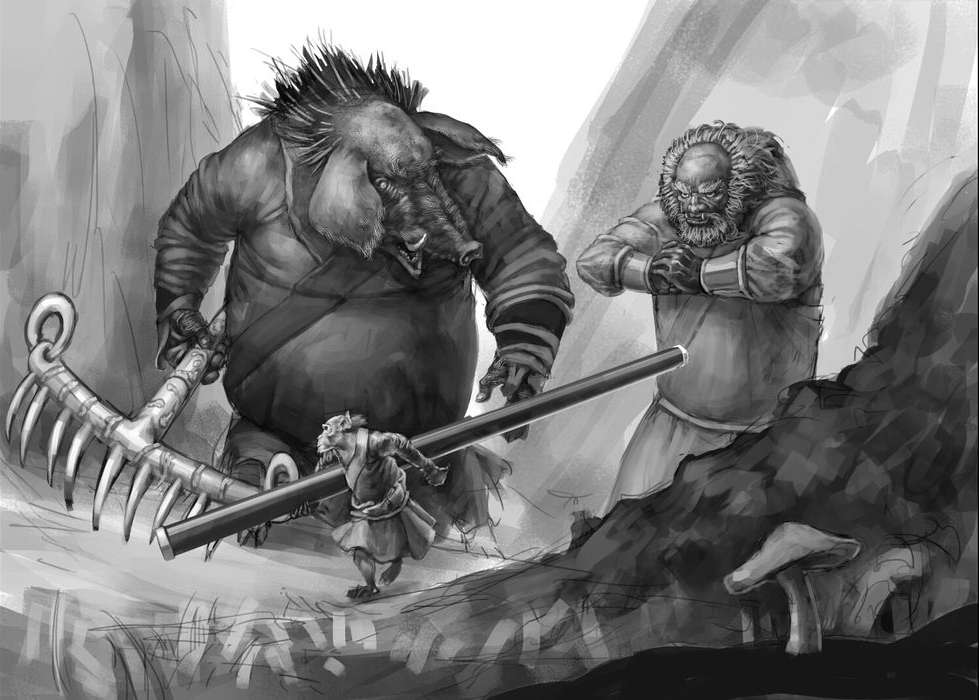
Fig. 1 – A novel accurate depiction of the Tang Monk’s disciples, including our hog hero (top left) (larger version). Artwork by @真·迪绝人 (see here and here).
1. The poems
The novel actually presents two contradictory verses on the origins of our beloved pig-monster. One (ch. 19) portrays him as a human-turned-immortal commander of heavenly forces, while the other (ch. 85) alludes to him being a powerful hog-spirit given celestial rank.
1.1. Chapter 19
This poem is chock-full of internal alchemical jargon, so I’m placing explanatory notes just below the blockquote to save readers from having to scroll to the very bottom of the article every time a new concept is mentioned.
My mind was dim since the time of youth; Always I loved my indolence and sloth. Neither nursing nature nor seeking the Real, I passed my days deluded and confused. I met a true immortal suddenly Who sat and spoke to me of cold and heat. [A] ‘Repent,’ he said, ‘and cease your worldly way: From taking life accrues a boundless curse. One day when the Great Limit ends your lot, For eight woes and three ways you’ll grieve too late!’ I listened and turned my will to mend my ways: I heard, repented, and sought the wondrous rune. By fate my teacher he became at once, Pointing to the Heavenly and Earthly Passes. [B] Taught to forge the Great PillNine Times Reversed, [C] I worked without pause through day and night To reach Mud-Pill Palace topping my skull [D] And Jetting-Spring Pointson soles of my feet. [E] With kidney brine flooding the Floral Pool, [F] My Cinnabar Field was thus warmly nursed. [G] Baby and Fair Girl mated as yin and yang; [H] Lead and mercury mixed as sun and moon. [I] In concord Li-dragon and Kan-tiger used, [J] The spirit turtle sucked dry the gold crow’s blood. [K] ‘Three flowers joined on top,’ the rootreclaimed [L]; ‘Five breaths faced their source’ and all freely flowed. [M] My merit done, I ascended on high, Met by pairs of immortals from the sky. Radiant pink clouds arose beneath my feet; With light, sound frame I faced the Golden Arch. The Jade Emperor gave a banquet for gods Who sat in rows according to their ranks. Made a marshal of the Celestial Stream, I took command of both sailors and ships. Because Queen Mother gave the Peaches Feast When she met her guests at the Jasper Pool My mind turned hazy for I got dead drunk, A shameless rowdy reeling left and right. Boldly I barged into Vast Cold Palace Where the charming fairy received me in. When I saw her face that would snare one’s soul, My carnal itch of old could not be stopped! Without regard for manners or for rank, I grabbed Miss Chang’e asking her to bed. For three or four times she rejected me: Hiding east and west, she was sore annoyed. My passion sky-high I roared like thunder, Almost toppling the arch of Heaven’s gate. Inspector General told the Emperor Jade; I was destined that day to meet my fate. The Vast Cold completely enclosed airtight Left me no way to run or to escape. Then I was caught by the various gods, Undaunted still, for wine was in my heart. Bound and taken to see the Emperor Jade, By law I should have been condemned to death. It was Venus the Gold Star, Mr. Li, Who left the ranks and knelt to beg for me. My punishment changed to two thousand blows, My flesh was torn; my bones did almost crack. Alive! I was banished from Heaven’s gate To make my home beneath the Fuling Mount. An errant womb’s my sinful destination: Stiff-Bristle Hog’s my worldly appellation!” (Wu & Yu, 2012, vol. 1, pp. 378-379).
A) “[C]old and heat,” (riyue, 日月; lit: “sun and moon”) refers to respective yang and yin energies (Pregadio, 2025p; see also Wu & Yu, 2012, vol. 1, p. 527 n. 2).
B) The original Chinese, “天關並地闕” (tianguan bing dique, or “heavenly passes and earthly watchtowers(?)”), is a likely typo for “天關並地關” (tianguan bing diguan, or “heavenly and earthly passes”). These respectively refer to the head and feet (Pregadio, 2025d, 2025s). I’ve therefore altered Yu’s (Wu & Yu, 2012) translation.
C) The “Great Pill [i.e. Elixir] Nine Times Reversed” (jiuzhuan da huandan, 九轉大還丹) was originally an external alchemical process where a concoction of toxic elements was purified over successive firings in a crucible to create a drug of immortality (see section 3.1. of this article). However, the term was coopted by later proponents of internal alchemy, who associated the ingestion and circulation of immortality-bestowing cosmic energies within pathways between bodily organs with a complex five phases-influenced numerology (Pregadio, 2025b, 2025n). Needham (1954, as cited in Wu & Yu, 2012) adds that it refers “to a chhi [qi, pneumatic vitality, breath] or substance generated by techniques purposefully within the human body which would bring about a reversion of the tissues from an ageing state to an infantile state” (vo. 1, p. 527 n. 4).
D) The “Mud-Pill Palace” (niwan gong, 泥丸宮) is a name for the upper cinnabar field in the head (Pregadio, 2025m; Wu & Yu, 2012, vol. 1, p. 528 n. 6).
E) The “Jetting-Spring Points” (yongquan xue, 湧泉穴) are pressure points on the bottom of the feet (Wu & Yu, 2012, vol. 1, p. 528 n. 7).
F) Yu (Wu & Yu, 2012) explains that spiritual energies contained in the kidneys (which are associated with the water element) can be directed to different parts of the practitioner’s body, including a spot under the tongue, the “Floral pool” (huachi, 華池) (vol. 1, p. 528 n. 8; see also Pregadio, 2025r). While this is no doubt the correct answer, it’s important to note that internal alchemy also uses the term Floral pool to refer to true yang energy inside yin (Pregadio, 2025h). The corresponding term is “spirit water” (shenshui, 神水), which denotes true yin energy inside yang—think of the white and black dots inside of the Taiji symbol (Pregadio, 2025h). Therefore, the poem’s original Chinese “腎水入華池” (shenshui ru huachi, or “kidney brine flooding the floral pool”) could also be a reference to the similarly-sounding phrase “神水入華池” (shenshui ru huachi, or “spirit water flooding the floral pool), or the mixture of yang and yin, respectively.
G) The “Cinnabar Field” (dantian, 丹田) is one of three spiritual centers in the body, which is located between 1.3 to 3.6 Chinese inches (cun, 寸; 1 = 1.25 in/3.18 cm) below (or behind) the belly button. The Cinnabar Field is believed to store cosmic/bodily energies, that when circulated and refined, produce an immortal alchemical embryo—i.e. a fledgling immortal spirit avatar (Pregadio, 2025c; see also Wu & Yu, 2012, vol. 1, p. 528 n. 9). And “warmly nursed” (bu de wenwen’re, 補得溫溫熱) may refer to “nourishing warmly” (wenyang, 溫養), or the process of “gestati[ng] the alchemical embryo” (Pregadio, 2025t).
H) The “Baby and Fair Girl” (ying’er chanu, 嬰兒姹女) are anthropomorphic personas of yang and yin energy, respectively (Pregadio, 2025a, 2025w; see also Wu & Yu, 2012, vol. 1, p. 528 n. 10).
I) The elemental and celestial imagery of “lead and mercury” (qian gong/hong, 鉛汞) and “sun and moon” (riyue, 日月) refer to yang and yin energies, respectively (Pregadio, 2025g, 2025o, 2025p).
J) The third eight trigram figure, Li (離/☲), is associated with dragons (long, 龍), and both symbolize yang energy. The sixth figure, Kan (坎/☵), is associated with tigers (hu, 虎), and both symbolize yin energy (fig. 2) (Pregadio, 2025j, 2025k, 2025l; see also Wu & Yu, 2012, vol. 1, p. 529 n. 11).
K) Yu (Wu & Yu, 2012) suggests that “turtle” (gui, 龜) “may be another name for the dark liquid of the kidneys” (vol. 1, p. 529 n. 12). He continues, “[T]he gold crow indicates the sun or the heart. The line refers to the union of yin and yang through the absorption of yang energy by yin” (Wu & Yu, 2012, vol. 1, p. 529 n. 12). While I agree that this refers to the mixing of said energies, it’s important to note, however, that turtles are usually paired with “snakes” (she, 蛇), both being anthropomorphic symbols of jing-essence and qi-breath (精氣), respectively (Pregadio, 2025f). Additionally, the “gold crow” (jinwu, 金烏), an anthropomorphic symbol of true yin inside yang energy, is normally paired with the “jade rabbit” (yutu, 玉兔), an anthropomorphic symbol of true yang inside yin (Pregadio, 2025i, 2025y). Similarly, “blood” (xue, 血) represents true yin inside of yang (Pregadio, 2025v).
L) The “Three flowers” (sanhua, 三花) is another name for jing-essence, qi-breath, and shen-spirit (精氣神), three important bio-spiritual substances/energies. These must be “joined on top” (juding, 聚頂), or concentrated in the head (the upper cinnabar field) during the internal alchemical process (Wu & Yu, 2012, vol. 1, p. 529 n. 13; see also Pregadio, 2025q). This leads to the “root [being] reclaimed” (guigen, 歸根), which refers to “[g]oing back to the root and returning to the mandate” (guigen fuming, 歸根復命), or achieving immortality (Pregadio, 2025e).
M) Yu (Wu & Yu, 2012) explains, “Five breaths … wuqi chaoyuan五氣朝元, refers to the pneumatic vitality, qi, of the five viscera (heart, liver, spleen, lungs, and kidneys) in harmonious balance” (Wu & Yu, 2012, vol. 1, p. 529 n. 14). A related view is that said viscera are synced with bio-spiritual substances or mental concepts—ie. hun/liver, jing-essence/kidneys, spirit/heart, po/lungs, intention/spleen—when a practitioner has learned to quiet their senses and still their body (Pregadio, 2025u).
Fig. 2 – An internal alchemy diagram of a Daoist cultivator circulating yang and yin energies, which are respectively represented by the eight trigrams figures ☲ (Li, 離) and ☵ (Kan, 坎) and the elements fire and water (larger version). Image found here. I believe it originally comes from the Anthology of Immortals of Complete Perfection (Quanzhen qunxian ji, 全真群仙集, 1483).
1.2. Explanation
Zhu was originally a lazy, aimless man, but he encountered a celestial who told him to mend his ways, or else he would be reborn in the lower three Buddhist realms of hell, hungry ghosts, or animals, making it impossible for him to hear the Buddha’s teachings (an example of the novel’s syncretic unity). Upon repenting, he studied under the immortal, learning the art of internal alchemy, which involved absorbing and circulating vital energies around his body. Once he had attained transcendence, he rose on clouds to be escorted by other celestials into the heavenly realm, where he was appointed marshal of the heavenly navy, which sailed the cosmic river of the Milky Way Galaxy.
But his great achievement was tainted when he got drunk at the Queen Mother’s peach banquet and, being aroused by Chang’e’s dazzling beauty (fig. 3), chased her to the moon palace. He propositioned the goddess for sex several times, but her refusals sent him into a powerful rage. The protector deity Wang Lingguan reported this to the Jade Emperor, who had the moon palace surrounded by heavenly soldiers. The Marshal was soon captured and sentenced to death, but the planet Venus asked for lenience, leading to Zhu’s past life being beaten 2,000 times and banished from the heavenly realm. His divine spirit sought reincarnation in the mortal realm below, but an accident of fate led to his rebirth as a pig-spirit. He later took the name “Stiff-Bristles Hog” (Zhu Ganglie, 豬剛鬣) based on his porcine appearance.
Fig. 3 – A Taiwanese stamp reading, “Drunkenly playing Chang’e” (Zuixi Change, 醉戲嫦娥) (larger version). It’s likely meant to serve as a visual reminder of Zhu’s early story arc involving the events leading to his banishment from heaven and rebirth as a hog-spirit.
1.3. Chapter 85
With huge mouth and fangs I’ve great magic might. Emperor Jade made me Marshal Heavenly Reeds. The boss of Heaven’s eighty-thousand marines, Comforts and joys I had in the halls of light. Because I mocked a palace maiden when I was drunk And flaunted my strength at a wrongful hour One shove of my snout toppled the Dipper–Ox Palace; Queen Mother’s divine herbs I then devoured Emperor Jade pounded me two thousand times And banished me from the Three Heavens realm. Though told to nourish my primal spirit, I became again a monster down below. About to marry at the Village Gao, I met Brother Sun—’twas my wretched fate! Quite defeated by his golden-hooped rod, I had to bow and take the Buddhist vow: A coolie who bears luggage and leads the horse, Who owes, in former life, the Tang Monk a debt! This iron-legged Heavenly Reed‘s name is Zhu; And my religious name is Zhu Eight Rules” (based on Wu & Yu, 2012, vol. 4, pp. 149-150).
He was originally a pig-spirit with sharp tusks and powerful magic (fig. 4) who was appointed Marshal Tianpeng, commander of the 80,000-strong celestial navy. He enjoyed his new life among the godly ranks but later got drunk (at the Queen Mother’s banquet) and performed a number of forbidden deeds: mistreating a moon goddess, knocking over the Dipper-Ox Palace, and eating the Queen mother’s magic mushrooms. This resulted in a punishment of 2,000 strokes and banishment from heaven, with the added instruction to cultivate his spirit while on earth. But he once again became a monster, and at some point, he took a wife in Gao Village. He was subsequently defeated by Monkey and forced to take the Buddhist vows, serving as Tripitaka’s disciple and luggage handler. His discipleship may have been the karmic result of a good deed that his master performed for him in a past life.
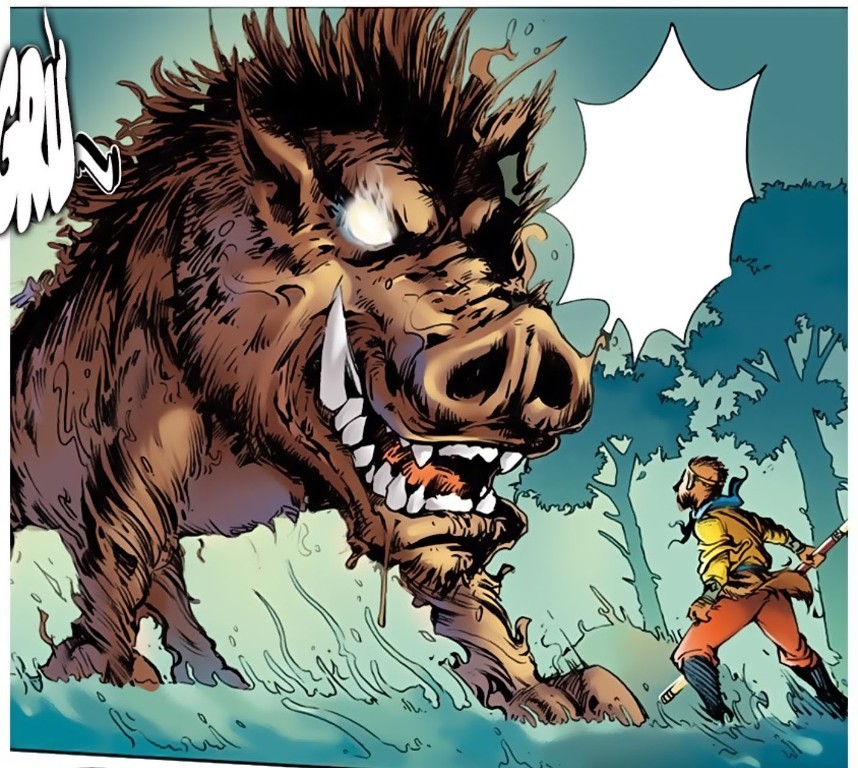
Fig. 4 – Zhu’s giant boar form from the manhuaJourney to the West (Xiyouji, 西遊記) (larger version).
2. Which is true?
Both poems provide certain information that is consistent with internal narrative details, such as:
Zhu originally serving as Marshal Heavenly Reed (Tianpeng yuanshuai, 天蓬元帥; lit: “Marshal of Heavenly Mugwort“), commander of the 80,000 soldiers of the celestial navy (and a historical deity) (fig. 5)
Getting drunk at the peach festival and harassing a moon goddess
Being beaten 2,000 times as punishment and exiled to the mortal world
Mistakenly being reborn as Stiff-Bristles Hog, a bloodthirsty pig-monster in Fuling Mountain (Fuling shan, 福陵山)
Eventually taking a wife in Gao Village (Gao zhuang, 高莊)
Being defeated by Sun Wukong
Becoming Zhu Bajie, a Buddhist disciple of Tripitaka
Acting as a coolie carrying the luggage
But the real question is: was Zhu originally human or a pig-spirit? I think the first poem is likely true (within the narrative) given the amount of detail that he provides about the alchemical processes that eventually led to his immortality and ascension to godhood. The second poem is cursory in comparison and seems like something that was made up on the spot to embellish his might—perhaps influenced by stories of Sun Wukong’s past havoc in heaven—or monstrous pedigree in the face of a demonic opponent (refer to the events in chapter 85). One detail pointing to this is his claim of knocking over the “Dipper-Ox Palace” (Douniu gong, 斗牛宮), which references the stars of the Southern Dipper and Ox mansions (Stephenson, 2008, p. 517). He’s therefore asserting that he can collapse entire constellations. That’s definitely nonsense as Zhu is often overpowered and defeated in battle, even by groups of little fiends (Wu & Yu, 2012, vol. 2, pp. 102-103, for example).
Fig. 5 – A historical painting of “Great Marshal Tianpeng” (Tianpeng da yuanshui, 天蓬大元帥) from the Ink Treasures of Wu Daozi (Daozi mobao, 道子墨寶, 13th-century), (larger version). Image altered for clarity.
3. Additional info
The poems actually leave out several details about Zhu’s past and current lives.
The Chang’e (嫦娥) mentioned above is not the singular goddess but one of many such named divine maidens in the entourage of the “Star Lord of Supreme Yin” (Taiyin xingjun, 太陰星君), the aged devi of the moon. [1]
He mauled his sow mother and piglet siblings to death sometime after his mistaken rebirth in Fuling Mountain (Wu & Yu, 2012, vol. 1, p. 212).
His first wife, “Second Elder Sister Mao” (Mao erjie, 夘二姐), [2] a likely rabbit spirit, [3] was the original owner of his Cloudy Paths Cave (Yunzhan dong, 雲棧洞) (Wu & Yu, 2012, vol. 1, p. 212). But sadly, she died less than a year after their marriage (Wu & Yu, 2012, vol. 1, p. 212). Their tragic love story would be good fodder for fanfiction.
He was invited by the Crow’s Nest Chan Master (Wuchao chanshi, 烏巢禪師), a Buddhist sage, to practice austerities, but he passed on the opportunity.
Years prior to being called Zhu Bajie, he submitted to Buddhism at the behest of the bodhisattva Guanyin and was given the religious name “Zhu Wuneng” (豬悟能, “Pig Who Awakens to Power”) (Wu & Yu, 2012, vol. 1, p. 213).
Sometime after adopting a vegetarian diet, [4] he magically transformed into a “stout, swarthy [human] fellow” (hei pang han, 黑胖漢) in order to fraudulently arrange a marriage with his second wife, “Green Orchid” (Cui’lan, 翠蘭), a maiden from Gao Village in Tibet (Wusizang, 烏斯藏) (Wu & Yu, 2012, vol. 1, p. 372). [5]
The Gao family grew rich from his supernatural labors in the field (Wu & Yu, 2012, vol. 1, pp. 375 and 381).
But he was abusive to his wife, locking her inside a back building and not allowing her to see her family for half a year (Wu & Yu, 2012, vol. 1, p. 372).
Monkey tricked Zhu by magically taking his wife’s form and hiding in a dark room (fig. 6), [6] but he later overpowered the hog-spirit in combat (Wu & Yu, 2012, vol. 1, p. 380). Zhu eventually submitted when he learned Sun was escorting the scripture pilgrim to India (Wu & Yu, 2012, vol. 1, p. 384).
Lastly, I would like to suggest that the immortal teacher of Zhu’s past life also taught him divine military arts—like Master Ghost Valley taught Sun Bin in vernacular fiction—because why else would a random person be given command of the entire heavenly navy? I headcanon that he was once a brilliant military strategist and commander, but his mistaken reincarnation as a hog made him very dim and lazy.
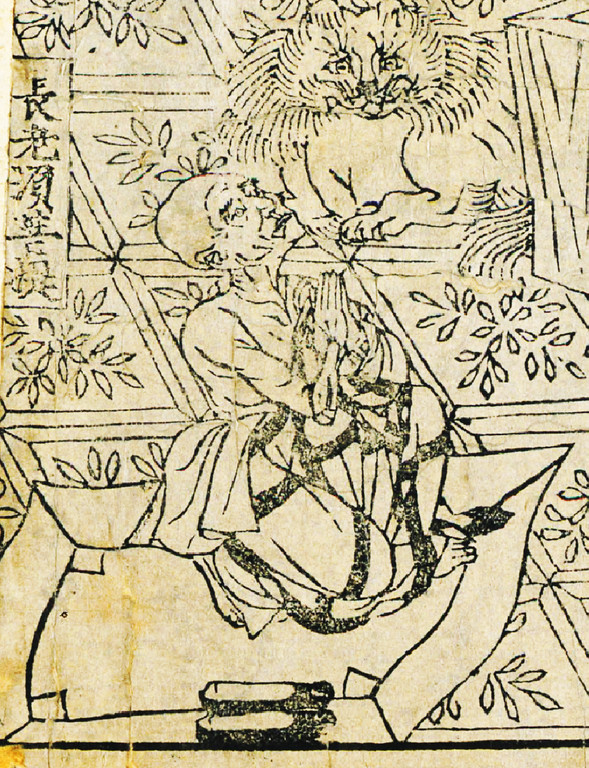
Fig. 6 – A woodblock print from the original 1592 edition of JTTW reading, “The fake Green Orchid outsmarts Stiff-Bristles Hog” (Jia Cui’lan zhinong Zhu Ganglie, 假翠蘭智㺯(弄)豬剛鬣) (larger version). See page 228 of the linked PDF. I’m intrigued by the pig-spirit’s failed human transformation.
Update: 03-04-25
Friend of the blog NingadudeXx has drawn a picture of Zhu Bajie as his past life, Marshal Tianpeng (fig. 7), based on the god’s historical iconography (refer back to fig. 5).
Fig. 7 – Zhu Bajie as Marshal Tianpeng (larger version).
Update: 04-09-25
I forgot to mention that Zhu has some medical knowledge. In chapter 41, for example, he performs life-saving massage to resuscitate a dead Sun Wukong:
With a chuckle, Eight Rules [Zhu Bajie] said, “Brother, stop crying. This ape is pretending to be dead, just to scare us. Feel him a little and see if there’s any warmth left in his breast.” “The whole body has turned cold,” said Sha Monk [Sha Wujing]. “Even if there were a little warmth left, how could you revive him?” Eight Rules said, “If he is capable of seventy-two transformations, he has seventy-two lives. Listen, you stretch out his legs while I take care of him.” Sha Monk indeed straightened Pilgrim’s legs while Eight Rules lifted his head and straightened his upper torso. They then pushed his legs up and folded them around the knees before raising him into a sitting position. Rubbing his hands together until they were warm, Eight Rules covered Pilgrim’s seven apertures and began to apply a Chan method [anmo chanfa, 按摩禪法] of massage on him (emphasis added). The cold water, you see, had had such a traumatic effect on Pilgrim that his breath was caught in his cinnabar field and he could not utter a sound. He was lucky, therefore, to have all that rubbing, squeezing, and kneading by Eight Rules, for in a moment his breath went through the three passes, invaded the bright hall, and burst through his apertures. and burst through his apertures. “O Master,” he [Monkey] began to say (Wu & Yu, 2012, vol. 2, p. 232).
Also, in chapter 69, he argues with Wukong about the attributes and usages of a medicinal ingredient:
“The flavour of badou [巴豆],” said Eight Rules, “is slightly acrid; its nature is hot and poisonous. Able to pare down the hard and the accumulated, it will therefore sweep out the submerged chills of one’s internal cavities. Able to bore through clottings and impediments, it will therefore facilitate the paths of water and grain. This is a warrior who can break down doors and passes, and it should be used lightly” (Wu & Yu, 2012, vol. 3, p. 274).
This might suggest that Bajie also learned these skills from his immortal master.
Endnotes:
1) Chapter 95 explains that the seemingly singular goddess Chang’e is actually a collective, and also that one of them was the maiden that Zhu’s former life had harassed in the past:
As they stared into the sky, they heard the Great Sage Sun crying out in a loud voice: “Your Majesty of India, please ask your queen and concubines to come out and look. Beneath this treasure canopy is the Star Lord of Supreme Yin of the Moon Palace, and the immortal sisters on both sides of her* are the Chang’e goddesses inside the moon (emphasis added). This little jade hare is the false princess of your household; she has now revealed her true form.”
The king hurriedly assembled the queen, his concubines, the palace maidens, and gaily-attired girls to bow to the sky and worship. He himself and the Tang Monk also expressed their thanks toward the sky by bowing low. All the households in the city also set up incense tables and kowtowed, chanting the name of Buddha.
As they looked up into the air, Zhu Eight Rules was moved to lust.Unable to contain himself, he leaped into the air and embraced a rainbow-skirted immortal, crying, “Sister, you and I are old acquaintances! Let’s go play!” (emphasis added) (based on Wu & Yu, 2012, vol. 4, p. 303).
* Yu (Wu & Yu, 2012) calls the Star Lord of Supreme Yin “him” in his original translation (vol. 4, p. 303), but the deity has been portrayed as a woman for centuries. See, for instance, her depiction (2nd from the top left) in the Ink Treasures of Wu Daozi (Daozi mobao, 道子墨寶, 13th-century).
2) Yu (Wu & Yu, 2012) translates her name as “Second Elder Sister Egg” (Luan erjie, 卵二姐)” (vol. 1, p. 212). But this is based on a transcription error—i.e. 夘 (Mao; original edition) vs 卵 (Luan; modern edition).
3) The relationship of Zhu and Second Elder Sister Mao references the synergy between the elemental and animal aspects of the 12 earthly branches—i.e. Mao (夘; yin wood/rabbit) and Hai (亥; yang wood/pig) complete each other.
4) His vegetarian diet is mentioned in chapters 18 and 19 (Wu & Yu, 2012, vol. 1, pp. 372, 384, and 386).
5) Yu (Wu & Yu, 2012) translates “烏斯藏” (Wusizang), the location of Gao village, as the “Kingdom of Qoco” (Wu & Yu, 2012, vol. 1, p. 369). However, this phrase actually refers to Dbus-gtsang, or Tibet (Zhang, 2023, pp. 32-33; Wilkinson, 2000, p. 728).
6) I’ve previously suggested that this episode was influenced by a scene from chapter five of the Water Margin (Shuihu zhuan, 水滸傳, c. 1400). Both feature:
Young, beautiful daughters in unwanted relationships (Green Orchid vs the unnamed maiden).
Elderly fathers worried for their child (Mr. Gao vs Mr. Liu).
Evil spirit-turned-inhumanly strong, hot-tempered, heavy metal staff-wielding martial monks who come to their aid (Sun Wukong vs Lu Zhishen).
The monk takes the place of the woman in a darkened room.
The villain is beaten (Zhu Bajie vs Zhou Tong) (Wu & Yu, 2012, vol. 1, pp. 374-377; Shi & Luo, 1993/2021, pp. 109-113).
Sources:
Pregadio, F. (2025a). cha nü 姹女 (chanü). In Dictionary of Taoist Internal Alchemy (pp. 19-20). Leiden: Brill.
Pregadio, F. (2025b). da huan dan 大還丹 (da huandan). In Dictionary of Taoist Internal Alchemy (pp. 32-33). Leiden: Brill.
Pregadio, F. (2025c). dan tian 丹田 (dantian). In Dictionary of Taoist Internal Alchemy (pp. 38-39). Leiden: Brill.
Pregadio, F. (2025d). di guan 地關 (diguan). In Dictionary of Taoist Internal Alchemy (p. 45). Leiden: Brill.
Pregadio, F. (2025e). gui gen fu ming 歸根復命 (guigen fuming). In Dictionary of Taoist Internal Alchemy (p. 78). Leiden: Brill.
Pregadio, F. (2025f). gui she 龜蛇 (guishe). In Dictionary of Taoist Internal Alchemy (p. 78). Leiden: Brill.
Pregadio, F. (2025g). hong 汞. In Dictionary of Taoist Internal Alchemy (p. 86). Leiden: Brill.
Pregadio, F. (2025h). hua chi shen shui 華池神水 (huachi shenshui). In Dictionary of Taoist Internal Alchemy (p. 90). Leiden: Brill.
Pregadio, F. (2025i). jin wu 金烏 (jinwu). In Dictionary of Taoist Internal Alchemy (pp. 124-125). Leiden: Brill.
Pregadio, F. (2025j). kan 坎. In Dictionary of Taoist Internal Alchemy (p. 134). Leiden: Brill.
Pregadio, F. (2025k). li 離. In Dictionary of Taoist Internal Alchemy (pp. 142-143). Leiden: Brill.
Pregadio, F. (2025l). long hu 龍虎 (longhu). In Dictionary of Taoist Internal Alchemy (pp. 154-156). Leiden: Brill.
Pregadio, F. (2025m). ni wan gong 泥丸宮 (niwan gong). In Dictionary of Taoist Internal Alchemy (p. 174). Leiden: Brill.
Pregadio, F. (2025n). qi fan jiu huan 七返九還 (qifan jiuhuan). In Dictionary of Taoist Internal Alchemy (pp. 183-184). Leiden: Brill.
Pregadio, F. (2025o). qian 鉛. In Dictionary of Taoist Internal Alchemy (p. 188). Leiden: Brill.
Pregadio, F. (2025p). ri yue 日月 (riyue). In Dictionary of Taoist Internal Alchemy (pp. 202-203). Leiden: Brill.
Pregadio, F. (2025q). san hua ju ding 三花聚頂 (sanhua juding). In Dictionary of Taoist Internal Alchemy (p. 214). Leiden: Brill.
Pregadio, F. (2025r). shen 腎. In Dictionary of Taoist Internal Alchemy (pp. 230-231). Leiden: Brill.
Pregadio, F. (2025s). tian guan 天關 (tianguan). In Dictionary of Taoist Internal Alchemy (p. 262). Leiden: Brill.
Pregadio, F. (2025t). wen yang 溫養 (wenyang). In Dictionary of Taoist Internal Alchemy (p. 276). Leiden: Brill.
Pregadio, F. (2025u). wu qi chao yuan 五氣朝元 (wuqi chaoyuan). In Dictionary of Taoist Internal Alchemy (pp. 282-283). Leiden: Brill.
Pregadio, F. (2025v). xue 血. In Dictionary of Taoist Internal Alchemy (pp. 321-322). Leiden: Brill.
Pregadio, F. (2025w). ying er 嬰兒 (ying’er) (1). In Dictionary of Taoist Internal Alchemy (pp. 341-342). Leiden: Brill.
Pregadio, F. (2025x). ying er 嬰兒 (ying’er) (2). In Dictionary of Taoist Internal Alchemy (p. 342). Leiden: Brill.
Pregadio, F. (2025y). yu tu 玉兔 (yutu). In Dictionary of Taoist Internal Alchemy (p. 346). Leiden: Brill.
Shi, N., & Luo, G. (2021). Outlaws of the Marsh (Vols. 1-4) (S. Shapiro, Trans.). Beijing: Foreign Languages Press. (Original work published 1993)
Stephenson, F. R. (2008). Lunar Mansions in Chinese Astronomy. In H. Selin (Ed.), Encyclopaedia of the History of Science, Technology, and Medicine in Non-Western Cultures (pp. 516-518) (2nd ed.). Netherlands: Kluwer Academic Publishers.
Wilkinson, E. P. (2000). Chinese History: A Manual. United Kingdom: Harvard University Asia Center.
Wu, C., & Yu, A. C. (2012). The Journey to the West (Vols. 1-4) (Rev. ed.). Chicago, Illinois: University of Chicago Press.
Zhang, F. (2023). The Eastern Land and the Western Heaven: Qing Cosmopolitanism and Its Translation in Tibet in the Eighteenth Century. United Kingdom: Taylor & Francis.
Plucking a handful of hairs from his own body and throwing them into his mouth, he chewed them to tiny pieces and then spat them into the air. “Change!” he cried, and they changed at once into two or three hundred little monkeys encircling the combatants on all sides. For you see, when someone acquires the body of an immortal, he can project his spirit, change his form, and perform all kinds of wonders. Since the Monkey King had become accomplished in the Way, every one of the eighty-four thousand hairs on his body could change into whatever shape or substance he desired (Wu & Yu, 2012, vol. 1, p. 129).
This tactic of transforming chewed up hairs into dozens, hundreds, or even thousands of monkey clones also appears in chapters 3, 5, 21, 35,44, 86, and 90 (A & B) (Wu & Yu, 2012, vol. 1, pp. 132, 165, 172, & 409; vol. 2, pp. 138 & 277; vol. 3, p. 332; vol. 4, pp. 164-165, 168, 219, & 221). But these chewed up hairs can also be transformed into other objects, such as sleep-inducing bugs in chapters 5 and 86, as well as seven kinds of hawks in chapter 72 (Wu & Yu, 2012, vol. 1, p. 165; vol. 3, p. 332; vol. 4, p. 168).
But the novel states that Monkey sometimes changes his hair by first blowing on it with his magic “immortal breath” (xianqi, 仙氣). This article will provide a brief survey of this skill and its abilities.
Yellow-gold rope to replace a magical weapon of the same name (ch. 34) (Wu & Yu, 2012, vol. 2, p. 130).
Gold-plated, red lacquered box to hold a white jade token (ch. 37) (Wu & Yu, 2012, vol. 2, p. 169).
Wrapper to infiltrate a demon’s lair (ch. 41) (Wu & Yu, 2012, vol. 2, pp. 235-236).
Yellow hound to carry away a bogus immortal’s decapitated head (ch. 46) (Wu & Yu, 2012, vol. 2, p. 308).
Hungry hawk to eat a bogus immortal’s entrails (ch. 46) (Wu & Yu, 2012, vol. 2, p. 310).
Group of 30 tigers to scare away monks (ch. 64) (Wu & Yu, 2012, vol. 3, p. 194).
Sleep-inducing insects and lice, fleas, and bedbugs (ch. 71 (A & B) & 84) (Wu & Yu, 2012, vol. 3, pp. 303 & 304; vol. 4, p. 139).
Gold-headed fly to scare a demon king (ch. 75) (Wu & Yu, 2012, vol. 3, p. 366).
Bow drill (comprised of a diamond bit, a bamboo strip, and a cotton string) to drill out of a dangerous magic treasure (ch. 75) (Wu & Yu, 2012, vol. 3, p. 369).
Very thin but long rope to climb out of a monster’s stomach (ch. 76) (Wu & Yu, 2012, vol. 4, p. 3).
Thirty ropes for tying up bandits (ch. 97) (Wu & Yu, 2012, vol. 4, p. 328).
It should be noted, however, that the novel is very inconsistent regarding this ability. The immortal breath is not always used; Sun often just commands the hair to transform or changes it without saying anything, such as in chapters 4, 33, 34 (A, B, & C), 42, 46, 49, 51, 59, 65, 68, 71, and 74 (Wu & Yu, 2012, vol. 1, p. 156; vol. 2, p. 115, 124-125, 237, 301, 305, & 345-346; vol. 3, p. 13, 120, 216, 269, 305, & 358). The “chewing” and “spitting out” of the hair is another example (see above). But one might argue that spitting requires a build of air in the lungs, so by extension, the immortal breath is being used.
This inconsistency is probably due to the standard 1592 edition of Journey to the West coalescing from independent oral stories developed and told over the centuries (see the late-13th-century version of the story, for example). Therefore, some story tellers likely employed the immortal breath, while others did not.
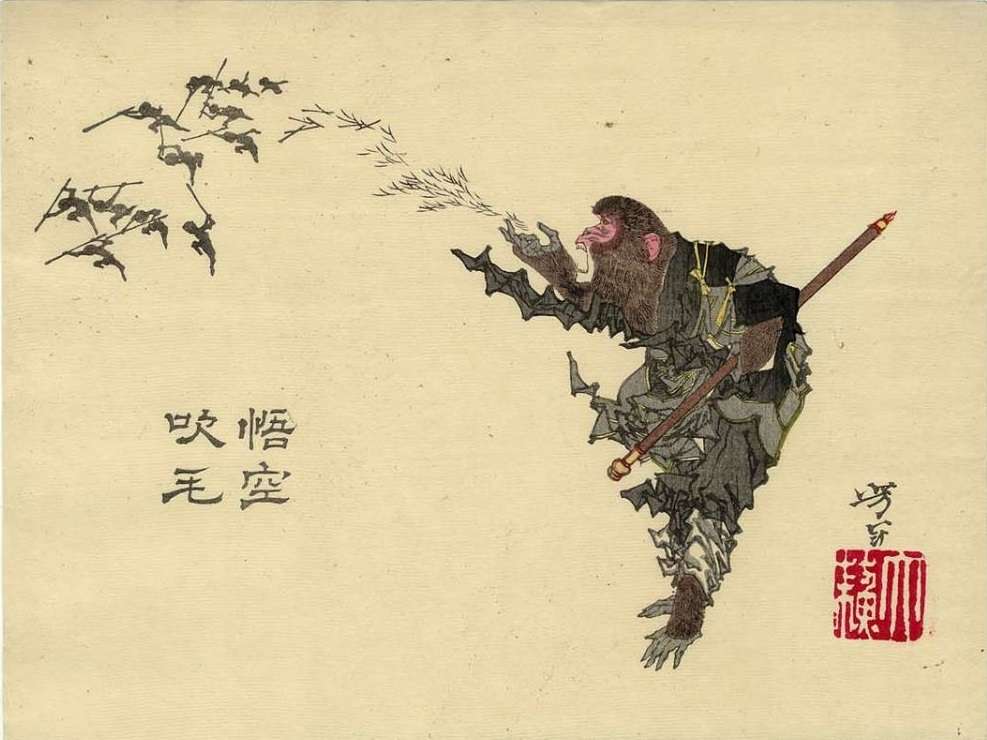
Fig. 1 – “Wukong Blows His Hair” (c. 1882) by Yoshitoshi (larger version).
2. Staff
This immortal breath is also shown capable of transforming the magic iron staff (fig. 2).
Steel file to file through a magic golden ring pinning Monkey’s neck to a column (ch. 34) (Wu & Yu, 2012, vol. 2, p. 129).
Razor to mutilate two lesser demons (ch. 63) (Wu & Yu, 2012, vol. 3, p. 180).
Flag pole to make a pair of magic cymbals stand upright (ch. 65) (Wu & Yu, 2012, vol. 3, p. 216).
Seventy forked weapons to cut the threads of supernatural spider webs (ch. 73) (Wu & Yu, 2012, vol. 3, p. 340).
Nail to prop open a demon’s mouth while Monkey climbs out of their stomach (ch. 83) (Wu & Yu, 2012, vol. 4, p. 113).
Three-pointed drill to make a covert hole in a wardrobe (ch. 84) (Wu & Yu, 2012, vol. 4, p. 139).
As noted above, the novel is inconsistent in this regard. For instance, Monkey changes the staff into a steel drill without blowing on it in chapter 65 (Wu & Yu, 2012, vol. 3, p. 218). Likewise, no breath is used in chapters 46 and 84 when Sun transforms the weapon into razors for shaving heads (Wu & Yu, 2012, vol. 2, p. 305; vol. 4, p. 139).
Monkey can also transform items not in contact with his body.
3.1. Clothing Color
For instance, in chapter 46, he changes a Daoist lad’s clothing from a spring onion white robe into a brown monk’s robe (Wu & Yu, 2012, vol. 2, p. 305).
3.2. Likeness
In chapter 78, Sun transforms Tripitaka into his likeness using a mask made from mud:
Pilgrim, too, had little alternative but to flatten the mud and press it on his own face and, after a little while, succeeded in making an apelike mask. Asking the Tang Monk to stand up but without uttering another word, Pilgrim pasted the mask on his master’s face and recited a magic spell. He then blew his immortal breath onto the mask, crying, “Change!” At once the elder took on the appearance of Pilgrim. He was told to take off his own garments and switch clothes with Pilgrim, who made the magic sign and then recited another spell to change into the form of the Tang Monk (Wu & Yu, 2012, vol. 4, p. 47).
Again, the novel is inconsistent regarding external objects. Sometimes Monkey bights his tongue and spits blood out to change said item, such as in chapter 25 (A & B) (Wu & Yu, 2012, vol. 1, pp. 474-475 & 477; vol. 2, p. 303). [1-2] But, again, one could argue that the immortal breath is used as spitting requires a build-up of air in the lungs.
4. Special Abilities
The immortal breath (fig. 3) is also shown to have other special abilities.
4.1. Healing
For instance, in chapter 46, Monkey uses it to heal a gaping wound in his stomach:
With a swagger, Pilgrim walked down to the execution site. Leaning himself on a huge pillar, he untied his robe and revealed his stomach. The executioner used a rope and tied his neck to the pillar; down below, another rope strapped his two legs also to the pillar. Then he wielded a sharp dagger and ripped Pilgrim’s chest downward, all the way to his lower abdomen. Pilgrim used both his hands to push open his belly, and then he took out his intestines, which he examined one by one. After a long pause, he put them back inside, coil for coil exactly as before. Grasping the skins of his belly and bringing them together with his hands, he blew his magic breath on his abdomen, crying, “Grow!” At once his belly closed up completely (Wu & Yu, 2012, vol. 2, p. 309).
The novel implies that Sun’s immortal breath also has the ability to manipulate souls. For example, in chapter 88, Sun uses it in an arcane ritual designed to bestow three human disciples with super human strength. The pertinent section reads:
In a secluded room behind the Gauze-Drying Pavilion, Pilgrim traced out on the ground a diagram of the Big Dipper. Then he asked the three princes to prostrate themselves inside the diagram and, with eyes closed, exercise the utmost concentration. Behind them he himself recited in silence the true sayings of realized immortality and intoned the words of Dharani as he blew divine breaths into their visceral cavities. Their primordial spirits [yuanshen, 元神] were thus restored to their original abodes …
The term “primordial spirits” (yuanshen, 元神) is commonly associated with Buddhahood or enlightenment. In Daoism, it is synonymous with the attainment of immortality via the formation of a “Sacred Embryo” (shengtai, 聖胎), which is forged from spiritual energies over long years of self-cultivation (Darga, 2008). This suggests that Monkey’s immortal breath also grants the disciples some form of immortality. You can read about the entire ritual here.
Fig. 3 – A vapor blowing smoke (larger version). I imagine this is what the immortal breath would look like. Image found here. Photographer unknown.
And in chapter 97, Sun uses the immortal breath to transform an old man’s soul into “ether” for easy transport back to the world of the living:
Pilgrim changed the soul of the squire into ether [qi, 氣] by blowing on him. The ether was stored in his sleeve so that they could leave [Hell] and go back to the world of light together. Astride the clouds, he soon arrived at the Kou house. Eight Rules [Zhu Bajie] was told to pry open the lid of the coffin, and the soul of the squire was pushed into his body. In a moment, he began to breathe once more and revived (Wu & Yu, 2012, vol. 4, p. 339).
The phrase “immortal breath” (xianqi, 仙氣) is missing in the original Chinese, but the ability’s use is understood as the passage mentions Monkey “blowing” (chui, 吹) on the soul.
V. Conclusion
Various chapters of Journey to the West show that Sun Wukong can use his immortal breath to transform his hair, his magic staff, and items not directly in contact with his body into anything he desires. These range from utilitarian items like files, blades, drills, and ropes to living creatures like insects, birds of prey, dogs, tigers, lesser demons, and even independent copies of himself. It can also change the color and appearance of clothing, as well as magically disguise someone when used in tandem with a mud mask. The skill’s special abilities include healing and soul manipulation. Evidence suggests that it can restore the “primordial spirit,” granting superhuman strength and some form of immortality, as well as transform souls into “ether” for better ease of transport.
The immortal breath, however, is not used consistently throughout the novel. Monkey sometimes chews up and spits out the hair, commands it to change, or simply transforms it without saying anything at all. This inconsistency is likely due to the novel coalescing from independent oral stories developed and told over the centuries.
Notes:
1) Thank you to Irwen Wong for reminding me of this.
If you were to ask someone to name Sun Wukong‘s master, those familiar with Journey to the West (Xiyouji, 西遊記, 1592; “JTTW” hereafter) would probably say Tang Tripitaka (Tang Sanzang, 唐三藏). But many forget that the cleric is actually his second master. His first, the Patriarch Subodhi (Xuputi zushi, 須菩提祖師; a.k.a. “Patriarch Puti / Bodhi,” Puti zushi, 菩提祖師), is rarely brought up in conversation, but this wise old man and elderly martial arts master archetype is the source of the Monkey King’s divine longevity, magical skills, and fighting prowess. He, therefore, deserves his own article. I’ve already written several pieces mentioning him, so I’ve decided to combine everything (including new material) onto a single page.
This article describes his origins, story in the novel, and description; the location, description, and meaning of the name of his mountain home; his school uniform; how he names his students and why the Monkey King is called Sun Wukong; his religious, magical, and martial arts curriculum, including tests of spiritual intelligence; and his spiritual powers. Despite his common portrayal as a Daoist immortal (xian, 仙), the novel stresses a connection to Buddhism. I ultimately suggest that the Patriarch Subodhi is a bodhisattva (pusa, 菩薩), albeit one with Daoist leanings.
Subodhi is based on Subhūti (Xuputi, 須扶提 / 須浮帝 / 蘇補底 / 蘇部底) (fig. 1), [1] one of the ten principal disciples of the Gautama Buddha. He plays an understated role in the original Pāli canon of Theravāda Buddhism, being recognized by the Buddha as the most accomplished in meditating on the concept of “loving-kindness” (Pāli: Metta; Sanskrit: Maitri), or wishing for the happiness of others (Buswell & Lopez, 2014, pp. 861-862; Osto, 2016, pp. 126-127). On the contrary, Subhūti plays a much larger role in Prajñāpāramitā texts of Mahāyāna Buddhism in which he is famed for contemplating “emptiness” (Pāli: suññatā; Sk: śūnyatā; Ch: kong, 空), a subject with textual interpretations ranging from ridding oneself of sexual desires to realizing the truth of the illusionary nature of Saṃsāra (Buswell & Lopez, 2014, pp. 872; Osto, 2016, p. 126). Because of this, he is also known in Chinese as the “One who expounded vacuity [emptiness]” (Kongsheng, 空生) (Soothill & Hodous, 1937/2014, p. 277). In fact, Osto (2016) suggests that Subhūti was secretly a bodhisattva, reasoning: “How else would he have the necessary insight to understand the profound and paradoxical philosophy of emptiness (śūnyatā) as it is found in these texts?” (p. 128). [2]
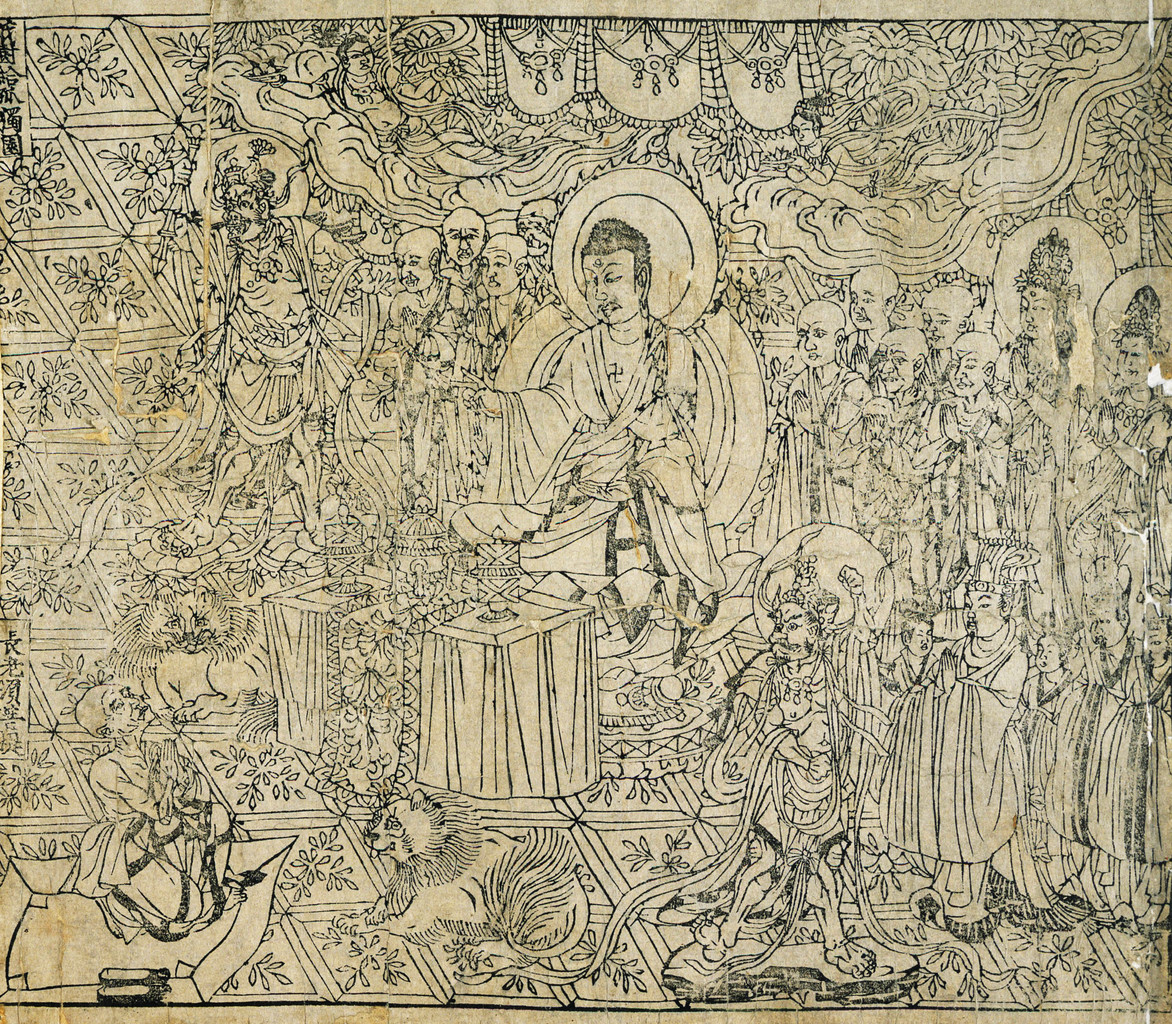
Fig. 1 – A detail of Subhūti from a woodblock frontispiece appearing in an 868 CE copy of the Diamond Sutra (larger version). This document is the oldest known dated printed book in the world (full woodblock).
Shao (2006) suggests that Subodhi was modeled on the historical disciple “to evoke a scriptural tradition that identifies Subhūti as the Buddhist at his best, one having the spiritual and intuitive approximation to ’emptiness’ … that the Chan [Zen] Buddhists value tremendously” (p. 723). He continues:
Is it then possible that what the novelist tried to highlight with Subhūti’s name was his reputation as the epitome of emptiness? We can certainly find ample textual evidence to support this line of thinking. Although Monkey’s Taoist realization is worthy of heaven, his Buddhist given name Wukong, or Awaken to Emptiness, obviously represents Subhūti’s Buddhist heritage, for the name is exactly what distinguishes Subhūti in the Buddhist tradition. What gives proof of the power and vitality of this bequest is the fact that “emptiness” constitutes the core of Monkey’s religious being (Shao, 2006, p. 724).
It should be noted that the complete Chinese name Xuputi (須菩提) is only used once in the novel to refer to the Patriarch (see here), while Puti (菩提) is used at least three times (see here). This is interesting as the latter term is a transliteration of bodhi (Pāli & Sk: “awakening” or “enlightenment”), an important concept in Buddhism in which one discovers the Four Noble Truths, thereby achieving enlightenment and freeing themself from the cycle of rebirth (Buswell & Lopez, 2014, p. 129). Therefore, the novel positions the Patriarch as a means to or even embodiment of enlightenment. This is fitting given Osto’s (2016) suggestion above that the historical Subhūti was a bodhisattva, “a ‘being’ (sattva) intent on awakening (bodhi) who has aroused the aspiration to achieve buddhahood” (Buswell & Lopez, 2014, p. 129). More on this below.
2. The Literary Teacher
2.1. His Story
Subodhi is introduced by name in JTTW chapter one when a woodcutter tells the Monkey King about the sage and the location of his mountain home. He learns that the Patriarch “has already sent out innumerable disciples” and that at present “there are thirty or forty persons who are practicing austerities with him” (Wu & Yu, 2012, vol. 1, p. 112). After a quick exchange with an immortal lad at the front door, the Stone Monkey is led to a hall where Subodhi is lecturing to a group of “lesser immortals” (xiaoxian, 小仙). The Patriarch asks for his name and the location of his home but becomes upset as he believes Monkey is lying about his ten year journey from afar. However, after being assured of the truth and hearing of the miraculous stone birth, Subodhi officially accepts the primate as a disciple, giving him the religious name Sun Wukong (孫悟空, “Monkey Awakened to Emptiness”).
In the opening of JTTW chapter two, the Patriarch has his immortal students tutor Monkey in menial tasks like fetching firewood and water, tending the garden, and cleaning the monastery grounds, as well as provide lessons on human language and etiquette, calligraphy, scripture reading, and minor ritual procedures like incense burning. Seven years later, Subodhi notices Sun jumping around in excitement as the primate listens to his lecture. He thereafter offers to teach Monkey a number of skills, but the latter refuses multiple times since they won’t lead to immortality. This rejection makes the Patriarch visually upset, leading him to strike Sun on the head three times with a ruler and then walk away with his hands behind his back. His senior religious brothers chastise him for angering their master, but due to his spiritual intelligence, Sun realizes that the admonishment was really secret code. He later enters Subodhi’s room at the third watch (three hits) using a back door (hands behind back), and it is there where the teacher reveals the secret of immortality in a flowery poem.
After Monkey successfully attains eternal life three years later, the Patriarch teaches him the 72 transformations in order to hide from three heaven-sent elemental attacks slated to destroy him. In addition, he teaches the cloud-somersault, a method of super fast flight. Sun’s religious brothers are amazed at his attainments and request that he display his power of transformation by changing into a pine tree. The resulting applause disturbs Subodhi, who sends the others away before reprimanding and expelling his disciple under the pretense of saving Monkey’s life from those who would harm him to learn his heavenly secrets. But before Sun has a chance to leave, his master threatens him with everlasting torment in the underworld if he ever reveals that the Patriarch had been his tutor. Monkey promises never to speak his name. This is the last time that Subodhi is seen in the story, but he is referenced two more times in later chapters (see section 3.4 below).
2.2. Allusions to Historical Buddhist Masters
Shao (1997) writes that Subodhi hitting Monkey on the head three times—a coded message for receiving secret teachings in the Master’s room at the third watch—is likely based on two episodes from the life of Huineng (惠能, 638-713), the Sixth Chan (Zen) Patriarch:
According to [the Platform Sutra], Huineng was pounding grain when Hongren [the 5th Chan Patriarch] came in, “hit on the mortar three times with his stick and then left” (以杖击碓三下而去). The non-verbal message occurred to the young man as a piece of intuition. By the third watch he arrived dutifully at the master’s chamber where Hongren passed the secret Dharma by way of enlightening him on [the Diamond Sutra], behind a raised cassock used to protect them from the intrusion of prying eyes. The other source is Caoxi dashi biezhuan曹溪大师别传 (An Alternative Biography of the Great Master From Caoxi) in which Huineng hit Shenhui … a few times, seemingly annoyed by the insolence of his disciple’s clever repartee. But it was to none other than Shenhui that he imparted the secret Dharma—in the middle of the night, and with a similar group of dumb disciples who had seen nothing but impudence in Shenhui (pp. 60-61).
The allusion to Hongren and his use of the Diamond Sutra is apt as the historical Subhūti plays a large part in the scripture. His questions fuel the lesson, with the “Buddha’s reply constitut[ing] the body of the sutra” (Watson, 2010, p. 72).
Therefore, the aforementioned episodes associate the Patriarch with two enlightened Chan masters and their secret, unorthodox transmission of the Dharma, supporting his connection to Buddhism.
The novel includes a third allusion to Huineng. This will be discussed in section 4.3 below.
2.3. His Description
The novel never gives an overt description of Subodhi’s features or dress. This ambiguity makes him a blank slate onto which anyone’s personal vision can be written. But there are a few references to his stately, awe-inspiring presence. A poem in chapter one reads:
A Golden Immortal of Great Awareness and of great ken and purest mien,
Master Bodhi, whose wondrous appearance like the West
Had no end or birth by work of the Double Three.
His whole spirit and breath were with mercy filled.
Empty, spontaneous, it could change at will,
His Buddha-nature able to do all things.
The same age as Heaven had his majestic frame.
Fully tried and enlightened was this grand priest (Wu & Yu, 2012, vol. 1, p. 114). [4]
Numerous elements from this poem require explanation. “Golden Immortal of Great Awareness” (Dajue jinxian, 大覺金仙) was a title bestowed on the Buddha by Song Emperor Huizong in 1119 in order to bring Buddhism under the banner of Daoism (Eskildsen, 2008, p. 43 n. 32). “Wonderous appearance like the West” (Xifang miaoxiang, 西方妙相) compares the splendor of his person to the Western Pure Land (Sk: Sukhāvatī; Ch: Xifang jingtu, 西方淨土) of the Amitābha Buddha. “No end and no birth” (busheng bumie, 不生不滅) refers to his eternal life free from the wheel of reincarnation, which is thanks to his mastery of the “Double Three” (Sansan xing, 三三行). Yu (Wu & Yu, 2012) explains that this term likely refers to the “three samādhis,” a high-level meditation technique which focuses on the Buddhist philosophical concepts of emptiness, no appearance, and no desires (Wu & Yu, 2012, vol. 1, p. 507 n. 16). “Empty” (kong, 空) in the next line of course refers to Subodhi’s constant meditations on emptiness. “Buddha-nature” (Sk: tathāgatagarbha, lit: “womb of the tathāgata“; Ch: Zhenru benxing, 真如本性; a.k.a. Rulai zang, 如來藏) is “the potential to achieve buddhahood that, according to some Mahāyāna schools, is inherent in all sentient beings” (Buswell & Lopez, 2014, p. 897). This is an open reference to the Buddho-Daoist philosophy of the Southern Quanzhen School Patriarch Zhang Boduan (張伯端, mid to late-980s-1082), which greatly influenced JTTW. He believed that in order to become a true transcendent (xian, 仙), one had to achieve both the Daoist elixir of immortality and Buddha-nature (Shao, 1997; 2006). This dual achievement thus signifies that Subodhi is a celestial of the highest order. His “majestic” (or stately) body (zhuangyan ti, 莊嚴體) is said to have the “same age as heaven” (yutian tongshou, 與天同壽), a phrase used in the novel to denote the endless longevity of such divine beings (see here). The last line notes that he is a fully “enlightened” (mingxin, 明心; lit: “illuminous heart-mind”) master. Taken together, the allusions to Buddhas, the Western paradise, emptiness, and enlightenment speak to Subodhi’s identity as a Buddhist deity. And given his association with bodhi (awakening), I suggest that he is in fact a bodhisattva like his namesake, albeit one with Daoist leanings.
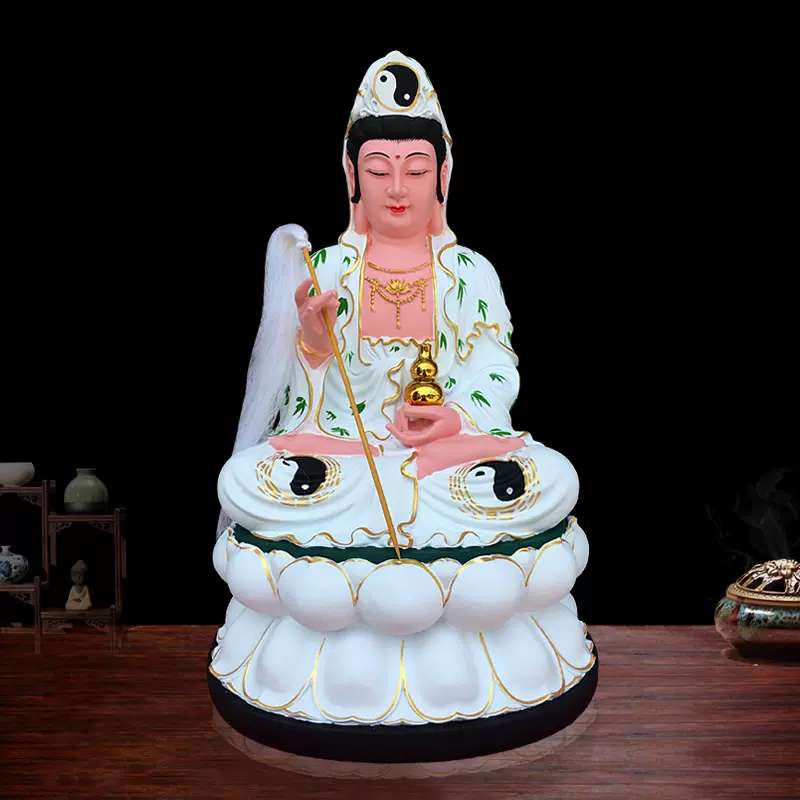
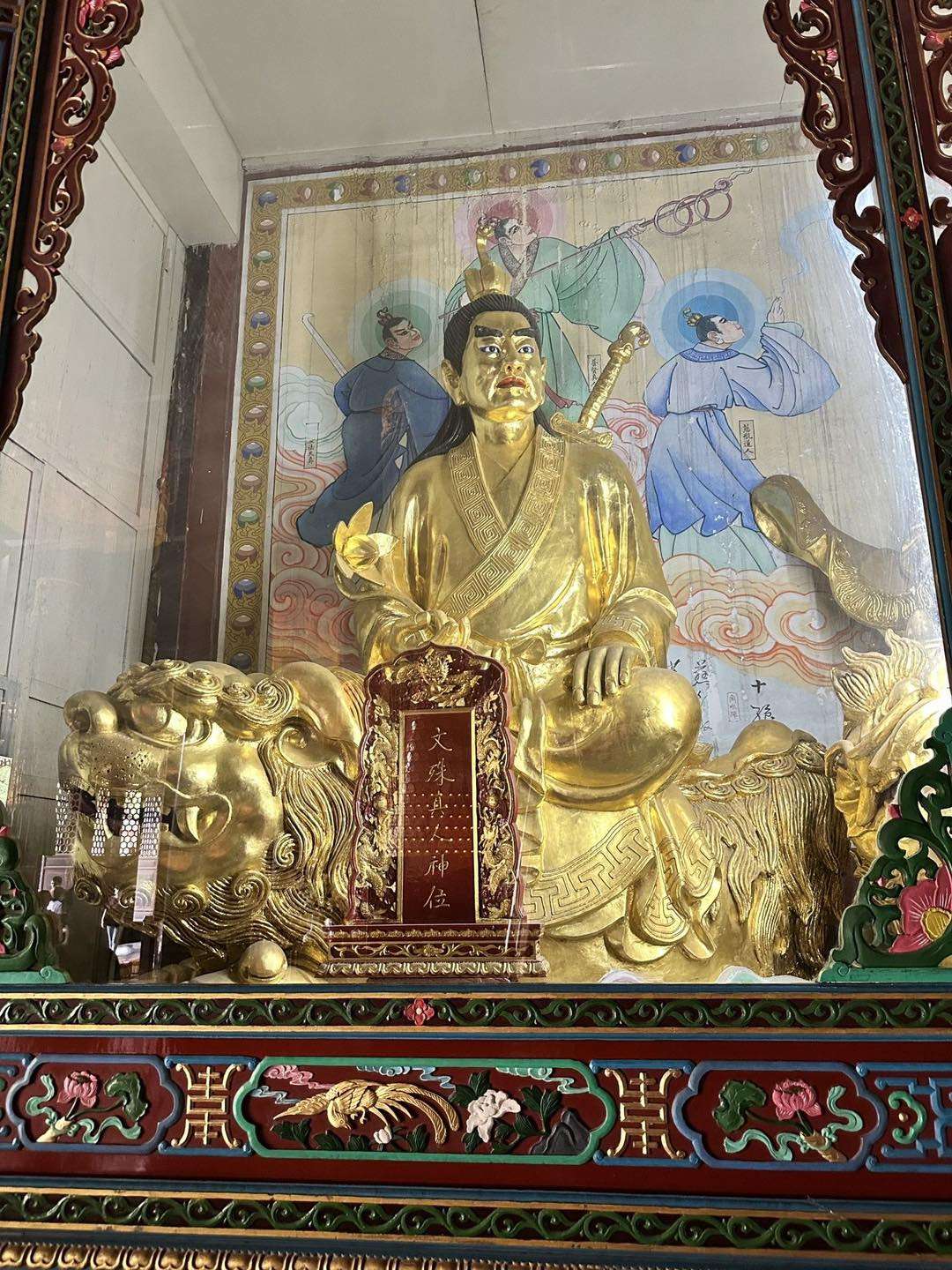
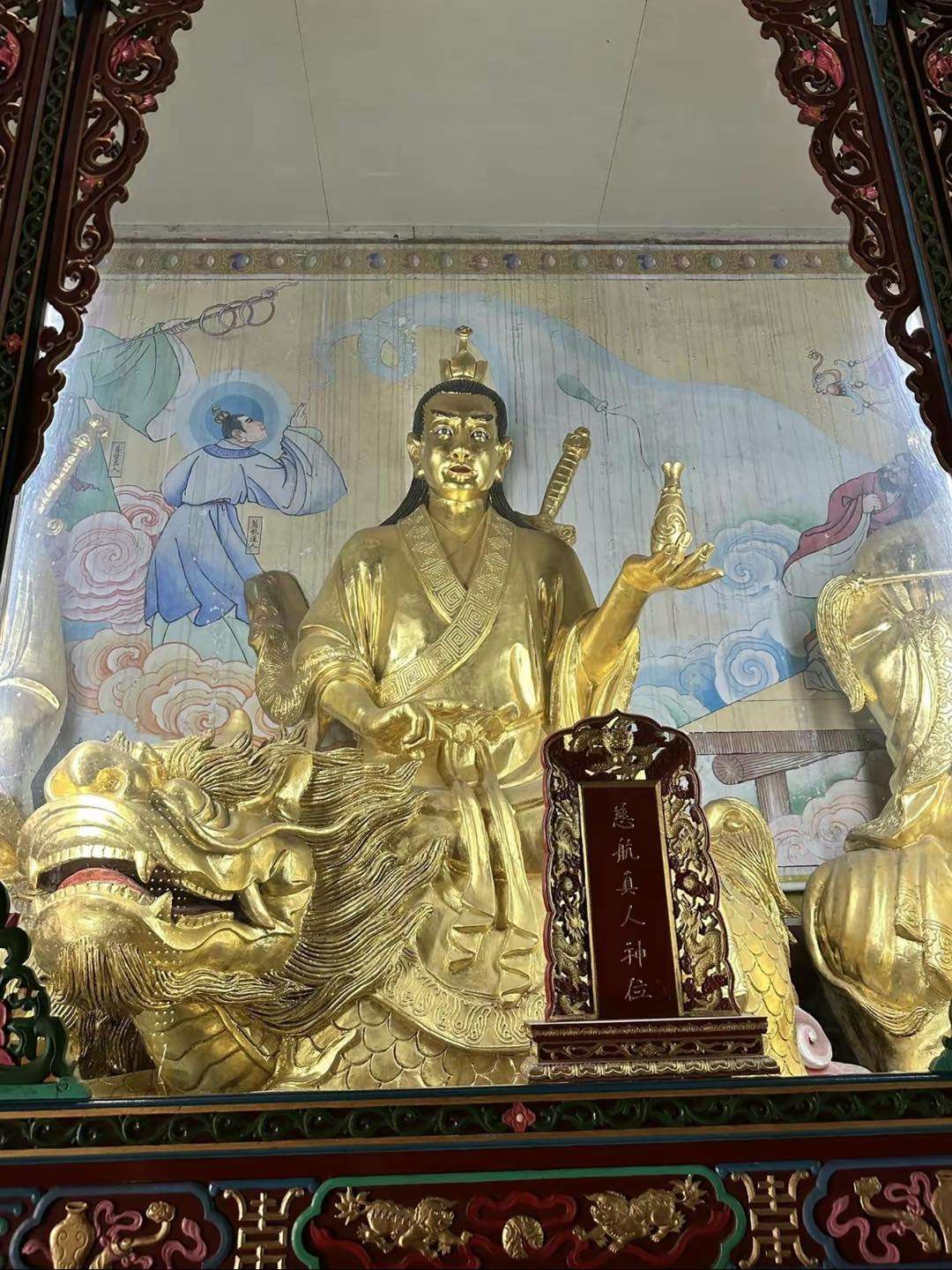
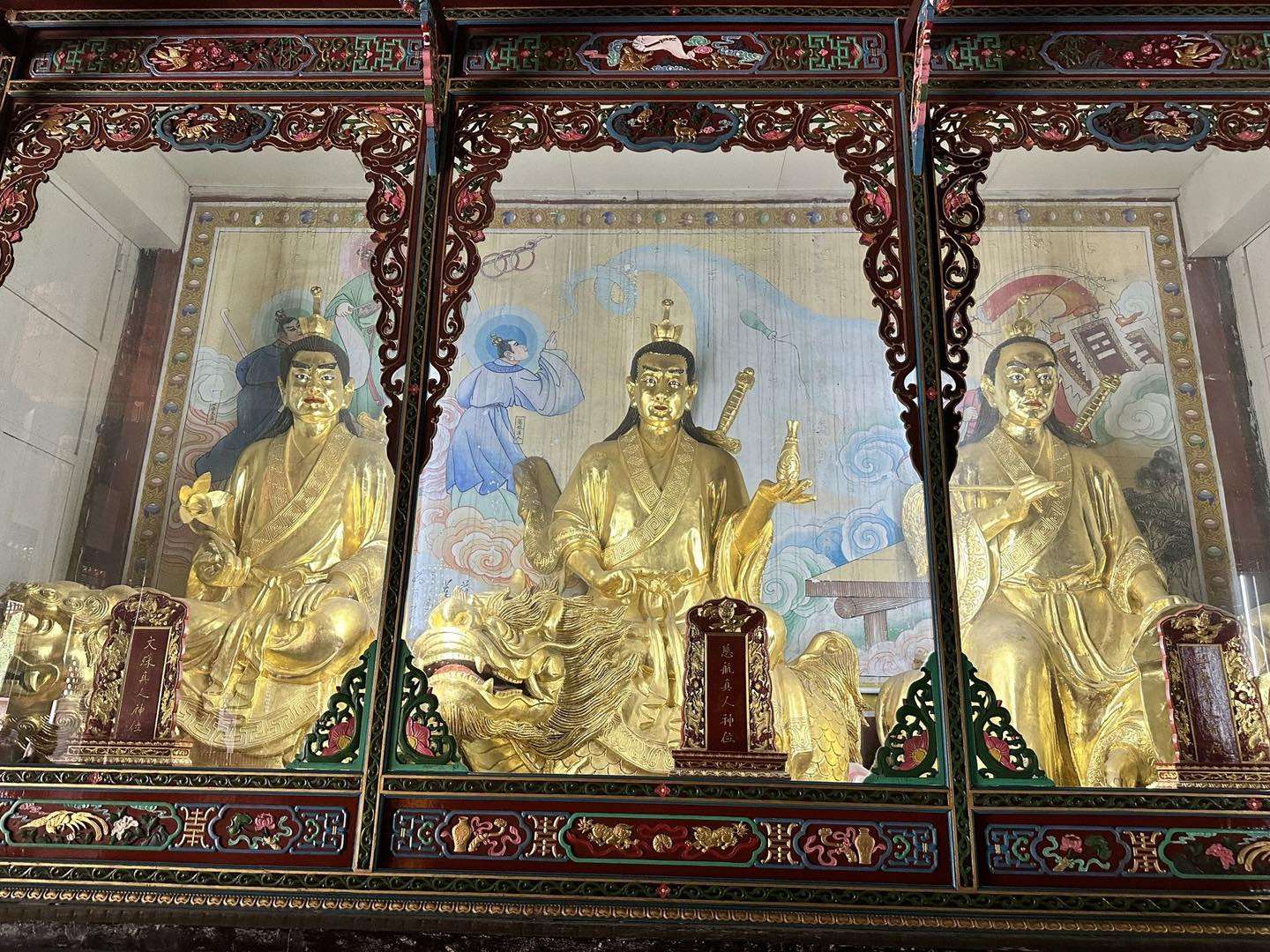
A Daoist bodhisattva may seem paradoxical, but this concept comfortably fits into the syncretic worldview espoused in late-Ming literature. For example, three well-known bodhisattvas are depicted as former high-ranking immortals in Investiture of the Gods (Fengshen yanyi, 封神演義, c. 1620). These include Guanyin (觀音) as “Person of the Way, Compassionate Ferry” (Cihang daoren, 慈航道人) (fig. 2), Mañjuśrī (Wenshu, 文殊) as the “Dharma-Spreading Heavenly Master of Outstanding Culture” (Wenshu guangfa tianzun, 文殊廣法天尊), and Samantabhadra (Puxian, 普賢) as the “Perfected Man of Universal Virtue” (Puxian zhenren, 普賢真人). Together, they later convert to Buddhism and become disciples of the Buddha at the end of chapter 83. [3]
Fig. 2 – A modern idol of Guanyin’s Daoist persona Person of the Way, Compassionate Ferry (larger version).
2.4. An Ancient Depiction
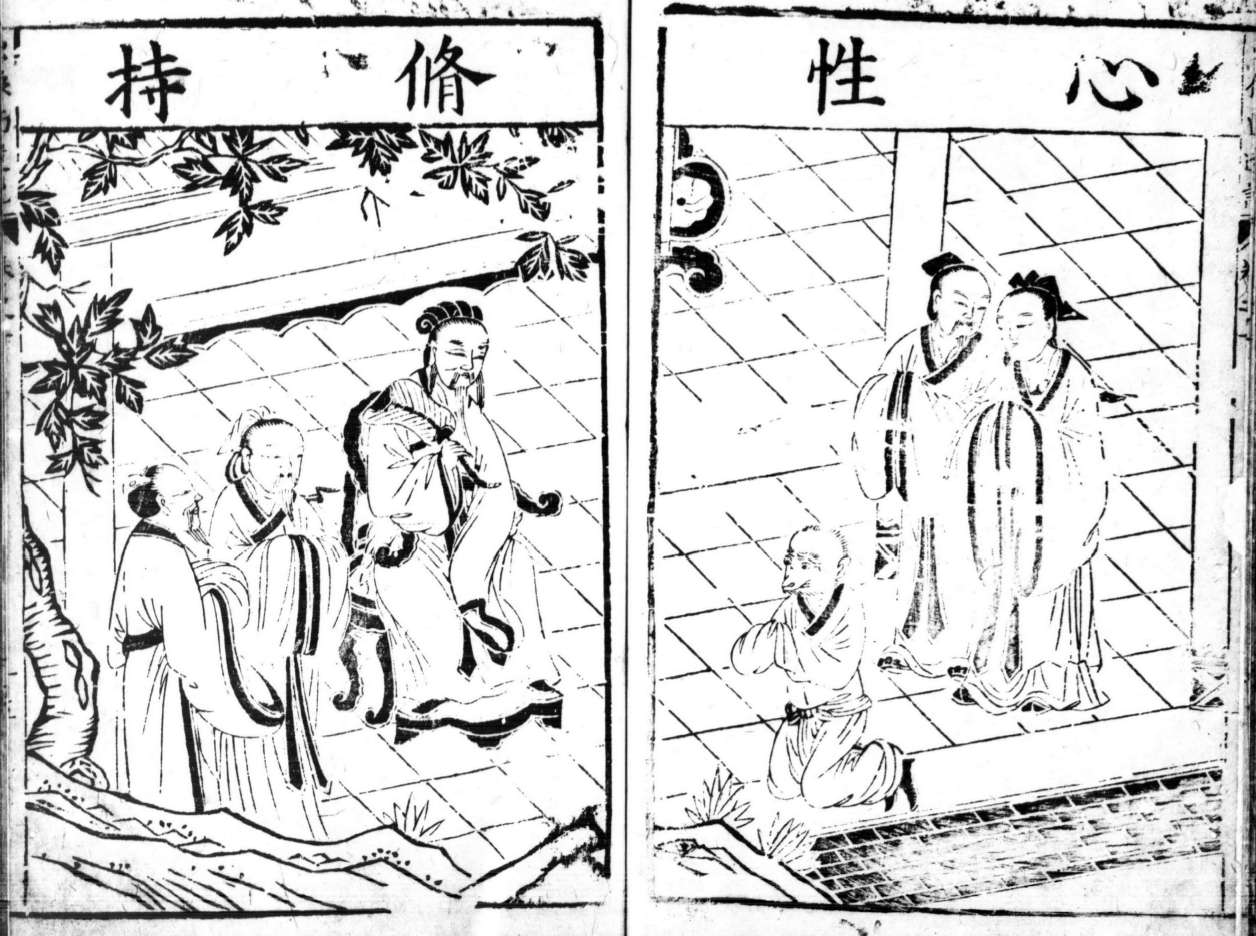
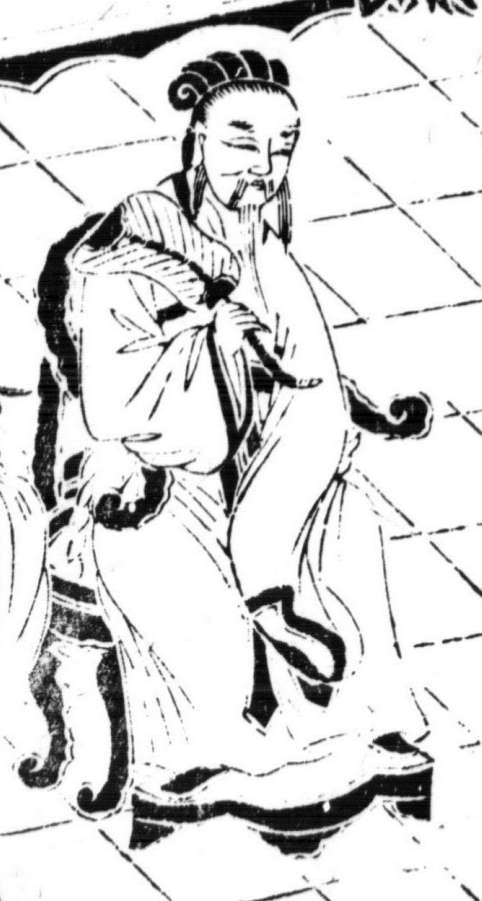
The standard 1592 edition of JTTW was originally published with a series of quaint woodblock prints. One features an image of the Patriarch, depicting him as a robed master holding a palace fan while seated in an ornate chair. He wears a guan-cap and has a kind face with airy whiskers and hints of large-lobed ears (fig. 3 and 4).
Fig. 3 (Left)- A woodblock of Monkey meeting the Patriarch for the first time (larger version). From the standard 1592 edition of the novel. Fig. 4 (Right) – A detail of Subodhi (larger version).
The novel remarks on the beauty of the mountain as Monkey walks through a forest to the school’s front entrance:
Mist and smoke in diffusive brilliance,
Flashing lights from the sun and moon,
A thousand stalks of old cypress,
Ten thousand stems of tall bamboo.
A thousand stalks of old cypress
Draped in rain half fill the air with tender green;
Ten thousand stems of tall bamboo
Held in smoke will paint the glen chartreuse.
Strange flowers spread brocades before the door.
Jadelike grass emits fragrance beside the bridge.
On ridges protruding grow moist green lichens;
On hanging cliffs cling the long blue mosses.
The cries of immortal cranes are often heard.
Once in a while a phoenix soars overhead.
When the cranes cry,
Their sounds reach through the marsh to the distant sky.
When the phoenix soars up,
Its plume with five bright colors embroiders the clouds.
Black apes and white deer may come or hide;
Gold lions and jade elephants may leave or bide.
A Blessed Land [Fudi] to be seen in spirit:
It has the true semblance of Paradise (Wu & Yu, 2012, vol. 1, pp. 112-113).
“Blessed lands” (Fudi, 福地) are thought to be “earthly paradises that do not suffer from floods, wars, epidemics, illnesses, old age or death” (Miura, 2008, p. 368). Daoism recognizes 72 Blessed Lands, each with their own documented name and location (Miura, 2008, p. 371).
The names of the cave and mountain reference the philosophical concept of the “heart-mind” (xin, 心), the center of spiritual intellect, no less than three times. As I explain in this article, the name “slanted moon and three stars” is a literal description of the Chinese character for the heart-mind (fig. 5). “Spirit Tower/platform” (lingtai, 靈臺) is used in Daoist literature to refer to the heart-mind, more specifically the middle elixir field (zhong dantian, 中丹田) around the heart, which is considered the seat of the spirit. During internal alchemical meditation, the spirit is directed from here, along with other energetic substances from elsewhere, into the “square inch” (fangcun, 方寸). This too is a Daoist reference to the heart-mind, more specifically the lower elixir field (xia dantian, 下丹田) around the abdomen, the storehouse of vital energies. The synergy of these energies is thought to bolster the body and bring about immortality. Therefore, a more accurate translation of Patriarch Subodhi’s home, which takes into account the veiled Daoist meanings, would be “Cave of the Slanted Moon and Three Stars on the Mountain of Spiritual Heart and Elixir Mind.”
Fig. 5 – The Chinese character for heart-mind (xin) literally looks like a crescent moon surmounted by three stars. Original image found here.
Therefore, the name of the Patriarch’s mountain home is a double metaphor for Daoist alchemical and Buddhist philosophical concepts.
3.4. References in Later Chapters
Monkey references Subodhi and his mountain home twice in the novel. He recites a biographical poem in chapter 17 in which he states:
[…]
Seedlings of herbs I plucked on Spirit Tower Mountain.
There was in that mountain an old immortal.
His age: one hundred and eight thousand years!
He became my master most solemnly
And showed me the way to longevity
[…] (Wu & Yu, 2012, vol. 1, p. 352). [6]
The location of this mountain is revealed in chapter one during Monkey’s first conversation with Subodhi. After hearing of Sun’s travels, the Patriarch asks:
[H]ow is it that you mention the East Purvavideha Continent? Separating that place and mine are two great oceans and the entire region of the Southern Jambudvipa Continent. How could you possibly get here? (Wu & Yu, 2012, vol. 1, p. 114).
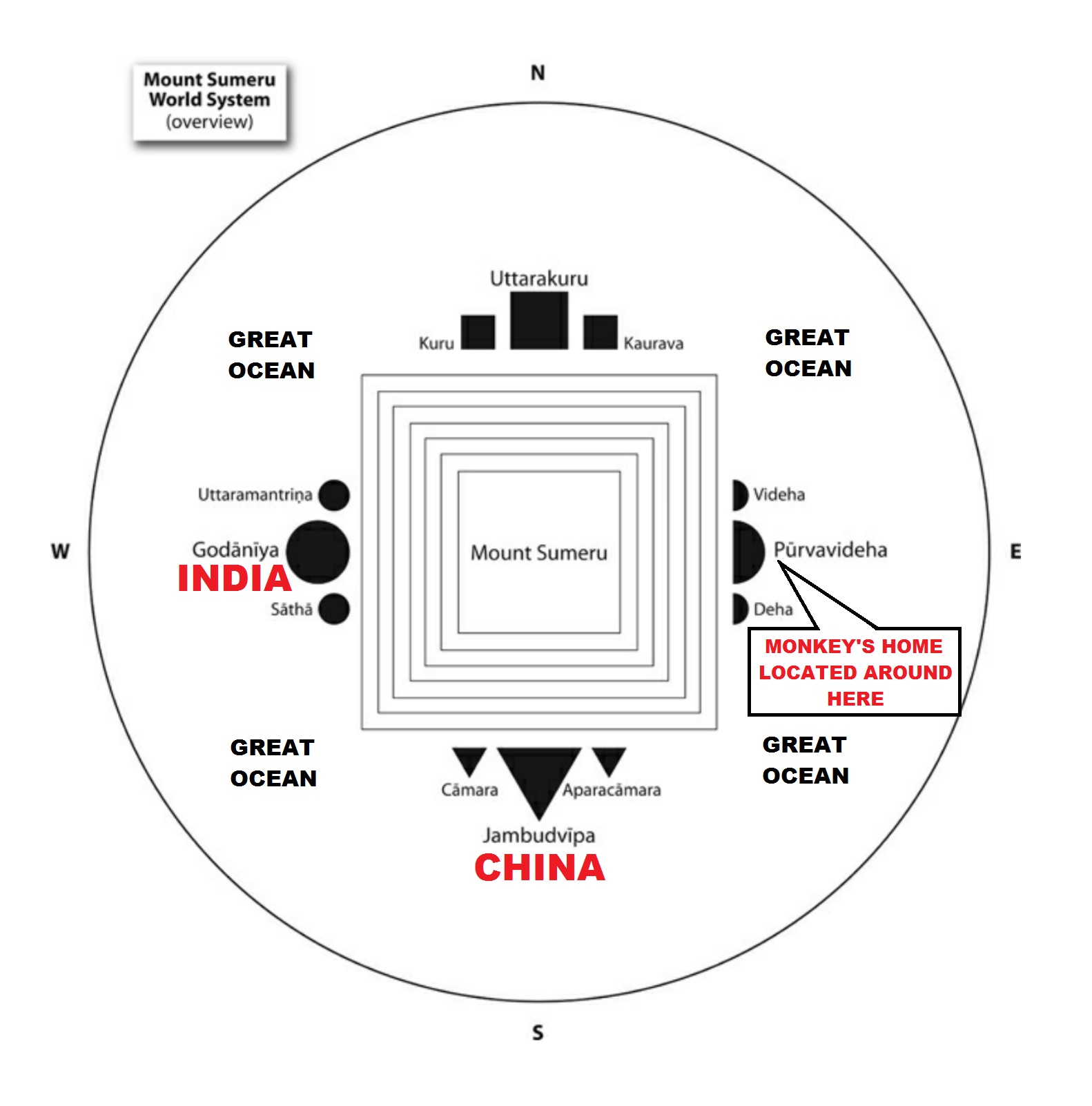
The world of JTTW is modeled on Hindo-Buddhist cosmic geography, which places the Eastern Purvavideha Continent (Sk: “Surpassing the body”; Ch: Dongsheng shenzhou, 東勝神洲), the Southern Jambudvipa Continent (Sk: “Rose-Apple”; Ch: Nanshan buzhou, 南贍部洲), the Western Godaniya Continent (Sk: “Using Cattle”; Ch: Xiniu hezhou, 西牛賀洲), the Northern Uttarakuru Continent (Sk: “Unpleasant Sound”; Ch: Beiju luzhou, 北俱盧洲) around the four respective faces of Mount Sumeru (Ximi shan, 須彌山; Miaogao shan, 妙高山), a giant mountain that serves as the axis mundi of the cosmos, as well as the abode of assorted gods and sages (Buswell & Lopez, 2014, p. 869) (fig. 6). While said geography traditionally associates Southern Jambudvipa with India, or the known world to the ancient people of South Asia (Buswell & Lopez, 2014, p. 377), the novel places the “Land of the East” (Dongtu, 東土) (i.e. China) within the continent and associates India with Western Godaniya (Wu & Yu, 2012, pp. 204-205). Therefore, Subodhi’s mountain is located in India, further strengthening his link with Buddhism.
Fig. 6 – A diagram showing a bird’s-eye view of Hindo-Buddhist cosmic geography as presented in JTTW. Adapted from Buswell & Lopez, 2014, p. xxix (larger version).
4. School
4.1. Possible Uniform
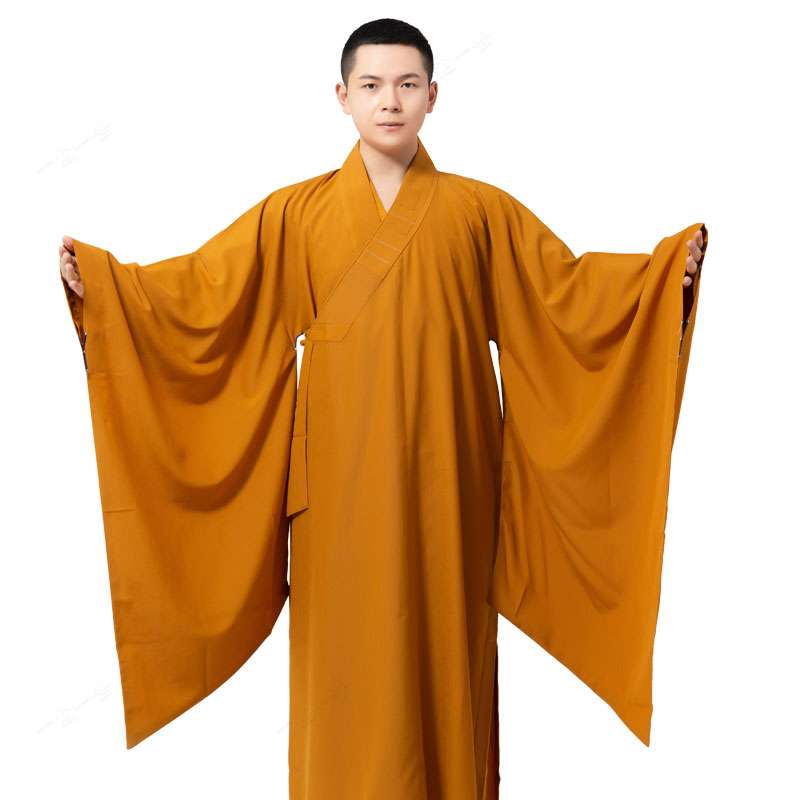
Upon returning to the Mountain of Flowers and Fruit from Subodhi’s school in chapter two, the novel describes Sun Wukong’s clothing through the eyes of a monster imp: “He is bare-headed, wears a red robe with a yellow sash, and has a pair of black boots on” (Wu & Yu, vol. 1, p. 127). The “red robe” is vague, but a poem in chapter one states that the immortal lad who invited Monkey into the cave was wearing a “wide robe with two sleeves of wind” (Wu & Yu, 2012, vol. 1, p. 113). This probably references the large, open arms of the zhiduo robe (直裰; a.k.a. haiqing, 海青), which is known colloquially in English as “Buddhist monk” or “Taoist monk” robes (fig. 7).
The novel doesn’t mention Monkey changing his clothing prior to returning home, so this might describe his school uniform.
Fig. 7 – A zhiduo robe with large sleeves (larger version). Image found here. Imagine this robe red, with a yellow sash at the waist.
4.2. Student Naming Scheme
Subodhi is shown to have 12 generational names (zibei, 字輩) used to name the cohorts of his religious lineage.
Three of the listed names, Zhi (智), Yuan (圓), and Jue (覺), were historically used in Daoism. [7]
Monkey is part of the tenth generation (Wu & Yu, 2012, p. 115), meaning that all of Subodhi’s students taken in around the same time would all have Wu (悟) in their name.
The novel explains in detail why Subodhi names his primate disciple Sun Wukong, tying it to Buddho-Daoist philosophy:
The Patriarch laughed and said, “Though your features are not the most attractive, you do resemble a pignolia-eating monkey (husun [猢猻]). This gives me the idea of taking a surname for you from your appearance. I intended to call you by the name Hu [猢]. If I drop the animal radical [犭] from this word, what’s left is a compound made up of the two characters, gu [古] and yue [月]. Gu means aged and yue [“moon”] denotes feminine yin energy [陰], but aged yin cannot reproduce. Therefore, it is better to give you the surname of Sun [猻]. If I drop the animal radical from this word, what we have left is the compound of zi [子] and xi [系]. Zi means a boy and xi means a baby, and that name exactly accords with the fundamental Doctrine of the Baby Boy [Ying’er zhi benlun, 嬰兒之本論]. So your surname will be ‘Sun.'”
[After explaining the generational names] “You will hence be given the religious name ‘Aware of Emptiness’ (wukong [悟空]). All right?” (Wu & Yu, 2012, vol. 1, p. 115).
Yu (Wu & Yu, 2012) explains: “The Baby Boy is none other than the ‘holy embryo or shengtai 聖胎,’ the avatar of the realized state of immortality in the adept’s body” (vol. 1, p. 86). Daoist doctrine dictates that the “Three Treasures” (Sanbao, 三寶) of semen (jing, 精), breath (qi, 氣), and spirit (shen, 神) be combined to create a holy embryo. The third stage of this internal alchemical process involves the nurturing of said embryo to maturation with spiritual energies and eventually guiding it upwards and out the Heavenly Gate (Tianguan, 天關), or the top of the crown. This results in a fledgling immortal spirit body that must be trained over an additional three year period in which it learns to travel far and wide apart from the physical vessel (Kohn, 2008, pp. 179-180). Therefore, Sun (孫) not only references the primate disciple’s appearance but also his Daoist immortality.
“Wukong” (悟空) combines “Emptiness” (Kong, 空) with “Awakening,” Wu (悟) being “one of the common Chinese translations for the Sanskrit term bodhi (awakening)” (i.e. the bodhi of Subodhi) (Buswell & Lopez, 2014, p. 998). Awakening takes two forms in Chan Buddhism: “instant” (dunwu, 頓悟) and “gradual” (jianwu, 漸悟). The former involves the sudden manifestation of inherent Buddha-nature (see section 2.3), while the latter involves compounding realization, often over a long period of purification (Buswell & Lopez, 2014, p. 998; see also pp. 273 and 384-385). As explained in section 1, bodhi involves realizing the Four Noble Truths, thereby achieving enlightenment and freeing oneself from the cycle of rebirth. Therefore, Wukong references said enlightenment.
Given the above information, another translation for Sun Wukong would be “Immortal Enlightened By Emptiness.” This shows that Monkey’s name incapsulates his story arc: attaining divine longevity in the beginning and ascending to Buddhahood at the end. This, again, is an open reference to the highly influential Buddho-Daoist philosophy of Zhang Boduan (see section 2.3).
4.3. Tests of Spiritual Intelligence
The Patriarch first offers to teach Monkey a selection of skills from the 360 “Side Gates” (bangmen, 傍門; a.k.a. pangmen, 旁門), noting that they will “result in illumination” (zhengguo, 正果; lit: “right fruit”) (Wu & Yu, 2012, vol. 1, p. 117). The skills include:
Method gate (Shuzi menzhong, 術字門中) – “[C]onsists of summoning immortals and working the planchette, of divination by manipulating yarrow stalks, and of learning the secrets of pursuing good and avoiding evil” (Wu & Yu, 2012, vol. 1, p. 117).
Dissemination gate (Liuzi menzhong, 流字門中) – “[I]ncludes the Confucians, the Buddhists, the Daoists, the Dualists, the Mohists, and the Physicians. They read scriptures or recite prayers; they interview priests or conjure up saints and the like” (Wu & Yu, 2012, vol. 1, p. 117).
Silence gate (Jingzi menzhong, 靜字門中) – “To cultivate fasting and abstinence … quiescence and inactivity, meditation and the art of cross-legged sitting, restraint of language, and a vegetarian diet. There are also the practices of yoga, exercises standing or prostrate, entrance into complete stillness, contemplation in solitary confinement, and the like” (Wu & Yu, 2012, vol. 1, pp. 117-118).
Action gate (Dongzi menzhong, 動字門中) – “[G]athering the yin to nourish the yang, bending the bow and treading the arrow, and rubbing the navel to pass breath. There are also experimentation with alchemical formulas, burning rushes and forging cauldrons, taking red lead, making autumn stone, and drinking bride’s milk and the like” (Wu & Yu, 2012, vol. 1, p. 118).
However, the Side Gates, which number 3,600 in Daoist literature, were historically considered “unorthodox training methods of limited benefit” (Eskildsen, 2019, p. 43). This shows that Subodhi is testing his disciple to see if he will fall for studying lesser arts. But Sun passes by refusing to learn them.
Another test takes place when Monkey visits his master’s room at the third watch to receive secret teachings. Shao (2006) explains that, once again, the novel alludes to the Sixth Chan Patriarch Huineng:
[Monkey] sets the stage for a striking display of his unusually profound insight when he announces his intentions to become an immortal. This provokes Subhuti to issue him a challenge by refusing to teach him, for he is “some what different from other people.” Monkey may not realize that the master is trying to gauge his spiritual power, but he rises to the occasion with a genuine clarity of vision: “I have a round head pointing to Heaven, and square feet walking on Earth. Similarly, I have nine apertures and four limbs, entrails and cavities. In what way am I different from other people?”
[…]
[W]e may look to Huineng’s story from which Monkey garners meaning. No doubt, Monkey’s inspired cleverness is modeled on Huineng’s reply to Hongren, the fifth patriarch of Chinese Chan Buddhism, in Huineng’s Tanjing (The Platform Sutra). When Huineng announces his intentions to become a Buddha, Hongren pounces upon him with a poignant reminder that he is “from Lingnan,” a “barbarian,” and therefore cannot become a Buddha. Huineng refuses to be intimidated, however. He holds his own with an unparalleled depth of insight about Buddha-nature: There may be “northern and southern men,” but “the Buddha nature fundamentally has no north or south.” Surely Monkey’s phrasing, his unusual insightfulness, and the quickness and aplomb with which he rises to the challenge are reminiscent of Huineng … (pp. 719-720).
Monkey clearly passes this test, for his insightful reply convinces the Patriarch to teach him the secret of eternal life.
Subodhi no doubt uses such examinations to filter out unsuitable candidates, allowing only the brightest individuals to become his inner disciples.
4.4. Overtly Stated Curriculum and Tools
The novel specifically mentions Subodhi offering or teaching Monkey the following concepts:
The “Three Parties” refer to the Ming syncretic philosophy of the “Three Teachings” (Sanjiao, 三教), which combines elements from Buddhism, Daoism, and Confucianism. This shows that his disciples are given a well-rounded religious education, which explains why Sun is competent even in Buddhist scripture. [8]
Also, during his lectures on philosophy, Subodhi is said to wield a “Precepts ruler” (jiechi, 戒尺), which he uses to admonish his students (Wu & Yu, 2012, vol. 1, p. 118). Such a device figures among the tools of Buddhism (Leong, 2001, p. 49).
2) Secret of Immortality – Breathing exercises designed to absorb yang energy during prescribed times (after midnight and before noon), the retention of chaste semen and transformation into qi energy, and the purification and circulation of the resulting spiritual energy throughout the body.
These internal methods are passed onto Monkey in secret via a flowery poem chocked full of alchemical imagery. It ends with the line, “When that’s done, be a Buddha or immortal at will!” (Wu & Yu, 2012, vol. 1, p. 120). Combined with his syncretic philosophy, this suggests that the Patriarch offers his students more than one spiritual path to divinity.
3) Transformations – A series of oral formulas that allow the user to change their body into any person, animal, or object. Two forms are offered: the 72 changes of the “Multitude of Terrestrial Killers” (Disha shu, 地煞數) and the 36 changes of the “Multitude of the Heavenly Rectifiers” (Tiangang shu, 天罡數) (based on Wu & Yu, 2012, vol. 1, p. 122; Meulenbeld, 2019, p. 7). [9]
Subodhi teaches this skill to Monkey with the expressed purpose of helping him hide from three calamities of cosmic lightning, fire, and wind sent by heaven to destroy immortals for defying fate and achieving eternal life. But beyond the power of metamorphosis, the novel implies that the ability also grants the user multiple lives (similar to a video game), which might serve as a buffer against the calamities. For example, in chapter 41, after Sun passes out from Red Boy‘s fiery attack, Zhu Bajie reassures everyone by saying: “If he is capable of seventy-two transformations, he has seventy-two lives” (Wu & Yu, 2012, vol. 2, p. 232). Also, in chapter 46, Monkey magically regrows his head after being non-fatally beheaded in a contest of magical skill. Sha Wujing remarks: “If he knows seventy-two ways of transformation, … he may have altogether seventy-two heads!” (Wu & Yu, 2012, vol. 2, p. 308). In addition, while not directly related to the primate hero, the Bull Demon King is said in chapter 61 to also know the 72 changes (Wu & Yu, 2012, vol. 3, p. 148). He uses the extra lives to survive being beheaded by Prince Nezha a number of times:
[Nezha] leaped onto the bull’s back and brought his monster-cleaving sword down on the bull’s neck: the bull was beheaded at once. Putting away his scimitar, the devaraja was about to greet [Sun Wukong] when another head emerged from the torso of the bull, his mouth belching black air and his eyes beaming golden rays. [Nezha] lifted his sword once more and cut off the bull’s head; as soon as it dropped to the ground, another head came out. It went on like this more than ten times. At last, [Nezha] took out his fiery wheel and hung it on the Bull’s horn. The wheel at once started a great blaze of true immortal fire, which burned so fiercely that the bull began to growl and roar madly, shaking his head and wagging his tail (Wu & Yu, vol. 3, p. 160). [10]
This agrees with the connection between transformation and immortality in Daoism. Robinet (1979) explains that gods and saints are portrayed in Daoist literature as being in constant flux, changing with the seasons, taking on different guises and titles, disappearing and reappearing, never remaining the same, thereby living eternally.
4) Flight – A method of flying through the sky on divine clouds. Two types are offered: “cloud-soaring” (jiayun, 駕雲), the most common method used by celestials throughout the cosmos. It involves stamping the foot to summon clouds (Wu & Yu, 2012, vol. 1, p. 123); and “cloud-somersaulting” (jindou yun, 觔/筋斗雲), the method chosen by Sun (fig. 8). It involves simultaneously “mak[ing] the magic sign, recit[ing] the spell, clench[ing] the fist tightly, shak[ing] the body” and then jumping into the sky, leaping from cloud to cloud (Wu & Yu, 2012, vol. 1, p. 123). The latter method is by far the fastest, enabling the user to travel 108,000 li (33,554 mi / 54,000 km) in a single instant.
Shao (2006) states that the latter skill is based on a philosophical metaphor from Huineng’s Platform Sutra. The Chan Master explains that the common trope of the Buddha’s paradise being separated from the world of man by 108,000 li is based on a combination of the “Ten Evils” (Shi’e, 十惡) and “Eight Wrongs” (Baxie, 八邪) of Buddhism (see section III here). Those who rid themselves of these spiritual flaws will achieve enlightenment and thus arrive instantly at the Buddha’s paradise (Shao, 2006, p. 718; Huineng & Cleary, 1998, pp. 26-27). Therefore, Subodhi teaches a skill that’s a metaphor for instant enlightenment, further supporting his connection to Buddhism.
As noted in section 3.3, Sun states: “I bowed to the Patriarch of Spirit Tower and Square Inch / and perfected with him the martial arts [wuyi, 武藝]” (Wu & Yu, 2012, vol 3, p. 243). [11]
5) Military arts – Monkey demonstrates knowledge in troop movement, weapons (swords, spears, axes, bows and arrows, staves, etc.), and unarmed boxing. His preferred method is “Short Fist” (Duan quan, 短拳), which is known for compact, short-ranged attacks. This is likely just one of many boxing styles taught by Subodhi.
Shahar (2008) explains that the martials arts of the famed Chan Buddhist Shaolin Monastery developed during the Ming-Qing transition from a synthesis of Daoist gymnastics (stretching and breathing exercises), religious rituals, and fist techniques. This new form of spiritual cultivation ushered in the era of so-called “internal martial arts,” Taiji boxing being the most famous among them. JTTW was published during the late-Ming when this synthesis was in full swing. Therefore, the study of martial arts in a religious institution is an accurate snapshot of one facet of 16th-century monastic life.
4.6. Inferred Curriculum
Although not directly stated, the following skills are likely learned while studying under the Patriarch.
6) General magic – Monkey is shown capable of calling forth gods and spirits, growing or shrinking to any size, parting fire and water, creating impassable barriers, conjuring wind storms, casting illusions, freezing people in place, making endless doubles of himself, unlocking any lock, bestowing superhuman strength, bringing the dead back to life, etc.
7) Traditional Chinese Medicine – Monkey knows how to analyze a patient’s pulse and then concoct individualized medicine from a number of raw ingredients.
This makes sense as a knowledge of harming and healing often goes hand in hand in traditional Chinese martial arts. A prime example is the folk hero Wong Fei-Hung (黃飛鴻, 1847-1925), a Hung Ga boxer and physician from Qing-era Guangdong.
5. His Powers
The breadth of skills taught to Monkey speaks to the Patriarch’s own vast array of magical and martial abilities. But he displays (or the narrative at least hints at him having) three additional powers.
Subodhi demonstrates the ability to see peoples, events, and times beyond his person in JTTW chapter one when Monkey first arrives at his home. An immortal lad opens the door and tells the primate:
“My master … has just left his couch to give a lecture on the platform. Before even announcing his theme, however, he told me to go out and open the door, saying, ‘There is someone outside who wants to practice austerities. You may go and receive him'” (Wu & Yu, 2012, vol. 1, pp. 113-114).
At the end of JTTW chapter two, Subodhi makes a statement suggesting that he is aware of all things:
I forbid you ever to mention that you are my disciple. For if you but utter half the word, I’ll know about it; you can be assured, wretched monkey, that you’ll be skinned alive … (Wu & Yu, 2012, vol. 1, p. 125).
The aforementioned powers raises a question: “If Subodhi has these abilities, why would he take Sun as a disciple knowing full well that he would later expel him for simply displaying his newly cultivated powers?” Someone might say showing off is a sign of ego and the need for validation, qualities unbecoming of a spiritual cultivator. But there is a better answer. Being a bodhisattva with the power of foresight, the Patriarch would no doubt foresee Monkey’s later attainment of Buddhahood, realizing that the trials and tribulations of protecting the Tang Monk on the journey to India would be the price that he needs to pay to gradually awaken (jianwu, 漸悟) his enlightenment. Therefore, expelling Sun would ignite the chain of events leading to his eventual Buddhahood. This would make Subodhi an agent of Dharma, one who uses whatever methods necessary to bring about the enlightenment of his disciples.
6. Conclusion
The Patriarch Subodhi finds his origins in Subhūti, one of the ten principal disciples of the historical Buddha known for his knowledge of “emptiness.” The literary figure’s connection to Buddhism is not in name only, however. The Chinese name used most in the novel to refer to Subodhi is Puti, a transliteration for bodhi (“awakening” or “enlightenment”). His story in JTTW is partly based on events from the lives of the respective Fifth and Sixth Chan (Zen) Patriarchs and their transmission of the Dharma. A poem in JTTW chapter one even compares him to the Buddha and the splendor of the Western paradise, as well as further ties him to emptiness and enlightenment.
The name of Subodhi’s home, Cave of the Slanted Moon and Three Stars on the Mountain of Spiritual Heart and Elixir Mind, serves as a double metaphor for Daoist internal alchemical practices and Buddhist concepts of the mind. It is described as a mountain paradise, and the cave therein is said to be filled with grand architecture, which is centered around the Patriarch’s green jade lecture platform. The mountain is located in the Western Godaniya Continent of Hindo-Buddhist cosmic geography, placing it squarely in India, home of the historical Subhūti.
Subodhi’s students possibly wear a red robe with large, open sleeves, a yellow sash, and black boots, and they are named according to a twelve generation character list. His choice for the Monkey King’s religious name, Sun Wukong, is packed full of philosophical significance related to the formation of a Daoist immortal spirit embryo and the manifestation of enlightenment. As for the Patriarch’s curriculum, he teaches Buddho-Daoist philosophy, the secret of eternal life, transformations, flight via cloud, armed and unarmed military arts, general magic, and Traditional Chinese Medicine. Tests of spiritual intelligence appear to be used to permit only the brightest into his inner circle.
Beyond the magical powers taught by him, Subodhi exhibits (or the narrative at least hints at him having) clairvoyance, omniscience, and control over souls and karmic results. His power of foresight might then explain why he accepted Monkey as a student, only to later expel him. This was likely done to ignite the chain of events that would eventually lead to Sun’s achievement of Buddhahood, thereby completing the last of Zhang Boduan’s two-step process towards Buddho-Daoist transcendence.
JTTW stresses the Patriarch’s status as a Buddhist deity, albeit one with Daoist leanings. Therefore, I suggest that he is a bodhisattva like (as one scholar has proposed) the historical Subhūti. A Daoist bodhisattva, however, is not a paradox as such figures appear in late-Ming syncretic popular literature. Examples include the former high-ranking immortals-turned-bodhisattvas Guanyin, Mañjuśrī, and Samantabhadra from Investiture of the Gods (c. 1620).
7. Updates
Update: 06-04-22
Above, I mentioned that Puti (菩提) is used at least three times to refer to Subodhi, thus stressing the Patriarch’s connection to the Buddhist concept of bodhi (Pāli / Sk: “awakening” or “enlightenment”). There’s actually a fourth usage, appearing in the title of chapter two: “Fully awoke to Bodhi’s wondrous truths / He cuts off Mara, returns to the root, and joins Primal Spirit” (Wu & Yu, 2012, p. 116). The title serves as a double reference to the end of Prince Siddhārtha‘s path to enlightenment. (I explain in this article that the author-compiler of the standard 1592 edition of JTTW likely based Monkey’s early life on the Buddha to make his spiritual journey more familiar to the reader.) As part of the Prince’s meditative journey inward to discover hidden truths, he faces off against the army of the heavenly demon Māra (Mo, 魔), the ruler of the illusionary world of Saṃsāra. But these evil forces are rendered powerless by Siddhartha’s supreme focus of mind and burgeoning grasp of reality. He shortly thereafter achieves enlightenment (a.k.a. bodhi) (Beal, 1883, pp. 156-163). Likewise, thanks to (Su)Bodhi’s guidance, Sun Wukong is able to also stop Mara and achieve immortality.
This free association between Buddhist (bodhi/Mara/returning to the root) and Daoist (primal spirit) concepts was common place in Ming-era religious literature. Darga (2008) explains:
Comparing the development of the embryo to the revelation of Buddhahood is typical of neidan texts of the Ming period. For instance, the Xingming guizhi (Principles of Balanced Cultivation of Inner Nature and Vital Force) uses Body of the Law (fashen 法身, dharmakāya) as a synonym for shengtai. The birth of the embryo represents the appearance of the original spirit (yuanshen 元神) or Buddhahood and is understood as enlightenment (p. 884).
Therefore, the Monkey King’s immortality is synonymous with the Buddha’s enlightenment. And since Subodhi is key to Sun’s spiritual achievement, and given the Patriarch’s demonstrated connection to Buddhism in the novel, I’d like to further suggest that the character is the original disciple Subhūti. After all, he still lives in India like his namesake.
Despite all of the overwhelming evidence for the Patriarch’s connection to Buddhism, someone might point out that the novel refers to him as a “Spirit Immortal” (shenxian, 神仙) (for example). The Anthology of the Transmission of the Dao from Zhongli Quan to Lü Dongbin (Zhong Lü Chuan Dao Ji, 鐘呂傳道集, c. late-Tang) explains that this is the fourth of five kinds of transcendents [12] who has cast off the mortal body (per the methods outlined above) to enjoy a life free from the dust of the world (Wong, 2000, p. 29; see also here). But making this distinction in the face of Ming syncretism amounts to little more than arguing semantics. As we’ve seen, this philosophy equates achieving immortality with enlightenment. And Subodhi’s description above as having “no end and no birth” (busheng bumie, 不生不滅) embodies that, for he has both the Daoist elixir and the Buddha-mind and has thus broken free of the wheel of rebirth.
Taking a page from the Daoist Bodhisattvas of Investiture of the Gods (Fengshen yanyi, 封神演義, c. 1620), perhaps Subodhi/Subhūti was an immortal recruited by the Buddha, or the Buddhist disciple trained under the former high-ranking immortals-turned-bodhisattvas Guanyin, Mañjuśrī, and Samantabhadra. Knowing different paths to divinity would make him a more affective teacher and bodhisattva.
Here is a welcoming, modern image of Subhūti (fig. 9). The top line reads “The Honored Monk Subhūti’s Understanding of Emptiness is Number One” (Xuputi zunzhe jiekong diyi, 须菩提尊者解空第一). I love the golden halo.
Subodhi is alluded to in Investiture of the Gods (c. 1620). It reproduces a poem about the sage from JTTW chapter one (section 2.3). The original reads:
A Golden Immortal of Great Awareness and of great ken and purest mien,
Master Bodhi, whose wondrous appearance like the West
Had no end or birth by work of the Double Three.
His whole spirit and breath were with mercy filled.
Empty, spontaneous, it could change at will,
His Buddha-nature able to do all things.
The same age as Heaven had his majestic frame.
Fully tried and enlightened was this grand priest (Wu & Yu, 2012, vol. 1, p. 114).
Chapter 61 of Investiture of the Gods reproduces the poem with only minor changes (indicated in red):
A Golden Immortal of Great Awareness and timelessness, [13] Dharma Master Bodhi of the wondrous West
Had no end or birth by work of the Double Three.
His whole spirit and breath were with mercy filled.
Empty, spontaneous, it could change at will,
His Buddha-nature able to do all things.
The same age as Heaven had his majestic frame.
Fully tried and enlightened was this grand priest (emphasis mine). [14]
It goes on to associate the poem with a Buddhist deity known as “Person of the Way, Cundī” (Zhunti daoren, 準提道人) (fig. 10). This figure is traditionally considered a multi-armed, female bodhisattva with a strong connection to the Cundā Dhāraṇī, a power-bestowing mantra (Buswell & Lopez, 2014, p. 204). Therefore, it appears that the author was trying to provide an origin for Subodhi (likely based on “提” (ti) appearing in both character’s names). Afterall, the novel is often considered a sequel to JTTW because it reveals the origins of many secondary characters (Li Jing, Nezha, Muzha, Erlang, etc.). However, it’s important to remember that Investiture of the Gods is still a separate novel by a different author. So, any events therein should NOT be considered canon for JTTW. Besides, the latter work clearly establishes a link between Subodhi and the historical Subhūti.
Fig. 10 – Person of the Way, Cundī (top right) fighting against a rogue immortal (lower left) (larger version). From a modern manhua comic book. Image found here.
Update: 06-09-22
It turns out that Subodhi is not the invention of the author-compiler [15] of the standard 1592 edition of JTTW. He appears in the earlier “Zhu edition” of the novel, a.k.a. Chronicle of Deliverances in Tang Sanzang’s Journey to the West (Tang Sanzang Xiyou shi e zhuan, 唐三藏西遊释厄傳) by Zhu Dingchen (朱鼎臣). [16] The following quote indicates the differences between the Zhu edition (red) with the 1592 edition (black):
With solemnity the Monkey King set his clothes in order and followed the boy into the depths of the cave. They passed rows and rows of lofty towers and huge alcoves, of pearly chambers and carved arches. After walking through innumerable quiet chambers and empty studios, they finally reached the base of the green jade platform. Patriarch Subodhi was seen seated solemnly on the platform, with thirty lesser immortals standing below in rows. He [It] was truly a realm of immortals. Let’s listen to the explanation in the next chapter. (emphasis mine)
[Poem describing Master Subodhi. See above for translation. The Zhu version has a typo in the line “Grand priest” (“大怯師” instead of “大法師”).]
The Zhu version is comprised of ten scrolls (juan, 卷) with three to ten subsections each. These subsections differ from the chapter layout of the 1592 edition. For example, subsections one to three and four to five respectively correspond to chapters one and two of the 1592 edition (Koss, 1981, pp. 14-15). It’s interesting to note that the above poem caps the first subsection of scroll one. This is why it ends with: “Let’s listen to the explanation in the next chapter” (qieting xiahua fenjie, 且聽下回分解).
Update: 06-10-22
Monkey’s religious name Wukong (悟空), or “Awakened to Emptiness,” predates the 1592 and Zhu editions, appearing as early as an early-Ming zaju play. Therefore, I’d like to suggest that the historical Subhūti was chosen as the basis for a master worthy of bestowing this name because of his great knowledge of emptiness, as well as the large role that he plays in the Diamond Sutra (Sk: Vajracchedikā Prajñāpāramitā Sūtra; Ch: Jingang bore boluomiduo jing, 金剛般若波羅蜜多經; a.k.a. Jingang jing, 金剛經). After all, the scripture “deals with the concept of emptiness” despite never once “employ[ing] the word for emptiness śūnyatā [Ch: kong, 空]” (Watson, 2010, p. 75). [17] Alluding to the sutra makes sense as it was so overwhelmingly popular when JTTW was written that tales of its miracles were eventually compiled during the late-Ming and Qing dynasties (Ho, 2019). So, the people reading the novel would have no doubt recognized Subodhi as an allusion to Subhūti from the scripture.
The late-13th-century JTTW story cycle already presents Monkey as an ancient Daoist immortal with magic powers from the very beginning. Therefore, this element likely played a role in draping the Buddhist master in a thin veil of Daoism to create the Buddho-Daoist sage Subodhi.
Update: 03-13-23
I just learned that the uber popular cartoon Lego Monkie Kid has introduced Master Subodhi in the recent 4th season. The following clip shows him training the reincarnations of Tripitaka, Zhu Bajie, and the White Dragon Horse and apparently the original Sha Wujing (video 1).
Video 1 – Master Subodhi trains new students in Lego Monkie Kid season 4.
Update: 05-15-23
Above in section 2.3, I mentioned how Subodhi’s seemingly paradoxical depiction as a Daoist bodhisattva wasn’t weird as other vernacular literature of the time included such beings:
A Daoist bodhisattva may seem paradoxical, but this concept comfortably fits into the syncretic worldview espoused in late-Ming literature. For example, three well-known bodhisattvas are depicted as former high-ranking immortals in Investiture of the Gods (Fengshen yanyi, 封神演義, c. 1620). These include Guanyin (觀音) as “Person of the Way, Compassionate Ferry” (Cihang daoren, 慈航道人), Mañjuśrī (Wenshu, 文殊) as the “Dharma-Spreading Heavenly Master of Outstanding Culture” (Wenshu guangfa tianzun, 文殊廣法天尊), and Samantabhadra (Puxian, 普賢) as the “Perfected Man of Universal Virtue” (Puxian zhenren, 普賢真人). Together, they later convert to Buddhism and become disciples of the Buddha at the end of chapter 83.
Well, I was happy to learn that Qingyang Temple in Chengdu, Sichuan Province, China (Chengdu Qingyang Gong, 成都青羊宮) houses idols to the three Daoist bodhisattvas from Investiture of the Gods (fig. 11 to 14).
Fig. 11 – (Top Left) The “Perfected Man of Outstanding Culture” (Wenshu zhenren, 文殊真人), a.k.a. Mañjuśrī (larger version). Fig. 12 – (Top Center) The “Perfected Man, Compassionate Ferry” (Cihang zhenren, 慈航真人), a.k.a. Guanyin (larger version). Fig. 13 – (Top Left) The Perfected Man of Universal Virtue (Puxian zhenren, 普賢真人), a.k.a. Samantabhadra (larger version). Fig. 14 – (Bottom) All three idols side by side (larger version). The original Facebook post can be seen here.
Update: 06-09-23
Tumblr user @sketching-shark has drawn a Buddho-Daoist depiction of Master Subodhi based on information in this article (fig. 15).
This is not directly connected to Subodhi, but it’s still interesting. Recall that the Sanskrit name Subhuti is the source for the Chinese name Xuputi/Subodhi. Well, it turns out that the former was a common name in Central Asia. According to this video:
Subhuti/Sophytos/Sophytes was a name that was used by many in this heterogenous region, including those of Iranian, Greek, and Central Asian descent.
Update: 09-25-24
@Ed1171918745 (a.k.a. “Fantasy of Ming”) on Twitter posted a mural by Wang Yixin (王怡新) and Wang Yu (王宇), who I later found out had painted it for the recent video game Black Myth: Wukong. It is a lovely rendition of Subodhi teaching Monkey and his other students painted in the Northern Song Dynasty style (fig. 16).
Fig. 16 – “Riddle in the Pot” (Pan zhong zhi mi, 盤中之謎) by Wang Yixing and Wang Yu (larger version).
1) The list of Xuputi variations comes from Soothill & Hodous, 1937/2014, p. 394.
2) Osto (2016) continues:
This conception that certain disciples of the Buddha were actually crypto-bodhisattvas fits in well with the Prajñāpāramitā idea … that a true bodhisattva does not maintain the idea that ‘I am a bodhisattva‘. Though these bodhisattva-disciples are actually bodhisattvas in guise of disciples, as true bodhisattvas, they would never admit to being bodhisattvas, because the false conception of ‘bodhisattva‘ as a truly existent dharma with ‘own-being’ never occurs in their minds (p. 128).
3) The English translation glosses over this, choosing instead to state how the three “not long thereafter” became the aforementioned bodhisattvas (Gu, 2000, p. 1737).
4) Source slightly altered. I’ve made the translation more accurate. I will do this with the rest of Yu’s (Wu & Yu, 2012) translation where necessary.
5) Yu (Wu & Yu, 2012) suggests that this poem is related to the Buddha’s statement that Sun is “only a monkey who happened to become a spirit, … merely a beast who has just attained human form in this incarnation” (p. 70). This alludes to a Confucian hierarchical scale present in the novel where animals are able to attain human qualities through spiritual cultivation. So Monkey’s training under Subodhi allows him to wed his monkey form to the human heart-mind.
8) An example of the Monkey King’s knowledge of Buddhist scripture happens in chapter 93:
“Disciple,” said the Tang Monk, “it may be true that the land of Buddha is not far away. But remember what the temple priests told us the other day: the distance to the capital of the Kingdom of lndia is still some two thousand miles. I wonder how far have we gone already.”
Tripitaka said, “That Prajñā-pāramitā is like a cassock or an alms bowl that accompanies my very body. Since it was taught me by that Crow’s Nest Chan Master, has there been a day that I didn’t recite it? Indeed, has there been a single hour that I didn’t have it in mind? I could recite the piece backward! How could I have forgotten it?”
“Master, you may be able to recite it,” said Pilgrim, “but you haven’t begged that Chan Master for its proper interpretation.”
“Ape-head!” snapped Tripitaka. “How dare you say that I don’t know its interpretation! Do you?”
“Yes, I know its interpretation!” replied Pilgrim. After that exchange, neither Tripitaka nor Pilgrim uttered another word. At their sides, Eight Rules nearly collapsed with giggles and Sha Monk almost broke up with amusement.
“What brassiness!” said Eight Rules. “Like me, he began his career as a monster-spirit. He wasn’t an acolyte who had heard lectures on the sūtras, nor was he a seminarian who had seen the law expounded. It’s sheer flimflam and pettifoggery to say that he knows how to interpret the sutra! Hey, why is he silent now? Let’s hear the lecture! Please give us the interpretation!”
“Second Elder Brother,” said Sha Monk, “do you believe him? Big Brother is giving us a nice tall tale, just to egg Master on his journey. He may know how to play with a rod. He doesn’t know anything about explaining a sūtra!”
“Wuneng and Wujing,” said Tripitaka, “stop this claptrap! Wukong’s interpretation is made in a speechless language. That’s true interpretation” (Wu & Yu, 2012, vol. 4, pp. 264-265)
9) These methods are named after a set of 108 stellar deities from Chinese astrology and popular literature. Sources describe the 72 stars as malevolent, while the 36 are more helpful. I follow the translation of these names from Meulenbeld (2019).
10) Thanks again to Irwen Wong for bringing these examples to my attention.
11) The term wuyi has been used as far back as the third-century CE to refer to Chinese martial arts. It predates the more familiar wushu (武術) by some three centuries (Lorge, 2012, p. 10).
12) The Anthology of the Transmission of the Dao from Zhongli Quan to Lü Dongbin (Zhong Lü Chuan Dao Ji, 鐘呂傳道集, c. late-Tang) states:
The three paths of cultivation are the Lesser Path, the Middle Path, and the Great Path. The five classes of immortals are ghost immortal, human immortal, earth immortal, spirit immortal, and celestial immortal (Wong, 2000, p. 29).
13) The original Chinese characters that I chose to translate as “timelessness” are “不二時” (bu ershi). Soothill and Hodous (1937/2014) define the phrase “二時” (ershi) as: “The two times or periods—morning and evening. Also 迦羅 kāla, a regular or fixed hour for meals, and 三昧那 samaya, irregular or unfixed hours or times” (p. 25). They further define kāla as: “a definite time, a division of time; the time of work, study, etc., as opposed to leisure time” (Soothill and Hodous, 1937/2014,p. 316). Therefore, the Investiture of the Gods poem might be suggesting that the intended character is beyond time.
14) The English version doesn’t even translate the poem (Gu, 2000, pp. 1248 and 1249).
15) The question of Wu Cheng’en‘s authorship is beyond the scope of this article.
16)Koss (1981) performs an in-depth analysis of the standard 1592, Zhu, and Yang editions of the Ming-era JTTW, showing that the 1592 edition is an expansion of Zhu and Yang is a later abridgement of the former. Zhu being the oldest, with portions likely predating 1450, is based on its earlier style phrasing and chapter structure; the use of vernacular language with simplistic two-person dialogue and fewer and less literary poems, suggesting a reliance on oral literature; and Zhu illustrations serving as the basis for many pictures from the 1592 edition.
17) The Diamond Sutra uses an “A is not-A” structure to negate anything and everything that might lead to physical or spiritual clinging. For example, one passage reads:
“Subhūti, [if a bodhisattva] were to say, ‘I am going to save a countless number of living beings,’ then one could not call that person a bodhisattva. Why? Because, Subhūti, there is no such dharma called a bodhisattva. Therefore, the Buddha teaches that, with regard to all dharmas, there is no self, no being, no living creature, no individual.”
“Subhūti, if a bodhisattva were to say, ‘I will adorn the buddha lands,’ he cannot be called a bodhisattva. Why? Because the Buddha teaches that to adorn the buddha lands is not to adorn them. This is called adorning. Subhūti, if the bodhisattvas thoroughly understand that there is no such thing as a self, then the [Tathāgata] declares that they are truly worthy to be called bodhisattvas” (Watson, 2010, p. 90).
“Adorning the Buddha land” refers to the treasure-like splendor of the heavenly paradises created for those saved by bodhisattvas (Watson, 2010, p. 83 n. 20).
Buswell, R. E., & Lopez, D. S. (2014). The Princeton Dictionary of Buddhism. N: Princeton University Press.
Darga, M. (2008) Shengtai. In F. Pregadio (Ed.), The Encyclopedia of Taoism (Vol. 1-2) (pp. 883-884). Longdon: Routledge.
Eskildsen, S. (2008). Do Immortals Kill?: The Controversy Surrounding Lü Dongbin. Journal of Daoist Studies1, 28-66. doi:10.1353/dao.2008.0001.
Eskildsen, S. (2019). Daoist Theories on Sexual Body Alteration. In A. Cuffel, A. Echevarria, & G. T. Halkias (Eds.), Religious Boundaries for Sex, Gender, and Corporeality (pp. 33-47). London: Routledge.
Leong, H. (2001). Ritual Implements, Tools & Objects of Chinese Buddhism. Taiwan: Yuan guang Buddhist Publications.
Lorge, P. A. (2012). Chinese Martial Arts: From Antiquity to the Twenty-First Century. New York, NY: Cambridge University Press.
Meulenbeld, M. (2019). Vernacular “Fiction” and Celestial Script: A Daoist Manual for the Use of Water Margin. Religions, 10(9), 518. MDPI AG. Retrieved from http://dx.doi.org/10.3390/rel10090518.
Miura, K. (2008). Dongtian and Fudi. In F. Pregadio (Ed.), The Encyclopedia of Taoism (Vol. 1-2) (pp. 368-373). Longdon: Routledge.
Osto, D. (2016). Orality, Authority, and Conservatism in the Prajnaparamita Sutras. In B. Black & L. Patton (Eds.), Dialogue in Early South Asian Religions: Hindu, Buddhist, and Jain Traditions (pp. 115-136). United Kingdom: Taylor & Francis.
Robinet, I. (1993). Taoist Meditation: The Mao-Shan Tradition of Great Purity. Albany: State University of New York Press.
Santangelo, P. (2013). Zibuyu, “What The Master Would Not Discuss”, According to Yuan Mei (1716 – 1798): A Collection of Supernatural Stories (2 Vols). Netherlands: Brill.
Shahar, M. (2008). The Shaolin Monastery: History, Religion, and the Chinese Martial Arts. Honolulu: University of Hawai’i Press.
Soothill, W. E., & Hodous, L. (2014). A Dictionary of Chinese Buddhist Terms: With Sanskrit and English Equivalents and a Sanskrit-Pali Index. London: Routledge. (Original work published 1937)
Ter Haar, B. (2021). The White Lotus Teachings in Chinese Religious History. Netherlands: Brill.
Watson, B. (2010). The Diamond Sutra. The Eastern Buddhist, 41(1), 67–100. Retrieved from www.jstor.org/stable/26289589.
Wong, E. (2000). Tao of Health, Longevity, and Immortality: The Teachings of Immortals Chung and Lü. United States: Shambhala.
Wu, C., & Yu, A. C. (2012). The Journey to the West (Vols. 1-4) (Rev. ed.). Chicago, Illinois: University of Chicago Press.
Chapters 44 to 46 of Journey to the West sees the pilgrims enter the Cart-Slow Kingdom (Chechi guo, 車遲國) where they find Buddhist monks have been enslaved by local Daoists to haul a cart full of materials up an impossibly narrow, steep, spine-like ridge in order to construct buildings behind an abbey. After some investigation, Sun Wukong discovers their enslavement is a royal punishment for losing a rain-making competition some years prior to three mysterious Daoist priests, Tiger Strength Great Immortal (Huli daxian, 虎力大仙), Deer Strength Great Immortal (Luli daxian, 鹿力大仙), and Goat Strength Great Immortal (Yangli daxian, 羊力大仙) (fig. 1). (For their victory in saving the country during a time of drought, the three priests are bestowed the royal titles “Precepts of State” (Guoshi, 國師).) Monkey and his brothers break into the abbey and trick the three priests, under the guise of the Three Pure Ones, into thinking their urine is heavenly elixir. The enraged priests then gain permission from the country’s ruler to engage our heroes in a series of magical competitions in order to defend their dignity. After aiding Tripitaka in contests of meditation and clairvoyance, the Great Sage personally faces each of the three priests in contests of surviving corporal punishment, namely beheading (vs Tiger Strength), evisceration (vs Deer Strength), and being boiled in oil (vs Goat Strength). Each priest dies as a result of having lesser magical skills born from heretical practices, and in the end they are revealed to have been animal spirits (a tiger, a deer, and a goat) in disguise. The country’s ruler releases the monks from their bondage and our pilgrims continue their journey to India.
Fig. 1 – A modern depiction of the three animal priests (larger version). Artist unknown.
Oldstone-Moore’s (1998) paper “Alchemy and Journey to the West: The Cart-Slow Kingdom Episode” explores the history and hidden meaning of the three chapters. She reveals certain aspects of the episode serve as allegories for internal alchemical processes. For background she explains Daoism sometimes presents the body as a microcosmic mountain landscape. In the case of the story, the ridge represents the spine and the building material being hauled by the monks represents unrefined qi, seminal essence, and spiritual energies that, when purified via circulation up the spine and down the front of the body numerous times, bolster the body and aids in the attainment of immortality. The cart itself represents a meditation technique used in the Quanzhen school of Daoism to transport the aforementioned energies up the spine. Interestingly, one Zhong-Lü scripture [1] notes this “River Cart” (heche, 河車) is pulled by a number of animals, including an oxen, a deer, and a goat. Therefore, Deer Strength and Goat Strength likely represent these animals. Oldstone-Moore (1998) suggests Tiger Strength is based on Uncle Eyes Great Immortal (Boyan daxian, 伯眼大仙), a tiger spirit appearing in an earlier version of the Slow-Cart Kingdom episode recorded in a 14th-century Korean primer on colloquial Chinese. Additionally, she highlights the conflict between orthodox and heretical practices in the episode. Sun Wukong is shown to have stronger magic because his early Daoist cultivation was guided by a teacher. This differs from the three priests, whose lesser abilities are the result of self study. So taken together, the episode is a warning that esoteric alchemical cultivation should only be pursued under the guidance of an initiated teacher.
Fig. 2 – A 14th-century painting of the Buddhist monk Amoghavajra (larger version). Image from Wikipedia.
Oldstone-Moore (1998) also mentions the rain-making competition between Buddhist and Daoists at the beginning of the episode is based on historical events. This is laid out by Yu (1987), who suggests it is based on Tang-era magic competitions between the Indo-Sogdian Buddhist monk Amoghavajra(Bukong, 不空) (fig. 2) and the Daoist Luo Gongyuan (羅公遠). What’s interesting is that, just like the three priests, Luo was also a Precept of State.
This has been posted for educational purposes. No malicious copyright infringement is intended. Please support the official release.
Notes:
1) This refers to teachings associated with the immortals Zhongli Quan and his student Lü Dongbin.
Sources:
Oldstone-Moore, J. (1998). Alchemy and Journey to the West: The Cart-Slow Kingdom Episode. Journal of Chinese Religions, 26(1), 51-66, DOI: 10.1179/073776998805306930
Yu, A. C. (1987). Religion and literature in China: The ‘Obscure Way’ in The Journey to the West In C. Tu (Ed.), Tradition and creativity: Essays on East Asian civilization (pp. 122-24). Publisher City, State: Publisher.