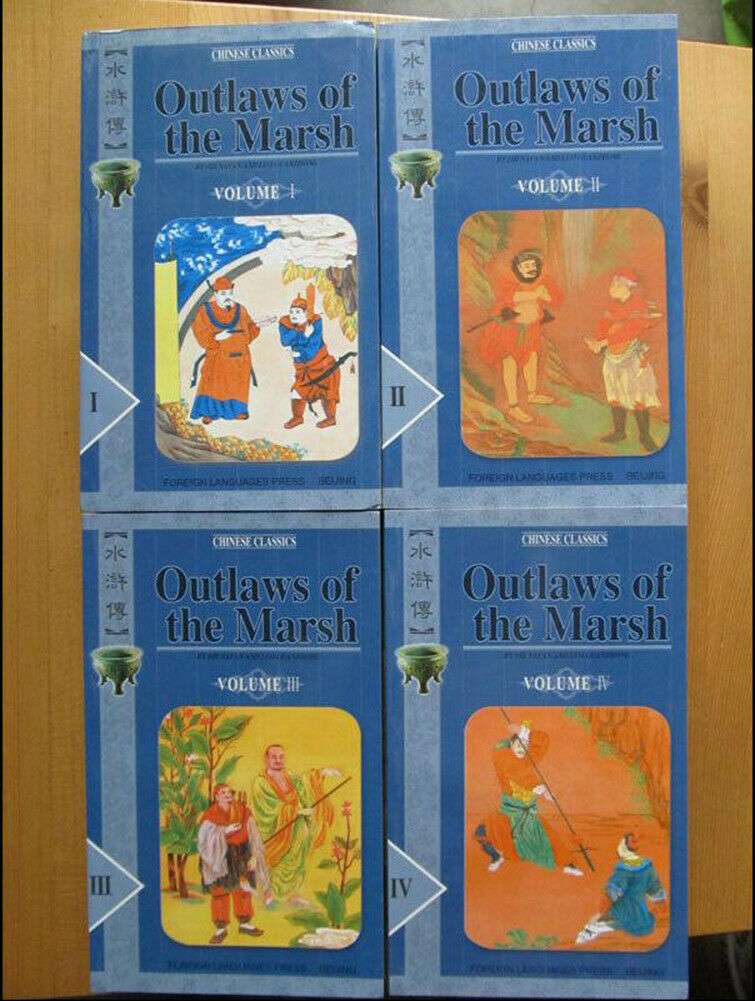
Archive #53 – PDFs of Outlaws of the Marsh (a.k.a. Water Margin) Foreign Language Press English Translation (Vols. 1-4)

Note: My blog is not monetized, so I am not making any money from this post. My hope is that the PDF will make this legendary story more accessible to a wider audience. If you enjoyed the digital version, please, please, please support the official release.

Here I present a PDF of the 100-chapter Foreign Language Press four-volume boxed set of Outlaws of the Marsh (a.k.a. Water Margin, Shuihu zhuan, 水滸傳, c. 1400; “WM” hereafter) translated by Sidney Shapiro. Credited to Shi Nai’an and Luo Guanzhong, this classic Chinese military romance follows 108 heavenly and earthly spirits-reborn-heroes who band together and use their great physical or mental strengths to rebel against the falling Song Dynasty (960–1279). Some of the surviving members later accept clemency from the government and work to fight the barbarian hordes invading China. Few survive to old age.

I’m archiving this book because it has a deep connection with Journey to the West (Xiyouji, 西遊記, 1592; “JTTW” hereafter). Here are a few examples. First, the name and number of Sun Wukong‘s “Multitude of Terrestrial Killers” (Disha shu地煞數; a.k.a. his “72 kinds of transformations,” qishier ban bianhua七十二般變化) and Zhu Bajie’s “Multitude of Celestial Rectifiers” (Tiangang shu天罡數; a.k.a. his “36 kinds of transformations,” sanshiliu ban bianhua三十六般變化) are similar to that of the spirits mentioned above. [1] In WM ch. 2, they are called the “Stars of the 36 Celestial Rectifiers and of the 72 Terrestrial Killers—a total of 108 Demon Lords” (三十六員天罡星,七十二座地煞星,共是一百單八個魔君) (Meulenbeld, 2019, p. 5; Shi & Luo, 1975/2021, vol. 1,  p. 16). [2] Second, see my previous article analyzing the parallels between the Monkey King and the bandit Wu Song (武松). See also the sister article over at the Journey to the West Library blog. And third, I’ve previously suggested that Sun’s ploy to rescue the beleaguered wife of Zhu Bajie in JTTW ch. 18 is based on an event from WM ch. 5. Both feature:

  • Young, beautiful daughters in unwanted relationships (Green Orchid vs the unnamed maiden).
  • Elderly fathers worried for their child (Mr. Gao vs Mr. Liu).
  • Evil spirit-turned-inhumanly strong, hot-tempered, heavy metal staff-wielding martial monks who come to their aid (Sun Wukong vs Lu Zhishen).
  • The monk takes the place of the woman in a darkened room.
  • The villain is beaten (Zhu Bajie vs Zhou Tong) (Wu & Yu, 2012, vol. 1, pp. 374-377; Shi & Luo, 1993/2001, pp. 109-113).

This PDF will complement the translations that I’ve previously archived. These include the JTTW story cycle (here and here), the four-volume 2000 Library of Chinese Classics Chinese-English bilingual edition of Creation of the Gods (Fengshen yanyi封神演義, c. 1620 CE), a fan translation of Journey to the South (Nanyouji南遊記, c. 1570s-1580s), and the four-volume 2001 Foreign Language Press boxed set of Three Kingdoms (Sanguo yanyi三國演義; lit: “Romance of the Three Kingdoms,” 14th century.).

Archive Link:

Click to access Outlaws-of-the-Marsh.pdf

Fig. 1 – The four covers of the boxed set edition (larger version). Image found here.

Notes:

1) Anthony C. Yu (Wu & Yu, 2012) translates these as the “Art of the Heavenly Ladle” and the “Art of the Earthly Multitude” (vol. 1, p. 122). I instead follow the translation used by Meulenbeld (2019). In regards to Tiangang (天罡), he explains: “In its exorcist manifestation, the Northern Dipper is known as gang 罡, which I translate here as ‘rectifier’ due to the ritual function it has in righting wrong” (Meulenbeld, 2019, p. 7). “Terrestrial Killers” is a direct translation of Disha (地煞).

2) Shapiro translates these as the “[t]hirty-six stars of Heavenly spirits and seventy two stars of Earthly Fiends, a total of one hundred and eight demons” (Shi & Luo, 2001, vol. 1, p. 16). Each of the 108 bandits is later associated with a particular star in WM ch. 71 (Shi & Luo, 2001, vol. 4, pp. 1499-1501; Shi & Luo, 1975/2021, vol. 3,  pp. 972-975).

Sources:

Meulenbeld, M. (2019). Vernacular “Fiction” and Celestial Script: A Daoist Manual for the Use of Water Margin. Religions10(9), 518. MDPI AG. Retrieved from http://dx.doi.org/10.3390/rel10090518.

Shi, N., & Luo, G. (2001). Outlaws of the Marsh (Vols. 1-4) (S. Shapiro, Trans.). Beijing: Foreign Languages Press. (Original work published 1993)

Shi, N., & Luo, G. (2021). Shuihu zhuan (shangzhongxia) [Tale of the Water Margin (Vols. 1-3)]. Beijing: Renmin wenxue chubanshe. (Original work published 1975)

Wu, C., & Yu, A. C. (2012). The Journey to the West (Vols. 1-4) (Rev. ed.). Chicago, Illinois: University of Chicago Press.

Why I Don’t Do Powerscaling for Sun Wukong

I am known in one small corner of the internet for being knowledgeable on the characters and events of the Chinese classic Journey to the West (Xiyouji西遊記, 1592, “JTTW” hereafter). As such, I receive a lot of questions across social media, but the single most frequent query put to me is: “Where do you scale Sun Wukong?” Comparing the power of mythic or fictional characters is a highly popular subject called “powerscaling” (a.k.a. “power scaling” and “power-scaling”).

This usually involves taking “scans,” or examples of feats from the respective literature, and using complicated physics to calculate not only a character’s power (e.g. strength and speed) but also their cosmic rank (e.g. any level inside or outside of a universe or multiverse). The higher up the chain a character sits, the more physical power they have, such as the ability to manipulate or destroy things broadly ranging from a car, a building, a city, a mountain, or a whole planet to a star/solar system, a galaxy/galaxy cluster, or even a universe/multiverse and beyond; and higher ranks can transcend “physicality,” with characters having such command over time and space that they can erase a given enemy or universe (and everything in between) from existence.

Having written the above, I dislike and do not participate in powerscaling for a number of reasons. But instead of typing the same thing over and over again, I’ve decided to create a standard response that I can just link to whenever I’m asked the aforementioned question.

My Response

No matter how precisely someone quotes from canon or calculates equations, anything written is going to be incorrect for one reason: a divine figure or philosophical concept removed from its original religio-mythological context and forced through the screen of a modern scientific worldview is no longer that thing. It’s an artificial construct that defies accurate measurement.

For example, among his many powers and skills, Sun Wukong is famous for his ability to travel 108,000 li (33,554 mi / 54,000 km) in a single leap of his somersault cloud. Powerscalers will naturally want to quantify this by somehow calculating a real world speed, but they are forgetting—or are not aware of—two key details: 1) The feat is actually an allegory for instant Buddhist enlightenment (see section III here); and 2) JTTW doesn’t happen in our own universe; it happens in a realm based on the Buddhist disc world system (see here). How then are any calculations going to be correct if allegorical feats happening in a specific religious cosmos are forced to fit the structure and scientific laws of our universe?

I’m ok with quantifying feats for small scale, personal use, like for figuring out the dynamics of a fanfiction. But I draw the line when entire websites and/or online communities are dedicated to pitting religious figures against one another or (worse) against fictional characters to see who is the strongest, fastest, deadliest, etc. And then wiki articles are written and presented to the world like the contents are gospel. The very idea of pitting pantheon against pantheon or a pantheon against a modern franchise is offensive, even to a non-religious person like myself.

Also, even if we disregard the religio-mythological nature of Sun Wukong, how is it fair to pit him against modern fictional characters that have benefited from building upon thousands of years of world mythology, as well as have enjoyed decades of iterations? There is only one Monkey King (from the standard modern version of JTTW), while Superman, for instance, has benefited from nearly 90 years of innovation and power increases.

Powerscalers need to remember that the 1592 edition of JTTW was published almost 435 years ago, with a story cycle going back further to roughly the 11th-century. It wasn’t written like modern Shonen comics or video games, where franchises try to one up the other by creating characters that are more and more powerful. The novel is basically a cultural encyclopedia of Chinese history, religion, myth, and folklore, with some fanfiction thrown in. And it’s important to recognize that the story itself serves as an allegory for the journey towards Buddhist enlightenment. Therefore, any of the feats performed by the Monkey King, especially during the pilgrimage, should be read as a service furthering that goal, not as an action requiring measurement.

Archive #49: Journey to the West (西游记): A 60-Volume Lianhuanhua Comic

I recently archived a seven-volume lianhuanhua comic about Sun Wukong battling the famous Eighteen Arhats. Upon learning this, a follower on Twitter asked me if I could locate scans of a 60-volume set that they read when they were younger. Luckily, I found a website selling them for super cheap.

I am archiving the set here in order to document modern day perceptions and depictions of JTTW and its characters.

1. Info

  • Title – Journey to the West (西游记)
    • Adaptation – Zhang Yuzhi (张玉枝)
    • Illustrations – Yan Dong (严东)
    • Editor-in-charge – Chang Shengli (常胜利)
  • Publisher – China Lianhuanhua Publishing House and Distribution (中国连环画出版社出版发行)
  • First edition – November 1997
  • ISBN 7-5061-0827-5

The volume 60 cover reading, “Meeting the Buddhist Patriarch at Spirit Mountain” (Lingshan jian Fozu, 灵山见佛祖) (larger version).

1.1. Reprint

This set is the first of at least two prints, the other coming out in 2008 (ISBN: 7801388461, 9787801388469). See, for example, this Ebay listing (screenshot).

The 2008 boxed set (larger version).

2. Download link:

This is for the 1997 version only.

The comics can be read on Google Drive or downloaded and read on Adobe. However, I’ve had problems reading them on Chrome. Please keep this in mind. It might just be a problem on my end.

https://drive.google.com/drive/folders/1JcS65ckxWZQh462mlqwj5OOzNl4JJAQ7?usp=sharing

Archive #48: The Eighteen Arhats Battle Wukong (十八罗汉斗悟空): A 7-Volume Lianhuanhua Comic

Last updated: 02-28-2025

I was contacted late last year by reader Adelar Eleramo (their JTTW group) looking for more information about a story called The Eighteen Arhats Battle (Sun) Wukong (Shiba luohan dou Wukong, 十八罗汉斗悟空/十八羅漢鬥悟空). A cursory searched turned up this Baidu article, which explained that both a 1982 Chinese opera and a six-volume 1989 lianhuanhua share this title. The respective stories differ, but both draw upon Journey to the West (Xiyouji西遊記, 1592) for inspiration. Regarding the comic, Baidu explains:

[It] tells the story of how the fully enlightened Sun Wukong goes out of his way to stir up trouble with the Eighteen Arhats because he cannot stand the way people celebrate and venerate them. He later reunites with Zhu Bajie to face the Buddhist saints in a battle of wits, courage, and magic, until the two groups finally reconcile.

漫画《十八罗汉斗悟空》描述讲述了修成正果的孙悟空因为看不惯十八罗汉声名显赫受人膜拜而刻意挑起事端,后联合猪八戒一起与十八罗汉斗智斗勇斗法,直至最后心悦诚服地言归于好。

Adelar was kind enough to send me an archive of a seven-volume 2011 adaptation of the original.

I am archiving it here in order to document modern day perceptions and depictions of JTTW and its characters.

1. Info

  • Title – The Eighteen Arhats Battle Wukong (十八罗汉斗悟空)
    • Original – He Hanqiu (何汉秋)
    • Adaptation – Jin Dan (金丹)
    • Editor-in-charge – Rao Zhongwei (饶忠伟)
    • Cover illustrations – Hong Zhe (洪哲), Zhang Zhiwen (张志文), and Dai Rui (戴锐)
    • Illustrations – Dai Rui (戴锐)
    • Planning – Yuhai Cultural Propagation Company (義海文化传播公司)
  • Publisher – Helongjiang Fine Arts Publishing House (黑龙江美术出版社)
  • First edition – August 2011
  • ISBN 978-7-5318-2967-6

Sun battles an Arhat (larger version).

2. Download links

The files are quite large, so I am providing two different download options.

2.1. WordPress

These are slow to load, but you can read them online without needing to first download.

Vol. 1https://journeytothewestresearch.com/wp-content/uploads/2025/02/01大战棋盘阵.戴锐.黑龙江美术出版社.2011.pdf

Vol. 2https://journeytothewestresearch.com/wp-content/uploads/2025/02/02青山龙虎斗.戴锐.黑龙江美术出版社.2011.pdf

Vol. 3https://journeytothewestresearch.com/wp-content/uploads/2025/02/03-两请猪八戒.戴锐.黑龙江美术出版社.2011.pdf

Vol. 4https://journeytothewestresearch.com/wp-content/uploads/2025/02/04围陷流沙河.戴锐.黑龙江美术出版社.2011.pdf

Vol. 5https://journeytothewestresearch.com/wp-content/uploads/2025/02/05火焚罗汉庙.戴锐.黑龙江美术出版社.2011.pdf

Vol. 6https://journeytothewestresearch.com/wp-content/uploads/2025/02/06威震十八湾.戴锐.黑龙江美术出版社.2011.pdf

Vol. 7https://journeytothewestresearch.com/wp-content/uploads/2025/02/07悟空心归正.戴锐.黑龙江美术出版社.2011.pdf

2.2. Google Drive

Google cannot provide an online preview, so you’ll, unfortunately, have to download these to read.

Vol. 1https://drive.google.com/file/d/1G8-KH5M4zCUhHYxRIs_yXeLBhPkqbND4/view?usp=sharing

Vol. 2https://drive.google.com/file/d/1uSPTLofaWglWcayxuDTGWdyxUUijlhbW/view?usp=drive_link

Vol. 3https://drive.google.com/file/d/12ybtR750U3h8lqErSdN2iw5V_x88dkem/view?usp=sharing

Vol. 4https://drive.google.com/file/d/1beRZw_Lx08l3HRv4mW7yh1JAsYUeENdj/view?usp=drive_link

Vol. 5https://drive.google.com/file/d/1PRWW-g9mWb9uS9hi6Wje7qu2eUywFKls/view?usp=sharing

Vol. 6https://drive.google.com/file/d/1Fby7yK_CwOeO5TpwJeiZA4IV2DuFKZ3b/view?usp=sharing

Vol. 7https://drive.google.com/file/d/1khp9Rj2VYUBH4V4EkvgjzWTuzqZg5sx3/view?usp=sharing


Update: 02-28-25

I have uploaded another lianhuanhua comic.

Archive #49: Journey to the West (西游记): A 60-Volume Lianhuanhua Comic