How to Resurrect the Tang Monk if He is Killed During Journey to the West

Tumblr user @predictablemess recently asked me the following question:

If [Tripitaka (Sanzang, 三藏; fig. 1), Sun Wukong‘s master,] were to die during Journey to the West, in your opinion, what would happen?

Would he remain dead and be reincarnated or be revived? Would they have to restart the cycle again? Through what means do they go through to get the monk and recover the Scriptures?

What follows is an expanded version of my answer.

Fig. 1 – Tripitaka as depicted in the 1986 Journey to the West TV show (larger version). Image found here.

Table of Contents

1. Introduction

Not counting the ginseng fruit (renshen guo人參果; a.k.a. “grass of reverted cinnabar,” cao huandan, 草還丹) that gives Tripitaka a nigh-immortal, adamantine body, [1] the Monkey King, a host of other Buddho-Daoist gods, Guanyin, or even the Buddha would prevent him from being killed. [2] However, for the sake of argument, there are a few ways to bring the Tang Monk (Tang seng, 唐僧) back to life, but the methods used depend on the state of his body. Below, I present examples of resurrection appearing in Journey to the West (Xiyou ji西遊記, 1592 CE).

The novel presents two main modes of revivification: 1) forcing the soul into the original or new body; and 2) compelling the spirit to reform within the old vessel using a magic pill and rescue breathing. The first method requires underworld authorization, while the second does not. An interesting side effect of (re)introducing a soul into a body is that the original injuries appear to heal, allowing the person to live once more.

Fanfiction writers might find this article useful. I consider it a companion piece to my “How to Kill Sun Wukong.”

2. Examples

2.1. Chapter 9

Shortly before Tripitaka’s birth, his father, Chen Guangrui (陳光蕊), is beaten to death by bandits disguised as boatmen, and his body is thrown into the river. The local Dragon King repays a kindness done to him by Guangrui by preserving the official’s body with a magic pearl (dingyan zhu, 定顏珠; lit: “feature-preserving pearl”) and requesting through a bureaucratic chain that the man’s soul be delivered (from the underworld) to serve as a courtier in the dragon kingdom (Wu & Yu, 2012, vol. 1, p. 220). Both halves are eventually rejoined some 18 years later:

Facing the river the three persons wept without restraint, and their sobs were heard down below in the water region. A yakṣa patrolling the waters brought the essay in its spirit form to the Dragon King, who read it and at once sent a turtle marshal to fetch Guangrui. “Sir,” said the king, “Congratulations! Congratulations! At this moment, your wife, your son, and your father-in-law are offering sacrifices to you at the bank of the river. I am now letting your soul go so that you may return to life. […] Today you will enjoy the reunion of husband and wife, mother and son.” After Guangrui had given thanks repeatedly, the Dragon King ordered a yakṣa to escort his body to the mouth of the river and there to return his soul. The yakṣa followed the order and left.

We tell you now about Lady Yin [Yin xiaojie, 殷小姐], who, having wept for some time for her husband, would have [tried to kill herself again] by plunging into the water if Xuanzang [玄奘; i.e. Tripitaka] had not desperately held on to her. They were struggling pitifully when they saw a dead body floating toward the river bank [fig. 2]. The lady hurriedly went forward to look at it. Recognizing it as her husband’s body, she burst into even louder wailing. As the other people gathered around to look, they suddenly saw Guangrui unclasping his fists and stretching his legs. The entire body began to stir, and in a moment he clambered up to the bank and sat down, to the infinite amazement of everyone. Guangrui opened his eyes and saw Lady Yin, the chief minister Yin, his father-in-law, and a youthful monk [i.e. Tripitaka], all weeping around him. “Why are you all here?” said Guangrui (Wu & Yu, 2012, vol. 1, pp. 228-229).

三人望江痛哭,早已驚動水府,有巡海夜叉將祭文呈與龍王。龍王看罷,就差鱉元帥去請光蕊來到,道:「先生,恭喜,恭喜。今有先生夫人、公子同岳丈俱在江邊祭你。我今送你還魂去也。[…] 你今日便可夫妻子母相會也。」光蕊再三拜謝。龍王就令夜叉將光蕊身屍送出江口還魂。夜叉領命而去。

卻說殷小姐哭奠丈夫一番,又欲將身赴水而死,慌得玄奘拚命扯住。正在倉皇之際,忽見水面上一個死屍浮來,靠近江岸之傍。小姐忙向前認看,認得是丈夫的屍首,一發嚎啕大哭不已。眾人俱來觀看,只見光蕊舒拳伸腳,身子漸漸展動,忽地爬將起來坐下。眾人不勝驚駭。光蕊睜開眼,早見殷小姐與丈人殷丞相同著小和尚俱在身邊啼哭。光蕊道:「你們為何在此?」

Fig 2 – Yaksha guardians escort Chen Guangrui’s revived body (center right) to the surface of the water. His family and their attendants watch from the river bank (larger version). This is a woodblock print from the Newly Annotated Journey to the West With Illustrations (Xinshuo Xiyouji tuxiang, 新說西遊記圖像, 1888).

2.2. Chapters 11 & 12

The Tang official Liu Quan (劉全) takes poison in order to deliver a royal offering of melons to the Ten Kings of the underworld. He explains that the untimely suicide of his wife, Li Cuilian (李翠蓮), cemented his decision (Wu & Yu, 2012, vol. 1, p. 268). This sways the infernal arbiters to help the couple:

Chapter 11

When the Ten Kings heard these words, they asked at once for Li, the wife of Liu Quan; she was brought in by the demon guardian, and wife and husband had a reunion before the Hall of Darkness. They conversed about what had happened and also thanked the Ten Kings for this meeting. King Yama, moreover, examined the Books of Life and Death and found that both husband and wife were supposed to live to a ripe old age. He quickly ordered the demon guardian to take them back to life, but the guardian said, “Since Li Cuilian has been back in the World of Darkness for many days, her body no longer exists. To whom should her soul attach herself?”

The emperor‘s sister, Li Yuying [李玉英],” said King Yama, “is destined to die very soon. Borrow her body right away so that this woman can return to life.” The demon guardian obeyed the order and led Liu Quan and his wife out of the Region of Darkness [Yin si, 陰司] to return to life. We do not know how the two of them returned to life (Wu & Yu, 2012, vol. 1, p. 268).

十王聞言,即命查勘劉全妻李氏。那鬼使速取來在森羅殿下,與劉全夫妻相會。訴罷前言,回謝十王恩宥。那閻王卻檢生死簿子看時,他夫妻們都有登仙之壽,急差鬼使送回。鬼使啟上道:「李翠蓮歸陰日久,屍首無存,魂將何附?」閻王道:「唐御妹李玉英今該促死,你可借他屍首,教他還魂去也。」那鬼使領命,即將劉全夫妻二人還魂,同出陰司而去。

畢竟不知夫妻二人如何還魂,且聽下回分解。

Chapter 12

We were telling you about the demon guardian who was leading Liu Quan and his wife out of the Region of Darkness. Accompanied by a swirling dark wind, they went directly back to Chang’ an of the great nation. The demon pushed the soul of Liu Quan into the Golden Court Pavilion Lodge, but the soul of Cuilian was brought into the inner court of the royal palace. Just then the Princess Yuying was walking beneath the shadows of flowers along a path covered with green moss. The demon guardian crashed right into her and pushed her to the ground; her living soul was snatched away and the soul of Cuilian was pushed into Yuying’s body instead [fig. 3]. The demon guardian then returned to the Region of Darkness, and we shall say no more about that (Wu & Yu, 2012, vol. 1, p. 269).

卻說鬼使同劉全夫妻二人出了陰司,那陰風遶遶,徑到了長安大國,將劉全的魂靈推入金亭館裡,將翠蓮的靈魂帶進皇宮內院。只見那玉英宮主正在花陰下,徐步綠苔而行,被鬼使撲個滿懷,推倒在地,活捉了他魂,卻將翠蓮的魂靈推入玉英身內。鬼使回轉陰司不題。

Li Cuilian revives in the new body with all of her past memories, but the Tang Emperor thinks that his “sister” is delusional (Wu & Yu, 2012, vol. 1, pp. 269-270). Off page, Liu Quan’s spirit is forced back into his own body and brought back to life. He soon thereafter arrives to corroborate the story of the princess/his wife (Wu & Yu, 2012, vol. 1, p. 270).

Fig. 3 – The demon guard steals Li Yuling’s spirit and replaces it with that of Li Cuilian (larger version). These are two graffitied woodblock prints from The Illustrated Journey to the West (Ehon Saiyuki, 繪本西遊記, 1835), the first complete Japanese translation of the novel.

2.3. Chapters 38 & 39

In chapter 38, Monkey tricks Zhu Bajie into entering a hidden well and swimming to a dragon kingdom to retrieve a “treasure,” which is actually the magic pearl-preserved corpse of a drowned king (Wu & Yu, 2012, vol. 2, pp. 186-189). Angered by the deception, Zhu schemes to get his religious brother in trouble (Wu & Yu, 2012, vol. 2, p. 190). And at the end of the section and the beginning of next (chapter 39), he convinces Tripitaka to use the tight-fillet spell to force Sun to resurrect the monarch using a harder method. Instead of simply retrieving his soul from the underworld (more on this process below), our hero is forced to appeal to heaven (Wu & Yu, 2012, vol. 2, pp. 191-192), where he fetches a pill of “Soul-Restoring Elixir of Nine Reversions” (Jiuzhuan huanhun dan, 九轉還魂丹) from Laozi (Wu & Yu, 2012, vol. 2, pp. 194-195). This leads to the following events:

… Pilgrim spat out the elixir and placed it inside the lips of the king. Then with both hands, he pulled the jaws of the king apart, and using a mouthful of clean water [from an alms bowl], he flushed the golden elixir down to the king’s stomach. After about half an hour, loud gurgling noises came from the belly of the king, although his body remained immobile. “Master,” said Pilgrim, “even my golden elixir [3] seems unable to revive him! Could it be that old Monkey’s going to be finished off by blackmail?” Tripitaka said, “Nonsense! There’s no reason for him not to live. How could he swallow that water if he had been only a corpse dead for a long time? It had to be the divine power of that golden elixir, which entrance into his stomach now causes the intestines to growl. When that happens, it means that circulation and pulse are in harmonious motion once more. His breath, however, is still stopped and cannot flow freely. But that’s to be expected when a man has been submerged in a well for three years; after all, even raw iron would be completely rusted. That’s why his primal breath is all used up, and someone should give him mouth-to-mouth resuscitation.”

Eight Rules walked forward and was about to do this when he was stopped by Tripitaka. “You can’t do it,” he said. “Wukong still should take over.” That elder indeed had presence of mind, for Zhu Eight Rules, you see, had been a cannibal since his youth, and his breath was unclean. Pilgrim, on the other hand, had practiced self-cultivation since his birth, the food sustaining him being various fruits and nuts, and thus his breath was pure. [4] The Great Sage, therefore, went forward and clamped his thundergod beak to the lips of the king: a mighty breath was blown through his throat to descend the tiered towers. Invading the bright hall, it reached the cinnabar field and the jetting-spring points beyond before it reversed its direction and traveled to the mud-pill chamber of the crown [fig. 4]. With a loud swoosh, the king’s breath came together and his spirit returned; he turned over and at once flexed his hands and feet, crying, “Master!” Going then to his knees, he said, “I remember my soul as a ghost did see you last night, but I did not expect this morning my spirit would return to the World of Light.” Tripitaka hurriedly tried to raise him, saying, “Your Majesty, I didn’t do anything. You should thank my disciple” (Wu & Yu, 2012, vol. 2, pp. 195-196).

行者接了水,口中吐出丹來,安在那皇帝唇裡。兩手扳開牙齒,用一口清水,把金丹沖灌下肚。有半個時辰,只聽他肚裡呼呼的亂響,只是身體不能轉移。行者道:「師父,弄我金丹也不能救活,可是掯殺老孫麼?」三藏道:「豈有不活之理?似這般久死之屍,如何吞得水下?此乃金丹之仙力也。自金丹入腹,卻就腸鳴了,腸鳴乃血脈和動,但氣絕不能迴伸。莫說人在井裡浸了三年,就是生鐵也上鏽了。只是元氣盡絕,得個人度他一口氣便好。」那八戒上前就要度氣,三藏一把扯住道:「使不得,還教悟空來。」那師父甚有主張:原來豬八戒自幼兒傷生作孽吃人,是一口濁氣。惟行者從小修持,咬松嚼柏,吃桃果為生,是一口清氣。這大聖上前,把個雷公嘴,噙著那皇帝口唇,呼的一口氣吹入咽喉,度下重樓,轉明堂,徑至丹田,從湧泉倒返泥[丸]宮。呼的一聲響喨,那君王氣聚神歸,便翻身,掄拳曲足,叫了一聲:「師父。」雙膝跪在塵埃道:「記得昨夜鬼魂拜謁,怎知道今朝天曉返陽神。」三藏慌忙攙起道:「陛下,不干我事,你且謝我徒弟。」

(Before continuing, I want to explain the esoteric jargon used to describe the path that Sun’s breath follows inside the king. First is the “tiered towers” (chonglou, 重樓; a.k.a. “12-story tower,” shi’er lou, 十二樓), or the trachea (Pregadio, 2025f). Second is the “bright hall” (mingtang, 明堂; a.k.a. “hall of light”), or the lungs (Pregadio, 2025c). Third is the “cinnabar field” (dantian, 丹田), one of three similarly named spiritual centers of the body. This one is commonly referred to as the “middle cinnabar field,” and it “is the place [around the navel] where essence and spirit are stored” (Pregadio, 2025a). Fourth is the “jetting-spring points” (yongquan xue, 湧泉穴), or pressure points on the bottom of the feet (Wu & Yu, 2012, vol. 1, p. 528 n. 7; Pregadio, 2025b, p. 312 n. 10). And fifth is the “mud-pill chamber” (niwan gong, 泥丸宮; [5] a.k.a. “Palace of the Muddy Pellet”), or the “upper cinnabar field,” and it is “the residence of [s]pirit” located at the crown of the head (Pregadio, 2025d; 2025e). Taken together, the following route forms: the breath flows through the trachea and into the lungs, continues into the abdomen and down to the feet, and it finally reverses course and terminates in the brain.)

Fig. 4 – The king is resurrected with the help of Monkey’s rescue breathing (larger version). The image is from a modern Journey to the West lianhuanhua pocket comic.

2.4. Chapter 97

Monkey travels to the infernal realm to bring back the spirit of Kou Hong (寇洪), a slain elderly householder who had recently hosted the pilgrims for a month (see here for more background info).

“Kou Hong is a virtuous person,” said the Ten Yama Kings. “We did not have to use a ghost guardian to summon him [when he died]. He came by himself, but when the Golden-Robed Youth of King Kṣitigarbha met him, he led him to see the king.” Pilgrim at once took leave of them to head for the Jade Cloud Palace, where he greeted the Bodhisattva King Kṣitigarbha and gave a thorough account of what took place.

In delight the Bodhisattva said, “It was foreordained that Kou Hong should leave the world without touching a bed or a mat when his allotted age reached its end. Because he had been a person of virtue who fed the monks, I took him in and made him the secretary in charge of the records of good karma. Since the Great Sage has come to ask for him, I shall lengthen his age by another dozen years. He may leave with you.”

The Golden-Robed Youth led out Kou Hong, who, on seeing Pilgrim, cried out, “Master! Master! Save me!” “You were kicked to death by a robber,” said Pilgrim. “This is the place of the Bodhisattva King Kṣitigarbha in the Region of Darkness. Old Monkey has come especially to take you back to the world of light so that you may give your testimony. The Bodhisattva is kind enough to release you and lengthen your age for another dozen years. Thereafter you’ll return here.” The squire bowed again and again.

Having thanked the Bodhisattva, Pilgrim changed the soul of the squire into ether by blowing on him. The ether was stored in his sleeve so that they could leave the house of darkness and go back to the world of light together. Astride the clouds, he soon arrived at the Kou house. Eight Rules was told to pry open the lid of the coffin, and the soul of the squire was pushed into his body. In a moment, he began to breathe once more and revived. Scrambling out of the coffin [fig. 5], the squire kowtowed to the Tang Monk and his three disciples, saying, “Masters! Masters! Having suffered a violent death, I am much obliged for this master’s arrival at the Region of Darkness and returning me to life. His is the kindness of a new creation!” (Wu & Yu, 2012, vol. 4, pp. 338-339)

十閻王道:「寇洪善士,也不曾有鬼使勾他,他自家到此,遇著地藏王的金衣童子,他引見地藏也。」行者即別了,徑至翠雲宮見地藏王菩薩。菩薩與他禮畢,具言前事。菩薩喜道:「寇洪陽壽,止該卦數命終,不染床蓆,棄世而去。我因他齋僧,是個善士,收他做個掌善緣簿子的案長。既大聖來取,我再延他陽壽一紀,教他跟大聖去。」金衣童子遂領出寇洪。寇洪見了行者,聲聲叫道:「老師,老師,救我一救。」行者道:「你被強盜踢死,此乃陰司地藏王菩薩之處。我老孫特來取你到陽世間對明此事。既蒙菩薩放回,又延你陽壽一紀,待十二年之後,你再來也。」那員外頂禮不盡。

行者謝辭了菩薩,將他吹化為氣,掉於衣袖之間,同去幽府,復返陽間。駕雲頭,到了寇家,即喚八戒捎開材蓋,把他魂靈兒推付本身。須臾間,透出氣來活了。那員外爬出材來,對唐僧四眾磕頭道:「師父,師父,寇洪死於非命,蒙師父至陰司救活,乃再造之恩。」

Fig. 5 – Kou Hong emerges from his coffin shortly after being resurrected (larger version). This is a woodblock print from Mr. Li Zhuowu’s Literary Criticism of Journey to the West (Li Zhuowu xiansheng piping Xiyou ji, 李卓吾先生批評西遊記, late 16th c. or early 17th c.).

3. Analysis

The novel presents two main modes of resurrection: 1) forcing the soul into the original or new body; and 2) compelling the spirit to reform within the old vessel using a magic pill and rescue breathing. The souls of Chen Guangrui, Liu Quan, and Kou Hong are forced back into their old bodies. And a new vessel, that of Princess Li Yuling, is quickly chosen for Li Cuilian as “her (old) body no longer existed” (shihou wu cun, 屍首無存). [6] I’m assuming this was because it was too degraded after burial or was cremated.

This first method requires underworld authorization in one form or another. For example, the Dragon King requests Chen Guangrui’s spirit from a municipal deity (chenghuang, 城隍; a.k.a. city god), a class of urban celestial that manages death gods (among other duties), through a bureaucratic chain:

He at once issued an official dispatch, sending a yakṣa to deliver it to the municipal deity and local spirit of Hongzhou, and asked for the soul of the scholar so that his life might be saved. The municipal deity and the local spirit in turn ordered the little demons to hand over the soul of Chen Guangrui to the yakṣa, who led the soul back to the Water Crystal Palace for an audience with the Dragon King (Wu & Yu, 2012, vol. 1, p. 220).

即寫下牒文一道,差夜叉徑往洪州城隍、土地處投下,要取秀才魂魄來,救他的性命。城隍、土地遂喚小鬼把陳光蕊的魂魄交付與夜叉去。夜叉帶了魂魄到水晶宮,稟見了龍王。

As for the others, Liu Quan and his wife are delivered back to life by order of the Ten Judges of the infernal realm, and Sun gains permission to do the same for Kou Hong from Bodhisattva Kṣitigarbha, a sort of pope of hell. Therefore, a writer wanting to bring the Tang Monk back using this method needs to keep this in mind.

If the Tripitaka’s old form is destroyed during the journey, finding him a new body opens the door for fanfiction writers to add a new element to his character. The first thing that comes to mind is reviving him as a woman, similar to how actresses portray him in modern Japanese media (fig. 6). A second is resurrecting him in the body of a recently deceased demon. This would create a struggle between his inner and outer selves—i.e. a noble spirit vs a fiendish appearance. (This would be especially hard on him since he was considered a very beautiful man in his original body. [7]) I can already hear Monkey saying, “Hey handsome! Now you know how we (your disciples) feel everyday.” A third is bringing him back as a young child (as sad as that may be). Passersby would be awestruck to see a cadre of monsters catering to a young lad, sort of like Marvel’s Earth-9997 Bruce Banner (fig. 7). And as an added bonus, readers would have the pleasure of reading a scene where an upset Tripitaka looks and points upward at the now taller Monkey King!

Fig. 6 (left) – The Tang Monk as portrayed by actress Masako Natsume in the highly popular Japanese TV show Saiyuki (Jp: 西遊記, 1978-1980; lit: “Journey to the West”; Eng: “Monkey” and “Monkey Magic”) (larger version). Image found here. Fig. 7 (right) – The Earth-9997 child version of Bruce Banner and his split alter ego, a mindless, gorilla-like Hulk. Image found here. In our case, the child would be Tripitaka and the monster(s) would be Sun, Zhu, and Sha Wujing.

As for the second method, the drowned king is revived with the help of Laojun’s “Soul-Restoring Elixir of Nine Reversions” (Jiuzhuan huanhun dan, 九轉還魂丹) and Sun’s rescue breathing. The celestial medicine is flushed into the monarch’s stomach with water, thus waking up the tissues, and the force of Monkey’s breath and the route that it takes causes the ruler’s “qi (breath, pneumas) to come together and his spirit to return” (qiju shengui, 氣聚神歸). I take this to mean that his soul is reignited or forced to re-coalesce with the body. This is certainly possible considering that the Great Sage has “immortal breath” (xianqi, 仙氣), which has the power to (among other things) manipulate and even strengthen spirits. [8] But it’s not wise to overemphasize Monkey’s ability here. Recall that the only requirement—at least according to the Tang Monk—is someone with “pure breath” (qingqi, 清氣). I’m sure that there are plenty of mortals who fit this description. Otherwise, the pill wouldn’t be needed and Sun could just resurrect whomever he wants with a simple exhale of his divine breath.

This mode of revivification does not require underworld authorization, for the magic medicine completely bypasses the bureaucracy and compels the soul to reform inside the body. This proves its great efficacy. However, the method does require heavenly permission of sorts: one would have to convince the Daoist high god to hand over one of his precious pills. (Though, there might be a way around this.) [9] Anyone wanting to bring Tripitaka back using this method needs to keep this info in mind.

3.1. Healing

An interesting side effect of (re)introducing a soul into a vessel is that the original injuries appear to heal, allowing the person to live once more. Recall that Chen Guangrui received a fatal beating, but his likely contusions, lacerations, brain damage, and internal bleeding disappear the moment that his soul is reunited with his body. Likewise, Liu Quan’s poison-damaged innards, the king’s water-logged lungs, and Kou Hong’s exploded testicles [10] seemingly revert to normal when they are raised from the dead. (Though, one might argue that the Dragon Kings’ respective pearls healed Guangrui and the human monarch. However, someone else might counter that the gem simply kept their corpses from rotting.) Medically speaking, Li Yuling’s quick death might denote a brain hemorrhage of some sort. If true, this, too, heals once Li Cuilian’s spirit is introduced. The same would hold true for Tripitaka provided that his original body isn’t too badly damaged. And this would also hold true for the replacement vessel.

Lastly, an interesting question arises from said resurrection: would the monk’s new (female, child, demonic, etc.) body gain the fabled immortality-bestowing flesh that monster’s crave in Journey to the West. It’s just something to think about.

4. Conclusion

If Tripitaka is killed at some point along the journey to India, he can be resurrected in a few ways, depending on the state of his vessel. With permission of the infernal bureaucracy, his soul can be forced into his original body (like Chen Guangrui, Liu Quan, and Kou Hong), or a new form can be found to house his spirit (like Li Cuilian). Minus underworld authorization, his soul can be compelled to regrow inside his body (like the king) with the help of Laozi’s pill of “Soul-Restoring Elixir of Nine Reversions” and the rescue breathing of some pure-breathed individual. This method does, however, require some heavenly permission as one needs to convince the Daoist high god to hand over his precious medicine. As for the injuries that caused the original or replacement bodies to die, these are seemingly healed when the soul is (re)introduced. Cured trauma from the narrative includes wounds from a fatal beating, poisoned innards, water-logged lungs, exploded testicles, and possibly a brain hemorrhage.

Notes:

1) A local god of the soil explains in chapter 24 that anything exposed to the ginseng fruit will gain a harder-than-iron constitution for 47,000 years (Wu & Yu, 2012, vol. 1, p. 462). Tripitaka eventually eats the fruit in chapter 26 (Wu & Yu, 2012, vol. 2, p. 14). His divinely durable body is completely forgotten until chapter 92, when his past consumption of the “grass of reverted cinnabar” is mentioned in passing (Wu & Yu, 2012, vol. 4, p. 253).

2) Sun Wukong essentially claims that Tripitaka can’t die while under his protection. This happens in chapter 81 while the Tang Monk is bedridden with an illness:

Which Yama king dares make this decision [to reap your soul]? Which judge of Hell has the gall to issue the summons? And which ghostly summoner would come near to take you away?’ If I’m the least bit annoyed, I may well bring out that temperament that greatly disturbed the Celestial Palace and, with my rod flying, fight my way into the Region of Darkness. Once I catch hold of the Ten Yama Kings, I’ll pull their tendons one by one, and even then I’ll not spare them!” (Wu & Yu, 2012, vol. 4, pp. 81-82).

問道那個閻王敢起心?那個判官敢出票?那個鬼使來勾取?若惱了我,我拿出那大鬧天宮之性子,又一路棍,打入幽冥,捉住十代閻王,一個個抽了他的筋,還不饒他哩。

A character being technically immortal just because the personification of death is too afraid of the person’s bodyguard(s) to reap their soul would make a great story!

3) This is naturally referring to Laozi’s resurrection pill, but Sun claims to have the knowledge to make his own divine medicine in chapter 5: “Since old Monkey has understood the Way and comprehended the mystery of the Internal’s identity with the External, I have also wanted to produce some golden elixir on my own to benefit people” (老孫自了道以來,識破了內外相同之理,也要煉些金丹濟人 …) (Wu & Yu, 2012, vol. 1, p. 166).

4) The idea that Monkey has pure breath because of a life-long vegetarian diet is contradicted in chapter 27, when he claims to have eaten humans as a young demon.

5) The original Chinese text reads niyuan gong (泥垣宮; lit: “mud-wall chamber”). The central character, yuan (垣; lit: “wall”), is a likely typo for wan (丸; lit: “pill” or “pellet”). This is because the far more common term is niwan gong (泥丸宮; lit: “mud-pill chamber”). I’ve, therefore, corrected the text accordingly.

It’s interesting to note that the typo also appears in chapter two, when Patriarch Subodhi describes the destructive force of a heavenly calamity sent to punish young cultivators:

After another five hundred years Heaven will send down the calamity of fire to burn you. The fire is neither natural nor common fire; its name is the Fire of Yin, and it arises from within your jetting-spring points (i.e. the souls of the feet) to reach even your mud-wall [pill] chamber [niyuan(wan) gong, 泥[丸]宮]* (i.e. the crown of the head), reducing your five entrails to ashes and your four limbs to utter ruin. The arduous labor of a millennium will then have been made completely superfluous (based on Wu & Yu, 2012, vol. 1, p. 121).

再五百年後,天降火災燒你。這火不是天火,亦不是凡火,喚做『陰火』。自本身湧泉穴下燒起,直透泥[丸]宮,五臟成灰,四肢皆朽,把千年苦行,俱為虛幻。

* Yu’s (Wu & Yu, 2012) original translation mistakenly calls it “the cavity of [the] heart” (vol. 1, p. 121).

6) It occurred to me that Cuilian and Yuling both have the surname Li (李). Perhaps the powers that be chose the latter’s corpse for Liu Quan’s wife because the women were part of the same extended clan and thus related. This could be an unspoken requirement, or it might just be a coincidence. Keep this in mind regarding the Tang Monk’s new body. As a reminder, he is part of the Chen (陳) clan.

7) A poem in chapter 54 describes Tripitaka’s beauty:

What handsome features!
What dignified looks!
Teeth white like silver bricks,
Ruddy lips and a square mouth.
His head’s flat-topped, his forehead, wide and full;
Lovely eyes, neat eyebrows, and a chin that’s long.
Two well-rounded ears betoken someone brave.
He is all elegance, a gifted man.
What a youthful, clever, and comely son of love,
Worthy to wed Western Liang’s gorgeous girl!* (Wu & Yu, 2012, vol.  3, p. 55).

丰姿英偉,相貌軒昂。齒白如銀砌,唇紅口四方。頂平額闊天倉滿,目秀眉清地閣長。兩耳有輪真傑士,一身不俗是才郎。好個妙齡聰俊風流子,堪配西梁窈窕娘。

* This refers to the Queen of the Woman Kingdom of Western Liang (Xiliang nuguo, 西梁女國).

8) As mentioned in chapter 97, Sun transforms Kou Hong’s soul into “ether” (qi, 氣) for better ease of transport to the mortal world. And previously in chapter 88, he performed a ritual in which he used his divine respiration to stoke the spiritual energy of three Indian princes, granting them super strength and possibly some form of divine longevity.

9) At least two characters are shown capable of entering heaven unseen and stealing precious items. Monkey does this in chapter 5 when he uses the “magic of body concealment” (yinshen fa, 隱身法; i.e. invisibility) to loot several jugs of immortal wine for his family and friends (Wu & Yu, 2012, vol. 1, p. 167). And in chapter 63, a dragon king explains how his daughter was able to rob the Queen Mother of her magic herbs (Wu & Yu, 2012, vol. 3, p. 192). This shows how easy it might be to sneak into heaven to steal Laozi’s magic elixir pill.

Additionally, the Daoist high god is not always present in his heavenly realm, leaving his precious items open to theft. For example, in chapter 52, the reader learns that a powerful spirit is actually Laozi’s buffalo mount that had stolen a magic weapon and fled to earth in his absence (Wu & Yu, 2012, vol. 3, pp. 28-29).

10) Chapter 97 explains that the elderly householder is kicked to death by a bandit:

Those robbers, of course, would not permit such discussion. They rushed forward, and one kick at the groin sent Squire Kou tumbling to the ground. Alas!

His three spirits gloomily drifted back to Hades; His seven souls slowly took leave of mankind (Wu & Yu, 2012, vol. 4, p. ).

那眾強人哪容分說,趕上前,把寇員外撩陰一腳,踢翻在地。可憐三魂渺渺歸陰府,七魄悠悠別世人!

Sources:

Pregadio, F. (2025a). dan tian 丹田 (dantian). In Dictionary of Taoist Internal Alchemy (pp. 38-39). Leiden: Brill.

Pregadio, F. (2025b). Dictionary of Taoist Internal Alchemy. Leiden: Brill.

Pregadio, F. (2025c). ming tang 明堂 (mingtang). In Dictionary of Taoist Internal Alchemy (p. 161). Leiden: Brill.

Pregadio, F. (2025d). ni wan 泥丸 (niwan). In Dictionary of Taoist Internal Alchemy (pp. 173-174). Leiden: Brill.

Pregadio, F. (2025e). ni wan gong 泥丸宮 (niwan gong). In Dictionary of Taoist Internal Alchemy (p. 174). Leiden: Brill.

Pregadio, F. (2025f). shi er lou 十二樓 (shi’er lou). In Dictionary of Taoist Internal Alchemy (p. 241). Leiden: Brill.

Wu, C., & Yu, A. C. (2012). The Journey to the West (Vols. 1-4) (Rev. ed.). Chicago, Illinois: University of Chicago Press.

Story Idea: Sun Wukong vs Heracles / Hercules

From time to time I like to post a fun blog not directly related to (though sometimes informed by) my research. Regular articles will resume after this entry.

Last updated: 04-08-2026

Readers may remember that DEATH BATTLE! (episode 162) featured a fight between Sun Wukong from Journey to the West (Xiyou ji, 西遊記, 1592 CE, “JTTW” hereafter) and Heracles / Hercules from Greco-Roman myth (fig. 1). The episode begins with the demi-god trekking up a mountain in order to fulfill the 11th of his famous 12 labors: procuring the Golden Apples of the Hesperides (Salapata, 2021), but he instead finds Monkey holding the fruit—food meant for his master, Tripitaka. Heracles demands the apple at sword-point, but he quickly discerns that the produce he’s been given was created from a magic hair. This leads to a deadly confrontation.

As I explain in my analysis of the episode, I initially liked how the fight began because both characters are known for stealing fruit in their respective mythologies (see no. 12 in my article listing their parallels). But in hindsight, this didn’t make much sense for two reasons. First, the golden apples are located in a land much further west than India, the scripture-pilgrims’ final destination in JTTW. Monkey could have easily gone to a location closer to their resting spot. And second, having the heroes meet during their respective adventures creates a temporal paradox since both are active at different times—late-Greek bronze age (c. 3000–1000 BCE) vs the early-Tang Dynasty (618–907 CE). Therefore, in the end, the idea is very forced. But what would be a more natural way for the Son of Zeus and the Great Sage Equaling Heaven to come to blows?

This article proposes a more organic reason for conflict via a story idea based on elements from JTTW, Greek myth, Greco-Buddhist art, and Buddhist literature. But take note that the encounter is NOT meant to be a death battle. Remember that the rest of the journey still needs to take place.

Fig. 1 – The official thumbnail for the episode (larger version). Image found here.

Table of Contents

1. Basis for the Story

My pitch is an offshoot of a previous story idea. It follows the historical Xuanzang (玄奘, 602–664 CE) (on whom Tripitaka is based) on his quest for sutras through Central Asia and India, including years-long periods of study. While the original novel sees Daoism practiced by Chinese-speaking people as far away as the Western Continent (i.e. India), this wouldn’t be the case in the real world. Therefore, changes would have to be made to the narrative, such as the appearance of foreign gods outside of the Middle Kingdom. But as I noted in the original article, it would be a lot easier to include the devas of Buddhism (e.g. Shakra, Brahma, Heavenly Kings, etc.) since the religion was practiced throughout the areas traveled by Xuanzang. This, however, wouldn’t exclude gods from other pantheons, like Heracles.

1.1. Heracles as Vajrapani in Greco-Buddhist Art

Now, I can already hear my readers asking, “How could Heracles possibly be associated with the gods of Buddhism?” Well, the first Greeks arrived in Central Asia and India during the reign of Darius the Great (550–486 BCE) and later Alexander the Great (356–323 BCE). And just like American Gods, these soldiers, merchants, artisans, and farmers brought their religion with them. The convergence of these two cultures eventually resulted in the demi-god appearing alongside Tathagata in the 1st to 3rd century CE Greco-Buddhist art of Gandhara (modern day NW Pakistan to E and NE Afghanistan) (fig. 2). The Greek hero takes the place of the Buddha’s loyal protector, the yaksha-turned-dharma guardian Vajrapani (Sk: वज्रपाणि, lit: “Vajra [Thunderbolt] in hand”; Ch: Jingang shou pusa, 金剛手菩薩, lit: “Bodhisattva holding the vajra”). (I have to say that Heracles’ association with the thunderbolt is super fascinating given who his father is.) In fact, the common image of Vajrapani as a muscular, club-wielding deva in East Asia (fig. 3) is directly linked to his depiction as Heracles in Gandharan art!

I won’t go into further detail here since I’ve already taken the liberty of archiving papers on the subject in preparation for this article:

Archive #50 – Heracles as Vajrapani

Fig. 2 – Detail of a stone carving of the Buddha preaching while Heracles-Vajrapani watches over him, Gandhara, 2nd or 3rd century CE, Schist (larger version). He wields a gada mace in his right hand and holds a bone-like vajra-club in the left. Adapted from an image found here. Copyright the Trustees of the British Museum. Fig. 3 – A Tang-era painting of Vajrapani, Dunhuang, Gansu Province, China, mid-9th to early-10th century CE, ink and colors on silk (larger version). Take note of his muscular physique and wispy beard. The vajra-club in his left hand is obscured by his leg. Image found here. Copyright the Trustees of the British Museum. See here for a Tang-era painting of Vajrapani with a visible club.

1.2. Historical Monkey King and Vajrapani Crossovers

Sun Wukong and Vajrapani have technically met before. For example, in the 13th century CE version of the JTTW story cycle, the Great Sage’s antecedent changes his magic staff into the dharma warrior while facing a white tiger spirit:

Monkey Pilgrim [Hou xingzhe, 猴行者] transformed his golden-ringed staff into a gigantic Yakşa whose head touched the sky and whose feet straddled the earth. In his hands he grasped a demon-subduing cudgel [jiangmochu, 降魔杵]. His body was blue as indigo, his hair red as cinnabar; from his mouth a fiery gleam shot forth over one thousand feet long” (based on Wivell, 1994, p. 1189). [1]

被猴行者將金鐶杖變作一個夜叉,頭點天,腳踏地,手把降魔杵,身如藍靛青,發似硃沙,口吐百丈火光。

The titan eventually crushes her with his weapon (Wivell, 1994, p. 1189). The “demon-subduing cudgel” is another name for Vajrapani’s vajra-thunderbolt.

Also, the Monkey King interacts with Vajra warriors (Jingang, 金剛) related to Vajrapani numerous times in the standard 1592 CE JTTW. In chapter 52, his way is momentarily barred by the “Eight Great Vajras” (Ba da jingang, 八大金剛) when he seeks an unannounced audience with the Buddha (Wu & Yu, 2012, vol. 3, p. 24). [2] In chapter 58, the eight warriors fail to stop Wukong and his doppelganger when they fight to the Western Paradise seeking Tathagata’s wisdom to distinguish one from the other (Wu & Yu, 2012, vol. 3, p. 114). After the Bull Demon King is captured in chapter 61, the Great Sage gathers the “Four Great Vajras” (Si da jingang, 四大金剛) and a host of other gods to confront Princess Iron Fan (Wu & Yu, 2012, vol. 3, p. 161). In chapter 77, the four warriors once again momentarily bar his way when he seeks an audience with the Buddha (Wu & Yu, 2012, vol. 4, pp. 27-28). In chapter 98, the four warriors welcome Tripitaka and his companions, including Monkey, upon their arrival to the Western Paradise (Wu & Yu, 2012, vol. 4, p. 347). Later in the same chapter, the Buddha charges the eight warriors with transporting the clerics on a cloud to hasten the completion of their mission and return to paradise (Wu & Yu, 2012, vol. 4, p. 357). But after being ordered to prematurely drop off the pilgrims, leading to Tripitaka’s 81st tribulation, the eight warriors reappear sometime later to complete the trip to China (Wu & Yu, 2012, vol. 4, p. 369). And finally, in chapter 100, the eight warriors spirit them back to the Western Paradise to receive their otherworldly reward (Wu & Yu, 2012, vol. 4, p. 380).

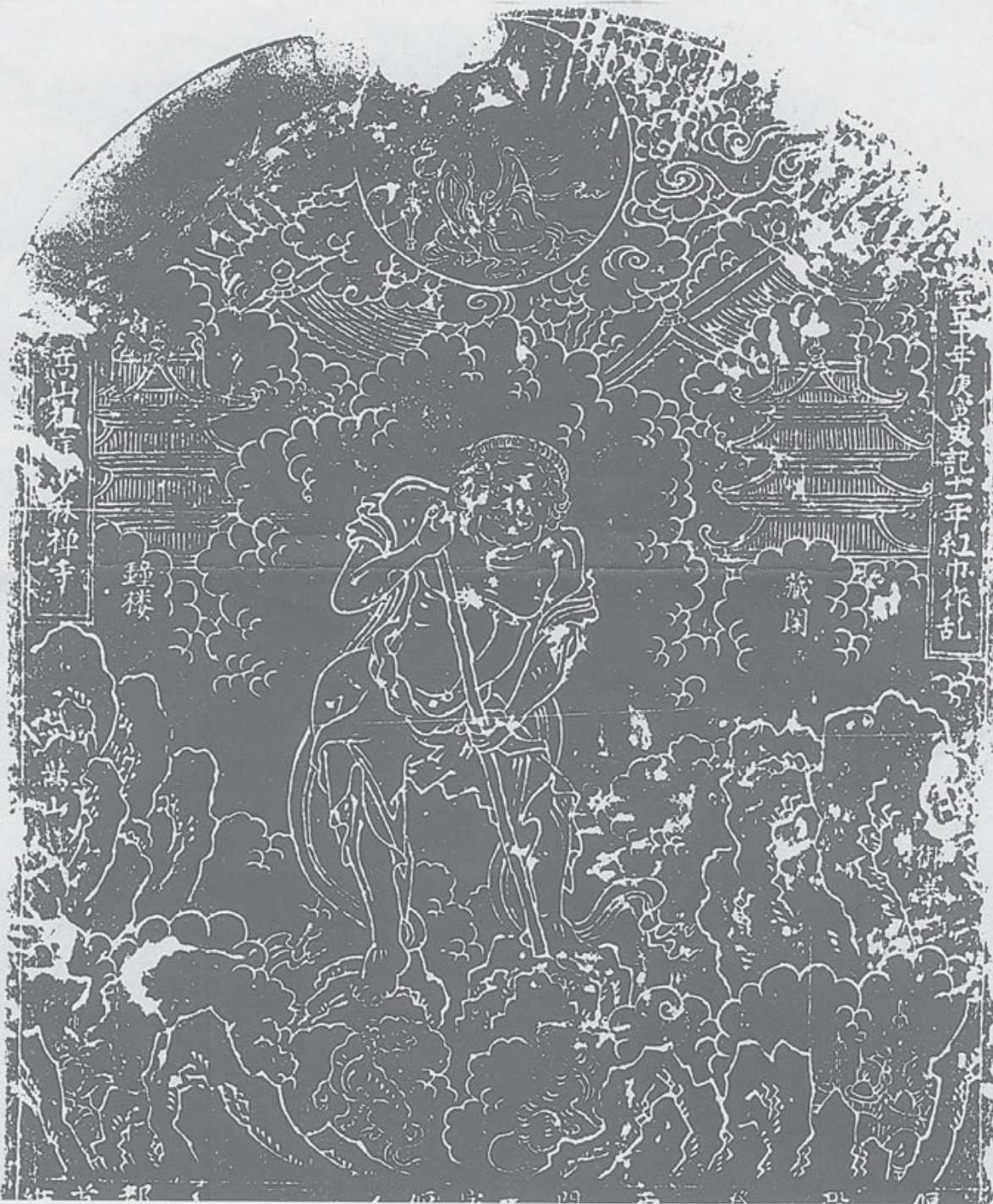
In addition, Sun Wukong and Vajrapani are associated with each other in Shaolin Monastery lore. The latter was historically worshiped as the progenitor of their famous staff method. A stele erected by Shaolin abbot Wenzai (文載) in 1517 CE shows that the deity’s vajra-club had been changed at some point to a Chinese staff (fig. 4) (Shahar, 2008, p. 84). Vajrapani’s yaksha-like Narayana (Naluoyan(tian), 那羅延(天)) form was eventually equated with one of the four staff-wielding “Kimnara Kings” (Jinnaluo wang, 緊那羅王) from the Lotus Sutra in 1575 CE. His name was thus changed from Narayana to Kimnara King (Shahar, 2008, p. 87). One version of the story about his creation of the staff method takes place during the Yuan Dynasty‘s Red Turban Rebellion (1351–1368 CE). Bandits lay siege to the monastery, but it is saved by a lowly kitchen worker wielding a long fire poker as a makeshift staff. He leaps into the oven and emerges as a monstrous giant tall enough to straddle both Mount Song and the imperial fort atop Mount Shaoshi, which are five miles (8.046 km) apart. The bandits flee when they behold this staff-wielding titan. The Shaolin monks later realize that the kitchen worker was none other than the Kimnara King in disguise (Shahar, 2008, pp. 87-88). Shahar (2008) suggests that mythical elements of the story were borrowed from the Monkey King’s adventures. He compares the worker’s transformation in the stove with Sun’s time in Laozi’s Eight Trigrams furnace (Bagua lu, 八卦爐), their use of the staff, and the fact that Monkey and his weapon can both grow to gigantic proportions (Shahar, 2008, p. 109). [3]

Therefore, given the above information, it’s not a stretch to have the two heroes meet in a fanfiction.

Fig. 4 – An ink rubbing of the 1517 CE Shaolin stele showing a titanic Vajrapani defending the monastery from rebels (larger version). From Shahar, 2008, p. 84.

2. The Main Story Idea

I’ve added in-text notes in this section to provide readers with extra context. This way, you won’t have to scroll to the endnotes at the bottom.

Buddhist tradition describes Tathagata visiting the devas to preach the dharma (Buswell & Lopez, 2014, p. 235). With the presence of Greeks in Central and South Asia, I imagine he would also visit the Olympian gods who had gained some influence in the region. (See the 03-28-26 update below for more info). These friendly interactions would lead Zeus to assign Heracles to guard the Enlightened One (fig. 5), thereby forming a link between the Greek and Buddhist pantheons (and explaining the aforementioned art). (See the 10-29-25 and 12-02-25 updates below for a detail from Greek myth that supports this idea.)

Here is where one of many changes to the standard 1592 CE JTTW story happens. In chapter six of the original, the bodhisattva Guanyin recommends that the demi-god Erlang battle the Monkey King after the latter had defeated many of heaven’s greatest warriors (Wu & Yu, 2012, vol. 1, p. 178). In our tale, she instead endorses the demi-god-turned-deity Heracles-Vajrapani (“HV” hereafter). [A]

A) The Son of Zeus became a full-blown god upon his death. After being exposed to a tunic soaked with poisonous hydra blood, Heracles sought release from the immense pain by jumping into a funeral pyre. But the flaming structure was shortly thereafter struck by lightning, signaling his rise to godhood (Romero-Gonzalez, 2021, pp. 273-276). This, of course, takes place hundreds of years before he becomes the protector of the Buddha.

Fig. 5 – A lovely digital painting of Heracles traveling with the Buddha (larger version). By Jacob King (deviantart). Used with permission. Image found here.

(I don’t consider myself a competent story writer, so please look at the following events and dialogue as conceptual in nature. I’m sure a seasoned writer could do the narrative more justice.)

Similar to the standard narrative, the monkey-soldiers of Wukong’s army notify him that heaven has sent another challenger. He emerges from his cave fully armored to see HV for the first time. Like the original, this might be followed by a poem describing the enemy; in this case, a large, muscular, bearded warrior wearing a lion skin and wielding a flaming vajra-club. (See the 02-19-26 update below for a visual.)

[Insert insults from both sides, including the Son of Zeus calling Monkey a “young rogue,” which naturally pisses him off. [B] HV also describes his godly heritage, which is alien to Monkey since he’s not familiar with the Greek pantheon.]

B) The Great Sage has a habit of claiming to be older than the various gods, immortals, spirits, and humans he meets—whether it’s true or not in the first three cases (Wu & Yu, 2012, vol. 1, p. 413, for example). This is exemplified by his self-given nickname “(Maternal/Paternal) Grandpa Sun” (Sun waigong, 孫外公; Sun Yeye, 孫爺爺). But within the story’s timeline, Heracles is indeed hundreds of years older. Writing around 430 BCE, the Greek historian Herodotus claimed that the Son of Zeus lived roughly 900 years before him, placing the demi-god’s life sometime around 1330 BCE. The Greek hero would, therefore, be active around 830 or more years prior to the birth of Wukong (c. 500 BCE).

The pair first take part in a battle of weapons, with Wukong wielding his magic staff and HV his vajra-club. The earth quakes, gods tremble, etc. HV’s powerful strikes push our hero back, causing his staff to painfully vibrate in his hands [C] and create a deafening ringing noise with each hit. Monkey would have a running internal monologue noting the great force of his opponent’s attacks. But despite this, the Great Sage continues driving forward, his weapon hardly leaving the area around HV’s head. [D] At one point, though, a glancing strike from the Greco-Buddhist hero redirects the staff, creating an opening. HV brings his vajra-club down hard on Monkey, but instead of dodging, the latter jerks his head upwards, butting away his opponent’s holy weapon with a loud, metallic bang. [E] The combined forces from the attack and defense might cause destruction to the surrounding area.

C) It may seem impossible for the staff to painfully vibrate in Wukong’s hands, but this indeed happens once in the novel. In JTTW chapter 20, he attempts to bludgeon a tiger-spirit, but when “the rod bounce[s] back up and his hands [a]re stung by the impact” (… 轉震得自己手疼), he learns it was just a big stone covered with the fiend’s sloughed off skin (Wu & Yu, 2012, vol. 1, p. 403).

D) The phrase “hardly leaving the monster’s head” is respectively used in JTTW chapters 41 and 67 (here and here) to describe Wukong’s supreme mastery of the staff (Wu & Yu, 2012, vol. 2, p. 224; vol. 3, p. 249).

E) The feat of headbutting the weapon serves two purposes. First, it’s a response to this 2020 DEATH BATTLE! fanon wiki script that sees Hercules win by smashing the primate immortal’s head to a pulp with his club. (This attack carried over into the official episode, too.) The ending betrays the author’s extremely limited knowledge of JTTW. In the original, the Great Sage’s head is one of the hardest parts of his body, giving him the confidence to voluntarily take blows to the scalp from even magic, bladed weapons with no harm (Wu & Yu, 2012, vol. 1, pp. 314, 383-384, and 408; vol. 2, p. 128; vol. 3, pp. 125 and 373). And two, it highlights the correlation between the invulnerability of Monkey and the Nemean Lion, the first labor of Heracles (March, 2021). Regarding the ending of the fan script, one version of the original mythology sees the Son of Zeus break his olive club over the lion’s head because of how tough its hide is (March, 2021, p. 34).

The novel gives at least three reasons for the Great Sage’s invulnerability. After heaven fails to execute him with bladed weapons and fire and lightning in JTTW chapter 7, Laozi suggests that all of the immortal foodstuff previously consumed by our hero had been refined by his own samadhi fire (sanmei huo, 三昧火), a spiritual flame in the lower abdomen, thus giving him a “diamond body” (jingang zhi qu, 金鋼之軀) (Wu & Yu, 2012, vol. 1, p. 188). Wukong himself later attributes his adamantine nature to his time in the high god’s furnace. In JTTW chapter 34, for example, he claims to have developed a heart of gold, viscera of silver, a head of bronze, and a back of iron, etc. (Wu & Yu, 2012, vol. 2, p. 131). This is refuted in JTTW chapter 75 when he claims to have been born with a head of bronze and iron that was further refined by the furnace (Wu & Yu, 2012, vol. 3, p. 374).

Stunned from the powerful blow, [F] Monkey stumbles around holding his head for a moment but raises his weapon in defense when he sees HV approaching. However, instead of attacking, the Greco-Buddhist warrior pauses combat by raising a hand in front of him. “What a skull!” he exclaims while clapping. “And no hint of blood! I reckon your hide is as tough as a monstrous beast I once fought. [G] Truly impressive! And your staff technique is masterful! Who trained you?”

F) This references how the Nemean Lion was blinded by pain after the blow (March, 2021, p. 34).

G) This reference is obvious.

“I have no teacher. [H] I alone trained my mind and body for three years.” [I]

H) This refers to Wukong’s promise to never reveal the Buddho-Daoist sage, Patriarch Subodhi, as his teacher under threat of karmic torture in the underworld (Wu & Yu, 2012, vol. 1, p. 125).

I) This is the length of time that he spends as an indoor disciple of Subodhi (Wu & Yu, 2012, vol. 1, p. 121).

“A prodigy!” exclaims HV. “But how good is your boxing and wrestling?”

“Ol’ Monkey can handle himself.”

“Let’s see if that’s true. How about we have a friendly sparring match, a test of heroic strength and skill? No weapons and no pesky magic tricks. Agreed?”

Wukong quickly agrees and inserts his shrunken staff into his ear before stripping off his armor from the waist up to match HV’s exposed muscles. HV somehow magically stores his holy vajra-club. The two then square up and launch forward, locking hands and pushing against the other, causing the ground beneath them to tremble and split.

“Extraordinary!” says HV. “How can such a small creature be so powerful?! [J] Were you born of the gods?

J) Many people often forget that Monkey’s normal form is less than 4-Chinese feet (121.92 cm) tall (see here).

“No, I was born from a stone egg.” (See the 02-28-26 update below for an interesting Greek parallel.)

“Oh, like the terrible stone titan and stone goddess! [K] No wonder you achieved this level of strength in such a short time. You have so much raw potential. Why cause trouble for such petty reasons?” [L]

K) These are Ullikumi and Agdistis, two powerful, rebellious, stone-born deities from Western myth. Referencing the former shows that HV is aware of the Near Eastern pantheon.

It’s interesting to note that lithic births are at least common enough in world myth to have earned a category in Stith Thompson’s Motif-Index of Folk-Literature: “Birth from rock” (T544.1).

L) This refers to Wukong’s rebellion over being given the lowest-ranking position in the Daoist heaven.

[Insert Wukong’s reply. They continue to converse during the battle.]

(This might be a good place to introduce some comedy. HV keeps referencing gods and monsters from other pantheons, making Monkey more and more frustrated:

“What the hell is wrong with you?! I … DON’T … KNOW … THESE … PEOPLE!!! [said in a slow, patronizing voice])

The Great Sage’s internal monologue comments on HV’s diamond grip and the great pressure of his punches. But our hero’s keen eyes notice openings in HV’s defense, allowing him to land blow after blow. However, with each successful attack comes praises from HV. Stinging rib shot. “Good, good!” Cutting elbow strike to the face. “Excellent!” Crushing body slam. “Amazing!”

“Why do you keep lauding me? I’m winning!”

“That would certainly be the case … if we were equals.”

“What do you mean?!”

Smiling, HV explains, “I’ve been testing you! [M] You found all of the openings I offered you, even some that I didn’t intend to because I was apparently too focused on judging your technique. [N] You are a talent the likes of which I’ve never seen before! Thank Father Zeus [or Buddha]! The student I’ve been looking for has finally appeared! Forsake this frivolous rebellion and return with me to the Western Paradise. I promise with my tutelage, you will become one of the greatest warriors of any pantheon!”

M) Perhaps HV decides to test the Great Sage when he sees how well the small primate responds to his opening strikes.

N) It just occurred to me that since the Subodhi appearing in this more realistic version of the story is the historical figure he’s based on, Subhuti, one of the Buddha’s ten principal disciples, the patriarch had to have trained under someone during Tathagata’s lifetime. And considering that HV was the Enlightened One’s bodyguard, perhaps Subhuti learned a little from the Greco-Buddhist hero—apart from other deities, holy men, and warriors, including the Buddha, a member of the Kshatriya class. An interesting implication is that HV would recognize (his or an ally’s) techniques among Wukong’s armed and unarmed attacks or defenses, thereby alerting him that Monkey’s claim of having no master is false. Yet, he would still be supremely impressed that the Great Sage became such a powerful, competent fighter in just three short years.

Fun fact: according to Theocritus, Heracles learned boxing and wrestling from the grim-looking demi-god Harpalycus, son of Hermes (Pache, 2021, p. 10). Apollodorus instead claims his teacher was Autolycus (2.4.9), also a son of Hermes.

“I think you’re full of shit! Ol’ Monkey is whittling away at you, and you’re just trying to talk your way out of it.”

“Well, my offer stands,” HV replies calmly, “but now that I’ve had my fun, it’s time to finish this.”

“Finish what, you bastard?!” Wukong screams in anger. He then unleashes a tornado of powerful punches, kicks, and knee and elbow strikes. But this time they have no effect on the Son of Zeus because he’s no longer playing along.

I’m not quite sure what the next sequence of events would be since I have zero experience choreographing fight scenes, especially between celestial warriors. Perhaps HV displays his true power by running Monkey headfirst through the side of a mountain with an outstretched arm, similar to how the comic book character Omni-Man uses his son, Invincible, like a wedge to slice through an oncoming subway train [warning: gore]. This feat alone would surely cause the primate immortal to question how his opponent’s strength has seemingly increased exponentially. [O] (But upon reflection, this deed seems lacking considering that Wukong himself is shown capable of carrying two mountains while running with great speed. Hopefully someone can suggest a feat for HV that would amaze even the Great Sage.) (See the 02-20-26 update below for a new reason.)

O) This, of course, proves that HV was holding back. It’s important to note that in Buddhist literature, the original Vajrapani is considered the “physical manifestation of the … power … of all the Buddhas” (Buswell & Lopez, 2014, p. 955). Now imagine how much stronger HV would be than Monkey! Apart from his own godly heritage, I guess in my version of JTTW, HV would gain an unfathomable boost in power from serving as the protector and disciple of the Buddha, exposing him to the dharma for centuries—during Tathagata’s lifetime and afterlife following his parinirvana (figs. 6 & 7). This is similar to how the scorpion-demoness becomes so strong in JTTW chapter 55 (Wu & Yu, 2012, vol. 3, p. 72). But HV would be well beyond even her.

I guess the Great Sage would hold off on using magic up to this point as a matter of pride, but maybe his hand is forced when faced with such oppressive strength. Like in the original, he might resort to his magic hairs, summoning hundreds of tiny clones in the hopes of overwhelming the Son of Zeus. [P] However, the Greco-Buddhist warrior quickly neutralizes these—possibly by clapping his hands together and creating a shockwave that blows them away [Q] and destroys the surrounding area—pressuring our hero to take other measures. Maybe Monkey frantically cycles through one trick after another but ultimately fails to best his opponent. (See the 10-26-25 update below for a detail from Greek myth that supports this idea). (It would be fascinating to see how HV deals with Wukong’s three-headed, six-armed war form—surely eliciting comparisons to Geryon.) [R]

To these breaches of their agreement, HV responds with something like, “Magic? You disappoint me.”

[Insert Monkey’s response.]

P) Monkey competes in hand-to-hand combat in JTTW chapters two and 51, and each time he resorts to hair clones when things get out of hand (Wu & Yu, 2012, vol. 1, pp. 128-129; vol. 3, pp. 12-13).

Q) The hair clones can indeed be blown away, as shown by the Yellow Wind Demon in JTTW chapter 21 (Wu & Yu, 2012, vol. 1, pp. 409-410).

R) Thank you to a beta reader of this article for reminding me about Geryon. He is sometimes described as having or depicted with three conjoined bodies, complete with three heads and six arms like Monkey (fig. 8) (Finglass, 2021).

Fig. 6 (Top) – A degraded stone carving depicting the parinirvana of the Buddha, Gandhara, 2nd to 3rd-century CE, Schist (larger version). HV is the first person from the left on the bottom row. He holds his vajra-club in one hand and upraises the other in lamentation. He has an exposed torso, showing off his muscles, in place of his signature lionskin. Housed in the British Museum. Adapted from an image found on Wikimedia Commons. Copyright Marie-Lan Nguyen. Fig. 7 (Bottom Left) – Detail of HV (larger version). Fig. 8 (Bottom Right) – Heracles vs Geryon, Attic black figure on Amphora vase, mid-6th century BCE (larger version). Housed in the Musée du Louvre, Paris.  This is an upscaled version of an image found here. Copyright www.theoi.com.

Ideally, given the parallels between Wukong and the Nemean lion—both are fierce mythological animals, have invulnerable hides, can change shape, [S] and fight someone who is/was a demi-god (Erlang vs Heracles)—I would like to see HV maneuver to Monkey’s back and get him in a chokehold, thereby mimicking how the big cat was originally defeated. [T] But instead of killing the Great Sage, he only intends to choke him to unconsciousness. [U] (Again, see the 10-26-25 update below). And to make matters worse, as the primate immortal fades towards blacking out, he by chance witnesses his beloved monkey army being routed and captured by celestial forces, like the standard version (Wu & Yu, 2012, vol. 1, p. 182). This causes him to lose heart and flee HV’s powerful arms by changing into an intangible ball of light or gust of wind. [V]

S) Matyszak (2015) states that the lion would sometimes take the form of kidnapped women (that it had presumably already eaten) in order to lure unsuspecting heroes into its cave (pp. 46-47). Dr. Matyszak tells me that “it’s not part of the core myth” but “later Roman and Byzantine authors do mention it” (personal communication, October 17, 2025).

T) I really like the ending of Theocritus’ description of the fight:

[After hitting him over the head with a club,] I threw my bow and stitched quiver to the ground, and before he could recover and turn on me again, I grabbed him by the scruff of his powerful neck. Gripping him firmly, I strangled him with my strong hands, tackling him from behind to stop him scratching me with his claws. Standing on his hind paws, I pressed them hard to the ground with my heels and controlled his flanks with my thighs, until I could lift him up lifeless in my arms and lay him out. And mighty Hades took his spirit (March, 2021, p. 34).

U) Someone might claim that it would be impossible to choke out Monkey since he’s a spiritual being, but it’s important to remember that the novel humanizes supernatural figures in order to make them more relatable. For instance, in JTTW chapter 65, Wukong claims that he will die from the lack of air inside of a sealed Buddhist treasure-weapon if he isn’t soon released (Wu & Yu, 2012, vol. 3, p. 217). And he reiterates this near-death experience to Zhu after escaping a few pages later (Wu & Yu, 2012, vol. 3, p. 224). Having read that, I think a blood choke would be more dignified and less dangerous method for subduing our hero.

V) Wukong escapes in the form of a ball of light in JTTW chapters 34 and 42 (Wu & Yu, 2012, vol. 2, pp. 126 and 241). And he turns into a gust of wind to follow a foe in JTTW chapter 60 (Wu & Yu, 2012, vol. 3, p. 140). This could easily be used to escape as well.

A beta reader suggested that I work Erlang and his sworn brothers back into the story. They could track down and capture Monkey. But however the situation is resolved, this would lead to the events of the original story: the Great Sage’s failed execution, his sentence to Laozi’s furnace, his escape and wager with Buddha, his imprisonment beneath Five Elements Mountain, and his eventual release to go on the journey. And since Wukong comes into contact with Erlang once more and the Vajra warriors several times in the standard version, [W] he would likely meet HV again during the pilgrimage. The Son of Zeus might even comment on his positive change in character as Tripitaka’s disciple and protector.

W) The Great Sage meets Erlang again in chapter 63 (Wu & Yu, 2012, vol. 3, pp. 187-191). Regarding Vajra warriors, refer back to section 1.2.

Two beta readers were disappointed by the ending because they didn’t think HV could defeat the Great Sage. As a longtime uberfan of Monkey myself, I understand that sentiment, but they should remember that this is not just the Heracles of Greco-Roman myth, who’s immensely powerful in his own right, able to support the sky on his shoulders in one myth (Salapata, 2021, p. 152). He’s an amalgam of the Greek hero and the Buddha’s protector. Recall that Vajrapani is considered the embodiment of all the Tathagatas’ power (refer back to note O). And If the dharma of one Buddha can easily defeat Monkey (Wu & Yu, 2012, vol. 1, pp. 195 and 199), a being endowed with the power of ALL of them should have no problem subduing our favorite primate immortal.

I feel like this idea has so much potential, but I lack the experience or talent to do it justice here. Hopefully, readers will see through the lackluster description to understand the promise of greatness that it holds. Please let me know if anyone is interested in fleshing out this tale.

Lastly, while finishing this section, I came upon a fun coincidence: ancient Greco-Buddhist stone carvings with HV, the Buddha, and … a monkey (figs. 9 & 10)! They depict “The Monkey Offering Honey (to the Buddha)” (Ch: Mihou xianmi, 獼猴獻蜜; Mihou fengmi, 獼猴奉蜜), a tale from the Tathagata’s lifetime where a primate selflessly offered him honey but shortly thereafter fell and died via drowning or impalement. Thankfully, though, the primate was reborn into the deva realm (Van der Geer, 2022, pp. 439-440). [W] The carvings depict HV watching over the Enlightened One during this event.

Perhaps, based on these images, HV tells Wukong at some point during their confrontation that he reminds him of someone from the past. (Fanfic theory: could the Great Sage be a reincarnation?)

W) The historical Xuanzang mentions a version of this story where the primate is later reborn as a human (Li, 1996/2017, p. 106). He adds that the area where the offering originally happened hosts images of monkeys (mihou xingxiang, 獼猴形像) next to a water tank or pond supposedly dug by a group of them for the Enlightened One (Li, 1996/2017, p. 184). [4]

Fig. 9 (Left) – Detail of a stone doorway fragment with two stacked carvings illustrating “The Monkey Offering Honey (to the Buddha)” story, Gandhara, 1st to 3rd-century CE, Schist (larger version). The upper scene portrays the primate asking for a bowl, while the lower depicts the offering of honey. HV is present in both: first from the left on the top and first from the right on the bottom. He lacks his beard and lionskin but wields his signature weapon. The extra person photobombing the lower scene may be Ananda. Fig. 10 (Right) – The full stone doorway fragment portraying various events from the Tathagata’s life (larger version). Housed in the Guimet Museum, Paris, France. Adapted from an image found on Wikimedia Commons. Copyright Marie-Lan Nguyen. 

3. An Idea for a Sequel

A continuation of the story would open where the original leaves off: after the scripture-pilgrims are elevated in spiritual rank, Tathagata charges HV with escorting the Victorious Fighting Buddha (i.e. Sun Wukong; fig. 11) through the Greek world-system. Imagine the kind of adventures Monkey would have as a Buddha interacting with Classical gods and monsters! It would definitely be a great way of introducing East Asian people to the wonders of Greek myth.

I really like the idea of HV visiting his old pantheon as his vajra is analogous to Zeus’ thunderbolt. Seeing a father-son lightning competition would be great!

Also, as I’ve discussed elsewhere, Wukong and Poseidon could bond over their shared love of horses.

Fig. 11 – Wukong as the Victorious Fighting Buddha (larger version). Imagery based on the iconography of the historical Yuddhajaya Buddha. Art by NingadudeXx.

3.1. Commissioned Art

I have commissioned some illustrators to draw Monkey in ancient Greek style as an experiment to see what he might look like through the lens of Hellenistic artisans.

Fig. 12 – The Victorious Fighting Buddha (larger version). Pencil, fineliners, and alcohol markers on paper. Art by tr0chanter (Instagram and Twitter).

Fig. 13 – Heracles vs Monkey (larger version). Pencil and markers on paper. Art by Dario Virga (Onibotokemaru on Instagram), a friend of the blog. Each character is labeled with their name in Greek. Heracles is “Ἡρακλῆς,” while the Great Sage is “Pithekos” (πῐ́θηκος), meaning “ape, monkey, trickster, or dwarf.” Wukong’s Greek name is very fitting. It’s also part of the modern scientific name for Old world monkeys (Cercopithecoidea).

Fig. 14 – Heracles vs Sun Wukong (larger version). Digital. Art by Jacob King (Twitter, Instagram, Tumblr). I love the cracks.

4. Possible Fanfiction

I can already predict fanfiction set in an alternate timeline where Monkey accepts HV’s offer to become his teacher. The Son of Zeus would spend time instructing Wukong on advanced techniques of boxing, wrestling, and weapons. This, of course, would be taught in tandem with spiritual cultivation. The training might be in preparation for a fighting tournament between the disciples of gods from all pantheons, kind of like Record of Ragnarok (Jp: Shūmatsu no Warukyūre, 終末のワルキューレ; lit. “Doomsday Valkyrie”; fig. 15). The contestants could be fighting for permission to start their own pantheon, thereby becoming a “Sky Father” (Sk: Dyaus-pitr, द्यौष्पितृ; Ch: Tianshang fuqin, 天上父親). Maybe the long-established Sky Fathers share some of their divine spark to kickstart the new world-system.

I REALLY like this idea, but it wouldn’t work for my own purposes since, as stated above, Wukong would still need to go on the journey.

Perhaps the prize could be the chance to help mankind since one of the reasons that Tripitaka is asked to quest for sutras is because they will help free untold numbers of orphaned souls from the torments of hell (see JTTW chapters 11 and 12). Therefore, the tournament would essentially be a contest to see who will be the Tang Monk’s protector. I don’t really like this idea, but it at least supports the original narrative. The Great Sage would win, of course, but he has to agree to have his extraordinary powers (and memories of the tournament) sealed as a test of his resolve or devotion. And his subsequent enlightenment would be the reward for his great deeds performed on the journey.

Fig. 15 – Promotional art for Record of Ragnarok (larger version). Image found here.


5. Updates

Update: 10-11-25

I’ve seen people claim online that Sun Wukong would easily defeat Heracles because the latter’s feats are not as grand as the former. To this, I counter that the deeds of both heroes shouldn’t be compared, for they serve difference purposes. I don’t know of any feats of speed for Heracles, but Monkey’s famous ability to fly 108,000 li (33,554 mi / 54,000 km) in a single cloud somersault is an allegory for instant enlightenment (as explained in section III here). [5] And his feat of carrying two Buddhist mountains on his shoulders is likely an allegory for the Great Sage “supporting” the religion by protecting his master on the quest for sutras (as I suggest here). The deeds of Heracles, however, were probably meant as actual displays of brute strength. For instance, ancient Greek men on lion hunts may have drawn inspiration and courage from the demi-god’s defeat of the Nemean Lion. [6]


Update: 10-26-25

Above, I wrote that “[m]aybe Monkey frantically cycles through one trick after another” in a failed bid to win, and I later added, “I would like to see HV maneuver to Monkey’s back and get him in a chokehold.” Well, I’m happy to report that I’ve found a mythic way to combine these. The Bibliotheca of Pseudo-Apollodorus describes Heracles’s grip tiring out a shape-shifting sea god:

And going on foot through Illyria and hastening to the river Eridanus he came to the nymphs, the daughters of Zeus and Themis. They revealed Nereus to him, and Hercules seized him while he slept, and though the god turned himself into all kinds of shapes, the hero bound him [with his arms (fig. 16)] and did not release him till he had learned from him where were the apples and the Hesperides (2.5.11).

Matyszak (2015) calls this binding a “Herculean head-lock” (p. 150). Therefore, in our story, Wukong cycles through all manner of transformations but can’t break free from HV’s grip! Then he loses heart and flees when he sees his children captured (as mentioned previously).

Fig. 16 – Heracles wrestling Nereus/Triton (larger version). From an 1894 drawing of a circa 550 BCE Attic Black-figure Kylix. Image found on Wikimedia Commons. For the original, see here.


Update: 10-29-25

I’ve also found a mythic reason for why Heracles would be sent away from Olympus to protect Buddha. Matyszak (2015) explains that the Son of Zeus didn’t want to become an official member of the Twelve Olympians because this would have forced someone out of the group:

Some felt that the mighty deeds of Hercules entitled him to the status of a full Olympian God. However, the number of Olympians was limited to the sacred number of twelve, and in a rare moment of diplomacy Hercules declined to take an honour that would have first to be stripped from someone else. (Dionysus, the God of Wine was less bashful. He bumped Hestia, Goddess of the Home, off the Olympian high table when his time came to be made divine.) (p. 200)

So instead of taking an Olympian’s spot, Heracles decides to accept a position within the Buddhist pantheon as the Tathagata’s protector.


Update: 12-02-25

I have found the specific passage alluded to by Matyszak (2015) in the previous update. In book four of his Library of History (c. 60 to 30 BCE), Diodorus Siculus writes:

[4.39.4] They report of Heracles further that Zeus enrolled him among the twelve gods but that he would not accept this honour; for it was impossible for him thus to be enrolled unless one of the twelve gods were first cast out; hence in his eyes it would be monstrous for him to accept an honour which involved depriving another god of his honour (source).


Update: 02-19-26

In March 2023, Twitter user @LinJKai posted a lovely 18 x 24-inch (45.72 x 60.96 cm) digital painting titled “Hercules as Vajrapani” (fig. 17). It depicts HV, the 12 labors, and various Greek gods in Tibetan thangka style. I adore this so much! I’d love to commission a physical copy.

Fig. 17 – @LinJKai’s painting of HV (larger version).


Update: 02-20-26

I originally couldn’t think of a feat of strength for HV that would outdo Monkey, but something has come to mind. In JTTW chapter 33, a demon uses the “Magic of Moving Mountains and Pouring Out Oceans” (Yishan daohai fashu, 移山倒海法術) to drop two holy landmasses on Monkey in the hope of incapacitating him. This does nothing to slow him down, though, so the fiend drops a third peak. But since the last ridge, Mount Tai (Taishan, 泰山), is considered the heaviest concept in Chinese philosophy, it instantly overpowers the Great Sage’s strength and pins him to the earth (see this article).

Now, imagine that Wukong uses the same magic to call up a column of mountains, perhaps capped with Mt. Tai, overhead (fig. 18), but not even this is enough to stop the Buddha’s protector. The Greco-Buddhist hero would continue to fight as if nothing is pressing down on him. This would surely frighten Monkey.

I like this because the Great Sage’s defeat in chapter 33 would thus be a call back to the punishment that he tried and failed to dish out during his fight with HV.

Fig. 18 – Imagine that the column of mountains above HV’s head looks something like this pile of stones (larger version). Image found here.


Update: 02-25-26

While writing the original article, I feared that I mischaracterized Heracles as being jovial with Wukong in what should have been a tense situation. However, I’ve found info that supports this. Galinsky (1972) explains:

Being close to the people as he was, Hesiod also portrayed Herakles as the folksy, jolly good fellow. The few fragments that have been preserved of the Wedding of Ceyx give us some indication of this. One of the main subjects of the poem was the wedding-feast of Ceyx and Alcyone at which Herakles intervened. He crashed the party, justifying himself with jovial magnificence: ‘Of their own accord good men betake themselves to good men’s feasts.’ This phrase became so proverbial that it was quoted, among others, by Plato in the Symposium. The remark shows that Hesiod attributed to Herakles the quality, which he undoubtedly found in the folktales, of taking himself lightly, and it kept our hero from becoming too lofty and untouchable. Much of the rest of the poem seems to have been concerned with Herakles’ prodigious appetite, a theme on which the comic poets were to seize with so much glee. Having stilled his hunger, Herakles entertained the party by proposing several riddles (p. 16-17).


Update: 02-28-26

Regarding the original DEATH BATTLE! episode, it’s interesting to note that Heracles has previously fought and killed a monstrous opponent born from an egg, just like Sun Wukong. Ibycus (6th century BCE) records the Greek hero saying: “I slew the white-horsed lads, the children of Molione, of the same age, equal-headed, single-bodied, both born in a silver egg” (Bowra, 1961, p. 245).


Update: 03-28-26

Above, I wrote, “With the presence of Greeks in Central and South Asia, I imagine he [Buddha] would also visit the Olympian gods who had gained some influence in the region.” Well, I’ve thought of a way to connect the structures of the mythic Greek and JTTW universes:

I’ve previously discussed how the novel is set in the Buddhist disc-world system—i.e. a flat earth (see below). It’s interesting to note that the archaic Greeks also believed in a flat earth. The wonderful Routledge Handbook of Greek Mythology explains:

As viewed from their perspective, as people who lived on the edge of a land mass, it might naturally have appeared to take the form of a circular disc, more or less level except were hills or mountains rose up from it, capped by the immense roof or dome of the sky. On the one side the sun and stars could be seen rising above the horizon, while on the other they disappeared at their setting; and since they always rose on the same side, in the east, they must presumably have made their way back again, either under the ground or by some other hidden route. It was imagined that the outermost boundary of this disc of the earth was formed by the stream of Ocean (Oceanos), which was not an ocean in the modern sense but a great river flowing in a circle around the edges of the earth. The sky was envisioned as a substantial roof or, later, dome sometimes said to be made of bronze or iron, which rose to a considerable, though not immeasurable, height above the earth. Zeus and the higher gods could be imagined as residing in the sky itself, or else on the summit of Mt Olympos in north-eastern Greece, hence their familiar name of Olympian gods. If one could pile three large mountains one above another, as the gigantic Aloadai set out to do when they revolted against the gods …, it would be sufficient to form a ladder to heaven (Hard, 2020, p. 17).

Heracles has a few connections to Ocean. [7]

Now, imagine that the purview of the Olympian gods and the borders of their disc-world (fig. 19) expand as Greeks traveling eastward bring their faith with them to Central and South Asia. This would allow the Greek cosmos to eventually overlap with the Buddhist realm (fig. 20). (The reverse would be true for westward-traveling Buddhists.) The result would look sort of like a Venn diagram, with the double-pointed oval in the middle indicating where the two realms intersect on our Earth.

Fig. 19 (Left) – A reconstruction of the Greek world based on the writings of Homer (larger version). The landmass is surrounded by the god Ocean. From Atlas of Ancient & Classical Geography (1928, plate 1). Fig. 20 (Right) – A diagram of the Buddhist cosmos (larger version). Mt. Sumeru is flanked by a continent and two islands on each of its four sides. The land is also surrounded by water; in this case, four great oceans. Adapted from Buswell & Lopez (2014, p. xxxii).

I should point out that JTTW changes the traditional structure of the Buddhist cosmos by placing China in the Southern Continent and moving India to the Western Continent (refer back to this article). Therefore, the western portion of the expanding Greek cosmos would more easily line up with the Buddhist cosmos.


Update: 04-08-2026

There is an interesting indirect connection between Wukong and Heracles by way of literature and religious iconography. I’ve previously written about Monkey’s noncanonical daughter, Yuebei xing (月孛星, “Moon Comet Star”) from Journey to the South (Nanyou ji南遊記, c. 1570s-1580s), who carries a magic skull with the power to kill even immortals. The historical deity on which she is based has human female and yaksha-like male forms, both of which carry a sword and severed head. This male version has a striking similarity to Arabo-Persian depictions of al-Mirrīkh (Ares/Mars), and the iconography of the latter is believed to be based on a constellation of the Greek demi-god Perseus holding the severed head of Medusa. Perseus is the great-grandfather of Heracles. [8]

See my article on the literary Yuebei xing.

Yuebei xing, Daughter of the Monkey King

Notes:

1) Translation changed slightly. Although the English reads “a hundred yards,” the original Chinese says “100 zhang” (bai zhang, 百丈). One zhang is ten Chinese feet, or roughly 10.43 ft (3.18 m) (Jiang, 2005, p. xxxi). Therefore, 100 zhang would be 1,043 ft (314 m).

2) Yu (Wu & Yu, 2012) translates jingang (金剛) as “Diamond Guardians” (vol. 3, p. 24, for example). I’m changing it to just Vajra since the term can mean both “lightning” and “diamond.” I don’t want to confuse anyone.

3) Yes, this information comes from Wikipedia, but I’m the one who originally added it under the screenname “Ghostexorcist.” See this edit history, for example.

4) The English translation just says “tank” (Li, 1996/2017, p. 184), but the original Chinese word chi (池) can also mean “pond.”

5) The li (里) is a Chinese measurement of distance. English works usually translate it as “mile.” However, it equals roughly 1/3rd of a mile or 1/2 of a kilometer.

6) Herodotus mentions mountain lions attacking the caravan camels of Xerxes on his route through Greece (The Histories, 7.125126). If such thing routinely happened to local travelers, this would have affected regular lion hunts. And this 16th-century BCE Minoan blade suggests that lion hunts go back centuries.

7) Heracles uses the Sun-God‘s goblet in order to sail Ocean to the destination of his tenth labor (Bibliotheca, 2.5.10). However, according to Pherecydes, “Ocean, to make trial of him, caused the goblet to heave wildly on the waves. Herakles was about to shoot him with an arrow; and the Ocean was afraid, and bade him give over” (Bibliotheca, 2.5.10, n. 7).

Also, the extent of his tenth labor set the limit for human travel:

[S]ince the Pillars or Columns of Heracles—the name usually associated with the twin rocks standing astride the Straits of Gibraltar—afforded the only known connection between the familiar Mediterranean and alien Ocean, they became a vivid symbol of the gateway or barrier between inner and outer worlds. For the most part they stood in the Greek imagination as a forbidding non plus ultra, a warning to mariners not to proceed any further. Pindar, for example, adopts this landmark as a paradigm of the limits to human daring, in his celebrations of victorious athletes:

Now Theron, approaching the outer limit in his feats of strength, touches the Pillars of Heracles. What lies beyond cannot be approached by wise men or unwise. I shall not try, or I would be a fool. (Ol. 3.4–5)

As a man of beauty, who accomplishes feats beautiful as himself, the son of Aristophanes may set forth on supreme, manly endeavors; but not easily across the untrodden sea, beyond the Pillars of Heracles, which that hero-god set in place, as a famed witness of the furthest limit of seafaring. (Nem. 3.20–23)

By the uttermost deeds of strength did these men touch the Pillars of Heracles, an achievement all their own; let none pursue valor any farther than that. (Isthm. 4.11–14)

In these passages Pindar measures the prowess of his athlete patrons in geographic terms, seeing their victories as journeys into distant space; but these journeys must end, he insists, before they enter the forbidden realm of Ocean. The Pillars have here come to stand for the boundary of the human condition itself: To pass beyond them is the prerogative of god alone, or of mythic figures like Heracles who manage to bridge the human and divine (Romm, 1992, pp. 17-18).

8) Perseus had several children, but I will only present the human line that leads to our hero: Perseus ⇒ Electryon (son) ⇒ Alcmena/Alcmene (granddaughter) ⇒ Heracles (great-grandson) (Bibliotheca, 2.4.5 & 2.4.8).

Sources:

Atlas of Ancient & Classical Geography. (1928). London & Toronto: J.M Dent & Sons, LTD.; New York: E. P. Dutton & Co.

Bowra, C. M. (1961). Greek Lyric Poetry from Alcman to Simonides. United Kingdom: Clarendon Press.

Buswell, R. E., & Lopez, D. S. (2014). The Princeton Dictionary of Buddhism. Princeton, NJ: Princeton University Press.

Finglass, P. J. (2021). LABOR X: The Cattle of Geryon and the Return from Tartessus. In D. Ogden (Ed.), The Oxford Handbook of Heracles (pp. 135-148). United Kingdom: Oxford University Press.

Galinsky, K. (1972). The Herakles Theme: The Adaptations of the Hero in Literature from Homer to the Twentieth Century. New Jersey: Rowman and Littlefield Publishers.

Hard, R. (2020). The Routledge Handbook of Greek Mythology (8th ed.). London & New York: Taylor & Francis.

Jiang, Y. (2005). The Great Ming Code / Da Ming Lu. Vancouver, Wa: University of Washington Press.

Li, R. (Trans.) (2017). The Great Tang Dynasty Record of the Western Regions. Berkeley, CA: Numata Center for Buddhist Translation and Research. (Original work published 1996) Retrieved from https://www.bdkamerica.org/product/the-great-tang-dynasty-record-of-the-western-regions/

March, J. (2021). LABOR I: The Nemean Lion. In D. Ogden (Ed.), The Oxford Handbook of Heracles (pp. 29-44). United Kingdom: Oxford University Press.

Matyszak, P. (2015). Hercules: The First Superhero (An Unauthorized Biography). Canada: Monashee Mountain Publishing.

Pache, C. (2021). Birth and Childhood. In D. Ogden (Ed.), The Oxford Handbook of Heracles (pp. 3-12). United Kingdom: Oxford University Press.

Romero-Gonzalez, D. (2021). Deianeira, Death, and Apotheosis. In D. Ogden (Ed.), The Oxford Handbook of Heracles (pp. 266-280). United Kingdom: Oxford University Press.

Romm, J. S. (1992). The Edges of the Earth in Ancient Thought: Geography, Exploration, and Fiction. Princeton University Press.

Salapata, G. (2021). LABOR XI: The Apples of Hesperides. In D. Ogden (Ed.), The Oxford Handbook of Heracles (pp. 149-164). United Kingdom: Oxford University Press.

Shahar, M. (2008). The Shaolin Monastery: History, Religion, and the Chinese Martial Arts. Honolulu: University of Hawai’i Press.

Van der Geer, A. A. E. (2022). The Great Monkey King: Carvings of Primates in Indian Religious Architecture (pp. 431-455). In B. Urbani, D. Youlatos, & A. Antczak (Eds.), World Archaeoprimatology: Interconnections of Humans and Nonhuman Primates in the Past. United Kingdom: Cambridge University Press.

Wivell, C.S. (1994). The Story of How the Monk Tripitaka of the Great Country of T’ang Brought Back the Sūtras. In V. Mair (Ed.), The Columbia Anthology of Traditional Chinese Literature (pp. 1181-1207). New York: Columbia University Press.

Wu, C., & Yu, A. C. (2012). The Journey to the West (Vols. 1-4) (Rev. ed.). Chicago, Illinois: University of Chicago Press.

Story Idea: Sun Wukong vs Juggernaut

From time to time I like to post a fun blog not directly related to (though sometimes informed by) my research. Regular articles will resume later.

Note: This is not about power scaling.

I’ve previously written about the Monkey King‘s greatest feat of strength, supporting two cosmic mountains on his shoulders while running, and I’ve also discussed two comic book iterations of the character, Marvel’s Sun Wukong and DC’s Monkey Prince (here and here). Combining these two subjects raises the question: how well would our hero do in a fight against modern comic book characters famed for their strength? I’m, unfortunately, not as knowledgeable about comics as I used to be, so I can’t conclusively answer the question. But what I can do is propose an ideal opponent and a scenario in which they might meet.

Table of Contents

1. Background

In Journey to the West (Xiyouji西遊記, 1592) chapter 59, Princess Iron Fan uses her magic weapon to blast Sun Wukong into the heavens (Wu & Yu, 2012, vol. 3, p. 126). The book provides two conflicting figures as to its effective range, stating that the fan can blow a target a total of 84,000 li (bawan siqian li, 八萬四千里; 26,097.59 mi/42,000 km) or 108,000 li (shiwan baqian li, 十萬八千里; 33,554 mi/54,000 km) (based on Wu & Yu, 2012, vol. 3, pp. 127-128 and 148). To combat this weapon, the Bodhisattva Lingji (Lingji pusa, 靈吉菩薩) offers our hero a magical Buddha treasure:

Lingju said, “In years past when I received the instructions from Tathagata, [1] I was given a Flying-Dragon Staff and a Wind-Arresting Elixir [Dingfeng dan, 定風丹; fig. 1]. [2] The staff was used to subdue the wind demon [from ch. 21], but the elixir has never been used. I’ll give it to you now, and you can be certain that that fan will not be able to move you (Wu & Yu, 2012, vol. 3, p. 128).

靈吉道:「我當年受如來教旨,賜我一粒定風丹、一柄飛龍杖。飛龍杖已降了風魔。這定風丹尚未曾見用,如今送了大聖,管教那廝搧你不動 … 」

Lingji then sews it into his robe collar, and the next time that he faces Princess Iron Fan, her weapon has no effect on him (Wu & Yu, 2012, vol. 3, pp. 128-129).

Fig. 1 – The Great Sage receives the Wind-Arresting Elixir (larger version). Image found here. I believe this comes from the circa 1999/2000 Monkey King cartoon.

But Sun accidentally swallows the treasure at some point, and it causes a physical change in his body. Chapter 61 reads:

He [the Bull Demon King] did not know, however, that when the Great Sage changed previously into a tiny mole cricket to enter the stomach of Raksasi [in ch. 59], [3] he still had in his mouth that Wind-Arresting Elixir, which he swallowed unwittingly. All his viscera had become firm; his skin and bones were wholly fortified (emphasis added). No matter how hard the Bull King fanned at him, he could not be moved (Wu & Yu, 2012, vol. 3, p. 149).

不知那大聖先前變蟭蟟蟲入羅剎女腹中之時,將定風丹噙在口裡,不覺的嚥下肚裡,所以五臟皆牢,皮骨皆固,憑他怎麼搧,再也搧他不動。

Let me reiterate: the elixir makes the Great Sage’s organs lao (牢), or “solid” or “firm,” like a prison (dictionary), and it also makes his skin and bones gu (固), or “solid” or “firm” like a four-sided structure (dictionary). Therefore, the pill essentially fortifies his body to the point of becoming an immovable object, even in the face of divine wind capable of blasting a celestial tens of thousands of miles or kilometers away. This makes him a perfect component of the Irresistible Force Paradox. This power is forgotten in subsequent chapters—a consequence of the novel’s origin as a collection of piecemeal stories—but this would be an interesting element to explore in fanfiction.

2. A Good Opponent

The other half of the paradox could be filled by the Juggernaut (Ch: Hong tanke, 紅坦克, or “Red Tank”), a.k.a. Cain Marko (Ch: Kaiyin Make, 凱因·馬可) (fig. 2), a Marvel villain created by Stan Lee and Jack Kirby and first introduced in 1965. He was previously the human step-brother of the powerful mutant telepath Charles Xavier, but after finding a magic gem inside an ancient temple, he became the avatar of the extradimensional deity Cyttorak and was empowered with great physical strength, durability, and immortality. He is often portrayed as unstoppable when in motion. For example, in Uncanny X-Men #183, the Wolverine describes him as “the closest thing on Earth to an irresistible force” (Claremont, 1984, p. 19).

Fig. 2 – The Juggernaut advances on the viewer (larger version). Image found here.

2.1. Similarities

Both Sun and the Juggernaut are:

  1. Fierce
  2. Super strong
  3. Super durable
  4. Immortal
  5. Empowered by divine beings, Buddha and Cyttorak, respectively (see here for cited examples of all of Monkey’s powers and skills)

The only difference between them—beyond size and origins—is that the powers under discussion are polar opposites, making one an immovable object and the other an unstoppable force. So, what do you think would happen if they ever came to blows?

3. Scenario

The only way I can think of that the Great Sage and Juggernaut could meet would involve borrowing story elements from the “Fear Itself” cross-over event in which both characters make appearances. In Iron Man 2.0 #5-7, Marvel’s Sun Wukong is introduced as a divinely empowered crime boss who’s released from hell when one of the magic hammers of Serpent, the Asgardian god of fear and the deposed brother of Odin, punches through Beijing, China and opens the dimensional barrier separating the underworld from earth. He attempts to lift the enchanted weapon on his way out but fails since he’s not the fated owner (figs. 3a,b,c & 4) (Spencer, 2011a; 2011b; 2011c). In Fear Itself #2, another hammer impacts Juggernaut’s island prison (on New York’s East River), and upon touching it, he becomes Serpent’s new warrior, “Kuurth, Breaker of Stone” (figs. 5a,b,c) (Fraction, 2011). Now, for the purposes of our story, instead of the weapon breaking into hell, imagine that it opens a rift to the Buddho-Daoist cosmos of Journey to the West during the quest to India. This would allow a novel accurate Monkey King (fig. 6) to eventually battle Juggernaut, as well as meet modern day superheroes. This change would, of course, require widescale alterations to the rest of the “Fear Itself” storyline. [4] I’m open to suggestions.

How the battle goes would depend on the writer. I’m biased, so I would naturally root for Sun Wukong.

Fig. 3(a) – After beating up some demonic thugs, Sun Wukong sees the hammer falling (here); (b) it makes impact (here); and (c) he first touches it (here) (Spencer, 2011a). Fig. 4 – He fails to lift the enchanted weapon (larger version) (Spencer, 2011b). Fig. 5(a) – A separate hammer impacts the Juggernaut’s prison (here); (b) he first touches it (here); and (c) he is transformed into Serpent’s new warrior (here) (Fraction, 2011). Copyright Marvel comics. Fig. 6 – A nearly novel accurate Monkey King (larger version). A photomanipulation by me.

Notes:

1) This refers to the Buddha’s previous instructions to defeat “Great King Yellow Wind” (Huangfeng dawang, 黃風大王), a demon with a mastery of powerful, divine wind (Wu & Yu, 2012, vol. 1, pp. 413 and 419).

2) Lingji twice reveals (ch. 21 and 59) that the Wind-Arresting Elixir (Dingfeng dan, 定風丹) is a treasure bestowed by the Buddha (Wu & Yu, 2012, vol. 1, p. 419; vol. 3, p. 128). Yu (Wu & Yu, 2012) translates this magic pill as the “wind-stopping pearl” in chapter 21 (vol. 1, p. 419). And It’s interesting to note that a “wind-stopping pearl” (dingfeng zhu, 定風珠) is said to be one of many heavenly jewels decorating Tripitaka’s cassock in chapter 12 (Wu & Yu, 2012, vol. 1, p. 282).

3) This refers to Monkey’s plan to procure the magic fan by beating up Princess Iron Fan from inside her stomach (Wu & Yu, 2012, vol. 3, p. 129).

4) The changes to the comic book storyline wouldn’t affect the original novel. Monkey would eventually return to his universe and continue the journey to India.

Sources:

Claremont, C. (1984, July). Uncanny X-Men (Vol. 1, No. 183 [Comic book]. New York, YK: Marvel. Retrieved from https://readallcomics.com/uncanny-x-men-v1-183/

Fraction, M. (2011). Fear Itself (No. 2) [Comic book]. New York, NY: Marvel. Retrieved from https://readallcomics.com/fear-itself-002-2011/

Spencer, N. (2011a). Iron Man 2.0 (No. 5) [Comic book]. New York, NY: Marvel Comics. Retrieved from https://readallcomics.com/iron-man-2-0-05/

Spencer, N. (2011b). Iron Man 2.0 (No. 6) [Comic book]. New York, NY: Marvel Comics. Retrieved from https://readallcomics.com/iron-man-2-0-06/

Spencer, N. (2011c). Iron Man 2.0 (No. 7) [Comic book]. New York, NY: Marvel Comics. Retrieved from https://readallcomics.com/iron-man-2-0-07/

Wu, C., & Yu, A. C. (2012). The Journey to the West (Vols. 1-4) (Rev. ed.). Chicago, Illinois: University of Chicago Press.

Story Idea: Firearms and the Journey to the West Universe

From time to time I like to post a fun blog not directly related to (though sometimes informed by) my research. Regular articles will resume after this entry.

Last updated: 04-19-2026

I am currently reading Gunpowder Technology in the Fifteenth Century: A Study, Edition and Translation of the Firework Book (2024), and this got me thinking: what would the Journey to the West (Xiyouji西遊記, 1592) cosmos be like if there were firearms? In this photo essay, I will briefly explore guns and cannons in Chinese folk religion, types of historical (mainly handheld) firearms used in ancient China, and, finally, ways that such weapons could be inserted into the narrative.

Table of Contents

1. Folk Religion

I first set out to see if firearms play any part in Chinese folk religion. I found a few examples from Taiwan. The first is “Lord Red Flag” (Hongqi gong, 紅旗公; a.k.a. “Marshal of Sacred Righteousness,” Shengyi yuanshuai, 聖義元帥), a relatively recent martial god. He and his marshals are depicted holding rifles.

(Click on the images to enlarge them.)

Here’s a version without the cloak.

Even his tangki (spirit-medium) gets a chance to fire off some rounds.

Three more involve Prince Nezha. The first of two (from the same temple) is a traditional statue adorned with an M4 assault rifle and other modern weaponry.

Here’s a closeup of the rifle. Also, take note of the holstered revolver (i.e. the black pouch) on his waist.

The profile view shows clips on his belt (again, in black pouches), as well as a grenade on top of an ammo case at his feet.

The second is a three-headed and eight-armed Nezha with an anti-tank rocket launcher, a rocket round, and a grenade at his feet.

A third statue (my personal favorite) portrays the prince with an MP 40 submachine gun and modern military gear. The carving on the water is amazing. I first learned of it here.

I learned here and here that cannons are sometimes worshiped in East and Southeast Asia as fertility gods. (See the 09-29-24 update below for more info about cannons.)

I also learned that ritual guns sometimes appear in Chinese folk temples of Vietnam.

If present, the guns number among ritual weapons that are commonly found in martial god temples of Chinese folk religion. (But I’ve never personally seen a gun among said armaments in Taiwanese temples.) This Vietnamese article briefly mentions that the weapons are based on the eighteen arms of Chinese martial arts. And it’s interesting to note that a “hand canon” (chong, 銃) does appear among the eighteen arms listed in the Water Margin (Shuihu zhuan, 水滸傳, c. 1400):

Shi Jin daily sought Drill Instructor Wang’s tutelage in the eighteen (weapons of) martial arts. He taught him from the very beginning. Which eighteen martial arts?

Lance, hammer, bow, crossbow, hand cannon, whip, metal tablet, long sword, chain, truncheon, fu-axe, yue-axe, ge-halberd, ji-halberd, shield, staff and spear, and toothless rake. [1]

史進每日求王教頭點撥十八般武藝,一一從頭指教。 那十八般武藝?

矛錘弓弩銃,鞭簡(鐧)劍鏈撾,斧鉞並戈戟,牌棒與槍杈。

Perhaps this list influenced the ritual weapons in Vietnam.

2. Historical Firearms in Ancient China

Here is an example of a Yuan-era hand canon, minus the shaft.

Here is a “Three-Eyed Hand Canon” (Sanyan chong, 三眼銃), a three-barreled stick gun used during the Ming Dynasty.

You can see that they were attached to bladed polearms, which could be used offensively or defensively between reloading.

There were even five-barreled and shielded firearms called “Rapid-Thunder Hand Cannons” (Xunlei chong, 迅雷銃). So cool!

Here’s a Chinese video demonstrating the one and three-barreled versions:

3. Story Idea

This brings me back to Journey to the West. How could firearms be inserted into a religious allegory? Well, for starters, a 950 CE wall mural in Dunhuang shows one of Mara‘s demons attacking the awakening Buddha with a “fire lance” (huoqiang, 火槍; upper right), a precursor of hand cannons. (The fellow below him holds a grenade.) This is a clear example of a centuries-old association between firearms and spiritual warfare.

Here’s the full mural.

Now imagine that these weapons are wielded by celestial gunner-soldiers under the command of the “Star of Fiery Virtue” (Huode xingjun, 火德星君), the god of fire. In JTTW chapter 51, his literary troops utilize fire lances[!!!], fire swords, and fire bows and arrows, fire crows, fire horses, red (fire) rats, and fire dragons, fire carts, fire gourds, fire pennants, and fire staves in battle (based on Wu & Yu, 2012, vol. 3, p. 9). These are just a short step from firearms.

Given that the novel projects Ming-era concepts backwards to the Tang Dynasty, having gods wield such weapons hundreds of years before they were even invented wouldn’t be out of place in the JTTW universe. A writer could just say that the weapons were created in the realm above and eventually trickled down to mankind. Admittedly, I like the real history better because it shows the ingenuity of our predecessors, but the story requires a little tinkering.

Writers wanting to expand on the idea of firearms in heaven could take Ming gunners, their uniforms, and their strategies as models to work from. This page features a lovely figurine of such soldiers, including lots of juicy historical info. And the fact that the historical troops were part of the “Divine Machine Battalion” (Shenji ying, 神機營), which specialized in firearms, really solidifies their connection to the heavenly realm.

Who would make such weapons? There’s a fun answer for that: Laozi! The novel twice describes him forging mystical weapons belonging to our main characters. For example, Zhu Bajie mentions in chapter 19 that the high god made his rake: “This is divine ice steel greatly refined, / Polished so highly that it glows and shines. / Laozi wielded the large hammer and tong …” (Wu & Yu, 2012, vol. 1, p. 382). And Monkey claims in chapter 75 that the Daoist Patriarch created his staff: “The rod of steel nine cyclic times refined / Was forged in the stove by Laozi himself” (Wu & Yu, 2012, vol. 3, p. 375). So, on top of making alchemical medicines, Laozi could be heaven’s celestial gunsmith.

How could demons get ahold of celestial guns? Well, referring back to chapter 51, a buffalo-spirit uses the “diamond cutter” (jingang zhuo, 金鋼琢), an uber powerful, bracelet-like treasure-weapon also created by Laozi, to twice suck away all of the aforementioned fire weapons (Wu & Yu, 2012, vol. 3, pp. 9 and 23). Devil craftsmen would then have time to analyze the heavenly technology, which would allow them to eventually make their own (inferior?) copies.

Recall that the Great Peng demon is said in chapter 74 to have taken over a human kingdom by eating all of the inhabitants some 500 years ago, and the former population was replaced by spirits (Wu & Yu, 2012, vol. 3, p. 360). Firearms would definitely make a human-to-monster kingdom transition for less powerful demon kings a lot easier.

Another possibility is that a fiend could simply sneak into heaven to steal some. This may seem like an impossible task, but JTTW chapter 63 mentions something similar happening. The dragon-spirit “Princess All Saints” (Wansheng gongzhu, 萬聖宮(公)主) is said to have “[snuck] into heaven and stole[n] from before the Hall of Divine Mists the nine-leaf divine agaric planted by the Lady Queen Mother of the West” (Wu & Yu, 2012, vol. 3, p. 192). So, if someone can secretly infiltrate the realm above and steal divine vegetation, they could certainly steal heavenly armaments.

Perhaps the simplest way that demons could attain celestial firearms is by ambushing heavenly troops and commandeering their equipment.

I could see Red Boy (Honghai’er, 紅孩兒) using his powerful Samadhi flame to forge his own hand cannons, at least with the help of devil craftsmen. His association with fire only makes it natural that his own troops would carry firearms.

The only thing I can’t think of is how heavenly hand cannons would differ from their real world counterparts. Would they just use gunpowder and metal shot, or would it be more magical in nature, like shooting meteors? I’m open to suggestions from readers.


4. Updates

Update: 09-29-2024

The film Enoken no Songoku: Zenpen (エノケンの孫悟空 前編; a.k.a. “Enoken’s Songoku,” 1940) features the Monkey King mowing down demons with his staff-turned-machine gun.

There are at least two toys depicting the Great Sage with a gun. The first I learned about via a Facebook group post. I love how his sniper rifle is modeled on his magic staff. You can see the original packaging here.

And here is a Black Myth: Wukong-inspired figure with a powerful-looking rifle/shot gun combo. I saw it here.

Regarding cannons, I learned that a giant Western cannon was worshiped by court officials during the Ming. The History of the Ming (Mingshi, 明史, 1739) explains:

At this time, a ship arriving from the Great Western Ocean [i.e. the West] brought an enormous cannon, which got the name of the “Red Barbarian” [Hongyi, 紅夷]. It measured over two-zhang [20.86 ft/6.358 m] long, and weighed as much as 3,000 catties [3,902.18 lbs/1,770 kg]. It could demolish any stone city-walls, and its earthquake-like roar could be heard for several dozen li around. During the Tianqi [天啟] reign, the name of “Great General” [Da jiangjun, 大將軍] was given to it, and officials were sent to offer libations [si, 祀] to it (based on Needham, 1986, p. 392).

其後,大西洋船至,復得巨砲,曰紅夷。長二丈馀,重者至三千斤,能洞裂石城,震數十里。天啟中,錫以大將軍號,遣官祀之。

Needham (1986) suggests the cannon’s worship is connected to folk beliefs: “In Taoist folk-religion any device or machine of almost miraculous potency was something which should receive veneration” (p. 392 n. b).


Update: 10-05-24

I forgot to mention the “Gatling Gun Bodhisattva” (Jia-te-lin pusa, 加特林菩薩) from Chinese social media and Japanese manga. The following clip expounds the Heart Sutra of the Honored Gatling Gun Bodhisattva (Namo Jia-te-lin pusa Xinjing, 南無加特林菩薩心經).


Update: 11-23-24

Reader Danna Zhang left a wonderful comment about how Investiture of the Gods (Fengshen yanyi封神演義, c. 1620 CE), a sort of prequel to Journey to the West, also includes gunpowder weaponry:

Late comment, but FSYY also puts Ming dynasty gunpowder weapons into the 11th BCE Shang dynasty setting. Apart from the numerous mentions of “cannons go boom”, In Chapter 56, they broke Deng Jiugong’s ambush-disguised-as-wedding by hiding a cannon in the gift casket and using it to make a surprise attack, and in Chapter 88, Jiang Ziya suggests to King Wu that they need the “Sky-blasting Cannon” (轰天大炮) to breach the walls of Mianchi City.

At this point, I think the bronze age gunpowder weapon isn’t a bug, it'[s] a feature.


Update: 12-03-24

The Japanese Scroll of Battle Between Generations (異代同戱図巻, 17th-century) includes a depiction of Guanyin aiming a flintlock rifle, with the Dragon Girl waiting in attendance behind her.


Update: 04-19-26

The Great Ming Military blog, a friend of this blog, has posted an article titled “The Great General Cannon of the Ming Dynasty.” Again, imagine such weapons were born of heaven and used to fight monsters and spirits.

Note:

1) The narration is based on my translation, while the weapons list is based on that from Lorge (2012). See page 147.

Source:

Lorge, P. A. (2012). Chinese Martial Arts: From Antiquity to the Twenty-First Century. United Kingdom: Cambridge University Press.

Needham, J. (1986). Science and Civilization in China. Volume 5: Chemistry and Chemical Technology; part 7, Military Technology: The Gunpowder Epic. Assisted by Ho Ping-yü et al. New York: Cambridge University Press.

Wu, C., & Yu, A. C. (2012). The Journey to the West  (Vols. 1-4) (Rev. ed.). Chicago, Illinois: University of Chicago Press.