How to Kill Sun Wukong

Last updated: 07-02-2026

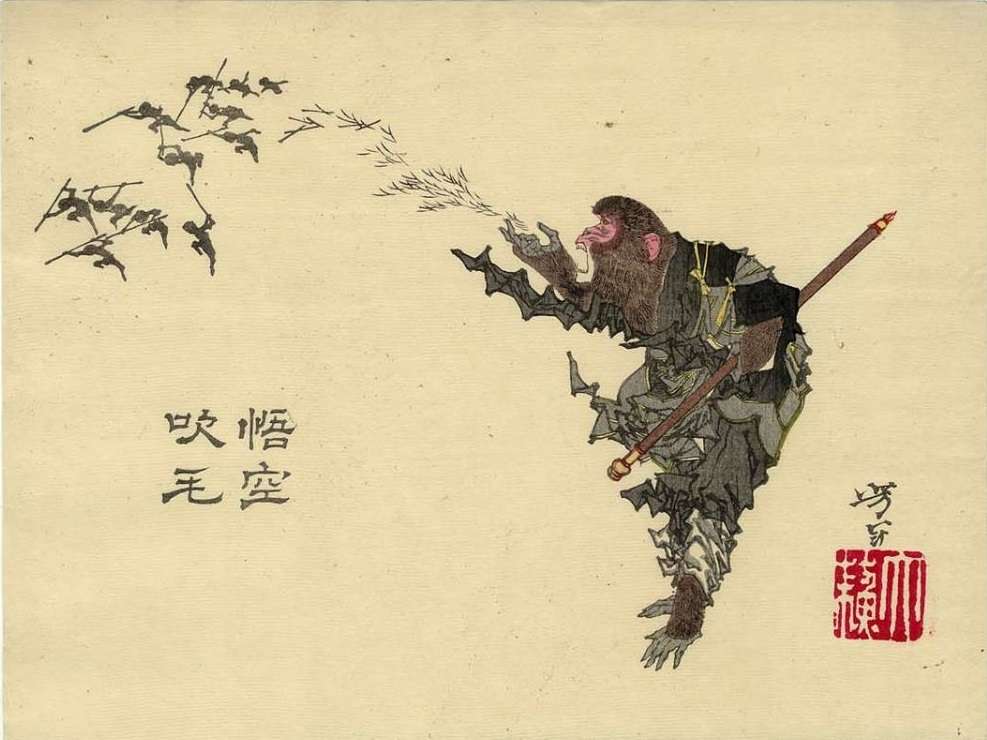
The Monkey King is famed for his multiple categories of immortality in Journey to the West (Xiyouji, 西遊記, 1592; “JTTW” hereafter). These are acquired through spiritual cultivation, redacting underworld ledgers, partaking in celestial foodstuffs, and (at the journey’s end) attaining Buddhahood. But “immortality” in Chinese vernacular literature doesn’t mean “invulnerable to harm.” Despite his great durability, during the journey, Wukong is a “bogus immortal” (yaoxian, 妖仙) who is still susceptible to injury and death because he hasn’t yet achieved Buddha-nature and broken free of the wheel of rebirth. [1] For instance, he briefly dies from thermal shock after being overwhelmed by Red Boy‘s (Honghai’er, 紅孩兒) true samadhi fire (sanmei zhenhuo, 三昧真火) in chapter 41:

His whole body covered by flame and smoke, the Great Sage found the intense heat unbearable and he dove straight into the mountain stream to try to put out the fire. Little did he anticipate that the shock of the cold water was so great that the heat caused by the fire was forced inward into his body and his three hun spirits left his vessel. Alas!

His breath caught in his chest, his tongue and throat grew cold;
His hun spirits fled, his po souls left, and his life was gone! (based on Wu & Yu, 2012, vol. 2, p. 231)

這大聖一身煙火,炮燥難禁,徑投於澗水內救火。怎知被冷水一逼,弄得火氣攻心,三魂出舍。可憐氣塞胸堂喉舌冷,魂飛魄散喪殘生。

Luckily, Zhu Bajie resuscitates him by performing a life-saving massage that forces qi from his cinnabar field and circulates it throughout his body (Wu & Yu, 2012, vol. 2, p. 232). [2]

This episode was an accident. But what if someone wanted to kill Monkey for good? How would they do it? Killing him in a one-on-one match would be nearly impossible, for few characters surpass Wukong in strength or fighting ability. I think it’s best that we draw on methods from another famous god and demon novel, Investiture of the Gods (Fengshen yanyi, 封神演義, c. 1620; “Investiture” hereafter), a sort of prequel to JTTW. It centers on a great battle between the falling Shang (c. 1600-1046 BCE) and the rising Zhou (c. 1046–256 BCE) dynasties, both of which are aided by factions of powerful immortals. The story is famous for a number of weapons, traps, and rituals designed to kill divine cultivators.

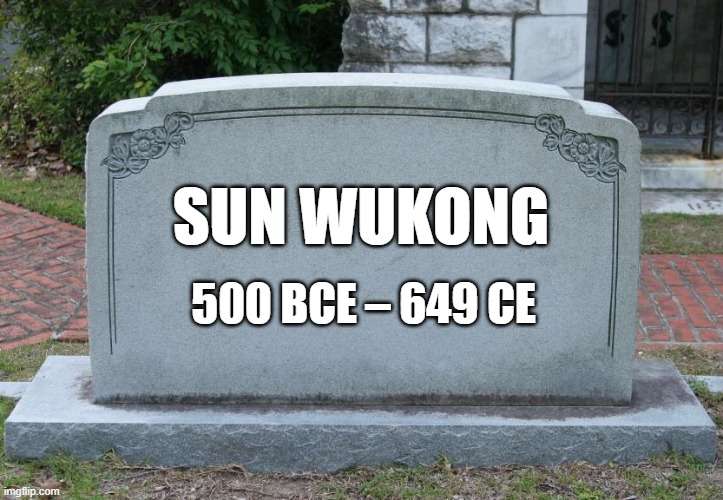
In this article, I would like to describe ten magical array traps (zhen, 陣) and one magic ritual that could possibly kill the Monkey King. The latter is, in my opinion, the best option for ending his life (fig. 1). And the best part is that it can be done from a distance! That way a villain doesn’t have to worry about getting smashed into hamburger or ripped to shreds by an angry monkey immortal. In addition, I will detail this method’s potential for great fanfiction.

Before continuing, I must point out that none of the information from Investiture can be considered JTTW canon. While it contains a host of similar characters (Laozi, Buddha, Nezha, Muzha, Li Jing, Ao Guang, Erlang and his hound, etc.), the novel is a separate work that was published nearly 30 years after JTTW. Look at this piece as a fun “What if?”

Fig. 1 – Monkey’s headstone (larger version).

Table of Contents

1. Possible Ways

Ch. 44 of Investiture mentions ten magical array traps that rely on primordial energies, destructive elements like wind, thunder, fire, sand, ice, and water, and spiritual attacks to terminate immortals:

  1. Heavenly Destruction (Tianjue zhen, 天絕陣) – This trap contains primordial energies (xiantian zhi qi, 先天之氣) and the mechanisms of chaos (hundun zhi ji, 混沌之機). It uses three magic pennants (fan, 旛), representing the respective energies of Heaven, Earth, and Man, to turn humans into dust and shatter the limbs of immortals with rolls of thunder.
  2. Earthly Fury (Dilie zhen, 地烈陣) – This trap uses a magic red pennant that kills intruders with rolls of thunder from above and fire below. It is also said to cut them off from reincarnation.
  3. Roaring Typhoon (Fenghou zhen, 風吼陣) – This trap uses wind, true samadhi fire, and countless swirling blades formed from primordial energies to kill intruders and render their bodies into a fragrant powder (jifen, 虀粉).
  4. Frigid Ice (Hanbing zhen, 寒冰陣) – This trap uses jagged, wolf fang-like ice mountains above, sword-like ice blocks below, and wind and thunder in the middle to grind intruders into a fragrant powder.
  5. Golden Light (Jinguang zhen, 金光陣) – This trap contains the essences of the sun and moon (riyue zhi jing, 日月之精) and the energies of heaven and earth (tiandi zhi qi, 天地之氣). It uses 21 treasure mirrors (baojing, 寶鏡) affixed to wooden polls to kill intruders with golden light that renders (melts?) their bodies into pus and blood.
  6. Bleeding Blood (Huaxue zhen, 化血陣) – This trap uses thunder and wind powered by primordial energies to blast black sand that kills intruders by rendering their bodies into a bloody mess.
  7. Vehement Flame (Lieyan zhen, 烈焰陣) – This trap uses true samadhi fire, fire from the sky (meteorites?), and fire from stone (lava?) to kill intruders by turning them into ash.
  8. Soul-Snatching (Luohun zhen, 落魂陣) – This trap contains the fierce energies of heaven and earth (tiandi liqi, 天地厲氣). It uses a white paper pennant stamped with a talisman seal (fuyin, 符印) to kill intruders by dispersing and eliminating their po and hun spirits.
  9. Red Water (Hongshui zhen, 紅水陣) – This trap controls the essences of the ninth and tenth heavenly stems (rengui zhi jing, 壬癸之精) (representing water), as well as contains the wonder of the Grand Monad (Tianyi zhi miao, 天乙之妙). It uses three bottle gourds resting on an eight trigrams platform (bagua tai, 八卦臺) to kill intruders by gushing forth an ocean of dangerous, red water, a single drop of which can render their bodies into a bloody mess.
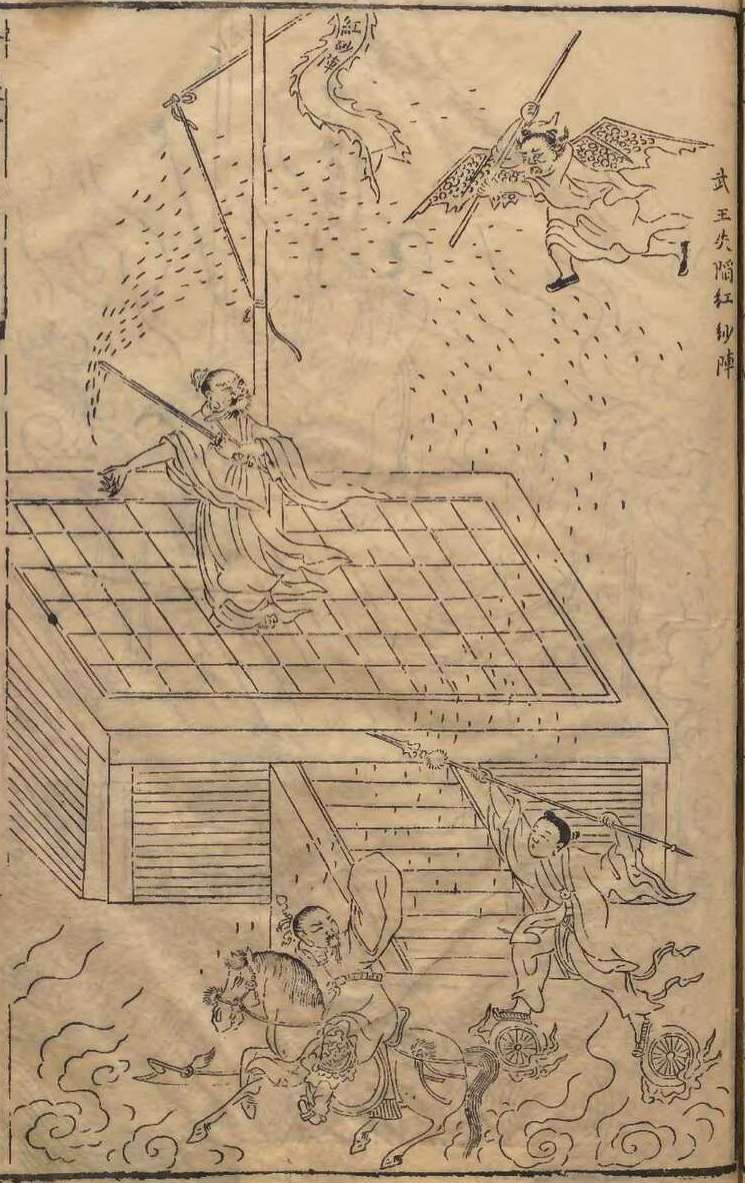
  10. Red Sand (Hongsha zhen, 紅砂陣/紅沙陣) – This trap controls the energies of Heaven, Earth, and Man. It uses thunder and wind to blast three buckets of red, sword-like sand to kill intruders by rendering their bones into a fragrant powder (fig. 2) (cf. Gu, 2000, vol. 2, pp. 869-873).

I think that Sun Wukong would easily survive many of these traps due to the adamantine nature of his body. [3] But numbers three, seven, and eight might give him some problems. As mentioned in the introduction, his encounter with Red Boy in chapter 41 shows that he is weak against true samadhi fire (Wu & Yu, 2012, vol. 2, p. 231). And of course, having his souls scattered and destroyed would certainly finish him off. Recall in JTTW chapter three how Monkey’s spirit (魂靈兒) is easily reaped by two underworld officers in his heavenly wine-induced slumber (Wu & Yu, 2012, vol. 1, p. 139). This might point to a weakness against spiritual attacks (at least while drunk on heavenly wine, anyway).

However, I think it would be hard to trick Wukong into going inside of these array traps. His “fiery eyes and gold Irises” (huoyan jinjing, 火眼金睛) would certainly notice the dark auras hovering above each one (Gu, 2000, vol. 2, p. 925 and 989, for example).

No, there’s only one sure fire way to kill our hero.

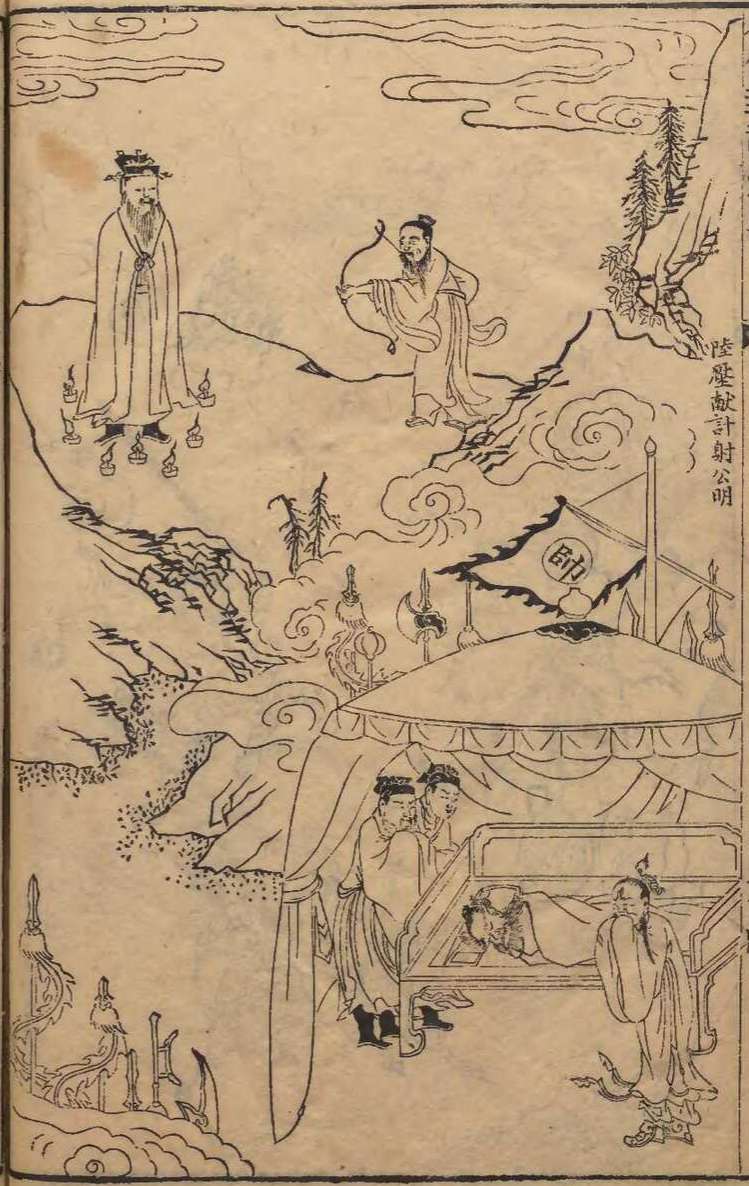
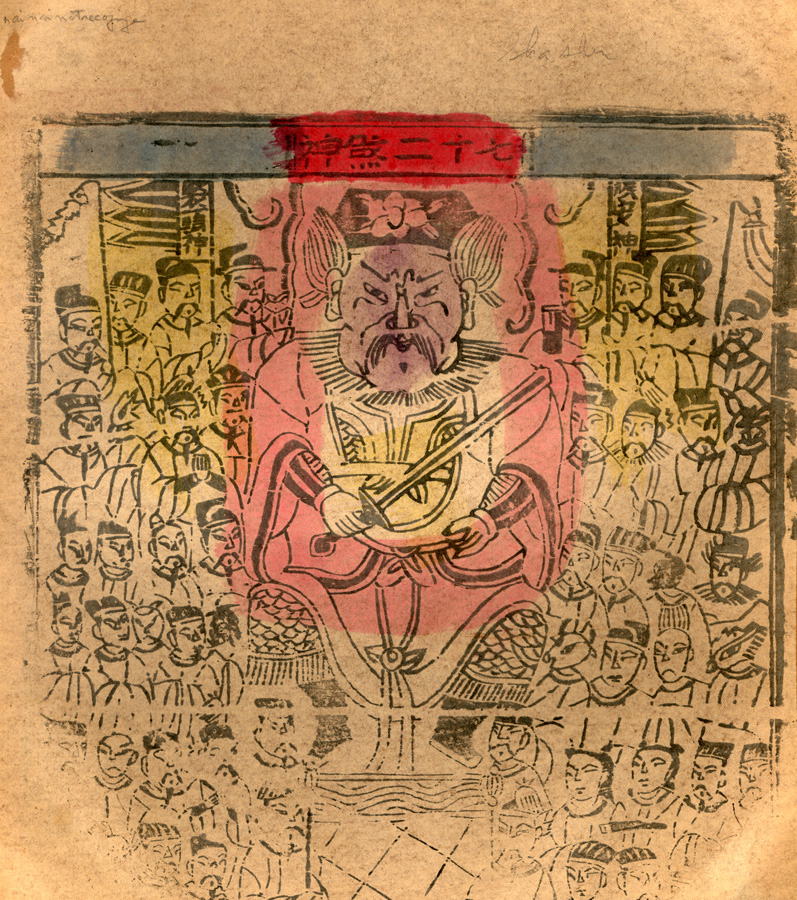
Fig. 2 – A Shang camp immortal working the Red Sand array trap (larger version). The woodblock print omits the three buckets. Image from The Newly Printed, Zhong Bojing Annotated, Investiture of the Gods (Xinke Zhong Bojing xiansheng piping Fengshen yanyi, 新刻鍾伯敬先生批評封神演義, c. 1620). See page 42 of this PDF.

2. The Best Way

Overcoming Monkey’s great power, durability, and speed would require an indirect approach, something that he wouldn’t even be aware of. A secret, spiritual assault from afar is, therefore, the only method that would work, in my opinion. Something like this is described in chapters 48 and 49 of Investiture. But I first need to give some background information as to why the rite is used in the first place.

Grand Preceptor Wen (Wen Taishi, 聞太師) recruits his old friend, the ancient immortal Zhao Gongming (趙公明), in chapter 46 after many of their divine comrades die in battle against Zhou allies (Gu, 2000, vol. 2, p. 935). Zhao is powerful in his own right, claiming to be able to flip Mount Sumeru (Xumi, 須彌) and reverse the course of the sun and moon (cf. Gu, 2000, vol. 2, pp. 945-947). But it’s his command of three holy treasures, namely the “Dragon-Binding Rope” (Fulong suo, 縛龍索), the “Sea-Fixing Mala Beads” (Dinghai zhu, 定海珠), and the “Golden-Scaled Dragon Scissors” (Jinjiao jian, 金蛟剪), [4] that make him a supremely dangerous opponent. The latter two treasures prove in chapter 47 to be especially difficult weapons for Zhou allies to counter.

Therefore, in chapter 48, the immortal Lu Ya (陸壓) devises a plan to secretly attack Zhao’s spirit from a distance. He enlists the help of Jiang Ziya (姜子牙), a Taoist disciple and commander of the Zhou forces, and instructs him how to perform a sympathetic magic ritual from the Book of Fixing the Seventh Posthumous Day Arrow (Ding touqi jianshu, 釘頭七箭書):

Lu Ya opened his flower basket and took out a book stamped with talisman seals and oral formulas. “Using these, you can set up camp and erect a platform on Mount Qi. Make a straw effigy and post a document with the three characters “Zhao Gongming” on its body. Place one lamp above its head and another beneath its feet. Then pray to it three times a day, burning the talismans and pacing the dipper. At noon on the twenty-first day, this poor Taoist (Lu Ya) will come and help you cut his life short.”

Before going to Mount Qi, Ziya secretly sent 3,000 troops, along with Nangong Kuo [南宮适] and Wu Ji [武吉] to find a suitable place to set up camp. After Ziya arrived at camp, Nangong built a platform, arranging it properly and making a straw effigy. He did everything strictly as instructed. Finally Ziya loosened his hair, took a sword, and paced the dipper, reciting charms, burning spells, and praying over and over again before the straw effigy (based on Gu, 2000, vol. 2, p. 967).

陸壓揭開花籃,取出一幅書,書寫明白,上有符印口訣,「……依此而用,可往岐山立一營;營內築一臺。紮一草人;人身上書『趙公明』三字,頭上一盞燈,足下一盞燈。自步罡斗,書符結印焚化,一日三次拜禮,至二十一日之時,貧道自來午時助你,公明自然絕也。」

子牙領命,前往岐山,暗出三千人馬,又令南宮适、武吉前去安置。子牙後隨軍至岐山,南宮适築起將臺,安排停當,紮一草人,依方製度。子牙披髮仗劍,腳步罡斗,書符結印…

[Three to five days later, Zhao Gongming feels frantic, with a strange burning in his heart.]

[…]

Now let’s speak of Ziya, who prayed until he had expelled the primal spirit [yuanshen, 元神] of Zhao Gongming. The primal spirit was of major importance to an immortal, enabling him to tour freely throughout the eight extremes (the universe). But now that Zhao Gongming had lost his primal spirit, he became drowsy and wanted to sleep all of the time (based on Gu, 2000, p. 973).

且說子牙拜掉了趙公明元神散而不歸,──但神仙以元神為主,遊八極,任逍遙,今一旦被子牙拜去,不覺昏沉,只是要睡。

[Sleeping is said to be uncharacteristic of immortals. This alerts Zhao Gongming’s comrades that he is being spiritually assaulted. After divining the effigy’s location, Wen sends Shang allies to steal it. They are initially successful, but the straw man is eventually recaptured by Zhou forces.]

[…]

[Lu Ya finally arrives as promised to finish the ritual.]

With a smile, Lu Ya opened his flower basket and took out a small mulberry bow and three short peach arrows, which he handed to Ziya. “At noon today, you must shoot the effigy with these arrows,” Lu Ya said. Ziya replied: “Order received!” The two waited in a tent until the astrological official came to report: “Noon time has arrived!” Ziya cleaned his hands, picked up the bow, and then nocked the first arrow. “Shoot his left eye first,” instructed Lu Ya. Ziya did as ordered. As the first arrow hit the left eye of the effigy, Zhao Gongming, lying in the Shang camp, roared in agony and closed his left eye. Grand Preceptor Wen held him in his arms, sobbing as the tears poured down his cheeks. Back at Mount Qi, the second arrow hit the right eye of the effigy, and the third penetrated its heart [fig. 3]. Zhao Gongming died in the Shang camp (based on Gu, 2000, vol. 2, pp. 985-987). [5]

陸壓笑吟吟揭開花籃,取出小小一張桑枝弓,三隻桃枝箭,遞與子牙,「今日午時初刻,用此箭射之。」子牙曰:「領命。」二人在帳中等至午時,不覺陰陽官來報:「午時牌!」子牙淨手,拈弓,搭箭。陸壓曰:「先中左目。」子牙依命,先中左目。──這西岐山發箭射草人,成湯營裏趙公明大叫一聲,把左眼閉了。聞太師心如刀割,一把抱住公明,淚流滿面,哭聲甚慘。──子牙在岐山,二箭射右目,三箭劈心一箭,三箭射了草人。──公明死于成湯營裏。

Like Ziya, a bad guy could perform the same ritual to secretly steal Monkey’s primal spirit, tether it to a straw effigy marked “Sun Wukong” (孫悟空), and finally kill our hero with three well-placed peach arrows to the eyes and chest.

Fig. 3 – Jiang Ziya aiming the ritual bow at the straw effigy (larger version). Zhao Gongming can be seen sleeping in the Shang camp below. Woodblock print from The Newly Printed, Zhong Bojing Annotated, Investiture of the Gods (Xinke Zhong Bojing xiansheng piping Fengshen yanyi, 新刻鍾伯敬先生批評封神演義, c. 1620). See page 42 of this PDF.

3. Story Potential

If anyone decided to write their own fanfiction using the method described above, I could see this being a great opportunity for Zhu Bajie (豬八戒) and/or Sha Wujing (沙悟淨) to shine. He/they could be the one(s) searching the cosmos for answers, and upon learning of the rite, desperately racing to find the straw effigy before the ritual is complete. All of this would of course take place while Monkey is sleeping.

I can definitely see Zhu and/or Sha seeking the aid of Guanyin (觀音), who could easily break the ritual. I imagine she would reveal that, “The Great Sage is destined to experience this tribulation…” (or something like that), but she would surely provide them with the location in the end.

Reasons for the villain performing the ritual could include:

  • Eliminating Wukong so that they can more easily catch and eat the Tang Monk, thus gaining immortality.
  • Absorbing Monkey’s primal spirit in order to gain his immortality and skills.

The latter is my favorite, but the former would work better for the story since the whole point of the ritual is to kill the target. And besides, Monkey’s disembodied spirit is powerful enough to kill the psychopomps sent to reap his soul, as well as bully the judges and officers of hell (Wu & Yu, 2012, vol. 1, pp. 139-141). Now, imagine what it could do to some random demon king and/or cultivator who tried to absorb it!

4. Conclusion

Sun Wukong is famed for his multiple categories of immortality, but he is still susceptible to death and the wheel of rebirth since during the journey, he hasn’t yet achieved Buddha-nature. Killing him in one-on-one combat would be nearly impossible, though, given his great durability and power. However, using methods borrowed from Investiture of the Gods (c. 1620) might work. For instance, chapter 44 mentions ten magical array traps that rely on primordial energies, destructive elements like wind, thunder, fire, sand, ice, and water, and spiritual attacks to terminate immortals. Three of the traps, numbers three, seven, and eight, respectively use true samadhi fire or soul-scattering and destruction to kill divine cultivators. These might give Monkey problems as his soul is easily reaped in his heavenly wine-induced slumber in JTTW chapter three, suggesting that it may be weak against spiritual attacks (at least while drunk), and he is shown to be weak against Red Boy’s true samadhi fire in chapter 41. But I think it would be hard to trick him into entering the traps since his magic eyes would no doubt see the dark auras above them.

The best way to overcome his great power, durability, and speed requires an indirect approach, a secret, spiritual assault from afar. A ritual used in chapters 48 and 49 of Investiture does exactly that. In order to defeat the immortal Zhao Gongming and circumvent his powerful holy treasures, the immortal Lu Ya instructs Zhou army commander Jiang Ziya how to perform a rite from the Book of Fixing the Seventh Posthumous Day Arrow. This involves a bureaucratic ceremony (praying, talisman-burning, and dipper-walking) that slowly steals the immortal’s primal spirit over a 21 day period, tethers it to a straw effigy marked with Zhao’s name, and then kills him by shooting the icon with three peach arrows: two to the eyes and a third to the heart.

A villain wanting to kidnap and eat the Tang Monk for immortality could perform this ritual in order to get Monkey out of the way. This would make for a great story centered on Zhu Bajie and/or Sha Wujing. He/they could frantically search the universe for answers, before racing to find the straw effigy before the rite is complete.


5. Updates

Update: 12-28-23

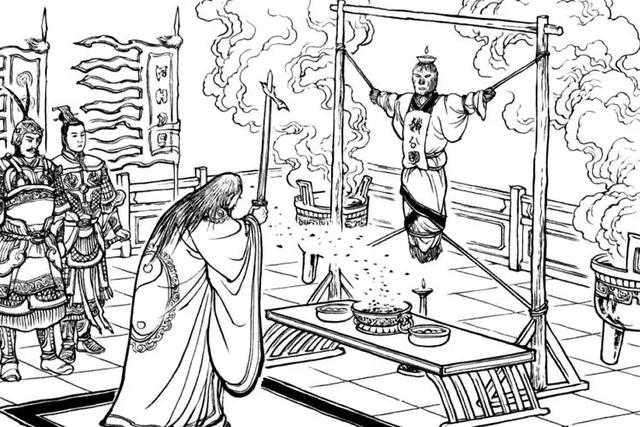
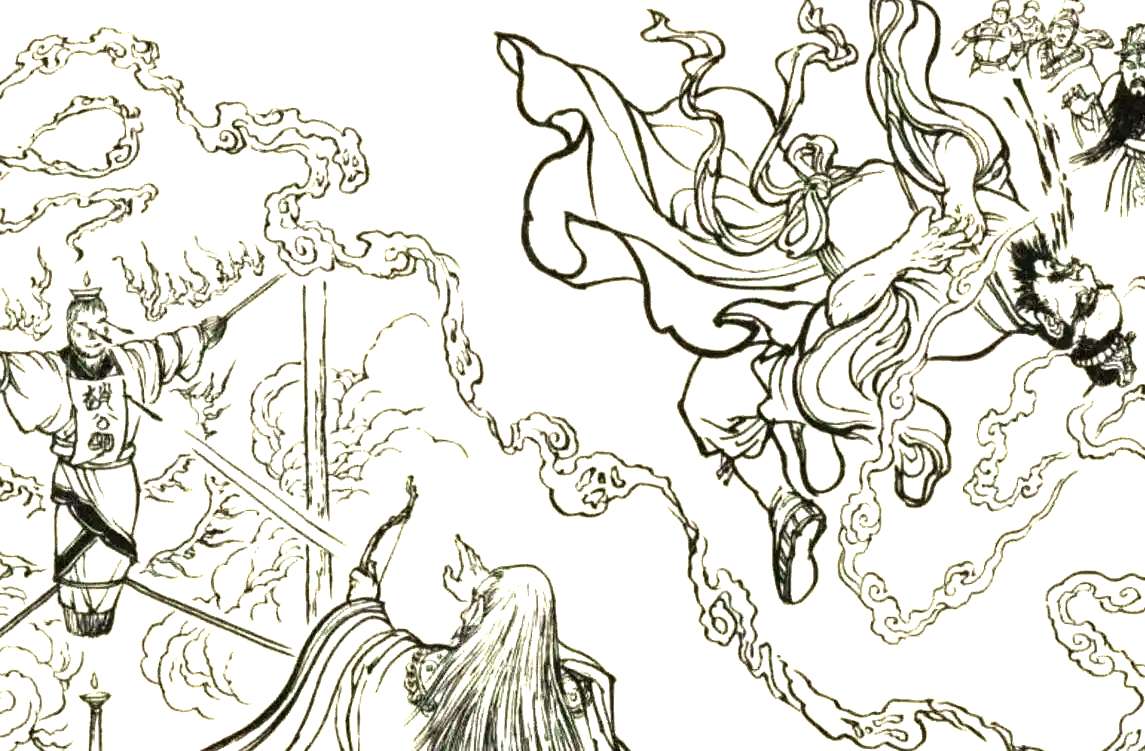
I found two neat drawings portraying Jiang Ziya performing the rite (fig. 4 & 5).

Fig. 4 (top) – Jiang Ziya performing the procedural side of the ritual (larger version). Image found here. Fig. 5 (bottom) – Ziya fires the last arrow, killing Zhao Gongming (larger version). Image found here. They appear to be from the same anonymous lianhuanhua comic book.


Update: 12-29-23

A reader’s comment (below) has prompted me to add more context. Zhao Gongming’s disembodied spirit is not destroyed by the ritual. It is pulled towards the “Terrace of Creation” (Fengshen tai, 封神臺), a magic receptacle of souls, to await his apotheosis at the end of the novel. He is enfeoffed as the “Golden Dragon, Wish-Fulfilling and Righteously Unifying, Dragon-Tiger Mysterious Altar Perfected Lord” (Jinlong ruyi zhengyi longhu xuantan zhenjun, 金龍如意正一龍虎玄壇真君), a god of wealth (cf. Gu, 2000, vol. 4, pp. 2119-2121).

This then raises the question, “What would happen to Wukong’s soul if the ritual was successful? After the death of his body, it would naturally report to the underworld for processing. Remember, Monkey has yet to attain Buddha-Nature, so he is still subject to the wheel of rebirth. I can see him causing trouble down there like he had done in the past, but perhaps Kṣitigarbha (Ch: Dizang, 地藏) would calm his rage and convince him that reincarnation is the right choice. This would lead to a new adventure.

Or, considering that the journey to India would still be underway, and Tripitaka is constantly in danger, heaven might rush to find a new body for Wukong’s spirit to inhabit. This actually happens to a minor character in chapters 11 and 12 of JTTW. The soul of an official’s wife is forced into the body of a recently dead princess to live out the remainder of her allotted lifespan (Wu & Yu, 2012, vol. 1, pp. 268-269).

Another reader suggested a second method from Investiture to kill Monkey (see the comment below):

The Immortal-slaying Flying Knife, also a treasure of Lu Ya’s, might be a good second-contender here. It’s a strange weapon with head and eyes and wings, stored inside a gourd: when released, its eyes shoot out white light that “nails down” an enemy’s true form, and, upon recitation of “Turn around please, precious” (请宝贝转身), will spin and instantly decapitate the target.

Sure, there is the matter of getting it out and saying the magical words before you were reduced to a meat patty, but if the target is already immobilized——like Yuan Hong, FSYY’s own staff-wielding ape with 72 transformations——the Immortal-Slaying Flying Knife will be that final nail in the coffin.

I’ll look into this more and update the page at a later date.


Update: 01-07-24

Lu Ya’s ritual reminds me of a two-step process used in Chinese Folk Religion to activate a religious statue (shenxiang, 神像). Part one is the “entering-spirit” (rushen, 入神) ceremony, which invites a deity’s essence inside. Lin (2020) explains:

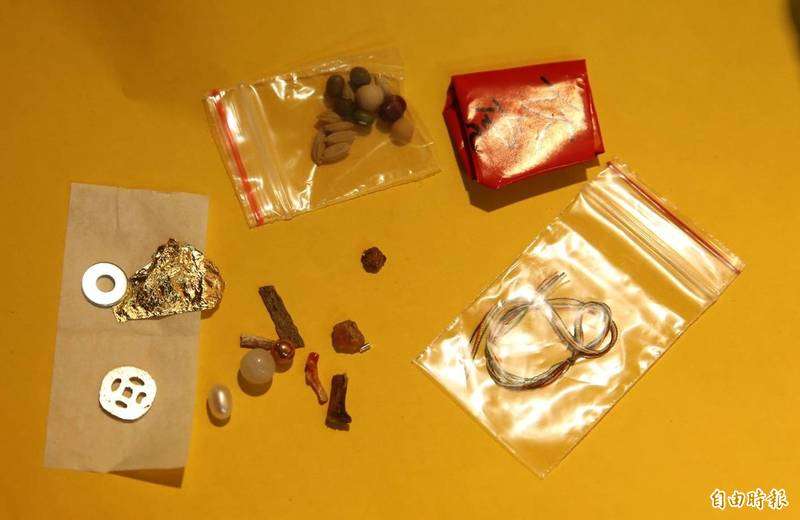
When the carving is complete, the carver chooses an auspicious day to hold the spirit-entering ritual. A cavity at the back of the image is carved out for this rite. The objects placed in this hole include incense ashes (xianghui) or talismans from the root temple, a live hornet, five precious materials (gold, silver, bronze, iron, and tin), five crops (rice, wheat, sesame, and different kinds of beans), and a bundle of five-color threads (red, yellow, blue, black, and white) [fig. 6 & 7] … The worshippers have to prepare fruit and flowers and burn incense to invite the deity to come.

When the auspicious moment arrives, the carver inserts the previously listed items into the cavity and plugs it with a piece of wood. The objects placed in the cavity are important clues regarding how people conceptualize deities. Local inhabitants explained to me that the ashes or talisman symbolizes the spirit of the deity, and the living hornet is to increase the deity’s power. Some people said the five forms of treasure represent the five organs of the deity, whereas others just said they are symbols of the deity’s grandeur. The five crops represent the harvest and the bunch of five-color threads is related to the five spirit-soldier camps (p. 38).

Lu Ya’s ritual essentially treats the straw effigy like an idol that will house a god’s essence. This might explain how the primal spirit of Zhao Gongming (and therefore Sun Wukong) is called to enter the icon.

Fig. 6 (top) – A collection of the talisman, grains, treasures, and colored-threads used in the entering-spirit ceremony (larger version). Fig. 7 (bottom) – A live wasp is retrieved to be added to the necessary ritual items (larger version). Images found here. 

Part two is the “eye-opening and dotting” (kaiguang dianyan, 開光點眼) ceremony, which brings the idol to life. Again, I refer to Lin (2020):

For this ceremony, the carver prepares flowers, fruit, a round mirror, a red brush pen, and a white cock. When the auspicious moment arrives, the mirror is taken outside where the light is sufficient to reflect it into the statue’s eyes. Next, the carver goes back to the altar and uses a knife to cut the cockscomb and smear the blood with the red brush pen. He then starts to chant and to dot the deity with the brush pen. There are many different kinds of chants … but their contents are not very different. The process of dotting usually begins at the center of the forehead and proceeds to the eyes, ears, nose, mouth, heart, navel, feet, toes, fingers, and back [fig. 8-10], as the following chant demonstrates:

First dot the sacred head, second dot the sacred hat,
Third dot the sacred body, then the true and righteous god will occupy the body.
Open the left eye to see heaven.
Open the right eye to see into the earth.
Open the left ear to listen to sounds from all directions.
Open the right ear to hear sounds from far away.
Open the divine nose, to smell fragrant scents.
Open the divine mouth, but not to eat house hold foods.
Open the left hand and the disciples will be prosperous year after year.
Open the right hand and the god will capture ghosts without being asked.
Open the sacred belly and great divine power will come forth.
Open the left foot to step upon the correct path.
Open the right foot to step into the divine carriage.
Open the back so that all people may be enlightened.

It can be inferred that in this ceremony, the carver at first draws the natural energy into the statue to enliven it. Then, he uses the blood of a white cock, symbolizing purity, to dot and connect the important parts of the body. This makes the statue like a living person with veins in which blood flows without obstruction (pp. 38-39).

Although Investiture doesn’t mention any of this, I think performing the eye-opening and dotting ceremony would be the final step in making the straw effigy a separate, living embodiment of the Monkey King. The ritual would open the eyes of Wukong’s spiritual double to the cosmos and fill his chest with divine energies in preparation for shooting said targets. This would explain why Zhao Gongming closes his eyes upon each arrow strike (refer back to section II).

Writers wanting to add a certain level of religious authenticity to the fictional Monkey King-killing ritual could have the villain place the talisman, grains, treasures, live wasp, and five colored-threads inside the straw effigy. And then he could chant while simultaneously reflecting sunlight on the face and dotting the eyes and body with a rooster blood-soaked brush. The only major difference between the fictional and religious ceremonies would be that the former’s first step, the entering-spirit ritual, lasts three weeks.

Fig. 8 (top L) – An entering-spirit and eye-opening and dotting kit commonly sold in Taiwan (larger version). Notice how the mirror is rectangular instead of circular. Image found here. Fig. 9 (top R) – A white temple rooster kept as a supply of pure blood (larger version). Don’t worry, nowadays they are only nicked on the comb with a knife. Image found here. Fig. 10 (bottom) – A ritual master uses a circular mirror to shine sunlight into an idol’s eyes while dotting the figure with a blood-soaked brush (larger version). Image found here.


Update: 07-02-26

I’ve just published an article on how to resurrect Tripitaka if he is killed during the quest to India. Consider it a companion piece to this article.

How to Resurrect the Tang Monk if He is Killed During Journey to the West

Notes:

1) Monkey is called a “bogus immortal” by the Jade Emperor (ch. 4), the Buddha (ch. 7), and the Dragon King of the Eastern Sea in (ch. 14) (Wu & Yu, 2012, vol. 1, pp. 147-148, p. 193, and p. 318). This alludes to the fact that he is not yet a true transcendent.

The idea that Wukong is still susceptible to death is based on the Buddho-Taoist philosophy of Southern Quanzhen School Patriarch Zhang Boduan (張伯端, mid to late-980s-1082), which heavily influenced JTTW. Zhang believed that one had to attain both the Taoist elixir and Buddha-Nature in order to be truly immortal. Only then could one rise above death and the endless rounds of rebirth to live forever (Shao, 1997, pp. 80-84). This is why JTTW starts with Monkey achieving immortality in chapter two and ends with him attaining Buddhahood in chapter 100, thereby fulfilling Zhang’s two-step process to true transcendence.

Zhang’s philosophy is reflected in his Writings on Understanding Reality (Wuzhen pian, 悟真篇, 1075). One poem reads:

The elixir is the most precious treasure of the physical body; when cultivated to perfection, the transmutations are endless. One can go on to investigate the true source in the realm of essence, and ascertain the ineffable function of the birthless. Without awaiting another body in the next life, one attains the spiritual capacities of a Buddha in the present; after the Naga Girl achieved this, who since then has been able to follow in her footsteps? (Zhang, Liu, & Cleary, 1987, p. 1481; cf. Shao, 1997, p. 83)

丹是色身至寶,煉成變化無窮。更能性上究真宗,决了無生妙用。不待他身後世,見前獲佛神通。自從龍女著斯功,爾後誰能繼踵。

2) It’s interesting to note that Pigsy suggests that Wukong dying isn’t a problem because his 72 changes give him 72 lives (qishi’er tiao xingming, 七十二條性命) (Wu & Yu, 2012, vol. 2, p. 232).

3) For instance, heaven fails to execute Monkey in chapter seven because of his adamantine hide:

They then slashed him with a scimitar, hewed him with an ax, stabbed him with a spear, and hacked him with a sword, but they could not hurt his body in any way. Next, the Star Spirit of the South Pole ordered the various deities of the Fire Department to burn him with fire, but that, too, had little effect. The gods of the Thunder Department were then ordered to strike him with thunderbolts, but not a single one of his hairs was destroyed (Wu & Yu, 2012, vol. 1, p. 188).

… 刀砍斧剁,槍刺劍刳,莫想傷及其身。南斗星奮令火部眾神放火煨燒,亦不能燒著。又著雷部眾神以雷屑釘打,越發不能傷損一毫。

4) Apart from these treasures, Zhao Gongming fights with a hard whip (bian, 鞭), a sword-like metal club with stacked ridges and a pointed end. Gu (2000) incorrectly translates this as “staff” (vol. 2, p. 941).

5) Given the ritual’s association with the number seven (i.e. “Fixing the Seventh Posthumous Day Arrow”), and the fact that it takes 21 days to execute, it seems that one arrow is used for every week that the rite is performed. Remember that there are a total of three: two for the eyes and a third one for the heart.

Sources:

Gu, Z. (2000). Creation of the Gods (Vols. 1-4). Beijing: New World Press.

Lin, W. (2020). Materializing Magic Power: Chinese Popular Religion in Villages and Cities. Netherlands: Brill.

Shao, P. (1997). Monkey and Chinese Scriptural Tradition: A Rereading of the Novel Xiyouji (UMI No. 9818173) [Doctoral dissertation, Washington University]. Available from ProQuest Dissertations and Theses database.

Wu, C., & Yu, A. C. (2012). The Journey to the West (Vols. 1-4) (Rev. ed.). Chicago, Illinois: University of Chicago Press.

Zhang, B., Liu, Y., & Cleary, T. (1987). Understanding Reality: A Taoist Alchemical Classic. Honululu Univ. of Hawaii Press.

A Realistic Retelling of Journey to the West?

Last updated: 10-04-2025

I was recently asked about the existence of a realistic retelling of Journey to the West (Xiyouji, 西遊記, 1592) that follows the adventures of the historical monk Xuanzang (玄奘, 602-664). To my knowledge, it doesn’t exist, but this is something I’ve thought about to some extent. In this article, I would like to discuss what a realistic journey might be like.

Table of Contents

1. Literature vs History

There are some important distinctions that first need to be made between the literary and historical stories before we can speculate about our version.

1.1. The Novel

  1. The story is set in a syncretic Buddho-Daoist universe modeled on Hindo-Buddhist cosmic geography. This flat world-disc features four cardinal continents (of various shapes) floating in a great ocean around the four faces of Mt. Sumeru. The Daoist heaven sits atop this mountain, taking the place of the “Heaven of the Thirty-Three” from the original Buddhist structure. China is located in the Southernmost continent (the original structure, however, associated this with India). India and the Buddha’s paradise are moved to the Westernmost continent (since it is West of China in OUR world).
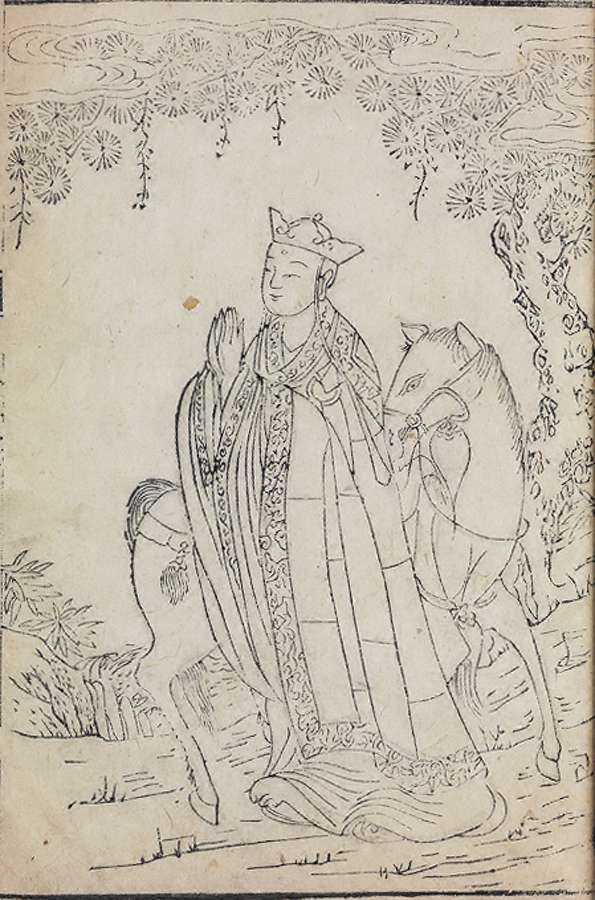
  2. The literary Xuanzang (fig. 1) is the final reincarnation of “Master Golden Cicada” (Jinchan zi, 金蟬子), the fictional second disciple of the Buddha who was exiled to China for ten lifetimes as punishment for being inattentive during a heavenly lecture.
  3. His father, Prefect Chen Guangrui (陳光蕊), is murdered by a bandit, who takes his government post and pregnant wife for his own. Chen’s son is born in Jiangzhou (Jiangxi) sometime after, forcing his mother to float the baby down the river in a basket (à la Moses) in order to save his life. He is found and raised by the old abbot of a Buddhist temple. Eighteen years later, after receiving his ordination, the monk Xuanzang is reunited with his mother and magically-revived father, and the bandit-turned-official is arrested and executed (ch. 9).
  4. He leaves China in 640 with the blessing of the Tang emperor (ch. 13) and returns in 654 (ch. 100). [1]
  5. The expressed purpose of his mission is to obtain the correct scriptures needed to perform a grand mass to release untold souls from suffering in hell (see note #1 here).
  6. He is portrayed as a proponent of the Chan (禪; Sk: Dhyāna) school of Buddhism.
  7. Xuanzang is an extremely whiny character modeled after a Confucian official who is blindly loyal to the throne, extolls virtues of propriety, and complains about everything. He is depicted as having an encyclopedic knowledge of Buddhist scripture, but he doesn’t always understand the underlying meaning, something that Monkey sometimes explains to him (see note #8 here).
  8. He initially leaves with a few human disciples, who are eventually eaten (ch. 13), and takes on the monstrous disciples Sun Wukong (ch. 13), Zhu Bajie (ch. 19), and Sha Wujing (ch. 22) along the way.
  9. These latter disciples aren’t “Chinese.” They come from different countries among said continents. For example, Monkey’s Flower Fruit Mountain is an island located to the east of the Easternmost continent (refer back to here).
  10. Xuanzang spends all of his time traveling or trying to escape from a monster or spirit who has kidnapped him. No time is spent studying languages or scripture.
  11. All of the kingdoms encountered conveniently speak (and to some extent dress) like the Chinese.
  12. The group receives the scriptures directly from the Buddha in the Western Paradise of India and are magically transported back to China.
  13. Xuanzang and his disciples are immediately whisked away from China upon delivery of the sutras, leaving the mass to be performed by someone else. The group is returned to the Western Paradise, where they receive an elevation in spiritual rank (ch. 100) (Wu & Yu, 2012).

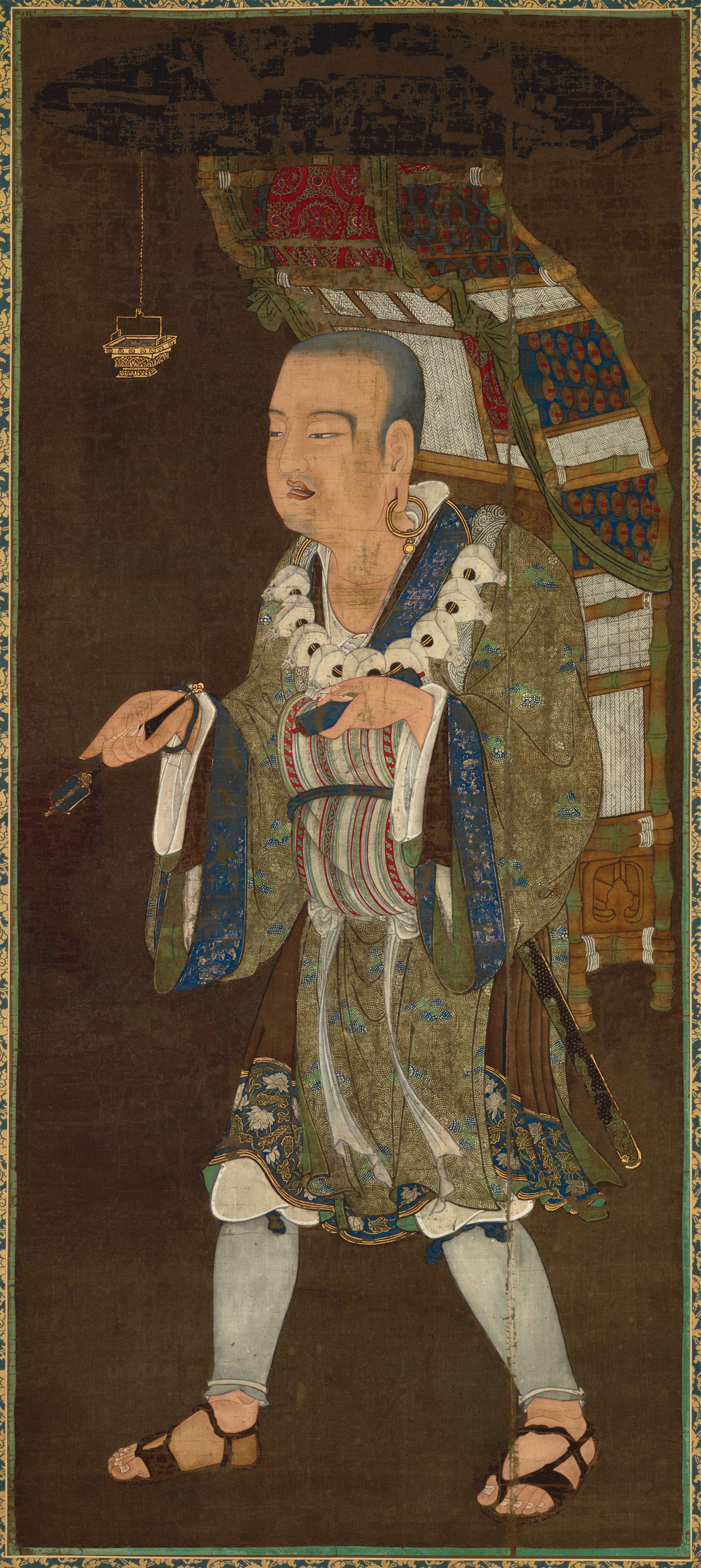
Fig. 1 – A print of the literary Xuanzang from a Qing-era edition of Journey to the West (larger version). Originally found on Wikimedia Commons. Fig. 2 – An anonymous 14th-century Japanese painting of the historical Xuanzang on the road to India (larger version). Originally found on Wikipedia.

1.2. The Real World

  1. The real Xuanzang (fig. 2) obviously existed in OUR world, the Earth.
  2. He was born in Luoyang (Henan) to the aristocratic Chen (陳) family, the youngest of four boys.
  3. He followed in his oldest brothers footsteps by becoming a monk at eleven, receiving full ordination at twenty.
  4. He left China illegally in 629 and returned a celebrity in 645.
  5. The expressed purpose of his mission was to obtain scriptures that resolved contradictions in and expanded the corpus of the Chinese Buddhist canon.
  6. He initially traveled by himself within China, but later joined caravans in Central Asia and India, even having his own royal escorts at different times.
  7. He was exposed to different cultures, languages, and religions, the latter including Zoroastrianism and Vedism (early Hinduism).
  8. He was a proponent of the Yogācāra (Sk: “Yoga practice”; Ch: Weishi zong, 唯識宗, “Consciousness Only”) school of Buddhism.
  9. He was super brave and intelligent, with an encyclopedic knowledge of Buddhist and even Vedic literature. Apart from Buddhist schooling in his youth, much of this knowledge was gained during prolonged study abroad.
  10. He faced many problems on the trip back to China, even losing some of his hard-won scriptures in a fording accident.
  11. Xuanzang returned home with hundreds of scriptures, over one hundred Buddha relics, and tens of statues. He spent the remainder of his life translating texts, while also battling his celebrity. He died at the age of 61 (Brose, 2021).

2. The Realistic Journey

This is not meant to be exhaustive since trying to adapt every character and event from the novel would make it much too long. The point is to give the reader a basic understanding of what Xuanzang’s historical journey was like.

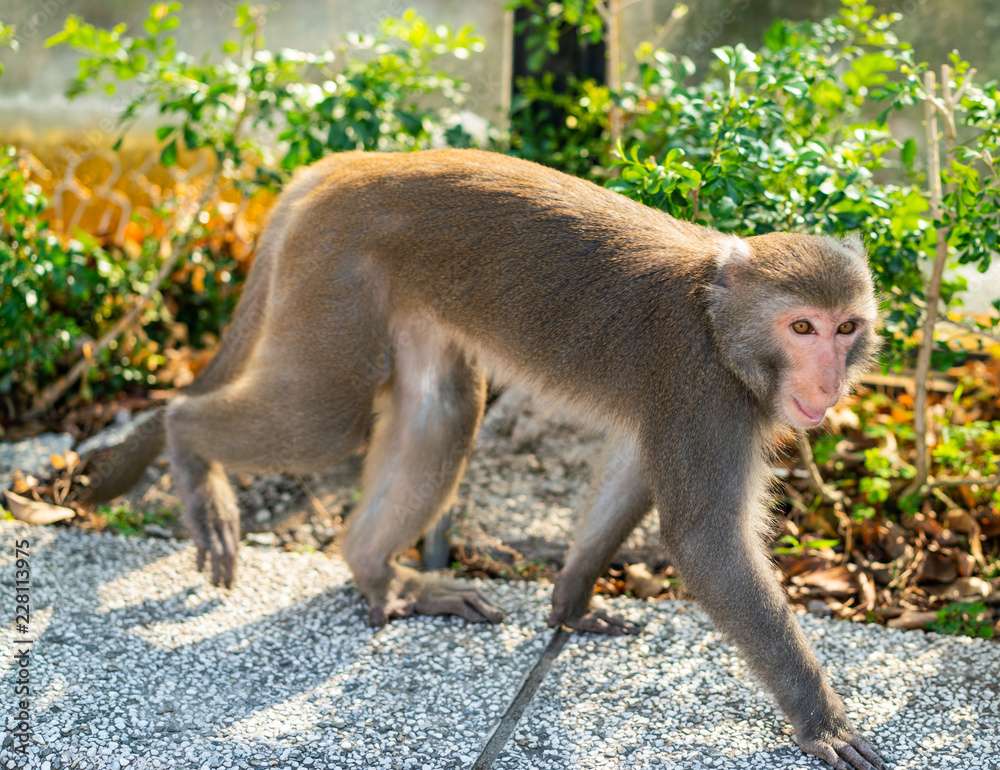
Everything prior to his birth would be nearly the same, including the monk’s previous incarnations and Sun Wukong, Zhu Bajie, and Sha Wujing’s respective early lives and punishments. But since the story will take place on Earth, the location of literary events will have to be placed in a real world context. For example, Monkey would have to be born on an island east of China. Japan is certainly an interesting option, with Mt. Fuji (Fujisan, 富士山) being a good candidate for his birthplace. Taiwan’s Mt. Jade (Yushan, 玉山) is another (see the 02-14-23 update below for more info). Fun fact: Taiwan is known for its “Rock Macaques” (fig. 3). This is a fitting name considering that Sun is born from stone.

Fig. 3 – A Taiwanese Rock Macaque (larger version). Originally found here.

Placing Monkey’s past in a real world context opens the door to interesting possibilities in this adaptation. The novel describes him studying Buddho-Daoist arts under the Patriarch Subodhi in the Westernmost continent (i.e. India). But since Daoism didn’t exist in ancient India, he would have likely learned Hindo-Buddhist spiritual cultivation techniques and philosophy, thereby becoming a competent (albeit short-tempered and naughty) rishi. Therefore, he would know how to read and speak the Pali/Sanskrit language of the different Buddhist and Vedic texts that Xuanzang would come to study. One implication is that Sun would be able to help his master if any language or philosophical barriers popped up. This means that his assistance would contribute to Xuanzang’s later translation of Buddhist scriptures in China!

2.1. Travel to and Life in India

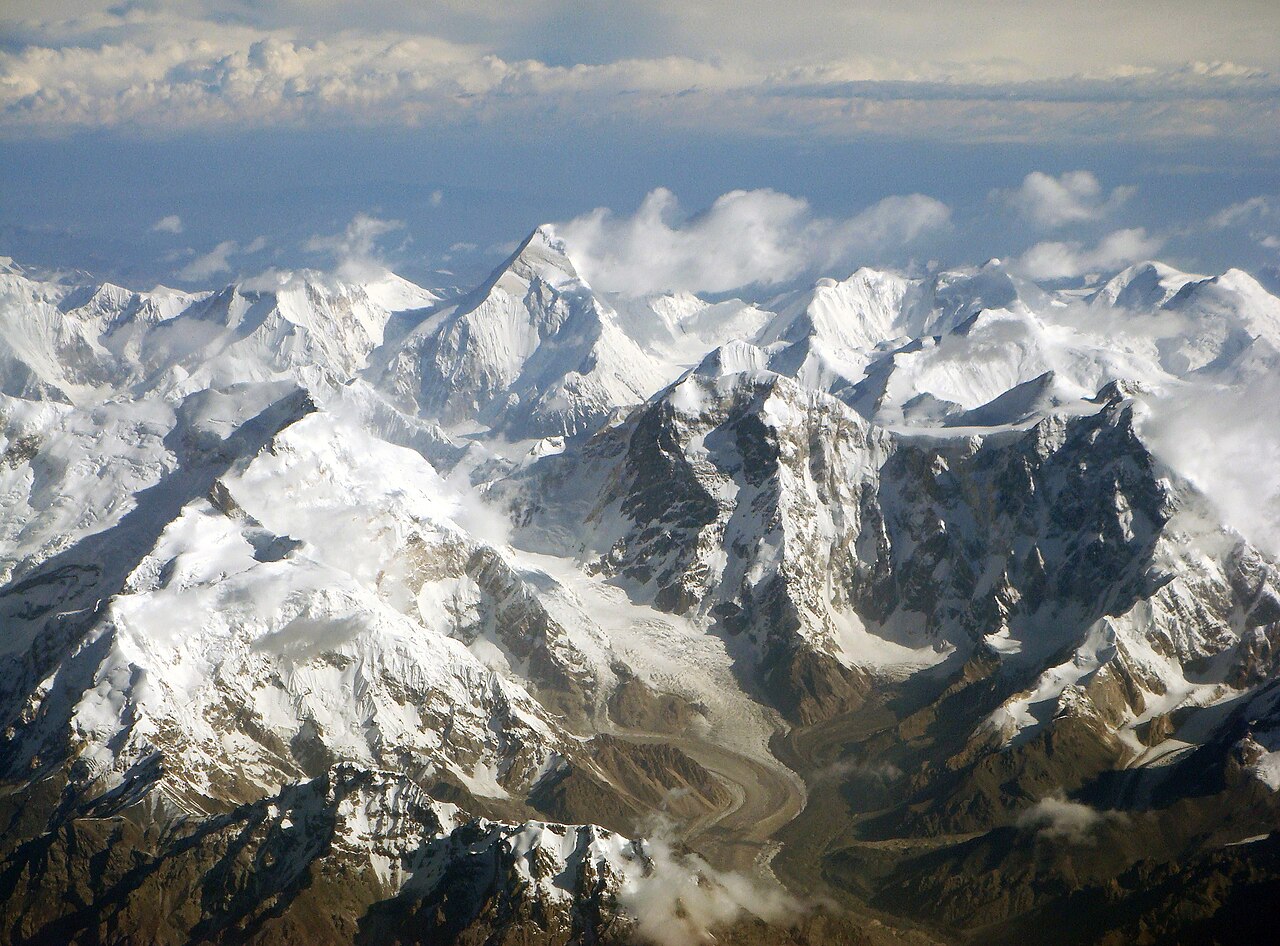
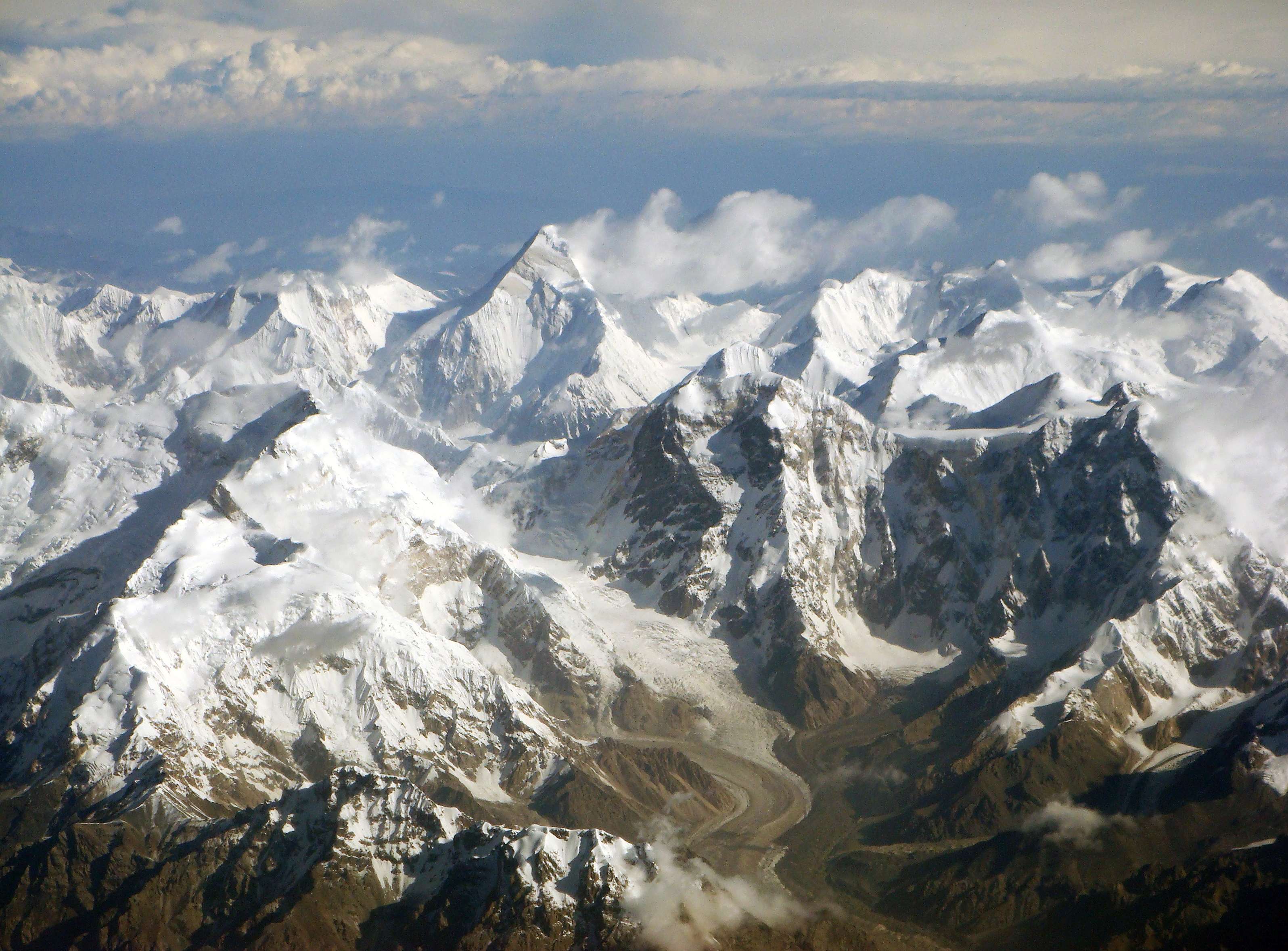
Xuanzang’s initial request to leave China was denied by the Tang court of Emperor Taizong. Undeterred, the monk traveled in secret towards the northwestern reaches of the empire in 629, eventually learning from a sympathetic official that he was to be arrested if caught (Brose, 2021, p. 16). He would likely have come across Monkey just prior to leaving China. Remember that chapter 13 also refers to Five Elements Mountain as the “Mountain of Two Frontiers” (Liangjie shan, 兩界山), the eastern half belonging to the Middle Kingdom and the western half belonging to Turkic peoples (Dada, 韃靼; a.k.a. “Tartars“) (Wu & Yu, 2012, vol. 1, p. 305). The Heavenly Mountain (Tianshan, 天山) (fig. 4) would therefore be a good spot for the trickster god’s earth prison as it stretches from Northwestern China into Central Asia.

Communication between master and disciple wouldn’t be an issue since Monkey would have likely picked up some Chinese during his early life and rebellion. The other disciples would be added at different spots along the route through Central Asia (see the 10-10-22 update below for more info). But since Zhu and Sha have memories of their previous lives, they too would likely know Chinese.

Fig. 4 – The Heavenly Mountains (larger version). Originally found on Wikipedia.

Xuanzang’s Central Asian route took him through Sūyāb (Kyrgyzstan), Samarkand (Uzbekistan), the Kunduz River valley (Afghanistan), and then Balkh (Afghanistan). Here, the monk stopped for a month to study Sanskrit literature under Prajñākara before both of them left to cross the Hindu Kush Mountains. After Bamiyan (Afghanistan), both of them attended the required three-month “Rainy Retreat” at a Buddhist monastery in Kapisā (Afghanistan). This was a time of intense study (Brose, 2021, pp. 23-28). Xuanzang likely attended the three-month retreat every year of his journey, making this aspect of the historical story a major divergence from the novel. This means that, unless the various monsters or spirits tried attacking him in monasteries, his disciples would only see action during the time (days or weeks) that it took the group to travel to a new location.

Since the story is set in the real world, Daoism’s influence would fade as the group traveled westward. This then raises the question: if Sun Wukong requires divine assistance to help identify or defeat a powerful foe in, say, Central Asia, would he zip back to the Daoist heaven in China, or would he simply consult the local foreign gods and spirits? The former possibility would allow us to stick closer to the novel, but the latter would be far more interesting. The Iranic, Judeo-Christian, or Greek gods in that area might be willing to help thanks to the Buddha’s request. I could see this leading to some comical inter-faith drama:

Foreign god: “Monkey Man, you have no power over us in this region!”

Sun Wukong: “Oh, really? Let me introduce you to my two friends [holds up fists], RIGHT and LEFT!”

But this might make the story a little too complex. And since Buddhism was present throughout Central Asia at one point or another, it would make more sense for Monkey to call on Buddhist deities for help. Either way, the story would have to be changed to accommodate gods and spirits outside of Daoism.

Prajñākara stayed in Kapisā, while Xuanzang headed for northern India. His travels took him through Nagarahāra (Afghanistan), Gandhāra (Afghanistan/Pakistan), the Swat Valley (Pakistan), Taxila (Pakistan), and Kashmir (India). He studied in the latter city for two years, while a team of twenty royally-appointed scribes copied extensive scriptures for him. For the next three years after this, he traveled through Cīnabhukti, Jālandhara, Śrughna, Matipura, and Kānyakubja, staying for a month or as long as a year in certain places to study with specialists in Buddhist and Vedic literature. Xuanzang later sailed down the Ganges River, where, according to legend, his priceless collection of Buddhist scriptures and imagery attracted the attention of Hindu pirates. When captured, he sunk into deep meditation while awaiting a sacrificial death by fire, but a strong, supernatural wind began throwing the world into chaos. Thinking that the attempted murder of the monk displeased their goddess Durga, the pirates begged for his forgiveness (Brose, 2021, pp. 30-35). This seems like a perfect demonstration of Sun Wukong’s powers. He would use this trick in place of outright murdering the bandits in order to avoid punishment via the golden headband.

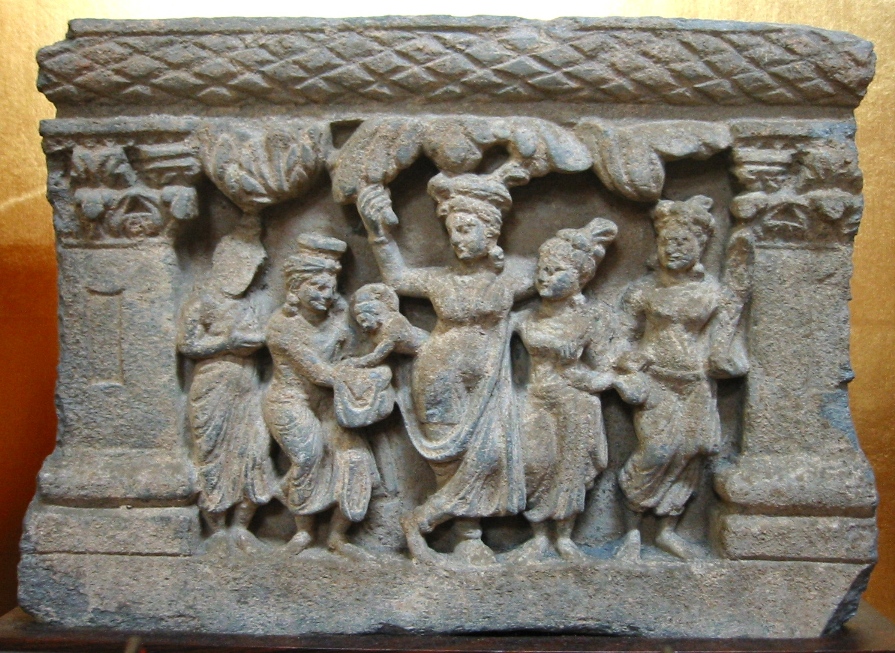
Xuanzang traveled through areas of India where Buddhist institutions once flourished but had fallen into decay, some places being taken over by Hindu and Jain ascetics who practiced extreme forms of austerities. During this time, he also went about visiting all of the famous locations associated with the historical Buddha’s life but was dismayed to see some of those in ruins and/or abandoned. These included the garden where the Enlightened one was born (Lumbini, Nepal) (fig. 5), his father’s palace (Kapilavastu), where he lived as an adult (Jetavana), and the forest where he died (Kuśinagara). Xuanzang took the declining state of Indian Buddhism as proof that his time was the Latter Day of the Dharma (Brose, 2021, pp. 30-32 and 35-38). This surely strengthened his resolve to learn all he could and take back as many scriptures as possible to China in order to ensure that the religion continued to thrive there. His monstrous disciples would be the ones to tote this huge collection in place of human laborers.

Fig. 5 – A 2nd to 3rd-century Gandharan stone carving depicting the Buddha’s birth from his mother’s side in Lumbini (larger version). Originally found on Wikipedia.

The idea of monsters and spirits attacking the monk while he visits these once flourishing but now dilapidated Buddhist sites is somewhat comical. I think that the evil would live in the various ruins or in the forests and hills around said locations. This would mean that demonic mountain strongholds from the novel would be a rarity in this retelling.

Thankfully, though, Xuanzang was able to visit two places associated with the Buddha’s life that still flourished, namely the park where he gave his first sermon (Sarnath) and the area where he achieved enlightenment (Bodh Gayā). The monk was later invited to a grand Buddhist complex in Nālandā, where he became a disciple of Śīlabhadra, a learned master of the Yogācāra school. He studied in Nālandā for five years, receiving a special status that freed him from community duties so he could focus on his studies (Brose, 2021, pp. 37-45). After a failed trip to Sri Lanka, Xuanzang traveled around southern India and eventually studied for two years in Parvata. After returning to Nālandā and learning from various local masters for a few months, he studied for two years with Jayasena, a very knowledgeable lay disciple of Śīlabhadra (Brose, 2021, pp. 50-53).

The total of Xuanzang’s time spent studying in Nālandā and Parvata alone adds up to an astounding nine years. That is an awfully long time for Sun, Zhu, and Sha to see no action. Perhaps they too would live the life of monks and possibly resume their spiritual cultivation in order to better themselves. They could even help teach the clerics at the various institutions how to protect themselves, much like the famous Shaolin Monks (fig. 6). This might replace the episode in chapter 88 in which Monkey and his religious brothers accept three Indian princes as students. Sun could instead give a chosen cadre of monks super strength and divine longevity in a similar fashion.

Fig. 6 – A group of Shaolin monks practicing martial arts (larger version). Originally found here.

Xuanzang’s final year in India was apparently an eventful one. Apart from saving Nālandā from destruction by accepting a tyrannical king’s invitation to visit, he evidently took part in a number of life or death religious debates against Brahmins and Mainstream Buddhists. However, there is no evidence that the grandest of these ever took place. It might even be a later embellishment by Xuanzang’s disciple (Brose, 2021, pp. 53-60). Therefore, I think it should be left out of the retelling.

2.2. Return to and Life in China

I’m going to skip over the events just prior to Xuanzang leaving India, as well as the various trials and tribulations that he faced along the road to China. His disciples would certainly continue protecting him from any evil that still wished to capture the monk. This means that the various episodes could be spread out to the return journey as well.

Instead, I’d like to briefly discuss Xuanzang’s life after returning to the Middle Kingdom. Despite his illegal departure, the monk was welcomed home in 645 with open arms and became an instant celebrity. Emperor Taizong shortly thereafter asked him to compose an account of his travels, the Great Tang Records on the Western Regions (Datang xiyou ji, 大唐西域記), [2] which was finished in 646. The year before, he and a team of experts from all around the empire began translating the scriptures, but fame, official duties, and later unwanted changes to group members by the proceeding Emperor Gaozong hindered the project over the years. The monk was expected to entertain aristocratic guests and donors, and he often traveled to perform the ordination of hundreds of monks at newly built monasteries. This took a toll on his body, which was apparently plagued by a chronic illness that affected his heart and bones. Wishing to escape his celebrity and return to more steady translation work, he requested and failed many times over the years to be relocated to more remote institutions. Instead, he was forced to stick close to the Tang capital, where, years later, he was lucky to escape political upheaval in the court that saw some of his official friends exiled or even executed. Apart from this, Xuanzang was forced to defend himself against critiques on two fronts. On one side were Daoists who disliked his fame and railed against the foreign nature of Buddhism (Daoism was after all the state religion at that time). And on the other, some Buddhists heavily criticized his translation method, as well as his Yogācāra philosophy, which differed from other Mahāyāna teachings. At the end of his life, the poor monk injured his leg in an accident and was bedridden for two months before dying at the age of 61 in 664. His death was apparently followed by miraculous lights in the sky. [3]

Now, I can already hear some of my readers asking: what happened to his disciples? Does everyone still achieve an elevation in spiritual rank? Monkey and his religious brothers would have left by this time. Whereas the pilgrim’s meet the Buddha face to face in India at the end of the novel, he would instead manifest before them (or at least jointly in their dreams) after they successfully transported the scriptures to China. This is when he would offer them their respective promotions, Sun becoming a Buddha, Sha Wujing an arhat, and Zhu an altar cleaner. They would thereafter leave to enjoy their divine lives in the Western Paradise (see the 11-04-23 update below for more info). However, I think Xuanzang would postpone his enlightenment until he finished translating the scriptures. Monkey might even visit his former master in his dreams and encourage him to continue his work even when he is old and sick. The many hardships that the monk faces towards the end of his life would, therefore, make his final ascension all the more bittersweet.

I’m interested to hear reader’s ideas on where they might insert famous episodes into this more realistic setting. Please let me know in the comments below or in an email (see the “contact” button above).


3. Updates

Update: 10-10-22

It turns out that Sha Wujing would be the first disciple recruited on the road to India in our more realistic retelling. As I show in this article, his antecedent appears in various retellings of Xuanzang’s journey as a stern, encouraging spirit or even a heaven-sent protector.

The monk’s embellished biography notes that, while traveling west of the Jade Gate, he chose to bypass various watchtowers on his illegal journey by trekking though the 800 li Gashun Gobi desert (Mohe yanqi, 莫賀延磧). But after only 100 li, Xuanzang lost his surplus of water when the heavy bag slipped from his hands. He went without drink for four days, all the while chanting the name of Avalokiteśvara (i.e. Guanyin) for deliverance, as well as the Heart Sutra, to keep demons at bay (Huili & Li, 1995, pp. 26-27). On the early morning of the fifth day, a divine mist lulled him to sleep, where:

[He] dreamed that he saw a giant deity several tens of feet tall, holding a [halberd] and a flag in his hands. The deity said to him, “Why are you sleeping here instead of forging ahead?” (Huili & Li, 1995, p. 28).

即於睡中夢一大神長數丈,執戟麾曰:「何不強行,而更臥也!」

After he awoke and mounted his horse, it veered in a different direction than Xuanzang intended and arrived at a much needed oasis, which was apparently provided by Guanyin (Huili & Li, 1995, p. 28).

However, a Tang-era Japanese source appearing in a work of the 11th-century states that the “Spirit of the Deep Sands” (Shensha shen, 深沙神) physically interacted with Xuanzang, calling himself the monk’s “guardian spirit” and even providing him with food and water (Dudbridge, 1970, p. 19). The same source also states that he had previously appeared before the earlier monk Faxian (法顯, 337-422) in a ghastly, demonic form (fig. 7):

I am manifested in an aspect of fury. My head is like a crimson bowl. My two hands are like the nets of heaven and earth. From my neck hang the heads of seven demons. About my limbs are eight serpents, and two demon heads seem to engulf my (nether-) limbs… (Dudbridge, 1970, p. 20).

Fig. 7 – A 13th or 14th-century Japanese carving of the Spirit of the Deep Sands (larger version).

The spirit’s great height influenced Sha’s whopping twelve Chinese-foot (zhang er, 丈二; 12.6 feet / 3.84 m) frame (Wu & Yu 2012, vol. 2, p. 51), his necklace of heads was the model for our hero’s necklace of skulls (Wu & Yu 2012, vol. 1, p. 230), and the “Moving Sands” (Liusha, 流沙) of his harsh desert home served as the basis for Wujing’s “Flowing-Sands River” (Liusha he, 流沙河) (Wu & Yu 2012, vol. 1, p. 421).

I would like to combine details from the Chinese and Japanese sources, making the Spirit of the Deep Sands a physical being, and instead of the pearly thread-wrapped wooden staff wielded by Sha in the novel (Wu & Yu, 2012, vol. 1, p. 428), the deity would use the aforementioned halberd. I’d also borrow from the novel, having him exiled to earth for an offense in heaven, but in place of the Flowing-Sands River, be banished to the desert to await the coming of Xuanzang (Wu & Yu 2012, vol. 1, p. 210).

Another interesting change that just occurred to me would be to completely reverse the order of Xuanzang’s disciples. Even though the literary monk happens upon them in the order of Sun Wukong, Zhu Bajie, and Sha Wujing, Guanyin first recruits them in the order of Sha, Zhu, and Sun (Wu & Yu 2012, vol. 1, pp. 207-216). Making Monkey the lowest-ranking, yet most powerful religious brother would lead to some funny situations. Sha and Zhu might try to order him around at first, but they would soon learn not to test the powerful monkey rishi’s patience. I can see them begging him to intervene when they can’t defeat a given evil.

Perhaps Zhu would be recruited in Central Asia, while Monkey might be discovered under a mountain closer to India. What say you?


Update: 12-17-22

Journey to the West characterizes the Buddha as having a corporeal form. This is revealed in chapter 55 when a Scorpion Spirit (Xiezi jing, 蝎子精) stings and hurts him:

Once upon a time she [the scorpion] happened to be listening to a lecture in the Thunderclap Monastery. When Tathagata saw her, he wanted to push her away with his hand, but she turned around and gave the left thumb of the Buddha a stab. Even Tathagata found the pain unbearable! (Wu & Yu, 2012, vol. 3, p. 72).

他前者在雷音寺聽佛談經,如來見了,不合用手推他一把,他就轉過鉤子,把如來左手中拇指上扎了一下。如來也疼難禁 …

I take this to mean that the Scorpion Spirit was imbued with “dharma power” (fali, 法力) while listening to the Enlightened One’s lectures. This makes sense as Campany (1985) explains that this is the penultimate power in the novel’s Buddho-Daoist universe.

(Baring a discrepancy in chapter six, [4] the Scorpion Spirit is the only figure in all of Journey to the West shown capable of piercing the Monkey King’s adamantine hide (Wu & Yu, 2012, vol. 3, p. 65). She does so with her “horse-felling poison stake” (daoma du zhuang, 倒馬毒樁), which is actually her stinger (Wu & Yu, 2012, vol. 3, p. 72).)

But since this article focuses on a real world journey set over a 1,000 years after the Enlightened One’s death, I would like to suggest that similar exposure to the spiritual power of the Buddha might give other demons or spirits a similar boost. In this case, the items granting this power would be relics associated with Shakyamuni.

Strong (2004) notes that there are three main types of Buddha relics: 1) those of the body left over from his cremation (hair, teeth, nails, bones, and Śarīra beads); 2) those that he used (walking staff, alms bowl, robes, etc.); and 3) those that he taught (i.e. lessons from scripture) (p. 8). I think that the first and second categories would be perfect for our story, especially the Śarīra (Sheli/zi, 舍利/子). These pearl-like beads were associated with the wish-fulfilling Cintāmaṇi (Ruyi baozhu, 如意寶組) jewel in East Asia (Strong, 2004, p. 10), so I could see them granting spirits power. [5]

Evil forces might sneak into monasteries to retrieve such items in a bid to gain extra power in order to fuel their nefarious machinations, assert their will on the surrounding populous, and/or to defeat Monkey and his religious brothers, thereby allowing them to gain immortality by eating the Tang Monk. Protecting the relics would, therefore, be one reason to keep the demon disciples busy during Xuanzang’s long years of study.


Update: 12-29-22

It turns out that Journey to the West has śarīra beads. In fact, they are mentioned at least 18 times throughout the novel. One example is a treasure belonging to the Yellow-Robed Demon (Huangpao guai, 黃袍怪). Chapter 31 reads:

Leading Pilgrim [Sun Wukong], the fiend [Yellow Robe] took his companion into the murky depth of the cave before spitting out from his mouth a treasure having the size of a chicken egg. It was a śarīra [shelizi, 舍利子] of exquisite internal elixir. Secretly delighted, Pilgrim said to himself, “Marvelous thing! It’s unknown how many sedentary exercises had been performed, how many years of trials and sufferings had elapsed, how many times the union of male and female forces had taken place before this śarīra of internal elixir was formed. What great affinity it has today that it should encounter old Monkey!” (Wu & Yu, 2012, vol. 2, pp. 80-81). [6]

那怪攜著行者,一直行到洞裡深遠密閉之處。卻從口中吐出一件寶貝,有雞子大小,是一顆舍利子玲瓏內丹。行者心中暗喜道:「好東西耶。這件物不知打了多少坐工,煉了幾年磨難,配了幾轉雌雄,煉成這顆內丹舍利。今日大有緣法,遇著老孫。」

As can be seen, Yellow Robe’s śarīra is portrayed as the hard-won product of spiritual cultivation. This agrees with Strong’s (2004) statement that Buddhists believed such beads were “brought on not only by the fire of cremation but also by the perfections of the saint (in this case the Buddha) (emphasis added) whose body they re-present” (p. 12).

But in our realistic retelling, Yellow Robes could have stolen the treasure from a monastery or stupa.


Update: 01-04-23

I mentioned in the original post that Sun Wukong would study Hindo-Buddhist arts and become a talented rishi. The Saṃyutta Nikāya (Sk: संयुक्त निकाया; Ch: Xiang ying bu, 相應部, c. 250 BCE) notes that such cultivators develop a host of supernatural powers once they master the four mental qualities (Pali: Iddhipāda):

  1. Multiplying the body
  2. Vanishing and reappearing
  3. Passing through solid objects (walls, ramparts, mountains, etc.)
  4. Diving into the earth like water
  5. Walking on water like earth
  6. Traveling through space
  7. Touching the sun and moon
  8. Hearing all sounds, both human and divine
  9. Knowing the minds of others
  10. Having memories of all of one’s past lives
  11. Knowing the future rebirths (and their causes) of all beings
  12. Liberation from the filth of the world through supreme wisdom (Bodhi, 2000, pp. 1727-1728)

Monkey already exhibits several of these powers in the original narrative.


Update: 01-29-23

Here’s another example of the śarīra beads appearing in Journey to the West. Chapter 62 reads:

This all came about because our All Saints Old Dragon once gave birth to a daughter by the name of Princess All Saints, who was blessed with the loveliest features and the most extraordinary talents. She took in a husband by the name of Nine-Heads, who also had vast magic powers. Year before last, he came here with the Dragon King and, exerting great divine strength, sent down a rainstorm of blood to have the treasure pagoda defiled. Then he stole the sarira Buddhist treasure from the building. Thereafter the princess also went up to the great Heaven where she stole the nine-leaved agaric, which the Lady Queen Mother planted before the Hall of Divine Mists. The plant and the Buddhist treasure are both kept now at the bottom of the lagoon, lighting up the place with their golden beams and colored hues night and day (Wu & Yu, 2012, vol. 3, p. 172).

因我萬聖老龍生了一個女兒,就喚做萬聖公主。那公主花容月貌,有二十分人才。招得一個駙馬,喚做九頭駙馬,神通廣大。前年與龍王來此,顯大法力,下了一陣血雨,污了寶塔,偷了塔中的舍利子佛寶。公主又去大羅天上,靈霄殿前,偷了王母娘娘的九葉靈芝草,養在那潭底下,金光霞彩,晝夜光明。

This supports the idea of evil attacking monasteries, and raining down blood would be one method of deconsecrating said locations.


Update: 02-14-23

Above, I mentioned that Japan or Taiwan would be good candidates for the Mountain of Flowers and Fruit, but I now feel that I didn’t give enough context. As I explain in this article (and briefly in sec. 1.1 above), Buddhist cosmic geography portrays the world as four cardinal continents surrounding a great mountain. Journey to the West changes the original system by associating China with the southern continent and moving India to the western continent. If we continue this trend by associating the other two continents with real countries, the north would be Russia or Mongolia and the east would be Korea (fig. 8). And since the Mountain of Flowers and Fruit is said to be an island east of the eastern most continent, Japan would be the best choice (fig. 9). This means Sun would be a Snow Macaque.

 Fig. 9 – A top view of Buddhist cosmic geography overlaid with the names of real world countries (larger version). Adapted from Buswell & Lopez, 2014, pp. xxxi. Fig 10 – Detail from a map of East Asia (larger version). Map found here.


Update: 08-26-23

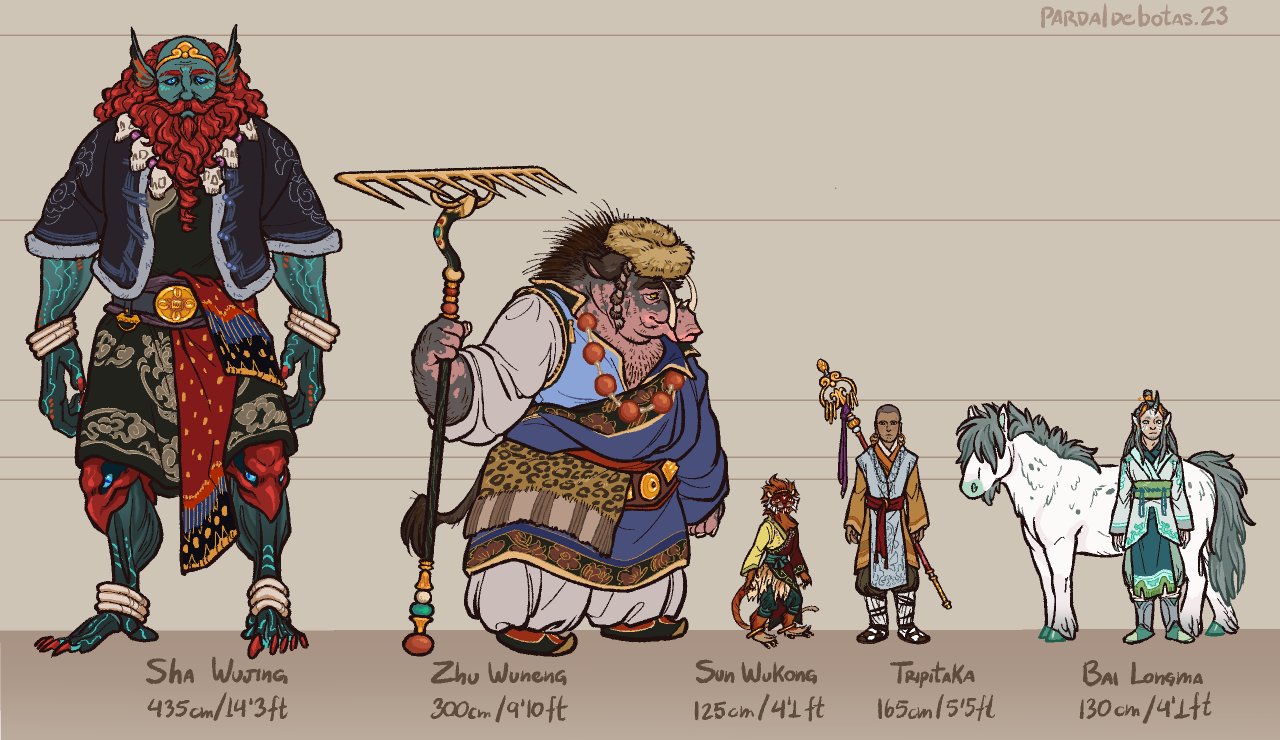
Tumblr user digitalagepulao has drawn lovely versions of the JTTW pilgrims (fig. 11). This is for their own “Expedition to the West au” (JTTW alternate universe) storyline based on the info presented above in the original article. They explain their design choices based on the countries where the disciples are recruited:

Sha Wujing (435cm): His outfit is mostly inspired by Mongolian clothes since he’s found in the Gobi desert stretch of the journey. His bangles are made of fossil bone, and he can use the waist cloth as a headwrap during adverse weather. His markings are inspired by African Lungfish and Mudfish fins, as they are species that exist somewhere between water and dry air. The beasts on his knees are an extension of him, and he can see and speak through them as needed. His beard and long hair can have Ghibli physics depending on his mood and emotions.

Zhu Wuneng (~300cm): Inspired by Northern Tibetan clothes, as that’s the region the group recruits him. Traditional clothes tend to have way more accessories and golden details so I had to simplify a bit. His features are a mix of wild boars and Indonesian babirusa, with the iconic bristles on his head. I leaned on ceremonial Tibetan swords and necklace beads for the decorations on his rake. His vest can be closed, he just prefers not to most of the time.

Sun Wukong (125cm): I’ve already commented on his design over here, but I’ll elaborate that the yellow shirt is the one he gained from Tripitaka soon after he was released, while the pants and red half-robe were the garments he was given by Guan Yin. The hoops on his feet and purple beads were reacquired back in Huaguoshan when he first fled the pilgrimage, heading to his family instead of Ao Guang’s palace. (A-ma and Jinju gave them to him so he’ll always have something to home to remember them by, as well as where he first started, as the beads were gained during his lessons with Subodhi.)

Tripitaka (163cm): This is but one of his many outfits since travel can be rough on clothes, and even more so when you get kidnapped by demons and thrown off your horse all the time. He wears the usual orange monk robes, with some kind of travel clothes over them. He gains some fur boots from Boquin for cold weather but usually prefers sandals most of the time. He seldom uses the cassock and crown he received from Guan Yin, save for when he pays respects to temples and holy sites, but the staff is a constant companion.

Ao Lie (167cm, 130cm at the shoulder as horse): Being effectively in exile until the journey is complete, he wears less fancy clothes than he usually would as a prince, but his status still shows. I tried to balance more casual hanfu of the era with some armor parts, like the waist guard and armored boots. He was given the skill to shapeshift into a horse by Guan Yin when she commanded him to wait for the chosen pilgrim monk, so he can shift at will, but preferably when the tack has been taken off. Speaking of, tack is lost and replaced multiple times during the journey, so I didn’t depict any specific one.

Fig. 11 – Digitalagepulao’s JTTW character designs (larger version). Used with permission.


Update: 11-04-23

Above, I stated: “They [Sun Wukong, Zhu Bajie, and Sha Wujing] would thereafter leave to enjoy their divine lives in the Western Paradise.” But I’ve never really liked the idea that Monkey would forever abandon his people. This is especially true since his rebellion led to heaven decimating the monkeys and burning their cave (Wu & Yu, 2012, vol. 2, p. 31). So, I think a better ending for this historical version would be for the “Victorious Fighting Buddha” (fig. 12) to return to the Mountain of Flower and Fruit, where he transforms it into his own Pure Land (Jingtu, 淨土). The monkeys killed in years passed would be reborn there, and everyone would receive periodic lessons on the dharma between bouts of play. It would be a paradise even grander than when the Great Sage was at the height of his power.

Fig. 12 – Monkey as the Victorious Fighting Buddha (larger version). Imagery based on the iconography of the historical Yuddhajaya Buddha. Art by NingadudeXx.


Update: 10-04-25

Here’s an article where I propose a more natural reason for Wukong and the Greek hero Heracles to fight each other. It’s based on the above story idea.

Story Idea: Sun Wukong vs Heracles / Hercules

Note:

1) The novel adds four more fictional years to a historical reign period (see section 1 here).

2) The Emperor’s true purpose in asking for the travelogue was to gain information pertinent to military campaigns against Turkic forces west of China (Brose, 2021, pp. 75-76).

3) See chapter 3 in Brose (2021).

4) Chapter six reads: “They bound him with ropes and punctured his breastbone with a knife, so that he could transform no further” (Wu & Yu, 2012, vol. 1, p. 186). But this is not stated or implied to be a form of physical punishment. It serves only to keep Monkey in his base form. The blade is mentioned again in chapter seven: “Arriving at the Tushita Palace, Laozi loosened the ropes on the Great Sage, pulled out the weapon from his breastbone, and pushed him into the Brazier of Eight Trigrams” (Wu & Yu, 2012, vol. 1, p. 189).

5) I guess the beads would be swallowed or kept close to the body. Their holy power would surely kill lesser devils but empower cultivator-demon kings.

6) Source altered slightly. I’ve made it more accurate.

Source:

Bodhi, B. (2000). The Connected Discourses of the Buddha: A Translation of the Saṃyutta Nikāya; Translated from the Pāli by Bhikkhu Bodhi (Vols. 1-2). Boston: Wisdom Publications.

Brose, B. (2021). Xuanzang: China’s Legendary Pilgrim and Translator. Boulder, Colorado: Shambhala Publications, Inc.

Buswell, R. E. , & Lopez, D. S. (2014). The Princeton Dictionary of Buddhism. Princeton University Press.
Campany, R. (1985). Demons, Gods, and Pilgrims: The Demonology of the Hsi-yu Chi. Chinese Literature: Essays, Articles, Reviews (CLEAR), 7(1/2), 95-115. doi:10.2307/495195

Dudbridge, G. (1970). The Hsi-Yu Chi: A Study of Antecedents to the Sixteenth-Century Chinese Novel. Cambridge: Cambridge Univ. Press.

Huili, & Li, R. (1995). A Biography of the Tripiṭaka Master of the Great Ci’en Monastery of the Great Tang Dynasty. Berkeley: Numata Center for Buddhist translation and research.

Strong, J. S. (2004). Relics of the Buddha. Princeton, NJ: Princeton University Press.

Wu, C., & Yu, A. C. (2012). The Journey to the West (Vols. 1-4) (Rev. ed.). Chicago, Illinois: University of Chicago Press.

Story Idea: The REAL Reason Sun Wukong is Expelled from Subodhi’s School

From time to time I like to post a fun blog not directly related to (though informed by) my research. A past example can be seen here. Regular articles will resume after this entry.

Last Updated: 08-27-2022

Sun Wukong is kicked out of Patriarch Subodhi‘s (Xuputi zushi, 須菩提祖師) school in chapter two of Journey to the West (Xiyouji, 西遊記, 1592) for showing off his transformation skills to his less-accomplished religious brothers. Upon their request, he changes into a perfect pine tree that’s completely indistinguishable from a real one. The subsequent applause greatly disturbs the Master, who reprimands and expels the Monkey King under the pretense of saving his life from those who would harm him to learn his heavenly secrets (Wu & Yu, 2012, vol. 1, pp. 123-125). [1]

This event is a turning point in Sun’s life, for he transitions from an inward pursuit of spiritual cultivation to an external quest for power, ending with an attempt to unseat the Jade Emperor (Yuhuang shangdi, 玉皇上帝). This ultimately leads to the Buddha imprisoning the seditious primate beneath Five Elements Mountain and punishing him to a hellish diet for 600 plus years.

Here, I would like to prepose a different reason, one that makes more sense and better aligns with some of my previous story ideas.

Table of Contents

1. The Story so Far

Last year I posted a story prompt to reddit to inspire writers looking for a Xianxia (仙俠, “immortal hero”) plot. It serves as a good summation of my past ideas:

The novel briefly mentions that Sun Wukong lives for ten years in the mountain home of the Buddho-Daoist sage Master Subodhi. The first seven are spent as a junior Daoist monk doing menial tasks and learning basic religious or life skills. However, the last three years are spent as a close disciple of Subodhi, learning elixir arts, magic, and combat skills. The novel glosses over his early cultivation in order to jump directly into the action. But imagine a Xianxia story focusing on those three years.

Drama with fellow disciples could arise from Monkey’s supernatural aptitude for quickly learning and mastering a skill. After all, it only takes him three years to go from a mere stone monkey to a powerful immortal capable of going toe-to-toe with gods and demons with millennia of cultivation and combat experience. Think of the resulting battles between our hero and his jealous senior religious brothers and sisters frustrated with his great progress.

In addition, given Sun’s demonstrated knowledge in boxing, weapons, and troop movement, I came up with the story idea that Subodhi’s school is the training ground for an immortal monastic army akin to the famous Shaolin temple. Shaolin was mobilized by the Chinese government during the 16th-century to battle pirates attacking the coast. Records indicate that one historical Shaolin monk was made the leader, and he was later forced to singlehandedly defend himself against eight individuals vying for his position. Likewise, I imagine heaven calls up Subodhi’s army to battle some demonic evil, and Monkey might quickly rise through the ranks. This would naturally lead to more tension with his fellow disciples, causing him to defend his position. All of these challenges, plus any action seen by the monastic army in heavenly battles, would explain how Sun Wukong became such a seasoned fighter in such a short time.

Plus, there is the added bonus of Subodhi’s army being called upon to fight Sun during his rebellion against heaven. He might have far surpassed his religious brothers and sisters in skill at this point.

2. Additions

In chapter one, Subodhi is shown to have 12 generation names (zibei, 字輩) used to name the students of his religious lineage, three of which were historically used by Daoism. [2]

  1. Guang (廣)
  2. Da (大)
  3. Zhi (智)
  4. Hui (慧)
  5. Zhen (真)
  6. Ru (如)
  7. Xing (性)
  8. Hai (海)
  9. Ying (穎)
  10. Wu (悟)
  11. Yuan (圓)
  12. Jue (覺) (Wu & Yu, 2012, p. 115).

Monkey is part of the tenth generation (Wu & Yu, 2012, p. 115). This means that all of Subodhi’s students taken in around the same time would all have Wu (悟) in their name. Perhaps Sun trains with his fellow Wu cohort but quickly moves on to older generations as his skill rapidly progresses.

This leads me to my next point. Above, I mentioned that Subodhi’s army might be called to bear against Monkey during his rebellion. But wouldn’t they recognize him? This feeds into a common question asked around the internet: Why doesn’t Wukong run into any fellow disciples on the journey?

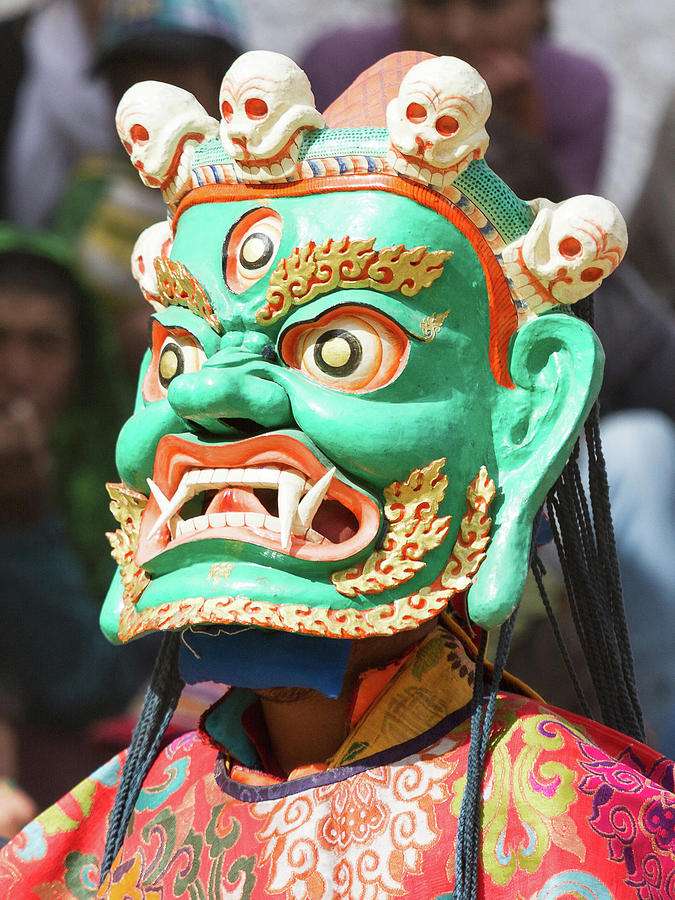
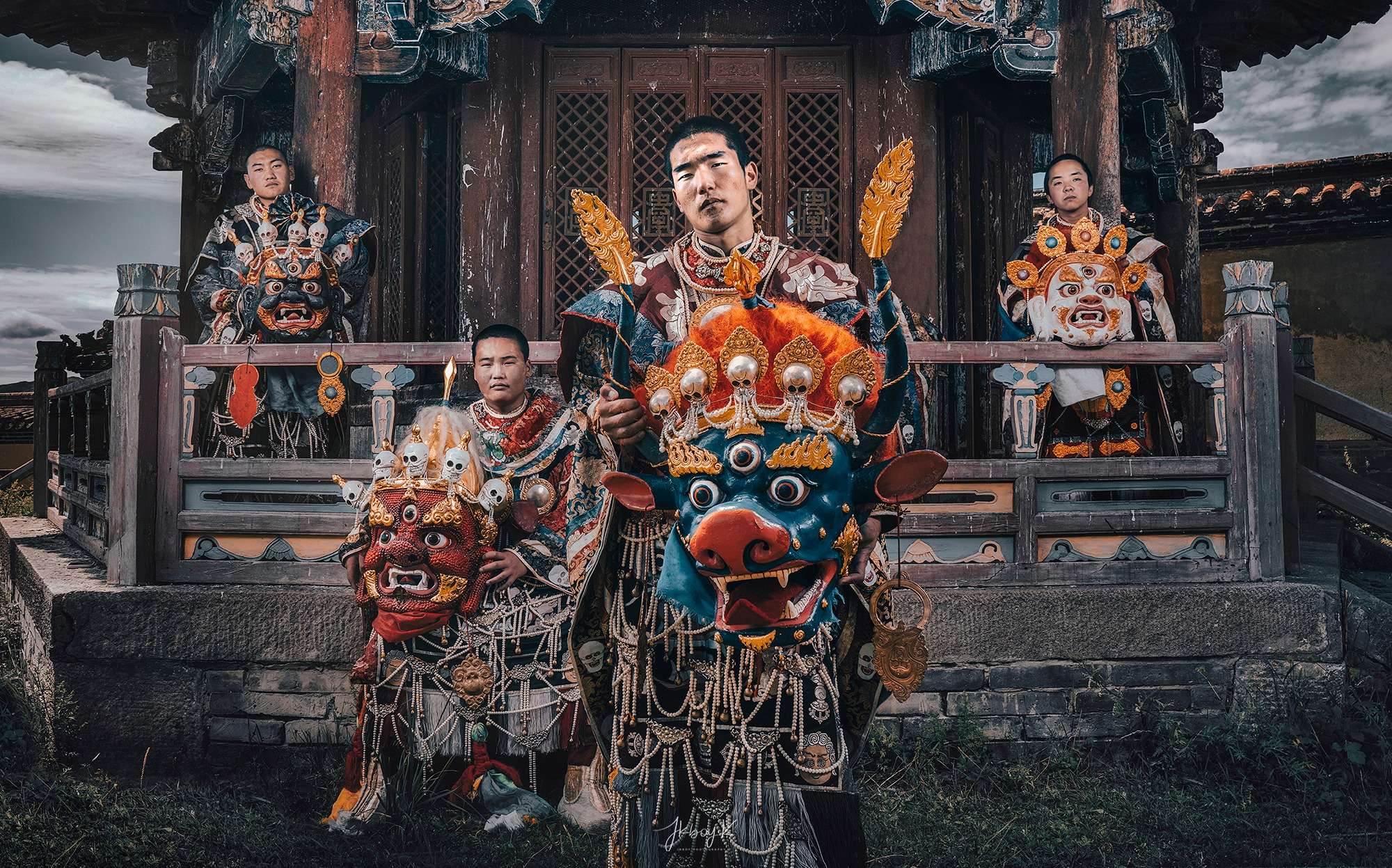
Well, the simple answer is that this isn’t important to the plot. But I’ve considered two ideas to work around this: One, his younger religious brothers are likely still studying under the Master. And two, the older generations⁠—the ones serving in the monastic army⁠—probably don’t know what Monkey looks like because advanced disciples, within the present story, are made to wear a host of fierce, multi-colored masks (fig. 1) as a way to forsake their identity and subsume the self into deep spiritual and martial cultivation. They would represent the negative thoughts and emotions that keep humans trapped in the illusionary world of Saṃsāra and chained to the wheel of rebirth. Perhaps the face becomes more human and peaceful-looking as the students progress through their training. 

Monk in dharmapala mask performs a mystery dance of Tantric Tibetan Buddhism  on Cham Dance Festival Photograph by Oleg Ivanov

Fig. 1  – “Monk in dharmapala mask performs a mystery dance of Tantric Tibetan Buddhism on Cham Dance Festival” (larger version). Photo by Oleg Ivanov. Image found here.

Also, in my version of the story universe, all immortals and deities attain a halo upon achieving divine status. Here, for example, is a photomanipulation of a haloed Sun Wukong by Elijah McTaggart and myself. Take note of the fiery aureola engulfing the halo. This will come into play shortly (fig. 2). I imagine that these halos/aureolas respectively spin and shine brighter when a divinity’s spiritual power is used.

Fig. 2 – The Monkey King with a halo (larger version). As seen on deviantart. Based on my original photomanipulation.

3. Why He’s Really Kicked Out

The reason I’ve devised is connected to one of the aforementioned fights between Monkey and his older religious brothers or sisters. Perhaps Sun is attacked by multiple powerful assailants at once (just like the historical Shaolin monk), and when they start to overwhelm him, his anger ignites his halo, which begins to furiously spin and produce a radiant splendor. Instantly, he takes on a titanic cosmic form, growing 100,000 feet (30,480 m) tall and stomping on his assailants. At the same time, his docile-looking mask cracks and reverts to it’s original, fierce form. This, combined with a fiery aureola, gives him the appearance of a giant Dharmapala (Ch: Fahu, 法護), a wrathful “Protector of the Dharma” (Buddhist Law) (fig. 3) (Buswell & Lopez, 2014, pp. 249-250). This display of raw, untamed spiritual power frightens his older religious brethren. Subodhi himself is also taken aback as Monkey exhibits a great, fiery anger, while also manifesting advanced cultivation techniques that haven’t even been taught to him yet⁠—a testament to his great spiritual intelligence. The Master fears that this rage, combined with Monkey’s demonstrated talent for exponential spiritual growth and perhaps a problem with controlling this power (given Sun’s short years of study), will lead him down the path to villainy. 

This brings us back to the pine tree incident. Perhaps the fight causes Subodhi to uncharacteristically allow Monkey a chance to visit his generational cohort. And when Sun acquiesces to their requests to see his transformation powers, the Master uses this as an opportunity to expel his student.  

Fig. 3 – A modern thangka of the Six-Armed Mahakala dharmapala (larger version). Image found here.

4. My Thoughts

I like this idea because it foreshadows Sun’s cosmic transformations throughout the novel (ch. 3, 6, 61, and 97). It also foreshadows his later mischief throughout the cosmos and eventual rebellion. 


5. Updates

Update: 05-16-22

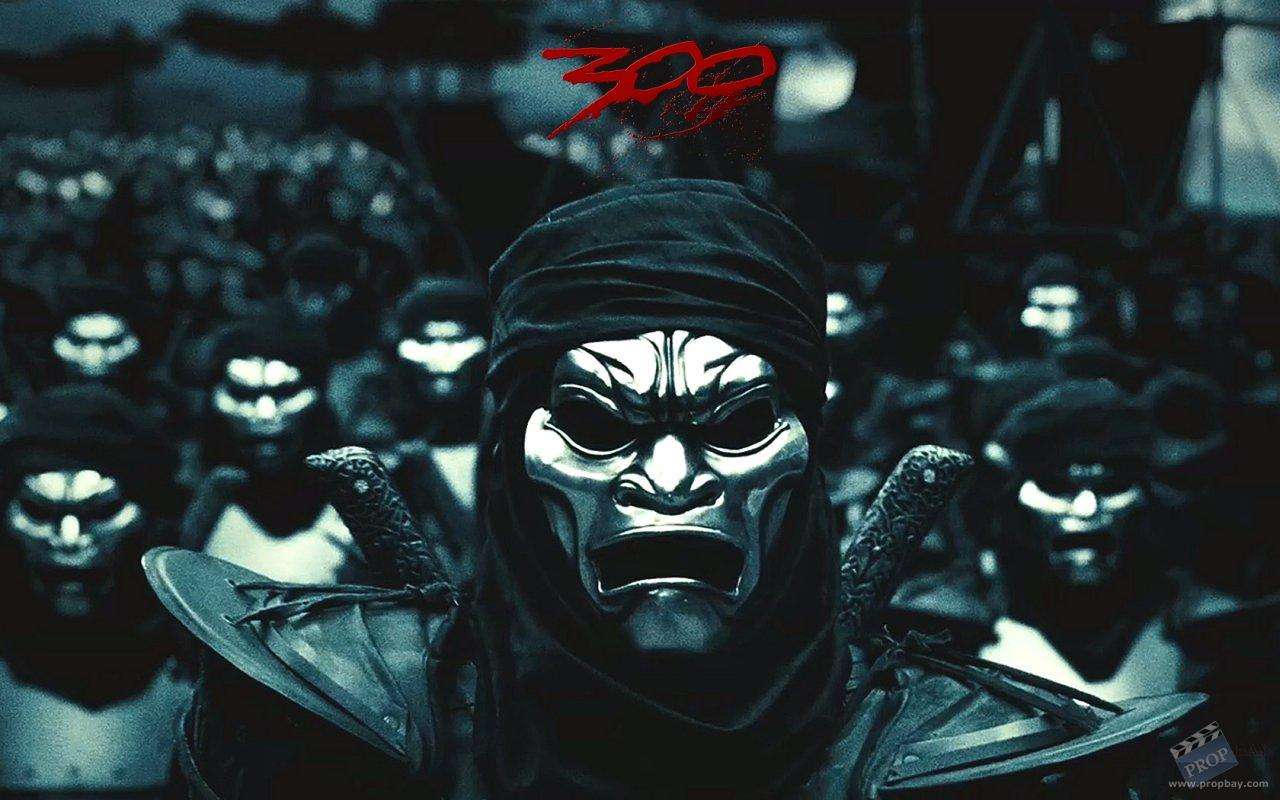
I imagine Master Subodhi’s mask-wearing monastic army would have an ominous feel to them just like the stylized Persian “immortals” from the film 300 (2006) (fig. 4). 

Fig. 4 – The Persian Immortals from 300 (2006) (larger version).


Update: 05-20-22

On second thought, a better mask would emulate the six paths of reincarnation in Buddhist cosmology:

As before, each would indicate the level of a disciple’s spiritual attainment. Perhaps Master Subodhi’s army would have different units of each category, each one being more powerful than the last.


Update: 05-24-22

Some readers might question why I’ve included so many Buddhist elements if Master Subodhi is a Daoist immortal. While this is true, I choose instead to refer to him as a “Buddho-Daoist Sage” as he preaches aspects of both religions in his lectures: 

With words so florid and eloquent
That gold lotus sprang from the ground.
The doctrine of three vehicles he subtly rehearsed,
Including even the laws’ minutest tittle.
The yak-tail waved slowly and spouted elegance:
His thunderous voice moved e’en the Ninth Heaven.
For a while he lectured on Dao;
For a while he spoke on
Chan–
To harmonize the Three Parties is a natural thing.
One word’s elucidation filled with truth
Points to the birthless showing nature’s mystery (Wu & Yu, 2012, p. 122) (emphasis mine).

He even advocates for his students to become Buddhas. For example, the poem that Subodhi uses to reveal the secret of immortality to Monkey ends with: “When that’s done, be a Buddha or immortal at will!” (Wu & Yu, 2012, p. 120).

It’s also important to remember that Master Subodhi is based on Subhuti, a historical disciple of the Buddha.


Update: 08-27-23

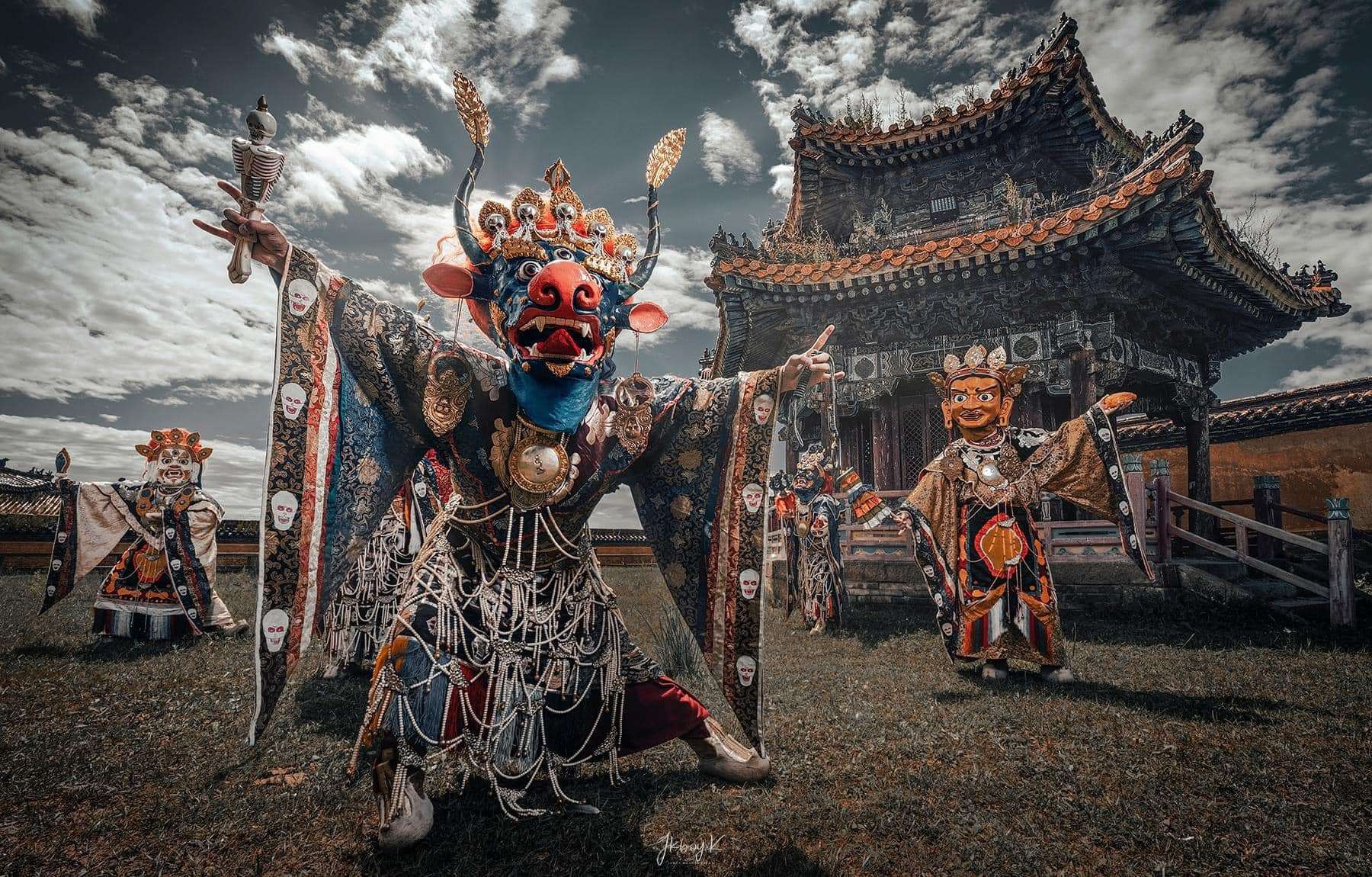
Above, I suggested that Subodhi’s advanced students could wear masks similar to the Tibetan Cham dancers. Well, someone on Facebook posted lovely images of said dancers by the photographer “JKBoy” Jatenipat Ketpradit (fig. 5-7). I just wanted to share some of them so that readers will have a better understanding of what the students might look like.

Fig 5 (top) – The monks performing the Cham dance (larger version). Fig. 6 (middle) – The dancers with their masks off (larger version). Fig. 7 (bottom) – A portrait of a Cham dancer (larger version). Images found here. Copyright Jatenipat Ketpradit.

Notes:

1) I quote the scene of his expulsion below:

“You, Wukong, come over here! I ask you what sort of exhibition were you putting on, changing into a pine tree? This ability you now possess, is it just for showing off to people? Suppose you saw someone with this ability. Wouldn’t you ask him at once how he acquired it? So when others see that you are in possession of it, they’ll come begging. If you’re afraid to refuse them, you will give away the secret; if you don’t, they may hurt you. You are actually placing your life in grave jeopardy.” “I beseech the master to forgive me,” Wukong said, kowtowing. “I won’t condemn you,” said the Patriarch, “but you must leave this place.” When Wukong heard this, tears fell from his eyes. “Where am I to go, Teacher?” he asked. “From wherever you came,” the Patriarch said, “you should go back there.” “I came from the East Purvavideha Continent,” Wukong said, his memory jolted by the Patriarch, “from the Water-Curtain Cave of the Flower-Fruit Mountain in the Aolai Country.” “Go back there quickly and save your life,” the Patriarch said. “You cannot possibly remain here!” “Allow me to inform my esteemed teacher,” said Wukong, properly penitent, “I have been away from home for twenty years, and I certainly long to see my subjects and followers of bygone days again. But I keep thinking that my master’s profound kindness to me has not yet been repaid. I, therefore, dare not leave.” “There’s nothing to be repaid,” said the Patriarch. “See that you don’t get into trouble and involve me: that’s all I ask.” Seeing that there was no other alternative, Wukong had to bow to the Patriarch and take leave of the congregation. “Once you leave,” the Patriarch said, “you’re bound to end up evildoing. I don’t care what kind of villainy and violence you engage in, but I forbid you ever to mention that you are my disciple. For if you but utter half the word, I’ll know about it; you can be assured, wretched monkey, that you’ll be skinned alive. I will break all your bones and banish your soul to the Place of Ninefold Darkness [Jiuyou zhi chu, 九幽之處], from which you will not be released even after ten thousand afflictions!” “I will never dare mention my master,” said Wukong. “I’ll say that I’ve learned this all by myself.” Having thanked the Patriarch, Wukong turned away, made the magic sign, pulled himself up, and performed the cloud-somersault (Wu & Yu, 2012, pp. 124-125).

2) Ter Haar (2021) provides a list of such generational names:

Table 1. The use affiliation characters by People of the Way

Dao 道 (Huzhou, Jiaxing, Taizhou, Suzhou) (13 cases) – The Way
Zhi 智 (Huzhou, Jiaxing) (6 cases) – Wisdom
Yuan 圓 (Huzhou, Jiaxing, Taizhou) (5 cases) – Complete
Pu 普 (Taicang, Taizhou, Huating) (4 cases) – Universal
Miao 妙 (Deqing, Jiaxing) (3 cases) – Wondrous
Jue 覺 (Huating) (1 case) – Awareness (p. 39)

Sources:

Buswell, R. E., & Lopez, D. S. (2014). The Princeton Dictionary of Buddhism. Princeton University Press.

Ter Haar, B. (2021). The White Lotus Teachings in Chinese Religious History. Netherlands: Brill.

Wu, C. & Yu, A. C. (2012). The Journey to the West (Vol. 1) (Rev. ed.). Chicago, Illinois: University of Chicago Press.

Story Idea: The Reason for Sun Wukong’s Rebellion

From time to time I like to post a fun blog not directly related to (though sometimes informed by) my research. Regular articles will resume after this entry.

I have previously posted a few of my story ideas regarding the Monkey King’s birth and training under Master Subodhi. For instance, this article provides two possible origins for our hero: 1) he is the spiritual offspring of primordial and highly respected ape immortals, who themselves rebel against heaven after a long period of exile; 2) he is the offspring of an ancient, rebellious martial god who wishes to overthrow heaven. This latter origin is tied to another idea where Wukong is a soldier-monk in Subodhi’s immortal monastic army similar to Shaolin. This is where my current idea begins. 

During Monkey’s early Daoist training, his mind is subtly corrupted by one of his magic powers, namely his famous 72 transformations (qi shi er bianhua, 七十二變化). Now, I can already hear my readers saying, “What?!” Well, there is a good reason for this idea. The actual name for this power of metamorphosis is the “Multitude of Terrestrial Killers” (Disha shu, 地煞數). [1] It is named after a host of malevolent stellar deities (fig. 1) who are described in various sources as bringers of bad luck and disease:

The Seventy-two malignant stellar gods, called Ti-shah 地煞, enemies of man, and causes of all diseases and ailments (Doré & Kennelly, 1916, p. xviii).

They are described as star generals inhabiting the stars of the Big Dipper, invoked by the Taoists to control evil spirits. But they are also believed to be evil influences on earth causing misfortune and disease (Pas & Leung, 1998, p. 293)

Similar to the 36 Rectifiers [tiangang, 天罡], the 72 Terrestrial Killers are frightening gods. In keeping with the link between celestial bodies and earthly spaces and with their function as timekeepers, the Killers originate from disruptive—and usually unexpected—collisions between the courses of time and space. In ritual contexts the 72 Killers are a common occurrence, prominently understood as a possible cause for disease or death. Preying on the 72 “passes” (關 guan) that connect the human body to all aspects of the cosmos, they can cause all sorts of maladies—especially for small children. Daoists commonly apply apotropaic rituals to prevent the working of these “killers of the passes” (關煞 guansha) (Meulenbeld, 2019).

Fig. 1 – The “72 Killer Deities” (Qi shi er Shashen, 七十二煞神) folk print from the Anne S. Goodrich Collection (larger version).

In the novel, Wukong originally learns the transformations in order to hide from three calamities of thunder, fire, and wind sent by heaven as punishment for defying his fate and becoming immortal. In my story, I imagine Master Subodhi would warn Monkey to guard his spirit while mastering the magic power as some individuals might be influenced by the “baleful stars” (xiong xing, 凶星). And this is exactly what happens to the young immortal. The stellar gods exploit a chink in his spiritual armor (possibly due to his background) and feed him small suggestions that have compounding effects on his personality, making him increasingly egotistical and combative. This ultimately leads to his attempt to usurp the throne of heaven. I’m open to suggestions.

Notes:

1) Yu (Wu & Yu, 2012) translates the skill as the “Art of the Earthly Multitude”, thus glossing over the 72 Terrestrial Killers (vol. 1, p. 122). Other translations for Disha (地煞) are “Earthly Fiends” and “Earthly Assassins” (Shi, Luo, & Shapiro, 1993, p. 1138, for example; Pas & Leung, 1998, p. 293). I follow the translation from Meulenbeld (2019).

Sources:

Doré, H., & Kennelly, M. (1916). Researches into Chinese superstitions: Vol. 3 – Superstitious practices. Shanghai: T’usewei Printing Press. Retrieved from https://ia800709.us.archive.org/2/items/researchesintoch03dor/researchesintoch03dor.pdf

Meulenbeld, M. (2019). Vernacular “Fiction” and Celestial Script: A Daoist Manual for the Use of Water Margin. Religions, 10(9), 518. MDPI AG. Retrieved from http://dx.doi.org/10.3390/rel10090518

Pas, J. F., & Leung, M. K. (1998). Historical Dictionary of Taoism. Lanham, Md.: Scarecrow Press.

Shi, N., Luo, G., & Shapiro, S. (1993). Outlaws of the Marsh. Beijing: Foreign Languages Press.

Story Idea: Sun Wukong Animated Music Short

From time to time I like to post a fun blog not directly related to (though sometimes informed by) my research. Past examples can be seen here and here. Regular articles will resume after this entry.

Back in 2010 I dreamed up an animation based around a modern adaptation of “In the Hall of the Mountain King” by the Finnish operatic metal band Apocalyptica. The original version of the song was composed by Edvard Grieg for Henrik Ibsen‘s play Peer Gynt in 1876. The play is based on an old Norwegian tale about a man named Per Gynt who travels the land rescuing maidens from the clutches of trolls. The music is used during the play to enhance the drama and action of a particular scene where Peer attempts to hide and then escape from the hall of the mountain king. This plot obviously shares many similarities with Journey to the West. Sun Wukong spends the majority of the novel rescuing Tripitaka from the mountain strongholds of various demon kings.

The animation would be completely silent to accommodate the music, the various notes acting as dialogue or sound effects. Below, I present the story with time stamps to indicate when the events are to take place. I recommend reading the material once, then listening to the song, and finally reading and listening in unison to better understand. You can possibly use the stopwatch on your phone and start it the same time as the music.

Apocalyptica’s arrangement of “In the Hall of the Mountain King”.

0:00 – 0:29 – The scene opens in a cave where a mountain demon is celebrating news that the Tang monk is headed to his territory. An imp runs in to inform him that Tripitaka has been spotted in the mountain with only two of his three disciples.

0:30 – 1:03 – The demon king leaves the cave and silently spies on them from afar as Tripitaka on his dragon-horse, Zhu Bajie and Sha Wujing walk down a path through the mountains. When it’s obvious that Wukong is off running errands for his master, the demon magically disguises himself as an elderly man or woman and waits for them, drawing them near.

  • The notes in this section sound like someone is sneaking around.

1:04 – 1:42 – He reveals his true form, grabs the monk, and orders his imps to attack Zhu Bajie and Sha Wujing. The two fight but are over powered by sheer numbers.

  • The change up from the sneaky notes is when he reveals his true self.
  • Each of the high-pitched notes here represent imps attacking the disciples in wave after wave, coming faster and faster until they are overwhelmed.

1:43 – 1:52 – The monk calls out Sun Wukong’s name. I imagine the words would come out as Chinese characters that drift through the air to Monkey’s ear. He forcefully turns his head towards the sound, his eyes flash with a fiery light.

1:53 – 2:20 – Wukong lands in an explosion of multicolored clouds and light. He waves his staff in front of him, thus forcing the imps away from his brothers. He then pulls out magic hairs and blows on them, creating an army of monkeys to do battle with the imps. The monkeys do all manner of things to the imps while Wukong rolls around on the ground in laughter.

  • 1:58 – Wukong creates the army of monkeys. Also, notice how a few seconds in the notes sound almost like monkeys.

sc137582 - small

“Wukong Blows His Hair” (c. 1882) by Yoshitoshi (larger version).

2:21 – 2:26 – The imps run away in defeat. Monkey stands outside the cave screaming and hopping up and down while shaking his fist in order to entice the mountain demon outside.

  • 2:23 – Double hop while shaking fist and screaming obscenities. The words come out as Chinese characters. They could be “coward” or something demeaning like that. The particular sound of “bwah bwah” in the song at this point is when he screams and hops.
  • 2:26 – Second double hop, same.

2:27 – 2:31 – His trick works as the demon king pokes his head out of the doors and shakes his fist back at Wukong.

  • 2:28 – First fist shake and screams obscenity. Same “bwah bwah” sound but with lower register.
  • 2:31 – Second fist shake, same.

2:32 – 2:50 – The demon emerges with his armor and weapon ready to fight and the two begin their bout. The earth shakes, mountains crumble, forests tumble, and the gods shiver in the realm above.

2:51 – 3:08 – Both take to their clouds, the warriors circling each other, rising higher and higher into the heavens, leaving a double helix-like pattern in their wake.

3:09 – 3:12 – The demon makes one last attack with his weapon. Wukong disappears in a puff of smoke, only to reappear instantly in his 100,000-foot-tall cosmic form, breathing fire from a mouth full of tusk-like teeth, his eyes like the sun and moon. The demon realizes he is not Wukong’s match and flees in terror.

cosmic transformation

Monkey performs the cosmic transformation for his children (larger version). Original artist unknown. Found on this article.

3:13 – 3:16 – Wukong reverts to his original form and rockets towards earth with his staff held high.

3:17 – 3:21 – He lands a mortal blow to the demon and stands over his remains.

  • 3:17 – The exact moment the demon is turned into hamburger.

3:22 – 3:24 – Wukong kicks open the double door of the mountain stronghold. The view would be from the inside out (i.e. it’s dark and then the doors are kicked inward, revealing the dark silhouette of Monkey holding his staff against a bright background).

  • The “boom” at the end is when he kicks in the doors.

After the song stops, the animation silently ends with them all continuing their journey to India. The entire animation would probably be around three minutes and forty seconds long. I would really love to work with an animator to make this a reality.