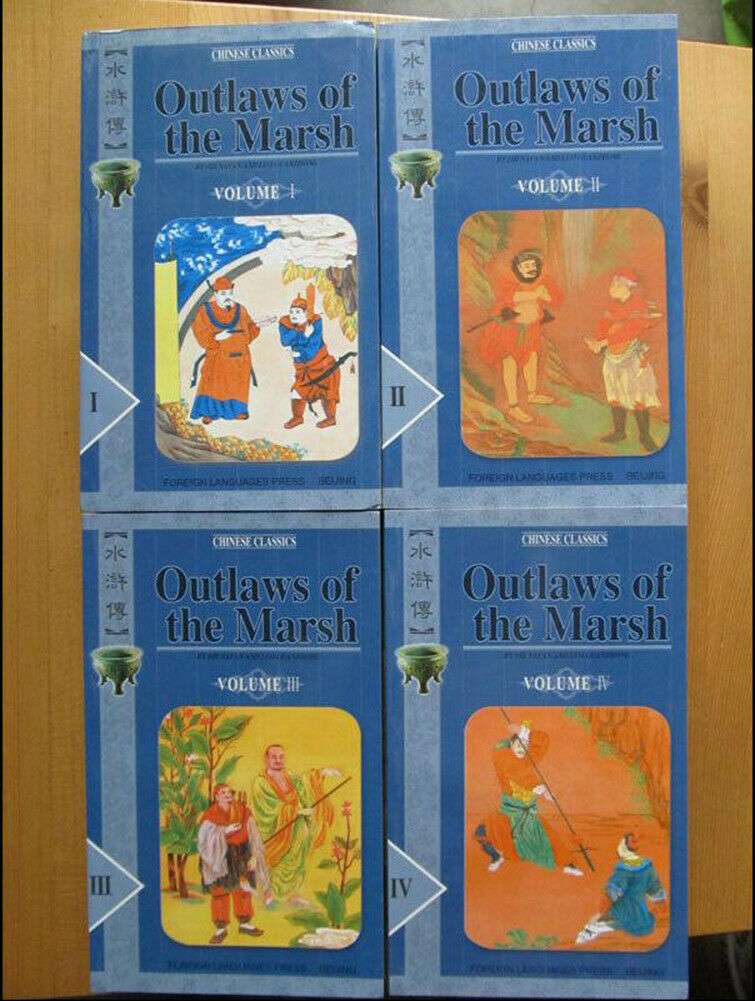
Archive #53 – PDFs of Outlaws of the Marsh (a.k.a. Water Margin) Foreign Language Press English Translation (Vols. 1-4)

Note: My blog is not monetized, so I am not making any money from this post. My hope is that the PDF will make this legendary story more accessible to a wider audience. If you enjoyed the digital version, please, please, please support the official release.

Here I present a PDF of the 100-chapter Foreign Language Press four-volume boxed set of Outlaws of the Marsh (a.k.a. Water Margin, Shuihu zhuan, 水滸傳, c. 1400; “WM” hereafter) translated by Sidney Shapiro. Credited to Shi Nai’an and Luo Guanzhong, this classic Chinese military romance follows 108 heavenly and earthly spirits-reborn-heroes who band together and use their great physical or mental strengths to rebel against the falling Song Dynasty (960–1279). Some of the surviving members later accept clemency from the government and work to fight the barbarian hordes invading China. Few survive to old age.

I’m archiving this book because it has a deep connection with Journey to the West (Xiyouji, 西遊記, 1592; “JTTW” hereafter). Here are a few examples. First, the name and number of Sun Wukong‘s “Multitude of Terrestrial Killers” (Disha shu地煞數; a.k.a. his “72 kinds of transformations,” qishier ban bianhua七十二般變化) and Zhu Bajie’s “Multitude of Celestial Rectifiers” (Tiangang shu天罡數; a.k.a. his “36 kinds of transformations,” sanshiliu ban bianhua三十六般變化) are similar to that of the spirits mentioned above. [1] In WM ch. 2, they are called the “Stars of the 36 Celestial Rectifiers and of the 72 Terrestrial Killers—a total of 108 Demon Lords” (三十六員天罡星,七十二座地煞星,共是一百單八個魔君) (Meulenbeld, 2019, p. 5; Shi & Luo, 1975/2021, vol. 1,  p. 16). [2] Second, see my previous article analyzing the parallels between the Monkey King and the bandit Wu Song (武松). See also the sister article over at the Journey to the West Library blog. And third, I’ve previously suggested that Sun’s ploy to rescue the beleaguered wife of Zhu Bajie in JTTW ch. 18 is based on an event from WM ch. 5. Both feature:

  • Young, beautiful daughters in unwanted relationships (Green Orchid vs the unnamed maiden).
  • Elderly fathers worried for their child (Mr. Gao vs Mr. Liu).
  • Evil spirit-turned-inhumanly strong, hot-tempered, heavy metal staff-wielding martial monks who come to their aid (Sun Wukong vs Lu Zhishen).
  • The monk takes the place of the woman in a darkened room.
  • The villain is beaten (Zhu Bajie vs Zhou Tong) (Wu & Yu, 2012, vol. 1, pp. 374-377; Shi & Luo, 1993/2001, pp. 109-113).

This PDF will complement the translations that I’ve previously archived. These include the JTTW story cycle (here and here), the four-volume 2000 Library of Chinese Classics Chinese-English bilingual edition of Creation of the Gods (Fengshen yanyi封神演義, c. 1620 CE), a fan translation of Journey to the South (Nanyouji南遊記, c. 1570s-1580s), and the four-volume 2001 Foreign Language Press boxed set of Three Kingdoms (Sanguo yanyi三國演義; lit: “Romance of the Three Kingdoms,” 14th century.).

Archive Link:

Click to access Outlaws-of-the-Marsh.pdf

Fig. 1 – The four covers of the boxed set edition (larger version). Image found here.

Notes:

1) Anthony C. Yu (Wu & Yu, 2012) translates these as the “Art of the Heavenly Ladle” and the “Art of the Earthly Multitude” (vol. 1, p. 122). I instead follow the translation used by Meulenbeld (2019). In regards to Tiangang (天罡), he explains: “In its exorcist manifestation, the Northern Dipper is known as gang 罡, which I translate here as ‘rectifier’ due to the ritual function it has in righting wrong” (Meulenbeld, 2019, p. 7). “Terrestrial Killers” is a direct translation of Disha (地煞).

2) Shapiro translates these as the “[t]hirty-six stars of Heavenly spirits and seventy two stars of Earthly Fiends, a total of one hundred and eight demons” (Shi & Luo, 2001, vol. 1, p. 16). Each of the 108 bandits is later associated with a particular star in WM ch. 71 (Shi & Luo, 2001, vol. 4, pp. 1499-1501; Shi & Luo, 1975/2021, vol. 3,  pp. 972-975).

Sources:

Meulenbeld, M. (2019). Vernacular “Fiction” and Celestial Script: A Daoist Manual for the Use of Water Margin. Religions10(9), 518. MDPI AG. Retrieved from http://dx.doi.org/10.3390/rel10090518.

Shi, N., & Luo, G. (2001). Outlaws of the Marsh (Vols. 1-4) (S. Shapiro, Trans.). Beijing: Foreign Languages Press. (Original work published 1993)

Shi, N., & Luo, G. (2021). Shuihu zhuan (shangzhongxia) [Tale of the Water Margin (Vols. 1-3)]. Beijing: Renmin wenxue chubanshe. (Original work published 1975)

Wu, C., & Yu, A. C. (2012). The Journey to the West (Vols. 1-4) (Rev. ed.). Chicago, Illinois: University of Chicago Press.

Review: The Second Journey (2024) by Joel Bigman

Note: I was not paid for this review.

Format: Ebook ($6.99 USD) and paperback (280 pages; $19.99 to $21.99 USD) [1]
Publisher: Earnshaw Books Ltd.
Release date: December 17th, 2024
Purchase links:

1. Introduction

Over two decades ago I was inspired by Journey to the West (Xiyouji西遊記, 1592 CE; “JTTW” hereafter) to begin writing my own Chinese fantasy about an itinerant disciple of Sun Wukong battling monsters across ancient China. However, this all changed when I learned about the Kaifeng Jews, a historical enclave of sinified Israelite descendants who have lived in the Middle Kingdom for nearly a millennium. This convergence of two different cultures immediately captured my imagination, leading to the main character becoming the son of a founding member of the community. He would go on to brave supernatural events and creatures while serving as a soldier under General Yue Fei (1103–1142 CE), [2] eventually becoming a Jewish sage and powerful exorcist later in life. However, the book ultimately didn’t materialize as I came to realize that I was much better at coming up with research-based story ideas than actually writing narratives. Thus, my dreams of a Chinese-Jewish fantasy novel never came to pass.

But fret not, for Joel Bigman has written The Second Journey (2024), a modern sequel to JTTW, which is being touted as “The World’s First Chinese-Jewish Historical Fantasy.” [3] The story is framed as the contents of a lost 7th-century CE scroll discovered inside a buried jar while city planners investigate a watermain leak in modern Xi’an, Shaanxi province, China. A subsequent translation of the Aramaic text reveals a second, unknown journey undertaken by Xuanzang, Sun Wukong, and Zhu Bajie (but not Sha Wujing or the Dragon Horse) five years after their original return. This new quest is initiated by the Bodhisattva Guanyin, who requests that the Tang Monk seek knowledge outside of China for the benefit of the Kaifeng Jews, who have assimilated so much into Chinese culture that they’ve forgotten how to read their Hebrew scriptures. The trio travels past India and into Central Asia, where they procure the services of “Bear” (a.k.a. the “Second Samson“), a supernaturally strong Jew with knowledge of the various routes and personages of Historic Palestine. Together with a mysterious donkey, they travel from town to town looking for a holy man willing to return to China and become the Kaifeng Jewish community’s new teacher, thereby reigniting their religious life. Bear arranges for the pilgrims to meet and stay with several such holy men—allowing them to learn Hebrew and Jewish culture and religious history along the way—but the search for the right candidate is quite difficult.

Cover art by the wonderful Yuyu (与鱼), a freelance illustrator. You can see other examples of their work here.

2. Analysis

2.1. Compare and contrast

How does The Second Journey compare to JTTW? Recall that the original is a fictionalized retelling of the historical monk Xuanzang‘s (玄奘, 602–664 CE) journey to India from 627 to 645 (640 to 654 in the novel) (Buswell & Lopez, 2014, pp. 1015-1016; Wu & Yu, 2012, vol. 1, p. 293; vol. 4, p. 374). The set up for the sequel is also based on actual history. The Jewish community of Kaifeng, Henan Province, China is believed to have been founded around the Northern Song Dynasty (960–1127 CE), [4] and after centuries of unchecked assimilation, the enclave became religiously extinct sometime after the last Rabbi with knowledge of Hebrew died around 1800, [5] during the Qing Dynasty (1644–1911 CE). Joel has simply taken some artistic license by setting these events during the Tang Dynasty (618–907 CE). Also, the novel is full of historical Jewish sages and people that Xuanzang and his companions come to meet and/or learn from over the course of their journey. These include Eliezer ben Hurcanus, Yehoshua ben Hananiah, Akiva ben Joseph, Elisha ben Abuyah, Simeon ben Azzai, Simeon ben Zoma, Honi HaMe’agel, Shimon bar Yochai and his son Eleazar ben Shimon, Hillel the Elder, Rav Nachman bar Yaakov and his wife Lady Yalta, Rav Sheshet, Yohanan ben Zakkai, Shimon ben Lakish, Rabbi Tarfon, Judah ha-Nasi, Rabbi Meir and his wife Bruriah, and others. One of my favorite historical moments happens in “Wine,” when Monkey helps an enraged Lady Yalta attain catharsis by prompting her to smash hundreds of casks in a wine cellar after being slighted by her husband’s house guest (Bigman, 2024, pp. 138-140). Another happens in “Mother,” when Sun smashes a vase at the behest of Xuanzang in order to snap grieving disciples out of their ceaseless prayers, which are keeping ailing Rabbi Judah from dying (Bigman, 2024, pp. 165-167). Inserting our heroes into these Talmudic stories is an ingenious way of making the pilgrims feel that much more real, like they are being pulled out of myth and thrust into the real world.

JTTW is full of enlightened beings, gods, immortals, and demons and ghosts that can fly and wield spells and mystic objects for benign or malevolent purposes. The Second Journey also features magic. I can’t continue without first acknowledging that the historical Jews listed above actually lived centuries before Xuanzang was even born—something that informed readers may have already figured out. This means that the story follows a dreamlike timeline where the group magically flows like water between their present, the early Talmudic period (70–638 CE), and the distant Exodus Period, freely interacting with sages, prophets, patriarchs, and even God himself along the way. [6] Some of these Jewish holy men have mystical adventures of their own, such as in “Orchard” when Rabbi Akiva and others fly on a flaming chariot to the “Orchard of mystical knowledge” in order to discuss spiritual matters with wise men-cum-divine beings, or in “Slow Cart” when Sage Honi, a biblical rain-maker, is transported in his dreams to the past events of JTTW chapter 46, where he takes part in a rain-making competition against a Daoist animal-spirit (Bigman, 2024, pp. 56-62 and 99-104). And of course no JTTW story would be complete without Monkey showing off his magic powers. One of the more inventive uses of his abilities happens in a particular chapter where the titanic, golem-like angel Gabriel produces a giant clay sword from his thigh, and Monkey uses the intense spiritual flames inside his divine body to carburize it into a fine steel blade (Bigman, 2024, pp. 79). You’ll have to read the book to see how the weapon is used.

The original story is set in a world where Buddhism, Daoism, and Confucianism live in harmony with one another. The sequel also features such religious pluralism. In “Kaifeng,” Guanyin explains that she is sending the Tang Monk to the Western lands in order to save the Kaifeng Jews from being completely absorbed by Chinese culture. And in order to accomplish this, Xuanzang must bring foreign knowledge back to the Eastern lands, referring to it as “[s]eeds that may grow into something new” (Bigman, 2024, p. 11). As mentioned above, “Orchard” sees Jewish sages travel to a mystical orchard, where they converse with wise country folk, who are in actuality the Jade Emperor and Laozi (Bigman, 2024, pp. 59-62). This implies that even Jewish holy men can benefit from the knowledge of the East. A third example takes the form of the novel’s two-fold world system, where the Eastern and Western lands are two distinct realms overseen by the Jade Emperor and God, respectively. The reader first learns about this partitioned cosmos in “Oven” when Monkey seeks Guanyin’s aid in order to facilitate a biblical miracle:

In the past, you have received help in battling demons, either from myself, or from other celestial beings. But in this case, even the Jade Emperor cannot help you. These [Western] lands are too far away from our realm. You must ask for help from the emperor in a different heaven, in the Far Western Heaven […] He is Olam-Tzu, World-Master. The westerners call him Ribbono Shel Olam. You’ll have to find your own way to his heaven (Bigman, 2024, p. 36).

JTTW is full of humor, my favorite episode being when Monkey tricks three animal-spirits into drinking “elixir” which is actually the disciples’ stinky urine (Wu & Yu, 2012, vol. 2, pp. 286-287). BWAHAHAHA!!! The Second Journey also has its funny moments. In “The Other,” we learn our heroes have melodious snores:

Our friends woke up late the following morning; only Xuanzang woke up before noon. There was a whole chorus of snoring, led by the renowned soloist Pigsy, accompanied by Bear, their Foreign Guide, and our dear Monkey (Bigman, 2024, p. 187).

My absolute favorite comical moment happens in “Karma,” when Sage Sheshet warns Zhu that his over indulgence of Sabbath stew will come back to haunt him. And sure enough, after eating eighteen bowls worth, horrible stomach pains wake him from his afternoon nap. This causes him to worry that he has once again become magically pregnant like in chapter 53 of the original. But instead of relying on magic abortion water this time to end his suffering, his problem is solved by ripping nasty, giant farts (Bigman, 2024, pp. 145 and 148-150).

Beyond cultural and religious differences, the only applicable element that contrasts with JTTW is that Historic Palestine is said to be free of monsters (Bigman, 2024, pp. 46 and 109, for example). Monkey does briefly tangle with some biblical baddies in the sequel, but they are separated from the human world and therefore do not pose an immediate threat to the Tang Monk. This lack of action might be a little depressing for fans of the original, but readers should understand that both books serve different purposes. JTTW is chocked full of spirits that act as both merit-building obstacles and cultivation-facilitating illusions of the mind. These act as metaphors for the journey towards Buddhist enlightenment. However, such concepts aren’t needed in The Second Journey since Joel tells me that the point of the book is to introduce readers to Jewish culture and history via the medium of Xuanzang’s quest to find a teacher. Therefore, our heroes spend the majority of the story learning local beliefs and customs, listening to biblical tales, and acting as casual observers of Jewish religious history as it unfolds during their time travels. Entering the book with this knowledge should make it more enjoyable.

2.2. Suggestions

The book’s version of Xuanzang is an amalgam of his historical and literary counterparts. While this generally meshes well within the more realistic context of Historic Palestine, it does cause a problem in one particular instance. In “Bandits,” the pilgrims are accosted on the road by a group of highwaymen, and after their Daoist immortal-looking leader neutralizes Sun, Zhu, and Bear with a magic net, they choose the Tang Monk and a temporary travel companion as sacrifices to the Hindu goddess Durga. But a mysterious, powerful wind sent from heaven causes them to change their minds. The bandit leader is eventually revealed to be a Jew with a shady past who would go on to become a great holy man (Bigman, 2024, pp. 152-156). The problem is that the attempted sacrifice supposedly happened to the historical Xuanzang in India while sailing down the Ganges River (Huili & Shi, 1995, pp. 76-78). Recall that the historical Sage Honi travels back in time to past events from JTTW in “Slow Cart,” but this happens in his dreams. The episode under discussion is different because a historical event from India—which should have already happened to our composit Xuanzang—has been transposed onto Historic Palestine. It’s so out of place that it took me out of the story at that moment. The same can be said about a Daoist Jew leading a group of Hindu bandits in the Levant. I understand that Joel was trying to manufacture tension here, but he could have come up with an original group of bandits, and that way, Xuanzang could liken the experience to the one he had in India years prior. Or better still, the event could be likened to the Tang Monk’s experience in JTTW chapter 56 when Monkey is kicked out of the group for killing brigands, including beheading the wayward son of a local elderly couple (Wu & Yu, 2012, vol. 3, pp. 88-90). Perhaps Sun is put into a similar situation in the sequel where he could easily kill, but he doesn’t, thereby showing his master that he has internalized restraint.

And lastly, beyond fixing some minor issues, [7] the book would benefit from adding a glossary or footnotes to explain the names and significance of the various Jewish personages featured in the narrative. Joel told me that he “didn’t want to make it too ‘educational,’ like lecturing at the reader,” but non-Jews like myself who lack an extensive knowledge of Jewish religious history will no doubt be lost without some kind of guide. Having one would, therefore, make the novel far more accessible and enjoyable to a wider audience. As evidence of this, I actually read the book twice for this review, and I found that I enjoyed it more the second time around after having looked up info about the historical people and events.

3. My rating

I give The Second Journey four and a half out of five stars. The book is well-written, with smooth and oftentimes thought-provoking dialogue. The worldbuilding is very creative and yet still respectful to both Jewish beliefs and Chinese mythos. It’s definitely a great way to introduce someone to Jewish culture and religious history via Journey to the West. I highly recommend it!

Notes:

1) I read the Kindle version for this review. My thanks to Joel for giving me an advanced copy.

2) This was based on Weisz (2006), who shows that the Kaifeng Jews reference Yue Fei’s famous patriotic back tattoo, “Serve the country with utmost loyalty” (Jinzhang baoguo, 盡忠報國), in two of three main stone monuments erected in 1489, 1512, and 1663. The first mention appears in a section of the 1489 stele:

[…]

They received kindness from the Prince,
Lived on the income from the Prince
(They) only exerted in prayers To inform Heaven of their sincerity
Which meant “Boundless loyalty to the country and Prince.” (emphasis added)
May the Great Emperor of the Ming
His virtue surpass that of Yu and Tang
and His Highness that of Yao and Xun (Weisz, 2006, p. 18).

[…]

… 受君之恩食君之祿惟盡禮拜告天之誠報國忠君之意祝頌大明皇上德邁禹湯聖並堯舜 … (White, 1966, p. 38; see also the punctuated version).

The second is in a section of the 1512 stele:

[…]

Look at today.
If those who initiated subjects to study
And “brought glory to one’s parents
And became celebrated”
They had made it.
If those who arranged order among China and foreigners and were loyal to the Prince and benefited the people, they had made it.
Or, those who subdued the enemy and resisted aggression
And where “boundlessly loyal to the country” (emphasis added)
They had made it (Weisz, 2006, p. 26).

[…]

… 今日若進取科目而顯親揚名者有之若布列中外而致君澤民者有之或折衝禦侮而盡忠報國者有 … (White, 1966, p. 53; see also the punctuated version).

3) This is per the book’s blurb:

The World’s first Chinese-Jewish Historical Fantasy.

The Tang Monk Xuanzang along with Monkey and Pigsy famously brought the Buddhist scriptures back to China. Now the trio go on a new adventure to get the Hebrew Scriptures. The strongman Bear joins them as they face new monsters and new challenges, and finally reach a land filled with hundreds of foreign sages, yet only one god. The search for a teacher willing to come back to China is difficult, but a talking donkey helps solve the problem.

A fresh parable linking the Chinese classic story with the worlds of Western Asia and Roman Palestine, The Second Journey brings together the cultures, myths and philosophies of all Asia.

4) See my two-part article (here and here) summarizing theories about when the Kaifeng Jews first came to China.

5) Writing in 1850 CE, a Chinese protestant delegate sent to Kaifeng reported:

The present neglect of the Jewish religion is due to the fact that for these fifty years, there has been no one to instruct the members in the knowledge of the fifty-three sections of the Divine Scriptures, and in the twenty-seven [sic] letters of the Jewish alphabet (White, 1966, p. 116).

“These fifty years” implies that the last rabbi died around 1800 CE.

6) Beyond a mention of a specific “magic time traveling cave” in “Cave” (Bigman, 2024, p. 112), the reason for their time-jumping is never openly explained in the narrative. But Joel notes in his “Afterward” that he did this just so the Tang Monk could meet famous Jewish holy men (Bigman, 2024, p. 260).

7) The first minor issue is plot holes. For example, in “Kaifeng,” after being asked by Xuanzang to be his guide, Bear exclaims: “I have always wanted to go west, to where my people came from. I’ll gladly join you!” (Bigman, 2024, p. 19). But despite having never gone there, he spends the rest of the story expertly guiding the group throughout Historic Palestine like he’s intimately familiar with the routes, towns, and people. Another is that the pilgrims are able to understand spoken Hebrew without the narrative ever mentioning when they first started learning it. For instance, in “Oven,” Sun Wukong understands a debate between Jewish sages: “Old Monkey listened carefully and while it was hard to follow, the question seemed to be whether this specific oven was ritually pure or impure, or maybe whether it could become impure or not” (Bigman, 2024, p. 32). He goes on to use his magic to produce biblical miracles that support one holy man’s exclamations of truth (Bigman, 2024, pp. 34-35). In “Angels,” Bear claims out of nowhere that Xuanzang has been “learn[ing] their language, at least a bit,” and the Tang Monk shortly thereafter speaks to Moses with “accented formal Hebrew” (Bigman, 2024, p. 47). Official Hebrew lessons (in this case reading) are not mentioned until “Mother” (Bigman, 2024, p. 158). A lesser plot hole appears at the end of a particular chapter where Monkey rolls up the recently flayed hide of a biblical baddie on his staff, shrinks it, and stores it to never be seen again (Bigman, 2024, p. 80). I would have liked to have seen the skin play a part in another episode, perhaps serving as a magic blanket or being tailored into a magic robe.

The second minor issue is inconsistency. For instance, in “Kaifeng,” the sequel states that Monkey’s magic staff weighs 17,500 jin (22,762.73 lbs./10,325 kg), but “Oven” changes this to the novel accurate number of 13,500 jin (17,560 lbs./7,965 kg) (Bigman, 2024, pp. 17 and 35). “Leviathan” ups this to an astounding 54,000 jin (70,239.28 lbs./31,860 kg), and then “Skip” sees Sun hand the weapon to Moses, who picks it up with ease (Bigman, 2024, pp. 73 and 183). So, either the prophet is crazy strong, or Joel forgot how much the weapon weighs.

The third minor issue is typos. The book could do with an additional copy edit. I’ve alerted Joel to the misprints I noticed during my readings (please forgive any typos that are overlooked in this article).

Sources:

Bigman, J. (2024). The Second Journey. Hong Kong: Earnshaw Books Ltd. Retrieved from https://www.amazon.com/Second-Journey-Joel-Bigman/dp/9888843702.

Buswell, R. E. , & Lopez, D. S. (2014). The Princeton Dictionary of Buddhism. Princeton, NJ: Princeton University Press.

Huili, & Shi, Y. (1995). A Biography of the Tripitaka Master of the Great Ci’en Monastery of the Great Tang Dynasty (L. Rongxi Trans.). Berkeley, CA: Numata Center for Buddhist Translation and Research. Retrieved from https://www.bdkamerica.org/product/a-biography-of-the-tripitaka-master-of-the-great-cien-monastery/.

Weisz, T. (2006). The Kaifeng Stone Inscriptions: The Legacy of the Jewish Community in Ancient China. Bloomington, IN: iUniverse.

White, W. C. (1966). Chinese Jews: A Compilation of Matters Relating to the Jews of K’ai-fêng Fu (2nd ed.). Canada: University of Toronto Press. Retrieved from https://archive.org/details/lccn_66026456/mode/2up.

A Possible Origin for the Term “Handsome Monkey King”

I normally don’t post tone marks for Chinese words, but I will include them here since they are important to the subject of this article.

Měihóu wáng (美猴王), or the “Handsome Monkey King,” is one of Sūn Wùkōng‘s many names and titles. I recently saw an online post where someone proposed their own folk analysis for the character měi (美, “beautiful/handsome”), suggesting that the two prongs on top reference Monkey’s iconic feathered cap. But others quickly pointed out that this was historically not the case. This reminded me of my theory on the origins of the term Měihóu wáng.

(Left) The character měi (, “beautiful/handsome”) (larger version). Take note of the two prongs on top. Image found here. (Right) Èrláng vs Sūn Wùkōng (larger version). Take note of Monkey’s feathered cap. Image of a production still from the 1986 TV Series.

I have suggested in an update to a past article that the title is a play on Míhóu wáng (獼猴王, “Macaque/Monkey King”), míhóu being a common term for monkeys for centuries. [1] This is because the 13th-century version of Journey to the West (Xīyóu jì西遊記, 1592) calls Sūn Wùkōng‘s antecedent Míhóu wáng. [2] Even a 3rd-century Chinese version of an Indian jataka tale where the Buddha is a monkey king calls him Míhóu wángBut most importantly, the Middle Chinese pronunciation of měi (美) sounds more like “mǐ” (mijX), as do the pronunciations of many ethnic groups and even neighboring countries. This might suggest that the pre-modern usage was adopted by these people and places in the past. Therefore, Míhóu wáng and Měihóu wáng may have sounded similar at some point in history:

Modern Chinese → Middle Chinese

(Míhóu wáng) Míhóu wáng (mjie-huw hjwang) [3]

(Měihóu wáng) Mǐhóu wáng (mijX huw hjwang) [4] 

Ethnic and foreign pronunciations of měi (美)

If true, this would mean that the common link between Sūn Wùkōng‘s title and his ego is a later interpretation.

I must point out, however, that I am NOT a language expert. This is just something that dawned on me one day. I would like feedback from more knowledgeable readers. Please write me via the “contact” button on the menu, or leave a comment below.

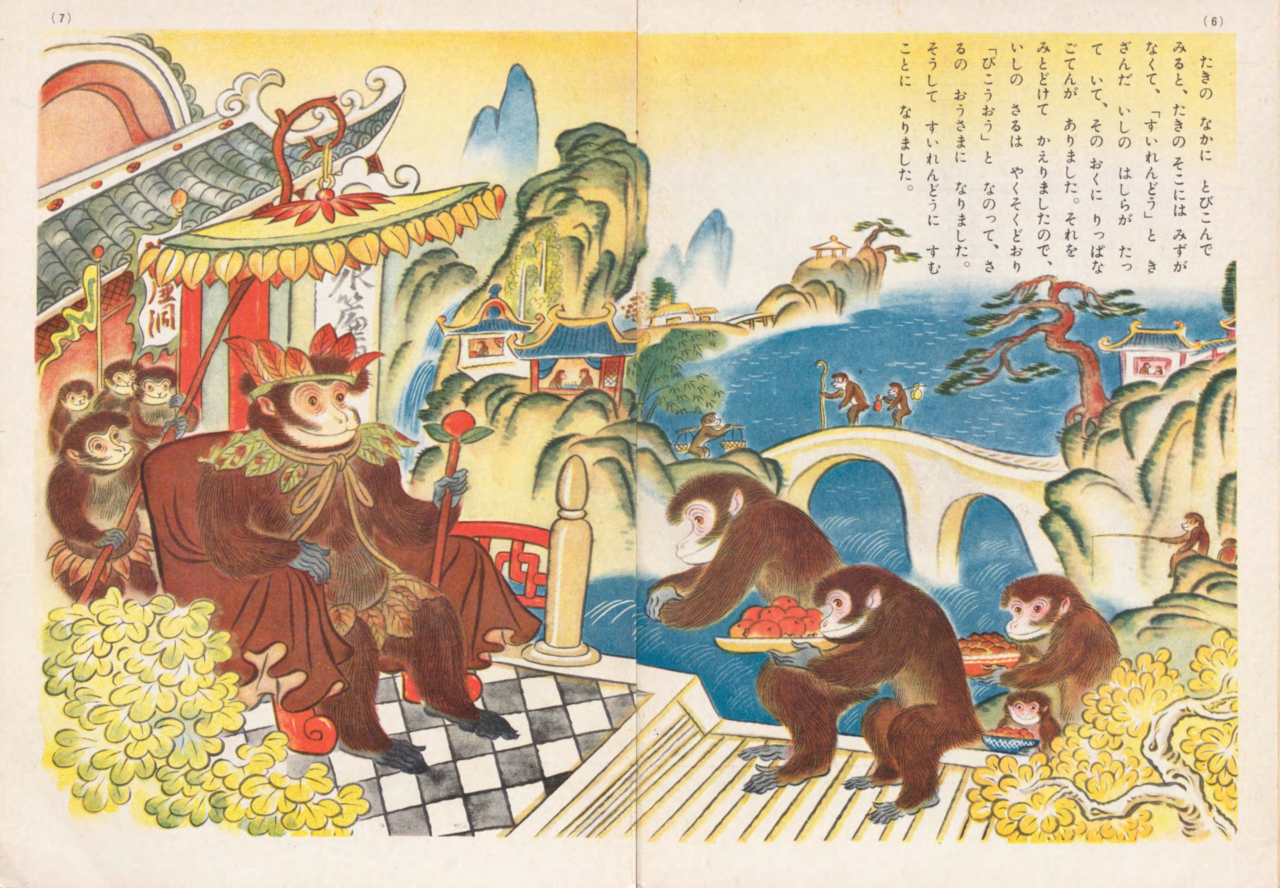
The Handsome Monkey King is waited on by his children (larger version). Image from the Japanese children’s book Son Goku (孫悟空,1939).

Notes:

1) Míhóu is one of various transcriptions for a word of non-Chinese origin used in ancient China to mean “monkey”:

The fact that mu occurs in four variants: 母 and 沐 in Chou literature, and mi 米 or 獼 during the Han dynasty and later, proves that this binom is a phonetic rendering of a non-Chinese term (Van Gulik, 1967, p. 35).

2) The full title is the “Bronze-Headed, Iron-Browed King of the Eighty-Four Thousand Monkeys of the Purple Cloud Grotto on the Mountain of Flowers and Fruit” (Huāguǒ shān Zǐyún dòng bāwàn sìqiān tóngtóu tiě’é Míhóu wáng, 花果山紫雲洞八萬四千銅頭鐵額獼猴王) (Wivell, 1994, p. 1182).

3) See Kroll et al. (2015, pp. 162, 302, and 469).

4) See Kroll et al. (2015, pp. 162, 299, and 469).

Source:

Kroll, P. W., Baxter, W., Boltz, W. G., Knechtges, D. R., Lien, Y. E., Richter, A., Richter, M. L., Warner, D. X. (2015). A Student’s Dictionary of Classical and Medieval Chinese. Belgium: Brill.

Van Gulik, R. H. (1967). The Gibbon in China: An Essay in Chinese Animal Lore. Leiden: E.J. Brill.

Wivell, C.S. (1994). The Story of How the Monk Tripitaka of the Great Country of T’ang Brought Back the Sūtras. In V. Mair (Ed.), The Columbia Anthology of Traditional Chinese Literature (pp. 1181-1207). New York: Columbia University Press.

Story Idea: Firearms and the Journey to the West Universe

From time to time I like to post a fun blog not directly related to (though sometimes informed by) my research. Regular articles will resume after this entry.

Last updated: 04-19-2026

I am currently reading Gunpowder Technology in the Fifteenth Century: A Study, Edition and Translation of the Firework Book (2024), and this got me thinking: what would the Journey to the West (Xiyouji西遊記, 1592) cosmos be like if there were firearms? In this photo essay, I will briefly explore guns and cannons in Chinese folk religion, types of historical (mainly handheld) firearms used in ancient China, and, finally, ways that such weapons could be inserted into the narrative.

Table of Contents

1. Folk Religion

I first set out to see if firearms play any part in Chinese folk religion. I found a few examples from Taiwan. The first is “Lord Red Flag” (Hongqi gong, 紅旗公; a.k.a. “Marshal of Sacred Righteousness,” Shengyi yuanshuai, 聖義元帥), a relatively recent martial god. He and his marshals are depicted holding rifles.

(Click on the images to enlarge them.)

Here’s a version without the cloak.

Even his tangki (spirit-medium) gets a chance to fire off some rounds.

Three more involve Prince Nezha. The first of two (from the same temple) is a traditional statue adorned with an M4 assault rifle and other modern weaponry.

Here’s a closeup of the rifle. Also, take note of the holstered revolver (i.e. the black pouch) on his waist.

The profile view shows clips on his belt (again, in black pouches), as well as a grenade on top of an ammo case at his feet.

The second is a three-headed and eight-armed Nezha with an anti-tank rocket launcher, a rocket round, and a grenade at his feet.

A third statue (my personal favorite) portrays the prince with an MP 40 submachine gun and modern military gear. The carving on the water is amazing. I first learned of it here.

I learned here and here that cannons are sometimes worshiped in East and Southeast Asia as fertility gods. (See the 09-29-24 update below for more info about cannons.)

I also learned that ritual guns sometimes appear in Chinese folk temples of Vietnam.

If present, the guns number among ritual weapons that are commonly found in martial god temples of Chinese folk religion. (But I’ve never personally seen a gun among said armaments in Taiwanese temples.) This Vietnamese article briefly mentions that the weapons are based on the eighteen arms of Chinese martial arts. And it’s interesting to note that a “hand canon” (chong, 銃) does appear among the eighteen arms listed in the Water Margin (Shuihu zhuan, 水滸傳, c. 1400):

Shi Jin daily sought Drill Instructor Wang’s tutelage in the eighteen (weapons of) martial arts. He taught him from the very beginning. Which eighteen martial arts?

Lance, hammer, bow, crossbow, hand cannon, whip, metal tablet, long sword, chain, truncheon, fu-axe, yue-axe, ge-halberd, ji-halberd, shield, staff and spear, and toothless rake. [1]

史進每日求王教頭點撥十八般武藝,一一從頭指教。 那十八般武藝?

矛錘弓弩銃,鞭簡(鐧)劍鏈撾,斧鉞並戈戟,牌棒與槍杈。

Perhaps this list influenced the ritual weapons in Vietnam.

2. Historical Firearms in Ancient China

Here is an example of a Yuan-era hand canon, minus the shaft.

Here is a “Three-Eyed Hand Canon” (Sanyan chong, 三眼銃), a three-barreled stick gun used during the Ming Dynasty.

You can see that they were attached to bladed polearms, which could be used offensively or defensively between reloading.

There were even five-barreled and shielded firearms called “Rapid-Thunder Hand Cannons” (Xunlei chong, 迅雷銃). So cool!

Here’s a Chinese video demonstrating the one and three-barreled versions:

3. Story Idea

This brings me back to Journey to the West. How could firearms be inserted into a religious allegory? Well, for starters, a 950 CE wall mural in Dunhuang shows one of Mara‘s demons attacking the awakening Buddha with a “fire lance” (huoqiang, 火槍; upper right), a precursor of hand cannons. (The fellow below him holds a grenade.) This is a clear example of a centuries-old association between firearms and spiritual warfare.

Here’s the full mural.

Now imagine that these weapons are wielded by celestial gunner-soldiers under the command of the “Star of Fiery Virtue” (Huode xingjun, 火德星君), the god of fire. In JTTW chapter 51, his literary troops utilize fire lances[!!!], fire swords, and fire bows and arrows, fire crows, fire horses, red (fire) rats, and fire dragons, fire carts, fire gourds, fire pennants, and fire staves in battle (based on Wu & Yu, 2012, vol. 3, p. 9). These are just a short step from firearms.

Given that the novel projects Ming-era concepts backwards to the Tang Dynasty, having gods wield such weapons hundreds of years before they were even invented wouldn’t be out of place in the JTTW universe. A writer could just say that the weapons were created in the realm above and eventually trickled down to mankind. Admittedly, I like the real history better because it shows the ingenuity of our predecessors, but the story requires a little tinkering.

Writers wanting to expand on the idea of firearms in heaven could take Ming gunners, their uniforms, and their strategies as models to work from. This page features a lovely figurine of such soldiers, including lots of juicy historical info. And the fact that the historical troops were part of the “Divine Machine Battalion” (Shenji ying, 神機營), which specialized in firearms, really solidifies their connection to the heavenly realm.

Who would make such weapons? There’s a fun answer for that: Laozi! The novel twice describes him forging mystical weapons belonging to our main characters. For example, Zhu Bajie mentions in chapter 19 that the high god made his rake: “This is divine ice steel greatly refined, / Polished so highly that it glows and shines. / Laozi wielded the large hammer and tong …” (Wu & Yu, 2012, vol. 1, p. 382). And Monkey claims in chapter 75 that the Daoist Patriarch created his staff: “The rod of steel nine cyclic times refined / Was forged in the stove by Laozi himself” (Wu & Yu, 2012, vol. 3, p. 375). So, on top of making alchemical medicines, Laozi could be heaven’s celestial gunsmith.

How could demons get ahold of celestial guns? Well, referring back to chapter 51, a buffalo-spirit uses the “diamond cutter” (jingang zhuo, 金鋼琢), an uber powerful, bracelet-like treasure-weapon also created by Laozi, to twice suck away all of the aforementioned fire weapons (Wu & Yu, 2012, vol. 3, pp. 9 and 23). Devil craftsmen would then have time to analyze the heavenly technology, which would allow them to eventually make their own (inferior?) copies.

Recall that the Great Peng demon is said in chapter 74 to have taken over a human kingdom by eating all of the inhabitants some 500 years ago, and the former population was replaced by spirits (Wu & Yu, 2012, vol. 3, p. 360). Firearms would definitely make a human-to-monster kingdom transition for less powerful demon kings a lot easier.

Another possibility is that a fiend could simply sneak into heaven to steal some. This may seem like an impossible task, but JTTW chapter 63 mentions something similar happening. The dragon-spirit “Princess All Saints” (Wansheng gongzhu, 萬聖宮(公)主) is said to have “[snuck] into heaven and stole[n] from before the Hall of Divine Mists the nine-leaf divine agaric planted by the Lady Queen Mother of the West” (Wu & Yu, 2012, vol. 3, p. 192). So, if someone can secretly infiltrate the realm above and steal divine vegetation, they could certainly steal heavenly armaments.

Perhaps the simplest way that demons could attain celestial firearms is by ambushing heavenly troops and commandeering their equipment.

I could see Red Boy (Honghai’er, 紅孩兒) using his powerful Samadhi flame to forge his own hand cannons, at least with the help of devil craftsmen. His association with fire only makes it natural that his own troops would carry firearms.

The only thing I can’t think of is how heavenly hand cannons would differ from their real world counterparts. Would they just use gunpowder and metal shot, or would it be more magical in nature, like shooting meteors? I’m open to suggestions from readers.


4. Updates

Update: 09-29-2024

The film Enoken no Songoku: Zenpen (エノケンの孫悟空 前編; a.k.a. “Enoken’s Songoku,” 1940) features the Monkey King mowing down demons with his staff-turned-machine gun.

There are at least two toys depicting the Great Sage with a gun. The first I learned about via a Facebook group post. I love how his sniper rifle is modeled on his magic staff. You can see the original packaging here.

And here is a Black Myth: Wukong-inspired figure with a powerful-looking rifle/shot gun combo. I saw it here.

Regarding cannons, I learned that a giant Western cannon was worshiped by court officials during the Ming. The History of the Ming (Mingshi, 明史, 1739) explains:

At this time, a ship arriving from the Great Western Ocean [i.e. the West] brought an enormous cannon, which got the name of the “Red Barbarian” [Hongyi, 紅夷]. It measured over two-zhang [20.86 ft/6.358 m] long, and weighed as much as 3,000 catties [3,902.18 lbs/1,770 kg]. It could demolish any stone city-walls, and its earthquake-like roar could be heard for several dozen li around. During the Tianqi [天啟] reign, the name of “Great General” [Da jiangjun, 大將軍] was given to it, and officials were sent to offer libations [si, 祀] to it (based on Needham, 1986, p. 392).

其後,大西洋船至,復得巨砲,曰紅夷。長二丈馀,重者至三千斤,能洞裂石城,震數十里。天啟中,錫以大將軍號,遣官祀之。

Needham (1986) suggests the cannon’s worship is connected to folk beliefs: “In Taoist folk-religion any device or machine of almost miraculous potency was something which should receive veneration” (p. 392 n. b).


Update: 10-05-24

I forgot to mention the “Gatling Gun Bodhisattva” (Jia-te-lin pusa, 加特林菩薩) from Chinese social media and Japanese manga. The following clip expounds the Heart Sutra of the Honored Gatling Gun Bodhisattva (Namo Jia-te-lin pusa Xinjing, 南無加特林菩薩心經).


Update: 11-23-24

Reader Danna Zhang left a wonderful comment about how Investiture of the Gods (Fengshen yanyi封神演義, c. 1620 CE), a sort of prequel to Journey to the West, also includes gunpowder weaponry:

Late comment, but FSYY also puts Ming dynasty gunpowder weapons into the 11th BCE Shang dynasty setting. Apart from the numerous mentions of “cannons go boom”, In Chapter 56, they broke Deng Jiugong’s ambush-disguised-as-wedding by hiding a cannon in the gift casket and using it to make a surprise attack, and in Chapter 88, Jiang Ziya suggests to King Wu that they need the “Sky-blasting Cannon” (轰天大炮) to breach the walls of Mianchi City.

At this point, I think the bronze age gunpowder weapon isn’t a bug, it'[s] a feature.


Update: 12-03-24

The Japanese Scroll of Battle Between Generations (異代同戱図巻, 17th-century) includes a depiction of Guanyin aiming a flintlock rifle, with the Dragon Girl waiting in attendance behind her.


Update: 04-19-26

The Great Ming Military blog, a friend of this blog, has posted an article titled “The Great General Cannon of the Ming Dynasty.” Again, imagine such weapons were born of heaven and used to fight monsters and spirits.

Note:

1) The narration is based on my translation, while the weapons list is based on that from Lorge (2012). See page 147.

Source:

Lorge, P. A. (2012). Chinese Martial Arts: From Antiquity to the Twenty-First Century. United Kingdom: Cambridge University Press.

Needham, J. (1986). Science and Civilization in China. Volume 5: Chemistry and Chemical Technology; part 7, Military Technology: The Gunpowder Epic. Assisted by Ho Ping-yü et al. New York: Cambridge University Press.

Wu, C., & Yu, A. C. (2012). The Journey to the West  (Vols. 1-4) (Rev. ed.). Chicago, Illinois: University of Chicago Press.