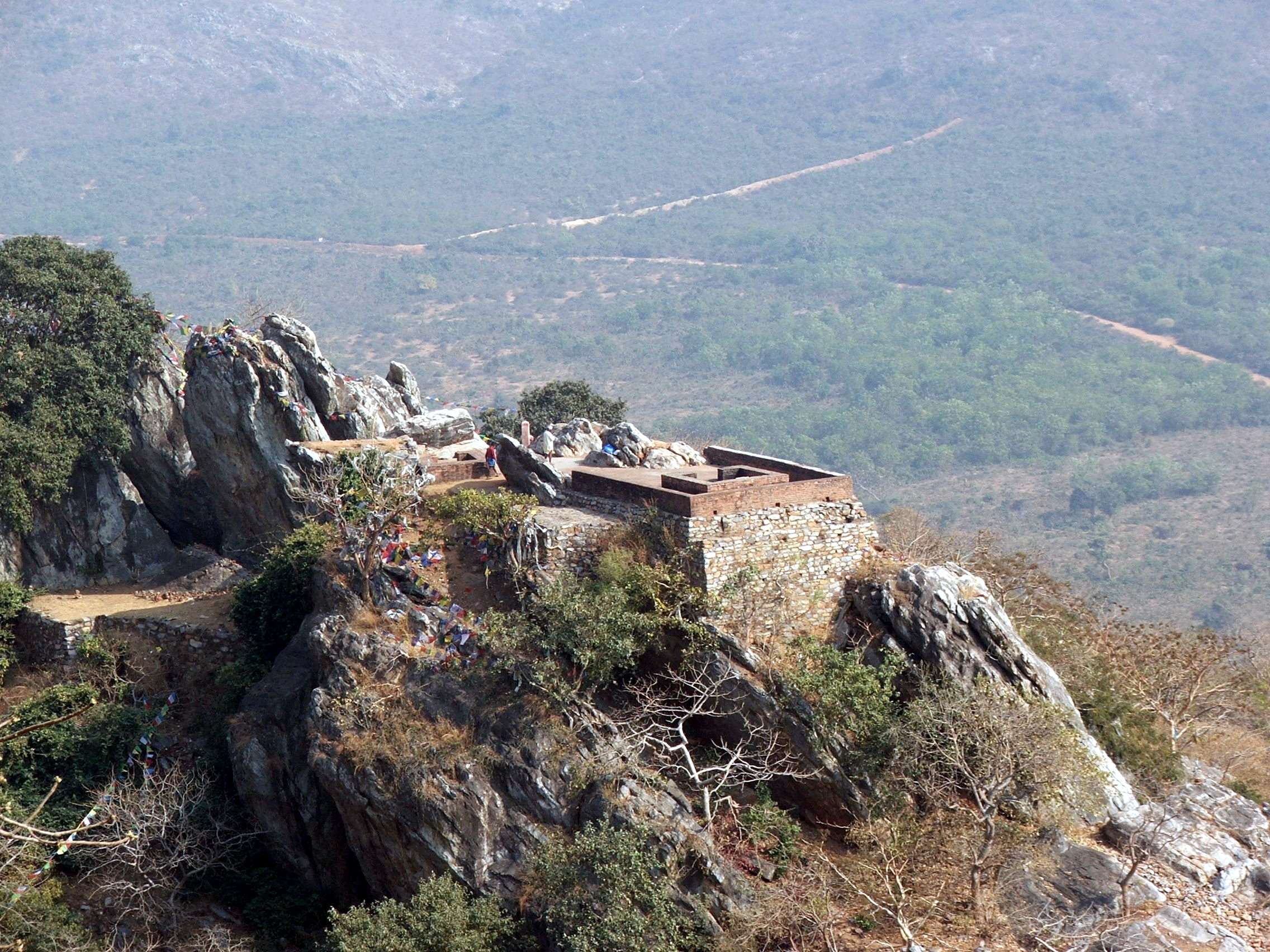
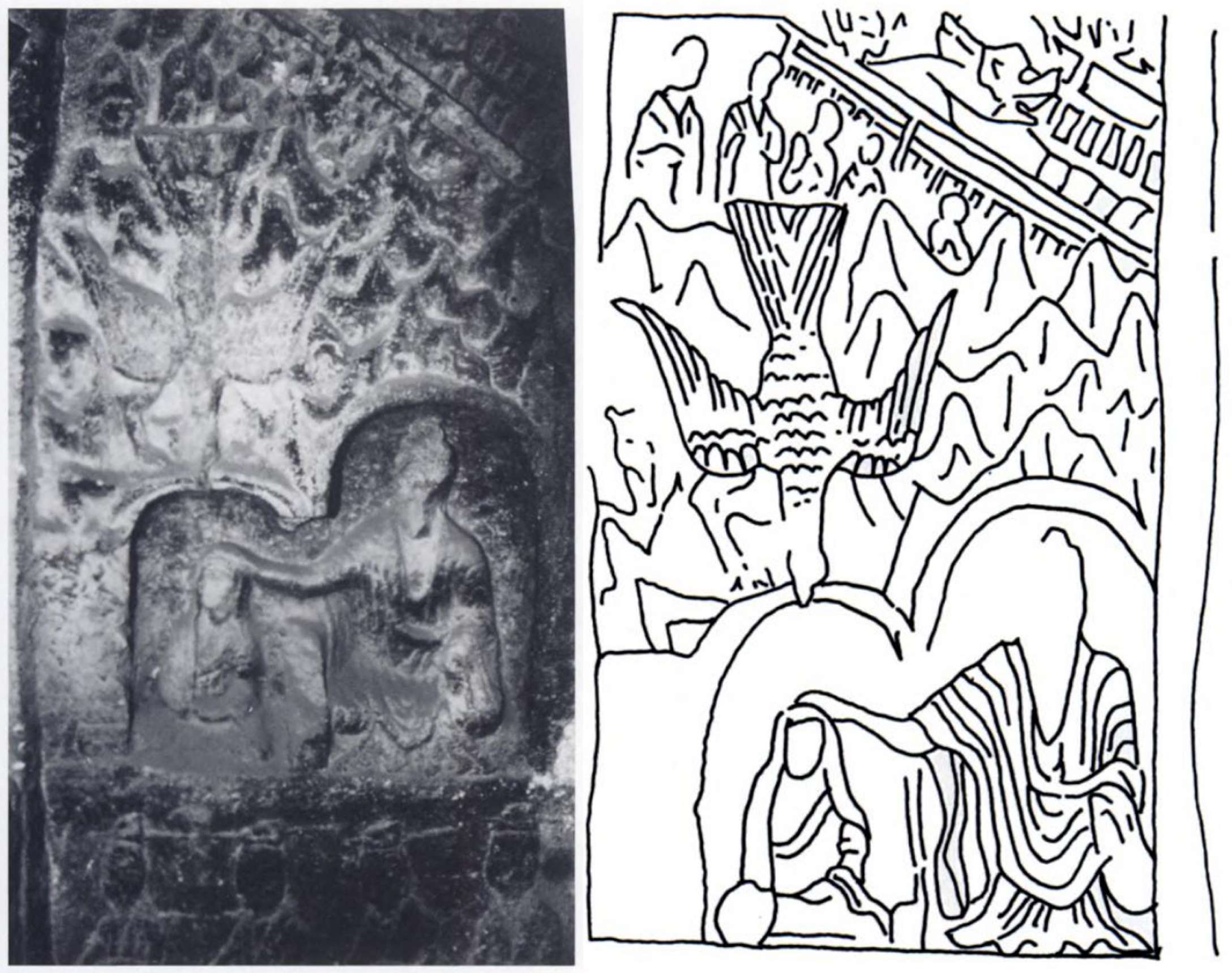
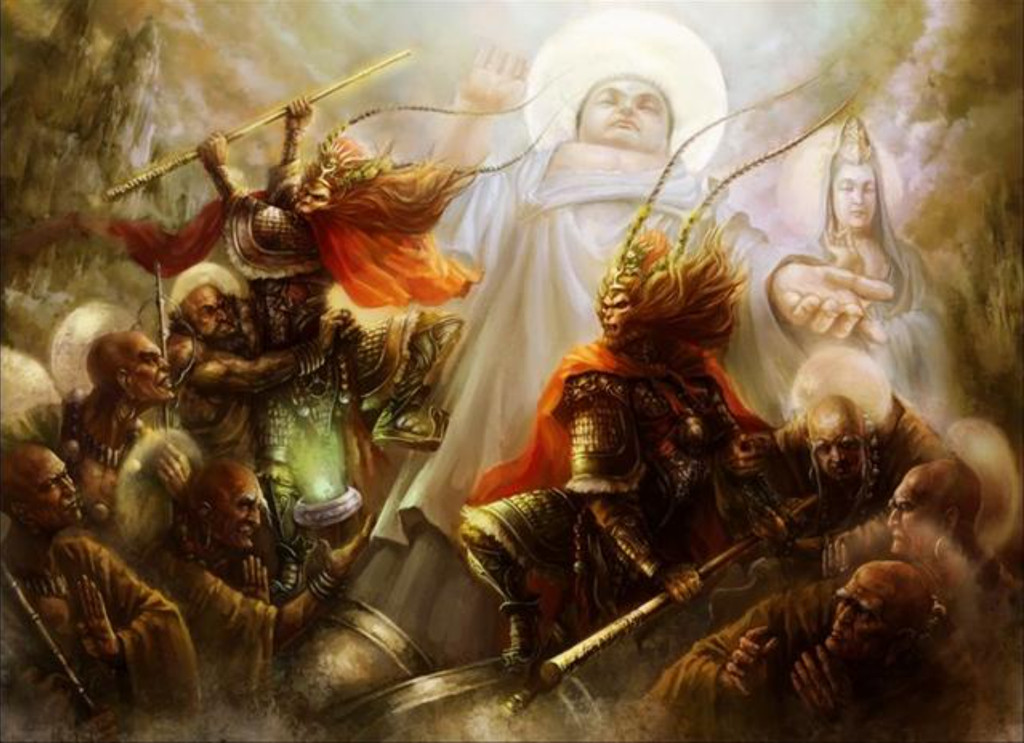
Story Idea: Sun Wukong vs Heracles / Hercules

From time to time I like to post a fun blog not directly related to (though sometimes informed by) my research. Regular articles will resume after this entry.

Last updated: 04-08-2026

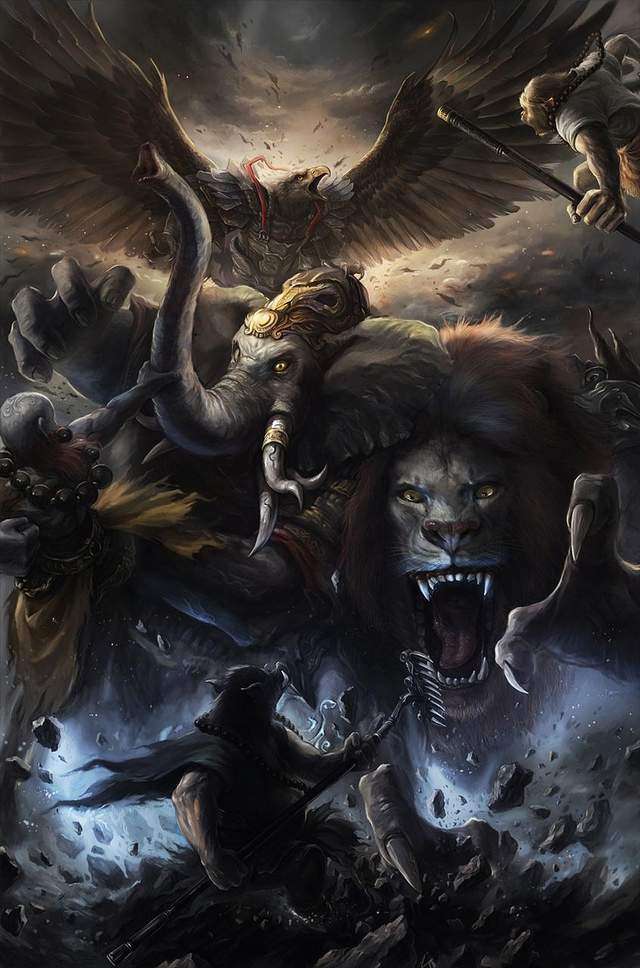
Readers may remember that DEATH BATTLE! (episode 162) featured a fight between Sun Wukong from Journey to the West (Xiyou ji, 西遊記, 1592 CE, “JTTW” hereafter) and Heracles / Hercules from Greco-Roman myth (fig. 1). The episode begins with the demi-god trekking up a mountain in order to fulfill the 11th of his famous 12 labors: procuring the Golden Apples of the Hesperides (Salapata, 2021), but he instead finds Monkey holding the fruit—food meant for his master, Tripitaka. Heracles demands the apple at sword-point, but he quickly discerns that the produce he’s been given was created from a magic hair. This leads to a deadly confrontation.

As I explain in my analysis of the episode, I initially liked how the fight began because both characters are known for stealing fruit in their respective mythologies (see no. 12 in my article listing their parallels). But in hindsight, this didn’t make much sense for two reasons. First, the golden apples are located in a land much further west than India, the scripture-pilgrims’ final destination in JTTW. Monkey could have easily gone to a location closer to their resting spot. And second, having the heroes meet during their respective adventures creates a temporal paradox since both are active at different times—late-Greek bronze age (c. 3000–1000 BCE) vs the early-Tang Dynasty (618–907 CE). Therefore, in the end, the idea is very forced. But what would be a more natural way for the Son of Zeus and the Great Sage Equaling Heaven to come to blows?

This article proposes a more organic reason for conflict via a story idea based on elements from JTTW, Greek myth, Greco-Buddhist art, and Buddhist literature. But take note that the encounter is NOT meant to be a death battle. Remember that the rest of the journey still needs to take place.

Fig. 1 – The official thumbnail for the episode (larger version). Image found here.

Table of Contents

1. Basis for the Story

My pitch is an offshoot of a previous story idea. It follows the historical Xuanzang (玄奘, 602–664 CE) (on whom Tripitaka is based) on his quest for sutras through Central Asia and India, including years-long periods of study. While the original novel sees Daoism practiced by Chinese-speaking people as far away as the Western Continent (i.e. India), this wouldn’t be the case in the real world. Therefore, changes would have to be made to the narrative, such as the appearance of foreign gods outside of the Middle Kingdom. But as I noted in the original article, it would be a lot easier to include the devas of Buddhism (e.g. Shakra, Brahma, Heavenly Kings, etc.) since the religion was practiced throughout the areas traveled by Xuanzang. This, however, wouldn’t exclude gods from other pantheons, like Heracles.

1.1. Heracles as Vajrapani in Greco-Buddhist Art

Now, I can already hear my readers asking, “How could Heracles possibly be associated with the gods of Buddhism?” Well, the first Greeks arrived in Central Asia and India during the reign of Darius the Great (550–486 BCE) and later Alexander the Great (356–323 BCE). And just like American Gods, these soldiers, merchants, artisans, and farmers brought their religion with them. The convergence of these two cultures eventually resulted in the demi-god appearing alongside Tathagata in the 1st to 3rd century CE Greco-Buddhist art of Gandhara (modern day NW Pakistan to E and NE Afghanistan) (fig. 2). The Greek hero takes the place of the Buddha’s loyal protector, the yaksha-turned-dharma guardian Vajrapani (Sk: वज्रपाणि, lit: “Vajra [Thunderbolt] in hand”; Ch: Jingang shou pusa, 金剛手菩薩, lit: “Bodhisattva holding the vajra”). (I have to say that Heracles’ association with the thunderbolt is super fascinating given who his father is.) In fact, the common image of Vajrapani as a muscular, club-wielding deva in East Asia (fig. 3) is directly linked to his depiction as Heracles in Gandharan art!

I won’t go into further detail here since I’ve already taken the liberty of archiving papers on the subject in preparation for this article:

Archive #50 – Heracles as Vajrapani

Fig. 2 – Detail of a stone carving of the Buddha preaching while Heracles-Vajrapani watches over him, Gandhara, 2nd or 3rd century CE, Schist (larger version). He wields a gada mace in his right hand and holds a bone-like vajra-club in the left. Adapted from an image found here. Copyright the Trustees of the British Museum. Fig. 3 – A Tang-era painting of Vajrapani, Dunhuang, Gansu Province, China, mid-9th to early-10th century CE, ink and colors on silk (larger version). Take note of his muscular physique and wispy beard. The vajra-club in his left hand is obscured by his leg. Image found here. Copyright the Trustees of the British Museum. See here for a Tang-era painting of Vajrapani with a visible club.

1.2. Historical Monkey King and Vajrapani Crossovers

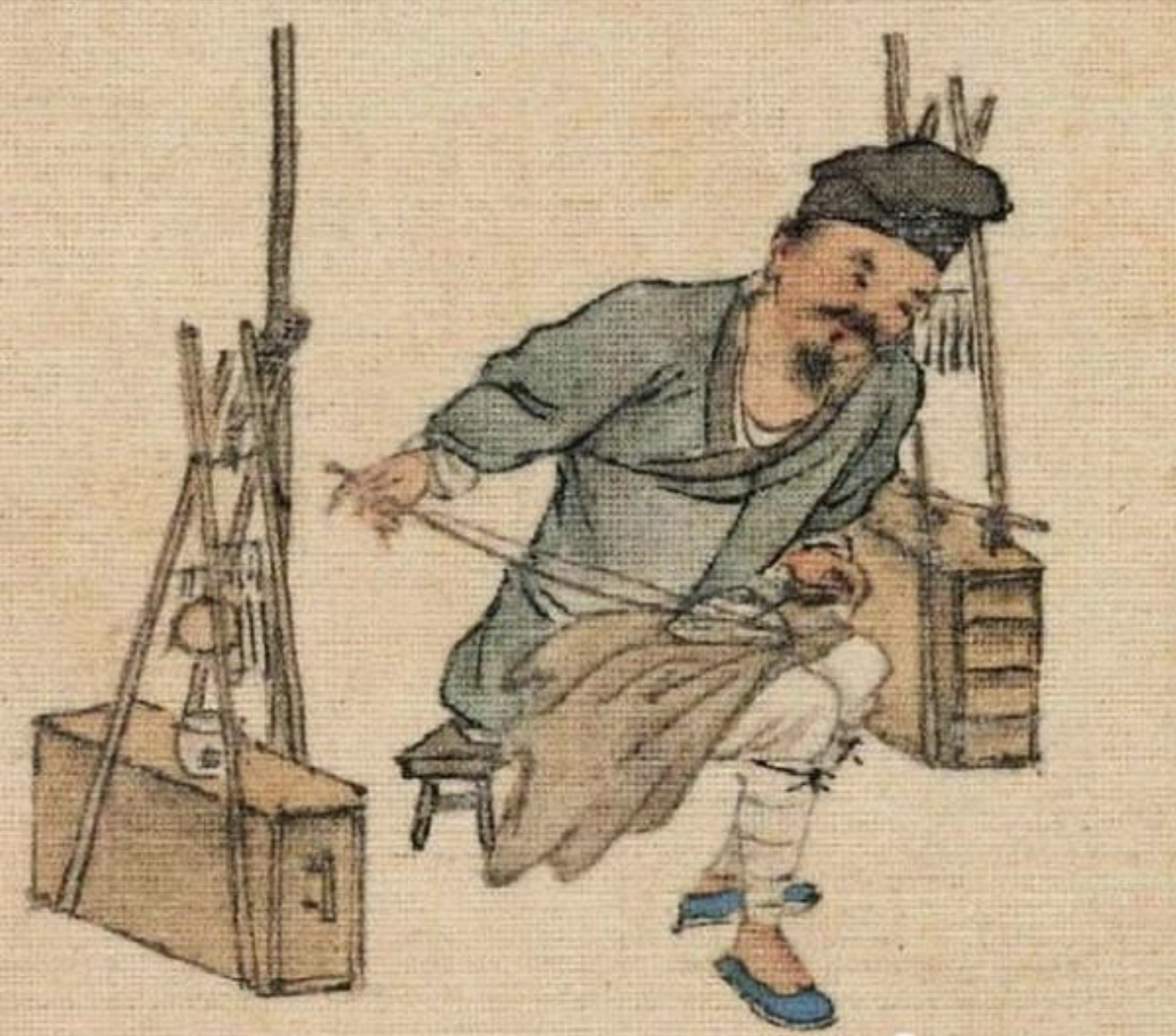
Sun Wukong and Vajrapani have technically met before. For example, in the 13th century CE version of the JTTW story cycle, the Great Sage’s antecedent changes his magic staff into the dharma warrior while facing a white tiger spirit:

Monkey Pilgrim [Hou xingzhe, 猴行者] transformed his golden-ringed staff into a gigantic Yakşa whose head touched the sky and whose feet straddled the earth. In his hands he grasped a demon-subduing cudgel [jiangmochu, 降魔杵]. His body was blue as indigo, his hair red as cinnabar; from his mouth a fiery gleam shot forth over one thousand feet long” (based on Wivell, 1994, p. 1189). [1]

被猴行者將金鐶杖變作一個夜叉,頭點天,腳踏地,手把降魔杵,身如藍靛青,發似硃沙,口吐百丈火光。

The titan eventually crushes her with his weapon (Wivell, 1994, p. 1189). The “demon-subduing cudgel” is another name for Vajrapani’s vajra-thunderbolt.

Also, the Monkey King interacts with Vajra warriors (Jingang, 金剛) related to Vajrapani numerous times in the standard 1592 CE JTTW. In chapter 52, his way is momentarily barred by the “Eight Great Vajras” (Ba da jingang, 八大金剛) when he seeks an unannounced audience with the Buddha (Wu & Yu, 2012, vol. 3, p. 24). [2] In chapter 58, the eight warriors fail to stop Wukong and his doppelganger when they fight to the Western Paradise seeking Tathagata’s wisdom to distinguish one from the other (Wu & Yu, 2012, vol. 3, p. 114). After the Bull Demon King is captured in chapter 61, the Great Sage gathers the “Four Great Vajras” (Si da jingang, 四大金剛) and a host of other gods to confront Princess Iron Fan (Wu & Yu, 2012, vol. 3, p. 161). In chapter 77, the four warriors once again momentarily bar his way when he seeks an audience with the Buddha (Wu & Yu, 2012, vol. 4, pp. 27-28). In chapter 98, the four warriors welcome Tripitaka and his companions, including Monkey, upon their arrival to the Western Paradise (Wu & Yu, 2012, vol. 4, p. 347). Later in the same chapter, the Buddha charges the eight warriors with transporting the clerics on a cloud to hasten the completion of their mission and return to paradise (Wu & Yu, 2012, vol. 4, p. 357). But after being ordered to prematurely drop off the pilgrims, leading to Tripitaka’s 81st tribulation, the eight warriors reappear sometime later to complete the trip to China (Wu & Yu, 2012, vol. 4, p. 369). And finally, in chapter 100, the eight warriors spirit them back to the Western Paradise to receive their otherworldly reward (Wu & Yu, 2012, vol. 4, p. 380).

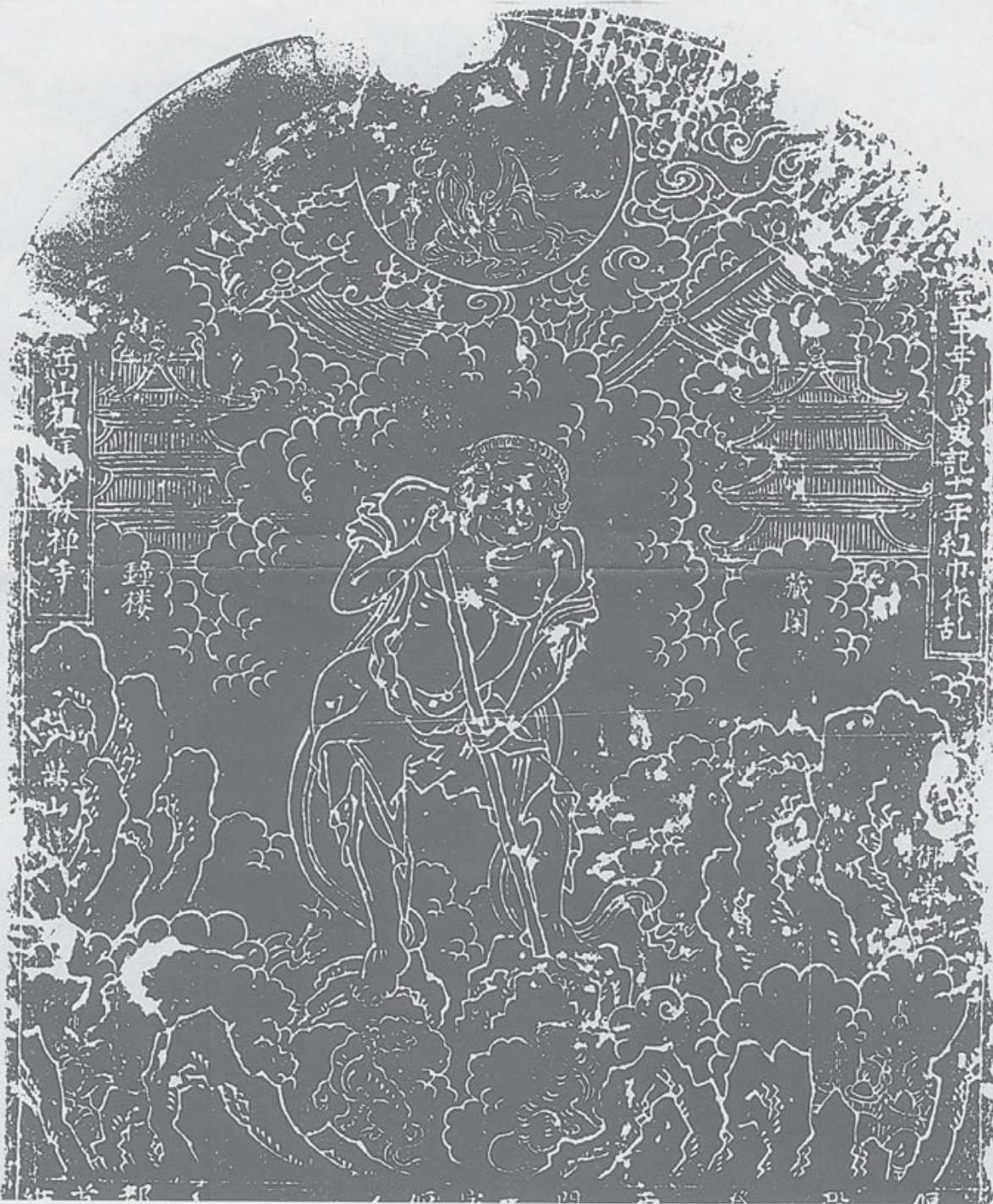
In addition, Sun Wukong and Vajrapani are associated with each other in Shaolin Monastery lore. The latter was historically worshiped as the progenitor of their famous staff method. A stele erected by Shaolin abbot Wenzai (文載) in 1517 CE shows that the deity’s vajra-club had been changed at some point to a Chinese staff (fig. 4) (Shahar, 2008, p. 84). Vajrapani’s yaksha-like Narayana (Naluoyan(tian), 那羅延(天)) form was eventually equated with one of the four staff-wielding “Kimnara Kings” (Jinnaluo wang, 緊那羅王) from the Lotus Sutra in 1575 CE. His name was thus changed from Narayana to Kimnara King (Shahar, 2008, p. 87). One version of the story about his creation of the staff method takes place during the Yuan Dynasty‘s Red Turban Rebellion (1351–1368 CE). Bandits lay siege to the monastery, but it is saved by a lowly kitchen worker wielding a long fire poker as a makeshift staff. He leaps into the oven and emerges as a monstrous giant tall enough to straddle both Mount Song and the imperial fort atop Mount Shaoshi, which are five miles (8.046 km) apart. The bandits flee when they behold this staff-wielding titan. The Shaolin monks later realize that the kitchen worker was none other than the Kimnara King in disguise (Shahar, 2008, pp. 87-88). Shahar (2008) suggests that mythical elements of the story were borrowed from the Monkey King’s adventures. He compares the worker’s transformation in the stove with Sun’s time in Laozi’s Eight Trigrams furnace (Bagua lu, 八卦爐), their use of the staff, and the fact that Monkey and his weapon can both grow to gigantic proportions (Shahar, 2008, p. 109). [3]

Therefore, given the above information, it’s not a stretch to have the two heroes meet in a fanfiction.

Fig. 4 – An ink rubbing of the 1517 CE Shaolin stele showing a titanic Vajrapani defending the monastery from rebels (larger version). From Shahar, 2008, p. 84.

2. The Main Story Idea

I’ve added in-text notes in this section to provide readers with extra context. This way, you won’t have to scroll to the endnotes at the bottom.

Buddhist tradition describes Tathagata visiting the devas to preach the dharma (Buswell & Lopez, 2014, p. 235). With the presence of Greeks in Central and South Asia, I imagine he would also visit the Olympian gods who had gained some influence in the region. (See the 03-28-26 update below for more info). These friendly interactions would lead Zeus to assign Heracles to guard the Enlightened One (fig. 5), thereby forming a link between the Greek and Buddhist pantheons (and explaining the aforementioned art). (See the 10-29-25 and 12-02-25 updates below for a detail from Greek myth that supports this idea.)

Here is where one of many changes to the standard 1592 CE JTTW story happens. In chapter six of the original, the bodhisattva Guanyin recommends that the demi-god Erlang battle the Monkey King after the latter had defeated many of heaven’s greatest warriors (Wu & Yu, 2012, vol. 1, p. 178). In our tale, she instead endorses the demi-god-turned-deity Heracles-Vajrapani (“HV” hereafter). [A]

A) The Son of Zeus became a full-blown god upon his death. After being exposed to a tunic soaked with poisonous hydra blood, Heracles sought release from the immense pain by jumping into a funeral pyre. But the flaming structure was shortly thereafter struck by lightning, signaling his rise to godhood (Romero-Gonzalez, 2021, pp. 273-276). This, of course, takes place hundreds of years before he becomes the protector of the Buddha.

Fig. 5 – A lovely digital painting of Heracles traveling with the Buddha (larger version). By Jacob King (deviantart). Used with permission. Image found here.

(I don’t consider myself a competent story writer, so please look at the following events and dialogue as conceptual in nature. I’m sure a seasoned writer could do the narrative more justice.)

Similar to the standard narrative, the monkey-soldiers of Wukong’s army notify him that heaven has sent another challenger. He emerges from his cave fully armored (refer to section 2.2. here) to see HV for the first time. Like the original, this might be followed by a poem describing the enemy; in this case, a large, muscular, bearded warrior wearing a lion skin and wielding a flaming vajra-club. (See the 02-19-26 update below for a visual.)

[Insert insults from both sides, including the Son of Zeus calling Monkey a “young rogue,” which naturally pisses him off. [B] HV also describes his godly heritage, which is alien to Monkey since he’s not familiar with the Greek pantheon.]

B) The Great Sage has a habit of claiming to be older than the various gods, immortals, spirits, and humans he meets—whether it’s true or not in the first three cases (Wu & Yu, 2012, vol. 1, p. 413, for example). This is exemplified by his self-given nickname “(Maternal/Paternal) Grandpa Sun” (Sun waigong, 孫外公; Sun Yeye, 孫爺爺). But within the story’s timeline, Heracles is indeed hundreds of years older. Writing around 430 BCE, the Greek historian Herodotus claimed that the Son of Zeus lived roughly 900 years before him, placing the demi-god’s life sometime around 1330 BCE. The Greek hero would, therefore, be active around 830 or more years prior to the birth of Wukong (c. 500 BCE).

The pair first take part in a battle of weapons, with Wukong wielding his magic staff and HV his vajra-club. The earth quakes, gods tremble, etc. HV’s powerful strikes push our hero back, causing his staff to painfully vibrate in his hands [C] and create a deafening ringing noise with each hit. Monkey would have a running internal monologue noting the great force of his opponent’s attacks. But despite this, the Great Sage continues driving forward, his weapon hardly leaving the area around HV’s head. [D] At one point, though, a glancing strike from the Greco-Buddhist hero redirects the staff, creating an opening. HV brings his vajra-club down hard on Monkey, but instead of dodging, the latter jerks his head upwards, butting away his opponent’s holy weapon with a loud, metallic bang. [E] The combined forces from the attack and defense might cause destruction to the surrounding area.

C) It may seem impossible for the staff to painfully vibrate in Wukong’s hands, but this indeed happens once in the novel. In JTTW chapter 20, he attempts to bludgeon a tiger-spirit, but when “the rod bounce[s] back up and his hands [a]re stung by the impact” (… 轉震得自己手疼), he learns it was just a big stone covered with the fiend’s sloughed off skin (Wu & Yu, 2012, vol. 1, p. 403).

D) The phrase “hardly leaving the monster’s head” is respectively used in JTTW chapters 41 and 67 (here and here) to describe Wukong’s supreme mastery of the staff (Wu & Yu, 2012, vol. 2, p. 224; vol. 3, p. 249).

E) The feat of headbutting the weapon serves two purposes. First, it’s a response to this 2020 DEATH BATTLE! fanon wiki script that sees Hercules win by smashing the primate immortal’s head to a pulp with his club. (This attack carried over into the official episode, too.) The ending betrays the author’s extremely limited knowledge of JTTW. In the original, the Great Sage’s head is one of the hardest parts of his body, giving him the confidence to voluntarily take blows to the scalp from even magic, bladed weapons with no harm (Wu & Yu, 2012, vol. 1, pp. 314, 383-384, and 408; vol. 2, p. 128; vol. 3, pp. 125 and 373). And two, it highlights the correlation between the invulnerability of Monkey and the Nemean Lion, the first labor of Heracles (March, 2021). Regarding the ending of the fan script, one version of the original mythology sees the Son of Zeus break his olive club over the lion’s head because of how tough its hide is (March, 2021, p. 34).

The novel gives at least three reasons for the Great Sage’s invulnerability. After heaven fails to execute him with bladed weapons and fire and lightning in JTTW chapter 7, Laozi suggests that all of the immortal foodstuff previously consumed by our hero had been refined by his own samadhi fire (sanmei huo, 三昧火), a spiritual flame in the lower abdomen, thus giving him a “diamond body” (jingang zhi qu, 金鋼之軀) (Wu & Yu, 2012, vol. 1, p. 188). Wukong himself later attributes his adamantine nature to his time in the high god’s furnace. In JTTW chapter 34, for example, he claims to have developed a heart of gold, viscera of silver, a head of bronze, and a back of iron, etc. (Wu & Yu, 2012, vol. 2, p. 131). This is refuted in JTTW chapter 75 when he claims to have been born with a head of bronze and iron that was further refined by the furnace (Wu & Yu, 2012, vol. 3, p. 374).

Stunned from the powerful blow, [F] Monkey stumbles around holding his head for a moment but raises his weapon in defense when he sees HV approaching. However, instead of attacking, the Greco-Buddhist warrior pauses combat by raising a hand in front of him. “What a skull!” he exclaims while clapping. “And no hint of blood! I reckon your hide is as tough as a monstrous beast I once fought. [G] Truly impressive! And your staff technique is masterful! Who trained you?”

F) This references how the Nemean Lion was blinded by pain after the blow (March, 2021, p. 34).

G) This reference is obvious.

“I have no teacher. [H] I alone trained my mind and body for three years.” [I]

H) This refers to Wukong’s promise to never reveal the Buddho-Daoist sage, Patriarch Subodhi, as his teacher under threat of karmic torture in the underworld (Wu & Yu, 2012, vol. 1, p. 125).

I) This is the length of time that he spends as an indoor disciple of Subodhi (Wu & Yu, 2012, vol. 1, p. 121).

“A prodigy!” exclaims HV. “But how good is your boxing and wrestling?”

“Ol’ Monkey can handle himself.”

“Let’s see if that’s true. How about we have a friendly sparring match, a test of heroic strength and skill? No weapons and no pesky magic tricks. Agreed?”

Wukong quickly agrees and inserts his shrunken staff into his ear before stripping off his armor from the waist up to match HV’s exposed muscles. HV somehow magically stores his holy vajra-club. The two then square up and launch forward, locking hands and pushing against the other, causing the ground beneath them to tremble and split.

“Extraordinary!” says HV. “How can such a small creature be so powerful?! [J] Were you born of the gods?

J) Many people often forget that Monkey’s normal form is less than 4-Chinese feet (121.92 cm) tall (see here).

“No, I was born from a stone egg.” (See the 02-28-26 update below for an interesting Greek parallel.)

“Oh, like the terrible stone titan and stone goddess! [K] No wonder you achieved this level of strength in such a short time. You have so much raw potential. Why cause trouble for such petty reasons?” [L]

K) These are Ullikumi and Agdistis, two powerful, rebellious, stone-born deities from Western myth. Referencing the former shows that HV is aware of the Near Eastern pantheon.

It’s interesting to note that lithic births are at least common enough in world myth to have earned a category in Stith Thompson’s Motif-Index of Folk-Literature: “Birth from rock” (T544.1).

L) This refers to Wukong’s rebellion over being given the lowest-ranking position in the Daoist heaven.

[Insert Wukong’s reply. They continue to converse during the battle.]

(This might be a good place to introduce some comedy. HV keeps referencing gods and monsters from other pantheons, making Monkey more and more frustrated:

“What the hell is wrong with you?! I … DON’T … KNOW … THESE … PEOPLE!!! [said in a slow, patronizing voice])

The Great Sage’s internal monologue comments on HV’s diamond grip and the great pressure of his punches. But our hero’s keen eyes notice openings in HV’s defense, allowing him to land blow after blow. However, with each successful attack comes praises from HV. Stinging rib shot. “Good, good!” Cutting elbow strike to the face. “Excellent!” Crushing body slam. “Amazing!”

“Why do you keep lauding me? I’m winning!”

“That would certainly be the case … if we were equals.”

“What do you mean?!”

Smiling, HV explains, “I’ve been testing you! [M] You found all of the openings I offered you, even some that I didn’t intend to because I was apparently too focused on judging your technique. [N] You are a talent the likes of which I’ve never seen before! Thank Father Zeus [or Buddha]! The student I’ve been looking for has finally appeared! Forsake this frivolous rebellion and return with me to the Western Paradise. I promise with my tutelage, you will become one of the greatest warriors of any pantheon!”

M) Perhaps HV decides to test the Great Sage when he sees how well the small primate responds to his opening strikes.

N) It just occurred to me that since the Subodhi appearing in this more realistic version of the story is the historical figure he’s based on, Subhuti, one of the Buddha’s ten principal disciples, the patriarch had to have trained under someone during Tathagata’s lifetime. And considering that HV was the Enlightened One’s bodyguard, perhaps Subhuti learned a little from the Greco-Buddhist hero—apart from other deities, holy men, and warriors, including the Buddha, a member of the Kshatriya class. An interesting implication is that HV would recognize (his or an ally’s) techniques among Wukong’s armed and unarmed attacks or defenses, thereby alerting him that Monkey’s claim of having no master is false. Yet, he would still be supremely impressed that the Great Sage became such a powerful, competent fighter in just three short years.

Fun fact: according to Theocritus, Heracles learned boxing and wrestling from the grim-looking demi-god Harpalycus, son of Hermes (Pache, 2021, p. 10). Apollodorus instead claims his teacher was Autolycus (2.4.9), also a son of Hermes.

“I think you’re full of shit! Ol’ Monkey is whittling away at you, and you’re just trying to talk your way out of it.”

“Well, my offer stands,” HV replies calmly, “but now that I’ve had my fun, it’s time to finish this.”

“Finish what, you bastard?!” Wukong screams in anger. He then unleashes a tornado of powerful punches, kicks, and knee and elbow strikes. But this time they have no effect on the Son of Zeus because he’s no longer playing along.

I’m not quite sure what the next sequence of events would be since I have zero experience choreographing fight scenes, especially between celestial warriors. Perhaps HV displays his true power by running Monkey headfirst through the side of a mountain with an outstretched arm, similar to how the comic book character Omni-Man uses his son, Invincible, like a wedge to slice through an oncoming subway train [warning: gore]. This feat alone would surely cause the primate immortal to question how his opponent’s strength has seemingly increased exponentially. [O] (But upon reflection, this deed seems lacking considering that Wukong himself is shown capable of carrying two mountains while running with great speed. Hopefully someone can suggest a feat for HV that would amaze even the Great Sage.) (See the 02-20-26 update below for a new reason.)

O) This, of course, proves that HV was holding back. It’s important to note that in Buddhist literature, the original Vajrapani is considered the “physical manifestation of the … power … of all the Buddhas” (Buswell & Lopez, 2014, p. 955). Now imagine how much stronger HV would be than Monkey! Apart from his own godly heritage, I guess in my version of JTTW, HV would gain an unfathomable boost in power from serving as the protector and disciple of the Buddha, exposing him to the dharma for centuries—during Tathagata’s lifetime and afterlife following his parinirvana (figs. 6 & 7). This is similar to how the scorpion-demoness becomes so strong in JTTW chapter 55 (Wu & Yu, 2012, vol. 3, p. 72). But HV would be well beyond even her.

I guess the Great Sage would hold off on using magic up to this point as a matter of pride, but maybe his hand is forced when faced with such oppressive strength. Like in the original, he might resort to his magic hairs, summoning hundreds of tiny clones in the hopes of overwhelming the Son of Zeus. [P] However, the Greco-Buddhist warrior quickly neutralizes these—possibly by clapping his hands together and creating a shockwave that blows them away [Q] and destroys the surrounding area—pressuring our hero to take other measures. Maybe Monkey frantically cycles through one trick after another but ultimately fails to best his opponent. (See the 10-26-25 update below for a detail from Greek myth that supports this idea). (It would be fascinating to see how HV deals with Wukong’s three-headed, six-armed war form—surely eliciting comparisons to Geryon.) [R]

To these breaches of their agreement, HV responds with something like, “Magic? You disappoint me.”

[Insert Monkey’s response.]

P) Monkey competes in hand-to-hand combat in JTTW chapters two and 51, and each time he resorts to hair clones when things get out of hand (Wu & Yu, 2012, vol. 1, pp. 128-129; vol. 3, pp. 12-13).

Q) The hair clones can indeed be blown away, as shown by the Yellow Wind Demon in JTTW chapter 21 (Wu & Yu, 2012, vol. 1, pp. 409-410).

R) Thank you to a beta reader of this article for reminding me about Geryon. He is sometimes described as having or depicted with three conjoined bodies, complete with three heads and six arms like Monkey (fig. 8) (Finglass, 2021).

Fig. 6 (Top) – A degraded stone carving depicting the parinirvana of the Buddha, Gandhara, 2nd to 3rd-century CE, Schist (larger version). HV is the first person from the left on the bottom row. He holds his vajra-club in one hand and upraises the other in lamentation. He has an exposed torso, showing off his muscles, in place of his signature lionskin. Housed in the British Museum. Adapted from an image found on Wikimedia Commons. Copyright Marie-Lan Nguyen. Fig. 7 (Bottom Left) – Detail of HV (larger version). Fig. 8 (Bottom Right) – Heracles vs Geryon, Attic black figure on Amphora vase, mid-6th century BCE (larger version). Housed in the Musée du Louvre, Paris.  This is an upscaled version of an image found here. Copyright www.theoi.com.

Ideally, given the parallels between Wukong and the Nemean lion—both are fierce mythological animals, have invulnerable hides, can change shape, [S] and fight someone who is/was a demi-god (Erlang vs Heracles)—I would like to see HV maneuver to Monkey’s back and get him in a chokehold, thereby mimicking how the big cat was originally defeated. [T] But instead of killing the Great Sage, he only intends to choke him to unconsciousness. [U] (Again, see the 10-26-25 update below). And to make matters worse, as the primate immortal fades towards blacking out, he by chance witnesses his beloved monkey army being routed and captured by celestial forces, like the standard version (Wu & Yu, 2012, vol. 1, p. 182). This causes him to lose heart and flee HV’s powerful arms by changing into an intangible ball of light or gust of wind. [V]

S) Matyszak (2015) states that the lion would sometimes take the form of kidnapped women (that it had presumably already eaten) in order to lure unsuspecting heroes into its cave (pp. 46-47). Dr. Matyszak tells me that “it’s not part of the core myth” but “later Roman and Byzantine authors do mention it” (personal communication, October 17, 2025).

T) I really like the ending of Theocritus’ description of the fight:

[After hitting him over the head with a club,] I threw my bow and stitched quiver to the ground, and before he could recover and turn on me again, I grabbed him by the scruff of his powerful neck. Gripping him firmly, I strangled him with my strong hands, tackling him from behind to stop him scratching me with his claws. Standing on his hind paws, I pressed them hard to the ground with my heels and controlled his flanks with my thighs, until I could lift him up lifeless in my arms and lay him out. And mighty Hades took his spirit (March, 2021, p. 34).

U) Someone might claim that it would be impossible to choke out Monkey since he’s a spiritual being, but it’s important to remember that the novel humanizes supernatural figures in order to make them more relatable. For instance, in JTTW chapter 65, Wukong claims that he will die from the lack of air inside of a sealed Buddhist treasure-weapon if he isn’t soon released (Wu & Yu, 2012, vol. 3, p. 217). And he reiterates this near-death experience to Zhu after escaping a few pages later (Wu & Yu, 2012, vol. 3, p. 224). Having read that, I think a blood choke would be more dignified and less dangerous method for subduing our hero.

V) Wukong escapes in the form of a ball of light in JTTW chapters 34 and 42 (Wu & Yu, 2012, vol. 2, pp. 126 and 241). And he turns into a gust of wind to follow a foe in JTTW chapter 60 (Wu & Yu, 2012, vol. 3, p. 140). This could easily be used to escape as well.

A beta reader suggested that I work Erlang and his sworn brothers back into the story. They could track down and capture Monkey. But however the situation is resolved, this would lead to the events of the original story: the Great Sage’s failed execution, his sentence to Laozi’s furnace, his escape and wager with Buddha, his imprisonment beneath Five Elements Mountain, and his eventual release to go on the journey. And since Wukong comes into contact with Erlang once more and the Vajra warriors several times in the standard version, [W] he would likely meet HV again during the pilgrimage. The Son of Zeus might even comment on his positive change in character as Tripitaka’s disciple and protector.

W) The Great Sage meets Erlang again in chapter 63 (Wu & Yu, 2012, vol. 3, pp. 187-191). Regarding Vajra warriors, refer back to section 1.2.

Two beta readers were disappointed by the ending because they didn’t think HV could defeat the Great Sage. As a longtime uberfan of Monkey myself, I understand that sentiment, but they should remember that this is not just the Heracles of Greco-Roman myth, who’s immensely powerful in his own right, able to support the sky on his shoulders in one myth (Salapata, 2021, p. 152). He’s an amalgam of the Greek hero and the Buddha’s protector. Recall that Vajrapani is considered the embodiment of all the Tathagatas’ power (refer back to note O). And If the dharma of one Buddha can easily defeat Monkey (Wu & Yu, 2012, vol. 1, pp. 195 and 199), a being endowed with the power of ALL of them should have no problem subduing our favorite primate immortal.

I feel like this idea has so much potential, but I lack the experience or talent to do it justice here. Hopefully, readers will see through the lackluster description to understand the promise of greatness that it holds. Please let me know if anyone is interested in fleshing out this tale.

Lastly, while finishing this section, I came upon a fun coincidence: ancient Greco-Buddhist stone carvings with HV, the Buddha, and … a monkey (figs. 9 & 10)! They depict “The Monkey Offering Honey (to the Buddha)” (Ch: Mihou xianmi, 獼猴獻蜜; Mihou fengmi, 獼猴奉蜜), a tale from the Tathagata’s lifetime where a primate selflessly offered him honey but shortly thereafter fell and died via drowning or impalement. Thankfully, though, the primate was reborn into the deva realm (Van der Geer, 2022, pp. 439-440). [W] The carvings depict HV watching over the Enlightened One during this event.

Perhaps, based on these images, HV tells Wukong at some point during their confrontation that he reminds him of someone from the past. (Fanfic theory: could the Great Sage be a reincarnation?)

W) The historical Xuanzang mentions a version of this story where the primate is later reborn as a human (Li, 1996/2017, p. 106). He adds that the area where the offering originally happened hosts images of monkeys (mihou xingxiang, 獼猴形像) next to a water tank or pond supposedly dug by a group of them for the Enlightened One (Li, 1996/2017, p. 184). [4]

Fig. 9 (Left) – Detail of a stone doorway fragment with two stacked carvings illustrating “The Monkey Offering Honey (to the Buddha)” story, Gandhara, 1st to 3rd-century CE, Schist (larger version). The upper scene portrays the primate asking for a bowl, while the lower depicts the offering of honey. HV is present in both: first from the left on the top and first from the right on the bottom. He lacks his beard and lionskin but wields his signature weapon. The extra person photobombing the lower scene may be Ananda. Fig. 10 (Right) – The full stone doorway fragment portraying various events from the Tathagata’s life (larger version). Housed in the Guimet Museum, Paris, France. Adapted from an image found on Wikimedia Commons. Copyright Marie-Lan Nguyen. 

3. An Idea for a Sequel

A continuation of the story would open where the original leaves off: after the scripture-pilgrims are elevated in spiritual rank, Tathagata charges HV with escorting the Victorious Fighting Buddha (i.e. Sun Wukong; fig. 11) through the Greek world-system. Imagine the kind of adventures Monkey would have as a Buddha interacting with Classical gods and monsters! It would definitely be a great way of introducing East Asian people to the wonders of Greek myth.

I really like the idea of HV visiting his old pantheon as his vajra is analogous to Zeus’ thunderbolt. Seeing a father-son lightning competition would be great!

Also, as I’ve discussed elsewhere, Wukong and Poseidon could bond over their shared love of horses.

Fig. 11 – Wukong as the Victorious Fighting Buddha (larger version). Imagery based on the iconography of the historical Yuddhajaya Buddha. Art by NingadudeXx.

3.1. Commissioned Art

I have commissioned some illustrators to draw Monkey in ancient Greek style as an experiment to see what he might look like through the lens of Hellenistic artisans.

Fig. 12 – The Victorious Fighting Buddha (larger version). Pencil, fineliners, and alcohol markers on paper. Art by tr0chanter (Instagram and Twitter).

Fig. 13 – Heracles vs Monkey (larger version). Pencil and markers on paper. Art by Dario Virga (Onibotokemaru on Instagram), a friend of the blog. Each character is labeled with their name in Greek. Heracles is “Ἡρακλῆς,” while the Great Sage is “Pithekos” (πῐ́θηκος), meaning “ape, monkey, trickster, or dwarf.” Wukong’s Greek name is very fitting. It’s also part of the modern scientific name for Old world monkeys (Cercopithecoidea).

Fig. 14 – Heracles vs Sun Wukong (larger version). Digital. Art by Jacob King (Twitter, Instagram, Tumblr). I love the cracks.

4. Possible Fanfiction

I can already predict fanfiction set in an alternate timeline where Monkey accepts HV’s offer to become his teacher. The Son of Zeus would spend time instructing Wukong on advanced techniques of boxing, wrestling, and weapons. This, of course, would be taught in tandem with spiritual cultivation. The training might be in preparation for a fighting tournament between the disciples of gods from all pantheons, kind of like Record of Ragnarok (Jp: Shūmatsu no Warukyūre, 終末のワルキューレ; lit. “Doomsday Valkyrie”; fig. 15). The contestants could be fighting for permission to start their own pantheon, thereby becoming a “Sky Father” (Sk: Dyaus-pitr, द्यौष्पितृ; Ch: Tianshang fuqin, 天上父親). Maybe the long-established Sky Fathers share some of their divine spark to kickstart the new world-system.

I REALLY like this idea, but it wouldn’t work for my own purposes since, as stated above, Wukong would still need to go on the journey.

Perhaps the prize could be the chance to help mankind since one of the reasons that Tripitaka is asked to quest for sutras is because they will help free untold numbers of orphaned souls from the torments of hell (see JTTW chapters 11 and 12). Therefore, the tournament would essentially be a contest to see who will be the Tang Monk’s protector. I don’t really like this idea, but it at least supports the original narrative. The Great Sage would win, of course, but he has to agree to have his extraordinary powers (and memories of the tournament) sealed as a test of his resolve or devotion. And his subsequent enlightenment would be the reward for his great deeds performed on the journey.

Fig. 15 – Promotional art for Record of Ragnarok (larger version). Image found here.


5. Updates

Update: 10-11-25

I’ve seen people claim online that Sun Wukong would easily defeat Heracles because the latter’s feats are not as grand as the former. To this, I counter that the deeds of both heroes shouldn’t be compared, for they serve difference purposes. I don’t know of any feats of speed for Heracles, but Monkey’s famous ability to fly 108,000 li (33,554 mi / 54,000 km) in a single cloud somersault is an allegory for instant enlightenment (as explained in section III here). [5] And his feat of carrying two Buddhist mountains on his shoulders is likely an allegory for the Great Sage “supporting” the religion by protecting his master on the quest for sutras (as I suggest here). The deeds of Heracles, however, were probably meant as actual displays of brute strength. For instance, ancient Greek men on lion hunts may have drawn inspiration and courage from the demi-god’s defeat of the Nemean Lion. [6]


Update: 10-26-25

Above, I wrote that “[m]aybe Monkey frantically cycles through one trick after another” in a failed bid to win, and I later added, “I would like to see HV maneuver to Monkey’s back and get him in a chokehold.” Well, I’m happy to report that I’ve found a mythic way to combine these. The Bibliotheca of Pseudo-Apollodorus describes Heracles’s grip tiring out a shape-shifting sea god:

And going on foot through Illyria and hastening to the river Eridanus he came to the nymphs, the daughters of Zeus and Themis. They revealed Nereus to him, and Hercules seized him while he slept, and though the god turned himself into all kinds of shapes, the hero bound him [with his arms (fig. 16)] and did not release him till he had learned from him where were the apples and the Hesperides (2.5.11).

Matyszak (2015) calls this binding a “Herculean head-lock” (p. 150). Therefore, in our story, Wukong cycles through all manner of transformations but can’t break free from HV’s grip! Then he loses heart and flees when he sees his children captured (as mentioned previously).

Fig. 16 – Heracles wrestling Nereus/Triton (larger version). From an 1894 drawing of a circa 550 BCE Attic Black-figure Kylix. Image found on Wikimedia Commons. For the original, see here.


Update: 10-29-25

I’ve also found a mythic reason for why Heracles would be sent away from Olympus to protect Buddha. Matyszak (2015) explains that the Son of Zeus didn’t want to become an official member of the Twelve Olympians because this would have forced someone out of the group:

Some felt that the mighty deeds of Hercules entitled him to the status of a full Olympian God. However, the number of Olympians was limited to the sacred number of twelve, and in a rare moment of diplomacy Hercules declined to take an honour that would have first to be stripped from someone else. (Dionysus, the God of Wine was less bashful. He bumped Hestia, Goddess of the Home, off the Olympian high table when his time came to be made divine.) (p. 200)

So instead of taking an Olympian’s spot, Heracles decides to accept a position within the Buddhist pantheon as the Tathagata’s protector.


Update: 12-02-25

I have found the specific passage alluded to by Matyszak (2015) in the previous update. In book four of his Library of History (c. 60 to 30 BCE), Diodorus Siculus writes:

[4.39.4] They report of Heracles further that Zeus enrolled him among the twelve gods but that he would not accept this honour; for it was impossible for him thus to be enrolled unless one of the twelve gods were first cast out; hence in his eyes it would be monstrous for him to accept an honour which involved depriving another god of his honour (source).


Update: 02-19-26

In March 2023, Twitter user @LinJKai posted a lovely 18 x 24-inch (45.72 x 60.96 cm) digital painting titled “Hercules as Vajrapani” (fig. 17). It depicts HV, the 12 labors, and various Greek gods in Tibetan thangka style. I adore this so much! I’d love to commission a physical copy.

Fig. 17 – @LinJKai’s painting of HV (larger version).


Update: 02-20-26

I originally couldn’t think of a feat of strength for HV that would outdo Monkey, but something has come to mind. In JTTW chapter 33, a demon uses the “Magic of Moving Mountains and Pouring Out Oceans” (Yishan daohai fashu, 移山倒海法術) to drop two holy landmasses on Monkey in the hope of incapacitating him. This does nothing to slow him down, though, so the fiend drops a third peak. But since the last ridge, Mount Tai (Taishan, 泰山), is considered the heaviest concept in Chinese philosophy, it instantly overpowers the Great Sage’s strength and pins him to the earth (see this article).

Now, imagine that Wukong uses the same magic to call up a column of mountains, perhaps capped with Mt. Tai, overhead (fig. 18), but not even this is enough to stop the Buddha’s protector. The Greco-Buddhist hero would continue to fight as if nothing is pressing down on him. This would surely frighten Monkey.

I like this because the Great Sage’s defeat in chapter 33 would thus be a call back to the punishment that he tried and failed to dish out during his fight with HV.

Fig. 18 – Imagine that the column of mountains above HV’s head looks something like this pile of stones (larger version). Image found here.


Update: 02-25-26

While writing the original article, I feared that I mischaracterized Heracles as being jovial with Wukong in what should have been a tense situation. However, I’ve found info that supports this. Galinsky (1972) explains:

Being close to the people as he was, Hesiod also portrayed Herakles as the folksy, jolly good fellow. The few fragments that have been preserved of the Wedding of Ceyx give us some indication of this. One of the main subjects of the poem was the wedding-feast of Ceyx and Alcyone at which Herakles intervened. He crashed the party, justifying himself with jovial magnificence: ‘Of their own accord good men betake themselves to good men’s feasts.’ This phrase became so proverbial that it was quoted, among others, by Plato in the Symposium. The remark shows that Hesiod attributed to Herakles the quality, which he undoubtedly found in the folktales, of taking himself lightly, and it kept our hero from becoming too lofty and untouchable. Much of the rest of the poem seems to have been concerned with Herakles’ prodigious appetite, a theme on which the comic poets were to seize with so much glee. Having stilled his hunger, Herakles entertained the party by proposing several riddles (p. 16-17).


Update: 02-28-26

Regarding the original DEATH BATTLE! episode, it’s interesting to note that Heracles has previously fought and killed a monstrous opponent born from an egg, just like Sun Wukong. Ibycus (6th century BCE) records the Greek hero saying: “I slew the white-horsed lads, the children of Molione, of the same age, equal-headed, single-bodied, both born in a silver egg” (Bowra, 1961, p. 245).


Update: 03-28-26

Above, I wrote, “With the presence of Greeks in Central and South Asia, I imagine he [Buddha] would also visit the Olympian gods who had gained some influence in the region.” Well, I’ve thought of a way to connect the structures of the mythic Greek and JTTW universes:

I’ve previously discussed how the novel is set in the Buddhist disc-world system—i.e. a flat earth (see below). It’s interesting to note that the archaic Greeks also believed in a flat earth. The wonderful Routledge Handbook of Greek Mythology explains:

As viewed from their perspective, as people who lived on the edge of a land mass, it might naturally have appeared to take the form of a circular disc, more or less level except were hills or mountains rose up from it, capped by the immense roof or dome of the sky. On the one side the sun and stars could be seen rising above the horizon, while on the other they disappeared at their setting; and since they always rose on the same side, in the east, they must presumably have made their way back again, either under the ground or by some other hidden route. It was imagined that the outermost boundary of this disc of the earth was formed by the stream of Ocean (Oceanos), which was not an ocean in the modern sense but a great river flowing in a circle around the edges of the earth. The sky was envisioned as a substantial roof or, later, dome sometimes said to be made of bronze or iron, which rose to a considerable, though not immeasurable, height above the earth. Zeus and the higher gods could be imagined as residing in the sky itself, or else on the summit of Mt Olympos in north-eastern Greece, hence their familiar name of Olympian gods. If one could pile three large mountains one above another, as the gigantic Aloadai set out to do when they revolted against the gods …, it would be sufficient to form a ladder to heaven (Hard, 2020, p. 17).

Heracles has a few connections to Ocean. [7]

Now, imagine that the purview of the Olympian gods and the borders of their disc-world (fig. 19) expand as Greeks traveling eastward bring their faith with them to Central and South Asia. This would allow the Greek cosmos to eventually overlap with the Buddhist realm (fig. 20). (The reverse would be true for westward-traveling Buddhists.) The result would look sort of like a Venn diagram, with the double-pointed oval in the middle indicating where the two realms intersect on our Earth.

Fig. 19 (Left) – A reconstruction of the Greek world based on the writings of Homer (larger version). The landmass is surrounded by the god Ocean. From Atlas of Ancient & Classical Geography (1928, plate 1). Fig. 20 (Right) – A diagram of the Buddhist cosmos (larger version). Mt. Sumeru is flanked by a continent and two islands on each of its four sides. The land is also surrounded by water; in this case, four great oceans. Adapted from Buswell & Lopez (2014, p. xxxii).

I should point out that JTTW changes the traditional structure of the Buddhist cosmos by placing China in the Southern Continent and moving India to the Western Continent (refer back to this article). Therefore, the western portion of the expanding Greek cosmos would more easily line up with the Buddhist cosmos.


Update: 04-08-2026

There is an interesting indirect connection between Wukong and Heracles by way of literature and religious iconography. I’ve previously written about Monkey’s noncanonical daughter, Yuebei xing (月孛星, “Moon Comet Star”) from Journey to the South (Nanyou ji南遊記, c. 1570s-1580s), who carries a magic skull with the power to kill even immortals. The historical deity on which she is based has human female and yaksha-like male forms, both of which carry a sword and severed head. This male version has a striking similarity to Arabo-Persian depictions of al-Mirrīkh (Ares/Mars), and the iconography of the latter is believed to be based on a constellation of the Greek demi-god Perseus holding the severed head of Medusa. Perseus is the great-grandfather of Heracles. [8]

See my article on the literary Yuebei xing.

Yuebei xing, Daughter of the Monkey King

Notes:

1) Translation changed slightly. Although the English reads “a hundred yards,” the original Chinese says “100 zhang” (bai zhang, 百丈). One zhang is ten Chinese feet, or roughly 10.43 ft (3.18 m) (Jiang, 2005, p. xxxi). Therefore, 100 zhang would be 1,043 ft (314 m).

2) Yu (Wu & Yu, 2012) translates jingang (金剛) as “Diamond Guardians” (vol. 3, p. 24, for example). I’m changing it to just Vajra since the term can mean both “lightning” and “diamond.” I don’t want to confuse anyone.

3) Yes, this information comes from Wikipedia, but I’m the one who originally added it under the screenname “Ghostexorcist.” See this edit history, for example.

4) The English translation just says “tank” (Li, 1996/2017, p. 184), but the original Chinese word chi (池) can also mean “pond.”

5) The li (里) is a Chinese measurement of distance. English works usually translate it as “mile.” However, it equals roughly 1/3rd of a mile or 1/2 of a kilometer.

6) Herodotus mentions mountain lions attacking the caravan camels of Xerxes on his route through Greece (The Histories, 7.125126). If such thing routinely happened to local travelers, this would have affected regular lion hunts. And this 16th-century BCE Minoan blade suggests that lion hunts go back centuries.

7) Heracles uses the Sun-God‘s goblet in order to sail Ocean to the destination of his tenth labor (Bibliotheca, 2.5.10). However, according to Pherecydes, “Ocean, to make trial of him, caused the goblet to heave wildly on the waves. Herakles was about to shoot him with an arrow; and the Ocean was afraid, and bade him give over” (Bibliotheca, 2.5.10, n. 7).

Also, the extent of his tenth labor set the limit for human travel:

[S]ince the Pillars or Columns of Heracles—the name usually associated with the twin rocks standing astride the Straits of Gibraltar—afforded the only known connection between the familiar Mediterranean and alien Ocean, they became a vivid symbol of the gateway or barrier between inner and outer worlds. For the most part they stood in the Greek imagination as a forbidding non plus ultra, a warning to mariners not to proceed any further. Pindar, for example, adopts this landmark as a paradigm of the limits to human daring, in his celebrations of victorious athletes:

Now Theron, approaching the outer limit in his feats of strength, touches the Pillars of Heracles. What lies beyond cannot be approached by wise men or unwise. I shall not try, or I would be a fool. (Ol. 3.4–5)

As a man of beauty, who accomplishes feats beautiful as himself, the son of Aristophanes may set forth on supreme, manly endeavors; but not easily across the untrodden sea, beyond the Pillars of Heracles, which that hero-god set in place, as a famed witness of the furthest limit of seafaring. (Nem. 3.20–23)

By the uttermost deeds of strength did these men touch the Pillars of Heracles, an achievement all their own; let none pursue valor any farther than that. (Isthm. 4.11–14)

In these passages Pindar measures the prowess of his athlete patrons in geographic terms, seeing their victories as journeys into distant space; but these journeys must end, he insists, before they enter the forbidden realm of Ocean. The Pillars have here come to stand for the boundary of the human condition itself: To pass beyond them is the prerogative of god alone, or of mythic figures like Heracles who manage to bridge the human and divine (Romm, 1992, pp. 17-18).

8) Perseus had several children, but I will only present the human line that leads to our hero: Perseus ⇒ Electryon (son) ⇒ Alcmena/Alcmene (granddaughter) ⇒ Heracles (great-grandson) (Bibliotheca, 2.4.5 & 2.4.8).

Sources:

Atlas of Ancient & Classical Geography. (1928). London & Toronto: J.M Dent & Sons, LTD.; New York: E. P. Dutton & Co.

Bowra, C. M. (1961). Greek Lyric Poetry from Alcman to Simonides. United Kingdom: Clarendon Press.

Buswell, R. E., & Lopez, D. S. (2014). The Princeton Dictionary of Buddhism. Princeton, NJ: Princeton University Press.

Finglass, P. J. (2021). LABOR X: The Cattle of Geryon and the Return from Tartessus. In D. Ogden (Ed.), The Oxford Handbook of Heracles (pp. 135-148). United Kingdom: Oxford University Press.

Galinsky, K. (1972). The Herakles Theme: The Adaptations of the Hero in Literature from Homer to the Twentieth Century. New Jersey: Rowman and Littlefield Publishers.

Hard, R. (2020). The Routledge Handbook of Greek Mythology (8th ed.). London & New York: Taylor & Francis.

Jiang, Y. (2005). The Great Ming Code / Da Ming Lu. Vancouver, Wa: University of Washington Press.

Li, R. (Trans.) (2017). The Great Tang Dynasty Record of the Western Regions. Berkeley, CA: Numata Center for Buddhist Translation and Research. (Original work published 1996) Retrieved from https://www.bdkamerica.org/product/the-great-tang-dynasty-record-of-the-western-regions/

March, J. (2021). LABOR I: The Nemean Lion. In D. Ogden (Ed.), The Oxford Handbook of Heracles (pp. 29-44). United Kingdom: Oxford University Press.

Matyszak, P. (2015). Hercules: The First Superhero (An Unauthorized Biography). Canada: Monashee Mountain Publishing.

Pache, C. (2021). Birth and Childhood. In D. Ogden (Ed.), The Oxford Handbook of Heracles (pp. 3-12). United Kingdom: Oxford University Press.

Romero-Gonzalez, D. (2021). Deianeira, Death, and Apotheosis. In D. Ogden (Ed.), The Oxford Handbook of Heracles (pp. 266-280). United Kingdom: Oxford University Press.

Romm, J. S. (1992). The Edges of the Earth in Ancient Thought: Geography, Exploration, and Fiction. Princeton University Press.

Salapata, G. (2021). LABOR XI: The Apples of Hesperides. In D. Ogden (Ed.), The Oxford Handbook of Heracles (pp. 149-164). United Kingdom: Oxford University Press.

Shahar, M. (2008). The Shaolin Monastery: History, Religion, and the Chinese Martial Arts. Honolulu: University of Hawai’i Press.

Van der Geer, A. A. E. (2022). The Great Monkey King: Carvings of Primates in Indian Religious Architecture (pp. 431-455). In B. Urbani, D. Youlatos, & A. Antczak (Eds.), World Archaeoprimatology: Interconnections of Humans and Nonhuman Primates in the Past. United Kingdom: Cambridge University Press.

Wivell, C.S. (1994). The Story of How the Monk Tripitaka of the Great Country of T’ang Brought Back the Sūtras. In V. Mair (Ed.), The Columbia Anthology of Traditional Chinese Literature (pp. 1181-1207). New York: Columbia University Press.

Wu, C., & Yu, A. C. (2012). The Journey to the West (Vols. 1-4) (Rev. ed.). Chicago, Illinois: University of Chicago Press.

Laozi’s Diamond Cutter Treasure-Weapon from Journey to the West

Last updated: 01-31-2026

I’ve previously written several articles that survey a chosen subject from Journey to the West (Xiyouji西遊記, 1592; “JTTW” hereafter). These include Monkey’s immortal breath, his names and titles, his four mighty commanders, and a comprehensive list of his magic powers and skills. Also, there are my articles on the respective appearances of Sun Wukong, Zhu Bajie, and Red Boy.

Here, I would like to focus on a bangle-like holy treasure belonging to the Daoist high god Laozi (老子). The fillet first appears in chapter six when it is used as a blunt throwing weapon to incapacitate Sun Wukong during his rebellion. It later reappears in chapters 50 to 52 as a mysterious, white, shiny string of pearls used by a buffalo spirit to instantly suck away magic weapons and animals and defeat even destructive elemental attacks, kind of like a personal black hole generator with a built-in pocket dimension. It’s so powerful, in fact, that even the sight of it is enough to make Monkey and a host of other gods flee for their lives.

This article will quote all mentions of the weapon, complete with the original Chinese; explain how it was created; describe the history of terminology that ties the treasure to diamond-pointed tools used by craftsmen west of China to work hard stone like jade; demonstrate that it is a mirrored literary element to Sun Wukong’s headband and Prince Nezha‘s fire wheel; and, finally, explore its influence on three fillet-like throwing weapons from another Chinese vernacular classic.

The overwhelming power of Lord Li’s treasure has stuck with me ever since I first read JTTW nearly 25 years ago. I hope that this article will introduce the subject to a wider audience who may not be aware of it.

Table of Contents

1. Introduction in Chapter Six

The high god of Daoism claims to have used the steel bangle as protection while proselytizing in the west:

He rolled up his sleeve and took down from his left arm an armlet [quanzi, 圈子, lit: “circle”], saying, “This is a weapon made of kun steel [kungang, 錕鋼], brought into existence during my preparation of reverted elixir and fully charged with spiritual energy. It can be made to transform at will; indestructible by fire or water, it can entrap many things. It’s called the diamond cutter [jingang zhuo, 金鋼琢] or the diamond snare [jingang tao, 金鋼套]. The year when I crossed the Hangu Pass, I depended on it a great deal for the conversion of the barbarians to Buddhism, for it was practically my bodyguard night and day (based on Wu & Yu, 2012, vol. 1, p. 186).

捋起衣袖,左膊上取下一個圈子,說道:「這件兵器,乃錕鋼摶煉的,被我將還丹點成,養就一身靈氣,善能變化,水火不侵,又能套諸物。一名『金鋼琢』,又名『金鋼套』。當年過函關,化胡為佛,甚是虧他。早晚最可防身。

He then throws it at Wukong’s head, knocking him off balance:

After saying this, Laozi hurled the cutter [1] down from the Heaven Gate; it went tumbling down into the battlefield at the Flower-Fruit Mountain and landed smack on the Monkey King’s head. The Monkey King was engaged in a bitter struggle with the Seven Sages and was completely unaware of this weapon, which had dropped from the sky and hit him on the crown of his head. No longer able to stand on his feet, he toppled over (Wu & Yu, 2012, vol. 1, p. 186).

話畢,自天門上往下一摜,滴流流,徑落花果山營盤裡,可可的著猴王頭上一下。猴王只顧苦戰七聖,卻不知天上墜下這兵器,打中了天靈,立不穩腳,跌了一跤

Fig. 1 – Laozi looks lovingly upon his diamond cutter (larger version). A screenshot from the 1986 JTTW TV Show. The cutter here looks like a gold or copper ring, but the novel describes it differently (see below).

2. Appearance in Later Chapters

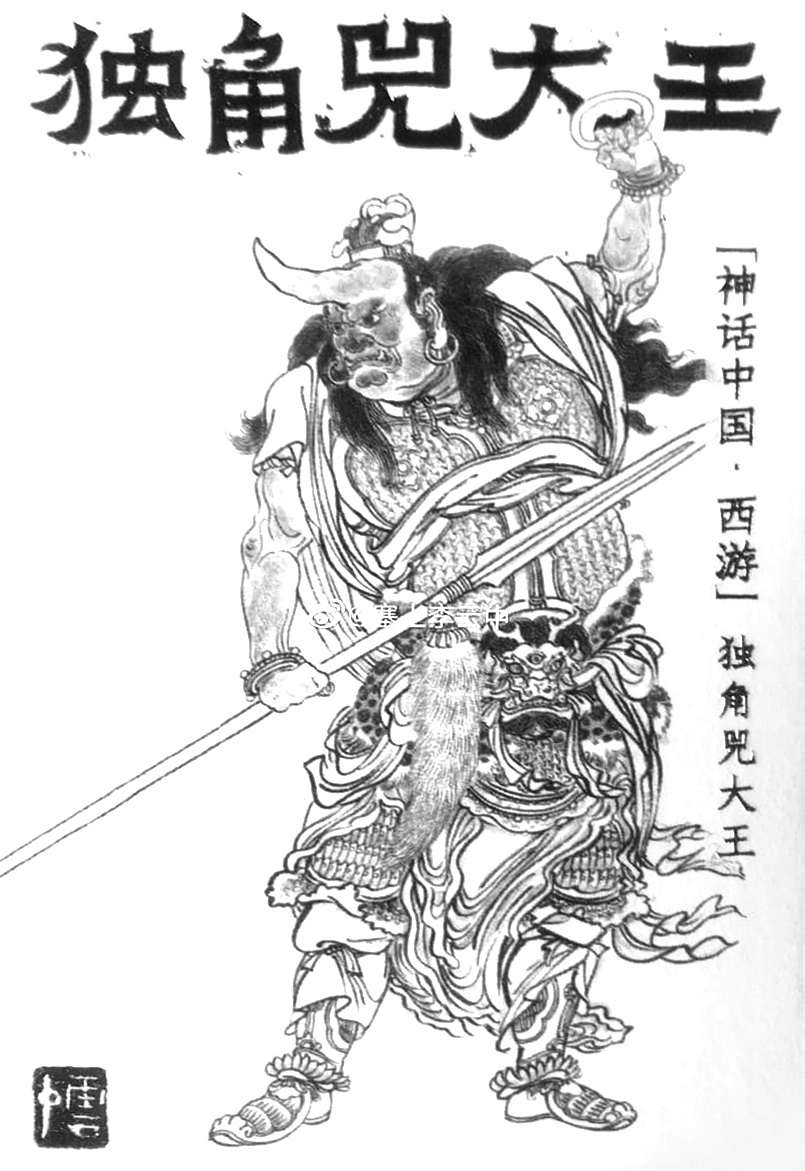
The diamond cutter reappears in chapters 50 to 52 as a mysterious, white, shiny string of pearls used by the Great King One-Horned Buffalo (Dujiao si dawang, 獨角兕大王) (fig. 2) to instantly disarm gods and defeat destructive elemental attacks. [2]

Fig. 2 – A modern drawing of Great King One-Horned Buffalo holding the diamond cutter and his spear (larger version). Based on an image found here.

2.1. Chapter 50

Monkey multiplies his iron staff many times over to fight against the buffalo and his army of minions. But the fiend easily sucks away all of the cudgels with the magic weapon:

The old demon king, however, stood still and, laughing with scorn, said, “Monkey, don’t be impertinent! Watch my trick!” He at once took out from his sleeve a white, shiny fillet [liang zhuozhuo bai sensen de quanzi, 亮灼灼白森森的圈子] and tossed it up in the air, crying, “Hit!” [zhao, 著] With a swish, all the iron rods changed back into a single rod, which was then sucked up by the fillet [fig. 3]. The Great Sage Sun, completely empty-handed, had to use his somersault desperately in order to escape with his life (Wu & Yu, 2012, vol. 2, p. 372).

老魔王唏唏冷笑道:「那猴不要無禮,看手段。」即忙袖中取出一個亮灼灼白森森的圈子來,望空拋起,叫聲:「著!」唿喇一下,把金箍棒收做一條,套將去了。弄得孫大聖赤手空拳,翻觔斗逃了性命。

Fig. 3 –  The diamond cutter sucking in the iron staff (larger version). A screenshot from the 2011 JTTW TV show. Image found here.

2.2. Chapter 51

After his defeat, Wukong seeks heavenly aid several times in a row. First, Prince Nezha is sent to do battle but fails:

“Change!” he roared, and [his six magic] weapons changed into hundreds and thousands. Like a thundershower and a sleet storm, these weapons rained down on the head of the demon. Not the least bit daunted, the demon king took out with one hand that somber white fillet tossed it into the air, crying, “Hit!” With a loud whoosh, the six weapons were all sucked away by it. In desperation Prince Nezha fled for his life with empty hands, [3] while the demon king turned back in triumph (Wu & Yu, 2012, vol. 3, p. 6).

大叫一聲:「變!」一變十,十變百,百變千,千變萬,都是一般兵器,如驟雨冰雹,紛紛密密,望妖魔打將去。那魔王公然不懼,一隻手取出那白森森的圈子來,望空拋起,叫聲:「著!」唿喇的一下,把六般兵器套將下來。慌得那哪吒太子赤手逃生。魔王得勝而回。

Second, the Devaraja Li Jing is sent to distract the buffalo with combat, while a fire god prepares his forces to scorch the spirit, but the plan fails:

The demon fought the devaraja for some time, and in the heat of the battle, he again took out the fillet. When the devaraja saw it, he at once turned his auspicious luminosity around and fled in defeat. On the tall summit the Star of Fiery Virtue quickly gave the command for the various gods of his department to start the fire. It was some fire, all right!

你看那個妖魔與天王正鬥到好處,卻又取出圈子來。天王看見,即撥祥光,敗陣而走。這高峰上火德星君忙傳號令,教眾部火神一齊放火。這一場真個利害

[…]

When the demon saw the fire coming, he was not in the least afraid. He tossed the fillet in the air and with a loud whoosh, it sucked away all those fire dragons, fire horses, fire crows, fire rats, fire lances, fire swords, and fire bows and arrows. Then he turned toward his cave and went back in triumph (based on Wu & Yu, 2012, vol. 3, pp. 8-9).

那妖魔見火來時,全無恐懼。將圈子望空拋起,唿喇一聲,把這火龍、火馬、火鴉、火鼠、火槍、火刀、火弓、火箭,一圈子又套將下去,轉回本洞,得勝收兵。

Third, a water god attempts to drown the monster with the Yellow River but fails:

[T]he Water Lord immediately emptied the content of his white jade chalice toward the inside of the cave. When he saw the water rushing in, the fiend dropped his long lance and took out the fillet, holding it high at the second door. Not only was the water blocked right there, but it reversed its course and gushed back out of the cave. So startled was the Great Sage Sun that he somersaulted immediately into the air and, together with Water Lord, leaped up to the tallest peak (Wu & Yu, 2012, vol. 3, p. 11).

這水伯將白玉盂向裡一傾。那妖見是水來,撒了長槍,即忙取出圈子,撐住二門。只見那股水骨都都的只往外泛將出來。慌得孫大聖急縱觔斗,與水伯跳在高峰。

Monkey then requests a boxing match to show that he isn’t useless without his staff. But when the bout comes to a draw, both heavenly and demonic forces charge in to help their respective fighter. Fearing the worst, Wukong creates hair clones to overwhelm the monster, but this strategy fails:

At once they changed into some fifty little monkeys, who swarmed all over the demon—grabbing his legs, tugging at his torso, gouging his eyes, and pulling at his hair. The fiendish creature became so alarmed that he immediately took out his fillet. When the Great Sage and his companions saw that object, they mounted the clouds at once and fled toward the tall summit. Tossing the fillet up into the air, the fiend changed those fifty monkeys back into their true forms and then they were sucked away again with a loud whoosh. After he had gained this victory, the fiend led his troops back to his cave, closed the door, and celebrated (Wu & Yu, 2012, vol. 3, p. 13).

即變做三五十個小猴,一擁上前,把那妖纏住,抱腿的抱腿,扯腰的扯腰,抓眼的抓眼,撏毛的撏毛。那怪物慌了,急把圈子拿將出來。大聖與天王等見他弄出圈套,撥轉雲頭,走上高峰逃陣。那妖把圈子往上拋起,唿喇的一聲,把那三五十個毫毛變的小猴,收為本相,套入洞中,得了勝,領兵閉門,賀喜而去。

2.3. Chapter 52

Monkey resorts to stealth, changing into a cricket (cuzhi’er, 促織兒) and sneaking into the monster’s cave in order to learn where the treasure is kept:

After the demon king took off his clothes, at once the fillet—all ghostly white—could be seen. It was attached to his left shoulder like an armlet made of a string of pearls [zhuzhuo tou, 珠鐲頭]. Look at him! Instead of taking the fillet off, he pushed it up a couple of times until it was snugly clamped to his shoulder. Only then did he lie down to sleep (Wu & Yu, 2012, vol. 3, p. 18).

只見那魔王寬了衣服,左肐膊上白森森的套著那個圈子,原來像一個連珠鐲頭模樣。你看他更不取下,轉往上抹了兩抹,緊緊的勒在肐膊上,方才睡下。

He changes into a flea (gezao, 虼蚤) and twice bites the spirit, but this plan fails to make the beast take off the bangle (Wu & Yu, 2012, vol. 3, pp. 18-19).

Wukong goes on to rescue the stolen holy weapons and animals and magic hairs, before setting the cave on fire:

The Bovine Great King was scared out of his wits; dashing out of his room, he held his fillet up high with both hands. He pushed it toward the fire this way and that way, and it immediately went out. Though the air was filled with flame and smoke, they all subsided after he and his treasure [baobei, 寶貝] had run through the entire cave (Wu & Yu, 2012, vol. 3, p. 20).

諕得個兕大王魂不附體,急欠身開了房門,雙手拿著圈子,東推東火滅,西推西火消,滿空中冒煙突火,執著寶貝跑了一遍,四下裡煙火俱熄。

Monkey and the host of gods become foolhardy upon retrieving their weapons and once more challenge the buffalo to a fight. But their holy armaments are again sucked away by the fillet:

Smiling scornfully, the demon calmly took out from his sleeve his treasure and tossed it in the air, crying, “Hit!” With a loud whoosh, the six divine weapons, the fire equipment, the thunderbolts, the scimitar of the devaraja, and the rod of Pilgrim were all snatched away. Once again, the deities and the Great Sage Sun were empty-handed (Wu & Yu, 2012, vol. 3, p. 23).

那魔頭巍巍冷笑,袖子中暗暗將寶貝取出,撒手拋起空中,叫聲:「著!」唿喇的一下,把六件神兵、火部等物、雷公㨝、天王刀、行者棒,盡情又都撈去。眾神靈依然赤手,孫大聖仍是空拳。

Having no more ideas, Wukong travels to Vulture Peak in the western continent (i.e. India) to seek the Buddha’s wisdom. The Tathagata in turn sends the 18 arhats armed with “golden cinnabar sand” (jindan sha, 金丹砂) in an attempt to bog the demon down and stop him from moving. But this plan also fails:

When the demon saw that the flying sand was clouding up his vision, he lowered his head and discovered that his feet were already standing in three feet of the stuff. He was so horrified that he tried to jump upward; before he could even stand up properly the sand grew another foot. In desperation, the fiend tried to pull up his legs while taking out his fillet. Throwing it up into the air, he cried, “Hit!” With a loud whoosh, the eighteen grains of golden cinnabar sand were sucked away. The demon then strode back to the cave (Wu & Yu, 2012, vol. 3, p. 27).

那妖魔見飛砂迷目,把頭低了一低,足下就有三尺餘深。慌得他將身一縱,跳在浮上一層。未曾立得穩,須臾,又有二尺餘深。那怪急了,拔出腳來,即忙取圈子,往上一撇,叫聲:「著!」唿喇的一下,把十八粒金丹砂又盡套去,拽回步,徑歸本洞。

Monkey later receives a message from the Buddha suggesting that he consult Laozi. Upon traveling to the Tushita Palace in the 33rd Heaven, he learns that the Daoist high god’s holy mount, a green buffalo (qingniu, 青牛), is missing. This prompts the deity to check his collection of holy treasures:

Laozi made a quick inventory; everything was there except the diamond cutter. “This cursed beast stole my diamond cutter!” said Laozi. “So, that’s the treasure!” said Pilgrim. “It was the same snare that hit me that time! [refer back to sec. 1] Now it’s going wild down below, sucking away who knows how many things.”

君急查看時,諸般俱在,止不見了金剛琢。老君道:「這孽畜偷了我金剛琢去了!」行者道:「原來是這件寶貝。當時打著老孫的是他。如今在下界張狂,不知套了我等多少物件。」

[After Wukong describes all of the magic weapons sucked away by the bangle …]

Laozi said, “That diamond cutter of mine is a treasure perfected since the time of my youth, and it was also an instrument with which I converted the barbarians when I passed through the Hangu Pass. Whatever weapons you may have, including fire and water, you can’t touch it. If the demon had stolen my plantain-leaf fan also, then even I would not be able to do anything to him” (Wu & Yu, 2012, vol. 3, p. 29).

老君道:「我那金剛琢,乃是我過函關化胡之器,自幼煉成之寶。憑你甚麼兵器、水火,俱莫能近他。若偷去我的芭蕉扇兒,連我也不能奈他何矣。」

Lord Li’s closing sentence is eye-opening, for it means that anyone who wields both the diamond cutter and fan would be invincible, even against Laozi. This is surprising since JTTW acknowledges him as the creator of the universe who separated the earth and sky from chaos. [4]

In the end, though, Laozi takes back the diamond cutter and subdues the buffalo spirit without trouble:

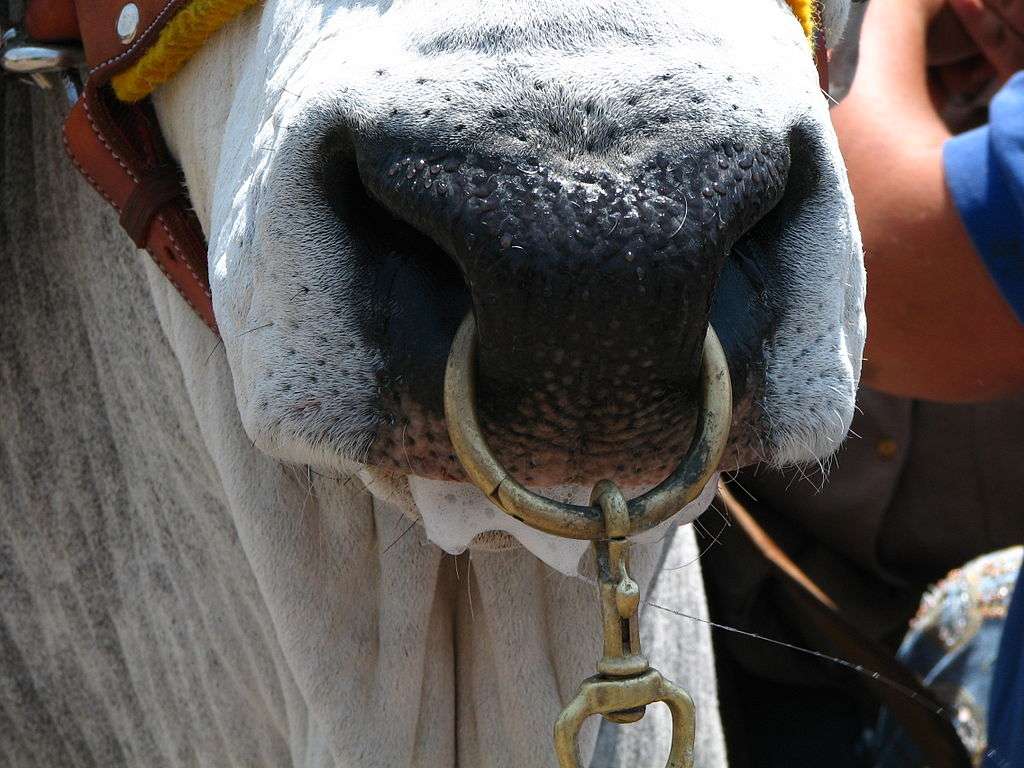
Reciting a spell, Laozi fanned the air once with his fan. The fiend threw the fillet at Laozi, who caught it immediately and gave him another fan. All at once the fiend’s strength fled him and his tendons turned numb; he changed back into his original form, which was that of a green buffalo. Blowing a mouthful of divine breath on the diamond snare, Laozi then used it to pierce the nostrils of the fiend. Next, he took off the sash around his waist and fastened one end of it to the cutter while his hand held the other. Thus the custom of leading the buffalo with a ring in its nose was established [fig. 4], a custom in use even now. This is also what we call binlang [賓郎] (Wu & Yu, 2012, vol. 3, p. 30). [5]

老君念個咒語,將扇子搧了一下,那怪將圈子丟來,被老君一把接住。又一搧,那怪物力軟筋麻,現了本相,原來是一隻青牛。老君將金鋼琢吹口仙氣,穿了那怪的鼻子,解下勒袍帶,繫於琢上,牽在手中。至今留下個拴牛鼻的拘兒,又名賓郎 …

Fig. 4 – A nose ring through a bull’s nose (larger version). Image found here.

3. Background

3.1. Literary Origin

Laozi’s dialogue explains how the diamond cutter was created. While at least two JTTW poems reference the high god’s skill in forging mystical weapons (Wu & Yu, 2012, vol. 1, p. 382; vol. 3, p. 375), his own words instead point to alchemical experimentation. As a reminder, in chapter 6, he states: “This is a weapon … brought into existence during my preparation of reverted elixir and fully charged with spiritual energy” (這件兵器,乃錕鋼摶煉的,被我將還丹點成,養就一身靈氣…) (based on Wu & Yu, 2012, vol. 1, p. 186). Later, in chapter 52, he adds: “That diamond cutter of mine is a treasure perfected since the time of my youth” (我那金剛琢 … 自幼煉成之寶。) (Wu & Yu, 2012, vol. 3, p. 29).

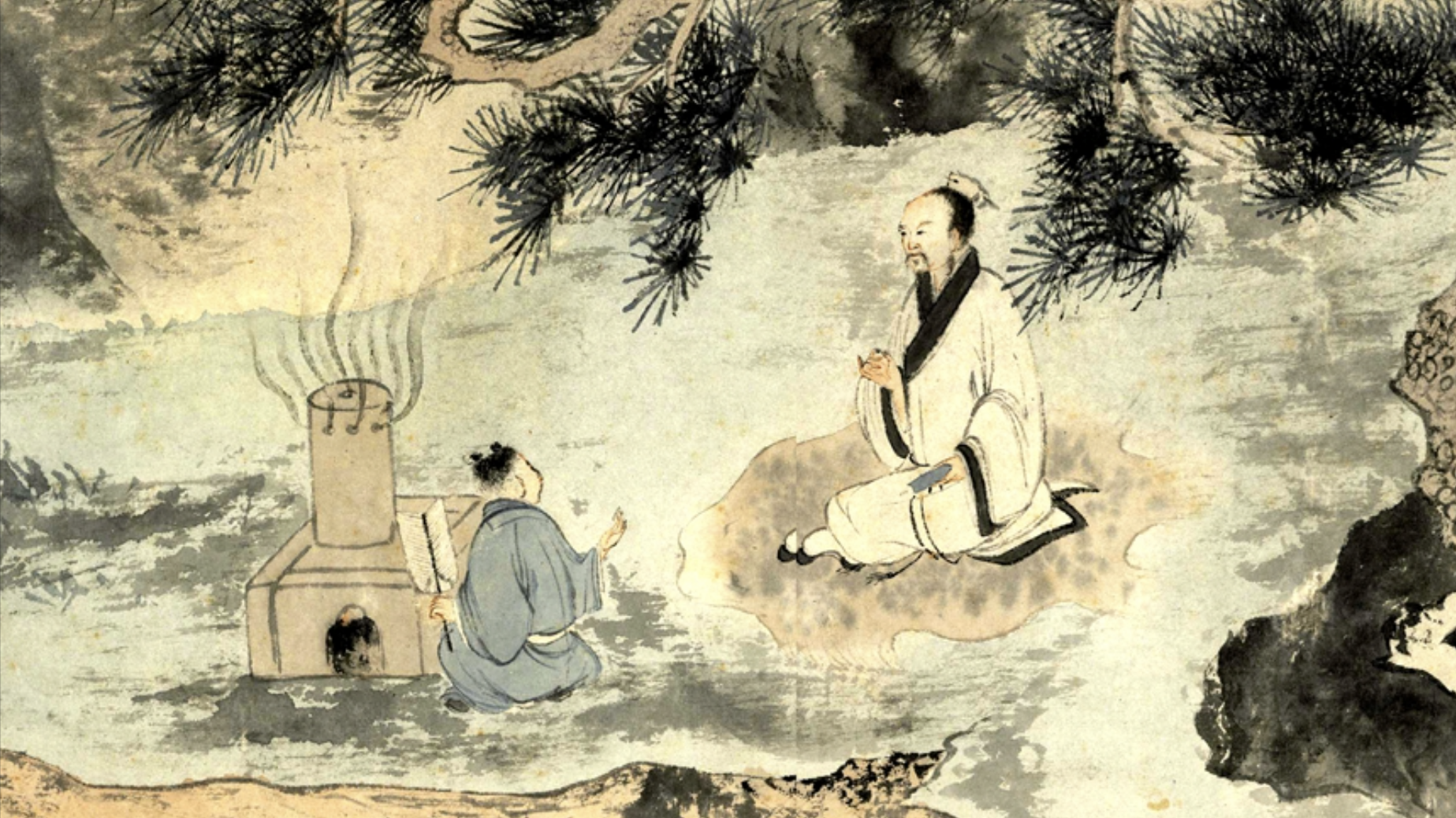
The phrase “reverted elixir” (huandan, 還丹) is key to understanding the origins of the treasure-weapon. This refers to a concept in external alchemy where a concoction of toxic elements is purified over successive firings in a crucible to create a drug of immortality (fig. 5). The Book of the Master Who Embraces Simplicity (Baopuzi抱樸子, 4th-century CE), for example, describes firing cycle periods of between one and nine times, and each subsequent medicine is said to bestow divine longevity within a respective period of time. The more the substance is fired, the faster the desired effect (Kohn, 1993, pp. 309 and 312-313). The product of the ninth cycle is said to transform into reverted elixir when combined with heated cinnabar and exposed to the sun, and a small dose of the drug is enough to bestow instant divinity:

Place the elixir, which has been cycled nine times, in a reaction vessel and expose it to the sun after the summer solstice. When the container becomes hot, introduce a pound of cinnabar beneath the lid. Even while you are watching, with the full power of the sun shining upon it, the whole content will suddenly glow and sparkle with all the colors of spirit radiance. It will immediately turn into reverted elixir. If you take even a single spoonful, you will straightaway rise to heaven in broad daylight (Kohn, 1993, p. 313).

若取九轉之丹,內神鼎中,夏至之後,爆之鼎熱,內朱兒一斤於蓋下。伏伺之,候日精照之。須臾翕然俱起,煌煌煇煇,神光五色,即化為還丹。取而服之一刀圭,即白日昇天。

The fact that Laozi has been developing the cutter from a young age, as stated above, suggests that it is ultimately a byproduct of excessive, millennia-long elixir firing cycles.

Fig. 5 – An alchemist watches as a young lad tends to the firing vessel (larger version). This is an example from Tang Yin’s (唐寅) Images of Cooking Medicine (Shaoyao tu, 燒葯圖) series. Image found here.

3.2. History

Anthony C. Yu (Wu & Yu, 2012) translates kungang (錕鋼), the substance comprising the diamond cutter, as “red steel” (vol. 1, p. 186). The original Chinese term refers to a legendary red knife mentioned in Master Lie (Liezi, 列子, c. 4th century) as coming from Kunwu (錕鋙/昆吾), a distant land. This incredibly hard blade was presented as a royal tribute, along with asbestos cloth, a product of the west:

When King Mu of Zhou made his great expedition against the Rong tribes of the West, they presented him with a knife from Kunwu and a fire-proof cloth. The knife was one chi and zhi [changchi youzhi, 長尺有咫, 22.8 in/57.9 cm] long with a red blade [6] of tempered steel; cutting jade with it was as easy as cutting mud (based on Liezi & Graham, 1960/1990, p.117). [7]

周穆王大征西戎,西戎獻錕鋙之劍,火浣之布。其劍長尺有咫,練鋼赤刃,用之切玉如切泥焉。

The later Ten Islands of the Inner Seas (Hainei shizhou ji, 海內十洲記; a.k.a. Shizhou ji, 十洲記, c. 5th century; “Ten Islands” hereafter) associates Kunwu with stones that can be smelted into jade-cutting iron swords. What’s important here is that the rocks are located in the “Western Ocean” (Xihai, 西海), a term commonly associated with the Mediterranean, the Persian Gulf, or the Indian Ocean—i.e. bodies of water and land west of China:

There is a floating island [liuzhou, 流洲] in the middle of the Western Ocean … The island has many mountains and rivers accumulating stones called kunwu [昆吾]. Smelting the stones will turn them into iron. A sword made from this will shine brightly like crystal, and it will cut jade like mud (cf. Laufer, 1915, p. 29).

流洲在西海中 … 上多山川積石,名為昆吾。冶其石成鐵,作劍光明洞照,如水精狀,割玉物如割泥。

But the now lost Record of the Mysterious Center (Xuanzhong ji, 玄中記, c. 5th century) (as cited here) explicitly associates jade-cutting blades with diamonds from western lands:

The country of Daqin [大秦, i.e. Roman Syria] produces diamonds (jingang [金剛]), termed also ‘jade-cutting swords or knives’ [xiaoyu dao, 削玉刀]. The largest reach a length of over one chi [12.3 in/31.8 cm], the smallest are of the size of a rice or millet grain. Hard stone can be cut by means of it all round, and on examination it turns out that it is the largest of diamonds. This is what the Buddhist priests substitute for the tooth of Buddha (based on Laufer, 1915, p. 30).

大秦國出金剛,一名削玉刀,大者長尺許,小者如稻黍,著環中,可以刻玉。

觀此則金剛有甚大者,番僧以充佛牙是也。

Similar to the Ten Islands, the Memoir of the Four Gentlemen of Liang (Liang sigong ji, 梁四公記, late-7th century) speaks of an island in the west but adds that the inhabitants are talented lapidarists, or gemstone cutters:

In the west, arriving at the Western Ocean, there is in the sea an island of two hundred square li [62.13 mi/100 km]. On this island is a large forest abundant in trees with precious stones, and inhabited by over ten thousand families. These men show great ability in cleverly working gems, which are named for the country Fulin 拂林 [i.e. Rome] (based on Laufer, 1915, p. 7).

西至西海,海中有島,方二百里。島上有大林,林皆寶樹。中有萬餘家,其人皆巧,能造寶器,所謂拂林國也。

Rustic Talks From the East of Qi (Qidong yeyu, 齊東野語, 13th century) (as cited here) describes how lapidarists use iron-like diamond-points to polish and carve jade:

The workers in jade polish jade by the persevering application of Ganges river-sand, and carve it by means of a diamond-point drill [jingang zuan, 金剛鑽]. Its shape is like the excrement of rodents [fig. 6 & 7]; it is of very black color, and is at once like stone and like iron (based on Laufer, 1915, p. 31). [8]

玉人攻玉,以恆河之砂,以金剛鑽鏤之,其形如鼠矢,青黑色,如石如鐵。

This brings us back to the kunwu blade. Laufer (1915) rejects the notion that it was an iron knife. Instead, he states that it was an embellishment on the kinds of diamond-pointed tools used by craftsmen west of China to carve hard stones like jade (Laufer, 1915, p. 32).

This ultimately explains the odd name of Laozi’s holy treasure, diamond cutter (jingang zhuo, 金鋼琢)—i.e. a cutter made from diamond. This name was no doubt chosen to infer that the weapon is unimaginably hard, something capable of “ringing the bell” of even the invincible Monkey King.

The use of kungang (錕鋼), along with the name diamond cutter, suggests that the JTTW author-compiler had knowledge of both the ancient red knife and its ties to diamonds. And speaking of the gemstone, I think given the above information, a better translation for kungang would be something like “diamond steel.” This is more fitting than Yu’s (Wu & Yu, 2012) “red steel” (vol. 1, p. 186).

Also, the description of the cutter as a white, shiny string of pearls makes much more sense when its ties to diamonds are taken into account. This brings to mind a bracelet of perhaps milky diamonds instead of a steel ring.

Fig. 6 (left) – A craftsman works a product with a bow-driven diamond-point drill (larger version). A painting from Zhou Kun’s (周鯤) “Village and Market Life Album” (Cunshi shengya hua’ce, 村市生涯畫冊, 18th century). Image found here. Fig. 7 (right) – An example of the diamond-point of a diamond drill (larger version). Image found here. This recalls the rodent excrement description of diamond-points mentioned in Rustic Talks From the East of Qi (13th century).

4. Mirrored Objects

The diamond cutter serves as a mirrored literary element to Wukong’s golden headband (jingu, 金箍; a.k.a. jingu, 緊箍, lit: “tight fillet”), which initially appears in chapters eight and 14. Both are used to rein in Monkey’s unruly behavior by way of his head: the first hits him on the crown, and the second clamps around his skull. And the fact that the diamond cutter “can entrap many things” (tao zhu wu, 套諸物) reminds me of the way that the golden fillet constricts (jin, 緊) around Wukong’s head when the correct spell is spoken (Wu & Yu, 2012, vol. 1, p. 319). Isn’t this also a kind of entrapment?

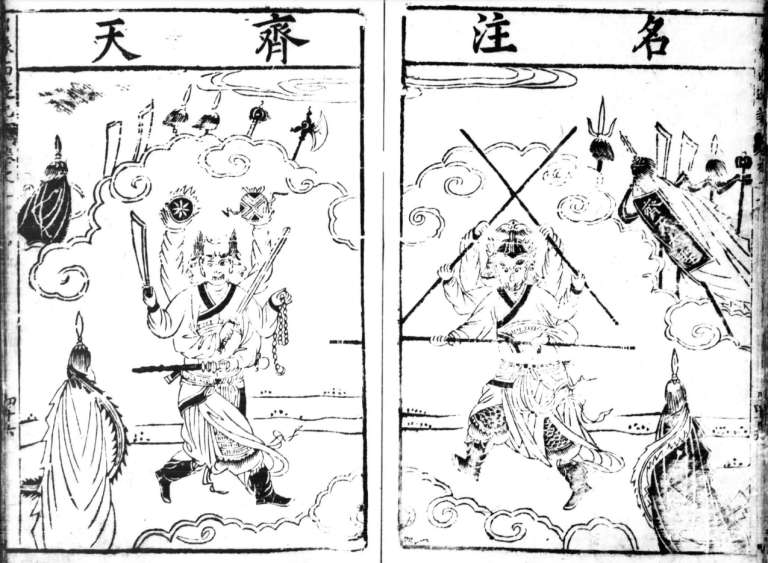
Another mirrored candidate is Nezha’s “fire wheel” (huolun’er, 火輪兒) (fig. 8), which numbers among his six magic weapons (liujian shenbing, 六件神兵). In chapter 61, this flaming fillet is placed on the Bull Demon King’s horn (i.e. on his head) to stop his rampaging transformations (Wu & Yu, 2012, vol. 3, p. 160). Compare this to the way that the diamond cutter stops Wukong via his head. This at first may seem like a passing similarity until you take into account the many parallels shared by Wukong and the bull spirit. The latter is a demon king nicknamed the “Great Sage,” who wields an iron staff, knows 72 changes, can adopt a titanic form, takes part in a battle of magic transformations, is trapped by a joint effort from heaven, is incapacitated by a circular object on his head, and finally faces the Buddha for punishment. [9] Therefore, I can confidently state that the fire wheel is a mirror of the golden headband and subsequently the diamond cutter. I’ll discuss the importance of these connections below.

The novel has many more mirrored objects and characters. I plan to write an article about this at a later date.

Fig. 8 – Nezha (left) wielding his six magic weapons in his three-headed, six-armed form against Sun Wukong (right) (larger version). The fire wheel can be seen in his upper rightmost hand (i.e. the flaming black circle with white spokes). Print from the original 1592 edition of JTTW.

5. Influence

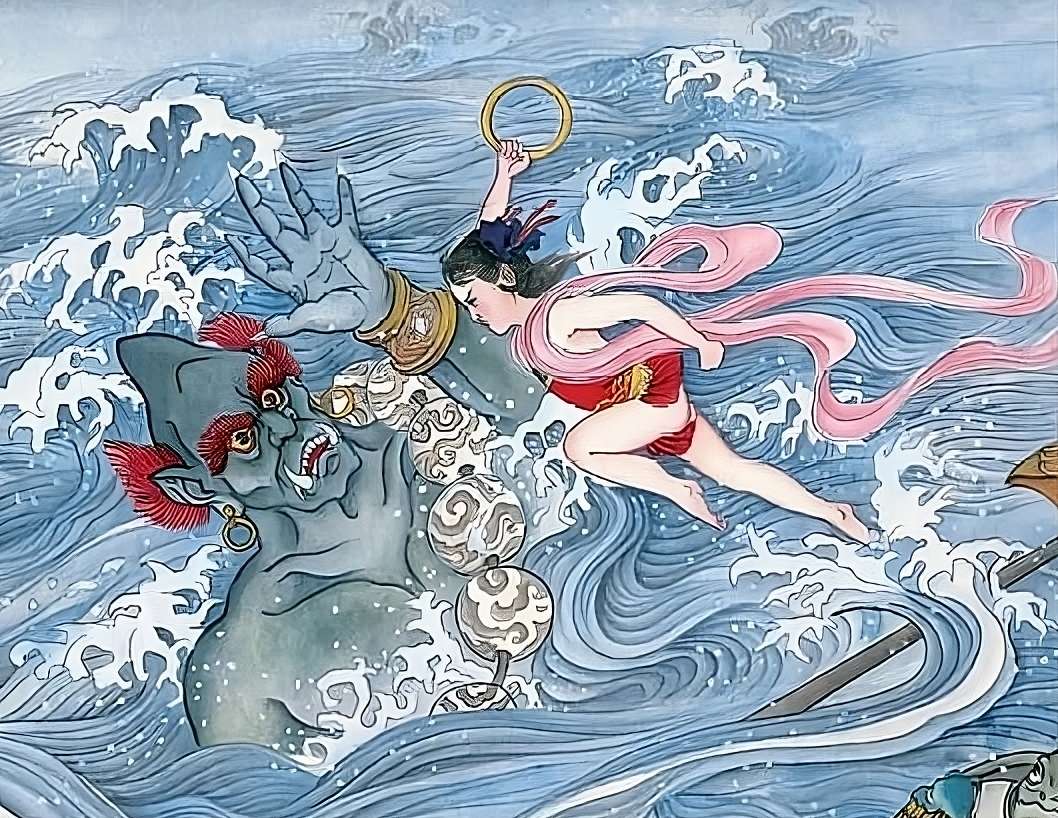
The relationship between Laozi’s diamond cutter and Nezha’s fire wheel in JTTW may have inspired the latter’s “cosmic ring” (qiankun quan, 乾坤圈) in Investiture of the Gods (Fengshen yanyi封神演義, c. 1620, “IOTG” hereafter). Nezha first uses it as a youth in chapter 12 to bludgeon a fierce water-spirit to death:

Standing there naked, Nezha dodged the advancing warrior’s attack and upraised the cosmic ring in his right hand. This treasure was originally bestowed by the Jade Emptiness Palace of Mt. Kunlun to the Perfected Man of the Grand Monad [Taiyi zhenren, 太乙真人] to secure the items of his Golden Light Cave. How could the yaksha withstand the magic weapon as it struck downward on his head? [fig. 9] His brains exploded from the blow, and he fell dead on the shore (cf. Gu, 2000, vol. 1, p. 239).

哪吒正赤身站立,見夜叉來得勇猛,將身躲過,把右手套的乾坤圈望空中一舉。此寶原係崑崙山玉虛宮所賜太乙真人鎮金光洞之物,夜叉那裏經得起,那寶打將下來,正落在夜叉頭上,只打的腦漿迸流,即死於岸上。

He also uses it as a throwing weapon:

After fighting three or four rounds, Nezha simultaneously blocked Yu Hua’s halberd with his spear and took out his cosmic ring from the leopard skin bag. He hit him directly in the arm, breaking tendons and shattering bone (cf. Gu, 2000, vol. 2, p. 671).

哪吒未及三四合,用鎗架住畫戟,豹皮囊內忙取乾坤圈打來,正中余化臂膊,打得筋斷骨折.

See note no. 11 below for more overt examples of throwing.

To sum up, both the diamond cutter and cosmic ring are holy treasures belonging to supreme Daoist deities, are circular and hard enough to serve as blunt throwing weapons, and have the power to entrap (tao, 套) or secure (zhen, 鎮, lit: “press down”) things. It’s also worth noting that the caves associated with these objects have similar names: Great King One-Horned Buffalo lives in Golden Helmet Cave (Jindou dong, 金▯洞), [10] while the Perfected Man of the Grand Monad lives in the Golden Light Cave (Jinguang dong, 金光洞).

My friend, a devotee and researcher of Nezha, tells me that the cosmic ring is a later development in the Third Prince’s mythos, first appearing in IOTG. And since the ring does not appear in JTTW (ctext), it certainly could have been influenced by the similarities between the diamond cutter and Nezha’s fire wheel.

Also, the diamond cutter likely influenced two other fillet-like throwing weapons in the novel, both of which are destroyed by Nezha’s much harder cosmic ring. One is Mo Liqing’s (魔禮青) “white jade diamond bracelet” (baiyu jingang zhuo, 白玉金剛鐲) from chapter 41. The alternate name for said treasure, jingang zhuo (金剛鐲), sounds exactly the same as Laozi’s diamond cutter, jingang zhuo (金鋼琢). I doubt the homophonous title and pale color are a coincidence.

The second is Wen Liang’s (溫良) “white jade ring” (baiyu huan, 白玉環) [11] Again, the white color is telling.

Fig. 9 – Nezha seconds from killing Li Gen with the cosmic ring (larger version). This is an upscaled version of an image found here.

6. Conclusion

Laozi’s great treasure-weapon, the “diamond cutter” (jingang zhuo, 金鋼琢; a.k.a. “diamond snare,” jingang tao, 金鋼套), first appears in chapter six when he uses the fillet to stop Monkey’s rampage by throwing it from heaven and hitting him on the head. It reappears in chapters 50 to 52 as a mysterious, white, shiny string of pearls used by Great King One-Horned Buffalo, an evil spirit, to suck away magic weapons and animals and defeat even destructive elemental attacks. The treasure gives Sun Wukong and a host of Daoist and Buddhist gods no end of trouble before Laozi retrieves his treasure and submits the monster, his runaway buffalo mount.

Lord Li explains that the treasure is a byproduct of creating “reverted elixir,” or a drug of immortality, and that it is made of “kun steel” (kungang, 錕鋼). The latter is a reference to an extremely hard, jade-cutting iron knife from Chinese folklore said to come from the distant land of Kunwu (錕鋙/昆吾). But this is itself an embellishment on reports of diamond-pointed tools used by craftsmen west of China to work hard stone like jade. The name diamond cutter was, therefore, likely chosen to denote something unimaginably hard, something capable of hurting even Sun Wukong.

The diamond cutter is a mirrored literary element to Sun Wukong’s headband. This is because the treasure and the golden fillet are both circular objects that rein in Monkey’s unruly behavior by way of his head, hitting it and clamping around his skull, respectively. The diamond cutter is also a mirrored element of Prince Nezha’s “fire wheel” (huolun’er, 火輪兒) because the latter stops the rampage of the Bull Demon King by way of his head. This takes place during a battle that closely mirrors Monkey’s early rebellion and defeat.

This connection between the diamond cutter and the fire wheel likely influenced Nezha’s “cosmic ring” (qiankun quan, 乾坤圈) from Investiture of the Gods (Fengshen yanyi, 封神演義, c. 1620). Both treasures belong to supreme Daoist deities, can be used as blunt throwing weapons, have the power to entrap or secure things, and are associated with caves with “gold” (jin, 金) in the name. The diamond cutter also likely influenced two other throwing fillets from the novel, Mo Liqing’s (魔禮青) “white jade diamond bracelet” (baiyu jingang zhuo, 白玉金剛鐲) and Wen Liang’s (溫良) “white jade ring” (baiyu huan, 白玉環). The name of the former closely mirrors that of the jade cutter.


7. Updates

Update: 03-14-24

The full name of the Diamond Sutra (c. 2nd to 4th-century) is the Diamond-Cutter Perfection of Wisdom Sutra (Sk: Vajracchedikāprajñāpāramitāsūtra) (Buswell & Lopez, 2014, p. 953). This interests me because Laozi states in chapter six:

The year when I crossed the Hangu Pass, I depended on it [his diamond-cutter treasure] a great deal for the conversion of the barbarians to Buddhism, for it was practically my bodyguard night and day (based on Wu & Yu, 2012, vol. 1, p. 186).

當年過函關,化胡為佛,甚是虧他。早晚最可防身。

Perhaps the diamond cutter is meant to be a metaphor for the Diamond Sutra, which he used to convert the people of the West.


Update: 01-31-2026

Above, I discussed how Nezha’s “Cosmic Ring” first appeared in IOTG and that it was likely influenced by Laozi’s Diamond Cutter. I originally thought that this was just a literary thing, but it recently dawned on me that Nezha’s circular weapon often appears in the hands of his idols (fig. 10). This demonstrates how JTTW has influenced real world religious iconography.

Fig. 10 – Lotus Flower Nezha bearing his Cosmic Ring (left hand) and spear (right) (larger version). Idol in the author’s personal collection.

Notes:

1) Yu (Wu & Yu, 2012) uses the English words “diamond snare” or just “snare” numerous times whenever Laozi’s weapon is mentioned. However, the corresponding Chinese phrase, jingang tao (金鋼套), only appears once in the entire novel, while that for “diamond cutter,” jingang zhuo (金鋼琢), appears a total of four times. Therefore, I have made changes to the translation for more accuracy.

2) Jenner (Wu & Jenner, 1993/2001) translates Dujiao si dawang (獨角兕大王), the monster’s name, as “Great King Rhinoceros” (vol. 2, p. 1143). This is because the character si (兕) is associated with rhinos. For instance, Strassberg’s (2002) translation of the Classic of Mountains and Seas (Shanhai jing, 山海經, c. 4th-century to 1st-century BCE) reads:

The Si-Rhinoceros dwell east of Shun’s Tomb and south of the Xiang River. Their form resembles an ox that is blue-black with a single horn” (p. 188).

兕在舜葬東,湘水南,其狀如牛,蒼黑,一角。

But the JTTW spirit is likely an amalgamation of Lord Li’s green/black buffalo (qingniu, 青牛) and the mythical animal. This is because both are dark, bovine-like beasts with a single horn. This association between the two is exemplified by a humorous vintage porcelain statue of Laozi riding a rhino.

3) I have changed all references to Nata to Nezha, a FAR more widely used term for the martial god.

4) Monkey explains in chapter 86 that everyone has a boss, thereby alluding to Laozi’s hallowed past:

Old Lord Li happens to be the patriarch of creation [kaitian pidi zhi zhu, 開天闢地之祖; lit: the “patriarch of splitting heaven and earth (from chaos)], but he still sits to the right of Supreme Purity. The Buddha Tathagata is the honored one who governs the world, and yet he still sits beneath the Great Peng. Kong the Sage is the founder of Confucianism, but he assumes the mere title of Master (Wu & Yu, 2012, vol. 4, p. 163).

李老君乃開天闢地之祖,尚坐於太清之右;佛如來是治世之尊,還坐於大鵬之下;孔聖人是儒教之尊,亦僅呼為『夫子』。

My thanks goes to Irwen Wong of the Journey to the West Library blog for reminding me of this fact.

5) Yu (Wu & Yu, 2012) points out that binlang (賓郎) is a variant of binlang (檳榔), or betel nut (vol. 3, p. 385 n. 8). One French translator suggests that the name comes from the circular shape shared by betel nut and coconuts, and that nose rings were likely made from the latter (Levy, 1991, as cited in Wu & Yu, 2012, vol. 3, p. 385-386 n. 8).

6) Regarding the red blade (chidao, 赤刃), the Classic of Mountains and Seas (Shanhai jing, 山海經, c. 4th-century to 1st-century BCE) mentions that the peaks of Kunwu have an abundance of copper (chitong, 赤銅, i.e. “red copper”) (Strassberg, 2002, p. 145).

7) I have changed all Wade-Giles to pinyin.

8) The passage from Rustic Talks From the East of Qi (13th century) goes on to associate diamonds with a strange phenomenon in western lands where birds pass the gemstone in their droppings:

According to legend, high in the mountains of the Western Regions [Xiyu, 西域] where the Huihe live, hawks and falcons would ingest (diamonds). These would then be deposited in the sandy gravel of Hebei Province when they defecate. But I do not know if this is true or not (cf. Laufer, 1915, p. 12).

相傳出西域及回紇高山頂上,鷹隼粘帶食入腹中,遺糞於河北砂磧間。未知然否?

This matches another passage from the aforementioned Memoir of the Four Gentlemen of Liang (late-7th century). This earlier source provides more information:

In a northwesterly direction from the island is a ravine hollowed out like a bowl, more than a thousand feet deep. They throw flesh into this valley. Birds take it up in their beaks, whereupon they drop the precious stones. The biggest of these have a weight of five catties. There is a saying that this is the treasury of the Devaraja of the Rupadhatu 色界天王 (Laufer, 1915, p. 7).

島西北有坑,盤坳深千餘尺。以肉投之,鳥銜寶出,大者重五斤,彼雲是色界天王之寶藏。

The bird-diamond connection is mentioned in non-Chinese sources as well. This includes The Book of the Wonders of India (Kitāb ‘Aja’ib al-Hind, 953), a collection of “sailor’s tales” by the Persian Shipmaster Buzurg Ibn Shahriyār. The 82nd tale in this collection, “Kashmiri Diamonds,” associates the gemstones with northernmost India. The full tale reads:

Someone who had been to India told me he had heard it said that the purest, the most beautiful, and the most precious diamonds come from the Kashmir region. There is a valley between two mountains, where a fire burns ceaselessly, night and day, winter and summer. It is there that the diamonds are. Only low-caste Indians risk themselves in this dangerous country. They gather in bands, and reach the entrance to the valley. They kill lean sheep, and cut them up into bits. Then they fling the pieces one after another into the valley, by means of a mangonel that they set in motion. There are many reasons that prevent their access to their valley. First, there is the ever-burning fire; and, in addition, around the fire, there is an uncountable number of snakes and vipers, so that no man can go there and not perish.

When the meat is thrown, a great number of vultures falls on it and seizes it. If it falls some distance from the fire, they carry it off. They follow the vulture as it flies. Sometimes a diamond falls from the meat that has been carried off. If the vulture comes down in some place to eat it, they go to there and find diamonds. If the meat falls in the fire, it burns. The vulture that wants to seize a piece too near the fire burns likewise. Sometimes also, by chance, a vulture seizes meat in flight, before it reaches the ground.

This is how diamonds are gathered. Most of the people who busy themselves looking for them die from the fire, or from the snakes and vipers. The kings of these countries are very fond of diamonds, and go to great trouble to get them. Those employed in this work are watched carefully, because of the beauty and high price of the stones (Shahriyar & Freeman-Grenville, 1981, p. 75).

9) The Bull Demon King takes the title “Great Sage, Parallel with Heaven” (Pingtian dasheng, 平天大聖) in chapter 4 (compare this to Monkey’s title, the “Great Sage Equaling Heaven“) (Wu & Yu, 2012, vol. 1, pp. 156-157). The rest of the similarities appear in chapters 60 and 61. He wields his own “cast-iron rod” (huntie gun, 混鐵棍) (compare this to Wukong’s weapon) (Wu & Yu, 2012, vol. 3, pp. 137 and 147). His skill with the 72 changes is referenced when he takes on Zhu’s appearance (compare this to Monkey’s ability) (Wu & Yu, 2012, vol. 3, p. 148). The battle of transformations against Sun takes place shortly after he’s overwhelmed by our hero and Zhu in combat (compare this to Wukong’s battle of transformations with Erlang in ch. 6) (Wu & Yu, 2012, vol. 3, pp. 156-157; vol. 1, pp. 182-183). He takes on his cosmic form, a giant white bull, in a last ditch effort to defeat Monkey (compare this to Wukong’s skill) (Wu & Yu, 2012, vol. 3, p. 157). He is trapped on all sides by Buddho-Daoist deities (compare this to Monkey’s troubles with heaven in ch. 6) (Wu & Yu, 2012, vol. 3, pp. 159-160; vol. 1, pp. 185-186). As mentioned above, Nezha uses his fire wheel to stop his rampaging transformations (compare this to Laozi stopping Monkey’s rampage by knocking him over with the diamond cutter in ch. 6) (Wu & Yu, 2012, vol. 3, p. 160; vol. 1, p. 186). And he is taken to see the Buddha at the end of his story arc (compare this to Wukong’s meeting with the Buddha) (Wu & Yu, 2012, vol. 3, p. 162).

10) The Ctext version is missing a particular Chinese character that appears in the original novel (see the right side, third column from the left, on p. 658 of this PDF). It is comprised of shan (山) and dou (兠/兜). Thank you to Irwen Wong for reminding me of this.

11) Mo Liqing clashes with Nezha in chapter 41, leading to the destruction of his white jade diamond bracelet:

Before they had fought twenty rounds, Mo Liqing hurled his white jade diamond bracelet. It cast a ray of multi-colored light as it struck him [Huang Tianhua, 黃天化] in the middle of the back. The hit knocked down his golden cap [i.e. he died] and fell from his mount.

Mo Liqing wanted to cut off his head, but before he could, Nezha screamed, “Don’t hurt my Daoist brother!” Riding his wind and fire wheels, the third prince fought to the front of the formation and rescued the body of Huang Tianhua.

Nezha engaged Mo Liqing in combat, their respective spears stabbing out in succession. Their battle saddened heaven and made gloomy the earth [i.e. it was extremely tense]. Mo Liqing hurled the diamond bracelet a second time to hit Nezha. The youth also cast his cosmic ring, but it was made of gold and the diamond bracelet jade. When the two clashed, the diamond bracelet shattered into many pieces (cf. Gu, 2000, vol. 2, p. 807 and 809)

來往未及二十回合,早被魔禮青隨手帶起白玉金剛鐲,一道霞光,打將下來,正中後心。只打得金冠倒撞,跌下騎來。魔禮青方欲取首級,早被哪吒大叫:「不要傷吾道兄!」登開風火輪,殺至陣前,救了黃天化。哪吒大戰魔禮青,雙鎗共發,殺得天愁地暗。魔禮青二起金剛鐲來打哪吒。哪吒也把乾坤圈丟起。乾坤圈是金的,金剛鐲是玉的,金打玉,打得粉碎。

Wen Liang’s white jade ring is destroyed by the Third Prince’s cosmic ring in chapter 64:

Now let’s talk about how Wen Liang cast up his white jade ring to attack Nezha. But he didn’t know that Nezha had the cosmic ring. The youth also cast his own treasure. Wen didn’t know that gold beats jade, and when the two clashed, the white jade ring shattered into many pieces (cf. Gu, 2000, vol, 3, pp. 1315 and 1317).

且說溫良祭起白玉環來打哪吒,不知哪吒也有乾坤圈,也祭起來;不知金打玉,打得紛紛粉碎。

Sources:

Buswell, R. E. , & Lopez, D. S. (2014). The Princeton Dictionary of Buddhism. Princeton University Press.

Gu, Z. (2000). Creation of the Gods (Vols. 1-4). Beijing: New World Press.

Kohn, L. (1993). The Taoist Experience: An Anthology. United States: State University of New York Press.

Laufer, B. (1915). The Diamond: A Study in Chinese and Hellenistic Folk-lore. United States: Field Museum of Natural History. Retrieved from https://archive.org/details/diamondstudyinch00lauf/page/n5/mode/2up

Liezi, & Graham, A. C. (1990). The Book of Lieh-tzu: A Classic of Tao. New York: Columbia University Press. (Original work published 1960)

Shahriyar, B., & Freeman-Grenville, G. S. P. (1981). The Book of the Wonders of India: Mainland, Sea and Islands. London: East-West Publications.

Strassberg, R. (2002). A Chinese Bestiary: Strange Creatures from the Guideways Through Mountains and Seas. University of California Press.

Wu, C. & Jenner, W. J. F. (2020). Journey to the West (Vols. 1-4). Beijing: Foreign Languages Press. (Original work published 1993)

Wu, C., & Yu, A. C. (2012). The Journey to the West (Vols. 1-4) (Rev. ed.) Chicago, Ill: University of Chicago Press.

The Buddha’s Vulture Peak and Journey to the West

Last updated: 01-23-2024

According to Journey to the West (Xiyouji, 西遊記, 1592), the Buddha’s realm (fig. 1) is located in the Western Cattle-Gift Continent (i.e. India) atop “Vulture Peak.” For example, in chapter 98, an immortal tells Tripitaka:

Anthony C. Yu Translation

“Sage Monk, look at the spot halfway up the sky, shrouded by auspicious luminosity of five colors and a thousand folds of hallowed mists. That’s the tall Spirit Vulture Peak, the holy region of the Buddhist Patriarch” (Wu & Yu, 2012, vol. 4, p. 343).

W. J. F. Jenner Translation

“Holy monk, do you see the auspicious light of many colors and the richly textured aura in the sky? That is the summit of Vulture Peak, the holy territory of the Lord Buddha” (Wu & Jenner, 1993/2020, vol. 4, p. 2250).

聖僧,你看那半天中有祥光五色、瑞藹千重的,就是靈鷲高峰,佛祖之聖境也。

Fig. 1 – The Buddha’s realm (larger version). Found randomly on the internet. Artist unknown.

1. Various Names

The novel provides several Chinese names for this hallowed place:

  • Jiufeng (鷲峰) – “Vulture Peak”
  • Jiuling (鷲嶺) – “Vulture Ridge”
  • Lingjiu xianshan (靈鷲仙山) – “Immortal Mountain of the Spirit Vulture” (the fanciest in my opinion)
  • Lingjiu feng (靈鷲峰) – “Peak of the Spirit Vulture”
  • Lingjiu gaofeng (靈鷲高峰) – “Tall Peak of the Spirit Vulture”

2. Real World Location

Vulture Peak (Sk: Gṛdhrakūṭaparvata, गृद्धकूट; Ch: Lingjiu shan, 靈鷲山; Qidujue shan, 耆闍崛山) is a Buddhist holy site located around the ancient city of Rājagṛaha (modern day Nalanda District, Bihar, India) (fig. 2). It was often visited by the historical Buddha and his disciples. Various traditions believe it to be the site from which the Enlightened One delivered some of his most important teachings, including those from the Nikāyas and Āgamas (Theravāda), as well as the Heart Sūtra and the Perfection of Wisdom sūtras (Mahāyāna). The Japanese Nichiren-shū sect even considers it a Buddhist paradise (Buswell & Lopez, 2014, p. 327).

Fig. 2 – A modern day picture of Vulture Peak (larger version). Image found on Wikipedia.

3. Religious Etymology

So where does the strange name come from? Lopez (1988) explains that the original Sanskrit, Gṛdhrakūṭaparvata, means “mass of vultures peak” (p. 36). The commentary to the Section of the Suttas says that the place was so named “because vultures lived on its peaks [fig. 3], or because the peaks looked like vultures.” [1] The commentary also alludes to story no. 536 from a famous 5th-century Indian collection of birth stories in which Ānanda is presented as the “king of the vultures, with a following of ten thousand vultures [that] dwelt upon Vulture Peak” (Cowell, 1895, p. 224; Bodhi & Buddhaghosa, 2017, p. 839).

The association of Ānanda with vultures is interesting as the Biography of the Eminent Monk Faxian (Gaoseng Faxian zhuan, 高僧法顯傳, c. 5th-century) gives a related supernatural reason:

Three [li] before you reach the top, there is a cavern in the rocks, facing the south, in which Buddha sat in meditation. Thirty paces to the north-west there is another, where Ânanda was sitting in meditation, when the deva Mâra Piśuna, [2] having assumed the form of a large vulture, took his place in front of the cavern, and frightened the disciple. Then Buddha, by his mysterious, supernatural power, made a cleft in the rock, introduced his hand, and stroked Ânanda’s shoulder, so that his fear immediately passed away [fig. 4]. The footprints of the bird and the cleft for (Buddha’s) hand are still there, and hence comes the name of ‘The Hill of the Vulture Cavern’ (Faxian & Legge, 1886/1965, p. 83).

未至頭三里有石窟南向本於此坐禪西北三十步復有一石窟阿難於中坐禪天魔波旬化作鵰住窟前恐阿佛以神足力隔石舒手摩阿難肩怖即得止鳥迹手孔今悉故曰鵰窟山

Barring the location’s supposed bird-like appearance, the original Sanskrit name and surveyed Buddhist sources give the impression that the peak was home to large numbers of vultures. This association appears to have been embellished in Buddhist stories to include a connection to Ānanda.

Fig. 3 – (Right) An Indian Vulture (larger version). Image found on WikipediaFig. 4 – (Center) Detail of a relief sculpture depicting the Buddha reaching his hand through the rock to calm Ānanda. Take note of the vulture on the top left. (Right) A line drawing of the scene (larger version). From Yungang Cave no. 38, 6th-century. Adapted from Wang, 2005, p. 197.

4. Conclusion

Journey to the West depicts the Buddha’s realm atop “Vulture Peak” in the western continent. The novel provides several Chinese names, the fanciest of which is “Immortal Mountain of the Spirit Vulture.” This is in fact a real world holy site in Bihar, India considered a place from which the Enlightened One taught important Buddhist doctrine. The original Sanskrit name and Buddhist sources suggest that the mountain is named for the large number of vultures who supposedly resided there. Buddhist stories would come to associate these birds with Ānanda. For example, one 5th-century Indian source depicts him, in a past life, as the king of 10,000 vultures living on Vulture Peak. A 5th-century Chinese source states that he was terrified by a deva-turned-vulture in order to interrupt his meditation. But he was saved by the reassuring hand of the Buddha.


Update: 02-12-23

I was curious as to when the Chinese translation of Gṛdhrakūṭaparvata first appeared. Wang (2005) notes it was used as far back as Dharmarakṣa‘s 286 CE translation of the Lotus Sūtra (p. 194). The holy site is referred to as “Mountain of the Spirit Vulture” (Lingjiu shan, 靈鷲山) at least five times. [3] I’d like to know if “spirit vulture” is a reference to Māra’s transformation from the story cycle mentioned by Faxian.


Update: 02-28-23

I’ve written an article about the location of Laozi’s realm.

Laozi’s Realm in Journey to the West


Update: 08-29-23

The novel places Vulture Peak in the Western paradise. This shows that the Tathagata in JTTW is actually a mixture of two different Buddhas, Shakyamuni and Amitabha. A good indication of this appears in chapter seven:

The Buddha laughed, saying: “I am Shakyamuni, the Venerable One from the Western Region of Ultimate Bliss. Salutations to Amitabha Buddha!” (based on Wu & Yu, vol. 1, p. 193). [4]

如來笑道:「我是西方極樂世界釋迦牟尼尊者。南無阿彌陀佛!…」

The Western Region of Ultimate Bliss (Xifang jileshijie, 西方極樂世界) is the paradise of the Amitabha Buddha. The term “Ultimate Bliss” (Jile, 極樂) appears 33 times in JTTW.

My guess is that the storytellers and/or author-compilers who added this element did so to make the story more inclusive. After all, there are many different sects of Buddhism, and each one venerates a different Buddha.


Update: 01-23-24

A more overt reference to Shakyamuni as the Amitabha Buddha appears later in chapter seven, when the gods hold a banquet in celebration of his defeat of Monkey. One poem speaks of the gods bearing gifts for him. The openly lines read: “The Naked-Feet Immortal brought fragrant pears and dates/ To give to Amitabha, whose count of years is long …” (大仙赤腳棗梨香,敬獻彌陀壽算長。) (Wu & Yu, 2012, vol. 1, p. 199).

Notes:

1) Bodhi & Buddhaghosa, 2017, p. 903. Lopez (1988) also cites two commentators with the same respective views (p. 36).

2) Legge (Faxian & Legge, 1886/1965) explains: “Piśuna is a name given to Mâra, and signifies ‘sinful just'” (p. 83, n. 2).

3) However, Wang (2005) says that the term appears six times (p. 194).

4) Yu (Wu & Yu, 2012) skipped over the last sentence about Amitabha in his translation.

Sources:

Bodhi, B., & Buddhaghosa, B. (2017). The Suttanipāta: An Ancient Collection of the Buddha’s Discourses Together with Its Commentaries Paramatthajotikā II and Excerpts from the Niddessa. Somerville, MA: Wisdom Publications.

Buswell, R. E. , & Lopez, D. S. (2014). The Princeton Dictionary of Buddhism. Princeton University Press.

Cowell, E. B. (Ed.) (1895). The Jātaka, or Stories of the Buddha’s Former Births (Vol. 5). Cambridge: Cambridge University Press. Retrieved from https://archive.org/details/cu31924072231545/page/n243/mode/2up

Faxian, & Legge, J. (1965). A Record of Buddhistic Kingdoms: Being an Account by the Chinese Monk Fâ-Hien of his Travels in India and Ceylon (A.D. 399-414) in Search of the Buddhist Books of Discipline. New York: Dover Publications. (Original work published 1886)

Lopez, D. S. (1988). The Heart Sūtra Explained: Indian and Tibetan Commentaries. Albany, N.Y: State University of New York Press.

Wang, E. Y. (2005). Shaping the Lotus Sutra: Buddhist Visual Culture in Medieval China. Seattle, WA: University of Washington Press.

Wu, C. & Jenner, W. J. F. (2020). Journey to the West (Vols. 1-4). Beijing: Foreign Languages Press. (Original work published 1993)

Wu, C., & Yu, A. C. (2012). The Journey to the West (Vols. 1-4) (Rev. ed.). Chicago, Illinois: University of Chicago Press.

Does the Buddha Lie in Journey to the West?

I was recently directed to an online Chinese article by Ye Zhiqiu (叶之秋) (n.d.) in which they claim that the Buddha makes “four grand, overarching lies” (sige mitian dahuang, 四個彌天大謊) throughout the course of Journey to the West (Xiyouji, 西遊記, 1592; “JTTW” hereafter). They believe this is because the literary version of the Enlightened One is a master strategist who uses lies in a calculated attempt to usurp power from the Jade Emperor, ruler of the cosmos. This is admittedly a fascinating idea but one that falls apart under careful analysis. Ye (n.d.) displays a fundamental misunderstanding of the novel’s history and religious influences. Worse still, they appear to selectively interpret details to suit a possible agenda against Buddhism. In this article, I will show that there are far more plausible reasons for the Buddha’s statements than lying.

I. First Lie

The Buddha states the following about the novel’s Hindo-Buddhist cosmos (ch. 8), which features four island-like continents floating in a great sea around a cosmic mountain (fig. 1):

I have watched the Four Great Continents, and the morality of their inhabitants varies from place to place. Those living on the East Pūrvavideha revere Heaven and Earth, and they are straightforward and peaceful. Those on the North Uttarakuru, though they love to destroy life, do so out of the necessity of making a livelihood. Moreover, they are rather dull of mind and lethargic in spirit, and they are not likely to do much harm. Those of our West Aparagodānīya are neither covetous nor prone to kill; they control their humor and temper their spirit. There is, to be sure, no illuminate of the first order, but everyone is certain to attain longevity. Those who reside in the South Jambūdvīpa, however, are prone to practice lechery and delight in evildoing, indulging in much slaughter and strife. Indeed, they are all caught in the treacherous field of tongue and mouth, in the wicked sea of slander and malice. However, I have three baskets of true scriptures which can persuade man to do good (Wu & Yu, 2012, vol. 1, pp. 204-205).

我觀四大部洲,眾生善惡,各方不一:東勝神洲者,敬天禮地,心爽氣平;北俱盧洲者,雖好殺生,只因糊口,性拙情疏,無多作踐;我西牛賀洲者,不貪不殺,養氣潛靈,雖無上真,人人固壽;但那南贍部洲者,貪淫樂禍,多殺多爭,正所謂口舌兇場,是非惡海。我今有三藏真經,可以勸人為善。

Ye (n.d.) claims that the Enlightened One is lying because most of the monsters show up not in the supposedly evil continent of South Jambūdvīpa (the Land of the East, i.e. China) but in the Buddha’s home of West Aparagodānīya (India). They even provide a long list of monsters encountered there. Also, the writer theorizes that the planned scripture pilgrimage is just a ploy to spread the Buddha’s influence to the Land of the East, making him the ruler of two of four continents. The implication here is that he is slowly chipping away at the Jade Emperor’s domain.

However, the Buddha was likely referring to the people in those particular continents and not the monsters. And most importantly, his words appear to mirror the views of foreign Buddhist monks. When the historical monk Xuanzang (玄奘; 602-664), on whom Tripitaka is based, planned to return home from India, his friends tried dissuading him by describing China in similarly negative terms. Brose (2021) comments:

For many of the monks he had befriended, the decision was hard to fathom. “India is the birthplace of the Buddha,” they reminded him. “Although the Great Sage is gone, his traces remain. To travel around and venerate them is enough to make one’s life content. Why would you want to give this up after having come here? China is a barbarian land where people are neglected, and the Dharma is despised. That is why no buddhas have ever been born there. The people have narrow aspirations and deep impurities, so sages do not go there. The air is cold and the land is dangerous. How can you think of returning there?” Xuanzang reportedly responded by quoting an exchange from the Vimalakīrti Sūtra, where the noble layman Vimalakīrti asks Śāriputra, “Why does the sun come to Jambudvīpa?” The answer: “To illuminate it and eliminate the darkness.” If Xuanzang remained in India, the true Dharma might never be known in China (pp. 61-62).

Additionally, Xuanzang is known to have left China illegally when he first began his journey. Brose (2021) explains:

Xuanzang almost didn’t make it to India. Before setting out on his pilgrimage, his initial request for a travel permit was denied by the [Tang] court and, after traveling over five hundred miles from the capital to the westernmost Chinese city of Liangzhou, the local governor ordered him to turn back. Hiding during the day and traveling at night, Xuanzang quietly continued on to the desert outpost of Guazhou. There, he learned that the court had issued a warrant for his arrest. The local prefect, it turned out, was a pious Buddhist and urged Xuanzang to leave quickly… (p. 16).

Conversely, the monk in JTTW is portrayed as a loyal Confucian-type person. Therefore, in order to frame Tripitaka as a faithful, law-abiding citizen of China, the novel had to provide a reason for his pilgrimage, one that the Tang emperor would give his blessing to. [1]

Fig. 1 – A diagram of the Hindo-Buddhist cosmos by MC Owens (larger version). Image from this talk.

II. Second Lie

During Sun Wukong’s battle with the Six-Eared Macaque (ch. 58) (fig. 2), the Buddha reveals the doppelganger’s true identity, noting that he and Monkey are two of four celestial primates (sihou hunshi四猴混世, lit: “four monkeys of havoc”) with amazing abilities:

“The first,” said Tathāgata [the Buddha], “is the Stone Monkey of Numinous Wisdom, [2] who

Knows transformations,
Recognizes the seasons,
Discerns the advantages of earth,
And is able to alter the course of planets and stars.

The second is the Red-Buttocked Horse Monkey, who

Has knowledge of yin and yang,
Understands human affairs,
Is adept in its daily life
And able to avoid death and lengthen its life.

The third is the Tongbi Gibbon, who can

Seize the sun and the moon,
Shorten a thousand mountains,
Distinguish the auspicious from the inauspicious,
And manipulate planets and stars.

The fourth is the Six-Eared Macaque who has

A sensitive ear,
Discernment of fundamental principles,
Knowledge of past and future,
And comprehension of all things.

These four kinds of monkeys are not classified in the ten categories [of life], nor are they contained in the names between Heaven and Earth. As I see the matter, that specious Wukong must be a six-eared macaque, for even if this monkey stands in one place, he can possess the knowledge of events a thousand miles away and whatever a man may say in that distance” (Wu & Yu, 2012, vol. 3, p. 115).

如來道:「第一是靈明石猴,通變化,識天時,知地利,移星換斗;第二是赤尻馬猴,曉陰陽,會人事,善出入,避死延生;第三是通臂猿猴,拿日月,縮千山,辨休咎,乾坤摩弄;第四是六耳獼猴,善聆音,能察理,知前後,萬物皆明。此四猴者,不入十類之種,不達兩間之名。我觀假悟空乃六耳獼猴也。此猴若立一處,能知千里外之事;凡人說話,亦能知之。

Ye (n.d.) claims the Buddha concocted the list of supernatural primates in order to hide the fact that Six Ears was an aspect of the Monkey King’s mind. They reason that the falsehood was used to avoid offending the Daoist hierarchy who couldn’t figure out the doppelganger’s true identity.

I think the author’s issue here is that the Daoist gods considered Six Ears a real figure, while the Buddha knew him to be an aspect of Sun’s mind. Something being real and illusory at the same time may seem like a big contradiction, but it’s not in the JTTW cosmos. Campany (1985) explains that, as physical threats, the monsters enable Monkey and his religious brothers to build Buddhist merit (zhenguo, 正果; lit: “right fruit”) by fighting them. At the same time, being illusory aspects of the mind, the monsters help the pilgrims, especially Tripitaka, to understand that reality is empty (kong, 空). This is something that Wukong (悟空, “Aware of Emptiness”) reminds his master of throughout the journey.

Ye (n.d.) also points out that the listed powers of the Horse Monkey and Tongbi Gibbon don’t appear to be true, for they (under the guise of the commanders Ma and Liu and Beng and Ba – see section 2 here) are supposedly killed by Erlang’s forces in chapter six. They claim this proves that the two supernatural primates don’t actually exist. However, two things need to be said. One, the aforementioned underlings appear alive and well in chapter 28 (Wu & Yu, 2012, vol. 2, p. 32), meaning that they were not killed. And two, an irregularity in the story does not equate to a lie. The author hasn’t even come close to offering conclusive evidence of intent. Instead, I suggest that this is just an inconsistency born from the novel’s origin as individual oral tales that were eventually compiled, expanded, and published in book form. See, for instance, the 13th-century version of the story cycle. Therefore, irregularities are bound to pop up throughout the narrative.

But even if this lie was somehow true, how exactly does it further the Buddha’s supposed plan to take power from the Jade Emperor?

Fig. 2 – The Great Sage and Six Ears battle in the Western Paradise (larger version). Artist unknown.

III. Third Lie

After the Buddha learns that the holy beasts of two bodhisattvas have escaped their respective mountain paradises and become man-eating demons on earth (ch. 77) (fig. 3), he has the following conversation with his disciples:

[…] Tathāgata left the lotus throne and went out of the monastery gate with the rest of the buddhas. There they saw Ānanda and Kāśyapa leading Mañjuśrī and Samantabhadra [3] on their way to the monastery also.

As the two bodhisattvas bowed to him, Tathagata asked, “How long have your beasts of burden been gone from your mountains?” “Seven days,” replied Mañjuśrī. “Seven days in the mountain,” said Tathāgata, “are equivalent to several thousand years on earth. I wonder how many lives they have taken down there. You must follow me quickly if we are to retrieve them.” With one bodhisattva standing on each side of him, the Buddha and his followers rose into the air (Wu & Yu, 2012, vol. 4, pp. 29-30).

如來即下蓮臺,同諸佛眾,徑出山門。又見阿儺、迦葉引文殊、普賢來見,二菩薩對佛禮拜。如來道:「菩薩之獸,下山多少時了?」文殊道:「七日了。」如來道:「山中方七日,世上幾千年。不知在那廂傷了多少生靈,快隨我收他去。」二菩薩相隨左右,同眾飛空。

Ye (n.d.) believes that the Buddha is lying about the corresponding time on earth in order to mask his guilt over not intervening sooner. As evidence, they cite the fact that the novel states “one day in heaven is equal to one year on Earth” (Wu & Yu, 2012, vol. 1, pp. 150 and 167). However, this could just be one of the aforementioned inconsistencies. One oral tradition may have said one day equals one year, while another said it equals one thousand years, and then both of these made it into the novel. But there is a more likely answer (see below).

They also claim that the respective Bodhisattvas’ mountain paradises are on earth, meaning they would be subject to the same time as the mortal world. This carries the implication that the beasts were eating people for at least a few hundred years and none of the Buddhist deities did anything to stop them. But the author clearly doesn’t understand earthly paradises like Mañjuśrī’s Mount Wutai (Wutai shan, 五臺山; lit: “Five Terrace/Platform Mountain”), which they mention by name in the article. Chou (2018) notes that a “central paradox of Mount Wutai” is that it is “both an earthly place and a Buddhist paradise (pure land)” (p. 142). Kōtatsu (Kōtatsu & Otowa, 1996) explains that Pure Lands (Jingtu, 净土) are “world[s] of another dimension” that are “temporally different from this one” (p. 45). Therefore, it seems more likely that the Enlightened One was referring to the time difference between Buddhist mountain paradises and the mortal realm. This is distinct from the Daoist heaven, which is expressly associated with the “one heavenly day = one earthly year” time dilation.

Additionally, Ye (n.d.) claims that Mañjuśrī is lying about the length of time his beast was absent because of a similar bout of guilt. It’s strange, though, that the writer’s answer for everything is “such and such Buddhist figure is being dishonest”. I’d be interested to read some of their other work to see if there’s a pattern of deconstructing Buddhism. JTTW clearly treats the religion with reverence, placing the Buddha and his disciples at the top of the novel’s cosmic hierarchy. Therefore, selectively interpreting details to support some agenda against Buddhism wouldn’t reflect positively on the author or their writing.

And again, I have to ask: How would this lie further the Buddha’s supposed plans?

Fig. 3 – Sun Wukong and his religious brothers battling the bird, elephant, and lion demons from Lion-Camel Cave (larger version). Artist unknown. Image found here. The elephant and lion are the missing holy beasts who became monsters on earth.

IV. Fourth Lie

After the Buddha captures the Great Peng (ch. 77) (fig. 4), the bird demon submits to Buddhism but stubbornly refuses to stop eating meat. The Enlightened One thinks for a moment and then offers him the following solution:

“In the four great continents of my domain,” said Tathāgata, “there are countless worshippers. I shall ask those who wish to do good to sacrifice first to your mouth” (Wu & Yu, 2012, vol. 4, p. 31).

我管四大部洲,無數眾生瞻仰,凡做好事,我教他先祭汝口。

Ye (n.d.) believes that the Buddha is deceptively bragging here in order to placate the uber powerful monster. At the same time, his statement about having dominance over the four continents is thought to be a lie since the Jade Emperor is the stated ruler of the cosmos. They reason that it’s evidence of the Enlightened One wanting to govern all four continents. But it’s important to remember that, as mentioned above, the novel takes place in a world modeled after Hindo-Buddhist cosmic geography, which Ye (n.d.) is fully aware of. The Daoist bureaucracy of JTTW is therefore a syncretic veil that has been draped over a pre-existing Buddhist structure. In the original system, the world is overseen by the Devarāja Śakra (Sk: Śakro devānāṃ indraḥ; Ch: Dishi, 帝釋) from the heaven of the thirty-three gods atop Mount Sumeru (Buswell & Lopez, 2014, pp. 739-740 and 921-922). (Interestingly, the novel hints that the Daoist bureaucracy is located in this very same heaven – see the material above figure two here). But despite the gods’ divine lifespans, as inhabitants of the Realm of Desire, they are still subject to death and therefore susceptible to the Wheel of Reincarnation (Buswell & Lopez, 2014, pp. 230-233). Only the Buddha can help such beings escape from the endless rounds of rebirth by leading them to enlightenment. He does this within the confines of his own domain or “Buddha-Field” (Sk: Buddhakṣetra; Ch: Focha, 佛刹). Buswell and Lopez (2014) explain:

[W]hen a buddha achieves enlightenment, a “container” or “inanimate” world is produced in the form of a field where the buddha leads beings to enlightenment. The inhabitant of that world is the buddha endowed with all the [qualities of an Enlightened One]. Buddha-fields occur in various levels of purification, broadly divided between pure and impure. Impure buddha-fields are synonymous with a world system (cakravāḍa), the infinite number of “world discs” in Buddhist cosmology that constitutes the universe; here, ordinary sentient beings (including animals, ghosts, and hell beings) dwell, subject to the afflictions of greed, hatred, and delusion. Each Cakravāḍa is the domain of a specific buddha, who achieves enlightenment in that world system and works there toward the liberation of all sentient beings… (p. 153).

Therefore, the JTTW cosmos is the Enlightened One’s Buddha-Field. But Ye (n.d.) appears to be aware of this fact (at least on some level), for they write: “The truth of the matter is that the Buddha is the lord of all sentient beings in the Buddhist schools of the four continents” (Zhenshi qingkuang shi, Rulai shi si dabu zhou fopai zhongsheng zhi zhu, 真實情況是,如來是四大部洲佛派眾生之主). So why would the writer still claim that the Buddha’s statement is a lie when they know it isn’t? This is a prime example of the author selectively interpreting facts.

Fig. 4 – A modern depiction of the Great Peng trapped above the Buddha’s head (larger version). Artist unknown.

V. Conclusion

Ye (n.d.) claims that the Buddha is a master strategist who makes “four grand, overarching lies” in a bid to usurp power from the Jade Emperor, ruler of the cosmos. But the writer demonstrates a fundamental misunderstanding of the novel’s history and religious influences. Worse still, they appear to selectively interpret details to suit a possible agenda against Buddhism. I show that the supposed falsehoods are instead likely based on the viewpoints of historical foreign monks, are inconsistencies within the JTTW narrative, reference Buddhist views of time, and reflect the Buddhist world system.

Notes:

1) The ruler’s decision to allow said pilgrimage is associated with a subplot in chapters 11 and 12 where he learns of countless orphaned souls in the underworld and searches for a monk to release them from their torments via a grand Buddhist ceremony. Tripitaka is chosen to lead the ceremony but is later convinced by the Bodhisattva Guanyin to halt the ritual until he has retrieved more appropriate scriptures from India.

2) Source altered slightly.

3) Yu (Wu & Yu, 2012) originally translates Puxian (普賢) as “Viśvabhadra” (vol. 4, pp. 29). I’ve changed it to “Samantabhadra” as this appears to be a more well-known version of the Bodhisattva’s name.

Sources:

Brose, B. (2021). Xuanzang: China’s Legendary Pilgrim and Translator. Boulder, Colorado: Shambhala Publications, Inc.

Buswell, R. E., & Lopez, D. S. (2014). The Princeton Dictionary of Buddhism. N: Princeton University Press.

Campany, R. (1985). Demons, Gods, and Pilgrims: The Demonology of the Hsi-yu Chi. Chinese Literature: Essays, Articles, Reviews (CLEAR), 7(1/2), 95-115. doi:10.2307/495195.

Chou, W. (2018). Mount Wutai: Visions of a Sacred Buddhist Mountain. Princeton; Oxford: Princeton University Press.

Kōtatsu, F., & Otowa, R. (1996). The Origin of the Pure Land. The Eastern Buddhist, 29(1), 33–51. http://www.jstor.org/stable/44362148.

Wu, C., & Yu, A. C. (2012). The Journey to the West (Vols. 1-4). Chicago: University of Chicago Press.

Ye, Z. (n.d.). Rulai fo sa de sige mitian dahuang [The Four Grand, Overarching Lies Cast by the Buddha]. Sohu. https://web.archive.org/web/20220731055723/https://m.sohu.com/n/474302290/.