Laozi’s Diamond Cutter Treasure-Weapon from Journey to the West

Last updated: 03-14-2024

I’ve previously written several articles that survey a chosen subject from Journey to the West (Xiyouji西遊記, 1592; “JTTW” hereafter). These include Monkey’s immortal breath, his names and titles, his four mighty commanders, and a comprehensive list of his magic powers and skills. Also, there are my articles on the respective appearances of Sun Wukong, Zhu Bajie, and Red Boy.

Here, I would like to focus on a bangle-like holy treasure belonging to the Daoist high god Laozi (老子). The fillet first appears in chapter six when it is used as a blunt throwing weapon to incapacitate Sun Wukong during his rebellion. It later reappears in chapters 50 to 52 as a mysterious, white, shiny string of pearls used by a buffalo spirit to instantly suck away magic weapons and animals and defeat even destructive elemental attacks, kind of like a personal black hole generator with a built-in pocket dimension. It’s so powerful, in fact, that even the sight of it is enough to make Monkey and a host of other gods flee for their lives.

This article will quote all mentions of the weapon, complete with the original Chinese; explain how it was created; describe the history of terminology that ties the treasure to diamond-pointed tools used by craftsmen west of China to work hard stone like jade; demonstrate that it is a mirrored literary element to Sun Wukong’s headband and Prince Nezha‘s fire wheel; and, finally, explore its influence on three fillet-like throwing weapons from another Chinese vernacular classic.

The overwhelming power of Lord Li’s treasure has stuck with me ever since I first read JTTW nearly 25 years ago. I hope that this article will introduce the subject to a wider audience who may not be aware of it.

1. Introduction in chapter six

The high god of Daoism claims to have used the steel bangle as protection while proselytizing in the west:

He rolled up his sleeve and took down from his left arm an armlet [quanzi, 圈子, lit: “circle”], saying, “This is a weapon made of kun steel [kungang, 錕鋼], brought into existence during my preparation of reverted elixir and fully charged with spiritual energy. It can be made to transform at will; indestructible by fire or water, it can entrap many things. It’s called the diamond cutter [jingang zhuo, 金鋼琢] or the diamond snare [jingang tao, 金鋼套]. The year when I crossed the Hangu Pass, I depended on it a great deal for the conversion of the barbarians to Buddhism, for it was practically my bodyguard night and day (based on Wu & Yu, 2012, vol. 1, p. 186).

捋起衣袖,左膊上取下一個圈子,說道:「這件兵器,乃錕鋼摶煉的,被我將還丹點成,養就一身靈氣,善能變化,水火不侵,又能套諸物。一名『金鋼琢』,又名『金鋼套』。當年過函關,化胡為佛,甚是虧他。早晚最可防身。

He then throws it at Wukong’s head, knocking him off balance:

After saying this, Laozi hurled the cutter [1] down from the Heaven Gate; it went tumbling down into the battlefield at the Flower-Fruit Mountain and landed smack on the Monkey King’s head. The Monkey King was engaged in a bitter struggle with the Seven Sages and was completely unaware of this weapon, which had dropped from the sky and hit him on the crown of his head. No longer able to stand on his feet, he toppled over (Wu & Yu, 2012, vol. 1, p. 186).

話畢,自天門上往下一摜,滴流流,徑落花果山營盤裡,可可的著猴王頭上一下。猴王只顧苦戰七聖,卻不知天上墜下這兵器,打中了天靈,立不穩腳,跌了一跤

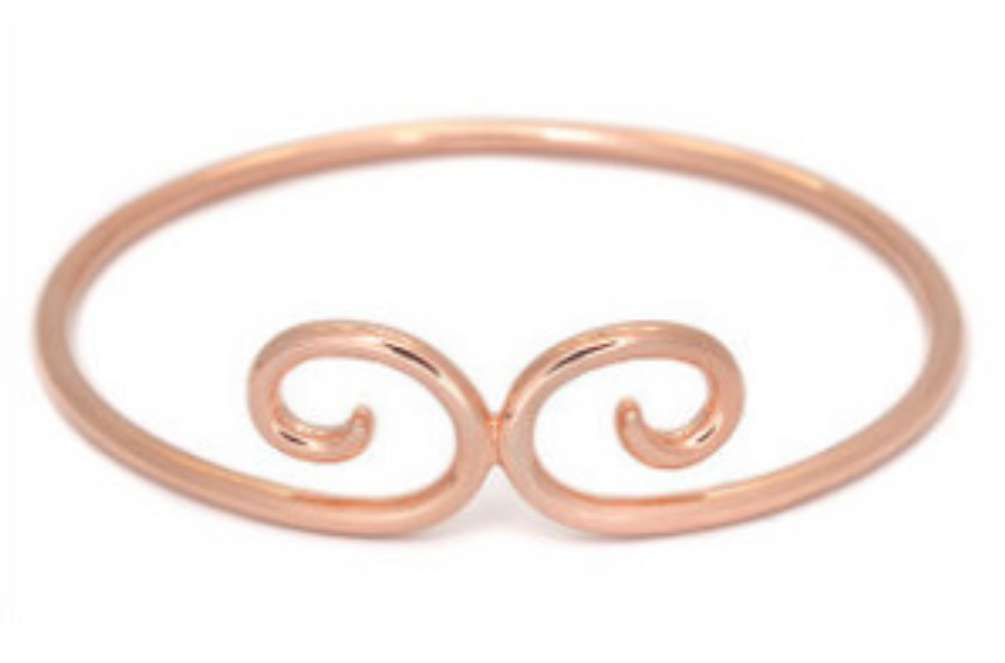
Fig. 1 – Laozi looks lovingly upon his diamond cutter (larger version). A screenshot from the 1986 JTTW TV Show. The cutter here looks like a gold or copper ring, but the novel describes it differently (see below).

2. Appearance in later chapters

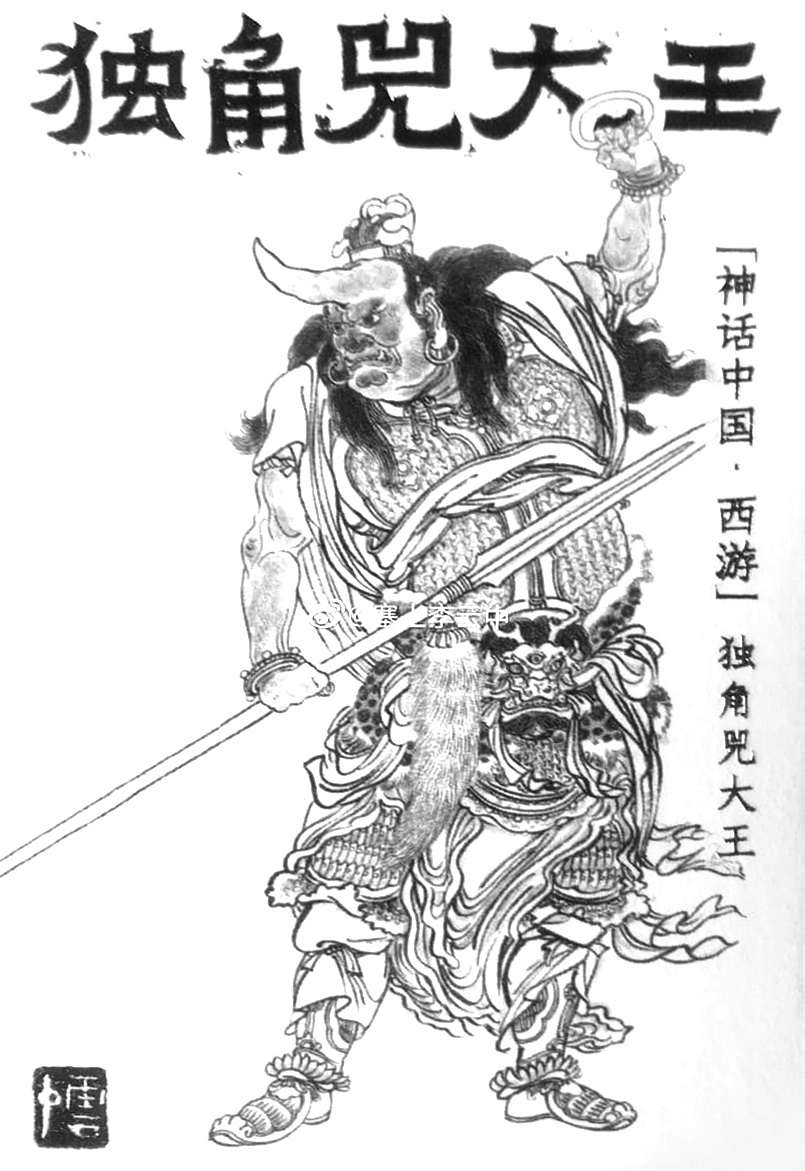
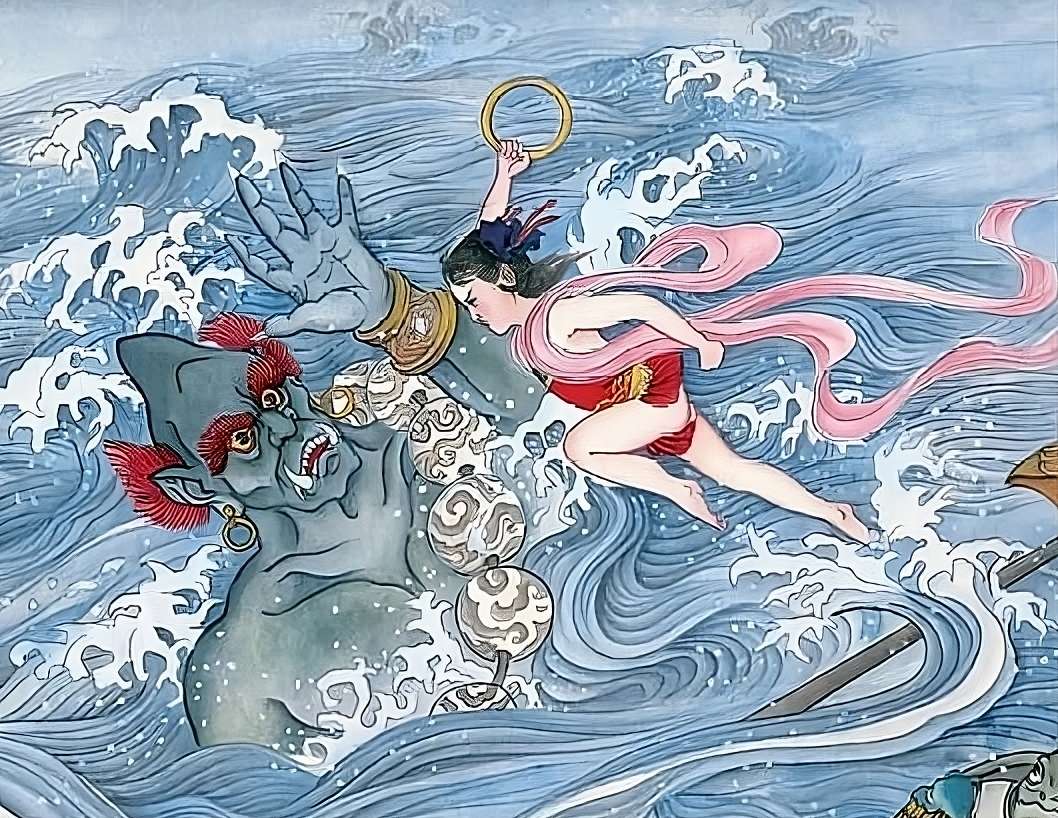
The diamond cutter reappears in chapters 50 to 52 as a mysterious, white, shiny string of pearls used by the Great King One-Horned Buffalo (Dujiao si dawang, 獨角兕大王) (fig. 2) to instantly disarm gods and defeat destructive elemental attacks. [2]

Fig. 2 – A modern drawing of Great King One-Horned Buffalo holding the diamond cutter and his spear (larger version). Based on an image found here.

2.1. Chapter 50

Monkey multiplies his iron staff many times over to fight against the buffalo and his army of minions. But the fiend easily sucks away all of the cudgels with the magic weapon:

The old demon king, however, stood still and, laughing with scorn, said, “Monkey, don’t be impertinent! Watch my trick!” He at once took out from his sleeve a white, shiny fillet [liang zhuozhuo bai sensen de quanzi, 亮灼灼白森森的圈子] and tossed it up in the air, crying, “Hit!” [zhao, 著] With a swish, all the iron rods changed back into a single rod, which was then sucked up by the fillet [fig. 3]. The Great Sage Sun, completely empty-handed, had to use his somersault desperately in order to escape with his life (Wu & Yu, 2012, vol. 2, p. 372).

老魔王唏唏冷笑道:「那猴不要無禮,看手段。」即忙袖中取出一個亮灼灼白森森的圈子來,望空拋起,叫聲:「著!」唿喇一下,把金箍棒收做一條,套將去了。弄得孫大聖赤手空拳,翻觔斗逃了性命。

Fig. 3 –  The diamond cutter sucking in the iron staff (larger version). A screenshot from the 2011 JTTW TV show. Image found here.

2.2. Chapter 51

After his defeat, Wukong seeks heavenly aid several times in a row. First, Prince Nezha is sent to do battle but fails:

“Change!” he roared, and [his six magic] weapons changed into hundreds and thousands. Like a thundershower and a sleet storm, these weapons rained down on the head of the demon. Not the least bit daunted, the demon king took out with one hand that somber white fillet tossed it into the air, crying, “Hit!” With a loud whoosh, the six weapons were all sucked away by it. In desperation Prince Nezha fled for his life with empty hands, [3] while the demon king turned back in triumph (Wu & Yu, 2012, vol. 3, p. 6).

大叫一聲:「變!」一變十,十變百,百變千,千變萬,都是一般兵器,如驟雨冰雹,紛紛密密,望妖魔打將去。那魔王公然不懼,一隻手取出那白森森的圈子來,望空拋起,叫聲:「著!」唿喇的一下,把六般兵器套將下來。慌得那哪吒太子赤手逃生。魔王得勝而回。

Second, the Devaraja Li Jing is sent to distract the buffalo with combat, while a fire god prepares his forces to scorch the spirit, but the plan fails:

The demon fought the devaraja for some time, and in the heat of the battle, he again took out the fillet. When the devaraja saw it, he at once turned his auspicious luminosity around and fled in defeat. On the tall summit the Star of Fiery Virtue quickly gave the command for the various gods of his department to start the fire. It was some fire, all right!

你看那個妖魔與天王正鬥到好處,卻又取出圈子來。天王看見,即撥祥光,敗陣而走。這高峰上火德星君忙傳號令,教眾部火神一齊放火。這一場真個利害

[…]

When the demon saw the fire coming, he was not in the least afraid. He tossed the fillet in the air and with a loud whoosh, it sucked away all those fire dragons, fire horses, fire crows, fire rats, fire bows, and fire arrows. Then he turned toward his cave and went back in triumph (Wu & Yu, 2012, vol. 3, pp. 8-9).

那妖魔見火來時,全無恐懼。將圈子望空拋起,唿喇一聲,把這火龍、火馬、火鴉、火鼠、火槍、火刀、火弓、火箭,一圈子又套將下去,轉回本洞,得勝收兵。

Third, a water god attempts to drown the monster with the Yellow River but fails:

[T]he Water Lord immediately emptied the content of his white jade chalice toward the inside of the cave. When he saw the water rushing in, the fiend dropped his long lance and took out the fillet, holding it high at the second door. Not only was the water blocked right there, but it reversed its course and gushed back out of the cave. So startled was the Great Sage Sun that he somersaulted immediately into the air and, together with Water Lord, leaped up to the tallest peak (Wu & Yu, 2012, vol. 3, p. 11).

這水伯將白玉盂向裡一傾。那妖見是水來,撒了長槍,即忙取出圈子,撐住二門。只見那股水骨都都的只往外泛將出來。慌得孫大聖急縱觔斗,與水伯跳在高峰。

Monkey then requests a boxing match to show that he isn’t useless without his staff. But when the bout comes to a draw, both heavenly and demonic forces charge in to help their respective fighter. Fearing the worst, Wukong creates hair clones to overwhelm the monster, but this strategy fails:

At once they changed into some fifty little monkeys, who swarmed all over the demon—grabbing his legs, tugging at his torso, gouging his eyes, and pulling at his hair. The fiendish creature became so alarmed that he immediately took out his fillet. When the Great Sage and his companions saw that object, they mounted the clouds at once and fled toward the tall summit. Tossing the fillet up into the air, the fiend changed those fifty monkeys back into their true forms and then they were sucked away again with a loud whoosh. After he had gained this victory, the fiend led his troops back to his cave, closed the door, and celebrated (Wu & Yu, 2012, vol. 3, p. 13).

即變做三五十個小猴,一擁上前,把那妖纏住,抱腿的抱腿,扯腰的扯腰,抓眼的抓眼,撏毛的撏毛。那怪物慌了,急把圈子拿將出來。大聖與天王等見他弄出圈套,撥轉雲頭,走上高峰逃陣。那妖把圈子往上拋起,唿喇的一聲,把那三五十個毫毛變的小猴,收為本相,套入洞中,得了勝,領兵閉門,賀喜而去。

2.3. Chapter 52

Monkey resorts to stealth, changing into a cricket (cuzhi’er, 促織兒) and sneaking into the monster’s cave in order to learn where the treasure is kept:

After the demon king took off his clothes, at once the fillet—all ghostly white—could be seen. It was attached to his left shoulder like an armlet made of a string of pearls [zhuzhuo tou, 珠鐲頭]. Look at him! Instead of taking the fillet off, he pushed it up a couple of times until it was snugly clamped to his shoulder. Only then did he lie down to sleep (Wu & Yu, 2012, vol. 3, p. 18).

只見那魔王寬了衣服,左肐膊上白森森的套著那個圈子,原來像一個連珠鐲頭模樣。你看他更不取下,轉往上抹了兩抹,緊緊的勒在肐膊上,方才睡下。

He changes into a flea (gezao, 虼蚤) and twice bites the spirit, but this plan fails to make the beast take off the bangle (Wu & Yu, 2012, vol. 3, pp. 18-19).

Wukong goes on to rescue the stolen holy weapons and animals and magic hairs, before setting the cave on fire:

The Bovine Great King was scared out of his wits; dashing out of his room, he held his fillet up high with both hands. He pushed it toward the fire this way and that way, and it immediately went out. Though the air was filled with flame and smoke, they all subsided after he and his treasure [baobei, 寶貝] had run through the entire cave (Wu & Yu, 2012, vol. 3, p. 20).

諕得個兕大王魂不附體,急欠身開了房門,雙手拿著圈子,東推東火滅,西推西火消,滿空中冒煙突火,執著寶貝跑了一遍,四下裡煙火俱熄。

Monkey and the host of gods become foolhardy upon retrieving their weapons and once more challenge the buffalo to a fight. But their holy armaments are again sucked away by the fillet:

Smiling scornfully, the demon calmly took out from his sleeve his treasure and tossed it in the air, crying, “Hit!” With a loud whoosh, the six divine weapons, the fire equipment, the thunderbolts, the scimitar of the devaraja, and the rod of Pilgrim were all snatched away. Once again, the deities and the Great Sage Sun were empty-handed (Wu & Yu, 2012, vol. 3, p. 23).

那魔頭巍巍冷笑,袖子中暗暗將寶貝取出,撒手拋起空中,叫聲:「著!」唿喇的一下,把六件神兵、火部等物、雷公㨝、天王刀、行者棒,盡情又都撈去。眾神靈依然赤手,孫大聖仍是空拳。

Having no more ideas, Wukong travels to Vulture Peak in the western continent (i.e. India) to seek the Buddha’s wisdom. The Tathagata in turn sends the 18 arhats armed with “golden cinnabar sand” (jindan sha, 金丹砂) in an attempt to bog the demon down and stop him from moving. But this plan also fails:

When the demon saw that the flying sand was clouding up his vision, he lowered his head and discovered that his feet were already standing in three feet of the stuff. He was so horrified that he tried to jump upward; before he could even stand up properly the sand grew another foot. In desperation, the fiend tried to pull up his legs while taking out his fillet. Throwing it up into the air, he cried, “Hit!” With a loud whoosh, the eighteen grains of golden cinnabar sand were sucked away. The demon then strode back to the cave (Wu & Yu, 2012, vol. 3, p. 27).

那妖魔見飛砂迷目,把頭低了一低,足下就有三尺餘深。慌得他將身一縱,跳在浮上一層。未曾立得穩,須臾,又有二尺餘深。那怪急了,拔出腳來,即忙取圈子,往上一撇,叫聲:「著!」唿喇的一下,把十八粒金丹砂又盡套去,拽回步,徑歸本洞。

Monkey later receives a message from the Buddha suggesting that he consult Laozi. Upon traveling to the Tushita Palace in the 33rd Heaven, he learns that the Daoist high god’s holy mount, a green buffalo (qingniu, 青牛), is missing. This prompts the deity to check his collection of holy treasures:

Laozi made a quick inventory; everything was there except the diamond cutter. “This cursed beast stole my diamond cutter!” said Laozi. “So, that’s the treasure!” said Pilgrim. “It was the same snare that hit me that time! [refer back to sec. 1] Now it’s going wild down below, sucking away who knows how many things.”

君急查看時,諸般俱在,止不見了金剛琢。老君道:「這孽畜偷了我金剛琢去了!」行者道:「原來是這件寶貝。當時打著老孫的是他。如今在下界張狂,不知套了我等多少物件。」

[After Wukong describes all of the magic weapons sucked away by the bangle …]

Laozi said, “That diamond cutter of mine is a treasure perfected since the time of my youth, and it was also an instrument with which I converted the barbarians when I passed through the Hangu Pass. Whatever weapons you may have, including fire and water, you can’t touch it. If the demon had stolen my plantain-leaf fan also, then even I would not be able to do anything to him” (Wu & Yu, 2012, vol. 3, p. 29).

老君道:「我那金剛琢,乃是我過函關化胡之器,自幼煉成之寶。憑你甚麼兵器、水火,俱莫能近他。若偷去我的芭蕉扇兒,連我也不能奈他何矣。」

Lord Li’s closing sentence is eye-opening, for it means that anyone who wields both the diamond cutter and fan would be invincible, even against Laozi. This is surprising since JTTW acknowledges him as the creator of the universe who separated the earth and sky from chaos. [4]

In the end, though, Laozi takes back the diamond cutter and subdues the buffalo spirit without trouble:

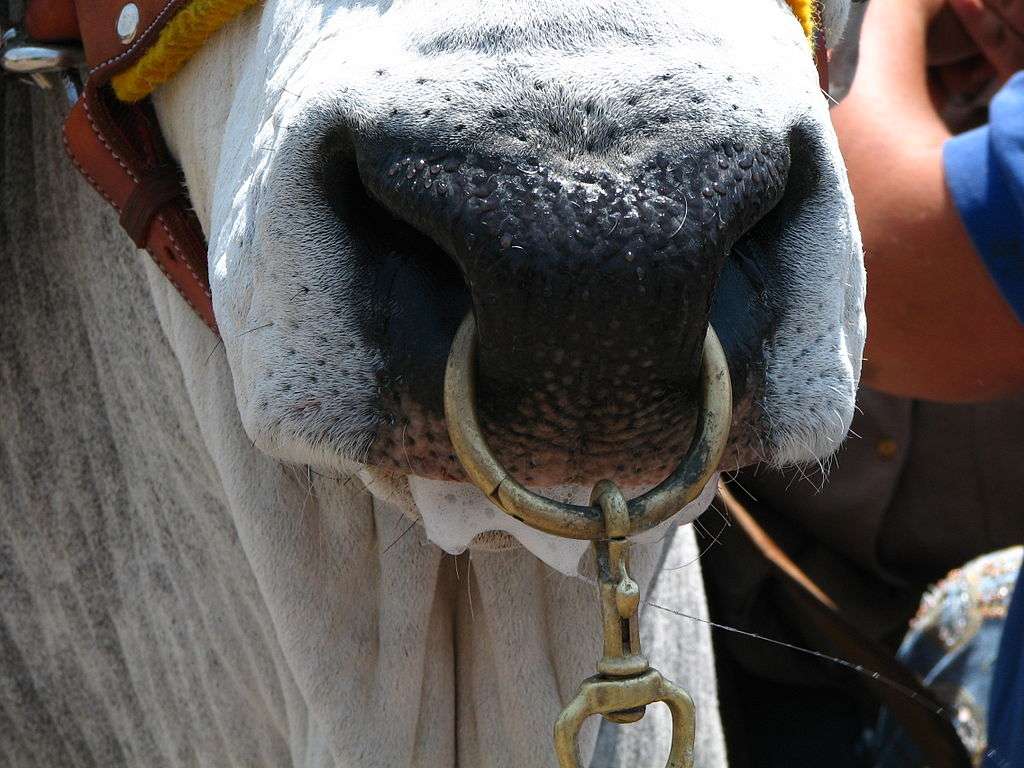
Reciting a spell, Laozi fanned the air once with his fan. The fiend threw the fillet at Laozi, who caught it immediately and gave him another fan. All at once the fiend’s strength fled him and his tendons turned numb; he changed back into his original form, which was that of a green buffalo. Blowing a mouthful of divine breath on the diamond snare, Laozi then used it to pierce the nostrils of the fiend. Next, he took off the sash around his waist and fastened one end of it to the cutter while his hand held the other. Thus the custom of leading the buffalo with a ring in its nose was established [fig. 4], a custom in use even now. This is also what we call binlang [賓郎] (Wu & Yu, 2012, vol. 3, p. 30). [5]

老君念個咒語,將扇子搧了一下,那怪將圈子丟來,被老君一把接住。又一搧,那怪物力軟筋麻,現了本相,原來是一隻青牛。老君將金鋼琢吹口仙氣,穿了那怪的鼻子,解下勒袍帶,繫於琢上,牽在手中。至今留下個拴牛鼻的拘兒,又名賓郎 …

Fig. 4 – A nose ring through a bull’s nose (larger version). Image found here.

3. Background

3.1. Literary origin

Laozi’s dialogue explains how the diamond cutter was created. While at least two JTTW poems reference the high god’s skill in forging mystical weapons (Wu & Yu, 2012, vol. 1, p. 382; vol. 3, p. 375), his own words instead point to alchemical experimentation. As a reminder, in chapter 6, he states: “This is a weapon … brought into existence during my preparation of reverted elixir and fully charged with spiritual energy” (這件兵器,乃錕鋼摶煉的,被我將還丹點成,養就一身靈氣…) (based on Wu & Yu, 2012, vol. 1, p. 186). Later, in chapter 52, he adds: “That diamond cutter of mine is a treasure perfected since the time of my youth” (我那金剛琢,乃是我過函關化胡之器,自幼煉成之寶。) (Wu & Yu, 2012, vol. 3, p. 29).

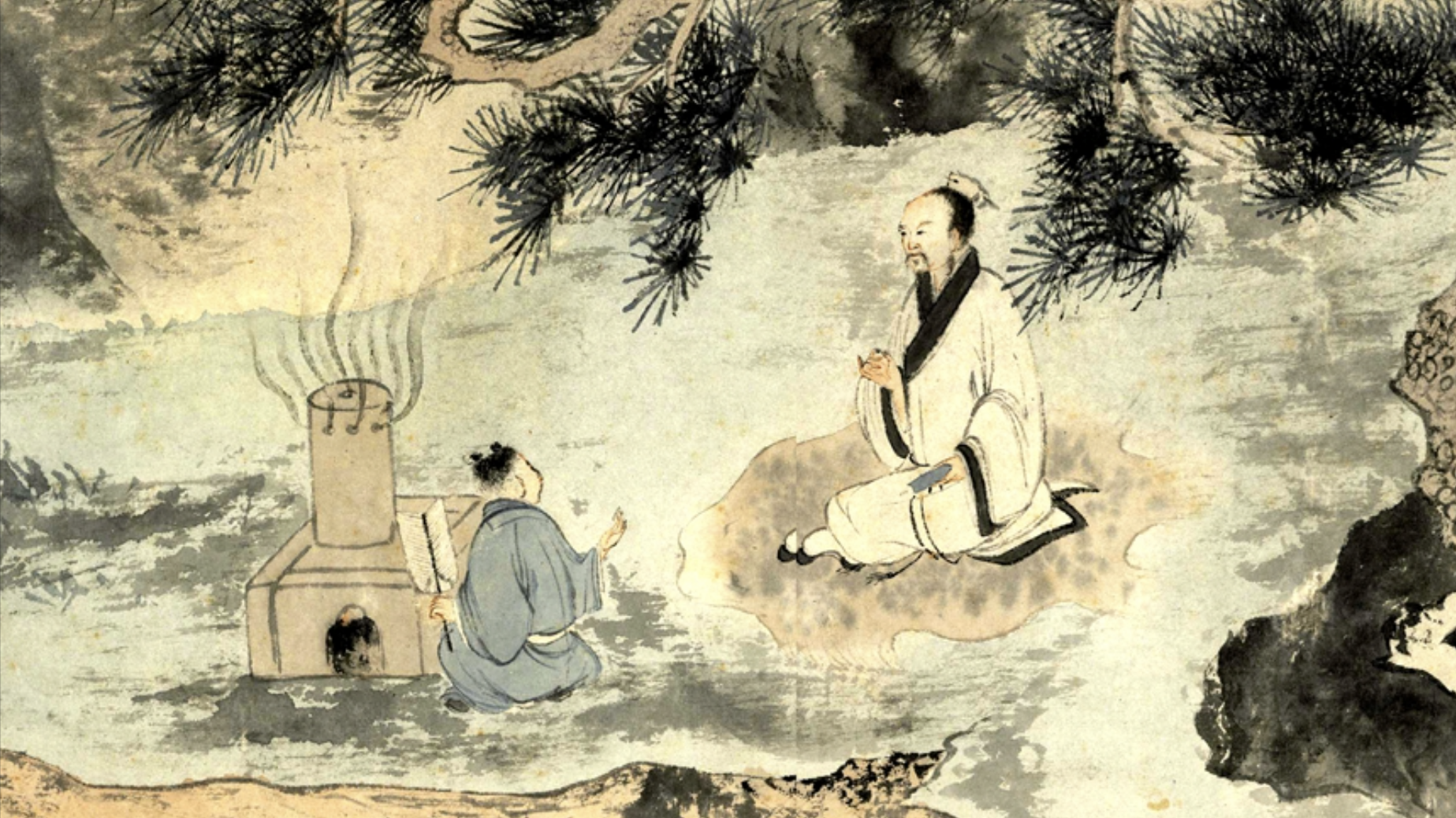
The phrase “reverted elixir” (huandan, 還丹) is key to understanding the origins of the treasure-weapon. This refers to a concept in external alchemy where a concoction of toxic elements is purified over successive firings in a crucible to create a drug of immortality (fig. 5). The Book of the Master Who Embraces Simplicity (Baopuzi抱樸子, 4th-century CE), for example, describes firing cycle periods of between one and nine times, and each subsequent medicine is said to bestow divine longevity within a respective period of time. The more the substance is fired, the faster the desired effect (Kohn, 1993, pp. 309 and 312-313). The product of the ninth cycle is said to transform into reverted elixir when combined with heated cinnabar and exposed to the sun, and a small dose of the drug is enough to bestow instant divinity:

Place the elixir, which has been cycled nine times, in a reaction vessel and expose it to the sun after the summer solstice. When the container becomes hot, introduce a pound of cinnabar beneath the lid. Even while you are watching, with the full power of the sun shining upon it, the whole content will suddenly glow and sparkle with all the colors of spirit radiance. It will immediately turn into reverted elixir. If you take even a single spoonful, you will straightaway rise to heaven in broad daylight (Kohn, 1993, p. 313).

若取九轉之丹,內神鼎中,夏至之後,爆之鼎熱,內朱兒一斤於蓋下。伏伺之,候日精照之。須臾翕然俱起,煌煌煇煇,神光五色,即化為還丹。取而服之一刀圭,即白日昇天。

The fact that Laozi has been developing the cutter from a young age, as stated above, suggests that it is ultimately a byproduct of excessive, millennia-long elixir firing cycles.

Fig. 5 – An alchemist watches as a young lad tends to the firing vessel (larger version). This is an example from Tang Yin’s (唐寅) Images of Cooking Medicine (Shaoyao tu, 燒葯圖) series. Image found here.

3.2. History

Anthony C. Yu (Wu & Yu, 2012) translates kungang (錕鋼), the substance comprising the diamond cutter, as “red steel” (vol. 1, p. 186). The original Chinese term refers to a legendary red knife mentioned in Master Lie (Liezi, 列子, c. 4th-century) as coming from Kunwu (錕鋙/昆吾), a distant land. This incredibly hard blade was presented as a royal tribute, along with asbestos cloth, a product of the west:

When King Mu of Zhou made his great expedition against the Rong tribes of the West, they presented him with a knife from Kunwu and a fire-proof cloth. The knife was one chi and zhi [changchi youzhi, 長尺有咫, 22.8 in/57.9 cm] long with a red blade [6] of tempered steel; cutting jade with it was as easy as cutting mud (based on Liezi & Graham, 1960/1990, p.117). [7]

周穆王大征西戎,西戎獻錕鋙之劍,火浣之布。其劍長尺有咫,練鋼赤刃,用之切玉如切泥焉。

The later Ten Islands of the Inner Seas (Hainei shizhou ji, 海內十洲記; a.k.a. Shizhou ji, 十洲記, c. 5th; “Ten Islands” hereafter) associates Kunwu with stones that can be smelted into jade-cutting iron swords. What’s important here is that the rocks are located in the “Western Ocean” (Xihai, 西海), a term commonly associated with the Mediterranean, the Persian Gulf, or the Indian Ocean—i.e. bodies of water and land west of China:

There is a floating island [liuzhou, 流洲] in the middle of the Western Ocean … The island has many mountains and rivers accumulating stones called kunwu [昆吾]. Smelting the stones will turn them into iron. A sword made from this will shine brightly like crystal, and it will cut jade like mud (cf. Laufer, 1915, p. 29).

流洲在西海中 … 上多山川積石,名為昆吾。冶其石成鐵,作劍光明洞照,如水精狀,割玉物如割泥。

But the now lost Record of the Mysterious Center (Xuanzhong ji, 玄中記, c. 5th-century) (as cited here) explicitly associates jade-cutting blades with diamonds from western lands:

The country of Daqin [大秦, i.e. Roman Syria] produces diamonds (jingang [金剛]), termed also ‘jade-cutting swords or knives’ [xiaoyu dao, 削玉刀]. The largest reach a length of over one chi [12.3 in/31.8 cm], the smallest are of the size of a rice or millet grain. Hard stone can be cut by means of it all round, and on examination it turns out that it is the largest of diamonds. This is what the Buddhist priests substitute for the tooth of Buddha (based on Laufer, 1915, p. 30).

大秦國出金剛,一名削玉刀,大者長尺許,小者如稻黍,著環中,可以刻玉。

觀此則金剛有甚大者,番僧以充佛牙是也。

Similar to the Ten Islands, the Memoir of the Four Gentlemen of Liang (Liang sigong ji, 梁四公記, late-7th-century) speaks of an island in the west but adds that the inhabitants are talented lapidarists, or gemstone cutters:

In the west, arriving at the Western Ocean, there is in the sea an island of two hundred square li [62.13 mi/100 km]. On this island is a large forest abundant in trees with precious stones, and inhabited by over ten thousand families. These men show great ability in cleverly working gems, which are named for the country Fulin 拂林 [i.e. Rome] (based on Laufer, 1915, p. 7).

西至西海,海中有島,方二百里。島上有大林,林皆寶樹。中有萬餘家,其人皆巧,能造寶器,所謂拂林國也。

Rustic Talks From the East of Qi (Qidong yeyu, 齊東野語, 13th-century) (as cited here) describes how lapidarists use iron-like diamond-points to polish and carve jade:

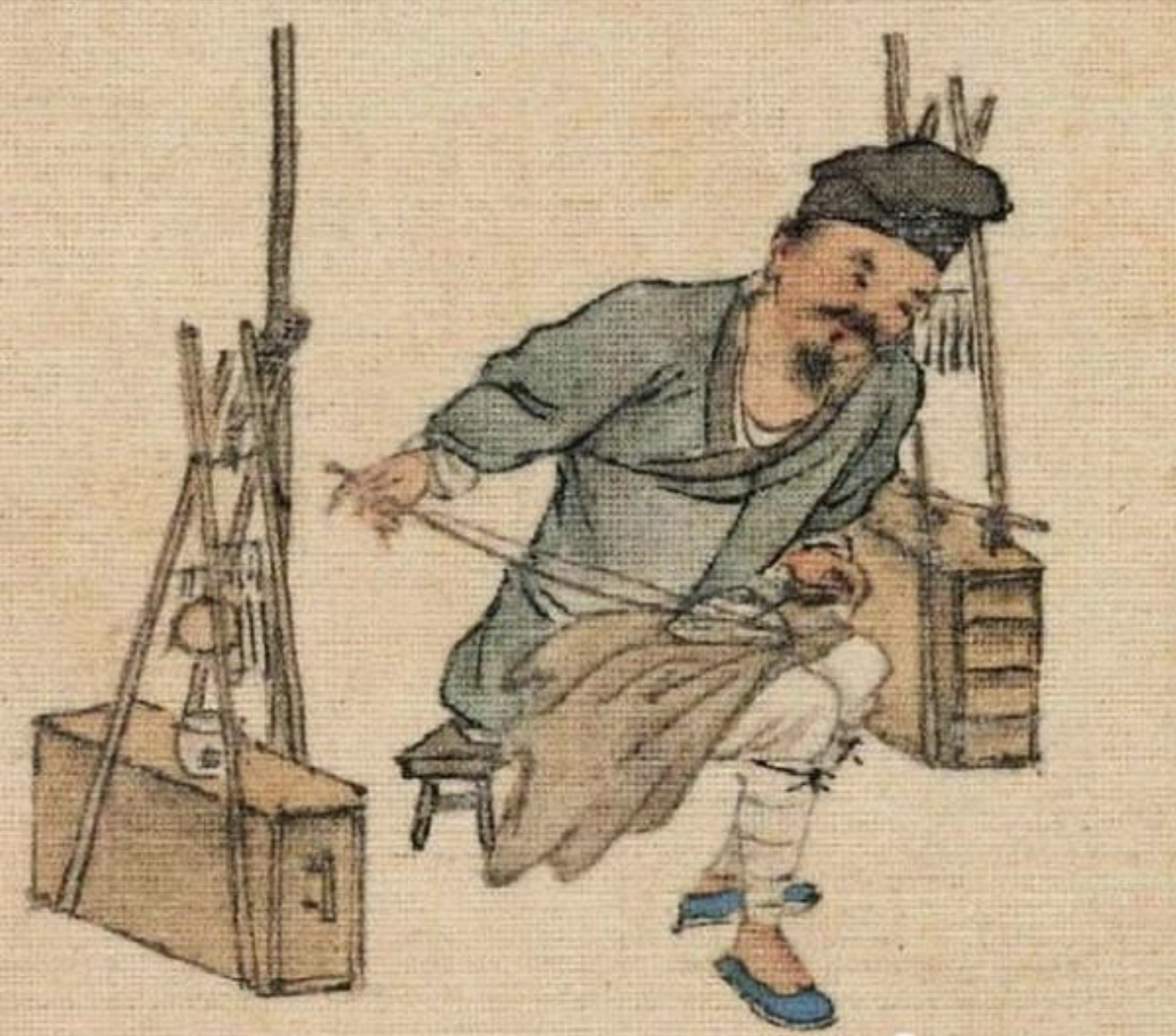
The workers in jade polish jade by the persevering application of Ganges river-sand, and carve it by means of a diamond-point drill [jingang zuan, 金剛鑽]. Its shape is like the excrement of rodents [fig. 6 & 7]; it is of very black color, and is at once like stone and like iron (based on Laufer, 1915, p. 31). [8]

玉人攻玉,以恆河之砂,以金剛鑽鏤之,其形如鼠矢,青黑色,如石如鐵。

This brings us back to the kunwu blade. Laufer (1915) rejects the idea that it was an iron knife. Instead, he states that it was an embellishment on the kinds of diamond-pointed tools used by craftsmen west of China to carve hard stones like jade (Laufer, 1915, p. 32).

This ultimately explains the odd name of Laozi’s holy treasure, diamond cutter (jingang zhuo, 金鋼琢)—i.e. a cutter made from diamond. This name was no doubt chosen to infer that the weapon is unimaginably hard, something capable of “ringing the bell” of even the Monkey King.

The use of kungang (錕鋼), along with the name diamond cutter, suggests that the JTTW author-compiler had knowledge of both the ancient red knife and its ties to diamonds. And speaking of the gemstone, I think given the above information, a better translation for kungang would be something like “diamond steel.” This is more fitting than Yu’s (Wu & Yu, 2012) “red steel” (vol. 1, p. 186).

Also, the description of the cutter as a white, shiny string of pearls makes much more sense when its ties to diamonds are taken into account. This brings to mind a bracelet of perhaps milky diamonds instead of a steel ring.

Fig. 6 (left) – A craftsman works a product with a bow-driven diamond-point drill (larger version). A painting from Zhou Kun’s (周鯤) “Village and Market Life Album” (Cunshi shengya hua’ce, 村市生涯畫冊, 18th-century). Image found here. Fig. 7 (right) – An example of the diamond-point of a diamond drill (larger version). Image found here. This recalls the rodent excrement description of diamond-points mentioned in Rustic Talks From the East of Qi (13th-century).

4. Mirrored objects

The diamond cutter serves as a mirrored literary element to Wukong’s golden headband (jingu, 金箍; a.k.a. jingu, 緊箍, lit: “tight fillet”), which initially appears in chapters eight and 14. Both are used to rein in Monkey’s unruly behavior by way of his head: the first hits him on the crown, and the second clamps around his skull. And the fact that the diamond cutter “can entrap many things” (tao zhu wu, 套諸物) reminds me of the way that the golden fillet constricts (jin, 緊) around Wukong’s head when the correct spell is spoken (Wu & Yu, 2012, vol. 1, p. 319). Isn’t this also a kind of entrapment?

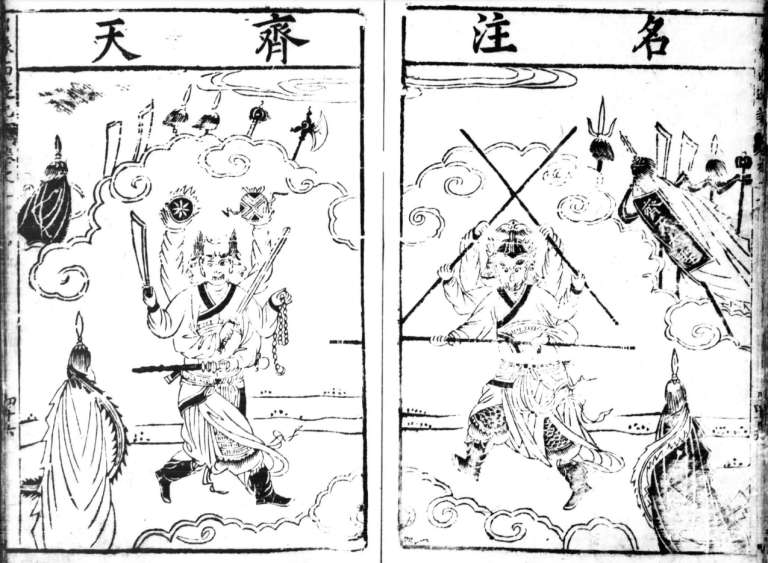
Another mirrored candidate is Nezha’s “fire wheel” (huolun’er, 火輪兒) (fig. 8), which numbers among his six magic weapons (liujian shenbing, 六件神兵). In chapter 61, this flaming fillet is placed on the Bull Demon King’s horn (i.e. on his head) to stop his rampaging transformations (Wu & Yu, 2012, vol. 3, p. 160). Compare this to the way that the diamond cutter stops Wukong via his head. This at first may seem like a passing similarity until you take into account the many parallels shared by Wukong and the bull spirit. The latter is a demon king nicknamed the “Great Sage,” who wields an iron staff, knows 72 changes, can adopt a titanic form, takes part in a battle of magic transformations, is trapped by a joint effort from heaven, is incapacitated by a circular object on his head, and finally faces the Buddha for punishment. [9] Therefore, I can confidently state that the fire wheel is a mirror of the golden headband and subsequently the diamond cutter. I’ll discuss the importance of these connections below.

The novel has many more mirrored objects and characters. I plan to write an article about this at a later date.

Fig. 8 – Nezha (left) wielding his six magic weapons in his three-headed, six-armed form against Sun Wukong (right) (larger version). The fire wheel can be seen in his upper rightmost hand (i.e. the flaming black circle with white spokes). Print from the original 1592 edition of JTTW.

5. Influence

The relationship between Laozi’s diamond cutter and Nezha’s fire wheel in JTTW may have inspired the latter’s “cosmic ring” (qiankun quan, 乾坤圈) in Investiture of the Gods (Fengshen yanyi封神演義, c. 1620, “IOTG” hereafter). Nezha first uses it as a youth in chapter 12 to bludgeon a fierce water-spirit to death:

Standing there naked, Nezha dodged the advancing warrior’s attack and upraised the cosmic ring in his right hand. This treasure was originally bestowed by the Jade Emptiness Palace of Mt. Kunlun to the Perfected Man of the Grand Monad [Taiyi zhenren, 太乙真人] to secure the items of his Golden Light Cave. How could the yaksha withstand the magic weapon as it struck downward on his head? [fig. 9] His brains exploded from the blow, and he fell dead on the shore (cf. Gu, 2000, vol. 1, p. 239).

哪吒正赤身站立,見夜叉來得勇猛,將身躲過,把右手套的乾坤圈望空中一舉。此寶原係崑崙山玉虛宮所賜太乙真人鎮金光洞之物,夜叉那裏經得起,那寶打將下來,正落在夜叉頭上,只打的腦漿迸流,即死於岸上。

He also uses it as a throwing weapon:

After fighting three or four rounds, Nezha simultaneously blocked Yu Hua’s halberd with his spear and took out his cosmic ring from the leopard skin bag. He hit him directly in the arm, breaking tendons and shattering bone (cf. Gu, 2000, vol. 2, p. 671).

哪吒未及三四合,用鎗架住畫戟,豹皮囊內忙取乾坤圈打來,正中余化臂膊,打得筋斷骨折.

See note no. 11 below for more overt examples of throwing.

To sum up, both the diamond cutter and cosmic ring are holy treasures belonging to supreme Daoist deities, are circular and hard enough to serve as blunt throwing weapons, and have the power to entrap (tao, 套) or secure (zhen, 鎮, lit: “press down”) things. It’s also worth noting that the caves associated with these objects have similar names: Great King One-Horned Buffalo lives in Golden Helmet Cave (Jindou dong, 金▯洞), [10] while the Perfected Man of the Grand Monad lives in the Golden Light Cave (Jinguang dong, 金光洞).

My friend, a devotee and researcher of Nezha, tells me that the cosmic ring is a later development in the Third Prince’s mythos, first appearing in IOTG. And since the ring does not appear in JTTW (ctext), it certainly could have been influenced by the similarities between the diamond cutter and Nezha’s fire wheel.

Also, the diamond cutter likely influenced two other fillet-like throwing weapons in the novel, both of which are destroyed by Nezha’s much harder cosmic ring. One is Mo Liqing’s (魔禮青) “white jade diamond bracelet” (baiyu jingang zhuo, 白玉金剛鐲) from chapter 41. The alternate name for said treasure, jingang zhuo (金剛鐲), sounds exactly the same as Laozi’s diamond cutter, jingang zhuo (金鋼琢). I doubt the homophonous title and pale color are a coincidence.

The second is Wen Liang’s (溫良) “white jade ring” (baiyu huan, 白玉環) [11] Again, the white color is telling.

Fig. 9 – Nezha seconds from killing Li Gen with the cosmic ring (larger version). This is an upscaled version of an image found here.

6. Conclusion

Laozi’s great treasure-weapon, the “diamond cutter” (jingang zhuo, 金鋼琢; a.k.a. “diamond snare,” jingang tao, 金鋼套), first appears in chapter six when he uses the fillet to stop Monkey’s rampage by throwing it from heaven and hitting him on the head. It reappears in chapters 50 to 52 as a mysterious, white, shiny string of pearls used by Great King One-Horned Buffalo, an evil spirit, to suck away magic weapons and animals and defeat even destructive elemental attacks. The treasure gives Sun Wukong and a host of Daoist and Buddhist gods no end of trouble before Laozi retrieves his treasure and submits the monster, his runaway buffalo mount.

Lord Li explains that the treasure is a byproduct of creating “reverted elixir,” or a drug of immortality, and that it is made of “kun steel” (kungang, 錕鋼). The latter is a reference to an extremely hard, jade-cutting iron knife from Chinese folklore said to come from the distant land of Kunwu (錕鋙/昆吾). But this is itself an embellishment on reports of diamond-pointed tools used by craftsmen west of China to work hard stone like jade. The name diamond cutter was, therefore, likely chosen to denote something unimaginably hard, something capable of hurting even Sun Wukong.

The diamond cutter is a mirrored literary element to Sun Wukong’s headband. This is because the treasure and the golden fillet are both circular objects that rein in Monkey’s unruly behavior by way of his head, hitting it and clamping around his skull, respectively. The diamond cutter is also a mirrored element of Prince Nezha’s “fire wheel” (huolun’er, 火輪兒) because the latter stops the rampage of the Bull Demon King by way of his head. This takes place during a battle that closely mirrors Monkey’s early rebellion and defeat.

This connection between the diamond cutter and the fire wheel likely influenced Nezha’s “cosmic ring” (qiankun quan, 乾坤圈) from Investiture of the Gods (Fengshen yanyi, 封神演義, c. 1620). Both treasures belong to supreme Daoist deities, can be used as blunt throwing weapons, have the power to entrap or secure things, and are associated with caves with “gold” (jin, 金) in the name. The diamond cutter also likely influenced two other throwing fillets from the novel, Mo Liqing’s (魔禮青) “white jade diamond bracelet” (baiyu jingang zhuo, 白玉金剛鐲) and Wen Liang’s (溫良) “white jade ring” (baiyu huan, 白玉環). The name of the former closely mirrors that of the jade cutter.


Update: 03-14-24

The full name of the Diamond Sutra (c. 2nd to 4th-century) is the Diamond-Cutter Perfection of Wisdom Sutra (Sk: Vajracchedikāprajñāpāramitāsūtra) (Buswell & Lopez, 2014, p. 953). This interests me because Laozi states in chapter six:

The year when I crossed the Hangu Pass, I depended on it [his diamond-cutter treasure] a great deal for the conversion of the barbarians to Buddhism, for it was practically my bodyguard night and day (based on Wu & Yu, 2012, vol. 1, p. 186).

當年過函關,化胡為佛,甚是虧他。早晚最可防身。

Perhaps the diamond-cutter is meant to be a metaphor for the Diamond Sutra, which he used to convert the people of the West.

Notes:

1) Yu (Wu & Yu, 2012) uses the English words “diamond snare” or just “snare” numerous times whenever Laozi’s weapon is mentioned. However, the corresponding Chinese phrase, jingang tao (金鋼套), only appears once in the entire novel, while that for “diamond cutter,” jingang zhuo (金鋼琢), appears a total of four times. Therefore, I have made changes to the translation for more accuracy.

2) Jenner (Wu & Jenner, 1993/2001) translates Dujiao si dawang (獨角兕大王), the monster’s name, as “Great King Rhinoceros” (vol. 2, p. 1143). This is because the character si (兕) is associated with rhinos. For instance, Strassberg’s (2002) translation of the Classic of Mountains and Seas (Shanhai jing, 山海經, c. 4th-century to 1st-century BCE) reads:

The Si-Rhinoceros dwell east of Shun’s Tomb and south of the Xiang River. Their form resembles an ox that is blue-black with a single horn” (p. 188).

兕在舜葬東,湘水南,其狀如牛,蒼黑,一角。

But the JTTW spirit is likely an amalgamation of Lord Li’s green/black buffalo (qingniu, 青牛) and the mythical animal. This is because both are dark, bovine-like beasts with a single horn. This association between the two is exemplified by a humorous vintage porcelain statue of Laozi riding a rhino.

3) I have changed all references to Nata to Nezha, a FAR more widely used term for the martial god.

4) Monkey explains in chapter 86 that everyone has a boss, thereby alluding to Laozi’s hallowed past:

Old Lord Li happens to be the patriarch of creation [kaitian pidi zhi zhu, 開天闢地之祖; lit: the “patriarch of splitting heaven and earth (from chaos)], but he still sits to the right of Supreme Purity. The Buddha Tathagata is the honored one who governs the world, and yet he still sits beneath the Great Peng. Kong the Sage is the founder of Confucianism, but he assumes the mere title of Master (Wu & Yu, 2012, vol. 4, p. 163).

李老君乃開天闢地之祖,尚坐於太清之右;佛如來是治世之尊,還坐於大鵬之下;孔聖人是儒教之尊,亦僅呼為『夫子』。

My thanks goes to Irwen Wong of the Journey to the West Library blog for reminding me of this fact.

5) Yu (Wu & Yu, 2012) points out that binlang (賓郎) is a variant of binlang (檳榔), or betel nut (vol. 3, p. 385 n. 8). One French translator suggests that the name comes from the circular shape shared by betel nut and coconuts, and that nose rings were likely made from the latter (Levy, 1991, as cited in Wu & Yu, 2012, vol. 3, p. 385-386 n. 8).

6) Regarding the red blade (chidao, 赤刃), the Classic of Mountains and Seas (Shanhai jing, 山海經, c. 4th-century to 1st-century BCE) mentions that the peaks of Kunwu have an abundance of copper (chitong, 赤銅, i.e. “red copper”) (Strassberg, 2002, p. 145).

7) I have changed all Wade-Giles to pinyin.

8) The passage from Rustic Talks From the East of Qi (13th-century) goes on to associate diamonds with a strange phenomenon in western lands where birds pass the gemstone in their droppings:

According to legend, high in the mountains of the Western Regions [Xiyu, 西域] where the Huihe live, hawks and falcons would ingest (diamonds). These would then be deposited in the sandy gravel of Hebei Province when they defecate. But I do not know if this is true or not (cf. Laufer, 1915, p. 12).

相傳出西域及回紇高山頂上,鷹隼粘帶食入腹中,遺糞於河北砂磧間。未知然否?

This matches another passage from the aforementioned Memoir of the Four Gentlemen of Liang (late-7th-century). This earlier source provides more information:

In a northwesterly direction from the island is a ravine hollowed out like a bowl, more than a thousand feet deep. They throw flesh into this valley. Birds take it up in their beaks, whereupon they drop the precious stones. The biggest of these have a weight of five catties. There is a saying that this is the treasury of the Devaraja of the Rupadhatu 色界天王 (Laufer, 1915, p. 7).

島西北有坑,盤坳深千餘尺。以肉投之,鳥銜寶出,大者重五斤,彼雲是色界天王之寶藏。

The bird-diamond connection is mentioned in non-Chinese sources as well. This includes The Book of the Wonders of India (Kitāb ‘Aja’ib al-Hind, 953), a collection of “sailor’s tales” by the Persian Shipmaster Buzurg Ibn Shahriyār. The 82nd tale in this collection, “Kashmiri Diamonds,” associates the gemstones with northernmost India. The full tale reads:

Someone who had been to India told me he had heard it said that the purest, the most beautiful, and the most precious between two mountains, where diamonds come from the Kashmir region. There is a valley a fire burns ceaselessly, and day, winter and summer. It is there that the diamonds are. Only low-caste Indians risk themselves in this dangerous country. They gather in bands, and reach the entrance to the valley. They kill lean sheep, and cut them up into bits. Then they fling the pieces one after another into the valley, by means of a mangonel that they set in motion. There are many reasons that prevent their access to their valley. First, there is the ever- burning fire; and, in addition, around the fire, there is an uncountable number of snakes and vipers, so that no man can go there and not perish.

When the meat is thrown, a great number of vultures falls on it and seizes it. If it falls some distance from the fire, they carry it off. They follow the vulture as it flies. Sometimes a diamond falls from the meat that has been carried off. If the vulture comes down in some place to eat it, they go to there and find diamonds. If the meat falls in the fire, it burns. The vulture that wants to seize a piece too near the fire burns likewise. Sometimes also, by chance, a vulture seizes meat in flight, before it reaches the ground.

This is how diamonds are gathered. Most of the people who busy themselves looking for them die from the fire, or from the snakes and vipers. The kings of these countries are very fond of diamonds, and go to great trouble to get them. Those employed in this work are watched carefully, because of the beauty and high price of the stones (Shahriyar & Freeman-Grenville, 1981, p. 75).

9) The Bull Demon King takes the title “Great Sage, Parallel with Heaven” (Pingtian dasheng, 平天大聖) in chapter 4 (compare this to Monkey’s title, the “Great Sage Equaling Heaven“) (Wu & Yu, 2012, vol. 1, pp. 156-157). The rest of the similarities appear in chapters 60 and 61. He wields his own “cast-iron rod” (huntie gun, 混鐵棍) (compare this to Wukong’s weapon) (Wu & Yu, 2012, vol. 3, pp. 137 and 147). His skill with the 72 changes is referenced when he takes on Zhu’s appearance (compare this to Monkey’s ability) (Wu & Yu, 2012, vol. 3, p. 148). The battle of transformations against Sun takes place shortly after he’s overwhelmed by our hero and Zhu in combat (compare this to Wukong’s battle of transformations with Erlang in ch. 6) (Wu & Yu, 2012, vol. 3, pp. 156-157; vol. 1, pp. 182-183). He takes on his cosmic form, a giant white bull, in a last ditch effort to defeat Monkey (compare this to Wukong’s skill) (Wu & Yu, 2012, vol. 3, p. 157). He is trapped on all sides by Buddho-Daoist deities (compare this to Monkey’s troubles with heaven in ch. 6) (Wu & Yu, 2012, vol. 3, pp. 159-160; vol. 1, pp. 185-186). As mentioned above, Nezha uses his fire wheel to stop his rampaging transformations (compare this to Laozi stopping Monkey’s rampage by knocking him over with the diamond cutter in ch. 6) (Wu & Yu, 2012, vol. 3, p. 160; vol. 1, p. 186). And he is taken to see the Buddha at the end of his story arc (compare this to Wukong’s meeting with the Buddha) (Wu & Yu, 2012, vol. 3, p. 162).

10) The Ctext version is missing a particular Chinese character that appears in the original novel (see the right side, third column from the left, on p. 658 of this PDF). It is comprised of shan (山) and dou (兠/兜). Thank you to Irwen Wong for reminding me of this.

11) Mo Liqing clashes with Nezha in chapter 41, leading to the destruction of his white jade diamond bracelet:

Before they had fought twenty rounds, Mo Liqing hurled his white jade diamond bracelet. It cast a ray of multi-colored light as it struck him [Huang Tianhua, 黃天化] in the middle of the back. The hit knocked down his golden cap [i.e. he died] and fell from his mount.

Mo Liqing wanted to cut off his head, but before he could, Nezha screamed, “Don’t hurt my Daoist brother!” Riding his wind and fire wheels, the third prince fought to the front of the formation and rescued the body of Huang Tianhua.

Nezha engaged Mo Liqing in combat, their respective spears stabbing out in succession. Their battle saddened heaven and made gloomy the earth [i.e. it was extremely tense]. Mo Liqing hurled the diamond bracelet a second time to hit Nezha. The youth also cast his cosmic ring, but it was made of gold and the diamond bracelet jade. When the two clashed, the diamond bracelet shattered into many pieces (cf. Gu, 2000, vol. 2, p. 807 and 809)

來往未及二十回合,早被魔禮青隨手帶起白玉金剛鐲,一道霞光,打將下來,正中後心。只打得金冠倒撞,跌下騎來。魔禮青方欲取首級,早被哪吒大叫:「不要傷吾道兄!」登開風火輪,殺至陣前,救了黃天化。哪吒大戰魔禮青,雙鎗共發,殺得天愁地暗。魔禮青二起金剛鐲來打哪吒。哪吒也把乾坤圈丟起。乾坤圈是金的,金剛鐲是玉的,金打玉,打得粉碎。

Wen Liang’s white jade ring is destroyed by the Third Prince’s cosmic ring in chapter 64:

Now let’s talk about how Wen Liang cast up his white jade ring to attack Nezha. But he didn’t know that Nezha had the cosmic ring. The youth also cast his own treasure. Wen didn’t know that gold beats jade, and when the two clashed, the white jade ring shattered into many pieces (cf. Gu, 2000, vol, 3, pp. 1315 and 1317).

且說溫良祭起白玉環來打哪吒,不知哪吒也有乾坤圈,也祭起來;不知金打玉,打得紛紛粉碎。

Sources:

Buswell, R. E. , & Lopez, D. S. (2014). The Princeton Dictionary of Buddhism. Princeton University Press.

Gu, Z. (2000). Creation of the Gods (Vols. 1-4). Beijing: New World Press.

Kohn, L. (1993). The Taoist Experience: An Anthology. United States: State University of New York Press.

Laufer, B. (1915). The Diamond: A Study in Chinese and Hellenistic Folk-lore. United States: Field Museum of Natural History. Retrieved from https://archive.org/details/diamondstudyinch00lauf/page/n5/mode/2up

Liezi, & Graham, A. C. (1990). The Book of Lieh-tzu: A Classic of Tao. New York: Columbia University Press. (Original work published 1960)

Shahriyar, B., & Freeman-Grenville, G. S. P. (1981). The Book of the Wonders of India: Mainland, Sea and Islands. London: East-West Publications.

Strassberg, R. (2002). A Chinese Bestiary: Strange Creatures from the Guideways Through Mountains and Seas. University of California Press.

Wu, C. & Jenner, W. J. F. (2020). Journey to the West (Vols. 1-4). Beijing: Foreign Languages Press. (Original work published 1993)

Wu, C., & Yu, A. C. (2012). The Journey to the West (Vols. 1-4) (Rev. ed.) Chicago, Ill: University of Chicago Press.

Archive #39 – Journey to the West Adaptations

Last updated: 07-21-2025

The Journey to the West Research blog is proud to host an entry by our friend Monkey Ruler (Twitter and Tumblr). They have graciously written an essay on the global nature of Journey to the West adaptations, as well as provided a link to their ongoing project recording JTTW media (fig. 1). As of the publishing of this article, it includes a long list of almost 570 movies, 90 TV shows, and 160 video games! – Jim

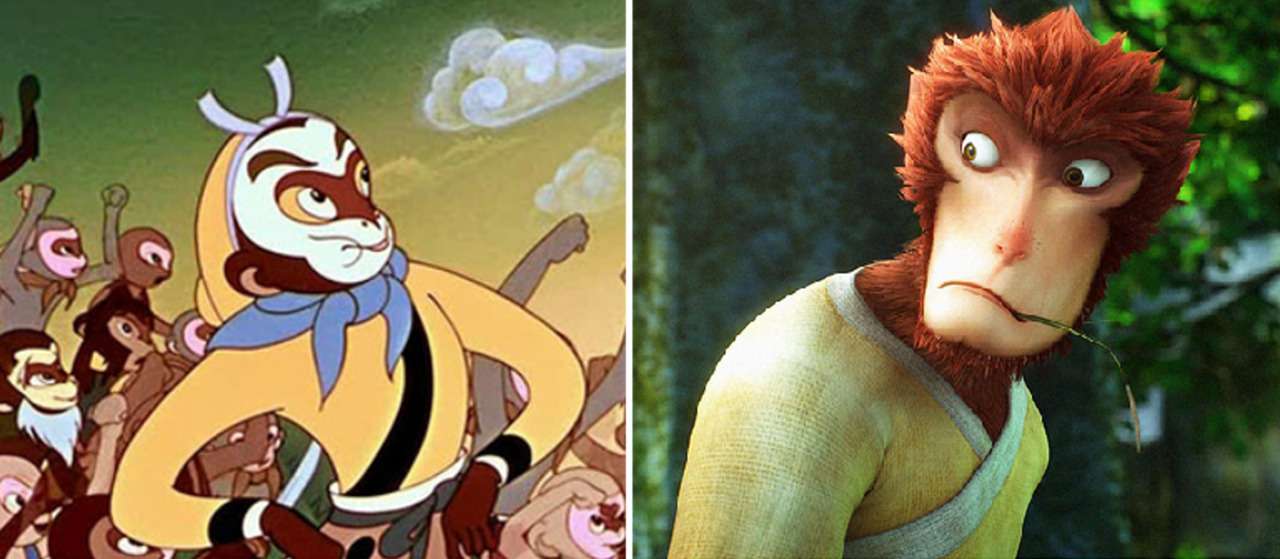
Fig. 1 – Depictions of Sun Wukong from adaptations produced over 50 years apart: (left) Havoc in Heaven (Danao tiangong, 大鬧天宮, 1961) and (right) Monkey King: Hero is Back (Xiyouji zhi Dasheng guilai, 西遊記之大聖歸來, lit: “Journey to the West: Return of the Great Sage,” 2015) (larger version). Courtesy of Monkey Ruler.

I. Media adaptations

This started out as a collection of Xiyouji (西遊記; lit: “Journey to the West,” 1592) movies and TV shows for the sake of a Master’s class project; it was simple enough to look for Xiyouji media and start adding them to a collection datasheet. But even when the project was over, I kept finding more and more adaptations, even stumbling across others trying to show the magnitude of how much this novel has encompassed popular culture throughout the centuries. It has been told and re-told again and again in oral and published literature, plays, art, songs, poems, etc., and now on the big and small screens. Audiences are re-introduced to the image of Sun Wukong and his fellow pilgrims with every new media addition.

What really inspired me was the book Transforming Monkey: Adaptations and Representation of a Chinese Epic (2018) by Hongmei Sun, where she explained in depth the cultural impact that Sun Wukong (fig. 2) and Xiyouji has had on Chinese media, as well as how this loose set of franchises have come to represent Chinese culture as these shows and movies have become more globally accessible. Xiyouji is such an iconic cultural universe that it can be both heavily entertaining while still being so personal to audiences of any generation depending on how the artist/writer portrays their interpretation of these characters and their stories. 

There hasn’t been a lot written about how these interpretations influence modern Xiyouji adaptations despite how the story has greatly influenced popular culture.

Fig. 2 – The front cover of Transforming Monkey (2018) (larger version).

Xiyouji is such an influential story, one that will continue to grow more and more globally known throughout time because it is such an all-encompassing piece that can cover politics, identities, and allegories, while still being a very personal and interpersonal work that artists or writers can relate to. 

However, even with these layers of meaning and symbolism to be found, the story never loses the charming and entertaining aspects that can and have captured audiences. Despite being published over 430 years ago (with a history stretching back even further), Xiyouji is still able to relate to modern audiences through its allegories of oppression, rebellion, and self-identity. It has the capability to resonate with any generation depending on what artists or writers at the time wish to highlight or personally connect with themselves or their current world around them, using Xiyouji as a medium for their own struggles.

As Xiyouji starts to become more and more globally known, it is important to understand and resonate that this is still a Chinese story and how to address further adaptations with cross-nation gaps in both translation and cultural differences. There are media forms that are far more exploitative of the mythical journey, creating impractical scenarios of the narrative and thus changing the message of the story and characters completely. However, there needs to be an acknowledgment of what doesn’t work as Xiyouji adaptations due to the ever-changing zeitgeist in not only its home of origin but introducing it to a global sphere as it adds influence. 

In order to see what works for adaptations, there needs to be an acknowledgment of what is the core of the story and just why it remains popular, story-beat or character-wise. For example, Sun Wukong can be used as a great model for positive ambivalence in media, moving away from set limits of a single stereotype and rather being a constant motion of new ideas and new identities. Monkey has been changed from a mischievous monkey to a revolutionary hero to a post-modern rebel against authority throughout the years. But even throughout the constant changes and interpretations, people never lose sight of what the nature of Sun Wukong is: rebelliousness, variability, optimism, and persistence. 

Monkey is a transcending character as he is able to mediate contradictions within his own design, one being his gold-banded staff, a symbol of breaking barriers, and his golden filet (fig. 3), a symbol of limits. These two simple but prominent pieces of iconography immediately tell audiences who the character is supposed to be and what they are about.

Fig. 3 – A modern replica of Monkey’s golden filet or headband (larger version).

While it is entertaining and able to be enjoyed by younger audiences, Xiyouji still has a deeper meaning that can be interpreted and recognized into adulthood. This is one of the few stories that I imagine can be adapted again and again without the issue of overlap as there are so many ways people can personally connect with these characters. 

Having that any generation, anyone really can find enjoyment in this media, and perhaps even be inspired to read the novel itself.

II. Archive link

Please consult the tabs at the bottom of the spreadsheet linked below. They are listed as “Movie Information,” “Movie Links,” “Honorary Shows,” “Game Information,” “Game Pictures,” “Honorary Games,” and “Sources.” – Jim

https://docs.google.com/spreadsheets/d/1GsiCGzE1DZDy2Vpc85wiVXSyLWpxMbxj/edit?usp=sharing&ouid=112097376285754662736&rtpof=true&sd=true


Update: 07-21-25

Monkey Ruler has officially posted a website called “Journey to the West Media.” They continue to update the page with movies, tv shows, video games, and now comic books.

https://www.journeytothewestmedia.com/

How Many Humans Does Sun Wukong Kill in Journey to the West?

Last updated: 08-15-2024

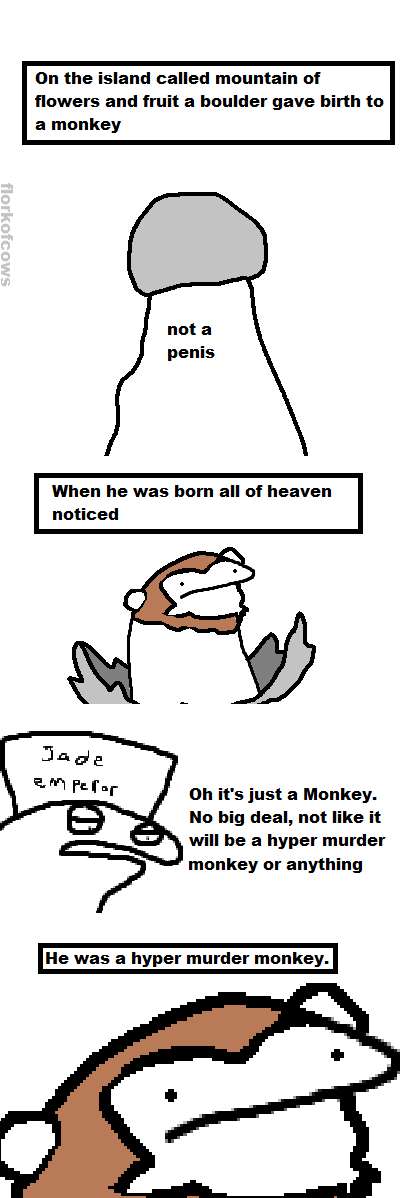
Someone on Tumblr recently asked me if I knew how many monsters, spirits, and humans that Sun Wukong kills throughout Journey to the West (Xiyouji, 西遊記, 1592). But since he’s a “hyper murder monkey” (fig. 1), this is impossible to quantify without an overly extensive survey of the book. However, the task becomes far more manageable if narrowed down to just humans. I know of at least seven instances in chapters 14, 27, 28, 44, 46, and 56. Although I can’t give an exact count, the number slain is over 1,030!

This study is by no means exhaustive. I’ve surely missed a few examples in the latter half of the book. But I’ll update this piece in the future if anything else pops up.

Fig. 1 – The story of the hyper murder monkey by @FlorkOfCows (larger version).

I. Chapter 14

  • Six robbers

The first instance happens when Sun and his master are accosted by six robbers shortly after the immortal is released from under Five Elements Mountain:

Master and disciple had traveled for some time when suddenly six men jumped out from the side of the road with much clamor, all holding long spears and short swords, sharp blades and strong bows. “Stop, monk!” they cried. “Leave your horse and drop your bag at once, and we’ll let you pass on alive!” Tripitaka was so terrified that his soul left him and his spirit fled; he fell from his horse, unable to utter a word. But Pilgrim lifted him up, saying, “Don’t be alarmed, Master. It’s nothing really, just some people coming to give us clothes and a travel allowance!” “Wukong,” said Tripitaka, “you must be a little hard of hearing! They told us to leave our bag and our horse, and you want to ask them for clothes and a travel allowance?” “You just stay here and watch our belongings,” said Pilgrim, “and let old Monkey confront them. We’ll see what happens.” Tripitaka said, “Even a good punch is no match for a pair of fists, and two fists can’t cope with four hands! There are six big fellows over there, and you are such a tiny person. How can you have the nerve to confront them?”

As he always had been audacious, Pilgrim did not wait for further discussion. He walked forward with arms folded and saluted the six men, saying, “Sirs, for what reason are you blocking the path of this poor monk?” “We are kings of the highway,” said the men, “philanthropic mountain lords. Our fame has long been known, though you seem to be ignorant of it. Leave your belongings at once, and you will be allowed to pass. If you but utter half a no, you’ll be chopped to pieces!” “I have been also a great hereditary king and a mountain lord for centuries,” said Pilgrim, “but I have yet to learn of your illustrious names.” “So you really don’t know!” one of them said. “Let’s tell you then: one of us is named Eye That Sees and Delights; another, Ear That Hears and Rages; another Nose That Smells and Loves; another, Tongue That Tastes and Desires; another, Mind That Perceives and Covets; and another, Body That Bears and Suffers.” “You are nothing but six hairy brigands,” said Wukong laughing, “who have failed to recognize in me a person who has left the family, your proper master. How dare you bar my way? Bring out the treasures you have stolen so that you and I can divide them into seven portions. I’ll spare you then!” Hearing this, the robbers all reacted with rage and amusement, covetousness and fear, desire and anxiety. They rushed forward crying, “You reckless monk! You haven’t a thing to offer us, and yet you want us to share our loot with you!” Wielding spears and swords, they surrounded Pilgrim and hacked away at his head seventy or eighty times. Pilgrim stood in their midst and behaved as if nothing were happening.

What a monk!” said one of the robbers. “He really does have a hard head!” “Passably so!” said Pilgrim, laughing. “But your hands must be getting tired from all that exercise; it’s about time for old Monkey to take out his needle for a little entertainment.” “This monk must be an acupuncture man in disguise,” said the robber. “We’re not sick! What’s all this about using a needle?” Pilgrim reached into his ear and took out a tiny embroidery needle; one wave of it in the wind and it became an iron rod with the thickness of a rice bowl. He held it in his hands, saying, “Don’t run! Let old Monkey try his hand on you with this rod!” The six robbers fled in all directions, but with great strides he caught up with them and rounded all of them up. He beat every one of them to death, stripped them of their clothes, and seized their valuables. Then Pilgrim came back smiling broadly and said, “You may proceed now, Master. Those robbers have been exterminated by old Monkey” (Wu & Yu, vol. 1, pp 314-315).

This ends with Tripitaka becoming angry and exiling Monkey. The cleric later welcomes him back, only to rein in his disciple’s unruly behavior with the heaven-sent golden headband (Wu & Yu, 2012, vol. 1, pp. 315-317 and 318-320). This becomes a reoccurring theme (see below).

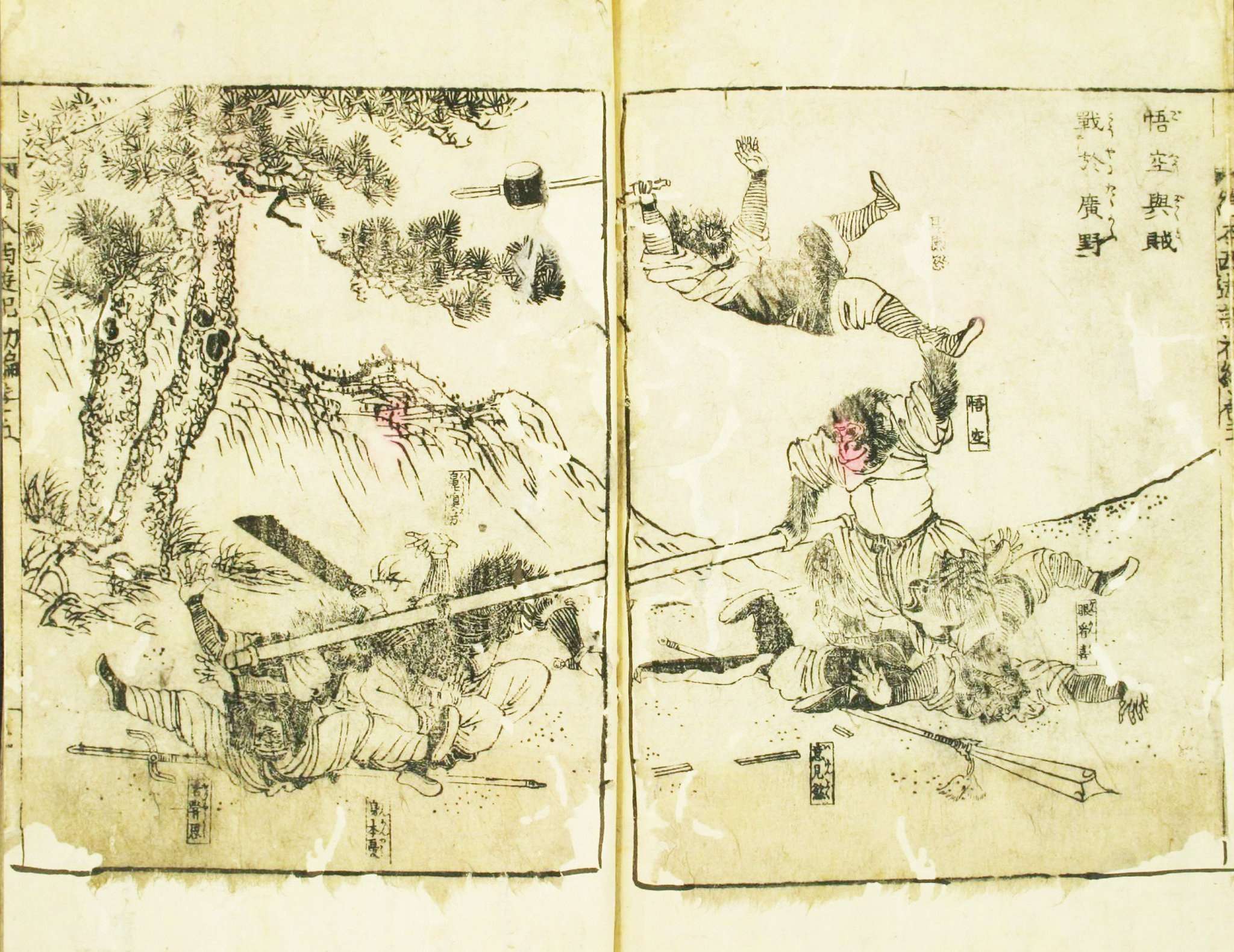
The six murders (fig. 2) are allegories for defeating the desires of the eyes, ears, nose, tongue, mind, and body that hinder one’s spiritual progression. [1] This is explained by Monkey in chapter 43 (Wu & Yu, 2012, vol. 2, p. 254).

Fig. 2 – A woodblock print depicting Sun killing the six bandits (larger version). It comes from The Illustrated Journey to the West (Ehon Saiyuki, 繪本西遊記), a 19th-century Japanese translation.

II. Chapter 27

  • Unknown

The second is alluded to during the White Bone Spirit episode. In her attempts to eat the monk, the wily skeleton demon takes on the guises of a beautiful girl, her elderly mother, and her elderly father in turn. But each time Sun attacks her with his staff, she leaves a fake corpse in her wake, [2] making it seem like the immortal has murdered yet another person. This naturally upsets Tripitaka, but Monkey explains that evil spirits commonly disguise themselves as something welcoming in order to catch and eat humans. He uses himself as an example, claiming to have done the same as a young monster:

“Master,” said Pilgrim with a laugh, “how could you know about this? When I was a monster back at the Water-Curtain Cave, I would act like this if I wanted to eat human flesh. I would change myself into gold or silver, a lonely building, a harmless drunk, or a beautiful woman. Anyone feebleminded enough to be attracted by me I would lure back to the cave. There I would enjoy him as I pleased, by steaming or boiling. If I couldn’t finish him off in one meal, I would dry the leftovers in the sun to keep for rainy days. Master, if I had returned a little later, you would have fallen into her trap and been harmed by her.” That Tang Monk, however, simply refused to believe these words; he kept saying instead that the woman was a good person (Wu & Yu, vol. 2, p. 20).

In the end, the cleric isn’t convinced that Sun didn’t kill an entire family, and so he punishes him with the band-tightening spell before once again banishing him from the group (Wu & Yu, 2012, vol. 2, pp. 26-28).

I know some online commentators believe that Monkey lies here about eating people. I’ll leave it up to the reader to make their own decision. But even if his claims are true, there is no way of quantifying the number eaten.

III. Chapter 28

  • 1,000-plus hunters

The third happens shortly after Sun’s exile. Upon returning to the Mountain of Flowers and Fruit, he learns that more than half of his 47,000 monkey subjects had been killed centuries ago in a great fire set by Erlang, and then half of the survivors later fled elsewhere due to a lack of food. In addition, half of those who remained were killed and eaten or captured for entertainment by a band of over 1,000 human hunters who recently came to inhabit the mountain. Hearing this greatly enrages the Monkey King. He thereafter instructs his subjects to gather piles of small rocks for a magical wind attack (Wu & Yu, vol. 2, pp. 31-32):

Making the magic sign with his fingers and reciting a spell, he drew in a breath facing the southwest and blew it out. At once a violent wind arose. Marvelous wind!

It threw up dust and scattered dirt;
It toppled trees and cut down forests.
The ocean waves rose like mountains;
They crashed fold upon fold on the shore.
The cosmos grew dim and darkened;
The sun and the moon lost their light.
The pine trees, once shaken, roared like tigers;
The bamboos, hit abruptly, sang like dragons.
All Heaven’s pores let loose their angry breaths
As rocks and sand flew, hurting one and all.

The Great Sage called up this mighty wind that blew up and scattered those rock pieces in every direction. Pity those thousand-odd (qianyu, 千餘) hunters and horses! This was what happened to every one of them:

The rocks broke their dark heads to pieces;
Flying sand hurt all the winged horses.
Lords and nobles confounded before the peak,
Blood stained like cinnabar the earth.
Fathers and sons could not go home.
Could fine men to their houses return?
Corpses fell to the dust and lay on the mountain,
While rouged ladies at home waited.

The poem says:

Men killed, horses dead—how could they go home?
Lost, lonely souls floundered like tangled hemp.
Pity those strong and virile fighting men,
Whose blood, both good and bad, did stain the sand!

Lowering the direction of his cloud, the Great Sage clapped his hands and roared with laughter, saying, “Lucky! Lucky! Since I made submission to the Tang Monk and became a priest, he has been giving me this advice:

‘Do good a thousand days,
But the good is still insufficient;
Do evil for one day,
And that evil is already excessive.’

Some truth indeed! When I followed him and killed a few monsters, he would blame me for perpetrating violence. Today I came home and it was the merest trifle to finish off all these hunters.”

He then shouted, “Little ones, come out!” When those monkeys saw that the violent wind had passed and heard the Great Sage calling, they all jumped out. “Go down to the south side of the mountain,” said the Great Sage, “and strip the dead hunters of their clothes. Bring them back home, wash away the bloodstains, and you all can wear them to ward off the cold. The corpses you can push into the deep mountain lake over there. Pull back here also the horses that are killed; their hides can be used to make boots, and their meat can be cured for us to enjoy slowly. Gather up the bows and arrows, the swords and spears, and you can use them for military drills again. And finally, bring me those banners of miscellaneous colors; I have use for them” (Wu & Yu, vol. 2, pp 33-34).

This is by far the largest number of humans killed in one go by the hyper murder monkey.

IV. Chapter 44

  • Two Daoists

The fourth happens shortly after the pilgrims arrive in the Cart-Slow Kingdom. Sun is appalled to learn that three self-proclaimed immortals have convinced the region’s monarch to not only destroy all Buddhist institutions but also to enslave the clerics to the Daoists. His initial response is to play a joke on two cocky Daoist overseers by convincing them (under the guise of an aged coreligionist) that he has a relative among the 500 monks who should be set free. But when they ask which one, our hero claims all of them to be his kin (Wu & Yu, 2012, vol. 2, pp. 269-275):

The Daoists said, “You must be a little crazy, for all at once you are babbling! These monks happen to be gifts from the king. If we want to release even one or two of them, we will have to go first before our masters to report that they are ill. Then, we have to submit a death certificate before we can consider the matter closed. How could you ask us to release them all? Nonsense! Nonsense! Why, not to speak of the fact that we would be left without servants in our household, but even the court might be offended. The king might send some officials to look into the work here or he himself might come to investigate. How could we dare let them go?” “You won’t release them?” said Pilgrim. “No, we won’t!” said the Daoists. Pilgrim asked them three times and his anger flared up. Whipping out his iron rod from his ear, he squeezed it once in the wind and it had the thickness of a rice bowl. He tested it with his hand before slamming it down on the Daoists’ heads. How pitiful! This one blow made

Their heads crack, their blood squirts, their bodies sink low;
Their skin split, their necks snap, their brains outflow! (Wu & Yu, vol. 2, p. 275).

V. Chapter 46

  • One civil official

The fifth happens during a magical contest of torture against one of the three supposed immortals. Monkey easily survives a bath in boiling oil but fakes his death in order to play a trick on Zhu Bajie. The officer in charge of the execution reports the development to the monarch, leading Tripitaka to eulogize and present offerings to his disciple’s spirit. But once Zhu hijacks the proceedings by calling Sun a Bimawen, [3] our hero erupts from the caldron to chastise his religious brother. Fearing possible punishment for seemingly lying to the king, the aforementioned official claims the primate is instead a ghost (Wu & Yu, 2012, vol. 3, pp. 310-312):

Maddened by what he heard, Pilgrim leaped out of the cauldron, dried himself from the oil, and threw on his clothes. Dragging that officer over, he whipped out his iron rod and one blow on the head reduced him to a meat patty. “What ghost is this who’s manifesting itself?” he huffed (Wu & Yu, 2012, vol. 2, pp. 312-313).

VI. Chapter 56 – Part 1

  • Two bandit chiefs

The last two instances that I know of take place shortly after the scorpion spirit episode. The sixth follows a similar pattern to chapter 14: Tripitaka is confronted by bandits → He gets scared and falls off the horse → The bandits demand money and the horse → Sun intervenes → His banter enrages them and they hit and stab at his adamantine pate to no avail → They comment on his hard head → Monkey pulls out his iron staff, referring to it as a needle → The bandits infer that he works in a certain profession and claim to have no use for the needle → He enlarges the weapon and eventually beats them to death. [4] The only difference here is that Sun first challenges the men to lift his staff:

… Sticking the rod into the ground, Pilgrim said to them, “If any of you can pick it up, it’s yours.” The two bandit chiefs at once went forward to try to grab it, but alas, it was as if dragonflies were attempting to shake a stone pillar. They could not even budge it half a whit! This rod, you see, happened to be the compliant golden-hooped rod, which tipped the scale in Heaven at thirteen thousand, five hundred [catties]. How could those bandits have knowledge of this? The Great Sage walked forward and picked up the rod with no effort at all. Assuming the style of the Python Rearing its Body, he pointed at the bandits and said, “Your luck’s running out, for you have met old Monkey!” One of the bandit chiefs approached him and gave him another fifty or sixty blows. “Your hands must be getting tired!” chuckled Pilgrim. “Let old Monkey give you one stroke of the rod. I won’t do it for real either!” Look at him! One wave of the rod and it grew to about seventy feet, its circumference almost as big as a well. He banged it on the bandit, and he at once fell to the ground: his lips hugging the earth, he could not make another sound.

The other bandit chiefs shouted, “This baldy is so audacious! He has no travel money, but he has killed one of us instead!” “Don’t fret! Don’t fret!” said Pilgrim, laughing. “I’ll hit every one of you, just to make sure that all of you will be wiped out!” With another bang he beat to death the other bandit chief Those small thieves were so terrified that they abandoned their weapons and fled for their lives in all directions (Wu & Yu, vol. 3, pp. 80-81).

VII. Chapter 56 – Part 2

  • One unfilial son
  • twenty-ish bandits

The seventh happens sometime after one of the surviving bandits, the son of an elderly couple surnamed Yang (楊), discovers that his parents are feeding and sheltering the pilgrims for the night. He and his brothers-in-arms make plans to attack the monks after eating dinner and sharpening their weapons, but old Mr. Yang alerts them, giving Tripitaka and his disciples ample time to escape:

Every bandit was darting forward like an arrow, and by sunrise, they caught sight of the Tang Monk. When the elder heard shouts behind him, he turned to look and discovered a band of some thirty men rushing toward him, all armed with knives and spears. “Oh, disciples,” he cried, “the brigand troops are catching up with us. What shall we do?” “Relax, relax!” said Pilgrim. “Old Monkey will go finish them off!” “Wukong,” said Tripitaka as he stopped his horse, “you must not hurt these people. Just frighten them away.” Unwilling, of course, to listen to his master, Pilgrim turned quickly to face his pursuers, saying, “Where are you going, sirs?” “You nasty baldie!” cried the thieves. “Give us back the lives of our great kings!”

As they encircled Pilgrim, the bandits lifted their spears and knives to stab and hack away madly. The Great Sage gave one wave of his rod and it had the thickness of a bowl; with it, he fought until those bandits dropped like stars and dispersed like clouds. Those he bumped into died at once, those he caught hold of perished immediately, those he tapped had their bones broken, and those he brushed against had their skins torn. The few smart ones managed to escape, but the rest of the dumb ones all went to see King Yama!

When Tripitaka saw that many men had fallen, he was so aghast that he turned and galloped toward the West, with Zhu Eight Rules and Sha Monk hard on the horse’s heels. Pilgrim pulled over one of the wounded bandits and asked, “Which is the son of old Yang?” “Father,” groaned the thief, “the one in yellow.” Pilgrim went forward to pick up a knife and beheaded the one in yellow. Holding the bloody head in his hand, he retrieved his iron rod and, in great strides, caught up with the Tang Monk. As he arrived before the horse, he raised the head and said, “Master, this is the rebellious son of old Yang, and he’s been beheaded by old Monkey.” [fig. 3] Paling with fright, Tripitaka fell down from the horse, crying, “Wretched ape! You’ve scared me to death! Take it away! Take it away!” Eight Rules went forward and kicked the head to the side of the road, where he used the muckrake to bury it (Wu & Yu, 2012, vol. 3, pp. 88-89).

The quote is clear that not all 30 bandits are killed. Apart from Yang the bandit, I think 20(-ish) is a conservative estimate based on the wording.

And just like chapters 14 and 27, this episode ends with Tripitaka punishing his disciple with the band-tightening spell before exiling him from the group (Wu & Yu, 2012, vol. 2, pp. 89-90).

Fig. 3 – Monkey presenting the head of Yang the bandit to his master. This screenshot comes from episode 10 of OSP’s retelling of Journey to the West (larger version).

VIII. Conclusion

To my knowledge, the Monkey King kills over 1,030 humans in Journey to the West. This includes six allegorical robbers in chapter 14, an unknown amount alluded to in chapter 27, over 1,000 hunters in chapter 28, two Daoists in chapter 44, one civil official in chapter 46, and two bandits chiefs, one unfilial son, and maybe 20-ish bandits in chapter 56. I may have missed a few instances in the latter half of the novel, so please don’t look at the above total as complete.


Update: 01-17-2023

I previously mentioned an instance in chapter 27 where Monkey admits to eating humans in his youth, something that some online commentators believe to be a fib. Well, a Tumblr user, who goes by both @abitfiendish and @localcactushugger, reminded me that dialogue in chapter 39 further calls this into question.

After a pill of immortal elixir fails to revive a long-dead king, Tripitaka suggests mouth-to-mouth necessitation is needed to complete the resurrection process. Sun is ultimately chosen for this job since he had apparently never eaten meat:

Eight Rules walked forward and was about to do this when he was stopped by Tripitaka. “You can’t do it,” he said. “Wukong still should take over.” That elder indeed had presence of mind, for Zhu Eight Rules, you see, had been a cannibal since his youth, and his breath was unclean. Pilgrim, on the other hand, had practiced self-cultivation since his birth, the food sustaining him being various fruits and nuts, and thus his breath was pure. The Great Sage, therefore, went forward and clamped his thundergod beak to the lips of the king: a mighty breath was blown through his throat … (Wu & Yu, 2012, vol. 2, pp. 195-196).

But it should be remembered that Journey to the West is crammed full of inconsistencies (likely born from the novel coalescing from different oral tales). For example, this chapter shows that all it takes to revive a dead person is an elixir pill and mouth-to-mouth. However, in chapter 97, Monkey has to physically retrieve the soul of a recently deceased householder from the underworld in order to resurrect him (see the material below figure 3 here).

Again, I’ll leave it up to the reader to make their own decision.


Update: 08-15-24

I recently finished rereading JTTW for the umpteenth time, and I am happy to report that I didn’t miss any mentions of killing humans in the latter part of the book. The above article represents the entire work.

Note:

1) Things that arouse the eyes (sights), ears (sounds), nose (smells), tongue (tastes), and mind and body (wants and desires).

2) This is related to an ancient Daoist concept called “Release by means of a corpse” (Shijie, 尸解). Stories as far back as the Han describe immortals leaving behind a fake corpse (sometimes a magically disguised object) while they ascended in secret to heaven (Kirkland, 2008).

3) This plays on the homophonous relationship between Bimawen (避馬瘟, lit: “avoid the horse plague”), an ancient belief that female monkeys placed in horse stables could ward off equine sickness, and Bimawen (弼馬溫, “To assist horse temperament”), Sun’s former station as keeper of the heavenly horses (see here).

See Wu & Yu, 2012, vol. 3, pp. 78-81.

Source:

Kirkland, R. (2008). Shijie In F. Pregadio (Ed.), The Encyclopedia of Taoism (Vol. 2) (pp. 896-897). London [u.a.: Routledge].

Wu, C., & Yu, A. C. (2012). The Journey to the West (Vols. 1-4) (Rev. ed.). Chicago, Illinois: University of Chicago Press.

My Great Sage Monkey King Statue from Thailand

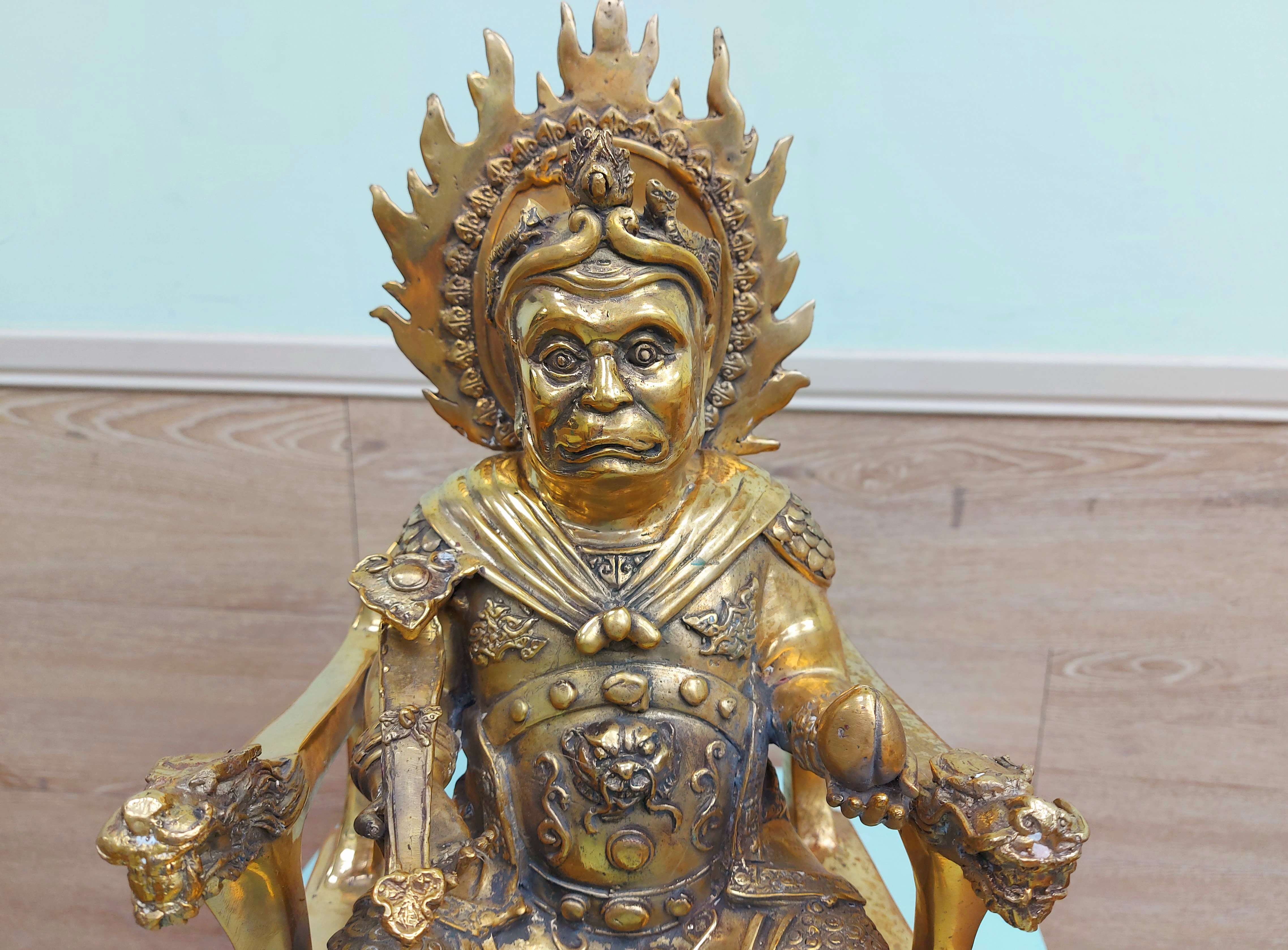
I learned in April via a private Thai Monkey King Facebook group that a limited run of colored resin, plain brass, painted brass, and gold-plated brass idols were to be made to raise funds to buy land on which a Great Sage temple would be built in Lam Narai, Lopburi province, Thailand. I procured the services of a local who contacted the religious organization building the temple, “The Equaling Heaven Academy (Altar) of Lam Narai” (Thai: Săm-nák chĕe tiian dtŭua lam-naa-raai, สำนักฉีเทียนตั๋วลำนารายณ์; Ch: Qitian tan Nannalai, 齊天壇南那來), and reserved a statue for me. Once the idols were cast (over several months), they shipped mine and it arrived on August 31st, 2022. Here, I’d like to briefly describe and compare the idol to other statues that I’ve seen or own.

I. Specs

Material: Brass

Length: 9.8 in (24.9 cm)

Width: 11.31 in (28.75 cm)

Height: 16.33 in (41.5 cm)

Weight: Around 24.25 lbs. (11 kg)

II. Pictures

Fig. 1 – The front (larger version).

Fig. 2 – The side (larger version).

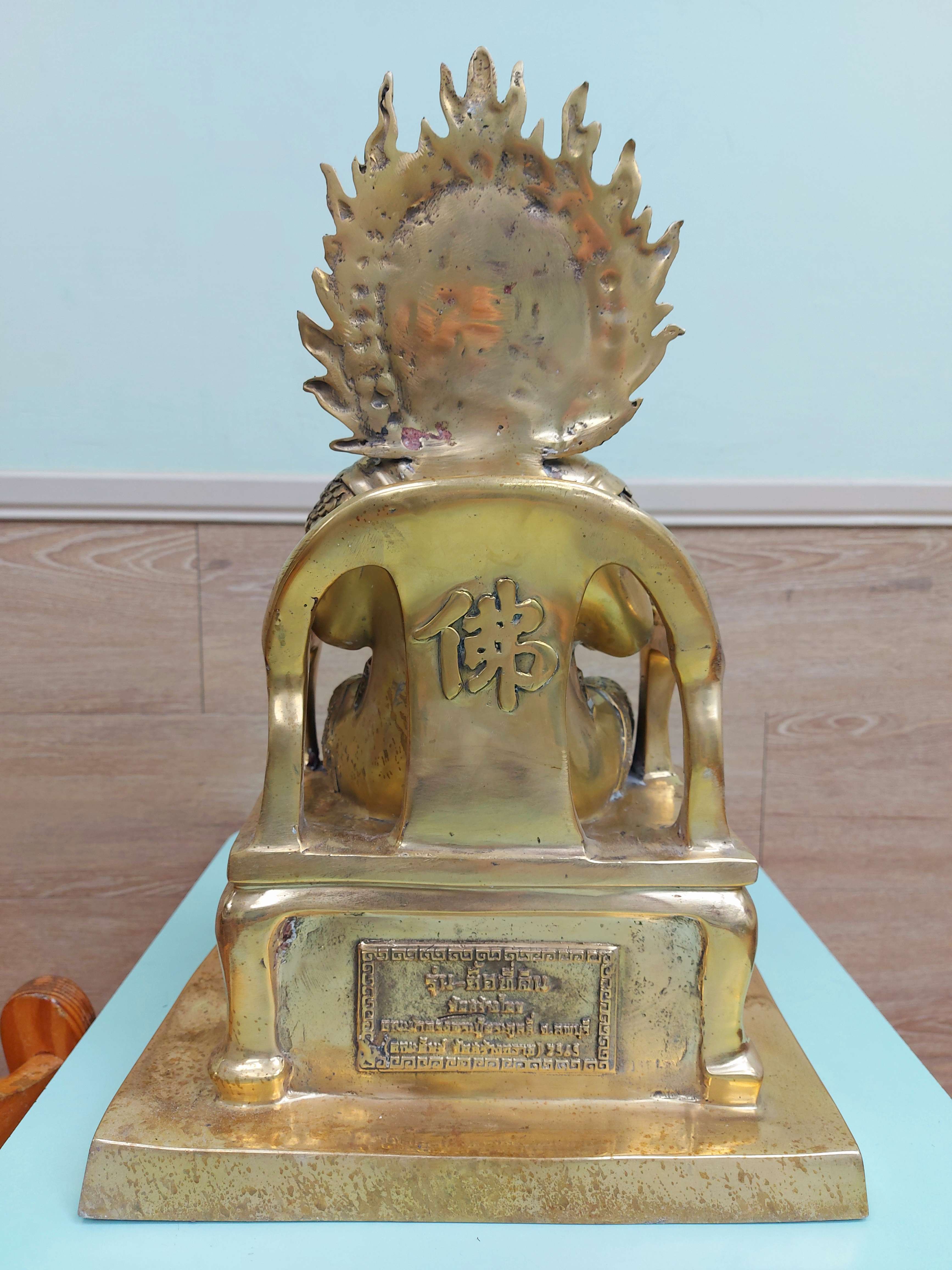
Fig. 3 – The back (larger version).

Fig. 4 – Detail of the front’s upper half (larger version).

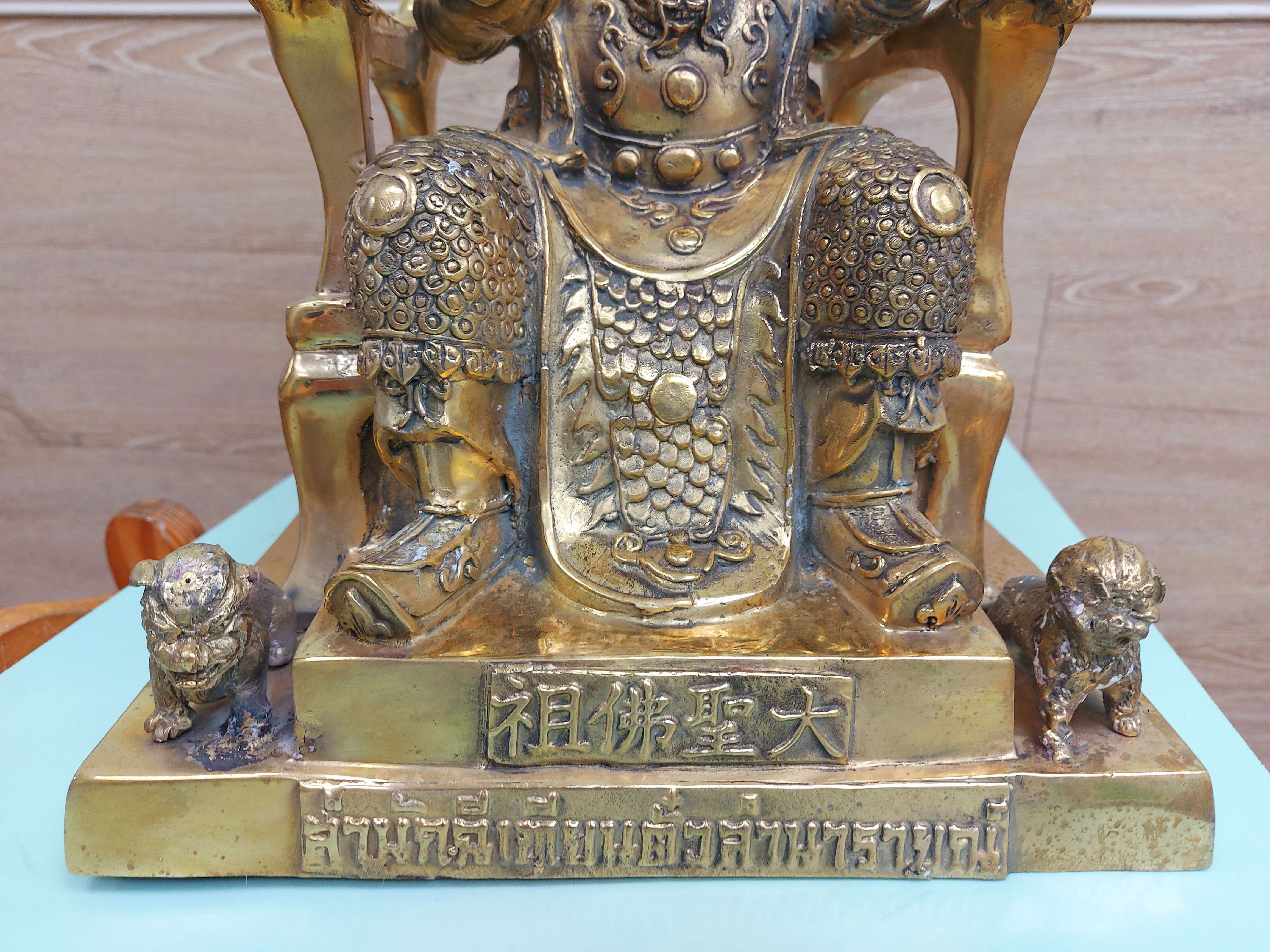
Fig. 5 – Detail of the front’s lower half (larger version).

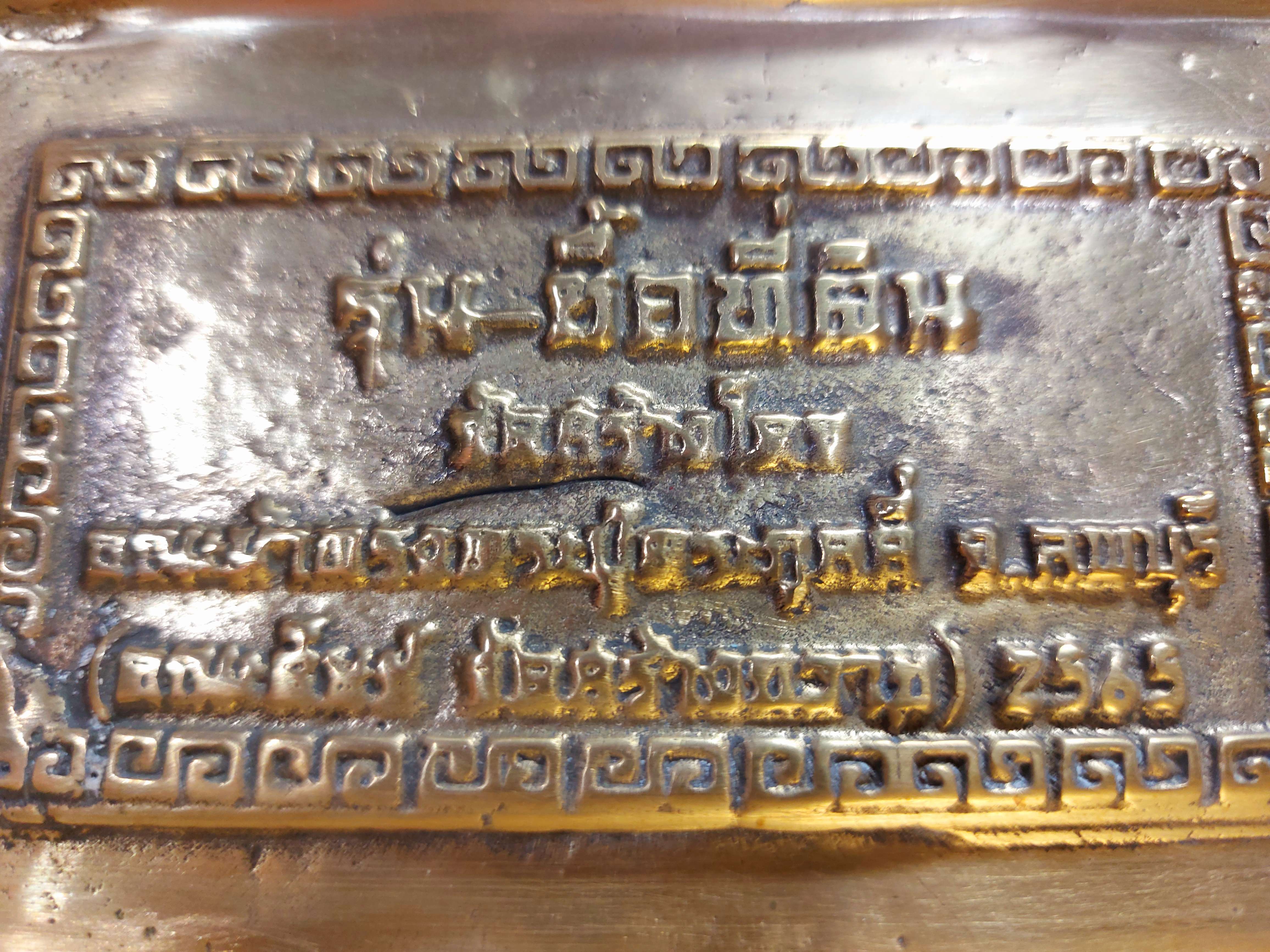
Fig. 6 – Detail of the placard on the back (larger version).

III. Discussion

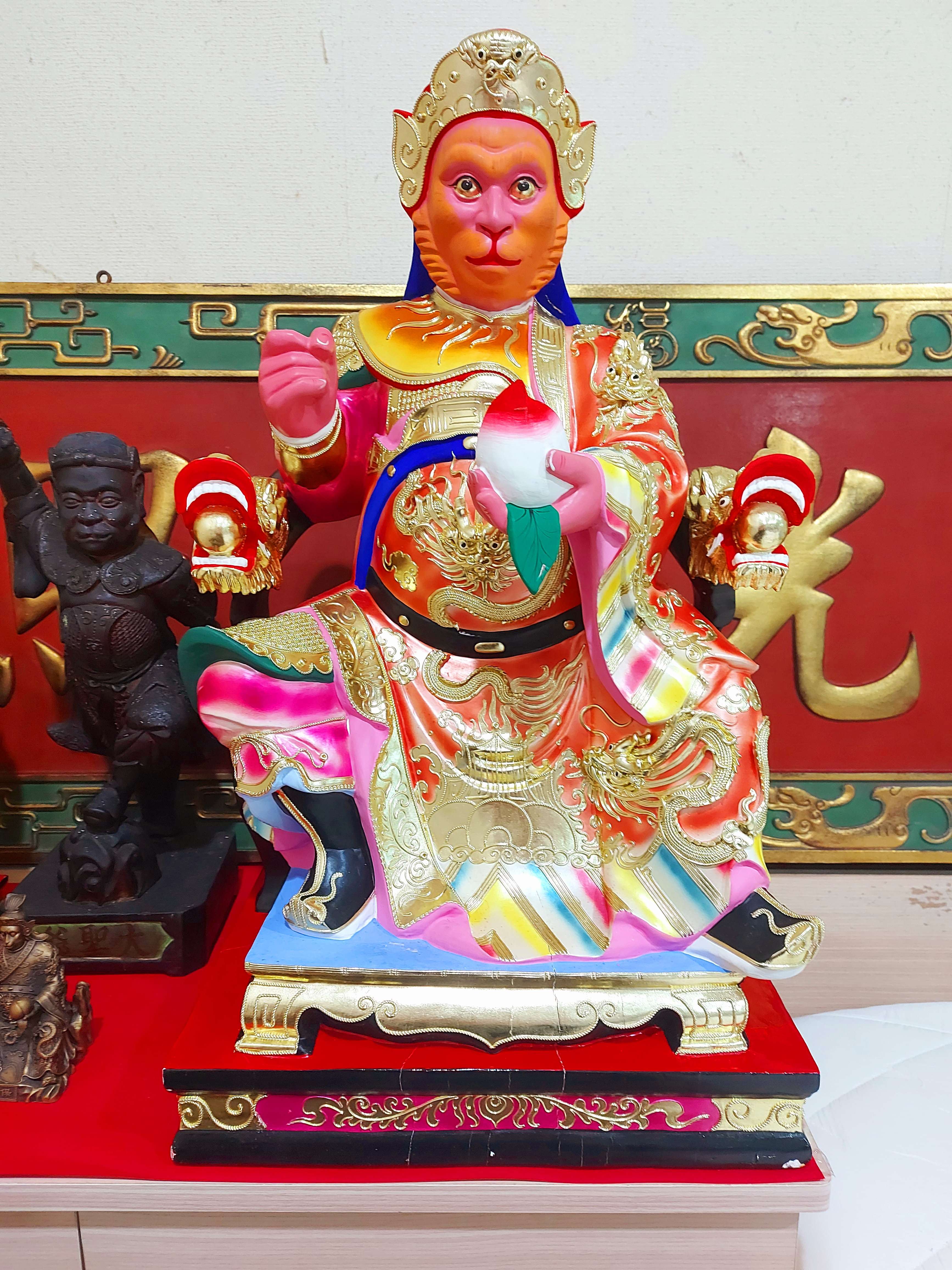
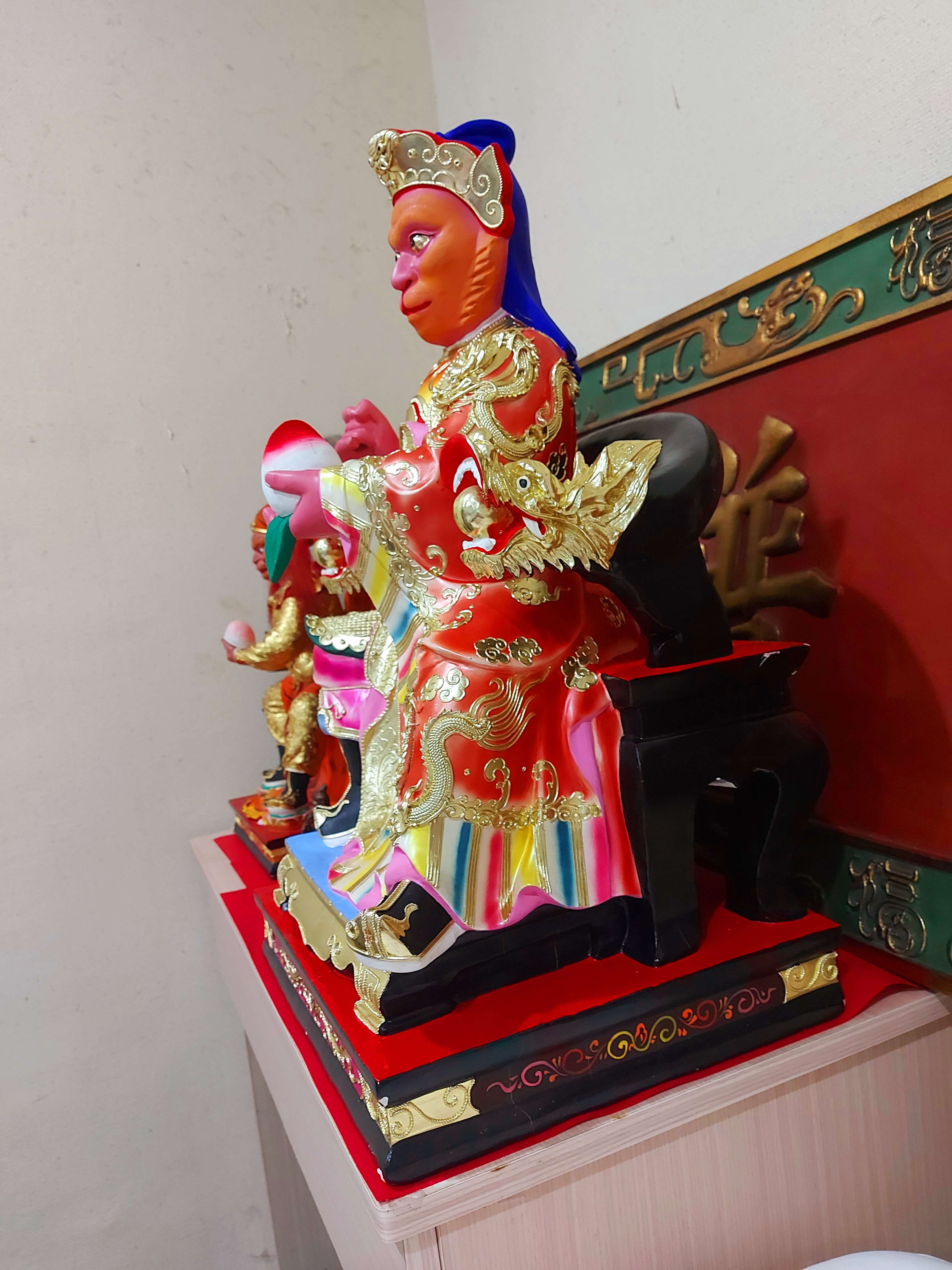
A fiery halo embellished with an inner circle of stylized ruyi-pattern mushrooms sits behind the Monkey King’s head. This shares similarities with a Monkey Buddha statue from a temple in Fujian province, China (fig. 7), the home of his cult. His bald head is adorned with the famous “curlicue-style” golden headband topped with a flaming Cintāmaṇi jewel, as well as a pair of slithering dragons wrapping around the back and sides of his crown. His visage is intense, with eyes opened wide and the corners of his mouth drawn downwards, forming a subtle “w” shape. A line marking the boundary of his forehead, the sides of his face, and just above his chin is slightly raised, giving the impression that he’s wearing a covering over his head and neck. This represents the pink facial patch, either covering the whole face or just a mask around the eyes, that often appears on gilded Monkey King statues in Thailand (fig. 8).

Fig. 7 (top) – A stature of Sun Wukong as a Buddha at the Yufeng Equaling Heaven Palatial Ancestor Hall of Pingshan (Yufeng Qitian fu Pingshan zudian, 玉封齐天府屏山祖殿) in Fuzhou City, Fujian (larger version). Picture by Saie Surendra of Hanumovies.com. Fig. 8 (bottom) – An example of a golden Thai Monkey statue with a pink patch on the face (larger version). Picture originally posted here.

Both arms are bent at the elbow and held out palm up towards the viewer. His left hand holds an immortal peach, while the right cups the handle of a ruyi-pattern scepter resting on his shoulder. The peach is a common element of his iconography all around the world (fig. 9 & 10); however, the scepter imagery seems to be more popular in Southeast Asia. See, for instance, the trinity from the syncretic “Three Teachings” cult of Malaysia and Singapore. Monkey holds the ruyi-scepter in the same manner (fig. 11).

Fig. 9 – A Taiwanese Monkey statue holding an immortal peach in the left hand (larger version). Fig. 10 – A Singaporean statue with an immortal peach in the left hand (larger version). Both are in my personal collection. See also figure twelve below. Fig. 11 – The “Three Teachings” trinity of Southeast Asia (larger version). Take note of Monkey’s ruyi-scepter. Picture originally posted here.

He wears a knotted neckerchief over a war coat with scale-pattern armor on his shoulders and the flap of cloth between his legs, a military girdle at his stomach and waist adorned with a dragon face, scale-pattern armored pants, and war boots with blocky, up-turned toes. His clothing and armor are adorned with various ruyi-pattern mushrooms. The Monkey King’s iconography commonly shows him wearing armor (fig. 12).

Fig. 12 – Detail of a Taiwanese Great Sage statue wearing armor (larger version). Take note of the armored Monkey statue behind him. Also notice that, like figures nine and ten, the lead idol is holding a peach in the left hand. All statues are in my personal collection.

He sits in a traditional dragon chair. More kingly depictions of the Great Sage commonly portray him seated (fig. 12 & 13). But this element is rare compared to the number of statues showing him standing (refer back to fig. 12; see also my other statues here).

Fig. 12 – The idol from figure nine is also shown seated in a dragon chair (larger version). Fig. 13 – The statue from figure ten is seated in a similar chair but replaces the dragon elements with lotuses (larger version).

Infront of the chair is a step on which his boots rest. It’s labeled in Chinese “大聖佛祖” (Dasheng fozu), or “Great Sage Buddha Patriarch“. I show in this article that the phrase is sometimes transliterated into Thai as “ต้าเชิ่งโฝจู่” (Dtâa chêrng fŏh jòo) and “ไต้เสี่ยฮุกโจ้ว” (Dtâi sìia húk-jôh, or just “Tai Sia Huk Chou/Zhou/Jow”). Both the chair and step sit on a rectangular base adorned with simplistic stone lions to his left and right. I haven’t seen lions in any of his other imagery. The front of the base is labeled:

สำนักฉีเทียนตั๋วลำนารายณ์ (Thai: Săm-nák chĕe tiian dtŭua lam-naa-raai)

“The Equaling Heaven Academy (Altar) of Lam Narai”.

The reverse of the backrest features a large symbol for “Buddha” (Fo, 佛), and below this (between the back legs) is a cloud and thunder-pattern lined placard reading:

รุ่น-ซื้อที่ดิน – จัดสร้างโดย คณะม้าทรงพระบู๊ตระกลูหลี่ จลพบุรี (คณะศิษย์จัดสร้างถวาย) 2565 (Thai: rûn séu têe din jàt sâang doi ká-ná máa song prá bóo ต rá gloo-lèe jà-lóp bù-ree (ká-ná sìt jàt sâang tà-wăai))

“The Young Generation Buys Land – Created by the Royal Horse Riding Troupe Raklu Li, Lopburi Province (a group of students made an offering), 2022”. [1]

This Thai statue is a welcome addition to my ever-growing collection of Great Sage idols. It’s certainly the biggest metal Monkey statue that I’ve found so far.

Note:

1. Thank you to “Nattida” for transcribing and translating the Thai text for me.


Interesting Facts about the Monkey King

Last updated: 08-28-2022

I recently posted a list of facts about Sun Wukong (孫悟空) to reddit. I am presenting an elongated version of it here, which serves as a summation of everything that I’ve learned over the years. It is by no means comprehensive. I’ll add more facts in the future as I learn of them. Enjoy.

Current count: 108

  1. He was likely influenced by the Hindu monkey god Hanuman (Ch: Ha nu man, 哈奴曼) in different waves, one possibly from the north (via Tibet) and another from the south (via Southeast Asia). But the parallels are most apparent from the standard 1592 edition of JTTW, suggesting that the author-compiler had access to some form of the Indian epic Rāmāyana (7th-c. BCE to 3rd-c. CE). The novel even includes material from the epic Mahābhārata (4th-c. BCE to 4th-c. CE).
  2. In my opinion, however, the greatest influence on his 1592 persona is a white ape antagonist from a Tang-era story. Similarities include: 1) both are supernatural primates possessed of human speech; 2) one thousand-year-old practitioners of longevity arts; 3) masters of Daoist magic with the ability to fly and change their appearance; 4) warriors capable of single-handedly defeating an army; 5) have a fondness for armed martial arts; 6) have an iron-hard, nigh-invulnerable body immune to most efforts to harm them; 7) have eyes that flash like lightning; 8) live in verdant mountain paradises (like Flower Fruit Mountain); and 9) reside in caves with stone furniture (like the Water Curtain Cave).
  3. He has the second longest association with the JTTW story cycle, appearing as the “Monkey Pilgrim” (Hou xingzhe, 猴行者) circa 1000 (or before). Sha Wujing’s earliest antecedent appeared during the 8th-century, while Zhu Bajie didn’t appear until the 14th-century.
  4. The oldest published mention of the Monkey Pilgrim is a eulogy appearing in a tale from Zhang Shinan’s (張世南) Memoirs of a Traveling Official (Youhuan jiwen, 遊宦紀聞, 13th-century). One scholar dates the story to around 1127.
  5. The oldest depictions of this character (late-11th to late-13th-century) appear in Buddhist cave art along the Silk Road in Northern China. He is almost always portrayed in a scene worshiping the Bodhisattva Guanyin.
  6. A 13th-century version of JTTW describes the Monkey Pilgrim as a white-clad scholar who is an ancient immortal from the very beginning of the tale. He was beaten with an iron rod as a young immortal after he stole magic peaches and was subsequently banished to the Mountain of Flowers and Fruit. He actively searches out the monk to protect him as the cleric’s two previous incarnations were eaten by a monster (Sha Wujing’s antecedent) in the past.

  7. This immortal fights with two staves (at different times), a golden-ringed monk’s staff and an iron staff (both borrowed from heaven). The monk’s staff can create destructive blasts of light, as well as transform into titanic creatures, including a club-wielding yaksha and an iron dragon. The iron staff isn’t shown to have any special powers. These weapons were later combined by storytellers, the rings from the former being added to the ends of the latter.

  8. He is called the “Monkey King” (Houwang, 猴王) as far back as the 13th-century version. This position is likely based on a jataka tale about the Buddha’s past life as a king of monkeys.
  9. The immortal is bestowed the title “Great Sage Steel Muscles and Iron Bones” (Gangjin tiegu dasheng, 鋼筋鐵骨大聖) at the end of the story by Tang Taizong.
  10. This immortal was heavily influenced by the Buddhist Saint Mulian (目連; Sk: Maudgalyayana).
  11. He was popular even in Korea and appeared in a set of carvings from a 14th-century stone pagoda.
  12. The earliest mention of the name “Sun Wukong” that I’m aware of appears in an early-15th-century zaju play. It depicts the character as a sex-crazed maniac who kidnaps a princess to be his wife, tries to seduce Princess Iron Fan, and later gets erectile disfunction when his golden headband tightens while trying to have sex with a young maiden in the Kingdom of Women.
  13. The dharma name “Wukong” (悟空) was likely influenced by a historical monk of that name who traveled to India during the 8th-century. The name means “Awakened to Emptiness”, thus referencing Buddhist enlightenment. I think the corresponding Sanskrit name would be something like “Bodhiśūnyatā” (but don’t quote me on this).

  14. The surname “Sun” (孫) means “grandson” but is an open reference to husun (猢猻, lit: “grandson of the barbarian”), the Chinese word for “macaque“. It was also a popular surname for supernatural primates in stories associated with the Lingyin Temple (靈隱寺), which also likely influenced the Monkey King.

  15. The 1592 edition of the novel associates the components of Sun (孫 = zi, 子 & xi, 系) (ch. 1 – see section 4.2 here) with the formation of a “holy embryo” (shengtai, 聖胎), an immortal spirit that lives on after the adherent dies.

  16. So taking all of the Buddhist and Daoist references into account, another translation for Sun Wukong would be “Immortal Awakened to Enlightenment”. This is a reference to the Buddho-Daoist philosophy of Zhang Boduan (張伯端, mid- to late-980s-1082), who believed that in order to become a true transcendent (xian, 仙), one had to achieve both the Daoist elixir of immortality and Buddha-nature (i.e. Buddhahood).

  17. The aforementioned zaju play calls him the “Great Sage Reaching Heaven” (Tongtian dasheng, 通天大聖).

  18. Said play also states that he has two sisters and two brothers. The sisters are respectively named the “Venerable Mother of Mount Li” (Lishan laomu, 驪山老母) and “Holy Mother Wuzhiqi” (Wuzhiqi shengmu, 巫支祇聖母). His older brother is called “Great Sage Equaling Heaven” (Qitian dasheng, 齊天大聖) and the younger the “Third Son Shuashua” (Shuashua sanlang, 耍耍三郎).

  19. His story in the 1592 version takes place not in our world but in one modeled after ancient Hindo-Buddhist cosmic geography, which features four island-like continents floating in a great ocean around the four respective faces of a cosmic mountain. And yet the novel was published during a time coinciding with the late Renaissance period in Europe, precisely 49 years after Copernicus suggested that the Earth orbits the sun.
  20. His home, the Mountain of Flowers and Fruit (Huaguo shan, 花果山), is located near the easternmost continent, while China is associated with the southernmost continent. This means that Monkey, within the novel, is not Chinese!
  21. He has had past lives (see the 11-24-20 update here).
  22. He’s not the only figure from world myth born from stone. In fact, “Birth from rock” (T544.1) is a mythic category appearing in Stith Thompson’s Motif-Index of Folk-Literature.

  23. While his stone birth (ch. 1) is likely based on that of Yu the Great (Dayu, 大禹), a legendary King of the Xia dynasty (more on this below), it may ultimately be linked to Tibetan stories of stone-born monkey deities.
  24. He was likely born during the late-Zhou Dynasty (circa 1046-256 BCE).
  25. He serves as a physical manifestation of the “Mind Monkey” (xinyuan, 心猿), a Buddho-Daoist philosophy denoting the disquieted thoughts that keep Man trapped in the illusory world of Saṃsāra (see the material below figure three here). This phrase is also surprisingly associated with sexual desire.
  26. Despite the association above, Monkey shows no interest in sex throughout the entire novel. This may be a response to the highly sexualized Sun Wukong from the zaju play.
  27. The novel also gives him the alchemical title “Squire of Metal/Gold” (Jingong, 金公), a possible “anagrammatic reading of the Chinese graph for lead or qian 鉛, which may be broken up into the two graphs of jin and gong” (Wu & Yu, 2012, vol. 1, p. 532 n. 3). Lead is an ingredient in external alchemy (see the material after figure two here). The title might also be referring to the earthly branch shen (申), which is associated with both metal and monkeys (Wu & Yu, 2012, vol. 1, p. 532 n. 3).
  28. The overall arc of his birth and early life were likely based on that of the historical Buddha to make his tale more familiar to readers. Similarities include: A) supernatural births that split open their respective mothers (Queen Maya vs stone egg); B) producing a radiant splendor in all directions upon their birth; C) being talented students that quickly master concepts taught to them; D) early lives as royals (Indian prince vs king of monkeys); E) shock at the impermanence of life; F) questing for a spiritual solution to said impermanence; and G) finding said solution via spiritual practices (Indic meditation vs Daoist elixir arts).

  29. His “Water Curtain Cave” (Shuilian dong, 水簾洞), the grotto-heaven where he and his people live in the Mountain of Flowers and Fruit, is associated with a different immortal in older religious literature. For instance, the Song-era text Master Ghost Valley’s Numinous Writ of the Essence of Heaven (Guigu zi tiansui lingwen鬼谷子天隨靈文) calls the titular character the “Master of the Waterfall Cave” (Shuilian dong zhu, 水濂洞主). In this case, the source uses a different lian (濂) in place of the lian (簾) associated with Monkey’s cave. But they both mean the same thing: a waterfall hiding a cave mouth (see the 12-11-21 update here). One 17th-century novel influenced by JTTW states that Master Ghost Valley lives in the Water Curtain Cave (Shuilian dong, 水簾洞; i.e. the same as Monkey’s home) with his student, the Warring States strategist Sun Bin (孫臏, d. 316 BCE). This means that two characters surnamed Sun (孫) live there in Chinese literature (see section II here).
  30. Despite modern media portraying him as an adult-sized humanoid character that is sometimes handsome and/or very muscular, the 1592 version describes him as an ugly, bald, and skinny Rhesus macaque that is less than four feet tall. This means that one of the most powerful warriors in the Buddho-Daoist cosmos is the size of a child.
  31. While commonly portrayed as a Daoist immortal, his first master, the Patriarch Subodhi (Xuputi zushi, 須菩提祖師) (ch. 1 & 2), is shown to live in India and have a strong connection to Buddhism, possibly even being a Bodhisattva.
  32. The breathing and energy circulation methods that Monkey uses to achieve immortality (ch. 2) are based on real Daoist elixir practices.
  33. The actual name for his famous 72 Transformations is “Multitude of Terrestrial Killers” (Disha shu, 地煞數), which is based on a popular set of malevolent stellar gods.
  34. This skill not only allows Monkey to transform into whatever he wants but also gives him a store of extra heads and possibly even extra lives like a video game (see section 4.4 # 3 here).
  35. He specifically learns the 72 Transformations (ch. 3) in order to hide from a trio of elemental calamities sent by heaven to punish cultivators for defying their fate and achieving immortality. This is the origin of the “Heavenly Tribulation” (tianjie, 天劫; zhongjie, 重劫) trope from modern Xianxia literature.
  36. But, surprisingly, he is not a true immortal, just long-lived and really hard to kill. The novel refers to him as a “bogus immortal” (yaoxian, 妖仙). This references Zhang Boduan’s aforementioned philosophy where one must obtain both the Daoist elixir (which Monkey did) and Buddha-Nature (which he hadn’t yet achieved) in order to be a true transcendent.
  37. While training under Subodhi (ch. 3), he expressly passes on learning the bureaucratic-style magic rites normally used by earthly priests to request something from heaven because the skills involved won’t result in eternal life. Instead, after achieving immortality, Monkey just commands the gods to do his bidding (see section II here).
  38. He can grow 100,000 feet (30,480 m) tall (ch. 1, 6, 61, and 97). This skill is called the “Method of Modeling Heaven on Earth” (Fatian xiangdi, 法天像地), and it is related to ancient Pre-Qin and Han concepts of astral-geography later used in the construction of imperial Chinese cities.
  39. His magic “immortal breath” (xianqi, 仙氣) can transform his hairs, his staff, and objects not in direct contact with his body into anything he desires. It can also change disembodied souls into “ether” for ease of transport, and evidence suggests that it can even grant some form of immortality.
  40. Monkey has 84,000 hairs on his body, and he can transform them into hundreds of thousands, millions, and even billions of hair clones (see the 03-19-22 update here).
  41. The novel only mentions him learning martial arts in passing (ch. 67 – see section 4.5 here), but one episode (ch. 51) features a battle between Monkey and a demon king in which they use a host of real world fighting techniques that are still known and practiced today.
  42. His favorite style of boxing is “Short Fist” (duanquan, 短拳) (see the 05-02-18 update here).
  43. His skill with the staff is so great that the novel compares it to techniques from two manuals listed among the Seven Military Classics of China (see the 08-07-18 update here).
  44. The bureaucratic mix-up that resulted in his soul being dragged to hell (ch. 3) is based on “mistaken summons” to the underworld and “return-from-death” narratives present in early Chinese “miraculous tales” (Zhiguai xiaoshuo, 志怪小説) (Campany, 1990).
  45. When he looks at his entry in the ledgers of hell, he learns that: 1) his soul number is “1,350”; 2) his real name is “Heaven-Born Stone Monkey” (Tianchan shihou, 天產石猴); and 3) he was fated to have a “good end” at the ripe old age of 342. This refers to a person’s pre-allotted lifespan (ming, 命) (Campany, 2005; Campany & Ge, 2002, pp. 47-52).
  46. The distance that his cloud-somersault can travel, 108,000 li (33,554 mi / 54,000 km), is based on a metaphor for instantaneous enlightenment. It comes from the Platform Sutra of the Sixth Chan Patriarch Huineng (惠能). The Chan Master explains that the common trope of the Buddha’s paradise being separated from the world of man by 108,000 li is based on a combination of the “Ten Evils” (Shi’e, 十惡) and “Eight Wrongs” (Baxie, 八邪) of Buddhism. Those who rid themselves of these spiritual flaws will achieve enlightenment and thus arrive instantly at the Buddha’s paradise.
  47. The initial depiction of his magic staff as a great iron pillar kept in the dragon kingdom treasury (ch. 3) is based on a metal column that the immortal Xu Xun (許遜) chained a demonic dragon to and then imprisoned in the aquatic realm in Chinese mythology.
  48. It’s a common misconception that his staff weighed down the Milky Way galaxy. This is based on a mistranslation. The W. J. F. Jenner edition claims that the weapon anchored said star cluster. However, the original Chinese states that it was used as a means to measure and set the depths of the Heavenly River (Tianhe, 天河; a.k.a. Milky Way).

  49. The weight of his staff is likely an embellishment on the weight of a heavy stone block lifted by the bandit-hero Wu Song (武松) in the Water Margin (Shuihu zhuan, 水滸傳, c. 1400). This episode and the JTTW episode where Monkey acquires his staff both involve a hero (Wu Song vs Sun Wukong) asking someone (a friend vs the Dragon King) to take them to a seemingly immovable object (stone block vs iron pillar). They then adjust their clothing before lifting the object with ease. Most importantly, the Chinese characters for the respective weights are visually similar. Sun’s staff is 13,500 catties (yiwan sanqian wubai jin, 一萬三千五百斤; 17,5560 lbs. / 7965.08 kg), while the stone block is 300 to 500 catties (sanwubai jin, 三五百斤; 390-650 lbs. / 177-295 kg). The characters in bold indicate the similarities between the two weights, where as those in red indicate the embellishments: 一萬五百斤.

  50. He singlehandedly defeats the “Nine Planets” (Sk: Navagraha; Ch: Jiuyao, 九曜, “Nine Luminaries”), personifications of the sun and planets from Hindu astrology (Gansten, 2009), during his rebellion (ch. 4) (Wu & Yu, 2012, vol. 1, pp. 170-172).
  51. His time as the Bimawen (弼馬溫, “To assist horse temperament”), a minor post overseeing the heavenly horse stables (ch. 4), is based on an ancient Chinese practice of placing monkeys in horse stables to ward off equine sicknesses. The belief was that the menstrual blood of female monkeys mixed with horse food somehow guarded against diseases. This is hilarious as the position links Sun Wukong to menstruation!

  52. His title “Great Sage Equaling Heaven” (Qitian dasheng, 齊天大聖) (ch. 4) was actually borrowed from the “Eastern Marchmount” (Dongyue, 東嶽; a.k.a. “Eastern Peak”), the god of Mt. Tai. This suggests that the older brother from the aforementioned zaju play is really the Eastern Marchmount.
  53. His time as the Guardian of the Immortal Peach Groves (ch. 5) is likely based on a Song-era Daoist scripture in which the aforementioned Sun Bin is tasked by his teacher, Master Ghost Valley, with protecting a tree laden with special fruit. He later captures a magic white ape stealing said produce (see section III here). The simian thief saves his life by offering Sun a set of secret religious texts. Both stories include: 1) a character surnamed Sun (孫) protecting special fruit (Sun Bin vs Sun Wukong); and 2) supernatural primates that steal and eat the fruit. Therefore, Monkey’s 1592 persona serves as both the guard and the thief!
  54. The elixir pills that he drunkenly eats in Laozi’s laboratory (ch. 5) likely influenced the senzu beans from the world famous Dragon Ball (Jp: Doragon Bōru,ドラゴンボール; Ch: Qilongzhu, 七龍珠) franchise.
  55. His conflict with Erlang (ch. 6) can be traced to ancient Han-era funerary rituals, and their battle of magic transformations shares parallels with ancient Greek tales and can ultimately be traced to even older stories from the Near East.
  56. His time in Laozi‘s furnace (ch. 7) is based on an episode from the aforementioned 13th-century version of JTTW. It may also be connected to a story of Laozi magically surviving a foreign king’s attempt to boil him in a cauldron.
  57. He is shown to be weak against spiritual fire and smoke (see the 06-28-22 update here).
  58. Smoke from the furnace irritates his eyes, giving him his famous “Fiery Eyes and Golden Pupils” (Huoyan jinjing, 火眼金睛). The former is likely based on the “actual red-rimmed eyes of [the Rhesus macaque]” (Burton, 2005, p. 148). The latter is likely based on the golden pupils of macaques (see section 2.1 here).
  59. The message that he leaves on the Buddha’s finger (ch. 7) is a popular form of graffiti in East Asia.
  60. His time under Five Elements Mountain (Wuxing shan, 五行山) (ch. 7) is based on stories of the aforementioned Wuzhiqi (無支奇/巫支祇) being imprisoned under a mountain by Yu the Great.
  61. He was pressed under the mountain during the late-Han Dynasty (202 BCE-220CE – see section II here).
  62. A religious precious scroll predating the 1592 edition states that Erlang instead traps Monkey beneath Mount Tai, and the aforementioned 15th-century zaju play states it was Guanyin and the Mountain of Flowers and Fruit.
  63. This punishment links him to a broader list of mythic baddies imprisoned in earth, including Lucifer, Loki, and the Titans of Tartarus. I plan to write a later article about “earth prisons” in world myth.
  64. One scholar suggests that being trapped under Five Elements Mountain is a symbolic death (remember that Monkey claims to be free of the Five Elements after attaining immortality), meaning that the hellish diet is his karmic punishment in the afterlife, and his later release is a symbolic reincarnation.
  65. Monkey’s mountain imprisonment was only part of his punishment. The other half was a hellish diet of hot iron pellets and molten copper, punishments straight from Buddhist canon.
  66. His golden headband (ch. 13) has three influences: 1) a historical ritual circlet worn as a physical reminder of right speech and action by Esoteric Buddhist yogins in ancient India; 2) adornments, likely based on stylized lingzhi mushrooms, worn by Daoist protector deities; and 3) an Iranic triple-crescent crown.
  67. The oldest depiction of Monkey with his headband that I know of appears in a late-Xixia (late-12th to early-13th-century) Buddhist cave grotto in Northwestern China.
  68. The earliest depiction of his double “curlicue-style” headband that I’m aware of is a 13th-century stone carving in Fujian.
  69. The secret spell that tightens his headband is likely the Akshobhya Buddha mantra.
  70. Along with the headband, his tiger skin kilt (ch. 13) can be traced to a list of ritual items prescribed for worshiping wrathful protector deities in Esoteric Indian Buddhism. These same ritual items came to be worn by the very protector deities that the yogins revered. This explains why some deities in Chinese folk religion (including Sun Wukong) are portrayed with the golden headband and tiger skin.

  71. Modern artists sometimes depict him with two long feathers protruding from the front of his golden headband, giving him the appearance of an insect. But the feathers (lingzi, 翎子) are actually associated with a different headdress called the “Purple Gold Cap” (zijin guan, 紫金冠), which is worn on top of the head. It was a military headdress later associated with heroes in Chinese opera (see section 2.2 here).
  72. Monkey is also shown to be weaker in water. For instance, he enlists Zhu Bajie to combat the water demon who turns out to be Sha Wujing (ch. 22) (Wu & Yu, 2012, vol. 1, p. pp. 422-423).
  73. The baby-shaped fruit that he eats (ch. 24) comes from a tree based on Indo-Persian lore.
  74. He claims to have eaten people when he was a monster in his youth (ch. 27) (Wu & Yu, 2012, vol. 2, p. 20).
  75. His greatest feat of strength is carrying two mountains while running at meteoric speeds (ch. 33). One is the axis mundi of the Hindo-Buddhist cosmos, while the other is the place from which (according to legend) Buddhism spread upon entering China. This episode is based on an older tale in which Erlang does the lifting.
  76. His doppelganger, the Six-Eared Macaque (ch. 56-58), is actually an aspect of his troubled mind. Once he kills him, Monkey takes one step closer to Buddhahood.
  77. He fights and is defeated by an ancient bird demon who is a spiritual uncle of the Buddha (ch. 77). This monster is based on the Hindu bird god Garuda.
  78. He and his religious brothers take human disciples in India (ch. 88), and Monkey later performs an arcane ritual in which he grants them superhuman strength (and possibly some form of immortality).
  79. His title, “Victorious Fighting Buddha” (Douzhan sheng fo, 鬥戰勝佛) (ch. 100), is based on a real world deity numbering among the “Thirty-Five Confession Buddhas“.
  80. The novel ranks him higher than Guanyin after his ascension (see the third quote here).
  81. As an enlightened Buddha, Monkey is eligible for his own “Buddha-Field” (Sk: Buddhakṣetra; Ch: Focha, 佛刹), essentially his own universe in which he will lead the inhabitants to enlightenment (Buswell & Lopez, 2014, p. 153).
  82. Despite his association with the Victorious Fighting Buddha, he is primarily worshiped as the Great Sage Equaling Heaven in East and Southeast Asian Chinese folk religion.
  83. Fighters of the Boxer Rebellion (Yihetuan yundong, 義和團運動, 1899-1901) believed that they could channel the Monkey King to gain his great combat skills.
  84. Modern ritual specialists known as “spirit-mediums” (Hokkien: Tangki, 童乩; Ch: Jitong, 乩童; lit: “Divining Child”) also channel the Great Sage, allowing his worshipers to have direct access to the divine. While they may use a staff to enhance the theater of their performance, the weapon surprisingly doesn’t serve a ritual function. They instead use a set of bladed or spiked weapons to draw blood intended to create evil-warding paper talismans (see the material below figure six here).
  85. Chinese folk religion recognizes more than one Great Sage, usually between three and five individuals.
  86. Monkey’s faith started in Fujian province, China and spread via boat to other countries within the Chinese diaspora. When he first started being worshiped is unknown. The first concrete references to his worship come from the 17th-century (see section III here). But the aforementioned 13th-century stone carving depicts him as a wrathful guardian, alongside other protector deities, Bodhisattvas, patriarchs, and eminent monks. This suggests that he might have been revered at an earlier time.
  87. He was even worshiped in 19th-century America!
  88. The iconic pose where he shades his eyes to search the horizon is likely based on a common motif associated with Chinese sea gods.
  89. He has a number of religious birthdays, one of which is the 16th day of the 8th lunar month (the day after the Mid Autumn Festival).
  90. There is a style of Chinese boxing named after him, “Great Sage Boxing” (Cantonese: Taishing kyun; Mandarin: Dasheng quan, 大聖拳). Another closely associated style is “Great Sage Axe Boxing” (Can: Taishing pek kwar kyun; Man: Dasheng pigua quan, 劈掛拳). These arts also have staff styles associated with the Monkey King.
  91. His time in Laozi’s furnace and ability to grow 100,000 feet tall influenced a Shaolin Monastery myth related to the founding of their famous staff fighting method. The story describes how a lowly kitchen worker jumped into an oven and remerged as a staff-wielding titan to battle mountain brigands attacking the monastery (see section 3 here).
  92. Mao Zedong, the leader of the Chinese Communist Party, was a fan of the Monkey King, even associating himself with the character in his poetry. Also, a CCP propaganda play of the 1960s associates the scripture pilgrims with members of the Communist Party, with Monkey referencing Mao.
  93. He shares several connections with Yu the Great (here and here). These include: A) both have stone births; B) Monkey’s staff was originally used by Yu as a drill and as a ruler to set the depths of the fabled world flood; C) Sun’s demonic sister Wuzhiqi was conquered by Yu in some stories; and D) both are legendary hero-kings.
  94. He shares a number of similarities with Wu Song. These include: A) both are reformed supernatural spirits originally trapped under the pressing weight of a mountain; B) slayers of tigers; C) Buddhist monks nicknamed “Pilgrim” (xingzhe, 行者), a title noting junior and traveling monks, as well as untrained riffraff that became clerics to avoid trouble with the law or taxes and military service (Wu Song is the latter and Monkey the former); D) martial arts monks who fight with staves; E) have moralistic golden headbands; and F) weapons made from bin steel (bin tie, 鑌鐵) (Wu Song’s Buddhist sabers vs Monkey’s magic staff).

  95. He shares a surprising number of similarities with the Greek hero Heracles (a.k.a. Hercules). These include: A) supernatural births via masculine heavenly forces (son of Zeus vs the stone seeded by heaven); B) quick to anger; C) big cat skins (Nemean lion vs mountain tiger); D) fight with blunt weapons (olive wood club vs magic iron staff); E) great strength; F) knocked out by a god during a fit of rage (Athena with a rock vs Laozi and his Diamond-Cutter bracelet); G) given punishment to atone for past transgressions (12 labors for killing family vs protecting the monk for rebelling against heaven); H) constantly helped by goddesses (Athena vs Guanyin); I) similar enemies (there’s a long list); tamer of supernatural horses (Mares of Diomedes vs Heavenly Horses); J) travel to lands peopled by women (Amazons vs Kingdom of Women); K) theft of fruit from the gardens of queenly goddesses (Hera’s golden apples of the Hesperides vs the Queen Mother’s immortal peaches); L) travel to the underworld; M) take part in a heavenly war (Gigantomachy vs rebellion in heaven); N) become gods at the end of their stories (god of heroes and strength vs Victorious Fighting Buddha); and O) worshiped in the real world (Greece and Rome vs East and Southeast Asia).

  96. He time travels to different points in Chinese history in an unofficial 17th-century sequel to JTTW.
  97. He has a total of eight children between two 17th-century novels. He has five sons in A Supplement to the Journey to the West (Xiyoubu, 西遊補, 1640), but only one of them is mentioned by name. “King Pāramitā” (Boluomi wang, 波羅蜜王) is portrayed as a sword-wielding general capable of fighting Sun for several rounds. His name is based on a set of virtues learned by Bodhisattvas on their path to Buddhahood. In Journey to the South (Nanyouji, 南遊記) he has two sons named “Jidu” (奇都) and “Luohou” (羅猴), who respectively represent the lunar eclipse demons Ketu and Rahu from Indian astrology. He also has a giant, monstrous daughter, “Yuebei Xing” (月孛星, “Moon Comet Star”), who is named after a shadowy planet representing the lunar apogee (or the furthest spot in the moon’s orbit) in East Asian astrology. Only the daughter plays a part in the story. She uses a magic skull, which can kill immortals three days after their name is called.

  98. He influenced the manga/anime hero Son Goku (a Japanese transliteration of 孫悟空) from the Dragon Ball Franchise.
  99. He almost appeared in an Indiana Jones movie!
  100. He has appeared in both Marvel and DC comic book series.
  101. The world’s tallest statue of Monkey is 40 ft (12.192 m) tall and resides at the Broga Sak Dato Temple (武來岸玉封石哪督廟) in Malaysia.
  102. He is the mascot of several entities in Taiwan, including the HCT delivery company, the Hang Yuan FC football team, and the Taipei Water Department.
  103. He has appeared in nearly 65 video games.
  104. He is the namesake for a Chinese satellite designed to search for dark matter.
  105. He is the namesake of a fossa on Pluto. This plays on his association with the underworld.
  106. He is the namesake of the Wukongopterus (Wukong yilong shu, 悟空翼龍屬), a genus of Chinese pterosaur.

  107. He is the namesake of Syntelia sunwukong, a Synteliid beetle from mid-Cretaceous Burma.
  108. A Covid-19 lab in Wuhan City, Hubei Province, China adopted the name “Fire Eyes” (Huoyan, 火眼) in honor of Monkey’s ability to discern evil spirits.

Sources:

Burton, F. D. (2005). Monkey King in China: Basis for a Conservation Policy? In A. Fuentes & L. D. Wolfe (Eds.), Primates Face to Face: Conservation Implications of Human-Nonhuman Primate Interconnections (pp. 137-162). Cambridge: Cambridge University Press.

Buswell, R. E., & Lopez, D. S. (2014). The Princeton Dictionary of Buddhism. N: Princeton University Press.

Campany, R. F. (1990). Return-from-Death Narratives in Early Medieval China. Journal of Chinese Religions, 18, pp. 91-125.

Campany, R. F., & Ge, H. (2002). To Live as Long as Heaven and Earth: A Translation and Study of Ge Hong’s Traditions of Divine Transcendents. Berkeley: University of California Press.

Campany, R. F. (2005). Living off the Books: Fifty Ways to Dodge Ming in Early Medieval China. In C. Lupke (Ed.), The Magnitude of Ming: Command, Allotment, and Fate in Chinese Culture (pp. 129-150), University of Hawaii Press.

Gansten, M. (2009). Navagrahas. In K. A. Jacobsen (Ed.), Brill’s Encyclopedia of Hinduism (Vol. 1) (pp. 647-653). Leiden: Brill.

Wu, C., & Yu, A. C. (2012). The Journey to the West (Vols. 1-4). Chicago, Illinois: University of Chicago Press.