The Monkey King’s Crescent-Style Headband

Various forms of media portray Sun Wukong wearing three types of golden headbands (jingu, 金箍; a.k.a. jingu, 緊箍, lit: “tight fillet”). The first has blunt ends that meet in the middle of the forehead and curl upwards like a pair of scowling eyebrows. The second has an upturned crescent moon shape in the center. And the third is just a thin fillet devoid of any adornment (fig. 1). This article will briefly discuss the origins of type two, what I call the “crescent-style” headband.

Fig. 1 – Type 1 (left): Curlicue. From the comedy A Chinese Odyssey Part Two: Cinderella (1995); Type 2 (center): Crescent. From the famous 1986 CCTV series; and Type 3 (right): Thin band. From the 2011 TV show (larger version).

Table of Contents

1. Ties to the Stage

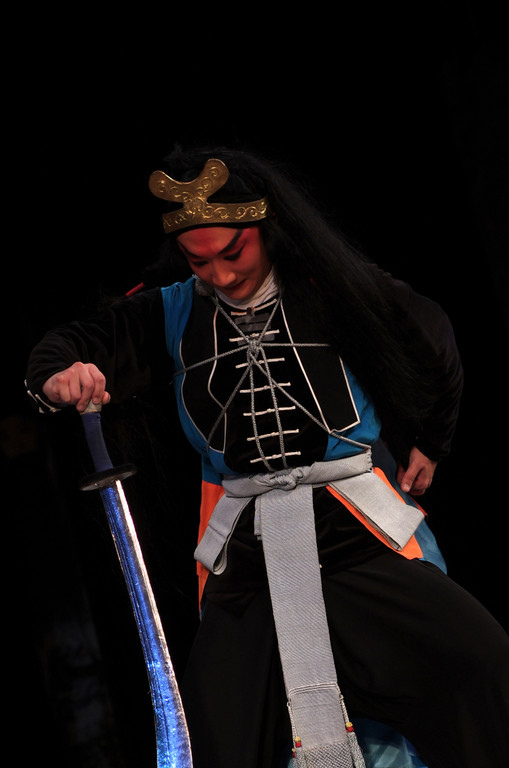
The type two headband is heavily associated with Liu Xiao Ling Tong‘s (六小齡童; a.k.a. Zhang Jinlai, 章金萊, b. 1959) portrayal of the Monkey King from the famed 1986 CCTV series. The actor comes from a long line of Chinese opera performers who specialize in playing Sun Wukong. It should be no surprise then that the type of circlet that he wears comes directly from Chinese opera. Known as a “precepts headband” (jiegu, 戒箍), this fillet is worn on stage by Military Monks (wuseng, 武僧) as a sign that they’ve taken a vow of abstinence (Bonds, 2008, pp. 177-178 and 328). Such clerics are depicted as wearing a jiegu in combination with a wild mane of hair (fig. 2), which contrasts with the bald heads of religious monks.

Fig. 2 – A detail of the literary hero and military monk Wu Song from a Chinese opera about his adventures (larger version). Full version available on Wikimedia Commons.

2. Appearance in Zaju Theater

To my knowledge, the oldest source associating Sun with the precepts headband is an early-Ming zaju play that predates the standard 1592 edition of Journey to the West. In act ten, the Bodhisattva Guanyin tells Monkey:

Great Sage Reaching Heaven [a previous title for Sun], you originally destroyed form and extinguished nature, but the honored monk saved you. This time, you will cease your desires. I give you the dharma name Sun Wukong, as well as an iron precepts headband [tie jiegu, 鐵戒箍], a black monk’s robe, and a precepts knife. [1] The iron headband will guard your nature, the robe will cover your beastly body, and the knife will cut your relations. If you want to go with your master, then you will be called Pilgrim Sun. Swiftly obtain the scriptures and seek the right fruit.

通天大聖,你本是毀形滅性的,老僧救了你,今次休起凡心。我與你一個法名,是孫悟空。與你個鐵戒箍、皂直裰、戒刀。鐵戒箍戒你凡性,皂直裰遮你獸身,戒刀豁你之恩愛,好生跟師父去,便喚作孫行者。疾便取經,著你也求正果

3. Foreign Origin

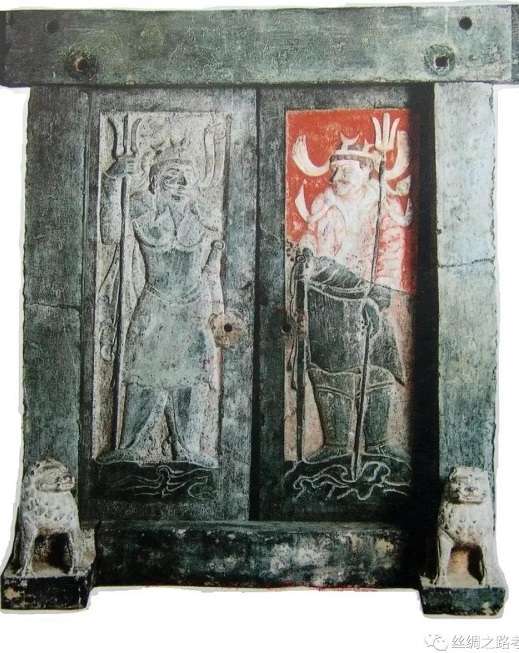
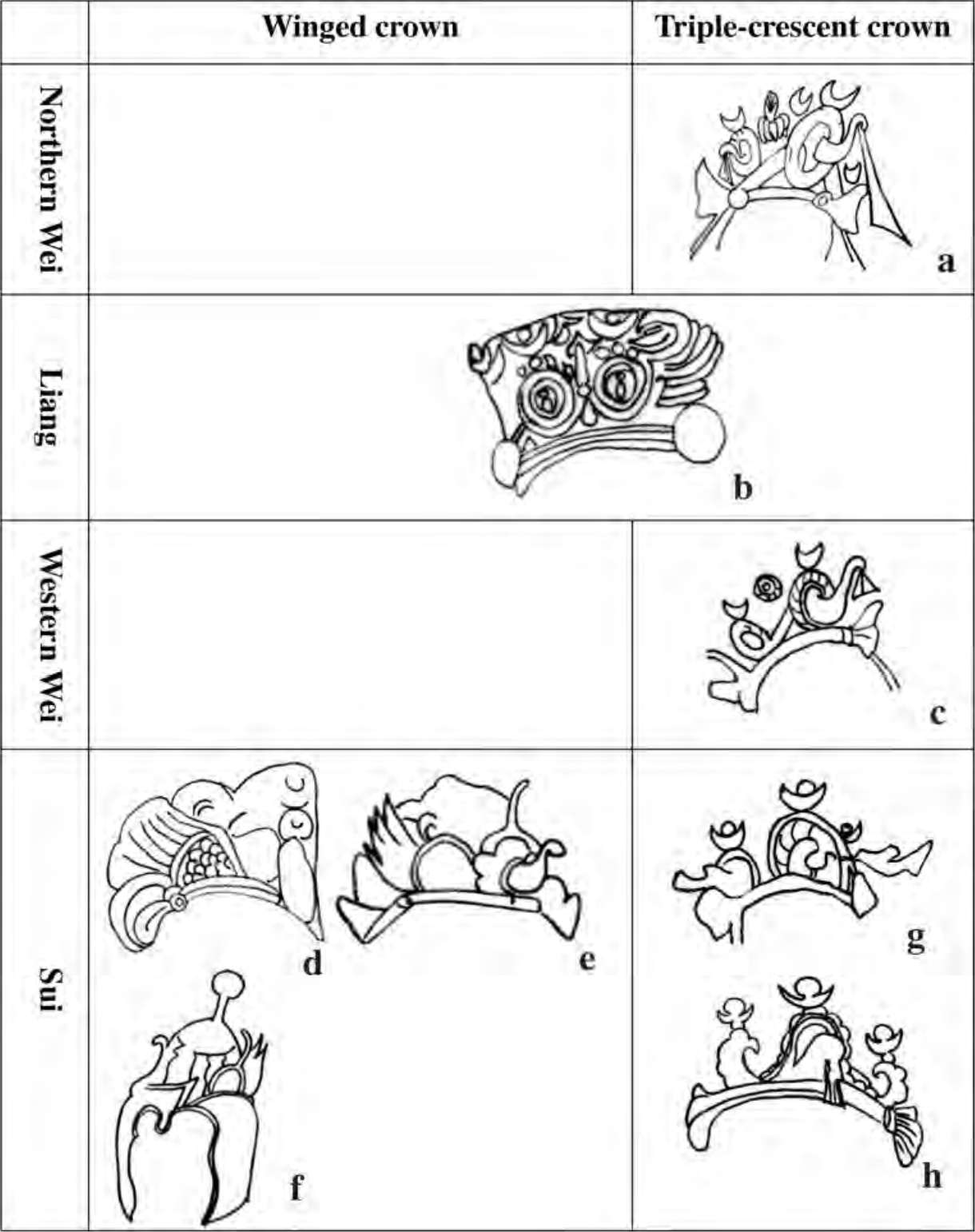
The precepts headband likely finds its origin in the triple-crescent crown of Central Asia. This crown was originally a fixture of Iranic Hephthalite royalty that was later adopted by Sogdian rulers. Zoroastrian gods were even portrayed wearing it. The motif is known to have entered China as early as the 6th century. For instance, the stone tomb of the Sogdian leader Di Caoming (翟曹明, d. 579) features two foreign-looking, trident-wielding door guardians wearing the crown (fig. 3 & 4). Most importantly, a crown featuring the triple-crescent and wings (also of Hephthalite origin) appears in Chinese Buddhist art, particularly in the headdresses of Bodhisattvas (fig. 5), before, during, and after the Tang and Liang periods (Kageyama, 2007). Therefore, the association of the triple-crescent with guardians and Buddhist deities might then explain why it was later connected to military monks in Chinese opera.

I’m indebted to the art historian Jin Xu (徐津) for posting a tweet about Sino-Sogdian funerary art, which led to him explaining the origin of the precepts headband. [2] I’m also indebted to Eran ud Turan for directing me to a lovely paper on the triple-crescent and winged crowns.

Fig. 3 – Triple-crescent crown-wearing guardians on the door of Di Caoming’s stone tomb (larger version). Fig. 4 – A detail of one of the guardians (larger version). Images found on this tweet. Fig. 5 – A diagram showing the various Bodhisattva crowns featuring the triple-crescent and winged adornments in Chinese Buddhist art (larger version). From Kageyama, 2007, p. 22. [3]

4. The Fillet’s Many Religious Influences

This subject is fascinating as it shows how different cultures came to influence the Monkey King’s headband. The general concept of a circlet serving as a physical reminder of right speech and action comes from India, and it was associated with gods in Esoteric Buddhism. The curlicue-style fillet is likely based on Chinese representations of stylized lingzhi (靈芝) mushrooms, which were associated with Daoist deities. And lastly, the crescent-style band is based on the crown of two Iranic cultures, and it was associated with divine beings from Zoroastrianism.

5. Conclusion

Various forms of media portray the Monkey King wearing different kinds of headbands. The second type, which includes an upturned crescent moon shape in the middle of the forehead, is featured in Chinese opera depictions of Sun Wukong. This “precepts headband” (jiegu, 戒箍) is a symbol of military monks, thus linking Monkey to such martial clerics. To my knowledge, the oldest source associating our hero with the jiegu is an early-Ming zaju play in which Guanyin gives Sun an “iron precepts headband” (tie jiegu, 鐵戒箍) (among other items).

This style of circlet was likely influenced by the “triple-crescent crown” used by the Iranic Hephthalite and Sogdian cultures as a symbol of royalty. The motif appeared in China as early as the 6th century as evidenced by the stone tomb of Di Caoming, which features foreign-looking door guardians wearing the triple-crescent crown. Most importantly, the motif also adorns the crowns of Bodhisattvas during China’s medieval period, which (combined with the aforementioned door guardians) might explain why the crescent came to be associated with military monks in Chinese opera.

This Iranic crown is one of three cultural threads influencing the function and look of Monkey’s golden headband, the other two coming from India (Esoteric Buddhism) and China (Daoism).

Notes:

1) Precept knives (jiedao, 戒刀) were historically small, unadorned, curved, finger-length blades used for cutting robes, trimming fingernails, opening wounds, or slicing food (Yifa, 2009, p. 250, n. 37).

2) After asking him a question on the original tweet, Jin Xu replied:

This type of crown is the prototype of Jiegu. It was a headgear favored by Sogdians, as you can see in some pictures taken by @eranudturan. I’m not sure if it had a specific name at the time, but perhaps related to later Persian word “taj” (tweet).

3) The diagram is labeled thusly in the original paper:

Winged crowns and triple-crescent crowns represented in the Buddhist art of the Northern and Southern Dynasties and the Sui. a, c, e-h: Wall paintings. Dunhuang (Gansu). a: Cave 254 (Northern Wei. Second half of the fifth century or first half of the sixth century), c: Cave 285 (Western Wei. 538-539 CE), e: Cave 276 (Sui. Late sixth or early seventh century), f. Cave 380 (Sui. Late sixth or early seventh century), g. Cave 389 (Sui. Late sixth or early seventh century), h. Cave 407 (Sui. Late sixth or early seventh century). b: Stone sculpture from Wanfo-si 万仏寺. Liang. First half of the sixth century. Chengdu (Sichuan). d. Stone relief from Dazhusheng 大住聖 Cave, Baoshan Lingquan-si 宝山霊泉寺, Anyang. Sui. 589 CE (Kageyama, 2007, p. 22).

Sources:

Bonds, A. B. (2008). Beijing Opera Costumes: The Visual Communication of Character and Culture. Honolulu: University of Hawai’i Press.

Kageyama, E. (2007). The Winged Crown and the Triple-crescent Crown in the Sogdian Funerary Monuments from China: Their Relation to the Hephthalite Occupation of Central Asia. Journal of Inner Asian Art and Archaeology, 2, 11-22. Retrieved from https://isaw.nyu.edu/publications/jiaaa/Kageyama.pdf.

Yifa. (2009). The Origins of Buddhist Monastic Codes in China: An Annotated Translation and Study of the Chanyuan Qinggui. Honolulu: University of Hawai’i press.

The Monkey King’s Worship in Thailand

Last updated: 09-11-2022

I first learned of Great Sage worship in Thailand when Ronni Pinsler of the BOXS project showed me a Monkey King statue on a Thai Facebook group. Since then, I’ve noticed an explosion in social media posts (mainly on Facebook and Instagram) highlighting his veneration in the “Land of Smiles.” Here, I’d like to record what I’ve learned so far.

Table of Contents

1. Names for the Monkey King

  1. เห้งเจีย (Hêng jiia, or just “Heng Jia/Chia” = Xingzhe, 行者, “Pilgrim”). [1] This appears to be the most popular of his Thai names. This should come as no surprise, though, as Xingzhe (行者) is used FAR more to refer to Monkey in Journey to the West (4,335 times) than Wukong (悟空) (512 times). [2]
  2. ซุนหงอคง (Sun ngŏr kong, or just “Sun Ngokong” = Sun Wukong, 孫悟空) (see here).
  3. ฉีเทียนต้าเชิ่ง (Chĕe tiian dtâa chêrng = Qitian dasheng, 齊天大聖, “Great Sage Equaling Heaven”)
  4. ฉีเทียนต้าเซิน (Chĕe tiian dtâa sern = same as above)
  5. โต้วจั้นเชิ่งโฝ (Dtôh wá jân chêrng fŏh = Douzhan shengfo, 鬥戰勝佛, “Victorious Fighting Buddha”)
  6. ต้าเชิ่งโฝจู่ (Dtâa chêrng fŏh jòo = Dasheng fozu, 大聖佛祖, “Great Sage Buddha Patriarch”
  7. ไต้เสี่ยฮุกโจ้ว (Dtâi sìia húk-jôh, or just “Tai Sia Huk Chou/Zhou/Jow” = same as above)

2. Statuary

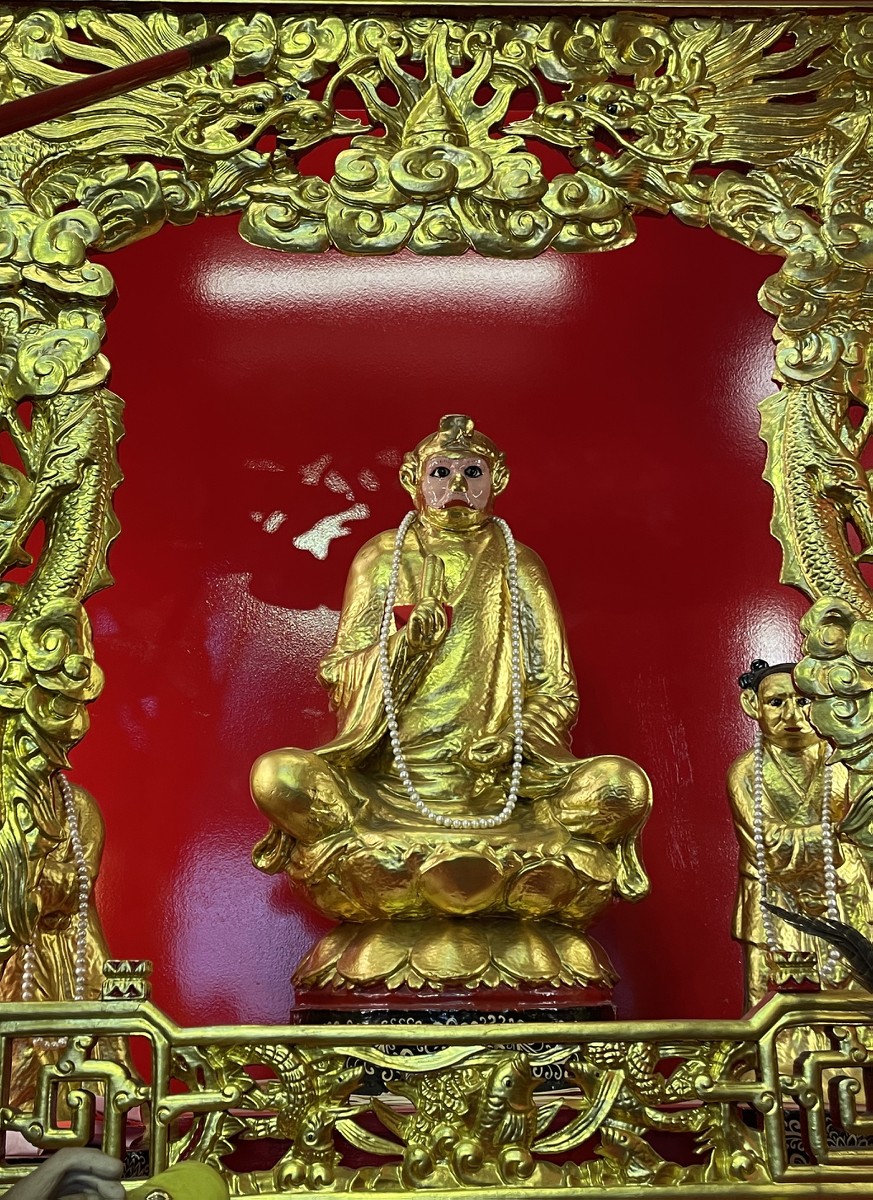
Various Thai Facebook groups post pictures of the same kinds of monkey god statues found in East and Southeast Asia. These range from armored warriors wielding the magic staff to serene buddhas on lotus thrones (see here). But I’ve noticed that one flavor of Thai Great Sage statue is almost entirely gilded (or draped with gold cloth) except for a pink/red mask around the eyes, the latter being similar to his Chinese opera depictions. Said statues tend to feature a golden headband with very tall curlicues (fig. 1).

Fig. 1 – An example of a golden Thai monkey statue with a pink mask and a high curlicue headband (larger version). Originally posted here.

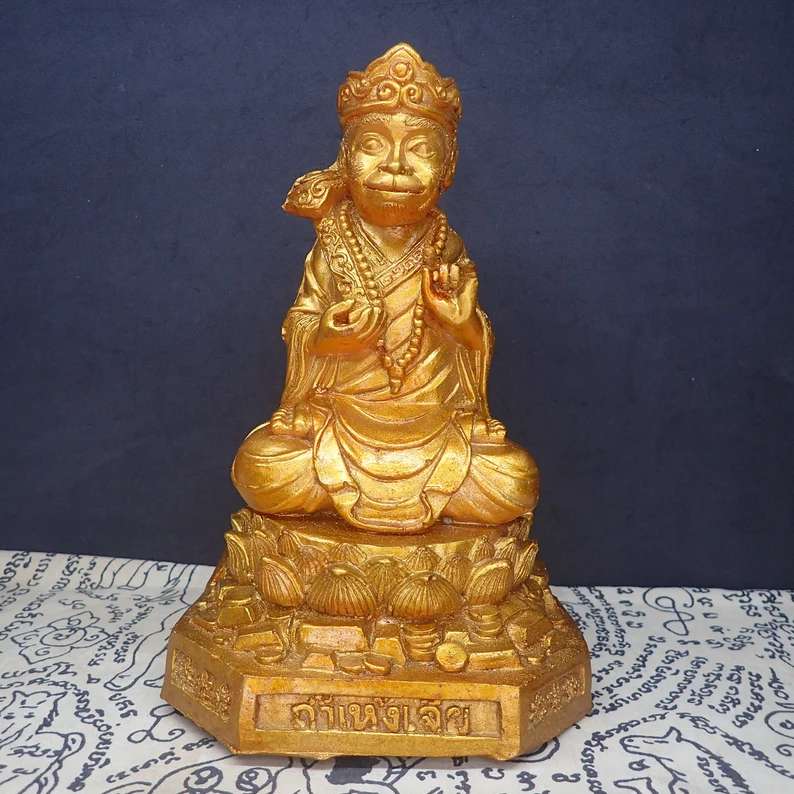
I’ve also noticed an abundance of Dizang-like Monkey Buddha statues, similar to those found in Singapore (I haven’t seen many such depictions in Taiwan). This may be of Fujian influence (see here). He is sometimes portrayed wearing an ornate crown (with or without the golden headband) and monk’s robes and seated on a lotus throne. One hand is held in a mudra, while the other clasps a ruyi scepter (or more rarely a fly whisk). I recently purchased such a statue with an amulet pressed in the bottom (fig. 2 and video #1).

Fig. 2 – My 20 cm colored resin Thai Monkey Buddha statue (larger version). Take note that the lotus throne sits on a pile of gold coins and ingots. Picture by the original seller.

Video #1 – Video by the original seller.

3. Amulets

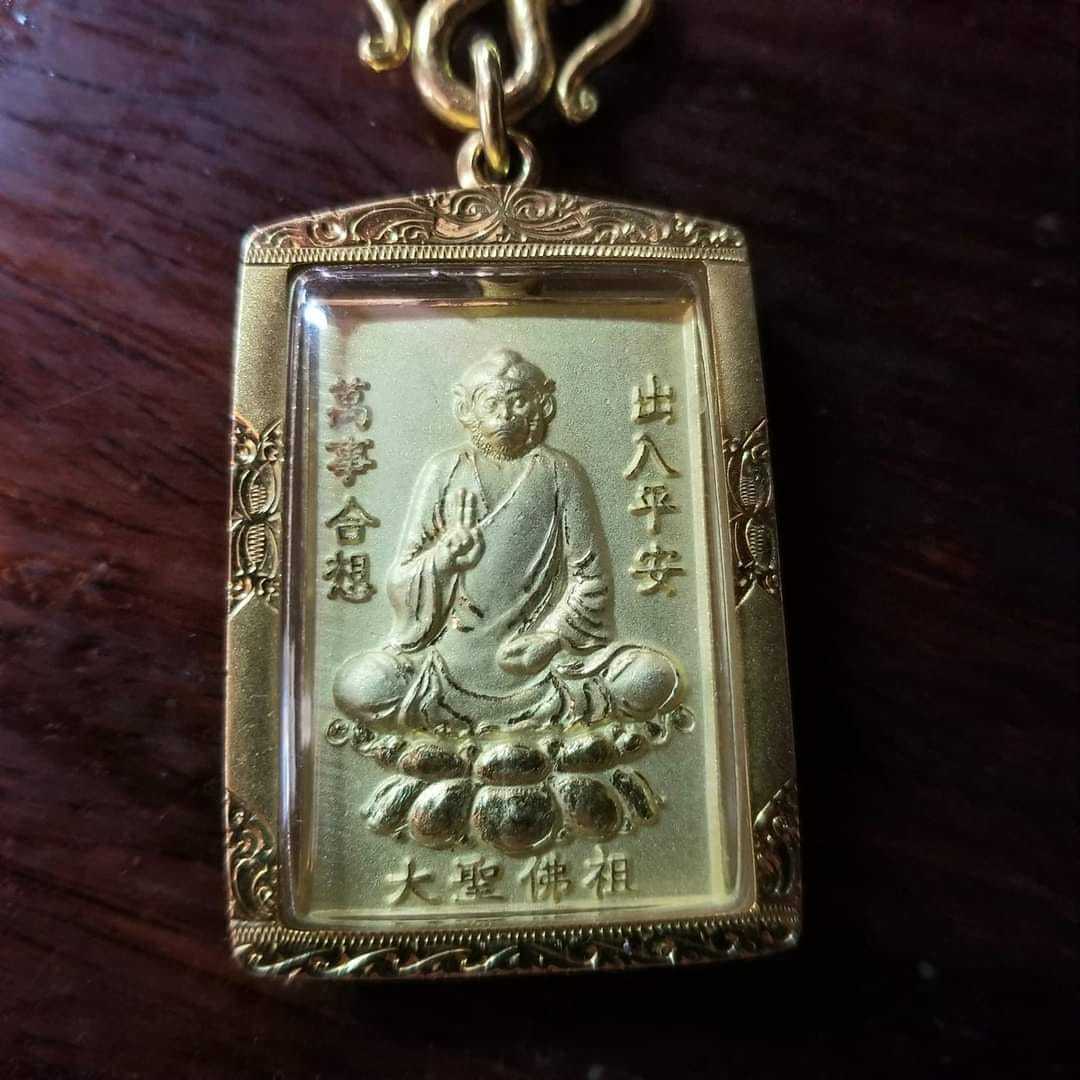
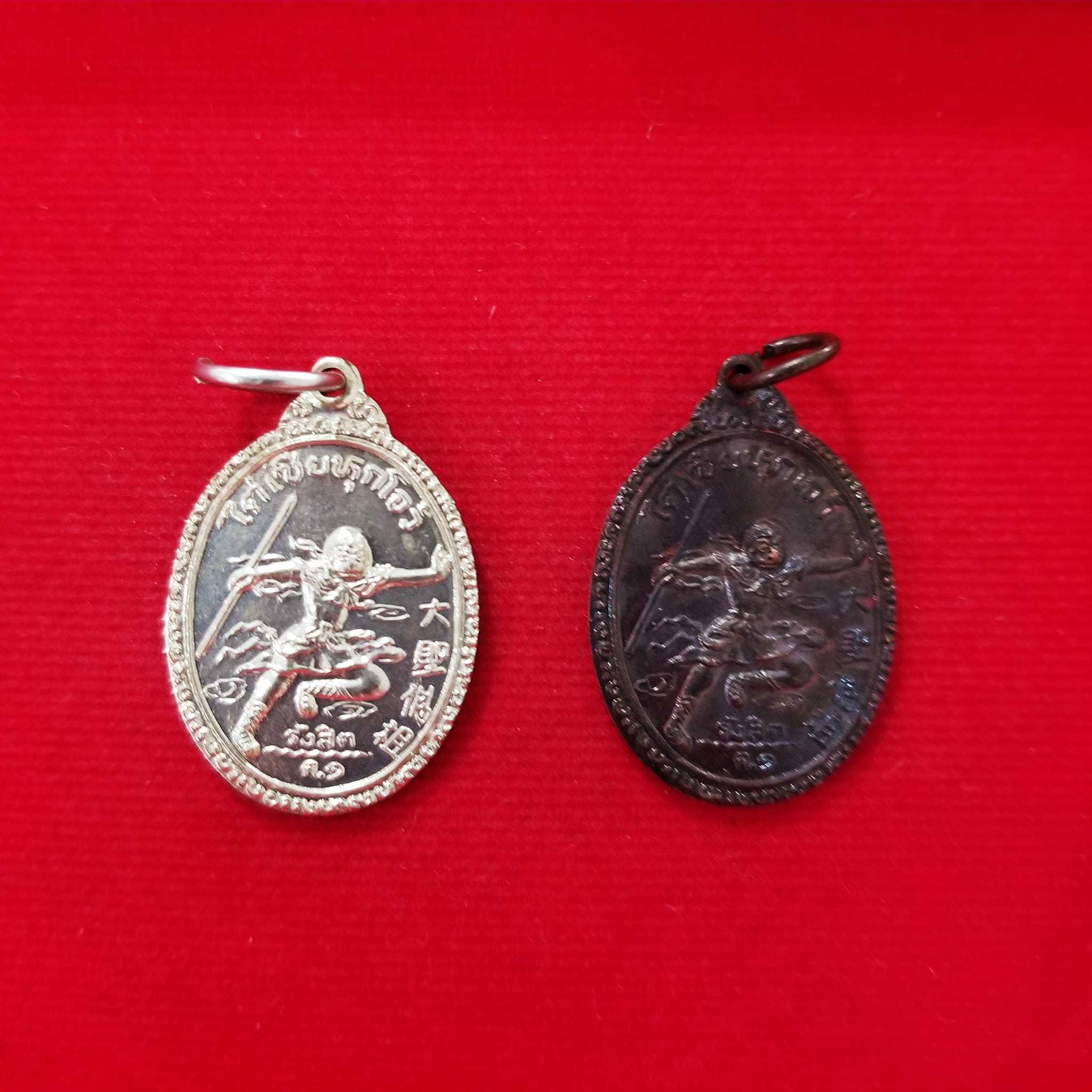
Buddhist amulets (Th: prá krêuuang, พระเครื่อง) are immensely important to Thai devotees. Marcus (2018) explains that they are believed to “endow wearers with supernatural faculties.” He continues: “Some amulets are thought to bring success and happiness. Others are believed to protect the wearer against disease, witchcraft, and misfortune” (Marcus, 2018). It’s no different for worshipers of the Monkey King. I’ve seen countless examples on Facebook ranging from Monkey Buddhas to Monkey warriors. See four examples below (fig. 3-6).

Fig. 3 (top left) – An amulet listing him as the “Great Sage Buddha Patriarch” (larger version). Originally posted here. Fig. 4 (top right) – A multi-armed Buddha Patriarch (larger version). Originally posted here. Fig. 5 (bottom left) – An armored, flying Buddha Patriarch (larger version). Originally posted here. Fig. 6 (bottom right) – Another armored example (larger version). Originally posted here.

4. Spirit-Mediumship

Like East and Southeast Asia, Thailand also has Great Sage spirit-mediums (Ch: Jitong, 乩童; Hokkien: Tangki, 童乩; lit: “Divining Child”) (see here). One temple medium seen on the ไปดีมาดี Channel1928 YouTube channel employs white, black, and gold headbands with the aforementioned high curlicue design. The color used appears to depend on which monkey god takes over the medium. I can’t comment on any rituals particular to the Thai religious sphere, but I have seen the medium perform self-mortification in order to create paper talismans (video #2). This is a normal function of spirit-mediums even in East and Southeast Asia. See my twitter post for pictures of a similar Taiwanese ritual.

I’m hoping to gather more information on Thai Great Sage spirit-mediumship in the future.

Video #2 –  HEADPHONE WARNING!!! The Thai Great Sage medium cuts his tongue to create paper talismans.


5. Updates

Update: 04-20-22

I just learned from this webpage that there is a Thai language book about the history of the Monkey King. Here’s the citation:

จรัสศรี จิรภาส. เห้งเจีย (ฉีเทียนต้าเสิ้ง) ลิงในวรรณกรรมที่กลายเป็นเทพเจ้า. กรุงเทพฯ : มติชน, 2547.

Jaratsri Jirapas. Heng Jia (Chi Tian Da Sheng), a Literary Monkey who has become a God. Bangkok: Matichon, 2004.

This online book seller has pictures of the cover (fig. 7) and some of the internal pages.

Fig. 7 – The cover of the Heng Jia book (larger version).

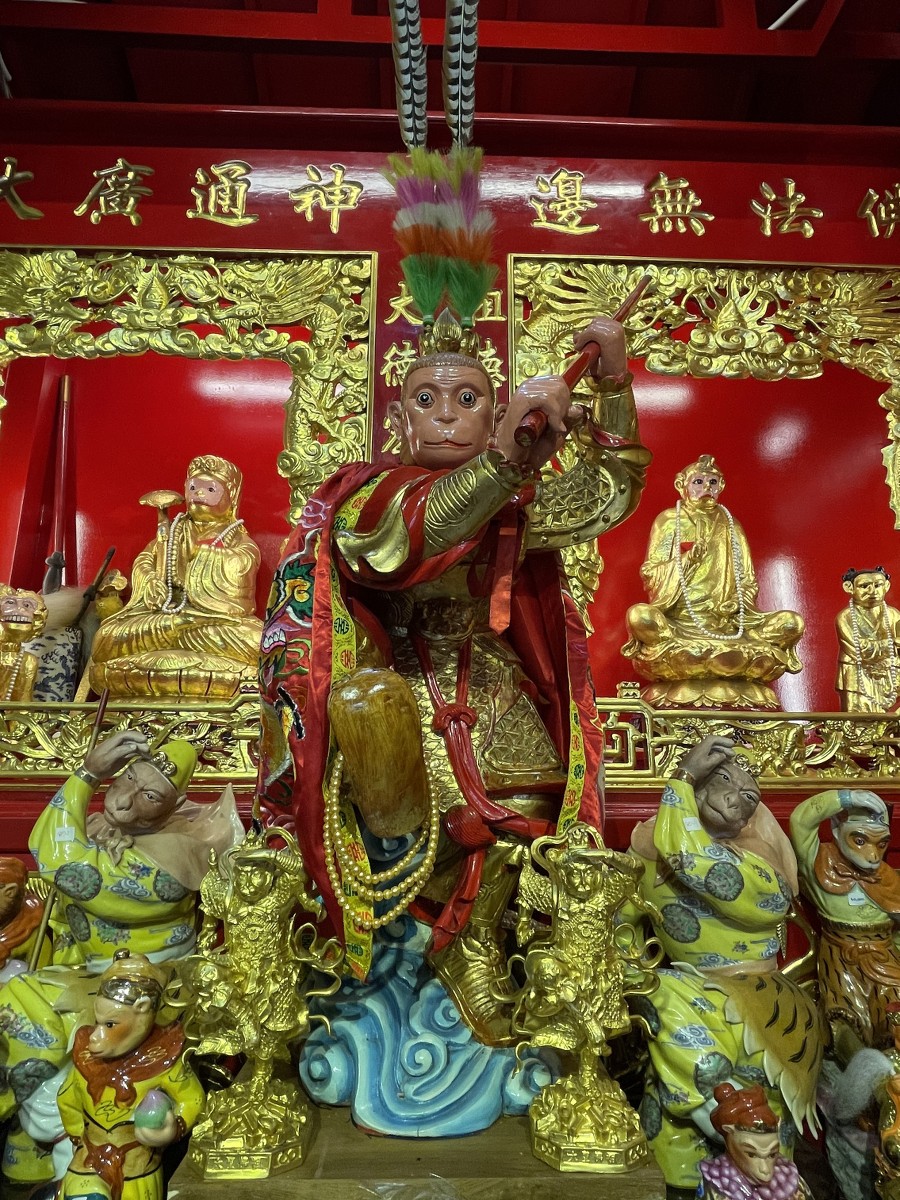
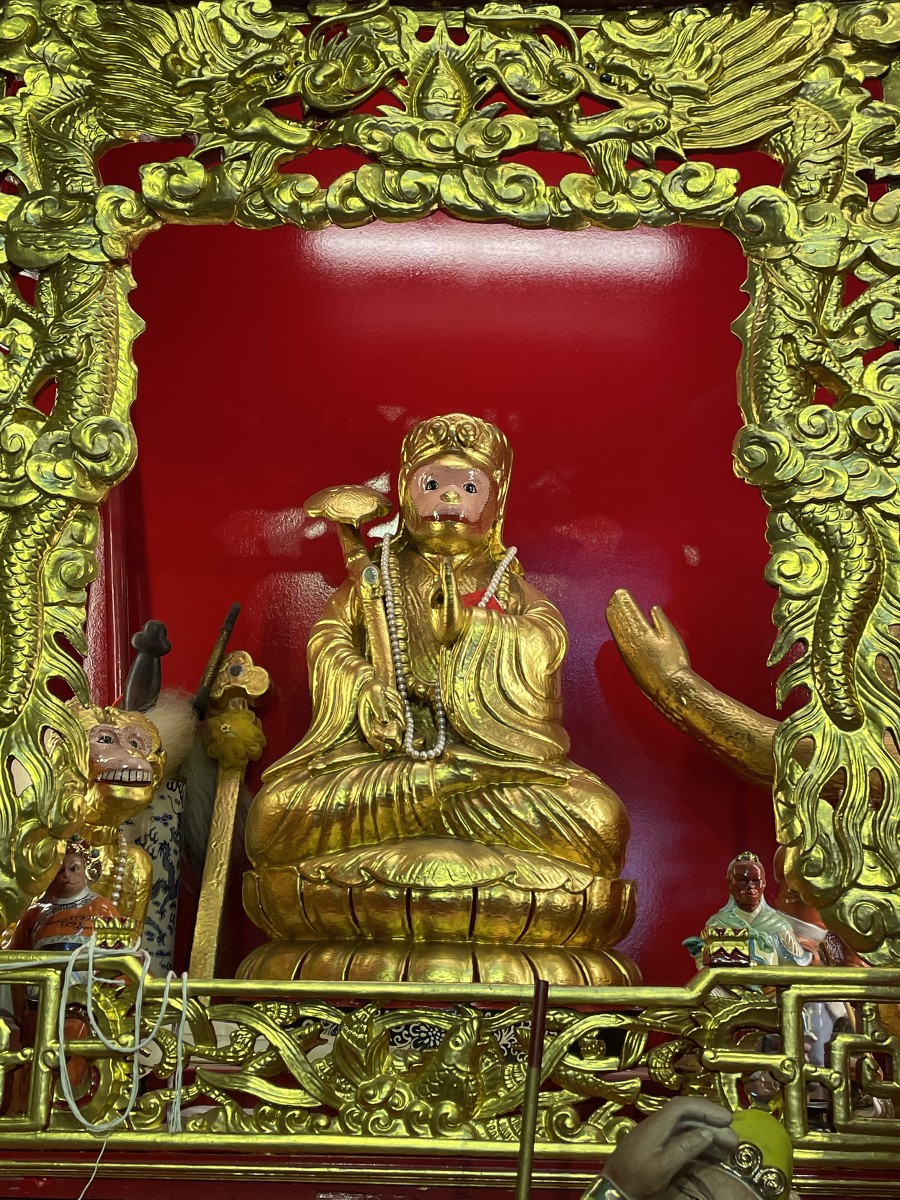
Also, I’ve learned the name and location of a small monkey god temple in Bangkok, Thailand (fig. 8-10 and video #3). It is claimed to be at least 200 years old(!), suggesting that Heng Jia has been worshiped by Chinese-Thai for several centuries:

ศาลเจ้าพ่อเห้งเจีย (Săan-jâo-pôr Hêng-jiia) – “Shrine of Heng Jia”

66 Rama IV Rd, Talat Noi, Samphanthawong, Bangkok 10500, Thailand

+66 2 221 9018

Fig. 8 (left) – The main altar statue, behind which are two golden Monkey Buddha statues with pink masks (larger version). Fig. 9 (middle) – The left Monkey Buddha (larger version). Fig. 10 (right) – The right Monkey Buddha (larger version). Pictures by KittyBinny’s Journey on Blockdit.

Video #3 – An episode about the temple on the MY CHANNEL – OFFICIAL YouTube Channel.


Update: 04-21-21

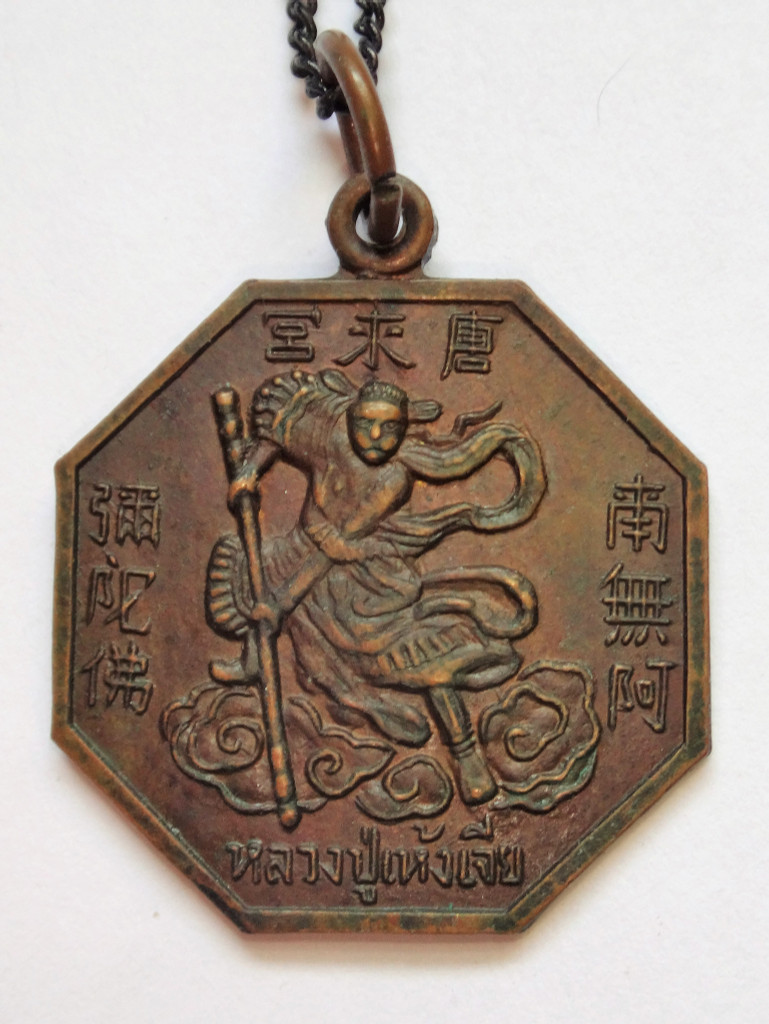
A fellow member of the Taoism Singapore and the Local Gods and their Legends Facebook groups was kind enough to let me post pictures of a Thai Monkey God amulet that he received in San Francisco around the year 2000. The top notes that it’s from the Tanglai Temple (Tanglai gong, 唐來宮), the first two characters being a term used in Journey to the West to indicate that the pilgrims have “come from China” in the east. The characters on the left and right sides combine to read “I submit to the Buddha Amitabha” (Namo Amituofo, 南無阿彌陀佛). The Thai at the bottom reads “Reverend Monk Heng Jia” (lŭuang bpòo hêng-jiia, หลวงปู่เห้งเจีย) (fig. 11). The reverse depicts the eight trigrams encircling a Taiju symbol (fig. 12), indicating that the amulet is Buddho-Daoist.

Fig. 11 (left) – The front of the Monkey God amulet (larger version). Fig. 12 (right) – The backside (larger version). 


Update: 04-22-22

Ellis (2017) mentions a “monument” to Heng Jia in Chao Pho Khao Yai cave (ศาลเจ้าพ่อเขาใหญ่) (p. 86). Mr. Ellis told me in a personal communication that the cave “is on Ko Si Chang island off the coast of Pattaya.” The address is:

5R94+7MM, Tha Thewawong, Ko Sichang District, Chon Buri 20120, Thailand

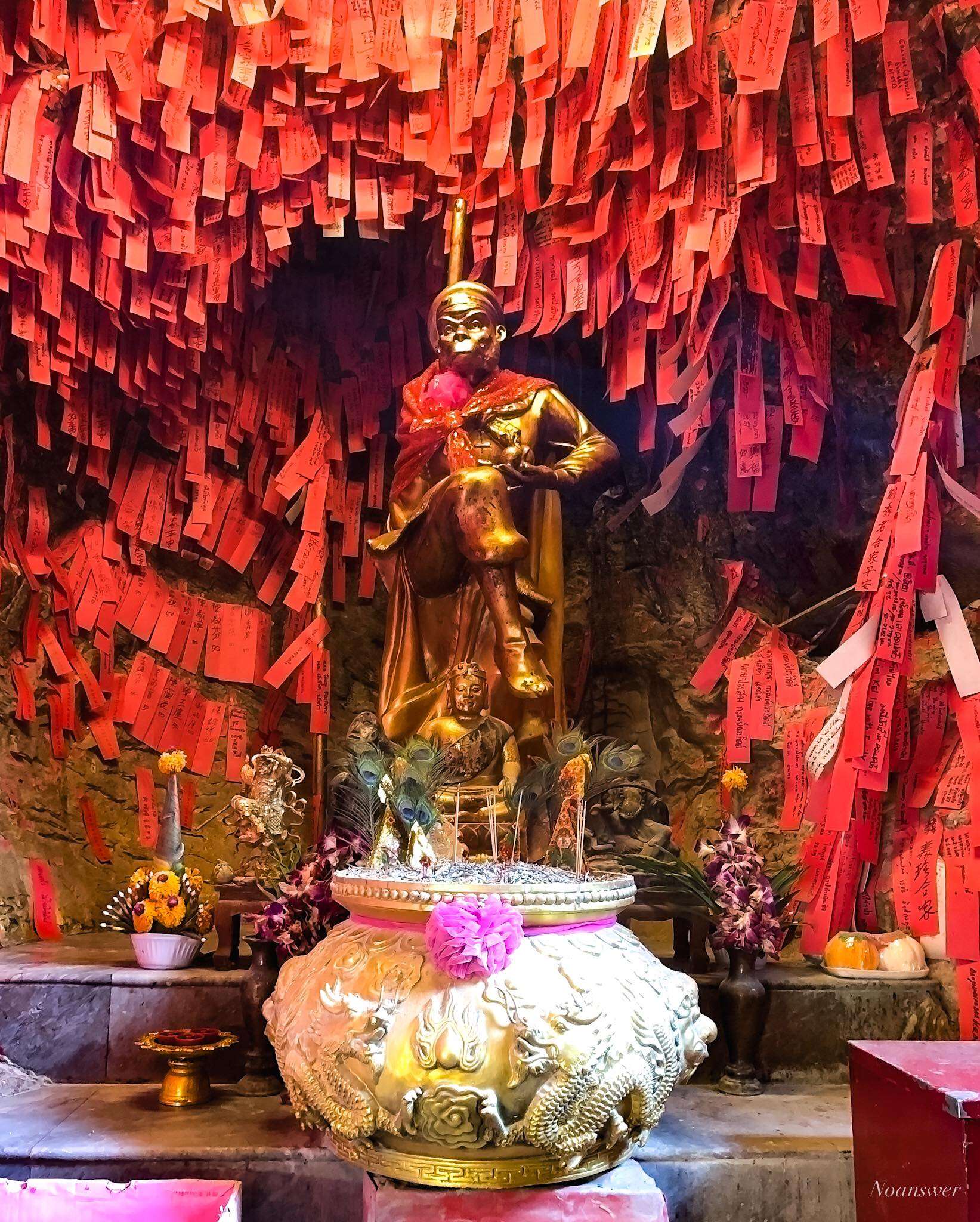
The small Monkey shrine is located in the interior, and it is surrounded by a forest of red prayer sheets (fig. 13). See here for a video touring the cave. The section featuring Heng Jia starts around minute 3:16.

Munier (1998) notes that this cave is the “only one” dedicated to Monkey in Thailand (p. 170) (see the 09-11-22 update below). A big thank you to Mr. Ellis for providing this information. Please check out his blog.

Fig. 13 – The Heng Jia shrine at Chao Pho Khao Yai cave (larger version). Original photo posted here. See here for a wider shot of the shrine.


Update: 04-23-22

A fellow member of a Monkey King group that I belong to posted this article of seven Thai Heng Jia shrines, including the ones I’ve mentioned above.

https://travel.trueid.net/detail/m0gr288wBPQx

Also, here’s a Thai prayer to Hengjia (video #4). It’s called “Prayer to the Great Sage Buddha Patriarch” (Bòt sùuat mon dtâi sìia húk-jôh, บทสวดมนต์ไต้เสี่ยฮุกโจ้ว, and the video labels it in Chinese as “Scripture of the Great Sage Buddha Patriarch” (Dasheng fozu jing, 大聖佛祖經).

Video #4 – The prayer to Hengjia.

Here’s a transcription of the prayer:

ไต่เสี่ยฮุกโจวเก็ง
ไต่ เสี่ย จู เสี่ยง กิ๋ง
บ่อ เสียง กิก เซี้ยง จูง
ก่วย ขื่อ อี ซิว เจ่ง
หลี่ ไอ่ เถี่ยว สี่ กัง
ซุ้ย ชื้อ สี่ เกียง เอ๋า
เหลี่ยง เมี่ยง จู คุ่ง อู๋
ห่วย ซิง เทียง ตง จู้
ปัก เก๊ก ฉิก อ้วง จูง
หู่ เพียก กั่ง ข่วง อ๋วย
จู๋ ไจ้ อี บ่วง ลุ้ย
เสียง ไจ่ เส็ก เกีย ซือ
อุ่ย เจ่ง กู่ ซวง ส่วย
อั้ว เต้ง กิม อี บุ๋ง
ง่วง ก้วง อี ม้วก สี่
หยู่ สี เก็ง กง เต็ก
คิ่ว ฮุก จิ่ง ซวง เอี้ยง
ไต่ เสี่ย ฮุก โจ้ว เก็ง
ยื่อ ซี้ ฮุก เก่า ไต๋ เจ่ง
เยียก อู๋ เสียง น้ำ สิ่ง นึ่ง ยิ้ง
ม้วย ยิก จี่ ซิม เหนี่ยม เจ็ก กึ้ง
หยู่ จ้วง กิม กัง เก็ง ซา จับ บ่วง กิ้ง
อิ่ว ติก สิ่ง เม้ง เกีย หู
เจ่ง ซิ้ง ที หี
ตี่ หุย ไจ เทียง ตี๋
อู่ นั่ง อ่วย เสี้ย เจ็ก ปึ้ง
อื้อ นั้ง หลิ่ว ท้วง
กง เต็ก เกา หยู่ ซู หนี่ ซัว
ชิม หยู่ ไต่ ไห้
บ่อ เหลียง กง เต็ก
ย่ง สี่ ปุก ตะ ตี่ เง็ก มิ้ง
ฉู่ ฉู่ หลั่ง สั่ว
เทีย ตัก มอ อิ้ง ซา ผ่อ ฮอ


Update: 04-24-22

This page mentions the benefits of worshiping Heng Jia (based on Google Translate):

If anyone worships Lord Tai Sia Huk Zhou, it will make everything smooth, turning bad into good, making it possible to do anything without obstacles. This includes family and friends, doing business, selling progress, keeping anything bad from coming into our lives. The believer must behave well, think positively, and never think ill of others. All blessings will bear fruit. Life will be truly happy and business will progress more and more.

[…]

If worshipers are free from evil and have health, intelligence, tact, and courage, they will be able to always find a solution to their problems. Therefore, [Heng Jia’s faith] is very popular among business operators that need to find a solution to every obstacle and problem.


Update: 05-21-22

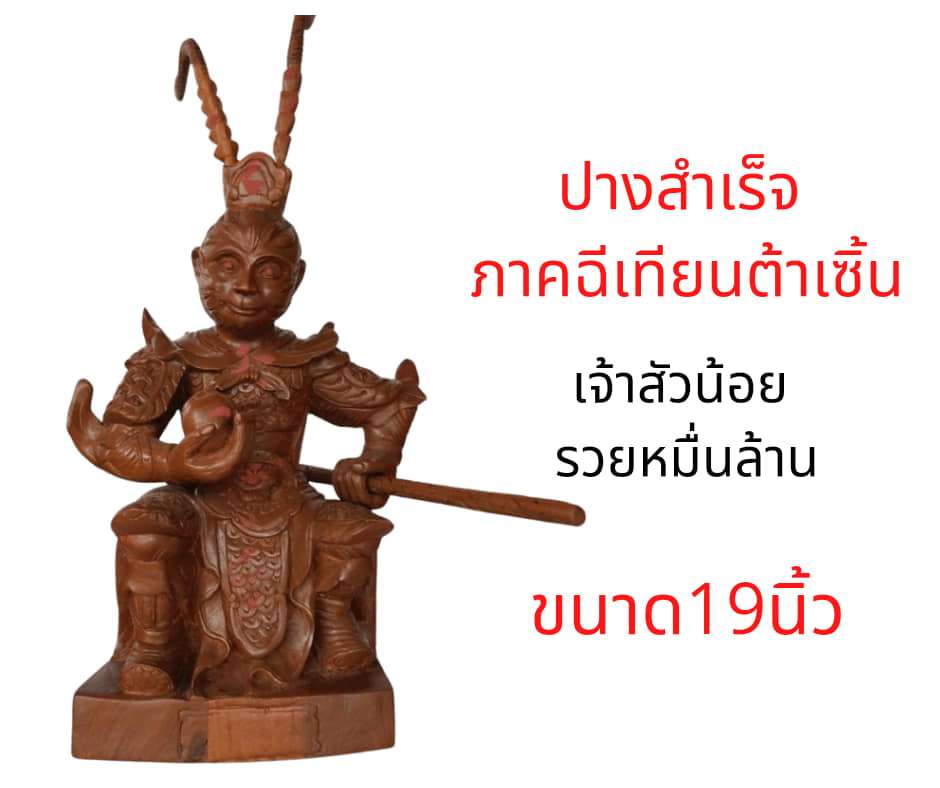
A Thai temple is raising funds by selling Monkey King statues in different postures, each with their own benefits (fig. 14-16). Here is a translation by a friend:

1. Clairvoyant posture = worship this for blessing of import/export trading.
2. Success posture = worship this for blessing of wealth.
3. Meditation posture = worship this for blessing of wisdom.

Fig. 14 (left) – The “Clairvoyant posture” (larger version). Fig. 15 (middle) – The “Success posture” (larger version). Fig. 16 (right) – The “Meditation posture” (larger version).


Update: 06-07-22

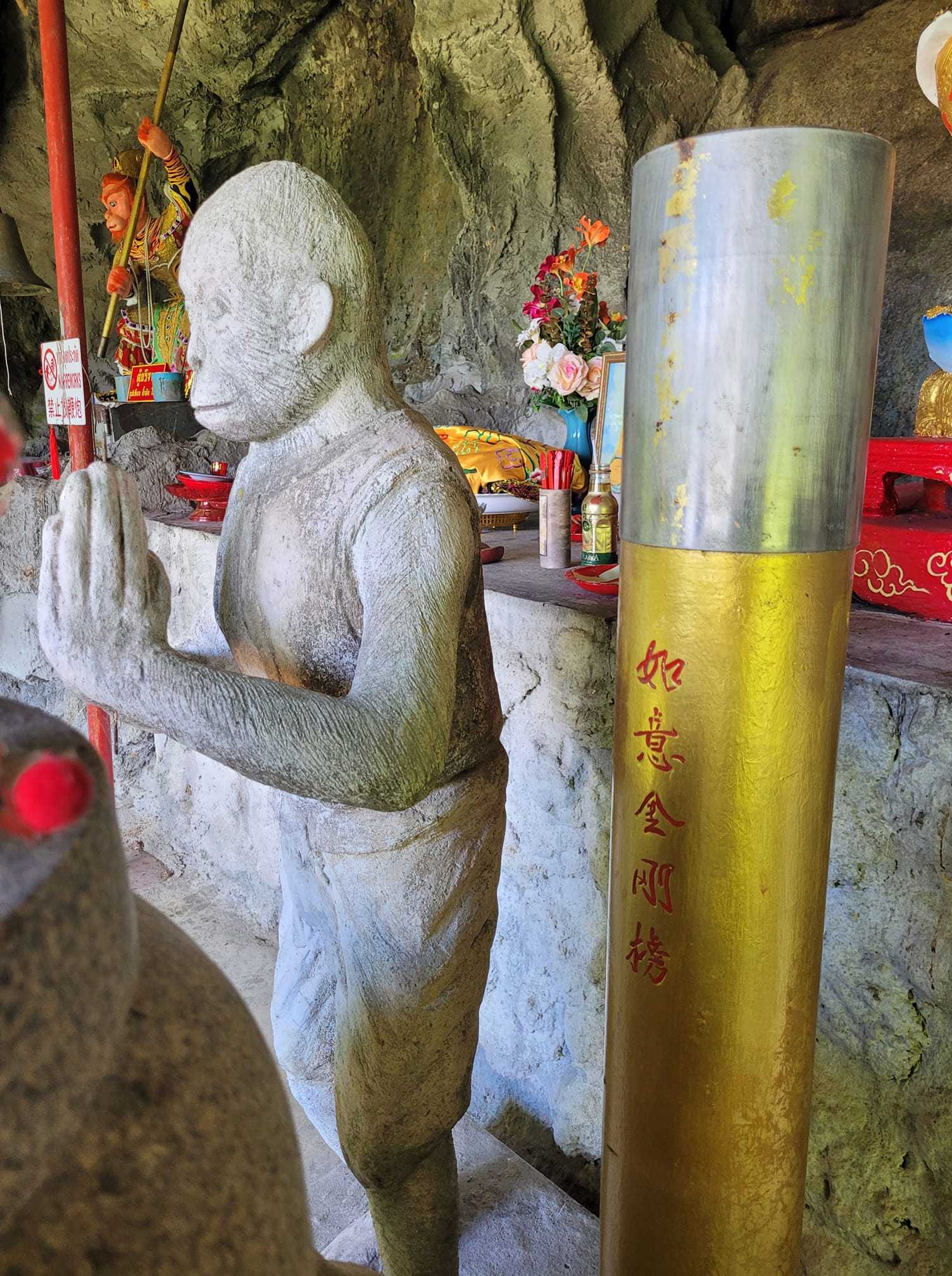
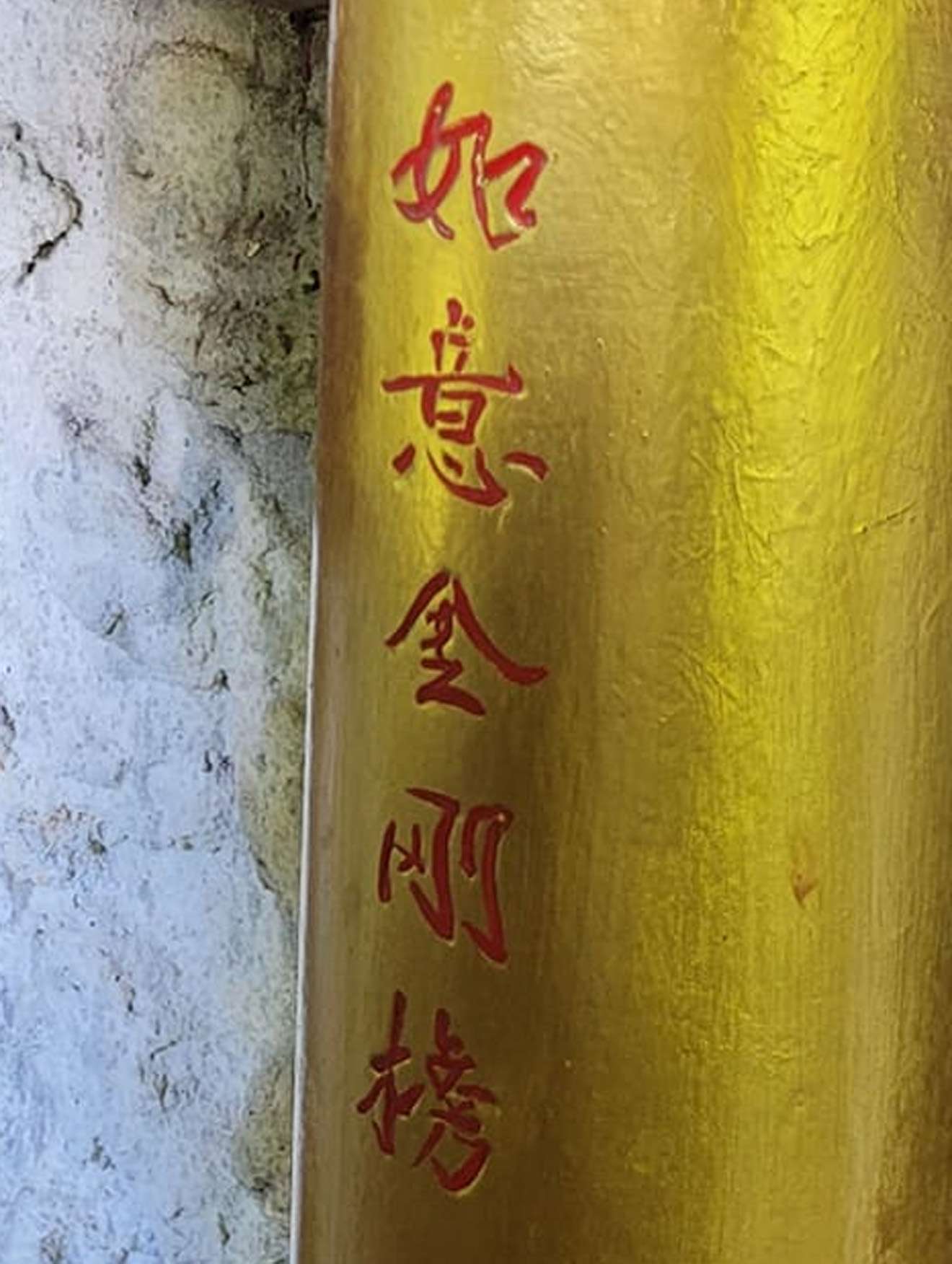
My friend posted a picture of a Thai Great Sage shrine to Facebook. It shows a stone monkey statue, behind which is a large silver and gold staff. Whereas the literary weapon is “如意金箍棒” (Ruyi jingu bang), the “As-You-Will Gold-Banded Staff,” the shrine version is labeled “如意金剛榜” (Ruyi jingang bang), “As-You-Will Vajra staff” (fig. 17 and 18). [3] The Vajra (jingang, 金剛) is a heavenly weapon closely associated with the Buddhist guardian deity Vajrapāni (Jingang shou pusa, 金剛手菩薩, lit: “The Vajra-Bearing Bodhisattva”) (Buswell & Lopez, 2014, p. 955). Therefore, the name change strengthens Sun Wukong’s association with Buddhism.

Fig. 17 (left) – The Great Sage shrine with a stone monkey statue and the silver and gold staff (larger version). Fig. 18 (right) – Detail of the Chinese characters on the staff (larger version).


Update: 09-03-22

I’ve written an article about a large brass Monkey King statue that I received from Thailand (fig. 19).

My Great Sage Monkey King Statue from Thailand

Fig. 19 – My new Great Sage statue from Thailand (larger version).


Update: 09-05-22

Figures one, nine, and ten above show gilded Monkey King statues with a pink mask over their eyes. I’ve found another variant that covers the entire face (fig. 20). Hints of this appear on my recently acquired Monkey King statue from Thailand. It lacks the color but includes a raised line around the face marking the boundary of said pink patch (fig. 21).

Fig. 20 (left) – The whole face variant of the pink face patch (larger version). Picture originally posted here. Fig. 21 (right) – Detail of my Thai statue indicating the aforementioned patch (larger version).


Update: 09-11-22

Mr. Ellis of the Caves and Caving in Thailand blog (see the 04-22-22 update above) was kind enough to point me to another Heng Jia cave shrine (fig. 22):

It is Tham Thevasathit, which is in the temple complex on top of the hill to the north of Prachaup Khiri Khan town at 11.8153 N 99.7986 E (personal communication).

Fig. 22 – A photo of Heng Jia’s statue in the cave shrine of Tham Thevasathit (larger version). Image courtesy of Mr. Ellis.

Note:

1) See section III of this article for more info on the name “Pilgrim.”

2) Thank you to Irwen Wong for bringing this to my attention.

3) 榜 (bang) should be 棒 (bang).

Source:

Buswell, R. E., & Lopez, D. S. (2014). The Princeton Dictionary of Buddhism. N: Princeton University Press.

Ellis, M. (2017). The Caves of Eastern Thailand. (n.p.): Lulu.com.

Marcus, D. (2018, May 5). Featured Object: Thai Buddhist Amulet. Spurlock Museum of World Cultures Blog. Retrieved April 17, 2022, from https://www.spurlock.illinois.edu/blog/p/featured-object-thai/263.

Munier, C. (1998). Sacred Rocks and Buddhist Caves in Thailand. Thailand: White Lotus.

Archive #29 – Ruthless Compassion: Wrathful Deities in Early Indo-Tibetan Esoteric Buddhist Art (1999)

I consider one of my greatest accomplishments on this blog to be discovering the origin of Sun Wukong’s golden headband. This would not have been possible without reading about the Hevajra Tantra (8th-century) in Robert Nelson Linrothe’s (1999) Ruthless Compassion: Wrathful Deities in Early Indo-Tibetan Esoteric Buddhist Art. This amazing study analyzes Esoteric Buddhist statues and texts to trace the evolution of these guardians from mere dwarf attendants to mighty warrior gods endowed with the power of the Five Wisdom Buddhas. This is a great resource for anyone researching religious art involving wrathful guardians in Buddhism, Daoism, and of course Chinese folk religion, for the iconography of these divine warriors spread far and wide.

I am sharing a PDF of the book found on libgen for the benefit of other scholars. The black and white portions of the book appear to be based on a xeroxed copy. However, there are full color plates in the back.

Book description:

Buddhists believe that the wrathful spirits represent inherent qualities of our own, and that meditating on them can transmute the otherwise malevolent sides of our own natures into positive qualities and actions. The wrathful deities also provide precious clues as to the early development of esoteric Buddhism in India, about which few early texts survive. Through careful examination of a large body of images as well as Sanskrit, Tibetan, and Indic texts, this lavishly illustrated volume traces the evolution of the forms and the unfolding significance of the wrathful deity in esoteric Buddhist sculpture.

Archive link:

Click to access Ruthless-Compassion-Wrathful-Deities-in-Early-Indo-Tibetan-Esoteric-Buddhist-Art-1999.pdf

Disclaimer:

This work has been posted for educational purposes. No malicious copyright infringement is intended. If you enjoyed the digital version, please support the official release.

Citation:

Linrothe, R. N. (1999). Ruthless Compassion: Wrathful Deities in Early Indo-Tibetan Esoteric Buddhist Art. London: Serindia Publ.

The Tightening Spell of Sun Wukong’s Golden Headband

Last updated: 04-09-2024

Sun Wukong‘s golden headband (jingu, 金箍; a.k.a. jingu, 緊箍, lit: “tight fillet”) (fig. 1) is an instantly recognizable part of his popular iconography. Anyone who’s read Journey to the West (Xiyouji西遊記, 1592 CE) will know that it painfully tightens around our hero’s skull to correct any unsavory behavior. “What kind of behavior?” someone might ask. Well, mass murder, of course! In chapter 56, for example, Monkey’s Buddhist master Tripitaka recites the spell to punish him for beating a group of bandits to death with his magic staff and beheading one of them with a blade (Wu & Yu, 2012, vol. 3, p. 89).

This spell is first revealed to the monk by Guanyin in chapter 14:

I have a spell which is called the True Words for Controlling the Mind [dingxin zhenyan, 定心真言], or the Tight-Fillet Spell [jingu er zhou, 緊箍兒咒]. You must memorize it secretly; commit it firmly to your memory, and don’t let anyone learn of it. I’ll try to catch up with him [Monkey] and persuade him to come back and follow you. When he returns, give him the shirt and the cap [containing the headband] to wear; and if he again refuses to obey you, recite the spell silently. He will not dare do violence or leave you again.” (Wu & Yu, 2012, p. 317).

我那裡還有一篇咒兒,喚做『定心真言』,又名做『緊箍兒咒』。你可暗暗的念熟,牢記心頭,再莫洩漏一人知道。我去趕上他,叫他還來跟你,你卻將此衣帽與他穿戴。他若不服你使喚,你就默念此咒,他再不敢行兇,也再不敢去了。」

You can see the exact words are never revealed. This is not surprising, though, as the spell is one of the few things in the entire Buddho-Daoist cosmos that can control Sun Wukong. Tripitaka’s life would be in danger and the journey would be doomed if any villains got ahold of this secret. But … what if … we could guess the spell, just for fun? I’d like to suggest a mantra based on historical religious beliefs and iconography. This thought experiment was written for the benefit of artists and fanfiction writers looking to create more accurate portrayals of the novel and its characters.

Fig. 1 – Monkey’s golden headband (larger version). Image found here.

Table of Contents

1. Religious Background

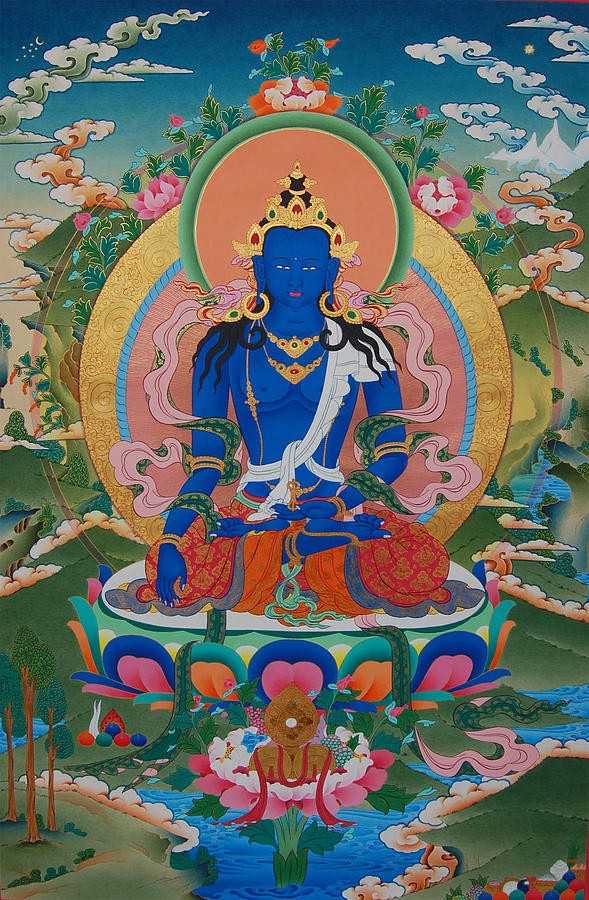
As I note in this article, the golden fillet is likely based on a ritual headband worn by Buddhist ascetics in ancient India. The Hevajra Tantra (Dabei kongzhi jingang dajiao wang yigui jing, 大悲空智金剛大教王儀軌經, 8th-c.) states yogins must wear the band and a list of other prescribed ritual items in their worship of the wrathful protector deity Heruka (Linrothe, 1999, p. 250). Most importantly, the tantra states the band symbolizes the Buddha Akshobhya (Ch: Achu, 阿閦; Budong, 不動; lit: “Immovable”) (fig. 2), who gained enlightenment through moralistic practices of right speech and action (Linrothe, 1999, p. 251; Buswell & Lopez, 2013, p. 27).

Fig. 2 – A depiction of Akshobhya (larger version). [1] Artist unknown.

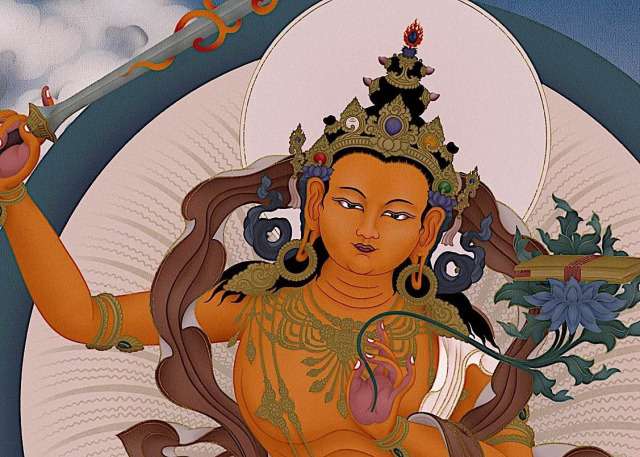
Akshobhya and the other esoteric Wisdom Buddhas are sometimes depicted as small figures or colored jewels in the headdress of the Manjusri Bodhisattva (and other Buddhist personages) (Getty, 1914/1988, p. 37; Vessantara, 1993, p. 155). Akshobhya is symbolized by the color blue (Getty, 1914/1988, p. 36). A cursory Google image search shows the blue jewel is often set in the top most position over Manjusri’s forehead (fig. 3).

This might suggest a more religiously accurate version of Sun Wukong’s golden headband would include a figure or jewel representing Akshobhya.

Fig. 3 – A modern painting of Manjusri by Ben Christian (larger version). The jewel above his forehead is a purple/blue color. Image found here

2. The Mantra

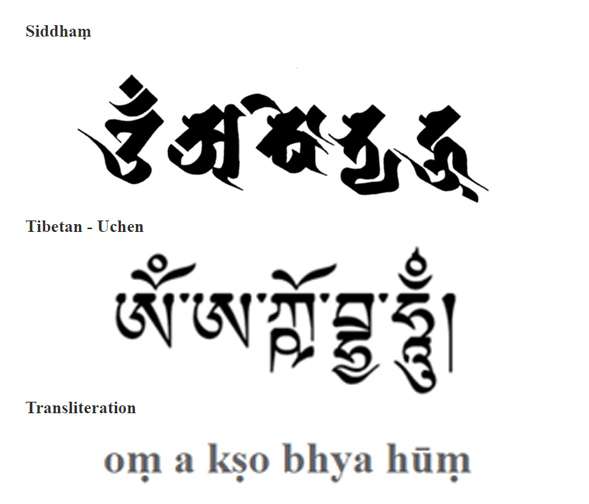
Given the above information, I’d like to suggest the tightening spell for Monkey’s headband—within the context of our thought experiment—is the Akshobhya Mantra! There are two kinds. I’ll leave it up to you which one you like best. The first is a short recitation of the buddha’s name: O a kṣo bhya hūṃ (fig. 4). This can be very roughly translated as “Praise to the Immovable One!” Om and Hum are both holy syllables invoking spiritual power and enlightenment, respectively. They also appear in the more well-known Oṃ maṇi padme hūṃ (Ch: An mo ni ba mi hong, 唵嘛呢叭咪吽). One Chinese version of the name mantra appears to be “An a bie zha zhi ga hong hong” (唵 阿別炸枝嘎 吽吽).

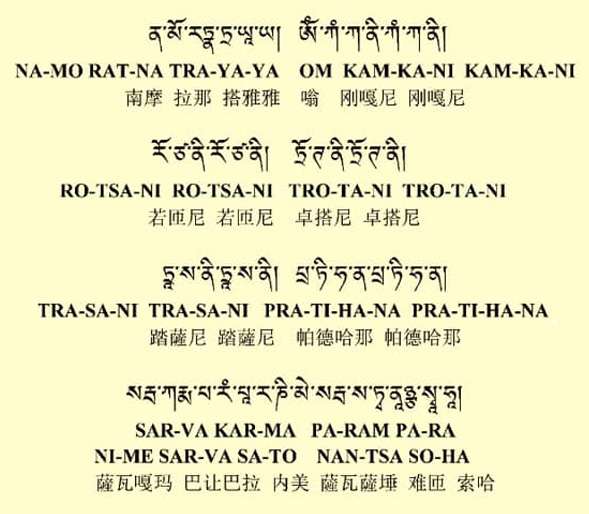
Fig. 4 – The Siddham and Uchen script versions of the short mantra (larger version). Based on information found here. Fig. 5 – A version of the longer chant with Uchen script, as well as English and Chinese transliterations (larger version). Based on an image found here.

The second is a longer chant, again called the “Mantra of Akshobhya” (Achu fo xinzhou, 阿閦佛心咒) (fig. 5 and video 1). It’s interesting to note that the historical Xuanzang (on whom Tripitaka is based) is known to have translated a version of this mantra. [2]

Reciting this to rein in Sun Wukong not only references the band’s historical and religious connection to Akshobhya but also serves as a physical reminder of right speech and action (how the deity gained buddhahood). It’s Tripitaka’s way of screaming, “Stop murdering everyone within arm’s reach!”

Video 1 – A chant of the long mantra.


3. Updates

Update: 01-24-22

The DC Comics’ story “The Monkey Prince Hates Superheroes” presents the spell as the Nianfo (fig. 6).

Fig. 6 – Shifu Pigsy (a.k.a. Zhu Bajie) reciting “Amituofo” to activate the golden headband on the Monkey Prince, son of the original Monkey King (larger version). From Yang, 2021, p. 80. Copyright DC Comics.


3.1. Additional Religious Background

Update: 01-25-22

The case for Akshobhya’s mantra being the tight-fillet spell is strengthened—again, within the context of our thought experiment—by the fact that he has power over strong negative emotions. According to Bangdel and Huntington (2003): “The transcendental insight represented by Akshobhya is mirrorlike wisdom (adarsha jnana), which…is the antidote to the poison of anger, or hatred” (p. 91). The monk Tripitaka assuages these emotions by activating the golden headband, once again reminding Wukong of right speech and action.

In addition, Akshobhya and Gautama have matching iconography: both are shown seated with the left hand palm up on the lap and the right reaching down to touch the earth. Hinayana Buddhists of Sri Lanka and Southeast Asia worship Gautama in this form, but Mahayana worships Akshobhya as such (see note #1). This is important as Gautama gives the three golden headbands to Guanyin in order to pacify any demons that she might encounter during her search for the scripture pilgrim (Wu & Yu, 2012, vol. 1, pp. 206-207). This shows there is a connection between the two Buddhas, and it also explains why Gautama would gift a headband associated with Akshobhya.


4. Updates (continued)

Update: 01-27-22

Various online sources and adaptations sometimes refer to the spell as the “Headache Sutra” (for example). But to my knowledge it’s never explicitly called this in the novel. The pain associated with the spell is generally used as a threat. For example, in chapter 16, Tripitaka exclaims: “Monkey! Aren’t you afraid of your headache [ni toutong, 你頭痛]? Do you still want to behave badly? (Wu & Yu, 2012, vol. 1, p. 347) (emphasis mine).

Chapter 25 provides two more names for the spell:

There is, moreover, the Tight-Fillet Spell or the Tight-Fillet Sutra [jingu er jing, 緊箍兒經]. It’s also [Tripitaka’s] “Old Saying Sutra” [jiuhua er jing, 舊話兒經]. [3] The moment he recites that, I’ll have a terrible headache, for it’s the magic trick designed to give me a hard time (Wu & Yu, 2012, vol. 1, p. 468).

叫做緊箍兒咒,又叫做緊箍兒經。他『舊話兒經』,即此是也。但若念動,我就頭疼,故有這個法兒難我。


Update: 07-25-22

I’ve written an article that explains the origins of the “crescent-style” headband.

The Monkey King’s Crescent-Style Headband


Update: 04-09-24

Another name for the spell is hua’er zhou (話兒咒), which Yu (Wu & Yu, 2012) translates as the “little something spell” (vol. 2, p. 16, for example).

Notes:

1) Akshobhya’s iconography is as follows:

[He] is represented seated, like all the Dhyani-Buddhas, with the legs locked and both feet apparent. There are often wheels marked on the soles of his feet, or a protuberance like a button, resembling the urna on the forehead. His left hand lies on his lap in ‘meditation’ mudra. His right touches the earth with the tips of the outstretched fingers, the palm turned inward. This is called the bhumisparsa or ‘witness’ mudra.

The Hinayana Buddhists in Ceylon, Java, Burma, and Siam worship Gautama Buddha under this form, while those of the Mahayana school look upon it as Akshobhya; for, with but rare exceptions, the historic Buddha is only appealed to by the Northern Buddhists in his ethereal form of Amitabha.

Akshobhya may also take in Tibet another form of Gautama Buddha called ‘Vajrasana’ (diamond throne). The attitude is the same as the above, but before him on the lotus throne lies a vajra, or it may be balanced in the palm of the left hand lying in ‘meditation’ mudra on his lap (Getty, 1914/1988, p. 36).

2) The Chinese source refers to Akshobhya as the “Immovable Buddha” (Budong rulai, 不動如來).

3) I’ve added an extra sentence from the Chinese original glossed over in the translation. Yu (Wu & Yu, 2012) translates the spell as the “Old-Time Sutra” in a previous sentence (vol. 1, p. 468).

Sources:

Bangdel, D., & Huntington, J. C. (2003). The Circle of Bliss: Buddhist Meditational Art. United Kingdom: Serindia Publications.

Buswell, R. E., & Lopez, D. S. (2013). The Princeton Dictionary of Buddhism. Princeton, NJ: Princeton University Press.

Getty, A. (1988). The Gods of Northern Buddhism: Their History, Iconography and Progressive Evolution through the Northern Buddhist Countries. New York: Dover Publications, Inc. (Original work published 1914)

Linrothe, R. N. (1999). Ruthless Compassion: Wrathful Deities in Early Indo-Tibetan Esoteric Buddhist Art. Boston, Mass: Shambhala.

Vessantara. (1993). Meeting the Buddhas: A Guide to Buddhas, Bodhisattvas, and Tantric Deities. United Kingdom: Windhorse Publications.

Wu, C., & Yu, A. C. (2012). The Journey to the West (Vols. 1-4) (Rev. ed.). Chicago, Illinois: University of Chicago Press.

Yang, G. L. (2021). The Monkey Prince Hates Superheroes. In Jessica Chen (Ed.). DC Festival of Heroes: The Asian Superhero Celebration (pp. 70-82) [Google Play]. New York, NY: DC Comics. Retrieved from https://play.google.com/store/books/details/Minh_Le_DC_Festival_of_Heroes_The_Asian_Superhero?id=qXUrEAAAQBAJ

The White Ape Perfected Man: Sun Wukong’s Divine Double

Last updated: 03-20-2022

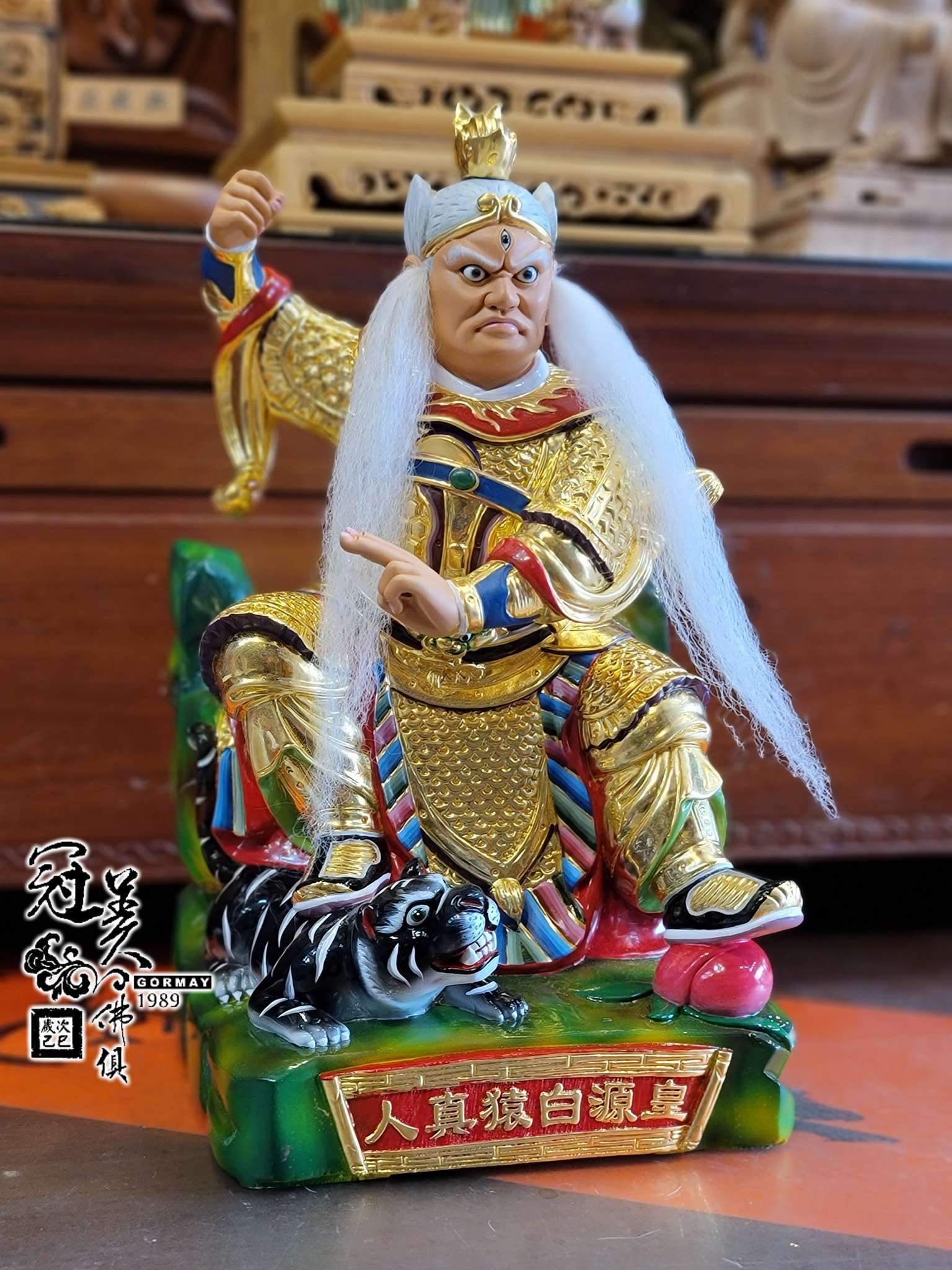
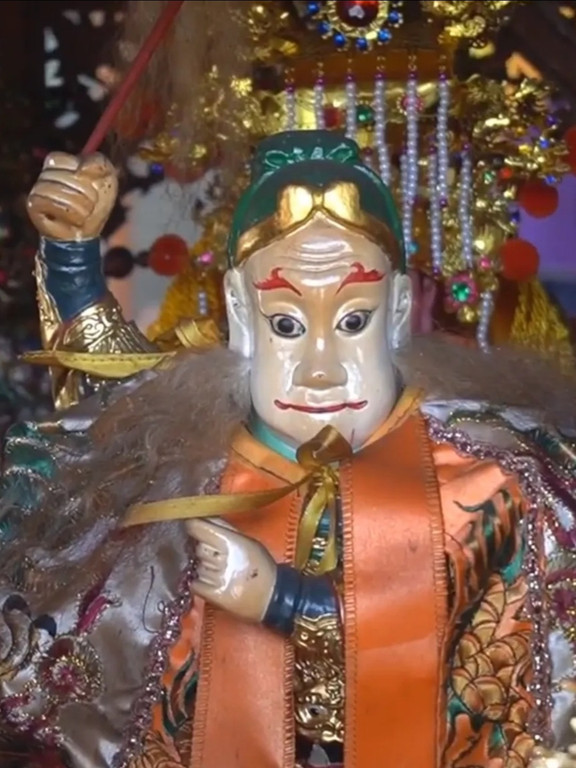
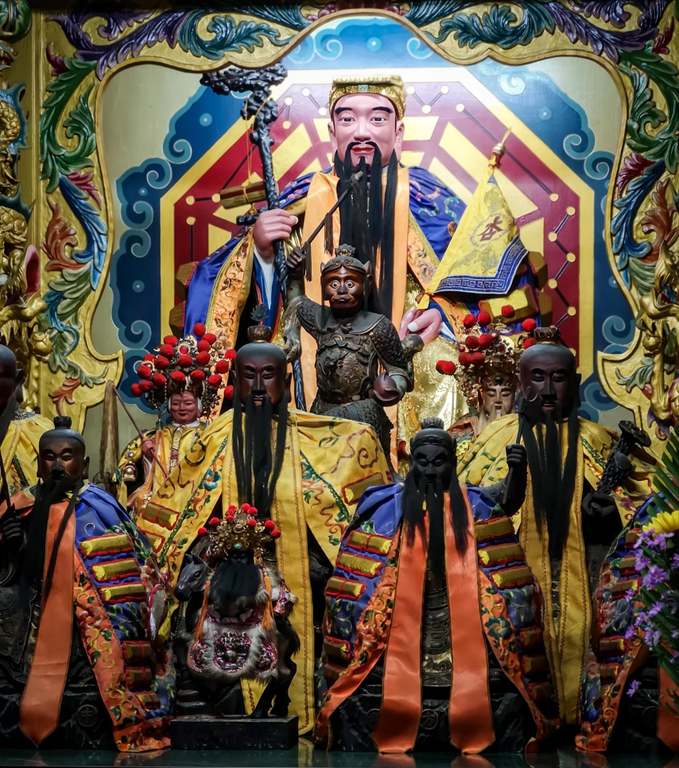
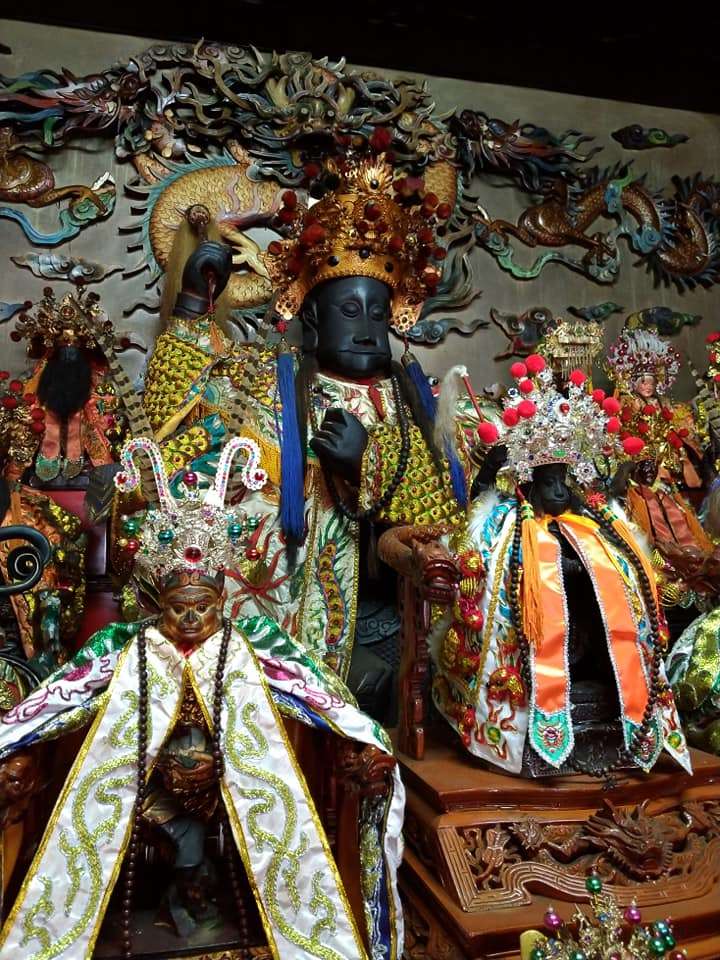
Readers may wonder where I get my inspiration to write articles. Most of the time I seek to answer a question that pops up while reading a book or researching a subject, leading to a subsequent paper on what I learned. Other times, I simply stumble across something online. A prime example of this is the “White Ape Perfected Man” (Baiyuan zhenren, 白猿真人), a rare folk Taoist deity that I recently learned about from Facebook. He is depicted with long hair (sometimes with ear-pressing tufts) and a golden fillet, linking him to Chinese opera depictions of military monks (wuseng, 武僧) (Bonds, 2008, pp. 177-178), thus signaling his position as a martial deity. A headdress with lingzi (翎子) feathers sometimes adorns his crown. His visage ranges from welcoming to fierce and from human to more primate-like. He wears a golden suit of armor and sits in a kingly fashion with the right knee resting on the seat, exposing the bottom of his foot to the viewer. This armor is sometimes draped in a colorful ritual cape. His left arm is usually bent at the elbow and the hand is clenched in a fist (or two-finger shooting mudra) or holds an immortal peach at the chest, while the other is held high and contains a fly whisk or staff. This iconography is shockingly similar to religious depictions of Sun Wukong as the “Great Sage Equaling Heaven” (Qitian dasheng, 齊天大聖). In fact, the two deities are nearly indistinguishable apart from the ape sometimes having white hair and a white face. But this isn’t always a good indicator, though, as one Fujian tradition features a brother of the Monkey King with a white face. And other times, statues of the white ape might be plain wood or even bronze, thereby erasing any signifying color. But the best clue to his identity appears to be the combination of the fist at the chest and a raised foot while in a seated position, what I call the “fist over foot motif” (fig. 1 to 4).

I’ve previously written about magical white apes (gibbons) in relation to Tang-era Chinese literature, primate-based martial arts, and the fictional origin of Sun Wukong. I’ve even archived an entire book on the subject which surveys historical references, poems, folktales, and art spanning over 3,000 years from the Zhou to Qing dynasties. I would like to supplement this material by writing an article about the White Ape Perfected Man and his appearance in vernacular fiction and Taoist scripture. I suggest his iconography was directly influenced by Sun Wukong based on a centuries-long association between the two magic primates in popular literature.

Fig. 1 – One of the first pictures I ever saw of the White Ape Perfected Man (larger version). Photo from Facebook. Fig. 2 – A statue from an unknown temple (larger version). Photo found here. Fig. 3 – One of several statues from the Zhenji Temple of Bade District, Taoyuan, Taiwan (Taoyuan Bade Zhenji gong, 桃園八德鎮濟宮) (larger version). Screenshot from this Facebook video. Fig. 4 – A statue belonging to Jishen Temple of Tainan, Taiwan (Tainan Jishen gong, 台南濟申宮) (larger version). Photo from Facebook.

Table of Contents

1. Religious Story

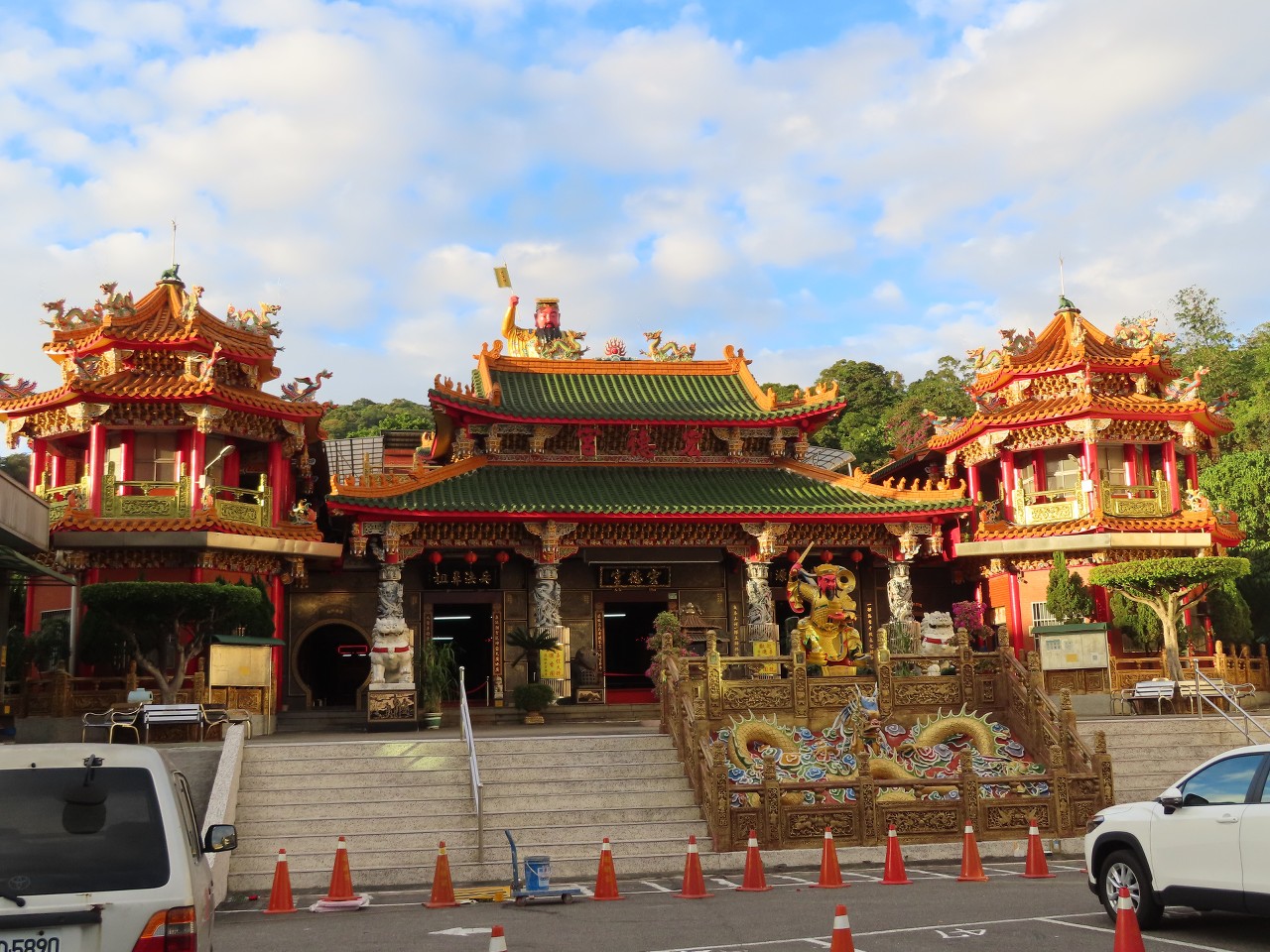
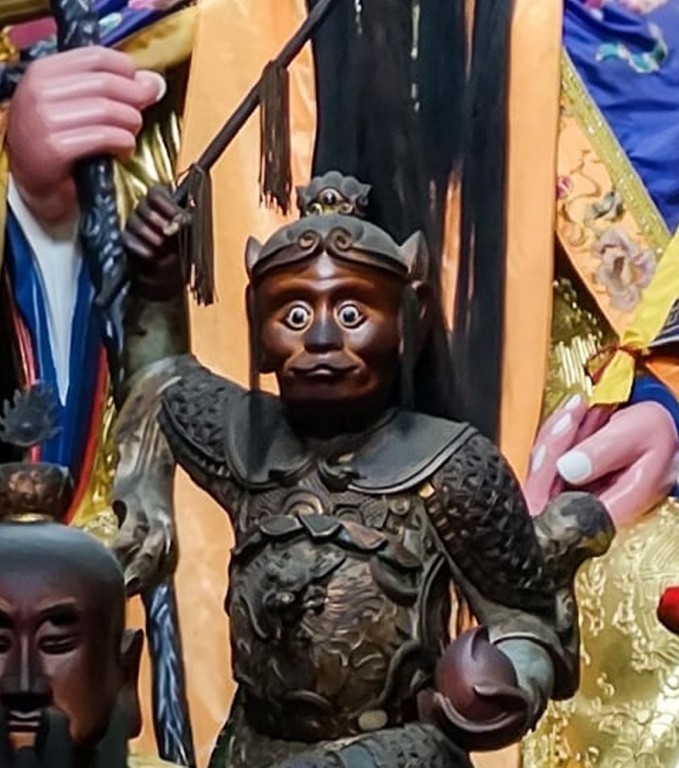
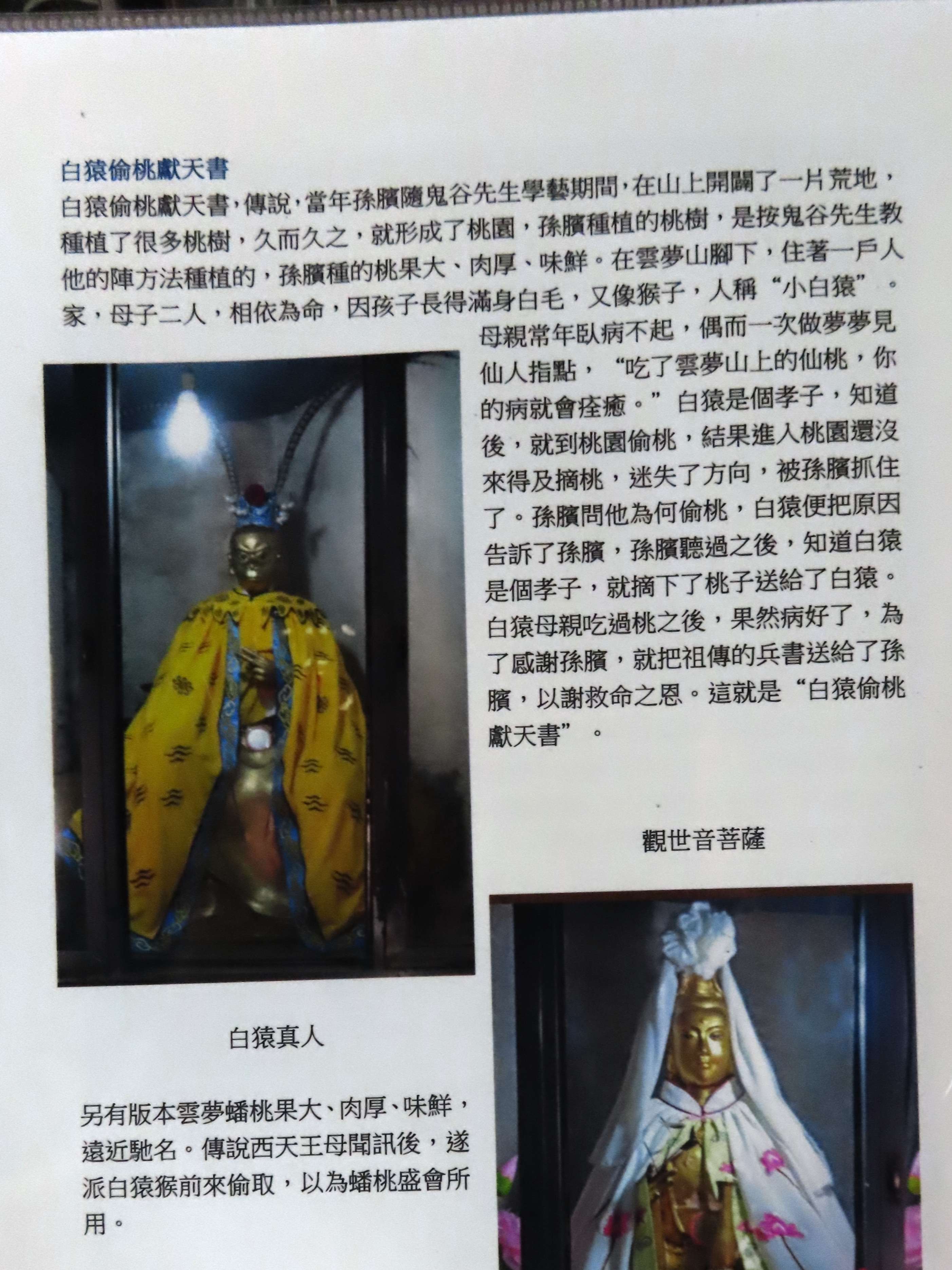
I traveled to the Sun Bin Shrine of Hongde Temple in Yingge District, New Taipei, Taiwan (Yingge Hongde Gong Sun Bin Miao, 鶯歌宏德宮孫臏廟) (fig. 5) to gather material for this article. Unfortunately, the temple’s statue of the White Ape Perfected Man (fig. 6) was out for repairs on the day of my visit. But I collected information about the deity from the temple’s history book (fig. 7). The ape god is associated with Sun Bin (孫臏, d. 316 BCE) (fig. 8), a deified military strategist of the Warring States period, and is revered as a transmitter of divine knowledge. [1] A rough translation of his religious story follows:

“The White Ape Steals a Peach and Offers a Heavenly Book” (Baiyuan toutao xian tianshu, 白猿偷桃獻天書)

According to legend, when Sun Bin was studying military arts under Master Ghost Valley (Guigu xiansheng, 鬼谷先生), he opened a plot of uncultivated land on the side of Yunmeng Mountain (Yunmeng shan, 雲夢山) and grew a peach orchard with big, fleshy, and delicious fruits using his teacher’s method. At the foot of the mountain lived a mother and son who depended on each other. The son looked like a monkey because his body was covered with white hair, and so he was known as the “Little White Ape” (Xiao baiyuan, 小白猿). His mother was constantly sick and occasionally dreamed of a transcendent pointing and saying, “Eat the immortal peaches on Yunmeng Mountain and your illness will be cured”.

The white ape was a filial son, and so he went to steal a peach for his mother but lost his way. Sun caught the boy and asked him why he would steal from the orchard. Once he heard of the ape’s sick mother, he gave him the peach. The mother ate the fruit and recovered. In return, the white ape gave Sun a heavenly book of military strategy (bingshu, 兵書) passed down from his ancestors, saying, “Thank you for your life-saving grace”.

Another version of the story states the Yunmeng peach was so famous for its large size, fleshy fruit, and delicious taste that, upon hearing of it, the Queen Mother of the West sent the white ape to steal it for her Peach Banquet.

This last part is a reversal of Sun Wukong stealing the Queen Mother’s peaches in Journey to the West (Xiyou ji, 西遊記, 1592). [2]

Fig. 5 – The Sun Bin Shrine of Hongde Temple (larger version). Photo by the author. Fig. 6 – A detail of the temple’s White Ape Perfected Man’s statue (larger version). See fig. 8 for a full version. Fig. 7 – A page from the temple’s history book (larger version). Note the bronze statue of the White Ape, including the lingzi headdress. Photo by the author. Fig. 8 – The central statue of Sun Bin (larger version). Note the position of the white ape in front of Sun. Photo from Facebook.

Astute readers will notice that the tale does not touch on the white ape’s religious title, the “Perfected Man” (Zhenren, 真人). Perfected individuals rank among the highest transcendents of the celestial hierarchy and even rule over lower immortals residing in various earthly paradises (Miura, 2008). This contrasts with the meager, filial son presented in the story. It also contrasts with the white ape’s iconography as an armor-clad martial deity. Perfected individuals are usually portrayed as lofty immortals wearing robes decorated with Daoist symbols (Stevens & Welch, 1998, for example).

I reached out to the Zhenji Temple of Bade District, Taoyuan, Taiwan (Taoyuan Bade Zhenji gong, 桃園八德鎮齊宮), where the White Ape Perfected Man is worshiped as the main deity (zhu shen, 主神) (fig. 9), to make sense of these disparate strands. However, they did not get back to me by the time this article was ready for publication. I’ll make an update when new information becomes available. But until then, I suggest his martial iconography was directly influenced by depictions of the Great Sage Equaling Heaven, whose cult is far more prevalent in Taiwan. This proposed connection to Sun Wukong becomes even more evident when the information below is taken into account.

Fig. 9 – Zhenji Temple’s main White Ape Perfected Man statue (center background) surrounded by various smaller figures (larger version). The statue in the left foreground looks very similar to the Great Sage apart from the fist over foot motif. Image from Facebook.  

2. Vernacular Fiction

The White Ape Perfected Man’s religious story can be traced directly to The Battle of Wits between Sun and Pang (Sun Pang douzhi yanyi, 孫龐鬥智演義, 1636; a.k.a. The Former and Latter Annals of the Seven Kingdoms, Qianhou qiguo zhi, 前後七國志), which tells of the great struggle between Sun Bin and his former friend and classmate Pang Juan (龐涓). The two study supernatural military arts under the Immortal Master Ghost Valley (Guigu xianshi, 鬼谷仙師) in his “Water Curtain Cave” (Shuilian dong, 水簾洞) before their fates take separate paths and they become bitter enemies. Chapter four sees the teacher appoint Sun as guardian of an immortal peach tree on the backside of Yunmeng Mountain. But the young disciple is surprised to discover a talking white ape stealing peaches night after night. When asked how it can speak, the primate reveals his aristocratic family has been soaking up immortal qi energy for three generations northwest of the Master’s cave. His ancestor is the Marquis of Baxi (Baxi hou, 巴西侯), [3] his father the Duke Macaque (Ju gong, 狙公), [4] and his mother the Princess Mountain Blossom (Shanhua gongzhu, 山花公主). [5] When asked why he’s stealing peaches (fig. 10), the white ape reveals he’s trying to cure his mother of an illness and that she will die unless the treatment is completed. Taking pity on the filial primate, Sun picks the last peach needed and gives it to the white ape, telling him never to return to the orchard. The grateful son repays the favor by stealing three scrolls of heavenly books (tianshu, 天書) from Master Ghost Valley’s secret hiding place to give to his mother’s savior.

But Sun Bin mistakenly incurs the wrath of heaven not only because he acquires the books before he’s fated to but also because he fails to ritually cleanse himself before reading them. Master Ghost Valley is forced to intervene on his student’s behalf by teaching Sun how to hide from heavenly punishment (da zainan, 大災難, lit: “great tribulation”) by meditating in a cave for 49 days (Wumen xiaoke & Yanshui sanren, 1636).

This novel shares many elements with Journey to the West. Both include:

  1. Characters surnamed Sun (孫) (Sun Bin VS Sun Wukong) living in a “Water Curtain Cave”. [6]
  2. Sun characters studying under an immortal master (Master Ghost Valley VS Master Subodhi). [7]
  3. Sun characters being directed to guard trees laden with immortal peaches (one tree on earth VS an entire grove in heaven).
  4. Supernatural primates stealing the magic peaches for consumption (the white ape VS the Monkey King). [8]
  5. Sun characters defying their fate and incurring the wrath of heaven, thereby learning from their masters how to hide from punishment (Sun Bin Vs. Sun Wukong). [9]

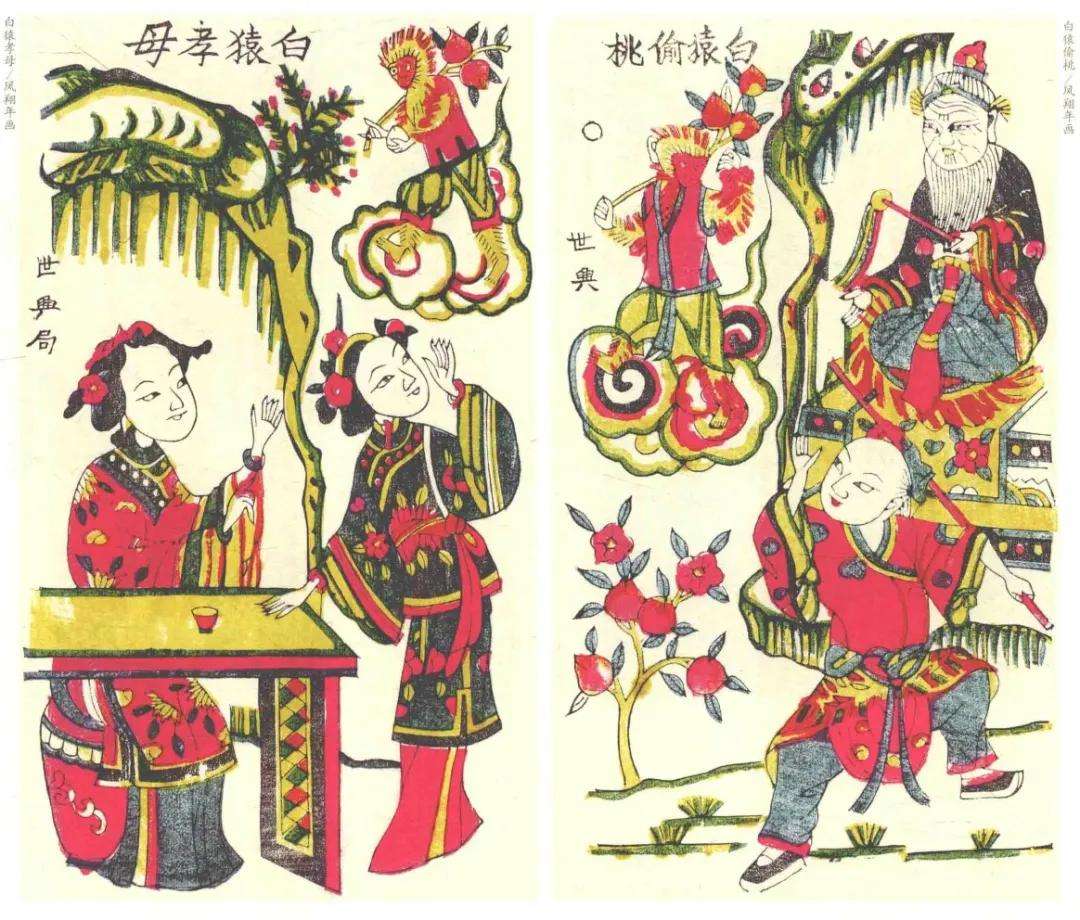
Fig. 10 – A lovely New Years print depicting scenes from the story, including the “White Ape steals peaches” (right) and the “White Ape is filial to mother” (left) (larger version). The right print includes Master Ghost Valley and a young Sun Bin. Print found here.

It’s important to note that there is also some overlap between The Battle of Wits and Journey to the South (Nanyouji, 南遊記, 1570s-1580s). I quote from my previous article:

[The rogue immortal Huaguang (華光)] works to end his mother’s demonic lust for flesh by procuring an immortal peach in chapter 17. He does this by transforming into Sun Wukong and stealing the magic fruit from heaven. The real Monkey King is subsequently accused of his double’s misdeeds, much like the Six-Eared Macaque episode of the original novel. The Jade Emperor threatens to remand him to the Buddha for punishment but is convinced to give Sun a month-long reprieve to find the true culprit.

So we have two magical primate characters (the white ape VS Huaguang-as-Sun Wukong) that steal immortal peaches to help cure their mothers. This association with the rogue immortal might then explain why the statue of the White Ape Perfected Man from figure one has a third eye. Huaguang’s various incarnations are described as having three eyes in Journey to the South (for example) (Yu, n.d.).

Therefore, it seems that these later novels borrowed from Journey to the West, as well as each other. But I will show the theme of a primate stealing fruit actually predates the standard Ming edition of Journey to the West by hundreds of years, suggesting it too borrowed from an earlier source.

3. Taoist Literature

The story of Sun Bin and the white ape actually prefaces the first scroll of the Scripture of the Most High Luminous Mirror of the Six Ren Tallying with Yin (Taishang liuren mingjian fuyin jing, 太上六壬明鑑符陰經) (a.k.a., the Ape Book, Yuanshu, 猿書), [10] a Northern Song-era work related to the Taoist doctrine of the Three Sovereigns (Steavu, 2019, p. 195). Instead of peaches, the tale just says “fruit” (guo, 菓). But I imagine the produce is something special like immortal peaches as Sun guards them with a weapon. A rough translation follows (I have skipped over some of the more esoteric parts that escape me):

[Master Ghost Valley] saw the fruit had ripened, so he commanded Sun to watch over it. One night a person jumped the wall into the nine gardens and took some of the fruit. But Sun was hiding with a sword and caught the culprit, a white ape. The primate said: “Don’t hurt my body. I share the same age as heaven and earth and have lived as long as the sun and moon. I have mysterious texts (xuanwen, 玄文). Wait for me the next day and I will give them to you”. The white ape then transformed into white light and left. Sun waited the following day. Suddenly, he saw the white ape fly from the northwest. He was given one scroll of mysterious texts. The primate again transformed into white light and headed towards the southeast. Sun then returned to his room to inspect the text. He didn’t know the name but saw that it was divided into three volumes: initial (shang, 上), middle (zhong, 中) and final (xia, 下). He named it after the white ape (Taishang liuren, n.d.).

The story of a magic monkey stealing peaches was already present in the Journey to the West story cycle by the 13th century, for the “Monkey Pilgrim” (Hou xingzhe, 猴行者), Sun Wukong’s predecessor, admits to raiding the Queen Mother’s orchard when he was still a young immortal (Wivell, 1994, p. 1195). But the preceding Daoist scripture indicates the motif is even older. [11] In addition, the scripture shows the idea of a character surnamed Sun (Sun Bin) guarding special fruit predates the motif in the standard Ming edition of Journey to the West. It’s not a stretch then to suggest the Most High Luminous Mirror (or related media) influenced the 13th and later 16th-century versions of the story. Therefore, it’s possible the tales of Sun Bin, the white ape, and Sun Wukong have been borrowing from each other for hundreds of years.

This centuries-long association between the magical primates in literature then strengthens my suggestion that the White Ape Perfected Man’s iconography was directly influenced by that of Sun Wukong. Drawing upon a well of preexisting cultural beliefs and imagery likely helped the cult of this relatively recent deity establish itself faster, allowing him to take his place in a rapidly evolving religious landscape where ever newer gods are constantly added to the ranks of their older brethren.

4. Conclusion

The White Ape Perfected Man is a rare folk Taoist deity associated with revealing heavenly scriptures to the Warring States military strategist Sun Bin (4th cent.). His statues depict him as a seated, armor-clad primate with a “fist over foot” motif and the long hair and golden fillet of military monks from Chinese opera. This martial iconography conflicts with the deity’s title, “Perfected Man”, a high-ranking immortal usually depicted wearing robes. It also conflicts with his own religious story, which presents him as a meager, filial son who steals immortal peaches to cure his sick mother. I suggested above that his religious imagery was directly influenced by depictions of Sun Wukong as the Great Sage Equaling Heaven. Beyond shockingly similar iconography, both primate deities have a long association in Chinese popular literature. The white ape appears in The Battle of Wits Between Sun and Pang (1636), which shares many similarities with Journey to the West (1592). These include characters surnamed Sun (孫) (Sun Bin VS Sun Wukong) living in a Water Curtain Cave, studying under immortal masters (Ghost Valley VS Subodhi), guarding immortal peaches, and hiding from heavenly punishment. It also includes supernatural primates (the white ape VS the Monkey King) stealing the life-prolonging fruit for consumption. The number of similarities suggests The Battle of Wits borrowed from Journey to the West. The theft of immortal peaches is already present in a 13th-century version of Journey to the West, but this is preceded by a tale appearing in a work from Taoist canon, the Scripture of the Most High Luminous Mirror of the Six Ren Tallying with Yin. It describes the white ape stealing fruit from a garden protected by Sun Bin. It’s possible the Monkey King’s early story cycle was influenced by this scripture (or related media), suggesting the stories of Sun Wukong, Sun Bin, and the white ape have been borrowing from each other for hundreds of years. This centuries-long connection lends support to the martial iconography of Sun Wukong influencing the religious imagery of the White Ape Perfected Man.


5. Updates

Update: 12-11-21

Palmer and Siegler (2017) quote a certain Master Hu, a monk of Mt. Hua in Shaanxi province, China, who claims that the White Ape taught him a system of primate-based martial arts:

I learned [White Ape Through the Back Boxing] spontaneously; it was transmitted to me by the White [Ape] Immortal (Baiyuan zhenren). When I start, he comes down into me, and I do the forms spontaneously. In the future, perhaps I will arrange it into a method in stages that can be taught to others. The White [Ape] Immortal first transmitted the method to humans in the spring and autumn period (770–476 BC), but owing to the poor moral quality of the inheritors of the method, it was lost. Now, it has been transmitted directly to me by the Immortal (pp. 120-121).

Also, Master Ghost Valley’s association with the Water Curtain Cave goes back to at least the Northern Song as his Numinous Writ of the Essence of Heaven (Guigu zi tiansui lingwen, 鬼谷子天隨靈文) lists him as the “Master of the Waterfall Cave” (Shuilian dong zhu, 水濂洞主) (Andersen, 2019). In this case, the source uses a different lian (濂) in place of the lian (簾) associated with the caves of the Master (and Sun Bin) in The Battle of Wits between Sun and Pang (1636) and Sun Wukong in Journey to the West (1592). But they both mean the same thing: a waterfall hiding a cave mouth. This might suggest, apart from the guarding and theft of immortal peaches, other elements from Sun Bin’s story cycle were borrowed by that of the Monkey King.


Update: 12-12-21

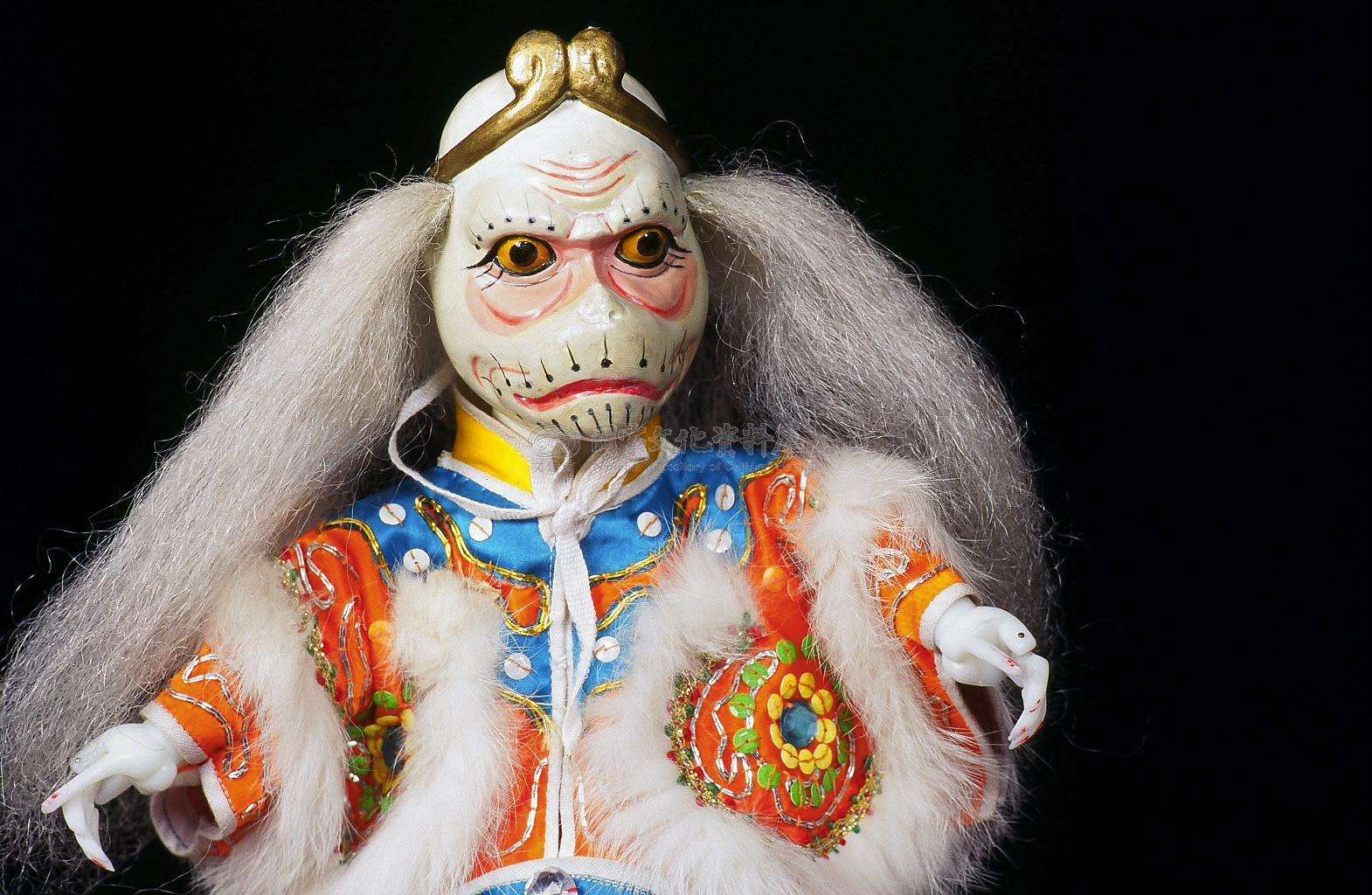
I mentioned in the introduction white face and hair are not always the best indicators that a figure is the White Ape Perfected Man. Take, for example, some depictions of Sun Wukong in glove puppetry (fig. 11).

Fig. 11 – A Taiwanese glove puppet of the Monkey King (larger version). Photo found here.


Update: 03-20-22

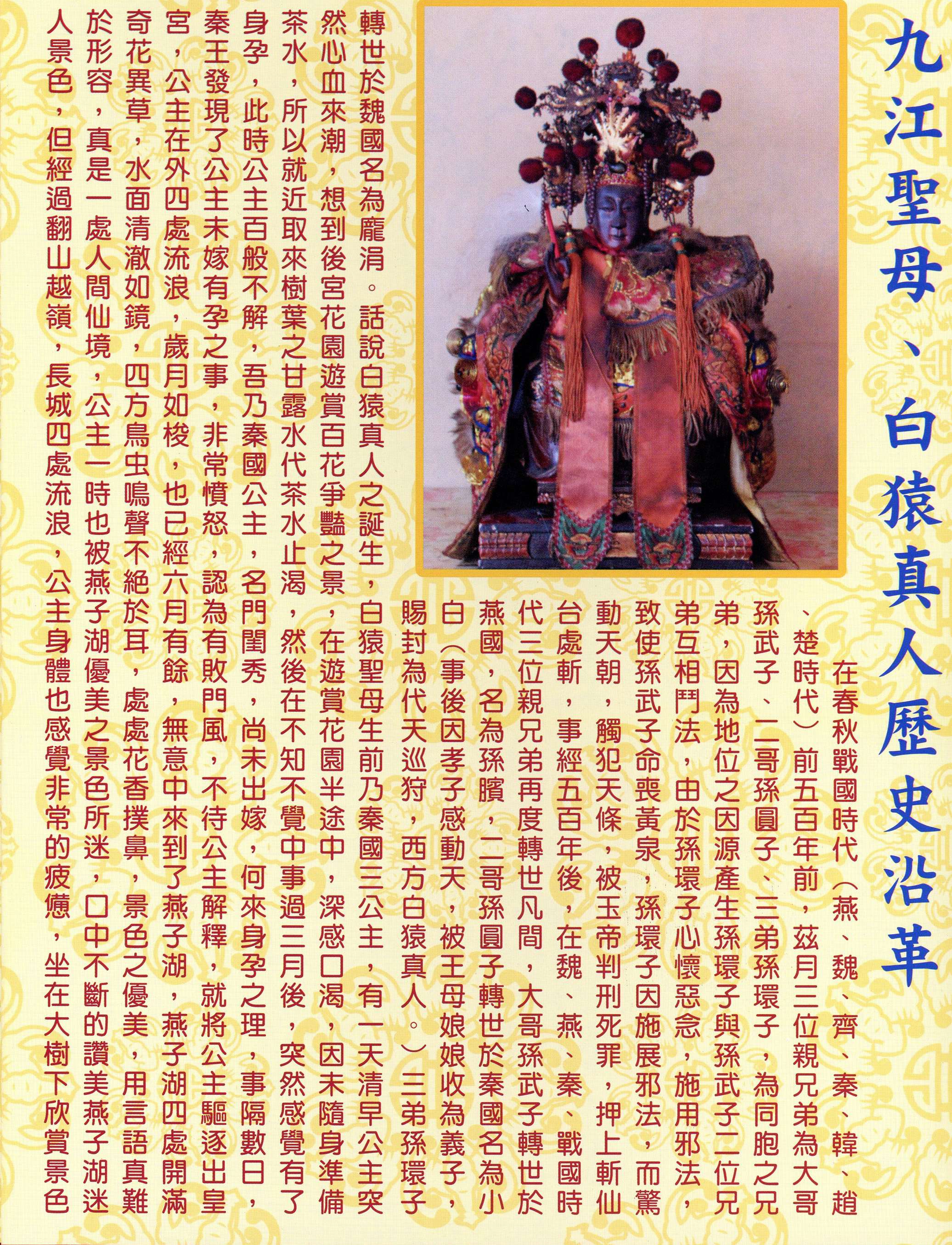
Yesterday I visited the aforementioned Zhenji Temple of Bade District, Taoyuan, Taiwan (Taoyuan Bade Zhenji gong, 桃園八德鎮齊宮), where the White Ape Perfected Man is venerated. I learned a few things. One, his religious birthday is celebrated on the 27th day of the 5th lunar month (June 25th, 2022), often written as 五月廿七日. Two, his mother, the “Holy Mother of Nine Rivers” (Jiujiang shengmu, 九江聖母), is also worshiped at the temple (her birthday is the 15th day of the 1st lunar month). A temple booklet provided to me tells her story (fig. 12 & 13). I paraphrase the tale below:

Five hundred years before the Spring and Autumn and Warring States Periods, there were three godly brothers named Sun Wuzi (孫武子), Sun Yuanzi (孫圓子), and Sun Huanzi (孫環子). The eldest brother Wuzi and the youngest Huanzi fought for status. But because the latter killed the former with evil magic, Sun Huanzi was sentenced by the Jade Emperor to die on the “Immortal-Beheading Platform” (Zhanxian tai, 斬仙台). The brothers were reborn in the mortal realm five hundred years later during the Warring States period. Sun Wuzi was reborn as Sun Bin in the Yan state, Sun Yuanzi was reborn as (the white ape) Xiaobai (小白) in the Qin state, and Sun Huanzi was reborn as Pang Juan in the Wei State.

The mother of the white ape was the third princess of the Qin state. One day, she became thirsty while touring the imperial garden. But in the absence of tea, she sated her thirst with sweet dew from tree leaves. Three months later, the princess discovered to her surprise that she, an unwed woman, was pregnant. When her father the king learned of this news, he expelled her from the palace. Sometime later, she came by accident to Swallow Lake (Yanzi hu, 燕子湖), a pure, mirror-like body of water surrounded by exotic, fragrant flowers and singing birds and insects. After wandering around this indescribable paradise for sometime, the princess became tired and went to sleep. She dreamed of a golden swallow that told her the child she was carrying was a god reincarnated on earth. It also asked the princess to practice spiritual cultivation beside the lake, promising her that she would one day became an immortal. She realized it was just a dream when she woke up, but she followed through with her training.

Ten days later she gave birth to her son, who was not quite human or demon. His entire body was covered with white hair just like a white ape. The local people claimed that he was a monster, but despite her anger, she raised him patiently. When he was three years old, heaven bestowed on him three divine treasures: an As-You-Will Vajra Staff (Ruyi jingang bang, 如意金剛棒), a golden headband spell (jinquan zhou, 金圈咒), and the steed Red Hare (Chitu ma, 赤兔馬). When the white ape was eight years old, a demon came to threaten the villagers around Swallow Lake. The white ape fought the monster and won, leading the people to believe he was a great celestial immortal (Dalou tianxian, 大羅天仙) come to save the world.

When the white ape was sixteen, his mother’s holy spirit left her body, and the evil Sage Sea Tide (Haichao shengren, 海潮聖人) cast his heavenly treasure around it, thus making her body sick. The Patriarch Reaching Heaven (Tongtian jiaozhu, 通天教主) then appeared to tell the white ape that the only way to cure his mother was to feed her one of the Queen Mother‘s (Wangmu niangniang, 王母娘娘) immortal peaches. After many hardships, he succeeded in his quest and cured her. Upon her recovery, she practiced diligently and eventually achieved immortality.

One day, the immortal princess did divination on her fingers and found that, despite their practice, four other woman around Swallow Lake had yet to achieve the elixir. So, she took them as her servants and continued to guide their practice. After this, she subdued seventeen phoenixes that were the same class of evil spirits as the phoenixes and serpents below the Queen Mother’s gate. Following this, she subdued thirty-six demon dragons as her subordinate generals.

At this time, the god of fire (huoshen, 火神) spread flames everywhere, plunging the world into chaos. The fires killed the surrounding vegetation and created a drought. The immortal princess felt sorry for the people, so she used her powers to defeat the fire god in a great battle. She then transformed nine dragons into nine rivers for the people to drink and to revive the plants and trees. The people were finally able to live in peace. From this point on, they worshiped her as the Holy Mother of Nine Rivers. A temple dedicated to her was built around Swallow Lake in Guangling County, Shanxi Province, China, which is now a first-class protected historic site by the CCP.

Fig. 12 – The first page of the Holy Mother of Nine River’s story (larger version). Fig. 13 – The second page (larger version).

It appears that portions of this story were taken from the Qing-era novel Spring and Autumn of Stabbing Swords (Fengjian chunqiu, 鋒劍春秋). The godly Sun brothers, the evil Sage Sea Tide, and even the white ape appear therein.

I’d also like to highlight that the white ape’s staff and headband are modeled on that of Sun Wukong, strengthening my suggestion that the former’s iconography was based on the latter.

Notes:

1) The idea of a white ape sharing heavenly knowledge goes back centuries. For example, one 4th-century source reveals Zhou Qun (周羣/群, 3rd-cent.) learned the art of divination from a book of bamboo slips given to him by a gibbon-turned-old man in the Min Mountains (Gulik, 1967, p. 50).

2) Sun is appointed the guardian of the immortal peach groves in chapter four. He starts eating the life-prolonging fruit early in his tenure, and his theft is eventually discovered by attendants of the Queen Mother of the West (Wu & Yu, 2012, pp. 160 and 162-163).

3) The Marquis of Baxi (Baxi hou, 巴西侯) is an ape spirit appearing in a story from the Song-era Extensive Records of the Taiping Era (Taiping guangji, 太平廣記, 978). A retired official from Sichuan is invited to an eerie, drunken party by the Marquis, only to wake up the next morning to find his host was a gibbon and all of the other guests were also animal spirits (Gulik, 1967, pp. 67 and 68-69).

4) The only Duke Macaque (Ju gong, 狙公) that I’m aware of is a human keeper of monkeys from a parable on freedom appearing in The Collected Works of Bowen (Chengyi Bowen ji, 诚意伯文集, 14th cent.). I’m not sure if the novel is claiming the ape has a human father, or if it’s just a vague reference to a character from Chinese literature with a connection to primates.

5) I can’t find any information on this character. But given the ancestor and father, I’m sure the mother is associated with apes or monkeys in some way.

6) Wukong becomes king of the monkeys in chapter one by discovering a cave, the Water Curtain Cave (Shuilian dong水簾洞), behind a waterfall. His people soon after take residence inside (Wu & Yu, 2012, pp. 104-106).

7) See my article on Master Subodhi’s curriculum.

8) See note #2.

9) Monkey learns the 72 transformations in order to escape heavenly punishments of lightning, fire, and wind sent to kill him for defying his fate by attaining immortality.

10) Steavu (2019) calls it the “Monkey book” (p. 195), but a gibbon is an ape, so I have adjusted the translation accordingly.

11) I suggest in this article that the supernatural ape stealing peaches motif could be a mixture of a Sinicized version of the Great Monkey jataka tale, in which the Buddha’s reincarnation as a monkey king leads his people to raid an imperial fruit garden, and the theft of immortal peaches by the planet Jupiter (Sui, 歲), who is subsequently exiled to reincarnate as the Han-era jester Dongfang Shuo (東方朔).

Sources:

Andersen, P. (2019). Guigu zi tiansui lingwen 鬼谷子天隨靈文. In K. Schipper and F. Verellen (Eds.), The Taoist Canon: A Historical Companion to the Daozang (p. 1239). Chicago: University of Chicago Press.

Bonds, A. B. (2008). Beijing Opera Costumes: The Visual Communication of Character and Culture. Honolulu: University of Hawai’i Press.

Gulik, R. H. (1967). The Gibbon in China: An Essay in Chinese Animal Lore. Leiden: E.J. Brill.

Miura, K. (2008). Zhenren. In F. Pregadio (Ed.), The Encyclopedia of Taoism: Vol. 1 & 2 (pp. 1265-1266). Longdon: Routledge.

Palmer, D. A., & Siegler, E. (2017). Dream Trippers: Global Daoism and the Predicament of Modern Spirituality. Chicago: The University of Chicago Press.

Steavu, D. (2019). The Writ of the Three Sovereigns: From Local Lore to Institutional Daoism. Hong Kong: The Chinese University of Hong Kong.

Stevens, K., & Welch, J. (1998). XU, The Daoist Perfected Lord Xu Zhenjun 許真君 The Protective Deity of Jiangxi Province. Journal of the Hong Kong Branch of the Royal Asiatic Society, 3, 137-146. http://www.jstor.org/stable/23889813

Taishang liuren mingjian fuyin jing juan yi (n.d.). [Book of the Most High Luminous Mirror of the Six Ren Tallying with Yin: First Scroll]. Retrieved from https://ctext.org/wiki.pl?if=gb&chapter=465883#p3

Wivell, C.S. (1994). The Story of How the Monk Tripitaka of the Great Country of T’ang Brought Back the Sūtras. In V. Mair (Ed.), The Columbia Anthology of Traditional Chinese Literature (pp. 1181-1207). New York: Columbia University Press.

Wumen xiaoke, & Yanshui sanren (1636). Qianhou qiguo zhi [Annals of the Seven Kingdoms]. Retrieved from https://ctext.org/wiki.pl?if=gb&chapter=736295#p89

Wu, C., & Yu, A. C. (2012). The Journey to the West (Vol. 1). Chicago, Illinois: University of Chicago Press.

Yu, X. (n.d.). Nanyouji: Huaguang sanxia Fengdu [Journey to the South: Huaguang goes to the Underworld Three Times]. Retrieved from https://ctext.org/wiki.pl?if=gb&chapter=506975&remap=gb#%E5%8D%8E%E5%85%89%E4%B8%89%E4%B8%8B%E9%85%86%E9%83%BD