Last updated: 05-25-2025
The idea that the Monkey King can gain the strength and magical abilities of an opponent by copying their appearance via bodily transformation or hair clones became popular online sometime around (or before) 2021, and it continues to spread (fig. 1).

Fig. 1 – (Top row) screenshot of a Twitter comment dated September 2021; (bottom three rows) screenshots of reddit comments taken in December 2023 (larger version).
A more recent example is an Instagram reel from August 2024. The transcript reads:
[Sun Wukong can’t be defeated by the video game character Kratos (of God of War fame) because] … one of his most broken abilities is his hair. You see, each of his individual hairs can transform into anything he wants. Basically, he can create another version of Kratos. He could just create another Kratos who would be just as strong as this Kratos. He could create 84,000* of Kratoses. So now, you have a Wukong who’s just as strong as Kratos, on top of the fact that he has another Kratos with him (source).
* This refers to the metaphorical number of Sun’s hairs as stated in chapter two of the original novel (Wu & Yu, 2012, vol. 1, p. 128).
But where does this idea come from? Does it even appear in the original Journey to the West (Xiyouji, 西遊記, 1592; “JTTW” hereafter)? In this article, I will discuss what the novel has to say about this topic.
1. Source
I am 100% certain that the claim was influenced by the battle between Monkey and Nezha from JTTW chapter four:
This Prince Nezha,* properly armed, leaped from his camp and dashed to the Water-Curtain Cave. Wukong was just dismissing his troops when he saw Nezha approaching fiercely. Dear Prince!
[poem about Nezha’s appearance and skills omitted for the sake of brevity]
Wukong drew near and asked, “Whose little brother are you, and what do you want, barging through my gate?” “Lawless monstrous monkey!” shouted Nezha. “Don’t you recognize me? I am Nezha, third son of the Pagoda Bearer Devaraja. I am under the imperial commission of the Jade Emperor to come and arrest you.” “Little prince,” said Wukong laughing, “your baby teeth haven’t even fallen out, and your natal hair is still damp! How dare you talk so big? I’m going to spare your life, and I won’t fight you. Just take a look at the words on my banner and report them to the Jade Emperor above. Grant me this title, and you won’t need to stir your forces. I will submit on my own. If you don’t satisfy my cravings, I will surely fight my way up to the Treasure Hall of Divine Mists.”
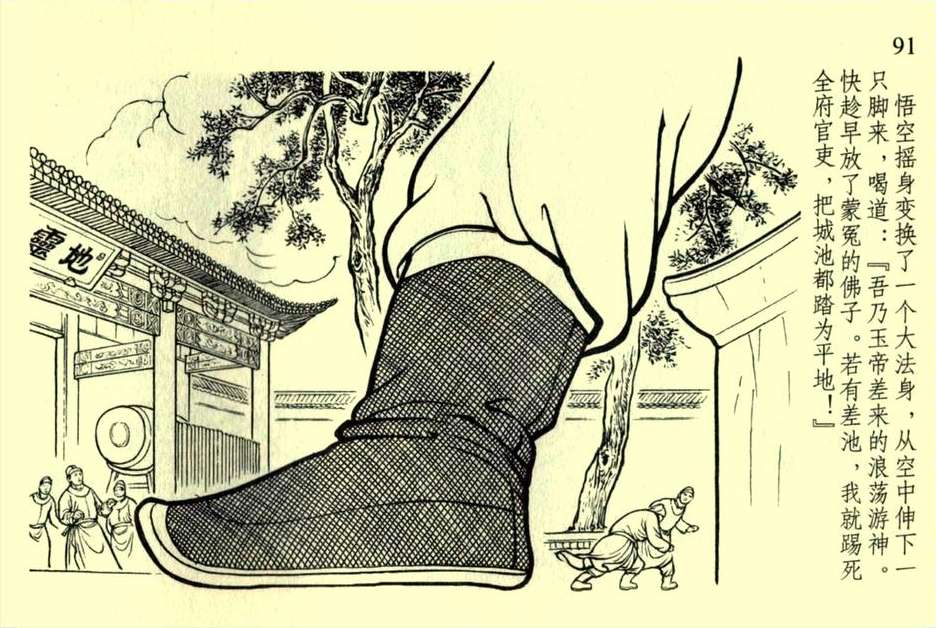
Lifting his head to look, Nezha saw the words, “Great Sage, Equal to Heaven.” “What great power does this monstrous monkey possess,” said Nezha, “that he dares claim such a title? Fear not! Swallow my sword.” “I’ll just stand here quietly,” said Wukong, “and you can take a few hacks at me with your sword.” Young Nezha grew angry. “Change!” he yelled loudly, and he changed at once into a fearsome person having three heads and six arms [fig. 2]. In his hands he held six kinds of weapons: a monster-stabbing sword, a monster-cleaving scimitar, a monster-binding rope, a monster-taming club, an embroidered ball, and a fiery wheel. Brandishing these weapons, he mounted a frontal attack. “This little brother does know a few tricks!” said Wukong, somewhat alarmed by what he saw. “But don’t be rash. Watch my magic!” Dear Great Sage! He shouted, “Change!” and he too transformed himself into a creature with three heads and six arms. One wave of the golden-hooped rod and it became three staffs, which were held with six hands. The conflict was truly earth-shaking and made the very mountains tremble. What a battle!
[Poem about their battle omitted for the sake of brevity.]
Each displaying his divine powers, the Third Prince and Wukong battled for thirty rounds. The six weapons of that prince changed into a thousand and ten thousand pieces; the golden-hooped rod of Sun Wukong into ten thousand and a thousand. They clashed like raindrops and meteors in the air, but victory or defeat was not yet determined. Wukong, however, proved to be the one swifter of eye and hand. Right in the midst of the confusion, he plucked a piece of hair and shouted, “Change!” It changed into a copy of him, also wielding a rod in its hands and deceiving Nezha. His real person leaped behind Nezha and struck his left shoulder with the rod. Nezha, still performing his magic, heard the rod whizzing through the air and tried desperately to dodge it. Unable to move quickly enough, he took the blow and fled in pain. Breaking off his magic and gathering up his six weapons, he returned to his camp in defeat (Wu & Yu, 2012, vol. 1, pp. 154-156). [1]
* Yu (Wu & Yu, 2012) originally translated 哪吒 here as “Naṭa.” However, “Nezha” is far and away the most popular rendering. I’ve, therefore, changed the text.
To sum up: Sun and Nezha battle. The child-god takes on a three-headed, six-armed war form, prompting Monkey to do the same. They continue to fight with no conclusion, until the Great Sage makes a hair clone decoy of his war form and finally wounds Nezha with a staff blow from behind.

Fig 2 – Monkey fighting a three-headed, six-armed Nezha (larger version). Image found here. It appears to be an illustration from a children’s book retelling Uproar in Heaven (1961/64).
2. Analysis
Someone might take the above as evidence supporting the claim, but they are overlooking two important details. One, Sun is clearly using his famous “Multitude of Terrestrial Killers” (Disha shu, 地煞數), a.k.a. “72 Changes” (Qishier ban bianhua, 七十二般變化), in response to the prince’s metamorphosis. As a reminder, this magic ability allows him to transform into anything he wants, including other humanoid figures, animals, insects, miscellaneous objects, incorporeal beams of light, and even buildings. Therefore, Sun mirroring Nezha’s multi-headed and armed war form is not a case of him magically copying the prince’s abilities. He’s simply using a pre-existing power to change himself in a similar way.
And two, Monkey’s hair clone is an extension of himself, so again, he’s not using it to copy a foe’s powers. And the hair clone certainly isn’t being used to create a stronger version of an adversary, in this case Nezha, as claimed in the comments from figure one. As can be seen, the battle is won by strategy and not some copied ability.
Now, I can already hear some readers disagreeing with my take. In that case, I challenge you to cite examples proving me wrong. This is a very specific request. You can’t just quote where he takes on or creates a random character’s shape. That happens many times over. You have to show where mirroring an opponent’s appearance gives the Great Sage or a hair clone new powers that he/it/they didn’t previously have.
If you’re not quite sure where to start, I suggest consulting my 200-plus page catalog of Monkey’s powers and skills from all 100 chapters of the book. I look forward to any future responses.
3. A Special Message
I hope this challenge helps netizens enamored with Sun Wukong’s embellished online persona as an unstoppable and unkillable cosmic force to understand that the only reliable source of information about him is the JTTW novel. Here’s some advice: if you happen upon someone making bold claims about the Great Sage (or JTTW characters and events in general), ask them to prove their point by quoting directly from the book. Don’t accept anything—no youtubers like OSP, no forum or social media posts, no video games, etc.—beyond cited canonical information. You can check the PDFs here to make sure that the quote is correct. And even then, it’s best to consult someone (Chinese or otherwise) who has a solid foundation in Chinese literature, religion, and culture to make sure that the person’s understanding of the material falls in line with what the original text actually means. I say this because I’ve seen a lot of people take something at face value without realizing that there’s some kind of underlying context.
Update: 05-08-25
My comments section is not the best for ongoing debates. I can’t reply to anyone who responds to my initial response to a comment. I think it’s best to move this to a different platform, maybe Reddit or Discord. I’ll leave it up to commenters to decide. I’ll post a link to the chosen debate site when it is agreed upon.
(Edit: I just discovered that I can respond if I go into my dashboard, but this isn’t as fast or convenient as directly answering the reply on the article page.)
Update: 05-25-25
A reader just commented that Monkey can gain the abilities of the animals that he changes into—something I’ve recorded several times in my catalog of his powers and skills—thereby implying that he should also be able to acquire the powers of a copied foe. However, the novel is clear that there’s a marked difference in quality between his animal/object forms and his humanoid forms. Chapter 75 reveals the fatal flaw:
“Elder Brother,” said the third fiend,” didn’t you see him? He [Wukong disguised as a small demon] was giggling just now with his face half turned, and I saw for a moment a thunder god beak on him. When I grabbed him, he changed back immediately into his present looks.” He then called out: “Little ones, bring me some ropes.” The captains took out ropes immediately. Wrestling Pilgrim to the ground, the third fiend had him hog-tied before they hitched up his clothes to examine him. It became apparent at once that he was the BanHorsePlague all right! Pilgrim, you see, was capable of seventy-two kinds of transformation. If it was a matter of changing into a fowl, a beast, a plant, a utensil, or an insect, his entire body could be transformed. But when he had to change into another person, only his face but not his body could be transformed. When they lifted up his clothes, therefore, they saw a body full of brown fur, two red buttocks, and a tail (emphasis added) (Wu & Yu, 2012, vol. 3, p. 367).
三怪道:「哥哥,你不曾看見他?他才子閃著身笑了一聲,我見他就露出個雷公嘴來。見我扯住時,他又變作個這等模樣。」叫:「小的們,拿繩來。」眾頭目即取繩索。
This means that the Great Sage’s changes are not perfect. How then would he be able to acquire an opponent’s strength or magical abilities via imperfect transformations? I look forward to future responses.
Note:
1) Here’s the original Chinese for the JTTW chapter four fight, including that for the omitted poems:
這哪吒太子甲冑齊整,跳出營盤,撞至水簾洞外。那悟空正來收兵,見哪吒來的勇猛。好太子:
總角才遮顖,披毛未蓋肩。神奇多敏悟,骨秀更清妍。誠為天上麒麟子,果是煙霞彩鳳仙。龍種自然非俗相,妙齡端不類塵凡。身帶六般神器械,飛騰變化廣無邊。今受玉皇金口詔,敕封海會號三壇。
悟空迎近前來問曰:「你是誰家小哥?闖近吾門,有何事幹?」哪吒喝道:「潑妖猴!豈不認得我?我乃托塔天王三太子哪吒是也,今奉玉帝欽差,至此捉你。」悟空笑道:「小太子,你的嬭牙尚未退,胎毛尚未乾,怎敢說這般大話?我且留你的性命,不打你。你只看我旌旗上是甚麼字號,拜上玉帝:是這般官銜,再也不須動眾,我自皈依;若是不遂我心,定要打上靈霄寶殿。」哪吒擡頭看處,乃「齊天大聖」四字。哪吒道:「這妖猴能有多大神通,就敢稱此名號?不要怕,吃吾一劍。」悟空道:「我只站下不動,任你砍幾劍罷。」那哪吒奮怒,大喝一聲,叫:「變!」即變做三頭六臂,惡狠狠,手持著六般兵器,乃是斬妖劍、砍妖刀、縛妖索、降妖杵、繡毬兒、火輪兒,丫丫叉叉,撲面來打。悟空見了,心驚道:「這小哥倒也會弄些手段。莫無禮,看我神通。」好大聖,喝聲:「變!」也變做三頭六臂;把金箍棒幌一幌,也變作三條。六隻手拿著三條棒架住。這場鬥,真個是地動山搖,好殺也:
六臂哪吒太子,天生美石猴王,相逢真對手,正遇本源流。那一個蒙差來下界,這一個欺心鬧斗牛。斬妖寶劍鋒芒快,砍妖刀狠鬼神愁;縛妖索子如飛蟒,降妖大杵似狼頭;火輪掣電烘烘艷,往往來來滾繡毬。大聖三條如意棒,前遮後擋運機謀。苦爭數合無高下,太子心中不肯休。把那六件兵器多教變,百千萬億照頭丟。猴王不懼呵呵笑,鐵棒翻騰自運籌。以一化千千化萬,滿空亂舞賽飛虯。諕得各洞妖王都閉戶,遍山鬼怪盡藏頭。神兵怒氣雲慘慘,金箍鐵棒響颼颼。那壁廂,天丁吶喊人人怕;這壁廂,猴怪搖旗個個憂。發狠兩家齊鬥勇,不知那個剛強那個柔。
三太子與悟空各騁神威,鬥了個三十回合。那太子六般兵,變做千千萬萬;孫悟空金箍棒,變作萬萬千千。半空中似雨點流星,不分勝負。
原來悟空手疾眼快,正在那混亂之時,他拔下一根毫毛,叫聲:「變!」就變做他的本相,手挺著棒,演著哪吒;他的真身,卻一縱,趕至哪吒腦後,著左膊上一棒打來。哪吒正使法間,聽得棒頭風響,急躲閃時,不能措手,被他著了一下,負痛逃走。收了法,把六件兵器依舊歸身,敗陣而回。(source)
Source:
Wu, C., & Yu, A. C. (2012). The Journey to the West (Vols. 1-4) (Rev. ed.). Chicago, Illinois: University of Chicago Press.