Last updated: 03-27-2026
In honor of the forthcoming video game Black Myth: Wukong (August 20, 2024), I have completed a catalog of Sun Wukong‘s magic abilities and skills from all 100 chapters of Journey to the West (Xiyouji, 西遊記, 1592). To my knowledge, this is the first of its kind in English. My hope is that it will be useful to fanfiction writers and artists, as well as academics studying magico-religious concepts from Ming-era vernacular literature.
Below, I present a Google Doc and PDF of the full 177-page catalog, as well as a general survey of the magic powers and skills for people who are short on time.
[Note (8-18-24): I have moved the chapter headings to the beginning of each page, as well as added more information. This has increased the page count to 221, but the text is close to the same length, roughly 180 pages if squished together.]

A promotional photo for Black Myth: Wukong (large version). Image found here.
Table of Contents
- 1. The Complete 100-Chapter Catalog
- 1.1. Google Doc
- 1.2. PDF
- 2. A Survey of His Magic Powers
- 2.1. Immortalities
- 2.2. Definite Powers
- 2.3. Uncertain Powers
- 2.4. Claimed Powers
- 3. Skills
- 4. Intelligence
- 4.1. Example
- 5. Updates
1. The Complete 100-Chapter Catalog
I am presenting two versions of the catalog here because I don’t know how many people can view the original Google Doc at once.
1.1. Google doc
A pro is that I can instantly update this. Also, readers can automatically jump to the chapter of their choice.
https://docs.google.com/document/d/1tP24uRujnwpX8k0Q1uh979pQJheSMY3d7XlpETpwX6o/edit?usp=sharing
1.2. PDF
A con is that I have to reupload this anytime I make an update to the original. Also, the formatting is wonky for some reason. But I’ll try my best to keep this updated at all times.
Click to access A-Catalog-of-the-Monkey-Kings-Powers-and-Skills-as-of-02-02-26-2.pdf

Sun Wukong from Lego Monkie Kid (larger version). Image found here.
2. A Survey of His Magic Powers
2.1. Immortalities
In place of using “layer” or “level,” I’m choosing to designate his various immortalities as “categories.” This is because a new layer of divine longevity or durability would surely be added for each immortal peach, elixir pill, or cup/jug of heavenly wine consumed. Hence, eating multiple peaches would be one category, eating multiple elixir pills would be one category, and so on and so forth.
There are two sets of immortalities. The first are achieved before or during the journey:
- Spiritual breathing exercises (ch. 2)
- Erasing his name from the ledgers of hell (ch. 3)
- Drinking immortal wine (ch. 4 & 5)
- Eating immortal peaches (ch. 5)
- Eating elixir pills (ch. 5 & 17)
- Eating Ginseng fruit (ch. 24)
(Monkey briefly dies from thermal shock in chapter 41 while battling Red Boy. Zhu Bajie shortly thereafter suggests that he has 72 lives because he knows the 72 transformations (他有七十二般變化,就有七十二條性命。). If true, this would have interesting implications for his various immortalities. Would someone have to kill him 72 times in order to make sure that he is dead for good? However, this is little more than speculation since the narrative never mentions Sun respawning after death like a video game character.)
The second are achieved at the journey’s end once they reach the Buddha’s blessed land. These shouldn’t be lumped together with those acquired before and during the pilgrimage.
- Eating Immortal food, tea, and fruit (ch. 98) (See the 01-01-26 update below for more info)
- Buddhahood (ch. 100)
It’s important to note that the novel ends before Monkey is able to perform any feats as a Buddha. Therefore, making claims about his subsequent abilities is outside of canon.

A photomanipulation by me called “The Immortal Has Awakened” (2018) (larger version). The original work was first published on Deviantart.
2.2. Definite Powers
These abilities are utilized in the narrative.
- Multitude of terrestrial killers (地煞數; a.k.a. “72 changes,” 七十二般變化) – This allows him to transform his body into anything he wants, including other humanoid figures, animals, insects, miscellaneous objects, incorporeal beams of light, and even buildings.
- Cloud-soaring (騰雲) – This allows him to slowly travel through the sky. He only attempts this once (ch. 2).
- Cloud somersault (觔/筋斗雲) – This allows him to fly 108,000 li (十萬八千里; 33,554 mi/54,000 km) in a single leap. He displays this throughout the novel.
- Navigation – The ability to travel to and find places that he has not previously been to. This is displayed throughout the novel.
- I’m placing this here because the ability might be magical.
- Body beyond body (身外身法; a.k.a. “magic of body division,” 分身法) – This allows him to transform anyone of his 84,000 hairs into whatever he desires, including humanoid figures, animals, insects, miscellaneous objects, and even food, money, and tools. It is often used to create an army of clones throughout the novel. He claims that a single hair can multiply into the millions and billions.
- Magic of displacement (攝法) – This allows him to transport people and items on a swift, powerful wind (ch. 2, 3, 62, 71, & 84).
- Mighty wind (陣風) – This allows him to cause chaos all around him with a powerful wind. It is used to hide his activities, fan the flames of fire, scare away onlookers, and even to kill by propelling rocks (ch. 3, 16, 28, 38, 44, 68, 71, & 95).
- Water-controlling magic – The “magic of water restriction” (閉水法; a.k.a. “water-repelling magic,” 避水訣) allows him to ward off water and/or to “open a waterway” (開水道) in order to travel to the aquatic realm. And the “magic of overturning seas and rivers” (翻江攪海的神通) does exactly as named. He displays these throughout the novel.
- Magic method of modeling heaven on earth (法天像(象)地) – This allows him to take on a monstrous, 104,300 ft/31,800 m tall form. The original specified height, 10,000 zhang (萬丈), may be a metaphorical number for a much, much larger figure, for Monkey claims to have the ability to fill the universe if he so desired it (ch. 14). He displays this power several times (ch. 3, 6, 61, 64, & 97).
- Super strength – This allows him to wield his 13,500-catty (一萬三千五百斤; 17,559.81 lbs/7,965 kg) iron staff with ease, overpower opponents, and to scare rude humans. He displays this throughout the novel. His greatest feat of strength involves carrying two mountains on his shoulders while running with great speed (ch. 33).
- Travel to heaven – This allows him to find and enter the celestial realm from any of the four cardinal gates. He displays this throughout the novel.
- Cloud production – This allows him to breathe clouds and fog during battle. He displays this throughout the novel.
- Three-headed and six-armed war form (三頭六臂) – This allows him to battle myriad opponents on all fronts (ch. 4, 7, 31, 40, & 81).
- Staff multiplication – This allows him to multiply his magic staff for his war form, to arm his clones, or to bombard opponents with a shower of hundreds of thousands or even millions of weapons. He displays this throughout the novel.
- Magic of body concealment (隱身法) – This allows him to become invisible to humans and even gods and spirits (ch. 5, 6, 24, 49, 63, 68, & 71).
- Magic of Immobilization (定身法) – This allows him to freeze humans, gods, and spirits in place for up to a full day (ch. 5, 39, 88, & 97).
- Invulnerability – His adamantine head and body are capable of withstanding damage from even celestial weapons and elements. He displays this throughout the novel.
- Fiery eyes and golden pupils (火眼金睛) – This allows him to peer up to 1,000 li (千里; 310.7 mi/500 km) during the day and 300 to 500 li (夜裡也還看三五百里; 93.20 to 155.34 mi/150 to 250 km) at night. It also enables him to see through the magic disguises and illusions of gods and spirits. It doesn’t work 100% of the time, though. He displays this throughout the novel.
- Horse authority – This allows him to command celestial and earthly equines (ch. 14 & 56). This is based on his former position as the keeper of the heavenly steeds, which essentially makes him the god of horses in the JTTW universe.
- Taming tigers – Earthly big cats immediately cower in his presence (ch. 14). This seemingly does not include tiger-spirits.
- Three life-saving hairs (三根救命的毫毛) – These are three willow branch leaves-turned-hairs gifted to him by Guanyin which allow him to make whatever he wants in the performance of his duties as Tripitaka’s guardian (ch. 15, 63, & 75). The novel differentiates these from the “body beyond body” hairs.
- Putting off sleep – He is shown in one instance (ch. 16) to conserve his immortal energy via meditation instead of sleeping, though he is described as resting in numerous chapters. He claims that putting of sleep for nearly three years wouldn’t even bother him (ch. 25).
- Voice impersonation – This power allows him to exactly copy the voice of any figure that he transforms into. He displays this throughout the novel.
- Magic of seizure (拿/手法; a.k.a. “holding trick”) – This allows him to magically grab large quantities of characters and goods with a single hand (ch. 62 & 89). It is also ambiguously described as a superpowered martial arts technique where he grabs and twists a much larger opponent so hard that they flip (ch. 18).
- Seize the wind (抓風) – This allows him to grab the wind like an animate object. This is done once to smell the breeze (ch. 20).
- Super smell – This allows him to detect and even track dangerous animals and evil spirits (ch. 20, 41, 67, & 91).
- Size manipulation – This allows him to shrink or grow his body as needed. I differentiate this from the “magic method of modeling heaven on earth” because it is not a grand transformation like the latter. His smallest transformation is a hair-like cicada (蟭蟟蟲), which is perhaps a typo for “蟭螟蟲,” an aquatic insect from Daoist literature said to be so small that it can congregate in the eyebrows of a mosquito.
- Summoning gods – This allows him to call upon local gods of the soil and mountains, Buddhist gods assigned to protect the Tang Monk, and also the Dragon Kings of the world’s oceans. He displays this throughout the novel.
- Immortal breath (仙氣) – This allows him to transform his hairs and staff and other inanimate objects into whatever he wants, as well as to heal grievous wounds, manipulate souls, and to help grant humans divine strength and longevity. He displays this throughout the novel.
- Spirit-body (真身出一個神; a.k.a. “magic of the spirit leaving the body,” 出神的手段) – This allows him to transform his body into an astral form in order to leave from a place unnoticed (ch. 25, 45, 77, & 85). This is often used in tandem with a hair-turned-decoy body.
- Lock-picking magic (解鎖法) – This allows him to unlock any lock with either his staff or hand (ch. 25, 52, 61, 71, 92, & 99).
- Sleep-inducing bugs (瞌睡蟲兒; a.k.a. “sleep demon bugs, 睡魔蟲”) – These insects allow him to incapacitate humans, gods, and spirits. These are said to have been won from a heavenly guardian in a finger-guessing game (ch. 25 & 77). The novel differentiates these from the sleep insects that he makes with “body beyond body.”
- Blood transformation magic – This allows him to create talking and moving decoys from inanimate objects. They are created by saying a spell, biting his tongue, and spitting the resulting blood on the selected items (ch. 25, & 46).
- Super scream – This allows him to scare away ferocious animals, as well as to intimidate humans (ch. 27, 65, & 93).
- Shortening the Ground (縮地法; a.k.a. “magic of shortening the ground and moving the mountain,” 移山縮地之法) – This allows him to transport people vast distances by contracting the land before them (ch. 31 & 40).
- Magic nullification – This allows him to cancel a spirit’s illusion by saying a spell and spitting water (ch. 31).
- Secret communication – This allows him to contact gods without others noticing (ch. 33 & 37).
- Fire-avoidance spell (避火訣) – This allows him to ward fire (ch. 35, 41, & 75).
- Super jump – This allows him to jump over a city wall (ch. 38).
- Turning off invulnerability – This allows him to switch off the hardness of his body in order to mutilate himself for fun (ch. 46, 75, & 79).
- Surviving fatal wounds – This allows him to live through having his head cut off and his intestines and heart pulled out (ch. 46 & 79).
- Phantom speech – This allows him to communicate without a head. His voice seemingly projects from inside his body (ch. 46).
- Magic body part retrieval – This allows him to command his body parts to return if they are separated from him. However, this doesn’t work if gods hold them down (ch. 46).
- Regrowing a head – This allows him to regrow his head if it is separated from his body (ch. 46). Sha Wujing suggests that our hero has 72 heads because he knows the 72 transformations (他有七十二般變化,就有七十二個頭哩。).
- Super healing – This allows him to heal from grievous injuries without even a single scar (ch. 46).
- Foreknowledge of fate – This allows him to know what the universe has in store for certain characters, especially Tripitaka (ch. 47, 81, 97, & 99).
- Magic barrier – This allows him to protect people by drawing a circle around them with his staff (ch. 50).
- Halting clouds (留雲) – This allows him to stop hurtling endlessly through the sky after being blown away by Princess Iron Fan‘s magic fan (ch. 59).
- Wind-arresting elixir (定風丹) – This allows him to become an immovable object. It is originally sown into the collar of his robe by a bodhisattva, but he later accidentally swallows it, and his body is fortified by it (ch. 59 & 61).
- Sympathetic magic – This allows him to summon rain in order to extinguish fire in a different location just by throwing a goblet of wine (ch. 70).
- Magic of body division (分身法) – This allows him to split his body in order to create endless copies of himself. The novel treats this as separate (ch. 75) from the “body beyond body,” which is also known by this name.
- Mimic magic – This allows him to make someone look like a different person. This involves an oral spell, the immortal breath, and a mud mask. He uses this to change his master’s appearance (face and body) to look like him (ch. 78).
- True Fire of Samadhi (三昧真火) – This allows him to blow spiritual fire (ch. 81).
- Divine empowerment – This allows him to grant divine strength and longevity to humans (ch. 88).
- Travel to the underworld – This allows him to find and enter hell (ch. 97).
- Resurrection – This allows him to bring someone back from the dead—provided that he has permission from Ksitigarbha—by retrieving and forcing their soul back into their body (ch. 97).
- Weightless body – This allows him to walk with great agility. He achieves this after crossing a spiritual river into the Buddha’s blessed land (ch. 98).
- Yang energy projection – This allows him to ward off an army of yin spirits with his staff at the end of the novel (ch. 99).

The Monkey King casting a spell (larger version). Drawing by Poppindollars on deviantart.
2.3. Uncertain Powers
Readers are free to decide whether or not these are actually powers.
- Eye beams – These shoot from his eyes shortly after his birth. They dim upon eating earthly food (ch. 2).
- Celestial voice – He is said to have a voice like bells and stone chimes (ch. 4).
- Super speed – He is said to run like a meteor in order to catch up to Tripitaka (飛星來趕師父) while carrying two mountains (ch. 33). This might be hyperbole, though, since his master isn’t that far ahead of him.

Light beams shoot from Sun’s eyes shortly after his birth (larger version). The image was originally found on Facebook, but I’ve been informed that it is by the artist Jiang Xiaoshu (姜晓殊).
2.4. Claimed Powers
These are abilities that are never demonstrated:
- No shadow – He claims to cast no shadow while walking past the sun and moon (ch. 3).
- Phasing – He claims that he can pass through metal and rock unhindered (ch. 3).
- Taming dragons – He claims to be able to subdue dragons (ch. 14), but the various serpent-spirits that he meets during the journey do not cower before him like earthly tigers do (see # 19 above).
- Super hearing – He claims to be able to hear the goings-on in heaven and hell (ch. 31). But it’s interesting to note that his doppelganger is shown to have super hearing.
- Kicking down the sky or overturning wells – These are as named.
- Manipulating stellar bodies – He claims to be able to change the path of stars and planets (ch. 46). But I should note that he fights and single handedly defeats the anthropomorphic forms of the nine planets during his rebellion (ch. 5). I’ll leave it up to the reader to decide whether or not this constitutes altering their paths.

Monkey fighting the dragon prince that will become the white dragon horse (larger version). Image found here.
3. Skills
- Early education – Language, etiquette, scriptural studies, calligraphy, and gardening.
- Navigation – The ability to travel to and find places that he has not previously been to. This is displayed throughout the novel.
- I’m also placing this here because it might just be a non-magical skill. You decide.
- Martial arts (武藝) – He has a knowledge of different weapons, and he is even shown to be a proficient boxer. He displays this throughout the novel.
- Cosmic social connections – His travels as a young immortal enabled him to make friends, or at least to become acquaintances with, all sorts of gods and spirits across the Buddho-Daoist universe. He uses these connections to his advantage throughout the novel.
- Medicine – He shows a knowledge of celestial and earthly pharmacology and pathology. This is most famously displayed in chapters 68 and 69.
- Sewing – He is shown capable of sewing clothing (ch. 14 & 84).
- Face reading – He is shown to have a familiarity with the art of deriving someone’s personality or intelligence from their looks.
- Craftsmanship – He claims to be able to build a house for the Tang Monk (ch. 27 & 67), and he later constructs a straw dragon for a queen to ride (ch. 71).
- Guessing weight – He can guess the weight of something just by holding it in his hand (ch. 76).

Monkey uses golden threads to analyze an emperor’s pulse in chapters 68 and 69 (larger version). From Mr. Li Zhuowu’s Literary Criticism of Journey to the West (late 16th-century).
4. Intelligence
Lastly, I would like to highlight Monkey’s intellect. Despite his common association with using force, he is shown in the novel to be very clever, often relying on a number of mental qualities or tactics to defeat demons:
- Adeptness
- Basic soldering
- Calculation
- Commandeering enemy equipment
- Deception
- Info gathering
- Knowledge base:
- Celestial and earthly pharmacology and pathology
- Heavenly treasures
- Classics
- Astronomy
- Philosophy
- Law
- Scripture
- Demonology
- Logic
- Spiritual cultivation and spirituality
- Cooking
- Types of wood
- Sound
- Cosmic hierarchy
- Language acquisition – He only has to listen to a conversation for a moment before he learns a new language.
- Memory
- Pattern recognition
- Persuasion
- Planning
- Problem solving
- Quick thinking
- Weapon making
4.1. Example
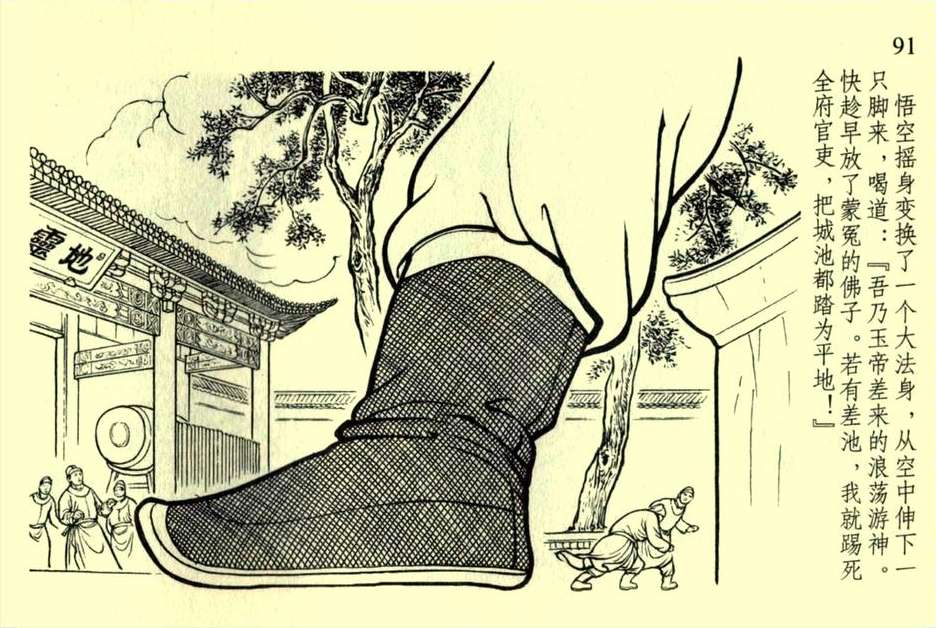
A good example of his cunning appears in chapter 97. The four monks are framed for the theft and murder of a rich layman who had originally hosted them for a month. Sun Wukong captures the real perpetrators and rounds up their stolen bounty, but he is forced to release the bandits for fear that Tripitaka will chant the tight-fillet spell for killing them. However, imperial troops later capture the clerics with the stolen items, making them look guilty. After the group is brought to court and tortured for some time (only affecting the weaker members), Monkey escapes from the prison at night in order to influence their release. First, he imitates the voice of the slain layman at his wake and threatens heavenly retribution if his widow, the person who framed the monks, doesn’t recant her false claims. Second, he imitates the voice of the deceased uncle of the city magistrate who imprisoned them and again threatens heavenly retribution if the official doesn’t reexamine the case. And third, at dawn he transforms himself into a titan-sized apparition before the district level magistrates and threatens to stomp the city and surrounding area into oblivion as heavenly retribution if they don’t put pressure on their superior to free the group. In the morning, Tripitaka, Zhu, Sha, and the officials visit the layman’s home, while Sun goes to the underworld to retrieve the man’s soul, which has been granted a dozen more years of life by the Bodhisattva Ksitigarbha. Monkey returns and brings the man back to life by forcing his soul into his body. The layman then explains how he had been murdered by bandits who robbed his mansion. The city magistrate, therefore, pardons the monks and even the wife.

A modern lianhuanhua depicting Monkey’s giant foot confronting the magistrates (larger version). Comic found here.
5. Updates
Update: 09-08-24
@ryin-silverfish of Tumblr (author of this guest post) has made a catalog of Nezha’s powers from Investiture of the Gods (Fengshenyanyi, 封神演義, c. 1620). A BIG thank you to them.
https://docs.google.com/document/d/1FjHQPXmEalChk7PNiw9ljAJ8Cq66-AjevgEfdEa6wgI/edit?usp=sharing

A detail of Nezha striking at an enemy during battle. Image from The Newly Printed, Zhong Bojing Annotated, Investiture of the Gods (Xinke Zhong Bojing xiansheng piping Fengshen yanyi, 新刻鍾伯敬先生批評封神演義, c. 1620) (larger version).
Update: 01-01-26
As noted, Sun Wukong appears to have eight immortalities:
- Spiritual breathing exercises (ch. 2)
- Erasing his name from the ledgers of hell (ch. 3)
- Drinking immortal wine (ch. 4 & 5)
- Eating immortal peaches (ch. 5)
- Eating elixir pills (ch. 5 & 17)
- Eating Ginseng fruit (ch. 24)
- Eating Immortal food, tea, and fruit (ch. 98)
- Buddhahood (ch. 100)
But I’ve thought of something that brings one of these into question:
In JTTW chapter 98, the pilgrims are all given “immortal food, tea, and fruit” (仙餚、仙茶、仙果) upon entering the Buddha’s paradise, and this is said to “grant them longevity and health and enable them to transform their mortal substance into immortal flesh and bones” (… 壽長生,脫胎換骨之饌,儘著他受用。) (based on Wu & Yu, 2012, vol. 4, pp. 349-350). The latter quote refers directly to Zhu Bajie and Sha Wujing, but Monkey and Tripitaka certainly benefit from the meal as well.
The pilgrims are not too long after elevated in spiritual rank in JTTW chapter 100 (Wu & Yu, 2012, vol. 4, pp. 381-382).
The chronological proximity of the food to the spiritual promotions reminds me of a concept from Buddhism, the immortal “diamond/adamantine body” (Sk: vajrakāya; Ch: jingangshen, 金剛身) of the Buddha. You can read more about that here (see the PDF link therein):
https://buddhistuniversity.net/content/articles/immortal-buddhas_radich-michael
(It’s interesting to note that Laozi suggests in JTTW chapter seven that all of the divine foodstuffs eaten/drunk by Monkey must have resulted in his “diamond body” (jingang zhi qu, 金鋼[剛]之軀) (Wu & Yu, 2012, vol. 1, p. 188).)
This then raises the question: Is the food meant to symbolize the immortality that comes with becoming an enlightened being? If so, numbers seven (immortal food) and eight (Buddhahood) in my list are one and the same, meaning that the former should be removed.
Update: 02-02-26
Monkey strikes me as the sort of person who is overqualified in all areas but still pads their résumé as a way to make them seem even more amazing. This could be used as an in-universe explanation for the undemonstrated powers (see above). Though, I’m sure he could figure out how to, for example, phase through solid objects if he put his mind to it.
Update: 03-27-26
I previously added this info as an update to a past article:
The Saṃyutta Nikāya (Sk: संयुक्त निकाया; Ch: Xiang ying bu, 相應部, c. 250 BCE) notes that Buddhist cultivators develop a host of supernatural powers once they master the four mental qualities (Pali: Iddhipāda). Notice how similar they are to those discussed above:
- Multiplying the body
- Vanishing and reappearing
- Passing through solid objects (walls, ramparts, mountains, etc.)
- Diving into the earth like water
- Walking on water like earth
- Traveling through space
- Touching the sun and moon
- Hearing all sounds, both human and divine
- Knowing the minds of others
- Having memories of all of one’s past lives
- Knowing the future rebirths (and their causes) of all beings
- Liberation from the filth of the world through supreme wisdom (Bodhi, 2000, pp. 1727-1728)
Source:
Bodhi, B. (2000). The Connected Discourses of the Buddha: A Translation of the Saṃyutta Nikāya; Translated from the Pāli by Bhikkhu Bodhi (Vols. 1-2). Boston: Wisdom Publications.
Wu, C., & Yu, A. C. (2012). The Journey to the West (Vols. 1-4) (Rev. ed.). Chicago, Illinois: University of Chicago Press.