Story Idea: Sun Wukong vs Heracles / Hercules

From time to time I like to post a fun blog not directly related to (though sometimes informed by) my research. Regular articles will resume after this entry.

Last updated: 10-29-2025

Readers may remember that DEATH BATTLE! (episode 162) featured a fight between Sun Wukong from Journey to the West (Xiyou ji, 西遊記, 1592 CE, “JTTW” hereafter) and Heracles / Hercules from Greco-Roman myth (fig. 1). The episode begins with the demi-god trekking up a mountain in order to fulfill the 11th of his famous 12 labors: procuring the Golden Apples of the Hesperides (Salapata, 2021), but he instead finds Monkey holding the fruit—food meant for his master, Tripitaka. Heracles demands the apple at sword-point, but he quickly discerns that the produce he’s been given was created from a magic hair. This leads to a deadly confrontation.

As I explain in my analysis of the episode, I initially liked how the fight began because both characters are known for stealing fruit in their respective mythologies (see no. 12 in my article listing their parallels). But in hindsight, this didn’t make much sense for two reasons. First, the golden apples are located in a land much further west than India, the scripture-pilgrims’ final destination in JTTW. Monkey could have easily gone to a location closer to their resting spot. And second, having the heroes meet during their respective adventures creates a temporal paradox since both are active at different times—late-Greek bronze age (c. 3000–1000 BCE) vs the early-Tang Dynasty (618–907 CE). Therefore, in the end, the idea is very forced. But what would be a more natural way for the Son of Zeus and the Great Sage Equaling Heaven to come to blows?

This article proposes a more organic reason for conflict via a story idea based on elements from JTTW, Greek myth, Greco-Buddhist art, and Buddhist literature. But take note that the encounter is NOT meant to be a death battle. Remember that the rest of the journey still needs to take place.

Fig. 1 – The official thumbnail for the episode (larger version). Image found here.

1. Background

My pitch is an offshoot of a previous story idea. It follows the historical Xuanzang (玄奘, 602–664 CE) (on whom Tripitaka is based) on his quest for sutras through Central Asia and India, including years-long periods of study. While the original novel sees Daoism practiced by Chinese-speaking people as far away as the Western Continent (i.e. India), this wouldn’t be the case in the real world. Therefore, changes would have to be made to the narrative, such as the appearance of foreign gods outside of the Middle Kingdom. But as I noted in the original article, it would be a lot easier to include the devas of Buddhism (e.g. Shakra, Brahma, Heavenly Kings, etc.) since the religion was practiced throughout the areas traveled by Xuanzang. This, however, wouldn’t exclude gods from other pantheons like Heracles.

1.1. History

Now, I can already hear my readers asking, “How could Heracles possibly be associated with the gods of Buddhism?” Well, the first Greeks arrived in Central Asia and India during the reign of Darius the Great (550–486 BCE) and later Alexander the Great (356–323 BCE). And just like American Gods, these soldiers, merchants, artisans, and farmers brought their religion with them. The convergence of these two cultures eventually resulted in the demi-god appearing alongside Tathagata in the 1st to 3rd century CE Greco-Buddhist art of Gandhara (modern day NW Pakistan to E and NE Afghanistan) (fig. 2). The Greek hero takes the place of the Buddha’s loyal protector, the yaksha-turned-dharma guardian Vajrapani (Sk: वज्रपाणि, lit: “Vajra [Thunderbolt] in hand”; Ch: Jingang shou pusa, 金剛手菩薩, lit: “Bodhisattva holding the vajra”). (I have to say that Heracles’ association with the thunderbolt is super fascinating given who his father is.) In fact, the common image of Vajrapani as a muscular, club-wielding deva in East Asia (fig. 3) is directly linked to his depiction as Heracles in Gandharan art!

I won’t go into further detail here since I’ve already taken the liberty of archiving papers on the subject in preparation for this article:

Archive #50 – Heracles as Vajrapani

Fig. 2 – Detail of a stone carving of the Buddha preaching while Heracles-Vajrapani watches over him, Gandhara, 2nd or 3rd century CE, Schist (larger version). He wields a gada mace in his right hand and holds a bone-like vajra-club in the left. Adapted from an image found here. Copyright the Trustees of the British Museum. Fig. 3 – A Tang-era painting of Vajrapani, Dunhuang, Gansu Province, China, mid-9th to early-10th century CE, ink and colors on silk (larger version). Take note of his muscular physique and wispy beard. The vajra-club in his left hand is obscured by his leg. Image found here. Copyright the Trustees of the British Museum. See here for a Tang-era painting of Vajrapani with a visible club.

1.2. Literature and Folklore

Sun Wukong and Vajrapani have technically met before. For example, in the 13th century CE version of the JTTW story cycle, the Great Sage’s antecedent, the “Monkey Pilgrim” (Hou xingzhe, 猴行者), changes his magic staff into the dharma warrior while facing a white tiger spirit:

Monkey Pilgrim transformed his golden-ringed staff into a gigantic Yakşa whose head touched the sky and whose feet straddled the earth. In his hands he grasped a demon-subduing cudgel [jiangmochu, 降魔杵]. His body was blue as indigo, his hair red as cinnabar; from his mouth a fiery gleam shot forth over one thousand feet long” (based on Wivell, 1994, p. 1189). [1]

被猴行者將金鐶杖變作一個夜叉,頭點天,腳踏地,手把降魔杵,身如藍靛青,發似硃沙,口吐百丈火光。

The titan eventually crushes her with his weapon (Wivell, 1994, p. 1189). The “demon-subduing cudgel” is another name for Vajrapani’s vajra-thunderbolt.

Also, the Monkey King interacts with Vajra warriors (Jingang, 金剛) related to Vajrapani numerous times in the standard 1592 CE JTTW. In chapter 52, his way is momentarily barred by the “Eight Great Vajras” (Ba da jingang, 八大金剛) when he seeks an unannounced audience with the Buddha (Wu & Yu, 2012, vol. 3, p. 24). [2] In chapter 58, the eight warriors fail to stop Wukong and his doppelganger when they fight to the Western Paradise seeking Tathagata’s wisdom to distinguish one from the other (Wu & Yu, 2012, vol. 3, p. 114). After the Bull Demon King is captured in chapter 61, the Great Sage gathers the “Four Great Vajras” (Si da jingang, 四大金剛) and a host of other gods to confront Princess Iron Fan (Wu & Yu, 2012, vol. 3, p. 161). In chapter 77, the four warriors once again momentarily bar his way when he seeks an audience with the Buddha (Wu & Yu, 2012, vol. 4, pp. 27-28). In chapter 98, the four warriors welcome Tripitaka and his companions, including Monkey, upon their arrival to the Western Paradise (Wu & Yu, 2012, vol. 4, p. 347). Later in the same chapter, the Buddha charges the eight warriors with transporting the clerics on a cloud to hasten the completion of their mission and return to paradise (Wu & Yu, 2012, vol. 4, p. 357). But after being ordered to prematurely drop off the pilgrims, leading to Tripitaka’s 81st tribulation, the eight warriors reappear sometime later to complete the trip to China (Wu & Yu, 2012, vol. 4, p. 369). And finally, in chapter 100, the eight warriors spirit them back to the Western Paradise to receive their otherworldly reward (Wu & Yu, 2012, vol. 4, p. 380).

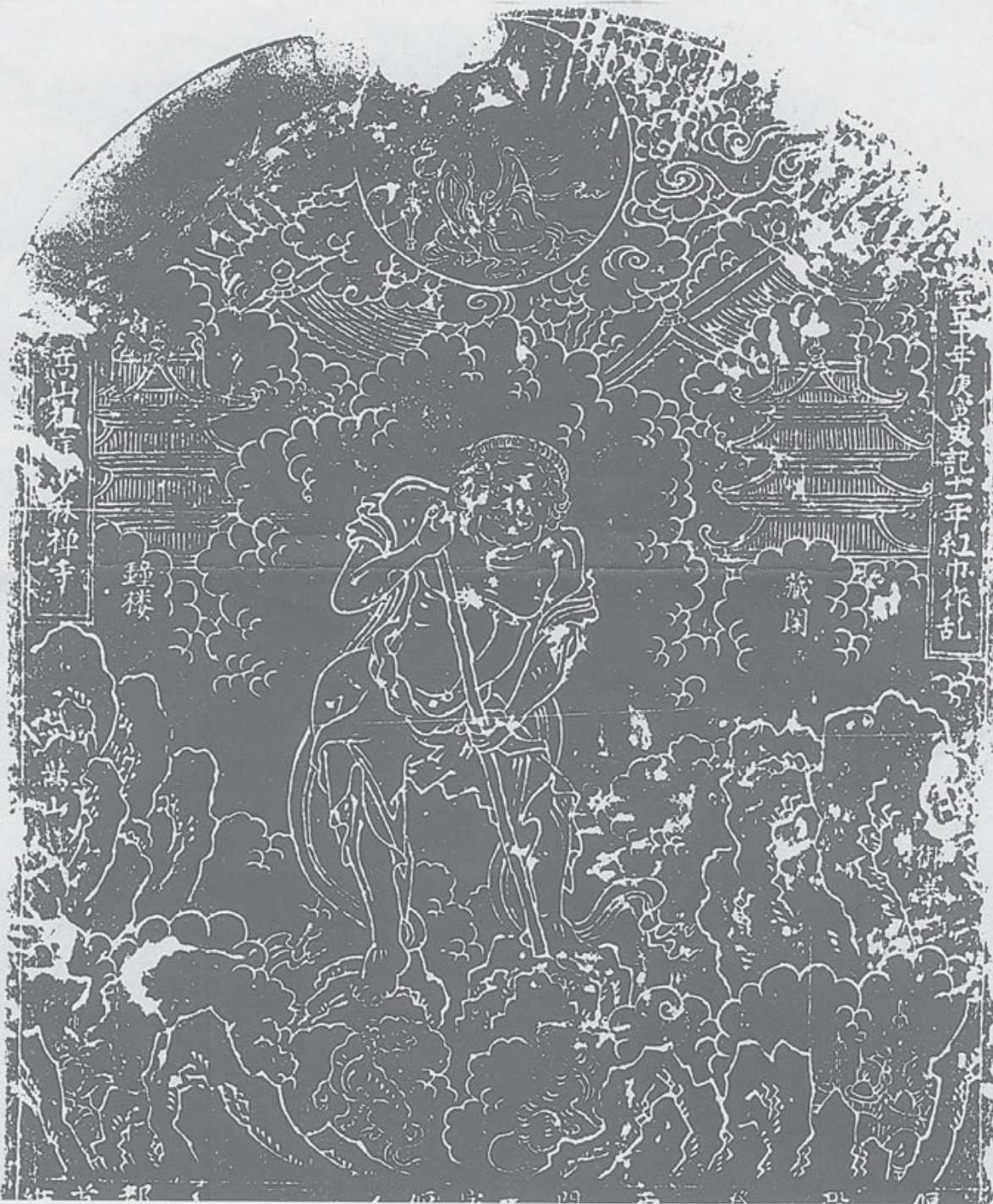
In addition, Sun Wukong and Vajrapani are associated with each other in Shaolin Monastery lore. The latter was historically worshiped as the progenitor of their famous staff method. A stele erected by Shaolin abbot Wenzai in 1517 CE shows that the deity’s vajra-club had been changed at some point to a Chinese staff (fig. 4) (Shahar, 2008, p. 84). Vajrapani’s yaksha-like Narayana (Naluoyan(tian), 那羅延(天)) form was eventually equated with one of the four staff-wielding “Kimnara Kings” (Jinnaluo wang, 緊那羅王) from the Lotus Sutra in 1575 CE. His name was thus changed from Narayana to Kimnara King (Shahar, 2008, p. 87). One version of the story about his creation of the staff method takes place during the Yuan Dynasty‘s Red Turban Rebellion (1351–1368 CE). Bandits lay siege to the monastery, but it is saved by a lowly kitchen worker wielding a long fire poker as a makeshift staff. He leaps into the oven and emerges as a monstrous giant tall enough to straddle both Mount Song and the imperial fort atop Mount Shaoshi, which are five miles (8.046 km) apart. The bandits flee when they behold this staff-wielding titan. The Shaolin monks later realize that the kitchen worker was none other than the Kimnara King in disguise (Shahar, 2008, pp. 87-88). Shahar (2008) suggests that mythical elements of the story were borrowed from the Monkey King’s adventures. He compares the worker’s transformation in the stove with Sun’s time in Laozi’s Eight Trigrams furnace (Bagua lu, 八卦爐), their use of the staff, and the fact that Monkey and his weapon can both grow to gigantic proportions (Shahar, 2008, p. 109). [3]

Therefore, given the above information, it’s not a stretch to have the two heroes meet in a fanfiction.

Fig. 4 – An ink rubbing of the 1517 CE Shaolin stele showing a titanic Vajrapani defending the monastery from rebels (larger version). From Shahar, 2008, p. 84.

2. Story Idea

I’ve added in-text notes in this section to provide readers with extra context. This way, you won’t have to scroll to the endnotes at the bottom.

Buddhist tradition describes Tathagata visiting the devas to preach the dharma (Buswell & Lopez, 2014, p. 235). With the presence of Greeks in Central and South Asia, I imagine he would also visit the Olympian gods who had gained some influence in the region. These friendly interactions would lead Zeus to assign Heracles to guard the Enlightened One (fig. 5), thereby forming a link between the Greek and Buddhist pantheons (and explaining the aforementioned art).

Here is where one of many changes to the standard 1592 CE JTTW story happens. In chapter six of the original, the bodhisattva Guanyin recommends that the demi-god Erlang battle the Monkey King after the latter had defeated many of heaven’s greatest warriors (Wu & Yu, 2012, vol. 1, p. 178). In our tale, she instead endorses the demi-god-turned-deity Heracles-Vajrapani (“HV” hereafter). [A]

A) The Son of Zeus became a full-blown god upon his death. After being exposed to a tunic soaked with poisonous hydra blood, Heracles sought release from the immense pain by jumping into a funeral pyre. But the flaming structure was shortly thereafter struck by lightning, signaling his rise to godhood (Romero-Gonzalez, 2021, pp. 273-276). This, of course, takes place hundreds of years before he becomes the protector of the Buddha.

Fig. 5 – A lovely digital painting of Heracles traveling with the Buddha (larger version). By Jacob King (deviantart). Used with permission. Image found here.

(I don’t consider myself a competent story writer, so please look at the following dialogue as conceptual in nature.)

Similar to the standard narrative, the monkey-soldiers of Wukong’s army notify him that heaven has sent another challenger. He emerges from his cave fully armored to see HV for the first time. Like the original, this might be followed by a poem describing the enemy; in this case, a large, muscular, bearded warrior wearing a lion skin and wielding a flaming vajra-club.

[Insert insults from both sides, including the Son of Zeus calling Monkey a “young rogue,” which naturally pisses him off. [B] HV also describes his godly heritage, which is alien to Monkey since he’s not familiar with the Greek pantheon.]

B) The Great Sage has a habit of claiming to be older than the various gods, immortals, spirits, and humans he meets—whether it’s true or not in the first three cases (Wu & Yu, 2012, vol. 1, p. 413, for example). This is exemplified by his self-given nickname “(Maternal/Paternal) Grandpa Sun” (Sun waigong, 孫外公; Sun Yeye, 孫爺爺). But within the story’s timeline, Heracles is indeed hundreds of years older. Writing around 430 BCE, the Greek historian Herodotus claimed that the Son of Zeus lived roughly 900 years before him, placing the demi-god’s life sometime around 1330 BCE. The Greek hero would, therefore, be active around 830 or more years prior to the birth of Wukong.

The pair take part in a battle of weapons, with Wukong wielding his magic staff and HV his vajra-club. (The earth quakes, gods tremble, etc.). HV’s powerful strikes push our hero back, causing his staff to painfully vibrate in his hands [C] and create a deafening ringing noise with each hit. Monkey would have a running internal monologue noting the great force of his opponent’s attacks. But despite this, the Great Sage continues driving forward, his weapon hardly leaving the area around HV’s head. [D] At one point, though, a glancing strike from the Greco-Buddhist hero redirects the staff, creating an opening. HV brings his vajra-club down hard on Monkey, but instead of dodging, the latter jerks his head upwards, butting away his opponent’s holy weapon with a loud, metallic bang. [E] The combined forces from the attack and defense might cause destruction to the surrounding area.

C) It may seem impossible for the staff to painfully vibrate in Wukong’s hands, but this indeed happens once in the novel. In JTTW chapter 20, he attempts to bludgeon a tiger-spirit, but when “the rod bounce[s] back up and his hands [a]re stung by the impact” (… 轉震得自己手疼), he learns it was just a big stone covered with the fiend’s sloughed off skin (Wu & Yu, 2012, vol. 1, p. 403).

D) The phrase “hardly leaving the monster’s head” is twice used (here and here) to describe Wukong’s supreme mastery of the staff in JTTW chapters 41 and 67 (Wu & Yu, 2012, vol. 2, p. 224; vol. 3, p. 249).

E) The feat of headbutting the weapon serves two purposes. First, it’s a response to this 2020 DEATH BATTLE! fanon wiki fan script that sees Hercules win by smashing the primate immortal’s head to a pulp with his club. (This attack carried over into the official episode, too.) The ending betrays the author’s extremely limited knowledge of JTTW. In the original, the Great Sage’s head is one of the hardest parts of his body, giving him the confidence to voluntarily take blows to the scalp from even magic, bladed weapons with no harm (Wu & Yu, 2012, vol. 1, pp. 314, 383-384, and 408; vol. 2, p. 128; vol. 3, pp. 125 and 373). And two, it highlights the correlation between the invulnerability of Monkey and the Nemean Lion, the first labor of Heracles (March, 2021). Regarding the ending of the fan script, one version of the original mythology sees the Son of Zeus break his olive club over the lion’s head because of how tough its hide is (March, 2021, p. 34).

The novel gives at least three reasons for the Great Sage’s invulnerability. After heaven fails to execute him with bladed weapons and fire and lightning in JTTW chapter 7, Laozi suggests that all of the immortal foodstuff previously consumed by our hero had been refined by his own samadhi fire (sanmei huo, 三昧火), a spiritual flame in the lower abdomen, thus giving him a “diamond body” (jingang zhi qu, 金鋼之軀) (Wu & Yu, 2012, vol. 1, p. 188). Wukong himself later attributes his adamantine nature to his time in the high god’s furnace. In JTTW chapter 34, for example, he claims to have developed a heart of gold, viscera of silver, a head of bronze, and a back of iron (among other things) (Wu & Yu, 2012, vol. 2, p. 131). This is refuted in JTTW chapter 75 when he claims to have been born with a head of bronze and iron that was further refined by the furnace (Wu & Yu, 2012, vol. 3, p. 374).

Stunned from the powerful blow, [F] Monkey stumbles around holding his head for a moment but raises his weapon in defense when he sees HV approaching. However, instead of attacking, the Greco-Buddhist warrior pauses combat by raising a hand in front of him. “What a skull!” he exclaims while clapping. “And no hint of blood! I reckon your hide is as tough as a monstrous beast I once fought. [G] Truly impressive! And your staff technique is masterful! Who trained you?”

F) This references how the Nemean Lion was blinded by pain after the blow (March, 2021, p. 34).

G) This reference is obvious.

“I have no teacher. [H] I alone trained my mind and body for three years.” [I]

H) This refers to Wukong’s promise to never reveal the Buddho-Daoist sage, Patriarch Subodhi, as his teacher under threat of karmic torture in the underworld (Wu & Yu, 2012, vol. 1, p. 125).

I) This is the length of time that he spends as an indoor disciple of Subodhi (Wu & Yu, 2012, vol. 1, p. 121).

“A prodigy!” exclaims HV. “But how good is your boxing and wrestling?”

“Ol’ Monkey can handle himself.”

“Let’s see if that’s true. How about we have a friendly sparring match, a test of heroic strength and skill? No weapons and no pesky magic tricks. Agreed?”

Wukong quickly agrees and inserts his shrunken staff into his ear before stripping off his armor from the waist up to match HV’s exposed muscles. (HV somehow magically stores his holy vajra-club.) The two then square up and launch forward, locking hands and pushing against the other, causing the ground beneath them to tremble and split.

“Extraordinary!” says HV. “How can such a small creature be so powerful?! [J] Were you born of the gods?

J) Many people often forget that Monkey’s normal form is less than 4-Chinese feet (121.92 cm) tall (see here).

“No, I was born from a stone.”

“Oh, like the stone titan and stone goddess! [K] No wonder you achieved this level of strength in such a short time. You have so much raw potential. Why cause trouble for such petty reasons?” [L]

K) These are Ullikumi and Agdistis, two powerful, rebellious, stone-born deities from Western myth (see sections 2.1 & 2.4 here). Referencing the former shows that HV is aware of the Near Eastern pantheon.

It’s interesting to note that lithic births are at least common enough in world myth to have earned a category in Stith Thompson’s Motif-Index of Folk-Literature: “Birth from rock” (T544.1).

L) This refers to Wukong’s rebellion over being given the lowest-ranking position in the Daoist heaven.

[Insert Wukong’s reply. They continue to converse during the battle.]

(This might be a good place to introduce some comedy. HV keeps referencing gods and monsters from other pantheons, making Monkey more and more frustrated:

“What the hell is wrong with you?! I … DON’T … KNOW … THESE … PEOPLE!!! [said in a slow, patronizing voice])

The Great Sage’s internal monologue comments on HV’s diamond grip and the great pressure of his punches. But our hero’s keen eyes notice openings in HV’s defense, allowing him to land blow after blow. However, with each successful attack comes praises from HV. Stinging rib shot. “Good, good!” Cutting elbow strike to the face. “Excellent!” Crushing body slam. “Amazing!”

“Why do you keep lauding me? I’m winning!”

“That would certainly be the case … if we were equals.”

“What do you mean?!”

Smiling, HV explains, “I’ve been testing you. [M] You found all of the openings I offered you, even some that I didn’t intend to because I was apparently too focused on judging your technique! [N] You are a talent the likes of which I’ve never seen before. Thank Father Zeus [or Buddha]! The student I’ve been looking for has finally appeared! Forsake this frivolous rebellion and return with me to the Western Paradise. I promise with my tutelage, you will become one of the greatest warriors of any pantheon!”

M) Perhaps HV decides to test the Great Sage when he sees how well the small primate responds to his opening strikes.

N) It just occurred to me that since the Subodhi appearing in this more realistic version of the story is the historical figure he’s based on, Subhuti, one of the Buddha’s ten principal disciples, the patriarch had to have trained under someone during Tathagata’s lifetime. And considering that HV was the Enlightened One’s bodyguard, perhaps Subhuti learned a little from the Greco-Buddhist hero—apart from other deities, holy men, and warriors, including the Buddha, a member of the Kshatriya class. An interesting implication is that HV would recognize (his or an ally’s) techniques among Wukong’s armed and unarmed attacks or defenses, thereby alerting him that Monkey’s claim of having no master is false. Yet, he would still be supremely impressed that the Great Sage became such a powerful, competent fighter in just three short years.

Fun fact: according to Theocritus, Heracles learned boxing and wrestling from the grim-looking demi-god Harpalycus, son of Hermes (Pache, 2021, p. 10). Apollodorus instead claims his teacher was Autolycus (2.4.9), also a son of Hermes.

“I think you’re full of shit! Ol’ Monkey is whittling away at you, and you’re just trying to talk your way out of it.”

“Well, my offer stands,” HV replies calmly, “but now that I’ve had my fun, it’s time to finish this.”

“Finish what, you bastard?!” Wukong screams in anger. He then unleashes a tornado of powerful punches, kicks, and knee and elbow strikes. But this time they have no effect on the Son of Zeus because he’s no longer playing along.

I’m not quite sure what the next sequence of events would be since I have zero experience choreographing fight scenes, especially between celestial warriors. Perhaps HV displays his true power by running Monkey headfirst through the side of a mountain with an outstretched arm, similar to how the comic book character Omni-Man uses his son, Invincible, like a wedge to slice through an oncoming subway train [warning: gore]. This feat alone would surely cause the primate immortal to question how his opponent’s strength has seemingly increased exponentially. [O] (But upon reflection, this deed seems lacking considering that Wukong himself is shown capable of carrying two mountains while running with great speed. Hopefully someone can suggest a feat for HV that would amaze even the Great Sage.)

O) This, of course, proves that HV was holding back. It’s important to note that in Buddhist literature, the original Vajrapani is considered the “physical manifestation of the … power … of all the Buddhas” (Buswell & Lopez, 2014, p. 955). Now imagine how much stronger HV would be than Monkey! Apart from his own godly heritage, I guess in my version of JTTW, HV would gain an unfathomable boost in power from serving as the protector and disciple of the Buddha, exposing him to the dharma for centuries—during Tathagata’s lifetime and afterlife following his parinirvana (figs. 6 & 7). This is similar to how the scorpion-demoness becomes so strong in JTTW chapter 55 (Wu & Yu, 2012, vol. 3, p. 72). But HV would be well beyond even her.

I guess the Great Sage would hold off on using magic up to this point as a matter of pride, but maybe his hand is forced when faced with such oppressive strength. Like in the original, he might resort to his magic hairs, summoning hundreds of tiny clones in the hopes of overwhelming the Son of Zeus. [P] However, the Greco-Buddhist warrior quickly neutralizes these—possibly by clapping his hands together and creating a shockwave that blows them away [Q] and destroys the surrounding area—pressuring our hero to take other measures. Maybe Monkey frantically cycles through one trick after another but ultimately fails to best his opponent (see the 10-26-25 update below). (It would be fascinating to see how HV deals with Wukong’s three-headed, six-armed war form—surely eliciting comparisons to Geryon [R].)

To these breaches of their agreement, HV responds with something like, “Magic? You disappoint me.”

[Insert Monkey’s response.]

P) Monkey competes in hand-to-hand combat in JTTW chapters two and 51, and each time he resorts to hair clones when things get out of hand (Wu & Yu, 2012, vol. 1, pp. 128-129; vol. 3, pp. 12-13).

Q) The hair clones can indeed be blown away, as shown by the Yellow Wind Demon in JTTW chapter 21 (Wu & Yu, 2012, vol. 1, pp. 409-410).

R) Thank you to a beta reader of this article for reminding me about Geryon. He is sometimes described as having or depicted with three conjoined bodies, complete with three heads and six arms like Monkey (fig. 8) (Finglass, 2021).

Fig. 6 (Top) – A degraded stone carving depicting the parinirvana of the Buddha, Gandhara, 2nd to 3rd-century CE, Schist (larger version). HV is the first person from the left on the bottom row. He holds his vajra-club in one hand and upraises the other in lamentation. He has an exposed torso, showing off his muscles, in place of his signature lionskin. Housed in the British Museum. Adapted from an image found on Wikimedia Commons. Copyright Marie-Lan Nguyen. Fig. 7 (Bottom Left) – Detail of HV (larger version). Fig. 8 (Bottom Right) – Heracles vs Geryon, Attic black figure on Amphora vase, mid-6th century BCE (larger version). Housed in the Musée du Louvre, Paris.  This is an upscaled version of an image found here. Copyright www.theoi.com.

Ideally, given the parallels between Wukong and the Nemean lion—both are fierce mythological animals, have invulnerable hides, can change shape, [S] and fight someone who is/was a demi-god (Erlang vs Heracles)—I would like to see HV maneuver to Monkey’s back and get him in a chokehold, thereby mimicking how the big cat was originally defeated. [T] But instead of killing the Great Sage, he only intends to choke him to unconsciousness (see the 10-26-25 update below). [U] And to make matters worse, as the primate immortal fades towards blacking out, he by chance witnesses his beloved monkey army being routed and captured by celestial forces, like the standard version (Wu & Yu, 2012, vol. 1, p. 182). This causes him to lose heart and flee HV’s powerful arms by changing into an intangible ball of light or gust of wind. [V]

S) Matyszak (2015) states that the lion would sometimes take the form of kidnapped women (that it had presumably already eaten) in order to lure unsuspecting heroes into its cave (pp. 46-47). Dr. Matyszak tells me that “it’s not part of the core myth” but “later Roman and Byzantine authors do mention it” (personal communication, October 17, 2025).

T) I really like the ending of Theocritus’ description of the fight:

[After hitting him over the head with a club,] I threw my bow and stitched quiver to the ground, and before he could recover and turn on me again, I grabbed him by the scruff of his powerful neck. Gripping him firmly, I strangled him with my strong hands, tackling him from behind to stop him scratching me with his claws. Standing on his hind paws, I pressed them hard to the ground with my heels and controlled his flanks with my thighs, until I could lift him up lifeless in my arms and lay him out. And mighty Hades took his spirit (March, 2021, p. 34).

U) Someone might claim that it would be impossible to choke out Monkey since he’s a spiritual being, but it’s important to remember that the novel humanizes supernatural figures in order to make them more relatable. For instance, in JTTW chapter 65, Wukong claims that he will die from the lack of air inside of a sealed Buddhist treasure-weapon if he isn’t soon released (Wu & Yu, 2012, vol. 3, p. 217). However, I think a blood choke would be more dignified and less dangerous for our hero.

V) Wukong escapes in the form of a ball of light in JTTW chapters 34 and 42 (Wu & Yu, 2012, vol. 2, pp. 126 and 241). And he turns into a gust of wind to follow a foe in JTTW chapter 60 (Wu & Yu, 2012, vol. 3, p. 140). This could easily be used to escape as well.

A beta reader suggested that I work Erlang and his sworn brothers back into the story. They could track down and capture Monkey. But however the situation is resolved, this would lead to the events of the original story: his failed execution, his sentence to Laozi’s furnace, his escape and wager with Buddha, his imprisonment beneath Five Elements Mountain, and his eventual release to go on the journey. And since Wukong comes into contact with Erlang once more and the Vajra warriors several times in the standard version, [W] he would likely meet HV again during the pilgrimage. The Son of Zeus might even comment on his positive change in character as Tripitaka’s disciple and protector.

W) The Great Sage meets Erlang again in chapter 63 (Wu & Yu, 2012, vol. 3, pp. 187-191). Regarding Vajra warriors, refer back to section 1.2.

Two beta readers were disappointed by the ending because they didn’t think HV could defeat the Great Sage. As a longtime uberfan of Monkey myself, I understand that sentiment, but they should remember that this is not just the Heracles of Greco-Roman myth, who’s immensely powerful in his own right, able to support the sky on his shoulders in one myth (Salapata, 2021, p. 152). He’s an amalgam of the Greek hero and the Buddha’s protector. Recall that Vajrapani is considered the embodiment of all the Tathagatas’ power (refer back to note O). And If the dharma of one Buddha can easily defeat Monkey (Wu & Yu, 2012, vol. 1, pp. 195 and 199), a being endowed with the power of ALL of them should have no problem subduing our favorite primate immortal.

I feel like this idea has so much potential, but I lack the experience or talent to do it justice here. Hopefully, readers will see through the lackluster description to understand the promise of greatness that it holds. Please let me know if any of you are interested in fleshing out this tale.

Lastly, while finishing this section, I came upon a fun coincidence: ancient Greco-Buddhist stone carvings with HV, the Buddha, and … a monkey (figs. 9 & 10)! They depict “The Monkey Offering Honey (to the Buddha)” (Ch: Mihou xianmi, 獼猴獻蜜; Mihou fengmi, 獼猴奉蜜), a tale from the Tathagata’s lifetime where a primate selflessly offered him honey but shortly thereafter fell and died via drowning or impalement. Thankfully, though, the primate was reborn into the deva realm (Van der Geer, 2022, pp. 439-440). [W] The carvings depict HV watching over the Enlightened One during this event.

Perhaps, based on these images, HV tells Wukong at some point during the confrontation that he reminds him of someone from the past. (Fanfic theory: could the Great Sage be a reincarnation?)

W) The historical Xuanzang mentions a version of this story where the primate is later reborn as a human (Li, 1996/2017, p. 106). He adds that the area where the offering originally happened hosts images of monkeys (mihou xingxiang, 獼猴形像) next to a water tank or pond supposedly dug by a group of them for the Enlightened One (Li, 1996/2017, p. 184). [4]

Fig. 9 (Left) – Detail of a stone doorway fragment with two stacked carvings illustrating “The Monkey Offering Honey (to the Buddha)” story, Gandhara, 1st to 3rd-century CE, Schist (larger version). The upper scene portrays the primate asking for a bowl, while the lower depicts the offering of honey. HV is present in both: first from the left on the top and first from the right on the bottom. He lacks his beard and lionskin but wields his signature weapon. The extra person photobombing the lower scene may be Ananda. Fig. 10 (Right) – The full stone doorway fragment portraying various events from the Tathagata’s life (larger version). Housed in the Guimet Museum, Paris, France. Adapted from an image found on Wikimedia Commons. Copyright Marie-Lan Nguyen. 

3. Sequel

A continuation of the story would open where the original leaves off: after the scripture-pilgrims are elevated in spiritual rank, Tathagata charges HV with escorting the Victorious Fighting Buddha (i.e. Sun Wukong; fig. 11) through the Greek world-system. Imagine the kind of adventures Monkey would have as a Buddha interacting with Classical gods and monsters! It would definitely be a great way of introducing East Asian people to the wonders of Greek myth.

I really like the idea of HV visiting his old pantheon as his vajra is analogous to Zeus’ thunderbolt. Seeing a father-son lightning competition would be great!

Also, as I’ve discussed elsewhere, Wukong and Poseidon could bond over their shared love of horses.

Fig. 11 – Wukong as the Victorious Fighting Buddha (larger version). Imagery based on the iconography of the historical Yuddhajaya Buddha. Art by NingadudeXx.

3.1. Commissioned Art

I have commissioned some illustrators to draw Monkey in ancient Greek style as an experiment to see what he might look like through the lens of Hellenistic artisans.

Fig. 12 – The Victorious Fighting Buddha (larger version). Pencil, fineliners, and alcohol markers on paper. Art by tr0chanter (Instagram and Twitter).

Fig. 13 – Heracles vs Monkey (larger version). Pencil and markers on paper. Art by Dario Virga (Onibotokemaru on Instagram), a friend of the blog. Each character is labeled with their name in Greek. Heracles is “Ἡρακλῆς,” while the Great Sage is “Pithekos” (πῐ́θηκος), meaning “ape, monkey, trickster, or dwarf.” Wukong’s Greek name is very fitting. It’s also part of the modern scientific name for Old world monkeys (Cercopithecoidea).

4. Fanfiction

I can already predict fanfiction set in an alternate timeline where Monkey accepts HV’s offer to become his teacher. The Son of Zeus would spend time instructing Wukong on advanced techniques of boxing, wrestling, and weapons. This, of course, would be taught in tandem with spiritual cultivation. The training might be in preparation for a fighting tournament between the disciples of gods from all pantheons, kind of like Record of Ragnarok (Jp: Shūmatsu no Warukyūre, 終末のワルキューレ; lit. “Doomsday Valkyrie”; fig. 14). The contestants could be fighting for permission to start their own pantheon, thereby becoming a “Sky Father” (Sk: Dyaus-pitr, द्यौष्पितृ; Ch: Tianshang fuqin, 天上父親). (Maybe the long-established Sky Fathers share some of their divine spark to kickstart the new world-system.) I REALLY like this idea, but it wouldn’t work for my own purposes since, as stated above, Wukong would still need to go on the journey.

Perhaps the prize could be the chance to help mankind since one of the reasons that Tripitaka is asked to quest for sutras is because they will help free untold numbers of orphaned souls from the torments of hell (see JTTW chapters 11 and 12). Therefore, the tournament would essentially be a contest to see who will be the Tang Monk’s protector. I don’t really like this idea, but it at least supports the original narrative. The Great Sage would win, of course, but he has to agree to have his extraordinary powers (and memories of the tournament) sealed as a test of his resolve or devotion. And his subsequent enlightenment would be the reward for his great deeds performed on the journey.

Fig. 14 – Promotional art for Record of Ragnarok (larger version). Image found here.


Update: 10-11-25

I’ve seen people claim online that Sun Wukong would easily defeat Heracles because the latter’s feats are not as grand as the former. To this, I counter that the deeds of both heroes shouldn’t be compared, for they serve difference purposes. I don’t know of any feats of speed for Heracles, but Monkey’s famous ability to fly 108,000 li (33,554 mi / 54,000 km) in a single cloud somersault is an allegory for instant enlightenment (as explained in section III here). [5] And his feat of carrying two Buddhist mountains on his shoulders is likely an allegory for the Great Sage “supporting” the religion by protecting his master on the quest for sutras (as I suggest here). The deeds of Heracles, however, were probably meant as actual displays of brute strength, things that would have both entertained and inspired ancient Greeks.


Update: 10-26-25

Above, I wrote that “[m]aybe Monkey frantically cycles through one trick after another” in a failed bid to win, and I later added, “I would like to see HV maneuver to Monkey’s back and get him in a chokehold.” Well, I’m happy to report that I’ve found a mythic way to combine these. The Bibliotheca of Pseudo-Apollodorus describes Heracles’s grip tiring out a shape-shifting sea god:

And going on foot through Illyria and hastening to the river Eridanus he came to the nymphs, the daughters of Zeus and Themis. They revealed Nereus to him, and Hercules seized him while he slept, and though the god turned himself into all kinds of shapes, the hero bound him [with his arms (fig. 15)] and did not release him till he had learned from him where were the apples and the Hesperides (2.5.11).

Matyszak (2015) calls this binding a “Herculean head-lock” (p. 150). Therefore, in our story, Wukong cycles through all manner of transformations but can’t break free from HV’s grip! Then he loses heart and flees when he sees his children captured (as mentioned previously).

Fig. 15 – Heracles wrestling Nereus/Triton (larger version). From an 1894 drawing of a circa 550 BCE Attic Black-figure Kylix. Image found on Wikimedia Commons. For the original, see here.


Update: 10-29-25

I’ve also found a mythic reason for why Heracles would be sent away from Olympus to protect Buddha. Matyszak (2015) explains that the Son of Zeus didn’t want to become an official member of the Twelve Olympians because this would have forced someone out of the group:

Some felt that the mighty deeds of Hercules entitled him to the status of a full Olympian God. However, the number of Olympians was limited to the sacred number of twelve, and in a rare moment of diplomacy Hercules declined to take an honour that would have first to be stripped from someone else. (Dionysus, the God of Wine was less bashful. He bumped Hestia, Goddess of the Home, off the Olympian high table when his time came to be made divine.) (p. 200)

So instead of taking an Olympian’s spot, Heracles decides to accept a position within the Buddhist pantheon as the Tathagata’s protector.


Update: 12-02-25

I have found the specific passage alluded to by Matyszak (2015) in the previous update. In book four of his Library of History (c. 60 to 30 BCE), Diodorus Siculus writes:

[4.39.4] They report of Heracles further that Zeus enrolled him among the twelve gods but that he would not accept this honour; for it was impossible for him thus to be enrolled unless one of the twelve gods were first cast out; hence in his eyes it would be monstrous for him to accept an honour which involved depriving another god of his honour (source).

Notes:

1) Translation changed slightly. Although the English reads “a hundred yards,” the original Chinese says “100 zhang” (bai zhang, 百丈). One zhang is ten Chinese feet, or roughly 10.43 ft (3.18 m) (Jiang, 2005, p. xxxi). Therefore, 100 zhang would be 1,043 ft (314 m).

2) Yu (Wu & Yu, 2012) translates jingang (金剛) as “Diamond Guardians” (vol. 3, p. 24, for example). I’m changing it to just Vajra since the term can mean both “lightning” and “diamond.” I don’t want to confuse anyone.

3) Yes, this information comes from Wikipedia, but I’m the one who originally added it under the screenname “Ghostexorcist.” See this edit history, for example.

4) The English translation just says “tank” (Li, 1996/2017, p. 184), but the original Chinese word chi (池) can also mean “pond.”

5) The li (里) is a Chinese measurement of distance. English works usually translate it as “mile.” However, it equals roughly 1/3rd of a mile or 1/2 of a kilometer.

Sources:

Buswell, R. E., & Lopez, D. S. (2014). The Princeton Dictionary of Buddhism. Princeton, NJ: Princeton University Press.

Finglass, P. J. (2021). LABOR X: The Cattle of Geryon and the Return from Tartessus. In D. Ogden (Ed.), The Oxford Handbook of Heracles (pp. 135-148). United Kingdom: Oxford University Press.

Jiang, Y. (2005). The Great Ming Code / Da Ming Lu. Vancouver, Wa: University of Washington Press.

Li, R. (Trans.) (2017). The Great Tang Dynasty Record of the Western Regions. Berkeley, CA: Numata Center for Buddhist Translation and Research. (Original work published 1996) Retrieved from https://www.bdkamerica.org/product/the-great-tang-dynasty-record-of-the-western-regions/

March, J. (2021). LABOR I: The Nemean Lion. In D. Ogden (Ed.), The Oxford Handbook of Heracles (pp. 29-44). United Kingdom: Oxford University Press.

Matyszak, P. (2015). Hercules: The First Superhero (An Unauthorized Biography). Canada: Monashee Mountain Publishing.

Pache, C. (2021). Birth and Childhood. In D. Ogden (Ed.), The Oxford Handbook of Heracles (pp. 3-12). United Kingdom: Oxford University Press.

Romero-Gonzalez, D. (2021). Deianeira, Death, and Apotheosis. In D. Ogden (Ed.), The Oxford Handbook of Heracles (pp. 266-280). United Kingdom: Oxford University Press.

Salapata, G. (2021). LABOR XI: The Apples of Hesperides. In D. Ogden (Ed.), The Oxford Handbook of Heracles (pp. 149-164). United Kingdom: Oxford University Press.

Shahar, M. (2008). The Shaolin Monastery: History, Religion, and the Chinese Martial Arts. Honolulu: University of Hawai’i Press.

Van der Geer, A. A. E. (2022). The Great Monkey King: Carvings of Primates in Indian Religious Architecture (pp. 431-455). In B. Urbani, D. Youlatos, & A. Antczak (Eds.), World Archaeoprimatology: Interconnections of Humans and Nonhuman Primates in the Past. United Kingdom: Cambridge University Press.

Wivell, C.S. (1994). The Story of How the Monk Tripitaka of the Great Country of T’ang Brought Back the Sūtras. In V. Mair (Ed.), The Columbia Anthology of Traditional Chinese Literature (pp. 1181-1207). New York: Columbia University Press.

Wu, C., & Yu, A. C. (2012). The Journey to the West (Vols. 1-4) (Rev. ed.). Chicago, Illinois: University of Chicago Press.

How Many Humans Does Sun Wukong Kill in Journey to the West?

Last updated: 08-15-2024

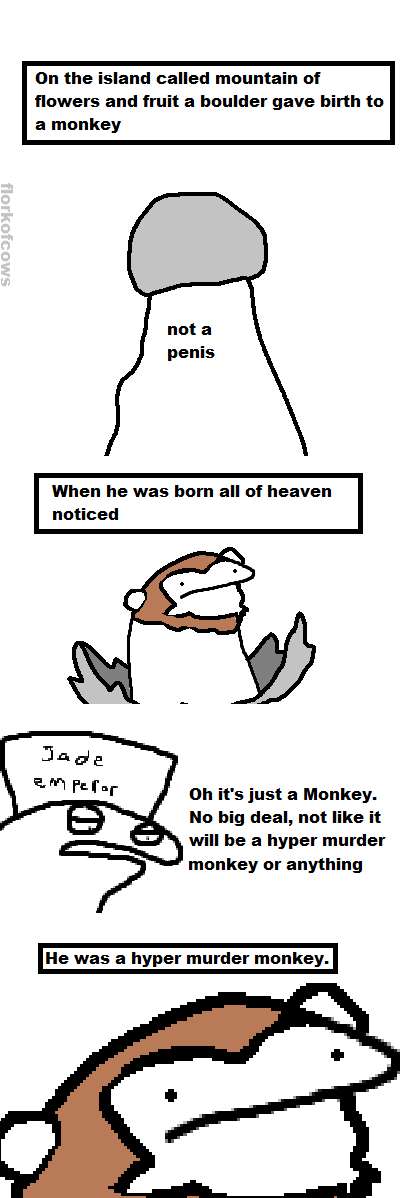
Someone on Tumblr recently asked me if I knew how many monsters, spirits, and humans that Sun Wukong kills throughout Journey to the West (Xiyouji, 西遊記, 1592). But since he’s a “hyper murder monkey” (fig. 1), this is impossible to quantify without an overly extensive survey of the book. However, the task becomes far more manageable if narrowed down to just humans. I know of at least seven instances in chapters 14, 27, 28, 44, 46, and 56. Although I can’t give an exact count, the number slain is over 1,030!

This study is by no means exhaustive. I’ve surely missed a few examples in the latter half of the book. But I’ll update this piece in the future if anything else pops up.

Fig. 1 – The story of the hyper murder monkey by @FlorkOfCows (larger version).

I. Chapter 14

  • Six robbers

The first instance happens when Sun and his master are accosted by six robbers shortly after the immortal is released from under Five Elements Mountain:

Master and disciple had traveled for some time when suddenly six men jumped out from the side of the road with much clamor, all holding long spears and short swords, sharp blades and strong bows. “Stop, monk!” they cried. “Leave your horse and drop your bag at once, and we’ll let you pass on alive!” Tripitaka was so terrified that his soul left him and his spirit fled; he fell from his horse, unable to utter a word. But Pilgrim lifted him up, saying, “Don’t be alarmed, Master. It’s nothing really, just some people coming to give us clothes and a travel allowance!” “Wukong,” said Tripitaka, “you must be a little hard of hearing! They told us to leave our bag and our horse, and you want to ask them for clothes and a travel allowance?” “You just stay here and watch our belongings,” said Pilgrim, “and let old Monkey confront them. We’ll see what happens.” Tripitaka said, “Even a good punch is no match for a pair of fists, and two fists can’t cope with four hands! There are six big fellows over there, and you are such a tiny person. How can you have the nerve to confront them?”

As he always had been audacious, Pilgrim did not wait for further discussion. He walked forward with arms folded and saluted the six men, saying, “Sirs, for what reason are you blocking the path of this poor monk?” “We are kings of the highway,” said the men, “philanthropic mountain lords. Our fame has long been known, though you seem to be ignorant of it. Leave your belongings at once, and you will be allowed to pass. If you but utter half a no, you’ll be chopped to pieces!” “I have been also a great hereditary king and a mountain lord for centuries,” said Pilgrim, “but I have yet to learn of your illustrious names.” “So you really don’t know!” one of them said. “Let’s tell you then: one of us is named Eye That Sees and Delights; another, Ear That Hears and Rages; another Nose That Smells and Loves; another, Tongue That Tastes and Desires; another, Mind That Perceives and Covets; and another, Body That Bears and Suffers.” “You are nothing but six hairy brigands,” said Wukong laughing, “who have failed to recognize in me a person who has left the family, your proper master. How dare you bar my way? Bring out the treasures you have stolen so that you and I can divide them into seven portions. I’ll spare you then!” Hearing this, the robbers all reacted with rage and amusement, covetousness and fear, desire and anxiety. They rushed forward crying, “You reckless monk! You haven’t a thing to offer us, and yet you want us to share our loot with you!” Wielding spears and swords, they surrounded Pilgrim and hacked away at his head seventy or eighty times. Pilgrim stood in their midst and behaved as if nothing were happening.

What a monk!” said one of the robbers. “He really does have a hard head!” “Passably so!” said Pilgrim, laughing. “But your hands must be getting tired from all that exercise; it’s about time for old Monkey to take out his needle for a little entertainment.” “This monk must be an acupuncture man in disguise,” said the robber. “We’re not sick! What’s all this about using a needle?” Pilgrim reached into his ear and took out a tiny embroidery needle; one wave of it in the wind and it became an iron rod with the thickness of a rice bowl. He held it in his hands, saying, “Don’t run! Let old Monkey try his hand on you with this rod!” The six robbers fled in all directions, but with great strides he caught up with them and rounded all of them up. He beat every one of them to death, stripped them of their clothes, and seized their valuables. Then Pilgrim came back smiling broadly and said, “You may proceed now, Master. Those robbers have been exterminated by old Monkey” (Wu & Yu, vol. 1, pp 314-315).

This ends with Tripitaka becoming angry and exiling Monkey. The cleric later welcomes him back, only to rein in his disciple’s unruly behavior with the heaven-sent golden headband (Wu & Yu, 2012, vol. 1, pp. 315-317 and 318-320). This becomes a reoccurring theme (see below).

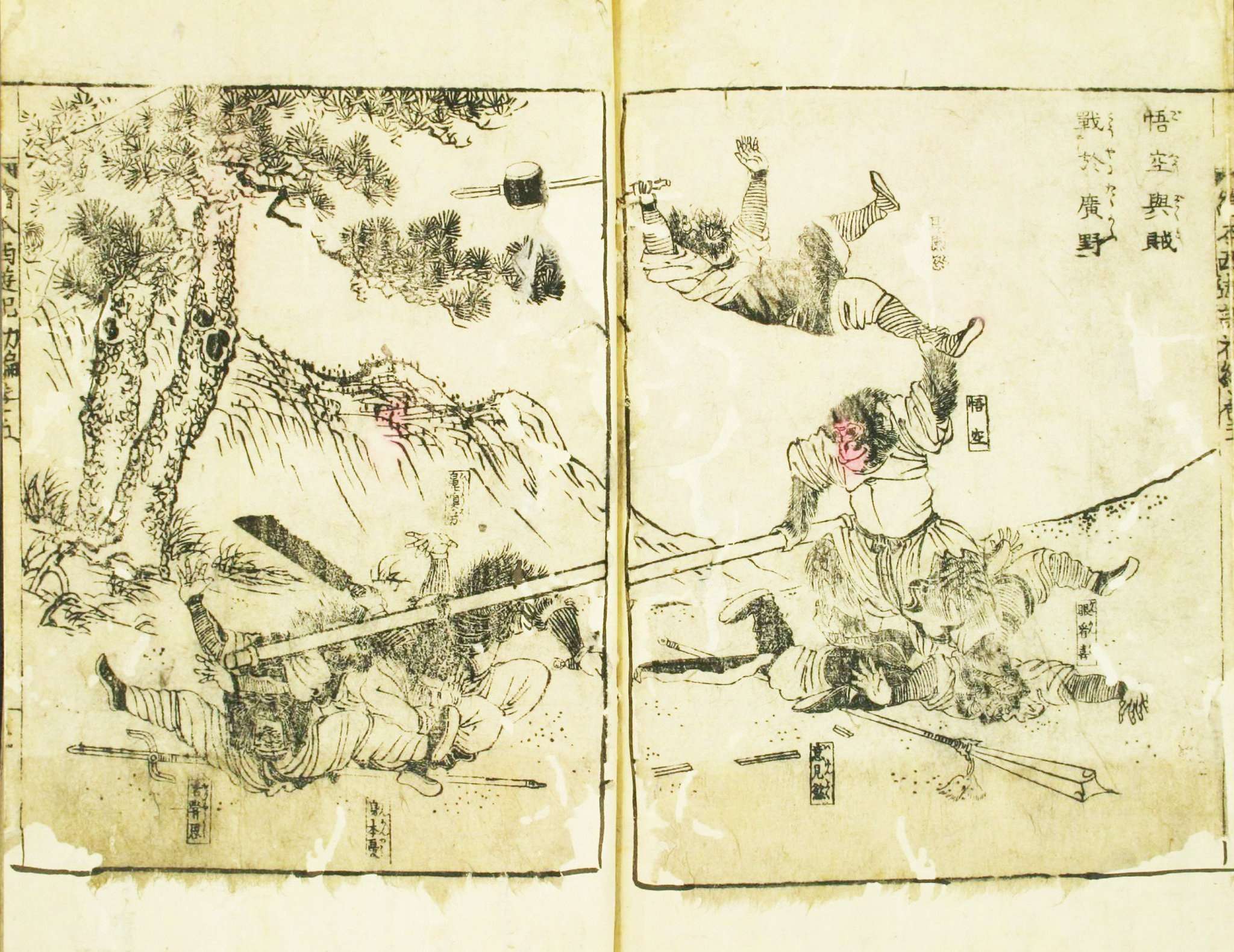
The six murders (fig. 2) are allegories for defeating the desires of the eyes, ears, nose, tongue, mind, and body that hinder one’s spiritual progression. [1] This is explained by Monkey in chapter 43 (Wu & Yu, 2012, vol. 2, p. 254).

Fig. 2 – A woodblock print depicting Sun killing the six bandits (larger version). It comes from The Illustrated Journey to the West (Ehon Saiyuki, 繪本西遊記), a 19th-century Japanese translation.

II. Chapter 27

  • Unknown

The second is alluded to during the White Bone Spirit episode. In her attempts to eat the monk, the wily skeleton demon takes on the guises of a beautiful girl, her elderly mother, and her elderly father in turn. But each time Sun attacks her with his staff, she leaves a fake corpse in her wake, [2] making it seem like the immortal has murdered yet another person. This naturally upsets Tripitaka, but Monkey explains that evil spirits commonly disguise themselves as something welcoming in order to catch and eat humans. He uses himself as an example, claiming to have done the same as a young monster:

“Master,” said Pilgrim with a laugh, “how could you know about this? When I was a monster back at the Water-Curtain Cave, I would act like this if I wanted to eat human flesh. I would change myself into gold or silver, a lonely building, a harmless drunk, or a beautiful woman. Anyone feebleminded enough to be attracted by me I would lure back to the cave. There I would enjoy him as I pleased, by steaming or boiling. If I couldn’t finish him off in one meal, I would dry the leftovers in the sun to keep for rainy days. Master, if I had returned a little later, you would have fallen into her trap and been harmed by her.” That Tang Monk, however, simply refused to believe these words; he kept saying instead that the woman was a good person (Wu & Yu, vol. 2, p. 20).

In the end, the cleric isn’t convinced that Sun didn’t kill an entire family, and so he punishes him with the band-tightening spell before once again banishing him from the group (Wu & Yu, 2012, vol. 2, pp. 26-28).

I know some online commentators believe that Monkey lies here about eating people. I’ll leave it up to the reader to make their own decision. But even if his claims are true, there is no way of quantifying the number eaten.

III. Chapter 28

  • 1,000-plus hunters

The third happens shortly after Sun’s exile. Upon returning to the Mountain of Flowers and Fruit, he learns that more than half of his 47,000 monkey subjects had been killed centuries ago in a great fire set by Erlang, and then half of the survivors later fled elsewhere due to a lack of food. In addition, half of those who remained were killed and eaten or captured for entertainment by a band of over 1,000 human hunters who recently came to inhabit the mountain. Hearing this greatly enrages the Monkey King. He thereafter instructs his subjects to gather piles of small rocks for a magical wind attack (Wu & Yu, vol. 2, pp. 31-32):

Making the magic sign with his fingers and reciting a spell, he drew in a breath facing the southwest and blew it out. At once a violent wind arose. Marvelous wind!

It threw up dust and scattered dirt;
It toppled trees and cut down forests.
The ocean waves rose like mountains;
They crashed fold upon fold on the shore.
The cosmos grew dim and darkened;
The sun and the moon lost their light.
The pine trees, once shaken, roared like tigers;
The bamboos, hit abruptly, sang like dragons.
All Heaven’s pores let loose their angry breaths
As rocks and sand flew, hurting one and all.

The Great Sage called up this mighty wind that blew up and scattered those rock pieces in every direction. Pity those thousand-odd (qianyu, 千餘) hunters and horses! This was what happened to every one of them:

The rocks broke their dark heads to pieces;
Flying sand hurt all the winged horses.
Lords and nobles confounded before the peak,
Blood stained like cinnabar the earth.
Fathers and sons could not go home.
Could fine men to their houses return?
Corpses fell to the dust and lay on the mountain,
While rouged ladies at home waited.

The poem says:

Men killed, horses dead—how could they go home?
Lost, lonely souls floundered like tangled hemp.
Pity those strong and virile fighting men,
Whose blood, both good and bad, did stain the sand!

Lowering the direction of his cloud, the Great Sage clapped his hands and roared with laughter, saying, “Lucky! Lucky! Since I made submission to the Tang Monk and became a priest, he has been giving me this advice:

‘Do good a thousand days,
But the good is still insufficient;
Do evil for one day,
And that evil is already excessive.’

Some truth indeed! When I followed him and killed a few monsters, he would blame me for perpetrating violence. Today I came home and it was the merest trifle to finish off all these hunters.”

He then shouted, “Little ones, come out!” When those monkeys saw that the violent wind had passed and heard the Great Sage calling, they all jumped out. “Go down to the south side of the mountain,” said the Great Sage, “and strip the dead hunters of their clothes. Bring them back home, wash away the bloodstains, and you all can wear them to ward off the cold. The corpses you can push into the deep mountain lake over there. Pull back here also the horses that are killed; their hides can be used to make boots, and their meat can be cured for us to enjoy slowly. Gather up the bows and arrows, the swords and spears, and you can use them for military drills again. And finally, bring me those banners of miscellaneous colors; I have use for them” (Wu & Yu, vol. 2, pp 33-34).

This is by far the largest number of humans killed in one go by the hyper murder monkey.

IV. Chapter 44

  • Two Daoists

The fourth happens shortly after the pilgrims arrive in the Cart-Slow Kingdom. Sun is appalled to learn that three self-proclaimed immortals have convinced the region’s monarch to not only destroy all Buddhist institutions but also to enslave the clerics to the Daoists. His initial response is to play a joke on two cocky Daoist overseers by convincing them (under the guise of an aged coreligionist) that he has a relative among the 500 monks who should be set free. But when they ask which one, our hero claims all of them to be his kin (Wu & Yu, 2012, vol. 2, pp. 269-275):

The Daoists said, “You must be a little crazy, for all at once you are babbling! These monks happen to be gifts from the king. If we want to release even one or two of them, we will have to go first before our masters to report that they are ill. Then, we have to submit a death certificate before we can consider the matter closed. How could you ask us to release them all? Nonsense! Nonsense! Why, not to speak of the fact that we would be left without servants in our household, but even the court might be offended. The king might send some officials to look into the work here or he himself might come to investigate. How could we dare let them go?” “You won’t release them?” said Pilgrim. “No, we won’t!” said the Daoists. Pilgrim asked them three times and his anger flared up. Whipping out his iron rod from his ear, he squeezed it once in the wind and it had the thickness of a rice bowl. He tested it with his hand before slamming it down on the Daoists’ heads. How pitiful! This one blow made

Their heads crack, their blood squirts, their bodies sink low;
Their skin split, their necks snap, their brains outflow! (Wu & Yu, vol. 2, p. 275).

V. Chapter 46

  • One civil official

The fifth happens during a magical contest of torture against one of the three supposed immortals. Monkey easily survives a bath in boiling oil but fakes his death in order to play a trick on Zhu Bajie. The officer in charge of the execution reports the development to the monarch, leading Tripitaka to eulogize and present offerings to his disciple’s spirit. But once Zhu hijacks the proceedings by calling Sun a Bimawen, [3] our hero erupts from the caldron to chastise his religious brother. Fearing possible punishment for seemingly lying to the king, the aforementioned official claims the primate is instead a ghost (Wu & Yu, 2012, vol. 3, pp. 310-312):

Maddened by what he heard, Pilgrim leaped out of the cauldron, dried himself from the oil, and threw on his clothes. Dragging that officer over, he whipped out his iron rod and one blow on the head reduced him to a meat patty. “What ghost is this who’s manifesting itself?” he huffed (Wu & Yu, 2012, vol. 2, pp. 312-313).

VI. Chapter 56 – Part 1

  • Two bandit chiefs

The last two instances that I know of take place shortly after the scorpion spirit episode. The sixth follows a similar pattern to chapter 14: Tripitaka is confronted by bandits → He gets scared and falls off the horse → The bandits demand money and the horse → Sun intervenes → His banter enrages them and they hit and stab at his adamantine pate to no avail → They comment on his hard head → Monkey pulls out his iron staff, referring to it as a needle → The bandits infer that he works in a certain profession and claim to have no use for the needle → He enlarges the weapon and eventually beats them to death. [4] The only difference here is that Sun first challenges the men to lift his staff:

… Sticking the rod into the ground, Pilgrim said to them, “If any of you can pick it up, it’s yours.” The two bandit chiefs at once went forward to try to grab it, but alas, it was as if dragonflies were attempting to shake a stone pillar. They could not even budge it half a whit! This rod, you see, happened to be the compliant golden-hooped rod, which tipped the scale in Heaven at thirteen thousand, five hundred [catties]. How could those bandits have knowledge of this? The Great Sage walked forward and picked up the rod with no effort at all. Assuming the style of the Python Rearing its Body, he pointed at the bandits and said, “Your luck’s running out, for you have met old Monkey!” One of the bandit chiefs approached him and gave him another fifty or sixty blows. “Your hands must be getting tired!” chuckled Pilgrim. “Let old Monkey give you one stroke of the rod. I won’t do it for real either!” Look at him! One wave of the rod and it grew to about seventy feet, its circumference almost as big as a well. He banged it on the bandit, and he at once fell to the ground: his lips hugging the earth, he could not make another sound.

The other bandit chiefs shouted, “This baldy is so audacious! He has no travel money, but he has killed one of us instead!” “Don’t fret! Don’t fret!” said Pilgrim, laughing. “I’ll hit every one of you, just to make sure that all of you will be wiped out!” With another bang he beat to death the other bandit chief Those small thieves were so terrified that they abandoned their weapons and fled for their lives in all directions (Wu & Yu, vol. 3, pp. 80-81).

VII. Chapter 56 – Part 2

  • One unfilial son
  • twenty-ish bandits

The seventh happens sometime after one of the surviving bandits, the son of an elderly couple surnamed Yang (楊), discovers that his parents are feeding and sheltering the pilgrims for the night. He and his brothers-in-arms make plans to attack the monks after eating dinner and sharpening their weapons, but old Mr. Yang alerts them, giving Tripitaka and his disciples ample time to escape:

Every bandit was darting forward like an arrow, and by sunrise, they caught sight of the Tang Monk. When the elder heard shouts behind him, he turned to look and discovered a band of some thirty men rushing toward him, all armed with knives and spears. “Oh, disciples,” he cried, “the brigand troops are catching up with us. What shall we do?” “Relax, relax!” said Pilgrim. “Old Monkey will go finish them off!” “Wukong,” said Tripitaka as he stopped his horse, “you must not hurt these people. Just frighten them away.” Unwilling, of course, to listen to his master, Pilgrim turned quickly to face his pursuers, saying, “Where are you going, sirs?” “You nasty baldie!” cried the thieves. “Give us back the lives of our great kings!”

As they encircled Pilgrim, the bandits lifted their spears and knives to stab and hack away madly. The Great Sage gave one wave of his rod and it had the thickness of a bowl; with it, he fought until those bandits dropped like stars and dispersed like clouds. Those he bumped into died at once, those he caught hold of perished immediately, those he tapped had their bones broken, and those he brushed against had their skins torn. The few smart ones managed to escape, but the rest of the dumb ones all went to see King Yama!

When Tripitaka saw that many men had fallen, he was so aghast that he turned and galloped toward the West, with Zhu Eight Rules and Sha Monk hard on the horse’s heels. Pilgrim pulled over one of the wounded bandits and asked, “Which is the son of old Yang?” “Father,” groaned the thief, “the one in yellow.” Pilgrim went forward to pick up a knife and beheaded the one in yellow. Holding the bloody head in his hand, he retrieved his iron rod and, in great strides, caught up with the Tang Monk. As he arrived before the horse, he raised the head and said, “Master, this is the rebellious son of old Yang, and he’s been beheaded by old Monkey.” [fig. 3] Paling with fright, Tripitaka fell down from the horse, crying, “Wretched ape! You’ve scared me to death! Take it away! Take it away!” Eight Rules went forward and kicked the head to the side of the road, where he used the muckrake to bury it (Wu & Yu, 2012, vol. 3, pp. 88-89).

The quote is clear that not all 30 bandits are killed. Apart from Yang the bandit, I think 20(-ish) is a conservative estimate based on the wording.

And just like chapters 14 and 27, this episode ends with Tripitaka punishing his disciple with the band-tightening spell before exiling him from the group (Wu & Yu, 2012, vol. 2, pp. 89-90).

Fig. 3 – Monkey presenting the head of Yang the bandit to his master. This screenshot comes from episode 10 of OSP’s retelling of Journey to the West (larger version).

VIII. Conclusion

To my knowledge, the Monkey King kills over 1,030 humans in Journey to the West. This includes six allegorical robbers in chapter 14, an unknown amount alluded to in chapter 27, over 1,000 hunters in chapter 28, two Daoists in chapter 44, one civil official in chapter 46, and two bandits chiefs, one unfilial son, and maybe 20-ish bandits in chapter 56. I may have missed a few instances in the latter half of the novel, so please don’t look at the above total as complete.


Update: 01-17-2023

I previously mentioned an instance in chapter 27 where Monkey admits to eating humans in his youth, something that some online commentators believe to be a fib. Well, a Tumblr user, who goes by both @abitfiendish and @localcactushugger, reminded me that dialogue in chapter 39 further calls this into question.

After a pill of immortal elixir fails to revive a long-dead king, Tripitaka suggests mouth-to-mouth necessitation is needed to complete the resurrection process. Sun is ultimately chosen for this job since he had apparently never eaten meat:

Eight Rules walked forward and was about to do this when he was stopped by Tripitaka. “You can’t do it,” he said. “Wukong still should take over.” That elder indeed had presence of mind, for Zhu Eight Rules, you see, had been a cannibal since his youth, and his breath was unclean. Pilgrim, on the other hand, had practiced self-cultivation since his birth, the food sustaining him being various fruits and nuts, and thus his breath was pure. The Great Sage, therefore, went forward and clamped his thundergod beak to the lips of the king: a mighty breath was blown through his throat … (Wu & Yu, 2012, vol. 2, pp. 195-196).

But it should be remembered that Journey to the West is crammed full of inconsistencies (likely born from the novel coalescing from different oral tales). For example, this chapter shows that all it takes to revive a dead person is an elixir pill and mouth-to-mouth. However, in chapter 97, Monkey has to physically retrieve the soul of a recently deceased householder from the underworld in order to resurrect him (see the material below figure 3 here).

Again, I’ll leave it up to the reader to make their own decision.


Update: 08-15-24

I recently finished rereading JTTW for the umpteenth time, and I am happy to report that I didn’t miss any mentions of killing humans in the latter part of the book. The above article represents the entire work.

Note:

1) Things that arouse the eyes (sights), ears (sounds), nose (smells), tongue (tastes), and mind and body (wants and desires).

2) This is related to an ancient Daoist concept called “Release by means of a corpse” (Shijie, 尸解). Stories as far back as the Han describe immortals leaving behind a fake corpse (sometimes a magically disguised object) while they ascended in secret to heaven (Kirkland, 2008).

3) This plays on the homophonous relationship between Bimawen (避馬瘟, lit: “avoid the horse plague”), an ancient belief that female monkeys placed in horse stables could ward off equine sickness, and Bimawen (弼馬溫, “To assist horse temperament”), Sun’s former station as keeper of the heavenly horses (see here).

See Wu & Yu, 2012, vol. 3, pp. 78-81.

Source:

Kirkland, R. (2008). Shijie In F. Pregadio (Ed.), The Encyclopedia of Taoism (Vol. 2) (pp. 896-897). London [u.a.: Routledge].

Wu, C., & Yu, A. C. (2012). The Journey to the West (Vols. 1-4) (Rev. ed.). Chicago, Illinois: University of Chicago Press.

Archive #37 – The 13th-Century Version of Journey to the West

Last updated: 01-30-2024

I’ve previously written an article describing The Story of How Tripitaka of the Great Tang Procures the Scriptures (Datang Sanzang qujing shihua, 大唐三藏取經詩話, c. late-13th-century), a seventeen chapter novelette that likely served as a prompt for oral storytellers. It is the oldest printed version of the Journey to the West (Xiyouji, 西遊記) story cycle. Here, I would like to present an English translation of this tale by Charles S. Wivell (1994).

Archive link:

The Story of How the Monk Tripitaka of the Great Country of T’ang Brought back the Sutras

Detail of Tripitaka and the Monkey Pilgrim from a late-Xixia Yulin Cave no. 3 mural (larger version). See here for more ancient depictions of Sun Wukong and his master.

Disclaimer:

This has been posted for educational purposes. No malicious copyright infringement is intended. If you liked the digital version, please support the official release.


Update: 01-30-24

I was recently interested to learn that The Story was influenced by underworld journey narratives. This explains the often fantastical and seemingly unrelated events that happen throughout the disjointed narrative. Brose (2023) writes:

The Japanese scholar Chūbachi Masakazu (b. 1938) was the first to point out that the Kōzanji narratives mirror two closely related mythic archetypes. The first, derived from ancient Han Chinese traditions, is the journey of the dead to the netherworld. In many accounts of postmortem travels, spirit animals (including but not limited to monkeys) serve as the guides for the dead on their passage through the spirit realm, whether the final destination is the Yellow Springs beneath the earth or Mount Kunlun in the distant west. The other motif, emerging from early Indian Buddhist literature, is the transmigration of the spirit to the Pure Land, which, like Mount Kunlun, was conventionally located somewhere in the west. In Buddhist accounts, animals (again, often but not always monkeys) also serve as escorts for the dead. Chubachi proposed that these narrative traditions—culturally distinct but thematically and functionally similar— were fused together with the historical account of Xuanzang’s journey to India. The Kōzanji texts, according to this reading, represent a complex but organic blending of initially independent narratives. The broad contours of Xuanzang’s biography and travelogue were superimposed onto older mythic accounts to provide a new, quasi-historical frame for age-old stories about the transmigrations of the dead.

Viewed from this perspective, Xuanzang was not passing through Central Asia en route to India but, instead, was traversing a hellish purgatory to reach a heavenly pure land. Like a shaman, he departs the human world and enters a dangerous liminal zone. Beset by ghosts and demons, he is guided and protected by powerful spirit animals and Buddhist deities. After enduring extreme hardship, he eventually arrives in an immortal realm populated by spirit monks, immortals, bodhisattvas, and buddhas. From Śākyamuni Buddha, he receives a collection of apotropaic texts with the power to safeguard the living and liberate the dead. Xuanzang then transmits these sacred scriptures back to the human realm before he and his assistants ascend to heaven during the annual ritual for liberating the damned from purgatory. This narrative not only maps the landscape of a postmortem shadow world, it also identifies the scriptures that guard against demonic molestation and ensure a propitious rebirth: the Buddhist canon in general and the Heart Sūtra in particular. Those who read, recited, or heard the Kōzanji texts were thus informed of the perils of purgatory and offered the promise of protection and salvation. Xuanzang, they also learned, was the saintly monk responsible for delivering these divine texts and technologies into the hands of humans (pp. 62-63).

This strengthens my suggestion that the Monkey Pilgrim serves as a stand-in for Mulian (目連; Sk: Maudgalyayana). This Buddhist saint is famous for traversing the underworld to save his mother.

Regarding the date of The Story, I’ve previously mentioned that it is a product of the late-13th-century. But Zhang (1990) assigns an earlier date to its writing, stating this was likely no earlier than the reign of Emperor Renzong (r. 1022-1063) of the Northern Song Dynasty (960-1127) and no later than the reign of Emperor Gaozong (r. 1127-1129) of the Southern Song Dynasty (1127-1279). This places The Story in the late-Northern Song. Zhang ends by saying,

Even though the current version of “Zhongwazi Zhangjiayin” [1] was printed in the late-Southern Song Dynasty, the date of publication should not be confused with the year in which the book was written.

纵然今见“中瓦子张家印”本刊印于南宋晚期,亦不能把刊印时间与成书年代混为一谈。

Chen (2014) supports a Song publication with evidence comparing The Story‘s rhyming system with that of Buddhist “Transformation Texts” (Bianwen, 變文). I have attached a PDF below.

PDF File:

A revisit of the time of Monk Xuanzang of the Tang Dynasty on a Pilgrimage for Buddhist Scriptures – Focus on rhyme style (2014)

Note:

1) The original late-13th-century manuscript of The Story is stamped with the “Zhang Family Seal of Central Market District” (Zhongwazi Zhangjiayin, 中瓦子張家印). The Central Market District (Zhongwazi, 中瓦子) was a street known for play promotions and book publishers in Song-era Lin’an prefecture (Zhang, 1990). This appears to be another nickname for The Story apart from the “Kozanji version” (Dudbridge, 1970, p. 25, for example).

Citation:

Brose, B. (2023). Embodying Xuanzang: The Postmortem Travels of a Buddhist Pilgrim. United States: University of Hawaii Press.

Chen, Y. (2014). Datang Sanzang qujing shihua shidaixing zaiyi: Yi yunwen tizhi de kaocha wei zhongxin [Another Discussion on the Age of the Story of How Tripitaka of the Great Tang Procured the Scriptures: An Investigation into the Rhyming System], Pudan Journal (Social Sciences), 5, 69-80.

Dudbridge, G. (1970). The Hsi-yu chi: A Study of Antecedents to the Sixteenth-Century Chinese Novel. Cambridge: Cambridge University Press.

Wivell, C.S. (1994). The Story of How the Monk Tripitaka of the Great Country of T’ang Brought Back the Sūtras. In V. Mair (Ed.), The Columbia Anthology of Traditional Chinese Literature (pp. 1181-1207). New York: Columbia University Press.

Zhang, J. (1990). Datang Sanzang qujing shihua chengshu niandai kaolun [A Discussion of the Date of the Story of How Tripitaka of the Great Tang Procures the Scriptures]. Xueshu jiaoliu, 4, 108-114. Retrieved from https://www.toutiao.com/article/7065749209709806087/?wid=1706529284309

Origin of the White Bone Spirit

Last updated: 01-31-2023

The twenty-seventh chapter of Journey to the West (Xiyouji, 西遊記, 1592) features a mountain spirit who resorts to magic disguises in an attempt to eat Tripitaka. Commonly referred to as the “White Bone Spirit” (Baigujing, 白骨精), she is one of a family of ghouls active in White Tiger Mountain (Baihu ling, 白虎嶺) who have long told legends of the monk’s immortality-bestowing flesh. She resorts to subterfuge because alone she is not powerful enough to contend with the holy man’s present disciples, Zhu Bajie and Sha Wujing.

The spirit first disguises herself as a peerless beauty described as having “ice-white skin hid[ing] jade-like bones” (Wu & Yu, 2012, pp. 18). She comes bearing a vegetarian meal, claiming it to be food intended for her pious husband toiling in the fields on the other side of the mountain. She instead decides to feed Tripitaka as this would allow her to keep her family’s vow of supporting monks. But before she can kidnap the monk, Sun Wukong returns from picking peaches for his master and sees through the magic facade, seemingly killing the young girl with his magic staff. The monster, however, is able to escape in spirit at the last second using the “Magic of Releasing the Corpse” (Jieshi fa, 解屍法), [1] leaving behind a fake body in her place. The innocent-looking food is then revealed to be bewitched frogs, toads, and maggots. Despite this, Zhu Bajie convinces their master that Monkey is trying to conceal the murder with magic, leading to the monk using the Tight-Fillet spell as punishment.

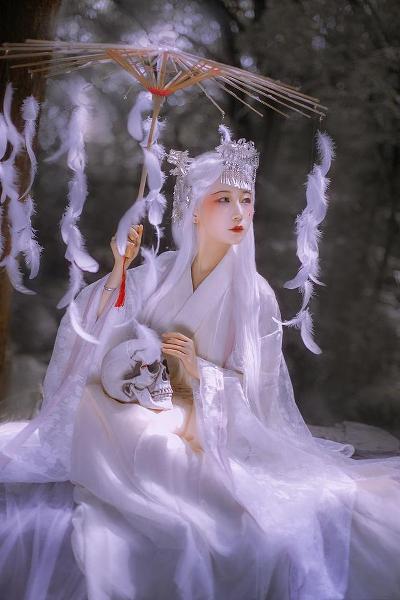
She subsequently disguises herself as the girl’s elderly mother searching the mountain for her daughter. Sun again sees through the disguise and seemingly kills her with his staff. This again leads to his punishment with the Tight-Fillet spell. The White Bone Spirit’s last disguise is that of the elderly father looking for his wife and daughter. But this time Monkey calls on local deities to guard any possible escape routes, and this time he succeeds in killing her. The spirit’s true form is revealed to be a “pile of flour-white skeletal bones” with the name “Lady White Bone” (Baigu furen, 白骨夫人) engraved on her spine (fig. 1) (Wu & Yu, 2012, pp. 26).

White Bone Spirit drawing - small

Fig. 1 – A lovely cosplay of Lady White Bone (larger version). More pictures can be seen here

I. Origin in oral literature

The precursor of the White Bone Spirit can be traced to a demon appearing in chapter six of The Story of How Tripitaka of the Great Tang Procures the Scriptures (Da Tang Sanzang qujing shihua, 大唐三藏取經詩話, c. late 13th-century), the earliest known printed edition of Journey to the West, which likely served as a prompt for ancient storytellers.

Chapter six: Passing Long Ditch and Great Serpent Peak (Guo changkeng dashe lingqu, 過長坑大蛇嶺處)

The pilgrims arrived at the valley of the fire-spitting White Tiger Spirit (Huo lei ao baohu jing, 火類坳白虎精). Coming closer they encountered a great ditch. The four steep entrances were pitch-black and they heard a roar of thunder. They could not advance. The Dharma Master [Fashi, 法師, i.e. Tripitaka] held up his [magic] golden-ringed staff and, flourishing it toward the distant heavenly palace, yelled: “Devaraja! Help us in our afflictions!” Suddenly a shaft of light shot out from the staff five tricents long. It slashed through the long ditch and soon they were able to get across.

Next they came to Great Serpent Peak. There they saw a gigantic serpent like a dragon. It likewise was not harmful to humans. Then they crossed the pit of the fire-spitters. Down, down into the fiery pit they looked and saw a pile of dry bones over forty tricents long. The Dharma Master asked Monkey Pilgrim [Hou xingzhe, 猴行者]: “What are those white withered bones piled up there like snow on a mountain?” Monkey Pilgrim replied: “This is the place where the Heir Apparent, Ming Huang…changed his bones.” [2] The Dharma Master, hearing this, joined his palms and bowed his head in reverence.

Next they suddenly came to a prairie fire which reached to the heavens. It sent off such a huge amount of smoke and sparks that the pilgrims could not proceed. The Dharma Master shone the light of his [magic] begging-bowl toward the fire and yelled: “Devaraja!” The fire died out immediately and the seven pilgrims crossed this pit. When they were halfway across, Monkey Pilgrim said: “Master, did you know this peak is inhabited by a white tiger spirit? It often appears as a vixen, demon, or goblin and even eats people.” The Master replied: “I didn’t know!” After a while they could see a spume of ominous-looking smoke rising behind the peak and from the cloud thus…fell a mixture of rain, snow, and sleet. In the cloudy mist there was a woman dressed all in white.

She wore a white bodice of gauze, a white gauze skirt with a white belt, and held in her hands a single white peony. [3] Her face was as pretty as a white lotus, her ten fingers like precious jades. Observing the form of the ogress, Monkey Pilgrim had his suspicions confirmed. “Master, don’t go any farther,” said Monkey Pilgrim. “It’s surely an ogress. Wait till I go up and ask who she is.” Monkey Pilgrim took one look at her and shouted in a loud voice: “What place are you from, demon? What shape is beneath your facade? If you are a sprite or goblin, why don’t you hurry back to your lair? If you are an ogress, hurriedly hid your traces. But, if you are the daughter of a human being, then tell me your name and surname. And be quick about it! If you procrastinate and don’t speak, I shall reduce you to dust and power!” Hearing the pilgrim’s ferocious tone of voice, the white-clad woman slowly advanced, smiled coyly, and inquired whither the master and his disciples were going. Monkey Pilgrim said: “Ask no more! We travel for the sake of the sentient beings of the Eastern Lands. And you must be none other than the White Tiger Spirit of the Fire-spitting Pit.”

Hearing this, the woman’s mouth gaped open and she screamed loudly, while at the same moment her skin burst open revealing claws, long fangs, a tail, and a feline head. She was fifteen feet long. In another instant the whole mountain was filled with white tigers. Monkey Pilgrim transformed his golden-ringed staff into a gigantic Yaksa whose head touched the sky and whose feet straddled the earth. In his hands he grasped a demon-subduing cudgel. His body was blue as indigo, his hair red as cinnabar; from his mouth a fiery gleam shot forth a hundred yards long. At the same time, the White Tiger Spirit advanced with a roar to do battle, but she was repulsed by the Monkey Pilgrim. After a short while, Monkey Pilgrim asked if the tiger spirit was ready to submit. She replied, “Never!” Monkey said: “If you will not submit, you will find an old monkey in your stomach!”

The tiger spirit heard what he said yet did not surrender right away. But no sooner had he yelled “Monkey!” than a monkey in the White Tiger Spirit’s stomach responded. The tiger spirit was forced to open her mouth and spit out the monkey. When it landed on the ground in front of her, it became twelve feet long with flashing eyes. The White Tiger Spirit spoke: “I still will not submit!” Monkey replied: “Then you will find another in your stomach!” Again, he caused the tiger spirit to open her mouth and spit out another monkey which landed in front of her. And again the tiger spirit said: “I still do not submit!” Monkey replied: “There are countless old monkeys in your stomach now, and even if you spit them out all day today until the next, all this month until the next, all this year until the next, all this life until the next, you will not be rid of them!” This made the tiger spirit angry. She was again afflicted by the Monkey when he transformed himself into a great stone in her stomach which gradually grew in size. Though she tried to spit it out, she couldn’t. Her stomach split asunder and blood poured from her seven orifices. [4] Monkey called upon the yaksa to slaughter the big White Tiger Spirit ruthlessly, and the yaksa pulverized its bones and obliterated its last vestiges.

The [Monkey Pilgrim], having withdrawn [his] magic, rested for a time before [the group] continued the journey. They left a poem:

The pit of fire-spitters and the White Tiger Spirit,
All that lot are vanquished, and peace and safety reign.
Now, the supernatural power of Monkey Pilgrim is displayed,
Protecting the monkish pilgrims across the great ditch (Wivell, 1994).

過長坑大蛇嶺處第六行次至火類坳白虎精。前去遇一大坑,四門陡黑,雷聲喊喊,進步不得。法師當把金鈽杖遙指天宮,大叫:「天王救難!」忽然杖上起五里毫光,射破長坑,須臾便過。

次人大虵嶺,目(德富氏本作「且」)見大蛇如龍,亦無傷人之性。

又過(巾箱本無「過」字)火類坳,坳下望,見坳上有一具枯骨,長四十馀裡。法師問猴行者曰:「山頭白色枯骨一具如雪?」猴行者曰:「此是明皇太子換骨之處。」法師聞語,合掌頂禮而行。

又忽遇一道野火連天,大生煙焰,行去不得。遂將缽盂一照,叫「天王」一聲,當下火滅,七人便過此坳。

欲經一半,猴行者曰:「我師曾知此嶺(巾箱本作「領」)有白虎精否?常作妖魅妖恠(怪),以至吃人。 「師曰:「不知。」良久,只見嶺後雲愁霧慘,雨細交霏;雲霧之中,有一白衣婦人,身掛白羅衣,腰繫白羅裙,手把白牡丹花一朵,面似白蓮,十指如玉。睹此妖姿,遂生疑悟。猴行者曰:「我師不用前去,定是妖精。待我向前向他姓字。」猴行者一見,高聲便喝:「汝是何方妖恠,甚處精靈?久為妖魅,何不速歸洞府? ,微微含笑,問:「師僧一行,往之何處?」猴行者曰:「不要問我行途,只為東土眾生。想汝是火類坳頭白虎精,必定是也!」

婦人聞語,張口大叫一聲,忽然面皮裂皺,露爪張牙,擺尾搖頭,身長丈五。定醒之中,滿山都是白老虎。被猴行者將金鈽杖變作一個夜叉,頭點天,腳踏地,手把降魔杵,身如藍靛青,發似朱沙,口吐百丈火光。當時,白虎精哮吼近前相敵,被猴行者戰退。半時,遂問虎精:「甘伏未伏!」虎精曰:「未伏!」猴行者曰:「汝若未伏,看你肚中有個老獼猴!」虎精聞說,當下未伏。一叫獼猴,獼猴在白虎精肚內應。遂教虎精開口,吐出一個獼猴,頓在面前,身長丈二,兩眼火光。白虎精又雲:「我未伏!」猴行者曰:「汝肚內更有一個!」再令開口,又吐出一個,頓在面前。白虎精又曰:「未伏!」猴行者曰:「你肚中無千無萬個老獼猴,今日吐至來日,今月吐至後月,今年吐至來年,今生吐至來生,也不盡。被猴行者化一團大石,在肚內漸漸會大。教虎精吐出,開口吐之不得;只見肚皮裂破,七孔流血。喝起夜叉,渾門大殺,虎精大小,粉骨塵碎,絕滅除蹤。

僧行收法,歇息一時,欲進前程,乃留詩曰:
火類坳頭白火精,渾群除滅永安寧。
此時行者神通顯,保全僧行過大坑 (source)

II. Development

The ancient chapter has a number of details that naturally led to the development of the White Bone Spirit:

  1. The demon is a White Tiger Spirit, hence the White Tiger Mountain mentioned in the novel.
  2. The “piles” of the future emperor’s bones recall the “piles” of the White Bone Spirit’s bones (her true form) after she is killed by Wukong.
  3. The White Tiger Spirit’s hunger for flesh and ability to take on any form (like “a vixen, demon, or goblin”) recalls the White Bone Spirit’s pursuit of Tripitaka and use of magic disguises.
  4. The White Tiger Spirit’s initial disguise as a beautiful woman with a “white lotus” face and jade-like fingers recalls the White Bone Demon’s “ice-white skin” and “jade-like bones.”

III. Popular Media

Here is the full length animated feature Sun Wukong Thrice Fights the White Bone Demon (Sun Wukong sanda Baigu jing, 孫悟空三打白骨精, 1985). It was produced twenty years after the highly popular Havoc in Heaven (Danao Tiangong, 大鬧天宮, 1965).


Update: 04-29-22

Shao (1997) writes: “Monkey kills the Cadaver demon three times as she manifests herself in three different forms in the symbolic sense of three cadavers which the Taoists hold accountable for voluptuary impulses” (p. 145). This makes the bone spirit an embodiment of the Three Corpses (Sanshi, 三尸).


Update: 01-31-23

I’ve used the word 髒 (zāng, “dirty”) for years now, but I never really paid attention to its components, 骨 (, “bone”) and 葬 (zàng, “bury”). It brings to mind taboos against being near or handling dead remains. This naturally reminds me of the White Bone Spirit.

Notes

1) This is related to an ancient Daoist concept called “Release by means of a corpse” (Shijie, 尸解). As far back as the Han, immortals are described as leaving a fake corpse (sometimes a magically disguised object) behind while they ascended in secret to heaven (Kirkland, 2008).

2) This changing of bones most likely refers to some type of realized spiritual cultivation that resulted in a new, pure body for the future emperor.

3) The color white is associated with death in Chinese culture.

4) Sun Wukong defeats several monsters in Journey to the West by invading their stomach. See, for example, chapters 59, 75, and 82.

Sources

Kirkland, R. (2008). Shijie In F. Pregadio (Ed.), The Encyclopedia of Taoism (Vol. 2) (pp. 896-897). London [u.a.: Routledge].

Shao, P. (1997). Monkey and Chinese Scriptural Tradition: A Rereading of the Novel Xiyouji (UMI No. 9818173) [Doctoral dissertation, Washington University]. Available from ProQuest Dissertations and Theses database.

Wivell, C.S. (1994). The Story of how the monk Tripitaka of the Great Country of T’ang brought back the Sūtras. In Mair, Victor H. The Columbia Anthology of Traditional Chinese Literature (pp 1181-1207). New York: Columbia University Press.

Wu, C., & Yu, A. C. (2012). The Journey to the West (Vol. 2) (Rev. ed.). Chicago, Ill: University of Chicago Press.

The Monk Tripitaka and the Golden Cicada

Last updated: 08-03-2025

The historical Buddhist monk Xuanzang (玄奘, 602-664) is famous for having traveled to India between 629 and 645 in order to supplement the Chinese Buddhist canon with fresh scriptures (see here). As his legend grew, an embellished story cycle began referring to him as Tang Sanzang (唐三藏; lit: “Tripitaka (“Three Baskets,” i.e. the Buddhist canon) of the Tang Dynasty“), and as early as the 11th-century, he acquired a divine monkey disciple who would later become Sun Wukong (孫悟空). The cleric eventually gained his own supernatural background, for evidence shows that he was worshiped as an Arhat (Luohan, 羅漢; Zunzhe, 尊者), a Buddhist saint, by the Song Dynasty (960-1127 CE) (Liu, 2019). A Yuan-Ming zaju stage production plays on this concept by depicting Tripitaka as the reincarnation of the Arhat Vairocana (Pulujia zunzhe, 毗廬伽尊者) (Dudbridge, 1970, p. 193). [1] This saintly status was further embellished in Journey to the West (Xiyouji, 西遊記, 1592), the culmination of his story cycle, where the character is cast as the earthly reincarnation of Master Golden Cicada (Jinchan zi, 金蟬子), the Buddha’s fictional second disciple.

In this article, I would like to discuss the Golden Cicada, including the story details explaining his background and the origin of his title. I ultimately suggest that the term was chosen because the celestial’s banishment to Earth and eventual return to paradise recalls the metamorphic lifecycle of the real life insect.

I. Internal story details

The Tang Monk’s background is first hinted at in chapter eight when Guanyin sets out to find the scripture pilgrim. The narrative proclaims:

[A] Buddha son return[s] to keep his primal vow.
The Gold Cicada Elder will clasp the candana (Wu & Yu, 2012, vol. I, p. 207).

佛子還來歸本願,金蟬長老裹栴檀。

Chapter twelve contains a poem introducing Tripitaka as the chosen pilgrim and reveals his heavenly origin. The first part reads:

Gold Cicada was his former divine name.
As heedless he was of the Buddha’s talk,
He had to suffer in this world of dust,
To fall in the net by being born a man
[…] (Wu & Yu, 2012, vol. 1, p. 275).

靈通本諱號金蟬,只為無心聽佛講。 轉托塵凡苦受磨,降生世俗遭羅網。 […]

Details about the extent of the former celestial’s punishment is revealed throughout the book. For instance, in chapter 33, a demon explains the source of the heavenly aura [2] around Tripitaka:

That Tang Monk is actually the incarnation of the Elder Gold Cicada, a virtuous man who has practiced austerities for ten existences (Wu & Yu, 2012, vol. 2, p. 105).

那唐僧原是金蟬長老臨凡,十世修行的好人

Furthermore, in chapter 100 the Buddha tells his former disciple:

Because you failed to listen to my exposition of the law and slighted my great teaching, your true spirit was banished to find another incarnation in the Land of the East. Happily you submitted and, by remaining faithful to our teaching [Buddhism], succeeded in acquiring the true scriptures (Wu & Yu, 2012, vol. 4, p. 381).

因為汝不聽說法,輕慢我之大教,故貶汝之真靈,轉生東土。今喜皈依,秉我迦持,又乘吾教,取去真經

So, we learn that the Golden Cicada was banished to live out ten pious lives in China until the time came for him to build merit as the scripture pilgrim, thereby gaining reentry into paradise.

II. Origin of the title

Yu (2008) alludes to chapter 99 explaining the source of the name Golden Cicada (p. 110). I can’t find such an overt explanation, but the chapter does mention the monk miraculously surviving drowning after being dumped by a disgruntled river turtle [3] into a heavenly river, along with his disciples and the hard-won scriptures. The novel exclaims:

Ah! It was fortunate that the Tang Monk had cast off his mortal frame and attained the way. If he were like the person he had been before, he would have sunk straight to the bottom (Wu & Yu, 2012, vol. 4, p. 363).

咦!還喜得唐僧脫了胎,成了道;若似前番,已經沉底。

The “cast[ing] off of his body” (tuotai, 脫胎) is reminiscent of the way in which the real life insect sloughs off its shell (fig. 1). If this is what Yu was referring to, I think this is but one part of the puzzle.

Fig. 1 – A newly formed cicada clinging to its shell (larger version).

I suggest that the author-compiler of Journey to the West chose the cicada imagery for the symbolic nature of its life cycle. Munsterberg (1972) describes the insect’s role in ancient Chinese religion:

Cicadas carved in jade are frequently found in graves of the Han period [fig. 2]. Since the cicada hatches above ground, spends a long period underground, and finally emerges as if in rebirth, these burial tokens were probably intended to induce resurrection by sympathetic magic (p. 32).

The Golden Cicada’s life follows this cycle very closely: the celestial being resides above in the Western Paradise, is banished below for an extended period of time, and is only allowed back into the celestial realm after a metamorphosis.

Fig. 2 – A stylized Han-era jade cicada (larger version). Photo by the Asian Art Museum.

The lifesaving transformation previously referred to by Guanyin takes place in chapter 98 when Tripitaka and his disciples are ferried across a heavenly river in a bottomless boat on their way to the Western Paradise:

All at once they saw a corpse floating [fig. 3] down upstream, the sight of which filled the elder [Tripitaka] with terror.

“Don’t be afraid, Master,” said Pilgrim [Sun Wukong], laughing. “It’s actually you!”

“It’s you! It’s you!” said Eight Rules [Zhu Bajie] also.

Clapping his hands, Sha Monk also said, “It’s you! It’s you!”

Adding his voice to the chorus, the boatman also said, “That’s you! Congratulations! Congratulations!” Then the three disciples repeated this chanting in unison as the boat was punted across the water. In no time at all, they crossed the Divine Cloud-Transcending Ferry all safe and sound. Only then did Tripitaka turn and skip lightly onto the shore. We have here a testimonial poem, which says:

Delivered from their mortal flesh and bone,
A primal spirit of mutual love has grown.
Their work done, they become Buddhas this day,
Free of their former six-six senses sway (Wu & Yu, 2012, vol. 4, pp. 345-346). [4]

只見上溜頭泱下一個死屍。長老見了大驚。行者笑道:「師父莫怕。那個原來是你。」八戒也道:「是你,是你。」沙僧拍著手,也道:「是你,是你!」那撐船的打著號子,也說:「那是你,可賀,可賀。」他們三人也一齊聲相和。撐著船,不一時,穩穩當當的過了凌雲仙渡。三藏才轉身,輕輕的跳上彼岸。有詩為證。詩曰:

脫卻胎胞骨肉身,相親相愛是元神。
今朝行滿方成佛,洗淨當年六六塵。

Here, we see Tripitaka has shed his mortal form to become a Buddha just like the cicada sheds its shell to grow wings and fly. The monk has freed himself from the endless cycle of birth and death to achieve nirvana.

Fig. 3 – Detail of a woodblock print showing the shedding of Tripitaka’s mortal body (larger version). From Mr. Li Zhuowu’s Literary Criticism of Journey to the West (late-16th to early-17th century).


Update: 05-27-2018

The Thirty-Six Stratagems (Sanshiliu ji, 三十六計, c. 5th-6th-cent.), a collection of military, political, and civil tactics, contains a plan known as “The Golden Cicada Sheds its Shell” (Jinchan tuoke, 金蟬脫殼), which entails leaving a decoy that distracts the enemy while the losing force is retreating. I’m not sure if this directly influenced the celestial’s title, but it at least shows that the name was known long before Journey to the West was published.

The strategy is actually used by a tiger demon in chapter 20:

Whipping out the iron rod, Pilgrim [Sun Wukong] shouted, “Catch him!” Eight Rules [Zhu Bajie] at once attacked with even greater ferocity, and the monster fled in defeat. “Don’t spare him,” yelled Pilgrim. “We must catch him!” Wielding rod and rake, the two of them gave chase down the mountain. In panic, the monster resorted to the trick of the gold cicada casting its shell (emphasis added): he rolled on the ground and changed back into the form of a tiger. Pilgrim and Eight Rules would not let up. Closing in on the tiger, they intended to dispose of him once and for all. When the monster saw them approaching, he again stripped himself of his own hide and threw the skin over a large piece of rock, while his true form changed into a violent gust of wind heading back the way he had come. (Wu & Yu, 2012, vol. 1, p. 401).

那行者掣了鐵棒,喝聲叫:「拿了!」此時八戒抖擻精神,那怪敗下陣去。行者道:「莫饒他,務要趕上。」他兩個掄起鈀,舉鐵棒,趕下山來。那怪慌了手腳,使個金蟬脫殼計,打個滾,現了原身,依然是一隻猛虎。行者與八戒那裡肯捨,趕著那虎,定要除根。那怪見他趕得至近,卻又摳著胸膛,剝下皮來,苫蓋在那臥虎石上,脫真身,化一陣狂風,徑回路口。


Update: 12-08-2018

I would like to further suggest that the name Master Golden Cicada (Jinchan zi, 金蟬子) might have been chosen to serve as a pun for “child or student of Chan” (Chanzi, 禪子) (fig. 4). While the historical Xuanzang was the patriarch of the Yogacara school of Chinese Buddhism (Robert & David, 2013, pp. 1015-1016), the novel closely associates him with Chan:

The depiction of the novelistic Xuanzang surely and constantly associates him and his entourage with Chan. Revealing examples can readily be found in both narrative content and such titular couplets as “Tripitaka does not forget his origin; / The Four Sages test the Chan Mind” (chapter 2[3]); “The Child’s tricky transformations confuse the Chan Mind; / Ape, Horse, Spatula, and Wood Mother-all are lost” (chapter 40); “The Chan Lord, taking food, has demonic conception; / Yellow Dame brings water to dissolve perverse pregnancy” (chapter 53); “Rescuing Tuoluo, Chan Nature is secure; / Escaping defilement, the Mind of Dao is pure” (chapter 67); “Mind Monkey envies Wood Mother; / The demon lord plots to devour Chan” (chapter 85); and “Chan, reaching Jade-Flower, convenes an assembly; / Mind Monkey, Wood, and Earth take in disciples” (chapter 88) (Wu & Yu, 2012, vol. 1, pp. 64-65).

If true, this would mean that the cicada-like spiritual transformation is based around a pun.

Fig. 4 – The similarities in form and pronunciation of chanzi (larger version). 

This seems like such an obvious connection that I wouldn’t be surprised if someone else beat me to the conclusion by decades or even centuries.


Update: 08-29-20

Art historian Jin Xu posted a picture of a 6th-century stone bodhisattva statue on twitter, and I was interested to see a cicada adorning the headdress (fig. 5 & 6). One essay about the statue suggests it was commissioned by an aristocratic layman since cicadas are known to have decorated the caps of high-ranking officials:

Another noteworthy characteristic of this superb sculpture is the cicada-shaped decoration on the front of the crown. To date, there are no other known Chinese Buddhist sculptural examples of this kind. However, cicada images can be found on gold mountain-shaped crown plaques that also are embellished with thin gold wire and granulation; these have been excavated from the tomb of Ping Sufu of the Northern Yan period (A.D. 409-436), and seated Buddha images were molded onto the back face of these crown ornaments. These excavated materials would have been made some one hundred years before the present image and suggest that there were members of the aristocracy who revered Buddhism and hid Buddha images on the backs of their crowns. This suggests the possibility that the Shumei bodhisattva, with a cicada in place of a Buddha image, was created at the request of a member of the aristocracy who revered Buddhism and believed in the philosophy that the Emperor is the living Buddha, which may have dated back to the Northern court (Standing Bodhisattva, n.d.).

The sculpture didn’t influence Tripitaka’s title as the Golden Cicada Elder. But it’s still fascinating to see a real world connection between the insect and a bodhisattva.

Fig. 5 – The Sixth-century Bodhisattva statue with a cicada decorating the crown (larger version). From Qingzhou Museum in Shandong province, China. Fig. 6 – A detail of the insect (larger version).


Update: 09-13-20

Deviantart user Taylor-Denna has drawn a beautiful depiction of Tripitaka’s former incarnation as a literal cicada (fig. 6). It is quite unique as I’ve never seen any other artist portray the former celestial in such a way. The image makes one think of an insect who acquired magic powers through spiritual cultivation and rose through the Buddho-Daoist hierarchy to become the Buddha’s disciple. The idea would make a good prequel story.

Fig. 6 – Detail of Master Golden Cicada by Taylor-Denna (larger version). Click here for the full version and the artist’s statement. Used with permission.


Update: 12-01-21

I’ve archived a book that shows how Tripitaka’s exile from heaven is similar to ancient Greek and Egyptian beliefs.

Archive #28 – Tripitaka’s Reincarnation and its Connection to Ancient Greek and Egyptian Philosophy


Update: 04-03-22

I’ve posted an entry discussing Tripitaka’s characterization in JTTW as a Confucian.

Archive #35 – The Tang Monk Tripitaka as a Confucian in Journey to the West


Update: 12-12-22

I recently added a modern jade burial token to my collection of religious items (fig. 7-9). It is very heavy for its size and cold to the touch.

Fig. 7 – Top (larger version). Fig. 8 – Front (larger version). Fig. 9 – Bottom (larger version). 


Update: 01-14-23

In chapter 81, Monkey alludes to his master’s past life, adding to the reason why the celestial had been exiled to Earth:

“You don’t realize that Master was the second disciple of our Buddha Tathagata, and originally he was called Elder Gold Cicada. Because he slighted the Law, he was fated to experience this great ordeal.”

“Elder Brother,” said Eight Rules, […] “Why must he endure sickness [for two days] as well?”

“You wouldn’t know about this,” replied Pilgrim. “Our old master fell asleep while listening to Buddha expounding the Law. As he slumped to one side, his left foot kicked down one grain of rice. That is why he is fated to suffer three days’ illness after he has arrived at the Region Below.”

Horrified, Eight Rules said, “The way old Hog sprays and splatters things all over when he eats, I wonder how many years of illness I’d have to go through!”

“Brother,” said Pilgrim, “you have no idea either that the Buddha is not that concerned with you and other creatures. But as people say:

Rice stalks planted in noonday sun
Take root as perspiration runs.
Who knows of this food from the soil
Each grain requires most bitter toil?

Master still has one more day to go, but he’ll be better by tomorrow” (Wu & Yu, 2012, vol. 4, p. 82).

This points to the supreme importance of rice in an agrarian society like ancient China.

Artist Countingclowns (a.k.a. Countinglegoclowns) on Tumblr has drawn a lovely Lego Monkie Kid-inspired image depicting the Golden Cicada, Tripitaka, and Mr. Tang, the monk’s reincarnation (fig. 10).

Fig. 10 – “Break the Cycle” by Countingclowns (larger version). The original can be seen here.


Update: 06-03-23

Tripitaka’s past celestial life and punishment appear to be based on information from Xuanzang’s historical life story, A Biography of the Tripitaka Master of the Great Ci’en Monastery of the Great Tang Dynasty (Datang Da Ci’ensi Sanzang Fashi zhuan, 大唐大慈恩寺三藏法師傳, 7th-century). After his death, a spirit extolls the monk’s virtues, as well as reveals the karmic result of his afterlife:

The Venerable Xuanzang alone cultivated the deeds of both blessedness and wisdom in nine lives. In every incarnation he was always learned and erudite, intelligent and eloquent, always the first and foremost in the land of Cīna in Jambudvīpa. Such were his blessed virtues also. […] Owing to the power of his good deeds, he has now been reborn in the inner court of Maitreya in the Tuṣita Heaven, where he will hear the Dharma with comprehension and understanding, and he will never again be born in the human world (Huili & Shi, 1995, p. 336).

且如奘師一人,九生已來備修福慧,生生之中多聞博洽,聰慧辯才,於贍部洲支那國常為第一,福德亦然 […] 由善業力,今見生睹史多天慈氏內眾,聞法悟解,更不來人間受生。

Like Tripitaka, Xuanzang has nine prior pious past lives, and like Master Golden Cicada, he comes to live in a paradise where he can listen to a Buddha lecture on the Dharma. The novel simply changes some of the details, like Xuanzang’s final rebirth in paradise being a previous life, and instead of Maitreya, he studies under the historical Buddha.


Update: 06-04-23

Brose (2021) mentions a small temple in Taipei, Taiwan where one of Xuanzang’s avatars, the bodhisattva Nine Lotuses (Jiulian pusa, 九蓮菩薩) is worshiped. [5] What’s important for this article is that the deity’s mythos, as recounted by a temple master, alludes to the Golden Cicada’s story:

[Xuanzang], she explained, originally lived in a heavenly Buddha realm, but because his cultivation was incomplete, he was sent down to earth to perform the meritorious task of bringing Buddhist sūtras from India to China. Once his work was complete, Xuanzang was able to return to the Buddha realm, but out of compassion for the world, he left a portion of his spirit behind in the form of Nine Lotuses (Brose, 2021, pp. ix-x).


Update: 04-09-24

In chapter 27, the white bone spirit also comments on the monk’s past life and the effects of eating his flesh:

“What luck! What luck!” she said, unable to contain her delight. “For several years my relatives have been talking about a Tang Monk from the Land of the East going to fetch the Great Vehicle. He is actually the incarnation of the Gold Cicada, and he has the original body that has gone through the process of self-cultivation during ten previous existences. If a man eats a piece of his flesh, his age will be immeasurably lengthened. So, this monk has at last arrived today!” (Wu & Yu, 2012, vol. 2, 17). 

造化,造化。幾年家人都講東土的唐和尚取大乘,他本是金蟬子化身,十世修行的原體,有人吃他一塊肉,長壽長生。真個今日到了。


Update: 10-06-24

Recall that the 01-14-23 update quotes the fullest description of events leading to Master Golden Cicada’s banishment from paradise: he falls asleep during a sermon and accidentally kicks something, causing a single grain of rice to fall to the ground. Well, I’m reading a biography of the Buddha and learned that his family has a connection to rice:

Sakyamuni’s father was called Suddhodana. The name means “pure rice” or “white rice.” In Chinese it is translated as Ching-fan-wang [[Jingfan wang, 淨飯王;] king of pure rice]. Legend says that the names of his four younger brothers all contained the element meaning “rice” (odana). These names suggest that the Sakyas were already cultivating rice and that they particularly valued white rice (Nakamura, 2000, vol. 1, p. 46).

This might explain the Buddha’s reaction.


Update: 01-25-25

To recap, Journey to the West casts the Tang Monk Tripitaka as the last incarnation of Master Golden Cicada (Jinchan zi, 金蟬子), the second disciple of the Buddha who is exiled from paradise for falling asleep during his master’s sermon. Chapter 81 adds a second crime: kicking something in his slumber and making a single grain of rice fall to the ground.

This leads me to the point of this post. A reader contacted me the other day asking if Sariputra (Sk: शारिपुत्र; Pali: Sariputta; Ch. Shelifu, 舍利弗), one of the Buddha’s ten primary disciples, was the basis for Master Golden Cicada since he was known for having a golden glow about him. A cursory search didn’t turn up anything connecting them, but thanks to the reader’s prompt, I kept digging and was interested to learn that another disciple of Tathagata, Aniruddha (Sk: अनुरुद्ध; Pali: Anuruddha; Ch: Analu, 阿那律) (fig. 11), was known to have fallen asleep during the Enlightened One’s lessons.

According to monk Jiaoguang’s (交光, fl. 1600) Dafo Dingshou Lengyan Jing Zhengmai Shuxu (大佛頂首楞嚴經正脉疏序, T. 275): 

Analu [Aniruddha] then stood up, bowed at the Buddha’s feet, and said to him respectfully …

[Commentary:] Changshui [6] says: Nalu, namely Anouloutuo, which means “free of poverty,” was a Rice Prince. He gave a meal to a Solitary Buddha in a past life and enjoyed happiness for 91 kalpas.

… “When I first entered the monastic life, I was too fond of sleep. The Thus-Come One admonished me, saying that I was no better than an animal. After the Buddha scolded me, I rebuked myself and wept. For seven days I did not sleep, and as a result I went blind in both eyes.”

[Commentary:] Gushan [7] says: According to the Ekottara Agama, the Buddha was preaching the Law in Jetavana when Nalu fell asleep. The Buddha spoke in verse: “Tut-tut … Why are you sleeping? River snails, mussels, clams and the like sleep for a thousand years, never hearing the names of Buddhas.” Thereupon, Nalu made it known that he would never sleep again, and he soon lost his sight. [8]

阿那律陀即從座起,頂禮佛足而白佛言:

長水曰:那律即阿㝹樓䭾,此云無貧,亦云如意,乃白飯王子也。過去世以一食施辟支,感九十一劫受如意樂。

我初出家,常樂睡眠,如來訶我為畜生類。我聞佛訶,啼泣自責,七日不眠,失其雙目。

孤山曰:增一阿含云:佛在給孤園為眾說法,那律於中眼睡,佛說偈訶云:咄咄何為睡?螺螄蚌蛤類,一睡一千年,不聞佛名字。那律於是達曉不眠,眼根便失。 (source)

The term “Rice Prince” (Bifan wangzi, 白飯王子) refers to the fact that Aniruddha was the cousin of the Buddha and a fellow grandson of King Sihahanu, whose sons, including the Buddha’s father (as mentioned above), all had the suffix odana (“rice”) as part of their names. Aniruddha’s father was Amitodana (“Unmeasured Rice”) (Nakamura, 2000, vol. 1, p. 46; Harvey, 2013, p. 117; Thomas, 1931/2013, p. 24).

Therefore, we have a Buddhist disciple who dozes off during the Buddha’s sermon and has an association with rice. This makes Aniruddha the best possible influence for Master Golden Cicada that I’ve seen. The story goes back to at least the 4th-century Zengyi ahan jingxu (增壹阿含經序, T. 125), so it would have been around long enough to eventually influence Journey to the West.

I need to point out, however, that I’m not the first person to write about this. While I was finishing typing this update, I came across this article, which mentions Aniruddha in passing. But to my credit, I actually cited the historical Buddhist literature involved.

Fig. 11 – A colored relief of the Buddha helping his blind disciple sew a new robe (larger version). Image found here.


Update: 02-13-25

I just thought of a way to work Aniruddha into JTTW lore: In chapter eight of the Lotus Sutra (Miaofa lianhua jing妙法蓮華經; a.k.a. Fahua jing, 法華經, c. 3rd-century), the Buddha mentions our tired friend among a list of 500 Arhats who will attain perfect enlightenment and share the same holy title:

Five hundred arhats, including Uruvilvakashyapa, Gayakashyapa, Nadikashyapa, Kalodayin, Udayin, Aniruddha, Revata, Kapphina, Bakkula, Chunda, Svagata, and others, will all attain anuttara-samyak-sambodhi. All will have the same designation, being called Universal Brightness (Watson, 1993, p. 149).

優樓頻螺迦葉伽耶迦葉那提迦葉迦留陀夷優陀阿㝹樓馱離婆多劫賓那薄拘羅周陀莎伽陀等皆當得阿耨多羅三藐三菩提同一號名曰普明

In our headcanon, Master Golden Cicada could be the celestial title of the Arhat Aniruddha, but his sleeping episode instead takes place in heaven. In addition, “Universal Brightness” (Puming, 普明) could just be a classification of Buddha, thus allowing for his Tripitaka avatar to receive the individualized title “Buddha of Candana Merit” (Zhantan gongde fo旃檀功德佛) at the end of his quest.


Update: 02-19-25

Something just dawned on: Although I’ve always considered Master Golden Cicada to be a bodhisattva, the novel never specifically calls him that. So what is his actual spiritual rank then? Several pieces of Information point to him being an Arhat. 

First, recall that the introduction to this article reads:

The cleric [Xuanzang] eventually gained his own supernatural background, for evidence shows that he was worshiped as an Arhat (Luohan, 羅漢; Zunzhe, 尊者), a Buddhist saint, by the Song Dynasty (960-1127 CE) (Liu, 2019). A Yuan-Ming zaju stage production plays on this concept by depicting Tripitaka as the reincarnation of the Arhat Vairocana (Pulujia zunzhe, 毗廬伽尊者) (Dudbridge, 1970, p. 193).

This shows that the Tang Monk was already closely associated with Arhats in the past. Second, something I learned but forgot to mention here is that Tripitaka Seeks the Scriptures (Sanzang qujing, 三藏取經), a rare Yuan-Ming puppet play that predates the 1592 JTTW, even refers to the cleric’s past life as the “Golden Chan Arhat” (Jinchan luohan, 金禪羅漢). (This implies that chan (蟬, “cicada”) was based on the Chan (禪) of Chan Buddhism, thereby supporting my suggestion from the 12-08-18 update.) Third, as mentioned above, Golden Cicada was likely based on the Arhat Aniruddha, one of the Buddha’s ten principle disciples, who was reprimanded by his master for dozing off during a lesson. And fourth, the Arhats Ananda (A’nuo, 阿儺) and Kasyapa (Jiaye, 伽葉), two other principle Buddha disciples, also appear among the Enlightened One’s heavenly retinue in JTTW (chapters 7, 8, 77, 98, 99, &  100). Therefore, taken together, this info is a strong indication that the novel’s author-compiler intended Golden Cicada to be an Arhat.

Because of this, I’ve updated the article by removing any previous references to him as a bodhisattva.


Update: 02-21-25

I posted a summary of my last update to Twitter, and a follower commented that Golden Cicada wouldn’t have been able to reincarnate like bodhisattvas if he was really an Arhat. This is based on Buddhist belief. For instance, Buswell and Lopez (2014) briefly explain: [T]he arhat is one who has attained nirvāṇa in this life, and at death attains final liberation ([parinirvāṇa]) and will never again be subject to rebirth” (p. 62). But I reminded them that JTTW is not an accurate snapshot of mainstream beliefs by pointing to two instances from past media (mentioned above) where Tripitaka is the reincarnation of an Arhat. Here, I translate the pertinent sections.

I. The Yuan-Ming JTTW zaju play

Guanyin reveals the monk’s divine origins in act one:

At present, the Western Land of India has the “Golden Scriptures of the Great Repository” in 5,480 volumes. We desire to transmit them to the Eastern Lands (i.e. China), but how can we help propagate them if we don’t have the illusory, corporal body of a genuine person? Currently, the various Buddhas are discussing what to do, and they have decided that the Arhat Vairocana of the Western Heaven will be reborn (tuohua, 托化) as a son to Chen Guangrui’s family in Hongnong County, Haizhou, China. When he grows up, he will leave the family to become a monk and travel to the Western Heaven to retrieve scriptures. He will (later) spread the teachings.

見今西天竺有《大藏金經》五千四十八卷,欲傳東土,爭奈無個肉身幻軀的真人闡揚。如今諸佛議論,著西天毗廬伽尊者托化於中國海州弘農縣陳光蕊家為子,長大出家為僧,往西天取經闡教。

You can see here that there are no negative reasons for his reincarnation. This differs from the next source.

II. The Yuan-Ming JTTW puppet play

Tripitaka describes being born (chushi, 出世) to father Chen Guangrui and a beautiful, nameless mother in scene one (see page 1 of this PDF). His celestial origin is later revealed by “Equaling Heaven” (Qitian, 齊天; i.e. Monkey) in scene six:

The Golden Chan Arhat descended to earth (jiangshi, 降世) because he privately went to the lantern fruit festival without reporting this to the temple sangha, causing the Buddha to punish him to 36 tribulations, including journeying to the Western Heaven to acquire scriptures. After suffering over countless days, he finally returned to the right fruit (i.e. achieved enlightenment).

… 金禪羅漢降世,因私赴燈果會,不報寺中眾僧,佛罰伊過三十六劫,往西天取經。苦難滿日,修歸正果。(see page 9 of this PDF)

Having read the above, I think Master Golden Cicada’s Arhatship is now fully established as fact within the JTTW story cycle. 


Update: 08-03-25

The notion that Arhats fall asleep is exemplified by the “Dreaming/Sleeping Arhat Fist” (Shuimeng luohan quan, 睡梦罗汉拳) from the 1992 HK film King of Beggars (Wu zhuangyuan Su qi’er, 武状元苏乞儿; lit: “Top Martial Scholar: Beggar Su”; video 1).

Video #1 – The scene where Beggar Su displays his new-found boxing abilities.

Notes:

1) This is interesting since Vairocana is the name of a major Buddha

2) This heavenly aura is also mentioned by Sun Wukong later in chapter 80 (Wu & Yu, 2012, vol. 4, p. 66).

3) The turtle had previously helped the pilgrims cross the same river in chapter 34, and in return they agreed to ask the Buddha when the terrapin would be allowed to achieve human form (for all creatures strive for such an attainment). But Tripitaka forgot to ask the Enlightenment One while visiting the Western paradise, so the turtle dumped them into the river upon their return.

4) The six-six senses (liuliu chen, 六六塵) are “the intensified form of the six gunas, the six impure qualities engendered by the objects and organs of sense: sight, sound, smell, taste, touch and idea” (Wu & Yu, 2012, vol. 4, p. 405 n. 7).

5) Brose (2021), however, explains that this goddess “is usually identified as the divinized form of a Ming Dynasty empress dowager” (p. ix).

6) The monk Changshui (長水), a.k.a. Zixuan (子璿; 965-1038), was the compiler of the Shou lengyan yanyi shu zhu jing (首楞嚴義疏注經, T. 1799) (Sorenson, 2011, p. 39).

7) Gushan (孤山), a.k.a. Zhiyuan (智圓; 976-1022), wrote a commentary for the Shou lengyan jing shu (首楞嚴經疏) (McBride, 2016, pp. 144-145 n. 238).

8) The translation of the commentary is mine, while the rest comes from Buddhist Text Translation Society & Hsuan (2012, p. 210). 

Sources:

Brose, B. (2021). Xuanzang: China’s Legendary Pilgrim and Translator. Boulder, Colorado: Shambhala Publications, Inc.

Buddhist Text Translation Society & Hsuan, H. (2012). The Surangama Sutra: A New Translation with Excerpts from the Commentary by the Venerable Master Hsuan Hua. (n.p.): Buddhist Text Translation Society.

Buswell, R. E. , & Lopez, D. S. (2014). The Princeton Dictionary of Buddhism. Princeton University Press.

Harvey, P. (2013). Buddha, Family Of. In C. S. Prebish & D. Keown (Eds.), Encyclopedia of Buddhism (pp. 117-121). United Kingdom: Taylor & Francis.

Huili, & Shi, Y. (1995). A Biography of the Tripitaka Master of the Great Ci’en Monastery of the Great Tang Dynasty (L. Rongxi Trans.). Berkeley, CA: Numata Center for Buddhist Translation and Research.

Liu, S. (2019). Songdai Xuanzang de shenghua: Tuxiang, wenwu he yiji [The Sanctification of Xuanzang in the Song Dynasty: Images, Artifacts and Remains]. Zhonghua wenshi luncong, 133, 161-219.

McBride, R. D. (2016). Doctrine and Practice in Medieval Korean Buddhism: The Collected Works of Ŭich’ŏn. Germany: University of Hawaii Press.

Munsterberg, H. (1972). The Arts of China. Rutland, Vt: C.E. Tuttle Co.

Nakamura, H. (2000). Gotama Buddha: A Biography Based on the Most Reliable Texts (G. Sekimori, Trans.) (Vols. 1-2). Tokyo: Kosei Publishing Co.

Sorenson, H. H. (2011). Textual Material Relating to Esoteric Buddhism in China Outside the Taisho, vol. 18-21. In C. D. Orzech, H. H. Sorensen, & R. K. Payne (Eds.), Esoteric Buddhism and the Tantras in East Asia (pp. 37-70). Netherlands: Brill.

Standing Bodhisattva. (n.d.). Retrieved from http://www.miho.or.jp/booth/html/artcon/00001542e.htm

Thomas, E. J. (2013). The Life of Buddha. United Kingdom: Taylor & Francis. (Original work published 1931)

Watson, B. (Trans.) (1993). The Lotus Sutra. New York: Columbia University Press.

Wu, C., & Yu, A. C. (2012). The Journey to the West (Vols. 1-4) (Rev. ed.). Chicago, Illinois: University of Chicago Press.

Yu, A. C. (2008). Comparative Journeys: Essays on Literature and Religion East and West. NY: Columbia University Press.