The Monk Tripitaka and the Golden Cicada

Last updated: 08-03-2025

The historical Buddhist monk Xuanzang (玄奘, 602-664) is famous for having traveled to India between 629 and 645 in order to supplement the Chinese Buddhist canon with fresh scriptures (see here). As his legend grew, an embellished story cycle began referring to him as Tang Sanzang (唐三藏; lit: “Tripitaka (“Three Baskets”) of the Tang Dynasty Clan”), and as early as the 11th century, he acquired a divine monkey disciple who would later become Sun Wukong (孫悟空). The cleric eventually gained his own supernatural background, for evidence shows that he was worshiped as an Arhat (Luohan, 羅漢; Zunzhe, 尊者), a Buddhist saint, by the Song Dynasty (960–1127 CE) (Liu, 2019). A Yuan-Ming zaju stage production plays on this concept by depicting Tripitaka as the reincarnation of the Arhat Vairocana (Pulujia zunzhe, 毗廬伽尊者) (Dudbridge, 1970, p. 193). [1] This saintly status was further embellished in Journey to the West (Xiyouji, 西遊記, 1592), the culmination of his story cycle, where the character is cast as the earthly reincarnation of Master Golden Cicada (Jinchan zi, 金蟬子), the Buddha’s fictional second disciple.

In this article, I would like to discuss the Golden Cicada, including the story details explaining his background and the origin of his title. I ultimately suggest that the term was chosen because the celestial’s banishment to Earth and eventual return to paradise recalls the metamorphic lifecycle of the real life insect.

Table of Contents

1. Internal Story Details

The Tang Monk’s background is first hinted at in chapter eight when Guanyin sets out to find the scripture pilgrim. The narrative proclaims:

[A] Buddha son return[s] to keep his primal vow.
The Gold Cicada Elder will clasp the candana (Wu & Yu, 2012, vol. I, p. 207).

佛子還來歸本願,金蟬長老裹栴檀。

Chapter twelve contains a poem introducing Tripitaka as the chosen pilgrim and reveals his heavenly origin. The first part reads:

Gold Cicada was his former divine name.
As heedless he was of the Buddha’s talk,
He had to suffer in this world of dust,
To fall in the net by being born a man
[…] (Wu & Yu, 2012, vol. 1, p. 275).

靈通本諱號金蟬,只為無心聽佛講。 轉托塵凡苦受磨,降生世俗遭羅網。 […]

Details about the extent of the former celestial’s punishment is revealed throughout the book. For instance, in chapter 33, a demon explains the source of the heavenly aura [2] around Tripitaka:

That Tang Monk is actually the incarnation of the Elder Gold Cicada, a virtuous man who has practiced austerities for ten existences (Wu & Yu, 2012, vol. 2, p. 105).

那唐僧原是金蟬長老臨凡,十世修行的好人

Furthermore, in chapter 100 the Buddha tells his former disciple:

Because you failed to listen to my exposition of the law and slighted my great teaching, your true spirit was banished to find another incarnation in the Land of the East. Happily you submitted and, by remaining faithful to our teaching [Buddhism], succeeded in acquiring the true scriptures (Wu & Yu, 2012, vol. 4, p. 381).

因為汝不聽說法,輕慢我之大教,故貶汝之真靈,轉生東土。今喜皈依,秉我迦持,又乘吾教,取去真經

So, we learn that the Golden Cicada was banished to live out ten pious lives in China until the time came for him to build merit as the scripture pilgrim, thereby gaining reentry into paradise.

2. Title Origin

Yu (2008) alludes to chapter 99 explaining the source of the name Golden Cicada (p. 110). I can’t find such an overt explanation, but the chapter does mention the monk miraculously surviving drowning after being dumped by a disgruntled river turtle [3] into a heavenly river, along with his disciples and the hard-won scriptures. The novel exclaims:

Ah! It was fortunate that the Tang Monk had cast off his mortal frame and attained the way. If he were like the person he had been before, he would have sunk straight to the bottom (Wu & Yu, 2012, vol. 4, p. 363).

咦!還喜得唐僧脫了胎,成了道;若似前番,已經沉底。

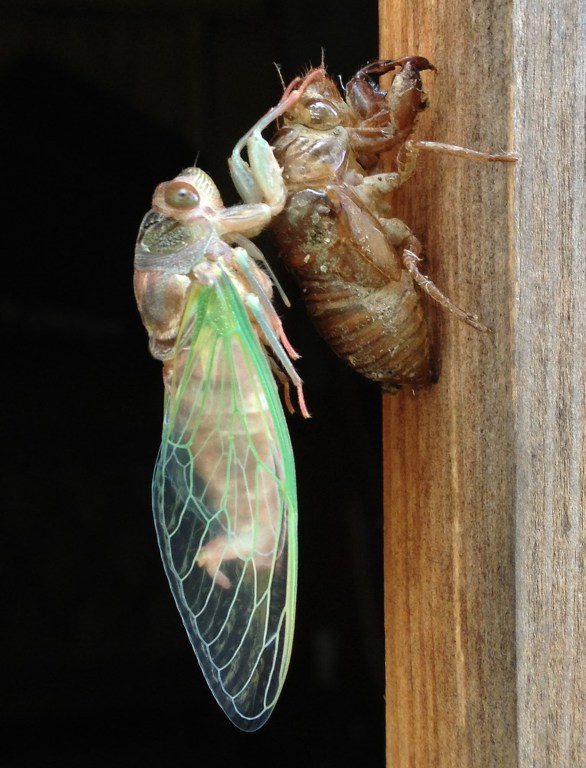
The “cast[ing] off of his body” (tuotai, 脫胎) is reminiscent of the way in which the real life insect sloughs off its shell (fig. 1). If this is what Yu was referring to, I think this is but one part of the puzzle.

Fig. 1 – A newly formed cicada clinging to its shell (larger version).
I suggest that the author-compiler of Journey to the West chose the cicada imagery for the symbolic nature of its life cycle. Munsterberg (1972) describes the insect’s role in ancient Chinese religion:

Cicadas carved in jade are frequently found in graves of the Han period [fig. 2]. Since the cicada hatches above ground, spends a long period underground, and finally emerges as if in rebirth, these burial tokens were probably intended to induce resurrection by sympathetic magic (p. 32).

The Golden Cicada’s life follows this cycle very closely: the celestial being resides above in the Western Paradise, is banished below for an extended period of time, and is only allowed back into the celestial realm after a metamorphosis.

Fig. 2 – A stylized Han-era jade cicada (larger version). Photo by the Asian Art Museum.

The lifesaving transformation previously referred to by Guanyin takes place in chapter 98 when Tripitaka and his disciples are ferried across a heavenly river in a bottomless boat on their way to the Western Paradise:

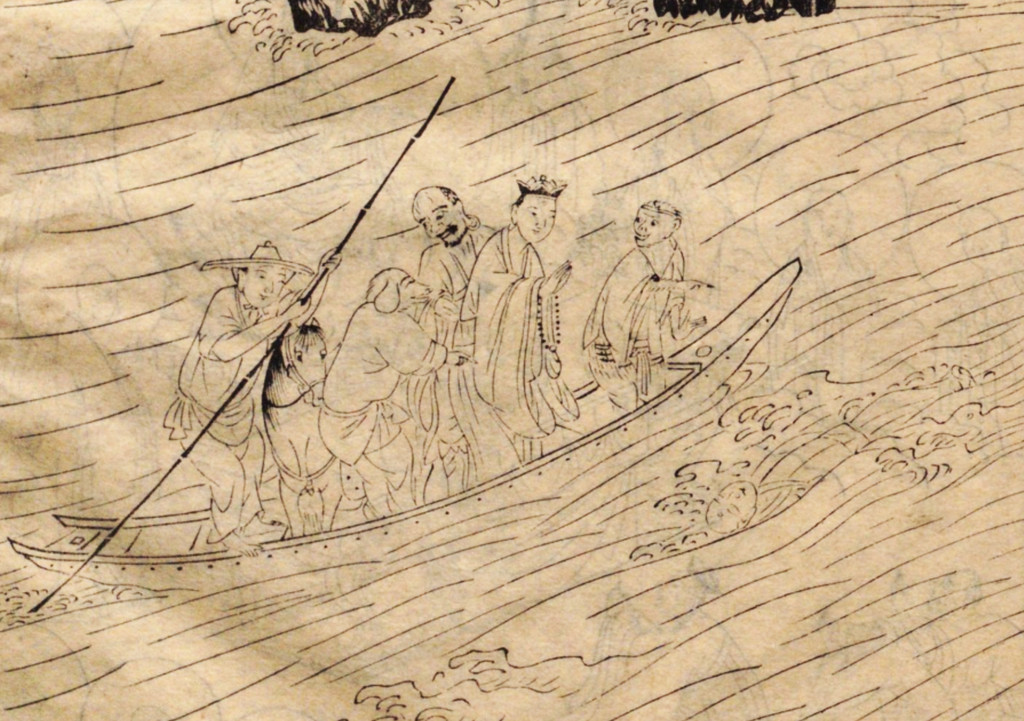
All at once they saw a corpse floating [fig. 3] down upstream, the sight of which filled the elder [Tripitaka] with terror.

“Don’t be afraid, Master,” said Pilgrim [Sun Wukong], laughing. “It’s actually you!”

“It’s you! It’s you!” said Eight Rules [Zhu Bajie] also.

Clapping his hands, Sha Monk also said, “It’s you! It’s you!”

Adding his voice to the chorus, the boatman also said, “That’s you! Congratulations! Congratulations!” Then the three disciples repeated this chanting in unison as the boat was punted across the water. In no time at all, they crossed the Divine Cloud-Transcending Ferry all safe and sound. Only then did Tripitaka turn and skip lightly onto the shore. We have here a testimonial poem, which says:

Delivered from their mortal flesh and bone,
A primal spirit of mutual love has grown.
Their work done, they become Buddhas this day,
Free of their former six-six senses sway (Wu & Yu, 2012, vol. 4, pp. 345-346). [4]

只見上溜頭泱下一個死屍。長老見了大驚。行者笑道:「師父莫怕。那個原來是你。」八戒也道:「是你,是你。」沙僧拍著手,也道:「是你,是你!」那撐船的打著號子,也說:「那是你,可賀,可賀。」他們三人也一齊聲相和。撐著船,不一時,穩穩當當的過了凌雲仙渡。三藏才轉身,輕輕的跳上彼岸。有詩為證。詩曰:

脫卻胎胞骨肉身,相親相愛是元神。
今朝行滿方成佛,洗淨當年六六塵。

Here, we see Tripitaka has shed his mortal form to become a Buddha just like the cicada sheds its shell to grow wings and fly. The monk has freed himself from the endless cycle of birth and death to achieve nirvana.

Fig. 3 – Detail of a woodblock print showing the shedding of Tripitaka’s mortal body (larger version). From Mr. Li Zhuowu’s Literary Criticism of Journey to the West (late-16th to early-17th century).

3. Updates

Update: 05-27-18

The Thirty-Six Stratagems (Sanshiliu ji, 三十六計, c. 5th-6th-cent.), a collection of military, political, and civil tactics, contains a plan known as “The Golden Cicada Sheds its Shell” (Jinchan tuoke, 金蟬脫殼), which entails leaving a decoy that distracts the enemy while the losing force is retreating. I’m not sure if this directly influenced the celestial’s title, but it at least shows that the name was known long before Journey to the West was published.

The strategy is actually used by a tiger demon in chapter 20:

Whipping out the iron rod, Pilgrim [Sun Wukong] shouted, “Catch him!” Eight Rules [Zhu Bajie] at once attacked with even greater ferocity, and the monster fled in defeat. “Don’t spare him,” yelled Pilgrim. “We must catch him!” Wielding rod and rake, the two of them gave chase down the mountain. In panic, the monster resorted to the trick of the gold cicada casting its shell (emphasis added): he rolled on the ground and changed back into the form of a tiger. Pilgrim and Eight Rules would not let up. Closing in on the tiger, they intended to dispose of him once and for all. When the monster saw them approaching, he again stripped himself of his own hide and threw the skin over a large piece of rock, while his true form changed into a violent gust of wind heading back the way he had come. (Wu & Yu, 2012, vol. 1, p. 401).

那行者掣了鐵棒,喝聲叫:「拿了!」此時八戒抖擻精神,那怪敗下陣去。行者道:「莫饒他,務要趕上。」他兩個掄起鈀,舉鐵棒,趕下山來。那怪慌了手腳,使個金蟬脫殼計,打個滾,現了原身,依然是一隻猛虎。行者與八戒那裡肯捨,趕著那虎,定要除根。那怪見他趕得至近,卻又摳著胸膛,剝下皮來,苫蓋在那臥虎石上,脫真身,化一陣狂風,徑回路口。


Update: 12-08-18

I would like to further suggest that the name Master Golden Cicada (Jinchan zi, 金蟬子) might have been chosen to serve as a pun for “child or student of Chan” (Chanzi, 禪子) (fig. 4). While the historical Xuanzang was the patriarch of the Yogacara school of Chinese Buddhism (Robert & David, 2013, pp. 1015-1016), the novel closely associates him with Chan:

The depiction of the novelistic Xuanzang surely and constantly associates him and his entourage with Chan. Revealing examples can readily be found in both narrative content and such titular couplets as “Tripitaka does not forget his origin; / The Four Sages test the Chan Mind” (chapter 2[3]); “The Child’s tricky transformations confuse the Chan Mind; / Ape, Horse, Spatula, and Wood Mother-all are lost” (chapter 40); “The Chan Lord, taking food, has demonic conception; / Yellow Dame brings water to dissolve perverse pregnancy” (chapter 53); “Rescuing Tuoluo, Chan Nature is secure; / Escaping defilement, the Mind of Dao is pure” (chapter 67); “Mind Monkey envies Wood Mother; / The demon lord plots to devour Chan” (chapter 85); and “Chan, reaching Jade-Flower, convenes an assembly; / Mind Monkey, Wood, and Earth take in disciples” (chapter 88) (Wu & Yu, 2012, vol. 1, pp. 64-65).

If true, this would mean that the cicada-like spiritual transformation is based around a pun.

Fig. 4 – The similarities in form and pronunciation of chanzi (larger version). 

This seems like such an obvious connection that I wouldn’t be surprised if someone else beat me to the conclusion by decades or even centuries.


Update: 08-29-20

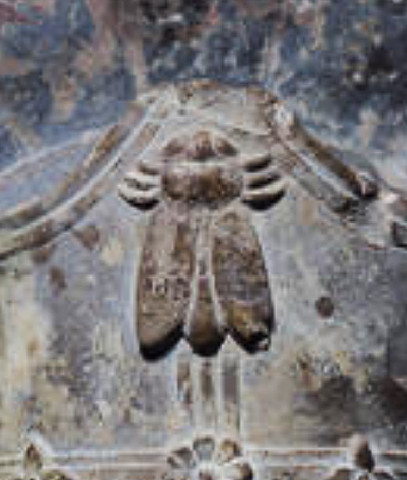
Art historian Jin Xu posted a picture of a 6th century stone bodhisattva statue on twitter, and I was interested to see a cicada adorning the headdress (fig. 5 & 6). One essay about the statue suggests it was commissioned by an aristocratic layman since cicadas are known to have decorated the caps of high-ranking officials:

Another noteworthy characteristic of this superb sculpture is the cicada-shaped decoration on the front of the crown. To date, there are no other known Chinese Buddhist sculptural examples of this kind. However, cicada images can be found on gold mountain-shaped crown plaques that also are embellished with thin gold wire and granulation; these have been excavated from the tomb of Ping Sufu of the Northern Yan period (A.D. 409-436), and seated Buddha images were molded onto the back face of these crown ornaments. These excavated materials would have been made some one hundred years before the present image and suggest that there were members of the aristocracy who revered Buddhism and hid Buddha images on the backs of their crowns. This suggests the possibility that the Shumei bodhisattva, with a cicada in place of a Buddha image, was created at the request of a member of the aristocracy who revered Buddhism and believed in the philosophy that the Emperor is the living Buddha, which may have dated back to the Northern court (Standing Bodhisattva, n.d.).

The sculpture didn’t influence Tripitaka’s title as the Golden Cicada Elder. But it’s still fascinating to see a real world connection between the insect and a bodhisattva.

Fig. 5 – The 6th century Bodhisattva statue with a cicada decorating the crown (larger version). From Qingzhou Museum in Shandong province, China. Fig. 6 – A detail of the insect (larger version).

Update: 09-13-20

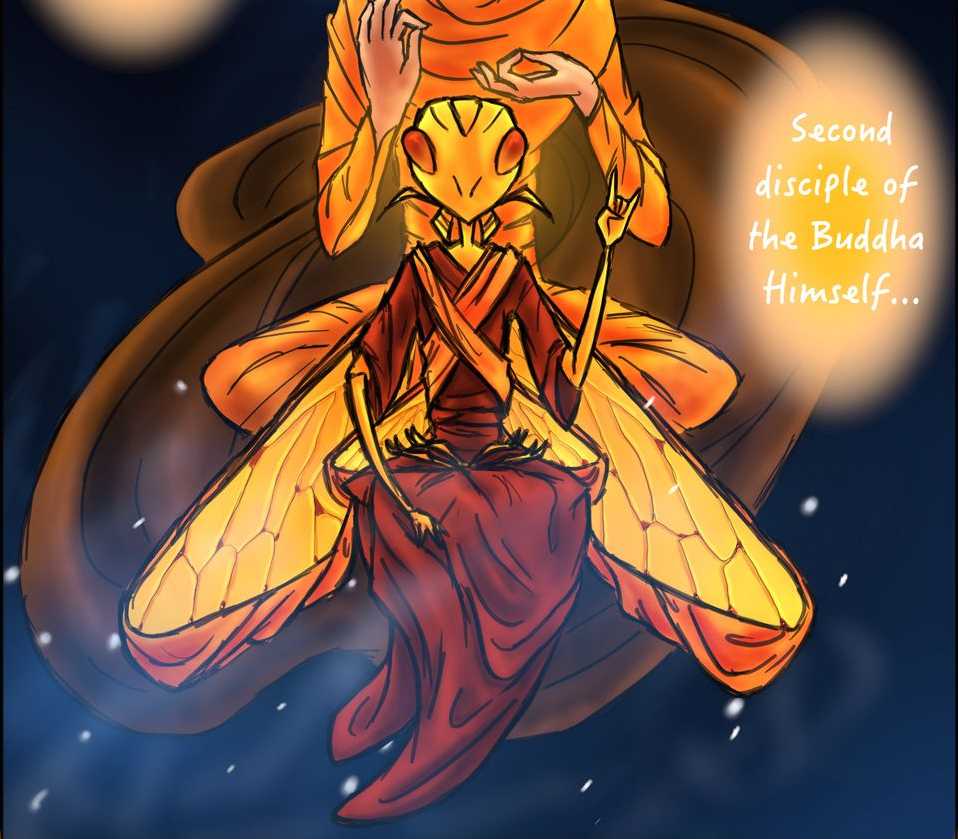
Deviantart user Taylor-Denna has drawn a beautiful depiction of Tripitaka’s former incarnation as a literal cicada (fig. 6). It is quite unique as I’ve never seen any other artist portray the former celestial in such a way. The image makes one think of an insect who acquired magic powers through spiritual cultivation and rose through the Buddho-Daoist hierarchy to become the Buddha’s disciple. The idea would make a good prequel story.

Fig. 6 – Detail of Master Golden Cicada by Taylor-Denna (larger version). Click here for the full version and the artist’s statement. Used with permission.

Update: 12-01-21

I’ve archived a book that shows how Tripitaka’s exile from heaven is similar to ancient Greek and Egyptian beliefs.

Archive #28 – Tripitaka’s Reincarnation and its Connection to Ancient Greek and Egyptian Philosophy


Update: 04-03-22

I’ve posted an entry discussing Tripitaka’s characterization in JTTW as a Confucian.

Archive #35 – The Tang Monk Tripitaka as a Confucian in Journey to the West


Update: 12-12-22

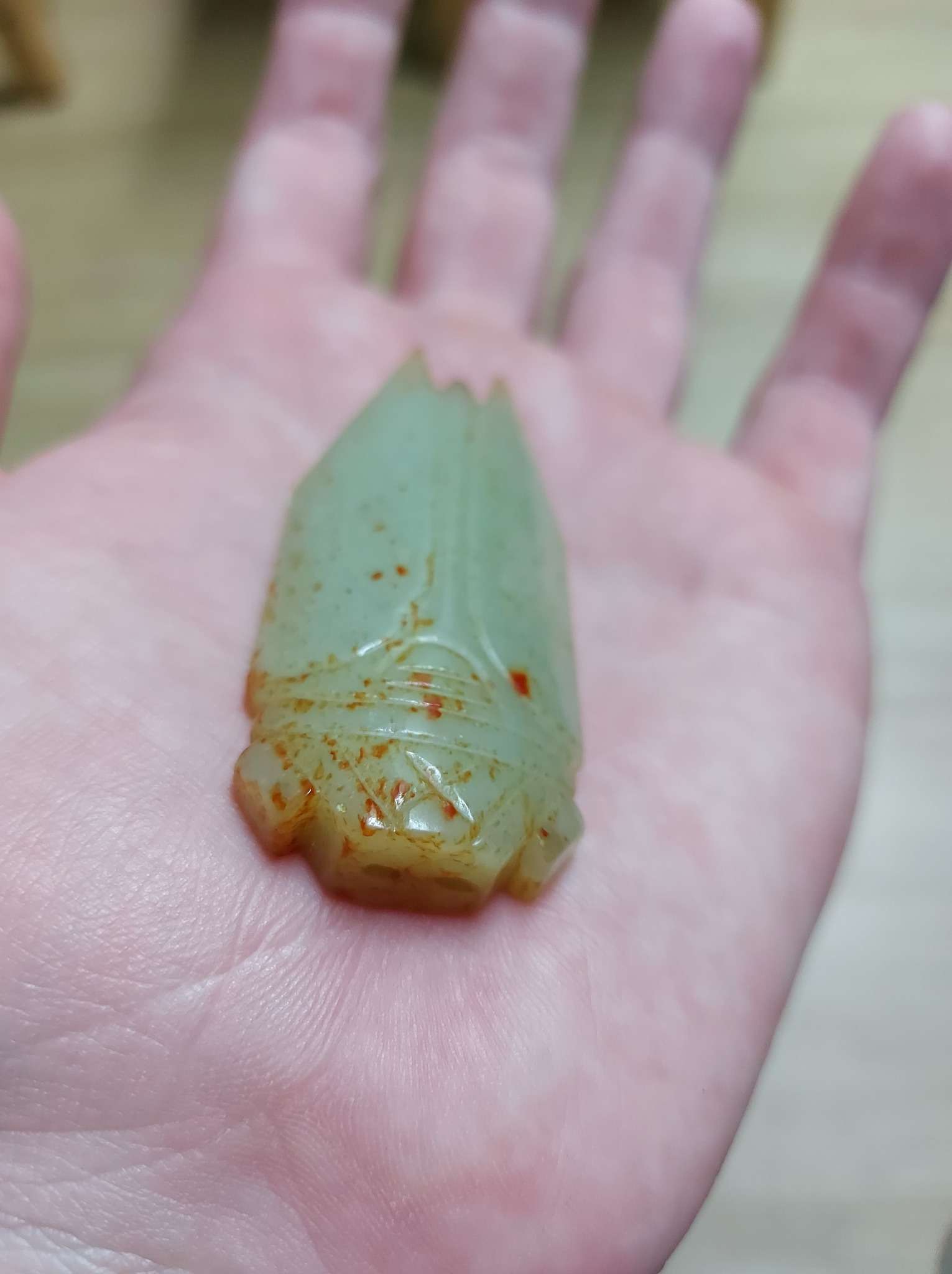
I recently added a modern jade burial token to my collection of religious items (fig. 7-9). It is very heavy for its size and cold to the touch.

Fig. 7 – Top (larger version). Fig. 8 – Front (larger version). Fig. 9 – Bottom (larger version). 


Update: 01-14-23

In chapter 81, Monkey alludes to his master’s past life, adding to the reason why the celestial had been exiled to Earth:

“You don’t realize that Master was the second disciple of our Buddha Tathagata, and originally he was called Elder Gold Cicada. Because he slighted the Law, he was fated to experience this great ordeal.”

“Elder Brother,” said Eight Rules, […] “Why must he endure sickness [for two days] as well?”

“You wouldn’t know about this,” replied Pilgrim. “Our old master fell asleep while listening to Buddha expounding the Law. As he slumped to one side, his left foot kicked down one grain of rice. That is why he is fated to suffer three days’ illness after he has arrived at the Region Below.”

Horrified, Eight Rules said, “The way old Hog sprays and splatters things all over when he eats, I wonder how many years of illness I’d have to go through!”

“Brother,” said Pilgrim, “you have no idea either that the Buddha is not that concerned with you and other creatures. But as people say:

Rice stalks planted in noonday sun
Take root as perspiration runs.
Who knows of this food from the soil
Each grain requires most bitter toil?

Master still has one more day to go, but he’ll be better by tomorrow” (Wu & Yu, 2012, vol. 4, p. 82).

This points to the supreme importance of rice in an agrarian society like ancient China.

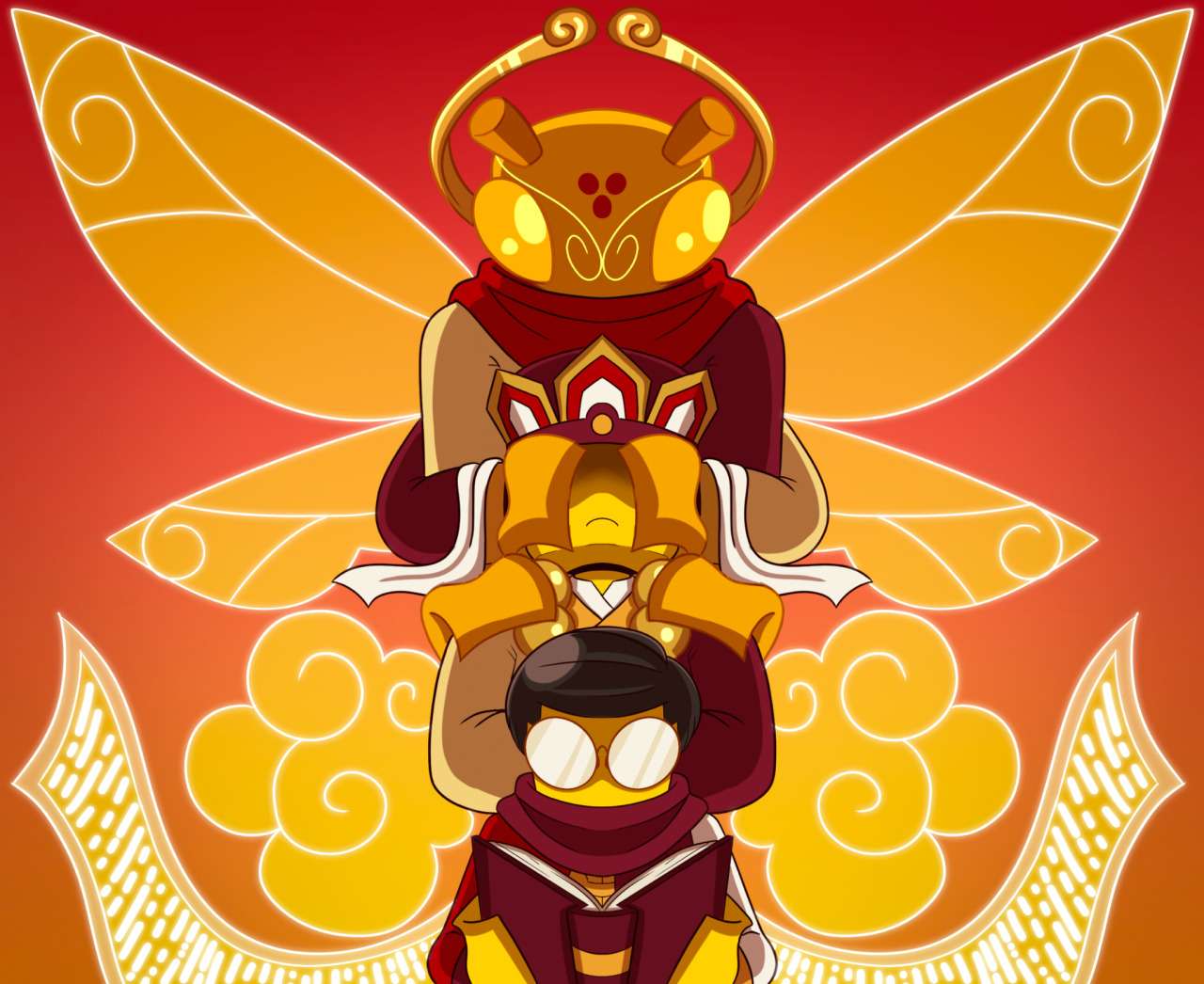
Artist Countingclowns (a.k.a. Countinglegoclowns) on Tumblr has drawn a lovely Lego Monkie Kid-inspired image depicting the Golden Cicada, Tripitaka, and Mr. Tang, the monk’s reincarnation (fig. 10).

Fig. 10 – “Break the Cycle” by Countingclowns (larger version). The original can be seen here.

3.1. Historical Origin

Update: 06-03-23

Tripitaka’s past celestial life and punishment appear to be based on information from Xuanzang’s historical life story, A Biography of the Tripitaka Master of the Great Ci’en Monastery of the Great Tang Dynasty (Datang Da Ci’ensi Sanzang Fashi zhuan, 大唐大慈恩寺三藏法師傳, 7th century). After his death, a spirit extolls the monk’s virtues, as well as reveals the karmic result of his afterlife:

The Venerable Xuanzang alone cultivated the deeds of both blessedness and wisdom in nine lives. In every incarnation he was always learned and erudite, intelligent and eloquent, always the first and foremost in the land of Cīna in Jambudvīpa. Such were his blessed virtues also. […] Owing to the power of his good deeds, he has now been reborn in the inner court of Maitreya in the Tuṣita Heaven, where he will hear the Dharma with comprehension and understanding, and he will never again be born in the human world (Huili & Shi, 1995, p. 336).

且如奘師一人,九生已來備修福慧,生生之中多聞博洽,聰慧辯才,於贍部洲支那國常為第一,福德亦然 […] 由善業力,今見生睹史多天慈氏內眾,聞法悟解,更不來人間受生。

Like Tripitaka, Xuanzang has nine prior pious past lives, and like Master Golden Cicada, he comes to live in a paradise where he can listen to a Buddha lecture on the Dharma. The novel simply changes some of the details, like Xuanzang’s final rebirth in paradise being a previous life, and instead of Maitreya, he studies under the historical Buddha.


4. Updates (continued)

Update: 06-04-23

Brose (2021) mentions a small temple in Taipei, Taiwan where one of Xuanzang’s avatars, the bodhisattva Nine Lotuses (Jiulian pusa, 九蓮菩薩) is worshiped. [5] What’s important for this article is that the deity’s mythos, as recounted by a temple master, alludes to the Golden Cicada’s story:

[Xuanzang], she explained, originally lived in a heavenly Buddha realm, but because his cultivation was incomplete, he was sent down to earth to perform the meritorious task of bringing Buddhist sūtras from India to China. Once his work was complete, Xuanzang was able to return to the Buddha realm, but out of compassion for the world, he left a portion of his spirit behind in the form of Nine Lotuses (Brose, 2021, pp. ix-x).


Update: 04-09-24

In chapter 27, the white bone spirit also comments on the monk’s past life and the effects of eating his flesh:

“What luck! What luck!” she said, unable to contain her delight. “For several years my relatives have been talking about a Tang Monk from the Land of the East going to fetch the Great Vehicle. He is actually the incarnation of the Gold Cicada, and he has the original body that has gone through the process of self-cultivation during ten previous existences. If a man eats a piece of his flesh, his age will be immeasurably lengthened. So, this monk has at last arrived today!” (Wu & Yu, 2012, vol. 2, 17). 

造化,造化。幾年家人都講東土的唐和尚取大乘,他本是金蟬子化身,十世修行的原體,有人吃他一塊肉,長壽長生。真個今日到了。


Update: 10-06-24

Recall that the 01-14-23 update quotes the fullest description of events leading to Master Golden Cicada’s banishment from paradise: he falls asleep during a sermon and accidentally kicks something, causing a single grain of rice to fall to the ground. Well, I’m reading a biography of the Buddha and learned that his family has a connection to rice:

Sakyamuni’s father was called Suddhodana. The name means “pure rice” or “white rice.” In Chinese it is translated as Ching-fan-wang [[Jingfan wang, 淨飯王;] king of pure rice]. Legend says that the names of his four younger brothers all contained the element meaning “rice” (odana). These names suggest that the Sakyas were already cultivating rice and that they particularly valued white rice (Nakamura, 2000, vol. 1, p. 46).

This might explain the Buddha’s reaction.


4.1. Historical Origin – 2

Update: 01-25-25

To recap, Journey to the West casts the Tang Monk Tripitaka as the last incarnation of Master Golden Cicada (Jinchan zi, 金蟬子), the second disciple of the Buddha who is exiled from paradise for falling asleep during his master’s sermon. Chapter 81 adds a second crime: kicking something in his slumber and making a single grain of rice fall to the ground.

This leads me to the point of this post. A reader contacted me the other day asking if Sariputra (Sk: शारिपुत्र; Pali: Sariputta; Ch. Shelifu, 舍利弗), one of the Buddha’s ten primary disciples, was the basis for Master Golden Cicada since he was known for having a golden glow about him. A cursory search didn’t turn up anything connecting them, but thanks to the reader’s prompt, I kept digging and was interested to learn that another disciple of Tathagata, Aniruddha (Sk: अनुरुद्ध; Pali: Anuruddha; Ch: Analu, 阿那律) (fig. 11), was known to have fallen asleep during the Enlightened One’s lessons.

According to monk Jiaoguang’s (交光, fl. 1600) Dafo Dingshou Lengyan Jing Zhengmai Shuxu (大佛頂首楞嚴經正脉疏序, T. 275): 

Analu [Aniruddha] then stood up, bowed at the Buddha’s feet, and said to him respectfully …

[Commentary:] Changshui [6] says: Nalu, namely Anouloutuo, which means “free of poverty,” was a Rice Prince. He gave a meal to a Solitary Buddha in a past life and enjoyed happiness for 91 kalpas.

… “When I first entered the monastic life, I was too fond of sleep. The Thus-Come One admonished me, saying that I was no better than an animal. After the Buddha scolded me, I rebuked myself and wept. For seven days I did not sleep, and as a result I went blind in both eyes.”

[Commentary:] Gushan [7] says: According to the Ekottara Agama, the Buddha was preaching the Law in Jetavana when Nalu fell asleep. The Buddha spoke in verse: “Tut-tut … Why are you sleeping? River snails, mussels, clams and the like sleep for a thousand years, never hearing the names of Buddhas.” Thereupon, Nalu made it known that he would never sleep again, and he soon lost his sight. [8]

阿那律陀即從座起,頂禮佛足而白佛言:

長水曰:那律即阿㝹樓䭾,此云無貧,亦云如意,乃白飯王子也。過去世以一食施辟支,感九十一劫受如意樂。

我初出家,常樂睡眠,如來訶我為畜生類。我聞佛訶,啼泣自責,七日不眠,失其雙目。

孤山曰:增一阿含云:佛在給孤園為眾說法,那律於中眼睡,佛說偈訶云:咄咄何為睡?螺螄蚌蛤類,一睡一千年,不聞佛名字。那律於是達曉不眠,眼根便失。 (source)

The term “Rice Prince” (Bifan wangzi, 白飯王子) refers to the fact that Aniruddha was the cousin of the Buddha and a fellow grandson of King Sihahanu, whose sons, including the Buddha’s father (as mentioned above), all had the suffix odana (“rice”) as part of their names. Aniruddha’s father was Amitodana (“Unmeasured Rice”) (Nakamura, 2000, vol. 1, p. 46; Harvey, 2013, p. 117; Thomas, 1931/2013, p. 24).

Therefore, we have a Buddhist disciple who dozes off during the Buddha’s sermon and has an association with rice. This makes Aniruddha the best possible influence for Master Golden Cicada that I’ve seen. The story goes back to at least the 4th century Zengyi ahan jingxu (增壹阿含經序, T. 125), so it would have been around long enough to eventually influence Journey to the West.

I need to point out, however, that I’m not the first person to write about this. While I was finishing typing this update, I came across this article, which mentions Aniruddha in passing. But to my credit, I actually cited the historical Buddhist literature involved.

Fig. 11 – A colored relief of the Buddha helping his blind disciple sew a new robe (larger version). Image found here.


Update: 02-13-25

I just thought of a way to work Aniruddha into JTTW lore: In chapter eight of the Lotus Sutra (Miaofa lianhua jing妙法蓮華經; a.k.a. Fahua jing, 法華經, c. 3rd century), the Buddha mentions our tired friend among a list of 500 Arhats who will attain perfect enlightenment and share the same holy title:

Five hundred arhats, including Uruvilvakashyapa, Gayakashyapa, Nadikashyapa, Kalodayin, Udayin, Aniruddha, Revata, Kapphina, Bakkula, Chunda, Svagata, and others, will all attain anuttara-samyak-sambodhi. All will have the same designation, being called Universal Brightness (Watson, 1993, p. 149).

其五百阿羅漢:優樓頻螺迦葉、伽耶迦葉、那提迦葉、迦留陀夷、優陀夷、阿㝹樓馱、離婆多、劫賓那、薄拘羅、周陀、莎伽陀等,皆當得阿耨多羅三藐三菩提,盡同一號,名曰普明。

In our headcanon, Master Golden Cicada could be the celestial title of the Arhat Aniruddha, but his sleeping episode instead takes place in heaven. In addition, “Universal Brightness” (Puming, 普明) could just be a classification of Buddha, thus allowing for his Tripitaka avatar to receive the individualized title “Buddha of Candana Merit” (Zhantan gongde fo旃檀功德佛) at the end of his quest.


Update: 02-19-25

Something just dawned on: although I’ve always considered Master Golden Cicada to be a bodhisattva, the novel never specifically calls him that. So what is his actual spiritual rank then? Several pieces of Information point to him being an Arhat. 

First, recall that the introduction to this article reads:

The cleric [Xuanzang] eventually gained his own supernatural background, for evidence shows that he was worshiped as an Arhat (Luohan, 羅漢; Zunzhe, 尊者), a Buddhist saint, by the Song Dynasty (960-1127 CE) (Liu, 2019). A Yuan-Ming zaju stage production plays on this concept by depicting Tripitaka as the reincarnation of the Arhat Vairocana (Pulujia zunzhe, 毗廬伽尊者) (Dudbridge, 1970, p. 193).

This shows that the Tang Monk was already closely associated with Arhats in the past. Second, something I learned but forgot to mention here is that Tripitaka Seeks the Scriptures (Sanzang qujing, 三藏取經), a rare Yuan-Ming puppet play that predates the 1592 JTTW, even refers to the cleric’s past life as the “Golden Chan Arhat” (Jinchan luohan, 金禪羅漢). (This implies that chan (蟬, “cicada”) was based on the Chan (禪) of Chan Buddhism, thereby supporting my suggestion from the 12-08-18 update.) Third, as mentioned above, Golden Cicada was likely based on the Arhat Aniruddha, one of the Buddha’s ten principal disciples, who was reprimanded by his master for dozing off during a lesson. And fourth, the Arhats Ananda (A’nuo, 阿儺) and Kasyapa (Jiaye, 伽葉), two other principle Buddha disciples, also appear among the Enlightened One’s heavenly retinue in JTTW (chapters 7, 8, 77, 98, 99, &  100). Therefore, taken together, this info is a strong indication that the novel’s author-compiler intended Golden Cicada to be an Arhat.

Because of this, I’ve updated the article by removing any previous references to him as a bodhisattva.


Update: 02-21-25

I posted a summary of my last update to Twitter, and a follower commented that Golden Cicada wouldn’t have been able to reincarnate like bodhisattvas if he was really an Arhat. This is based on Buddhist belief. For instance, Buswell and Lopez (2014) briefly explain: [T]he arhat is one who has attained nirvāṇa in this life, and at death attains final liberation ([parinirvāṇa]) and will never again be subject to rebirth” (p. 62). But I reminded them that JTTW is not an accurate snapshot of mainstream beliefs by pointing to two instances from past media (mentioned above) where Tripitaka is the reincarnation of an Arhat. Here, I translate the pertinent sections.

I. The Yuan-Ming JTTW zaju play

Guanyin reveals the monk’s divine origins in act one:

At present, the Western Land of India has the “Golden Scriptures of the Great Repository” in 5,480 volumes. We desire to transmit them to the Eastern Lands (i.e. China), but how can we help propagate them if we don’t have the illusory, corporal body of a genuine person? Currently, the various Buddhas are discussing what to do, and they have decided that the Arhat Vairocana of the Western Heaven will be reborn (tuohua, 托化) as a son to Chen Guangrui’s family in Hongnong County, Haizhou, China. When he grows up, he will leave the family to become a monk and travel to the Western Heaven to retrieve scriptures. He will (later) spread the teachings.

見今西天竺有《大藏金經》五千四十八卷,欲傳東土,爭奈無個肉身幻軀的真人闡揚。如今諸佛議論,著西天毗廬伽尊者托化於中國海州弘農縣陳光蕊家為子,長大出家為僧,往西天取經闡教。

You can see here that there are no negative reasons for his reincarnation. This differs from the next source.

II. The Yuan-Ming JTTW puppet play

Tripitaka describes being born (chushi, 出世) to father Chen Guangrui and a beautiful, nameless mother in scene one (see page 1 of this PDF). His celestial origin is later revealed by “Equaling Heaven” (Qitian, 齊天; i.e. Monkey) in scene six:

The Golden Chan Arhat descended to earth (jiangshi, 降世) because he privately went to the lantern fruit festival without reporting this to the temple sangha, causing the Buddha to punish him to 36 tribulations, including journeying to the Western Heaven to acquire scriptures. After suffering over countless days, he finally returned to the right fruit (i.e. achieved enlightenment).

… 金禪羅漢降世,因私赴燈果會,不報寺中眾僧,佛罰伊過三十六劫,往西天取經。苦難滿日,修歸正果。(see page 9 of this PDF)

Having read the above, I think Master Golden Cicada’s Arhatship is now fully established as fact within the JTTW story cycle. 


5. Updates (continued) – 2

Update: 08-03-25

The notion that Arhats fall asleep is exemplified by the “Dreaming/Sleeping Arhat Fist” (Shuimeng luohan quan, 睡梦罗汉拳) from the 1992 HK film King of Beggars (Wu zhuangyuan Su qi’er, 武状元苏乞儿; lit: “Top Martial Scholar: Beggar Su”; video 1).

Video #1 – The scene where Beggar Su displays his new-found boxing abilities.

Notes:

1) This is interesting since Vairocana is the name of a major Buddha

2) This heavenly aura is also mentioned by Sun Wukong later in chapter 80 (Wu & Yu, 2012, vol. 4, p. 66).

3) The turtle had previously helped the pilgrims cross the same river in chapter 34, and in return they agreed to ask the Buddha when the terrapin would be allowed to achieve human form (for all creatures strive for such an attainment). But Tripitaka forgot to ask the Enlightenment One while visiting the Western paradise, so the turtle dumped them into the river upon their return.

4) The six-six senses (liuliu chen, 六六塵) are “the intensified form of the six gunas, the six impure qualities engendered by the objects and organs of sense: sight, sound, smell, taste, touch and idea” (Wu & Yu, 2012, vol. 4, p. 405 n. 7).

5) Brose (2021), however, explains that this goddess “is usually identified as the divinized form of a Ming Dynasty empress dowager” (p. ix).

6) The monk Changshui (長水), a.k.a. Zixuan (子璿; 965-1038), was the compiler of the Shou lengyan yanyi shu zhu jing (首楞嚴義疏注經, T. 1799) (Sorenson, 2011, p. 39).

7) Gushan (孤山), a.k.a. Zhiyuan (智圓; 976-1022), wrote a commentary for the Shou lengyan jing shu (首楞嚴經疏) (McBride, 2016, pp. 144-145 n. 238).

8) The translation of the commentary is mine, while the rest comes from Buddhist Text Translation Society & Hsuan (2012, p. 210). 

Sources:

Brose, B. (2021). Xuanzang: China’s Legendary Pilgrim and Translator. Boulder, Colorado: Shambhala Publications, Inc.

Buddhist Text Translation Society & Hsuan, H. (2012). The Surangama Sutra: A New Translation with Excerpts from the Commentary by the Venerable Master Hsuan Hua. (n.p.): Buddhist Text Translation Society.

Buswell, R. E. , & Lopez, D. S. (2014). The Princeton Dictionary of Buddhism. Princeton University Press.

Harvey, P. (2013). Buddha, Family Of. In C. S. Prebish & D. Keown (Eds.), Encyclopedia of Buddhism (pp. 117-121). United Kingdom: Taylor & Francis.

Huili, & Shi, Y. (1995). A Biography of the Tripitaka Master of the Great Ci’en Monastery of the Great Tang Dynasty (L. Rongxi Trans.). Berkeley, CA: Numata Center for Buddhist Translation and Research.

Liu, S. (2019). Songdai Xuanzang de shenghua: Tuxiang, wenwu he yiji [The Sanctification of Xuanzang in the Song Dynasty: Images, Artifacts and Remains]. Zhonghua wenshi luncong, 133, 161-219.

McBride, R. D. (2016). Doctrine and Practice in Medieval Korean Buddhism: The Collected Works of Ŭich’ŏn. Germany: University of Hawaii Press.

Munsterberg, H. (1972). The Arts of China. Rutland, Vt: C.E. Tuttle Co.

Nakamura, H. (2000). Gotama Buddha: A Biography Based on the Most Reliable Texts (G. Sekimori, Trans.) (Vols. 1-2). Tokyo: Kosei Publishing Co.

Sorenson, H. H. (2011). Textual Material Relating to Esoteric Buddhism in China Outside the Taisho, vol. 18-21. In C. D. Orzech, H. H. Sorensen, & R. K. Payne (Eds.), Esoteric Buddhism and the Tantras in East Asia (pp. 37-70). Netherlands: Brill.

Standing Bodhisattva. (n.d.). Retrieved from http://www.miho.or.jp/booth/html/artcon/00001542e.htm

Thomas, E. J. (2013). The Life of Buddha. United Kingdom: Taylor & Francis. (Original work published 1931)

Watson, B. (Trans.) (1993). The Lotus Sutra. New York: Columbia University Press.

Wu, C., & Yu, A. C. (2012). The Journey to the West (Vols. 1-4) (Rev. ed.). Chicago, Illinois: University of Chicago Press.

Yu, A. C. (2008). Comparative Journeys: Essays on Literature and Religion East and West. NY: Columbia University Press.

The Story of How Tripitaka of the Great Tang Procures the Scriptures: The Literary Precursor of Journey to the West

Last updated: 01-30-2024

The great Chinese classic Journey to the West (Xiyouji, 西遊記) was anonymously publish in 1592 and has since then enjoyed the adoration of readers for the last four centuries. But not many people know that an earlier version of the novel exists that predates the popular narrative by some three hundred years. Titled The Story of How Tripitaka of the Great Tang Procures the Scriptures (Da Tang Sanzang qujing shihua, 大唐三藏取經詩話, c. late-13th century), this seventeen chapter novelette likely served as a prompt for oral storytellers, [1] and given it’s age, contains material that differs greatly from the final 16th-century version. For example, the disciple Zhu Bajie doesn’t even appear in the story, and a precursor of Sha Wujing only makes a brief cameo as a monster that Monkey battles.

The novelette is also known as the “Kozanji version” as two editions are mentioned in a 1633 catalog held by the titular Japanese Buddhist temple. The Chinese scholars Wang Guowei (王國維, 1877–1927) and Luo Zhenyu (羅振玉, 1866–1940) first identified the earlier of the two editions as a work of the late-Song Dynasty (960–1279). [2] This article will summarize each short chapter, as well as discuss the similarities and differences between it and the final Ming version of Journey to the West. I rely heavily on the English translation by Charles S. Wivell (1994).

Table of Contents

Ch. 1 – TITLE MISSING

[TEXT MISSING]

Ch. 2 – “En Route They Encounter the Monkey Pilgrim”

Tripitaka and five other monks happen upon a white-clad scholar on their way to India. The figure warns the Sutra Master that his two previous incarnations have died on such a journey, and he will die a thousand times more unless he has protection. The scholar reveals himself to be “the bronze-headed, iron-browed king of the eighty-four thousand monkeys of the Purple Cloud Grotto on the Mountain of Flowers and Fruit” (Huaguoshan ziyundong bawan siqian tongtou tie’e mihou wang, 花果山紫雲洞八萬四千銅頭鐵額獼猴王) (Wivell, 1994, p. 1182). Tripitaka accepts his help and rejoices that Karma is uniting the past, present, and future to benefit the people of China. Tripitaka gives him the name “Monkey Pilgrim” (Hou xingzhe, 猴行者).

JTTW Comparison (A)

Similarities:

1) Tripitaka initially sets out with a retinue of monks, but they are all eventually killed by monsters and tigers in chapters 13 and 14.
2) He starts referring to Monkey by the name Pilgrim Sun (Sun Xingzhe, 孫行者) in chapter 14.

Differences:

1) Triptaka happens upon Monkey at the base of Five Elements Mountain, where he has been imprisoned for the last five hundred years. He removes a magic talisman from the top of the mountain, allowing the immortal to break free. See chapter 14.
2) The name Sun Wukong does not appear in the novelette. He is given the name by the immortal Subodhi in chapter one.

Ch. 3 – “Entering the Palace of Mahābrahmā Devarāja”

Pilgrim tells the monks he is so old that he has seen the Yellow River dry up nine different times over thousands of generations. Since the immortal has knowledge of the celestial realms, Tripitaka asks Monkey to fly the group to heaven to attend the Buddhist feast being held by Vaiśravana, the Mahābrahmā Devarāja (Dafan tianwang, 大梵天王), in the Crystal Palace. There, the devas ask the monk to give a lecture on the Lotus Sutra. Knowing that a monster, the “Spirit of the Deep Sand” (Shensha shen, 深沙神), had twice devoured Tripitaka in the past, the Devarāja bestows on Monkey three magic weapons to aid in his defense. These include a cap of invisibility, a golden-ringed monk’s staff, and a begging bowl. In addition, Vaiśravana tells them to call his name so that they may be delivered from any danger they face on the journey.

JTTW Comparison (B)

Similarities:

1) Monkey travels to and from heaven as he pleases.
2) He interacts with Vaiśravana on several occasions (see below).
3) The Bodhisattva Guanyin bestows Tripitaka with a golden-ringed monk’s staff and a cassock in chapter 12.

Differences:

1) Monkey is roughly 1,100 hundred years old when he first meets Tripitaka.
2) He never uses his magic to transport the monk by cloud because the impure nature of mortal bodies makes them far too heavy. See chapter 22.
3) The August Jade Emperor is the ruler of heaven in the final version.
4) Vaiśravana makes several appearances as the Pagoda-Bearing Heavenly King Li Jing, father of the child god, Prince Nezha. [3] Monkey battles Li Jing and Prince Nezha during his rebellion in heaven. See chapter 4, for example.
5) Tripitaka is not eaten over and over again. He was originally the Golden Cicada Bodhisattva, who was exiled from heaven for falling asleep during one of the Buddha’s lectures. He goes through nine pious incarnations before he is reborn as the Sutra Master.
6) Monkey fights with an iron cudgel, which he retrieved from the underwater treasury of Ao Guang, the Dragon King of the Eastern Sea. See chapter 3.
7) This episode does not appear in the final version.

Ch. 4 – “Entry in Incense Mountain Temple”

The group travels to the land of the “Thousand-Armed Thousand-Eyed Bodhisattva” (Qian shou qian yan pusa, 千手千眼菩薩), or the Bodhisattva Guanyin (Wivell, 1994, p. 1185). They come upon the Incense Mountain Temple, which is lorded over by statues of fierce guardian deities. Inside, Tripitaka is dismayed to find the holy place has fallen into complete disrepair. Monkey reminds him that the worst is yet to come; the road to the west is full of foreign people with strange languages, wild animals, and unspeakable monsters.

They travel further and enter the Country of Snakes, which is populated by massive serpents that bellow miasmic clouds. However, despite their terrible appearance, the snakes respect the Buddha and let the pilgrims pass through unharmed.

JTTW Comparison (C)

Differences:

1) Guanyin lives on Mount Potalaka, an island in the Eastern Ocean.
2) The giant serpents do not appear in the final version.

Ch. 5 – “Passing the Lion Wood and the Country of Tree People”

The seven monks travel to the Lion Wood country where they are greeted by countless unicorns and lions with flowers in their mouths. Upon entering the Country of the Tree People, the group finds an inn to spend the night, and in the morning, a young monk is sent to fetch breakfast. However, hours pass without the little disciple returning, so Monkey searches the local village and finds that the monk has been transformed into a donkey by a sorcerer. Pilgrim uses his powers to turn the man’s wife into a bale of grass to feed her to the donkey as revenge. Horrified, the sorcerer then recalls his magic by spitting a mouthful of water on the animal. Monkey does the same and threatens to “mow down all the grass of [his] house” (i.e., kill his wife and anyone else he loves) if the man misuses his powers again (Wivell, 1994, p. 1187). The sorcerer promises to let the group pass through the country unharmed.

JTTW Comparison (D)

Differences:

1) This episode does not appear in the final version.

Ch. 6 – “Passing Long Ditch and Great Serpent Peak”

The monks travel to the valley of the fire-spitting white tiger spirit and encounter a large ditch through which they cannot pass. Pointing the ringed staff towards the heavens, Tripitaka calls the name of Vaiśravana and a ray of light issues forth from the rod that destroys the ditch. Next, the group passes through a fiery pit in which Ming Huang, Emperor Xuanzong of the Tang Dynasty, “changed his bones” and deposited them “like snow on a mountain” (Wivell, 1994, p. 1188). [4] Finally, the Sutra Master calls on the Devarāja once more and uses his alms bowl to extinguish a great prairie fire.

Pilgrim warns Tripitaka that they are passing through the territory of a white tiger spirit who can assume the form of any person. She appears out of the mist wearing white clothing and riding a white pony. Monkey confronts her, causing the spirit to forsake her beautiful façade and take on a demonic white tiger form. He then: “…transform[s] his golden-ringed staff into a gigantic Yakşa whose head touche[s] the sky and whose feet straddle the earth. In his hands he grasp[s] a demon-subduing cudgel. His body [is] blue as indigo, his hair red as cinnabar; from his mouth a fiery gleam sh[oots] forth a hundred yards long” (Wivell, 1994, p. 1189). She refuses to submit, so Pilgrim uses his magic to make her vomit up countless monkeys without end. When she still refuses to surrender, he takes the form of an ever-growing stone in her stomach, causing it to explode. The spirit is finally destroyed when Monkey orders the Yakşa to crush her with his cudgel.

JTTW Comparison (E)

Similarities:

1) The prairie fire may be a precursor to the Fiery Mountain that Monkey extinguishes in chapter 59.
2) The mention of bones and a white-clad demon likely resulted in the White Bone Demon (Baigujing, 白骨精) from chapter 27.
3) Monkey’s staff from the final version has the ability to grow, shrink, and take on different forms.
4) Pilgrim defeats several monsters by invading their stomach. See, for example, chapters 59, 75, and 82.

Differences:

1) This episode does not appear in the final version.

Ch. 7 – “Entering Nine Dragon Pond”

The group enters the territory of the Nine Dragon Pond, home to nine-headed dragons that cause devastating floods. Nine of the beasts leap from the water intent on taking Tripitaka’s life, but Pilgrim intervenes by blanketing the sky in darkness with a cloak created from the cap of invisibility, and enveloping thousands of miles of water with the alms bowl. He then transforms the ringed staff into a great iron dragon and engages the creatures in a two day long battle. Fighting them to exhaustion, Monkey rips out their spinal sinews as punishment and weaves them into a magical belt that gives Tripitaka the ability to travel at great speeds. In addition, he subjects each creature to eight hundred blows with an iron cudgel.

JTTW Comparison (F)

Similarities:

1) Monkey battles a dragon who eats and eventually replaces Tripitaka’s horse in chapter 15.
2) The iron staff is a precursor of Monkey’s weapon from the final version.

Differences:

1) Monkey only battles with a single staff.
2) This episode does not appear in the final version.

Ch. 8 – TITLE MISSING

[FIRST PART MISSING]

[After blocking the group’s passage through a quicksand-like desert,] The Spirit of the Deep Sand reveals: “I am the one who devoured you twice before, monk. Slung from my neck are all your dry bones!” (Wivell, 1994, p. 1190). The monster only helps the monks cross the “Deep Sands” (Shensha, 深沙) via a magical golden bridge once he is threatened with heavily retribution. Memorial poems note that Tripitaka releases the Spirit from a five hundred-year-long curse, and Pilgrim promises to speak highly of him when they meet the Buddha.

JTTW Comparison (G)

Similarities:

1) The Spirit of the Deep Sand is the literary precursor of Sha Wujing from the final version.
2) The bones of Tripitaka mentioned here are similar to the nine monk skulls hanging from Wujing’s neck.
3) The monster-turned-disciple helps Tripitaka pass through the “Flowing Sands River” (Liusha he, 流沙河) by turning the nine skulls into a makeshift raft. See chapter 22.

Ch. 9 – “Entering the Country of Hārītī”

The seven monks travel to a sparsely populated country peopled mainly by unattended three-year-old children. The few adults who can be found do not bother to interact with the group when spoken to. They eventually meet a king who throws them a lavish vegetarian banquet and reveals that they have entered the Country of Hārītī (Guizi mu, 鬼子母), or the “Mother of Ghostly Children.” Tripitaka is shocked to learn that they have been interacting with disembodied spirits during their stay. The King sends them off with bushels of rice, gold, pearls, and embroidered cloth to help pay for their journey. A memorial poem notes that the monks will repay their debt of gratitude by obtaining the scriptures.

JTTW Comparison (H)

Differences:

1) This episode does not appear in the final version.

Ch. 10 – “Passing Through the Country of Women”

The group travels for some time before Tripitaka calls on the Devarāja once more to help them bypass a raging flood. They pass through several uninhabited territories before they enter the Country of Women, where the Queen offers them a Buddhist feast. They decline to eat, however, as the food is full of sand, but offer to send the country much needed grains upon their return to the East.

The Queen invites Tripitaka and his retinue to remain as permanent residents and even offers to build them their own temple. Furthermore, she offers them any number of beautiful women as prospective brides. But true to their vow, the monks decline in order to continue their journey to India. The Queen sends them off with pearls and a white horse.

JTTW Comparison (I)

Similarities:

1) Tripitaka and his disciples pass through the Country of Women in chapter 54.
2) The Queen attempts to entice them to stay.

Ch. 11 – “Entering the Pool of the Queen Mother”

Tripitaka asks Pilgrim to steal some immortal peaches from the Queen Mother of the West, a primordial goddess, in order to quell his great thirst. Monkey, however, hesitates as he was originally beaten with an iron club and exiled to the Purple Cloud Grotto on the Mountain of Flowers and Fruit for stealing her peaches when he was just eight hundred years old. He remarks that his shanks are still sore even at twenty-seven thousand years of age. They eventually enter the Queen Mother’s realm and look up high above a cliff to see the immortal peach trees laden with fruit. Monkey explains: “These peach trees sprout a thousand years after planting. They blossom in three thousand years and produce a fruit in ten thousand years. The fruit requires ten thousand more years to ripen. He who eats one gains three thousand years of life” (Wivell, 1994, p. 1196).

Several of the ripe fruits fall from the trees into the pond below. Pilgrim raps the golden-ringed monk’s staff on the ground three, five, and seven times, each time summoning a different immortal child to the surface of the water. The first and second children respectively claim to be three thousand and five thousand years old. The third child, who claims to be seven thousand years old, is pulled from the water and quickly devoured in the form of a jujube, or Chinese date. [5] The story mentions in passing that, upon their return to China, Monkey spits out the pit in Sichuan province, thus explaining the origin of ginseng in the area.

JTTW Comparison (J)

Similarities:

1) Pilgrim steals peaches from the Queen Mother’s immortal peach grove in chapter 5. The chapter notes that there are three classes of immortal peaches, each taking thousands upon thousands of years to ripen.
2) He is punished for his transgressions against heaven. See chapters 6 and 7.
3) Tripitaka and his disciples eat baby-shaped ginseng fruit that bestows on them forty-seven thousand years of life. The fruits are harvested from a magical tree with a golden rod. See chapter 24 through 26.

Differences:

1) Monkey is born on the Mountain of Flowers and Fruits in chapter one.
2) He is imprisoned under the Five Elements Mountain for trying to usurp the throne of heaven.
3) Again, he is roughly 1,100 hundred years old.
4) Tripitaka would never ask Pilgrim to steal anything for him.
5) This episode does not appear in the final version.

Ch. 12 – “Entering the Country of Heavy Scent”

They travel to an unpopulated country full of large, ancient trees.

Ch. 13 – “Entering the Country of Vara”

The monks travel through Vara, a paradise on earth, complete with beautiful women, neatly kept homes, playful children, and lions and dragons who chant the Buddha’s name.

Ch. 14 – “Entering the Country of Utpala”

They travel through Utpala, a flower-filled extension of the Buddha’s paradise in which the inhabitants live for countless ages and never want for food. [6]

JTTW Comparison (K)

Differences:

1) These brief episodes do not appear in the final version.

Ch. 15 – “Entering India and Crossing the Sea”

The group finally arrives in India and seeks lodging in the Prosperous Immortals Temple. After a vegetarian meal, the temple monks engage Tripitaka in a sarcastic conversation about the purpose of his quest, noting that they themselves have no need to seek the Buddha’s law any further since they already have copies of the sutras. They warn Tripitaka that endless miles of oceans and mountains separate him from Chicken Foot Mountain, home of the Buddha. Furthermore, they claim that, even if his group could surmount such a vast distance, the scriptures themselves are unattainable as they are kept in the Buddha’s residence high atop a sheer cliff accessible only to holy men with the gift of flight. The Sutra Master is disheartened at first, but Monkey suggests that the group gather the following morning to pray wholeheartedly to the Buddha. Their beautiful chanting causes the sky to go black and resound with thunder and lightning. When the darkness subsides, they are delighted to find that a near complete Buddhist canon has appeared before them. Only the Heart Sutra is missing from among the scriptures.

JTTW Comparison (L)

Differences:

1) Tripitaka and his disciples actually travel to Vulture Peak, where the Buddha gives them the Buddhist canon. See chapter 98.
2) The sutras that they initially receive are destroyed in an accident linked to karmic retribution. But they eventually get new copies. See chapter 99.
3) This episode does not appear in the final version.

Ch. 16 – “Returning They Arrive at the Fragrant Grove Temple and Receive the Heart Sutra”

On their return trip home, the monks seek lodging in the Fragrant Grove Temple in the Country of Pan Lu. Tripitaka dreams a heavenly envoy announces that he will be given the Heart Sutra. The group awakens to a defining noise and rises to see the Buddha emerge from colorful clouds in the form of a young, beautiful monk carrying a golden-ringed staff. He reaches into his sleeve and retrieves a scroll, noting that its power should not be shared with the unworthy because: “As soon as this sutra is opened, bright lights will flash, ghosts will weep and spirits will howl, winds and waves will quiet of themselves, and the sun and moon will cease to shine!” (p. 1201).

Additionally, the Buddha orders Tripitaka to have Tang Emperor Xuanzong build Buddhist temples, initiate monks, and promote the Buddhist Law throughout China.

The Enlightened One only gives the monks three months to complete the task of escorting the sutras back to China, for a “Lotus-Plucking Barge” will be arriving at a particular place and time to transport them to paradise (Wivell, 1994, p. 1202).

JTTW Comparison (M)

Similarities:

1) The Buddha tells Vajra guardians to transport the monk and his disciples to paradise once they have completed their mission. See chapter 98.

Differences:

1) The Buddha is portrayed as a huge, towering figure with a golden body. See chapter 98.
2) Tripitaka, his disciples, and the sutras are magically transported back to China by eight Vajra guardians. See chapter 100.
3) This episode does not appear in the final version.

Ch. 17 – “They Reach Shensi, Where the Wife of the Householder Wang Kills His Son”

The householder Wang (Wang zhangzhe, 王長者) leaves his second wife, whose maiden name is Meng (孟), to care for her step-son Daffy (Chi na, 癡那) while he is away trading goods in foreign lands. Half a year goes by when she receives a letter from Wang dictating that all of their money should go to Daffy if anything were to happen to him. This greatly enrages Meng since Stay-Put (Ju na, 居那), her son from a previous marriage, would miss out on any inheritance. Meng then conspires with her maid Spring Willow (Chunliu, 春柳) to kill Daffy before Wang’s return. They respectively boil him in a pot, rip out his tongue, and starve him, but each time he is magically saved by some unseen supernatural force. For instance, after four days of boiling in the pot, Daffy emerges unscathed and claims: “[T]he iron caldron changed into a lily pad on which I sat, surrounded by the cool waters of a pond. I could sleep or just sit there. It was very comfortable” (Wivell, 1994, p. 1203). Finally, they push Daffy into a tumultuous river and he is swept away. Word of the boy’s death soon spreads to his father, who returns home in tears. Wang holds a Buddhist feast to honor the memory of his son. [7]

Upon their return to China, Tripitaka and the monks stop to attend the feast. The Sutra Master refuses to eat any of the food, however, on the grounds that he is too drunk and needs fish broth to sober up. Following the monk’s instructions, Wang buys the largest specimen that he can find and sets it before Tripitaka. He slices the stomach open with a knife and Daffy emerges unharmed. In the end, father and son are reunited and the treachery of Madame Meng and Spring Willow is exposed.

The monks travel onto the capital where Buddhist feasts are held in their honor. Emperor Xuanzong personally accepts the Heart Sutra and has seven statues of the Buddha commissioned. Soon, the appointed day arrives and “the seven [pilgrims] boarded the barge and, looking due west, they ascended into the heavens and became immortals” (Wivell, 1994, p. 1206). Tang Taizong later honors Monkey with the name “Great Sage Steel Muscles and Iron Bones” (Gangjin tiegu dasheng, 鋼筋鐵骨大聖) (Wivell, 1994, p. 1207).

JTTW Comparison (N)

Similarities:

1) The child emerging from the boiling pot unharmed recalls Monkey’s time in Laozi’s eight trigrams furnace. See chapter 7.
2) Tripitaka and his disciples are granted Buddhahood and Arhatship after returning to the Western Paradise. See chapter 100.
3) Monkey’s new name recalls his title “Great Sage Equally Heaven” (Qitian dasheng, 齊天大聖) from chapter 4.
4) This also recalls Sun receiving the title of the “Victorious Fighting Buddha” (Dou zhansheng fo, 鬥戰勝佛) upon attaining Buddhahood in chapter 100.

Differences:

1) This episode does not appear in the final version.


Updates

Update: 09-14-19

I have written an article discussing the influence of the Buddhist saint Mulian on the Monkey Pilgrim from the story prompt.

Sun Wukong and the Buddhist Saint Mulian


Important Historical and Religious Info

Update: 01-30-24

I was recently interested to learn that The Story was influenced by underworld journey narratives. This explains the often fantastical and seemingly unrelated events that happen throughout the disjointed narrative. Brose (2023) writes:

The Japanese scholar Chūbachi Masakazu (b. 1938) was the first to point out that the Kōzanji narratives mirror two closely related mythic archetypes. The first, derived from ancient Han Chinese traditions, is the journey of the dead to the netherworld. In many accounts of postmortem travels, spirit animals (including but not limited to monkeys) serve as the guides for the dead on their passage through the spirit realm, whether the final destination is the Yellow Springs beneath the earth or Mount Kunlun in the distant west. The other motif, emerging from early Indian Buddhist literature, is the transmigration of the spirit to the Pure Land, which, like Mount Kunlun, was conventionally located somewhere in the west. In Buddhist accounts, animals (again, often but not always monkeys) also serve as escorts for the dead. Chūbachi proposed that these narrative traditions—culturally distinct but thematically and functionally similar—were fused together with the historical account of Xuanzang’s journey to India. The Kōzanji texts, according to this reading, represent a complex but organic blending of initially independent narratives. The broad contours of Xuanzang’s biography and travelogue were superimposed onto older mythic accounts to provide a new, quasi-historical frame for age-old stories about the transmigrations of the dead.

Viewed from this perspective, Xuanzang was not passing through Central Asia en route to India but, instead, was traversing a hellish purgatory to reach a heavenly pure land. Like a shaman, he departs the human world and enters a dangerous liminal zone. Beset by ghosts and demons, he is guided and protected by powerful spirit animals and Buddhist deities. After enduring extreme hardship, he eventually arrives in an immortal realm populated by spirit monks, immortals, bodhisattvas, and buddhas. From Śākyamuni Buddha, he receives a collection of apotropaic texts with the power to safeguard the living and liberate the dead. Xuanzang then transmits these sacred scriptures back to the human realm before he and his assistants ascend to heaven during the annual ritual for liberating the damned from purgatory. This narrative not only maps the landscape of a postmortem shadow world, it also identifies the scriptures that guard against demonic molestation and ensure a propitious rebirth: the Buddhist canon in general and the Heart Sūtra in particular. Those who read, recited, or heard the Kōzanji texts were thus informed of the perils of purgatory and offered the promise of protection and salvation. Xuanzang, they also learned, was the saintly monk responsible for delivering these divine texts and technologies into the hands of humans (pp. 62-63).

This strengthens my suggestion that the Monkey Pilgrim serves as a stand-in for Mulian (目連; Sk: Maudgalyayana), a Buddhist saint famed for traversing the underworld to save his mother. One element that I overlooked was the date when Tripitaka and his companions rise to paradise:

During the fifth quarter hour of the noon watch on the fifteenth [of the seventh month], a barge for collecting lotuses was sent down from the Heavenly Palace and Dipamkara Buddha was manifest in the clouds. Announcing that he had better not tarry any longer, the Dharma Master [Tripitaka] bade a hasty good-bye to the emperor. The seven [pilgrims, including Monkey,] boarded the barge and, looking due west, they ascended into the heavens and became immortals. Nine dragons rose up into the mist and ten phoenixes came out to welcome them. A thousand cranes offered them felicitations and there were flashing lights of transcendence (Wivell, 1994, p. 1206).

十五日午時五刻,天宮降下採蓮舡,定光佛在雲中正果。法師宣公,不得遲遲,匆卒辭於皇帝。七人上舡,望正西乘空上仙去也。九龍興霧,十鳳來迎,千鶴萬祥,光明閃爍。

The 15th day of the seventh lunar month falls on the “Ghost Festival” (Gui jie, 鬼節; a.k.a. “Zhongyuan Festival,” Zhongyuan jie, 中元節; a.k.a. “Yulanpen Festival,” Yulanpen jie, 盂蘭盆節), a time when souls are believed to be released from the underworld. Therefore, the ascension of the pilgrims would coincide with the rise and subsequent salvation (thanks to the procured scriptures) of said spirits from hell.

Regarding the date of The Story, I’ve previously mentioned that it is a product of the late-13th century. But Zhang (1990) assigns an earlier date to its writing, stating this was likely no earlier than the reign of Emperor Renzong (r. 1022–1063) of the Northern Song Dynasty (960–1127) and no later than the reign of Emperor Gaozong (r. 1127–1129) of the Southern Song Dynasty (1127–1279). This places The Story in the late-Northern Song. Zhang ends by saying,

Even though the current version of “Zhongwazi Zhangjiayin” [8] was printed in the late-Southern Song Dynasty, the date of publication should not be confused with the year in which the book was written.

纵然今见“中瓦子张家印”本刊印于南宋晚期,亦不能把刊印时间与成书年代混为一谈。

Chen (2014) supports a Song publication with evidence comparing The Story‘s rhyming system with that of Buddhist “Transformation Texts” (Bianwen, 變文). I have attached a PDF below.

PDF File:

A revisit of the time of Monk Xuanzang of the Tang Dynasty on a Pilgrimage for Buddhist Scriptures – Focus on rhyme style (2014)

Notes:

1) The term shihua (詩話) at the end of the tale’s Chinese name is synonymous with huaben (話本), a genre of vernacular oral literature.

2) Stories dealing with the adventures of the monk Tripitaka and Sun Wukong appeared as early as the 11th century, as evidenced by cave art from that time. Such tales were originally created and told by professional storytellers in busy market places, much like the famed Yangzhou storytellers of today. Standardized repertoires were eventually collected and published during the late Song Dynasty. See Dudbridge (1970) for more information.

3) Li Jing (李靖, 571–649) was a historical Tang dynasty general who won many battles in China and Central Asia. Shahar (2013) notes that Li was deified after his death, and that the cult centered around him existed into the Song Dynasty. Most importantly, “The general [was] celebrated in a large body of oral and written fiction, which gradually associated him with the Indian god [Vaiśravana]” (Shahar, 2013, p. 28). He continues, “Storytellers and playwrights [eventually] merged the Tang general with the martial Heavenly King” (Shahar, 2013, p. 28). This merging may have happened as early as the Yuan Dynasty (1271–1368) (Shahar & Kieschnick, 2013, p. 224 n. 18).

4) This changing of bones most likely refers to some type of realized spiritual cultivation that resulted in a new, pure body for the future emperor.

5) It would seem the immortal fruit takes on the form of children upon entering the pool.

6) The land of Utpala sounds very much like Tao Quan’s famous tale the “Peach Blossom Spring” (421), which tells the story of how a fisherman stumbles upon a garden paradise where the inhabitants never age (Barnhart, 1983, pp. 13-16).

7) This portion of the story is very similar to the late 9th- to early 10th century “Transformation Text on the Boy Shun’s Extreme Filial Piety.” For a comparative analysis, see Mair (1987). For a complete English translation of the tale, see Bodman (1994).

8) The original late-13th century manuscript of The Story is stamped with the “Zhang Family Seal of Central Market District” (Zhongwazi Zhangjiayin, 中瓦子張家印). The Central Market District (Zhongwazi, 中瓦子) was a street known for play promotions and book publishers in Song-era Lin’an prefecture (Zhang, 1990). This appears to be another nickname for The Story apart from the “Kozanji version” (Dudbridge, 1970, p. 25, for example).

Bibliography:

Barnhart, R. M., & Metropolitan Museum of Art (New York, N.Y.) (1983). Peach blossom spring: Gardens and flowers in Chinese paintings. New York: Metropolitan Museum of Art.

Bodman, R.W. (1994). The Transformation Text on the Boy Shun’s Extreme Filial Piety. In V. H. Mair (Ed.), The Columbia anthology of traditional Chinese literature (pp 1128-1134). New York: Columbia University Press.

Brose, B. (2023). Embodying Xuanzang: The Postmortem Travels of a Buddhist Pilgrim. United States: University of Hawaii Press.

Chen, Y. (2014). Datang Sanzang qujing shihua shidaixing zaiyi: Yi yunwen tizhi de kaocha wei zhongxin [Another Discussion on the Age of the Story of How Tripitaka of the Great Tang Procured the Scriptures: An Investigation into the Rhyming System], Pudan Journal (Social Sciences), 5, 69-80.

Dudbridge, G. (1970). The Hsi-yu chi: A study of antecedents to the sixteenth-century Chinese novel. Cambridge, England: University Press.

Mair, V. H. (1987). Parallels between some Tun-Huang manuscripts and the 17th chapter of the Kozanji Journey to the West. Cahiers d’Extrême-Asie, 3, 41-53.

Shahar, M., & Kieschnick, J. (2013). India in the Chinese Imagination: Myth, Religion, and Thought. University of Pennsylvania Press.

Shahar, M. (2013). Indian mythology and the Chinese imagination: Nezha, Nalakubara, and Krshna. In M. Shahar and J. Kieschnick (Eds.), India in the Chinese imagination: Myth, religion, and thought (pp. 21-45). University of Pennsylvania Press.

Wivell, C.S. (1994). The Story of How the Monk Tripitaka of the Great Country of T’ang Brought Back the Sūtras. In V. Mair (Ed.), The Columbia Anthology of Traditional Chinese Literature (pp. 1181-1207). New York: Columbia University Press.

Zhang, J. (1990). Datang Sanzang qujing shihua chengshu niandai kaolun [A Discussion of the Date of the Story of How Tripitaka of the Great Tang Procures the Scriptures]. Xueshu jiaoliu, 4, 108-114. Retrieved from https://www.toutiao.com/article/7065749209709806087/?wid=1706529284309