Story Idea: Sun Wukong vs Heracles / Hercules

From time to time I like to post a fun blog not directly related to (though sometimes informed by) my research. Regular articles will resume after this entry.

Last updated: 04-08-2026

Readers may remember that DEATH BATTLE! (episode 162) featured a fight between Sun Wukong from Journey to the Westย (Xiyou ji, ่ฅฟ้Š่จ˜, 1592 CE, “JTTW” hereafter) and Heracles / Hercules from Greco-Roman myth (fig. 1). The episode begins with the demi-god trekking up a mountain in order to fulfill the 11th of his famous 12 labors: procuring the Golden Apples of the Hesperides (Salapata, 2021), but he instead finds Monkey holding the fruitโ€”food meant for his master, Tripitaka. Heracles demands the apple at sword-point, but he quickly discerns that the produce he’s been given was created from a magic hair. This leads to a deadly confrontation.

As I explain in my analysis of the episode, I initially liked how the fight began because both characters are known for stealing fruit in their respective mythologies (see no. 12 in my article listing their parallels). But in hindsight, this didn’t make much sense for two reasons. First, the golden apples are located in a land much further west than India, the scripture-pilgrims’ final destination in JTTW. Monkey could have easily gone to a location closer to their resting spot. And second, having the heroes meet during their respective adventures creates a temporal paradox since both are active at different timesโ€”late-Greek bronze age (c. 3000โ€“1000 BCE) vs the early-Tang Dynasty (618โ€“907 CE). Therefore, in the end, the idea is very forced. But what would be a more natural way for the Son of Zeus and the Great Sage Equaling Heaven to come to blows?

This article proposes a more organic reason for conflict via a story idea based on elements from JTTW, Greek myth, Greco-Buddhist art, and Buddhist literature. But take note that the encounter is NOT meant to be a death battle. Remember that the rest of the journey still needs to take place.

Fig. 1 – The official thumbnail for the episode (larger version). Image found here.

Table of Contents

1. Basis for the Story

My pitch is an offshoot of a previous story idea. It follows the historical Xuanzang (็Ž„ๅฅ˜, 602โ€“664 CE) (on whom Tripitaka is based) on his quest for sutras through Central Asia and India, including years-long periods of study. While the original novel sees Daoism practiced by Chinese-speaking people as far away as the Western Continent (i.e. India), this wouldn’t be the case in the real world. Therefore, changes would have to be made to the narrative, such as the appearance of foreign gods outside of the Middle Kingdom. But as I noted in the original article, it would be a lot easier to include the devas of Buddhism (e.g. Shakra, Brahma, Heavenly Kings, etc.) since the religion was practiced throughout the areas traveled by Xuanzang. This, however, wouldn’t exclude gods from other pantheons, like Heracles.

1.1. Heracles as Vajrapani in Greco-Buddhist Art

Now, I can already hear my readers asking, “How could Heracles possibly be associated with the gods of Buddhism?” Well, the first Greeks arrived in Central Asia and India during the reign of Darius the Great (550โ€“486 BCE) and laterย Alexander the Great (356โ€“323 BCE). And just like American Gods, these soldiers, merchants, artisans, and farmers brought their religion with them. The convergence of these two cultures eventually resulted in the demi-god appearing alongside Tathagata in the 1st to 3rd century CE Greco-Buddhist art of Gandhara (modern day NW Pakistan to E and NE Afghanistan) (fig. 2). The Greek hero takes the place of the Buddha’s loyal protector, the yaksha-turned-dharma guardian Vajrapani (Sk: เคตเคœเฅเคฐเคชเคพเคฃเคฟ, lit: “Vajra [Thunderbolt] in hand”; Ch: Jingang shou pusa, ้‡‘ๅ‰›ๆ‰‹่ฉ่–ฉ, lit: “Bodhisattva holding the vajra”). (I have to say that Heracles’ association with the thunderbolt is super fascinating given who his father is.) In fact, the common image of Vajrapani as a muscular, club-wielding deva in East Asia (fig. 3) is directly linked to his depiction as Heracles in Gandharan art!

I won’t go into further detail here since I’ve already taken the liberty of archiving papers on the subject in preparation for this article:

Archive #50 – Heracles as Vajrapani

Fig. 2 โ€“ Detail of a stone carving of the Buddha preaching while Heracles-Vajrapani watches over him, Gandhara, 2nd or 3rd century CE, Schist (larger version). He wields a gada mace in his right hand and holds a bone-like vajra-club in the left. Adapted from an image found here. Copyright the Trustees of the British Museum. Fig. 3 – A Tang-era painting of Vajrapani, Dunhuang, Gansu Province, China, mid-9th to early-10th century CE, ink and colors on silk (larger version). Take note of his muscular physique and wispy beard. The vajra-club in his left hand is obscured by his leg. Image found here. Copyright the Trustees of the British Museum. See here for a Tang-era painting of Vajrapani with a visible club.

1.2. Historical Monkey King and Vajrapani Crossovers

Sun Wukong and Vajrapani have technically met before. For example, in the 13th century CE version of the JTTW story cycle, the Great Sageโ€™s antecedentย changes his magic staff into the dharma warrior while facing a white tiger spirit:

Monkey Pilgrim [Hou xingzhe, ็Œด่กŒ่€…] transformed his golden-ringed staff into a giganticย YakลŸaย whose head touched the sky and whose feet straddled the earth. In his hands he grasped a demon-subduing cudgel [jiangmochu, ้™้ญ”ๆต]. His body was blue as indigo, his hair red as cinnabar; from his mouth a fiery gleam shot forth over one thousand feet longโ€ (based on Wivell, 1994, p. 1189). [1]

่ขซ็Œด่กŒ่€…ๅฐ‡้‡‘้ถๆ–่ฎŠไฝœไธ€ๅ€‹ๅคœๅ‰๏ผŒ้ ญ้ปžๅคฉ๏ผŒ่…ณ่ธๅœฐ๏ผŒๆ‰‹ๆŠŠ้™้ญ”ๆต๏ผŒ่บซๅฆ‚่—้›้’๏ผŒ็™ผไผผ็กƒๆฒ™๏ผŒๅฃๅ็™พไธˆ็ซๅ…‰ใ€‚

The titan eventually crushes her with his weapon (Wivell, 1994, p. 1189). The โ€œdemon-subduing cudgelโ€ is another name for Vajrapani’s vajra-thunderbolt.

Also, the Monkey King interacts with Vajra warriors (Jingang, ้‡‘ๅ‰›) related to Vajrapani numerous times in the standard 1592 CE JTTW. In chapter 52, his way is momentarily barred by the “Eight Great Vajras” (Ba da jingang, ๅ…ซๅคง้‡‘ๅ‰›) when he seeks an unannounced audience with the Buddha (Wu & Yu, 2012, vol. 3, p. 24). [2] In chapter 58, the eight warriors fail to stopย Wukong and his doppelganger when they fight to the Western Paradise seeking Tathagata’s wisdom to distinguish one from the other (Wu & Yu, 2012, vol. 3, p. 114). After the Bull Demon King is captured in chapter 61, the Great Sage gathers the “Four Great Vajras” (Si da jingang, ๅ››ๅคง้‡‘ๅ‰›) and a host of other gods to confront Princess Iron Fan (Wu & Yu, 2012, vol. 3, p. 161). In chapter 77, the four warriors once again momentarily bar his way when he seeks an audience with the Buddha (Wu & Yu, 2012, vol. 4, pp. 27-28). In chapter 98, the four warriors welcome Tripitaka and his companions, including Monkey, upon their arrival to the Western Paradise (Wu & Yu, 2012, vol. 4, p. 347). Later in the same chapter, the Buddha charges the eight warriors with transporting the clerics on a cloud to hasten the completion of their mission and return to paradise (Wu & Yu, 2012, vol. 4, p. 357). But after being ordered to prematurely drop off the pilgrims, leading to Tripitaka’s 81st tribulation, the eight warriors reappear sometime later to complete the trip to China (Wu & Yu, 2012, vol. 4, p. 369). And finally, in chapter 100, the eight warriors spirit them back to the Western Paradise to receive their otherworldly reward (Wu & Yu, 2012, vol. 4, p. 380).

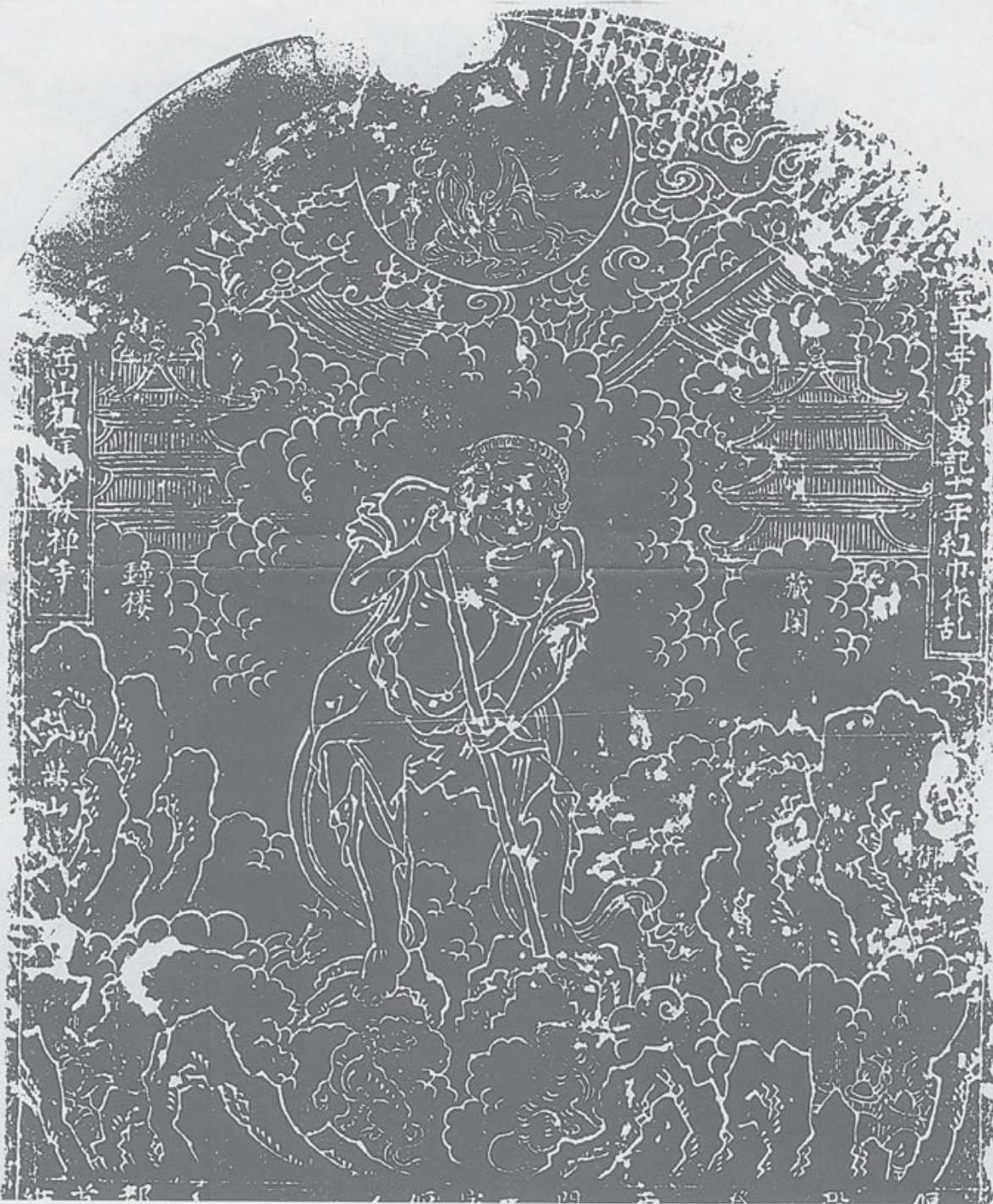
In addition, Sun Wukong and Vajrapani are associated with each other in Shaolin Monastery lore. The latter was historically worshiped as the progenitor of their famous staff method. A stele erected by Shaolin abbot Wenzai (ๆ–‡่ผ‰) in 1517 CE shows that the deityโ€™s vajra-club had been changed at some point to a Chinese staff (fig. 4) (Shahar, 2008, p. 84). Vajrapaniโ€™s yaksha-like Narayana (Naluoyan(tian), ้‚ฃ็พ…ๅปถ(ๅคฉ)) form was eventually equated with one of the four staff-wielding โ€œKimnara Kingsโ€ (Jinnaluo wang, ็ทŠ้‚ฃ็พ…็Ž‹) from the Lotus Sutra in 1575 CE. His name was thus changed from Narayana to Kimnara King (Shahar, 2008, p. 87). One version of the story about his creation of the staff method takes place during the Yuan Dynastyโ€˜sย Red Turban Rebellion (1351โ€“1368 CE). Bandits lay siege to the monastery, but it is saved by a lowly kitchen worker wielding a long fire pokerย as a makeshift staff. He leaps into the oven and emerges as a monstrous giant tall enough to straddle bothย Mount Songย and the imperial fort atop Mount Shaoshi, which are five miles (8.046 km) apart. The bandits flee when they behold this staff-wielding titan. The Shaolin monks later realize that the kitchen worker was none other than the Kimnara King in disguise (Shahar, 2008, pp. 87-88). Shahar (2008) suggests that mythical elements of the story were borrowed from the Monkey Kingโ€™s adventures. He compares the workerโ€™s transformation in the stove with Sunโ€™s time inย Laoziโ€™s Eight Trigrams furnaceย (Bagua lu,ย ๅ…ซๅฆ็ˆ), their use of the staff, and the fact that Monkey and his weapon can both grow to gigantic proportions (Shahar, 2008, p. 109). [3]

Therefore, given the above information, it’s not a stretch to have the two heroes meet in a fanfiction.

Fig. 4 โ€“ An ink rubbing of the 1517 CE Shaolin stele showing a titanic Vajrapani defending the monastery from rebels (larger version). From Shahar, 2008, p. 84.

2. The Main Story Idea

I’ve added in-text notes in this section to provide readers with extra context. This way, you won’t have to scroll to the endnotes at the bottom.

Buddhist tradition describes Tathagata visiting the devas to preach the dharma (Buswell & Lopez, 2014, p. 235). With the presence of Greeks in Central and South Asia, I imagine he would also visit the Olympian gods who had gained some influence in the region. (See the 03-28-26 update below for more info). These friendly interactions would lead Zeus to assign Heracles to guard the Enlightened One (fig. 5), thereby forming a link between the Greek and Buddhist pantheons (and explaining the aforementioned art). (See the 10-29-25 and 12-02-25 updates below for a detail from Greek myth that supports this idea.)

Here is where one of many changes to the standard 1592 CE JTTW story happens. In chapter six of the original, the bodhisattva Guanyin recommends that the demi-god Erlang battle the Monkey King after the latter had defeated many of heaven’s greatest warriors (Wu & Yu, 2012, vol. 1, p. 178). In our tale, she instead endorses the demi-god-turned-deity Heracles-Vajrapani (“HV” hereafter). [A]

A) The Son of Zeus became a full-blown god upon his death. After being exposed to a tunic soaked with poisonous hydra blood, Heracles sought release from the immense pain by jumping into a funeral pyre. But the flaming structure was shortly thereafter struck by lightning, signaling his rise to godhood (Romero-Gonzalez, 2021, pp. 273-276). This, of course, takes place hundreds of years before he becomes the protector of the Buddha.

Fig. 5 – A lovely digital painting of Heracles traveling with the Buddha (larger version). By Jacob King (deviantart). Used with permission. Image found here.

(I don’t consider myself a competent story writer, so please look at the following events and dialogue as conceptual in nature. I’m sure a seasoned writer could do the narrative more justice.)

Similar to the standard narrative, the monkey-soldiers of Wukong’s army notify him that heaven has sent another challenger. He emerges from his cave fully armored (refer to section 2.2. here) to see HV for the first time. Like the original, this might be followed by a poem describing the enemy; in this case, a large, muscular, bearded warrior wearing a lion skin and wielding a flaming vajra-club. (See the 02-19-26 update below for a visual.)

[Insert insults from both sides, including the Son of Zeus calling Monkey a “young rogue,” which naturally pisses him off. [B] HV also describes his godly heritage, which is alien to Monkey since he’s not familiar with the Greek pantheon.]

B) The Great Sage has a habit of claiming to be older than the various gods, immortals, spirits, and humans he meetsโ€”whether it’s true or not in the first three cases (Wu & Yu, 2012, vol. 1, p. 413, for example). This is exemplified by his self-given nickname “(Maternal/Paternal) Grandpa Sun” (Sun waigong, ๅญซๅค–ๅ…ฌ; Sun Yeye, ๅญซ็ˆบ็ˆบ). But within the story’s timeline, Heracles is indeed hundreds of years older. Writing around 430 BCE, the Greek historian Herodotus claimed that the Son of Zeus lived roughly 900 years before him, placing the demi-god’s life sometime around 1330 BCE. The Greek hero would, therefore, be active around 830 or more years prior to the birth of Wukong (c. 500 BCE).

The pair first take part in a battle of weapons, with Wukong wielding his magic staff and HV his vajra-club. The earth quakes, gods tremble, etc. HV’s powerful strikes push our hero back, causing his staff to painfully vibrate in his hands [C] and create a deafening ringing noise with each hit. Monkey would have a running internal monologue noting the great force of his opponent’s attacks. But despite this, the Great Sage continues driving forward, his weapon hardly leaving the area around HV’s head. [D] At one point, though, a glancing strike from the Greco-Buddhist hero redirects the staff, creating an opening. HV brings his vajra-club down hard on Monkey, but instead of dodging, the latter jerks his head upwards, butting away his opponent’s holy weapon with a loud, metallic bang. [E] The combined forces from the attack and defense might cause destruction to the surrounding area.

C) It may seem impossible for the staff to painfully vibrate in Wukong’s hands, but this indeed happens once in the novel. In JTTW chapter 20, he attempts to bludgeon a tiger-spirit, but when “the rod bounce[s] back up and his hands [a]re stung by the impact” (… ่ฝ‰้œ‡ๅพ—่‡ชๅทฑๆ‰‹็–ผ), he learns it was just a big stone covered with the fiend’s sloughed off skin (Wu & Yu, 2012, vol. 1, p. 403).

D) The phrase “hardly leaving the monster’s head” is respectively used in JTTW chapters 41 and 67 (here and here) to describe Wukong’s supreme mastery of the staff (Wu & Yu, 2012, vol. 2, p. 224; vol. 3, p. 249).

E) The feat of headbutting the weapon serves two purposes. First, it’s a response to this 2020 DEATH BATTLE! fanon wiki script that sees Hercules win by smashing the primate immortal’s head to a pulp with his club. (This attack carried over into the official episode, too.) The ending betrays the author’s extremely limited knowledge of JTTW. In the original, the Great Sage’s head is one of the hardest parts of his body, giving him the confidence to voluntarily take blows to the scalp from even magic, bladed weapons with no harm (Wu & Yu, 2012, vol. 1, pp. 314, 383-384, and 408; vol. 2, p. 128; vol. 3, pp. 125 and 373). And two, it highlights the correlation between the invulnerability of Monkey and the Nemean Lion, the first labor of Heracles (March, 2021). Regarding the ending of the fan script, one version of the original mythology sees the Son of Zeus break his olive club over the lion’s head because of how tough its hide is (March, 2021, p. 34).

The novel gives at least three reasons for the Great Sage’s invulnerability. After heaven fails to execute him with bladed weapons and fire and lightning in JTTW chapter 7, Laozi suggests that all of the immortal foodstuff previously consumed by our hero had been refined by his own samadhi fire (sanmei huo, ไธ‰ๆ˜ง็ซ), a spiritual flame in the lower abdomen, thus giving him a โ€œdiamond bodyโ€ (jingang zhi qu, ้‡‘้‹ผไน‹่ป€) (Wu & Yu, 2012, vol. 1, p. 188). Wukong himself later attributes his adamantine nature to his time in the high god’s furnace. In JTTW chapter 34, for example, he claims to have developed a heart of gold, viscera of silver, a head of bronze, and a back of iron, etc. (Wu & Yu, 2012, vol. 2, p. 131). This is refuted in JTTW chapter 75 when he claims to have been born with a head of bronze and iron that was further refined by the furnace (Wu & Yu, 2012, vol. 3, p. 374).

Stunned from the powerful blow, [F] Monkey stumbles around holding his head for a moment but raises his weapon in defense when he sees HV approaching. However, instead of attacking, the Greco-Buddhist warrior pauses combat by raising a hand in front of him. “What a skull!” he exclaims while clapping. “And no hint of blood! I reckon your hide is as tough as a monstrous beast I once fought. [G] Truly impressive! And your staff technique is masterful! Who trained you?”

F) This references how the Nemean Lion was blinded by pain after the blow (March, 2021, p. 34).

G) This reference is obvious.

“I have no teacher. [H] I alone trained my mind and body for three years.” [I]

H) This refers to Wukong’s promise to never reveal the Buddho-Daoist sage, Patriarch Subodhi, as his teacher under threat of karmic torture in the underworld (Wu & Yu, 2012, vol. 1, p. 125).

I) This is the length of time that he spends as an indoor disciple of Subodhi (Wu & Yu, 2012, vol. 1, p. 121).

“A prodigy!” exclaims HV. “But how good is your boxing and wrestling?”

“Ol’ Monkey can handle himself.”

“Let’s see if that’s true. How about we have a friendly sparring match, a test of heroic strength and skill? No weapons and no pesky magic tricks. Agreed?”

Wukong quickly agrees and inserts his shrunken staff into his ear before stripping off his armor from the waist up to match HV’s exposed muscles. HV somehow magically stores his holy vajra-club. The two then square up and launch forward, locking hands and pushing against the other, causing the ground beneath them to tremble and split.

“Extraordinary!” says HV. “How can such a small creature be so powerful?! [J] Were you born of the gods?

J) Many people often forget that Monkey’s normal form is less than 4-Chinese feet (121.92 cm) tall (see here).

“No, I was born from a stone egg.” (See the 02-28-26 update below for an interesting Greek parallel.)

“Oh, like the terrible stone titan and stone goddess! [K] No wonder you achieved this level of strength in such a short time. You have so much raw potential. Why cause trouble for such petty reasons?” [L]

K) These are Ullikumi and Agdistis, two powerful, rebellious, stone-born deities from Western myth (see sections 2.1 & 2.4 here). Referencing the former shows that HV is aware of the Near Eastern pantheon.

It’s interesting to note that lithic births are at least common enough in world myth to have earned a category in Stith Thompsonโ€™s Motif-Index of Folk-Literature: โ€œBirth from rockโ€ (T544.1).

L) This refers to Wukong’s rebellion over being given the lowest-ranking position in the Daoist heaven.

[Insert Wukong’s reply. They continue to converse during the battle.]

(This might be a good place to introduce some comedy. HV keeps referencing gods and monsters from other pantheons, making Monkey more and more frustrated:

“What the hell is wrong with you?! I … DON’T … KNOW … THESE … PEOPLE!!! [said in a slow, patronizing voice])

The Great Sage’s internal monologue comments on HV’s diamond grip and the great pressure of his punches. But our hero’s keen eyes notice openings in HV’s defense, allowing him to land blow after blow. However, with each successful attack comes praises from HV. Stinging rib shot. “Good, good!” Cutting elbow strike to the face. “Excellent!” Crushing body slam. “Amazing!”

“Why do you keep lauding me? I’m winning!”

“That would certainly be the case … if we were equals.”

“What do you mean?!”

Smiling, HV explains, “I’ve been testing you! [M] You found all of the openings I offered you, even some that I didn’t intend to because I was apparently too focused on judging your technique. [N] You are a talent the likes of which I’ve never seen before! Thank Father Zeus [or Buddha]! The student I’ve been looking for has finally appeared! Forsake this frivolous rebellion and return with me to the Western Paradise. I promise with my tutelage, you will become one of the greatest warriors of any pantheon!”

M) Perhaps HV decides to test the Great Sage when he sees how well the small primate responds to his opening strikes.

N) It just occurred to me that since the Subodhi appearing in this more realistic version of the story is the historical figure he’s based on, Subhuti, one of the Buddha’s ten principal disciples, the patriarch had to have trained under someone during Tathagata’s lifetime. And considering that HV was the Enlightened One’s bodyguard, perhaps Subhuti learned a little from the Greco-Buddhist heroโ€”apart from other deities, holy men, and warriors, including the Buddha, a member of the Kshatriya class. An interesting implication is that HV would recognize (his or an ally’s) techniques among Wukong’s armed and unarmed attacks or defenses, thereby alerting him that Monkey’s claim of having no master is false. Yet, he would still be supremely impressed that the Great Sage became such a powerful, competent fighter in just three short years.

Fun fact: according to Theocritus, Heracles learned boxing and wrestling from the grim-looking demi-god Harpalycus, son of Hermes (Pache, 2021, p. 10). Apollodorus instead claims his teacher was Autolycus (2.4.9), also a son of Hermes.

“I think you’re full of shit! Ol’ Monkey is whittling away at you, and you’re just trying to talk your way out of it.”

“Well, my offer stands,” HV replies calmly, “but now that I’ve had my fun, it’s time to finish this.”

“Finish what, you bastard?!” Wukong screams in anger. He then unleashes a tornado of powerful punches, kicks, and knee and elbow strikes. But this time they have no effect on the Son of Zeus because he’s no longer playing along.

I’m not quite sure what the next sequence of events would be since I have zero experience choreographing fight scenes, especially between celestial warriors. Perhaps HV displays his true power by running Monkey headfirst through the side of a mountain with an outstretched arm, similar to how the comic book character Omni-Man uses his son, Invincible, like a wedge to slice through an oncoming subway train [warning: gore]. This feat alone would surely cause the primate immortal to question how his opponent’s strength has seemingly increased exponentially. [O] (But upon reflection, this deed seems lacking considering that Wukong himself is shown capable of carrying two mountains while running with great speed. Hopefully someone can suggest a feat for HV that would amaze even the Great Sage.) (See the 02-20-26 update below for a new reason.)

O) This, of course, proves that HV was holding back. It’s important to note that in Buddhist literature, the original Vajrapani is considered the “physical manifestation of the … power … of all the Buddhas” (Buswell & Lopez, 2014, p. 955). Now imagine how much stronger HV would be than Monkey! Apart from his own godly heritage, I guess in my version of JTTW, HV would gain an unfathomable boost in power from serving as the protector and disciple of the Buddha, exposing him to the dharma for centuriesโ€”during Tathagata’s lifetime and afterlife following his parinirvana (figs. 6 & 7). This is similar to how the scorpion-demoness becomes so strong in JTTW chapter 55 (Wu & Yu, 2012, vol. 3, p. 72). But HV would be well beyond even her.

I guess the Great Sage would hold off on using magic up to this point as a matter of pride, but maybe his hand is forced when faced with such oppressive strength. Like in the original, he might resort to his magic hairs, summoning hundreds of tiny clones in the hopes of overwhelming the Son of Zeus. [P] However, the Greco-Buddhist warrior quickly neutralizes theseโ€”possibly by clapping his hands together and creating a shockwave that blows them away [Q] and destroys the surrounding areaโ€”pressuring our hero to take other measures. Maybe Monkey frantically cycles through one trick after another but ultimately fails to best his opponent. (See the 10-26-25 update below for a detail from Greek myth that supports this idea). (It would be fascinating to see how HV deals with Wukong’s three-headed, six-armed war formโ€”surely eliciting comparisons to Geryon.) [R]

To these breaches of their agreement, HV responds with something like, “Magic? You disappoint me.”

[Insert Monkey’s response.]

P) Monkey competes in hand-to-hand combat in JTTW chapters two and 51, and each time he resorts to hair clones when things get out of hand (Wu & Yu, 2012, vol. 1, pp. 128-129; vol. 3, pp. 12-13).

Q) The hair clones can indeed be blown away, as shown by the Yellow Wind Demon in JTTW chapter 21 (Wu & Yu, 2012, vol. 1, pp. 409-410).

R) Thank you to a beta reader of this article for reminding me about Geryon. He is sometimes described as having or depicted with three conjoined bodies, complete with three heads and six arms like Monkey (fig. 8) (Finglass, 2021).

Fig. 6 (Top) – A degraded stone carving depicting the parinirvana of the Buddha, Gandhara, 2nd to 3rd-century CE, Schist (larger version). HV is the first person from the left on the bottom row. He holds his vajra-club in one hand and upraises the other in lamentation. He has an exposed torso, showing off his muscles, in place of his signature lionskin. Housed in the British Museum.ย Adapted from an image found on Wikimedia Commons. Copyright Marie-Lan Nguyen. Fig. 7 (Bottom Left) – Detail of HV (larger version). Fig. 8 (Bottom Right) – Heracles vs Geryon, Attic black figure on Amphora vase, mid-6th century BCE (larger version). Housed in the Musรฉe du Louvre, Paris. ย This is an upscaled version of an image found here. Copyright www.theoi.com.

Ideally, given the parallels between Wukong and the Nemean lionโ€”both are fierce mythological animals, have invulnerable hides, can change shape, [S] and fight someone who is/was a demi-god (Erlang vs Heracles)โ€”I would like to see HV maneuver to Monkey’s back and get him in a chokehold, thereby mimicking how the big cat was originally defeated. [T] But instead of killing the Great Sage, he only intends to choke him to unconsciousness.ย [U] (Again, see the 10-26-25 update below). And to make matters worse, as the primate immortal fades towards blacking out, he by chance witnesses his beloved monkey army being routed and captured by celestial forces, like the standard version (Wu & Yu, 2012, vol. 1, p. 182). This causes him to lose heart and flee HV’s powerful arms by changing into an intangible ball of light or gust of wind. [V]

S) Matyszak (2015) states that the lion would sometimes take the form of kidnapped women (that it had presumably already eaten) in order to lure unsuspecting heroes into its cave (pp. 46-47). Dr. Matyszak tells me that “it’s not part of the core myth” but “later Roman and Byzantine authors do mention it” (personal communication, October 17, 2025).

T) I really like the ending of Theocritus’ description of the fight:

[After hitting him over the head with a club,] I threw my bow and stitched quiver to the ground, and before he could recover and turn on me again, I grabbed him by the scruff of his powerful neck. Gripping him firmly, I strangled him with my strong hands, tackling him from behind to stop him scratching me with his claws. Standing on his hind paws, I pressed them hard to the ground with my heels and controlled his flanks with my thighs, until I could lift him up lifeless in my arms and lay him out. And mighty Hades took his spirit (March, 2021, p. 34).

U) Someone might claim that it would be impossible to choke out Monkey since he’s a spiritual being, but it’s important to remember that the novel humanizes supernatural figures in order to make them more relatable. For instance, in JTTW chapter 65, Wukong claims that he will die from the lack of air inside of a sealed Buddhist treasure-weapon if he isnโ€™t soon released (Wu & Yu, 2012, vol. 3, p. 217). And he reiterates this near-death experience to Zhu after escaping a few pages later (Wu & Yu, 2012, vol. 3, p. 224). Having read that, I think a blood choke would be more dignified and less dangerous method for subduing our hero.

V) Wukong escapes in the form of a ball of light in JTTW chapters 34 and 42 (Wu & Yu, 2012, vol. 2, pp. 126 and 241). And he turns into a gust of wind to follow a foe in JTTW chapter 60 (Wu & Yu, 2012, vol. 3, p. 140). This could easily be used to escape as well.

A beta reader suggested that I work Erlang and his sworn brothers back into the story. They could track down and capture Monkey. But however the situation is resolved, this would lead to the events of the original story: the Great Sage’s failed execution, his sentence to Laozi’s furnace, his escape and wager with Buddha, his imprisonment beneath Five Elements Mountain, and his eventual release to go on the journey. And since Wukong comes into contact with Erlang once more and the Vajra warriors several times in the standard version, [W] he would likely meet HV again during the pilgrimage. The Son of Zeus might even comment on his positive change in character as Tripitaka’s disciple and protector.

W) The Great Sage meets Erlang again in chapter 63 (Wu & Yu, 2012, vol. 3, pp. 187-191). Regarding Vajra warriors, refer back to section 1.2.

Two beta readers were disappointed by the ending because they didn’t think HV could defeat the Great Sage. As a longtime uberfan of Monkey myself, I understand that sentiment, but they should remember that this is not just the Heracles of Greco-Roman myth, who’s immensely powerful in his own right, able to support the sky on his shoulders in one myth (Salapata, 2021, p. 152). He’s an amalgam of the Greek hero and the Buddha’s protector. Recall that Vajrapani is considered the embodiment of all the Tathagatas’ power (refer back to note O). And If the dharma of one Buddha can easily defeat Monkey (Wu & Yu, 2012, vol. 1, pp. 195 and 199), a being endowed with the power of ALL of them should have no problem subduing our favorite primate immortal.

I feel like this idea has so much potential, but I lack the experience or talent to do it justice here. Hopefully, readers will see through the lackluster description to understand the promise of greatness that it holds. Please let me know if anyone is interested in fleshing out this tale.

Lastly, while finishing this section, I came upon a fun coincidence: ancient Greco-Buddhist stone carvings with HV, the Buddha, and … a monkey (figs. 9 & 10)! They depict “The Monkey Offering Honey (to the Buddha)” (Ch: Mihou xianmi, ็ผ็Œด็ป่œœ; Mihou fengmi, ็ผ็Œดๅฅ‰่œœ), a tale from the Tathagata’s lifetime where a primate selflessly offered him honey but shortly thereafter fell and died via drowning or impalement. Thankfully, though, the primate was reborn into the deva realm (Van der Geer, 2022, pp. 439-440). [W] The carvings depict HV watching over the Enlightened One during this event.

Perhaps, based on these images, HV tells Wukong at some point during their confrontation that he reminds him of someone from the past. (Fanfic theory: could the Great Sage be a reincarnation?)

W) The historical Xuanzang mentions a version of this story where the primate is later reborn as a human (Li, 1996/2017, p. 106). He adds that the area where the offering originally happened hosts images of monkeys (mihou xingxiang, ็ผ็Œดๅฝขๅƒ) next to a water tank or pond supposedly dug by a group of them for the Enlightened One (Li, 1996/2017, p. 184). [4]

Fig. 9 (Left) – Detail of a stone doorway fragment with two stacked carvings illustrating “The Monkey Offering Honey (to the Buddha)” story, Gandhara, 1st to 3rd-century CE, Schist (larger version). The upper scene portrays the primate asking for a bowl, while the lower depicts the offering of honey. HV is present in both: first from the left on the top and first from the right on the bottom. He lacks his beard and lionskin but wields his signature weapon. The extra person photobombing the lower scene may be Ananda. Fig. 10 (Right) – The full stone doorway fragment portraying various events from the Tathagata’s life (larger version). Housed in the Guimet Museum, Paris, France. Adapted from an image found on Wikimedia Commons. Copyright Marie-Lan Nguyen.ย 

3. An Idea for a Sequel

A continuation of the story would open where the original leaves off: after the scripture-pilgrims are elevated in spiritual rank, Tathagata charges HV with escorting the Victorious Fighting Buddha (i.e. Sun Wukong; fig. 11) through the Greek world-system. Imagine the kind of adventures Monkey would have as a Buddha interacting with Classical gods and monsters! It would definitely be a great way of introducing East Asian people to the wonders of Greek myth.

I really like the idea of HV visiting his old pantheon as his vajra is analogous to Zeusโ€™ thunderbolt. Seeing a father-son lightning competition would be great!

Also, as I’ve discussed elsewhere, Wukong and Poseidon could bond over their shared love of horses.

Fig. 11 – Wukong as the Victorious Fighting Buddha (larger version). Imagery based on the iconography of the historical Yuddhajaya Buddha. Art by NingadudeXx.

3.1. Commissioned Art

I have commissioned some illustrators to draw Monkey in ancient Greek style as an experiment to see what he might look like through the lens of Hellenistic artisans.

Fig. 12 – The Victorious Fighting Buddha (larger version). Pencil, fineliners, and alcohol markers on paper. Art by tr0chanter (Instagram and Twitter).

Fig. 13 – Heracles vs Monkey (larger version). Pencil and markers on paper. Art by Dario Virga (Onibotokemaruย on Instagram), a friend of the blog. Each character is labeled with their name in Greek. Heracles is “แผฉฯฮฑฮบฮปแฟ†ฯ‚,” while the Great Sage is “Pithekos” (ฯ€แฟฬฮธฮทฮบฮฟฯ‚), meaning “ape, monkey, trickster, or dwarf.” Wukong’s Greek name is very fitting. It’s also part of the modern scientific name for Old world monkeys (Cercopithecoidea).

Fig. 14 – Heracles vs Sun Wukong (larger version). Digital. Art by Jacob King (Twitter, Instagram, Tumblr). I love the cracks.

4. Possible Fanfiction

I can already predict fanfiction set in an alternate timeline where Monkey accepts HV’s offer to become his teacher. The Son of Zeus would spend time instructing Wukong on advanced techniques of boxing, wrestling, and weapons. This, of course, would be taught in tandem with spiritual cultivation. The training might be in preparation for a fighting tournament between the disciples of gods from all pantheons, kind of like Record of Ragnarok (Jp: Shลซmatsu no Warukyลซre, ็ต‚ๆœซใฎใƒฏใƒซใ‚ญใƒฅใƒผใƒฌ; lit. “Doomsday Valkyrie”; fig. 15). The contestants could be fighting for permission to start their own pantheon, thereby becoming a “Sky Father” (Sk: Dyaus-pitr, เคฆเฅเคฏเฅŒเคทเฅเคชเคฟเคคเฅƒ; Ch: Tianshang fuqin, ๅคฉไธŠ็ˆถ่ฆช). Maybe the long-established Sky Fathers share some of their divine spark to kickstart the new world-system.

I REALLY like this idea, but it wouldn’t work for my own purposes since, as stated above, Wukong would still need to go on the journey.

Perhaps the prize could be the chance to help mankind since one of the reasons that Tripitaka is asked to quest for sutras is because they will help free untold numbers of orphaned souls from the torments of hell (see JTTW chapters 11 and 12). Therefore, the tournament would essentially be a contest to see who will be the Tang Monk’s protector. I don’t really like this idea, but it at least supports the original narrative. The Great Sage would win, of course, but he has to agree to have his extraordinary powers (and memories of the tournament) sealed as a test of his resolve or devotion. And his subsequent enlightenment would be the reward for his great deeds performed on the journey.

Fig. 15 – Promotional art for Record of Ragnarok (larger version). Image found here.


5. Updates

Update: 10-11-25

I’ve seen people claim online that Sun Wukong would easily defeat Heracles because the latter’s feats are not as grand as the former. To this, I counter that the deeds of both heroes shouldn’t be compared, for they serve difference purposes. I don’t know of any feats of speed for Heracles, but Monkey’s famous ability to fly 108,000 li (33,554 mi / 54,000 km) in a single cloud somersault is an allegory for instant enlightenment (as explained in section III here). [5] And his feat of carrying two Buddhist mountains on his shoulders is likely an allegory for the Great Sage “supporting” the religion by protecting his master on the quest for sutras (as I suggest here). The deeds of Heracles, however, were probably meant as actual displays of brute strength. For instance, ancient Greek men on lion hunts may have drawn inspiration and courage from the demi-god’s defeat of the Nemean Lion. [6]


Update: 10-26-25

Above, I wrote that “[m]aybe Monkey frantically cycles through one trick after another” in a failed bid to win, and I later added, “I would like to see HV maneuver to Monkey’s back and get him in a chokehold.” Well, I’m happy to report that I’ve found a mythic way to combine these. The Bibliothecaย of Pseudo-Apollodorus describes Heracles’s grip tiring out a shape-shifting sea god:

And going on foot through Illyria and hastening to the river Eridanus he came to the nymphs, the daughters of Zeus and Themis. They revealed Nereus to him, and Hercules seized him while he slept, and though the god turned himself into all kinds of shapes, the hero bound him [with his arms (fig. 16)] and did not release him till he had learned from him where were the apples and the Hesperides (2.5.11).

Matyszak (2015) calls this binding a “Herculean head-lock” (p. 150). Therefore, in our story, Wukong cycles through all manner of transformations but can’t break free from HV’s grip! Then he loses heart and flees when he sees his children captured (as mentioned previously).

Fig. 16 – Heracles wrestling Nereus/Triton (larger version). From an 1894 drawing of a circa 550 BCE Attic Black-figure Kylix. Image found on Wikimedia Commons. For the original, see here.


Update: 10-29-25

I’ve also found a mythic reason for why Heracles would be sent away from Olympus to protect Buddha. Matyszak (2015) explains that the Son of Zeus didn’t want to become an official member of the Twelve Olympians because this would have forced someone out of the group:

Some felt that the mighty deeds of Hercules entitled him to the status of a full Olympian God. However, the number of Olympians was limited to the sacred number of twelve, and in a rare moment of diplomacy Hercules declined to take an honour that would have first to be stripped from someone else. (Dionysus, the God of Wine was less bashful. He bumped Hestia, Goddess of the Home, off the Olympian high table when his time came to be made divine.) (p. 200)

So instead of taking an Olympian’s spot, Heracles decides to accept a position within the Buddhist pantheon as the Tathagata’s protector.


Update: 12-02-25

I have found the specific passage alluded to by Matyszak (2015) in the previous update. In book four of his Library of History (c. 60 to 30 BCE), Diodorus Siculus writes:

[4.39.4] They report of Heracles further that Zeus enrolled him among the twelve gods but that he would not accept this honour; for it was impossible for him thus to be enrolled unless one of the twelve gods were first cast out; hence in his eyes it would be monstrous for him to accept an honour which involved depriving another god of his honour (source).


Update: 02-19-26

In March 2023, Twitter user @LinJKai posted a lovely 18 x 24-inch (45.72 x 60.96 cm) digital painting titled “Hercules as Vajrapani” (fig. 17). It depicts HV, the 12 labors, and various Greek gods in Tibetan thangka style. I adore this so much! I’d love to commission a physical copy.

Fig. 17 – @LinJKai’s painting of HV (larger version).


Update: 02-20-26

I originally couldn’t think of a feat of strength for HV that would outdo Monkey, but something has come to mind. In JTTW chapter 33, a demon uses the “Magic of Moving Mountains and Pouring Out Oceans” (Yishan daohai fashu, ็งปๅฑฑๅ€’ๆตทๆณ•่ก“) to drop two holy landmasses on Monkey in the hope of incapacitating him. This does nothing to slow him down, though, so the fiend drops a third peak. But since the last ridge, Mount Tai (Taishan, ๆณฐๅฑฑ), is considered the heaviest concept in Chinese philosophy, it instantly overpowers the Great Sage’s strength and pins him to the earth (see this article).

Now, imagine that Wukong uses the same magic to call up a column of mountains, perhaps capped with Mt. Tai, overhead (fig. 18), but not even this is enough to stop the Buddha’s protector. The Greco-Buddhist hero would continue to fight as if nothing is pressing down on him. This would surely frighten Monkey.

I like this because the Great Sage’s defeat in chapter 33 would thus be a call back to the punishment that he tried and failed to dish out during his fight with HV.

Fig. 18 – Imagine that the column of mountains above HV’s head looks something like this pile of stones (larger version). Image found here.


Update: 02-25-26

While writing the original article, I feared that I mischaracterized Heracles as being jovial with Wukong in what should have been a tense situation. However, I’ve found info that supports this. Galinsky (1972) explains:

Being close to the people as he was, Hesiod also portrayed Herakles as the folksy, jolly good fellow. The few fragments that have been preserved of the Wedding of Ceyx give us some indication of this. One of the main subjects of the poem was the wedding-feast of Ceyx and Alcyone at which Herakles intervened. He crashed the party, justifying himself with jovial magnificence: ‘Of their own accord good men betake themselves to good men’s feasts.’ This phrase became so proverbial that it was quoted, among others, by Plato in the Symposium. The remark shows that Hesiod attributed to Herakles the quality, which he undoubtedly found in the folktales, of taking himself lightly, and it kept our hero from becoming too lofty and untouchable. Much of the rest of the poem seems to have been concerned with Herakles’ prodigious appetite, a theme on which the comic poets were to seize with so much glee. Having stilled his hunger, Herakles entertained the party by proposing several riddles (p. 16-17).


Update: 02-28-26

Regarding the original DEATH BATTLE! episode, it’s interesting to note that Heracles has previously fought and killed a monstrous opponent born from an egg, just like Sun Wukong. Ibycus (6th century BCE) records the Greek hero saying: “I slew the white-horsed lads, the children of Molione, of the same age, equal-headed, single-bodied, both born in a silver egg” (Bowra, 1961, p. 245).


Update: 03-28-26

Above, I wrote, “With the presence of Greeks in Central and South Asia, I imagine he [Buddha] would also visit the Olympian gods who had gained some influence in the region.” Well, I’ve thought of a way to connect the structures of the mythic Greek and JTTW universes:

I’ve previously discussed how the novel is set in the Buddhist disc-world systemโ€”i.e. a flat earth (see below). It’s interesting to note that the archaic Greeks also believed in a flat earth. The wonderful Routledge Handbook of Greek Mythologyย explains:

As viewed from their perspective, as people who lived on the edge of a land mass, it might naturally have appeared to take the form of a circular disc, more or less level except were hills or mountains rose up from it, capped by the immense roof or dome of the sky. On the one side the sun and stars could be seen rising above the horizon, while on the other they disappeared at their setting; and since they always rose on the same side, in the east, they must presumably have made their way back again, either under the ground or by some other hidden route. It was imagined that the outermost boundary of this disc of the earth was formed by the stream of Ocean (Oceanos), which was not an ocean in the modern sense but a great river flowing in a circle around the edges of the earth. The sky was envisioned as a substantial roof or, later, dome sometimes said to be made of bronze or iron, which rose to a considerable, though not immeasurable, height above the earth. Zeus and the higher gods could be imagined as residing in the sky itself, or else on the summit of Mt Olympos in north-eastern Greece, hence their familiar name of Olympian gods. If one could pile three large mountains one above another, as the gigantic Aloadai set out to do when they revolted against the gods …, it would be sufficient to form a ladder to heaven (Hard, 2020, p. 17).

Heracles has a few connections to Ocean. [7]

Now, imagine that the purview of the Olympian gods and the borders of their disc-world (fig. 19) expand as Greeks traveling eastward bring their faith with them to Central and South Asia. This would allow the Greek cosmos to eventually overlap with the Buddhist realm (fig. 20). (The reverse would be true for westward-traveling Buddhists.) The result would look sort of like a Venn diagram, with the double-pointed oval in the middle indicating where the two realms intersect on our Earth.

Fig. 19 (Left) – A reconstruction of the Greek world based on the writings of Homer (larger version). The landmass is surrounded by the god Ocean. From Atlas of Ancient & Classical Geography (1928, plate 1). Fig. 20 (Right) – A diagram of the Buddhist cosmos (larger version). Mt. Sumeru is flanked by a continent and two islands on each of its four sides. The land is also surrounded by water; in this case, four great oceans. Adapted from Buswell & Lopez (2014, p. xxxii).

I should point out that JTTW changes the traditional structure of the Buddhist cosmos by placing China in the Southern Continent and moving India to the Western Continent (refer back to this article). Therefore, the western portion of the expanding Greek cosmos would more easily line up with the Buddhist cosmos.


Update: 04-08-2026

There is an interesting indirect connection between Wukong and Heracles by way of literature and religious iconography. I’ve previously written about Monkey’s noncanonical daughter, Yuebei xing (ๆœˆๅญ›ๆ˜Ÿ, โ€œMoon Comet Starโ€) fromย Journey to the South (Nanyou ji,ย ๅ—้Š่จ˜, c. 1570s-1580s), who carries a magic skull with the power to kill even immortals. The historical deity on which she is based has human female and yaksha-like male forms, both of which carry a sword and severed head. This male version has a striking similarity to Arabo-Persian depictions of al-Mirrฤซkh (Ares/Mars), and the iconography of the latter is believed to be based on a constellation of the Greek demi-god Perseus holding the severed head of Medusa. Perseus is the great-grandfather of Heracles. [8]

See my article on the literary Yuebei xing.

Yuebei xing, Daughter of the Monkey King

Notes:

1) Translation changed slightly. Although the English reads “a hundred yards,” the original Chinese says “100 zhang” (bai zhang, ็™พไธˆ).ย One zhang is ten Chinese feet, or roughly 10.43 ft (3.18 m) (Jiang, 2005, p. xxxi). Therefore, 100 zhang would be 1,043 ft (314 m).

2) Yu (Wu & Yu, 2012) translates jingang (้‡‘ๅ‰›) as “Diamond Guardians” (vol. 3, p. 24, for example). I’m changing it to just Vajra since the term can mean both “lightning” and “diamond.” I don’t want to confuse anyone.

3) Yes, this information comes from Wikipedia, but Iโ€™m the one who originally added it under the screenname โ€œGhostexorcist.โ€ See this edit history, for example.

4) The English translation just says “tank” (Li, 1996/2017, p. 184), but the original Chinese word chi (ๆฑ ) can also mean “pond.”

5) Theย liย (้‡Œ) is a Chinese measurement of distance. English works usually translate it as “mile.” However, it equals roughly 1/3rd of a mile or 1/2 of a kilometer.

6) Herodotus mentions mountain lions attacking the caravan camels of Xerxes on his route through Greeceย (The Histories, 7.125126). If such thing routinely happened to local travelers, this would have affected regular lion hunts. And this 16th-century BCE Minoan blade suggests that lion hunts go back centuries.

7) Heracles uses the Sun-God‘s goblet in order to sail Ocean to the destination of his tenth labor (Bibliotheca, 2.5.10). However, according to Pherecydes, “Ocean, to make trial of him, caused the goblet to heave wildly on the waves. Herakles was about to shoot him with an arrow; and the Ocean was afraid, and bade him give over” (Bibliotheca, 2.5.10, n. 7).

Also, the extent of his tenth labor set the limit for human travel:

[S]ince the Pillars or Columns of Heraclesโ€”the name usually associated with the twin rocks standing astride the Straits of Gibraltarโ€”afforded the only known connection between the familiar Mediterranean and alien Ocean, they became a vivid symbol of the gateway or barrier between inner and outer worlds. For the most part they stood in the Greek imagination as a forbidding non plus ultra, a warning to mariners not to proceed any further. Pindar, for example, adopts this landmark as a paradigm of the limits to human daring, in his celebrations of victorious athletes:

Now Theron, approaching the outer limit in his feats of strength, touches the Pillars of Heracles. What lies beyond cannot be approached by wise men or unwise. I shall not try, or I would be a fool. (Ol. 3.4โ€“5)

As a man of beauty, who accomplishes feats beautiful as himself, the son of Aristophanes may set forth on supreme, manly endeavors; but not easily across the untrodden sea, beyond the Pillars of Heracles, which that hero-god set in place, as a famed witness of the furthest limit of seafaring. (Nem. 3.20โ€“23)

By the uttermost deeds of strength did these men touch the Pillars of Heracles, an achievement all their own; let none pursue valor any farther than that. (Isthm. 4.11โ€“14)

In these passages Pindar measures the prowess of his athlete patrons in geographic terms, seeing their victories as journeys into distant space; but these journeys must end, he insists, before they enter the forbidden realm of Ocean. The Pillars have here come to stand for the boundary of the human condition itself: To pass beyond them is the prerogative of god alone, or of mythic figures like Heracles who manage to bridge the human and divine (Romm, 1992, pp. 17-18).

8) Perseus had several children, but I will only present the human line that leads to our hero: Perseus โ‡’ Electryon (son) โ‡’ Alcmena/Alcmene (granddaughter) โ‡’ Heracles (great-grandson) (Bibliotheca, 2.4.5 & 2.4.8).

Sources:

Atlas of Ancient & Classical Geography. (1928). London & Toronto: J.M Dent & Sons, LTD.; New York: E. P. Dutton & Co.

Bowra,ย C.ย M.ย (1961).ย Greek Lyric Poetry from Alcman to Simonides.ย United Kingdom:ย Clarendon Press.

Buswell, R. E., & Lopez, D. S. (2014). The Princeton Dictionary of Buddhism. Princeton, NJ: Princeton University Press.

Finglass, P. J. (2021). LABOR X: The Cattle of Geryon and the Return from Tartessus. In D. Ogden (Ed.), The Oxford Handbook of Heracles (pp. 135-148). United Kingdom: Oxford University Press.

Galinsky, K. (1972). The Herakles Theme: The Adaptations of the Hero in Literature from Homer to the Twentieth Century. New Jersey: Rowman and Littlefield Publishers.

Hard, R. (2020). The Routledge Handbook of Greek Mythology (8th ed.). London & New York: Taylor & Francis.

Jiang, Y. (2005).ย The Great Ming Code / Da Ming Lu. Vancouver, Wa: University of Washington Press.

Li, R. (Trans.) (2017). The Great Tang Dynasty Record of the Western Regions. Berkeley, CA: Numata Center for Buddhist Translation and Research. (Original work published 1996) Retrieved from https://www.bdkamerica.org/product/the-great-tang-dynasty-record-of-the-western-regions/

March, J. (2021). LABOR I: The Nemean Lion. In D. Ogden (Ed.), The Oxford Handbook of Heracles (pp. 29-44). United Kingdom: Oxford University Press.

Matyszak, P. (2015).ย Hercules: The First Superhero (An Unauthorized Biography). Canada: Monashee Mountain Publishing.

Pache, C. (2021). Birth and Childhood. In D. Ogden (Ed.),ย The Oxford Handbook of Heraclesย (pp. 3-12). United Kingdom: Oxford University Press.

Romero-Gonzalez, D. (2021). Deianeira, Death, and Apotheosis. In D. Ogden (Ed.),ย The Oxford Handbook of Heraclesย (pp. 266-280). United Kingdom: Oxford University Press.

Romm, J. S. (1992). The Edges of the Earth in Ancient Thought: Geography, Exploration, and Fiction. Princeton University Press.

Salapata, G. (2021). LABOR XI: The Apples of Hesperides. In D. Ogden (Ed.), The Oxford Handbook of Heraclesย (pp. 149-164). United Kingdom: Oxford University Press.

Shahar, M. (2008).ย The Shaolin Monastery: History, Religion, and the Chinese Martial Arts. Honolulu: University of Hawaiโ€™i Press.

Van der Geer, A. A. E. (2022). The Great Monkey King: Carvings of Primates in Indian Religious Architecture (pp. 431-455). In B. Urbani, D. Youlatos, & A. Antczak (Eds.), World Archaeoprimatology: Interconnections of Humans and Nonhuman Primates in the Past. United Kingdom: Cambridge University Press.

Wivell, C.S. (1994).ย The Story of How the Monk Tripitaka of the Great Country of Tโ€™ang Brought Back the Sลซtras. In V. Mair (Ed.),ย The Columbia Anthology of Traditional Chinese Literatureย (pp. 1181-1207). New York: Columbia University Press.

Wu, C., & Yu, A. C. (2012).ย The Journey to the Westย (Vols. 1-4) (Rev. ed.). Chicago, Illinois: University of Chicago Press.

Interesting Facts about the Monkey King

Last updated: 08-28-2022

I recently posted a list of facts about Sun Wukong (ๅญซๆ‚Ÿ็ฉบ) to reddit. I am presenting an elongated version of it here, which serves as a summation of everything that I’ve learned over the years. It is by no means comprehensive. I’ll add more facts in the future as I learn of them. Enjoy.

Current count: 108

  1. He was likely influenced by the Hindu monkey god Hanuman (Ch: Ha nu man, ๅ“ˆๅฅดๆ›ผ) in different waves, one possibly from the north (via Tibet) and another from the south (via Southeast Asia). But the parallels are most apparent from the standard 1592 edition of JTTW, suggesting that the author-compiler had access to some form of the Indian epic Rฤmฤyana (7th-c. BCE to 3rd-c. CE). The novel even includes material from the epic Mahฤbhฤrata (4th-c. BCE to 4th-c. CE).
  2. In my opinion, however, the greatest influence on his 1592 persona is a white ape antagonist from a Tang-era story. Similarities include: 1) both are supernatural primates possessed of human speech; 2) one thousand-year-old practitioners of longevity arts; 3) masters of Daoist magic with the ability to fly and change their appearance; 4) warriors capable of single-handedly defeating an army; 5) have a fondness for armed martial arts; 6) have an iron-hard, nigh-invulnerable body immune to most efforts to harm them; 7) have eyes that flash like lightning; 8) live in verdant mountain paradises (like Flower Fruit Mountain); and 9) reside in caves with stone furniture (like the Water Curtain Cave).
  3. He has the second longest association with the JTTWย story cycle, appearing as the “Monkey Pilgrim” (Hou xingzhe, ็Œด่กŒ่€…) circa 1000 (or before). Sha Wujing’s earliest antecedent appeared during the 8th-century, while Zhu Bajie didn’t appear until the 14th-century.
  4. The oldest published mention of the Monkey Pilgrim is a eulogy appearing in a tale from Zhang Shinanโ€™s (ๅผตไธ–ๅ—) Memoirs of a Traveling Official (Youhuan jiwen, ้Šๅฎฆ็ด€่ž, 13th-century). One scholar dates the story to around 1127.
  5. The oldest depictions of this character (late-11th to late-13th-century) appear in Buddhist cave art along the Silk Road in Northern China. He is almost always portrayed in a scene worshiping the Bodhisattva Guanyin.
  6. A 13th-century version of JTTW describes the Monkey Pilgrim as a white-clad scholar who is an ancient immortal from the very beginning of the tale. He was beaten with an iron rod as a young immortal after he stole magic peaches and was subsequently banished to the Mountain of Flowers and Fruit. He actively searches out the monk to protect him as the cleric’s two previous incarnations were eaten by a monster (Sha Wujing’s antecedent) in the past.

  7. This immortal fights with two staves (at different times), a golden-ringed monk’s staff and an iron staff (both borrowed from heaven). The monk’s staff can create destructive blasts of light, as well as transform into titanic creatures, including a club-wielding yaksha and an iron dragon. The iron staff isn’t shown to have any special powers. These weapons were later combined by storytellers, the rings from the former being added to the ends of the latter.

  8. He is called the “Monkey King” (Houwang, ็Œด็Ž‹) as far back as the 13th-century version. This position is likely based on a jataka tale about the Buddha’s past life as a king of monkeys.
  9. The immortal is bestowed the title โ€œGreat Sage Steel Muscles and Iron Bonesโ€ (Gangjin tiegu dasheng, ้‹ผ็ญ‹้ต้ชจๅคง่–) at the end of the story by Tang Taizong.
  10. This immortal was heavily influenced by the Buddhist Saint Mulian (็›ฎ้€ฃ; Sk:ย Maudgalyayana).
  11. He was popular even in Korea and appeared in a set of carvings from a 14th-century stone pagoda.
  12. The earliest mention of the name “Sun Wukong” that I’m aware of appears in an early-15th-century zaju play. It depicts the character as a sex-crazed maniac who kidnaps a princess to be his wife, tries to seduce Princess Iron Fan, and later gets erectile disfunction when his golden headband tightens while trying to have sex with a young maiden in the Kingdom of Women.
  13. The dharma name “Wukong” (ๆ‚Ÿ็ฉบ) was likely influenced by a historical monk of that name who traveled to India during the 8th-century. The name means “Awakened to Emptiness”, thus referencing Buddhist enlightenment. I think the corresponding Sanskrit name would be something like “Bodhiล›ลซnyatฤ” (but don’t quote me on this).

  14. The surname “Sun” (ๅญซ) means “grandson” but is an open reference toย husun (็Œข็Œป, lit: “grandson of the barbarian”), the Chinese word for “macaque“. It was also a popular surname for supernatural primates in stories associated with theย Lingyinย Temple (้ˆ้šฑๅฏบ), which also likely influenced the Monkey King.

  15. The 1592 edition of the novel associates the components of Sun (ๅญซ =ย zi, ๅญ & xi, ็ณป) (ch. 1 – see section 4.2 here) with the formation of a “holy embryo” (shengtai, ่–่ƒŽ), an immortal spirit that lives on after the adherent dies.

  16. So taking all of the Buddhist and Daoist references into account, another translation for Sun Wukong would be “Immortal Awakened to Enlightenment”. This is a reference to the Buddho-Daoist philosophy of Zhang Boduan (ๅผตไผฏ็ซฏ, mid- to late-980s-1082), who believed that in order to become a true transcendent (xian, ไป™), one had to achieve both the Daoist elixir of immortality and Buddha-nature (i.e. Buddhahood).

  17. The aforementioned zaju play calls him the “Great Sage Reaching Heaven” (Tongtian dasheng, ้€šๅคฉๅคง่–).

  18. Said play also states that he has two sisters and two brothers. The sisters are respectively named the “Venerable Mother of Mount Li” (Lishan laomu, ้ฉชๅฑฑ่€ๆฏ) and “Holy Mother Wuzhiqi” (Wuzhiqi shengmu, ๅทซๆ”ฏ็ฅ‡่–ๆฏ). His older brother is called “Great Sage Equaling Heaven” (Qitian dasheng, ้ฝŠๅคฉๅคง่–) and the younger the “Third Son Shuashua” (Shuashua sanlang, ่€่€ไธ‰้ƒŽ).

  19. His story in the 1592 version takes place not in our world but in one modeled after ancient Hindo-Buddhist cosmic geography, which features four island-like continents floating in a great ocean around the four respective faces of a cosmic mountain. And yet the novel was published during a time coinciding with the lateย Renaissance period in Europe, precisely 49 years after Copernicus suggested that the Earth orbits the sun.
  20. His home, the Mountain of Flowers and Fruit (Huaguo shan, ่Šฑๆžœๅฑฑ), is located near the easternmost continent, while China is associated with the southernmost continent. This means that Monkey, within the novel, is not Chinese!
  21. He has had past lives (see the 11-24-20 update here).
  22. He’s not the only figure from world myth born from stone. In fact, โ€œBirth from rockโ€ (T544.1) is a mythic category appearing in Stith Thompsonโ€™s Motif-Index of Folk-Literature.

  23. While his stone birth (ch. 1) is likely based on that of Yu the Great (Dayu, ๅคง็ฆน), a legendary King of the Xia dynasty (more on this below), it may ultimately be linked to Tibetan stories of stone-born monkey deities.
  24. He was likely born during the late-Zhou Dynasty (circa 1046-256 BCE).
  25. He serves as a physical manifestation of the โ€œMind Monkeyโ€ย (xinyuan, ๅฟƒ็Œฟ), a Buddho-Daoist philosophy denoting the disquieted thoughts that keep Man trapped in the illusory world of Saแนƒsฤra (see the material below figure three here). This phrase is also surprisingly associated with sexual desire.
  26. Despite the association above, Monkey shows no interest in sex throughout the entire novel. This may be a response to the highly sexualized Sun Wukong from the zaju play.
  27. The novel also gives him the alchemical title “Squire of Metal/Gold” (Jingong, ้‡‘ๅ…ฌ), a possible “anagrammatic reading of the Chinese graph for lead or qian ้‰›, which may be broken up into the two graphs of jin and gong” (Wu & Yu, 2012, vol. 1, p. 532 n. 3). Lead is an ingredient in external alchemy (see the material after figure two here). The title might also be referring to the earthly branch shen (็”ณ), which is associated with both metal and monkeys (Wu & Yu, 2012, vol. 1, p. 532 n. 3).
  28. The overall arc of his birth and early life were likely based on that of the historical Buddha to make his tale more familiar to readers. Similarities include: A) supernatural births that split open their respective mothers (Queen Maya vs stone egg); B) producing a radiant splendor in all directions upon their birth; C) being talented students that quickly master concepts taught to them; D) early lives as royals (Indian prince vs king of monkeys); E) shock at the impermanence of life; F) questing for a spiritual solution to said impermanence; and G) finding said solution via spiritual practices (Indic meditation vs Daoist elixir arts).

  29. His “Water Curtain Cave” (Shuilian dong, ๆฐด็ฐพๆดž), the grotto-heaven where he and his people live in the Mountain of Flowers and Fruit, is associated with a different immortal in older religious literature. For instance, the Song-era text Master Ghost Valley’s Numinous Writ of the Essence of Heavenย (Guigu zi tiansui lingwen,ย ้ฌผ่ฐทๅญๅคฉ้šจ้ˆๆ–‡) calls the titular character the “Master of the Waterfall Cave” (Shuilian dong zhu, ๆฐดๆฟ‚ๆดžไธป). In this case, the source uses a differentย lianย (ๆฟ‚) in place of theย lian (็ฐพ) associated with Monkey’s cave. But they both mean the same thing: a waterfall hiding a cave mouth (see the 12-11-21 update here). One 17th-century novel influenced by JTTW states that Master Ghost Valley lives in the Water Curtain Cave (Shuilian dong, ๆฐด็ฐพๆดž; i.e. the same as Monkey’s home) with his student, the Warring States strategist Sun Bin (ๅญซ่‡, d. 316 BCE). This means that two characters surnamed Sun (ๅญซ) live there in Chinese literature (see section II here).
  30. Despite modern media portraying him as an adult-sized humanoid character that is sometimes handsome and/or very muscular, the 1592 version describes him as an ugly, bald, and skinny Rhesus macaque that is less than four feet tall. This means that one of the most powerful warriors in the Buddho-Daoist cosmos is the size of a child.
  31. While commonly portrayed as a Daoist immortal, his first master, the Patriarch Subodhi (Xuputi zushi, ้ ˆ่ฉๆ็ฅ–ๅธซ) (ch. 1 & 2), is shown to live in India and have a strong connection to Buddhism, possibly even being a Bodhisattva.
  32. The breathing and energy circulation methods that Monkey uses to achieve immortality (ch. 2) are based on real Daoist elixir practices.
  33. The actual name for his famous 72 Transformations is “Multitude of Terrestrial Killers” (Disha shu, ๅœฐ็…žๆ•ธ), which is based on a popular set of malevolent stellar gods.
  34. This skill not only allows Monkey to transform into whatever he wants but also gives him a store of extra heads and possibly even extra lives like a video game (see section 4.4 # 3 here).
  35. He specifically learns the 72 Transformations (ch. 3) in order to hide from a trio of elemental calamities sent by heaven to punish cultivators for defying their fate and achieving immortality. This is the origin of the “Heavenly Tribulation” (tianjie, ๅคฉๅŠซ; zhongjie, ้‡ๅŠซ) trope from modern Xianxia literature.
  36. But, surprisingly, he is not a true immortal, just long-lived and really hard to kill. The novel refers to him as a “bogus immortal” (yaoxian, ๅฆ–ไป™). This references Zhang Boduan’s aforementioned philosophy where one must obtain both the Daoist elixir (which Monkey did) and Buddha-Nature (which he hadn’t yet achieved) in order to be a true transcendent.
  37. While training under Subodhi (ch. 3), he expressly passes on learning the bureaucratic-style magic rites normally used by earthly priests to request something from heaven because the skills involved wonโ€™t result in eternal life. Instead, after achieving immortality, Monkey just commands the gods to do his bidding (see section II here).
  38. He can grow 100,000 feet (30,480 m) tall (ch. 1, 6, 61, and 97). This skill is called the โ€œMethod of Modeling Heaven on Earthโ€ (Fatian xiangdi, ๆณ•ๅคฉๅƒๅœฐ), and it is related to ancient Pre-Qinย andย Han concepts of astral-geography later used in the construction of imperial Chinese cities.
  39. His magic “immortal breath” (xianqi, ไป™ๆฐฃ) can transform his hairs, his staff, and objects not in direct contact with his body into anything he desires. It can also change disembodied souls into “ether” for ease of transport, and evidence suggests that it can even grant some form of immortality.
  40. Monkey has 84,000 hairs on his body, and he can transform them into hundreds of thousands, millions, and even billions of hair clones (see the 03-19-22 update here).
  41. The novel only mentions him learning martial arts in passing (ch. 67 – see section 4.5 here), but one episode (ch. 51) features a battle between Monkey and a demon king in which they use a host of real world fighting techniques that are still known and practiced today.
  42. His favorite style of boxing is “Short Fist” (duanquan, ็Ÿญๆ‹ณ) (see the 05-02-18 update here).
  43. His skill with the staff is so great that the novel compares it to techniques from two manuals listed among the Seven Military Classics of China (see the 08-07-18 update here).
  44. The bureaucratic mix-up that resulted in his soul being dragged to hell (ch. 3) is based on “mistaken summons” to the underworld and “return-from-death” narratives present in early Chinese “miraculous tales” (Zhiguai xiaoshuo, ๅฟ—ๆ€ชๅฐ่ชฌ) (Campany, 1990).
  45. When he looks at his entry in the ledgers of hell, he learns that: 1) his soul number is “1,350”; 2) his real name is “Heaven-Born Stone Monkey” (Tianchan shihou, ๅคฉ็”ข็Ÿณ็Œด); and 3) he was fated to have a “good end” at the ripe old age of 342. This refers to a person’s pre-allotted lifespan (ming, ๅ‘ฝ) (Campany, 2005; Campany & Ge, 2002, pp. 47-52).
  46. The distance that his cloud-somersault can travel, 108,000ย liย (33,554 mi / 54,000 km), is based on a metaphor for instantaneous enlightenment. It comes from theย Platform Sutra of the Sixth Chan Patriarch Huineng (ๆƒ ่ƒฝ). The Chan Master explains that the common trope of the Buddhaโ€™s paradise being separated from the world of man by 108,000 liย is based on a combination of the โ€œTen Evilsโ€ (Shiโ€™e, ๅๆƒก) and โ€œEight Wrongsโ€ (Baxie, ๅ…ซ้‚ช) of Buddhism. Those who rid themselves of these spiritual flaws will achieve enlightenment and thus arrive instantly at the Buddhaโ€™s paradise.
  47. The initial depiction of his magic staff as a great iron pillar kept in the dragon kingdom treasury (ch. 3) is based on a metal column that the immortal Xu Xun (่จฑ้œ) chained a demonic dragon to and then imprisoned in the aquatic realm in Chinese mythology.
  48. It’s a common misconception that his staff weighed down the Milky Way galaxy. This is based on a mistranslation. The W. J. F. Jenner edition claims that the weapon anchored said star cluster. However, the original Chinese states that it was used as a means to measure and set the depths of the Heavenly River (Tianhe, ๅคฉๆฒณ; a.k.a. Milky Way).

  49. The weight of his staff is likely an embellishment on the weight of a heavy stone block lifted by the bandit-hero Wu Song (ๆญฆๆพ) in the Water Margin (Shuihu zhuan, ๆฐดๆปธๅ‚ณ, c. 1400). This episode and the JTTW episode where Monkey acquires his staff both involve a hero (Wu Song vs Sun Wukong) asking someone (a friend vs the Dragon King) to take them to a seemingly immovable object (stone block vs iron pillar). They then adjust their clothing before lifting the object with ease. Most importantly, the Chinese characters for the respective weights are visually similar. Sun’s staff is 13,500 catties (yiwan sanqian wubai jin, ไธ€่ฌไธ‰ๅƒไบ”็™พๆ–ค; 17,5560 lbs. / 7965.08 kg), while the stone block is 300 to 500 catties (sanwubai jin, ไธ‰ไบ”็™พๆ–ค; 390-650 lbs. / 177-295 kg). The characters in bold indicate the similarities between the two weights, where as those in red indicate the embellishments: ไธ€่ฌไธ‰ๅƒไบ”็™พๆ–ค.

  50. He singlehandedly defeats theย โ€œNine Planetsโ€ (Sk:ย Navagraha; Ch:ย Jiuyao, ไนๆ›œ, โ€œNine Luminariesโ€), personifications of the sun and planets from Hindu astrology (Gansten, 2009), during his rebellion (ch. 4) (Wu & Yu, 2012, vol. 1, pp. 170-172).
  51. His time as theย Bimawen (ๅผผ้ฆฌๆบซ, โ€œTo assist horse temperamentโ€), a minor post overseeing the heavenly horse stables (ch. 4), is based on an ancient Chinese practice of placing monkeys in horse stables to ward off equine sicknesses. The belief was that the menstrual blood of female monkeys mixed with horse food somehow guarded against diseases. This is hilarious as the position links Sun Wukong to menstruation!

  52. His title “Great Sage Equaling Heaven” (Qitian dasheng, ้ฝŠๅคฉๅคง่–) (ch. 4) was actually borrowed from the “Eastern Marchmount” (Dongyue, ๆฑๅถฝ; a.k.a. “Eastern Peak”), the god of Mt. Tai. This suggests that the older brother from the aforementioned zaju play is really the Eastern Marchmount.
  53. His time as the Guardian of the Immortal Peach Groves (ch. 5) is likely based on a Song-era Daoist scripture in which the aforementioned Sun Bin is tasked by his teacher, Master Ghost Valley, with protecting a tree laden with special fruit. He later captures a magic white ape stealing said produce (see section III here). The simian thief saves his life by offering Sun a set of secret religious texts. Both stories include: 1) a character surnamed Sun (ๅญซ) protecting special fruit (Sun Bin vs Sun Wukong); and 2) supernatural primates that steal and eat the fruit. Therefore, Monkey’s 1592 persona serves as both the guard and the thief!
  54. The elixir pills that he drunkenly eats in Laozi’s laboratory (ch. 5) likely influenced the senzu beans from the world famous Dragon Ball (Jp:ย Doragon Bลru,ใƒ‰ใƒฉใ‚ดใƒณใƒœใƒผใƒซ; Ch:ย Qilongzhu, ไธƒ้พ็ ) franchise.
  55. His conflict with Erlang (ch. 6) can be traced to ancient Han-era funerary rituals, and their battle of magic transformations shares parallels with ancient Greek tales and can ultimately be traced to even older stories from the Near East.
  56. His time in Laozi‘s furnace (ch. 7) is based on an episode from the aforementioned 13th-century version of JTTW. It may also be connected to a story of Laozi magically surviving a foreign king’s attempt to boil him in a cauldron.
  57. He is shown to be weak against spiritual fire and smoke (see the 06-28-22 update here).
  58. Smoke from the furnace irritates his eyes, giving him his famous “Fiery Eyes and Golden Pupils” (Huoyan jinjing, ็ซ็œผ้‡‘็›). The former is likely based on the “actual red-rimmed eyes of [theย Rhesus macaque]โ€ (Burton, 2005, p. 148). The latter is likely based on the golden pupils of macaques (see section 2.1 here).
  59. The message that he leaves on the Buddha’s finger (ch. 7) is a popular form of graffiti in East Asia.
  60. His time under Five Elements Mountain (Wuxing shan, ไบ”่กŒๅฑฑ) (ch. 7) is based on stories of the aforementioned Wuzhiqi (็„กๆ”ฏๅฅ‡/ๅทซๆ”ฏ็ฅ‡) being imprisoned under a mountain by Yu the Great.
  61. He was pressed under the mountain during the late-Han Dynasty (202 BCE-220CE – see section II here).
  62. A religious precious scroll predating the 1592 edition states that Erlang instead traps Monkey beneath Mount Tai, and the aforementioned 15th-century zaju play states it was Guanyin and the Mountain of Flowers and Fruit.
  63. This punishment links him to a broader list of mythic baddies imprisoned in earth, including Lucifer, Loki, and the Titans of Tartarus. I plan to write a later article about “earth prisons” in world myth.
  64. One scholar suggests that being trapped under Five Elements Mountain is a symbolic death (remember that Monkey claims to be free of the Five Elements after attaining immortality), meaning that the hellish diet is his karmic punishment in the afterlife, and his later release is a symbolic reincarnation.
  65. Monkey’s mountain imprisonment was only part of his punishment. The other half was a hellish diet of hot iron pellets and molten copper, punishments straight from Buddhist canon.
  66. His golden headband (ch. 13) has three influences: 1) a historical ritual circlet worn as a physical reminder of right speech and action by Esoteric Buddhist yogins in ancient India; 2) adornments, likely based on stylized lingzhi mushrooms, worn by Daoist protector deities; and 3) an Iranic triple-crescent crown.
  67. The oldest depiction of Monkey with his headband that I know of appears in a late-Xixia (late-12th to early-13th-century) Buddhist cave grotto in Northwestern China.
  68. The earliest depiction of his double “curlicue-style” headband that I’m aware of is a 13th-century stone carving in Fujian.
  69. The secret spell that tightens his headband is likely the Akshobhya Buddha mantra.
  70. Along with the headband, his tiger skin kilt (ch. 13) can be traced to a list of ritual items prescribed for worshiping wrathful protector deities in Esoteric Indian Buddhism. These same ritual items came to be worn by the very protector deities that the yogins revered. This explains why some deities in Chinese folk religion (including Sun Wukong) are portrayed with the golden headband and tiger skin.

  71. Modern artists sometimes depict him with two long feathers protruding from the front of his golden headband, giving him the appearance of an insect. But the feathers (lingzi, ็ฟŽๅญ) are actually associated with a different headdress called the โ€œPurple Gold Capโ€ (zijin guan, ็ดซ้‡‘ๅ† ), which is worn on top of the head. It was a military headdress later associated with heroes in Chinese opera (see section 2.2 here).
  72. Monkey is also shown to be weaker in water. For instance, he enlists Zhu Bajie to combat the water demon who turns out to be Sha Wujing (ch. 22) (Wu & Yu, 2012, vol. 1, p. pp. 422-423).
  73. The baby-shaped fruit that he eats (ch. 24) comes from a tree based on Indo-Persian lore.
  74. He claims to have eaten people when he was a monster in his youth (ch. 27) (Wu & Yu, 2012, vol. 2, p. 20).
  75. His greatest feat of strength is carrying two mountains while running at meteoric speeds (ch. 33). One is the axis mundi of the Hindo-Buddhist cosmos, while the other is the place from which (according to legend) Buddhism spread upon entering China. This episode is based on an older tale in which Erlang does the lifting.
  76. His doppelganger, the Six-Eared Macaque (ch. 56-58), is actually an aspect of his troubled mind. Once he kills him, Monkey takes one step closer to Buddhahood.
  77. He fights and is defeated by an ancient bird demon who is a spiritual uncle of the Buddha (ch. 77). This monster is based on the Hindu bird god Garuda.
  78. He and his religious brothers take human disciples in India (ch. 88), and Monkey later performs an arcane ritual in which he grants them superhuman strength (and possibly some form of immortality).
  79. His title, “Victorious Fighting Buddha” (Douzhan sheng fo, ้ฌฅๆˆฐๅ‹ไฝ›) (ch. 100), is based on a real world deity numbering among the “Thirty-Five Confession Buddhas“.
  80. The novel ranks him higher than Guanyin after his ascension (see the third quote here).
  81. As an enlightened Buddha, Monkey is eligible for his own “Buddha-Field” (Sk: Buddhakแนฃetra; Ch: Focha, ไฝ›ๅˆน), essentially his own universe in which he will lead the inhabitants to enlightenment (Buswell & Lopez, 2014, p. 153).
  82. Despite his association with the Victorious Fighting Buddha, he is primarily worshiped as the Great Sage Equaling Heaven in East and Southeast Asian Chinese folk religion.
  83. Fighters of the Boxer Rebellion (Yihetuan yundong, ็พฉๅ’Œๅœ˜้‹ๅ‹•, 1899-1901) believed that they could channel the Monkey King to gain his great combat skills.
  84. Modern ritual specialists known as “spirit-mediums” (Hokkien:ย Tangki, ็ซฅไนฉ; Ch: Jitong, ไนฉ็ซฅ; lit: โ€œDivining Childโ€) also channel the Great Sage, allowing his worshipers to have direct access to the divine. While they may use a staff to enhance the theater of their performance, the weapon surprisingly doesn’t serve a ritual function. They instead use a set of bladed or spiked weapons to draw blood intended to create evil-warding paper talismans (see the material below figure six here).
  85. Chinese folk religion recognizes more than one Great Sage, usually between three and five individuals.
  86. Monkey’s faith started in Fujian province, China and spread via boat to other countries within the Chinese diaspora. When he first started being worshiped is unknown. The first concrete references to his worship come from the 17th-century (see section III here). But the aforementioned 13th-century stone carving depicts him as a wrathful guardian, alongside other protector deities, Bodhisattvas, patriarchs, and eminent monks. This suggests that he might have been revered at an earlier time.
  87. He was even worshiped in 19th-century America!
  88. The iconic pose where he shades his eyes to search the horizon is likely based on a common motif associated with Chinese sea gods.
  89. He has a number of religious birthdays, one of which is the 16th day of the 8th lunar month (the day after the Mid Autumn Festival).
  90. There is a style of Chinese boxing named after him, “Great Sage Boxing” (Cantonese: Taishingย kyun; Mandarin: Dasheng quan, ๅคง่–ๆ‹ณ). Another closely associated style is “Great Sage Axe Boxing” (Can: Taishing pek kwarย kyun; Man: Dasheng pigua quan, ๅŠˆๆŽ›ๆ‹ณ). These arts also have staff styles associated with the Monkey King.
  91. His time in Laozi’s furnace and ability to grow 100,000 feet tall influenced a Shaolin Monastery myth related to the founding of their famous staff fighting method. The story describes how a lowly kitchen worker jumped into an oven and remerged as a staff-wielding titan to battle mountain brigands attacking the monastery (see section 3 here).
  92. Mao Zedong, the leader of the Chinese Communist Party, was a fan of the Monkey King, even associating himself with the character in his poetry. Also, a CCP propaganda play of the 1960s associates the scripture pilgrims with members of the Communist Party, with Monkey referencing Mao.
  93. He shares several connections with Yu the Great (here and here). These include: A) both have stone births; B) Monkey’s staff was originally used by Yu as a drill and as a ruler to set the depths of the fabled world flood; C) Sun’s demonic sister Wuzhiqi was conquered by Yu in some stories; and D) both are legendary hero-kings.
  94. He shares a number of similarities with Wu Song. These include: A) both are reformed supernatural spirits originally trapped under the pressing weight of a mountain; B) slayers of tigers; C) Buddhist monks nicknamed “Pilgrim” (xingzhe, ่กŒ่€…), a title noting junior and traveling monks, as well as untrained riffraff that became clerics to avoid trouble with the law or taxes and military service (Wu Song is the latter and Monkey the former); D) martial arts monks who fight with staves; E) have moralistic golden headbands; and F) weapons made from binย steel (bin tie, ้‘Œ้ต) (Wu Song’s Buddhist sabers vs Monkey’s magic staff).

  95. He shares a surprising number of similarities with the Greek hero Heracles (a.k.a. Hercules). These include: A) supernatural births via masculine heavenly forces (son of Zeus vs the stone seeded by heaven); B) quick to anger; C) big cat skins (Nemean lion vs mountain tiger); D) fight with blunt weapons (olive wood club vs magic iron staff); E) great strength; F) knocked out by a god during a fit of rage (Athena with a rock vs Laozi and his Diamond-Cutter bracelet); G) given punishment to atone for past transgressions (12 labors for killing family vs protecting the monk for rebelling against heaven); H) constantly helped by goddesses (Athena vs Guanyin); I) similar enemies (there’s a long list); tamer of supernatural horses (Mares of Diomedes vs Heavenly Horses); J) travel to lands peopled by women (Amazons vs Kingdom of Women); K) theft of fruit from the gardens of queenly goddesses (Hera’s golden apples of the Hesperides vs the Queen Mother’s immortal peaches); L) travel to the underworld; M) take part in a heavenly war (Gigantomachy vs rebellion in heaven); N) become gods at the end of their stories (god of heroes and strength vs Victorious Fighting Buddha); and O) worshiped in the real world (Greece and Rome vs East and Southeast Asia).

  96. He time travels to different points in Chinese history in an unofficial 17th-century sequel to JTTW.
  97. He has a total of eight children between two 17th-century novels. He has five sons inย A Supplement to the Journey to the Westย (Xiyoubu, ่ฅฟ้Š่ฃœ, 1640), but only one of them is mentioned by name. โ€œKing Pฤramitฤโ€ (Boluomi wang, ๆณข็พ…่œœ็Ž‹) is portrayed as a sword-wielding general capable of fighting Sun for several rounds. His name is based on a set of virtues learned by Bodhisattvas on their path to Buddhahood. Inย Journey to the Southย (Nanyouji, ๅ—้Š่จ˜) he has two sons named “Jidu” (ๅฅ‡้ƒฝ) and “Luohou” (็พ…็Œด), who respectively represent the lunar eclipse demons Ketu and Rahu from Indian astrology. He also has a giant, monstrous daughter, “Yuebei Xing” (ๆœˆๅญ›ๆ˜Ÿ, โ€œMoon Comet Starโ€), who is named after a shadowy planet representing the lunar apogee (or the furthest spot in the moon’s orbit) in East Asian astrology. Only the daughter plays a part in the story. She uses a magic skull, which can kill immortals three days after their name is called.

  98. He influenced the manga/anime hero Son Goku (a Japanese transliteration of ๅญซๆ‚Ÿ็ฉบ) from the Dragon Ballย Franchise.
  99. He almost appeared in an Indiana Jones movie!
  100. He has appeared in both Marvel and DC comic book series.
  101. The world’s tallest statue of Monkey is 40 ft (12.192 m) tall and resides at the Broga Sak Dato Temple (ๆญฆไพ†ๅฒธ็މๅฐ็Ÿณๅ“ช็ฃๅปŸ) in Malaysia.
  102. He is the mascot of several entities in Taiwan, including the HCT delivery company, the Hang Yuan FC football team, and the Taipei Water Department.
  103. He has appeared in nearly 65 video games.
  104. He is the namesake for a Chinese satellite designed to search for dark matter.
  105. He is the namesake of a fossa on Pluto. This plays on his association with the underworld.
  106. He is the namesake of the Wukongopterus (Wukong yilong shu, ๆ‚Ÿ็ฉบ็ฟผ้พๅฑฌ), a genus of Chinese pterosaur.

  107. He is the namesake of Syntelia sunwukong, a Synteliid beetle from mid-Cretaceous Burma.
  108. A Covid-19 lab in Wuhan City, Hubei Province, China adopted the name “Fire Eyes” (Huoyan, ็ซ็œผ) in honor of Monkey’s ability to discern evil spirits.

Sources:

Burton, F. D. (2005). Monkey King in China: Basis for a Conservation Policy? In A. Fuentes & L. D. Wolfe (Eds.),ย Primates Face to Face: Conservation Implications of Human-Nonhuman Primate Interconnectionsย (pp. 137-162). Cambridge: Cambridge University Press.

Buswell, R. E., & Lopez, D. S. (2014).ย The Princeton Dictionary of Buddhism. N: Princeton University Press.

Campany, R. F. (1990). Return-from-Death Narratives in Early Medieval China. Journal of Chinese Religions, 18, pp. 91-125.

Campany, R. F., & Ge, H. (2002).ย To Live as Long as Heaven and Earth: A Translation and Study of Ge Hong’s Traditions of Divine Transcendents. Berkeley: University of California Press.

Campany, R. F. (2005). Living off the Books: Fifty Ways to Dodge Ming in Early Medieval China. In C. Lupke (Ed.), The Magnitude of Ming: Command, Allotment, and Fate in Chinese Culture (pp. 129-150),ย University of Hawaii Press.

Gansten, M. (2009). Navagrahas. In K. A. Jacobsen (Ed.),ย Brillโ€™s Encyclopedia of Hinduismย (Vol. 1) (pp. 647-653). Leiden: Brill.

Wu, C., & Yu, A. C. (2012).ย The Journey to the West (Vols. 1-4). Chicago, Illinois: University of Chicago Press.

The Weight of the Monkey King’s Staff: A Literary Origin

Last updated: 03-11-2023

Sun Wukong’s magic staff is famed in popular culture for its ability to grow and shrink but less so for its great weight. The latter quality is best demonstrated in chapter 56 when human bandits attempt and fail to pick up the 8.8 ton weapon:

Sticking the rod into the ground, Pilgrim said to them, โ€œIf any of you can pick it up, itโ€™s yours.โ€ The two bandit chiefs at once went forward to try to grab it, but alas, it was as if dragonflies were attempting to shake a stone pillar. They could not even budge it half a whit! This rod, you see, happened to be the “As-you-will” gold-banded cudgel, which tipped the scale in Heaven at thirteen thousand, five hundred catties [yiwan sanqian wubai jin,ย ไธ€่ฌไธ‰ๅƒไบ”็™พๆ–ค; 17,560 lbs. / 7,965 kg]. [1] How could those bandits have knowledge of this? The Great Sage walked forward and picked up the rod with no effort at all. Assuming the style of the Python Rearing its Body, he pointed at the bandits and said, โ€œYour luckโ€™s running out, for you have met old Monkey!โ€ (Wu & Yu, 2012, vol. 3, p. 81).

I suggested in one of my earliest articles that the weight of Monkey’s staff had a connection to Chinese numerology:

Thirteen thousand five hundred is divisible by nine, which Chinese numerology considers to represent “infinity”. So itโ€™s possible the number (infinity multiplied) was meant to convey that the staff was heavy beyond comprehension, something that only a divine hero such as Monkey would be able to wield.

While I still agree the great weight cements his position as a superior hero, I no longer believe the number is connected to numerology.

1. Connection to the Water Margin

I now suggest the weight of the weapon was directly influenced by a scene in chapter 27 of the Water Margin (Shuihu zhuan, ๆฐดๆปธๅ‚ณ, c. 1400). [2] It involves the bandit Wu Song lifting a heavy stone block:

โ€œYou mean I haven’t got my strength back? All right. How heavy is the stone block [shi dun, ็Ÿณๅขฉ] I saw in front of the Heavenly King Temple yesterday?โ€ [3]

[Shi En, a young admirer] โ€œProbably three to five hundred catties [san wu bai jin, ไธ‰ไบ”็™พๆ–ค; 390-650 lbs./177-295 kg].โ€ [4]

โ€œLet’s take a look. I wonder whether I can move it.โ€

โ€œPlease have some food and wine first.โ€

โ€œThere’ll be time enough for that when we come back.โ€

The two men walked to the Heavenly King Temple. The prisoners on the grounds bowed and hailed them respectfully. Wu Song shook the stone slightly. He laughed.

โ€œThis soft life is spoiling me. I’ll never be able to pick it up!โ€

โ€œYou shouldn’t scoff,โ€ said Shi En. โ€œThat stone weighs three to five hundred catties!โ€

Wu Song grinned. โ€œYou really think I can’t lift it? Get back, you men, and watch this.โ€

He slipped off his tunic and tied the sleeves around his waist. Embracing the stone, he raised it easily [fig. 1], then tossed it away with both hands. It dropped with a thud, sinking a foot into the earth. The watching prisoners were astonished.

Wu Song grasped the stone with his right hand and lifted. With a sudden twist, he flung it upwards. It sailed ten feet into the air. He caught it in both hands as it came down and lightly put it back in its original place. He turned and looked at Shi En and the prisoners. His face wasn’t flushed, he wasn’t even breathing hard, his heart beat calmly (Shi, Luo, & Shapiro, 1999, pp. 845-847).

Fig. 1 – Wu Song lifts the stone block (larger version). Image found here.

Now compare it to the scene in chapter three of Journey to the West where Monkey procures his magic staff:

โ€œTake it [the staff] out and let me see it,โ€ said Wukong. Waving his hands, the Dragon King said, โ€œWe canโ€™t move it! We canโ€™t even lift it! The high immortal must go there himself to take a look.โ€ โ€œWhere is it?โ€ asked Wukong. โ€œTake me there.โ€

The Dragon King accordingly led him to the center of the ocean treasury, where all at once they saw a thousand shafts of golden light. Pointing to the spot, the Dragon King said, โ€œThatโ€™s itโ€”the thing that is glowing.โ€ Wukong girded up his clothes and went forward to touch it: it was an iron rod [tie zhuzi, ้ตๆŸฑๅญ] more than twenty feet long and as thick as a barrel. Using all his might, he lifted it with both hands [fig. 2], saying, โ€œItโ€™s a little too long and too thick. It would be more serviceable if it were somewhat shorter and thinner.โ€ Hardly had he finished speaking when the treasure shrunk a few feet in length and became a layer thinner. โ€œSmaller still would be even better,โ€ said Wukong, giving it another bounce in his hands. Again the treasure became smaller. Highly pleased, Wukong took it out of the ocean treasury to examine it. He found a golden hoop at each end, with solid black iron in between. Immediately adjacent to one of the hoops was the inscription, โ€œ’As-you-will’ Gold-Banded Cudgel. Weight: thirteen thousand five hundred catties [Ruyi jingu bang zhong yiwan sanqian wubai jin,ย ๅฆ‚ๆ„้‡‘็ฎๆฃ’๏ผŒ้‡ไธ€่ฌไธ‰ๅƒไบ”็™พๆ–ค] [fig. 3].โ€ He thought to himself in secret delight, โ€œThis treasure, I suppose, must be most compliant with oneโ€™s wishes.โ€ As he walked, he was deliberating in his mind and murmuring to himself, bouncing the rod in his hands, โ€œShorter and thinner still would be marvelous!โ€ By the time he took it outside, the rod was no more than twelve feet in length and had the thickness of a rice bowl (Wu & Yu, 2012, vol. 1, p. 135). [5]

Fig. 2 – Monkey lifts the iron pillar (larger version). Fig. 3 – Sun looks at the inscription, including the weight (larger version). Screenshots from the 1960s classic Havoc in Heaven.

2. Comparison

Both scenes involve a hero (Wu Song vs. Sun Wukong) asking someone (Shi En vs. Ao Guang) to show them a heavy object that cannot be moved (stone block vs. iron pillar). Both heroes then adjust their clothing before easily lifting the object with both hands. Most importantly, the Chinese characters for the weight of each object (ไธ‰ไบ”็™พๆ–ค vs. ไธ€่ฌไธ‰ๅƒไบ”็™พๆ–ค) are similar. The only difference is the addition of ไธ€่ฌ and ๅƒ, respectively (fig. 4). [6] Now, someone might say the numbers are meaningless as “three to five hundred” is a common estimate for lengths, distances, and people used throughout the Water Margin (some examples). But the proposed connection is strengthened when you take into account the many similarities shared by Monkey and Wu. I show in this article that both are reformed supernatural spirits previously trapped under the weight of magic mountains, slayers of tigers, Buddhist monks nicknamed “Pilgrim”, monastic masters of martial arts, wearers of moralistic golden headbands, and wielders of bin steel weapons. Therefore, given the close historical and cultural ties between the two characters, I believe the author-compiler of Journey to the West embellished the Water Margin episode to portray Sun as a hero like no other, a divine immortal that can lift weights far beyond even Wu Song himself.

Fig. 4 – The weight of Monkey’s staff where the red characters represent additions to the weight of Wu Song’s stone in black.


Update: 03-11-23

My friend and contributor Saie Surendra (website) was recently sent a video similar to this one suggesting another possible origin for the weight of Monkey’s staff. [7] The speaker, Lan yanling (ๅ…ฐๅฝฆๅฒญ), states, “The Golden-Hooped Staff weighs 13,500 catties, and everyday a person breathes 13,500 times” (้‡‘็ฎๆฃ’้‡13,500ๆ–ค๏ผŒไบบไธ€ๅคฉๅ‘ผๅธ13,500ๆฌก). The specific number of breaths is drawn from ancient medical treatises, some of which were absorbed into the Daoist canon.

For example, the first scroll of The Yellow Emperor’s Canon of Eighty-One Difficult Issues (Huangdi bashiyi nanjing, ้ปƒๅธๅ…ซๅไธ€้›ฃ็ถ“) reads:

A person, in the course of one day and one night, breathes altogether 13,500 times (Unschuld, 1986, p. 65).ย 

ไบบไธ€ๆ—ฅไธ€ๅคœ๏ผŒๅ‡กไธ€่ฌไธ‰ๅƒไบ”็™พๆฏใ€‚

This second possibility is interesting as Sun achieves immortality through a series of breathing and energy circulation exercises. This means that, if the number did influence the weapon’s weight, one could speculate that the staff is a physical manifestation of the methods by which he gained his powers.ย 

I’m not quite sure how I feel about this new possibility. On one hand, it doesn’t require adding characters (i.e. ไธ€่ฌ and ๅƒ) to come up with the figure 13,500 (refer back to section 2 above). But on the other, it lacks the literary context laid out in the main article. I’ll have to look into this more.

Notes:

1) I have changed Yuโ€™s (Wu & Yu, 2012) dry rendering โ€œCompliant Golden-Hooped Rodโ€ to the more pleasant one based on W.J.F. Jenner (Wu & Jenner, 1993/2001, p. 56). Also, Yuโ€™s (Wu & Yu, 2012) original translation says โ€œthirteen thousand five hundred poundsโ€ (Wu & Yu, 2012, vol. 1, p. 135). However, the Chinese version uses jin (ๆ–ค), known in English as “catty.” The catty and pound are two different measures of weight, the former being heavier than the latter. Therefore, the English text has been altered to show this. The catty during the Ming Dynasty when the novel was compiled equaled 590 grams (Elvin, 2004, p. 491 n. 133), so 13,500 catties would equal 17,560 lbs.

2) The scene happens in chapter 28 of the English translation (see Shi, Luo, & Shapiro, 1999).

3) The English translation doesn’t mention the specific name of the temple appearing in the original Chinese version. I’ve corrected this.

4) The English translation says “four or five hundred catties” (Shi, Luo, & Shapiro, 1999, pp. 845-847), whereas the Chinese says “three to five hundred catties” (san wu bai jin, ไธ‰ไบ”็™พๆ–ค). I’ve corrected this.

5) Again, I have slightly modified Yu’s (Wu & Yu, 2012) translation. Also, both the original Chinese and the translation say the staff was shrunk to “no more than twenty feet in length” (zhiyou er zhang changduan, ๅชๆœ‰ไบŒไธˆ้•ท็Ÿญ) (Wu & Yu, 2012, vol. 1, p. 135), but it was close to 20 feet from the start. This is likely an error (thanks to Irwen Wong for pointing this out).

6) These mean “10,000” (yiwan, ไธ€่ฌ) and “1,000” (qian, ๅƒ), respectively. When combined with the character for three, the latter becomes “3,000” (sanqian, ไธ‰ๅƒ).

7) The video was sent to him by an acquaintance named Afeng.

Sources:

Elvin, M. (2004).ย The Retreat of the Elephants: An Environmental History of China. New Haven (Conn.): Yale university press.

Shi, N., Luo, G., & Shapiro, S. (1999). Outlaws of the Marsh (Bilingual ed.). Beijing, China: Foreign Languages Press.

Unschuld, P. (1986). Nan-Ching: The Classic of Difficult Issues; With Commentaries by Chinese and Japanese Authors from the Third through the Twentieth Century. Berkeley, CA: University of California Press.

Wu, C., & Jenner, W. J. F. (2000). Journey to the West (Vol. 1). Beijing, China: Foreign Languages Press. (Original work published 1993)

Wu, C., & Yu, A. C. (2012).ย The Journey to the West (Vols. 1-4) (Rev. ed.). Chicago, Illinois: University of Chicago Press.

Parallels between Sun Wukong and Wu Song

Last updated: 06-18-2022

It recently occurred to me that Sun Wukong from Journey to the West (Xiyouji, ่ฅฟ้Š่จ˜, 1592) (hereafter, JTTW) and Wu Song (ๆญฆๆพ) from the Water Margin (Shuihu zhuan, ๆฐดๆปธๅ‚ณ, c. 1400) (hereafter, WM) share a number of similarities. Each is a reformed supernatural spirit, a tiger-slayer, a Buddhist monk nicknamed “Pilgrim”, and a monastic martial artist, and each wears a moralistic headband and wields a weapon made from the same fanciful metal. Since the WM predates the publication of JTTW by nearly two hundred years, one might be tempted to speculate that the latter influenced the former. However, both story cycles first appeared during theย Songย dynasty, with various iterations from the Yuan to the Mingย (see Ge, 2001). In this article I show theย parallels are due to the respective narratives drawing on similar religious, folkloric, and historical source material. I feel such a comparison is important as it presents a fuller picture of the cultural landscape in which the Monkey King developed.ย 

I. Reformed supernatural spirits

Chapters one through seven of JTTWย present Sun Wukong as a celestial stone-born monkey whoย studies under a Buddho-Daoist master and achieves great magic powers, which he uses to rebel against heaven. After being defeated by the Buddha, Monkey is imprisoned under Five Elements Mountain for five hundred years. In chapter fourteen, the repentant immortal is later released to protect the monk Tripitaka on his journey to retrieve scriptures from India.

Sun Wukong trapped under mountain - In Flames toy - small

Fig. 1 – A modern action figure of Sun Wukong’s imprisonment under a section of Five Elements Mountain (larger version).

Chapter one of the WM tells how one hundred and eight spirits were quelled by a Daoist sage during the Tang dynasty and imprisoned in a bottomless pit under a great stone slab. Four or five hundred years later during the Song dynasty, a haughty government official orders the slab dug up and removed to sate his curiosity, allowing the spirits to escape in a plume of miasmic black fumes and later be reborn on earth. Wu Song, whose main story appears in chapters 23 to 32, is one of these extraordinary men and women who come to use their martial,ย intellectual, orย magical skills to rebel against the corrupt Song government. A heaven-sent stone slab in chapter 71 is later discovered to list the names of each bandit with the corresponding name of their previous incarnation, which make up the “Thirty-Six Heavenly Stars” (Tiangang sanshiliu xing, ๅคฉ็ฝกไธ‰ๅๅ…ญๆ˜Ÿ) and the “Seventy-Two Earthly Fiend Stars” (Disha qishier xing, ๅœฐ็…žไธƒๅไบŒๆ˜Ÿ). Wu Song is listed as the “Heavenly Harm Star” (Tianshang xing, ๅคฉๅ‚ทๆ˜Ÿ), the fourteenth of the Thirty-Six Heavenly Stars.

So we see both are formerly evil spirits who were conquered by a religious figure and imprisoned under stone for centuries. After being released, each rebellious figure becomes a force for good.

Monkey’s punishment can be traced to Tang and Song dynasty tales about the sage kingย Yu the Great imprisoning aย simian water demon under a mountain. To my knowledge, the first recorded mention of this punishment appears in an early Ming zaju playย in which Guanyin traps Sun Wukong under Flower Fruit Mountain. Wang (1992) suggests the stone slab from the WM was likely influenced by the Taishan stone (taishan shi, ๆณฐๅฑฑ็Ÿณ) (fig. 2), a class of “evil-warding stones” (shigandang, ็Ÿณๆ•ข็•ถ) often placed outside of homes and temples or at the intersection of roads as protection from malevolent forces (pp. 71-72 and 254). The Taishan stone representsย Mount Taiย and its deity. The landmass is considered the heaviest thing imaginable in Chinese culture. This means the evil would be completely immobilized by the great weight.

Taishan stone example - small

Fig. 2 – A modern Japanese example of a Taishan stone (larger version). They often read “Taishan stone takes upon itself” (Taishan shi gandang,ย ๆณฐๅฑฑ็Ÿณๆ•ข็•ถ), denoting its duty of protection (Wang, 1992, p. 71). Original image from Wikipedia.ย 

Additionally, the pit containing the spirits can be traced to a Song-era Daoist ritual in which an exorcist draws the character for “well” (jing, ไบ•/ไธผ) on the ground, thereby dividing the ritual space into nine sections, representing the Nine Palaces (jiugong, ไนๅฎฎ),ย [1]ย and creating an earth prison. The Compilation of Rituals of the Way (Daofa huiyuan, ้“ๆณ•ๆœƒๅ…ƒ) reads:

[U]se the Sword mudrฤ to draw the character for โ€œwellโ€ on the ground. Transform it into a black prison, ten-thousand zhang deep, and ten thousand li wide. [2] Black vapors burst out of it. Inside the prison, visualize how cangues and locks, as well as tools and machinery are laid out. Then recite the Spell for Fast Arrest [cu zhuo zhou, ไฟƒๆ‰ๅ’’] (Meulenbeld, 2007, p. 142).

The black vapors should remind readers of that released upon the spirits’ escape from their centuries-long imprisonment.

Mountain mudra with Chinese character

Fig. 3 – The Chinese character for mountainย (shan, ๅฑฑ) (larger version). Fig. 4 – The Mountain mudra (shanzi jue, ๅฑฑๅญ—่จฃ) (larger version). Photo by the author. Fig. 5 – The double-handed Mount Tai mudra (Taishan jue, ๆณฐๅฑฑ่จฃ) (larger version). Original picture from here.

Another version of the ritual sees the spirits being coaxed or forced inside of a liquid-filled jar placed in the center of the well diagram. Afterwards, the opening is sealed with paper and the exorcist performs a mudra representing the immense pressing weight of a mountain (just like the aforementioned Taishan stone). [3] Meulenbeld (2007) writes:

The spirits captured within the grid of the Nine Palaces were kept inside their prison by symbolically pressing them down underneath a mountain. The symbolism here lies in the fact that the mountain was represented by a posture of the hand forming the character for mountain (โ€œMountain Mudrฤโ€ ๅฑฑๅญ—่จฃ with the thumb, index-finger, and little finger all pointing upward [fig. 3 and 4]. Oftentimes the specific โ€œmudrฤ of Mt. Taiโ€ ๆณฐๅฑฑ่จฃ [fig. 5], was used, representing the heaviest of all mountains. Moreover, many present-day exorcist talismans contain a character composed of a โ€œdemonโ€ ้ฌผ underneath a โ€œmountainโ€ ๅฑฑ, namely the character wei ๅตฌ (p. 145, n. 92).

This means the respective punishments of Sun Wukong and Wu Song (and his brethren) are for all intents and purposes the same: they are imprisoned under mountains. The Taishan stone and the Mountain mudra are no doubt based on the same belief that mountains can immobilize evil spirits.ย Most importantly, the mudra likely influenced the concept of the Buddha transforming his handย into Five Elements Mountain in chapter 7 of JTTW. The fictional mountain is then a cognate of Mount Tai.ย 

Five Thunders talisman - small

Fig. 6 – A paper fu talisman marked with an image of the Five Thunders (Wu Lei, ไบ”้›ท)ย (larger version).

Lastly, the idea that evil spirits can be reformed and their powers put to good useโ€”i.e. Sun Wukong protecting Tripitaka and Wu Song standing against a corrupt governmentโ€”is tied to the Song-era โ€œThunder Ritualโ€ (Leifa, ้›ทๆณ•). Meulenbeld (2007) explains stories from the Tang to the Song present the characteristics of the thunder god,ย Sire Thunder (Lei Gong, ้›ทๅ…ฌ), becoming increasingly demonic, changing from a muscular deity to a number of animals and finally a Garuda-likeย bird monster. Likewise, while he was a respected force of nature in the past, Sire Thunder becomes an impulsive agent of heaven, one capable of being challenged and even captured by a brave individual or ritual master. The subjugation of this demonic god allows his captors to appropriate his heavenly power for their own purposes. The deity and his four brothers, comprising the “Five Thunders” (Wu Lei, ไบ”้›ท) (fig. 6), can be summoned on command via talismans and charms and made to bring rain, heal sicknesses, or conquer demons. [4]ย Such ritual accouterments are just a small part of a much larger subsequent Thunder Ritual liturgy that is, according to one Song dynasty source, capable of “control[ing] the demons and spirits of the Sixfold Heavens, [expelling] evil and avert[ing] disaster” (Meulenbeld, 2007, p. 67).ย 

II. Tiger-Slayers

JTTW, ch. 14 –ย Sun Wukong’s first act of protecting Tripitaka upon his release is effortlessly killing a tiger with a single stroke of his staff. This happens the day after a huntsman had come to the monk’s defense by fighting a tiger for hours before dispatching it with a trident. The difference in power between the immortal and human heroes leads the monk to exclaim, “For the strong, thereโ€™s always someone stronger!” (Wu & Yu, 2012, vol. 1, p. 310).

WM, ch. 23 –ย Wu Song gets drunk on a trip home to see his elder brother, and after ignoring warnings not to take a mountain shortcut, the hero is set upon by a ferocious man-eating tiger. In the process of initially defending himself, Wu snaps his walking staff on a nearby tree, forcing him to resort to brute strength. He manages to wrestle the big cat’s face into the dirt and rains down sixty or seventy fist blows before it stops moving (fig. 7). He then finishes off the beast with the remains of his staff.

Wu Song kills tiger - small

Fig. 7 – “Wu Song Beats the Tiger” (Wu Song da hu, ๆญฆๆพๆ‰“่™Ž) by Wang Keweiย (็Ž‹ๅฏๅ‰) (larger version).

I can’t help but imagine the episode from JTTW is a sly nod to that from the WM. Tripitaka’s statement could be a way of propping up the Monkey King as the most powerful hero, one who can dispatch tigers with no effort at all.

The ability to kill a tiger was considered the sign of a powerful warrior in Chinese folklore. For example,ย A New Account of the Tales of the World (Shishuo xinyu, ไธ–่ชชๆ–ฐ่ชž, 5th-century), a collection of historical and fictional anecdotes, tells the story of how the Western Jinย general Zhou Chu (ๅ‘จ่™•,ย 236โ€“297) was originally a wayward youth considered the worst ofย Yixing‘s “Three Scourges”โ€”a tiger, a dragon, and himself. Wanting to prove his strength, Zhou is said to have easily killed the tiger but disappeared for three days and nights fighting the dragon. The youth later returned to find the people celebrating his apparent death. This caused Zhou to mend his ways and eventually become a great general (Knechtges & Chang, 2010, pp. 2274-2275).

III. Buddhist monks with matchingย religious nicknamesย 

JTTW, ch. 14 –ย Sun Wukong takes the tonsure as a Buddhist monk upon his release. [5] His master Tripitaka then gives him the religious nickname “Pilgrim Sun” (Sun xingzhe, ๅญซ่กŒ่€…), and the character is often simply referred to as “Pilgrim” (xingzhe, ่กŒ่€…; literally: “traveler”) throughout the narrative.

WM, ch. 31 –ย Wu Song kills a thug and his Song government official friend for framing the hero for theft and attempting to have him murdered en route to a prison camp. As a result, he is forced to dress as a Buddhist monk, taking a slain priest’s religious garb and ordination certificate (jiedie,ย ๆˆ’็‰’)ย and calling himself “Pilgrim Wu” (Wu xingzhe, ๆญฆ่กŒ่€…).

The term Pilgrim refers to a “postulant”, a lay Buddhist acolyte who has yet to be ordained but lives as an untonsured monk, one expected to follow the Five Precepts (Pali: Paรฑcasฤซla; Ch:ย Wujie, ไบ”ๆˆ’) against killing, lying, stealing, sexual misconduct, and drinking alcoholย (Robert & David, 2013, pp. 1011-1012). Ch’en (1956) writes that such trainees were historically required to complete a long period of intense religious study and pass a rigorous examination before being awarded the aforementioned ordination certificate (fig. 8), thereby becoming a full-fledged monk. This certification system was originally initiated during the Tang to weed out those wantingย to evade the draft and taxes, as well as bandits like Wu Song who sought refuge from the law.ย However, during the Song, the government sold these documents like war bonds in order to help pay for their ongoing struggle against the barbarians of northern China. Therefore,ย ordination certificates were often exuberantly expensive, [6] meaning those who had the training but could not afford the document were doomed to live as a postulant. This contrasts with the thousands upon thousands of people who bought their way into the Buddha’s fold simply for the draft and tax exemption. They forwent the training altogether and were monks only on paper.ย This continued practice naturally resulted in a major decline in the quality of monks during the Song.

Monk with ordination certificate - small

Fig. 8 – A present day monk showing his ordination certificate (jiedie, ๆˆ’็‰’) (larger version). Original image found here.

Having read the above, we can say Sun Wukong is called Pilgrim because he assists a Buddhist priest but lacks the religious education and ordination certificate. While Wu Song has the document (taken from a dead priest), he lacks the required education. It should be remembered that Wu is a bandit-turned-monk. At the same time, both characters typify the “itinerant monk”, the second meaning of Pilgrim (xingzhe, ่กŒ่€…), as both are on a journey:ย Sun is traveling to India and Wu is traveling the roadโ€”albeit secretly to meet with fellow outlaws. But I would like to suggest that theย titles may have also been meant as a jab at the violent, untrained riffraff passing for monks during the Song (more on this below). After all, the earliest references to our characters with these titles come from this period.

“Pilgrim Wu” appears in scholar-painterย Gong Shengyu‘s (้พ”่–ไบˆ, 1222โ€“1307)ย In Praise of the Thirty-Sixย [men]ย of Song Jiangย (Song Jiang sanshiliu zan,ย ๅฎ‹ๆฑŸไธ‰ๅๅ…ญ่ดŠ), a collection of poems eulogizing each of the thirty-six bandits then associated with the early WM story cycle.

Pilgrim Wu Song: You resisted women, obeyed the Five Precepts, amongย Wine, Women, Wealth and Force, you were inclined to kill people (Bรธrdahl, 2013, p. 29).

Gong claims the poems were based on “stories of the streetsย and tales of the lanes” (jie tan xiang yu,ย ่ก—่ซ‡ๅทท่ชž), popular narratives performed by storytellers at local venues.ย  Given that such early tales no longer exist, its impossible to say whether or not Wu Song was always a monk or a bandit-turned-impostor monk like his counterpart from the published edition of the WMย (Bรธrdahl, 2013, pp. 28-29). Either way, this suggests Wu’s predilection for killing was a prominent aspect of his story cycle by at least the 13-century.

Sun Wukong first appears as the “Monkey Pilgrim”ย (Hou xingzhe, ็Œด่กŒ่€…) inย The Story of How Tripitaka of the Great Tang Procures the Scripturesย (Da Tang Sanzang qujing shihua,ย ๅคงๅ”ไธ‰่—ๅ–็ถ“่ฉฉ่ฉฑ), a seventeen chapter storytelling prompt dated to the lateย 13th-century.ย Like Wu Song, Monkey is also depicted as comfortable with killing.ย For example, in chapter five, he turns an evil sorcerer’s wife into grass so that she will be eaten by a young monk who had been transformed by her husband into a donkey. After both parties are changed back to normal, Monkey threatens to โ€œmow down all the grass of [his] houseโ€ (i.e. kill his wife and anyone else he loves) if the man ever misuses his magic again. [7] Later in chapter six, Monkey brutally tortures and then killsย a white tiger demon who tries to eat his master (Wivell, 1994, pp. 1181-1207)

Wu Song and Lu Zhishen - Small

Fig. 9 – The “Pilgrim” Wu Song (right) and the “Flower Monk” Lu Zhishen (left) from a recent WM television series (larger version).

Additionally, two early WM-related tales titled “Pilgrim Wu” (Wu xingzhe, ๆญฆ่กŒ่€…) and the “Flower [Tattooed] Monk” (Hua heshang, ่Šฑๅ’Œๅฐš) are listed under the โ€œstaff” (ganbang, ๆกฟๆฃ’) category of popular stories in The Drunken Man’s Talkย (Zuiweng tanlu, ้†‰็ฟ่ซ‡้Œ„), a circa 13th-century collection of short stories, anecdotes, and poetry. [8] So-called staff tales were character-driven narratives about heroes, in this caseย Wu Song and his fellow outlaw-turned-monkย Lu Zhishenย (fig. 9),ย righting injustices using staves.ย [9]ย I should note that The Story describes the Monkey Pilgrim wielding two such weapons in his adventures.

Sun and Wu’s association with killing and staff fighting were likely influenced by historical warrior monks and bandit monks. Shahar (2008) explains warrior monks were seasoned fighters who lived in subsidiary shrines away from the devout community and protected monasteries in times of trouble. These “monks” regularly drank wine and ate meat, associating the latter with physical strength and fighting ability, and even worshiped wrathful deities likeย Vajrapani, whoย is described in scripture as killing in the name of Buddha.ย Their weapon of choice was a wooden staff, which was originally chosen for being non-lethal. However, a metal staff like the one wielded by Sun Wukong in JTTW was sometimes used by warrior monks for its killing capacity in times of war. The most famous monastic staff method belongs to the Shaolin Monastery (Shaolin si, ๅฐ‘ๆž—ๅฏบ) (video 1). After the Shaolin warrior monks helped the Ming dynastyย government repelย Japanese pirate incursionsย from the Chinese coast during the 1550s, their staff method was touted in military encyclopedias and civilian weapons manuals. [10]

Video 1 – A demonstration of Shaolin Wind Devil Staff (Fengmo gun, ้ขจ้ญ”ๆฃ).
ย 

Bandit monks are outlaws like Wu Song who dressed as monks to avoid problems with the law. [11] Lorge (2012) comments that the characteristics of bandit monks were nearly indistinguishable from that of warrior monks.

[I]t is easy to see how bandit-monks are virtually the same as warrior-monks. These men drank wine, at meat, and had sex with womenโ€”practices alien to true Buddhist monks. A number of Buddhist authorities were deeply troubled by the presence of monks who directly violated Buddhist precepts. We do not know whether there was a sharp break between ordained and trained monks who carefully followed monastic rules in their search for enlightenment and men who simply claimed to be monks, wore monastic robes, shaved their heads, but otherwise did not follow monastic rules (p. 174).

He goes on to explain thatย the Shaolin monastery, for example, became heavily militarizedย after a nasty defeat in 1356 during the Red Turban Rebellion and so may have replenished its ranks using formerly deactivated soldiers at the turn of the Ming dynasty. Such violence-prone men would naturally turn towards a life of crime. Therefore, these bandits “would have been easy enough to recruit and send out as warrior-monks to fight against [other] bandits” (Lorge, 2012, p. 175).

So we see there existed a class of staff-bearing pseudo-monks who regularly took life and drank alcohol. Serving as mainly monastic bodyguards, these fighters lacked theย devotion to the precepts and, especially, theย religious education to be considered real monks. Therefore, Sun and Wu’s characterization as such warriors may further explain why they are called Pilgrim.

IV. Monastic martial artists

I want to preface this section by stating upfront that it overlaps to some degree with the previous one. But whileย the former explored Sun and Wu’s connection to staff-wielding warrior monks by way of their characterization in late Song oral literature, this one will discuss the connection between their images as monastic martial artists and the historical practice of boxing by warrior monks.

While the Great Sage is primarily known for his skill with the staff, he displays a mastery of unarmed combat twice in JTTW. Chapter 51, for example, describes Sun and a demonic opponent fighting with a long list of punches, kicks, grapples, and throws.

Hitching up his clothes and walking forward, the fiend assumed a boxing posture; his two fists upraised looked truly like two iron sledge hammers. Our Great Sage also loosened his legs at once and moved his body to attack; right before the cave entrance, he began to box with the demon king. This was quite a fight! Aha!

Opening wide the โ€œFour Levels Postureโ€;
The double-kicking feet fly up.
They pound the ribs and chests;
They stab at galls and hearts.
โ€œThe Immortal pointing the Wayโ€;
โ€œLao Zi Riding the Craneโ€;
โ€œA Hungry Tiger Pouncing on the Preyโ€ is most hurtful;
โ€œA Dragon Playing with Waterโ€ is quite vicious.
The demon king uses a โ€œSerpent Turning Aroundโ€;
The Great Sage employs a โ€œDeer Letting Loose its Horns.โ€
The dragon plunges to Earth with heels upturned;
The wrist twists around to seize Heavenโ€™s bag.
A green lionโ€™s open-mouthed lunge;
A carpโ€™s snapped-back flip.
Sprinkling flowers over the head;
Tying a rope around the waist;
A fan moving with the wind;
The rain driving down the flowers.
The monster-spirit then uses the โ€œGuanyin Palm,โ€
And pilgrim counters with the โ€œArhat Feet.โ€
The โ€œLong-Range Fist,โ€ stretching, is more slack, of course.
How could it compare with the โ€œClose-Range Fistโ€™sโ€ sharp jabs?
The two of them fought for many roundsโ€”
None was the stronger, for they are evenly matched (Wu & Yu, 2012, vol. 3, pp. 12-13)

I show in this article that many of the named techniques are real and are still practiced to this day. Furthermore, the poem’s bias for close-range fighting over long-range “is typical of late Ming and early Qing military literature”, as noted by Shahar (2008, p. 117). He continues, “Sixteenth- and seventeenth-century military experts allude to various short-range styles including ‘Cotton Zhangโ€™s Close-Range Fist’ (Mian Zhang duanda [็ถฟๅผต็Ÿญๆ‰“]), ‘Ren Family Close-Range Fist’ (Renjia duanda [ไปปๅฎถ็Ÿญๆ‰“]), and ‘Liu [Family] Close-Range Fist’ (Liu duanda [ๅЉ็Ÿญๆ‰“])” (Shahar, 2008, p. 117). This shows the author-compiler of JTTW consulted real martial arts material to make this fight more authentic.

Having donned the monk persona, Pilgrim Wu stops by an inn while on a journey to meet with fellow outlaws in chapter 32. The monk’s great tolerance for wine (fig. 13) and request for meat surprises the inn keeper, whom Wu slaps to the ground upon seeing the man serve better wine and even chicken to a different patron. The patron and his friends attack the monk but are soundly beaten by his superior strength and fighting ability. [12]

Wu’s characterization as a meat-eating, alcohol-drinking monk with a thirst for combat is obviously tied to the warrior and bandit monks discussed earlier.

Wu Song with jug of wine and sword - small

Fig. 15 – A modern depiction of Pilgrim Wu holding a jar of wine and brandishing a saber (larger version). By Leewiart user Du_YH. Original image found here.ย 

While it precedes Wu becoming a monk, the best example of his martial prowess appears in chapter 29:

But Jiang was scornful of his foe [Wu Song], thinking that he was drunk, and he closed in rapidly. Quicker than it takes to tell, Wu Song flourished his two fists at Jiang’s face, then turned and started away. Enraged, Jiang raced after him. Wu Song lashed out backwards with his left foot and kicked him in the groin. As Jiang clasped his injured section and doubled over in pain, Wu Song whirled around and swung his right foot in a flying kick to the forehead that slammed the big man over on his back. Wu Song planted one foot on his chest and, with keg-like fists, began pommeling Jiang’s head.

This maneuver we just describedโ€”the flourish of fists and turning away, the backward left kick, the whirling around and the forward right kickโ€”is called “the Jade-Circle Steps with Duck and Drake Feet” [Yuhuan bu,ย yuanyang jiao, ็މ็’ฐๆญฅ, ้ด›้ดฆ่…ณ]. It was one of Wu Song’s most skillful moves. A remarkable trick! (Shi, Luo, & Shapiro, 2015, p. 332).

Wu’s style is possibly another name for “Piercing Foot” (Chuojiao, ๆˆณ่…ณ), a northern Chinese martial art known for its dynamic kicking skills. Modern folklore traces the style to the Song dynasty due to its association with WM heroes. [13]

While JTTW never openly describes Sun Wukong training in martial arts, it does imply thatย he learns armed and unarmed combat as a young monk studying under the Buddho-Daoist Sage Subodhi. Monkey learning boxing in a religious institution is actually a faithful depiction of one aspect of monastic life during the Ming.ย Shahar (2008) shows Shaolin warrior monks took up unarmed combat during the late Ming-period, whenย boxing saw an explosion in popularity in Chinese culture (as demonstrated by the named techniques recorded in JTTW and the WM). Textual evidence suggests the first styles practiced by Shaolin were Drunken Eight Immortals Boxing (Zui baxian quan, ้†‰ๅ…ซไป™ๆ‹ณ), popularized by Jackie Chan in The Drunken Master (1978), and Lost Track Boxing (Mizong quan, ่ฟท่นคๆ‹ณ), the fighting style of the national hero Huo Yuanjia popularized by Bruce Lee in Fist of Fury (1972). The monks may have adopted boxing as a form of calisthenic exercise. To this they later added Daoyin (ๅฐŽๅผ•), a regimen of yoga-like Daoist breathing and stretching exercises designed to absorb qi (ๆฐฃ) energy and circulate it throughout the body.ย Therefore, the monks elevated their boxing practice from mere fighting to a form of spiritual cultivation. This synthesis of martial and spiritual practices simultaneouslyย took place in wider Ming culture, leading to the creation of so-called “internal” (Neijia, ๅ†…ๅฎถ) martial arts like Taiji and Xingyi boxing. [14]

sengchou-jumps-into-the-rafters-small-1.jpg

Fig. 10 – A modern drawing of the monk Sengchou showing off his newfound powers by jumping above the rafters of the Shaolin monastery (larger version). Original image found here.

That’s not to say Shaolin monks did not practice unarmed martial arts prior to the 17th-century. It’s just boxing was only a form of entertainment practiced by a few and not part of the official training regimen. For example, the Tang-era anthology Complete Records from Court and Commonality (Chaoye qian zai,ย ๆœ้‡Žๅƒ‰่ผ‰, c. 8th-century), contains the story of the famed dhyana master and Shaolin monk Sengchou (ๅƒง็จ , 480โ€“560) beseeching a religious statue of Vajrapani to bless him with martial strength so that the other monks, who enjoy sparring in their free time, will stop bullying him. After six straight days of prayer, the deity appears before him and offers the young novice a bowl of sinews to eat. Sengchou initially refuses due to the prohibition against eating meat, but he ultimately finishes the meal for fear Vajrapani will smite him with his vajra club. Like the radioactive spider bite that changes Peter Parker into Spider-Man, the sinews transform the monk, blessing him with a god-like physique and miraculous powers, such as the ability to walk on walls, leap great heights (fig. 10), and lift thousands of pounds. Most importantly, it drastically improves his fighting skills, so much so, in fact, that his former tormentors come to grovel in his presence (Shahar, 2008, pp. 35-37).

From whom might have Sengchou’s religious brothers learned their unarmed martial arts centuries prior to it becoming an official part of Shaolin’s training regimen? The simplest answer is someone like Wu Song who learned boxing as a bandit or soldier and later joined the sangha. Readers may recall such violence-prone men may have been tapped as warrior monks to protect the monastery in times of trouble. They could have easily passed their fighting skills to the next generation of warrior monks.

A good example of a soldier-turned-monk is the brutish former general Huiming (ๆƒ ๆ˜Ž)ย from theย Platform Sutraย (Liuzu tanjing, ๅ…ญ็ฅ–ๅฃ‡็ถ“, written from the 8th to 13th-c.). The textย tells how the disciples of Hongren (ๅผ˜ๅฟ,ย 601โ€“674), the fifth Chan patriarch, were enraged when their master passed the mantle onto the illiterate postulant laborerย Huineng (ๆƒ ่ƒฝ, 638โ€“713). Hundreds of monks are said to have pursued the fleeing Pilgrim south intent on forcefully taking the patriarchal symbols of the begging bowl and robe for themselves. Huiming persevered and managed to cornerย Huineng on a mountain. He attempted to wrestle the treasures away, but, by a miracle, he could not lift them. Realizing Huineng was the rightful heir, the monk became his disciple (Huineng & Cleary, 1998, pp. 11-12). Jealousy and anger are obviously qualities unbecoming of a real monk. In fact, the only thing that separates Huiming’s actions of hounding and attempted strong arm robbery from a bandit is his monkhood.

So we see Sun Wukong typifies a next generation warrior monk who learns boxing inside a religious institution. Wu Song typifies the soldier or bandit who learns boxing outside the monastery and later becomes a monastic fighter, one who passes on their skills to younger monks.

V. Moralistic headbands

JTTW, ch. 14 –ย The Monkey King is tricked into wearing a brocade hat under the pretense of gaining the ability to recite scripture without rote memorization. However, the hat houses a golden fillet (jinguquan, ้‡‘็ฎๅœˆ) that soon takes root and painfully tightens around the immortal’s head when the correct spell is chanted (fig. 11). This allows the feeble monk Tripitaka to control the celestial monkey’s unruly nature.

WM, ch. 31 –ย When Wu Song disguises himself as a monk, he wears the garments of a priest who had previously been killed by bandits. The habit includes a metal “Precepts fillet” (jiegu, ๆˆ’็ฎ) that he wears over his long hair (fig. 12).

Fillet examples - small

Fig. 11 – (Top left) Sun Wukong’s golden fillet from the 1986 JTTW television series (larger version). Fig. 12 – (Top right) Wu Song’s Precepts fillet from a recent WM television series (larger version). Fig. 13 – (Bottom left) Aย late 11th to early 12th-century copper alloy statue of the wrathful deity Hevajra (larger version).ย He is portrayed with the same Esoteric Buddhist ritual attire as his followers, including the headband, arm cuffs, a bone (skull) rosary, bracelets, a girdle, anklets, and a tiger skin sarong. Courtesy of theย Los Angeles County Museum of Art.ย Fig. 14 – (Bottom center) A detail of the Monkey Pilgrim’s fillet featured in an 11th-century mural from Eastern Thousand Buddha Cave number two in Gansu Province, Chinaย (larger version).ย It has been slightly enhanced for clarity.ย A fuller version of the image can be seen here. Fig. 15 – (Bottom right) A military monk from a modern Beijing Opera production (larger version). From Bonds, 2008, p. 178.

I explain in this article that the heroes’ fillets share a common origin in an ancient Indo-Tibetan Esoteric Buddhist ritual headband, one representing the Buddha Akshobhya and thereby moral self-restraint. It was one of several ritual items worn while worshiping wrathful protector deities like Heruka. Such deities were often depicted wearing the same attire as their followers, leading to the band becoming a symbol of powerful Buddhist spirits (fig. 13). The Hevajra Tantra (Ch: Dabei kongzhi jingang dajiao wang yigui jing,ย ๅคงๆ‚ฒ็ฉบๆ™บ้‡‘ๅ‰›ๅคงๆ•™็Ž‹ๅ„€่ปŒ็ถ“), the original 8th-century Indian Buddhistย text mentioning the ritual items, was translated into Tibetan and Chinese during the 11th-century. Interestingly, the earliest example of Monkey wearing the circlet (likely symbolizing the taming of the monkey of the mind) hails from this time (fig. 14). But Wu’s association with the headband was likely influenced by the Precepts fillet worn by the warrior monksย of Chinese Operaย (fig. 15). These heroesย wear the band to show that they have taken a vow of abstinenceย (Bonds, 2008, pp. 177-178 and 328).

VI. Bin steel weapons

JTTW, ch. 3 – Sun Wukong comes into possession of a magic staffย (fig. 16) taken from the Dragon King’s underwater treasury. A poem in chapter 75 describes the weapon being hand-forged from Bin steel (bintie, ้‘Œ้ต) by the high Daoist god Laozi.

WM, ch. 31 – Apart from wearing the fallen monk’s religious clothing, Wu Song also takes possession of his Buddhist sabers made from “snowflake pattern” Bin steel (huaxue bintie jiedao, ้›ช่Šฑ้‘Œ้ตๆˆ’ๅˆ€) (fig. 17). [15]

Sun Wukong and Wu Song weapons - small

Fig. 16 – A modern action figure of Sun Wukong holding his magic Bin steel staff (larger version). Fig. 17 – A modern painting of Wu Song wielding his Bin steel sabers (larger version). Artist unknown.ย 

Sun’s staff and Wu’s sabers are not the first bin steel weapons to appear in Chinese literature. A bladed pole arm example is the Bin steel great swordย (bintie da podao, ้‘Œ้ตๅคงๆฝ‘ๅˆ€) wielded by a banditย from the Old incidents in Xuanheย period of the Great Song Dynasty (Da Song Xuanhe Yishi,ย ๅคงๅฎ‹ๅฎฃๅ’Œ้บไบ‹, mid-13th-century), a storytelling prompt containing WM material predating the published novel. [16] Another pole arm is the Bin steel spear (bintie qiang,ย ้‘Œ้ตๆง) wielded by a generalย from The Three Sui Quash the Demons’ Revoltย (San sui pingyao zhuan, ไธ‰้‚ๅนณๅฆ–ๅ‚ณ, c. late 16th-century), which also takes place in the Song-era (Luo, n.d.).ย 

I explain in this article that Bin steel is a real world metal akin toย Damascusย that wasย imported to China from Persia starting from the 6th-century, and the secret of its manufacture eventually reached the Middle Kingdom by the 12th-century. The metal was considered an exceptionally fine steel and was often used to make strong, durable, and sharp knives and swords, some worth more than silver. One general is described as boasting that rebels would โ€œhave to nick (chi,ย ้ฝ’) his sword of bin ironโ€ if they wished to rise up (Wagner, 2008, p. 269). This is a simultaneous declaration of his unbreakable resolve and a statement praising the seemingly indestructible metal.ย Therefore, JTTW and the WM portray the finest of heroes wielding the finest of steel weapons.

VII. Conclusion

As shown, the parallels between Sun Wukong and Wu Song are the result of JTTW and the WM borrowing from the same cultural source material. Monkey’s imprisonment under Five Elements mountain and Wu’s time as an evil spirit trapped in a well beneath stone was influenced by the Daoist belief that mountainsโ€”be theyย sympathetically represented by stone or handย mudrasโ€”could immobilize malevolent forces. Likewise, our heroes’ portrayal as reformed demons can be tied to the Daoist “Thunder Ritual”, which aims to conquer evil and repurpose its power for good.ย Sun and Wu’s image as tiger-slayers was influenced by stories of tiger-killing strongmen from Chinese folklore. Their religious nickname “Pilgrim” and characterization as monastic martial artists can be tied to uneducated pseudo-monks and holy warriors skilled in both staff fighting and boxing from Chinese history. Their religious fillets were inspired by anย Esoteric Buddhistย ritual headband worn as a reminder of moral self-restraint. And the metal comprising Sun and Wu’s weapons can be traced to a real world steel prized in ancient China for its durability.ย 

This was a fun piece to write because it shows the Great Sage obviously didn’t develop in a vacuum. It’s interesting to me that much of Sun and Wu’s influences hail from the Song dynasty. These include the Daoist rituals for trapping and reforming spirits, the Pilgrim nickname and characterization as staff-wielding warrior monks, and the translation of the tantric text mentioning the moralistic headband and Monkey’s earliest known depiction wearing it.


Update: 10-04-20

I have written a follow up article explaining the parallels between Monkey and the historical Buddha.

Parallels Between the Monkey King and the Buddha


Update: 07-08-21

I’ve written an article that shows the weight of Sun Wukong’s magic staff (ไธ€่ฌไธ‰ๅƒไบ”็™พๆ–ค) is an embellishment on the weight of a stone block (ไธ‰ไบ”็™พๆ–ค) lifted by Wu Song in ch. 27 of the WM.


Update: 10-02-21

My friend over at Journey to the West Library has written a sequel to this article detailing further similarities between Sun Wukong and Wu Song.

https://journeytothewestlibrary.weebly.com/parallels-between-wukong-and-wu-song

Update: 02-26-22

I’m thinking about writing a piece on characters from world myth trapped under mountains. Here’s the list I have so far:

  1. Sun Wukong (various Journey to the West iterations) – Mt. Huaguo by Guanyin or Five Elements Mountain by the Buddha
  2. 108 stars (Water Margin) – Imprisoned in an earth prison under a stone slab by a Daoist master. As mentioned above, Jing Wang (1992) suggests the stone slab was likely influenced by the Taishan stone (ๆณฐๅฑฑ็Ÿณ).
  3. Goddess Yaoji (Precious Scroll of Erlang) โ€“ Mt. Tai by the Jade Emperor
  4. Goddess Sanshengmu (Precious Lotus Lamp) – Mt. Hua by Erlang
  5. Wuzhiqi (Extensive Records of the Taiping Reign) โ€“ Turtle Mountain by Yu the Great
  6. Ravana (Ramayana) โ€“ Mt. Kailash by Shiva
  7. Typhon (Dionysiaca/various) โ€“ Sicily/ Mt. Etna by Zeus
  8. Enceladus (Apollodorus/various) โ€“ Sicily by Athena or Mt. Etna by Zeus
  9. Polybotes (Apollodorus/various) โ€“ Kos/Nisyros by Poseidon

The parameters may later be expanded to include “earth prisons” in general, which would open the door to Lucifer.


Update: 03-11-22

I recently archived the Precious Scroll of Erlangย (Erlang baojuan, ไบŒ้ƒŽๅฏณๅท, 1562), a baojuan that venerates and records the various deeds of the immortal demi-god. This work states that the Monkey King was “pressed under the base of Mt. Tai” (yazai, taishan gen, ๅฃ“ๅœจๅคชๅฑฑๆ น) (PDF page 46) (fig. 18). This supports my suggestion above that Five Elements Mountain is a cognate for Mt. Tai.

Fig. 18 – The Mt. Tai sentence is indicated in red (larger version).


Update: 06-18-22

I’ve written an article that lists a number of surprising parallels shared by Monkey and the Greco-Roman hero Heracles (see section 2).

Hercules vs Sun Wukong Death Battle Analysis

Notes

1) The nine palaces are a cosmic geographical concept in which stars are mapped according to the five Chinese cardinalย directionsย (N, S, E, W, and center) and the four intermediate directions. Thus, they represent the universe as a whole.

2) A zhang (ไธˆ) is ten Chinese feet, so 10,000 zhang would be 100,000 feet. A liย (้‡Œ) is one-third of a Western mile. More importantly, in Chinese culture, the number 10,000 represents an infinitely large concept. Therefore, by squaring the number, the well prison is described as an unfathomably large and inescapable place. I would like to thank the Dragon Ball scholar Derek Padula (his website) for suggesting this note as it helps better visualize the prison. He was kind enough to read an earlier draft of this article.

3) See Meulenbeld, 2007, pp. 143-145 for more information about the jar ritual. It likely influenced media that influenced Akira Toriyama of Dragon Ball fame to create the Mafuba (้ญ”ๅฐๆณข; Ch: mofengbo), or “Demon Containment Wave” ritual. Padula (2016) describes the etymology and background of the Mafuba (pp. 122 to 126). He graciously provided me with a digital copy of his book.

4) See chapter two.

5) This is not openly stated in chapter 14 but is implied in chapter 27. See this article for more information.

6) Ch’en (1956) gives examples.ย During the Song, the official selling prices for the certificates ranged from one hundred thirty to eight hundred strings of cash. To put these prices in perspective, he notes the lowest cost would pay for the equivalent of seventy-five bolts of silk or one hundred twenty-five bushels of rice (pp. 316-317).ย 

7) Wivell, 1994, p. 1187. The full episode appears on pages 1186-1187.

8) Ge, 2001, p. 38. The eight types of stories appearing in The Drunken Man’s Talk are: “lingguaiย [้ˆๆ€ช] (spirits and demons), yanfenย [็…™็ฒ‰] (rouge and powder), chuanqiย [ๅ‚ณๅฅ‡] (marvels), gongโ€™anย [ๅ…ฌๆกˆ] (court cases), podaoย [ๆœดๅˆ€] (broadsword), ganbangย [ๆกฟๆฃ’] (staff), shenxianย [็ฅžไป™] (immortals), and yaoshuย [ๅฆ–่ก“] (sorcery)” (Ge, 2001, p. 209, n. 6).

9) Huang, 2018, p. 61 and n. 8. It’s interesting to note that the monk Lu Zhishen is said to wield an impossibly heavy metal staff like Sun Wukong. See this article for more details.

10) See chapters three and four.

11) Lorge (2012) cites a Tang-era story about an 8th-century prince who discovers an abandoned wardrobe while hunting in the forest. It is found to contain a young woman who had been kidnapped the previous night by bandits but was subsequently whisked away by two monks among the group. The prince replaces her with a wild bear that later mauls the bandit monks to death when the wardrobe is reopened (pp. 106-107). The monks were likely impostors like Wu Song.

12) Wu Song is famed in Chinese folklore for his martial arts ability. This led to the creation of a wushu form known as “Wu Song Breaks Manacles” (Wu Song tuo kao, ๆญฆๆพ่„ซๆ‹ท), which mimics a person fighting with their hands clasped as if shackled, forcing them to rely on doubled fist and elbow strikes and lots of kicking. The form is based on an episode from chapter 30 of the WM when the hero is attacked by assassins while being led in shackles to a prison camp. Wu Song is forced to defend himself in such a manner before breaking his restraints.

13) See, for example, Chlumsky, 2005, p. 72. The author also repeats folklore further tying the style to the Song dynasty heroes Yue Fei and his teacher Zhou Tong.

14) See chapters five and six.

15) I think it’s interesting that each weapon is presented as having some level of sentience.ย Called the “As-you-wish” Gold-Banded Cudgel (Ruyi jingu bang, ๅฆ‚ๆ„้‡‘็ฎๆฃ’), Sun’s staff grows or shrinks according to his whim. Wu’sย peerless blades are said to โ€œoften groan in the nightโ€ (Shi, Luo, & Shapiro, 2015, p. 350),ย suggesting a magic longing for combat. The sentience of each weapon is based on different sources, however.ย I note in this article that the compliance of Monkey’s weapon is based on the Ruyi (ๅฆ‚ๆ„) scepter, a symbol of religious and secular authority that was at some point associated with the similarly named wish-fulfilling cintamaniย jewelย (ruyi zhu, ๅฆ‚ๆ„็ ) from Buddhist mythology. The vocal ability of Wu Song’s blades may be based on the Chinese belief that swords have a soul. Two prime examples are the famed treasure swordsย Longyuan (้พๆทต, a.k.a. Longquan, ้พๆณ‰) and Tai’e (ๆณฐ้˜ฟ/ๅคช้˜ฟ) made by the legendary swordsmith Ou Yezi (ๆญๅ†ถๅญ) during the Spring and Autumn period. Yuan poetย Jia Penglai (่ณˆ่“ฌ่Š, c. mid-14th-ccentury) described them as mated lovers who pine for each other when separated and even leap from the scabbard to seek out their beloved (Lee & Wiles, 2015, pp. 161-163).

16) See Luo (n.d.). The original source says “po bintie dadao” (ๆฝ‘้‘Œ้ตๅคงๅˆ€). This is likely a transcription error. I have corrected it above.ย 

Sources

Bonds, A. B. (2008).ย Beijing opera costumes: The visual communication of character and culture. Honolulu: University of Hawaiโ€™i Press.

Bรธrdahl, V. (2013).ย Wu Song fights the tiger: The interaction of oral and written traditions in the Chinese novel, drama and storytelling. Copenhagen, Denmark: NIAS Press.

Ch’en, K. (1956). The sale of monk certificates during the Sung dynasty: A factor in the decline of Buddhism in China. The Harvard Theological Review 49(4), pp. 307-327.

Chen, P., & Petersen, V. (2016).ย The development of Chinese martial arts fiction. Cambridge, U.K.: Cambridge University Press.

Chlumsky, N. (2015). Inside kungfu: Chinese martial arts encyclopedia. [n.p.]: Lulu.com.

Da song xuanhe yishi [Old incidents in xuanheย period of the great Song dynasty] (n.d.). [archived document]. Retrieved from https://zh.wikisource.org/zh-hant/%E5%A4%A7%E5%AE%8B%E5%AE%A3%E5%92%8C%E9%81%BA%E4%BA%8B

Huang, Y. (2018). Narrative of Chinese and western popular fiction: Comparison and interpretation. Berlin, Germany: Springer.

Huineng, & Cleary, T. F. (1998).ย The Sutra of Hui-neng, grand master of Zen: With Hui-neng’s commentary on the Diamond Sutra. Boston: Shambhala.

Ge, L. (2001). Out of the margins: The rise of Chinese vernacular fiction. Honolulu: University of Hawaii Press.

Knechtges, D. R., & Chang, T. (2010).ย Ancient and early medieval Chinese literature: A reference guide. Leiden: Brill.

Lee, L. X. H., & Wiles, S. (2015).ย Biographical dictionary of Chinese women: Tang through Ming: 618-1644. Abingdon: Routledge.

Lorge, P. A. (2012).ย Chinese martial arts: From antiquity to the twenty-first century. New York, NY: Cambridge University Press.

Luo, G. (n.d.).ย San sui pingyao zhuan [The three sui quash the demons’ revolt] [archived document]. Retrieved from https://zh.wikisource.org/wiki/%E4%B8%89%E9%81%82%E5%B9%B3%E5%A6%96%E5%82%B3/16

Meulenbeld, M. R. E. (2007).ย Civilized demons: Ming thunder gods from ritual to literatureย (Doctoral dissertation). Available from ProQuest Dissertations and Theses database (UMI No: 3247802).

Padula, D. (2016).ย Dragon ball culture: Volume 5. (n.p.): Derek Padula.

Robert, E. B. J., & David, S. L. J. (2013).ย The Princeton Dictionary of Buddhism. Princeton University Press.

Shahar, M. (2008).ย The Shaolin monastery: History, religion, and the Chinese martial arts. Honolulu: University of Hawaiโ€™i Press.

Shi, N., Luo, G., & Shapiro, S. (2015).ย Outlaws of the marsh. California: CreateSpace Independent Publishing Platform.

Wagner, D. (2008).ย Science and civilisation in China: volume 5, chemistry and chemical technology, part 11, ferrous metallurgy. Cambridge: Cambridge Univ. Press.

Wang, J. (1992).ย The story of stone: Intertextuality, ancient Chinese stone lore, and the stone symbolism in Dream of the red chamber, Water margin, and the journey to the west. Durham, N.C: Duke University Press.

Wivell, C.S. (1994). The story of how the monk Tripitaka of the great country of Tโ€™ang brought back the sลซtras. In V. Mair (Ed.).ย The Columbia anthology of traditional Chinese literatureย (pp 1181-1207). New York: Columbia University Press.

Wu, C., & Yu, A. C. (2012). The journey to the West: Vol. 1-4. Chicago, Illinois: University of Chicago Press.