Story Idea: Sun Wukong vs Heracles / Hercules

From time to time I like to post a fun blog not directly related to (though sometimes informed by) my research. Regular articles will resume after this entry.

Last updated: 03-28-2026

Readers may remember that DEATH BATTLE! (episode 162) featured a fight between Sun Wukong from Journey to the Westย (Xiyou ji, ่ฅฟ้Š่จ˜, 1592 CE, “JTTW” hereafter) and Heracles / Hercules from Greco-Roman myth (fig. 1). The episode begins with the demi-god trekking up a mountain in order to fulfill the 11th of his famous 12 labors: procuring the Golden Apples of the Hesperides (Salapata, 2021), but he instead finds Monkey holding the fruitโ€”food meant for his master, Tripitaka. Heracles demands the apple at sword-point, but he quickly discerns that the produce he’s been given was created from a magic hair. This leads to a deadly confrontation.

As I explain in my analysis of the episode, I initially liked how the fight began because both characters are known for stealing fruit in their respective mythologies (see no. 12 in my article listing their parallels). But in hindsight, this didn’t make much sense for two reasons. First, the golden apples are located in a land much further west than India, the scripture-pilgrims’ final destination in JTTW. Monkey could have easily gone to a location closer to their resting spot. And second, having the heroes meet during their respective adventures creates a temporal paradox since both are active at different timesโ€”late-Greek bronze age (c. 3000โ€“1000 BCE) vs the early-Tang Dynasty (618โ€“907 CE). Therefore, in the end, the idea is very forced. But what would be a more natural way for the Son of Zeus and the Great Sage Equaling Heaven to come to blows?

This article proposes a more organic reason for conflict via a story idea based on elements from JTTW, Greek myth, Greco-Buddhist art, and Buddhist literature. But take note that the encounter is NOT meant to be a death battle. Remember that the rest of the journey still needs to take place.

Fig. 1 – The official thumbnail for the episode (larger version). Image found here.

Table of Contents

1. Basis for the Story

My pitch is an offshoot of a previous story idea. It follows the historical Xuanzang (็Ž„ๅฅ˜, 602โ€“664 CE) (on whom Tripitaka is based) on his quest for sutras through Central Asia and India, including years-long periods of study. While the original novel sees Daoism practiced by Chinese-speaking people as far away as the Western Continent (i.e. India), this wouldn’t be the case in the real world. Therefore, changes would have to be made to the narrative, such as the appearance of foreign gods outside of the Middle Kingdom. But as I noted in the original article, it would be a lot easier to include the devas of Buddhism (e.g. Shakra, Brahma, Heavenly Kings, etc.) since the religion was practiced throughout the areas traveled by Xuanzang. This, however, wouldn’t exclude gods from other pantheons, like Heracles.

1.1. Heracles as Vajrapani in Greco-Buddhist Art

Now, I can already hear my readers asking, “How could Heracles possibly be associated with the gods of Buddhism?” Well, the first Greeks arrived in Central Asia and India during the reign of Darius the Great (550โ€“486 BCE) and laterย Alexander the Great (356โ€“323 BCE). And just like American Gods, these soldiers, merchants, artisans, and farmers brought their religion with them. The convergence of these two cultures eventually resulted in the demi-god appearing alongside Tathagata in the 1st to 3rd century CE Greco-Buddhist art of Gandhara (modern day NW Pakistan to E and NE Afghanistan) (fig. 2). The Greek hero takes the place of the Buddha’s loyal protector, the yaksha-turned-dharma guardian Vajrapani (Sk: เคตเคœเฅเคฐเคชเคพเคฃเคฟ, lit: “Vajra [Thunderbolt] in hand”; Ch: Jingang shou pusa, ้‡‘ๅ‰›ๆ‰‹่ฉ่–ฉ, lit: “Bodhisattva holding the vajra”). (I have to say that Heracles’ association with the thunderbolt is super fascinating given who his father is.) In fact, the common image of Vajrapani as a muscular, club-wielding deva in East Asia (fig. 3) is directly linked to his depiction as Heracles in Gandharan art!

I won’t go into further detail here since I’ve already taken the liberty of archiving papers on the subject in preparation for this article:

Archive #50 – Heracles as Vajrapani

Fig. 2 โ€“ Detail of a stone carving of the Buddha preaching while Heracles-Vajrapani watches over him, Gandhara, 2nd or 3rd century CE, Schist (larger version). He wields a gada mace in his right hand and holds a bone-like vajra-club in the left. Adapted from an image found here. Copyright the Trustees of the British Museum. Fig. 3 – A Tang-era painting of Vajrapani, Dunhuang, Gansu Province, China, mid-9th to early-10th century CE, ink and colors on silk (larger version). Take note of his muscular physique and wispy beard. The vajra-club in his left hand is obscured by his leg. Image found here. Copyright the Trustees of the British Museum. See here for a Tang-era painting of Vajrapani with a visible club.

1.2. Historical Monkey King and Vajrapani Crossovers

Sun Wukong and Vajrapani have technically met before. For example, in the 13th century CE version of the JTTW story cycle, the Great Sageโ€™s antecedentย changes his magic staff into the dharma warrior while facing a white tiger spirit:

Monkey Pilgrim [Hou xingzhe, ็Œด่กŒ่€…] transformed his golden-ringed staff into a giganticย YakลŸaย whose head touched the sky and whose feet straddled the earth. In his hands he grasped a demon-subduing cudgel [jiangmochu, ้™้ญ”ๆต]. His body was blue as indigo, his hair red as cinnabar; from his mouth a fiery gleam shot forth over one thousand feet longโ€ (based on Wivell, 1994, p. 1189). [1]

่ขซ็Œด่กŒ่€…ๅฐ‡้‡‘้ถๆ–่ฎŠไฝœไธ€ๅ€‹ๅคœๅ‰๏ผŒ้ ญ้ปžๅคฉ๏ผŒ่…ณ่ธๅœฐ๏ผŒๆ‰‹ๆŠŠ้™้ญ”ๆต๏ผŒ่บซๅฆ‚่—้›้’๏ผŒ็™ผไผผ็กƒๆฒ™๏ผŒๅฃๅ็™พไธˆ็ซๅ…‰ใ€‚

The titan eventually crushes her with his weapon (Wivell, 1994, p. 1189). The โ€œdemon-subduing cudgelโ€ is another name for Vajrapani’s vajra-thunderbolt.

Also, the Monkey King interacts with Vajra warriors (Jingang, ้‡‘ๅ‰›) related to Vajrapani numerous times in the standard 1592 CE JTTW. In chapter 52, his way is momentarily barred by the “Eight Great Vajras” (Ba da jingang, ๅ…ซๅคง้‡‘ๅ‰›) when he seeks an unannounced audience with the Buddha (Wu & Yu, 2012, vol. 3, p. 24). [2] In chapter 58, the eight warriors fail to stopย Wukong and his doppelganger when they fight to the Western Paradise seeking Tathagata’s wisdom to distinguish one from the other (Wu & Yu, 2012, vol. 3, p. 114). After the Bull Demon King is captured in chapter 61, the Great Sage gathers the “Four Great Vajras” (Si da jingang, ๅ››ๅคง้‡‘ๅ‰›) and a host of other gods to confront Princess Iron Fan (Wu & Yu, 2012, vol. 3, p. 161). In chapter 77, the four warriors once again momentarily bar his way when he seeks an audience with the Buddha (Wu & Yu, 2012, vol. 4, pp. 27-28). In chapter 98, the four warriors welcome Tripitaka and his companions, including Monkey, upon their arrival to the Western Paradise (Wu & Yu, 2012, vol. 4, p. 347). Later in the same chapter, the Buddha charges the eight warriors with transporting the clerics on a cloud to hasten the completion of their mission and return to paradise (Wu & Yu, 2012, vol. 4, p. 357). But after being ordered to prematurely drop off the pilgrims, leading to Tripitaka’s 81st tribulation, the eight warriors reappear sometime later to complete the trip to China (Wu & Yu, 2012, vol. 4, p. 369). And finally, in chapter 100, the eight warriors spirit them back to the Western Paradise to receive their otherworldly reward (Wu & Yu, 2012, vol. 4, p. 380).

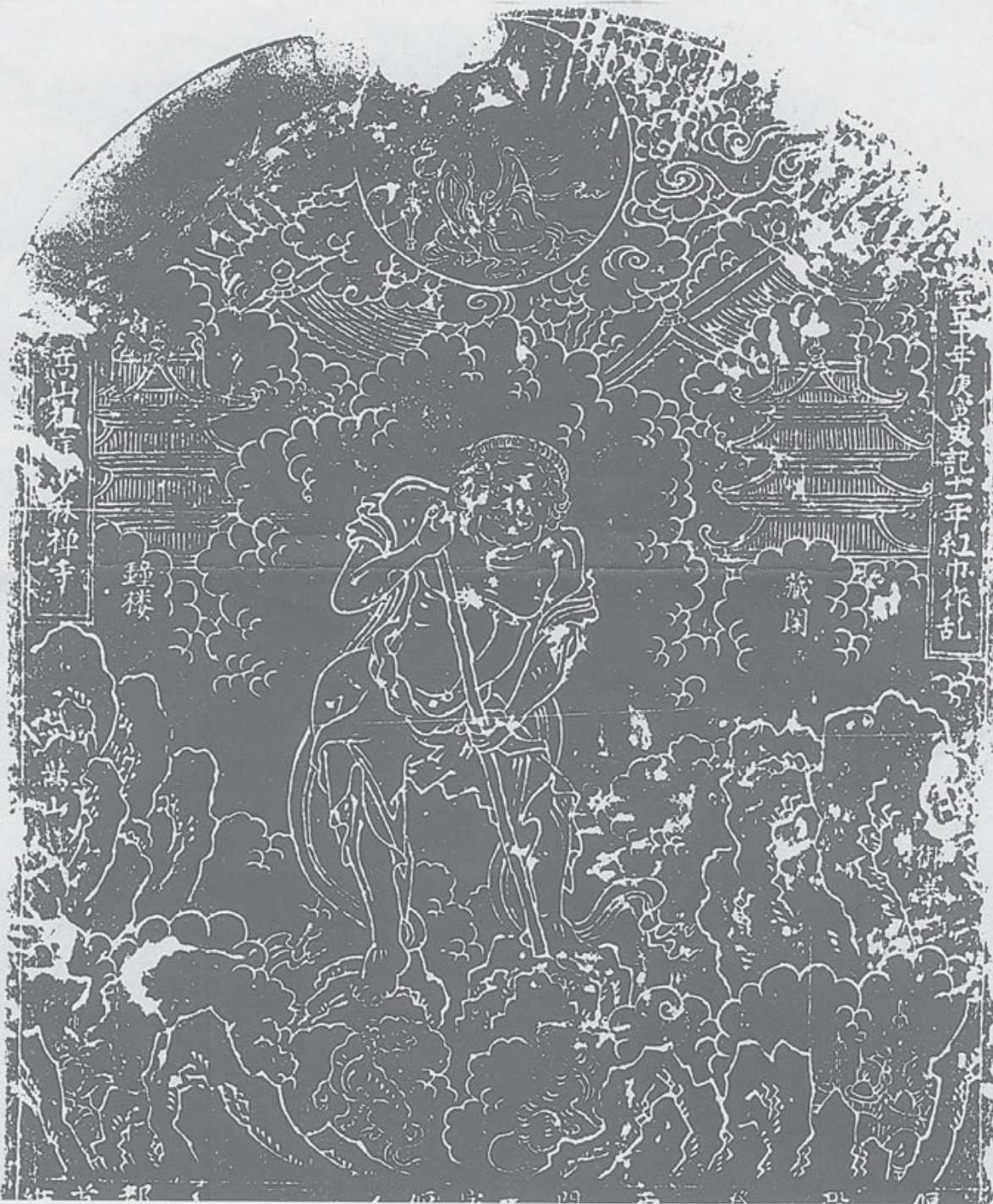
In addition, Sun Wukong and Vajrapani are associated with each other in Shaolin Monastery lore. The latter was historically worshiped as the progenitor of their famous staff method. A stele erected by Shaolin abbot Wenzai (ๆ–‡่ผ‰) in 1517 CE shows that the deityโ€™s vajra-club had been changed at some point to a Chinese staff (fig. 4) (Shahar, 2008, p. 84). Vajrapaniโ€™s yaksha-like Narayana (Naluoyan(tian), ้‚ฃ็พ…ๅปถ(ๅคฉ)) form was eventually equated with one of the four staff-wielding โ€œKimnara Kingsโ€ (Jinnaluo wang, ็ทŠ้‚ฃ็พ…็Ž‹) from the Lotus Sutra in 1575 CE. His name was thus changed from Narayana to Kimnara King (Shahar, 2008, p. 87). One version of the story about his creation of the staff method takes place during the Yuan Dynastyโ€˜sย Red Turban Rebellion (1351โ€“1368 CE). Bandits lay siege to the monastery, but it is saved by a lowly kitchen worker wielding a long fire pokerย as a makeshift staff. He leaps into the oven and emerges as a monstrous giant tall enough to straddle bothย Mount Songย and the imperial fort atop Mount Shaoshi, which are five miles (8.046 km) apart. The bandits flee when they behold this staff-wielding titan. The Shaolin monks later realize that the kitchen worker was none other than the Kimnara King in disguise (Shahar, 2008, pp. 87-88). Shahar (2008) suggests that mythical elements of the story were borrowed from the Monkey Kingโ€™s adventures. He compares the workerโ€™s transformation in the stove with Sunโ€™s time inย Laoziโ€™s Eight Trigrams furnaceย (Bagua lu,ย ๅ…ซๅฆ็ˆ), their use of the staff, and the fact that Monkey and his weapon can both grow to gigantic proportions (Shahar, 2008, p. 109). [3]

Therefore, given the above information, it’s not a stretch to have the two heroes meet in a fanfiction.

Fig. 4 โ€“ An ink rubbing of the 1517 CE Shaolin stele showing a titanic Vajrapani defending the monastery from rebels (larger version). From Shahar, 2008, p. 84.

2. The Main Story Idea

I’ve added in-text notes in this section to provide readers with extra context. This way, you won’t have to scroll to the endnotes at the bottom.

Buddhist tradition describes Tathagata visiting the devas to preach the dharma (Buswell & Lopez, 2014, p. 235). With the presence of Greeks in Central and South Asia, I imagine he would also visit the Olympian gods who had gained some influence in the region. (See the 03-28-26 update below for more info). These friendly interactions would lead Zeus to assign Heracles to guard the Enlightened One (fig. 5), thereby forming a link between the Greek and Buddhist pantheons (and explaining the aforementioned art). (See the 10-29-25 and 12-02-25 updates below for a detail from Greek myth that supports this idea.)

Here is where one of many changes to the standard 1592 CE JTTW story happens. In chapter six of the original, the bodhisattva Guanyin recommends that the demi-god Erlang battle the Monkey King after the latter had defeated many of heaven’s greatest warriors (Wu & Yu, 2012, vol. 1, p. 178). In our tale, she instead endorses the demi-god-turned-deity Heracles-Vajrapani (“HV” hereafter). [A]

A) The Son of Zeus became a full-blown god upon his death. After being exposed to a tunic soaked with poisonous hydra blood, Heracles sought release from the immense pain by jumping into a funeral pyre. But the flaming structure was shortly thereafter struck by lightning, signaling his rise to godhood (Romero-Gonzalez, 2021, pp. 273-276). This, of course, takes place hundreds of years before he becomes the protector of the Buddha.

Fig. 5 – A lovely digital painting of Heracles traveling with the Buddha (larger version). By Jacob King (deviantart). Used with permission. Image found here.

(I don’t consider myself a competent story writer, so please look at the following events and dialogue as conceptual in nature. I’m sure a seasoned writer could do the narrative more justice.)

Similar to the standard narrative, the monkey-soldiers of Wukong’s army notify him that heaven has sent another challenger. He emerges from his cave fully armored (refer to section 2.2. here) to see HV for the first time. Like the original, this might be followed by a poem describing the enemy; in this case, a large, muscular, bearded warrior wearing a lion skin and wielding a flaming vajra-club. (See the 02-19-26 update below for a visual.)

[Insert insults from both sides, including the Son of Zeus calling Monkey a “young rogue,” which naturally pisses him off. [B] HV also describes his godly heritage, which is alien to Monkey since he’s not familiar with the Greek pantheon.]

B) The Great Sage has a habit of claiming to be older than the various gods, immortals, spirits, and humans he meetsโ€”whether it’s true or not in the first three cases (Wu & Yu, 2012, vol. 1, p. 413, for example). This is exemplified by his self-given nickname “(Maternal/Paternal) Grandpa Sun” (Sun waigong, ๅญซๅค–ๅ…ฌ; Sun Yeye, ๅญซ็ˆบ็ˆบ). But within the story’s timeline, Heracles is indeed hundreds of years older. Writing around 430 BCE, the Greek historian Herodotus claimed that the Son of Zeus lived roughly 900 years before him, placing the demi-god’s life sometime around 1330 BCE. The Greek hero would, therefore, be active around 830 or more years prior to the birth of Wukong (c. 500 BCE).

The pair first take part in a battle of weapons, with Wukong wielding his magic staff and HV his vajra-club. The earth quakes, gods tremble, etc. HV’s powerful strikes push our hero back, causing his staff to painfully vibrate in his hands [C] and create a deafening ringing noise with each hit. Monkey would have a running internal monologue noting the great force of his opponent’s attacks. But despite this, the Great Sage continues driving forward, his weapon hardly leaving the area around HV’s head. [D] At one point, though, a glancing strike from the Greco-Buddhist hero redirects the staff, creating an opening. HV brings his vajra-club down hard on Monkey, but instead of dodging, the latter jerks his head upwards, butting away his opponent’s holy weapon with a loud, metallic bang. [E] The combined forces from the attack and defense might cause destruction to the surrounding area.

C) It may seem impossible for the staff to painfully vibrate in Wukong’s hands, but this indeed happens once in the novel. In JTTW chapter 20, he attempts to bludgeon a tiger-spirit, but when “the rod bounce[s] back up and his hands [a]re stung by the impact” (… ่ฝ‰้œ‡ๅพ—่‡ชๅทฑๆ‰‹็–ผ), he learns it was just a big stone covered with the fiend’s sloughed off skin (Wu & Yu, 2012, vol. 1, p. 403).

D) The phrase “hardly leaving the monster’s head” is respectively used in JTTW chapters 41 and 67 (here and here) to describe Wukong’s supreme mastery of the staff (Wu & Yu, 2012, vol. 2, p. 224; vol. 3, p. 249).

E) The feat of headbutting the weapon serves two purposes. First, it’s a response to this 2020 DEATH BATTLE! fanon wiki script that sees Hercules win by smashing the primate immortal’s head to a pulp with his club. (This attack carried over into the official episode, too.) The ending betrays the author’s extremely limited knowledge of JTTW. In the original, the Great Sage’s head is one of the hardest parts of his body, giving him the confidence to voluntarily take blows to the scalp from even magic, bladed weapons with no harm (Wu & Yu, 2012, vol. 1, pp. 314, 383-384, and 408; vol. 2, p. 128; vol. 3, pp. 125 and 373). And two, it highlights the correlation between the invulnerability of Monkey and the Nemean Lion, the first labor of Heracles (March, 2021). Regarding the ending of the fan script, one version of the original mythology sees the Son of Zeus break his olive club over the lion’s head because of how tough its hide is (March, 2021, p. 34).

The novel gives at least three reasons for the Great Sage’s invulnerability. After heaven fails to execute him with bladed weapons and fire and lightning in JTTW chapter 7, Laozi suggests that all of the immortal foodstuff previously consumed by our hero had been refined by his own samadhi fire (sanmei huo, ไธ‰ๆ˜ง็ซ), a spiritual flame in the lower abdomen, thus giving him a โ€œdiamond bodyโ€ (jingang zhi qu, ้‡‘้‹ผไน‹่ป€) (Wu & Yu, 2012, vol. 1, p. 188). Wukong himself later attributes his adamantine nature to his time in the high god’s furnace. In JTTW chapter 34, for example, he claims to have developed a heart of gold, viscera of silver, a head of bronze, and a back of iron, etc. (Wu & Yu, 2012, vol. 2, p. 131). This is refuted in JTTW chapter 75 when he claims to have been born with a head of bronze and iron that was further refined by the furnace (Wu & Yu, 2012, vol. 3, p. 374).

Stunned from the powerful blow, [F] Monkey stumbles around holding his head for a moment but raises his weapon in defense when he sees HV approaching. However, instead of attacking, the Greco-Buddhist warrior pauses combat by raising a hand in front of him. “What a skull!” he exclaims while clapping. “And no hint of blood! I reckon your hide is as tough as a monstrous beast I once fought. [G] Truly impressive! And your staff technique is masterful! Who trained you?”

F) This references how the Nemean Lion was blinded by pain after the blow (March, 2021, p. 34).

G) This reference is obvious.

“I have no teacher. [H] I alone trained my mind and body for three years.” [I]

H) This refers to Wukong’s promise to never reveal the Buddho-Daoist sage, Patriarch Subodhi, as his teacher under threat of karmic torture in the underworld (Wu & Yu, 2012, vol. 1, p. 125).

I) This is the length of time that he spends as an indoor disciple of Subodhi (Wu & Yu, 2012, vol. 1, p. 121).

“A prodigy!” exclaims HV. “But how good is your boxing and wrestling?”

“Ol’ Monkey can handle himself.”

“Let’s see if that’s true. How about we have a friendly sparring match, a test of heroic strength and skill? No weapons and no pesky magic tricks. Agreed?”

Wukong quickly agrees and inserts his shrunken staff into his ear before stripping off his armor from the waist up to match HV’s exposed muscles. HV somehow magically stores his holy vajra-club. The two then square up and launch forward, locking hands and pushing against the other, causing the ground beneath them to tremble and split.

“Extraordinary!” says HV. “How can such a small creature be so powerful?! [J] Were you born of the gods?

J) Many people often forget that Monkey’s normal form is less than 4-Chinese feet (121.92 cm) tall (see here).

“No, I was born from a stone egg.” (See the 02-28-26 update below for an interesting Greek parallel.)

“Oh, like the terrible stone titan and stone goddess! [K] No wonder you achieved this level of strength in such a short time. You have so much raw potential. Why cause trouble for such petty reasons?” [L]

K) These are Ullikumi and Agdistis, two powerful, rebellious, stone-born deities from Western myth (see sections 2.1 & 2.4 here). Referencing the former shows that HV is aware of the Near Eastern pantheon.

It’s interesting to note that lithic births are at least common enough in world myth to have earned a category in Stith Thompsonโ€™s Motif-Index of Folk-Literature: โ€œBirth from rockโ€ (T544.1).

L) This refers to Wukong’s rebellion over being given the lowest-ranking position in the Daoist heaven.

[Insert Wukong’s reply. They continue to converse during the battle.]

(This might be a good place to introduce some comedy. HV keeps referencing gods and monsters from other pantheons, making Monkey more and more frustrated:

“What the hell is wrong with you?! I … DON’T … KNOW … THESE … PEOPLE!!! [said in a slow, patronizing voice])

The Great Sage’s internal monologue comments on HV’s diamond grip and the great pressure of his punches. But our hero’s keen eyes notice openings in HV’s defense, allowing him to land blow after blow. However, with each successful attack comes praises from HV. Stinging rib shot. “Good, good!” Cutting elbow strike to the face. “Excellent!” Crushing body slam. “Amazing!”

“Why do you keep lauding me? I’m winning!”

“That would certainly be the case … if we were equals.”

“What do you mean?!”

Smiling, HV explains, “I’ve been testing you! [M] You found all of the openings I offered you, even some that I didn’t intend to because I was apparently too focused on judging your technique. [N] You are a talent the likes of which I’ve never seen before! Thank Father Zeus [or Buddha]! The student I’ve been looking for has finally appeared! Forsake this frivolous rebellion and return with me to the Western Paradise. I promise with my tutelage, you will become one of the greatest warriors of any pantheon!”

M) Perhaps HV decides to test the Great Sage when he sees how well the small primate responds to his opening strikes.

N) It just occurred to me that since the Subodhi appearing in this more realistic version of the story is the historical figure he’s based on, Subhuti, one of the Buddha’s ten principal disciples, the patriarch had to have trained under someone during Tathagata’s lifetime. And considering that HV was the Enlightened One’s bodyguard, perhaps Subhuti learned a little from the Greco-Buddhist heroโ€”apart from other deities, holy men, and warriors, including the Buddha, a member of the Kshatriya class. An interesting implication is that HV would recognize (his or an ally’s) techniques among Wukong’s armed and unarmed attacks or defenses, thereby alerting him that Monkey’s claim of having no master is false. Yet, he would still be supremely impressed that the Great Sage became such a powerful, competent fighter in just three short years.

Fun fact: according to Theocritus, Heracles learned boxing and wrestling from the grim-looking demi-god Harpalycus, son of Hermes (Pache, 2021, p. 10). Apollodorus instead claims his teacher was Autolycus (2.4.9), also a son of Hermes.

“I think you’re full of shit! Ol’ Monkey is whittling away at you, and you’re just trying to talk your way out of it.”

“Well, my offer stands,” HV replies calmly, “but now that I’ve had my fun, it’s time to finish this.”

“Finish what, you bastard?!” Wukong screams in anger. He then unleashes a tornado of powerful punches, kicks, and knee and elbow strikes. But this time they have no effect on the Son of Zeus because he’s no longer playing along.

I’m not quite sure what the next sequence of events would be since I have zero experience choreographing fight scenes, especially between celestial warriors. Perhaps HV displays his true power by running Monkey headfirst through the side of a mountain with an outstretched arm, similar to how the comic book character Omni-Man uses his son, Invincible, like a wedge to slice through an oncoming subway train [warning: gore]. This feat alone would surely cause the primate immortal to question how his opponent’s strength has seemingly increased exponentially. [O] (But upon reflection, this deed seems lacking considering that Wukong himself is shown capable of carrying two mountains while running with great speed. Hopefully someone can suggest a feat for HV that would amaze even the Great Sage.) (See the 02-20-26 update below for a new reason.)

O) This, of course, proves that HV was holding back. It’s important to note that in Buddhist literature, the original Vajrapani is considered the “physical manifestation of the … power … of all the Buddhas” (Buswell & Lopez, 2014, p. 955). Now imagine how much stronger HV would be than Monkey! Apart from his own godly heritage, I guess in my version of JTTW, HV would gain an unfathomable boost in power from serving as the protector and disciple of the Buddha, exposing him to the dharma for centuriesโ€”during Tathagata’s lifetime and afterlife following his parinirvana (figs. 6 & 7). This is similar to how the scorpion-demoness becomes so strong in JTTW chapter 55 (Wu & Yu, 2012, vol. 3, p. 72). But HV would be well beyond even her.

I guess the Great Sage would hold off on using magic up to this point as a matter of pride, but maybe his hand is forced when faced with such oppressive strength. Like in the original, he might resort to his magic hairs, summoning hundreds of tiny clones in the hopes of overwhelming the Son of Zeus. [P] However, the Greco-Buddhist warrior quickly neutralizes theseโ€”possibly by clapping his hands together and creating a shockwave that blows them away [Q] and destroys the surrounding areaโ€”pressuring our hero to take other measures. Maybe Monkey frantically cycles through one trick after another but ultimately fails to best his opponent. (See the 10-26-25 update below for a detail from Greek myth that supports this idea). (It would be fascinating to see how HV deals with Wukong’s three-headed, six-armed war formโ€”surely eliciting comparisons to Geryon.) [R]

To these breaches of their agreement, HV responds with something like, “Magic? You disappoint me.”

[Insert Monkey’s response.]

P) Monkey competes in hand-to-hand combat in JTTW chapters two and 51, and each time he resorts to hair clones when things get out of hand (Wu & Yu, 2012, vol. 1, pp. 128-129; vol. 3, pp. 12-13).

Q) The hair clones can indeed be blown away, as shown by the Yellow Wind Demon in JTTW chapter 21 (Wu & Yu, 2012, vol. 1, pp. 409-410).

R) Thank you to a beta reader of this article for reminding me about Geryon. He is sometimes described as having or depicted with three conjoined bodies, complete with three heads and six arms like Monkey (fig. 8) (Finglass, 2021).

Fig. 6 (Top) – A degraded stone carving depicting the parinirvana of the Buddha, Gandhara, 2nd to 3rd-century CE, Schist (larger version). HV is the first person from the left on the bottom row. He holds his vajra-club in one hand and upraises the other in lamentation. He has an exposed torso, showing off his muscles, in place of his signature lionskin. Housed in the British Museum.ย Adapted from an image found on Wikimedia Commons. Copyright Marie-Lan Nguyen. Fig. 7 (Bottom Left) – Detail of HV (larger version). Fig. 8 (Bottom Right) – Heracles vs Geryon, Attic black figure on Amphora vase, mid-6th century BCE (larger version). Housed in the Musรฉe du Louvre, Paris. ย This is an upscaled version of an image found here. Copyright www.theoi.com.

Ideally, given the parallels between Wukong and the Nemean lionโ€”both are fierce mythological animals, have invulnerable hides, can change shape, [S] and fight someone who is/was a demi-god (Erlang vs Heracles)โ€”I would like to see HV maneuver to Monkey’s back and get him in a chokehold, thereby mimicking how the big cat was originally defeated. [T] But instead of killing the Great Sage, he only intends to choke him to unconsciousness.ย [U] (Again, see the 10-26-25 update below). And to make matters worse, as the primate immortal fades towards blacking out, he by chance witnesses his beloved monkey army being routed and captured by celestial forces, like the standard version (Wu & Yu, 2012, vol. 1, p. 182). This causes him to lose heart and flee HV’s powerful arms by changing into an intangible ball of light or gust of wind. [V]

S) Matyszak (2015) states that the lion would sometimes take the form of kidnapped women (that it had presumably already eaten) in order to lure unsuspecting heroes into its cave (pp. 46-47). Dr. Matyszak tells me that “it’s not part of the core myth” but “later Roman and Byzantine authors do mention it” (personal communication, October 17, 2025).

T) I really like the ending of Theocritus’ description of the fight:

[After hitting him over the head with a club,] I threw my bow and stitched quiver to the ground, and before he could recover and turn on me again, I grabbed him by the scruff of his powerful neck. Gripping him firmly, I strangled him with my strong hands, tackling him from behind to stop him scratching me with his claws. Standing on his hind paws, I pressed them hard to the ground with my heels and controlled his flanks with my thighs, until I could lift him up lifeless in my arms and lay him out. And mighty Hades took his spirit (March, 2021, p. 34).

U) Someone might claim that it would be impossible to choke out Monkey since he’s a spiritual being, but it’s important to remember that the novel humanizes supernatural figures in order to make them more relatable. For instance, in JTTW chapter 65, Wukong claims that he will die from the lack of air inside of a sealed Buddhist treasure-weapon if he isnโ€™t soon released (Wu & Yu, 2012, vol. 3, p. 217). And he reiterates this near-death experience to Zhu after escaping a few pages later (Wu & Yu, 2012, vol. 3, p. 224). Having read that, I think a blood choke would be more dignified and less dangerous method for subduing our hero.

V) Wukong escapes in the form of a ball of light in JTTW chapters 34 and 42 (Wu & Yu, 2012, vol. 2, pp. 126 and 241). And he turns into a gust of wind to follow a foe in JTTW chapter 60 (Wu & Yu, 2012, vol. 3, p. 140). This could easily be used to escape as well.

A beta reader suggested that I work Erlang and his sworn brothers back into the story. They could track down and capture Monkey. But however the situation is resolved, this would lead to the events of the original story: the Great Sage’s failed execution, his sentence to Laozi’s furnace, his escape and wager with Buddha, his imprisonment beneath Five Elements Mountain, and his eventual release to go on the journey. And since Wukong comes into contact with Erlang once more and the Vajra warriors several times in the standard version, [W] he would likely meet HV again during the pilgrimage. The Son of Zeus might even comment on his positive change in character as Tripitaka’s disciple and protector.

W) The Great Sage meets Erlang again in chapter 63 (Wu & Yu, 2012, vol. 3, pp. 187-191). Regarding Vajra warriors, refer back to section 1.2.

Two beta readers were disappointed by the ending because they didn’t think HV could defeat the Great Sage. As a longtime uberfan of Monkey myself, I understand that sentiment, but they should remember that this is not just the Heracles of Greco-Roman myth, who’s immensely powerful in his own right, able to support the sky on his shoulders in one myth (Salapata, 2021, p. 152). He’s an amalgam of the Greek hero and the Buddha’s protector. Recall that Vajrapani is considered the embodiment of all the Tathagatas’ power (refer back to note O). And If the dharma of one Buddha can easily defeat Monkey (Wu & Yu, 2012, vol. 1, pp. 195 and 199), a being endowed with the power of ALL of them should have no problem subduing our favorite primate immortal.

I feel like this idea has so much potential, but I lack the experience or talent to do it justice here. Hopefully, readers will see through the lackluster description to understand the promise of greatness that it holds. Please let me know if anyone is interested in fleshing out this tale.

Lastly, while finishing this section, I came upon a fun coincidence: ancient Greco-Buddhist stone carvings with HV, the Buddha, and … a monkey (figs. 9 & 10)! They depict “The Monkey Offering Honey (to the Buddha)” (Ch: Mihou xianmi, ็ผ็Œด็ป่œœ; Mihou fengmi, ็ผ็Œดๅฅ‰่œœ), a tale from the Tathagata’s lifetime where a primate selflessly offered him honey but shortly thereafter fell and died via drowning or impalement. Thankfully, though, the primate was reborn into the deva realm (Van der Geer, 2022, pp. 439-440). [W] The carvings depict HV watching over the Enlightened One during this event.

Perhaps, based on these images, HV tells Wukong at some point during their confrontation that he reminds him of someone from the past. (Fanfic theory: could the Great Sage be a reincarnation?)

W) The historical Xuanzang mentions a version of this story where the primate is later reborn as a human (Li, 1996/2017, p. 106). He adds that the area where the offering originally happened hosts images of monkeys (mihou xingxiang, ็ผ็Œดๅฝขๅƒ) next to a water tank or pond supposedly dug by a group of them for the Enlightened One (Li, 1996/2017, p. 184). [4]

Fig. 9 (Left) – Detail of a stone doorway fragment with two stacked carvings illustrating “The Monkey Offering Honey (to the Buddha)” story, Gandhara, 1st to 3rd-century CE, Schist (larger version). The upper scene portrays the primate asking for a bowl, while the lower depicts the offering of honey. HV is present in both: first from the left on the top and first from the right on the bottom. He lacks his beard and lionskin but wields his signature weapon. The extra person photobombing the lower scene may be Ananda. Fig. 10 (Right) – The full stone doorway fragment portraying various events from the Tathagata’s life (larger version). Housed in the Guimet Museum, Paris, France. Adapted from an image found on Wikimedia Commons. Copyright Marie-Lan Nguyen.ย 

3. An Idea for a Sequel

A continuation of the story would open where the original leaves off: after the scripture-pilgrims are elevated in spiritual rank, Tathagata charges HV with escorting the Victorious Fighting Buddha (i.e. Sun Wukong; fig. 11) through the Greek world-system. Imagine the kind of adventures Monkey would have as a Buddha interacting with Classical gods and monsters! It would definitely be a great way of introducing East Asian people to the wonders of Greek myth.

I really like the idea of HV visiting his old pantheon as his vajra is analogous to Zeusโ€™ thunderbolt. Seeing a father-son lightning competition would be great!

Also, as I’ve discussed elsewhere, Wukong and Poseidon could bond over their shared love of horses.

Fig. 11 – Wukong as the Victorious Fighting Buddha (larger version). Imagery based on the iconography of the historical Yuddhajaya Buddha. Art by NingadudeXx.

3.1. Commissioned Art

I have commissioned some illustrators to draw Monkey in ancient Greek style as an experiment to see what he might look like through the lens of Hellenistic artisans.

Fig. 12 – The Victorious Fighting Buddha (larger version). Pencil, fineliners, and alcohol markers on paper. Art by tr0chanter (Instagram and Twitter).

Fig. 13 – Heracles vs Monkey (larger version). Pencil and markers on paper. Art by Dario Virga (Onibotokemaruย on Instagram), a friend of the blog. Each character is labeled with their name in Greek. Heracles is “แผฉฯฮฑฮบฮปแฟ†ฯ‚,” while the Great Sage is “Pithekos” (ฯ€แฟฬฮธฮทฮบฮฟฯ‚), meaning “ape, monkey, trickster, or dwarf.” Wukong’s Greek name is very fitting. It’s also part of the modern scientific name for Old world monkeys (Cercopithecoidea).

Fig. 14 – Heracles vs Sun Wukong (larger version). Digital. Art by Jacob King (Twitter, Instagram, Tumblr). I love the cracks.

4. Possible Fanfiction

I can already predict fanfiction set in an alternate timeline where Monkey accepts HV’s offer to become his teacher. The Son of Zeus would spend time instructing Wukong on advanced techniques of boxing, wrestling, and weapons. This, of course, would be taught in tandem with spiritual cultivation. The training might be in preparation for a fighting tournament between the disciples of gods from all pantheons, kind of like Record of Ragnarok (Jp: Shลซmatsu no Warukyลซre, ็ต‚ๆœซใฎใƒฏใƒซใ‚ญใƒฅใƒผใƒฌ; lit. “Doomsday Valkyrie”; fig. 15). The contestants could be fighting for permission to start their own pantheon, thereby becoming a “Sky Father” (Sk: Dyaus-pitr, เคฆเฅเคฏเฅŒเคทเฅเคชเคฟเคคเฅƒ; Ch: Tianshang fuqin, ๅคฉไธŠ็ˆถ่ฆช). Maybe the long-established Sky Fathers share some of their divine spark to kickstart the new world-system.

I REALLY like this idea, but it wouldn’t work for my own purposes since, as stated above, Wukong would still need to go on the journey.

Perhaps the prize could be the chance to help mankind since one of the reasons that Tripitaka is asked to quest for sutras is because they will help free untold numbers of orphaned souls from the torments of hell (see JTTW chapters 11 and 12). Therefore, the tournament would essentially be a contest to see who will be the Tang Monk’s protector. I don’t really like this idea, but it at least supports the original narrative. The Great Sage would win, of course, but he has to agree to have his extraordinary powers (and memories of the tournament) sealed as a test of his resolve or devotion. And his subsequent enlightenment would be the reward for his great deeds performed on the journey.

Fig. 15 – Promotional art for Record of Ragnarok (larger version). Image found here.


5. Updates

Update: 10-11-25

I’ve seen people claim online that Sun Wukong would easily defeat Heracles because the latter’s feats are not as grand as the former. To this, I counter that the deeds of both heroes shouldn’t be compared, for they serve difference purposes. I don’t know of any feats of speed for Heracles, but Monkey’s famous ability to fly 108,000 li (33,554 mi / 54,000 km) in a single cloud somersault is an allegory for instant enlightenment (as explained in section III here). [5] And his feat of carrying two Buddhist mountains on his shoulders is likely an allegory for the Great Sage “supporting” the religion by protecting his master on the quest for sutras (as I suggest here). The deeds of Heracles, however, were probably meant as actual displays of brute strength. For instance, ancient Greek men on lion hunts may have drawn inspiration and courage from the demi-god’s defeat of the Nemean Lion. [6]


Update: 10-26-25

Above, I wrote that “[m]aybe Monkey frantically cycles through one trick after another” in a failed bid to win, and I later added, “I would like to see HV maneuver to Monkey’s back and get him in a chokehold.” Well, I’m happy to report that I’ve found a mythic way to combine these. The Bibliothecaย of Pseudo-Apollodorus describes Heracles’s grip tiring out a shape-shifting sea god:

And going on foot through Illyria and hastening to the river Eridanus he came to the nymphs, the daughters of Zeus and Themis. They revealed Nereus to him, and Hercules seized him while he slept, and though the god turned himself into all kinds of shapes, the hero bound him [with his arms (fig. 16)] and did not release him till he had learned from him where were the apples and the Hesperides (2.5.11).

Matyszak (2015) calls this binding a “Herculean head-lock” (p. 150). Therefore, in our story, Wukong cycles through all manner of transformations but can’t break free from HV’s grip! Then he loses heart and flees when he sees his children captured (as mentioned previously).

Fig. 16 – Heracles wrestling Nereus/Triton (larger version). From an 1894 drawing of a circa 550 BCE Attic Black-figure Kylix. Image found on Wikimedia Commons. For the original, see here.


Update: 10-29-25

I’ve also found a mythic reason for why Heracles would be sent away from Olympus to protect Buddha. Matyszak (2015) explains that the Son of Zeus didn’t want to become an official member of the Twelve Olympians because this would have forced someone out of the group:

Some felt that the mighty deeds of Hercules entitled him to the status of a full Olympian God. However, the number of Olympians was limited to the sacred number of twelve, and in a rare moment of diplomacy Hercules declined to take an honour that would have first to be stripped from someone else. (Dionysus, the God of Wine was less bashful. He bumped Hestia, Goddess of the Home, off the Olympian high table when his time came to be made divine.) (p. 200)

So instead of taking an Olympian’s spot, Heracles decides to accept a position within the Buddhist pantheon as the Tathagata’s protector.


Update: 12-02-25

I have found the specific passage alluded to by Matyszak (2015) in the previous update. In book four of his Library of History (c. 60 to 30 BCE), Diodorus Siculus writes:

[4.39.4] They report of Heracles further that Zeus enrolled him among the twelve gods but that he would not accept this honour; for it was impossible for him thus to be enrolled unless one of the twelve gods were first cast out; hence in his eyes it would be monstrous for him to accept an honour which involved depriving another god of his honour (source).


Update: 02-19-26

In March 2023, Twitter user @LinJKai posted a lovely 18 x 24-inch (45.72 x 60.96 cm) digital painting titled “Hercules as Vajrapani” (fig. 17). It depicts HV, the 12 labors, and various Greek gods in Tibetan thangka style. I adore this so much! I’d love to commission a physical copy.

Fig. 17 – @LinJKai’s painting of HV (larger version).


Update: 02-20-26

I originally couldn’t think of a feat of strength for HV that would outdo Monkey, but something has come to mind. In JTTW chapter 33, a demon uses the “Magic of Moving Mountains and Pouring Out Oceans” (Yishan daohai fashu, ็งปๅฑฑๅ€’ๆตทๆณ•่ก“) to drop two holy landmasses on Monkey in the hope of incapacitating him. This does nothing to slow him down, though, so the fiend drops a third peak. But since the last ridge, Mount Tai (Taishan, ๆณฐๅฑฑ), is considered the heaviest concept in Chinese philosophy, it instantly overpowers the Great Sage’s strength and pins him to the earth (see this article).

Now, imagine that Wukong uses the same magic to call up a column of mountains, perhaps capped with Mt. Tai, overhead (fig. 18), but not even this is enough to stop the Buddha’s protector. The Greco-Buddhist hero would continue to fight as if nothing is pressing down on him. This would surely frighten Monkey.

I like this because the Great Sage’s defeat in chapter 33 would thus be a call back to the punishment that he tried and failed to dish out during his fight with HV.

Fig. 18 – Imagine that the column of mountains above HV’s head looks something like this pile of stones (larger version). Image found here.


Update: 02-25-26

While writing the original article, I feared that I mischaracterized Heracles as being jovial with Wukong in what should have been a tense situation. However, I’ve found info that supports this. Galinsky (1972) explains:

Being close to the people as he was, Hesiod also portrayed Herakles as the folksy, jolly good fellow. The few fragments that have been preserved of the Wedding of Ceyx give us some indication of this. One of the main subjects of the poem was the wedding-feast of Ceyx and Alcyone at which Herakles intervened. He crashed the party, justifying himself with jovial magnificence: ‘Of their own accord good men betake themselves to good men’s feasts.’ This phrase became so proverbial that it was quoted, among others, by Plato in the Symposium. The remark shows that Hesiod attributed to Herakles the quality, which he undoubtedly found in the folktales, of taking himself lightly, and it kept our hero from becoming too lofty and untouchable. Much of the rest of the poem seems to have been concerned with Herakles’ prodigious appetite, a theme on which the comic poets were to seize with so much glee. Having stilled his hunger, Herakles entertained the party by proposing several riddles (p. 16-17).


Update: 02-28-26

Regarding the original DEATH BATTLE! episode, it’s interesting to note that Heracles has previously fought and killed a monstrous opponent born from an egg, just like Sun Wukong. Ibycus (6th century BCE) records the Greek hero saying: “I slew the white-horsed lads, the children of Molione, of the same age, equal-headed, single-bodied, both born in a silver egg” (Bowra, 1961, p. 245).


Update: 03-28-26

Above, I wrote, “With the presence of Greeks in Central and South Asia, I imagine he [Buddha] would also visit the Olympian gods who had gained some influence in the region.” Well, I’ve thought of a way to connect the structures of the mythic Greek and JTTW universes:

I’ve previously discussed how the novel is set in the Buddhist disc-world systemโ€”i.e. a flat earth (see below). It’s interesting to note that the archaic Greeks also believed in a flat earth. The wonderful Routledge Handbook of Greek Mythologyย explains:

As viewed from their perspective, as people who lived on the edge of a land mass, it might naturally have appeared to take the form of a circular disc, more or less level except were hills or mountains rose up from it, capped by the immense roof or dome of the sky. On the one side the sun and stars could be seen rising above the horizon, while on the other they disappeared at their setting; and since they always rose on the same side, in the east, they must presumably have made their way back again, either under the ground or by some other hidden route. It was imagined that the outermost boundary of this disc of the earth was formed by the stream of Ocean (Oceanos), which was not an ocean in the modern sense but a great river flowing in a circle around the edges of the earth. The sky was envisioned as a substantial roof or, later, dome sometimes said to be made of bronze or iron, which rose to a considerable, though not immeasurable, height above the earth. Zeus and the higher gods could be imagined as residing in the sky itself, or else on the summit of Mt Olympos in north-eastern Greece, hence their familiar name of Olympian gods. If one could pile three large mountains one above another, as the gigantic Aloadai set out to do when they revolted against the gods …, it would be sufficient to form a ladder to heaven (Hard, 2020, p. 17).

Heracles has a few connections to Ocean. [7]

Now, imagine that the purview of the Olympian gods and the borders of their disc-world (fig. 19) expand as Greeks traveling eastward bring their faith with them to Central and South Asia. This would allow the Greek cosmos to eventually overlap with the Buddhist realm (fig. 20). (The reverse would be true for westward-traveling Buddhists.) The result would look sort of like a Venn diagram, with the double-pointed oval in the middle indicating where the two realms intersect on our Earth.

Fig. 19 (Left) – A reconstruction of the Greek world based on the writings of Homer (larger version). The landmass is surrounded by the god Ocean. From Atlas of Ancient & Classical Geography (1928, plate 1). Fig. 20 (Right) – A diagram of the Buddhist cosmos (larger version). Mt. Sumeru is flanked by a continent and two islands on each of its four sides. The land is also surrounded by water; in this case, four great oceans. Adapted from Buswell & Lopez (2014, p. xxxii).

I should point out that JTTW changes the traditional structure of the Buddhist cosmos by placing China in the Southern Continent and moving India to the Western Continent (refer back to this article). Therefore, the western portion of the expanding Greek cosmos would more easily line up with the Buddhist cosmos.

Notes:

1) Translation changed slightly. Although the English reads “a hundred yards,” the original Chinese says “100 zhang” (bai zhang, ็™พไธˆ).ย One zhang is ten Chinese feet, or roughly 10.43 ft (3.18 m) (Jiang, 2005, p. xxxi). Therefore, 100 zhang would be 1,043 ft (314 m).

2) Yu (Wu & Yu, 2012) translates jingang (้‡‘ๅ‰›) as “Diamond Guardians” (vol. 3, p. 24, for example). I’m changing it to just Vajra since the term can mean both “lightning” and “diamond.” I don’t want to confuse anyone.

3) Yes, this information comes from Wikipedia, but Iโ€™m the one who originally added it under the screenname โ€œGhostexorcist.โ€ See this edit history, for example.

4) The English translation just says “tank” (Li, 1996/2017, p. 184), but the original Chinese word chi (ๆฑ ) can also mean “pond.”

5) Theย liย (้‡Œ) is a Chinese measurement of distance. English works usually translate it as “mile.” However, it equals roughly 1/3rd of a mile or 1/2 of a kilometer.

6) Herodotus mentions mountain lions attacking the caravan camels of Xerxes on his route through Greeceย (The Histories, 7.125126). If such thing routinely happened to local travelers, this would have affected regular lion hunts. And this 16th-century BCE Minoan blade suggests that lion hunts go back centuries.

7) Heracles uses the Sun-God‘s goblet in order to sail Ocean to the destination of his tenth labor (Library, 2.5.10). However, according to Pherecydes, “Ocean, to make trial of him, caused the goblet to heave wildly on the waves. Herakles was about to shoot him with an arrow; and the Ocean was afraid, and bade him give over” (Library, 2.5.10, n. 7).

Also, the extent of his tenth labor set the limit for human travel:

[S]ince the Pillars or Columns of Heraclesโ€”the name usually associated with the twin rocks standing astride the Straits of Gibraltarโ€”afforded the only known connection between the familiar Mediterranean and alien Ocean, they became a vivid symbol of the gateway or barrier between inner and outer worlds. For the most part they stood in the Greek imagination as a forbidding non plus ultra, a warning to mariners not to proceed any further. Pindar, for example, adopts this landmark as a paradigm of the limits to human daring, in his celebrations of victorious athletes:

Now Theron, approaching the outer limit in his feats of strength, touches the Pillars of Heracles. What lies beyond cannot be approached by wise men or unwise. I shall not try, or I would be a fool. (Ol. 3.4โ€“5)

As a man of beauty, who accomplishes feats beautiful as himself, the son of Aristophanes may set forth on supreme, manly endeavors; but not easily across the untrodden sea, beyond the Pillars of Heracles, which that hero-god set in place, as a famed witness of the furthest limit of seafaring. (Nem. 3.20โ€“23)

By the uttermost deeds of strength did these men touch the Pillars of Heracles, an achievement all their own; let none pursue valor any farther than that. (Isthm. 4.11โ€“14)

In these passages Pindar measures the prowess of his athlete patrons in geographic terms, seeing their victories as journeys into distant space; but these journeys must end, he insists, before they enter the forbidden realm of Ocean. The Pillars have here come to stand for the boundary of the human condition itself: To pass beyond them is the prerogative of god alone, or of mythic figures like Heracles who manage to bridge the human and divine (Romm, 1992, pp. 17-18).

Sources:

Atlas of Ancient & Classical Geography. (1928). London & Toronto: J.M Dent & Sons, LTD.; New York: E. P. Dutton & Co.

Bowra,ย C.ย M.ย (1961).ย Greek Lyric Poetry from Alcman to Simonides.ย United Kingdom:ย Clarendon Press.

Buswell, R. E., & Lopez, D. S. (2014). The Princeton Dictionary of Buddhism. Princeton, NJ: Princeton University Press.

Finglass, P. J. (2021). LABOR X: The Cattle of Geryon and the Return from Tartessus. In D. Ogden (Ed.), The Oxford Handbook of Heracles (pp. 135-148). United Kingdom: Oxford University Press.

Galinsky, K. (1972). The Herakles Theme: The Adaptations of the Hero in Literature from Homer to the Twentieth Century. New Jersey: Rowman and Littlefield Publishers.

Hard, R. (2020). The Routledge Handbook of Greek Mythology (8th ed.). London & New York: Taylor & Francis.

Jiang, Y. (2005).ย The Great Ming Code / Da Ming Lu. Vancouver, Wa: University of Washington Press.

Li, R. (Trans.) (2017). The Great Tang Dynasty Record of the Western Regions. Berkeley, CA: Numata Center for Buddhist Translation and Research. (Original work published 1996) Retrieved from https://www.bdkamerica.org/product/the-great-tang-dynasty-record-of-the-western-regions/

March, J. (2021). LABOR I: The Nemean Lion. In D. Ogden (Ed.), The Oxford Handbook of Heracles (pp. 29-44). United Kingdom: Oxford University Press.

Matyszak, P. (2015).ย Hercules: The First Superhero (An Unauthorized Biography). Canada: Monashee Mountain Publishing.

Pache, C. (2021). Birth and Childhood. In D. Ogden (Ed.),ย The Oxford Handbook of Heraclesย (pp. 3-12). United Kingdom: Oxford University Press.

Romero-Gonzalez, D. (2021). Deianeira, Death, and Apotheosis. In D. Ogden (Ed.),ย The Oxford Handbook of Heraclesย (pp. 266-280). United Kingdom: Oxford University Press.

Romm, J. S. (1992). The Edges of the Earth in Ancient Thought: Geography, Exploration, and Fiction. Princeton University Press.

Salapata, G. (2021). LABOR XI: The Apples of Hesperides. In D. Ogden (Ed.), The Oxford Handbook of Heraclesย (pp. 149-164). United Kingdom: Oxford University Press.

Shahar, M. (2008).ย The Shaolin Monastery: History, Religion, and the Chinese Martial Arts. Honolulu: University of Hawaiโ€™i Press.

Van der Geer, A. A. E. (2022). The Great Monkey King: Carvings of Primates in Indian Religious Architecture (pp. 431-455). In B. Urbani, D. Youlatos, & A. Antczak (Eds.), World Archaeoprimatology: Interconnections of Humans and Nonhuman Primates in the Past. United Kingdom: Cambridge University Press.

Wivell, C.S. (1994).ย The Story of How the Monk Tripitaka of the Great Country of Tโ€™ang Brought Back the Sลซtras. In V. Mair (Ed.),ย The Columbia Anthology of Traditional Chinese Literatureย (pp. 1181-1207). New York: Columbia University Press.

Wu, C., & Yu, A. C. (2012).ย The Journey to the Westย (Vols. 1-4) (Rev. ed.). Chicago, Illinois: University of Chicago Press.

Archive #36 – Sun Wukong and Battles of Magical Transformations

Last updated: 04-10-2022

One of the most famous episodes from Journey to the West (Xiyouji, ่ฅฟ้Š่จ˜, 1592) happens in chapter six when heaven sends Erlang to confrontย Sun Wukong during his rebellion. After a prolonged, indecisive battle between the two immortals in their respective humanoid and cosmic giant forms, Monkey loses heart when his children are captured, causing him to flee. He tries to hide in the guise of a sparrow but is soon spotted by Erlang. This leads to an epic battle of magical transformations (video 1):

… Erlang at once discovered that the Great Sage had changed into a small sparrow perched on a tree. He changed out of his magic form and took off his pellet bow. With a shake of his body, he changed into a sparrow hawk with outstretched wings, ready to attack its prey. When the Great Sage saw this, he darted up with a flutter of his wings; changing himself into a cormorant, he headed straight for the open sky. When Erlang saw this, he quickly shook his feathers and changed into a huge ocean crane, which could penetrate the clouds to strike with its bill. The Great Sage therefore lowered his direction, changed into a small fish, and dove into a stream with a splash. Erlang rushed to the edge of the water but could see no trace of him. He thought to himself, “This simian must have gone into the water and changed himself into a fish, a shrimp, or the like. I’ll change again to catch him.” He duly changed into a fish hawk and skimmed downstream over the waves. After a while, the fish into which the Great Sage had changed was swimming along with the current. Suddenly he saw a bird that looked like a green kite though its feathers were not entirely green, like an egret though it had small feathers, and like an old crane though its feet were not red. “That must be the transformed Erlang waiting for me,” he thought to himself. He swiftly turned around and swam away after releasing a few bubbles. When Erlang saw this, he said, “The fish that released the bubbles looks like a carp though its tail is not red, like a perch though there are no patterns on its scales, like a snake fish though there are no stars on its head, like a bream though its gills have no bristles. Why does it move away the moment it sees me? It must be the transformed monkey himself!” He swooped toward the fish and snapped at it with his beak. The Great Sage shot out of the water and changed at once into a water snake; he swam toward shore and wriggled into the grass along the bank. When Erlang saw that he had snapped in vain and that a snake had darted away in the water with a splash, he knew that the Great Sage had changed again. Turning around quickly, he changed into a scarlet-topped gray crane, which extended its heel like sharp iron pincers to devour the snake. With a bounce, the snake changed again into a spotted bustard standing by itself rather stupidly amid the water pepper along the bank. When Erlang saw that the monkey had changed into such a vulgar creatureโ€”for the spotted bustard is the basest and most promiscuous of birds, mating indiscriminately with phoenixes, hawks, or crows-he refused to approach him. Changing back into his true form, he went and stretched his bow to the fullest. With one pellet he sent the bird hurtling (Wu & Yu, 2012, vol. 1, pp. 182-183).

ไบŒ้ƒŽๅœ“็œ้ณณ็›ฎ่ง€็œ‹๏ผŒ่ฆ‹ๅคง่–่ฎŠไบ†้บป้›€ๅ…’๏ผŒ้‡˜ๅœจๆจนไธŠใ€‚ๅฐฑๆ”ถไบ†ๆณ•่ฑก๏ผŒๆ’‡ไบ†็ฅž้‹’๏ผŒๅธไธ‹ๅฝˆๅผ“ใ€‚ๆ–่บซไธ€่ฎŠ๏ผŒ่ฎŠไฝœๅ€‹้ท‚้ทนๅ…’๏ผŒๆŠ–้–‹็ฟ…๏ผŒ้ฃ›ๅฐ‡ๅŽปๆ’ฒๆ‰“ใ€‚ๅคง่–่ฆ‹ไบ†๏ผŒ้ขผ็š„ไธ€็ฟ…้ฃ›่ตทๅŽป๏ผŒ่ฎŠไฝœไธ€ๅชๅคง้ถฟ่€๏ผŒๆฒ–ๅคฉ่€ŒๅŽปใ€‚ไบŒ้ƒŽ่ฆ‹ไบ†๏ผŒๆ€ฅๆŠ–็ฟŽๆฏ›๏ผŒๆ–่บซไธ€่ฎŠ๏ผŒ่ฎŠไฝœไธ€้šปๅคงๆตท้ถด๏ผŒ้‘ฝไธŠ้›ฒ้œ„ไพ†ๅ—›ใ€‚ๅคง่–ๅˆๅฐ‡่บซๆŒ‰ไธ‹๏ผŒๅ…ฅๆพ—ไธญ๏ผŒ่ฎŠไฝœไธ€ๅ€‹้ญšๅ…’๏ผŒๆทฌๅ…ฅๆฐดๅ…งใ€‚ไบŒ้ƒŽ่ถ•่‡ณๆพ—้‚Š๏ผŒไธ่ฆ‹่นค่ทกใ€‚ๅฟƒไธญๆš—ๆƒณ้“๏ผšใ€Œ้€™็Œข็Œปๅฟ…็„ถไธ‹ๆฐดๅŽปไนŸ๏ผŒๅฎš่ฎŠไฝœ้ญš่ฆไน‹้กžใ€‚็ญ‰ๆˆ‘ๅ†่ฎŠ่ฎŠๆ‹ฟไป–ใ€‚ใ€ๆžœไธ€่ฎŠ๏ผŒ่ฎŠไฝœๅ€‹้ญš้ทนๅ…’๏ผŒ้ฃ„่•ฉๅœจไธ‹ๆบœ้ ญๆณข้ขไธŠ๏ผŒ็ญ‰ๅพ…็‰‡ๆ™‚ใ€‚้‚ฃๅคง่–่ฎŠ้ญšๅ…’๏ผŒ้ †ๆฐดๆญฃๆธธ๏ผŒๅฟฝ่ฆ‹ไธ€้šป้ฃ›็ฆฝ๏ผšไผผ้’้ท‚๏ผŒๆฏ›็‰‡ไธ้’๏ผ›ไผผ้ทบ้ทฅ๏ผŒ้ ‚ไธŠ็„ก็บ“๏ผ›ไผผ่€้ธ›๏ผŒ่…ฟๅˆไธ็ด…๏ผšใ€Œๆƒณๆ˜ฏไบŒ้ƒŽ่ฎŠๅŒ–ไบ†็ญ‰ๆˆ‘ๅ“ฉ๏ผใ€ๆ€ฅ่ฝ‰้ ญ๏ผŒๆ‰“ๅ€‹่Šฑๅฐฑ่ตฐใ€‚ไบŒ้ƒŽ็œ‹่ฆ‹้“๏ผšใ€Œๆ‰“่Šฑ็š„้ญšๅ…’๏ผšไผผ้ฏ‰้ญš๏ผŒๅฐพๅทดไธ็ด…๏ผ›ไผผ้ฑ–้ญš๏ผŒ่Šฑ้ฑ—ไธ่ฆ‹๏ผ›ไผผ้ป‘้ญš๏ผŒ้ ญไธŠ็„กๆ˜Ÿ๏ผ›ไผผ้ญด้ญš๏ผŒ้ฐ“ไธŠ็„ก้‡ใ€‚ไป–ๆ€Ž้บผ่ฆ‹ไบ†ๆˆ‘ๅฐฑๅ›žๅŽปไบ†๏ผŸๅฟ…็„ถๆ˜ฏ้‚ฃ็Œด่ฎŠ็š„ใ€‚ใ€่ถ•ไธŠไพ†๏ผŒๅˆท็š„ๅ•„ไธ€ๅ˜ดใ€‚้‚ฃๅคง่–ๅฐฑๆ”›ๅ‡บๆฐดไธญ๏ผŒไธ€่ฎŠ๏ผŒ่ฎŠไฝœไธ€ๆขๆฐด่›‡๏ผŒๆธธ่ฟ‘ๅฒธ๏ผŒ้‘ฝๅ…ฅ่‰ไธญใ€‚ไบŒ้ƒŽๅ› ๅ—›ไป–ไธ่‘—๏ผŒไป–่ฆ‹ๆฐด้Ÿฟไธญ๏ผŒ่ฆ‹ไธ€ๆข่›‡ๆ”›ๅ‡บๅŽป๏ผŒ่ชๅพ—ๆ˜ฏๅคง่–ใ€‚ๆ€ฅ่ฝ‰่บซ๏ผŒๅˆ่ฎŠไบ†ไธ€้šปๆœฑ็นก้ ‚็š„็ฐ้ถด๏ผŒไผธ่‘—ไธ€ๅ€‹้•ทๅ˜ด๏ผŒ่ˆ‡ไธ€ๆŠŠๅฐ–้ ญ้ต้‰—ๅญ็›ธไผผ๏ผŒๅพ‘ไพ†ๅƒ้€™ๆฐด่›‡ใ€‚ๆฐด่›‡่ทณไธ€่ทณ๏ผŒๅˆ่ฎŠๅšไธ€้šป่Šฑ้ด‡๏ผŒๆœจๆœจๆจ—ๆจ—็š„๏ผŒ็ซ‹ๅœจ่“ผๆฑ€ไน‹ไธŠใ€‚ไบŒ้ƒŽ่ฆ‹ไป–่ฎŠๅพ—ไฝŽ่ณค๏ผŒ๏ผˆ่Šฑ้ด‡ไนƒ้ณฅไธญ่‡ณ่ณค่‡ณๆทซไน‹็‰ฉ๏ผŒไธๆ‹˜้ธžใ€้ณณใ€้ทนใ€้ด‰๏ผŒ้ƒฝ่ˆ‡ไบค็พค๏ผ‰ๆ•…ๆญคไธๅŽปๆ”ๅ‚ใ€‚ๅณ็พๅŽŸ่บซ๏ผŒ่ตฐๅฐ‡ๅŽป๏ผŒๅ–้Žๅฝˆๅผ“๏ผŒๆ‹ฝๆปฟ๏ผŒไธ€ๅฝˆๅญๆŠŠไป–ๆ‰“ๅ€‹่บ˜่ธตใ€‚

Video 1 – A light-hearted, animated version of the battle between Erlang and Sun Wukong. From the 1960s classic Havoc in Heaven.

My friend Irwen Wong over at the Journey to the West Library blog has analyzed this fight, showing that Erlang’s changes are always a stronger response to the Monkey King’s transformations.

[…] 1.3. Round 3

Type:ย Transformation
Monkey turns himself into a sparrow and flees by flying away. Erlang notices this transformation and turns himself into a sparrow hawk to attack.
Result:ย Erlang wins.

1.4. Round 4

Type:ย Transformation
When Monkey now changes into a cormorant to be able to fly higher, out of Erlangโ€™s hawkโ€™s reach. Erlang was aware of this and transforms into an ocean crane to give chase.
Result:ย Erlang wins.

1.5. Round 5

Type:ย Transformation & intellect
Monkey was afraid of Erlangโ€™s powerful transformations and turns himself into a small fish to hide in a stream. Erlang changes into a fish hawk and scans the stream for Monkeyโ€™s trace. He cleverly identifies the fish that was Monkey and attempts to catch it.
Result:ย Erlang wins.

1.6. Round 6

Type:ย Transformation
Monkey immediately darts out of the water when he sees Erlang and changes into a water snake. Erlang transforms into a grey crane to catch the water snake.
Result:ย Erlang wins.

1.7. Round 7

Type:ย Transformation & intellect
Monkey sees that Erlang had turned into a crane to chase him, so he wittily transformed into a spotted bustard to oppose Erlangโ€™s crane.
Result: Monkey wins – Erlang as a crane did not dare approach the bustard.

1.8. Round 8

Type:ย Transformation & combat
When Monkey changed into a bustard, Erlang was afraid to approach it. Instead, Erlang reverted to his original form and took out his pellet bow. With the bow, he aimed at Monkeyโ€™s bustard and succeeded with a strong direct hit.
Result:ย Erlang wins.
[…]

This magical battle is actually related to an ancient mythic motif involving two warring supernatural beings.

I. Antecedents of the motif

Ioannis M. Konstantakos’ (2016) paper “The Magical Transformation Contest in the Ancient Storytelling Tradition” explains that the motif can be traced to the Near East of the late-3rd millennium BCE. However, the oldest variants instead depict the combatants transforming objects and not their physical bodies in battle. But the outcome is still the same: one competitor produces stronger responses to the other’s initial attack. For example, the Sumerian tale Enmerkar and Ensuhgirana (c. early-2nd millennium BCE) depicts the two titular characters engaged in a magical battle over the fate of their respective homelands. Konstantakos (2016) writes:

The competition of SaฤŸburu and UrฤŸirnuna consists precisely in the magical fabrication of various animals. Each one of the adversaries throws a certain object of witchcraft into the river and draws out a magically produced creature (or group of creatures). Every time, however, SaฤŸburuโ€™s creations are bigger, stronger, and wilder than those of UrฤŸirnuna, which they seize and lacerate as a result. Specifically, the foreign sorcerer produces in sequence: 1) a big carp; 2) a ewe with its lamb; 3) a cow with its calf; 4) an ibex and a wild sheep; and 5) a young gazelle. The wise witch, on the other hand, counters these creations correspondingly with 1) an eagle; 2) a wolf; 3) a lion; 4) a mountain leopard; and 5) a tiger and another kind of lion. In this way, all of UrฤŸirnunaโ€™s creatures are eliminated, and SaฤŸburu wins the contest (p. 210).

This finds parallels with ancient Egyptian stories and even an event from the book of Exodus (7.8-12) (Konstantakos, 2016, pp. 210-213).

The more familiar version of the motif, which sees competitors transforming their bodies, is found in ancient Greek drama. Konstantakos (2016) describes one such tale involving the lustful adventures of Zeus:

The Cypria offers the most expanded and detailed form of the saga. Zeus was amorously chasing [his daughter] Nemesis, but she was averse to his sexual intentions and ran away. In the course of her flight, Nemesis took the form of various beasts; she became a fish in the sea and swam through the Oceanโ€™s stream; then she changed herself into many kinds of animals on the land, in order to escape. In the end, the goddess was transformed into a bird, the species of which is variously given in the ancient sources. … Zeus assimilated himself to the same species of bird, becoming respectively a gander in the former version and a male swan in the latter one. In this form, the great god finally managed to mate with the metamorphosed and bird-like Nemesis (pp. 213-214).

The body transforming motif came to influence later European stories, many involving a battle between a magician and his arrogant pupil (folklore index no. 325) (Konstantakos, 2016, p. 208).

The Greek version is very similar to the battle between Erlang and Sun Wukong, for both feature a character fleeing under different magical disguises while being chased by an assailant who undergoes stronger transformations in response. Given the link between Greek and Indian philosophy, I’d wager that there’s some ancient South Asian version of this motif that came to influence Journey to the West. I’m just happy that Monkey wasn’t handled like Nemesis in the final product. That would have been awkward for everyone!

II. Archive

Below, I archive Konstantakos (2016). The first half of the paper is fascinating, while the second is quite repetitive. It takes up a great deal of space analyzing a Near Eastern-influenced version of the motif in the Greek Alexander Romance. Please keep this in mind.

Archive link:

Click to access The_Magical_Transformation_Contest_in_t.pdf

Disclaimer:

This has been posted for educational purposes. No malicious copyright infringement is intended. If you liked the digital version, please support the official release.


Update: 04-10-22

I’ve mentioned in this article (section 3) that the Bull Demon King‘s story arc shares many similarities with Sun Wukong’s. He too has a battle of transformations, but instead of Erlang, his opponent is the Monkey King. Chapter 61 reads:

[…] Unable to enter the cave, the old Bull turned swiftly and saw Eight Rules and Pilgrim rushing toward him. He became so flustered that he abandoned his armor and his iron rod; with one shake of his body, he changed into a swan and flew into the air.

[…]

Putting away his golden-hooped rod, the Great Sage shook his body and changed into a Manchurian vulture, which spread its wings and darted up to a hole in the clouds. It then hurtled down and dropped onto the swan, seeking to seize its neck and peck at the eyes. Knowing also that this was a transformation of Pilgrim Sun, the Bull King hurriedly flapped his wings and changed himself into a yellow eagle to attack the vulture. At once Pilgrim changed himself into a black phoenix, the special foe of the yellow eagle. Recognizing him, the Bull King changed next into a white crane which, after a long cry, flew toward the south. Pilgrim stood still, and shaking his feathers, changed into a scarlet phoenix that uttered a resounding call. Since the phoenix was the ruler of all the birds and fowl, the white crane dared not touch him. Spreading wide his wings, he dived instead down the cliff and changed with one shake of the body into a musk deer, grazing rather timorously before the slope. Recognizing him, Pilgrim flew down also and changed into a hungry tiger which, with wagging tail and flying paws, went after the deer for food. Greatly flustered, the demon king then changed into a huge spotted leopard to attack the tiger. When Pilgrim saw him, he faced the wind and, with one shake of his head, changed into a golden-eyed Asian lion, with a voice like thunder and a head of bronze, which pounced on the huge leopard. Growing even more anxious, the Bull King changed into a large bear, which extended his paws to try to seize the lion. Rolling on the ground, Pilgrim at once turned himself into a scabby elephant, with a trunk like a python and tusks like bamboo shoots. Whipping up his trunk, he tried to catch hold of the bear (Wu & Yu, 2012, vol. 3, pp. 156-157).

This fight shows that Sun Wukong learned a lot from his encounter with Erlang, for his transformations are far more fierce in comparison.

Sources:

Konstantakos, I. (2016). The Magical Transformation Contest in the Ancient Storytelling Tradition. Estudios griegos e indoeuropeos, 26, 207-234. Retrieved from https://www.academia.edu/25983449/_The_Magical_Transformation_Contest_in_the_Ancient_Storytelling_Tradition_Cuadernos_de_Filolog%C3%ADa_Cl%C3%A1sica_Estudios_griegos_e_indoeuropeos_26_2016_207_234.

Wu, C., & Yu, A. C. (2012).ย The Journey to the West (Vols. 1-4) (Rev. ed.). Chicago, Illinois: University of Chicago Press.

Story Idea: The Reason for Sun Wukongโ€™s Rebellion

From time to time I like to post a fun blog not directly related to (though sometimes informed by) my research. Regular articles will resume after this entry.

I have previously posted a few of my story ideas regarding the Monkey Kingโ€™s birth and training under Master Subodhi. For instance, this article provides two possible origins for our hero: 1) he is the spiritual offspring of primordial and highly respected ape immortals, who themselves rebel against heaven after a long period of exile; 2) he is the offspring of an ancient, rebellious martial god who wishes to overthrow heaven. This latter origin is tied to another idea where Wukong is a soldier-monk in Subodhiโ€™s immortal monastic army similar to Shaolin. This is where my current idea begins.ย 

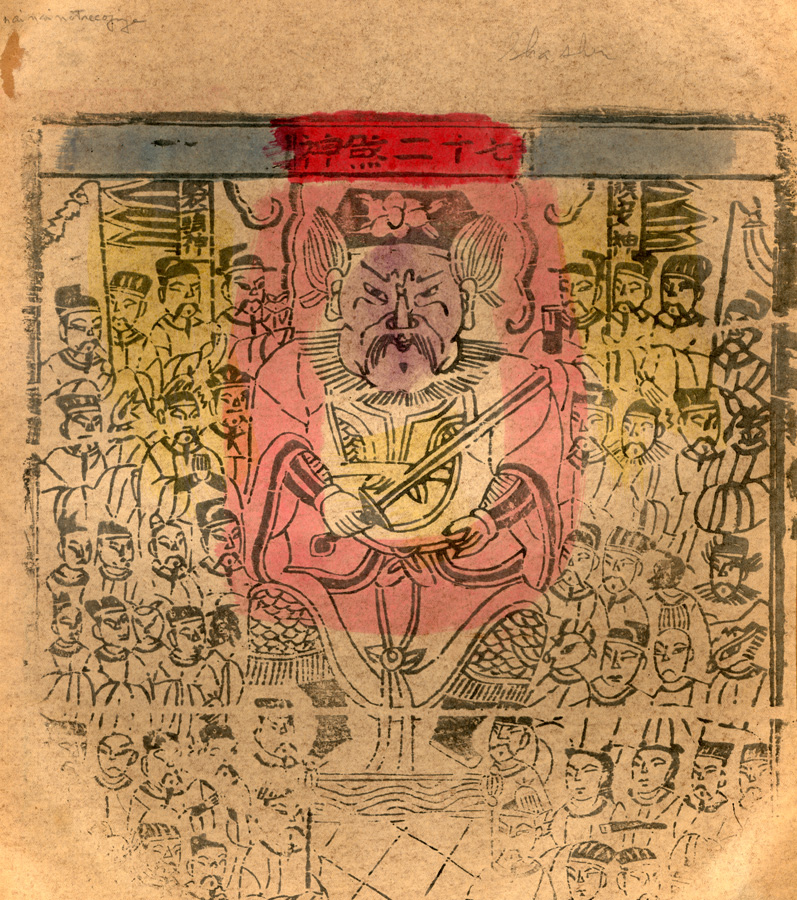
During Monkeyโ€™s early Daoist training, his mind is subtly corrupted by one of his magic powers, namely his famous 72 transformations (qi shi er bianhua, ไธƒๅไบŒ่ฎŠๅŒ–). Now, I can already hear my readers saying, โ€œWhat?!โ€ Well, there is a good reason for this idea. The actual name for this power of metamorphosis is theย โ€œMultitude of Terrestrial Killersโ€ (Disha shu, ๅœฐ็…žๆ•ธ). [1] It is named after a host of malevolent stellar deities (fig. 1) who are described in various sources as bringers of bad luck and disease:

The Seventy-two malignant stellar gods, called Ti-shah ๅœฐ็…ž, enemies of man, and causes of all diseases and ailments (Dorรฉ & Kennelly, 1916, p. xviii).

They are described as star generals inhabiting the stars of the Big Dipper, invoked by the Taoists to control evil spirits. But they are also believed to be evil influences on earth causing misfortune and disease (Pas & Leung, 1998, p. 293)

Similar to the 36 Rectifiers [tiangang, ๅคฉ็ฝก], the 72 Terrestrial Killers are frightening gods. In keeping with the link between celestial bodies and earthly spaces and with their function as timekeepers, the Killers originate from disruptiveโ€”and usually unexpectedโ€”collisions between the courses of time and space. In ritual contexts the 72 Killers are a common occurrence, prominently understood as a possible cause for disease or death. Preying on the 72 โ€œpassesโ€ (้—œย guan) that connect the human body to all aspects of the cosmos, they can cause all sorts of maladiesโ€”especially for small children. Daoists commonly apply apotropaic rituals to prevent the working of these โ€œkillers of the passesโ€ (้—œ็…žย guansha) (Meulenbeld, 2019).

Fig. 1 – The “72 Killer Deities” (Qi shi er Shashen, ไธƒๅไบŒ็…ž็ฅž) folk print from the Anne S. Goodrich Collection (larger version).

In the novel, Wukong originally learns the transformations in order to hide fromย three calamities of thunder, fire, and wind sent by heavenย as punishment for defying his fate and becoming immortal. In my story, I imagine Master Subodhi would warn Monkey to guard his spirit while mastering the magic power as some individuals might be influenced by the โ€œbaleful starsโ€ (xiong xing, ๅ‡ถๆ˜Ÿ). And this is exactly what happens to the young immortal. The stellar gods exploit a chink in his spiritual armor (possibly due to his background) and feed him small suggestions that have compounding effects on his personality, making him increasingly egotistical and combative. This ultimately leads to his attempt to usurp the throne of heaven. I’m open to suggestions.

Notes:

1) Yu (Wu & Yu, 2012) translates the skill as the “Art of the Earthly Multitude”, thus glossing over the 72 Terrestrial Killers (vol. 1, p. 122). Other translations for Disha (ๅœฐ็…ž) are “Earthly Fiends” and “Earthly Assassins” (Shi, Luo, & Shapiro, 1993, p. 1138, for example; Pas & Leung, 1998, p. 293). I follow the translation from Meulenbeld (2019).

Sources:

Dorรฉ, H., & Kennelly, M. (1916).ย Researches into Chinese superstitions:ย Vol. 3ย โ€“ Superstitious practices.ย Shanghai: Tโ€™usewei Printing Press. Retrieved fromย https://ia800709.us.archive.org/2/items/researchesintoch03dor/researchesintoch03dor.pdf

Meulenbeld, M. (2019). Vernacular โ€œFictionโ€ and Celestial Script: A Daoist Manual for the Use of Water Margin.ย Religions,ย 10(9), 518. MDPI AG. Retrieved from http://dx.doi.org/10.3390/rel10090518

Pas, J. F., & Leung, M. K. (1998). Historical Dictionary of Taoism. Lanham, Md.: Scarecrow Press.

Shi, N., Luo, G., & Shapiro, S. (1993).ย Outlaws of the Marsh. Beijing: Foreign Languages Press.

Sun Wukong and Births From Stone in World Mythology

Last updated: 08-31-2025

This article is a greatly expanded version of this piece.

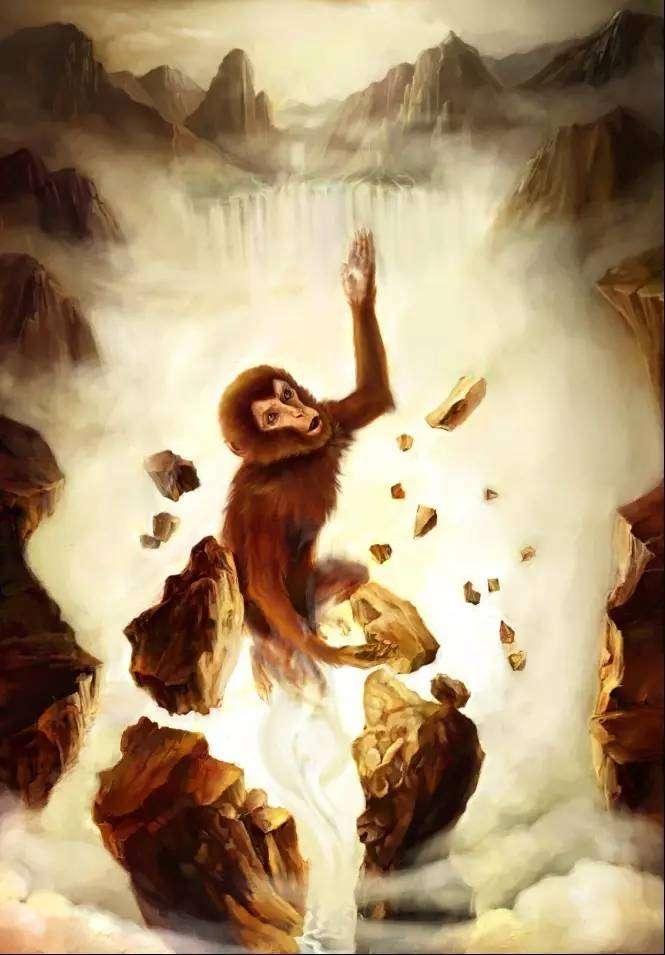
One of the many unique aspects about Sun Wukong‘s story cycle is his birth from stone (fig. 1). Chapter one of Journey to the West (Xiyouji, ่ฅฟ้Š่จ˜, 1592 CE) describes how the 36-foot, 5-inch (11.09 m) tall, 24-foot (7.31 m) circumference rock issues forth a stone egg after absorbing celestial and terrestrial energies over countless eons:

Since the creation of the world, it [the stone] had been nourished for a long period by the seeds of Heaven and Earth and by the essences of the sun and the moon, until, quickened by divine inspiration, it became pregnant with a divine embryo [xian bao, ไป™่ƒž]. One day, it split open, giving birth to a stone egg [shi luan, ็Ÿณๅต] about the size of a playing ball [yuan qiu, ๅœ“ๆฏฌ]. Exposed to the wind, it was transformed into a stone monkey endowed with fully developed features and limbs (Wu & Yu, 2012, p. 101).

The description of Wukong’s conception draws on ancient Chinese cosmological ideas regarding the gendered nature of the universe. Works of the Eastern Zhou and Han considered heaven masculine and described it as the father/husband/superior of the feminine earth, the mother/wife/inferior (Hinsch, 2011, pp. 157-158). As quoted above, the stone is “nourished…by the seeds of Heaven and Earth”. This line was likely influenced by philosophical works such as the Yijing which states: “Heaven and Earth come together, and all things take shape and find form. Male and female mix their seed, and all creatures take shape and are born” (Wilhelm & Baynes, 1977, pp. 342-343).

Surprisingly, Wukong is not the only figure from world mythology born from stone. In fact, “Birth from rock” (T544.1) is a mythic category appearing in Stith Thompson’s Motif-Index of Folk-Literature. Eliade (1978) comments: “The theme recurs in the great civilizations of Central America (Inca, Maya), in the traditions of certain tribes of Southern American, among the Greeks, the Semites, in the Caucasus, and generally from Asia Minor right down to Oceania” (p. 43).

In this article, I will explore eight examples from Asian and Western myth, demonstrating how stone-born figures share certain parallels with Monkey. I will show that, with the exception of creator gods and savior figures, stone-born beings generally have one or more of the following in common: 1) they are the product of masculine heavenly forces and feminine earthly forces (anthropomorphic or otherwise); 2) they violate the natural order by challenging heaven (in one form or another); and 3) they are eventually defeated by the gods. The purpose of this preliminary survey is to better understand an ancient myth cycle that may have influenced the development of the Monkey King’s lore.

Monkey's stone birth, by Zhang Moyi - small

Fig. 1 – Monkey’s birth from stone by Zhang Moyi (larger version). Found on this article.

1. Other Examples from Eastern Mythology

1.1. Yu the Greatย 

Yu the Great (Dayu, ๅคง็ฆน), a demi-god, sage-king, and founder of the Xia Dynasty, is generally portrayed in his mythos either violently erupting from the side or back of his mother or emerging (or being hewn with an ax) from the executed body of his father Gun (Cook & Luo, 2017, p. 98-101). However, a few sources briefly note his lithic birth. For example, the Han-era Huainanziย (ๆทฎๅ—ๅญ, 2nd-century BCE) simply states: โ€œYu was born from a stoneโ€ (Cook & Luo, 2017, p. 100).ย Lewis (2006) explains Yuโ€™s stone birth is tied to ancient Chinese beliefs about the fertile, creative power of stone, as evidenced by the stone altar of the High Matchmaker (Gao mei, ้ซ˜ๅช’), which was historically prayed to for children by married couples, as well as legends of the mending of the sky with five magic stones by the primordial goddess Nuwa, the High Matchmakerโ€™s mythic prototype. [1] This naturally has implications for the stone birth of Monkey.

Interestingly, the Jin-era Diwang Shiji (ๅธ็Ž‹ไธ–็ด€, 3rd-century) states Yuโ€™s mother was impregnated by swallowing magic seeds and a โ€œdivine pearlโ€ (shenzhu, ็ฅž็ ), a type of stone, and even locates his birth in a place called โ€œStone Knobโ€ (Shiniu, ็Ÿณ็ด) (Cook & Luo, 2017, p. 101). While the mother is not a stone, his birth is effected by a stone and happens in a place named stone. In this instance, the divine pearl is an encapsulation of the same masculine heavenly and feminine earthly forces that help create Wukong.

Yu is of course most famous in Chinese myth for his monumental effort in quelling the fabled world flood and then establishing the nine provinces of China (Birrell, 1999, pp. 81-83). Therefore, as a savior figure his mythos lacks the rebellious challenge against the gods and eventual defeat that marks several figures in this list. However, in a twist, his father Gun is known for violating the natural order by stealing Godโ€™s โ€œself-renewing soilโ€ in his quest to quell the flood. For this crime, he is executed (Birrell, 1999, pp. 79-81).

1.2. Qi of Xia

Yu’s son, Qi (ๅ•Ÿ) or Kai (้–‹), both meaning โ€œopenโ€ (fig. 2), [2] is said in an early 4th-century source to have also been born from stone: [3]

When Yu was controlling the floodwaters and was making a passage through Mount Huanyuan, he changed into a bear. He spoke to the Tushan [ๅœŸๅฑฑ] girl: “If you want to give me some food, when you hear the sound of a drumbeat, come to me.” But Yu leaped on a stone and by mistake drummed on it. The Tushan girl came forward, but when she saw Yu in the guise of a bear she was ashamed and fled. She reached the foothills of Mount Songgao, when she turned into a stone and gave birth to Qi. Yu said, “Give me back my son!” The stone then split open [4] on its north flank and Qi was born (Birrell, 1999, p. 123).

Lewis (2006) notes that early texts, such as the Diwang Shiji, claim this daughter of the Tushan clan is named Nuwa (with variations on her given name), proving that Yu and the goddess were married in some traditions (p. 134). This then strengthens the association between marriage, procreation, and stones.

Birrell (1999) explains a text appearing in the Zhou to Han-era Guicang (ๆญธ่—) records that he tried to โ€œstealโ€ (qie, ็ซŠ) music from heaven, while the Shanhaijing (ๅฑฑๆตท็ถ“) states he received it as a gift from the realm above (pp. 83-84). While not directly related to Qiโ€™s stone birth story, this shows at least one tradition believed Qi followed in his grandfatherโ€™s footsteps by stealing from heaven and violating the natural order, much like Wukong steals immortal peaches and wine.

Qi of Xia from the Shanhai Jing - Small

Fig. 2 โ€“ A woodblock print of Qi of Xia from a Ming-era version of theย Shanhai jingย (larger version). Plate XLIV fromย Strassberg, 2002, p. 168.ย 

1.3. The Bodhisattva Hilumandju’s Children

One myth explains the origin of the Tibetan peoples from a magic monkey and a rock-ogress (brag srin mo) (fig. 3). While evidence for it goes back to at least the 7th-century, [5] the best known version comes from the Mani Kambum (12th to 13th-century). As the story goes, the Buddha charges the Avalokitesvara Bodhisattva with converting the evil creatures of the “Land of Snow” (Tibet) to Buddhism. The latter sends his avatar, the Bodhisattva Hilumandju (possibly a reference to Hanuman), a monkey king with great spiritual powers, to meditate on a mountain top in Tibet. A rock-ogress comes upon his hermitage and attempts to seduce him by taking the form of a female monkey and then a human woman, but each time her advances are rejected due to his supernatural focus. As a result, the rock-ogress threatens to mate with an ogre and produce a race of demonic creatures that would devour the world, thereby heaping sins upon the monkey king if he does not take her as his wife. So after seeking council with his master, Hilumandju agrees to become her husband (I have archived the full story here):

โ€œSo be it (Laso),” he made answer. Then the monkey Bodhisattva, fearing lest the rock-ogress should destroy herself, departed in all haste for the Abode of Snow, and as soon as he arrived he took her unto him as his wife. When the space of nine months had elapsed she bore him six sons, who participated of the nature of the six classes of sentient creatures subject to birth and death. As their father was a monkey, so their bodies were covered with hair, and as their mother was a rock-ogress, so they had tails; their faces were reddish and they were most unsightly. From the mortal gods, one had gentleness and patience; from the mortal (lit., subject to birth and death) Asuras (lh’a-mayin), one of them derived angry passions and quarrelsomeness. One of them had in part great lusts, and love of worldly riches, which qualities he owed to mortal man. One of them owed to hell’s mortal fiends, hate, and anger, and great hardiness. One partook of the mortal Prรฉta’s (yidag) characteristics in being deformed, from his cravings for food (lit., bad stomach), and his avariciousness. One partook of mortal brute beasts in not being able to distinguish right from wrong, and in having neither comprehension nor cleverness. When born they were ruddy-faced, had a taste for flesh and blood, and hair covered their heads and bodies, and, moreover, they knew how to speak (Rockhill, 1891, pp. 357-358). [6]

The resulting six offspring mate with monkeys and reproduce in the many hundreds, becoming more and more human with each new generation. When they eat all of their resources and begin to starve, Avalokitesvara gives Hilumandju grain and jewels for his descendants to grow and mine until they are fully human and ready to receive the Buddhist teachings (Rockhill, 1891, pp. 358-361).

The rock-ogress and her kind are portrayed as vicious, blood-thirsty creatures beyond Avalokitesvara’s ability to convert to Buddhism (Rockhill, 1891, p. 359). The rock-monkey children inherit not only their mother’s misshapen appearance but also many of her negative qualities, making them resistant to the teachings. So, in a way, they too violate the natural order.

I obviously can’t continue without commenting on this tale’s interesting parallels with Sun Wukong. Hilumandju is a monkey king who uses his magic powers in the service of Buddhism at the behest of the Bodhisattva Avalokitesvara. And like Wukong, Hilumandju’s children are the product of a masculine heavenly force and a feminine earthly force (the rock-ogress). Wukong is a monkey king who uses his magic powers in the service of Buddhism at the behest of the Bodhisattva Guanyin (the feminine form of Avalokitesvara).

Tibetan origin myth painting - Monkey and Ogress - small

Fig. 3 โ€“ A modern painting showing the monkey and rock ogress of Tibetan myth (larger version). Originalย from Wikipedia.

2. Stone Births in Western Mythologyย 

Jong (1997) explains Western myths of stone-born figures “are usually connected with the Song of Ullikummi known from Hittite and Hurrian sources” (p. 292). He continues:

There are many more myths or complexes of myths which largely follow the same pattern: the cycle of Agdistis from Phrygia, the Nart-epics of the Ossetes, the Jewish myths of the monster Armillus andโ€”for some aspectsโ€”the Georgian myth cycles of Amirani [fig. 4] (Jong, 1997, p. 292).

traditions-of-the-magi-chart-showing-other-cultures-where-a-supreme-god-beget-a-son-from-a-rock-small.png

Fig. 4 โ€“ A chart showing the existence of the rock-born son trope from other cultures (larger version). From Jong, 1997, p. 293.

2.1. Ullikummi

The aforementioned Hurrian myth the โ€œSong of Ullikummi” (c. 1200 BCE) appears in an extant Hittite cuneiform text comprising three fragmented clay tablets. While named after the eponymous stone monster (fig. 5), the story follows the machinations of Kumarbi, a resentful former ruler of the gods, who wishes to usurp the throne from his son, the storm god Tesub. Kumarbi sets about doing this by bedding a massive stone in an effort to produce a being powerful enough to rout the gods. Upon its birth, the doting father gives the creature a name meaning โ€œDestroy Kummiyaโ€ (Rutherford, 2020, p. 147), foreshadowing its intended fate to destroy Tesubโ€™s home (I have archived papers reconstructing the story here and here):

Out of the [rock’s] body like a blade he sprang.
He shall go! Ullikummi be his name!
Up to Heaven to kingship he shall go,
and Kummiya, the dear town, he shall press down!
But the Storm-God he shall hit,
and like salt he shall pound him,
and like an ant with (his) foot he shall crush him!
But Tasmisu [7] like a …… reed he shall break off!
All the gods down from Heaven like birds he shall scatter,
and like empty vessels he shall break them! (Gรผterbock, 1951, p. 153).

Fearing that it may be killed by the gods before coming into full power, Kumarbi has the monster hidden in the underworld, where it is placed on the right shoulder of the Atlas-like god Upelluri. The creature quickly multiples in size, growing nine thousand leagues tall, eventually reaching heaven. When Ishtar fails to seduce the blind and deaf monster, the warrior god Astabi leads 70 deities into battle against the lithic menace only to be defeated and cast into the sea below. Tesub abandons the throne and, along with Tasmisu, seeks the aid of Ea, the god of wisdom and witchcraft, who travels to the underworld in search of the creature’s origins. Upon questioning Upelluri, who effortlessly carries the weight of the heavens, earth, and sea, Ea learns a great weight, which turns out to be the monster, pains the titan’s right shoulder. In the end (of the third and final extant tablet), Ea calls for a tool originally used by the old gods to cleave heaven and earth and chisels Ullikummi free of Upelluri’s shoulder, thus breaking the monster’s base of power and leaving it vulnerable to attack by the gods. Gรผterbock (1951) suggests there’s a missing fourth tablet that describes the monster’s ultimate defeat (p. 140). [8]

Likeย Monkey and the other figures listed above,ย Ullikummi is the product of a masculine heavenly force (Kumarbi) and a feminine earthly force (the stone). Although the assault on heaven is orchestrated by his father, Ullikummi’s challenge to the gods, like that of Monkey, violates the natural order. And his presumed defeat in the end also follows the story cycle of Wukong.

I’d like to add that Ullikummi battling Astabi’s force of 70 gods is similar to Sun fighting the 72 gods called up against him (Koss, 1981, p. 84). Also, King Tesub seeking aid from Ea, leading to Ullikummi’s defeat, is reminiscent of the Jade Emperor asking for the Buddha to intervene, leading to Wukong’s defeat.

Fig. 5 – Ullikummi as a playable character from the online video game Final Fantasy XI (larger version).

2.2. Mithrasย 

The Greco-Roman god of light, Mithras,ย [9] is perhaps the best known and studied of the stone-born deities in Western mythology. Researchers often refer to his birth stone using the Latin term Petra Genetrix, or the “Fecund rock”. Manfred Clauss notes the symbolism of the rock is tied to the earth and the cosmic egg (I have archived the relevant chapter section here).

The multi-layered quality of Mithraic symbolism…reappears in the case of the rock: represented and understood not only as the kosmos but also as the earth, on many images it is encircled by a serpent, [fig. 6] a creature associated with the earth (Clauss & Gordon, 2001, p. 67).

[…]

We can discern the influence of Orphic speculation in a Greek inscription from one of the numerous mithraea in Rome, on a statue-base dedicated ฮ”ฮนi ‘Hฮปฯ‰ Miฮธpa ฮฆรกvฮทฯ„ฤฑ, that is to Deus Sol Mithras Phanes. Phanes is the embodiment of unlimited light, an Orphic deity who emerged from the cosmic egg. There is also literary evidence for the syncretism of Mithras with Phanes. In this community, therefore, Mithras’ identification with the sun god grounded an allusion to the Orphic-Platonic ideas current among the intellectual รฉlites. Mithras-Phanes is also known to us in iconographic form: a relief from Vercovicium (Housesteads) on Hadrian’s Wall shows Mithras emerging from the cosmic egg, [fig. 7] which is represented both as such and by the shape of the zodiacal ring (Clauss & Gordon, 2001, p. 70).

Mithras’ position as a solar deity and depiction emerging from a cosmic egg/stone establishes him as a self-born creator god. This is supported by another aspect of his holy narrative: the slaying of the bull. Stone reliefs depict him in a great struggle to pin the animal down and then strike it in the neck with a knife. Since the bull was symbolic of the moon (and thus death), its sacrifice is seen as the creation of life and the cosmos. This is represented by zodiac symbolsโ€”the path of the newly formed planetsโ€”on the godโ€™s fluttering cloak and by grapes or ears of corn in place of the pooled blood on the ground (Clauss & Gordon, 2001, pp. 78-90). Therefore, like Yu the Great, Mithrasโ€™ feat distances him from the rebellion and defeat that mark other figures in this list.

Sun Wukong is similar to Mithras as he too struggles against bovine opponents, including Laoziโ€™s buffalo in chapters 50 to 52 and the Bull Demon King in chapters 59 to 61. However, Monkey’s conception involves the mingling of masculine heavenly and feminine earthly forces, while Mithras is born of a virginal stone.

Mithra birth from stone images for Monkey stone birth article

Fig. 6 โ€“ An example of Mithrasโ€™ serpent-wrapped birth rock from Austria. A larger versionย is available on Wikicommons; Fig. 7 โ€“ The deity emerging from a cosmic egg surrounded by the western Zodiac symbols (larger version). From the Homesteads Romanย Fort along Hadrianโ€™s Wall. Foundย on this article.ย 

2.3. Diorphus

Mithras’ son, Diorphus, is said to have also been born from a stone. Pseudo-Plutarch (c. 3rd-century) writes:

Near to this [the Araxes] river lies the mountain Diorphus, so called from Diorphus the son of the Earth, of whom this story is reported. Mithrasย desirous to have a son, yet hating woman-kind, lay with a stone, till he had heated it to that degree that the stone grew big, and at the prefixed time was delivered of a son, called Diorphus; who, growing up and contending with Mars for courage and stoutness, was by him slain, and by the providence of the Gods was transformed into the mountain which was called Diorphus by his name (Plutarch & Goodwin, 1874, p. 505).

Diorphus is similar to Monkey, Qi of Xia, and the Bodhisattva Hilumandju’s children as he is the product of a masculine heavenly force (Mithras) and a feminine earthly force (the stone). He and Qi share a further connection as they are both the sons of beings who were themselves born from stone. And much like Wukong, Diorphus violates the natural order by challenging the gods (in this case Mars) and is defeated, being transformed into a mountain after his death. While not exactly the same, the end result brings to mind Monkey’s imprisonment under Five Elements Mountain.

The tale of Diorphusโ€™ conception follows the same tradition as the Story of Ullikummi where a god intends to sire a son with a stone and not a goddess, resulting in a powerful, rebellious offspring.

ย 2.4. Agdistis

The god Agdistis is a monstrous, hermaphroditic being sired by Zeus. His story is recorded by Arnobious of Sicca (died c. 330):

Within the confines of Phrygia, he says (Timotheus), there is a rock of unheard-of wildness in every respect, the name of which is Agdus, so named by the natives of that district. Stones taken from it, as Themis by her oracle had enjoined, Deucalion and Pyrrha threw upon the earth, [10] at that time emptied of men; from which this Great Mother, too, as she is called, was fashioned along with the others, and animated by the deity. Her, given over to rest and sleep on the very summit of the rock, Jupiter assailed with lewdest desires. But when, after long strife, he could not accomplish what he had proposed to himself, he, baffled, spent his lust on the stone. This the rock received, and with many groanings Acdestis (Agdistis) is born in the tenth month, being named from his mother rock. In him there had been resistless might, and a fierceness of disposition beyond control, a lust made furious, and derived from both sexes. He violently plundered and laid waste; he scattered destruction wherever the ferocity of his disposition had led him; he regarded not gods nor men, nor did he think anything more powerful than himself; he contemned earth, heaven, and the stars.

Now, when it had been often considered in the councils of the gods, by what means it might be possible either to weaken or to curb his audacity, Liber, the rest hanging back, takes upon himself this task. With the strongest wine he drugs a spring much resorted to by Acdestis where he had been wont to assuage the heat and burning thirst roused in him by sport and hunting. Hither runs Acdestis to drink when he felt the need; he gulps down the draught too greedily into his gaping veins. Overcome by what he is quite unaccustomed to, he is in consequence sent fast asleep. Liber is near the snare which he had set; over his foot he throws one end of a halter formed of hairs, woven together very skillfully; with the other end he lays hold of his privy members. When the fumes of the wine passed off, Acdestis starts up furiously, and his foot dragging the noose, by his own strength he robs himself of his sex; with the tearing asunder of these parts there is an immense flow of blood; both are carried off and swallowed up by the earth; from them there suddenly springs up, covered with fruit, a pomegranate tree… (Burkert, 1979, pp. 255-256)

Agdistis is similar to Monkey and the above figures as he is the product of a masculine heavenly force (Zeus) and a feminine earthly force (the stone). And like Wukong’s rebellion, the hermaphroditeโ€™s raw, destructive nature threatens the primacy of heaven. As a result, both Agdistis and Monkey share a superiority complex, believing they are mightier than the gods. The deities fear their power and therefore seek ways to tame them. Wukong is placated for a time with celestial posts before ultimately being imprisoned by the Buddha, while Agdistis is stripped of hisย manhood.ย 

Agdistisโ€™ conception also follows the tradition of Ullikummi and Diorphus. The end result of Zeusโ€™s attempted rape of the stone/earth goddess is a powerful, rebellious offspring. ย 

2.5. Armilus

Theย Book of Zerubbabel (7th-century) describes Armilus, a Jewish anti-messiah figure, as the spawn of Satan and a world conqueror who will force all to worship his lithic mother. Knohl (2009) presents the section where Zerubbabel learns of Armilus from an angel:

This city is Nineveh, the city of bloodshed, which is the big Rome. And I have said to him: โ€œWhen would be the end of these awful things?โ€™ And he took me by my hand and brought me to the house of disgrace.

And he showed me there a marble stone in the shape of a very beautiful virgin. And he said to me: ‘What do you see, Zerubbabel?’ And I said: ‘I see a marble stone in the shape of a very beautiful woman.’

And he told me: โ€œThis stone is the wife of Belial [Satan], and when Belial sees her, he will lie with her and she will become pregnant and will bear him Armilus, and she will be the chief idolatry. And he (Armilus) will rule over the whole world and his dominion will be from one end of the earth to the other end of the earth. And he will make signs. He will worship strange gods, and will speak words against the Most High and no one will be able to stand against him. And all nations will go astray after him except for Israel.

And he Armilus will take his mother from the house of disgrace and all places and all nations will worship this stone and will make sacrifices and libations to it. And no one will be able to look upon her face because of her beauty. He is Arimolaus son of Satan, and he will become a King in Emmaus, the city of his father, and his fear will fall in all places (pp. 79-81). [11]

Another tradition explains Armilus will proclaim himself God and, having won the trust of Christians, lead a vast army to decimate Jews who stand against him. In the end, though, God or the Messiah will gather the scattered Israelites and defeat Armilus:

But as Armilus nevertheless insists upon being recognized as God by the Jews, and they cry out to him that he is Satan and not God, a bitter battle breaks out between Armilus with an immense heathen army on the one side, and Nehemiah with 30,000 Jewish heroes on the other. This unequal combat ends in the death of the “Ephraimite Messiah” and a million Jews. After an interval of forty-five days, … Michael will blow his trumpet; then the Messiah and Elijah will appear, gather the dispersed of Israel, and proceed to Jerusalem. Armilus, inflamed against the Jews, will march against the Messiah. But now God Himself will war against Armilus and his army and destroy them; or the Messiah, as one version has it, will slay Armilus by the breath of his mouth (Kohler & Ginzberg, 1906, p. 119).

Like Monkey and the above figures, Armilus is the product of a masculine heavenly force (Satan) and a feminine earthly force (the stone statue).ย He violates the natural order by proclaiming himself God and even fights against the All Mighty, much like Monkey proclaims himself the “Great Sage Equaling Heaven” and leads an army against heaven. Armilus’ defeat by God is also like Wukong’s subjugation by the Buddha, Diorphus’ death by Mars, and Ullikummi’s presumed besting by the gods.

Armilus’ conception also follows the tradition of Ullikummi, Diorphus, and Agdistis. Satan lays with the stone statue with the intent of creating a powerful, rebellious offspring.

2.6. Soslan

The hero Soslan, also known as Sozryko, appears in a body of legends associated with the Caucasian Nart Saga:

At the sight of the beautiful Satana [the mother of the Narts] washing clothes on the riverbank, a shepherd across the river poured out his semen on a stone from which, nine months later, the child Soslan came forth. When he had grown up, he demanded to be “tempered” in the milk of a she-wolf, a treatment destined to make him invulnerable. The divine smith Kurdalรคgon dropped him into a trough containing one hundred goatskins of milk, but since the trough was too short, Soslan had to bend his knees, which consequently were not tempered and thus remained vulnerable.

After a long existence devoted to war exploits, mostly miraculous, Soslan insulted the daughter of Balsรคg, a kind of celestial spirit, who took his vengeance by discharging at Soslan a living steel wheel that he controlled. The hero was hit by the wheel on all parts of his body successively and threw it back without being injured until, on the advice of the treacherous Syrdon [a figure similar to Loki], the wheel hit him on the knees and smashed them to pieces. According to an eastern Circassian variant, Soslan indulged in a game during which the Narts, again at Syrdon’s instigation, threw a wheel made of serrated steel at him from the top of a hill. It hit the distracted Soslan in the knees (Honigsblum, 1993, p. 264).

Despite the slight difference, Soslanโ€™s parentage still follows the same tradition as Ullikummi, Diorphus, Agdistis, and Armilus. His father is humanoid, while his mother is a stone. The change from deity to lowly human shows that, in this case, even mortal sperm was thought capable of magically fertilizing earth.

Fig. 8 – “Soslan vs Balsag Wheel” by Maharbek Tuganov (larger version).

3. Western influences on Sun Wukong’s story?

Monkey’s birth narrative was likely influenced by that of Yu the Great and his son Qi/Kai considering that our hero wields the sage-king’s cosmic ruler, the gold-banded cudgel, as a weapon. But since his stone birth and later rebellion mirror the tales above, might this suggest the author-compiler of Journey to the West was aware of the ancient myth cycle of a stone-born son who challenges heaven? Many of the cited Western myths show a clear affinity with the Song of Ullikummi. For example, Burkert (1979) notes six similarities between the myths of Agdistis and the stone titan: “(1) The initial situation: the big stone; (2) a god fertilizes the stone; (3) the stone gives birth to a child; (4) the child thus created is a rebel against the gods; (5) the gods gather and plan countermeasures; (6) the enemy of the gods is rendered harmless” (p. 257). Sound familiar? If this circa 12th-century BCE myth cycle spread west from Anatolia to Greece, could not a version of it have spread east and penetrated China by way of Persia? This need not have been the original Ullikummi story but an older protomyth or even a later variation. Of course this then raises the question, “How would the author-compiler have learned about this story?” Needless to say, much, much more research is needed to determine if such a dissemination took place. Similarities alone aren’t enough without some kind of textural, oral, or archaeological evidence. Perhaps in the future a scholar more qualified than myself will pursue this line of inquiry.

4. Monkey’s stone egg and popular culture

Sun Wukong’s stone birth is so well known that it is referenced in the world famous anime Dragon Ball Z (DBZ). The original Dragon Ball series presents the main character Son Goku, himself based on the Great Sage, as a good-natured little boy with bulletproof skin and a monkey tail. However, DBZ reveals him to be a Saiyan, a humanoid alien warrior, who was sent as an infant in a rocket ship (ร  la Superman) to destroy Earth. This vessel, known as an “Attack Ball” (Atakku Bลru, ใ‚ขใ‚ฟใƒƒใ‚ฏใƒœใƒผใƒซ), is spherical in shape and represents the stone from which Wukong is born (fig. 9). It is a fun little twist on the original lore.

Fig. 9 – Goku in the stone egg-like Attack Ball (larger version).

5. Conclusion

This brief survey demonstrates that stone is capable of giving birth to creator gods, protoplasts, savior figures, heroes, and even great monsters. But much like a human egg, a father is needed to fertilize it with sperm. Sun Wukong’s stone is nourished by the seeds of heaven. Qi of Xia was fathered by the demigod Yu the Great and born from a woman-turned-stone. The first Tibetans, born of a rock-ogress, are sired by the Bodhisattva Hilumandju. In almost all cases in Western mythology (with the exception of Soslan), the pater is a heavenly force, an anthropomorphic deity, who begets a son by impregnating a stone in place of a goddess or mortal woman. Examples include Kumarbi and the stone titan Ullikummi, Mithras and the foolhardy Diorphus, Zeus and the violent Agdistis, and Satan and the anti-Messiah Armilus. Misogyny aside, the myths discussed speak to some belief that a son born of stone would pose a threat to the gods. I suggest this tendency towards violating the natural order is a manifestation of their unnatural births.

The number of similarities between Monkey’s early story arc and the Song of Ullikummi might suggest a possible flow of influence from the near east. Both are born of stone, rebel against heaven, rout an army of 70-something gods, and are defeated by a supreme deity. I must stress, however, that these are just surface level affinities. They shouldn’t be accepted as concrete proof of influence until a deeper study providing actual historical evidence is conducted.


Updated: 01-27-21

I have found a full account of the mythical stone birth of the Nart hero Soslan. It is portrayed as volcanic in nature, with the birth stone growing as it is baked in an oven for nine months. And finally, the child is born glowing red hot, causing a god of blacksmiths to quench-harden him in water.

There were two brothers, the sons of Sajem. The elder was named Zartyzh, the younger Shawey.

One day Setenaya [Satana] was bathing by the river. On the water’s other side stood one of these brothers, the Nart herdsman Sajemuquo Zartyzh, also called Tezhidada, the “Eldest Ram.” From where he stood he was able to see Lady Setenaya. When that brother saw the beautiful temptress going back and forth, not standing still, strewing her clothes about, he could no longer control his passion. He was enchanted by her beauty and so let loose an arrow of manly fluid.

“Setenaya” It is coming to you.”

“So, let it come, but why did you do that?” said Setenaya.

“Hey, Setenaya! By day I tend the sheep. By night, when I come to you, the lance is always stuck in the ground in front of your house. so how would you have me do it?” said the shepherd.

Heavy steam arose as the bolt skimmed over the water, tracing a path until it reached Setenaya, but the bolt of lust just missed her and instead fell on a stone that was lying beside her on the riverbank. Setenaya picked up the stone, wrapped it in a warm cloth, brought it home, and placed it in the stove. Day by day the stone grew. It lay for nine months and nine days. During this time it grew in size and became very big. Lady Setenaya had her people bring the stone to Tlepsh‘s smithy. There she bade Tlepsh, the god of the forge, to break open the stone.

Tlepsh did as she had bidden him. From inside the stone emerged a baby boy, glowing as bright as fire. The baby fell on the front part of Setenayaโ€™s dress and burned through it until he fell to the ground. Tlepsh seized him with his blacksmith’s tongs, and holding him by the thighs plunged him into the water for the grindstone seven times, thus cooling the baby. Then once again Tlepsh picked up the little child with his metal tongs by his thighs and hardened him seven times, so that the child’s skin became a little bit more flexible. The child became like a human being, but his skin remained tough, like tempered steel. Tlepsh named the baby Sawseruquo [Soslan] and gave him back to Setenaya.

On his thighs, where Tlepsh had held him with the tongs, Sawseruquo’s skin remained soft like human skin, and because his thighs had been squeezed, he was bowlegged (Colarusso, 2015, pp. 52-53).

This story has obvious parallels with the Greek story of Achilles, a mighty warrior with a vulnerable spot on his feet. Interestingly, a character from the Iliad (8th-century BCE) suggests that, due to his unwillingness to help his comrades in battle, Achilles’ parents were not the human couple commonly associated with him but the very sea and a rock cliff. Alepidou (2020) convincingly argues that these are references to the ancient Hurro-Hittite “Story of Hedammu” and the “Story of Ullikummi”. Hedammu, the offspring of Kumarbi and a sea goddess, was a massive sea creature that plagued the earth and sea. As noted above, Kumarbi’s subsequent offspring, Ullikummi, is a stone giant who attacked heaven. The stone titan is defeated when he is chiseled free from his base of power on the shoulder of an underworld god. This weakness of the lower extremities likely influenced that of Achilles and Soslan.


Update: 02-26-22

I was originally thinking about writing a sequel to this piece in which I list mythic characters trapped under mountains. Here’s the list I have so far:

  1. Sun Wukong (various Journey to the West iterations) – Mt. Huaguo by Guanyin or Five Elements Mountain by the Buddha
  2. 108 stars (Water Margin) – Imprisoned in an earth prison under a stone slab by a Daoist master. Jing Wang (1992) suggests the stone slab was likely influenced by the Taishan stone (ๆณฐๅฑฑ็Ÿณ).
  3. Goddess Yaoji (Precious Scroll of Erlang) โ€“ Mt. Tai by the Jade Emperor
  4. Goddess Sanshengmu (Precious Lotus Lamp) – Mt. Hua by Erlang
  5. Wuzhiqi (Extensive Records of the Taiping Reign) โ€“ Turtle Mountain by Yu the Great
  6. Ravana (Ramayana) โ€“ Mt. Kailash by Shiva
  7. Typhon (Dionysiaca/various) โ€“ Sicily/ Mt. Etna by Zeus
  8. Enceladus (Apollodorus/various) โ€“ Sicily by Athena or Mt. Etna by Zeus
  9. Polybotes (Apollodorus/various) โ€“ Kos/Nisyros by Poseidon

But if I choose the broader term “earth prisons”, I can include other mythic baddies like Lucifer and Loki, as well as the Titans in Tartarus!


Update: 08-31-25

It has occurred to me since writing the main article that my suggestion that Monkey was influenced by Ullikummi could just be a coincidence. As shown by this Yuan-Ming zaju play, the concept of a rebellious Great Sage feuding with and being punished by heaven predates the 1592 JTTW. And Monkey’s stone birth is unique to the standard edition, meaning that the rebellion and lithic nativity are separate elements added to his story cycle. They are not part of Wukong’s early story cycle.

Notes:

1) See chapter four, especially the sections โ€œThe Mythology of Nรผ Gua and the Floodโ€ and โ€œYu, Marriage, and the Bodyโ€.

2) Strassberg (2002) explains the variant Kai (้–‹) was used during the Han to avoid conflicting with Emperor Jingโ€™s personal name, Liu Qi (ๅЉๅ•Ÿ) (p. 169). Whether Qi or Kai is used, both names reference the story of the stone splitting open to give birth to Yuโ€™s son. See also note four below. ย 

3๏ผ‰Birrell (1999) writes:

It is said by the Tang classical scholar and commentator Yan Shigu (A.D. 581-645) to be a reference he located in a text from Huainanzi, compiled circa 139 B.C. That text, however, does not appear in the extant editions of Huainanzi. The only reference the latter makes to the Yu/Qi myth is: โ€œYu was born of a stone.โ€ Embroidered versions of the metamorphosis of the Tushan girl into stone begin to appear in the writings of Han commentators such as Gao You (third century A.D.), and Ying Shao (second century A.D.). The fourth-century commentator of The Classic of Mountains and Seas, Guo Pu, however, specifies that the mother of Qi (Kai) metamorphosed into stone and gave birth to Qi on the mountain. Thus the tradition of Qi’s miraculous birth is confirmed by at least the early fourth century A.D. and probably derives from an earlier tradition (p. 122).

I changed the Wade-Giles to Pinyin.

4) The stone โ€œsplitting openโ€ is related to stories of sage-kings erupting from the backs or sides of their mothers, splitting them open in the process (Cook & Luo, 2017, pp. 97-100). See also note two above.

5) Sรธrensen notes that the myth was depicted in a mural from the famous Jokhang Temple, which was built in the 7th-century (Bsod-nams-rgyal-mtshan & Sรธrensen, 1994, p. 582).ย 

6) Another version of the tale appears inย The Mirror Illuminating the Royal Genealogiesย (Rgyal rabs gsal baโ€™i me long, 14th-century). An annotated translation can be read in Bsod-nams-rgyal-mtshan & Sรธrensen, 1994, pp. 125-133.

7) The vizier and brother of Tesub.

8) Gรผterbock (1951), pp. 138-140 gives a summary of the tale. The paper also translates the first half of the fragmented epic. Gรผterbock (1952) translates the other half. Both papers are archived above.

9) I am indebted to Jose Loayza for bringing the stone birth of Mithras to my attention. This resulted in the rest of the Western figures in this article.

10) This references another myth in which, following the great flood, mankind is repopulated by Deucalion and Pyrrha casting the “bones” (stones) of the “great mother” (Gaia) over their shoulders. Thus thrown, the stones soften and take on human shape. See for example Ovid’s Metamorphosis (Ovid & More (n.d.)).

11) Knohl (2009) suggests Armilus’ story is a veiled attack against Augustus Caesar: 1) who is said to have been sired by the god Apollo under the guise of a dragon, the Jewish symbol for Satan; 2) who founded the Greek city of Nicopolis, which brings to mind the biblical Emmaus Nicopolis; 3) and who helped spread the cult of the goddess Roma (a statue of a beautiful woman) (pp. 81-83). So Satan impregnating the stone statue to produce Armilus likely refers to the myth of Apollo siring Augustus.

Sources:

Alepidou, A. (2020). Near Eastern Echoes in Iliad 16.33โ€“35,ย Yearbook of Ancient Greek Epic Online,ย 4(1), 1-26. doi:ย https://doi.org/10.1163/24688487-00401001

Birrell, A. (1999). Chinese Mythology: An introduction. Baltimore: The Johns Hopkins University Press.

Bsod-nams-rgyal-mtshan, & Sรธrensen, P. K. (1994).ย The Mirror Illuminating the Royal Genealogies: Tibetan Buddhist Historiography: An Annotated Translation of the XIVth Century Tibetan Chronicle: rGyal-rabs gsal-baโ€™i me-long. Wiesbaden: Harrassowitz.

Burkert, W. (1979). Von Ullikummi zum Kaukasus. Die Felsengeburt des Unholds. Wรผrzb. Jahrbb. 5, 252-261. Retrieved from https://journals.ub.uni-heidelberg.de/index.php/wja/article/view/25702/19416

Clauss, M., & Gordon, R. (2001).ย The Roman Cult of Mithras: The god and his mysteries. New York: Routledge.

Colarusso, J. (2015).ย Nart Sagas from the Caucasus: Myths and Legends from the Circassians, Abazas, Abkhaz and Ubykhs. Princeton: Princeton University Press.

Cook, C. A., & Luo, X. (2017). Birth in Ancient China: A study of metaphor and cultural identity in pre-imperial China. Albany: State University of New York Press

Eliade, M. (1978).ย The Forge and the Crucible (3rd ed.). Chicago: University of Chicago Press.

Gรผterbock, H. (1951). The Song of Ullikummi Revised Text of the Hittite Version of a Hurrian Myth.ย Journal of Cuneiform Studies,5(4), 135-161. doi:10.2307/1359008

Gรผterbock, H. (1952). The Song of Ullikummi Revised Text of the Hittite Version of a Hurrian Myth (Continued).ย Journal of Cuneiform Studies,ย 6(1), 8-42. doi:10.2307/1359160

Hinsch, B. (2011).ย Women in Early Imperial China. Lanham, Md: Rowman & Littlefield Publishers.

Honigsblum, G. (1993). The Religion and Myths of the Ossets. In Y. Bonnefoy (Ed.). American, African, and Old European mythologies (pp. 262-265). Chicago: University of Chicago Press.

Jong, A. (1997).ย Traditions of the Magi: Zoroastrianism in Greek and Latin literature. Leiden; New York: Brill.

Knohl, I. (2009). Messiahs and Resurrection in ‘The Gabriel Revelation’. Israel: Bloomsbury Publishing.

Kohler, K., & Ginzberg, L. (1906). Armilus. In The Jewish Encyclopedia (vol. 2, pp. 118-120). United Kingdom: Funk & Wagnalls. Retrieved from http://www.jewishencyclopedia.com/articles/1789-armilus

Koss, N. (1981).ย The Xiyou ji in Its Formative Stages: The Late Ming Editions (Vols. 1 and 2).ย (Doctoral dissertation). Available from ProQuest Dissertations and Theses database. (UMI No. 8112445)

Lewis, M. E. (2006). The Flood Myths of Early China. Albany: State University of New York Press.

Ovid, & More, B. (n.d.). Metamorphoses, lines 348-415. Retrieved June 6, 2020, from http://www.perseus.tufts.edu/hopper/text?doc=Perseus:text:1999.02.0028:book=1:card=348

Plutarch, & Goodwin, W. W. (1874). Plutarch’s Morals: Translated from Greek by Several Hands. United States: Little, Brown. Retrieved from http://www.perseus.tufts.edu/hopper/text?doc=Perseus:text:2008.01.0400:chapter=23&highlight=mithras

Rockhill, W. W. (1891).ย The Land of the Lamas: Notes of a Journey Through China, Mongolia and Tibet with maps and Illustrations. New York: Century Co.

Rutherford,ย I.ย (2020).ย Hittite Texts and Greek Religion: Contact, Interaction, and Comparison.ย United Kingdom:ย OUP Oxford.

Wilhelm, H., & Baynes, C. F. (1977). I Ching or Book of Changes (3rd ed.). Princeton University Press.

Wu, C., & Yu, A. (2012). The Journey to the West (Vol. 1) (Rev. ed.). Chicago: University of Chicago Press.