How to Resurrect the Tang Monk if He is Killed During Journey to the West

Last updated: 07-12-2026

Tumblr user @predictablemess recently asked me the following question:

If [Tripitaka (Sanzang, 三藏; fig. 1), Sun Wukong‘s master,] were to die during Journey to the West, in your opinion, what would happen?

Would he remain dead and be reincarnated or be revived? Would they have to restart the cycle again? Through what means do they go through to get the monk and recover the Scriptures?

What follows is an expanded version of my answer.

Fig. 1 – Tripitaka as depicted in the 1986 Journey to the West TV show (larger version). Image found here.

Table of Contents

1. Introduction

Not counting the ginseng fruit (renshen guo人參果; a.k.a. “grass of reverted cinnabar,” cao huandan, 草還丹) that gives Tripitaka a nigh-immortal, adamantine body, [1] the Monkey King, a host of other Buddho-Daoist gods, Guanyin, or even the Buddha would prevent him from being killed. [2] However, for the sake of argument, there are a few ways to bring the Tang Monk (Tang seng, 唐僧) back to life, but the methods used depend on the state of his body. Below, I present examples of resurrection appearing in Journey to the West (Xiyou ji西遊記, 1592 CE).

The novel presents two main modes of revivification: 1) forcing the soul into the original or new body; and 2) compelling the spirit to reform within the old vessel using a magic pill and rescue breathing. The first method requires underworld authorization, while the second does not. An interesting side effect of (re)introducing a soul into a body is that the original injuries appear to heal, allowing the person to live once more.

Fanfiction writers might find this article useful. I consider it a companion piece to my “How to Kill Sun Wukong.”

2. Examples

2.1. Chapter 9

Shortly before Tripitaka’s birth, his father, Chen Guangrui (陳光蕊), is beaten to death by bandits disguised as boatmen, and his body is thrown into the river. The local Dragon King repays a kindness done to him by Guangrui by preserving the official’s body with a magic pearl (dingyan zhu, 定顏珠; lit: “feature-preserving pearl”) and requesting through a bureaucratic chain that the man’s soul be delivered (from the underworld) to serve as a courtier in the dragon kingdom (Wu & Yu, 2012, vol. 1, p. 220). Both halves are eventually rejoined some 18 years later:

Facing the river the three persons wept without restraint, and their sobs were heard down below in the water region. A yakṣa patrolling the waters brought the essay in its spirit form to the Dragon King, who read it and at once sent a turtle marshal to fetch Guangrui. “Sir,” said the king, “Congratulations! Congratulations! At this moment, your wife, your son, and your father-in-law are offering sacrifices to you at the bank of the river. I am now letting your soul go so that you may return to life. […] Today you will enjoy the reunion of husband and wife, mother and son.” After Guangrui had given thanks repeatedly, the Dragon King ordered a yakṣa to escort his body to the mouth of the river and there to return his soul. The yakṣa followed the order and left.

We tell you now about Lady Yin [Yin xiaojie, 殷小姐], who, having wept for some time for her husband, would have [tried to kill herself again] by plunging into the water if Xuanzang [玄奘; i.e. Tripitaka] had not desperately held on to her. They were struggling pitifully when they saw a dead body floating toward the river bank [fig. 2]. The lady hurriedly went forward to look at it. Recognizing it as her husband’s body, she burst into even louder wailing. As the other people gathered around to look, they suddenly saw Guangrui unclasping his fists and stretching his legs. The entire body began to stir, and in a moment he clambered up to the bank and sat down, to the infinite amazement of everyone. Guangrui opened his eyes and saw Lady Yin, the chief minister Yin, his father-in-law, and a youthful monk [i.e. Tripitaka], all weeping around him. “Why are you all here?” said Guangrui (Wu & Yu, 2012, vol. 1, pp. 228-229).

三人望江痛哭,早已驚動水府,有巡海夜叉將祭文呈與龍王。龍王看罷,就差鱉元帥去請光蕊來到,道:「先生,恭喜,恭喜。今有先生夫人、公子同岳丈俱在江邊祭你。我今送你還魂去也。[…] 你今日便可夫妻子母相會也。」光蕊再三拜謝。龍王就令夜叉將光蕊身屍送出江口還魂。夜叉領命而去。

卻說殷小姐哭奠丈夫一番,又欲將身赴水而死,慌得玄奘拚命扯住。正在倉皇之際,忽見水面上一個死屍浮來,靠近江岸之傍。小姐忙向前認看,認得是丈夫的屍首,一發嚎啕大哭不已。眾人俱來觀看,只見光蕊舒拳伸腳,身子漸漸展動,忽地爬將起來坐下。眾人不勝驚駭。光蕊睜開眼,早見殷小姐與丈人殷丞相同著小和尚俱在身邊啼哭。光蕊道:「你們為何在此?」

Fig 2 – Yaksha guardians escort Chen Guangrui’s revived body (center right) to the surface of the water. His family and their attendants watch from the river bank (larger version). This is a woodblock print from the Newly Annotated Journey to the West With Illustrations (Xinshuo Xiyouji tuxiang, 新說西遊記圖像, 1888).

2.2. Chapters 11 & 12

The Tang official Liu Quan (劉全) takes poison in order to deliver a royal offering of melons to the Ten Kings of the underworld. He explains that the untimely suicide of his wife, Li Cuilian (李翠蓮), cemented his decision (Wu & Yu, 2012, vol. 1, p. 268). This sways the infernal arbiters to help the couple:

Chapter 11

When the Ten Kings heard these words, they asked at once for Li, the wife of Liu Quan; she was brought in by the demon guardian, and wife and husband had a reunion before the Hall of Darkness. They conversed about what had happened and also thanked the Ten Kings for this meeting. King Yama, moreover, examined the Books of Life and Death and found that both husband and wife were supposed to live to a ripe old age. He quickly ordered the demon guardian to take them back to life, but the guardian said, “Since Li Cuilian has been back in the World of Darkness for many days, her body no longer exists. To whom should her soul attach herself?”

The emperor‘s sister, Li Yuying [李玉英],” said King Yama, “is destined to die very soon. Borrow her body right away so that this woman can return to life.” The demon guardian obeyed the order and led Liu Quan and his wife out of the Region of Darkness [Yin si, 陰司] to return to life. We do not know how the two of them returned to life (Wu & Yu, 2012, vol. 1, p. 268).

十王聞言,即命查勘劉全妻李氏。那鬼使速取來在森羅殿下,與劉全夫妻相會。訴罷前言,回謝十王恩宥。那閻王卻檢生死簿子看時,他夫妻們都有登仙之壽,急差鬼使送回。鬼使啟上道:「李翠蓮歸陰日久,屍首無存,魂將何附?」閻王道:「唐御妹李玉英今該促死,你可借他屍首,教他還魂去也。」那鬼使領命,即將劉全夫妻二人還魂,同出陰司而去。

畢竟不知夫妻二人如何還魂,且聽下回分解。

Chapter 12

We were telling you about the demon guardian who was leading Liu Quan and his wife out of the Region of Darkness. Accompanied by a swirling dark wind, they went directly back to Chang’ an of the great nation. The demon pushed the soul of Liu Quan into the Golden Court Pavilion Lodge, but the soul of Cuilian was brought into the inner court of the royal palace. Just then the Princess Yuying was walking beneath the shadows of flowers along a path covered with green moss. The demon guardian crashed right into her and pushed her to the ground; her living soul was snatched away and the soul of Cuilian was pushed into Yuying’s body instead [fig. 3]. The demon guardian then returned to the Region of Darkness, and we shall say no more about that (Wu & Yu, 2012, vol. 1, p. 269).

卻說鬼使同劉全夫妻二人出了陰司,那陰風遶遶,徑到了長安大國,將劉全的魂靈推入金亭館裡,將翠蓮的靈魂帶進皇宮內院。只見那玉英宮主正在花陰下,徐步綠苔而行,被鬼使撲個滿懷,推倒在地,活捉了他魂,卻將翠蓮的魂靈推入玉英身內。鬼使回轉陰司不題。

Li Cuilian revives in the new body with all of her past memories, but the Tang Emperor thinks that his “sister” is delusional (Wu & Yu, 2012, vol. 1, pp. 269-270). Off page, Liu Quan’s spirit is forced back into his own body and brought back to life. He soon thereafter arrives to corroborate the story of the princess/his wife (Wu & Yu, 2012, vol. 1, p. 270).

Fig. 3 – The demon guard steals Li Yuling’s spirit and replaces it with that of Li Cuilian (larger version). These are two graffitied woodblock prints from The Illustrated Journey to the West (Ehon Saiyuki, 繪本西遊記, 1835), the first complete Japanese translation of the novel.

2.3. Chapters 38 & 39

In chapter 38, Monkey tricks Zhu Bajie into entering a hidden well and swimming to a dragon kingdom to retrieve a “treasure,” which is actually the magic pearl-preserved corpse of a drowned king (Wu & Yu, 2012, vol. 2, pp. 186-189). Angered by the deception, Zhu schemes to get his religious brother in trouble (Wu & Yu, 2012, vol. 2, p. 190). And at the end of the section and the beginning of next (chapter 39), he convinces Tripitaka to use the tight-fillet spell to force Sun to resurrect the monarch using a harder method. Instead of simply retrieving his soul from the underworld (more on this process below), our hero is forced to appeal to heaven (Wu & Yu, 2012, vol. 2, pp. 191-192), where he fetches a pill of “Soul-Restoring Elixir of Nine Reversions” (Jiuzhuan huanhun dan, 九轉還魂丹) from Laozi (Wu & Yu, 2012, vol. 2, pp. 194-195). This leads to the following events:

… Pilgrim spat out the elixir and placed it inside the lips of the king. Then with both hands, he pulled the jaws of the king apart, and using a mouthful of clean water [from an alms bowl], he flushed the golden elixir down to the king’s stomach. After about half an hour, loud gurgling noises came from the belly of the king, although his body remained immobile. “Master,” said Pilgrim, “even my golden elixir [3] seems unable to revive him! Could it be that old Monkey’s going to be finished off by blackmail?” Tripitaka said, “Nonsense! There’s no reason for him not to live. How could he swallow that water if he had been only a corpse dead for a long time? It had to be the divine power of that golden elixir, which entrance into his stomach now causes the intestines to growl. When that happens, it means that circulation and pulse are in harmonious motion once more. His breath, however, is still stopped and cannot flow freely. But that’s to be expected when a man has been submerged in a well for three years; after all, even raw iron would be completely rusted. That’s why his primal breath is all used up, and someone should give him mouth-to-mouth resuscitation.”

Eight Rules walked forward and was about to do this when he was stopped by Tripitaka. “You can’t do it,” he said. “Wukong still should take over.” That elder indeed had presence of mind, for Zhu Eight Rules, you see, had been a cannibal since his youth, and his breath was unclean. Pilgrim, on the other hand, had practiced self-cultivation since his birth, the food sustaining him being various fruits and nuts, and thus his breath was pure. [4] The Great Sage, therefore, went forward and clamped his thundergod beak to the lips of the king: a mighty breath was blown through his throat to descend the tiered towers. Invading the bright hall, it reached the cinnabar field and the jetting-spring points beyond before it reversed its direction and traveled to the mud-pill chamber of the crown [fig. 4]. With a loud swoosh, the king’s breath came together and his spirit returned; he turned over and at once flexed his hands and feet, crying, “Master!” Going then to his knees, he said, “I remember my soul as a ghost did see you last night, but I did not expect this morning my spirit would return to the World of Light.” Tripitaka hurriedly tried to raise him, saying, “Your Majesty, I didn’t do anything. You should thank my disciple” (Wu & Yu, 2012, vol. 2, pp. 195-196).

行者接了水,口中吐出丹來,安在那皇帝唇裡。兩手扳開牙齒,用一口清水,把金丹沖灌下肚。有半個時辰,只聽他肚裡呼呼的亂響,只是身體不能轉移。行者道:「師父,弄我金丹也不能救活,可是掯殺老孫麼?」三藏道:「豈有不活之理?似這般久死之屍,如何吞得水下?此乃金丹之仙力也。自金丹入腹,卻就腸鳴了,腸鳴乃血脈和動,但氣絕不能迴伸。莫說人在井裡浸了三年,就是生鐵也上鏽了。只是元氣盡絕,得個人度他一口氣便好。」那八戒上前就要度氣,三藏一把扯住道:「使不得,還教悟空來。」那師父甚有主張:原來豬八戒自幼兒傷生作孽吃人,是一口濁氣。惟行者從小修持,咬松嚼柏,吃桃果為生,是一口清氣。這大聖上前,把個雷公嘴,噙著那皇帝口唇,呼的一口氣吹入咽喉,度下重樓,轉明堂,徑至丹田,從湧泉倒返泥[丸]宮。呼的一聲響喨,那君王氣聚神歸,便翻身,掄拳曲足,叫了一聲:「師父。」雙膝跪在塵埃道:「記得昨夜鬼魂拜謁,怎知道今朝天曉返陽神。」三藏慌忙攙起道:「陛下,不干我事,你且謝我徒弟。」

(Before continuing, I want to explain the esoteric jargon used to describe the path that Sun’s breath follows inside the king. First is the “tiered towers” (chonglou, 重樓; a.k.a. “12-story tower,” shi’er lou, 十二樓), or the trachea (Pregadio, 2025f). Second is the “bright hall” (mingtang, 明堂; a.k.a. “hall of light”), or the lungs (Pregadio, 2025c). Third is the “cinnabar field” (dantian, 丹田), one of three similarly named spiritual centers of the body. This one is commonly referred to as the “middle cinnabar field,” and it “is the place [around the navel] where essence and spirit are stored” (Pregadio, 2025a). Fourth is the “jetting-spring points” (yongquan xue, 湧泉穴), or pressure points on the bottom of the feet (Wu & Yu, 2012, vol. 1, p. 528 n. 7; Pregadio, 2025b, p. 312 n. 10). And fifth is the “mud-pill chamber” (niwan gong, 泥丸宮; [5] a.k.a. “Palace of the Muddy Pellet”), or the “upper cinnabar field,” and it is “the residence of [s]pirit” located at the crown of the head (Pregadio, 2025d; 2025e). Taken together, the following route forms: the breath flows through the trachea and into the lungs, continues into the abdomen and down to the feet, and it finally reverses course and terminates in the brain.)

Fig. 4 – The king is resurrected with the help of Monkey’s rescue breathing (larger version). The image is from a modern Journey to the West lianhuanhua pocket comic.

2.4. Chapter 97

Monkey travels to the infernal realm to bring back the spirit of Kou Hong (寇洪), a slain elderly householder who had recently hosted the pilgrims for a month (see here for more background info).

“Kou Hong is a virtuous person,” said the Ten Yama Kings. “We did not have to use a ghost guardian to summon him [when he died]. He came by himself, but when the Golden-Robed Youth of King Kṣitigarbha met him, he led him to see the king.” Pilgrim at once took leave of them to head for the Jade Cloud Palace, where he greeted the Bodhisattva King Kṣitigarbha and gave a thorough account of what took place.

In delight the Bodhisattva said, “It was foreordained that Kou Hong should leave the world without touching a bed or a mat when his allotted age reached its end. Because he had been a person of virtue who fed the monks, I took him in and made him the secretary in charge of the records of good karma. Since the Great Sage has come to ask for him, I shall lengthen his age by another dozen years. He may leave with you.”

The Golden-Robed Youth led out Kou Hong, who, on seeing Pilgrim, cried out, “Master! Master! Save me!” “You were kicked to death by a robber,” said Pilgrim. “This is the place of the Bodhisattva King Kṣitigarbha in the Region of Darkness. Old Monkey has come especially to take you back to the world of light so that you may give your testimony. The Bodhisattva is kind enough to release you and lengthen your age for another dozen years. Thereafter you’ll return here.” The squire bowed again and again.

Having thanked the Bodhisattva, Pilgrim changed the soul of the squire into ether by blowing on him. The ether was stored in his sleeve so that they could leave the house of darkness and go back to the world of light together. Astride the clouds, he soon arrived at the Kou house. Eight Rules was told to pry open the lid of the coffin, and the soul of the squire was pushed into his body. In a moment, he began to breathe once more and revived. Scrambling out of the coffin [fig. 5], the squire kowtowed to the Tang Monk and his three disciples, saying, “Masters! Masters! Having suffered a violent death, I am much obliged for this master’s arrival at the Region of Darkness and returning me to life. His is the kindness of a new creation!” (Wu & Yu, 2012, vol. 4, pp. 338-339)

十閻王道:「寇洪善士,也不曾有鬼使勾他,他自家到此,遇著地藏王的金衣童子,他引見地藏也。」行者即別了,徑至翠雲宮見地藏王菩薩。菩薩與他禮畢,具言前事。菩薩喜道:「寇洪陽壽,止該卦數命終,不染床蓆,棄世而去。我因他齋僧,是個善士,收他做個掌善緣簿子的案長。既大聖來取,我再延他陽壽一紀,教他跟大聖去。」金衣童子遂領出寇洪。寇洪見了行者,聲聲叫道:「老師,老師,救我一救。」行者道:「你被強盜踢死,此乃陰司地藏王菩薩之處。我老孫特來取你到陽世間對明此事。既蒙菩薩放回,又延你陽壽一紀,待十二年之後,你再來也。」那員外頂禮不盡。

行者謝辭了菩薩,將他吹化為氣,掉於衣袖之間,同去幽府,復返陽間。駕雲頭,到了寇家,即喚八戒捎開材蓋,把他魂靈兒推付本身。須臾間,透出氣來活了。那員外爬出材來,對唐僧四眾磕頭道:「師父,師父,寇洪死於非命,蒙師父至陰司救活,乃再造之恩。」

Fig. 5 – Kou Hong emerges from his coffin shortly after being resurrected (larger version). This is a woodblock print from Mr. Li Zhuowu’s Literary Criticism of Journey to the West (Li Zhuowu xiansheng piping Xiyou ji, 李卓吾先生批評西遊記, late 16th c. or early 17th c.).

3. Analysis

The novel presents two main modes of resurrection: 1) forcing the soul into the original or new body; and 2) compelling the spirit to reform within the old vessel using a magic pill and rescue breathing. The souls of Chen Guangrui, Liu Quan, and Kou Hong are forced back into their old bodies. And a new vessel, that of Princess Li Yuling, is quickly chosen for Li Cuilian as “her (old) body no longer existed” (shihou wu cun, 屍首無存). [6] I’m assuming this was because it was too degraded after burial or was cremated.

This first method requires underworld authorization in one form or another. For example, the Dragon King requests Chen Guangrui’s spirit from a municipal deity (chenghuang, 城隍; a.k.a. city god), a class of urban celestial that manages death gods (among other duties), through a bureaucratic chain:

He at once issued an official dispatch, sending a yakṣa to deliver it to the municipal deity and local spirit of Hongzhou, and asked for the soul of the scholar so that his life might be saved. The municipal deity and the local spirit in turn ordered the little demons to hand over the soul of Chen Guangrui to the yakṣa, who led the soul back to the Water Crystal Palace for an audience with the Dragon King (Wu & Yu, 2012, vol. 1, p. 220).

即寫下牒文一道,差夜叉徑往洪州城隍、土地處投下,要取秀才魂魄來,救他的性命。城隍、土地遂喚小鬼把陳光蕊的魂魄交付與夜叉去。夜叉帶了魂魄到水晶宮,稟見了龍王。

As for the others, Liu Quan and his wife are delivered back to life by order of the Ten Judges of the infernal realm, and Sun gains permission to do the same for Kou Hong from Bodhisattva Kṣitigarbha, a sort of pope of hell. Therefore, a writer wanting to bring the Tang Monk back using this method needs to keep this in mind.

If Tripitaka’s old form is destroyed during the journey, finding him a new body opens the door for fanfiction writers to add a new element to his character. The first thing that comes to mind is reviving him as a woman, similar to how actresses portray him in modern Japanese media (fig. 6). A second is resurrecting him in the body of a recently deceased demon. This would create a struggle between his inner and outer selves—i.e. a noble spirit vs a fiendish appearance. (This would be especially hard on him since he was considered a very beautiful man in his original body. [7]) I can already hear Monkey saying, “Hey handsome! Now you know how we (your disciples) feel everyday.” A third is bringing him back as a young child (as sad as that may be). Passersby would be awestruck to see a cadre of monsters catering to a young lad, sort of like Marvel’s Earth-9997 Bruce Banner (fig. 7). And as an added bonus, readers would have the pleasure of reading a scene where an upset Tripitaka looks and points upward at the now taller Monkey King!

Fig. 6 (left) – The Tang Monk as portrayed by actress Masako Natsume in the highly popular Japanese TV show Saiyuki (Jp: 西遊記, 1978-1980; lit: “Journey to the West”; Eng: “Monkey” and “Monkey Magic”) (larger version). Image found here. Fig. 7 (right) – The Earth-9997 child version of Bruce Banner and his split alter ego, a mindless, gorilla-like Hulk. Image found here. In our case, the child would be Tripitaka and the monster(s) would be Sun, Zhu, and Sha Wujing.

As for the second method, the drowned king is revived with the help of Laojun’s “Soul-Restoring Elixir of Nine Reversions” (Jiuzhuan huanhun dan, 九轉還魂丹) and Sun’s rescue breathing (see the 07-12-26 update below for more info). The celestial medicine is flushed into the monarch’s stomach with water, thus waking up the tissues, and the force of Monkey’s breath and the route that it takes causes the ruler’s “qi (breath, pneumas) to come together and his spirit to return” (qiju shengui, 氣聚神歸). I take this to mean that his soul is reignited or forced to re-coalesce with the body. This is certainly possible considering that the Great Sage has “immortal breath” (xianqi, 仙氣), which has the power to (among other things) manipulate and even strengthen spirits. [8] But it’s not wise to overemphasize Monkey’s ability here. Recall that the only requirement—at least according to the Tang Monk—is someone with “pure breath” (qingqi, 清氣). I’m sure that there are plenty of mortals who fit this description. Otherwise, the pill wouldn’t be needed and Sun could just resurrect whomever he wants with a simple exhale of his divine breath.

This mode of revivification does not require underworld authorization, for the magic medicine completely bypasses the bureaucracy and compels the soul to reform inside the body. This proves its great efficacy. However, the method does require heavenly permission of sorts: one would have to convince the Daoist high god to hand over one of his precious pills. (Though, there might be a way around this.) [9] Anyone wanting to bring Tripitaka back using this method needs to keep this info in mind.

3.1. Healing

An interesting side effect of (re)introducing a soul into a vessel is that the original injuries appear to heal, allowing the person to live once more. Recall that Chen Guangrui received a fatal beating, but his likely contusions, lacerations, brain damage, and internal bleeding disappear the moment that his soul is reunited with his body. Likewise, Liu Quan’s poison-damaged innards, the king’s water-logged lungs, and Kou Hong’s exploded testicles [10] seemingly revert to normal when they are raised from the dead. (Though, one might argue that the Dragon Kings’ respective pearls healed Guangrui and the human monarch. However, someone else might counter that the gem simply kept their corpses from rotting.) Medically speaking, Li Yuling’s quick death might denote a brain hemorrhage of some sort. If true, this, too, heals once Li Cuilian’s spirit is introduced. The same would hold true for Tripitaka provided that his original body isn’t too badly damaged. And this would also hold true for the replacement vessel.

Lastly, an interesting question arises from said resurrection: would the monk’s new (female, child, demonic, etc.) body gain the fabled immortality-bestowing flesh that monster’s crave in Journey to the West. It’s just something to think about.

4. Conclusion

If Tripitaka is killed at some point along the journey to India, he can be resurrected in a few ways, depending on the state of his vessel. With permission of the infernal bureaucracy, his soul can be forced into his original body (like Chen Guangrui, Liu Quan, and Kou Hong), or a new form can be found to house his spirit (like Li Cuilian). Minus underworld authorization, his soul can be compelled to regrow inside his body (like the king) with the help of Laozi’s pill of “Soul-Restoring Elixir of Nine Reversions” and the rescue breathing of some pure-breathed individual. This method does, however, require some heavenly permission as one needs to convince the Daoist high god to hand over his precious medicine. As for the injuries that caused the original or replacement bodies to die, these are seemingly healed when the soul is (re)introduced. Cured trauma from the narrative includes wounds from a fatal beating, poisoned innards, water-logged lungs, exploded testicles, and possibly a brain hemorrhage.


5. Update

Update: 07-12-26

I forgot to mention that Laozi’s Soul-Restoring Elixir of Nine Reversions (Jiuzhuan huanhun dan, 九轉還魂丹) and his personal arm share a common origin. In chapter 6, he states: “This is a weapon … brought into existence during my preparation of reverted elixir and fully charged with spiritual energy” (這件兵器,乃錕鋼摶煉的,被我將還丹點成,養就一身靈氣…) (based on Wu & Yu, 2012, vol. 1, p. 186). The term “reverted elixir” (huandan, 還丹) refers to a concept in external alchemy where a concoction of toxic elements is purified over successive firings in a crucible to create a drug of immortality. The Book of the Master Who Embraces Simplicity (Baopuzi抱樸子, 4th century CE), for example, describes firing cycle periods of between one and nine times, and each subsequent medicine is said to bestow divine longevity within a respective period of time. The more the substance is fired, the faster the desired effect (Kohn, 1993, pp. 309 and 312-313). The product of the ninth cycle (jiuzhuan, 九轉)—like the pill’s name—is said to transform into reverted elixir when combined with heated cinnabar and exposed to the sun, and a small dose of the drug is enough to bestow instant divinity:

Place the elixir, which has been cycled nine times, in a reaction vessel and expose it to the sun after the summer solstice. When the container becomes hot, introduce a pound of cinnabar beneath the lid. Even while you are watching, with the full power of the sun shining upon it, the whole content will suddenly glow and sparkle with all the colors of spirit radiance. It will immediately turn into reverted elixir. If you take even a single spoonful, you will straightaway rise to heaven in broad daylight (Kohn, 1993, p. 313).

若取九轉之丹,內神鼎中,夏至之後,爆之鼎熱,內朱兒一斤於蓋下。伏伺之,候日精照之。須臾翕然俱起,煌煌煇煇,神光五色,即化為還丹。取而服之一刀圭,即白日昇天。

Therefore, the literary process is capable of creating both divine weapons and medicines—i.e. results of the method can both kill and resurrect.

Notes:

1) A local god of the soil explains in chapter 24 that anything exposed to the ginseng fruit will gain a harder-than-iron constitution for 47,000 years (Wu & Yu, 2012, vol. 1, p. 462). Tripitaka eventually eats the fruit in chapter 26 (Wu & Yu, 2012, vol. 2, p. 14). His divinely durable body is completely forgotten until chapter 92, when his past consumption of the “grass of reverted cinnabar” is mentioned in passing (Wu & Yu, 2012, vol. 4, p. 253).

2) Sun Wukong essentially claims that Tripitaka can’t die while under his protection. This happens in chapter 81 while the Tang Monk is bedridden with an illness:

Which Yama king dares make this decision [to reap your soul]? Which judge of Hell has the gall to issue the summons? And which ghostly summoner would come near to take you away?’ If I’m the least bit annoyed, I may well bring out that temperament that greatly disturbed the Celestial Palace and, with my rod flying, fight my way into the Region of Darkness. Once I catch hold of the Ten Yama Kings, I’ll pull their tendons one by one, and even then I’ll not spare them!” (Wu & Yu, 2012, vol. 4, pp. 81-82).

問道那個閻王敢起心?那個判官敢出票?那個鬼使來勾取?若惱了我,我拿出那大鬧天宮之性子,又一路棍,打入幽冥,捉住十代閻王,一個個抽了他的筋,還不饒他哩。

A character being technically immortal just because the personification of death is too afraid of the person’s bodyguard(s) to reap their soul would make a great story!

3) This is naturally referring to Laozi’s resurrection pill, but Sun claims to have the knowledge to make his own divine medicine in chapter 5: “Since old Monkey has understood the Way and comprehended the mystery of the Internal’s identity with the External, I have also wanted to produce some golden elixir on my own to benefit people” (老孫自了道以來,識破了內外相同之理,也要煉些金丹濟人 …) (Wu & Yu, 2012, vol. 1, p. 166).

4) The idea that Monkey has pure breath because of a life-long vegetarian diet is contradicted in chapter 27, when he claims to have eaten humans as a young demon.

5) The original Chinese text reads niyuan gong (泥垣宮; lit: “mud-wall chamber”). The central character, yuan (垣; lit: “wall”), is a likely typo for wan (丸; lit: “pill” or “pellet”). This is because the far more common term is niwan gong (泥丸宮; lit: “mud-pill chamber”). I’ve, therefore, corrected the text accordingly.

It’s interesting to note that the typo also appears in chapter two, when Patriarch Subodhi describes the destructive force of a heavenly calamity sent to punish young cultivators:

After another five hundred years Heaven will send down the calamity of fire to burn you. The fire is neither natural nor common fire; its name is the Fire of Yin, and it arises from within your jetting-spring points (i.e. the souls of the feet) to reach even your mud-wall [pill] chamber [niyuan(wan) gong, 泥[丸]宮]* (i.e. the crown of the head), reducing your five entrails to ashes and your four limbs to utter ruin. The arduous labor of a millennium will then have been made completely superfluous (based on Wu & Yu, 2012, vol. 1, p. 121).

再五百年後,天降火災燒你。這火不是天火,亦不是凡火,喚做『陰火』。自本身湧泉穴下燒起,直透泥[丸]宮,五臟成灰,四肢皆朽,把千年苦行,俱為虛幻。

* Yu’s (Wu & Yu, 2012) original translation mistakenly calls it “the cavity of [the] heart” (vol. 1, p. 121).

6) It occurred to me that Cuilian and Yuling both have the surname Li (李). Perhaps the powers that be chose the latter’s corpse for Liu Quan’s wife because the women were part of the same extended clan and thus related. This could be an unspoken requirement, or it might just be a coincidence. Keep this in mind regarding the Tang Monk’s new body. As a reminder, he is part of the Chen (陳) clan.

7) A poem in chapter 54 describes Tripitaka’s beauty:

What handsome features!
What dignified looks!
Teeth white like silver bricks,
Ruddy lips and a square mouth.
His head’s flat-topped, his forehead, wide and full;
Lovely eyes, neat eyebrows, and a chin that’s long.
Two well-rounded ears betoken someone brave.
He is all elegance, a gifted man.
What a youthful, clever, and comely son of love,
Worthy to wed Western Liang’s gorgeous girl!* (Wu & Yu, 2012, vol.  3, p. 55).

丰姿英偉,相貌軒昂。齒白如銀砌,唇紅口四方。頂平額闊天倉滿,目秀眉清地閣長。兩耳有輪真傑士,一身不俗是才郎。好個妙齡聰俊風流子,堪配西梁窈窕娘。

* This refers to the Queen of the Woman Kingdom of Western Liang (Xiliang nuguo, 西梁女國).

8) As mentioned in chapter 97, Sun transforms Kou Hong’s soul into “ether” (qi, 氣) for better ease of transport to the mortal world. And previously in chapter 88, he performed a ritual in which he used his divine respiration to stoke the spiritual energy of three Indian princes, granting them super strength and possibly some form of divine longevity.

9) At least two characters are shown capable of entering heaven unseen and stealing precious items. Monkey does this in chapter 5 when he uses the “magic of body concealment” (yinshen fa, 隱身法; i.e. invisibility) to loot several jugs of immortal wine for his family and friends (Wu & Yu, 2012, vol. 1, p. 167). And in chapter 63, a dragon king explains how his daughter was able to rob the Queen Mother of her magic herbs (Wu & Yu, 2012, vol. 3, p. 192). This shows how easy it might be to sneak into heaven to steal Laozi’s magic elixir pill.

Additionally, the Daoist high god is not always present in his heavenly realm, leaving his precious items open to theft. For example, in chapter 52, the reader learns that a powerful spirit is actually Laozi’s buffalo mount that had stolen a magic weapon and fled to earth in his absence (Wu & Yu, 2012, vol. 3, pp. 28-29).

10) Chapter 97 explains that the elderly householder is kicked to death by a bandit:

Those robbers, of course, would not permit such discussion. They rushed forward, and one kick at the groin sent Squire Kou tumbling to the ground. Alas!

His three spirits gloomily drifted back to Hades; His seven souls slowly took leave of mankind (Wu & Yu, 2012, vol. 4, p. ).

那眾強人哪容分說,趕上前,把寇員外撩陰一腳,踢翻在地。可憐三魂渺渺歸陰府,七魄悠悠別世人!

Sources:

Kohn, L. (1993). The Taoist Experience: An Anthology. United States: State University of New York Press.

Pregadio, F. (2025a). dan tian 丹田 (dantian). In Dictionary of Taoist Internal Alchemy (pp. 38-39). Leiden: Brill.

Pregadio, F. (2025b). Dictionary of Taoist Internal Alchemy. Leiden: Brill.

Pregadio, F. (2025c). ming tang 明堂 (mingtang). In Dictionary of Taoist Internal Alchemy (p. 161). Leiden: Brill.

Pregadio, F. (2025d). ni wan 泥丸 (niwan). In Dictionary of Taoist Internal Alchemy (pp. 173-174). Leiden: Brill.

Pregadio, F. (2025e). ni wan gong 泥丸宮 (niwan gong). In Dictionary of Taoist Internal Alchemy (p. 174). Leiden: Brill.

Pregadio, F. (2025f). shi er lou 十二樓 (shi’er lou). In Dictionary of Taoist Internal Alchemy (p. 241). Leiden: Brill.

Wu, C., & Yu, A. C. (2012). The Journey to the West (Vols. 1-4) (Rev. ed.). Chicago, Illinois: University of Chicago Press.

Sun Wukong’s Hellish Punishment

Last updated: 01-09-2023

At the end of Journey to the West (Xiyouji西遊記, 1592) chapter seven, Sun Wukong is crushed under Five Elements Mountain for 600-plus-years as punishment for attempting to usurp the throne of heaven. I’ve previously described how this sentence is based on Tang and Song-era tales of the Sage-King Yu the Great imprisoning an aquatic simian demon beneath a mountain. Monkey’s time pinned by the landmass has been portrayed numerous times in movies and television, but modern media often forgets that this was only part of his punishment. The other half was a hellish diet:

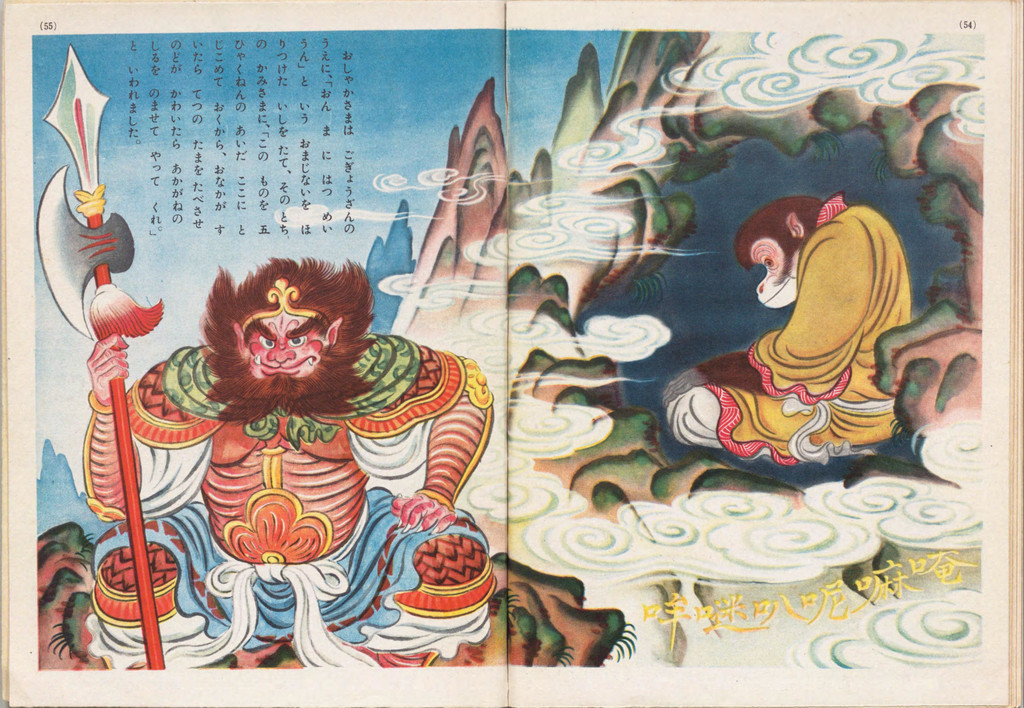
Moved by compassion, he [the Buddha] recited a divine spell and called together a local spirit and the Fearless Guards of Five Quarters to stand watch over the Five-Phases Mountain [fig. 1]. They were told to feed the prisoner with iron pellets [tie wanzi, 鐵丸子] when he was hungry and to give him melted copper [ronghua de tong zhi, 溶化的銅汁] to drink when he was thirsty. When the time of his chastisement was fulfilled, they were told, someone would be coming to deliver him (Wu & Yu, 2012, vol. 1, p. 199).

又發一個慈悲心,念動真言咒語,將五行山召一尊土地神祇,會同五方揭諦,居住此山監押。但他饑時,與他鐵丸子吃;渴時,與他溶化的銅汁飲。待他災愆滿日,自有人救他。

Fig. 1 – One of the guards charged with watching over Monkey (larger version). From the children’s book Son Goku (1939).

Table of Contents

1. The Origin

This punishment comes directly from Buddhist doctrine describing the torture of sinners in hell (Sk: Naraka; Ch: Diyu, 地獄). For example, the Dīrghāgama (Sk: दीर्घागम; Ch: Chang Ahun Jing, 長阿含經, or “The Collection of Long Scriptures”) [1] describes two realms in hell in which the damned are fed such a horrific diet:

[…] Terrified they [a damned soul] run out, seeking safety and refuge, but they arrive at the Hell of Hunger [Ji’e diyu, 飢餓地獄].

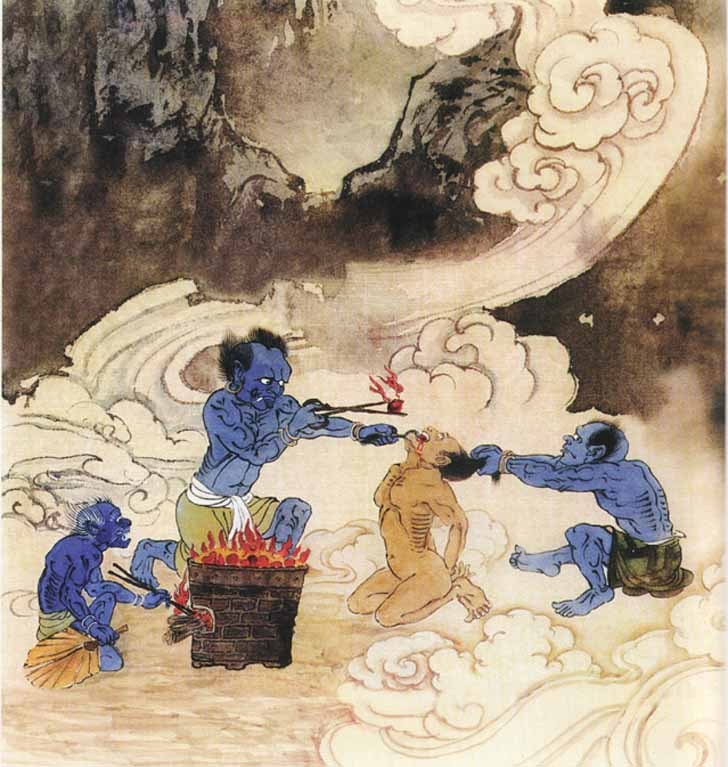
The wardens come to ask them: “Since you came here, what do you want?” They answer: “We are hungry”. The wardens then seize them and throw them on burning iron. They are caused to stretch and spread out their bodies; with iron hooks the wardens hook the sinners’ mouths and force them open; they put [hot] iron pellets into them [fig. 2]. The pellets burn their lips and tongues, from the throats down to their stomachs. The pellets penetrate through the sinners; there is nothing but burning. The horrible, fatal, and bitter suffering makes the sinners shriek and moan. Since their punishment is not yet completed, the sinners do not perish. After having suffered for a long time, they leave the Hell of Hunger. Frightened they run away, looking for relief and safety, until they arrive to the Hell of Thirst [Ke diyu, 渴地獄].

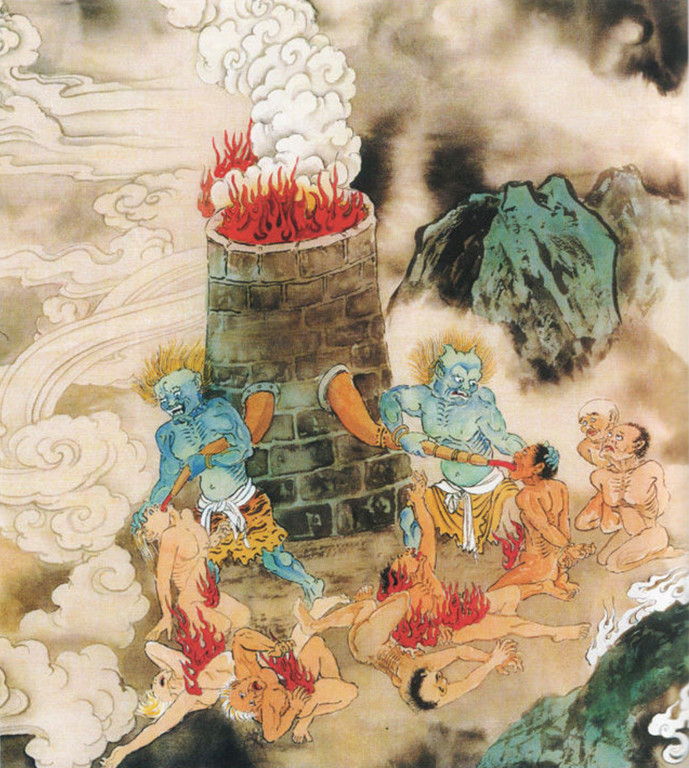
The wardens come to them and ask: “Since you came here, what do you want?” They answer: “We are thirsty.” The wardens thereupon seize the sinners and throw them on burning iron. They are caused to stretch and spread out their bodies; with hot iron hooks, the wardens hook the sinners’ mouths and force them open. They pour down molten copper [fig. 3]. It burns their mouth, lips and tongue; from their throats it reaches their stomachs. It penetrates down and goes through them; there is nothing but burning. The terrible, fatal, and bitter suffering makes the sinners shriek and moan. Since the remaining transgressions have not yet been atoned, they do not perish. After having been subjected to this punishment for a long time, they leave the Hell of Thirst (Howard, 1986, p. 131).

「… 慞惶馳走,求自救護,到飢餓地獄。獄卒來問:『汝等來此,欲何所求?』報言:『我餓。』獄卒即捉撲熱鐵上,舒展其身,以鐵鈎鈎口使開,以熱鐵丸著其口中,燋其脣舌,從咽至腹,通徹下過,無不燋爛,苦毒辛酸,悲號啼哭。餘罪未盡,猶復不死。

「久受苦已,出飢地獄,慞惶馳走,求自救護,到渴地獄。獄卒問言:『汝等來此,欲何所求?』報言:『我渴。』獄卒即捉撲熱鐵上,舒展其身,以熱鐵鈎鈎口使開,消銅灌口,燒其脣舌,從咽至腹,通徹下過,無不燋爛,苦毒辛酸,悲號啼哭。餘罪未盡,猶復不死。

「久受苦已,出渴地獄 …

Soul being forced to eat iron pellets

Fig. 2 – A damned soul being force-fed red hot iron pellets (larger version). Fig. 3 – Souls being forced to drink molten copper (larger version).

1.1. Additional Info

The same source explains that the hells of hunger and thirst are the respective fourth and fifth of sixteen minor hells (shiliu xiaoyu, 十六小獄) making up one of the eight greater purgatories (ba da diyu, 八大地獄) called the hell of consciousness (xiang, 想). Sinners reborn into this labyrinth of pain are full of anger and lash out at each other with scythe-like claws, as well as swords and daggers. They remain conscious through endless rounds of dismemberment and resurrection via a cold, magical wind (lengfeng, 冷風). They then wander into each successive minor hell, enduring everything from grinding by hot millstones to their flesh and bones being shattered by blistering cold. Again, each sinner remains conscious and resurrects between each purgatory (Howard, 1986, pp. 129-134).

Another name for the greater hell of consciousness is the Sanskrit term Samjiva (Ch: Denghuo, 等活), meaning “revival” or “repetition.” These might refer to the cyclical resurrection of the sinner, or to their karmic punishment mirroring what they did to others in life (Buswell & Lopez, 2014, p. 754).

It should be noted that unlike the Judeo-Christian tradition, rebirth in the Buddhist hell is not forever. For some it may last eons, but the torture serves to cleanse the spirit of past sins gained in life. Once the karmic debt has been repaid, the soul will be reborn into one of the other six realms of existence: hell, hungry ghost, animal, human, asura, or deva. Sometimes souls have to work their way back up to human status if they have particularly heavy karmic baggage.

Monkey’s punishment is essentially hell on earth. The Five Elements Mountain pins him down so that the chosen guards can torture him with hot iron pellets and molten copper just like those in the subterranean hells of hunger and thirst. He is not capable of dying, so his immortality serves a similar function to the magic wind that continually resurrects the damned. The finite length of his sentence (600-plus-years) is similar to the way a soul will only stay in the hell realm until they have repaid their karmic debt. And Tripitaka delivering him from his torments is like a soul being reborn into a new life. After all, Monkey’s life drastically changes after his release; he goes from being a rebellious, power-hungry demon, to a Buddhist monk devoted to the protection of his master.

2. Other Damned Celestials

Sun Wukong is not the only celestial to be damned to drink molten copper. Readers may be surprised to learn that King Yama (Yanluo Wang, 閻羅王), fifth of the Ten Judges of Hell, also suffers from this affliction. The aforementioned Dīrghāgama reads:

Buddha said to the bhiksus: “South of Jambudvipa, in the interior of the great Diamond Mountain, lies the palace of King Yama. The realm he governs extends for six thousand yojanas in both directions. His city has seven rows of ramparts, with seven nets and seven rows of trees … Day and night, three times a day, a huge copper cauldron automatically places itself in front of him. If the huge cauldron emerges in the interior of the palace, the king, upon seeing it, rushes out of the palace stricken by horror and fright. But then, if the cauldron emerges outside the palace, the king, upon seeing it, reenters the palace stricken by horror and fright. Giant hell wardens grab King Yama and have him lie down on hot irons. With iron hooks, they split his mouth open and force molten copper down. It burns his lips and tongue; from the throat, it reaches his stomach. It spreads down below and passes through [his body] so that no place is left unburnt. The punishment continues [in this fashion] until its completion. Afterwards, King Yama returns to seek amusement with all his ladies. Many great state[s]men, who possessed riches, are also punished in this way” (Howard, 1986, p. 141).

佛告比丘:「閻浮提南大金剛山內,有閻羅王宮,王所治處縱廣六千由旬,其城七重,七重欄楯、七重羅網、七重行樹 … 然彼閻羅王晝夜三時,有大銅鑊自然在前。若鑊出宮內,王見畏怖,捨出宮外。若鑊出宮外,王見畏怖,捨入宮內。有大獄卒,捉閻羅王臥熱鐵上,以鐵鈎擗口使開,洋銅灌之,燒其脣舌,從咽至腹,通徹下過,無不燋爛。受罪訖已,復與諸婇女共相娛樂。彼諸大臣同受福者,亦復如是。」

So Yama inhabits an odd position where he is both a member of the heavenly hierarchy working to judge the fate of the dead and a damned soul repaying a karmic debt through torture.


3. Updates

Update: 01-09-23

Chapter four of Shao (1997) explains that the term “Five Elements/Phases” (Wuxing, 五行) is used in JTTW and Buddho-Daoist doctrine to represent mortality. For example, Monkey complains to the judges of hell in chapter three that he’s no longer subject to death since he has achieved the Daoist elixir, thereby breaking free of the five elements. His imprisonment beneath Five Elements Mountain and hellish diet are, therefore, clues that the Buddha is punishing Sun to a symbolic death and afterlife. His subsequent release in chapter 14 can then be viewed as a symbolic reincarnation, which completes the cycle of death, karmic punishment, and rebirth.

Recall how the novel states time and time again that Monkey was under the mountain for 500 years. Although internal story details suggest it was actually over 600 years, it’s important to remember that 500 is used in Buddhist doctrine to denote a large number (Zhao, 2021, p. 126). So, maybe the novel was just implying that Monkey was punished for a really long time.

Note:

1) The Dīrghāgama has only survived thanks to a Chinese translation from the original Sanskrit in 413 CE (Buswell & Lopez, 2014, p. 246).

Sources:

Buswell, R. E., & Lopez, D. S. (2014). The Princeton Dictionary of Buddhism. Princeton University Press.

Howard, A. F. (1986). The Imagery of the Cosmological Buddha. Leiden: E.J. Brill.

Wu, C., & Yu, A. C. (2012). The Journey to the West (Vols. 1-4) (Rev. ed.). Chicago, Illinois: University of Chicago Press.

Zhao, P. (2021). The Essentials of Buddhism: Questions and Answers (H. Fang, trans.). Beijing: American Academic Press.

Origins of the Chinese Underworld Appearing in Journey to the West

Did you know that the underworld presented in Journey to the West is actually an amalgam of native Chinese and foreign Hindu-Buddhist beliefs? As far back as the Han Dynasty (206 BCE–220 CE), hell was considered an otherworldly bureaucracy where souls were kept en masse. With the coming of Buddhism from India, a different view of the underworld evolved wherein souls would be reborn in one of six paths (deva, asura, human, animal, hungry ghost, and hell) and burn off any bad karma via suffering in life until they were pure enough to be reborn in a Buddha realm. But starting around the 7th-century, the idea of purgatory appeared and brought with it the concept of the Ten Judges or Kings (shi wang, 十王). This is where the two previous views were combined. Souls would be brought before a magistrate and suffer punishment for a given sin before being sent onto the next court and so forth. After suffering for a three year period, the soul would finally be sent onto their next life (Teiser, 2003, pp. 4-7).

Click the image to open in full size.

Detail from a 20th-century hell scroll (larger version)

Two of the Ten Judges stand as perfect examples of the intermixing of the two belief systems. The seventh judge, King of Mount Tai (Taishan Wang泰山王), is an allusion to a famous Chinese holy mountain. The fifth judge, King Yama (Yanluo Wang, 閻羅王), is a Buddhist holdover from Hinduism who originally ruled as the god of the underworld (Teiser, 2003, pp. 2-3).

Not everyone living in medieval China could read Buddhist scriptures, so the purgatories were eventually illustrated as a powerful teaching tool. Nothing says behave like seeing a demon eviscerating someone in full bloody color. Such “Hell Scrolls” (Diyu tu地獄圖) remain quite popular even to this day. Charles D. Orzech (1994) suggests that one of the reasons why they remained popular through the end of dynastic China was because they served as not so subtle reminders to be a law abiding citizen. Otherworldly judges doling out painful punishments mirrored the actions of their earthbound counterparts. Real-world magistrates were known for using torture to gain confessions. One such device was used to slowly fracture the ankles and shins.

Those interested can see full color versions of hell scrolls here:

http://people.reed.edu/~brashiek/scrolls/index.html

Sources:

Orzech, C. D. (1994). Mechanisms of Violent Retribution in Chinese Hell Narratives. Journal of Violence, Mimesis, and Culture, 1. Retrieved from
https://www.uibk.ac.at/theol/cover/c…n01_orzech.pdf

Teiser, S. F. (2003). The scripture on the ten kings and the making of purgatory in medieval Chinese Buddhism. Honolulu, HI: University of Hawaii Press.

The Story of Sun Wukong, the Monkey King

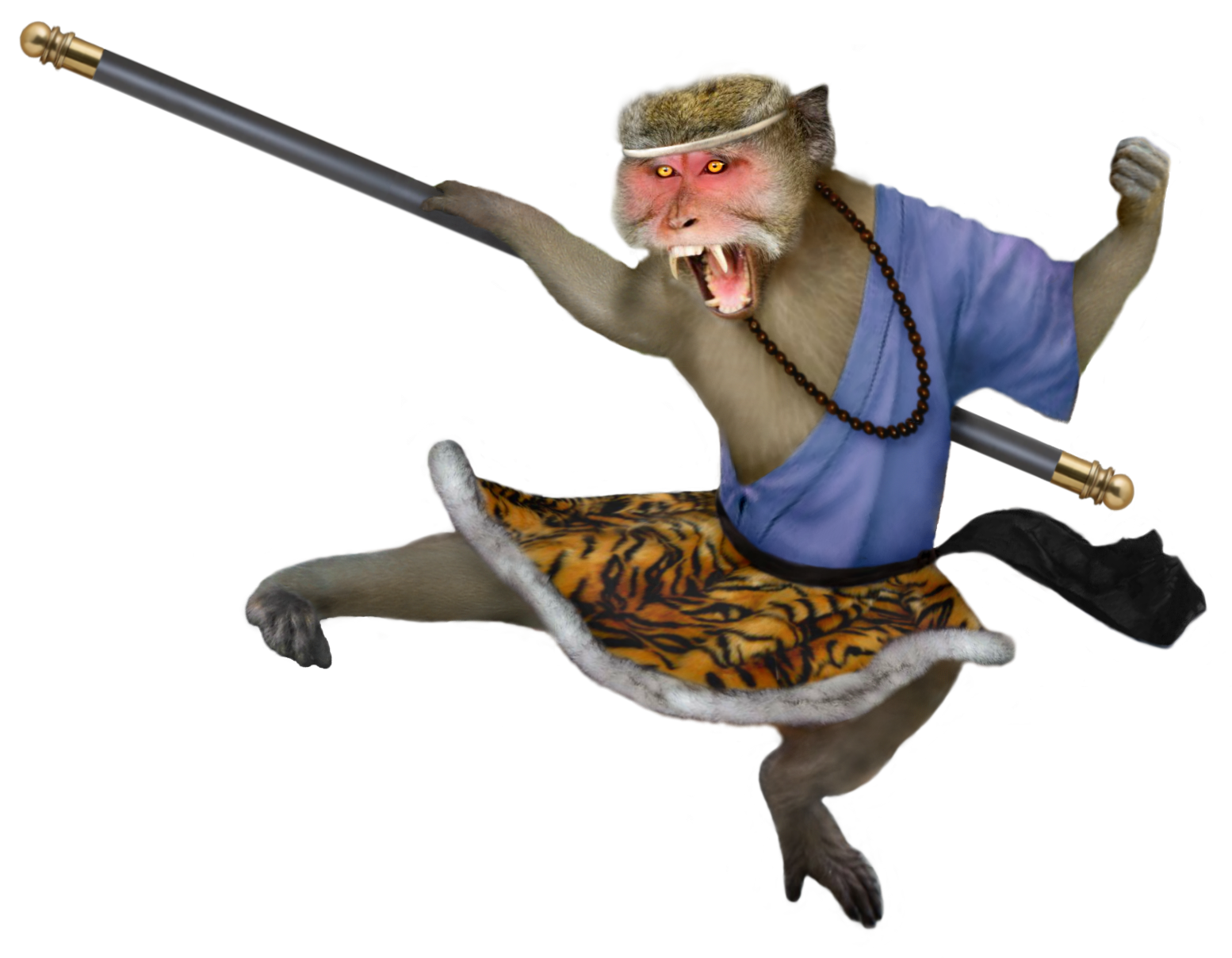
One of the most famous primate characters in world literature appears in the great Chinese classic Journey to the West (Xiyouji, 西遊記, 1592 CE). The story follows the adventures of Sun Wukong (孫悟空, a.k.a. “Monkey”) (fig. 1), an immortal rhesus macaque demon, who gains extraordinary power via spiritual cultivation and rebels against the primacy of heaven. Like Lucifer in Judeo-Christian mythology, this trickster god falls from grace when a supreme deity, in this case the Buddha, banishes him to an earthly prison below. But unlike his western counterpart, the monkey repents, becoming a monk and agreeing to use his abilities to protect a Buddhist priest on his journey to collect sutras from India.

What follows is an overview of Monkey’s story. It will primarily focus on the first seven of the novel’s 100 chapters, but chapters eight through 100 will be briefly touched upon, along with lesser-known literary sequels to Journey to the West. I will also discuss the novel’s impact on pop culture and religion.

Table of Contents

1. His Story

In the beginning, the mystical energies of heaven and earth and the light of the sun and moon come together to impregnate a boulder high atop the Mountain of Flowers and Fruit (Huaguo shan, 花果山), an island that lies to the east of the easternmost continent in the Buddhist disc world system. The stone gestates for countless ages until the Zhou Dynasty (1046-256 BCE), when it hatches a stone egg that is eroded by the elements into a simian shape. The Stone Monkey (Shihou, 石猴) awakens and bows to the four cardinal directions as light bursts forth from his eyes. The light is so bright that it reaches heaven, alarming the Jade Emperor (Yuhuang dadi, 玉皇大帝) and his celestial retinue. The light soon subsides, however, once he ingests food for the first time.

The Stone Monkey happens upon other primates on the island and becomes their king when he proves himself in a test of bravery by blindly leaping through a waterfall, thereby discovering a long-forgotten immortal’s cave. He rules the mountain for over three centuries before the fear of death finally creeps in. One of his primate advisors suggests that the king finds a transcendent to teach him the secrets of eternal life, and so Monkey sets sail on a makeshift raft and explores the world for ten years. His quest eventually takes him to the western continent, where he is finally accepted as a student by the Buddho-Daoist sage, Patriarch Subodhi (Xuputi zushi, 須菩提祖師). He is given the religious name Sun Wukong, meaning “monkey awakened to emptiness” or “monkey who realizes sunyata.” The sage teaches him the 72 methods of earthly transformation, or endless ways of changing his shape and size; cloud somersaulting, or a type of flying that allows him to travel 108,000 li (33,554 mi / 54,000 km) in a single leap; all manner of magical spells to call forth gods and spirits, grow or shrink to any size, part fire and water, create impassable barriers, conjure wind storms, cast illusions, freeze people in place, make endless clones of himself, unlock any lock, bestow superhuman strength, bring the dead back to life, etc.; traditional medicine; armed and unarmed martial arts; and, most importantly, an internal breathing method that results in his immortality. He is later disowned by the sage for selfishly showing off his new found magical skills to his less accomplished classmates.

Sun eventually returns to his cave and faces a demon who had terrorized his people during his prolonged absence. After killing the monster, he realizes that he needs a weapon to match his celestial power, and so his advisor suggests that he go to the undersea palace of Ao Guang (敖廣), the Dragon King of the Eastern Sea. There, he tries out weapons weighing thousands of pounds, but each one is too light. He finally settles on a massive nine-ton iron pillar that was originally used by Yu the Great (Dayu, 大禹) to set the depths of the fabled world flood, as well as to calm the seas. Named the “As-You-Will Gold-Banded Staff” (Ruyi jingu bang, 如意金箍棒), the iron responds to Sun’s touch and follows his command to shrink or grow to his whim, thus signifying that this weapon was fated to be his. In addition to the staff, Monkey bullies the Dragon King’s royal brothers into giving him a magical suit of armor.

Shortly after returning home to the Mountain of Flowers and Fruit, he shows off his new weapon by turning into a frightful cosmic giant and commanding the staff to grow, with the top touching the highest heaven and the bottom the lowest hell. This display of power prompts demon kings of the 72 caves to submit to his rule and host a drunken party in his honor. Soon after falling asleep, Sun is visited by two psychopomps who drag his soul to the Chinese underworld of Diyu (地獄). There, he learns that he was fated to die at the allotted age of 342 years old. But this enrages Monkey since his immortality freed him from the cycle of rebirth, and so he bullies the kings of hell in to bringing him the ledger containing his info. He promptly crosses out his name with ink, as well as the names of all monkeys on earth, thus making them immortal, too. He wakes up in the mortal world when his soul returns to his body.

Fig. 1 – A modern depiction of Sun Wukong (by the author) (larger version).

Both the Eastern Dragon King and the Hell King Qinguang (秦廣王) submit memorials to heaven concerning Sun’s misconduct. But the court advisor, an embodiment of the planet Venus, convinces the Jade Emperor to give Sun the menial task of watching over the Heavenly Horses in order to avoid further conflict. Monkey accepts and steadfastly performs his duties, that is until he learns that he’s just a glorified stable boy. He immediately returns to his earthly home in rebellion to proclaim himself the “Great Sage Equaling Heaven” (Qitian dasheng, 齊天大聖). The celestial realm mobilizes an army of powerful demon hunters, including the Heavenly King Li Jing (Li Jing tianwang, 李靖天王) and his son, the child god Third Prince Nezha (Nezha santaizi, 哪吒三太子), but they all fall to Monkey’s magical and martial might. The embodiment of the planet Venus once again steps in to convince the Jade Emperor to acquiesce to Monkey’s demand for higher rank, thereby granting him the empty title of Great Sage Equaling Heaven and even promoting him to watch over the immortal peach groves.

Sun takes stock of the magical peaches that ripen every few thousand years, but he eventually succumbs to their heavenly aroma. He eats all but the youngest life-prolonging fruits, thus gaining another level of immortality. His theft is soon discovered, however, when fairy attendants of the Queen Mother of the West (Xiwangmu, 西王母) arrive to pick the choicest specimens for her long-awaited immortal peach banquet. Sun is alerted to there presence and, upon questioning them, learns that he has not been invited. Naturally, Sun becomes enraged, freezing the maidens in place with fixing magic and then crashes the party before the hallowed guests arrive. He eats all of the celestial food and drinks all of the immortal wine, and then drunkenly stumbles into the laboratory of Laozi (老子), a high god of Daoism. There, he gobbles up the deity’s alchemically-derived elixir pills, thereby adding several more levels of immortality.

Sun returns home once again to await the coming storm of heavenly forces. Tired of the demon’s antics, the Jade Emperor calls up 72 heavenly generals, comprising the most powerful Buddho-Daoist gods, and 100,000 celestial soldiers. In response, Monkey mobilizes his own army comprising the demon kings of the 72 caves and all manner of animal spirits, including his own monkey soldiers. But soon after the battle commences, the demon kings fall to heavenly troops, forcing Sun to take on three heads and six arms and multiply his iron staff to meet the onslaught. Once again, the heavenly army is no match for him. However, he soon loses his nerve when his monkey children are captured in great heavenly nets. He flees with Erlang (Erlang shen, 二郎神), a master of magic and the nephew of the Jade Emperor, taking chase. The two battle through countless animal transformations, each trying to one-up the other. Monkey is finally captured when Laozi drops a magical bracelet on his head, incapacitating him long enough for Erlang’s celestial hound to bite hold of his leg.

Sun is taken to heaven to be executed for his crimes, but fire, lightning, and edged weapons have no effect on his invincible body. Laozi then suggests that they put him inside of the deity’s alchemical furnace to reduce the demon to ashes. They check the furnace 49 days later expecting to see his rendered remains. However, Monkey jumps out unscathed, having found protection in the wind element (xun, 巽) of the eight trigrams. But intense heat and smoke inside the furnace had greatly irritated his eyes, refining his pupils the color of gold and giving them the power to recognize the dark auras of demons in disguise. He overturns the furnace and begins to cause havoc in heaven with his iron staff. The Jade Emperor finally beseeches the Buddha (Rulai, 如来) in the Western Paradise to intervene.

The Tathagata appears and declares that he will make Sun the new ruler of heaven if the macaque can simply jump out of his palm. Monkey agrees to the wager, and with one tremendous leap, speeds towards the reaches of heaven. He lands before five great pillars, thinking them to be the edge of the cosmos. He tags one with his name and urinates at the base of another in order to prove that he had been there. Upon returning, Sun demands the throne. However, the Buddha reveals that the five pillars were actually his fingers, meaning that the Great Sage had never left. But before Monkey can do anything, the Tathagata overturns his hand, pushing it out the gates of heaven, and transforming it into the Five Elements Mountain (Wuxing shan, 五行山). There, Sun is imprisoned for his crimes against heaven, as well as subjected to a hellish diet.

Chapters thirteen to 100 tell how six hundred years later Sun is released during the Tang Dynasty (618-907) to help escort the Buddhist monk Tripitaka (Sanzang, 三藏) (whose early story is told in chapters eight to twelve), a disciple of the Buddha in a previous life, on a quest to retrieve salvation-bestowing scriptures from India. The Bodhisattva Guanyin (觀音) gives the monk a golden headband (jingu, 金箍; a.k.a. jingu, 緊箍, lit: “tight fillet”) as a means to rein in Monkey’s unruly nature. It tightens around Sun’s head whenever a magic formula is recited, causing him great pain. In addition, Guanyin gives Monkey three magic hairs on the back of his neck that can transform into anything he desires to aid in his protection of the monk. Along the way, the two meet other monsters-turned-disciples—Zhu Bajie (猪八戒), the lecherous pig demon, Sha Wujing (沙悟净), the complacent water demon, and the White Dragon Horse (Bailongma, 白龍馬), a royal serpent transformed into an equine—who agree to aid in the monk’s defense. Monkey battles all sorts of ghosts, monsters, demons, and gods along the way. In the end, he is granted Buddhahood and given the title of the “Victorious Fighting Buddha” (Dou zhanzheng fo, 鬥戰勝佛) for protecting Tripitaka over the long journey.

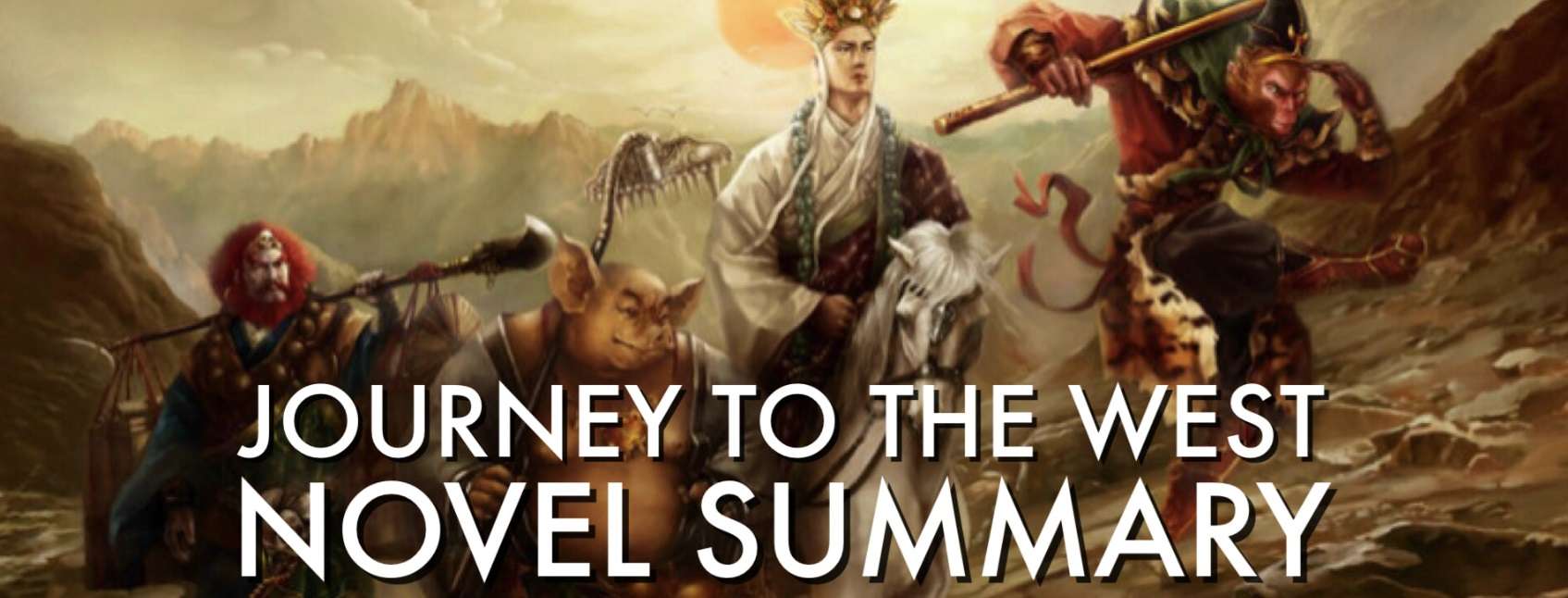
A summary of all 100 chapters can be read on my friend’s blog (fig. 2).

https://journeytothewestlibrary.weebly.com/novel-summary

Fig. 2 – The summary header (larger version).

2. Sequels

There are a total of four unofficial sequels to the novel.

The first is called A Supplement to the Journey to the West (Xiyoubu, 西游补, 1640), which takes place between chapters 61 and 62 of the original. In the story, the Monkey King wanders from one adventure to the next, using a magic tower of mirrors and a Jade doorway to travel to different points in time. In the Qin Dynasty (221–206 BCE), he disguises himself as Consort Yu in order to locate a magic weapon needed for his quest to India. During the Song Dynasty (960–1279), he serves in place of King Yama as the judge of Hell. After returning to the Tang Dynasty, he finds that his master Tripitaka has taken a wife and become a general charged with wiping out the physical manifestation of desire (desire being a major theme running through the novelette). Monkey goes on to take part in a great war between all the kingdoms of the world, during which time he faces one of his own children in battle. In the end, he discovers an unforeseen danger that threatens Tripitaka’s life.

The second is the Later Journey to the West (Hou Xiyouji, 後西遊記, 17th century). This novel focuses on the adventures of Monkey’s spiritual descendent Sun Luzhen (孫履真, “Monkey who Walks Reality”). I have a three-part article about it (first, second, and third).

And the third and fourth are the Continuation of the Journey to the West (Xu Xiyouji, 續西遊記, 17th century) and the New Journey to the West (Xin Xiyouji, 新西遊記, 19th century), respectively. As of 2023, I have not written any articles on these sequels.

3. Cultural Impact

Stories about Sun Wukong have enthralled people the world over for centuries. His adventures first became popular via oral folktale performances during the Song Dynasty (960-1279). These eventually coalesced into the earliest known version of the novel, The Story of How Tripitaka of the Great Tang Procures the Scriptures (Da Tang Sanzang qujing shihua, 大唐三藏取經詩話; The Story hereafter), published during the late-13th century.

Since the anonymous publishing of the complete novel in the 16th century, Monkey has appeared in numerous paintings, poems, books, operatic stage plays, video games, and films (both live action and animated).

He was sometimes “channeled,” along with other martial spirits, by citizen soldiers of the anti-foreign Boxer Rebellion (1899-1901). There is also a monkey-based martial art named in his honor.

It is interesting to note that there are people in southern China, Taiwan, Malaysia, Singapore, Thailand, and Vietnam who worship him as a patron deity. Thus, Sun became so popular that he jumped from oral and published literature to take his place on the family altar.

Copies of The Story were discovered in Japan among a 17th-century catalog of books in the Kozanji Temple (高山寺, Ch: Gaoshan si). No copies are known to exist in China, which suggests this version came to the island many centuries ago. The complete Ming edition of the novel came to Japan in the late-18th century, where it was translated in bits and pieces over the course of some seventy years. However, Monkey did not become immensely popular until the first complete translation of the novel was published in 1835. The last part was illustrated with woodblocks by Taito II (fl. 1810-1853), a noted student of famous artist Hokusai (1760-1849).

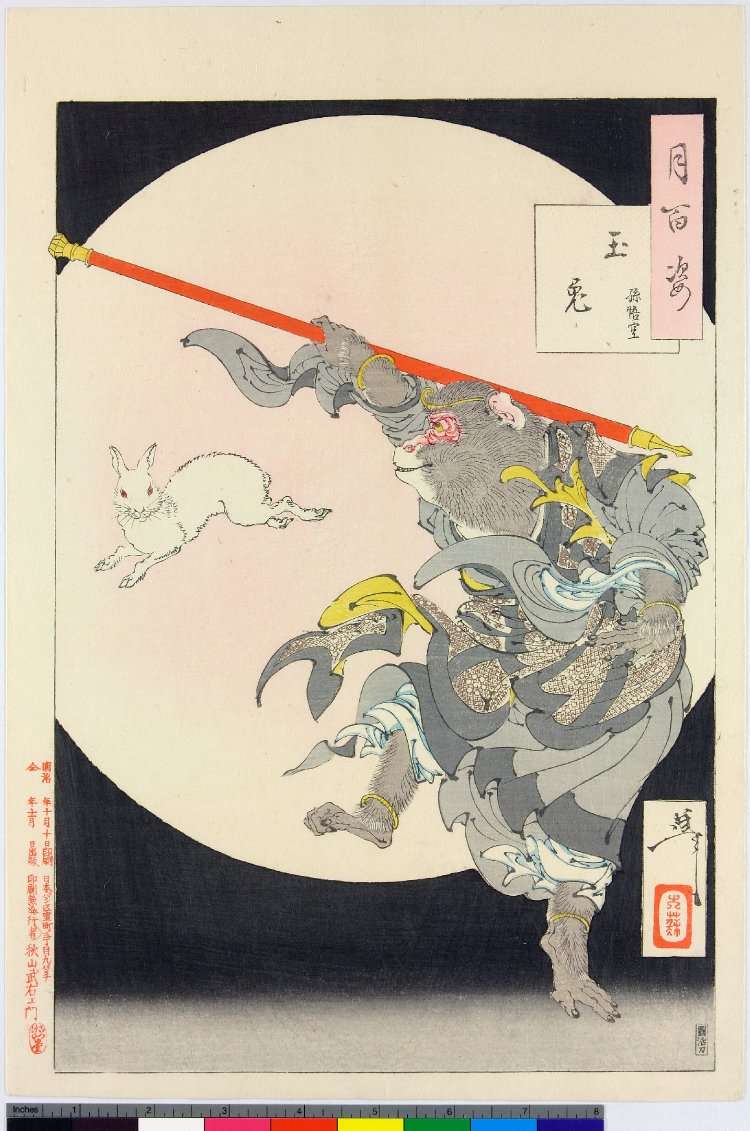
Other Japanese artists, such as Kubo Shunman (1757-1820) and Yoshitoshi (1839-1892) (fig. 3), produced beautiful full color woodblock prints of Sun.

Fig. 3 – (Left) Tsukioka Yoshitoshi, “Jade Rabbit – Sun Wukong”, October 10, 1889 (larger version). Fig 4. – (Right) Son Goku (孫悟空) from the Dragonball Franchise (larger version).

Like in China, Monkey has been adapted in all kinds of Japanese media. By far, his most famous adaptation is the manga and anime character Son Goku (孫悟空) (fig. 4) from the Dragon Ball (Jp:ドラゴンボール; Ch: Qi longzhu, 七龍珠) franchise (1984-present). Like Sun, Goku has a monkey tail, knows martial arts, fights with a magic staff, and rides on a cloud. His early adventures in Dragon Ball (manga: 1984-1995; anime: 1986-1989) see him traveling the world in search of seven wish-granting “dragon balls,” while also perfecting his fighting abilities and participating in a world martial arts tournament. Several of the supporting characters, such as Oolong (ウーロン), a lecherous anthropomorphic pig who can change his shape, a nod to Zhu Bajie, were directly influenced by the novel. Dragon Ball Z (manga: 1988-1995; anime: 1989-1996), a continuation of the comic book and animated TV show, follows Goku as an adult and reveals that he is actually a humanoid alien sent as a child to destroy Earth. He arrived in a spherical spaceship that recalls the stone egg from which Sun Wukong was formed. But instead of destroying the planet, he becomes its stalwart protector and faces extraterrestrial menaces from beyond the stars. Goku’s adventures have continued in the sequels Dragon Ball GT (1996-1997), Dragon Ball Super (2015-2018), and Super Dragon Ball Heroes (2018-present).