Note: For the time being, I’m changing this from a review of issue #0 to a review of the whole series. Until anything of significance takes place in the story (no luck as of issue #6), I’ll confine my thoughts to this page.
Last updated: 04-11-2026
The DC Comics character Monkey Prince (Ch: Xiao Houwang, 小猴王; a.k.a. “Marcus”), son of Sun Wukong (孫悟空), first appeared in “The Monkey Prince Hates Superheroes” from the DC Festival of Heroes: The Asian Superhero Celebration (2021) (Yang, 2021a). In anticipation of the character receiving his own 12-issue series in February 2022, DC released a free digital issue #0 (fig. 1) (DC Publicity, 2021). I stated in my previous review of the Monkey Prince that I wasn’t going to evaluate issue #0 due to so many problems with the original, as well as unpromising errors in promotional material for upcoming issue #1. But I changed my mind because I want readers unfamiliar with Journey to the West (Xiyouji, 西遊記, 1592; “JTTW” hereafter), the Chinese classic on which the comic is based, to have an informed opinion about the quality of the character design and writing through the lens of the original.
Issue #0 is written by Gene Luen Yang, colored by Sebastian Cheng, lettered by Janice Chiang, and edited by Jessica Chen. Bernard Chang provides art for the opening and closing pages, while Billy Tan draws the “flashback” scenes, or the majority of the issue (Yang, 2021b, p. 3). Readers of my previous review will remember that Editor Chen thought up the Monkey Prince but also worked with Mr. Yang and Mr. Chang to craft “the origin and the essence of [the character] together” (Aguilar, 2021).
Those who like this subject might fancy learning about Sun Wukong’s children in Ming-Qing Chinese literature. See also my review of Marvel’s Sun Wukong.

Fig. 1 – The front cover of Monkey Prince #0 (larger version). From Yang, 2021b. Copyright DC Comics.
Table of Contents
1. Story Overview
Titled “Apokolips in the Heavenly Realm,” the story opens on the Monkey Prince fighting a nest of insect-like parademon soldiers at night in Philadelphia. When asked how he knew about the nest, Shifu Pigsy (a.k.a. Zhu Bajie, 豬八戒) reveals that he and Sun Wukong had fought their kind once before in the past. This took place centuries ago when Darkseid, a despotic New God, sent his army to conquer the heavenly realm. A flashback shows the Bull Demon King (Niu mowang, 牛魔王), his wife Princess Iron Fan (Tieshan gongzhu, 鐵扇公主; a.k.a. “Rākṣasi,” Luocha, 羅剎), their son Red Boy (Hong hai’er, 紅孩兒), the immortal Erlang (二郎), and the child god Nezha (哪吒) standing against a wave of invading vanguard warriors and a sea of parademons (fig. 2). In the initial clash, Princess Iron Fan uses her famous palm-leaf fan (bajiao shanzi, 芭蕉扇子) to attack Mad Harriet, and the Bull Demon King protects his wife by punching Kalibak. But Big Barda incapacitates Red Boy with a sneak attack from behind. Luckily, though, the Monkey King swoops in at the last moment to save him from a second, fatal blow. Pigsy thereafter replaces Red Boy and uses his battle rake to strike at the warrioress, while also taking the opportunity to flirt with her.
At the height of battle, Sun and Erlang sense something traveling through time and space. This is revealed to be Darkseid himself when he arrives via boom tube. The evil god then exclaims:
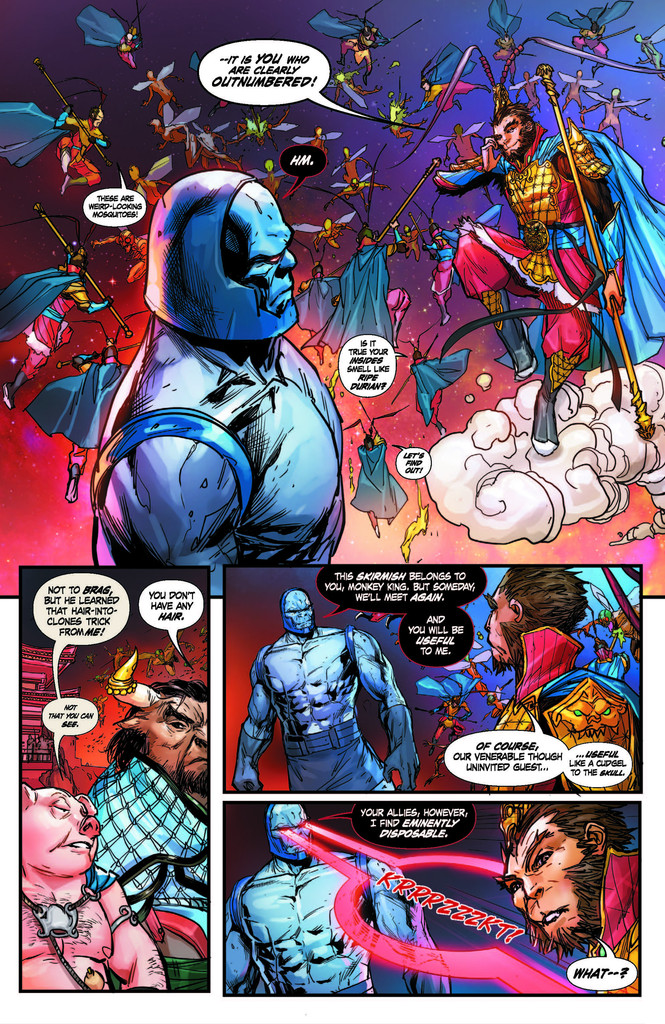
Hear me denizens of the Heavenly Realm! I am … the sovereign ruler of Apokolips! I’ve come to save you from your own incompetence! You are clearly outnumbered! If you value your lives, you will surrender immediately! (Yang, 2021b, p. 6, panel #2).
The Bull Demon Family jointly attacks the despot with their magic weapons, but this proves futile against his invulnerable body. Meanwhile, Monkey and Pigsy find and destroy the parademon nest, thereby decimating the invaders’ numerical advantage.
Sun soon after returns to confront Darkseid, comically referring to him as “our most venerable though uninvited guest” (Yang, 2021b, p. 7, panel #3). When the New God claims to have never heard of the famous Monkey King, our hero reveals that he’s destroyed the nest. He goes on to flaunt his power by creating countless hair clones of himself, stating: “It is YOU who are clearly outnumbered” (Yang, 2021b, p. 8, panel #1). Darkseid admits defeat; though, he claims to have a future use for Sun Wukong but not the others, so he unleashes his omega beams and kills the Bull Demon King and Princess Iron Fan. Red Boy is left to mourn over the bodies of his parents.
The issue ends with the Monkey Prince and Shifu Pigsy discussing how the event likely drove Red Boy to a life of villainy (Yang, 2021b).

Fig. 2 – A splash page showing some of the Journey to the West characters fighting Darkseid’s army (larger version). From Yang, 2021b, p. 3. Copyright DC Comics.
2. The Art
There’s a noticeable difference in quality throughout the comic. The “flashback” by Mr. Tan has a rough, sketchy style, while the “present day” sections by Mr. Chang, are crisp and dynamic. Mr. Cheng, the colorist, should be congratulated on his amazing work because he helps elevate the mediocre pencils comprising the majority of the comic.
2.1. Character Design
The panels of issue #0 are often packed with kinetic figures, making it hard to see detailed, full body images of the characters. I’ve, therefore, chosen to base my analysis on the character sheets from Blum (2021). I won’t be including Erlang or Nezha in the analysis as their presence is not as out of place as the others.
A major flaw is that the JTTW characters are presented as they might have looked during the pilgrimage instead of at the end of the novel. This doesn’t make any sense as the story takes place centuries after the events of the journey. And of course Mr. Chang has taken some artistic license with the designs instead of using descriptions from the book. But, admittedly, some are quite beautiful, such as that for Princess Iron Fan.
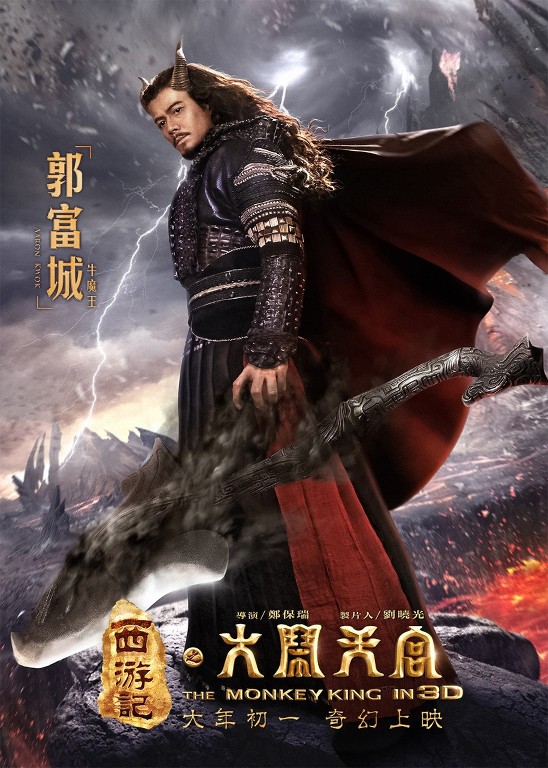
The Bull Demon King is depicted as a brown, minotaur-like figure with blue and red armor and matching gauntlets and boots, green pants, and a black battle ax (Blum, 2021) (fig. 3). The problem is that: 1) In the novel, the monster wields his own “cast-iron rod” (huntie gun, 混鐵棍) and a pair of his wife’s treasure swords (Wu & Yu, 2012, vol. 3, pp. 137 and 147). I’m guessing Mr. Chang got the idea for a black ax from the 2014 Chinese film The Monkey King (fig. 4). Films are obviously not a good source to use when adapting a readily available novel; 2) his armor doesn’t match that described in chapter 60:
He had on a wrought-iron helmet, water polished and silver bright; / He wore a yellow gold cuirass lined with silk brocade; / His feet were shod in a pair of pointed-toe and powdered-sole buckskin boots; / His waist was tied with a lion king belt of triple-braided silk (Wu & Yu, 2012, vol. 3, p. 137).
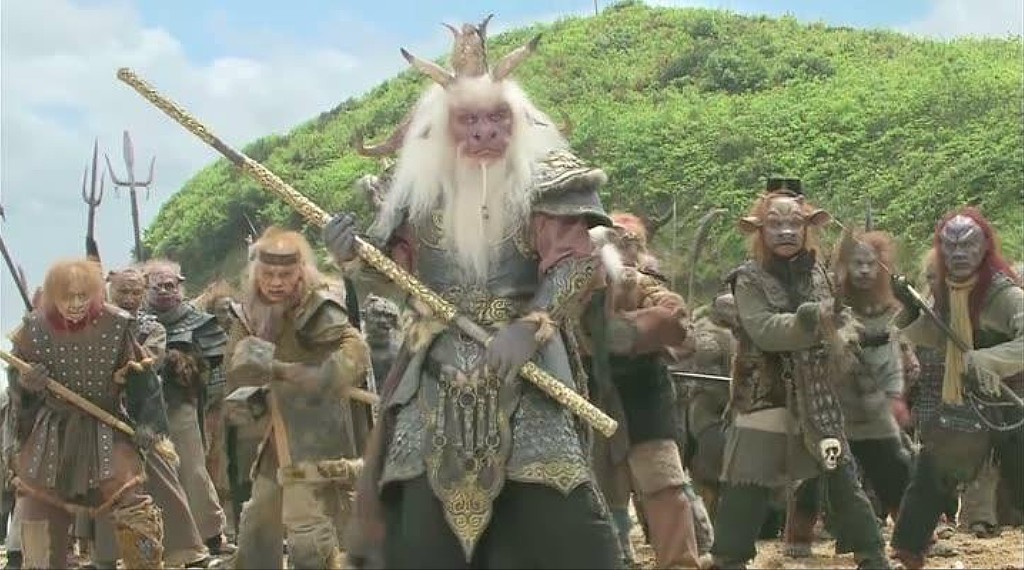
And 3) while the novel doesn’t note the color of his anthropomorphic form, the demon’s true form is said to be a “giant white bull” (da bai niu, 大白牛) (Wu & Yu, 2012, vol. 3, p. 157). This is why the faithful 2011 TV show depicts the Bull Demon King with white fur (fig. 5).

Fig. 3 – The Bull Demon King’s character design (larger version). Image from Blum (2021). Copyright DC Comics. Fig. 4 – The Monkey King (2014) movie poster showing Aaron Kwok’s bull demon summoning energy from his black ax (larger version). Fig. 5 – A screenshot of the white Bull Demon King from the 2011 TV show (larger version). Image found here. Take note of his iron staff.
Princess Iron Fan is portrayed with jewelry and makeup, a layered coif, and an elegant, multi-colored dress (fig. 6). A mini version of her palm-leaf fan is shown tucked inside a white belt at her waist (Blum, 2021). The problem is that: 1) Her main weapons in the novel are a pair of “blue-bladed treasure swords” (qingfeng baojian, 青鋒寶劍); [1] 2) the fan is reduced to a small leaf and kept inside her mouth, and when full size, it is 12-feet long (Wu & Yu, 2012, vol. 3, p. 145). This obviously differs from the small, handheld weapon shown in the comic (Yang, 2021b, p. 4, panel #1); and 3) most importantly, chapter 61 expressly states that Princess Iron Fan forsakes her lavish clothing to dress as a renunciate upon the defeat of her husband:
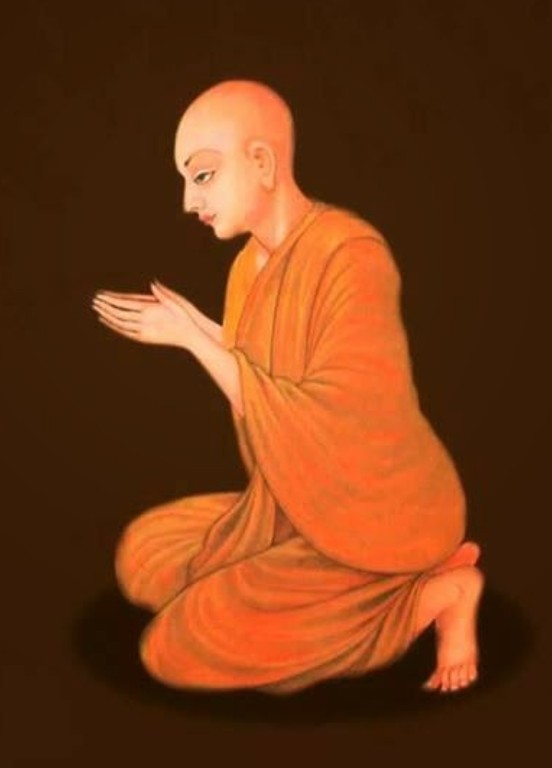
When Rākṣasi heard the call [of the Bull Demon King], she took off her jewels and her colored clothing. Tying up her hair like a Daoist priestess [daogu, 道姑] and putting on a plain colored robe like a Buddhist nun [biqiu, 比丘] [fig. 7], she took up with both hands the twelve-foot long palm-leaf fan to walk out of the door (Wu & Yu, 2012, vol. 3, p. 161).
She thereafter follows a reclusive life of self-cultivation (Wu & Yu, 2012, vol. 3, p. 163). So, there is a huge contrast between her comic book design and how she looks at the end of her story arc.

Fig. 6 – Princess Iron Fan’s character design (larger version). Image from Blum (2021). Copyright DC Comics. Fig. 7 – A drawing of a Buddhist nun (larger version). Image found here. Just imagine Raksasi with her hair tied into a knot on top and perhaps wearing grey-blue robes.
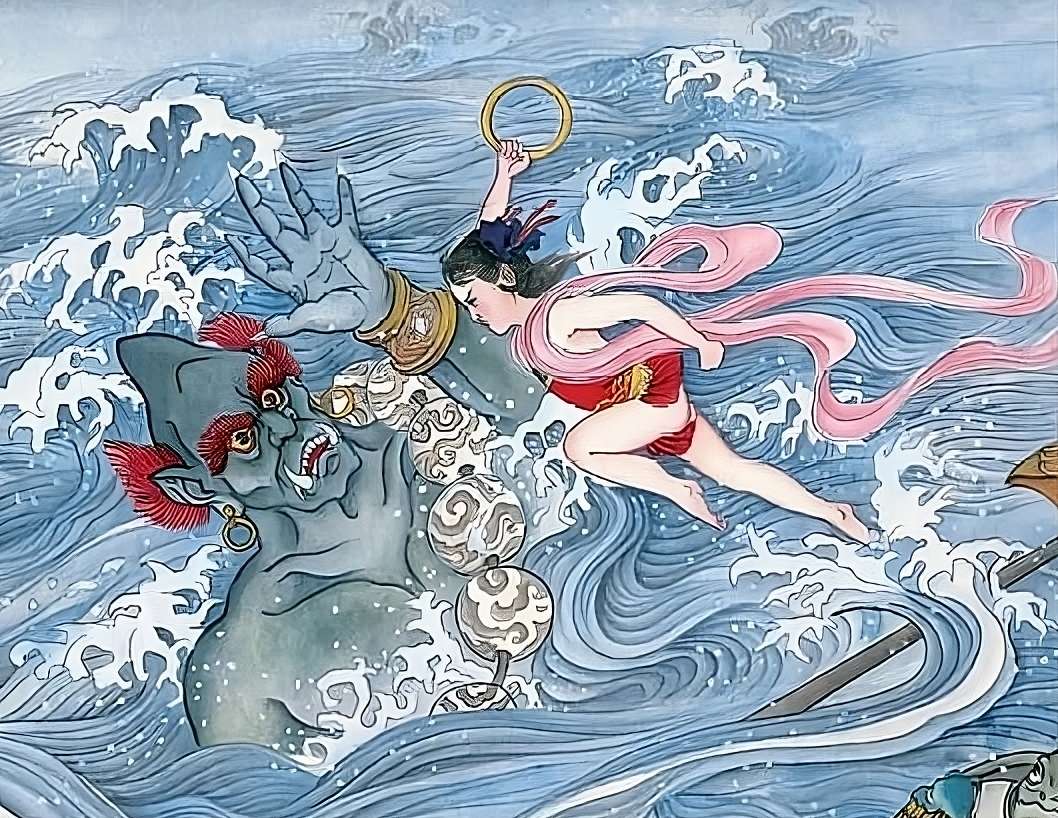
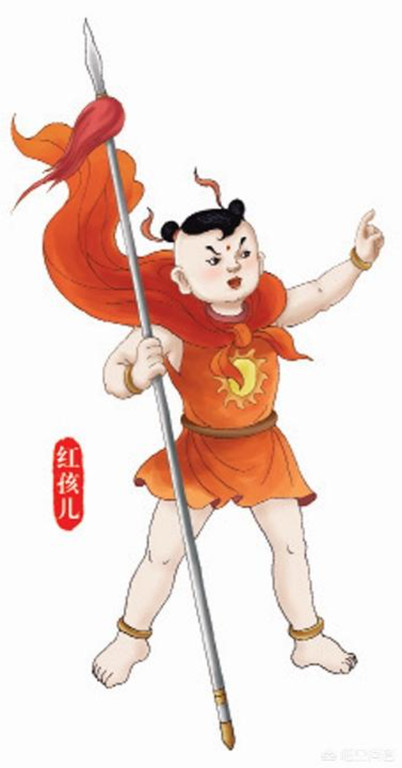
Red Boy is portrayed as a muscular teenager with a red and black undercut hairstyle, a small, purple cape, a bare chest and shoulders with a red, armored stomacher and matching gauntlets and boots, and purplish-blue, baggy pants. Flaming jewels(?) adorn the armor on his stomach, forearms, and knees (fig. 8). He wields a golden, red-tasseled spear with a partitioned blade (Blum, 2021). The problem is that: 1) Red Boy’s weapon is described in chapter 41 as an “eighteen-foot fire-tipped lance” (zhangba chang de huojian qiang, 丈八長的火尖槍) (Wu & Yu, 2012, vol. 2, p. 222); and 2) he’s depicted as a small child in the novel. He’s said to be huskier than Nezha, with a powder white face, deep red lips, and beautiful, black hair (Wu & Yu, 2012, vol. 2, p. 222). In fact, his nickname is the “Great King Holy Infant” (Shengying dawang, 聖嬰大王) (Wu & Yu, 2012, vol. 2, p. 219). [2] And after his defeat at the hands of the Bodhisattva Guanyin (Guanyin pusa, 觀音菩薩), he becomes her disciple, taking the religious name “The Child Sudhana” (Shancai tongzi, 善財童子; lit: “Child of Goodly Wealth”) (Wu & Yu, vol. 2, p. 354). So, he definitely shouldn’t look like a teenager; and 3) Guanyin subdues the fiery demon with gold circlets that squeeze his head, wrists, and ankles (fig. 9) (Wu & Yu, vol. 2, p. 251). This story is used to explain the presence of golden bracelets and anklets on modern religious statues of the deity (fig. 10). So, a child-like appearance and golden bands are associated with Red Boy in both literature and religion, and yet we see these are totally absent from Mr. Chang’s design.

Fig. 8 – Red Boy’s character design (larger version). Image from Blum (2021). Copyright DC Comics. Fig. 9 – A modern drawing of the literary demon (larger version). Image found here. Take note of the rings on his wrists and ankles. Fig. 10 – A modern day religious statue of Sudhana (larger version).
Lastly, Sun Wukong is depicted wearing a purple gold cap with lingzi (翎子) feathers, golden armor with a blue cape and gauntlets, a tiger skin kilt, and red pants with black boots (fig. 11) (Blum, 2021). He wields a golden staff with dragon finials spiraling down each tip like a corkscrew. The problem is that: 1) Chapter 3 describes the staff as a bar of black iron banded on each end with a golden ring (Wu & Yu, 2012, vol. 1, p. 135); 2) while the armor design is similar to early depictions of the Monkey King (minus the blue cape and gauntlets and the tiger skin kilt), the novel implies that it was stripped from his body once he was captured by heaven. I quote from my previous article (see section 2.2.):
Contrary to popular belief, Sun does not wear the armor throughout the entire story. Though not openly stated, the novel suggests it is stripped from the monkey when he is captured by heavenly soldiers in chapter six: “They bound him with ropes and punctured his breast bone with a knife, so that he could transform no further” (Wu & Yu, 2012, vol. 1, p. 186). Obviously the knife wouldn’t have punctured the magic armor. And after heaven fails to harm his body during an attempted execution, one celestial reports:
Your Majesty, we don’t know where this Great Sage has acquired such power to protect his body. Your subjects slashed him with a scimitar and hewed him with an ax; we also struck him with thunder and burned him with fire. Not a single one of his hairs was destroyed. What shall we do? (Wu & Yu, 2012, vol. 1, p. 186). (emphasis mine)
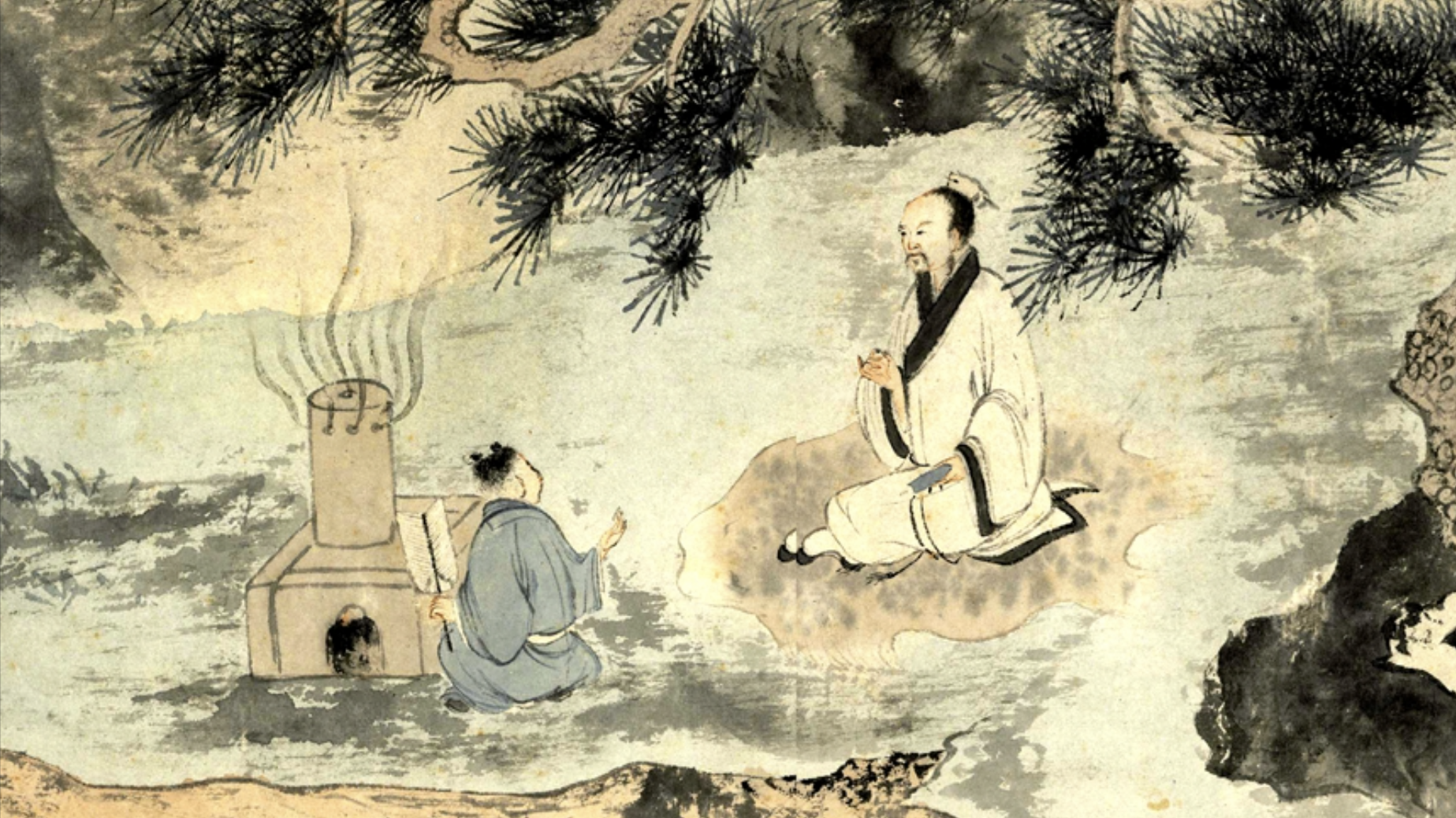
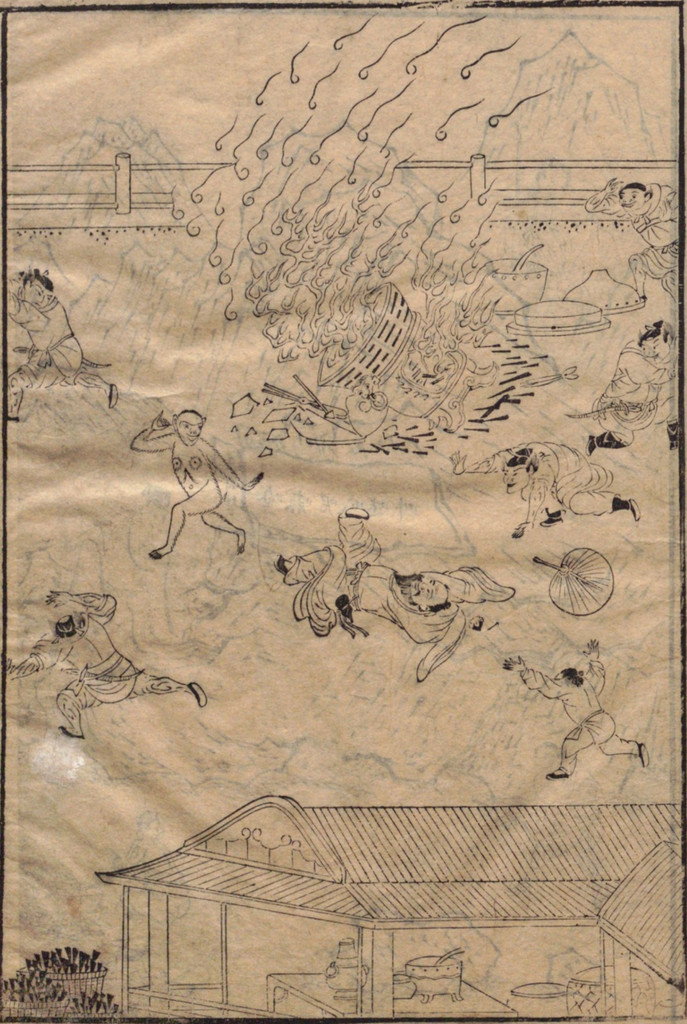
Prior to his turn in Laozi’s eight trigrams furnace in chapter seven, the story again references the knife in Monkey’s breastbone, suggesting he is still naked: “Arriving at the Tushita Palace, Laozi loosened the ropes on the Great Sage, pulled out the weapon from his breastbone, and pushed him into the [brazier]” (Wu & Yu, 2012, vol. 1, p. 189). One late-Ming woodblock print actually portrays him naked upon his escape from the furnace (fig. 16). Most importantly, after being released from his 600 plus-year-long imprisonment under Five Elements Mountain, Monkey is expressly described as being “stark naked” (chi tiao tiao, 赤條條) (Wu & Yu, 2012, vol. 1, p. 309).

Fig. 16 – Wukong in his birthday suit escaping from Laozi’s eight trigrams furnace (larger version). From Mr. Li’s Criticism (late-16th to early-17th c.).
This means that he wouldn’t have worn the armor during the entirety of the journey (ch. 14 to 100); and 3) most importantly, the Monkey King is elevated in spiritual rank at the journey’s end, becoming the Buddha Victorious in Strife (Dou zhansheng fo, 鬥戰勝佛; a.k.a. the “Victorious Fighting Buddha”) (Wu & Yu, 2012, p. 381). Religious depictions of this historical deity portray him wearing the traditional robes of a Buddhist monk and holding a symbolic sword and suit of armor in his hands (fig. 12). So, Sun Wukong should be portrayed as a Buddha and not an armored warrior (fig. 13).

Fig. 11 – Sun Wukong’s character design (larger version). Image from Blum (2021). Copyright DC Comics. Fig. 12 – The Buddha Victorious in Strife holding a sword and suit of armor (larger version). Image found here. Fig. 13 – A modern drawing of Monkey as a Buddha by Tianwaitang on deviantart (larger version).
Someone might ask: “Who cares what the characters look like?” Well, the creative team had two choices when they elected to adapt JTTW. One, they could have done so in broad strokes and laid the foundation for a fresh, new take that departs greatly from the original. An example of this is the South Korean drama Hwayugi (2017-2018), where the characters are depicted as gods disguised as humans living in modern Seoul. Or two, they could be faithful to the novel. The team sort of chose the latter as they created a main character that’s a carbon copy of the Monkey King (complete with the same strengths and weaknesses), designed secondary characters how they might have looked in the original, and Mr. Yang even references specific events from the novel in the comic story (see below). So if they’re going to adhere this much to the literary source, they should have at the very least followed the descriptions provided therein. As the old saying goes: “If it ain’t broke, don’t fix it.” It would be like me adapting Harry Potter despite never having read the books (I’m looking at you Mr. Chang). [3] My designs would no doubt be so wildly different from the original that the characters would be nearly unrecognizable.
3. The Writing
Let me begin by saying that I actually like the idea of Darkseid taking a boom tube to the heavenly realm. It’s a smart way of bridging the dimensional gap between modern comics and traditional Chinese literature. But that’s where my favorable comments end for the most part.
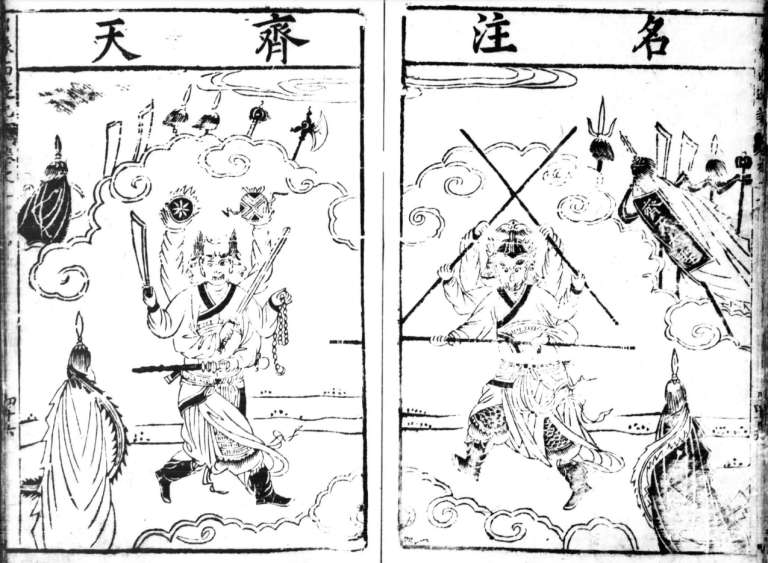
Mr. Yang makes some strange choices in the story. For example, making Zhu Bajie and the Bull Demon Family part of the heavenly army’s main force is odd because it overlooks the 72 commanders and 100,000 stellar soldiers from the original. [4] With the exception of Nezha, they are nowhere to be found in the comic, making it look like Sun Wukong, Erlang, Zhu, the Bull Demon King, Princess Iron Fan, and Red Boy are the sole defenders of heaven fighting to hold back the tide of Darkseid’s invasion (maybe this will be explained in a future issue).
Zhu Bajie would not have been involved at all because he was made the “Janitor of the Altars” (Jintan shizhe, 淨壇使者) at the end of the journey. This position allows him to constantly eat any leftover offerings on Buddhist altars (tan, 壇) from all over the world (Wu & Yu, 2012, vol. 4, p. 382). So Zhu would have been too busy selfishly stuffing his stomach to his heart’s content.
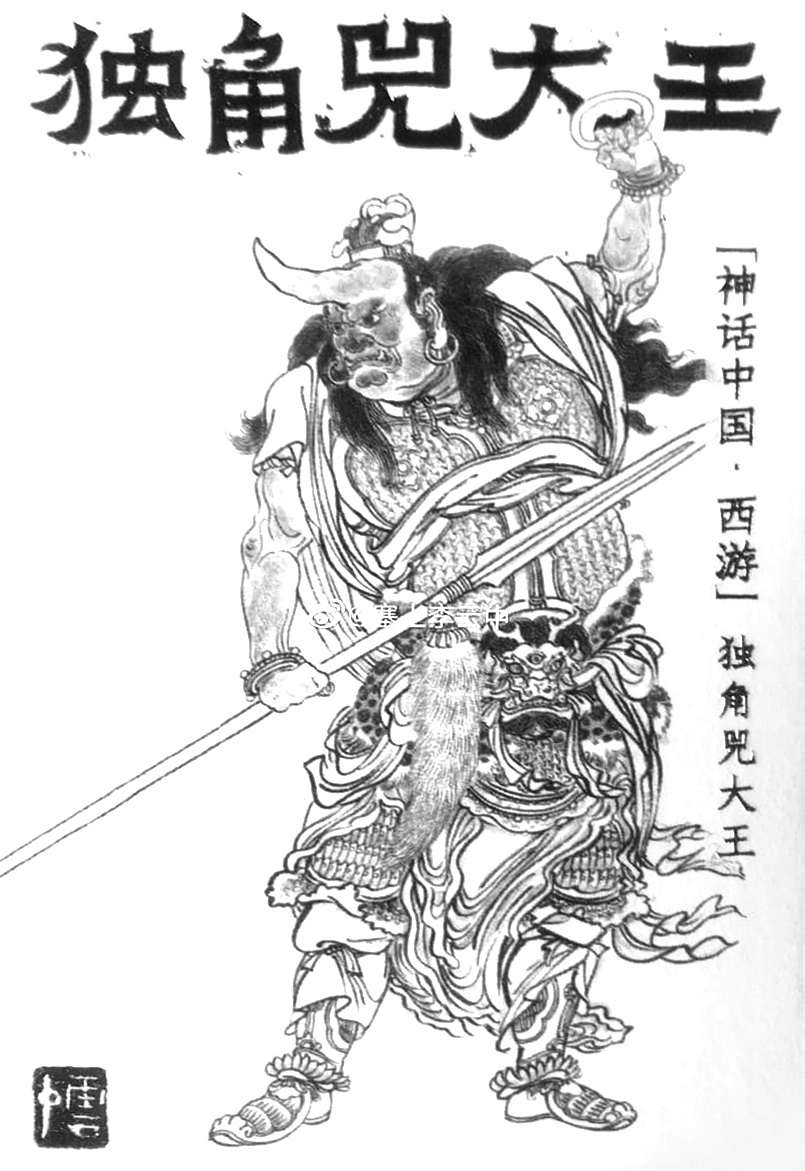
Apart from being strange that earth-dwelling villains like the Bull Demon King and Princess Iron Fan would defend the heavenly realm, their inclusion in the story does not mesh with the way their respective arcs end in JTTW. As noted above, the monster king’s true form is a giant white bull. His story ends when he is trapped in this form and taken under guard by Devraja Li Jing (李靖天王) and Nezha to see the Buddha (Wu & Yu, 2012, vol. 3, pp. 161 and 162). The details of his arc are quite similar to that of Sun Wukong: he’s an iron staff-wielding demon king nicknamed the “Great Sage,” who knows 72 changes, can adopt a titanic form, takes part in a battle of transformations with an enemy, is trapped by a joint effort from heaven and incapacitated by a circular object, and finally faces the Buddha. [5] So it’s not a stretch to suggest that the Bull Demon King is also punished in a similar manner. I show in this article (see section 1) that being trapped under the pressing weight of a mountain is a reoccurring sentence for supernatural offenders in Chinese literature. And don’t forget about Monkey’s secondary punishment, a hellish diet of hot iron balls and molten copper. Therefore, the monster king would likely still be imprisoned by the time Darkseid invades heaven.
Before continuing, I should note that Mr. Yang is well aware of the Bull Demon King’s fate, for he references his literary defeat in the comic. During the flashback, the monster asks Sun Wukong: “Would a blood brother have betrayed me to a cosmic net of Buddha’s warrior guardians, Monkey?” (Yang, 2021b, p. 5, panel #3). So, this makes the demon’s inclusion in the heavenly army twice as puzzling as he’s still bitter about his defeat.
Princess Iron Fan’s story ends when she “[goes] off somewhere to practice self-cultivation as a recluse” (Wu & Yu, 2012, vol. 3, p. 163). The novel continues: “In the end she, too, attained the right fruit [zhenguo, 正果] and a lasting reputation in the sutras” (Wu & Yu, 2012, vol. 3, p. 163). This might imply that she compounds Buddhist merit by performing good deeds or perhaps even religious miracles, becoming a sort of Buddhist saint in her own right. So, I imagine that she, too, would be unavailable to fight against the sudden invasion of Darkseid’s army.
On the contrary, Red Boy’s inclusion makes more sense because as Guanyin’s disciple, she might send Sudhana to “test the waters” (so to speak) to see whether or not a given threat merits the intervention of a higher power. She does this, for example, in chapter six when she sends Muzha (木吒) to help fight Sun Wukong during his rebellion (Wu & Yu, 2012, vol. 1, p. 175). But just like his senior religious brother, Sudhana surely wouldn’t be able to stand against the threat alone. He would have to work with the aforementioned heavenly commanders and stellar soldiers.
This brings me to Sun Wukong. The story does make a passing reference to his elevation in spiritual rank. When Darkseid fails to recognize Monkey’s name, our hero states: “Enlightenment sure does a number on fame” (Yang, 2021b, p. 7, panel #5). But that’s it. Sun is not presented as a Buddha, just his regular, pre-enlightened self swinging a staff and resorting to the same old tricks. The narrative could’ve been taken to a new level by featuring the Buddha Victorious in Strife.
The thing that bothers me the most about the comic is the anticlimactic confrontation between Sun and Darkseid. Neither takes any overt action against the other. In my opinion, Darkseid, who has never met the Monkey King, gives up way too easily (fig. 14). You’d think there would at least be a brief exchange of fists so they can gauge each other’s strength. And once the invader realizes he’s dealing with a powerhouse, seeing Sun then multiply himself many times over would make him think twice about sticking around. But this only dresses up the story at hand. See below for my suggested changes.

Fig. 14 – Darkseid gives up the invasion upon seeing Monkey duplicate himself (larger version). From Yang, 2021b, p. 8. Copyright DC Comics.
4. My Rating
Overall, I would give issue #0 2.5 out of 5 stars. It is marred by mediocre pencils, designs that don’t match the characters’ description from JTTW, and a story that doesn’t agree with how the respective characters’ arcs end in the original. I gave extra points for the beautiful coloring of Mr. Cheng, though.
Now, I have to ask the question: Why would the creative team (haphazardly) cram so many recognizable JTTW characters into canon? The first answer is clear: DC is likely after that sweet, sweet money from the Asian market. Sure, sales stateside might get a small boost from Asian Americans, but the target demographic is likely the millions of mainland and diasporic Chinese comics readers. The second answer is that the death of the Bull Demon King and Princess Iron Fan under Darkseid’s omega beams likely sets up Red Boy’s spiral into villainy and a later battle between him and the Monkey Prince. [6] That’s right ladies and gentlemen, we have ourselves some throwaway characters! It honestly would have been better (and more respectful to the original) if the husband and wife had never appeared in the comic.
5. What I Would Change
My suggestions for issue #0 build off of the changes I made in the original review. Read it first to better understand my choices here.
I would do away with the Bull Demon King, Princess Iron Fan, and Zhu Bajie. Instead, the original heavenly army would meet the brunt of Darkseid’s forces upon their arrival. Playing off of the comic story, and acknowledging my own changes, Guanyin would send her disciples Muzha and Sudhana to take part in the battle. And taking more inspiration from the comic story, I would also have Erlang arrive but instead go toe-to-toe with Darkseid. The “Small Sage” (Xiaosheng, 小聖) is after all the only god to truly defeat the Monkey King, so he would be a worthy opponent. But lets say that the invader somehow gets the upper hand, and so I would pay homage to the original novel by having the Jade Emperor call on Gautama Buddha to intervene. But he instead sends the Buddha Victorious in Strife, who obviously has experience with causing havoc in heaven. The Monkey Buddha shows off his power by easily nullifying the attacks of Darkseid’s army and even negating the omega beams by turning them into a shower of flowers, reminiscent of ancient biographies of Gautama Buddha:
The host of Mara hastening, as arranged, each one exerting his utmost force, taking each other’s place in turns, threatening every moment to destroy [the Buddha, but] … Their flying spears, lances, and javelins, stuck fast in space, refusing to descend; the angry thunderdrops and mighty hail, with these, were changed into five-colour’d lotus flowers…” (Beal, 1883, pp. 152 and 153).
I could borrow still more from the novel and have the Buddha Victorious in Strife make Darkseid a wager, recalling Gautama Buddha’s bet with Sun Wukong involving his cloud somersault. But instead of betting that he can’t leap from his palm, the Monkey Buddha makes a wager involving the boom tube.
This is where I run into trouble, though. I don’t know enough about the cosmic hierarchy of the DC universe to go past this point. I say this because Darkseid is considered a “conceptual being” that lives outside of time and is capable of creating avatars of himself (Darkseid (New Earth), n.d.). I’m not sure how this stacks up against DC’s concept of an enlightened being. But from a Buddhist cosmological perspective, I believe that the Buddha would be more powerful because he has achieved “nirvāṇa” (Ch: niepan, 涅槃) and broken free of the wheel of rebirth (Buswell & Lopez, 2014, pp. 589-590). However, the New God, even as a deva capable of creating avatars, would still be subject to the “Desire realm” (Sk: kāmadhātu; Ch: yujie, 欲界) of Saṃsāra (Ch: lunhui, 輪迴; shengsi lunhui, 生死輪迴) (Buswell & Lopez, 2014, pp. 230-233 and 411). Therefore, I imagine that the Buddha Victorious in Strife plays a trick on Darkseid and is able to trap or even destroy his avatar. As mentioned above, this would make the real villain (in his home dimension) think twice before tangling with Monkey again.
I’m now obligated to insert my concept of the Monkey Prince into the story. Since he’s born during the Tang Dynasty (618–907 CE), he would be alive during the attack on heaven. But as a young, inexperienced disciple, he wouldn’t take part in the battle, just hear news of it from Guanyin during the event and stories of what happened from his half-brother Sudhana after the fact. This way, the Monkey Prince would remember the invasion and yearn to do his part when Darkseid reappears in the present.
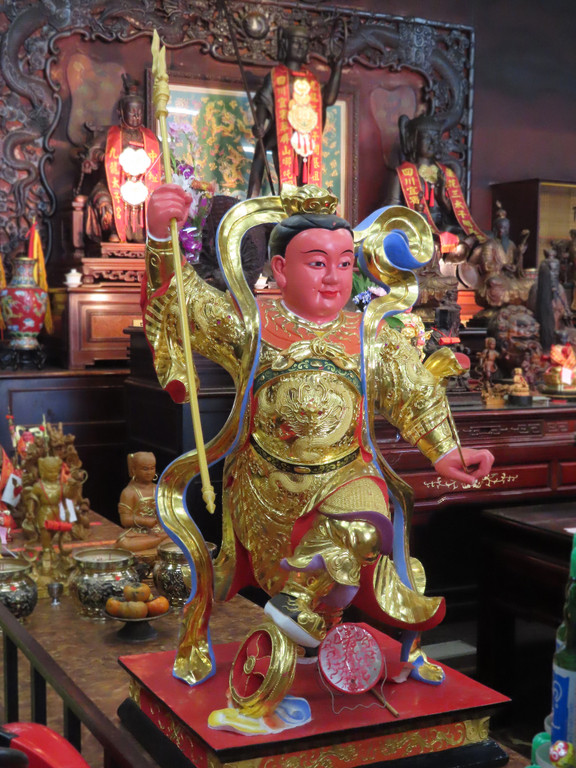
Lastly, I feel it’s necessary to give the character a name. The comic calls him the “Monkey Prince” in his hero form and “Marcus” in his human form. I think Sun Taizi (孫太子), or “Prince Sun,” is a great name as it plays off of San Taizi (三太子), the “Third Prince” (fig. 15), one of Nezha’s titles in Chinese folk religion. (Fun fact: This deity serves as a heavenly vanguard in Sun Wukong’s own religion.) Borrowing from existing religious beliefs sparks the titillating idea that Sun Taizi’s heroic deeds would earn him devotees. Beyond his own continuing spiritual cultivation, he would grow in strength as more and more believers pray to and leave him offerings! This wouldn’t be the first time a monkey god is worshiped in America.

Fig. 15 – A religious statue of San Taizi, the “Third Prince,” from the Nine Dragons Prince Temple (Jiulong taizi gong, 九龍太子宮) in Tainan, Taiwan (larger version). Photo taken by the author.
6. Updates
6.1. Prediction
Update: 12-24-21
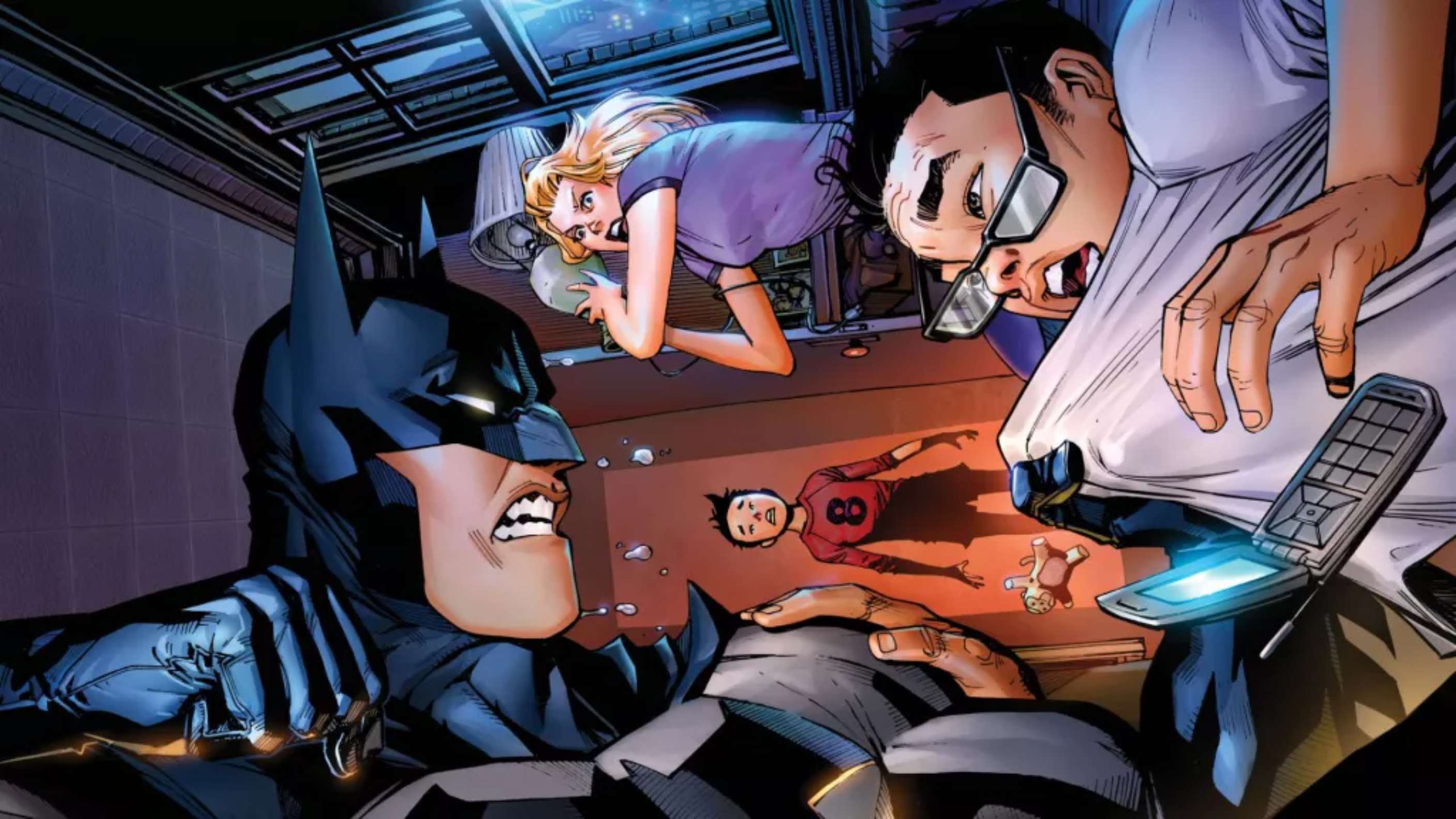
I noted in my original review that promotional material for upcoming issue #1 shows Marcus living in Gotham City prior to the events in Philadelphia. The story is said to include Batman, and a sneak peek shows the Caped Crusader accosting Marcus’ criminal foster parents (fig. 16). I predict that future suggested changes to issue #1 and beyond are going to become harder and harder as the comic story is fleshed out. My original changes portray the character as a young demigod who grows up in Guanyin’s earthly paradise and only later becomes acquainted with modern superheroes through happenstance. So, I will have to bypass all of these flashbacks and only suggest changes to the broader story.

Fig. 16 – The Batman panel from issue #1 (larger version). Copyright DC Comics.
6.2. Buddha > Darkseid & New Info
Update: 01-26-22
In the above post, I noted that I didn’t know enough about the comic book hierarchy to say whether or not DC’s version of a Buddha would be strong enough to defeat Darkseid. But I subsequently argued in favor of this outcome based on Buddhist cosmology—i.e. the New God is still subject to Samsara and the wheel of rebirth, while a buddha is free.
I recently read more about said comics hierarchy. The informative answers from this Quora question show that beings like Mr. Mxyzptlk are more powerful than Darkseid because they reside in higher plains of existence. The New God is 4th-dimensional, while the imp is 5th-dimensional. This means that beings who reside beyond existence, like a Buddha, would hold infinitely more sway over reality. This brings me to the next subject.
Thanks to a friend’s Facebook post, I learned the story for the upcoming Monkey Prince #3 (available 04-05-22). Blum (2022) provides an analysis, as well as a copy of the promotional blurb, which reads:
The bat’s out of the bag as Monkey Prince and Pigsy both realize what all the demon spirits around the world are after—eating specific superheroes in order to gain their powers! And this penguin demon has his eyes on…Batman! Uh-oh, Monkey Prince, it’s bad enough you have to keep hiding your tail when you’re Marcus, and how your circlet keeps returning latched onto your body as something else every time you try to get rid of it—but now cannibalism is also on the menu? YEOW! (see here)
While I like that there will be an ongoing reference to Tripitaka’s immortality-bestowing flesh (as noted in the original review), a penguin demon just sounds…well…really bad. There’s not one single menacing thing that comes to mind when I think of a penguin. At least the deer demon was big and had antlers. I’m wondering if this creature has any connection to the Batman villain.
6.3. Monkey Prince #1
Update: 02-02-22
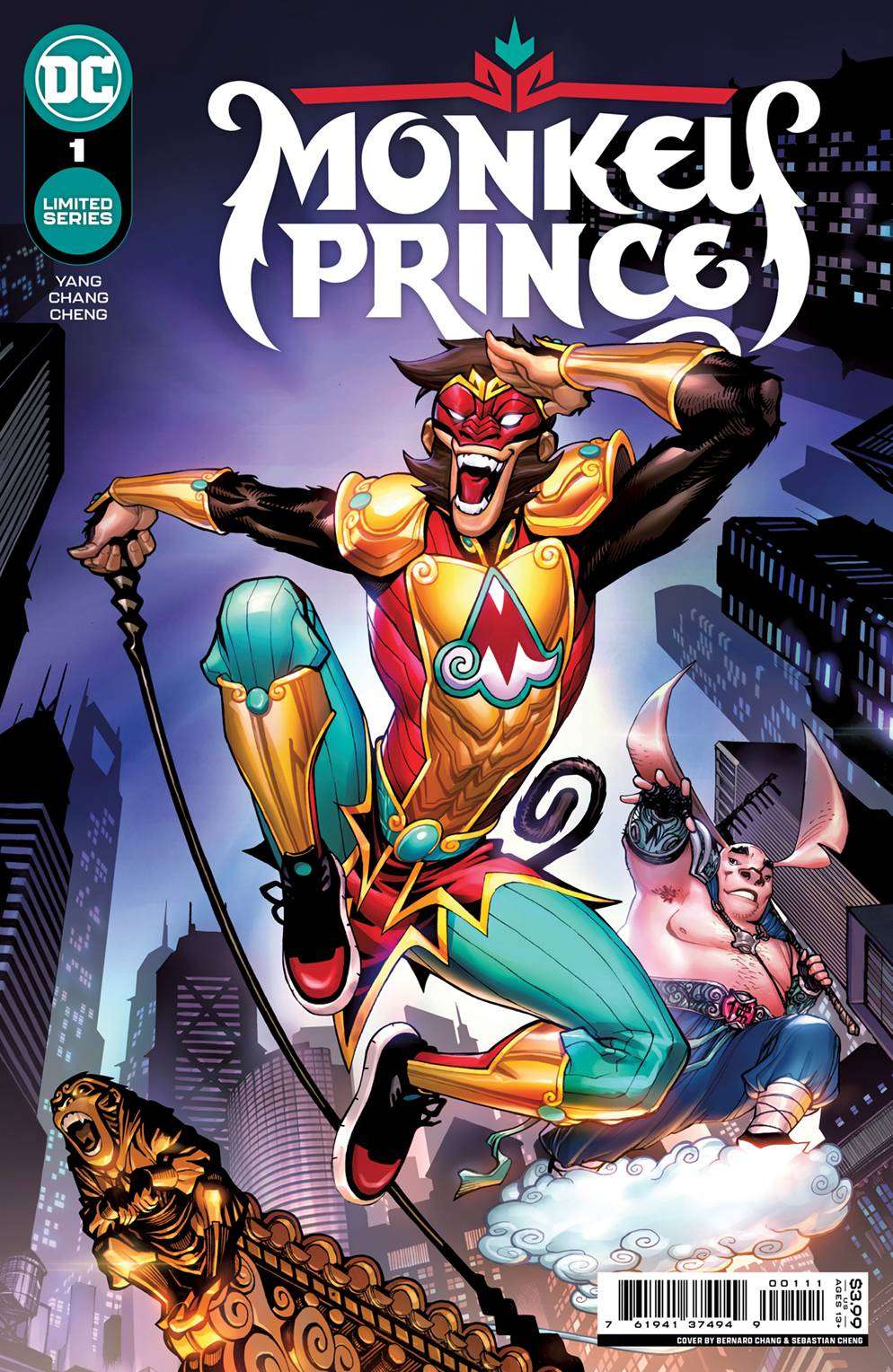
Monkey Prince #1 (fig. 17) was released on 02-01-22, and just as I predicted, there’s nothing to build off of regarding suggested changes.
The story takes place in Gotham City, home of the Batman. Marcus is traumatized as a young child when the Dark Knight beats up his adoptive father while looking for information about the pair’s criminal activity. This event leads to Marcus developing a phobia around just about everything, including bats, black curtains, water, etc. After briefly living elsewhere, a now teenaged Marcus returns to attend high school in the city, but he’s singled out by bullies for his apparent weakness. Apart from his parents, his only positive role model is a husky, Chinese janitor name Mr. Zhu (i.e. Shifu Pigsy in disguise). Zhu encourages the boy to overcome his fear of water by jumping into a pool. Marcus refuses at first, but after miraculously sprouting a monkey tail in class and subsequently getting beaten up and his shoes stolen by bullies, he takes the plunge. He finds himself magically transported to the “Water Curtain Cave,” [7] home of the Monkey King. He even catches a brief glimpse of his father. Most importantly, he’s transformed into the Monkey Prince, only to reemerge into the present and use his new found powers to beat up his bullies. Damian Wayne, Batman’s son and sidekick, alerts his father to the disturbance. The issue ends when the Dark Knight misjudges his throw and accidentally beheads the Monkey Prince with a batarang. No joke!
Some new information comes to light:
- Marcus’ adopted parents are named Laura and Winston Shugel-Shen.
- Both are PhD tech scientists who have worked for the Riddler, Intergang, and Captain Cold.
Their new boss, the Penguin, has procured their services to use a large ray to possess an accountant with an ancient Chinese demon. The ray shatters a metal hu-gourd, revealing the Great King Golden Horn (Jinjiao dawang, 金角大王) demon from chapters 33 to 35 of the original. The experiment seemingly fails, causing the Penguin to shoot the victim in a rage. However, the aforementioned promotional material for issue #3 describes a “penguin demon” that wants to eat superheroes to gain their powers. This suggests that the demon actually takes hold of the Penguin (Yang, 2022a).
Lastly, the ongoing criminal career of Marcus’ adoptive parents really bothers me. Everyone, even celestials, appears to be oblivious to their illegal activities. Shifu Pigsy either doesn’t know or doesn’t care. Either way, it’s shitty writing. Also, in the beginning, when Batman discovers Marcus watching him accost his father, the Dark Knight simply leaves. He doesn’t attempt to arrest the parents or take the child into protective custody. Again, shitty writing. Ugh.

Fig. 17 – The front cover of issue #1 (larger version). Copyright DC Comics.
6.4. Monkey Prince #2
Update: 03-13-22
Issue #2 (fig. 18) was released on 03-01-22, and it’s the same bad writing. Batman, Robin, and Shifu Pigsy play a game of hot potato with the Monkey Prince’s head, while the latter nearly dies of asphyxiation before escaping. Marcus subsequently denounces Pigsy and throws away the golden headband, only for it to return with the quaint ability to move about his body. Meanwhile, as predicted, the golden horn demon takes over Penguin’s body, and this monstrous hybrid soon goes about draining the qi energy from countless victims. A shadowy figure with two demon attendants then convinces Penguin to go after the life force of superheroes, thus leading into the aforementioned events of issue #3 (Yang, 2022b).
Above, I suggested that Darkseid is still subject to the wheel of reincarnation despite being long-lived. As an inhabitant of the Desire Realm, he too will eventually die. I just came across a fitting line from Buddhist scripture, something that the Monkey Buddha could say to the New God as a warning: “Despite your millions of kalpas of life / It comes to emptiness and annihilation in the end” (Zhang, 1977, as cited in Shao, 1997, p. 110).
Also, this Quora answer features another powerful character, one who lives outside the multiverse, capable of easily defeating even true form Darkseid.

Fig. 18 – The front cover of issue #2 (larger version). Copyright DC Comics.
6.5. Monkey Prince #3
Update: 04-06-22
Issue #3 (fig. 19) was released on 04-05-22, and I have to say it was extremely bland. Nothing of substance happened at all. It honestly just feels like stuffing to pad out the series. The length of the comic sort of proves this point. Only 24 of the total 31 pages of the digital version comprise the story. The rest is a teaser for a new Batman storyline (Yang, 2022c).
The issue opens on Shifu Pigsy reciting the band-tightening spell as he and the Monkey Prince soar through the clouds. This teaches the young hero that he needs to concentrate in times of stress, or he’ll lose mental control over his cloud-somersault and fall to his death. At the same time, Marcus attempts to snatch a red envelope from his teacher’s hand. This is subsequently revealed to be a magically disguised gift: a vigilante-type superhero mask to hide his true identity.
The Monkey Prince is later hailed by a young girl (one who unknowingly witnessed his first transformation in issue #1) and tasked with finding her brother: Marcus’ bully. He finds him strung upside down in a stadium and being interrogated by Robin, Batman’s son and sidekick. After a brief fight in which the hero’s forearm is accidentally separated at the elbow, the Monkey Prince successfully returns his former bully to the sister. She kisses him as a reward.
Meanwhile, Shifu Pigsy locates and kills the two demons who were present when the shadowy figure suggested (in issue #2) that the demon-possessed Penguin should drain the life energy of superheroes. This drives the Penguin to kidnap the Shugel-Shens and hold them hostage, noting in a broadcasted message to the Caped Crusader that he’ll eat them if Batman doesn’t meet with him. The issue ends with a shocked Marcus learning of his adoptive parents’ predicament (Yang, 2022c).
One thing of interest is that Shifu Pigsy hints Marcus has brothers: “Do you know how difficult it was to locate just one of the Monkey King’s sons? Sure, there are others but…” (Yang, 2022c, p. 8, panel #3). I’ll be interested to see if they ever explain why Sun Wukong knocked up random human women and then left them to solely raise or adopt-out the child. It honestly doesn’t reflect positively on the Monkey King.
Also, I’m still not sold on the Penguin being a demon. Mr. Yang could have gone with other rogues. Killer Croc, for example, is known to eat people. Even the Joker seems like a better choice. A demon-possessed psychopath is far more scary than a penguin.
Another thing that bothers me is the description of the demon itself. Shifu Pigsy claims: “Among your [Marcus’] father’s deadliest enemies was the Golden Horn King. He and his brother Silver Horn King wreaked such havoc across China!” (Yang, 2022c, p. 23, panel #2). But this isn’t the case in the original novel. While they were difficult to handle, Laozi explains: “These youths were requested by the Bodhisattva from the sea three times; they were to be sent here and transformed into demons, to test all of you and see whether master and disciples are sincere in going to the West” (Wu & Yu, 2012, vol. 2, p. 145). This means that they were never actual demons, and they certainly weren’t among the deadliest, nor did they wreak havoc across China. This is yet another example showing that the creative team doesn’t actually care about the novel.

Fig. 19 – The front cover of issue #3 (larger version). Copyright DC Comics.
6.6. Monkey Prince #4
Update: 05-03-22
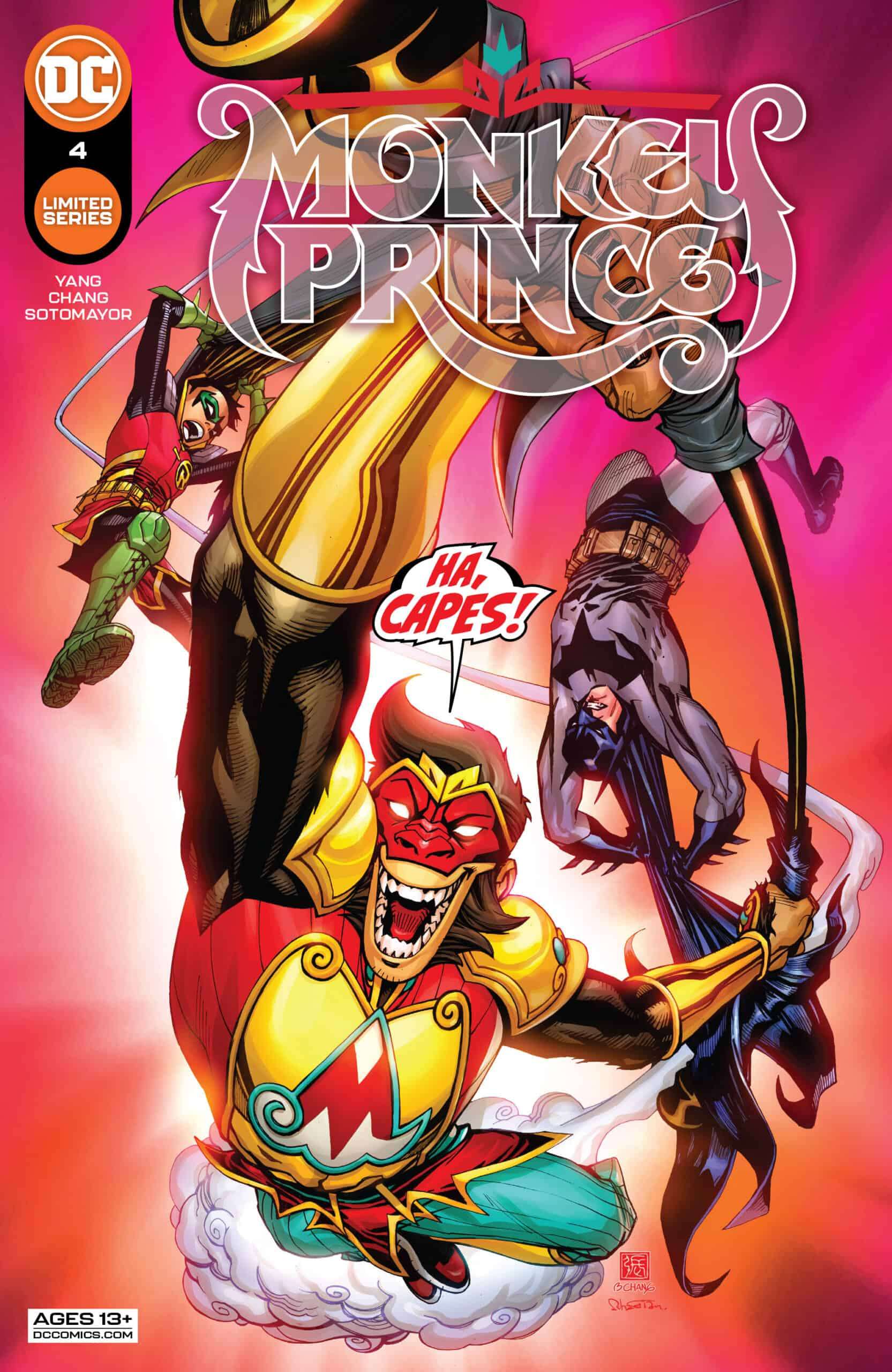
Issue #4 (fig. 20) was released on 05-03-22, and it’s more of the same fluff. The story opens on the Monkey Prince transforming his cloud into an R-shaped signal (a play on the Bat-Signal) to get Robin’s attention. And when the Boy Wonder arrives, they agree to a brief partnership to find the Shugel-Shens in exchange for the simian hero later answering pertinent questions. Robin then deduces that the hostages are being held in an old auction house where Batman first fought the Penguin.
After briefly bonding over the strictness of their respective masters, the young heroes travel to the auction house, where they are ambushed by the Penguin demon. He attempts to crush them with a large, metal vault door but misses. Batman subsequently appears and retaliates with bat-shaped knuckledusters. But the sight of the Caped Crusader (who cut off the Monkey Prince’s head in issue #1) causes Marcus to lose focus, making him fall through his cloud and explode into several pieces upon hitting the ground. It’s only with the reassuring words of Pigsy that he’s able to collect everything back together. Meanwhile, Batman and Robin work as a team to take down the Penguin, much to Shifu Pigy’s delight.
The Monkey Prince attempts to untie his adoptive parents, but Batman stops him, revealing that all past victims were found to have worked for the Penguin, suggesting that the Shugel-Shens are fellow hench people. Marcus has little time to process this unsettling information before low-ranking spirits appear to assist the fallen demon. They overwhelm Batman, allowing the Penguin to start absorbing his powerful, heroic qi energy. The Monkey Prince takes this opportunity to free his parents, but he’s called back into battle by Shifu Pigsy before having a chance to fly them to safety. Torn between helping Batman or his parents, Marcus asks Robin to throw a batarang at his midsection, cutting him in half. His torso then helps the Caped Crusader by tackling the Penguin, while his legs release the Shugel-Shens on the street outside.
Upon rejoining both halves, the Monkey Prince takes a can of magic soda previously given to him by Pigsy and throws it at the demon. This somehow disrupts the monster’s hold on the Penguin, allowing Robin to separate the two with a well-placed staff strike. Batman and his ward thereafter question and attempt to apprehend Marcus and Shifu Pigsy, but the latter tricks them into chasing decoys, while the two hide using a magic disguise. Meanwhile, the spirits help the weakened Golden Horn demon escape. They worry that their master will punish them for failing, but one of them states it was a partial success as the monster was able to absorb enough qi to remain in solid form. They’re last seen taking a boom tube back to the “Flame Planet.” The issue closes with Marcus’ bully apologizing to him at the behest of his sister, the young woman who kissed the Monkey Prince at the end of the last issue (Yang, 2022d).
Beyond the lovely art and coloring by Mr. Chang and Chris Sotomayor, respectively, there’s nothing positive that I can say about this issue. The author, Mr. Yang, continues to make odd choices. His characterization of Batman throughout the series has completely missed the mark. The Cape Crusader is overly dramatic and extremely dense. For example, the Monkey Prince tricks him into looking down at his crotch by saying, “You left the house with your fly down!” (Yang, 2022d, p. 18, panel #2). I remind the reader that Batman’s design includes the classic dark gray trunks over light gray pants, so why would he even look down? Ugh.
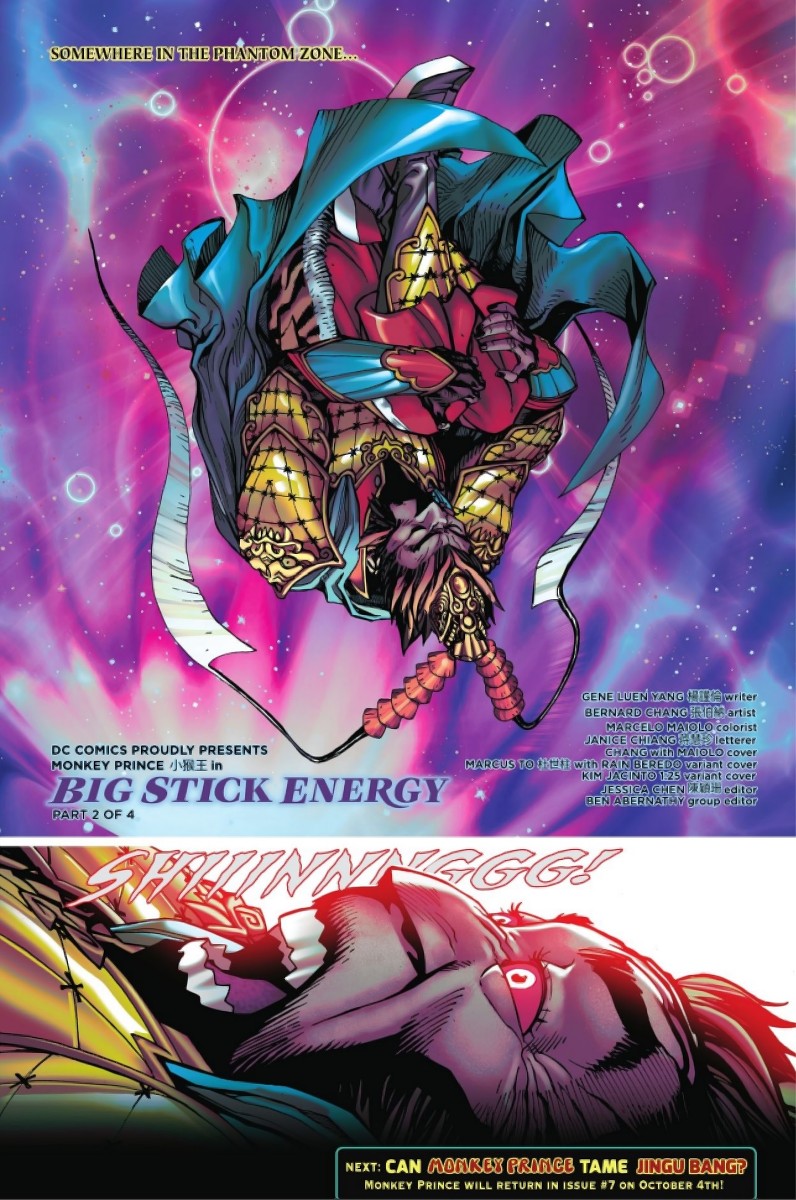
The Monkey King’s whereabouts are finally revealed, but the location makes no sense. When the low-ranking spirits first see the “magic monkey” (Marcus), one exclaims: “Impossible! He was lossst [sic] in the Phantom Zone!” (Yang, 2022d, p. 18, panel #4). The Phantom Zone is a timeless pocket dimension that serves as a penal colony for the worst villains in the universe. But it’s not impossible to escape from, for even Superman has done this. So, how can a Buddha, a being beyond reality, be trapped in this cosmic Alcatraz? I’m assuming Sun Wukong’s exile there was the work of Darkseid. I guess we’ll find out in later issues how he accomplished this feat.
And lastly, Marcus is shown capable of easily transporting people, Robin and later his parents, on his cloud (Yang, 2022d, p. 6, panel #3, for example; p. 14, panel #4, for example). But JTTW is clear that this is not feasible, for Zhu Bajie states: “The mortal nature and worldly bones of Master [Tripitaka] are as heavy as the Tai Mountain…How could my cloud soaring bear him up? It has to be your cloud somersault” (Wu & Yu, 2012, vol. 1, p. 427). Sun Wukong counters:
If you can’t carry him, what makes you think I can? There’s an old proverb that says:
Move Mount Tai: it’s light as mustard seeds.
Lift a man and you won’t leave the red dust! (Wu & Yu, 2012, vol. 1, p. 427).
I show in this article that Mt. Tai is considered the heaviest thing in Chinese culture. Therefore, Monkey and Zhu Bajie are arguing that it’s impossible to lift mortals on celestial clouds.

Fig. 20 – The front cover of issue #4 (larger version). Copyright DC Comics.
6.7. Monkey Prince #5
Update: 06-11-22
Issue #5 (fig. 21) was released on 06-07-22, and it’s even more bland than issue #3. After leaving Gotham, Marcus and his family move to the seaside town of Amnesty Bay, the childhood home of Aquaman. There, the Shugel-Shens meet with their new boss, Black Manta, who reveals his revised plan to awaken a demon within a silver hu-gourd (i.e. Great King Silver Horn (Yinjiao dawang, 銀角大王)). The scientist couple are hesitant to agree to the new arrangement given that they almost died at the hands of his brother, Great King Golden Horn, but they acquiesce after deciding to transfer his spirit into a seemingly harmless hermit crab (I predict a giant monster similar to Tamatoa).
Meanwhile, Marcus meets a pink-haired, black leather-clad goth girl at the new high school. She shows an unusual interest in him, evening calling to him on the street after school. But once she rips away his shirt, revealing the golden band on his body, she morphs into a long-toothed monster and tackles Marcus into the ocean. This triggers his aquaphobia (see issue #1). After Shifu Pigsy arrives and pulls him to safety, the Monkey Prince drives her back into the water with a timely delivered staff (bestowed by his master) but refuses to further engage the villainess in the aquatic environment. She is subsequently revealed to be Shellestriah, the half-human daughter of the Atlantean villain Trench King. The issue ends with Trench King alluding to the immortality-bestowing abilities of superhero flesh (Yang, 2022e). That’s it. Nothing new is added to further the Darkseid/Monkey King storyline from issue #0. This entire issue was just boring fluff.
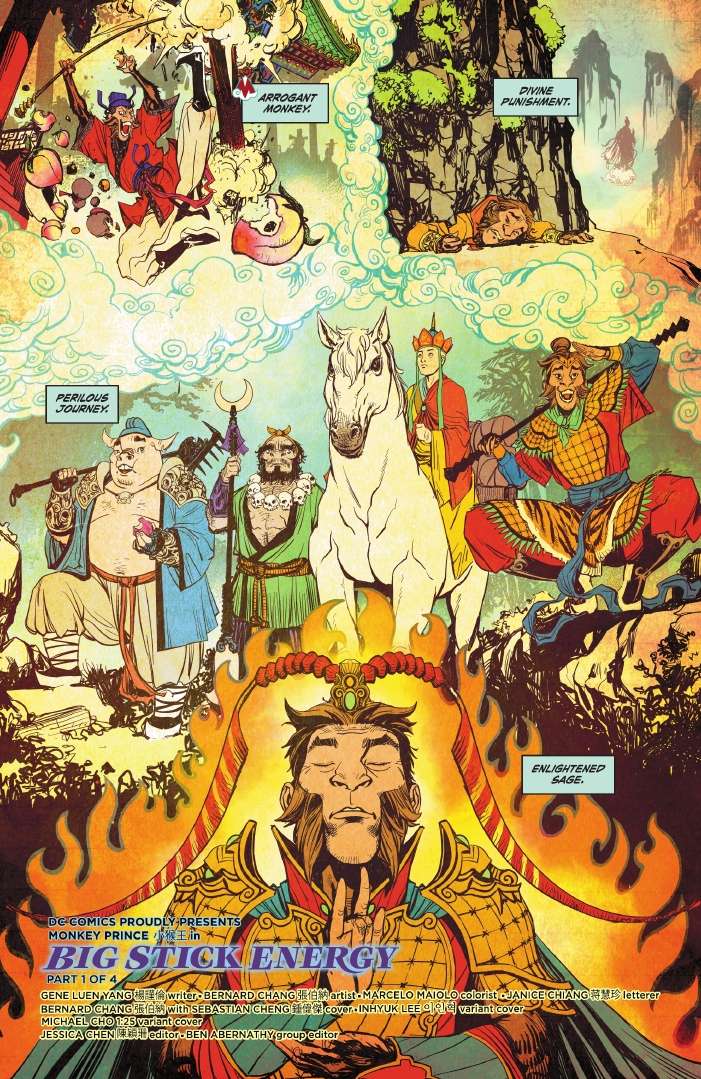
Though, I will say that I enjoyed the opening page, which depicts the historical Monkey King at various stages in his character arc, from his rebellion and punishment beneath Five Elements Mountain to the journey proper and his elevation to Buddhahood at the end of the story (fig. 22) (Yang, 2022e, p. 3). But, again, Mr. Chang has wrongly portrayed Sun Wukong as an armored warrior instead of a robed Buddha.

Fig. 21 – The front cover of issue #5 (larger version). Fig. 22 – The opening page showing the Monkey King’s story arc (larger version). Copyright DC Comics.
6.8. Monkey Prince #6
Update: 07-09-22
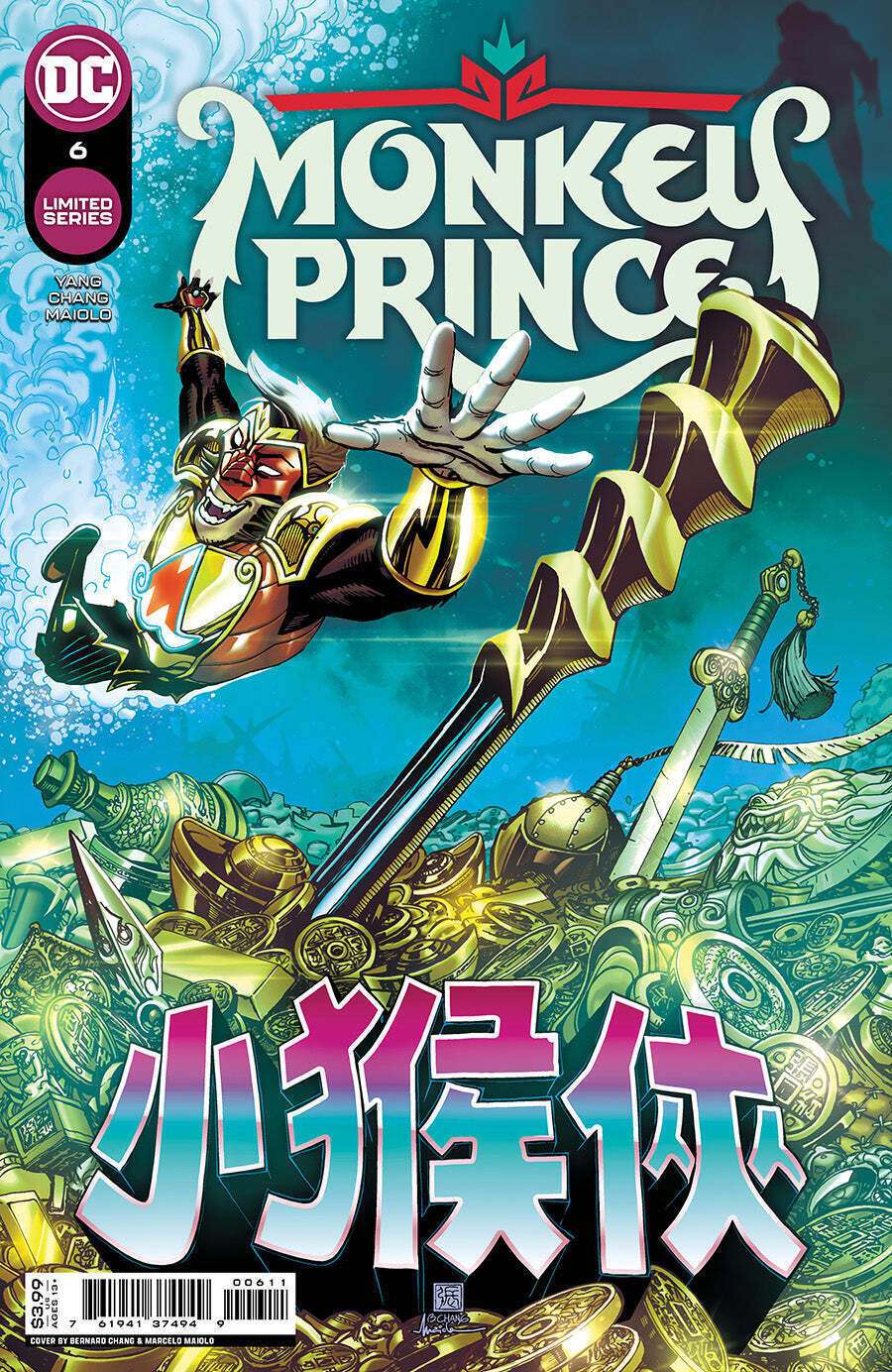
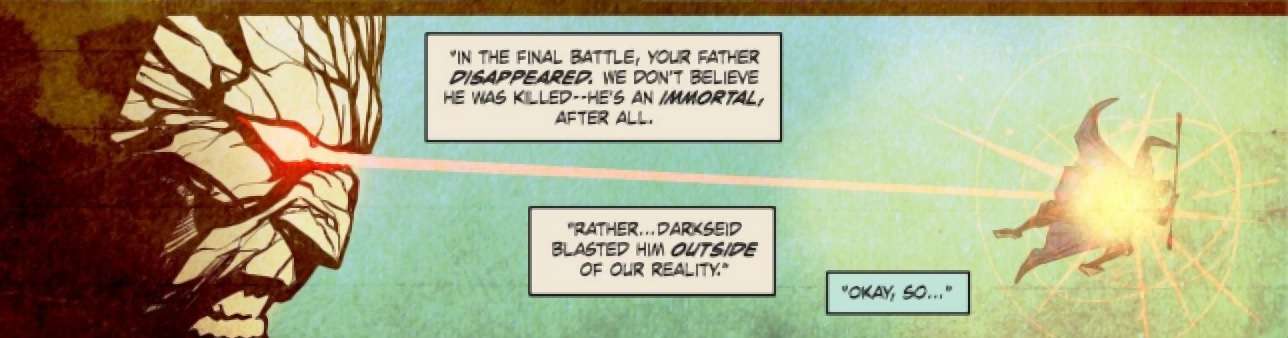
Issue #6 (fig. 23) was released on 07-05-22, and while it continues the Darkseid story (see issue #0), it’s only briefly alluded to and, therefore, does not warrant its own page. Shifu Pigsy gives Marcus a pep talk about his father’s past, thereby teaching him that one needs to move past their fears (i.e. the boy’s fear of water) in order to become stronger. It is here when he briefly reveals the ultimate fate of the original Monkey King: after the battle in heaven, Darkseid banished Sun Wukong to the Phantom Zone with a blast from his omega beams (fig. 24). Back in the present, as predicted, the experiment of Marcus’ adopted parents, the Shugel-Shens, results in a titanic monster hermit crab. The villain Black Manta promises to attack Atlantis with it but instead attacks Harmony Bay (the childhood home of Aquaman) for some reason. The Monkey Prince goes onto battle the creature, driving out the demon with a magic can of soda (ugh) but breaking his extending staff in the process. Marcus then proves that he has overcome his fear by jumping into the ocean, but when Pigsy joins him, both are immediately captured by Atlantean troops readying for an assault from the villain Trench King. Meanwhile, a group of sea dragons in Atlantis are shown bickering while playing elephant chess. One among them, who had previously claimed that his scarred eye held a shard from the Monkey King’s staff, starts to complain of a burning sensation. It produces a light that eventually grows into a golden shaft, predicting the appearance of Sun’s magic staff. The issue ends with Monkey awakening within the Phantom Zone (fig. 25) (Yang, 2022f).
The author, Mr. Yang, again takes liberties with the original story. For instance, Shifu Pigsy tells an altered version of Sun’s past where he seemingly has powers upon his stone birth (Yang, 2022f, pp. 4), thereby skipping over his tutelage in Daoist longevity arts and martial arts under the Patriarch Subodhi (this was no doubt done to save space). And he only acquires his staff after beating up the denizens of heaven (Yang, 2022f, pp. 5). This is completely reversed in the novel, as Monkey is invited to hold position in heaven only after causing trouble in the dragon kingdom and hell (Wu & Yu, 2012, vol. 1, pp. 133-144). Pigsy goes on to state: Once we completed our journey to the west, we all achieved enlightenment” (Yang, 2022f, p. 6). A note then reads: “Well, I was assigned the title ‘Altar Service Attendant,’ but still. It’s an enlightenment of sorts” (Yang, 2022f, p. 6). I’m sure Mr. Yang fully understands the meaning of “enlightenment.” He’s likely using the term to describe the pilgrims’ elevation in spiritual rank. But this is an oversimplification that needs to be corrected. Only the monk Tripitaka and Sun Wukong achieve Buddhahood—i.e. being freed from the wheel of rebirth; while Sha Wujing becomes a luohan, a sort of Buddhist saint. Zhu Bajie doesn’t really receive an elevation in rank. It’s more of a lateral promotion. He’s essentially a janitor who gets to eat the left over food on Buddhist altars all over the world (Wu & Yu, 2012, vol. 4, pp. 381-382). Does this sound like enlightenment to you?
The addition of Asian sea dragons to Atlantis is a clear cut case of shoehorning, but I kind of like them. They are comically grumpy and bicker like old human men who have known each other for many, many years. The staff shard growing into a golden pillar is an interesting touch, but I’m not quite sure how the narrative will justify this. An unofficial 17th-century sequel to JTTW states that Sun’s spiritual descendent finds the staff in the Mountain of Flowers and Fruit. Marcus previously visited this place (Yang, 2022a, pp. 18-19, for example), which would have made this the ideal time to acquire the magic weapon from his father.
I still don’t agree with the Monkey King being trapped in the Phantom zone. As mentioned above, a Buddha is beyond the realm of desire, meaning that he would be beyond the control of the gods.

Figure 23 (left) – The front cover of issue #6 (larger version). Fig. 24 (top right) – Darkseid banishes Monkey to the Phantom Zone (larger version). From Yang, 2022f, p. 6, panel #4. Fig. 25 (bottom right) – Sun awakens in the Phantom Zone (larger version). From Yang, 2022f, p. 23. Copyright DC Comics.
6.9. Giving up On the Series
Update: 01-03-23
Several issues of the Monkey Prince have been published since my last update, but I’m honestly no longer interested in the series. It’s a chore to read, so I’d rather work on things that I like and am interested in. I might return in the future to finish my review, but it won’t be for a while. Sorry to those who have been following this page.
6.10. List of Monkey Prince Powers
Update: 04-11-26
A reddit member has posted a list of the Monkey Prince’s powers.
Respect Marcus Shugel-Shen, the Monkey Prince (DC Comics, Post-Flashpoint)
byu/rangernumberx inrespectthreads
Notes:
1) The novel doesn’t name the swords upon their first appearance (Wu & Yu, vol. 3, p. 124). They are named slightly later when the Bull Demon King wields them (Wu & Yu, vol. 3, p. 147).
2) Yu (Wu & Yu, 2012) translates this as “Great King Holy Child” (vol. 2, p. 219).
3) Mr. Chang admits that he only heard a few JTTW stories as a child and doesn’t know how the novel ends (Ching, 2021)
4) This is based on a passage from chapter five:
[The Jade Emperor] at once commanded the Four Great Devarājas to assist Devarāja Li and Prince [Nezha]. Together, they called up the Twenty-Eight Constellations, the Nine Luminaries, the Twelve Horary Branches, the Fearless Guards of Five Quarters, the Four Temporal Guardians, the Stars of East and West, the Gods of North and South, the Deities of the Five Mountains and the Four Rivers, the Star Spirits of the entire Heaven, and a hundred thousand celestial soldiers (Wu & Yu, 2012, vol. 1, p. 169).
Koss (1981) counts 72 commanders from the names listed in the beginning (pp. 83-84).
5) I’ve already mentioned the iron staff above (compare this to Monkey’s weapon). The Bull Demon King takes the title “Great Sage, Parallel with Heaven” (Pingtian dasheng, 平天大聖) in chapter four (compare this to Sun’s title, the “Great Sage Equaling Heaven“) (Wu & Yu, 2012, vol. 1, pp. 156-157). Most of the similarities that I mentioned happen in chapter 61. His skill with the 72 changes is referenced when he takes on Zhu’s appearance (compare this to Monkey’s ability) (Wu & Yu, 2012, vol. 3, p. 148). The battle of transformations against Sun takes place shortly after he’s overwhelmed by our hero and Zhu in combat (compare this to Monkey’s battle of changes with Erlang in ch. 6) (Wu & Yu, 2012, vol. 3, pp. 156-157; vol. 1, pp. 182-183). He takes on his cosmic form, a giant white bull, in a last ditch effort to defeat Sun (compare this to Monkey’s skill) (Wu & Yu, 2012, vol. 3, p. 157). He is trapped on all sides by Buddho-Daoist deities (compare this to Sun’s troubles with heaven in ch. 6) (Wu & Yu, 2012, vol. 3, pp. 159-160; vol. 1, pp. 185-186). Nezha uses his fire wheel to stop him from regrowing his severed heads (compare this to the diamond bracelet that Laozi (老子) uses to knock the Monkey King off his feet in ch. 6) (Wu & Yu, 2012, vol. 3, p. 160; vol. 1, p. 186); and he is taken to see the Buddha at the end of his story arc (compare this to Sun’s meeting with the Buddha) (Wu & Yu, 2012, vol. 3, p. 162).
6) This spiral is implied during the discussion between the Monkey Prince and Shifu Pigsy at the end of the issue (Yang, 2021b, p. 10).
7) The Water Curtain Cave (Shuilian dong, 水簾洞) is a grotto-heaven located somewhere within the Mountain of Flowers and Fruit. The stone monkey becomes the Monkey King by jumping through a waterfall and discovering the cave in chapter one. His people soon after take residence inside (Wu & Yu, 2012, vol. 1, pp. 104-106).
Sources:
Aguilar, M. (2021). Jessica Chen Talks Returning Favorites and the Monkey Prince’s Debut in Festival of Heroes: The Asian Superhero Celebration. Comic Book. https://comicbook.com/comics/news/dc-festival-of-heroes-the-asian-superhero-celebration-jessica-chen/.
Beal, S. (Trans.). (1883). The Fo-sho-hing-tsan-king: A Life of Buddha by Asvaghosha Bodhisattva. Oxford: Clarendon Press. Retrieved from https://archive.org/details/foshohingtsankin00asva/mode/2up.
Blum, J. (2021). DC Festival of Heroes’ Monkey Prince Gets Solo Series. CBR. Retrieved from https://www.cbr.com/dc-monkey-prince-solo-series/.
Blum, J. (2022). DC’s New Bad Guys Eat Superheroes to Steal Their Powers. CBR. Retrieved from https://www.cbr.com/dc-villains-eat-superheroes-monkey-prince/.
Buswell, R. E., & Lopez, D. S. (2014). The Princeton Dictionary of Buddhism. Princeton, NJ : Princeton University Press.
Ching, B. A. (2021). Meet the Monkey Prince: Yang and Chang Introduce DC’s Newest Hero. DC. https://www.dccomics.com/blog/2021/05/12/meet-the-monkey-prince-yang-and-chang-introduce-dcs-newest-hero.
Darkseid (New Earth). (n.d.). DC Database. Retrieved from https://dc.fandom.com/wiki/Darkseid_(New_Earth).
DC Publicity. (2021, October 15). DC’s Monkey Prince: New Series to Debut on Lunar New Year 2022. DC Comics. Retrieved from https://www.dccomics.com/blog/2021/10/16/dc’s-monkey-prince-new-series-to-debut-on-lunar-new-year-2022.
Koss, N. (1981). The Xiyou ji in its Formative Stages: The Late Ming Editions (vol. 1 and 2). (UMI No. 8112445) [Doctoral dissertation]. Available from ProQuest Dissertations and Theses database.
Shao, P. (1997). Monkey and Chinese Scriptural Tradition: A Rereading of the Novel Xiyouji (UMI No. 9818173) [Doctoral dissertation, Washington University]. Available from ProQuest Dissertations and Theses database.
Wu, C., & Yu, A. C. (2012). The Journey to the West (Vols. 1-4) (Rev. ed.). Chicago, Illinois: University of Chicago Press.
Yang, G. L. (2021a). The Monkey Prince Hates Superheroes. In Jessica Chen (Ed.). DC Festival of Heroes: The Asian Superhero Celebration (pp. 70-82) [Google Play]. New York, NY: DC Comics. Retrieved from https://play.google.com/store/books/details/Minh_Le_DC_Festival_of_Heroes_The_Asian_Superhero?id=qXUrEAAAQBAJ.
Yang, G. L. (2021b). Monkey Prince, (0) [Digital]. New York, NY: DC Comics. Retrieved from https://www.dccomics.com/reader/#/comics/483798.
Yang, G. L. (2022a). Monkey Prince, (1) [Kindle]. New York, NY: DC Comics. Retrieved from https://www.amazon.com/Monkey-Prince-2022-2021-ebook/dp/B09P45TWKD/.
Yang, G. L. (2022b). Monkey Prince, (2) [Kindle]. New York, NY: DC Comics. Retrieved from https://www.amazon.com/Monkey-Prince-2022-2021-ebook/dp/B09RQ6581L.
Yang, G. L. (2022c). Monkey Prince, (3) [Kindle]. New York, NY: DC Comics. Retrieved from https://www.amazon.com/Monkey-Prince-2022-2021-ebook/dp/B09TV1BQSW/.
Yang, G. L. (2022d). Monkey Prince, (4) [Kindle]. New York, NY: DC Comics. Retrieved from https://www.amazon.com/Monkey-Prince-2022-2021-ebook/dp/B09X5YZGQ5/.
Yang, G. L. (2022e). Monkey Prince, (5) [Kindle]. New York, NY: DC Comics. Retrieved from https://www.amazon.com/Monkey-Prince-2022-2021-ebook/dp/B09ZVH9C5J/.
Yang, G. L. (2022f). Monkey Prince, (6) [Kindle]. New York, NY: DC Comics. Retrieved from https://www.amazon.com/Monkey-Prince-2022-2021-ebook/dp/B0B3B6D522.



#/media/File:Cow_ring.jpg)