How to Resurrect the Tang Monk if He is Killed During Journey to the West

Last updated: 07-12-2026

Tumblr user @predictablemess recently asked me the following question:

If [Tripitaka (Sanzang, 三藏; fig. 1), Sun Wukong‘s master,] were to die during Journey to the West, in your opinion, what would happen?

Would he remain dead and be reincarnated or be revived? Would they have to restart the cycle again? Through what means do they go through to get the monk and recover the Scriptures?

What follows is an expanded version of my answer.

Fig. 1 – Tripitaka as depicted in the 1986 Journey to the West TV show (larger version). Image found here.

Table of Contents

1. Introduction

Not counting the ginseng fruit (renshen guo人參果; a.k.a. “grass of reverted cinnabar,” cao huandan, 草還丹) that gives Tripitaka a nigh-immortal, adamantine body, [1] the Monkey King, a host of other Buddho-Daoist gods, Guanyin, or even the Buddha would prevent him from being killed. [2] However, for the sake of argument, there are a few ways to bring the Tang Monk (Tang seng, 唐僧) back to life, but the methods used depend on the state of his body. Below, I present examples of resurrection appearing in Journey to the West (Xiyou ji西遊記, 1592 CE).

The novel presents two main modes of revivification: 1) forcing the soul into the original or new body; and 2) compelling the spirit to reform within the old vessel using a magic pill and rescue breathing. The first method requires underworld authorization, while the second does not. An interesting side effect of (re)introducing a soul into a body is that the original injuries appear to heal, allowing the person to live once more.

Fanfiction writers might find this article useful. I consider it a companion piece to my “How to Kill Sun Wukong.”

2. Examples

2.1. Chapter 9

Shortly before Tripitaka’s birth, his father, Chen Guangrui (陳光蕊), is beaten to death by bandits disguised as boatmen, and his body is thrown into the river. The local Dragon King repays a kindness done to him by Guangrui by preserving the official’s body with a magic pearl (dingyan zhu, 定顏珠; lit: “feature-preserving pearl”) and requesting through a bureaucratic chain that the man’s soul be delivered (from the underworld) to serve as a courtier in the dragon kingdom (Wu & Yu, 2012, vol. 1, p. 220). Both halves are eventually rejoined some 18 years later:

Facing the river the three persons wept without restraint, and their sobs were heard down below in the water region. A yakṣa patrolling the waters brought the essay in its spirit form to the Dragon King, who read it and at once sent a turtle marshal to fetch Guangrui. “Sir,” said the king, “Congratulations! Congratulations! At this moment, your wife, your son, and your father-in-law are offering sacrifices to you at the bank of the river. I am now letting your soul go so that you may return to life. […] Today you will enjoy the reunion of husband and wife, mother and son.” After Guangrui had given thanks repeatedly, the Dragon King ordered a yakṣa to escort his body to the mouth of the river and there to return his soul. The yakṣa followed the order and left.

We tell you now about Lady Yin [Yin xiaojie, 殷小姐], who, having wept for some time for her husband, would have [tried to kill herself again] by plunging into the water if Xuanzang [玄奘; i.e. Tripitaka] had not desperately held on to her. They were struggling pitifully when they saw a dead body floating toward the river bank [fig. 2]. The lady hurriedly went forward to look at it. Recognizing it as her husband’s body, she burst into even louder wailing. As the other people gathered around to look, they suddenly saw Guangrui unclasping his fists and stretching his legs. The entire body began to stir, and in a moment he clambered up to the bank and sat down, to the infinite amazement of everyone. Guangrui opened his eyes and saw Lady Yin, the chief minister Yin, his father-in-law, and a youthful monk [i.e. Tripitaka], all weeping around him. “Why are you all here?” said Guangrui (Wu & Yu, 2012, vol. 1, pp. 228-229).

三人望江痛哭,早已驚動水府,有巡海夜叉將祭文呈與龍王。龍王看罷,就差鱉元帥去請光蕊來到,道:「先生,恭喜,恭喜。今有先生夫人、公子同岳丈俱在江邊祭你。我今送你還魂去也。[…] 你今日便可夫妻子母相會也。」光蕊再三拜謝。龍王就令夜叉將光蕊身屍送出江口還魂。夜叉領命而去。

卻說殷小姐哭奠丈夫一番,又欲將身赴水而死,慌得玄奘拚命扯住。正在倉皇之際,忽見水面上一個死屍浮來,靠近江岸之傍。小姐忙向前認看,認得是丈夫的屍首,一發嚎啕大哭不已。眾人俱來觀看,只見光蕊舒拳伸腳,身子漸漸展動,忽地爬將起來坐下。眾人不勝驚駭。光蕊睜開眼,早見殷小姐與丈人殷丞相同著小和尚俱在身邊啼哭。光蕊道:「你們為何在此?」

Fig 2 – Yaksha guardians escort Chen Guangrui’s revived body (center right) to the surface of the water. His family and their attendants watch from the river bank (larger version). This is a woodblock print from the Newly Annotated Journey to the West With Illustrations (Xinshuo Xiyouji tuxiang, 新說西遊記圖像, 1888).

2.2. Chapters 11 & 12

The Tang official Liu Quan (劉全) takes poison in order to deliver a royal offering of melons to the Ten Kings of the underworld. He explains that the untimely suicide of his wife, Li Cuilian (李翠蓮), cemented his decision (Wu & Yu, 2012, vol. 1, p. 268). This sways the infernal arbiters to help the couple:

Chapter 11

When the Ten Kings heard these words, they asked at once for Li, the wife of Liu Quan; she was brought in by the demon guardian, and wife and husband had a reunion before the Hall of Darkness. They conversed about what had happened and also thanked the Ten Kings for this meeting. King Yama, moreover, examined the Books of Life and Death and found that both husband and wife were supposed to live to a ripe old age. He quickly ordered the demon guardian to take them back to life, but the guardian said, “Since Li Cuilian has been back in the World of Darkness for many days, her body no longer exists. To whom should her soul attach herself?”

The emperor‘s sister, Li Yuying [李玉英],” said King Yama, “is destined to die very soon. Borrow her body right away so that this woman can return to life.” The demon guardian obeyed the order and led Liu Quan and his wife out of the Region of Darkness [Yin si, 陰司] to return to life. We do not know how the two of them returned to life (Wu & Yu, 2012, vol. 1, p. 268).

十王聞言,即命查勘劉全妻李氏。那鬼使速取來在森羅殿下,與劉全夫妻相會。訴罷前言,回謝十王恩宥。那閻王卻檢生死簿子看時,他夫妻們都有登仙之壽,急差鬼使送回。鬼使啟上道:「李翠蓮歸陰日久,屍首無存,魂將何附?」閻王道:「唐御妹李玉英今該促死,你可借他屍首,教他還魂去也。」那鬼使領命,即將劉全夫妻二人還魂,同出陰司而去。

畢竟不知夫妻二人如何還魂,且聽下回分解。

Chapter 12

We were telling you about the demon guardian who was leading Liu Quan and his wife out of the Region of Darkness. Accompanied by a swirling dark wind, they went directly back to Chang’ an of the great nation. The demon pushed the soul of Liu Quan into the Golden Court Pavilion Lodge, but the soul of Cuilian was brought into the inner court of the royal palace. Just then the Princess Yuying was walking beneath the shadows of flowers along a path covered with green moss. The demon guardian crashed right into her and pushed her to the ground; her living soul was snatched away and the soul of Cuilian was pushed into Yuying’s body instead [fig. 3]. The demon guardian then returned to the Region of Darkness, and we shall say no more about that (Wu & Yu, 2012, vol. 1, p. 269).

卻說鬼使同劉全夫妻二人出了陰司,那陰風遶遶,徑到了長安大國,將劉全的魂靈推入金亭館裡,將翠蓮的靈魂帶進皇宮內院。只見那玉英宮主正在花陰下,徐步綠苔而行,被鬼使撲個滿懷,推倒在地,活捉了他魂,卻將翠蓮的魂靈推入玉英身內。鬼使回轉陰司不題。

Li Cuilian revives in the new body with all of her past memories, but the Tang Emperor thinks that his “sister” is delusional (Wu & Yu, 2012, vol. 1, pp. 269-270). Off page, Liu Quan’s spirit is forced back into his own body and brought back to life. He soon thereafter arrives to corroborate the story of the princess/his wife (Wu & Yu, 2012, vol. 1, p. 270).

Fig. 3 – The demon guard steals Li Yuling’s spirit and replaces it with that of Li Cuilian (larger version). These are two graffitied woodblock prints from The Illustrated Journey to the West (Ehon Saiyuki, 繪本西遊記, 1835), the first complete Japanese translation of the novel.

2.3. Chapters 38 & 39

In chapter 38, Monkey tricks Zhu Bajie into entering a hidden well and swimming to a dragon kingdom to retrieve a “treasure,” which is actually the magic pearl-preserved corpse of a drowned king (Wu & Yu, 2012, vol. 2, pp. 186-189). Angered by the deception, Zhu schemes to get his religious brother in trouble (Wu & Yu, 2012, vol. 2, p. 190). And at the end of the section and the beginning of next (chapter 39), he convinces Tripitaka to use the tight-fillet spell to force Sun to resurrect the monarch using a harder method. Instead of simply retrieving his soul from the underworld (more on this process below), our hero is forced to appeal to heaven (Wu & Yu, 2012, vol. 2, pp. 191-192), where he fetches a pill of “Soul-Restoring Elixir of Nine Reversions” (Jiuzhuan huanhun dan, 九轉還魂丹) from Laozi (Wu & Yu, 2012, vol. 2, pp. 194-195). This leads to the following events:

… Pilgrim spat out the elixir and placed it inside the lips of the king. Then with both hands, he pulled the jaws of the king apart, and using a mouthful of clean water [from an alms bowl], he flushed the golden elixir down to the king’s stomach. After about half an hour, loud gurgling noises came from the belly of the king, although his body remained immobile. “Master,” said Pilgrim, “even my golden elixir [3] seems unable to revive him! Could it be that old Monkey’s going to be finished off by blackmail?” Tripitaka said, “Nonsense! There’s no reason for him not to live. How could he swallow that water if he had been only a corpse dead for a long time? It had to be the divine power of that golden elixir, which entrance into his stomach now causes the intestines to growl. When that happens, it means that circulation and pulse are in harmonious motion once more. His breath, however, is still stopped and cannot flow freely. But that’s to be expected when a man has been submerged in a well for three years; after all, even raw iron would be completely rusted. That’s why his primal breath is all used up, and someone should give him mouth-to-mouth resuscitation.”

Eight Rules walked forward and was about to do this when he was stopped by Tripitaka. “You can’t do it,” he said. “Wukong still should take over.” That elder indeed had presence of mind, for Zhu Eight Rules, you see, had been a cannibal since his youth, and his breath was unclean. Pilgrim, on the other hand, had practiced self-cultivation since his birth, the food sustaining him being various fruits and nuts, and thus his breath was pure. [4] The Great Sage, therefore, went forward and clamped his thundergod beak to the lips of the king: a mighty breath was blown through his throat to descend the tiered towers. Invading the bright hall, it reached the cinnabar field and the jetting-spring points beyond before it reversed its direction and traveled to the mud-pill chamber of the crown [fig. 4]. With a loud swoosh, the king’s breath came together and his spirit returned; he turned over and at once flexed his hands and feet, crying, “Master!” Going then to his knees, he said, “I remember my soul as a ghost did see you last night, but I did not expect this morning my spirit would return to the World of Light.” Tripitaka hurriedly tried to raise him, saying, “Your Majesty, I didn’t do anything. You should thank my disciple” (Wu & Yu, 2012, vol. 2, pp. 195-196).

行者接了水,口中吐出丹來,安在那皇帝唇裡。兩手扳開牙齒,用一口清水,把金丹沖灌下肚。有半個時辰,只聽他肚裡呼呼的亂響,只是身體不能轉移。行者道:「師父,弄我金丹也不能救活,可是掯殺老孫麼?」三藏道:「豈有不活之理?似這般久死之屍,如何吞得水下?此乃金丹之仙力也。自金丹入腹,卻就腸鳴了,腸鳴乃血脈和動,但氣絕不能迴伸。莫說人在井裡浸了三年,就是生鐵也上鏽了。只是元氣盡絕,得個人度他一口氣便好。」那八戒上前就要度氣,三藏一把扯住道:「使不得,還教悟空來。」那師父甚有主張:原來豬八戒自幼兒傷生作孽吃人,是一口濁氣。惟行者從小修持,咬松嚼柏,吃桃果為生,是一口清氣。這大聖上前,把個雷公嘴,噙著那皇帝口唇,呼的一口氣吹入咽喉,度下重樓,轉明堂,徑至丹田,從湧泉倒返泥[丸]宮。呼的一聲響喨,那君王氣聚神歸,便翻身,掄拳曲足,叫了一聲:「師父。」雙膝跪在塵埃道:「記得昨夜鬼魂拜謁,怎知道今朝天曉返陽神。」三藏慌忙攙起道:「陛下,不干我事,你且謝我徒弟。」

(Before continuing, I want to explain the esoteric jargon used to describe the path that Sun’s breath follows inside the king. First is the “tiered towers” (chonglou, 重樓; a.k.a. “12-story tower,” shi’er lou, 十二樓), or the trachea (Pregadio, 2025f). Second is the “bright hall” (mingtang, 明堂; a.k.a. “hall of light”), or the lungs (Pregadio, 2025c). Third is the “cinnabar field” (dantian, 丹田), one of three similarly named spiritual centers of the body. This one is commonly referred to as the “middle cinnabar field,” and it “is the place [around the navel] where essence and spirit are stored” (Pregadio, 2025a). Fourth is the “jetting-spring points” (yongquan xue, 湧泉穴), or pressure points on the bottom of the feet (Wu & Yu, 2012, vol. 1, p. 528 n. 7; Pregadio, 2025b, p. 312 n. 10). And fifth is the “mud-pill chamber” (niwan gong, 泥丸宮; [5] a.k.a. “Palace of the Muddy Pellet”), or the “upper cinnabar field,” and it is “the residence of [s]pirit” located at the crown of the head (Pregadio, 2025d; 2025e). Taken together, the following route forms: the breath flows through the trachea and into the lungs, continues into the abdomen and down to the feet, and it finally reverses course and terminates in the brain.)

Fig. 4 – The king is resurrected with the help of Monkey’s rescue breathing (larger version). The image is from a modern Journey to the West lianhuanhua pocket comic.

2.4. Chapter 97

Monkey travels to the infernal realm to bring back the spirit of Kou Hong (寇洪), a slain elderly householder who had recently hosted the pilgrims for a month (see here for more background info).

“Kou Hong is a virtuous person,” said the Ten Yama Kings. “We did not have to use a ghost guardian to summon him [when he died]. He came by himself, but when the Golden-Robed Youth of King Kṣitigarbha met him, he led him to see the king.” Pilgrim at once took leave of them to head for the Jade Cloud Palace, where he greeted the Bodhisattva King Kṣitigarbha and gave a thorough account of what took place.

In delight the Bodhisattva said, “It was foreordained that Kou Hong should leave the world without touching a bed or a mat when his allotted age reached its end. Because he had been a person of virtue who fed the monks, I took him in and made him the secretary in charge of the records of good karma. Since the Great Sage has come to ask for him, I shall lengthen his age by another dozen years. He may leave with you.”

The Golden-Robed Youth led out Kou Hong, who, on seeing Pilgrim, cried out, “Master! Master! Save me!” “You were kicked to death by a robber,” said Pilgrim. “This is the place of the Bodhisattva King Kṣitigarbha in the Region of Darkness. Old Monkey has come especially to take you back to the world of light so that you may give your testimony. The Bodhisattva is kind enough to release you and lengthen your age for another dozen years. Thereafter you’ll return here.” The squire bowed again and again.

Having thanked the Bodhisattva, Pilgrim changed the soul of the squire into ether by blowing on him. The ether was stored in his sleeve so that they could leave the house of darkness and go back to the world of light together. Astride the clouds, he soon arrived at the Kou house. Eight Rules was told to pry open the lid of the coffin, and the soul of the squire was pushed into his body. In a moment, he began to breathe once more and revived. Scrambling out of the coffin [fig. 5], the squire kowtowed to the Tang Monk and his three disciples, saying, “Masters! Masters! Having suffered a violent death, I am much obliged for this master’s arrival at the Region of Darkness and returning me to life. His is the kindness of a new creation!” (Wu & Yu, 2012, vol. 4, pp. 338-339)

十閻王道:「寇洪善士,也不曾有鬼使勾他,他自家到此,遇著地藏王的金衣童子,他引見地藏也。」行者即別了,徑至翠雲宮見地藏王菩薩。菩薩與他禮畢,具言前事。菩薩喜道:「寇洪陽壽,止該卦數命終,不染床蓆,棄世而去。我因他齋僧,是個善士,收他做個掌善緣簿子的案長。既大聖來取,我再延他陽壽一紀,教他跟大聖去。」金衣童子遂領出寇洪。寇洪見了行者,聲聲叫道:「老師,老師,救我一救。」行者道:「你被強盜踢死,此乃陰司地藏王菩薩之處。我老孫特來取你到陽世間對明此事。既蒙菩薩放回,又延你陽壽一紀,待十二年之後,你再來也。」那員外頂禮不盡。

行者謝辭了菩薩,將他吹化為氣,掉於衣袖之間,同去幽府,復返陽間。駕雲頭,到了寇家,即喚八戒捎開材蓋,把他魂靈兒推付本身。須臾間,透出氣來活了。那員外爬出材來,對唐僧四眾磕頭道:「師父,師父,寇洪死於非命,蒙師父至陰司救活,乃再造之恩。」

Fig. 5 – Kou Hong emerges from his coffin shortly after being resurrected (larger version). This is a woodblock print from Mr. Li Zhuowu’s Literary Criticism of Journey to the West (Li Zhuowu xiansheng piping Xiyou ji, 李卓吾先生批評西遊記, late 16th c. or early 17th c.).

3. Analysis

The novel presents two main modes of resurrection: 1) forcing the soul into the original or new body; and 2) compelling the spirit to reform within the old vessel using a magic pill and rescue breathing. The souls of Chen Guangrui, Liu Quan, and Kou Hong are forced back into their old bodies. And a new vessel, that of Princess Li Yuling, is quickly chosen for Li Cuilian as “her (old) body no longer existed” (shihou wu cun, 屍首無存). [6] I’m assuming this was because it was too degraded after burial or was cremated.

This first method requires underworld authorization in one form or another. For example, the Dragon King requests Chen Guangrui’s spirit from a municipal deity (chenghuang, 城隍; a.k.a. city god), a class of urban celestial that manages death gods (among other duties), through a bureaucratic chain:

He at once issued an official dispatch, sending a yakṣa to deliver it to the municipal deity and local spirit of Hongzhou, and asked for the soul of the scholar so that his life might be saved. The municipal deity and the local spirit in turn ordered the little demons to hand over the soul of Chen Guangrui to the yakṣa, who led the soul back to the Water Crystal Palace for an audience with the Dragon King (Wu & Yu, 2012, vol. 1, p. 220).

即寫下牒文一道,差夜叉徑往洪州城隍、土地處投下,要取秀才魂魄來,救他的性命。城隍、土地遂喚小鬼把陳光蕊的魂魄交付與夜叉去。夜叉帶了魂魄到水晶宮,稟見了龍王。

As for the others, Liu Quan and his wife are delivered back to life by order of the Ten Judges of the infernal realm, and Sun gains permission to do the same for Kou Hong from Bodhisattva Kṣitigarbha, a sort of pope of hell. Therefore, a writer wanting to bring the Tang Monk back using this method needs to keep this in mind.

If Tripitaka’s old form is destroyed during the journey, finding him a new body opens the door for fanfiction writers to add a new element to his character. The first thing that comes to mind is reviving him as a woman, similar to how actresses portray him in modern Japanese media (fig. 6). A second is resurrecting him in the body of a recently deceased demon. This would create a struggle between his inner and outer selves—i.e. a noble spirit vs a fiendish appearance. (This would be especially hard on him since he was considered a very beautiful man in his original body. [7]) I can already hear Monkey saying, “Hey handsome! Now you know how we (your disciples) feel everyday.” A third is bringing him back as a young child (as sad as that may be). Passersby would be awestruck to see a cadre of monsters catering to a young lad, sort of like Marvel’s Earth-9997 Bruce Banner (fig. 7). And as an added bonus, readers would have the pleasure of reading a scene where an upset Tripitaka looks and points upward at the now taller Monkey King!

Fig. 6 (left) – The Tang Monk as portrayed by actress Masako Natsume in the highly popular Japanese TV show Saiyuki (Jp: 西遊記, 1978-1980; lit: “Journey to the West”; Eng: “Monkey” and “Monkey Magic”) (larger version). Image found here. Fig. 7 (right) – The Earth-9997 child version of Bruce Banner and his split alter ego, a mindless, gorilla-like Hulk. Image found here. In our case, the child would be Tripitaka and the monster(s) would be Sun, Zhu, and Sha Wujing.

As for the second method, the drowned king is revived with the help of Laojun’s “Soul-Restoring Elixir of Nine Reversions” (Jiuzhuan huanhun dan, 九轉還魂丹) and Sun’s rescue breathing (see the 07-12-26 update below for more info). The celestial medicine is flushed into the monarch’s stomach with water, thus waking up the tissues, and the force of Monkey’s breath and the route that it takes causes the ruler’s “qi (breath, pneumas) to come together and his spirit to return” (qiju shengui, 氣聚神歸). I take this to mean that his soul is reignited or forced to re-coalesce with the body. This is certainly possible considering that the Great Sage has “immortal breath” (xianqi, 仙氣), which has the power to (among other things) manipulate and even strengthen spirits. [8] But it’s not wise to overemphasize Monkey’s ability here. Recall that the only requirement—at least according to the Tang Monk—is someone with “pure breath” (qingqi, 清氣). I’m sure that there are plenty of mortals who fit this description. Otherwise, the pill wouldn’t be needed and Sun could just resurrect whomever he wants with a simple exhale of his divine breath.

This mode of revivification does not require underworld authorization, for the magic medicine completely bypasses the bureaucracy and compels the soul to reform inside the body. This proves its great efficacy. However, the method does require heavenly permission of sorts: one would have to convince the Daoist high god to hand over one of his precious pills. (Though, there might be a way around this.) [9] Anyone wanting to bring Tripitaka back using this method needs to keep this info in mind.

3.1. Healing

An interesting side effect of (re)introducing a soul into a vessel is that the original injuries appear to heal, allowing the person to live once more. Recall that Chen Guangrui received a fatal beating, but his likely contusions, lacerations, brain damage, and internal bleeding disappear the moment that his soul is reunited with his body. Likewise, Liu Quan’s poison-damaged innards, the king’s water-logged lungs, and Kou Hong’s exploded testicles [10] seemingly revert to normal when they are raised from the dead. (Though, one might argue that the Dragon Kings’ respective pearls healed Guangrui and the human monarch. However, someone else might counter that the gem simply kept their corpses from rotting.) Medically speaking, Li Yuling’s quick death might denote a brain hemorrhage of some sort. If true, this, too, heals once Li Cuilian’s spirit is introduced. The same would hold true for Tripitaka provided that his original body isn’t too badly damaged. And this would also hold true for the replacement vessel.

Lastly, an interesting question arises from said resurrection: would the monk’s new (female, child, demonic, etc.) body gain the fabled immortality-bestowing flesh that monster’s crave in Journey to the West. It’s just something to think about.

4. Conclusion

If Tripitaka is killed at some point along the journey to India, he can be resurrected in a few ways, depending on the state of his vessel. With permission of the infernal bureaucracy, his soul can be forced into his original body (like Chen Guangrui, Liu Quan, and Kou Hong), or a new form can be found to house his spirit (like Li Cuilian). Minus underworld authorization, his soul can be compelled to regrow inside his body (like the king) with the help of Laozi’s pill of “Soul-Restoring Elixir of Nine Reversions” and the rescue breathing of some pure-breathed individual. This method does, however, require some heavenly permission as one needs to convince the Daoist high god to hand over his precious medicine. As for the injuries that caused the original or replacement bodies to die, these are seemingly healed when the soul is (re)introduced. Cured trauma from the narrative includes wounds from a fatal beating, poisoned innards, water-logged lungs, exploded testicles, and possibly a brain hemorrhage.


5. Update

Update: 07-12-26

I forgot to mention that Laozi’s Soul-Restoring Elixir of Nine Reversions (Jiuzhuan huanhun dan, 九轉還魂丹) and his personal arm share a common origin. In chapter 6, he states: “This is a weapon … brought into existence during my preparation of reverted elixir and fully charged with spiritual energy” (這件兵器,乃錕鋼摶煉的,被我將還丹點成,養就一身靈氣…) (based on Wu & Yu, 2012, vol. 1, p. 186). The term “reverted elixir” (huandan, 還丹) refers to a concept in external alchemy where a concoction of toxic elements is purified over successive firings in a crucible to create a drug of immortality. The Book of the Master Who Embraces Simplicity (Baopuzi抱樸子, 4th century CE), for example, describes firing cycle periods of between one and nine times, and each subsequent medicine is said to bestow divine longevity within a respective period of time. The more the substance is fired, the faster the desired effect (Kohn, 1993, pp. 309 and 312-313). The product of the ninth cycle (jiuzhuan, 九轉)—like the pill’s name—is said to transform into reverted elixir when combined with heated cinnabar and exposed to the sun, and a small dose of the drug is enough to bestow instant divinity:

Place the elixir, which has been cycled nine times, in a reaction vessel and expose it to the sun after the summer solstice. When the container becomes hot, introduce a pound of cinnabar beneath the lid. Even while you are watching, with the full power of the sun shining upon it, the whole content will suddenly glow and sparkle with all the colors of spirit radiance. It will immediately turn into reverted elixir. If you take even a single spoonful, you will straightaway rise to heaven in broad daylight (Kohn, 1993, p. 313).

若取九轉之丹,內神鼎中,夏至之後,爆之鼎熱,內朱兒一斤於蓋下。伏伺之,候日精照之。須臾翕然俱起,煌煌煇煇,神光五色,即化為還丹。取而服之一刀圭,即白日昇天。

Therefore, the literary process is capable of creating both divine weapons and medicines—i.e. results of the method can both kill and resurrect.

Notes:

1) A local god of the soil explains in chapter 24 that anything exposed to the ginseng fruit will gain a harder-than-iron constitution for 47,000 years (Wu & Yu, 2012, vol. 1, p. 462). Tripitaka eventually eats the fruit in chapter 26 (Wu & Yu, 2012, vol. 2, p. 14). His divinely durable body is completely forgotten until chapter 92, when his past consumption of the “grass of reverted cinnabar” is mentioned in passing (Wu & Yu, 2012, vol. 4, p. 253).

2) Sun Wukong essentially claims that Tripitaka can’t die while under his protection. This happens in chapter 81 while the Tang Monk is bedridden with an illness:

Which Yama king dares make this decision [to reap your soul]? Which judge of Hell has the gall to issue the summons? And which ghostly summoner would come near to take you away?’ If I’m the least bit annoyed, I may well bring out that temperament that greatly disturbed the Celestial Palace and, with my rod flying, fight my way into the Region of Darkness. Once I catch hold of the Ten Yama Kings, I’ll pull their tendons one by one, and even then I’ll not spare them!” (Wu & Yu, 2012, vol. 4, pp. 81-82).

問道那個閻王敢起心?那個判官敢出票?那個鬼使來勾取?若惱了我,我拿出那大鬧天宮之性子,又一路棍,打入幽冥,捉住十代閻王,一個個抽了他的筋,還不饒他哩。

A character being technically immortal just because the personification of death is too afraid of the person’s bodyguard(s) to reap their soul would make a great story!

3) This is naturally referring to Laozi’s resurrection pill, but Sun claims to have the knowledge to make his own divine medicine in chapter 5: “Since old Monkey has understood the Way and comprehended the mystery of the Internal’s identity with the External, I have also wanted to produce some golden elixir on my own to benefit people” (老孫自了道以來,識破了內外相同之理,也要煉些金丹濟人 …) (Wu & Yu, 2012, vol. 1, p. 166).

4) The idea that Monkey has pure breath because of a life-long vegetarian diet is contradicted in chapter 27, when he claims to have eaten humans as a young demon.

5) The original Chinese text reads niyuan gong (泥垣宮; lit: “mud-wall chamber”). The central character, yuan (垣; lit: “wall”), is a likely typo for wan (丸; lit: “pill” or “pellet”). This is because the far more common term is niwan gong (泥丸宮; lit: “mud-pill chamber”). I’ve, therefore, corrected the text accordingly.

It’s interesting to note that the typo also appears in chapter two, when Patriarch Subodhi describes the destructive force of a heavenly calamity sent to punish young cultivators:

After another five hundred years Heaven will send down the calamity of fire to burn you. The fire is neither natural nor common fire; its name is the Fire of Yin, and it arises from within your jetting-spring points (i.e. the souls of the feet) to reach even your mud-wall [pill] chamber [niyuan(wan) gong, 泥[丸]宮]* (i.e. the crown of the head), reducing your five entrails to ashes and your four limbs to utter ruin. The arduous labor of a millennium will then have been made completely superfluous (based on Wu & Yu, 2012, vol. 1, p. 121).

再五百年後,天降火災燒你。這火不是天火,亦不是凡火,喚做『陰火』。自本身湧泉穴下燒起,直透泥[丸]宮,五臟成灰,四肢皆朽,把千年苦行,俱為虛幻。

* Yu’s (Wu & Yu, 2012) original translation mistakenly calls it “the cavity of [the] heart” (vol. 1, p. 121).

6) It occurred to me that Cuilian and Yuling both have the surname Li (李). Perhaps the powers that be chose the latter’s corpse for Liu Quan’s wife because the women were part of the same extended clan and thus related. This could be an unspoken requirement, or it might just be a coincidence. Keep this in mind regarding the Tang Monk’s new body. As a reminder, he is part of the Chen (陳) clan.

7) A poem in chapter 54 describes Tripitaka’s beauty:

What handsome features!
What dignified looks!
Teeth white like silver bricks,
Ruddy lips and a square mouth.
His head’s flat-topped, his forehead, wide and full;
Lovely eyes, neat eyebrows, and a chin that’s long.
Two well-rounded ears betoken someone brave.
He is all elegance, a gifted man.
What a youthful, clever, and comely son of love,
Worthy to wed Western Liang’s gorgeous girl!* (Wu & Yu, 2012, vol.  3, p. 55).

丰姿英偉,相貌軒昂。齒白如銀砌,唇紅口四方。頂平額闊天倉滿,目秀眉清地閣長。兩耳有輪真傑士,一身不俗是才郎。好個妙齡聰俊風流子,堪配西梁窈窕娘。

* This refers to the Queen of the Woman Kingdom of Western Liang (Xiliang nuguo, 西梁女國).

8) As mentioned in chapter 97, Sun transforms Kou Hong’s soul into “ether” (qi, 氣) for better ease of transport to the mortal world. And previously in chapter 88, he performed a ritual in which he used his divine respiration to stoke the spiritual energy of three Indian princes, granting them super strength and possibly some form of divine longevity.

9) At least two characters are shown capable of entering heaven unseen and stealing precious items. Monkey does this in chapter 5 when he uses the “magic of body concealment” (yinshen fa, 隱身法; i.e. invisibility) to loot several jugs of immortal wine for his family and friends (Wu & Yu, 2012, vol. 1, p. 167). And in chapter 63, a dragon king explains how his daughter was able to rob the Queen Mother of her magic herbs (Wu & Yu, 2012, vol. 3, p. 192). This shows how easy it might be to sneak into heaven to steal Laozi’s magic elixir pill.

Additionally, the Daoist high god is not always present in his heavenly realm, leaving his precious items open to theft. For example, in chapter 52, the reader learns that a powerful spirit is actually Laozi’s buffalo mount that had stolen a magic weapon and fled to earth in his absence (Wu & Yu, 2012, vol. 3, pp. 28-29).

10) Chapter 97 explains that the elderly householder is kicked to death by a bandit:

Those robbers, of course, would not permit such discussion. They rushed forward, and one kick at the groin sent Squire Kou tumbling to the ground. Alas!

His three spirits gloomily drifted back to Hades; His seven souls slowly took leave of mankind (Wu & Yu, 2012, vol. 4, p. ).

那眾強人哪容分說,趕上前,把寇員外撩陰一腳,踢翻在地。可憐三魂渺渺歸陰府,七魄悠悠別世人!

Sources:

Kohn, L. (1993). The Taoist Experience: An Anthology. United States: State University of New York Press.

Pregadio, F. (2025a). dan tian 丹田 (dantian). In Dictionary of Taoist Internal Alchemy (pp. 38-39). Leiden: Brill.

Pregadio, F. (2025b). Dictionary of Taoist Internal Alchemy. Leiden: Brill.

Pregadio, F. (2025c). ming tang 明堂 (mingtang). In Dictionary of Taoist Internal Alchemy (p. 161). Leiden: Brill.

Pregadio, F. (2025d). ni wan 泥丸 (niwan). In Dictionary of Taoist Internal Alchemy (pp. 173-174). Leiden: Brill.

Pregadio, F. (2025e). ni wan gong 泥丸宮 (niwan gong). In Dictionary of Taoist Internal Alchemy (p. 174). Leiden: Brill.

Pregadio, F. (2025f). shi er lou 十二樓 (shi’er lou). In Dictionary of Taoist Internal Alchemy (p. 241). Leiden: Brill.

Wu, C., & Yu, A. C. (2012). The Journey to the West (Vols. 1-4) (Rev. ed.). Chicago, Illinois: University of Chicago Press.

Story Idea: Sun Wukong vs Heracles / Hercules

From time to time I like to post a fun blog not directly related to (though sometimes informed by) my research. Regular articles will resume after this entry.

Last updated: 04-08-2026

Readers may remember that DEATH BATTLE! (episode 162) featured a fight between Sun Wukong from Journey to the West (Xiyou ji, 西遊記, 1592 CE, “JTTW” hereafter) and Heracles / Hercules from Greco-Roman myth (fig. 1). The episode begins with the demi-god trekking up a mountain in order to fulfill the 11th of his famous 12 labors: procuring the Golden Apples of the Hesperides (Salapata, 2021), but he instead finds Monkey holding the fruit—food meant for his master, Tripitaka. Heracles demands the apple at sword-point, but he quickly discerns that the produce he’s been given was created from a magic hair. This leads to a deadly confrontation.

As I explain in my analysis of the episode, I initially liked how the fight began because both characters are known for stealing fruit in their respective mythologies (see no. 12 in my article listing their parallels). But in hindsight, this didn’t make much sense for two reasons. First, the golden apples are located in a land much further west than India, the scripture-pilgrims’ final destination in JTTW. Monkey could have easily gone to a location closer to their resting spot. And second, having the heroes meet during their respective adventures creates a temporal paradox since both are active at different times—late-Greek bronze age (c. 3000–1000 BCE) vs the early-Tang Dynasty (618–907 CE). Therefore, in the end, the idea is very forced. But what would be a more natural way for the Son of Zeus and the Great Sage Equaling Heaven to come to blows?

This article proposes a more organic reason for conflict via a story idea based on elements from JTTW, Greek myth, Greco-Buddhist art, and Buddhist literature. But take note that the encounter is NOT meant to be a death battle. Remember that the rest of the journey still needs to take place.

Fig. 1 – The official thumbnail for the episode (larger version). Image found here.

Table of Contents

1. Basis for the Story

My pitch is an offshoot of a previous story idea. It follows the historical Xuanzang (玄奘, 602–664 CE) (on whom Tripitaka is based) on his quest for sutras through Central Asia and India, including years-long periods of study. While the original novel sees Daoism practiced by Chinese-speaking people as far away as the Western Continent (i.e. India), this wouldn’t be the case in the real world. Therefore, changes would have to be made to the narrative, such as the appearance of foreign gods outside of the Middle Kingdom. But as I noted in the original article, it would be a lot easier to include the devas of Buddhism (e.g. Shakra, Brahma, Heavenly Kings, etc.) since the religion was practiced throughout the areas traveled by Xuanzang. This, however, wouldn’t exclude gods from other pantheons, like Heracles.

1.1. Heracles as Vajrapani in Greco-Buddhist Art

Now, I can already hear my readers asking, “How could Heracles possibly be associated with the gods of Buddhism?” Well, the first Greeks arrived in Central Asia and India during the reign of Darius the Great (550–486 BCE) and later Alexander the Great (356–323 BCE). And just like American Gods, these soldiers, merchants, artisans, and farmers brought their religion with them. The convergence of these two cultures eventually resulted in the demi-god appearing alongside Tathagata in the 1st to 3rd century CE Greco-Buddhist art of Gandhara (modern day NW Pakistan to E and NE Afghanistan) (fig. 2). The Greek hero takes the place of the Buddha’s loyal protector, the yaksha-turned-dharma guardian Vajrapani (Sk: वज्रपाणि, lit: “Vajra [Thunderbolt] in hand”; Ch: Jingang shou pusa, 金剛手菩薩, lit: “Bodhisattva holding the vajra”). (I have to say that Heracles’ association with the thunderbolt is super fascinating given who his father is.) In fact, the common image of Vajrapani as a muscular, club-wielding deva in East Asia (fig. 3) is directly linked to his depiction as Heracles in Gandharan art!

I won’t go into further detail here since I’ve already taken the liberty of archiving papers on the subject in preparation for this article:

Archive #50 – Heracles as Vajrapani

Fig. 2 – Detail of a stone carving of the Buddha preaching while Heracles-Vajrapani watches over him, Gandhara, 2nd or 3rd century CE, Schist (larger version). He wields a gada mace in his right hand and holds a bone-like vajra-club in the left. Adapted from an image found here. Copyright the Trustees of the British Museum. Fig. 3 – A Tang-era painting of Vajrapani, Dunhuang, Gansu Province, China, mid-9th to early-10th century CE, ink and colors on silk (larger version). Take note of his muscular physique and wispy beard. The vajra-club in his left hand is obscured by his leg. Image found here. Copyright the Trustees of the British Museum. See here for a Tang-era painting of Vajrapani with a visible club.

1.2. Historical Monkey King and Vajrapani Crossovers

Sun Wukong and Vajrapani have technically met before. For example, in the 13th century CE version of the JTTW story cycle, the Great Sage’s antecedent changes his magic staff into the dharma warrior while facing a white tiger spirit:

Monkey Pilgrim [Hou xingzhe, 猴行者] transformed his golden-ringed staff into a gigantic Yakşa whose head touched the sky and whose feet straddled the earth. In his hands he grasped a demon-subduing cudgel [jiangmochu, 降魔杵]. His body was blue as indigo, his hair red as cinnabar; from his mouth a fiery gleam shot forth over one thousand feet long” (based on Wivell, 1994, p. 1189). [1]

被猴行者將金鐶杖變作一個夜叉,頭點天,腳踏地,手把降魔杵,身如藍靛青,發似硃沙,口吐百丈火光。

The titan eventually crushes her with his weapon (Wivell, 1994, p. 1189). The “demon-subduing cudgel” is another name for Vajrapani’s vajra-thunderbolt.

Also, the Monkey King interacts with Vajra warriors (Jingang, 金剛) related to Vajrapani numerous times in the standard 1592 CE JTTW. In chapter 52, his way is momentarily barred by the “Eight Great Vajras” (Ba da jingang, 八大金剛) when he seeks an unannounced audience with the Buddha (Wu & Yu, 2012, vol. 3, p. 24). [2] In chapter 58, the eight warriors fail to stop Wukong and his doppelganger when they fight to the Western Paradise seeking Tathagata’s wisdom to distinguish one from the other (Wu & Yu, 2012, vol. 3, p. 114). After the Bull Demon King is captured in chapter 61, the Great Sage gathers the “Four Great Vajras” (Si da jingang, 四大金剛) and a host of other gods to confront Princess Iron Fan (Wu & Yu, 2012, vol. 3, p. 161). In chapter 77, the four warriors once again momentarily bar his way when he seeks an audience with the Buddha (Wu & Yu, 2012, vol. 4, pp. 27-28). In chapter 98, the four warriors welcome Tripitaka and his companions, including Monkey, upon their arrival to the Western Paradise (Wu & Yu, 2012, vol. 4, p. 347). Later in the same chapter, the Buddha charges the eight warriors with transporting the clerics on a cloud to hasten the completion of their mission and return to paradise (Wu & Yu, 2012, vol. 4, p. 357). But after being ordered to prematurely drop off the pilgrims, leading to Tripitaka’s 81st tribulation, the eight warriors reappear sometime later to complete the trip to China (Wu & Yu, 2012, vol. 4, p. 369). And finally, in chapter 100, the eight warriors spirit them back to the Western Paradise to receive their otherworldly reward (Wu & Yu, 2012, vol. 4, p. 380).

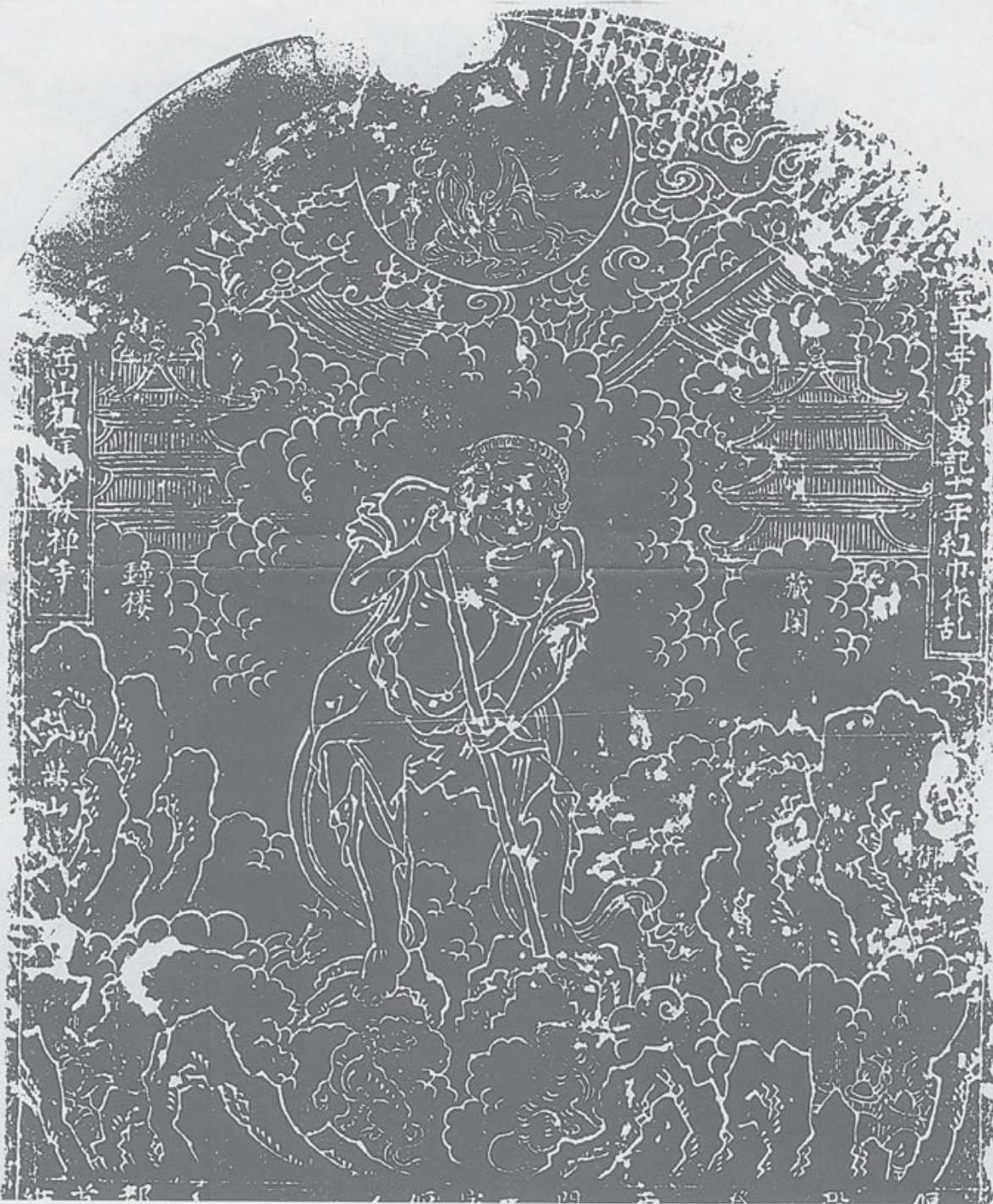
In addition, Sun Wukong and Vajrapani are associated with each other in Shaolin Monastery lore. The latter was historically worshiped as the progenitor of their famous staff method. A stele erected by Shaolin abbot Wenzai (文載) in 1517 CE shows that the deity’s vajra-club had been changed at some point to a Chinese staff (fig. 4) (Shahar, 2008, p. 84). Vajrapani’s yaksha-like Narayana (Naluoyan(tian), 那羅延(天)) form was eventually equated with one of the four staff-wielding “Kimnara Kings” (Jinnaluo wang, 緊那羅王) from the Lotus Sutra in 1575 CE. His name was thus changed from Narayana to Kimnara King (Shahar, 2008, p. 87). One version of the story about his creation of the staff method takes place during the Yuan Dynasty‘s Red Turban Rebellion (1351–1368 CE). Bandits lay siege to the monastery, but it is saved by a lowly kitchen worker wielding a long fire poker as a makeshift staff. He leaps into the oven and emerges as a monstrous giant tall enough to straddle both Mount Song and the imperial fort atop Mount Shaoshi, which are five miles (8.046 km) apart. The bandits flee when they behold this staff-wielding titan. The Shaolin monks later realize that the kitchen worker was none other than the Kimnara King in disguise (Shahar, 2008, pp. 87-88). Shahar (2008) suggests that mythical elements of the story were borrowed from the Monkey King’s adventures. He compares the worker’s transformation in the stove with Sun’s time in Laozi’s Eight Trigrams furnace (Bagua lu, 八卦爐), their use of the staff, and the fact that Monkey and his weapon can both grow to gigantic proportions (Shahar, 2008, p. 109). [3]

Therefore, given the above information, it’s not a stretch to have the two heroes meet in a fanfiction.

Fig. 4 – An ink rubbing of the 1517 CE Shaolin stele showing a titanic Vajrapani defending the monastery from rebels (larger version). From Shahar, 2008, p. 84.

2. The Main Story Idea

I’ve added in-text notes in this section to provide readers with extra context. This way, you won’t have to scroll to the endnotes at the bottom.

Buddhist tradition describes Tathagata visiting the devas to preach the dharma (Buswell & Lopez, 2014, p. 235). With the presence of Greeks in Central and South Asia, I imagine he would also visit the Olympian gods who had gained some influence in the region. (See the 03-28-26 update below for more info). These friendly interactions would lead Zeus to assign Heracles to guard the Enlightened One (fig. 5), thereby forming a link between the Greek and Buddhist pantheons (and explaining the aforementioned art). (See the 10-29-25 and 12-02-25 updates below for a detail from Greek myth that supports this idea.)

Here is where one of many changes to the standard 1592 CE JTTW story happens. In chapter six of the original, the bodhisattva Guanyin recommends that the demi-god Erlang battle the Monkey King after the latter had defeated many of heaven’s greatest warriors (Wu & Yu, 2012, vol. 1, p. 178). In our tale, she instead endorses the demi-god-turned-deity Heracles-Vajrapani (“HV” hereafter). [A]

A) The Son of Zeus became a full-blown god upon his death. After being exposed to a tunic soaked with poisonous hydra blood, Heracles sought release from the immense pain by jumping into a funeral pyre. But the flaming structure was shortly thereafter struck by lightning, signaling his rise to godhood (Romero-Gonzalez, 2021, pp. 273-276). This, of course, takes place hundreds of years before he becomes the protector of the Buddha.

Fig. 5 – A lovely digital painting of Heracles traveling with the Buddha (larger version). By Jacob King (deviantart). Used with permission. Image found here.

(I don’t consider myself a competent story writer, so please look at the following events and dialogue as conceptual in nature. I’m sure a seasoned writer could do the narrative more justice.)

Similar to the standard narrative, the monkey-soldiers of Wukong’s army notify him that heaven has sent another challenger. He emerges from his cave fully armored to see HV for the first time. Like the original, this might be followed by a poem describing the enemy; in this case, a large, muscular, bearded warrior wearing a lion skin and wielding a flaming vajra-club. (See the 02-19-26 update below for a visual.)

[Insert insults from both sides, including the Son of Zeus calling Monkey a “young rogue,” which naturally pisses him off. [B] HV also describes his godly heritage, which is alien to Monkey since he’s not familiar with the Greek pantheon.]

B) The Great Sage has a habit of claiming to be older than the various gods, immortals, spirits, and humans he meets—whether it’s true or not in the first three cases (Wu & Yu, 2012, vol. 1, p. 413, for example). This is exemplified by his self-given nickname “(Maternal/Paternal) Grandpa Sun” (Sun waigong, 孫外公; Sun Yeye, 孫爺爺). But within the story’s timeline, Heracles is indeed hundreds of years older. Writing around 430 BCE, the Greek historian Herodotus claimed that the Son of Zeus lived roughly 900 years before him, placing the demi-god’s life sometime around 1330 BCE. The Greek hero would, therefore, be active around 830 or more years prior to the birth of Wukong (c. 500 BCE).

The pair first take part in a battle of weapons, with Wukong wielding his magic staff and HV his vajra-club. The earth quakes, gods tremble, etc. HV’s powerful strikes push our hero back, causing his staff to painfully vibrate in his hands [C] and create a deafening ringing noise with each hit. Monkey would have a running internal monologue noting the great force of his opponent’s attacks. But despite this, the Great Sage continues driving forward, his weapon hardly leaving the area around HV’s head. [D] At one point, though, a glancing strike from the Greco-Buddhist hero redirects the staff, creating an opening. HV brings his vajra-club down hard on Monkey, but instead of dodging, the latter jerks his head upwards, butting away his opponent’s holy weapon with a loud, metallic bang. [E] The combined forces from the attack and defense might cause destruction to the surrounding area.

C) It may seem impossible for the staff to painfully vibrate in Wukong’s hands, but this indeed happens once in the novel. In JTTW chapter 20, he attempts to bludgeon a tiger-spirit, but when “the rod bounce[s] back up and his hands [a]re stung by the impact” (… 轉震得自己手疼), he learns it was just a big stone covered with the fiend’s sloughed off skin (Wu & Yu, 2012, vol. 1, p. 403).

D) The phrase “hardly leaving the monster’s head” is respectively used in JTTW chapters 41 and 67 (here and here) to describe Wukong’s supreme mastery of the staff (Wu & Yu, 2012, vol. 2, p. 224; vol. 3, p. 249).

E) The feat of headbutting the weapon serves two purposes. First, it’s a response to this 2020 DEATH BATTLE! fanon wiki script that sees Hercules win by smashing the primate immortal’s head to a pulp with his club. (This attack carried over into the official episode, too.) The ending betrays the author’s extremely limited knowledge of JTTW. In the original, the Great Sage’s head is one of the hardest parts of his body, giving him the confidence to voluntarily take blows to the scalp from even magic, bladed weapons with no harm (Wu & Yu, 2012, vol. 1, pp. 314, 383-384, and 408; vol. 2, p. 128; vol. 3, pp. 125 and 373). And two, it highlights the correlation between the invulnerability of Monkey and the Nemean Lion, the first labor of Heracles (March, 2021). Regarding the ending of the fan script, one version of the original mythology sees the Son of Zeus break his olive club over the lion’s head because of how tough its hide is (March, 2021, p. 34).

The novel gives at least three reasons for the Great Sage’s invulnerability. After heaven fails to execute him with bladed weapons and fire and lightning in JTTW chapter 7, Laozi suggests that all of the immortal foodstuff previously consumed by our hero had been refined by his own samadhi fire (sanmei huo, 三昧火), a spiritual flame in the lower abdomen, thus giving him a “diamond body” (jingang zhi qu, 金鋼之軀) (Wu & Yu, 2012, vol. 1, p. 188). Wukong himself later attributes his adamantine nature to his time in the high god’s furnace. In JTTW chapter 34, for example, he claims to have developed a heart of gold, viscera of silver, a head of bronze, and a back of iron, etc. (Wu & Yu, 2012, vol. 2, p. 131). This is refuted in JTTW chapter 75 when he claims to have been born with a head of bronze and iron that was further refined by the furnace (Wu & Yu, 2012, vol. 3, p. 374).

Stunned from the powerful blow, [F] Monkey stumbles around holding his head for a moment but raises his weapon in defense when he sees HV approaching. However, instead of attacking, the Greco-Buddhist warrior pauses combat by raising a hand in front of him. “What a skull!” he exclaims while clapping. “And no hint of blood! I reckon your hide is as tough as a monstrous beast I once fought. [G] Truly impressive! And your staff technique is masterful! Who trained you?”

F) This references how the Nemean Lion was blinded by pain after the blow (March, 2021, p. 34).

G) This reference is obvious.

“I have no teacher. [H] I alone trained my mind and body for three years.” [I]

H) This refers to Wukong’s promise to never reveal the Buddho-Daoist sage, Patriarch Subodhi, as his teacher under threat of karmic torture in the underworld (Wu & Yu, 2012, vol. 1, p. 125).

I) This is the length of time that he spends as an indoor disciple of Subodhi (Wu & Yu, 2012, vol. 1, p. 121).

“A prodigy!” exclaims HV. “But how good is your boxing and wrestling?”

“Ol’ Monkey can handle himself.”

“Let’s see if that’s true. How about we have a friendly sparring match, a test of heroic strength and skill? No weapons and no pesky magic tricks. Agreed?”

Wukong quickly agrees and inserts his shrunken staff into his ear before stripping off his armor from the waist up to match HV’s exposed muscles. HV somehow magically stores his holy vajra-club. The two then square up and launch forward, locking hands and pushing against the other, causing the ground beneath them to tremble and split.

“Extraordinary!” says HV. “How can such a small creature be so powerful?! [J] Were you born of the gods?

J) Many people often forget that Monkey’s normal form is less than 4-Chinese feet (121.92 cm) tall (see here).

“No, I was born from a stone egg.” (See the 02-28-26 update below for an interesting Greek parallel.)

“Oh, like the terrible stone titan and stone goddess! [K] No wonder you achieved this level of strength in such a short time. You have so much raw potential. Why cause trouble for such petty reasons?” [L]

K) These are Ullikumi and Agdistis, two powerful, rebellious, stone-born deities from Western myth. Referencing the former shows that HV is aware of the Near Eastern pantheon.

It’s interesting to note that lithic births are at least common enough in world myth to have earned a category in Stith Thompson’s Motif-Index of Folk-Literature: “Birth from rock” (T544.1).

L) This refers to Wukong’s rebellion over being given the lowest-ranking position in the Daoist heaven.

[Insert Wukong’s reply. They continue to converse during the battle.]

(This might be a good place to introduce some comedy. HV keeps referencing gods and monsters from other pantheons, making Monkey more and more frustrated:

“What the hell is wrong with you?! I … DON’T … KNOW … THESE … PEOPLE!!! [said in a slow, patronizing voice])

The Great Sage’s internal monologue comments on HV’s diamond grip and the great pressure of his punches. But our hero’s keen eyes notice openings in HV’s defense, allowing him to land blow after blow. However, with each successful attack comes praises from HV. Stinging rib shot. “Good, good!” Cutting elbow strike to the face. “Excellent!” Crushing body slam. “Amazing!”

“Why do you keep lauding me? I’m winning!”

“That would certainly be the case … if we were equals.”

“What do you mean?!”

Smiling, HV explains, “I’ve been testing you! [M] You found all of the openings I offered you, even some that I didn’t intend to because I was apparently too focused on judging your technique. [N] You are a talent the likes of which I’ve never seen before! Thank Father Zeus [or Buddha]! The student I’ve been looking for has finally appeared! Forsake this frivolous rebellion and return with me to the Western Paradise. I promise with my tutelage, you will become one of the greatest warriors of any pantheon!”

M) Perhaps HV decides to test the Great Sage when he sees how well the small primate responds to his opening strikes.

N) It just occurred to me that since the Subodhi appearing in this more realistic version of the story is the historical figure he’s based on, Subhuti, one of the Buddha’s ten principal disciples, the patriarch had to have trained under someone during Tathagata’s lifetime. And considering that HV was the Enlightened One’s bodyguard, perhaps Subhuti learned a little from the Greco-Buddhist hero—apart from other deities, holy men, and warriors, including the Buddha, a member of the Kshatriya class. An interesting implication is that HV would recognize (his or an ally’s) techniques among Wukong’s armed and unarmed attacks or defenses, thereby alerting him that Monkey’s claim of having no master is false. Yet, he would still be supremely impressed that the Great Sage became such a powerful, competent fighter in just three short years.

Fun fact: according to Theocritus, Heracles learned boxing and wrestling from the grim-looking demi-god Harpalycus, son of Hermes (Pache, 2021, p. 10). Apollodorus instead claims his teacher was Autolycus (2.4.9), also a son of Hermes.

“I think you’re full of shit! Ol’ Monkey is whittling away at you, and you’re just trying to talk your way out of it.”

“Well, my offer stands,” HV replies calmly, “but now that I’ve had my fun, it’s time to finish this.”

“Finish what, you bastard?!” Wukong screams in anger. He then unleashes a tornado of powerful punches, kicks, and knee and elbow strikes. But this time they have no effect on the Son of Zeus because he’s no longer playing along.

I’m not quite sure what the next sequence of events would be since I have zero experience choreographing fight scenes, especially between celestial warriors. Perhaps HV displays his true power by running Monkey headfirst through the side of a mountain with an outstretched arm, similar to how the comic book character Omni-Man uses his son, Invincible, like a wedge to slice through an oncoming subway train [warning: gore]. This feat alone would surely cause the primate immortal to question how his opponent’s strength has seemingly increased exponentially. [O] (But upon reflection, this deed seems lacking considering that Wukong himself is shown capable of carrying two mountains while running with great speed. Hopefully someone can suggest a feat for HV that would amaze even the Great Sage.) (See the 02-20-26 update below for a new reason.)

O) This, of course, proves that HV was holding back. It’s important to note that in Buddhist literature, the original Vajrapani is considered the “physical manifestation of the … power … of all the Buddhas” (Buswell & Lopez, 2014, p. 955). Now imagine how much stronger HV would be than Monkey! Apart from his own godly heritage, I guess in my version of JTTW, HV would gain an unfathomable boost in power from serving as the protector and disciple of the Buddha, exposing him to the dharma for centuries—during Tathagata’s lifetime and afterlife following his parinirvana (figs. 6 & 7). This is similar to how the scorpion-demoness becomes so strong in JTTW chapter 55 (Wu & Yu, 2012, vol. 3, p. 72). But HV would be well beyond even her.

I guess the Great Sage would hold off on using magic up to this point as a matter of pride, but maybe his hand is forced when faced with such oppressive strength. Like in the original, he might resort to his magic hairs, summoning hundreds of tiny clones in the hopes of overwhelming the Son of Zeus. [P] However, the Greco-Buddhist warrior quickly neutralizes these—possibly by clapping his hands together and creating a shockwave that blows them away [Q] and destroys the surrounding area—pressuring our hero to take other measures. Maybe Monkey frantically cycles through one trick after another but ultimately fails to best his opponent. (See the 10-26-25 update below for a detail from Greek myth that supports this idea). (It would be fascinating to see how HV deals with Wukong’s three-headed, six-armed war form—surely eliciting comparisons to Geryon.) [R]

To these breaches of their agreement, HV responds with something like, “Magic? You disappoint me.”

[Insert Monkey’s response.]

P) Monkey competes in hand-to-hand combat in JTTW chapters two and 51, and each time he resorts to hair clones when things get out of hand (Wu & Yu, 2012, vol. 1, pp. 128-129; vol. 3, pp. 12-13).

Q) The hair clones can indeed be blown away, as shown by the Yellow Wind Demon in JTTW chapter 21 (Wu & Yu, 2012, vol. 1, pp. 409-410).

R) Thank you to a beta reader of this article for reminding me about Geryon. He is sometimes described as having or depicted with three conjoined bodies, complete with three heads and six arms like Monkey (fig. 8) (Finglass, 2021).

Fig. 6 (Top) – A degraded stone carving depicting the parinirvana of the Buddha, Gandhara, 2nd to 3rd-century CE, Schist (larger version). HV is the first person from the left on the bottom row. He holds his vajra-club in one hand and upraises the other in lamentation. He has an exposed torso, showing off his muscles, in place of his signature lionskin. Housed in the British Museum. Adapted from an image found on Wikimedia Commons. Copyright Marie-Lan Nguyen. Fig. 7 (Bottom Left) – Detail of HV (larger version). Fig. 8 (Bottom Right) – Heracles vs Geryon, Attic black figure on Amphora vase, mid-6th century BCE (larger version). Housed in the Musée du Louvre, Paris.  This is an upscaled version of an image found here. Copyright www.theoi.com.

Ideally, given the parallels between Wukong and the Nemean lion—both are fierce mythological animals, have invulnerable hides, can change shape, [S] and fight someone who is/was a demi-god (Erlang vs Heracles)—I would like to see HV maneuver to Monkey’s back and get him in a chokehold, thereby mimicking how the big cat was originally defeated. [T] But instead of killing the Great Sage, he only intends to choke him to unconsciousness. [U] (Again, see the 10-26-25 update below). And to make matters worse, as the primate immortal fades towards blacking out, he by chance witnesses his beloved monkey army being routed and captured by celestial forces, like the standard version (Wu & Yu, 2012, vol. 1, p. 182). This causes him to lose heart and flee HV’s powerful arms by changing into an intangible ball of light or gust of wind. [V]

S) Matyszak (2015) states that the lion would sometimes take the form of kidnapped women (that it had presumably already eaten) in order to lure unsuspecting heroes into its cave (pp. 46-47). Dr. Matyszak tells me that “it’s not part of the core myth” but “later Roman and Byzantine authors do mention it” (personal communication, October 17, 2025).

T) I really like the ending of Theocritus’ description of the fight:

[After hitting him over the head with a club,] I threw my bow and stitched quiver to the ground, and before he could recover and turn on me again, I grabbed him by the scruff of his powerful neck. Gripping him firmly, I strangled him with my strong hands, tackling him from behind to stop him scratching me with his claws. Standing on his hind paws, I pressed them hard to the ground with my heels and controlled his flanks with my thighs, until I could lift him up lifeless in my arms and lay him out. And mighty Hades took his spirit (March, 2021, p. 34).

U) Someone might claim that it would be impossible to choke out Monkey since he’s a spiritual being, but it’s important to remember that the novel humanizes supernatural figures in order to make them more relatable. For instance, in JTTW chapter 65, Wukong claims that he will die from the lack of air inside of a sealed Buddhist treasure-weapon if he isn’t soon released (Wu & Yu, 2012, vol. 3, p. 217). And he reiterates this near-death experience to Zhu after escaping a few pages later (Wu & Yu, 2012, vol. 3, p. 224). Having read that, I think a blood choke would be more dignified and less dangerous method for subduing our hero.

V) Wukong escapes in the form of a ball of light in JTTW chapters 34 and 42 (Wu & Yu, 2012, vol. 2, pp. 126 and 241). And he turns into a gust of wind to follow a foe in JTTW chapter 60 (Wu & Yu, 2012, vol. 3, p. 140). This could easily be used to escape as well.

A beta reader suggested that I work Erlang and his sworn brothers back into the story. They could track down and capture Monkey. But however the situation is resolved, this would lead to the events of the original story: the Great Sage’s failed execution, his sentence to Laozi’s furnace, his escape and wager with Buddha, his imprisonment beneath Five Elements Mountain, and his eventual release to go on the journey. And since Wukong comes into contact with Erlang once more and the Vajra warriors several times in the standard version, [W] he would likely meet HV again during the pilgrimage. The Son of Zeus might even comment on his positive change in character as Tripitaka’s disciple and protector.

W) The Great Sage meets Erlang again in chapter 63 (Wu & Yu, 2012, vol. 3, pp. 187-191). Regarding Vajra warriors, refer back to section 1.2.

Two beta readers were disappointed by the ending because they didn’t think HV could defeat the Great Sage. As a longtime uberfan of Monkey myself, I understand that sentiment, but they should remember that this is not just the Heracles of Greco-Roman myth, who’s immensely powerful in his own right, able to support the sky on his shoulders in one myth (Salapata, 2021, p. 152). He’s an amalgam of the Greek hero and the Buddha’s protector. Recall that Vajrapani is considered the embodiment of all the Tathagatas’ power (refer back to note O). And If the dharma of one Buddha can easily defeat Monkey (Wu & Yu, 2012, vol. 1, pp. 195 and 199), a being endowed with the power of ALL of them should have no problem subduing our favorite primate immortal.

I feel like this idea has so much potential, but I lack the experience or talent to do it justice here. Hopefully, readers will see through the lackluster description to understand the promise of greatness that it holds. Please let me know if anyone is interested in fleshing out this tale.

Lastly, while finishing this section, I came upon a fun coincidence: ancient Greco-Buddhist stone carvings with HV, the Buddha, and … a monkey (figs. 9 & 10)! They depict “The Monkey Offering Honey (to the Buddha)” (Ch: Mihou xianmi, 獼猴獻蜜; Mihou fengmi, 獼猴奉蜜), a tale from the Tathagata’s lifetime where a primate selflessly offered him honey but shortly thereafter fell and died via drowning or impalement. Thankfully, though, the primate was reborn into the deva realm (Van der Geer, 2022, pp. 439-440). [W] The carvings depict HV watching over the Enlightened One during this event.

Perhaps, based on these images, HV tells Wukong at some point during their confrontation that he reminds him of someone from the past. (Fanfic theory: could the Great Sage be a reincarnation?)

W) The historical Xuanzang mentions a version of this story where the primate is later reborn as a human (Li, 1996/2017, p. 106). He adds that the area where the offering originally happened hosts images of monkeys (mihou xingxiang, 獼猴形像) next to a water tank or pond supposedly dug by a group of them for the Enlightened One (Li, 1996/2017, p. 184). [4]

Fig. 9 (Left) – Detail of a stone doorway fragment with two stacked carvings illustrating “The Monkey Offering Honey (to the Buddha)” story, Gandhara, 1st to 3rd-century CE, Schist (larger version). The upper scene portrays the primate asking for a bowl, while the lower depicts the offering of honey. HV is present in both: first from the left on the top and first from the right on the bottom. He lacks his beard and lionskin but wields his signature weapon. The extra person photobombing the lower scene may be Ananda. Fig. 10 (Right) – The full stone doorway fragment portraying various events from the Tathagata’s life (larger version). Housed in the Guimet Museum, Paris, France. Adapted from an image found on Wikimedia Commons. Copyright Marie-Lan Nguyen. 

3. An Idea for a Sequel

A continuation of the story would open where the original leaves off: after the scripture-pilgrims are elevated in spiritual rank, Tathagata charges HV with escorting the Victorious Fighting Buddha (i.e. Sun Wukong; fig. 11) through the Greek world-system. Imagine the kind of adventures Monkey would have as a Buddha interacting with Classical gods and monsters! It would definitely be a great way of introducing East Asian people to the wonders of Greek myth.

I really like the idea of HV visiting his old pantheon as his vajra is analogous to Zeus’ thunderbolt. Seeing a father-son lightning competition would be great!

Also, as I’ve discussed elsewhere, Wukong and Poseidon could bond over their shared love of horses.

Fig. 11 – Wukong as the Victorious Fighting Buddha (larger version). Imagery based on the iconography of the historical Yuddhajaya Buddha. Art by NingadudeXx.

3.1. Commissioned Art

I have commissioned some illustrators to draw Monkey in ancient Greek style as an experiment to see what he might look like through the lens of Hellenistic artisans.

Fig. 12 – The Victorious Fighting Buddha (larger version). Pencil, fineliners, and alcohol markers on paper. Art by tr0chanter (Instagram and Twitter).

Fig. 13 – Heracles vs Monkey (larger version). Pencil and markers on paper. Art by Dario Virga (Onibotokemaru on Instagram), a friend of the blog. Each character is labeled with their name in Greek. Heracles is “Ἡρακλῆς,” while the Great Sage is “Pithekos” (πῐ́θηκος), meaning “ape, monkey, trickster, or dwarf.” Wukong’s Greek name is very fitting. It’s also part of the modern scientific name for Old world monkeys (Cercopithecoidea).

Fig. 14 – Heracles vs Sun Wukong (larger version). Digital. Art by Jacob King (Twitter, Instagram, Tumblr). I love the cracks.

4. Possible Fanfiction

I can already predict fanfiction set in an alternate timeline where Monkey accepts HV’s offer to become his teacher. The Son of Zeus would spend time instructing Wukong on advanced techniques of boxing, wrestling, and weapons. This, of course, would be taught in tandem with spiritual cultivation. The training might be in preparation for a fighting tournament between the disciples of gods from all pantheons, kind of like Record of Ragnarok (Jp: Shūmatsu no Warukyūre, 終末のワルキューレ; lit. “Doomsday Valkyrie”; fig. 15). The contestants could be fighting for permission to start their own pantheon, thereby becoming a “Sky Father” (Sk: Dyaus-pitr, द्यौष्पितृ; Ch: Tianshang fuqin, 天上父親). Maybe the long-established Sky Fathers share some of their divine spark to kickstart the new world-system.

I REALLY like this idea, but it wouldn’t work for my own purposes since, as stated above, Wukong would still need to go on the journey.

Perhaps the prize could be the chance to help mankind since one of the reasons that Tripitaka is asked to quest for sutras is because they will help free untold numbers of orphaned souls from the torments of hell (see JTTW chapters 11 and 12). Therefore, the tournament would essentially be a contest to see who will be the Tang Monk’s protector. I don’t really like this idea, but it at least supports the original narrative. The Great Sage would win, of course, but he has to agree to have his extraordinary powers (and memories of the tournament) sealed as a test of his resolve or devotion. And his subsequent enlightenment would be the reward for his great deeds performed on the journey.

Fig. 15 – Promotional art for Record of Ragnarok (larger version). Image found here.


5. Updates

Update: 10-11-25

I’ve seen people claim online that Sun Wukong would easily defeat Heracles because the latter’s feats are not as grand as the former. To this, I counter that the deeds of both heroes shouldn’t be compared, for they serve difference purposes. I don’t know of any feats of speed for Heracles, but Monkey’s famous ability to fly 108,000 li (33,554 mi / 54,000 km) in a single cloud somersault is an allegory for instant enlightenment (as explained in section III here). [5] And his feat of carrying two Buddhist mountains on his shoulders is likely an allegory for the Great Sage “supporting” the religion by protecting his master on the quest for sutras (as I suggest here). The deeds of Heracles, however, were probably meant as actual displays of brute strength. For instance, ancient Greek men on lion hunts may have drawn inspiration and courage from the demi-god’s defeat of the Nemean Lion. [6]


Update: 10-26-25

Above, I wrote that “[m]aybe Monkey frantically cycles through one trick after another” in a failed bid to win, and I later added, “I would like to see HV maneuver to Monkey’s back and get him in a chokehold.” Well, I’m happy to report that I’ve found a mythic way to combine these. The Bibliotheca of Pseudo-Apollodorus describes Heracles’s grip tiring out a shape-shifting sea god:

And going on foot through Illyria and hastening to the river Eridanus he came to the nymphs, the daughters of Zeus and Themis. They revealed Nereus to him, and Hercules seized him while he slept, and though the god turned himself into all kinds of shapes, the hero bound him [with his arms (fig. 16)] and did not release him till he had learned from him where were the apples and the Hesperides (2.5.11).

Matyszak (2015) calls this binding a “Herculean head-lock” (p. 150). Therefore, in our story, Wukong cycles through all manner of transformations but can’t break free from HV’s grip! Then he loses heart and flees when he sees his children captured (as mentioned previously).

Fig. 16 – Heracles wrestling Nereus/Triton (larger version). From an 1894 drawing of a circa 550 BCE Attic Black-figure Kylix. Image found on Wikimedia Commons. For the original, see here.


Update: 10-29-25

I’ve also found a mythic reason for why Heracles would be sent away from Olympus to protect Buddha. Matyszak (2015) explains that the Son of Zeus didn’t want to become an official member of the Twelve Olympians because this would have forced someone out of the group:

Some felt that the mighty deeds of Hercules entitled him to the status of a full Olympian God. However, the number of Olympians was limited to the sacred number of twelve, and in a rare moment of diplomacy Hercules declined to take an honour that would have first to be stripped from someone else. (Dionysus, the God of Wine was less bashful. He bumped Hestia, Goddess of the Home, off the Olympian high table when his time came to be made divine.) (p. 200)

So instead of taking an Olympian’s spot, Heracles decides to accept a position within the Buddhist pantheon as the Tathagata’s protector.


Update: 12-02-25

I have found the specific passage alluded to by Matyszak (2015) in the previous update. In book four of his Library of History (c. 60 to 30 BCE), Diodorus Siculus writes:

[4.39.4] They report of Heracles further that Zeus enrolled him among the twelve gods but that he would not accept this honour; for it was impossible for him thus to be enrolled unless one of the twelve gods were first cast out; hence in his eyes it would be monstrous for him to accept an honour which involved depriving another god of his honour (source).


Update: 02-19-26

In March 2023, Twitter user @LinJKai posted a lovely 18 x 24-inch (45.72 x 60.96 cm) digital painting titled “Hercules as Vajrapani” (fig. 17). It depicts HV, the 12 labors, and various Greek gods in Tibetan thangka style. I adore this so much! I’d love to commission a physical copy.

Fig. 17 – @LinJKai’s painting of HV (larger version).


Update: 02-20-26

I originally couldn’t think of a feat of strength for HV that would outdo Monkey, but something has come to mind. In JTTW chapter 33, a demon uses the “Magic of Moving Mountains and Pouring Out Oceans” (Yishan daohai fashu, 移山倒海法術) to drop two holy landmasses on Monkey in the hope of incapacitating him. This does nothing to slow him down, though, so the fiend drops a third peak. But since the last ridge, Mount Tai (Taishan, 泰山), is considered the heaviest concept in Chinese philosophy, it instantly overpowers the Great Sage’s strength and pins him to the earth (see this article).

Now, imagine that Wukong uses the same magic to call up a column of mountains, perhaps capped with Mt. Tai, overhead (fig. 18), but not even this is enough to stop the Buddha’s protector. The Greco-Buddhist hero would continue to fight as if nothing is pressing down on him. This would surely frighten Monkey.

I like this because the Great Sage’s defeat in chapter 33 would thus be a call back to the punishment that he tried and failed to dish out during his fight with HV.

Fig. 18 – Imagine that the column of mountains above HV’s head looks something like this pile of stones (larger version). Image found here.


Update: 02-25-26

While writing the original article, I feared that I mischaracterized Heracles as being jovial with Wukong in what should have been a tense situation. However, I’ve found info that supports this. Galinsky (1972) explains:

Being close to the people as he was, Hesiod also portrayed Herakles as the folksy, jolly good fellow. The few fragments that have been preserved of the Wedding of Ceyx give us some indication of this. One of the main subjects of the poem was the wedding-feast of Ceyx and Alcyone at which Herakles intervened. He crashed the party, justifying himself with jovial magnificence: ‘Of their own accord good men betake themselves to good men’s feasts.’ This phrase became so proverbial that it was quoted, among others, by Plato in the Symposium. The remark shows that Hesiod attributed to Herakles the quality, which he undoubtedly found in the folktales, of taking himself lightly, and it kept our hero from becoming too lofty and untouchable. Much of the rest of the poem seems to have been concerned with Herakles’ prodigious appetite, a theme on which the comic poets were to seize with so much glee. Having stilled his hunger, Herakles entertained the party by proposing several riddles (p. 16-17).


Update: 02-28-26

Regarding the original DEATH BATTLE! episode, it’s interesting to note that Heracles has previously fought and killed a monstrous opponent born from an egg, just like Sun Wukong. Ibycus (6th century BCE) records the Greek hero saying: “I slew the white-horsed lads, the children of Molione, of the same age, equal-headed, single-bodied, both born in a silver egg” (Bowra, 1961, p. 245).


Update: 03-28-26

Above, I wrote, “With the presence of Greeks in Central and South Asia, I imagine he [Buddha] would also visit the Olympian gods who had gained some influence in the region.” Well, I’ve thought of a way to connect the structures of the mythic Greek and JTTW universes:

I’ve previously discussed how the novel is set in the Buddhist disc-world system—i.e. a flat earth (see below). It’s interesting to note that the archaic Greeks also believed in a flat earth. The wonderful Routledge Handbook of Greek Mythology explains:

As viewed from their perspective, as people who lived on the edge of a land mass, it might naturally have appeared to take the form of a circular disc, more or less level except were hills or mountains rose up from it, capped by the immense roof or dome of the sky. On the one side the sun and stars could be seen rising above the horizon, while on the other they disappeared at their setting; and since they always rose on the same side, in the east, they must presumably have made their way back again, either under the ground or by some other hidden route. It was imagined that the outermost boundary of this disc of the earth was formed by the stream of Ocean (Oceanos), which was not an ocean in the modern sense but a great river flowing in a circle around the edges of the earth. The sky was envisioned as a substantial roof or, later, dome sometimes said to be made of bronze or iron, which rose to a considerable, though not immeasurable, height above the earth. Zeus and the higher gods could be imagined as residing in the sky itself, or else on the summit of Mt Olympos in north-eastern Greece, hence their familiar name of Olympian gods. If one could pile three large mountains one above another, as the gigantic Aloadai set out to do when they revolted against the gods …, it would be sufficient to form a ladder to heaven (Hard, 2020, p. 17).

Heracles has a few connections to Ocean. [7]

Now, imagine that the purview of the Olympian gods and the borders of their disc-world (fig. 19) expand as Greeks traveling eastward bring their faith with them to Central and South Asia. This would allow the Greek cosmos to eventually overlap with the Buddhist realm (fig. 20). (The reverse would be true for westward-traveling Buddhists.) The result would look sort of like a Venn diagram, with the double-pointed oval in the middle indicating where the two realms intersect on our Earth.

Fig. 19 (Left) – A reconstruction of the Greek world based on the writings of Homer (larger version). The landmass is surrounded by the god Ocean. From Atlas of Ancient & Classical Geography (1928, plate 1). Fig. 20 (Right) – A diagram of the Buddhist cosmos (larger version). Mt. Sumeru is flanked by a continent and two islands on each of its four sides. The land is also surrounded by water; in this case, four great oceans. Adapted from Buswell & Lopez (2014, p. xxxii).

I should point out that JTTW changes the traditional structure of the Buddhist cosmos by placing China in the Southern Continent and moving India to the Western Continent (refer back to this article). Therefore, the western portion of the expanding Greek cosmos would more easily line up with the Buddhist cosmos.


Update: 04-08-2026

There is an interesting indirect connection between Wukong and Heracles by way of literature and religious iconography. I’ve previously written about Monkey’s noncanonical daughter, Yuebei xing (月孛星, “Moon Comet Star”) from Journey to the South (Nanyou ji南遊記, c. 1570s-1580s), who carries a magic skull with the power to kill even immortals. The historical deity on which she is based has human female and yaksha-like male forms, both of which carry a sword and severed head. This male version has a striking similarity to Arabo-Persian depictions of al-Mirrīkh (Ares/Mars), and the iconography of the latter is believed to be based on a constellation of the Greek demi-god Perseus holding the severed head of Medusa. Perseus is the great-grandfather of Heracles. [8]

See my article on the literary Yuebei xing.

Yuebei xing, Daughter of the Monkey King

Notes:

1) Translation changed slightly. Although the English reads “a hundred yards,” the original Chinese says “100 zhang” (bai zhang, 百丈). One zhang is ten Chinese feet, or roughly 10.43 ft (3.18 m) (Jiang, 2005, p. xxxi). Therefore, 100 zhang would be 1,043 ft (314 m).

2) Yu (Wu & Yu, 2012) translates jingang (金剛) as “Diamond Guardians” (vol. 3, p. 24, for example). I’m changing it to just Vajra since the term can mean both “lightning” and “diamond.” I don’t want to confuse anyone.

3) Yes, this information comes from Wikipedia, but I’m the one who originally added it under the screenname “Ghostexorcist.” See this edit history, for example.

4) The English translation just says “tank” (Li, 1996/2017, p. 184), but the original Chinese word chi (池) can also mean “pond.”

5) The li (里) is a Chinese measurement of distance. English works usually translate it as “mile.” However, it equals roughly 1/3rd of a mile or 1/2 of a kilometer.

6) Herodotus mentions mountain lions attacking the caravan camels of Xerxes on his route through Greece (The Histories, 7.125126). If such thing routinely happened to local travelers, this would have affected regular lion hunts. And this 16th-century BCE Minoan blade suggests that lion hunts go back centuries.

7) Heracles uses the Sun-God‘s goblet in order to sail Ocean to the destination of his tenth labor (Bibliotheca, 2.5.10). However, according to Pherecydes, “Ocean, to make trial of him, caused the goblet to heave wildly on the waves. Herakles was about to shoot him with an arrow; and the Ocean was afraid, and bade him give over” (Bibliotheca, 2.5.10, n. 7).

Also, the extent of his tenth labor set the limit for human travel:

[S]ince the Pillars or Columns of Heracles—the name usually associated with the twin rocks standing astride the Straits of Gibraltar—afforded the only known connection between the familiar Mediterranean and alien Ocean, they became a vivid symbol of the gateway or barrier between inner and outer worlds. For the most part they stood in the Greek imagination as a forbidding non plus ultra, a warning to mariners not to proceed any further. Pindar, for example, adopts this landmark as a paradigm of the limits to human daring, in his celebrations of victorious athletes:

Now Theron, approaching the outer limit in his feats of strength, touches the Pillars of Heracles. What lies beyond cannot be approached by wise men or unwise. I shall not try, or I would be a fool. (Ol. 3.4–5)

As a man of beauty, who accomplishes feats beautiful as himself, the son of Aristophanes may set forth on supreme, manly endeavors; but not easily across the untrodden sea, beyond the Pillars of Heracles, which that hero-god set in place, as a famed witness of the furthest limit of seafaring. (Nem. 3.20–23)

By the uttermost deeds of strength did these men touch the Pillars of Heracles, an achievement all their own; let none pursue valor any farther than that. (Isthm. 4.11–14)

In these passages Pindar measures the prowess of his athlete patrons in geographic terms, seeing their victories as journeys into distant space; but these journeys must end, he insists, before they enter the forbidden realm of Ocean. The Pillars have here come to stand for the boundary of the human condition itself: To pass beyond them is the prerogative of god alone, or of mythic figures like Heracles who manage to bridge the human and divine (Romm, 1992, pp. 17-18).

8) Perseus had several children, but I will only present the human line that leads to our hero: Perseus ⇒ Electryon (son) ⇒ Alcmena/Alcmene (granddaughter) ⇒ Heracles (great-grandson) (Bibliotheca, 2.4.5 & 2.4.8).

Sources:

Atlas of Ancient & Classical Geography. (1928). London & Toronto: J.M Dent & Sons, LTD.; New York: E. P. Dutton & Co.

Bowra, C. M. (1961). Greek Lyric Poetry from Alcman to Simonides. United Kingdom: Clarendon Press.

Buswell, R. E., & Lopez, D. S. (2014). The Princeton Dictionary of Buddhism. Princeton, NJ: Princeton University Press.

Finglass, P. J. (2021). LABOR X: The Cattle of Geryon and the Return from Tartessus. In D. Ogden (Ed.), The Oxford Handbook of Heracles (pp. 135-148). United Kingdom: Oxford University Press.

Galinsky, K. (1972). The Herakles Theme: The Adaptations of the Hero in Literature from Homer to the Twentieth Century. New Jersey: Rowman and Littlefield Publishers.

Hard, R. (2020). The Routledge Handbook of Greek Mythology (8th ed.). London & New York: Taylor & Francis.

Jiang, Y. (2005). The Great Ming Code / Da Ming Lu. Vancouver, Wa: University of Washington Press.

Li, R. (Trans.) (2017). The Great Tang Dynasty Record of the Western Regions. Berkeley, CA: Numata Center for Buddhist Translation and Research. (Original work published 1996) Retrieved from https://www.bdkamerica.org/product/the-great-tang-dynasty-record-of-the-western-regions/

March, J. (2021). LABOR I: The Nemean Lion. In D. Ogden (Ed.), The Oxford Handbook of Heracles (pp. 29-44). United Kingdom: Oxford University Press.

Matyszak, P. (2015). Hercules: The First Superhero (An Unauthorized Biography). Canada: Monashee Mountain Publishing.

Pache, C. (2021). Birth and Childhood. In D. Ogden (Ed.), The Oxford Handbook of Heracles (pp. 3-12). United Kingdom: Oxford University Press.

Romero-Gonzalez, D. (2021). Deianeira, Death, and Apotheosis. In D. Ogden (Ed.), The Oxford Handbook of Heracles (pp. 266-280). United Kingdom: Oxford University Press.

Romm, J. S. (1992). The Edges of the Earth in Ancient Thought: Geography, Exploration, and Fiction. Princeton University Press.

Salapata, G. (2021). LABOR XI: The Apples of Hesperides. In D. Ogden (Ed.), The Oxford Handbook of Heracles (pp. 149-164). United Kingdom: Oxford University Press.

Shahar, M. (2008). The Shaolin Monastery: History, Religion, and the Chinese Martial Arts. Honolulu: University of Hawai’i Press.

Van der Geer, A. A. E. (2022). The Great Monkey King: Carvings of Primates in Indian Religious Architecture (pp. 431-455). In B. Urbani, D. Youlatos, & A. Antczak (Eds.), World Archaeoprimatology: Interconnections of Humans and Nonhuman Primates in the Past. United Kingdom: Cambridge University Press.

Wivell, C.S. (1994). The Story of How the Monk Tripitaka of the Great Country of T’ang Brought Back the Sūtras. In V. Mair (Ed.), The Columbia Anthology of Traditional Chinese Literature (pp. 1181-1207). New York: Columbia University Press.

Wu, C., & Yu, A. C. (2012). The Journey to the West (Vols. 1-4) (Rev. ed.). Chicago, Illinois: University of Chicago Press.

Shi Pantuo: An Influence on Sun Wukong

I was asked on Tumblr if I was familiar with Shi Pantuo (石槃陀/石盤陀/石磐陀; fig. 1), a historical figure suggested to be one of several influences on Sun Wukong. [1] He is known for serving as a temporary guide to the historical monk Xuanzang (玄奘, 602–664), on whom the literary Tripitaka is based. According to Hansen (2012), Shi was a Sogdian, an Iranic people active in Central Asia and China:

The guide’s last name, Shi, indicated that his family had originally come from the region of Kesh, or Shahrisabz, outside Samarkand, Uzbekistan, while his given name, Pantuo, was the Chinese transcription of Vandak, a common Sogdian name meaning “servant” of a given deity (p. 85). [2]

In this article, I will quote Shi’s full story appearing in A Biography of the Tripitaka Master of the Great Ci’en Monastery (Da Tang Daci’en si Sanzang Fashi Zhuan, 大唐大慈恩寺三藏法師傳, 7th-century; T2053), a journal of Xuanzang’s travels written by his disciple Huili (慧立). I will also discuss why he is believed to have been an inspiration for the Monkey King.

On a related note, please see my past article about the historical monk Wukong (悟空).

Fig. 1 – Statues of Xuanzang (left) and Shi Pantuo (right) from the Xuanzang Procures the Scriptures Museum (Xuanzang qujing bowuguan, 玄奘取经博物馆) in Guazhou County, Gansu Province, China (larger version). Image found here.

Table of Contents

1. Historical Record

Determined to procure Buddhist scriptures from India, Xuanzang ignored a royal prohibition against leaving China by traveling in secret towards the western reaches of the country. He was initially worried about traversing the border, which was heavily guarded by the military, but then his horse died, making matters worse. Then he was shocked to find that a warrant had been issued for his arrest. All of this weighed heavily on the monk (Huili & Shi, 1995, pp. 20-21). It was shortly thereafter that he met Shi Pantuo:

Now the Master worried all the more. Of the two junior monks [who had recently joined him in Liangzhou], Daozheng had already gone to Dunhuang, and only Huilin remained with him. Knowing that he could not stand the hardships of the long journey ahead, the Master dismissed him and let him go home. He bought a horse, but the trouble was that he had nobody to be his guide. Before the image of Maitreya Bodhisattva of the monastery [in Guazhou (fig. 2)] in which he was staying, he prayed for a man who might guide him through the pass. That night a monk of the Hu [胡, i.e. “barbarian“] tribe, named Dharma, of that monastery dreamed that the Master was sitting on a lotus flower going west. Dharma felt it strange and in the following morning he came to tell his dream to the Master, who was delighted in his mind, knowing that this was a good omen indicating the possibility of continuing his journey. But he said to Dharma, “A dream is but a fancy and is not worth mentioning.”

He again entered the shrine hall to pray. Before long a man of the Hu tribe came to pay homage to the image of the Buddha. He worshipped the Master by circumambulating him two or three … (Huili & Shi, 1995, p. 21)

… times. Being asked his name, the man said that he was named Pantuo with the surname of Shi (emphasis added). He begged for the conferment of the Precepts and was given the Five Precepts. Greatly delighted, the Hu man went away and returned in a moment with cakes and fruits. Seeing that the man was intelligent and strong with a reverential manner, the Master told him about his intention of taking the journey. The Hu man consented to send him across the five watchtowers, and this greatly pleased the Master. He bought some clothes and a horse for the man and made an appointment with him.

On the following day, when the sun was about to set, the Master went to a bushland where he waited for the man. Before long he arrived together with an old man of the Hu tribe, riding on an aged lean horse of reddish color. At this sight the Master felt displeased. But the young man said, “This old man knows the route to the West perfectly well. He has travelled to and from Yiwu for more than thirty times. I have brought him along in the hope that he might give you some counsel.” Then the old Hu man said, “The road to the West is perilous and the Sha River is an obstacle on the long way. There are demons and hot wind. Whoever encounters them cannot be spared from death. Even if you travel together with a large group of companions, you might go astray or be lost. How can you, reverend teacher, try to go all alone? I ask you to consider the matter carefully and not gamble with your life.”

The Master replied, “I started on my journey to the West for the purpose of seeking the Great Dharma. I shall not return to the East before I reach the Brahmanic countries. I shall not regret it even if I die on the way.”

The old man said, “If you insist on going, you had better ride my horse. This horse of mine has travelled to Yiwu fifteen times. It is sound and knows the way well. Yours is too young to travel such a long distance.”

Then the Master recalled that when he was about to start on his journey to the West from Chang’an, there was a sorcerer, named He Hongda, whose witchcraft and divination were usually effective. The Master had asked him to foretell the events of his … (Huili & Shi, 1995, p. 22)

… forthcoming journey. The sorcerer said, “You will be able to go, and it seems that you will be riding on an aged, lean horse of a reddish color, equipped with a varnished saddle with a piece of iron at the front.” On seeing that the Hu man’s horse was lean and reddish in color and that the varnished saddle had a piece of iron, the Master deemed it appropriate to take it, and so he changed his horse for that of the old Hu man, who was quite pleased and went away after due salutation.

After having packed his outfit, the Master started on the journey with the young Hu man. At about the third watch, they reached the river and saw the Yumen Pass at a distance. They went up the stream for about ten li [3.10 mi or 5 km] from the pass and came to a place where the banks of the river were over ten [Chinese] feet apart [10.43 ft or 3.18 m], beside which there was a wood of tamarisks. The Hu man cut some branches and built a bridge, on which he spread grass and paved it with sand. Then they drove their horses across [fig. 3].

The Master was glad to have crossed the river, and he unsaddled his horse to take rest at a place more than fifty paces from the Hu man. They spread their quilts on the ground to sleep. After a little while the Hu man got up, unsheathed his knife, and slowly advanced toward the Master, but he retreated at a distance of about ten paces. Not knowing what he had in his mind and suspecting that he might have an evil intent, the Master got up and recited scriptures and repeated the name of Avalokitesvara Bodhisattva [i.e. Guanyin], whereupon the Hu man lay down and slept. [3]

When it was nearly daybreak, the Master wakened the man to fetch some water for a wash. At the moment when they were about to continue the journey after having taken breakfast, the Hu man said, “Your disciple considers that the journey ahead is long and dangerous with neither water nor grass on the way. As water can be obtained only at the five towers, we have to reach them at night to steal water and pass along. But once discovered we shall be dead men. So it is safer to turn back.”

But the Master was determined not to go back, and so the Hu man proceeded with reluctance. He took out his sword and drew his bow, ordering the Master to go before him, but the Master … (Huili & Shi, 1995, p. 23)

… refused to precede him. When they had gone a few li, the man stopped and said, ‘Your disciple cannot go any more. I have a big family to support, and moreover I dare not trespass against the law.” The Master knew his mind and let him go back. The Hu man said, “You will certainly not be able to reach your destination. What shall I do if you are arrested and I am involved in the matter?” The Master replied, “Even if I am cut to pieces, I will never implicate you in my affair.” He then took a solemn oath and the man was satisfied. The Master presented him with a horse out of gratitude for his service, and they parted (Huili & Shi, 1995, p. 23).

___________________________

(I’m presenting two Chinese versions of the text here because I’ve noticed some differences.)

CBETA:

自是益增憂惘。所從二小僧,道整先向燉煌,唯惠琳在,知其不堪遠涉,亦放還。遂貿易得馬一匹,但苦無人相引。即於所停寺彌勒像前啟請,願得一人相引渡關。

其夜,寺有胡僧達摩,夢法師坐一蓮華向西而去。達摩私怪,旦而來白。法師心喜為得行之徵,然語達摩云:「夢為虛妄,何足涉言。」更入道場禮請。俄有一胡人來入禮佛,逐法師行二三匝。問其姓名,云姓石,字槃陀。此胡即請受戒,乃為授五戒。胡甚喜,辭還。少時齎餅菓更來。法師見其明健,貌又恭肅,遂告行意。胡人許諾言,送師過五烽。法師大喜,乃更貿衣資為買馬而期焉。

明日日欲下,遂入草間,須臾彼胡更與一胡老翁乘一瘦老赤馬相逐而至。法師心不懌,少胡曰:「此翁極諳西路,來去伊吾三十餘反,故共俱來,望有平章耳。」胡公因說:「西路險惡,沙河阻遠,鬼魅熱風,過無達者。徒侶眾多,猶數迷失,況師單獨,如何可行?願自斟量,勿輕身命。」法師報曰:「貧道為求大法,發趣西方,若不至婆羅門國,終不東歸。縱死中途,非所悔也。」胡翁曰:「師必去,可乘我此馬。此馬往反伊吾已十五度。健而知道。師馬少,不堪遠涉。」

法師乃竊念,在長安將發志西方日,有術人何弘達者,誦呪占觀,多有所中。法師令占行事,達曰:「師得去。去狀似乘一老赤瘦馬,漆鞍橋前有鐵。」既覩胡人所乘馬瘦赤,鞍漆有鐵,與何言合,心以為當,遂換馬。胡翁歡喜,禮敬而別。於是裝束,與少胡夜發。三更許到河,遙見玉關。去關上流十里許,兩岸可闊丈餘,傍有胡椒樹叢。胡乃斬木為橋,布草填沙,驅馬而過。

法師既渡而喜,因解駕停憩,與胡人相去可五十餘步,各下褥而眠。少時,胡人乃拔刀而起,徐向法師,未到十步許又迴,不知何意,疑有異心。即起誦經,念觀音菩薩。胡人見已,還臥遂眠。天欲明,法師喚令起取水𣹉漱,解齋訖欲發,胡人曰:「弟子將前途險遠,又無水草,唯五烽下有水,必須夜到偷水而過,但一處被覺,即是死人。不如歸還,用為安隱。」法師確然不迴,乃俛仰而進,露刃張弓,命法師前行。法師不肯居前,胡人自行數里而住,曰:「弟子不能去。家累既大而王法不可干也。」法師知其意,遂任還。胡人曰:「師必不達。如被擒捉,相引奈何?」法師報曰:「縱使切割此身如微塵者,終不相引。」為陳重誓,其意乃止。與馬一匹,勞謝而別。(Source)

Wikisource:

自是益增憂惘。所從二小僧,道整先向燉煌,唯慧琳在,知其不堪遠涉,亦放還。遂貿易得馬一疋,但苦無人相引。即於所停寺彌勒像前啟請,願得一人相引渡關。其夜,寺有胡僧達磨夢法師坐一蓮華向西而去。達磨私怪,旦而來白。法師心喜為得行之徵,然語達磨云:「夢為虛妄,何足涉言。」更入道場禮請,俄有一胡人來入禮佛,逐法師行二三幣。問其姓名,雲姓石字盤陀。此胡即請受戒,乃為授五戒。胡甚喜,辭還。少時齋餅果更來。法師見其明健,貌又恭肅,遂告行意。胡人許諾,言送師過五烽。法師大喜,乃更貿衣資為買馬而期焉。明日日欲下,遂入草間,須臾彼胡更與一胡老翁乘一瘦老赤馬相逐而至,法師心不懌。少胡曰:「此翁極諳西路,來去伊吾三十餘返,故共俱來,望有平章耳。」胡公因說西路險惡,沙河阻遠,鬼魅熱風,遇無免者。徒侶眾多,猶數迷失,況師單獨,如何可行?願自料量,勿輕身命。法師報曰:「貧道為求大法,發趣西方,若不至婆羅門國,終不東歸。縱死中途,非所悔也。」胡翁曰:「師必去,可乘我馬。此馬往返伊吾已有十五度,健而知道。師馬少,不堪遠涉。」法師乃竊念在長安將發誌西方日,有術人何弘達者,誦咒占觀,多有所中。法師令占行事,達曰:「師得去。去狀似乘一老赤瘦馬,漆鞍橋前有鐵。」既睹胡人所乘馬瘦赤,漆鞍有鐵,與何言合,心以為當,遂即換馬。胡翁歡喜,禮敬而別。

於是裝束,與少胡夜發。三更許到河,遙見玉門關。去關上流十里許,兩岸可闊丈餘,傍有梧桐樹叢。胡人乃斬木為橋,布草填沙,驅馬而過。法師既渡而喜,因解駕停,與胡人相去可五十餘步,各下褥而眠。少時胡人乃拔刀而起,徐向法師,未到十步許又回,不知何意,疑有異心。即起誦經,念觀音菩薩。胡人見已,還臥遂睡。天欲明,法師喚令起取水盥漱,解齋訖欲發,胡人曰:「弟子將前途險遠,又無水草,唯五烽下有水,必須夜到偷水而過,但一處被覺,即是死人。不如歸還,用為安穩。」法師確然不回。乃勉仰而進,露刀張弓,命法師前行。法師不肯居前,胡人自行數里而住,曰:「弟子不能去。家累既大而王法不可忤也。」法師知其意,遂任還。胡人曰:「師必不達。如被擒捉,相引奈何?」法師報曰:「縱使切割此身如微塵者,終不相引。」為陳重誓,其意乃止。與馬一疋,勞謝而別。(Source)

Fig. 2 (Top) – Xuanzang’s route to (red) and from (green) India. The black triangle indicates his starting point in the Chinese capital of Chang’an. The red arrow indicates Guazhou, where he met Shi Pantuo (larger version). Image found here. Fig. 3 (Bottom) – Xuanzang’s route from Guazhou towards the Yumen Pass. The bottom arrow indicates Guazhou, and the top arrow indicates where the monk and his guide passed the river and eventually parted ways (larger version). Image found here.

2. Connection to Sun Wukong

Zhang Jinchi (张锦池), a professor of Chinese Language and Literature at Harbin Normal University, has proposed five reasons for why Shi is a prototype of Sun Wukong:

1) Their functions as guides are similar; 2) their functions in resolving danger are comparable; 3) their identities as pilgrims are identical; 4) their delicate master-disciple relationships are similar; and 5) Shi Pantuo was a “barbarian monk” (huseng), and this is pronounced similarly to “macaque” (husun).

(1) 向导作用相类;(2) 解决危难作用相若;(3) 行者身份相同;(4) 师徒间微妙关系相似;(5) 石磐陀乃胡僧,胡僧与“猢狲”音近 (Chen, 2011, p. 50).

I’d like to provide context as a reminder of what we have already learned about Shi and what is known about Monkey from his story cycle. First, both obviously guide their masters, Shi past the Yumen Pass and Sun all the way to India. Second, both resolve danger in particular ways. Shi built a bridge, which helped them bypass a river blocking their path, and he also carried a sword and bow, which means he could have protected the monk from bandits if the need arose. Wukong of course uses his magic and martial skills to protect Tripitaka from all sorts of monsters and spirits. Third, the term “pilgrim” (xingzhe, 行者) refers to a “postulant,” a lay Buddhist acolyte who has yet to be ordained but lives as an untonsured monk, one expected to follow the Five Precepts against killing, lying, stealing, sexual misconduct, and drinking alcohol (Buswell & Lopez, 2014, pp. 1011-1012). Therefore, both Shi and Monkey were/are essentially untrained, itinerant monks who travel(ed) with their masters on the road west. Fourth, the master-disciple relationship is delicate because both postulants threaten their masters’ lives. Shi attempted to assault Xuanzang with a knife in the night, and Sun attempts to kill Tripitaka with his staff when the cleric first uses the tight-fillet spell (Wu & Yu, 2012, vol. 1, p. 320). And of course we can’t forget the times when the Tang Monk kicks Wukong out of the pilgrimage (Wu & Yu, 2012, vol. 2, pp. 26-28; vol. 3, pp. 89-91). And fifth, huseng (胡僧, “barbarian monk,” i.e. Shi) and husun (猢猻, “macaque,” i.e. Monkey) sound similar, implying a connection. But this last point requires more explanation. Mair (2015) comments on the relationship between the word hu (胡), Hu-barbarians, and beards:

The earliest mention I know of for hú 胡 with the meaning of “non-Sinitic people from the west” is in the Zhōu lǐ 周礼 (Rituals of the Zhou), which is a Western Han (206 BC-9 AD) text, whereas the earliest occurrence of hú 胡 with the meaning “beard” that I’m aware of is considerably later, during the Liang period (502-587) of the Southern Dynasties.

This speaks to a stereotyped image of foreigners as bearded people (fig. 4). Most importantly, their association with body hair eventually gave rise to a new name for monkeys. The Compendium of Materia Medica (Bencao gangmu本草綱目, 1596) states, “Since a monkey resembles a Hu-barbarian (Hu ren), he is also called ‘grandson of the barbarian’ (husun)” (猴形似胡人,故曰胡孫). This term is often used to refer to macaques. For example, even Sun’s first master references it in JTTW chapter one: “Though your features are not the most attractive, you do resemble a pignolia-eating macaque (husun)” (你身軀雖是鄙陋,卻像個食松果的猢猻) (based on Wu & Yu, 2012, vol. 1, p. 115). [4]

Therefore, all of these points combined make it easy to see how the concept of a Hu-barbarian monk traveling with Xuanzang could’ve helped give rise to stories about a husun (macaque) monk traveling with Tripitaka.

Fig. 4 – A 7th-century Chinese temple carving of a bearded Sogdian dancer (larger version).

Note:

1) This reminds me of “Euhemerism,” a philosophical interpretation of mythology where gods are suggested to have originally been deified historical figures.

2) A chart in Hansen (2005) shows that another variant of Pantuo (槃陀/盤陀/磐陀), a common Sogdian given name, is “畔陀” (p. 305).

3) Hansen (2012) questions if Shi approaching Xuanzang with a knife was a nightmare (p. 86).

A more sinical person might read the old Sogdian convincing Xuanzang to switch animals as a plot to cheat the monk out of a better quality horse. And Shi approaching him in the night with a knife could thus be read as the murderous finale of that plan. After all, the cleric wouldn’t be able to return to complain to the authorities about the bad trade if he was dead. But there are two problems with this theory: 1) Shi guided Xuanzang for a distance and even built a bridge to help bypass a river. That sure seems like way too much effort just to turn around and murder someone. Killing the monk just outside of town would have taken much less time and effort; and 2) the sorcerer He Hongda is said to have foretold the use of this skinny horse while the monk was still in Chang’an. However, a sinical person might counter that: 1) Shi was just scared to do the dirty deed too close to home; and 2) The “prophecy” was just a cover for the bad trade. I’ll let the reader decide.

4) The only difference between the old husun (胡孫) from the Materia Medica and the current husun (猢猻) is the addition of the dog radical (quan, 犭), thereby transforming the barbaric grandson into an animal.

Sources:

Buswell, R. E. , & Lopez, D. S. (2014). The Princeton Dictionary of Buddhism. Princeton, NJ: Princeton University Press.

Chen, M. (2011). Sun Wukong juese yanjiu jiqi yiyi tantao [An Investigation of the Research into Sun Wukong’s Role and Importance]. Journal of Xianning University, 31(11), 49-50. Retrieved from https://web.archive.org/web/20181220230540/http://lyglibrary.com/tsg/xyjwx/xyjyj/%E8%A5%BF%E6%B8%B8%E8%AE%B0%E8%AE%BA%E6%96%872011/%E5%AD%99%E6%82%9F%E7%A9%BA%E8%A7%92%E8%89%B2%E7%A0%94%E7%A9%B6%E5%8F%8A%E5%85%B6%E6%84%8F%E4%B9%89%E6%8E%A2%E8%AE%A8.pdf

Hansen, V. (2005). The Impact of the Silk Road Trade on Local Community: The Turfan Oasis, 500-800. In E. Trombert, & E. La Vaissière (Eds.), Les Sogdiens en Chine (pp. 283-310). Paris: École française d’Extrême-Orient.

Hansen, V. (2012). The Silk Road: A New History. Oxford, NY: Oxford University Press.

Huili, & Shi, Y. (1995). A Biography of the Tripitaka Master of the Great Ci’en Monastery of the Great Tang Dynasty (L. Rongxi Trans.). Berkeley, CA: Numata Center for Buddhist Translation and Research. Retrieved from https://www.bdkamerica.org/product/a-biography-of-the-tripitaka-master-of-the-great-cien-monastery/.

Mair, V. (2015, August 26). The bearded barbarian. Language Log. Retrieved from https://languagelog.ldc.upenn.edu/nll/?p=20808

The Past Life Biography of Zhu Bajie

Last updated: 04-09-2025

A twitter user asked me in late 2024 where Zhu Bajie (豬八戒; fig. 1) learned his “36 transformations” (sanshiliu ban bianhua, 三十六般變化). I told them that chapters 19 and 85 of Journey to the West (Xiyouji西遊記; “JTTW” hereafter) contain biographical poems, one of which explains his internal alchemy (neidan, 内丹) training under an immortal and ascension to godhood. I suggested that his past human life learned the magic changes during this time, but after answering the question, it dawned on me that many people may not be aware of these verses. I have, therefore, decided to post and analyze said poems for the benefit of my readers.

This is the second of three articles where I will present info about the disciples’ lives prior to the main events of JTTW. My next article will follow with Sha Wujing‘s (沙悟净) poem. Click here to read the first post about the White Dragon Horse (Bai longma, 白龍馬). These are meant to compliment my previous essay about Sun Wukong (孫悟空).

(On a related note, see here for the oldest known depictions of Zhu Bajie. They come from 14th-century Korea!)

Fig. 1 – A novel accurate depiction of the Tang Monk’s disciples, including our hog hero (top left) (larger version). Artwork by @真·迪绝人 (see here and here).

Table of Contents

1. The Poems

The novel actually presents two contradictory verses on the origins of our beloved pig-monster. One (ch. 19) portrays him as a human-turned-immortal commander of heavenly forces, while the other (ch. 85) alludes to him being a powerful hog-spirit given celestial rank.

1.1. Chapter 19

This poem is chock-full of internal alchemical jargon, so I’m placing explanatory notes just below the blockquote to save readers from having to scroll to the very bottom of the article every time a new concept is mentioned.

My mind was dim since the time of youth;
Always I loved my indolence and sloth.
Neither nursing nature nor seeking the Real,
I passed my days deluded and confused.
I met a true immortal suddenly
Who sat and spoke to me of cold and heat. [A]
‘Repent,’ he said, ‘and cease your worldly way:
From taking life accrues a boundless curse.
One day when the Great Limit ends your lot,
For eight woes and three ways you’ll grieve too late!’ 
I listened and turned my will to mend my ways:
I heard, repented, and sought the wondrous rune.
By fate my teacher he became at once,
Pointing to the Heavenly and Earthly Passes. [B]
Taught to forge the Great Pill Nine Times Reversed, [C]
I worked without pause through day and night
To reach Mud-Pill Palace topping my skull [D]
And Jetting-Spring Points on soles of my feet. [E]
With kidney brine flooding the Floral Pool, [F]
My Cinnabar Field was thus warmly nursed. [G]
Baby and Fair Girl mated as yin and yang[H]
Lead and mercury mixed as sun and moon. [I]
In concord Li-dragon and Kan-tiger used, [J]
The spirit turtle sucked dry the gold crow’s blood. [K]
‘Three flowers joined on top,’ the root reclaimed [L];
‘Five breaths faced their source’ and all freely flowed. [M]
My merit done, I ascended on high,
Met by pairs of immortals from the sky.
Radiant pink clouds arose beneath my feet;
With light, sound frame I faced the Golden Arch.
The Jade Emperor gave a banquet for gods
Who sat in rows according to their ranks.
Made a marshal of the Celestial Stream,
I took command of both sailors and ships.
Because Queen Mother gave the Peaches Feast
When she met her guests at the Jasper Pool
My mind turned hazy for I got dead drunk,
A shameless rowdy reeling left and right.
Boldly I barged into Vast Cold Palace
Where the charming fairy received me in.
When I saw her face that would snare one’s soul,
My carnal itch of old could not be stopped!
Without regard for manners or for rank,
I grabbed Miss Chang’e asking her to bed.
For three or four times she rejected me:
Hiding east and west, she was sore annoyed.
My passion sky-high I roared like thunder,
Almost toppling the arch of Heaven’s gate.
Inspector General told the Emperor Jade;
I was destined that day to meet my fate.
The Vast Cold completely enclosed airtight
Left me no way to run or to escape.
Then I was caught by the various gods,
Undaunted still, for wine was in my heart.
Bound and taken to see the Emperor Jade,
By law I should have been condemned to death.
It was Venus the Gold Star, Mr. Li,
Who left the ranks and knelt to beg for me.
My punishment changed to two thousand blows,
My flesh was torn; my bones did almost crack.
Alive! I was banished from Heaven’s gate
To make my home beneath the Fuling Mount.
An errant womb’s my sinful destination: Stiff-Bristle Hog’s my worldly appellation!” (Wu & Yu, 2012, vol. 1, pp. 378-379).

自小生來心性拙,貪閑愛懶無休歇。
不曾養性與修真,混沌迷心熬日月。
忽然閑裡遇真仙,就把寒溫坐下說。
勸我回心莫墮凡,傷生造下無邊孽。
有朝大限命終時,八難三途悔不喋。
聽言意轉要修行,聞語心回求妙訣。
有緣立地拜為師,指示天關並地[關]
得傳九轉大還丹,工夫晝夜無時輟。
上至頂門泥丸宮,下至腳板湧泉穴。
周流腎水入華池,丹田補得溫溫熱。
嬰兒姹女配陰陽,鉛汞相投分日月。
離龍坎虎用調和,靈龜吸盡金烏血。
三花聚頂得歸根,五氣朝元通透徹。
功圓行滿卻飛昇,天仙對對來迎接。
朗然足下彩雲生,身輕體健朝金闕。
玉皇設宴會群仙,各分品級排班列。
敕封元帥管天河,總督水兵稱憲節。
只因王母會蟠桃,開宴瑤池邀眾客。
那時酒醉意昏沉,東倒西歪亂撒潑。
逞雄撞入廣寒宮,風流仙子來相接。
見他容貌挾人魂,舊日凡心難得滅。
全無上下失尊卑,扯住嫦娥要陪歇。
再三再四不依從,東躲西藏心不悅。
色膽如天叫似雷,險些震倒天關闕。
糾察靈官奏玉皇,那日吾當命運拙。
廣寒圍困不通風,進退無門難得脫。
卻被諸神拿住我,酒在心頭還不怯。
押赴靈霄見玉皇,依律問成該處決。
多虧太白李金星,出班俯顖親言說。
改刑重責二千鎚,肉綻皮開骨將折。
放生遭貶出天關,福陵山下圖家業。
我因有罪錯投胎,俗名喚做豬剛鬣。(source)

Footnotes:

A) “[C]old and heat,” (riyue, 日月; lit: “sun and moon”) refers to respective yang and yin energies (Pregadio, 2025p; see also Wu & Yu, 2012, vol. 1, p. 527 n. 2).

B) The original Chinese, “天關並地” (tianguan bing dique, or “heavenly passes and earthly watchtowers(?)”), is a likely typo for “天關並地” (tianguan bing diguan, or “heavenly and earthly passes”). These respectively refer to the head and feet (Pregadio, 2025d, 2025s). I’ve therefore altered Yu’s (Wu & Yu, 2012) translation.

C) The “Great Pill [i.e. Elixir] Nine Times Reversed” (jiuzhuan da huandan, 九轉大還丹) was originally an external alchemical process where a concoction of toxic elements was purified over successive firings in a crucible to create a drug of immortality (see section 3.1. of this article). However, the term was coopted by later proponents of internal alchemy, who associated the ingestion and circulation of immortality-bestowing cosmic energies within pathways between bodily organs with a complex five phases-influenced numerology (Pregadio, 2025b, 2025n). Needham (1954, as cited in Wu & Yu, 2012) adds that it refers “to a chhi [qi, pneumatic vitality, breath] or substance generated by techniques purposefully within the human body which would bring about a reversion of the tissues from an ageing state to an infantile state” (vo. 1, p. 527 n. 4).

D) The “Mud-Pill Palace” (niwan gong, 泥丸宮) is a name for the upper cinnabar field in the head (Pregadio, 2025m; Wu & Yu, 2012, vol. 1, p. 528 n. 6).

E) The “Jetting-Spring Points” (yongquan xue, 湧泉穴) are pressure points on the bottom of the feet (Wu & Yu, 2012, vol. 1, p. 528 n. 7).

F) Yu (Wu & Yu, 2012) explains that spiritual energies contained in the kidneys (which are associated with the water element) can be directed to different parts of the practitioner’s body, including a spot under the tongue, the “Floral pool” (huachi, 華池) (vol. 1, p. 528 n. 8; see also Pregadio, 2025r). While this is no doubt the correct answer, it’s important to note that internal alchemy also uses the term Floral pool to refer to true yang energy inside yin (Pregadio, 2025h). The corresponding term is “spirit water” (shenshui, 神水), which denotes true yin energy inside yang—think of the white and black dots inside of the Taiji symbol (Pregadio, 2025h). Therefore, the poem’s original Chinese “腎水入華池” (shenshui ru huachi, or “kidney brine flooding the floral pool”) could also be a reference to the similarly-sounding phrase “神水入華池” (shenshui ru huachi, or “spirit water flooding the floral pool), or the mixture of yang and yin, respectively.

G) The “Cinnabar Field” (dantian, 丹田) is one of three spiritual centers in the body, which is located between 1.3 to 3.6 Chinese inches (cun, 寸; 1 = 1.25 in/3.18 cm) below (or behind) the belly button. The Cinnabar Field is believed to store cosmic/bodily energies, that when circulated and refined, produce an immortal alchemical embryo—i.e. a fledgling immortal spirit avatar (Pregadio, 2025c; see also Wu & Yu, 2012, vol. 1, p. 528 n. 9). And “warmly nursed” (bu de wenwen’re, 補得溫溫熱) may refer to “nourishing warmly” (wenyang, 溫養), or the process of “gestati[ng] the alchemical embryo” (Pregadio, 2025t).

H) The “Baby and Fair Girl” (ying’er chanu, 嬰兒姹女) are anthropomorphic personas of yang and yin energy, respectively (Pregadio, 2025a, 2025w; see also Wu & Yu, 2012, vol. 1, p. 528 n. 10).

I) The elemental and celestial imagery of “lead and mercury” (qian gong/hong, 鉛汞) and “sun and moon” (riyue, 日月) refer to yang and yin energies, respectively (Pregadio, 2025g, 2025o, 2025p).

J) The third eight trigram figure, Li (/☲), is associated with dragons (long, ), and both symbolize yang energy. The sixth figure, Kan (/☵), is associated with tigers (hu, ), and both symbolize yin energy (fig. 2) (Pregadio, 2025j, 2025k, 2025l; see also Wu & Yu, 2012, vol. 1, p. 529 n. 11).

K) Yu (Wu & Yu, 2012) suggests that “turtle” (gui, ) “may be another name for the dark liquid of the kidneys” (vol. 1, p. 529 n. 12). He continues, “[T]he gold crow indicates the sun or the heart. The line refers to the union of yin and yang through the absorption of yang energy by yin” (Wu & Yu, 2012, vol. 1, p. 529 n. 12). While I agree that this refers to the mixing of said energies, it’s important to note, however, that turtles are usually paired with “snakes” (she, 蛇), both being anthropomorphic symbols of jing-essence and qi-breath (精氣), respectively (Pregadio, 2025f). Additionally, the “gold crow” (jinwu, 金烏), an anthropomorphic symbol of true yin inside yang energy, is normally paired with the “jade rabbit” (yutu, 玉兔), an anthropomorphic symbol of true yang inside yin (Pregadio, 2025i, 2025y). Similarly, “blood” (xue, ) represents true yin inside of yang (Pregadio, 2025v).

L) The “Three flowers” (sanhua, 三花) is another name for jing-essence, qi-breath, and shen-spirit (精氣神), three important bio-spiritual substances/energies. These must be “joined on top” (juding, 聚頂), or concentrated in the head (the upper cinnabar field) during the internal alchemical process (Wu & Yu, 2012, vol. 1, p. 529 n. 13; see also Pregadio, 2025q). This leads to the “root [being] reclaimed” (guigen, 歸根), which refers to “[g]oing back to the root and returning to the mandate” (guigen fuming, 歸根復命), or achieving immortality (Pregadio, 2025e).

M) Yu (Wu & Yu, 2012) explains, “Five breaths … wuqi chaoyuan 五氣朝元, refers to the pneumatic vitality, qi, of the five viscera (heart, liver, spleen, lungs, and kidneys) in harmonious balance” (Wu & Yu, 2012, vol. 1, p. 529 n. 14). A related view is that said viscera are synced with bio-spiritual substances or mental concepts—ie. hun/liver, jing-essence/kidneys, spirit/heart, po/lungs, intention/spleen—when a practitioner has learned to quiet their senses and still their body (Pregadio, 2025u).

Fig. 2 – An internal alchemy diagram of a Daoist cultivator circulating yang and yin energies, which are respectively represented by the eight trigrams figures (Li, ) and (Kan, ) and the elements fire and water (larger version). Image found here. I believe it originally comes from the Anthology of Immortals of Complete Perfection (Quanzhen qunxian ji, 全真群仙集, 1483).

1.2. Explanation

Zhu was originally a lazy, aimless man, but he encountered a celestial who told him to mend his ways, or else he would be reborn in the lower three Buddhist realms of hell, hungry ghosts, or animals, making it impossible for him to hear the Buddha’s teachings (an example of the novel’s syncretic unity). Upon repenting, he studied under the immortal, learning the art of internal alchemy, which involved absorbing and circulating vital energies around his body. Once he had attained transcendence, he rose on clouds to be escorted by other celestials into the heavenly realm, where he was appointed marshal of the heavenly navy, which sailed the cosmic river of the Milky Way Galaxy.

But his great achievement was tainted when he got drunk at the Queen Mother’s peach banquet and, being aroused by Chang’e’s dazzling beauty (fig. 3), chased her to the moon palace. He propositioned the goddess for sex several times, but her refusals sent him into a powerful rage. The protector deity Wang Lingguan reported this to the Jade Emperor, who had the moon palace surrounded by heavenly soldiers. The Marshal was soon captured and sentenced to death, but the planet Venus asked for lenience, leading to Zhu’s past life being beaten 2,000 times and banished from the heavenly realm. His divine spirit sought reincarnation in the mortal realm below, but an accident of fate led to his rebirth as a pig-spirit. He later took the name “Stiff-Bristles Hog” (Zhu Ganglie, 豬剛鬣) based on his porcine appearance.

Zhu Bajie-Chang'e stamp

Fig. 3 – A Taiwanese stamp reading, “Drunkenly playing Chang’e” (Zuixi Change, 醉戲嫦娥) (larger version). It’s likely meant to serve as a visual reminder of Zhu’s early story arc involving the events leading to his banishment from heaven and rebirth as a hog-spirit.

1.3. Chapter 85

With huge mouth and fangs I’ve great magic might.
Emperor Jade made me Marshal Heavenly Reeds.
The boss of Heaven’s eighty-thousand marines,
Comforts and joys I had in the halls of light.
Because I mocked a palace maiden when I was drunk
And flaunted my strength at a wrongful hour
One shove of my snout toppled the DipperOx Palace;
Queen Mother’s divine herbs I then devoured
Emperor Jade pounded me two thousand times
And banished me from the Three Heavens realm.
Though told to nourish my primal spirit,
I became again a monster down below.
About to marry at the Village Gao, I met Brother Sun—’twas my wretched fate!
Quite defeated by his golden-hooped rod,
I had to bow and take the Buddhist vow:
A coolie who bears luggage and leads the horse,
Who owes, in former life, the Tang Monk a debt!
This iron-legged Heavenly Reed‘s name is Zhu;
And my religious name is Zhu Eight Rules(based on Wu & Yu, 2012, vol. 4, pp. 149-150).

巨口獠牙神力大,玉皇陞我天蓬帥。
掌管天河八萬兵,天宮快樂多自在。
只因酒醉戲宮娥,那時就把英雄賣。
一嘴拱倒斗牛宮,吃了王母靈芝菜。
玉皇親打二千鎚,把吾貶下三天界。
教吾立志養元神,下方卻又為妖怪。
正在高莊喜結親,命低撞著孫兄在。
金箍棒下受他降,低頭才把沙門拜。
背馬挑包做夯工,前生少了唐僧債。
鐵腳天蓬本姓豬,法名喚作豬八戒。(source)

1.4. Explanation

He was originally a pig-spirit with sharp tusks and powerful magic (fig. 4) who was appointed Marshal Tianpeng, commander of the 80,000-strong celestial navy. He enjoyed his new life among the godly ranks but later got drunk (at the Queen Mother’s banquet) and performed a number of forbidden deeds: mistreating a moon goddess, knocking over the Dipper-Ox Palace, and eating the Queen mother’s magic mushrooms. This resulted in a punishment of 2,000 strokes and banishment from heaven, with the added instruction to cultivate his spirit while on earth. But he once again became a monster, and at some point,  he took a wife in Gao Village. He was subsequently defeated by Monkey and forced to take the Buddhist vows, serving as Tripitaka’s disciple and luggage handler. His discipleship may have been the karmic result of a good deed that his master performed for him in a past life.

Fig. 4 – Zhu’s giant boar form from the manhua Journey to the West (Xiyouji, 西遊記) (larger version).

2. Which is True?

Both poems provide certain information that is consistent with internal narrative details, such as:

  • Zhu originally serving as Marshal Heavenly Reed (Tianpeng yuanshuai, 天蓬元帥; lit: “Marshal of Heavenly Mugwort“), commander of the 80,000 soldiers of the celestial navy (and a historical deity) (fig. 5)
  • Getting drunk at the peach festival and harassing a moon goddess
  • Being beaten 2,000 times as punishment and exiled to the mortal world
  • Mistakenly being reborn as Stiff-Bristles Hog, a bloodthirsty pig-monster in Fuling Mountain (Fuling shan, 福陵山)
  • Eventually taking a wife in Gao Village (Gao zhuang, 高莊)
  • Being defeated by Sun Wukong
  • Becoming Zhu Bajie, a Buddhist disciple of Tripitaka
  • Acting as a coolie carrying the luggage

But the real question is: was Zhu originally human or a pig-spirit? I think the first poem is likely true (within the narrative) given the amount of detail that he provides about the alchemical processes that eventually led to his immortality and ascension to godhood. The second poem is cursory in comparison and seems like something that was made up on the spot to embellish his might—perhaps influenced by stories of Sun Wukong’s past havoc in heaven—or monstrous pedigree in the face of a demonic opponent (refer to the events in chapter 85). One detail pointing to this is his claim of knocking over the “Dipper-Ox Palace” (Douniu gong, 斗牛宮), which references the stars of the Southern Dipper and Ox mansions (Stephenson, 2008, p. 517). He’s therefore asserting that he can collapse entire constellations. That’s definitely nonsense as Zhu is often overpowered and defeated in battle, even by groups of little fiends (Wu & Yu, 2012, vol. 2, pp. 102-103, for example).

Fig. 5 – A historical painting of “Great Marshal Tianpeng” (Tianpeng da yuanshui, 天蓬大元帥) from the Ink Treasures of Wu Daozi (Daozi mobao, 道子墨寶, 13th-century), (larger version). Image altered for clarity.

3. Additional Info

The poems actually leave out several details about Zhu’s past and current lives.

  1. The Chang’e (嫦娥) mentioned above is not the singular goddess but one of many such named divine maidens in the entourage of the “Star Lord of Supreme Yin” (Taiyin xingjun, 太陰星君), the aged devi of the moon. [1]
  2. He mauled his sow mother and piglet siblings to death sometime after his mistaken rebirth in Fuling Mountain (Wu & Yu, 2012, vol. 1, p. 212).
  3. His first wife, “Second Elder Sister Mao” (Mao erjie, 夘二姐), [2] a likely rabbit spirit, [3] was the original owner of his Cloudy Paths Cave (Yunzhan dong, 雲棧洞) (Wu & Yu, 2012, vol. 1, p. 212). But sadly, she died less than a year after their marriage (Wu & Yu, 2012, vol. 1, p. 212). Their tragic love story would be good fodder for fanfiction.
  4. He was invited by the Crow’s Nest Chan Master (Wuchao chanshi烏巢禪師), a Buddhist sage, to practice austerities, but he passed on the opportunity.
  5. Years prior to being called Zhu Bajie, he submitted to Buddhism at the behest of the bodhisattva Guanyin and was given the religious name “Zhu Wuneng” (豬悟能, “Pig Who Awakens to Power”) (Wu & Yu, 2012, vol. 1, p. 213).
  6. Sometime after adopting a vegetarian diet, [4] he magically transformed into a “stout, swarthy [human] fellow” (hei pang han, 黑胖漢) in order to fraudulently arrange a marriage with his second wife, “Green Orchid” (Cui’lan, 翠蘭), a maiden from Gao Village in Tibet (Wusizang, 烏斯藏) (Wu & Yu, 2012, vol. 1, p. 372). [5]
  7. The Gao family grew rich from his supernatural labors in the field (Wu & Yu, 2012, vol. 1, pp. 375 and 381).
  8. But he was abusive to his wife, locking her inside a back building and not allowing her to see her family for half a year (Wu & Yu, 2012, vol. 1, p. 372).
  9. Monkey tricked Zhu by magically taking his wife’s form and hiding in a dark room (fig. 6), [6] but he later overpowered the hog-spirit in combat (Wu & Yu, 2012, vol. 1, p. 380). Zhu eventually submitted when he learned Sun was escorting the scripture pilgrim to India (Wu & Yu, 2012, vol. 1, p. 384).

Lastly, I would like to suggest that the immortal teacher of Zhu’s past life also taught him divine military arts—like Master Ghost Valley taught Sun Bin in vernacular fiction—because why else would a random person be given command of the entire heavenly navy? I headcanon that he was once a brilliant military strategist and commander, but his mistaken reincarnation as a hog made him very dim and lazy.

Fig. 6 – A woodblock print from the original 1592 edition of JTTW reading, “The fake Green Orchid outsmarts Stiff-Bristles Hog” (Jia Cui’lan zhinong Zhu Ganglie, 假翠蘭智㺯(弄)豬剛鬣) (larger version). See page 228 of the linked PDF. I’m intrigued by the pig-spirit’s failed human transformation.


4. Updates

Update: 03-04-25

Friend of the blog NingadudeXx has drawn a picture of Zhu Bajie as his past life, Marshal Tianpeng (fig. 7), based on the god’s historical iconography (refer back to fig. 5).

Fig. 7 – Zhu Bajie as Marshal Tianpeng (larger version).


Update: 04-09-25

I forgot to mention that Zhu has some medical knowledge. In chapter 41, for example, he performs life-saving massage to resuscitate a dead Sun Wukong:

With a chuckle, Eight Rules [Zhu Bajie] said, “Brother, stop crying. This ape is pretending to be dead, just to scare us. Feel him a little and see if there’s any warmth left in his breast.” “The whole body has turned cold,” said Sha Monk [Sha Wujing]. “Even if there were a little warmth left, how could you revive him?” Eight Rules said, “If he is capable of seventy-two transformations, he has seventy-two lives. Listen, you stretch out his legs while I take care of him.” Sha Monk indeed straightened Pilgrim’s legs while Eight Rules lifted his head and straightened his upper torso. They then pushed his legs up and folded them around the knees before raising him into a sitting position. Rubbing his hands together until they were warm, Eight Rules covered Pilgrim’s seven apertures and began to apply a Chan method [anmo chanfa, 按摩禪法] of massage on him (emphasis added). The cold water, you see, had had such a traumatic effect on Pilgrim that his breath was caught in his cinnabar field and he could not utter a sound. He was lucky, therefore, to have all that rubbing, squeezing, and kneading by Eight Rules, for in a moment his breath went through the three passes, invaded the bright hall, and burst through his apertures. and burst through his apertures. “O Master,” he [Monkey] began to say (Wu & Yu, 2012, vol. 2, p. 232).

八戒笑道:「兄弟莫哭。這猴子佯推死,嚇我們哩。你摸他摸,胸前還有一點熱氣沒有?」沙僧道:「渾身都冷了,就有一點兒熱氣,怎的就得回生?」八戒道:「他有七十二般變化,就有七十二條性命。你扯著腳,等我擺佈他。」真個那沙僧扯著腳,八戒扶著頭,把他拽個直,推上腳來,盤膝坐定。八戒將兩手搓熱,仵住他的七竅,使一個按摩禪法。原來那行者被冷水逼了,氣阻丹田,不能出聲。卻幸得八戒按摸揉擦,須臾間,氣透三關,轉明堂,沖開孔竅,叫了一聲:「師父啊!」

Also, in chapter 69, he argues with Wukong about the attributes and usages of a medicinal ingredient:

“The flavour of badou [巴豆],” said Eight Rules, “is slightly acrid; its nature is hot and poisonous. Able to pare down the hard and the accumulated, it will therefore sweep out the submerged chills of one’s internal cavities. Able to bore through clottings and impediments, it will therefore facilitate the paths of water and grain. This is a warrior who can break down doors and passes, and it should be used lightly” (Wu & Yu, 2012, vol. 3, p. 274).

八戒道:「巴豆味辛,性熱有毒。削堅積,蕩肺腑之沉寒;通閉塞,利水穀之道路。乃斬關奪門之將,不可輕用。」

This might suggest that Bajie also learned these skills from his immortal master.

Endnotes:

1) Chapter 95 explains that the seemingly singular goddess Chang’e is actually a collective, and also that one of them was the maiden that Zhu’s former life had harassed in the past:

As they stared into the sky, they heard the Great Sage Sun crying out in a loud voice: “Your Majesty of India, please ask your queen and concubines to come out and look. Beneath this treasure canopy is the Star Lord of Supreme Yin of the Moon Palace, and the immortal sisters on both sides of her* are the Chang’e goddesses inside the moon (emphasis added). This little jade hare is the false princess of your household; she has now revealed her true form.”

The king hurriedly assembled the queen, his concubines, the palace maidens, and gaily-attired girls to bow to the sky and worship. He himself and the Tang Monk also expressed their thanks toward the sky by bowing low. All the households in the city also set up incense tables and kowtowed, chanting the name of Buddha.

As they looked up into the air, Zhu Eight Rules was moved to lust. Unable to contain himself, he leaped into the air and embraced a rainbow-skirted immortal, crying, “Sister, you and I are old acquaintances! Let’s go play!” (emphasis added) (based on Wu & Yu, 2012, vol. 4, p. 303).

眾擡頭看處,又聞得孫大聖厲聲高叫道:「天竺陛下,請出你那皇后、嬪妃看者:這寶幢下乃月宮太陰星君,兩邊的仙妹是月裡嫦娥。這個玉兔兒卻是你家的假公主,今現真相也。」那國王急召皇后、嬪妃與宮娥、綵女等眾朝天禮拜,他和唐僧及多官亦俱望空拜謝。滿城中各家各戶,也無一人不設香案,叩頭念佛。正此觀看處,豬八戒動了慾心,忍不住,跳在空中,把霓裳仙子抱住道:「姐姐,我與你是舊相識,我和你耍子兒去也。」

* Yu (Wu & Yu, 2012) calls the Star Lord of Supreme Yin “him” in his original translation (vol. 4, p. 303), but the deity has been portrayed as a woman for centuries. See, for instance, her depiction (2nd from the top left) in the Ink Treasures of Wu Daozi (Daozi mobao, 道子墨寶, 13th-century).

2) Yu (Wu & Yu, 2012) translates her name as “Second Elder Sister Egg” (Luan erjie, 卵二姐)” (vol. 1, p. 212). But this is based on a transcription error—i.e. 夘 (Maooriginal edition) vs 卵 (Luan; modern edition).

3) The relationship of Zhu and Second Elder Sister Mao references the synergy between the elemental and animal aspects of the 12 earthly branches—i.e. Mao (夘; yin wood/rabbit) and Hai (亥; yang wood/pig) complete each other.

4) His vegetarian diet is mentioned in chapters 18 and 19 (Wu & Yu, 2012, vol. 1, pp. 372, 384, and 386).

5) Yu (Wu & Yu, 2012) translates “烏斯藏” (Wusizang), the location of Gao village, as the “Kingdom of Qoco” (Wu & Yu, 2012, vol. 1, p. 369). However, this phrase actually refers to Dbus-gtsang, or Tibet (Zhang, 2023, pp. 32-33; Wilkinson, 2000, p. 728).

6) I’ve previously suggested that this episode was influenced by a scene from chapter five of the Water Margin (Shuihu zhuan, 水滸傳, c. 1400). Both feature:

  • Young, beautiful daughters in unwanted relationships (Green Orchid vs the unnamed maiden).
  • Elderly fathers worried for their child (Mr. Gao vs Mr. Liu).
  • Evil spirit-turned-inhumanly strong, hot-tempered, heavy metal staff-wielding martial monks who come to their aid (Sun Wukong vs Lu Zhishen).
  • The monk takes the place of the woman in a darkened room.
  • The villain is beaten (Zhu Bajie vs Zhou Tong) (Wu & Yu, 2012, vol. 1, pp. 374-377; Shi & Luo, 1993/2021, pp. 109-113).

Sources:

Pregadio, F. (2025a). cha nü 姹女 (chanü). In Dictionary of Taoist Internal Alchemy (pp. 19-20). Leiden: Brill.

Pregadio, F. (2025b). da huan dan 大還丹 (da huandan). In Dictionary of Taoist Internal Alchemy (pp. 32-33). Leiden: Brill.

Pregadio, F. (2025c). dan tian 丹田 (dantian). In Dictionary of Taoist Internal Alchemy (pp. 38-39). Leiden: Brill.

Pregadio, F. (2025d). di guan 地關 (diguan). In Dictionary of Taoist Internal Alchemy (p. 45). Leiden: Brill.

Pregadio, F. (2025e). gui gen fu ming 歸根復命 (guigen fuming). In Dictionary of Taoist Internal Alchemy (p. 78). Leiden: Brill.

Pregadio, F. (2025f). gui she 龜蛇 (guishe). In Dictionary of Taoist Internal Alchemy (p. 78). Leiden: Brill.

Pregadio, F. (2025g). hong 汞. In Dictionary of Taoist Internal Alchemy (p. 86). Leiden: Brill.

Pregadio, F. (2025h). hua chi shen shui 華池神水 (huachi shenshui). In Dictionary of Taoist Internal Alchemy (p. 90). Leiden: Brill.

Pregadio, F. (2025i). jin wu 金烏 (jinwu). In Dictionary of Taoist Internal Alchemy (pp. 124-125). Leiden: Brill.

Pregadio, F. (2025j). kan 坎. In Dictionary of Taoist Internal Alchemy (p. 134). Leiden: Brill.

Pregadio, F. (2025k). li 離. In Dictionary of Taoist Internal Alchemy (pp. 142-143). Leiden: Brill.

Pregadio, F. (2025l). long hu 龍虎 (longhu). In Dictionary of Taoist Internal Alchemy (pp. 154-156). Leiden: Brill.

Pregadio, F. (2025m). ni wan gong 泥丸宮 (niwan gong). In Dictionary of Taoist Internal Alchemy (p. 174). Leiden: Brill.

Pregadio, F. (2025n). qi fan jiu huan 七返九還 (qifan jiuhuan). In Dictionary of Taoist Internal Alchemy (pp. 183-184). Leiden: Brill.

Pregadio, F. (2025o). qian 鉛. In Dictionary of Taoist Internal Alchemy (p. 188). Leiden: Brill.

Pregadio, F. (2025p). ri yue 日月 (riyue). In Dictionary of Taoist Internal Alchemy (pp. 202-203). Leiden: Brill.

Pregadio, F. (2025q). san hua ju ding 三花聚頂 (sanhua juding). In Dictionary of Taoist Internal Alchemy (p. 214). Leiden: Brill.

Pregadio, F. (2025r). shen 腎. In Dictionary of Taoist Internal Alchemy (pp. 230-231). Leiden: Brill.

Pregadio, F. (2025s). tian guan 天關 (tianguan). In Dictionary of Taoist Internal Alchemy (p. 262). Leiden: Brill.

Pregadio, F. (2025t). wen yang 溫養 (wenyang). In Dictionary of Taoist Internal Alchemy (p. 276). Leiden: Brill.

Pregadio, F. (2025u). wu qi chao yuan 五氣朝元 (wuqi chaoyuan). In Dictionary of Taoist Internal Alchemy (pp. 282-283). Leiden: Brill.

Pregadio, F. (2025v). xue 血. In Dictionary of Taoist Internal Alchemy (pp. 321-322). Leiden: Brill.

Pregadio, F. (2025w). ying er 嬰兒 (ying’er) (1). In Dictionary of Taoist Internal Alchemy (pp. 341-342). Leiden: Brill.

Pregadio, F. (2025x). ying er 嬰兒 (ying’er) (2). In Dictionary of Taoist Internal Alchemy (p. 342). Leiden: Brill.

Pregadio, F. (2025y). yu tu 玉兔 (yutu). In Dictionary of Taoist Internal Alchemy (p. 346). Leiden: Brill.

Shi, N., & Luo, G. (2021). Outlaws of the Marsh (Vols. 1-4) (S. Shapiro, Trans.). Beijing: Foreign Languages Press. (Original work published 1993)

Stephenson, F. R. (2008). Lunar Mansions in Chinese Astronomy. In H. Selin (Ed.), Encyclopaedia of the History of Science, Technology, and Medicine in Non-Western Cultures (pp. 516-518) (2nd ed.). Netherlands: Kluwer Academic Publishers.

Wilkinson, E. P. (2000). Chinese History: A Manual. United Kingdom: Harvard University Asia Center.

Wu, C., & Yu, A. C. (2012). The Journey to the West (Vols. 1-4) (Rev. ed.). Chicago, Illinois: University of Chicago Press.

Zhang, F. (2023). The Eastern Land and the Western Heaven: Qing Cosmopolitanism and Its Translation in Tibet in the Eighteenth Century. United Kingdom: Taylor & Francis.