Story Idea: Sun Wukong vs Heracles / Hercules

From time to time I like to post a fun blog not directly related to (though sometimes informed by) my research. Regular articles will resume after this entry.

Last updated: 12-28-2025

Readers may remember that DEATH BATTLE! (episode 162) featured a fight between Sun Wukong from Journey to the West (Xiyou ji, 西遊記, 1592 CE, “JTTW” hereafter) and Heracles / Hercules from Greco-Roman myth (fig. 1). The episode begins with the demi-god trekking up a mountain in order to fulfill the 11th of his famous 12 labors: procuring the Golden Apples of the Hesperides (Salapata, 2021), but he instead finds Monkey holding the fruit—food meant for his master, Tripitaka. Heracles demands the apple at sword-point, but he quickly discerns that the produce he’s been given was created from a magic hair. This leads to a deadly confrontation.

As I explain in my analysis of the episode, I initially liked how the fight began because both characters are known for stealing fruit in their respective mythologies (see no. 12 in my article listing their parallels). But in hindsight, this didn’t make much sense for two reasons. First, the golden apples are located in a land much further west than India, the scripture-pilgrims’ final destination in JTTW. Monkey could have easily gone to a location closer to their resting spot. And second, having the heroes meet during their respective adventures creates a temporal paradox since both are active at different times—late-Greek bronze age (c. 3000–1000 BCE) vs the early-Tang Dynasty (618–907 CE). Therefore, in the end, the idea is very forced. But what would be a more natural way for the Son of Zeus and the Great Sage Equaling Heaven to come to blows?

This article proposes a more organic reason for conflict via a story idea based on elements from JTTW, Greek myth, Greco-Buddhist art, and Buddhist literature. But take note that the encounter is NOT meant to be a death battle. Remember that the rest of the journey still needs to take place.

Fig. 1 – The official thumbnail for the episode (larger version). Image found here.

1. Background

My pitch is an offshoot of a previous story idea. It follows the historical Xuanzang (玄奘, 602–664 CE) (on whom Tripitaka is based) on his quest for sutras through Central Asia and India, including years-long periods of study. While the original novel sees Daoism practiced by Chinese-speaking people as far away as the Western Continent (i.e. India), this wouldn’t be the case in the real world. Therefore, changes would have to be made to the narrative, such as the appearance of foreign gods outside of the Middle Kingdom. But as I noted in the original article, it would be a lot easier to include the devas of Buddhism (e.g. Shakra, Brahma, Heavenly Kings, etc.) since the religion was practiced throughout the areas traveled by Xuanzang. This, however, wouldn’t exclude gods from other pantheons like Heracles.

1.1. History

Now, I can already hear my readers asking, “How could Heracles possibly be associated with the gods of Buddhism?” Well, the first Greeks arrived in Central Asia and India during the reign of Darius the Great (550–486 BCE) and later Alexander the Great (356–323 BCE). And just like American Gods, these soldiers, merchants, artisans, and farmers brought their religion with them. The convergence of these two cultures eventually resulted in the demi-god appearing alongside Tathagata in the 1st to 3rd century CE Greco-Buddhist art of Gandhara (modern day NW Pakistan to E and NE Afghanistan) (fig. 2). The Greek hero takes the place of the Buddha’s loyal protector, the yaksha-turned-dharma guardian Vajrapani (Sk: वज्रपाणि, lit: “Vajra [Thunderbolt] in hand”; Ch: Jingang shou pusa, 金剛手菩薩, lit: “Bodhisattva holding the vajra”). (I have to say that Heracles’ association with the thunderbolt is super fascinating given who his father is.) In fact, the common image of Vajrapani as a muscular, club-wielding deva in East Asia (fig. 3) is directly linked to his depiction as Heracles in Gandharan art! (See the 12-28-2025 update for one more of Heracles’ ties to India.)

I won’t go into further detail here since I’ve already taken the liberty of archiving papers on the subject in preparation for this article:

Archive #50 – Heracles as Vajrapani


Fig. 2 – Detail of a stone carving of the Buddha preaching while Heracles-Vajrapani watches over him, Gandhara, 2nd or 3rd century CE, Schist (larger version). He wields a gada mace in his right hand and holds a bone-like vajra-club in the left. Adapted from an image found here. Copyright the Trustees of the British Museum. Fig. 3 – A Tang-era painting of Vajrapani, Dunhuang, Gansu Province, China, mid-9th to early-10th century CE, ink and colors on silk (larger version). Take note of his muscular physique and wispy beard. The vajra-club in his left hand is obscured by his leg. Image found here. Copyright the Trustees of the British Museum. See here for a Tang-era painting of Vajrapani with a visible club.

1.2. Literature and Folklore

Sun Wukong and Vajrapani have technically met before. For example, in the 13th century CE version of the JTTW story cycle, the Great Sage’s antecedent, the “Monkey Pilgrim” (Hou xingzhe, 猴行者), changes his magic staff into the dharma warrior while facing a white tiger spirit:

Monkey Pilgrim transformed his golden-ringed staff into a gigantic Yakşa whose head touched the sky and whose feet straddled the earth. In his hands he grasped a demon-subduing cudgel [jiangmochu, 降魔杵]. His body was blue as indigo, his hair red as cinnabar; from his mouth a fiery gleam shot forth over one thousand feet long” (based on Wivell, 1994, p. 1189). [1]

被猴行者將金鐶杖變作一個夜叉,頭點天,腳踏地,手把降魔杵,身如藍靛青,發似硃沙,口吐百丈火光。

The titan eventually crushes her with his weapon (Wivell, 1994, p. 1189). The “demon-subduing cudgel” is another name for Vajrapani’s vajra-thunderbolt.

Also, the Monkey King interacts with Vajra warriors (Jingang, 金剛) related to Vajrapani numerous times in the standard 1592 CE JTTW. In chapter 52, his way is momentarily barred by the “Eight Great Vajras” (Ba da jingang, 八大金剛) when he seeks an unannounced audience with the Buddha (Wu & Yu, 2012, vol. 3, p. 24). [2] In chapter 58, the eight warriors fail to stop Wukong and his doppelganger when they fight to the Western Paradise seeking Tathagata’s wisdom to distinguish one from the other (Wu & Yu, 2012, vol. 3, p. 114). After the Bull Demon King is captured in chapter 61, the Great Sage gathers the “Four Great Vajras” (Si da jingang, 四大金剛) and a host of other gods to confront Princess Iron Fan (Wu & Yu, 2012, vol. 3, p. 161). In chapter 77, the four warriors once again momentarily bar his way when he seeks an audience with the Buddha (Wu & Yu, 2012, vol. 4, pp. 27-28). In chapter 98, the four warriors welcome Tripitaka and his companions, including Monkey, upon their arrival to the Western Paradise (Wu & Yu, 2012, vol. 4, p. 347). Later in the same chapter, the Buddha charges the eight warriors with transporting the clerics on a cloud to hasten the completion of their mission and return to paradise (Wu & Yu, 2012, vol. 4, p. 357). But after being ordered to prematurely drop off the pilgrims, leading to Tripitaka’s 81st tribulation, the eight warriors reappear sometime later to complete the trip to China (Wu & Yu, 2012, vol. 4, p. 369). And finally, in chapter 100, the eight warriors spirit them back to the Western Paradise to receive their otherworldly reward (Wu & Yu, 2012, vol. 4, p. 380).

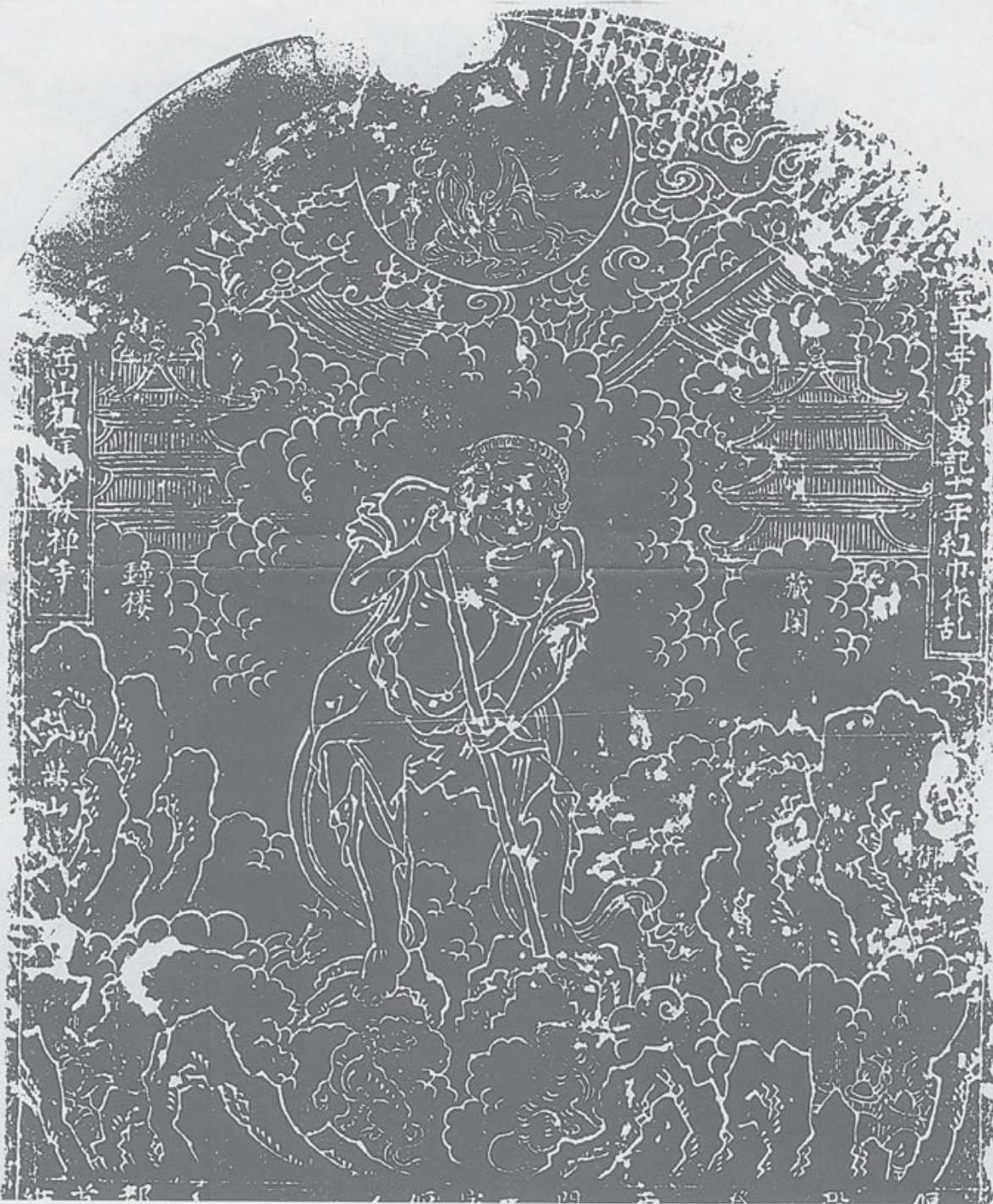
In addition, Sun Wukong and Vajrapani are associated with each other in Shaolin Monastery lore. The latter was historically worshiped as the progenitor of their famous staff method. A stele erected by Shaolin abbot Wenzai in 1517 CE shows that the deity’s vajra-club had been changed at some point to a Chinese staff (fig. 4) (Shahar, 2008, p. 84). Vajrapani’s yaksha-like Narayana (Naluoyan(tian), 那羅延(天)) form was eventually equated with one of the four staff-wielding “Kimnara Kings” (Jinnaluo wang, 緊那羅王) from the Lotus Sutra in 1575 CE. His name was thus changed from Narayana to Kimnara King (Shahar, 2008, p. 87). One version of the story about his creation of the staff method takes place during the Yuan Dynasty‘s Red Turban Rebellion (1351–1368 CE). Bandits lay siege to the monastery, but it is saved by a lowly kitchen worker wielding a long fire poker as a makeshift staff. He leaps into the oven and emerges as a monstrous giant tall enough to straddle both Mount Song and the imperial fort atop Mount Shaoshi, which are five miles (8.046 km) apart. The bandits flee when they behold this staff-wielding titan. The Shaolin monks later realize that the kitchen worker was none other than the Kimnara King in disguise (Shahar, 2008, pp. 87-88). Shahar (2008) suggests that mythical elements of the story were borrowed from the Monkey King’s adventures. He compares the worker’s transformation in the stove with Sun’s time in Laozi’s Eight Trigrams furnace (Bagua lu, 八卦爐), their use of the staff, and the fact that Monkey and his weapon can both grow to gigantic proportions (Shahar, 2008, p. 109). [3]

Therefore, given the above information, it’s not a stretch to have the two heroes meet in a fanfiction.

Fig. 4 – An ink rubbing of the 1517 CE Shaolin stele showing a titanic Vajrapani defending the monastery from rebels (larger version). From Shahar, 2008, p. 84.

2. Story Idea

I’ve added in-text notes in this section to provide readers with extra context. This way, you won’t have to scroll to the endnotes at the bottom.

Buddhist tradition describes Tathagata visiting the devas to preach the dharma (Buswell & Lopez, 2014, p. 235). With the presence of Greeks in Central and South Asia, I imagine he would also visit the Olympian gods who had gained some influence in the region. These friendly interactions would lead Zeus to assign Heracles to guard the Enlightened One (fig. 5), thereby forming a link between the Greek and Buddhist pantheons (and explaining the aforementioned art).

Here is where one of many changes to the standard 1592 CE JTTW story happens. In chapter six of the original, the bodhisattva Guanyin recommends that the demi-god Erlang battle the Monkey King after the latter had defeated many of heaven’s greatest warriors (Wu & Yu, 2012, vol. 1, p. 178). In our tale, she instead endorses the demi-god-turned-deity Heracles-Vajrapani (“HV” hereafter). [A]

A) The Son of Zeus became a full-blown god upon his death. After being exposed to a tunic soaked with poisonous hydra blood, Heracles sought release from the immense pain by jumping into a funeral pyre. But the flaming structure was shortly thereafter struck by lightning, signaling his rise to godhood (Romero-Gonzalez, 2021, pp. 273-276). This, of course, takes place hundreds of years before he becomes the protector of the Buddha.

Fig. 5 – A lovely digital painting of Heracles traveling with the Buddha (larger version). By Jacob King (deviantart). Used with permission. Image found here.

(I don’t consider myself a competent story writer, so please look at the following events and dialogue as conceptual in nature. I’m sure a seasoned writer could do the narrative more justice.)

Similar to the standard narrative, the monkey-soldiers of Wukong’s army notify him that heaven has sent another challenger. He emerges from his cave fully armored to see HV for the first time. Like the original, this might be followed by a poem describing the enemy; in this case, a large, muscular, bearded warrior wearing a lion skin and wielding a flaming vajra-club.

[Insert insults from both sides, including the Son of Zeus calling Monkey a “young rogue,” which naturally pisses him off. [B] HV also describes his godly heritage, which is alien to Monkey since he’s not familiar with the Greek pantheon.]

B) The Great Sage has a habit of claiming to be older than the various gods, immortals, spirits, and humans he meets—whether it’s true or not in the first three cases (Wu & Yu, 2012, vol. 1, p. 413, for example). This is exemplified by his self-given nickname “(Maternal/Paternal) Grandpa Sun” (Sun waigong, 孫外公; Sun Yeye, 孫爺爺). But within the story’s timeline, Heracles is indeed hundreds of years older. Writing around 430 BCE, the Greek historian Herodotus claimed that the Son of Zeus lived roughly 900 years before him, placing the demi-god’s life sometime around 1330 BCE. The Greek hero would, therefore, be active around 830 or more years prior to the birth of Wukong.

The pair take part in a battle of weapons, with Wukong wielding his magic staff and HV his vajra-club. (The earth quakes, gods tremble, etc.). HV’s powerful strikes push our hero back, causing his staff to painfully vibrate in his hands [C] and create a deafening ringing noise with each hit. Monkey would have a running internal monologue noting the great force of his opponent’s attacks. But despite this, the Great Sage continues driving forward, his weapon hardly leaving the area around HV’s head. [D] At one point, though, a glancing strike from the Greco-Buddhist hero redirects the staff, creating an opening. HV brings his vajra-club down hard on Monkey, but instead of dodging, the latter jerks his head upwards, butting away his opponent’s holy weapon with a loud, metallic bang. [E] The combined forces from the attack and defense might cause destruction to the surrounding area.

C) It may seem impossible for the staff to painfully vibrate in Wukong’s hands, but this indeed happens once in the novel. In JTTW chapter 20, he attempts to bludgeon a tiger-spirit, but when “the rod bounce[s] back up and his hands [a]re stung by the impact” (… 轉震得自己手疼), he learns it was just a big stone covered with the fiend’s sloughed off skin (Wu & Yu, 2012, vol. 1, p. 403).

D) The phrase “hardly leaving the monster’s head” is twice used (here and here) to describe Wukong’s supreme mastery of the staff in JTTW chapters 41 and 67 (Wu & Yu, 2012, vol. 2, p. 224; vol. 3, p. 249).

E) The feat of headbutting the weapon serves two purposes. First, it’s a response to this 2020 DEATH BATTLE! fanon wiki fan script that sees Hercules win by smashing the primate immortal’s head to a pulp with his club. (This attack carried over into the official episode, too.) The ending betrays the author’s extremely limited knowledge of JTTW. In the original, the Great Sage’s head is one of the hardest parts of his body, giving him the confidence to voluntarily take blows to the scalp from even magic, bladed weapons with no harm (Wu & Yu, 2012, vol. 1, pp. 314, 383-384, and 408; vol. 2, p. 128; vol. 3, pp. 125 and 373). And two, it highlights the correlation between the invulnerability of Monkey and the Nemean Lion, the first labor of Heracles (March, 2021). Regarding the ending of the fan script, one version of the original mythology sees the Son of Zeus break his olive club over the lion’s head because of how tough its hide is (March, 2021, p. 34).

The novel gives at least three reasons for the Great Sage’s invulnerability. After heaven fails to execute him with bladed weapons and fire and lightning in JTTW chapter 7, Laozi suggests that all of the immortal foodstuff previously consumed by our hero had been refined by his own samadhi fire (sanmei huo, 三昧火), a spiritual flame in the lower abdomen, thus giving him a “diamond body” (jingang zhi qu, 金鋼之軀) (Wu & Yu, 2012, vol. 1, p. 188). Wukong himself later attributes his adamantine nature to his time in the high god’s furnace. In JTTW chapter 34, for example, he claims to have developed a heart of gold, viscera of silver, a head of bronze, and a back of iron (among other things) (Wu & Yu, 2012, vol. 2, p. 131). This is refuted in JTTW chapter 75 when he claims to have been born with a head of bronze and iron that was further refined by the furnace (Wu & Yu, 2012, vol. 3, p. 374).

Stunned from the powerful blow, [F] Monkey stumbles around holding his head for a moment but raises his weapon in defense when he sees HV approaching. However, instead of attacking, the Greco-Buddhist warrior pauses combat by raising a hand in front of him. “What a skull!” he exclaims while clapping. “And no hint of blood! I reckon your hide is as tough as a monstrous beast I once fought. [G] Truly impressive! And your staff technique is masterful! Who trained you?”

F) This references how the Nemean Lion was blinded by pain after the blow (March, 2021, p. 34).

G) This reference is obvious.

“I have no teacher. [H] I alone trained my mind and body for three years.” [I]

H) This refers to Wukong’s promise to never reveal the Buddho-Daoist sage, Patriarch Subodhi, as his teacher under threat of karmic torture in the underworld (Wu & Yu, 2012, vol. 1, p. 125).

I) This is the length of time that he spends as an indoor disciple of Subodhi (Wu & Yu, 2012, vol. 1, p. 121).

“A prodigy!” exclaims HV. “But how good is your boxing and wrestling?”

“Ol’ Monkey can handle himself.”

“Let’s see if that’s true. How about we have a friendly sparring match, a test of heroic strength and skill? No weapons and no pesky magic tricks. Agreed?”

Wukong quickly agrees and inserts his shrunken staff into his ear before stripping off his armor from the waist up to match HV’s exposed muscles. (HV somehow magically stores his holy vajra-club.) The two then square up and launch forward, locking hands and pushing against the other, causing the ground beneath them to tremble and split.

“Extraordinary!” says HV. “How can such a small creature be so powerful?! [J] Were you born of the gods?

J) Many people often forget that Monkey’s normal form is less than 4-Chinese feet (121.92 cm) tall (see here).

“No, I was born from a stone.”

“Oh, like the stone titan and stone goddess! [K] No wonder you achieved this level of strength in such a short time. You have so much raw potential. Why cause trouble for such petty reasons?” [L]

K) These are Ullikumi and Agdistis, two powerful, rebellious, stone-born deities from Western myth (see sections 2.1 & 2.4 here). Referencing the former shows that HV is aware of the Near Eastern pantheon.

It’s interesting to note that lithic births are at least common enough in world myth to have earned a category in Stith Thompson’s Motif-Index of Folk-Literature: “Birth from rock” (T544.1).

L) This refers to Wukong’s rebellion over being given the lowest-ranking position in the Daoist heaven.

[Insert Wukong’s reply. They continue to converse during the battle.]

(This might be a good place to introduce some comedy. HV keeps referencing gods and monsters from other pantheons, making Monkey more and more frustrated:

“What the hell is wrong with you?! I … DON’T … KNOW … THESE … PEOPLE!!! [said in a slow, patronizing voice])

The Great Sage’s internal monologue comments on HV’s diamond grip and the great pressure of his punches. But our hero’s keen eyes notice openings in HV’s defense, allowing him to land blow after blow. However, with each successful attack comes praises from HV. Stinging rib shot. “Good, good!” Cutting elbow strike to the face. “Excellent!” Crushing body slam. “Amazing!”

“Why do you keep lauding me? I’m winning!”

“That would certainly be the case … if we were equals.”

“What do you mean?!”

Smiling, HV explains, “I’ve been testing you. [M] You found all of the openings I offered you, even some that I didn’t intend to because I was apparently too focused on judging your technique! [N] You are a talent the likes of which I’ve never seen before. Thank Father Zeus [or Buddha]! The student I’ve been looking for has finally appeared! Forsake this frivolous rebellion and return with me to the Western Paradise. I promise with my tutelage, you will become one of the greatest warriors of any pantheon!”

M) Perhaps HV decides to test the Great Sage when he sees how well the small primate responds to his opening strikes.

N) It just occurred to me that since the Subodhi appearing in this more realistic version of the story is the historical figure he’s based on, Subhuti, one of the Buddha’s ten principal disciples, the patriarch had to have trained under someone during Tathagata’s lifetime. And considering that HV was the Enlightened One’s bodyguard, perhaps Subhuti learned a little from the Greco-Buddhist hero—apart from other deities, holy men, and warriors, including the Buddha, a member of the Kshatriya class. An interesting implication is that HV would recognize (his or an ally’s) techniques among Wukong’s armed and unarmed attacks or defenses, thereby alerting him that Monkey’s claim of having no master is false. Yet, he would still be supremely impressed that the Great Sage became such a powerful, competent fighter in just three short years.

Fun fact: according to Theocritus, Heracles learned boxing and wrestling from the grim-looking demi-god Harpalycus, son of Hermes (Pache, 2021, p. 10). Apollodorus instead claims his teacher was Autolycus (2.4.9), also a son of Hermes.

“I think you’re full of shit! Ol’ Monkey is whittling away at you, and you’re just trying to talk your way out of it.”

“Well, my offer stands,” HV replies calmly, “but now that I’ve had my fun, it’s time to finish this.”

“Finish what, you bastard?!” Wukong screams in anger. He then unleashes a tornado of powerful punches, kicks, and knee and elbow strikes. But this time they have no effect on the Son of Zeus because he’s no longer playing along.

I’m not quite sure what the next sequence of events would be since I have zero experience choreographing fight scenes, especially between celestial warriors. Perhaps HV displays his true power by running Monkey headfirst through the side of a mountain with an outstretched arm, similar to how the comic book character Omni-Man uses his son, Invincible, like a wedge to slice through an oncoming subway train [warning: gore]. This feat alone would surely cause the primate immortal to question how his opponent’s strength has seemingly increased exponentially. [O] (But upon reflection, this deed seems lacking considering that Wukong himself is shown capable of carrying two mountains while running with great speed. Hopefully someone can suggest a feat for HV that would amaze even the Great Sage.)

O) This, of course, proves that HV was holding back. It’s important to note that in Buddhist literature, the original Vajrapani is considered the “physical manifestation of the … power … of all the Buddhas” (Buswell & Lopez, 2014, p. 955). Now imagine how much stronger HV would be than Monkey! Apart from his own godly heritage, I guess in my version of JTTW, HV would gain an unfathomable boost in power from serving as the protector and disciple of the Buddha, exposing him to the dharma for centuries—during Tathagata’s lifetime and afterlife following his parinirvana (figs. 6 & 7). This is similar to how the scorpion-demoness becomes so strong in JTTW chapter 55 (Wu & Yu, 2012, vol. 3, p. 72). But HV would be well beyond even her.

I guess the Great Sage would hold off on using magic up to this point as a matter of pride, but maybe his hand is forced when faced with such oppressive strength. Like in the original, he might resort to his magic hairs, summoning hundreds of tiny clones in the hopes of overwhelming the Son of Zeus. [P] However, the Greco-Buddhist warrior quickly neutralizes these—possibly by clapping his hands together and creating a shockwave that blows them away [Q] and destroys the surrounding area—pressuring our hero to take other measures. Maybe Monkey frantically cycles through one trick after another but ultimately fails to best his opponent (see the 10-26-25 update below). (It would be fascinating to see how HV deals with Wukong’s three-headed, six-armed war form—surely eliciting comparisons to Geryon [R].)

To these breaches of their agreement, HV responds with something like, “Magic? You disappoint me.”

[Insert Monkey’s response.]

P) Monkey competes in hand-to-hand combat in JTTW chapters two and 51, and each time he resorts to hair clones when things get out of hand (Wu & Yu, 2012, vol. 1, pp. 128-129; vol. 3, pp. 12-13).

Q) The hair clones can indeed be blown away, as shown by the Yellow Wind Demon in JTTW chapter 21 (Wu & Yu, 2012, vol. 1, pp. 409-410).

R) Thank you to a beta reader of this article for reminding me about Geryon. He is sometimes described as having or depicted with three conjoined bodies, complete with three heads and six arms like Monkey (fig. 8) (Finglass, 2021).

Fig. 6 (Top) – A degraded stone carving depicting the parinirvana of the Buddha, Gandhara, 2nd to 3rd-century CE, Schist (larger version). HV is the first person from the left on the bottom row. He holds his vajra-club in one hand and upraises the other in lamentation. He has an exposed torso, showing off his muscles, in place of his signature lionskin. Housed in the British Museum. Adapted from an image found on Wikimedia Commons. Copyright Marie-Lan Nguyen. Fig. 7 (Bottom Left) – Detail of HV (larger version). Fig. 8 (Bottom Right) – Heracles vs Geryon, Attic black figure on Amphora vase, mid-6th century BCE (larger version). Housed in the Musée du Louvre, Paris.  This is an upscaled version of an image found here. Copyright www.theoi.com.

Ideally, given the parallels between Wukong and the Nemean lion—both are fierce mythological animals, have invulnerable hides, can change shape, [S] and fight someone who is/was a demi-god (Erlang vs Heracles)—I would like to see HV maneuver to Monkey’s back and get him in a chokehold, thereby mimicking how the big cat was originally defeated. [T] But instead of killing the Great Sage, he only intends to choke him to unconsciousness (see the 10-26-25 update below). [U] And to make matters worse, as the primate immortal fades towards blacking out, he by chance witnesses his beloved monkey army being routed and captured by celestial forces, like the standard version (Wu & Yu, 2012, vol. 1, p. 182). This causes him to lose heart and flee HV’s powerful arms by changing into an intangible ball of light or gust of wind. [V]

S) Matyszak (2015) states that the lion would sometimes take the form of kidnapped women (that it had presumably already eaten) in order to lure unsuspecting heroes into its cave (pp. 46-47). Dr. Matyszak tells me that “it’s not part of the core myth” but “later Roman and Byzantine authors do mention it” (personal communication, October 17, 2025).

T) I really like the ending of Theocritus’ description of the fight:

[After hitting him over the head with a club,] I threw my bow and stitched quiver to the ground, and before he could recover and turn on me again, I grabbed him by the scruff of his powerful neck. Gripping him firmly, I strangled him with my strong hands, tackling him from behind to stop him scratching me with his claws. Standing on his hind paws, I pressed them hard to the ground with my heels and controlled his flanks with my thighs, until I could lift him up lifeless in my arms and lay him out. And mighty Hades took his spirit (March, 2021, p. 34).

U) Someone might claim that it would be impossible to choke out Monkey since he’s a spiritual being, but it’s important to remember that the novel humanizes supernatural figures in order to make them more relatable. For instance, in JTTW chapter 65, Wukong claims that he will die from the lack of air inside of a sealed Buddhist treasure-weapon if he isn’t soon released (Wu & Yu, 2012, vol. 3, p. 217). However, I think a blood choke would be more dignified and less dangerous for our hero.

V) Wukong escapes in the form of a ball of light in JTTW chapters 34 and 42 (Wu & Yu, 2012, vol. 2, pp. 126 and 241). And he turns into a gust of wind to follow a foe in JTTW chapter 60 (Wu & Yu, 2012, vol. 3, p. 140). This could easily be used to escape as well.

A beta reader suggested that I work Erlang and his sworn brothers back into the story. They could track down and capture Monkey. But however the situation is resolved, this would lead to the events of the original story: his failed execution, his sentence to Laozi’s furnace, his escape and wager with Buddha, his imprisonment beneath Five Elements Mountain, and his eventual release to go on the journey. And since Wukong comes into contact with Erlang once more and the Vajra warriors several times in the standard version, [W] he would likely meet HV again during the pilgrimage. The Son of Zeus might even comment on his positive change in character as Tripitaka’s disciple and protector.

W) The Great Sage meets Erlang again in chapter 63 (Wu & Yu, 2012, vol. 3, pp. 187-191). Regarding Vajra warriors, refer back to section 1.2.

Two beta readers were disappointed by the ending because they didn’t think HV could defeat the Great Sage. As a longtime uberfan of Monkey myself, I understand that sentiment, but they should remember that this is not just the Heracles of Greco-Roman myth, who’s immensely powerful in his own right, able to support the sky on his shoulders in one myth (Salapata, 2021, p. 152). He’s an amalgam of the Greek hero and the Buddha’s protector. Recall that Vajrapani is considered the embodiment of all the Tathagatas’ power (refer back to note O). And If the dharma of one Buddha can easily defeat Monkey (Wu & Yu, 2012, vol. 1, pp. 195 and 199), a being endowed with the power of ALL of them should have no problem subduing our favorite primate immortal.

I feel like this idea has so much potential, but I lack the experience or talent to do it justice here. Hopefully, readers will see through the lackluster description to understand the promise of greatness that it holds. Please let me know if any of you are interested in fleshing out this tale.

Lastly, while finishing this section, I came upon a fun coincidence: ancient Greco-Buddhist stone carvings with HV, the Buddha, and … a monkey (figs. 9 & 10)! They depict “The Monkey Offering Honey (to the Buddha)” (Ch: Mihou xianmi, 獼猴獻蜜; Mihou fengmi, 獼猴奉蜜), a tale from the Tathagata’s lifetime where a primate selflessly offered him honey but shortly thereafter fell and died via drowning or impalement. Thankfully, though, the primate was reborn into the deva realm (Van der Geer, 2022, pp. 439-440). [W] The carvings depict HV watching over the Enlightened One during this event.

Perhaps, based on these images, HV tells Wukong at some point during the confrontation that he reminds him of someone from the past. (Fanfic theory: could the Great Sage be a reincarnation?)

W) The historical Xuanzang mentions a version of this story where the primate is later reborn as a human (Li, 1996/2017, p. 106). He adds that the area where the offering originally happened hosts images of monkeys (mihou xingxiang, 獼猴形像) next to a water tank or pond supposedly dug by a group of them for the Enlightened One (Li, 1996/2017, p. 184). [4]

Fig. 9 (Left) – Detail of a stone doorway fragment with two stacked carvings illustrating “The Monkey Offering Honey (to the Buddha)” story, Gandhara, 1st to 3rd-century CE, Schist (larger version). The upper scene portrays the primate asking for a bowl, while the lower depicts the offering of honey. HV is present in both: first from the left on the top and first from the right on the bottom. He lacks his beard and lionskin but wields his signature weapon. The extra person photobombing the lower scene may be Ananda. Fig. 10 (Right) – The full stone doorway fragment portraying various events from the Tathagata’s life (larger version). Housed in the Guimet Museum, Paris, France. Adapted from an image found on Wikimedia Commons. Copyright Marie-Lan Nguyen. 

3. Sequel

A continuation of the story would open where the original leaves off: after the scripture-pilgrims are elevated in spiritual rank, Tathagata charges HV with escorting the Victorious Fighting Buddha (i.e. Sun Wukong; fig. 11) through the Greek world-system. Imagine the kind of adventures Monkey would have as a Buddha interacting with Classical gods and monsters! It would definitely be a great way of introducing East Asian people to the wonders of Greek myth.

I really like the idea of HV visiting his old pantheon as his vajra is analogous to Zeus’ thunderbolt. Seeing a father-son lightning competition would be great!

Also, as I’ve discussed elsewhere, Wukong and Poseidon could bond over their shared love of horses.

Fig. 11 – Wukong as the Victorious Fighting Buddha (larger version). Imagery based on the iconography of the historical Yuddhajaya Buddha. Art by NingadudeXx.

3.1. Commissioned Art

I have commissioned some illustrators to draw Monkey in ancient Greek style as an experiment to see what he might look like through the lens of Hellenistic artisans.

Fig. 12 – The Victorious Fighting Buddha (larger version). Pencil, fineliners, and alcohol markers on paper. Art by tr0chanter (Instagram and Twitter).

Fig. 13 – Heracles vs Monkey (larger version). Pencil and markers on paper. Art by Dario Virga (Onibotokemaru on Instagram), a friend of the blog. Each character is labeled with their name in Greek. Heracles is “Ἡρακλῆς,” while the Great Sage is “Pithekos” (πῐ́θηκος), meaning “ape, monkey, trickster, or dwarf.” Wukong’s Greek name is very fitting. It’s also part of the modern scientific name for Old world monkeys (Cercopithecoidea).

Fig. 14 – Heracles vs Sun Wukong (larger version). Digital. Art by Jacob King (Twitter, Instagram, Tumblr). I love the cracks.

4. Fanfiction

I can already predict fanfiction set in an alternate timeline where Monkey accepts HV’s offer to become his teacher. The Son of Zeus would spend time instructing Wukong on advanced techniques of boxing, wrestling, and weapons. This, of course, would be taught in tandem with spiritual cultivation. The training might be in preparation for a fighting tournament between the disciples of gods from all pantheons, kind of like Record of Ragnarok (Jp: Shūmatsu no Warukyūre, 終末のワルキューレ; lit. “Doomsday Valkyrie”; fig. 15). The contestants could be fighting for permission to start their own pantheon, thereby becoming a “Sky Father” (Sk: Dyaus-pitr, द्यौष्पितृ; Ch: Tianshang fuqin, 天上父親). (Maybe the long-established Sky Fathers share some of their divine spark to kickstart the new world-system.) I REALLY like this idea, but it wouldn’t work for my own purposes since, as stated above, Wukong would still need to go on the journey.

Perhaps the prize could be the chance to help mankind since one of the reasons that Tripitaka is asked to quest for sutras is because they will help free untold numbers of orphaned souls from the torments of hell (see JTTW chapters 11 and 12). Therefore, the tournament would essentially be a contest to see who will be the Tang Monk’s protector. I don’t really like this idea, but it at least supports the original narrative. The Great Sage would win, of course, but he has to agree to have his extraordinary powers (and memories of the tournament) sealed as a test of his resolve or devotion. And his subsequent enlightenment would be the reward for his great deeds performed on the journey.

Fig. 15 – Promotional art for Record of Ragnarok (larger version). Image found here.


Update: 10-11-25

I’ve seen people claim online that Sun Wukong would easily defeat Heracles because the latter’s feats are not as grand as the former. To this, I counter that the deeds of both heroes shouldn’t be compared, for they serve difference purposes. I don’t know of any feats of speed for Heracles, but Monkey’s famous ability to fly 108,000 li (33,554 mi / 54,000 km) in a single cloud somersault is an allegory for instant enlightenment (as explained in section III here). [5] And his feat of carrying two Buddhist mountains on his shoulders is likely an allegory for the Great Sage “supporting” the religion by protecting his master on the quest for sutras (as I suggest here). The deeds of Heracles, however, were probably meant as actual displays of brute strength. For instance, ancient Greek men on lion hunts may have drawn inspiration and courage from the demi-god’s defeat of the Nemean Lion. [6]


Update: 10-26-25

Above, I wrote that “[m]aybe Monkey frantically cycles through one trick after another” in a failed bid to win, and I later added, “I would like to see HV maneuver to Monkey’s back and get him in a chokehold.” Well, I’m happy to report that I’ve found a mythic way to combine these. The Bibliotheca of Pseudo-Apollodorus describes Heracles’s grip tiring out a shape-shifting sea god:

And going on foot through Illyria and hastening to the river Eridanus he came to the nymphs, the daughters of Zeus and Themis. They revealed Nereus to him, and Hercules seized him while he slept, and though the god turned himself into all kinds of shapes, the hero bound him [with his arms (fig. 16)] and did not release him till he had learned from him where were the apples and the Hesperides (2.5.11).

Matyszak (2015) calls this binding a “Herculean head-lock” (p. 150). Therefore, in our story, Wukong cycles through all manner of transformations but can’t break free from HV’s grip! Then he loses heart and flees when he sees his children captured (as mentioned previously).

Fig. 16 – Heracles wrestling Nereus/Triton (larger version). From an 1894 drawing of a circa 550 BCE Attic Black-figure Kylix. Image found on Wikimedia Commons. For the original, see here.


Update: 10-29-25

I’ve also found a mythic reason for why Heracles would be sent away from Olympus to protect Buddha. Matyszak (2015) explains that the Son of Zeus didn’t want to become an official member of the Twelve Olympians because this would have forced someone out of the group:

Some felt that the mighty deeds of Hercules entitled him to the status of a full Olympian God. However, the number of Olympians was limited to the sacred number of twelve, and in a rare moment of diplomacy Hercules declined to take an honour that would have first to be stripped from someone else. (Dionysus, the God of Wine was less bashful. He bumped Hestia, Goddess of the Home, off the Olympian high table when his time came to be made divine.) (p. 200)

So instead of taking an Olympian’s spot, Heracles decides to accept a position within the Buddhist pantheon as the Tathagata’s protector.


Update: 12-02-25

I have found the specific passage alluded to by Matyszak (2015) in the previous update. In book four of his Library of History (c. 60 to 30 BCE), Diodorus Siculus writes:

[4.39.4] They report of Heracles further that Zeus enrolled him among the twelve gods but that he would not accept this honour; for it was impossible for him thus to be enrolled unless one of the twelve gods were first cast out; hence in his eyes it would be monstrous for him to accept an honour which involved depriving another god of his honour (source).


Update: 12-28-25

Above in section 1.1, I mentioned that Heracles appeared in Greco-Buddhist art alongside the Buddha. Well, this is not the demi-god’s only tie to the region. Writing in his Indica, Megasthenes (d. 290 BCE), a Greek diplomat to South Asia, claims a local tradition states that Heracles was a home-born son of India who made his seven year old daughter queen of a southern region named after her (i.e. the Pandya Dynasty). And because no suitor could even be his equal, the Son of Zeus is said to have … impregnated the child (ewwwwwwwwwwww) in order to spawn a line of kings. All of this supposedly happened just prior to his death. [7]

Barring the incest, it would be neat to add the daughter into the story somewhere. She could be tied to the three Indian princess from JTTW chapter 88 (as discussed here).

Notes:

1) Translation changed slightly. Although the English reads “a hundred yards,” the original Chinese says “100 zhang” (bai zhang, 百丈). One zhang is ten Chinese feet, or roughly 10.43 ft (3.18 m) (Jiang, 2005, p. xxxi). Therefore, 100 zhang would be 1,043 ft (314 m).

2) Yu (Wu & Yu, 2012) translates jingang (金剛) as “Diamond Guardians” (vol. 3, p. 24, for example). I’m changing it to just Vajra since the term can mean both “lightning” and “diamond.” I don’t want to confuse anyone.

3) Yes, this information comes from Wikipedia, but I’m the one who originally added it under the screenname “Ghostexorcist.” See this edit history, for example.

4) The English translation just says “tank” (Li, 1996/2017, p. 184), but the original Chinese word chi (池) can also mean “pond.”

5) The li (里) is a Chinese measurement of distance. English works usually translate it as “mile.” However, it equals roughly 1/3rd of a mile or 1/2 of a kilometer.

6) Herodotus mentions mountain lions attacking the caravan camels of Xerxes on his route through Greece (The Histories, 7.125126). If such thing routinely happened to local travelers, this would have affected regular lion hunts. And this 16th-century BCE Minoan blade suggests that lion hunts go back centuries.

7) Here is a translation of the relevant passages:

B9. Flavius Arrianus: Indika VIII: 4-IX: 12

Heracles, however, who is currently reported to have come [as a stranger] into the country, is said to have been in reality a native of India. This Heracles is held in especial honour by the Sourasenoi, an Indian tribe who possess two large cities, Methora and Cleisobora, and through whose country flows a navigable river called the Iobares. But the dress which this Heracles wore, Megasthenés tells us, resembled that of the Theban Heracles, as the Indians themselves admit. It is further said that he had a very numerous progeny of male children born to him in India (for, [like his Theban namesake,] he married many wives), but that he had only one daughter. The name of this child was Pandaia, and the land in which she was born, and with the sovereignty of which Heracles entrusted her, was called after her name, Pandaia, and she received from the hands of her father 500 elephants, a force of cavalry 4000 strong, and another of infantry consisting of about 130,000 men. Some Indian [writers] say further of Heracles that when he was going over the world and ridding land and sea of whatever evil monsters infested them, he found in the sea an ornament for women, [(which even to this day the Indian traders who bring us their wares eagerly buy up and carry away to foreign markets, while it is even more eagerly bought up by the wealthy Romans of to-day, as it was wont to be by the wealthy Greeks long ago)]. This article is the sea-pearl, called in the Indian tongue margarita. But Heracles, it is said, appreciating its beauty as a wearing ornament, caused it to be brought from all the sea into India, that he might adorn with it the person of his daughter.

[…]

IX. Now in that part of the country where the daughter of Heracles reigned as a queen, it is said that the women when seven years old are of marriageable age, and that the men live at most forty years, and that on this subject there is a tradition current among the Indians to the effect that Heracles, whose daughter was born to him late in life, when he saw that his end was near, and he knew no man his equal in rank to whom he could give her in marriage, had incestuous intercourse with the girl when she was seven years of age, in order that a race of kings sprung from their common blood might be left to rule over India; that Heracles therefore made her of suitable age for marriage, and that in consequence the whole nation over which Pandaia reigned obtained this same privilege from her father (pp. 63 and 65).

[…]

B 12. Polyænus: Strateg. I: 3: 4

Heracles begot a daughter in India whom he called Pandaia. To her he assigned that portion of India which lies to southward and extends to the sea, while he distributed the people subject to her rule into 365 villages, giving orders that one village should each day bring to the treasury the royal tribute, so that the queen might always have the assistance of those men whose turn it was to pay the tribute in coercing those who for the time being were defaulters in their payments (Dahlquist, 1962, p. 67).

Sources:

Buswell, R. E., & Lopez, D. S. (2014). The Princeton Dictionary of Buddhism. Princeton, NJ: Princeton University Press.

Dahlquist, A. (1962). Megasthenes and Indian Religion: A Study in Motives and Types. Stockholm: Almqvist & Wiksell.

Finglass, P. J. (2021). LABOR X: The Cattle of Geryon and the Return from Tartessus. In D. Ogden (Ed.), The Oxford Handbook of Heracles (pp. 135-148). United Kingdom: Oxford University Press.

Jiang, Y. (2005). The Great Ming Code / Da Ming Lu. Vancouver, Wa: University of Washington Press.

Li, R. (Trans.) (2017). The Great Tang Dynasty Record of the Western Regions. Berkeley, CA: Numata Center for Buddhist Translation and Research. (Original work published 1996) Retrieved from https://www.bdkamerica.org/product/the-great-tang-dynasty-record-of-the-western-regions/

March, J. (2021). LABOR I: The Nemean Lion. In D. Ogden (Ed.), The Oxford Handbook of Heracles (pp. 29-44). United Kingdom: Oxford University Press.

Matyszak, P. (2015). Hercules: The First Superhero (An Unauthorized Biography). Canada: Monashee Mountain Publishing.

Pache, C. (2021). Birth and Childhood. In D. Ogden (Ed.), The Oxford Handbook of Heracles (pp. 3-12). United Kingdom: Oxford University Press.

Romero-Gonzalez, D. (2021). Deianeira, Death, and Apotheosis. In D. Ogden (Ed.), The Oxford Handbook of Heracles (pp. 266-280). United Kingdom: Oxford University Press.

Salapata, G. (2021). LABOR XI: The Apples of Hesperides. In D. Ogden (Ed.), The Oxford Handbook of Heracles (pp. 149-164). United Kingdom: Oxford University Press.

Shahar, M. (2008). The Shaolin Monastery: History, Religion, and the Chinese Martial Arts. Honolulu: University of Hawai’i Press.

Van der Geer, A. A. E. (2022). The Great Monkey King: Carvings of Primates in Indian Religious Architecture (pp. 431-455). In B. Urbani, D. Youlatos, & A. Antczak (Eds.), World Archaeoprimatology: Interconnections of Humans and Nonhuman Primates in the Past. United Kingdom: Cambridge University Press.

Wivell, C.S. (1994). The Story of How the Monk Tripitaka of the Great Country of T’ang Brought Back the Sūtras. In V. Mair (Ed.), The Columbia Anthology of Traditional Chinese Literature (pp. 1181-1207). New York: Columbia University Press.

Wu, C., & Yu, A. C. (2012). The Journey to the West (Vols. 1-4) (Rev. ed.). Chicago, Illinois: University of Chicago Press.

Archive #49: Journey to the West (西游记): A 60-Volume Lianhuanhua Comic

I recently archived a seven-volume lianhuanhua comic about Sun Wukong battling the famous Eighteen Arhats. Upon learning this, a follower on Twitter asked me if I could locate scans of a 60-volume set that they read when they were younger. Luckily, I found a website selling them for super cheap.

I am archiving the set here in order to document modern day perceptions and depictions of JTTW and its characters.

1. Info

  • Title – Journey to the West (西游记)
    • Adaptation – Zhang Yuzhi (张玉枝)
    • Illustrations – Yan Dong (严东)
    • Editor-in-charge – Chang Shengli (常胜利)
  • Publisher – China Lianhuanhua Publishing House and Distribution (中国连环画出版社出版发行)
  • First edition – November 1997
  • ISBN 7-5061-0827-5

The volume 60 cover reading, “Meeting the Buddhist Patriarch at Spirit Mountain” (Lingshan jian Fozu, 灵山见佛祖) (larger version).

1.1. Reprint

This set is the first of at least two prints, the other coming out in 2008 (ISBN: 7801388461, 9787801388469). See, for example, this Ebay listing (screenshot).

The 2008 boxed set (larger version).

2. Download link:

This is for the 1997 version only.

The comics can be read on Google Drive or downloaded and read on Adobe. However, I’ve had problems reading them on Chrome. Please keep this in mind. It might just be a problem on my end.

https://drive.google.com/drive/folders/1JcS65ckxWZQh462mlqwj5OOzNl4JJAQ7?usp=sharing

Archive #47: The Newly Annotated Journey to the West With Illustrations (Xinshuo Xiyouji (tuxiang), 1749/1888)

I. Original Text

The Newly Annotated Journey to the West (Xinshuo Xiyouji, 新說西遊記, 1749) by Zhang Shushen (張書紳) is one of three popular editions of JTTW that circulated during the Qing Dynasty (1644-1911) and overshadowed the original. [1] It contains a running commentary dispersed throughout the pilgrims’ many adventures. Anthony C. Yu (Wu & Yu, 2012) describes Zhang’s work as having a Confucian bias:

In his unabridged hundred-chapter Xinshuo Xiyouji (The Journey to the West, Newly Interpreted) of 1749, Zhang Shushen declared in the section entitled “Xiyouji zongpi 西游記總批 (Overall Comments on The Journey to the West)” that “the book Xiyou has been designated by the ancients as a book meant to illuminate the Dao [a pointed dig at the 1662 edition titled Xiyou zhengdao shu, with the Daoist-leaning preface attributed to Yu Ji … ], by which it originally means the Dao of the sages, the worthies, and the Confucians (儒 Ru). To consider it an illumination of the Dao of immortals and Buddhism would be a mistake, indeed.” From a point of view clearly unsympathetic to the popular movement of Three-Religions-Joining-As-One (sanjiao heyi 三教合一, a possibly millennium-old notion … ), Zhang defended the story of the quest for Buddhist scriptures as an allegory of the classic Confucian doctrines on the illustration of virtue (mingde 明德) and the rectification of the mind (zhengxin 正心), ignoring the repeated and complex elaborations of zhengxin in Chan Buddhism also for at least a thousand years prior to his time (vol. 1, pp. 51-52).

I’ve decided to archive a scanned copy of this work for posterity.

A digital version of the text (interspersed with other commentaries) can be found here.

Book link

Click to access Journey-to-the-West-Newly-Annotated-by-Zhang-Shushen-Xinshuo-Xiyouji-compressed.pdf

II. Text With Illustrations

I’ve previously archived illustrated versions of JTTW, including the original 1592 edition, (images from) Li Zhuowu’s late-16th-century critique, and a circa 1835 Japanese translation. Here, I’d like to add another, the Newly Annotated Journey to the West With Illustrations (Xinshuo Xiyouji tuxiang, 新說西遊記圖像, 1888). The original text and commentary are the same, but this edition features a preface by Wang Tao (王韜), as well as over 100 woodblock prints.

The prints in the archived book below are admittedly a little fuzzy. This webpage has somewhat clearer versions.

Book link

Click to access Journey-to-the-West-Newly-Annotated-With-Illustrations-1888-compressed.pdf

Prints of Zhu Bajie and Sun Wukong from the opening illustrations (larger version).

Note:

1) The Qing versions are noted for having shoehorned Tripitaka‘s life story (chapter nine) into the original 100 chapters of the 1592 edition.

Archive #45 – Tripitaka Seeks the Scriptures: A Rare Journey to the West Puppet Play from Quanzhou, Fujian

Last updated: 07-21-2025

The Journey to the West Research blog is proud to host a guest post by the very knowledgeable @ryin-silverfish of Tumblr. They managed to track down a digital copy of the script for Tripitaka Seeks the Scriptures (Sanzang Qujing, 三藏取经), an extremely rare Journey to the West (Xiyouji, 西遊記; “JTTW” hereafter) puppet play from Quanzhou, Fujian province, China (fig. 1). This prompt book was first transcribed during the Qing Dynasty (1644-1911), but internal characteristics date it to sometime after the late-13th-century JTTW and before or concurrent with the early-Ming JTTW zaju play. Needless to say, this is a super important addition to JTTW studies as it likely serves as a “missing link” between the northern and southern traditions of the story cycle (Hu, 2017a; 2017b). The strange thing is that I’ve never read anything about the play in any English sources on JTTW. This fact demonstrates just how rare and precious the play is.

The work contains familiar episodes, like Monkey’s havoc and punishment, Tripitaka‘s tumultuous childhood and vow to retrieve scriptures from India; Sun Wukong and Zhu Bajie becoming his disciples, etc. (This and other parallels presented below perhaps point to the play’s influence on the later 1592 edition of the novel. Or, at the very least, this points to them drawing upon the same source.) But the play also has some very interesting differences: Tripitaka is adopted by Tang Emperor Taizong, thus becoming a prince; Monkey is imprisoned in a crystal well for his past misdeeds; Sha Wujing is the one transformed into a white horse; and Erlang becomes the Tang Monk’s disciple after being punished for flirting with a heavenly maiden. Read on for a full Chinese script and English synopsis below.

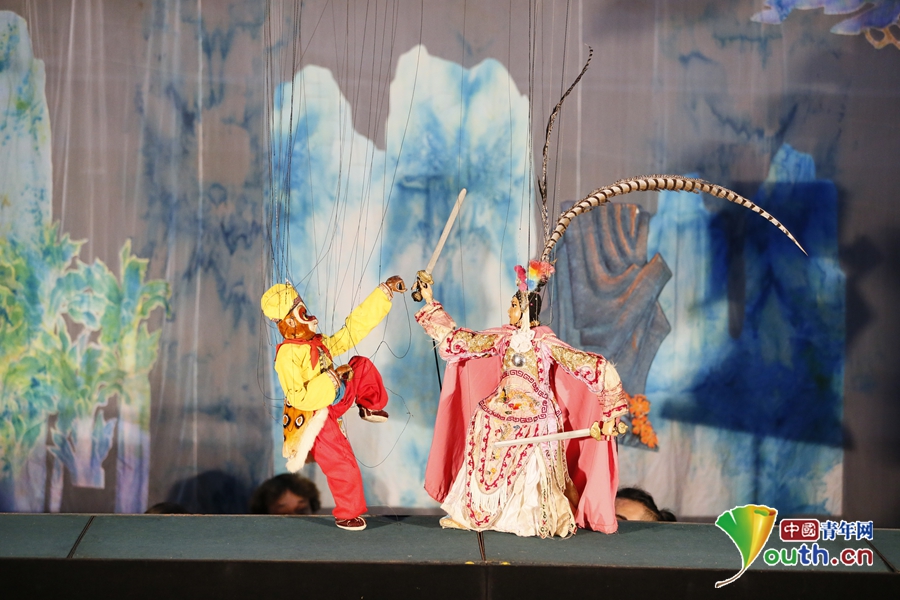
Fig. 1 – An example of modern Quanzhou string puppetry depicting a battle between Sun Wukong and Princess Iron Fan (larger version). Image found here.

I. The Chinese Script

The source of this text is quite obscure, only featured in a 1999 Chinese collection of puppet theater plays published by the Quanzhou Regional Opera Research Society.

Name of the book: 泉州地方戲曲研究社編,《泉州傳統戲曲叢書》第十卷《傀儡戲•目連全簿》(北京:中國戲劇出版社,1999)。

Unsurprisingly, I have no way of getting my hands on an actual copy of the book, so the Chinese text here came from a Tieba user who did, and then someone helpfully uploaded it onto Baidu Cloud Drive.

Just something to keep in mind.

PDF File:

https://docs.google.com/document/d/10XhOpvLFrdcSaqyrhY_4MmiXylSGNhWutcgv6Ngen3M/edit

Jim: Here is a backup just in case.

Click to access Quanzhou-Puppet-Theatre-JTTW.pdf

[Note: See also the 07-21-25 update below for a PDF of the original book!]

II. English Summary

Disclaimer – This is a very rough chapter-by-chapter summary of the play, which was first transcribed in the Qing dynasty and appeared to be written in the local dialect. As I do not speak Hokkien, nuances are likely lost and errors made.

Jim: I have added italicized explanatory notes to @ryin-silverfish’s summary below. I formatted the section as such so that readers will have more context at hand. This way, you won’t have to constantly scroll down to the footnotes. Also, I have added links, as well as more hanzi and pinyin. I don’t (yet) know Hokkien either, so I apologize for not adding the corresponding romanization.

Chapter 1: Meeting the Buddha (Jian Fozu, 见佛祖)

Tripitaka (Sanzang, 三藏; a.k.a. Xuanzang, 玄奘) sings his backstory, which is pretty much the same as the JTTW novel version, minus the revenge part, and with a few more details: he was found by Li Gong (李公) and raised under the name “River Float” (Jiang Liu’er, 江流儿) in the Golden Mountain Temple (Jinshan Si, 金山寺). [A] As an adult, he later traveled to become a monk at the Immortal Peach Temple (Pantao Si, 蟠桃寺). Tang Emperor Taizong came there one day to sponsor a mass and present incense, and being impressed by the monk’s arhat-like aura, made him his adopted son, “Prince Tripitaka” (Sanzang Taizi, 三藏太子). [B]

The royal monk is praying to the “Buddha of the Southern Seas” (Nanhai Fozu, 南海佛祖, a.k.a. Guanyin), when the goddess arrives to ask what is bothering him. He worries that the monks who travel outside the temple might be tempted by worldly things, so he vows that day to retrieve scriptures from India in order to save them from negative karmic fate. [C] In response, Guanyin first tells him that the journey will be perilous, with untold dangers along the way. Then, she tells Tripitaka of the “Great Sage Equaling Heaven” (Qitian Dasheng, 齐天大圣), who had been imprisoned in a well for stealing the Jade Emperor’s wine in the past. Next, she recommends recruiting the Great Sage to protect the monk on the trip, and to that end gives him a “Precious Sash of Infinity” (Wujin Baodi, 无尽宝绦) and a golden headband, two heavenly treasures needed to respectively free and submit the spirit. Finally, Guanyin gives him a ringed staff, an alms bowl, and straw slippers before sending him on his way.

A) Tripitaka is found as a baby by the monk Faming (Faming Heshang, 法明和尚), the holy abbot of the Golden Mountain Temple, in JTTW chapter nine. He gives the baby the same name, “River Float” (Jiang Liu/er, 江流/儿) (Wu & Yu, 2012, vol. 1, p. 222).

B) The monk becomes Tang Emperor Taizong’s bond brother (xiongdi, 兄弟) in JTTW chapter 12 (Wu & Yu, 2012, vol. 1, p. 290). The monarch even refers to him as his “Royal Brother” (yudi, 御弟) (Wu & Yu, 2012, vol. 1, p. 291, for example).

C) The Tang Monk’s reason for the trip is different in the novel: he is chosen to procure scriptures of the “Great Vehicle” (Dacheng, 大乘; i.e. Mahayana texts) in order to perform a “Grand Mass of Land and Water (Shuilu Dahui, 水陆大会), which will free untold numbers of abandoned souls from the underworld (Wu & Y, 2012, vol. 1, pp. 275 and 286-290). This is more in line with Tang Taizong’s mass in the play.

Chapter 2: Monkey in a Well (Zuojing Hou, 坐井猴)

Sun Wukong sings his backstory inside the well: he was as old as heaven and earth and had eleven brothers, a.k.a. the “Eleven Luminaries” (Shiyi Yao Xingjun, 十一曜星君). [D-F] Turning into a mosquito and flying into the celestial realm, he ate twelve peaches of immortality and three, multi-ton alms bowls full of Laozi’s golden elixir pills and drank 3,000 jars of heavenly wine. [G]

In a drunken haze, Monkey drank so much water from the Eastern Sea that the Dragon King’s palace was exposed, causing the monarch, together with every other deity he had pissed off, to complain to the Jade Emperor.

After he was captured by the combined forces of Erlang, Nezha, Devaraja Li Jing, the Curtain-Raising General Deng Hua (Juanlian Denghua, 卷帘邓化), and celestial soldiers, the plot, again, proceeds the same as in the JTTW novel. This includes his failed execution, sentence to the eight trigrams furnace, wager with the Buddha, and his defeat under “Five-Fingers Mountain” (Wuzhi Shan, 五指山; a.k.a. “Five Elements Mountain“). The only thing different is his place of imprisonment: the power-nullifying, 10,000-zhang-deep “Dazzling Crystal Well” under the Wild Horse Bridge of Youzhou (Youzhou Yema Qiao xia wanzhang Huashan Liuli Jing, 幽州野马桥下万丈花闪琉璃井). [H-J]

Monkey is told that only when “flowers bloom on iron trees” (tieshu kaihua, 铁树开花) will he be released. Shortly thereafter, Guanyin shows up in his dreams and mentions Tripitaka, and the chapter ends with him crying out the monk’s name, hoping he might be heard.

D) Monkey formally introduces himself as Sun Wukong (xing Sun ming Wukong, 姓孙名悟空). But this name only appears twice in the entire play. He is primarily called “Equaling Heaven” (Qitian, 齐天). It appears a total of 286 times, including only two uses of “Great Sage Equaling Heaven” (Qitian Dasheng, 齐天大圣) (ch. 2 & 4). He is twice referred to in chapter four as the “Monkey Whose Greatness Equals Heaven” (Yuansun Qitian, 猿孙大齐天) (refer to the PDF). The present summary primarily uses Sun Wukong and Monkey out of tradition. 

E) Monkey’s stated age, “the same as Heaven and Earth” (yu tiandi tonggeng, 与天地同庚) (refer to the PDF), is different from the novel. Calculations based on internal story details suggest that he was born around the year 500 BCE during the late-Zhou Dynasty (c. 1046-256 BCE). 

F) The “Eleven Luminaries” (Shiyi Yao Xingjun, 十一曜星君) are a combination of nine sinicized Hindu astrological deities and two East Asian astrological deities. They include the Sun (Taiyang xing, 太陽星), Moon (Taiyin xing, 太阴星), Mars (Huoxing, 火星), Mercury (Shuixing, 水星), Jupiter (Muxing, 木星), Venus (Jinxing, 金星), Saturn (Tuxing, 土星), Rahu (Luohou, 罗睺), Ketu (Jidu, 奇都), and two shadowy planets called Yuebei xing (月孛星) and Ziqi (紫气). See figure one here for a circa 13th-century image of these gods. I don’t know if these are supposed to be his biological siblings or just bond brothers. But Wukong does take the “Nine Luminaries” (Jiu Yaoxing, 九曜星), the aforementioned sinified stellar gods, as his bond brothers in JTTW chapter five (Wu & Yu, 2012, vol. 1, p. 160). He later fights and singlehandedly defeats them all during his rebellion (Wu & Yu, 2012, vol. 1, p. 171).

Monkey does have biological brothers and sisters in two YuanMing stage plays (see the 12-20-23 update here). One is a sister called the “Iron-Colored Macaque” (Tiese Mihou, 铁色狝猴) (refer to this PDF). In the puppet play, Laozi refers to Monkey as an “iron bone-colored macaque” (Tiegu Se Mihou, 铁骨色猕猴) because his body is immune to harm. I’m not sure where these terms come from. They might be connected to the tiese (铁色), a kind of fruit-bearing tree in Asia. Perhaps macaques were associated with eating its fruit. Also, I should note that Monkey is called the “Great Sage Steel Muscles and Iron Bones” (Gangjin Tiegu Dasheng, 钢筋铁骨大圣) at the end of the late-13th-century JTTW.

G) Monkey is punished in JTTW chapter five for a host of crimes, including eating countless immortal peaches, ruining a celestial banquet, drinking copious amounts of heavenly wine, and eating all of Laozi’s elixir pills (Wu & Yu, 2012, vol. 1, pp. 162 and 165-166).

H) One zhang () comprises ten chi (, a.k.a. “Chinese feet”), and one chi is roughly 31.8 cm (12.3 in). This makes one zhang 3.18 m (10.43 ft) (Jiang, 2005, p. xxxi). Ten-thousand zhang (wanzhang, 万丈) would therefore be 31,800 m (104,300 ft). That’s one deep well!

The Water Margin (Shuihu Zhuan, 水浒传, c. 1400), another famous Chinese vernacular novel, also contains a 10,000 zhang deep pit (wanzhang shenqian dixue, 万丈深浅地穴) used to imprison 108 stellar spirits (Shi & Luo, 1975/2021a, vol. 1, p. 15). Shapiro translates this as “a pit 100,000 feet deep” (Shi & Luo, 1993/2021b, vol. 1, p.15). But the use of 10,000 zhang is likely referring to an infinitely deep, inescapable abyss.

This idea can be traced to a Song-era Daoist ritual in which an exorcist draws the character for “well” (jing, 井/丼) on the ground. This divides the ritual space into nine sections, representing the Nine Palaces (Jiugong, 九宮) (stellar groupings comprising the cosmos), thereby creating an earth prison to incarcerate evil spirits. The Compilation of Rituals of the Way (Daofa huiyuan, 道法会元) reads:

[U]se the Sword mudrā to draw the character for “well” on the ground. Transform it into a black prison, ten-thousand zhang deep, and ten thousand li wide. Black vapors burst out of it. Inside the prison, visualize how cangues and locks, as well as tools and machinery are laid out. Then recite the Spell for Fast Arrest.

右用劍訣,就地劃一井字。化為黑獄,深萬丈,闊萬里。黑炁衝騰。存獄中枷鎖、噐械備列;就念「促捉咒」(Meulenbeld, 2007, p. 142).

Therefore, Monkey’s imprisonment was likely influenced by this Daoist rite.

I) It’s important to note that liuli (琉璃), the material comprising his prison, has a connection to Buddhism. For example, it is mentioned in Indian Buddhist sources under it’s Pali/Sanskrit equivalent, vaiḍūrya (वैडूर्य), as one of the seven precious substances, along with gold, silver, pearls, etc. Modern translators of said sources associate vaiḍūrya with shiny, translucent beryl and cat’s eye gemstones. But the Chinese originally associated vaiḍūrya/liuli with opaque, dark blue, and sometimes golden-speckled lapis lazuli (Winder, 1990). This is why the Chinese name of the Medicine Buddha, Yaoshi Liuli Guangwang Rulai (藥師琉璃光如來), is translated as the “Medicine Master [of] Lapis Lazuli Light Tathāgata” (for example).

This would suggest that Wukong’s prison is not crystal but lapis lazuli, perhaps with golden speckles, which would explain the “dazzle” (huashan, 花闪) part of the well’s name. And since he is held fast there by the Buddha’s seal (see chapter 4 below), the medium of his jail is likely influenced by Buddhism. This would make his prison a joint Buddho-Daoist punishment.

J) Youzhou (幽州) was an ancient prefecture in what is now Heibei province, China.

Chapter 3: Farewell Banquet (Paishu, 派数)

Zhangsun Wuji, historically Taizong’s minister, is preparing a farewell banquet for Prince Tripitaka. It’s mostly a list of dishes; not much to see here.

Chapter 4: Monkey Joins (Shou Hou, 收猴)

Tripitaka attends Zhangsun Wuji’s farewell banquet, and then begins his journey to the west. The Buddha Maitreya sees him about to reach a wide river, uncrossable by boats, and sends Shancai to assist him by covering the river in lotus flowers.

Tripitaka steps over the lotuses and crosses the “Nine-Rank, No Boats River” (Jiupin Wuchuan Jiang, 九品无船江). Keep on keeping on, he hears someone calling out his name, but doesn’t see the caller. The local god of the soil shows up to inform him that it is the Great Sage Equaling Heaven, yelling from inside his well.

The monk removes the Buddha’s seal on the well cover by reciting the “Three-Jewels Mantra” (Sanbao zhenyan, 三宝真言), and then he uses the Precious Sash to lift Sun Wukong out of the well, thereby breaking the iron locks holding him down.

Tripitaka asks Monkey to escort him to the Western Heaven, but the spirit only wants to go back to Flower-Fruit Mountain. Sun Wukong agrees to have his head shaved just so he can bail out after a few li. [K] Unfortunately for him, he also agrees to wear the golden headband, and right after he speeds away, Tripitaka recites the tightening sutra and forces him to return.

Monkey finally relents and agrees to protect Tripitaka on the journey to India. He takes this as an opportunity to bring out the “luggage” from his ear: the 30,000 cattyAs-You-Wish Staff” (Qianjun Ruyi Bang, 千钧如意棒; a.k.a. the “Golden-Hooped As-You-Wish Staff,” Jingu Ruyi Bang, 金箍如意棒), forged by the sage-king Yu the Great. [L & M]

K) Wukong also sports a shaven head in the novel. For instance, in JTTW chapter 27, he states:

But ever since Nirvana delivered me from my sins, when with my hair shorn I took the vow of complete poverty and followed you as your disciple, I had this gold fillet clamped on my head… (Wu & Yu, 2012, vol. 2, p. 24).

自从涅槃罪度,削发秉正沙门,跟你做了徒弟,把这个金箍儿勒在我头上 …

L) The staff’s weight is based on a thousand multiples of 30 catties (jun, ). One catty (jin, ) is 590 grams (Elvin, 2004, p. 491 n. 133). Therefore, 30,000 catties would be roughly 17,700 kg or 39,021.82 lbs. But 30,000 is likely used here to refer to an unimaginably large number (i.e. Wukong’s staff is REALLY heavy). 

The novel staff weighs 13,500 catties (cf. Wu & Yu, 2012, vol. 1, p. 135). This equals 7,965 kg or 17,559.81 lbs.

M) The literary weapon also has a slightly different name: the “As-You-Wish Gold-Banded staff” (Ruyi Jingu Bang, 如意金箍棒). (Notice how ruyi (如意) and jingu (金箍) are switched around from the play’s staff name.) In addition, it is said to have been used by Yu the Great in the past to conquer the world flood (Wu & Yu, 2012, vol. 1, p. 135). But the staff’s creation is attributed to both Laozi (ch. 75) and Yu (ch. 88) (Wu & Yu, 2012, vol. 3, pp. 375; vol. 4, 201).

Chapter 5: The Horse Joins (Shou Ma, 收马)

The “Deep Sand God” of Black Sand Cave (Heisha Dong Shensha Shen, 黑沙洞深沙神, i.e. Sha Wujing) sits in his abode, [N] looking to grab some travelers to eat, and soon, he comes across Tripitaka and Sun Wukong. He seizes the monk first, then tries to grab the monkey but seemingly fails.

Sun Wukong, using his magic “Fiery Eyes and Golden Irises” (Huoyan Jinjing, 火眼金睛), figures out it was the Deep Sand God, and then goes into his cave for a rescue mission. They banter and proceed to fight. Knowing that the old monkey spirit is vulnerable to 1) flames and 2) water, [O] the Deep Sand God sets a fire inside his cave, forcing Sun Wukong to flee to the South Sea for help.

Guanyin decides to come along and asks Sun Wukong to bring her alms bowl, too. When they confront the Deep Sand God again, Guanyin presents a wager to him: if he can lift her alms bowl (boyu, 钵盂), both she and Tripitaka will be his food.

The monster tries but is unable to lift it. [P] Sun Wukong then lifts the bowl, tosses it onto his head, and attempts to slay the Deep Sand God. But Guanyin spares him on the condition that he will turn into a white horse and become Tripitaka’s steed. [Q]

N) The “Deep Sand God” (Shensha Shen, 深沙神) appears as a desert demon in (the incomplete) chapter eight of the late-13th-century JTTW. He claims to have eaten Tripitaka’s two previous incarnations on their journey to India. The monster only helps the pilgrims cross the “Deep Sands” (Shensha, 深沙) via a magical golden bridge once he is threatened with heavily retribution. Memorial poems note that Tripitaka releases the Spirit from a 500-year-long curse, and Monkey promises to speak highly of him when they meet the Buddha (Wivell, 1994, pp. 1190-1191).

O) Monkey is shown to be weak to “True Samadhi Fire” (Sanmei zhenhuo, 三昧真火), an intense flame born from spiritual cultivation, in JTTW chapter 41 (Wu & Yu, 2012, vol. 2, pp. 230-23). And he is shown throughout the novel to be a less proficient fighter in water (ch. 21, for example) (Wu & Yu, 2012, vol. 1, pp. 423-424).

P) This is reminiscent of JTTW chapter 42, when Guanyin challenges Wukong to pick up her porcelain vase, which contains an ocean full of water. He is unsuccessful (see the 07-03-22 update here). The Deep Sand God’s inability to raise the alms bowl is likely related to monk Faxian‘s story about the immovable quality of Buddha’s almsbowl (Faxian & Legge, 1886/1965, pp. 34-35).

Q) In the novel, the white horse is a transformed dragon prince. He is forced to become Tripitaka’s steed after eating the original horse in chapter 15 (Wu & Yu, 2012, vol. 1, p. 328).

Chapter 6: Erlang Joins (Shou Erlang, 收二郎)

Erlang sings his backstory. The previous year, he harassed a Jade Maiden messenger (Chuanyan Yunu, 传言玉女) on a bridge in Tianjin (Tianjin Qiaotou, 天津桥头), provoking the Jade Emperor’s wrath and causing him to cut off sacrifices and worship to Erlang. After the intervention of Guanyin, he was sent to Mt. Guankou (灌口山) (in Sichuan) as a guardian deity, but often preyed on passing mortals and ate their flesh. [R]

The POV switches to Tripitaka and Wukong; the latter sees a black cloud blocking his way, and suspecting it to be a demon, he asks his master to hide while he checks. Erlang reveals his identity and suggests that he will catch the monk and share his flesh with “Elder Brother Qi” (Qige, 齐哥) (i.e. Monkey).

Wukong promptly chews him out and reveals that Tripitaka is the reincarnation of the Golden Chan Arhat (Jinchan Luohan, 金禅罗汉), [S] who attended a lantern fruit festival without notifying his fellow monks and was punished by the Buddha to experience 36 perils (sanshiliu jie, 三十六劫) on his journey to the west. [T]

After getting a monk makeover, Erlang becomes Tripitaka’s disciple.

R) This is reminiscent of Zhu Bajie’s backstory from JTTW chapter 18. After being stripped of his divine post and exiled to earth for forcing himself on a moon maiden, Pigsy becomes a meat-eating spirit (Wu & Yu, 2012, vol. 1, p. 212).

S) Tripitaka’s past divine title, the “Golden Chan Arhat” (Jinchan Luohan,金禅罗汉), is similar to that from JTTW, “Master Golden Cicada” (Jinchan Zi, 金蝉子). Chan (as in Chan Buddhism) and chan (蝉, “cicada”) look and sound similar.

T) Master Golden Cicada is exiled from heaven for sleeping during the Buddha’s lecture. The fullest explanation for this appears in chapter 81 (Wu & Yu, 2012, vol. 4, p. 82). Another part of his punishment is experiencing 81 perils, which happen throughout the novel. Eighty of these are listed, with the final one happening shortly thereafter, in chapter 99 (Wu & Yu, 2012, vol. 4, pp. 358-363).

Chapter 7: Pigsy Joins (Shou Zhu, 收猪)

Zhu Bajie (猪八戒), the pig demon of Mt. Song (嵩山; later called “Pig Excrement Mountain,” Zhushi Shan, 猪屎山), is hungry for human flesh, and so he decides to whip up some smoke and seize some unaware travelers under its cover. Just like the two villains before him, he picks the pilgrims as his target.

Wukong fights him, subdues him, and he joins the party.

Chapter 8: Spiderly Woe (Zhizhu Men, 蜘蛛闷)

Lady Earth-Raised (Diyang Furen, 地养夫人), the spider demoness of Mt. Hua (Hua Shan, 华山), has a problem. She might be the youngest sister of the “Three Saints of Mt. Song” (Song Shan Sansheng Langjun, 嵩山三圣郎君), [U] living on her silk webs, but she is still single and unmarried. As such, she commands her imps to patrol the mountains daily, so as to kidnap a fine man as her future husband.

The imps soon spot a group of people under the mountain: a monkey, a horse, a pig, and a monk (Erlang isn’t mentioned for some reason). She asks one of her imp minions, the “Big-headed Demon” (Datou Gui, 大头鬼), which one seems like a good choice, and after comically dismissing the first three, she settles on the monk.

The Big-headed Demon eagerly grabs a sack and chopper and, when she asks why, he tells her he is going to cut the monk in half and bring the body to her. But since a dead person does not a good husband make, she decides to kidnap the monk herself.

U) Lady Earth-Raised is similar to the seven Spider Spirits (Zhizhu Jing, 蜘蛛精) from JTTW chapters 72 to 73, and her lofty brothers, the Three Saints, are reminiscent of the Demon Lord of a Hundred Eyes (Baiyan Mojun, 百眼魔君), the spider spirits’ senior from chapter 73.

Her name and at least one of her deceptions is also very similar to a demoness in JTTW chapter 80 (see below).

Chapter 9: Subduing the Spider (Shou Zhizhu, 收蜘蛛)

The demoness disguises herself as a young woman with her lower half buried in the earth (the same trick Lady Earth Flow uses in JTTW chapter 80 (Wu & Yu, 2012, vol. 4, p. 67) and calls out for help. Tripitaka orders Wukong to investigate, but he refuses because he doesn’t want trouble. However, the monk forces him into it via the headband tightening spell.

She says she was buried there by her husband for doing something wrong, and then asks the monk for help. When Tripitaka tries to pry her free with a monk’s knife (jiedao, 戒刀), she grabs him and returns to her cave.

Sun Wukong spots some spider silk with his fiery eyes and plans to turn into a jiaoming fly (jiaoming chong, 蟭螟虫) [V] and follow it back to her cave. However, the horse says she probably raises hens inside, and a fly would quickly be eaten, so he should transform into a Scops owl (Lao Chi, 老鸱), a bird of prey. That way Wukong can deal with the chickens when he sneaks inside.

He soon finds the spider demoness and orders her to let his master go or die. She replies that if he dares, her brothers, the “Three Saints of Mt. Wo” (Wo Shan Sanshen Langjun, 窝山三圣郎君) (again, a mountain’s name does not stay consistent) will deal with him. [W] Wukong beats her to death with the staff anyways and rescues Tripitaka.

V) The jiaoming fly (jiaoming chong, 蟭/焦螟虫) is an aquatic insect from Daoist literature said to be so small that it can congregate in the eyebrows of a mosquito (Wang, 2012, p. 28 n. 44).

W) The “Three Saints of Mt. Song/Wo” (Song/Wo Shan Sansheng Langjun, 嵩/窝山三圣郎君) are part of a pattern in JTTW in which the pilgrims face a trio of baddies. Examples include the three bogus animal immortals (ch. 46), the three demon kings of Lion-Camel Cave (ch. 74-77), and the three rhino demons (ch. 91-92). The three incarnations of the White Bone Spirit (ch. 27) could also count. This reoccurring number is perhaps meant to mirror Tripitaka’s three disciples.

Chapter 10: Bad News (Bao Xiongxun, 报凶讯)

Luo Tuo, Luo Du, and Luo Hou (罗托,罗独,罗候)—the Three Saints of Mt. Wo—are having a party in celebration of their eldest brother, Luo Tuo’s birthday. They wonder why their sister has not arrived yet, when suddenly, the Big-Headed Demon enters and delivers the bad news.

Furious, the trio swear revenge and set out to capture Tripitaka and kill Wukong. [X]

X) The Saints’ anger over the murder of their spider sister is also similar to the rage of the Demon Lord of a Hundred Eyes over the killing of his seven spider sisters (ch. 73) (Wu & Yu, 2012, vol. 3, pp. 340-341). All eight are done in by Monkey.

Chapter 11: Subduing the Three Saints (Shou Sansheng, 收三圣)

The pilgrims are passing through a mountain, when Luo Tuo swoops down and grabs Tripitaka but fails to capture Wukong. Monkey informs the rest of the gang about the Three Saints. Erlang suggests that since Wukong is the one who started it, he alone should deal with them.

The whole gang goes after the trio anyways but fails to beat them. Wukong tells Erlang and Sandy to keep watch on the Three Saints so that they do not harm Tripitaka, and he flies to the South Sea to seek Guanyin’s help.

Guanyin agrees, but the chapter ends here because the rest of the pages are missing from the original manuscript.

Chapter 12: Ascending the Immortal Pavilion (Dengxian Ge, 登仙阁)

The chapter begins with the head of the pavilion’s local shrine asking an attendant about sacrifices, for the birthday of a certain “Great Immortal” (Daxian, 大仙) is near. He demands a young boy, as well as food and fruits, as gifts.

The shrine attendant goes to inform the families responsible for supplying each of the sacrifices; this year, it is Old Huang’s (Huang Gong, 黄公) turn to give up his only grandson. [Y] He begs them to delay the sacrifices until his family can … sire another grandkid!

In response, the shrine attendants tie him up and start beating him, stating that if the Great Immortal does not get his sacrifice, the whole village will suffer. Unable to withstand the beating, Old Huang yields and agrees to their demand.

Y) This plot is similar to the Great King of Numinous Power (Linggan Dawang, 灵感大王) episode from JTTW chapters 47 to 48. He demands a yearly sacrifice of children from families that shoulder the horrible burden on a rotating basis. This shares shocking similarities with Hindu literature (see section 2.2 here).

Chapter 13: Meeting the Grandfather and Grandson (Yu Gongsun, 遇公孙)

The pilgrims hear the commotions of the sacrificial ceremony, and upon investigating, come across Old Huang, dragging his grandson along and sobbing. After questioning him, Tripitaka decides to go to Ascending Immortal Pavilion himself and talk the Great Immortal out of this whole “human sacrifice” thing.

Chapter 14: Subduing the Great Serpent (Shou Dashe, 收大蛇)

The sacrificial ceremony begins. But the shrine attendants wonder if the Great Immortal has not yet arrived because the young boy hasn’t been offered up. Tripitaka arrives just in time to call out the Great Immortal for demanding human sacrifices.

Enraged, the Great Immortal orders his imps to snatch Tripitaka, but Wukong smashes his way in and demands the release of his master. The Great Immortal dares Wukong to allow the spirit three free strikes; Wukong agrees.

After three hits and no effect, the Great Immortal tries to bash him over the head with a stone incense burner, which only annoys Wukong. [Z] He whips out his staff and kills the Great Immortal in one strike, revealing his true form—a huge serpent. [AA]

The pilgrims continue their journey. Wukong asks Erlang to get their master some water, while he travels on his cloud to get some food from the Immortal Peach Monastery (蟠桃寺). As the two leave, Tripitaka hears the sound of people chopping firewood and goes to investigate.

Z) Monkey is famous for his invulnerability in JTTW. For instance, in chapter 75, Wukong willingly blocks a sword strike with his adamantine head:

Arousing his spirit, the old demon stood firmly with one foot placed in front of the other. He lifted up his scimitar with both hands and brought it down hard on the head of the Great Sage. Our Great Sage, however, jerked his head upward to meet the blow. All they heard was a loud crack, but the skin on the head did not even redden (Wu & Yu, 2012, vol. 3, p. 373).

那老魔抖擻威風,丁字步站定,雙手舉刀,望大聖劈頂就砍。這大聖把頭往上一迎,只聞扢扠一聲響,頭皮兒紅也不紅。

AA) A massive, red-scaled python spirit (honglin damang, 紅鳞大蟒) appears in JTTW chapter 67.

Chapter 15: Firewood Crossing (隔柴渡)

Two firewood choppers turn out to be Hanshan and Shide (寒山,拾得), two famous historical monks of Mt. Tiantai, who are also worshiped in folk religion. Tripitaka asks them if there is a temple nearby. They say yes but that it’s on the other side of the river.

There aren’t any boats either, so they use their firewood to create a bridge for Tripitaka. Halfway across, the bridge collapses; he falls into the river, only to be rescued by the local Dragon King, who escorts him to the “Correctness and Broadness Temple” (Fangguang Si, 方广寺), [AB] where the Buddha is secretly staying.

After the monk greets Buddha, an immortal lad brings Tripitaka a message: Devaraja Li (Li Tianwang, 李天王) of the Bisha-men Palace (Pisha Gong, 毗沙宫) is inviting him to a party in celebration of his own birthday, as well as Prince Nezha’s (Nezha Taizi, 哪吒太子) “return to the world/rebirth” (zai chushi, 在出世). Tripitaka agrees and heads for the celestial realm on a white crane.

AB) This may be a reference to the Buddhāvataṃsaka Sūtra (Dafangguang fo huayan jing, 大方广佛华严经; a.k.a. “Flower Garland Sutra,” Huayan jing, 华严经). The Chinese believed that this was the Buddha’s first teaching shortly after achieving enlightenment (Buswell & Lopez, 2014, p. 84). This might then explain why the Buddha is residing in a random temple along the journey.

Chapter 16: Party in the Celestial Realm (Tiangong Hui, 天宫会)

Devaraja Li is organizing the party, sending out invitations for the 500 Arhats (Wubai Luohan, 五百罗汉). The immortal lad reports that all five hundred handkerchiefs (shoupa, 手帕) were given out, save for one—which turned out to be Tripitaka’s, missing because of the whole reincarnation thing. [AC]

Luckily, he soon arrives. Devaraja Li gifts him three cups of immortal wine, and Tripitaka, being a lightweight, becomes totally wasted and is taken into the backrooms of the palace to rest.

AC) Tripitaka was historically venerated as an arhat as early as the Song dynasty (960-1279) (Liu, 2019). For example, he is included in a series of late-12th-century religious paintings focusing on the 500 Arhats. A black-robed Sun Wukong can be seen walking in the clouds behind him (fig. 2) (see the 06-04-23 update here).

Fig. 2 – Lin Tinggui and Zhou Jichang, The Tang Monk Procures the Scriptures (Tangseng qujing, 唐僧取經), no. 77 of 100 scrolls from Images of the 500 Arhats (Wubai Luohan tu, 五百羅漢圖, 1178-1188 CE) (larger version). Hanging scroll, ink and color on silk. Image from Nara kuniritsu hakubutsukan, Tōkyō bunkazai kenkyūjo, 2014, p. 86. Courtesy of Dr. Liu Shufen, a research fellow at the Institute of History and Philology, Academia Sinica. See the 06-04-23 update here for close ups of Monkey.

Chapter 17: Where did the monk go? (Tao Heshang, 讨和尚)

Meanwhile, Wukong and Erlang return, only to find their master missing. They bash on the gate of the Correctness and Broadness Temple to demand his whereabouts; the Buddha replies that Tripitaka is drunk and sleeping in Devaraja Li’s palace, then slams the door shut in their faces.

Erlang asks Wukong to go to the celestial realm and bring their master back. Wukong declines, citing the whole “Havoc in Heaven” business, then asks Erlang to go. He also declines because of the Jade Maiden incident in the past.

Finally, they summon the local Jiedi (揭帝) with a mantra and send the guardian deity to pick up Tripitaka.

Chapter 18: Subduing the Red-faced Demon (Shou Chimian, 收赤面)

Elder Li De (Laofu Li De, 老夫李德) of Mt. Song has an 18-year-old daughter, Jinyu (金玉, “Golden Jade”), who has been charmed by a demon, and none of the exorcisms by Daoist priests seem to work. The pilgrims happen to pass by and stay at his place for the night, so naturally, Tripitaka signs his monkey disciple up to banish the demon.

Wukong hides in her bedroom, ready to ambush the demon. However, when spooked, it spews out fire and forces Wukong to retreat. Elder Li laments that the demon will surely give them even more trouble after this fiasco; in response, Wukong transforms into the man’s daughter and summons the local god of the soil for questioning. The deity reveals the monster’s identity as the “Red-Faced Demon King” (Chimian Guiwang, 赤面鬼王).

A transformed Wukong marches to the demon’s cave and tells him their relationship might not work out now that her father has seen the demon flee, deeming him a weakling. The Red-Faced Demon then reveals his backstory: he used to be a woodcutter until he saw the “Lamp-Lamp Buddha” (Dengdeng Fo, 灯灯佛) meditating on a rock, [AD] with a precious pearl (zhu, 珠) by his side. He stole the pearl and swallowed it, which allowed him to turn into a fireball and take flight.

Wukong cajoles him into giving up the pearl, immediately swallows it, and uses the True Samadhi Fire to eliminate the demon. [AE]

AD) This is a likely reference to Dīpaṃkara (Sk: दीपंकर), the Buddha preceding Śākyamuni. His Chinese name appears in countless sutras as Dengdeng Fo (燃灯佛), or the “Lamp Buddha.” This is appropriate given the magic pearl’s connection to spiritual fire. Also, this implies that the Red-Faced Demon has lived for countless eons if he was alive during the time of the previous Buddha.

Dīpaṃkara is referenced in JTTW chapter 5, and he briefly appears in chapter 98 (Wu & Yu, 2012, vol. 1, p. 166; vol. 4, p. 352). In addition, his name is listed first (even above Śākyamuni) in a roster of Buddhas and Bodhisattvas saluted at the end of the novel (Wu & Yu, 2012, vol. 4, p. 384). Journey to the West calls him Dendeng Gufo (燃灯古佛; a.k.a. Gufo, 古佛, here and here), or the “Ancient Buddha of the Lamp.”

AE) This chapter shares similarities with a number of JTTW episodes. First, Monkey hiding in the daughter’s room and later transforming into her likeness is reminiscent of Sun and Zhu’s first meeting in chapter 18 (Wu & Yu, 2012, vol. 1, pp. 374-375). Second, Wukong, once again disguised as a woman, tricks a spirit into spitting up a magic pearl and then swallows it himself in chapter 31 (Wu & Yu, 2012, vol. 2, pp. 80-81). And third, the emphasis on a red demon’s command of True Samadhi Fire is similar to Red Boy from chapter 40-42.

Chapter 19: Eight Wheels (Balun Tan, 八轮叹)

The “Holy Mothers of the Eight Wheels” (Balun Shengmu, 八轮圣母) sing their backstory: They were eight sisters—Gold Wheel, Silver Wheel, Copper Wheel, Iron Wheel, Tin Wheel, Wind Wheel, Fire Wheel, and Cart Wheel (Jinlun, Yinlun, Tonglun, Tielun, Xilun, Fenglun, Huolun, Chelun, 金轮, 银轮, 铜轮, 铁轮, 锡轮, 风轮, 火轮, 车轮), who were famous for their might but had remained single for 24,000 years.

As such, they planned to kidnap a husband to share between themselves.

Chapter 20: Subduing the Eight Wheels (Shou Balun, 收八轮)

Tripitaka is very close to his destination, when he is kidnapped by Gold Wheel. A very amusing sequence ensues, where each sister tries to snatch him away for their own wedding but are interrupted by Wukong bashing his way in and threatening to kill all eight of them.

The sisters beg for mercy; Wukong accepts their surrender, and then orders them to turn into eight immortal maidens (Feixian, 飞仙), fly to the Thunderclap Monastery (Leiyin Si, 雷音寺), and notify the Buddha of the pilgrims’ forthcoming arrival.

Chapter 21: Meeting the Great Buddha (Jian Dafo, 见大佛)

The pilgrims greet the Buddha and receive the Three Baskets of scriptures, consisting of sutras, texts and monastic codes. Afterwards, these are taken back to Immortal Peach Temple by the Four Bodhisattvas and Eight Vajrapanis (Ba Jingang, Si Pusa, 八金刚,四菩萨). [AF]

AF) The Eight Vajrapanis are ordered by Buddha to escort the pilgrims and sutras back to China in JTTW chapter 98 (Wu & Yu, 2012, vol. 4, p. 357). However, the guardians are later directed to land after only half way so that Tripitaka can experience the last of the 81 perils: the sutras are nearly lost in chapter 99 when a giant white turtle carrying the group to the other side of a river gets annoyed and dives into the water (this might be based on a historical event) (Wu & Yu, 2012, vol. 4, pp. 363). Thankfully, the Vajrapanis pick them back up and finish the trip to China in chapter 100 (Wu & Yu, 2012, vol. 4, pp. 370).

Chapter 22 to 23: Descending with the Buddha’s Decree (Jiang Fozhi, 降佛旨) and Conferring of Titles (Fengci, 封赐)

After the pilgrims descend to the Tang capital on colorful clouds, their Vajrapani escort suddenly remembers that he forgot to ask for the Buddha’s decree. He then flies back to Thunderclap Monastery after telling them to first start reading the scriptures to the masses.

That minor incident aside, the decree soon arrives without problem: Tripitaka is appointed the “Venerable Pindola Arhat” (Bintou Luohan Zunzhe, 宾头罗汉尊者), Wukong the “Great Sage of the Void” (Xukong Dasheng, 虚空大圣), Erlang the “Great Emperor of Miraculous Knowledge” (Lingtong Dadi, 灵通大帝), [AG] while Zhu Bajie and the Deep Sand God are made Buddhas. [AH]

Taizong then welcomes Prince Tripitaka back and gives him the royal title of “The Great Chan Master of the Great Law and True Scriptures” (Dafa Zhenjing Dachan Shi, 大法真经大禅师).

AG) This section of the manuscript contains an out of place passage not mentioned in the summary. It reads: “The Tree-born Prince and Sinful Dragon, Tathagata, and Erlang were each granted the title of Great Emperor of Marvelous Knowledge” (树生太子业龙,如来,灌口二郎各封灵通大帝) (refer to the PDF). This previously unmentioned princely dragon Buddha character is likely a transcription error (Hu, 2017a; 2017b).

AH) This is radically different than JTTW chapter 100. Only Sun Wukong and Tripitaka become Buddhas. Sha is made an arhat, while Zhu is made an altar custodian (Wu & Yu, 2012, vol. 4, pp. 381-382). Would the play’s ending then suggest that Buddhahood is considered lesser to the heavenly titles given to Monkey and Erlang?

–THE END–

III. Thanks

Jim: I would like to express my utmost thanks to @ryin-silverfish for alerting me to this play, providing the Chinese script, summarizing it, and directing me to an intricate paper about the play’s history. This article would not have been possible without their generous contributions.


Update: 07-21-2025

I’m excited to archive a PDF of the original book (fig. 3) containing the JTTW puppet play.

泉州地方戲曲研究社編,《泉州傳統戲曲叢書》第十卷《傀儡戲•目連全簿》(北京:中國戲劇出版社,1999)。

Quanzhou Local Opera Research Society. (1999). Quanzhou Traditional Opera Series (Vol. 10): Puppet Opera – The Complete Book of Mulian. Beijing: China Drama Publishing House.

All thanks goes to @ryin-silverfish for providing the PDF.

Archive link:

Click to access 泉州传统戏曲丛书-第10卷-傀儡戏·《目连》全簿-Pdg2Pic-郑国权主编;泉州地方戏曲研究社编-Z-Library.pdf

Fig. 3 – Quanzhou Traditional Opera Series (Vol. 10): Puppet Opera – The Complete Book of Mulian (《泉州傳統戲曲叢書》第十卷《傀儡戲•目連全簿》) (larger version).

Sources:

Buswell, R. E., & Lopez, D. S. (2014). The Princeton Dictionary of Buddhism. Princeton University Press.

Elvin, M. (2004). The Retreat of the Elephants: An Environmental History of China. New Haven (Conn.): Yale University Press.

Faxian, & Legge, J. (1965). A Record of Buddhistic Kingdoms: Being an Account by the Chinese Monk Fâ-Hien of his Travels in India and Ceylon (A.D. 399-414) in Search of the Buddhist Books of Discipline. New York: Dover Publications. (Original work published 1886)

Hu, S. (2017a, December 26). Chonggu “Nanxi” Xiyouji: Yi Quanzhou Kuileixi Sanzang Qujing Wei Qieru dian [A Re-evaluation of the Southern Story System of The Journey to the West: Based on Quanzhou Puppet Drama Monk Xuanzang on a Pilgrimage for Buddhist Scriptures]. Weixin Gongzhong Pintai. Retrieved from https://www.yidianzixun.com/article/0HzCWYnd.

Hu, S. (2017b). Chonggu “Nanxi” Xiyouji: Yi Quanzhou Kuileixi Sanzang Qujing Wei Qieru dian [A Re-evaluation of the Southern Story System of The Journey to the West: Based on Quanzhou Puppet Drama Monk Xuanzang on a Pilgrimage for Buddhist Scriptures], Fudan Xuebao (Shehui Kexue Ban), 59(6), 65-74.

Jiang, Y. (2005). The Great Ming Code / Da Ming Lu. Vancouver, Wa: University of Washington Press.

Liu, S. (2019). Songdai Xuanzang de shenghua: Tuxiang, wenwu he yiji [The Sanctification of Xuanzang in the Song Dynasty: Images, Artifacts and Remains]. Zhonghua wenshi luncong, 133, 161-219.

Meulenbeld, M. R. E. (2007). Civilized Demons: Ming Thunder Gods from Ritual to Literature (Publication No. 3247802) [Doctoral dissertation, Princeton University]. ProQuest Dissertations & Theses Global.

Nara kuniritsu hakubutsukan, Tōkyō bunkazai kenkyūjo henshū [Nara University Tōkyō Research Institute for Cultural Properties (Ed.)]. (2014). Daitokuji denrai gohyaku rakan zu [Daitoku Temple’s Tradition of the 500 Arhats Paintings]. Kyōto: Shitau bungaku.

Shi, N., & Luo, G. (2021a). Shuihu Zhuan (Shang, Zhong, Xia) [Tale of the Water Margin (Vols. 1-3)]. Beijing: Renmin Wenxue Chubanshe. (Original work published 1975)

Shi, N, & Luo, G. (2021b). Outlaws of the Marsh (vols. 1-4) (Trans. S. Shapiro). Beijing: Foreign Language Press. (Original work published 1993)

Wang, y. (2004). Sun Wukong De Yuanji Keneng Zai Fujian Baoshan [Sun Wukong’s Origin Could be In Baoshan, Fujian]Yuncheng Xueyan Bao, 22(3), 30-34.

Wang, P. (2012). The Age of Courtly Writing: Wen Xuan Compiler Xiao Tong (501-531) and His Circle. Netherlands: Brill.

Winder, M. (1990). Vaiḍūrya. Bulletin of Tibetology, 26(1-3), 31-37.

Wivell, C.S. (1994). The Story of How the Monk Tripitaka of the Great Country of T’ang Brought Back the Sūtras. In V. Mair (Ed.), The Columbia Anthology of Traditional Chinese Literature (pp. 1181-1207). New York: Columbia University Press.

Wu, C., & Yu, A. C. (2012). The Journey to the West (Vols. 1-4) (Rev. ed.). Chicago, Illinois: University of Chicago Press.

Archive #44 – The God Erlang Captures the Great Sage Equaling Heaven (Erlang shen suo Qitian dasheng) Zaju Play

Last updated: 03-08-2025

The God Erlang Captures the Great Sage Equaling Heaven (Erlang shen suo Qitian dasheng / Erh-lang shen so Ch’i-t’ien Ta-sheng, 二郎神鎖齊天大聖) is a zaju play from the Yuan-Ming period. To my knowledge it is roughly contemporaneous with the early-Ming Journey to the West zaju play (Xiyou ji zaju西遊記雜劇). Here, I would like to archive the Chinese script, as well as provide a brief description for those unable to read the original.

1. Synopsis

Dudbridge (1970) gives a brief overview of the play:

The action, in brief, is as follows: An ape-demon, Qitian dasheng [齊天大聖], steals Taoist elixir and fairy wine from the Immortal Yuanshi tianzun [元始天尊] and returns with it to his home Shuilian dong [水簾洞] on Huaguo shan. The theft reported, Erlang is summoned to capture him. The ape meanwhile feasts with members of his family on Huaguo shan. Erlang, mustering his traditional followers, advances in company with Juling shen [巨靈神] and effects the capture. In the final act he surrenders the prisoner to the Taoist deity Quxie yuanzhu [驅邪院主]. The ape begs for clemency and is finally dismissed with only a firm injunction to reform (p. 129). [1]

Apart from Erlang and his followers, some of these figures carried over into the 1592 Journey to the West novel. Yuanshi tianzun (“Celestial Worthy of Original Commencement”) is mentioned by name in the novel six times. Juling shen (“Might-Spirit God”) is easily bested by Sun Wukong in chapter four (Wu & Yu, 2012, vol. 1, pp. 153-154). His name is mentioned a total of 15 times.

Quxie yuanzhu (驅邪院主, “Lord of the Court for Exorcising Evils”) does not appear in the novel.

2. Similarities with the JTTW Zaju

As noted in the introduction, this zaju shares parallels with the early-Ming JTTW zaju. Dudbridge (1970) explains:

A number of details demand attention:
the name of the ape: Qitian Dasheng;
the name of his home: Huaguo shan, Shuilian dong [花果山水簾洞];
the members of his family: “My elder brother Tongtian Dasheng [通天大聖], myself Qitian Dasheng, my elder sister Guishan shuimu [龜山水母], my younger sister Tiese mihou [鐵色獼猴], my younger brother Shuashua Sanlang [耍耍三郎]” (speech in the first act);
the stealing of elixir and wine;
the role of Erlang and Juling shen;
the ‘iron cudgel’ [鐵棒], with which the ape defends himself in the third act;
the name Sun xingzhe [孫行者] claimed by the youngest brother in the same act;
minor details of the battle—the attendants of Erlang, the Taoist gods—also peripherally related to the Xiyouji story (pp. 129-130).

For a list comparing the names of Monkey’s siblings from both plays, see the 12-20-23 update here.

Erlang vs the Great Sage (larger version).

3. Archive link

The Chinese text is split up in sections just like it was posted to Text Court (see below).

Click to access The-God-Erlang-Captures-the-Great-Sage-Equaling-Heaven.pdf

Thanks:

Thank you to the Text Court of the University of Oxford for making this zaju play freely available. The original can be found here.


Update: 03-07-25

Above, Quxie yuanzhu (驅邪院主, “Lord of the Court for Exorcising Evils”) was mentioned as a character that didn’t carry over to the 1592 JTTW. I originally couldn’t find any info about said deity, but I have found a possible lead. According to Kohn (2020), “In Daoism under the Song, [the immortal Zhongli Quan] was particularly honored as the head of the Department of Exorcism (Quxie yuan 驅邪元[院]), a central part of the celestial administration” (p. 13). Perhaps there is a connection between the two.


Update: 03-08-25

I apparently didn’t look hard enough because Text Court (thanked and linked above) provides a list of the character’s other titles:

  • 北極鎮天真武玉虚師相玄天元聖仁威
  • 北極驅邪院主
  • 北極驅邪院都教主

The first title, “北極鎮天真武玉虚師相玄天元聖仁威” (Beiji Zhentian Zhenwu Yuxushi Shixiang Xuantian Yuansheng Renwei), or the “Northern Ultimate and Suppressing Heaven True Warrior, Jade Emptiness Prime Minister, Dark (or Mysterious) Heaven Primal Sage of Humane Power,” contains several illusions to a deity associated with exorcism. The most obvious of these is Zhenwu (真武) and Xuantian (玄天), both of which refer to a singular martial god. I guess this is mystery solved.

Zhenwu appears as the “Demon-Conquering Celestial Worthy” (Dangmo tianzun, 蕩魔天尊) in JTTW chapter 66 (Wu & Yu, 2012, vol. 3, p. 226), but his role is small like in the play.

Notes:

1. All Wade-Giles has been converted to Pinyin.

Source:

Dudbridge, G. (1970). The Hsi-yu chi: A Study of Antecedents to the Sixteenth-Century Chinese Novel. Cambridge: Cambridge University Press.

Kohn, L. (2020). The Zhong-Lü System of Internal Alchemy. Russia: Three Pines Press.