Story Idea: Sun Wukong vs Heracles / Hercules

From time to time I like to post a fun blog not directly related to (though sometimes informed by) my research. Regular articles will resume after this entry.

Last updated: 12-28-2025

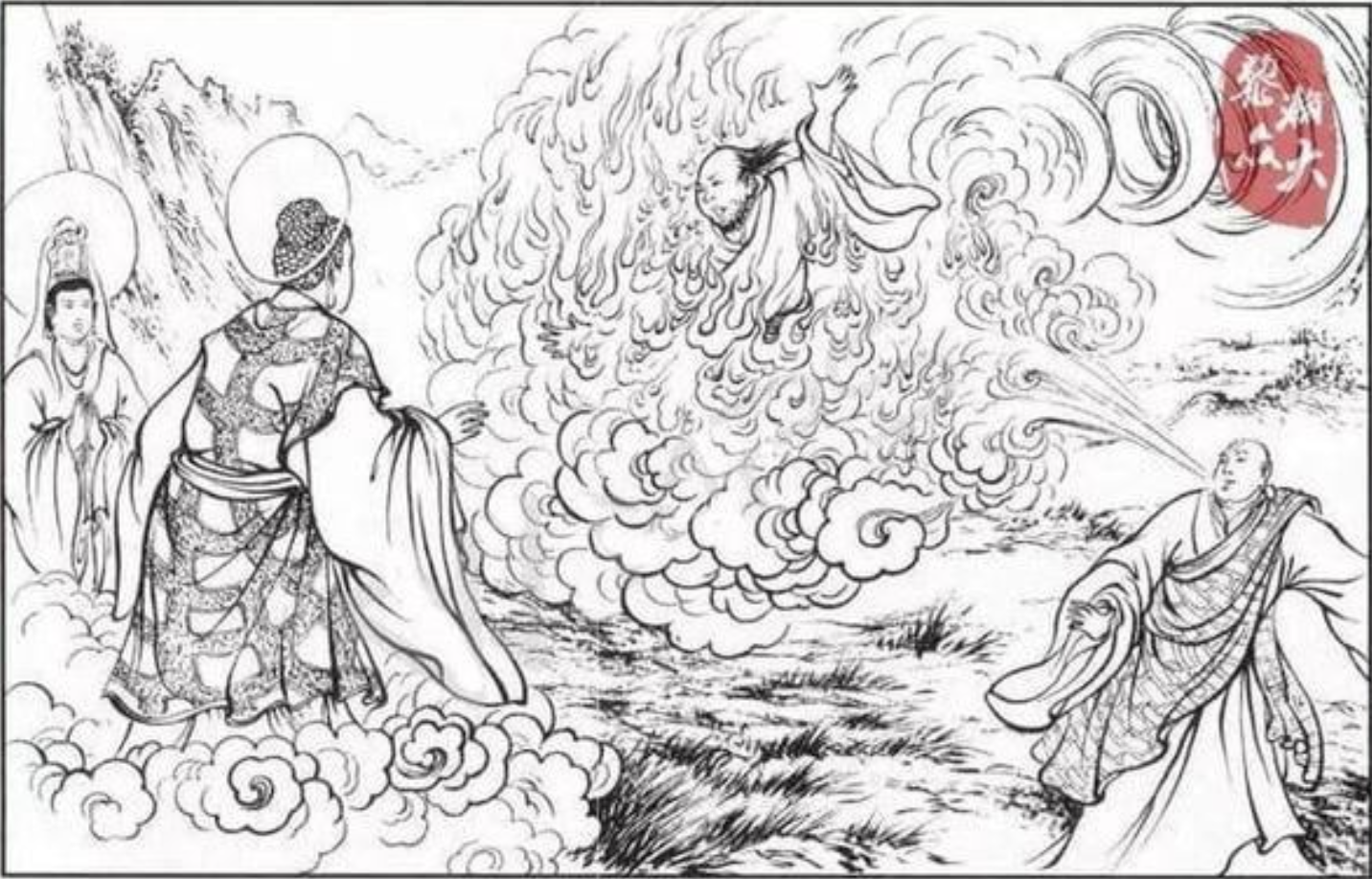
Readers may remember that DEATH BATTLE! (episode 162) featured a fight between Sun Wukong from Journey to the West (Xiyou ji, 西遊記, 1592 CE, “JTTW” hereafter) and Heracles / Hercules from Greco-Roman myth (fig. 1). The episode begins with the demi-god trekking up a mountain in order to fulfill the 11th of his famous 12 labors: procuring the Golden Apples of the Hesperides (Salapata, 2021), but he instead finds Monkey holding the fruit—food meant for his master, Tripitaka. Heracles demands the apple at sword-point, but he quickly discerns that the produce he’s been given was created from a magic hair. This leads to a deadly confrontation.

As I explain in my analysis of the episode, I initially liked how the fight began because both characters are known for stealing fruit in their respective mythologies (see no. 12 in my article listing their parallels). But in hindsight, this didn’t make much sense for two reasons. First, the golden apples are located in a land much further west than India, the scripture-pilgrims’ final destination in JTTW. Monkey could have easily gone to a location closer to their resting spot. And second, having the heroes meet during their respective adventures creates a temporal paradox since both are active at different times—late-Greek bronze age (c. 3000–1000 BCE) vs the early-Tang Dynasty (618–907 CE). Therefore, in the end, the idea is very forced. But what would be a more natural way for the Son of Zeus and the Great Sage Equaling Heaven to come to blows?

This article proposes a more organic reason for conflict via a story idea based on elements from JTTW, Greek myth, Greco-Buddhist art, and Buddhist literature. But take note that the encounter is NOT meant to be a death battle. Remember that the rest of the journey still needs to take place.

Fig. 1 – The official thumbnail for the episode (larger version). Image found here.

1. Background

My pitch is an offshoot of a previous story idea. It follows the historical Xuanzang (玄奘, 602–664 CE) (on whom Tripitaka is based) on his quest for sutras through Central Asia and India, including years-long periods of study. While the original novel sees Daoism practiced by Chinese-speaking people as far away as the Western Continent (i.e. India), this wouldn’t be the case in the real world. Therefore, changes would have to be made to the narrative, such as the appearance of foreign gods outside of the Middle Kingdom. But as I noted in the original article, it would be a lot easier to include the devas of Buddhism (e.g. Shakra, Brahma, Heavenly Kings, etc.) since the religion was practiced throughout the areas traveled by Xuanzang. This, however, wouldn’t exclude gods from other pantheons like Heracles.

1.1. History

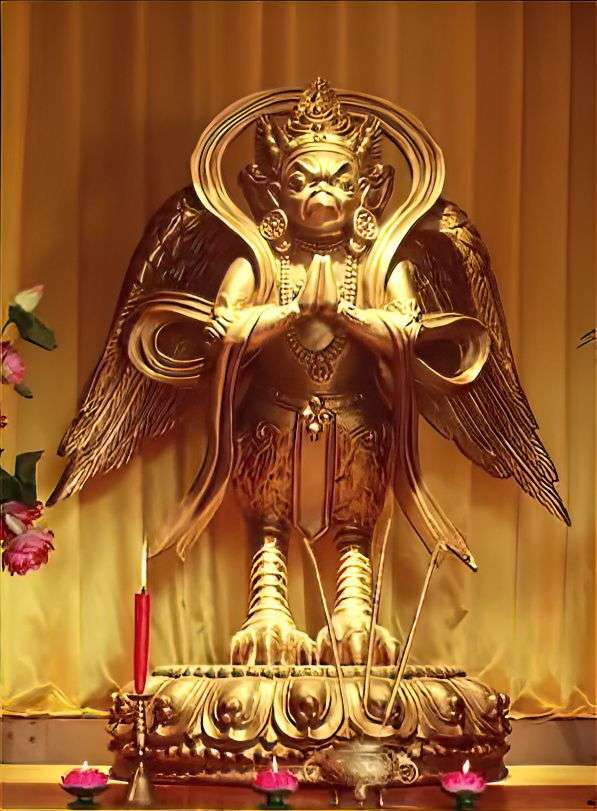
Now, I can already hear my readers asking, “How could Heracles possibly be associated with the gods of Buddhism?” Well, the first Greeks arrived in Central Asia and India during the reign of Darius the Great (550–486 BCE) and later Alexander the Great (356–323 BCE). And just like American Gods, these soldiers, merchants, artisans, and farmers brought their religion with them. The convergence of these two cultures eventually resulted in the demi-god appearing alongside Tathagata in the 1st to 3rd century CE Greco-Buddhist art of Gandhara (modern day NW Pakistan to E and NE Afghanistan) (fig. 2). The Greek hero takes the place of the Buddha’s loyal protector, the yaksha-turned-dharma guardian Vajrapani (Sk: वज्रपाणि, lit: “Vajra [Thunderbolt] in hand”; Ch: Jingang shou pusa, 金剛手菩薩, lit: “Bodhisattva holding the vajra”). (I have to say that Heracles’ association with the thunderbolt is super fascinating given who his father is.) In fact, the common image of Vajrapani as a muscular, club-wielding deva in East Asia (fig. 3) is directly linked to his depiction as Heracles in Gandharan art! (See the 12-28-2025 update for one more of Heracles’ ties to India.)

I won’t go into further detail here since I’ve already taken the liberty of archiving papers on the subject in preparation for this article:

Archive #50 – Heracles as Vajrapani


Fig. 2 – Detail of a stone carving of the Buddha preaching while Heracles-Vajrapani watches over him, Gandhara, 2nd or 3rd century CE, Schist (larger version). He wields a gada mace in his right hand and holds a bone-like vajra-club in the left. Adapted from an image found here. Copyright the Trustees of the British Museum. Fig. 3 – A Tang-era painting of Vajrapani, Dunhuang, Gansu Province, China, mid-9th to early-10th century CE, ink and colors on silk (larger version). Take note of his muscular physique and wispy beard. The vajra-club in his left hand is obscured by his leg. Image found here. Copyright the Trustees of the British Museum. See here for a Tang-era painting of Vajrapani with a visible club.

1.2. Literature and Folklore

Sun Wukong and Vajrapani have technically met before. For example, in the 13th century CE version of the JTTW story cycle, the Great Sage’s antecedent, the “Monkey Pilgrim” (Hou xingzhe, 猴行者), changes his magic staff into the dharma warrior while facing a white tiger spirit:

Monkey Pilgrim transformed his golden-ringed staff into a gigantic Yakşa whose head touched the sky and whose feet straddled the earth. In his hands he grasped a demon-subduing cudgel [jiangmochu, 降魔杵]. His body was blue as indigo, his hair red as cinnabar; from his mouth a fiery gleam shot forth over one thousand feet long” (based on Wivell, 1994, p. 1189). [1]

被猴行者將金鐶杖變作一個夜叉,頭點天,腳踏地,手把降魔杵,身如藍靛青,發似硃沙,口吐百丈火光。

The titan eventually crushes her with his weapon (Wivell, 1994, p. 1189). The “demon-subduing cudgel” is another name for Vajrapani’s vajra-thunderbolt.

Also, the Monkey King interacts with Vajra warriors (Jingang, 金剛) related to Vajrapani numerous times in the standard 1592 CE JTTW. In chapter 52, his way is momentarily barred by the “Eight Great Vajras” (Ba da jingang, 八大金剛) when he seeks an unannounced audience with the Buddha (Wu & Yu, 2012, vol. 3, p. 24). [2] In chapter 58, the eight warriors fail to stop Wukong and his doppelganger when they fight to the Western Paradise seeking Tathagata’s wisdom to distinguish one from the other (Wu & Yu, 2012, vol. 3, p. 114). After the Bull Demon King is captured in chapter 61, the Great Sage gathers the “Four Great Vajras” (Si da jingang, 四大金剛) and a host of other gods to confront Princess Iron Fan (Wu & Yu, 2012, vol. 3, p. 161). In chapter 77, the four warriors once again momentarily bar his way when he seeks an audience with the Buddha (Wu & Yu, 2012, vol. 4, pp. 27-28). In chapter 98, the four warriors welcome Tripitaka and his companions, including Monkey, upon their arrival to the Western Paradise (Wu & Yu, 2012, vol. 4, p. 347). Later in the same chapter, the Buddha charges the eight warriors with transporting the clerics on a cloud to hasten the completion of their mission and return to paradise (Wu & Yu, 2012, vol. 4, p. 357). But after being ordered to prematurely drop off the pilgrims, leading to Tripitaka’s 81st tribulation, the eight warriors reappear sometime later to complete the trip to China (Wu & Yu, 2012, vol. 4, p. 369). And finally, in chapter 100, the eight warriors spirit them back to the Western Paradise to receive their otherworldly reward (Wu & Yu, 2012, vol. 4, p. 380).

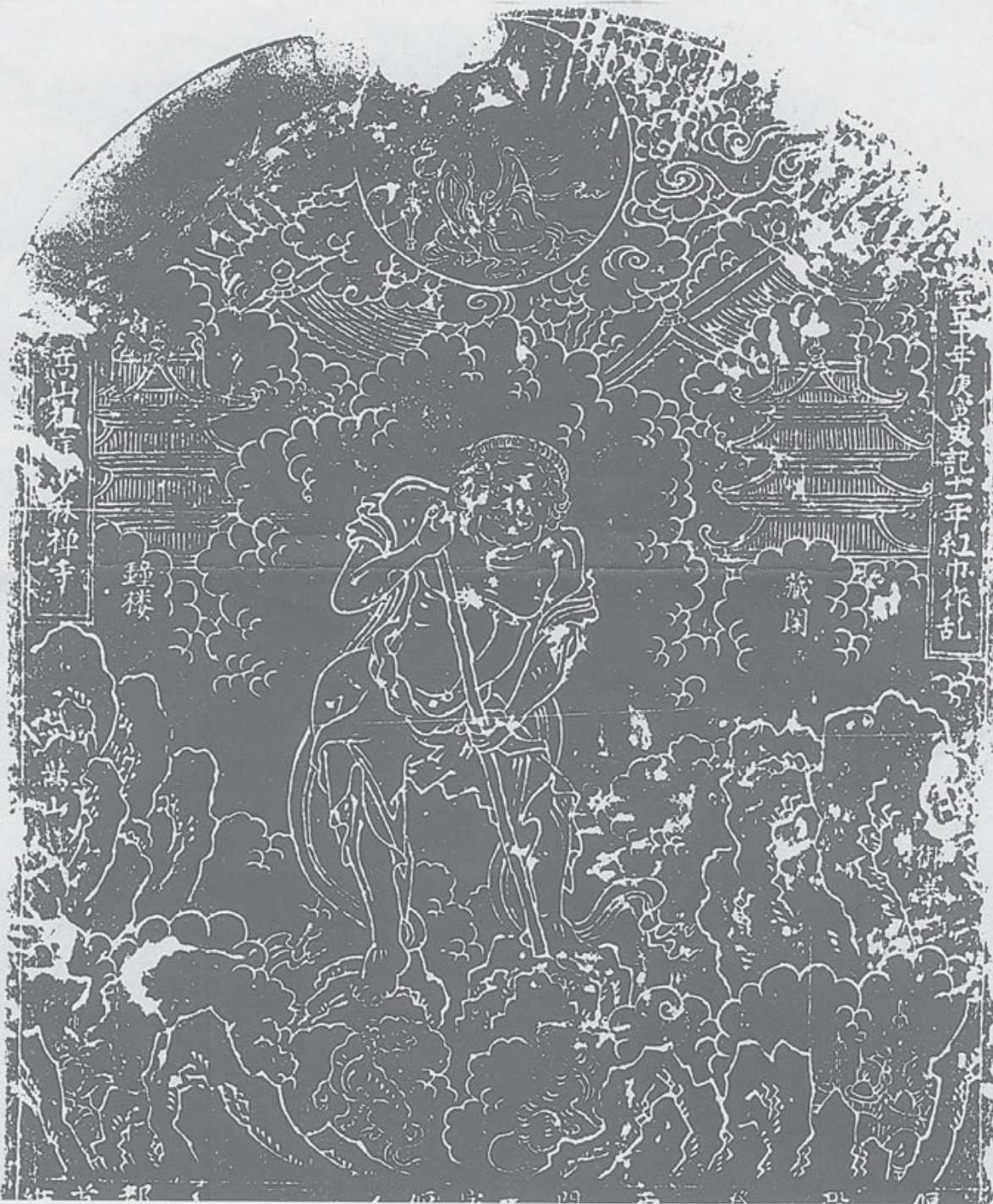
In addition, Sun Wukong and Vajrapani are associated with each other in Shaolin Monastery lore. The latter was historically worshiped as the progenitor of their famous staff method. A stele erected by Shaolin abbot Wenzai in 1517 CE shows that the deity’s vajra-club had been changed at some point to a Chinese staff (fig. 4) (Shahar, 2008, p. 84). Vajrapani’s yaksha-like Narayana (Naluoyan(tian), 那羅延(天)) form was eventually equated with one of the four staff-wielding “Kimnara Kings” (Jinnaluo wang, 緊那羅王) from the Lotus Sutra in 1575 CE. His name was thus changed from Narayana to Kimnara King (Shahar, 2008, p. 87). One version of the story about his creation of the staff method takes place during the Yuan Dynasty‘s Red Turban Rebellion (1351–1368 CE). Bandits lay siege to the monastery, but it is saved by a lowly kitchen worker wielding a long fire poker as a makeshift staff. He leaps into the oven and emerges as a monstrous giant tall enough to straddle both Mount Song and the imperial fort atop Mount Shaoshi, which are five miles (8.046 km) apart. The bandits flee when they behold this staff-wielding titan. The Shaolin monks later realize that the kitchen worker was none other than the Kimnara King in disguise (Shahar, 2008, pp. 87-88). Shahar (2008) suggests that mythical elements of the story were borrowed from the Monkey King’s adventures. He compares the worker’s transformation in the stove with Sun’s time in Laozi’s Eight Trigrams furnace (Bagua lu, 八卦爐), their use of the staff, and the fact that Monkey and his weapon can both grow to gigantic proportions (Shahar, 2008, p. 109). [3]

Therefore, given the above information, it’s not a stretch to have the two heroes meet in a fanfiction.

Fig. 4 – An ink rubbing of the 1517 CE Shaolin stele showing a titanic Vajrapani defending the monastery from rebels (larger version). From Shahar, 2008, p. 84.

2. Story Idea

I’ve added in-text notes in this section to provide readers with extra context. This way, you won’t have to scroll to the endnotes at the bottom.

Buddhist tradition describes Tathagata visiting the devas to preach the dharma (Buswell & Lopez, 2014, p. 235). With the presence of Greeks in Central and South Asia, I imagine he would also visit the Olympian gods who had gained some influence in the region. These friendly interactions would lead Zeus to assign Heracles to guard the Enlightened One (fig. 5), thereby forming a link between the Greek and Buddhist pantheons (and explaining the aforementioned art).

Here is where one of many changes to the standard 1592 CE JTTW story happens. In chapter six of the original, the bodhisattva Guanyin recommends that the demi-god Erlang battle the Monkey King after the latter had defeated many of heaven’s greatest warriors (Wu & Yu, 2012, vol. 1, p. 178). In our tale, she instead endorses the demi-god-turned-deity Heracles-Vajrapani (“HV” hereafter). [A]

A) The Son of Zeus became a full-blown god upon his death. After being exposed to a tunic soaked with poisonous hydra blood, Heracles sought release from the immense pain by jumping into a funeral pyre. But the flaming structure was shortly thereafter struck by lightning, signaling his rise to godhood (Romero-Gonzalez, 2021, pp. 273-276). This, of course, takes place hundreds of years before he becomes the protector of the Buddha.

Fig. 5 – A lovely digital painting of Heracles traveling with the Buddha (larger version). By Jacob King (deviantart). Used with permission. Image found here.

(I don’t consider myself a competent story writer, so please look at the following events and dialogue as conceptual in nature. I’m sure a seasoned writer could do the narrative more justice.)

Similar to the standard narrative, the monkey-soldiers of Wukong’s army notify him that heaven has sent another challenger. He emerges from his cave fully armored to see HV for the first time. Like the original, this might be followed by a poem describing the enemy; in this case, a large, muscular, bearded warrior wearing a lion skin and wielding a flaming vajra-club.

[Insert insults from both sides, including the Son of Zeus calling Monkey a “young rogue,” which naturally pisses him off. [B] HV also describes his godly heritage, which is alien to Monkey since he’s not familiar with the Greek pantheon.]

B) The Great Sage has a habit of claiming to be older than the various gods, immortals, spirits, and humans he meets—whether it’s true or not in the first three cases (Wu & Yu, 2012, vol. 1, p. 413, for example). This is exemplified by his self-given nickname “(Maternal/Paternal) Grandpa Sun” (Sun waigong, 孫外公; Sun Yeye, 孫爺爺). But within the story’s timeline, Heracles is indeed hundreds of years older. Writing around 430 BCE, the Greek historian Herodotus claimed that the Son of Zeus lived roughly 900 years before him, placing the demi-god’s life sometime around 1330 BCE. The Greek hero would, therefore, be active around 830 or more years prior to the birth of Wukong.

The pair take part in a battle of weapons, with Wukong wielding his magic staff and HV his vajra-club. (The earth quakes, gods tremble, etc.). HV’s powerful strikes push our hero back, causing his staff to painfully vibrate in his hands [C] and create a deafening ringing noise with each hit. Monkey would have a running internal monologue noting the great force of his opponent’s attacks. But despite this, the Great Sage continues driving forward, his weapon hardly leaving the area around HV’s head. [D] At one point, though, a glancing strike from the Greco-Buddhist hero redirects the staff, creating an opening. HV brings his vajra-club down hard on Monkey, but instead of dodging, the latter jerks his head upwards, butting away his opponent’s holy weapon with a loud, metallic bang. [E] The combined forces from the attack and defense might cause destruction to the surrounding area.

C) It may seem impossible for the staff to painfully vibrate in Wukong’s hands, but this indeed happens once in the novel. In JTTW chapter 20, he attempts to bludgeon a tiger-spirit, but when “the rod bounce[s] back up and his hands [a]re stung by the impact” (… 轉震得自己手疼), he learns it was just a big stone covered with the fiend’s sloughed off skin (Wu & Yu, 2012, vol. 1, p. 403).

D) The phrase “hardly leaving the monster’s head” is twice used (here and here) to describe Wukong’s supreme mastery of the staff in JTTW chapters 41 and 67 (Wu & Yu, 2012, vol. 2, p. 224; vol. 3, p. 249).

E) The feat of headbutting the weapon serves two purposes. First, it’s a response to this 2020 DEATH BATTLE! fanon wiki fan script that sees Hercules win by smashing the primate immortal’s head to a pulp with his club. (This attack carried over into the official episode, too.) The ending betrays the author’s extremely limited knowledge of JTTW. In the original, the Great Sage’s head is one of the hardest parts of his body, giving him the confidence to voluntarily take blows to the scalp from even magic, bladed weapons with no harm (Wu & Yu, 2012, vol. 1, pp. 314, 383-384, and 408; vol. 2, p. 128; vol. 3, pp. 125 and 373). And two, it highlights the correlation between the invulnerability of Monkey and the Nemean Lion, the first labor of Heracles (March, 2021). Regarding the ending of the fan script, one version of the original mythology sees the Son of Zeus break his olive club over the lion’s head because of how tough its hide is (March, 2021, p. 34).

The novel gives at least three reasons for the Great Sage’s invulnerability. After heaven fails to execute him with bladed weapons and fire and lightning in JTTW chapter 7, Laozi suggests that all of the immortal foodstuff previously consumed by our hero had been refined by his own samadhi fire (sanmei huo, 三昧火), a spiritual flame in the lower abdomen, thus giving him a “diamond body” (jingang zhi qu, 金鋼之軀) (Wu & Yu, 2012, vol. 1, p. 188). Wukong himself later attributes his adamantine nature to his time in the high god’s furnace. In JTTW chapter 34, for example, he claims to have developed a heart of gold, viscera of silver, a head of bronze, and a back of iron (among other things) (Wu & Yu, 2012, vol. 2, p. 131). This is refuted in JTTW chapter 75 when he claims to have been born with a head of bronze and iron that was further refined by the furnace (Wu & Yu, 2012, vol. 3, p. 374).

Stunned from the powerful blow, [F] Monkey stumbles around holding his head for a moment but raises his weapon in defense when he sees HV approaching. However, instead of attacking, the Greco-Buddhist warrior pauses combat by raising a hand in front of him. “What a skull!” he exclaims while clapping. “And no hint of blood! I reckon your hide is as tough as a monstrous beast I once fought. [G] Truly impressive! And your staff technique is masterful! Who trained you?”

F) This references how the Nemean Lion was blinded by pain after the blow (March, 2021, p. 34).

G) This reference is obvious.

“I have no teacher. [H] I alone trained my mind and body for three years.” [I]

H) This refers to Wukong’s promise to never reveal the Buddho-Daoist sage, Patriarch Subodhi, as his teacher under threat of karmic torture in the underworld (Wu & Yu, 2012, vol. 1, p. 125).

I) This is the length of time that he spends as an indoor disciple of Subodhi (Wu & Yu, 2012, vol. 1, p. 121).

“A prodigy!” exclaims HV. “But how good is your boxing and wrestling?”

“Ol’ Monkey can handle himself.”

“Let’s see if that’s true. How about we have a friendly sparring match, a test of heroic strength and skill? No weapons and no pesky magic tricks. Agreed?”

Wukong quickly agrees and inserts his shrunken staff into his ear before stripping off his armor from the waist up to match HV’s exposed muscles. (HV somehow magically stores his holy vajra-club.) The two then square up and launch forward, locking hands and pushing against the other, causing the ground beneath them to tremble and split.

“Extraordinary!” says HV. “How can such a small creature be so powerful?! [J] Were you born of the gods?

J) Many people often forget that Monkey’s normal form is less than 4-Chinese feet (121.92 cm) tall (see here).

“No, I was born from a stone.”

“Oh, like the stone titan and stone goddess! [K] No wonder you achieved this level of strength in such a short time. You have so much raw potential. Why cause trouble for such petty reasons?” [L]

K) These are Ullikumi and Agdistis, two powerful, rebellious, stone-born deities from Western myth (see sections 2.1 & 2.4 here). Referencing the former shows that HV is aware of the Near Eastern pantheon.

It’s interesting to note that lithic births are at least common enough in world myth to have earned a category in Stith Thompson’s Motif-Index of Folk-Literature: “Birth from rock” (T544.1).

L) This refers to Wukong’s rebellion over being given the lowest-ranking position in the Daoist heaven.

[Insert Wukong’s reply. They continue to converse during the battle.]

(This might be a good place to introduce some comedy. HV keeps referencing gods and monsters from other pantheons, making Monkey more and more frustrated:

“What the hell is wrong with you?! I … DON’T … KNOW … THESE … PEOPLE!!! [said in a slow, patronizing voice])

The Great Sage’s internal monologue comments on HV’s diamond grip and the great pressure of his punches. But our hero’s keen eyes notice openings in HV’s defense, allowing him to land blow after blow. However, with each successful attack comes praises from HV. Stinging rib shot. “Good, good!” Cutting elbow strike to the face. “Excellent!” Crushing body slam. “Amazing!”

“Why do you keep lauding me? I’m winning!”

“That would certainly be the case … if we were equals.”

“What do you mean?!”

Smiling, HV explains, “I’ve been testing you. [M] You found all of the openings I offered you, even some that I didn’t intend to because I was apparently too focused on judging your technique! [N] You are a talent the likes of which I’ve never seen before. Thank Father Zeus [or Buddha]! The student I’ve been looking for has finally appeared! Forsake this frivolous rebellion and return with me to the Western Paradise. I promise with my tutelage, you will become one of the greatest warriors of any pantheon!”

M) Perhaps HV decides to test the Great Sage when he sees how well the small primate responds to his opening strikes.

N) It just occurred to me that since the Subodhi appearing in this more realistic version of the story is the historical figure he’s based on, Subhuti, one of the Buddha’s ten principal disciples, the patriarch had to have trained under someone during Tathagata’s lifetime. And considering that HV was the Enlightened One’s bodyguard, perhaps Subhuti learned a little from the Greco-Buddhist hero—apart from other deities, holy men, and warriors, including the Buddha, a member of the Kshatriya class. An interesting implication is that HV would recognize (his or an ally’s) techniques among Wukong’s armed and unarmed attacks or defenses, thereby alerting him that Monkey’s claim of having no master is false. Yet, he would still be supremely impressed that the Great Sage became such a powerful, competent fighter in just three short years.

Fun fact: according to Theocritus, Heracles learned boxing and wrestling from the grim-looking demi-god Harpalycus, son of Hermes (Pache, 2021, p. 10). Apollodorus instead claims his teacher was Autolycus (2.4.9), also a son of Hermes.

“I think you’re full of shit! Ol’ Monkey is whittling away at you, and you’re just trying to talk your way out of it.”

“Well, my offer stands,” HV replies calmly, “but now that I’ve had my fun, it’s time to finish this.”

“Finish what, you bastard?!” Wukong screams in anger. He then unleashes a tornado of powerful punches, kicks, and knee and elbow strikes. But this time they have no effect on the Son of Zeus because he’s no longer playing along.

I’m not quite sure what the next sequence of events would be since I have zero experience choreographing fight scenes, especially between celestial warriors. Perhaps HV displays his true power by running Monkey headfirst through the side of a mountain with an outstretched arm, similar to how the comic book character Omni-Man uses his son, Invincible, like a wedge to slice through an oncoming subway train [warning: gore]. This feat alone would surely cause the primate immortal to question how his opponent’s strength has seemingly increased exponentially. [O] (But upon reflection, this deed seems lacking considering that Wukong himself is shown capable of carrying two mountains while running with great speed. Hopefully someone can suggest a feat for HV that would amaze even the Great Sage.)

O) This, of course, proves that HV was holding back. It’s important to note that in Buddhist literature, the original Vajrapani is considered the “physical manifestation of the … power … of all the Buddhas” (Buswell & Lopez, 2014, p. 955). Now imagine how much stronger HV would be than Monkey! Apart from his own godly heritage, I guess in my version of JTTW, HV would gain an unfathomable boost in power from serving as the protector and disciple of the Buddha, exposing him to the dharma for centuries—during Tathagata’s lifetime and afterlife following his parinirvana (figs. 6 & 7). This is similar to how the scorpion-demoness becomes so strong in JTTW chapter 55 (Wu & Yu, 2012, vol. 3, p. 72). But HV would be well beyond even her.

I guess the Great Sage would hold off on using magic up to this point as a matter of pride, but maybe his hand is forced when faced with such oppressive strength. Like in the original, he might resort to his magic hairs, summoning hundreds of tiny clones in the hopes of overwhelming the Son of Zeus. [P] However, the Greco-Buddhist warrior quickly neutralizes these—possibly by clapping his hands together and creating a shockwave that blows them away [Q] and destroys the surrounding area—pressuring our hero to take other measures. Maybe Monkey frantically cycles through one trick after another but ultimately fails to best his opponent (see the 10-26-25 update below). (It would be fascinating to see how HV deals with Wukong’s three-headed, six-armed war form—surely eliciting comparisons to Geryon [R].)

To these breaches of their agreement, HV responds with something like, “Magic? You disappoint me.”

[Insert Monkey’s response.]

P) Monkey competes in hand-to-hand combat in JTTW chapters two and 51, and each time he resorts to hair clones when things get out of hand (Wu & Yu, 2012, vol. 1, pp. 128-129; vol. 3, pp. 12-13).

Q) The hair clones can indeed be blown away, as shown by the Yellow Wind Demon in JTTW chapter 21 (Wu & Yu, 2012, vol. 1, pp. 409-410).

R) Thank you to a beta reader of this article for reminding me about Geryon. He is sometimes described as having or depicted with three conjoined bodies, complete with three heads and six arms like Monkey (fig. 8) (Finglass, 2021).

Fig. 6 (Top) – A degraded stone carving depicting the parinirvana of the Buddha, Gandhara, 2nd to 3rd-century CE, Schist (larger version). HV is the first person from the left on the bottom row. He holds his vajra-club in one hand and upraises the other in lamentation. He has an exposed torso, showing off his muscles, in place of his signature lionskin. Housed in the British Museum. Adapted from an image found on Wikimedia Commons. Copyright Marie-Lan Nguyen. Fig. 7 (Bottom Left) – Detail of HV (larger version). Fig. 8 (Bottom Right) – Heracles vs Geryon, Attic black figure on Amphora vase, mid-6th century BCE (larger version). Housed in the Musée du Louvre, Paris.  This is an upscaled version of an image found here. Copyright www.theoi.com.

Ideally, given the parallels between Wukong and the Nemean lion—both are fierce mythological animals, have invulnerable hides, can change shape, [S] and fight someone who is/was a demi-god (Erlang vs Heracles)—I would like to see HV maneuver to Monkey’s back and get him in a chokehold, thereby mimicking how the big cat was originally defeated. [T] But instead of killing the Great Sage, he only intends to choke him to unconsciousness (see the 10-26-25 update below). [U] And to make matters worse, as the primate immortal fades towards blacking out, he by chance witnesses his beloved monkey army being routed and captured by celestial forces, like the standard version (Wu & Yu, 2012, vol. 1, p. 182). This causes him to lose heart and flee HV’s powerful arms by changing into an intangible ball of light or gust of wind. [V]

S) Matyszak (2015) states that the lion would sometimes take the form of kidnapped women (that it had presumably already eaten) in order to lure unsuspecting heroes into its cave (pp. 46-47). Dr. Matyszak tells me that “it’s not part of the core myth” but “later Roman and Byzantine authors do mention it” (personal communication, October 17, 2025).

T) I really like the ending of Theocritus’ description of the fight:

[After hitting him over the head with a club,] I threw my bow and stitched quiver to the ground, and before he could recover and turn on me again, I grabbed him by the scruff of his powerful neck. Gripping him firmly, I strangled him with my strong hands, tackling him from behind to stop him scratching me with his claws. Standing on his hind paws, I pressed them hard to the ground with my heels and controlled his flanks with my thighs, until I could lift him up lifeless in my arms and lay him out. And mighty Hades took his spirit (March, 2021, p. 34).

U) Someone might claim that it would be impossible to choke out Monkey since he’s a spiritual being, but it’s important to remember that the novel humanizes supernatural figures in order to make them more relatable. For instance, in JTTW chapter 65, Wukong claims that he will die from the lack of air inside of a sealed Buddhist treasure-weapon if he isn’t soon released (Wu & Yu, 2012, vol. 3, p. 217). However, I think a blood choke would be more dignified and less dangerous for our hero.

V) Wukong escapes in the form of a ball of light in JTTW chapters 34 and 42 (Wu & Yu, 2012, vol. 2, pp. 126 and 241). And he turns into a gust of wind to follow a foe in JTTW chapter 60 (Wu & Yu, 2012, vol. 3, p. 140). This could easily be used to escape as well.

A beta reader suggested that I work Erlang and his sworn brothers back into the story. They could track down and capture Monkey. But however the situation is resolved, this would lead to the events of the original story: his failed execution, his sentence to Laozi’s furnace, his escape and wager with Buddha, his imprisonment beneath Five Elements Mountain, and his eventual release to go on the journey. And since Wukong comes into contact with Erlang once more and the Vajra warriors several times in the standard version, [W] he would likely meet HV again during the pilgrimage. The Son of Zeus might even comment on his positive change in character as Tripitaka’s disciple and protector.

W) The Great Sage meets Erlang again in chapter 63 (Wu & Yu, 2012, vol. 3, pp. 187-191). Regarding Vajra warriors, refer back to section 1.2.

Two beta readers were disappointed by the ending because they didn’t think HV could defeat the Great Sage. As a longtime uberfan of Monkey myself, I understand that sentiment, but they should remember that this is not just the Heracles of Greco-Roman myth, who’s immensely powerful in his own right, able to support the sky on his shoulders in one myth (Salapata, 2021, p. 152). He’s an amalgam of the Greek hero and the Buddha’s protector. Recall that Vajrapani is considered the embodiment of all the Tathagatas’ power (refer back to note O). And If the dharma of one Buddha can easily defeat Monkey (Wu & Yu, 2012, vol. 1, pp. 195 and 199), a being endowed with the power of ALL of them should have no problem subduing our favorite primate immortal.

I feel like this idea has so much potential, but I lack the experience or talent to do it justice here. Hopefully, readers will see through the lackluster description to understand the promise of greatness that it holds. Please let me know if any of you are interested in fleshing out this tale.

Lastly, while finishing this section, I came upon a fun coincidence: ancient Greco-Buddhist stone carvings with HV, the Buddha, and … a monkey (figs. 9 & 10)! They depict “The Monkey Offering Honey (to the Buddha)” (Ch: Mihou xianmi, 獼猴獻蜜; Mihou fengmi, 獼猴奉蜜), a tale from the Tathagata’s lifetime where a primate selflessly offered him honey but shortly thereafter fell and died via drowning or impalement. Thankfully, though, the primate was reborn into the deva realm (Van der Geer, 2022, pp. 439-440). [W] The carvings depict HV watching over the Enlightened One during this event.

Perhaps, based on these images, HV tells Wukong at some point during the confrontation that he reminds him of someone from the past. (Fanfic theory: could the Great Sage be a reincarnation?)

W) The historical Xuanzang mentions a version of this story where the primate is later reborn as a human (Li, 1996/2017, p. 106). He adds that the area where the offering originally happened hosts images of monkeys (mihou xingxiang, 獼猴形像) next to a water tank or pond supposedly dug by a group of them for the Enlightened One (Li, 1996/2017, p. 184). [4]

Fig. 9 (Left) – Detail of a stone doorway fragment with two stacked carvings illustrating “The Monkey Offering Honey (to the Buddha)” story, Gandhara, 1st to 3rd-century CE, Schist (larger version). The upper scene portrays the primate asking for a bowl, while the lower depicts the offering of honey. HV is present in both: first from the left on the top and first from the right on the bottom. He lacks his beard and lionskin but wields his signature weapon. The extra person photobombing the lower scene may be Ananda. Fig. 10 (Right) – The full stone doorway fragment portraying various events from the Tathagata’s life (larger version). Housed in the Guimet Museum, Paris, France. Adapted from an image found on Wikimedia Commons. Copyright Marie-Lan Nguyen. 

3. Sequel

A continuation of the story would open where the original leaves off: after the scripture-pilgrims are elevated in spiritual rank, Tathagata charges HV with escorting the Victorious Fighting Buddha (i.e. Sun Wukong; fig. 11) through the Greek world-system. Imagine the kind of adventures Monkey would have as a Buddha interacting with Classical gods and monsters! It would definitely be a great way of introducing East Asian people to the wonders of Greek myth.

I really like the idea of HV visiting his old pantheon as his vajra is analogous to Zeus’ thunderbolt. Seeing a father-son lightning competition would be great!

Also, as I’ve discussed elsewhere, Wukong and Poseidon could bond over their shared love of horses.

Fig. 11 – Wukong as the Victorious Fighting Buddha (larger version). Imagery based on the iconography of the historical Yuddhajaya Buddha. Art by NingadudeXx.

3.1. Commissioned Art

I have commissioned some illustrators to draw Monkey in ancient Greek style as an experiment to see what he might look like through the lens of Hellenistic artisans.

Fig. 12 – The Victorious Fighting Buddha (larger version). Pencil, fineliners, and alcohol markers on paper. Art by tr0chanter (Instagram and Twitter).

Fig. 13 – Heracles vs Monkey (larger version). Pencil and markers on paper. Art by Dario Virga (Onibotokemaru on Instagram), a friend of the blog. Each character is labeled with their name in Greek. Heracles is “Ἡρακλῆς,” while the Great Sage is “Pithekos” (πῐ́θηκος), meaning “ape, monkey, trickster, or dwarf.” Wukong’s Greek name is very fitting. It’s also part of the modern scientific name for Old world monkeys (Cercopithecoidea).

Fig. 14 – Heracles vs Sun Wukong (larger version). Digital. Art by Jacob King (Twitter, Instagram, Tumblr). I love the cracks.

4. Fanfiction

I can already predict fanfiction set in an alternate timeline where Monkey accepts HV’s offer to become his teacher. The Son of Zeus would spend time instructing Wukong on advanced techniques of boxing, wrestling, and weapons. This, of course, would be taught in tandem with spiritual cultivation. The training might be in preparation for a fighting tournament between the disciples of gods from all pantheons, kind of like Record of Ragnarok (Jp: Shūmatsu no Warukyūre, 終末のワルキューレ; lit. “Doomsday Valkyrie”; fig. 15). The contestants could be fighting for permission to start their own pantheon, thereby becoming a “Sky Father” (Sk: Dyaus-pitr, द्यौष्पितृ; Ch: Tianshang fuqin, 天上父親). (Maybe the long-established Sky Fathers share some of their divine spark to kickstart the new world-system.) I REALLY like this idea, but it wouldn’t work for my own purposes since, as stated above, Wukong would still need to go on the journey.

Perhaps the prize could be the chance to help mankind since one of the reasons that Tripitaka is asked to quest for sutras is because they will help free untold numbers of orphaned souls from the torments of hell (see JTTW chapters 11 and 12). Therefore, the tournament would essentially be a contest to see who will be the Tang Monk’s protector. I don’t really like this idea, but it at least supports the original narrative. The Great Sage would win, of course, but he has to agree to have his extraordinary powers (and memories of the tournament) sealed as a test of his resolve or devotion. And his subsequent enlightenment would be the reward for his great deeds performed on the journey.

Fig. 15 – Promotional art for Record of Ragnarok (larger version). Image found here.


Update: 10-11-25

I’ve seen people claim online that Sun Wukong would easily defeat Heracles because the latter’s feats are not as grand as the former. To this, I counter that the deeds of both heroes shouldn’t be compared, for they serve difference purposes. I don’t know of any feats of speed for Heracles, but Monkey’s famous ability to fly 108,000 li (33,554 mi / 54,000 km) in a single cloud somersault is an allegory for instant enlightenment (as explained in section III here). [5] And his feat of carrying two Buddhist mountains on his shoulders is likely an allegory for the Great Sage “supporting” the religion by protecting his master on the quest for sutras (as I suggest here). The deeds of Heracles, however, were probably meant as actual displays of brute strength. For instance, ancient Greek men on lion hunts may have drawn inspiration and courage from the demi-god’s defeat of the Nemean Lion. [6]


Update: 10-26-25

Above, I wrote that “[m]aybe Monkey frantically cycles through one trick after another” in a failed bid to win, and I later added, “I would like to see HV maneuver to Monkey’s back and get him in a chokehold.” Well, I’m happy to report that I’ve found a mythic way to combine these. The Bibliotheca of Pseudo-Apollodorus describes Heracles’s grip tiring out a shape-shifting sea god:

And going on foot through Illyria and hastening to the river Eridanus he came to the nymphs, the daughters of Zeus and Themis. They revealed Nereus to him, and Hercules seized him while he slept, and though the god turned himself into all kinds of shapes, the hero bound him [with his arms (fig. 16)] and did not release him till he had learned from him where were the apples and the Hesperides (2.5.11).

Matyszak (2015) calls this binding a “Herculean head-lock” (p. 150). Therefore, in our story, Wukong cycles through all manner of transformations but can’t break free from HV’s grip! Then he loses heart and flees when he sees his children captured (as mentioned previously).

Fig. 16 – Heracles wrestling Nereus/Triton (larger version). From an 1894 drawing of a circa 550 BCE Attic Black-figure Kylix. Image found on Wikimedia Commons. For the original, see here.


Update: 10-29-25

I’ve also found a mythic reason for why Heracles would be sent away from Olympus to protect Buddha. Matyszak (2015) explains that the Son of Zeus didn’t want to become an official member of the Twelve Olympians because this would have forced someone out of the group:

Some felt that the mighty deeds of Hercules entitled him to the status of a full Olympian God. However, the number of Olympians was limited to the sacred number of twelve, and in a rare moment of diplomacy Hercules declined to take an honour that would have first to be stripped from someone else. (Dionysus, the God of Wine was less bashful. He bumped Hestia, Goddess of the Home, off the Olympian high table when his time came to be made divine.) (p. 200)

So instead of taking an Olympian’s spot, Heracles decides to accept a position within the Buddhist pantheon as the Tathagata’s protector.


Update: 12-02-25

I have found the specific passage alluded to by Matyszak (2015) in the previous update. In book four of his Library of History (c. 60 to 30 BCE), Diodorus Siculus writes:

[4.39.4] They report of Heracles further that Zeus enrolled him among the twelve gods but that he would not accept this honour; for it was impossible for him thus to be enrolled unless one of the twelve gods were first cast out; hence in his eyes it would be monstrous for him to accept an honour which involved depriving another god of his honour (source).


Update: 12-28-25

Above in section 1.1, I mentioned that Heracles appeared in Greco-Buddhist art alongside the Buddha. Well, this is not the demi-god’s only tie to the region. Writing in his Indica, Megasthenes (d. 290 BCE), a Greek diplomat to South Asia, claims a local tradition states that Heracles was a home-born son of India who made his seven year old daughter queen of a southern region named after her (i.e. the Pandya Dynasty). And because no suitor could even be his equal, the Son of Zeus is said to have … impregnated the child (ewwwwwwwwwwww) in order to spawn a line of kings. All of this supposedly happened just prior to his death. [7]

Barring the incest, it would be neat to add the daughter into the story somewhere. She could be tied to the three Indian princess from JTTW chapter 88 (as discussed here).

Notes:

1) Translation changed slightly. Although the English reads “a hundred yards,” the original Chinese says “100 zhang” (bai zhang, 百丈). One zhang is ten Chinese feet, or roughly 10.43 ft (3.18 m) (Jiang, 2005, p. xxxi). Therefore, 100 zhang would be 1,043 ft (314 m).

2) Yu (Wu & Yu, 2012) translates jingang (金剛) as “Diamond Guardians” (vol. 3, p. 24, for example). I’m changing it to just Vajra since the term can mean both “lightning” and “diamond.” I don’t want to confuse anyone.

3) Yes, this information comes from Wikipedia, but I’m the one who originally added it under the screenname “Ghostexorcist.” See this edit history, for example.

4) The English translation just says “tank” (Li, 1996/2017, p. 184), but the original Chinese word chi (池) can also mean “pond.”

5) The li (里) is a Chinese measurement of distance. English works usually translate it as “mile.” However, it equals roughly 1/3rd of a mile or 1/2 of a kilometer.

6) Herodotus mentions mountain lions attacking the caravan camels of Xerxes on his route through Greece (The Histories, 7.125126). If such thing routinely happened to local travelers, this would have affected regular lion hunts. And this 16th-century BCE Minoan blade suggests that lion hunts go back centuries.

7) Here is a translation of the relevant passages:

B9. Flavius Arrianus: Indika VIII: 4-IX: 12

Heracles, however, who is currently reported to have come [as a stranger] into the country, is said to have been in reality a native of India. This Heracles is held in especial honour by the Sourasenoi, an Indian tribe who possess two large cities, Methora and Cleisobora, and through whose country flows a navigable river called the Iobares. But the dress which this Heracles wore, Megasthenés tells us, resembled that of the Theban Heracles, as the Indians themselves admit. It is further said that he had a very numerous progeny of male children born to him in India (for, [like his Theban namesake,] he married many wives), but that he had only one daughter. The name of this child was Pandaia, and the land in which she was born, and with the sovereignty of which Heracles entrusted her, was called after her name, Pandaia, and she received from the hands of her father 500 elephants, a force of cavalry 4000 strong, and another of infantry consisting of about 130,000 men. Some Indian [writers] say further of Heracles that when he was going over the world and ridding land and sea of whatever evil monsters infested them, he found in the sea an ornament for women, [(which even to this day the Indian traders who bring us their wares eagerly buy up and carry away to foreign markets, while it is even more eagerly bought up by the wealthy Romans of to-day, as it was wont to be by the wealthy Greeks long ago)]. This article is the sea-pearl, called in the Indian tongue margarita. But Heracles, it is said, appreciating its beauty as a wearing ornament, caused it to be brought from all the sea into India, that he might adorn with it the person of his daughter.

[…]

IX. Now in that part of the country where the daughter of Heracles reigned as a queen, it is said that the women when seven years old are of marriageable age, and that the men live at most forty years, and that on this subject there is a tradition current among the Indians to the effect that Heracles, whose daughter was born to him late in life, when he saw that his end was near, and he knew no man his equal in rank to whom he could give her in marriage, had incestuous intercourse with the girl when she was seven years of age, in order that a race of kings sprung from their common blood might be left to rule over India; that Heracles therefore made her of suitable age for marriage, and that in consequence the whole nation over which Pandaia reigned obtained this same privilege from her father (pp. 63 and 65).

[…]

B 12. Polyænus: Strateg. I: 3: 4

Heracles begot a daughter in India whom he called Pandaia. To her he assigned that portion of India which lies to southward and extends to the sea, while he distributed the people subject to her rule into 365 villages, giving orders that one village should each day bring to the treasury the royal tribute, so that the queen might always have the assistance of those men whose turn it was to pay the tribute in coercing those who for the time being were defaulters in their payments (Dahlquist, 1962, p. 67).

Sources:

Buswell, R. E., & Lopez, D. S. (2014). The Princeton Dictionary of Buddhism. Princeton, NJ: Princeton University Press.

Dahlquist, A. (1962). Megasthenes and Indian Religion: A Study in Motives and Types. Stockholm: Almqvist & Wiksell.

Finglass, P. J. (2021). LABOR X: The Cattle of Geryon and the Return from Tartessus. In D. Ogden (Ed.), The Oxford Handbook of Heracles (pp. 135-148). United Kingdom: Oxford University Press.

Jiang, Y. (2005). The Great Ming Code / Da Ming Lu. Vancouver, Wa: University of Washington Press.

Li, R. (Trans.) (2017). The Great Tang Dynasty Record of the Western Regions. Berkeley, CA: Numata Center for Buddhist Translation and Research. (Original work published 1996) Retrieved from https://www.bdkamerica.org/product/the-great-tang-dynasty-record-of-the-western-regions/

March, J. (2021). LABOR I: The Nemean Lion. In D. Ogden (Ed.), The Oxford Handbook of Heracles (pp. 29-44). United Kingdom: Oxford University Press.

Matyszak, P. (2015). Hercules: The First Superhero (An Unauthorized Biography). Canada: Monashee Mountain Publishing.

Pache, C. (2021). Birth and Childhood. In D. Ogden (Ed.), The Oxford Handbook of Heracles (pp. 3-12). United Kingdom: Oxford University Press.

Romero-Gonzalez, D. (2021). Deianeira, Death, and Apotheosis. In D. Ogden (Ed.), The Oxford Handbook of Heracles (pp. 266-280). United Kingdom: Oxford University Press.

Salapata, G. (2021). LABOR XI: The Apples of Hesperides. In D. Ogden (Ed.), The Oxford Handbook of Heracles (pp. 149-164). United Kingdom: Oxford University Press.

Shahar, M. (2008). The Shaolin Monastery: History, Religion, and the Chinese Martial Arts. Honolulu: University of Hawai’i Press.

Van der Geer, A. A. E. (2022). The Great Monkey King: Carvings of Primates in Indian Religious Architecture (pp. 431-455). In B. Urbani, D. Youlatos, & A. Antczak (Eds.), World Archaeoprimatology: Interconnections of Humans and Nonhuman Primates in the Past. United Kingdom: Cambridge University Press.

Wivell, C.S. (1994). The Story of How the Monk Tripitaka of the Great Country of T’ang Brought Back the Sūtras. In V. Mair (Ed.), The Columbia Anthology of Traditional Chinese Literature (pp. 1181-1207). New York: Columbia University Press.

Wu, C., & Yu, A. C. (2012). The Journey to the West (Vols. 1-4) (Rev. ed.). Chicago, Illinois: University of Chicago Press.

Archive #50 – Heracles as Vajrapani

Last updated: 10-04-2025

I’ve previously archived a book about wrathful protectors of Buddhism due to their likely influence on Sun Wukong. One such protector is Vajrapāṇi (Sk: वज्रपाणि), the so-called “Bodhisattva holding the Vajra (Thunderbolt)” (Jingang shou pusa, 金剛手菩薩). This Yakṣa-turned-Dharmapāla is often portrayed in religious art as a muscular, club-wielding guardian of the Buddha. What’s interesting, though, is that this depiction can be traced to representations of the Greco-Roman hero HeraclesHercules (Ἡρακλῆς; Ch: Helakelesi, 赫拉克勒斯) that passed from Greece into Central Asia and India and eventually to China over a period of several hundred years (Flood, 1989; Hsing & Crowell, 2005; Galinsky, 2020). The Greco-Buddhist art of Gandhara (modern day Afghanistan and Pakistan) is an early example of this converging iconography (fig. 1).

I’ve decided to archive three papers on the subject for a few reasons: 1) it’s such a fascinating topic; 2) it compliments two of my previous articles about Monkey and Heracles-Hercules (here and here); and 3) the information will be used in a future story idea pitting Wukong against the demi-god (see the 10-04-25 update below). Said piece will also briefly discuss times when the primate immortal and Vajrapāṇi have crossed paths in historical literature and folklore.

Fig. 1 – Detail of a stone carving of the Buddha preaching while Heracles-Vajrapāṇi watches over him, Gandhara, 2nd-century (larger version). The full image can be seen here. Copyright the Trustees of the British Museum.

1. Archive links

  • Herakles and the ‘Perpetual Acolyte’ of the Buddha: Some Observations on the Iconography of Vajrapani in Gandharan Art (Flood, 1989)

[No abstract]

Click to access Herakles-and-the-Perpetual-Acolyte-of-the-Buddha-Some-Observations-on-the-Iconography-of-Vajrapani-in-Gandharan-Art.pdf


  • Heracles in the East: The Diffusion and Transformation of His Image in the Arts of Central Asia, India, and Medieval China (Hsing & Crowell, 2005)

[No abstract]

Click to access Heracles_in_the_East_Asia_Major_2005_vol.pdf


  • Herakles Vajrapani, the Companion of Buddha (Galinsky, 2020)

[Abstract: Herakles had a continuing and high-profile existence in the east and the crossroads of Asia from the time of Alexander onwards. The Alexander/Herakles portrait and other representations of Herakles appear in Tajikistan, which was absorbed into the Kushan empire. Cultural contact continued with the west throughout the first and second centuries CE under rulers who patronised Buddhism. It is in this context that Herakles, the most popular hero of Greece and Rome, makes his appearance in Buddhist iconography as Vajrapani. In Gandharan art Vajrapani is the Buddha’s faithful companion and protector in scenes of the Buddha’s life from the Great Departure to his death. The paper examines the hybridisation of Herakles/Vajrapani in a number of reliefs and sculptures to demonstrate that this is not a process of borrowing some stylistic details but of considerable familiarity with the Herakles myth. Both Herakles and Vajrapani had many dimensions and their traditions and characteristics had multiple layers, which facilitated their adaptability.]

Click to access Herakles-Vajrapani-the-Companion-of-Buddha.pdf


Update: 08-20-25

It just occurred to me that not everyone is familiar with Heracles/Hercules or Vajrapani, so I have decided to post more info about them.

I’ll start with Heracles. This is an AMAZING resource that I’ve used in a previous article.

  • The Oxford Handbook of Heracles (Ogden, 2021) 

[Blurb: Heracles is the quintessential ancient Greek hero. The rich and massive tradition associated with him encompasses myths of all kinds: quest myths, monster-fights, world-foundational myths, aetiological myths, philosophical myths, allegorical myths, and more. It informs and is informed by every genre and variety of Classical literature. The figure of Heracles opens windows onto numerous aspects of ancient religion, including those of cult, syncretism, Christian reception, the relationship between gods and heroes, and the intersection of religion with politics.

The Oxford Handbook of Heracles is the first large-scale guide to Heracles, his myth-cycle the Twelve Labors, and, to the pervasive impact of the hero upon Greek and Roman culture. The first half of the volume is devoted to the lucid exposition and analysis of the ancient evidence, literary and iconographic, for Heracles’ life and deeds. In the second half, the Heracles tradition is analyzed from a range of thematic perspectives, including the contrasting projections of the figure across the major literary genres and in art; the ways in which Greek communities and even Roman emperors exploited the figure in the fashioning of their own identities and for political advantage; his cult in Greece and Rome and its syncretism with that of the Phoenician Melqart; and Heracles’ reception in later Western tradition.

Presenting, in 39 chapters, the authoritative work of international experts in a clear and well-structured format, this volume provides a convenient reference tool for scholars and offers an accessible starting-point for students.

Click to access The-Oxford-Handbook-of-Heracles-2021.pdf


Next is Vajrapani. I unfortunately don’t know of any dedicated books on the subject, so here are two papers about his presence in Indian Buddhism.

  • Vajrapani in India I (Lamotte, 1966/2003a)

[No abstract]

(Please note that the formatting of this PDF was already wonky when I found it online.)

Click to access Lamotte-–-Vajrapaṇi-in-India-I.pdf


  • Vajrapani in India II (Lamotte, 1966/2003b)

[No abstract]

Click to access Lamotte-–-Vajrapaṇi-in-India-II.pdf

I’ll add more Vajrapani info in the future when I get a chance.


Update: 08-25-25

Here is the entry for Vajrapani in The Princeton Dictionary of Buddhism (Buswell & Lopez, 2014):

Vajrapāṇi. (P. Vajirapāṇi; T. Phyag na rdo rje; C. Jingangshou pusa; J. Kongōshu bosatsu; K. Kŭmgangsu posal 金剛手菩薩). In Sanskrit, “Holder of the VAJRA”; an important bodhisattva in the MAHĀYĀNA and VAJRAYĀNA traditions, who appears in both peaceful and wrathful forms. In the Pāli suttas, he is a YAKṢA (P. yakkha) guardian of the Buddha. It is said that whoever refuses three times to respond to a reasonable question from the Buddha would have his head split into pieces on the spot; carrying out this punishment was Vajrapāni’s duty. In such circumstances, Vajrapāni, holding his cudgel, would be visible only to the Buddha and to the person who was refusing to answer the question; given the frightening vision, the person would inevitably then respond. Vajrapāni is sometimes said to be the wrathful form of ŚAKRA, who promised to offer the Buddha protection if the Buddha would teach the dharma; he thus accompanies the Buddha as a kind of bodyguard on his journeys to distant lands. Vajrapāni is commonly depicted in GANDHĀRA sculpture, flanking the Buddha and holding a cudgel. In the early Mahāyāna sūtras, Vajrapāni is referred to as a yakṣa servant of the bodhisattvas, as in the AṢṬASĀHASRIKĀPRAJÑĀPĀRAMITĀ. In the SUVARṆAPRABHĀSOTTAMASŪTRA, he is called the “general of the yakṣas” (yakṣasenādhipati), and is praised as a protector of followers of the Buddha. In the SADDHARMAPUṆḌARĪKASŪTRA, AVALOKITEŚVARA explains that one of the forms that he assumes to convert sentient beings is as Vajrapāni. In later Mahāyāna and early tantric Buddhism, Vajrapāni becomes a primary speaker in important sūtras and tantras, as well as a principal protagonist in them, and comes to be listed as one of the “eight close sons” (*UPAPUTRA), the principal bodhisattvas. In the MAÑJUŚRĪMŪLAKALPA, as leader of the vajra family (VAJRAKULA), he flanks ŚĀKYAMUNI in the MAṆḌALA. In the SARVATATHĀGATATATTVASAṂGRAHA, his transition from “general of the yakṣas” to “the supreme lord of all tathāgatas” is played out through his subjugation of Maheśvara (Śiva). At the command of the buddha VAIROCANA, Vajrapāni suppresses all of the worldly divinities of the universe and brings them to the summit of Mount SUMERU, where they seek refuge in the three jewels (RATNATRAYA). Only Maheśvara refuses to submit to the Buddha. Through Vajrapāni’s recitation of a MANTRA, Maheśvara loses his life, only to be reincarnated in another world system, where he eventually achieves buddhahood. Vajrapāni’s Yakṣa origins continue in his wrathful aspects, most common in Tibet, such as the three-eyed Caṇḍa Vajrapāni. It is in this form that he is part of a popular triad with Avalokiteśvara and MAÑJUŚRĪ known as the “protectors of the three families” (T. RIGS GSUM MGON PO). These three bodhisattvas are said to be the physical manifestation of the wisdom (Mañjuśrī), compassion (Avalokiteśvara), and power (Vajrapāni) of all the buddhas. Vajrapāni is also said to be the bodhisattva emanation of the buddha AKṢOBHYA and the chief bodhisattva of the vajra family. He himself has numerous forms and emanations, including Mahābāla (who may have developed from his early attendant Vajrapuruṣa), Vajrasattva, Vajradhara, Vajrahūṃkāra, Ucchuṣma, Bhūtaḍāmara, and Trailokyavijaya. Vajrapāni is closely related especially to VAJRADHARA, and indeed Vajradhara and Vajrapāni may have originally been two names for the same deity (the Chinese translations of the two deities’ names are the same). Vajrapāni’s MANTRA is oṃvajrapāṇi hūṃphaṭ. He is also known as Guhyakādhipati, or “Lord of the Secret.” The secret (guhyaka) originally referred to a class of yakṣas that he commanded, but expanded in meaning to include secret knowledge and mantras. Vajrapāni is the protector of mantras and those who recite them, and is sometimes identified as the bodhisattva responsible for the collection, recitation, and protection of the VIDYĀDHARAPIṬAKA (p. 955).


Update: 08-27-25

Here is another work about the Greek hero.

  • Herakles (Stafford, 2012)

[Blurb: There is more material available on Herakles than any other Greek god or hero. His story has many more episodes than those of other heroes, concerning his life and death as well as his battles with myriad monsters and other opponents. In literature, he appears in our earliest Greek epic and lyric poetry, is reinvented for the tragic and comic stage, and later finds his way into such unlikely areas as philosophical writing and love poetry. In art, his exploits are amongst the earliest identifiable mythological scenes, and his easily-recognisable figure with lionskin and club was a familiar sight throughout antiquity in sculpture, vase-painting and other media. He was held up as an ancestor and role-model for both Greek and Roman rulers, and widely worshipped as a god, his unusual status as a hero-god being reinforced by the story of his apotheosis. Often referred to by his Roman name Hercules, he has continued to fascinate writers and artists right up to the present day.

In Herakles, Emma Stafford has successfully tackled the ‘Herculean task’ of surveying both the ancient sources and the extensive modern scholarship in order to present a hugely accessible account of this important mythical figure. Covering both Greek and Roman material, the book highlights areas of consensus and dissent, indicating avenues for further study on both details and broader issues. Easy to read, Herakles is perfectly suited to students of classics and related disciplines, and of interest to anyone looking for an insight into ancient Greece’s most popular hero.]

Click to access Emma-Stafford-Herakles-2012.pdf


Update: 10-04-25

I have posted an article that proposes a more natural reason for Sun Wukong to battle Heracles

Story Idea: Sun Wukong vs Heracles / Hercules

Disclaimer:

These have been posted for educational purposes. No malicious copyright infringement is intended. My blog is not monetized, so I am not financially benefiting from posting these. If you enjoyed the digital versions, please support the official releases.

Citations:

Buswell, R. E. , & Lopez, D. S. (2014). The Princeton Dictionary of Buddhism. Princeton, NJ: Princeton University Press.

Flood, F. B. (1989). Herakles and the ‘Perpetual Acolyte’ of the Buddha: Some Observations on the Iconography of Vajrapani in Gandharan Art. South Asian Studies, 5(1), 17-27.

Galinsky, K. (2020). Herakles Vajrapani, the Companion of Buddha. In A. Allan, E. Anagnostou-Laoutides, & E. Stafford (Eds.), Herakles Inside and Outside the Church. Leiden, The Netherlands: Brill

Hsing, I.T., & Crowell, W. G. (2005). Heracles in the East: The Diffusion and Transformation of His Image in the Arts of Central Asia, India, and Medieval China. Asia Major, 18(2), 103-154.

Lamotte, É. (2003a). Vajrapāṇi in India (I) (S. Boin-Webb, Trans). Buddhist Studies Reviews, 20(1), 1-30. (Original work published 1966)

Lamotte, É. (2003b). Vajrapāṇi in India (II) (S. Boin-Webb, Trans). Buddhist Studies Reviews, 20(2), 119-144. (Original work published 1966)

Ogden, D. (Ed.), The Oxford Handbook of Heracles. United Kingdom: Oxford University Press.

Stafford, E. (2012). Herakles. New York, N.Y.: Routledge.

Parallels Between Sun Wukong and Hercules

Last updated: 01-10-2026

Here I present a list of parallels shared between Sun Wukong from Journey to the West (Xiyou ji西遊記, 1592 CE) and the Greco-Roman hero Hercules. I noticed many of the similarities myself, but I am also indebted to the list (that I also contributed to) posted on the DEATH BATTLE! Wiki. Numbers one to sixteen below originally appeared in my Hercules vs Sun Wukong Death Battle Analysis, but I decided to split the information off into a new article in order to make the original a more manageable length. 

I should point out that this piece is only listing interesting parallels. It is NOT trying to prove that elements from the Greek demi-god’s story directly influenced that of our primate immortal. However, at the end, I do briefly discuss possible antecedents that may have influenced both tales.

Before continuing, I want to note that I know the demi-god’s original name is Heracles (or Herakles), but I will use Hercules throughout the article as this is the name chosen by the staff of DEATH BATTLE!

Current parallel count: 21

Listed in no particular order.

  1. Born of masculine heavenly forces
  2. Bad tempers
  3. Wear big cat skins
  4. Wield blunt weapons
  5. Immensely strong
  6. Subdued by a blow from a deity
  7. Punished with difficult tasks for past crimes
  8. Aided by goddesses
  9. Similar animal enemies
  10. Tamer of horses
  11. Visit women lands
  12.  Steal divine fruit
  13. Visit the underworld
  14. Fight in heavenly wars
  15. Achieve godhood in respective narratives
  16. Worshiped in the real world
  17. Have doubles
  18. Attack enemies from within
  19. Blond hair/fur
  20. Disguised as women
  21. Compiled adventures

See below for more details.

I. Details

1) Origins – Both are born of masculine heavenly forces and feminine earthly forces. Hercules is the half-human son of Zeus and the mortal Alkmene. Hesiod‘s Shield of Heracles reads:

But the father of men and gods wove another design in his mind, how he might fashion for gods and wheat-eating men a protector against disaster. He arose from Olympos by night, pondering a deception in his spirit, longing for sex with a fine-waisted woman. Quickly he came to Typhaonion, and from there Zeus the Counselor trod the peak of Mount Phikion. Taking his seat, he planned wondrous deeds in his heart. On that very night he slept with the slender-ankled daughter of Elektryon; he fulfilled his desire […] She bore him [Herakles] by submitting to the son of Kronos, lord of the dark clouds (Hesiod & Powell, 2017, p. 153 and 154; see also Pache, 2021).

The Monkey King is born from a stone seeded by heavenly and earthly energies. Chapter one of JTTW reads:

Since the creation of the world, it [the stone] had been nourished for a long period by the seeds of Heaven and Earth and by the essences of the sun and the moon, until, quickened by divine inspiration, it became pregnant with a divine embryo. One day, it split open, giving birth to a stone egg about the size of a playing ball. Exposed to the wind, it was transformed into a stone monkey endowed with fully developed features and limbs (Wu & Yu, 2012, p. 101).

Hinsch (2011) explains that Chinese works as far back as the Eastern Zhou and Han considered heaven masculine and described it as the father/husband/superior of the feminine earth, the mother/wife/inferior (pp. 157-158).

2) Temper – Both are quick to anger. In his youth, Hercules killed his music teacher for punishing him. The Bibliotheca Historica of Diodorus reads:

Linus [of Thrace] also, who was admired because of his poetry and singing, had many pupils and three of greatest renown, Heracles, Thamyras, and Orpheus. Of these three Heracles, who was learning to play the lyre, was unable to appreciate what was taught him because of his sluggishness of soul, and once when he had been punished with rods by Linus he became violently angry and killed his teacher with a blow of the lyre (3.67.2; Pache, 2021, p. 10).

Sun pushes over a magical, one-of-a-kind Ginseng Tree (Renshen shu, 人參樹) in retaliation for verbal abuse at the hands of some immortal youths. Chapter 25 of JTTW reads:

When the immortal lads found out the truth, they became even more abusive in their language; the Great Sage became so enraged that he ground his steel-like teeth audibly and opened wide his fiery eyes. He gripped his golden-hooped rod again and again, struggling to restrain himself and saying to himself, “These malicious youths! They certainly know how to give people a lashing with their tongues! All right, so I have to take such abuse from them. Let me offer them in return a plan for eliminating posterity: and none of them will have any more fruit to eat!” Dear Pilgrim! He pulled off a strand of hair behind his head and blew on it with his magic breath, crying “Change!” It changed at once into a specious Pilgrim, standing by the Tang Monk, Wujing, and Wuneng to receive the scolding from the Daoist lads. His true spirit rose into the clouds, and with one leap he arrived at the ginseng garden. Whipping out his golden-hooped rod, he gave the tree a terrific blow, after which he used that mountain-moving divine strength of his to give it a mighty shove (Wu & Yu, 2012, vol. 1, pp. 465-466).

3) Skins – Both wear the skins of big cats. Hercules wears the skin of the Nemean Lion. TheocritusIdylls (25) reads:

The fight ended, I fell to pondering how I could strip the shaggy hide from the dead brute’s limbs—a troublesome task indeed, for when I tried, I could not cut it either with iron or with stone or [otherhow]. But then some god put in my mind the thought to sever the lion’s skin with his own claws; and with these I flayed it speedily and wrapped it about my body to guard me from the rents and hurts of war (Theocritus & Gow, 1952, p. 213; see also March, 2021).

Monkey wears the skin of a mountain tiger. Chapter 14 of JTTW reads:

He [Sun] pulled off one strand of hair and blew a mouthful of magic breath onto it, crying, “Change!” It changed into a sharp, curved knife, with which he ripped open the tiger’s chest. Slitting the skin straight down, he then ripped it off in one piece. He chopped away the paws and the head, cutting the skin into one square piece. He picked it up and tried it for size, and then said, “It’s a bit too large; one piece can be made into two.” He took the knife and cut it again into two pieces; he put one of these away and wrapped the other around his waist. Ripping off a strand of rattan from the side of the road, he firmly tied on this covering for the lower part of his body (Wu & Yu, 2012, vol. 1, p. 310).

4) Weapons – Both are knowledgeable in multiple armaments but often wield blunt weapons in their adventures. Hercules uses an olive wood club (I’m unsure if it has an actual name). Theocritus’ Idylls (25) reads:

I set forth, taking my pliant bow, a hallow quiver filled with arrows, and in my other hand a club, made from a spreading wild olive, close-grained, with bark and pith intact, which I had found under holy Helicon and had pulled up entire with all it’s tangle of roots.

[…]

And I, holding in front of me with one hand my arrows … with the other raised my seasoned club over my head and brought it down on [the lion’s] skull; and full on the shaggy head of that invincible brute I broke the tough olive clean in two (Theocritus & Gow, 1952, p. 209 and 211).

Sun uses a black iron staff. Chapter three of JTTW reads:

[After a magic iron pillar followed his wish to shrink] He found a golden hoop at each end, with solid black iron in between. Immediately adjacent to one of the hoops was the inscription, “As-You-Will Gold-Banded Staff. Weight: Thirteen Thousand Five Hundred Catties” [Ruyi jingu bang zhong yiwan sanqian wubai jin如意金箍棒重一萬三千五百斤]” [1] … See how he displayed his power now! He wielded the rod to make lunges and passes, engaging in mock combat all the way back to the Water-Crystal Palace. The old Dragon King was so terrified that he shook with fear, and the dragon princes were all panic-stricken (Wu & Yu, 2012, vol. 1, p. 135).

5) Strength – Both are immensely strong. Hercules (in one version of the myth) holds up the sky. The Bibliotheca of Pseudo-Apollodorus reads:

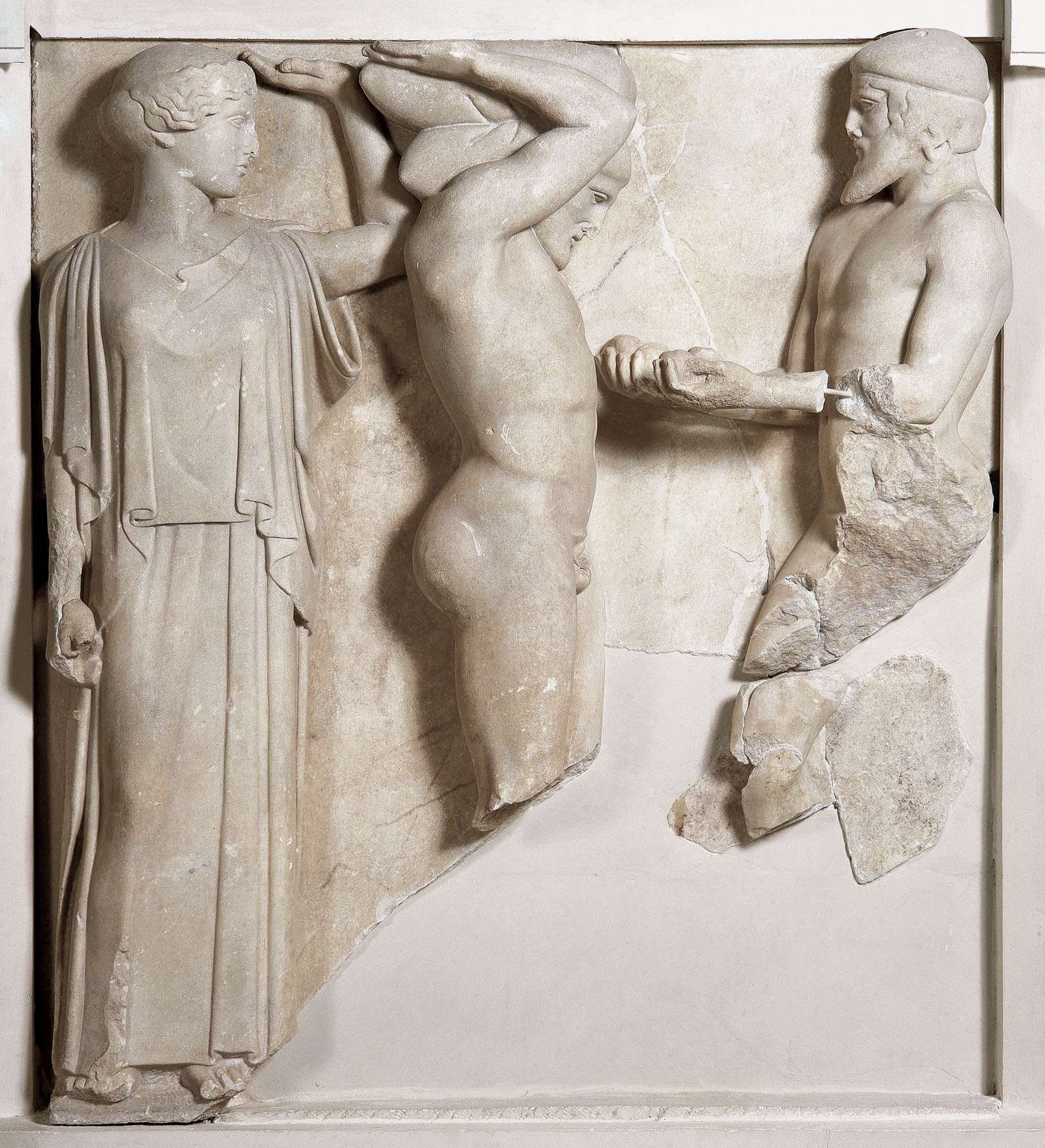
Now Prometheus had told Hercules not to go himself after the apples but to send Atlas, first relieving him of the burden of the sphere; so when he was come to Atlas in the land of the Hyperboreans, he took the advice and relieved Atlas. But when Atlas had received three apples from the Hesperides, he came to Hercules, and not wishing to support the sphere<he said that he would himself carry the apples to Eurystheus, and bade Hercules hold up the sky in his stead. Hercules promised to do so, but succeeded by craft in putting it on Atlas instead. For at the advice of Prometheus he begged Atlas to hold up the sky till he should> put a pad on his head [fig. 1]. When Atlas heard that, he laid the apples down on the ground and took the sphere from Hercules (2.5.11; see also Salapata, 2021).

Fig. 1 – A lovely Olympian Temple of Zeus metopes portraying Hercules (middle) resting the uplifted sky on his cushioned back. Athena (left) aids him in this task. Atlas (right) is shown with the golden apples (larger version). Image found on Wikipedia.

Monkey runs at great speed while bearing the weight of two mountains on his shoulders, one of which is the axis mundi of the Hindo-Buddhist cosmos and the abode of the gods. Chapter 33 of JTTW reads:

Knowing how to summon mountains, he [a demon being carried by Sun] resorted to the magic of Moving Mountains and Pouring Out Oceans. On Pilgrim’s [Monkey] back he made the magic sign with his fingers and recited a spell, sending the Sumeru Mountain into midair and causing it to descend directly on Pilgrim’s head. A little startled, the Great Sage bent his head to one side and the mountain landed on his left shoulder. Laughing, he said, “My child, what sort of press-body magic are you using to pin down old Monkey? This is all right, but a lopsided pole is rather difficult to carry.”

The demon said to himself, “One mountain can’t hold him down.” He recited a spell once more and summoned the Emei Mountain into the air. Pilgrim again turned his head and the mountain landed on his right shoulder. Look at him! Carrying two mountains, he began to give chase to his master with the speed of a meteor! The sight of him caused the old demon to perspire all over, muttering to himself, “He truly knows how to pole mountains!” (Wu & Yu, 2012, vol. 2, pp. 108-109).

6) Submission – Both are subdued with a blow by deities. Hercules is knocked out with a rock by Athena during his murderous rage. EuripidesHeracles reads:

Then in wild gallop he starts to slay his aged father; but there came a phantom [Athena], as it seemed to us on-lookers, of Pallas, with plumed helm, brandishing a spear; and she hurled a rock against the breast of Heracles, which held him from his frenzied thirst for blood and plunged him into sleep (1000-1006).

Sun is dazed by Laozi’s magic bracelet during his rebellion, allowing the primate to be captured by heaven. Chapter six of JTTW reads:

[Laozi] rolled up his sleeve and took down from his left arm an armlet, saying, “This is a weapon made of red steel, brought into existence during my preparation of elixir and fully charged with theurgical forces. It can be made to transform at will; indestructible by fire or water, it can entrap many things. It’s called the diamond cutter or the diamond snare … After saying this, Laozi hurled the snare down from the Heaven Gate; it went tumbling down into the battlefield at the Flower-Fruit Mountain and landed smack on the Monkey King’s head. The Monkey King was engaged in a bitter struggle with the Seven Sages and was completely unaware of this weapon, which had dropped from the sky and hit him on the crown of his head. No longer able to stand on his feet, he toppled over (Wu & Yu, 2012, vol. 1, p. 186).

7) Punishment – Both are given difficult tasks in order to atone for past transgressions. For killing his family, Hercules is tasked with serving King Eurystheus and completing the 12 Labors. The Bibliotheca of Pseudo-Apollodorus reads:

Now it came to pass that after the battle with the Minyans Hercules was driven mad through the jealousy of Hera and flung his own children, whom he had by Megara, and two children of Iphicles into the fire; wherefore he condemned himself to exile, and was purified by Thespius, and repairing to Delphi he inquired of the god where he should dwell. The Pythian priestess then first called him Hercules, for hitherto he was called Alcides. And she told him to dwell in Tiryns, serving Eurystheus for twelve years and to perform the ten [plus two] labours imposed on him, and so, she said, when the tasks were accomplished, he would be immortal (2.4.12; see also Hsu, 2021).

Monkey is directed to guard the Buddhist monk Tripitaka for rebelling against heaven. Chapter eight of JTTW reads:

Tathagata deceived me,” said the Great Sage, “and imprisoned me beneath this mountain. For over five hundred years already I have not been able to move. I implore the Bodhisattva to show a little mercy and rescue old Monkey!” “Your sinful karma is very deep,” said the Bodhisattva. “If I rescue you, I fear that you will again perpetrate violence, and that will be bad indeed.” “Now I know the meaning of penitence,” said the Great Sage. “So I entreat the Great Compassion to show me the proper path, for I am willing to practice cultivation.”

[…]

“If you have such a purpose, wait until I reach the Great Tang Nation in the Land of the East [China] and find the scripture pilgrim. He will be told to come and rescue you, and you can follow him as a disciple. You shall keep the teachings and hold the rosary to enter our gate of Buddha, so that you may again cultivate the fruits of righteousness. Will you do that?” ”I’m willing, I’m willing,” said the Great Sage repeatedly (Wu & Yu, 2012, vol. 1, p. 215).

8) Heavenly aid – Both are aided by goddesses. Hercules is helped by Athena. For example, Homer‘s Illiad reads”

[B]ut my [Athena] father Zeus is mad with spleen, ever foiling me, ever headstrong and unjust. He forgets how often I saved his son [Hercules] when he was worn out by the labors Eurystheus had laid on him. He would weep till his cry came up to heaven, and then Zeus would send me down to help him; if I had had the sense to foresee all this, when Eurystheus sent him to the house of Hades, to fetch the hell-hound from Erebos, he would never have come back alive out of the deep waters of the river Styx (8.366; See also Deacy, 2021).

Sun is helped by the Bodhisattva Guanyin. For example, the goddess tells him the following in chapter 15 of JTTW:

If on your journey you should come across any danger that threatens your life, I give you permission to call on Heaven, and Heaven will respond; to call on Earth, and Earth will prove efficacious. In the event of extreme difficulty, I myself will come to rescue you. Come closer, and I shall endow you with one more means of power.” Plucking three leaves from her willow branch, the Bodhisattva placed them at the back of Pilgrim’s head, crying, “Change!” They changed at once into three hairs with lifesaving power. She said to him: “When you find yourself in a helpless and hopeless situation, you may use these according to your needs, and they will deliver you from your particular affliction.” After Pilgrim had heard all these kind words, he thanked the Bodhisattva of Great Mercy and Compassion. With scented wind and colored mists swirling around her, the Bodhisattva returned to Potalaka (Wu & Yu, 2012, pp. 328-329).

9) Enemies – Both face similar enemies: A) supernatural lions (Nemean Lion vs Lion demon); B) opponents that regrow their heads once severed but are eventually defeated with fire (Lernaean Hydra vs Bull Demon King); C) supernatural deer (Ceryneian Hind vs Great Immortal Deer Strength); D) supernatural boars (Erymanthian Boar vs Zhu Bajie); E) supernatural birds (Stymphalian birds vs Great Peng of 10,000 Cloudy Miles); and F) supernatural bulls (Cretan Bull vs Bull Demon King).

10) Horses – Both tame supernatural horses. Hercules tames the man-eating Mares of Diomedes. The Bibliotheca Historica of Diodorus reads:

The next Labour which Heracles undertook was the bringing back of the horses of Diomedes, the Thracian. The feeding-troughs of those horses were of brass because the steeds were so savage, and they were fastened by iron chains because of their strength, and the food they ate was not the natural produce of the soil but they tore apart the limbs of strangers and so got their food from the ill lot of hapless men. Heracles, in order to control them, threw to them their master Diomedes, and when he had satisfied the hunger of the animals by means of the flesh of the man who had taught them to violate human law in this fashion, he had them under his control (4.15.3; see also Ogden, 2021b).

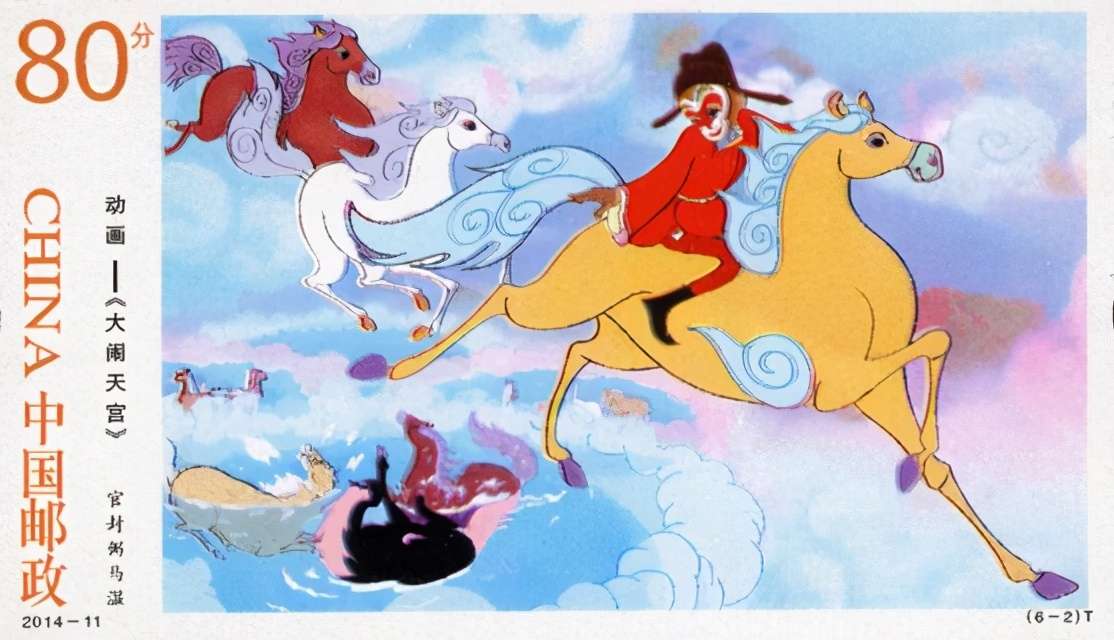
Monkey serves as the Keeper of the Heavenly Horses (fig. 2). Chapter four of JTTW reads:

Never resting, the [Sun] oversaw the care of the horses, fussing with them by day and watching over them diligently by night. Those horses that wanted to sleep were stirred up and fed; those that wanted to gallop were caught and placed in the stalls. When the celestial horses saw him, they all behaved most properly and they were so well cared for that their flanks became swollen with fat (Wu & Yu, 2012, vol. 1, p. 149).

Fig. 2 – A 2014 stamp featuring a scene from the classic 1960s animation Havoc in Heaven in which Sun Wukong serves as the keeper of the heavenly horses (larger version). Image found here.

11) Women lands – Both visit locations peopled entirely by women. Hercules visits the Amazons to get the heavenly war belt (zoster) of their Queen Hippolyte. The Bibliotheca of Pseudo-Apollodorus reads:

The ninth labour he [Eurystheus] enjoined on Hercules was to bring the belt of Hippolyte. She was queen of the Amazons, who dwelt about the river Thermodon, a people great in war; for they cultivated the manly virtues, and if ever they gave birth to children through intercourse with the other sex, they reared the females; and they pinched off the right breasts that they might not be trammelled by them in throwing the javelin, but they kept the left breasts, that they might suckle. Now Hippolyte had the belt of Ares in token of her superiority to all the rest. Hercules was sent to fetch this belt because Admete, daughter of Eurystheus, desired to get it. So taking with him a band of volunteer comrades in a single ship he set sail …

[After taking part in a small war elsewhere, Hercules finally arrived at his destination]

… Having put in at the harbor of Themiscyra, he received a visit from Hippolyte, who inquired why he was come, and promised to give him the belt. But Hera in the likeness of an Amazon went up and down the multitude saying that the strangers who had arrived were carrying off the queen. So the Amazons in arms charged on horseback down on the ship. But when Hercules saw them in arms, he suspected treachery, and killing Hippolyte stripped her of her belt. And after fighting the rest he sailed away and touched at Troy (2.5.9; see also Mayor, 2021).

Monkey and the other pilgrims travel through the “Woman Kingdom of Western Liang” (Xiliang nuguo, 西梁女國) in chapter 53 on their way to India (both Tripitaka and Zhu Bajie become pregnant from drinking magic water while there). In chapter 54, the group enters the capital in order to have their travel rescript signed by the queen, but she has other plans for the head monk:

The queen said, “This man from the Land of the East [China] is a royal brother of the Tang court. In our country, the rulers of various generations since the time when chaos divided had never seen a man come here. Now the royal brother of the Tang emperor has arrived, and he must be a gift from Heaven. We will use the wealth of an entire nation to ask this royal brother to be king; we are willing to be his queen. Such a sexual union will produce children and grandchildren, and the perpetuity of our kingdom will be assured (Wu & Yu, 2012, vol. 3, p. 49).

Sun helps arrange the marriage with the veiled purpose of ensuring that their travel rescript is signed (Wu & Yu, 2012, vol. 3, pp. 52-53).

12) Theft of fruit – Both steal supernatural fruit from the gardens of queenly goddesses. Hercules (in one version of the myth) steals Queen Hera‘s Golden Apples of the Hesperides. The Bibliotheca of Pseudo-Apollodorus reads:

But some say that he did not get them from Atlas, but that he plucked the apples himself after killing the guardian snake. And having brought the apples he gave them to Eurystheus. But he, on receiving them, bestowed them on Hercules, from whom Athena got them and conveyed them back again; for it was not lawful that they should be laid down anywhere (2.5.11; see also Salapata, 2021).

Monkey steals the Queen Mother’s immortal peaches. Chapter five of JTTW reads:

One day he saw that more than half of the peaches on the branches of the older trees had ripened, and he wanted very much to eat one and sample its novel taste. Closely followed, however, by the local spirit of the garden, the stewards, and the divine attendants of the Equal to Heaven Residence, he found it inconvenient to do so. He therefore devised a plan on the spur of the moment and said to them, “Why don’t you all wait for me outside and let me rest a while in this arbor?” The various immortals withdrew accordingly. That Monkey King then took off his cap and robe and climbed up onto a big tree. He selected the large peaches that were thoroughly ripened and, plucking many of them, ate to his heart’s content right on the branches. Only after he had his fill did he jump down from the tree. Pinning back his cap and donning his robe, he called for his train of followers to return to the residence. After two or three days, he used the same device to steal peaches to gratify himself once again (Wu & Yu, 2012, vol. 1, p. 162).

13) Underworld – Both travel to the land of the dead. Hercules goes to Hades to acquire Cerberus. The Bibliotheca of Pseudo-Apollodorus reads:

A twelfth labour imposed on Hercules was to bring Cerberus from Hades. Now this Cerberus had three heads of dogs, the tail of a dragon, and on his back the heads of all sorts of snakes. When Hercules was about to depart to fetch him, he went to Eumolpus at Eleusis, wishing to be initiated … [He sought ritual purification for his past misdeeds] … And having come to Taenarum in Laconia, where is the mouth of the descent to Hades, he descended through it … [He fended off the empty attacks of shades, rescued Theseus, sated the various ghosts with blood, and won a wrestling match against Menoetes] …When Hercules asked Pluto for Cerberus, Pluto ordered him to take the animal provided he mastered him without the use of the weapons which he carried. Hercules found him at the gates of Acheron, and, cased in his cuirass and covered by the lion’s skin, he flung his arms round the head of the brute, and though the dragon in its tail bit him, he never relaxed his grip and pressure till it yielded. So he carried it off and ascended through Troezen … [A]nd Hercules, after showing Cerberus to Eurystheus, carried him back to Hades (2.5.12; see also Hanesworth, 2021).

Sun travels to the Land of Darkness at least twice. For instance, in chapter 97, he goes to the underworld to retrieve the spirit of a recently deceased benefactor:

With a series of cloud somersaults, that Great Sage went to the Region Below and crashed right into the Hall of Darkness … Pilgrim said, “Which one of you took away the soul of Kou Hong, the person who fed the monks in the Numinous Earth District of the Bronze Estrade Prefecture? Find out instantly and bring him to me.”

[…]

[After being led out] Kou Hong, who, on seeing Pilgrim, cried out, “Master! Master! Save me!” “You were kicked to death by a robber,” said Pilgrim. “This is the place of the Bodhisattva King Kṣitigarbha in the Region of Darkness. Old Monkey has come especially to take you back to the world of light so that you may give your testimony. The Bodhisattva is kind enough to release you and lengthen your age for another dozen years. Thereafter you’ll return here.” The squire bowed again and again.

Having thanked the Bodhisattva, Pilgrim changed the soul of the squire into ether by blowing on him. The ether was stored in his sleeve so that they could leave the house of darkness and go back to the world of light together. Astride the clouds, he soon arrived at the Kou house (Wu & Yu, 2012, vol. 4, pp. 338-339).

14) Heavenly war – Both take part in battles with heaven but on opposing sides. Hercules fights alongside the Olympian gods during the Gigantomachy. The Bibliotheca of Pseudo-Apollodorus reads:

But Earth, vexed on account of the Titans, brought forth the giants, whom she had by Sky. These were matchless in the bulk of their bodies and invincible in their might; terrible of aspect did they appear, with long locks drooping from their head and chin, and with the scales of dragons for feet. They were born, as some say, in Phlegrae, but according to others in Pallene. And they darted rocks and burning oaks at the sky. Surpassing all the rest were Porphyrion and Alcyoneus, who was even immortal so long as he fought in the land of his birth. He also drove away the cows of the Sun from Erythia. Now the gods had an oracle that none of the giants could perish at the hand of gods, but that with the help of a mortal they would be made an end of. Learning of this, Earth sought for a simple to prevent the giants from being destroyed even by a mortal. But Zeus forbade the Dawn and the Moon and the Sun to shine, and then, before anybody else could get it, he culled the simple himself, and by means of Athena summoned Hercules to his help. Hercules first shot Alcyoneus with an arrow, but when the giant fell on the ground he somewhat revived. However, at Athena’s advice Hercules dragged him outside Pallene, and so the giant died (1.6.1; see also Salowey, 2021).

Monkey fights against the Buddho-Daoist gods a few times. For instance, chapter four of JTTW reads:

Each displaying his divine powers, the Third Prince [Nezha] and Wukong battled for thirty rounds. The six weapons of that prince changed into a thousand and ten thousand pieces; the golden-hooped rod of Sun Wukong into ten thousand and a thousand. They clashed like raindrops and meteors in the air, but victory or defeat was not yet determined. Wukong, however, proved to be the one swifter of eye and hand. Right in the midst of the confusion, he plucked a piece of hair and shouted, “Change!” It changed into a copy of him, also wielding a rod in its hands and deceiving [Nezha]. His real person leaped behind Nata and struck his left shoulder with the rod. [Nezha], still performing his magic, heard the rod whizzing through the air and tried desperately to dodge it. Unable to move quickly enough, he took the blow and fled in pain. Breaking off his magic and gathering up his six weapons, he returned to his camp in defeat (Wu & Yu, 2012, vol. 1, p. 156).

15) Godhood – Both become deities at the end of their respective story cycles. Hercules joins the gods of Olympus after death. Reasons given for this apotheosis include his his 12 Labors, his Gigantomachy deeds, or simply his virtus (Romero-Gonzalez, 2021, p. 275). One account from the Bibliotheca Historica of Diodorus reads:

… Heracles, having abandoned hope for himself [due to exposure to hydra venom], ascended the pyre and asked each one who came up to him too put torch to the pyre. And when no one had courage to obey him Philoctetes alone was prevailed upon; and he, having received in return for his compliance the gift of the bow and arrows of Heracles, lighted the pyre. And immediately lightning also fell from the heavens and the pyre was wholly consumed.

After this, when the companions of Iolaus came to gather up the bones of Heracles and found not a single bone anywhere, they assumed that, in accordance with the words of the oracle, he had passed from among men into the company of the gods.

[Description of the kinds of sacrifices that the various Greek states made to Heracles as a hero and god following his death/ascension]

We should add to what has been said about Heracles, that after his apotheosis Zeus persuaded Hera to adopt him as her son and henceforth for all time to cherish him with a mother’s love, and this adoption, they say, took place in the following manner. Hera lay upon a bed, and drawing Heracles close to her body then let him fall through her garments to the ground, imitating in this way the actual birth; and this ceremony is observed to this day by the barbarians whenever they wish to adopt a son. Hera, the myths relate, after she had adopted Heracles in this fashion, joined him in marriage to Hebe (4.38.4-4.392; see also Romero-Gonzalez, 2021).

Sun is elevated to Buddhahood at the journey’s end. The Buddha says the following to Monkey in chapter 100 of JTTW:

“Sun Wukong, when you caused great disturbance at the Celestial Palace, I had to exercise enormous dharma power to have you pressed beneath the Mountain of Five Phases. Fortunately your Heaven-sent calamity came to an end, and you embraced the Buddhist religion. I am pleased even more by the fact that you were devoted to the scourging of evil and the exaltation of good. Throughout your journey you made great merit by smelting the demons and defeating the fiends. For being faithful in the end as you were in the beginning, I hereby give you the grand promotion and appoint you the Buddha Victorious in Strife [Dou zhansheng fo, 鬥戰勝佛] (Wu & Yu, 2012, p. 381).

16) Worship – Both are (were) worshiped. Hercules was worshiped by the ancient Greeks and Romans, while Sun is worshiped as the “Great Sage Equaling Heaven” in modern Chinese folk religion. It’s interesting to note that both deities are are believed to ward off evil.

II. Possible antecedents 

Scholars have previously noted how Hercules shares parallels with godly heroes of the ancient Near East. For example, here is one of two figures listed by Ogden (2021a):

Ninurta/Ningirsu, in the Akkadian epics Anzu and The Return of Ninurta to Nippur (both originally second millennium BC). He is the son of the storm-god and ruler of the gods, Enlil (cf. Zeus); he wears a lion-skin, carries a club and a bow (cf. Heracles’ equipment); he fights eleven or twelve monsters (cf. the Labors); after defeating them he brings them back to his city as trophies (cf. the demands of Eurystheus); and the beasts in question include a seven-headed serpent (cf. the Hydra), a wild bull (cf. the Cretan Bull), a stag (cf. the Cerynean Hind), the Anzubird (cf. the Stymphalian Birds), and a lion (cf. the Nemean Lion) (pp. xxiv-xxv).

Perhaps the Indic practices that would come to influence the Monkey King’s iconography were also influenced by the same ancient Indo-European sources.


Update: 09-27-25

I just thought of another parallel: both figures have doubles!

17. Doubles – Both have someone who looks exactly like them. Heracles’ double is his twin (half) brother Iphicles (Ἰφικλῆς). The Bibliotheca of Pseudo-Apollodorus reads:

But before Amphitryon reached Thebes, Zeus came by night and prolonging the one night threefold he assumed the likeness of Amphitryon and bedded with Alcmena and related what had happened concerning the Teleboans. But when Amphitryon arrived and saw that he was not welcomed by his wife, he inquired the cause; and when she told him that he had come the night before and slept with her, he learned from Tiresias how Zeus had enjoyed her. And Alcmena bore two sons, to wit, Hercules, whom she had by Zeus and who was the elder by one night, and Iphicles, whom she had by Amphitryon. When the child was eight months old, Hera desired the destruction of the babe and sent two huge serpents to the bed. Alcmena called Amphitryon to her help, but Hercules arose and killed the serpents by strangling them with both his hands. However, Pherecydes says that it was Amphitryon who put the serpents in the bed, because he would know which of the two children was his, and that when Iphicles fled, and Hercules stood his ground, he knew that Iphicles was begotten of his body (2.4.8; see also Pache, 2021).

Monkey’s double is the Six-Eared Macaque (Liu’er mihou, 六耳獼猴), who appears in JTTW chapters 56 to 58. Chapter 58 describes him as Wukong’s mirror image:

His looks were exactly the same as those of the Great Sage: he, too, had a golden headband clamped to his blond hair, a pair of fiery eyes with golden irises, a monk’s robe on his body, a tiger kilt tied around his waist, a gold-banded iron staff in one of his hands, and a pair of deerskin boots on his feet. He, too, had

A hairy face with the Thunder Lord’s beak, [2]
Empty cheeks unlike those of Saturn; 
[3]
Two forked ears on a big, broad head,
And fangs that have grown outward 
(based on Wu & Yu, 2012, vol. 3, p. 104).

See my previous article about Six Ears for more info.


Update: 10-04-25

And another: they attack enemies from within.

18. Attack from within – Both are known for assaulting bad guys from inside their bodies. I, unfortunately, can’t find an English translation of the original fifth century BCE source for Heracles’ feat (due to its fragmentary nature), but Wickkiser (2021) provides a brief description: “Hellanicus, unlike Homer, provides details about how Heracles attacks the [sea creature] kētos: he climbs inside its mouth and enters its belly, where he ‘destroyed its flanks,’ cutting them from within” (p. 212). Also, Alexandra by Lycophron (3rd century BCE) gives the following account:

Alas! hapless nurse of mine burnt even aforetime by the warlike pineships of the lion that was begotten in three evenings [i.e. Heracles], whom of old Triton’s hound [i.e. kētos] of jagged teeth devoured with his jaws. But he, a living carver of the monster’s liver, seething in steam of cauldron on a flameless hearth, shed to ground the bristles of his head (source).

Attacking baddies from within is one of Monkey’s favorite methods. He successfully performs this in chapters 59, 66, 67, and 75 (Wu & Yu, 2012, vol. 3, pp. 129, 238, 249, and 380). Wukong attempts this twice in chapter 82, but only one is successful (Wu & Yu, 2012, vol. 4, pp. 104 and 110-111). Here’s an example from chapter 59:

“I’m now having a little fun in my esteemed Sister-in-law’s stomach! I am, as the saying goes, seeing right through you! I know how thirsty you must be, so let me send you a ‘sitting bowl’ to relieve your thirst.” Suddenly he shoved his foot down hard and unbearable pain shot through Rākṣasī‘s lower abdomen, sending her tumbling to the floor and moaning. “Please don’t refuse me, Sister-in-law,” said Pilgrim, “I’m presenting you with an added snack for your hunger.” He jerked his head upward, and unbearable pain coursed through Rākṣasī’s heart. She began to roll all over the ground, the pain turning her face yellow and her lips white. All she could do was to cry out, “Brother-in-law Sun, please spare my life!” (Wu & Yu, 2012, vol. 3, p. 129).

On a related note, I have posted an article that proposes a more natural reason for the two heroes to fight each other.

Story Idea: Sun Wukong vs Heracles / Hercules


Update: 10-17-25

And another: they have similar hair/fur color.

19. Hair/fur color: Both have light-colored hair/fur. EuripidesMadness of Heracles reads:

In Zeus’ glen first, in the Lion’s lair,
He [Heracles] fought, and the terror was no more there;
But the tawny beast’s grim jaws were veiling
His golden head, and behind swept, trailing
Over his shoulders, its fell of hair (source).

I again quote Chapter 58’s description of Monkey’s doppleganger:

His looks were exactly the same as those of the Great Sage: he, too, had a golden headband clamped to his blond hair, a pair of fiery eyes with golden irises, a monk’s robe on his body, a tiger kilt tied around his waist, a gold-banded iron staff in one of his hands, and a pair of deerskin boots on his feet. He, too, had

A hairy face with the Thunder Lord’s beak, 
Empty cheeks unlike those of Saturn; 

Two forked ears on a big, broad head,
And fangs that have grown outward 
(based on Wu & Yu, 2012, vol. 3, p. 104).

The original Chinese says the hair of Wukong and his double is huang (), or “yellow.” Macaque monkeys, like our hero, tend to have sandy blonde to light brown and even reddish fur (depending on the area of their body).


Update: 10-25-25

And another: Dress as women

20. Feminine disguises – Both disguise themselves as women in order to hide their true identities. Plutarch’s Greek Questions reads:

Heracles, putting out with his six ships from Troy, encountered a storm ; and when his other ships had been destroyed, with the only one remaining he was driven by the gale to Cos. He was cast ashore upon the Laceter, as the place is called, with nothing salvaged save his arms and his men. Now he happened upon some sheep and asked for one ram from the shepherd. This man, whose name was Antagoras, was in the prime of bodily strength, and bade Heracles wrestle with him ; if Heracles could throw him, he might carry off the ram. And when Heracles grappled with him, the Meropes came to the aid of Antagoras, and the Greeks to help Heracles, and they were soon engaged in a mighty battle. In the struggle it is said that Heracles, being exhausted by the multitude of his adversaries, fled to the house of a Thracian woman ; there, disguising himself in feminine garb, he managed to escape detection (section 58; Matyszak, 2015, p. 123).

This story is only mentioned by Plutarch, however. Older writers don’t reference this defeat.

I think the most famous instance of Wukong taking on a feminine appearance happens in chapter 18, when he transforms into Zhu Bajie’s beleaguered wife:

Pilgrim said. “Old Man! Take your beloved daughter to the building in front, and then you can spend all the time you want with her. Old Monkey will be here waiting for him; if the monster doesn’t show up, don’t blame me. But if he comes at all, I’ll pull out the weeds of your troubles by the roots!” With great joy, old Mr. Gao led his daughter to the front building. Exercising his magic might, Pilgrim shook his body and changed at once into the form of that girl, sitting all by herself to wait for the monster (Wu & Yu, 2012, vol. 1, p. 374).

He goes on to act like a dissatisfied spouse, complaining that her family doesn’t know anything about Zhu’s family (i.e. his background) in order to learn more about him (Wu & Yu, 2012, vol. 1, p. 376).


Update: 01-10-26

Another deals more with their literary origins:

21. Compiled adventures – The stories of both heroes have been gathered from disparate sources. For Hercules, Grollios (1984) explains:

It is very fortunate that we possess today the work of a number of authors who undertook the difficult task of compiling and syncretizing the loose mass of myths that centred around Herakles in antiquity. They were called mythographoi and one of the most important among them was Pherekydes, a 5th century B.C. scholar from Athens, whose work survives only in fragments and references. Fortunately enough, another compiler called Apollodorus, who lived in Athens during the 1st century B.C., appears to have followed the work of Pherekydes quite closely in his own work, the Bibliotheke, which is today one of the most reliable sources (if not the most reliable) for the study of the myths about Herakles. There existed many other compilers, like Diodorus Siculus, Konon, Athenaeus, to mention just a few, who devoted part or the whole of their work to the preservation of myths, among which a large part was covered by myths concerning Herakles. It is mainly through their copious and scholastic collections that we are able today to possess a significant amount of information about the life and deeds of Herakles (p. XXVI).

The piecemeal origins of Sun Wukong’s adventures are discussed in this book:

Archive #33 – The Hsi-yu chi: A Study of Antecedents to the Sixteenth-Century Chinese Novel (1970)

Note:

1) Yu (Wu & Yu, 2012) uses “pounds” instead of the original jin (斤, a.k.a. catty) (vol. 1, p. 135). During the Ming dynasty when the novel was compiled, one jin equaled approximately 590 grams (Jiang, 2005, p. xxxi). I will therefore alter Yu’s translation to reflect more accurate measures.

2) This is comparing a monkey’s prognathic face with the beak of the Chinese thunder god, who is commonly portrayed as a bird man.

3) Saturn (Tuxing, 土星; lit: “Earth Star”) is mentioned here because the stellar deity is known for having a thickly-bearded face (see figure one on this article). The reference is saying that Sun Wukong’s sunken cheeks are hairless.

Sources:

Deacy, S. (2021). Heracles between Hera and Athena. In D. Ogden (Ed.), The Oxford Handbook of Heracles (pp. 387-394). United Kingdom: Oxford University Press.

Grollios, A. D. (1984). The Myths of Herakles as a Fighter (Publication No. 10867846) [Masters thesis, University of Glasgow]. ProQuest Dissertations & Theses Global.

Hanesworth, P. (2021). Labor XII: Cerberus. In D. Ogden (Ed.), The Oxford Handbook of Heracles (pp. 165-180). United Kingdom: Oxford University Press.

Hesiod, & Powell, B. B. (2017). The Poems of Hesiod: Theogony, Works and Days, and The Shield of Herakles. United States: University of California Press.

Hinsch, B. (2011). Women in Early Imperial China. Lanham, Md: Rowman & Littlefield Publishers.

Hsu, K. L. (2021). The Madness and the Labors. In D. Ogden (Ed.), The Oxford Handbook of Heracles (pp. 13-25). United Kingdom: Oxford University Press.

Jiang, Y. (2005). The Great Ming Code / Da Ming Lu. Vancouver, Wa: University of Washington Press.

March, J. (2021). Labor I: The Nemean Lion. In D. Ogden (Ed.), The Oxford Handbook of Heracles (pp. 29-44). United Kingdom: Oxford University Press.

Matyszak, P. (2015). Hercules: The First Superhero (An Unauthorized Biography). Canada: Monashee Mountain Publishing.

Mayor, A. (2021). The Girdle of the Amazon Hippolyte. In D. Ogden (Ed.), The Oxford Handbook of Heracles (pp. 124-134). United Kingdom: Oxford University Press.

Ogden, D. (2021a). Introduction. In D. Ogden (Ed.), The Oxford Handbook of Heracles (pp. xxi-xxxi). United Kingdom: Oxford University Press.

Ogden, D. (2021b). Labor VIII: The Mares of Diomede (and Alcestis). In D. Ogden (Ed.), The Oxford Handbook of Heracles (pp. 113-123). United Kingdom: Oxford University Press.

Pache, C. (2021). Birth and Childhood. In D. Ogden (Ed.), The Oxford Handbook of Heracles (pp. 3-12). United Kingdom: Oxford University Press.

Romero-Gonzalez, D. (2021). Deianeira, Death, and Apotheosis. In D. Ogden (Ed.), The Oxford Handbook of Heracles (pp. 266-280). United Kingdom: Oxford University Press.

Salapata, G. (2021). Labor XI: The Apples of Hesperides. In D. Ogden (Ed.), The Oxford Handbook of Heracles (pp. 149-164). United Kingdom: Oxford University Press.

Salowey, C. (2021). The Gigantomachy. In D. Ogden (Ed.), The Oxford Handbook of Heracles (pp. 235-250). United Kingdom: Oxford University Press.

Theocritus, & Gow A. S. F. (1952). Theocritus (Vols. 1-2). Kiribati: Cambridge University Press.

Wickkiser, B. (2021). Laomedon, Hesione, and The Sea-Monster. In D. Ogden (Ed.), The Oxford Handbook of Heracles (pp. 209-223). United Kingdom: Oxford University Press.

Wu, C., & Yu, A. C. (2012). The Journey to the West (Vols. 1-4) (Rev. ed.). Chicago, Illinois: University of Chicago Press.

Buddhist Deities Exiled From the Western Heaven in Chinese Vernacular Literature

Last updated: 1-25-2025

Anyone who has read Journey to the West (Xiyouji西遊記, 1592) will know that the Tang monk Tripitaka (Tang Sanzang, 唐三藏; a.k.a. Xuanzang) is said to be an incarnation of Master Golden Cicada (Jinchan zi, 金蟬子), the Buddha’s second disciple. The full picture of his past can be pieced together from verse and character dialogue throughout the narrative. This culminates with the Tathagata‘s explanation in chapter 100:

Because you failed to listen to my exposition of the law and slighted my great teaching, your true spirit was banished to find another incarnation in the Land of the East [i.e. China]. Happily you submitted and, by remaining faithful to our teaching, succeeded in acquiring the true scriptures (Wu & Yu, 2012, vol. 4, p. 381).

因為汝不聽說法,輕慢我之大教,故貶汝之真靈,轉生東土。今喜皈依,秉我迦持,又乘吾教,取去真經 …

In the course of my research, I’ve come across two other examples of Buddhist deities from Ming-Qing Chinese vernacular literature that are exiled from the Western Heaven. In this article, I would like to highlight these stories, as well as analyze them alongside Master Golden Cicada’s tale to record parallels. It’s important to note that all examples are connected to the Journey to the West story cycle. Finally, I will show that the presented examples share similarities with Greek philosophy.

I wrote this to better understand how the story of Master Golden Cicada’s exile may have come about.

1. Master Golden Cicada

For the record, the fullest account of Tripitaka’s past is described by Sun Wukong in chapter 81:

“You don’t realize that Master was the second disciple of our Buddha Tathagata, and originally he was called Elder Gold Cicada. Because he slighted the Law, he was fated to experience this great ordeal.”

“Elder Brother,” said Eight Rules, “even if Master did slight the Law, he had already been banished back to the Land of the East where he took on human form in the field of slander and the sea of strife. After he made his vow to worship Buddha and seek scriptures in the Western Heaven, he was bound whenever he ran into monster-spirits and he was hung high whenever he met up with demons. Hasn’t he suffered enough? “Why must he endure sickness as well?”

“You wouldn’t know about this,” replied Pilgrim. “Our old master fell asleep while listening to Buddha expounding the Law [fig. 1]. As he slumped to one side, his left foot kicked down one grain of rice. That is why he is fated to suffer three days’ illness after he has arrived at the Region Below.” [1]

Horrified, Eight Rules said, “The way old Hog sprays and splatters things all over when he eats, I wonder how many years of illness I’d have to go through!”

“Brother,” said Pilgrim, “you have no idea either that the Buddha is not that concerned with you and other creatures. But as people say:

Rice stalks planted in noonday sun
Take root as perspiration runs.
Who knows of this food from the soil
Each grain requires most bitter toil?

Master still has one more day to go, but he’ll be better by tomorrow” (Wu & Yu, 2012, vol. 4, p. 82).

你不知道。師父是我佛如來第二個徒弟,原叫做金蟬長老,只因他輕慢佛法,該有這場大難。」八戒道:「哥啊,師父既是輕慢佛法,貶回東土,在是非海內,口舌場中,託化做人身,發願往西天拜佛求經,遇妖精就捆,逢魔頭就吊,受諸苦惱,也夠了,怎麼又叫他害病?」行者道:「你那裡曉得。老師父不曾聽佛講法,打了一個盹,往下一試,左腳屣了一粒米,下界來,該有這三日病。」八戒驚道:「像老豬吃東西潑潑撒撒的,也不知害多少年代病是。」行者道:「兄弟,佛不與你眾生為念,你又不知。人云:『鋤禾日當午,汗滴禾下土。誰知盤中餐,粒粒皆辛苦。』師父只今日一日,明日就好了。」

Fig. 1 – Master Golden Cicada falls asleep during the Buddha’s sermon (larger version). Screenshot from episode one of the 1996 Journey to the West TV show.

2. Miao Jixiang

Miao Jixiang (妙吉祥) is a former oil lamp-turned-humanoid Buddhist disciple who briefly appears in chapter one of Journey to the South (Nanyouji南遊記, c. 1570s-1580s). He is exiled from the Western Heaven for using his holy flame to kill a belligerent sage. But Miao escapes underworld punishment thanks to the intervention of the Bodhisattva Guanyin. He is later reborn in China as a number of figures, most famously the popular martial deity Huaguang dadi (華光大帝; variously translated as “Great Emperor of Flowery/Resplendent/Magnificent/Majestic Light”):

That Great King of the Single Flame [Duhuo dawang, 独火大王] … wanted to incinerate Spirit Mountain. Fortunately, the Tathagata foresaw this with his all-seeing eyes, and so he recited a mantra, summoning five hundred dragons that brought forth dew and fog to cover the mountain.

Unable to unleash his fire, this Single-Flame demon became angry, rampaging to the left and right of the temple and hurling insults.

Miao Jixiang [2] offered a word of advice, “You are not the same caliber of wisdom as we Buddhist disciples. You can leave if you want; it makes no difference.”

“If you enrage my heart-mind, I will burn your dog bones to death!” replied the Great King of the Single Flame.

Miao Jixiang laughed, “You can only burn others. You can never burn me. If you can burn me, I will acknowledge you as superior.”

Anger racing through him, the Great King set loose his Fire of the Five Dippers, but Miao Jixiang remained perfectly still.

He laughed, “You monster, how could your fire burn me? I used to be the oil lamp before the Tathagata’s Dharma Hall, burning brilliantly day and night, listening to the sutras, and inquiring about the Dharma. I have accumulated many candle wicks during this time. But one day, Tathagata recited a spell and bestowed onto me a human body. With my appearance, spirit, hearing, and origins all arising from fire, how could you burn me? You monster, if you continue to harass our Spirit Mountain and cause us unease, I will inevitably bring forth my Perfected Fire of Samadhi to burn you monster to death, so as to avoid any future troubles.”

Watching this with his all-seeing eyes, the Tathagata was about to stop Miao Jixiang, but the latter had already unleashed his fire and burned that damnable Single Flame to death [fig. 2].

Furious, the Tathagata summoned heavenly generals to arrest Miao Jixiang, “You beast, how dare you break my precepts?” Tathagata scolded, “Although he is wrong, you and I are Buddhists (chujia zhi ren, 出家之人, lit: “people who have left their families”); we’re supposed to be infinitely merciful. Why did you burn him to death? Such an act is intolerable by the Buddhist Dharma. I shall banish you to the underworld (yinshan, 陰山; lit: “mountain of yin/darkness”) to suffer.”

Miao Jixiang begged for forgiveness.

The Reverend Mother Guanyin came forward from one said to defend him by saying, “Although he is guilty, Miao Jixiang is a disciple of Spirit Mountain. He should not be banished to the underworld. When he was still alive, the Great King of Horse-Ear Mountain approached our Spirit Mountain to pray for a son. Now that his wife is pregnant, why not send Miao Jixiang to be reincarnated as her son? After Miao Jixiang goes through this catastrophe, he shall be allowed to return to Spirit Mountain and serve the Master. Why not do this?”

Nodding, Tathagata was about to send Miao Jixiang away.

“My master, you order me to reincarnate,” Miao Jixiang said in tears, “but if I am deprived of the Divine Way, I am afraid that I will be bullied.”

Sitting atop his treasured throne, Tathagata recited a spell, “I shall now bestow you with the five supernatural powers: the heaven power, with which you can travel freely to heaven; the earth power, with which the earth will crack by itself if you want to get inside; the wind power, with which you are shadowless in the wind; the water power, with which you can travel without any obstacle in water; the fire power, with which you feel ease in the fire.”

Tathagata pointed his dharma finger at Miao Jixiang’s forehead, saying, “I will also bestow you with a heavenly eye, with which you can see all across the three realms.”

Tathagata ordered the Reverend Mother Guanyin to deliver Miao Jixiang to his reincarnation (adapted from pp. 10-11 of this PDF).

那大王 … 即要放火烧灵山。幸如来慧眼一见,便念动咒语,放出五百条逆龙,涌起露雾罩住灵山,此火便不能发。独火鬼见火不发,十分著恼,于寺中左冲右撞,出言不逊,妙吉祥进言曰:「我们佛家弟子,亦不比你见识,你可去也罢。」独火大王曰:「恼得我心一边来,把你这狗骨头亦将来烧死。」妙吉祥笑曰:「你的火只好烧别人,烧得我不成;你若烧得我,便见你高。」大王怒起,就放出五斗火,便烧吉祥,吉祥端然不动。笑曰:「你这妖怪,你那火如何烧得我?我乃如来法堂前一盏油灯,昼夜煌煌,听经问法,灯花堆积,一日如来念咒,咒成人身。我这火之相,火之灵,火之听,火之起,你焉能烧我?你这妖怪,今你若再在整日闹我灵山,不得自在,我不免请出三昧真火,烧死你这妖怪,免致后患。」如来慧眼看见,便叫不可之时,独火鬼已被他烧死在地。如来大怒,喝声叫将妙吉祥拿下,责曰:「你这畜生如何敢破我戒?他虽不是,我你俱出家之人,当大慈大悲终是,为何将他烧死?佛法难容,贬去阴山受罪。」吉祥告饶。观音老母在旁保曰:「妙吉祥虽然有罪,乃灵山弟子,不可贬去阴山。当日马耳山大王在日之时,来我灵山祈嗣。今日那娘娘有孕有身,不如送去投胎,等他大难满日,取回灵山,伏侍师父,何不可也。」如来依言,便欲送去。吉祥流泪告曰:「师父命我投胎,奈我不晓神道,恐后被人欺负。」如来于宝座中,念动咒语,说:「我就赐你五通:你一通天,天中自行;二通地,地赶自裂;三通风,风中无影;四通水,水中无碍;五通火,火里自在。」又用法手一指顶门:「赐你一个天眼挪门,可见三界。」就叫观音老母送去投胎。

Fig. 2 – Miao Jixiang kills the Great King of the Single Flame (larger version). From a modern lianhuanhua comic. Image found here

3. The Great Peng

The Complete Vernacular Biography of Yue Fei (Shuo Yue quanzhuan說岳全傳, 1684) depicts the Great Peng, the Golden-Winged King of Illumination (Dapeng jinchi mingwang, 大鵬金翅明王), [3] as a hot-tempered avian dharma protector stationed above the Buddha’s head (fig. 3). He is exiled from the Western Heaven for killing a bat-spirit who farts during the Buddha’s sermon, and the bird is later reborn in China as the famed Song-era General Yue Fei (岳飛, 1103-1142):

Let’s talk about the Buddha Tathagata at the Great Thunderclap Monastery in the Western Paradise. One day, he sat on a nine-level lotus throne, and the Four Great Bodhisattvas, the Eight Great Vajra Warriors, the five hundred Arhats, the three thousand Heavenly Kingsnuns and monks, male and female attendants, all of the heavenly sages who protect the Dharma, gathered to listen to his lecture on the Lotus Sutra. His words were like flowers and precious jewels raining from the heavens. But, at that time, a star-spirit, the Maiden Earth Bat, who had been listening to the lecture from beneath the lotus throne, couldn’t bear it any longer and unexpectedly let out a stinky fart.

The Buddha was a great, merciful lord, so he didn’t mind even the slightest bit. But don’t console the Dharma protector above his head, [4] the “Great Peng, the Golden-Winged King of Illumination,” whose eyes shone with golden light and whose back was a scene of auspiciousness. He became angry when he saw the nasty, filthy Maiden Earth Bat, and so he unfurled both his wings and dropped down to kill the spirit by pecking her on the head. The light-point of her soul shot out of the Great Thunderclap Monastery and went to the Lands of the East (China) in the world below to find a mother and reincarnate. She was reborn as a daughter of the Wang clan. She would later marry the Song Prime minister Qin Hui (1091-1155) and come to cruelly kill the righteous (Yue Fei) as a means to get revenge against today’s enemy. We will talk about this later.

Let’s return to the Buddha, who saw what happened with his all-seeing eyes and exclaimed, “Good! Good! It turns out that this is an episode of karma (cause and effect).” Then he called the Great Peng bird to come closer and shouted, “You evil creature! You already took refuge in my teachings. How can you not follow the five precepts by daring to commit such a horrible crime? I don’t need you here; you will descend to the mortal world to pay off your (karmic) debt and wait until you have fulfilled your work. Once that is completed, only then will I allow you to return to the mountain to achieve the right fruit (Buddhist merit).” The Great Peng complied with the decree, flying out of the Great Thunderclap Monastery directly to the Lands of the East to be reincarnated. We will stop here (translated by the author).

且說西方極樂世界大雷音寺我佛如來,一日端坐九品蓮臺,旁列著四大菩薩、八大金剛、五百羅漢、三千偈諦、比丘尼、比丘僧、優婆夷、優婆塞,共諸天護法聖眾,齊聽講說妙法真經。正說得天花亂墜、寶雨繽紛之際,不期有一位星官,乃是女土蝠,偶在蓮臺之下聽講,一時忍不住,撒出一個臭屁來。我佛原是個大慈大悲之主,毫不在意。不道惱了佛頂上頭一位護法神祗,名為大鵬金翅明王,眼射金光,背呈祥瑞,見那女土蝠污穢不潔,不覺大怒,展開雙翅落下來,望著女土蝠頭上,這一嘴就啄死了。那女土蝠一點靈光射出雷音寺,徑往東土認母投胎,在下界王門為女,後來嫁與秦檜為妻,殘害忠良,以報今日之讎。此是後話,按下不提。

且說佛爺將慧眼一觀,口稱:「善哉,善哉!原來有此一段因果。」即喚大鵬鳥近前,喝道:「你這孽畜!既歸我教,怎不皈依五戒,輒敢如此行兇?我這裡用你不著,今將你降落紅塵,償還冤債,直待功成行滿,方許你歸山,再成正果。」大鵬鳥遵了法旨,飛出雷音寺,徑來東土投胎不表。

Fig. 3 – Detail of an altar to the Great Peng, the Golden-Winged King of Illumination (larger version). Full image found here.

4. Analysis

There are four parallels shared between these stories. First, each character is exiled for disrespecting the Buddha. Master Golden Cicada falls asleep during the Tathagata’s sermon. Miao Jixiang kills a belligerent sage on the grounds of the Thunderclap Monastery. And the Great Peng kills the Maiden Earth Bat in the same hallowed place during the Buddha’s lecture. The latter two examples are similar in that both characters are admonished by the Tathagata for breaking the precept against killing. For the former, the Buddha exclaims, “You beast, how dare you break my precepts? … Such an act is intolerable by the Buddhist Dharma” (你這畜生如何敢破我戒?… 佛法難容). And for the latter, he screams, “You evil creature! You already took refuge in my teachings. How can you not follow the five precepts by daring to commit such a horrible crime?” (你這孽畜!既歸我教,怎不皈依五戒,輒敢如此行兇?). Admittedly, these acts make Master Golden Cicada’s sleeping far less serious in comparison.

Second, each is exiled from the Western Heaven in India to be reborn as a hero in China. Master Golden Cicada lives out a number of pious incarnations before his final life as Tripitaka, a learned monk who procures scriptures needed to release untold numbers of orphaned souls from the underworld. Miao Jixiang experiences several adventurous incarnations before his final life as Huaguang dadi, a martial deity who rids the world of evil spirits. And the Great Peng is reborn as Song Dynasty General Yue Fei, a patriot who fights against invading Jurchen forces which threaten the Middle Kingdom.

Third, all are exiled with the understanding that they will return once they have accumulated enough Buddhist merit and/or paid off a karmic debt. This is more implied in Master Golden Cicada/Tripitaka’s case when the Buddha reveals his past transgression and then grants him an elevation in spiritual rank to an enlightened being, thereby allowing him to return to the Western Heaven at the end of his story arc (Wu & Yu, 2012, vol. 4, p. 381). Whereas with Miao Jixiang, this is openly suggested by Guanyin: “After [he] goes through this catastrophe, he shall be allowed to return to Spirit Mountain and serve the Master. Why not do this?” (等他大难满日,取回灵山,伏侍师父,何不可也。) The Tathagata agrees to this arrangement. As for the Great Peng, the Buddha states,

[Y]ou will descend to the mortal world to pay off your (karmic) debt and wait until you have fulfilled your work. Once that is completed, only then will I allow you to return to the mountain to achieve the right fruit (Buddhist merit).

今將你降落紅塵,償還冤債,直待功成行滿,方許你歸山,再成正果。

And fourth, all are connected to the Journey to the West story cycle. For instance, in chapter one of Journey to the South (c. 1570s-1580s), “Pilgrim Sun” (Sun xingzhe, 孫行者; i.e. Sun Wukong) wins first place in a competition between the gods of the Buddho-Daoist pantheon to see who owns the greatest celestial treasure (see pp. 6-7 of this PDF). And in chapter 17, Monkey fights Miao Jixiang’s reincarnation, Huaguang dadi, because the latter framed the former for the theft of immortal peaches. The Great Sage initially wins the encounter, but he is unexpectantly burned at the last minute, leaving his non-canonical daughter to finish the fight (see pp. 107-110 of this PDF). And the Great Peng originally appears as a demon king named the “Peng of Ten Thousand Cloudy Miles” (Yuncheng wanli peng, 雲程萬里鵬) in chapters 74 to 77 of Journey to the West (1592). At the end of his arc, he is trapped above the Buddha’s head (fig. 4):

Perceiving the Peng’s intentions, Tathagata produced a golden light and, facing the wind, and gave his head (which had once supported the nests of magpies) a shake. The head changed at once into a piece of meat dripping with fresh blood. Stretching out his claws, the monster-spirit drew near and tried to clutch at the piece of meat. Our Father Buddha pointed at him with his finger and immediately the monster-spirit felt such cramps throughout his huge wings that he could not fly away. He was trapped above the Buddha’s head in his true form: the Great Peng, a golden-winged eagle [fig. 4] (based on Wu & Yu, 2012, vol. 4, p. 31).

如來情知此意,即閃金光,把那鵲巢貫頂之頭迎風一幌,變做鮮紅的一塊血肉。妖精掄利爪叼他一下。被佛爺把手往上一指,那妖翅膊上就了筋,飛不去,只在佛頂上不能遠遁,現了本相,乃是一個大鵬金翅鵰。

The Great Peng later begrudgingly agrees to submit to Buddhism (Wu & Yu, 2012, vol. 4, p. 31). Therefore, this explains his lofty position in The Complete Vernacular Biography of Yue Fei (1684).

Fig. 4 – The Great Peng trapped above the Buddha’s head (larger version). An AI upscaled version of a blurry image found randomly online. The original comes from Chen Huiguan’s Newly Illustrated and Complete Journey to the West (Chen Huiguan Xinhui Quanben Xiyouji, 陈惠冠新绘全本西游记, 2001).

5. Similarities to Western Philosophy

McEvilley (2002) comments that the Greek philosopher Empedocles (5th-c. BCE) wrote of gods being exiled for ten thousand years for the crime of murder or lying under oath. The fallen deity was believed to reincarnate into every creature of land, air, and sea, and when their long punishment was over, they were reborn in their last life as a person of high culture, such as royalty, religious leaders, and scholars. They then returned to their former heavenly station upon death (McEvilley, 2002, pp. 106-107). These beliefs mirror the misdeeds (sleeping and murder), exile from heaven, experience of reincarnation, and then eventual return to heaven of Master Golden Cicada, Miao Jixiang, and the Great Peng. These similarities likely point to a broader concept in Greco-Indian philosophy that made its way into Chinese vernacular fiction.


Update: 01-25-25

I have suggested that a historical disciple of the Buddha influenced the episode of Master Golden Cicada falling asleep. See my update here:

The Monk Tripitaka and the Golden Cicada

Notes:

1) Tripitaka’s additional punishment points to the supreme importance of rice in an agrarian society like ancient China.

2) Miao Jixiang should not be confused with the Bodhisattva Manjushri, who has the same Chinese name in some older Buddhist literature (Von Glahn, 2004, p. 214).

3) The mingwang (明王, “illumination king”) of the Great Peng’s Buddhist title could also mean “wisdom king,” which refers to spiritual knowledge.

4) My previous article traces the religious motif of a bird (Garuda) hovering above the heads of Buddhist personages to Hindo-Buddhist architecture in ancient India.

Sources:

McEvilley, T. (2002). The Shape of Ancient Thought: Comparative Studies in Greek and Indian Philosophies. New York: Allworth.

Von Glahn, R. (2004). The Sinister Way: The Divine and the Demonic in Chinese Religious Culture. United Kingdom: University of California Press.

Wu, C., & Yu, A. C. (2012). The Journey to the West (Vols. 1-4) (Rev. ed.). Chicago, Illinois: University of Chicago Press.

Archive #42 – PDFs of Journey to the West Translations

Note: My blog is not monetized, so I am not making any money from this post. My hope is that the PDFs will make this legendary story more accessible to a wider audience. If you enjoyed the digital versions, please, please, please support the official releases.

Last updated: 08-17-2023

I’m happy to host a number of foreign language translations of the noted Chinese classic Journey to the West (Xiyouji西遊記, 1592 CE). This archive currently houses the following editions:

  1. English
  2. French 
  3. German
  4. Hungarian
  5. Italian (see below)
  6. Polish
  7. Romanian
  8. Russian
  9. Spanish
  10. Thai
  11. Vietnamese

As of this writing, I don’t yet have a modern Japanese translation. But you can read an original copy of the 1835 translation here.

I have also included translations of the unofficial sequel, A Supplement to the Journey to the West (Xiyoubu, 西遊補, 1640), in the following languages:

  1. English
  2. Hungarian

I will add more languages to this archive as they become available. Please let me know if you have access to other editions.

Journey to the West (Xiyouji)

1. English

1.A. Complete

1) This is a PDF for The Journey to the West (2012 Rev. ed.) translated by Anthony C. Yu.

Archive #11 – PDFs of the Journey to the West 2012 Revised Edition

2) This is a text PDF for Journey to the West (1993/2020) translated by W. J. F. Jenner.

PDF File

Click to access Wu-Chengen-Journey-to-the-West-4-Volume-Boxed-Set-2003.pdf

The four-volume box set in my collection (larger version).

1.B. Abridged

1) This is a PDF for Monkey (1942/1984) translated by Arthur Waley in 30 chapters (1 to 15, 18 and 19, 22, 37 to 39, 44 to 46, 47 to 49, and 98 to 100). See past book covers here.

PDF File

Click to access Wu-Chengen_-Arthur-Waley-Monkey-Grove-Press-1984.pdf

2) This is a PDF for The Monkey and the Monk (2006): An Abridgement of The Journey to the West translated by Anthony C. Yu in 31 chapters (1 to 15, 18 and 19, 22 and 23, 44 to 46, 53 to 55, 57 and 58, 84, and 98 to 100)

PDF File

Click to access Anthony-C.-Yu-The-Monkey-and-the-Monk_-An-Abridgment-of-The-Journey-to-the-West-2006.pdf

The official cover (larger version)

1.C. Audiobook

1) I just learned of “The Fifth Monkey” and their Journey to the West – An Audio Drama Series, which presents a new English translation alongside the original Chinese. They explain:

One reason that led our team to start this audio drama project is to correct some of the mistranslations found in the Yu/Jenner translations. Most of them are very minor and we certainly understand what could have led to those mistakes, but we think it is worth exploring how we can help bring a more accurate presentation of the original text in the English language (source).

The official logo (larger version).

2) YouTuber Sondley continues to record the Journey to the West (English Audiobook), an audio recording of the aforementioned Jenner version. As of 6-10-24, they are up to chapter 38 (of 100).

2. French

These are PDFs for La Pérégrination vers l’Ouest (Xiyou ji) (1991) translated by André Lévy in 100 chapters. I was told by one French academic that this edition “is one of the best available in Western languages.”

Thank you to arcanananas on Tumbler for volume one, and thank you to jyeet on the Journey to the West discord for volume two.

PDF Files

Vol. 1https://journeytothewestresearch.com/wp-content/uploads/2024/11/La-peregrination-vers-lOuest-v.1.pdf

Vol. 2https://journeytothewestresearch.com/wp-content/uploads/2023/08/French-JTTW-la-peregrination-vers-louest-Vol-2.pdf

The original two-volume boxed edition (larger version). Image found here.

3. German

This is a PDF for Die Reise in den Westen. Ein klassischer chinesischer Roman (2016) translated by Eva Lüdi Kong in 100 chapters. It was awarded the Leipzig Book Fair prize in 2017. This version was converted from an ebook.

PDF File

Click to access German-JTTW-Die-Reise-in-den-Westen.pdf

The official cover (larger version)

4. Hungarian

These are text PDFs for Nyugati utazás: avagy a majomkirály története (1969/1980) translated by Barnabás Csongor in two volumes. While the work covers the full 100 chapters, I’ve been told that it deletes the poems and occasionally paraphrases long-winded sections of text.

Thank you to Twitter user Jakabfi Károly for locating the files.

PDF Files

Vol 1https://journeytothewestresearch.com/wp-content/uploads/2023/08/Hungarian-JTTW-Nyugati-Utazas-Vol-1.pdf

Vol 2https://journeytothewestresearch.com/wp-content/uploads/2023/08/Hungarian-JTTW-Nyugati-Utazas-Vol-2.pdf

The official covers for volumes one and two (larger version). Image found here.

5. Italian

[Note 10-19-23: I was asked to remove the PDF from the archive per the publisher. I’m leaving the title here so others will know an Italian translation exists.]

The Italian text is called Viaggio in occidente (1998/2008). It was translated by Serafino Balduzzi and published in two volumes. It is based on the French edition published in 1991. The work covers all 100 chapters.

6. Polish

This is a PDF for Małpi bunt (1976) translated by Tadeusz Żbikowski. It is a 14 chapter abridgement of the first 20 chapters of the original.

Thank you to Twitter user Friend_Pretend for locating the file.

PDF File

Click to access Polish-JTTW-Malpi-bunt-1976.pdf

The official cover (larger version).

7. Romanian

This is a text PDF for Călătorie spre soareapune (1971) translated by Corneliu Rudescu and Fănică N. Gheorghe. It appears to be an abridgment.

Thank you to greencicadarchivist on the Journey to the West discord for locating the file.

PDF File

Click to access Romanian-JTTW-U_Ceng_En_Calatorie_Spre_Soare_Apune_pdf.pdf

The official cover (larger version).

8. Russian

8.1. Complete

These are PDFs for Путеше́ствие на За́пад (1959) translated by A. Rogachev (vols. 1-2) and V. Kolokolov (vols. 3-4). It covers all 100 chapters.

PDF Files

Vol 1https://journeytothewestresearch.com/wp-content/uploads/2023/08/Russian-JTTW-Puteshestvie_Na_Zapad_T_1_-1959-Vol-1.pdf

Vol. 2https://journeytothewestresearch.com/wp-content/uploads/2023/08/Russian-JTTW-Puteshestvie_Na_Zapad_T_1_-1959-Vol-2.pdf

Vol. 3https://journeytothewestresearch.com/wp-content/uploads/2023/08/Russian-JTTW-Puteshestvie_Na_Zapad_T_1_-1959-Vol-3.pdf

Vol. 4https://journeytothewestresearch.com/wp-content/uploads/2023/08/Russian-JTTW-Puteshestvie_Na_Zapad_T_1_-1959-Vol-4.pdf

The four-volume hardcover edition (larger version).

8.2. Abridged

This is a text PDF for Неприятность в небесах. Из китайской мифологии (1926) translated by Yakov Arakin. It is a poetic retelling of the first seven chapters of the novel.

Thank you to Adelar Eleramo for locating the file.

PDF File

Click to access Russian-JTTW-poem-Yakov-Arakin.pdf

The official cover (larger version).

9. Spanish

This is a text PDF for Viaje al Oeste: Las aventuras del Rey Mono (2022) translated by Enrique P. Gatón and Imelda Huang-Wang in 100 chapters.

PDF File

Click to access viaje-al-oeste-las-aventuras-del-rey-mono.pdf

The official cover (larger version)

10. Thai

This is a PDF for ไซอิ๋ว (2004/2010). It appears to be based on a four-volume edition translated by one Mr. Tin (นายติ่น) and published from 1906 to 1909. I believe it covers all 100 chapters.

Thank you again to greencicadarchivist for locating the file.

PDF File

Click to access Thai-JTTW-ไซอิ๋ว.pdf

The official cover (larger version)

11. Vietnamese

This is a text PDF for Tây Du Ký translated by Như Sơn, Mai Xuân Hải, and Phương Oanh. The 100 chapters were originally split between 10 volumes and published from 1982 to 1988. The volumes were later transcribed and combined to make a single eBook via an online community in 2013 (see here). I have converted it into a PDF.

PDF File

Click to access Vietnamese-JTTW-Tay-Du-Ky.pdf

The covers for the original ten volumes (larger version). Image found here.

A Supplement to the Journey to the West (Xiyoubu)

1. English

A) This is a PDF for Further Adventures on the Journey to the West – Master of Silent Whistle Studio (2020) translated by Qianchng Li and Robert E. Hegel.

PDF File

Click to access Further-Adventures-on-the-Journey-to-the-West-Master-of-Silent-Whistle-Studio-2020.pdf

The official cover (larger version)

B) This is a PDF for Tower of Myriad Mirrors: A Supplement to Journey to the West (2000) translated by Shuen-fu Lin and Larry J. Schulz. This version was converted from Mobi.

PDF File

Click to access English-Xiyoubu-Lin-Shuen-fu_Dong-Yue-Schulz-Tung-Yueh-The-tower-of-myriad-mirrors_-a-supplement-to-Journey-to-the-West.pdf

The official cover (larger version)

2. Hungarian

This is a text PDF for Ami a nyugati utazásból kimaradt (1957/1980) translated by Barnabás Csongor.

My thanks again to Twitter user Jakabfi Károly.

PDF File

Click to access Hungarian-Xiyoubu-tung_jue_ami_a_nyugati_utazasbol_kimaradt.pdf

The official cover (larger version).


Update: 08-17-23

I forgot to mention that I have previously archived two other Chinese classics. The first is Creation of the Gods (Fengshen yanyi, 封神演義, c. 1620; a.k.a. Investiture of the Gods), a sort of prequel to JTTW.

Archive #17 – PDFs of Creation of the Gods Library of Chinese Classics Chinese-English Bilingual Edition (Vols. 1-4)

The second is Journey to the South (Nanyouji南遊記, c. 1570s-1580s). This is NOT a direct sequel to JTTW. It instead follows the adventures of a martial god from Chinese folk religion. However, Sun Wukong makes a guest appearance in chapters one and seventeen.

Archive #40 – Journey to the South (Nanyouji) English Translation PDF

Disclaimer

These have been posted for educational purposes. No malicious copyright infringement is intended. If you enjoyed the digital versions, please support the official releases.