Last updated: 01-31-24
Sun Wukong first appears as the “Monkey Pilgrim” (Hou xingzhe, 猴行者) in The Story of How Tripitaka of the Great Tang Procures the Scriptures (Datang Sanzang qujing shihua, 大唐三藏取經詩話, late-13th-century; “The Story,” hereafter), the earliest known published version of the Journey to the West (Xiyouji, 西遊記, 1592; “JTTW” hereafter) story cycle. He is described as an immortal banished from heaven for stealing divine peaches from the Queen Mother of the West, and he later became the ruler of the 84,000 monkeys of Flower-Fruit Mountain. But he first enters the story as a white-clad scholar and willing participant in the journey who actively seeks out the monk Tripitaka and his retinue of fellow clerics on the quest to India. The Monkey Pilgrim then uses his magical abilities and heavenly treasures to protect the monks from all manner of spirits, warlocks, and dragons. In the end, he is bestowed the title “Great Sage Steel Muscles and Iron Bones” (Gangjin tiegu dasheng, 鋼筋鐵骨大聖) (Wivell, 1994). [1]
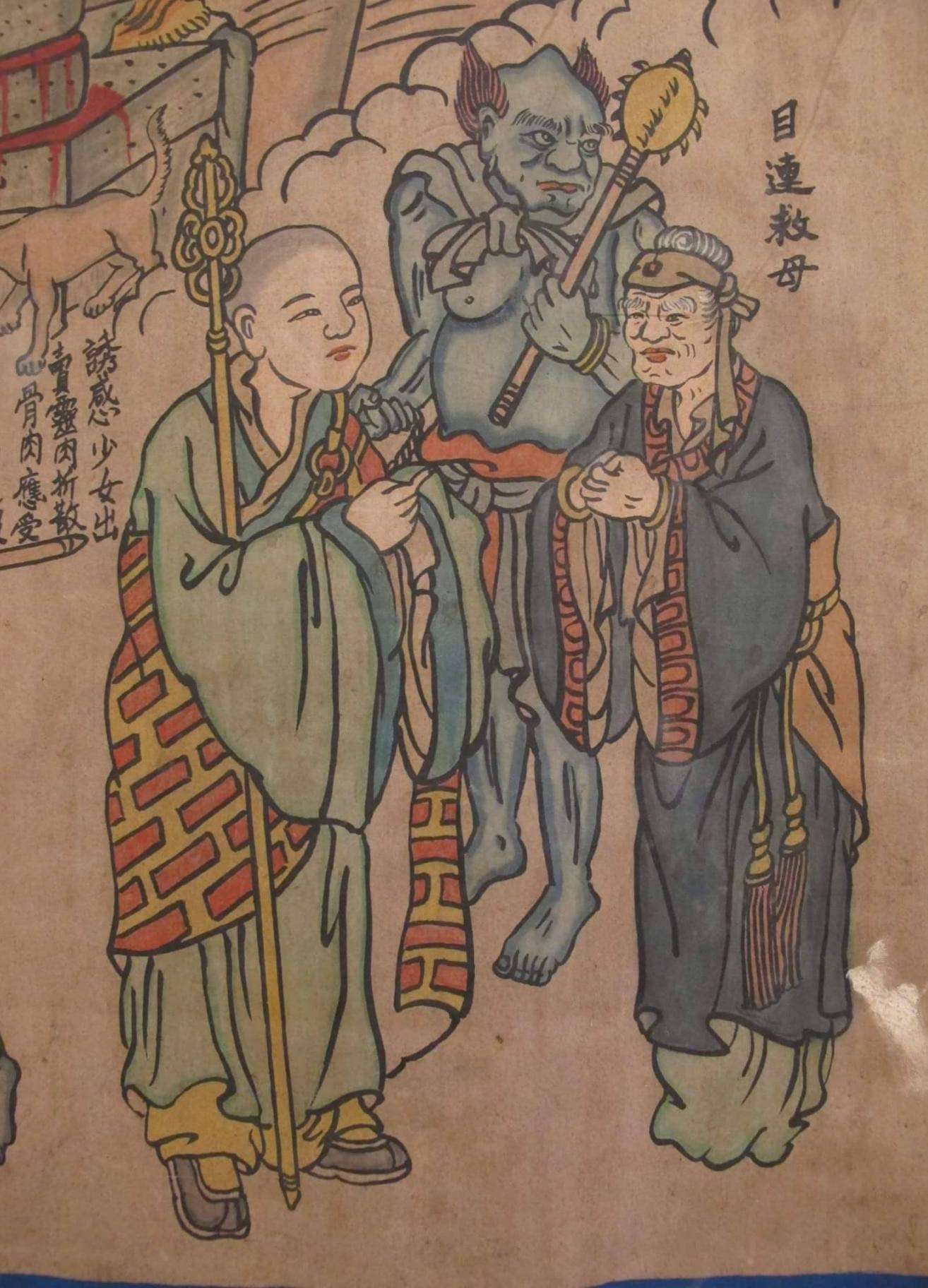
The heavenly treasures wielded by the Monkey Pilgrim are based on those used by the famed Buddhist saint and cultural hero Mulian (目連; Sk: Maudgalyayana), a disciple of the Buddha. He appears in the Transformation Text on Mahamaudgalyayana Rescuing his Mother From the Underworld with Pictures, One Scroll, with Preface (Damuganlian mingjian jiumu bianwen bingtu yijuan bingxu, 大目乾連冥間救母變文并圖一卷並序), a late-9th to early-10th-century Bianwen (變文) text in which he travels to the underworld to release his mater from karmic torment (fig. 1). Originally discovered in the oasis of Dunhuang, the text serves as the foundational myth for the Ghost Festival (Gui jie, 鬼節; a.k.a. “Zhongyuan Festival,” Zhongyuan jie, 中元節; a.k.a. “Yulanpen Festival,” Yulanpen jie, 盂蘭盆節), which is held on the 15th day of the seventh month.
In this article, I will discuss three similarities that the Monkey Pilgrim shares with Mulian, including using similar holy treasures, visiting the same heavenly realm, and having a connection to the Ghost Festival. While Tripitaka, as a monk working towards the salvation of others, is a more obvious cognate for Mulian, it’s correct to say that Monkey is an amalgam of the Buddhist saint and Chinese stories of animals that guide the recently deceased through the underworld.

Fig. 1 – A scroll or mural depicting Mulian rescuing his mother from the underworld (larger version). Originally found here.
1. The Monkey Pilgrim
1.1. The Staff
The Monkey Pilgrim and Tripitaka first receive the golden-ringed monk’s staff, along with two other treasures, from the supreme deity, the Mahabrahma devaraja (Dafan tianwang, 大梵天王; lit: “Great Brahma Heavenly King,” a.k.a. Vaisravana), in chapter two.
The Dharma Master [Tripitaka] and Monkey Pilgrim approached the Devaraja and begged for his help. The Devaraja granted them a cap of invisibility, a golden-ringed staff, and a begging bowl. After accepting these three boons, the Dharma Master said farewell, then turned to the Monkey Pilgrim and asked: “How can we get back to the mortal world?” Pilgrim replied: “Before the Dharma Master speaks of returning to the world below, he had better ask the Devaraja how we can save ourselves from the monsters and disasters which lie ahead of us.” The Dharma Master returned to Mahabrahma and asked as Monkey had suggested. The Devaraja responded: “When you meet calamity, point toward the Heavenly Palace from afar and shout ‘Devaraja’ once, and you will be saved.” The Dharma Master accepted his instructions and bowed farewell (Wivell, 1994, p. 1184).
Now compare that with Mulian’s tale in which he receives the staff from the Buddha:
“How will I [Mulian] be able to see my dear mother again?”
The World-Honored called out to him, saying, “Mahamaudgalyayana!
Do not be so mournful that you cry yourself heartbroken;
The sins of the world are tied to those who commit them like a string,
They are not stuck on clay-fashion by anyone else.
Quickly I take my metal-ringed staff and give it to you.
It can repel the eight difficulties and the three disasters.
If only you remember diligently to recite my name,
The hells will certainly open up their doors for you” (Mair, 1994, p. 1111).
Both receive a magic monk’s staff with abilities tied to the recitation of a Buddhist deity’s name.
Here is one example of the power of The Story‘s staff:
The pilgrims arrived at the valley of the fire-spitting White Tiger Spirit. Coming closer they encountered a great ditch. The four steep entrances were pitch-black and they heard a roar of thunder. They could not advance. The Dharma Master held up his golden-ringed staff and, flourishing it toward the distant heavenly palace, yelled: “Devaraja! Help us in our afflictions!” Suddenly a shaft of light shot out from the staff five tricents long. It slashed through the long ditch and soon they were able to get across (Wivell, 1994, 1187-1188).
行次至火類坳白虎精。前去遇一大坑,四門陡黑,雷聲喊喊,進步不得。法師當把金鐶杖遙指天宮,大叫:「天王救難!」忽然杖上起五里毫光,射破長坑,須臾便過。
Now compare that to Mulian’s staff:
He [Mulian] wiped his tears in mid-air, and shook the metal-ringed staff,
Ghosts and spirits were mowed down on the spot like stalks of hemp.
Streams of cold sweat crisscrossed their bodies, dampening them like rain,
Dazed and unconscious, they groaned in self-pity;
They let go of the three-cornered clubs which were in their hands,
They threw far away the six-tined pitchforks which were on their shoulders (Mair, 1994, p. 1112).
Both are capable of creating powerful blasts.
But The Story‘s treasure builds upon the Mulian tale by adding an exciting new ability: creating giant, monstrous life. For instance, while confronting the white tiger spirit in chapter six,
Monkey Pilgrim transformed his golden-ringed staff into a gigantic yaksa whose head touched the sky and whose feet straddled the earth. In his hands he grasped a demon-subduing cudgel. His body was blue as indigo, his hair red as cinnabar; from his mouth a fiery gleam shot forth a hundred yards long (Wivell, 1994, p. 1189).
How cool is that? And in chapter seven, “he transformed the magic staff into an iron dragon” to battle a group of nine-headed serpents (被猴行者 … 金鐶錫杖化作一條鐵龍) (Wivell, 1994, p. 1190).

Fig. 2 – The head of a 12-ringed monk’s staff (larger version). From the author’s personal collection.
1.2. The Alms Bowl
The treasure bowl is first used in chapter six:
Next they suddenly came to a wild fire [2] which reached to the heavens. It sent off such a huge amount of smoke and sparks that the pilgrims could not proceed. The Dharma Master shone the light of his begging-bowl toward the fire and yelled: “Devaraja!” The fire died out immediately and the seven pilgrims crossed this pit (Wivell, 1994, p. 1189).
It is next used by the Monkey Pilgrim in chapter seven while fighting the nine-headed serpents. He “sucked all the thousand tricents of water into the begging-bowl” (被猴行者 … 缽盂盛卻萬里之水) (Wivell, 1994, p. 1190).
There are no similar feats in Mulian’s story, but his alms bowl is also imbued with magic, allowing him to fly freely between the realms of heaven, earth, and the underworld. For instance,
Maudgalyayana awoke from abstract meditation,
Then swiftly exercised his supernatural power;
His coming was quick as a thunderclap,
His going seemed like a gust of wind.
[…]
With his supernatural power, he gained freedom,
So he hurled up his begging bowl and leaped into space;
Thereupon, instantaneously,
He ascended to the heavenly palace of Brahma (Mair, 1994, pp. 1097-1098).
Both he and the primate hero travel to the Brahma realm. Readers will recall that Monkey magically transports Tripitaka and his group to the crystal palace of the Mahabrahma Devaraja in chapter two (Wivell, 1994, p. 1184).
1.3. Connection to the Ghost Festival
Not only does the Monkey Pilgrim use Mulian-esque treasures, he also ascends to heaven on the Ghost Festival. After the group receives the last of the scriptures in chapter 16, the Dipamkara Buddha tells them:
“On the fifteenth day of the seventh month [i.e. the date of the Ghost Festival], it will be time for you, Dharma Master, and your band of seven to return to the celestial halls. Remember what I have said, and on the fifteenth rise early and bathe yourself. Say farewell to the T’ang emperor, for at noon the ‘Lotus-Plucking Barge’ will arrive. There will also be golden lotus-flower seats and auspicious rainbow-colored clouds. Twelve mellifluously voiced youths will escort you with incense, flowers, and decorated banners. They will adorn you with the seven precious gems, welcoming you seven to return to Heaven. But the invitation from Heaven has a time limit and you must not dally! Listen well to what I have told you and keep it firmly implanted in your mind!” (Wivell, 1994, 1202).
And on the appointed day in chapter 17:
The seven boarded the barge and, looking due west, they ascended into the heavens and became immortals. Nine dragons rose up into the mist and ten phoenixes came out to welcome them. A thousand cranes offered them felicitations and there were flashing lights of transcendence (Wivell, 1994, p. 1206).
Recall that Mulian’s quest to free his mother’s soul from underworld torments is the foundational myth of the Ghost Festival. It actually opens with an explanation of the chthonic celebration:
Now, on the fifteenth day of the seventh month, the heavens open their doors and the gates of hells are flung wide. The three mires dissipate, the ten virtues increase. Because this is the day when the company of monks end their summer retreat, the deity who confers blessings and and the eight classes of supernatural beings all come to convey blessings. Those who undertake to make offerings to them in the present world will have a supply of blessings and those who are dead will be reborn in a superlative place. Therefore, a purgatorian feast is spread before the Three Honored Ones who, through the grace of their welcoming the great assembly, put a priority upon saving those who are distressed by hanging in limbo (Wivell, 1994, pp. 1093-1094).
1.4. Monkey = Mulian?
The Monkey Pilgrim’s use of Mulian-style holy accoutrements, travel to the Brahma realm, and ascension on the Ghost Festival raises the question: is our hero suppose to be a stand-in for the Buddhist saint? The simple answer is “not exactly.” It’s important to remember that he and Tripitaka share the duty of wielding the holy treasures. And while the immortal uses them more, the fact that Tripitaka is a Buddhist monk working towards the salvation of others makes him a more fitting cognate for Mulian.
However, The Story‘s connection to chthonic literature still provides Monkey a link to the Buddhist saint:
The Japanese scholar Chūbachi Masakazu (b. 1938) was the first to point out that the Kōzanji narratives mirror two closely related mythic archetypes. The first, derived from ancient Han Chinese traditions, is the journey of the dead to the netherworld. In many accounts of postmortem travels, spirit animals (including but not limited to monkeys) serve as the guides for the dead on their passage through the spirit realm, whether the final destination is the Yellow Springs beneath the earth or Mount Kunlun in the distant west. The other motif, emerging from early Indian Buddhist literature, is the transmigration of the spirit to the Pure Land, which, like Mount Kunlun, was conventionally located somewhere in the west. In Buddhist accounts, animals (again, often but not always monkeys) also serve as escorts for the dead. Chūbachi proposed that these narrative traditions—culturally distinct but thematically and functionally similar—were fused together with the historical account of Xuanzang’s journey to India. The Kōzanji texts, according to this reading, represent a complex but organic blending of initially independent narratives. The broad contours of Xuanzang’s biography and travelogue were superimposed onto older mythic accounts to provide a new, quasi-historical frame for age-old stories about the transmigrations of the dead.
Viewed from this perspective, Xuanzang was not passing through Central Asia en route to India but, instead, was traversing a hellish purgatory to reach a heavenly pure land. Like a shaman, he departs the human world and enters a dangerous liminal zone. Beset by ghosts and demons, he is guided and protected by powerful spirit animals and Buddhist deities. After enduring extreme hardship, he eventually arrives in an immortal realm populated by spirit monks, immortals, bodhisattvas, and buddhas. From Śākyamuni Buddha, he receives a collection of apotropaic texts with the power to safeguard the living and liberate the dead. Xuanzang then transmits these sacred scriptures back to the human realm before he and his assistants ascend to heaven during the annual ritual for liberating the damned from purgatory. This narrative not only maps the landscape of a postmortem shadow world, it also identifies the scriptures that guard against demonic molestation and ensure a propitious rebirth: the Buddhist canon in general and the Heart Sūtra in particular. Those who read, recited, or heard the Kōzanji texts were thus informed of the perils of purgatory and offered the promise of protection and salvation. Xuanzang, they also learned, was the saintly monk responsible for delivering these divine texts and technologies into the hands of humans (Brose, 2023, pp. 62-63).
Given the above information, it’s more correct to view the Monkey Pilgrim as a sort of amalgam of Mulian and the animal helpers who guide the recently deceased through the under world. This is important to remember, especially when discussing the origins of the Great Sage, for his history is far more nuanced than the “foreign only” (i.e. Hanuman=Sun Wukong) theory would suggest.
2. Sun Wukong
Another power of Mulian’s staff likely influenced the Monkey King’s “As You Wish Gold-Banded Cudgel.” During his quest to free his mother from the underworld, the Buddhist saint uses the treasure to unlock the gates of hell:
With one shake of his staff, the bars and locks fell from the black walls,
On the second shake, the double leaves of the main gate [of hell] flew open (Mair, 1994, p. 1113). [2]
Now compare that to an episode from JTTW chapter 25:
“Elder Brother,” said Eight Rules [Zhu Bajie], “stop this hocus-pocus. The doors are all locked. Where are we going to go?” “Watch my power!” said Pilgrim. He seized his golden-hooped rod and exercised the lock-opening magic; he pointed the rod at the door and all the locks fell down with a loud pop as the several doors immediately sprung open. “What talent!” said Eight Rules, laughing. “Even if a little smith were to use a lock pick, he wouldn’t be able to do this so nimbly.” Pilgrim said, “This door is nothing! Even the South Heaven Gate would immediately fly open if I pointed this at it!” (Wu & Yu, 2012, vol. 1, pp. 468-469)
Update: 12-28-19
While I believe Mulian’s bowl influenced the somersault cloud, Shao (2006) notes the 108,000 li (33,554 mi/54,000 km) covered by Monkey in a single leap is based on the symbolic distance said by Huineng to separate the Buddha’s paradise from the world of man. As the Chan patriarch explains in the Platform Sutra, “This number refers to the ten evils and eight wrongs in one’s person” (Huineng & Cleary, 1998, p. 26, for example). Only those who achieve enlightenment can overcome these hindrances and arrive instantly in paradise. This is symbolized in the novel by Monkey zipping their instantly on his cloud, whereas Tripitaka must travel thousands of miles over many years.
Update: 02-06-21
I have written an article that discusses the magic powers of the staff. These include the ability to shrink and grow, control the ocean, astral project and entangle with Monkey’s spirit, multiply endlessly, pick locks, and transform into various objects. It also has sentience to a certain degree.
The Magic Powers of the Monkey King’s Iron Staff
Update: 01-31-24
I’ve rewritten and added new some new information to the article.
Note:
1) Wivell (1994) translates the name as “Great Sage of Bronze Muscles and Iron Bones” (p. 1207). But the gang (鋼) of Gangjin tiegu dasheng (鋼筋鐵骨大聖) means “steel.” Therefore, I’ve changed the original source accordingly.
2) Wivell (1994) translates yehuo (野火) as “prairie fire” (p. 1189), but “wildfire” is a more literal rendering. Therefore, I’ve changed the original source accordingly.
Sources:
Brose, B. (2023). Embodying Xuanzang: The Postmortem Travels of a Buddhist Pilgrim. United States: University of Hawaii Press.
Buswell, R. E., & Lopez, D. S. (2014). The Princeton Dictionary of Buddhism. Princeton University Press.
Mair, V. H. (1989). Suen Wu-kung = Hanumat? The Progress of a Scholarly Debate In Proceedings of the Second International Conference on Sinology (pp. 659-752). Taipei:
Mair, V. H. (1994). Transformation Text on Mahamaudgalyayana Rescuing his Mother From the Underworld with Pictures, One Scroll, with Preface. In V. Mair (Ed.), The Columbia Anthology of Traditional Chinese Literature (pp. 1094-1127). New York: Columbia University Press.
Shao, P. (2006). Huineng, Subhūti, and Monkey’s Religion in “Xiyou ji”. The Journal of Asian Studies, 65(4), 713-740. Retrieved from www.jstor.org/stable/25076127
Wivell, C.S. (1994). The Story of How the Monk Tripitaka of the Great Country of T’ang Brought Back the Sūtras. In V. Mair (Ed.), The Columbia Anthology of Traditional Chinese Literature (pp. 1181-1207). New York: Columbia University Press.
Wu, C., & Yu, A. C. (2012). The Journey to the West (Vols. 1-4) (Rev. ed). Chicago: University of Chicago Press.