Skip to content

Journey to the West Research

A repository for research on the great 16th-century Chinese Classic

Primary Menu

  • Home
  • About
  • Contact

Tag Magic body part retrieval

Can Sun Wukong Copy the Strength and Magic of an Opponent?

May 4, 2025July 5, 2025Jim R. McClanahan 22 Comments

Last updated: 05-25-2025

The idea that the Monkey King can gain the strength and magical abilities of an opponent by copying their appearance via bodily transformation or hair clones became popular online sometime around (or before) 2021, and it continues to spread (fig. 1).

Fig. 1 – (Top row) screenshot of a Twitter comment dated September 2021; (bottom three rows) screenshots of reddit comments taken in December 2023 (larger version).

A more recent example is an Instagram reel from August 2024. The transcript reads:

[Sun Wukong can’t be defeated by the video game character Kratos (of God of War fame) because] … one of his most broken abilities is his hair. You see, each of his individual hairs can transform into anything he wants. Basically, he can create another version of Kratos. He could just create another Kratos who would be just as strong as this Kratos. He could create 84,000* of Kratoses. So now, you have a Wukong who’s just as strong as Kratos, on top of the fact that he has another Kratos with him (source).

* This refers to the metaphorical number of Sun’s hairs as stated in chapter two of the original novel (Wu & Yu, 2012, vol. 1, p. 128).

But where does this idea come from? Does it even appear in the original Journey to the West (Xiyouji, 西遊記, 1592; “JTTW” hereafter)? In this article, I will discuss what the novel has to say about this topic.

1. Source

I am 100% certain that the claim was influenced by the battle between Monkey and Nezha from JTTW chapter four:

This Prince Nezha,* properly armed, leaped from his camp and dashed to the Water-Curtain Cave. Wukong was just dismissing his troops when he saw Nezha approaching fiercely. Dear Prince!

[poem about Nezha’s appearance and skills omitted for the sake of brevity]

Wukong drew near and asked, “Whose little brother are you, and what do you want, barging through my gate?” “Lawless monstrous monkey!” shouted Nezha. “Don’t you recognize me? I am Nezha, third son of the Pagoda Bearer Devaraja. I am under the imperial commission of the Jade Emperor to come and arrest you.” “Little prince,” said Wukong laughing, “your baby teeth haven’t even fallen out, and your natal hair is still damp! How dare you talk so big? I’m going to spare your life, and I won’t fight you. Just take a look at the words on my banner and report them to the Jade Emperor above. Grant me this title, and you won’t need to stir your forces. I will submit on my own. If you don’t satisfy my cravings, I will surely fight my way up to the Treasure Hall of Divine Mists.”

Lifting his head to look, Nezha saw the words, “Great Sage, Equal to Heaven.” “What great power does this monstrous monkey possess,” said Nezha, “that he dares claim such a title? Fear not! Swallow my sword.” “I’ll just stand here quietly,” said Wukong, “and you can take a few hacks at me with your sword.” Young Nezha grew angry. “Change!” he yelled loudly, and he changed at once into a fearsome person having three heads and six arms [fig. 2]. In his hands he held six kinds of weapons: a monster-stabbing sword, a monster-cleaving scimitar, a monster-binding rope, a monster-taming club, an embroidered ball, and a fiery wheel. Brandishing these weapons, he mounted a frontal attack. “This little brother does know a few tricks!” said Wukong, somewhat alarmed by what he saw. “But don’t be rash. Watch my magic!” Dear Great Sage! He shouted, “Change!” and he too transformed himself into a creature with three heads and six arms. One wave of the golden-hooped rod and it became three staffs, which were held with six hands. The conflict was truly earth-shaking and made the very mountains tremble. What a battle!

[Poem about their battle omitted for the sake of brevity.]

Each displaying his divine powers, the Third Prince and Wukong battled for thirty rounds. The six weapons of that prince changed into a thousand and ten thousand pieces; the golden-hooped rod of Sun Wukong into ten thousand and a thousand. They clashed like raindrops and meteors in the air, but victory or defeat was not yet determined. Wukong, however, proved to be the one swifter of eye and hand. Right in the midst of the confusion, he plucked a piece of hair and shouted, “Change!” It changed into a copy of him, also wielding a rod in its hands and deceiving Nezha. His real person leaped behind Nezha and struck his left shoulder with the rod. Nezha, still performing his magic, heard the rod whizzing through the air and tried desperately to dodge it. Unable to move quickly enough, he took the blow and fled in pain. Breaking off his magic and gathering up his six weapons, he returned to his camp in defeat (Wu & Yu, 2012, vol. 1, pp. 154-156). [1]

* Yu (Wu & Yu, 2012) originally translated 哪吒 here as “Naṭa.” However, “Nezha” is far and away the most popular rendering. I’ve, therefore, changed the text.

To sum up: Sun and Nezha battle. The child-god takes on a three-headed, six-armed war form, prompting Monkey to do the same. They continue to fight with no conclusion, until the Great Sage makes a hair clone decoy of his war form and finally wounds Nezha with a staff blow from behind.

Fig 2 – Monkey fighting a three-headed, six-armed Nezha (larger version). Image found here. It appears to be an illustration from a children’s book retelling Uproar in Heaven (1961/64).

2. Analysis

Someone might take the above as evidence supporting the claim, but they are overlooking two important details. One, Sun is clearly using his famous “Multitude of Terrestrial Killers” (Disha shu, 地煞數), a.k.a. “72 Changes” (Qishier ban bianhua, 七十二般變化), in response to the prince’s metamorphosis. As a reminder, this magic ability allows him to transform into anything he wants, including other humanoid figures, animals, insects, miscellaneous objects, incorporeal beams of light, and even buildings. Therefore, Sun mirroring Nezha’s multi-headed and armed war form is not a case of him magically copying the prince’s abilities. He’s simply using a pre-existing power to change himself in a similar way.

And two, Monkey’s hair clone is an extension of himself, so again, he’s not using it to copy a foe’s powers. And the hair clone certainly isn’t being used to create a stronger version of an adversary, in this case Nezha, as claimed in the comments from figure one. As can be seen, the battle is won by strategy and not some copied ability.

Now, I can already hear some readers disagreeing with my take. In that case, I challenge you to cite examples proving me wrong. This is a very specific request. You can’t just quote where he takes on or creates a random character’s shape. That happens many times over. You have to show where mirroring an opponent’s appearance gives the Great Sage or a hair clone new powers that he/it/they didn’t previously have.

If you’re not quite sure where to start, I suggest consulting my 200-plus page catalog of Monkey’s powers and skills from all 100 chapters of the book. I look forward to any future responses.

3. A Special Message

I hope this challenge helps netizens enamored with Sun Wukong’s embellished online persona as an unstoppable and unkillable cosmic force to understand that the only reliable source of information about him is the JTTW novel. Here’s some advice: if you happen upon someone making bold claims about the Great Sage (or JTTW characters and events in general), ask them to prove their point by quoting directly from the book. Don’t accept anything—no youtubers like OSP, no forum or social media posts, no video games, etc.—beyond cited canonical information. You can check the PDFs here to make sure that the quote is correct. And even then, it’s best to consult someone (Chinese or otherwise) who has a solid foundation in Chinese literature, religion, and culture to make sure that the person’s understanding of the material falls in line with what the original text actually means. I say this because I’ve seen a lot of people take something at face value without realizing that there’s some kind of underlying context.


Update: 05-08-25

My comments section is not the best for ongoing debates. I can’t reply to anyone who responds to my initial response to a comment. I think it’s best to move this to a different platform, maybe Reddit or Discord. I’ll leave it up to commenters to decide. I’ll post a link to the chosen debate site when it is agreed upon.

(Edit: I just discovered that I can respond if I go into my dashboard, but this isn’t as fast or convenient as directly answering the reply on the article page.)


Update: 05-25-25

A reader just commented that Monkey can gain the abilities of the animals that he changes into—something I’ve recorded several times in my catalog of his powers and skills—thereby implying that he should also be able to acquire the powers of a copied foe. However, the novel is clear that there’s a marked difference in quality between his animal/object forms and his humanoid forms. Chapter 75 reveals the fatal flaw:

“Elder Brother,” said the third fiend,” didn’t you see him? He [Wukong disguised as a small demon] was giggling just now with his face half turned, and I saw for a moment a thunder god beak on him. When I grabbed him, he changed back immediately into his present looks.” He then called out: “Little ones, bring me some ropes.” The captains took out ropes immediately. Wrestling Pilgrim to the ground, the third fiend had him hog-tied before they hitched up his clothes to examine him. It became apparent at once that he was the BanHorsePlague all right! Pilgrim, you see, was capable of seventy-two kinds of transformation. If it was a matter of changing into a fowl, a beast, a plant, a utensil, or an insect, his entire body could be transformed. But when he had to change into another person, only his face but not his body could be transformed. When they lifted up his clothes, therefore, they saw a body full of brown fur, two red buttocks, and a tail (emphasis added) (Wu & Yu, 2012, vol. 3, p. 367).

三怪道:「哥哥,你不曾看見他?他才子閃著身笑了一聲,我見他就露出個雷公嘴來。見我扯住時,他又變作個這等模樣。」叫:「小的們,拿繩來。」眾頭目即取繩索。

三怪把行者扳翻倒,四馬攢蹄綑住。揭起衣裳看時,足足是個弼馬溫。原來行者有七十二般變化,若是變飛禽、走獸、花木、器皿、昆蟲之類,卻就連身子滾去了;但變人物,卻只是頭臉變了,身子變不過來。果然一身黃毛,兩塊紅股,一條尾巴。

This means that the Great Sage’s changes are not perfect. How then would he be able to acquire an opponent’s strength or magical abilities via imperfect transformations? I look forward to future responses.

Note:

1) Here’s the original Chinese for the JTTW chapter four fight, including that for the omitted poems:

這哪吒太子甲冑齊整,跳出營盤,撞至水簾洞外。那悟空正來收兵,見哪吒來的勇猛。好太子:

總角才遮顖,披毛未蓋肩。神奇多敏悟,骨秀更清妍。誠為天上麒麟子,果是煙霞彩鳳仙。龍種自然非俗相,妙齡端不類塵凡。身帶六般神器械,飛騰變化廣無邊。今受玉皇金口詔,敕封海會號三壇。

悟空迎近前來問曰:「你是誰家小哥?闖近吾門,有何事幹?」哪吒喝道:「潑妖猴!豈不認得我?我乃托塔天王三太子哪吒是也,今奉玉帝欽差,至此捉你。」悟空笑道:「小太子,你的嬭牙尚未退,胎毛尚未乾,怎敢說這般大話?我且留你的性命,不打你。你只看我旌旗上是甚麼字號,拜上玉帝:是這般官銜,再也不須動眾,我自皈依;若是不遂我心,定要打上靈霄寶殿。」哪吒擡頭看處,乃「齊天大聖」四字。哪吒道:「這妖猴能有多大神通,就敢稱此名號?不要怕,吃吾一劍。」悟空道:「我只站下不動,任你砍幾劍罷。」那哪吒奮怒,大喝一聲,叫:「變!」即變做三頭六臂,惡狠狠,手持著六般兵器,乃是斬妖劍、砍妖刀、縛妖索、降妖杵、繡毬兒、火輪兒,丫丫叉叉,撲面來打。悟空見了,心驚道:「這小哥倒也會弄些手段。莫無禮,看我神通。」好大聖,喝聲:「變!」也變做三頭六臂;把金箍棒幌一幌,也變作三條。六隻手拿著三條棒架住。這場鬥,真個是地動山搖,好殺也:

六臂哪吒太子,天生美石猴王,相逢真對手,正遇本源流。那一個蒙差來下界,這一個欺心鬧斗牛。斬妖寶劍鋒芒快,砍妖刀狠鬼神愁;縛妖索子如飛蟒,降妖大杵似狼頭;火輪掣電烘烘艷,往往來來滾繡毬。大聖三條如意棒,前遮後擋運機謀。苦爭數合無高下,太子心中不肯休。把那六件兵器多教變,百千萬億照頭丟。猴王不懼呵呵笑,鐵棒翻騰自運籌。以一化千千化萬,滿空亂舞賽飛虯。諕得各洞妖王都閉戶,遍山鬼怪盡藏頭。神兵怒氣雲慘慘,金箍鐵棒響颼颼。那壁廂,天丁吶喊人人怕;這壁廂,猴怪搖旗個個憂。發狠兩家齊鬥勇,不知那個剛強那個柔。

三太子與悟空各騁神威,鬥了個三十回合。那太子六般兵,變做千千萬萬;孫悟空金箍棒,變作萬萬千千。半空中似雨點流星,不分勝負。

原來悟空手疾眼快,正在那混亂之時,他拔下一根毫毛,叫聲:「變!」就變做他的本相,手挺著棒,演著哪吒;他的真身,卻一縱,趕至哪吒腦後,著左膊上一棒打來。哪吒正使法間,聽得棒頭風響,急躲閃時,不能措手,被他著了一下,負痛逃走。收了法,把六件兵器依舊歸身,敗陣而回。(source)

Source:

Wu, C., & Yu, A. C. (2012). The Journey to the West (Vols. 1-4) (Rev. ed.). Chicago, Illinois: University of Chicago Press.

Archive #46 – A Catalog of the Monkey King’s Magic Powers and Skills

August 11, 2024December 16, 2025Jim R. McClanahan 12 Comments

Last updated: 09-08-2024

In honor of the forthcoming video game Black Myth: Wukong (August 20, 2024), I have completed a catalog of Sun Wukong‘s magic abilities and skills from all 100 chapters of Journey to the West (Xiyouji, 西遊記, 1592). To my knowledge, this is the first of its kind in English. My hope is that it will be useful for fanfiction writers and artists, as well as academics studying magico-religious concepts from Ming-era vernacular literature.

Below, I present a Google Doc and PDF of the full 177-page catalog, as well as a general survey of the magic powers and skills for people who are short on time.

[Note (8-18-24): I have moved the chapter headings to the beginning of each page, as well as added more information. This has increased the page count to 221, but the text is close to the same length, roughly 180 pages if squished together.]

Black Myth: Wukong

A promotional photo for Black Myth: Wukong (large version). Image found here.

1. The complete 100 chapter catalog

I am presenting two versions of the catalog here because I don’t know how many people can view the original Google Doc at once.

1.1. Google doc

A pro is that I can instantly update this. Also, readers can automatically jump to the chapter of their choice.

https://docs.google.com/document/d/1tP24uRujnwpX8k0Q1uh979pQJheSMY3d7XlpETpwX6o/edit?usp=sharing

1.2. PDF

A con is that I have to reupload this anytime I make an update to the original. Also, the formatting is wonky for some reason. But I’ll try my best to keep this updated at all times.

Click to access A-Catalog-of-the-Monkey-Kings-Powers-and-Skills-1.pdf

Sun Wukong from Lego Monkie Kid (larger version). Image found here.

2. A survey of his magic powers

2.1. Immortalities

In place of using “layer” or “level,” I’m choosing to designate his various immortalities as “categories.” This is because a new layer of divine longevity or durability would surely be added for each immortal peach, elixir pill, or cup/jug of heavenly wine consumed. Hence, eating multiple peaches would be one category, eating multiple elixir pills would be one category, and so on and so forth.

There are two sets of immortalities. The first are achieved before or during the journey:

  1. Spiritual breathing exercises (ch. 2)
  2. Erasing his name from the ledgers of hell (ch. 3)
  3. Drinking immortal wine (ch. 4 & 5)
  4. Eating immortal peaches (ch. 5)
  5. Eating elixir pills (ch. 5 & 17)
  6. Eating Ginseng fruit (ch. 24)

(Monkey briefly dies from thermal shock in chapter 41 while battling Red Boy. Zhu Bajie shortly thereafter suggests that he has 72 lives because he knows the 72 transformations (他有七十二般變化,就有七十二條性命。). If true, this would have interesting implications for his various immortalities. Would someone have to kill him 72 times in order to make sure that he is dead for good? However, this is little more than speculation since the narrative never mentions Sun respawning after death like a video game character.)

The second are achieved at the journey’s end once they reach the Buddha’s blessed land. These shouldn’t be lumped together with those acquired before and during the pilgrimage.

  1. Eating Immortal food, tea, and fruit (ch. 98)
  2. Buddhahood (ch. 100)

It’s important to note that the novel ends before Monkey is able to perform any feats as a Buddha. Therefore, making claims about his subsequent abilities is outside of canon.

A photomanipulation by me called “The Immortal Has Awakened” (2018) (larger version). The original work was first published on Deviantart.

2.2. Definite powers

These are abilities that are utilized in the narrative.

  1. Multitude of terrestrial killers (地煞數; a.k.a. “72 changes,” 七十二般變化) – This allows him to transform his body into anything he wants, including other humanoid figures, animals, insects, miscellaneous objects, incorporeal beams of light, and even buildings.
  2. Cloud-soaring (騰雲) – This allows him to slowly travel through the sky. He only attempts this once (ch. 2).
  3. Cloud somersault (觔/筋斗雲) – This allows him to fly 108,000 li (十萬八千里; 33,554 mi/54,000 km) in a single leap. He displays this throughout the novel.
  4. Body beyond body (身外身法; a.k.a. “magic of body division,” 分身法) – This allows him to transform anyone of his 84,000 hairs into whatever he desires, including humanoid figures, animals, insects, miscellaneous objects, and even food, money, and tools. It is often used to create an army of clones throughout the novel. He claims that a single hair can multiply into the millions and billions.
  5. Magic of displacement (攝法) – This allows him to transport people and items on a swift, powerful wind (ch. 2, 3, 62, 71, & 84).
  6. Mighty wind (陣風) – This allows him to cause chaos all around him with a powerful wind. It is used to hide his activities, fan the flames of fire, scare away onlookers, and even to kill by propelling rocks (ch. 3, 16, 28, 38, 44, 68, 71, & 95).
  7. Water-controlling magic – The “magic of water restriction” (閉水法; a.k.a. “water-repelling magic,” 避水訣) allows him to ward off water and/or to “open a waterway” (開水道) in order to travel to the aquatic realm. And the “magic of overturning seas and rivers” (翻江攪海的神通) does exactly as named. He displays these throughout the novel.
  8. Magic method of modeling heaven on earth (法天像(象)地) – This allows him to take on a monstrous, 104,300 ft/31,800 m tall form. The original specified height, 10,000 zhang (萬丈), may be a metaphorical number for a much, much larger figure, for Monkey claims to have the ability to fill the universe if he so desired it (ch. 14). He displays this power several times (ch. 3, 6, 61, 64, & 97).
  9. Super strength – This allows him to wield his 13,500-catty (一萬三千五百斤; 17,559.81 lbs/7,965 kg) iron staff with ease, overpower opponents, and to scare rude humans. He displays this throughout the novel. His greatest feat of strength involves carrying two mountains on his shoulders while running with great speed (ch. 33).
  10. Travel to heaven – This allows him to find and enter the celestial realm from any of the four cardinal gates. He displays this throughout the novel.
  11. Cloud production – This allows him to breathe clouds and fog during battle. He displays this throughout the novel.
  12. Three-headed and six-armed war form (三頭六臂) – This allows him to battle myriad opponents on all fronts (ch. 4, 7, 31, 40, & 81).
  13. Staff multiplication – This allows him to multiply his magic staff for his war form, to arm his clones, or to bombard opponents with a shower of hundreds of thousands or even millions of weapons. He displays this throughout the novel.
  14. Magic of body concealment (隱身法) – This allows him to become invisible to humans and even gods and spirits (ch. 5, 6, 24, 49, 63, 68, & 71).
  15. Magic of Immobilization (定身法) – This allows him to freeze humans, gods, and spirits in place for up to a full day (ch. 5, 39, 88, & 97).
  16. Invulnerability – His adamantine head and body are capable of withstanding damage from even celestial weapons and elements. He displays this throughout the novel.
  17. Fiery eyes and golden pupils (火眼金睛) – This allows him to peer up to 1,000 li (千里; 310.7 mi/500 km) during the day and 300 to 500 li (夜裡也還看三五百里; 93.20 to 155.34 mi/150 to 250 km) at night. It also enables him to see through the magic disguises and illusions of gods and spirits. It doesn’t work 100% of the time, though. He displays this throughout the novel.
  18. Horse authority – This allows him to command celestial and earthly equines (ch. 14 & 56). This is based on his former position as the keeper of the heavenly steeds, which essentially makes him the god of horses in the JTTW universe.
  19. Taming tigers – Earthly big cats immediately cower in his presence (ch. 14). This seemingly does not include tiger-spirits.
  20. Three life-saving hairs (三根救命的毫毛) – These are three willow branch leaves-turned-hairs gifted to him by Guanyin which allow him to make whatever he wants in the performance of his duties as Tripitaka’s guardian (ch. 15, 63, & 75). The novel differentiates these from the “body beyond body” hairs.
  21. Putting off sleep – He is shown in one instance (ch. 16) to conserve his immortal energy via meditation instead of sleeping, though he is described as resting in numerous chapters. He claims that putting of sleep for nearly three years wouldn’t even bother him (ch. 25).
  22. Voice impersonation – This power allows him to exactly copy the voice of any figure that he transforms into. He displays this throughout the novel.
  23. Magic of seizure (拿/手法; a.k.a. “holding trick”) – This allows him to magically grab large quantities of characters and goods with a single hand (ch. 62 & 89). It is also ambiguously described as a superpowered martial arts technique where he grabs and twists a much larger opponent so hard that they flip (ch. 18).
  24. Seize the wind (抓風) – This allows him to grab the wind like an animate object. This is done once to smell the breeze (ch. 20).
  25. Super smell – This allows him to detect and even track dangerous animals and evil spirits (ch. 20, 41, 67, & 91).
  26. Size manipulation – This allows him to shrink or grow his body as needed. I differentiate this from the “magic method of modeling heaven on earth” because it is not a grand transformation like the latter. His smallest transformation is a hair-like cicada (蟭蟟蟲), which is perhaps a typo for “蟭螟蟲,” an aquatic insect from Daoist literature said to be so small that it can congregate in the eyebrows of a mosquito.
  27. Summoning gods – This allows him to call upon local gods of the soil and mountains, Buddhist gods assigned to protect the Tang Monk, and also the Dragon Kings of the world’s oceans. He displays this throughout the novel.
  28. Immortal breath (仙氣) – This allows him to transform his hairs and staff and other inanimate objects into whatever he wants, as well as to heal grievous wounds, manipulate souls, and to help grant humans divine strength and longevity. He displays this throughout the novel.
  29. Spirit-body (真身出一個神; a.k.a. “magic of the spirit leaving the body,” 出神的手段) – This allows him to transform his body into an astral form in order to leave from a place unnoticed (ch. 25, 45, 77, & 85). This is often used in tandem with a hair-turned-decoy body.
  30. Lock-picking magic (解鎖法) – This allows him to unlock any lock with either his staff or hand (ch. 25, 52, 61, 71, 92, & 99).
  31. Sleep-inducing bugs (瞌睡蟲兒; a.k.a. “sleep demon bugs, 睡魔蟲”) – These insects allow him to incapacitate humans, gods, and spirits. These are said to have been won from a heavenly guardian in a finger-guessing game (ch. 25 & 77). The novel differentiates these from the sleep insects that he makes with “body beyond body.”
  32. Blood transformation magic – This allows him to create talking and moving decoys from inanimate objects. They are created by saying a spell, biting his tongue, and spitting the resulting blood on the selected items (ch. 25, & 46).
  33. Super scream – This allows him to scare away ferocious animals, as well as to intimidate humans (ch. 27, 65, & 93).
  34. Shortening the Ground (縮地法; a.k.a. “magic of shortening the ground and moving the mountain,” 移山縮地之法) – This allows him to transport people vast distances by contracting the land before them (ch. 31 & 40).
  35. Magic nullification – This allows him to cancel a spirit’s illusion by saying a spell and spitting water (ch. 31).
  36. Secret communication – This allows him to contact gods without others noticing (ch. 33 & 37).
  37. Fire-avoidance spell (避火訣) – This allows him to ward fire (ch. 35, 41, & 75).
  38. Super jump – This allows him to jump over a city wall (ch. 38).
  39. Turning off invulnerability – This allows him to switch off the hardness of his body in order to mutilate himself for fun (ch. 46, 75, & 79).
  40. Surviving fatal wounds – This allows him to live through having his head cut off and his intestines and heart pulled out (ch. 46 & 79).
  41. Phantom speech – This allows him to communicate without a head. His voice seemingly projects from inside his body (ch. 46).
  42. Magic body part retrieval – This allows him to command his body parts to return if they are separated from him. However, this doesn’t work if gods hold them down (ch. 46).
  43. Regrowing a head – This allows him to regrow his head if it is separated from his body (ch. 46). Sha Wujing suggests that our hero has 72 heads because he knows the 72 transformations (他有七十二般變化,就有七十二個頭哩。).
  44. Super healing – This allows him to heal from grievous injuries without even a single scar (ch. 46).
  45. Foreknowledge of fate – This allows him to know what the universe has in store for certain characters, especially Tripitaka (ch. 47, 81, 97, & 99).
  46. Magic barrier – This allows him to protect people by drawing a circle around them with his staff (ch. 50).
  47. Halting clouds (留雲) – This allows him to stop hurtling endlessly through the sky after being blown away by Princess Iron Fan‘s magic fan (ch. 59).
  48. Wind-arresting elixir (定風丹) – This allows him to become an immovable object. It is originally sown into the collar of his robe by a bodhisattva, but he later accidentally swallows it, and his body is fortified by it (ch. 59 & 61).
  49. Sympathetic magic – This allows him to summon rain in order to extinguish fire in a different location just by throwing a goblet of wine (ch. 70).
  50. Magic of body division (分身法) – This allows him to split his body in order to create endless copies of himself. The novel treats this as separate (ch. 75) from the “body beyond body,” which is also known by this name.
  51. Mimic magic – This allows him to make someone look like a different person. This involves an oral spell, the immortal breath, and a mud mask. He uses this to change his master’s appearance (face and body) to look like him (ch. 78).
  52. True Fire of Samadhi (三昧真火) – This allows him to blow spiritual fire (ch. 81).
  53. Divine empowerment – This allows him to grant divine strength and longevity to humans (ch. 88).
  54. Travel to the underworld – This allows him to find and enter hell (ch. 97).
  55. Resurrection – This allows him to bring someone back from the dead—provided that he has permission from Ksitigarbha—by retrieving and forcing their soul back into their body (ch. 97).
  56. Weightless body – This allows him to walk with great agility. He achieves this after crossing a spiritual river into the Buddha’s blessed land (ch. 98).
  57. Yang energy projection – This allows him to ward off an army of yin spirits with his staff at the end of the novel (ch. 99).

The Monkey King casting a spell (larger version). Drawing by Poppindollars on deviantart.

2.3. Uncertain powers

Readers are free to decide whether or not these are actually powers.

  1. Eye beams – These shoot from his eyes shortly after his birth. They dim upon eating earthly food (ch. 2).
  2. Celestial voice – He is said to have a voice like bells and stone chimes (ch. 4).
  3. Super speed – He is said to run like a meteor in order to catch up to Tripitaka (飛星來趕師父) while carrying two mountains (ch. 33). This might be hyperbole, though, since his master isn’t that far ahead of him.

Light beams shoot from Sun’s eyes shortly after his birth (larger version). The image was originally found on Facebook, but I’ve been informed that it is by the artist Jiang Xiaoshu (姜晓殊).

2.4. Claimed powers

These are abilities that are never demonstrated:

  1. No shadow – He claims to cast no shadow while walking past the sun and moon (ch. 3).
  2. Phasing – He claims that he can pass through metal and rock unhindered (ch. 3).
  3. Taming dragons – He claims to be able to subdue dragons (ch. 14), but the various serpent-spirits that he meets during the journey do not cower before him like earthly tigers do (see # 19 above).
  4. Super hearing – He claims to be able to hear the goings-on in heaven and hell (ch. 31). But it’s interesting to note that his doppelganger is shown to have super hearing.
  5. Kicking down the sky or overturning wells – These are as named.
  6. Manipulating stellar bodies – He claims to be able to change the path of stars and planets (ch. 46). But I should note that he fights and single handedly defeats the anthropomorphic forms of the nine planets during his rebellion (ch. 5). I’ll leave it up to the reader to decide whether or not this constitutes altering their paths.

Monkey fighting the dragon prince that will become the white dragon horse (larger version). Image found here.

3. Skills

  1. Early education – Language, etiquette, scriptural studies, calligraphy, and gardening.
  2. Navigation – The ability to travel to and find places that he has not previously been to. This is displayed throughout the novel.
  3. Martial arts (武藝) – He has a knowledge of different weapons, and he is even shown to be a proficient boxer. He displays this throughout the novel.
  4. Cosmic social connections – His travels as a young immortal enabled him to make friends, or at least to become acquaintances with, all sorts of gods and spirits across the Buddho-Daoist universe. He uses these connections to his advantage throughout the novel.
  5. Medicine – He shows a knowledge of celestial and earthly pharmacology and pathology. This is most famously displayed in chapters 68 and 69.
  6. Sewing – He is shown capable of sewing clothing (ch. 14 & 84).
  7. Face reading – He is shown to have a familiarity with the art of deriving someone’s personality or intelligence from their looks.
  8. Craftsmanship – He claims to be able to build a house for the Tang Monk (ch. 27 & 67), and he later constructs a straw dragon for a queen to ride (ch. 71).
  9. Guessing weight – He can guess the weight of something just by holding it in his hand (ch. 76).

Monkey analyzes the Emperor's Pulse (from Mr. Li Zhouwu's Lit. Criticism) - small

Monkey uses golden threads to analyze an emperor’s pulse in chapters 68 and 69 (larger version). From Mr. Li Zhuowu’s Literary Criticism of Journey to the West (late 16th-century).

4. Intelligence

Lastly, I would like to highlight Monkey’s intellect. Despite his common association with using force, he is shown in the novel to be very clever, often relying on a number of mental qualities or tactics to defeat demons:

  1. Adeptness
  2. Basic soldering
  3. Calculation
  4. Commandeering enemy equipment
  5. Deception
  6. Info gathering
  7. Knowledge base: celestial and earthly pharmacology and pathology, heavenly treasures, classics, astronomy, philosophy, law, scripture, demonology, logic, spiritual cultivation and spirituality, cooking, types of wood, sound, and the cosmic hierarchy
  8. Language acquisition – He only has to listen to a conversation for a moment before he learns a new language.
  9. Memory
  10. Pattern recognition
  11. Persuasion
  12. Planning
  13. Problem solving
  14. Quick thinking
  15. Weapon making

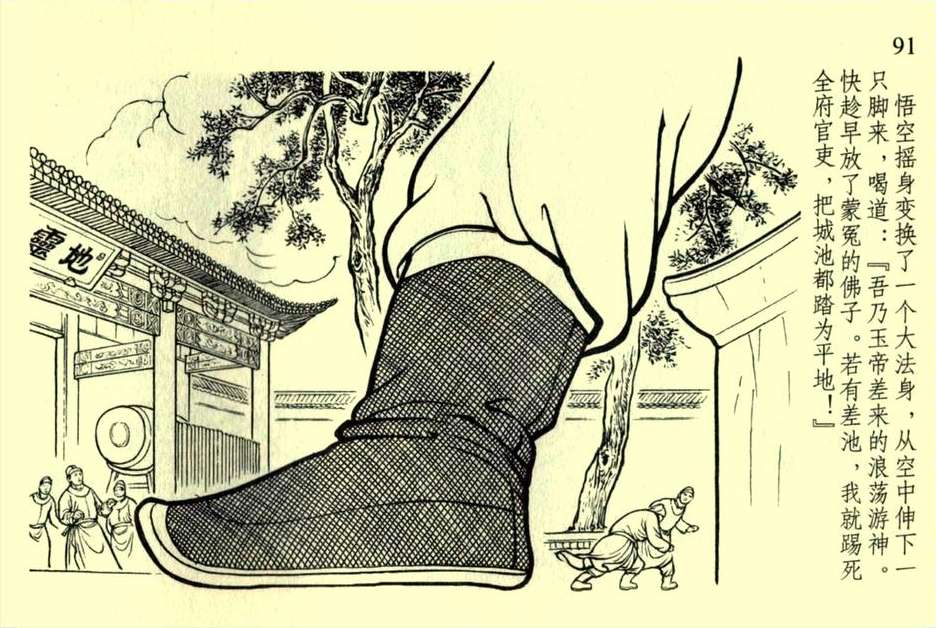
A good example of his cunning appears in chapter 97. The four monks are framed for the theft and murder of a rich layman who had originally hosted them for a month. Sun Wukong captures the real perpetrators and rounds up their stolen bounty, but he is forced to release the bandits for fear that Tripitaka will chant the tight-fillet spell for killing them. However, imperial troops later capture the clerics with the stolen items, making them look guilty. After the group is brought to court and tortured for some time (only affecting the weaker members), Monkey escapes from the prison at night in order to influence their release. First, he imitates the voice of the slain layman at his wake and threatens heavenly retribution if his widow, the person who framed the monks, doesn’t recant her false claims. Second, he imitates the voice of the deceased uncle of the city magistrate who imprisoned them and again threatens heavenly retribution if the official doesn’t reexamine the case. And third, at dawn he transforms himself into a titan-sized apparition before the district level magistrates and threatens to stomp the city and surrounding area into oblivion as heavenly retribution if they don’t put pressure on their superior to free the group. In the morning, Tripitaka, Zhu, Sha, and the officials visit the layman’s home, while Sun goes to the underworld to retrieve the man’s soul, which has been granted a dozen more years of life by the Bodhisattva Ksitigarbha. Monkey returns and brings the man back to life by forcing his soul into his body. The layman then explains how he had been murdered by bandits who robbed his mansion. The city magistrate therefore pardons the monks and even the wife.

A modern lianhuanhua depicting Monkey’s giant foot confronting the magistrates (larger version). Comic found here. 


Update: 09-08-24

@ryin-silverfish of Tumblr (author of this guest post) has made a catalog of Nezha’s powers from Investiture of the Gods (Fengshenyanyi, 封神演義, c. 1620). A BIG thank you to them.

https://docs.google.com/document/d/1FjHQPXmEalChk7PNiw9ljAJ8Cq66-AjevgEfdEa6wgI/edit?usp=sharing

A detail of Nezha striking at an enemy during battle. Image from The Newly Printed, Zhong Bojing Annotated, Investiture of the Gods (Xinke Zhong Bojing xiansheng piping Fengshen yanyi, 新刻鍾伯敬先生批評封神演義, c. 1620) (larger version).

Search

Follow Blog via Email

Enter your email address to follow this blog and receive notifications of new posts by email.

Social Media

  • X
  • Instagram

Recent Posts

  • Story Idea: Sun Wukong vs Heracles / Hercules
  • Origin of the White Turtle River Crossing Accident From Journey to the West Chapters 98 and 99
  • Archive #53 – PDFs of the Three Kingdoms Foreign Language Press English Translation (Vols. 1-4)
  • Archive #52 – Animating Sun Wukong: Shanghai Animation Film Studio’s Havoc in Heaven and Symbolic Transformation on the Eve of the Cultural Revolution
  • Archive #51 – Shi Pantuo, an Influence on Sun Wukong
  • Can Sun Wukong Copy the Strength and Magic of an Opponent?
  • The Crow’s Nest Chan Master of Journey to the West
  • Archive #50 – Heracles as Vajrapani
  • The “Immortal Register” of Journey to the West
  • Archive #49: Journey to the West (西游记): A 60-Volume Lianhuanhua Comic
  • Archive #48: The Eighteen Arhats Battle Wukong (十八罗汉斗悟空): A 7-Volume Lianhuanhua Comic
  • Archive #47: The Newly Annotated Journey to the West With Illustrations (Xinshuo Xiyouji (tuxiang), 1749/1888)
  • Journey to the West Fanfiction Writer Spotlight #1: DarkscytheDrake
  • Story Idea: Sun Wukong vs Juggernaut
  • The Past Life Biography of Zhu Bajie
  • Why Did the White Dragon Horse Burn His Father’s Pearls in Journey to the West?
  • Review: The Second Journey (2024) by Joel Bigman
  • Parallels Between Sun Wukong and Hercules
  • Why was Sun Wukong Able to Live 342 Years Prior to his Immortality?
  • A Possible Origin for the Term “Handsome Monkey King”
  • Sun Wukong Dough Figurines from Quanzhou, Fujian
  • Story Idea: Firearms and the Journey to the West Universe
  • Journey to the West Artist Spotlight #3: NingadudeXx
  • Archive #46 – A Catalog of the Monkey King’s Magic Powers and Skills
  • Origin of the Immortal Peach-Stealing Episode from Journey to the West
  • What Does Red Boy Look Like? A Resource for Artists and Cosplayers
  • Archive #45 – Tripitaka Seeks the Scriptures: A Rare Journey to the West Puppet Play from Quanzhou, Fujian
  • Archive #44 – The God Erlang Captures the Great Sage Equaling Heaven (Erlang shen suo Qitian dasheng) Zaju Play
  • Buddhist Deities Exiled From the Western Heaven in Chinese Vernacular Literature
  • Laozi’s Diamond Cutter Treasure-Weapon from Journey to the West
  • How to Kill Sun Wukong
  • Sun Wukong’s Four Mighty Commanders
  • Sun Wukong’s Names and Titles
  • Archive #43: The 72 and 36 Taoist Skills of the Lidai Shenxian Tongjian
  • Archive #42 – PDFs of Journey to the West Translations
  • A Brief Study of the Term Mihou (獼猴) in Journey to the West
  • Archive #41 – PDFs of The Illustrated Journey to the West (Ehon Saiyuki, 繪本西遊記, 1835)
  • Archive #40 – Journey to the South (Nanyouji) English Translation PDF
  • The Tang Monk Tripitaka and the Buddha Candana Merit
  • Is Sun Wukong FTM Trans?
  • How Tall are the Main Characters from Journey to the West?
  • Archive #39 – Journey to the West Adaptations
  • Laozi’s Realm in Journey to the West
  • The Buddha’s Vulture Peak and Journey to the West
  • How Many Humans Does Sun Wukong Kill in Journey to the West?
  • Yuebei xing, Daughter of the Monkey King
  • Journey to the West Artist Spotlight #2: NinjaHaku21
  • Archive #38 – Books on Learning Taiwanese Hokkien
  • A Realistic Retelling of Journey to the West?
  • Archive #37 – The 13th-Century Version of Journey to the West
  • My Great Sage Monkey King Statue from Thailand
  • What is the Oldest Known Media of Sun Wukong the Monkey King?
  • Does the Buddha Lie in Journey to the West?
  • Interesting Facts about the Monkey King
  • The Monkey King’s Crescent-Style Headband
  • A Survey of Sun Wukong’s Magic “Immortal Breath” and Its Abilities
  • Hercules vs Sun Wukong Death Battle Analysis
  • The Patriarch Subodhi: Sun Wukong’s First Master
  • Story Idea: The REAL Reason Sun Wukong is Expelled from Subodhi’s School
  • The Monkey King’s Worship in Thailand
  • Archive #36 – Sun Wukong and Battles of Magical Transformations
  • Archive #35 – The Tang Monk Tripitaka as a Confucian in Journey to the West
  • The Monkey King and the “Three-Teachings” (三教) Trinity of Southeast Asia
  • Archive #34 – Understanding Reality: A Taoist Alchemical Classic
  • Archive #33 – The Hsi-yu chi: A Study of Antecedents to the Sixteenth-Century Chinese Novel (1970)
  • Archive #32 – The Precious Scroll of Erlang (Erlang baojuan) (1562)
  • How Tall is the Monkey King? – A Debate
  • Archive #31 – The Original 1592 Edition of Journey to the West, Complete with Pictures
  • A Study of the Four Celestial Primates from Journey to the West
  • Archive #30 – The “Great Sage Equaling Heaven” Story from Liaozhai zhiyi (1740)
  • Archive #29 – Ruthless Compassion: Wrathful Deities in Early Indo-Tibetan Esoteric Buddhist Art (1999)
  • The Monkey King’s Magic Staff: A Complete Guide
  • The Tightening Spell of Sun Wukong’s Golden Headband
  • Review of DC Comics’ Monkey Prince #0 to #6
  • The White Ape Perfected Man: Sun Wukong’s Divine Double
  • Archive #28 – Tripitaka’s Reincarnation and its Connection to Ancient Greek and Egyptian Philosophy
  • Archive #27 – The Journey to the West Japsang Effigies of Korean Royal Palaces
  • Archive #26 – Bimawen, Heavenly Horses, and Dragon Horses in Chinese Literature and History
  • Dragon Ball and Journey to the West
  • Journey to the West Artist Spotlight #1: Dario Virga
  • The Monkey King’s Children
  • Watch Your Step: The Influence of Journey to the West on the “Ashiarai Yashiki” Yokai Story of Edo-Period Japan
  • What Does Zhu Bajie Look Like? A Resource for Artists and Cosplayers
  • Archive #25 – The Gibbon in China: An Essay in Chinese Animal Lore (1967) by Robert van Gulik
  • The Weight of the Monkey King’s Staff: A Literary Origin
  • Story Idea: The Reason for Sun Wukong’s Rebellion
  • Review of Marvel Comics’ Sun Wukong
  • Review of DC Comics’ “The Monkey Prince Hates Superheroes”
  • The Worship of Sun Wukong the Monkey King: An Overview
  • Archive #24 – Chinese Gods: The Unseen World of Spirits and Demons (1997) by Keith Stevens
  • Archive #23 – “Pagan Temples in San Francisco” (1892)
  • Review of Imagin8 Press’ Bilingual Edition of Journey to the West for Chinese Language Learners
  • The Great Sage Monkey King Scripture: A Brief Analysis
  • Archive #22 – The Monkey King’s Scripture
  • Sun Wukong and the Buddha’s Past Life as a Monkey King
  • Qitian Dasheng Monkey King Temples in Taiwan
  • Archive #21 – Qing-Period Color-Illustrated Complete Edition of Journey to the West
  • The Magic Powers of the Monkey King’s Iron Staff
  • The Book of Xian and Shen (BOXS), a Catalog of Chinese Gods
  • My Qitian Dasheng Monkey King Talisman Block
  • Archive #20 – The Xiyou ji in Its Formative Stages: The Late Ming Editions (1981)
  • Archive #19 – Transforming Monkey: Adaptation and Representation of a Chinese Epic (2018)
  • Origin of the Pregnancy Episode in Chapter 53
  • Origin of the Six-Eared Macaque and the Character’s Influence on Black Myth: Wukong
  • Parallels Between the Monkey King and the Buddha
  • The Monkey King and The Buddha Victorious in Strife (a.k.a. Victorious Fighting Buddha)
  • Archive #18 – Demons, Gods, and Pilgrims: The Demonology of the Hsi-yu Chi (1985)
  • Sun Wukong’s Curlicue-Style Headband
  • The Great Sage Detecting “Ping-Pong” Bottle
  • When was the Monkey King Born?
  • Sun Wukong and Births From Stone in World Mythology
  • Archive #17 – PDFs of Creation of the Gods Library of Chinese Classics Chinese-English Bilingual Edition (Vols. 1-4)
  • Generals Thousand-Mile Eye and Fair-Wind Ear
  • Taiwanese Religious Humor: The Epidemic Prevention Conference
  • Idea: Sun Wukong Animated Music Short
  • Archive #16 – Sun Wukong and Chinese Medicine
  • The Monkey King Temples of Fujian Province, China
  • Archive #15 – Narrative Structure and the Problem of Chapter Nine in the “Hsi-Yu Chi”
  • Archive #14 – Alchemy and Journey to the West: The Cart-Slow Kingdom Episode
  • The Alchemical Metaphor of Subodhi’s Mountain Home
  • The Origin of Sun Wukong’s Cloud Somersault
  • Archive #13 – Huineng, Subhuti, and Monkey’s Religion in “Xiyou ji” (2006)
  • Archive # 12 – The Origin of Sun Wukong’s 72 Transformations
  • Dragon Ball’s Senzu Bean and Journey to the West
  • Sun Wukong and the Buddhist Saint Mulian
  • Book Covers for Vintage Editions of Arthur Waley’s Monkey
  • Monkey Boxing: The Connection Between Primates and Martial Arts in Ancient China
  • Archive #11 – PDFs of the Journey to the West 2012 Revised Edition
  • Parallels between Sun Wukong and Wu Song
  • Archive #10 – The Magic White Ape of the Tang Dynasty
  • The Worship of Sun Wukong in 19th-century America
  • Bin Steel: The Magic Metal of Journey to the West
  • Origin of the White Bone Spirit
  • Sun Wukong and Miao Folklore
  • Sun Wukong and the Qiang Ethnic Group of China
  • Zhu Bajie’s Earliest Known Depictions and the Gyeongcheonsa Pagoda
  • The Great Sage Purple Cloud Temple of Yilan, Taiwan: A Photo Essay
  • Story Idea: The Origin of Sun Wukong
  • Archive #9 – PDF of Hanuman’s Tale: The Messages of a Divine Monkey
  • The Monkey King’s Cosmic Body
  • Archive #8 – The Pig and the Prostitute: The Cult of Zhu Bajie in Modern Taiwan
  • Musings on Journey to the West and my new Great Sage Tattoo
  • Sun Wukong’s Strength-Bestowing Ritual
  • Story Idea: Master Subodhi’s Curriculum II – Immortal Warriors and Shaolin Monks – Some Fun Monkey King Fanfiction Speculation
  • My Sun Wukong Art – “The Buddha has Awakened”
  • Master Subodhi’s Curriculum
  • Journey to the West and World History
  • The Story of the Original Golden Headband in the Great Sage Treasure Temple, Kowloon, Hong Kong
  • Sun Wukong’s Hellish Punishment
  • Monkey and the Summoners of Hell: The Story and Origins of the Heibai Wuchang

Categories

  • Archive
  • Art
  • Buddhism
  • Comics
  • Daoism
  • Ethnic Groups
  • Fanfiction
  • Fujian
  • Geography
  • Greek
  • Han Dynasty
  • Hinduism
  • Japan
  • Korea
  • Lianhuanhua comic
  • Lord Erlang
  • Martial arts
  • Ming Dynasty
  • Popular Media
  • popular religion
  • PRC China
  • Prequels
  • Qing Dynasty
  • Sequels
  • Sha Wujing
  • Song Dynasty
  • Story Ideas
  • Sun Wukong
  • Tang Dynasty
  • Thailand
  • Tripitaka
  • Weapons
  • White Dragon Horse
  • Yu the Great
  • Yuan Dynasty
  • Zhu Bajie

Archives

  • October 2025
  • August 2025
  • July 2025
  • June 2025
  • May 2025
  • April 2025
  • March 2025
  • February 2025
  • January 2025
  • December 2024
  • October 2024
  • September 2024
  • August 2024
  • April 2024
  • March 2024
  • February 2024
  • January 2024
  • December 2023
  • September 2023
  • August 2023
  • July 2023
  • June 2023
  • May 2023
  • April 2023
  • March 2023
  • February 2023
  • January 2023
  • December 2022
  • October 2022
  • September 2022
  • August 2022
  • July 2022
  • June 2022
  • May 2022
  • April 2022
  • March 2022
  • February 2022
  • January 2022
  • December 2021
  • November 2021
  • October 2021
  • August 2021
  • July 2021
  • June 2021
  • May 2021
  • April 2021
  • March 2021
  • February 2021
  • January 2021
  • December 2020
  • November 2020
  • October 2020
  • September 2020
  • August 2020
  • June 2020
  • May 2020
  • April 2020
  • March 2020
  • February 2020
  • January 2020
  • December 2019
  • October 2019
  • September 2019
  • July 2019
  • June 2019
  • May 2019
  • April 2019
  • March 2019
  • February 2019
  • January 2019
  • December 2018
  • November 2018
  • October 2018
  • September 2018
  • August 2018
  • July 2018
  • June 2018
  • May 2018
  • April 2018
  • March 2018
  • February 2018
  • December 2017
  • November 2017
  • October 2017
  • September 2017
  • July 2017
  • June 2017
  • May 2017
  • February 2017
  • January 2017
  • December 2016
  • October 2016
  • December 2014
  • June 2014
  • February 2014
  • September 2013
  • November 2012
Powered by WordPress.com.
 

Loading Comments...