Archive #51 – Shi Pantuo, an Influence on Sun Wukong

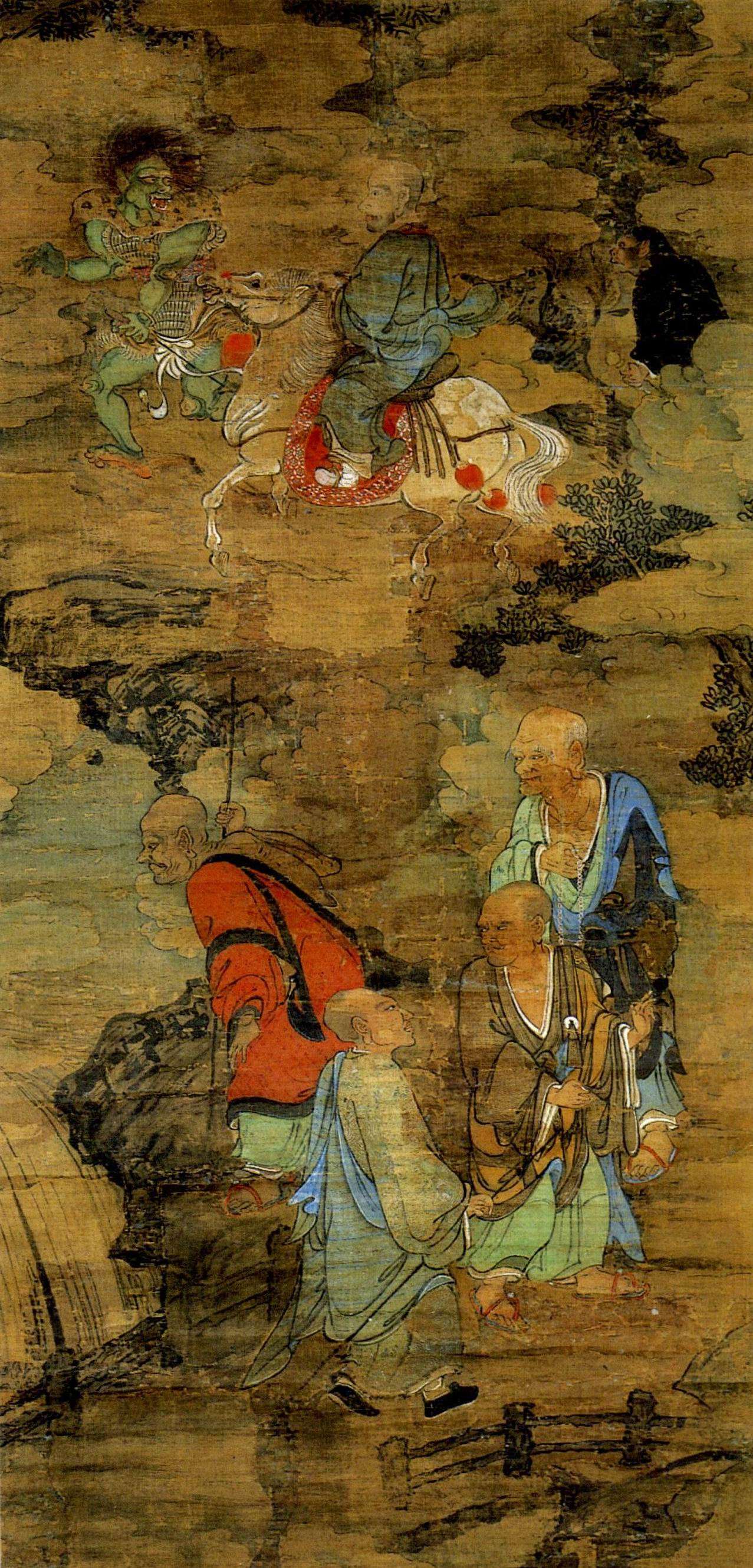
I was asked on Tumblr if I was familiar with Shi Pantuo (石槃陀/石盤陀/石磐陀; fig. 1), a historical figure suggested to be one of several influences on Sun Wukong. [1] He is known for serving as a temporary guide to the historical monk Xuanzang (玄奘, 602–664), on whom the literary Tripitaka is based. According to Hansen (2012), Shi was a Sogdian, an Iranian people active in Central Asia and China:

The guide’s last name, Shi, indicated that his family had originally come from the region of Kesh, or Shahrisabz, outside Samarkand, Uzbekistan, while his given name, Pantuo, was the Chinese transcription of Vandak, a common Sogdian name meaning “servant” of a given deity (p. 85). [2]

In this article, I will quote Shi’s full story appearing in A Biography of the Tripitaka Master of the Great Ci’en Monastery (Da Tang Daci’en si Sanzang Fashi Zhuan, 大唐大慈恩寺三藏法師傳, 7th-century; T2053), a journal of Xuanzang’s travels written by his disciple Huili (慧立). I will also discuss why he is believed to have been an inspiration for the Monkey King.

On a related note, please see my past article about the historical monk Wukong (悟空).

Fig. 1 – Statues of Xuanzang (left) and Shi Pantuo (right) from the Xuanzang Procures the Scriptures Museum (Xuanzang qujing bowuguan, 玄奘取经博物馆) in Guazhou County, Gansu Province, China (larger version). Image found here.

1. Historical Record

Determined to procure Buddhist scriptures from India, Xuanzang ignored a royal prohibition against leaving China by traveling in secret towards the western reaches of the country. He was initially worried about traversing the border, which was heavily guarded by the military, but then his horse died, making matters worse. Then he was shocked to find that a warrant had been issued for his arrest. All of this weighed heavily on the monk (Huili & Shi, 1995, pp. 20-21). It was shortly thereafter that he met Shi Pantuo:

Now the Master worried all the more. Of the two junior monks [who had recently joined him in Liangzhou], Daozheng had already gone to Dunhuang, and only Huilin remained with him. Knowing that he could not stand the hardships of the long journey ahead, the Master dismissed him and let him go home. He bought a horse, but the trouble was that he had nobody to be his guide. Before the image of Maitreya Bodhisattva of the monastery [in Guazhou (fig. 2)] in which he was staying, he prayed for a man who might guide him through the pass. That night a monk of the Hu [胡, i.e. “barbarian“] tribe, named Dharma, of that monastery dreamed that the Master was sitting on a lotus flower going west. Dharma felt it strange and in the following morning he came to tell his dream to the Master, who was delighted in his mind, knowing that this was a good omen indicating the possibility of continuing his journey. But he said to Dharma, “A dream is but a fancy and is not worth mentioning.”

He again entered the shrine hall to pray. Before long a man of the Hu tribe came to pay homage to the image of the Buddha. He worshipped the Master by circumambulating him two or three … (Huili & Shi, 1995, p. 21)

… times. Being asked his name, the man said that he was named Pantuo with the surname of Shi (emphasis added). He begged for the conferment of the Precepts and was given the Five Precepts. Greatly delighted, the Hu man went away and returned in a moment with cakes and fruits. Seeing that the man was intelligent and strong with a reverential manner, the Master told him about his intention of taking the journey. The Hu man consented to send him across the five watchtowers, and this greatly pleased the Master. He bought some clothes and a horse for the man and made an appointment with him.

On the following day, when the sun was about to set, the Master went to a bushland where he waited for the man. Before long he arrived together with an old man of the Hu tribe, riding on an aged lean horse of reddish color. At this sight the Master felt displeased. But the young man said, “This old man knows the route to the West perfectly well. He has travelled to and from Yiwu for more than thirty times. I have brought him along in the hope that he might give you some counsel.” Then the old Hu man said, “The road to the West is perilous and the Sha River is an obstacle on the long way. There are demons and hot wind. Whoever encounters them cannot be spared from death. Even if you travel together with a large group of companions, you might go astray or be lost. How can you, reverend teacher, try to go all alone? I ask you to consider the matter carefully and not gamble with your life.”

The Master replied, “I started on my journey to the West for the purpose of seeking the Great Dharma. I shall not return to the East before I reach the Brahmanic countries. I shall not regret it even if I die on the way.”

The old man said, “If you insist on going, you had better ride my horse. This horse of mine has travelled to Yiwu fifteen times. It is sound and knows the way well. Yours is too young to travel such a long distance.”

Then the Master recalled that when he was about to start on his journey to the West from Chang’an, there was a sorcerer, named He Hongda, whose witchcraft and divination were usually effective. The Master had asked him to foretell the events of his … (Huili & Shi, 1995, p. 22)

… forthcoming journey. The sorcerer said, “You will be able to go, and it seems that you will be riding on an aged, lean horse of a reddish color, equipped with a varnished saddle with a piece of iron at the front.” On seeing that the Hu man’s horse was lean and reddish in color and that the varnished saddle had a piece of iron, the Master deemed it appropriate to take it, and so he changed his horse for that of the old Hu man, who was quite pleased and went away after due salutation.

After having packed his outfit, the Master started on the journey with the young Hu man. At about the third watch, they reached the river and saw the Yumen Pass at a distance. They went up the stream for about ten li [3.10 mi or 5 km] from the pass and came to a place where the banks of the river were over ten [Chinese] feet apart [10.43 ft or 3.18 m], beside which there was a wood of tamarisks. The Hu man cut some branches and built a bridge, on which he spread grass and paved it with sand. Then they drove their horses across [fig. 3].

The Master was glad to have crossed the river, and he unsaddled his horse to take rest at a place more than fifty paces from the Hu man. They spread their quilts on the ground to sleep. After a little while the Hu man got up, unsheathed his knife, and slowly advanced toward the Master, but he retreated at a distance of about ten paces. Not knowing what he had in his mind and suspecting that he might have an evil intent, the Master got up and recited scriptures and repeated the name of Avalokitesvara Bodhisattva [i.e. Guanyin], whereupon the Hu man lay down and slept. [3]

When it was nearly daybreak, the Master wakened the man to fetch some water for a wash. At the moment when they were about to continue the journey after having taken breakfast, the Hu man said, “Your disciple considers that the journey ahead is long and dangerous with neither water nor grass on the way. As water can be obtained only at the five towers, we have to reach them at night to steal water and pass along. But once discovered we shall be dead men. So it is safer to turn back.”

But the Master was determined not to go back, and so the Hu man proceeded with reluctance. He took out his sword and drew his bow, ordering the Master to go before him, but the Master … (Huili & Shi, 1995, p. 23)

… refused to precede him. When they had gone a few li, the man stopped and said, ‘Your disciple cannot go any more. I have a big family to support, and moreover I dare not trespass against the law.” The Master knew his mind and let him go back. The Hu man said, “You will certainly not be able to reach your destination. What shall I do if you are arrested and I am involved in the matter?” The Master replied, “Even if I am cut to pieces, I will never implicate you in my affair.” He then took a solemn oath and the man was satisfied. The Master presented him with a horse out of gratitude for his service, and they parted (Huili & Shi, 1995, p. 23).

___________________________

(I’m presenting two Chinese versions of the text here because I’ve noticed some differences.)

CBETA:

自是益增憂惘。所從二小僧,道整先向燉煌,唯惠琳在,知其不堪遠涉,亦放還。遂貿易得馬一匹,但苦無人相引。即於所停寺彌勒像前啟請,願得一人相引渡關。

其夜,寺有胡僧達摩,夢法師坐一蓮華向西而去。達摩私怪,旦而來白。法師心喜為得行之徵,然語達摩云:「夢為虛妄,何足涉言。」更入道場禮請。俄有一胡人來入禮佛,逐法師行二三匝。問其姓名,云姓石,字槃陀。此胡即請受戒,乃為授五戒。胡甚喜,辭還。少時齎餅菓更來。法師見其明健,貌又恭肅,遂告行意。胡人許諾言,送師過五烽。法師大喜,乃更貿衣資為買馬而期焉。

明日日欲下,遂入草間,須臾彼胡更與一胡老翁乘一瘦老赤馬相逐而至。法師心不懌,少胡曰:「此翁極諳西路,來去伊吾三十餘反,故共俱來,望有平章耳。」胡公因說:「西路險惡,沙河阻遠,鬼魅熱風,過無達者。徒侶眾多,猶數迷失,況師單獨,如何可行?願自斟量,勿輕身命。」法師報曰:「貧道為求大法,發趣西方,若不至婆羅門國,終不東歸。縱死中途,非所悔也。」胡翁曰:「師必去,可乘我此馬。此馬往反伊吾已十五度。健而知道。師馬少,不堪遠涉。」

法師乃竊念,在長安將發志西方日,有術人何弘達者,誦呪占觀,多有所中。法師令占行事,達曰:「師得去。去狀似乘一老赤瘦馬,漆鞍橋前有鐵。」既覩胡人所乘馬瘦赤,鞍漆有鐵,與何言合,心以為當,遂換馬。胡翁歡喜,禮敬而別。於是裝束,與少胡夜發。三更許到河,遙見玉關。去關上流十里許,兩岸可闊丈餘,傍有胡椒樹叢。胡乃斬木為橋,布草填沙,驅馬而過。

法師既渡而喜,因解駕停憩,與胡人相去可五十餘步,各下褥而眠。少時,胡人乃拔刀而起,徐向法師,未到十步許又迴,不知何意,疑有異心。即起誦經,念觀音菩薩。胡人見已,還臥遂眠。天欲明,法師喚令起取水𣹉漱,解齋訖欲發,胡人曰:「弟子將前途險遠,又無水草,唯五烽下有水,必須夜到偷水而過,但一處被覺,即是死人。不如歸還,用為安隱。」法師確然不迴,乃俛仰而進,露刃張弓,命法師前行。法師不肯居前,胡人自行數里而住,曰:「弟子不能去。家累既大而王法不可干也。」法師知其意,遂任還。胡人曰:「師必不達。如被擒捉,相引奈何?」法師報曰:「縱使切割此身如微塵者,終不相引。」為陳重誓,其意乃止。與馬一匹,勞謝而別。(Source)

Wikisource:

自是益增憂惘。所從二小僧,道整先向燉煌,唯慧琳在,知其不堪遠涉,亦放還。遂貿易得馬一疋,但苦無人相引。即於所停寺彌勒像前啟請,願得一人相引渡關。其夜,寺有胡僧達磨夢法師坐一蓮華向西而去。達磨私怪,旦而來白。法師心喜為得行之徵,然語達磨云:「夢為虛妄,何足涉言。」更入道場禮請,俄有一胡人來入禮佛,逐法師行二三幣。問其姓名,雲姓石字盤陀。此胡即請受戒,乃為授五戒。胡甚喜,辭還。少時齋餅果更來。法師見其明健,貌又恭肅,遂告行意。胡人許諾,言送師過五烽。法師大喜,乃更貿衣資為買馬而期焉。明日日欲下,遂入草間,須臾彼胡更與一胡老翁乘一瘦老赤馬相逐而至,法師心不懌。少胡曰:「此翁極諳西路,來去伊吾三十餘返,故共俱來,望有平章耳。」胡公因說西路險惡,沙河阻遠,鬼魅熱風,遇無免者。徒侶眾多,猶數迷失,況師單獨,如何可行?願自料量,勿輕身命。法師報曰:「貧道為求大法,發趣西方,若不至婆羅門國,終不東歸。縱死中途,非所悔也。」胡翁曰:「師必去,可乘我馬。此馬往返伊吾已有十五度,健而知道。師馬少,不堪遠涉。」法師乃竊念在長安將發誌西方日,有術人何弘達者,誦咒占觀,多有所中。法師令占行事,達曰:「師得去。去狀似乘一老赤瘦馬,漆鞍橋前有鐵。」既睹胡人所乘馬瘦赤,漆鞍有鐵,與何言合,心以為當,遂即換馬。胡翁歡喜,禮敬而別。

於是裝束,與少胡夜發。三更許到河,遙見玉門關。去關上流十里許,兩岸可闊丈餘,傍有梧桐樹叢。胡人乃斬木為橋,布草填沙,驅馬而過。法師既渡而喜,因解駕停,與胡人相去可五十餘步,各下褥而眠。少時胡人乃拔刀而起,徐向法師,未到十步許又回,不知何意,疑有異心。即起誦經,念觀音菩薩。胡人見已,還臥遂睡。天欲明,法師喚令起取水盥漱,解齋訖欲發,胡人曰:「弟子將前途險遠,又無水草,唯五烽下有水,必須夜到偷水而過,但一處被覺,即是死人。不如歸還,用為安穩。」法師確然不回。乃勉仰而進,露刀張弓,命法師前行。法師不肯居前,胡人自行數里而住,曰:「弟子不能去。家累既大而王法不可忤也。」法師知其意,遂任還。胡人曰:「師必不達。如被擒捉,相引奈何?」法師報曰:「縱使切割此身如微塵者,終不相引。」為陳重誓,其意乃止。與馬一疋,勞謝而別。(Source)

Fig. 2 (Top) – Xuanzang’s route to (red) and from (green) India. The black triangle indicates his starting point in the Chinese capital of Chang’an. The red arrow indicates Guazhou, where he met Shi Pantuo (larger version). Image found here. Fig. 3 (Bottom) – Xuanzang’s route from Guazhou towards the Yumen Pass. The bottom arrow indicates Guazhou, and the top arrow indicates where the monk and his guide passed the river and eventually parted ways (larger version). Image found here.

2. Connection to Sun Wukong

Zhang Jinchi (张锦池), a professor of Chinese Language and Literature at Harbin Normal University, has proposed five reasons for why Shi is a prototype of Sun Wukong:

1) Their functions as guides are similar; 2) their functions in resolving danger are comparable; 3) their identities as pilgrims are identical; 4) their delicate master-disciple relationships are similar; and 5) Shi Pantuo was a “barbarian monk” (huseng), and this is pronounced similarly to “macaque” (husun).

(1) 向导作用相类;(2) 解决危难作用相若;(3) 行者身份相同;(4) 师徒间微妙关系相似;(5) 石磐陀乃胡僧,胡僧与“猢狲”音近 (Chen, 2011, p. 50).

I’d like to provide context as a reminder of what we have already learned about Shi and what is known about Monkey from his story cycle. First, both obviously guide their masters, Shi past the Yumen Pass and Sun all the way to India. Second, both resolve danger in particular ways. Shi built a bridge, which helped them bypass a river blocking their path, and he also carried a sword and bow, which means he could have protected the monk from bandits if the need arose. Wukong of course uses his magic and martial skills to protect Tripitaka from all sorts of monsters and spirits. Third, the term “pilgrim” (xingzhe, 行者) refers to a “postulant,” a lay Buddhist acolyte who has yet to be ordained but lives as an untonsured monk, one expected to follow the Five Precepts against killing, lying, stealing, sexual misconduct, and drinking alcohol (Buswell & Lopez, 2014, pp. 1011-1012). Therefore, both Shi and Monkey were/are essentially untrained, itinerant monks who travel(ed) with their masters on the road west. Fourth, the master-disciple relationship is delicate because both postulants threaten their masters’ lives. Shi attempted to assault Xuanzang with a knife in the night, and Sun attempts to kill Tripitaka with his staff when the cleric first uses the tight-fillet spell (Wu & Yu, 2012, vol. 1, p. 320). And of course we can’t forget the times when the Tang Monk kicks Wukong out of the pilgrimage (Wu & Yu, 2012, vol. 2, pp. 26-28; vol. 3, pp. 89-91). And fifth, huseng (胡僧, “barbarian monk,” i.e. Shi) and husun (猢猻, “macaque,” i.e. Monkey) sound similar, implying a connection. But this last point requires more explanation. Mair (2015) comments on the relationship between the word hu (胡), Hu-barbarians, and beards:

The earliest mention I know of for hú 胡 with the meaning of “non-Sinitic people from the west” is in the Zhōu lǐ 周礼 (Rituals of the Zhou), which is a Western Han (206 BC-9 AD) text, whereas the earliest occurrence of hú 胡 with the meaning “beard” that I’m aware of is considerably later, during the Liang period (502-587) of the Southern Dynasties.

This speaks to a stereotyped image of foreigners as bearded people (fig. 4). Most importantly, their association with body hair eventually gave rise to a new name for monkeys. The Compendium of Materia Medica (Bencao gangmu本草綱目, 1596) states, “Since a monkey resembles a Hu-barbarian (Hu ren), he is also called ‘grandson of the barbarian’ (husun)” (猴形似胡人,故曰胡孫). This term is often used to refer to macaques. For example, even Sun’s first master references it in JTTW chapter one: “Though your features are not the most attractive, you do resemble a pignolia-eating macaque (husun)” (你身軀雖是鄙陋,卻像個食松果的猢猻) (based on Wu & Yu, 2012, vol. 1, p. 115). [4]

Therefore, all of these points combined make it easy to see how the concept of a Hu-barbarian monk traveling with Xuanzang could’ve helped give rise to stories about a husun (macaque) monk traveling with Tripitaka.

Fig. 4 – A 7th-century Chinese temple carving of a bearded Sogdian dancer (larger version).

Note:

1) This reminds me of “Euhemerism,” a philosophical interpretation of mythology where gods are suggested to have originally been deified historical figures.

2) A chart in Hansen (2005) shows that another variant of Pantuo (槃陀/盤陀/磐陀), a common Sogdian given name, is “畔陀” (p. 305).

3) Hansen (2012) questions if Shi approaching Xuanzang with a knife was a nightmare (p. 86).

A more sinical person might read the old Sogdian convincing Xuanzang to switch animals as a plot to cheat the monk out of a better quality horse. And Shi approaching him in the night with a knife could thus be read as the murderous finale of that plan. Afterall, the cleric wouldn’t be able to return to complain to the authorities about the bad trade if he was dead. But there are two problems with this theory: 1) Shi guided Xuanzang for a distance and even built a bridge to help bypass a river. That seems like way too much effort just to turn around and murder someone. Killing the monk just outside of town would have taken much less time and effort; and 2) the sorcerer He Hongda is said to have foretold the use of this skinny horse while the monk was still in Chang’an. However, a sinical person might counter that: 1) Shi was just scared to do the dirty deed too close to home; and 2) The “prophecy” was just a cover for the bad trade. I’ll let the reader decide.

4) The only difference between the old husun (胡孫) from the Materia Medica and the current husun (猢猻) is the addition of the dog radical (quan, 犭), thereby transforming the barbaric grandson into an animal.

Sources:

Buswell, R. E. , & Lopez, D. S. (2014). The Princeton Dictionary of Buddhism. Princeton, NJ: Princeton University Press.

Chen, M. (2011). Sun Wukong juese yanjiu jiqi yiyi tantao [An Investigation of the Research into Sun Wukong’s Role and Importance]. Journal of Xianning University, 31(11), 49-50. Retrieved from https://web.archive.org/web/20181220230540/http://lyglibrary.com/tsg/xyjwx/xyjyj/%E8%A5%BF%E6%B8%B8%E8%AE%B0%E8%AE%BA%E6%96%872011/%E5%AD%99%E6%82%9F%E7%A9%BA%E8%A7%92%E8%89%B2%E7%A0%94%E7%A9%B6%E5%8F%8A%E5%85%B6%E6%84%8F%E4%B9%89%E6%8E%A2%E8%AE%A8.pdf

Hansen, V. (2005). The Impact of the Silk Road Trade on Local Community: The Turfan Oasis, 500-800. In E. Trombert, & E. La Vaissière (Eds.), Les Sogdiens en Chine (pp. 283-310). Paris: École française d’Extrême-Orient.

Hansen, V. (2012). The Silk Road: A New History. Oxford, NY: Oxford University Press.

Huili, & Shi, Y. (1995). A Biography of the Tripitaka Master of the Great Ci’en Monastery of the Great Tang Dynasty (L. Rongxi Trans.). Berkeley, CA: Numata Center for Buddhist Translation and Research. Retrieved from https://www.bdkamerica.org/product/a-biography-of-the-tripitaka-master-of-the-great-cien-monastery/.

Mair, V. (2015, August 26). The bearded barbarian. Language Log. Retrieved from https://languagelog.ldc.upenn.edu/nll/?p=20808

Review: The Second Journey (2024) by Joel Bigman

Note: I was not paid for this review.

Format: Ebook ($6.99 USD) and paperback (280 pages; $19.99 to $21.99 USD) [1]
Publisher: Earnshaw Books Ltd.
Release date: December 17th, 2024
Purchase links:

1. Introduction

Over two decades ago I was inspired by Journey to the West (Xiyouji西遊記, 1592 CE; “JTTW” hereafter) to begin writing my own Chinese fantasy about an itinerant disciple of Sun Wukong battling monsters across ancient China. However, this all changed when I learned about the Kaifeng Jews, a historical enclave of sinified Israelite descendants who have lived in the Middle Kingdom for nearly a millennium. This convergence of two different cultures immediately captured my imagination, leading to the main character becoming the son of a founding member of the community. He would go on to brave supernatural events and creatures while serving as a soldier under General Yue Fei (1103–1142 CE), [2] eventually becoming a Jewish sage and powerful exorcist later in life. However, the book ultimately didn’t materialize as I came to realize that I was much better at coming up with research-based story ideas than actually writing narratives. Thus, my dreams of a Chinese-Jewish fantasy novel never came to pass.

But fret not, for Joel Bigman has written The Second Journey (2024), a modern sequel to JTTW, which is being touted as “The World’s First Chinese-Jewish Historical Fantasy.” [3] The story is framed as the contents of a lost 7th-century CE scroll discovered inside a buried jar while city planners investigate a watermain leak in modern Xi’an, Shaanxi province, China. A subsequent translation of the Aramaic text reveals a second, unknown journey undertaken by Xuanzang, Sun Wukong, and Zhu Bajie (but not Sha Wujing or the Dragon Horse) five years after their original return. This new quest is initiated by the Bodhisattva Guanyin, who requests that the Tang Monk seek knowledge outside of China for the benefit of the Kaifeng Jews, who have assimilated so much into Chinese culture that they’ve forgotten how to read their Hebrew scriptures. The trio travels past India and into Central Asia, where they procure the services of “Bear” (a.k.a. the “Second Samson“), a supernaturally strong Jew with knowledge of the various routes and personages of Historic Palestine. Together with a mysterious donkey, they travel from town to town looking for a holy man willing to return to China and become the Kaifeng Jewish community’s new teacher, thereby reigniting their religious life. Bear arranges for the pilgrims to meet and stay with several such holy men—allowing them to learn Hebrew and Jewish culture and religious history along the way—but the search for the right candidate is quite difficult.

Cover art by the wonderful Yuyu (与鱼), a freelance illustrator. You can see other examples of their work here.

2. Analysis

2.1. Compare and contrast

How does The Second Journey compare to JTTW? Recall that the original is a fictionalized retelling of the historical monk Xuanzang‘s (玄奘, 602–664 CE) journey to India from 627 to 645 (640 to 654 in the novel) (Buswell & Lopez, 2014, pp. 1015-1016; Wu & Yu, 2012, vol. 1, p. 293; vol. 4, p. 374). The set up for the sequel is also based on actual history. The Jewish community of Kaifeng, Henan Province, China is believed to have been founded around the Northern Song Dynasty (960–1127 CE), [4] and after centuries of unchecked assimilation, the enclave became religiously extinct sometime after the last Rabbi with knowledge of Hebrew died around 1800, [5] during the Qing Dynasty (1644–1911 CE). Joel has simply taken some artistic license by setting these events during the Tang Dynasty (618–907 CE). Also, the novel is full of historical Jewish sages and people that Xuanzang and his companions come to meet and/or learn from over the course of their journey. These include Eliezer ben Hurcanus, Yehoshua ben Hananiah, Akiva ben Joseph, Elisha ben Abuyah, Simeon ben Azzai, Simeon ben Zoma, Honi HaMe’agel, Shimon bar Yochai and his son Eleazar ben Shimon, Hillel the Elder, Rav Nachman bar Yaakov and his wife Lady Yalta, Rav Sheshet, Yohanan ben Zakkai, Shimon ben Lakish, Rabbi Tarfon, Judah ha-Nasi, Rabbi Meir and his wife Bruriah, and others. One of my favorite historical moments happens in “Wine,” when Monkey helps an enraged Lady Yalta attain catharsis by prompting her to smash hundreds of casks in a wine cellar after being slighted by her husband’s house guest (Bigman, 2024, pp. 138-140). Another happens in “Mother,” when Sun smashes a vase at the behest of Xuanzang in order to snap grieving disciples out of their ceaseless prayers, which are keeping ailing Rabbi Judah from dying (Bigman, 2024, pp. 165-167). Inserting our heroes into these Talmudic stories is an ingenious way of making the pilgrims feel that much more real, like they are being pulled out of myth and thrust into the real world.

JTTW is full of enlightened beings, gods, immortals, and demons and ghosts that can fly and wield spells and mystic objects for benign or malevolent purposes. The Second Journey also features magic. I can’t continue without first acknowledging that the historical Jews listed above actually lived centuries before Xuanzang was even born—something that informed readers may have already figured out. This means that the story follows a dreamlike timeline where the group magically flows like water between their present, the early Talmudic period (70–638 CE), and the distant Exodus Period, freely interacting with sages, prophets, patriarchs, and even God himself along the way. [6] Some of these Jewish holy men have mystical adventures of their own, such as in “Orchard” when Rabbi Akiva and others fly on a flaming chariot to the “Orchard of mystical knowledge” in order to discuss spiritual matters with wise men-cum-divine beings, or in “Slow Cart” when Sage Honi, a biblical rain-maker, is transported in his dreams to the past events of JTTW chapter 46, where he takes part in a rain-making competition against a Daoist animal-spirit (Bigman, 2024, pp. 56-62 and 99-104). And of course no JTTW story would be complete without Monkey showing off his magic powers. One of the more inventive uses of his abilities happens in a particular chapter where the titanic, golem-like angel Gabriel produces a giant clay sword from his thigh, and Monkey uses the intense spiritual flames inside his divine body to carburize it into a fine steel blade (Bigman, 2024, pp. 79). You’ll have to read the book to see how the weapon is used.

The original story is set in a world where Buddhism, Daoism, and Confucianism live in harmony with one another. The sequel also features such religious pluralism. In “Kaifeng,” Guanyin explains that she is sending the Tang Monk to the Western lands in order to save the Kaifeng Jews from being completely absorbed by Chinese culture. And in order to accomplish this, Xuanzang must bring foreign knowledge back to the Eastern lands, referring to it as “[s]eeds that may grow into something new” (Bigman, 2024, p. 11). As mentioned above, “Orchard” sees Jewish sages travel to a mystical orchard, where they converse with wise country folk, who are in actuality the Jade Emperor and Laozi (Bigman, 2024, pp. 59-62). This implies that even Jewish holy men can benefit from the knowledge of the East. A third example takes the form of the novel’s two-fold world system, where the Eastern and Western lands are two distinct realms overseen by the Jade Emperor and God, respectively. The reader first learns about this partitioned cosmos in “Oven” when Monkey seeks Guanyin’s aid in order to facilitate a biblical miracle:

In the past, you have received help in battling demons, either from myself, or from other celestial beings. But in this case, even the Jade Emperor cannot help you. These [Western] lands are too far away from our realm. You must ask for help from the emperor in a different heaven, in the Far Western Heaven […] He is Olam-Tzu, World-Master. The westerners call him Ribbono Shel Olam. You’ll have to find your own way to his heaven (Bigman, 2024, p. 36).

JTTW is full of humor, my favorite episode being when Monkey tricks three animal-spirits into drinking “elixir” which is actually the disciples’ stinky urine (Wu & Yu, 2012, vol. 2, pp. 286-287). BWAHAHAHA!!! The Second Journey also has its funny moments. In “The Other,” we learn our heroes have melodious snores:

Our friends woke up late the following morning; only Xuanzang woke up before noon. There was a whole chorus of snoring, led by the renowned soloist Pigsy, accompanied by Bear, their Foreign Guide, and our dear Monkey (Bigman, 2024, p. 187).

My absolute favorite comical moment happens in “Karma,” when Sage Sheshet warns Zhu that his over indulgence of Sabbath stew will come back to haunt him. And sure enough, after eating eighteen bowls worth, horrible stomach pains wake him from his afternoon nap. This causes him to worry that he has once again become magically pregnant like in chapter 53 of the original. But instead of relying on magic abortion water this time to end his suffering, his problem is solved by ripping nasty, giant farts (Bigman, 2024, pp. 145 and 148-150).

Beyond cultural and religious differences, the only applicable element that contrasts with JTTW is that Historic Palestine is said to be free of monsters (Bigman, 2024, pp. 46 and 109, for example). Monkey does briefly tangle with some biblical baddies in the sequel, but they are separated from the human world and therefore do not pose an immediate threat to the Tang Monk. This lack of action might be a little depressing for fans of the original, but readers should understand that both books serve different purposes. JTTW is chocked full of spirits that act as both merit-building obstacles and cultivation-facilitating illusions of the mind. These act as metaphors for the journey towards Buddhist enlightenment. However, such concepts aren’t needed in The Second Journey since Joel tells me that the point of the book is to introduce readers to Jewish culture and history via the medium of Xuanzang’s quest to find a teacher. Therefore, our heroes spend the majority of the story learning local beliefs and customs, listening to biblical tales, and acting as casual observers of Jewish religious history as it unfolds during their time travels. Entering the book with this knowledge should make it more enjoyable.

2.2. Suggestions

The book’s version of Xuanzang is an amalgam of his historical and literary counterparts. While this generally meshes well within the more realistic context of Historic Palestine, it does cause a problem in one particular instance. In “Bandits,” the pilgrims are accosted on the road by a group of highwaymen, and after their Daoist immortal-looking leader neutralizes Sun, Zhu, and Bear with a magic net, they choose the Tang Monk and a temporary travel companion as sacrifices to the Hindu goddess Durga. But a mysterious, powerful wind sent from heaven causes them to change their minds. The bandit leader is eventually revealed to be a Jew with a shady past who would go on to become a great holy man (Bigman, 2024, pp. 152-156). The problem is that the attempted sacrifice supposedly happened to the historical Xuanzang in India while sailing down the Ganges River (Huili & Shi, 1995, pp. 76-78). Recall that the historical Sage Honi travels back in time to past events from JTTW in “Slow Cart,” but this happens in his dreams. The episode under discussion is different because a historical event from India—which should have already happened to our composit Xuanzang—has been transposed onto Historic Palestine. It’s so out of place that it took me out of the story at that moment. The same can be said about a Daoist Jew leading a group of Hindu bandits in the Levant. I understand that Joel was trying to manufacture tension here, but he could have come up with an original group of bandits, and that way, Xuanzang could liken the experience to the one he had in India years prior. Or better still, the event could be likened to the Tang Monk’s experience in JTTW chapter 56 when Monkey is kicked out of the group for killing brigands, including beheading the wayward son of a local elderly couple (Wu & Yu, 2012, vol. 3, pp. 88-90). Perhaps Sun is put into a similar situation in the sequel where he could easily kill, but he doesn’t, thereby showing his master that he has internalized restraint.

And lastly, beyond fixing some minor issues, [7] the book would benefit from adding a glossary or footnotes to explain the names and significance of the various Jewish personages featured in the narrative. Joel told me that he “didn’t want to make it too ‘educational,’ like lecturing at the reader,” but non-Jews like myself who lack an extensive knowledge of Jewish religious history will no doubt be lost without some kind of guide. Having one would, therefore, make the novel far more accessible and enjoyable to a wider audience. As evidence of this, I actually read the book twice for this review, and I found that I enjoyed it more the second time around after having looked up info about the historical people and events.

3. My rating

I give The Second Journey four and a half out of five stars. The book is well-written, with smooth and oftentimes thought-provoking dialogue. The worldbuilding is very creative and yet still respectful to both Jewish beliefs and Chinese mythos. It’s definitely a great way to introduce someone to Jewish culture and religious history via Journey to the West. I highly recommend it!

Notes:

1) I read the Kindle version for this review. My thanks to Joel for giving me an advanced copy.

2) This was based on Weisz (2006), who shows that the Kaifeng Jews reference Yue Fei’s famous patriotic back tattoo, “Serve the country with utmost loyalty” (Jinzhang baoguo, 盡忠報國), in two of three main stone monuments erected in 1489, 1512, and 1663. The first mention appears in a section of the 1489 stele:

[…]

They received kindness from the Prince,
Lived on the income from the Prince
(They) only exerted in prayers To inform Heaven of their sincerity
Which meant “Boundless loyalty to the country and Prince.” (emphasis added)
May the Great Emperor of the Ming
His virtue surpass that of Yu and Tang
and His Highness that of Yao and Xun (Weisz, 2006, p. 18).

[…]

… 受君之恩食君之祿惟盡禮拜告天之誠報國忠君之意祝頌大明皇上德邁禹湯聖並堯舜 … (White, 1966, p. 38; see also the punctuated version).

The second is in a section of the 1512 stele:

[…]

Look at today.
If those who initiated subjects to study
And “brought glory to one’s parents
And became celebrated”
They had made it.
If those who arranged order among China and foreigners and were loyal to the Prince and benefited the people, they had made it.
Or, those who subdued the enemy and resisted aggression
And where “boundlessly loyal to the country” (emphasis added)
They had made it (Weisz, 2006, p. 26).

[…]

… 今日若進取科目而顯親揚名者有之若布列中外而致君澤民者有之或折衝禦侮而盡忠報國者有 … (White, 1966, p. 53; see also the punctuated version).

3) This is per the book’s blurb:

The World’s first Chinese-Jewish Historical Fantasy.

The Tang Monk Xuanzang along with Monkey and Pigsy famously brought the Buddhist scriptures back to China. Now the trio go on a new adventure to get the Hebrew Scriptures. The strongman Bear joins them as they face new monsters and new challenges, and finally reach a land filled with hundreds of foreign sages, yet only one god. The search for a teacher willing to come back to China is difficult, but a talking donkey helps solve the problem.

A fresh parable linking the Chinese classic story with the worlds of Western Asia and Roman Palestine, The Second Journey brings together the cultures, myths and philosophies of all Asia.

4) See my two-part article (here and here) summarizing theories about when the Kaifeng Jews first came to China.

5) Writing in 1850 CE, a Chinese protestant delegate sent to Kaifeng reported:

The present neglect of the Jewish religion is due to the fact that for these fifty years, there has been no one to instruct the members in the knowledge of the fifty-three sections of the Divine Scriptures, and in the twenty-seven [sic] letters of the Jewish alphabet (White, 1966, p. 116).

“These fifty years” implies that the last rabbi died around 1800 CE.

6) Beyond a mention of a specific “magic time traveling cave” in “Cave” (Bigman, 2024, p. 112), the reason for their time-jumping is never openly explained in the narrative. But Joel notes in his “Afterward” that he did this just so the Tang Monk could meet famous Jewish holy men (Bigman, 2024, p. 260).

7) The first minor issue is plot holes. For example, in “Kaifeng,” after being asked by Xuanzang to be his guide, Bear exclaims: “I have always wanted to go west, to where my people came from. I’ll gladly join you!” (Bigman, 2024, p. 19). But despite having never gone there, he spends the rest of the story expertly guiding the group throughout Historic Palestine like he’s intimately familiar with the routes, towns, and people. Another is that the pilgrims are able to understand spoken Hebrew without the narrative ever mentioning when they first started learning it. For instance, in “Oven,” Sun Wukong understands a debate between Jewish sages: “Old Monkey listened carefully and while it was hard to follow, the question seemed to be whether this specific oven was ritually pure or impure, or maybe whether it could become impure or not” (Bigman, 2024, p. 32). He goes on to use his magic to produce biblical miracles that support one holy man’s exclamations of truth (Bigman, 2024, pp. 34-35). In “Angels,” Bear claims out of nowhere that Xuanzang has been “learn[ing] their language, at least a bit,” and the Tang Monk shortly thereafter speaks to Moses with “accented formal Hebrew” (Bigman, 2024, p. 47). Official Hebrew lessons (in this case reading) are not mentioned until “Mother” (Bigman, 2024, p. 158). A lesser plot hole appears at the end of a particular chapter where Monkey rolls up the recently flayed hide of a biblical baddie on his staff, shrinks it, and stores it to never be seen again (Bigman, 2024, p. 80). I would have liked to have seen the skin play a part in another episode, perhaps serving as a magic blanket or being tailored into a magic robe.

The second minor issue is inconsistency. For instance, in “Kaifeng,” the sequel states that Monkey’s magic staff weighs 17,500 jin (22,762.73 lbs./10,325 kg), but “Oven” changes this to the novel accurate number of 13,500 jin (17,560 lbs./7,965 kg) (Bigman, 2024, pp. 17 and 35). “Leviathan” ups this to an astounding 54,000 jin (70,239.28 lbs./31,860 kg), and then “Skip” sees Sun hand the weapon to Moses, who picks it up with ease (Bigman, 2024, pp. 73 and 183). So, either the prophet is crazy strong, or Joel forgot how much the weapon weighs.

The third minor issue is typos. The book could do with an additional copy edit. I’ve alerted Joel to the misprints I noticed during my readings (please forgive any typos that are overlooked in this article).

Sources:

Bigman, J. (2024). The Second Journey. Hong Kong: Earnshaw Books Ltd. Retrieved from https://www.amazon.com/Second-Journey-Joel-Bigman/dp/9888843702.

Buswell, R. E. , & Lopez, D. S. (2014). The Princeton Dictionary of Buddhism. Princeton, NJ: Princeton University Press.

Huili, & Shi, Y. (1995). A Biography of the Tripitaka Master of the Great Ci’en Monastery of the Great Tang Dynasty (L. Rongxi Trans.). Berkeley, CA: Numata Center for Buddhist Translation and Research. Retrieved from https://www.bdkamerica.org/product/a-biography-of-the-tripitaka-master-of-the-great-cien-monastery/.

Weisz, T. (2006). The Kaifeng Stone Inscriptions: The Legacy of the Jewish Community in Ancient China. Bloomington, IN: iUniverse.

White, W. C. (1966). Chinese Jews: A Compilation of Matters Relating to the Jews of K’ai-fêng Fu (2nd ed.). Canada: University of Toronto Press. Retrieved from https://archive.org/details/lccn_66026456/mode/2up.

Sun Wukong Dough Figurines from Quanzhou, Fujian

Last updated: 10-12-2024

My blog currently hosts several articles related to Fujian Province, China, including Sun Wukong’s cult, some of his mainland temples, a 13th-century pagoda relief carving, and a rare Yuan-Ming Journey to the West (Xiyouji西遊記) puppet play entitled Tripitaka Seeks the Scriptures (Sanzang Qujing, 三藏取經). Here, I would like to add to the list by shining a spotlight on the traditional “decorated dough figurines” (zhuanggao ren, 粧糕人) of Maan Uiling (Wan Weilong, 萬偉龍; Insta: @maanuiling) from Quanzhou City.

This article will serve as a very basic introduction to dough figurines. The artform of food-based dolls has many names across Asia, including niemian ren or liat bin/bian jin/lin (捏面/麵人) and niesu or liat sok/so (捏塑) in Chinese and Hokkien-speaking countries, amezaiku (飴細工) in Japan, and to he in Vietnam.

I will update this piece when new information becomes available.

1. Uiling’s Work

I first learned about Uiling’s art from a Facebook post (video 1). It features Sun Wukong in whimsical, brightly-colored scenes of combat and worship.

Video 1 – A video of Great Sage dough figurines.

1.1. Brief Interview

Uiling was kind enough to answer some questions:

1. I would really like to learn more about the history and uses of decorated dough figurines. Are they related to religion?

The figurines are only available during the Yulanpen [i.e. Hungry Ghost] Festival in the seventh month of the lunar calendar. They are used to ward off evil spirits. In my seaside hometown of Quanzhou, Fujian, adults buy them for children to play with in order to drive away evil spirits.

[…]

The most popular figure purchased by everyone during the seventh lunar month is Sun Wukong, and there’s also Nezha, Three-Eyed Yang Jian [i.e. Erlang, 二郎], the Pagoda-Bearing Heavenly King [i.e. Li Jing, 李靖], Mother Guanyin, Lord Guan, Tripitaka riding the white horse, Mu Guiying, He Xiangu, and Iron Crutch Li bearing a hu-gourd.

你好,粧糕人是农历七月盂兰盆节才有的东西。用来镇邪。我的家乡在海边福建泉州,大人买来给小孩子拿在手上玩,驱逐鬼恶。

[…]

七月的时候大家买的比较多的是孙悟空,还有哪吒、三目杨戬、托塔天王、观音妈、关公、三藏骑白马、穆桂英、何仙姑、铁拐李有一粒葫芦。

(The demonifugic properties of the figurines no doubt explain why Sun Wukong is a popular subject of dough figurine makers. He is after all the demon queller par excellence.)

2. Can you tell me how you started making decorated dough figurines? Is this a family tradition? And can you walk me through the process? What materials do you use, and how long does it take to make the figurines?

The materials are wheat flour, glutinous rice flour, salt, honey, etc. It takes five hours to make one. I have enjoyed this since I was a child and have learned from people everywhere. I want to produce items that suit how I feel in my soul. I have written a book titled Quanzhou Clay Toys.

材料是面粉糯米粉盐蜂蜜等。制作目前是五个小时。我从小就喜欢这个,到处跟人学。我想做出适合我灵魂的感觉。我有写一本书《泉州土怂玩具》。

Those wishing to purchase his creations should download the REDnote (小红书) app. Then, search “泉郡粧糕宫.” If this doesn’t work, you can reach out to the artist on Facebook. Again, search “泉郡粧糕宫.”

1.2. Style Influences

Uiling’s version of Sun Wukong features long hair, something that may seem unique to the laymen (fig. 1).

Fig. 1 – Uiling’s version of the Monkey King (larger version). Screenshot from this Instagram video.

But this can be tied to his depiction in Fujian glove puppetry (fig. 1) and folk religion (fig. 2).

Fig. 1 (left) – A (porcelain or wood) Quanzhou glove puppet Monkey King head (larger version). Photo found here. Fig. 2 (right) – A Fujian Great Sage statue in my personal collection (larger version).

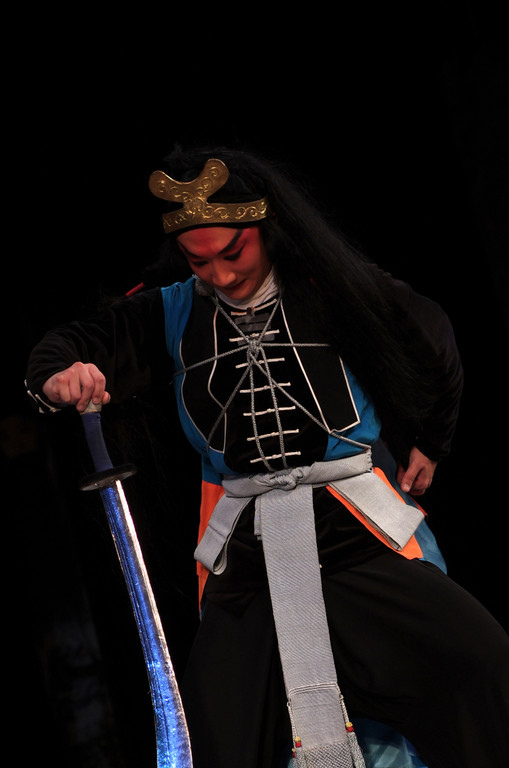
And these in turn are modeled on long-haired military monks (wuseng, 武僧) from Chinese opera (fig. 3).

Fig. 2 – A detail of the literary hero and military monk Wu Song from a Chinese opera about his adventures (larger version). Full version available on Wikimedia Commons.

2. Folk History

Several online articles link dough figurines to the origins of mantou pastries. Thankfully, I was able to find a dynastic source mentioning the legend. [1] The Song-era Records on the Origins of Things and Affairs (Shiwu jiyuan, 事物紀原, c. 11th-century) contains an entry reading:

Steamed Buns [Mantou, 饅頭]

The novel says: In the past, when Martial Marquis Zhuge [Zhuge wuhou, 諸葛武侯; i.e. Zhuge Liang, 諸葛亮] was leading an expedition to capture Meng [孟; i.e. Meng Hou, 孟获], people said that the land of the Man-barbarians [蠻] was permeated with sorcery. So, he had to pray to the gods in order to procure spirit-soldiers to help him. But the local custom involved killing sacrificial victims before the gods would send troops. However, the Martial Marquis refused, choosing instead to wrap mutton and pork in rice dough and shape them like human heads [rentou, 人頭]. After this “sacrifice,” the gods sent the soldiers.

From then on, later generations called these “steamed buns” [mantou, 饅頭; i.e. a homonym of “Man-barbarian heads”]. In Lu Di’s (Miscellaneous) Methods of Sacrifice [(Za) Ji fa, (雜)祭法] of the Jin Dynasty, steamed buns were used during the spring sacrifice as items offered to the gods. And Xu Shi’s “Rhapsody on Pasta” [Bing fu, 餅賦] also mentions this, so it’s suspected that steamed buns originated from the Martial Marquis.

饅頭

小說雲:昔諸葛武侯之徵孟獲也,人曰:蠻地多邪術,須禱於神,假陰兵一以助之。然蠻俗必殺人,以其首祭之,神則向之,為出兵也。武侯不從,因雜用羊豕之肉以包之,以面像人頭以祠,神亦向焉,而為出兵。後人由此為饅頭。至晉盧諦《祭法》春祠用饅頭,始列於祭祀之品,而束晢《餅賦》亦有其說,則饅頭疑自武侯始也。

It’s easy to see how this story was associated with our subject. Both the steamed buns and and figurines are humanoid representations that are shaped from rice dough. And both serve a religious function.

I hope to write more about this fascinating artform in the future.


Update: 10-12-24

Dr. Robin Ruizendaal, a noted scholar of traditional Chinese puppetry, recently posted a colorized photo of a dough figurine maker from the mid-20th century (fig. 3). His original description reads:

1940年代四川成都龍泉驛區賣捏麵人演偶戲
Dough puppet maker and vendor brings his merchandise to life on a small stage in Chengdu, Sichuan province (1940s).

The maker appears to be using his figurines as puppets to entertain/entice the young lads to buy some of his wares.

Fig. 3 – The dough maker and crowd (larger version).

Notes:

1) I learned about said source from Ma (2019, p. 981). However, I am not following their translation of the passage because it is different from the version I have.

Source:

Ma, B. (2019). History Of Medicine In Chinese Culture (Vols. 1-2). Singapore: World Scientific Publishing.

Story Idea: Firearms and the Journey to the West Universe

From time to time I like to post a fun blog not directly related to (though sometimes informed by) my research. Regular articles will resume after this entry.

Last updated: 12-03-2024

I am currently reading Gunpowder Technology in the Fifteenth Century: A Study, Edition and Translation of the Firework Book (2024), and this got me thinking: what would the Journey to the West (Xiyouji西遊記, 1592) cosmos be like if there were guns? In this photo essay, I will briefly explore guns in Chinese folk religion, types of historical (mainly handheld) firearms used in ancient China, and, finally, ways that such weapons could be inserted into the narrative.

I. Folk Religion

I first set out to see if firearms play any part in Chinese folk religion. I found a few examples from Taiwan. The first is “Lord Red Flag” (Hongqi gong, 紅旗公; a.k.a. “Marshal of Sacred Righteousness,” Shengyi yuanshuai, 聖義元帥), a relatively recent martial god. He and his marshals are depicted holding rifles.

(Click on the pictures to enlarge them.)

Here’s a version without the cloak.

Even his tangki (spirit-medium) gets a chance to fire off some rounds.

Three more involve Prince Nezha. The first of two (from the same temple) is a traditional statue adorned with an M4 assault rifle and other modern weaponry.

Here’s a closeup of the rifle. Also, take note of the holstered revolver (i.e. the black pouch) on his waist.

The profile view shows clips on his belt (again, in black pouches), as well as a grenade on top of an ammo case at his feet.

The second is a three-headed and eight-armed Nezha with an anti-tank rocket launcher, a rocket round, and a grenade at his feet.

A third statue (my personal favorite) portrays the prince with an MP 40 submachine gun and modern military gear. The carving on the water is amazing. I first learned of it here.

I learned here and here that cannons are sometimes worshiped in East and Southeast Asia as fertility gods. (See the 09-29-24 update below for more info about cannons.)

I also learned that ritual guns sometimes appear in Chinese folk temples of Vietnam.

If present, the guns number among ritual weapons that are commonly found in martial god temples of Chinese folk religion. (But I’ve never personally seen a gun among said armaments in Taiwanese temples.) This Vietnamese article briefly mentions that the weapons are based on the eighteen arms of Chinese martial arts. And it’s interesting to note that a “hand canon” (chong, 銃) does appear among the eighteen arms listed in the Water Margin (Shuihu zhuan, 水滸傳, c. 1400):

Shi Jin daily sought Drill Instructor Wang’s tutelage in the eighteen (weapons of) martial arts. He taught him from the very beginning. Which eighteen martial arts?

Lance, hammer, bow, crossbow, hand cannon, whip, metal tablet, long sword, chain, truncheon, fu-axe, yue-axe, ge-halberd, ji-halberd, shield, staff and spear, and toothless rake. [1]

史進每日求王教頭點撥十八般武藝,一一從頭指教。 那十八般武藝?

矛錘弓弩銃,鞭簡(鐧)劍鏈撾,斧鉞並戈戟,牌棒與槍杈。

Perhaps this list influenced the ritual weapons in Vietnam.

II. Historical Firearms in Ancient China

Here is an example of a Yuan-era hand canon, minus the shaft.

Here is a “Three-Eyed Hand Canon” (Sanyan chong, 三眼銃), a three-barreled stick gun used during the Ming Dynasty.

You can see that they were attached to bladed polearms, which could be used offensively or defensively between reloading.

There were even five-barreled and shielded firearms called “Rapid-Thunder Hand Cannons” (Xunlei chong, 迅雷銃). So cool!

Here’s a Chinese video demonstrating the one and three-barreled versions:

III. Story Idea

This brings me back to Journey to the West. How could firearms be inserted into a religious allegory? Well, for starters, a 950 CE wall mural in Dunhuang shows one of Mara‘s demons attacking the awakening Buddha with a “fire lance” (huoqiang, 火槍; upper right), a precursor of hand cannons. This is a clear example of a centuries-old association between firearms and spiritual warfare.

Here’s the full mural.

Now imagine that these weapons are wielded by celestial gunner-soldiers under the command of the “Star of Fiery Virtue” (Huode xingjun, 火德星君), the god of fire. In JTTW chapter 51, his literary troops utilize fire scimitars, fire bows, fire arrows, fire crows, fire horses, red (fire) rats, fire dragons, fire carts, fire gourds, fire banners, and fire rods in battle (Wu & Yu, 2012, vol. 3, p. 9). These are just a short step from firearms.

Given that the novel projects Ming-era concepts backwards to the Tang Dynasty, having gods wield such weapons hundreds of years before they were even invented wouldn’t be out of place in the JTTW universe. A writer could just say that the weapons were created in the realm above and eventually trickled down to mankind. Admittedly, I like the real history better because it shows the ingenuity of our predecessors, but the story requires a little tinkering.

Writers wanting to expand on the idea of firearms in heaven could take Ming gunners, their uniforms, and their strategies as models to work from. This page features a lovely figurine of such soldiers, including lots of juicy historical info. And the fact that the historical troops were part of the “Divine Machine Battalion” (Shenji ying, 神機營), which specialized in firearms, really solidifies their connection to the heavenly realm.

Who would make such weapons? There’s a fun answer for that: Laozi! The novel twice describes him forging mystical weapons belonging to our main characters. For example, Zhu Bajie mentions in chapter 19 that the high god made his rake: “This is divine ice steel greatly refined, / Polished so highly that it glows and shines. / Laozi wielded the large hammer and tong …” (Wu & Yu, 2012, vol. 1, p. 382). And Monkey claims in chapter 75 that the Daoist Patriarch created his staff: “The rod of steel nine cyclic times refined / Was forged in the stove by Laozi himself” (Wu & Yu, 2012, vol. 3, p. 375). So, on top of making alchemical medicines, Laozi could be heaven’s celestial gunsmith.

How could demons get ahold of celestial guns? Well, referring back to chapter 51, a buffalo-spirit uses the “diamond cutter” (jingang zhuo, 金鋼琢), an uber powerful, bracelet-like treasure-weapon also created by Laozi, to twice suck away all of the aforementioned fire weapons (Wu & Yu, 2012, vol. 3, pp. 9 and 23). Devil craftsmen would then have time to analyze the heavenly technology, which would allow them to eventually make their own (inferior?) copies.

Recall that the Great Peng demon is said in chapter 74 to have taken over a human kingdom by eating all of the inhabitants some 500 years ago, and the former population was replaced by spirits (Wu & Yu, 2012, vol. 3, p. 360). Firearms would definitely make a human-to-monster kingdom transition for less powerful demon kings a lot easier.

Another possibility is that a fiend could simply sneak into heaven to steal some. This may seem like an impossible task, but JTTW chapter 63 mentions something similar happening. The dragon-spirit “Princess All Saints” (Wansheng gongzhu, 萬聖宮(公)主) is said to have “[snuck] into heaven and stole[n] from before the Hall of Divine Mists the nine-leaf divine agaric planted by the Lady Queen Mother of the West” (Wu & Yu, 2012, vol. 3, p. 192). So, if someone can secretly infiltrate the realm above and steal divine vegetation, they could certainly steal heavenly armaments.

Perhaps the simplest way that demons could attain celestial firearms is by ambushing heavenly troops and commandeering their equipment.

I could see Red Boy (Honghai’er, 紅孩兒) using his powerful Samadhi flame to forge his own hand cannons, at least with the help of devil craftsmen. His association with fire only makes it natural that his own troops would carry firearms.

The only thing I can’t think of is how heavenly hand cannons would differ from their real world counterparts. Would they just use gunpowder and metal shot, or would it be more magical in nature, like shooting meteors? I’m open to suggestions from readers.


Update: 09-29-2024

The film Enoken no Songoku: Zenpen (エノケンの孫悟空 前編; a.k.a. “Enoken’s Songoku,” 1940) features the Monkey King mowing down demons with his staff-turned-machine gun.

There are at least two toys depicting the Great Sage with a gun. The first I learned about via a Facebook group post. I love how his sniper rifle is modeled on his magic staff. You can see the original packaging here.

And here is a Black Myth: Wukong-inspired figure with a powerful-looking rifle/shot gun combo. I saw it here.

Regarding cannons, I learned that a giant Western cannon was worshiped by court officials during the Ming. The History of the Ming (Mingshi, 明史, 1739) explains:

At this time, a ship arriving from the Great Western Ocean [i.e. the West] brought an enormous cannon, which got the name of the “Red Barbarian” [Hongyi, 紅夷]. It measured over two-zhang [20.86 ft/6.358 m] long, and weighed as much as 3,000 catties [3,902.18 lbs/1,770 kg]. It could demolish any stone city-walls, and its earthquake-like roar could be heard for several dozen li around. During the Tianqi [天啟] reign, the name of “Great General” [Da jiangjun, 大將軍] was given to it, and officials were sent to offer libations [si, 祀] to it (based on Needham, 1986, p. 392).

其後,大西洋船至,復得巨砲,曰紅夷。長二丈馀,重者至三千斤,能洞裂石城,震數十里。天啟中,錫以大將軍號,遣官祀之。

Needham (1986) suggests the cannon’s worship is connected to folk beliefs: “In Taoist folk-religion any device or machine of almost miraculous potency was something which should receive veneration” (p. 392 n. b).


Update: 10-05-24

I forgot to mention the “Gatling Gun Bodhisattva” (Jia-te-lin pusa, 加特林菩薩) from Chinese social media and Japanese manga. The following clip expounds the Heart Sutra of the Honored Gatling Gun Bodhisattva (Namo Jia-te-lin pusa Xinjing, 南無加特林菩薩心經).


Update: 11-23-24

Reader Danna Zhang left a wonderful comment about how Investiture of the Gods (Fengshen yanyi封神演義, c. 1620 CE), a sort of prequel to Journey to the West, also includes gunpowder weaponry:

Late comment, but FSYY also puts Ming dynasty gunpowder weapons into the 11th BCE Shang dynasty setting. Apart from the numerous mentions of “cannons go boom”, In Chapter 56, they broke Deng Jiugong’s ambush-disguised-as-wedding by hiding a cannon in the gift casket and using it to make a surprise attack, and in Chapter 88, Jiang Ziya suggests to King Wu that they need the “Sky-blasting Cannon” (轰天大炮) to breach the walls of Mianchi City.

At this point, I think the bronze age gunpowder weapon isn’t a bug, it'[s] a feature.


Update: 12-03-24

The Japanese Scroll of Battle Between Generations (異代同戱図巻, 17th-century) includes a depiction of Guanyin aiming a flintlock rifle, with the Dragon Girl waiting in attendance behind her.

Note:

1) The narration is based on my translation, while the weapons list is based on that from Lorge (2012). See page 147.

Source:

Lorge, P. A. (2012). Chinese Martial Arts: From Antiquity to the Twenty-First Century. United Kingdom: Cambridge University Press.

Needham, J. (1986). Science and Civilization in China. Volume 5: Chemistry and Chemical Technology; part 7, Military Technology: The Gunpowder Epic. Assisted by Ho Ping-yü et al. New York: Cambridge University Press.

Wu, C., & Yu, A. C. (2012). The Journey to the West (Vols. 1-4) (Rev. ed.). Chicago, Illinois: University of Chicago Press.


Archive #45 – Tripitaka Seeks the Scriptures: A Rare Journey to the West Puppet Play from Quanzhou, Fujian

Last updated: 07-21-2025

The Journey to the West Research blog is proud to host a guest post by the very knowledgeable @ryin-silverfish of Tumblr. They managed to track down a digital copy of the script for Tripitaka Seeks the Scriptures (Sanzang Qujing, 三藏取经), an extremely rare Journey to the West (Xiyouji, 西遊記; “JTTW” hereafter) puppet play from Quanzhou, Fujian province, China (fig. 1). This prompt book was first transcribed during the Qing Dynasty (1644-1911), but internal characteristics date it to sometime after the late-13th-century JTTW and before or concurrent with the early-Ming JTTW zaju play. Needless to say, this is a super important addition to JTTW studies as it likely serves as a “missing link” between the northern and southern traditions of the story cycle (Hu, 2017a; 2017b). The strange thing is that I’ve never read anything about the play in any English sources on JTTW. This fact demonstrates just how rare and precious the play is.

The work contains familiar episodes, like Monkey’s havoc and punishment, Tripitaka‘s tumultuous childhood and vow to retrieve scriptures from India; Sun Wukong and Zhu Bajie becoming his disciples, etc. (This and other parallels presented below perhaps point to the play’s influence on the later 1592 edition of the novel. Or, at the very least, this points to them drawing upon the same source.) But the play also has some very interesting differences: Tripitaka is adopted by Tang Emperor Taizong, thus becoming a prince; Monkey is imprisoned in a crystal well for his past misdeeds; Sha Wujing is the one transformed into a white horse; and Erlang becomes the Tang Monk’s disciple after being punished for flirting with a heavenly maiden. Read on for a full Chinese script and English synopsis below.

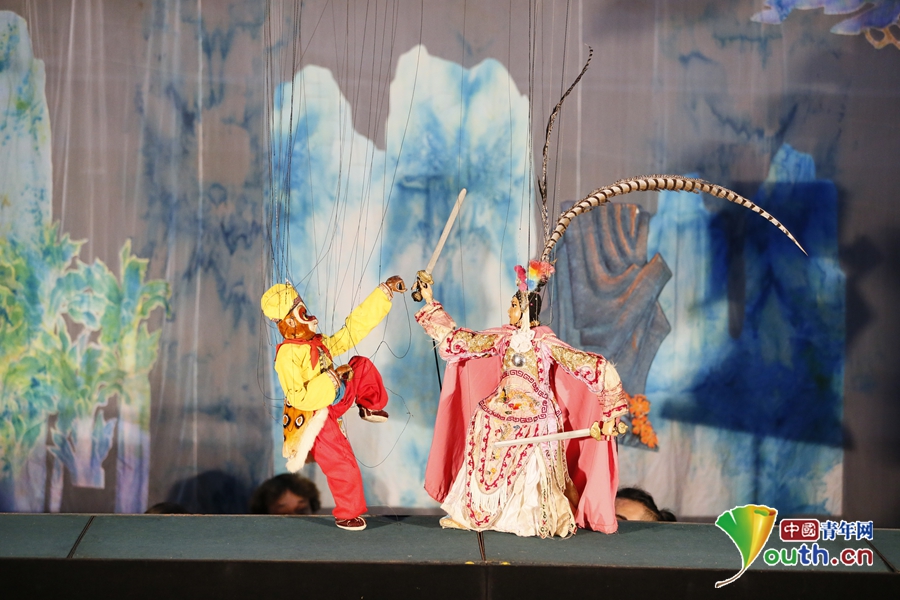
Fig. 1 – An example of modern Quanzhou string puppetry depicting a battle between Sun Wukong and Princess Iron Fan (larger version). Image found here.

I. The Chinese Script

The source of this text is quite obscure, only featured in a 1999 Chinese collection of puppet theater plays published by the Quanzhou Regional Opera Research Society.

Name of the book: 泉州地方戲曲研究社編,《泉州傳統戲曲叢書》第十卷《傀儡戲•目連全簿》(北京:中國戲劇出版社,1999)。

Unsurprisingly, I have no way of getting my hands on an actual copy of the book, so the Chinese text here came from a Tieba user who did, and then someone helpfully uploaded it onto Baidu Cloud Drive.

Just something to keep in mind.

PDF File:

https://docs.google.com/document/d/10XhOpvLFrdcSaqyrhY_4MmiXylSGNhWutcgv6Ngen3M/edit

Jim: Here is a backup just in case.

Click to access Quanzhou-Puppet-Theatre-JTTW.pdf

[Note: See also the 07-21-25 update below for a PDF of the original book!]

II. English Summary

Disclaimer – This is a very rough chapter-by-chapter summary of the play, which was first transcribed in the Qing dynasty and appeared to be written in the local dialect. As I do not speak Hokkien, nuances are likely lost and errors made.

Jim: I have added italicized explanatory notes to @ryin-silverfish’s summary below. I formatted the section as such so that readers will have more context at hand. This way, you won’t have to constantly scroll down to the footnotes. Also, I have added links, as well as more hanzi and pinyin. I don’t (yet) know Hokkien either, so I apologize for not adding the corresponding romanization.

Chapter 1: Meeting the Buddha (Jian Fozu, 见佛祖)

Tripitaka (Sanzang, 三藏; a.k.a. Xuanzang, 玄奘) sings his backstory, which is pretty much the same as the JTTW novel version, minus the revenge part, and with a few more details: he was found by Li Gong (李公) and raised under the name “River Float” (Jiang Liu’er, 江流儿) in the Golden Mountain Temple (Jinshan Si, 金山寺). [A] As an adult, he later traveled to become a monk at the Immortal Peach Temple (Pantao Si, 蟠桃寺). Tang Emperor Taizong came there one day to sponsor a mass and present incense, and being impressed by the monk’s arhat-like aura, made him his adopted son, “Prince Tripitaka” (Sanzang Taizi, 三藏太子). [B]

The royal monk is praying to the “Buddha of the Southern Seas” (Nanhai Fozu, 南海佛祖, a.k.a. Guanyin), when the goddess arrives to ask what is bothering him. He worries that the monks who travel outside the temple might be tempted by worldly things, so he vows that day to retrieve scriptures from India in order to save them from negative karmic fate. [C] In response, Guanyin first tells him that the journey will be perilous, with untold dangers along the way. Then, she tells Tripitaka of the “Great Sage Equaling Heaven” (Qitian Dasheng, 齐天大圣), who had been imprisoned in a well for stealing the Jade Emperor’s wine in the past. Next, she recommends recruiting the Great Sage to protect the monk on the trip, and to that end gives him a “Precious Sash of Infinity” (Wujin Baodi, 无尽宝绦) and a golden headband, two heavenly treasures needed to respectively free and submit the spirit. Finally, Guanyin gives him a ringed staff, an alms bowl, and straw slippers before sending him on his way.

A) Tripitaka is found as a baby by the monk Faming (Faming Heshang, 法明和尚), the holy abbot of the Golden Mountain Temple, in JTTW chapter nine. He gives the baby the same name, “River Float” (Jiang Liu/er, 江流/儿) (Wu & Yu, 2012, vol. 1, p. 222).

B) The monk becomes Tang Emperor Taizong’s bond brother (xiongdi, 兄弟) in JTTW chapter 12 (Wu & Yu, 2012, vol. 1, p. 290). The monarch even refers to him as his “Royal Brother” (yudi, 御弟) (Wu & Yu, 2012, vol. 1, p. 291, for example).

C) The Tang Monk’s reason for the trip is different in the novel: he is chosen to procure scriptures of the “Great Vehicle” (Dacheng, 大乘; i.e. Mahayana texts) in order to perform a “Grand Mass of Land and Water (Shuilu Dahui, 水陆大会), which will free untold numbers of abandoned souls from the underworld (Wu & Y, 2012, vol. 1, pp. 275 and 286-290). This is more in line with Tang Taizong’s mass in the play.

Chapter 2: Monkey in a Well (Zuojing Hou, 坐井猴)

Sun Wukong sings his backstory inside the well: he was as old as heaven and earth and had eleven brothers, a.k.a. the “Eleven Luminaries” (Shiyi Yao Xingjun, 十一曜星君). [D-F] Turning into a mosquito and flying into the celestial realm, he ate twelve peaches of immortality and three, multi-ton alms bowls full of Laozi’s golden elixir pills and drank 3,000 jars of heavenly wine. [G]

In a drunken haze, Monkey drank so much water from the Eastern Sea that the Dragon King’s palace was exposed, causing the monarch, together with every other deity he had pissed off, to complain to the Jade Emperor.

After he was captured by the combined forces of Erlang, Nezha, Devaraja Li Jing, the Curtain-Raising General Deng Hua (Juanlian Denghua, 卷帘邓化), and celestial soldiers, the plot, again, proceeds the same as in the JTTW novel. This includes his failed execution, sentence to the eight trigrams furnace, wager with the Buddha, and his defeat under “Five-Fingers Mountain” (Wuzhi Shan, 五指山; a.k.a. “Five Elements Mountain“). The only thing different is his place of imprisonment: the power-nullifying, 10,000-zhang-deep “Dazzling Crystal Well” under the Wild Horse Bridge of Youzhou (Youzhou Yema Qiao xia wanzhang Huashan Liuli Jing, 幽州野马桥下万丈花闪琉璃井). [H-J]

Monkey is told that only when “flowers bloom on iron trees” (tieshu kaihua, 铁树开花) will he be released. Shortly thereafter, Guanyin shows up in his dreams and mentions Tripitaka, and the chapter ends with him crying out the monk’s name, hoping he might be heard.

D) Monkey formally introduces himself as Sun Wukong (xing Sun ming Wukong, 姓孙名悟空). But this name only appears twice in the entire play. He is primarily called “Equaling Heaven” (Qitian, 齐天). It appears a total of 286 times, including only two uses of “Great Sage Equaling Heaven” (Qitian Dasheng, 齐天大圣) (ch. 2 & 4). He is twice referred to in chapter four as the “Monkey Whose Greatness Equals Heaven” (Yuansun Qitian, 猿孙大齐天) (refer to the PDF). The present summary primarily uses Sun Wukong and Monkey out of tradition. 

E) Monkey’s stated age, “the same as Heaven and Earth” (yu tiandi tonggeng, 与天地同庚) (refer to the PDF), is different from the novel. Calculations based on internal story details suggest that he was born around the year 500 BCE during the late-Zhou Dynasty (c. 1046-256 BCE). 

F) The “Eleven Luminaries” (Shiyi Yao Xingjun, 十一曜星君) are a combination of nine sinicized Hindu astrological deities and two East Asian astrological deities. They include the Sun (Taiyang xing, 太陽星), Moon (Taiyin xing, 太阴星), Mars (Huoxing, 火星), Mercury (Shuixing, 水星), Jupiter (Muxing, 木星), Venus (Jinxing, 金星), Saturn (Tuxing, 土星), Rahu (Luohou, 罗睺), Ketu (Jidu, 奇都), and two shadowy planets called Yuebei xing (月孛星) and Ziqi (紫气). See figure one here for a circa 13th-century image of these gods. I don’t know if these are supposed to be his biological siblings or just bond brothers. But Wukong does take the “Nine Luminaries” (Jiu Yaoxing, 九曜星), the aforementioned sinified stellar gods, as his bond brothers in JTTW chapter five (Wu & Yu, 2012, vol. 1, p. 160). He later fights and singlehandedly defeats them all during his rebellion (Wu & Yu, 2012, vol. 1, p. 171).

Monkey does have biological brothers and sisters in two YuanMing stage plays (see the 12-20-23 update here). One is a sister called the “Iron-Colored Macaque” (Tiese Mihou, 铁色狝猴) (refer to this PDF). In the puppet play, Laozi refers to Monkey as an “iron bone-colored macaque” (Tiegu Se Mihou, 铁骨色猕猴) because his body is immune to harm. I’m not sure where these terms come from. They might be connected to the tiese (铁色), a kind of fruit-bearing tree in Asia. Perhaps macaques were associated with eating its fruit. Also, I should note that Monkey is called the “Great Sage Steel Muscles and Iron Bones” (Gangjin Tiegu Dasheng, 钢筋铁骨大圣) at the end of the late-13th-century JTTW.

G) Monkey is punished in JTTW chapter five for a host of crimes, including eating countless immortal peaches, ruining a celestial banquet, drinking copious amounts of heavenly wine, and eating all of Laozi’s elixir pills (Wu & Yu, 2012, vol. 1, pp. 162 and 165-166).

H) One zhang () comprises ten chi (, a.k.a. “Chinese feet”), and one chi is roughly 31.8 cm (12.3 in). This makes one zhang 3.18 m (10.43 ft) (Jiang, 2005, p. xxxi). Ten-thousand zhang (wanzhang, 万丈) would therefore be 31,800 m (104,300 ft). That’s one deep well!

The Water Margin (Shuihu Zhuan, 水浒传, c. 1400), another famous Chinese vernacular novel, also contains a 10,000 zhang deep pit (wanzhang shenqian dixue, 万丈深浅地穴) used to imprison 108 stellar spirits (Shi & Luo, 1975/2021a, vol. 1, p. 15). Shapiro translates this as “a pit 100,000 feet deep” (Shi & Luo, 1993/2021b, vol. 1, p.15). But the use of 10,000 zhang is likely referring to an infinitely deep, inescapable abyss.

This idea can be traced to a Song-era Daoist ritual in which an exorcist draws the character for “well” (jing, 井/丼) on the ground. This divides the ritual space into nine sections, representing the Nine Palaces (Jiugong, 九宮) (stellar groupings comprising the cosmos), thereby creating an earth prison to incarcerate evil spirits. The Compilation of Rituals of the Way (Daofa huiyuan, 道法会元) reads:

[U]se the Sword mudrā to draw the character for “well” on the ground. Transform it into a black prison, ten-thousand zhang deep, and ten thousand li wide. Black vapors burst out of it. Inside the prison, visualize how cangues and locks, as well as tools and machinery are laid out. Then recite the Spell for Fast Arrest.

右用劍訣,就地劃一井字。化為黑獄,深萬丈,闊萬里。黑炁衝騰。存獄中枷鎖、噐械備列;就念「促捉咒」(Meulenbeld, 2007, p. 142).

Therefore, Monkey’s imprisonment was likely influenced by this Daoist rite.

I) It’s important to note that liuli (琉璃), the material comprising his prison, has a connection to Buddhism. For example, it is mentioned in Indian Buddhist sources under it’s Pali/Sanskrit equivalent, vaiḍūrya (वैडूर्य), as one of the seven precious substances, along with gold, silver, pearls, etc. Modern translators of said sources associate vaiḍūrya with shiny, translucent beryl and cat’s eye gemstones. But the Chinese originally associated vaiḍūrya/liuli with opaque, dark blue, and sometimes golden-speckled lapis lazuli (Winder, 1990). This is why the Chinese name of the Medicine Buddha, Yaoshi Liuli Guangwang Rulai (藥師琉璃光如來), is translated as the “Medicine Master [of] Lapis Lazuli Light Tathāgata” (for example).

This would suggest that Wukong’s prison is not crystal but lapis lazuli, perhaps with golden speckles, which would explain the “dazzle” (huashan, 花闪) part of the well’s name. And since he is held fast there by the Buddha’s seal (see chapter 4 below), the medium of his jail is likely influenced by Buddhism. This would make his prison a joint Buddho-Daoist punishment.

J) Youzhou (幽州) was an ancient prefecture in what is now Heibei province, China.

Chapter 3: Farewell Banquet (Paishu, 派数)

Zhangsun Wuji, historically Taizong’s minister, is preparing a farewell banquet for Prince Tripitaka. It’s mostly a list of dishes; not much to see here.

Chapter 4: Monkey Joins (Shou Hou, 收猴)

Tripitaka attends Zhangsun Wuji’s farewell banquet, and then begins his journey to the west. The Buddha Maitreya sees him about to reach a wide river, uncrossable by boats, and sends Shancai to assist him by covering the river in lotus flowers.

Tripitaka steps over the lotuses and crosses the “Nine-Rank, No Boats River” (Jiupin Wuchuan Jiang, 九品无船江). Keep on keeping on, he hears someone calling out his name, but doesn’t see the caller. The local god of the soil shows up to inform him that it is the Great Sage Equaling Heaven, yelling from inside his well.

The monk removes the Buddha’s seal on the well cover by reciting the “Three-Jewels Mantra” (Sanbao zhenyan, 三宝真言), and then he uses the Precious Sash to lift Sun Wukong out of the well, thereby breaking the iron locks holding him down.

Tripitaka asks Monkey to escort him to the Western Heaven, but the spirit only wants to go back to Flower-Fruit Mountain. Sun Wukong agrees to have his head shaved just so he can bail out after a few li. [K] Unfortunately for him, he also agrees to wear the golden headband, and right after he speeds away, Tripitaka recites the tightening sutra and forces him to return.

Monkey finally relents and agrees to protect Tripitaka on the journey to India. He takes this as an opportunity to bring out the “luggage” from his ear: the 30,000 cattyAs-You-Wish Staff” (Qianjun Ruyi Bang, 千钧如意棒; a.k.a. the “Golden-Hooped As-You-Wish Staff,” Jingu Ruyi Bang, 金箍如意棒), forged by the sage-king Yu the Great. [L & M]

K) Wukong also sports a shaven head in the novel. For instance, in JTTW chapter 27, he states:

But ever since Nirvana delivered me from my sins, when with my hair shorn I took the vow of complete poverty and followed you as your disciple, I had this gold fillet clamped on my head… (Wu & Yu, 2012, vol. 2, p. 24).

自从涅槃罪度,削发秉正沙门,跟你做了徒弟,把这个金箍儿勒在我头上 …

L) The staff’s weight is based on a thousand multiples of 30 catties (jun, ). One catty (jin, ) is 590 grams (Elvin, 2004, p. 491 n. 133). Therefore, 30,000 catties would be roughly 17,700 kg or 39,021.82 lbs. But 30,000 is likely used here to refer to an unimaginably large number (i.e. Wukong’s staff is REALLY heavy). 

The novel staff weighs 13,500 catties (cf. Wu & Yu, 2012, vol. 1, p. 135). This equals 7,965 kg or 17,559.81 lbs.

M) The literary weapon also has a slightly different name: the “As-You-Wish Gold-Banded staff” (Ruyi Jingu Bang, 如意金箍棒). (Notice how ruyi (如意) and jingu (金箍) are switched around from the play’s staff name.) In addition, it is said to have been used by Yu the Great in the past to conquer the world flood (Wu & Yu, 2012, vol. 1, p. 135). But the staff’s creation is attributed to both Laozi (ch. 75) and Yu (ch. 88) (Wu & Yu, 2012, vol. 3, pp. 375; vol. 4, 201).

Chapter 5: The Horse Joins (Shou Ma, 收马)

The “Deep Sand God” of Black Sand Cave (Heisha Dong Shensha Shen, 黑沙洞深沙神, i.e. Sha Wujing) sits in his abode, [N] looking to grab some travelers to eat, and soon, he comes across Tripitaka and Sun Wukong. He seizes the monk first, then tries to grab the monkey but seemingly fails.

Sun Wukong, using his magic “Fiery Eyes and Golden Irises” (Huoyan Jinjing, 火眼金睛), figures out it was the Deep Sand God, and then goes into his cave for a rescue mission. They banter and proceed to fight. Knowing that the old monkey spirit is vulnerable to 1) flames and 2) water, [O] the Deep Sand God sets a fire inside his cave, forcing Sun Wukong to flee to the South Sea for help.

Guanyin decides to come along and asks Sun Wukong to bring her alms bowl, too. When they confront the Deep Sand God again, Guanyin presents a wager to him: if he can lift her alms bowl (boyu, 钵盂), both she and Tripitaka will be his food.

The monster tries but is unable to lift it. [P] Sun Wukong then lifts the bowl, tosses it onto his head, and attempts to slay the Deep Sand God. But Guanyin spares him on the condition that he will turn into a white horse and become Tripitaka’s steed. [Q]

N) The “Deep Sand God” (Shensha Shen, 深沙神) appears as a desert demon in (the incomplete) chapter eight of the late-13th-century JTTW. He claims to have eaten Tripitaka’s two previous incarnations on their journey to India. The monster only helps the pilgrims cross the “Deep Sands” (Shensha, 深沙) via a magical golden bridge once he is threatened with heavily retribution. Memorial poems note that Tripitaka releases the Spirit from a 500-year-long curse, and Monkey promises to speak highly of him when they meet the Buddha (Wivell, 1994, pp. 1190-1191).

O) Monkey is shown to be weak to “True Samadhi Fire” (Sanmei zhenhuo, 三昧真火), an intense flame born from spiritual cultivation, in JTTW chapter 41 (Wu & Yu, 2012, vol. 2, pp. 230-23). And he is shown throughout the novel to be a less proficient fighter in water (ch. 21, for example) (Wu & Yu, 2012, vol. 1, pp. 423-424).

P) This is reminiscent of JTTW chapter 42, when Guanyin challenges Wukong to pick up her porcelain vase, which contains an ocean full of water. He is unsuccessful (see the 07-03-22 update here). The Deep Sand God’s inability to raise the alms bowl is likely related to monk Faxian‘s story about the immovable quality of Buddha’s almsbowl (Faxian & Legge, 1886/1965, pp. 34-35).

Q) In the novel, the white horse is a transformed dragon prince. He is forced to become Tripitaka’s steed after eating the original horse in chapter 15 (Wu & Yu, 2012, vol. 1, p. 328).

Chapter 6: Erlang Joins (Shou Erlang, 收二郎)

Erlang sings his backstory. The previous year, he harassed a Jade Maiden messenger (Chuanyan Yunu, 传言玉女) on a bridge in Tianjin (Tianjin Qiaotou, 天津桥头), provoking the Jade Emperor’s wrath and causing him to cut off sacrifices and worship to Erlang. After the intervention of Guanyin, he was sent to Mt. Guankou (灌口山) (in Sichuan) as a guardian deity, but often preyed on passing mortals and ate their flesh. [R]

The POV switches to Tripitaka and Wukong; the latter sees a black cloud blocking his way, and suspecting it to be a demon, he asks his master to hide while he checks. Erlang reveals his identity and suggests that he will catch the monk and share his flesh with “Elder Brother Qi” (Qige, 齐哥) (i.e. Monkey).

Wukong promptly chews him out and reveals that Tripitaka is the reincarnation of the Golden Chan Arhat (Jinchan Luohan, 金禅罗汉), [S] who attended a lantern fruit festival without notifying his fellow monks and was punished by the Buddha to experience 36 perils (sanshiliu jie, 三十六劫) on his journey to the west. [T]

After getting a monk makeover, Erlang becomes Tripitaka’s disciple.

R) This is reminiscent of Zhu Bajie’s backstory from JTTW chapter 18. After being stripped of his divine post and exiled to earth for forcing himself on a moon maiden, Pigsy becomes a meat-eating spirit (Wu & Yu, 2012, vol. 1, p. 212).

S) Tripitaka’s past divine title, the “Golden Chan Arhat” (Jinchan Luohan,金禅罗汉), is similar to that from JTTW, “Master Golden Cicada” (Jinchan Zi, 金蝉子). Chan (as in Chan Buddhism) and chan (蝉, “cicada”) look and sound similar.

T) Master Golden Cicada is exiled from heaven for sleeping during the Buddha’s lecture. The fullest explanation for this appears in chapter 81 (Wu & Yu, 2012, vol. 4, p. 82). Another part of his punishment is experiencing 81 perils, which happen throughout the novel. Eighty of these are listed, with the final one happening shortly thereafter, in chapter 99 (Wu & Yu, 2012, vol. 4, pp. 358-363).

Chapter 7: Pigsy Joins (Shou Zhu, 收猪)

Zhu Bajie (猪八戒), the pig demon of Mt. Song (嵩山; later called “Pig Excrement Mountain,” Zhushi Shan, 猪屎山), is hungry for human flesh, and so he decides to whip up some smoke and seize some unaware travelers under its cover. Just like the two villains before him, he picks the pilgrims as his target.

Wukong fights him, subdues him, and he joins the party.

Chapter 8: Spiderly Woe (Zhizhu Men, 蜘蛛闷)

Lady Earth-Raised (Diyang Furen, 地养夫人), the spider demoness of Mt. Hua (Hua Shan, 华山), has a problem. She might be the youngest sister of the “Three Saints of Mt. Song” (Song Shan Sansheng Langjun, 嵩山三圣郎君), [U] living on her silk webs, but she is still single and unmarried. As such, she commands her imps to patrol the mountains daily, so as to kidnap a fine man as her future husband.

The imps soon spot a group of people under the mountain: a monkey, a horse, a pig, and a monk (Erlang isn’t mentioned for some reason). She asks one of her imp minions, the “Big-headed Demon” (Datou Gui, 大头鬼), which one seems like a good choice, and after comically dismissing the first three, she settles on the monk.

The Big-headed Demon eagerly grabs a sack and chopper and, when she asks why, he tells her he is going to cut the monk in half and bring the body to her. But since a dead person does not a good husband make, she decides to kidnap the monk herself.

U) Lady Earth-Raised is similar to the seven Spider Spirits (Zhizhu Jing, 蜘蛛精) from JTTW chapters 72 to 73, and her lofty brothers, the Three Saints, are reminiscent of the Demon Lord of a Hundred Eyes (Baiyan Mojun, 百眼魔君), the spider spirits’ senior from chapter 73.

Her name and at least one of her deceptions is also very similar to a demoness in JTTW chapter 80 (see below).

Chapter 9: Subduing the Spider (Shou Zhizhu, 收蜘蛛)

The demoness disguises herself as a young woman with her lower half buried in the earth (the same trick Lady Earth Flow uses in JTTW chapter 80 (Wu & Yu, 2012, vol. 4, p. 67) and calls out for help. Tripitaka orders Wukong to investigate, but he refuses because he doesn’t want trouble. However, the monk forces him into it via the headband tightening spell.

She says she was buried there by her husband for doing something wrong, and then asks the monk for help. When Tripitaka tries to pry her free with a monk’s knife (jiedao, 戒刀), she grabs him and returns to her cave.

Sun Wukong spots some spider silk with his fiery eyes and plans to turn into a jiaoming fly (jiaoming chong, 蟭螟虫) [V] and follow it back to her cave. However, the horse says she probably raises hens inside, and a fly would quickly be eaten, so he should transform into a Scops owl (Lao Chi, 老鸱), a bird of prey. That way Wukong can deal with the chickens when he sneaks inside.

He soon finds the spider demoness and orders her to let his master go or die. She replies that if he dares, her brothers, the “Three Saints of Mt. Wo” (Wo Shan Sanshen Langjun, 窝山三圣郎君) (again, a mountain’s name does not stay consistent) will deal with him. [W] Wukong beats her to death with the staff anyways and rescues Tripitaka.

V) The jiaoming fly (jiaoming chong, 蟭/焦螟虫) is an aquatic insect from Daoist literature said to be so small that it can congregate in the eyebrows of a mosquito (Wang, 2012, p. 28 n. 44).

W) The “Three Saints of Mt. Song/Wo” (Song/Wo Shan Sansheng Langjun, 嵩/窝山三圣郎君) are part of a pattern in JTTW in which the pilgrims face a trio of baddies. Examples include the three bogus animal immortals (ch. 46), the three demon kings of Lion-Camel Cave (ch. 74-77), and the three rhino demons (ch. 91-92). The three incarnations of the White Bone Spirit (ch. 27) could also count. This reoccurring number is perhaps meant to mirror Tripitaka’s three disciples.

Chapter 10: Bad News (Bao Xiongxun, 报凶讯)

Luo Tuo, Luo Du, and Luo Hou (罗托,罗独,罗候)—the Three Saints of Mt. Wo—are having a party in celebration of their eldest brother, Luo Tuo’s birthday. They wonder why their sister has not arrived yet, when suddenly, the Big-Headed Demon enters and delivers the bad news.

Furious, the trio swear revenge and set out to capture Tripitaka and kill Wukong. [X]

X) The Saints’ anger over the murder of their spider sister is also similar to the rage of the Demon Lord of a Hundred Eyes over the killing of his seven spider sisters (ch. 73) (Wu & Yu, 2012, vol. 3, pp. 340-341). All eight are done in by Monkey.

Chapter 11: Subduing the Three Saints (Shou Sansheng, 收三圣)

The pilgrims are passing through a mountain, when Luo Tuo swoops down and grabs Tripitaka but fails to capture Wukong. Monkey informs the rest of the gang about the Three Saints. Erlang suggests that since Wukong is the one who started it, he alone should deal with them.

The whole gang goes after the trio anyways but fails to beat them. Wukong tells Erlang and Sandy to keep watch on the Three Saints so that they do not harm Tripitaka, and he flies to the South Sea to seek Guanyin’s help.

Guanyin agrees, but the chapter ends here because the rest of the pages are missing from the original manuscript.

Chapter 12: Ascending the Immortal Pavilion (Dengxian Ge, 登仙阁)

The chapter begins with the head of the pavilion’s local shrine asking an attendant about sacrifices, for the birthday of a certain “Great Immortal” (Daxian, 大仙) is near. He demands a young boy, as well as food and fruits, as gifts.

The shrine attendant goes to inform the families responsible for supplying each of the sacrifices; this year, it is Old Huang’s (Huang Gong, 黄公) turn to give up his only grandson. [Y] He begs them to delay the sacrifices until his family can … sire another grandkid!

In response, the shrine attendants tie him up and start beating him, stating that if the Great Immortal does not get his sacrifice, the whole village will suffer. Unable to withstand the beating, Old Huang yields and agrees to their demand.

Y) This plot is similar to the Great King of Numinous Power (Linggan Dawang, 灵感大王) episode from JTTW chapters 47 to 48. He demands a yearly sacrifice of children from families that shoulder the horrible burden on a rotating basis. This shares shocking similarities with Hindu literature (see section 2.2 here).

Chapter 13: Meeting the Grandfather and Grandson (Yu Gongsun, 遇公孙)

The pilgrims hear the commotions of the sacrificial ceremony, and upon investigating, come across Old Huang, dragging his grandson along and sobbing. After questioning him, Tripitaka decides to go to Ascending Immortal Pavilion himself and talk the Great Immortal out of this whole “human sacrifice” thing.

Chapter 14: Subduing the Great Serpent (Shou Dashe, 收大蛇)

The sacrificial ceremony begins. But the shrine attendants wonder if the Great Immortal has not yet arrived because the young boy hasn’t been offered up. Tripitaka arrives just in time to call out the Great Immortal for demanding human sacrifices.

Enraged, the Great Immortal orders his imps to snatch Tripitaka, but Wukong smashes his way in and demands the release of his master. The Great Immortal dares Wukong to allow the spirit three free strikes; Wukong agrees.

After three hits and no effect, the Great Immortal tries to bash him over the head with a stone incense burner, which only annoys Wukong. [Z] He whips out his staff and kills the Great Immortal in one strike, revealing his true form—a huge serpent. [AA]

The pilgrims continue their journey. Wukong asks Erlang to get their master some water, while he travels on his cloud to get some food from the Immortal Peach Monastery (蟠桃寺). As the two leave, Tripitaka hears the sound of people chopping firewood and goes to investigate.

Z) Monkey is famous for his invulnerability in JTTW. For instance, in chapter 75, Wukong willingly blocks a sword strike with his adamantine head:

Arousing his spirit, the old demon stood firmly with one foot placed in front of the other. He lifted up his scimitar with both hands and brought it down hard on the head of the Great Sage. Our Great Sage, however, jerked his head upward to meet the blow. All they heard was a loud crack, but the skin on the head did not even redden (Wu & Yu, 2012, vol. 3, p. 373).

那老魔抖擻威風,丁字步站定,雙手舉刀,望大聖劈頂就砍。這大聖把頭往上一迎,只聞扢扠一聲響,頭皮兒紅也不紅。

AA) A massive, red-scaled python spirit (honglin damang, 紅鳞大蟒) appears in JTTW chapter 67.

Chapter 15: Firewood Crossing (隔柴渡)

Two firewood choppers turn out to be Hanshan and Shide (寒山,拾得), two famous historical monks of Mt. Tiantai, who are also worshiped in folk religion. Tripitaka asks them if there is a temple nearby. They say yes but that it’s on the other side of the river.

There aren’t any boats either, so they use their firewood to create a bridge for Tripitaka. Halfway across, the bridge collapses; he falls into the river, only to be rescued by the local Dragon King, who escorts him to the “Correctness and Broadness Temple” (Fangguang Si, 方广寺), [AB] where the Buddha is secretly staying.

After the monk greets Buddha, an immortal lad brings Tripitaka a message: Devaraja Li (Li Tianwang, 李天王) of the Bisha-men Palace (Pisha Gong, 毗沙宫) is inviting him to a party in celebration of his own birthday, as well as Prince Nezha’s (Nezha Taizi, 哪吒太子) “return to the world/rebirth” (zai chushi, 在出世). Tripitaka agrees and heads for the celestial realm on a white crane.

AB) This may be a reference to the Buddhāvataṃsaka Sūtra (Dafangguang fo huayan jing, 大方广佛华严经; a.k.a. “Flower Garland Sutra,” Huayan jing, 华严经). The Chinese believed that this was the Buddha’s first teaching shortly after achieving enlightenment (Buswell & Lopez, 2014, p. 84). This might then explain why the Buddha is residing in a random temple along the journey.

Chapter 16: Party in the Celestial Realm (Tiangong Hui, 天宫会)

Devaraja Li is organizing the party, sending out invitations for the 500 Arhats (Wubai Luohan, 五百罗汉). The immortal lad reports that all five hundred handkerchiefs (shoupa, 手帕) were given out, save for one—which turned out to be Tripitaka’s, missing because of the whole reincarnation thing. [AC]

Luckily, he soon arrives. Devaraja Li gifts him three cups of immortal wine, and Tripitaka, being a lightweight, becomes totally wasted and is taken into the backrooms of the palace to rest.

AC) Tripitaka was historically venerated as an arhat as early as the Song dynasty (960-1279) (Liu, 2019). For example, he is included in a series of late-12th-century religious paintings focusing on the 500 Arhats. A black-robed Sun Wukong can be seen walking in the clouds behind him (fig. 2) (see the 06-04-23 update here).

Fig. 2 – Lin Tinggui and Zhou Jichang, The Tang Monk Procures the Scriptures (Tangseng qujing, 唐僧取經), no. 77 of 100 scrolls from Images of the 500 Arhats (Wubai Luohan tu, 五百羅漢圖, 1178-1188 CE) (larger version). Hanging scroll, ink and color on silk. Image from Nara kuniritsu hakubutsukan, Tōkyō bunkazai kenkyūjo, 2014, p. 86. Courtesy of Dr. Liu Shufen, a research fellow at the Institute of History and Philology, Academia Sinica. See the 06-04-23 update here for close ups of Monkey.

Chapter 17: Where did the monk go? (Tao Heshang, 讨和尚)

Meanwhile, Wukong and Erlang return, only to find their master missing. They bash on the gate of the Correctness and Broadness Temple to demand his whereabouts; the Buddha replies that Tripitaka is drunk and sleeping in Devaraja Li’s palace, then slams the door shut in their faces.

Erlang asks Wukong to go to the celestial realm and bring their master back. Wukong declines, citing the whole “Havoc in Heaven” business, then asks Erlang to go. He also declines because of the Jade Maiden incident in the past.

Finally, they summon the local Jiedi (揭帝) with a mantra and send the guardian deity to pick up Tripitaka.

Chapter 18: Subduing the Red-faced Demon (Shou Chimian, 收赤面)

Elder Li De (Laofu Li De, 老夫李德) of Mt. Song has an 18-year-old daughter, Jinyu (金玉, “Golden Jade”), who has been charmed by a demon, and none of the exorcisms by Daoist priests seem to work. The pilgrims happen to pass by and stay at his place for the night, so naturally, Tripitaka signs his monkey disciple up to banish the demon.

Wukong hides in her bedroom, ready to ambush the demon. However, when spooked, it spews out fire and forces Wukong to retreat. Elder Li laments that the demon will surely give them even more trouble after this fiasco; in response, Wukong transforms into the man’s daughter and summons the local god of the soil for questioning. The deity reveals the monster’s identity as the “Red-Faced Demon King” (Chimian Guiwang, 赤面鬼王).

A transformed Wukong marches to the demon’s cave and tells him their relationship might not work out now that her father has seen the demon flee, deeming him a weakling. The Red-Faced Demon then reveals his backstory: he used to be a woodcutter until he saw the “Lamp-Lamp Buddha” (Dengdeng Fo, 灯灯佛) meditating on a rock, [AD] with a precious pearl (zhu, 珠) by his side. He stole the pearl and swallowed it, which allowed him to turn into a fireball and take flight.

Wukong cajoles him into giving up the pearl, immediately swallows it, and uses the True Samadhi Fire to eliminate the demon. [AE]

AD) This is a likely reference to Dīpaṃkara (Sk: दीपंकर), the Buddha preceding Śākyamuni. His Chinese name appears in countless sutras as Dengdeng Fo (燃灯佛), or the “Lamp Buddha.” This is appropriate given the magic pearl’s connection to spiritual fire. Also, this implies that the Red-Faced Demon has lived for countless eons if he was alive during the time of the previous Buddha.

Dīpaṃkara is referenced in JTTW chapter 5, and he briefly appears in chapter 98 (Wu & Yu, 2012, vol. 1, p. 166; vol. 4, p. 352). In addition, his name is listed first (even above Śākyamuni) in a roster of Buddhas and Bodhisattvas saluted at the end of the novel (Wu & Yu, 2012, vol. 4, p. 384). Journey to the West calls him Dendeng Gufo (燃灯古佛; a.k.a. Gufo, 古佛, here and here), or the “Ancient Buddha of the Lamp.”

AE) This chapter shares similarities with a number of JTTW episodes. First, Monkey hiding in the daughter’s room and later transforming into her likeness is reminiscent of Sun and Zhu’s first meeting in chapter 18 (Wu & Yu, 2012, vol. 1, pp. 374-375). Second, Wukong, once again disguised as a woman, tricks a spirit into spitting up a magic pearl and then swallows it himself in chapter 31 (Wu & Yu, 2012, vol. 2, pp. 80-81). And third, the emphasis on a red demon’s command of True Samadhi Fire is similar to Red Boy from chapter 40-42.

Chapter 19: Eight Wheels (Balun Tan, 八轮叹)

The “Holy Mothers of the Eight Wheels” (Balun Shengmu, 八轮圣母) sing their backstory: They were eight sisters—Gold Wheel, Silver Wheel, Copper Wheel, Iron Wheel, Tin Wheel, Wind Wheel, Fire Wheel, and Cart Wheel (Jinlun, Yinlun, Tonglun, Tielun, Xilun, Fenglun, Huolun, Chelun, 金轮, 银轮, 铜轮, 铁轮, 锡轮, 风轮, 火轮, 车轮), who were famous for their might but had remained single for 24,000 years.

As such, they planned to kidnap a husband to share between themselves.

Chapter 20: Subduing the Eight Wheels (Shou Balun, 收八轮)

Tripitaka is very close to his destination, when he is kidnapped by Gold Wheel. A very amusing sequence ensues, where each sister tries to snatch him away for their own wedding but are interrupted by Wukong bashing his way in and threatening to kill all eight of them.

The sisters beg for mercy; Wukong accepts their surrender, and then orders them to turn into eight immortal maidens (Feixian, 飞仙), fly to the Thunderclap Monastery (Leiyin Si, 雷音寺), and notify the Buddha of the pilgrims’ forthcoming arrival.

Chapter 21: Meeting the Great Buddha (Jian Dafo, 见大佛)

The pilgrims greet the Buddha and receive the Three Baskets of scriptures, consisting of sutras, texts and monastic codes. Afterwards, these are taken back to Immortal Peach Temple by the Four Bodhisattvas and Eight Vajrapanis (Ba Jingang, Si Pusa, 八金刚,四菩萨). [AF]

AF) The Eight Vajrapanis are ordered by Buddha to escort the pilgrims and sutras back to China in JTTW chapter 98 (Wu & Yu, 2012, vol. 4, p. 357). However, the guardians are later directed to land after only half way so that Tripitaka can experience the last of the 81 perils: the sutras are nearly lost in chapter 99 when a giant white turtle carrying the group to the other side of a river gets annoyed and dives into the water (this might be based on a historical event) (Wu & Yu, 2012, vol. 4, pp. 363). Thankfully, the Vajrapanis pick them back up and finish the trip to China in chapter 100 (Wu & Yu, 2012, vol. 4, pp. 370).

Chapter 22 to 23: Descending with the Buddha’s Decree (Jiang Fozhi, 降佛旨) and Conferring of Titles (Fengci, 封赐)

After the pilgrims descend to the Tang capital on colorful clouds, their Vajrapani escort suddenly remembers that he forgot to ask for the Buddha’s decree. He then flies back to Thunderclap Monastery after telling them to first start reading the scriptures to the masses.

That minor incident aside, the decree soon arrives without problem: Tripitaka is appointed the “Venerable Pindola Arhat” (Bintou Luohan Zunzhe, 宾头罗汉尊者), Wukong the “Great Sage of the Void” (Xukong Dasheng, 虚空大圣), Erlang the “Great Emperor of Miraculous Knowledge” (Lingtong Dadi, 灵通大帝), [AG] while Zhu Bajie and the Deep Sand God are made Buddhas. [AH]

Taizong then welcomes Prince Tripitaka back and gives him the royal title of “The Great Chan Master of the Great Law and True Scriptures” (Dafa Zhenjing Dachan Shi, 大法真经大禅师).

AG) This section of the manuscript contains an out of place passage not mentioned in the summary. It reads: “The Tree-born Prince and Sinful Dragon, Tathagata, and Erlang were each granted the title of Great Emperor of Marvelous Knowledge” (树生太子业龙,如来,灌口二郎各封灵通大帝) (refer to the PDF). This previously unmentioned princely dragon Buddha character is likely a transcription error (Hu, 2017a; 2017b).

AH) This is radically different than JTTW chapter 100. Only Sun Wukong and Tripitaka become Buddhas. Sha is made an arhat, while Zhu is made an altar custodian (Wu & Yu, 2012, vol. 4, pp. 381-382). Would the play’s ending then suggest that Buddhahood is considered lesser to the heavenly titles given to Monkey and Erlang?

–THE END–

III. Thanks

Jim: I would like to express my utmost thanks to @ryin-silverfish for alerting me to this play, providing the Chinese script, summarizing it, and directing me to an intricate paper about the play’s history. This article would not have been possible without their generous contributions.


Update: 07-21-2025

I’m excited to archive a PDF of the original book (fig. 3) containing the JTTW puppet play.

泉州地方戲曲研究社編,《泉州傳統戲曲叢書》第十卷《傀儡戲•目連全簿》(北京:中國戲劇出版社,1999)。

Quanzhou Local Opera Research Society. (1999). Quanzhou Traditional Opera Series (Vol. 10): Puppet Opera – The Complete Book of Mulian. Beijing: China Drama Publishing House.

All thanks goes to @ryin-silverfish for providing the PDF.

Archive link:

Click to access 泉州传统戏曲丛书-第10卷-傀儡戏·《目连》全簿-Pdg2Pic-郑国权主编;泉州地方戏曲研究社编-Z-Library.pdf

Fig. 3 – Quanzhou Traditional Opera Series (Vol. 10): Puppet Opera – The Complete Book of Mulian (《泉州傳統戲曲叢書》第十卷《傀儡戲•目連全簿》) (larger version).

Sources:

Buswell, R. E., & Lopez, D. S. (2014). The Princeton Dictionary of Buddhism. Princeton University Press.

Elvin, M. (2004). The Retreat of the Elephants: An Environmental History of China. New Haven (Conn.): Yale University Press.

Faxian, & Legge, J. (1965). A Record of Buddhistic Kingdoms: Being an Account by the Chinese Monk Fâ-Hien of his Travels in India and Ceylon (A.D. 399-414) in Search of the Buddhist Books of Discipline. New York: Dover Publications. (Original work published 1886)

Hu, S. (2017a, December 26). Chonggu “Nanxi” Xiyouji: Yi Quanzhou Kuileixi Sanzang Qujing Wei Qieru dian [A Re-evaluation of the Southern Story System of The Journey to the West: Based on Quanzhou Puppet Drama Monk Xuanzang on a Pilgrimage for Buddhist Scriptures]. Weixin Gongzhong Pintai. Retrieved from https://www.yidianzixun.com/article/0HzCWYnd.

Hu, S. (2017b). Chonggu “Nanxi” Xiyouji: Yi Quanzhou Kuileixi Sanzang Qujing Wei Qieru dian [A Re-evaluation of the Southern Story System of The Journey to the West: Based on Quanzhou Puppet Drama Monk Xuanzang on a Pilgrimage for Buddhist Scriptures], Fudan Xuebao (Shehui Kexue Ban), 59(6), 65-74.

Jiang, Y. (2005). The Great Ming Code / Da Ming Lu. Vancouver, Wa: University of Washington Press.

Liu, S. (2019). Songdai Xuanzang de shenghua: Tuxiang, wenwu he yiji [The Sanctification of Xuanzang in the Song Dynasty: Images, Artifacts and Remains]. Zhonghua wenshi luncong, 133, 161-219.

Meulenbeld, M. R. E. (2007). Civilized Demons: Ming Thunder Gods from Ritual to Literature (Publication No. 3247802) [Doctoral dissertation, Princeton University]. ProQuest Dissertations & Theses Global.

Nara kuniritsu hakubutsukan, Tōkyō bunkazai kenkyūjo henshū [Nara University Tōkyō Research Institute for Cultural Properties (Ed.)]. (2014). Daitokuji denrai gohyaku rakan zu [Daitoku Temple’s Tradition of the 500 Arhats Paintings]. Kyōto: Shitau bungaku.

Shi, N., & Luo, G. (2021a). Shuihu Zhuan (Shang, Zhong, Xia) [Tale of the Water Margin (Vols. 1-3)]. Beijing: Renmin Wenxue Chubanshe. (Original work published 1975)

Shi, N, & Luo, G. (2021b). Outlaws of the Marsh (vols. 1-4) (Trans. S. Shapiro). Beijing: Foreign Language Press. (Original work published 1993)

Wang, y. (2004). Sun Wukong De Yuanji Keneng Zai Fujian Baoshan [Sun Wukong’s Origin Could be In Baoshan, Fujian]Yuncheng Xueyan Bao, 22(3), 30-34.

Wang, P. (2012). The Age of Courtly Writing: Wen Xuan Compiler Xiao Tong (501-531) and His Circle. Netherlands: Brill.

Winder, M. (1990). Vaiḍūrya. Bulletin of Tibetology, 26(1-3), 31-37.

Wivell, C.S. (1994). The Story of How the Monk Tripitaka of the Great Country of T’ang Brought Back the Sūtras. In V. Mair (Ed.), The Columbia Anthology of Traditional Chinese Literature (pp. 1181-1207). New York: Columbia University Press.

Wu, C., & Yu, A. C. (2012). The Journey to the West (Vols. 1-4) (Rev. ed.). Chicago, Illinois: University of Chicago Press.