Journey to the West Fanfiction Writer Spotlight #1: DarkscytheDrake

From time to time I like to post a fun blog not directly related to (though sometimes informed by) my research. Regular articles will resume after this entry.

Anyone who follows me on social media will know that I generally do not like modern adaptations of Journey to the West (Xiyouji西遊記, 1592; “JTTW” hereafter) (see here and here, for example). But thanks to enjoying this book, I’ve learned to temper my negativity. I’ve, therefore, decided to mirror the format of a series of past art-based articles [1] and shine a spotlight on the author of a JTTW-related fanfiction that I actually like. My hope is that such posts will expose their work to a wider audience interested in JTTW, while also documenting modern day perceptions and depictions of the novel and its characters.

Our first writer goes by the online handle DarkscytheDrake (AO3, Fanfiction.net, Spacebattles). They were kind enough to answer some interview questions, as well as allow permission to display some of their work.

I. Q & A

1) Can you tell me a little about yourself?

I’m 24 years old and live in the Middle East. I’m a huge fan of mythologies and old stories. I dabble in many aspects of the art world, and writing has been a hobby of mine since high school. Since I was a kid my dad used to bring me books from abroad to read. I’ve travelled the world thanks to my parents’ business trips and was exposed to many cultures and stories, which made me fall in love with them even more.

2) Are you self-taught or have you taken writing classes?

I’m self-taught, using the example of others. By the time I seriously thought about writing, there weren’t any writing workshops in my area, at least ones that didn’t focus on the genres I wanted to write in. English is my second native language and most books I read are in English.

3) What are your main sources of literary inspiration?

My main inspirations are the Inheritance Cycle, Shogun (book and TV show), The Hobbit (book and movies), and Bone. Manga like Fullmetal Alchemist have also taught me a lot about storytelling and character arcs.

4) How did you learn about Journey to the West?

I first became fully aware of Journey to the West proper, meaning not expys like Dragon Ball, when I visited China for the first time. I saw a lot of ads and costumes for the Monkey King, and I asked our guide who this character was. I did some research to get acquainted with the story and main players, and I left it alone until Black Myth: Wukong was announced, which revitalized my interest and prompted me to purchase an abridged version of the book, Monkey King. I read the Anthony C. Yu translation online. From there, I also watched some of his spin-off works like Lego Monkie Kid.

5) Who is your favorite character?

Sun Wukong is my favorite character, and while half of that does come from the sheer insanity of his powers and adventures, the other half comes from how much he learns in the journey, and the family he finds within his companions. His moments of innocence, like when he plays in the snow or his more vulnerable moments like in the White Bone Spirit arc. Princess Iron Fan has got to be my second favorite, though. She takes a lot of shit from her husband, suffered the imprisonment of her son and had to deal with Wukong’s antics, but ultimately remains a decent person and one of the few demons on the journey who isn’t wicked or wants to eat Tripitaka.

6) Do you have a favorite episode from the novel?

My favorite episode would have to be the fight against Demon Bull King, because of how personal it is to Wukong and the sheer scale of the fights that ensue there, like Wukong and DBK transforming into their giant forms and duking it out. Really, all of the Demon Bull family’s episodes (Iron Fan and Red Boy) are the best.

7) Does the novel have a special meaning to you?

I’m honestly surprised by the sheer depth the novel has for its age. There’s a lot of worldbuilding there which is on par with Tolkien‘s work, and those who grew up in Asian culture are aware of its deeper meanings, so it transcends ‘modern’ worldbuilders in that sense. And when I see just how influential the novel is and how it led to one of the greatest anime of all time…I’m humbled.

8) Can you tell me about your ongoing JTTW-related project?

My current JTTW project is a fanfiction story called “Great Sage, Equal to Heaven and Above Brockton” (AO3, Fanfiction.net, Spacebattles), and it’s a crossover with the webnovel Worm by Wildbow. The world of Worm is filled with superpowered humans called ‘capes’ (fig. 1), but unlike DC and Marvel, many capes use their powers for crime. There are heroes who battle these villains of course, but matters aren’t as clear-cut as they appear. On top of that, giant monsters attack cities every few months and cause untold damage. The main premise of my story is that an untold amount of time after the journey, Sun Wukong wakes up in Worm‘s main setting of Brockton Bay, a coastal city [north of Boston, MA, USA] with a lot of capes, nazis, Asian gangsters and heroes. From there he investigates the modern era, having fun and tries to find out what’s going on with these strange superpowered humans. It’s a classic premise of ‘OP character gets dropped into a lower-ranked world’, but it’s also a study of how a character who found a home suddenly gets dropped into a new one, and how power doesn’t always solve problems. And if it does, what are the potential consequences?

[Jim here: As of this writing, chapters one to 11 are available for free online, but chapters 12 to 13 (and a ch. 14 preview) are still only available on patreon.]

Fig. 1 – Cover for a fake Worm comic book featuring the original story’s main character, who makes an appearance in the Great Sage story (larger version). Illustration by @codetrillogy on Twitter. Used with permission.

II. Writing Sample

The following excerpt comes from an event in chapter six. After befriending a young boy, Sun Wukong jumps in to save his sister from gangsters attempting to take her in lieu of a missed “protection money” payment:

* The boy’s name.
** The boy’s sister.
*** The name of a local gang leader. Monkey comically believes he is a literal dragon.

Note:

1) As of this writing, I’ve made three such art posts here, here, and here.

Journey to the West Artist Spotlight #3: NingadudeXx

From time to time I like to post a fun blog not directly related to (though sometimes informed by) my research. Regular articles will resume after this entry.

Anyone who has read my blog will no doubt realize that I am an avid fan of researching the history and influences of Journey to the West (Xiyouji西遊記, 1592). But as an artist, I am also a fan of JTTW-related artwork. There are so many talented people in the world who post their original designs and comics online, so I’ve decided to feature some of them on my blog. My hope is that such posts will expose this art to a wider audience interested in JTTW, while also documenting modern day perceptions and depictions of the novel and its characters.

Our third artist goes by the username NingadudeXx on Tumblr and  They were kind enough to answer some interview questions, as well as allow permission to display a few of their pieces.

The previous artist spotlight entries can be seen here and here.

I. Q & A

1) Can you tell me a little about yourself?

Hello, I go by DSG! I currently have an art blog called NingadudeXx on Tumblr that I use as a personal portfolio for my artwork. I also have a YouTube channel under the same name, where I post my animations and animatics! My username originates from when I was very young playing Minecraft and didn’t know how to spell, so I ended up with a wonky spelling of my current username. I’ve been using this username out of habit over the past decade and found that my misspelling helps people separate my username from the other dozen Ninja Dude’s out there!

2) Are you self-taught or did you go to art school?

I graduated from a high school that had an arts program, which specialized in animation, film, sound-design, and gaming. Funnily enough, my animation teacher wasn’t much of an artist himself, but the assignments he gave us over the years helped me to improve my skills! Aside from that, I would say that I am mostly a self-taught artist who’s been drawing since I could hold a pencil. Currently, I go to college and I’m working towards getting a degree in the arts, more specifically animation. I work at my school as a digital media tutor, where I help students with graphic design projects involving Adobe programs.

3) What are your main sources of artistic inspiration?

Some big inspirations of mine are Bill Watterson, Charles Schultz, and Craig McCracken. My dad introduced me to comic books when I was young, so I began reading Calvin and Hobbes and Peanuts books at a young age. I also grew up watching Cartoon Network shows, more specifically all of Craig McCracken’s cartoons. Growing up with the early style of 2000s/2010s cartoons has significantly influenced my style over the years. My biggest animation inspiration would have to be Flying Bark Studios, who have created beautiful cartoons such as Lego Monkie Kid and Rise of the Teenage Mutant Ninja Turtles!

4) How did you learn about Journey to the West?

I learned about Journey to the West over 3 years ago now from watching Lego Monkie Kid! I’ve been captivated by the show and Journey to the West since. I love to research and watch any new media I can find that’s inspired by the novel!

5) Who is your favorite character?

My favorite character is Sun Wukong, who I find endlessly fascinating to draw and think about. I think he’s an incredible character that goes through many changes throughout his lifetime, as he ultimately becomes a better person despite the odds against him!

6) Do you have a favorite episode from the novel?

That’s a tough question. I really love everything about the novel! But if I had to choose a favorite section in general, I would have to say the beginning chapters of the novel, where we get to see how Wukong earns his various titles and gains all his abilities. Sun Wukong’s beginnings are an important aspect of his character, especially when compared to how he changes and grows during his journey to the west.

7) Does the novel have a special meaning to you?

This novel is a huge source of inspiration and strength for me. When times are tough, I often try to put myself in the mindset of my favorite characters and think about how they’d react/confront the problem at hand. While I didn’t grow up with the story when I was younger, I’m grateful to be reading and learning about this wonderful novel now!

8) Can you tell me about your ongoing JTTW-related projects?

I hope to make JTTW comics in the future depicting my favorite chapters and scenes from the novel! Until then, I’m always drawing Monkey King whenever I get a sliver of free time, which I usually post on my Tumblr or YouTube page.

II. Art and Thought Process

Note: Click each image to enlarge it.

1. For this piece, I wanted to draw Sun Wukong enjoying himself surrounded by his favorite stone fruits! Some of my favorite types of backgrounds to draw are the ones that involve twisty trees and grassy fields.

2. In this work, I wanted to capture the scene where Wukong breaks out of the Trigram Furnace after 49 long days and goes on a rampage in Heaven. I like to use strong shapes to emphasize emotion, so I made Wukong’s hair sharp and spiky to show his anger.

3. In this piece, I took clothing inspiration from the amazing painting The Great Sage Equaling Heaven by the talented Yang Ruifen. I try my best to include a lot of star/sun motifs in my Sun Wukong artwork, whether it be through the shape of his hair or by putting stars in his eyes. Or in this case, by putting a literal sun behind him!

4. A lot of my artwork is based on spur of the moment ideas, or is inspired by small things that happen in my life! In this case, I happened to eat some colorful and sweet gummies, which inspired the ‘gummy’ monkeys in this piece. It’s fun to find inspiration in small things that are otherwise considered mundane. Wukong is a very reactive and intense character, so I like to think that he has a lot on his mind. This piece was my way of showing that!

5. These two pieces I included together as a diptych! I was studying the attire and textures of the Beijing Opera Monkey King, and the 1996 Journey to the West version of Sun Wukong. I love contrasting warm oranges and yellows against a nice sky-blue color. I ended up entering this diptych into an arts competition at my college and won the illustration category!

6. For this animation, I focused more specifically on Monkie Kid’s version of Sun Wukong, mixed with my own idea of his character! I wanted to capture the feeling that Wukong is a very old being who has inspired many generations, having been in novels, cartoons, films, operas, etc. I wonder if the older Wukong gets, the more his identity gets muddled with other people’s perception of him? Maybe he feels like he must put on a mask of sorts around those who don’t know him personally.

Journey to the West Artist Spotlight #2: NinjaHaku21

From time to time I like to post a fun blog not directly related to (though sometimes informed by) my research. Regular articles will resume after this entry.

Last updated: 05-09-2023

Anyone who has read my blog will know that I’m an avid fan of researching the history and influences of Journey to the West (Xiyouji, 西遊記, 1592). But as an artist, I am also a fan of JTTW-related artwork. There are so many talented people in the world who post their traditional and original designs and comics online, so I’ve decided to feature some of them on my blog. My hope is that such posts will expose this art to a wider audience interested in JTTW, while also documenting modern day perceptions and depictions of the novel and its characters.

Our next artist is NinjaHaku21, who goes by @NinjaHaku21_Art on both Twitter and Instagram and @NinjaHaku21Art on Tumblr.  They also have a Patreon and an Etsy storeThey were kind enough to answer some interview questions, as well as allow permission to display a few of their pieces.

I. Q & A

1) Can you tell me a little about yourself?

Hi there! I go by Ninja, and I am a freelance artist! I recently just started my freelancing career this year, and work on a few indie comics along with thumbnails for youtube!

2) Are you self-taught or did you go to art school?

I am self taught! I always wanted to go to art school, but life had other plans in mind!

3) What are your main sources of artistic inspiration?

While growing up, comics for sure! Was a huge fan of sonic comics, and now, it’s a mix of that and other media!

4) How did you learn about Journey to the West?

I learned about the Journey To The West after watching the show LEGO Monkie Kid! My friends and I have seen clips of it on twitter, and so we binged the entire series up to date. I was so interested in the characters and the world, I had to look up more. I then discovered the novel and was hooked. I am still looking into more movies to see their take on the novel!

5) Who is your favorite character?

Sun Wukong! He grows so much throughout the story and faces so many challenges. It’s hard not to love this murderous Monkey King who seeks redemption.

6) Do you have a favorite episode from the novel?

That’s a tough one! I think my favorites have to be the Six- Eared Macaque, the battle with Red Boy, and the Immortals of Tiger, Elk, and Antelope Power!

7) Does the novel have a special meaning to you?

To me, seeing what the characters have acted before in the past and seeing them grow and learn makes me happy. It helps me remember that even though you may have done some awful stuff in the past, you can still make a difference and grow from it.

8) Can you tell me about any ongoing JTTW-related projects?

Currently I am working on my own designs of the characters for fun! Making illustrations about my versions of them, and making some merch of the designs for my shop!

II. Art and Thought Process

Note: Click each image to enlarge it.

1. Ever since I started reading Journey To The West and watching movies with the Monkey King or anything JTTW-related, I wanted to create my own take of the characters. With this piece, I was seeing how my designs would look with all of them together! I had rough sketched out some draft looks that got inspired by different pieces of them from either shows, movies, or ancient drawings of them, then fit in what I liked most and created this piece! I wanted to have them express their own personality through the look, and I am quite proud of the final results! I imagined some unlucky villager getting a visit from these “ugly demons” and their Master asking for a place to visit.

2. With this piece, I wanted to capture a fun moment on their journey to the west. These guys have to deal with so much while trying to protect their master, so I figured giving them a nice snow day would be a fun thing to draw!

3. The Six-Eared Macaque. Definitely one of my favorite characters from the stories. I wanted to show him off along with the opera mask, kind of symbolizing him transforming into Wukong to trick his companions.

4. I wanted to put these three pieces together, showing how Sun Wukong acts around his companions and Master.

I know for sure Wukong and Zhu Bajie argued a lot, and I haven’t seen any issues between Sha Wujing and Wukong (still reading and learning) and figured they’d have some nice conversations. And of course, Wukong protects his master from a group of hungry demons or bandits!

5. Now this one I did decide on having some fun on creating my own version of a “spider queen” (I know there wasn’t a queen in the story, but it was still fun)! I based this loosely around the chapter with the spider sisters, making the eldest one the queen. I had a fun time drawing this out, making the eldest have a thing for Wukong, haha!

(Jim here. This reminds me of the Scorpion Spirit having a thing for Tripitaka.)
6. In this piece here, I wanted to have my design of Nezha interacting with Wukong. I based Nezha’s design on a few different inspirations (some being from the Monkie Kid series and ancient art of the deity), and descriptions from the story. I also wanted to add in a dragon tattoo, sort of as a remembrance of what Nezha had done in the past. But this picture was to show the type of relationship these two have. Nezha would definitely feel a bit salty of losing to Wukong all those years ago!


Update: 05-09-23

I commissioned NinjaHaku21 to draw a religiously accurate illustration of Sun Wukong as the “Victorious Fighting Buddha.” It is based on the traditional iconography of the Yuddhajaya Buddha, the deity from which his religious title is derived. The results are stunning!


How Tall is the Monkey King? – A Debate

This was originally posted as a 03-03-2022 update to an existing article, but I decided to make it a standalone piece.

Last updated: 04-27-2024

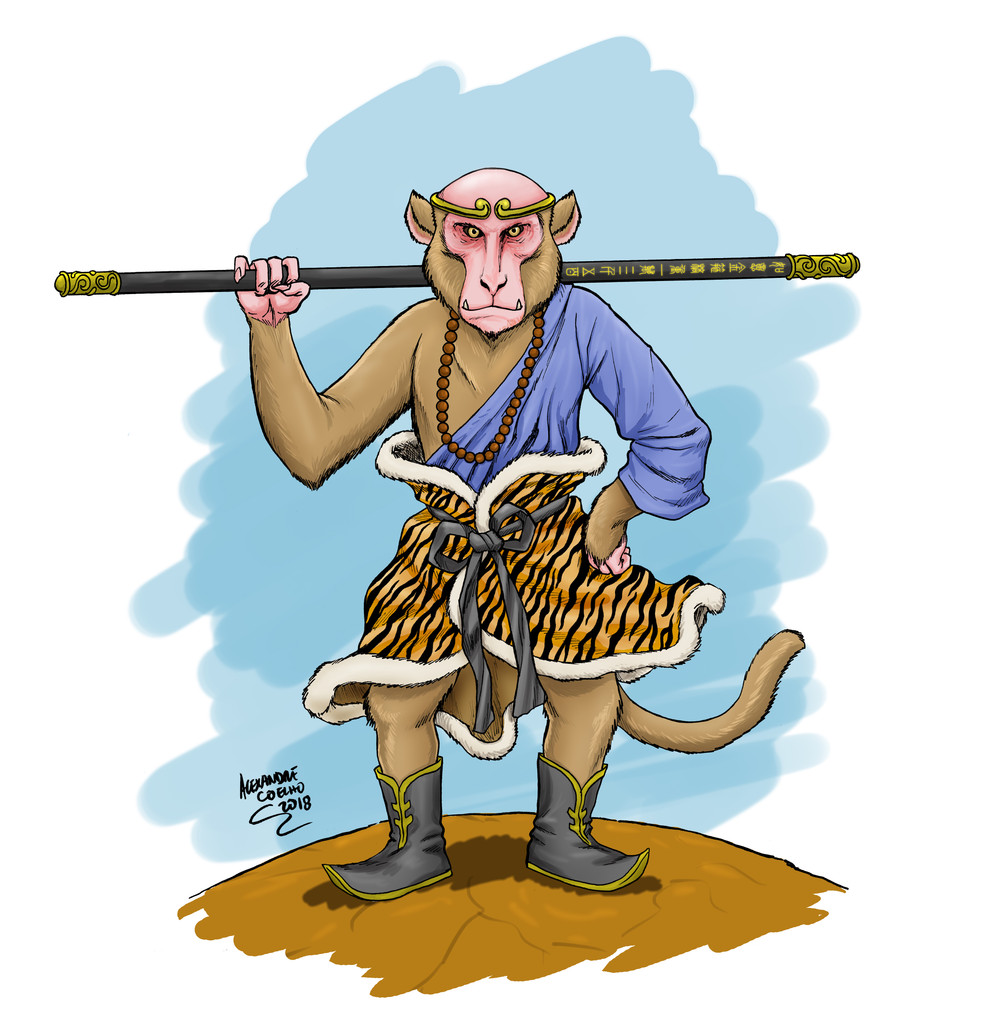
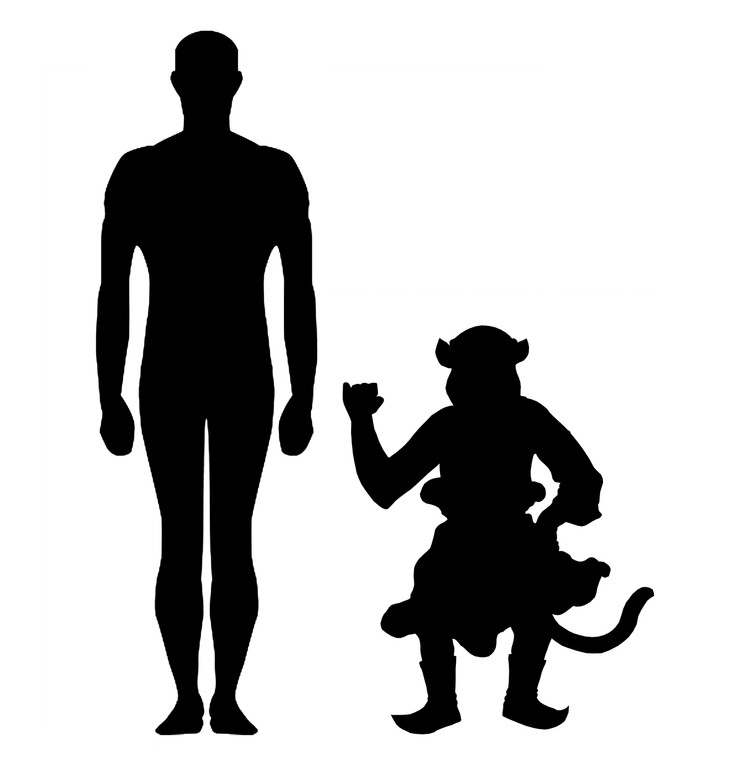
In “What Does Sun Wukong Look Like?” I highlighted several sentences pointing to the Monkey King’s small stature (fig. 1 & 2). For example, one monster comments:

The old monster took a careful look and saw the diminutive figure of Pilgrim [Monkey]—less than four Chinese feet [buman sichi, 不滿四尺, 4.17 ft or 1.27 m] in fact—and his sallow cheeks. He said with a laugh: “Too bad! Too bad! I thought you were some kind of invincible hero. But you are only a sickly ghost, with nothing more than your skeleton left!” (Wu & Yu, 2012, vol. 1, p. 408).

This information was later used in the making of a youtube video called “10 Facts About Sun Wukong the Monkey King.” Fact number seven was that “He’s really short,” and I ended the section by saying: “That’s right! The Great Sage Equaling Heaven, the conqueror of the heavenly army … is the size of a child.” A Chinese viewer later left a thought-provoking comment on the video stating that I was wrong about Monkey’s size.

Fig. 1 – An accurate Monkey King (larger version). Drawn by my friend Alexandre Palheta Coelho (instagram and deviantart). Slightly modified by me to match what I’ve written here. For the original version, see here. Fig. 2 – A size chart comparing Sun to a six-foot human (larger version).
The Debate

Here, I will present the comment in full but interspersed with my responses:

Hello! I am a Wukong fan from China. I really enjoyed your video! I would like to say that the height of the Monkey King has been very controversial on the internet in China. The data and appearance depictions in classical Chinese novels can be somewhat exaggerated. Journey to the West is a mythological novel is even more so. For example, seventy-two transformations, a somersault that can travel one hundred thousand eight hundred thousand li respectively refer to infinite changes and fly extremely fast. Seventy-two and one hundred and eighty thousand are not exact numbers, so relying solely on data is not reliable. Besides, in addition to four feet, Wukong has also appeared other height data. For example, the earliest version of the Journey to the West, “世德堂本”, Chapter 21. “大圣公然不惧。那怪果打一下来,他把腰躬一躬,足长了三尺,有一丈长短。” “Our Great Sage was not in the least frightened. When the monster struck him once, he stretched his waist and at once grew three chi, attaining the height of one zhang altogether.”

This PDF scan (page 258) shows the original version of the novel did indeed read “grow three chi” (changle sanchi, 長了三尺) and not six like in the modern version (Wu & Yu, vol. 1, p. 408). I was surprised when this was brought to my attention.

One zhang minus three chi equals seven chi. In other words, the height of the Monkey King here was seven chi (Since the height unit in Chinese classical novels is based on the ancient system, 7 chi is around 5.5 feet). But in later versions and translations, “grew three chi” was changed to six chi. This has always been a point of contention. The figure of four feet (four chi) appears twice, both from the perspective of other monsters, such as the Monstrous King, who is three zhangs tall (around 24 feet). It may be possible that Sun Wukong is short in his eyes in comparison.

For those unfamiliar with ancient Chinese measurements, one zhang () equals ten chi (尺, i.e. “Chinese feet”) (Jiang, 2005, p. xxxi). The passage in question does imply that Monkey is seven chi tall. However, there are two problems. First, during the Ming (1368-1644) when the novel was published, one chi equaled approximately 12.52 inches (31.8 cm) (Jiang, 2005, p. xxxi). This would make Sun a whopping 7.3 feet (2.22 m) tall! I must admit that the chi varied at the local level, but I doubt the variations would lead to a nearly two-foot (60.96 cm) difference. Additionally, if we use the measures for the Tang (618-907 CE), when the story is set, a chi was 11.57 inches (29.4 cm), making Monkey 6.75 feet (2.06 m) tall. There was, however, a “small chi” (xiaochi, 小尺) at this time, which was 9.66 inches (24.6 cm) (Nienhauser, 2016, p. 405 n. 40). This would only make him 5.65 feet (1.72 m) tall. But I would question if the common folk reading the novel during the Ming were aware of and still using this truncated measure. Second, as written above, the figure for “not even four chi” (buman sichi, 不滿四尺, 4.17 ft or 1.27 m) appears twice. But it’s important to note that this estimate is made by two different characters at two different locations and times. The first is spoken in chapter two by the Monstrous King of Havoc (Hunshi mowang, 混世魔王) in the Water Belly Cave (Shuizang dong, 水臟洞) of the Mountain of Flowers and Fruit (east of the Eastern Purvavideha Continent) (PDF page 36; Wu & Yu, 2012, vol. 1, p. 128). This takes place over 100 years before Sun’s initial rebellion during the Han Dynasty (202 BCE-220 CE). And the second is spoken in chapter 21  by Great King Yellow Wind (Huangfeng dawang, 黃風大王) in the Yellow Wind Cave (Huangfeng dong, 黃風洞) of Yellow Wind Ridge (Huangfeng ling, 黃風嶺) somewhere in the Southern Jambudvipa Continent (PDF page 258; Wu & Yu, 2012, vol. 1, p. 408). This takes place sometime after his release from his 600-plus-year punishment under Five Elements Mountain during the Tang Dynasty (618-907 CE). Therefore, this seems like a more reliable measure—given the distance between themthan the ten minus three argument. I suggest the latter was actually a typo that later editions tried to amend by changing three to six. 
Another reason is that the author may be deliberately blurring the height of the Monkey King. Because at least in the story, the author describes Wukong according to the height of normal people. For example: Before Wukong learned Magic skills, when he could not change his height, he had robbed ordinary people’s clothes to wear. If Wukong was the height of a child, the clothes would hardly fit. When Wukong set out on his journey to the west, he once wore the clothes of Tang Monk. Wukong could carry the Taoist priest changed by the Silver Horned King (if he was a child height this would be very difficult).

These are good points, but a 7.3-foot tall Monkey wouldn’t be able to wear the clothing of the aforementioned people either. Conversely, tucking in or rolling up clothing wouldn’t be out of the question. And carrying a priest wouldn’t be a problem for a small-statured hero capable of hoisting the weight of two cosmic mountains while running at meteoric speeds.

In the same chapter, the Tang monk sitting on the horse can pull Wukong’s tiger skin skirt. Wukong can easily grab Eight Rules’ ear. In the Bhikṣu Kingdom, Wukong once exchanged clothes with Tang monk, etc.

Horses are tall animals, so the Tang Monk would’ve probably fallen off before even grabbing the skirt of an adult-sized Sun Wukong. I look at this as something that sounds good on paper until it’s tried in real life.

I think even a 5.5-foot tall Monkey would have problems grabbing the ear of Zhu Bajie, who is likely 10 feet (3.05 m) tall or more given his three chi (3.13 ft / 95.4 cm) snout (PDF page 108; Wu & Yu 2012, vol. 4, p. 149) and giant body that “causes even the wind to rise when he walks” (PDF page 367; Wu & Yu 2012, vol. 2, p. 51). Either way, jumping would be involved, making this irrelevant.

And just because Sun might be smaller doesn’t mean he wears child-sized clothing. I believe the first instance of sharing clothes happens in chapter 14: “Pilgrim … noticed that Tripitaka had taken off a [robe] made of white cloth and had not put it on again after his bath. Pilgrim grabbed it and put it on himself” (PDF page 174; Wu & Yu, vol. 1, p. 313). He seems to wear whatever is available to him.

In China, there is another speculation about Wukong’s height: monkeys are usually hunched over. Wukong is four chi tall when bent over and seven chi tall when standing upright.

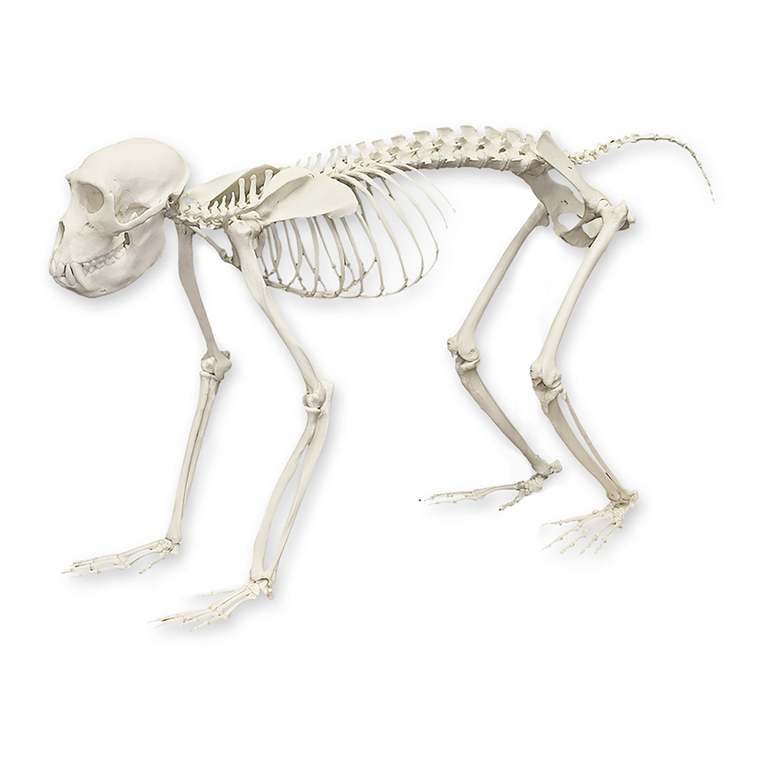
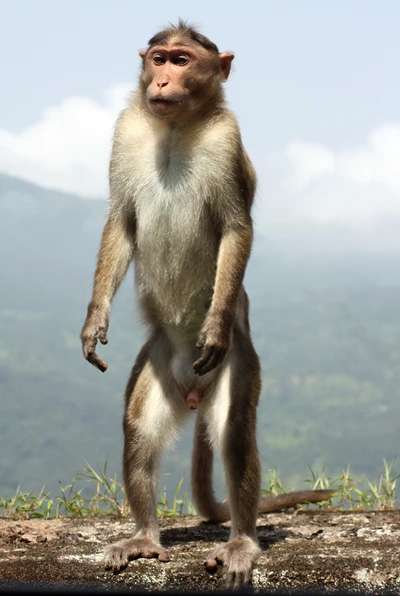
I studied primates in college. Monkeys usually walk on their palms (palmigrade) (fig. 3) and only stand when foraging, fighting, or carrying things. But I don’t recall the novel ever mentioning Sun traveling on all fours (please correct me if I’m wrong). Therefore, he likely walks on two legs. In this case, as stated, monkeys have a hunched posture when standing. They can’t stand straight because of mechanical limitations in their skull, spine, hips, legs, and feet (my previous essay on hominids applies to monkeys as well). One could argue that Monkey can overcome these limitations with his immortal body, but this definitely wouldn’t give him three more chi of height. For example, here’s a macaque standing at full height (fig. 4). As can be seen, straightening the head, spine, and legs would only give a handful of inches or centimeters.

Fig. 3 – A macaque skeleton in its natural posture (larger version). Fig. 4 – A young macaque male standing (larger version).

And as stated in this article, Sun shares all of the hallmarks of a macaque, including a “furry, joweless face with fiery eyes, a broken or flat nose, a beak-like mouth with protruding fangs, and forked ears.” This likely includes a smaller stature.

Of course, there is no doubt that he is very thin, and is definitely the shortest one in the scripture takers, but at least, his height is more like that of a shorter adult than a child. The role of Sun Wukong is a combination of human nature, monkey nature, and divinity. The author may be deliberately obscuring his height. Therefore, when describing daily life, Wukong is the same height as normal people, but in the eyes of other demons, he is more prominent in the shape of the monkey. And he has the divine power to change his height at will. Sorry for my bad English, really enjoyed your video!

I will concede that four chi is a rough estimate, so he might be slightly shorter or even taller than this. Either way, he’d be far below average human height.


Update: 03-06-22

Chapter 20 includes a scene where Monkey refers to his stature: “A person like me, old Monkey, may be small but tough, like the skin around a ball of ligaments!” (PDF page 246; Wu & Yu, 2012, vol. 1, p. 395).


Update: 03-08-22

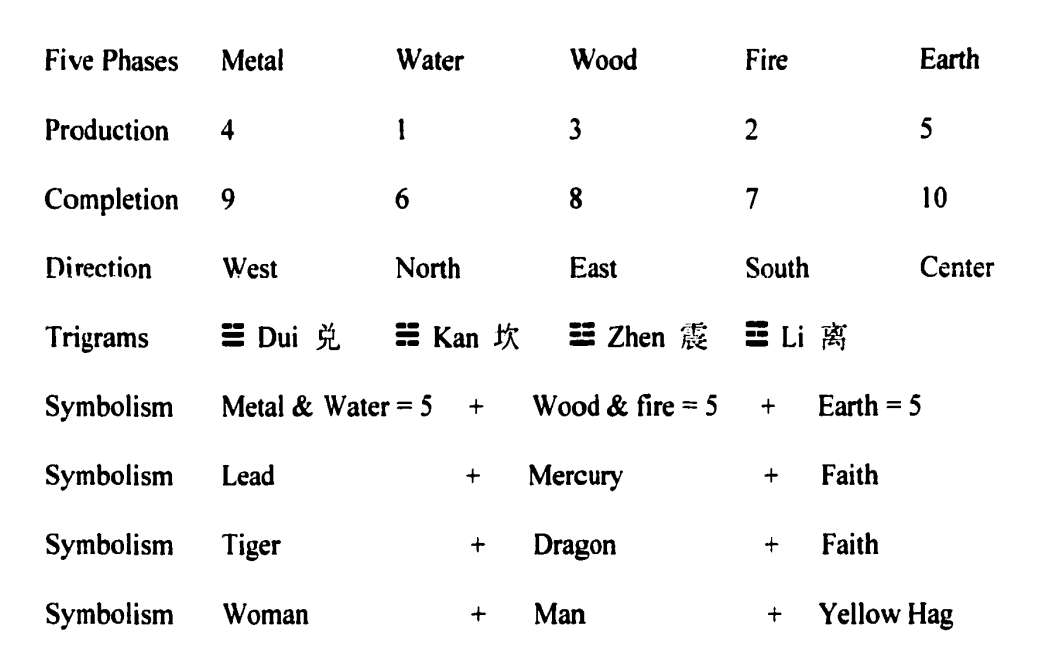
Above, I suggested that the ten minus three argument was a typo. But there might be a numerological explanation. Qing-era scholar Wang Xiangxu (汪象旭, fl.1605-1668) borrowed from the Daoist philosophy of Zhang Boduan (張伯端, 987?-1082) by applying his “three fives equal one” (sanwuyi, 三五一) five elements concept (fig. 5) to numbers appearing in the novel. As Shao (1997) explains:

One set of five consists of wood (3) and fire (2). Wood in the east produces fire in the south. The second set is that of metal (4) and water (1). Metal in the west produces water in the north. The third is earth in the center whose number is five. The whole business of the “gold elixir” is to integrate all three sets of five to produce one—the gold elixir (pp. 16-17).

Shao (1997) goes on to explain the numeric significance of the dharma vessel constructed from Sha Wujing’s 9-skull necklace and the heavenly gourd in chapter 22: 

Wang Xiangxu shows a keen eye for the “one” gourd and “nine” skulls which make a perfect “ten”—the number for the completion of earth. However, it is not the numbers that attract him, but what they indicate—that the gold elixir is creation—a process that involves the integration of all the five elements—not unlike the creation of the universe (p. 18).

Therefore, three (wood) and seven (fire) may be a reference to the completion of ten (the golden elixir) in Daoist numerology. If this is true, even the later switch from three to six still matches this (refer to fig. 5).

Fig. 5 – A chart explaining the three fives (larger version). From Shao, 1997, p. 17.


Update: 04-27-24

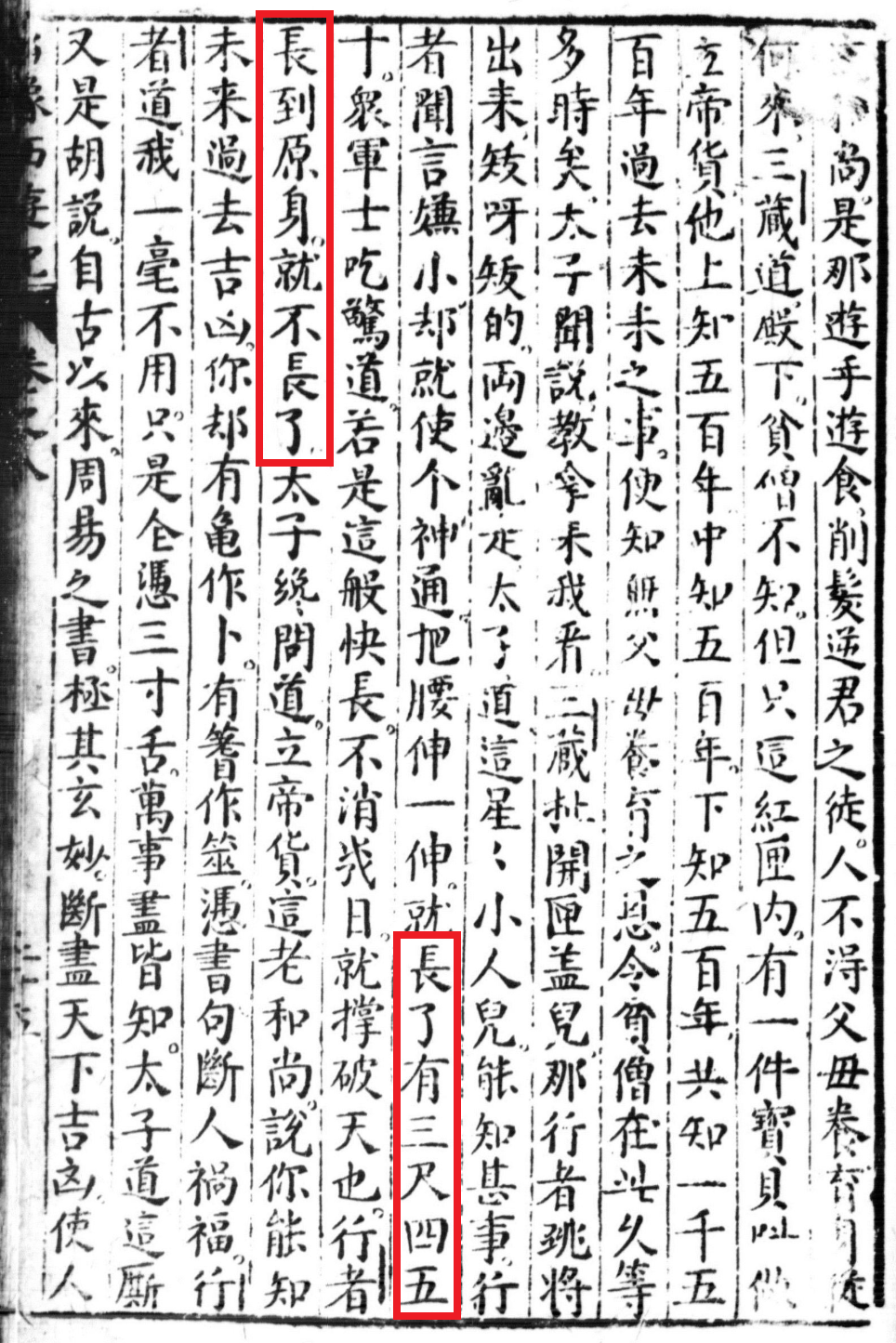
Chapter 37 gives a more precise measurement for Monkey’s height. He first transforms into a “tiny monk about two cun tall” (二寸長的小和尚兒) (based on Wu & Yu, 2012, vol. 2, p. 172). He shortly thereafter grows even bigger when a prince makes fun of him:

Tripitaka pulled open the box’s cover; Pilgrim [Sun Wukong] leaped out and began to hobble all over the place. The prince said, “This little midget! What can he know?” When Pilgrim heard this remark about his size, he at once resorted to magic. Straightening up his torso, he grew about three chi and four or five cun instantly (emphasis added). “If he can grow that rapidly,” said the soldiers, highly startled, “it will only be a few days before he pierces the sky.” When Pilgrim reached his normal height, however, he stopped growing (emphasis added) (based on Wu & Yu, 2012, vol. 2, pp. 174-175).

三藏扯開匣蓋兒,那行者跳將出來,呀的兩邊亂走。太子道:「這星星小人兒,能知甚事?」行者聞言嫌小,卻就使個神通,把腰伸一伸,就長了有三尺四五寸。眾軍士吃驚道:「若是這般快長,不消幾日,就撐破天也。」行者長到原身,就不長了。

As mentioned above, one chi (尺) is roughly 12.3 in or 31.8 cm (Jiang, 2005, p. xxxi). Expanding on this, one chi equals 10 cun (寸; a.k.a. “Chinese inches”) (Jiang, 2005, p. xxxi). One cun would be about 1.25 in or 3.18 cm. Two cun would therefore be 2.5 in or 6.36 cm. Growing the stated additional height would then put our hero at chi and 6 or 7 cun, which is roughly 3.86 ft or 1.176 m. This agrees with the aforementioned estimate of “not (or less than) four chi tall” (buman sichi不滿四尺) (Wu & Yu, 2012, vol. 1, pp. 128 and 408).

It’s important to note that the cited quote above does indeed appear in the original 1592 edition (see PDF page 480) (fig. 6). This proves that the aforementioned “grow three chi” (changle sanchi, 長了三尺) from PDF page 258 was a typo!

Fig. 6 – A scan from the original 1592 edition showing that Monkey only grows an additional “3 chi and 4 or 5 cun” (larger version). 

Sources:

Jiang, Y. (2005). The Great Ming Code / Da Ming Lu. Vancouver, Wa: University of Washington Press.

Nienhauser, W. H. (2016). Tang Dynasty Tales: A Guided Reader. Singapore: World Scientific.

Shao, P. (1997). Monkey and Chinese Scriptural Tradition: A Rereading of the Novel Xiyouji (UMI No. 9818173) [Doctoral dissertation, Washington University]. Available from ProQuest Dissertations and Theses database.

Wu, C., & Yu, A. C. (2012). The Journey to the West (Vols. 1-4) (Rev. ed.). Chicago, Illinois: University of Chicago Press.

Journey to the West Artist Spotlight #1: Dario Virga

From time to time I like to post a fun blog not directly related to (though sometimes informed by) my research. Regular articles will resume after this entry.

Anyone who has read my blog will know that I’m an avid fan of researching the history and influences of Journey to the West. But as an artist, I am also a fan of JTTW-related artwork. There are so many talented people in the world who post their traditional and original designs and comics online, so I’ve decided to feature some of them on my blog. My hope is that such posts will expose this art to a wider audience interested in JTTW, while also documenting modern day perceptions and depictions of the novel and its characters.

Our first artist is Dario Virga, who goes by Onibotokemaru on Instagram. They were kind enough to answer some interview questions, as well as allow permission to display a few of their pieces.

I. Q & A

1) Can you tell me a little about yourself?

Real name Dario Virga, from Italy (Piedmont). Interest in eastern culture and literature, mostly from Japan and China.

2) Are you self-taught or did you go to art school?

Self-taught, though I had some help from someone who went to art school.

3) What are your main sources of artistic inspiration?

Usually animals and characters/elements taken from mythology and literature.

4) How did you learn about Journey to the West?

My very first contact with Journey to the West was back when I was younger, in a book about Chinese myths. Later I found an integral translation done by Serafino Balduzzi (translated from a French one).

5) Who is your favorite character?

Tough question, but I like most of the characters. If forced to choose, I’d say Pigsy for the good guys and the Bull Demon King for the villains.

6) Do you have a favorite episode from the novel?

Probably the whole Gold Horn & Silver Horn arc.

7) Does the novel have a special meaning to you?

Not a special meaning per se, but it was a novel I really enjoyed, both for the setting, the narration, the characters within and watching them grow.

8) Can you tell me about your ongoing JTTW-related projects?

Plan to make a gallery of, if not all, at least a huge amount of the novel’s characters.

II. Art and Thought Process

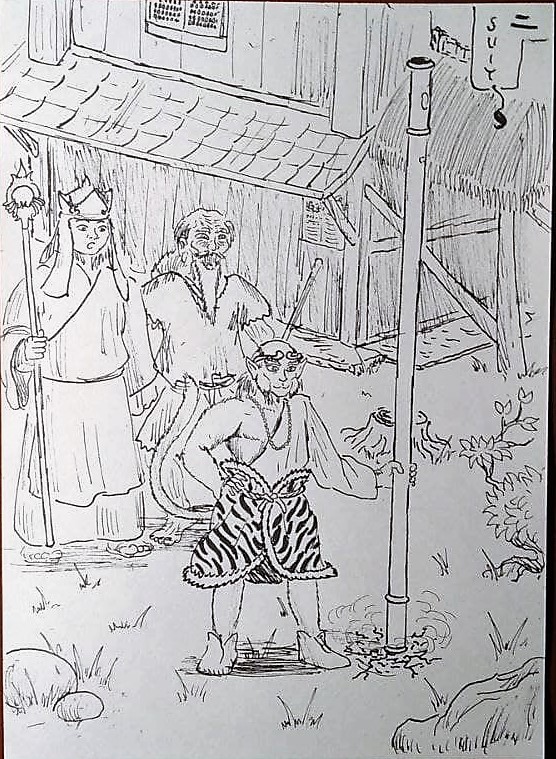
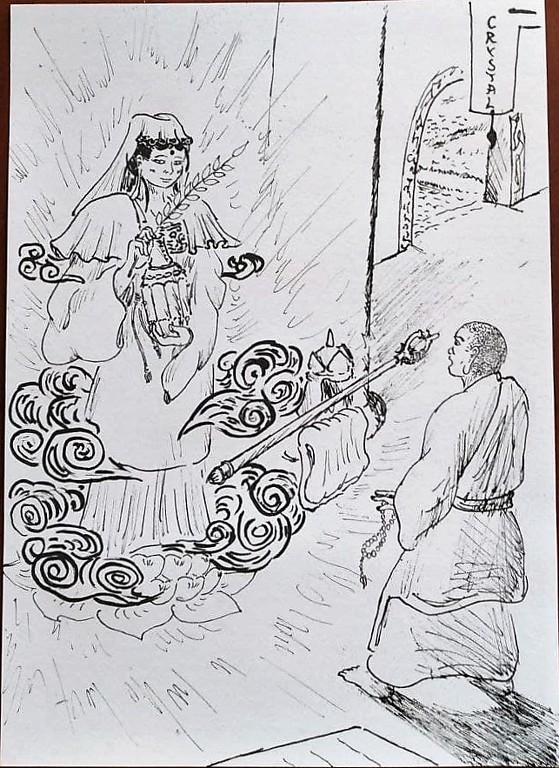
1. As the opening drawing of the Xiyouji-themed Inktober set, I’ve decided to focus not on Sun Wukong himself but rather on Tripitaka, the monk, as Guanyin Pusa appears before him to assign him the quest for the sutras. Guanyin’s reference are commonly-found icons and statues. Between the two of them float the items Tripitaka receives (the cossack, nine-ringed staff and hat).

(Larger version)

2. This is the first time I depict Sun Wukong in the series, and I did it based his design on an article written on this very blog, trying to stick as much as possible to his literary description, especially regarding the clothing (monk’s shirt and tiger pelt kilt held by a rope), short stature, simian face and bald spot on the top of the head (converted to Buddhism). I gave him long spike-like hair in the back because otherwise his head felt too small. The Ruyijingubang has a rather simple design, as I never liked its depictions with pommels on both ends. I also tried to make the inscriptions on the shaft, but ultimately gave up, admittedly.

(Larger version)

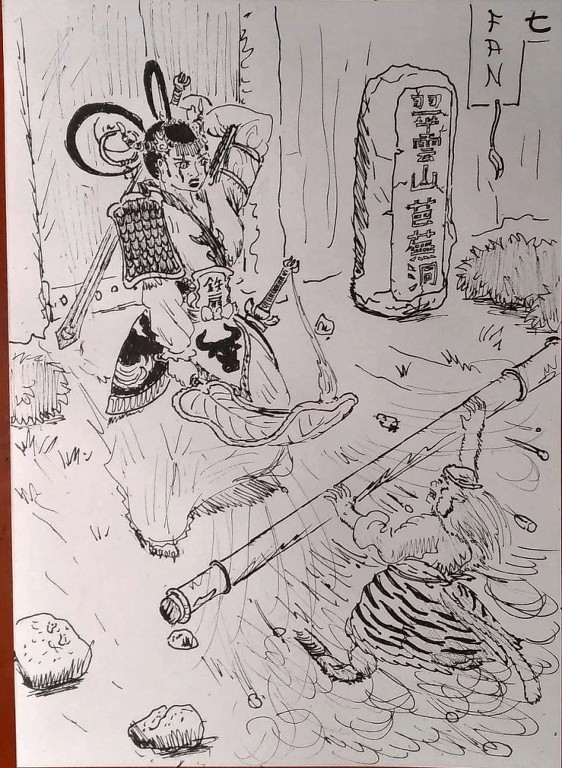
3. This picture has Sun Wukong fighting against the Iron Fan Princess, who sends him flying away with her Banana Leaf Fan. Once again, I wanted to show how small Monkey is (in comparison to nearly everyone else, though I’m not always 100% consistent) and remind that the Ruyijingubang can increase in both length and width, as seen here where he tries to use it as a shield to block the wind, unsuccessfully. Also of note, the massive stone pillar on which the “address” of the Iron Fan Princess is written.

(Larger version)

4. This one isn’t based on any specific event, but it’s here to bring out two topics: the first is the size of the party members, which I always tried to keep consistent (and tried is the keyword). The idea is that Sun Wukong is the smallest of the group (4 feet), then we have Tripitaka, the “normal” one, and the Dragon (horse-sized): Pigsy (here depicted with a hint of boar) is the second tallest but also the fattest, while Sandy is the tallest of the party (and definitively not a Kappa). The second one is Sha Wujing’s weapon: while it’s usually depicted as a Monk Spade, the actual name is the “Demon-Subduing Treasure Cane” (降魔宝杖, Xiangmobaozhang), making it a stick/staff. However, it’s also worth a mention that the Monk Spade is sometimes called “Zen Cane” (禪杖, Chanzhang), a term which also refers to the ringed staff used by monks. Admittedly, I liked the spade version the most, though I plan to depict this weapon as a staff when Sandy is in his celestial marshal/arhat forms, implying that the staff changed into a spade when he fell from Heaven.

(Larger version)

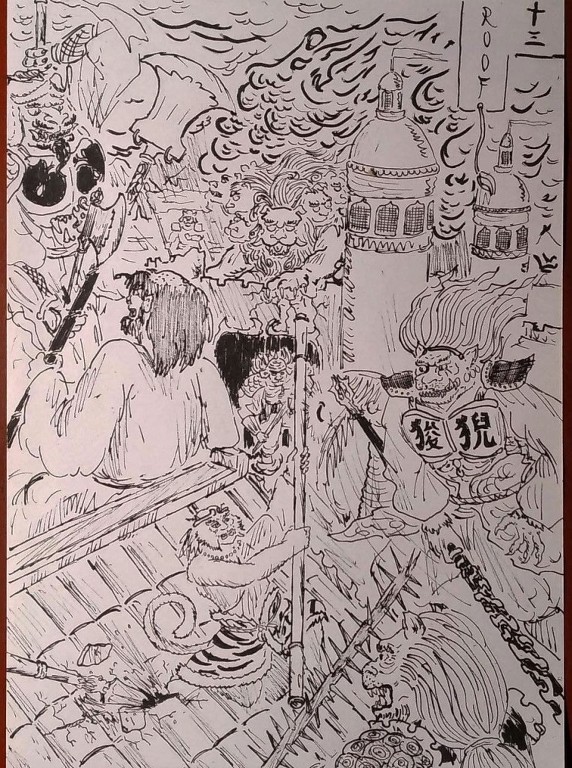
5. The big battle between Sun Wukong and the Lion Demons working for the Great Sage Nine Spirits (seen in the background, in his giant nine-headed form): this was mostly done because it was one of the rare parts of the book where Sandy actually fights the monsters alongside Sun Wukong (as Pigsy was captured), as well as an attempt to make a big battle scene.

(Larger version)

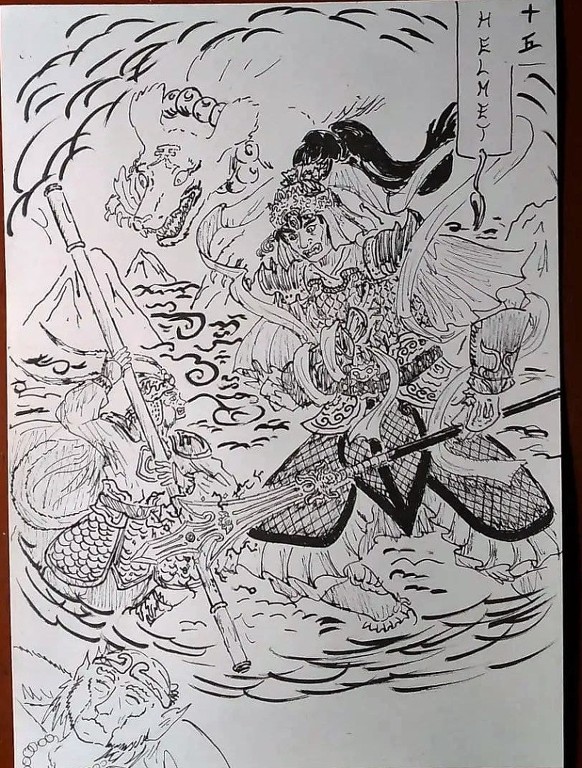
6. The only god who actually beat Monkey, Erlang Shen. Since the Inktober was focused on the journey itself, I’ve decided to depict their battle as a bad dream. This time, Monkey wears his old, stylish outfit he got from the Dragon Kings, while Erlang is in full battle regalia, including his “Sanjiang Lianrendao” (三尖两刃刀 Three-pointed, Double Edged Glaive) and his Heavenly Roar Dog.

(Larger version)

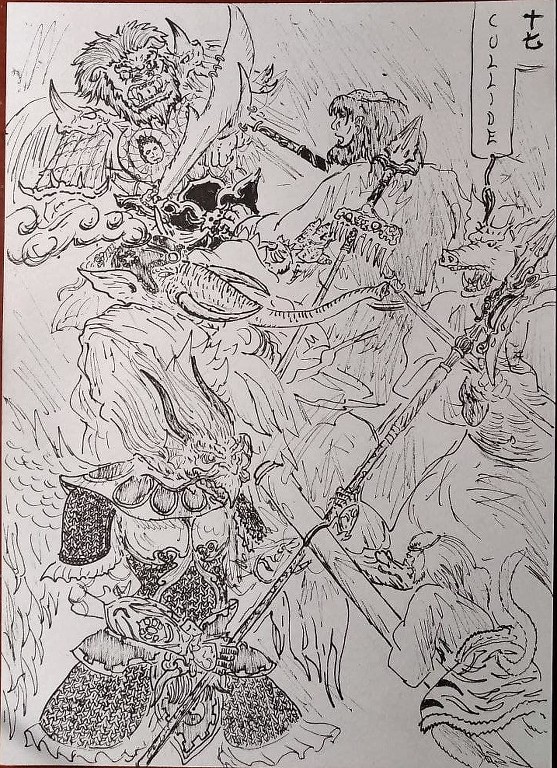
7. The clash between the three pilgrims and the three Demon Kings of Lion Camel Mountain, from top to bottom: the Blue-Haired Lion vs Sha Wujing, the Yellow-Tusked White Elephant vs Zhu Bajie and the Golden-Wings Peng King vs Sun Wukong. The design of the three kings was based on a series of pictures I loved very much. Once again, a reminder that Wukong’s staff can widen as well.

(Larger version)

8. Sun Wukong fights the three Rhino Kings, who’re kidnapping Tripitaka. This time I wanted to depict Monkey twirling his staff as he fights. Like with the Demon Kings above, the design of the three Rhinos was based on the same set of pictures, even though I remember that in the novel they’re described as “bull-like” in appearence. Particularly like the dust cloud to the right.

(Larger version)

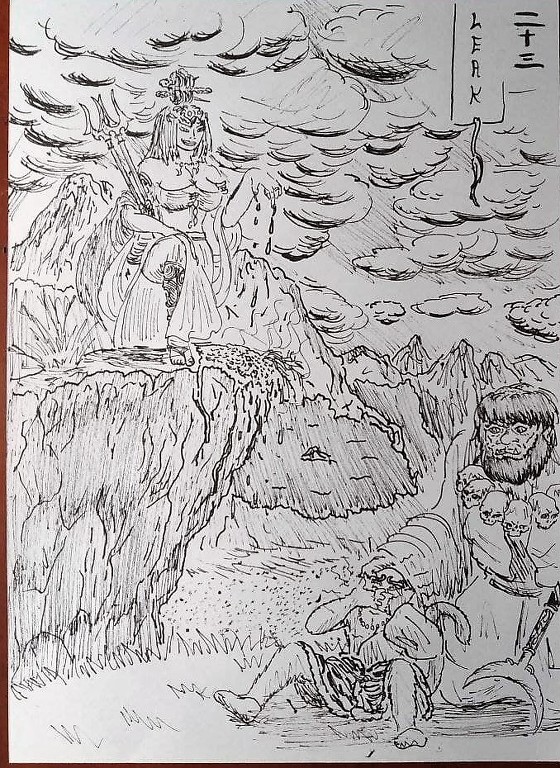
9. Sun Wukong is poisoned by the Scorpion Spirit. Aside from the scenery, I like the scorpioness. I’ve noticed in several arts (even old ones) that she sports a relatively skimpy outfit. As of her weapon, mentioned to be a “fork/trident” in the book, I’ve seen plenty of depictions with both the single trident version and the smaller, dual trident version.

(Larger version)

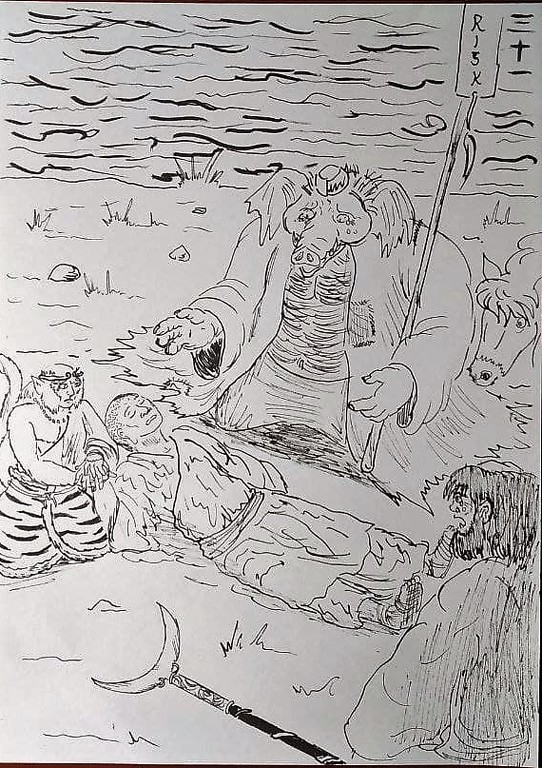
10. As a bookend, I’ve depicted a scene from the end of the book, the moment where Tripitaka drowns and ascends to buddhahood, so that he can obtain the sutras properly. This is also to represent one of the things I liked the most from the novel, the gradual growth of the pilgrims and the attachment to Tripitaka as a father figure. [Note: Tripitaka sheds his mortal form as he and his disciples are ferried across a body of water to the Buddha’s paradise. See the paragraph above image one and the material between images two and three in this article.]

(Larger version)