Origin of the White Turtle River Crossing Accident From Journey to the West Chapters 98 and 99

Last updated: 09-05-2025

Journey to the West (Xiyouji西遊記, 1592; “JTTW” hereafter) chapter 98 sees the pilgrims sent back to China on a cloud to hasten the completion of their mission and subsequent return to paradise. However, shortly after their departure, Guanyin realizes in chapter 99 that Tripitaka has only experienced a total of 80 tribulations during his life, which is just shy of the perfect, sacred number (9 x 9 = 81). Therefore, she orders the eight Dharma guardians piloting the cloud to prematurely drop them off somewhere before reaching their stated destination. Sha Wujing reasons that this was done because they are going too fast (Wu & Yu, vol. 4, pp. 357-361).

The companions find that they have been deposited along the western bank of the “Heaven-Reaching River” (Tongtian he, 通天河), the same body of water where a giant, white turtle-spirit (baiyuan, 白黿) had ferried them across in chapter 49 (fig. 1). This same reptile appears and offers to carry them to the eastern bank (i.e. in the direction of China), but when he learns that the clerics had failed to keep their promise to ask the Buddha when the turtle’s long years of cultivation would result in him achieving human form (Wu & Yu, 2012, vol. 2, pp. 359), the angry spirit dives into the water, dunking the clerics, the dragon horse, and the hard-won scriptures. Thus, the 81st tribulation is achieved (Wu & Yu, 2012, vol. 4, pp. 362-363).

Fig. 1 – A statue of the pilgrims crossing the Heaven-Reaching River on the back of the giant river turtle (larger version). The reptile is presented here as a dragon-turtle. Statue in the author’s personal collection.

This episode is likely based on a historical accident that resulted in the real Xuanzang (玄奘, 602–664) (on whom Tripitaka is based) losing 50 scriptures to the drink. I first learned about the real world event from Brose (2021) and made the connection to JTTW chapters 98 and 99 on my own. Here’s a twitter post from 2022 attesting to that. But when I recently revisited the idea for a possible article, a cursory search didn’t turn up much information about the accident in Xuanzang’s historical travelogue, A Biography of the Tripitaka Master of the Great Ci’en Monastery (Datang Daci’en si Sanzang Fashi Zhuan大唐大慈恩寺三藏法師傳, 7th-century; T2053; “A Biography” hereafter). Luckily, I found the answer in Brose (2023), where he states: “Xuanzang does not recount the accident in his Record; he mentions it only briefly in the letters he later wrote to monks in India requesting copies of the lost texts” (p. 147). The provided citations led me to the correct sections of A Biography.

The end of one letter presented in scroll seven (of ten) reads:

[…] Of the scriptures and commentaries that I have brought back, I have already translated the Yogācārabhūmi Śāstra and other long and short texts, making a total of over thirty works. The translation of the Abhidharmakośa Śāstra and the Abhidharmanyāyānusāra Śāstra is not yet completed, but it will be finished this year. The reigning Emperor of the Great Tang Empire is enjoying every felicity, with peace prevailing throughout his land. With the compassion of a Cakravartin King, he has spread the edification of the Buddha, composed a preface with his Divine Pen to all the Chinese translations of the scriptures and commentaries, and also ordered the authorities to copy them for circulation in the country. Thus even neighboring states also follow and study them. Although we are now at the end of the Image Period, the brilliance of the Dharma is still as genial and as glorious as when it was taught in the Jetavana Garden in Śrāvastī. I hope you will take note of the above information. When I was crossing the Indus [on my way back home], I lost a pack of scriptures (emphasis added). I am now sending you herewith a list of the lost texts, of which I request that you send me new copies by some convenient messenger (Huili & Shi, 1995, pp. 232-233).

玄奘所將經論,已翻《瑜伽師地論》等大小三十餘部,其《俱舍》、《順正理》,見譯未周,今年必了。即日大唐天子聖躬萬福,率土安寧,以輪王之慈,敷法王之化,所出經論,並蒙神筆製序,令所司抄寫,國內流行,爰至隣邦亦俱遵習。雖居像運之末,而法教光華,邕邕穆穆,亦不異室羅筏誓多林之化也,伏願照知。又前渡信渡河失經一馱,今錄名如後,有信請為附來。(source)

This is admittedly anticlimactic, but a fuller, more exciting version of the event appears in scroll five:

After travelling for more than twenty days, he reached the country of Takṣaśilā and revisited the place where King Candraprabha had sacrificed his head a thousand times in his previous lives. Fifty yojanas to the northeast of this country was the country of Kaśmīra. The king sent an envoy to invite the Master [i.e. Xuanzang]; but as he was riding on an elephant and had luggage with him, he was unable to go. After staying there for seven days, he proceeded northwest again for three days and reached the great Sindhu [i.e. Indus] River, which was five or six li broad. His scriptures and images were loaded in a boat with his companions to sail across the river, while the Master waded through the river on his elephant [fig. 2]. He had appointed a man in the boat to take care of the scriptures and some seeds of different kinds of rare Indian flowers. When the boat sailed to midstream, a turbulent gale suddenly arose. The waves tossed the boat and almost overturned it. The man who was asked to look after the scriptures was so frightened that he fell overboard, but was rescued by the other passengers. Fifty bundles of scriptures and flower seeds were lost, while his other property narrowly escaped damage.

At that time the king of Kapiśā who was already in the city of Uḍakhāṇḍa heard that the Master was arriving and went personally to the riverside to greet him. He inquired, “I heard that you lost your scriptures in the river. Did you bring any seeds of Indian flowers and fruits with you?” “Yes, I did,” was the reply. The king said, “That was the cause of the gale that stirred up the waves and almost overturned your boat. Since ancient times, those who brought flower seeds to cross this river have always had the same trouble.” Then he returned to the city with the Master, who lodged in a monastery for more than fifty days. As he had lost some of his scriptures, he sent a man to the country of Udyāna to copy the Tripiṭaka of the Kāśyapīya school (Huili & Shi, 1995, pp. 156-157).

如是二十餘日行,至呾叉尸羅國,重禮月光王捨千頭處。國東北五十踰繕那即迦濕彌羅國,其王遣使迎請,法師為象行輜重不果去。停七日,又西北行三日至信度大河,河廣五六里,經像及同侶人並坐船而進,法師乘象涉渡。時遣一人在船看守經及印度諸異花種,將至中流,忽然風波亂起,搖動船舫,數將覆沒,守經者惶懼墮水,眾人共救得出,遂失五十夾經本及花果種等,自餘僅得保全。

時迦畢試王先在烏鐸迦漢茶城,聞法師至,躬到河側奉迎,問曰:「承師河中失經,師不將印度花果種來?」答曰:「將來。」王曰:「鼓浪傾船,事由於此。自昔以來,欲將花種渡者,並然。」因共法師還城,寄一寺停五十餘日,為失經本,更遣人往烏長那國抄寫迦葉臂耶部三藏。(Source)

And lastly, scroll two associates the Indus River with greedy water-spirits that capsize boats in order to gain the treasures therein:

From the city of Uḍakhāṇḍa, the Master crossed the Indus to the south. The river was three or four li wide, and the water was very clear and flowed rapidly. Many venomous dragons and evil animals dwelt in it. Anyone crossing the river with Indian precious gems, rare flowers, or relic bones would often have his boat overturned (Huili & Shi, 1995, p. 60).

自烏鐸迦漢茶城南渡信渡河,河廣三四里,流極清急,毒龍惡獸多窟其中,有持印度奇寶名花及舍利渡者,船輒覆沒。(source)

Connecting the three passages presents a complete picture of the event: Xuanzang and his servants attempted to cross the Indus River with precious scriptures and the seeds of rare Indian flowers, but one or more river dragons called up a powerful wind that capsized the boat carrying his treasures just so it/they could get their scaly mitts on them. This/these beast(s) and their crime eventually made it into the 1592 JTTW in the form of the giant white turtle-spirit and his grudge against the scripture-seekers.

Fig. 2 – Xuanzang riding an elephant (larger version). From a lianhuanhua pocket comic about the monk’s travels. Image found here.


Update: 09-05-25

Maria Josey, a friend of the blog, told me that she saw a statue of the pilgrims riding the turtle in a temple from Phuket, Thailand (fig. 3). She explains:

This story featured heavily in the chosen design of the temple grounds … [T]he monument is quite high up, on a mound, then a huge boulder. Cannot have been easy to build, I imagine, but it must have meant a lot to whoever did make it.

Fig. 3 – The statue (larger version). This photo was taken “a few years ago.” Copyright Maria Josey. Used with permission.

Sources:

Brose, B. (2021). Xuanzang: China’s Legendary Pilgrim and Translator. Boulder, Colorado: Shambhala Publications, Inc.

Brose, B. (2023). Embodying Xuanzang: The Postmortem Travels of a Buddhist Pilgrim. United States: University of Hawaii Press.

Huili, & Shi, Y. (1995). A Biography of the Tripitaka Master of the Great Ci’en Monastery of the Great Tang Dynasty (R. Li, Trans.). Berkeley, CA: Numata Center for Buddhist Translation and Research. Retrieved from https://www.bdkamerica.org/product/a-biography-of-the-tripitaka-master-of-the-great-cien-monastery/.

Wu, C., & Yu, A. C. (2012). The Journey to the West (Vols. 1-4) (Rev. ed.). Chicago, Illinois: University of Chicago Press.

How Tall are the Main Characters from Journey to the West?

Last updated: 09-30-2024

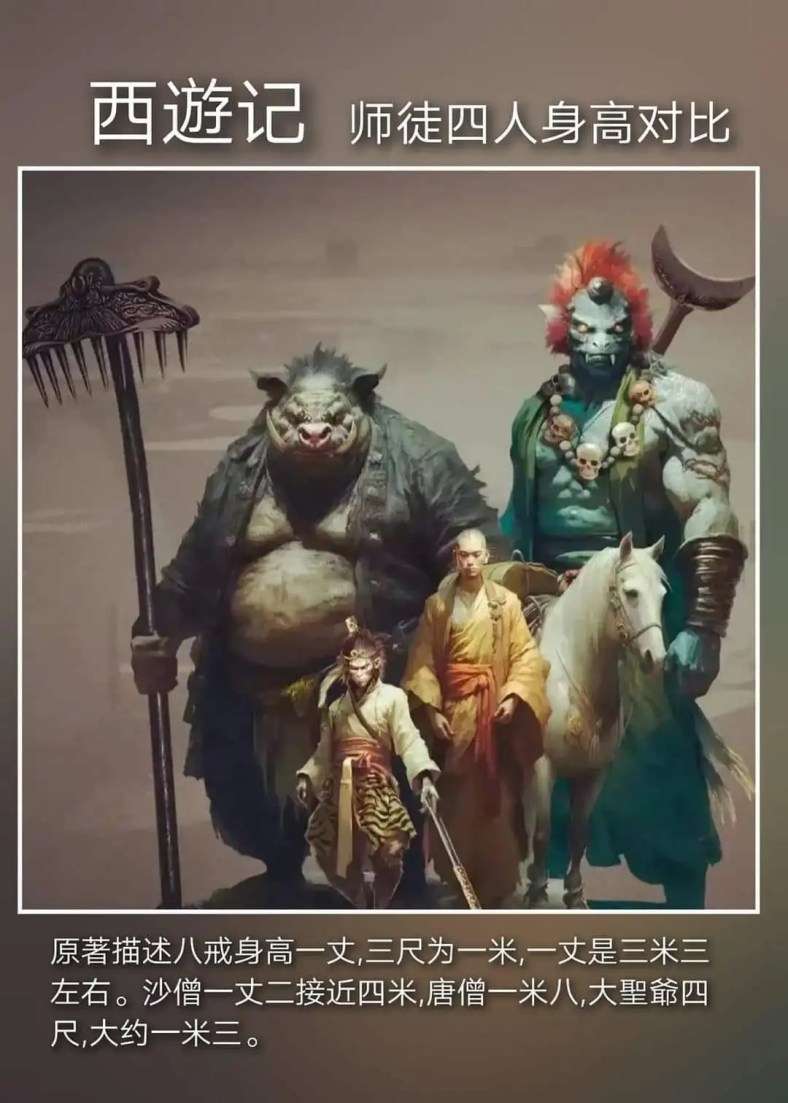
A member of a Monkey King Facebook group I belong to posted a Chinese informational graphic titled “Journey to the West: The Four Body Height Ratios of the Master and His Disciples” (Xiyou ji: Shitu siren shengao duibi, 西游记 师徒四人身高对比) (fig. 1). Each character is depicted with their correct corresponding height, ranging from Sun Wukong as the shortest to Sha Wujing as the tallest. The bottom of the picture provides some measurements:

The original novel describes Bajie’s body as being 1 zhang tall. Three chi is 1 meter. One zhang is around 3.3 meters. Sha Monk is 1.2 zhang, which is close to 4 meters. The Tang monk is 1.8 meters. The Lord Great Sage is 4 chi, or approximately 1.3 meters.

原著描述八戒身高一丈,三尺为一米,一丈是三米三左右。沙僧一丈二接近四米,唐僧一米八,大聖爺四尺,大约一米三。

The information is overgeneralized and at times conjectural, but I figured the picture would be interesting to my followers on Twitter. Little did I know that it would explode in popularity. As of this writing, my tweet has 940 likes (most of these received in a few days). This indicates that not many people were aware of the great height disparity between the pilgrims. I’ve therefore decided to write an article recording what Journey to the West actually says about each character’s height. 

I believe that the creator of the info graphic got their measurements from this essay, for it has the exact same title and very similar material (Zhongshi Damei Shenghuo [ZDS], 2020). I will use the claims therein to compare and contrast with the actual text from the novel.

Fig. 1 – The Chinese informational picture listing the pilgrims’ heights (larger version). I unfortunately don’t know who the original artist is. A reverse image search didn’t turn up anything. This page has the earliest appearance of the informational picture that I can find.

1. Measurements

ZDS (2020) uses a mixture of the ancient Chinese chi (尺) and zhang (丈) and the modern meter (mi, 米). The chi (and subsequently the zhang) varied at the local level at different times. During the Ming (1368-1644), when Journey to the West was published, the measurements equaled:

  • One chi (尺) = roughly 31.8 cm (12.3 in)
  • Ten chi = one zhang (丈)
  • one zhang (丈) = roughly 3.18 m (10.43 ft) (Jiang, 2005, p. xxxi).

Yes, the novel is set during the Tang (618-907), but many elements of the story (e.g. language, religion, mythos, martial arts, etc.) are filtered through the lens of the Ming. Therefore, it’s appropriate to use Ming-era measurements.

2. Heights

The characters are listed below from shortest to tallest.

(Note: I will be relying on the Wu & Yu (2012) translation. But since it uses “feet” instead of the original chi or zhang, I’ll alter the source throughout the article for more accuracy.)

2.1. Sun Wukong

See my previous articles discussing Monkey’s height (here and here).

ZDS (2020) states that Sun is “4 chi, that is less than 1.3 m [4.26 ft] or the same height as a child” (4 chi, yejiushi budao 1.3 mi, gen haitong yiban gao, 4尺,也就是不到1.3米,跟孩童一般高). But they miss an important distinction. The novel twice describes him as being “not four chi tall” (buman sichi, 不滿四尺), meaning that Monkey is an unknown height below 1.272 m (4.17 ft).

The phrase is first spoken by the Monstrous King of Havoc (Hunshi mowang, 混世魔王) in chapter 2:

When the Monstrous King saw him, he laughed and said, “You’re not four chi tall (emphasis added), nor are you thirty years old; you don’t even have weapons in your hands. How dare you be so insolent, looking for me to settle accounts?” (based on Wu & Yu, 2012, vol. 1, p. 128).

魔王見了,笑道:「你身不滿四尺,年不過三旬,手內又無兵器,怎麼大膽猖狂,要尋我見甚麼上下?」

The second is said hundreds of years later by the Great King Yellow Wind (Huangfeng dawang, 黃風大王) in chapter 21:

The old monster took a careful look and saw the diminutive figure of Pilgrim—less than four chi (emphasis added), in fact—and his sallow cheeks. He said with a laugh: “Too bad! Too bad! I thought you were some kind of invincible hero. But you are only a sickly ghost, with nothing more than your skeleton left!” (based on Wu & Yu, 2012, vol. 1, p. 408).

那怪仔細觀看,見行者身軀鄙猥,面容羸瘦,不滿四尺。笑道:「可憐,可憐。我只道是怎麼樣扳翻不倒的好漢,原來是這般一個骷髏的病鬼。」

Some readers may wonder why such a powerful character can be so tiny. This is because the novel describes Sun as a literal monkey. Refer back to this article for more information.

(Note: See the 4-27-24 update below for a more precise measurement.)

2.2. The Tang Monk

I have yet to formally write about Tripitaka‘s height.

ZDS (2020) suggests that the “Tang Monk should be about 1.8 m [5.90 ft]” (Tangseng yinggai zai 1.8 mi zuoyou, 唐僧应该在1.8米左右). This estimate is based on the size of a stone box used to imprison him in chapter 49:

Pilgrim … mov[ed] towards the rear of the palace. He looked, and sure enough there was a stone box, somewhat like a trough that people use in a pigpen or a stone coffin. Measuring it, he found it to be approximately six chi in length (emphasis added). He crawled on top of it and soon heard the pitiful sound of Tripitaka’s weeping coming from inside (Wu & Yu, 2012, vol. 2, p. 347).

行者 … 徑直尋到宮後看,果有一個石匣,卻像人家槽房裡的豬槽,又似人間一口石棺材之樣,量量足有六尺長短。卻伏在上面,聽了一會,只聽得三藏在裡面嚶嚶的哭哩。

Six chi is 1.9 m or 6.25 ft. Tripitaka would obviously be shorter given the inside thickness of the stone walls, but the novel doesn’t provide such detailed information. This means that the 1.8 m estimate is conjecture. So, what other proof is there?

ZDS (2020) also cites a poem from chapter 54 as evidence that the Tank Monk is “tall and handsome” (yougao youshuai, 又高又帅):

What handsome features!
What dignified looks!
Teeth white like silver bricks,
Ruddy lips and a square mouth.
His head’s flat-topped, his forehead, wide and full;
Lovely eyes, neat eyebrows, and a chin that’s long.
Two well-rounded ears betoken someone brave.
He is all elegance, a gifted man.
What a youthful, clever, and comely son of love,
Worthy to wed Western Liang’s gorgeous girl! (Wu & Yu, 2012, vol.  3, p. 55). [1]

丰姿英偉,相貌軒昂。齒白如銀砌,唇紅口四方。頂平額闊天倉滿,目秀眉清地閣長。兩耳有輪真傑士,一身不俗是才郎。好個妙齡聰俊風流子,堪配西梁窈窕娘。

Technically, yishen busu (一身不俗) can mean having a body that is “impressive” or “out of the ordinary,” but as Yu (2012) translates, it can also refer to one’s person. This is not the same as listing a particular height.

Hence, there isn’t enough information in the novel to officially say how tall Tripitaka is. But for those demanding some sort of answer, we can always speculate using real world data.

According to one study, out of a sample size of 28,044 Chinese men from 31 provinces/autonomous regions, the average modern height is 169 cm (5.54 ft). Additionally, this Chinese article references a study claiming that men from ancient times up to the Ming were between 165 cm (1.65 m or 5.41 ft) and 167 cm (1.67 m or 5.47 ft). This is obviously shorter than the 1.8 m suggested above.

Therefore, the most we can say is that the Tang Monk would be average historical height.

2.3. Zhu Bajie

I’ve written about Zhu Bajie’s height in the past (see here).

ZDS (2020) writes that Zhu’s “snout is 3 chi long” (zui chang 3 chi, 嘴长3尺). This is based on a descriptive poem from chapter 85:

A snout, pestlelike, over three chi long (emphasis added)
And teeth protruding like silver prongs
Bright like lightning a pair of eyeballs round,
Two ears that whip the wind in hu-hu sound.
Arrowlike hairs behind his head are seen;
His whole body’s skin is both coarse and green.
His hands hold up a thing bizarre and queer:
A muckrake of nine prongs which all men fear.

(Wu & Yu 2012, vol. 4, p. 149).

碓嘴初長三尺零,獠牙觜出賽銀釘。
一雙圓眼光如電,兩耳搧風唿唿聲。
腦後鬃長排鐵箭,渾身皮糙癩還青。
手中使件蹊蹺物,九齒釘鈀個個驚。

But, again, an important distinction is missed. Zhu’s nose is “over three chi long,” or larger than 95.4 cm (3.12 ft), which is over half the height of an average humanZDS (2020) says this measurement indicates that: “According to the laws of biology, (Zhu’s) body is approximately 3.5 m [11.48 ft]” (Anzhao shengwuxue de guilu, shenti yue 3.5 mi zuoyou, 按照生物学的规律,身体约3.5米左右). However, they never explain what laws they are referring to.

The only other information about Zhu’s size that I’m aware of appears in chapter 29. Upon entering a new kingdom, Tripitaka describes his two remaining disciples. [2] He starts with the pig spirit:

“My elder disciple has the surname of Zhu, and his given names are Wuneng and Eight Rules. He has a long snout and fanglike teeth, tough bristles on the back of his head, and huge, fanlike ears. He is coarse and husky, and he causes even the wind to rise when he walks (emphasis added) …” (Wu & Yu 2012, vol. 2, p. 51).

我那大徒弟姓豬,名悟能八戒,他生得長嘴獠牙,剛鬃扇耳,身粗肚大,行路生風 …

This tells us that Zhu has a large body capable of stirring the wind when he moves. But it’s important to note that Tripitaka’s subsequent dialogue assigns Sha Wujing a specific height (see below). This points to Zhu being shorter in comparison.

Therefore, just like the Tank Monk, there isn’t enough info to officially say how tall Zhu is. But we can again speculate using real world data.

My friend Barbara Campbell (blog) suggested that I use extinct prehistoric pigs as reference. A prime example is Megalochoerus homungous, which has been estimated to be 3.8 m (12.46 ft) long, 1.8 to 2.2 m (5.9 to 7.21 ft) at the shoulder, and up to 1,600 kg (3,527.39 lbs) (Uchytel, n.d.). A reconstruction by the paleo artist Roman Uchytel presents a towering creature with a head half as long as a man’s body (fig. 2). This is quite similar to the size of Zhu’s nose. Even with it’s head facing forward, a bipedal M. homungous would still be around 3.8 m (12.46 ft) tall. But as you’ll read below, this is too tall if Zhu is supposed to be shorter than Sha.

So how tall is Zhu? Your guess is as good as mine. But for those demanding some sort of answer, we can use human arm span to body height ratio, which is roughly 1:1. Using 1.8 m (5.9 ft), or the lower estimate for M. homungous‘ shoulder height, Zhu could be as much as 3.6 m (11.81 ft). But I am in no way comfortable with this estimate. It’s 100% pure conjecture, and I think it is still too tall.

Fig. 2 – A reconstruction of M. homungous by Roman Uchytel (larger version). Mr. Uchytel graciously gave me permission to use a watermarked version of his art for free. Please consult his website here.

2.4. Sha Wujing

I’ve previously mentioned Sha’s height in an article about Zhu Bajie’s appearance (refer back to here).

ZDS (2020) writes that Sha is “One zhangchi, nearly 4 m” (yizhang erchi, chabuduo 4 mi le, 一丈二尺,差不多4米了). This is based on Tripitaka’s continued dialogue with the foreign king in chapter 29:

“… My second disciple has the surname of Sha, and his religious names are Wujing and Monk. He is one zhang two chi tall and three span wide across his shoulders (emphasis added). His face is like indigo, his mouth, a butcher’s bowl; his eyes gleam and his teeth seem a row of nails” (Wu & Yu 2012, vol. 2, p. 51).

第二個徒弟姓沙,法名悟淨和尚,他生得身長丈二,臂闊三停,臉如藍靛,口似血盆,眼光閃灼,牙齒排釘。他都是這等個模樣,所以不敢擅領入朝。

This tells us that the monstrous monk is a whopping 3.816 m (12.51 ft) tall, with an exceptionally broad body.

Fun fact: Sha Wujing’s height is based on his giant antecedent, an obscure desert spirit appearing in the 7th-century biography of  the historical monk Xuanzang (on whom Tripitaka is based). The spirit comes to the cleric in a dream to admonish him for sleeping on the journey to India:

[Xuanzang] dreamed that he saw a giant deity several zhang tall (emphasis added), holding a halberd and a flag in his hands. The deity said to him, “Why are you sleeping here instead of forging ahead?” (based on Huili & Li, 1995, p. 28).

即於睡中夢一大神長數丈,執戟麾曰:「何不強行,而更臥也!」

“[S]everal zhang” would be 3 zhang (9.54 m or 31.29 ft) or more tall! That’s one big spirit!

3. Conclusion 

Journey to the West: The Four Body Height Ratios of the Master and His Disciples” is an informational picture that depicts the pilgrims with their correct corresponding heights. The bottom of the picture also provides measurements to supplement the illustration. These numbers were likely borrowed from ZDS (2020), an online article with the exact same name and very similar material. According to the essay, Sun Wukong is less than 1.3 m (4.26 ft), the Tang Monk is about 1.8 m (5.90 ft), Zhu Bajie is 3.5 m (11.48 ft), and Sha Wujing is nearly 4 m (13.12 ft). However, this information is overgeneralized and at times conjectural.

The original Chinese text of Journey to the West naturally gives more accurate information. But, unfortunately, the book only lists specific heights for two characters: Monkey is shorter than 1.272 m (4.17 ft) and Sha is 3.816 m (12.51 ft). As for the other two, not enough information is given for Tripitaka or Zhu to officially say how tall they are. However, speculating with real world historical height data suggests that the literary monk could be somewhere between 1.65 m (5.41 ft) and 1.67 m (5.47 ft), which is obviously shorter than the 1.8 m cited above. But even using prehistoric pigs as a reference, Zhu Bajie is the hardest to calculate since the novel indirectly implies that he is shorter than Sha. I used the lower end shoulder height estimate of the extinct M. homungous to suggest that Zhu could be as much as 3.6 m (11.81 ft) tall. But I think this is still too big.

On an interesting note, Sha’s great height is based on his giant antecedent, a desert spirit appearing in the historical Xuanzang’s 7th-century biography. The spirit is described as being 9.54 m (31.29 ft) or more!


Update: 08-26-23

Tumblr user @digitalagepulao has drawn lovely versions of the JTTW pilgrims (fig. 3). And while some of their heights may differ slightly from those discussed above, the overall ratios are correct. I love the designs.

This is for @digitalagepulao’s own “Expedition to the West au” (alternate universe) JTTW storyline based on a previous article of mine.

Fig. 3 – The height ratios for digitalagepulao’s JTTW character designs (larger version). Used with permission.


Update: 04-27-24

Chapter 37 gives a more precise measurement for Monkey’s height. He first transforms into a “tiny monk about two cun tall” (二寸長的小和尚兒) (based on Wu & Yu, 2012, vol. 2, p. 172). He shortly thereafter grows even bigger when a prince makes fun of him:

Tripitaka pulled open the box’s cover; Pilgrim [Sun Wukong] leaped out and began to hobble all over the place. The prince said, “This little midget! What can he know?” When Pilgrim heard this remark about his size, he at once resorted to magic. Straightening up his torso, he grew about three chi and four or five cun instantly (emphasis added). “If he can grow that rapidly,” said the soldiers, highly startled, “it will only be a few days before he pierces the sky.” When Pilgrim reached his normal height, however, he stopped growing (emphasis added) (based on Wu & Yu, 2012, vol. 2, pp. 174-175).

三藏扯開匣蓋兒,那行者跳將出來,呀的兩邊亂走。太子道:「這星星小人兒,能知甚事?」行者聞言嫌小,卻就使個神通,把腰伸一伸,就長了有三尺四五寸。眾軍士吃驚道:「若是這般快長,不消幾日,就撐破天也。」行者長到原身,就不長了。

As mentioned in section 1, one chi (尺) is roughly 12.3 in or 31.8 cm (Jiang, 2005, p. xxxi). Expanding on this, one chi equals 10 cun (寸; a.k.a. “Chinese inches”) (Jiang, 2005, p. xxxi). One cun would be about 1.25 in or 3.18 cm. Two cun would therefore be 2.5 in or 6.36 cm. Growing the stated additional height would then put our hero at 3 chi and 6 or 7 cun, which is roughly 3.86 ft or 1.176 m. This agrees with the aforementioned estimate of “not (or less than) four chi tall” (buman sichi, 不滿四尺) (Wu & Yu, 2012, vol. 1, pp. 128 and 408).


Update: 09-30-24

Tumblr user @heshemejoshi has drawn an awesome image of the pilgrims with their various height differences. The coloring almost makes it look like a dream.

Fig. 4 – The pilgrims “going west” (larger version).

Note:

1) “Western Liang’s gorgeous girl” is referring to the Queen of Womanland.

2) The Tang Monk had previously expelled Monkey from the group in chapter 27 (Wu & Yu, vol. 2, pp. 26-28).

Sources:

Huili, & Li, R. (1995). A Biography of the Tripiṭaka Master of the Great Ci’en Monastery of the Great Tang Dynasty. Berkeley: Numata Center for Buddhist translation and research.

Jiang, Y. (2005). The Great Ming Code / Da Ming Lu. Vancouver, Wa: University of Washington Press.

Uchytel, R. (n.d.). Megalochoerus. Prehistoric Fauna. Retrieved from https://prehistoric-fauna.com/Megalochoerus.

Wu, C., & Yu, A. C. (2012). The Journey to the West (Vols. 1-4) (Rev. ed.). Chicago, Illinois: University of Chicago Press.

Zhongshi Damei Shenghuo. (2020, August 18). Xiyou ji: Shitu siren shengao duibi [Journey to the West: The Four Body Height Ratios of the Master and His Disciples]. Sohu. Retrieved from https://www.sohu.com/a/413598842_120113471