The Past Life Biography of Zhu Bajie

Last updated: 04-09-2025

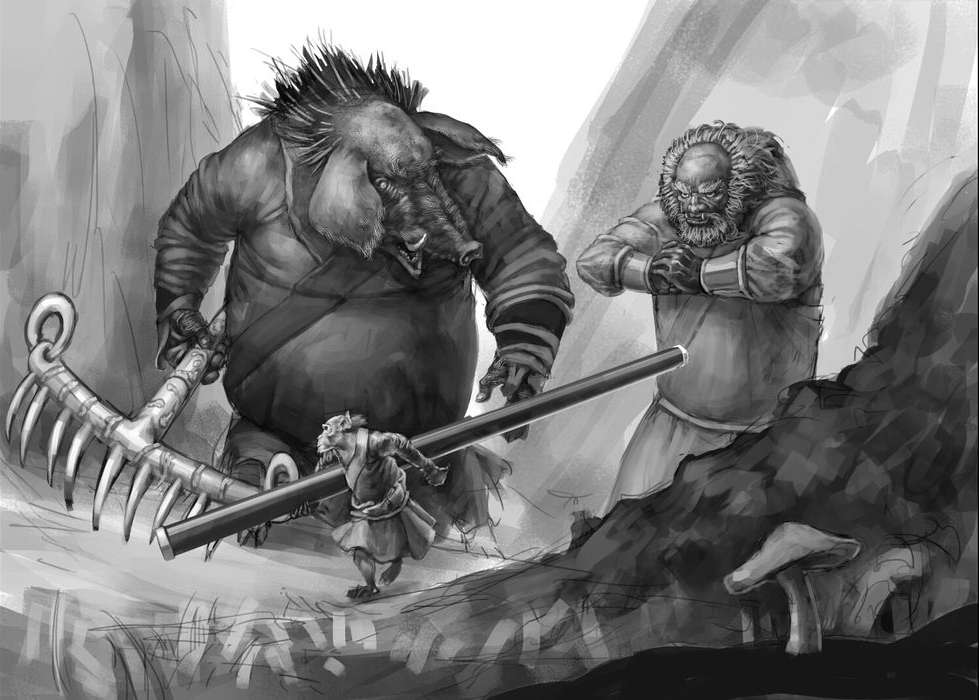
A twitter user asked me in late 2024 where Zhu Bajie (豬八戒; fig. 1) learned his “36 transformations” (sanshiliu ban bianhua, 三十六般變化). I told them that chapters 19 and 85 of Journey to the West (Xiyouji西遊記; “JTTW” hereafter) contain biographical poems, one of which explains his internal alchemy (neidan, 内丹) training under an immortal and ascension to godhood. I suggested that his past human life learned the magic changes during this time, but after answering the question, it dawned on me that many people may not be aware of these verses. I have, therefore, decided to post and analyze said poems for the benefit of my readers.

This is the second of three articles where I will present info about the disciples’ lives prior to the main events of JTTW. My next article will follow with Sha Wujing‘s (沙悟净) poem. Click here to read the first post about the White Dragon Horse (Bai longma, 白龍馬). These are meant to compliment my previous essay about Sun Wukong (孫悟空).

(On a related note, see here for the oldest known depictions of Zhu Bajie. They come from 14th-century Korea!)

Fig. 1 – A novel accurate depiction of the Tang Monk’s disciples, including our hog hero (top left) (larger version). Artwork by @真·迪绝人 (see here and here).

1. The poems

The novel actually presents two contradictory verses on the origins of our beloved pig-monster. One (ch. 19) portrays him as a human-turned-immortal commander of heavenly forces, while the other (ch. 85) alludes to him being a powerful hog-spirit given celestial rank.

1.1. Chapter 19

This poem is chock-full of internal alchemical jargon, so I’m placing explanatory notes just below the blockquote to save readers from having to scroll to the very bottom of the article every time a new concept is mentioned.

My mind was dim since the time of youth;
Always I loved my indolence and sloth.
Neither nursing nature nor seeking the Real,
I passed my days deluded and confused.
I met a true immortal suddenly
Who sat and spoke to me of cold and heat. [A]
‘Repent,’ he said, ‘and cease your worldly way:
From taking life accrues a boundless curse.
One day when the Great Limit ends your lot,
For eight woes and three ways you’ll grieve too late!’ 
I listened and turned my will to mend my ways:
I heard, repented, and sought the wondrous rune.
By fate my teacher he became at once,
Pointing to the Heavenly and Earthly Passes. [B]
Taught to forge the Great Pill Nine Times Reversed, [C]
I worked without pause through day and night
To reach Mud-Pill Palace topping my skull [D]
And Jetting-Spring Points on soles of my feet. [E]
With kidney brine flooding the Floral Pool, [F]
My Cinnabar Field was thus warmly nursed. [G]
Baby and Fair Girl mated as yin and yang[H]
Lead and mercury mixed as sun and moon. [I]
In concord Li-dragon and Kan-tiger used, [J]
The spirit turtle sucked dry the gold crow’s blood. [K]
‘Three flowers joined on top,’ the root reclaimed [L];
‘Five breaths faced their source’ and all freely flowed. [M]
My merit done, I ascended on high,
Met by pairs of immortals from the sky.
Radiant pink clouds arose beneath my feet;
With light, sound frame I faced the Golden Arch.
The Jade Emperor gave a banquet for gods
Who sat in rows according to their ranks.
Made a marshal of the Celestial Stream,
I took command of both sailors and ships.
Because Queen Mother gave the Peaches Feast
When she met her guests at the Jasper Pool
My mind turned hazy for I got dead drunk,
A shameless rowdy reeling left and right.
Boldly I barged into Vast Cold Palace
Where the charming fairy received me in.
When I saw her face that would snare one’s soul,
My carnal itch of old could not be stopped!
Without regard for manners or for rank,
I grabbed Miss Chang’e asking her to bed.
For three or four times she rejected me:
Hiding east and west, she was sore annoyed.
My passion sky-high I roared like thunder,
Almost toppling the arch of Heaven’s gate.
Inspector General told the Emperor Jade;
I was destined that day to meet my fate.
The Vast Cold completely enclosed airtight
Left me no way to run or to escape.
Then I was caught by the various gods,
Undaunted still, for wine was in my heart.
Bound and taken to see the Emperor Jade,
By law I should have been condemned to death.
It was Venus the Gold Star, Mr. Li,
Who left the ranks and knelt to beg for me.
My punishment changed to two thousand blows,
My flesh was torn; my bones did almost crack.
Alive! I was banished from Heaven’s gate
To make my home beneath the Fuling Mount.
An errant womb’s my sinful destination: Stiff-Bristle Hog’s my worldly appellation!” (Wu & Yu, 2012, vol. 1, pp. 378-379).

自小生來心性拙,貪閑愛懶無休歇。
不曾養性與修真,混沌迷心熬日月。
忽然閑裡遇真仙,就把寒溫坐下說。
勸我回心莫墮凡,傷生造下無邊孽。
有朝大限命終時,八難三途悔不喋。
聽言意轉要修行,聞語心回求妙訣。
有緣立地拜為師,指示天關並地[關]
得傳九轉大還丹,工夫晝夜無時輟。
上至頂門泥丸宮,下至腳板湧泉穴。
周流腎水入華池,丹田補得溫溫熱。
嬰兒姹女配陰陽,鉛汞相投分日月。
離龍坎虎用調和,靈龜吸盡金烏血。
三花聚頂得歸根,五氣朝元通透徹。
功圓行滿卻飛昇,天仙對對來迎接。
朗然足下彩雲生,身輕體健朝金闕。
玉皇設宴會群仙,各分品級排班列。
敕封元帥管天河,總督水兵稱憲節。
只因王母會蟠桃,開宴瑤池邀眾客。
那時酒醉意昏沉,東倒西歪亂撒潑。
逞雄撞入廣寒宮,風流仙子來相接。
見他容貌挾人魂,舊日凡心難得滅。
全無上下失尊卑,扯住嫦娥要陪歇。
再三再四不依從,東躲西藏心不悅。
色膽如天叫似雷,險些震倒天關闕。
糾察靈官奏玉皇,那日吾當命運拙。
廣寒圍困不通風,進退無門難得脫。
卻被諸神拿住我,酒在心頭還不怯。
押赴靈霄見玉皇,依律問成該處決。
多虧太白李金星,出班俯顖親言說。
改刑重責二千鎚,肉綻皮開骨將折。
放生遭貶出天關,福陵山下圖家業。
我因有罪錯投胎,俗名喚做豬剛鬣。(source)

Footnotes:

A) “[C]old and heat,” (riyue, 日月; lit: “sun and moon”) refers to respective yang and yin energies (Pregadio, 2025p; see also Wu & Yu, 2012, vol. 1, p. 527 n. 2).

B) The original Chinese, “天關並地” (tianguan bing dique, or “heavenly passes and earthly watchtowers(?)”), is a likely typo for “天關並地” (tianguan bing diguan, or “heavenly and earthly passes”). These respectively refer to the head and feet (Pregadio, 2025d, 2025s). I’ve therefore altered Yu’s (Wu & Yu, 2012) translation.

C) The “Great Pill [i.e. Elixir] Nine Times Reversed” (jiuzhuan da huandan, 九轉大還丹) was originally an external alchemical process where a concoction of toxic elements was purified over successive firings in a crucible to create a drug of immortality (see section 3.1. of this article). However, the term was coopted by later proponents of internal alchemy, who associated the ingestion and circulation of immortality-bestowing cosmic energies within pathways between bodily organs with a complex five phases-influenced numerology (Pregadio, 2025b, 2025n). Needham (1954, as cited in Wu & Yu, 2012) adds that it refers “to a chhi [qi, pneumatic vitality, breath] or substance generated by techniques purposefully within the human body which would bring about a reversion of the tissues from an ageing state to an infantile state” (vo. 1, p. 527 n. 4).

D) The “Mud-Pill Palace” (niwan gong, 泥丸宮) is a name for the upper cinnabar field in the head (Pregadio, 2025m; Wu & Yu, 2012, vol. 1, p. 528 n. 6).

E) The “Jetting-Spring Points” (yongquan xue, 湧泉穴) are pressure points on the bottom of the feet (Wu & Yu, 2012, vol. 1, p. 528 n. 7).

F) Yu (Wu & Yu, 2012) explains that spiritual energies contained in the kidneys (which are associated with the water element) can be directed to different parts of the practitioner’s body, including a spot under the tongue, the “Floral pool” (huachi, 華池) (vol. 1, p. 528 n. 8; see also Pregadio, 2025r). While this is no doubt the correct answer, it’s important to note that internal alchemy also uses the term Floral pool to refer to true yang energy inside yin (Pregadio, 2025h). The corresponding term is “spirit water” (shenshui, 神水), which denotes true yin energy inside yang—think of the white and black dots inside of the Taiji symbol (Pregadio, 2025h). Therefore, the poem’s original Chinese “腎水入華池” (shenshui ru huachi, or “kidney brine flooding the floral pool”) could also be a reference to the similarly-sounding phrase “神水入華池” (shenshui ru huachi, or “spirit water flooding the floral pool), or the mixture of yang and yin, respectively.

G) The “Cinnabar Field” (dantian, 丹田) is one of three spiritual centers in the body, which is located between 1.3 to 3.6 Chinese inches (cun, 寸; 1 = 1.25 in/3.18 cm) below (or behind) the belly button. The Cinnabar Field is believed to store cosmic/bodily energies, that when circulated and refined, produce an immortal alchemical embryo—i.e. a fledgling immortal spirit avatar (Pregadio, 2025c; see also Wu & Yu, 2012, vol. 1, p. 528 n. 9). And “warmly nursed” (bu de wenwen’re, 補得溫溫熱) may refer to “nourishing warmly” (wenyang, 溫養), or the process of “gestati[ng] the alchemical embryo” (Pregadio, 2025t).

H) The “Baby and Fair Girl” (ying’er chanu, 嬰兒姹女) are anthropomorphic personas of yang and yin energy, respectively (Pregadio, 2025a, 2025w; see also Wu & Yu, 2012, vol. 1, p. 528 n. 10).

I) The elemental and celestial imagery of “lead and mercury” (qian gong/hong, 鉛汞) and “sun and moon” (riyue, 日月) refer to yang and yin energies, respectively (Pregadio, 2025g, 2025o, 2025p).

J) The third eight trigram figure, Li (/☲), is associated with dragons (long, ), and both symbolize yang energy. The sixth figure, Kan (/☵), is associated with tigers (hu, ), and both symbolize yin energy (fig. 2) (Pregadio, 2025j, 2025k, 2025l; see also Wu & Yu, 2012, vol. 1, p. 529 n. 11).

K) Yu (Wu & Yu, 2012) suggests that “turtle” (gui, ) “may be another name for the dark liquid of the kidneys” (vol. 1, p. 529 n. 12). He continues, “[T]he gold crow indicates the sun or the heart. The line refers to the union of yin and yang through the absorption of yang energy by yin” (Wu & Yu, 2012, vol. 1, p. 529 n. 12). While I agree that this refers to the mixing of said energies, it’s important to note, however, that turtles are usually paired with “snakes” (she, 蛇), both being anthropomorphic symbols of jing-essence and qi-breath (精氣), respectively (Pregadio, 2025f). Additionally, the “gold crow” (jinwu, 金烏), an anthropomorphic symbol of true yin inside yang energy, is normally paired with the “jade rabbit” (yutu, 玉兔), an anthropomorphic symbol of true yang inside yin (Pregadio, 2025i, 2025y). Similarly, “blood” (xue, ) represents true yin inside of yang (Pregadio, 2025v).

L) The “Three flowers” (sanhua, 三花) is another name for jing-essence, qi-breath, and shen-spirit (精氣神), three important bio-spiritual substances/energies. These must be “joined on top” (juding, 聚頂), or concentrated in the head (the upper cinnabar field) during the internal alchemical process (Wu & Yu, 2012, vol. 1, p. 529 n. 13; see also Pregadio, 2025q). This leads to the “root [being] reclaimed” (guigen, 歸根), which refers to “[g]oing back to the root and returning to the mandate” (guigen fuming, 歸根復命), or achieving immortality (Pregadio, 2025e).

M) Yu (Wu & Yu, 2012) explains, “Five breaths … wuqi chaoyuan 五氣朝元, refers to the pneumatic vitality, qi, of the five viscera (heart, liver, spleen, lungs, and kidneys) in harmonious balance” (Wu & Yu, 2012, vol. 1, p. 529 n. 14). A related view is that said viscera are synced with bio-spiritual substances or mental concepts—ie. hun/liver, jing-essence/kidneys, spirit/heart, po/lungs, intention/spleen—when a practitioner has learned to quiet their senses and still their body (Pregadio, 2025u).

Fig. 2 – An internal alchemy diagram of a Daoist cultivator circulating yang and yin energies, which are respectively represented by the eight trigrams figures (Li, ) and (Kan, ) and the elements fire and water (larger version). Image found here. I believe it originally comes from the Anthology of Immortals of Complete Perfection (Quanzhen qunxian ji, 全真群仙集, 1483).

1.2. Explanation

Zhu was originally a lazy, aimless man, but he encountered a celestial who told him to mend his ways, or else he would be reborn in the lower three Buddhist realms of hell, hungry ghosts, or animals, making it impossible for him to hear the Buddha’s teachings (an example of the novel’s syncretic unity). Upon repenting, he studied under the immortal, learning the art of internal alchemy, which involved absorbing and circulating vital energies around his body. Once he had attained transcendence, he rose on clouds to be escorted by other celestials into the heavenly realm, where he was appointed marshal of the heavenly navy, which sailed the cosmic river of the Milky Way Galaxy.

But his great achievement was tainted when he got drunk at the Queen Mother’s peach banquet and, being aroused by Chang’e’s dazzling beauty (fig. 3), chased her to the moon palace. He propositioned the goddess for sex several times, but her refusals sent him into a powerful rage. The protector deity Wang Lingguan reported this to the Jade Emperor, who had the moon palace surrounded by heavenly soldiers. The Marshal was soon captured and sentenced to death, but the planet Venus asked for lenience, leading to Zhu’s past life being beaten 2,000 times and banished from the heavenly realm. His divine spirit sought reincarnation in the mortal realm below, but an accident of fate led to his rebirth as a pig-spirit. He later took the name “Stiff-Bristles Hog” (Zhu Ganglie, 豬剛鬣) based on his porcine appearance.

Zhu Bajie-Chang'e stamp

Fig. 3 – A Taiwanese stamp reading, “Drunkenly playing Chang’e” (Zuixi Change, 醉戲嫦娥) (larger version). It’s likely meant to serve as a visual reminder of Zhu’s early story arc involving the events leading to his banishment from heaven and rebirth as a hog-spirit.

1.3. Chapter 85

With huge mouth and fangs I’ve great magic might.
Emperor Jade made me Marshal Heavenly Reeds.
The boss of Heaven’s eighty-thousand marines,
Comforts and joys I had in the halls of light.
Because I mocked a palace maiden when I was drunk
And flaunted my strength at a wrongful hour
One shove of my snout toppled the DipperOx Palace;
Queen Mother’s divine herbs I then devoured
Emperor Jade pounded me two thousand times
And banished me from the Three Heavens realm.
Though told to nourish my primal spirit,
I became again a monster down below.
About to marry at the Village Gao, I met Brother Sun—’twas my wretched fate!
Quite defeated by his golden-hooped rod,
I had to bow and take the Buddhist vow:
A coolie who bears luggage and leads the horse,
Who owes, in former life, the Tang Monk a debt!
This iron-legged Heavenly Reed‘s name is Zhu;
And my religious name is Zhu Eight Rules(based on Wu & Yu, 2012, vol. 4, pp. 149-150).

巨口獠牙神力大,玉皇陞我天蓬帥。
掌管天河八萬兵,天宮快樂多自在。
只因酒醉戲宮娥,那時就把英雄賣。
一嘴拱倒斗牛宮,吃了王母靈芝菜。
玉皇親打二千鎚,把吾貶下三天界。
教吾立志養元神,下方卻又為妖怪。
正在高莊喜結親,命低撞著孫兄在。
金箍棒下受他降,低頭才把沙門拜。
背馬挑包做夯工,前生少了唐僧債。
鐵腳天蓬本姓豬,法名喚作豬八戒。(source)

1.4. Explanation

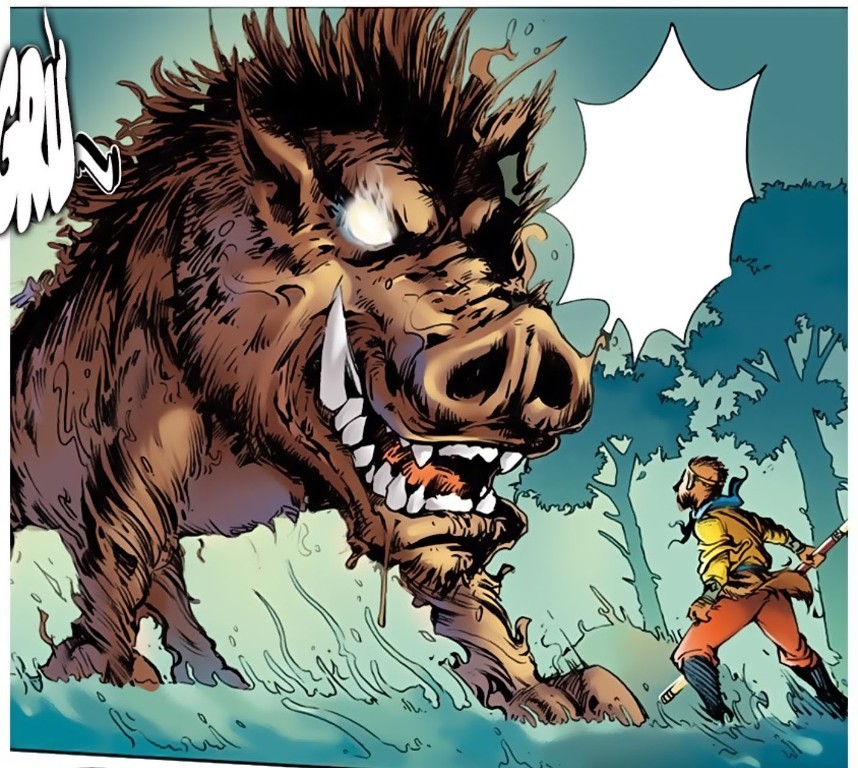
He was originally a pig-spirit with sharp tusks and powerful magic (fig. 4) who was appointed Marshal Tianpeng, commander of the 80,000-strong celestial navy. He enjoyed his new life among the godly ranks but later got drunk (at the Queen Mother’s banquet) and performed a number of forbidden deeds: mistreating a moon goddess, knocking over the Dipper-Ox Palace, and eating the Queen mother’s magic mushrooms. This resulted in a punishment of 2,000 strokes and banishment from heaven, with the added instruction to cultivate his spirit while on earth. But he once again became a monster, and at some point,  he took a wife in Gao Village. He was subsequently defeated by Monkey and forced to take the Buddhist vows, serving as Tripitaka’s disciple and luggage handler. His discipleship may have been the karmic result of a good deed that his master performed for him in a past life.

Fig. 4 – Zhu’s giant boar form from the manhua Journey to the West (Xiyouji, 西遊記) (larger version).

2. Which is true?

Both poems provide certain information that is consistent with internal narrative details, such as:

  • Zhu originally serving as Marshal Heavenly Reed (Tianpeng yuanshuai, 天蓬元帥; lit: “Marshal of Heavenly Mugwort“), commander of the 80,000 soldiers of the celestial navy (and a historical deity) (fig. 5)
  • Getting drunk at the peach festival and harassing a moon goddess
  • Being beaten 2,000 times as punishment and exiled to the mortal world
  • Mistakenly being reborn as Stiff-Bristles Hog, a bloodthirsty pig-monster in Fuling Mountain (Fuling shan, 福陵山)
  • Eventually taking a wife in Gao Village (Gao zhuang, 高莊)
  • Being defeated by Sun Wukong
  • Becoming Zhu Bajie, a Buddhist disciple of Tripitaka
  • Acting as a coolie carrying the luggage

But the real question is: was Zhu originally human or a pig-spirit? I think the first poem is likely true (within the narrative) given the amount of detail that he provides about the alchemical processes that eventually led to his immortality and ascension to godhood. The second poem is cursory in comparison and seems like something that was made up on the spot to embellish his might—perhaps influenced by stories of Sun Wukong’s past havoc in heaven—or monstrous pedigree in the face of a demonic opponent (refer to the events in chapter 85). One detail pointing to this is his claim of knocking over the “Dipper-Ox Palace” (Douniu gong, 斗牛宮), which references the stars of the Southern Dipper and Ox mansions (Stephenson, 2008, p. 517). He’s therefore asserting that he can collapse entire constellations. That’s definitely nonsense as Zhu is often overpowered and defeated in battle, even by groups of little fiends (Wu & Yu, 2012, vol. 2, pp. 102-103, for example).

Fig. 5 – A historical painting of “Great Marshal Tianpeng” (Tianpeng da yuanshui, 天蓬大元帥) from the Ink Treasures of Wu Daozi (Daozi mobao, 道子墨寶, 13th-century), (larger version). Image altered for clarity.

3. Additional info

The poems actually leave out several details about Zhu’s past and current lives.

  1. The Chang’e (嫦娥) mentioned above is not the singular goddess but one of many such named divine maidens in the entourage of the “Star Lord of Supreme Yin” (Taiyin xingjun, 太陰星君), the aged devi of the moon. [1]
  2. He mauled his sow mother and piglet siblings to death sometime after his mistaken rebirth in Fuling Mountain (Wu & Yu, 2012, vol. 1, p. 212).
  3. His first wife, “Second Elder Sister Mao” (Mao erjie, 夘二姐), [2] a likely rabbit spirit, [3] was the original owner of his Cloudy Paths Cave (Yunzhan dong, 雲棧洞) (Wu & Yu, 2012, vol. 1, p. 212). But sadly, she died less than a year after their marriage (Wu & Yu, 2012, vol. 1, p. 212). Their tragic love story would be good fodder for fanfiction.
  4. He was invited by the Crow’s Nest Chan Master (Wuchao chanshi烏巢禪師), a Buddhist sage, to practice austerities, but he passed on the opportunity.
  5. Years prior to being called Zhu Bajie, he submitted to Buddhism at the behest of the bodhisattva Guanyin and was given the religious name “Zhu Wuneng” (豬悟能, “Pig Who Awakens to Power”) (Wu & Yu, 2012, vol. 1, p. 213).
  6. Sometime after adopting a vegetarian diet, [4] he magically transformed into a “stout, swarthy [human] fellow” (hei pang han, 黑胖漢) in order to fraudulently arrange a marriage with his second wife, “Green Orchid” (Cui’lan, 翠蘭), a maiden from Gao Village in Tibet (Wusizang, 烏斯藏) (Wu & Yu, 2012, vol. 1, p. 372). [5]
  7. The Gao family grew rich from his supernatural labors in the field (Wu & Yu, 2012, vol. 1, pp. 375 and 381).
  8. But he was abusive to his wife, locking her inside a back building and not allowing her to see her family for half a year (Wu & Yu, 2012, vol. 1, p. 372).
  9. Monkey tricked Zhu by magically taking his wife’s form and hiding in a dark room (fig. 6), [6] but he later overpowered the hog-spirit in combat (Wu & Yu, 2012, vol. 1, p. 380). Zhu eventually submitted when he learned Sun was escorting the scripture pilgrim to India (Wu & Yu, 2012, vol. 1, p. 384).

Lastly, I would like to suggest that the immortal teacher of Zhu’s past life also taught him divine military arts—like Master Ghost Valley taught Sun Bin in vernacular fiction—because why else would a random person be given command of the entire heavenly navy? I headcanon that he was once a brilliant military strategist and commander, but his mistaken reincarnation as a hog made him very dim and lazy.

Fig. 6 – A woodblock print from the original 1592 edition of JTTW reading, “The fake Green Orchid outsmarts Stiff-Bristles Hog” (Jia Cui’lan zhinong Zhu Ganglie, 假翠蘭智㺯(弄)豬剛鬣) (larger version). See page 228 of the linked PDF. I’m intrigued by the pig-spirit’s failed human transformation.


Update: 03-04-25

Friend of the blog NingadudeXx has drawn a picture of Zhu Bajie as his past life, Marshal Tianpeng (fig. 7), based on the god’s historical iconography (refer back to fig. 5).

Fig. 7 – Zhu Bajie as Marshal Tianpeng (larger version).


Update: 04-09-25

I forgot to mention that Zhu has some medical knowledge. In chapter 41, for example, he performs life-saving massage to resuscitate a dead Sun Wukong:

With a chuckle, Eight Rules [Zhu Bajie] said, “Brother, stop crying. This ape is pretending to be dead, just to scare us. Feel him a little and see if there’s any warmth left in his breast.” “The whole body has turned cold,” said Sha Monk [Sha Wujing]. “Even if there were a little warmth left, how could you revive him?” Eight Rules said, “If he is capable of seventy-two transformations, he has seventy-two lives. Listen, you stretch out his legs while I take care of him.” Sha Monk indeed straightened Pilgrim’s legs while Eight Rules lifted his head and straightened his upper torso. They then pushed his legs up and folded them around the knees before raising him into a sitting position. Rubbing his hands together until they were warm, Eight Rules covered Pilgrim’s seven apertures and began to apply a Chan method [anmo chanfa, 按摩禪法] of massage on him (emphasis added). The cold water, you see, had had such a traumatic effect on Pilgrim that his breath was caught in his cinnabar field and he could not utter a sound. He was lucky, therefore, to have all that rubbing, squeezing, and kneading by Eight Rules, for in a moment his breath went through the three passes, invaded the bright hall, and burst through his apertures. and burst through his apertures. “O Master,” he [Monkey] began to say (Wu & Yu, 2012, vol. 2, p. 232).

八戒笑道:「兄弟莫哭。這猴子佯推死,嚇我們哩。你摸他摸,胸前還有一點熱氣沒有?」沙僧道:「渾身都冷了,就有一點兒熱氣,怎的就得回生?」八戒道:「他有七十二般變化,就有七十二條性命。你扯著腳,等我擺佈他。」真個那沙僧扯著腳,八戒扶著頭,把他拽個直,推上腳來,盤膝坐定。八戒將兩手搓熱,仵住他的七竅,使一個按摩禪法。原來那行者被冷水逼了,氣阻丹田,不能出聲。卻幸得八戒按摸揉擦,須臾間,氣透三關,轉明堂,沖開孔竅,叫了一聲:「師父啊!」

Also, in chapter 69, he argues with Wukong about the attributes and usages of a medicinal ingredient:

“The flavour of badou [巴豆],” said Eight Rules, “is slightly acrid; its nature is hot and poisonous. Able to pare down the hard and the accumulated, it will therefore sweep out the submerged chills of one’s internal cavities. Able to bore through clottings and impediments, it will therefore facilitate the paths of water and grain. This is a warrior who can break down doors and passes, and it should be used lightly” (Wu & Yu, 2012, vol. 3, p. 274).

八戒道:「巴豆味辛,性熱有毒。削堅積,蕩肺腑之沉寒;通閉塞,利水穀之道路。乃斬關奪門之將,不可輕用。」

This might suggest that Bajie also learned these skills from his immortal master.

Endnotes:

1) Chapter 95 explains that the seemingly singular goddess Chang’e is actually a collective, and also that one of them was the maiden that Zhu’s former life had harassed in the past:

As they stared into the sky, they heard the Great Sage Sun crying out in a loud voice: “Your Majesty of India, please ask your queen and concubines to come out and look. Beneath this treasure canopy is the Star Lord of Supreme Yin of the Moon Palace, and the immortal sisters on both sides of her* are the Chang’e goddesses inside the moon (emphasis added). This little jade hare is the false princess of your household; she has now revealed her true form.”

The king hurriedly assembled the queen, his concubines, the palace maidens, and gaily-attired girls to bow to the sky and worship. He himself and the Tang Monk also expressed their thanks toward the sky by bowing low. All the households in the city also set up incense tables and kowtowed, chanting the name of Buddha.

As they looked up into the air, Zhu Eight Rules was moved to lust. Unable to contain himself, he leaped into the air and embraced a rainbow-skirted immortal, crying, “Sister, you and I are old acquaintances! Let’s go play!” (emphasis added) (based on Wu & Yu, 2012, vol. 4, p. 303).

眾擡頭看處,又聞得孫大聖厲聲高叫道:「天竺陛下,請出你那皇后、嬪妃看者:這寶幢下乃月宮太陰星君,兩邊的仙妹是月裡嫦娥。這個玉兔兒卻是你家的假公主,今現真相也。」那國王急召皇后、嬪妃與宮娥、綵女等眾朝天禮拜,他和唐僧及多官亦俱望空拜謝。滿城中各家各戶,也無一人不設香案,叩頭念佛。正此觀看處,豬八戒動了慾心,忍不住,跳在空中,把霓裳仙子抱住道:「姐姐,我與你是舊相識,我和你耍子兒去也。」

* Yu (Wu & Yu, 2012) calls the Star Lord of Supreme Yin “him” in his original translation (vol. 4, p. 303), but the deity has been portrayed as a woman for centuries. See, for instance, her depiction (2nd from the top left) in the Ink Treasures of Wu Daozi (Daozi mobao, 道子墨寶, 13th-century).

2) Yu (Wu & Yu, 2012) translates her name as “Second Elder Sister Egg” (Luan erjie, 卵二姐)” (vol. 1, p. 212). But this is based on a transcription error—i.e. 夘 (Maooriginal edition) vs 卵 (Luan; modern edition).

3) The relationship of Zhu and Second Elder Sister Mao references the synergy between the elemental and animal aspects of the 12 earthly branches—i.e. Mao (夘; yin wood/rabbit) and Hai (亥; yang wood/pig) complete each other.

4) His vegetarian diet is mentioned in chapters 18 and 19 (Wu & Yu, 2012, vol. 1, pp. 372, 384, and 386).

5) Yu (Wu & Yu, 2012) translates “烏斯藏” (Wusizang), the location of Gao village, as the “Kingdom of Qoco” (Wu & Yu, 2012, vol. 1, p. 369). However, this phrase actually refers to Dbus-gtsang, or Tibet (Zhang, 2023, pp. 32-33; Wilkinson, 2000, p. 728).

6) I’ve previously suggested that this episode was influenced by a scene from chapter five of the Water Margin (Shuihu zhuan, 水滸傳, c. 1400). Both feature:

  • Young, beautiful daughters in unwanted relationships (Green Orchid vs the unnamed maiden).
  • Elderly fathers worried for their child (Mr. Gao vs Mr. Liu).
  • Evil spirit-turned-inhumanly strong, hot-tempered, heavy metal staff-wielding martial monks who come to their aid (Sun Wukong vs Lu Zhishen).
  • The monk takes the place of the woman in a darkened room.
  • The villain is beaten (Zhu Bajie vs Zhou Tong) (Wu & Yu, 2012, vol. 1, pp. 374-377; Shi & Luo, 1993/2021, pp. 109-113).

Sources:

Pregadio, F. (2025a). cha nü 姹女 (chanü). In Dictionary of Taoist Internal Alchemy (pp. 19-20). Leiden: Brill.

Pregadio, F. (2025b). da huan dan 大還丹 (da huandan). In Dictionary of Taoist Internal Alchemy (pp. 32-33). Leiden: Brill.

Pregadio, F. (2025c). dan tian 丹田 (dantian). In Dictionary of Taoist Internal Alchemy (pp. 38-39). Leiden: Brill.

Pregadio, F. (2025d). di guan 地關 (diguan). In Dictionary of Taoist Internal Alchemy (p. 45). Leiden: Brill.

Pregadio, F. (2025e). gui gen fu ming 歸根復命 (guigen fuming). In Dictionary of Taoist Internal Alchemy (p. 78). Leiden: Brill.

Pregadio, F. (2025f). gui she 龜蛇 (guishe). In Dictionary of Taoist Internal Alchemy (p. 78). Leiden: Brill.

Pregadio, F. (2025g). hong 汞. In Dictionary of Taoist Internal Alchemy (p. 86). Leiden: Brill.

Pregadio, F. (2025h). hua chi shen shui 華池神水 (huachi shenshui). In Dictionary of Taoist Internal Alchemy (p. 90). Leiden: Brill.

Pregadio, F. (2025i). jin wu 金烏 (jinwu). In Dictionary of Taoist Internal Alchemy (pp. 124-125). Leiden: Brill.

Pregadio, F. (2025j). kan 坎. In Dictionary of Taoist Internal Alchemy (p. 134). Leiden: Brill.

Pregadio, F. (2025k). li 離. In Dictionary of Taoist Internal Alchemy (pp. 142-143). Leiden: Brill.

Pregadio, F. (2025l). long hu 龍虎 (longhu). In Dictionary of Taoist Internal Alchemy (pp. 154-156). Leiden: Brill.

Pregadio, F. (2025m). ni wan gong 泥丸宮 (niwan gong). In Dictionary of Taoist Internal Alchemy (p. 174). Leiden: Brill.

Pregadio, F. (2025n). qi fan jiu huan 七返九還 (qifan jiuhuan). In Dictionary of Taoist Internal Alchemy (pp. 183-184). Leiden: Brill.

Pregadio, F. (2025o). qian 鉛. In Dictionary of Taoist Internal Alchemy (p. 188). Leiden: Brill.

Pregadio, F. (2025p). ri yue 日月 (riyue). In Dictionary of Taoist Internal Alchemy (pp. 202-203). Leiden: Brill.

Pregadio, F. (2025q). san hua ju ding 三花聚頂 (sanhua juding). In Dictionary of Taoist Internal Alchemy (p. 214). Leiden: Brill.

Pregadio, F. (2025r). shen 腎. In Dictionary of Taoist Internal Alchemy (pp. 230-231). Leiden: Brill.

Pregadio, F. (2025s). tian guan 天關 (tianguan). In Dictionary of Taoist Internal Alchemy (p. 262). Leiden: Brill.

Pregadio, F. (2025t). wen yang 溫養 (wenyang). In Dictionary of Taoist Internal Alchemy (p. 276). Leiden: Brill.

Pregadio, F. (2025u). wu qi chao yuan 五氣朝元 (wuqi chaoyuan). In Dictionary of Taoist Internal Alchemy (pp. 282-283). Leiden: Brill.

Pregadio, F. (2025v). xue 血. In Dictionary of Taoist Internal Alchemy (pp. 321-322). Leiden: Brill.

Pregadio, F. (2025w). ying er 嬰兒 (ying’er) (1). In Dictionary of Taoist Internal Alchemy (pp. 341-342). Leiden: Brill.

Pregadio, F. (2025x). ying er 嬰兒 (ying’er) (2). In Dictionary of Taoist Internal Alchemy (p. 342). Leiden: Brill.

Pregadio, F. (2025y). yu tu 玉兔 (yutu). In Dictionary of Taoist Internal Alchemy (p. 346). Leiden: Brill.

Shi, N., & Luo, G. (2021). Outlaws of the Marsh (Vols. 1-4) (S. Shapiro, Trans.). Beijing: Foreign Languages Press. (Original work published 1993)

Stephenson, F. R. (2008). Lunar Mansions in Chinese Astronomy. In H. Selin (Ed.), Encyclopaedia of the History of Science, Technology, and Medicine in Non-Western Cultures (pp. 516-518) (2nd ed.). Netherlands: Kluwer Academic Publishers.

Wilkinson, E. P. (2000). Chinese History: A Manual. United Kingdom: Harvard University Asia Center.

Wu, C., & Yu, A. C. (2012). The Journey to the West (Vols. 1-4) (Rev. ed.). Chicago, Illinois: University of Chicago Press.

Zhang, F. (2023). The Eastern Land and the Western Heaven: Qing Cosmopolitanism and Its Translation in Tibet in the Eighteenth Century. United Kingdom: Taylor & Francis.

How to Kill Sun Wukong

Last updated: 01-07-2024

The Monkey King is famed for his multiple categories of immortality in Journey to the West (Xiyouji西遊記, 1592; “JTTW” hereafter). These are acquired through spiritual cultivation, redacting heavenly paperwork, partaking in celestial foodstuffs, and (at the journey’s end) attaining Buddhahood. But “immortality” in Chinese vernacular literature doesn’t mean “invulnerable to harm.” Despite his great durability, during the journey, Wukong is a “bogus immortal” (yaoxian妖仙) who is still susceptible to injury and death because he hasn’t yet achieved Buddha-nature and broken free of the wheel of rebirth. [1] For instance, he briefly dies from thermal shock after being overwhelmed by Red Boy‘s (Honghai’er, 紅孩兒) true samadhi fire (sanmei zhenhuo三昧真火) in chapter 41:

His whole body covered by flame and smoke, the Great Sage found the intense heat unbearable and he dove straight into the mountain stream to try to put out the fire. Little did he anticipate that the shock of the cold water was so great that the heat caused by the fire was forced inward into his body and his three hun spirits left his vessel. Alas!

His breath caught in his chest, his tongue and throat grew cold;
His hun spirits fled, his po souls left, and his life was gone! (based on Wu & Yu, 2012, vol. 2, p. 231)

這大聖一身煙火,炮燥難禁,徑投於澗水內救火。怎知被冷水一逼,弄得火氣攻心,三魂出舍。可憐氣塞胸堂喉舌冷,魂飛魄散喪殘生。

Luckily, Zhu Bajie resuscitates him by performing a life-saving massage that forces qi from his cinnabar field and circulates it throughout his body (Wu & Yu, 2012, vol. 2, p. 232). [2]

This episode was an accident. But what if someone wanted to kill Monkey for good? How would they do it? Killing him in a one-on-one match would be nearly impossible, for few characters surpass Wukong in strength or fighting ability. I think it’s best that we draw on methods from another famous god and demon novel, Investiture of the Gods (Fengshen yanyi封神演義, c. 1620; “Investiture” hereafter), a sort of prequel to JTTW. It centers on a great battle between the falling Shang (c. 1600-1046 BCE) and the rising Zhou (c. 1046–256 BCE) dynasties, both of which are aided by factions of powerful immortals. The story is famous for a number of weapons, traps, and rituals designed to kill divine cultivators.

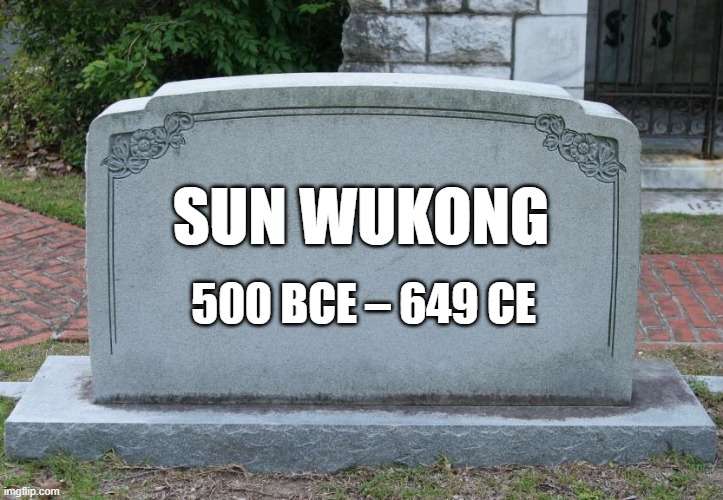
In this article, I would like to describe ten magical array traps (zhen, 陣) and one magic ritual that could possibly kill the Monkey King. The latter is, in my opinion, the best option for ending his life (fig. 1). And the best part is that it can be done from a distance! That way a villain doesn’t have to worry about getting smashed into hamburger or ripped to shreds by an angry monkey immortal. In addition, I will detail this method’s potential for great fanfiction.

Before continuing, I must point out that none of the information from Investiture can be considered JTTW canon. While it contains a host of similar characters (Laozi, Buddha, Nezha, Muzha, Li Jing, Ao Guang, Erlang and his hound, etc.), the novel is a separate work that was published nearly 30 years after JTTW. Look at this piece as a fun “What if?”

Fig. 1 – Monkey’s headstone (larger version).

I. Possible Ways

Ch. 44 of Investiture mentions ten magical array traps that rely on primordial energies, destructive elements like wind, thunder, fire, sand, ice, and water, and spiritual attacks to terminate immortals:

  1. Heavenly Destruction (Tianjue zhen, 天絕陣) – This trap contains primordial energies (xiantian zhi qi, 先天之氣) and the opportunity for chaos (hundun zhi ji, 混沌之機). It uses three magic pennants (fan, 旛), representing the respective energies of Heaven, Earth, and Man, to turn humans into dust and shatter the limbs of immortals with rolls of thunder.
  2. Earthly Fury (Dilie zhen, 地烈陣) – This trap uses a magic red pennant that kills intruders with rolls of thunder from above and fire below. It is also said to cut them off from reincarnation.
  3. Roaring Typhoon (Fenghou zhen, 風吼陣) – This trap uses wind, true samadhi fire, and countless swirling blades formed from primordial energies to kill intruders and render their bodies into a fragrant powder (jifen, 虀粉).
  4. Frigid Ice (Hanbing zhen, 寒冰陣) – This trap uses jagged, wolf fang-like ice mountains above, sword-like ice blocks below, and wind and thunder in the middle to grind intruders into a fragrant powder.
  5. Golden Light (Jinguang zhen, 金光陣) – This trap contains the essences of the sun and moon (riyue zhi jing, 日月之精) and the energies of heaven and earth (tiandi zhi qi, 天地之氣). It uses 21 treasure mirrors (baojing, 寶鏡) affixed to wooden polls to kill intruders with golden light that renders (melts?) their bodies into pus and blood.
  6. Bleeding Blood (Huaxue zhen, 化血陣) – This trap uses thunder and wind powered by primordial energies to blast black sand that kills intruders by rendering their bodies into a bloody mess.
  7. Vehement Flame (Lieyan zhen, 烈焰陣) – This trap uses true samadhi fire, fire from the sky (meteorites?), and fire from stone (lava?) to kill intruders by turning them into ash.
  8. Soul-Snatching (Luohun zhen, 落魂陣) – This trap contains the fierce energies of heaven and earth (tiandi liqi, 天地厲氣). It uses a white paper pennant stamped with a talisman seal (fuyin, 符印) to kill intruders by dispersing and eliminating their po and hun spirits.
  9. Red Water (Hongshui zhen, 紅水陣) – This trap controls the essences of the ninth and tenth heavenly stems (rengui zhi jing, 壬癸之精) (representing water), as well as contains the wonder of the Grand Monad (Tianyi zhi miao, 天乙之妙). It uses three bottle gourds resting on an eight trigrams platform (bagua tai, 八卦臺) to kill intruders by gushing forth an ocean of dangerous, red water, a single drop of which can render their bodies into a bloody mess.
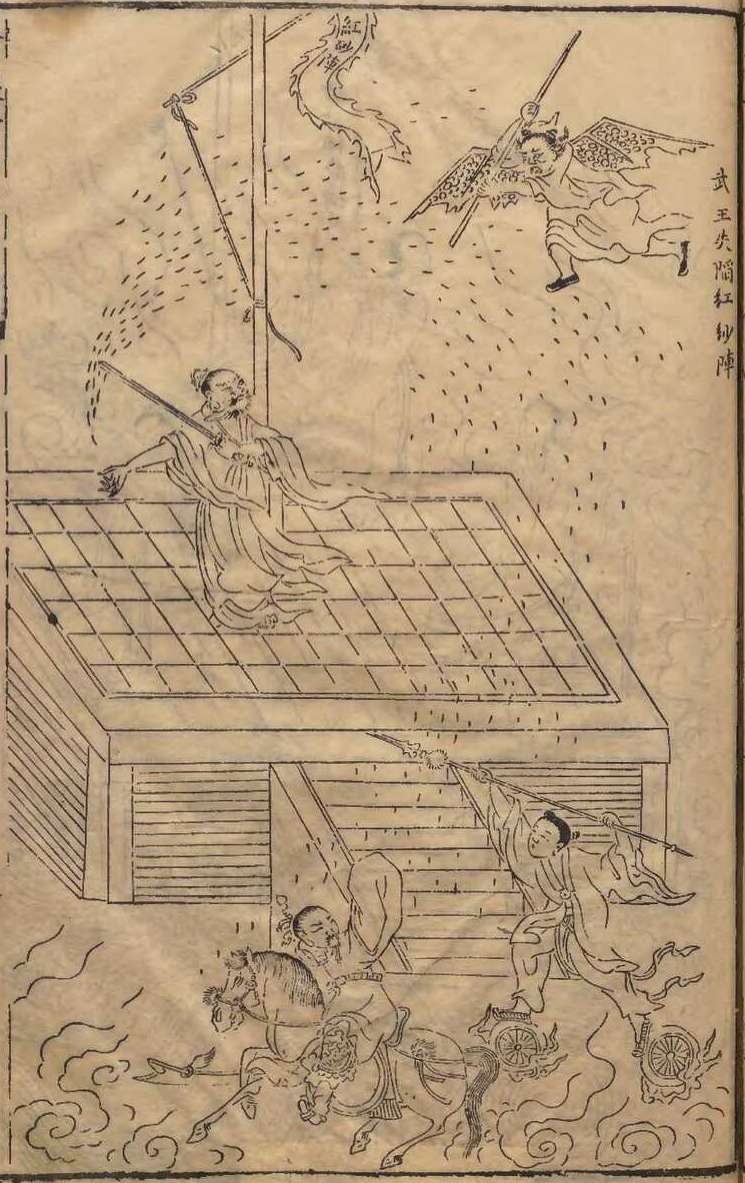
  10. Red Sand (Hongsha zhen, 紅砂陣/紅沙陣) – This trap controls the energies of Heaven, Earth, and Man. It uses thunder and wind to blast three buckets of red, sword-like sand to kill intruders by rendering their bones into a fragrant powder (fig. 2) (cf. Gu, 2000, vol. 2, pp. 869-873).

I think that Sun Wukong would easily survive many of these traps due to the adamantine nature of his body. [3] But numbers three, seven, and eight might give him some problems. As mentioned in the introduction, his encounter with Red Boy in chapter 41 shows that he is weak against true samadhi fire (Wu & Yu, 2012, vol. 2, p. 231). And of course, having his souls scattered and destroyed would certainly finish him off. Remember that Monkey’s spirit (魂靈兒) is easily reaped by two underworld officers in his slumber in chapter three (Wu & Yu, 2012, vol. 1, p. 139). This might point to a weakness against spiritual attacks (see below).

However, I think it would be hard to trick Wukong into going inside of these array traps. His “fiery eyes and gold Irises” (huoyan jinjing, 火眼金睛) would certainly notice the dark auras hovering above each one (Gu, 2000, vol. 2, p. 925 and 989, for example).

No, there’s only one sure fire way to kill our hero.

Fig. 2 – A Shang camp immortal working the Red Sand array trap (larger version). The woodblock print omits the three buckets. Image from The Newly Printed, Zhong Bojing Annotated, Investiture of the Gods (Xinke Zhong Bojing xiansheng piping Fengshen yanyi, 新刻鍾伯敬先生批評封神演義, c. 1620). See page 42 of this PDF.

II. The Best Way

Overcoming Monkey’s great power, durability, and speed would require an indirect approach, something that he wouldn’t even be aware of. A secret, spiritual assault from afar is, therefore, the only method that would work, in my opinion. Something like this is described in chapters 48 and 49 of Investiture. But I first need to give some background information as to why the rite is used in the first place.

Grand Preceptor Wen (Wen Taishi, 聞太師) recruits his old friend, the ancient immortal Zhao Gongming (趙公明), in chapter 46 after many of their divine comrades die in battle against Zhou allies (Gu, 2000, vol. 2, p. 935). Zhao is powerful in his own right, claiming to be able to flip Mount Sumeru (Xumi, 須彌) and reverse the course of the sun and moon (cf. Gu, 2000, vol. 2, pp. 945-947). But it’s his command of three holy treasures, namely the “Dragon-Binding Rope” (Fulong suo縛龍索), the “Sea-Fixing Mala Beads” (Dinghai zhu定海珠), and the “Golden Scaled Dragon Scissors” (Jinjiao jian金蛟剪), [4] that make him a supremely dangerous opponent. The latter two treasures prove in chapter 47 to be especially difficult weapons for Zhou allies to counter.

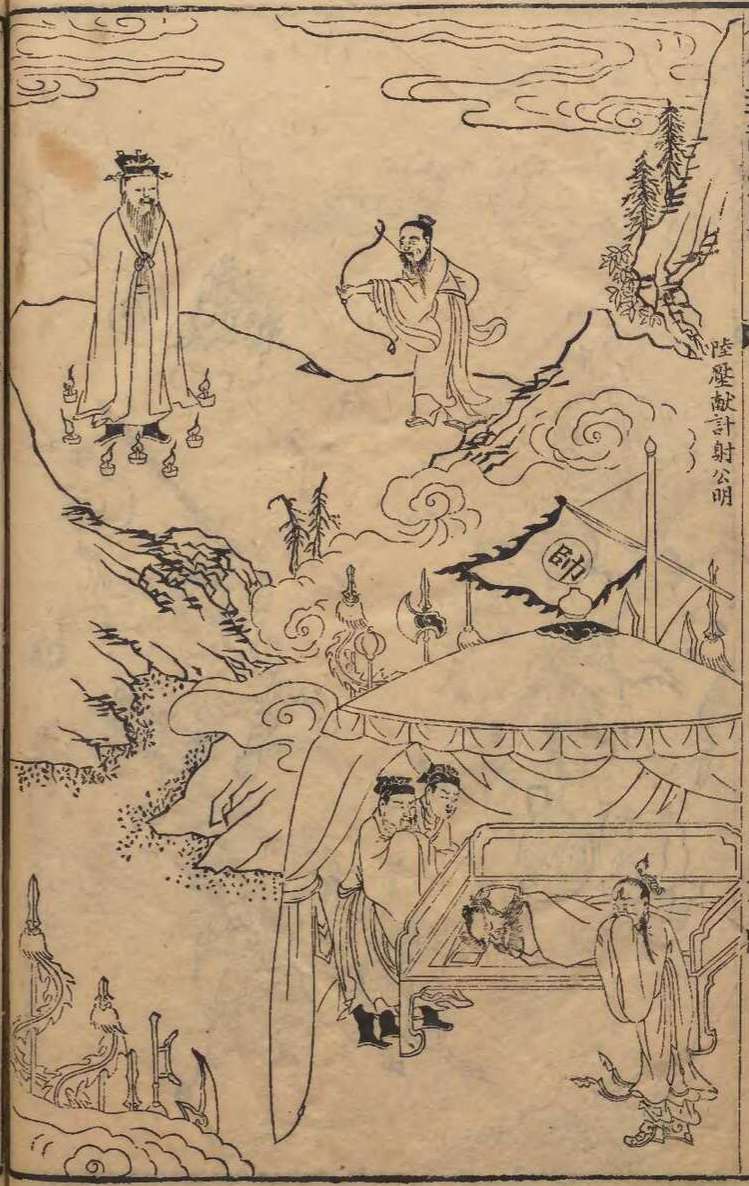
Therefore, in chapter 48, the immortal Lu Ya (陸壓) devises a plan to secretly attack Zhao’s spirit from a distance. He enlists the help of Jiang Ziya (姜子牙), a Taoist disciple and commander of the Zhou forces, and instructs him how to perform a sympathetic magic ritual from the Book of Fixing the Seventh Posthumous Day Arrow (Ding touqi jianshu, 釘頭七箭書):

Lu Ya opened his flower basket and took out a book stamped with talisman seals and oral formulas. “Using these, you can set up camp and erect a platform on Mount Qi. Make a straw effigy and post a document with the three characters “Zhao Gongming” on its body. Place one lamp above its head and another beneath its feet. Then pray to it three times a day, burning the talismans and pacing the dipper. At noon on the twenty-first day, this poor Taoist (Lu Ya) will come and help you cut his life short.”

Before going to Mount Qi, Ziya secretly sent 3,000 troops, along with Nangong Kuo [南宮适] and Wu Ji [武吉] to find a suitable place to set up camp. After Ziya arrived at camp, Nangong built a platform, arranging it properly and made a straw effigy. He did everything strictly as instructed. Finally Ziya loosened his hair, took a sword, and paced the dipper, reciting charms, burning spells, and praying over and over again before the straw effigy (based on Gu, 2000, vol. 2, p. 967).

陸壓揭開花籃,取出一幅書,書寫明白,上有符印口訣,「……依此而用,可往岐山立一營;營內築一臺。紮一草人;人身上書『趙公明』三字,頭上一盞燈,足下一盞燈。自步罡斗,書符結印焚化,一日三次拜禮,至二十一日之時,貧道自來午時助你,公明自然絕也。」

子牙領命,前往岐山,暗出三千人馬,又令南宮适、武吉前去安置。子牙後隨軍至岐山,南宮适築起將臺,安排停當,紮一草人,依方製度。子牙披髮仗劍,腳步罡斗,書符結印

[Three to five days later, Zhao Gongming feels frantic, with a strange burning in his heart.]

[…]

Now let’s speak of Ziya, who prayed until he had expelled the primal spirit [yuanshen, 元神] of Zhao Gongming. The primal spirit was of major importance to an immortal, enabling him to tour freely throughout the eight extremes (the universe). But now Zhao Gongming had lost his primal spirit and became drowsy, wanting to sleep all the time (based on Gu, 2000, p. 973).

且說子牙拜掉了趙公明元神散而不歸,──但神仙以元神為主,遊八極,任逍遙,今一旦被子牙拜去,不覺昏沉,只是要睡。

[Sleeping is said to be uncharacteristic of immortals. This alerts Zhao Gongming’s comrades that he is being spiritually assaulted. After divining the effigy’s location, Wen sends Shang allies to steal it. They are initially successful, but the straw man is eventually recaptured by Zhou forces.]

[…]

[Lu Ya finally arrives as promised to finish the ritual.]

With a smile, Lu Ya opened his flower basket and took out a small mulberry bow and three short peach arrows, which he handed to Ziya. “At noon today, you must shoot the effigy with these arrows,” Lu Ya said. Ziya replied: “Order received!” The two waited in a tent until the astrological official came to report: “Noon time has arrived!” Ziya cleaned his hands, picked up the bow, and then nocked the first arrow. “Shoot his left eye first,” instructed Lu Ya. Ziya did as ordered. As the first arrow hit the left eye of the effigy, Zhao Gongming, lying in the Shang camp, roared in agony and closed his left eye. Grand Preceptor Wen held him in his arms, sobbing as the tears poured down his cheeks. Back at Mount Qi, the second arrow hit the right eye of the effigy, and the third penetrated its heart [fig. 3]. Zhao Gongming died in the Shang camp (based on Gu, 2000, vol. 2, pp. 985-987). [5]

陸壓笑吟吟揭開花籃,取出小小一張桑枝弓,三隻桃枝箭,遞與子牙,「今日午時初刻,用此箭射之。」子牙曰:「領命。」二人在帳中等至午時,不覺陰陽官來報:「午時牌!」子牙淨手,拈弓,搭箭。陸壓曰:「先中左目。」子牙依命,先中左目。──這西岐山發箭射草人,成湯營裏趙公明大叫一聲,把左眼閉了。聞太師心如刀割,一把抱住公明,淚流滿面,哭聲甚慘。──子牙在岐山,二箭射右目,三箭劈心一箭,三箭射了草人。──公明死于成湯營裏。

Like Ziya, a bad guy could perform the same ritual to secretly steal Monkey’s primal spirit, tether it to a straw effigy marked “Sun Wukong” (孫悟空), and finally kill our hero with three well-placed peach arrows to the eyes and chest.

Fig. 3 – Jiang Ziya aiming the ritual bow at the straw effigy (larger version). Zhao Gongming can be seen sleeping in the Shang camp below. Woodblock print from The Newly Printed, Zhong Bojing Annotated, Investiture of the Gods (Xinke Zhong Bojing xiansheng piping Fengshen yanyi, 新刻鍾伯敬先生批評封神演義, c. 1620). See page 42 of this PDF.

III. Story Potential

If anyone decided to write their own fanfiction using the method described above, I could see this being a great opportunity for Zhu Bajie (豬八戒) and/or Sha Wujing (沙悟淨) to shine. He/they could be the one(s) searching the cosmos for answers, and upon learning of the rite, desperately racing to find the straw effigy before the ritual is complete. All of this would of course take place while Monkey is sleeping.

I can definitely see Zhu and/or Sha seeking the aid of Guanyin (觀音), who could easily break the ritual. I imagine she would reveal that, “The Great Sage is destined to experience this tribulation…” (or something like that), but she would surely provide them with the location in the end.

Reasons for the villain performing the ritual could include:

  • Eliminating Wukong so that they can more easily catch and eat the Tang Monk, thus gaining immortality.
  • Absorbing Monkey’s primal spirit in order to gain his immortality and skills.

The latter is my favorite, but the former would work better for the story since the whole point of the ritual is to kill the target. And besides, Monkey’s disembodied spirit is powerful enough to kill the psychopomps sent to reap his soul, as well as bully the judges and officers of hell (Wu & Yu, 2012, vol. 1, pp. 139-141). Now, imagine what it could do to some random demon king and/or cultivator who tried to absorb it!

IV. Conclusion

Sun Wukong is famed for his multiple categories of immortality, but he is still susceptible to death and the wheel of rebirth since, during the journey, he hasn’t yet achieved Buddha-nature. Killing him in one-on-one combat would be nearly impossible, though, given his great durability and power. However, using methods borrowed from Investiture of the Gods (c. 1620) might work. For instance, chapter 44 mentions ten magical array traps that rely on primordial energies, destructive elements like wind, thunder, fire, sand, ice, and water, and spiritual attacks to terminate immortals. Three of the traps, numbers three, seven, and eight, respectively use true samadhi fire or soul-scattering and destruction to kill divine cultivators. These might give Monkey problems as his soul is easily reaped in his sleep in JTTW chapter three, suggesting that it may be weak against spiritual attacks, and he is shown to be weak against Red Boy’s true samadhi fire in chapter 41. But I think it would be hard to trick him into entering the traps since his magic eyes would no doubt see the dark auras above them.

The best way to overcome his great power, durability, and speed requires an indirect approach, a secret, spiritual assault from afar. A ritual used in chapters 48 and 49 of Investiture does exactly that. In order to defeat the immortal Zhao Gongming and circumvent his powerful holy treasures, the immortal Lu Ya instructs Zhou army commander Jiang Ziya how to perform a rite from the Book of Fixing the Seventh Posthumous Day Arrow. This involves a bureaucratic ceremony (praying, talisman-burning, and dipper-walking) that slowly steals the immortal’s primal spirit over a 21 day period, tethers it to a straw effigy marked with Zhao’s name, and then kills him by shooting the icon with three peach arrows, two to the eyes and a third to the heart.

A villain wanting to kidnap and eat the Tang Monk for immortality could perform this ritual in order to get Monkey out of the way. This would make for a great story centered on Zhu Bajie and/or Sha Wujing. He/they could frantically search the universe for answers, before racing to find the straw effigy before the rite is complete.


Update: 12-28-23

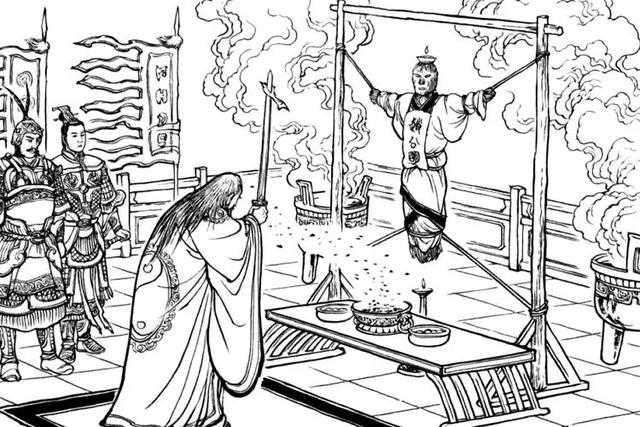
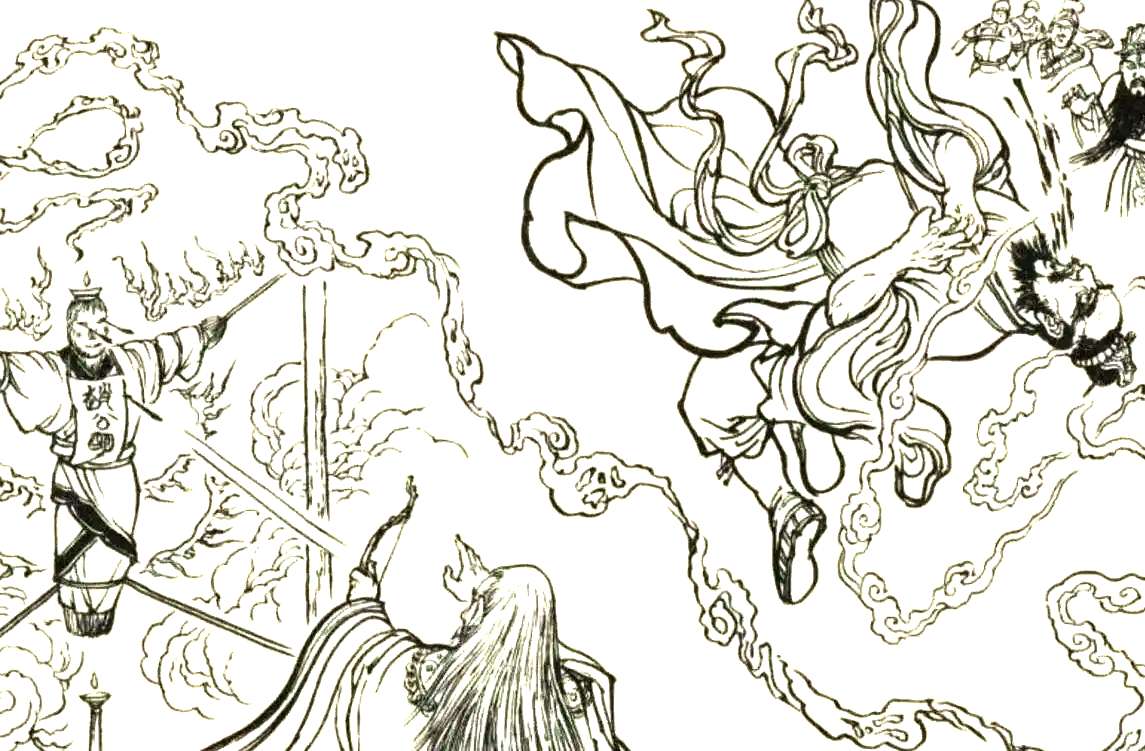
I found two neat drawings portraying Jiang Ziya performing the rite (fig. 4 & 5).

Fig. 4 (top) – Jiang Ziya performing the procedural side of the ritual (larger version). Image found here. Fig. 5 (bottom) – Ziya fires the last arrow, killing Zhao Gongming (larger version). Image found here. They appear to be from the same anonymous lianhuanhua comic book.


Update: 12-29-23

A reader’s comment (below) has prompted me to add more context. Zhao Gongming’s disembodied spirit is not destroyed by the ritual. It is pulled towards the “Terrace of Creation” (Fengshen tai, 封神臺), a magic receptacle of souls, to await his apotheosis at the end of the novel. He is enfeoffed as the “Golden Dragon, Wish-Fulfilling and Righteously Unifying, Dragon-Tiger Mysterious Altar Perfected Lord” (Jinlong ruyi zhengyi longhu xuantan zhenjun, 金龍如意正一龍虎玄壇真君), a god of wealth (cf. Gu, 2000, vol. 4, pp. 2119-2121).

This then raises the question, “What would happen to Wukong’s soul if the ritual was successful? After the death of his body, it would naturally report to the underworld for processing. Remember, Monkey has yet to attain Buddha-Nature, so he is still subject to the wheel of rebirth. I can see him causing trouble down there like he had done in the past, but perhaps Kṣitigarbha (Ch: Dizang, 地藏) would calm his rage and convince him that reincarnation is the right choice. This would lead to a new adventure.

Or, considering that the journey to India would still be underway, and Tripitaka is constantly in danger, heaven might rush to find a new body for Wukong’s spirit to inhabit. This actually happens to a minor character in chapters 11 and 12 of JTTW. The soul of an official’s wife is forced into the body of a recently dead princess to live out the remainder of her allotted lifespan (Wu & Yu, 2012, vol. 1, pp. 268-269).

Another reader suggested a second method from Investiture to kill Monkey (see the comment below):

The Immortal-slaying Flying Knife, also a treasure of Lu Ya’s, might be a good second-contender here. It’s a strange weapon with head and eyes and wings, stored inside a gourd: when released, its eyes shoot out white light that “nails down” an enemy’s true form, and, upon recitation of “Turn around please, precious” (请宝贝转身), will spin and instantly decapitate the target.

Sure, there is the matter of getting it out and saying the magical words before you were reduced to a meat patty, but if the target is already immobilized——like Yuan Hong, FSYY’s own staff-wielding ape with 72 transformations——the Immortal-Slaying Flying Knife will be that final nail in the coffin.

I’ll look into this more and update the page at a later date.


Update: 01-07-24

Lu Ya’s ritual reminds me of a two-step process used in Chinese Folk Religion to activate a religious statue (shenxiang, 神像). Part one is the “entering-spirit” (rushen, 入神) ceremony, which invites a deity’s essence inside. Lin (2020) explains:

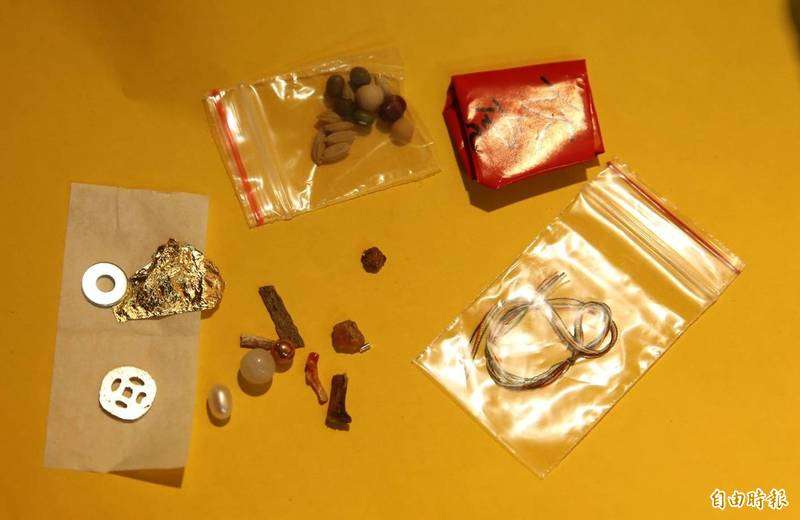
When the carving is complete, the carver chooses an auspicious day to hold the spirit-entering ritual. A cavity at the back of the image is carved out for this rite. The objects placed in this hole include incense ashes (xianghui) or talismans from the root temple, a live hornet, five precious materials (gold, silver, bronze, iron, and tin), five crops (rice, wheat, sesame, and different kinds of beans), and a bundle of five-color threads (red, yellow, blue, black, and white) [fig. 6 & 7] … The worshippers have to prepare fruit and flowers and burn incense to invite the deity to come.

When the auspicious moment arrives, the carver inserts the previously listed items into the cavity and plugs it with a piece of wood. The objects placed in the cavity are important clues regarding how people conceptualize deities. Local inhabitants explained to me that the ashes or talisman symbolizes the spirit of the deity, and the living hornet is to increase the deity’s power. Some people said the five forms of treasure represent the five organs of the deity, whereas others just said they are symbols of the deity’s grandeur. The five crops represent the harvest and the bunch of five-color threads is related to the five spirit-soldier camps (p. 38).

Lu Ya’s ritual essentially treats the straw effigy like an idol that will house a god’s essence. This might explain how the primal spirit of Zhao Gongming (and therefore Sun Wukong) is called to enter the icon.

Fig. 6 (top) – A collection of the talisman, grains, treasures, and colored-threads used in the entering-spirit ceremony (larger version). Fig. 7 (bottom) – A live wasp is retrieved to be added to the necessary ritual items (larger version). Images found here

Part two is the “eye-opening and dotting” (kaiguang dianyan, 開光點眼) ceremony, which brings the idol to life. Again, I refer to Lin (2020):

For this ceremony, the carver prepares flowers, fruit, a round mirror, a red brush pen, and a white cock. When the auspicious moment arrives, the mirror is taken outside where the light is sufficient to reflect it into the statue’s eyes. Next, the carver goes back to the altar and uses a knife to cut the cockscomb and smear the blood with the red brush pen. He then starts to chant and to dot the deity with the brush pen. There are many different kinds of chants … but their contents are not very different. The process of dotting usually begins at the center of the forehead and proceeds to the eyes, ears, nose, mouth, heart, navel, feet, toes, fingers, and back [fig. 8-10], as the following chant demonstrates:

First dot the sacred head, second dot the sacred hat,
Third dot the sacred body, then the true and righteous god will occupy the body.
Open the left eye to see heaven.
Open the right eye to see into the earth.
Open the left ear to listen to sounds from all directions.
Open the right ear to hear sounds from far away.
Open the divine nose, to smell fragrant scents.
Open the divine mouth, but not to eat house hold foods.
Open the left hand and the disciples will be prosperous year after year.
Open the right hand and the god will capture ghosts without being asked.
Open the sacred belly and great divine power will come forth.
Open the left foot to step upon the correct path.
Open the right foot to step into the divine carriage.
Open the back so that all people may be enlightened.

It can be inferred that in this ceremony, the carver at first draws the natural energy into the statue to enliven it. Then, he uses the blood of a white cock, symbolizing purity, to dot and connect the important parts of the body. This makes the statue like a living person with veins in which blood flows without obstruction (pp. 38-39).

Although Investiture doesn’t mention any of this, I think performing the eye-opening and dotting ceremony would be the final step in making the straw effigy a separate, living embodiment of the Monkey King. The ritual would open the eyes of Wukong’s spiritual double to the cosmos and fill his chest with divine energies in preparation for shooting said targets. This would explain why Zhao Gongming closes his eyes upon each arrow strike (refer back to section II).

Writers wanting to add a certain level of religious authenticity to the fictional Monkey King-killing ritual could have the villain place the talisman, grains, treasures, live wasp, and five colored-threads inside the straw effigy. And then he could chant while simultaneously reflecting sunlight on the face and dotting the eyes and body with a rooster blood-soaked brush. The only major difference between the fictional and religious ceremonies would be that the former’s first step, the entering-spirit ritual, lasts three weeks.

Fig. 8 (top L) – An entering-spirit and eye-opening and dotting kit commonly sold in Taiwan (larger version). Notice how the mirror is rectangular instead of circular. Image found here. Fig. 9 (top R) – A white temple rooster kept as a supply of pure blood (larger version). Don’t worry, nowadays they are only nicked on the comb with a knife. Image found here. Fig. 10 (bottom) – A ritual master uses a circular mirror to shine sunlight into an idol’s eyes while dotting the figure with a blood-soaked brush (larger version). Image found here.

Notes:

1) Monkey is called a “bogus immortal” by the Jade Emperor (ch. 4), the Buddha (ch. 7), and the Dragon King of the Eastern Sea in (ch. 14) (Wu & Yu, 2012, vol. 1, pp. 147-148, p. 193, and p. 318). This alludes to the fact that he is not yet a true transcendent.

The idea that Wukong is still susceptible to death is based on the Buddho-Taoist philosophy of Southern Quanzhen School Patriarch Zhang Boduan (張伯端, mid to late-980s-1082), which heavily influenced JTTW. Zhang believed that one had to attain both the Taoist elixir and Buddha-Nature in order to be truly immortal. Only then could one rise above death and the endless rounds of rebirth to live forever (Shao, 1997, pp. 80-84). This is why JTTW starts with Monkey achieving immortality in chapter two and ends with him attaining Buddhahood in chapter 100, thereby fulfilling Zhang’s two-step process to true transcendence.

Zhang’s philosophy is reflected in his Writings on Understanding Reality (Wuzhen pian, 悟真篇, 1075). One poem reads:

The elixir is the most precious treasure of the physical body; when cultivated to perfection, the transmutations are endless. One can go on to investigate the true source in the realm of essence, and ascertain the ineffable function of the birthless. Without awaiting another body in the next life, one attains the spiritual capacities of a Buddha in the present; after the Naga Girl achieved this, who since then has been able to follow in her footsteps? (Zhang, Liu, & Cleary, 1987, p. 1481; cf. Shao, 1997, p. 83)

丹是色身至寶,煉成變化無窮。更能性上究真宗,决了無生妙用。不待他身後世,見前獲佛神通。自從龍女著斯功,爾後誰能繼踵。

2) It’s interesting to note that Pigsy suggests that Wukong dying isn’t a problem because his 72 changes give him 72 lives (qishi’er tiao xingming, 七十二條性命) (Wu & Yu, 2012, vol. 2, p. 232).

3) For instance, heaven fails to execute Monkey in chapter seven because of his adamantine hide:

They then slashed him with a scimitar, hewed him with an ax, stabbed him with a spear, and hacked him with a sword, but they could not hurt his body in any way. Next, the Star Spirit of the South Pole ordered the various deities of the Fire Department to burn him with fire, but that, too, had little effect. The gods of the Thunder Department were then ordered to strike him with thunderbolts, but not a single one of his hairs was destroyed (Wu & Yu, 2012, vol. 1, p. 188).

刀砍斧剁,槍刺劍刳,莫想傷及其身。南斗星奮令火部眾神放火煨燒,亦不能燒著。又著雷部眾神以雷屑釘打,越發不能傷損一毫。

4) Apart from these treasures, Zhao Gongming fights with a hard whip (bian, 鞭), a sword-like metal club with stacked ridges and a pointed end. Gu (2000) incorrectly translates this as “staff” (vol. 2, p. 941).

5) Given the ritual’s association with the number seven (i.e. “Fixing the Seventh Posthumous Day Arrow”), and the fact that it takes 21 days to execute, it seems that one arrow is used for every week that the rite is performed. Remember that there are a total of three: two for the eyes and a third one for the heart.

6) These are the holes in the head: eyes, nose, ears, and mouth.

Sources:

Gu, Z. (2000). Creation of the Gods (Vols. 1-4). Beijing: New World Press.

Lin, W. (2020). Materializing Magic Power: Chinese Popular Religion in Villages and Cities. Netherlands: Brill.

Shao, P. (1997). Monkey and Chinese Scriptural Tradition: A Rereading of the Novel Xiyouji (UMI No. 9818173) [Doctoral dissertation, Washington University]. Available from ProQuest Dissertations and Theses database.

Wu, C., & Yu, A. C. (2012). The Journey to the West (Vols. 1-4) (Rev. ed.). Chicago, Illinois: University of Chicago Press.

Zhang, B., Liu, Y., & Cleary, T. (1987). Understanding Reality: A Taoist Alchemical Classic. Honululu Univ. of Hawaii Press.

The Alchemical Metaphor of Subodhi’s Mountain Home

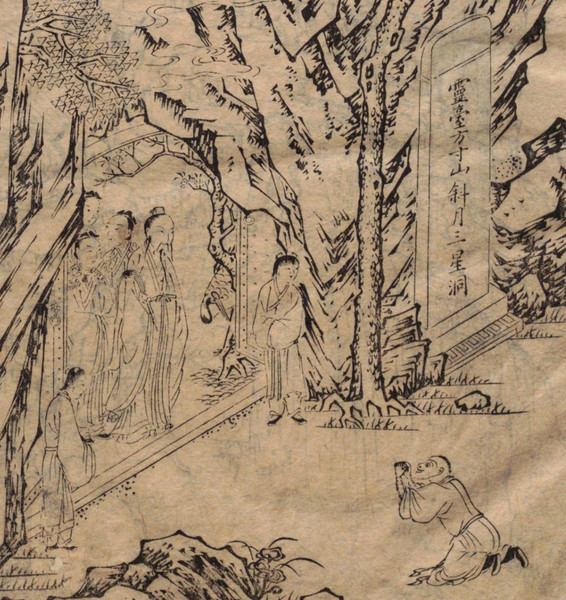
The Monkey King’s quest for immortality spans some ten years, taking him passed two cosmic continents and two great oceans. After sailing to a continent in the west, our hero is directed to the abode of the Sage Subodhi, a place often translated as “The Mountain of Mind and Heart / Cave of the Slanted Moon and Three Stars” (Lingtai fangcun shan, xieyue sanxing dong, 靈臺方寸山,斜月三星洞) (fig. 1) (Wu & Yu, 2012, p. 113, for example). This translation, however, glosses over deeper meanings associated with the original Chinese. The term lingtai (靈臺/台), literally “spirit platform/tower” or “numinous platform/tower”, was sometimes used in Daoist literature to refer to the “heart” or “mind” (xin, 心, “heart-mind” hereafter), the center of spiritual intellect. Going back centuries to the Zhuangzi (c. 3rd-century BCE), it was represented as something that had to be guarded against malevolent influences:

Utilize the bounty of things and let them nourish your body; withdraw into thoughtlessness and in this way give life to your mind; be reverent of what is within and extend this same reverence to others. If you do these things and yet are visited by ten thousand evils, then all are Heaven-sent and not the work of man. They should not be enough to destroy your composure; they must not be allowed to enter the Spirit Tower. The Spirit Tower has its guardian, but unless it understands who its guardian is, it cannot be guarded (Chuang & Watson, 1968, p. 194).

Subuti's cave, from Mr. Zhuo's literary criticism of Xiyouji - 2mall

Fig. 1 – Monkey kneeling before the entrance of Subodhi’s school asking to become a disciple (larger version). A detail from Mr. Li Zhuowu’s Literary Criticism of Journey to the West (late 16th-century).

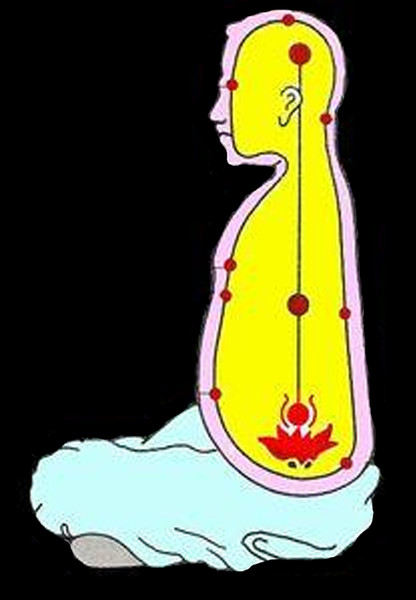
The term fangcun (方寸), literally “square inch”, was also used historically to refer to the heart-mind. [1] But it’s important to note that Daoist alchemical literature sometimes uses the term to refer to the lowest cinnabar or elixir field located approximately “two inches below the navel, three inches within, where the mind is focused” (Saso, 1995, p. 128). For instance, the Scripture of the Yellow Court (Huangting jing, 黃庭經, c. 4th-century), a treatise associated with the Highest Clarity tradition, recognizes three fields: brain (upper), heart (center), and belly (lower) (fig. 2), each one represented by a series of place names or an anthropomorphic persona (Saso, 1995, pp. 106-107). The scripture presents the lower field/square inch as the storehouse of vital spiritual energies, the synergy of which is thought to bolster the body and bring about immortality. A portion of the fifth stanza reads: “Inside the square inch, carefully cover and store qi. / Shen spirit and jing intuition returned there, though old, are made new / Through the dark palace make them flow, down to the lower realm. / Nourish your jade tree, now a youth again”. [2]

The scripture treats the central heart-mind field as the seat of the spirit (shen, 神), sometimes anthropomorphizing it as a red-robed man (Saso, 1995, p. 125, for example). But it also calls the field the spirit platform. A section of the sixth stanza reads: “The spirit platform meets heaven in the central field. / From square inch center, down to the [dark] gate, / The soul’s doorway to the Jade Chamber’s core is there”. [3] Saso (1995) explains the first line refers to the interaction between the heart-mind and the Dao, with the second and third referring to spiritual energies being directed into the lower field via a passage near the kidneys (p. 129). Despite the cryptic Daoist jargon, what’s important here is the link between the center field/spirit platform and the lower field/square inch. 

Given the information above, a better translation for Subodhi’s mountain might be the “Mountain of Spiritual Heart and Cinnabar Mind” or the “Mountain of Numinous Heart and Elixir Mind” (or any combination of the two).

Daoist Dantian Chakras - small

Fig. 2 – An example of the upper, center, and lower cinnabar fields indicated by red dots (larger version).

I propose the name of Subodhi’s mountain home was specifically chosen by the author-compiler of the Journey to the West as a metaphor for the alchemical practices taught in the Scripture of the Yellow Court. This conclusion is supported by the mention of the scripture in the very first chapter of the novel. This happens when Monkey confuses a lowly woodcutter for an immortal just because the man was singing a Daoist song, one taught to him by Subodhi:

The Monkey King explained, “When I came just now to the forest’s edge, I heard you singing, ‘Those I meet, if not immortals, would be Daoists, seated quietly to expound the Yellow Court.’ The Yellow Court contains the perfected words of the Way and Virtue. What can you be but an immortal?” (Wu & Yu, 2012, p. 111)

I find it interesting that Wukong touts the authority of the Scripture of the Yellow Court even before having begun his Daoist training. From where did he learn this? Could this be projection of the author-compiler?

heart calligraphy

Fig. 3 – The Chinese character for heart (xin). Original image found here.

Another aspect of Subodhi’s location that requires explanation is the cavern housing his temple, the “Cave of the Slanted Moon and Three Stars” (xieyue sanxing dong, 斜月三星洞). The name is a literal description of the Chinese character for heart-mind (xin, 心). It looks just like a crescent moon surmounted by three stars (fig. 3). This means all three sections of the location name (spirit platform, square inch, cave name) are associated in some form with the heart-mind. The reason for this could be because, in the Ming Journey to the West, Wukong represents the “Mind Monkey” (xinyuan, 心猿), a Buddho-Daoist concept denoting the disquieted thoughts that keep man trapped in Samsara. Examples include the titles for chapters seven (“From the Eight Trigrams Brazier the Great Sage escapes; / Beneath the Five Phases Mountain, Mind Monkey is still”) and fourteen (“Mind Monkey returns to the Right; / The Six Robbers vanish from sight”). Additionally, a poem in chapter seven reads: “An ape’s body of Dao weds the human mind. / Mind is a monkey—this meaning’s profound” (yuanhou dao ti renxin / xin ji yuanhou yisi shen, 猿猴道體配人心 / 心即猿猴意思深) (Wu & Yu, 2012, p. 190). [4]

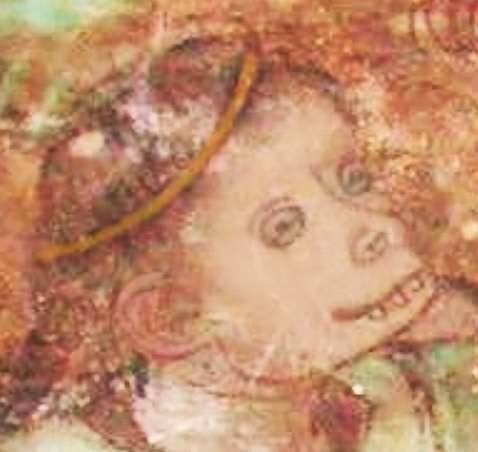
I’m not sure when Sun was first associated with this concept, but Eastern Thousand Buddha Cave (Dong qianfo dong, 東千佛洞) number two in the Hexi Corridor of Gansu Province contains a Western Xia wall painting of the Monkey Pilgrim wearing a golden headband (fig. 4). I show in this article that the band is based on a historical Esoteric Buddhist ritual fillet associated with the Akshobhya Buddha, who is known for his vow to attain Buddhahood through moralistic practices. Therefore, the ritual band most likely served as a physical reminder of right speech and action, making the band from the mural a symbol for the taming of the Monkey Mind. If this is the case, Wukong has represented the Monkey Mind since at least the 11th-century when the mural was painted.

Fig. 4 – Detail of the Monkey Pilgrim’s fillet from Eastern Thousand Buddha Cave no. 2 (c. 11th-cent.) (larger version). Image enhanced slightly for clarity. See here for a larger detail showing both Monkey and Tripitaka. 

Allusions to the Mind Monkey appear in the ancient Pali Buddhist canon, but its earliest known occurrences in Chinese sources appear among the translations of the monk Kumarajiva (Jiumoluoshi, 鳩摩羅什, d. 413). For instance, his translation of the Vimalakirti Sutra reads: “Since the mind of one difficult to convert is like an ape [yuanhou, 猨猴], govern his mind by using certain methods and it can then be broken in” (Dudbridge, 1970, pp. 168). This shows the concept was present in China for over a millennia prior to the Ming Journey to the West.

Notes:

1) In Buddhism, for example, the fourth Chan patriarch Daoxin is quoted as saying: “All schools of the Law find their way to the Square Inch; all rivers and sand of wonderful virtues come from the Source of the Mind (xinyuan 心源)” (Liu, 1994, p. 28).

2) See Saso, 1995, p. 127 for the full stanza and explanation. I have changed all quotes used from this source from Wade-Giles to Pinyin. I also slightly modified the translation.

3) See Saso, 1995, p. 129 for the full stanza and explanation. Again, I slightly modified the translation.

4) Anthony Yu (Wu & Yu, 2012) suggests this poem is related to the Buddha’s statement that Wukong is “only a monkey who happened to become a spirit, … merely a beast who has just attained human form in this incarnation” (p. 70), thereby alluding to a Confucian hierarchical scale present in the novel where animals are able to attain human qualities through Daoist cultivation. So Monkey’s Daoist training under Subodhi allows him to wed his monkey form to the human heart-mind.

Sources:

Chuang, T., & Watson, B. (1968). The complete works of Chuang Tzu. Columbia University Press.

Dudbridge, G. (1970). The Hsi-yu chi: A study of antecedents to the sixteenth-century Chinese novel. Cambridge: Cambridge Univ. Press.

Liu, X. (1994). The odyssey of the Buddhist mind: The allegory of the later journey to the West. Lanham, Md: Univ. Press of America.

Saso, M. R. (1995). The Gold pavilion: Taoist ways to peace, healing, and long life. Boston: Charles E. Tuttle Co.

Wu, C., & Yu, A. C. (2012). The journey to the West: Vol. 1. Chicago, Illinois: University of Chicago Press.