The “Immortal Register” of Journey to the West

Last updated: 04-01-2025

Anyone familiar with Journey to the West (Xiyouji, 西遊記, 1592; “JTTW” hereafter) will remember the event in chapter three where Sun Wukong gains another category of immortality by inking out his name (and those of all other primates) from the “register of births and deaths” (shengsi bu, 生死簿) in hell (Wu & Yu, 2012, vol. 1, pp. 140-141). But did you know that there is a corresponding book in heaven? The “immortal register” (xianlu, 仙籙) (fig. 1) records the names of all transcendent beings in the realm above. The term is also used in the novel to note official appointments in heaven, thereby designating officeholders as deities. For example, Monkey’s is a random earth immortal [1] until he is appointed the Bimawen, a sort of god of horses. This gives him power over all equines in the JTTW cosmos (Wu & Yu, 2012, vol. 1, p. 309; vol. 3, p. 77).

In this article, I would like to quote all mentions of the book or appointment in relation to Sun Wukong. I will also show that the concept is mentioned in Daoist texts as far back as the early-4th-century.

Fig. 1 – Perhaps the immortal register would look something like this stack of modern bamboo strip books (larger version). Image found here.

1. Mentions in JTTW

1.1. Chapter Two

Upon returning home from studying under Patriarch Subodhi, Monkey reveals his new name to his children. His future appointment is then foretold in a couplet:

“My surname is Sun,” replied Wukong, “and my religious name is Wukong.” When the monkeys heard this, they all clapped their hands and shouted happily, “If the great king is Elder Sun, then we are all Junior Suns, Suns the Third, small Suns, tiny Suns—the Sun Family, the Sun Nation, and the Sun Cave!” So they all came and honored Elder Sun with large and small bowls of coconut and grape wine, of divine flowers and fruits. It was indeed one big happy family! Lo,

The surname is one, the self’s returned to its source.
This glory awaits—a name recorded in Heaven [xianlu, 仙籙] (emphasis added)! (Wu & Yu, 2012, vol. 1, p. 130)

悟空道:「我今姓孫,法名悟空。」眾猴聞說,鼓掌忻然道:「大王是老孫,我們都是二孫、三孫、細孫、小孫一家孫、一國孫、一窩孫矣!」都來奉承老孫,大盆小碗的椰子酒、葡萄酒、仙花、仙果,真個是合家歡樂。咦!

貫通一姓身歸本,只待榮遷仙籙名。

1.2. Chapter Three

After receiving separate complaints about Monkey’s behavior, Heaven decides to give him a celestial position in order to keep his misadventures in check. A stellar deity is dispatched to invite him to the realm above:

The Gold Star came into the center of the cave and stood still with his face toward the south. “I am the Gold Star of Venus from the West,” he said. “I came down to Earth, bearing the imperial decree of pacification from the Jade Emperor, and invite you to go to Heaven to receive an immortal appointment [xianlu, 仙籙] (emphasis added)” (Wu & Yu, 2012, vol. 1, p. 144)

金星徑入當中,面南立定道:「我是西方太白金星,奉玉帝招安聖旨,下界請你上天,拜受仙籙。」

1.3. Chapter Four

After receiving his summons, Sun’s cloud somersault carries him to heaven faster than the envoy, and when he attempts to enter, his way is blocked by gate guardians. The aged star eventually arrives to resolve the issue, noting that he doesn’t yet have access because his name hasn’t been added to the celestial record.

“Old man,” said Wukong angrily to his face, “why did you deceive me? You told me that I was invited by the Jade Emperor’s decree of pacification. Why then did you get these people to block the Heaven Gate and prevent my entering?” “Let the Great King calm down,” the Gold Star said, laughing. “Since you have never been to the Hall of Heaven before, nor have you been given a name, you are quite unknown to the various heavenly guardians. How can they let you in on their own authority? Once you have seen the Heavenly Deva, received an appointment, and had your name listed in the Immortal Register [shoule xianlu, zhule guanming, 授了仙籙,注了官名] (emphasis added), you can go in and out as you please. Who would then obstruct your way?” (Wu & Yu, 2012, vol. 1, p. 145)

悟空就覿面發狠道:「你這老兒,怎麼哄我?被你說奉玉帝招安旨意來請,卻怎麼教這些人阻住天門,不放老孫進去?」金星笑道:「大王息怒。你自來未曾到此天堂,卻又無名,眾天丁又與你素不相識,他怎肯放你擅入?等如今見了天尊,授了仙籙,注了官名,向後隨你出入,誰復擋也?」

He serves as the keeper of the heavenly horses but rage quits upon learning that his rank is the lowest in heaven. But no one tries to stop him from leaving due to his official position:

When the Monkey King heard this, fire leaped up from his heart. “So that’s the contempt they have for old Monkey!” he cried angrily, gnashing his teeth. “At the Flower-Fruit Mountain I was honored as king and patriarch. How dare they trick me into coming to look after horses for them, if horse tending is such a menial service, reserved only for the young and lowly? Is such treatment worthy of me? I’m quitting! I’m quitting! I’m leaving right now!” With a crash, he kicked over his official desk and took the treasure [the staff] out of his ear. One wave of his hand and it had the thickness of a rice bowl. Delivering blows in all directions, he fought his way out of the imperial stables and went straight to the South Heaven Gate. The various celestial guardians, knowing that he had been officially appointed [xianlu, 仙籙] (emphasis added) a BanHorsePlague, did not dare stop him and allowed him to fight his way out of the Heaven Gate (Wu & Yu, 2012, vol. 1, p. 149).

猴王聞此,不覺心頭火起,咬牙大怒道:「這般藐視老孫!老孫在那花果山稱王稱祖,怎麼哄我來替他養馬?養馬者,乃後生小輩下賤之役,豈是待我的?不做他,不做他,我將去也。」忽喇的一聲,把公案推倒,耳中取出寶貝,幌一幌,碗來粗細,一路解數,直打出御馬監,徑至南天門。眾天丁知他受了仙籙,乃是個弼馬溫,不敢阻當,讓他打出天門去了。

1.4. Chapter Five

Monkey is offered a second appointment as the Great Sage Equaling Heaven following a brief but tense confrontation with the realm above. And while the term xianlu (仙籙) is not used, the narrative does mention him signing his name in the book:

Now we must tell you that the Great Sage, after all, was a monkey monster; in truth, he had no knowledge of his title or rank, nor did he care for the size of his salary. He did nothing but place his name on the Register [zhu ming, 註名] (emphasis added). At his official residence he was cared for night and day by the attending officials of the two departments. His sole concern was to eat three meals a day and to sleep soundly at night. Having neither duties nor worries, he was free and content to tour the mansions and meet friends, to make new acquaintances and form new alliances at his leisure (Wu & Yu, 2012, vol. 1, p. 160).

話表齊天大聖到底是個妖猴,更不知官銜品從,也不較俸祿高低,但只註名便了。那齊天府下二司仙吏,早晚伏侍,只知日食三餐,夜眠一榻,無事牽縈,自由自在。閑時節會友遊宮,交朋結義。

This implies that a transcendent must sign their name each time they take on a new roll.

2. Mentions in Religious Texts

It’s important to note that the immortal register is not the creation of the JTTW author-compiler. It can actually be traced to historical Daoist literature. For instance, the Scripture of the Nine Elixirs (Jiudan jing, 九丹經 , c. 300) describes a deity transferring a mortal’s name from the book of the dead to that of heaven once they ingest the ninth kind of elixir of immortality:

[Following the creation of the elixir…]

At dawn pay obeisance twice toward the sun, and ingest one pill with pure water from a well. It will make your body light, and in one hundred days the hundred diseases will be healed. The Jade Women will become your attendants. The Director of Destinies (Siming) will delete your name from the records of the dead (siji [死籍]) and enter it in the registers of immortality (xianlu [仙錄]).

[Pregadio’s (2006) explanation:] The Director of Destinies is the deity charged with establishing the length of each person’s life on behalf of the Great One (Taiyi). He performs his task by entering the individual’s name in the “records of the dead” or the “registers of immortality.”

You will travel through the air in any direction, and enter and exit the world without interruption. Nobody will be able to hold or restrain you: one moment you will be sitting, and then you will rise up and disappear. Lightly you will ascend riding the clouds, and rise to heaven (Pregadio, 2006, p. 187).

平旦,以井華水,向日再拜,吞一丸,令人身輕,百日百病除愈,玉女來侍,司命消除死籍,名著仙錄,飛行上下,出入無問,不可拘制,坐在立亡,輕舉乘雲,升於天矣。

2.1. Relationship to Sun Wukong

This is really interesting to me because Monkey’s story precisely matches the way the alchemist’s name is switched from one book to the other. His name is removed from the register of births and deaths in chapter three, and then it’s added to the immortal register in chapters four and five. The only difference is that the Great Sage removes his name by force instead of relying on a god to do it for him. Perhaps the author-compiler copied this process in order to lend some authenticity to Sun’s spiritual journey. What do you think?

It would be neat to see the immortal register pop up in fanfiction. Perhaps a fiend sneaks into heaven and steals it (for whatever nefarious reasons). This may seem like an impossible task, but JTTW chapter 63 mentions a spirit covertly infiltrating the realm above and taking celestial medicinal plants (Wu & Yu, 2012, vol. 3, p. 192). If this can be done, I’m sure the register can be pilfered, too.


Update: 04-1-25

A user on discord asked me if the immortal register from JTTW influenced a roster from Investiture of the Gods (Fengshen yanyi封神演義, c. 1620 CE). The “Roll of Investment” (Fengshen bag, 封神榜) is a preordained list of humans, immortals, and demons chosen to be canonized as gods following the great ShangZhou war. My reply—an educated guess—was that both lists were based on the historical register from Daoist literature.

Note:

1) Monkey is one of several types of immortals recognized in JTTW:

Tathagata said, “There are five kinds of immortals in the universe, and they are: the celestial, the earthbound, the divine, the human, and the ghostly” (Wu & Yu, 2012, vol. 3, p. 115).

如來才道:「周天之內有五仙:乃天、地、神、人、鬼。

This comes from the Zhong-Lu (鍾呂) sect of Quanzhen Daoism. See Kohn (2020, pp. 120-124) for more information about these five immortals.

Sources:

Pregadio, F. (2006). Great Clarity: Daoism and Alchemy in Early Medieval China. United States: Stanford University Press.

Kohn, L. (2020). The Zhong-Lü System of Internal Alchemy. Russia: Three Pines Press.

Wu, C., & Yu, A. C. (2012). The Journey to the West (Vols. 1-4) (Rev. ed.). Chicago, Illinois: University of Chicago Press.

Archive #47: The Newly Annotated Journey to the West With Illustrations (Xinshuo Xiyouji (tuxiang), 1749/1888)

I. Original Text

The Newly Annotated Journey to the West (Xinshuo Xiyouji, 新說西遊記, 1749) by Zhang Shushen (張書紳) is one of three popular editions of JTTW that circulated during the Qing Dynasty (1644-1911) and overshadowed the original. [1] It contains a running commentary dispersed throughout the pilgrims’ many adventures. Anthony C. Yu (Wu & Yu, 2012) describes Zhang’s work as having a Confucian bias:

In his unabridged hundred-chapter Xinshuo Xiyouji (The Journey to the West, Newly Interpreted) of 1749, Zhang Shushen declared in the section entitled “Xiyouji zongpi 西游記總批 (Overall Comments on The Journey to the West)” that “the book Xiyou has been designated by the ancients as a book meant to illuminate the Dao [a pointed dig at the 1662 edition titled Xiyou zhengdao shu, with the Daoist-leaning preface attributed to Yu Ji … ], by which it originally means the Dao of the sages, the worthies, and the Confucians (儒 Ru). To consider it an illumination of the Dao of immortals and Buddhism would be a mistake, indeed.” From a point of view clearly unsympathetic to the popular movement of Three-Religions-Joining-As-One (sanjiao heyi 三教合一, a possibly millennium-old notion … ), Zhang defended the story of the quest for Buddhist scriptures as an allegory of the classic Confucian doctrines on the illustration of virtue (mingde 明德) and the rectification of the mind (zhengxin 正心), ignoring the repeated and complex elaborations of zhengxin in Chan Buddhism also for at least a thousand years prior to his time (vol. 1, pp. 51-52).

I’ve decided to archive a scanned copy of this work for posterity.

A digital version of the text (interspersed with other commentaries) can be found here.

Book link

Click to access Journey-to-the-West-Newly-Annotated-by-Zhang-Shushen-Xinshuo-Xiyouji-compressed.pdf

II. Text With Illustrations

I’ve previously archived illustrated versions of JTTW, including the original 1592 edition, (images from) Li Zhuowu’s late-16th-century critique, and a circa 1835 Japanese translation. Here, I’d like to add another, the Newly Annotated Journey to the West With Illustrations (Xinshuo Xiyouji tuxiang, 新說西遊記圖像, 1888). The original text and commentary are the same, but this edition features a preface by Wang Tao (王韜), as well as over 100 woodblock prints.

The prints in the archived book below are admittedly a little fuzzy. This webpage has somewhat clearer versions.

Book link

Click to access Journey-to-the-West-Newly-Annotated-With-Illustrations-1888-compressed.pdf

Prints of Zhu Bajie and Sun Wukong from the opening illustrations (larger version).

Note:

1) The Qing versions are noted for having shoehorned Tripitaka‘s life story (chapter nine) into the original 100 chapters of the 1592 edition.

Origin of the Immortal Peach-Stealing Episode from Journey to the West

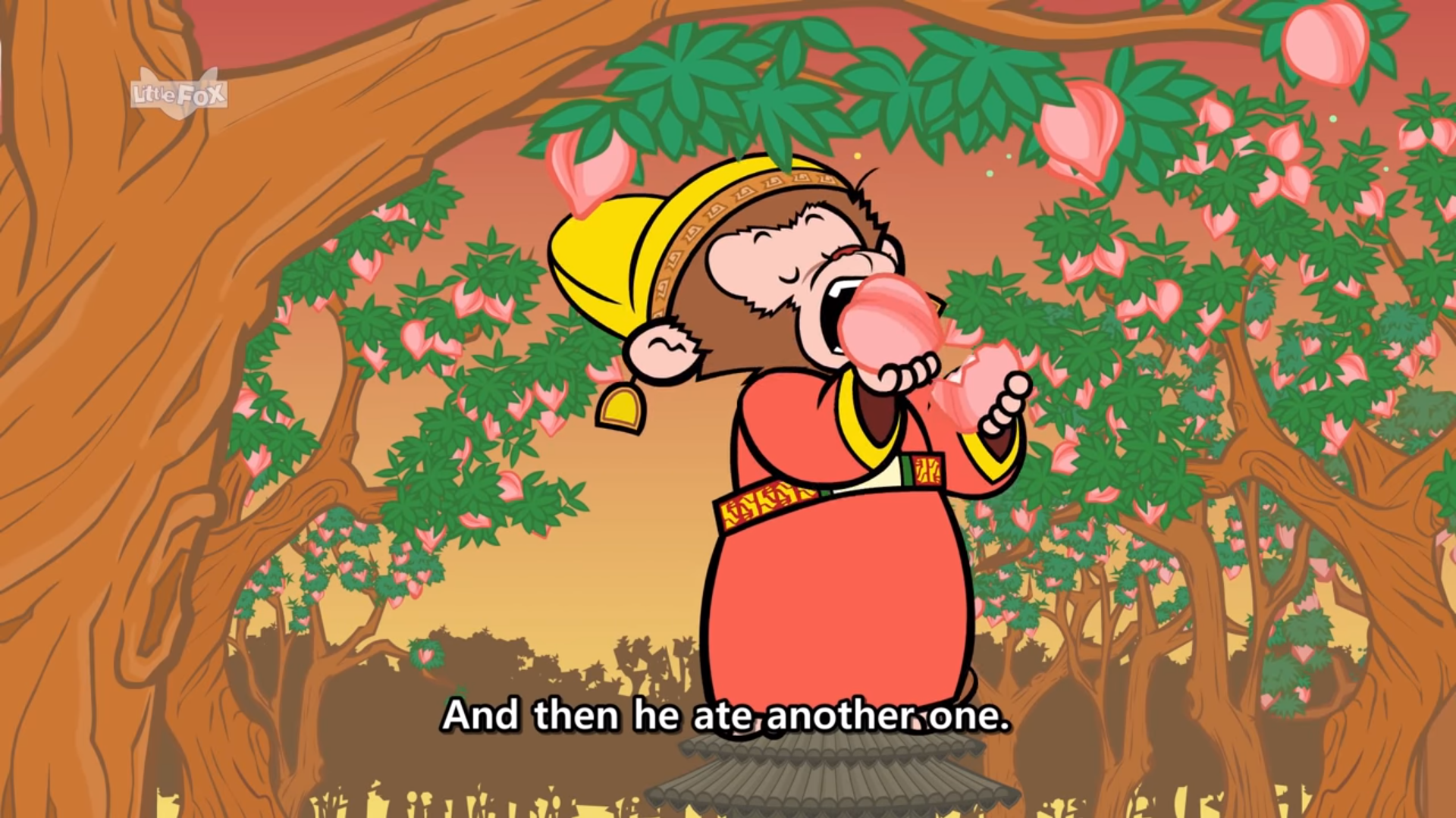
I’ve previously mentioned that the Monkey King has multiple categories of immortality in Journey to the West (Xiyouji, 西遊記, 1592; “JTTW” hereafter). The third is achieved in chapter five when he eats untold numbers of 9,000-year-old immortal peaches (pantao, 蟠桃) while serving as the temporary custodian of the Queen Mother of the West‘s immortal peach garden (fig. 1). Each of these is said to “make a man’s age equal to that of Heaven and Earth, the sun and the moon” (人吃了與天地齊壽,日月同庚。) (Wu & Yu, 2012, vol. 1, p. 161). This naturally bestows our hero with supreme longevity (but not complete immortality). In this article, I would like to explore the origins of this episode. I suggest that it is based on the theft of divine fruit by a Han-era trickster, as well as by a magic white ape from Song-era religious literature.  

Fig. 1 – Sun Wukong eating immortal peaches (larger version). This is a screenshot from episode 9 of the Little Fox Journey to the West series on YouTube.

1. Literature and mythology

1.2. Literary episode (ch. 4 to 5)

After winning his battle with heaven, Monkey is granted the empty title “Great Sage Equaling Heaven” (Qitian dasheng, 齊天大聖) and given a position in the celestial realm with no official rank, salary, or duty. He spends this time freely traveling the universe and making friends with all sorts of primordial, stellar, and cardinal gods. But his idleness catches the eye of an immortal who reports to the throne the possible negative repercussions of Sun Wukong having too much free time. In response, the Jade Emperor tasks Monkey with temporarily watching over the immortal peach garden, warning him to take the position seriously. Sun immediately performs an inspection of the garden, learning from an underling that of the 3,600 total trees, three groups of immortal peaches respectively ripen every 3,000, 6,000, and 9,000 years.

This new position takes up his time, ending his visits with deities across the cosmos. But one day, he feigns tiredness just so his attendants will leave him alone long enough to strip out off his official clothing and climb trees to eat his fill of fruit. He uses this ruse several times to sate his hunger. However, his theft is soon discovered when the Queen Mother sends seven immortal maidens to procure fruit for her famous Grand Banquet of Immortal Peaches (Pantao shenghui, 蟠桃勝會). Upon their arrival, Monkey is nowhere to be found (having shrunken to miniature size and fallen asleep in the trees), so the underlings allow the maidens into the garden to fulfill their duty. It is there where they discover that most of the oldest peaches have been eaten, and in the process of picking leftovers, a maiden disturbs Sun’s slumber when she pulls down and lets go of the branch that he is sleeping on. Thus awakened, Monkey resumes his normal size and threatens the maidens with his iron staff. But his anger quickly subsides when he learns about the forthcoming banquet and the high-ranking Buddho-Daoist gods that have attended in the past. Being egotistical, Sun inquires as to whether or not he is the guest of honor this year, but when the maidens reveal that they don’t yet know the guest list, he freezes them in place with fixing magic and heads to the banquet hall to find out for himself (Wu & Yu, 2012, vol. 1, pp. 157-164).

1.2. Connection to world mythology

This episode is part of a set of closely-related motifs from world mythology. Thompson’s Motif-Index lists the following:

A153.1. Theft of ambrosia. Food of the gods stolen. — Hindu: Keith 139; Persian: Carnoy 283.

[…]

A153.2. Magic food gives immortality to gods. Irish: MacCulloch Celtic 54; India: Thompson-Balys.

D1346.3. Food of immortality.

A153.3. Banquets of the gods. Icel.: MacCulloch Eddic 23; India: Thompson-Balys; Chinese: Werner 137. — So. Am. Indian (Chiriguano): Métraux RMLP XXXIII 178 (source).

In our case, “ambrosia,” “food of the gods,” “magic food,” and “food of immortality” all refer to immortal peaches.

2. History

To my knowledge, one of the oldest sources associating Monkey with the theft of immortal peaches is The Story of How Tripitaka of the Great Tang Procures the Scriptures (Da Tang Sanzang qujing shihua, 大唐三藏取經詩話, c. late-13th-century), the earliest known printed edition of the JTTW story cycle. Chapter 11 sees the pilgrims enter the domain of the Queen Mother during their quest to India. The monk Tripitaka asks Sun’s antecedent, the “Monkey Pilgrim” (Hou xingzhe, 猴行者), to steal some immortal peaches to quench his thirst, but the latter refuses:

Because I stole ten peaches to eat when I was eight hundred years old, I was captured by the Queen Mother and given eight hundred blows on my left side and three thousand blows on the right with an iron cudgel. Then I was exiled to the Purple Cloud Grotto on the Mountain of Flowers and Fruits. Even today my sides hurt and now I definitely don’t dare to steal any more peaches!” (Wivell, 1994, p. 1195).

猴行者曰:「我因八百歲時,偷吃十顆,被王母捉下,左肋判八百,右肋判三千鐵棒,配在花果山紫雲洞。至今肋下尚痛。我今定是不敢偷吃也。」

3. Origins

There are at least two sources that I believe contributed to the peach-stealing episode from JTTW.

3.1. Dongfang Shuo

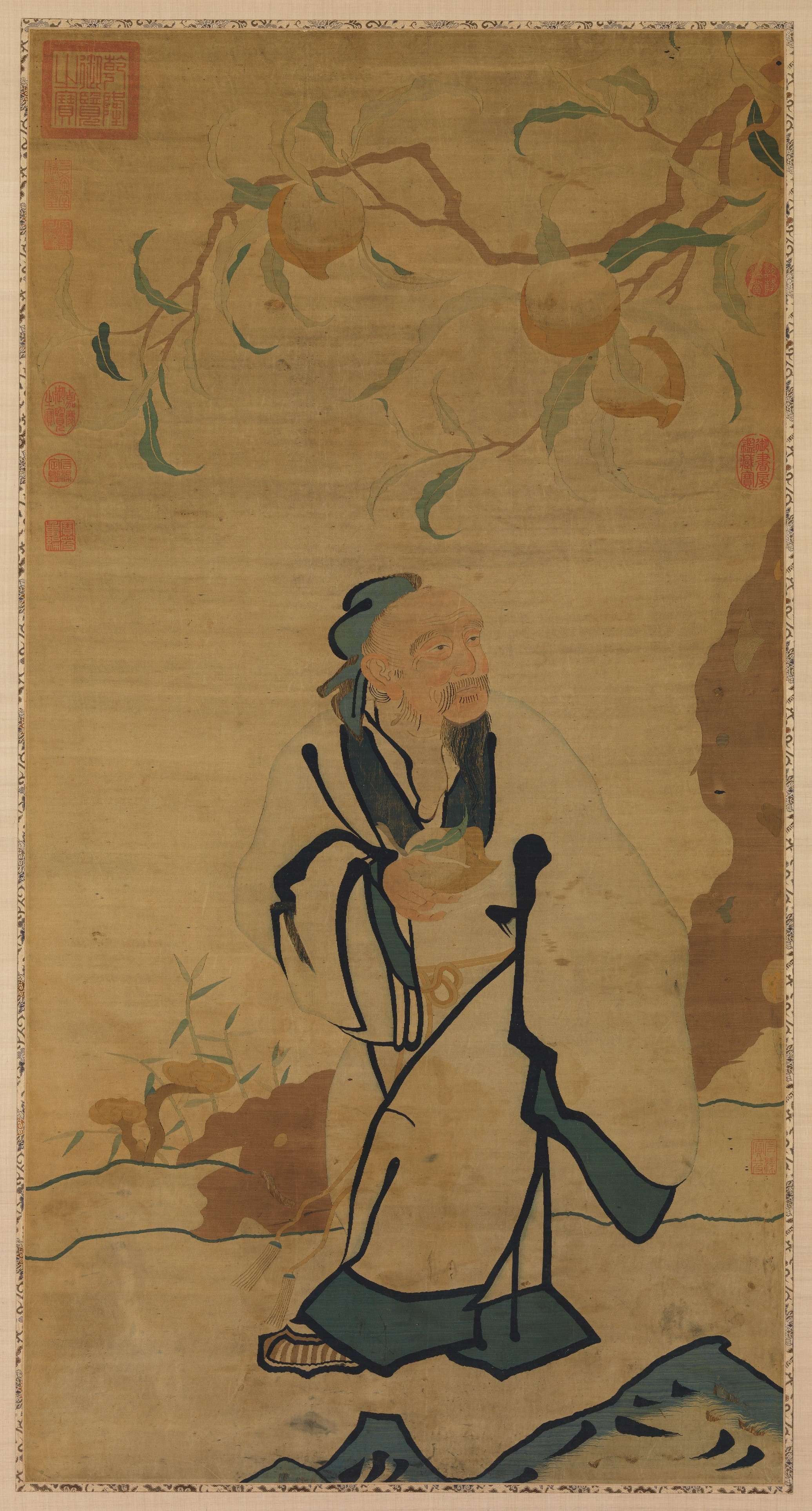
The first is a story cycle which involves the trickster Dongfang Shuo (東方朔, c. 160–93 BCE) (fig. 2) stealing peaches from the Queen Mother’s garden. The tale appears as early as the Precedents of Wu of Han (Hanwu gushi, 漢武故事), a circa 3rd-century collection of fictionalized stories about Emperor Wu of Han. It records that, after the Emperor was gifted a supernaturally small dwarf, Dongfang claimed it to be a nature spirit of sorts. However:

The dwarf did not reply but pointed at Dongfang Shuo and told the Emperor, “The Queen Mother grows peaches in her Eastern Garden which ripen once every three thousand years. This boy is no good—he’s already stolen the peaches three times! Consequently he fell out of the Queen Mother’s favor, and for this reason he was banished here.” 

The Emperor was quite startled, for he began to understand that Dongfang Shuo was not a man of this world (Smith, 1992, pp. 408-409).

短人不對,因指朔謂上曰:「王母種桃,三千年一作子,此兒不良,已三過偷之矣,遂失王母意,故被謫來此。」上大驚,始知朔非世中人。

[…] 

[During a planned meeting between the Emperor and the Queen Mother] Dongfang Shuo peeked at [her] through the Red Bird Window. Spotting him, she pointed and turned to the Emperor saying, “This boy is fond of mischief. He’s rude and undependable. Three times have the peaches of immortality ripened, and three times he has stolen them. Long ago I banished him and forbade him to return to heaven, thus he has lingered here. Nevertheless his original heart is not evil, and soon he will be able to return. Do treat him well” (Smith, 1992, pp. 416-417).

東方朔於朱鳥牖中窺母,母謂帝曰:「此兒好作罪過,疏妄無賴,久被斥退,不得還天;然原心無惡,尋當得還。帝善遇之。」

[On the day that a celestial envoy presented the emperor with three immortal peaches], Dongfang Shuo died. The Emperor, who had his doubts, asked the envoy about it.

“Dongfang Shuo is the vital essence of the Wood Emperor, who became the planet Jupiter,” she said. “He came down and roamed among men to observe what is below heaven. He is not Your Majesty’s subject.” 

The Emperor gave him a magnificent funeral (Smith, 1992, p. 418).

使至之日,東方朔死。上疑之,問使者。曰:「朔是木帝精為歲星,下游人中,以觀天下,非陛下臣也。」上厚葬之。

Here are some important elements to remember: 

  1. Jupiter-Dongfang Shuo steals peaches from the Queen Mother’s garden.
  2. The planet thrice steals peaches that ripen every 3,000 years.
  3. The thieving celestial is banished from heaven

Dongfang’s story is so famous that he even makes an appearance in JTTW. After being introduced as a disciple of the Grand Thearch (Dijun, 帝君) in chapter 26 (Wu & Yu, 2012, vol. 2, pp. 7-8), he and Monkey share a brief exchange in which they ridicule each other’s criminal past:

When Pilgrim saw him, he laughed and said, “So, this little crook is here! But there’s no peach at the Grand Thearch’s place for you to steal and eat.” Dongfang Shuo bowed to him and replied, “Old burglar! Why did you come? There’s no divine elixir at my master’s place for you to steal and eat” (Wu & Yu, 2012, vol. 2, p. 8). [1]

行者見了,笑道:「這個小賊在這裡哩。帝君處沒有桃子你偷吃!」東方朔朝上進禮,答道:「老賊,你來這裡怎的?我師父沒有仙丹你偷吃。」

Irwen Wong of the Journey to the West Library blog has suggested to me that within the novel’s universe, Jupiter-Dongfang Shuo was the previous caretaker of the immortal peach garden. His exile from heaven and rebirth on earth would have vacated the post, leaving it open for Monkey to later take over. This would mean that heaven doesn’t have a good track record with choosing peach garden caretakers.

Fig. 2 – A Ming-era painting of Dongfang Shuo stealing peaches (larger version). Image courtesy of the MET on Wikimedia Commons.

3.2. Sun Bin and White Ape

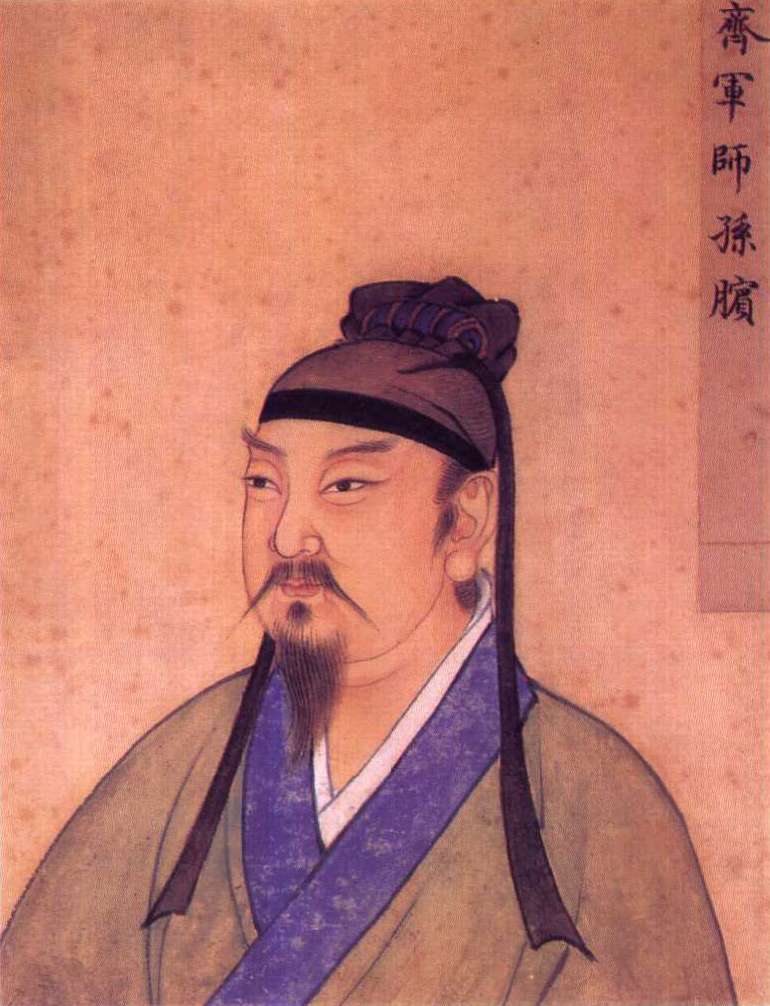
The second is a story cycle involving the Warring States military strategist Sun Bin (孫臏, d. 316 BCE) (fig. 3) protecting an earthly fruit garden from a magic white ape (baiyuan, 白猿; a.k.a. “gibbon“). The tale appears as early as the Scripture of the Most High Luminous Mirror of the Six Ren Tallying with Yin (Taishang liuren mingjian fuyin jing, 太上六壬明鑑符陰經) (a.k.a., Ape Book, Yuanshu, 猿書), a Northern Song-era work related to the Daoist doctrine of the Three Sovereigns (Steavu, 2019, p. 195). But instead of peaches, the scripture just says “fruit” (guo, 菓). However, I imagine the produce is something special like immortal peaches as Sun guards them with a weapon. A rough translation follows (I have skipped over some of the more esoteric parts that escape me):

[Master Ghost Valley] saw that the fruit had ripened, so he commanded Sun to watch over it. One night a person jumped the wall into the nine gardens and took some of the fruit. But Sun was hiding with a sword and caught the culprit, a white ape. The primate said: “Don’t hurt me! I share the same age as heaven and earth and have lived as long as the sun and moon! I have mysterious texts (xuanwen, 玄文)! Wait for me the next day and I will give them to you.” The white ape then transformed into white light and left. Sun waited the following day. Suddenly, he saw the white ape fly from the northwest. He was given one scroll of mysterious texts. The primate again transformed into white light and headed towards the southeast. Sun then returned to his room to inspect the text. He didn’t know the name but saw that it was divided into three volumes: initial, middle, and final. He named it after the white ape (Taishang liuren, n.d.).

師因園看菓成實,令臏看之。夜忽有一人,踰垣而九園中,盜菓子食之。臏乃潛身,持刀欲補之,乃是白猿也。拿住,忽言曰:汝勿傷吾身,我與天地同生,日月並長,瘍無道炁,結化成形。吾有玄文,汝來日於此處候吾,我傳與汝。臏乃長跪而退,其猿乃化白光而去。至次日,臏乃依期而伺之。忽見白猿自西北乘空而來,授臏玄文一卷。隨時化白光,東南而去。臏將其文而歸,本宿房中點檢,一曰六甲天厭一卷,一日六丁天厭一卷。遺其頭尾,不知是何名目,分上一中下三卷,因日指其白猿為名也。

Here are some important elements to remember:  

  1. Sun Bin looks after a special fruit-bearing garden.
  2. A magic primate steals the fruit.
  3. The primate has divine longevity and the ability to fly and change its shape.

It’s important to note that the aforementioned fruit was eventually called immortal peaches in later iterations of the story cycle. [2]

Fig. 3 – A Ming-era painting of Sun Bin (larger version). Image found on Wikimedia Commons.

4. Putting it all together

I believe that the two story cycles influenced JTTW in at least five ways: 1) Jupiter-Dongfang Shuo and the white ape stealing special fruit connects said produce with the Queen Mother’s immortal peaches; 2) the fruit being stolen by a white ape with divine longevity and the ability to fly and change its shape helps connect Sun Wukong, a fellow magical primate, to the theft of special produce/immortal peaches; 3) Jupiter-Dongfang Shuo thrice stealing peaches that ripen every 3,000 years may have influenced the three kinds of peaches in the Queen Mother’s garden that respectively ripen every 3,000, 6,000, and 9,000 years; 4) Sun Bin looking after a special fruit-bearing garden on earth may have influenced Monkey’s position as the caretaker of the immortal peach garden in heaven. After all, both of their surnames is Sun (孫) (Sun Bin vs Sun Wukong); and 5) Jupiter-Dongfang Shuo being exiled from heaven for stealing the peaches feeds into Monkey’s theft and subsequent actions that ultimately lead to the Buddha banishing him to earth and imprisoning him under Five Elements Mountain.

Notes:

1) Thank you to Irwen Wong for reminding me of this. 

2) For example, The Battle of Wits between Sun and Pang (Sun Pang douzhi yanyi, 孫龐鬥智演義, 1636; a.k.a. The Former and Latter Annals of the Seven Kingdoms, Qianhou qiguo zhi, 前後七國志) uses the term xiantao (仙桃; lit: “immortal peaches”) (Taishang liuren, n.d.).

Sources:

Smith, T. E. (1992). Ritual and the Shaping of Narrative: The Legend of the Han Emperor Wu (Vols. 1-2) (UMI No. 9303824) [Doctoral dissertation, The University of Michigan]. Available from ProQuest Dissertations and Theses database.

Steavu, D. (2019). The Writ of the Three Sovereigns: From Local Lore to Institutional Daoism. Hong Kong: The Chinese University of Hong Kong.

Taishang liuren mingjian fuyin jing juan yi (n.d.). [Book of the Most High Luminous Mirror of the Six Ren Tallying with Yin: First Scroll]. Retrieved from https://ctext.org/wiki.pl?if=gb&chapter=465883#p3

Wivell, C.S. (1994). The Story of How the Monk Tripitaka of the Great Country of T’ang Brought Back the Sūtras. In V. Mair (Ed.), The Columbia Anthology of Traditional Chinese Literature (pp. 1181-1207). New York: Columbia University Press.

Wu, C., & Yu, A. C. (2012). The Journey to the West (Vols. 1-4) (Rev. ed.). Chicago, Illinois: University of Chicago Press.


Archive #44 – The God Erlang Captures the Great Sage Equaling Heaven (Erlang shen suo Qitian dasheng) Zaju Play

Last updated: 03-08-2025

The God Erlang Captures the Great Sage Equaling Heaven (Erlang shen suo Qitian dasheng / Erh-lang shen so Ch’i-t’ien Ta-sheng, 二郎神鎖齊天大聖) is a zaju play from the Yuan-Ming period. To my knowledge it is roughly contemporaneous with the early-Ming Journey to the West zaju play (Xiyou ji zaju西遊記雜劇). Here, I would like to archive the Chinese script, as well as provide a brief description for those unable to read the original.

1. Synopsis

Dudbridge (1970) gives a brief overview of the play:

The action, in brief, is as follows: An ape-demon, Qitian dasheng [齊天大聖], steals Taoist elixir and fairy wine from the Immortal Yuanshi tianzun [元始天尊] and returns with it to his home Shuilian dong [水簾洞] on Huaguo shan. The theft reported, Erlang is summoned to capture him. The ape meanwhile feasts with members of his family on Huaguo shan. Erlang, mustering his traditional followers, advances in company with Juling shen [巨靈神] and effects the capture. In the final act he surrenders the prisoner to the Taoist deity Quxie yuanzhu [驅邪院主]. The ape begs for clemency and is finally dismissed with only a firm injunction to reform (p. 129). [1]

Apart from Erlang and his followers, some of these figures carried over into the 1592 Journey to the West novel. Yuanshi tianzun (“Celestial Worthy of Original Commencement”) is mentioned by name in the novel six times. Juling shen (“Might-Spirit God”) is easily bested by Sun Wukong in chapter four (Wu & Yu, 2012, vol. 1, pp. 153-154). His name is mentioned a total of 15 times.

Quxie yuanzhu (驅邪院主, “Lord of the Court for Exorcising Evils”) does not appear in the novel.

2. Similarities with the JTTW Zaju

As noted in the introduction, this zaju shares parallels with the early-Ming JTTW zaju. Dudbridge (1970) explains:

A number of details demand attention:
the name of the ape: Qitian Dasheng;
the name of his home: Huaguo shan, Shuilian dong [花果山水簾洞];
the members of his family: “My elder brother Tongtian Dasheng [通天大聖], myself Qitian Dasheng, my elder sister Guishan shuimu [龜山水母], my younger sister Tiese mihou [鐵色獼猴], my younger brother Shuashua Sanlang [耍耍三郎]” (speech in the first act);
the stealing of elixir and wine;
the role of Erlang and Juling shen;
the ‘iron cudgel’ [鐵棒], with which the ape defends himself in the third act;
the name Sun xingzhe [孫行者] claimed by the youngest brother in the same act;
minor details of the battle—the attendants of Erlang, the Taoist gods—also peripherally related to the Xiyouji story (pp. 129-130).

For a list comparing the names of Monkey’s siblings from both plays, see the 12-20-23 update here.

Erlang vs the Great Sage (larger version).

3. Archive link

The Chinese text is split up in sections just like it was posted to Text Court (see below).

Click to access The-God-Erlang-Captures-the-Great-Sage-Equaling-Heaven.pdf

Thanks:

Thank you to the Text Court of the University of Oxford for making this zaju play freely available. The original can be found here.


Update: 03-07-25

Above, Quxie yuanzhu (驅邪院主, “Lord of the Court for Exorcising Evils”) was mentioned as a character that didn’t carry over to the 1592 JTTW. I originally couldn’t find any info about said deity, but I have found a possible lead. According to Kohn (2020), “In Daoism under the Song, [the immortal Zhongli Quan] was particularly honored as the head of the Department of Exorcism (Quxie yuan 驅邪元[院]), a central part of the celestial administration” (p. 13). Perhaps there is a connection between the two.


Update: 03-08-25

I apparently didn’t look hard enough because Text Court (thanked and linked above) provides a list of the character’s other titles:

  • 北極鎮天真武玉虚師相玄天元聖仁威
  • 北極驅邪院主
  • 北極驅邪院都教主

The first title, “北極鎮天真武玉虚師相玄天元聖仁威” (Beiji Zhentian Zhenwu Yuxushi Shixiang Xuantian Yuansheng Renwei), or the “Northern Ultimate and Suppressing Heaven True Warrior, Jade Emptiness Prime Minister, Dark (or Mysterious) Heaven Primal Sage of Humane Power,” contains several illusions to a deity associated with exorcism. The most obvious of these is Zhenwu (真武) and Xuantian (玄天), both of which refer to a singular martial god. I guess this is mystery solved.

Zhenwu appears as the “Demon-Conquering Celestial Worthy” (Dangmo tianzun, 蕩魔天尊) in JTTW chapter 66 (Wu & Yu, 2012, vol. 3, p. 226), but his role is small like in the play.

Notes:

1. All Wade-Giles has been converted to Pinyin.

Source:

Dudbridge, G. (1970). The Hsi-yu chi: A Study of Antecedents to the Sixteenth-Century Chinese Novel. Cambridge: Cambridge University Press.

Kohn, L. (2020). The Zhong-Lü System of Internal Alchemy. Russia: Three Pines Press.

Sun Wukong’s Names and Titles

Last updated: 07-26-25

I was recently contacted by a reader who said they were researching the Monkey King’s various nicknames. I had never thought about this before, so I decided to write an article to help them out. I am indebted to Irwen Wong of the Journey to the West Library blog for helping me with some of the more obscure terms. If you know of others that I missed, please let me know in the comments below or by email (see the “contact” button).

The vast majority of the terms listed here come from the standard 1592 edition of Journey to the West (Xiyouji西遊記; “JTTW” hereafter) (Wu & Yu, 2012). I have also added a few terms from a precursor, The Story of How Tripitaka of the Great Tang Procures the Scriptures (Da Tang Sanzang qujing shihua大唐三藏取經詩話, c. late-13th-century) (Wivell, 1994). I did this to show that certain variations of names or titles have existed for centuries.

My translation of some names and titles will slightly differ from those appearing in Wu and Yu (2012).

I. Mentioned in the narrative

These are names or titles mentioned by the narrative.

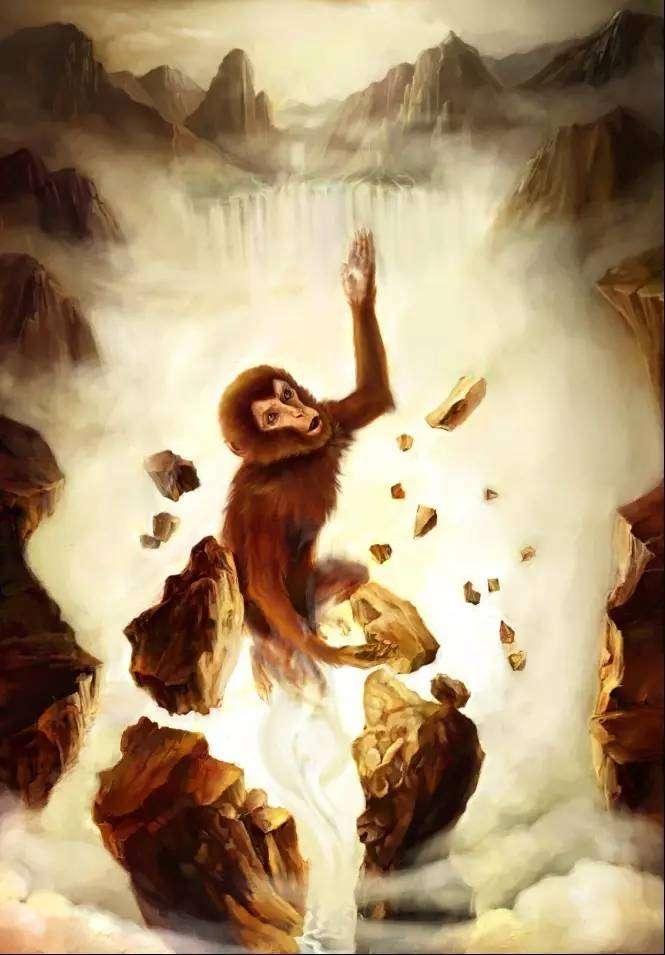
  1. Shihou (石猴, “Stone Monkey”) – Monkey’s first name according to chapter one (Wu & Yu, 2012, vol. 1, p. 104). This is related to his birth from stone (fig. 1).
  2. Tianchan Shihou (天產石猴, “Heaven-Born Stone Monkey”) – His REAL name as listed in the ledgers of hell in chapter three (Wu & Yu, 2012, vol. 1, p. 140).
  3. Xinyuan (心猿, “Mind Monkey/Ape”) – A Buddho-Daoist allegorical term for the disquieted thoughts and emotions that keep man trapped in Saṃsāra. It is used numerous times in chapter titles (e.g. ch. 7) and poems to refer to Monkey (see the material below figure three here).
  4. Jingong (金公, “Lord or Squire of Gold/Metal”) – A term used mainly in poems to refer to Monkey. It is an alternative reading of the component characters making up lead (qian, 鉛), namely jin (金) and gong (公). Lead was an important ingredient in immortal elixirs of external alchemy, and metal/gold (jin, 金) is connected to the earthly branch shen (申), which is associated with monkeys (see no. 9 here) (Wu & Yu, 2012, vol. 1, p. 83 and p. 532 n. 3).
  5. Taiyi Sanxian (太乙散仙, “Leisurely or Minor Immortal of the Great Monad”) – Monkey’s rank within the hierarchy of cosmic immortals (Wu & Yu, 2012, vol. 1, p. 471, for example). It essentially means that he is a divine being without a heavenly post.
  6. Taiyi Jinxian (太乙金仙, “Golden Immortal of the Great Monad”) – A seemingly embellished version of the previous term (Wu & Yu, 2012, vol. 2, p. 264, for example). It speaks of a higher rank. [1]
  7. Lingming Shihou (靈明石猴, “Stone Monkey of Numinous Wisdom”) – The name of his magic species according to the Buddha in chapter 58 (Wu & Yu, 2012, vol. 3, p. 115). [2] He is the first of four spiritual primates.
  8. Nanbian Mihou (難辨獼猴, “Indistinguishable Macaques”) – A term referring to both Sun Wukong and the Six-Eared Macaque. [3]

Fig. 1 – Monkey’s birth from stone by Zhang Moyi (larger version). Found on this article.

II. Given

These are names, titles, or insults that are given to or directed at our hero by other characters.

  1. Hou Xingzhe (猴行者, “Monkey Pilgrim”) – Monkey’s original religious name in the 13th-century JTTW. It is given by Tripitaka at the beginning of the journey (Wivell, 1994, p. 1182). The Xingzhe (行者) portion of this name carried over to the 1592 edition. See nos. 12 and 13 below.
  2. Gangjin Tiegu Dasheng (鋼筋鐵骨大聖, “Great Sage Steel Muscles and Iron Bones”) – His divine title in the 13th-century JTTW. It is bestowed by Tang Emperor Taizong at the end of the journey (Wivell, 1994, p. 1207). [4] The Dasheng (大聖) portion of this name carried over to the 1592 edition. See sec. III, nos. 7 and 8 below.
  3. Sun Wukong (孫悟空, “Monkey Awakened to Emptiness”) – The religious name given to him in chapter one by his first master, the Patriarch Subodhi (Wu & Yu, 2012, vol. 1, p. 115). It predates the 1592 JTTW, first appearing as early as the early-Ming zaju play (see here, for example). It’s important to note that the name “Wukong” (悟空) might have been influenced by a Tang-era monk who traveled throughout India just like Xuanzang (on whom Tripitaka is based).
  4. Liu Xiao Ling Tong (六小龄童) – Monkey’s name in the human world.
  5. Pohou (潑猴, “Reckless or Brazen Monkey”) – An insult used throughout JTTW (Wu & Yu, 2012, vol. 1, p. 118, for example).
  6. Shangxian (上仙, “High or Exalted Immortal”) – A respectful title used by the Dragon King of the Eastern Ocean in chapter three (Wu & Yu, 2012, vol. 1, p. 134).
  7. Huaguo Shan Shuilian Dong Tianchan Yaohou (花果山水簾洞天產妖猴, “Heaven-Born Demon Monkey from the Water-Curtain Cave of the Mountain of Flowers and Fruit”) – An insult used by King Qinguang, a Judge of Hell, in a memorial to the Jade Emperor in chapter three (Wu & Yu, 2012, vol. 1, p. 142).
  8. Xiandi (賢弟, “Worthy Little Brother”) – A nicknamed used by the Bull Demon King (Wu & Yu, 2012, vol. 1, p. 156, for example). Monkey is the smallest and therefore the last of seven sworn brothers (Wu & Yu, 2012, vol. 2, pp. 223-224).
  9. Yaoxian (妖仙, “Bogus Immortal”) – A category of nigh-immortal beings. He is called this by the Jade Emperor (ch. 4), the Buddha (ch. 7), and the Dragon King of the Eastern Sea in (ch. 14) (Wu & Yu, 2012, vol. 1, pp. 147-148, 193, and 318).
  10. Bimawen (弼馬溫, “To Assist Horse Temperament”) – A minor post overseeing the celestial horse stables. Monkey is given this position in chapter four by the Jade Emperor. Yu (Wu & Yu, 2012) translates this as “BanHorsePlague” (vol. 1, p. 148, for example). [5] This is sometimes used as an insult (Wu & Yu, 2012, vol. 1, p. 354, for example).
  11. Yaohou (妖猴, “Monster or Demon Monkey”) – An insult used numerous times throughout the novel (Wu & Yu, 2012, vol. 1, p. 154, for example).
  12. Sun Xingzhe (孫行者, “Pilgrim Sun”) – Monkey’s second religious name. It is given to him in chapter 14 by Tripitaka (Wu & Yu, 2012, vol. 1, p. 309). Xingzhe Sun (行者孫) is a less common variation. Refer back to no. 1. See also sec. III, no. 9 below.
  13. Xingzhe (行者, “Pilgrim”) – He is more commonly referred to by this name than Sun Xingzhe or Sun Wukong combined. [6] See section III here to learn about the significance of this title. Refer back to no. 1.
  14. Sun Zhanglao (孫長老, “Elder Sun”) – A respectful title used by people he has helped (Wu & Yu, vol. 2, p. 85, for example).
  15. Dashixiong (大師兄, “Elder Religious Brother”) – A term used by Zhu Bajie and Sha Wujing (Wu & Yu, 2012, vol. 2, p. 74, for example).
  16. Houtou (猴頭, “Monkey/Ape Head”) – An insult used by various characters, especially Tripitaka (Wu & Yu, 2012, vol. 2, p. 26, for example).
  17. Maolian Heshang (毛臉和尚, “Hairy-Faced Monk”) – A term that describes his features (Wu & Yu, 2012, vol. 1, p. 407, for example).
  18. Maolian Lei Gong Zui de Heshang (毛臉雷公嘴的和尚, “Hairy-Faced, Thunder God-Beaked Monk) – A term that compares his elongated simian face to the beak of the bird-like thunder god Lei Gong (Wu & Yu, 2012, vol. 1, p. 351, for example). Variations include Lei Gong Zui Heshang (雷公嘴和尚, “Thunder God-Beaked Monk”) and Lei Gong de Nanzi/Hanzi (雷公嘴的男子/漢子, “Thunder God-Beaked Man”).
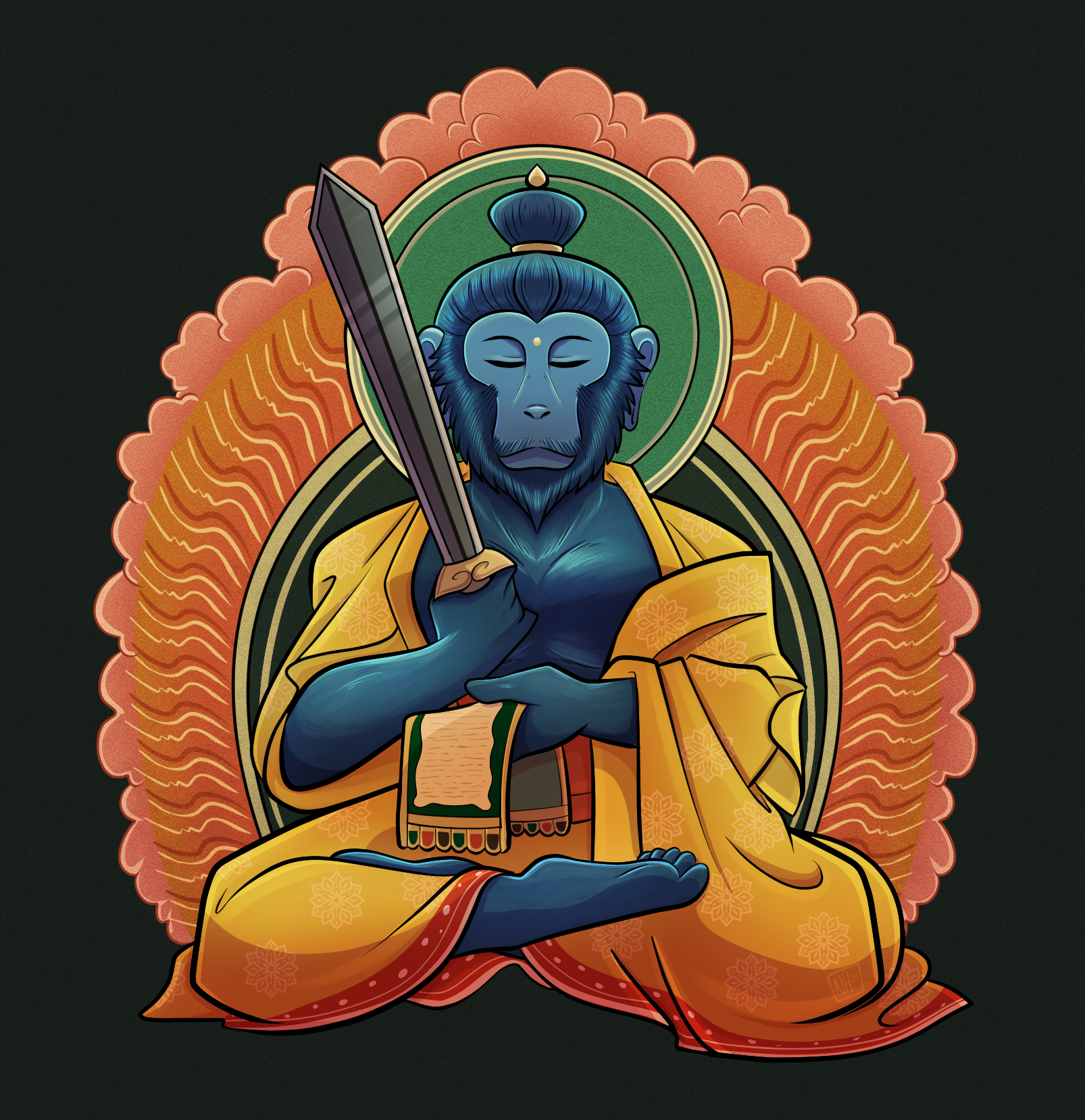
  19. Dou Zhansheng Fo (鬥戰勝佛, “Buddha Victorious in Strife or Victorious Fighting Buddha”) – His Buddha title bestowed by the Tathagata at the end of the journey in chapter 100 (fig. 2) (Wu & Yu, 2012, vol. 4, p. 381).

Fig. 2 – A religiously accurate drawing of Monkey as Dou zhansheng fo by NinjaHaku21 (larger version).

III. Self-Named

These are names, titles, or pseudonyms taken by Monkey himself. These do not include the names of the innumerable gods, monsters, or humans that he disguises himself as. They only refer to him personally.

  1. Huaguo Shan Ziyun Dong Bawan Siqian Tongtou Tie’e Mihou Wang (花果山紫雲洞八萬四千銅頭鐵額獼猴王, “Bronze-Headed, Iron-Browed King of the Eighty-Four Thousand Monkeys of the Purple Cloud Grotto on the Mountain of Flowers and Fruit”) – How he introduces himself to Tripitaka in the 13th-century JTTW (Wivell, 1994, p. 1182). The “Monkey King” (Mihou Wang, 獼猴王) portion of this name carried over to the 1592 edition but was represented with different Chinese characters. See nos. 2 and 3 below. This article discusses the term mihou (獼猴).
  2. Meihou Wang (美猴王, “Handsome Monkey King“) – The title that he takes upon ascending the throne in chapter one (Wu & Yu, 2012, vol. 1, p. 106).
  3. Hou Wang (猴王, “Monkey King”) – He is more commonly referred to by this name than Meihou wang. [7]
  4. Huaguo Shan Shuilian Dong Dongzhu (花果山水簾洞洞主, “Lord of the Water-Curtain Cave in the Mountain of Flowers and Fruit”) – How he introduces himself in chapter two to a demon king plaguing his people (Wu & Yu, 2012, vol. 1, p. 127).
  5. Huaguo Shan Shuilian Dong Tiansheng Shenren (花果山水簾洞天生聖人, “Heaven-Born Sage From the Water-Curtain Cave in the Mountain of Flowers and Fruit”) – How he introduces himself to the Ten Kings of Hell in chapter three (Wu & Yu, 2012, vol. 1, p. 140).
  6. Lao Sun (老孫, “Old Sun”) – A term that he uses many, many times throughout the novel. Yu (Wu & Yu, 2012) translates this as “Old Monkey” (vol. 1, p. 128, for example).
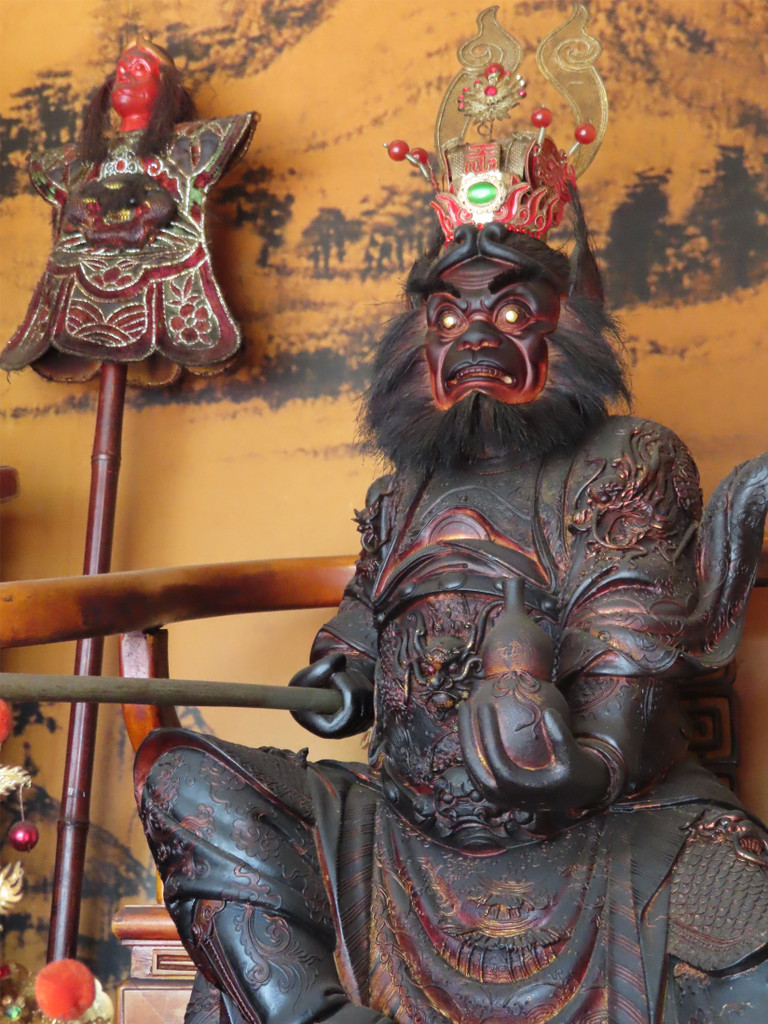
  7. Qitian Dasheng (齊天大聖, “Great Sage Equaling Heaven”) – The seditious title that he takes during his rebellion against heaven (Wu & Yu, 2012, vol. 1, p. 151). Monkey is worshiped by this name in modern Chinese Folk Religion (fig. 3). Refer back to sec. II, no. 2.
  8. Dasheng (大聖, “Great Sage”) – He is more commonly referred to by this title than Qitian dasheng. [8] Variations include Dasheng Yeye (大聖爺爺, “[Paternal] Grandpa Great Sage”) and Sun Dasheng (孫大聖, “Great Sage Sun”). Refer back to sec. II, no. 2.
  9. Zhexing Sun (者行孫, “Grimpil Sun”) – A pseudonym taken in chapter 34 when Monkey secretly escapes imprisonment and then presents himself as his own brother in an attempt to trick demons (Wu & Yu, 2012, vol. 1, p. 130). The strange English rendering is Yu’s (Wu & Yu, 2012) way of accounting for the change from Xingzhe Sun (孫, “Pilgrim Sun”) to Zhexing Sun (孫, “Grimpil Sun”). Refer back to sec. II, no. 12.
  10. Sun Waigong (孫外公, “([Maternal] Grandpa Sun”) – A name that he uses to taunt demons (Wu & Yu, 2012, vol. 1, p. 407, for example). It’s a cheeky way of saying, “I’m your elder, so you better submit to me.”
  11. Sun Yeye (孫爺爺, “([Paternal] Grandpa Sun”) – Same.
  12. Sun Erguan (孫二官, “Second Master Sun”) – A pseudonym taken in chapter 84 in order to investigate an anti-Buddhist kingdom under the guise of a horse trader. The other pilgrims take similar names (Wu & Yu, 2012, vol. 4, p. 132).

Fig. 3 – A Great Sage idol from Shengfo Tang (聖佛堂, “Sage Buddha Hall”) in Beigang Township, Yunlin County, Taiwan (larger version). It is one of many Monkey King Temples on the island. Photo by the author.


Update: 10-28-24

Someone on reddit questioned why I didn’t add a title for Monkey as the “Protector of the Peaches” or “Guardian of the Heavenly Peach Garden” (as mentioned by Wikipedia). This is how I responded:

This is what the novel says:

“We perceive,” said the Jade Emperor, “that your life is quite indolent, since you have nothing to do, and we have decided therefore to give you an assignment. You will temporarily take care of the Garden of Immortal Peaches. Be careful and diligent, morning and evening” (Wu & Yu, 2012, vol. 1, p. 160).

玉帝道:「朕見你身閑無事,與你件執事:你且權管那蟠桃園,早晚好生在意。」

The phrase “care for the Immortal Peach garden” (管蟠桃園) appears four times. But there is no official title for the position.


Update: 07-26-25

In section one, no. 6, I listed the title Taiyi Jinxian (太乙金仙, “Golden Immortal of the Great Monad”). However, this is only part of the term. The full title is “Golden Immortal of the Great Monad Atop the Primordial Breath of the Chaotic Origin” (Hunyuan yiqi shangfang taiyi jinxian, 混元一氣上方太乙金仙). “Atop the Primordial Breath … ” likely refers to the pristine, original energy of the universe that all Daoists wish to return to. Therefore, I believe this refers to his level of spiritual attainment—think of it in terms of cultivation literature—which is separate from his actual heavenly rank.

Notes:

1) The Jinxian (金仙) of Monkey’s title Taiyi Jinxian (太乙金仙, “Golden Immortal of the Great Monad”) is associated with far more lofty figures. For example, a poem in chapter one refers to the Patriarch Subodhi as the Dajue Jinxian (大覺金仙, “Golden Immortal of Great Awareness”) (see section 2.3 here).

2) I’m placing the name in this category because the Tathagata is stating a fact instead of bestowing it as a proper name.

3) Yu (Wu & Yu, 2012) translates this as the “macaque hard to distinguish” (vol. 4, p. 360). But I think that the original Chinese term is likely referring to both Sun and Six Ears. Their battle across the cosmos is counted in chapter 99 as the 46th of 81 hardships that Tripitaka was fated to endure (Wu &Yu, 2012, vol. 4, p. 360).

4) Wivell (1994) translates the name as “Great Sage of Bronze Muscles and Iron Bones” (p. 1207). But the gang (鋼) of Gangjin tiegu dasheng (鋼筋鐵骨大聖) means “steel.”

5) This references the homophonous term Bimawen (避馬瘟, “avoid the horse plague”), the historical practice of placing monkeys in horse stables to ward off equine sickness (see the 02-26-22 update here).

6) The term Xingzhe (行者, “pilgrim”) appears 4,355 times, while Sun xingzhe and Sun Wukong appear 239 and 127 times, respectively. Xingzhe is used numerous times to refer to other characters, such as Guanyin’s disciple Hui’an (惠岸行者, 6 times; a.k.a. Mucha or Mokṣa, 木叉行者, 9 times), but the vast majority refer to Monkey.

7) The term Hou wang (猴王, “Monkey King”) appears 185 times, while Meihou wang (美猴王) appears 42 times.

8) The term Dasheng (大聖, “Great Sage”) appears 1,273 times, while Qitian dasheng (齊天大聖) appears 103 times. I believe Dasheng is also used to refer to the Buddha a few times, so please keep this in mind.

Sources:

Wivell, C.S. (1994). The Story of How the Monk Tripitaka of the Great Country of T’ang Brought Back the Sūtras. In V. Mair (Ed.), The Columbia Anthology of Traditional Chinese Literature (pp. 1181-1207). New York: Columbia University Press.

Wu, C., & Yu, A. C. (2012). The Journey to the West (Vols. 1-4) (Rev. ed.). Chicago, Illinois: University of Chicago Press.