Review of Marvel Comics’ Sun Wukong

There have been a number of Monkey King adaptations in mainstream and indie Western comic books over the decades. I’ve been aware of Marvel Comics’ Sun Wukong for a number of years now, but I feel compelled to finally write something after having reviewed DC Comics’ Monkey Prince. Sun’s tale is laid out in several publications, including four tie-ins from the “Fear Itself” (2011) crossover event, four issues of Avengers World (2014-2015), one tie-in from the “Secret Empire” (2017) crossover, and two tie-ins from the “War of the Realms” (2019) event. Sun’s story arc follows him from a greedy crime lord to a heroic demigod who sacrifices his life in an attempt to help save the world. He is comparable to Shazam (a.k.a. Captain Marvel) as he gains his abilities via divine empowerment.

Sun appears as a minor character in several disparate storylines. It would take way too long to summarize each narrative here, so I will only be discussing the events in which he appears. However, the linked articles and notes below should help the uninitiated get up to speed.

A more accurate, cartoonish version of Sun Wukong appears in two issues of Tarot: Avengers/Defenders (2020) (Davis, 2020a; 2020b). But I won’t be covering that depiction here as it is separate from the aforementioned superhero.

Table of Contents

1. Character Arc

1.1. Iron Man 2.0 #5-7 (2011)

Sun’s story opens in the Eighth City, a hellish dimension that serves as a prison for the evils of the Seven Capital Cities of Heaven. [1] He is first seen enjoying a meal meant for the winner of a demonic fighting tournament. When challenged by the intended recipient and his henchmen, Sun leaps from a tall rampart and soundly beats the monstrous gang, all while touting his superiority based on the pedigree of his magic staff (which can separate into three sections) and past deeds as the historical Monkey King (fig. 1). But this triumphant moment is disturbed when one of the “Seven Hammers of the Worthy” punches through the heart of Beijing, China and breaches the dimensional barrier separating hell from earth, thus allowing demons to spill into the human world. [2] Sun attempts to retrieve the weapon but can’t lift it (similar to the enchantment on Thor’s hammer) as he isn’t the intended wielder (Spencer, 2011a).

The third Worthy, “Skirn: Breaker of Men” (Titania), leads the Absorbing Man to hell so he can become the next Worthy. But Sun greedily boasts that the hammer is his property, along with everything else he sees, much to her annoyance. Skirn then attacks the “little thief” and incapacitates him with a blow of her hammer (Spencer, 2011b, p. 14). Moments later, the Immortal Weapons and War Machine happen upon the scene while attempting to close the dimensional rift. However, despite a brief struggle, they too fall to Skirn’s mighty power, allowing the Absorbing Man to become the sixth Worthy, “Greithoth: Breaker of Wills” (Spencer, 2011b).

When the earthly heroes recover from the attack, they awaken to find Sun standing over them with his staff. The Monkey King bemoans the loss of his hammer and claims that the two Worthies have run away from his martial might. But before turning to leave, he acknowledges the Immortal Weapons as heroes, while also noting a dark aura surrounding one of them, the Immortal Iron Fist (Spencer, 2011c).

Fig. 1 – Sun beating up the winner of the demonic fighting tournament (larger version). Art by Ariel Olivetti. From Spencer, 2011a, p. 8. Copyright Marvel Comics.

1.2. Fear Itself: The Monkey King (2011)

Sun’s eponymous tie-in issue opens on the story of the Buddha‘s wager that the historical Monkey King cannot leap clear of his palm. The imp takes up the challenge by flying a thousand miles across the sky until he reaches a set of five stone pillars. But when Sun returns to gloat, he soon realizes it was all an illusion and that he had never actually left the Enlightened One’s palm. The Buddha then clamps his hand shut, trapping Monkey inside (Fialkov, 2011, pp. 3-4).

Flashforward to present day Beijing: the modern Monkey King reminisces about his origins while fighting his way through a villain’s army of henchmen and women. Fifteen years ago, our hero was a greedy crime lord who referred to himself as and affected the persona of the Monkey King. After a brief fight over poker, the rival crime lord “Lion” attempts to appease Sun by bringing him to a cave in the Wudang Mountains. Sun initially shows no interest, but after his companion reveals it to be the “final resting place of the REAL Monkey King” and his magic staff (Fialkov, 2011, p. 10), the crime lord immediately stakes his claim on the cavern like a selfish child. Lion then plays on his ego by saying that he’s probably not skilled enough to bypass the booby traps protecting the weapon, which lies just inside the cave mouth. Sun answers the challenge by leaping in headfirst, deftly avoiding projectiles with gymnastic grace, and taking possession of the polearm. But this was all a part of Lion’s plan; the rival crime lord activates a button hidden in the rock face, causing the ground beneath Sun to literally engulf him like an octopus attacking prey (Fialkov, 2011, pp. 4-14).

He falls into a deep chasm where he’s confronted by a titanic apparition of the historical Monkey King. The simian god admonishes Sun for stealing the staff but grudgingly admits his abilities: “Only the greatest thief who walks the earth could actually hold onto my dearest Ruyi Jingu Bang” (Fialkov, 2011, p. 14). So the Monkey King presents him with a wager: If he has a clean soul, he’ll receive freedom and the deity’s staff and powers to do with however he wishes; but if he has an unclean soul, he’ll be damned to an eternity in the Eighth City. After agreeing to the bet, the crime lord naturally finds himself banished to the hellish realm, but (for some reason) he still gets the powers and staff, as well as (for some reason) a heroic costume. The narrative then briefly recaps his confrontation with Skirn and the Absorbing Man and eventual escape via the dimensional rift, before circling back to present day (Fialkov, 2011, pp. 14-15).

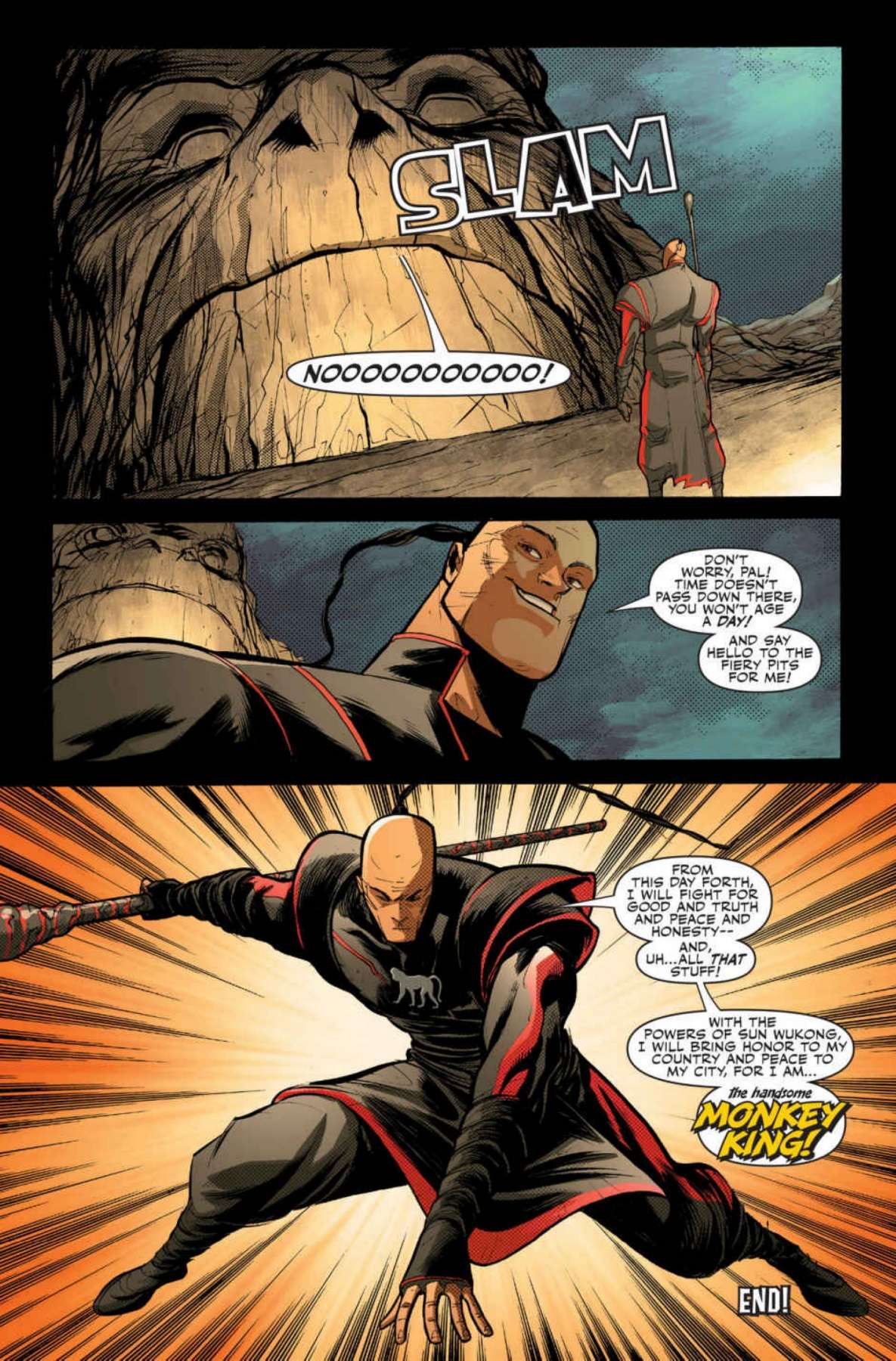
Sun finally confronts the sought-after villain, who turns out to be Lion. He magically transports him to the same cave mouth and reveals how he survived by gaining the Monkey King’s powers and memories, as well as how his time in the Eighth City led him to repent his criminal past. Sun ultimately punishes Lion to a similar fate by tossing him into the hell realm (Fialkov, 2011, pp. 16-22). The issue ends with Sun standing in a heroic pose and exclaiming: “From this day forth, I will fight for good and truth and peace and honesty … and, uh … all that stuff! With the powers of Sun Wukong, I will bring honor to my country and peace to my city, for I am… the handsome Monkey King!” (fig. 2) (Fialkov, 2011, p. 22).

Fig. 2 – Sun Wukong’s heroic pose (larger version). Art by Juan Doe. From Fialkov, 2011, p. 22. Copyright Marvel Comics.

1.3. Avengers World #7, 10, 13, and 14 (2014)

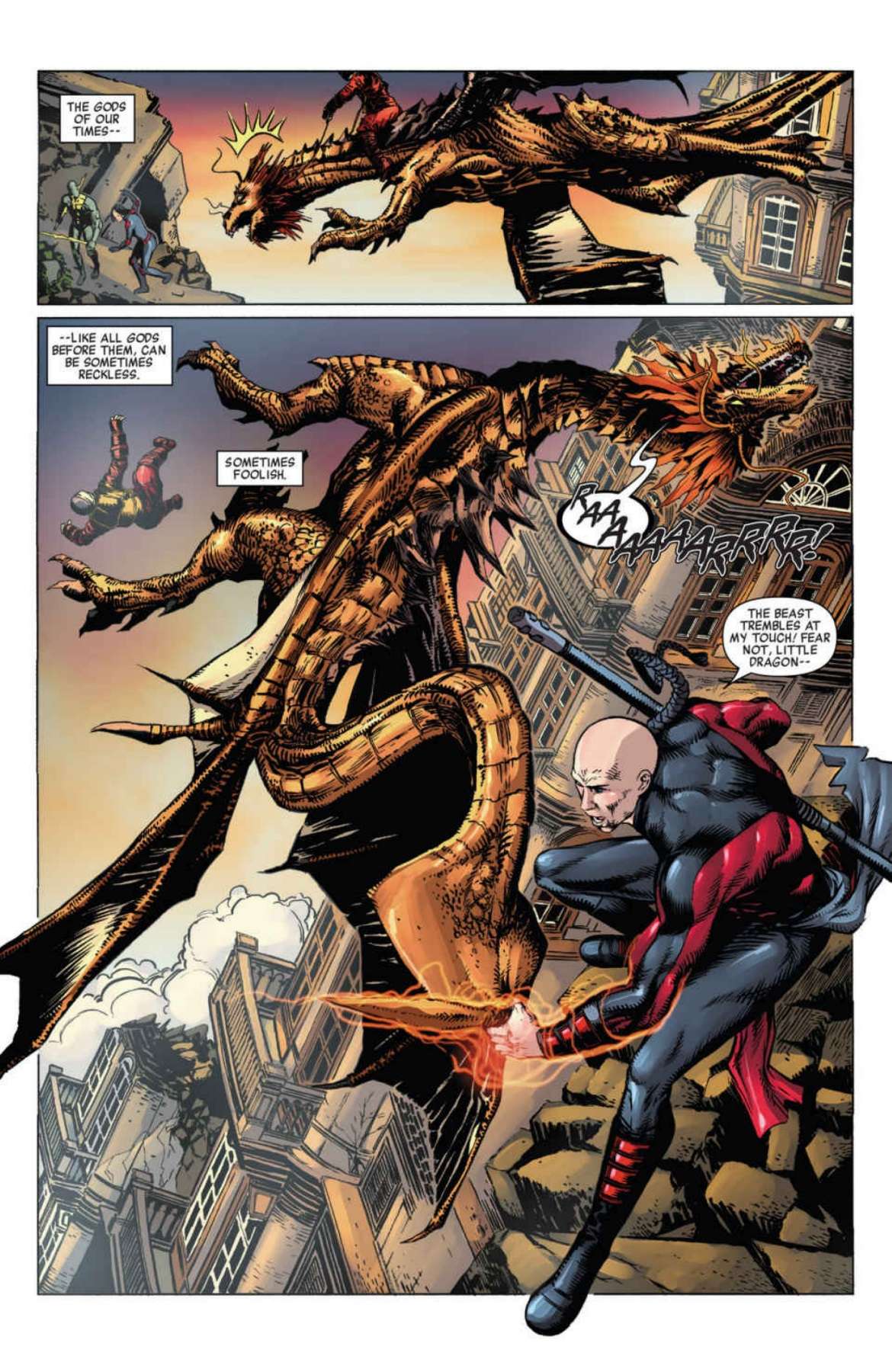
Sun next appears as a member of the newly-minted Chinese superhero team, the Ascendants, led by the Weather Witch. S.P.E.A.R. deploys the team to reinforce the Avengers as they fight to protect Hong Kong against the attack of an island-sized dragon controlled by the villain Gorgon (Spencer, 2014/2019a). [3] Instead of being a lone wolf, Sun is shown working in tandem with the team (Spencer, 2014/2019a, pp. 156 and 159; 2014/2019b, p. 211; 2019c, pp. 277-278). During their battle, he single-handedly stops one of many vehicle-sized dragons, thrashes it to the left and right, and finally throws it into a building (fig. 3) (Spencer, 2014/2019c, pp. 274-275). A flashback reveals that the Weather Witch had hand-picked Sun, who joined the superhero team only on the promise of adventure (Spencer, 2014/2019c, p. 276). [4]

Fig. 3 – Sun stops the dragon with a single hand (larger version). Art by Raffaele Ienco (lines) and Andres Mossa (color). From Spencer, 2014/2019c, p. 274. Copyright Marvel Comics.

1.4. Captain America: Steve Rogers #18 (2017)

A flashback shows Sun (for some reason) crouching on a glowing hover disc while he and the Ascendants prepare themselves to repel an on-coming attack of their airborne base by Hydra ships in southern China (fig. 4) (Spencer & Cates, 2017, p. 15). This happens during a worldwide pushback against Hydra’s attempt at global domination (Spencer & Cates, 2017).

Fig. 4 – Sun standing on the glowing hover disc alongside the Ascendants (larger version). Art by Javier Pina/Andres Guinaldo (lines) and Rachelle Rosenberg (color). Copyright Marvel Comics.

1.5. War Of The Realms: New Agents Of Atlas #3 and 4 (2019)

Sun appears as one of three Asian superheroes giving updates to Amadeus Cho about their respective efforts in Tokyo, Manila, and Beijing to battle the armies of the fire giantess Sindr, who has claimed Asia as her new empire. He reports that the Ascendants will protect Beijing, while he plans to attack her fire soldiers in northern China (Pak, 2019a, pp. 5-6). But when Cho asks him to wait for his team, the New Agents of Atlas, Sun snaps at him, noting that the situation requires godly powers. Cho then assures him that he has a plan involving their resident goddess, Pele (Pak, 2019a, pp. 6).

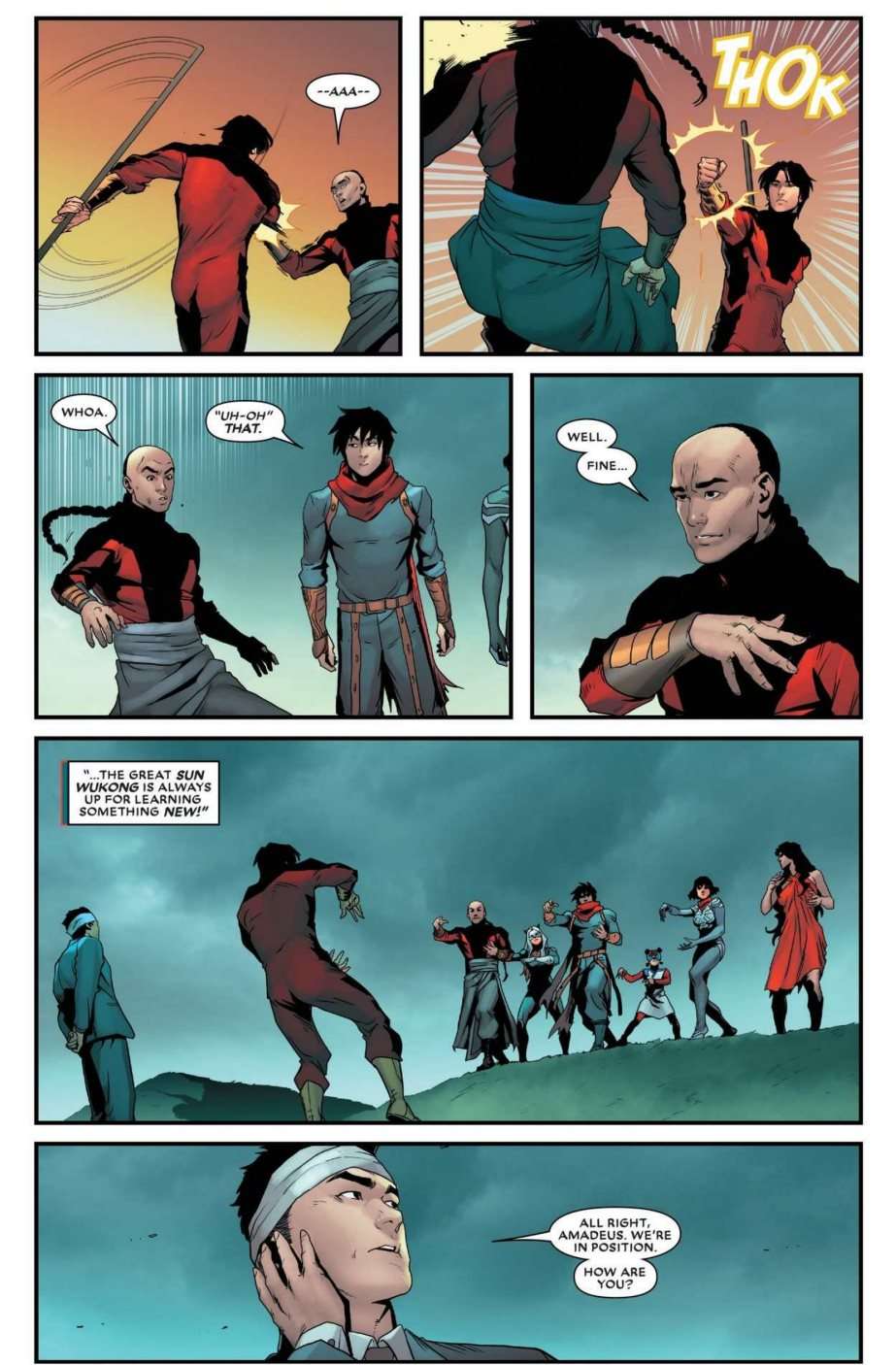
Sun next appears (for some reason) on horseback in northern China where he meets with the New Agents of Atlas. The head of Atlas asks Shang Chi to give the group a crash course in martial arts ahead of their battle. But when Sun scoffs at the idea of taking directions from a mortal, Shang Chi proves his skill by effortlessly disarming him of his staff and knocking him back with a punch to the chest (Pak, 2019a, pp. 20-21). Thus humbled, the Monkey King accepts this as a learning opportunity: “The Great Sun Wukong is always up for learning something new” (Pak, 2019a, pp. 21).

Sun is among the vanguards who lead the charge against Sindr when she arrives in northern China, but even he is beaten back by her power (Pak, 2019a, pp. 8-9). However, after a brief confrontation with Pele, who turns out to be a robot designed to battle magic beings, a large portion of Sindr’s mystical energy is drained, leaving her open to attack. Sun takes this as an opportunity to sacrifice his life so that the New Agents of Atlas have a better chance of defeating her. He leaps into the air and stabs her in the back with his staff before succumbing to the intense heat of her flames (Pak, 2019b, pp. 13-15). His last words are: “Behold, the Great Monkey King, Sun Wukong! I’ll save this world … And I’ll see you in the next! Ha ha ha ha ha ha ha ha!” (fig. 5) (Pak, 2019b, p. 14).

Fig. 5 – Sun’s death scene (larger version). Art by Gang Huk Lim/Moy R./Pop Mhan (lines) and Federico Blee/Andres Mossa (colors). From Pak, 2019b, p. 14. Copyright Marvel Comics.

2. References to Journey to the West

During Sun’s battle with the demonic gladiators in the Eighth City, he refers to his staff as an ocean-calming pillar and recalls his past adventures, including stealing immortal peaches and wine from heaven, stealing his name from the books of life and death, and acquiring a feathered cap from the Dragon Kings of the four oceans (Spencer, 2011a, pp. 7-8). All of these are mentioned in one form or another in the novel, [5] but I must make a few corrections. Instead of Sun stealing his name from the infernal legers, he crosses it out with ink (Wu & Yu, 2012, vol. 1, p. 141). And instead of “defeat[ing] the Four Dragon Kings” to acquire the feather cap (Spencer, 2011a, p. 8), he simply threatens to beat one of them up (Wu & Yu, 2012, vol. 1, p. 136). Also, the cap is only one part of a set of golden armor and boots that he strong-arms from the royal brothers (Wu & Yu, 2012, vol. 1, pp. 136-137).

The Buddha’s wager with the Monkey King recalls the exact event from chapter seven. But instead of trapping the imp in his hand, the Enlightened One transforms the appendage into Five Elements Mountain and imprisons Sun Wukong beneath it.

Sun transforms into a hawk (Spencer, 2011a, p. 5; Fialkov, 2011, p. 18), a gecko (Fialkov, 2011, p. 6), and a lion (Fialkov, 2011, p. 17) in the early part of his story. This recalls Monkey’s famous 72 transformations, which are best exhibited during his battle with Erlang in chapter six (video 1) (Wu & Yu, 2012, vol. 1, pp. 182-184).

Video 1 – The magic battle of transformations between Sun and Erlang. From the 1960s classic Havoc in Heaven.

3. Problems with the Writing and Art

As I previously stated in my review of DC Comics’ Monkey Prince, an adaptation of Journey to the West, or in this case the Monkey King, has to be super accurate or just different enough for me to find it fresh and interesting. This adaptation is neither accurate nor uniquely different. Sun Wukong has simply been grafted onto a modern, human superhero and in the worst possible way. He is depicted as a Chinese man wearing the queue (bianzi, 辮子) hairstyle, a cleanly shaven scalp adorned with a long braid hanging from the crown (refer back to fig. 3). I get the distinct feeling that Sun’s creators, (writer) Nick Spencer and (artist) Ariel Olivetti, were influenced by Hong Kong wire-fu media of the 1990s in which heroic martial artists, played by the likes of Jet Li and Donnie Yen, sported the queue while fighting injustice. So in that sense, the character could be considered an homage to cinematic folk heroes like Wong Fei-hung and Hung Hei-gun. But the problem is that the creators clearly didn’t take note of the hairstyle’s historical context. Such films are set during the foreign-ruled Qing dynasty (1644–1912).

Historically the Manchu forced their traditional hairstyle on the Chinese as a sign of subjugation after conquering the Middle Kingdom in the mid-17th century. The Chinese resisted, not because of the braid—long hair was after all a Chinese fashion—but because of the requirement to shave the scalp. Those who refused were put to death (Godley, 2011). The disgust for this style was perfectly summed up by leaders of the Taiping Rebellion in 1853:

The Chinese have Chinese characteristics; but now the Manchus have ordered us to shave the hair around the head leaving a long tail behind, thus making the Chinese appear to be brute animals … You are all Chinese people; how can you be so stupid as to cut your hair and follow the demons? (Godley, 2011).

Students and laborers who traveled abroad were still required to wear the queue up into the early 20th century. But by then the hairstyle had already become antiquated on the world stage (Godley, 2011). For example, writing in 1903, the nationalist Zou Rong lamented:

When a man with a queue and wearing Manchu clothes loiters about in London, why do all the passers-by say “Pig-tail” or “savage”? And if he loiters about in Tokyo, why do all the passers-by say “Chanchanbotsu” [slave with a tail]? (Tsou & Lust, 1968, p. 79; cf Godley, 2011).

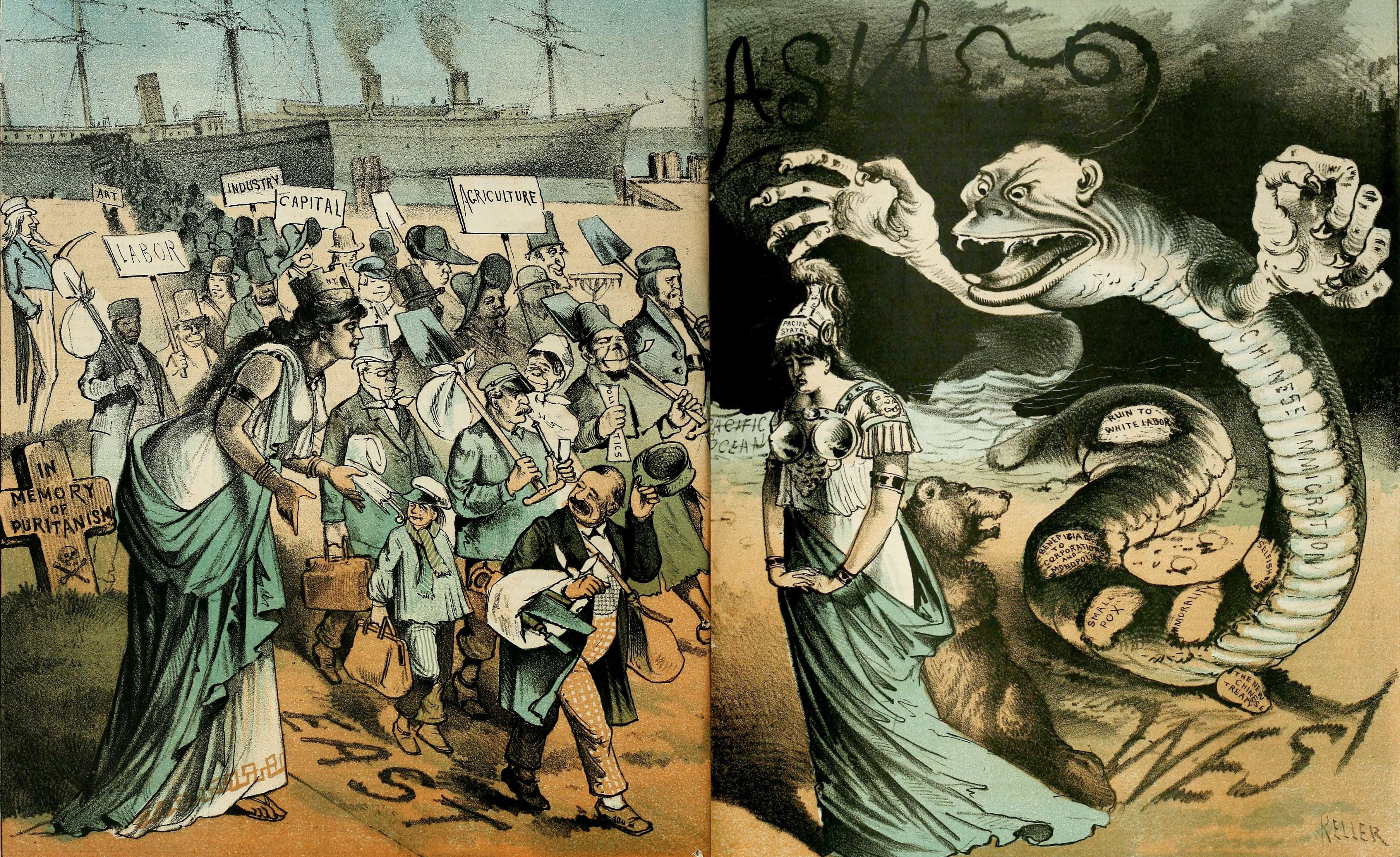
This antipathy for braid-wearing Chinese had already for decades been mirrored in Western “Yellow Peril” propaganda of the late 19th century. For instance, “Immigration East and West” (1881) (fig. 6), a two-page political cartoon by George Frederick Keller, depicts the concept of “Chinese Immigration” as a monstrous serpent arriving in the “West” (western US) with fangs bared and large, clawed hands threatening to attack a defeated-looking Lady Liberty [6] and a cowering California Grizzly. The serpent’s queue whips in the air overhead next to the word “Asia,” and spots on its body are labeled with afflictions such as “immorality,” “smallpox,” and “ruin to white labor” (Bierce, 1881, p. 173), symbolizing the then prominent fear that the Chinese would overrun the United States with cheap labor and diseases (Lyman, 2000). This is in contrast to the adjoining image, which depicts Lady Liberty [7] welcoming throngs of bustling European immigrants to the “East” (eastern US), who bring with them virtues such as “art,” “labor,” and “agriculture” (Bierce, 1881, p. 172).

So the hairstyle was originally a sign of subjugation forced on the Chinese by foreign rulers under penalty of death. And it later served as a symbol for racist, economic-based fears of Chinese immigration in the West. Therefore, I feel confident in saying that depicting Sun Wukong with a queue was not a well-thought-out idea. In fact, this lack of forethought is indicative of the lazy writing that plagues the rest of the Monkey King’s character arc.

Fig. 6 – “Immigration East and West” (1881) (larger version). It first appeared in volume seven of The Wasp (Bierce, 1881, pp. 172-173), a satirical magazine from San Francisco, California, USA.

Fear Itself: The Monkey King (2011) is the worst perpetrator of this lackadaisical approach. For starters, how did Lion and Sun travel to the Wudang Mountains, and why are they still wearing their everyday street clothes instead of thick coats and hiking boots? How does Lion even know the location of this ancient cave, and why does he alone know it’s the final resting place of the historical Monkey King? Shouldn’t this be a well-guarded secret only known to a select few? This is even more puzzling considering that in Journey to the West, Sun Wukong retires to the Buddha’s Western Paradise in India (Wu & Yu, vol. 4, pp. 381-383), so why would he resettle in China? How does Lion know about the trigger hidden in the rock face, and why does he know that the ground will engulf Sun? Why is the Monkey King’s magic staff just sitting out in the open, and how does Sun effortlessly pick it up despite weighing 17,560 lbs. (7,965 kg) in the novel? [8] Sure, the historical Monkey King says, “Only the greatest thief who walks the earth” can hold the weapon (Fialkov, 2011, p. 14). But why is that even a requirement, especially when he ends up sentencing the crime lord to hell for having an unclean soul? Why does Monkey give him the powers and the staff even after judging him to be unworthy? Why does he give him a superhero costume upon sending him to hell? Where does the modern Monkey King get the different superhero costume upon escaping from hell? None of this is answered. This is just frustratingly lazy writing by Joshua Hale Fialkov.

Oh, and the lazy streak continues. Sun Wukong’s ability to fly on clouds from the novel is briefly alluded to in Fear Itself: The Monkey King (Fialkov, 2011, p. 4). But this power is completely forgotten in the very same issue, for the modern hero has to magically transform into a hawk in order to fly (Fialkov, 2011, p. 18; see also Spencer, 2011a, p. 5). In addition, this avian transformation is also forgotten in later appearances, for Sun is shown standing on a glowing hover disc in Captain America: Steve Rogers #18 (2017) (Spencer & Cates, 2017, p. 15). And War Of The Realms: New Agents Of Atlas #3 (2019) depicts him traveling northern China on horseback (Pak, 2019a, pp. 19). Furthermore, the storyline seems to forget that the character has super strength. In Avengers World #13 (2014) he’s capable of stopping a dragon with a single hand (refer back to fig. 3) (Spencer, 2014/2019c, pp. 274-275), but in War Of The Realms: New Agents Of Atlas #3 Shangi Chi, who does not have super strength, easily snatches away his staff (fig. 7 & 8) (Pak, 2019a, pp. 20-21). Ugh.

Fig. 7 – Shang Chi grabs Sun’s staff (larger version). Fig. 8 – Shang simultaneously disarms Sun and punches him (larger version). Art by Gang Huk Lim (lines) and Federico Blee/Andres Mossa/Erick Arciniega (colors). Copyright Marvel Comics.

Beyond the laziness, another problem with the writing is Sun’s negative characterization. He comes off as a boastful, greedy, and thoroughly unlikable person. For example, upon learning that the cave is the final resting place of the historical Monkey King, the crime lord says: “First off, this cave is totally mine now. Second off, I’m going to kill you [Lion] at least six times for wasting my time” (Fialkov, 2011, p. 10). This sour attitude leads me to believe that he was never intended to be a top-tier superhero. In fact, I dare say that he was designed as a throwaway character. His quick, pointless death is the “smoking gun.” Sun isn’t given a chance to evolve as a character—i.e. a series of stories following him as the main protagonist in which he reflects on his flaws and strives to be a better person—and there’s no prolonged battle with a running internal monologue in which he deems his sacrifice a necessary outcome. He just blindly rushes to an empty death that serves no purpose as the fire giantess Sindr continues to fight even after the hero goes up in smoke. [9] And in the end, even the act of sacrificing himself is tainted by greed. Before leaping onto the fire giantess’ back, Sun exclaims: “[I]f a real goddess were around [referring to the destruction of the Pele robot], I might not get my chance at glory” (Pak, 2019b, p. 14). So, he doesn’t give his life for the welfare of the team or to save the Earth but to steal the spotlight.

Next, there are several instances where Sun touts his abilities or fame and subsequently gets knocked off his pedestal, making him the butt of a joke. First, he boasts of his fighting skill but is easily defeated by Skirn, and after she and her companion leave, he claims: “They … ran away like cowardly, lying dogs. I begged them to stay and fight, but they knew better” (Spencer, 2011c, p. 4). This reads less like Sun Wukong and more like a delusional person. Second, he trumpets his fame as the Monkey King, stating everyone knows his name, but Iron Fist comically shrugs his shoulders in confusion (Spencer, 2011c, p. 4). However, given Iron Fist’s training in K’un-lun (a magic city in China) and Sun Wukong’s centuries-long popularity throughout Asia, [10] this makes as much sense as someone in Metropolis saying they’ve never heard of Superman. Third, Sun continually flaunts his godly powers and looks down on mortals, but as noted before, Shang Chi takes away his weapon (Pak, 2019a, pp. 20-21). This slap to his ego is preceded by the head of S.P.E.A.R. telling Sun, “[A]ll your magic won’t be enough … without training” (Pak, 2019a, p. 20), suggesting that the hero relies solely on the mystical arts. But this doesn’t make any sense considering that he’s shown to be a capable fighter in previous issues (refer back to fig. 1) (Spencer, 2011a, pp. 6-9, for example), not to mention the fact that in Journey to the West, the Monkey King is depicted as a master of unarmed boxing.

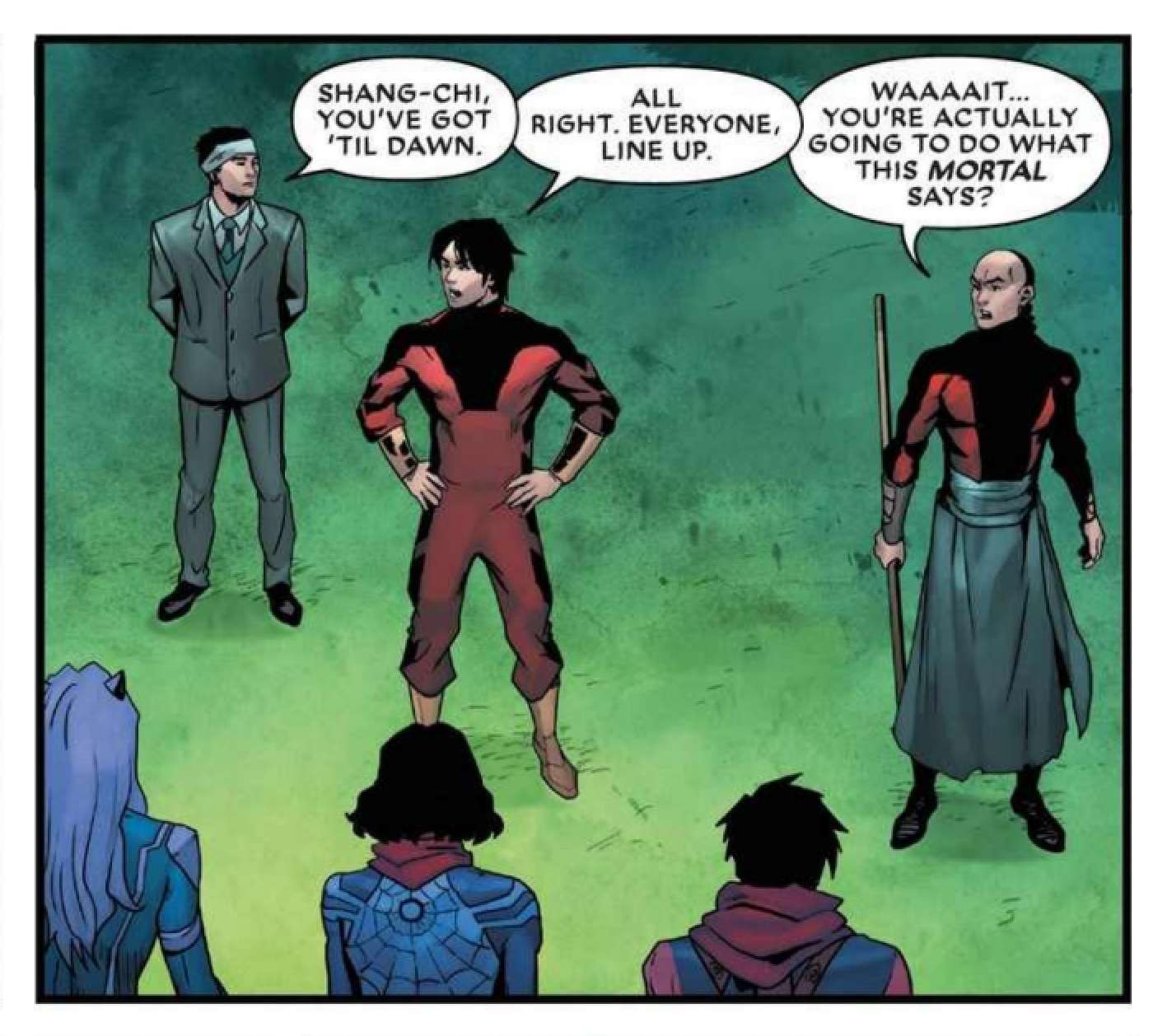
The art throughout Sun’s character arc ranges from the divine (Ariel Olivetti) to the demonic (Juan Doe). But here I’d like to focus on the Character design. Beyond the problematic queue, the costume first appearing in Iron Man 2.0 #5 (2011) isn’t bad, it just doesn’t suit the character. Nothing about it says “Monkey King.” Sun is depicted wearing a form-fitting red top with black accent lines on his chest, back, and arms; grey gauntlets with three golden stripes; a black sash belt; a gray apron and baggy pants; and black boots (refer back to fig. 1). The lower half of his costume was likely influenced by period clothing from the aforementioned wire-fu films of the 90s. However, I do have a problem with Sun’s shirt. It is almost exactly the same as the upper half of Shang Chi’s body suit, which is also red with black accent lines on the chest, back, and arms. Shang also has gauntlets with three sections. The similarities are apparent when the characters share the same scene (fig. 9). The only difference is that Shang’s black accents don’t go all the way down his chest, and those on his arms break up into stacked arrows. I think it would have been a smarter move to differentiate the two.

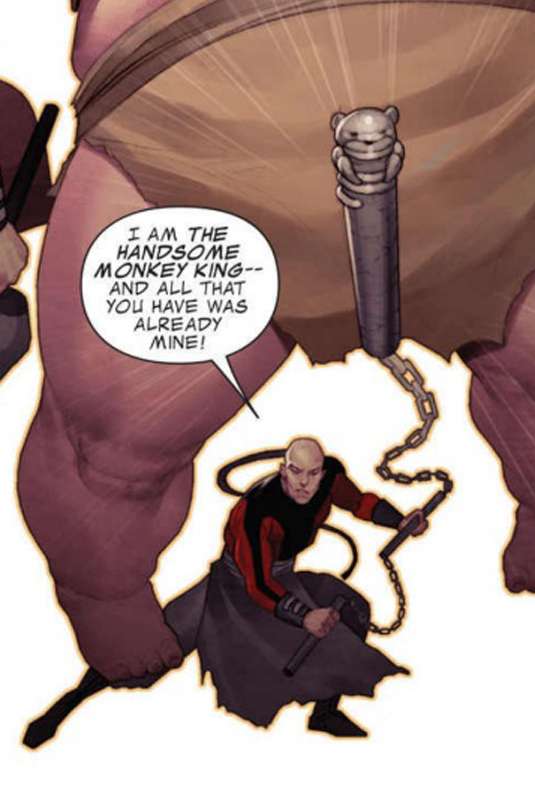
The only other critique I have for Olivetti’s design is the Monkey King’s staff. It is depicted as a gray metal bar with a strange finial. The tip features a cutesy, grinning monkey with half moon-shaped ears on a spherical head. A tail spirals down from the top like a corkscrew (fig. 10). It looks like something straight out of Hello Kitty, which obviously doesn’t fit the tone of the character or the comics he appears in. This simian ornament next appears in Fear Itself: The Monkey King but only on the cover (fig. 11). The finial within the issue looks more like the gnarled end of a red and black walking stick (Fialkov, 2011, p. 16, for example). Interestingly, the monkey isn’t present in Sun’s later comic book appearances.

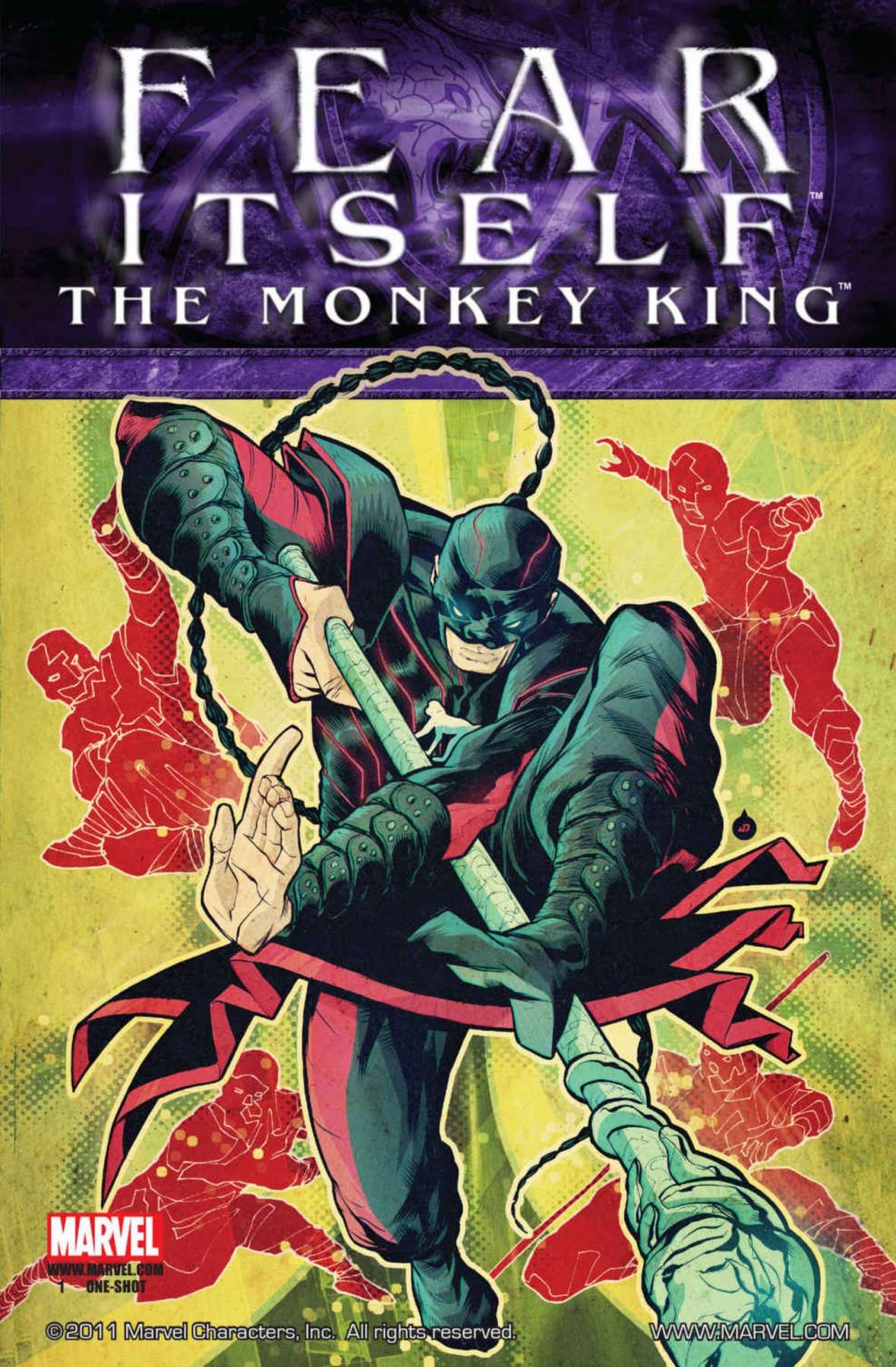
Lastly, the superhero costume appearing in Fear Itself: The Monkey King is terrible. It’s so bad, in fact, that it never appears again in another comic. The overall suit is black with red trim on the chest, arms, apron, and legs. The top features layered shoulder pads, a silver monkey symbol on the chest, and wrapped forearms. It totally looks like something a villain from the Mad Max franchise would wear. And to top it all off, Sun sports a black mask with a molded monkey nose on the front and a hole in the back to accommodate his queue braid (refer to fig. 11). This is another example where the costume just doesn’t suit the Monkey King concept. Juan Doe should have at least tried to mirror some of the elements from Sun Wukong’s literary armor.

Fig. 9 – The similarities between the costumes of Shang Chi and Sun (larger version). From Pak, 2019a, p. 20, panel #4. Fig. 10 – A detail of the monkey finial on Sun’s staff (larger version). From Spencer, 2011a, p. 8. Fig. 11 – The Cover of Fear Itself: The Monkey King (2011) (larger version). Art by Juan Doe. Copyright Marvel Comics.

4. My Rating

There are aspects of this character that differ wildly in quality, so I feel like I have to rate them separately. As I stated above, the costume designed by Olivetti isn’t bad, just not suitable for the character. I would give it 2.5 out of 5 stars. Having said that, everything else, especially Fialkov’s writing and Doe’s art, gets a hard 0 out of 5 stars. It’s painfully clear that no actual thought or research went into the Monkey King’s development or story beyond a lazy read of the Wikipedia article.

Before continuing, I feel I must apologize to Editor Jessica Chen, writer Gene Luen Yang, and artist Bernard Chang for being overly harsh in my previous review of DC’s Monkey Prince. They obviously put more effort into one 12-page story than went into all 11 comics from Marvel’s failed attempt.

5. What I Would Change

I would completely do away with the queue-wearing crime lord and replace him with a modern spirit-medium (Chinese: Jitong, 乩童; Hokkien: Tangki, 童乩; literally: “divining child”) from Chinese folk religion. Such individuals are believed to channel the spirit of the “Great Sage Equaling Heaven” (Qitian Dasheng, 齊天大聖), the celestial title of Sun Wukong. While inhabited by the monkey god, the spirit of the human host is believed to reside in heaven or some temple-based holy object (Chan, 2006, pp. 59-60; Graham, 2013, p. 330). Therefore, the person would be for all intents and purposes the Monkey King for the duration of the story. As a medium, the character wouldn’t wear a superhero costume. Instead, he would be bare-chested apart from a ritual stomacher (dudou, 肚兜) and a tri-panel dragon-tiger apron (longhu qun, 龍虎裙) over everyday pants and shoes (or no shoes). Such ritual attire is usually decorated with auspicious symbols and, sometimes, the Chinese name of the deity, in this case the Great Sage (fig. 12).

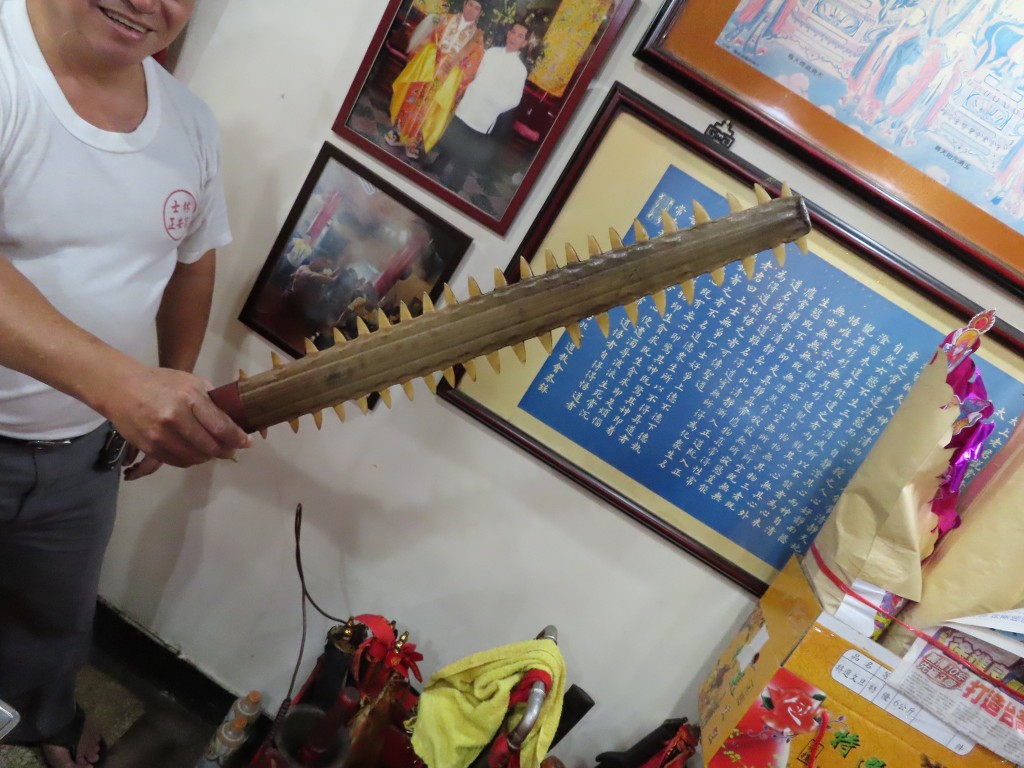
I would also like to make some changes that might seem weird for an adaptation of Sun Wukong. But I’m torn between pandering to the wants of comic book fans and my desire to portray an authentic East and Southeast Asian spirit-medium. The former would involve the character wielding the magic staff, but in the case of the latter, I’ve noticed that few mediums involve the polearm in their public performances. Those who do only use it to enhance the theater of their portrayal of the Great Sage. The weapon serves no ritual function. The latter would involve the character wielding the “Five Treasures of the Spirit-Medium” (jitong wubao, 乩童五寶), a set of ritual weapons consisting of a spiked ball on a rope, a spiked club, a sawfish nose sword, a crescent moon ax, and a double-edged sword engraved with seven stars (fig. 13) (Chan, 2006, p. 73). Mediums use these weapons during a ritual dance in which they inflict wounds on their body. This self-mortification is believed to serve two purposes. One, holy energy from the weapons help the medium prepare “for a particularly difficult battle” by “supercharg[ing] him with spirit power” (Chan, 2006, pp. 108-109). And two, the resulting holy blood—for it is considered the blood of the god, not the host—is believed to have demonifugic properties. It can be used to write paper sigils commanding heavenly forces to attack demonic spirits (Chan, 2006, p. 108). Now, I’ll admit that this would no doubt be off-putting to the average comic book reader, so herein lies the dilemma. The only compromise that I can think of would be to use them both but more so in one case and sparingly in the other. An enchanted brass pole, like those used by Great Sage mediums during performances (fig. 14 & 15), would be the character’s main weapon. But when he runs into trouble, he could summon the aforementioned treasures to “supercharge” himself, and if needed, he could draw blood in order to call on heavenly forces. This leads me to my next change.

Fig. 12 – An entranced spirit-medium wearing the stomacher and apron (larger version). Picture taken by the author in Tainan, Taiwan. Fig. 13 – The “Five Treasures of the Spirit-Medium” (larger version). Found on Facebook and slightly modified. Here, the original biological sawfish nose sword (photo by author) has been replaced by two modern, metal, single and double-edged versions. Fig. 14 – An example of a brass pole used by Great Sage mediums (larger version). Fig. 15 – A detail of joss paper and joss sticks attached to the pole (larger version). Pictures taken by the author in Jiayi, Taiwan.

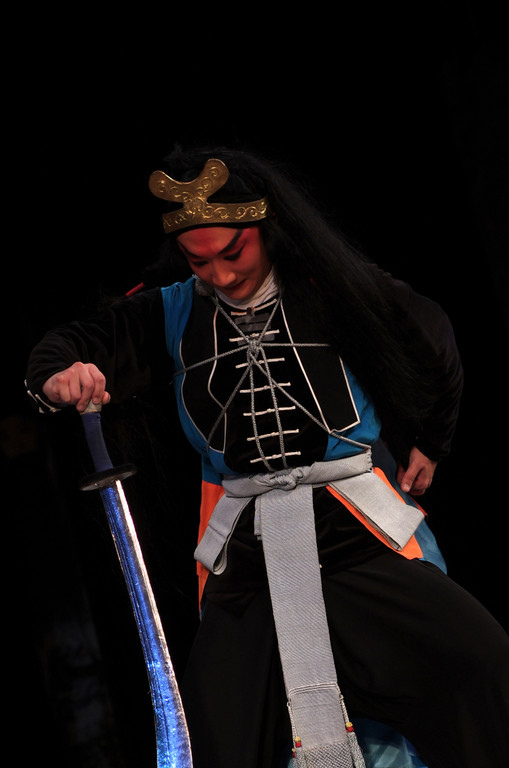
Despite the Monkey King’s immeasurable strength in Journey to the West, I wouldn’t want to make the character an unstoppable powerhouse like, say, the Sentry. I would instead make him moderately powerful for a few reasons. First, there’s no fun in an invincible hero who one-shots all his foes; there has to be some struggle in order to make the character more interesting and relatable. Second, spirit-mediums only protect their local community and, therefore, not an entire country or planet like more powerful characters. And third, there are many Great Sage spirit-mediums across East and Southeast Asia. What’s interesting about this concept is that each medium is believed by their respective communities to be the Great Sage. For example, one very small temple I visited in Taiwan has an astounding seven Great Sage mediums. This means that if a particularly nasty evil befalls the earth, an entire army of Great Sages, who in turn command their own heavenly forces, can be called on to deal with the villain! This would not only be authentic, but also reference Sun Wukong’s magic power of creating endless doubles of himself. [11] And the best part? The story could follow a series of different spirit-mediums in different countries, so the “character” wouldn’t be limited to a single person. The medium could be Chinese, Taiwanese, Malaysian, Singaporean, basically any person of Chinese descent who practices spirit-mediumship. And they can be young, old, and even female, too. That’s right, there are female Great Sage mediums! (video 2).

Video 2 – A female Great Sage medium in Chinese opera-inspired attire.

Notes:

1) A portal leading to this hell realm was first discovered centuries ago by inhabitants of the hidden city of K’un-lun. The Immortal Weapons of old were tasked with rounding up the world’s evils and forcing them inside (Swierczynski, 2009).

2) These hammers are mystical uru weapons called forth by Serpent (a.k.a. Cul Borson), the Asgardian god of fear and the deposed brother of Odin. Once rained across the earth, superpowered beings who come into contact with the weapons are immediately transformed into the “Worthy,” apocalyptic generals who lay waste to everything around them, thus enabling Serpent to regain his youth by feeding on the resulting fear and discord.

3) Sun is introduced in Spencer, 2014/2019a, p. 155.

4) Sun only appears at the end of Avengers World #14 on a splash page just above Black Widow (top right) (Spencer, 2014/2019d, p. 300).

5) For example, regarding Sun’s weapon, a poem in chapter 88 states: “The depths of all oceans, rivers, and lakes / Were fathomed and fixed by this very rod. Having bored through mountains and conquered floods, / It stayed in East Ocean and ruled the seas” (Wu & Yu, 2012, vol. 4, p. 201). In addition, the Monkey King steals immortal peaches and wine in chapter five (Wu & Yu, 2012, vol. 1, p. 162, 165, and 167).

6) As Liberty’s crown shows, she symbolizes the “Pacific States” (Bierce, 1881, p. 173).

7) Here, Liberty’s crown says “NY” (New York), symbolizing the eastern states (Bierce, 1881, p. 172).

8) Yu’s (Wu & Yu, 2012) original translation says “thirteen thousand five hundred pounds” (vol. 1, p. 135). However, the Chinese version uses jin (斤), known in English as “catty.” The catty and pound are two different measures of weight, the former being heavier than the latter. The catty during the Ming Dynasty when the novel was compiled equaled 590 grams (Elvin, 2004, p. 491 n. 133), so 13,500 catties would equal 17,560 lbs. Therefore, the English text has been altered to show this.

9) Following Sun’s sacrifice, the New Agents of Atlas are able to ward off Sindr by performing a simultaneous group punch (Pak, 2019b, p. 15). However, the story never explains how the Monkey King’s kamikaze attack helps weaken her further, nor does it explain how the punch works or why it has any effect on a powerful fire giantess. After escaping northern China through a fire portal, Sindr is depicted knocking out the superherione Carol Danvers (Pak, 2019b, pp. 17-18), thus showing her ability to continue fighting powerful characters despite Sun’s sacrifice.

10) Sun’s story cycle has existed since at least the Song Dynasty (960–1279). Stories of his adventures were celebrated in Korea during the 14th century. Journey to the West was translated into Japanese during the 19th century and became so wildly popular that it influenced the creation of Son Goku from the Dragon Ball franchise (Chien, 2017, pp. 2 and 21-22).

11) For example, chapter two reads:

Plucking a handful of hairs from his [the Monkey King’s] own body and throwing them into his mouth, he chewed them to tiny pieces and then spat them into the air. “Change!” he cried, and they changed at once into two or three hundred little monkeys encircling the combatants on all sides. For you see, when someone acquires the body of an immortal, he can project his spirit, change his form, and perform all kinds of wonders. Since the Monkey King had become accomplished in the Way, every one of the eighty-four thousand hairs on his body could change into whatever shape or substance he desired (Wu & Yu, 2012, vol. 1, p. 128).

Sources:

Bierce, A. (Ed.). (1881). The Wasp (Vol. 7). San Francisco: Wasp Pub. Co. Retrieved from https://archive.org/details/waspjulydec188107unse/page/n171/mode/2up?view=theater

Chan, M. (2006). Ritual is Theatre, Theatre is Ritual: Tang-ki, Chinese Spirit Medium Worship. Singapore: Wee Kim Wee Centre, Singapore Management University.

Chien, P. (2017). A Journey to the Translation of Verse in Five English Versions of Xiyouji [Master’s thesis, National Taiwan Normal University]. DSpace at National Taiwan Normal Univ. http://rportal.lib.ntnu.edu.tw/bitstream/20.500.12235/95894/1/060025002l01.pdf

Davis, A. (2020a). Tarot: Avengers/Defenders, (3) [Kindle version]. New York, NY: Marvel Comics. Retrieved from https://www.amazon.com/Tarot-3-4-Alan-Davis-ebook/dp/B081NV7WJ5/ref=sr_1_2?dchild=1&keywords=Tarot+%282020%29+%233&qid=1622886601&s=digital-text&sr=1-2

Davis, A. (2020b). Tarot: Avengers/Defenders, (4) [Kindle version]. New York, NY: Marvel Comics. Retrieved from https://www.amazon.com/Tarot-4-Alan-Davis-ebook/dp/B082TMS1TJ/ref=sr_1_2?dchild=1&keywords=Tarot+%282020%29+%234&qid=1622886726&s=digital-text&sr=1-2

Elvin, M. (2004). The Retreat of the Elephants: An Environmental History of China. New Haven (Conn.): Yale university press.

Fialkov, J. H. (2011). Fear Itself: The Monkey King [Kindle version]. New York, NY: Marvel Comics. Retrieved from https://www.amazon.com/Fear-Itself-Monkey-King-1-ebook/dp/B00ZMR2O2I/ref=sr_1_1?dchild=1&keywords=Fear+Itself%3A+The+Monkey+King&qid=1622537141&s=digital-text&sr=1-1

Godley, M. (2011). The End of the Queue: Hair as Symbol in Chinese History. China Heritage Quarterly. http://www.chinaheritagequarterly.org/features.php?searchterm=027_queue.inc&issue=027

Graham. F. (2013). Vessels for the Gods: Tang-ki Spirit Mediumship in Singapore and Taiwan. In J. Hunter & D. Luke (Eds.)., Talking With Spirits: Interdisciplinary Approaches to Spirit Mediumship (pp. 327-348). Brisbane: Daily Grail Press.

Lyman, S. (2000). The “Yellow Peril” Mystique: Origins and Vicissitudes of a Racist Discourse. International Journal of Politics, Culture, and Society, 13(4), 683-747. Retrieved June 13, 2021, from http://www.jstor.org/stable/20020056

Pak, G. (2019a). War Of The Realms: New Agents Of Atlas, (3) [Kindle version]. New York, NY: Marvel Comics. Retrieved from https://www.amazon.com/War-Realms-New-Agents-Atlas-ebook/dp/B07NHR9NCZ/ref=sr_1_1?dchild=1&keywords=War+Of+The+Realms%3A+New+Agents+Of+Atlas+%282019%29+%233&qid=1622856262&s=digital-text&sr=1-1

Pak, G. (2019b). War Of The Realms: New Agents Of Atlas, (4) [Kindle version]. New York, NY: Marvel Comics. Retrieved from https://www.amazon.com/War-Realms-New-Agents-Atlas-ebook/dp/B07PTCRP7Q/ref=sr_1_1?dchild=1&keywords=War+Of+The+Realms%3A+New+Agents+Of+Atlas+%282019%29+%234&qid=1622856335&s=digital-text&sr=1-1

Spencer, N. (2011a). Iron Man 2.0, (5) [Kindle version]. New York, NY: Marvel Comics. Retrieved from https://www.amazon.com/gp/product/B00ZMZKZ94?notRedirectToSDP=1&ref_=dbs_mng_calw_4&storeType=ebooks

Spencer, N. (2011b). Iron Man 2.0, (6) [Kindle version]. New York, NY: Marvel Comics. Retrieved from https://www.amazon.com/gp/product/B00ZMZKZ44?notRedirectToSDP=1&ref_=dbs_mng_calw_5&storeType=ebooks

Spencer, N. (2011c). Iron Man 2.0, (7) [Kindle version]. New York, NY: Marvel Comics. Retrieved from https://www.amazon.com/gp/product/B00ZMZKZF8?notRedirectToSDP=1&ref_=dbs_mng_calw_6&storeType=ebooks

Spencer, N., & Cates, D. (2017). Captain America: Steve Rogers, (18) [Kindle version]. New York, NY: Marvel Comics. Retrieved from https://www.amazon.com/Captain-America-Steve-Rogers-2016-2017-ebook/dp/B06XTC762K/ref=sr_1_1?dchild=1&keywords=Captain+America-Steve+Rogers+%2318&qid=1622816005&s=digital-text&sr=1-1

Spencer, N. (2019a). Avengers World, (7). In M. D. Meazley (Ed.), Avengers World: The Complete Collection (pp. 139-159) [Kindle version]. New York, NY: Marvel Comics. Retrieved from https://www.amazon.com/Avengers-World-Complete-Collection-2014-2015-ebook/dp/B07PHL8RGM/ref=sr_1_1?dchild=1&keywords=Avengers+World%3A+The+Complete+Collection+%28Avengers+World+%282014-2015%29%29&qid=1622695934&s=digital-text&sr=1-1 (Original work published 2014)

Spencer, N. (2019b). Avengers World, (10). In M. D. Meazley (Ed.), Avengers World: The Complete Collection (pp. 202-222) [Kindle version]. New York, NY: Marvel Comics. Retrieved from https://www.amazon.com/Avengers-World-Complete-Collection-2014-2015-ebook/dp/B07PHL8RGM/ref=sr_1_1?dchild=1&keywords=Avengers+World%3A+The+Complete+Collection+%28Avengers+World+%282014-2015%29%29&qid=1622695934&s=digital-text&sr=1-1 (Original work published 2014)

Spencer, N. (2019c). Avengers World, (13). In M. D. Meazley (Ed.), Avengers World: The Complete Collection (pp. 261-281) [Kindle version]. New York, NY: Marvel Comics. Retrieved from https://www.amazon.com/Avengers-World-Complete-Collection-2014-2015-ebook/dp/B07PHL8RGM/ref=sr_1_1?dchild=1&keywords=Avengers+World%3A+The+Complete+Collection+%28Avengers+World+%282014-2015%29%29&qid=1622695934&s=digital-text&sr=1-1 (Original work published 2014)

Spencer, N. (2019d). Avengers World, (14). In M. D. Meazley (Ed.), Avengers World: The Complete Collection (pp. 282-300) [Kindle version]. New York, NY: Marvel Comics. Retrieved from https://www.amazon.com/Avengers-World-Complete-Collection-2014-2015-ebook/dp/B07PHL8RGM/ref=sr_1_1?dchild=1&keywords=Avengers+World%3A+The+Complete+Collection+%28Avengers+World+%282014-2015%29%29&qid=1622695934&s=digital-text&sr=1-1 (Original work published 2014)

Swierczynski, D. (2009). Immortal Iron Fist, (25) [Kindle version]. New York, NY: Marvel Comics. Retrieved from https://www.amazon.com/Immortal-Iron-Fist-2006-2009-25-ebook/dp/B00ZMP33LG/ref=sr_1_1?dchild=1&keywords=Immortal+Iron+Fist+%282006-2009%29+%2325&qid=1622602352&s=digital-text&sr=1-1

Tsou, J., & Lust, J. (1968). The Revolutionary Army: A Chinese Nationalist Tract of 1903. The Hague: Mouton.

Wu, C., & Yu, A. C. (2012). The Journey to the West (Vol. 1-4). Chicago, Illinois: University of Chicago Press.

Review of DC Comics’ “The Monkey Prince Hates Superheroes”

Last updated: 04-11-2026

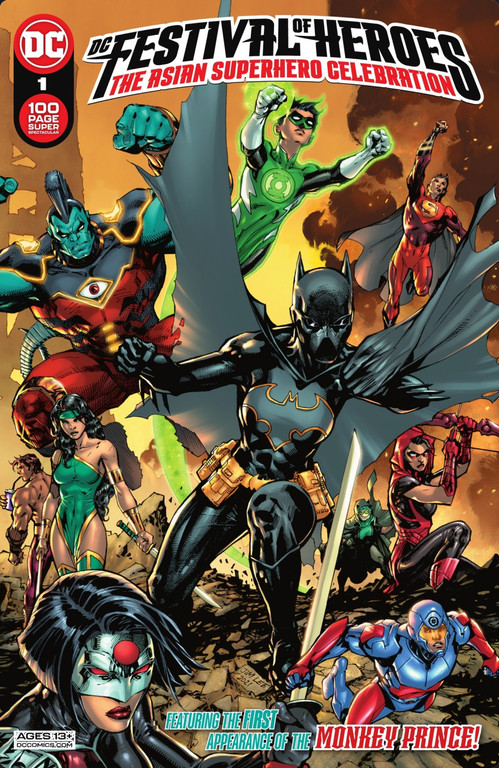
A follower on social media asked me to write an article about DC Comics’ new character, “Monkey Prince” (Ch: Hou wangzi, 猴王子), appearing in the story “The Monkey Prince Hates Superheroes” (Yang, 2021). He is part of a lineup of new and existing Asian characters in their DC Festival of Heroes: The Asian Superhero Celebration (2021). I was aware of the Monkey Prince prior to the request, and while I wasn’t a fan of his costume (more on this later), I was optimistic about the story as I’m a big fan of writer Gene Luen Yang’s masterful graphic novel American Born Chinese (2006). This new comic is 100 pages [1] and features art ranging from dark and gritty to bright and cute. It includes short episodes for many characters, including Batgirl (Cassandra Cain), Green Lantern (Tai Pham), Green Arrow (Connor Hawke), Super-Man (Kong Kenan), Robin (Damian Wayne), Cheshire Cat (Lian Harper), Grace Choi (an Asian Amazon), Red Arrow (Emiko Queen), Katana (Tatsu Toro), Atom (Ryan Choi), and, of course, the Monkey Prince. What’s interesting is that while he doesn’t appear among the heroes on the front cover of the standard edition, our supernatural simian is given top billing: “Featuring the first appearance of the Monkey Prince!” (fig. 1) (Chen, 2021, p. 1). There’s even a variant cover featuring the character (fig. 2).

DC editor Jessica Chen states the character was her idea, but that she worked with Gene Yang and artist Bernard Chang to craft “the origin and the essence of Monkey Prince together” (Aguilar, 2021). She also explains that her close connection to Sun Wukong and her yearning to make a comic book based on him: “Monkey King was kind of my first superhero, and after being at DC Comics, I’ve always wanted to somehow introduce Monkey King as a superhero because his origin story just kind of writes itself” (Aguilar, 2021). She was finally given the go ahead for this “passion project” last year by DC Editor-in-Chief Marie Javins (Aguilar, 2021).

Fig. 1 – The front cover of the standard edition of DC Festival of Heroes: The Asian Superhero Celebration (2021) (larger version). Fig. 2 – The variant cover with the Monkey Prince (larger version). Copyright DC Comics.

Table of Contents

1. Story Description

The story opens in an abandoned warehouse in Philadelphia, Pennsylvania, USA, where the evil Dr. Sivana has captured Shazam (a.k.a. Captain Marvel) and plans to slice him open with a laser a la Goldfinger (1964). However, unlike the Bond villain, Sivana uncharacteristically boasts about the prospect of cooking and eating the demigod’s heart, much to the disgust of his henchman and woman standing nearby. A broken, blue on white, Yuan-era vase in the foreground foreshadows Shazam’s deduction that the doctor has in fact been possessed by an ancient Chinese spirit hell-bent on eating the hero’s heart to gain immortality. While Sivana is visibly disturbed by this inference, Shazam is kind enough to tear open his own chest with an object retrieved from his ear. But instead of a warm, beating heart gushing blood, loads of large, multi-colored Valentine’s Day heart candies stamped “You suck” comically fall from the cavity. And with the added revelation of a wayward tail, the reader learns that the demigod is actually the transformed Monkey Prince and the item is his magic staff. The young hero then flies into action to save the hench people from a large explosion caused from their careless shooting. The blast separates the spirit from Sivana.

“Shifu Pigsy,” a master of magic and martial arts, arrives by cloud to chastise his young disciple’s sloppy work. We learn through subsequent conversations that the Monkey Prince is bitter towards his estranged father, the original Monkey King, leading him to quickly correct anyone who confuses him for his pater. With the help of a magic powder blown into his eyes by Shifu Pigsy, the Prince discovers that the invisible, disembodied spirit is a large, armored deer demon. The latter tries to justify his lust for immortality by stating the need to rule humanity for the damage that they’ve caused to the earthly realm. But when the real Shazam shows up and the spirit tries to attack him, the Monkey Prince is caught off guard and punched to the ground. This causes him to revert back to his human form, showing that his magical transformation is connected to his mental state. Shifu Pigsy calms his mind with sage advice, allowing the Prince to spring back into action.

Having survived the explosion, Dr. Sivana shoots Shazam with a ray gun but to no effect. The demigod attempts to apprehend his foe, but the spirit sneaks up behind him and bites down on his head. Luckily, the adamantine nature of Shazam’s magic body protects him from the attack long enough for the Monkey Prince to land a devastating blow with his staff, thus vanquishing the deer demon. Shazam, however, threatens to arrest the Prince because, unaware of the invisible spirit, he confused the simian character for his attacker. But the Monkey Prince preemptively strikes the demigod so hard that the impact destroys public property. Shifu Pigsy then recites a spell to activate the golden headband on the young hero’s mask, which painfully constricts to tame his rage. Once again, the Monkey Prince reverts to his human form, and we learn that the mask is used to protect his true identity.

Upon returning home to a Philadelphia suburb, we learn that the Prince’s adopted parents are actually the two hench people whom he had saved earlier that night (they are seemingly unaware of his magic heritage). Later at school, we not only learn that his human name is “Marcus” (Ch: Makusi, 馬庫斯), but that also one of his few friends just so happens to be Billy Batson, the kid alter-ego of Shazam. Billy tries to interest Marcus in a video of Shazam’s latest battle, but the latter refuses on the grounds that “superheroes suck” (Yang, 2021, p. 82). The Monkey Prince’s problem with superpowered beings is illustrated earlier during his confrontation with the demigod:

You superheroes think you’re better than everyone else! You think your powers and fancy capes make you the sole arbiters of right and wrong! Well, you know what? I am the mother-flipping Monkey Prince! And I actually am better than everyone else! I can beat you or any of your doofy superhero friends from here to next Sunday! (Yang, 2021, p. 80).

The story ends with a note suggesting that our hero will be getting his own comic: “The adventures of the Monkey Prince continue later this year!” (Yang, 2021, p. 82).

2. References to Journey to the West

There are several things from the story that call back to elements from the classic novel. The need to eat holy flesh to gain immortality refers to the many demons who attempt to cheat the cosmic hierarchy by trying to eat the monk Tripitaka. The Prince keeping his extending staff in his ear refers to the same thing his father does throughout the novel. Him tearing open his chest to reveal multiple hearts refers to one of the Monkey King’s tricks from chapter 79:

“In that case,” said the spurious Tang Monk [a transformed Monkey King], “bring me the knife quickly, so that I may cut open my chest. If I have a black heart, I’ll be pleased to present it to you.” Delighted, the befuddled king thanked him and asked the attendant to the throne to hand the spurious monk a curved dagger. Taking the dagger, the monk untied his robe and stuck out his chest. As he rubbed his belly with his left hand, he plunged the dagger into himself with his right hand and, with a loud ripping noise, tore open his own chest. A mass of hearts rolled out, so terrifying the onlookers that the civil officials paled in fright and the military officers turned numb. When he saw that, the royal father-in-law said in the hall, “This is a monk of many hearts!”

The spurious monk took those bloody hearts and manipulated them one by one for all to see: a red heart, a white heart, a yellow heart, an avaricious heart, a greedy heart, an envious heart, a petty heart, a competitive heart, an ambitious heart, a scornful heart, a murderous heart, a vicious heart, a fearful heart, a cautious heart, a perverse heart, a nameless obscure heart, and all kinds of wicked hearts. There was, however, not one single black heart! (Wu & Yu, 2012, vol. 4, pp. 49-50).

The Monkey Prince’s inability to transform his tail refers to his father’s weakness from the novel. This is best illustrated during his fight with Lord Erlang:

Rolling down the mountain slope, he [Sun Wukong] squatted there to change again—this time into a little temple for the local spirit. His wide-open mouth became the entrance, his teeth the doors, his tongue the Bodhisattva, and his eyes the windows. Only his tail he found to be troublesome, so he stuck it up in the back and changed it into a flagpole (Wu & Yu, 2012, vol. 1, p. 183).

Of course Pigsy, or Zhu Bajie/Wuneng (豬八戒/悟能), is a main character from the original novel. Like his comic book counterpart, he knows martial arts and magic. The name Pigsy is a nickname used in place of the original Chinese name from Arthur Waley’s famed abridgement, Monkey (1942). The golden headband is exactly like the one used by Tripitaka to reign in the Monkey King’s unruly nature. In the case of the Monkey Prince, his band is activated when his master recites the name of the Amitabha Buddha (Yang, 2021, p. 80). And the Prince’s angry, egotistical nature and boastful statements of superiority are just like his father. This is what leads to Sun Wukong’s rebellion against heaven and subsequent imprisonment by the Buddha.

3. The Story and Character Design

One problem any adaptation of Journey to the West is going to face is lack of originality. It’s all been rehashed before endless times. An adaptation has to be super accurate or just different enough for me to find it fresh and interesting. An example of the former is the 2011 TV show, while the latter is the Korean drama Hwayugi (2017-2018). For me, this story falls in the perilous middle ground. The Monkey Prince’s power set/weaknesses are just carbon copies of his father, and yet an effort has been made to differentiate both characters. Marcus is not an immortal monkey protecting a holy monk en route to the Western Paradise of ancient India. Instead, he’s a brooding, teenaged, half-human-half-monkey spirit demigod navigating a normal life in the modern United States, while also attempting to master heavenly arts and fight evil. Mr. Yang explains in an interview why he made the character a teenager:

Pretty early on, we knew we wanted the Monkey Prince to be a teenager. I think there’s something about the American conception of adolescence that ties very well with the character of the Monkey King from the original stories. He’s trying to figure himself out, he’s trying to gather power to himself, he’s really arrogant, but then he also has these moments of self-doubt. Even in the original, 500 years ago (Ching, 2021).

But this portrayal of the Monkey Prince is the first of several problems that I have with the present narrative. While I’m willing to keep an open mind for future installments, the current story structure is not original. It seemingly draws upon formulaic tropes from other young adult literature with teenaged demigods angry at their estranged fathers (e.g. Percy Jackson). And the fact that the Monkey Prince was transplanted onto this formula, and has been so heavily marketed over other Asian heroes, reads less like a bid at expanding diversity in comics and more like a ploy to drum up business in East Asia, where the Monkey King is insanely popular.

Second, the Monkey Prince’s addition to existing canon doesn’t feel natural. Mr. Yang claims making Marcus a teenager with a mystical background made it easier to connect him to Billy Batson, who’s also “a teenager with mythological ties” (Ching, 2021). But this connection is just way, way too forced. To recap, the young hero’s adopted parents just so happen to be the hench people of Dr. Sivana. This isn’t even acknowledged by Marcus, even after saving them. He just notes: “Because of my parents’ jobs, we move around a lot” (Yang, 2021, p. 82). The Prince also just so happens to go to the same school and is friends with Billy Batson. The story even mentions Billy is one of his few friends: “Not many kids here are nice to me. Heck, not many know I even Exist. Billy Batson is one of the few who do” (Yang, 2021, p. 82). So, the Monkey Prince wasn’t just shoe-horned into canon, he was hammered in whether it made sense or not.

Third, the comic doesn’t explain why Sun Wukong would take a Chinese wife after becoming a Buddha in the Western Paradise of India at the end of the novel. I hope this gaping plot hole will be addressed in later issues.

Fourth, making Zhu Bajie a sagely teacher to the Monkey Prince is not a well-thought-out idea. Zhu is the very symbol of gluttony and sloth throughout the original. After reaching the Western Paradise, the Buddha tells him: “Although you protected the sage monk on his way, you were still quite mischievous, for greed and lust were never wholly extinguished in you” (Wu & Yu, 2012, vol. 4, p. 382). When Zhu asks why he’s only promoted to an altar cleaner while the rest of his companions became Buddhas and arhats, the Enlightened One replies: “Because you are still talkative and lazy, … and you retain an enormous appetite” (Wu & Yu, 2012, vol. 4, p. 382). Therefore, he’s definitely not teacher material. [2]

Fifth, the term “Shifu Pigsy” is just grating to my inner reading voice. Why mix two languages when you could just call him “Zhu Shifu” or “Master Pig”? [3]

Sixth, Pigsy’s design, while similar to some Chinese depictions, is too cutesy. His description in the novel is far more grotesque: “He has a long snout and fanglike teeth, tough bristles on the back of his head, and huge fanlike ears. He is coarse and husky, and he causes even the wind to rise when he walks” (Wu & Yu, 2012, vol. 2, p. 51). The first drawing of Pigsy in the comic does portray him with large ears, but this is said to be a magic transformation that allows for better control when flying (Yang, 2021, p. 76).

Seventh, the golden fillet disappears when Marcus is in his everyday human attire. This goes against the point of the band. In the novel, it can’t be removed and thus serves as an ever-present reminder of self-restraint (Wu & Yu, 2012, vol. 1, pp. 319-320). Maybe this will be addressed later.

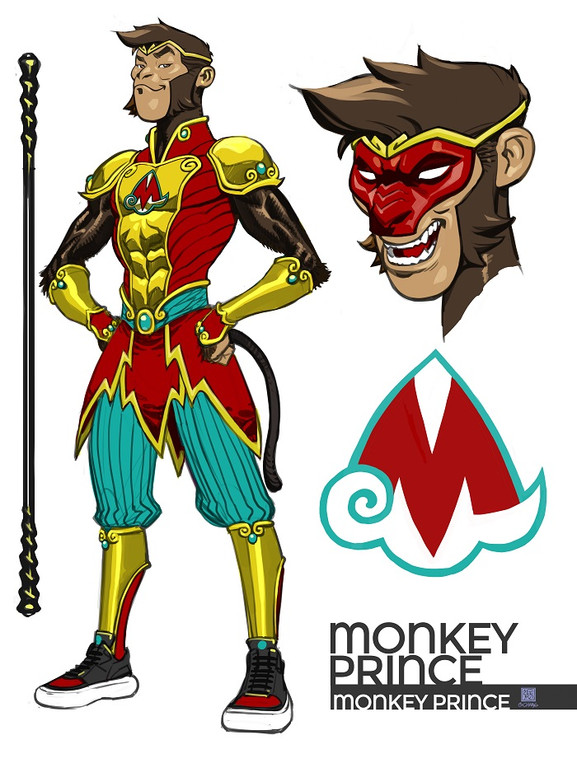
The eighth and biggest problem is the Monkey Prince’s design (refer back to fig. 2). His golden headband is bent into a subtle “M” (for Monkey), which likely borrows from the double “W” motif on Wonder Woman‘s chest. He even wears a vigilante-type mask and sports a large “M” logo on his chest. And the most egregious of all, he wears basketball sneakers! Mr. Yang explains that this costume and the Monkey Prince’s secret identity tie him to other heroes in the DC Universe. He also states that the logo is “not really an ‘M’ [but] a graphic presentation of Flower Fruit Mountain” where the monkey king was born (Ching, 2021). But this symbology doesn’t agree with the internal story details. Marcus is adamant in his hatred for superheroes, so why dress him like one? It just doesn’t make any sense.

The character designer Mr. Chang explains his reasoning for the final look:

Monkey Prince Is all about attitude and character. My initial reaction to the original Monkey King character is that he’s a rebel, a mischievous figure who defied the gods and wanted to do things his way. So, bringing that element into the design was a key factor. There are already a ton of previous adaptations of this great story, so I wanted to find a balance between the traditional uniform elements (in reflection for previous fans of the mythological hero) and our modern-day superhero elements you would find in heroes in the DC Universe and form that into a new, authentic variation for our times and story.

I was also initially drawn towards the curlicue motif, with it also representing clouds or wind, which the monkey would fly around on, and you can see that throughout his armor. I balanced the traditional deep red, for blood and family, with an old gold, for history and flashiness, and teal, a more modern and hip variation of traditional green or jade (Ching, 2021).

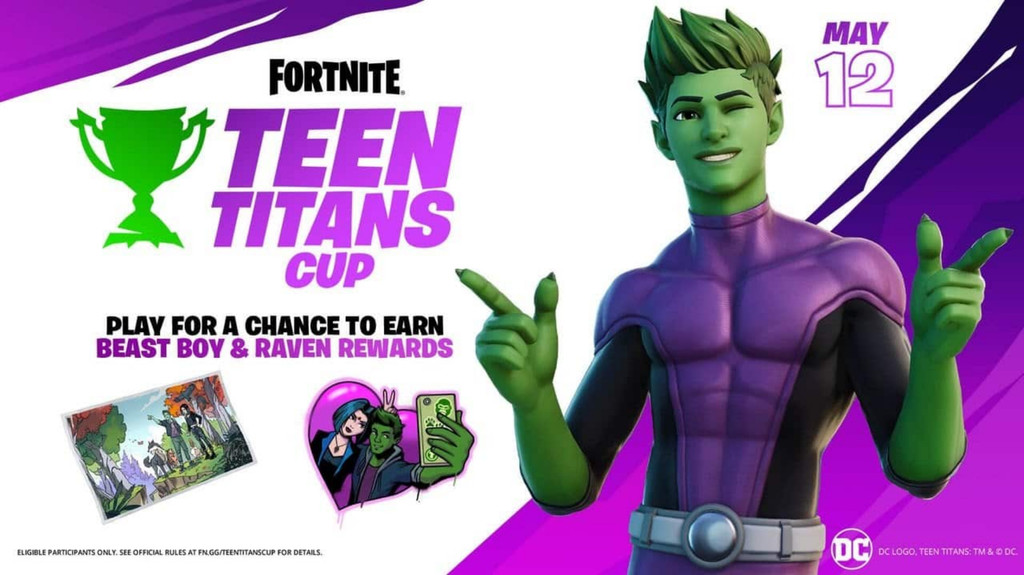
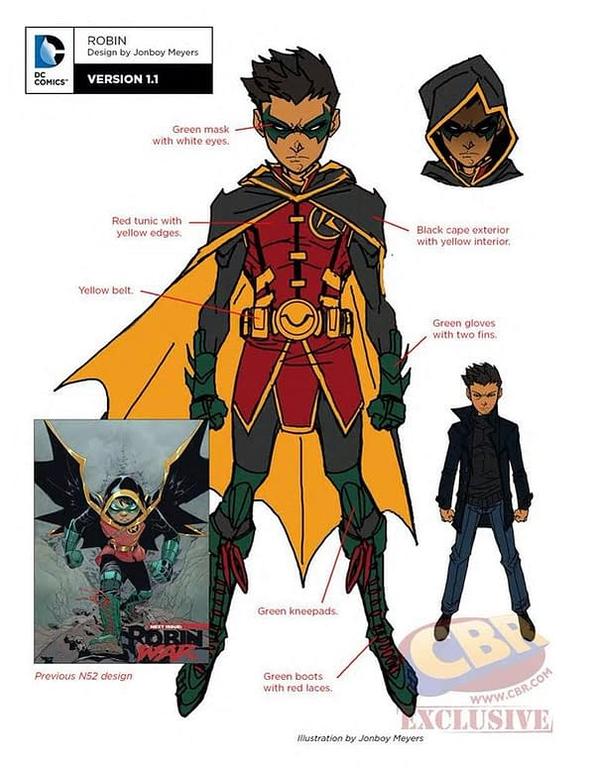
While I like some of the golden armor elements and the use of ruyi (如意) / lingzhi (靈芝) mushrooms (the “curlicue motif“), the striped teal paints and, especially, the sneakers just look tacky. Moreover, the design appears to be recycled from previous characters. Several people have commented online that the Monkey Prince is just a combination of Beast Boy‘s hair and body (fig. 3) and an altered version of Tim Drake‘s red and green Robin costume (fig. 4). Personally, I think his design is just a play on Damian Wayne, especially the hair, the red tri-panels with yellow borders at his waist, and the green pants (fig. 5). He is, after all, playing second fiddle to the Monkey King, like Robin does Batman.

Now, I have to address the sneakers. Why, why, why would a Chinese monkey demigod wear basketball sneakers? Well, according to Mr. Chang, it’s because a high school teenager like Marcus is bound to wear something with “some hotness to it” (Ching, 2021). Additionally, the designer admits that it’s also because he’s trying to (shamelessly) plug his own brand of shoes (Ching, 2021).

Fig. 3 – Detail of an advertisement featuring the design for Beast Boy in Fortnite (larger version). Image found here. Fig. 4 – Tim Drake’s costume (larger version). Take note of the staff. Image found on Wikimedia commons. Fig. 5 – Damian Wayne’s costume (larger version). Take note of the waist panels. Image found here. Copyright DC Comics.

4. My Rating

Overall, I would give “The Monkey Prince Hates Superheroes” 2 out of 5 stars 3 out of 5 stars (see the 06-16-21 update below). [4] I gave extra points for comical story elements and the technical proficiency of the art, but it’s hard to overlook problems with the writing and character design. This is a weak showing for the creative team involved. I think part of the problem is that not all parties had an intimate familiarity with Journey to the West. Mr. Chang admits that he only heard a few stories as a child and doesn’t know how the novel ends (Ching, 2021). Editor Chen states that her parents also told her stories (Aguilar, 2021), but I don’t know if she has ever read the novel. As for Mr. Yang, I’m sure he knows the story cover to cover, so I’d like to think that he was forced to sacrifice authenticity while working within certain constraints set by DC Comics.

Having said that, I’m honestly interested to see where the Monkey Prince story goes in future issues of his comic book. I will update this article as the narrative progresses.

5. What I Would Change

I would do away with the Monkey King taking a Chinese wife centuries after he became a Buddha. Instead, the son could be born during the Tang Dynasty (618–907) to Princess Iron Fan, the rakshasi wife of the Bull Demon King. Though seemingly impossible, there is precedent for this idea. An early 15th-century zaju play predating the novel describes Sun Wukong’s delight upon learning that the Princess is unmarried (Ning, 1986, pp. 139-140). He then resorts to seduction in an attempt to gain the iron fan needed to extinguish Flaming Mountain. For example, he recites a poem to her chocked full of sexual innuendo: “The disciple’s not too shallow. / the woman’s not too deep. / You and I, let’s each put forth an item, / and make a little demon” (Ning, 1986, p. 141). In addition, a 17th-century sequel to Journey to the West even describes the Monkey King having a number of sons with Princess Iron Fan. He faces one of his offspring, King Pāramitā (Boluomi wang, 波羅蜜王), during a final battle between all of the armies of the world (Dong, Lin, & Schulz, 2000, pp. 123-124). In our story, the son could have been conceived during chapter 60 of the original novel when Monkey shares a tender moment with the Princess while disguised as the Bull Demon King (Wu & Yu, 2012, vol. 3, p. 144).

Being a half-monkey spirit-half-rakshasa demigod, I’d like to think that the Prince’s base form would be more monkey-like. This would mean any lapse in concentration would cause him to revert to this state instead of a human form like in the original comic story.

I can already hear someone ask: “How can the Monkey Prince still be a teenager by the start of the story if he was born hundreds of years ago?” Well, this leads me to my next change. Instead of Zhu Bajie, it would make much more sense for his teacher to be the Bodhisattva Guanyin. After all, she tutors the children of several characters from the novel, including Muzha (木吒), 2nd son of Heavenly King Li Jing, and Red Boy (Hong hai’er, 紅孩兒; a.k.a. the “Child Sudhana,” Shancai tongzi, 善財童子), son of the Princess Iron Fan and Bull Demon King. [5] Already having a son under the goddess’ tutelage would make it easier for the Princess to send another child to learn from her. Also, Guanyin helped subdue both Monkey and Red Boy with golden fillets (Wu & Yu, 2012, vol. 1, pp. 316-320; vol. 2, pp. 251-252). Perhaps the Monkey Prince has a temper like his father and half-brother, so the goddess would make him wear Wukong’s fillet as it’s no longer needed once the latter attains Buddhahood (Wu & Yu, 2012, vol. 4, p. 383). Most importantly, the bodhisattva lives on the earthly paradise of Potalaka Mountain. The novel explains that one day in heaven equals one year on earth (Wu & Yu, 2012, vol. 1, pp. 150 and 167). A similar constricting of time would no doubt happen in Guanyin’s holy land. Therefore, the Monkey Prince would still be a teenager even after hundreds of years have passed on earth.

Next, I would completely do away with the tacky superhero costume. As a disciple of Guanyin, he would just wear a monk’s robe, the golden fillet, and possibly even sport a tiger skin skirt (like his father) since he would technically be a heavenly guardian. There would be no unnecessary logos, recycled costumes, or cursed sneakers. And the best part? This attire wouldn’t contradict the Monkey Prince’s hatred for superheroes, provided that was still a necessary plot element. Perhaps this hatred could be born from the fact that heroes like Shazam are given their powers (or happen upon them by accident), while the Prince’s abilities are the hard-won product of long years of spiritual cultivation.

My changes are less confident, however, when it comes to naturally fitting the Monkey Prince into existing canon. The first thing that comes to mind would involve the Shazam villain Sabbac, a hellish demon, causing havoc in Philidephlia’s Chinatown. Perhaps his assault could be related to the deplorable reports of Covid-related violence against Asians. A devotee of the goddess could pray to her in their time of need, and then the Monkey Prince is sent in her stead to exorcize the evil. But Shazam arrives while the Prince is battling the demon, and not knowing one from the other, he attacks them both. This might add fuel to the Monkey Prince’s dislike for Shazam.

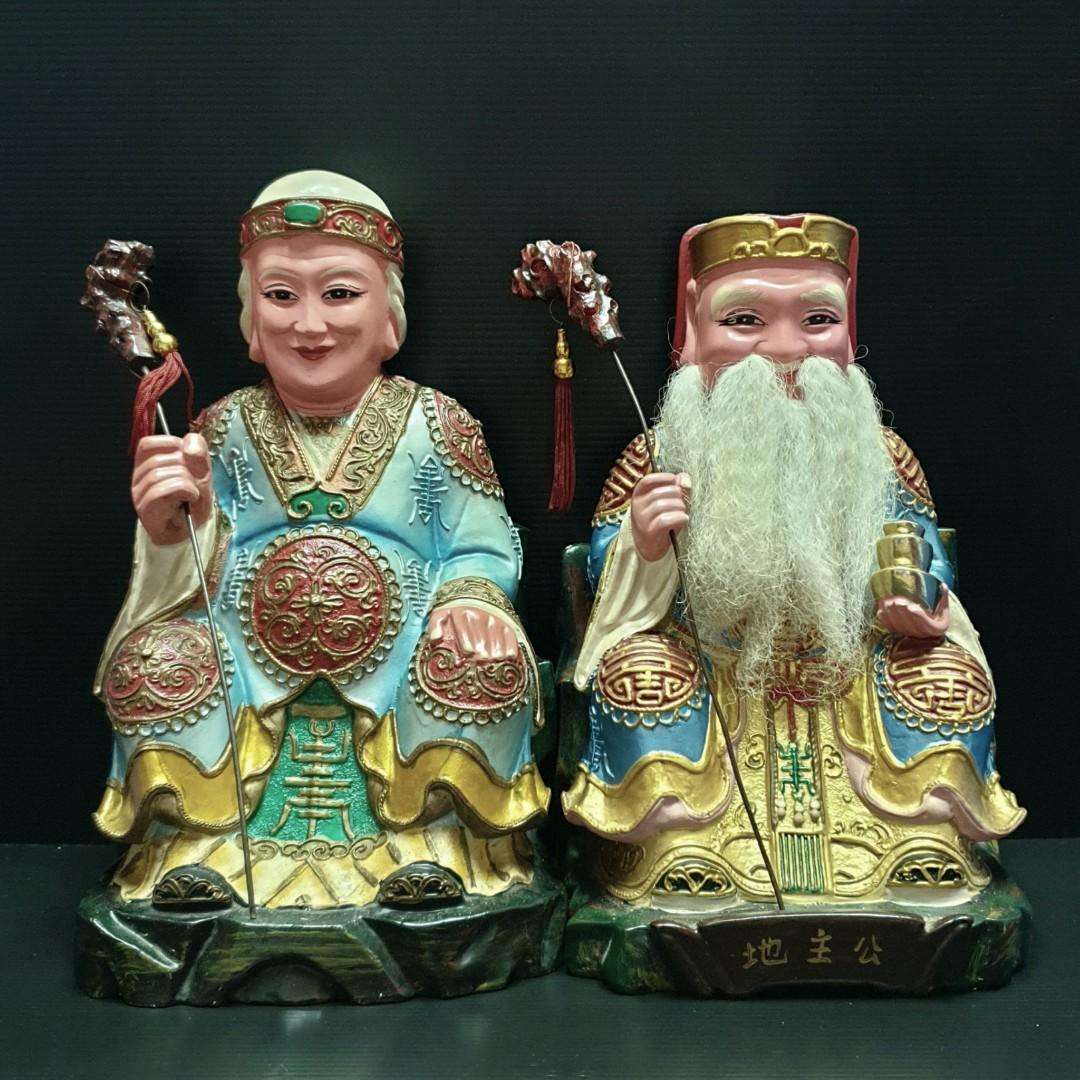
I personally think that the secret teen identity is a bit much, but if it is a necessary plot element, Guanyin could assign the Monkey Prince to watch over her flock in Philadelphia (and the rest of America?), [6] and at the same time allow him to experience a slice of modern teen life. And, again, if necessary, we can borrow from the original story and have the Prince attend high school, where he feels drawn to Billy Batson because of his godly aura. A local earth god (tudi gong, 土地公) and his wife (tudi po, 土地婆) (fig. 6) could be tasked by heaven to act like his grandparents to keep up the appearance of a normal human family.

Fig. 6 – Religious statues of the earth god (right) and his wife (left) in the author’s personal collection (larger version).


6. Updates

Update: 05-21-21

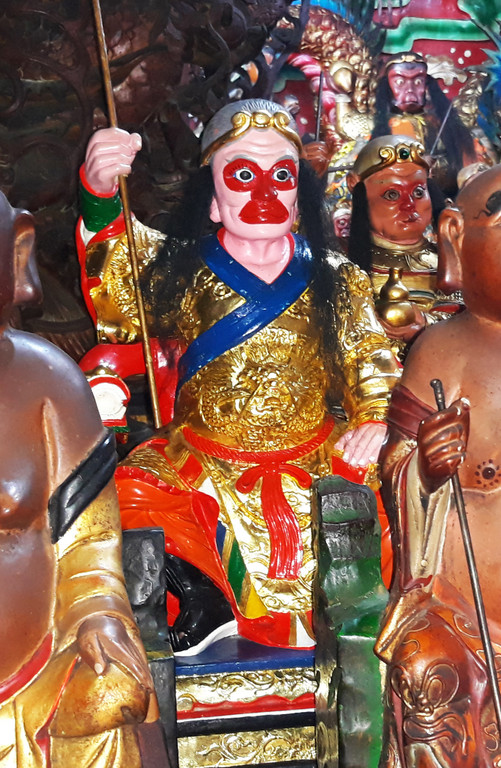
Last time I suggested changes to the Monkey Prince’s costume. One thing I forgot to mention was his hair. In order to be more authentic, there are two choices: 1) he can be bald (like his father in the original novel) since he’d be a Buddhist monk; or 2) he can have long hair since he’d be a martial monk (wuseng, 武僧). It’s interesting to note that religious statues of Sun Wukong sometimes depict him as a martial monk, complete with the golden fillet and long hair (fig. 7). This is heavily influenced by Chinese opera (fig. 8) (Bonds, 2008, pp. 177-178).

Fig. 7 – Detail of a religious statue of Sun Wukong as a martial monk (larger version). See the full version here. Photo taken by the author at one of the many temples in Taiwan dedicated to the Monkey King. Fig. 8. – A detail of the literary hero and martial monk Wu Song from a Chinese opera about his adventures (larger version). Full version available on Wikimedia Commons.


Update: 06-16-21

I’ve just posted my review of Marvel Comics’ Sun Wukong character. Reading the comic book equivalent of a train wreck has allowed me to view the Monkey Prince in a new, more positive light. I have, therefore, decided to increase my previous review score.

Review of Marvel Comics’ Sun Wukong


Update: 10-18-21

It has officially been confirmed that the Monkey Prince will be receiving his own 12-issue run in February 2022.

https://www.dccomics.com/blog/2021/10/16/dc%E2%80%99s-monkey-prince-new-series-to-debut-on-lunar-new-year-2022

DC has created an issue #0, which can be read here. I will review this comic at a later date.


Update: 12-13-21

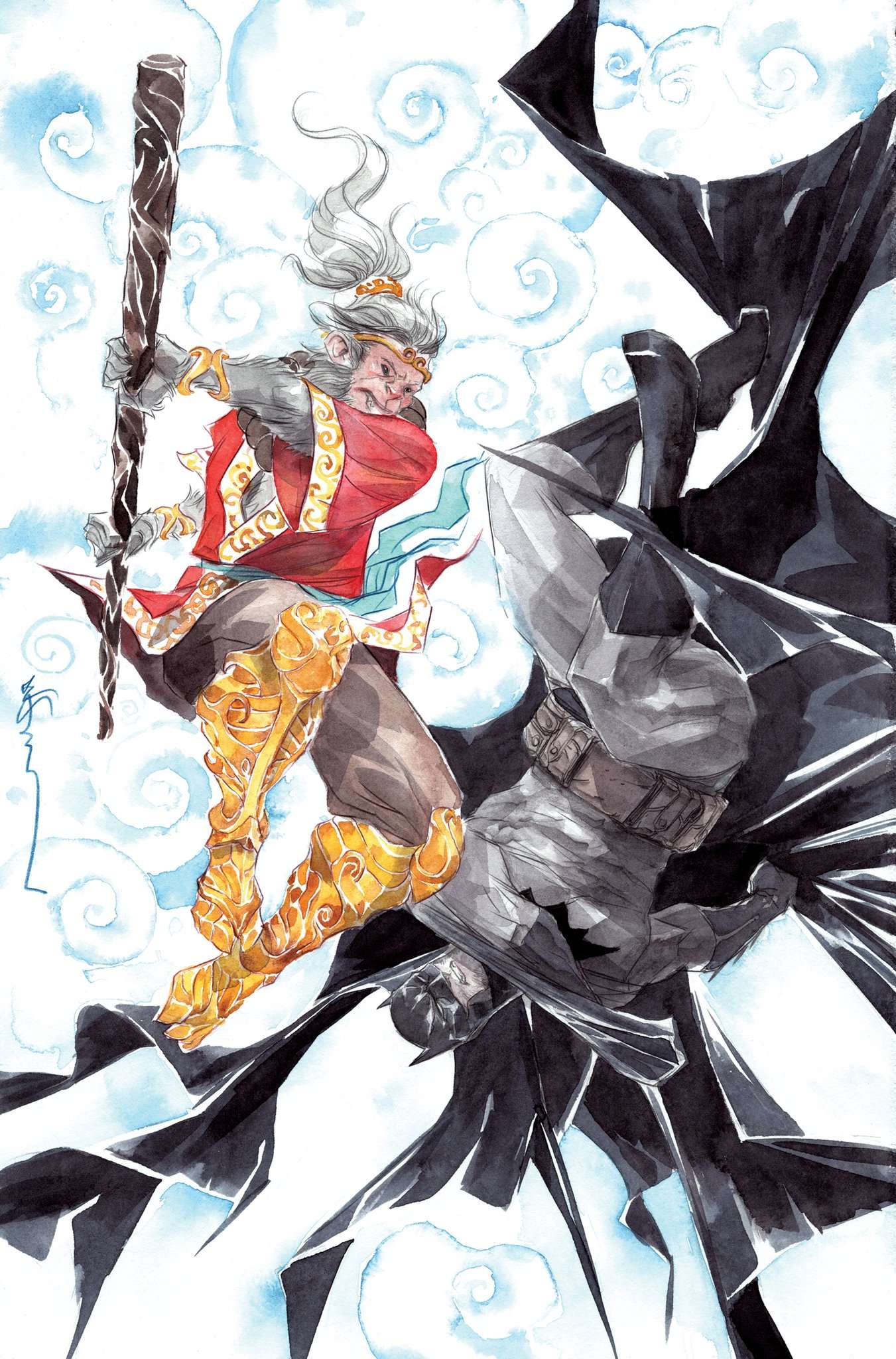
Thanks to a friend, I learned that a new Dustin Nguyen variant cover for issue #1 shows a long, white-haired Monkey Prince/King(?) fighting Batman (fig. 9). The issue description reveals that it is a prequel set in Gotham City:

Introducing the newest hero in the DCU, the great sage, equal to the heavens, better than his predecessor the legendary Monkey King, even better than the Justice League and definitely the Teen Titans (actually, all the heroes combined), everyone put your hands together for the Monkey Prince! Marcus Sun moves around a lot because his adoptive parents are freelance henchpeople, so this month he finds himself as the new kid at Gotham City High School, where a mysterious man with pig features asks Marcus to walk through a water curtain to reveal himself as who Marcus really is someone who has adventured through The Journey to the West, can transform into 72 different formations, can clone himself using his hairs, and is called the Monkey Prince! (see here)

This description indicates that Marcus first meets and begins his training under Pigsy while living in Gotham. It also shows (for some reason) that the hog immortal doesn’t do anything to curb the criminal activity of the boy’s adopted parents. Apparently, even celestials are oblivious to their henching gig. Ugh.

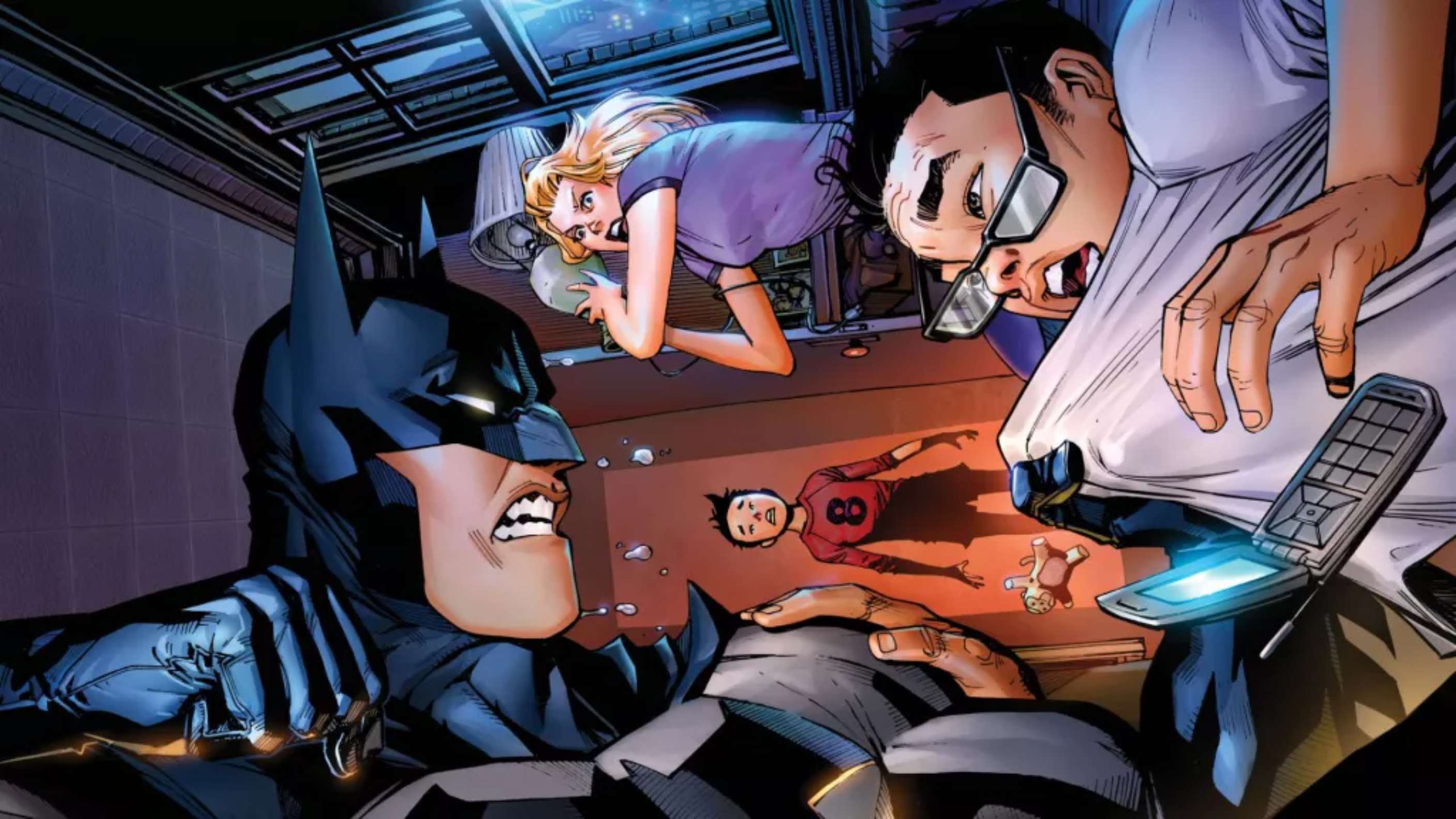
A cursory search shows that I missed a preview panel released in October showing Batman attacking a man and woman (the adopted parents), while a young Marcus helplessly watches from the background (fig. 10).

Fig. 9 – The new issue #1 variant cover by Dustin Nguyen (larger version). Fig. 10 – The Batman panel (larger version). Copyright DC Comics.

I don’t have high hopes for this upcoming issue for several reasons: 1) I’ve already mentioned everyone’s obliviousness to the adopted parents’ criminal activity; 2) The description confuses the Monkey King’s title “Great Sage Equaling Heaven” for a nickname of the Monkey Prince. Anyone who has actually read the novel would NEVER make this mistake; 3) It also says “high school,” while the panel clearly shows a young Marcus holding a stuffed Monkey; and most importantly, 4) Issue #0 was horrible. I won’t bother to give it a proper review. Just know that the story was a flashback involving a shotgun blast of Journey to the West characters (both heroes and villains) fighting against Darkseid‘s invasion of the heavenly realm (fig. 11). Once again, the characters are hammered into canon whether it makes sense or not. 

At this point, I probably won’t do any more reviews, but I will continue to read the series out of morbid curiosity. 

Fig. 11 – Monkey Prince #0 splash page with Journey to the West characters fighting Darkseid’s army (larger version). Copyright DC Comics. 


Update: 12-22-2021

I changed my mind about reviewing issue #0. Here is my analysis. Among my suggested changes, I named the character Sun Taizi (孫太子), or “Prince Sun.” This plays off of San Taizi (三太子), the “Third Prince,” one of the titles of Nezha, a heavenly vanguard in Sun Wukong’s religion, as well as a very important deity in his own right.

Review of DC Comics’ Monkey Prince #0 to #6


Update: 03-13-22

One of my previous complaints reads:

Seventh, the golden fillet disappears when Marcus is in his everyday human attire. This goes against the point of the band. In the novel, it can’t be removed and thus serves as an ever-present reminder of self-restraint (Wu & Yu, 2012, vol. 1, pp. 319-320). Maybe this will be addressed later.

This is indeed addressed in issue #2. Marcus throws away the headband, only for it to return later with the quaint ability to move about his body. It can never be removed, so when he isn’t in his Monkey Prince persona, Marcus wears the fillet where it can’t be seen (Yang, 2022, pp. 16 and 20-21).


Update: 04-11-26

A reddit member has posted a list of the Monkey Prince’s powers.

Respect Marcus Shugel-Shen, the Monkey Prince (DC Comics, Post-Flashpoint)
byu/rangernumberx inrespectthreads

Notes:

1) Though, the online version I bought through Google Play only has 84 pages.

2) Zhu Bajie and his brothers do briefly take students in chapter 88, but they only teach them how to wield weapons (Wu & Yu, 2012, vol. 4, pp. 198-203). This is not the same as the sagely teacher of magic presented in the comic.

3) Admittedly Yu (Wu & Yu, 2012) does use “Master Zhu” (vol. 4, p. 199), but that is far more accurate than mixing “Shifu” with “Pigsy,” a nickname used in place of the proper Chinese from the English abridgement Monkey (1942).

4) I’m willing to revise this in the future as the narrative progresses.

5) Muzha (a.k.a. Hui’an, 惠岸) is already Guanyin’s disciple by the start of Monkey’s rebellion. In chapter 6, the goddess sends him to help in case his skills are needed (Wu & Yu, 2012, vol. 1, p. 175). Red Boy is taken in by her at the end of chapter 42 and beginning of chapter 43 (Wu & Yu, 2012, vol. 2, pp. 251-252).

6) I’ll have to wait and see how far the Monkey Prince’s adventures take him in his ongoing comic.

Sources:

Aguilar, M. (2021). Jessica Chen Talks Returning Favorites and the Monkey Prince’s Debut in Festival of Heroes: The Asian Superhero Celebration. Comic Book. https://comicbook.com/comics/news/dc-festival-of-heroes-the-asian-superhero-celebration-jessica-chen/

Blum, J. (2022). DC’s New Bad Guys Eat Superheroes to Steal Their Powers. CBR. Retrieved from https://www.cbr.com/dc-villains-eat-superheroes-monkey-prince/

Bonds, A. B. (2008). Beijing Opera Costumes: The Visual Communication of Character and Culture. Honolulu: University of Hawai’i Press.

Chen, J. (Ed.). (2021). DC Festival of Heroes: The Asian Superhero Celebration [Google Play]. New York, NY: DC Comics. Retrieved from https://play.google.com/store/books/details/Minh_Le_DC_Festival_of_Heroes_The_Asian_Superhero?id=qXUrEAAAQBAJ

Ching, B. A. (2021). Meet the Monkey Prince: Yang and Chang Introduce DC’s Newest Hero. DC. https://www.dccomics.com/blog/2021/05/12/meet-the-monkey-prince-yang-and-chang-introduce-dcs-newest-hero

Dong, Y., Lin, S., & Schulz, L. J. (2000). The Tower of Myriad Mirrors: A Supplement to Journey to the West. Ann Arbor: Center for Chinese Studies, The University of Michigan.

Ning, C. Y. (1986). Comic Elements in the Xiyouji Zaju. (Doctoral dissertation). Available from ProQuest Dissertations and Theses database. (UMI No. 8612591)

Wu, C., & Yu, A. C. (2012). The Journey to the West (Vol. 1-4). Chicago, Illinois: University of Chicago Press.

Yang, G. L. (2022). Monkey Prince, (2) [Kindle]. New York, NY: DC Comics. Retrieved from https://www.amazon.com/Monkey-Prince-2022-2021-ebook/dp/B09RQ6581L

Yang, G. L. (2021). The Monkey Prince Hates Superheroes. In Jessica Chen (Ed.). DC Festival of Heroes: The Asian Superhero Celebration (pp. 70-82) [Google Play]. New York, NY: DC Comics. Retrieved from https://play.google.com/store/books/details/Minh_Le_DC_Festival_of_Heroes_The_Asian_Superhero?id=qXUrEAAAQBAJ

The Monkey King and The Buddha Victorious in Strife (a.k.a. Victorious Fighting Buddha)

NOTE: THIS IS MY 100TH BLOG POST.

Last updated: 06-13-2025

The Monkey King is elevated in spiritual rank at the end of Journey to the West (Xiyouji, 西遊記, 1592; “JTTW” hereafter) for his service in protecting the monk Tripitaka throughout the quest to India. Gautama Buddha enfeoffs him as the “Buddha Victorious in Strife” or “Victorious Fighting Buddha” (Dou zhansheng fo, 鬥戰勝佛). Many readers may be surprised to learn that this is actually an established Buddhist deity and not just the creation of the JTTW author-compiler. In this article, I would like to briefly explore the Buddha’s religious background, iconography, purpose, and relationship to the worship of Sun Wukong.

Table of Contents

1. Literary Enlightenment

The Gautama Buddha explains:

“Sun Wukong, when you caused great disturbance at the Celestial Palace, I had to exercise enormous dharma power to have you pressed beneath the Mountain of Five Phases. Fortunately your Heaven-sent calamity came to an end, and you embraced the Buddhist religion. I am pleased even more by the fact that you were devoted to the scourging of evil and the exaltation of good. Throughout your journey you made great merit by smelting the demons and defeating the fiends. For being faithful in the end as you were in the beginning, I hereby give you the grand promotion and appoint you the Buddha Victorious in Strife (Wu & Yu, 2012, p. 381).

孫悟空,汝因大鬧天宮,吾以甚深法力,壓在五行山下,幸天災滿足,歸於釋教;。且喜汝隱惡揚善,在途中煉魔降怪有功,全終全始,加陞大職正果,汝為鬥戰勝佛。

2. Religious Background

JTTW closes by “submitting” or “prostrating” (namo, 南無) to a long list of Buddhas, Bodhisattvas, and Arhats. The Buddha Victorious in Strife is placed at the end of 47 Buddhas and ahead of the Bodhisattva Guanyin. A section of the list reads:

[…]
I submit to the Buddha of the Gift of Light.
I submit to the Buddha of Candana Merit.
I submit to the Buddha Victorious in Strife (emphasis added).
I submit to the Bodhisattva Guanshiyin.
I submit to the Bodhisattva, Great Power-Coming
[…] (Wu & Yu, 2012, p. 385).

…南無才光佛。南無旃檀功德佛。南無鬥戰勝佛。南無觀世音菩薩。南無大勢至菩薩…

Many of the Buddhas from the novel’s list appear in assorted real world canonical lists, including the 88 Buddhas (Bashiba fo, 八十八佛) from the Great Repentance Text of the Eighty-Eight Buddhas (Ch: Bashiba fo da chanhui wen, 八十八佛大懺悔文). [1] This group is comprised of the 53 Buddhas (Ch: Wushisan fo, 五十三佛) and the 35 Confession Buddhas (Ch: Sanshiwu fo chan, 三十五佛懺) (fig. 1).

The historical “Buddha Victorious in Strife,” Yuddhajaya (Sk: युद्धजय; see the 06-13-2025 update for more name info), is the 31st of the 35 Confession Buddhas, who are individually called upon during a confessional prayer to absolve oneself of sins. They appear in a number of sources, such as The Bodhisattva’s Confession of Ethical Downfalls (Ch: Pusa duochan / Pusa chanhui wen, 菩薩墮懺 / 菩薩懺悔文) from the Three Heaps Sutra (Sk: Trīskhandhadharmasūtra; Ch: Sanyun jing, 三蘊經) and the Names of the Thirty-Five Buddhas Spoken by the Buddha (Ch: Foshuo sanshiwu foming lichan wen, 佛說三十五佛名禮懺文, 8th century). 

Fig. 1 – A religious painting of the 35 Confession Buddhas (larger version). The Buddha Victorious in Strife is third from the right on the bottom row. Image found here.

2.1. Iconography

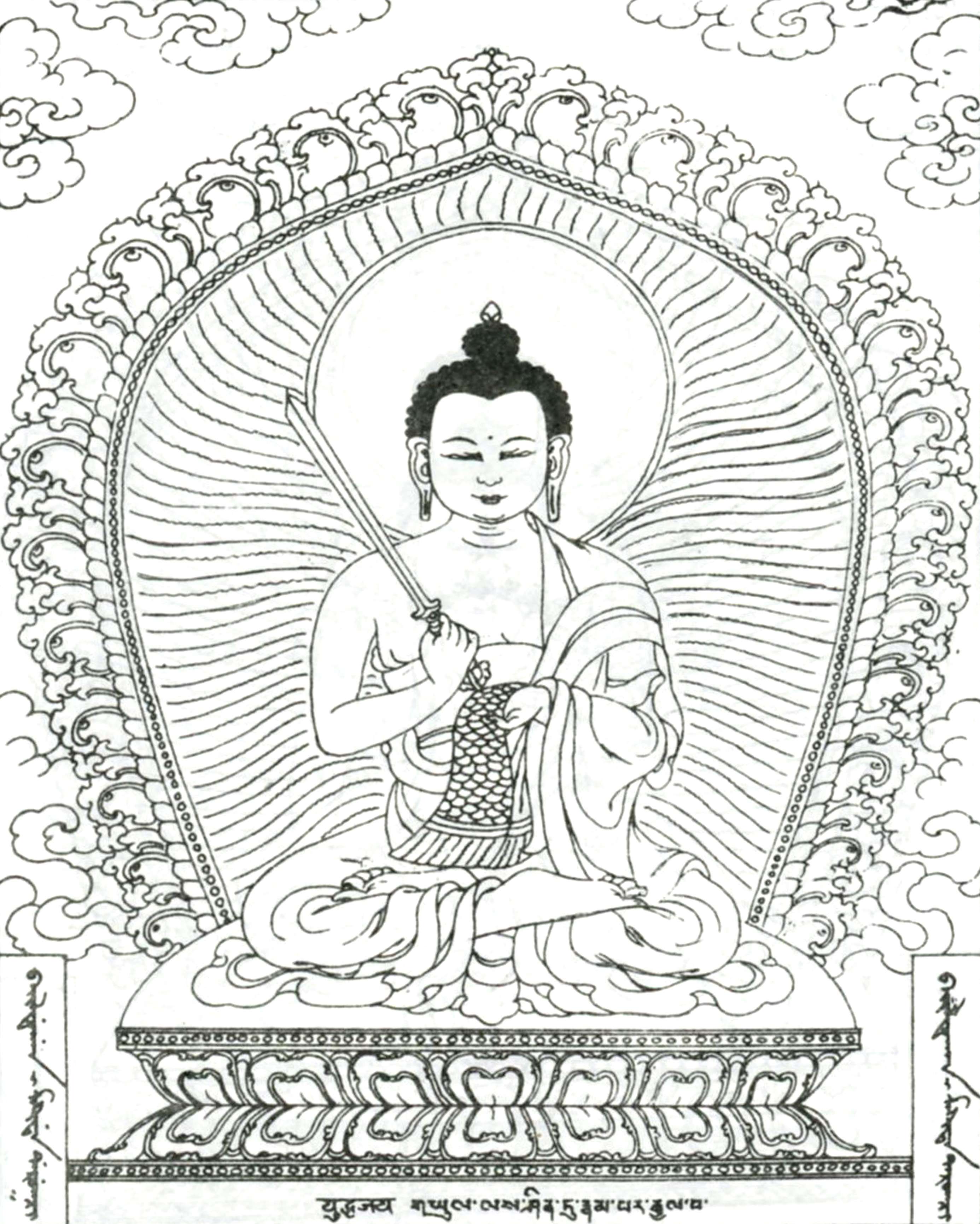
The Buddha Victorious in Strife is depicted in Buddhist art with the traditional features of a Buddha (i.e. ūrṇā, uṣṇīṣa, long ear lobes, robes, etc.), but he is also shown holding a suit of armor and a sword (fig. 2):

Yuddhajaya Buddha — (Skt.: aka Yuddhajaya) (Chin.: Tou-chan-sheng fo; Mon.: Bayildugan-i masids darugci; Tib.: gYul-las-sin-tu-rnam-par-rgyal-ba, rGyal-ba-gYul-lasr-Gyal-ba) A Sanskrit variant for the Jina Yuddhajaya. One of the Buddha images found in the Pao Hsiang Lou [寶相樓] temple of the Forbidden City, Beijing, and one of the thirty-five “Buddhas of Confession.” Face: one, calm, urna, usnisa, long ear-lobes; arms/hands: holding a cuirass up to his chest; body: monastic robes; legs: two; asana: vajrasana; vahana: lotus throne.

— (2) — (Mon.: Bayildugan-i masids darugci; Tib.: gYul-las-sin-tu-rnam-par-rgyal-ba) One of the Buddhas of Confession pictured in the Mongolian Kanjur (Mon.: Monggol ganjur-un) (1717-1720) Face: one, calm, urna, usnisa, long ear-lobes; arms/hands: two, right hand holds sword (khadga, ral-gri), left hand holds coat of mail (khrab); body: monastic robes, right shoulder uncovered; legs: two; asana: vajrasana; attributes: 32 major and 80 minor signs; vahana: lotus throne (Bunce, 1994, Vol. 1, p. 629). [2]

Fig. 2 – The Buddha Victorious in Strife (Yuddhajaya) holding a sword and suit of armor (larger version). Image found here.

2.2. Purpose

Neither the name Buddha Victorious in Strife nor the sword and armor are a reference to the deity’s fighting prowess. According to Lai (2016), the Buddha “defeat[s] the inner enemies of afflictive emotions and negative actions of sentient beings. He is victorious over cyclic existence and thus able to lead all sentient beings to liberation. He purifies the negative karma of actions committed out of pride.”

His name and accoutrements, therefore, symbolize the means by which he subjugates the negative emotions or actions that would otherwise keep man trapped in the illusory world of Saṃsāra.

3. Relationship to Sun Wukong’s Worship

The Monkey King is worshiped in southern China, Taiwan, and Southeast Asian countries like Malaysia, Singapore, Thailand, and Vietnam as a great exorcist and protector of children. But it may come as a surprise to learn that he is rarely worshiped as the Buddha Victorious in Strife. Instead, Wukong is almost exclusively revered as the “Great Sage Equaling Heaven” (Qitian dasheng, 齊天大聖), and even when he is called a Buddha, the name usually includes some reference to the rebellious title. For example, when I attended the Monkey King’s birthday (sixteenth day of the eighth lunar month) in Hong Kong in 2018, I saw an incense pot labeled “Great Sage Buddha Patriarch” (Dasheng fozu, 大聖佛祖) (fig. 3).

So why isn’t Sun widely worshiped as the Buddha Victorious in Strife? I think the simplest answer is that the Buddha already had a long-established following and therefore couldn’t be subsumed under the late-blooming cult of a cultural hero, even one as popular as the Monkey King.

Fig. 3 – An incense pot reading “Great Sage Buddha Patriarch” (Dasheng fozu, 大聖佛祖) (larger version). Taken by the author in Kowloon, Hongkong (Sept. 24, 2018).

4. Precedent for Spiritual Promotion

The author-compiler likely connected Sun Wukong to the Buddha Victorious in Strife because of the Enlightened One’s war-like iconography (recall the sword and armor mentioned above). After all, Monkey is an armor-wearing martial deity wielding his magic staff to protect Tripitaka from untold numbers of demons and spirits.

But the choice to elevate Monkey in rank was likely influenced by previous media. For example, Wukong’s literary antecedent, the Monkey Pilgrim (Hou xingzhe, 猴行者), receives a promotion at the end of The Story of How Tripitaka of the Great Tang Procures the Scriptures (Da Tang Sanzang qujing shihua, 大唐三藏取經詩話), a late-13th century precursor of JTTW. The story ends thus: “Tang Taizong later enfeoffed Monkey Pilgrim as ‘Great Sage Steel Muscles and Iron Bones'” (Gangjin tiegu dasheng, 鋼筋鐵骨大聖) (Wivell, 1994, p. 1207). [3]

5. Conclusion

At the end of JTTW, the Buddha promotes Sun Wukong to the “Buddha Victorious in Strife” or “Victorious Fighting Buddha” (Dou zhansheng fo, 鬥戰勝佛). This is the Chinese name of Yuddhajaya (Sk: युद्धजय), the 31st of the 35 Confession Buddhas called upon during a confessional prayer to absolve oneself of sins. He is generally portrayed as a robe-wearing Buddha holding a sword and suit of armor. This is not a reference to the deity’s fighting prowess, however. Instead, his name and accoutrements symbolize the means by which he subjugates the negative emotions or actions that would otherwise keep man trapped in the illusory world of Saṃsāra.

Instead of being universally revered as the Buddha Victorious in Strife, the Monkey King is far more widely worshiped in East and Southeast Asia as the “Great Sage Equaling Heaven” (Qitian dasheng, 齊天大聖) or a variant like “Great Sage Buddha Patriarch” (Dasheng fozu, 大聖佛祖). This discrepancy is probably due to the original Yuddhajaya already having a long-established following. There’s no way that he could ever be subsumed under Sun Wukong’s late-blooming cult. 

Wu Cheng’en (or whoever the true author-compiler was) likely connected Monkey to the Buddha Victorious in Strife because both have martial iconography. Sun is commonly depicted wearing armor and wielding an iron staff, while Yuddhajaya is shown holding a sword and armor. But the concept of Sun receiving an elevation in spiritual rank goes back centuries. The Monkey Pilgrim, his literary antecedent from The Story of How Tripitaka of the Great Tang Procures the Scriptures (late-13th century), is deified by the Tang emperor as “Great Sage Steel Muscles and Iron Bones” (Gangjin tiegu dasheng, 鋼筋鐵骨大聖).


6. Updates

Update: 09-06-20

If you type “Buddha Victorious in Strife,” “Victorious Fighting Buddha,” “鬥戰勝佛” or “斗战胜佛” into google images, you’ll notice that these terms are almost exclusively associated with Sun Wukong. Most results are fan-made drawings of Monkey wearing his armor. Very few depict him as a Buddha. The only appearance of the latter in popular media that I’m aware is the Victorious Fighting Buddha from the manga / anime High School DxD.

The character is depicted as a jovial old dwarf with long, shaggy brown hair, bushy eyebrows that fall over a cyberpunk-style black visor, no mustache, a long beard, a floor-length, dark gray coat over a red robe, and monkey feet. He wears his famous golden fillet and a set of chunky brown and red prayer beads. In his left hand he holds a smoking pipe, while the right holds his magic staff, which is depicted as red and gold (fig. 4).

Fig. 4 – The Victorious Fighting Buddha from High School DxD (larger version).

The Victorious Fighting Buddha inhabits a universe where various factions of Western and Eastern gods, devils, and heroes battle one another. According to the story, upon ascending to Buddhahood, he steps down as the Monkey King, handing the title to a young descendant, and serves as the vanguard of the Hindu god Indra, during which time he protects the cosmos from a faction of devils and fallen angels. He later takes on the role of sub-leader and mentor to a new faction of young heroes whom he trains to battle god-tier opponents.

High School DxD portrays the Victorious Fighting Buddha as very powerful. For example, season four, episode six (minute 13:35) of the anime shows him effortlessly blocking the “True Longinus” spear with the tip of his index finger. This is quite a feat as this weapon is the same one used to pierce the side of Christ, thereby giving it the power to kill other gods.


Update: 03-22-21

I visited “Sage Buddha Hall” (Shengfo Tang, 聖佛堂), a Great Sage temple in Beigang, Yunlin, Taiwan and saw a few items labeled the “Fighting Sage Buddha” (Dou zhan sheng fo, 鬥戰聖佛) in place of the Buddha Victorious in Strife/Victorious Fighting Buddha. One such item was a paper fan (fig. 5). As noted above, Buddha Victorious in Strife/Victorious Fighting Buddha is not a reference to the deity’s fighting prowess, but his ability to “defeat the inner enemies of afflictive emotions and negative actions of sentient beings.” So it appears that this temple takes his martial skill at face value.


Update: 08-09-22

As an enlightened Buddha, Monkey is eligible for his own “Buddha-Field” (Sk: Buddhakṣetra; Ch: Focha, 佛刹), essentially his own universe in which he will lead the inhabitants to enlightenment. Buswell and Lopez (2014) explain:

[W]hen a buddha achieves enlightenment, a “container” or “inanimate” world is produced in the form of a field where the buddha leads beings to enlightenment. The inhabitant of that world is the buddha endowed with all the [qualities of an Enlightened One]. Buddha-fields occur in various levels of purification, broadly divided between pure and impure. Impure buddha-fields are synonymous with a world system (cakravāḍa), the infinite number of “world discs” in Buddhist cosmology that constitutes the universe; here, ordinary sentient beings (including animals, ghosts, and hell beings) dwell, subject to the afflictions of greed, hatred, and delusion. Each Cakravāḍa is the domain of a specific buddha, who achieves enlightenment in that world system and works there toward the liberation of all sentient beings… (p. 153).


Update: 01-22-23

Chandra (1999) includes a lovely black and white line drawing of Yuddhajaya (fig. 6) (p. 94).

Fig. 6 – A traditional Tibetan drawing of Yuddhajaya (larger version). Image from Chandra, 1999, p. 94.


Update: 05-09-23

I commissioned NinjaHaku21 (Twitter, Instagram, and Tumblr) to draw Sun Wukong using Yuddhajaya’s traditional iconography (fig. 7), and the results are stunning! It is based on the design from figure two above.

Fig. 7 – A religiously accurate drawing of Monkey as the Yuddhajaya Buddha by NinjaHaku21 (larger version).


Update: 06-12-23

I have written a companion piece to this article about Tripitaka’s Buddha title.

The Tang Monk Tripitaka and the Buddha Candana Merit


Update: 09-11-23

Tumblr user @darkfalcon-z has drawn a lovely picture of the Monkey King as a Buddha (fig. 8). They explain their headcanon for the image:

[B]aby monkeys think Grandpa’s lotus throne is for playing.

[…]

I think Wukong got back to his mountain to take care of his monkeys. He does visit sometimes. He takes his favourite monkeys along for the ride. I don’t think it is much of a problem in Western Heaven in Buddha’s domain, because if you are enlightened the antics of little animals won’t really bother you. He’s told not to bring monkeys along next time as per formality. He does anyway. It’s not like anyone minds. He takes the monkeys along when he visits Jade Emperors domain. There monkeys are treated as nuisance and chased around, but no one actually dares to harm them, as they fear to incur his anger. He probably takes more troublesome monkeys too. On purpose.

I love the baby monkeys, as well as Wukong’s flower-like halo.

Fig. 8 – @darkfalcon-z’s Monkey Buddha (larger version). Used with permission.


Update: 11-07-2024

Above, I wrote: 

Wu Cheng’en (or whoever the true author-compiler was) likely connected Monkey to the Buddha Victorious in Strife because both have martial iconography. Sun is commonly depicted wearing armor and wielding an iron staff, while Yuddhajaya is shown holding a sword and armor.

But it just dawned on me that Sun’s antecedent, the Monkey Pilgrim (Hou xingzhe, 猴行者), is also portrayed holding a divine sword in a 13th century stone relief carving (fig. 9). This weapon is referred to as his “Bodhisattva Sabre” (Pusa dao, 菩薩刀) in a 17th or 18th century tale appearing in a famous collection of Chinese folk stories. Therefore, it wouldn’t surprise me if this influenced the association with Yuddhajaya’s sword.

Fig. 9 – The Kaiyuan temple pagoda relief carving depicting Monkey holding a sword (larger version). Located on one of two 13th century stone pagodas of Kaiyuan Temple in Quanzhou City, Fujian Province, China.

I would also like to add some more drawings of Sun Wukong as a Buddha. The first two (fig. 10 & 11) are by a netizen who goes by @VirliebeAnatta (a.k.a. Bhante_Wukong) on Twitter and @his-shining-tears on Tumblr. Their work is very calming and welcoming.

Fig. 10 – The Monkey Buddha gazes upon the viewer with hands clasped (larger version). Image found here and here. Fig. 11 – A three-quarters view of the Monkey Buddha with head bowed and hands clasped (larger version). Image found here and here.

The third (fig. 12) is by Nhung Nguyen (twitter and instagram).

Fig. 12 – Nhung’s intense Monkey Buddha (larger version). The image was first seen on a JTTW discord, but it can also be found here and here.

The fourth (fig. 13) is by Saknarin Bowonkitmanee (a.k.a. Move Saknarin), a member of the the ศรัทธาอากงไต่เสี่ยฮุกโจ้ว (大聖佛祖) Thailand Facebook group.

Fig. 13 – Move’s serene Monkey Buddha (larger version). Image found here.


Update: 11-16-24

Figure 13 above was the bases for this lovely Thai statue of the Monkey Buddha (fig. 14).

Fig. 14 – The Thai Monkey Buddha idol (larger version). Image found here.


Update: 06-13-2025

In late-2024, I commissioned friend of the blog NingadudeXx to draw Monkey as Yuddhajaya using their colorful style. The finished piece (fig. 15) was delivered in mid-January 2025.

Fig. 15 – NingadudeXx’s colorful Monkey Buddha (larger version).

On a related note, I learned that Yuddhajaya has a secondary name, Vijita-saṃgrāma (Ch: Yongjian jixiang fo, 勇健吉祥佛; Viet: Dũng Kiện Cát Tương Phật), or the “Brave and Auspicious Buddha” (source). The Chinese version of his title is listed in the 8th century Names of the Thirty-Five Buddhas Spoken by the Buddha (Ch: Foshuo sanshiwu foming lichan wen, 佛說三十五佛名禮懺文) (originally linked above).

Interestingly, the farthest back that I can trace the term Dou zhansheng fo (鬥戰勝佛, i.e. “Buddha Victorious in Strife”) on CBETA is the 12th or 13th century Ritual for the Tathāgata’s Extensive Filial Piety’s Ten Kinds of Recompensating (Parents’) Kindness (Rulai guangxiao shizhong bao’en daochang yi, 如來廣孝十種報恩道場儀) (see here). Therefore, Vijita-saṃgrāma appears to be a much older name.

Spread the gospel of the Brave and Auspicious Buddha!!!

Notes:

1) Compare the list from the Chinese version to those listed here. The characters may vary slightly.

2) I am grateful to Joris Baeyens of Ghent University Library for providing me with scans of Bunce (1994).

3) Source slightly altered.

Sources:

Bunce, F. W. (1994). An Encyclopaedia of Buddhist Deities, Demigods, Godlings, Saints and Demons: With Special Focus on Iconographic Attributes (Vols.1-2). New Delhi: D.K. Printworld.

Buswell, R. E., & Lopez, D. S. (2014). The Princeton Dictionary of Buddhism. N: Princeton University Press.

Chandra, L. (1999). Buddhist Iconography: Compact Edition. New Delhi: International Academy of Indian Culture & Aditya Prakashan.

Lai, D. (2016, September 3). 35 Confessional Buddhas. Retrieved from www.davidlai.me/2016/09/03/35-confessional-buddhas/.

Wu, C., & Yu, A. C. (2012). The Journey to the West (Vol. 4). Chicago, Illinois: University of Chicago Press.

The Origin of Sun Wukong’s Cloud Somersault

Last updated: 05-03-2026

The Monkey King is famous for utilizing a vast arsenal of magic powers to protect the monk Tripitaka on the journey to India, chief among them being immortality, shape-shifting, hair clones, super strength, and flight via the cloud somersault (jindou yun, 觔/筋斗雲). The latter is a powerful skill because it enables him to travel 108,000 li (33,554 mi / 54,000 km), [1] or one and one-third the circumference of our Earth, in a single leap. [2] Perhaps the most famous episode involving the somersault appears in Journey to the West (Xiyouji, 西遊記, 1592; “JTTW” hereafter) chapter seven when the Buddha bets Wukong that he’ll give the rebellious monkey the throne of heaven if he can leap clear of the Enlightened One’s palm. Sun gleefully accepts, certain of his success:

What a fool this Tathagata is! A single somersault of mine can carry old Monkey one hundred and eight thousand li, yet his palm is not even one foot across. How could I possibly not jump clear of it? (Wu & Yu, 2012, vol. 1, p. 194).

這如來十分好獃。我老孫一觔斗去十萬八千里,他那手掌方圓不滿一尺,如何跳不出去?

But of course lovers of the novel know how this wager ends, with a desecrated finger and our hero trapped beneath Five Elements Mountain.

Table of Contents

1. Literary Description

While Sun is traditionally portrayed in visual media riding a single cloud (fig. 1), the very name “somersault” points to Monkey leaping from cloud to cloud. And in fact this is demonstrated in chapter 97 when it requires “a series of cloud somersaults” for him to retrieve the soul of an elderly benefactor from the underworld (Wu & Yu, 2012, vol. 4, p. 338). However, the magic skill’s attributes are not always portrayed consistently throughout the novel. For example, it is sometimes shown capable of transporting passengers, such as the “thirty or fifty” of Monkey’s children rescued from captivity in JTTW chapter two, thereby implying a single cloud (Wu & Yu, 2012, vol. 1, p. 129). (See the 04-28-26 update below for more info.) But other times, like in chapter 22, it can’t lift even a single person because the impure nature of mortals renders them “as heavy as the Tai Mountain” (Wu & Yu, 2012, vol. 1, p. 427). Interestingly, the somersault is portrayed as much faster than the clouds of other immortals (see section three below).

Kubo Son Goku, 18th-c. - small

Fig. 1 – Detail of an 1812 calendar print by Japanese artist Kubo Shunman depicting Son Goku (Sun Wukong) flying on his cloud somersault (larger version). A full size scan of the calendar can be seen here.  

2. Ties to Daoist immortals

Sun Wukong first learns to perform his cloud somersault in chapter two while studying Daoist cultivation under his first master, the Sage Subodhi:

[T]he Patriarch gave him an oral formula, saying,

“Make the magic sign, recite the spell, clench your fist tightly, shake your body, and when you jump up, one somersault will carry you one hundred and eight thousand miles.” When the other people heard this, they all giggled and said, “Lucky Wukong! If he learns this little trick, he can become a dispatcher for someone to deliver documents or carry circulars. He’ll be able to make a living anywhere!”

The sky now began to darken, and the master went back to the cave dwelling with his pupils. Throughout the night, however, Wukong practiced ardently and mastered the technique of cloud-somersault. From then on, he had complete freedom (emphasis added), blissfully enjoying his state of long life (Wu & Yu, 2012, vol. 1, p. 123).

祖師卻又傳個口訣道:「這朵雲,捻著訣,念動真言,攢緊了拳,將身一抖,跳將起來,一觔斗就有十萬八千里路哩。」大眾聽說,一個個嘻嘻笑道:「悟空造化,若會這個法兒,與人家當鋪兵、送文書、遞報單,不管那裡都尋了飯吃。」師徒們天昏各歸洞府。

這一夜,悟空即運神煉法,會了觔斗雲。逐日家無拘無束,自在逍遙,此亦長生之美。

Elements of this passage reference the long tradition of cloud-borne transcendents in Daoist literature. For example, Kirkova (2016) highlights a poem by the first Cao Wei emperor Cao Pi describing the great speed of their travel: “Lightened you’ll soar, mount the floating clouds, / in a blink you’ll travel millions of li” (p. 105). She explains the ability to traverse vast distances in a flash “is a primary sign of the immortals’ mastery over space and time and is an important topos in their hagiographies” (Kirkova, 2016, p. 106). Furthermore, Kirkova (2016) points out the term used to denote their great freedom of movement, xiaoyao (逍遙/消搖), emphasized above, appears in works as old as the Huananzi and Zhuangzi (p. 104).

3. Ties to Chan Buddhist Philosophy

Despite the cloud’s apparent ties to Daoism, it has a strong symbolic connection to Buddhism. For example, the distance that a single somersault covers just so happens to correspond to the expanse separating Tripitaka from the Buddha’s paradise. This fact is revealed in chapter 14 by Guanyin while disguised as an old woman: “The Buddha of the West … lives in the Great Temple of Thunderclap in the territory of India, and the journey there is one hundred and eight thousand li long” (Wu & Yu, 2012, vol. 1, p. 316).

Shao (2006) explains that the distance is taken directly from the Platform Sutra (Liuzu tangjing, 六祖壇經, c. 8th to 13th century) of Huineng, the sixth patriarch of Chan Buddhism (p. 718). The particular passage reads:

The governor also asked,

I often see clergy and laity invoking Amitabha Buddha in hopes of rebirth in the [Pure Land of the] West. Please explain this to me. Can we attain rebirth there? Please resolve this doubt for me.

The Master said,

Listen clearly, Governor, and I will explain it to you. When the World Honored One was in the city of Sravasti, he spoke of the Western Pure Land as a teaching device. Scripture is clear that “it is not far from here,” but treatises say it is “108,000 li away.” This number refers to the ten evils and eight wrongs in the one’s person. This says it is far away. Saying it is far away is for people of lesser faculties. Saying it is near is for people of better faculties.

刺史又問曰:「弟子常見僧俗念阿彌陀佛,願生西方。請和尚說,得生彼否?願為破疑。」

師言:「使君善聽,惠能與說。世尊在舍衛城中,說西方引化。經文分明,去此不遠。若論相說,里數有十萬八千,即身中十惡八邪,便是說遠。說遠為其下根,說近為其上智。

[…]

Now I urge you, good friends, to first get rid of the ten evils; that is the equivalent of traveling one hundred thousand li. [3] Then get rid of the eight wrongs; that is the equivalent of crossing eight thousand li. See essential nature in every moment, always acting with impartial directness, and you will arrive in a finger-snap and see Amitabha Buddha (Huineng & Cleary, 1998, pp. 26-27).

今勸善知識,先除十惡即行十萬,後除八邪乃過八千。念念見性,常行平直,到如彈指,便覩彌陀 …」

As can be seen, the number 108,000 is symbolic of two sets of spiritual hindrances. The “ten evils” (shi’e, 十惡) are killing, stealing, sexual misconduct, greed, hatred, delusion, foul language, lying, harsh speech, and slander. The “eight wrongs” (baxie, 八邪) are opposites of the eight fold path (Huineng, Hsuan, & Buddhist Text Translation Society, 2002, p. 183). Ridding oneself of these piecemeal gets you many li closer to paradise. But only those who achieve enlightenment can arrive instantly. This means the cloud somersault can be read as a Chan metaphor for instant enlightenment. After all, Monkey can travel to the Buddha’s heaven in a flash, whereas Tripitaka is fated to journey thousands of miles over many years “before he finds deliverance from the sea of sorrows” (Wu & Yu, 2012, vol. 1, p. 436). This is because, as suggested by Shao (2006), the demons encountered on the journey embody the “ten evils and eight wrongs” that must be defeated before the monk can enter paradise (p. 719).

37e2fc9cebe000bb1c76c73e7ad2963a-d5oas0h

Fig. 2 – Monkey soaring on his cloud. Drawing by Funzee on deviantart (larger version).

This connection to Buddhism may then explain why the novel differentiates Monkey’s somersault (fig. 2) from the clouds of other immortals. As Sun explains in chapter 22: “My cloud somersault is essentially like cloud soaring [jiayun, 駕雲] … the only difference being that I can cover greater distances more rapidly” (Wu & Yu, 2012, vol. 1, p. 427). In light of the Chan evidence, the difference in speed could be read as a further metaphor for the potency of Buddhism over Daoism.

4. Other Influences?

Going back to the early days of Sun’s flight training, Subodhi observes our hero using an unorthodox method for propelling himself into the sky: jumping. This differs from other immortals, so the Sage teaches him a different method:

The Patriarch said, “When the various immortals want to soar on the clouds, they all rise by stamping their feet. But you’re not like them. When I saw you leave just now, you had to pull yourself up by jumping. What I’ll do now is to teach you the cloud-somersault in accordance with your form” (Wu & Yu, 2012, vol. 1, p. 123).

凡諸仙騰雲,皆跌足而起,你卻不是這般。我才見你去,連扯方才跳上。我今只就你這個勢,傳你個觔斗雲罷。

Zhou (1994) suggests this method is likely based on “the novelist’s personal observation” of trained monkey street performances “in the late Ming marketplace” (fig. 3 and 4) (p. 71). He points to an episode in chapter 28 when Wukong returns home to learn his children are regularly captured to perform tricks in the human world:

Those of us who were caught by the net or the trap would be led away live; they would be taught to skip ropes, to act, to somersault, and to do cartwheels. They would have to beat the drum and the gong on the streets and perform every kind of trick to entertain humans (Zhou, 1994, p. 71; cf. Wu & Yu, 2012, vol. 2, p. 31).

或有那遭網的,遇扣的,夾活兒拿去了,教他跳圈做戲,翻觔斗,豎蜻蜓,當街上篩鑼擂鼓,無所不為的頑耍。

Anyone who has viewed monkeys in a zoo or in the wild knows that they are naturally gifted acrobats. Therefore, Zhou’s proposal is certainly an alluring possibility, one that mixes the naturalistic and historical with Daoist tales of cloud-borne immortals.

Trained monkeys - pic for blog

Fig. 3 – A Qing-era trainer and his performing monkey (larger version). Original image found here. Fig. 4 – A monkey performer dressed as Sun Wukong (larger version). Original image found here. 

Scholars favoring a foreign origin for Sun sometimes point to the somersault as evidence for his connection to the Hindu monkey god Hanuman from the epic Ramayana (4th/5th century BCE). For example, Mi (as cited in Mair, 1989) notes similarities in which Sun and the god propel themselves by leaping:

In typical Chinese legends, the spirits and immortals mount on clouds and ride them; they stand on top of the clouds. Sun Wukong, however is different … Rather, he leaps through the air from a crouching position in the same fashion as Hanuman … This proves Sun Wukong’s supernatural abilities were adopted from Hanuman. (pp. 712-713).

Walker (1998) champions this view by citing a passage from the Ramayana in which Hanuman’s mighty leap across the sea from India to Lanka rips trees away from a mountain:

Hanuman, the foremost of monkeys, without pausing for breath … sprang into the air and, such was the force of his leap, that the trees growing on the mountain, tossing their branches, were sent spinning on every side.

In his rapid flight, Hanuman bore away those trees with their flowering boughs filled with lapwings intoxicated with love … Carried away by the impetus of his tremendous bound, those trees followed in his wake, like an army its leader (p. 10).

However, I’m inclined to believe any similarities in propulsion are simply the product of common behavioral traits among monkeys (refer back to my statement above about their gift for acrobatics). If Wukong’s jumping is indeed based on the somersaulting monkeys of vaudevillian street performances in China, then Hanuman’s jumping prowess no doubt has a real world counterpart in India. A prime example is the Gray Langur, which is capable of spectacular leaps (video 1).

Video 1 (LOUD NOISE WARNING) – A Langur takes a mighty jump. The video should start at minute 0:43.

Given the somersault’s symbolic connection to Chan Buddhism, it’s possible Monkey’s jumping has ties to the religion as well. Like immortals, Buddhist saints are also portrayed in Chinese literature as having the power of flight. One example is Maudgalyayana (Ch: Mulian, 目連), a disciple of the Buddha, who is famous for appearing in a late-9th to early-10th century Bianwen (變文) text in which he travels to the underworld to release his mother from karmic torment (fig. 5). One passage from the tale reads:

Maudgalyayana awoke from abstract meditation,
Then swiftly exercised his supernatural power;
His coming was quick as a thunderclap,
His going seemed like a gust of wind.
[…]
With his supernatural power, he gained freedom,
So he hurled up his begging bowl and leaped into space (emphasis added);
Thereupon, instantaneously,
He ascended to the heavenly palace of Brahma (Mair, 1994, pp. 1097-1098).

Like Monkey, Maudgalyayana is depicted leaping into the heavens to freely roam the cosmos at blinding speeds, the only difference being that he stands astride a magic alms bowl (fig. 6) and not a cloud. It’s important to note that the saint’s tale influenced the 13th century precursor of the Ming JTTW. As I show in this article, Sun’s antecedent, the Monkey Pilgrim (Hou xingzhe, 猴行者), serves as a proxy for the saint because he wields magic weapons based on those used by Maudgalyayana, namely a golden-ringed monk’s staff and an alms bowl. The ringed staff would come to influence Sun’s signature weapon in JTTW, including its ability to change size and pick locks. Therefore, it’s possible the saint may have also influenced Monkey’s jumping.

Buddhist alms bowl - small

Fig. 5 – A scroll or mural depicting Maudgalyayana rescuing his mother from the underworld (larger version). Originally found here. Fig. 6 – A metal alms bowl (larger version). 

5. Popular Culture

It’s interesting to note that the cloud somersault was adapted in the world famous Dragon Ball franchise. In episode three of the Dragonball anime, the lead character Son Goku, himself based on Sun Wukong, is gifted the yellow, fluffy Kinto’un (筋斗雲) by his would-be martial arts teacher, Master Roshi. [4] This is an obvious reference to Subodhi teaching the somersault skill to Monkey. But before Goku officially takes possession, Roshi gives him a warning: “People with impure thoughts can’t ride on it. In other words, you have to be a good person” (video 2). The master thereafter attempts to stand on it but quickly falls through due to his perverted nature. Goku then leaps up and successfully lands on the cloud, proving his worth. This exchange is no doubt a reference to Sun’s inability to carry passengers on his cloud because the impure nature of mortals renders them too heavy (see section one).

Video 2 – Roshi gives Goku his cloud. Watch from minute 1:50.

6. Conclusion

The Monkey King first learns the cloud somersault during the early days of his Daoist training under the Sage Subodhi. It enables him to travel 108,000 li in a single leap, making him much faster than the cloud soaring of other transcendents. While this skill shares affinities with the fleet clouds of immortals from Daoist hagiography, Sun’s somersault has a deep connection to Chan Buddhism. The vast distance that it travels is symbolic of the “ten evils and eight wrongs,” two sets of spiritual hindrances from the Platform Sutra said to keep the Buddha’s paradise out of reach. Only those who cleanse themselves of these obstacles can achieve enlightenment and arrive there in a flash, thus making Wukong’s cloud an apt metaphor for instant enlightenment. This suggests the greater speed of the somersault can be read as a further metaphor for the potency of Buddhism over Daoism.

Wukong’s habit of jumping into the heavens differs from the way other immortals rise by stamping their feet. This unorthodox method may have naturalistic or even religious influences. The suggestion that it is based on somersaulting monkeys from Chinese vaudevillian street performances is alluring given their natural gift for acrobatics. Some scholars champion a foreign origin by pointing to the leaping prowess of the Hindu monkey god Hanuman. But this could simply be a passing similarity based on common behavioral traits among monkeys. The jumping may also have ties to the Buddhist saint Maudgalyayana, who is portrayed in a famed 9th/10th century tale leaping into the air to ride his magic alms bowl between heaven and hell. Elements from his story would come to influence the 13th century precursor of JTTW, as well as the Ming edition of the novel, adding support for his possible influence.


7. Updates

Update: 01-04-24

The singular version of Monkey’s cloud is sometimes described as being “auspicious” (xiangyun, 祥雲) or having a “luminosity” (xiangguang, 祥光). Such clouds or lights are commonly associated with the five colors (wuse, 五色) (fig. 7). Chapter 88 makes this explicit:

Marvelous Great Sage! With a loud whistle he somersaulted right up into midair, his two feet treading the auspicious cloud of five colors (emphasis added). At about three hundred paces above ground, he let loose his rod to make [the martial arts moves] Sprinkling Flowers over the Top and the Yellow Dragon Entwining the Body. Up and down he moved, circling left and right. In the beginning his person and the rod so complemented each other that they seemed, as the adage had it, like flowers added to brocade. By and by even the person disappeared, and all one could see was a sky full of twirling rods! (Wu & Yu, 2012, vol. 4, pp. 196-197)

好大聖,唿哨一聲,將觔斗一抖,兩隻腳踏著五色祥雲,起在半空,離地約有三百步高下。把金箍棒丟開個「撒花蓋頂」,「黃龍轉身」,一上一下,左旋右轉,起初時人與棒似錦上添花;次後來不見人,只見一天棒滾。

Fig. 7 – An example of an auspicious cloud (larger version). The scientific term for this phenomenon is “cloud iridescence,” but such nimbuses are commonly called “rainbow clouds” in English. 


Update: 04-28-26

Above, I wrote: “[The cloud] is sometimes shown capable of transporting passengers, such as the ‘thirty or fifty’ of Monkey’s children rescued from captivity in JTTW chapter two, thereby implying a single cloud” (Wu & Yu, 2012, vol. 1, p. 129).

However, this was a mistake on my part. As I show in my more recent catalog of Sun Wukong’s powers and skills, these children are actually transported via the “magic of displacement” (shefa, 攝法), a swift, powerful wind appearing in JTTW chapters 2, 3, 62, 71, and 84.

On a different note, I feel like a major aspect of the somersault cloud needs extra context. If you recall in section 3, I discussed how the figure of 108,000 li is a religious allegory for the distance separating man from the Buddha’s paradise. Per the Sixth Chan Patriarch, the number comprises the “ten evils” (shi’e, 十惡) and “eight wrongs” (baxie, 八邪), two lists of negative thoughts and actions that hinder spiritual cultivation. Anyone who manages to rid themselves of these will attain enlightenment, allowing them to travel to the holy land instantly. But not everyone is capable of defeating these spiritual hindrances, so the distance separating them from the Buddha might as well be infinity. Therefore, it’s not wise to assign a real world distance and speed to the somersault cloud. This is regarding my recent response to “powerscaling.”


Update: 05-03-26

Here is an old woodblock print showing Monkey practicing his cloud somersault above Patriarch Subodhi and his early religious brothers (fig. 8). It is one of a few images from The Book to Enlightenment of the Journey to the West (Xiyou Zhengdao Shu, 西遊證道書, 1663), a Daoist commentary on the novel.

Fig. 8 – The 1663 woodblock print of Monkey’s cloud practice (larger version).

Notes:

1) The li (里) is a Chinese measure equaling roughly one-third of a mile. All cited English translations presented here use “mile” instead of the original li. I have, therefore, changed them accordingly.

2) Of course the magic world in which Monkey lives is not our own. It is much, much larger.

3) The English translation originally says “ten myriad” (Huineng & Cleary, 1998, pp. 26-27). The original Chinese reads shiwan (十萬; 10 x 10,000), or 100,000. I have changed the source to make this more explicit.

4) The cloud is called the “Flying Nimbus” in the English dub.

Sources:

Huineng, & Cleary, T. F. (1998). The Sutra of Hui-neng, Grand Master of Zen: With Hui-neng’s Commentary on the Diamond Sutra. Boston: Shambhala.

Huineng, Hsuan, H., & Buddhist Text Translation Society. (2002). The Sixth Patriarch’s Dharma Jewel Platform Sutra: With the Commentary of Venerable Master Hsuan Hua. Burlingame: Buddhist Text Translation Society.

Kirkova, Z. (2016). Roaming into the Beyond: Representations of Xian Immortality in Early Medieval Chinese Verse. Leiden: Brill.

Mair, V. (1989). Suen Wu-kung = Hanumat? The Progress of a Scholarly Debate. In Proceedings of the Second International Conference on Sinology (pp. 659-752). Taipei: Academia Sinica.

Mair, V. (1994). Transformation Text on Mahamaudgalyayana Rescuing His Mother From the Underworld with Pictures, One Scroll, with Preface. In V. Mair (Ed.), The Columbia Anthology of Traditional Chinese Literature (pp. 1094-1127). New York: Columbia University Press.

Shao, P. (2006). Huineng, Subhūti, and Monkey’s Religion in “Xiyou ji”. The Journal of Asian Studies, 65(4), 713-740.

Walker, H.S. (1998). Indigenous or foreign? A look at the origins of monkey hero Sun Wukong. Sino-Platonic Papers, 81, 1-117. Retrieved from https://sino-platonic.org/complete/spp081_monkey_sun_wukong.pdf

Wu, C., & Yu, A. C. (2012). The Journey to the West (Vols. 1-4) (Rev. ed.). Chicago, Illinois: University of Chicago Press.

Zhou, Z. (1994). Carnivalization in The Journey to the West: Cultural Dialogism in Fictional Festivity. Chinese Literature: Essays, Articles, Reviews (CLEAR),16, 69-92. doi:10.2307/495307

The Story of the Original Golden Headband in the Great Sage Treasure Temple, Kowloon, Hong Kong

I recently attended the birthday of Sun Wukong on September 25th (the 16th day of the 8th lunar month) in Kowloon, Hong Kong (I’ll write more about this later). While the festivities took place at an alternate location with a secondary altar, I later visited the main altar in the Great Sage Treasure Temple (Dasheng bao miao, 大聖寶廟) on the Po Tat Estate. The altar stage includes a large gilded statue of Wukong, flanked on either side by those of his religious brothers Sha Wujing and Zhu Bajie. Strangely enough, a glass box is conspicuously placed in front of the Monkey King’s visage (fig. 1). Inside is a rusted metal band held together with a single chain link (fig. 2). An accompanying text panel labels it the “Vajra/Diamond Headband” (Jingang gu, 金剛箍) and claims the piece to be the original band worn by the Great Sage during his adventures. This same text is echoed in the Kowloon Great Sage Buddha Hall: Special Inaugural Ceremony Issue of the Sixteenth Year Council Association (Jiulong Dasheng Fo tang: Di shiliu jie lishi hui jiu shi dianli tekan, 九龍大聖佛堂: 第十六屆理事會就識典禮特刊) (2014), a booklet handed out during this year’s festivities. [1]

20180925_150017

Fig. 1 – The glass box is visible between the food offerings and the Great Sage’s statue (larger version). Photo by the author.

I. Translation

From Childhood, I believe that everyone has read the story of the golden headband from Journey to the West. Everyone is familiar with the tale. A few decades later [after the events took place], some Buddhists were invited to a Buddhist statue workshop in Shanwei [City, Guangdong Province, China] to see if the Buddha statue they ordered was finished. But when they saw the statue they found it full of flaws. Suddenly, one among them spoke up and said it wasn’t made well enough. The Buddhist statue workshop master asked not to be chastised and said he instead wanted to give them a treasure. They asked him what it was. When he handed it to them they saw it was the Great Sage Buddha’s [original] golden headband.

People say that when Sun Wukong would not accept the Buddhist teachings, Guanyin put the band on his head. Sun Wukong ran side to side while yelling, trying to take it off and throw it far away to some unknown place [but couldn’t].

Many years later, maybe until ten years ago, a virtuous man purchased a sandalwood tree in order to build a Great Sage Buddha statue. He gave it to a Buddhist statue workshop master, who started to saw the tree but soon discovered the golden headband inside and decided to keep it for himself. Two years later, he decided to return it so everyone could behold this sacred treasure. Today, we asked the Buddhist workshop master to make a glass box to display the band in the Great Sage Temple for everyone to worship (p. 45). [2]

20180925_150202

Fig. 2 – The glass box with the headband. The accompanying text panel can be seen in the back (larger version). Photo by the author.

Chapter 100 of the original novel describes the headband disappearing once Monkey internalizes self-restraint and becomes a Buddha (Wu & Yu, 2012, p. 383). The ultimate fate of the band is never commented on thereafter. The above story presents a continuation of the tale, thereby linking the Great Sage Treasure Temple with the original events of the novel. The band is lost and discovered twice over the centuries, eventually coming to rest in Hong Kong.

II. Similarities with Shaolin art

The displayed headband appears to be quite old given the level of rust damage. In addition, the style is different than any band I’ve written about before. That being said, the style is somewhat similar to a 17th-century mural from the famed Shaolin Monastery. The mural depicts a muscular luohan wielding a staff and standing next to a ferocious tiger (possibly the Tiger-Taming Luohan). His crown is adorned with a headband held together by a single chain link (fig. 3) similar to our aforementioned band. I am by no means claiming a connection to Shaolin, but it shows there may have been some style of linked headband associated with protector deities in late dynastic China.

17th-Century Shaolin Fresco

Fig. 3 – The 17th-century Shaolin mural (larger version). Take note of the linked headband. From Shahar, 2008, p. 90.

Notes

1) The presented folk story is as told by the Kowloon Great Sage Buddha Hall First Vice-Chairperson Qian Peiqun (錢佩群).

2) Thank you to Kelly Black Lin for helping me with the translation.

Sources

Kowloon Great Sage Buddha hall: Special inaugural ceremony issue of the sixteenth year Council association (2014, Sept. 9). Published by the Hong Kong Shanwei General Commerce Association Limited.

Shahar, M. (2008). The Shaolin monastery: History, religion, and the Chinese martial arts. Honolulu: University of Hawai’i Press.
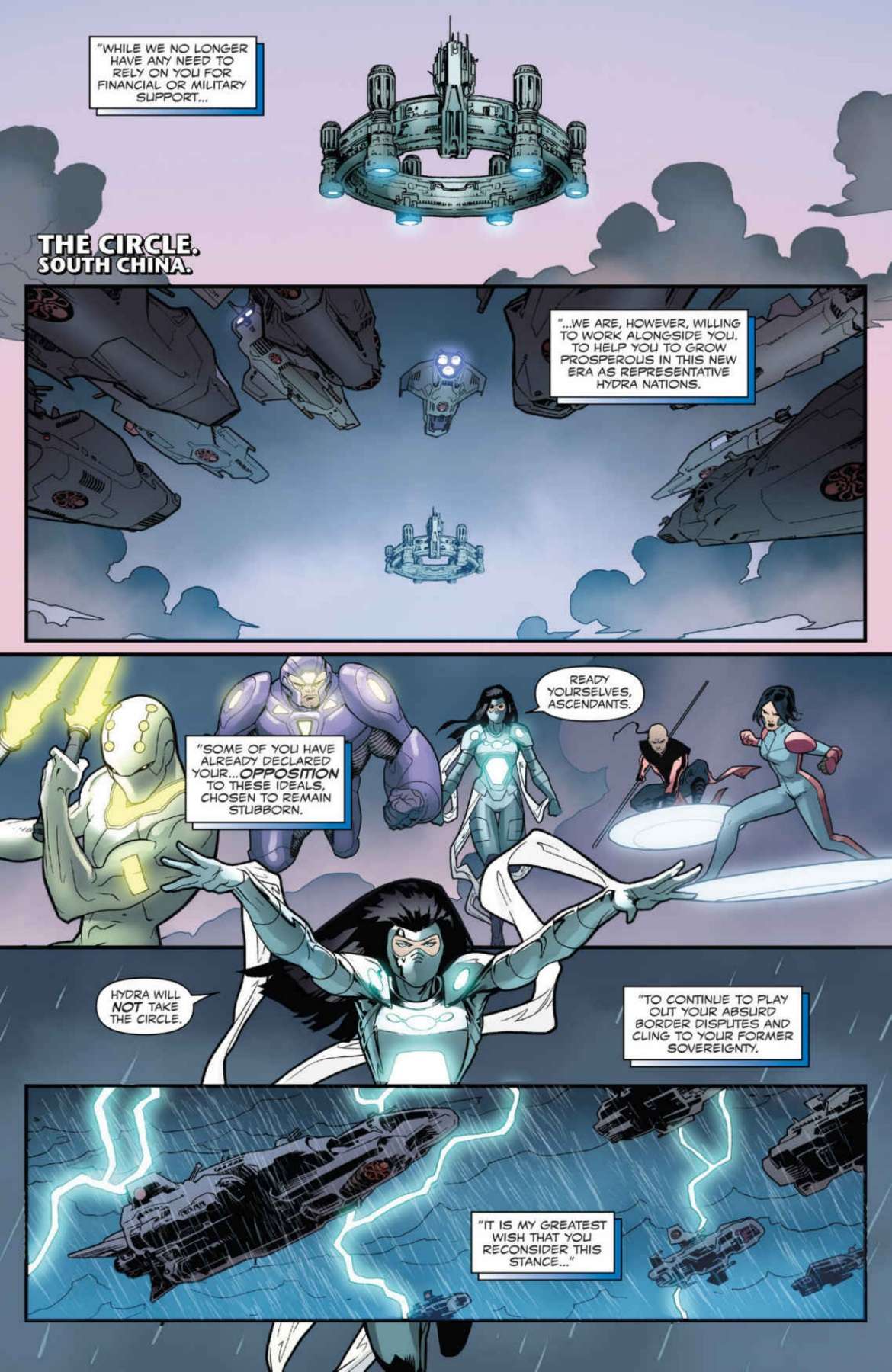
Wu, C., & Yu, A. C. (2012). The journey to the West: Volume 4. Chicago, Ill: University of Chicago Press.