The Sun Wukong Stone Relief of Kaiyuan Temple

Last updated: 01-27-2024

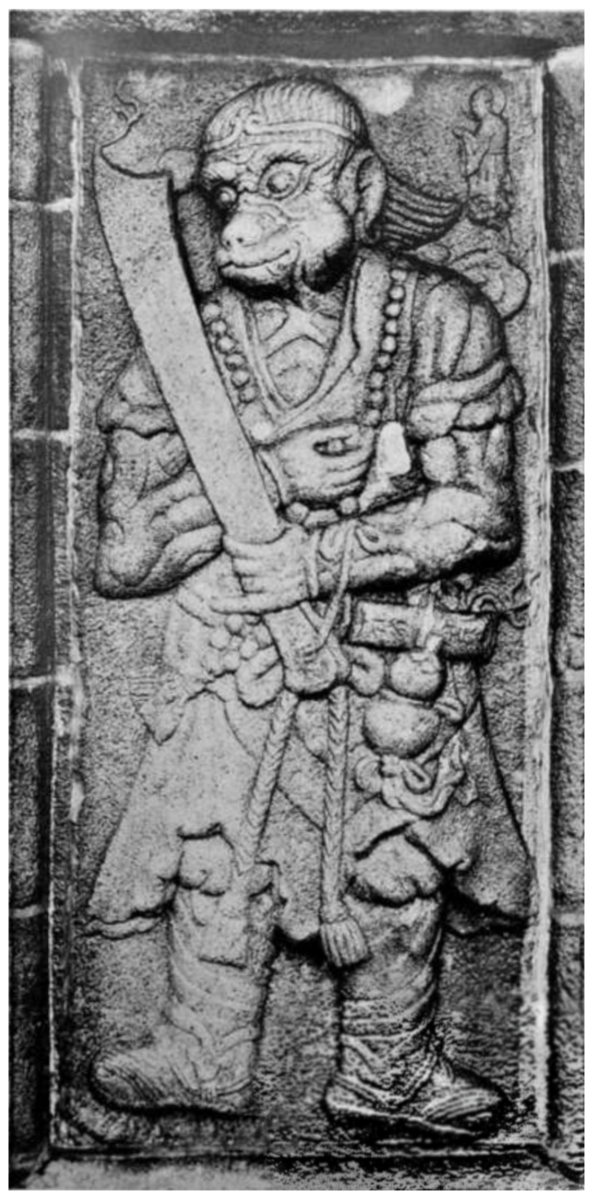
The southern Chinese seaport of Quanzhou in Fujian province is home to Kaiyuan Temple (Kaiyuan si, 開元寺), also known as the Purple Cloud Temple (Ziyun si, 紫雲寺), an ancient Buddhist complex originally built in 686. The temple is famous for its two stone pagodas, each of which is covered in 80 life-size relief carvings of bodhisattvas, arhats, patriarchs, protector deities, and various mythological creatures rendered in a rustic style influenced by the Northern Song Dynasty school of art (Ecke & Demiéville, 1935, pp. 11-18). One figure of interest is a muscular, sword-wielding, monkey-headed warrior (fig. 1) located on the northeastern side of the western pagoda’s fourth story. Many scholars consider this to be an early depiction of Sun Wukong from Journey to the West (Xiyouji, 西遊記, 1592). The pagoda was erected in 1237 (Ecke & Demiéville, 1935, p. 91), so this depiction predates the Ming novel by 355 years, making it an important source for analyzing the early influences on the much beloved literary character. In this paper, I present past research on the relief, as well my own in which I suggest that the iconography is based on ritual adornments mentioned in the Hevajra Tantra, an Esoteric Buddhist text of the 8th century.

Fig. 1 – The  Kaiyuan temple pagoda relief (larger version), Quanzhou, Fujian.

Table of Contents

1. Previous Research

The first detailed description of the relief appears in Ecke and Demiéville (1935):

A guardian with a monkey-head, holding with one hand a rosary which is hanging around his neck, and with the other a sword emitting a cloud from its tip. He wears a short tunic, travel-sandals, and a rope-belt from which are hanging a calabash and a scroll with the Chinese title of the Mahamayarividyārajñi [Fomu da kongque mingwang jing, 佛母大孔雀明王經] (T982-985, a text which was used as a charm against all calamities, dangers, wounds, and diseases). [According to local tradition, it is] Sun Wu-k’ung the name of the monkey assistant (alias the Monkey attendant 猴行者, or the fair Monkey-king 美猴王, or the Great Saint Equal to Heaven 齊天大聖) of Hsüan-tsang [Xuanzang] in the JW-novel. In the upper right corner of the carving there is a small monk-figure with a halo, evidently Hsüan-tsang himself, appearing on a cloud, seemingly the same cloud as that which emanates from the monkey’s sword. In the version of the JW now extant, the monkey assistant’s weapon is not a sword, but an iron rod with two golden rings, which he can reduce, whenever he finds it convenient, into a needle and so keep inside his ear. Also, he wears a tiger-skin over the lower part of his body, a detail which does not agree with our carving (p. 35)

Glen Dudbridge (1970) compares Ecke and Demiéville’s analysis with the description of the Monkey Pilgrim (Hou xinzhe, 猴行者) from the The Story of How Tripitaka of the Great Tang Procures the Scriptures, the late-13th century precursor of Journey to the West. Based on the differences, he suggests that Northern and Southern China may have had separate Monkey story cycles:

[T]here is no sign there of the traveller’s garb in which the Zayton [1] figure is so meticulously clothed; the sword is also not mentioned, although the ‘iron rod with gold rings’ … has not yet assumed its full distinctive role; similarly, the tiger-skin robe, while not described in so many words, seems faintly anticipated in the episode [chapter six] in which Hou Hsing-che slays a tiger-demon, and certainly this standard attribute of demonic figures in Tantric iconography accords well with the description of the yakṣa in that same episode. [2] All this tends to suggest that the Zayton monkey-figure remains strangely distinct from that known to us in the literary sources … Certainly at this stage of their development, there seems to have been no obligation to uniformity in the enactment or representation of popular story cycles: the monkey seen, heard or read about by the northern public could well have differed from his southern counterpart (Dudbridge, 1970, p. 49).

Journey to the West translator and scholar Anthony C. Yu (1977) highlighted a difference in opinion regarding the pious figure on the upper right of the piece:

Ōta Tatsuo 太田辰夫 and Torii Hisayasu 鳥居久靖, in “Kaisetsu 解説,” in Saiyuki, Chūgoku koten bungaku taikei, 31-32 (Tokyo 1971), 432, have challenged Ecke and Demiéville’s interpretation of the carving by pointing out that the figure at the upper righthand corner should be thought of simply as a figure of Buddha (not Hsüan-tsang), which Monkey will become by virtue of bringing back the scriptures. It may be added that Sun Wu-k’ung of the hundred chapter narrative did use a sword or scimitar 刀 (JW, chaps. 2 and 3) before he acquired his famous rod. [3] None of the scholars consulted here sees fit to discuss the significance of what seems to be a headband worn by the carved figure (p. 497 n. 23). 

Victor Mair (1989) focuses on the relief’s iconography and suggests that the various elements might have ties to depictions of both the Buddhist protector deity Aṇḍīra and the Hindu monkey god Hanuman from the Ramayana (c. 4th cent BCE):

The band on the Zayton monkey’s head is indeed very important. Surely it must represent what becomes the Tight-Fillet 緊箍 of the Ming JW, ch. 14. Regardless of the author’s (or his predecessors’) elaborate creative inventions surrounding this fillet in the tradition of the novel, we may ask whether it has any identifiable iconographical origins in art.

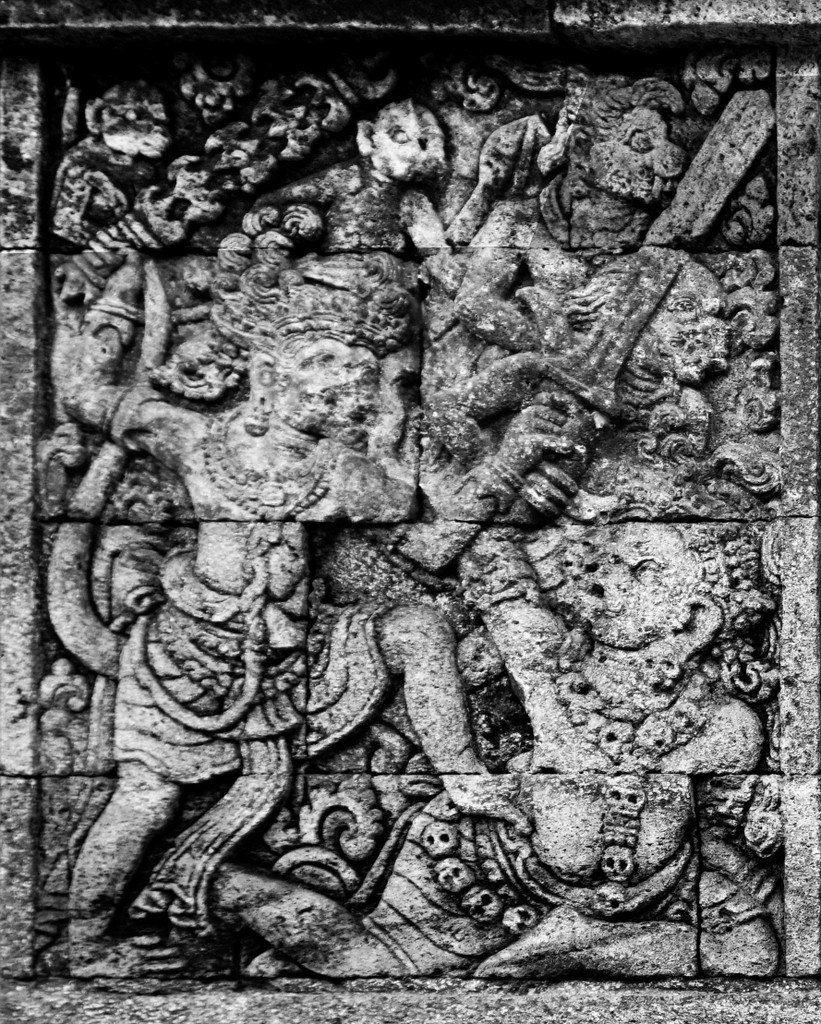
The Tight-Fillet recalls the band around the head of representations of Aṇḍīra, the simian guardian of Avalokiteśvara and Bhaișajyaguruvaidūryaprabhāṣa … As a typical specimen, we may take a statue [fig. 2] from the Kōfukuji in Nara. The Kōfukuji Aṇḍīra has curious wing-like projections extending from the sides of the band around his head that remind us of Mercury in Western classical art. On the Zayton SWK [Sun Wukong], these symbols of swiftness have been displaced to the sides of the eyes. In either case, the wings remind us of H’s [Hanuman’s] descent from the god of the wind. Other similarities between the Kōfukuji Aṇḍīra and the Zayton SWK include: identical earrings (these are key iconographical features of H in many Southeast Asian Rs [Ramayanas]), comparable tilt of the head (exaggerated with the Kōfukuji Aṇḍīra) which seems to indicate enforced submission, long locks of hair flaring out behind the head, elongated monkey’s mouth, similar decorations on forearms and upper arm, etc. It is crucial to note that all of these features can be found in South Asian and Southeast Asian representations of H. For its photographic clarity, we may choose a scene from the Rāma reliefs in Panataran, Indonesia [fig. 3]. H’s forearms are bare in this particular representation, but in some Thai reliefs (at Wat Phra Jetubon in Bangkok), they resemble those of the Zayton SWK and the Kōfukuji Aṇḍīra. The discrepancies in the dress and ornamentation of the lower parts of the body may be attributed to culture and climate (pp. 699-700).

Fig. 2 – The Kōfukuji Aṇḍīra wooden relief carving (c. 11th to 12th cent.) (larger version), Nara, Japan. Fig. 3 – Hanuman (left) besting a demonic foe (right), from the Ramayana reliefs of the Panataran temple complex (c. 12th cent.) (larger version), East Java, Indonesia. 

2. My Findings

My opinion on the origins of the Kaiyuan relief’s iconography parts ways with Mair in some respects. For instance, upon close inspection of the Japanese Aṇḍīra carving, the band that he refers to appears to be the brim of a helmet. I do agree that the Kaiyuan relief shares affinities with the cited image of Hanuman (e.g., the earrings and armbands). But again, here I part ways with Mair because I suggest that the relief’s accoutrements were instead influenced by Esoteric Buddhism and not Hinduism. The similar imagery is no doubt due to a common cultural source.

Nearly every aspect of Sun Wukong’s attire can be found in a passage from the 8th-century esoteric text the Hevajra Tantra (Dabei kongzhi jingang dajiao wang yigui jing, 大悲空智金剛大教王儀軌經). It instructs yogins on how to adorn and dress themselves for worshipping Heruka (Xilujia, 呬嚕迦), a wrathful protector deity of Buddhism.

Sanskrit: bhavakena vidhartavyam karnayor divyakupdalam/ sirasi cakri dhartavya hastayo rucakadvayam/ katyarp va mekhalam caiva padayor nupuran tatha/ bahumule ca keyuram gnvayam asthimalika/ paridhanam vyaghracarma bhaksanam dasardhamrtam

Translation: The practitioner should wear divine ear-rings, a circlet around the head, upon each wrist a bracelet, a girdle around his waist, anklets around the ankles, arm ornaments around the upper arms and a garland of bones around the neck. His dress must be of tiger skin … (Farrow & Menon, 2001, pp. 61-62).

彼修觀者當如是行:謂頂想寶輪、耳帶、寶鐶,手串寶釧,腰垂寶帶,足繫寶鐸及妙臂釧,頸嚴寶鬘衣、虎皮衣 …

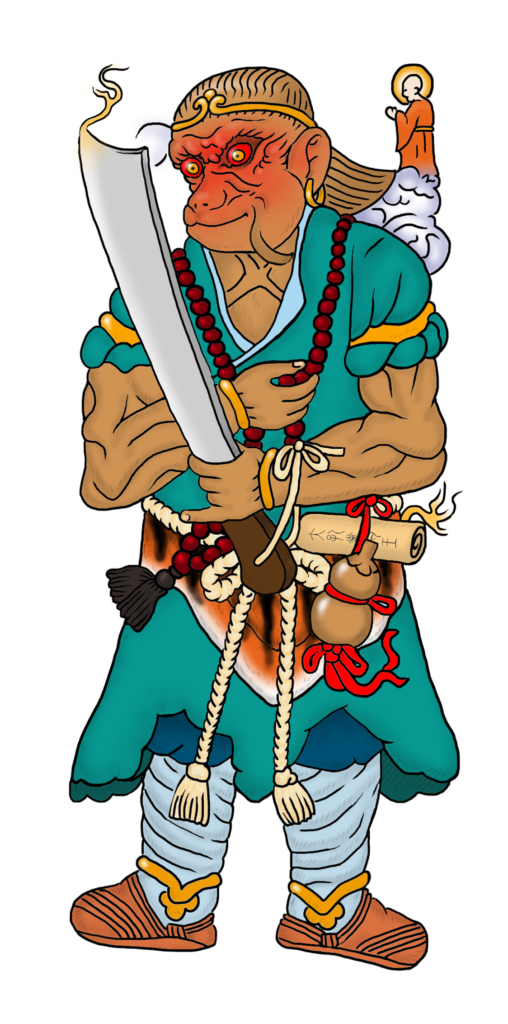
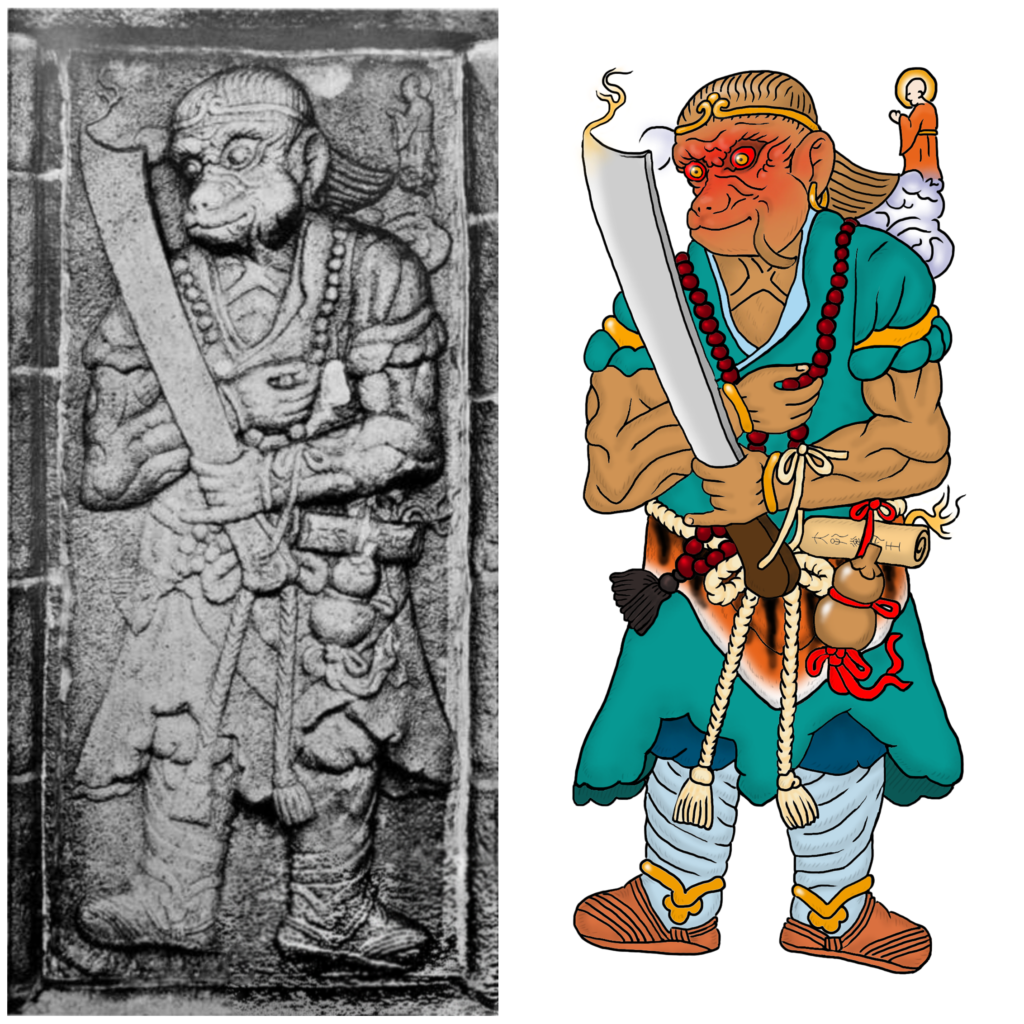
Earrings? Check! Circlet? Check! Bracelets, girdle, anklets, and arm ornaments? Check, check, check, and check! The only two aspects that are questionable are the bone necklace and the tigerskin. Rosaries are sometimes made from bone, which satisfies that requirement. And while Ecke and Demiéville were quick to note the omission of the pelt in their study, I think that the appearance of so many elements from the passage suggests that the tigerskin is present but the features may have just been eroded by time. The chevron shape visible below the girdle could be a skin apron. I’ve created a color version of the relief based on this information (fig. 4).

Fig. 4 – My interpretation of the relief (larger version). A comparison of the original and new versions can be seen here.

(Note: 05-22-23 – Upon reviewing figure four, I don’t like the way the proposed tiger skin cuts off at the belt. It would make more sense for the skin to act as a girdle, making it visible above the belt. I’ll probably update this in the future.)

As I explained in a previous article, the Hevajra Tantra was officially translated into Chinese in 1055 (no doubt arriving earlier than this), so the text was present in the middle kingdom for nearly 200 years prior to the creation of the relief.

What can these ritual elements tell us about Monkey’s depiction? Firstly, it should be noted that the esoteric deity Heruka and other such wrathful guardians, known by the neologism “Wrathful Destroyers of Obstacles” (Sk: krodha-vighnantaka), are commonly portrayed wearing such items, leading to the scholar Van Kooij (as cited in Linrothe, 1999) to comment, “Heruka is more or less a deified hypostasis of the … yogin himself” (p. 251). Second, these deities are often portrayed wielding weapons. For example, one source describes Vajrapani‘s wrathful form Trailokyavijaya “hold[ing] the vajra, ankusa-hook, sharp sword, pâsa-noose and other âyudha [weapons]” (Linrothe, 1999, p. 188). Sun Wukong, too, is depicted with a weapon, a sword with a lick of heavenly flame. Third, the flaming sutra tied to Monkey’s girdle was, as explained above, historically “used as a charm against all calamities, dangers, wounds, and diseases” (Ecke & Demiéville, 1935, p. 35). Wrathful Destroyers of Obstacles are charged “with the destruction of barriers which prevent the experience of enlightenment” (Linrothe, 1999, p. 25). These include external threats like manifested demons and internal threats like demon-caused mental and bodily illness, the “three poisons,” and karmic debt (Linrothe, 1999, pp. 24-25). Therefore, the iconography presents Sun Wukong as a wrathful protector deity.

This then may lend support to Ecke and Demiéville’s original assertion that the pious figure floating in the clouds to the right of Monkey’s head is in fact Xuanzang. The Great Sage clears the path of manifested demons that obstruct the monk’s path to enlightenment, leading to his ascension into paradise (this happens in both the 13th-century version of the story and the standard Ming novel).

3. Ritual Adornments and Other Literary Figures

While Monkey’s association with the fillet and the tiger skin carried over into the novel, other characters came to be associated with ritual adornments from the Hevajra Tantra. A prime example is Red Boy (Hong hai’er, 紅孩兒), son of the Bull Demon King and Princess Iron Fan. The Bodhisattva Guanyin forces the demon child to submit in chapter 42, after which she uses a magic treasure given to her by the Buddha to ensnare his extremities.

Dear Bodhisattva! She took the fillet and waved it at the wind once, crying, “Change!” It changed into five fillets, which she threw at the body of the boy, crying, “Hit!” One fillet enveloped the boy’s head, while the rest caught his two hands and two feet (Wu & Yu, 1977, vol. 2, p. 280).

Red Boy is the literary counterpart of the religious figure Sudhana (Sancai, 善財), whose spiritual journey is told in the Gandavyuha Sutra (Dafang guang fohuayan jing, 大方廣佛華嚴經, c. 3rd cent.). The youth sets out on a quest towards enlightenment and trains under 52 different teachers, including Maitreya, Avalokiteśvara (the South Asian variant of Guanyin), Mañjuśrī, and Samantabhadra (Buswell & Lopez, 2014, p. 864). It’s no wonder then that the ascetic came to be associated with such ritual adornments. South and East Asian depictions of Sudhana/Sancai often portray him wearing bangles and anklets (fig. 5).

Fig. 5 – A modern day altar statue of Sudhana/Sancai (larger version). Notice the bracelets and anklets.

4. Conclusion

The 13th-century Sun Wukong pagoda relief of the Kaiyuan Temple shares many similarities to ritual adornments mentioned in the esoteric Hevajra Tantra (8th cent.), including earrings, the circlet, arm cuffs, a necklace, a girdle, wrist bangles, anklets, and possibly even a tiger skin. Esoteric protector deities are often portrayed with similar attire since they represent the very yogin ascetics who worship them. Monkey’s depiction with said attire suggests the artist who created the piece intended to present him as a powerful Buddhist guardian on par with Wrathful Destroyers of Obstacles like Heruka. The depicted sword and sutra, each shown with a lick of heavenly flame, no doubt represent the means by which the Great Sage protects his master Xuanzang (possibly the pious figure on the upper right corner of the relief).

The onetime enemy Redboy comes to wear the ritual circlet, bracelets, and anklets in Journey to the West after being subjugated by Guanyin. While he is depicted as a defeated foe who submits to Buddhism, these adornments recall his historical and religious origins as Sudhana, a great ascetic from Buddhist literature.


5. Updates

5.1. Fan Art

Update: 05-22-23

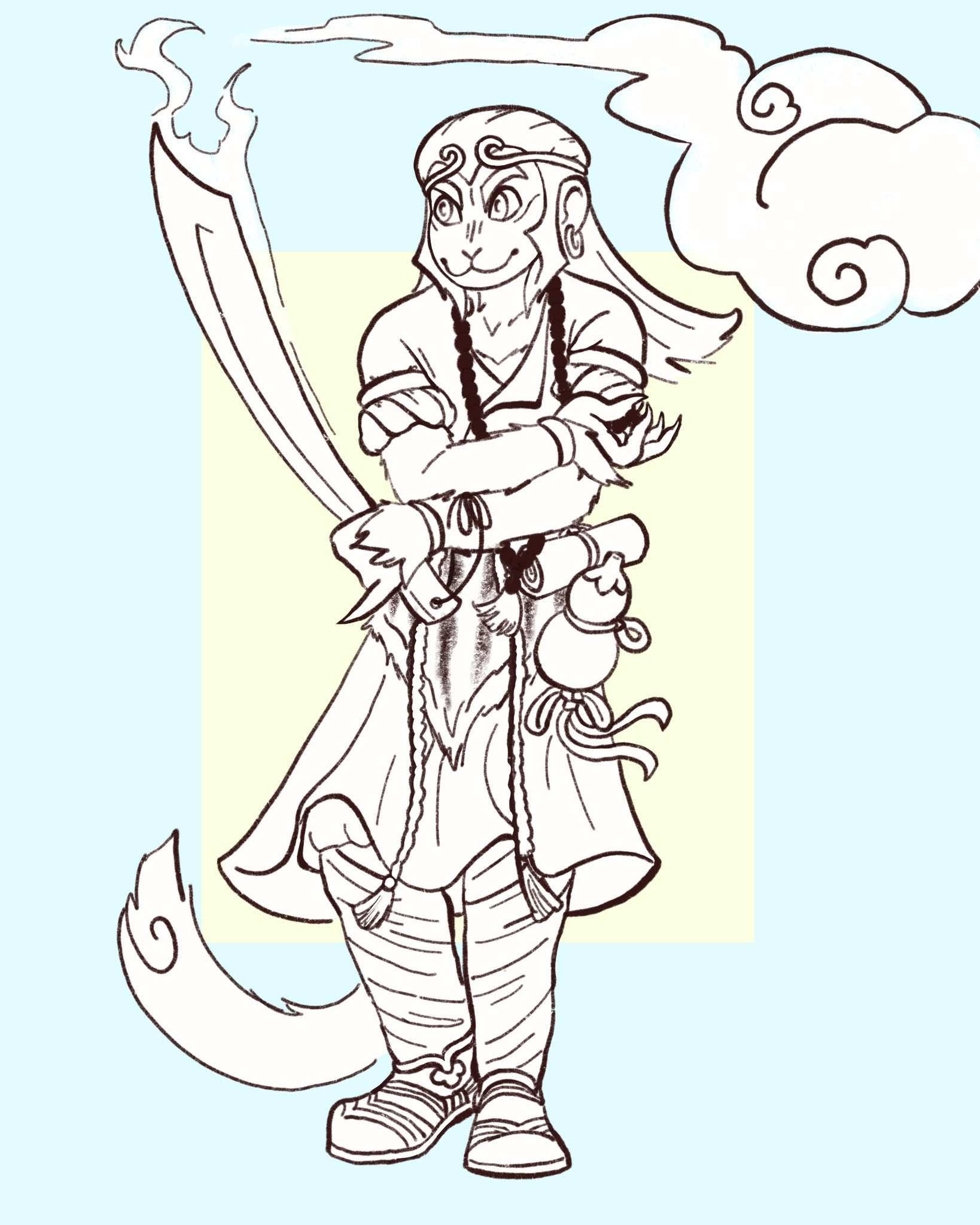
Twitter user Lava (@Lavaflowe) has allowed me to post their lovely drawing of the stone pagoda carving.

Fig. 6 – Lavaflowe’s version of the stone pagoda carving (larger version). Image from twitter.


5.2. No Tiger Skin?

Update: 01-26-24

There is also a possibility that the tiger skin isn’t present at all (as suggested by others). Despite the Hevajra Tantra prescribing this dress, the skin isn’t listed among the most basic accoutrements of a yogi elsewhere in the work. These are known as the “Five Symbolic Ornaments” or “Five Seals” (Sk: Pancamudrā, पञ्चमुद्रा; Ch: Wuyin, 五印; a.k.a. “Five Buddha Seals,” Wufo yin, 五佛印). Each is associated with a particular Buddha:

Aksobhya is symbolised by the circlet, Amitabha by the ear-rings, Ratnesa by the necklace, Vairocana by the hand ornaments, [and] Amogha by the girdle (Farrow, 1992, p. 65).

輪者,表阿閦如來;鐶者,無量壽如來;頸上鬘者,寶生如來;手寶釧者,大毘盧遮那如來;腰寶帶者,不空成就如來。


5.3. The Six Ornaments

Update: 01-27-24

The aforementioned five ornaments are sometimes combined with another item to form the “Six Ornaments” or “Six Seals” (Sk: Shanmudrā, षण्मुद्रा), each of which is associated with a Buddhist wisdom:

The yogic ornaments … are commonly classified as being six in number: (1) the skull-tiara, (2) the armlets, (3) the bracelets, (4) the anklets … (5) the bone-bead apron and waist-band combined … and (6) the double line of bone-beads extending over the shoulders to the breast, where they hold in place the breast-plate Mirror of Karma, wherein … are reflected every good and bad action. These six ornaments (usually of human bone) denote the Six Pāramitā (‘Boundless Virtues’), which are: (1) Dāna-Pāramitā (‘Boundless Charity’), (2) Shīla-Pāramitā (‘Boundless Morality’), (3) Kshānti-Pāramitā (‘Boundless Patience’), (4) Vīrya-Pāramitā (‘Boundless Industry’), (5) Dhyāna-Pāramitā (‘Boundless Meditation’), and (6) Prajñā-Pāramitā (‘Boundless Wisdom’). To attain to Buddhahood, and as a Bodhisattva to assist in the salvation of all living creatures, the Six Pramita must be assiduously practised (Evans-Wentz, 2000, p. xxv).

The most detailed source I’ve found reads:

a. The Bone Wheel

Vajradharma wears a bone wheel on his head. It is formed from a small bone circle that sits around the crown of the head, surrounded by a second, larger circle. The two circles are attached to one another by eight bone spokes. On each of the five spokes at the front, above the forehead, stands a dried skull that supports the jewel, which is the crest ornament. From the lower part of their jaws, looped chains and hanging decorative chains extend downward to the space between Vajradharma’s eyebrows and to the tips of his ears. One the back of each skull is a multicolored vajra with a crescent moon placed to the left. The deity’s long hair passes up through the hole in the middle of the inner bone circle and is tired in a topknot. 

b. The Earrings 

There are five parts to the earrings. There is a main circle of bone, which is like a bangle. From the bottom of the circle hang two smaller rings, each one attached to the larger ring above them by a semi-circle of bone.

c. The Necklace 

The necklace is made of two strings of bones bound together with hair taken from both a corpse and a living person. At the front is a square central hub. The hub forms the base for a T-shaped triple vajra. There are to more triple vajras placed at the two points where the strings of the necklace reach the shoulders.

d. The Bracelets

The deity wears a bracelet on each ankle, wrist, and upper arm, making six in total. Each bracelet is made from two strings of bones that have been bound together. There are three vajras on each pair of bracelets, one at the knot in the upper string, one at the knot in the lower string, and one opposite the knot in the upper string.

e. The Brahmin’s Bone Thread

Next is the Brahmin’s bone thread, or investiture thread (yajnopavita). On the front of the body, above the novel, is a bone wheel with either right or four spokes. There are holes in four of the spokes and two parallels strings of bone pass through each of them. Two of these strings go over the shoulders, and two pass under the armpit. On each of these strings are two vajras on the shoulder and another two under the armpit, making eight in total. Sometimes there is a second bone wheel on the back, to which all the strings are tied; if not, all the ends of the strings are knotted together. 

Together, or with the thread of hair from a slain thief, these bone ornaments are called the ornaments of the five mudras.

f. The Bone Belt 

The bone belt, or apron, hangs from the waist. It is made, as before, of two parallel strings of bone. The strings have five vajras attached to them–one at the front in the center, one on each hip, and one on each side of the center, halfway to the whips. Hanging chains and looped chains decorated with small silver bells and small bone spearheads hang from the tips of the vajras. The chains end at the point where the calf muscle begins to taper.

According to oral tradition, the necklace we just mentioned is ornamented with five vajras at the heart. Although I have consulted many descriptions of the bone ornaments, I have never seen this stated anywhere else. There are many traditions concerning the bone ornaments, but here I have presented that of the oral tradition taught by my master (Lingpa, Rinpoche, & Chemchok, 2017, pp. 52-54). 

As can be seen, the tiger skin is not mentioned among these ornaments either.

Also, as is mentioned, the items making up the six ornaments vary from tradition to tradition. For instance, Huntington and Bangdel (2003) list bone ash in place of the bone thread (p. 161). But it’s important to note for our purposes that the circlet, bangles, bracelets, anklets, and belt make up the five basic accoutrements.

Notes:

1) The city of Quanzhou was known to both Marco Polo and Ibn Battuta by the Arabic name Zayton or Zaiton (زيتون , the “City of Olives”).

2) Monkey transforms a ringed monk’s staff into a titanic yakṣa that crushes the aforementioned tiger demon with a club.

3) Yu (Wu & Yu, 1977) is referring to the fight between Sun Wukong and a demon, during which time the monkey disarms him and uses the latter’s own sword against him.

Sources:

Buswell, R. E., & Lopez, D. S. (2014). The Princeton Dictionary of Buddhism. Princeton, NJ: Princeton University Press.

Dudbridge, G. (1970). The Hsi-yu chi: A Study of Antecedents to the Sixteenth-Century Chinese Novel. Cambridge: Cambridge Univ. Press.

Ecke, G., & Demiéville, P. (1935). The Twin Pagodas of Zayton: A Study of the Later Buddhist Sculpture in China. Cambridge, Mass: Harvard University Press.

Evans-Wentz, W. Y. (Ed.). (2000). Tibet’s Great Yogi Milarepa: A Biography from the Tibetan Being the Jetsun-Kabbum Or Biographical History of Jetsun-Milarepa, According to the Late Lama Kazi Dawa-Samdup’s English Rendering. United Kingdom: Oxford University Press, USA.

Farrow, G. W., & Menon, I. (2001). The Concealed Essence of the Hevajra Tantra: With the Commentary Yogaratnamālā. Delhi: Motilal Banarsidass Publ.

Huntington, J. C., & Bangdel, D. (2003). The Circle of Bliss: Buddhist Meditational Art. United Kingdom: Serindia Publications.

Lingpa, J., Rinpoche, P., Chemchok, K. (2017). The Gathering of Vidyadharas: Text and Commentaries on the Rigdzin Düpa. United States: Shambhala.

Linrothe, R. N. (1999). Ruthless Compassion: Wrathful Deities in Early Indo-Tibetan Esoteric Buddhist Art. Boston, Mass: Shambhala.

Mair, V. (1989). Suen Wu-kung = Hanumat? The Progress of a Scholarly Debate, in Proceedings of the Second International Conference on Sinology (pp. 659-752). Taipei: Academia Sinica.

Wu, C., & Yu, A. C. (1977). The Journey to the West (Vol. 1). Chicago, Illinois: University of Chicago Press.

The Origins and Evolution of Sha Wujing

Did you know that Sha Wujing can be traced to an obscure Chinese desert spirit who was venerated as a minor Buddhist protector deity in Japan? This god is first mentioned in a 7th-century account of the historical Xuanzang, a.k.a. Tripitaka, titled Da Tang Daciensi Sanzang Fashi Zhuan (大唐大慈恩寺三藏法師傳, A Biography of the Tripitaka Master of the Great Ci’en Monastery of the Great Tang Dynasty). According to the text, Xuanzang spilled his surplus of water while in the deserts near Dunhuang, and after several days without drink, he had a fevered dream in which a tall, halberd-wielding spirit chastised him for sleeping instead of continuing his journey to retrieve scriptures from India. The monk immediately awoke and mounted his horse, which took him to an oasis with green grass and fresh water (Dudbridge, 1970, pp. 18-19).

Table of Contents

1. Close Ties With Japan

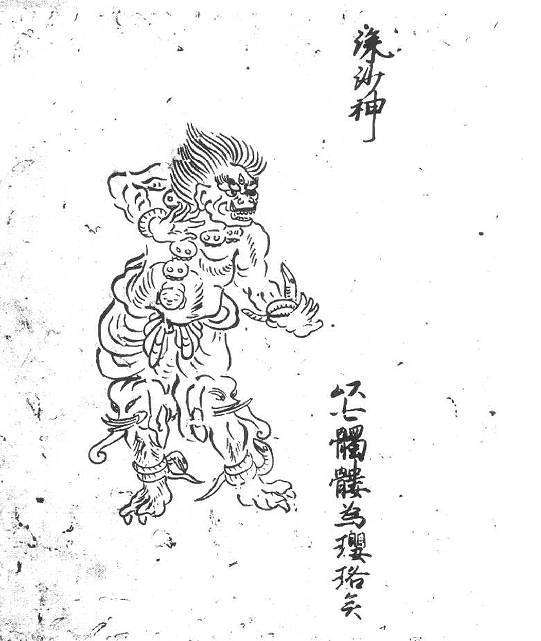
The Tang Sanzang ji (唐三藏記, Record of the Tang Monk Tripitaka), a book of seemingly unknown date appearing in an 11th-century Japanese collection of tales known as Jōbodai shū (成菩堤集), states that Xuanzang was magically provided food and drink by a deva while in the “Flowing Sands” (Liusha, 流沙) desert, a term commonly used for the harsh environment of China’s northwestern region. [1] The compiler of the Jōbodai shū explains: “This is the reason for the name Spirit of the Deep Sands (Shensha shen, 深沙神)” (Dudbridge, 1970, p. 19). After returning from a pilgrimage to China (838–839), the Japanese Buddhist monk Jōgyō (常曉, d. 865) wrote a report which describes Tripitaka’s fabled exchange with the deity, as well as equates Shensha shen with King Vaiśravaṇa, one of the Four Heavenly Kings of Buddhism (Dudbridge, 1970, pp. 19-20). [2] Therefore, the Tang Sanzang ji most likely hails from the Tang Dynasty (618–907). The Jōbodai shū also states that the god manifested itself before the famous Chinese Buddhist monk Faxian (法顯, 337–c. 422) during his pilgrimage to India. Shensha shen describes himself thus:

I am manifested in an aspect of fury. My head is like a crimson bowl. My two hands are like the nets of heaven and earth. From my neck hang the heads of seven demons. About my limbs are eight serpents, and two demon heads seem to engulf my (nether-) limbs… (Dudbridge, 1970, p. 20).

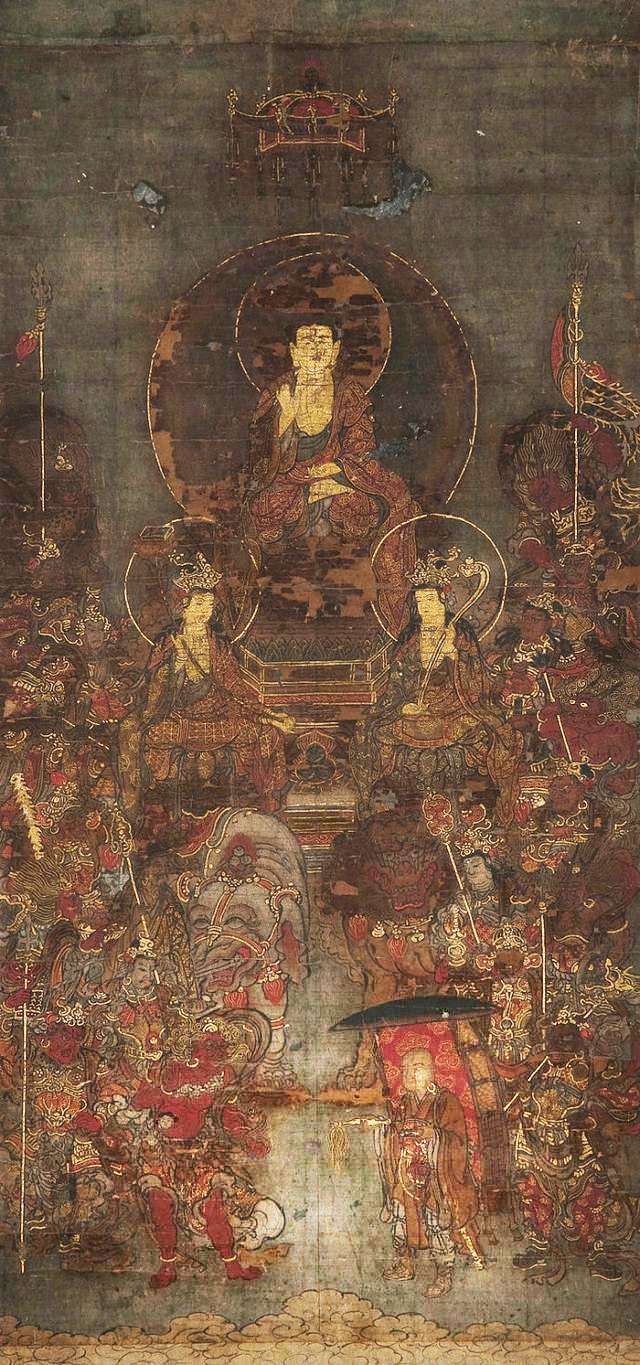
Monk Jōgyō’s aforementioned 9th-century report on Shensha shen appears to have initiated veneration of the spirit as a Buddhist guardian (no doubt thanks to his association with King Vaiśravaṇa). This deity was at some point given the title Jinja Taishō (深沙大將, “General of the Deep Sands”) and appeared in late-Heian (794–1185) and Kamakura (1185–1333) period art (Wong, 2002, pp. 61 and 63). One 12th-century ink on paper painting follows the iconography from the Jōbodai shū and depicts his legs with demonic elephant knees and bird-like talons (fig. 1). This same depiction most likely served as the basis for an exquisite wooden statue from the Kamakura period (fig. 2). The god never lost his association with Xuanzang, for one well-known 14th-century painting of the monk depicts him wearing Jinja Taisho’s necklace of skulls (fig. 3 and 4). Another painting of the same period depicts the pair standing on either side of a celestial crowd paying reverence to the Buddha. [3] It appears to be based on an earlier Chinese Song Dynasty painting (Figs. 5-7). Regarding the Japanese image, Wong (2002) notes:

Even though Xuanzang, of human origin, and Shensha shen, a demonic figure, were of low status in the Buddhist hierarchy, they are represented because of their role in the transmission of the Heart Sutra, and become elevated in rank by being shown with the deities and bodhisattvas that protect the sacred text (p. 63).

Sha Wujing Origins - 1

Fig. 1 – 12th-century Japanese ink on paper painting (larger version); Fig. 2 – 13th to 14th-century Japanese Kamakura wooden statue (larger version); Fig. 3 – Famous 14th-century Kamakura painting of Xuanzang (larger version); Fig. 4 – Detail of the skull necklace (larger version); Fig. 5 – Chinese Song Dynasty painting of the Buddha’s heavenly retinue, including Shensha shen (bottom center left) and Xuanzang (bottom center right) (larger version); Fig 6 – Detail of Shensha shen (larger version); Fig. 7 – Detail of Xuanzang (larger version).

2. Mention in Chinese Literature

The concept of Shensha shen was well enough established in China by the 13th century to be included in the eighth chapter of The Story of How Tripitaka of the Great Tang Procures the Scriptures, the earliest version of Journey to the West. But instead of being a benevolent deity, he is portrayed as a bloodthirsty monster who had several times eaten Xuanzang’s past reincarnations. The demon tells him, “I am the one who devoured you twice before, monk. Slung from my neck are all your dry bones!” (Wivell, 1994, p. 1190). The monster only helps the monk and his retinue cross the “Deep Sands” via a magical golden bridge once he is threatened with heavily retribution. Memorial poems thereafter note that Tripitaka releases the spirit from a five hundred-year-long curse, and Pilgrim (Sun Wukong) promises to speak highly of him when they finally meet the Buddha.

Sha Wujing first appears in the 22nd chapter of the final 1592 edition as an ogre-like beast living in the “Flowing Sands River” (Liusha he, 流沙河), a callback to the similarly named desert from earlier sources .

A head full of tousled and flame-like hair;
A pair of bright, round eyes which shone like lamps;
An indigo face, neither black nor green;
An old dragon’s voice like thunderclap or drum.
He wore a cape of light yellow goose down.
Two strands of white reeds tied around his waist [fig. 8].
Beneath his chin nine skulls were strung and hung;
His hands held an awesome priestly staff (Wu & Yu, 2012, vol. 1, p. 422).

Like The Story, Sha Wujing is persuaded to help the group cross the river, but this time it is after Xuanzang takes him as his third and final disciple (he had previously been pacified and converted by the Bodhisattva Guanyin). The water spirit takes off his skull necklace and, with the aid of a heaven-sent magic gourd, transforms the accoutrements into a boat on which Tripitaka rides to the other side.

sandy_appearing_by_tianwaitang-d319dlj

Fig. 8 – A modern depiction of Sha Wujing by Tianwaitang on deviantart (larger version).

3. Origin of Shensha Shen and Sha Wujing’s Skull Necklace

The skull necklace (Sanskrit: muṇḍamālā) can be tied to Esoteric Buddhism. For instance, the Sadhanamala (“Garland of Methods”), a compilation of esoteric texts from the 5th to 11th centuries, describes the wrathful protector deity Hevajra (fig. 9) wearing such a necklace:

He wields the vajra in the right hand and from his left shoulder hangs the Khatvanga [staff] with a flowing banner, like a sacred thread. He carries in his left hand the kapala [skull cap] full of blood. His necklace is beautified by a chain of half-a-hundred severed heads (emphasis added) [Fig. 10]. His face is slightly distorted with bare fangs and blood-shot eyes. His brown hair rises upwards and forms into a crown which bears the effigy of Aksobhya [Buddha]. He wears a kundala [ear decoration] and is decked in ornaments of bones. His head is beautified by five skulls (Donaldson, 2001, p. 221).

This attire is traceable to that worn by adherents of Heruka, another wrathful deity, as prescribed in the Indian Buddhist Hevajra Tantra (Ch: Dabei kongzhi jingang dajiao wang yigui jing, 大悲空智金剛大教王儀軌經, 8th century):

The yogin must wear the sacred ear-rings, and the circlet on his head; on his wrists the bracelets, and the girdle round his waist, rings around his ankles, bangles round his arms; he wears the bone-necklace (emphasis added) and for his dress a tiger-skin… (Linrothe, 1999, p. 250).

Compare this description with, for example, the Song Dynasty painting of Shensha shen (fig. 6). Many of the elements are present.

Statue with necklace detail

Fig. 8 – The Buddhist Deity Hevajra, late-11th to early-12th century, copper alloy (larger version). Courtesy of the Los Angeles County Museum of Art. Fig. 9 – Detail of the necklace (larger version).

4. Conclusion

Sha Wujing is traceable to an obscure Chinese desert spirit first mentioned in an embellished 7th-century account of the historical Xuanzang’s travels. This and later accounts portray him as a benevolent guardian watching over the monk and providing Tripitaka with subsistence on his journey through the harsh “Flowing Sands” desert of northwestern China. The Japanese Monk Jōgyō wrote a 9th-century report in which he mentioned the deity and associated him with King Vaiśravaṇa. This appears to have led to his veneration in Japan, for sources from the 11th century onward not only provide him with the titles Shensha shen (“Spirit of the Deep Sands”) and Jinja Taisho (“General of the Deep Sands”), but also lay out a prescribed iconography for him. He is generally portrayed in late-12th to 14th-century Japanese art as a fierce warrior with flame-like hair, a necklace of skulls, serpent arm adornments, demonic knees, and (sometimes) bird-like talons.

This spirit appears in The Story of How Tripitaka of the Great Tang Procures the Scriptures (13th century), the earliest version of Journey to the West, but is instead portrayed as a bloodthirsty desert demon who revels in having eaten Xuanzang’s last two incarnations. A necklace of dry bones serves as proof of his murderous hobby. He only decides to help the monk pass the Deep Sands when threatened with heavenly retribution. This episode served as the basis for Sha Wujing’s origin in the final 1592 version of the novel. He is similarly portrayed as a flesh-craving, skull necklace-wearing demon. Even his home, the aquatic realm of the “Deep Sands River,” is based on the former’s desert home. But after helping Tripitaka cross the river, Sha Wujing differentiates himself from his precursor by serving as the monk’s disciple and stalwart protector.

The skull necklace can be traced to wrathful Esoteric Buddhist deities and their accoutrements. For example, an 11th-century esoteric text describes the deity Hevajra wearing a “necklace…beautified by a chain of half-a-hundred severed heads.” This is ultimately based on one of the five kinds of ritual adornments worn by Indian Buddhist yogin adherents of the wrathful deity Heruka during the 8th century.

Notes:

1) The original source says “Moving sands” (Dudbridge, 1970, p. 19 n. 3), but I have changed the wording to conform with that commonly used in various English translations of the tale.

2) It’s interesting to note that King Vaiśravaṇa influenced another character from Journey to the West, Heavenly King Li Jing. Li Jing (李靖, 571–649) was a historical Tang Dynasty general who won many battles in China and Central Asia. Shahar (2013) notes that Li was deified after his death, and that the cult centered around him existed into the Song Dynasty (p. 28). Most importantly, “The general [was] celebrated in a large body of oral and written fiction, which gradually associated him with the Indian god [Vaiśravana]” (Shahar, 2013, p. 28). He continues, “Storytellers and playwrights [eventually] merged the Tang general with the martial Heavenly King” (Shahar, 2013, p. 28). This merging may have happened as early as the Yuan Dynasty (1271–1368) (Shahar & Kieschnick, 2013, p. 224 n. 18).

3) I, unfortunately, couldn’t find a high res version of this painting. All those I could find were either too blurry or to small for focusing on specific areas for details. The above linked webpage with the Song Dynasty variant includes a low res version of the Japanese painting.

Sources:

Dudbridge, G. (1970). The Hsi-yu chi: A Study of Antecedents to the Sixteenth-Century Chinese Novel. Cambridge: Cambridge Univ. Press.

Linrothe, R. N. (1999). Ruthless Compassion: Wrathful Deities in Early Indo-Tibetan Esoteric Buddhist Art. Boston, Mass: Shambhala.

Shahar, M., & Kieschnick, J. (2013). India in the Chinese Imagination: Myth, Religion, and Thought. University of Pennsylvania Press.

Shahar, M. (2013). Indian Mythology and the Chinese Imagination: Nezha, Nalakubara, and Krshna. In M. Shahar and J. Kieschnick (Eds.), India in the Chinese Imagination: Myth, Religion, and Thought (pp 21-45). University of Pennsylvania Press.

Wivell, C.S. (1994). The Story of How the Monk Tripitaka of the Great Country of T’ang Brought Back the Sūtras. In V. H. Mair (Ed.), The Columbia Anthology of Traditional Chinese Literature (pp 1181-1207). New York: Columbia University Press.

Wong, D. C. (2002). The Making of a Saint: Images of Xuanzang in East Asia. Early Medieval China 8, pp. 43-95.

Wu, C., & Yu, A. C. (2012). The Journey to the West (Vols. 1-4) (Rev. ed.). Chicago, Illinois: University of Chicago Press.

Modern Depictions of Sha Wujing’s Weapon and its Origins

Last updated: 07-02-2023

Sha Wujing (沙悟淨), or “Sandy” for short, is commonly portrayed in modern media wielding a Crescent Moon Spade (Yueya chan, 月牙鏟, a.k.a. “Monk’s Spade“), a wooden polearm capped with a sharpened spade on one end and a crescent-shaped blade on the other (fig. 1). But did you know that Sandy never wields this kind of weapon in the novel? Journey to the West (Xiyouji, 西遊記) chapter 22 contains a poem that describes the actual polearm and its pedigree. A section of it reads:

For years my treasure staff has enjoyed great fame,
Originally a tree of the sala variety in the moon, [1]
Wu Gang cut down from it one limb.
Lu Ban then made it, using all his skills.
Within the hub is “as-you-will” gold. [2]
Outside it’s wrapped by countless pearly threads.
It’s called the Treasure Staff Perfect for Subduing Monsters, [3]
[…] (based on Wu & Yu, 2012, vol. 1, p. 428)

寶杖原來名譽大,本是月裡梭羅派。
吳剛伐下一枝來,魯班製造工夫蓋。
裡邊一條金趁心,外邊萬道珠絲玠。
名稱寶杖善降妖 …

As you can see, it is described as a wooden staff devoid of any metal blades. So how did Sandy become associated with the Crescent Moon Spade?

Table of Contents

1. The Ming-Era Motif

The weapon can be traced to a common motif appearing in late-Ming Dynasty (1368–1644) woodblock prints. Sandy is just one of a number of famous literary staff-wielding monks to be portrayed brandishing a polearm topped with a small crescent shape (fig. 2). Others include Huiming (惠明) from the Story of the Western Wing (Xixiangji, 西廂記, c. 1300) (fig. 3) and Lu Zhishen (魯智深) from the Water Margin (Shuihu zhuan, 水滸傳, c. 1400) (fig. 4) (Shahar, 2008, p. 97).

#12 - Sha Wujing pics for blog entry

Fig. 1 – A modern depiction of Sandy wielding a Crescent Moon Spade (larger version). Fig. 2 – A late-Ming Dynasty print of Sandy with the crescent staff (larger version). Fig. 3 – A 1614 woodblock print of Monk Huiming with a crescent staff (larger version). Fig. 4 – A late-Ming woodblock of Lu Zhishen with a crescent staff (larger version). Fig. 5 – Sandy from Ehon Saiyuki (circa 1806) (larger version). Fig. 6 – Sandy from Xiyou yuanzhi (1819) (larger version). Fig. 7 – A detail from a Long Corridor painting (circa 1890) (larger version).

The exact origin or purpose of the blade is unknown, however. Martial historian Meir Shahar (2008) comments:

Future research may determine the origins of the crescent shape, which is visible in some Ming period illustrations of the staff. Here I will mention only that an identical design is common in a wide variety of twentieth-century martial arts weapons, whether or not they are wielded by Buddhist clerics. The crescent’s significance in contemporary weaponry can be gauged by its appearance in the names of such instruments as the “Crescent-Shaped (Yueya) [Monk’s] Spade,” “Crescent-Shaped Spear,” “Crescent-Shaped Battle-ax,” and “Crescent-Shaped Rake” (pp. 97-98).

A woodblock print appearing in the first section of The Illustrated Journey to the West (Ehon Saiyuki, 画本西遊記), published in 1806, depicts Sandy holding a staff with a large crescent blade (fig. 5), showing how the once small accent had been enlarged by this time to become a more prominent feature of the weapon. This same polearm is echoed in a print from The Original Intent of The Journey to the West (Xiyou yuanzhi, 西遊原旨, 1819) (fig. 6), as well as in multiple circa 1890 JTTW-related paintings from the Long Corridor of the Summer Palace in Beijing (fig. 7, for example). Therefore, Ming depictions of Sandy wielding a crescent-tipped staff were most likely associated with the Crescent Moon Spade due to their physical similarities, and this probably took place no earlier than the early-20thcentury.


2. Updates

2.1. A Crescent Moon Spade in JTTW

Update: 02-25-18

Unlike Sha Wujing, there is a monster in the novel who wields a Crescent Moon Spade. Chapter 63 describes the Nine-Headed Beast (Jiutou chong, 九頭蟲), [4] the son-in-law of a dragon king, using this bladed polearm in a battle against Monkey:

Enraged, Pilgrim shouted, “You brazen thievish fiend! What power do you have that you dare mouth such big words? Come up here and have a taste of your father’s rod!” Not in the least intimidated, the son-in-law parried the blow with his crescent-tooth spade; a marvelous battle thus broke out on top of that Scattered-Rock Mountain (Wu & Yu, 2012, vol. 3, p. 183).

行者大怒,罵道:「這潑賊怪,有甚強能,敢開大口?走上來,吃老爺一棒。」那駙馬更不心慌,把月牙鏟架住鐵棒,就在那亂石山頭 …

During the Ming Dynasty, there existed a military spade with a crescent blade on the top and a dagger-like blade on the bottom (武備志 (四十三) , n.d.) (fig. 8). This is likely the weapon used by the monster. Notice the similarities with figures five to seven. It’s easy to see how the crescent-tipped staff from the Ming woodblock prints could have later been associated with this military weapon. The difference is one of degree and not kind. This polearm was later modified into the modern Crescent Moon Spade, leading to depictions of Sandy wielding the weapon.

Fig. 8 – A Crescent Moon Spade from the Collection of Military Works (Wubei zhi, 武備志, c. 1621), a Ming treatise on military armaments and fighting techniques (larger version).


2.2. Sandy’s Weapon in the 1592 JTTW

Update: 05-15-18

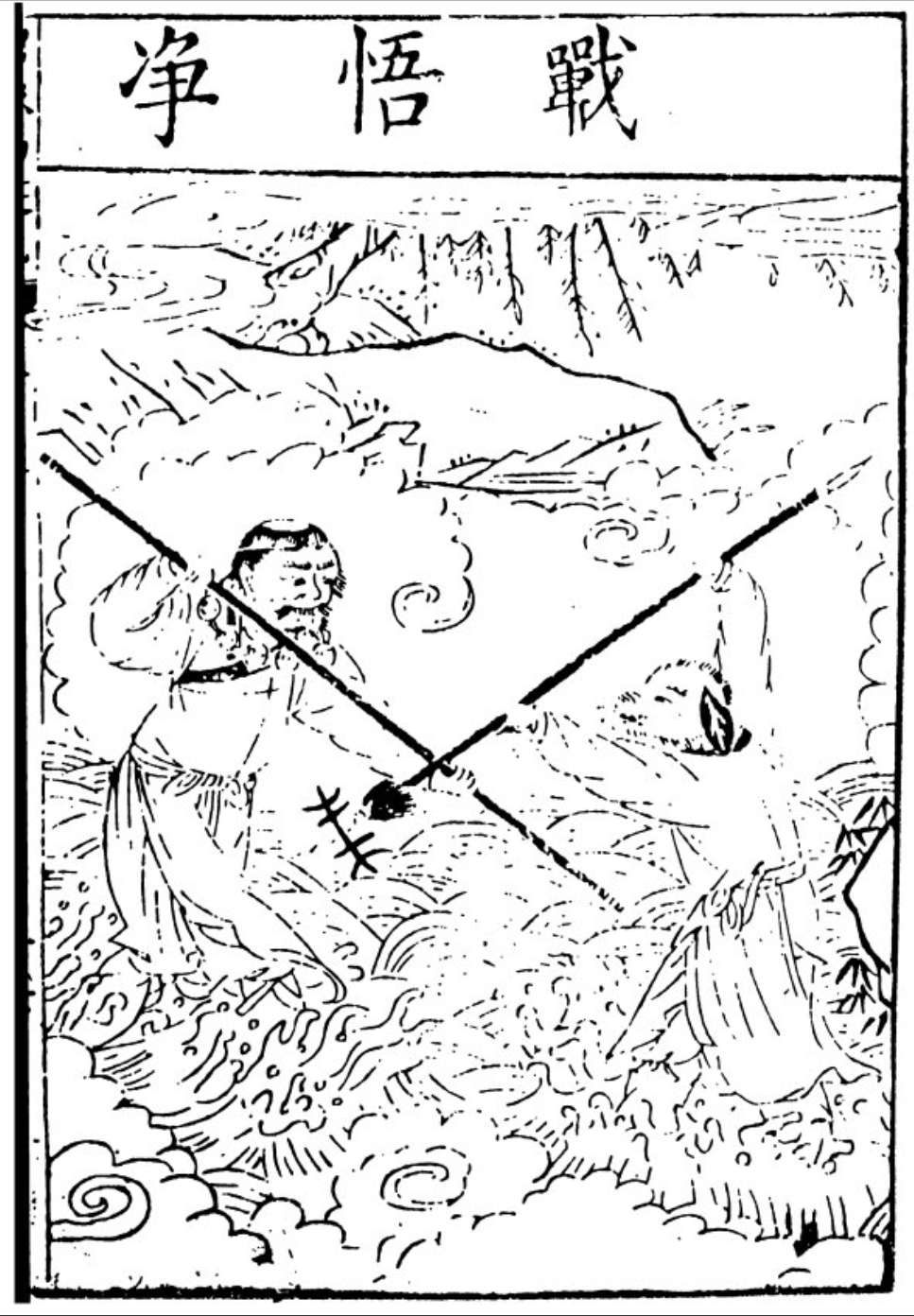
Feng Dajian of Nankai University was kind enough to direct me to this woodblock print (fig. 9) from the original 1592 publishing of Journey to the West. Sandy’s staff is more evident in this piece. It even lacks the aforementioned crescent shape.

Fig. 9 – The 1592 JTTW print of Sandy vs Pigsy (larger version).


2.3. Sandy’s Weapon in the 1592 JTTW – Part 2

Update: 07-02-23

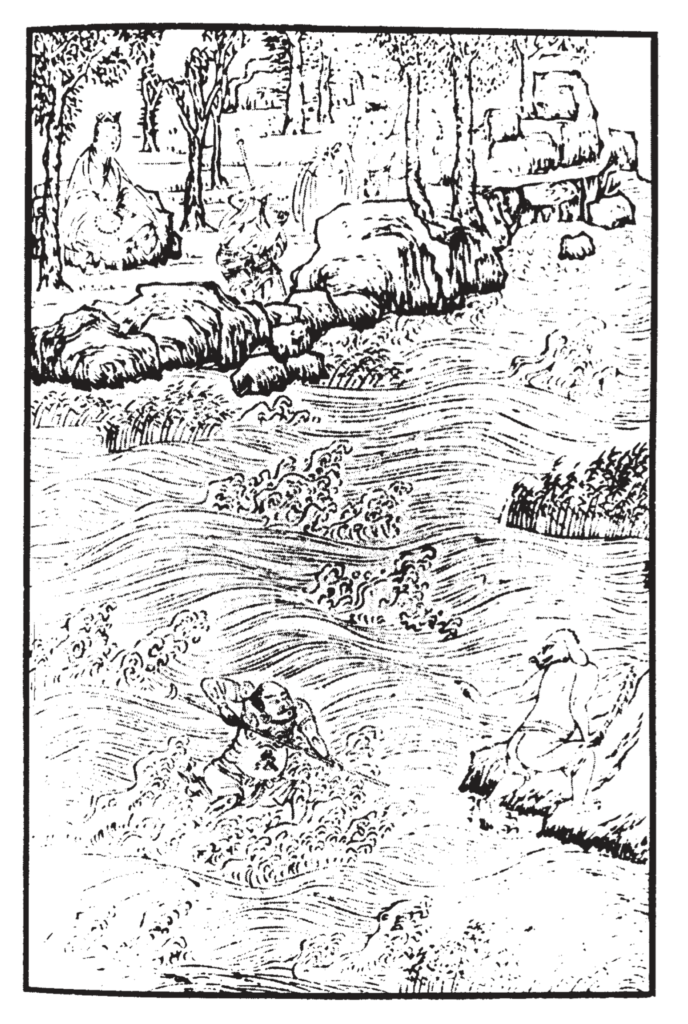
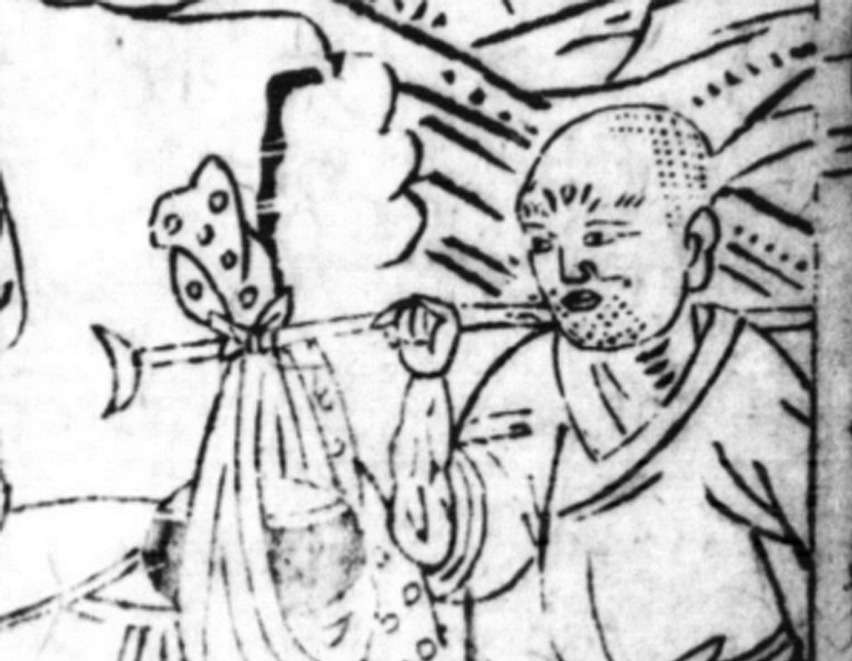
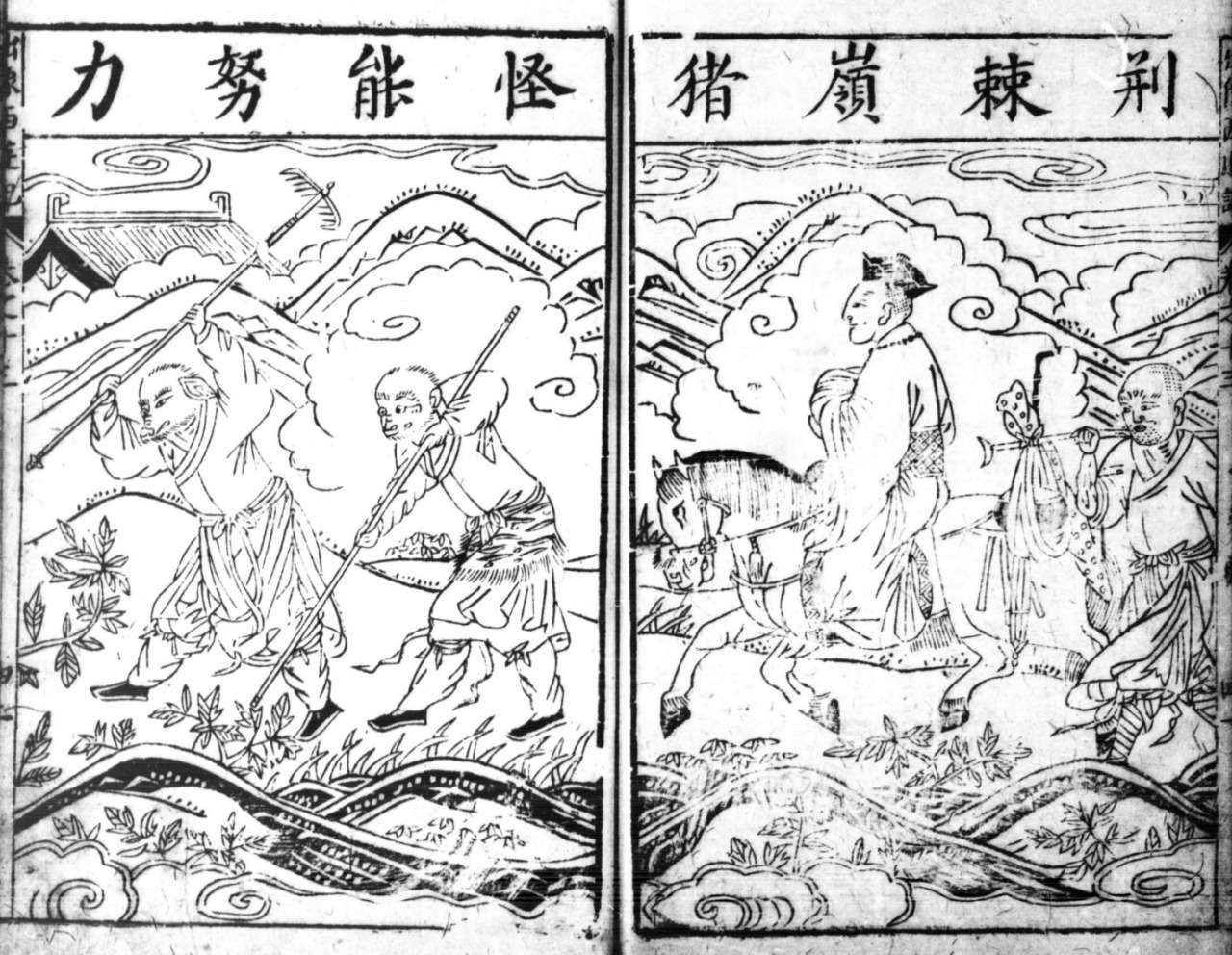
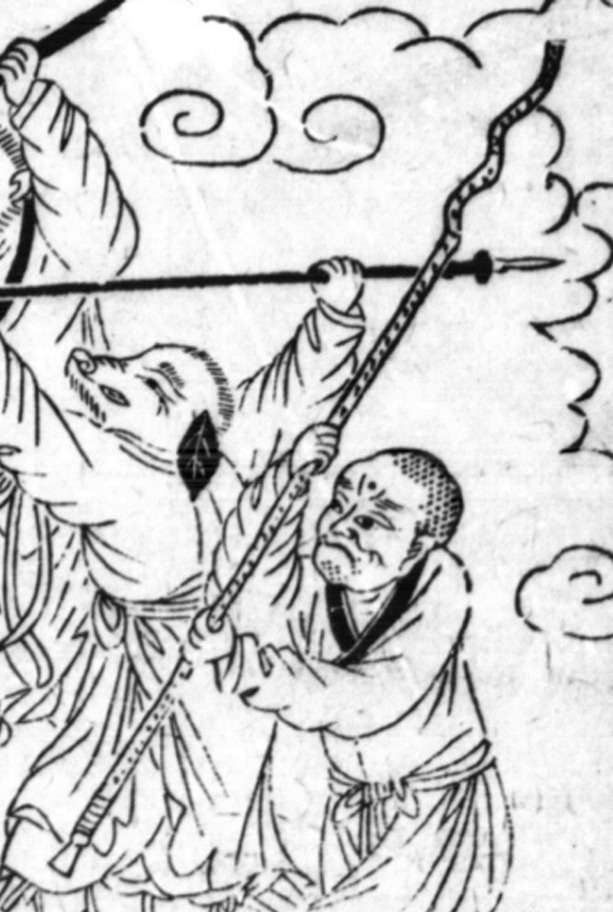
The woodblock prints from the original 1592 JTTW are extremely inconsistent. For example, figure nine shows Sha’s staff as a straight, black line. However, another print (fig. 10 & 11) depicts it with the crescent finial, and yet another (fig. 12 & 13) shows it as a twisting tree branch. The latter is my favorite because it aligns more with the weapon’s origin as presented above in the introduction.

Fig. 10 (top left) – A detail of the crescent staff (larger version). Fig. 11 (top right) – The full print (larger version). Fig. 12 (bottom left) – A detail of the tree branch staff (larger version). Fig. 13 (bottom right) – The full print (larger version).

Notes:

1) The original translation reads: “At first an evergreen tree in the moon” (Wu & Yu, 2012, vol. 1, p. 428), but the Chinese identifies the tree as suoluo pai (梭羅派), which literally means a “(family) branch of the sala tree.” I chose “a variety of” to avoid confusion with “tree branch.” And while the sala is technically a kind of evergreen in wet environments, it has deciduous-looking leaves. I chose to use the actual name of the tree to avoid confusion with pine evergreens. Yu (Wu & Yu, 2012) incorrectly identifies the suoluo tree as “Cunninghamia [l]anceolata,” a type of Chinese pine evergreen (vol. 4, p. 391 n. 7).

2) The original translation reads: “Within the hub one solid piece of gold” (Wu & Yu, 2012, vol. 1, p. 428). But the Chinese states that the inside is jin chenxin (金趁心), or “satisfactory metal/gold.” This is likely referring to the Chinese idiom chenxin ruyi (趁心如意), or “as one desires.” This important as the novel reveals that Sha’s weapon is capable of growing or shrinking on command just like Monkey’s cudgel, the “As-You-Will Gold-Banded Staff” (based on Wu & Yu, 2012, vol. 1, p. 429). Thank you to Irwen Wong of the Journey to the West Library blog for reminding me of this fact.

3) Yu (Wu & Yu, 2012) skipped over shan (善), or “good at, apt, perfect,” in his translation (vol. 1, p. 428).

4) The creature’s name is originally translated as the “Nine-Headed Insect,” but its true form is that of a monstrous reptilian bird (Wu & Yu, vol. 3, p. 184). While chong (蟲) usually means “insect, worm, or pest,” it can also mean “beast.” For instance, Da chong (大蟲, “great beast”) is the name of the tiger killed by the hero Wu Song in the Water Margin (c. 1400) (Børdahl, 2007). Therefore, a better name for our villain would be “Nine-Headed Beast.”

Sources:

Børdahl, V. (2007). The Man-Hunting Tiger: From “Wu Song Fights the Tiger” in Chinese Traditions. Asian Folklore Studies, 66(1/2), 141-163. Retrieved January 7, 2021, from http://www.jstor.org/stable/30030454

Shahar, M. (2008). The Shaolin Monastery: History, Religion, and the Chinese Martial Arts. University of Hawaii Press.

Wu, C., & Yu, A. C. (2012). The Journey to the West (Vols. 1-4) (Rev. ed.). Chicago, Illinois: University of Chicago Press.

武備志 (四十三) . (n.d.). Retrieved February 25, 2018, from https://archive.org/details/02092301.cn

Journey to the West and Islamic Lore

Last updated: 05-20-2026

Did you know that certain portions of Journey to the West (Xiyou ji, 西遊記, 1592 CE, “JTTW” hereafter) were influenced by Indo-Persian and Arab Islamic lore? I will discuss two examples below.

Table of Contents

1. Battle of Transformations

In JTTW chapter six, Sun Wukong and Lord Erlang engage in a magical battle of skill in which they freely transform into myriad animals, each trying to one-up the other. This battle is unusual as Chinese stories going back to pre-Tang Dynasty (618–907) sources show that characters could not transform into successive beasts at will (Hsia, 1968/2015, pp. 122-123). Conversely, One Thousand and One Arabian Nights (1704), which is based on stories as far back as the 9th century, contains a tale featuring a magical battle of transformations between a princess and a genie (Hsia, 1968/2015, p. 122). Literary critic C.T. Hsia (1968/2015) notes that the similarities in magical combat “does not mean…the makers of the Monkey legend were specifically indebted to [the Arabian Nights], but it certainly indicates their general awareness of the popular literature of the Middle and Near East” (p. 123).

(Note: I no longer feel that Hsia’s (1968/2015) suggestion is accurate. See the 11-21-2019 update below.)

2. Magic Tree with Human-Shaped Fruit

JTTW chapters 24 to 26 feature a magical Ginseng Tree (Renshen shu, 人參樹; a.k.a. “Immortal/Divine Root of the Five Villages Abbey,” Wuzhuang guan li xiangen, 五莊觀裡仙根) that produces crying, baby-shaped ginseng fruits (renshen guo, 人參果; a.k.a. “grass of reverted cinnabar,” cao huandan, 草還丹; a.k.a. “long-life grass of reverted cinnabar,” wanshou cao huandan, 萬壽草還丹) capable of extending the lives of those who eat them to 47,000 years (fig. 1). The literary antecedent of this fruit first appears in The Story of How Tripitaka of the Great Tang Procures the Scriptures (Da Tang Sanzang qujing shihua, 大唐三藏取經詩話; “The Story” hereafter), a 17-chapter storytelling prompt dated to the late-13th century. Chapter 11 features an immortal peach tree with fruits that transform into edible children once they drop into water. Each is capable of answering when asked a question:

Monkey Pilgrim continued: ‘There are more than ten peaches on the tree now, but there are gods of the earth who are posted here especially to protect them. There is no way to steal the peaches.’ The Master teased: ‘Your supernatural powers are stupendous. If you were to go, what could prevent you?’ Before his words were finished three peaches of immortality fell down into the pool. The Master was startled by the splash and he asked: ‘What fell down?’ Monkey Pilgrim replied: ‘Don’t be alarmed, Master. It was just a few ripe peaches of immortality which fell into the pool.’ The Master said: ‘Can we find them and eat them?’

Monkey Pilgrim took the golden-ringed staff and shook it three times in the direction of the huge, flat stone. A small child with a greenish face appeared. His fingernails were as sharp as a hawk’s claws and from his gaping mouth the teeth showed as he emerged from the pool. Pilgrim asked: ‘How old are you?’ The child answered: ‘Three thousand years.’ Pilgrim replied: ‘I have no use for you.’ Again he rapped five times and a child appeared whose face was as round as the full moon. He wore embroidered clothes and a headdress with tassels. Pilgrim asked: ‘How old are you?’ The child replied: ‘Five thousand years.’ Pilgrim replied: ‘I will not use you.’ And once more he rapped several times with the staff. Another child appeared all of a sudden. Monkey Pilgrim asked: ‘How old are you?’ ‘Seven thousand years,” the child replied. Monkey put down the golden-ringed staff and made the child get on his hand. Then he asked: ‘Monk! Will you eat this?’ The monks were terrified and fled. Pilgrim whirled his hand with the child in it a number of times and the child became a milky jujube which he popped into his mouth (Wivell, 1994, p. 1196).

猴行者曰:「樹上今有十餘顆,為地神專在彼此守定,無路可去偷取。」師曰:「你神通廣大,去必無妨。」說由未了,攧下三顆蟠桃入池中去。師甚敬惶。問:「此落者是何物?」答曰:「師不要敬,此是蟠桃正熱,攧下水中也。」師曰:「可去尋取來吃。」

猴行者即將金鐶杖向盤石上敲三下,乃見一個孩兒,面帶青色,爪似鷹鷂,開口露牙,從池中出。行者問:『汝年幾多?」孩曰:「三千歲。」行者曰:「我不用你。」又敲五下,見一孩兒,面如滿月,身掛繡纓。行者曰:「汝年多少?」答曰:「五千歲。」行者曰:「不用你。」又敲數下,偶然一孩兒出來。問曰:「你年多少?」答曰:「七千歲。」行者放下金鐶杖,叫取孩兒入手中,問:「和尚,你吃否?」和尚聞語,心敬便走。被行者手中旋數下,孩兒化成一枝乳棗,當時吞入口中。後歸東土唐朝,遂吐出於西川。至今此地中生人參是也。

Click the image to open in full size.

Fig. 1 (left) – Modern pears grown in molds to imitate ginseng baby fruit. Fig. 2 (right) – A 14th to 15th-century illuminated manuscript depicting the women fruit of the Waqwaq tree (larger version).

The concept of speaking, human-shaped fruit can be traced to the “Waqwaq tree” from Islamic lore. For example, The Book of the Wonders of India (Kitaab Ajaaib al-Hind), a set of Indo-Persian sailor stories collected between 900 and 953, contains a brief anecdote which reads:

Muhammad b. Babishad told me that, according to what he had learnt from men who had been to the Waqwaq country, there is a large tree there, with round leaves, or sometimes oblong, which bears fruit like a marrow, only larger, and looking something like a human being. When the wind blows, a voice comes out of it. The inside is full of air, like the fruit of the usher. If one picks it, the air escapes at once, and it is nothing but skin (Buzurg & Freeman-Grenville, 1981, p. 39).

The 15th-century Arab historian Ibn al-Wardi took the concept further by describing the fruit as being shaped like voluptuous women (fig. 2) with the power of speech:

On this island are trees that bear as fruit women: shapely, with bodies, eyes, hands, feet, hair, breasts, and vulvas like the vulvas of women. Their faces are exceptionally beautiful and they hang by their hair. They come out of cases like big swords, and when they feel the wind and sun, they shout “Waq Waq” until their hair tears (Toorawa, 2000, p. 393).

Various sources respectively locate the Waqwaq tree and its home of Waqwaq, a faraway, exotic land or island, somewhere within the Indian Ocean, beyond Iraq, or further still, beyond China. The Waqwaq term was most likely used to describe the limits of the known world at given times (Toorawa, 2000). The tree itself can possibly be traced to a passage in the Quran (Sura 37, verses 60-64) that describes how the “Tree of Zakkum” produces fruit shaped like the heads of demons. The earliest mention of the Waqwaq tree in Chinese sources appears in the late-8th century Comprehensive Encyclopedia (Tongdian, 通典) by the travel writer Du Huan (杜環). This is apparently based on an earlier Arabic source (A floral fantasy, n.d.).


3. Updates

Update: 02-28-2018

I was looking through the Ming-era Illustrated Encyclopedia of the Three Realms (Sancai tuhui, 三才圖會, 1609; “Three Realms” hereafter) and happened upon a woodblock print of a Waqwaq tree (fig. 3). The image is labeled Dashi Guo (大食國), a term used since the Tang Dynasty to refer to an ancient country in the Arab World (Zhang & Unschuld, 2015, p. 81). This shows the Chinese were still aware of the tree’s foreign origin around the time that JTTW was published.

Ginseng tree - From Sancai tuhui (1609), based on image of Iskander (Alexander the Great) talking to the Talking Tree from the Shamanah

Fig. 3 – Woodblock print from the Three Realms showing the Waqwaq tree (larger version).


Update: 11-21-2019

As noted above, Hsia (1996) suggests that the battle of transformations between Monkey and Erlang was influenced in some way by Islamic literature. However, Robinet (1979) describes a tit-for-tat battle from Daoist literature that casts doubt on this view:

The Xianyuan bianzhu [仙苑編珠, “Paired Pearls from the Garden of Immortals,” after c. 921] tells how Wang Tan [王探] received “the art of hiding his light and transforming his body.” Dared by someone to metamorphose himself, he took the form of a tree, but the other fellow seized an axe. Wang immediately transformed himself into a stone, but the other lit a fire (in the theory of the five elements, fire prevails over minerals). After turning himself into bubbling water and so on, Wang Tan finally achieved the upper hand by adopting the appearance of a corpse-the man fled immediately (p. 46). [1]

The way that the Daoist and his opponent try to one up the other is very similar to the battle between the Great and Small Sages. Therefore, it’s not a stretch to suggest that this story or related media were embellished by a storyteller or the author-compiler of the Ming JTTW to include two masters of transformation instead of one.


Update: 04-04-2020

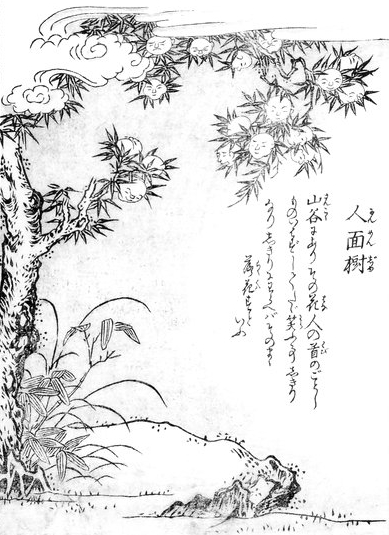
Thanks to a recent Twitter post by Guy Reisman, I was delighted to learn that the Islamic Waqwaq tree made its way to Japan, where it is known as the Jinmenju (人面樹, “human-face tree“). In fact, an illustration of the tree appearing in the Edo-period bestiary Konjaku Hyakki Shūi (今昔百鬼拾遺, “Supplement to the Hundred Demons from the Present and the Past,” c. 1781) appears to be based on that from the Three Realms cited above (refer back to fig. 3).

Even more exciting, however, is the revelation of the identity of the man standing beneath the tree in the Three Realms illustration. Foster (2015) traces the Japanese image to the Three Realms and then further back to a Persian source, thereby associating the man with a famous historical king:

If we continue back in time and along the Silk Road, we find different versions of the great Persian epic poem Shahnama (Book of Kings) by Firdawsi (d. 1020), with illustrations of a man conversing with a tree bearing human heads. The man, it turns out, is Alexander the Great (Sikandar or Iskandar), and the illustrations portray his legendary encounter with a talking tree, sometimes called the Wakwak Tree, that prophesied his death (p. 185).

That’s right! The man in the Three Realms is based on Alexander the Great! See figure four for a comparison of the Chinese illustration and one example of Persian “Iskander and the Talking Tree”-genre drawings. Both men stand in a similar position, looking upwards. The Persian Alexander is passively listening, while the Three Realms Alexander is actively talking.

Iskander and the Talking Tree - Three Realms Ginseng Tree

Fig. 4 – A comparison of a 15th-century Persian “Iskander and the Talking Tree” image and the Three Realms image (larger version). The former is held by the Bodleian Library.

This then raises the question: Did material related to the Shahmana influence the Ginseng Tree in Journey to the the West? [2] I’ve already demonstrated that an antecedent of the Ginseng tree appears in The Story, but this doesn’t necessarily negate some sort of influence. After all, both the Shahmana and JTTW feature mythic kings (Alexander and Sun Wukong) coming into contact with magic trees with humanoid fruit. I should note, however, that the trees represent two drastically different fates. Alexander’s tree foresees his death, while Monkey’s tree holds the promise of eternal life. Further research might shed light on stronger connections between both stories.


Update: 04-03-22

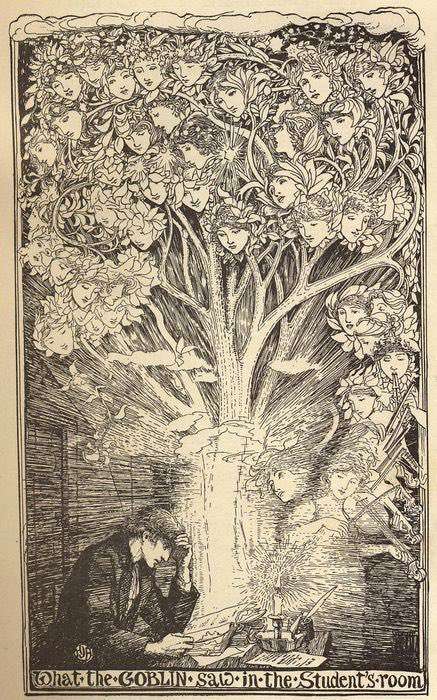
I was scrolling through Twitter, when I came across a post displaying a lovely 19th-century engraving of a magical tree from “The Goblin and the Grocer” (Danish: Nissen hos Spekhøkeren, 1852), a fairy tale by Hans Christian Andersen. The tree is shown to have smiling, female head-shaped fruits similar to the waqwaq tree (fig. 5). The description of the tree reads:

Out of the book shot a streak of light which grew into a large tree and spread its branches far above the student. Every leaf was alive, and every flower was a beautiful girl’s head, some with dark and shining eyes, others with wonderful blue ones. Every fruit was a glittering star” (Anderson, 1904, pp. 13-14)

So it appears that the waqwaq tree came to influence European literature as well.

Fig. 5 – The tree engraving from “The Goblin and the Grocer” (larger version). From Anderson, 1904, p. 15.


Update: 04-05-22

I’ve archived a paper showing that magical battles of transformation can be traced to Ancient Near Eastern, Egyptian, and Greek stories.

Archive #36 – Sun Wukong and Battles of Magical Transformations


Update: 04-07-24

Here is a description of the Ginseng Fruit Tree from JTTW chapter 24:

There was a huge tree right in the middle of the garden, with long, healthy branches and luxuriant green leaves that somewhat resembled those of the plantain. Soaring straight up, the tree was over a thousand chi [1,043.30 ft or 318 m] tall, and its base must have measured seven [73.03 ft or 22.26 m] or eight zhang [83.46 ft or 25.44 m] around. Leaning on the tree, Pilgrim looked up and found one ginseng fruit sticking out on one of the branches pointing southward. It certainly had the appearance of an infant with a tail-like peduncle. Look at it dangling from the end of the branch, with limbs moving wildly and head bobbing madly! It seemed to make sounds as it swung in the breeze (based on Wu & Yu, 2012, vol. 1, p. 461).

只見那正中間有根大樹,真個是青枝馥郁,綠葉陰森,那葉兒卻似芭蕉模樣,直上去有千尺餘高,根下有七八丈圍圓。那行者倚在樹下,往上一看,只見向南的枝上露出一個人參果,真個像孩兒一般。原來尾間上是個扢蒂,看他丁在枝頭,手腳亂動,點頭幌腦,風過處似乎有聲。


Update: 05-20-26

I recently learned that The Domestic Yapoo (Jp: Kachikujin Yapoo, 1970 onward), a strange Japanese time-traveling, body-horror novel series from the post-WWII era features a nod to the JTTW Ginseng Fruit Tree. Translator Nelliefeathers shared the following:

Yes, chapter 32.4 is titled Mandrake Apple (“spelt” with the same kanji used for the Man-fruit from JTTW). The Mandarake Apples are presented to the group to eat. They look like babies with an old person’s face, and Clara remarks that they remind her of the tree from Monkey. She’s specifies she’s referring to Waley’s translation (Personal communication, March 6, 2026).

Notes:

1) I changed the Wade-Giles to Pinyin.

2) Hall (2019) explains that Iskander’s meeting with the talking tree takes place in both the Shahmana and the older Greek Alexander Romance (p. 149).

Sources:

A floral fantasy of animals and birds (Waq-waq). (n.d.). Cleveland Museum of Art. Cleveland, Ohio. Retrieved May 12, 2017, from http://library.clevelandart.org/site…0Waq%20waq.pdf

Anderson, H. C. (1904). The Goblin and the Grocer. In A. Lang (Ed.), The Pink Fairy Book (pp. 12-17). New York: Longmans, Green, and Co. Retrieved from https://archive.org/details/pinkfairybook00lang/page/12/mode/2up

Buzurg, S., & Freeman-Grenville, G. S. P. (1981). The book of the wonders of India: Mainland, sea and islands. London: East-West.

Foster, M. D. (2015). The book of yōkai: Mysterious creatures of Japanese folklore. Oakland: University of California Press.
Hall, M. (2019). The imagination of plants: A book of botanical mythology. Albany : State University of New York Press

Hsia, C. (2015). The classic Chinese novel: A critical introduction (Rev. ed.). Hong Kong: The Chinese University of Hong Kong. ( Original work published 1968)

Robinet, I. (1979). Metamorphosis and deliverance from the corpse in Taoism. History of Religions, 19(1), 37-70.

Toorawa, S. M. (2000). WaÃq al-waÃq: Fabulous, fabular, Indian Ocean (?) island(s). Emergences, 10(2), 387-402.

Wivell, C.S. (1994). The story of how the monk Tripitaka of the great country of T’ang brought back the Sūtras In V. Mair (Ed.), The Columbia anthology of traditional Chinese literature (pp. 1181-1207). New York: Columbia University Press.

Zhang, Z., & Unschuld, P. U. (2015). Dictionary of the Ben cao gan mu: Volume 2 – Geographical and administrative designations. Oakland, California: University of California Press