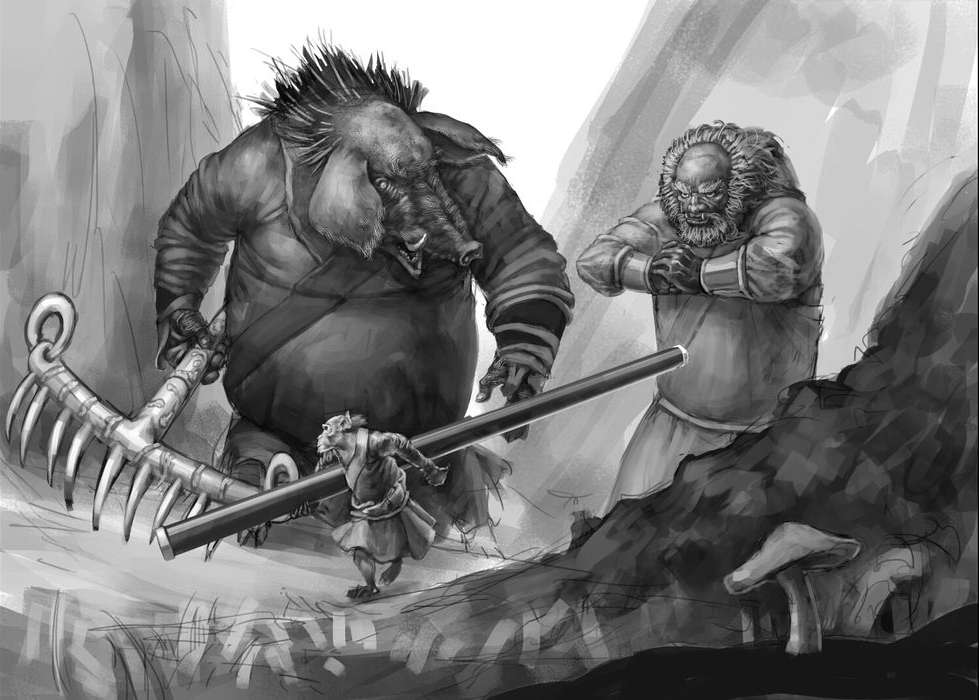
In honor of the forthcoming video game Black Myth: Wukong (August 20, 2024), I have completed a catalog of Sun Wukong‘s magic abilities and skills from all 100 chapters of Journey to the West (Xiyouji, 西遊記, 1592). To my knowledge, this is the first of its kind in English. My hope is that it will be useful to fanfiction writers and artists, as well as academics studying magico-religious concepts from Ming-era vernacular literature.
Below, I present a Google Doc and PDF of the full 177-page catalog, as well as a general survey of the magic powers and skills for people who are short on time.
[Note (8-18-24): I have moved the chapter headings to the beginning of each page, as well as added more information. This has increased the page count to 221, but the text is close to the same length, roughly 180 pages if squished together.]
A con is that I have to reupload this anytime I make an update to the original. Also, the formatting is wonky for some reason. But I’ll try my best to keep this updated at all times.
In place of using “layer” or “level,” I’m choosing to designate his various immortalities as “categories.” This is because a new layer of divine longevity or durability would surely be added for each immortal peach, elixir pill, or cup/jug of heavenly wine consumed. Hence, eating multiple peaches would be one category, eating multiple elixir pills would be one category, and so on and so forth.
There are two sets of immortalities. The first are achieved before or during the journey:
(Monkey briefly dies from thermal shock in chapter 41 while battling Red Boy. Zhu Bajie shortly thereafter suggests that he has 72 lives because he knows the 72 transformations (他有七十二般變化,就有七十二條性命。). If true, this would have interesting implications for his various immortalities. Would someone have to kill him 72 times in order to make sure that he is dead for good? However, this is little more than speculation since the narrative never mentions Sun respawning after death like a video game character.)
The second are achieved at the journey’s end once they reach the Buddha’s blessed land. These shouldn’t be lumped together with those acquired before and during the pilgrimage.
Eating Immortal food, tea, and fruit (ch. 98) (See the 01-01-26 update below for more info)
It’s important to note that the novel ends before Monkey is able to perform any feats as a Buddha. Therefore, making claims about his subsequent abilities is outside of canon.
A photomanipulation by me called “The Immortal Has Awakened” (2018) (larger version). The original work was first published on Deviantart.
2.2. Definite Powers
These abilities are utilized in the narrative.
Multitude of terrestrial killers (地煞數; a.k.a. “72 changes,” 七十二般變化) – This allows him to transform his body into anything he wants, including other humanoid figures, animals, insects, miscellaneous objects, incorporeal beams of light, and even buildings.
Cloud-soaring (騰雲) – This allows him to slowly travel through the sky. He only attempts this once (ch. 2).
Cloud somersault (觔/筋斗雲) – This allows him to fly 108,000 li (十萬八千里; 33,554 mi/54,000 km) in a single leap. He displays this throughout the novel.
Navigation – The ability to travel to and find places that he has not previously been to. This is displayed throughout the novel.
I’m placing this here because the ability might be magical.
Body beyond body (身外身法; a.k.a. “magic of body division,” 分身法) – This allows him to transform anyone of his 84,000 hairs into whatever he desires, including humanoid figures, animals, insects, miscellaneous objects, and even food, money, and tools. It is often used to create an army of clones throughout the novel. He claims that a single hair can multiply into the millions and billions.
Magic of displacement (攝法) – This allows him to transport people and items on a swift, powerful wind (ch. 2, 3, 62, 71, & 84).
Mighty wind (陣風) – This allows him to cause chaos all around him with a powerful wind. It is used to hide his activities, fan the flames of fire, scare away onlookers, and even to kill by propelling rocks (ch. 3, 16, 28, 38, 44, 68, 71, & 95).
Water-controlling magic – The “magic of water restriction” (閉水法; a.k.a. “water-repelling magic,” 避水訣) allows him to ward off water and/or to “open a waterway” (開水道) in order to travel to the aquatic realm. And the “magic of overturning seas and rivers” (翻江攪海的神通) does exactly as named. He displays these throughout the novel.
Magic method of modeling heaven on earth (法天像(象)地) – This allows him to take on a monstrous, 104,300 ft/31,800 m tall form. The original specified height, 10,000 zhang (萬丈), may be a metaphorical number for a much, much larger figure, for Monkey claims to have the ability to fill the universe if he so desired it (ch. 14). He displays this power several times (ch. 3, 6, 61, 64, & 97).
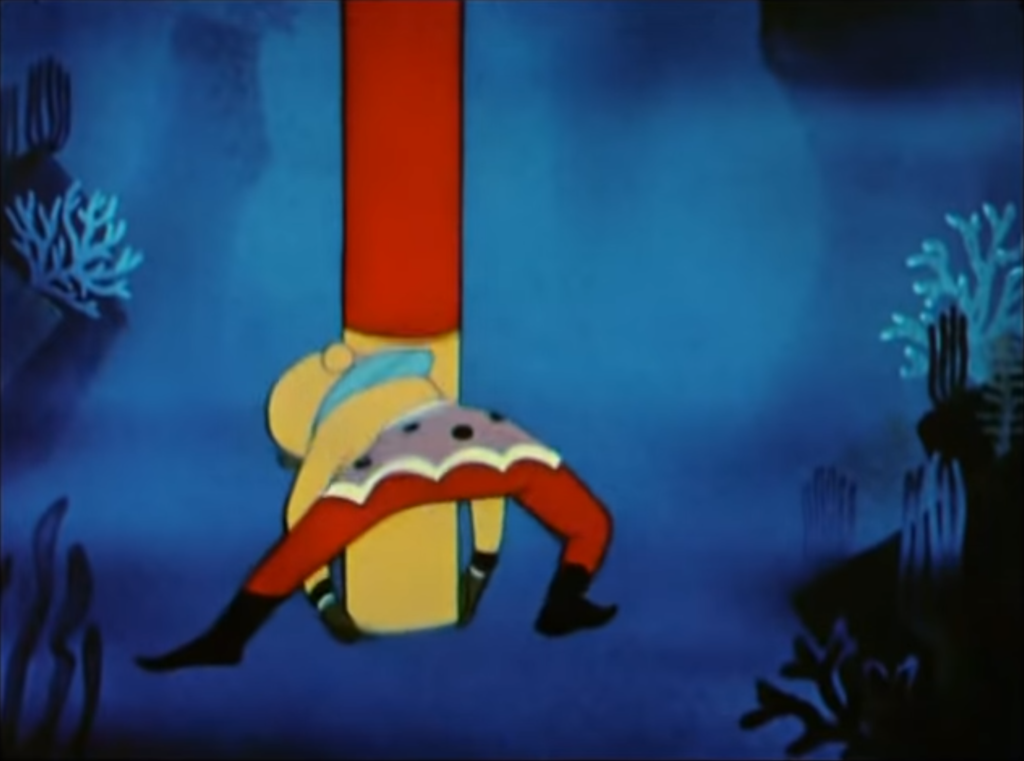
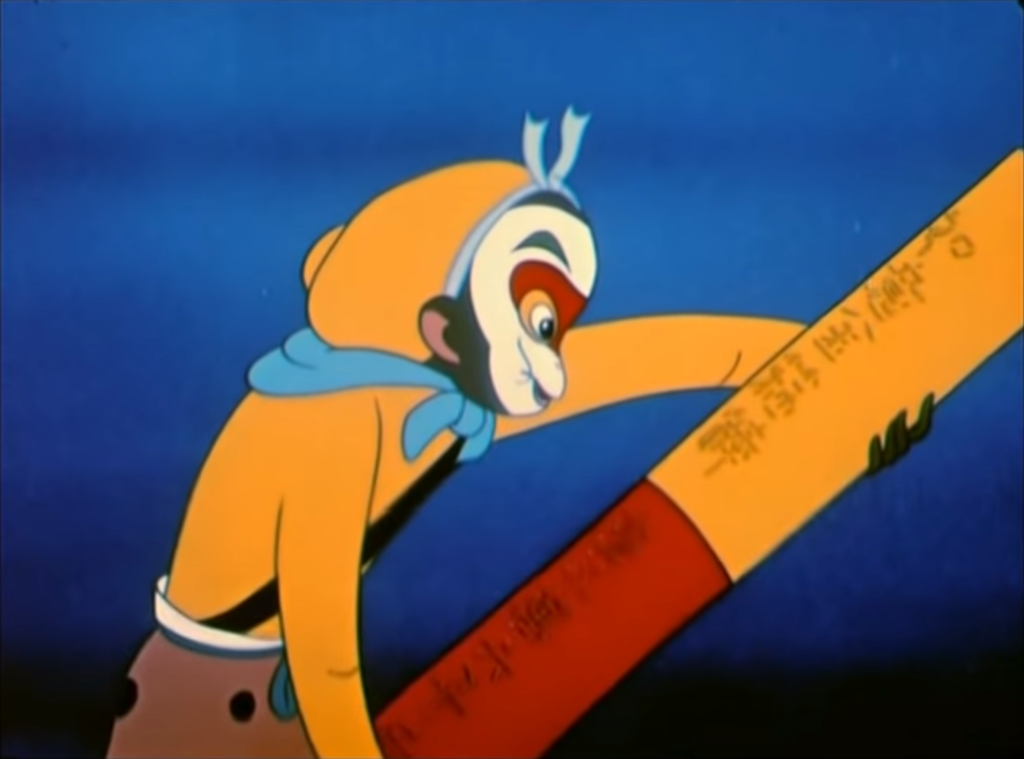
Super strength – This allows him to wield his 13,500-catty (一萬三千五百斤; 17,559.81 lbs/7,965 kg) iron staff with ease, overpower opponents, and to scare rude humans. He displays this throughout the novel. His greatest feat of strength involves carrying two mountains on his shoulders while running with great speed (ch. 33).
Travel to heaven – This allows him to find and enter the celestial realm from any of the four cardinal gates. He displays this throughout the novel.
Cloud production – This allows him to breathe clouds and fog during battle. He displays this throughout the novel.
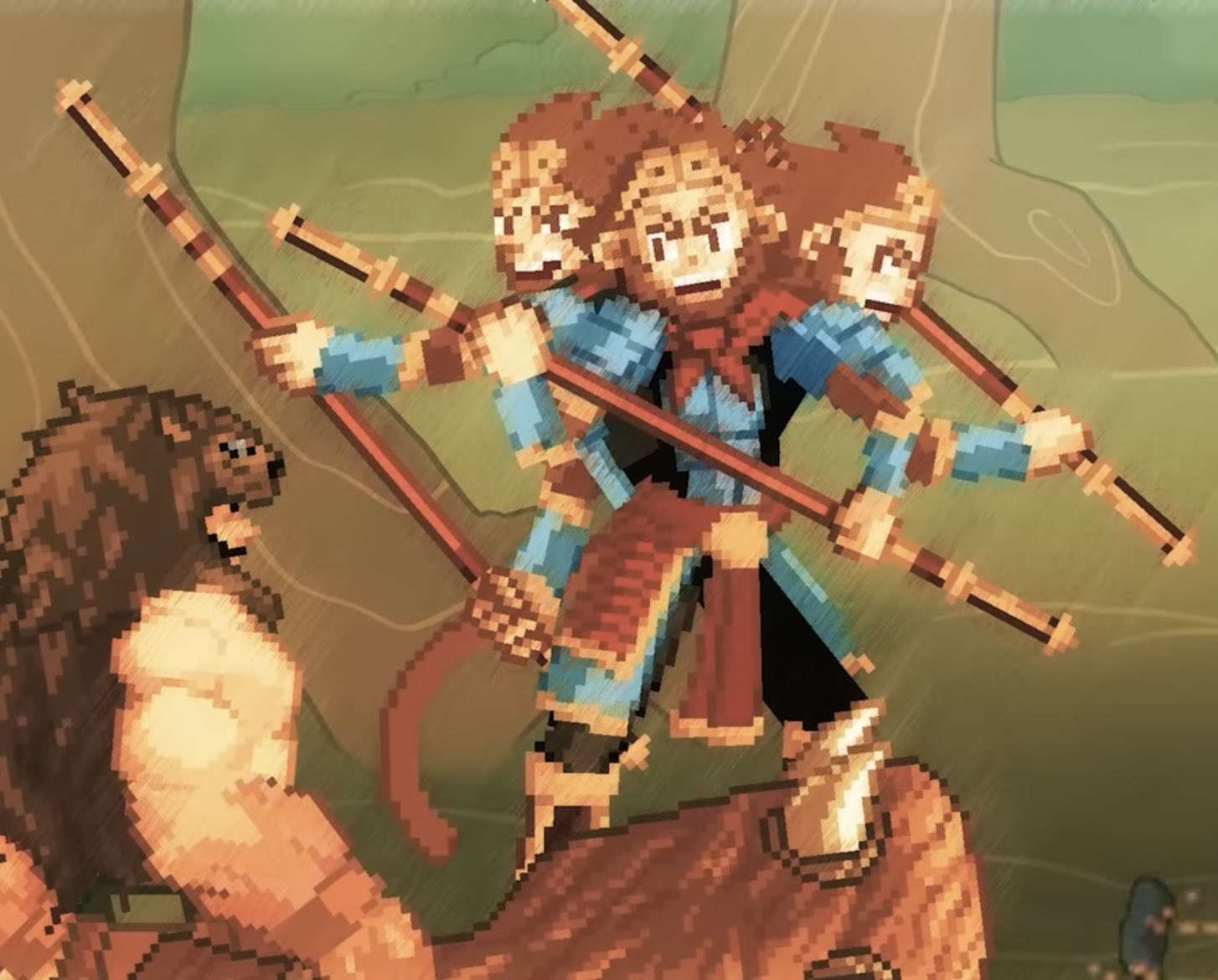
Three-headed and six-armed war form (三頭六臂) – This allows him to battle myriad opponents on all fronts (ch. 4, 7, 31, 40, & 81).
Staff multiplication – This allows him to multiply his magic staff for his war form, to arm his clones, or to bombard opponents with a shower of hundreds of thousands or even millions of weapons. He displays this throughout the novel.
Magic of body concealment (隱身法) – This allows him to become invisible to humans and even gods and spirits (ch. 5, 6, 24, 49, 63, 68, & 71).
Magic of Immobilization (定身法) – This allows him to freeze humans, gods, and spirits in place for up to a full day (ch. 5, 39, 88, & 97).
Invulnerability – His adamantine head and body are capable of withstanding damage from even celestial weapons and elements. He displays this throughout the novel.
Fiery eyes and golden pupils (火眼金睛) – This allows him to peer up to 1,000 li (千里; 310.7 mi/500 km) during the day and 300 to 500 li (夜裡也還看三五百里; 93.20 to 155.34 mi/150 to 250 km) at night. It also enables him to see through the magic disguises and illusions of gods and spirits. It doesn’t work 100% of the time, though. He displays this throughout the novel.
Horse authority – This allows him to command celestial and earthly equines (ch. 14 & 56). This is based on his former position as the keeper of the heavenly steeds, which essentially makes him the god of horses in the JTTW universe.
Taming tigers – Earthly big cats immediately cower in his presence (ch. 14). This seemingly does not include tiger-spirits.
Three life-saving hairs (三根救命的毫毛) – These are three willow branch leaves-turned-hairs gifted to him by Guanyin which allow him to make whatever he wants in the performance of his duties as Tripitaka’s guardian (ch. 15, 63, & 75). The novel differentiates these from the “body beyond body” hairs.
Putting off sleep – He is shown in one instance (ch. 16) to conserve his immortal energy via meditation instead of sleeping, though he is described as resting in numerous chapters. He claims that putting of sleep for nearly three years wouldn’t even bother him (ch. 25).
Voice impersonation – This power allows him to exactly copy the voice of any figure that he transforms into. He displays this throughout the novel.
Magic of seizure (拿/手法; a.k.a. “holding trick”) – This allows him to magically grab large quantities of characters and goods with a single hand (ch. 62 & 89). It is also ambiguously described as a superpowered martial arts technique where he grabs and twists a much larger opponent so hard that they flip (ch. 18).
Seize the wind (抓風) – This allows him to grab the wind like an animate object. This is done once to smell the breeze (ch. 20).
Super smell – This allows him to detect and even track dangerous animals and evil spirits (ch. 20, 41, 67, & 91).
Size manipulation – This allows him to shrink or grow his body as needed. I differentiate this from the “magic method of modeling heaven on earth” because it is not a grand transformation like the latter. His smallest transformation is a hair-like cicada (蟭蟟蟲), which is perhaps a typo for “蟭螟蟲,” an aquatic insect from Daoist literature said to be so small that it can congregate in the eyebrows of a mosquito.
Summoning gods – This allows him to call upon local gods of the soil and mountains, Buddhist gods assigned to protect the Tang Monk, and also the Dragon Kings of the world’s oceans. He displays this throughout the novel.
Immortal breath (仙氣) – This allows him to transform his hairs and staff and other inanimate objects into whatever he wants, as well as to heal grievous wounds, manipulate souls, and to help grant humans divine strength and longevity. He displays this throughout the novel.
Spirit-body (真身出一個神; a.k.a. “magic of the spirit leaving the body,” 出神的手段) – This allows him to transform his body into an astral form in order to leave from a place unnoticed (ch. 25, 45, 77, & 85). This is often used in tandem with a hair-turned-decoy body.
Lock-picking magic (解鎖法) – This allows him to unlock any lock with either his staff or hand (ch. 25, 52, 61, 71, 92, & 99).
Sleep-inducing bugs (瞌睡蟲兒; a.k.a. “sleep demon bugs, 睡魔蟲”) – These insects allow him to incapacitate humans, gods, and spirits. These are said to have been won from a heavenly guardian in a finger-guessing game (ch. 25 & 77). The novel differentiates these from the sleep insects that he makes with “body beyond body.”
Blood transformation magic – This allows him to create talking and moving decoys from inanimate objects. They are created by saying a spell, biting his tongue, and spitting the resulting blood on the selected items (ch. 25, & 46).
Super scream – This allows him to scare away ferocious animals, as well as to intimidate humans (ch. 27, 65, & 93).
Shortening the Ground (縮地法; a.k.a. “magic of shortening the ground and moving the mountain,” 移山縮地之法) – This allows him to transport people vast distances by contracting the land before them (ch. 31 & 40).
Magic nullification – This allows him to cancel a spirit’s illusion by saying a spell and spitting water (ch. 31).
Secret communication – This allows him to contact gods without others noticing (ch. 33 & 37).
Fire-avoidance spell (避火訣) – This allows him to ward fire (ch. 35, 41, & 75).
Super jump – This allows him to jump over a city wall (ch. 38).
Turning off invulnerability – This allows him to switch off the hardness of his body in order to mutilate himself for fun (ch. 46, 75, & 79).
Surviving fatal wounds – This allows him to live through having his head cut off and his intestines and heart pulled out (ch. 46 & 79).
Phantom speech – This allows him to communicate without a head. His voice seemingly projects from inside his body (ch. 46).
Magic body part retrieval – This allows him to command his body parts to return if they are separated from him. However, this doesn’t work if gods hold them down (ch. 46).
Regrowing a head – This allows him to regrow his head if it is separated from his body (ch. 46). Sha Wujing suggests that our hero has 72 heads because he knows the 72 transformations (他有七十二般變化,就有七十二個頭哩。).
Super healing – This allows him to heal from grievous injuries without even a single scar (ch. 46).
Foreknowledge of fate – This allows him to know what the universe has in store for certain characters, especially Tripitaka (ch. 47, 81, 97, & 99).
Magic barrier – This allows him to protect people by drawing a circle around them with his staff (ch. 50).
Halting clouds (留雲) – This allows him to stop hurtling endlessly through the sky after being blown away by Princess Iron Fan‘s magic fan (ch. 59).
Wind-arresting elixir (定風丹) – This allows him to become an immovable object. It is originally sown into the collar of his robe by a bodhisattva, but he later accidentally swallows it, and his body is fortified by it (ch. 59 & 61).
Sympathetic magic – This allows him to summon rain in order to extinguish fire in a different location just by throwing a goblet of wine (ch. 70).
Magic of body division (分身法) – This allows him to split his body in order to create endless copies of himself. The novel treats this as separate (ch. 75) from the “body beyond body,” which is also known by this name.
Mimic magic – This allows him to make someone look like a different person. This involves an oral spell, the immortal breath, and a mud mask. He uses this to change his master’s appearance (face and body) to look like him (ch. 78).
True Fire of Samadhi (三昧真火) – This allows him to blow spiritual fire (ch. 81).
Divine empowerment – This allows him to grant divine strength and longevity to humans (ch. 88).
Travel to the underworld – This allows him to find and enter hell (ch. 97).
Resurrection – This allows him to bring someone back from the dead—provided that he has permission from Ksitigarbha—by retrieving and forcing their soul back into their body (ch. 97).
Weightless body – This allows him to walk with great agility. He achieves this after crossing a spiritual river into the Buddha’s blessed land (ch. 98).
Yang energy projection – This allows him to ward off an army of yin spirits with his staff at the end of the novel (ch. 99).
Readers are free to decide whether or not these are actually powers.
Eye beams – These shoot from his eyes shortly after his birth. They dim upon eating earthly food (ch. 2).
Celestial voice – He is said to have a voice like bells and stone chimes (ch. 4).
Super speed – He is said to run like a meteor in order to catch up to Tripitaka (飛星來趕師父) while carrying two mountains (ch. 33). This might be hyperbole, though, since his master isn’t that far ahead of him.
Light beams shoot from Sun’s eyes shortly after his birth (larger version). The image was originally found on Facebook, but I’ve been informed that it is by the artist Jiang Xiaoshu (姜晓殊).
2.4. Claimed Powers
These are abilities that are never demonstrated:
No shadow – He claims to cast no shadow while walking past the sun and moon (ch. 3).
Phasing – He claims that he can pass through metal and rock unhindered (ch. 3).
Taming dragons – He claims to be able to subdue dragons (ch. 14), but the various serpent-spirits that he meets during the journey do not cower before him like earthly tigers do (see # 19 above).
Super hearing – He claims to be able to hear the goings-on in heaven and hell (ch. 31). But it’s interesting to note that his doppelganger is shown to have super hearing.
Kicking down the sky or overturning wells – These are as named.
Manipulating stellar bodies – He claims to be able to change the path of stars and planets (ch. 46). But I should note that he fights and single handedly defeats the anthropomorphic forms of the nine planets during his rebellion (ch. 5). I’ll leave it up to the reader to decide whether or not this constitutes altering their paths.
Monkey fighting the dragon prince that will become the white dragon horse (larger version). Image found here.
3. Skills
Early education – Language, etiquette, scriptural studies, calligraphy, and gardening.
Navigation – The ability to travel to and find places that he has not previously been to. This is displayed throughout the novel.
I’m also placing this here because it might just be a non-magical skill. You decide.
Martial arts (武藝) – He has a knowledge of different weapons, and he is even shown to be a proficient boxer. He displays this throughout the novel.
Cosmic social connections – His travels as a young immortal enabled him to make friends, or at least to become acquaintances with, all sorts of gods and spirits across the Buddho-Daoist universe. He uses these connections to his advantage throughout the novel.
Sewing – He is shown capable of sewing clothing (ch. 14 & 84).
Face reading – He is shown to have a familiarity with the art of deriving someone’s personality or intelligence from their looks.
Craftsmanship – He claims to be able to build a house for the Tang Monk (ch. 27 & 67), and he later constructs a straw dragon for a queen to ride (ch. 71).
Guessing weight – He can guess the weight of something just by holding it in his hand (ch. 76).
Lastly, I would like to highlight Monkey’s intellect. Despite his common association with using force, he is shown in the novel to be very clever, often relying on a number of mental qualities or tactics to defeat demons:
Adeptness
Basic soldering
Calculation
Commandeering enemy equipment
Deception
Info gathering
Knowledge base:
Celestial and earthly pharmacology and pathology
Heavenly treasures
Classics
Astronomy
Philosophy
Law
Scripture
Demonology
Logic
Spiritual cultivation and spirituality
Cooking
Types of wood
Sound
Cosmic hierarchy
Language acquisition – He only has to listen to a conversation for a moment before he learns a new language.
Memory
Pattern recognition
Persuasion
Planning
Problem solving
Quick thinking
Weapon making
4.1. Example
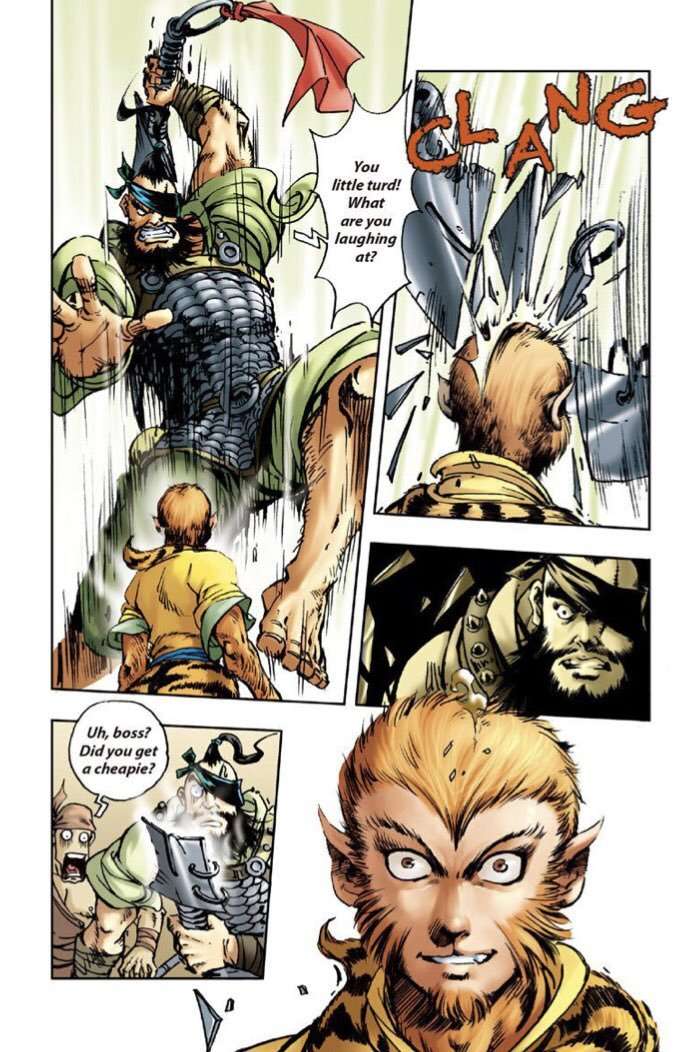
A good example of his cunning appears in chapter 97. The four monks are framed for the theft and murder of a rich layman who had originally hosted them for a month. Sun Wukong captures the real perpetrators and rounds up their stolen bounty, but he is forced to release the bandits for fear that Tripitaka will chant the tight-fillet spell for killing them. However, imperial troops later capture the clerics with the stolen items, making them look guilty. After the group is brought to court and tortured for some time (only affecting the weaker members), Monkey escapes from the prison at night in order to influence their release. First, he imitates the voice of the slain layman at his wake and threatens heavenly retribution if his widow, the person who framed the monks, doesn’t recant her false claims. Second, he imitates the voice of the deceased uncle of the city magistrate who imprisoned them and again threatens heavenly retribution if the official doesn’t reexamine the case. And third, at dawn he transforms himself into a titan-sized apparition before the district level magistrates and threatens to stomp the city and surrounding area into oblivion as heavenly retribution if they don’t put pressure on their superior to free the group. In the morning, Tripitaka, Zhu, Sha, and the officials visit the layman’s home, while Sun goes to the underworld to retrieve the man’s soul, which has been granted a dozen more years of life by the Bodhisattva Ksitigarbha. Monkey returns and brings the man back to life by forcing his soul into his body. The layman then explains how he had been murdered by bandits who robbed his mansion. The city magistrate, therefore, pardons the monks and even the wife.
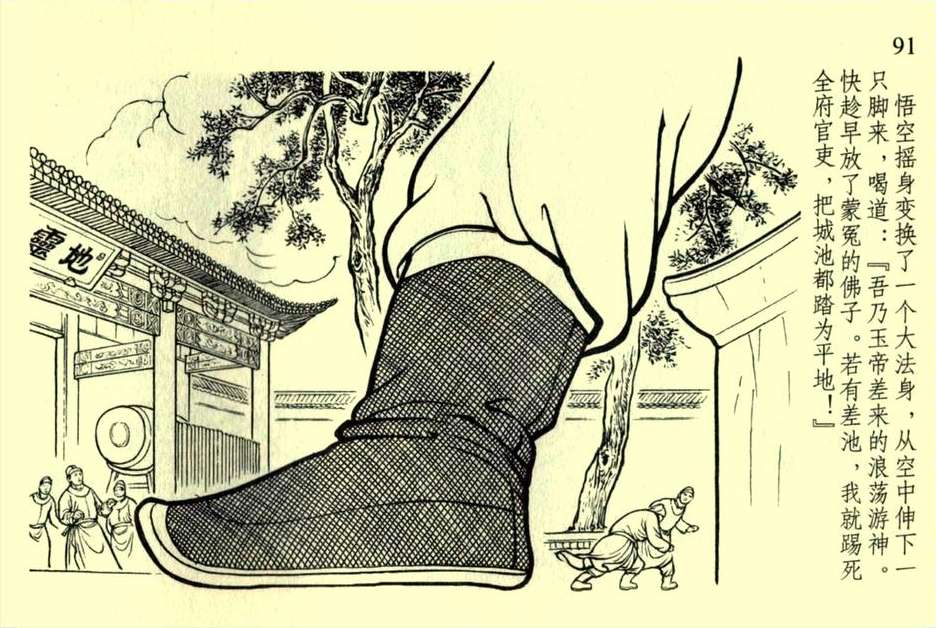
A modern lianhuanhua depicting Monkey’s giant foot confronting the magistrates (larger version). Comic found here.
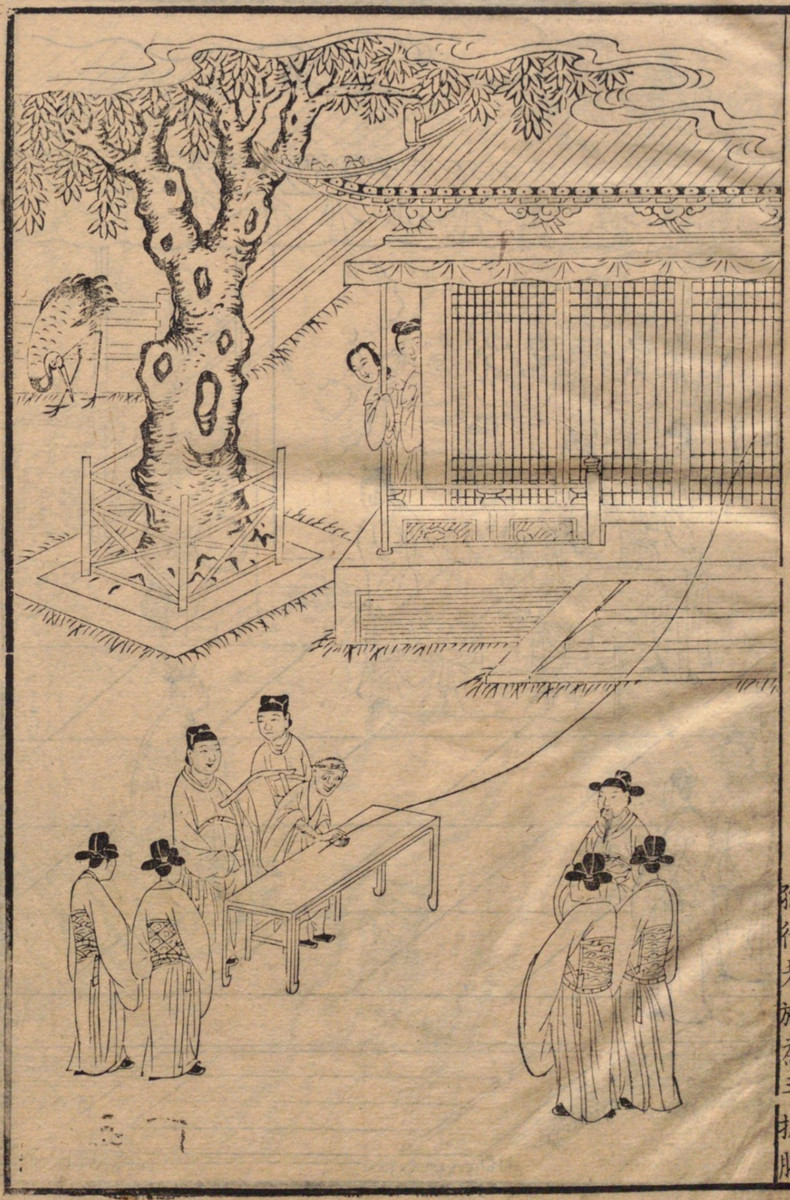
A detail of Nezha striking at an enemy during battle. Image from The Newly Printed, Zhong Bojing Annotated, Investiture of the Gods (Xinke Zhong Bojing xiansheng piping Fengshen yanyi, 新刻鍾伯敬先生批評封神演義, c. 1620) (larger version).
Update: 01-01-26
As noted, Sun Wukong appears to have eight immortalities:
Spiritual breathing exercises (ch. 2)
Erasing his name from the ledgers of hell (ch. 3)
Drinking immortal wine (ch. 4 & 5)
Eating immortal peaches (ch. 5)
Eating elixir pills (ch. 5 & 17)
Eating Ginseng fruit (ch. 24)
Eating Immortal food, tea, and fruit (ch. 98)
Buddhahood (ch. 100)
But I’ve thought of something that brings one of these into question:
In JTTW chapter 98, the pilgrims are all given “immortal food, tea, and fruit” (仙餚、仙茶、仙果) upon entering the Buddha’s paradise, and this is said to “grant them longevity and health and enable them to transform their mortal substance into immortal flesh and bones” (… 壽長生,脫胎換骨之饌,儘著他受用。) (based on Wu & Yu, 2012, vol. 4, pp. 349-350). The latter quote refers directly to Zhu Bajie and Sha Wujing, but Monkey and Tripitaka certainly benefit from the meal as well.
The pilgrims are not too long after elevated in spiritual rank in JTTW chapter 100 (Wu & Yu, 2012, vol. 4, pp. 381-382).
The chronological proximity of the food to the spiritual promotions reminds me of a concept from Buddhism, the immortal “diamond/adamantine body” (Sk: vajrakāya; Ch: jingangshen, 金剛身) of the Buddha. You can read more about that here (see the PDF link therein):
(It’s interesting to note that Laozi suggests in JTTW chapter seven that all of the divine foodstuffs eaten/drunk by Monkey must have resulted in his “diamond body” (jingang zhi qu, 金鋼[剛]之軀) (Wu & Yu, 2012, vol. 1, p. 188).)
This then raises the question: Is the food meant to symbolize the immortality that comes with becoming an enlightened being? If so, numbers seven (immortal food) and eight (Buddhahood) in my list are one and the same, meaning that the former should be removed.
Update: 02-02-26
Monkey strikes me as the sort of person who is overqualified in all areas but still pads their résumé as a way to make them seem even more amazing. This could be used as an in-universe explanation for the undemonstrated powers (see above). Though, I’m sure he could figure out how to, for example, phase through solid objects if he put his mind to it.
Update: 03-27-26
I previously added this info as an update to a past article:
The Saṃyutta Nikāya (Sk: संयुक्त निकाया; Ch: Xiang ying bu, 相應部, c. 250 BCE) notes that Buddhist cultivators develop a host of supernatural powers once they master the four mental qualities (Pali: Iddhipāda). Notice how similar they are to those discussed above:
Multiplying the body
Vanishing and reappearing
Passing through solid objects (walls, ramparts, mountains, etc.)
Diving into the earth like water
Walking on water like earth
Traveling through space
Touching the sun and moon
Hearing all sounds, both human and divine
Knowing the minds of others
Having memories of all of one’s past lives
Knowing the future rebirths (and their causes) of all beings
Liberation from the filth of the world through supreme wisdom (Bodhi, 2000, pp. 1727-1728)
Source:
Bodhi, B. (2000). The Connected Discourses of the Buddha: A Translation of the Saṃyutta Nikāya; Translated from the Pāli by Bhikkhu Bodhi (Vols. 1-2). Boston: Wisdom Publications.
Wu, C., & Yu, A. C. (2012). The Journey to the West (Vols. 1-4) (Rev. ed.). Chicago, Illinois: University of Chicago Press.
The Journey to the West Research blog is proud to host an entry by our friend Monkey Ruler (Twitter and Tumblr). They have graciously written an essay on the global nature of Journey to the West adaptations, as well as provided a link to their ongoing project recording JTTW media (fig. 1). As of the publishing of this article, it includes a long list of almost 570 movies, 90 TV shows, and 160 video games! – Jim
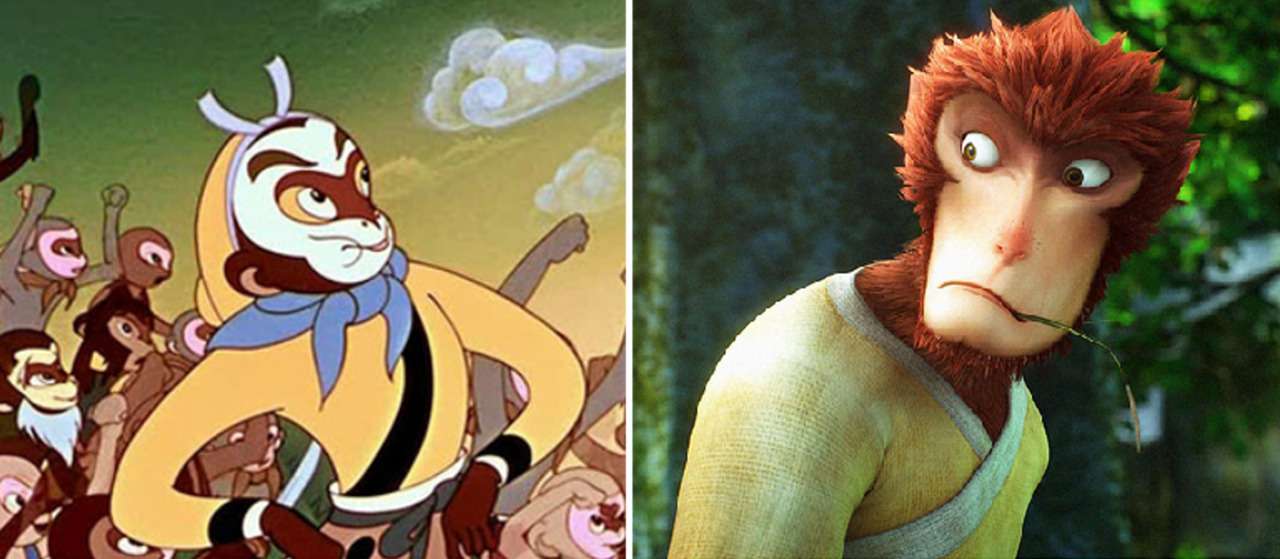
Fig. 1 – Depictions of Sun Wukong from adaptations produced over 50 years apart: (left) Havoc in Heaven (Danao tiangong, 大鬧天宮, 1961) and (right) Monkey King: Hero is Back (Xiyouji zhi Dasheng guilai, 西遊記之大聖歸來, lit: “Journey to the West: Return of the Great Sage,” 2015) (larger version). Courtesy of Monkey Ruler.
I. Media adaptations
This started out as a collection of Xiyouji (西遊記; lit: “Journey to the West,” 1592) movies and TV shows for the sake of a Master’s class project; it was simple enough to look for Xiyouji media and start adding them to a collection datasheet. But even when the project was over, I kept finding more and more adaptations, even stumbling across others trying to show the magnitude of how much this novel has encompassed popular culture throughout the centuries. It has been told and re-told again and again in oral and published literature, plays, art, songs, poems, etc., and now on the big and small screens. Audiences are re-introduced to the image of Sun Wukong and his fellow pilgrims with every new media addition.
What really inspired me was the book Transforming Monkey: Adaptations and Representation of a Chinese Epic(2018) by Hongmei Sun, where she explained in depth the cultural impact that Sun Wukong (fig. 2) and Xiyouji has had on Chinese media, as well as how this loose set of franchises have come to represent Chinese culture as these shows and movies have become more globally accessible. Xiyouji is such an iconic cultural universe that it can be both heavily entertaining while still being so personal to audiences of any generation depending on how the artist/writer portrays their interpretation of these characters and their stories.
There hasn’t been a lot written about how these interpretations influence modern Xiyouji adaptations despite how the story has greatly influenced popular culture.
Fig. 2 – The front cover of Transforming Monkey (2018) (larger version).
Xiyouji is such an influential story, one that will continue to grow more and more globally known throughout time because it is such an all-encompassing piece that can cover politics, identities, and allegories, while still being a very personal and interpersonal work that artists or writers can relate to.
However, even with these layers of meaning and symbolism to be found, the story never loses the charming and entertaining aspects that can and have captured audiences. Despite being published over 430 years ago (with a history stretching back even further), Xiyouji is still able to relate to modern audiences through its allegories of oppression, rebellion, and self-identity. It has the capability to resonate with any generation depending on what artists or writers at the time wish to highlight or personally connect with themselves or their current world around them, using Xiyouji as a medium for their own struggles.
As Xiyouji starts to become more and more globally known, it is important to understand and resonate that this is still a Chinese story and how to address further adaptations with cross-nation gaps in both translation and cultural differences. There are media forms that are far more exploitative of the mythical journey, creating impractical scenarios of the narrative and thus changing the message of the story and characters completely. However, there needs to be an acknowledgment of what doesn’t work as Xiyouji adaptations due to the ever-changing zeitgeist in not only its home of origin but introducing it to a global sphere as it adds influence.
In order to see what works for adaptations, there needs to be an acknowledgment of what is the core of the story and just why it remains popular, story-beat or character-wise. For example, Sun Wukong can be used as a great model for positive ambivalence in media, moving away from set limits of a single stereotype and rather being a constant motion of new ideas and new identities. Monkey has been changed from a mischievous monkey to a revolutionary hero to a post-modern rebel against authority throughout the years. But even throughout the constant changes and interpretations, people never lose sight of what the nature of Sun Wukong is: rebelliousness, variability, optimism, and persistence.
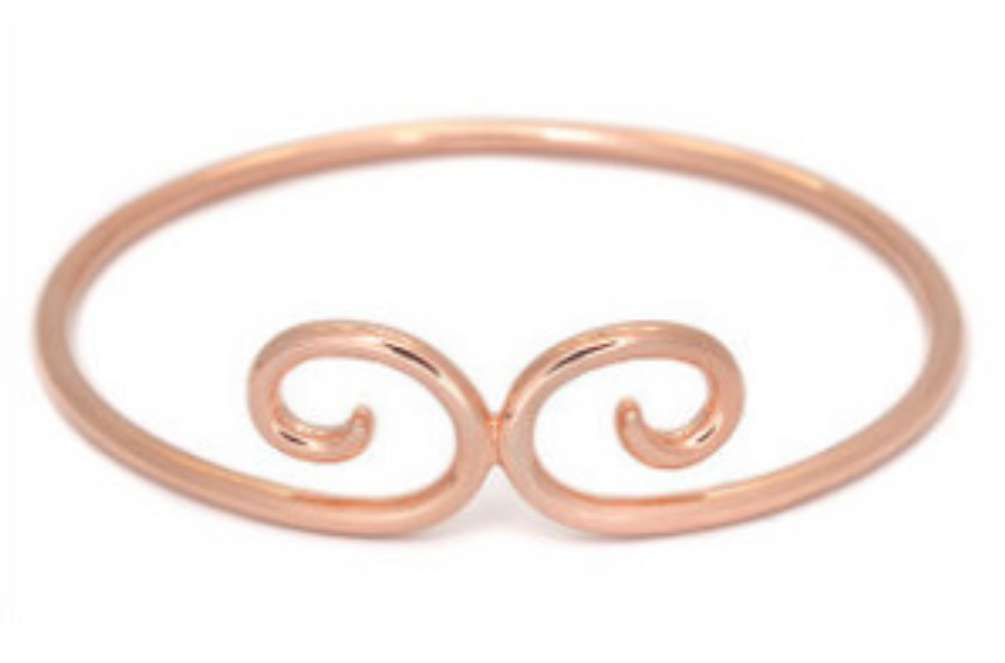
Monkey is a transcending character as he is able to mediate contradictions within his own design, one being his gold-banded staff, a symbol of breaking barriers, and his golden filet (fig. 3), a symbol of limits. These two simple but prominent pieces of iconography immediately tell audiences who the character is supposed to be and what they are about.
Fig. 3 – A modern replica of Monkey’s golden filet or headband (larger version).
While it is entertaining and able to be enjoyed by younger audiences, Xiyouji still has a deeper meaning that can be interpreted and recognized into adulthood. This is one of the few stories that I imagine can be adapted again and again without the issue of overlap as there are so many ways people can personally connect with these characters.
Having that any generation, anyone really can find enjoyment in this media, and perhaps even be inspired to read the novel itself.
II. Archive link
Please consult the tabs at the bottom of the spreadsheet linked below. They are listed as “Movie Information,” “Movie Links,” “Honorary Shows,” “Game Information,” “Game Pictures,” “Honorary Games,” and “Sources.” – Jim
Monkey Ruler has officially posted a website called “Journey to the West Media.” They continue to update the page with movies, tv shows, video games, and now comic books.
I recently posted a list of facts about Sun Wukong (孫悟空) to reddit. I am presenting an elongated version of it here, which serves as a summation of everything that I’ve learned over the years. It is by no means comprehensive. I’ll add more facts in the future as I learn of them. Enjoy.
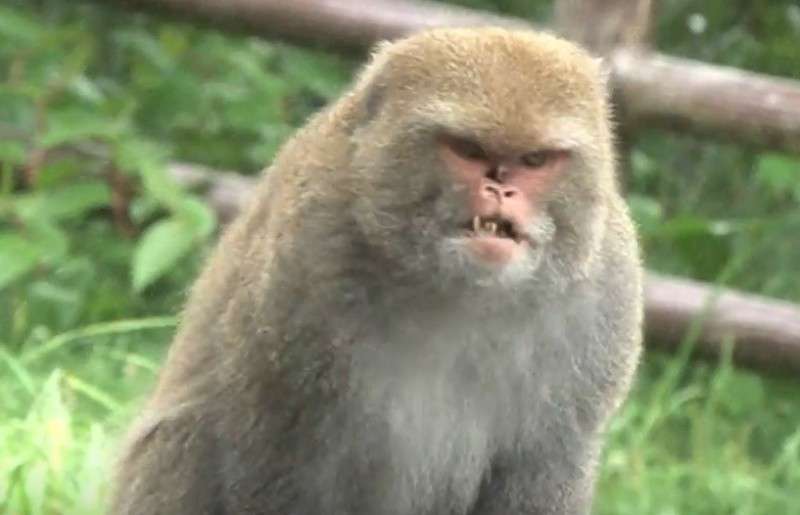
In my opinion, however, the greatest influence on his 1592 persona is a white ape antagonist from a Tang-era story. Similarities include: 1) both are supernatural primates possessed of human speech; 2) one thousand-year-old practitioners of longevity arts; 3) masters of Daoist magic with the ability to fly and change their appearance; 4) warriors capable of single-handedly defeating an army; 5) have a fondness for armed martial arts; 6) have an iron-hard, nigh-invulnerable body immune to most efforts to harm them; 7) have eyes that flash like lightning; 8) live in verdant mountain paradises (like Flower Fruit Mountain); and 9) reside in caves with stone furniture (like the Water Curtain Cave).
The oldest published mention of the Monkey Pilgrim is a eulogy appearing in a tale from Zhang Shinan’s (張世南) Memoirs of a Traveling Official (Youhuan jiwen, 遊宦紀聞, 13th-century). One scholar dates the story to around 1127.
The oldest depictions of this character (late-11th to late-13th-century) appear in Buddhist cave art along the Silk Road in Northern China. He is almost always portrayed in a scene worshiping the Bodhisattva Guanyin.
A 13th-century version of JTTW describes the Monkey Pilgrim as a white-clad scholar who is an ancient immortal from the very beginning of the tale. He was beaten with an iron rod as a young immortal after he stole magic peaches and was subsequently banished to the Mountain of Flowers and Fruit. He actively searches out the monk to protect him as the cleric’s two previous incarnations were eaten by a monster (Sha Wujing’s antecedent) in the past.
This immortal fights with two staves (at different times), a golden-ringed monk’s staff and an iron staff (both borrowed from heaven). The monk’s staff can create destructive blasts of light, as well as transform into titanic creatures, including a club-wielding yaksha and an iron dragon. The iron staff isn’t shown to have any special powers. These weapons were later combined by storytellers, the rings from the former being added to the ends of the latter.
The earliest mention of the name “Sun Wukong” that I’m aware of appears in an early-15th-century zaju play. It depicts the character as a sex-crazed maniac who kidnaps a princess to be his wife, tries to seduce Princess Iron Fan, and later gets erectile disfunction when his golden headband tightens while trying to have sex with a young maiden in the Kingdom of Women.
The dharma name “Wukong” (悟空) was likely influenced by a historical monk of that name who traveled to India during the 8th-century. The name means “Awakened to Emptiness”, thus referencing Buddhist enlightenment. I think the corresponding Sanskrit name would be something like “Bodhiśūnyatā” (but don’t quote me on this).
The surname “Sun” (孫) means “grandson” but is an open reference to husun (猢猻, lit: “grandson of the barbarian”), the Chinese word for “macaque“. It was also a popular surname for supernatural primates in stories associated with the Lingyin Temple (靈隱寺), which also likely influenced the Monkey King.
The 1592 edition of the novel associates the components of Sun (孫 = zi, 子 & xi, 系) (ch. 1 – see section 4.2 here) with the formation of a “holy embryo” (shengtai, 聖胎), an immortal spirit that lives on after the adherent dies.
So taking all of the Buddhist and Daoist references into account, another translation for Sun Wukong would be “Immortal Awakened to Enlightenment”. This is a reference to the Buddho-Daoist philosophy of Zhang Boduan (張伯端, mid- to late-980s-1082), who believed that in order to become a true transcendent (xian, 仙), one had to achieve both the Daoist elixir of immortality and Buddha-nature (i.e. Buddhahood).
The aforementioned zaju play calls him the “Great Sage Reaching Heaven” (Tongtian dasheng, 通天大聖).
Said play also states that he has two sisters and two brothers. The sisters are respectively named the “Venerable Mother of Mount Li” (Lishan laomu, 驪山老母) and “Holy Mother Wuzhiqi” (Wuzhiqi shengmu, 巫支祇聖母). His older brother is called “Great Sage Equaling Heaven” (Qitian dasheng, 齊天大聖) and the younger the “Third Son Shuashua” (Shuashua sanlang, 耍耍三郎).
His story in the 1592 version takes place not in our world but in one modeled after ancient Hindo-Buddhist cosmic geography, which features four island-like continents floating in a great ocean around the four respective faces of a cosmic mountain. And yet the novel was published during a time coinciding with the late Renaissance period in Europe, precisely 49 years after Copernicus suggested that the Earth orbits the sun.
His home, the Mountain of Flowers and Fruit (Huaguo shan, 花果山), is located near the easternmost continent, while China is associated with the southernmost continent. This means that Monkey, within the novel, is not Chinese!
While his stone birth (ch. 1) is likely based on that ofYu the Great (Dayu, 大禹), a legendary King of theXia dynasty(more on this below), it may ultimately be linked to Tibetan stories ofstone-born monkey deities.
Despite the association above, Monkey shows no interest in sex throughout the entire novel. This may be a response to the highly sexualized Sun Wukong from the zaju play.
The novel also gives him the alchemical title “Squire of Metal/Gold” (Jingong, 金公), a possible “anagrammatic reading of the Chinese graph for lead or qian 鉛, which may be broken up into the two graphs of jin and gong” (Wu & Yu, 2012, vol. 1, p. 532 n. 3). Lead is an ingredient in external alchemy (see the material after figure two here). The title might also be referring to the earthly branchshen (申), which is associated with both metal and monkeys (Wu & Yu, 2012, vol. 1, p. 532 n. 3).
The overall arc of his birth and early life were likely based on that of the historical Buddha to make his tale more familiar to readers. Similarities include: A) supernatural births that split open their respective mothers (Queen Maya vs stone egg); B) producing a radiant splendor in all directions upon their birth; C) being talented students that quickly master concepts taught to them; D) early lives as royals (Indian prince vs king of monkeys); E) shock at the impermanence of life; F) questing for a spiritual solution to said impermanence; and G) finding said solution via spiritual practices (Indic meditation vs Daoist elixir arts).
His “Water Curtain Cave” (Shuilian dong, 水簾洞), the grotto-heaven where he and his people live in the Mountain of Flowers and Fruit, is associated with a different immortal in older religious literature. For instance, the Song-era text Master Ghost Valley’sNuminous Writ of the Essence of Heaven (Guigu zi tiansui lingwen, 鬼谷子天隨靈文) calls the titular character the “Master of the Waterfall Cave” (Shuilian dong zhu, 水濂洞主). In this case, the source uses a different lian (濂) in place of the lian (簾) associated with Monkey’s cave. But they both mean the same thing: a waterfall hiding a cave mouth (see the 12-11-21 update here). One 17th-century novel influenced by JTTW states that Master Ghost Valley lives in the Water Curtain Cave (Shuilian dong, 水簾洞; i.e. the same as Monkey’s home) with his student, the Warring States strategist Sun Bin (孫臏, d. 316 BCE). This means that two characters surnamed Sun (孫) live there in Chinese literature (see section II here).
While commonly portrayed as a Daoist immortal, his first master, the Patriarch Subodhi (Xuputi zushi, 須菩提祖師) (ch. 1 & 2), is shown to live in India and have a strong connection to Buddhism, possibly even being a Bodhisattva.
The actual name for his famous 72 Transformations is “Multitude of Terrestrial Killers” (Disha shu, 地煞數), which is based on a popular set of malevolent stellar gods.
This skill not only allows Monkey to transform into whatever he wants but also gives him a store of extra heads and possibly even extra lives like a video game (see section 4.4 # 3 here).
He specifically learns the 72 Transformations (ch. 3) in order to hide from a trio of elemental calamities sent by heaven to punish cultivators for defying their fate and achieving immortality. This is the origin of the “Heavenly Tribulation” (tianjie, 天劫; zhongjie, 重劫) trope from modern Xianxia literature.
But, surprisingly, he is not a true immortal, just long-lived and really hard to kill. The novel refers to him as a “bogus immortal” (yaoxian, 妖仙). This references Zhang Boduan’s aforementioned philosophy where one must obtain both the Daoist elixir (which Monkey did) and Buddha-Nature (which he hadn’t yet achieved) in order to be a true transcendent.
While training under Subodhi (ch. 3), he expressly passes on learning the bureaucratic-style magic rites normally used by earthly priests to request something from heaven because the skills involved won’t result in eternal life. Instead, after achieving immortality, Monkey just commands the gods to do his bidding (see section II here).
He can grow 100,000 feet (30,480 m) tall (ch. 1, 6, 61, and 97). This skill is called the “Method of Modeling Heaven on Earth” (Fatian xiangdi, 法天像地), and it is related to ancient Pre-Qin and Han concepts of astral-geography later used in the construction of imperial Chinese cities.
His magic “immortal breath” (xianqi, 仙氣) can transform his hairs, his staff, and objects not in direct contact with his body into anything he desires. It can also change disembodied souls into “ether” for ease of transport, and evidence suggests that it can even grant some form of immortality.
Monkey has 84,000 hairs on his body, and he can transform them into hundreds of thousands, millions, and even billions of hair clones (see the 03-19-22 update here).
The novel only mentions him learning martial arts in passing (ch. 67 – see section 4.5 here), but one episode (ch. 51) features a battle between Monkey and a demon king in which they use a host of real world fighting techniques that are still known and practiced today.
His skill with the staff is so great that the novel compares it to techniques from two manuals listed among the Seven Military Classics of China (see the 08-07-18 update here).
The bureaucratic mix-up that resulted in his soul being dragged to hell (ch. 3) is based on “mistaken summons” to the underworld and “return-from-death” narratives present in early Chinese “miraculous tales” (Zhiguai xiaoshuo, 志怪小説) (Campany, 1990).
When he looks at his entry in the ledgers of hell, he learns that: 1) his soul number is “1,350”; 2) his real name is “Heaven-Born Stone Monkey” (Tianchan shihou, 天產石猴); and 3) he was fated to have a “good end” at the ripe old age of 342. This refers to a person’s pre-allotted lifespan (ming, 命) (Campany, 2005; Campany & Ge, 2002, pp. 47-52).
The distance that his cloud-somersault can travel, 108,000 li (33,554 mi / 54,000 km), is based on a metaphor for instantaneous enlightenment. It comes from the Platform Sutra of the Sixth Chan Patriarch Huineng (惠能). The Chan Master explains that the common trope of the Buddha’s paradise being separated from the world of man by 108,000 li is based on a combination of the “Ten Evils” (Shi’e, 十惡) and “Eight Wrongs” (Baxie, 八邪) of Buddhism. Those who rid themselves of these spiritual flaws will achieve enlightenment and thus arrive instantly at the Buddha’s paradise.
The initial depiction of his magic staff as a great iron pillar kept in the dragon kingdom treasury (ch. 3) is based on a metal column that the immortal Xu Xun (許遜) chained a demonic dragon to and then imprisoned in the aquatic realm in Chinese mythology.
It’s a common misconception that his staff weighed down the Milky Way galaxy. This is based on a mistranslation. The W. J. F. Jenner edition claims that the weapon anchored said star cluster. However, the original Chinese states that it was used as a means to measure and set the depths of the Heavenly River (Tianhe, 天河; a.k.a. Milky Way).
The weight of his staff is likely an embellishment on the weight of a heavy stone block lifted by the bandit-hero Wu Song (武松) in the Water Margin (Shuihu zhuan, 水滸傳, c. 1400). This episode and the JTTW episode where Monkey acquires his staff both involve a hero (Wu Song vs Sun Wukong) asking someone (a friend vs the Dragon King) to take them to a seemingly immovable object (stone block vs iron pillar). They then adjust their clothing before lifting the object with ease. Most importantly, the Chinese characters for the respective weights are visually similar. Sun’s staff is 13,500 catties (yiwan sanqian wubai jin, 一萬三千五百斤; 17,5560 lbs. / 7965.08 kg), while the stone block is 300 to 500 catties (sanwubai jin, 三五百斤; 390-650 lbs. / 177-295 kg). The characters in bold indicate the similarities between the two weights, where as those in red indicate the embellishments: 一萬三千五百斤.
He singlehandedly defeats the “Nine Planets” (Sk: Navagraha; Ch: Jiuyao, 九曜, “Nine Luminaries”), personifications of the sun and planets from Hindu astrology (Gansten, 2009), during his rebellion (ch. 4) (Wu & Yu, 2012, vol. 1, pp. 170-172).
His time as the Bimawen (弼馬溫, “To assist horse temperament”), a minor post overseeing the heavenly horse stables (ch. 4), is based on an ancient Chinese practice of placing monkeys in horse stables to ward off equine sicknesses. The belief was that the menstrual blood of female monkeys mixed with horse food somehow guarded against diseases. This is hilarious as the position links Sun Wukong to menstruation!
His title “Great Sage Equaling Heaven” (Qitian dasheng, 齊天大聖) (ch. 4) was actually borrowed from the “Eastern Marchmount” (Dongyue, 東嶽; a.k.a. “Eastern Peak”), the god of Mt. Tai. This suggests that the older brother from the aforementioned zaju play is really the Eastern Marchmount.
His time as the Guardian of the Immortal Peach Groves (ch. 5) is likely based on a Song-era Daoist scripture in which the aforementioned Sun Bin is tasked by his teacher, Master Ghost Valley, with protecting a tree laden with special fruit. He later captures a magic white ape stealing said produce (see section III here). The simian thief saves his life by offering Sun a set of secret religious texts. Both stories include: 1) a character surnamed Sun (孫) protecting special fruit (Sun Bin vs Sun Wukong); and 2) supernatural primates that steal and eat the fruit. Therefore, Monkey’s 1592 persona serves as both the guard and the thief!
The elixir pills that he drunkenly eats in Laozi’s laboratory (ch. 5) likely influenced the senzu beans from the world famous Dragon Ball (Jp: Doragon Bōru,ドラゴンボール; Ch: Qilongzhu, 七龍珠) franchise.
His time in Laozi‘s furnace (ch. 7) is based on an episode from the aforementioned 13th-century version of JTTW. It may also be connected to a story of Laozi magically surviving a foreign king’s attempt to boil him in a cauldron.
He is shown to be weak against spiritual fire and smoke (see the 06-28-22 update here).
Smoke from the furnace irritates his eyes, giving him his famous “Fiery Eyes and Golden Pupils” (Huoyan jinjing, 火眼金睛). The former is likely based on the “actual red-rimmed eyes of [the Rhesus macaque]” (Burton, 2005, p. 148). The latter is likely based on the golden pupils of macaques (see section 2.1 here).
His time under Five Elements Mountain (Wuxing shan, 五行山) (ch. 7) is based on stories of the aforementioned Wuzhiqi (無支奇/巫支祇) being imprisoned under a mountain by Yu the Great.
A religious precious scroll predating the 1592 edition states that Erlang instead traps Monkey beneath Mount Tai, and the aforementioned 15th-century zaju play states it was Guanyin and the Mountain of Flowers and Fruit.
This punishment links him to a broader list of mythic baddies imprisoned in earth, including Lucifer, Loki, and the Titans of Tartarus. I plan to write a later article about “earth prisons” in world myth.
One scholar suggests that being trapped under Five Elements Mountain is a symbolic death (remember that Monkey claims to be free of the Five Elements after attaining immortality), meaning that the hellish diet is his karmic punishment in the afterlife, and his later release is a symbolic reincarnation.
The oldest depiction of Monkey with his headband that I know of appears in a late-Xixia (late-12th to early-13th-century) Buddhist cave grotto in Northwestern China.
Along with the headband, his tiger skin kilt (ch. 13) can be traced to a list of ritual items prescribed for worshiping wrathful protector deities in Esoteric Indian Buddhism. These same ritual items came to be worn by the very protector deities that the yogins revered. This explains why some deities in Chinese folk religion (including Sun Wukong) are portrayed with the golden headband and tiger skin.
Modern artists sometimes depict him with two long feathers protruding from the front of his golden headband, giving him the appearance of an insect. But the feathers (lingzi, 翎子) are actually associated with a different headdress called the “Purple Gold Cap” (zijin guan, 紫金冠), which is worn on top of the head. It was a military headdress later associated with heroes in Chinese opera (see section 2.2 here).
Monkey is also shown to be weaker in water. For instance, he enlists Zhu Bajie to combat the water demon who turns out to be Sha Wujing (ch. 22) (Wu & Yu, 2012, vol. 1, p. pp. 422-423).
He claims to have eaten people when he was a monster in his youth (ch. 27) (Wu & Yu, 2012, vol. 2, p. 20).
His greatest feat of strength is carrying two mountains while running at meteoric speeds (ch. 33). One is the axis mundi of the Hindo-Buddhist cosmos, while the other is the place from which (according to legend) Buddhism spread upon entering China. This episode is based on an older tale in which Erlang does the lifting.
His doppelganger, the Six-Eared Macaque (ch. 56-58), is actually an aspect of his troubled mind. Once he kills him, Monkey takes one step closer to Buddhahood.
He fights and is defeated by an ancient bird demon who is a spiritual uncle of the Buddha (ch. 77). This monster is based on the Hindu bird god Garuda.
He and his religious brothers take human disciples in India (ch. 88), and Monkey later performs an arcane ritual in which he grants them superhuman strength (and possibly some form of immortality).
The novel ranks him higher than Guanyin after his ascension (see the third quote here).
As an enlightened Buddha, Monkey is eligible for his own “Buddha-Field” (Sk: Buddhakṣetra; Ch: Focha, 佛刹), essentially his own universe in which he will lead the inhabitants to enlightenment (Buswell & Lopez, 2014, p. 153).
Modern ritual specialists known as “spirit-mediums” (Hokkien: Tangki, 童乩; Ch: Jitong, 乩童; lit: “Divining Child”) also channel the Great Sage, allowing his worshipers to have direct access to the divine. While they may use a staff to enhance the theater of their performance, the weapon surprisingly doesn’t serve a ritual function. They instead use a set of bladed or spiked weapons to draw blood intended to create evil-warding paper talismans (see the material below figure six here).
Chinese folk religion recognizes more than one Great Sage, usually between three and five individuals.
Monkey’s faith started in Fujian province, China and spread via boat to other countries within the Chinese diaspora. When he first started being worshiped is unknown. The first concrete references to his worship come from the 17th-century (see section III here). But the aforementioned 13th-century stone carving depicts him as a wrathful guardian, alongside other protector deities, Bodhisattvas, patriarchs, and eminent monks. This suggests that he might have been revered at an earlier time.
There is a style of Chinese boxing named after him, “Great Sage Boxing” (Cantonese: Taishingkyun; Mandarin: Dasheng quan, 大聖拳). Another closely associated style is “Great Sage Axe Boxing” (Can: Taishing pek kwarkyun; Man: Dasheng pigua quan, 劈掛拳). These arts also have staff styles associated with the Monkey King.
His time in Laozi’s furnace and ability to grow 100,000 feet tall influenced a Shaolin Monastery myth related to the founding of their famous staff fighting method. The story describes how a lowly kitchen worker jumped into an oven and remerged as a staff-wielding titan to battle mountain brigands attacking the monastery (see section 3 here).
He shares several connections with Yu the Great (here and here). These include: A) both have stone births; B) Monkey’s staff was originally used by Yu as a drill and as a ruler to set the depths of the fabled world flood; C) Sun’s demonic sister Wuzhiqi was conquered by Yu in some stories; and D) both are legendary hero-kings.
He shares a number of similarities with Wu Song. These include: A) both are reformed supernatural spirits originally trapped under the pressing weight of a mountain; B) slayers of tigers; C) Buddhist monks nicknamed “Pilgrim” (xingzhe, 行者), a title noting junior and traveling monks, as well as untrained riffraff that became clerics to avoid trouble with the law or taxes and military service (Wu Song is the latter and Monkey the former); D) martial arts monks who fight with staves; E) have moralistic golden headbands; and F) weapons made from bin steel (bin tie, 鑌鐵) (Wu Song’s Buddhist sabers vs Monkey’s magic staff).
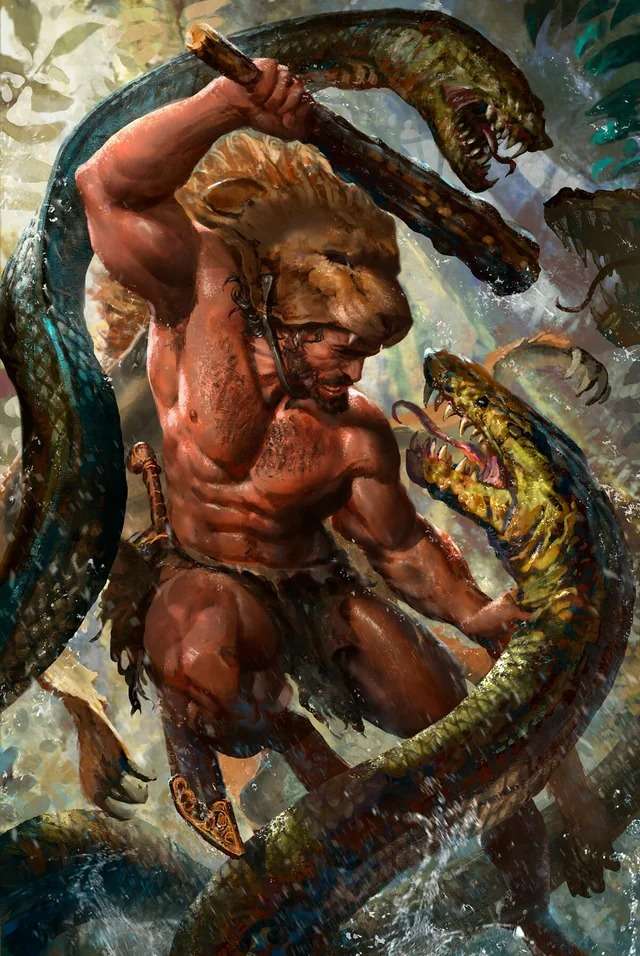
He shares a surprising number of similarities with the Greek hero Heracles (a.k.a. Hercules). These include: A) supernatural births via masculine heavenly forces (son of Zeus vs the stone seeded by heaven); B) quick to anger; C) big cat skins (Nemean lion vs mountain tiger); D) fight with blunt weapons (olive wood club vs magic iron staff); E) great strength; F) knocked out by a god during a fit of rage (Athena with a rock vs Laozi and his Diamond-Cutter bracelet); G) given punishment to atone for past transgressions (12 labors for killing family vs protecting the monk for rebelling against heaven); H) constantly helped by goddesses (Athena vs Guanyin); I) similar enemies (there’s a long list); tamer of supernatural horses (Mares of Diomedes vs Heavenly Horses); J) travel to lands peopled by women (Amazons vs Kingdom of Women); K) theft of fruit from the gardens of queenly goddesses (Hera’s golden apples of the Hesperides vs the Queen Mother’s immortal peaches); L) travel to the underworld; M) take part in a heavenly war (Gigantomachy vs rebellion in heaven); N) become gods at the end of their stories (god of heroes and strength vs Victorious Fighting Buddha); and O) worshiped in the real world (Greece and Rome vs East and Southeast Asia).
He has a total of eight children between two 17th-century novels. He has five sons in A Supplement to the Journey to the West (Xiyoubu, 西遊補, 1640), but only one of them is mentioned by name. “King Pāramitā” (Boluomi wang, 波羅蜜王) is portrayed as a sword-wielding general capable of fighting Sun for several rounds. His name is based on a set of virtues learned by Bodhisattvas on their path to Buddhahood. In Journey to the South (Nanyouji, 南遊記) he has two sons named “Jidu” (奇都) and “Luohou” (羅猴), who respectively represent the lunar eclipse demons Ketu and Rahu from Indian astrology. He also has a giant, monstrous daughter, “Yuebei Xing” (月孛星, “Moon Comet Star”), who is named after a shadowy planet representing the lunar apogee (or the furthest spot in the moon’s orbit) in East Asian astrology. Only the daughter plays a part in the story. She uses a magic skull, which can kill immortals three days after their name is called.
Burton, F. D. (2005). Monkey King in China: Basis for a Conservation Policy? In A. Fuentes & L. D. Wolfe (Eds.), Primates Face to Face: Conservation Implications of Human-Nonhuman Primate Interconnections (pp. 137-162). Cambridge: Cambridge University Press.
Buswell, R. E., & Lopez, D. S. (2014). The Princeton Dictionary of Buddhism. N: Princeton University Press.
Campany, R. F. (1990). Return-from-Death Narratives in Early Medieval China. Journal of Chinese Religions, 18, pp. 91-125.
Campany, R. F., & Ge, H. (2002). To Live as Long as Heaven and Earth: A Translation and Study of Ge Hong’s Traditions of Divine Transcendents. Berkeley: University of California Press.
Campany, R. F. (2005). Living off the Books: Fifty Ways to Dodge Ming in Early Medieval China. In C. Lupke (Ed.), The Magnitude of Ming: Command, Allotment, and Fate in Chinese Culture (pp. 129-150), University of Hawaii Press.
Gansten, M. (2009). Navagrahas. In K. A. Jacobsen (Ed.), Brill’s Encyclopedia of Hinduism (Vol. 1) (pp. 647-653). Leiden: Brill.
Wu, C., & Yu, A. C. (2012). The Journey to the West (Vols. 1-4). Chicago, Illinois: University of Chicago Press.
DEATH BATTLE! is a YouTube show that pits famous fictional and (now) mythological characters against one another to see who is the strongest. The outcome of each fight, usually ending in death, is supposedly based on research comparing the combatants’ respective canonical strengths and weaknesses. There are in total nine seasons with 161 episodes. The 162nd episode (episode 7 of season 9) will feature a battle between the hero Hercules from Greco-Roman myth and Sun Wukong from the Chinese Journey to the West (Xiyouji, 西遊記, 1592, JTTW hereafter) story cycle. I only learned about this upcoming fight a little over a week ago when I noticed via my website analytics that a DEATH BATTLE! staff member had linked to my research blog on their external site. Very little concrete information about the battle was released until a few days ago, so I’ve been scrambling to finish this article in preparation for the episode on June 20th, 2022. It can be watched here:
Win or lose, the purpose of this article is to present accurate information about Sun Wukong. I will correct any mistakes that appear in the video. I will also present a list of surprising parallels shared between Hercules and Sun Wukong, suggesting that they might have been influenced by the same mythic tropes. See also my articles comparing Monkey with the Water Margin hero Wu Song and the historical Buddha.
Before continuing, I want to note that I know the original name is Heracles (or Herakles), but I will use Hercules throughout as this is the name chosen by the staff of DEATH BATTLE!
1. Analysis
1.1. The Death Battle
It’s official, Sun Wukong WON the fight. I will add my comments and corrections (in blue) to the official battle transcript:
An ancient scroll unfurls onscreen as a painted mountain manifests. An unseen narrator begins his story.
1. This was an interesting concept.
Muse: Our tale begins up top a great mountain, where the mighty Heracles sought a gift from the Gods.
As narrated, the legendary demigod finishes his trek up the mountain and calls out to the nearby Monkey King, Sun Wukong, who is sitting atop his Nimbus cloud and holding a divine fruit in his hand.
2. Just a tiny nitpick: The Nimbus cloud is not from JTTW but the Dragon Ball franchise. The novel refers to this skill as the Cloud-Somersault.
Hercules: Ho there! I’m in need of that apple. Relinquish it.
Wukong turns to face the hero and explains his own need for it.
Sun Wukong: Sorry, I’m supposed to find my master some vegetarian food.
3. I really like that the fight starts over fruit. As I note below (sec. 2, #12), both characters steal supernatural fruit (golden apples vs immortal peaches) from the gardens of queenly goddesses (Hera vs the Queen Mother of the West). So this was a nice nod to both myths.
But in hindsight, Monkey stealing the golden apples to feed his master doesn’t make much sense considering: 1) they are located in a land that’s much further west than the scripture monk’s final western destination, India; and 2) I don’t recall reading that the golden apples were anything other than treasures. To my knowledge, none of the associated myths treat them as foodstuff. Someone please correct me if I’m wrong.
However, the explanation is ignored.His short temper kicking in, Hercules draws his sword from its scabbard and threatens Wukong.
Hercules: You’ll find it… elsewhere.
With a shrug and groan of annoyance, Wukong passes the apple to Hercules, who catches it.
Muse: But Heracles was not so easily fooled.
4. Legitimate question: Is Hercules known for having supernatural perception? Are there examples of him seeing through illusions in his original mythos? If anyone knows, please leave a comment.
The hero’s satisfaction turns to indignation as he crushes the illusory fruit in his hand, revealing it to merely be strands of Wukong’s hair. With his scheme discovered, the trickster god pulls out a miniaturized Ruyi Jingu Bang from his ear and enlarges it to its standard size. Laughing with glee, he leaps from his cloud and clashes with Hercules’ sword,
5. Another tiny nitpick: The “standard size” in the animation was not large enough. The novel states that Monkey fights with the staff when it’s around 12 feet (3.65 m) long [1] and the width of a bowl (Wu & Yu, 2012, vol. 1, p. 135, for example). [2] This illustration (fig. 1) shows how big the staff should be in relation to Sun’s body size.
Muse: The Monkey King’s strike rang true, but he’d not so easily overwhelm the God of Strength.
Locked in a clash of weapons, Hercules slashes at Wukong, who dissipates into smoke. The monkey flies behind Hercules on his Nimbus and jabs the hero in the gut with his staff, sending him flying into a cliff below. The mighty demigod is hardly phased though and springs back with a powerful dropkick against the advancing Wukong, sending them down another level.
6. I personally thought Monkey relied far too much on turning into a puff of smoke. I think he instead would have preferred to meet Hercules head-on.
As they both land, Hercules attempts to slash him with his sword once again, but Sun Wukong disappears in a smoke cloud and strikes Hercules with his Ruyi Jingu Bang. As Hercules lies on the ground, the Monkey King extends the staff and brings it down on the hero, who raises his sword to block the strike, only for the blade to shatter. Quickly recovering, Hercules grabs the Ruyi Jingu Bang and pulls on it, bringing Sun Wukong down to him.
Hercules: I am Heracles!
With a single mighty punch to the jaw, Heracles sent the Monkey King soaring through the sky, hitting the edge of the scroll and forcing it to go higher up before landing on a nearby cloud. Before the Monkey King has time to even breathe, Hercules shoots an arrow at him, only narrowly missing.
Sun Wukong: Yikes!
As the hero continues his assault, Wukong begins to jump through the clouds in order to avoid all of his shots, and after beginning to fly with one of them, summons several clones with his hairs to try and reach Hercules. However, the God of Strength manages to shoot down almost all of the clones. One of them climbs onto the cloud Wukong is riding and grabs his tail. Wukong spins him around and launches himself and the clone at Hercules. The Wukongs turn into birds to reach Hercules faster, before turning into snakes to restrict his arms. Tired of the monkey’s shenanigans, Hercules breaks free and grabs his rattles.
7. Legitimate question: Does Hercules have unlimited arrows? Please let me know.
Regarding the transformations, this seemed so out of place during the battle as Monkey never uses animal forms offensively. He instead uses them for stealth or, most famously, to hide from from an opponent.
Hercules: Die, demon!
The loud noise echoes through the skies, destroying every single Wukong clone. Reeling in pain from the noise, Wukong’s snake transformation comes undone as he tumbles down the mountain into the forest below.
Sun Wukong: Agony, agony!
8. Why would the rattles have any effect on Monkey? I don’t recall his ears being a weakness
Update: 06-24-22
A redditor explained the following: “It’s not so much that Wukong is weak to sound, more so that the krotalas [rattles] are so loud that the noise causes pain to whatever hears them…”
“For not even could Heracles, when he came to Arcadia, drive away with bow and arrow the birds that swam on the Stymphalian lake. I saw it myself. But he shook in his hand a rattle of bronze and made a loud clatter as he stood upon a lofty peak, and the birds fled far off, screeching in bewildered fear” (2.1052).
“Heracles then received a Command to drive the birds out of the Stymphalian Lake, and he easily accomplished the Labour by means of a device of art and by ingenuity. The lake abounded, it would appear, with a multitude of birds without telling, which destroyed the fruits of the country round-about. Now it was not possible to master the animals by force because of the exceptional multitude of them, and so the deed called for ingenuity in cleverly discovering some device. Consequently he fashioned a bronze rattle whereby he made a terrible noise and frightened the animals away, and furthermore, by maintaining a continual din, he easily forced them to abandon their siege of the place and cleansed the lake of them” (4.13.2).
“There is a story current about the water of the Stymphalus, that at one time man-eating birds bred on it, which Heracles is said to have shot down. Peisander of Camira, however, says that Heracles did not kill the birds, but drove them away with the noise of rattles” (8.22.4).
As can be seen, no mention is made of the implements being painfully loud to anything other than the birds (please provide an example if you know otherwise). While uncertain of the true reason why the rattles appear in the story, Aston (2021) posits that they could reference cultic practices or even just the “noisy rattle[s] or clapper[s] … used by farmers to scare birds from their crops” (p. 102).
I can understand the rattles working if Monkey was still in bird form, but the clone attacking Hercules had already transformed into a snake at the point. And the rattle subsequently affects all of the clones. This doesn’t make any sense.
The scroll unfurls further, revealing the spot where the Monkey King landed, as he begins to laugh.
Muse: The Monkey King fell into a strange forest, in awe of such a wondrous fight. But should he mistake his fear, he might lose his head.
Hercules comes crashing down, instantly crushing Wukong’s head with his club. But to his shock, the beheaded body of the Great Sage gets right back up.
9. Crushing Monkey’s head would not be possible with the olive club, for it would break over his adamantine crown like when Hercules broke the weapon over the Nemean Lion‘s head (sec. 2, #3). Sun’s crown is one of the hardest parts of his body, easily taking direct blows from even sharp weapons wielded by demons with no issue (sec. 1.2, #3).
It think it would have made more sense for both heroes to have, at some point, exchanged blows with their respective blunt weapons (sec. 2, #4). But, again, the club wouldn’t have lasted long. This brings me back to my previous question about the number of Hercules’ arrows. If he ran out, then he would be weaponless after both his sword and club are destroyed.
So, I think at this point Sun would have placed his staff in his ear and offered to have a boxing match with the Greek hero. Something similar happens twice in JTTW. In chapter two, Monkey confronts a demon that had been terrorizing his children during his quest for immortality. But when the monster sees that the primate is not only small but also unarmed, he offers to fight him barehanded in order to avoid criticism from other demon kings. Sun ends up beating him so badly that the monster rushes to defend himself with his sword (Wu & Yu, 2012, vol. 1, p. 128). And in chapter 51, another demon uses a powerful treasure stolen from heaven to take away Monkey’s staff, leading the latter to challenge the monster to unarmed combat to show that he isn’t useless without his weapon. A poem describing the subsequent battle states that the combatants use real-world punching and kicking techniques, many of which are known and still practiced today. And while said poem claims that they are equally matched, all of the heavenly commanders agree that Monkey’s technique is faster and more polished (Wu & Yu, 2012, vol. 3, pp. 12-14)
Seeing Hercules and Sun duke it out, causing the earth to shake and mountains crumble, would be much more entertaining than the latter’s game of hopscotch among the clouds from the video.
Sun Wukong: I haven’t had such fun since I fought all of Heaven! Change!
Wukong transforms into a taller, three-headed and six-armed version of himself, with three separate Ruyi Jingu Bangs included.
Sun Wukong: Behold me, the Immortal Monkey King!
Hercules stares at his opponent’s transformation and laments his misfortune.
Both warriors begin to trade blows, Hercules managing to avoid a few of Wukong’s strikes before being disarmed of his club and becoming a victim of a staff combo before being kicked away. He shoots out three more arrows at the Monkey King, which seemingly manage to damage him, before his three-headed form dissipates into smoke, and the real Wukong jumps right back up to the clouds, before sending out his staff to hit Hercules once more. The hero merely watches before the staff suddenly grows into an enormous size mere inches away from his face.
11. Monkey does indeed use deceptive magic doubles in battle. One example happens in chapter 4 during his fight with Prince Nezha:
“They clashed like raindrops and meteors in the air, but victory or defeat was not yet determined. Wukong, however, proved to be the one swifter of eye and hand. Right in the midst of the confusion, he plucked a piece of hair and shouted, ‘Change!’ It changed into a copy of him, also wielding a rod in its hands and deceiving [Nezha]. His real person leaped behind [Nezha] and struck his left shoulder with the rod. [Nezha] … heard the rod whizzing through the air and tried desperately to dodge it. Unable to move quickly enough, he took the blow and fled in pain” (Wu & Yu, 2012, vol. 1, p. 156).
Hercules: Huh?
He is suddenly crushed underneath the Ruyi Jingu Bang as Wukong sits on top of it and laughs. But the staff suddenly begins to shake, as Hercules begins to lift it from underneath.
Hercules: You’ve had your fun, beast, but I’ve had enough!
Hercules throws the staff away, forcing Wukong to get off it before changing its size once more, and preparing to strike a finishing blow. Hercules sees this and charges towards the Monkey King, clashing with the staff with only his fist. But as the blows make contact, two blue, divine versions of the two warriors can be seen holding the scroll, before preparing their weapons for a clash of their own. The club of Hercules’ celestial body leaves a trail of constellations, while the celestial Ruyi Jingu Bang leaves a trail of names of Four Symbols written in Chinese in its wake.
Muse: The gods watched their earthbound selves, and so joined in battle. The God of Strength mustered the heart of Olympus, while the Great Sage harnessed power equal to Heaven! Thus…
The two celestial bodies swing at each other, with the force of the blows turning the screen a blinding white. Slowly, the light fades away to reveal that Hercules’ celestial body has been impaled by the Ruyi Jingu Bang. The scroll floats back into view, covering the screen once more.
12. I think I understand what the Death Battle staff was going for when they portrayed each character in their celestial form. But this contradicts their promise to not use the heroes’ post-apotheosic versions. Therefore, this also seemed extremely out of place during the fight.
Muse: The Monkey King emerged victorious!
Returning back inside the scroll, Wukong’s attack manages to overpower Hercules, and its might destroys the God of Strength leaving nothing behind.
Sun Wukong: Wow, would you look at that! I struck him so hard he was reduced to nothingness!
13. I think this would have only killed Hercules’ mortal half, releasing the god within and prolonging the fight. While sources vary on what caused his apotheosis (virtus vs the 12 Labors vs Gigantomachy deeds), it’s clear that the son of Zeus become a god upon his fiery death (Romero-Gonzalez, 2021, p. 275).
Wukong laughs once more and grabs the apple, leaving the forest to rejoin his master.
Muse: With a formidable foe slain, stricken against the mountain’s breast, so ends our great tale of East and West.
14. I was honestly underwhelmed by the ending. It seemed like the staff ran out of time, money, or interest and decided to stop the episode prematurely. It should have gone on much longer since Hercules and Sun Wukong are the first two mythological characters to be featured. I also thought Hercules was splattered way too easily. I’m sure there could have been a different way to end the fight. It would have been more respectful to both pantheons if the heroes had simply come to a draw and, having developed a newfound respect for each other’s skills, parted as bond brothers.
But considering that the show is called “Death Battle!”, somebody needs to die (the fans would otherwise be upset). So, baring that in mind, I thought of an idea five days before the episode aired, but I must admit that it’s not very respectful to the Greek hero. In my scenario, Sun seemingly disappears, but he actually turns into an insect and flies into Hercules’ mouth and crawls into his stomach. There, Monkey beats him up from the inside using the iron staff or even his fists. Then he instantly takes on his 100,000 foot (30,480 m) tall cosmic form, causing Hercules’ mortal body to explode. This “attack from within” tactic appears in chapters 59, 75, and 82 of JTTW, [3] as well as chapter 11 of the late-13th-century version of the story cycle
Lasty, I didn’t think the sprite animation was appropriate for such a mythic showdown. I personally would have liked more dynamic, hand-drawn animation like that from the Omni-man vs Homelander episode.
Update: 06-24-22
The same redditor from above also explained that the show apparently has budgetary constraints on episode length and art style. This explains the seemingly abrupt ending and the sprite animation. Hand drawn animation is apparently only reserved for the very tip of the top-most requested matchups.
This still doesn’t change my opinion, though. This was their first battle between extremely famous mythological characters. The fight should have been more grand.
But this information still doesn’t change my opinion of the episode. Rooster Teeth should have allotted a larger budget and made the episode longer.
Wiz: Heracles was among the greatest heroes in myth, but the Great Sage Equal to Heaven held many more advantages.
Boomstick: You’d think Sun might not measure up to the God of Strength… you know, strength, but he totally could. remember he carried Sumeru on his back, the mountain holding up the infinite celestial sky, like how Heracles held up the infinite celestial sphere.
1. The Death Battle researchers likely learned about this feat from my article. But nowhere do I write that the mountain upheld the sky. The Abhidharmakośa (Ch: Api damo jushe lun, 阿毗達磨俱舍論, 4th to 5th-century) contains an overview of the Hindo-Buddhist cosmos, and it states that the sun, moon, and stars orbit half way down the exposed portion of the mountain [4] in a whirlpool-like ring of wind (Vasubandhu, 2014, pp. 460; Sadakata, 1997, p. 38-40). But the source doesn’t associate this ring with any weight.
Conversely, native Chinese mythology views the sky as a solid object that must be propped up by mountains. And if one of these earthly pillars is damage, it will cause the sky to tilt and even tear, requiring divine repair. See, for example, the legend of Nuwa mending the sky (Birrell, 1999, pp. 69-72 and 96-97). But this has no baring on the discussion at hand as Journey to the West expressly describes the world according to Hindo-Buddhist cosmic geography.
Therefore, Sun’s feat should be scaled accordingly. But I’m not sure how this would be possible as the Buddhist and Greek concepts of the sky appear to be fundamentally different. I’ll have to read more on the latter concept to be sure.
Update: 06-25-22
I was contacted by a reader who said that the episode’s Sun Wukong researcher responded to me on the Death Battle discord, stating:
“To clarify, the basis for what Sumeru supports comes from the Buddhist cosmology lectures sourced in the character sheet. Though the article Jim wrote was what made me initially take note of the feat.
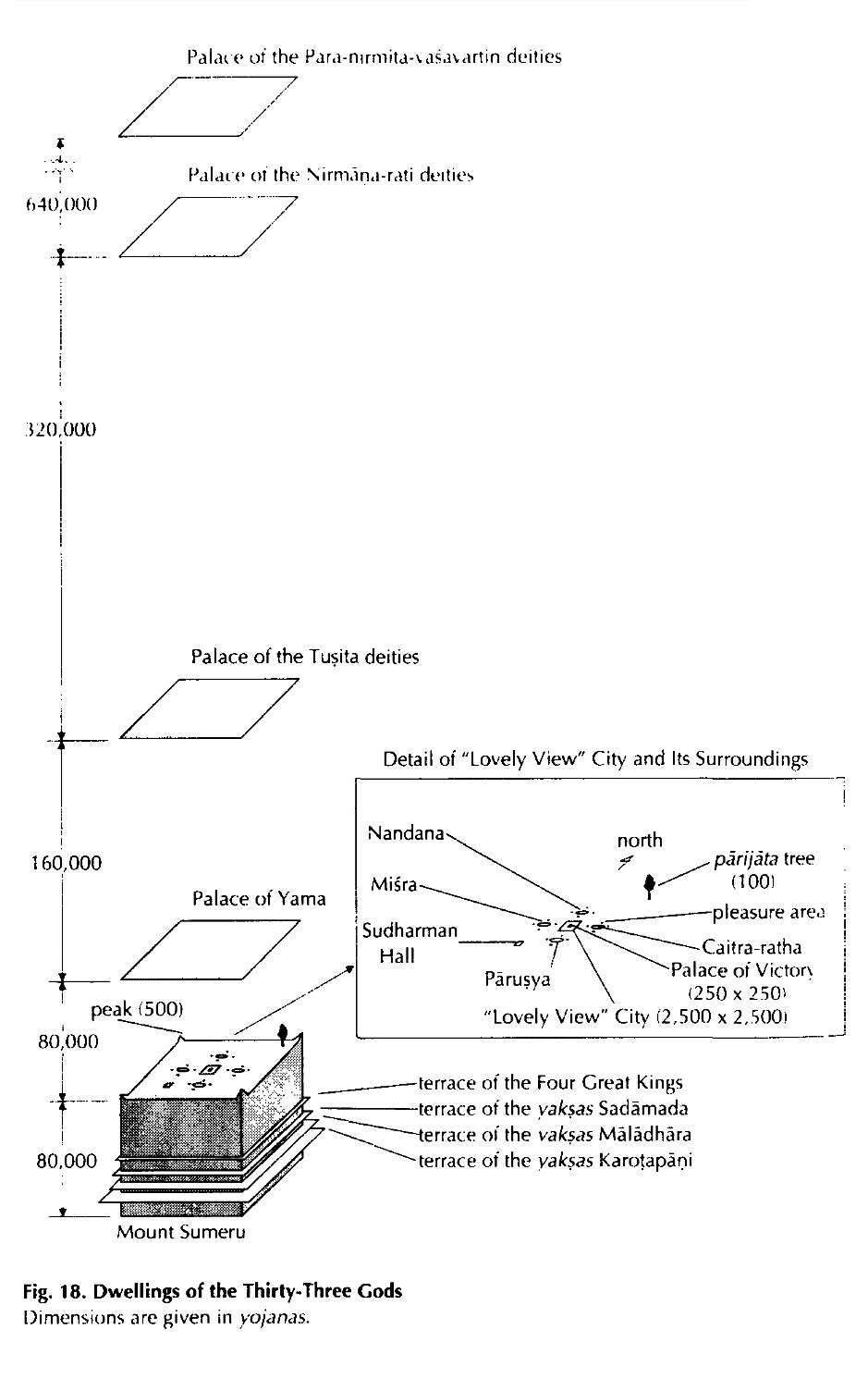
But I’ve watched the videos and they don’t contradict what I wrote. The problem is that the researcher didn’t make a distinction between the “sky” (as stated in the Death Battle video) and “heaven.” I’ve already described the wind ring in which the celestial bodies orbit the midpoint of Mt. Sumeru. So, now I will give a brief and very simplified overview of the Buddhist cosmos to help readers form a better picture of what I’m arguing. As the axis mundi, Mt. Sumeru is located at the center of our earthly realm, with a ring of seven smaller mountains circling it. This landmass is surrounded by four island-like continents, one for each face of Sumeru, that float in a great sea resting on a disc of golden earth (kāñcanamaṇḍala). This is then supported by a disc of water (jalamaṇḍala) and finally a disc of wind (vāyumaṇḍala), each layer generally becoming larger as one descends. This grand creation is thought to float in “space” (ākāśa) (Sadakata, 1997, pp. 25-30), sometimes translated as “sky” (Buswell & Lopez, 2014, p. 26). There are indeed various layers of heavens on and above Mt. Sumeru, but they appear to be separate from this space/sky (fig. 2). The first two heavens, that of the Four Great Kings and the 33 Gods, are respectively located at the midpoint and summit of Mt. Sumeru. But the following four heavens float above it at varying heights (fig. 3) (Sadakata, 1997, pp. 56-62). Therefore, by running with Mt. Sumeru on one shoulder (and Mt. Emei on the other), Monkey would have supported both the landmass and the two earthly heavens, a monumental task to be sure. But he doesn’t support the four floating heavens above or, most importantly, the space/sky that they are located in.
Having written the above, I want to note that I’m not claiming Hercules’ feat is stronger by default. I just want to present accurate information. I will at some point post an update with info about ancient Greek concepts of the sky.
Fig. 2 – A diagram of the Buddhist cosmos by MC Owens (larger version). Image from this talk. It’s the most simplistic, eye-catching version I’ve seen. The column of red, blue, and purple rings on the bottom represent the various layers of Hell. Fig. 3 – A diagram of the various heavens on and above Mt. Sumeru (larger version). From Sadakata, 1997, p. 60.
Wiz: As befitting heroes of myth they were on par in that they were both incomprehensibly strong, however, Wukong’s healing abilities meant he could bounce back from Heracles deadliest blows, whereas Heracles did not have a similar option.
Boomstick: But Heracles did have one way of putting the Monkey King down, his arrows dipped in hydra poison.
Wiz: The hydra poison threatened even the gods of Olympus, similar to the scorpion sting. Whether or not it would be fatal is questionable but it could have incapacitated Wukong, similar to how it affected Heracles himself.
2. The novel presents concepts with elemental states beyond heaven and earth. A prime example is Red Boy‘s Samādhi fire, which is considered more powerful than normal or even divine flames. [5] Likewise, the scorpion’s “horse-felling poison” (daoma du, 倒馬毒) likely falls into this separate category, for it was able to hurt even the Buddha! The bodhisattva Guanyin explains:
“Once upon a time she [the scorpion] happened to be listening to a lecture in the Thunderclap Monastery. When Tathagata saw her, he wanted to push her away with his hand, but she turned around and gave the left thumb of the Buddha a stab. Even Tathagata found the pain unbearable!” (Wu & Yu, 2012, vol. 3, p. 72).
The aforementioned monastery is located in the Western Paradise. This suggests that she might have been imbued with “dharma power” [6] over a certain period of time, making her a super powerful foe. Even the bodhisattva Guanyin fears her sting (Wu & Yu, 2012, vol. 3, p. 72).
I suggest that the scorpion’s sting may be stronger than the hydra’s heavenly poison. [7] Therefore, I question if the latter would have the same effect on the Monkey King.
Boomstick: But that is one very specific win condition and we’re looking at this with every possible option in mind.
Wiz: With his variety of clones, transformations and numerous other spells, Wukong’s arsenal was far more versatile.
Boomstick: Like, there was nothing stopping him from making thousands of clones of himself and just sitting back, while they beat up Herc for him. Unsporting been like? Sure. In character? Absolutely.
Wiz: Even then, those arrows would have to actually strike Wukong, which would be extremely difficult. Yes, in some depictions Heracles could potentially shoot the sun of Helios, his arrows flying 90 times the speed of light. However, in his contest with the Buddha, Wukong leap to the edge of the universe in a single second. To do so he had to be moving over 1.4 quintillion times faster than light.
3. But even if the hydra venom was equally potent, there is no guarantee that Hercules’ arrows could pierce Sun’s adamantine hide. The novel is clear that Monkey’s frame is nearly indestructible. For instance, upon his capture, heaven fails to execute him:
“They then slashed him with a scimitar, hewed him with an ax, stabbed him with a spear, and hacked him with a sword, but they could not hurt his body in any way. Next, the Star Spirit of the South Pole ordered the various deities of the Fire Department to burn him with fire, but that, too, had little effect. The gods of the Thunder Department were then ordered to strike him with thunderbolts [lei xie ding, 雷屑釘, lit: “nails of thunder”], but not a single one of his hairs was destroyed.” (Wu & Yu, 2012, vol. 1, p. 188).
This invincibility follows him throughout the novel. For example, in chapter 75, Sun agrees to a demon lord’s offer to set the monk free if he can survive a blow to his head with a scimitar (fig. 4):
“‘When he heard this, Pilgrim smiled and said, ‘Fiend! If you have brush and paper in your cave, take them out and I’ll sign a contract with you. You can start delivering your blows from today until next year, and I won’t regard you seriously!’ Arousing his spirit, the old demon stood firmly with one foot placed in front of the other. He lifted up his scimitar with both hands and brought it down hard on the head of the Great Sage. Our Great Sage, however, jerked his head upward to meet the blow. All they heard was a loud crack, but the skin on the head did not even redden” (Wu & Yu, 2012, vol. 3, p. 373).
Fig. 4 – Page from a Journey to the West comic book showing Monkey’s hard head (larger version). Image found on Twitter.
Someone may argue that the scorpion’s sting pierced his face, but refer back to what I wrote about dharma power in comment #2, and see also note #6 below.
Also, the Death Battle crew lists astronomically large numbers without explaining how the figures were calculated (I make the same critic of the G1 Death Battle Fan Blog in my 06-19-22 update). These figures mean absolutely nothing without some sort of explanation.
But since the numbers are used in reference to Monkey’s feat of leaping out of the Buddha’s palm, I want to explain its significance for those who don’t understand (per this reddit post). Sadakata (1997) writes: “[Sun’s feat] reflects the world of the Flower Garland Sutra, where every phenomenon is located within the buddha-world” (p. 155). He goes on to discuss the Cosmic Buddha Vairochana, noting how Buddhist art from all over the world depicts the myriad Buddhas as his emanations. One Javanese example features images of the Five Dhyani Buddhas encircling a stupa dedicated to Vairochana, thereby “express[ing] the Mahayana idea that the buddhas emanate from Mahavairocana and penetrate the universe, that the ‘one’ is at the same time the ‘many'” (Sadakata, 1997, pp. 156-157). Therefore, in essence, the Buddha’s palm in the novel represents the universe.
“[T]he Hydra venom doesn’t need to ‘pierce’ your body to make effect, it just needs to have skin contact, referring to the time Hercules died because he was tricked into using a robe with some hydra venom on it.”
“I’m aware of how Hercules dies, but there’s still the question of whether or not the venom would be absorbed into Sun Wukong’s nearly indestructible skin. I don’t recall any similar episode where a substance is absorbed through his skin in JTTW. So assuming that it could is not the same as citing evidence that it would. I’m not trying to split hairs. I’m just a stickler for details.”
But I will concede that artistic license and the need to raise the stakes of the battle could warrant the venom effecting him even if the arrows can’t penetrate his skin.
Boomstick: Making him way faster than Herc could ever hope to be.
Wiz: Heracles held might of mythic proportions, but barring a lucky shot. Sun Wukong’s versatile magic, similar strength and absolutely absurd speed overcame this foe fitting for heaven’s equal.
Boomstick: When fighting Sun Wukong, Heracles mythed his chance.
Wiz: The winner is the Monkey King, Sun Wukong.
2. List of Parallels
This has been split off into its own article to make the present post a more manageable length.
I’ve been notified by several people that the G1 Death Battle Fan Blog has posted a prediction. This blog is independent from the actual content creators. In a 7 to 6 split, the blog predicts Hercules will win, explaining that he is stronger and faster. While seemingly thorough, portions of their analysis make no sense. For example, the section on speed reads:
As far as speed goes, the demigod also comes out on top. Taking into account Wukong growing his staff from Earth to the Underworld and the Heavens, then scaling that back to his speed, he could potentially move at 800 quadrillion times the speed of light. However, Heracles scaling to Zeus surpasses this by dozens of times, with him being able to send shockwaves across the entire firmament by simply nodding his head. Zeus nodding his head is an act that should have been done with extreme ease – at least more ease than Zeus actually wrestling Heracles – meaning that Heracles should reasonably scale. As the firmament and Olympus are on the outer sphere of the cosmos, which encircle each other, this would have had to cross the entire diameter, putting the feat at 29 quintillion times the speed of light, over 36 times faster than Wukong …
They scale Sun Wukong’s speed not by his Cloud-Somersault (a metaphor for instantaneous travel) or his ability to carry mountains with meteoric speed but by the magic growth of his staff into a pillar of heaven. Why? They also provide astronomically large numbers without explaining how the figures were calculated, a very common problem with such versus discussions.
In addition, they wrongly state that the 72 Transformations grant Monkey immortality. He actually first attains immortality via Daoist elixir arts. Furthermore, they claim that Sun’s immortality can be taken away from him, referencing his turn in Laozi’s Eight Trigrams furnace. While the extreme heat was meant to extract the elixir from his body, it doesn’t work as Monkey was able to hide in a cooler part of the furnace (Wu & Yu, 2012, vol. 1, p. 189). But we don’t know if this plan would have worked even if Sun had been stuck in direct heat. This is confusing an “intended result” with an “actual result.” But even if the heat could complete the job, how exactly is Hercules going to defeat Sun’s immortality. Does he also carry around a heavenly furnace? This is never explained in the analysis.
I don’t have time to analyze the entire article. I will reserve this space for the actual fight results.
Note: In light of new evidence, I’ve changed my opinion regarding the furnace. Please see the 06-28-22 update below.
Update: 06-23-22
I have finished adding my comments to the official fight and result transcripts of the battle (sec. 1.1 and 1.2). If any new evidence comes to light, I will make sure to further update the page.
I’m thrilled to announce that the episode has 1.1 million views after only two days! 925,000 plus of those were in the first 24 hours! I knew this fight would attract a lot of attention. I hope more and more people will finally read the novel and fall in love with Monkey’s adventures like I did oh so long ago.
Update: 06-26-22
When I originally watched the video, I skipped the character analysis straight to the fight. I only just now got around to reading the official transcript for the beginning, and I’m sorry to report that Monkey’s section is riddled with errors. Whomever wrote it has definitely never read the book. It would be like me writing a Death Battle transcript about Harry Potter based on a very lazy read of Wikipedia. I tried correcting the mistakes onsite, but my edits were reverted, and I was told that the transcript is off limits. Therefore, I’ve decided to add my corrections and comments here (in blue) like I did above.
But before continuing, I want to note that I’m upset because it appears that info from my research blog was likely used in the video and Death Battle wiki website without the specific articles being linked to. Sure, my general blog URL was added twice to an external site (here and here), but this is not the same as linking to the actual articles on the video/wiki so people can see where Death Battle got their information from. Make no mistake, this has little to do with publicity; my blog generates zero money for me. It’s just fair that my work be recognized if it’s being used, especially if it contributed to a video currently making money for its creators.
3. Sun Wukong’s character analysis
Wiz: There once was a mighty monkey warrior, born of a mystic stone from the energy of the sun and moon. Upon birth, he graciously bowed to the cardinal directions and-
1. The stone was “nourished for a long period by the seeds of Heaven and Earth and by the essences of the sun and the moon” (Wu & Yu, 2012, vol. 1, p. 101).
Boomstick: Shot lasers from his eyes! Strap in folks, this one’s a doozy.
2. This feat is likely based on the birth of the historical Buddha. See parallel #2 on this article.
Wiz: This monkey soon befriended a band of other primates and, rather narcissistically, named himself their handsome Monkey King.
3. Sun doesn’t just proclaim himself king, though the addition of “handsome” is pure ego on his part (he’s actually really ugly). He proves himself in a test of bravery by jumping through a waterfall to discover a long-forgotten immortal’s grotto-heaven (see the opening of this article).
Boomstick: But after a few centuries of monkeying about, he got a taste of the dreaded… midlife crisis!
Wiz: You see, the Monkey King was fierce and brave, yet he feared death, so he ventured to new lands in search of immortality.
4. Brave? Yes. Fierce? Not yet a warrior.
Boomstick: Turns out, he’d find a lot of it.
Wiz: Training under the Taoist master, Puti, he earned his first method of immortality and a new name. He would be the Monkey Awakened to the Void, spoken as: Sun Wukong.
5. Subodhi is a Buddho-Daoist sage with heavy Buddhist associations despite his normal portrayal as an immortal.
Boomstick: He also learned a bunch of magic. He can ride clouds, make thousands of clones, heal from fatal wounds like decapitation, and transform into basically anything: a bird, some vapor, a pitchfork, even an incredible fighting temple!
Popup: Though this technique is called “72 Earthly Transformations”, the scope of Sun Wukong’s shapeshifting is limited only by his imagination. The number actually references a collection of stars that the power is associated with.
6. Example #1 of info from my blog being used but not linked to. And the actual name for the technique is the “Multitude of the Terrestrial Killers” (Disha shu, 地煞數). [10]
Wiz: With his famous cloud somersault, he could traverse the world at incredibly high speed. At first, a single somersault could carry him 180,000 li [a typo for 108,000], li being a traditional Chinese unit equal to about 500 meters, making one somersault move 54,000 kilometers per second, fast enough to circle the entire Earth in one leap.
7. Example #2 of info from my blog being used but not linked to. I note this ability to encircle the earth in the opening paragraph here.
Boomstick: And he’d only get faster from there. Monkey would do whatever it took to prove he was the best of the best.
Wiz: When fighting the mighty deity Prince Nezha, his foe transformed into a more powerful visage with three heads and six arms.
8. This doesn’t happen until chapters later when Monkey first rebels. I’m not sure why they would introduce this fight so early.
Boomstick: But Sun was like, “Hey, I can do that too,” and then did just that.
Wiz: Sun Wukong eventually returned to his simian subjects and, with his newfound power, amassed a veritable army. However, he felt no weapon in their arsenal suited him.
Boomstick: So he barged into the Dragon King‘s palace and demanded he hand over a weapon worthy of a king who can match the power of Heaven. Yeah, Sun was pretty full of himself. But, he wound up taking a pillar, originally designed to measure the depths of the ocean.
Popup: Some translations claim this “golden-hooped rod” measured or held up the galaxy, but these are incorrect. It was originally used to gauge the depth of the Great Flood, a story regarding the rise of dynastic China.
9. Example #3 of info from my blog being used but not linked to. Here I discuss the error in translation that led to this common misconception.
Wiz: What seemed like a worthless rod to the Dragon King was actually the perfect weapon for Wukong. Weighing nearly eight tons, the Ruyi Jingu Bang can change size at his whim. It can shrink to the size of a needle or grow long enough to pierce the heavens.
10. The pillar was not “useless.” He considered it an item of great importance:
“‘That,’ said the Dragon King, ‘was the measure with which the Great Yu fixed the depths of rivers and oceans when he conquered the Flood. It’s a piece of magic iron, but of what use could it be to him [Monkey]?'” (Wu & Yu, 2012, p. 135).
And later, he even refers to it as a “divine treasure” (Wu & Yu, 2012, p. 142).
But the Dragon Queen suggests giving it to the rude and very powerful immortal anyway so that he will leave their kingdom (Wu & Yu, 2012, p. 135).
Boomstick: The same heavens that got pretty mad with Sun after he crossed his name out of the Ledger of Death, making himself double immortal! Wait, how does that work?
Wiz: And even more mad when he demanded to be formally acknowledged as “The Great Sage Equal to Heaven”.
11. This doesn’t happen until after serving as the Bimawen and subsequently rebelling. Again, they introduce something too early.
Wiz: Now, the Monkey King may have lashed out, but it was because when he requested a place in Heaven, a place he truly believed he deserved, the Jade Emperor‘s court reduced him to a stable boy.
12. He didn’t request a place in heaven. The celestial bureaucracy just gave him a position to keep his unruly adventures in check (Wu & Yu, 2012, vol. 1, p. 143). Monkey only later “lashes out” upon learning of his low rank (Wu & Yu, 2012, vol. 1, p. 149).
Boomstick: Beneath all his antics, what Sun wanted most was to prove himself.
Wiz: Even with all the shenanigans, the Jade Emperor remained cautious and willing to placate Wukong.
Boomstick: By making him the watchdog of the Garden of Immortal Peaches. He totally ate that shit, didn’t he, Wiz?
13. It’s only at this point when Monkey battles Nezha, and when he proves too powerful, heaven placates him with the aforementioned sagely title and the above position (Wu & Yu, 2012, vol. 1, pp. 155-159).
Wiz: Oh yeah, Wukong got hammered, ate most of the peaches, ran around the Jade Palace in a fit, and found five gourds of immortality pills… which he promptly swallowed. All of them.
Boomstick: Ok, so that makes… how many layers of immortality now?
Wiz: I’d say a few… hundred? Thousand? If you count each individual peach and pill. When he sobered up, he knew he was in serious trouble, so naturally… he prepared for war.
14. This glosses over the reason for why Sun was drunk in the first place. He crashes the long-awaited immortal peach banquet and drinks all of the heavenly wine. Only then does he drunkenly stumble into Laozi’s laboratory and eat all of the alchemical pills (Wu & Yu, 2012, vol. 1, pp. 165-166).
Boomstick: Wow, that escalated quickly! What are they gonna do? Kill him? So, the Monkey King proved too strong for Heaven. He battled all their best fighters, and even matched Erlang Shen blow-for-blow in an epic battle of transformations! He’s that guy with the third eye.
Wiz: And Heaven’s greatest holy warrior. Yet, no matter Erlang’s form, Wukong always had a counter. UntilLaozi threw in a convenient plot MacGuffin that captured the monkey. But even with Wukong in chains, Heaven had a problem.
15. Sun has no problem fighting Erlang, that is until his beloved monkey army is routed. He thereafter loses heart and flees, using a number of animal/structural transformations to escape (Wu & Yu, 2012, vol. 1, pp. 181-184). This is obviously different from the scenario described above. See this article by my friend Irwen Wong over at Journey to the West Library to learn how Erlang wins the majority of their encounters.
Also, Laozi’s Diamond snare doesn’t capture Monkey. It simply hits Sun on the head, dazing him long enough for heaven to capture him (Wu & Yu, 2012, vol. 1, p. 186).
We cut to Boomstick.
Boomstick: He just wouldn’t die! Lightning, fire, even Laozi’s de-immortalizing furnace just made the monkey stronger!
16. The purpose of the Eight Trigrams furnace is not to remove one’s immortality but to produce the intense heat needed to manufacture alchemical elixirs (see section III of this article). This is an important distinction.
Laozi suggests that the reason why Monkey has a nearly indestructible body is because all of the immortal peaches and alchemical pills were likely refined in his lower elixir field. He then offers a possible solution:
“It would be better, therefore, if [he is placed] in the Brazier of Eight Trigrams, where he will be smelted by high and low heat. When he is finally separated from my elixir, his body will certainly be reduced to ashes” (Wu & Yu, 2012, vol. 1, pp. 188-189).
But as I note in my 06-19-22 critique of the G1 Death Battle Fan Blog,
“…it doesn’t work as Monkey was able to hide in a cooler part of the furnace. But we don’t know if this plan would have worked even if Sun had been stuck in direct heat. This is confusing an ‘intended result’ with an ‘actual result’.”
Note: In light of new evidence, I’ve changed my opinion regarding the furnace. Please see the 06-28-22 update below.
Wiz: Now, Wukong is not invincible. He has been hurt by the Scorpion Demoness’ poison, which could even harm the Buddha, an awaken divine being liberated from the cycle of life and death entirely.
17. Please see what I wrote about the scorpion above (sec. 1.2, #2)
[Random skit removed for brevity]
Boomstick: Ugh… But even after all that, Sun had one more challenger to contend with; the Buddha himself!
Wiz: Buddha approached Wukong with a contest: leap out of his hand, and he could have the Jade Emperor’s throne for himself.
Boomstick: Having no impulse control, the monkey agreed, and in an instant, somersaulted to the very edge of Heaven.
Wiz: But he had already lost. Because Buddha achieved Nirvana, he transcended the world, literally holding all of existence. So even at the edge of the universe, Wukong technically never left his hand.
18. This matches what I wrote above about the Buddha and the universe (sec. 1.2, #3).
Boomstick: For his rebellion, Sun was put in time out, sealed under a mountain for 500 years.
19. This is an understandable mistake as the phrase “500 years” is thrown around a lot in the novel. But as I explain here, chapter 14 states that the mountain trapped Monkey during the rein of a historical usurper (Wu & Yu, 2012, vol. 1, p. 306), revealing that his imprisonment actually lasts somewhere between 617 to 649 years.
Wiz: But even Sun Wukong would find a chance at redemption. In his case, he was tasked with escorting and protecting a monk, Tang Sanzang, or Tripitaka, on a journey to the west.
Boomstick: With additional companions Pigsy and Sandy. The trip was a tough one, and Monkey abandoned it more than once. But through it all, he always returned to shine as the group’s powerhouse, saving Tripitaka’s life many, many times. Seriously, this guy could not stay out of trouble. It’s like Wiz on a blind date.
Wiz: Ahem. Wukong has cracked apart mountains, slayed hundreds of monsters, and survived the Yellow Wind Demon‘s storm that could destroy the universe. As in Heaven, Earth, the 18 layers of Hell, and more!
Popup: The storm is depicted differently across translations, but the original Chinese text uses “乾坤”, meaning “universe”, or more literally “every manifestation of nature”.
Boomstick: That’s cool and all, Wiz, but let’s answer the real question. Can he beat Goku?
Wiz: Um… maybe! During his journey, Wukong performed possibly his most legendary feat: holding up Mount Sumeru which, in traditional Mahayana Buddhism, is a mountain supporting the infinite cosmic sky.
Boomstick: And Sun just hauled it around on one shoulder. Just one! Because on his other shoulder… was a whole other mountain!
Popup: The other mountain was Mount Emei, one of the Sacred Mountain of China.
20. Example #4 of info from my blog being used but not linked to. This material of course comes from here.
Wiz: After 14 years of travel, the journey was complete, and Wukong had finally accomplished a truly great deed. For this, he was given his long-awaited place among the heavens.
Boomstick: As the Victorious Fighting Buddha! Now that’s got to be an anime.
Wiz: After so much time as a rebel, an outcast, and a truly unstoppable warrior, Sun Wukong had, at last, found his home.
Update: 06-28-22
I previously referenced Sun’s turn in Laozi’s Eight Trigrams furnace but stated that this should not be used as an anti-feat since the flames never actually hurt him (due to taking shelter in a cooler portion of the brazier) (06-19-22 update & sec. 4, #16). I also referenced Red Boy’s spiritually-cultivated Samādhi fire, noting that it is more powerful than earthly or even heavenly fire (sec. 1.2, #2). Regarding the latter, remember that Monkey easily survives an attempted execution by this celestial flame (sec. 1.2, #3). But it’s important to highlight that, in chapter 41, the combination of Samādhi fire and intense smoke is shown to override Monkey’s famous fire-protection spell:
His whole body covered by flame and smoke, the Great Sage found the intense heat unbearable and he dove straight into the mountain stream to try to put out the fire. Little did he anticipate that the shock of the cold water [11] was so great that the heat caused by the fire was forced inward into his body and he fainted immediately (Wu & Yu, vol. 2, p. 231).
And I was recently reminded of an additional episode where Sun has another brush with supernatural flames. In chapter 75, an ancient demon king places Monkey in a small, unassuming vase for execution, but the latter comments on the cool temperature inside. However, it turns out that this is an ultra powerful treasure “governed by the double primal forces of yin and yang” (Wu & Yu, 2012, vol. 3, p. 368), and the second that he speaks, the vessel assaults Sun first with fire, then biting snakes, and finally fire dragons. The first round of fire has no effect on him (nor do the snakes) but the fire dragons produce flames so hot that they also override the fire-protection spell:
He had hardly finished speaking when he felt some pain on his shanks. Rubbing them hurriedly with his hand, he found his shanks were turning flaccid because of the fire. More and more anxious, he thought to himself, “What’s to become of me? Even my shanks are weakened by the fire. I’ll be reduced to a cripple!” (Wu & Yu, 2012, vol. 3, p. 369)
What’s interesting is that the vase’s various torments are said to be “activated by the seven jewels, the eight trigrams, and the twenty-four solar terms” (Wu & Yu, 2012, vol. 3, p. 368) (emphasis mine). These are the same eight trigrams as Laozi’s furnace. So, this suggests that Sun’s time in the brazier would have actually hurt his body. While this might even destroy his form, the novel hints that, besides providing a surplus of extra heads, the 72 Transformations also grant Monkey extra lives just like a video game (see the 06-12-22 update here). But this “respawning” is never officially shown in the novel. So what would happen if Sun had been trapped inside the Eight Trigrams furnace in direct heat? Would he just keep regenerating over and over again until his extra lives were spent (or he escaped), or would the supernatural flames simply destroy his body once and for all? I’m not sure. Make of this what you will.
But my original point still stands: Hercules would not have been able to overcome Monkey’s immortality unless he was carrying around a heavenly furnace and managed to force and keep the primate hero inside for a given time.
Update: 07-01-22
I forgot to mention something regarding the various fire-related episodes in the last update: Sun Wukong’s abilities are presented inconsistently throughout the novel. This is best illustrated by two episodes. As mentioned above, in chapter 75, Monkey cries that he’ll be a cripple if the supernatural fire continues to burn his ankles. But he previously demonstrated the ability to heal using his immortal breath in Chapter 46:
With a swagger, Pilgrim walked down to the execution site. Leaning himself on a huge pillar, he untied his robe and revealed his stomach. The executioner used a rope and tied his neck to the pillar; down below, another rope strapped his two legs also to the pillar. Then he wielded a sharp dagger and ripped Pilgrim’s chest downward, all the way to his lower abdomen. Pilgrim used both his hands to push open his belly, and then he took out his intestines, which he examined one by one. After a long pause, he put them back inside, coil for coil exactly as before. Grasping the skins of his belly and bringing them together with his hands, he blew his magic breath on his abdomen, crying, “Grow!” At once his belly closed up completely (Wu & Yu, 2012, vol. 2, p. 309).
Prior to this, he quoted a fun poem about his abilities:
Cut off my head and I still can speak,
Sever my arms, I still can beat you up!
My legs amputated, I still can walk.
My belly, ripped open, will heal again,
Smooth and snug as a wonton people make:
A tiny pinch and it’s completely formed.
To bathe in boiling oil is easier still;
Like warm liquid cleanse me of dirt it will (Wu & Yu, 2012, vol. 2, p. 307).
This inconsistency is likely due to the standard 1592 edition of Journey to the West coalescing from independent oral stories developed and told over the centuries (see the late-13th-century version of the story, for example). Therefore, it’s important to remember that Monkey is only as fast, strong, or invulnerable as the story calls for him to be. This serves to heighten the drama, making the story more compelling.
Update: 05-20-23
Above, I mentioned that the DEATHBATTLE! video animated the characters as sprites. I didn’t like Monkey’s design at the time because he was so tiny that you couldn’t see any of the details. However, someone on twitter recently posted hi def and up-close images of him from the battle (fig. 8), and I have to say that he looks pretty good.
I want a Hercules-Sun Wukong (fig. 9 & 10) buddy cop movie:
One is a divine hero who is super strong, wears a big cat skin, and fights monsters with a blunt weapon. The other is a divine hero who is super strong, wears a big cat skin, and fights monsters with a blunt weapon. Both are extremely pissed and ready to clean up the streets.
1) JTTW uses two measurement units when referring to the staff, the chi (尺, i.e. “Chinese foot”; 12.52 in / 31.8 cm) and the zhang (丈; 1 = 10 chi) (Jiang, 2005, p. xxxi). Monkey is said to fight with the staff at two lengths, “two zhang” (erzhang, 二丈, i.e. 20 chi) in chapter three and “12 or 13 chi” (丈二三) in chapter 88 (Wu & Yu, 2012, vol. 1, p. 135; vol. 4, p. 196). But twenty is likely a typo for 12 (zhanger, 丈二, 3.82 m / 12.53 ft.) since the pillar was already close to the former size when Sun first saw it in the dragon treasury. Therefore, this correction agrees with the latter measurement.
2) Translation slightly altered. Yu (Wu & Yu, 2012) writes that it’s the size of a “rice bowl” (vol. 1, p. 135), but this doesn’t appear in the original Chinese.
3) In chatper 59, for example, he invades the stomach of his former bond brother‘s wife in an attempt to procure a magic weapon needed to clear his master’s path to the west:
“I’m now having a little fun in my esteemed Sister-in-law’s stomach! I am, as the saying goes, seeing right through you! I know how thirsty you must be, so let me send you a ‘sitting bowl’ to relieve your thirst” Suddenly he shoved his foot down hard and unbearable pain shot through Rākṣasī’s lower abdomen, sending her tumbling to the floor and moaning. “Please don’t refuse me, Sister-in-law,” said Pilgrim, “I’m presenting you with an added snack for your hunger.” He jerked his head upward, and unbearable pain coursed through Rākṣasī’s heart. She began to roll all over the ground, the pain turning her face yellow and her lips white. All she could do was to cry out, “Brother-in-law Sun, please spare my life!” (Wu & Yu, 2012, vol. 3, p. 129).
4) Mt. Sumeru is said to be 160,000 yojanas (1 yojana = roughly 8 miles/12.87 km) tall, with 80,000 below a great ocean and 80,000 exposed above (Vasubandhu, 2014, pp. 454).
5) Three lines from a poem in chapter 41 read: “It’s not fire from Heaven, / Nor is it a wildfire. / It’s the realized samādhi fire born of the demon’s self-cultivation” (Wu & Yu, 2012, vol. 2, p. 225).
6) “Dharma power” (fali, 法力) is the strongest form of magic in Journey to the West. See this paper for an explanation of the novel’s Buddho-Daoist cosmic hierarchy, which places Buddhist deities at the top.
7) The hydra is the nigh-immortal offspring of the Titanic monsters Typhon and Echidna (Hesiod & Powell, 2017, p. 52).
8) Yu (Wu & Yu, 2012) uses “pounds” instead of the original jin (斤, a.k.a. catty) (vol. 1, p. 135). During the Ming dynasty when the novel was compiled, one jin equaled approximately 590 grams (Jiang, 2005, p. xxxi). I will therefore alter Yu’s translation to reflect more accurate measures.
9) Yes, this information comes from Wikipedia, but I’m the one who originally added it under the screenname “Ghostexorcist.” See this edit history, for example.
10) I follow the translation used in Meulenbeld (2019). Yu (Wu & Yu, 2012) simply translates this as the “Art of the Earthly Multitude” (vol. 1, p. 122).
Aston, E. (2021). Labor VI: The Stymphalian Birds. In D. Ogden (Ed.), The Oxford Handbook of Heracles (pp. 95-106). United Kingdom: Oxford University Press.
Birrell, A. (1999). Chinese Mythology: An Introduction. Baltimore: The Johns Hopkins University Press.
Deacy, S. (2021). Heracles between Hera and Athena. In D. Ogden (Ed.), The Oxford Handbook of Heracles (pp. 387-394). United Kingdom: Oxford University Press.
Hanesworth, P. (2021). Labor XII: Cerberus. In D. Ogden (Ed.), The Oxford Handbook of Heracles (pp. 165-180). United Kingdom: Oxford University Press.
Hesiod, & Powell, B. B. (2017). The Poems of Hesiod: Theogony, Works and Days, and The Shield of Herakles. United States: University of California Press.
Hinsch, B. (2011). Women in Early Imperial China. Lanham, Md: Rowman & Littlefield Publishers.
Hsing, I.T., & Crowell, W. G. (2005). Heracles in the East: The Diffusion and Transformation of His Image in the Arts of Central Asia, India, and Medieval China. Asia Major, 18(2), 103–154. http://www.jstor.org/stable/41649907
Hsu, K. L. (2021). The Madness and the Labors. In D. Ogden (Ed.), The Oxford Handbook of Heracles (pp. 13-25). United Kingdom: Oxford University Press.
Huntington, J. C., Bangdel, D. (2003). The Circle of Bliss: Buddhist Meditational Art. United Kingdom: Serindia Publications.
Jiang, Y. (2005). The Great Ming Code: Da Ming Lü. United States: University of Washington Press.
March, J. (2021). Labor I: The Nemean Lion. In D. Ogden (Ed.), The Oxford Handbook of Heracles (pp. 29-44). United Kingdom: Oxford University Press.
Mayor, A. (2021). The Girdle of the Amazon Hippolyte. In D. Ogden (Ed.), The Oxford Handbook of Heracles (pp. 124-134). United Kingdom: Oxford University Press.
Meulenbeld. (2019). Vernacular “Fiction” and Celestial Script: A Daoist Manual for the Use of Water Margin. Religions, 10(9), 518. MDPI AG. Retrieved from http://dx.doi.org/10.3390/rel10090518
Ogden, D. (2021a). Introduction. In D. Ogden (Ed.), The Oxford Handbook of Heracles (pp. xxi-xxxi). United Kingdom: Oxford University Press.
Ogden, D. (2021b). Labor VIII: The Mares of Diomede (and Alcestis). In D. Ogden (Ed.), The Oxford Handbook of Heracles (pp. 113-123). United Kingdom: Oxford University Press.
Pache, C. (2021). Birth and Childhood. In D. Ogden (Ed.), The Oxford Handbook of Heracles (pp. 3-12). United Kingdom: Oxford University Press.
Romero-Gonzalez, D. (2021). Deianeira, Death, and Apotheosis. In D. Ogden (Ed.), The Oxford Handbook of Heracles (pp. 266-280). United Kingdom: Oxford University Press.
Sadakata, A. (1997). Buddhist Cosmology: Philosophy and Origins. Japan: Kosei Publishing Company.
Salowey, C. (2021). The Gigantomachy. In D. Ogden (Ed.), The Oxford Handbook of Heracles (pp. 235-250). United Kingdom: Oxford University Press.
Salapata, G. (2021). Labor XI: The Apples of Hesperides. In D. Ogden (Ed.), The Oxford Handbook of Heracles (pp. 149-164). United Kingdom: Oxford University Press.
Shahar, M. (2008). The Shaolin Monastery: History, Religion, and the Chinese Martial Arts. Honolulu: University of Hawai’i Press.
Theocritus, & Gow A. S. F. (1952). Theocritus (Vol. 1-2). Kiribati: Cambridge University Press.
Vasubandhu (2014). Abhidharmakosabhasyam of Vasubandhu (Vol. 2) (L. de La Vallee Poussin & L. M. Pruden, Trans.). United States: Jain Publishing Company.
Sun Wukong’s magic staff is famed in popular culture for its ability to grow and shrink but less so for its great weight. The latter quality is best demonstrated in Journey to the West (Xiyouji, 西遊記, 1592; “JTTW” hereafter) chapter 56 when human bandits attempt and fail to pick up the 8.8 ton weapon:
Sticking the rod into the ground, Pilgrim said to them, “If any of you can pick it up, it’s yours.” The two bandit chiefs at once went forward to try to grab it, but alas, it was as if dragonflies were attempting to shake a stone pillar. They could not even budge it half a whit! This rod, you see, happened to be the “As-You-Will” Gold-Banded Staff, which tipped the scale in Heaven at thirteen thousand, five hundred catties [yiwan sanqian wubai jin, 一萬三千五百斤; 17,559.81 lbs. / 7,965 kg]. [1] How could those bandits have knowledge of this? The Great Sage walked forward and picked up the rod with no effort at all. Assuming the style of the Python Rearing its Body, he pointed at the bandits and said, “Your luck’s running out, for you have met old Monkey!” (Wu & Yu, 2012, vol. 3, p. 81).
I suggested in one of my earliest articles that the weight of Monkey’s staff had a connection to Chinese numerology:
Thirteen thousand five hundred is divisible by nine, which Chinese numerology considers to represent “infinity.” So it’s possible the number (infinity multiplied) was meant to convey that the staff was heavy beyond comprehension, something that only a divine hero such as Monkey would be able to wield.
While I still agree that the great weight cements his position as a superior hero, I no longer believe that the number is directly connected to numerology.
I now suggest that the weapon’s weight was directly influenced by a scene in chapter 28 of the Water Margin (Shuihu zhuan, 水滸傳, c. 1400). It involves the bandit Wu Song lifting a heavy stone block:
[Wu Song:] “You mean I haven’t got my strength back? All right. How heavy is the stone block [shi dun, 石墩] I saw in front of the Heavenly King Temple yesterday?” [2]
[Shi En, a young admirer] “Probably four to five hundred catties [si wu bai jin, 四五百斤; 520.29 to 650.36 lbs. / 236 to 295 kg].”
“Let’s take a look. I wonder whether I can move it.”
“Please have some food and wine first.”
“There’ll be time enough for that when we come back.”
The two men walked to the Heavenly King Temple. The prisoners on the grounds bowed and hailed them respectfully. Wu Song shook the stone slightly. He laughed.
“This soft life is spoiling me. I’ll never be able to pick it up!”
“You shouldn’t scoff,” said Shi En. “That stone weighs three to five hundred catties [san wu bai jin, 三五百斤; 390.21 to 650.36 lbs. / 177 to 295 kg]!”
Wu Song grinned. “You really think I can’t lift it? Get back, you men, and watch this.”
He slipped off his tunic and tied the sleeves around his waist. Embracing the stone, he raised it easily [fig. 1], then tossed it away with both hands. It dropped with a thud, sinking a chi [尺; 12.3 in / 31.8 cm] into the earth. The watching prisoners were astonished.
Wu Song grasped the stone with his right hand and lifted. With a sudden twist, he flung it upwards. It sailed one zhang [丈; 10.25 ft / 3.18 m] into the air. He caught it in both hands as it came down and lightly put it back in its original place. He turned and looked at Shi En and the prisoners. His face wasn’t flushed, he wasn’t even breathing hard, his heart beat calmly (based on Shi & Luo, 1993/2001, vol. 2, pp. 590-591).
Now compare it to the scene in JTTW chapter three where Monkey first procures his magic staff:
“Take it [the staff] out and let me see it,” said Wukong. Waving his hands, the Dragon King said, “We can’t move it! We can’t even lift it! The high immortal must go there himself to take a look.” “Where is it?” asked Wukong. “Take me there.”
The Dragon King accordingly led him to the center of the ocean treasury, where all at once they saw a thousand shafts of golden light. Pointing to the spot, the Dragon King said, “That’s it—the thing that is glowing.” Wukong girded up his clothes and went forward to touch it: it was an iron rod [tie zhuzi, 鐵柱子] more than two zhang [丈; 20.5 ft / 6.36 m] long and as thick as a barrel. Using all his might, he lifted it with both hands [fig. 2], saying, “It’s a little too long and too thick. It would be more serviceable if it were somewhat shorter and thinner.” Hardly had he finished speaking when the treasure shrunk a few chi [尺; 1 = 12.3 in / 31.8 cm] in length and became a layer thinner. “Smaller still would be even better,” said Wukong, giving it another bounce in his hands. Again the treasure became smaller. Highly pleased, Wukong took it out of the ocean treasury to examine it. He found a golden hoop at each end, with solid black iron in between. Immediately adjacent to one of the hoops was the inscription, “‘As-You-Will’ Gold-Banded Staff. Weight: thirteen thousand five hundred catties [Ruyi jingu bang zhong yiwan sanqian wubai jin, 如意金箍棒,重一萬三千五百斤] [fig. 3].” He thought to himself in secret delight, “This treasure, I suppose, must be most compliant with one’s wishes.” As he walked, he was deliberating in his mind and murmuring to himself, bouncing the rod in his hands, “Shorter and thinner still would be marvelous!” By the time he took it outside, the rod was no more than twelve chi in length and had the thickness of a rice bowl (Wu & Yu, 2012, vol. 1, p. 135). [3]
Fig. 2 – Monkey lifts the iron pillar (larger version). Fig. 3 – Sun looks at the inscription, including the weight (larger version). Screenshots from the 1960s classic Havoc in Heaven.
2. Comparison
Both scenes involve a hero (Wu Song vs. Sun Wukong) asking someone (Shi En vs. Ao Guang) to show them a heavy object that cannot be moved (stone block vs. iron pillar). Both heroes then adjust their clothing before easily lifting the object with both hands. Most importantly, the Chinese characters for the weight of each object (三五百斤 vs. 一萬三千五百斤) are similar. The only difference is the addition of 一萬 and 千, respectively (fig. 4). [4]Now, someone might say the numbers are meaningless as “three to five hundred” is a common estimate for lengths, distances, and people used throughout the Water Margin (some examples). But the proposed connection is strengthened when you take into account the many similarities shared by Monkey and Wu. I show in this article that both are reformed supernatural spirits previously trapped under the weight of magic mountains, slayers of tigers, Buddhist monks nicknamed “Pilgrim,” monastic masters of martial arts, wearers of moralistic golden headbands, and wielders of bin steel weapons. Therefore, given the close historical and cultural ties between the two characters, I believe that the JTTW author-compiler embellished the Water Margin episode to portray Sun as a hero like no other, a divine immortal that can lift weights far beyond even Wu Song himself.
Fig. 4 – The weight of Monkey’s staff where the red characters represent additions to the weight of Wu Song’s stone in black.
3. Updates
Update: 03-11-23
My friend and contributor Saie Surendra (his website) was recently sent a video similar to this one suggesting another possible origin for the weight of Monkey’s staff. [5] The speaker, Lan Yanling (兰彦岭), states, “The Golden-Hooped Staff weighs 13,500 catties, and everyday a person breathes 13,500 times” (金箍棒重13,500斤,人一天呼吸13,500次). The specific number of breaths is drawn from ancient medical treatises, some of which were absorbed into the Daoist canon.
For example, the first scroll of The Yellow Emperor’s Canon of Eighty-One Difficult Issues (Huangdi bashiyi nanjing, 黃帝八十一難經) reads:
A person, in the course of one day and one night, breathes altogether 13,500 times (Unschuld, 1986, p. 65).
This second possibility is interesting as Sun achieves immortality through a series of breathing and energy circulation exercises. This means that, if the number did influence the weapon’s weight, one could speculate that the staff is a physical manifestation of the methods by which he gained his powers.
I’m not quite sure how I feel about this new possibility. On one hand, it doesn’t require adding characters (i.e. 一萬 and 千) to come up with the figure 13,500 (refer back to section 2). But on the other, it lacks the literary context laid out in the main article. I’ll have to look into this more.
Notes:
1) I have changed Yu’s (Wu & Yu, 2012) dry rendering “Compliant Golden-Hooped Rod” to a more pleasant one based on W.J.F. Jenner (Wu & Jenner, 1993/2001, vol. 1, p. 56). Also, Yu’s (Wu & Yu, 2012) original translation says “thirteen thousand five hundred pounds” (vol. 1, p. 135). However, the Chinese version uses jin (斤), known in English as “catty.” The catty and pound are two different measures of weight, the former being heavier than the latter. Therefore, the English text has been altered to show this. The catty during the Ming Dynasty when the novel was compiled equaled 590 grams (Elvin, 2004, p. 491 n. 133; Jiang, 2005, p. xxxi), so 13,500 catties would be roughly 17,560 lbs.
2) I’ve updated the English translation because it didn’t mention the specific temple name appearing in the original Chinese version.
3) Both the original Chinese and the translation say that the staff shrank to “no more than two zhang in length” (zhiyou er zhang changduan, 只有二丈長短) (based on Wu & Yu, 2012, vol. 1, p. 135), but it was close to two zhang (20.5 ft / 6.36 m) from the start. Irwen Wong of the Journey to the West Library blog has suggested to me that this is a likely error for “one zhang two (chi)” (丈二; 12.3 ft / 3.74 m). I’ve, therefore, modified the translation.
4) These mean “10,000” (yiwan, 一萬) and “1,000” (qian, 千), respectively. When combined with the character for three, the latter becomes “3,000” (sanqian, 三千).
5) The video was sent to him by an acquaintance named Afeng.
Sources:
Elvin, M. (2004). The Retreat of the Elephants: An Environmental History of China. New Haven (Conn.): Yale university press.
Jiang, Y. (2005). The Great Ming Code / Da Ming Lu. Vancouver, Wa: University of Washington Press.
Shi, N., & Luo, G. (2021a). Shuihu zhuan (shang, zhong, xia) [Tale of the Water Margin (Vols. 1-3)]. Beijing: Renmin wenxue chubanshe. (Original work published 1975)
Shi, N., Luo, G., & Shapiro, S. (2001b). Outlaws of the Marsh (Vols. 1-4) (S. Shapiro, Trans.). Beijing, China: Foreign Languages Press. (Original work published 1993)
Unschuld, P. (1986). Nan-Ching: The Classic of Difficult Issues; With Commentaries by Chinese and Japanese Authors from the Third through the Twentieth Century. Berkeley, CA: University of California Press.
Wu, C., & Jenner, W. J. F. (2000). Journey to the West (Vols. 1-4). Beijing, China: Foreign Languages Press. (Original work published 1993)
Wu, C., & Yu, A. C. (2012). The Journey to the West (Vols. 1-4) (Rev. ed.). Chicago, Illinois: University of Chicago Press.