Sun Wukong’s Strength-Bestowing Ritual

Last updated: 05-15-2025

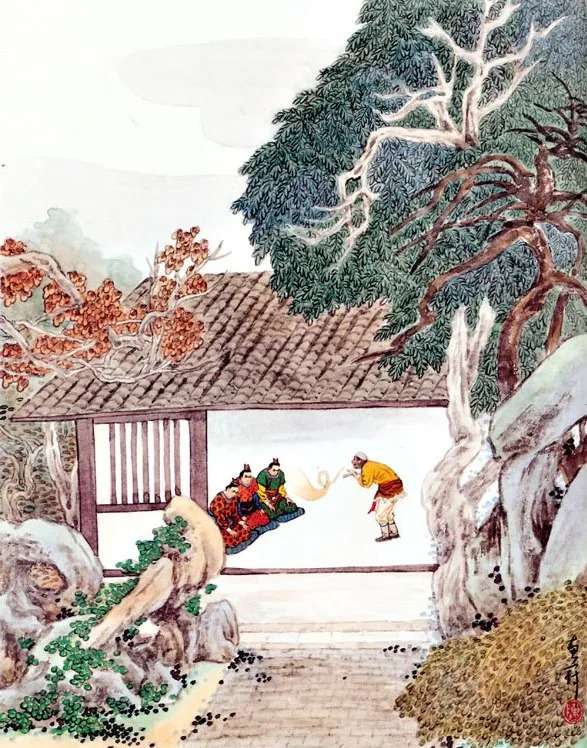
In chapter 88 of Journey to the West (Xiyouji, 西遊記, 1592), the pilgrims arrive in the lower Indian prefecture of Jade Flower District (Yuhua xian, 玉華縣), which strikes Tripitaka as a spitting image of the Tang Chinese capital of Chang’an. There, the disciples’ monstrous appearance rouses the local ruler’s three sons to action against what they think are demons come to harm their father. However, they soon learn Monkey, Pigsy, and Sandy are celestial warriors possessing magical versions of their mere earthly arms—two staves and a battle rake. The three princes are later accepted as disciples, the oldest wanting to learn Monkey’s techniques and the second and third oldest wanting to learn from Pigsy and Sandy in turn. But when they fail to lift the monks’ celestial weapons, Monkey performs an arcane ritual in which he bestows each prince with superhuman strength:

In a secluded room behind the Gauze-Drying Pavilion, Pilgrim traced out on the ground a diagram of the Big Dipper. Then he asked the three princes to prostrate themselves inside the diagram and, with eyes closed, exercise the utmost concentration. Behind them he himself recited in silence the true sayings of realized immortality and intoned the words of Dharani as he blew divine breaths into their visceral cavities. Their primordial spirits were thus restored to their original abodes. Then he transmitted secret oral formulas to them so that each of the princes received the strength of tens of thousands of men. [1] He next helped them to circulate and build up the fire phases, as if they themselves were carrying out the technique for shedding the mortal embryo and changing the bones. Only when the circulation of the vital force had gone through all the circuits of their bodies (modeled on planetary movements) did the young princes regain consciousness. When they jumped to their feet and gave their own faces a wipe, they felt more energetic than ever. Each of them, in fact, had become so sturdy in his bones and so strong in his ligaments that the eldest prince could handle the golden-hooped rod, the second prince could wield the nine-pronged muckrake, and the third prince could lift the fiend-routing staff (Wu & Yu, 2012, vol. 4, pp. 202-203).

行者才教三個王子都在暴紗亭後,靜室之間,畫了罡斗。教三人都俯伏在內,一個個瞑目寧神。這裡卻暗暗念動真言,誦動咒語,將仙氣吹入他三人心腹之中,把元神收歸本舍。傳與口訣,各授得萬千之膂力,運添了火候,卻像個脫胎換骨之法。運遍了子午周天,那三個小王子方才甦醒,一齊爬將起來,抹抹臉,精神抖擻,一個個骨壯筋強:大王子就拿得金箍棒,二王子就掄得九齒鈀,三王子就舉得降妖杖。

Table of Contents

I. Explanation

1. “Pilgrim traced out on the ground a diagram of the Big Dipper.”

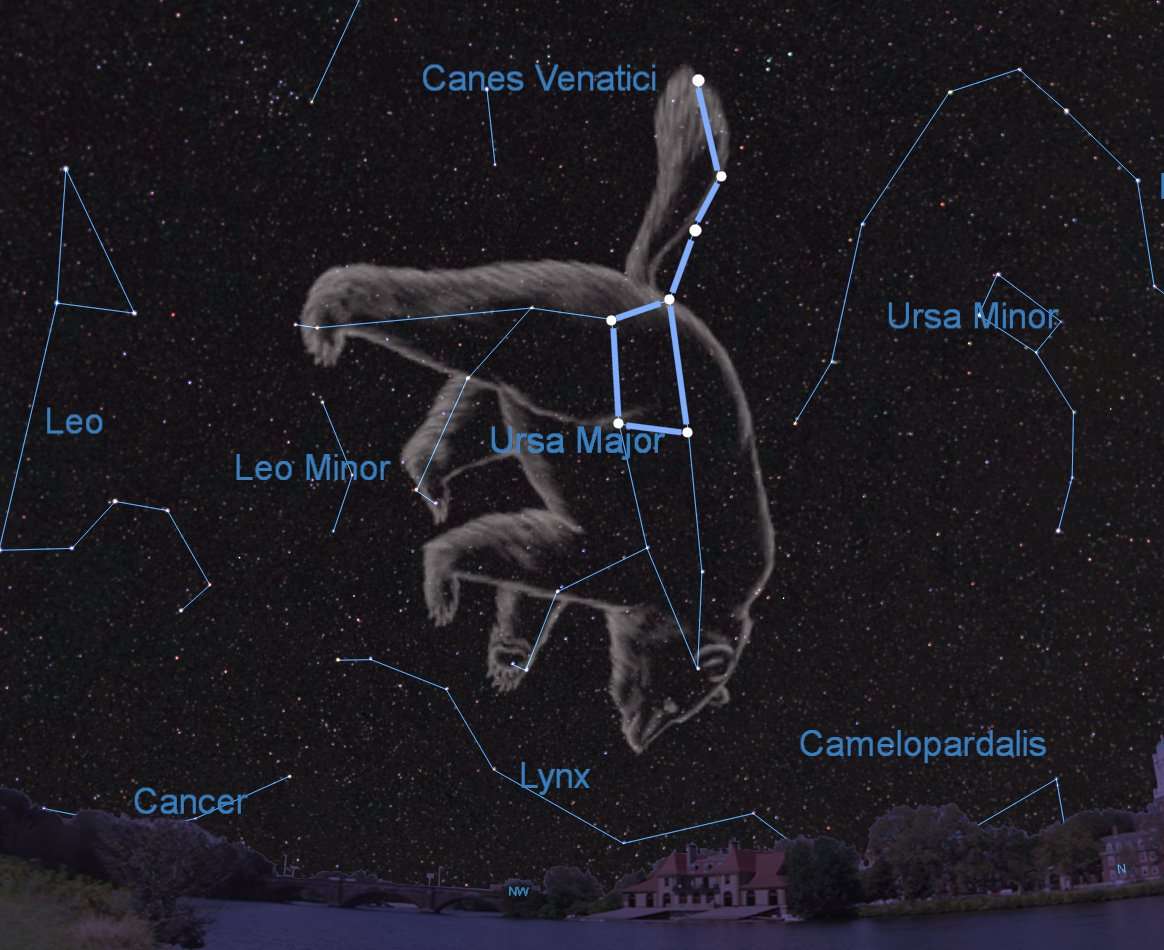
The Big Dipper (gangdou, 罡斗), also known as the Northern Dipper (beidou, 北斗), is a pattern of seven stars associated with the constellation Ursa Major (fig. 1). Daoism considers the pole star of this pattern to be the center of the cosmos through which emanates “primordial breath” (generative qi), which has long been deified as the great god Taiyi. The constellation is associated with a Daoist ritual known as Bugang (步綱/罡, “Walking the Guideline”) in which a practitioner paces the Big Dipper pattern with their feet on the ground. This ritual dance is synonymous with the much older shamanistic Yubu (禹步, “Paces of Yu”) used by ancient Sage Kings to conquer primordial chaos by pacing the stars and planets into motion, thereby directing the seasons and passage of time. The ritual involved pacing an inwardly spiraling circular pattern while dragging one foot behind the other in imitation of the limp adopted by Yu the Great after over-exerting himself quelling the fabled World Flood (fig. 2). Later Daoists viewed Yubu as a means of gaining immortality because the limping, three pace-style walking pattern symbolized the practitioner spanning the three realms of Earth, Man, and finally Heaven (this has an interesting Vedic correlation). [2] But most importantly, by the Tang and Song dynasties, Bugang served the purpose of purifying the area before an altar, ensuring the liturgy to follow takes place in a consecrated space. In fact, some sources interchange the characters for Bugang with the homonyms 布剛, meaning “distributing strength,” which denotes the demonifugic properties of the dance (Andersen, 1989). Therefore, Monkey draws the Big Dipper talisman on the ground in order to create a sacred space free of any negative influences.

Fig. 1 (left) – The location of the Big Dipper in relation to the Ursa Major constellation (larger version). Originally from this Futurism article. Fig. 2 (right) – A diagram showing the inwardly spiraling pattern of Yubu (top) and the dipper pattern of Bugang (bottom) (larger version). Take note of the spiral’s limping, three pace-style walking pattern. Originally found on this WordPress article.  

2. “Then he himself recited in silence the true sayings of realized immortality and intoned the words of Dharani…”

The “true sayings” (zhenyan, 真言) is the Chinese term for mantra, meaning “spell” or “magical formula.” A mantra is “a syllable or series of syllables that may or may not have semantic meaning, most often in a form of Sanskrit, the contemplation or recitation of which is thought to be efficacious” (Buswell & Lopez, 2014, p. 529). The most famous mantra is of course Om Mani Padme Hum, the very same six-syllable prayer that was used to weigh down the mountain holding Monkey prisoner for rebelling against heaven.

The “true sayings” is often used as an abbreviation for Dharani (tuoluoni/zongchi, 陀羅尼/總持), a Sanskrit term meaning “mnemonic device” (fig. 3). Like mantras, dharani are comprised of syllables, but these instead serve to remind practitioners of broader concepts, for example a single syllable representing the first letter of a much longer phrase. There exists four types of dharani said to be used by Bodhisattvas to achieve enlightenment: 1) those used for teaching interpretations of Buddhist law; 2) those used for understanding the exact meaning of important words; 3) those used for casting spells; and 4) those used for spiritual endurance in the face of suffering (Buswell & Lopez, 2014, pp. 241-242). The third type, which concerns us, falls under a category of sutra recitation called Paritta (minghu/jing, 明護/經), which is Pali for “protection.” The historical Buddha is known to have delivered paritta verses, including those for “protection from evil spirits, the assurance of good fortune, exorcism, curing serious illness, and even safe childbirth” (Buswell & Lopez, 2014, p. 630).

In both cases zhenyan/mantra and dharani refer to magical formulas of sorts and were no doubt chosen because they gave the ritual an heir of arcane authenticity. Additionally, I suggest that the use of dharani may have also been chosen to denote a spell of protection, as in Sun wanted to protect the princes during the transformation of their bodies.

(Note 06-15-19: Feng Dajian of Nankai University notified me via Twitter that he disagrees with Anthony C. Yu’s 2012 revised translation (cited above) associating the “True Sayings” with the Buddhist Dharani. This is because he feels that the ritual is overtly Daoist, noting that the religion also has its own True Sayings.)

Fig. 3 – A Dharani print from the late Tang Dynasty. Original from Wikicommons.

3. “…as he blew divine breaths into their visceral cavities. Their primordial spirits were thus restored to their original abodes.”

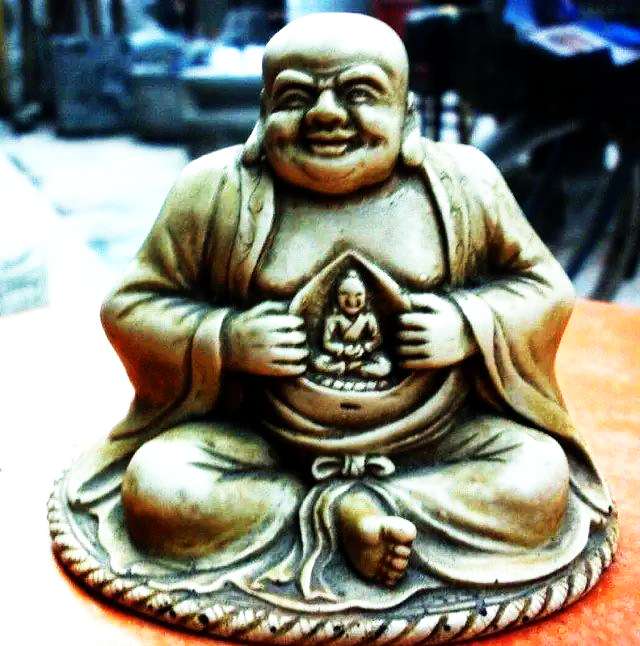
Journey to the West translator Anthony C. Yu (Wu & Yu, 2012) notes that this section “is an abbreviated or paraphrastic account, in fact, of the neidan (internal or physiological alchemy process)” (vol. 4, p. 396, n. 8). Monkey already went through this process in chapter two when he practiced a series of breathing and energy circulation exercises that resulted in his immortality. Therefore, he uses his own hard-won “divine breath” or “immortal energy” (xianqi, 仙氣) to fortify the princes’ bodies by drastically speeding up the years-long process of internal cultivation to only a matter of hours or minutes. Monkey’s breath bolsters their own energy, helping them to achieve “primordial spirits” (yuanshen, 元神), a term commonly associated with Buddhahood or enlightenment. In Daoism, the term is synonymous with the attainment of immortality via the formation of a “Sacred Embryo” (Shengtai, 聖胎) (fig. 4), which is forged from spiritual energies over long years of self-cultivation (Darga, 2008). This suggests that beyond super strength, the ritual also gives them some form of immortality.

Fig. 4 – The Sacred Embryo is sometimes depicted as a baby (or in this case a Buddha) on a practitioner’s stomach (larger version). Found on this blog.

4. “He next helped them to circulate and build up the fire phases…”

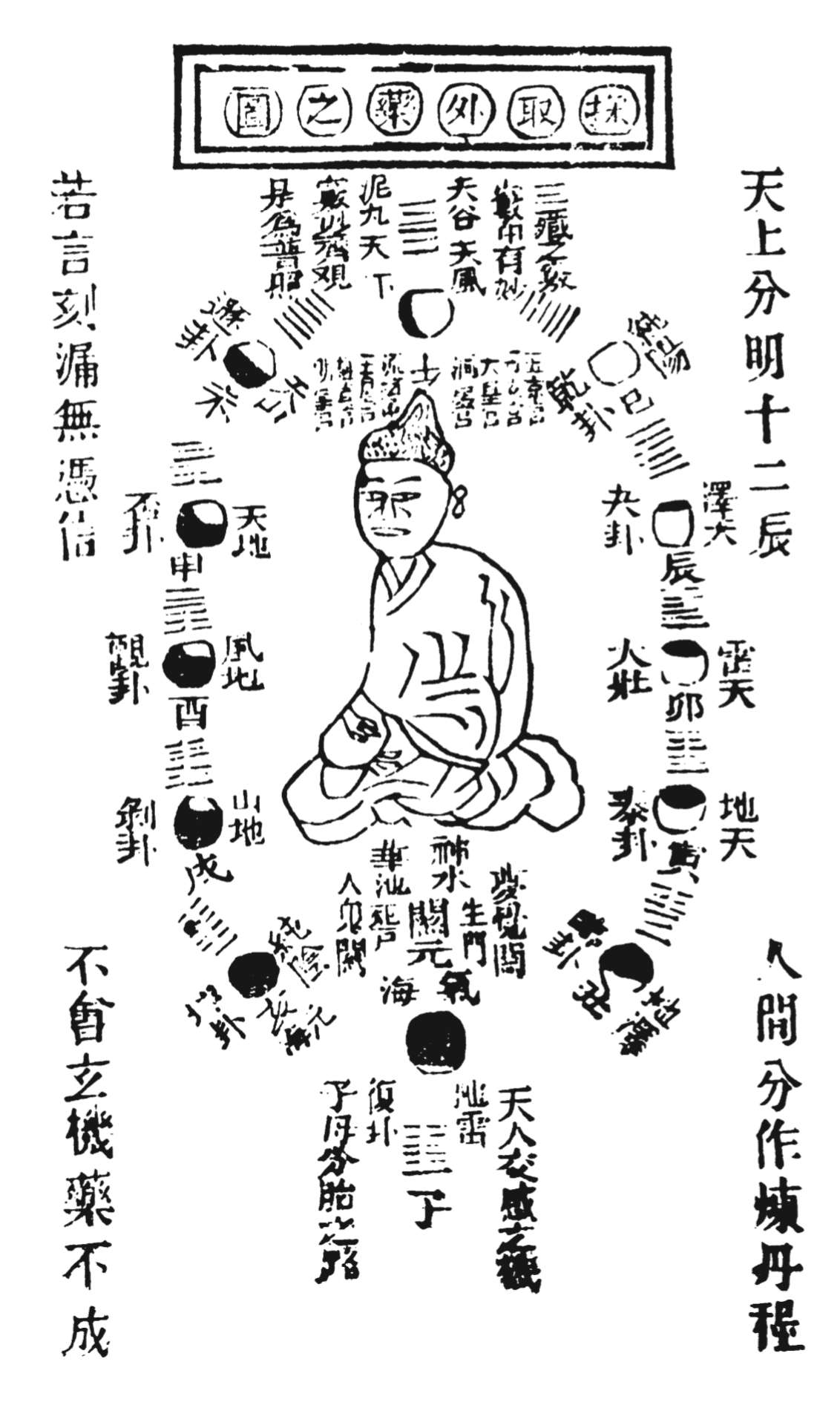
The fire phases (huohou, 火候) comprise the process of circulating spiritual energy throughout the body at prescribed times (fig. 5). Monica Esposito (2008) writes that there are three phases in total, making up two distinct periods of activity and rest:

The first is a phase of “yangization” in which Yang augments and Yin decreases. This is described as a warlike or martial period, corresponding to the advancement of a light called Martial Fire (wuhuo 武火) or Yang Fire (yanghuo 陽火) that purifies by burning and eliminates defiled elements to release the Original Yang and increase it. At the cosmic level, the beginning of this phase is symbolized by the winter solstice (zi 子) and by the hexagram fu 復 ䷗ (Return, no. 24), which indicates the return of Yang. This is followed by a phase of balance, a time of rest called muyu ([沐浴] ablutions). At the cosmic level, this phase is symbolized by the spring and autumn equinoxes and by the hexagrams dazhuang 大壯 ䷡ (Great Strength, no. 34) and guan 觀 ䷓ (Contemplation, no. 20). The third stage is a phase of “yinization” in which Yin augments and Yang decreases. This period, called Civil Fire (wenhuo 文火) or Yin Fire (yinfu 陰符), corresponds to a decrease of the light. The adept achieves the alchemical work spontaneously and without any effort or voluntary intervention; water descends to moisten, fertilize, and temper fire. At the cosmic level, this phase is symbolized by the summer solstice (wu 午) and by the hexagram gou 姤 ䷫ (Encounter, no. 44) (p. 531).

Mastering the complicated chronological rhythm of this process is considered the best kept secret of internal alchemy (Esposito, 2008). Therefore, Monkey navigates this temporal maze for the princes, ensuring the spiritual energy that he has helped them cultivate ebbs and flows when prescribed. Once again we see that Sun has sped up a lengthy process to only a few days, hours, or minutes.

Fig. 5 – A chart showing the fire phases, the 12 phases of the moon, and the corresponding hexagrams (larger version). From Kim, 2008, p. 528.

II. Similarities to Comic Book Heroes

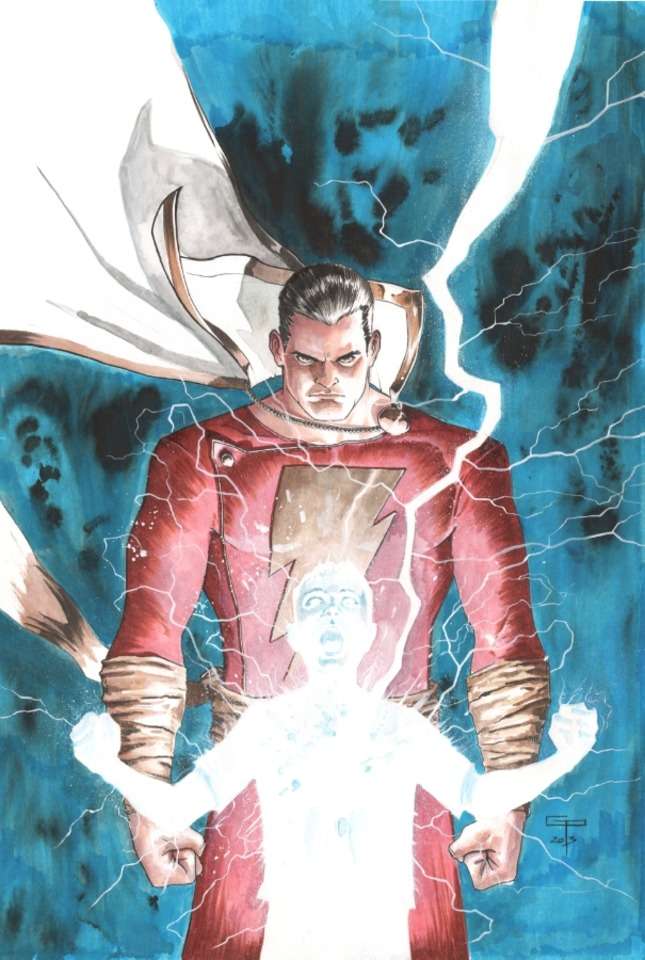
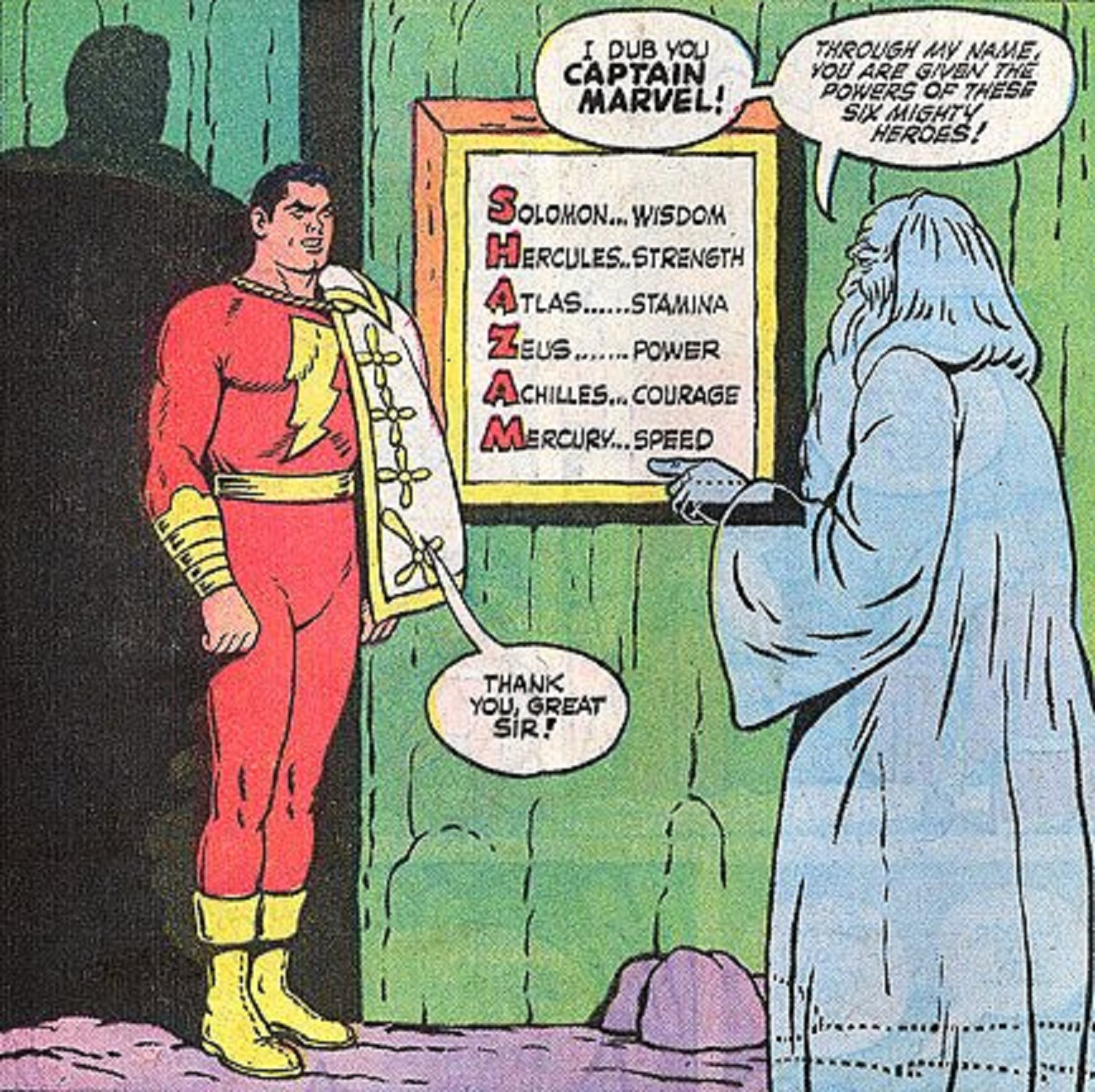
The princes in essence become the fantasy equivalent of today’s comic book superheroes. Gaining power from a divine being is similar to the concept of “Divine Empowerment” from DC Comics. A good example is Billy Batson, a.k.a. Captain Marvel (Ch: Jingqi duizhang, 驚奇隊長) (fig. 6), a child-turned-adult who receives super strength and other powers from a battery of Western gods and sages through the medium of a divine wizard.

4139607-160

Fig. 6 – The child Billy Batson transforming into the superhero Captain Marvel, also known as Shazam (larger version). Image found here.

III. Conclusion

This fascinating strength-bestowing ritual draws on multiple aspects of Buddho-Daoist ceremony and internal alchemy. First, Sun chooses a secluded room where he traces a diagram of the Big Dipper on the floor in order to consecrate the space. Second, he recites magical spells likely intended to protect the princes during their bodily transformation. Third, Monkey uses his own divine breath to ignite their spiritual energy, manually fanning the flames to higher levels of spiritual attainment. Finally, he controls the ebb and flow of the resulting energy throughout their bodies according to a prescribed chronological rhythm. In all, Sun shortens a years-long process to only a few days, hours, or minutes. The princes come away from the ritual with superhuman strength and likely some form of divine longevity.

This whole process reminds me of the DC Comics character Billy Batson receiving divine powers through the medium of the Wizard Shazam to become Captain Marvel.


IV. Updates

Update: 12-14-19

This is a past photomanipulation that depicts Monkey as the Wizard Shazam and the three Indian Princes as Captain Marvel. I used a golden age comic book image as the base (fig. 7).

Fig. 7 – The photomanipulation mixing Journey to the West and Captain Marvel (larger version). The original comic book image can be seen here.


Update: 07-17-22

I’ve posted an article that explores the abilities of Monkey’s immortal breath (used in the ritual above).

A Survey of Sun Wukong’s Magic “Immortal Breath” and Its Abilities


Update: 03-18-23

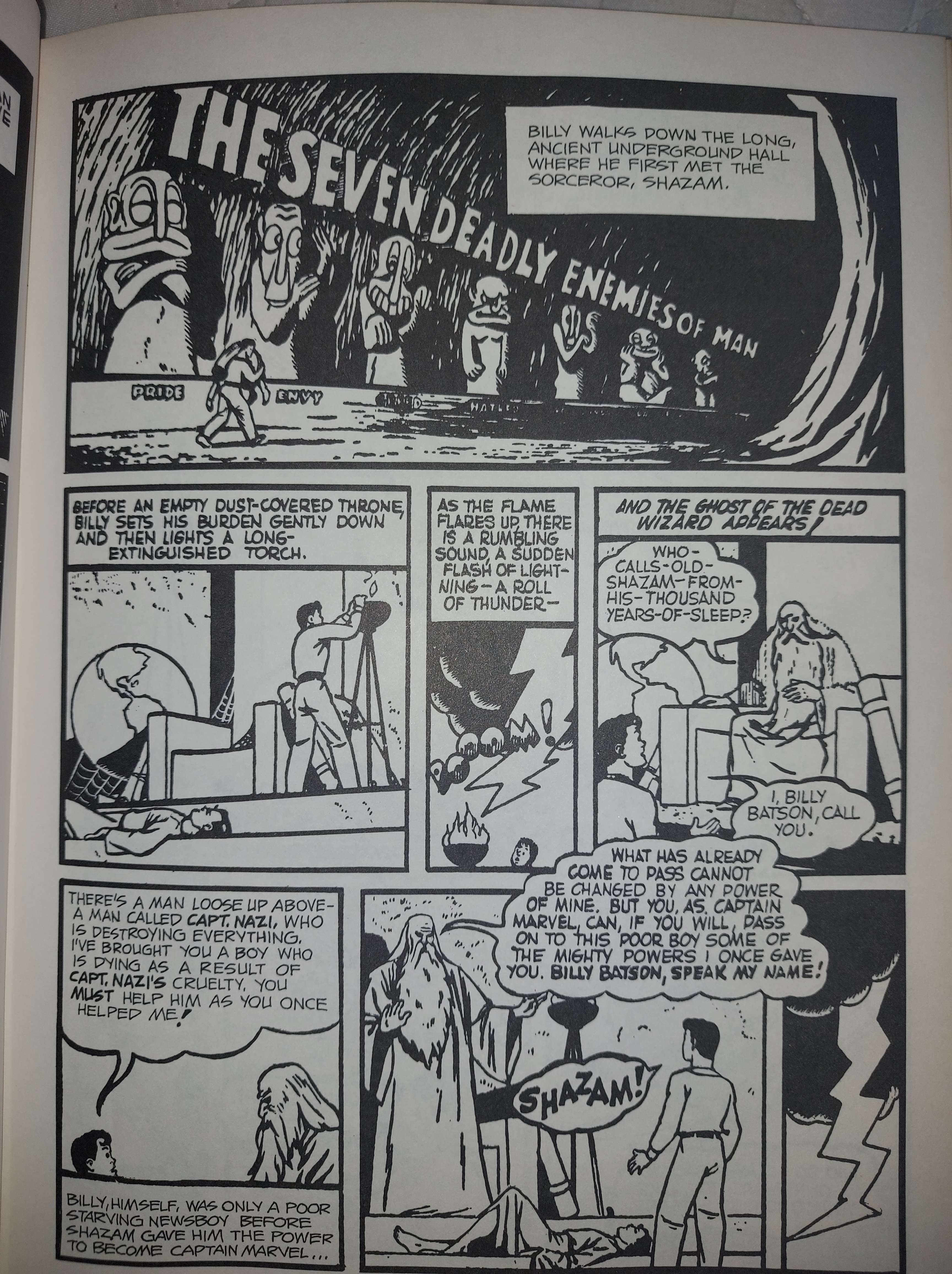
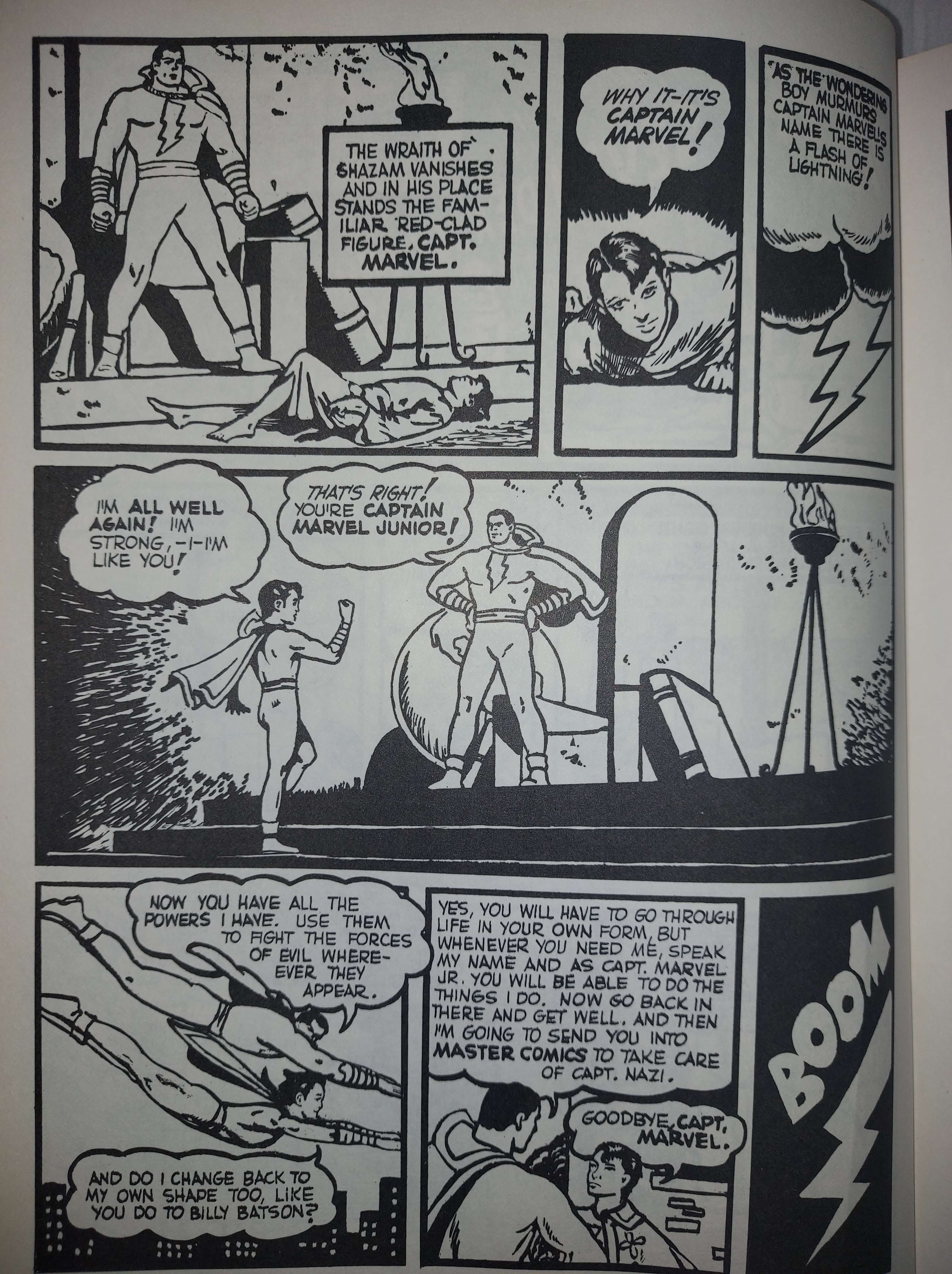
Above, I referenced Captain Marvel because he receives divine powers similar to the Indian Princes from Journey to the West. Well, the hero is also capable of sharing his abilities just like Sun Wukong! One issue sees him save the life of a fatally injured boy by giving him some of his magic energy, thereby transforming him into a superhero. The boy is henceforth known as “Captain Marvel Jr.” (Ch: Xiao shengqi duizhang, 小神奇隊長) in his hero form (fig. 8-10) (Binder et. al., 1977, pp. 57-59).

Fig. 8 (left) – Billy Batson (a.k.a. Captain Marvel) seeks help from Shazam to save the boy (larger version). Fig. 9 (center) – Captain Marvel shares some of his power, thus saving the boy (larger version). Fig. 10 (right) – The boy-turned-superhero vows to fight evil (larger version).


Update: 12-02-23

Someone recently asked me why the monstrous pilgrims would take human disciples in the first place. Well, this is the result of a sequence of events:

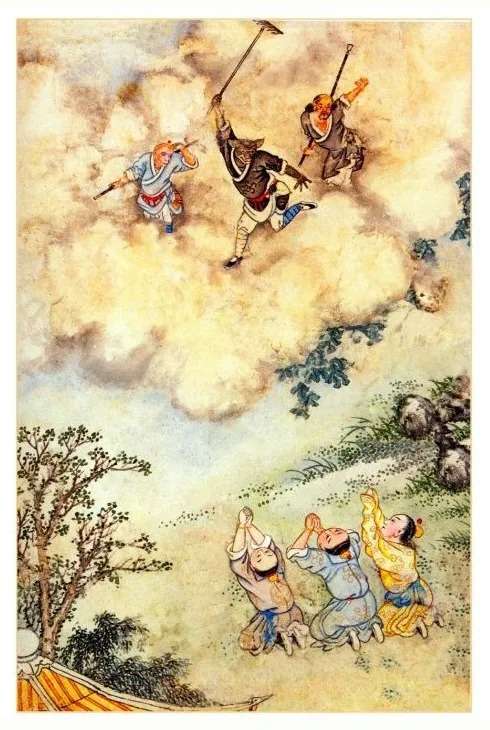
  • The young princes are amazed to see Sun, Zhu, and Sha display their martial arts skills while flying on divine clouds (fig. 11).
  • They tell their father, the sovereign prince, that they want to become their students, claiming it would allow them to protect their nation.
  • The monarch asks Tripitaka for permission, and he agrees.
  • The sovereign prince then personally requests that Sun, Zhu, and Sha tutor his sons in martial arts (Wu & Yu, 2012, pp. 197-199).

This seems straightforward enough, but there is an underlying answer that just dawned on me: everyone agrees, and Monkey goes a step further by empowering the princes (fig. 12), as a way of kissing the ruler’s butt since he stamped the group’s travel rescript, a kind of passport needed to legally travel through various countries (Wu & Yu, 2012, p. 193). Without the stamp, the pilgrims wouldn’t have been able to continue their journey to the Buddha’s mountain.

The humorous implication here is that even celestials have to bow to earthly bureaucracy. 

Fig. 11 (left) – The princes drop to their knees as they watch the three monstrous pilgrims display their supernatural martial skills (larger version). Image from the Qing-Period Color-Illustrated Complete Edition of Journey to the West (清彩繪全本西遊記, 2008). Fig. 12 (right) – Monkey empowers the princes with his divine breath (larger version). Image from Chen Huiguan’s Newly Illustrated and Complete Journey to the West (陈惠冠新绘全本西游记, 2001). Both images found here.

For future reference, this episode takes place towards the middle of ep. 23 of the 1986 JTTW TV show and the end of ep. 55 and the beginning of ep. 56 of the 2011 JTTW TV show. Both programs skip over the strength-bestowing ritual.


Update: 08-11-24

I have written a catalog of all of Sun Wukong’s abilities from all 100 chapters of JTTW. The strength-bestowing ritual appears on pages 194-195 (ch. 88, no. 3) of this PDF.

Archive #46 – A Catalog of the Monkey King’s Magic Powers and Skills


Update: 05-15-25

I forgot to mention above that although the princes can wield their teachers’ divine, multi-ton weapons after the ritual—an amazing feat for mortals to be sure—the weight is still too much for them to handle comfortably. This is why they request to make their own lighter replicas. Chapter 88 reads: 

When the old prince saw this [the princes wielding the divine weapons], he could not have been more pleased, and another vegetarian banquet was laid out to thank the master and his three disciples. Right before the banquet tables, however, they [the princes] began their instruction. The one studying the rod performed with the rod; the one studying the rake performed with the rake; and the one studying the staff performed with the staff. The princes thus succeeded in making a few turns and several movements, but they were, after all, mortals, and they found the goings rather strenuous. After exercising for a while, they began to pant heavily. Indeed, they could not last long, though their weapons might have the ability to undergo transformation. In their advances and retreats, their attacks and offenses, the princes simply could not attain the wonder of natural transformation. Later that day the banquet came to an end.

The next day the three princes came again to thank their masters and to say: “We thank the divine master for endowing us with strength in our arms. Though we are now able to hold the weapons of our masters, however, we find it difficult to wield and turn them. We propose, therefore, that artisans be asked to duplicate the three weapons. They will use your weapons as models but take some of the weight off. Would the masters grant us permission?” (Wu & Yu, 2012, vol. 4, p. 203)

老王見了,歡喜不勝。又排素宴,啟謝他師徒四眾。就在筵前各傳各授:學棍的演棍,學鈀的演鈀,學杖的演杖。雖然打幾個轉身,丟幾般解數,此等終是凡夫,有些著力:走一路,便喘氣噓噓,不能耐久。蓋他那兵器都有變化,其進退攻揚,隨消隨長,皆有自然之妙,此等終是凡夫,豈能以遽及也?當日收了筵宴。 

次日,三個王子又來稱謝道:「感蒙神師授賜了膂力,縱然掄得師的兵器,只是轉換艱難。意欲命匠依神師兵器式樣,減削斤兩,打造一般,未知師父肯容否?」

Pigsy takes the lead by granting their wish, but the three original weapons are unfortunately stolen by a fiend while in the custody of craftsmen (Wu & Yu, 2012, vol. 4, pp. 203-204). This eventually leads to a war with earthly and heavenly lion-spirits (see chapters 88 to 90).

After the day is saved, the replica weapons are completed. The end of chapter 90 reads:

In the meantime, the ironsmiths had finished forging the three weapons. As they kowtowed to Pilgrim [Monkey], they said, “Holy Father, our work is done.”

“What’s the weight of each of the weapons?” asked Pilgrim.

“The golden-hooped rod weighs a thousand catties,” replied one of the ironsmiths. “The nine-pronged rake and the fiend-routing staff both weigh eight hundred catties.” “All right,” said Pilgrim, and he asked the three princes to come out and pick up their weapons (based on Wu & Yu, 2012, vol. 4, pp. 229-230).

又見那鐵匠人等造成了三般兵器,對行者磕頭道:「爺爺,小的們工都完了。」問道:「各重多少斤兩?」鐵匠道:「金箍棒有千斤,九齒鈀與降妖杖各有八百斤。」行者道:「也罷。」叫請三位王子出來,各人執兵器。

One thousand catties (千斤) is 1,300.72 lbs or 590 kg, and 800 catties (八百斤) is 1,040.58 lbs or 472 kg.

This episode would be a great setup for a Game of Thrones-style Asian fantasy. The three princes could be plotting and scheming against each other in the hopes of one day gaining the throne from their aging father, the sovereign prince. Then a monkey wizard comes along and makes things worse by bestowing them with super strength and divine longevity. This would definitely lead to lots of drama between the brothers and their offspring. It would be a centuries-long battle royale between competing dynasties of superpowered beings!

Notes:

1) Although the original English translation reads “the strength of a thousand arms” (Wu & Yu, 2012, p. 202), the Chinese reads wanqian zhi luli (萬千之膂力), which means “the strength of tens of thousands (of men).” I have, therefore, adjusted the translation for more accuracy.

2) Andersen (2008) notes that the three paces are similar to those used by Vedic priests:

It would appear, in other words, that even in this early period the Paces of Yu constituted a close parallel to the three Strides Viṣṇu in early Vedic mythology, which are thought to have taken the god through the three levels of the cosmos (thereby establishing the universe), and which indeed, just like the Paces of Yu in Taoist ritual, are known to have been imitated by Vedic priests as they approached the altar—and in the same form as the Paces of Yu, that is, dragging one foot after the other (pp. 238-239).

Sources:

Andersen, P. (1989). The Practice of Bugang. Cahiers d’Extrême-Asie, 5. Numéro spécial Etudes taoïstes II / Special Issue on Taoist Studies II en l’honneur de Maxime Kaltenmark. pp. 15-53.

Andersen, P. (2008). Bugang. In F. Pregadio (Ed.), The Encyclopedia of Taoism (Vols. 1-2) (pp. 237-240). London [u.a.: Routledge].

Binder, O., Woolfolk, W., O’Neil, D., Parker, B., Maggin, E. S., & Bridwell, E. N. (1977). Shazam! From the Forties to the Seventies. New York: Harmony Books.

Buswell, R., & Lopez, D. (2014). The Princeton Dictionary of Buddhism. Princeton University Press.

Darga, M. (2008). Shengtai. In F. Pregadio (Ed.), The Encyclopedia of Taoism (Vols. 1-2) (pp. 883-884). London [u.a.: Routledge].

Esposito, M. (2008). Huohou: 2. Neidan. In F. Pregadio (Ed.), The Encyclopedia of Taoism (Vols. 1-2) (pp. 530-532). London [u.a.: Routledge].

Kim, D. (2008). Houhou: 1. Waidan. In F. Pregadio (Ed.), The Encyclopedia of Taoism (Vols. 1-2) (pp. 526-530). London [u.a.: Routledge].

Wu, C., & Yu, A. C. (2012). The Journey to the West (Vols. 1-4) (Rev. ed.). Chicago, Illinois: University of Chicago Press.
Sun Wukong’s Greatest Feat of Strength: An Allegory for Cultural or Religious Conflict?

Last updated: 07-03-2022

Now that I’ve written an entry debunking the idea that the Monkey King’s staff anchored the Milky Way, I want to write a piece about his greatest feat of strength in Journey to the West (Xiyouji西遊記, 1592). This takes place in chapter 33 after Zhu Bajie has been captured by two demon brothers, Great Kings Goldhorn (Jinjiao Dawang, 金角大王) and Silverhorn (Yinjiao Dawang, 銀角大王). Great King Silverhorn, the younger of the two, then sets out to capture Tripitaka but is forced to resort to trickery when he learns that the monk is protected by Sun Wukong. He transforms himself into an elderly Daoist laying by the roadside with a broken leg. The monk subsequently forces Monkey to carry him on his back, but our hero sees through the disguise and plans to throw his charge off a cliff. However…

As the Great Sage was about to do this, the monster knew instantly of his plan. Knowing how to summon mountains, he resorted to the magic of Moving Mountains and Pouring Out Oceans [“Yishan daohaide fashu, “移山倒海” 的法術]. On Pilgrim’s [Monkey’s] back he made the magic sign with his fingers and recited a spell, sending the Sumeru Mountain into midair and causing it to descend directly on Pilgrim’s head. A little startled, the Great Sage bent his head to one side and the mountain landed on his left shoulder. Laughing, he said, “My child, what sort of press-body magic are you using to pin down old Monkey? This is all right, but a lopsided pole is rather difficult to carry.”

The demon said to himself, “One mountain can’t hold him down.” He recited a spell once more and summoned the Emei Mountain into the air. Pilgrim again turned his head and the mountain landed on his right shoulder. Look at him! Carrying two mountains, he began to give chase to his master with the speed of a meteor! The sight of him caused the old demon to perspire all over, muttering to himself, “He truly knows how to pole mountains!” Exerting his spirit even more, he recited another spell and sent up the Tai Mountain to press down on Pilgrim’s head. With this magic of the Tai Mountain Pressing the Head, the Great Sage was overpowered as his strength ebbed and his tendons turned numb; the weight was so great that the spirits of the Three Worms inside his body exploded and blood spurted from his seven apertures (Wu & Yu, 2012, vol. 2, pp. 108-109).

這大聖正算計要摜,原來那怪就知道了,且會遣山。就使一個「移山倒海」的法術,就在行者背上捻訣,念動真言,把一座須彌山遣在空中,劈頭來壓行者。這大聖慌得把頭偏一偏,壓在左肩臂上,笑道:「我的兒,你使甚麼重身法來壓老孫哩?這個倒也不怕,只是正擔好挑,偏擔兒難挨。」那魔道:「一座山壓他不住。」卻又念咒語,把一座峨嵋山遣在空中來壓。行者又把頭偏一偏,壓在右肩臂上。看他挑著兩座大山,飛星來趕師父。那魔頭看見,就嚇得渾身是汗,遍體生津道:「他卻會擔山。」又整性情,把真言念動,將一座泰山遣在空中,劈頭壓住行者。那大聖力軟觔麻,遭逢他這泰山下頂之法,只壓得三尸神咋,七竅噴紅。

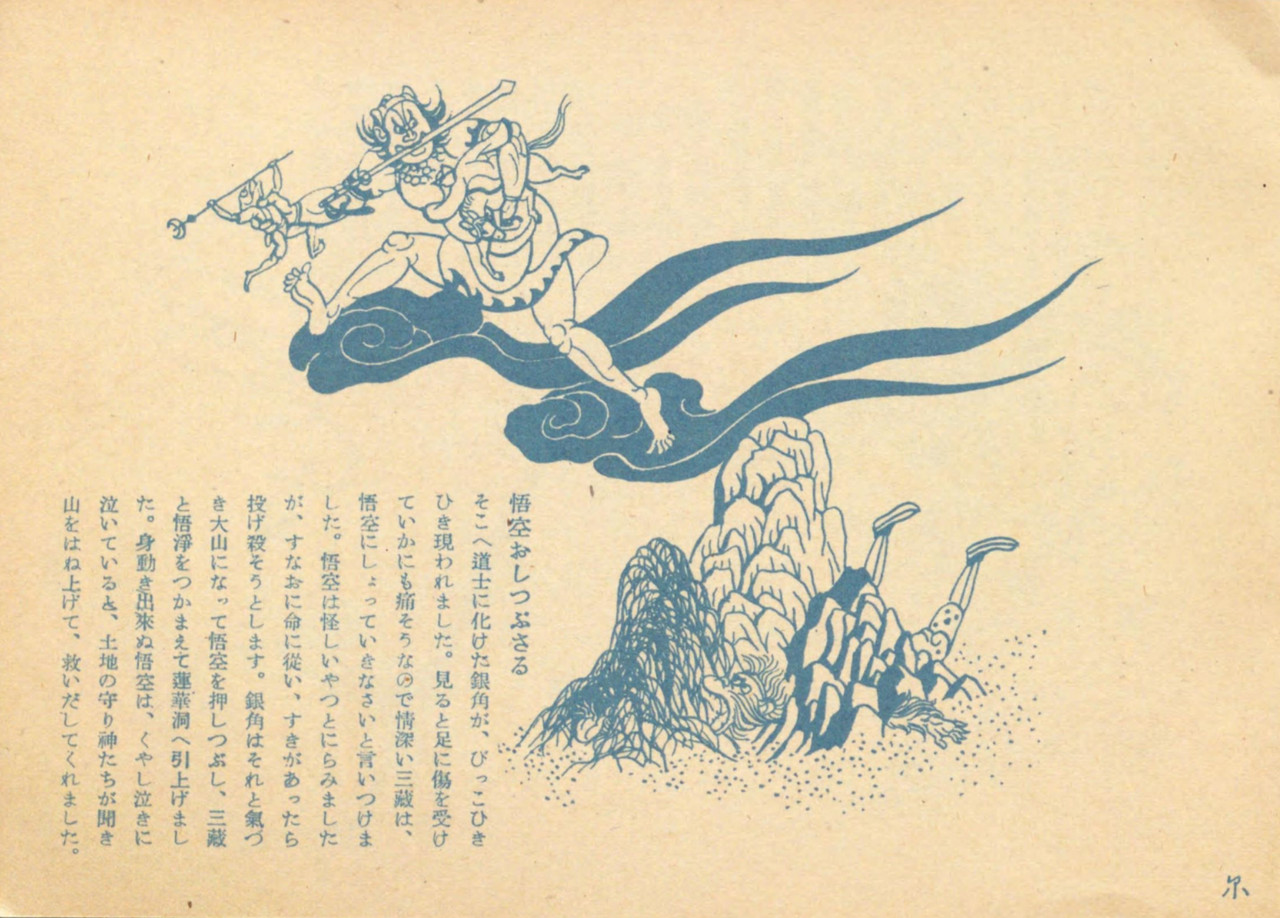
We see here that Monkey is able to successfully carry the weight of both the Sumeru and Emei mountains, while running after his master “with the speed of a meteor.” That’s quite impressive, even if he is eventually crushed under the weight of a third mountain (fig. 1). Attention should be given to the particular mountains used in this episode, as well as their possible allegorical meanings.

Table of Contents

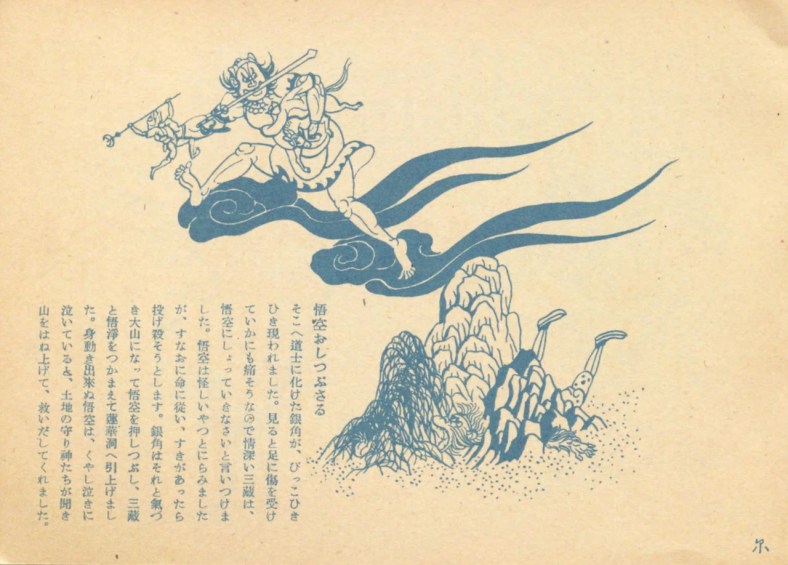
Fig. 1 – Wukong trapped under the three mountains as Great King Silverhorn abducts Tripitaka, the dragon horse, and Sha Wujing (larger version). From The Illustrated Journey to the West (1950), a Japanese children’s book.

1. Explanation

1.1. Mount Sumeru

Buswell and Lopez (2014) describe Mount Sumeru (Ximi shan, 須彌山; Miaogao shan, 妙高山) as:

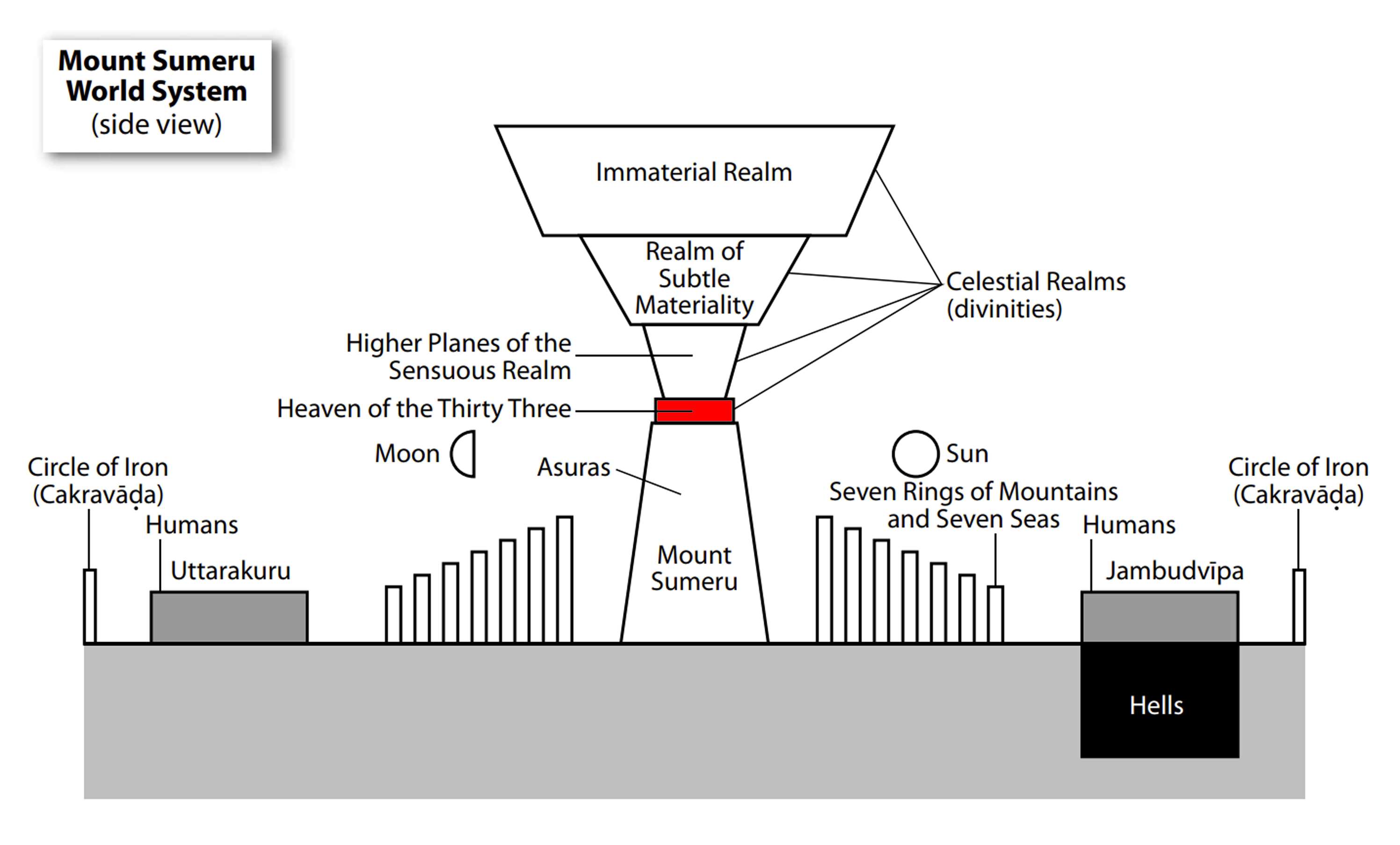
The central axis of the universe in Buddhist cosmology; also known as Mount Meru. Mount Sumeru stands in the middle of the world as its axis and is eight leagues high …  The slopes of Sumeru are the abode of demigods, and its upper reaches are the heavens of the four heavenly kings. At the summit of the mountain is the heaven of the thirty-three, ruled by the king of the gods, Sakra. Above Mount Sumeru are located the remaining heavens of the sensuous realm [fig. 2] (p. 896).

[Note: The portion that has been struck through is a typo. Please see section 4.5 below.]

A poem in chapter four of Journey to the West describes what Monkey sees when he first comes to live in heaven as the Keeper of the Heavenly Horses. A portion reads:

Thirty-three mansions were found up here, / With names like the Scattered Cloud, the Vaisravana, the Pancavidya, the Suyama, the Nirmanarati…” (Wu & Yu, 2012, vol. 1, p. 146).

這天上有三十三座天宮,乃遣雲宮、毘沙宮、五明宮、太陽宮、花樂宮 …

Yu (Wu & Yu, 2012) comments, “The verse here is alluding to the Indra heaven with it’s thirty-three summits (trāyastriṃśa) [fig. 2] and the six heavens of desire (devalokas)” (vol. 1, p. 510, n. 1), which are located atop Mount Sumeru. Therefore, the heaven described in the novel is located on the same cosmic mountain as that from Hindo-Buddhist cosmology, meaning that Wukong successfully supports the axis of the universe on one shoulder.

Fig. 2 – A sideview of Hindo-Buddhist cosmic geography (larger version). The Heaven of the Thirty-Three is indicated in red. Adapted from Buswell & Lopez, 2014, p. xxxii.

1.2. Mount Emei

Mount Emei (Emei shan, 峨嵋/眉山) is one of the four sacred Buddhist mountains of China. It is considered extremely important as Chinese tradition believes, upon entering the Middle Kingdom from India, Buddhism spread from this place during the eastern Han Dynasty and proliferated throughout China. The mountain is 10,167 ft (3098.90 m) high, making it over 3,000 ft (914.4 m) taller than the other sacred Buddhist mountains. The mountain is believed to be the heavenly abode of the Bodhisattva Samantabhadra, making him the patron saint of Emei (Buswell & Lopez, 2014, pp. 282-283).

1.3. Mount Tai

I turn now to Mount Tai (Taishan, 泰山), the mountain that ultimately overwhelms Sun Wukong’s supernatural strength. It is one of the five sacred mountains of China, which differ from the four Buddhist counterparts mentioned above. Mount Tai was the epicenter of a state cult in Ancient China, one in which Sage-Kings and emperors of past millennia traveled there to perform sacrifices to heaven, thereby gaining the right to rule or attaining eternal life. An entry in the Classic of History (Shujing, 書經, 4th c. BCE) suggests that the practice goes all the way back to the Sage-King Shun (3rd millennia BCE) (Poo, 2011, pp. 20-21).

Due to its great cultural and historical significance, the mountain came to be recognized as an adamantine monolith, the very name of which was used as a metaphor for something unfathomably heavy, whether it be a physical measure of weight or philosophical importance. For example, Warring States philosopher Mozi took part in a debate over the plausibility of his school of thought taking center stage in Chinese society. His opponent claimed, “As we see it, one can no more put it into practice than one can pick up Mount Tai and leap over a river with it!” Mozi highlighted the irrelevant nature of the metaphor by replying, “As for picking up Mount Tai and leaping over rivers with it, no one from ancient times to the present, from the beginning of humankind to now, has ever succeeded in doing that!” (Watson, 1999a, p. 71). Another example comes from the Han historian Sima Qian who wrote, “A man has only one death. That death may be as weighty as Mount Tai, or it may be as light as a goose feather. It all depends upon the way he uses it” (Watson, 1999a, pp. 371-372). Therefore, the mountain represented the heaviest thing imaginable in Chinese culture. It’s no wonder then that not even Monkey could withstand its weight.

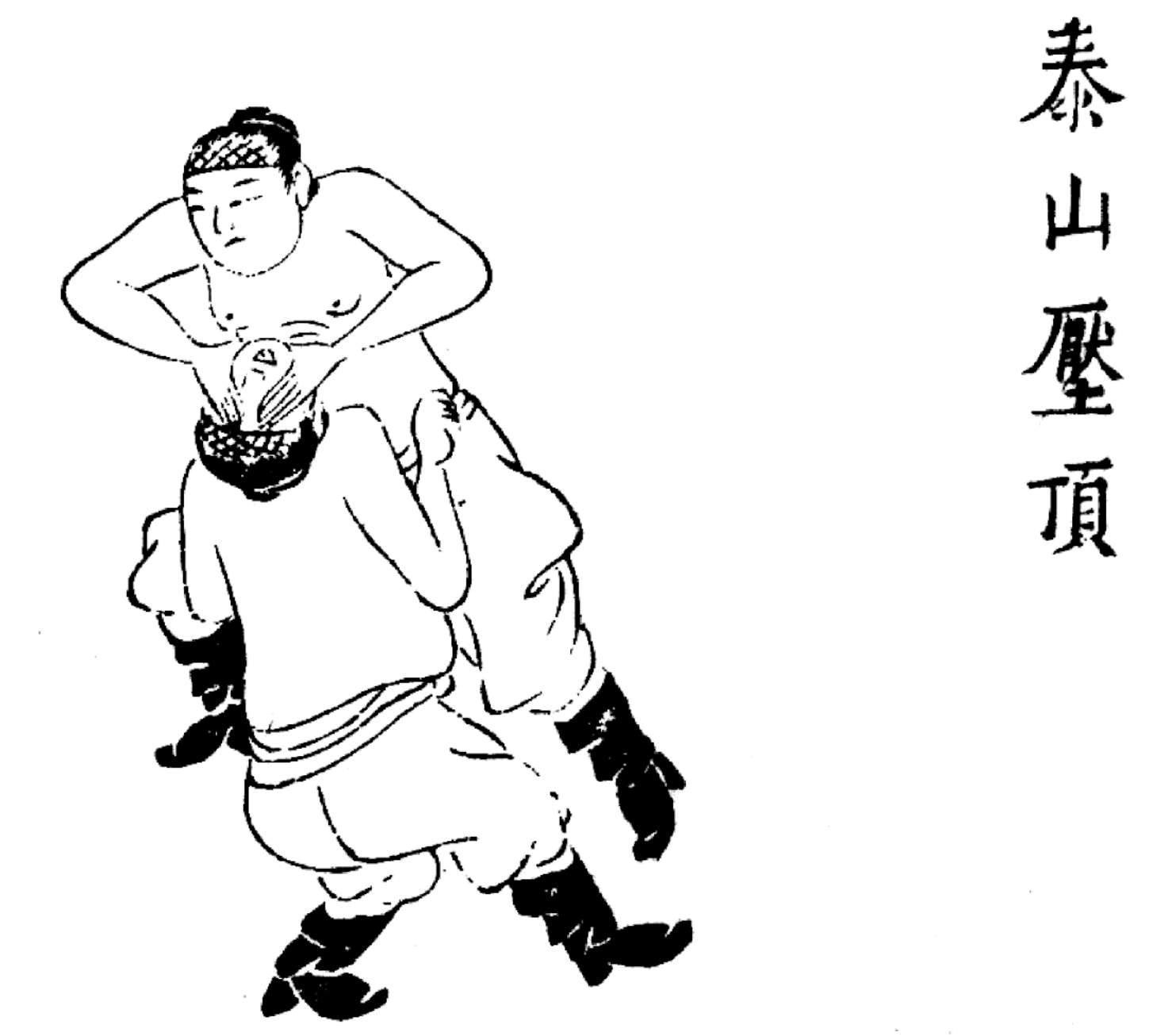
The idea of Mount Tai symbolizing a heavy object influenced the name of a 17th century technique related to the development of Taiji boxing called “Crush with the Weight of Mount Tai” (Taishan yading, 泰山壓頂) (fig. 3), which involved climbing onto an opponent (Henning, 2009, pp. 78 and 82). Incidentally, the name of this technique is also a common Chinese saying referring to someone being under a lot of stress (Gao, Wang, & Weightman, 2012, p. 191).

Fig. 3 – “Crush with the Weight of Mount Tai”. From Henning, 2009, p. 78 (larger version).

2. An Allegory for Cultural or Religious Conflict?

I want to reiterate the fact that both Sumeru and Emei are important to Buddhism, a religion originally foreign to China. Not only does Monkey support the very axis of the Buddhist universe on one shoulder, he supports on the other the very mountain from which the religion is believed to have spread into China. Therefore, considering that Wukong carries these landmasses while protecting Tripitaka on the quest to India, the feat could be read as an allegory for “supporting” Buddhism. After all, the historical Xuanzang (玄奘, 602–664), on whom Tripitaka was based, is considered to be one of, if not the most, prolific translators of religious texts in the history of Chinese Buddhism (Buswell & Lopez, 2014, pp. 1015-1016).

This is why it’s fascinating that Mount Tai ultimately overpowers the Monkey King. It represents native Chinese history and culture, while Sumeru and Emei represent foreign Buddhism. Therefore, this episode could be read as a struggle between the domestic and foreign aspects of Chinese culture. Considering that the monsters are later revealed to be Daoist attendants of Laozi sent by heaven to test the resolve of the pilgrims (Wu & Yu, 2012, vol. 2, p. 145), it’s possible that the conflict is between Daoism, a native Chinese religion, and Buddhism.

This is obviously not a perfect theory, though. For instance, Laozi reveals that it was actually the Bodhisattva Guanyin who requested the lads be sent (Wu & Yu, 2012, vol. 2, p. 145). Does this explain why a Daoist spirit would summon two Buddhist mountains to crush Monkey? I’m interested in what others think.

3. Possible Ties to Hanuman

Lastly, I would like to note that Wukong’s feat of lifting mountains recalls an episode in the Ramayana (4th c. BCE) in which the monkey god Hanuman carries back a mountain laden with magical herbs to heal the wounds of his master‘s brother Lakshmana (fig. 4). Hanuman is the living embodiment of strength (shakti) in India (Alter, 1992). Monkey is believed to be loosely based on Hanuman (Walker, 1998), so there could be a connection between both instances of mountain lifting.

Fig. 4 – A modern painting of Hanuman lifting the mountain (larger version). All credit goes to the original artist, S. Keerthi. 


4. Updates

4.1. The Feat’s Origin in Chinese Folklore

Update: 08-10-18

Monkey’s feat appears to be based on a native Chinese story and not the Ramayana. This is first hinted at in chapter 33 when the demon exclaims that the Great Sage “truly knows how to pole mountains [ta quehui danshan, 他卻會擔山]!” (Wu & Yu, 2012, vol. 2, p. 109). A poem spoken by Wukong in chapter 67 confirms the connection:

Purvavideha was my ancestral home,
I did cultivation on Mount Flower-Fruit.
I bowed to the Patriarch of Heart and Mind
and perfected with him the martial arts.
I can tame dragons, stirring up the seas;
I can tote mountains to chase down the sun (emphasis added).
In binding fiends and demon’s I’m the best;
Moving stars and planets, I scare ghosts and gods.
Stealing from heav’n and Earth gives me great fame,
Of boundless change, Handsome Stone Monkey’s my name (Wu & Yu, 2012, vol. 3, p. 243).

祖居東勝大神洲,花果山前自幼修。
身拜靈臺方寸祖,學成武藝甚全周:
也能攪海降龍母,善會擔山趕日頭
縛怪擒魔稱第一,移星換斗鬼神愁。
偷天轉地英名大,我是變化無窮美石猴。

Fig. 5 – Erlang poling the mountains (larger version). Artist unknown.

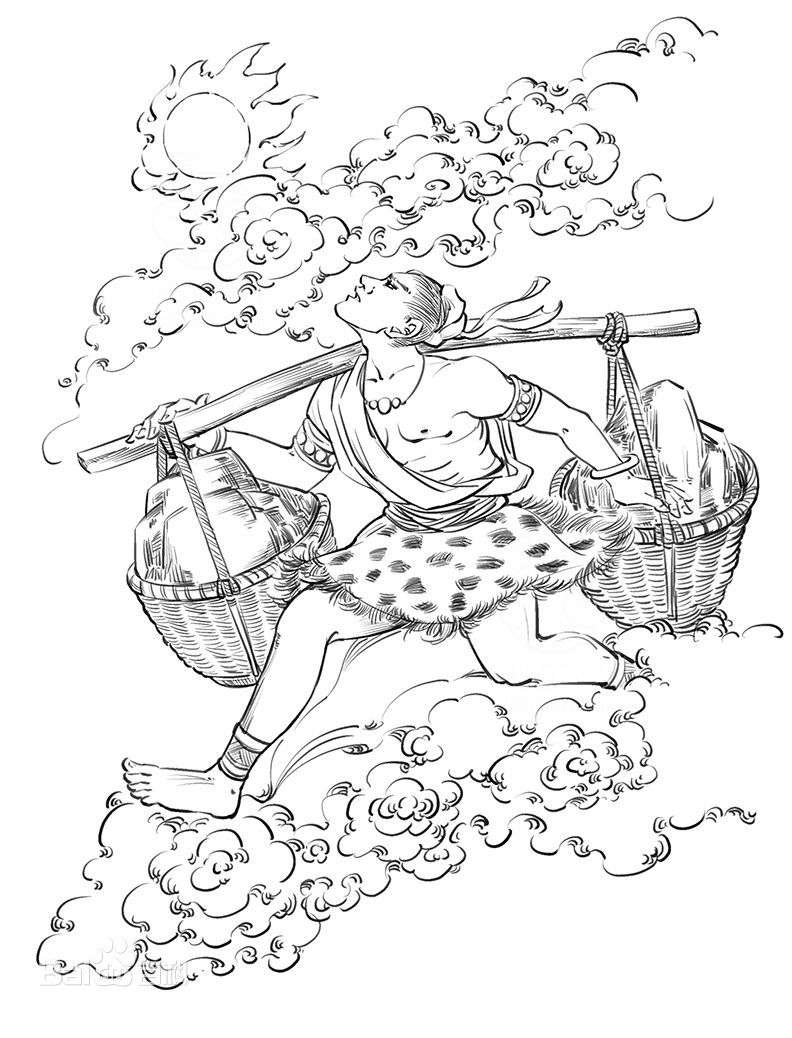
“I can tote mountains to chase down the sun” (shanhui danshan gan ritou, 善會擔山趕日頭) is a clear allusion to the ancient tale “Erlang carries mountains to chase the suns” (Erlang danshan gan taiyang, 二郎擔​​山趕太陽). The story describes how the ancient earth was plagued by many suns that scorched the land, making it impossible for people to grow anything. Vowing to end this plight, the hero Erlang shoulders two mountains hanging from a tree and with the aid of magical shoes, chases down each sun (fig. 5), using the weight from both landmasses to overwhelm and crush the superfluous celestial bodies (担山赶太阳, n.d). Apart from the feat of lifting two mountains, Erlang’s fleet pursuit of each sun (gan taiyang, 趕太陽) foreshadows Monkey “giv[ing] chase to his master with the speed of a meteor” (feixing laigan shifu, 飛星來趕師父).

It’s interesting to note that “Erlang Carrying Mountains” (Erlang danshan, 二郎擔山) is a common Shaolin stance, and a staff variant even appears in the Collection of Military Works (Wubei zhi, 武備志, c. 1621), a Ming treatise on military armaments and fighting techniques (fig. 6). The staff obviously recalls the pole (or in this case tree) that Erlang uses to bear the weight of the mountains.

Fig. 6 – The “Erlang Carrying Mountains” staff stance (larger version).


4.2. Carrying Mountains AND Running

Update: 06-23-21

One thing I forgot to stress is the fact that Sun Wukong RUNS while transporting the Buddhist landmasses. The novel reads: “Carrying two mountains, he began to give chase to his master with the speed of a meteor!” (Kanta tiaozhe liang zuo dashan, feixing laigan shifu, 看他挑著兩座大山,飛星來趕師父) (Wu & Yu, 2012, vol. 2, p. 109). The meteoric imagery is no doubt hyperbole given that Tripitaka isn’t that far ahead of him, but this additional feat is still impressive.


4.3. Monkey and Mount Tai in Religious Literature

Update: 03-11-22

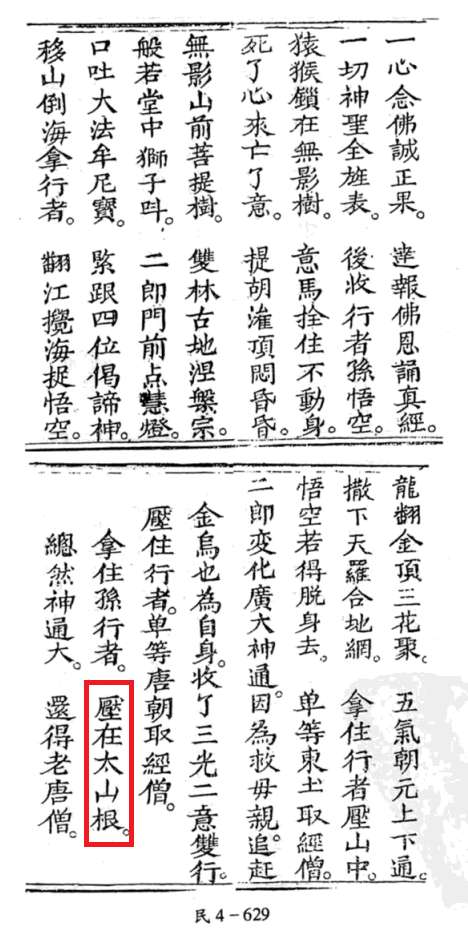
I recently archived the Precious Scroll of Erlang (Erlang baojuan, 二郎寳卷, 1562), a religious text that venerates and records the various deeds of the immortal demi-god. The work states that the Monkey King was “pressed under the base of Mt. Tai” (yazai, taishan gen, 壓在太山根) (PDF page 46) (fig. 7). This might also explain why Mount Tai overwhelms Monkey in chapter 33.

Fig. 7– The Mt. Tai sentence is indicated in red (larger version).


Update: 03-25-22

My friend Irwen Wong of the Journey to the West Library blog was kind enough to provide me with time-stamped links to the aforementioned episode in the various JTTW TV shows. I will list them in order of year.

Journey to the West (1986) – Live action

Even though this is my favorite show, it did a poor job of representing the mountain. It’s little more than a boulder.

Journey to the West: Legends of the Monkey King (2000) – Animated

This cartoon just has monkey trapped by a single mountain.

New Journey to the West (2010) – Live action

This version uses all three mountains and really steps up the special effects. This is no surprise given the differences in time and budget between it and the 1986 edition.

Journey to the West (2011) – Live action

This is my favorite depiction of the episode. The special effects are top notch. I will say the elongated arms on the Taoist are a bit odd, but Irwen suggests that it’s likely a visual representation of “poling” mountains (as discussed above).

Each of these iterations have their own charm, but all of them depart from the novel by showing Wukong struggling to carry the first two mountains. I remind the reader that the literary character runs “with the speed of a meteor!” while carrying the load (Wu & Yu, 2012, vol. 2, p. 108). I guess that would have been hard to depict, even with modern computer graphics.


4.5. The Correct Size of Mount Sumeru

Update: 06-19-22

The Monkey King’s feats are on the minds of many people as the Death Battle TV show is set to feature a fight between Hercules and our hero. I’ve seen a few blogs where people try to calculate the size of Mount Sumeru. I cited a source above stating that the landmass is “eight leagues high” (Buswell & Lopez, 2014, p. 896), but this appears to be a typo, for other sources multiply this estimate by thousands of times. For example, Sadakata (1997) explains that according to the Abhidharmakośa (Ch: Api damo jushe lun, 阿毗達磨俱舍論, 4th to 5th century): “Sumeru has a height of 160,000 yojanas, of which half is under water. The half above water is therefore 80,000 yojanas high” (pp. 26-27). The yojana (youxun, 由旬) is approximately eight miles (12.87 km), or the distance that one can travel in one day on a cart driven by a team of oxen. But estimates also range between four and ten miles (6.43 and 16.09 km) (Buswell & Lopez, 2014, p. 1036). If eight miles is used, then Mt. Sumeru would an astounding 1,280,000 miles (2,059,960.32 km) tall.


4.6. Wukong’s Inconsistent Strength in JTTW

Update: 07-03-22

I should note that Journey to the West does not depict Monkey’s strength consistently throughout the novel. As mentioned, he can carry two mountains (one of them the cosmic axis) on his shoulders while running with meteoric speeds. But apart from Mount Tai, the novel describes another object that he can’t lift. Chapter 42 reads:

[T]he Bodhisattva grew terribly angry, crying, “How dare that brazen fiend [Red Boy] change into my image!” As she cried, she flung into the ocean the immaculate porcelain vase set with precious pearls which she held in her hand …

菩薩聽說,心中大怒道:「那潑妖敢變我的模樣?」恨了一聲,將手中寶珠、淨瓶往海心裡撲的一摜。

[…]

[After her turtle emerges from the sea with the vase on its back, she orders Monkey to retrieve it for her.] Pilgrim went forward at once to pick up the vase. Alas! He could not do so at all! It was as if a dragonfly attempted to rock a stone pillar-how could he even budge it? Pilgrim approached the Bodhisattva and knelt down, saying, “Your disciple cannot pick it up.” “Monkey head,” said the Bodhisattva, “all you know is how to brag! If you can’t even pick up a small vase, how can you subdue fiends and capture monsters?” “To tell you the truth, Bodhisattva,” said Pilgrim, “I might be able to do it ordinarily, but today I just can’t pick it up. I must have been hurt by the monster-spirit, and my strength has weakened.” The Bodhisattva said, “Normally it’s an empty vase, but once it has been thrown into the ocean, it has traveled through the three rivers, the five lakes, the eight seas, and the four big rivers. It has, in fact, gathered together from all the aquatic bodies in the world an oceanful of water, which is now stored inside it. You may be strong, but you don’t possess the strength of upholding the ocean. That’s why you cannot pick up the vase…” (Wu & Yu, 2012, vol. 2, pp. 243 and 244).

這行者即去拿瓶。唉!莫想拿得他動。好便似蜻蜓撼石柱,怎生搖得半分毫?行者上前跪下道:「菩薩,弟子拿不動。」菩薩道:「你這猴頭,只會說嘴。瓶兒你也拿不動,怎麼去降妖縛怪?」行者道:「不瞞菩薩說。平日拿得動,今日拿不動。想是吃了妖精虧,觔力弱了。」菩薩道:「常時是個空瓶;如今是淨瓶拋下海去,這一時間,轉過了三江五湖、八海四瀆、溪源潭洞之間,共借了一海水在裡面。你那裡有架海的斤量?此所以拿不動也。」

However, there may be an underlying religious reason for this. For instance, while Sun can’t lift it, the goddess does so easily, as does her holy sea turtle (Wu & Yu, 2012, vol. 2, p. 243). Most importantly, the story suggests that Guanyin will send her holy disciple, the “Dragon Girl Skilled in Wealth” (Shancai longnu, 善財龍女), to carry it for him (Wu & Yu, 2012, vol. 2, p. 244). So, this could mean that Monkey, at this point in the story, lacks the Buddhist spiritual attainments necessary to lift the vase. After all, “Dharma Power” (Fali, 法力) is considered the penultimate power in the novel’s universal hierarchy, even outclassing that wielded by high Daoist deities.

Sources:

Alter, J. S., & OUP. (1992). The Wrestler’s Body: Identity and Ideology in North India. Berkeley, Calif: University of California Press.

Buswell, R. E., & Lopez, D. S. (2014). The Princeton Dictionary of Buddhism. N: Princeton University Press.

Gao, W., Wang, A., & Weightman, F. (2012). A Handbook of Chinese Cultural Terms. Bloomington, Indiana: Trafford On Demand Pub.

Henning, S. (2009). Taijiquan: Symbol of Traditional Chinese Martial Arts Culture. Journal of Chinese Martial Arts, 1, pp. 76-83.

Poo, M. (2011). Preparation for the Afterlife in Ancient China. In Olberding, A., & Ivanhoe, P. J. (Ed.), Mortality in Traditional Chinese Thought (pp. 13-36). Albany: State University of New York Press.

Sadakata, A. (1997). Buddhist Cosmology: Philosophy and Origins. Japan: Kosei Publishing Company.

Walker, H.S. (1998). Indigenous or Foreign? A Look at the Origins of Monkey Hero Sun Wukong. Sino-Platonic Papers, 81, 1-117.

Watson, B. (1999a). Mozi: Utility, Uniformity, and Universal Love. In De Bary, W. T. & Bloom, I. (Eds.), Sources of Chinese Tradition: Volume 1: From Earliest Times to 1600 (pp. 64-76). New York: Columbia University Press.

Watson, B. (1999b). The Great Han Historians. In De Bary, W. T. & Bloom, I. (Eds.), Sources of Chinese Tradition: Volume 1: From Earliest Times to 1600 (pp. 367-374). New York: Columbia University Press.

Wu, C., & Yu, A. C. (2012). The Journey to the West (Vols. 1-4) (Rev. ed.). Chicago, Illinois: University of Chicago Press.

担山赶太阳. (n.d.). Retrieved August 10, 2018, from https://baike.baidu.com/item/担山赶太阳

Misconceptions About the Monkey King’s Staff and the Milky Way Galaxy

Last updated: 05-15-2024

A common misconception on the internet is that Sun Wukong’s magic staff was originally used to hold down the Milky Way (fig. 1), suggesting that since the immortal can effortlessly wield the weapon, he is strong enough to lift the weight of a galaxy. (This misconception usually pops up in forums and battle wikis during debates on the lifting strength of particular mythological or fictional characters.) It ultimately stems from a mistranslation in the widely read W. J. F. Jenner edition (see the 02-12-23 update for a PDF). [1] The passage in question reads:

The piece of miraculous iron that anchors the Milky Way in place (emphasis added) has been shining with a lovely rosy glow for the last few days, and creating a most auspicious atmosphere (Wu & Jenner, 1993/2020, p. 55).

However, the original Chinese reads:

我們這海藏中,那一塊天河定底的神珍鐵,這幾日霞光艷艷,瑞氣騰騰

The problem lies in the partial mistranslation of the characters Tianhe dingdi (天河定底). Tianhe is the Chinese name for the Milky Way, while dingdi means to “fix or set the depth or base of.” This refers to setting a fixed measurement for the “Heavenly River” and has nothing to do with anchoring or weighing down anything.

Milky_Way_Arch

Fig. 1 – A panorama of the top arch of the Milky Way galaxy as seen from Chile (larger version).

The far more accurate Anthony C. Yu translations reads:

Inside our ocean treasury is that piece of rare magic iron by which the depth of the Heavenly River is fixed (emphasis added). These past few days the iron has been glowing with a strange and lovely light (Wu and Yu, 2012, vol. 1, p. 135).

Most importantly, the novel is quite clear on how much the staff weighs:

Immediately adjacent to one of the hoops was the inscription, “The Compliant Golden-Hooped Rod. Weight: 13,500 catties” (17,560 lbs./7,965 kg) (based on Wu and Yu, 2012, vol. 1, p. 135). [2]

緊挨箍有鐫成的一行字,喚做:「如意金箍棒,重一萬三千五百斤。」


Update: 08-05-18

I’ve written a follow up discussing Monkey’s greatest feat of strength.

Sun Wukong’s Greatest Feat of Strength: An Allegory for Cultural or Religious Conflict?


Update: 02-06-21

I have written an article that discusses the magic powers of the staff. These include the ability to shrink and grow, control the ocean, astral project and entangle with Monkey’s spirit, multiply endlessly, pick locks, and transform into various objects. It also has sentience to a certain degree.

The Magic Powers of the Monkey King’s Iron Staff


Update: 07-04-21

Here is my theory on why Sun Wukong’s staff weighs 13,500 catties (Yiwan sanqian wubai jin, 一萬三千五百斤; 17,560 lbs./7,965 kg). I believe the number is an embellishment on the 300 to 500 catty (san wubai jin, 三五百斤) stone block lifted by the bandit Wu Song in the Water Margin (Shuihu zhuan, 水滸傳, c. 1400).

The Weight of the Monkey King’s Staff: A Literary Origin


Update: 05-15-24

Sun Wukong claims that his staff can hold up the sky in chapter 67:

Old Monkey isn’t bragging, but this rod I hold in my hands can even hold up the sky—if it collapses!” Wu and Yu, 2012, vol. 3, p. 241)

不是老孫海口,只這條棒子揝在手裡,就是塌下天來,也撐得住。

I should note, however, that this is never demonstrated.

Notes

1) This is the first edition I read as a youngster.

2) Anthony Yu’s (Wu & Yu, 2012) original translation says “thirteen thousand five hundred pounds” (vol. 1, p. 135). However, the Chinese version uses jin (斤), known in English as “catty.” The catty and pound are two different measures of weight, the former being heavier than the latter. Therefore, the English text has been altered to show this. The catty during the Ming Dynasty when the novel was compiled equaled 590 grams (Elvin, 2004, p. 491 n. 133), so 13,500 catties would equal 17,560 lbs.

Sources

Elvin, M. (2004). The Retreat of the Elephants: An Environmental History of China. New Haven (Conn.): Yale university press.

Wu, C. & Jenner, W. J. F. (2020). Journey to the West (Vols. 1-4). Beijing: Foreign Languages Press. (Original work published 1993)

Wu, C., & Yu, A. C. (2012). The Journey to the West (Vols. 1-4) (Rev. ed.). Chicago, Illinois: University of Chicago Press.