Sun Wukong’s Names and Titles

Last updated: 03-21-2026

I was recently contacted by a reader who said they were researching the Monkey King’s various nicknames. I had never thought about this before, so I decided to write an article to help them out. I am indebted to Irwen Wong of the Journey to the West Library blog for helping me with some of the more obscure terms. If you know of others that I missed, please let me know in the comments below or by email (see the “contact” button).

The vast majority of the terms listed here come from the standard 1592 edition of Journey to the West (Xiyouji西遊記; “JTTW” hereafter) (Wu & Yu, 2012). I have also added a few terms from a precursor, The Story of How Tripitaka of the Great Tang Procures the Scriptures (Da Tang Sanzang qujing shihua大唐三藏取經詩話, c. late-13th-century) (Wivell, 1994). I did this to show that certain variations of names or titles have existed for centuries.

My translation of some names and titles will slightly differ from those appearing in Wu and Yu (2012).

Table of Contents

1. Mentioned in the Narrative

These are names or titles mentioned by the narrative.

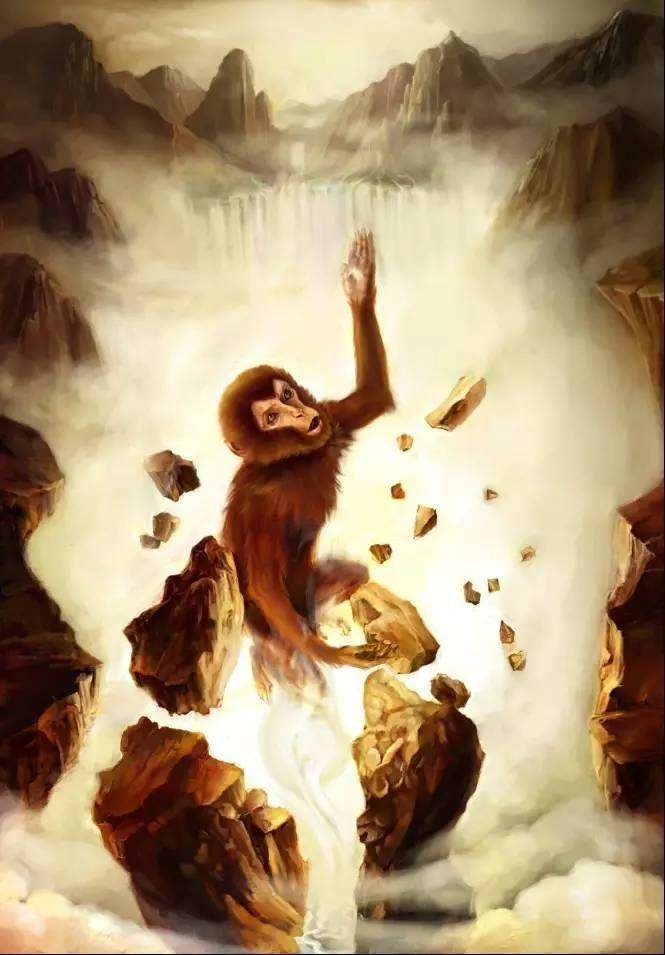
  1. Shihou (石猴, “Stone Monkey”) – Monkey’s first name according to chapter one (Wu & Yu, 2012, vol. 1, p. 104). This is related to his birth from stone (fig. 1).
  2. Tianchan Shihou (天產石猴, “Heaven-Born Stone Monkey”) – His REAL name as listed in the ledgers of hell in chapter three (Wu & Yu, 2012, vol. 1, p. 140).
  3. Xinyuan (心猿, “Mind Monkey/Ape”) – A Buddho-Daoist allegorical term for the disquieted thoughts and emotions that keep man trapped in Saṃsāra. It is used numerous times in chapter titles (e.g. ch. 7) and poems to refer to Monkey (see the material below figure three here).
  4. Jingong (金公, “Lord or Squire of Gold/Metal”) – A term used mainly in poems to refer to Monkey. It is an alternative reading of the component characters making up lead (qian, 鉛), namely jin (金) and gong (公). Lead was an important ingredient in immortal elixirs of external alchemy, and metal/gold (jin, 金) is connected to the earthly branch shen (申), which is associated with monkeys (see no. 9 here) (Wu & Yu, 2012, vol. 1, p. 83 and p. 532 n. 3).
  5. Taiyi Sanxian (太乙散仙, “Leisurely or Minor Immortal of the Great Monad”) – Monkey’s rank within the hierarchy of cosmic immortals (Wu & Yu, 2012, vol. 1, p. 471, for example). It essentially means that he is a divine being without a heavenly post.
  6. Taiyi Jinxian (太乙金仙, “Golden Immortal of the Great Monad”) – A seemingly embellished version of the previous term (Wu & Yu, 2012, vol. 2, p. 264, for example). It speaks of a higher rank. [1] (See the 07-26-25 update below for more info.)
  7. Lingming Shihou (靈明石猴, “Stone Monkey of Numinous Wisdom”) – The name of his magic species according to the Buddha in chapter 58 (Wu & Yu, 2012, vol. 3, p. 115). [2] He is the first of four spiritual primates.
  8. Nanbian Mihou (難辨獼猴, “Indistinguishable Macaques”) – A term referring to both Sun Wukong and the Six-Eared Macaque. [3]

Fig. 1 – Monkey’s birth from stone by Zhang Moyi (larger version). Found on this article.

2. Given by Characters

These are names, titles, or insults that are given to or directed at our hero by other characters.

  1. Hou Xingzhe (猴行者, “Monkey Pilgrim”) – Monkey’s original religious name in the 13th-century JTTW. It is given by Tripitaka at the beginning of the journey (Wivell, 1994, p. 1182). The Xingzhe (行者) portion of this name carried over to the 1592 edition. See nos. 12 & 13 below.
  2. Gangjin Tiegu Dasheng (鋼筋鐵骨大聖, “Great Sage Steel Muscles and Iron Bones”) – His divine title in the 13th-century JTTW. It is bestowed by Tang Emperor Taizong at the end of the journey (Wivell, 1994, p. 1207). [4] The Dasheng (大聖) portion of this name carried over to the 1592 edition. See sec. 3, nos. 7 & 8 below.
  3. Sun Wukong (孫悟空, “Monkey Awakened to Emptiness”) – The religious name given to him in chapter one by his first master, the Patriarch Subodhi (Wu & Yu, 2012, vol. 1, p. 115). It predates the 1592 JTTW, first appearing as early as the early-Ming zaju play (see here, for example). It’s important to note that the name “Wukong” (悟空) might have been influenced by a Tang-era monk who traveled throughout India just like Xuanzang (on whom Tripitaka is based).
  4. Liu Xiao Ling Tong (六小龄童) – Monkey’s name in the human world.
  5. Pohou (潑猴, “Reckless or Brazen Monkey”) – An insult used throughout JTTW (Wu & Yu, 2012, vol. 1, p. 118, for example).
  6. Shangxian (上仙, “High or Exalted Immortal”) – A respectful title used by the Dragon King of the Eastern Ocean in chapter three (Wu & Yu, 2012, vol. 1, p. 134).
  7. Huaguo Shan Shuilian Dong Tianchan Yaohou (花果山水簾洞天產妖猴, “Heaven-Born Demon Monkey from the Water-Curtain Cave of the Mountain of Flowers and Fruit”) – An insult used by King Qinguang, a Judge of Hell, in a memorial to the Jade Emperor in chapter three (Wu & Yu, 2012, vol. 1, p. 142).
  8. Xiandi (賢弟, “Worthy Little Brother”) – A nickname used by the Bull Demon King (Wu & Yu, 2012, vol. 1, p. 156, for example). Monkey is the smallest and therefore the last of seven sworn brothers (Wu & Yu, 2012, vol. 2, pp. 223-224).
  9. Yaoxian (妖仙, “Bogus Immortal”) – A category of nigh-immortal beings. He is called this by the Jade Emperor (ch. 4), the Buddha (ch. 7), and the Dragon King of the Eastern Sea in (ch. 14) (Wu & Yu, 2012, vol. 1, pp. 147-148, 193, and 318).
  10. Bimawen (弼馬溫, “To Assist Horse Temperament”) – A minor post overseeing the celestial horse stables. Monkey is given this position in chapter four by the Jade Emperor. Yu (Wu & Yu, 2012) translates this as “BanHorsePlague” (vol. 1, p. 148, for example). [5] This is sometimes used as an insult (Wu & Yu, 2012, vol. 1, p. 354, for example).
  11. Yaohou (妖猴, “Monster or Demon Monkey”) – An insult used numerous times throughout the novel (Wu & Yu, 2012, vol. 1, p. 154, for example).
  12. Sun Xingzhe (孫行者, “Pilgrim Sun”) – Monkey’s second religious name. It is given to him in chapter 14 by Tripitaka (Wu & Yu, 2012, vol. 1, p. 309). Refer back to no. 1. See also sec. 3, nos. 9 & 10 below.
  13. Xingzhe (行者, “Pilgrim”) – He is more commonly referred to by this name than Sun Xingzhe or Sun Wukong combined. [6] See section III here to learn about the significance of this title. Refer back to no. 1. Again, see sec. 3, no. 9 & 10 below.
  14. Sun Zhanglao (孫長老, “Elder Sun”) – A respectful title used by people he has helped (Wu & Yu, vol. 2, p. 85, for example).
  15. Dashixiong (大師兄, “Elder Religious Brother”) – A term used by Zhu Bajie and Sha Wujing (Wu & Yu, 2012, vol. 2, p. 74, for example).
  16. Houtou (猴頭, “Monkey/Ape Head”) – An insult used by various characters, especially Tripitaka (Wu & Yu, 2012, vol. 2, p. 26, for example).
  17. Maolian Heshang (毛臉和尚, “Hairy-Faced Monk”) – A term that describes his features (Wu & Yu, 2012, vol. 1, p. 407, for example).
  18. Maolian Lei Gong Zui de Heshang (毛臉雷公嘴的和尚, “Hairy-Faced, Thunder God-Beaked Monk) – A term that compares his elongated simian face to the beak of the bird-like thunder god Lei Gong (Wu & Yu, 2012, vol. 1, p. 351, for example). Variations include Lei Gong Zui Heshang (雷公嘴和尚, “Thunder God-Beaked Monk”) and Lei Gong de Nanzi/Hanzi (雷公嘴的男子/漢子, “Thunder God-Beaked Man”).
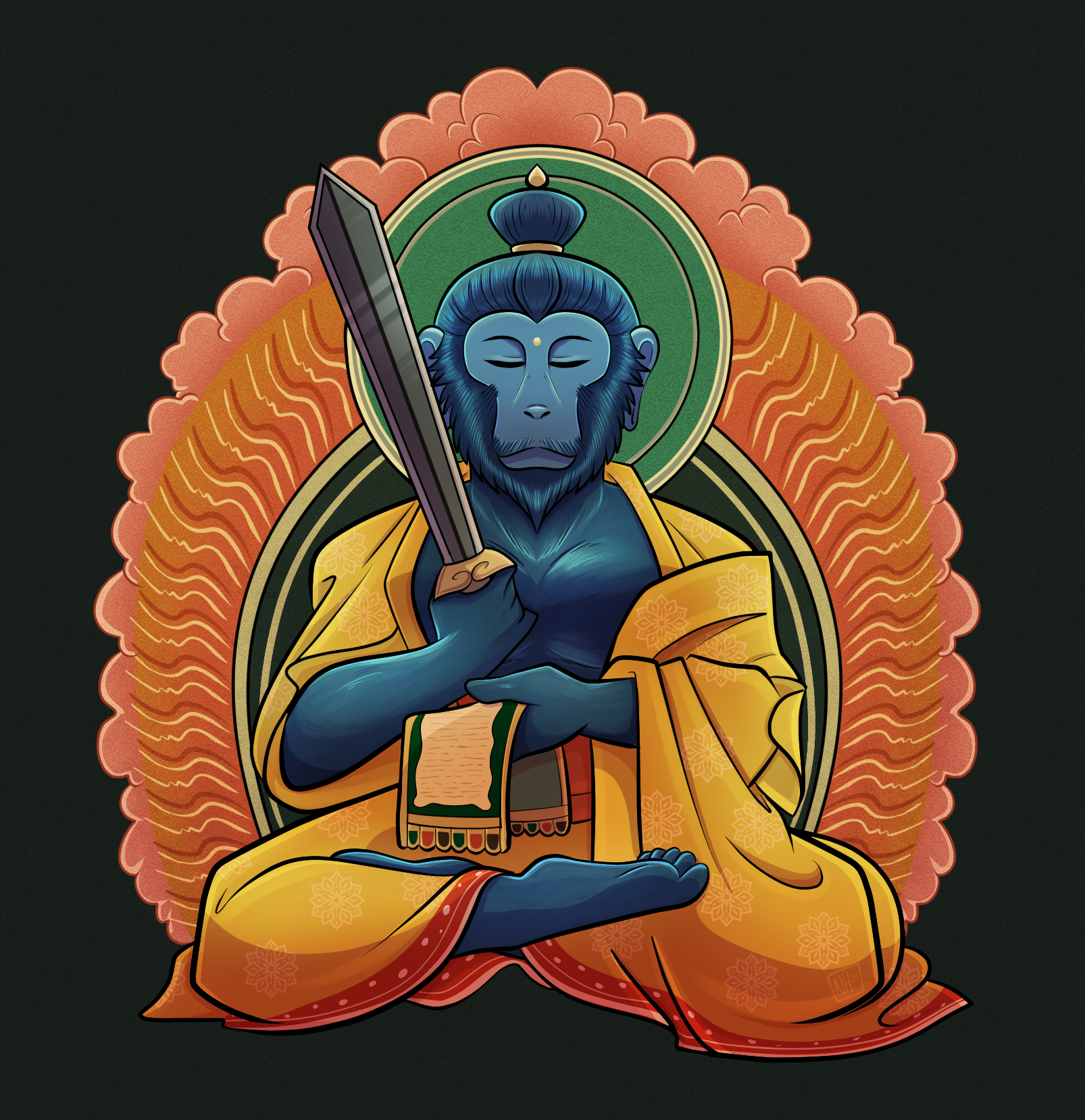
  19. Dou Zhansheng Fo (鬥戰勝佛, “Buddha Victorious in Strife or Victorious Fighting Buddha”) – His Buddha title bestowed by the Tathagata at the end of the journey in chapter 100 (fig. 2) (Wu & Yu, 2012, vol. 4, p. 381).

Fig. 2 – A religiously accurate drawing of Monkey as Dou zhansheng fo by NinjaHaku21 (larger version).

3. Self-Given

These are names, titles, or pseudonyms taken by Monkey himself. These do not include the names of the innumerable gods, monsters, or humans that he disguises himself as. They only refer to him personally.

  1. Huaguo Shan Ziyun Dong Bawan Siqian Tongtou Tie’e Mihou Wang (花果山紫雲洞八萬四千銅頭鐵額獼猴王, “Bronze-Headed, Iron-Browed King of the Eighty-Four Thousand Monkeys of the Purple Cloud Grotto on the Mountain of Flowers and Fruit”) – How he introduces himself to Tripitaka in the 13th-century JTTW (Wivell, 1994, p. 1182). The “Monkey King” (Mihou Wang, 獼猴王) portion of this name carried over to the 1592 edition but was represented with different Chinese characters. See nos. 2 & 3 below. This article discusses the term mihou (獼猴).
  2. Meihou Wang (美猴王, “Handsome Monkey King“) – The title that he takes upon ascending the throne in chapter one (Wu & Yu, 2012, vol. 1, p. 106).
  3. Hou Wang (猴王, “Monkey King”) – He is more commonly referred to by this name than Meihou wang. [7]
  4. Huaguo Shan Shuilian Dong Dongzhu (花果山水簾洞洞主, “Lord of the Water-Curtain Cave in the Mountain of Flowers and Fruit”) – How he introduces himself in chapter two to a demon king plaguing his people (Wu & Yu, 2012, vol. 1, p. 127).
  5. Huaguo Shan Shuilian Dong Tiansheng Shenren (花果山水簾洞天生聖人, “Heaven-Born Sage From the Water-Curtain Cave in the Mountain of Flowers and Fruit”) – How he introduces himself to the Ten Kings of Hell in chapter three (Wu & Yu, 2012, vol. 1, p. 140).
  6. Lao Sun (老孫, “Old Sun”) – A term that he uses many, many times throughout the novel. Yu (Wu & Yu, 2012) translates this as “Old Monkey” (vol. 1, p. 128, for example).
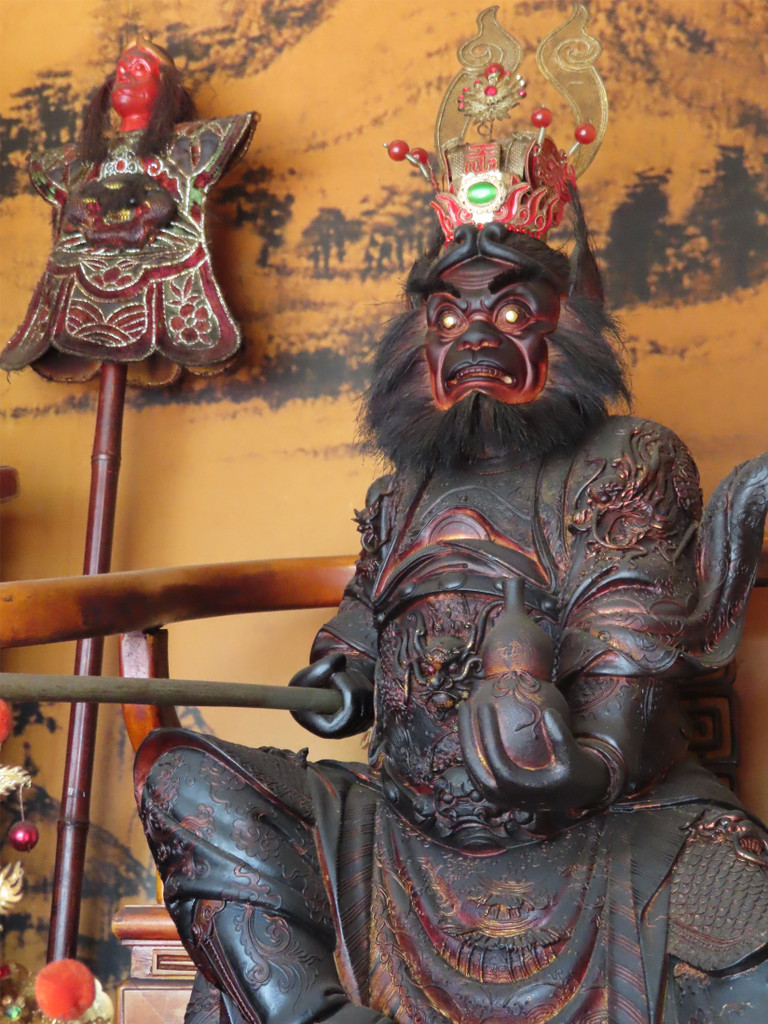
  7. Qitian Dasheng (齊天大聖, “Great Sage Equaling Heaven”) – The seditious title that he takes during his rebellion against heaven (Wu & Yu, 2012, vol. 1, p. 151). Monkey is worshiped by this name in modern Chinese Folk Religion (fig. 3). Refer back to sec. 2, no. 2.
  8. Dasheng (大聖, “Great Sage”) – He is more commonly referred to by this title than Qitian dasheng. [8] Variations include Dasheng Yeye (大聖爺爺, “[Paternal] Grandpa Great Sage”) and Sun Dasheng (孫大聖, “Great Sage Sun”). Refer back to sec. 2, no. 2.
  9. Zhexing Sun (者行孫, “Grimpil Sun”) – A pseudonym taken in chapter 34 when Monkey secretly escapes imprisonment and then presents himself as his own brother in an attempt to trick demons (Wu & Yu, 2012, vol. 1, p. 130). The strange English rendering is Yu’s (Wu & Yu, 2012) way of accounting for the change from Sun Xingzhe (, “Pilgrim Sun“) to Zhexing Sun (, “Grimpil Sun“). Refer back to sec. 2, no. 12. See also no. 10 below.
  10. Xingzhe Sun (行者孫, “Sun Pilgrim”) – A pseudonym taken in chapter 35 when he once again escapes capture and presents himself as a second brother (Wu & Yu, 2012, vol. 1, p. 133). This is a reversal of Sun Xingzhe (孫行者, “Pilgrim Sun”). Refer back to sec. 2, no. 12.
  11. Sun Waigong (孫外公, “([Maternal] Grandpa Sun”) – A name that he uses to taunt demons (Wu & Yu, 2012, vol. 1, p. 407, for example). It’s a cheeky way of saying, “I’m your elder, so you better submit to me.”
  12. Sun Yeye (孫爺爺, “([Paternal] Grandpa Sun”) – Same.
  13. Sun Erguan (孫二官, “Second Master Sun”) – A pseudonym taken in chapter 84 in order to investigate an anti-Buddhist kingdom under the guise of a horse trader. The other pilgrims take similar names (Wu & Yu, 2012, vol. 4, p. 132).

Fig. 3 – A Great Sage idol from Shengfo Tang (聖佛堂, “Sage Buddha Hall”) in Beigang Township, Yunlin County, Taiwan (larger version). It is one of many Monkey King Temples on the island. Photo by the author.


4. Updates

Update: 10-28-24

Someone on reddit questioned why I didn’t add a title for Monkey as the “Protector of the Peaches” or “Guardian of the Heavenly Peach Garden” (as mentioned by Wikipedia). This is how I responded:

This is what the novel says:

“We perceive,” said the Jade Emperor, “that your life is quite indolent, since you have nothing to do, and we have decided therefore to give you an assignment. You will temporarily take care of the Garden of Immortal Peaches. Be careful and diligent, morning and evening” (Wu & Yu, 2012, vol. 1, p. 160).

玉帝道:「朕見你身閑無事,與你件執事:你且權管那蟠桃園,早晚好生在意。」

The phrase “care for the Immortal Peach garden” (管蟠桃園) appears four times. But there is no official title for the position.


Update: 07-26-25

In section one, no. 6, I listed the title Taiyi Jinxian (太乙金仙, “Golden Immortal of the Great Monad”). However, this is only part of the term. The full title is Hunyuan yiqi shangfang taiyi jinxian (混元一氣上方太乙金仙), or “Golden Immortal of the Great Monad Atop the Primordial Breath of the Chaotic Origin.” The phrase “Atop the Primordial Breath … ” likely refers to the pristine, original energy of the universe that all Daoists wish to return to. Therefore, I believe this refers to his level of spiritual attainment—think of it in terms of cultivation literature—which is separate from his actual heavenly rank.


Update: 03-21-2026

It dawned on me that Pilgrim Sun (sec. 2, no. 12) and his “brothers,” Grimpil Sun and Sun Pilgrim (sec. 3, nos. 9 & 10), might be intentional references to the tripart monkey gods of religion and theater. For example, one Fujian tradition names the triad as the black-faced “Great Sage Reaching Heaven” (Tongtian dasheng, 通天大聖), the white-faced “Third Son Shuashua” (Shuashua sanlang, 耍耍三郎/爽爽三郎), and the red-faced “Cinnabar Cloud Great Sage” (Danxia dasheng, 丹霞大聖). The first two figures appear as brothers, along side the Great Sage Equaling Heaven and two sisters, in a pair of Yuan-Ming zaju plays (see the 12-20-23 update here.)

Notes:

1) The Jinxian (金仙) of Monkey’s title Taiyi Jinxian (太乙金仙, “Golden Immortal of the Great Monad”) is associated with far more lofty figures. For example, a poem in chapter one refers to the Patriarch Subodhi as the Dajue Jinxian (大覺金仙, “Golden Immortal of Great Awareness”) (see section 2.3 here).

2) I’m placing the name in this category because the Tathagata is stating a fact instead of bestowing it as a proper name.

3) Yu (Wu & Yu, 2012) translates this as the “macaque hard to distinguish” (vol. 4, p. 360). But I think that the original Chinese term is likely referring to both Sun and Six Ears. Their battle across the cosmos is counted in chapter 99 as the 46th of 81 hardships that Tripitaka was fated to endure (Wu &Yu, 2012, vol. 4, p. 360).

4) Wivell (1994) translates the name as “Great Sage of Bronze Muscles and Iron Bones” (p. 1207). But the gang (鋼) of Gangjin tiegu dasheng (鋼筋鐵骨大聖) means “steel.”

5) This references the homophonous term Bimawen (避馬瘟, “avoid the horse plague”), the historical practice of placing monkeys in horse stables to ward off equine sickness (see the 02-26-22 update here).

6) The term Xingzhe (行者, “pilgrim”) appears 4,355 times, while Sun xingzhe and Sun Wukong appear 239 and 127 times, respectively. Xingzhe is used numerous times to refer to other characters, such as Guanyin’s disciple Hui’an (惠岸行者, 6 times; a.k.a. Mucha or Mokṣa, 木叉行者, 9 times), but the vast majority refer to Monkey.

7) The term Hou wang (猴王, “Monkey King”) appears 185 times, while Meihou wang (美猴王) appears 42 times.

8) The term Dasheng (大聖, “Great Sage”) appears 1,273 times, while Qitian dasheng (齊天大聖) appears 103 times. I believe Dasheng is also used to refer to the Buddha a few times, so please keep this in mind.

Sources:

Wivell, C.S. (1994). The Story of How the Monk Tripitaka of the Great Country of T’ang Brought Back the Sūtras. In V. Mair (Ed.), The Columbia Anthology of Traditional Chinese Literature (pp. 1181-1207). New York: Columbia University Press.

Wu, C., & Yu, A. C. (2012). The Journey to the West (Vols. 1-4) (Rev. ed.). Chicago, Illinois: University of Chicago Press.

Archive #39 – Journey to the West Adaptations

Last updated: 07-21-2025

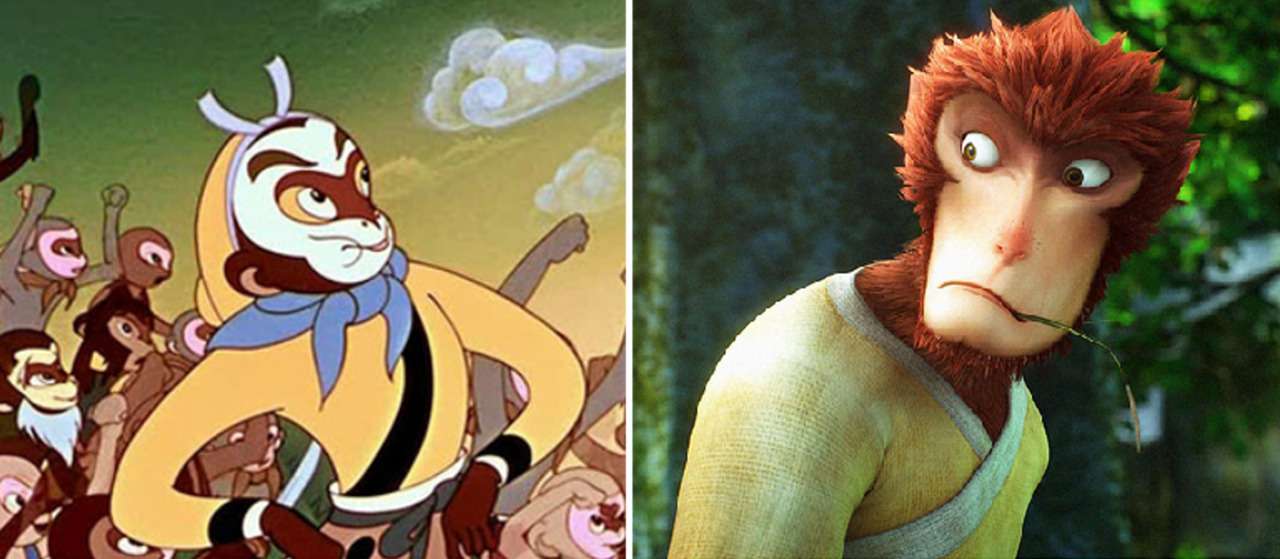
The Journey to the West Research blog is proud to host an entry by our friend Monkey Ruler (Twitter and Tumblr). They have graciously written an essay on the global nature of Journey to the West adaptations, as well as provided a link to their ongoing project recording JTTW media (fig. 1). As of the publishing of this article, it includes a long list of almost 570 movies, 90 TV shows, and 160 video games! – Jim

Fig. 1 – Depictions of Sun Wukong from adaptations produced over 50 years apart: (left) Havoc in Heaven (Danao tiangong, 大鬧天宮, 1961) and (right) Monkey King: Hero is Back (Xiyouji zhi Dasheng guilai, 西遊記之大聖歸來, lit: “Journey to the West: Return of the Great Sage,” 2015) (larger version). Courtesy of Monkey Ruler.

I. Media adaptations

This started out as a collection of Xiyouji (西遊記; lit: “Journey to the West,” 1592) movies and TV shows for the sake of a Master’s class project; it was simple enough to look for Xiyouji media and start adding them to a collection datasheet. But even when the project was over, I kept finding more and more adaptations, even stumbling across others trying to show the magnitude of how much this novel has encompassed popular culture throughout the centuries. It has been told and re-told again and again in oral and published literature, plays, art, songs, poems, etc., and now on the big and small screens. Audiences are re-introduced to the image of Sun Wukong and his fellow pilgrims with every new media addition.

What really inspired me was the book Transforming Monkey: Adaptations and Representation of a Chinese Epic (2018) by Hongmei Sun, where she explained in depth the cultural impact that Sun Wukong (fig. 2) and Xiyouji has had on Chinese media, as well as how this loose set of franchises have come to represent Chinese culture as these shows and movies have become more globally accessible. Xiyouji is such an iconic cultural universe that it can be both heavily entertaining while still being so personal to audiences of any generation depending on how the artist/writer portrays their interpretation of these characters and their stories. 

There hasn’t been a lot written about how these interpretations influence modern Xiyouji adaptations despite how the story has greatly influenced popular culture.

Fig. 2 – The front cover of Transforming Monkey (2018) (larger version).

Xiyouji is such an influential story, one that will continue to grow more and more globally known throughout time because it is such an all-encompassing piece that can cover politics, identities, and allegories, while still being a very personal and interpersonal work that artists or writers can relate to. 

However, even with these layers of meaning and symbolism to be found, the story never loses the charming and entertaining aspects that can and have captured audiences. Despite being published over 430 years ago (with a history stretching back even further), Xiyouji is still able to relate to modern audiences through its allegories of oppression, rebellion, and self-identity. It has the capability to resonate with any generation depending on what artists or writers at the time wish to highlight or personally connect with themselves or their current world around them, using Xiyouji as a medium for their own struggles.

As Xiyouji starts to become more and more globally known, it is important to understand and resonate that this is still a Chinese story and how to address further adaptations with cross-nation gaps in both translation and cultural differences. There are media forms that are far more exploitative of the mythical journey, creating impractical scenarios of the narrative and thus changing the message of the story and characters completely. However, there needs to be an acknowledgment of what doesn’t work as Xiyouji adaptations due to the ever-changing zeitgeist in not only its home of origin but introducing it to a global sphere as it adds influence. 

In order to see what works for adaptations, there needs to be an acknowledgment of what is the core of the story and just why it remains popular, story-beat or character-wise. For example, Sun Wukong can be used as a great model for positive ambivalence in media, moving away from set limits of a single stereotype and rather being a constant motion of new ideas and new identities. Monkey has been changed from a mischievous monkey to a revolutionary hero to a post-modern rebel against authority throughout the years. But even throughout the constant changes and interpretations, people never lose sight of what the nature of Sun Wukong is: rebelliousness, variability, optimism, and persistence. 

Monkey is a transcending character as he is able to mediate contradictions within his own design, one being his gold-banded staff, a symbol of breaking barriers, and his golden filet (fig. 3), a symbol of limits. These two simple but prominent pieces of iconography immediately tell audiences who the character is supposed to be and what they are about.

Fig. 3 – A modern replica of Monkey’s golden filet or headband (larger version).

While it is entertaining and able to be enjoyed by younger audiences, Xiyouji still has a deeper meaning that can be interpreted and recognized into adulthood. This is one of the few stories that I imagine can be adapted again and again without the issue of overlap as there are so many ways people can personally connect with these characters. 

Having that any generation, anyone really can find enjoyment in this media, and perhaps even be inspired to read the novel itself.

II. Archive link

Please consult the tabs at the bottom of the spreadsheet linked below. They are listed as “Movie Information,” “Movie Links,” “Honorary Shows,” “Game Information,” “Game Pictures,” “Honorary Games,” and “Sources.” – Jim

https://docs.google.com/spreadsheets/d/1GsiCGzE1DZDy2Vpc85wiVXSyLWpxMbxj/edit?usp=sharing&ouid=112097376285754662736&rtpof=true&sd=true


Update: 07-21-25

Monkey Ruler has officially posted a website called “Journey to the West Media.” They continue to update the page with movies, tv shows, video games, and now comic books.

https://www.journeytothewestmedia.com/

Interesting Facts about the Monkey King

Last updated: 08-28-2022

I recently posted a list of facts about Sun Wukong (孫悟空) to reddit. I am presenting an elongated version of it here, which serves as a summation of everything that I’ve learned over the years. It is by no means comprehensive. I’ll add more facts in the future as I learn of them. Enjoy.

Current count: 108

  1. He was likely influenced by the Hindu monkey god Hanuman (Ch: Ha nu man, 哈奴曼) in different waves, one possibly from the north (via Tibet) and another from the south (via Southeast Asia). But the parallels are most apparent from the standard 1592 edition of JTTW, suggesting that the author-compiler had access to some form of the Indian epic Rāmāyana (7th-c. BCE to 3rd-c. CE). The novel even includes material from the epic Mahābhārata (4th-c. BCE to 4th-c. CE).
  2. In my opinion, however, the greatest influence on his 1592 persona is a white ape antagonist from a Tang-era story. Similarities include: 1) both are supernatural primates possessed of human speech; 2) one thousand-year-old practitioners of longevity arts; 3) masters of Daoist magic with the ability to fly and change their appearance; 4) warriors capable of single-handedly defeating an army; 5) have a fondness for armed martial arts; 6) have an iron-hard, nigh-invulnerable body immune to most efforts to harm them; 7) have eyes that flash like lightning; 8) live in verdant mountain paradises (like Flower Fruit Mountain); and 9) reside in caves with stone furniture (like the Water Curtain Cave).
  3. He has the second longest association with the JTTW story cycle, appearing as the “Monkey Pilgrim” (Hou xingzhe, 猴行者) circa 1000 (or before). Sha Wujing’s earliest antecedent appeared during the 8th-century, while Zhu Bajie didn’t appear until the 14th-century.
  4. The oldest published mention of the Monkey Pilgrim is a eulogy appearing in a tale from Zhang Shinan’s (張世南) Memoirs of a Traveling Official (Youhuan jiwen, 遊宦紀聞, 13th-century). One scholar dates the story to around 1127.
  5. The oldest depictions of this character (late-11th to late-13th-century) appear in Buddhist cave art along the Silk Road in Northern China. He is almost always portrayed in a scene worshiping the Bodhisattva Guanyin.
  6. A 13th-century version of JTTW describes the Monkey Pilgrim as a white-clad scholar who is an ancient immortal from the very beginning of the tale. He was beaten with an iron rod as a young immortal after he stole magic peaches and was subsequently banished to the Mountain of Flowers and Fruit. He actively searches out the monk to protect him as the cleric’s two previous incarnations were eaten by a monster (Sha Wujing’s antecedent) in the past.

  7. This immortal fights with two staves (at different times), a golden-ringed monk’s staff and an iron staff (both borrowed from heaven). The monk’s staff can create destructive blasts of light, as well as transform into titanic creatures, including a club-wielding yaksha and an iron dragon. The iron staff isn’t shown to have any special powers. These weapons were later combined by storytellers, the rings from the former being added to the ends of the latter.

  8. He is called the “Monkey King” (Houwang, 猴王) as far back as the 13th-century version. This position is likely based on a jataka tale about the Buddha’s past life as a king of monkeys.
  9. The immortal is bestowed the title “Great Sage Steel Muscles and Iron Bones” (Gangjin tiegu dasheng, 鋼筋鐵骨大聖) at the end of the story by Tang Taizong.
  10. This immortal was heavily influenced by the Buddhist Saint Mulian (目連; Sk: Maudgalyayana).
  11. He was popular even in Korea and appeared in a set of carvings from a 14th-century stone pagoda.
  12. The earliest mention of the name “Sun Wukong” that I’m aware of appears in an early-15th-century zaju play. It depicts the character as a sex-crazed maniac who kidnaps a princess to be his wife, tries to seduce Princess Iron Fan, and later gets erectile disfunction when his golden headband tightens while trying to have sex with a young maiden in the Kingdom of Women.
  13. The dharma name “Wukong” (悟空) was likely influenced by a historical monk of that name who traveled to India during the 8th-century. The name means “Awakened to Emptiness”, thus referencing Buddhist enlightenment. I think the corresponding Sanskrit name would be something like “Bodhiśūnyatā” (but don’t quote me on this).

  14. The surname “Sun” (孫) means “grandson” but is an open reference to husun (猢猻, lit: “grandson of the barbarian”), the Chinese word for “macaque“. It was also a popular surname for supernatural primates in stories associated with the Lingyin Temple (靈隱寺), which also likely influenced the Monkey King.

  15. The 1592 edition of the novel associates the components of Sun (孫 = zi, 子 & xi, 系) (ch. 1 – see section 4.2 here) with the formation of a “holy embryo” (shengtai, 聖胎), an immortal spirit that lives on after the adherent dies.

  16. So taking all of the Buddhist and Daoist references into account, another translation for Sun Wukong would be “Immortal Awakened to Enlightenment”. This is a reference to the Buddho-Daoist philosophy of Zhang Boduan (張伯端, mid- to late-980s-1082), who believed that in order to become a true transcendent (xian, 仙), one had to achieve both the Daoist elixir of immortality and Buddha-nature (i.e. Buddhahood).

  17. The aforementioned zaju play calls him the “Great Sage Reaching Heaven” (Tongtian dasheng, 通天大聖).

  18. Said play also states that he has two sisters and two brothers. The sisters are respectively named the “Venerable Mother of Mount Li” (Lishan laomu, 驪山老母) and “Holy Mother Wuzhiqi” (Wuzhiqi shengmu, 巫支祇聖母). His older brother is called “Great Sage Equaling Heaven” (Qitian dasheng, 齊天大聖) and the younger the “Third Son Shuashua” (Shuashua sanlang, 耍耍三郎).

  19. His story in the 1592 version takes place not in our world but in one modeled after ancient Hindo-Buddhist cosmic geography, which features four island-like continents floating in a great ocean around the four respective faces of a cosmic mountain. And yet the novel was published during a time coinciding with the late Renaissance period in Europe, precisely 49 years after Copernicus suggested that the Earth orbits the sun.
  20. His home, the Mountain of Flowers and Fruit (Huaguo shan, 花果山), is located near the easternmost continent, while China is associated with the southernmost continent. This means that Monkey, within the novel, is not Chinese!
  21. He has had past lives (see the 11-24-20 update here).
  22. He’s not the only figure from world myth born from stone. In fact, “Birth from rock” (T544.1) is a mythic category appearing in Stith Thompson’s Motif-Index of Folk-Literature.

  23. While his stone birth (ch. 1) is likely based on that of Yu the Great (Dayu, 大禹), a legendary King of the Xia dynasty (more on this below), it may ultimately be linked to Tibetan stories of stone-born monkey deities.
  24. He was likely born during the late-Zhou Dynasty (circa 1046-256 BCE).
  25. He serves as a physical manifestation of the “Mind Monkey” (xinyuan, 心猿), a Buddho-Daoist philosophy denoting the disquieted thoughts that keep Man trapped in the illusory world of Saṃsāra (see the material below figure three here). This phrase is also surprisingly associated with sexual desire.
  26. Despite the association above, Monkey shows no interest in sex throughout the entire novel. This may be a response to the highly sexualized Sun Wukong from the zaju play.
  27. The novel also gives him the alchemical title “Squire of Metal/Gold” (Jingong, 金公), a possible “anagrammatic reading of the Chinese graph for lead or qian 鉛, which may be broken up into the two graphs of jin and gong” (Wu & Yu, 2012, vol. 1, p. 532 n. 3). Lead is an ingredient in external alchemy (see the material after figure two here). The title might also be referring to the earthly branch shen (申), which is associated with both metal and monkeys (Wu & Yu, 2012, vol. 1, p. 532 n. 3).
  28. The overall arc of his birth and early life were likely based on that of the historical Buddha to make his tale more familiar to readers. Similarities include: A) supernatural births that split open their respective mothers (Queen Maya vs stone egg); B) producing a radiant splendor in all directions upon their birth; C) being talented students that quickly master concepts taught to them; D) early lives as royals (Indian prince vs king of monkeys); E) shock at the impermanence of life; F) questing for a spiritual solution to said impermanence; and G) finding said solution via spiritual practices (Indic meditation vs Daoist elixir arts).

  29. His “Water Curtain Cave” (Shuilian dong, 水簾洞), the grotto-heaven where he and his people live in the Mountain of Flowers and Fruit, is associated with a different immortal in older religious literature. For instance, the Song-era text Master Ghost Valley’s Numinous Writ of the Essence of Heaven (Guigu zi tiansui lingwen鬼谷子天隨靈文) calls the titular character the “Master of the Waterfall Cave” (Shuilian dong zhu, 水濂洞主). In this case, the source uses a different lian (濂) in place of the lian (簾) associated with Monkey’s cave. But they both mean the same thing: a waterfall hiding a cave mouth (see the 12-11-21 update here). One 17th-century novel influenced by JTTW states that Master Ghost Valley lives in the Water Curtain Cave (Shuilian dong, 水簾洞; i.e. the same as Monkey’s home) with his student, the Warring States strategist Sun Bin (孫臏, d. 316 BCE). This means that two characters surnamed Sun (孫) live there in Chinese literature (see section II here).
  30. Despite modern media portraying him as an adult-sized humanoid character that is sometimes handsome and/or very muscular, the 1592 version describes him as an ugly, bald, and skinny Rhesus macaque that is less than four feet tall. This means that one of the most powerful warriors in the Buddho-Daoist cosmos is the size of a child.
  31. While commonly portrayed as a Daoist immortal, his first master, the Patriarch Subodhi (Xuputi zushi, 須菩提祖師) (ch. 1 & 2), is shown to live in India and have a strong connection to Buddhism, possibly even being a Bodhisattva.
  32. The breathing and energy circulation methods that Monkey uses to achieve immortality (ch. 2) are based on real Daoist elixir practices.
  33. The actual name for his famous 72 Transformations is “Multitude of Terrestrial Killers” (Disha shu, 地煞數), which is based on a popular set of malevolent stellar gods.
  34. This skill not only allows Monkey to transform into whatever he wants but also gives him a store of extra heads and possibly even extra lives like a video game (see section 4.4 # 3 here).
  35. He specifically learns the 72 Transformations (ch. 3) in order to hide from a trio of elemental calamities sent by heaven to punish cultivators for defying their fate and achieving immortality. This is the origin of the “Heavenly Tribulation” (tianjie, 天劫; zhongjie, 重劫) trope from modern Xianxia literature.
  36. But, surprisingly, he is not a true immortal, just long-lived and really hard to kill. The novel refers to him as a “bogus immortal” (yaoxian, 妖仙). This references Zhang Boduan’s aforementioned philosophy where one must obtain both the Daoist elixir (which Monkey did) and Buddha-Nature (which he hadn’t yet achieved) in order to be a true transcendent.
  37. While training under Subodhi (ch. 3), he expressly passes on learning the bureaucratic-style magic rites normally used by earthly priests to request something from heaven because the skills involved won’t result in eternal life. Instead, after achieving immortality, Monkey just commands the gods to do his bidding (see section II here).
  38. He can grow 100,000 feet (30,480 m) tall (ch. 1, 6, 61, and 97). This skill is called the “Method of Modeling Heaven on Earth” (Fatian xiangdi, 法天像地), and it is related to ancient Pre-Qin and Han concepts of astral-geography later used in the construction of imperial Chinese cities.
  39. His magic “immortal breath” (xianqi, 仙氣) can transform his hairs, his staff, and objects not in direct contact with his body into anything he desires. It can also change disembodied souls into “ether” for ease of transport, and evidence suggests that it can even grant some form of immortality.
  40. Monkey has 84,000 hairs on his body, and he can transform them into hundreds of thousands, millions, and even billions of hair clones (see the 03-19-22 update here).
  41. The novel only mentions him learning martial arts in passing (ch. 67 – see section 4.5 here), but one episode (ch. 51) features a battle between Monkey and a demon king in which they use a host of real world fighting techniques that are still known and practiced today.
  42. His favorite style of boxing is “Short Fist” (duanquan, 短拳) (see the 05-02-18 update here).
  43. His skill with the staff is so great that the novel compares it to techniques from two manuals listed among the Seven Military Classics of China (see the 08-07-18 update here).
  44. The bureaucratic mix-up that resulted in his soul being dragged to hell (ch. 3) is based on “mistaken summons” to the underworld and “return-from-death” narratives present in early Chinese “miraculous tales” (Zhiguai xiaoshuo, 志怪小説) (Campany, 1990).
  45. When he looks at his entry in the ledgers of hell, he learns that: 1) his soul number is “1,350”; 2) his real name is “Heaven-Born Stone Monkey” (Tianchan shihou, 天產石猴); and 3) he was fated to have a “good end” at the ripe old age of 342. This refers to a person’s pre-allotted lifespan (ming, 命) (Campany, 2005; Campany & Ge, 2002, pp. 47-52).
  46. The distance that his cloud-somersault can travel, 108,000 li (33,554 mi / 54,000 km), is based on a metaphor for instantaneous enlightenment. It comes from the Platform Sutra of the Sixth Chan Patriarch Huineng (惠能). The Chan Master explains that the common trope of the Buddha’s paradise being separated from the world of man by 108,000 li is based on a combination of the “Ten Evils” (Shi’e, 十惡) and “Eight Wrongs” (Baxie, 八邪) of Buddhism. Those who rid themselves of these spiritual flaws will achieve enlightenment and thus arrive instantly at the Buddha’s paradise.
  47. The initial depiction of his magic staff as a great iron pillar kept in the dragon kingdom treasury (ch. 3) is based on a metal column that the immortal Xu Xun (許遜) chained a demonic dragon to and then imprisoned in the aquatic realm in Chinese mythology.
  48. It’s a common misconception that his staff weighed down the Milky Way galaxy. This is based on a mistranslation. The W. J. F. Jenner edition claims that the weapon anchored said star cluster. However, the original Chinese states that it was used as a means to measure and set the depths of the Heavenly River (Tianhe, 天河; a.k.a. Milky Way).

  49. The weight of his staff is likely an embellishment on the weight of a heavy stone block lifted by the bandit-hero Wu Song (武松) in the Water Margin (Shuihu zhuan, 水滸傳, c. 1400). This episode and the JTTW episode where Monkey acquires his staff both involve a hero (Wu Song vs Sun Wukong) asking someone (a friend vs the Dragon King) to take them to a seemingly immovable object (stone block vs iron pillar). They then adjust their clothing before lifting the object with ease. Most importantly, the Chinese characters for the respective weights are visually similar. Sun’s staff is 13,500 catties (yiwan sanqian wubai jin, 一萬三千五百斤; 17,5560 lbs. / 7965.08 kg), while the stone block is 300 to 500 catties (sanwubai jin, 三五百斤; 390-650 lbs. / 177-295 kg). The characters in bold indicate the similarities between the two weights, where as those in red indicate the embellishments: 一萬五百斤.

  50. He singlehandedly defeats the “Nine Planets” (Sk: Navagraha; Ch: Jiuyao, 九曜, “Nine Luminaries”), personifications of the sun and planets from Hindu astrology (Gansten, 2009), during his rebellion (ch. 4) (Wu & Yu, 2012, vol. 1, pp. 170-172).
  51. His time as the Bimawen (弼馬溫, “To assist horse temperament”), a minor post overseeing the heavenly horse stables (ch. 4), is based on an ancient Chinese practice of placing monkeys in horse stables to ward off equine sicknesses. The belief was that the menstrual blood of female monkeys mixed with horse food somehow guarded against diseases. This is hilarious as the position links Sun Wukong to menstruation!

  52. His title “Great Sage Equaling Heaven” (Qitian dasheng, 齊天大聖) (ch. 4) was actually borrowed from the “Eastern Marchmount” (Dongyue, 東嶽; a.k.a. “Eastern Peak”), the god of Mt. Tai. This suggests that the older brother from the aforementioned zaju play is really the Eastern Marchmount.
  53. His time as the Guardian of the Immortal Peach Groves (ch. 5) is likely based on a Song-era Daoist scripture in which the aforementioned Sun Bin is tasked by his teacher, Master Ghost Valley, with protecting a tree laden with special fruit. He later captures a magic white ape stealing said produce (see section III here). The simian thief saves his life by offering Sun a set of secret religious texts. Both stories include: 1) a character surnamed Sun (孫) protecting special fruit (Sun Bin vs Sun Wukong); and 2) supernatural primates that steal and eat the fruit. Therefore, Monkey’s 1592 persona serves as both the guard and the thief!
  54. The elixir pills that he drunkenly eats in Laozi’s laboratory (ch. 5) likely influenced the senzu beans from the world famous Dragon Ball (Jp: Doragon Bōru,ドラゴンボール; Ch: Qilongzhu, 七龍珠) franchise.
  55. His conflict with Erlang (ch. 6) can be traced to ancient Han-era funerary rituals, and their battle of magic transformations shares parallels with ancient Greek tales and can ultimately be traced to even older stories from the Near East.
  56. His time in Laozi‘s furnace (ch. 7) is based on an episode from the aforementioned 13th-century version of JTTW. It may also be connected to a story of Laozi magically surviving a foreign king’s attempt to boil him in a cauldron.
  57. He is shown to be weak against spiritual fire and smoke (see the 06-28-22 update here).
  58. Smoke from the furnace irritates his eyes, giving him his famous “Fiery Eyes and Golden Pupils” (Huoyan jinjing, 火眼金睛). The former is likely based on the “actual red-rimmed eyes of [the Rhesus macaque]” (Burton, 2005, p. 148). The latter is likely based on the golden pupils of macaques (see section 2.1 here).
  59. The message that he leaves on the Buddha’s finger (ch. 7) is a popular form of graffiti in East Asia.
  60. His time under Five Elements Mountain (Wuxing shan, 五行山) (ch. 7) is based on stories of the aforementioned Wuzhiqi (無支奇/巫支祇) being imprisoned under a mountain by Yu the Great.
  61. He was pressed under the mountain during the late-Han Dynasty (202 BCE-220CE – see section II here).
  62. A religious precious scroll predating the 1592 edition states that Erlang instead traps Monkey beneath Mount Tai, and the aforementioned 15th-century zaju play states it was Guanyin and the Mountain of Flowers and Fruit.
  63. This punishment links him to a broader list of mythic baddies imprisoned in earth, including Lucifer, Loki, and the Titans of Tartarus. I plan to write a later article about “earth prisons” in world myth.
  64. One scholar suggests that being trapped under Five Elements Mountain is a symbolic death (remember that Monkey claims to be free of the Five Elements after attaining immortality), meaning that the hellish diet is his karmic punishment in the afterlife, and his later release is a symbolic reincarnation.
  65. Monkey’s mountain imprisonment was only part of his punishment. The other half was a hellish diet of hot iron pellets and molten copper, punishments straight from Buddhist canon.
  66. His golden headband (ch. 13) has three influences: 1) a historical ritual circlet worn as a physical reminder of right speech and action by Esoteric Buddhist yogins in ancient India; 2) adornments, likely based on stylized lingzhi mushrooms, worn by Daoist protector deities; and 3) an Iranic triple-crescent crown.
  67. The oldest depiction of Monkey with his headband that I know of appears in a late-Xixia (late-12th to early-13th-century) Buddhist cave grotto in Northwestern China.
  68. The earliest depiction of his double “curlicue-style” headband that I’m aware of is a 13th-century stone carving in Fujian.
  69. The secret spell that tightens his headband is likely the Akshobhya Buddha mantra.
  70. Along with the headband, his tiger skin kilt (ch. 13) can be traced to a list of ritual items prescribed for worshiping wrathful protector deities in Esoteric Indian Buddhism. These same ritual items came to be worn by the very protector deities that the yogins revered. This explains why some deities in Chinese folk religion (including Sun Wukong) are portrayed with the golden headband and tiger skin.

  71. Modern artists sometimes depict him with two long feathers protruding from the front of his golden headband, giving him the appearance of an insect. But the feathers (lingzi, 翎子) are actually associated with a different headdress called the “Purple Gold Cap” (zijin guan, 紫金冠), which is worn on top of the head. It was a military headdress later associated with heroes in Chinese opera (see section 2.2 here).
  72. Monkey is also shown to be weaker in water. For instance, he enlists Zhu Bajie to combat the water demon who turns out to be Sha Wujing (ch. 22) (Wu & Yu, 2012, vol. 1, p. pp. 422-423).
  73. The baby-shaped fruit that he eats (ch. 24) comes from a tree based on Indo-Persian lore.
  74. He claims to have eaten people when he was a monster in his youth (ch. 27) (Wu & Yu, 2012, vol. 2, p. 20).
  75. His greatest feat of strength is carrying two mountains while running at meteoric speeds (ch. 33). One is the axis mundi of the Hindo-Buddhist cosmos, while the other is the place from which (according to legend) Buddhism spread upon entering China. This episode is based on an older tale in which Erlang does the lifting.
  76. His doppelganger, the Six-Eared Macaque (ch. 56-58), is actually an aspect of his troubled mind. Once he kills him, Monkey takes one step closer to Buddhahood.
  77. He fights and is defeated by an ancient bird demon who is a spiritual uncle of the Buddha (ch. 77). This monster is based on the Hindu bird god Garuda.
  78. He and his religious brothers take human disciples in India (ch. 88), and Monkey later performs an arcane ritual in which he grants them superhuman strength (and possibly some form of immortality).
  79. His title, “Victorious Fighting Buddha” (Douzhan sheng fo, 鬥戰勝佛) (ch. 100), is based on a real world deity numbering among the “Thirty-Five Confession Buddhas“.
  80. The novel ranks him higher than Guanyin after his ascension (see the third quote here).
  81. As an enlightened Buddha, Monkey is eligible for his own “Buddha-Field” (Sk: Buddhakṣetra; Ch: Focha, 佛刹), essentially his own universe in which he will lead the inhabitants to enlightenment (Buswell & Lopez, 2014, p. 153).
  82. Despite his association with the Victorious Fighting Buddha, he is primarily worshiped as the Great Sage Equaling Heaven in East and Southeast Asian Chinese folk religion.
  83. Fighters of the Boxer Rebellion (Yihetuan yundong, 義和團運動, 1899-1901) believed that they could channel the Monkey King to gain his great combat skills.
  84. Modern ritual specialists known as “spirit-mediums” (Hokkien: Tangki, 童乩; Ch: Jitong, 乩童; lit: “Divining Child”) also channel the Great Sage, allowing his worshipers to have direct access to the divine. While they may use a staff to enhance the theater of their performance, the weapon surprisingly doesn’t serve a ritual function. They instead use a set of bladed or spiked weapons to draw blood intended to create evil-warding paper talismans (see the material below figure six here).
  85. Chinese folk religion recognizes more than one Great Sage, usually between three and five individuals.
  86. Monkey’s faith started in Fujian province, China and spread via boat to other countries within the Chinese diaspora. When he first started being worshiped is unknown. The first concrete references to his worship come from the 17th-century (see section III here). But the aforementioned 13th-century stone carving depicts him as a wrathful guardian, alongside other protector deities, Bodhisattvas, patriarchs, and eminent monks. This suggests that he might have been revered at an earlier time.
  87. He was even worshiped in 19th-century America!
  88. The iconic pose where he shades his eyes to search the horizon is likely based on a common motif associated with Chinese sea gods.
  89. He has a number of religious birthdays, one of which is the 16th day of the 8th lunar month (the day after the Mid Autumn Festival).
  90. There is a style of Chinese boxing named after him, “Great Sage Boxing” (Cantonese: Taishing kyun; Mandarin: Dasheng quan, 大聖拳). Another closely associated style is “Great Sage Axe Boxing” (Can: Taishing pek kwar kyun; Man: Dasheng pigua quan, 劈掛拳). These arts also have staff styles associated with the Monkey King.
  91. His time in Laozi’s furnace and ability to grow 100,000 feet tall influenced a Shaolin Monastery myth related to the founding of their famous staff fighting method. The story describes how a lowly kitchen worker jumped into an oven and remerged as a staff-wielding titan to battle mountain brigands attacking the monastery (see section 3 here).
  92. Mao Zedong, the leader of the Chinese Communist Party, was a fan of the Monkey King, even associating himself with the character in his poetry. Also, a CCP propaganda play of the 1960s associates the scripture pilgrims with members of the Communist Party, with Monkey referencing Mao.
  93. He shares several connections with Yu the Great (here and here). These include: A) both have stone births; B) Monkey’s staff was originally used by Yu as a drill and as a ruler to set the depths of the fabled world flood; C) Sun’s demonic sister Wuzhiqi was conquered by Yu in some stories; and D) both are legendary hero-kings.
  94. He shares a number of similarities with Wu Song. These include: A) both are reformed supernatural spirits originally trapped under the pressing weight of a mountain; B) slayers of tigers; C) Buddhist monks nicknamed “Pilgrim” (xingzhe, 行者), a title noting junior and traveling monks, as well as untrained riffraff that became clerics to avoid trouble with the law or taxes and military service (Wu Song is the latter and Monkey the former); D) martial arts monks who fight with staves; E) have moralistic golden headbands; and F) weapons made from bin steel (bin tie, 鑌鐵) (Wu Song’s Buddhist sabers vs Monkey’s magic staff).

  95. He shares a surprising number of similarities with the Greek hero Heracles (a.k.a. Hercules). These include: A) supernatural births via masculine heavenly forces (son of Zeus vs the stone seeded by heaven); B) quick to anger; C) big cat skins (Nemean lion vs mountain tiger); D) fight with blunt weapons (olive wood club vs magic iron staff); E) great strength; F) knocked out by a god during a fit of rage (Athena with a rock vs Laozi and his Diamond-Cutter bracelet); G) given punishment to atone for past transgressions (12 labors for killing family vs protecting the monk for rebelling against heaven); H) constantly helped by goddesses (Athena vs Guanyin); I) similar enemies (there’s a long list); tamer of supernatural horses (Mares of Diomedes vs Heavenly Horses); J) travel to lands peopled by women (Amazons vs Kingdom of Women); K) theft of fruit from the gardens of queenly goddesses (Hera’s golden apples of the Hesperides vs the Queen Mother’s immortal peaches); L) travel to the underworld; M) take part in a heavenly war (Gigantomachy vs rebellion in heaven); N) become gods at the end of their stories (god of heroes and strength vs Victorious Fighting Buddha); and O) worshiped in the real world (Greece and Rome vs East and Southeast Asia).

  96. He time travels to different points in Chinese history in an unofficial 17th-century sequel to JTTW.
  97. He has a total of eight children between two 17th-century novels. He has five sons in A Supplement to the Journey to the West (Xiyoubu, 西遊補, 1640), but only one of them is mentioned by name. “King Pāramitā” (Boluomi wang, 波羅蜜王) is portrayed as a sword-wielding general capable of fighting Sun for several rounds. His name is based on a set of virtues learned by Bodhisattvas on their path to Buddhahood. In Journey to the South (Nanyouji, 南遊記) he has two sons named “Jidu” (奇都) and “Luohou” (羅猴), who respectively represent the lunar eclipse demons Ketu and Rahu from Indian astrology. He also has a giant, monstrous daughter, “Yuebei Xing” (月孛星, “Moon Comet Star”), who is named after a shadowy planet representing the lunar apogee (or the furthest spot in the moon’s orbit) in East Asian astrology. Only the daughter plays a part in the story. She uses a magic skull, which can kill immortals three days after their name is called.

  98. He influenced the manga/anime hero Son Goku (a Japanese transliteration of 孫悟空) from the Dragon Ball Franchise.
  99. He almost appeared in an Indiana Jones movie!
  100. He has appeared in both Marvel and DC comic book series.
  101. The world’s tallest statue of Monkey is 40 ft (12.192 m) tall and resides at the Broga Sak Dato Temple (武來岸玉封石哪督廟) in Malaysia.
  102. He is the mascot of several entities in Taiwan, including the HCT delivery company, the Hang Yuan FC football team, and the Taipei Water Department.
  103. He has appeared in nearly 65 video games.
  104. He is the namesake for a Chinese satellite designed to search for dark matter.
  105. He is the namesake of a fossa on Pluto. This plays on his association with the underworld.
  106. He is the namesake of the Wukongopterus (Wukong yilong shu, 悟空翼龍屬), a genus of Chinese pterosaur.

  107. He is the namesake of Syntelia sunwukong, a Synteliid beetle from mid-Cretaceous Burma.
  108. A Covid-19 lab in Wuhan City, Hubei Province, China adopted the name “Fire Eyes” (Huoyan, 火眼) in honor of Monkey’s ability to discern evil spirits.

Sources:

Burton, F. D. (2005). Monkey King in China: Basis for a Conservation Policy? In A. Fuentes & L. D. Wolfe (Eds.), Primates Face to Face: Conservation Implications of Human-Nonhuman Primate Interconnections (pp. 137-162). Cambridge: Cambridge University Press.

Buswell, R. E., & Lopez, D. S. (2014). The Princeton Dictionary of Buddhism. N: Princeton University Press.

Campany, R. F. (1990). Return-from-Death Narratives in Early Medieval China. Journal of Chinese Religions, 18, pp. 91-125.

Campany, R. F., & Ge, H. (2002). To Live as Long as Heaven and Earth: A Translation and Study of Ge Hong’s Traditions of Divine Transcendents. Berkeley: University of California Press.

Campany, R. F. (2005). Living off the Books: Fifty Ways to Dodge Ming in Early Medieval China. In C. Lupke (Ed.), The Magnitude of Ming: Command, Allotment, and Fate in Chinese Culture (pp. 129-150), University of Hawaii Press.

Gansten, M. (2009). Navagrahas. In K. A. Jacobsen (Ed.), Brill’s Encyclopedia of Hinduism (Vol. 1) (pp. 647-653). Leiden: Brill.

Wu, C., & Yu, A. C. (2012). The Journey to the West (Vols. 1-4). Chicago, Illinois: University of Chicago Press.

The Later Journey to the West: Part 2 – The Journey to India Begins

Note: An AI translation of this novel is now available. Click the linked Chinese characters below that read “後西遊記.”

The main body of Later Journey to the West (Hou Xiyouji, 後西遊記, 17th century) follows a similar trajectory as the parent novel, Journey to the West (Xiyouji西遊記, 1592). The historical monk Dadian (大顛, 732–824) (fig. 1) is tasked with traveling from China to India to retrieve spiritual knowledge from the Buddha, and just like Tripitaka, he is protected by three demonic disciples, namely Sun Luzhen (孫履真), the descendant of Sun Wukong, Zhu Yijie (豬一戒), the son of Zhu Bajie, and Sha Zhihe (沙致和), the disciple of Sha Wujing. Along the way the group travels through many lands, battles numerous evils, and they eventually become enlightened Buddhas like their predecessors two hundred years prior. As noted in part one, Later Journey to the West may appear like a carbon copy of the original, but the similarities are only skin deep since the novel is comprised of extremely dense layers of allegorical meaning.

Below, I present the second of a three-part summary of the novel (part 1 and part 3), which focuses on the journey proper. I rely very heavily on Xiaolian Liu (1994) as the novel has yet to be published in English.

Notes have been added to the sections below to explain the allegorical meaning of various story elements.

Table of Contents

1. The Interpretation Pilgrim is Chosen

After quelling his descendant’s rebellion, Buddha Sun Wukong travels eastward by cloud with Buddha Tripitaka to see how China has benefited from the scriptures delivered by them some two centuries in the past. However, they find that the monks of the Famen temple (Famen si, 法門寺) are not only falsely claiming to have holy relics from Tripitaka’s deceased human body, [1] but also that their leader is his sixth generation disciple and a master of the sutras. This influences Tang Emperor Xianzong (唐憲宗, r. 806-820) to donate heavily to the temple because he believes that the dynasty will prosper once the pagoda containing the supposed relics is opened. The two Buddhas return to the Western Paradise and report their findings to Tathagata, who tells them that the Chinese will continue to misunderstand and misuse the teachings until they receive the “true interpretation” (zhenjie, 真解). The Enlightened One then charges Tripitaka with locating a pilgrim who will make the journey to India to retrieve this interpretation. [2]

In the meantime, the scholar-official Han Yu (韓愈, 768–824) openly criticizes the emperor for his worship of the relics and his spendthrift support of the temple. For this he is exiled from Shaanxi province in the north to Guangdong province in the south, where he meets the Chan Buddhist Master Dadian. [3] Upon hearing of the decadent, misguided state of Buddhism near the capital, Dadian goes north and memorializes the emperor to give up his extravagant patronage of the religion. This show of integrity cements Tripitaka’s decision to choose the monk as his pilgrim. The Buddha then magically seals away the scriptures, forcing the Emperor to send Dadian to India to retrieve the true interpretation.

124782997

Fig. 1 – A woodblock print of the monk Dadian.

2. The Journey to India Begins

The novel has a total of 40 chapters. Liu (1994) only covers certain chapters from this point on since they contain the most allegorical meaning.

Dadian acquires his demonic disciples during the early stage of his journey. First, he recites a magic spell taught to him by Tripitaka which calls Sun Luzhen to his side. Second, he recruits Zhu Yijie on the road after the pig is subdued by Monkey and made to follow the priest west. Third, Dadian accepts Sha Shihe as his last disciple after the water spirit saves him from a monster that had dragged him to the bottom of the Flowing Sands River.

Prior to Sha Shihe joining the group, Monkey, Dadian, and Yijie travel through the sister villages of Ge (葛, “Creepers”) and Teng (籐, “Clinging Vines”), which are both plagued by bottomless pits that appear and swallow untold numbers of people. [A] The elders of these respective villages tell the pilgrims that the source of this calamity is a demon known as King Defect (Quexian wang, 缺陷王), who lives on the Mountain of Imperfection (Buman, 不滿, lit: “Not full”). The monster feeds on the negativity of people whom he curses with poverty, divorce, disease, etc., and those who don’t worship him are swallowed by the ground to be imprisoned forever. Luzhen retrieves a magic golden treasure from heaven that stops the demon from burrowing underground; however, when he flees into a cave, the pilgrims’ path is blocked by seemingly indestructible vines that regrow as soon as they are cut. But Monkey discovers the vines fail to grow if he cuts them while not talking. [B] The group follows suit and they are able to capture and kill the demon, who is revealed to be a badger spirit.

A) These names refer to Geteng (葛籐, Creepers and Clinging Vines), a term used in Buddhist literature to refer to the net of desire that ensnares humans. Liu (1994) notes the Avadanas Scripture (Chuyao jing, 出曜經, late-5th to early-6th cent.) contains two mentions of the term, one of which reads: “Entrapped in the net of desires, common people are bound to undermine the right (orthodoxy) way … like the creepers and vines which twine round a tree and eventually cause its death” (p. 70).

B) The aforementioned creepers and clinging vines also refer to Geteng Chan (葛籐禪, Wordy Chan/Zen), a term often applied “to people who resort to long-winded words or writings, rather than to their intuitive perceptions to grasp the essence of Buddhist principles” (Liu, 1994, p. 71). This love for speaking/writing is believed to hinder the path to enlightenment. This explains why the vines stop growing when Monkey stops talking. The group, in essence, frees themselves from Wordy Chan and relies more on intuition. This puts them one step closer to enlightenment.

After passing the Flowing Sands River and bringing Sha Shihe into their fold, the group travels to the Mountain of Deliverance lorded over by King Deliverance (Jietuo dawang, 解脫大王). He and his demon generals maintain 72 chasms where humans fall prey to their desires (sex, money, alcohol, anger, etc.) and 36 pits where sinners are tortured. [C] During a battle with the demon army, Zhu Yijie resists promises of sex, food, and treasures offered by the generals, but lets his guard down due to flattery and is captured. [D] Dadian is captured by seven demons displaying a range of emotions from joy to hatred. [E] The monk clears his mind and falls into a deep meditative state undisturbed by the outside world. It is only when Monkey comes to his rescue that Tripitaka regains consciousness. [F] In the end, Luzhen manages to kill King Deliverance by crushing him under the weight of a huge boulder that he had transformed into an exact likeness of himself. This causes all of the generals and the chasms and pits to disappear. The author provides an explanatory couplet.

When the heart (mind) is active,
All kinds of demons come into existence;
When the heart (mind) is extinguished,
All kinds of demons disappear (Liu, 1994, p. 77).

心生種種魔生,心滅種種魔滅。

C) The demon king and generals are physical embodiments of desires that keep people from attaining enlightenment.

D) This represents the consequence of temptation, no matter how small.

E) These demons represent the seven emotions of joy, anger, sorrow, fear, love, hate, and desire.

F) Dadian’s capture represents those who erroneously think meditation is simply sitting quietly instead of inner reflection and the examination of truths. His inability to focus his mind is the real reason for his capture. Monkey represents the mind, so his arrival allows the monk to regain consciousness. Therefore, this episode teaches one to focus the mind and thereby not fall prey to desires. This is yet another step closer to enlightenment.

QQ截图20160221185741

Fig. 2 – The immortal Zhenyuanzi as depicted in the famous 1986 television series.

The pilgrims travel to the Temple of Five Villages (Wuzhuang guan, 五莊觀) in the Mountain of Longevity (Wanshou shan, 萬壽山), where they are met by the supreme immortal Zhenyuanzi (鎮元子) (fig. 2), the patriarch of all earthly immortals and a temporary adversary in chapters 24 to 26 of the original. Sensing that Monkey relies too heavily on his physical strength and not his spiritual strength, the immortal only allows Dadian to enter, leaving the others to sit outside for hours. To add further insult to injury, a young immortal page tells Luzhen that his master has decided to forsake the journey in order to study Daoism. This so enrages him that he bursts inside to confront Zhenyuanzi and is challenged to retrieve Dadian from the Mansion of Fiery Clouds (Huoyun lou, 火雲樓) in which the monk is drinking tea. But Monkey’s way is suddenly blocked by a supernatural flame, known as the “fire of the mind” (Xinhuo, 心火), which can’t even be extinguished by Dragon King rain. [G] He finally manages to douse the fire with the sweet dew from Guanyin‘s holy willow sprig and retrieve his master. [H]

G) This fire represents Sun Luzhen and Zhenyuanzi’s anger, which ignites when both enter into an argument. Anger is one of the emotions thought to inhibit enlightenment.

H) This liquid is referred to in Buddhist literature as being able to extinguish everything from desires to negative emotions. For example, Liu (1994) comments: “In a parable in Za baozang jing 雜寶藏經 (Sutra of Miscellaneous Treasures [5th cent.]), the Buddha was said to use the Water of Wisdom to extinguish the Three Fires of Desire, Anger and Delusion” (Liu, 1994, p. 81). Therefore, the dew/water represents wisdom, or the ability to use reason and not become angry. The use of the dew causes Monkey to switch from knee jerk reaction to reason, as exemplified by this statement:

It was my mistake in the first place. I should not have quarreled with him to stir up his fire. Once his fire is stirred up, my fire is stirred up too. I don’t know how long the fire will burn. This surely would cause delay in our master’s proper business (Liu, 1994, p. 80).

初時,原是我差了,不該與他角口,惹他動起火來。他既動了火,我又動起火來,不知燒到幾時?豈不誤了師父正事!

The group comes to an endless, ocean-like river and question how they will ever reach the “other side” (bi’an, 彼岸). [I] They eventually take a derelict boat, but infighting between Dadian and the disciples coincides with a monstrous black storm that erupts overhead, producing powerful winds that blow them thousands of miles off course to the Rakshasa Kingdom (Luocha guo, 羅剎國). This land of monsters is ruled over by the Bull Demon King and Lady Iron Fan (fig. 3), adversaries from chapters 59 to 61 of the original. After learning of the pilgrims’ arrival, Lady Iron Fan sends an army of demon soldiers to capture them so she can exact revenge for perceived misdeeds by their predecessors. [4] Dadian once again enters meditation to avoid evil influences and is quickly rescued by Monkey. Luzhen attempts to save Yijie, who once again falls prey to temptation and is captured, but is stopped by a black whirlwind created by Black Boy (Heihai’er, 黑孩兒), the second son of the demonic couple. [J] Monkey is forced to retrieve a sutra from the Bodhisattva Ksitigarbha in the underworld. Upon reading the sutra, a magic red cloud appears and shines light on the kingdom, destroying all of the demons and leading the monks to freedom. [K]

I) This ocean/river is a common metaphor in Buddhist literature referring to desire, and the “other side” refers to a life free from desire (Paramita), or achieving enlightenment. For example, Huineng (惠能, 638–713), the sixth Chan patriarch, says: “The perverted mind is the great sea and the passions are the waves … if the perverted mind is cast aside the ocean will dry up, and when the passions are gone the waves will subside” (Liu, 1994, p. 81).

J) The black whirlwind represents ignorance, or the Buddhist concept of Wuming (無明, darkness without illumination), and the demon kingdom represents the unenlightened mind that falls prey to its own demons (desire, ignorance, anger, etc.). The metaphors of the black whirlwind and demon kingdom are mentioned in the Collected Essentials of the Five Lamplight Histories (Wudeng huiyuan, 五燈會元, c. 1252), one of several accepted histories of Chan Buddhist orthodoxy in China (Liu, 1994, pp. 84-85).

K) The illuminated red cloud represents sudden enlightenment that sweeps away all ignorance and desire.

01300001248577133770100944901

Fig. 3 – An artist’s depiction of Lady Iron Fan and the Bull Demon King.

Notes:

1) This is false within the novel’s fictional universe because Tripitaka attained living Buddhahood in chapter 100 of the original.

2) Tripitaka serves as Guanyin’s successor in this respect, for it was the Bodhisattva who recruited the “scripture pilgrim” in chapter 12.

3) Liu (1994) notes that this is based on actual history. Han Yu, who was a Confucian scholar and the Vice Minister of the Justice Department, “presented a memorial to the throne, denouncing Buddhism as an alien doctrine and criticizing the emperor for receiving and showing reverence for the ‘decayed and rotten bone’ of the Buddha” (pp. 63-64). So in this case it was a relic belonging to the Buddha and not Tripitaka. Han was actually sentenced to death, but this was later commuted to exile thanks to parties arguing on his behalf.

4) She wishes to exact her revenge because their predecessors, Tripitaka, Sun Wukong, Zhu Bajie, and Sha Wujing, were instrumental in the subjugation and reformation of her first son Red Boy by Guanyin.

Source:

Liu, X. (1994). The Odyssey of the Buddhist Mind: The Allegory of the Later Journey to the West. Lanham, Md: University Press of America.

The Later Journey to the West: Part 1 – Sun Luzhen’s Early Adventures

Note: An AI translation of this novel is now available. Click the linked Chinese characters below that read “後西遊記.”

Last updated: 03-15-2026

The great Chinese classic Journey to the West (Xiyouji, 西遊記; “JTTW” hereafter) spawned numerous unofficial sequels years after its publishing in 1592. One such sequel, Later Journey to the West (Hou Xiyouji, 後西遊記) by an anonymous author of the 17th-century, is set two hundred years after the original and follows the adventures of Sun Wukong’s spiritual descendant Sun Luzhen (孫履真). He too learns the secrets of immortality and causes havoc in heaven, before being tasked to protect the historical monk Dadian (大顛, 732-824) on a similar journey to India. The two are accompanied by the son of Zhu Bajie, Zhu Yijie (豬一戒), and the disciple of Sha Wujing, Sha Zhihe (沙致和). This may at first seem like a cookie cutter retelling of the story, but it is so much more. Unlike the original, which only used allegorical terms for given characters, Later Journey to the West is comprised of extremely dense layers of allegorical meaning, from the names of characters and the words they speak to the places they visit and the villains they face.

Below, I present the first of a three-part overview (part 2 and part 3), which covers Sun Luzhen’s early adventures. I rely very heavily on the engaging work of Xiaolian Liu (1994) as the novel has yet to be published in English.

Notes have been added to the sections below to explain the allegorical meaning of various story elements.

Table of Contents

1. The Riddle

The novel begins with the following riddle:

I have a statue of Buddha, which nobody knows;
He needs no molding or carving;
Nor does he have any clay or color;
No human can draw him; no thief can steal him;
His appearance is originally natural,
And his clarity and purity are not the result of cleaning;
Though only one body,
He is capable of transforming himself into myriad forms (Liu, 1994, p. 22)

我有一軀佛,世人皆不識,
不塑亦不裝,不雕亦不刻,
無一滴灰泥,無一點彩色,
人畫畫不成,賊偷偷不得。
體相本自然,清靜非拂拭,
雖然是一軀,分身千百億。(source)

Liu (1994) notes that the answer is: “The Mind is none other than the Buddha” (jixin jifo, 即心即佛), a common Chan (Zen) Buddhist saying referring to self-enlightenment (p. 22). He continues:

The author uses the verse to announce the theme of his book and to prepare the reader for the mental or spiritual journey he is going to undertake through the experience of reading it […] [T]he novelist wants to make sure that the readers is aware of the allegorical nature of his various episodes and is ready to apply the same technique he would employ in solving a riddle to the reading of the novel, i.e. to go beyond the literal level of the text in order to find the solution or to decipher the intended message (Liu, 1994, p. 24).

2. Sun Luzhen’s Early Adventures

The story opens on the Flower Fruit Mountain (fig. 1), home of the original Monkey King and the axis mundi, or center of the cosmos through which all creative energies flow freely between heaven and earth. Our hero Sun Luzhen is born from a stone and, upon hearing of the adventures of Sun Wukong, takes the title “Small Sage Equaling Heaven” (Qitian xiaosheng, 齊天小聖). [A][1] He follows in his ancestor’s footsteps by sailing to the Aparagodaniya continent in a quest for immortality. There, he finds an immortal’s temple but is barred from meeting the patriarch by a Daoist monk until he has completed a number of tasks, including purifying himself in the Hall of Calming the Mind and the Hall of Nourishing the Breath, [B] taming a dragon and a tiger, [C] and visiting several locations, such as the Cinnabar Field and the Divine Mansion. [D] Monkey completes the purification rituals, but soon leaves the temple when he discovers the immortal cavorting with an old woman and two young maidens. [E]

A) Just like Sun Wukong in JTTW, Sun Luzhen represents the “Monkey of the Mind” (xinyuan, 心猿), a Buddhist metaphor for the restlessness of the human mind/heart (the character of xin () can mean both) (Liu, 1994, pp. 27-28).

B) These represent the early stages of spiritual cultivation, namely meditation and the regulation of breathing. The latter involves absorption of yang energy during prescribed times of the day.

C) These animals represent yin and yang energy, respectively. So taming said animals refers to a mastery of said energies.

D) These represent spiritual centers of the body, namely a region just below the navel and the upper region of the head, respectively. See J below.

E) These people represent Daoist terms associated with sexual cultivation, a type of internal cultivation popular during the Han dynasty but fell out of favor by the Ming when the novel was written (Liu, 1994, pp. 35-37).

Monkey leaves the temple and continues his search the world over for a worthy master, finding only false immortals and hypocritical monks along the way. [F] He returns to Flower Fruit Mountain determined to bring about his own immortality, and there the small stone monkey finds the “No-Leak” Cave (wulou dong, 無漏洞) on the backside of the mountain, making it his hermitage. [G] He meditates for forty-nine days, before Sun Wukong appears in spirit, sharing with him magical formulas and eventually merging with him. This causes Monkey Jr. to realize: “The true master is after all in one’s own mind, but people don’t know where to look for him” (Liu, 1994, p. 38). [H]

F) These people represent the wrong path to enlightenment, including non-Chan Buddhist sects and even Daoism.

G) The name represents the Buddhist concept of Anasrava and the Daoist concept of Wulou (無漏)/Loujin (漏盡), or the cessation of emotional outpouring (or leaking) upon achieving enlightenment (Liu, 1994, p. 38).

H) This represents self-realization.

Having achieved immortality, Sun Luzhen discovers his ancestor’s “as-you-will” gold-banded cudgel in the cave and sets out to find additional ways of increasing his spiritual attainment. [2] First, he forces the Dragon King of the Eastern Sea and the Old Tiger King of the Western Mountains to respectively submit to his power. [I] Next, Monkey travels to the underworld below and uses his wits to prove the other worldly judgements of the ten magistrates of hell are unjust, making their rulings listed in the ledgers of life and death null and void. [J][3] Finally, the small stone monkey travels to the celestial realm above to visit the Jasper Pool, the abode of the Queen Mother of the West (fig. 2). [K] He gets drunk on immortal wine and soon creates such a disturbance that the August Jade Emperor, the ruler of heaven, calls up the celestial army to deal with the menace. The Small Sage is too powerful, and so the emperor enlists the help of the Great Sage, now an enlightened Buddha (fig. 3), [4] to halt his descendant’s onslaught. [L][5]

I) This follows the Daoist monk’s instructions to tame a dragon and a tiger. This again represents his mastery of yin and yang energies.

J) This represents Monkey’s status as an immortal who is beyond the reach of death. I believe the downward journey symbolically follows the Daoist monk’s instructions to visit the Cinnabar Field, an area of the body below the navel normally associated with the storage of spiritual and sexual energy. Although Liu (1994) does not say this explicitly, he does comment: “According to the Taoist microcosmic view, the human body [has] features corresponding to the cosmic universe […] For example, the Celestial Palace … and the Jasper Pool are not only the heavenly residence of the Jade Emperor and the Mother Queen [of the west], but also terms referring to the upper regions of the head” (p. 45). See K below.

K) Going to heaven represents the upward propulsion of energy to the head, the last step in achieving immortality.

L) As the ruler of heaven, the August Jade Emperor represents the Primary Spirit (yuanshen, 元神), or the original pure spirit that everyone is born with. This is also known as the “Heavenly Mind/Heart” (tianxin, 天心). Therefore, Monkey’s rebellion represents the attempt of the “Conscious Spirit or the Heart of Blood and Flesh” at usurping the spiritual mind before all attachments are extinguished upon enlightenment (Liu, 1994, pp. 47-48).

Fig. 1 – A depiction of Flower Fruit Mountain from a modern video game (larger version). Fig. 2 – A Ming Dynasty painting of the Queen Mother of the West riding a stone lion (larger version). Fig. 3 – A live action depiction of Sun Wukong after attaining Buddhahood (larger version).

3. Sun Luzhen’s Enlightenment

Sun Wukong arrives and soon deprives the small stone monkey of the magic iron staff, and when the latter complains that he won’t be able to defend himself, Monkey Sr. tells him: “It is already in your ear [where he used to hide the magically reduced weapon]. How can I give it back to you?” (Liu, 1994, p. 50). [M] This Chan gong’an (Zen koan) instantly brings about Sun Luzhen’s enlightenment.

M) This represents one’s own internal or spiritual strength.

Before returning to the Western Paradise, the Great Sage places the golden fillet on his head and instructs him:

There is a limit to brute force,
But Wisdom and courage are boundless;
If you fail to achieve the right fruition,
You will forever be a wild immortal. (Liu, 1994, p. 49)

頑力有阻,慧勇無邊;
不成正果,終屬野仙。(source)

Liu (1994) explains the significance of the verse:

In the poem Sun Wukong tells his descendant to resort to wisdom and courage, rather than brute force, to achieve this goal. This teaching is borne out by the fact that it is not the celestial army but Sun Wukong who subdues Monkey with his enlightening words. But more important is the message conveyed in the last two lines. Though Monkey has obtained physical immortality, he is still a yexian 野仙 (wild immortal), because he is unable to quench his desires and emotions […] According to Chan Buddhist doctrine of wunian 無念 (no-thought), man’s original nature is pure and free from all thoughts and passions. In the first section of the novel, Monkey tries a Taoist approach in his effort to seek immortality. Though he succeeds through Taoist meditation in calming his mind and in realizing his self-nature, his desire for immortality and his practice of internal alchemy, symbolized by his celestial adventures, violate the Chan Buddhist principle of non-attachment, and are therefore considered “wild” and “unorthodox” by Buddhist ontological non-dualism. The completion of the Taoist physiological alchemy is only the beginning of a self-cultivation process for the hero whose ultimate goal … is to accomplish zhenguo 正果 (right or orthodox fruition), i.e. to achieve the Buddhahood inherent in one’s own nature, through the journey proper to the Holy Mountain in the Western Paradise. (p. 49)


4. Updates

Update: 10-25-21

I have listed Sun Luzhen as an “honorable mention” among the Monkey King’s literary children. See section 3 here:

The Monkey King’s Children


Update: 03-15-26

I have drastically updated the formatting of this article, including adding more of the original Chinese characters/quotations, increasing the number of tags, linking to more wiki articles, and placing the (previously separate) explanatory notes within each section. Needless to say, this post now differs from parts two and three. I will get around to updating those in the future.

Notes:

1) This mirrors the title “Great Sage Equaling Heaven” (Qitian Dasheng, 齊天大聖) taken by Sun Wukong in JTTW chapter 4.

2) Daoism recognizes up to five categories of immortality, each increasing in spiritual attainment from the last: 1. Ghost; 2. Human; 3. Earthly; 4. Divine; and 5. Heavenly (Liu, 1994, p. 55, n. 36).

3) This contrasts with Sun Wukong who used force to erase his name (and those of all other monkeys living at that time) from the ledgers of life and death (see JTTW chapter 3).

4) Monkey Sr. is granted Buddhahood, along with the title “Buddha Victorious in Strife” in JTTW chapter 100.

5) Sun Luzhen’s drunken episode, havoc in heaven, and subjugation by a Buddha recalls the adventures of his ancestor from JTTW chapters 4 to 7.

Source:

Liu, X. (1994). The Odyssey of the Buddhist Mind: The Allegory of the Later Journey to the West. Lanham, Md: University Press of America.