The Monkey King and The Buddha Victorious in Strife (a.k.a. Victorious Fighting Buddha)

NOTE: THIS IS MY 100TH BLOG POST.

Last updated: 06-13-2025

The Monkey King is elevated in spiritual rank at the end of Journey to the West (Xiyouji, 西遊記, 1592; “JTTW” hereafter) for his service in protecting the monk Tripitaka throughout the quest to India. Gautama Buddha enfeoffs him as the “Buddha Victorious in Strife” or “Victorious Fighting Buddha” (Dou zhansheng fo, 鬥戰勝佛). Many readers may be surprised to learn that this is actually an established Buddhist deity and not just the creation of the JTTW author-compiler. In this article, I would like to briefly explore the Buddha’s religious background, iconography, purpose, and relationship to the worship of Sun Wukong.

Table of Contents

1. Literary Enlightenment

The Gautama Buddha explains:

“Sun Wukong, when you caused great disturbance at the Celestial Palace, I had to exercise enormous dharma power to have you pressed beneath the Mountain of Five Phases. Fortunately your Heaven-sent calamity came to an end, and you embraced the Buddhist religion. I am pleased even more by the fact that you were devoted to the scourging of evil and the exaltation of good. Throughout your journey you made great merit by smelting the demons and defeating the fiends. For being faithful in the end as you were in the beginning, I hereby give you the grand promotion and appoint you the Buddha Victorious in Strife (Wu & Yu, 2012, p. 381).

孫悟空,汝因大鬧天宮,吾以甚深法力,壓在五行山下,幸天災滿足,歸於釋教;。且喜汝隱惡揚善,在途中煉魔降怪有功,全終全始,加陞大職正果,汝為鬥戰勝佛。

2. Religious Background

JTTW closes by “submitting” or “prostrating” (namo, 南無) to a long list of Buddhas, Bodhisattvas, and Arhats. The Buddha Victorious in Strife is placed at the end of 47 Buddhas and ahead of the Bodhisattva Guanyin. A section of the list reads:

[…]
I submit to the Buddha of the Gift of Light.
I submit to the Buddha of Candana Merit.
I submit to the Buddha Victorious in Strife (emphasis added).
I submit to the Bodhisattva Guanshiyin.
I submit to the Bodhisattva, Great Power-Coming
[…] (Wu & Yu, 2012, p. 385).

…南無才光佛。南無旃檀功德佛。南無鬥戰勝佛。南無觀世音菩薩。南無大勢至菩薩…

Many of the Buddhas from the novel’s list appear in assorted real world canonical lists, including the 88 Buddhas (Bashiba fo, 八十八佛) from the Great Repentance Text of the Eighty-Eight Buddhas (Ch: Bashiba fo da chanhui wen, 八十八佛大懺悔文). [1] This group is comprised of the 53 Buddhas (Ch: Wushisan fo, 五十三佛) and the 35 Confession Buddhas (Ch: Sanshiwu fo chan, 三十五佛懺) (fig. 1).

The historical “Buddha Victorious in Strife,” Yuddhajaya (Sk: युद्धजय; see the 06-13-2025 update for more name info), is the 31st of the 35 Confession Buddhas, who are individually called upon during a confessional prayer to absolve oneself of sins. They appear in a number of sources, such as The Bodhisattva’s Confession of Ethical Downfalls (Ch: Pusa duochan / Pusa chanhui wen, 菩薩墮懺 / 菩薩懺悔文) from the Three Heaps Sutra (Sk: Trīskhandhadharmasūtra; Ch: Sanyun jing, 三蘊經) and the Names of the Thirty-Five Buddhas Spoken by the Buddha (Ch: Foshuo sanshiwu foming lichan wen, 佛說三十五佛名禮懺文, 8th century). 

Fig. 1 – A religious painting of the 35 Confession Buddhas (larger version). The Buddha Victorious in Strife is third from the right on the bottom row. Image found here.

2.1. Iconography

The Buddha Victorious in Strife is depicted in Buddhist art with the traditional features of a Buddha (i.e. ūrṇā, uṣṇīṣa, long ear lobes, robes, etc.), but he is also shown holding a suit of armor and a sword (fig. 2):

Yuddhajaya Buddha — (Skt.: aka Yuddhajaya) (Chin.: Tou-chan-sheng fo; Mon.: Bayildugan-i masids darugci; Tib.: gYul-las-sin-tu-rnam-par-rgyal-ba, rGyal-ba-gYul-lasr-Gyal-ba) A Sanskrit variant for the Jina Yuddhajaya. One of the Buddha images found in the Pao Hsiang Lou [寶相樓] temple of the Forbidden City, Beijing, and one of the thirty-five “Buddhas of Confession.” Face: one, calm, urna, usnisa, long ear-lobes; arms/hands: holding a cuirass up to his chest; body: monastic robes; legs: two; asana: vajrasana; vahana: lotus throne.

— (2) — (Mon.: Bayildugan-i masids darugci; Tib.: gYul-las-sin-tu-rnam-par-rgyal-ba) One of the Buddhas of Confession pictured in the Mongolian Kanjur (Mon.: Monggol ganjur-un) (1717-1720) Face: one, calm, urna, usnisa, long ear-lobes; arms/hands: two, right hand holds sword (khadga, ral-gri), left hand holds coat of mail (khrab); body: monastic robes, right shoulder uncovered; legs: two; asana: vajrasana; attributes: 32 major and 80 minor signs; vahana: lotus throne (Bunce, 1994, Vol. 1, p. 629). [2]

Fig. 2 – The Buddha Victorious in Strife (Yuddhajaya) holding a sword and suit of armor (larger version). Image found here.

2.2. Purpose

Neither the name Buddha Victorious in Strife nor the sword and armor are a reference to the deity’s fighting prowess. According to Lai (2016), the Buddha “defeat[s] the inner enemies of afflictive emotions and negative actions of sentient beings. He is victorious over cyclic existence and thus able to lead all sentient beings to liberation. He purifies the negative karma of actions committed out of pride.”

His name and accoutrements, therefore, symbolize the means by which he subjugates the negative emotions or actions that would otherwise keep man trapped in the illusory world of Saṃsāra.

3. Relationship to Sun Wukong’s Worship

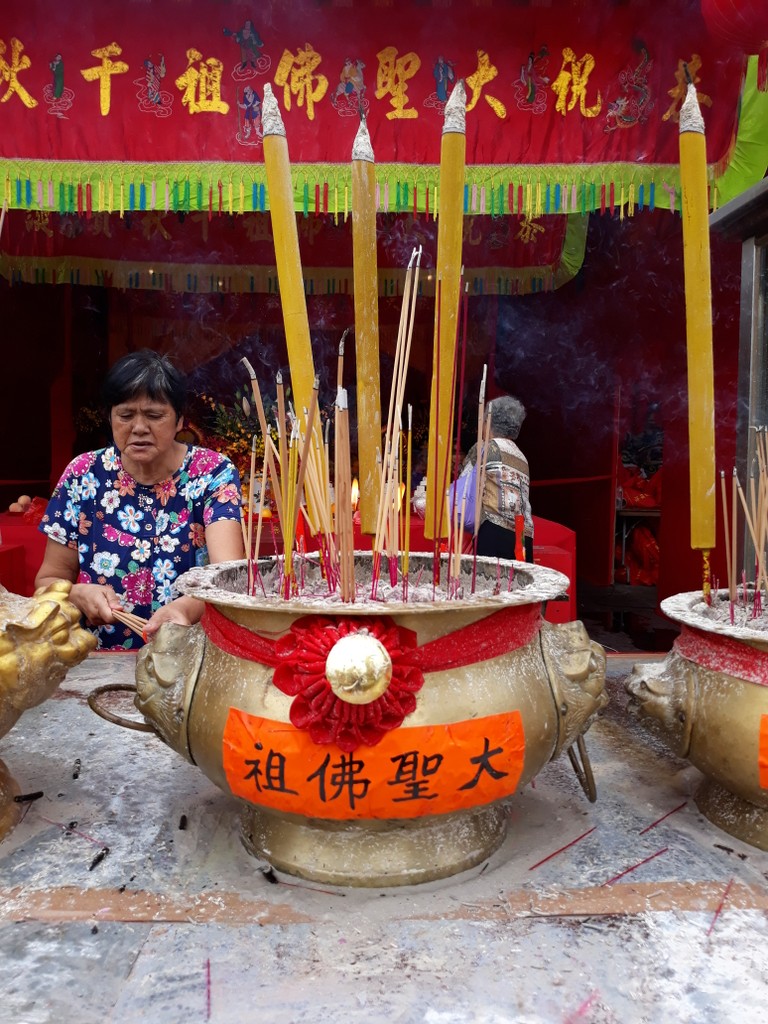
The Monkey King is worshiped in southern China, Taiwan, and Southeast Asian countries like Malaysia, Singapore, Thailand, and Vietnam as a great exorcist and protector of children. But it may come as a surprise to learn that he is rarely worshiped as the Buddha Victorious in Strife. Instead, Wukong is almost exclusively revered as the “Great Sage Equaling Heaven” (Qitian dasheng, 齊天大聖), and even when he is called a Buddha, the name usually includes some reference to the rebellious title. For example, when I attended the Monkey King’s birthday (sixteenth day of the eighth lunar month) in Hong Kong in 2018, I saw an incense pot labeled “Great Sage Buddha Patriarch” (Dasheng fozu, 大聖佛祖) (fig. 3).

So why isn’t Sun widely worshiped as the Buddha Victorious in Strife? I think the simplest answer is that the Buddha already had a long-established following and therefore couldn’t be subsumed under the late-blooming cult of a cultural hero, even one as popular as the Monkey King.

Fig. 3 – An incense pot reading “Great Sage Buddha Patriarch” (Dasheng fozu, 大聖佛祖) (larger version). Taken by the author in Kowloon, Hongkong (Sept. 24, 2018).

4. Precedent for Spiritual Promotion

The author-compiler likely connected Sun Wukong to the Buddha Victorious in Strife because of the Enlightened One’s war-like iconography (recall the sword and armor mentioned above). After all, Monkey is an armor-wearing martial deity wielding his magic staff to protect Tripitaka from untold numbers of demons and spirits.

But the choice to elevate Monkey in rank was likely influenced by previous media. For example, Wukong’s literary antecedent, the Monkey Pilgrim (Hou xingzhe, 猴行者), receives a promotion at the end of The Story of How Tripitaka of the Great Tang Procures the Scriptures (Da Tang Sanzang qujing shihua, 大唐三藏取經詩話), a late-13th century precursor of JTTW. The story ends thus: “Tang Taizong later enfeoffed Monkey Pilgrim as ‘Great Sage Steel Muscles and Iron Bones'” (Gangjin tiegu dasheng, 鋼筋鐵骨大聖) (Wivell, 1994, p. 1207). [3]

5. Conclusion

At the end of JTTW, the Buddha promotes Sun Wukong to the “Buddha Victorious in Strife” or “Victorious Fighting Buddha” (Dou zhansheng fo, 鬥戰勝佛). This is the Chinese name of Yuddhajaya (Sk: युद्धजय), the 31st of the 35 Confession Buddhas called upon during a confessional prayer to absolve oneself of sins. He is generally portrayed as a robe-wearing Buddha holding a sword and suit of armor. This is not a reference to the deity’s fighting prowess, however. Instead, his name and accoutrements symbolize the means by which he subjugates the negative emotions or actions that would otherwise keep man trapped in the illusory world of Saṃsāra.

Instead of being universally revered as the Buddha Victorious in Strife, the Monkey King is far more widely worshiped in East and Southeast Asia as the “Great Sage Equaling Heaven” (Qitian dasheng, 齊天大聖) or a variant like “Great Sage Buddha Patriarch” (Dasheng fozu, 大聖佛祖). This discrepancy is probably due to the original Yuddhajaya already having a long-established following. There’s no way that he could ever be subsumed under Sun Wukong’s late-blooming cult. 

Wu Cheng’en (or whoever the true author-compiler was) likely connected Monkey to the Buddha Victorious in Strife because both have martial iconography. Sun is commonly depicted wearing armor and wielding an iron staff, while Yuddhajaya is shown holding a sword and armor. But the concept of Sun receiving an elevation in spiritual rank goes back centuries. The Monkey Pilgrim, his literary antecedent from The Story of How Tripitaka of the Great Tang Procures the Scriptures (late-13th century), is deified by the Tang emperor as “Great Sage Steel Muscles and Iron Bones” (Gangjin tiegu dasheng, 鋼筋鐵骨大聖).


6. Updates

Update: 09-06-20

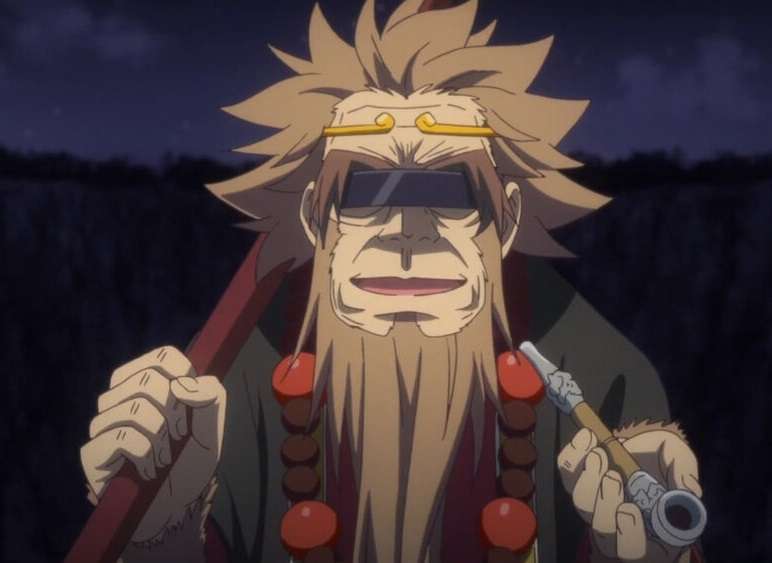
If you type “Buddha Victorious in Strife,” “Victorious Fighting Buddha,” “鬥戰勝佛” or “斗战胜佛” into google images, you’ll notice that these terms are almost exclusively associated with Sun Wukong. Most results are fan-made drawings of Monkey wearing his armor. Very few depict him as a Buddha. The only appearance of the latter in popular media that I’m aware is the Victorious Fighting Buddha from the manga / anime High School DxD.

The character is depicted as a jovial old dwarf with long, shaggy brown hair, bushy eyebrows that fall over a cyberpunk-style black visor, no mustache, a long beard, a floor-length, dark gray coat over a red robe, and monkey feet. He wears his famous golden fillet and a set of chunky brown and red prayer beads. In his left hand he holds a smoking pipe, while the right holds his magic staff, which is depicted as red and gold (fig. 4).

Fig. 4 – The Victorious Fighting Buddha from High School DxD (larger version).

The Victorious Fighting Buddha inhabits a universe where various factions of Western and Eastern gods, devils, and heroes battle one another. According to the story, upon ascending to Buddhahood, he steps down as the Monkey King, handing the title to a young descendant, and serves as the vanguard of the Hindu god Indra, during which time he protects the cosmos from a faction of devils and fallen angels. He later takes on the role of sub-leader and mentor to a new faction of young heroes whom he trains to battle god-tier opponents.

High School DxD portrays the Victorious Fighting Buddha as very powerful. For example, season four, episode six (minute 13:35) of the anime shows him effortlessly blocking the “True Longinus” spear with the tip of his index finger. This is quite a feat as this weapon is the same one used to pierce the side of Christ, thereby giving it the power to kill other gods.


Update: 03-22-21

I visited “Sage Buddha Hall” (Shengfo Tang, 聖佛堂), a Great Sage temple in Beigang, Yunlin, Taiwan and saw a few items labeled the “Fighting Sage Buddha” (Dou zhan sheng fo, 鬥戰聖佛) in place of the Buddha Victorious in Strife/Victorious Fighting Buddha. One such item was a paper fan (fig. 5). As noted above, Buddha Victorious in Strife/Victorious Fighting Buddha is not a reference to the deity’s fighting prowess, but his ability to “defeat the inner enemies of afflictive emotions and negative actions of sentient beings.” So it appears that this temple takes his martial skill at face value.


Update: 08-09-22

As an enlightened Buddha, Monkey is eligible for his own “Buddha-Field” (Sk: Buddhakṣetra; Ch: Focha, 佛刹), essentially his own universe in which he will lead the inhabitants to enlightenment. Buswell and Lopez (2014) explain:

[W]hen a buddha achieves enlightenment, a “container” or “inanimate” world is produced in the form of a field where the buddha leads beings to enlightenment. The inhabitant of that world is the buddha endowed with all the [qualities of an Enlightened One]. Buddha-fields occur in various levels of purification, broadly divided between pure and impure. Impure buddha-fields are synonymous with a world system (cakravāḍa), the infinite number of “world discs” in Buddhist cosmology that constitutes the universe; here, ordinary sentient beings (including animals, ghosts, and hell beings) dwell, subject to the afflictions of greed, hatred, and delusion. Each Cakravāḍa is the domain of a specific buddha, who achieves enlightenment in that world system and works there toward the liberation of all sentient beings… (p. 153).


Update: 01-22-23

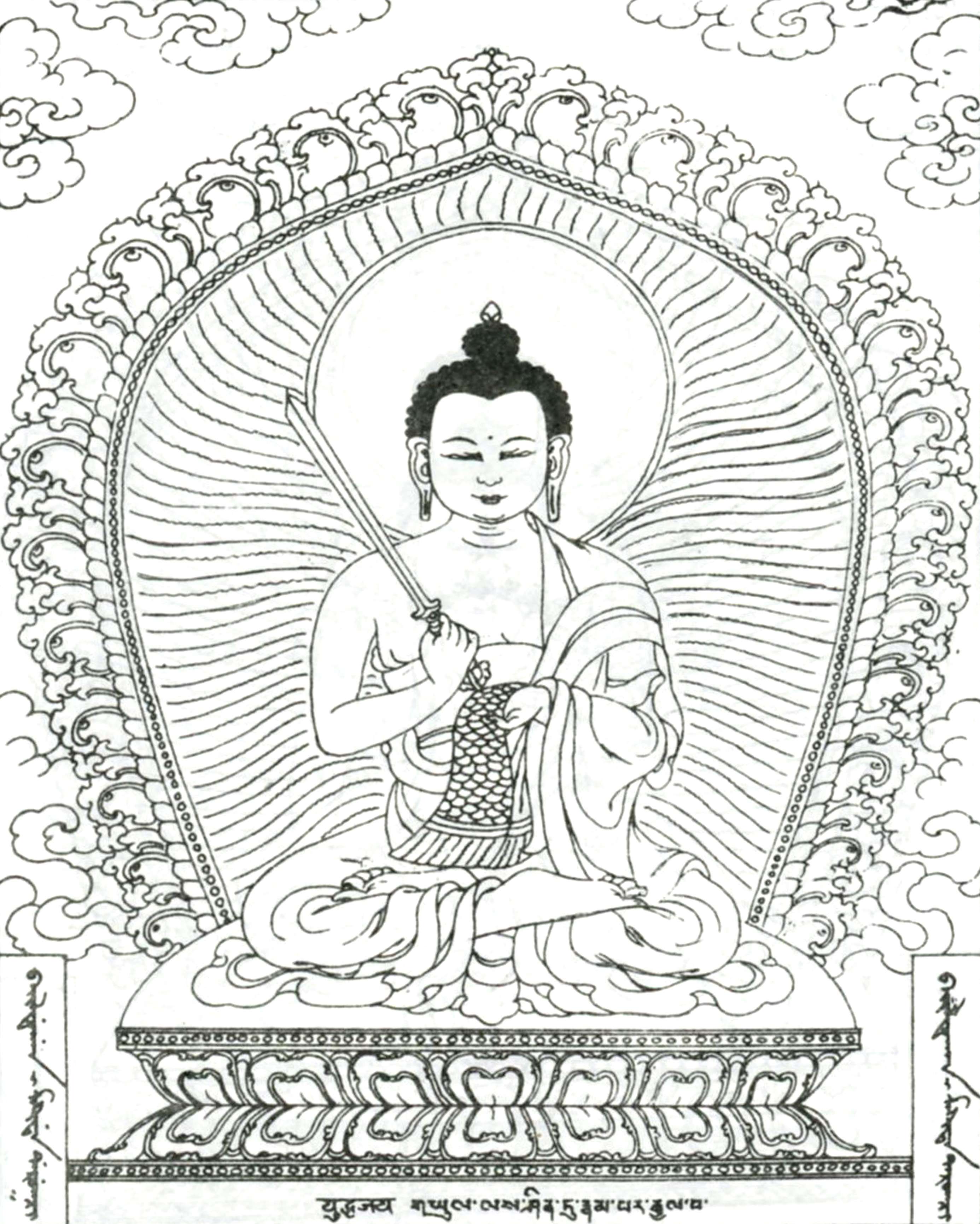
Chandra (1999) includes a lovely black and white line drawing of Yuddhajaya (fig. 6) (p. 94).

Fig. 6 – A traditional Tibetan drawing of Yuddhajaya (larger version). Image from Chandra, 1999, p. 94.


Update: 05-09-23

I commissioned NinjaHaku21 (Twitter, Instagram, and Tumblr) to draw Sun Wukong using Yuddhajaya’s traditional iconography (fig. 7), and the results are stunning! It is based on the design from figure two above.

Fig. 7 – A religiously accurate drawing of Monkey as the Yuddhajaya Buddha by NinjaHaku21 (larger version).


Update: 06-12-23

I have written a companion piece to this article about Tripitaka’s Buddha title.

The Tang Monk Tripitaka and the Buddha Candana Merit


Update: 09-11-23

Tumblr user @darkfalcon-z has drawn a lovely picture of the Monkey King as a Buddha (fig. 8). They explain their headcanon for the image:

[B]aby monkeys think Grandpa’s lotus throne is for playing.

[…]

I think Wukong got back to his mountain to take care of his monkeys. He does visit sometimes. He takes his favourite monkeys along for the ride. I don’t think it is much of a problem in Western Heaven in Buddha’s domain, because if you are enlightened the antics of little animals won’t really bother you. He’s told not to bring monkeys along next time as per formality. He does anyway. It’s not like anyone minds. He takes the monkeys along when he visits Jade Emperors domain. There monkeys are treated as nuisance and chased around, but no one actually dares to harm them, as they fear to incur his anger. He probably takes more troublesome monkeys too. On purpose.

I love the baby monkeys, as well as Wukong’s flower-like halo.

Fig. 8 – @darkfalcon-z’s Monkey Buddha (larger version). Used with permission.


Update: 11-07-2024

Above, I wrote: 

Wu Cheng’en (or whoever the true author-compiler was) likely connected Monkey to the Buddha Victorious in Strife because both have martial iconography. Sun is commonly depicted wearing armor and wielding an iron staff, while Yuddhajaya is shown holding a sword and armor.

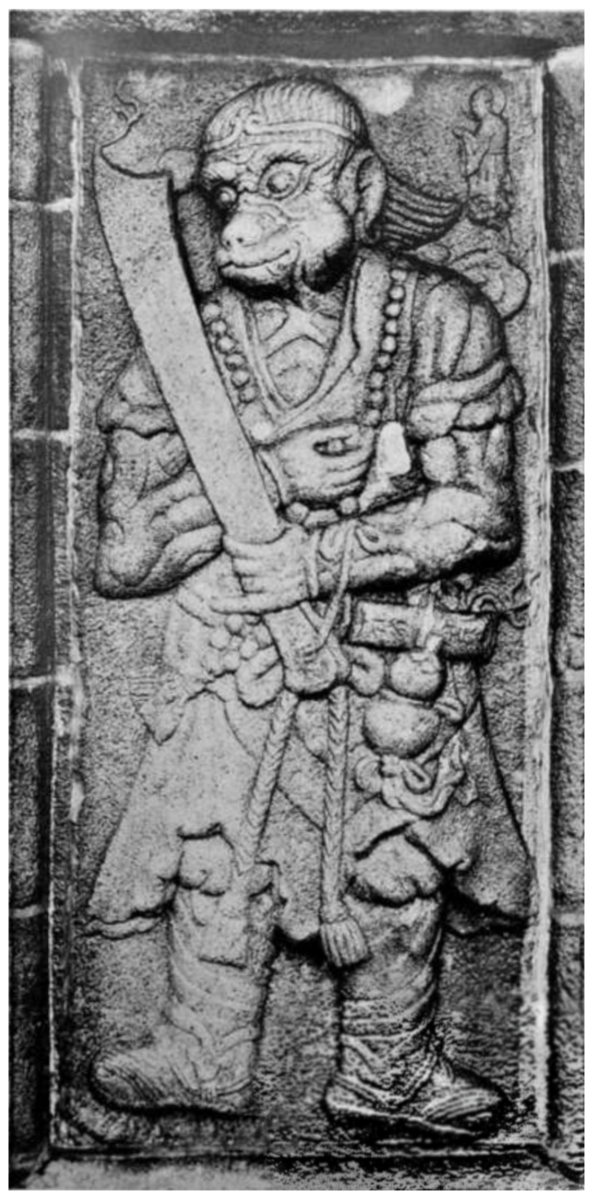
But it just dawned on me that Sun’s antecedent, the Monkey Pilgrim (Hou xingzhe, 猴行者), is also portrayed holding a divine sword in a 13th century stone relief carving (fig. 9). This weapon is referred to as his “Bodhisattva Sabre” (Pusa dao, 菩薩刀) in a 17th or 18th century tale appearing in a famous collection of Chinese folk stories. Therefore, it wouldn’t surprise me if this influenced the association with Yuddhajaya’s sword.

Fig. 9 – The Kaiyuan temple pagoda relief carving depicting Monkey holding a sword (larger version). Located on one of two 13th century stone pagodas of Kaiyuan Temple in Quanzhou City, Fujian Province, China.

I would also like to add some more drawings of Sun Wukong as a Buddha. The first two (fig. 10 & 11) are by a netizen who goes by @VirliebeAnatta (a.k.a. Bhante_Wukong) on Twitter and @his-shining-tears on Tumblr. Their work is very calming and welcoming.

Fig. 10 – The Monkey Buddha gazes upon the viewer with hands clasped (larger version). Image found here and here. Fig. 11 – A three-quarters view of the Monkey Buddha with head bowed and hands clasped (larger version). Image found here and here.

The third (fig. 12) is by Nhung Nguyen (twitter and instagram).

Fig. 12 – Nhung’s intense Monkey Buddha (larger version). The image was first seen on a JTTW discord, but it can also be found here and here.

The fourth (fig. 13) is by Saknarin Bowonkitmanee (a.k.a. Move Saknarin), a member of the the ศรัทธาอากงไต่เสี่ยฮุกโจ้ว (大聖佛祖) Thailand Facebook group.

Fig. 13 – Move’s serene Monkey Buddha (larger version). Image found here.


Update: 11-16-24

Figure 13 above was the bases for this lovely Thai statue of the Monkey Buddha (fig. 14).

Fig. 14 – The Thai Monkey Buddha idol (larger version). Image found here.


Update: 06-13-2025

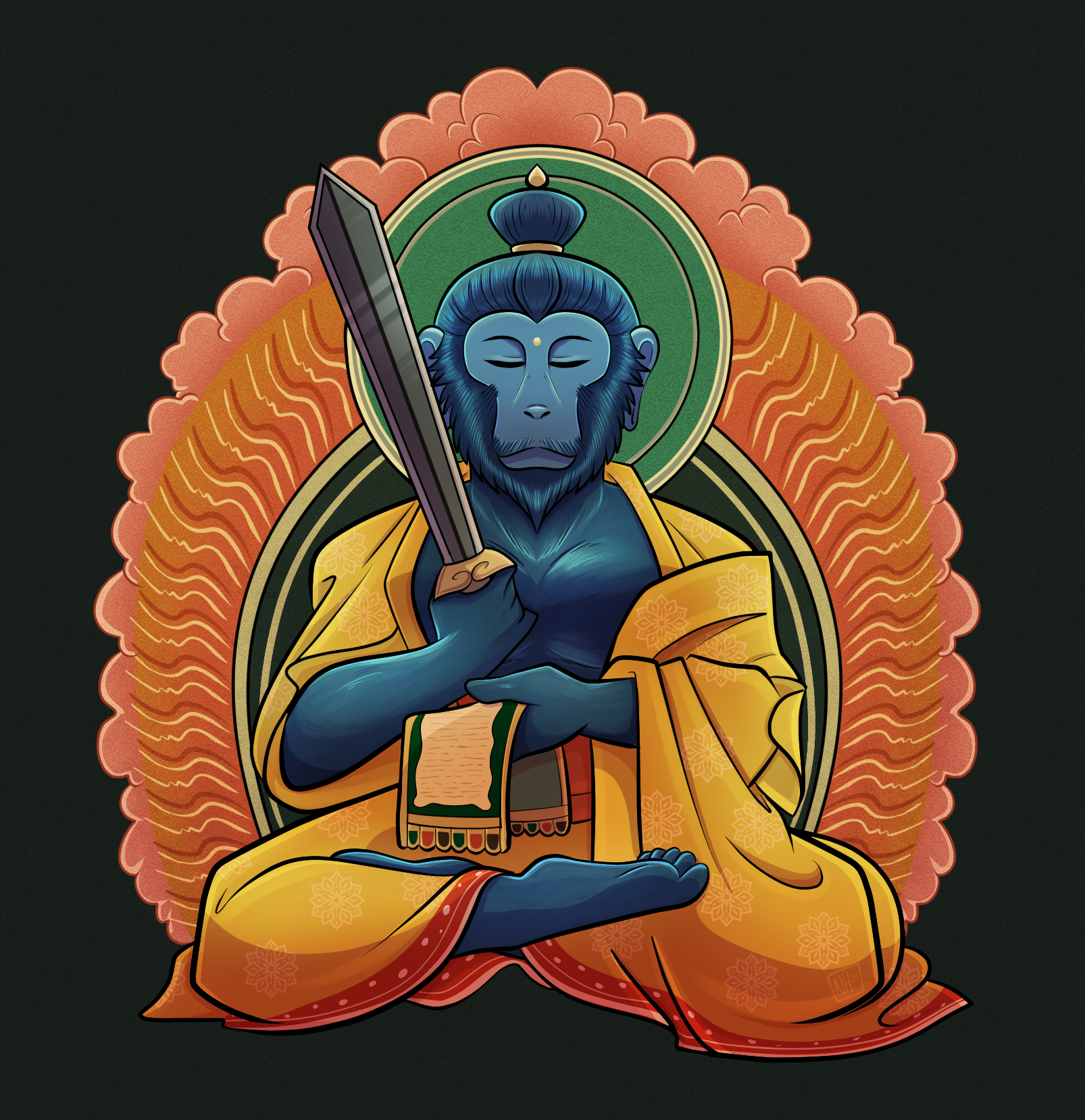
In late-2024, I commissioned friend of the blog NingadudeXx to draw Monkey as Yuddhajaya using their colorful style. The finished piece (fig. 15) was delivered in mid-January 2025.

Fig. 15 – NingadudeXx’s colorful Monkey Buddha (larger version).

On a related note, I learned that Yuddhajaya has a secondary name, Vijita-saṃgrāma (Ch: Yongjian jixiang fo, 勇健吉祥佛; Viet: Dũng Kiện Cát Tương Phật), or the “Brave and Auspicious Buddha” (source). The Chinese version of his title is listed in the 8th century Names of the Thirty-Five Buddhas Spoken by the Buddha (Ch: Foshuo sanshiwu foming lichan wen, 佛說三十五佛名禮懺文) (originally linked above).

Interestingly, the farthest back that I can trace the term Dou zhansheng fo (鬥戰勝佛, i.e. “Buddha Victorious in Strife”) on CBETA is the 12th or 13th century Ritual for the Tathāgata’s Extensive Filial Piety’s Ten Kinds of Recompensating (Parents’) Kindness (Rulai guangxiao shizhong bao’en daochang yi, 如來廣孝十種報恩道場儀) (see here). Therefore, Vijita-saṃgrāma appears to be a much older name.

Spread the gospel of the Brave and Auspicious Buddha!!!

Notes:

1) Compare the list from the Chinese version to those listed here. The characters may vary slightly.

2) I am grateful to Joris Baeyens of Ghent University Library for providing me with scans of Bunce (1994).

3) Source slightly altered.

Sources:

Bunce, F. W. (1994). An Encyclopaedia of Buddhist Deities, Demigods, Godlings, Saints and Demons: With Special Focus on Iconographic Attributes (Vols.1-2). New Delhi: D.K. Printworld.

Buswell, R. E., & Lopez, D. S. (2014). The Princeton Dictionary of Buddhism. N: Princeton University Press.

Chandra, L. (1999). Buddhist Iconography: Compact Edition. New Delhi: International Academy of Indian Culture & Aditya Prakashan.

Lai, D. (2016, September 3). 35 Confessional Buddhas. Retrieved from www.davidlai.me/2016/09/03/35-confessional-buddhas/.

Wu, C., & Yu, A. C. (2012). The Journey to the West (Vol. 4). Chicago, Illinois: University of Chicago Press.

Musings on Journey to the West and my new Great Sage Tattoo

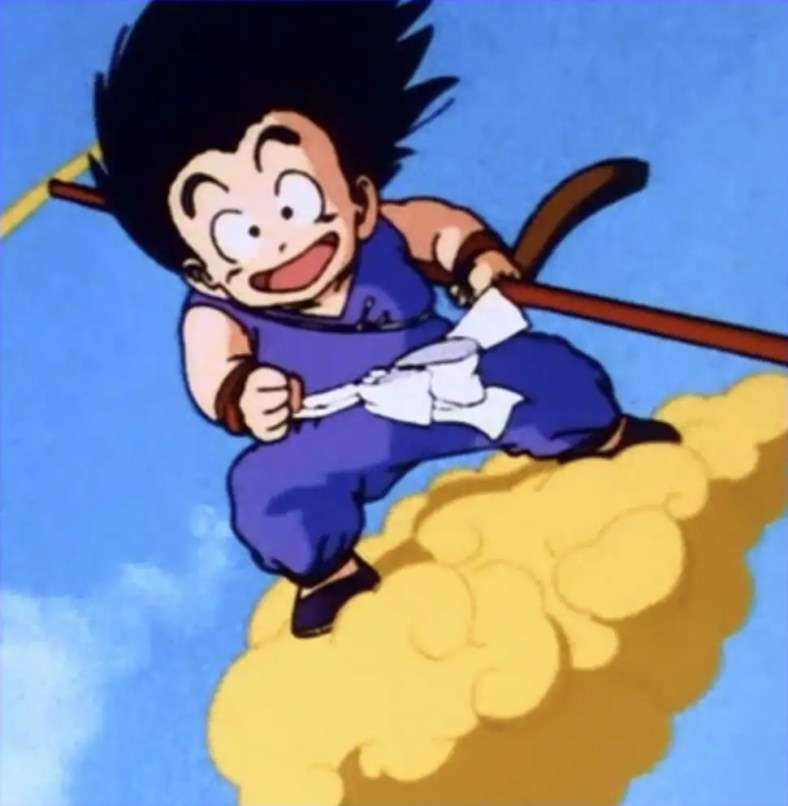
I was a big fan of mythology as a child, particularly enjoying the adventures of the Greek and Norse pantheons. Then, one day, my mother bought me a book on world mythology, and I read about a certain Sun Wukong, a monkey deity that reminded me of my favorite anime hero Son Goku from the Dragon Ball franchise. In my youthful naivety, I thought this monkey was a knockoff of my beloved Saiyan. For instance, both have monkey features, fly on clouds, and wield extending staves. But I was humbled to learn years later that the flow of influence actually went in the opposite direction.

Young Goku flying on his cloud (larger version).

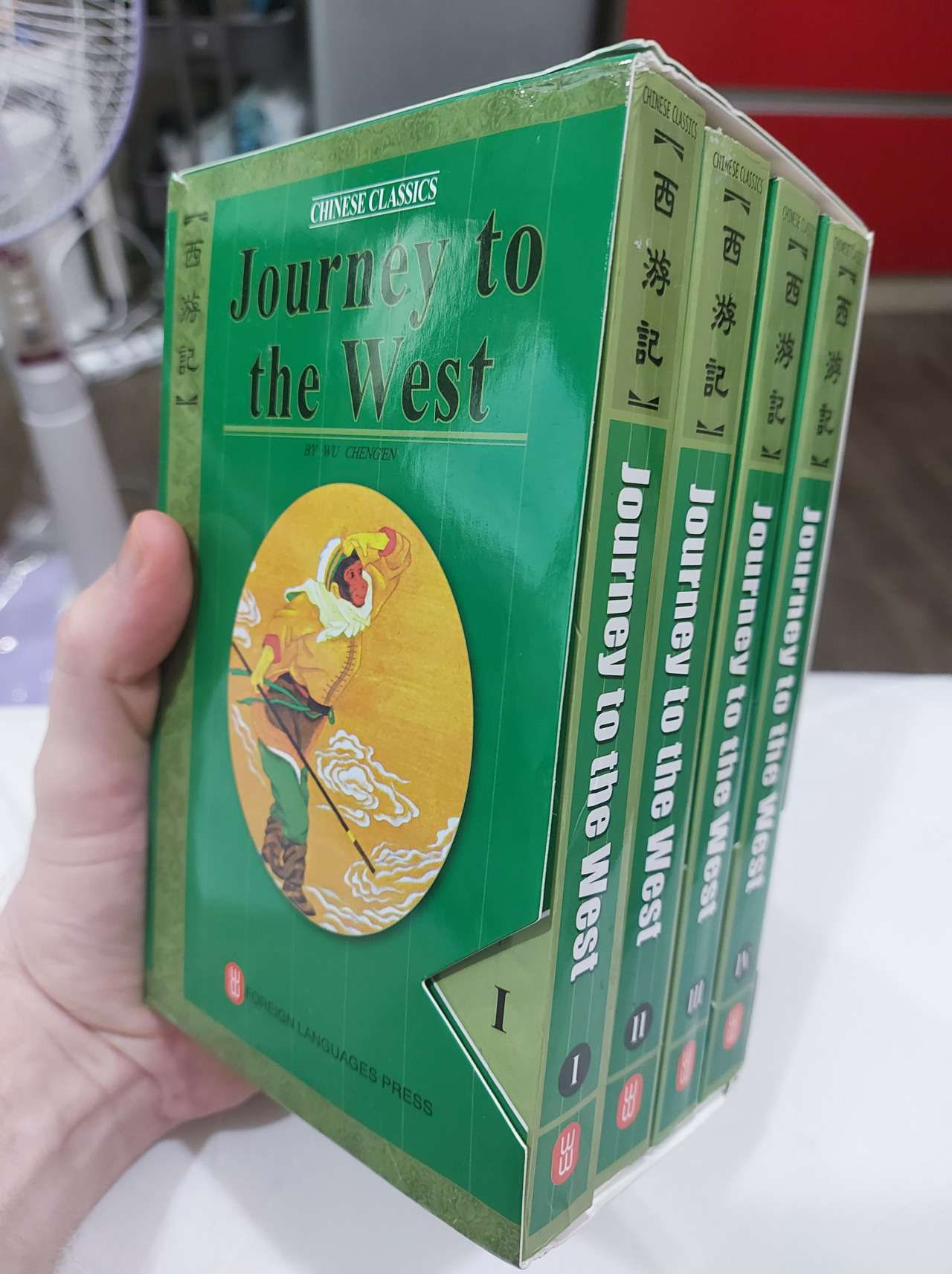
I don’t remember exactly how—perhaps reading about it on the internet—but I confirmed the connection between both characters around 2001 while serving in the US Army 82nd Airborne Division. I shortly thereafter purchased the W. J. F. Jenner four-volume boxed edition of Journey to the West to learn more about Sun Wukong and his adventures. I immediately fell in love with the character, especially during the first seven chapters in which he comes to rebel against heaven. What’s not to love about a little stone monkey who, through his own hard work and determination, gains the power to bring the heavenly hierarchy to its knees? The fear that he continues to instill in gods even after his fall from grace and redemption, as well as the tit-for-tat relationship with his religious brother Zhu Bajie, still makes me laugh to this very day.

Journey to the West has been an integral part of my life for nearly 20 years. My foray into research did not happen until the latter part of college. This blog stands as a testament of my continued dedication to the novel. My love for the work grows deeper and deeper as I learn new things to share with my readers. This is especially true as the Anthony C. Yu 2012 revised edition has so much juicy background information. I often use it as a stepping stone to discover new concepts overlooked by previous scholarship.

The four-volume box set in my collection (larger version).

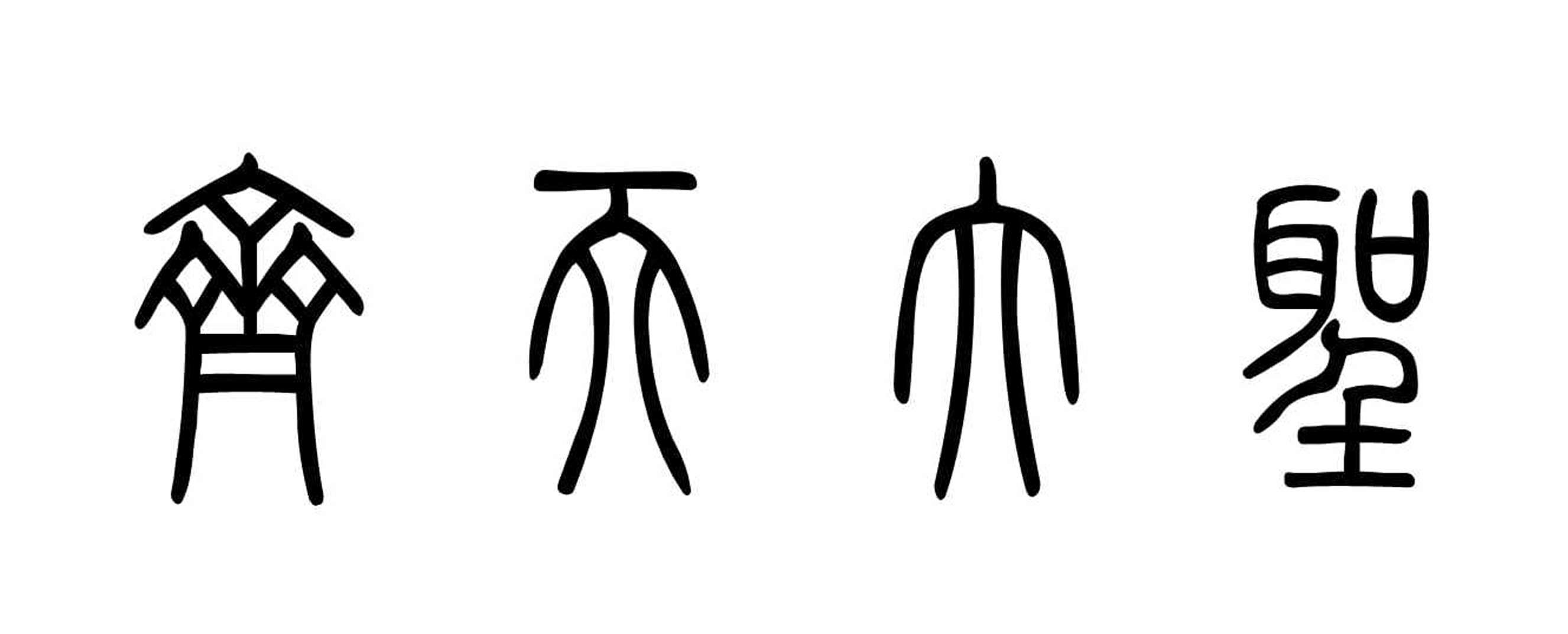
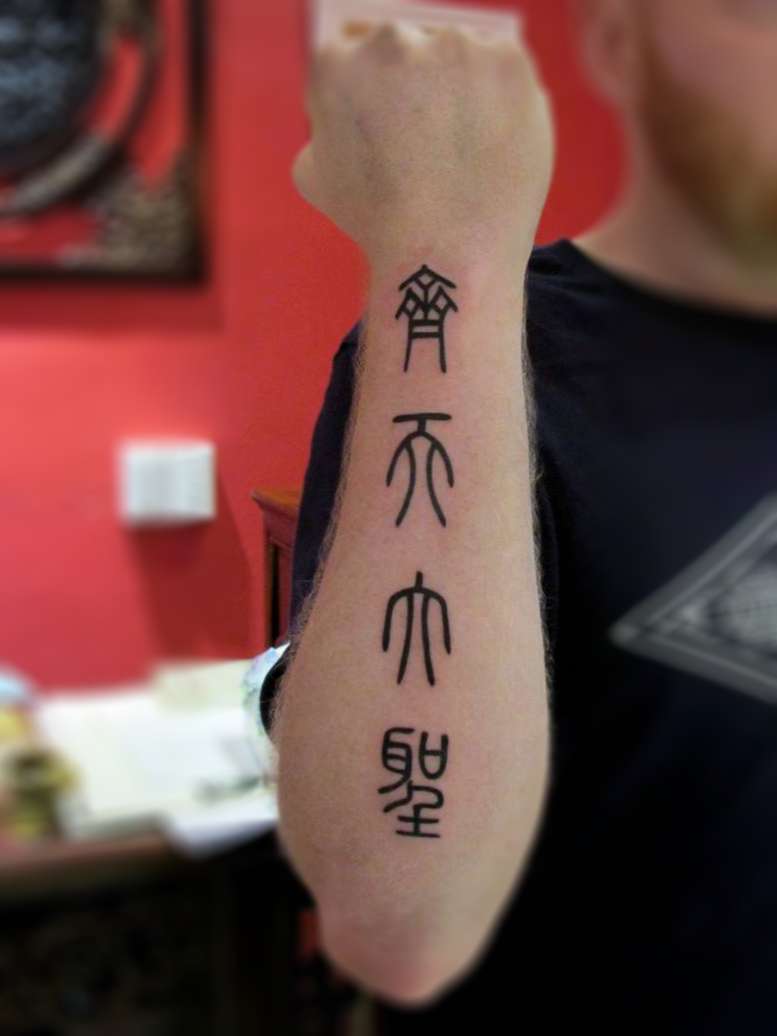
I’ve wanted to get a Monkey King tattoo for years but never liked anything I saw, not even my own novel accurate designs. I finally accepted that I would never find the bright, flashy piece that agreed with my strict standards of authenticity. I instead opted to start simple by getting the characters for “Great Sage Equaling Heaven” (Qitian Dasheng, 齊天大聖) because I felt it accurately reflected my interests. I chose Seal Script because I wanted the piece to have an ancient feel, something that is, if only briefly, arcane to even modern native readers like those in Taiwan where I live. I can’t wait to show it to some of my friends in Tainan who actively worship the Great Sage.

The seal script characters (larger version).

The piece was done by Judy Chang of the Red Room in Banqiao District, New Taipei City, Taiwan.

My tattoo (larger version).


Story Idea: Master Subodhi’s Curriculum II – Immortal Warriors and Shaolin Monks – Some Fun Monkey King Fanfiction Speculation

From time to time I like to post a fun blog not directly related to (though informed by) my research. A past example can be seen here. Regular articles will resume after this entry.

Last Updated: 05-15-2022

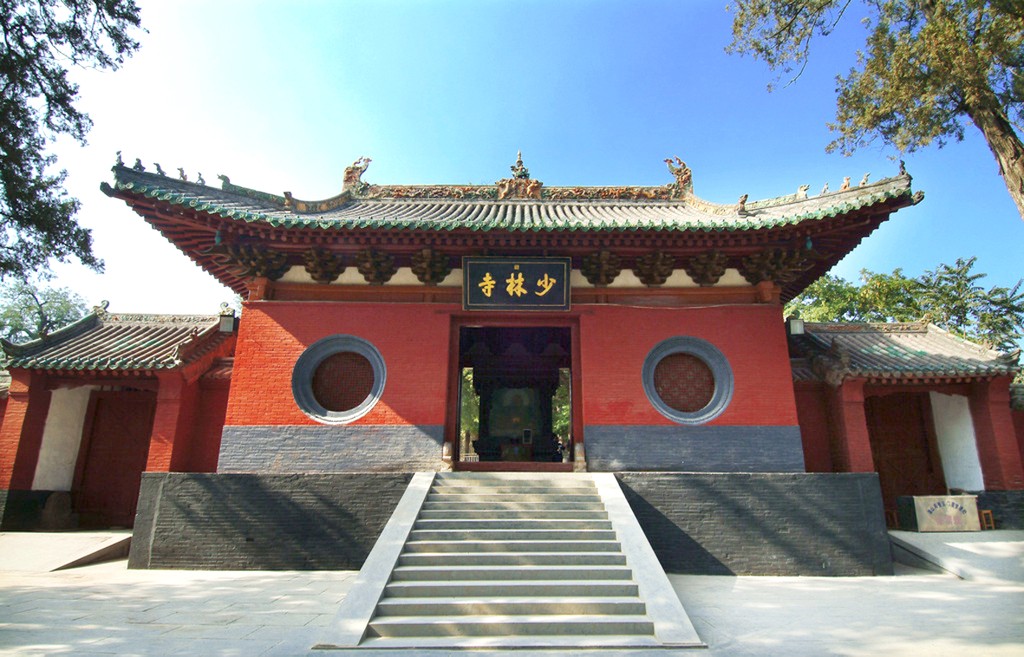
As noted in part one, the immortal sage Subodhi teaches Sun Wukong Chan (Zen) and Daoist philosophy; the secret of immortality; the 72 heavenly transformations; cloud-somersaulting; general Daoist magic; military arts like troop maneuvering, weapons, and boxing; and medicine. But why would a Daoist monk need to know how to wield weapons and fight in battle formations? In this piece, I would like to speculate that the Sage’s school is a training ground for an immortal monastic army! I am by no means suggesting that there is actual textual support for my conjecture. This is purely a fun exercise, fodder for fanfiction, if you will. I plan to supplement what we already know from the novel with historical information about monastic armies in China, particularly focusing on the warrior monks of the famed Shaolin Monastery (Shaolin si, 少林寺) (fig. 1).

Fig. 1 – The front gate of Shaolin (larger version).

Table of Contents

1. The Evolution of Shaolin’s Monastic Army: A Brief Survey

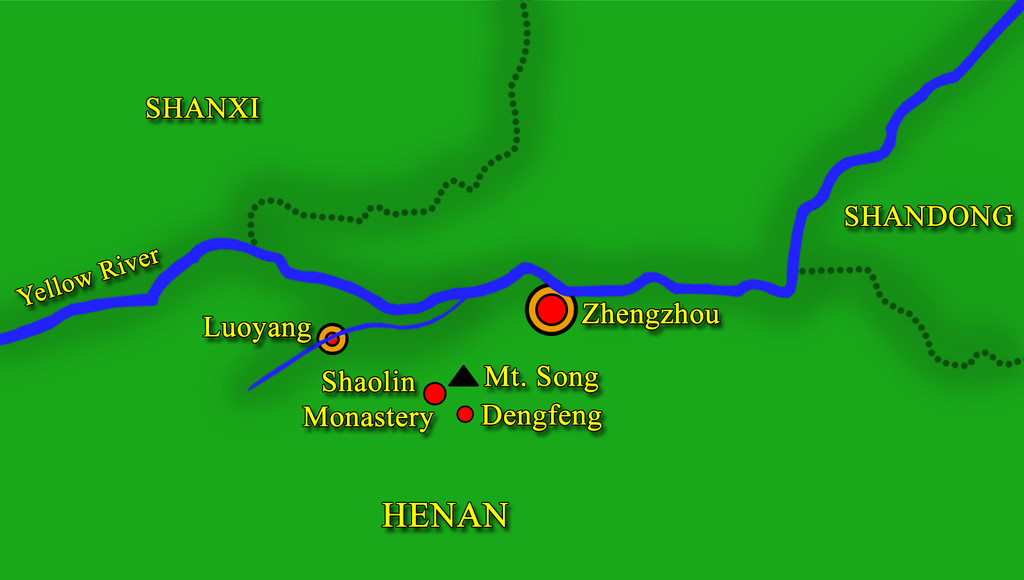
Founded in 496 during the Northern Wei Dynasty, the Shaolin monastery was built on Song Mountain, a mountain range located in Henan Province, China (fig. 2). It became the home of Chan Buddhism and a center for Buddhist learning, even attracting the likes of Xuanzang (on whom Tripitaka is based), whose request to move there in 645 was denied by the Tang Emperor Taizong (Shahar, 2008, p. 17). Despite being a school of higher religious learning, the monastery later came to be associated with elite warriors. The term “Warrior Monk” seems like an oxymoron considering that Buddhism is generally considered a religion of peace. However, evidence suggests that the monks may have first taken up arms to protect their property, for monasteries were often lavishly decorated and laden with treasures from rich donors, making them prime targets for bandits (Shahar, 2008, p. 18). For example, one of Shaolin’s worst bandit raids took place in 1356 when Red Turban rebels attacked, “peeling off the gold coating of the Buddha images and breaking the statues in search of hidden treasures,” eventually destroying part of the complex (Shahar, 2008, p. 85).

Fig. 2 – A map showing the location of Shaolin and the nearby town of Dengfeng in northern Henan (larger version). The ancient Sui and Tang capital of Luoyang is visible to the left, while the modern day capital of Zhengzhou is visible to the right. Henan shares a border with the provinces of Shanxi and Shandong to the north. Adapted from Shahar, 2008, p. 10. By the author.

The first documented case of Shaolin monks protecting their monastery took place in 610 when they repelled a bandit attack that saw many of their stupas burnt. Their combat experience would come in handy years later when, in 621, the monks aided Li Shimin, the future Emperor Taizong of the newly formed Tang Dynasty, by assaulting a stronghold and capturing the nephew of Wang Shichong, a former general of the defunct Sui Dynasty and the founder of a competing dynasty. Wang had captured valuable farmland belonging to Shaolin and established the stronghold there because it was located in a valley through which passed the strategically important route to the Sui capital of Luoyang. The monks’ intervention was not a display of loyalty to the fledgling Tang but solely a move to regain control of their property, a political gamble that paid off and benefited the monastery for centuries (Shahar, 2008, pp. 25-27). Three of the monks who took part in the battle were awarded titles by Li. One in particular was given the high military rank of Generalissimo (Da Jiangjun, 大將軍) (Shahar, 2008, p. 31). This wasn’t the last time Shaolin soldier monks came to the aid of the Chinese empire.

By the late-Ming Dynasty, Shaolin was famed far and wide for their mastery of the staff, their method appearing in various military encyclopedias. The interest in their martial prowess was likely spurred by news of their military victories during the 1550s against the Wokou (倭寇, “Dwarf/Japanese pirates”), a conglomeration of Japanese, Chinese, and Korean sea bandits who plagued China’s eastern and southeastern coasts (fig. 3). The Ming’s hereditary army was all but useless at this time, forcing local governments to rely more on prefectural level troops (xiang bing, 廂兵), including contingents of Buddhist warrior monks from different monasteries (Shahar, 2008, p. 68). Monks from Shaolin and sister temples were mobilized in the spring of 1553 and fought the pirates a total of four times through the autumn of 1555. Shahar (2008) explains:

The monks scored their biggest victory in the Wengjiagang battle. On July 21, 1553, 120 fighting monks defeated a group of pirates, chasing the survivors for ten days along the twenty-mile route southward to Wangjiazhuang (on the Jiaxing Prefecture coast). There, on July 31, the very last bandit was disposed of. All in all, more than a hundred pirates perished, whereas the monks suffered four casualties only. Indeed, the monks took pity on no one in this battle, one employing his iron staff to kill an escaping pirate’s wife (p. 69).

It’s interesting to note that the head priest who led the monastic army in their victory over the Wokou was himself from Shaolin and was documented to have single-handedly defeated eight armed monks from a neighboring temple who challenged his position (Shahar, 2008, pp. 69-70).

Fig. 3 – Detail from a Ming painting depicting soldiers fighting the Wokou (larger version). More information about the scroll can be seen here.

In a chapter titled “The Monastic Armies’ First Victory” (Seng bing shou jie ji, 僧兵首捷記, 1568), the geographer Zheng Ruoceng extolled Shaolin’s skill and called for their regular use, along with other holy warriors from sister temples, in combat:

In today’s martial arts, there is no one in the land who does not yield to Shaolin. Funiu [in Henan] should be ranked as second. The main reason [for Funiu’s excellence] is that its monks, seeking to protect themselves against the miners, studied at Shaolin. Third comes Wutai [in Shanxi]. The source of the Wutai tradition is the method of the “Yang Family Spear” (Yangjia qiang), which has been transmitted for generations in the Yang family. Together, these three [Buddhist centers] comprise hundreds of monasteries and countless monks. Our land is beset by bandits inside and barbarians outside. If the government issues an order for [these monks’] recruitment it will win every battle (Shahar, 2008, p. 70).

The warrior monks were just one type of disciple at Shaolin. For example, modern Shaolin has four types: 1) ordained monks; 2) ordained martial arts monks who often leave to open their own schools around the monastery or abroad; 3) non-ordained martial arts performers (a.k.a. “fake monks”); and 4) lay disciples. Only the first type strictly adheres to Buddhist dietary laws. The martial type are historically known for eating meat and drinking alcohol, associating the former with physical strength and fighting ability. During the Ming and Qing Dynasties, such monks lived in subsidiary shrines (fangtou, 房頭) away from the monastery proper or lived an itinerant lifestyle (Shahar, 2008, pp. 46-51). Therefore, the warrior monks who bloodied their hands during wartime and regularly ate meat lived away from the devout, vegetarian body within the main monastery. Their unruly nature was for the most part accepted because of the protection they provided.

2. Story Idea

Now the fun begins! Here I would like to take what we know about the novel (part one) and the above information to speculate on the martial history of Subodhi’s school.

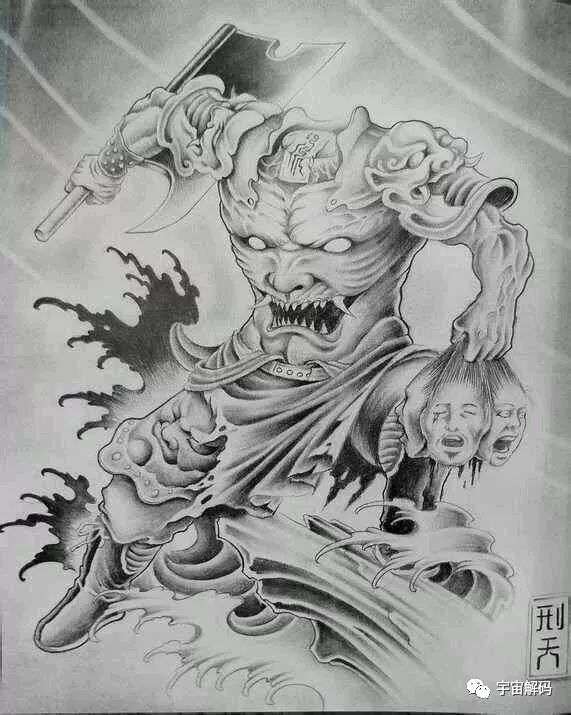
Like Shaolin, Subodhi’s school is located in the mountains and most likely houses great heavenly treasures, the likes of which might be sought after by demon kings. Conflict with these demons would naturally necessitate the immortal monks take up arms in defense of their school. Continued conflict would allow them to hone their skills until their services might be called upon by one of two celestial factions vying for control of heaven during times immemorial, much like Li Shimin’s struggle against Wang Shichong. Chinese mythology is full of numerous baddies threatening the primacy of heaven. One in particular is the headless deity Xingtian (刑天) (fig. 4) from the Classic of Mountains and Seas (c. 4th–1st century BCE):

Xingtian and the Supreme God Di came to this place and struggled against each other for ultimate power. The Supreme God cut off Xingtian’s head and buried him at Eternally Auspicious Mountain. Xiangtian’s nipples then transformed into eyes, and his navel became a mouth. He performs a dance with an ax and shield (Strassberg, 2002, p. 171).

Xingtian was originally a retainer of the Flame emperor, who lost his bid for power against the Yellow Emperor. Xingtian then continued his master’s war, even refusing to die after being beheaded (Strassberg, 2002, p. 171).

Fig. 4 – A modern depiction of Xingtian (larger version). Artist unknown.

The deity’s sustained, obsessive defiance, illustrated by his war dance, could serve as an ever present threat working in the shadows, waiting and plotting. Perhaps untold millennia after his first defeat, Xingtian amasses a huge army that attacks the celestial realm via the Tianhe (天河, “Heavenly River), or the Milky Way, much like the Wokou attacked the Chinese coast by sea. The Yellow Emperor then calls up Master Subodhi’s immortal warriors to help neutralize the threat, emerging victorious and winning the admiration of deities throughout the cosmos like their Shaolin counterparts.

So where does Sun Wukong fit in to this fanciful yarn? As an ordained-martial monk, Monkey would regularly train in weapons and fight in the monastic army, possibly rising through the ranks due to his supernatural talent and becoming a general who leads an assault against Xingtian’s forces. (Perhaps he would even have to defend his position against older, jealous immortals, much like the aforementioned Shaolin monk during the Ming.) Sun’s time in the monastic army would explain why, as noted in part one, the young immortal knows how to train his monkey children to march, go on patrol, follow orders directed by flags and battle drums, and advance and retreat. Only a person who studied military classics and had prior experience with leading troops would have such knowledge.

This in turn would explain why Subodhi expels Monkey and warns him to never reveal the sage had been his teacher. Sun Wukong is a powerful immortal and seasoned fighter with vast magical powers. Combine that with little impulse control and you’ve got the makings of a demon. Heaven discovering that Subodhi had trained the very demon who came to rebel against it would stain the sage’s name and the achievements of his school.

I would love to see someone use this information to write a prequel set during Sun Wukong’s time in Subodhi’s monastery.


3. Updates

Update: 09-18-21

Sun is originally expelled from Subodhi’s school for flaunting his newfound powers of transformation (Wu & Yu, 2012, vol. 1, pp. 123-124). But given Monkey’s ability to acquire amazing powers in just three short years, perhaps Subodhi fears his student’s potential for exponential spiritual growth. Whether this is because he sees a spark of malice in his disciple or he’s just plain jealous (the former seems more likely), Subodhi could just use the transformation as an excuse to halt his progression. But imagine Sun after another three years! I imagine high-level cosmic beings like the Buddha would be interested in keeping an eye on his progress.


Update: 05-15-22

I’ve posted an article that expands on the ideas from above.

Story Idea: The REAL Reason Sun Wukong is Expelled from Subodhi’s School

Sources

Shahar, M. (2008). The Shaolin Monastery: History, Religion, and the Chinese Martial Arts. Honolulu: University of Hawai’i Press.

Strassberg, Richard (2002). A Chinese Bestiary: Strange Creatures from the Guideways Through Mountains and Seas. University of California Press.

Wu, C., & Yu, A. C. (2012). The Journey to the West (Vols. 1-4) (Rev. ed.). Chicago: University of Chicago Press.

The Later Journey to the West: Part 2 – The Journey to India Begins

Note: An AI translation of this novel is now available. Click the linked Chinese characters below that read “後西遊記.”

The main body of Later Journey to the West (Hou Xiyouji, 後西遊記, 17th century) follows a similar trajectory as the parent novel, Journey to the West (Xiyouji, 西遊記, 1592). The historical monk Dadian (大顛, 732–824) (fig. 1) is tasked with traveling from China to India to retrieve spiritual knowledge from the Buddha, and just like Tripitaka, he is protected by three demonic disciples, namely Sun Luzhen (孫履真), the descendant of Sun Wukong, Zhu Yijie (豬一戒), the son of Zhu Bajie, and Sha Zhihe (沙致和), the disciple of Sha Wujing. Along the way the group travels through many lands, battles numerous evils, and they eventually become enlightened Buddhas like their predecessors two hundred years prior. As noted in part one, Later Journey to the West may appear like a carbon copy of the original, but the similarities are only skin deep since the novel is comprised of extremely dense layers of allegorical meaning.

Below, I present the second of a three-part summary of the novel (part 1 and part 3), which focuses on the journey proper. I rely very heavily on Xiaolian Liu (1994) as the novel has yet to be published in English.

Notes have been added to the sections below to explain the allegorical meaning of various story elements.

Table of Contents

1. The Interpretation Pilgrim is Chosen

After quelling his descendant’s rebellion, Buddha Sun Wukong travels eastward by cloud with Buddha Tripitaka to see how China has benefited from the scriptures delivered by them some two centuries in the past. However, they find that the monks of the Famen temple (Famen si, 法門寺) are not only falsely claiming to have holy relics from Tripitaka’s deceased human body, [1] but also that their leader is his sixth generation disciple and a master of the sutras. This influences Tang Emperor Xianzong (唐憲宗, r. 806-820) to donate heavily to the temple because he believes that the dynasty will prosper once the pagoda containing the supposed relics is opened. The two Buddhas return to the Western Paradise and report their findings to Tathagata, who tells them that the Chinese will continue to misunderstand and misuse the teachings until they receive the “true interpretation” (zhenjie, 真解). The Enlightened One then charges Tripitaka with locating a pilgrim who will make the journey to India to retrieve this interpretation. [2]

In the meantime, the scholar-official Han Yu (韓愈, 768–824) openly criticizes the emperor for his worship of the relics and his spendthrift support of the temple. For this he is exiled from Shaanxi province in the north to Guangdong province in the south, where he meets the Chan Buddhist Master Dadian. [3] Upon hearing of the decadent, misguided state of Buddhism near the capital, Dadian goes north and memorializes the emperor to give up his extravagant patronage of the religion. This show of integrity cements Tripitaka’s decision to choose the monk as his pilgrim. The Buddha then magically seals away the scriptures, forcing the Emperor to send Dadian to India to retrieve the true interpretation.

124782997

Fig. 1 – A woodblock print of the monk Dadian.

2. The Journey to India Begins

The novel has a total of 40 chapters. Liu (1994) only covers certain chapters from this point on since they contain the most allegorical meaning.

Dadian acquires his demonic disciples during the early stage of his journey. First, he recites a magic spell taught to him by Tripitaka which calls Sun Luzhen to his side. Second, he recruits Zhu Yijie on the road after the pig is subdued by Monkey and made to follow the priest west. Third, Dadian accepts Sha Shihe as his last disciple after the water spirit saves him from a monster that had dragged him to the bottom of the Flowing Sands River.

Prior to Sha Shihe joining the group, Monkey, Dadian, and Yijie travel through the sister villages of Ge (葛, “Creepers”) and Teng (籐, “Clinging Vines”), which are both plagued by bottomless pits that appear and swallow untold numbers of people. [A] The elders of these respective villages tell the pilgrims that the source of this calamity is a demon known as King Defect (Quexian wang, 缺陷王), who lives on the Mountain of Imperfection (Buman, 不滿, lit: “Not full”). The monster feeds on the negativity of people whom he curses with poverty, divorce, disease, etc., and those who don’t worship him are swallowed by the ground to be imprisoned forever. Luzhen retrieves a magic golden treasure from heaven that stops the demon from burrowing underground; however, when he flees into a cave, the pilgrims’ path is blocked by seemingly indestructible vines that regrow as soon as they are cut. But Monkey discovers the vines fail to grow if he cuts them while not talking. [B] The group follows suit and they are able to capture and kill the demon, who is revealed to be a badger spirit.

A) These names refer to Geteng (葛籐, Creepers and Clinging Vines), a term used in Buddhist literature to refer to the net of desire that ensnares humans. Liu (1994) notes the Avadanas Scripture (Chuyao jing, 出曜經, late-5th to early-6th cent.) contains two mentions of the term, one of which reads: “Entrapped in the net of desires, common people are bound to undermine the right (orthodoxy) way … like the creepers and vines which twine round a tree and eventually cause its death” (p. 70).

B) The aforementioned creepers and clinging vines also refer to Geteng Chan (葛籐禪, Wordy Chan/Zen), a term often applied “to people who resort to long-winded words or writings, rather than to their intuitive perceptions to grasp the essence of Buddhist principles” (Liu, 1994, p. 71). This love for speaking/writing is believed to hinder the path to enlightenment. This explains why the vines stop growing when Monkey stops talking. The group, in essence, frees themselves from Wordy Chan and relies more on intuition. This puts them one step closer to enlightenment.

After passing the Flowing Sands River and bringing Sha Shihe into their fold, the group travels to the Mountain of Deliverance lorded over by King Deliverance (Jietuo dawang, 解脫大王). He and his demon generals maintain 72 chasms where humans fall prey to their desires (sex, money, alcohol, anger, etc.) and 36 pits where sinners are tortured. [C] During a battle with the demon army, Zhu Yijie resists promises of sex, food, and treasures offered by the generals, but lets his guard down due to flattery and is captured. [D] Dadian is captured by seven demons displaying a range of emotions from joy to hatred. [E] The monk clears his mind and falls into a deep meditative state undisturbed by the outside world. It is only when Monkey comes to his rescue that Tripitaka regains consciousness. [F] In the end, Luzhen manages to kill King Deliverance by crushing him under the weight of a huge boulder that he had transformed into an exact likeness of himself. This causes all of the generals and the chasms and pits to disappear. The author provides an explanatory couplet.

When the heart (mind) is active,
All kinds of demons come into existence;
When the heart (mind) is extinguished,
All kinds of demons disappear (Liu, 1994, p. 77).

心生種種魔生,心滅種種魔滅。

C) The demon king and generals are physical embodiments of desires that keep people from attaining enlightenment.

D) This represents the consequence of temptation, no matter how small.

E) These demons represent the seven emotions of joy, anger, sorrow, fear, love, hate, and desire.

F) Dadian’s capture represents those who erroneously think meditation is simply sitting quietly instead of inner reflection and the examination of truths. His inability to focus his mind is the real reason for his capture. Monkey represents the mind, so his arrival allows the monk to regain consciousness. Therefore, this episode teaches one to focus the mind and thereby not fall prey to desires. This is yet another step closer to enlightenment.

QQ截图20160221185741

Fig. 2 – The immortal Zhenyuanzi as depicted in the famous 1986 television series.

The pilgrims travel to the Temple of Five Villages (Wuzhuang guan, 五莊觀) in the Mountain of Longevity (Wanshou shan, 萬壽山), where they are met by the supreme immortal Zhenyuanzi (鎮元子) (fig. 2), the patriarch of all earthly immortals and a temporary adversary in chapters 24 to 26 of the original. Sensing that Monkey relies too heavily on his physical strength and not his spiritual strength, the immortal only allows Dadian to enter, leaving the others to sit outside for hours. To add further insult to injury, a young immortal page tells Luzhen that his master has decided to forsake the journey in order to study Daoism. This so enrages him that he bursts inside to confront Zhenyuanzi and is challenged to retrieve Dadian from the Mansion of Fiery Clouds (Huoyun lou, 火雲樓) in which the monk is drinking tea. But Monkey’s way is suddenly blocked by a supernatural flame, known as the “fire of the mind” (Xinhuo, 心火), which can’t even be extinguished by Dragon King rain. [G] He finally manages to douse the fire with the sweet dew from Guanyin‘s holy willow sprig and retrieve his master. [H]

G) This fire represents Sun Luzhen and Zhenyuanzi’s anger, which ignites when both enter into an argument. Anger is one of the emotions thought to inhibit enlightenment.

H) This liquid is referred to in Buddhist literature as being able to extinguish everything from desires to negative emotions. For example, Liu (1994) comments: “In a parable in Za baozang jing 雜寶藏經 (Sutra of Miscellaneous Treasures [5th cent.]), the Buddha was said to use the Water of Wisdom to extinguish the Three Fires of Desire, Anger and Delusion” (Liu, 1994, p. 81). Therefore, the dew/water represents wisdom, or the ability to use reason and not become angry. The use of the dew causes Monkey to switch from knee jerk reaction to reason, as exemplified by this statement:

It was my mistake in the first place. I should not have quarreled with him to stir up his fire. Once his fire is stirred up, my fire is stirred up too. I don’t know how long the fire will burn. This surely would cause delay in our master’s proper business (Liu, 1994, p. 80).

初時,原是我差了,不該與他角口,惹他動起火來。他既動了火,我又動起火來,不知燒到幾時?豈不誤了師父正事!

The group comes to an endless, ocean-like river and question how they will ever reach the “other side” (bi’an, 彼岸). [I] They eventually take a derelict boat, but infighting between Dadian and the disciples coincides with a monstrous black storm that erupts overhead, producing powerful winds that blow them thousands of miles off course to the Rakshasa Kingdom (Luocha guo, 羅剎國). This land of monsters is ruled over by the Bull Demon King and Lady Iron Fan (fig. 3), adversaries from chapters 59 to 61 of the original. After learning of the pilgrims’ arrival, Lady Iron Fan sends an army of demon soldiers to capture them so she can exact revenge for perceived misdeeds by their predecessors. [4] Dadian once again enters meditation to avoid evil influences and is quickly rescued by Monkey. Luzhen attempts to save Yijie, who once again falls prey to temptation and is captured, but is stopped by a black whirlwind created by Black Boy (Heihai’er, 黑孩兒), the second son of the demonic couple. [J] Monkey is forced to retrieve a sutra from the Bodhisattva Ksitigarbha in the underworld. Upon reading the sutra, a magic red cloud appears and shines light on the kingdom, destroying all of the demons and leading the monks to freedom. [K]

I) This ocean/river is a common metaphor in Buddhist literature referring to desire, and the “other side” refers to a life free from desire (Paramita), or achieving enlightenment. For example, Huineng (惠能, 638–713), the sixth Chan patriarch, says: “The perverted mind is the great sea and the passions are the waves … if the perverted mind is cast aside the ocean will dry up, and when the passions are gone the waves will subside” (Liu, 1994, p. 81).

J) The black whirlwind represents ignorance, or the Buddhist concept of Wuming (無明, darkness without illumination), and the demon kingdom represents the unenlightened mind that falls prey to its own demons (desire, ignorance, anger, etc.). The metaphors of the black whirlwind and demon kingdom are mentioned in the Collected Essentials of the Five Lamplight Histories (Wudeng huiyuan, 五燈會元, c. 1252), one of several accepted histories of Chan Buddhist orthodoxy in China (Liu, 1994, pp. 84-85).

K) The illuminated red cloud represents sudden enlightenment that sweeps away all ignorance and desire.

01300001248577133770100944901

Fig. 3 – An artist’s depiction of Lady Iron Fan and the Bull Demon King.

Notes:

1) This is false within the novel’s fictional universe because Tripitaka attained living Buddhahood in chapter 100 of the original.

2) Tripitaka serves as Guanyin’s successor in this respect, for it was the Bodhisattva who recruited the “scripture pilgrim” in chapter 12.

3) Liu (1994) notes that this is based on actual history. Han Yu, who was a Confucian scholar and the Vice Minister of the Justice Department, “presented a memorial to the throne, denouncing Buddhism as an alien doctrine and criticizing the emperor for receiving and showing reverence for the ‘decayed and rotten bone’ of the Buddha” (pp. 63-64). So in this case it was a relic belonging to the Buddha and not Tripitaka. Han was actually sentenced to death, but this was later commuted to exile thanks to parties arguing on his behalf.

4) She wishes to exact her revenge because their predecessors, Tripitaka, Sun Wukong, Zhu Bajie, and Sha Wujing, were instrumental in the subjugation and reformation of her first son Red Boy by Guanyin.

Source:

Liu, X. (1994). The Odyssey of the Buddhist Mind: The Allegory of the Later Journey to the West. Lanham, Md: University Press of America.

The Possible Origin of Wanfu Temple’s Multiple Great Sages

Last updated: 03-22-2026

The Wanfu Temple (Wanfu an, 萬福庵) of Tainan, Taiwan worships Sun Wukong in his guise as the Great Sage Equaling Heaven (Qitian dasheng, 齊天大聖). Most surprisingly, they recognize more than one Great Sage, each with his own function. These include a trinity, three in administrative positions, and an army of dozens of other Monkeys. In this article, I would like to explore the possible origins of this multifaceted pantheon.

Table of Contents

1. Possible Origins

1.1. The JTTW Zaju

The idea of multiple Great Sages goes back centuries to a Yuan-Ming zaju play by Yang Jingxian (杨景賢) titled Journey to the West (Xiyouji, 西遊記, “JTTW zaju” hereafter), which predates the similarly named novel (“JTTW” hereafter) by two hundred years. Scene nine sees Monkey introduce himself, his past misdeeds, and his family. He claims to be one of several siblings:

This small sage has five brothers and sisters: My elder sister is the “Venerable Mother of Mount Li” (Lishan Laomu, 驪山老母), my second sister is the “Holy Mother Wuzhiqi” (Wuzhiqi Shengmu, 巫支祇聖母), my older brother is the “Great Sage Equaling Heaven” (Qitian Dasheng, 齊天大聖), I myself am the “Great Sage Reaching Heaven” (Tongtian Dasheng, 通天大聖), and my younger brother is the “Third Son Shuashua” (Shuashua Sanlang, 耍耍三郎) (based on Dudbridge, 1970, p. 110). [1]

小聖弟兄、姊妹五人,大姊驪山老母,二妹巫枝祗聖母,大兄齊天大聖,小聖通天大聖,三弟耍耍三郎。

Astute readers will notice a discrepancy with the novel. Sun Wukong is referred to here as the Great Sage Reaching Heaven, while an older brother is known as the Great Sage Equaling Heaven. Sun (2018) suggests that the older brother is the result of confusing similar titles given to Monkey during the long history of the story cycle (pp. 44-45). It’s interesting to note, however, that the female siblings have their own history. The Venerable Mother of Mount Li (驪/黎山) was historically worshiped as a deity from at least the Song Dynasty (960–1279), and myths often associate her with the creation/flood-conquering goddess Nuwa (女媧) (Theobald, 2010; Yang & An, 2005, pp. 222-223). Wuzhiqi (also written 無支祁) is a monkey-like flood demon appearing in stories as far back as the Tang Dynasty (618–907) (Andersen, 2001). So, both sisters are associated with flooding.

1.2 JTTW – The “Sun Family”

The novel provides a possible answer to the mystery of the multiple Great Sages. After returning home to the Mountain of Flowers and Fruit in chapter two, Wukong tells his children about his new name:

“My surname is Sun,” replied Wukong, “and my religious name is Wukong.” When the monkeys heard this, they all clapped their hands and shouted happily, “If the great king is Elder Sun, then we are all Junior Suns, Suns the Third, small Suns, tiny Suns—the Sun Family, the Sun Nation, and the Sun Cave!” (Wu & Yu, 2012, vol. 1, p. 130)

悟空道:「我今姓孫,法名悟空。」眾猴聞說,鼓掌忻然道:「大王是老孫,我們都是二孫、三孫、細孫、小孫一家孫、一國孫、一窩孫矣!」

This would explain the army of monkey soldiers who do the bidding of the aforementioned trinity.

1.3 The Linshui Novel

Another Great Sage appears in the pious novel Pacification of the Demons of Linshui (Linshui Pingyao zhuan, 臨水平妖傳, c. 17th or 18th century; “The Linshui novel” hereafter). The narrative recounts the miraculous deeds and deification of Chen Jinggu (陳靖姑) (fig. 1), more commonly known as the Lady of Linshui (臨水夫人), a highly popular Fujian and Taiwanese protector goddess of pregnancy and children. The novel depicts the Cinnabar Cloud Great Sage (Danxia Dasheng, 丹霞大聖) as a red-furred, mulberry staff-wielding monkey who, just like Sun Wukong, stole heavenly peaches and survived a turn in Laozi’s furnace. He teams up with another demon to attack the goddess and her heavenly companion, but both are beaten back. The Great Sage is so badly burnt by a magic flaming pearl used by the companion that it takes an entire year for him to heal his wounds. One year later, he resumes his misdeeds and takes on the appearance of a young man, causing so much havoc that the real human is chased from his village. The young man calls on the goddess, who promptly captures the Great Sage and castrates him “in order, she says, to open to him the way of true asceticism stripped of desire, of true wisdom allowing him to obtain the ‘just fruits’, zhengguo [正果]” (Baptandier, 2008, p. 111). After being deprived of his manhood, the novel reveals the Cinnabar Cloud Great Sage to be the “double” of Sun Wukong. He goes on to become an agent of justice charged with conquering demons. [2]

Fig. 1 – A modern altar statue of the Lady of Linshui (larger version).

The Cinnabar Cloud Sage being Sun Wukong’s double is most likely based on the Six-Eared Macaque (Liu‘er mihou, 六耳獼猴) from JTTW chapters 56 to 58 (fig. 2 and 3). [3] This demon takes on Monkey’s form, much like the Cinnabar Cloud Great Sage does the young man in the aforementioned novel, and causes all sorts of trouble. When the twins seek the Buddha’s wisdom to tell one from the other, the Enlightened One reveals the fraud to be one of four supernatural primates, the other three being the intelligent stone monkey, the red-buttocked horse-monkey, and the long-armed gibbon. The demon attempts to flee but is eventually killed by Sun Wukong (Wu & Yu, 2012, vol. 3, pp. 112-116).

Fig. 2 (left) – An artist’s depiction of the six-eared macaque. Fig. 3 (right) – A production still of Sun Wukong fighting his evil double (video).

1.4. The Religious Trinity

A religious tradition in Fujian appears to borrow from both the Yuan-Ming zaju play and The Linshui novel to derive a trinity of familiar Great Sages. These are the red-faced Cinnabar Cloud Great Sage (丹霞大聖), the black-faced Great Sage Reaching Heaven (通天大聖), and the white-faced Shuashua Sanlang (耍耍三郎/爽爽三郎) (fig. 4) (Chinese Monkey God(s)?, n.d.; Wu, n.d.). Therefore, this plethora of Great Sages could have influenced the many venerated in Wanfu temple.

Fig. 4 – An example of the Three Great Sages from a Lady of Linshui temple (larger version).

2. Updates

Update: 04-21-18

Elliott (1955/1990) describes a Chinese medium in Singapore who channels two of five Great Sages.

According to the current version of the legend, for which no supporting authority can be found elsewhere, there are five Monkey Brothers who may appear when the shen [神, god] is invoked. Each is likely to appear for a number of years before handing over to another brother, unless for any special reason the others have to be consulted. The first Monkey Brother is the wisest and most quiescent of them all. When possessing the dang-ki [童乩, the medium] he can be identified by the manner in which he shades his eyes with his right hand while gazing into the distance. The second Monkey Brother is of fiercer temperament, and can be identified by the manner in which he scratches at his ears as a monkey would. He has a predilection also for eating fire and fruit. The third, fourth and fifth Monkey Brothers are more and more irascible, but there is no detailed knowledge concerning their characteristics since they have never yet appeared. So far it is only the second Monkey Brother who possesses the dang-ki, although the eldest brother is sometimes deferred to in difficult cases and may make a temporary appearance (p. 82).

This shows the concept of multiple Great sages is not restricted to Fujian or Taiwan.


Update: 04-24-18

Another possible avenue opens to us thanks to Monkey’s resemblance to the Chinese god Sire Thunder (Leigong, 雷公). Sun Wukong is compared to the weather deity numerous times throughout the novel (Wu & Yu, 2012, vol 3, p. 352, for example). The connection between the two is an old one, for two tales from the early Song Dynasty (960–1279) portray the thunder god as having the form of an ape with flashing, mirror-like eyes (Meulenbeld, 2007, p. 72). These sound very much like Sun Wukong’s fiery eyes and diamond pupils. Most importantly, tales from the same time period refer to the thunder deity having numerous brothers. Their attributes are similar to the aforementioned five Great Sages:

We are five brothers. If you want to hear the sound of thunder, only call Thunder the old, and Thunder two; then you will have an immediate response. But Thunder five is tough and hot-tempered; if there is no urgent business, you must not call him (Meulenbeld, 2007, p. 69).

The concept of five thunder brothers was solidified by the second half of the Song Dynasty and remains a common belief to this day (Meulenbeld, 2007).


Update: 03-22-26

It dawned on me that a story element from chapters 34 and 35 of the original novel might reference the aforementioned triad of divine brothers from religion and theater. The specific arc sees Monkey escaping capture three times, and in each instance, he presents himself as a brother come to rescue him/them. The following paragraph sums up the event nicely:

The little fiend dashed inside to make the report, saying, “Great King, there is a so-called Sun Pilgrim showing up outside our door.” “Worthy Brother,” said the old demon, deeply shaken, “that’s bad! We have stirred up a whole nest of pestilence! Look! The yellow-gold rope has caught a Pilgrim Sun, while the gourd has stored up a Grimpil Sun. How can it be that there is another Sun Pilgrim? It must be that they have several brothers and they have all arrived” (Wu & Yu, 2012, vol. 2, p. 133).

那小妖急入裡報道:「大王,門外有個甚麼行者孫來了。」老魔大驚道:「賢弟,不好了,惹動他一窩風了。幌金繩現拴著孫行者,葫蘆裡現裝著者行孫,怎麼又有個甚麼行者孫?想是他幾個兄弟都來了。」

These names require some explanation since wordplay is involved. I have used color-coding to make the subject easier to understand. As I note here, Grimpil Sun (Zhexing Sun, 者行孫) and Sun Pilgrim (Xingzhe Sun, 行者孫) are variants of Monkey’s religious name, Pilgrim Sun (Sun xingzhe, 孫行者). 

Notes:

1) The name of the youngest brother could be translated as “Shuashua, the third son” considering the god Erlang (二郎) is literally the “Second Son.” Shuashua is after all the third of three sons.

2) See chapter four in Baptandier (2008) for a complete description of the life and deeds of the Cinnabar Cloud Great Sage.

3) Anthony Yu (Wu & Yu, 2012) suggests that the concept of six ears “may have been derived from the common Buddhist saying, ‘The dharma is not to be transmitted to the sixth ear [i.e., the third pair or person] 法不傳六耳'” (vol. 3, p. 387 n. 7).

Sources:

Andersen, P. (2001). The Demon Chained Under Turtle Mountain: The History and Mythology of Chinese River Spirit Wuzhiqi. Berlin: G-und-H-Verl.

Baptandier, B. (2008). The Lady of Linshui: A Chinese Female Cult. Stanford, Calif: Stanford University Press.

Chinese Monkey God(s)? – What You Don’t Know. (n.d.). Retrieved from http://taoist-sorcery.blogspot.tw/2015/08/chinese-monkey-gods-what-you-dont-know.html

Dudbridge, G. (1970). The Hsi-yu chi: A study of Antecedents to the Sixteenth-Century Chinese Novel. Cambridge: Cambridge Univ. Press.

Elliott, A. J. (1990). Chinese Spirit-Medium Cults in Singapore. London: The Athlone Press. (Original work published 1955)

Meulenbeld, M. R. E. (2007). Civilized Demons: Ming Thunder Gods from Ritual to Literature (Doctoral dissertation). Available from ProQuest Dissertations and Theses database (UMI No: 3247802).

Sun, H. (2018). Transforming Monkey: Adaptation and Representation of a Chinese Epic. Seattle: University of Washington Press.

Theobald, U. (2010). Lishan laomu 驪山老母, the Old Lady from Mt. Lishan. Retrieved from http://www.chinaknowledge.de/Literature/Religion/personslishanlaomu.html.

Wu, C., & Yu, A. C. (2012). The Journey to the West (Vols. 1-4) (Rev. ed.). Chicago, Illinois: University of Chicago Press.

Wu, J. (n.d.). The Three Monkey Sages of Lin Shui Palace. Retrieved from http://javewutaoismplace.blogspot.tw/2014/01/three-monkey-sages-of-lin-shui-palace.html

Yang, L., & An, D. (2005). Handbook of Chinese Mythology. Santa Barbara, Calif.: ABC-CLIO.