The Origin of Sun Wukong’s Golden Headband

Last updated: 12-24-2023

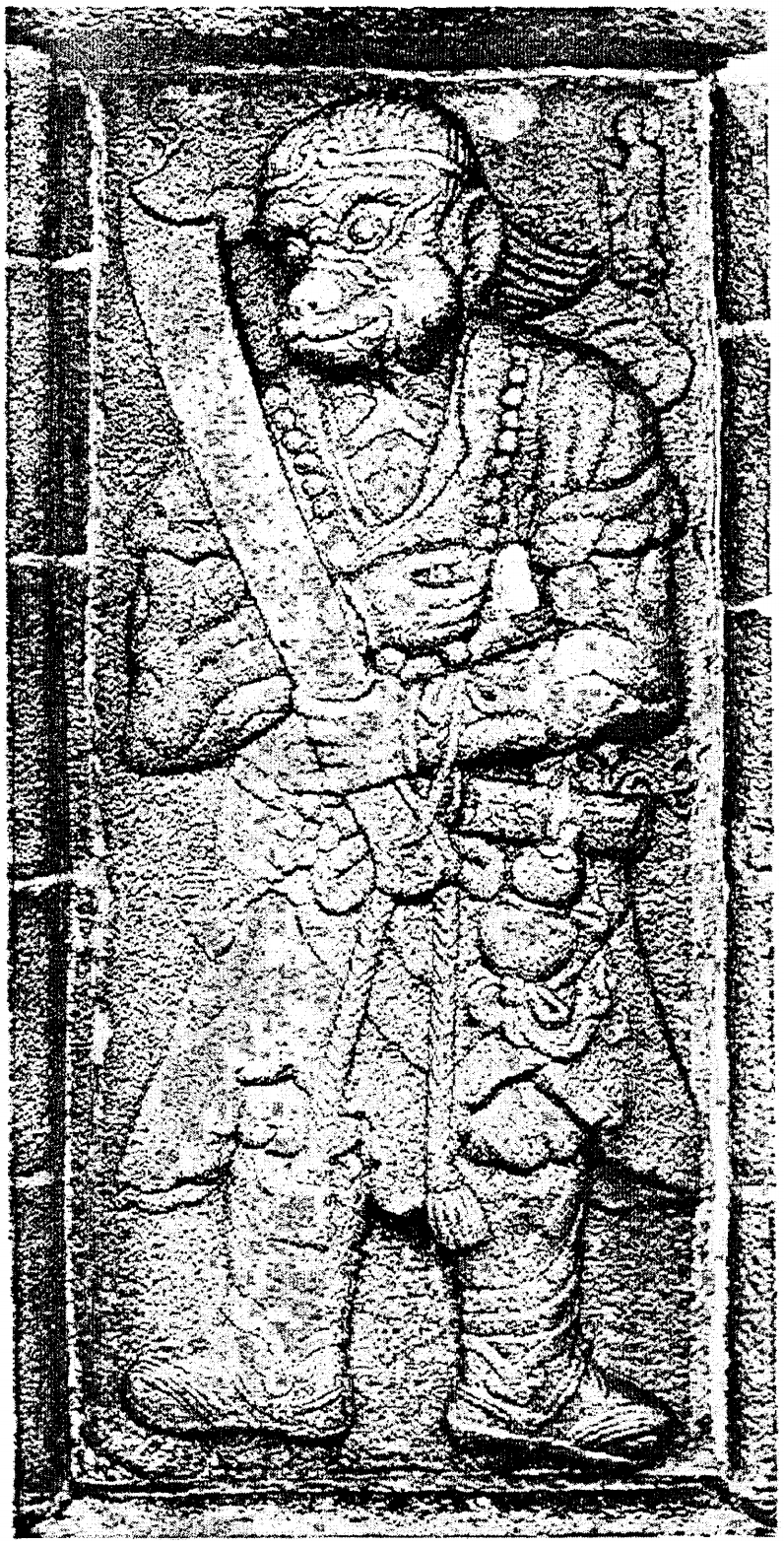
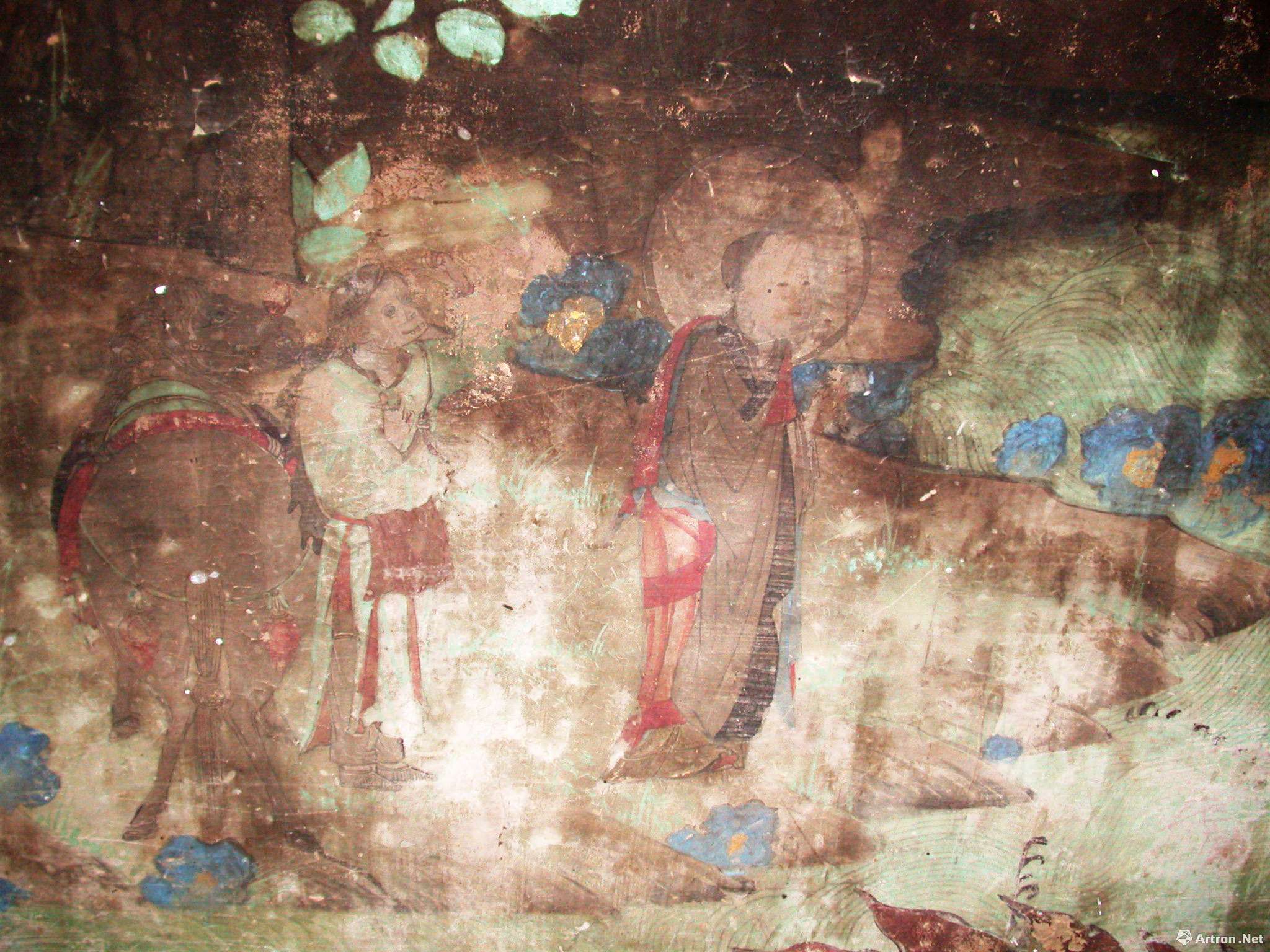
The golden headband or fillet (jingu, 金箍; a.k.a. jingu, 緊箍, lit: “tight fillet”) is one of the Monkey King’s most recognizable iconographic elements appearing in visual media based on the great Chinese classic Journey to the West (Xiyouji西遊記, 1592 CE; “JTTW” hereafter). It is generally portrayed as a ringlet of gold with blunt ends that meet in the middle of the forehead and curl upwards like scowling eyebrows (type one) (fig. 1). A different version is a single band adorned with an upturned crescent shape in the center (type two) (fig. 2). Another still is a simple band devoid of decoration (type three) (fig. 3). Sun first earns the headband as punishment for murdering humans. The circlet is a heaven-sent magic treasure designed to reign in the immortal’s unruly, rebellious nature. Since Sun Wukong is a personification of the Buddhist concept of the “Monkey of the Mind” (xinyuan, 心猿), or the disquieted mind that bars humanity from enlightenment, the fillet serves as a not-so-subtle reminder of Buddhist restraint. Few scholars writing in English have attempted to analyze the treasure’s history.

In this paper, I present textual and visual evidence from India, China, and Japan that suggests it is ultimately based on a ritual headband worn by Esoteric Buddhist Yogin ascetics in 8th century CE India. I also show how such fillets became the emblem of some Chinese protector deities, as well as military monks in Chinese opera.

Table of Contents

1. Literary Origin and Purpose

The headband is first mentioned in chapter eight when three such “tightening fillets” are given to the Bodhisattva Guanyin by the Buddha in order to conquer any demons that she may come across while searching for a scripture pilgrim:

“These treasures are called the tightening fillets, and though they are all alike, their uses are not the same. I have a separate spell for each of them: the Golden, the Constrictive, and the Prohibitive Spell. If you encounter on the way any monster who possesses great magic powers, you must persuade him to learn to be good and to follow the scripture pilgrim as his disciple. If he is disobedient, this fillet may be put on his head, and it will strike root the moment it comes into contact with the flesh. Recite the particular spell which belongs to the fillet and it will cause the head to swell and ache so painfully that he will think his brains are bursting. That will persuade him to come within our fold” (Wu & Yu, 2012, vol. 1, pp. 206-207).

此寶喚做緊箍兒,雖是一樣三個,但只是用各不同。我有金緊禁的咒語三篇。假若路上撞見神通廣大的妖魔,你須是勸他學好,跟那取經人做個徒弟。他若不伏使喚,可將此箍兒與他戴在頭上,自然見肉生根。各依所用的咒語念一念,眼脹頭痛,腦門皆裂,管教他入我門來。

Guanyin later explains in JTTW chapter 42 which demons get which fillet (Wu & Yu, 2012, vol. 2, p. 251).

Sun Wukong earns the “Constrictive” (jin, 緊) band in JTTW chapter 14 after brutally murdering six thieves who accost his master Tripitaka, the chosen scripture pilgrim, on the road to the west. The killings cause the two to part ways, and it is during Monkey’s absence when Guanyin gives the monk a brocade hat containing the fillet and teaches him the “True Words for Controlling the Mind, or the Tight-Fillet Spell” (喚做『定心真言』,又名做『緊箍兒咒』) (Wu & Yu, 2012, vol. 1, p. 317). Sun is eventually persuaded to return and tricked into wearing the hat under the guise of gaining the ability to recite scripture without rote memorization. It soon takes root, and the powerful immortal is brought under control through the application of pain. He then promises to behave and to protect Tripitaka during their long journey to the Western Paradise. [1]

The remaining two fillets are used by Guanyin to conquer monsters in later episodes. She throws the “Prohibitive” (jin, 禁) band onto the head of the Black Bear Demon (Hei xiong jing, 黑熊精) in JTTW chapter 17, and after reciting the spell, he agrees to become the rear entrance guard of her Potalaka Island paradise (Wu & Yu, 2012, vol. 1, p. 365). The “Golden” (jin, 金) band is split into five rings—one each for the head, wrists, and ankles—and used to subdue Red Boy (Hong hai’er, 紅孩兒), the fire-spewing son of the Bull Demon King and Princess Iron Fan, at the end of JTTW chapter 42 and the beginning of 43 (Wu & Yu, 2012, vol. 2, pp. 251-252). The child demon becomes her disciple and eventually takes the religious name “Sudhana.” [2]

Monkey is forced to wear the fillet until he attains Buddhahood in JTTW chapter 100, causing it to vanish (Wu & Yu, 2012, vol. 4, p. 383). The band’s disappearance at the end of the novel denotes Sun’s internalization of self-control, but the treasure doesn’t disappear forever. It appears once more in the Later Journey to the West (Hou Xiyouji, 後西游記, 17th century CE), an unofficial sequel set 200 years after the original. The story follows a similar trajectory, with Monkey’s descendant Sun Luzhen (孫履真, “Monkey who Walks Reality”) attaining immortality and causing havoc in heaven. But this time the macaque Buddha is called in to quell the demon. Monkey quickly disarms the “Small Sage Equaling Heaven” of his iron staff and pacifies him not with trickery but with an enlightening Buddhist koan. He then places the band on Luzhen’s head to teach him restraint (see Liu, 1994).

Fig. 1 – (Left) The “Type One” headband. From the comedy A Chinese Odyssey Part Two: Cinderella (1995). (Center) The “Type Two” headband. From the famous 1986 TV show. (Right) The “Type Three” headband. From the 2011 TV show (larger version).

2. Past Research into the Origins of the Headband

It appears very few scholars writing in English have attempted to trace the origins of the golden fillet. Wang Tuancheng theorizes that the idea for the headband came from two sources. First, the historical journal of Xuanzang (602–664 CE), the Tang Dynasty monk on whom Tripitaka is loosely based, details how he was challenged to a religious debate by a man in a foreign kingdom who offered his own head as the price of defeat. Xuanzang won, but instead of collecting his prize, the monk took the man as his servant. Second, Wang notes that slaves during the Han Dynasty (206 BCE–220 CE) wore a metal collar around their neck shaped like the Chinese character for twenty (nian, 廿). He goes on to explain: “…the author transformed the metal hoop that the non-Buddhist might have worn to Sun Wukong’s headband” (Wang, 2006, p. 67).

I’m not particularly persuaded by this argument since Wang doesn’t offer any evidence as to why a Han-era slave implement would still be in use during the Tang (618–907 CE) four to five hundred years later; nor does he suggest a reason for why such a collar would be moved from the neck to the head. Besides, there exists religious art featuring the fillet (see below) that predates the novel by centuries, meaning it wasn’t the sole invention of the JTTW author-compiler.

Before I continue, I would like to point out that the 13th century CE precursor of the novel, The Story of How Tripitaka of the Great Tang Procures the Scriptures, does not mention the fillet at all. (This is just one of many differences between it and the final 16th century CE version.) Monkey is simply portrayed as a concerned celestial who purposely seeks out Tripitaka to ensure his safety, as the monk’s two previous incarnations have perished on the journey to India. In other words, he comes as a willing participant, which negates the need for punishment via the ringlet. [3] But at least two pictorial representations of Monkey coinciding with the Song Dynasty (960–1279 CE) depict him wearing a band, which, again, excludes the treasure being a later invention.

In her excellent paper on the origins of Sun Wukong, Hera S. Walker (1998) discusses a 13th century CE stone relief from the western pagoda of the Kaiyuan Temple (開元寺) in Quanzhou, Fujian province, China that portrays a sword-wielding, monkey-headed warrior (pp. 69-70). Considered by many to be an early depiction of Monkey, the figure wears a robe, a Buddhist rosary, and, most importantly, a type one fillet on the forehead (Fig. 4). [4] Walker quotes Victor Mair, who believes that the fillet “recalls the band around the head of representations of Andira, the simian guardian of Avalokitesvara” (the Indian counterpart to Guanyin) (Walker, 1998, p. 70). He goes on to list similarities between the stone relief and depictions of Andira, while also suggesting said depictions are based on south and southeast Asian representations of the Hindu monkey god Hanuman:

Identical earrings (these are key iconographic features of H[anuman] in many Southeast Asian R[ama saga]s), comparable tilt of the head… which seems to indicate enforced submission, long locks of hair… flaring out behind the head, elongated monkey’s mouth, similar decorations on the forearm and upper arm, etc. It is crucial to note that all these features can be found in South Asian and Southeast Asian representations of H[anuman] (Walker, 1998, p. 70).

So as it stands, the 13th century CE appears to be the furthest that the motif has been reliably traced.

Fig. 4 – The 13th century CE stone relief of Sun Wukong from the Kaiyuan Temple in Quanzhou, Fujian province, China (larger version).

3. My Findings

While Mair suggests a Southeast Asian Hindo-Buddhist influence, I know of at least one example from northeastern China that suggests an Indo-Tibetan Buddhist influence. The Eastern Thousand Buddha Cave no. 2 (Dong qianfo dong di 2 ku, 東千佛洞第2窟) in the Hexi Corridor of Gansu Province contains a late-Xixia dynasty (late-12th to early-13th century CE) mural of Xuanzang worshiping Guanyin from a riverbank. Monkey stands behind him tending to a brown horse. He is portrayed with a type three circlet on his head, waist length hair, and light blue-green robes with brown pants (fig. 5). This painting was completed during a time when China was seeing an influx of monks fleeing the inevitable fall of India’s Buddhist-led Pala Dynasty (750–1174 CE) from the 10th to the 12th century CE. They brought with them the highly influential Pala Buddhist art style and Vajrayana Buddhism, a form of esoteric Buddhism. The MET (2010) writes:

A mixture of Chinese-style and Vajrayana traditions and imagery was employed in the Tangut Xixia Kingdom …  which was based in Ningxia, Gansu, and parts of Shanxi … It is difficult to imagine that this “new” type of Buddhism, which not only was flourishing in Tibet in the late tenth century but was also found in the neighboring Xixia Kingdom and may have been practiced by Tibetans based in the Hexi Corridor region of Gansu Province, was completely unknown in central China until the advent of the Mongols (p. 19).

The painting of Monkey and Tripitaka was surely created by an Indian or Tibetan Buddhist monk, or at the very least a fellow Tangut or Chinese practitioner living in the area. This suggests that the imagery within the painting, such as the fillet, could have an Esoteric Buddhist pedigree, and textual evidence shows such headbands were indeed worn in some esoteric rituals.

For example, the Indian Buddhist Hevajra Tantra (Dabei kongzhi jingang dajiao wang yigui jing, 大悲空智金剛大教王儀軌經, 8th century CE) instructs adherents on how to adorn and dress themselves for worshipping Heruka, a Wrathful Destroyer of Obstacles:

The yogin must wear the sacred ear-rings, and the circlet on his head (emphasis added); on his wrists the bracelets, and the girdle round his waist, rings around his ankles, bangles round his arms; he wears the bone-necklace and for his dress a tiger-skin… (Linrothe, 1999, p. 250).

彼修觀者當如是行:謂頂想寶輪、耳帶、寶鐶,手串寶釧,腰垂寶帶,足繫寶鐸及妙臂釧,頸嚴寶鬘衣、虎皮衣 …

Furthermore, it describes how each of the ritual adornments and implements used in the ceremony represents each of the five esoteric Buddhas, as well as other religio-philosophical elements:

Aksobhya is symbolized by the circlet (emphasis added), Amitabha by the ear-rings, Ratnesa by the necklace, and Vairocana (by the rings) upon the wrists. Amogha is symbolized by the girdle. Wisdom by the khatvanga [staff] and Means by the drum, while the yogin represents the Wrathful One himself [i.e. Heruka]. Song symbolizes mantra, dance symbolizes meditation, and so singing and dancing the yogin always acts (Linrothe, 1999, p. 251).

「輪者,表阿閦如來;鐶者,無量壽如來;頸上鬘者,寶生如來;手寶釧者,大毘盧遮那如來;腰寶帶者,不空成就如來。於是色相而生念住:金剛渴椿誐杖者,表勝慧相;奎樓鼓者,即善方便故;瑜伽行者,瞋業清淨;住金剛歌詠者,真言清淨。

「又復,不應為求利養作是金剛歌舞事業。是故,瑜伽者當如是行…

As can be seen, the circlet represents Aksobhya (Sk: “Immovable”; Ch: Achu, 阿閦; Budong, 不動). This deity is known for his adamantine vow to attain buddhahood through the practice of Sila, or “morality,” the aim of which “is to restrain nonvirtuous deeds of body and speech, often in conjunction with the keeping of precepts” (Buswell & Lopez, 2014, pp. 27 and 821). So, the ritual band most likely served as a physical reminder of right speech and action, making it the best candidate for the origin of Monkey’s fillet. Sun is after all the representation of the “Monkey of the Mind” (as noted in the introduction), so his inclusion in the Eastern Thousand Buddha Cave painting was probably meant to convey the taming of this Buddhist concept via the circlet (apart from referencing the popular tale itself).

The Hevajra Tantra, the text in which the circlet appears, was first translated into Tibetan by Drogmi (993–1074 CE) and adopted during the 11th century CE as a central text by the respective founders of the Kagyu and Sakya sects, two of the six major schools of Tibetan Buddhism. Various members of the Sakya sect were invited by Mongol royalty to initiate them into the text’s esoteric teachings during the 13th century CE. These include Sakya Pandita and his nephew Chogyal Phagpa, who tutored Genghis Khan‘s grandson Prince Goden in 1244 and Kublai Khan in 1253, respectively. The meeting between Kublai and Chogyal resulted in Vajrayana Buddhism becoming the state religion of Mongolia. The Hevajra Tantra was translated into Chinese by the Indian monk Dharmapala (963–1058 CE) in 1055 during the Northern Song Dynasty (960–1127 CE). The text, however, did not become popular within the Chinese Buddhist community like it would with the Mongols in the 13th century CE (Bangdel & Huntington, 2003, p. 455). But this evidence shows how the concept of the 8th century CE ritual circlet could have traveled from India to East Asia to influence depictions of Sun Wukong in the 12th/13th century CE. And the relatively unknown status of the text in China might ultimately explain why there are so few ancient depictions of Chinese deities wearing the fillet, or why it does not appear in the 13th century CE version of JTTW.

While the late-Xixia mural (fig. 5) lacks many of the ritual adornments (apart from the fillet) mentioned in the Hevajra Tantra, the Quanzhou stone relief (refer back to fig. 3) includes the band, earrings, necklace, bangles, and possibly even a tiger skin apron, suggesting it too has an esoteric origin (most likely based on Chinese source material). The band’s connection to esoteric Buddhism is further strengthened by a 12th century CE painting from Japan. Titled Aka-Fudo (赤不動), or “Red Fudo [Myoo],” it depicts the wrathful esoteric god seated in a kingly fashion, holding a fiery, serpent-wrapped Vajra sword in one hand and a lasso in the other (fig. 6). He wears a golden, three-linked headband (similar to the curls of type one), which stands out against his deep red body and flaming aureola. Biswas (2010) notes: “… the headband on his forehead … indicate[s], according to some, a relation to the habit of groups of ascetics who were among the strong supporters of Acalanatha” (p. 112). His supporters were no doubt yogin practitioners in the same vein as those who worshipped Heraku and other such wrathful protector deities.

Fig. 5 – A portion of the late-Xixia (late-12th to early-13th century CE mural) in the Eastern Thousand Buddha Cave number two (larger version). Fig. 6 – The 12th century CE Japanese painting “Aka-Fudo” (赤不動) (larger version).

3.1. Symbol of Martial Deities and Warrior Monks

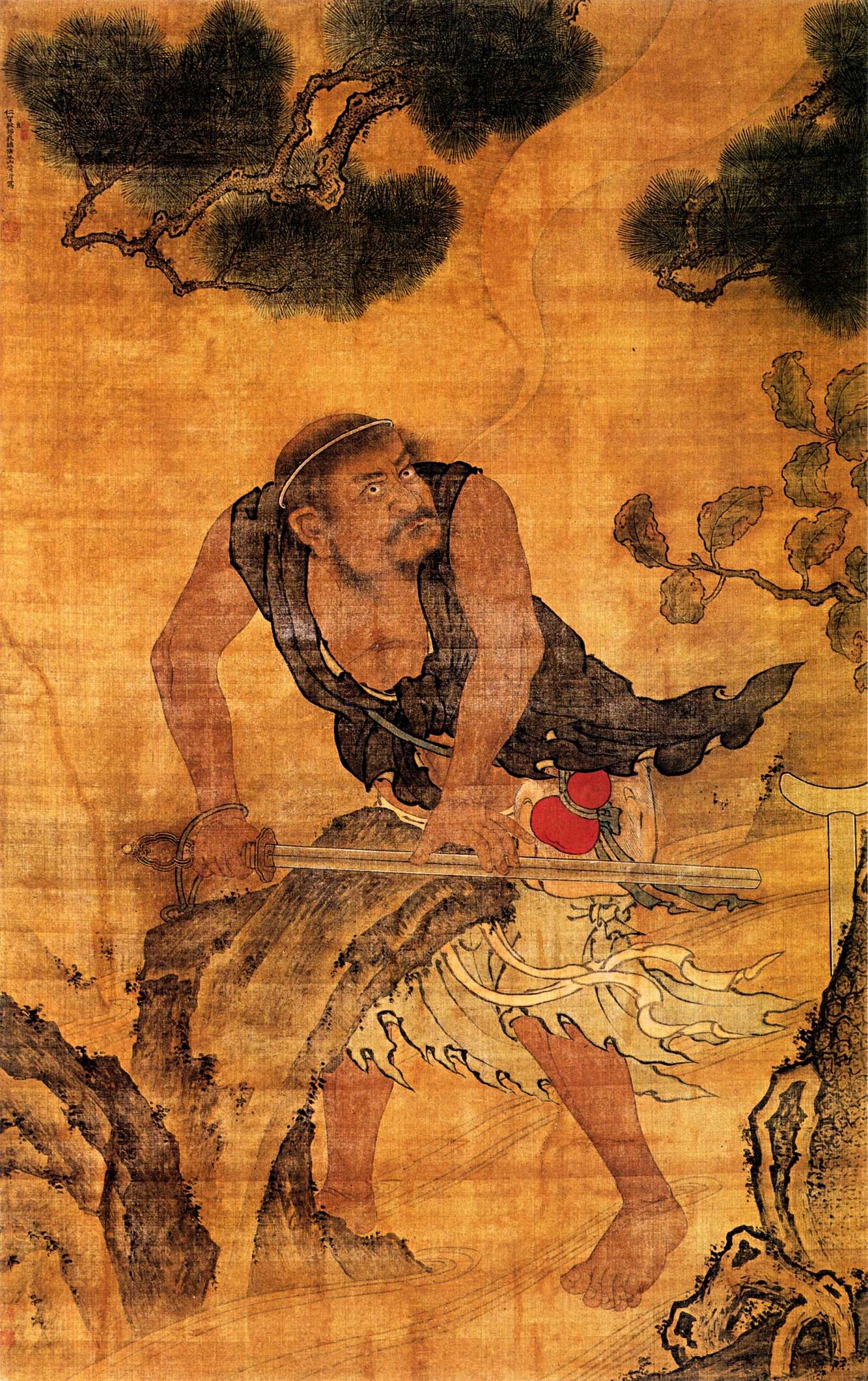
It’s important to note that Monkey was not the only cultural hero of the Ming Dynasty (1368–1644 CE) to wear a golden fillet. Another example is Li Tieguai (李鐵拐), or “Iron Crutch Li,” the oldest of the Eight Immortals. [5] Li is generally portrayed as a crippled beggar leaning on a cane. Legend has it that his original body was cremated prematurely by a disciple while the immortal traveled in spirit to answer a summons from Lord Laozi, the high god of Daoism. Li’s spirit returned a day later to find only ashes, thus forcing him to inhabit the body of a recently deceased cripple. According to Allen and Philips (2012), “Laozi gave him in recompense a golden headband and the crutch that was to become his symbol” (p. 108). Some depictions of Li wearing the fillet predate JTTW. The most striking example is Huang Ji’s Sharpening a Sword (early-15th century CE) (Fig. 7), which portrays the immortal wearing a type three band and sharpening a double-edged blade on a stone while staring menacingly at the viewer. [6] One theory suggests Li’s martial visage identifies him as a “spirit-guardian of the [Ming] state” (Little, 2000, p. 333). Both Monkey and Li are, therefore, portrayed as brutish, weapon-bearing, golden headband-wearing immortals who serve as protectors. This shows that the fillet was associated with certain warrior deities during the Ming.

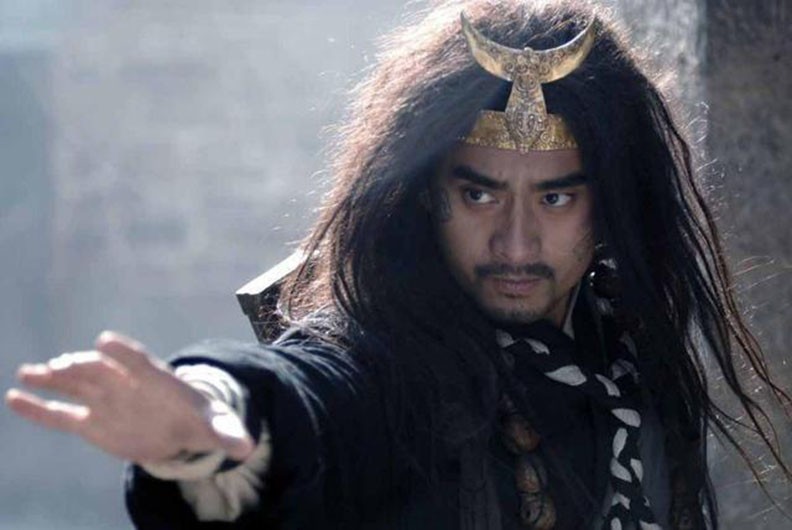
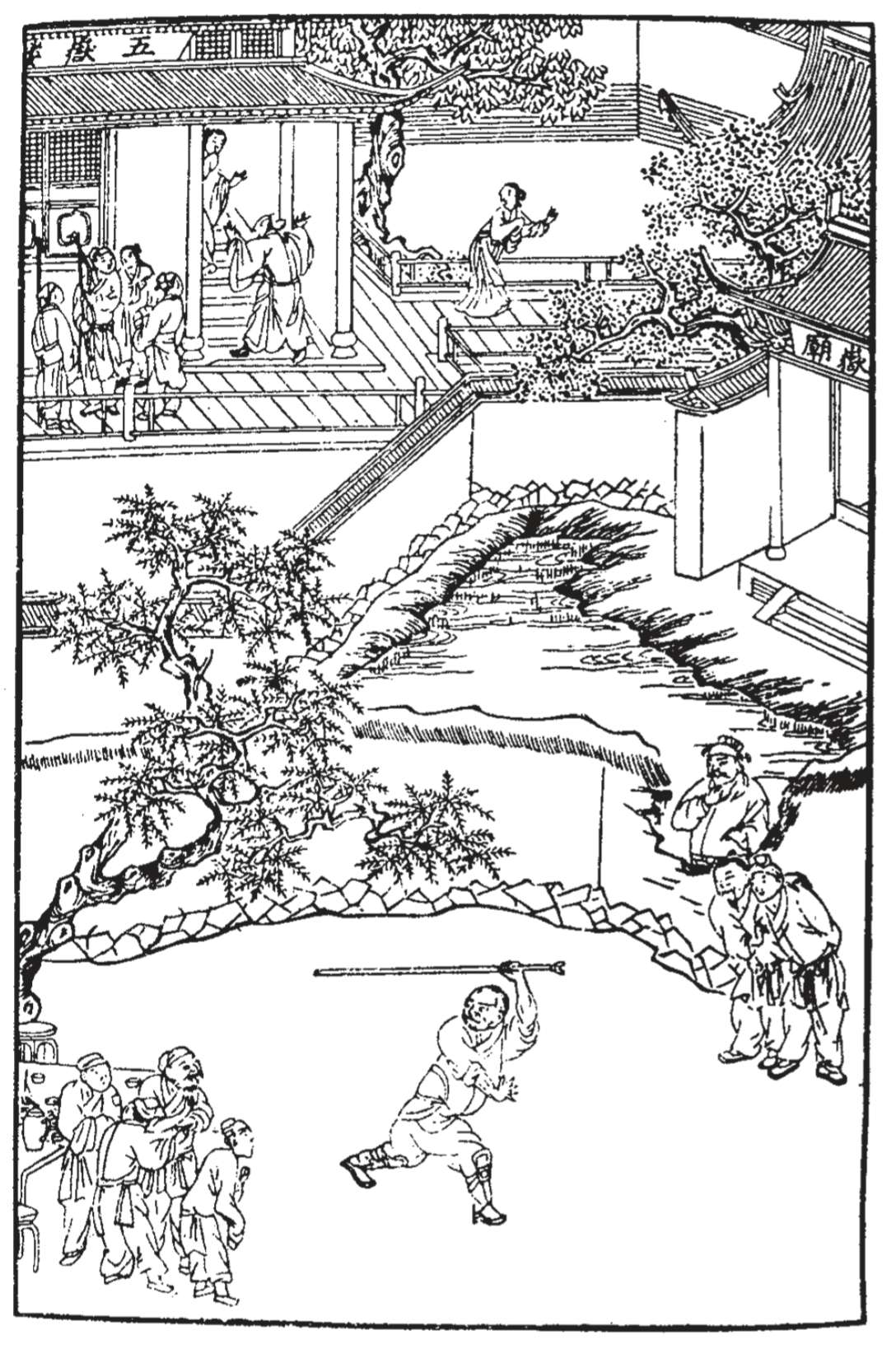
The fillet’s connection to religion and martial attributes culminated in the Jiegu (戒箍, “ring to forget desires”), a type two band worn by Military Monks (Wuseng, 武僧) in Chinese opera to show that they have taken a vow of abstinence (fig. 8). Such monks are depicted as wearing a Jiegu over long hair (Bonds, 2008, pp. 177-178 and 328), which contrasts with the bald heads of religious monks. [7] I would like to suggest that the band’s half-moon shape may have some connection to a Ming-era woodblock print motif in which martial monks are shown wielding staves tipped with a crescent (fig. 9) . The exact reason for the shape is still unknown (Shahar, 2008, pp. 97-98), but the association between the crescent and martial monks seems obvious. (See the 07-25-22 update below for the foreign origins of this motif.) The use of the fillet in Chinese opera led to it being worn by Sun Wukong in the highly popular 1986 live-action TV show adaptation of the novel (fig. 2). [8]

Fig. 7 (Left) – Huang Ji’s “Sharpening a Sword” (early-15th century CE) (larger version). Fig. 8 (Center) – An image of the military monk Wu Song wearing a jiegu (戒箍) fillet from a 2011 Water Margin TV show (larger version). Fig. 9 (Right) – A late-Ming woodblock of the warrior monk Lu Zhishen with a crescent staff (larger version). From Shahar (2008).

4. Conclusion

Examples of past research into the origins of the golden fillet respectively point to a slave collar from the Han dynasty (206 BCE–220 CE) and circa 13th century CE South and Southeast Asian depictions of the Buddhist guardian Andira and the Hindu monkey god Hanuman as possible precursors. However, the first isn’t credible, and the second, while on the right track, doesn’t go back far enough. A late-12th to early-13th century CE mural in the Eastern Thousand Buddha Cave complex depicts Sun Wukong wearing a type three fillet with possible ties to a ritual circlet worn by Esoteric Buddhist Yogin ascetics in 8th century CE India. The Hevajra Tantra, the esoteric text that mentions the band, associates it with the Aksobhya Buddha and thereby his moralistic, self-restraining practices. The text was transmitted from India to Tibet, China, and Mongolia from the 11th to the 13th centuries CE, showing a clear path for such imagery to appear in East Asia. A 12th century CE Japanese Buddhist painting of the guardian deity Fudo Myoo with a fillet suggests that the practice of wearing circlets in esoteric rituals continued for centuries. Other non-Buddhist deities became associated with the fillet during the Ming Dynasty. A 15th century CE painting of the immortal Li Tieguai, for example, depicts him as a type one circlet-wearing, sword-wielding guardian of the Ming dynasty. All of this suggests that the band became a symbol of Chinese protector deities. The association between the fillet and religion and martial attributes led to its use as the symbol of military monks in Chinese opera.


5. Updates

Update: 12-23-17

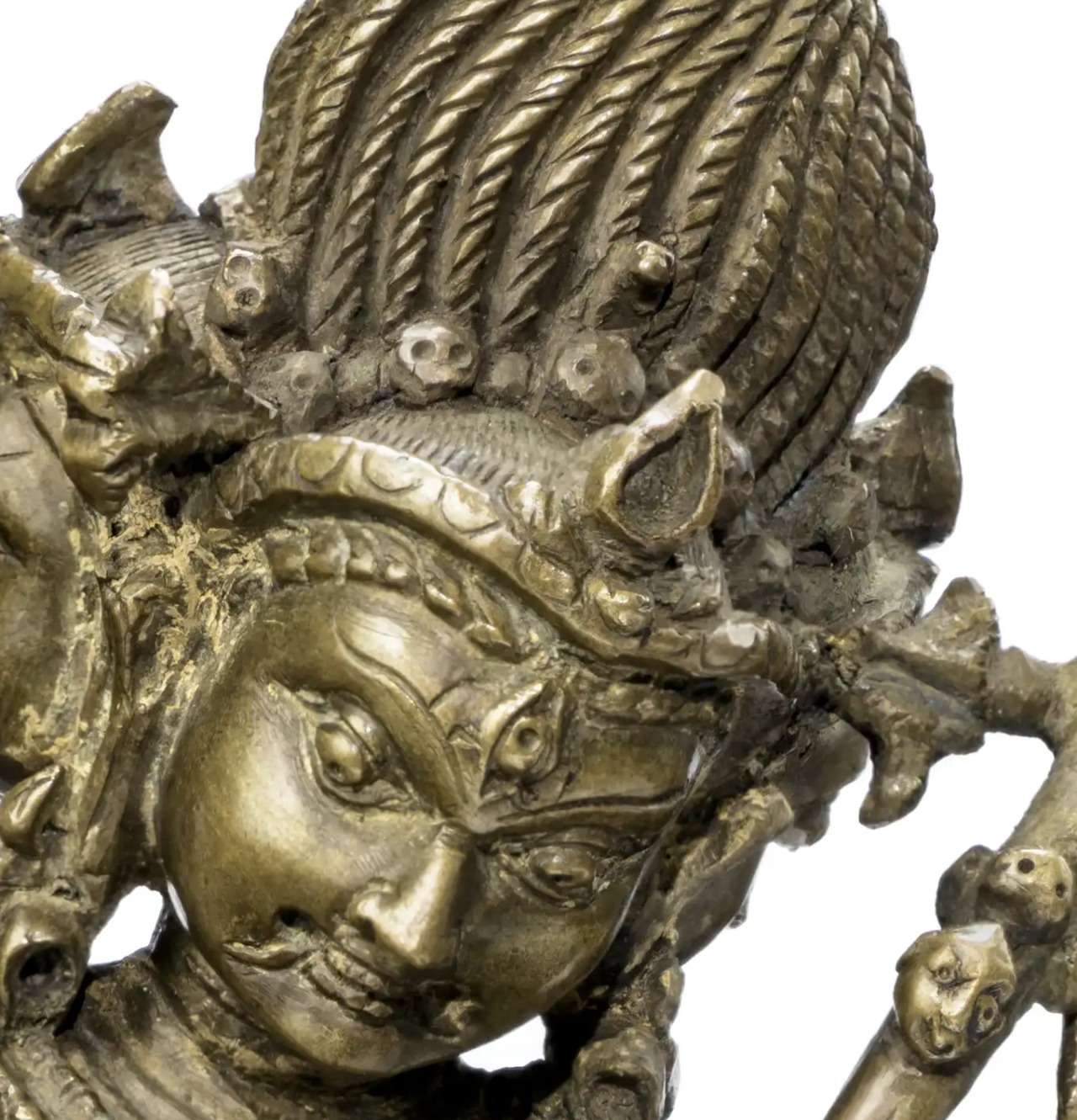
I’ve been wondering what the 8th century CE version of the circlet (along with the other ritual implements) mentioned in the Hevajra Tantra might have looked like. While I have yet to find a contemporary sculpture or painting, I have found an 11th to 12th century CE interpretation from Tibet. Titled The Buddhist Deity Hevajra (fig. 10), this copper alloy statue somewhat follows the prescribed iconography of the god as laid out in the aforementioned text:

Dark blue and like the sun in colour with reddened and extended eyes, his yellow hair twisted upwards, and adorned with the five symbolic adornments,/ the circlet, the ear-rings and necklace, the bracelets and belt. These five symbols are well known for the purificatory power of the Five Buddhas./ He has the form of a sixteen-year-old youth and is clad in a tiger-skin. His gaze is wrathful. In his left hand he holds a vajra-skull, and a khatvahga [staff] likewise in his left, while in his right is a vajra of [a] dark hue…(Linrothe, 1999, p. 256)

Fig. 10 – The Buddhist Deity Hevajra, late-11th to early-12th century CE, copper alloy (larger version). Courtesy of the Los Angeles County Museum of Art. Fig. 11 – Detail of the circlet (larger version).

The circlet here is depicted as a fitted band with crescent trim and a teardrop-shaped adornment (a conch?) (fig. 11). The statue’s iconography more closely follows that from the Sadhanamala (“Garland of Methods”), a compilation of esoteric texts from the 5th to 11th centuries CE. The following information probably derives from the later part of this period:

He wields the vajra in the right hand and from his left shoulder hangs the Khatvanga [staff] with a flowing banner, like a sacred thread. He carries in his left hand the kapala [skull cap] full of blood. His necklace is beautified by a chain of half-a-hundred severed heads. His face is slightly distorted with bare fangs and blood-shot eyes. His brown hair rises upwards and forms into a crown which bears the effigy of Aksobhya. He wears a kundala [ear decoration] and is decked in ornaments of bones. His head is beautified by five skulls (Donaldson, 2001, p. 221).

Our statue has many of these features but lacks the image of the Buddha in his hair. This suggests the knob visible in the coif (fig. 10) once carried such a figure. So, once again we see the importance of the Aksobhya Buddha. The statue is similar to 10th and 11th century CE stone statues from India. [9]

While this doesn’t get us any closer to what the original circlet looked like, this statue adds to the mutability of the fillet imagery. The Hevajra Tantra is vague in its description, and so it is no surprise that so many variations have appeared over the centuries. The original sanskrit text uses the word cakri (circle) to refer to the band (Farrow & Menon, 2001, pp. 61-62). This might explain the simple type three fillet worn by Monkey in the Eastern Thousand Buddha Cave no. two painting (fig. 2).


Update: 08-16-20

I have written an article suggesting an origin for the type one headband, or as I now call it, the “curlicue headband.”

Sun Wukong’s Curlicue-Style Headband


Update: 12-12-21

One thing I figured out a while ago but never explained here was the reason why the Japanese Buddhist protector deity Aka-Fudo (赤不動) (fig. 6) is depicted with a headband. I believe this is a visual representation of the fillet’s association with the Aksobhya Buddha. This is because the fudo (Ch: budong, 不動) of Aka-Fudo and the Sanskrit meaning of Aksobhya respectively mean “immovable.” So, the image of Aka-Fudo is encapsulating both his position as a protector deity and the Buddha represented by the headband. 


Update: 01-23-22

I’ve written an article suggesting a mantra for the secret spell that causes the golden fillet to tighten.

The Tightening Spell of Sun Wukong’s Golden Headband


Update: 07-25-22

I’ve written an article that explains the origins of the “crescent-style” headband.

The Monkey King’s Crescent-Style Headband


Update: 06-26-23

Above, I mentioned that the novel contains three kinds of headbands:

  1. Sun Wukong/Six Ears – “Constrictive” (jin, 緊) – ch. 14
  2. Black Bear Demon – “Prohibitive” (jin, 禁) – ch. 17
  3. Red Boy – “Golden” (jin, 金) – ch. 42

It’s interesting that all of them are pronounced “jin” (with varying tones).

Now imagine that there is a secret fourth headband not intended to punish but to empower. Called the “Strength” (jin, 勁) headband, it would only be used in the most extreme emergencies.

It would be neat to see someone work this into their fanfiction.


Update: 12-24-23

A character is briefly punished to wear a golden headband in the famed Ming-era novel Investiture of the Gods (Fengshen yanyi封神演義, c. 1620; summary). Chapter 82 reads: 

Ma Sui [馬遂] attacked him with his sword, and after only one round, threw a gold hoop [jingu, 金箍] around the immortal’s head. The Yellow Dragon Immortal [Huanglong zhenren, 黃龍真人] writher in pain but was quickly rescued and brought back to the pavilion.

The Yellow Immortal Dragon Immortal tried to take the hoop off his head but found it was impossible. It was so tight the true samadhi fire went out of his eyes.

The Immortal of the South Pole [Nanji xianweng, 南極仙翁] came in to announce Heavenly Primogenitor’s [Yuanshi tianzun, 元始天尊] arrival. The religious leader entered the pavilion and said, “The Yellow Dragon Immortal was destined to be caught in this gold hoop. Come here and let me help you.”

He pointed at the gold hoop, and it dropped to the ground (Gu, 2000, pp. 1713-1715).

只一合,馬遂祭起金箍,把黃龍真人的頭箍住了。真人頭疼不可忍,眾仙急救真人,大家回蘆篷上來。真人急忙除金箍,除又除不掉,只箍得三昧真火從眼中冒出;大家鬧在一處。不表。且說元始天尊來會萬仙陣,先著南極仙翁持玉符先行。南極仙翁跨鶴而來,雲光縹緲。馬遂抬頭,見是南極仙翁,急駕雲光至半空中來,阻住去路。仙翁笑曰:「馬遂,你休要猖獗,掌教師尊來了。」馬遂正欲爭持,只見後面仙樂一派,遍地異香,馬遂知不可爭持,按落雲頭,回歸本陣。南極仙翁先至蘆篷,率眾仙迎鑾接駕,上篷坐下。眾門人拜畢,侍立兩傍。元始曰:「黃龍真人有金箍之厄。」忙叫:「過來。」黃龍真人走至面前;元始用手一指,金箍隨脫。

(Gu (2000) skips over some elements in the original Chinese.)

I’ve known about this episode for a while but forget to post about it.

Notes

1) For the entire episode, see Wu & Yu, 2012, vol. 1, pp. 314-320.

2) The child first speaks his new name in chapter 49 (Wu & Yu, 2012, vol. 2, p. 354). The original Sudhana originates from the Avatamsaka Sutra (Wu & Yu, 2012, vol. 2, pp. 386-387 n. 3).

3) For a complete English translation, see Wivell (1994).

4) This is just one of many relief carvings that grace the pagoda. It includes other guardian-type figures with esoteric elements but rendered in the Chinese style. See Ecke and Demiéville (1935).

5) The Eight Immortals are Daoist saints who came to be worshipped as a group starting sometime in the Jin Dynasty (1115–1234 CE) (Little, 2000, p. 319).

6) The sword is usually a symbol of the immortal Lu Dongbin, but as noted above, it is used to identify Li Tieguai as a Ming guardian (Little, 2000, p. 333).

7) Shahar (2008) discusses the historical differences between religious and military monks in ancient China.

8) Liu Xiao Ling Tong (六小龄童; born Zhang Jinlai, 章金萊, 1959), the actor who played Monkey in the 1986 TV show, comes from a family who has specialized in playing Sun Wukong in Chinese opera for generations (Ye, 2016).

9) See the Heruka chapter in Linrothe (1999). He includes our statue in his study, but other sources describe it as Tibetan instead of Indian (Bangdel & Huntington, 2003, p. 458).

Bibliography

Allan, T., & Phillips, C. (2012). Ancient China’s Myths and Beliefs. New York: Rosen Pub.

Bangdel, D., & Huntington, J. C. (2003). The Circle of Bliss: Buddhist Meditational Art. Chicago, Ill: Serindia Publications.

Biswas, S. (2010). Indian Influence on the Art of Japan. New Delhi: Northern Book Centre.

Bonds, A. B. (2008). Beijing Opera costumes: The Visual Communication of Character and Culture. Honolulu: University of Hawai’i Press.

Buswell, R. E., & Lopez, D. S. (2014). The Princeton Dictionary of Buddhism. Princeton, NJ: Princeton University Press.

Donaldson, T. E. (2001). Iconography of the Buddhist Sculpture of Orissa. New Delhi: Indira Gandhi National Centre for the Arts.

Ecke, G., & Demiéville, P. (1935). The Twin Pagodas of Zayton: A Study of the Later Buddhist Sculpture in China. Cambridge, Mass: Harvard University Press.

>Farrow, G. W., & Menon, I. (2001). The Concealed Essence of the Hevajra Tantra: With the Commentary Yogaratnamālā. Delhi: Motilal Banarsidass Publ.

Gu, Z. (2000). Creation of the Gods (Vols. 1-4). Beijing: New World Press.

Linrothe, R. N. (1999). Ruthless Compassion: Wrathful Deities in Early Indo-Tibetan Esoteric Buddhist Art. Boston, Mass: Shambhala.

Little, S. (2000). Taoism and the Arts of China. Chicago, IL: Art Institute of Chicago.

Liu, X. (1994). The Odyssey of the Buddhist Mind: The Allegory of the Later Journey to the West. Lanham, Md: University Press of America.

Metropolitan Museum of Art, Leidy, D. P., Strahan, D. K., & Becker, L. (2010). Wisdom Embodied: Chinese Buddhist and Daoist sculpture in the Metropolitan Museum of Art. New York: Metropolitan Museum of Art.

Shahar, M. (2008). The Shaolin Monastery: History, Religion, and the Chinese Martial Arts. University of Hawaii Press.

Walker, H.S. (1998). Indigenous or Foreign? A Look at the Origins of Monkey Hero Sun Wukong. Sino-Platonic Papers, 81, 1-117.

Wang, T. (2006). Dust in the Wind: Retracing Dharma Master Xuanzang’s Western Pilgrimage. Taipei: Rhythms Monthly.

Wivell, C.S. (1994). The Story of How the Monk Tripitaka of the Great Country of T’ang Brought Back the Sūtras. In V. H. Mair (Ed.), The Columbia Anthology of Traditional Chinese Literature (pp. 1181-1207). New York: Columbia University Press.

Wu, C., & Yu, A. C. (2012). The Journey to the West (Vols. 1-4) (Rev. ed.) Chicago, Ill: University of Chicago Press.

Ye, X. (2016). Liu Xiao Ling Tong and Sun Wukong. Retrieved December 15, 2017, from https://www.youlinmagazine.com/story/liu-xiao-ling-tong-and-sun-wukong/Njgw

Modern Depictions of Sha Wujing’s Weapon and its Origins

Last updated: 07-02-2023

Sha Wujing (沙悟淨), or “Sandy” for short, is commonly portrayed in modern media wielding a Crescent Moon Spade (Yueya chan, 月牙鏟, a.k.a. “Monk’s Spade“), a wooden polearm capped with a sharpened spade on one end and a crescent-shaped blade on the other (fig. 1). But did you know that Sandy never wields this kind of weapon in the novel? Journey to the West (Xiyouji西遊記) chapter 22 contains a poem that describes the actual polearm and its pedigree. A section of it reads:

For years my treasure staff has enjoyed great fame,
Originally a tree of the sala variety in the moon, [1]
Wu Gang cut down from it one limb.
Lu Ban then made it, using all his skills.
Within the hub is “as-you-will” gold. [2]
Outside it’s wrapped by countless pearly threads.
It’s called the Treasure Staff Perfect for Subduing Monsters, [3]
[…] (based on Wu & Yu, 2012, vol. 1, p. 428)

寶杖原來名譽大,本是月裡梭羅派。
吳剛伐下一枝來,魯班製造工夫蓋。
裡邊一條金趁心,外邊萬道珠絲玠。
名稱寶杖善降妖 …

As you can see, it is described as a wooden staff devoid of any metal blades. So how did Sandy become associated with the Crescent Moon Spade?

Table of Contents

1. The Ming-Era Motif

The weapon can be traced to a common motif appearing in late-Ming Dynasty (1368–1644) woodblock prints. Sandy is just one of a number of famous literary staff-wielding monks to be portrayed brandishing a polearm topped with a small crescent shape (fig. 2). Others include Huiming (惠明) from the Story of the Western Wing (Xixiangji, 西廂記, c. 1300) (fig. 3) and Lu Zhishen (魯智深) from the Water Margin (Shuihu zhuan, 水滸傳, c. 1400) (fig. 4) (Shahar, 2008, p. 97).

#12 - Sha Wujing pics for blog entry

Fig. 1 – A modern depiction of Sandy wielding a Crescent Moon Spade (larger version). Fig. 2 – A late-Ming Dynasty print of Sandy with the crescent staff (larger version). Fig. 3 – A 1614 woodblock print of Monk Huiming with a crescent staff (larger version). Fig. 4 – A late-Ming woodblock of Lu Zhishen with a crescent staff (larger version). Fig. 5 – Sandy from Ehon Saiyuki (circa 1806) (larger version). Fig. 6 – Sandy from Xiyou yuanzhi (1819) (larger version). Fig. 7 – A detail from a Long Corridor painting (circa 1890) (larger version).

The exact origin or purpose of the blade is unknown, however. Martial historian Meir Shahar (2008) comments:

Future research may determine the origins of the crescent shape, which is visible in some Ming period illustrations of the staff. Here I will mention only that an identical design is common in a wide variety of twentieth-century martial arts weapons, whether or not they are wielded by Buddhist clerics. The crescent’s significance in contemporary weaponry can be gauged by its appearance in the names of such instruments as the “Crescent-Shaped (Yueya) [Monk’s] Spade,” “Crescent-Shaped Spear,” “Crescent-Shaped Battle-ax,” and “Crescent-Shaped Rake” (pp. 97-98).

A woodblock print appearing in the first section of The Illustrated Journey to the West (Ehon Saiyuki, 画本西遊記), published in 1806, depicts Sandy holding a staff with a large crescent blade (fig. 5), showing how the once small accent had been enlarged by this time to become a more prominent feature of the weapon. This same polearm is echoed in a print from The Original Intent of The Journey to the West (Xiyou yuanzhi, 西遊原旨, 1819) (fig. 6), as well as in multiple circa 1890 JTTW-related paintings from the Long Corridor of the Summer Palace in Beijing (fig. 7, for example). Therefore, Ming depictions of Sandy wielding a crescent-tipped staff were most likely associated with the Crescent Moon Spade due to their physical similarities, and this probably took place no earlier than the early-20thcentury.


2. Updates

2.1. A Crescent Moon Spade in JTTW

Update: 02-25-18

Unlike Sha Wujing, there is a monster in the novel who wields a Crescent Moon Spade. Chapter 63 describes the Nine-Headed Beast (Jiutou chong, 九頭蟲), [4] the son-in-law of a dragon king, using this bladed polearm in a battle against Monkey:

Enraged, Pilgrim shouted, “You brazen thievish fiend! What power do you have that you dare mouth such big words? Come up here and have a taste of your father’s rod!” Not in the least intimidated, the son-in-law parried the blow with his crescent-tooth spade; a marvelous battle thus broke out on top of that Scattered-Rock Mountain (Wu & Yu, 2012, vol. 3, p. 183).

行者大怒,罵道:「這潑賊怪,有甚強能,敢開大口?走上來,吃老爺一棒。」那駙馬更不心慌,把月牙鏟架住鐵棒,就在那亂石山頭 …

During the Ming Dynasty, there existed a military spade with a crescent blade on the top and a dagger-like blade on the bottom (武備志 (四十三) , n.d.) (fig. 8). This is likely the weapon used by the monster. Notice the similarities with figures five to seven. It’s easy to see how the crescent-tipped staff from the Ming woodblock prints could have later been associated with this military weapon. The difference is one of degree and not kind. This polearm was later modified into the modern Crescent Moon Spade, leading to depictions of Sandy wielding the weapon.

Fig. 8 – A Crescent Moon Spade from the Collection of Military Works (Wubei zhi, 武備志, c. 1621), a Ming treatise on military armaments and fighting techniques (larger version).


2.2. Sandy’s Weapon in the 1592 JTTW

Update: 05-15-18

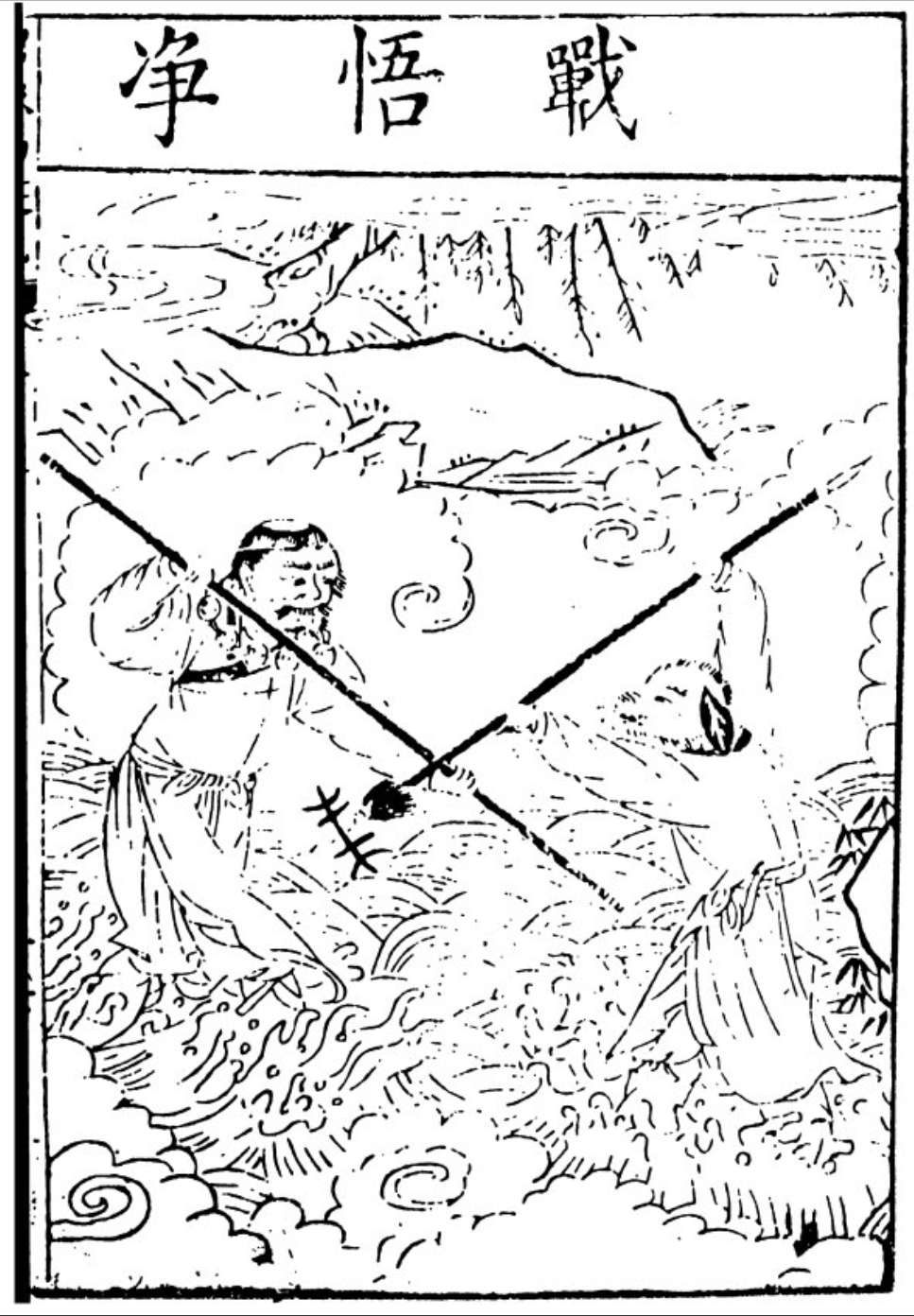
Feng Dajian of Nankai University was kind enough to direct me to this woodblock print (fig. 9) from the original 1592 publishing of Journey to the West. Sandy’s staff is more evident in this piece. It even lacks the aforementioned crescent shape.

Fig. 9 – The 1592 JTTW print of Sandy vs Pigsy (larger version).


2.3. Sandy’s Weapon in the 1592 JTTW – Part 2

Update: 07-02-23

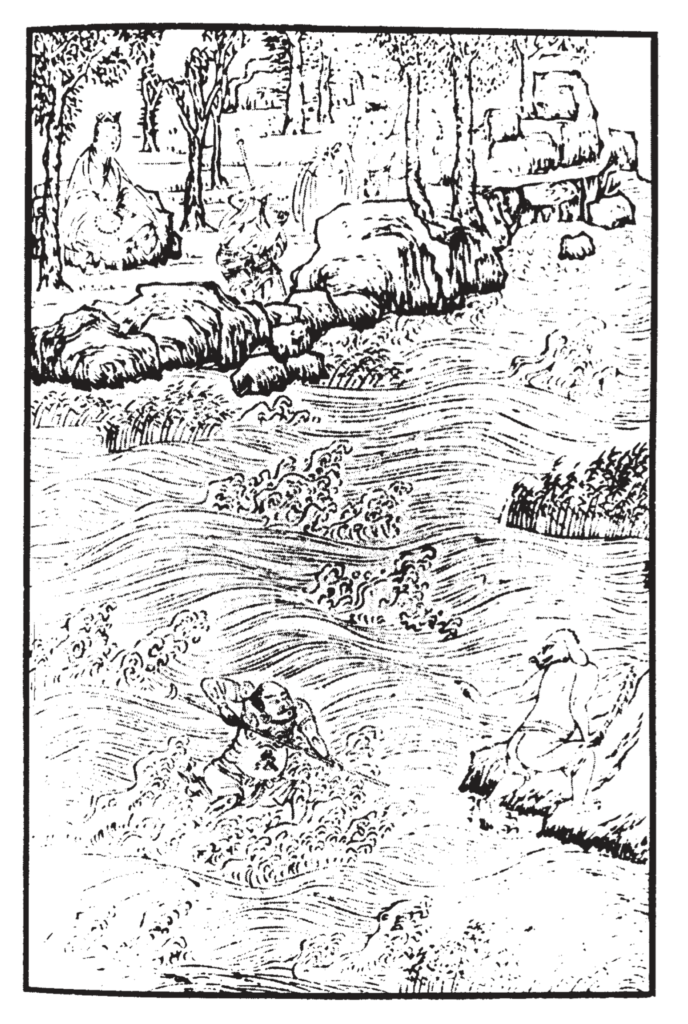
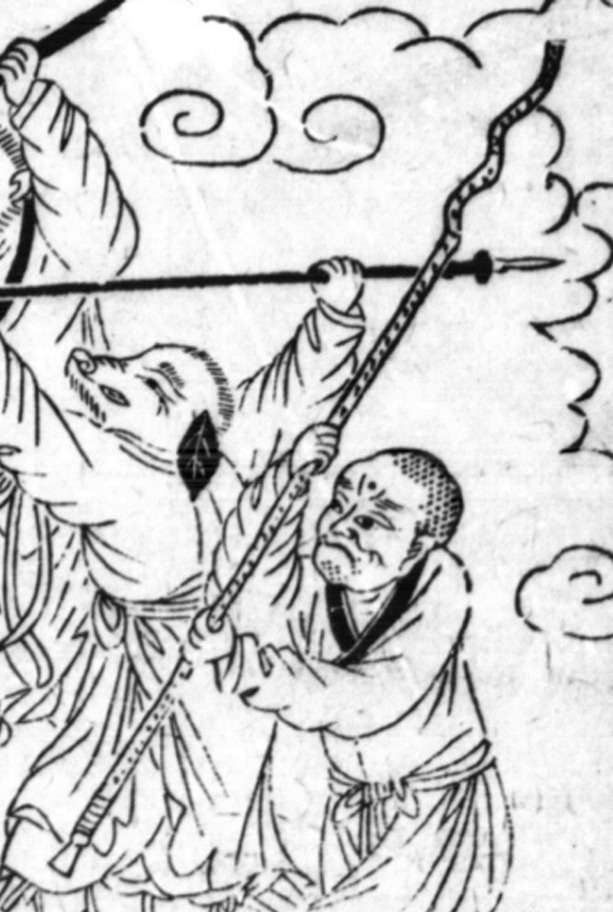
The woodblock prints from the original 1592 JTTW are extremely inconsistent. For example, figure nine shows Sha’s staff as a straight, black line. However, another print (fig. 10 & 11) depicts it with the crescent finial, and yet another (fig. 12 & 13) shows it as a twisting tree branch. The latter is my favorite because it aligns more with the weapon’s origin as presented above in the introduction.

Fig. 10 (top left) – A detail of the crescent staff (larger version). Fig. 11 (top right) – The full print (larger version). Fig. 12 (bottom left) – A detail of the tree branch staff (larger version). Fig. 13 (bottom right) – The full print (larger version).

Notes:

1) The original translation reads: “At first an evergreen tree in the moon” (Wu & Yu, 2012, vol. 1, p. 428), but the Chinese identifies the tree as suoluo pai (梭羅派), which literally means a “(family) branch of the sala tree.” I chose “a variety of” to avoid confusion with “tree branch.” And while the sala is technically a kind of evergreen in wet environments, it has deciduous-looking leaves. I chose to use the actual name of the tree to avoid confusion with pine evergreens. Yu (Wu & Yu, 2012) incorrectly identifies the suoluo tree as “Cunninghamia [l]anceolata,” a type of Chinese pine evergreen (vol. 4, p. 391 n. 7).

2) The original translation reads: “Within the hub one solid piece of gold” (Wu & Yu, 2012, vol. 1, p. 428). But the Chinese states that the inside is jin chenxin (金趁心), or “satisfactory metal/gold.” This is likely referring to the Chinese idiom chenxin ruyi (趁心如意), or “as one desires.” This important as the novel reveals that Sha’s weapon is capable of growing or shrinking on command just like Monkey’s cudgel, the “As-You-Will Gold-Banded Staff” (based on Wu & Yu, 2012, vol. 1, p. 429). Thank you to Irwen Wong of the Journey to the West Library blog for reminding me of this fact.

3) Yu (Wu & Yu, 2012) skipped over shan (), or “good at, apt, perfect,” in his translation (vol. 1, p. 428).

4) The creature’s name is originally translated as the “Nine-Headed Insect,” but its true form is that of a monstrous reptilian bird (Wu & Yu, vol. 3, p. 184). While chong (蟲) usually means “insect, worm, or pest,” it can also mean “beast.” For instance, Da chong (大蟲, “great beast”) is the name of the tiger killed by the hero Wu Song in the Water Margin (c. 1400) (Børdahl, 2007). Therefore, a better name for our villain would be “Nine-Headed Beast.”

Sources:

Børdahl, V. (2007). The Man-Hunting Tiger: From “Wu Song Fights the Tiger” in Chinese Traditions. Asian Folklore Studies, 66(1/2), 141-163. Retrieved January 7, 2021, from http://www.jstor.org/stable/30030454

Shahar, M. (2008). The Shaolin Monastery: History, Religion, and the Chinese Martial Arts. University of Hawaii Press.

Wu, C., & Yu, A. C. (2012). The Journey to the West (Vols. 1-4) (Rev. ed.). Chicago, Illinois: University of Chicago Press.

武備志 (四十三) . (n.d.). Retrieved February 25, 2018, from https://archive.org/details/02092301.cn

The Story of How Tripitaka of the Great Tang Procures the Scriptures: The Literary Precursor of Journey to the West

Last updated: 01-30-2024

The great Chinese classic Journey to the West (Xiyouji, 西遊記) was anonymously publish in 1592 and has since then enjoyed the adoration of readers for the last four centuries. But not many people know that an earlier version of the novel exists that predates the popular narrative by some three hundred years. Titled The Story of How Tripitaka of the Great Tang Procures the Scriptures (Da Tang Sanzang qujing shihua, 大唐三藏取經詩話, c. late-13th century), this seventeen chapter novelette likely served as a prompt for oral storytellers, [1] and given it’s age, contains material that differs greatly from the final 16th-century version. For example, the disciple Zhu Bajie doesn’t even appear in the story, and a precursor of Sha Wujing only makes a brief cameo as a monster that Monkey battles.

The novelette is also known as the “Kozanji version” as two editions are mentioned in a 1633 catalog held by the titular Japanese Buddhist temple. The Chinese scholars Wang Guowei (王國維, 1877–1927) and Luo Zhenyu (羅振玉, 1866–1940) first identified the earlier of the two editions as a work of the late-Song Dynasty (960–1279). [2] This article will summarize each short chapter, as well as discuss the similarities and differences between it and the final Ming version of Journey to the West. I rely heavily on the English translation by Charles S. Wivell (1994).

Table of Contents

Ch. 1 – TITLE MISSING

[TEXT MISSING]

Ch. 2 – “En Route They Encounter the Monkey Pilgrim”

Tripitaka and five other monks happen upon a white-clad scholar on their way to India. The figure warns the Sutra Master that his two previous incarnations have died on such a journey, and he will die a thousand times more unless he has protection. The scholar reveals himself to be “the bronze-headed, iron-browed king of the eighty-four thousand monkeys of the Purple Cloud Grotto on the Mountain of Flowers and Fruit” (Huaguoshan ziyundong bawan siqian tongtou tie’e mihou wang, 花果山紫雲洞八萬四千銅頭鐵額獼猴王) (Wivell, 1994, p. 1182). Tripitaka accepts his help and rejoices that Karma is uniting the past, present, and future to benefit the people of China. Tripitaka gives him the name “Monkey Pilgrim” (Hou xingzhe, 猴行者).

JTTW Comparison (A)

Similarities:

1) Tripitaka initially sets out with a retinue of monks, but they are all eventually killed by monsters and tigers in chapters 13 and 14.
2) He starts referring to Monkey by the name Pilgrim Sun (Sun Xingzhe, 孫行者) in chapter 14.

Differences:

1) Triptaka happens upon Monkey at the base of Five Elements Mountain, where he has been imprisoned for the last five hundred years. He removes a magic talisman from the top of the mountain, allowing the immortal to break free. See chapter 14.
2) The name Sun Wukong does not appear in the novelette. He is given the name by the immortal Subodhi in chapter one.

Ch. 3 – “Entering the Palace of Mahābrahmā Devarāja”

Pilgrim tells the monks he is so old that he has seen the Yellow River dry up nine different times over thousands of generations. Since the immortal has knowledge of the celestial realms, Tripitaka asks Monkey to fly the group to heaven to attend the Buddhist feast being held by Vaiśravana, the Mahābrahmā Devarāja (Dafan tianwang, 大梵天王), in the Crystal Palace. There, the devas ask the monk to give a lecture on the Lotus Sutra. Knowing that a monster, the “Spirit of the Deep Sand” (Shensha shen, 深沙神), had twice devoured Tripitaka in the past, the Devarāja bestows on Monkey three magic weapons to aid in his defense. These include a cap of invisibility, a golden-ringed monk’s staff, and a begging bowl. In addition, Vaiśravana tells them to call his name so that they may be delivered from any danger they face on the journey.

JTTW Comparison (B)

Similarities:

1) Monkey travels to and from heaven as he pleases.
2) He interacts with Vaiśravana on several occasions (see below).
3) The Bodhisattva Guanyin bestows Tripitaka with a golden-ringed monk’s staff and a cassock in chapter 12.

Differences:

1) Monkey is roughly 1,100 hundred years old when he first meets Tripitaka.
2) He never uses his magic to transport the monk by cloud because the impure nature of mortal bodies makes them far too heavy. See chapter 22.
3) The August Jade Emperor is the ruler of heaven in the final version.
4) Vaiśravana makes several appearances as the Pagoda-Bearing Heavenly King Li Jing, father of the child god, Prince Nezha. [3] Monkey battles Li Jing and Prince Nezha during his rebellion in heaven. See chapter 4, for example.
5) Tripitaka is not eaten over and over again. He was originally the Golden Cicada Bodhisattva, who was exiled from heaven for falling asleep during one of the Buddha’s lectures. He goes through nine pious incarnations before he is reborn as the Sutra Master.
6) Monkey fights with an iron cudgel, which he retrieved from the underwater treasury of Ao Guang, the Dragon King of the Eastern Sea. See chapter 3.
7) This episode does not appear in the final version.

Ch. 4 – “Entry in Incense Mountain Temple”

The group travels to the land of the “Thousand-Armed Thousand-Eyed Bodhisattva” (Qian shou qian yan pusa, 千手千眼菩薩), or the Bodhisattva Guanyin (Wivell, 1994, p. 1185). They come upon the Incense Mountain Temple, which is lorded over by statues of fierce guardian deities. Inside, Tripitaka is dismayed to find the holy place has fallen into complete disrepair. Monkey reminds him that the worst is yet to come; the road to the west is full of foreign people with strange languages, wild animals, and unspeakable monsters.

They travel further and enter the Country of Snakes, which is populated by massive serpents that bellow miasmic clouds. However, despite their terrible appearance, the snakes respect the Buddha and let the pilgrims pass through unharmed.

JTTW Comparison (C)

Differences:

1) Guanyin lives on Mount Potalaka, an island in the Eastern Ocean.
2) The giant serpents do not appear in the final version.

Ch. 5 – “Passing the Lion Wood and the Country of Tree People”

The seven monks travel to the Lion Wood country where they are greeted by countless unicorns and lions with flowers in their mouths. Upon entering the Country of the Tree People, the group finds an inn to spend the night, and in the morning, a young monk is sent to fetch breakfast. However, hours pass without the little disciple returning, so Monkey searches the local village and finds that the monk has been transformed into a donkey by a sorcerer. Pilgrim uses his powers to turn the man’s wife into a bale of grass to feed her to the donkey as revenge. Horrified, the sorcerer then recalls his magic by spitting a mouthful of water on the animal. Monkey does the same and threatens to “mow down all the grass of [his] house” (i.e., kill his wife and anyone else he loves) if the man misuses his powers again (Wivell, 1994, p. 1187). The sorcerer promises to let the group pass through the country unharmed.

JTTW Comparison (D)

Differences:

1) This episode does not appear in the final version.

Ch. 6 – “Passing Long Ditch and Great Serpent Peak”

The monks travel to the valley of the fire-spitting white tiger spirit and encounter a large ditch through which they cannot pass. Pointing the ringed staff towards the heavens, Tripitaka calls the name of Vaiśravana and a ray of light issues forth from the rod that destroys the ditch. Next, the group passes through a fiery pit in which Ming Huang, Emperor Xuanzong of the Tang Dynasty, “changed his bones” and deposited them “like snow on a mountain” (Wivell, 1994, p. 1188). [4] Finally, the Sutra Master calls on the Devarāja once more and uses his alms bowl to extinguish a great prairie fire.

Pilgrim warns Tripitaka that they are passing through the territory of a white tiger spirit who can assume the form of any person. She appears out of the mist wearing white clothing and riding a white pony. Monkey confronts her, causing the spirit to forsake her beautiful façade and take on a demonic white tiger form. He then: “…transform[s] his golden-ringed staff into a gigantic Yakşa whose head touche[s] the sky and whose feet straddle the earth. In his hands he grasp[s] a demon-subduing cudgel. His body [is] blue as indigo, his hair red as cinnabar; from his mouth a fiery gleam sh[oots] forth a hundred yards long” (Wivell, 1994, p. 1189). She refuses to submit, so Pilgrim uses his magic to make her vomit up countless monkeys without end. When she still refuses to surrender, he takes the form of an ever-growing stone in her stomach, causing it to explode. The spirit is finally destroyed when Monkey orders the Yakşa to crush her with his cudgel.

JTTW Comparison (E)

Similarities:

1) The prairie fire may be a precursor to the Fiery Mountain that Monkey extinguishes in chapter 59.
2) The mention of bones and a white-clad demon likely resulted in the White Bone Demon (Baigujing, 白骨精) from chapter 27.
3) Monkey’s staff from the final version has the ability to grow, shrink, and take on different forms.
4) Pilgrim defeats several monsters by invading their stomach. See, for example, chapters 59, 75, and 82.

Differences:

1) This episode does not appear in the final version.

Ch. 7 – “Entering Nine Dragon Pond”

The group enters the territory of the Nine Dragon Pond, home to nine-headed dragons that cause devastating floods. Nine of the beasts leap from the water intent on taking Tripitaka’s life, but Pilgrim intervenes by blanketing the sky in darkness with a cloak created from the cap of invisibility, and enveloping thousands of miles of water with the alms bowl. He then transforms the ringed staff into a great iron dragon and engages the creatures in a two day long battle. Fighting them to exhaustion, Monkey rips out their spinal sinews as punishment and weaves them into a magical belt that gives Tripitaka the ability to travel at great speeds. In addition, he subjects each creature to eight hundred blows with an iron cudgel.

JTTW Comparison (F)

Similarities:

1) Monkey battles a dragon who eats and eventually replaces Tripitaka’s horse in chapter 15.
2) The iron staff is a precursor of Monkey’s weapon from the final version.

Differences:

1) Monkey only battles with a single staff.
2) This episode does not appear in the final version.

Ch. 8 – TITLE MISSING

[FIRST PART MISSING]

[After blocking the group’s passage through a quicksand-like desert,] The Spirit of the Deep Sand reveals: “I am the one who devoured you twice before, monk. Slung from my neck are all your dry bones!” (Wivell, 1994, p. 1190). The monster only helps the monks cross the “Deep Sands” (Shensha, 深沙) via a magical golden bridge once he is threatened with heavily retribution. Memorial poems note that Tripitaka releases the Spirit from a five hundred-year-long curse, and Pilgrim promises to speak highly of him when they meet the Buddha.

JTTW Comparison (G)

Similarities:

1) The Spirit of the Deep Sand is the literary precursor of Sha Wujing from the final version.
2) The bones of Tripitaka mentioned here are similar to the nine monk skulls hanging from Wujing’s neck.
3) The monster-turned-disciple helps Tripitaka pass through the “Flowing Sands River” (Liusha he, 流沙河) by turning the nine skulls into a makeshift raft. See chapter 22.

Ch. 9 – “Entering the Country of Hārītī”

The seven monks travel to a sparsely populated country peopled mainly by unattended three-year-old children. The few adults who can be found do not bother to interact with the group when spoken to. They eventually meet a king who throws them a lavish vegetarian banquet and reveals that they have entered the Country of Hārītī (Guizi mu, 鬼子母), or the “Mother of Ghostly Children.” Tripitaka is shocked to learn that they have been interacting with disembodied spirits during their stay. The King sends them off with bushels of rice, gold, pearls, and embroidered cloth to help pay for their journey. A memorial poem notes that the monks will repay their debt of gratitude by obtaining the scriptures.

JTTW Comparison (H)

Differences:

1) This episode does not appear in the final version.

Ch. 10 – “Passing Through the Country of Women”

The group travels for some time before Tripitaka calls on the Devarāja once more to help them bypass a raging flood. They pass through several uninhabited territories before they enter the Country of Women, where the Queen offers them a Buddhist feast. They decline to eat, however, as the food is full of sand, but offer to send the country much needed grains upon their return to the East.

The Queen invites Tripitaka and his retinue to remain as permanent residents and even offers to build them their own temple. Furthermore, she offers them any number of beautiful women as prospective brides. But true to their vow, the monks decline in order to continue their journey to India. The Queen sends them off with pearls and a white horse.

JTTW Comparison (I)

Similarities:

1) Tripitaka and his disciples pass through the Country of Women in chapter 54.
2) The Queen attempts to entice them to stay.

Ch. 11 – “Entering the Pool of the Queen Mother”

Tripitaka asks Pilgrim to steal some immortal peaches from the Queen Mother of the West, a primordial goddess, in order to quell his great thirst. Monkey, however, hesitates as he was originally beaten with an iron club and exiled to the Purple Cloud Grotto on the Mountain of Flowers and Fruit for stealing her peaches when he was just eight hundred years old. He remarks that his shanks are still sore even at twenty-seven thousand years of age. They eventually enter the Queen Mother’s realm and look up high above a cliff to see the immortal peach trees laden with fruit. Monkey explains: “These peach trees sprout a thousand years after planting. They blossom in three thousand years and produce a fruit in ten thousand years. The fruit requires ten thousand more years to ripen. He who eats one gains three thousand years of life” (Wivell, 1994, p. 1196).

Several of the ripe fruits fall from the trees into the pond below. Pilgrim raps the golden-ringed monk’s staff on the ground three, five, and seven times, each time summoning a different immortal child to the surface of the water. The first and second children respectively claim to be three thousand and five thousand years old. The third child, who claims to be seven thousand years old, is pulled from the water and quickly devoured in the form of a jujube, or Chinese date. [5] The story mentions in passing that, upon their return to China, Monkey spits out the pit in Sichuan province, thus explaining the origin of ginseng in the area.

JTTW Comparison (J)

Similarities:

1) Pilgrim steals peaches from the Queen Mother’s immortal peach grove in chapter 5. The chapter notes that there are three classes of immortal peaches, each taking thousands upon thousands of years to ripen.
2) He is punished for his transgressions against heaven. See chapters 6 and 7.
3) Tripitaka and his disciples eat baby-shaped ginseng fruit that bestows on them forty-seven thousand years of life. The fruits are harvested from a magical tree with a golden rod. See chapter 24 through 26.

Differences:

1) Monkey is born on the Mountain of Flowers and Fruits in chapter one.
2) He is imprisoned under the Five Elements Mountain for trying to usurp the throne of heaven.
3) Again, he is roughly 1,100 hundred years old.
4) Tripitaka would never ask Pilgrim to steal anything for him.
5) This episode does not appear in the final version.

Ch. 12 – “Entering the Country of Heavy Scent”

They travel to an unpopulated country full of large, ancient trees.

Ch. 13 – “Entering the Country of Vara”

The monks travel through Vara, a paradise on earth, complete with beautiful women, neatly kept homes, playful children, and lions and dragons who chant the Buddha’s name.

Ch. 14 – “Entering the Country of Utpala”

They travel through Utpala, a flower-filled extension of the Buddha’s paradise in which the inhabitants live for countless ages and never want for food. [6]

JTTW Comparison (K)

Differences:

1) These brief episodes do not appear in the final version.

Ch. 15 – “Entering India and Crossing the Sea”

The group finally arrives in India and seeks lodging in the Prosperous Immortals Temple. After a vegetarian meal, the temple monks engage Tripitaka in a sarcastic conversation about the purpose of his quest, noting that they themselves have no need to seek the Buddha’s law any further since they already have copies of the sutras. They warn Tripitaka that endless miles of oceans and mountains separate him from Chicken Foot Mountain, home of the Buddha. Furthermore, they claim that, even if his group could surmount such a vast distance, the scriptures themselves are unattainable as they are kept in the Buddha’s residence high atop a sheer cliff accessible only to holy men with the gift of flight. The Sutra Master is disheartened at first, but Monkey suggests that the group gather the following morning to pray wholeheartedly to the Buddha. Their beautiful chanting causes the sky to go black and resound with thunder and lightning. When the darkness subsides, they are delighted to find that a near complete Buddhist canon has appeared before them. Only the Heart Sutra is missing from among the scriptures.

JTTW Comparison (L)

Differences:

1) Tripitaka and his disciples actually travel to Vulture Peak, where the Buddha gives them the Buddhist canon. See chapter 98.
2) The sutras that they initially receive are destroyed in an accident linked to karmic retribution. But they eventually get new copies. See chapter 99.
3) This episode does not appear in the final version.

Ch. 16 – “Returning They Arrive at the Fragrant Grove Temple and Receive the Heart Sutra”

On their return trip home, the monks seek lodging in the Fragrant Grove Temple in the Country of Pan Lu. Tripitaka dreams a heavenly envoy announces that he will be given the Heart Sutra. The group awakens to a defining noise and rises to see the Buddha emerge from colorful clouds in the form of a young, beautiful monk carrying a golden-ringed staff. He reaches into his sleeve and retrieves a scroll, noting that its power should not be shared with the unworthy because: “As soon as this sutra is opened, bright lights will flash, ghosts will weep and spirits will howl, winds and waves will quiet of themselves, and the sun and moon will cease to shine!” (p. 1201).

Additionally, the Buddha orders Tripitaka to have Tang Emperor Xuanzong build Buddhist temples, initiate monks, and promote the Buddhist Law throughout China.

The Enlightened One only gives the monks three months to complete the task of escorting the sutras back to China, for a “Lotus-Plucking Barge” will be arriving at a particular place and time to transport them to paradise (Wivell, 1994, p. 1202).

JTTW Comparison (M)

Similarities:

1) The Buddha tells Vajra guardians to transport the monk and his disciples to paradise once they have completed their mission. See chapter 98.

Differences:

1) The Buddha is portrayed as a huge, towering figure with a golden body. See chapter 98.
2) Tripitaka, his disciples, and the sutras are magically transported back to China by eight Vajra guardians. See chapter 100.
3) This episode does not appear in the final version.

Ch. 17 – “They Reach Shensi, Where the Wife of the Householder Wang Kills His Son”

The householder Wang (Wang zhangzhe, 王長者) leaves his second wife, whose maiden name is Meng (孟), to care for her step-son Daffy (Chi na, 癡那) while he is away trading goods in foreign lands. Half a year goes by when she receives a letter from Wang dictating that all of their money should go to Daffy if anything were to happen to him. This greatly enrages Meng since Stay-Put (Ju na, 居那), her son from a previous marriage, would miss out on any inheritance. Meng then conspires with her maid Spring Willow (Chunliu, 春柳) to kill Daffy before Wang’s return. They respectively boil him in a pot, rip out his tongue, and starve him, but each time he is magically saved by some unseen supernatural force. For instance, after four days of boiling in the pot, Daffy emerges unscathed and claims: “[T]he iron caldron changed into a lily pad on which I sat, surrounded by the cool waters of a pond. I could sleep or just sit there. It was very comfortable” (Wivell, 1994, p. 1203). Finally, they push Daffy into a tumultuous river and he is swept away. Word of the boy’s death soon spreads to his father, who returns home in tears. Wang holds a Buddhist feast to honor the memory of his son. [7]

Upon their return to China, Tripitaka and the monks stop to attend the feast. The Sutra Master refuses to eat any of the food, however, on the grounds that he is too drunk and needs fish broth to sober up. Following the monk’s instructions, Wang buys the largest specimen that he can find and sets it before Tripitaka. He slices the stomach open with a knife and Daffy emerges unharmed. In the end, father and son are reunited and the treachery of Madame Meng and Spring Willow is exposed.

The monks travel onto the capital where Buddhist feasts are held in their honor. Emperor Xuanzong personally accepts the Heart Sutra and has seven statues of the Buddha commissioned. Soon, the appointed day arrives and “the seven [pilgrims] boarded the barge and, looking due west, they ascended into the heavens and became immortals” (Wivell, 1994, p. 1206). Tang Taizong later honors Monkey with the name “Great Sage Steel Muscles and Iron Bones” (Gangjin tiegu dasheng, 鋼筋鐵骨大聖) (Wivell, 1994, p. 1207).

JTTW Comparison (N)

Similarities:

1) The child emerging from the boiling pot unharmed recalls Monkey’s time in Laozi’s eight trigrams furnace. See chapter 7.
2) Tripitaka and his disciples are granted Buddhahood and Arhatship after returning to the Western Paradise. See chapter 100.
3) Monkey’s new name recalls his title “Great Sage Equally Heaven” (Qitian dasheng, 齊天大聖) from chapter 4.
4) This also recalls Sun receiving the title of the “Victorious Fighting Buddha” (Dou zhansheng fo, 鬥戰勝佛) upon attaining Buddhahood in chapter 100.

Differences:

1) This episode does not appear in the final version.


Updates

Update: 09-14-19

I have written an article discussing the influence of the Buddhist saint Mulian on the Monkey Pilgrim from the story prompt.

Sun Wukong and the Buddhist Saint Mulian


Important Historical and Religious Info

Update: 01-30-24

I was recently interested to learn that The Story was influenced by underworld journey narratives. This explains the often fantastical and seemingly unrelated events that happen throughout the disjointed narrative. Brose (2023) writes:

The Japanese scholar Chūbachi Masakazu (b. 1938) was the first to point out that the Kōzanji narratives mirror two closely related mythic archetypes. The first, derived from ancient Han Chinese traditions, is the journey of the dead to the netherworld. In many accounts of postmortem travels, spirit animals (including but not limited to monkeys) serve as the guides for the dead on their passage through the spirit realm, whether the final destination is the Yellow Springs beneath the earth or Mount Kunlun in the distant west. The other motif, emerging from early Indian Buddhist literature, is the transmigration of the spirit to the Pure Land, which, like Mount Kunlun, was conventionally located somewhere in the west. In Buddhist accounts, animals (again, often but not always monkeys) also serve as escorts for the dead. Chūbachi proposed that these narrative traditions—culturally distinct but thematically and functionally similar—were fused together with the historical account of Xuanzang’s journey to India. The Kōzanji texts, according to this reading, represent a complex but organic blending of initially independent narratives. The broad contours of Xuanzang’s biography and travelogue were superimposed onto older mythic accounts to provide a new, quasi-historical frame for age-old stories about the transmigrations of the dead.

Viewed from this perspective, Xuanzang was not passing through Central Asia en route to India but, instead, was traversing a hellish purgatory to reach a heavenly pure land. Like a shaman, he departs the human world and enters a dangerous liminal zone. Beset by ghosts and demons, he is guided and protected by powerful spirit animals and Buddhist deities. After enduring extreme hardship, he eventually arrives in an immortal realm populated by spirit monks, immortals, bodhisattvas, and buddhas. From Śākyamuni Buddha, he receives a collection of apotropaic texts with the power to safeguard the living and liberate the dead. Xuanzang then transmits these sacred scriptures back to the human realm before he and his assistants ascend to heaven during the annual ritual for liberating the damned from purgatory. This narrative not only maps the landscape of a postmortem shadow world, it also identifies the scriptures that guard against demonic molestation and ensure a propitious rebirth: the Buddhist canon in general and the Heart Sūtra in particular. Those who read, recited, or heard the Kōzanji texts were thus informed of the perils of purgatory and offered the promise of protection and salvation. Xuanzang, they also learned, was the saintly monk responsible for delivering these divine texts and technologies into the hands of humans (pp. 62-63).

This strengthens my suggestion that the Monkey Pilgrim serves as a stand-in for Mulian (目連; Sk: Maudgalyayana), a Buddhist saint famed for traversing the underworld to save his mother. One element that I overlooked was the date when Tripitaka and his companions rise to paradise:

During the fifth quarter hour of the noon watch on the fifteenth [of the seventh month], a barge for collecting lotuses was sent down from the Heavenly Palace and Dipamkara Buddha was manifest in the clouds. Announcing that he had better not tarry any longer, the Dharma Master [Tripitaka] bade a hasty good-bye to the emperor. The seven [pilgrims, including Monkey,] boarded the barge and, looking due west, they ascended into the heavens and became immortals. Nine dragons rose up into the mist and ten phoenixes came out to welcome them. A thousand cranes offered them felicitations and there were flashing lights of transcendence (Wivell, 1994, p. 1206).

十五日午時五刻,天宮降下採蓮舡,定光佛在雲中正果。法師宣公,不得遲遲,匆卒辭於皇帝。七人上舡,望正西乘空上仙去也。九龍興霧,十鳳來迎,千鶴萬祥,光明閃爍。

The 15th day of the seventh lunar month falls on the “Ghost Festival” (Gui jie, 鬼節; a.k.a. “Zhongyuan Festival,” Zhongyuan jie, 中元節; a.k.a. “Yulanpen Festival,” Yulanpen jie, 盂蘭盆節), a time when souls are believed to be released from the underworld. Therefore, the ascension of the pilgrims would coincide with the rise and subsequent salvation (thanks to the procured scriptures) of said spirits from hell.

Regarding the date of The Story, I’ve previously mentioned that it is a product of the late-13th century. But Zhang (1990) assigns an earlier date to its writing, stating this was likely no earlier than the reign of Emperor Renzong (r. 1022–1063) of the Northern Song Dynasty (960–1127) and no later than the reign of Emperor Gaozong (r. 1127–1129) of the Southern Song Dynasty (1127–1279). This places The Story in the late-Northern Song. Zhang ends by saying,

Even though the current version of “Zhongwazi Zhangjiayin” [8] was printed in the late-Southern Song Dynasty, the date of publication should not be confused with the year in which the book was written.

纵然今见“中瓦子张家印”本刊印于南宋晚期,亦不能把刊印时间与成书年代混为一谈。

Chen (2014) supports a Song publication with evidence comparing The Story‘s rhyming system with that of Buddhist “Transformation Texts” (Bianwen, 變文). I have attached a PDF below.

PDF File:

A revisit of the time of Monk Xuanzang of the Tang Dynasty on a Pilgrimage for Buddhist Scriptures – Focus on rhyme style (2014)

Notes:

1) The term shihua (詩話) at the end of the tale’s Chinese name is synonymous with huaben (話本), a genre of vernacular oral literature.

2) Stories dealing with the adventures of the monk Tripitaka and Sun Wukong appeared as early as the 11th century, as evidenced by cave art from that time. Such tales were originally created and told by professional storytellers in busy market places, much like the famed Yangzhou storytellers of today. Standardized repertoires were eventually collected and published during the late Song Dynasty. See Dudbridge (1970) for more information.

3) Li Jing (李靖, 571–649) was a historical Tang dynasty general who won many battles in China and Central Asia. Shahar (2013) notes that Li was deified after his death, and that the cult centered around him existed into the Song Dynasty. Most importantly, “The general [was] celebrated in a large body of oral and written fiction, which gradually associated him with the Indian god [Vaiśravana]” (Shahar, 2013, p. 28). He continues, “Storytellers and playwrights [eventually] merged the Tang general with the martial Heavenly King” (Shahar, 2013, p. 28). This merging may have happened as early as the Yuan Dynasty (1271–1368) (Shahar & Kieschnick, 2013, p. 224 n. 18).

4) This changing of bones most likely refers to some type of realized spiritual cultivation that resulted in a new, pure body for the future emperor.

5) It would seem the immortal fruit takes on the form of children upon entering the pool.

6) The land of Utpala sounds very much like Tao Quan’s famous tale the “Peach Blossom Spring” (421), which tells the story of how a fisherman stumbles upon a garden paradise where the inhabitants never age (Barnhart, 1983, pp. 13-16).

7) This portion of the story is very similar to the late 9th- to early 10th century “Transformation Text on the Boy Shun’s Extreme Filial Piety.” For a comparative analysis, see Mair (1987). For a complete English translation of the tale, see Bodman (1994).

8) The original late-13th century manuscript of The Story is stamped with the “Zhang Family Seal of Central Market District” (Zhongwazi Zhangjiayin, 中瓦子張家印). The Central Market District (Zhongwazi, 中瓦子) was a street known for play promotions and book publishers in Song-era Lin’an prefecture (Zhang, 1990). This appears to be another nickname for The Story apart from the “Kozanji version” (Dudbridge, 1970, p. 25, for example).

Bibliography:

Barnhart, R. M., & Metropolitan Museum of Art (New York, N.Y.) (1983). Peach blossom spring: Gardens and flowers in Chinese paintings. New York: Metropolitan Museum of Art.

Bodman, R.W. (1994). The Transformation Text on the Boy Shun’s Extreme Filial Piety. In V. H. Mair (Ed.), The Columbia anthology of traditional Chinese literature (pp 1128-1134). New York: Columbia University Press.

Brose, B. (2023). Embodying Xuanzang: The Postmortem Travels of a Buddhist Pilgrim. United States: University of Hawaii Press.

Chen, Y. (2014). Datang Sanzang qujing shihua shidaixing zaiyi: Yi yunwen tizhi de kaocha wei zhongxin [Another Discussion on the Age of the Story of How Tripitaka of the Great Tang Procured the Scriptures: An Investigation into the Rhyming System], Pudan Journal (Social Sciences), 5, 69-80.

Dudbridge, G. (1970). The Hsi-yu chi: A study of antecedents to the sixteenth-century Chinese novel. Cambridge, England: University Press.

Mair, V. H. (1987). Parallels between some Tun-Huang manuscripts and the 17th chapter of the Kozanji Journey to the West. Cahiers d’Extrême-Asie, 3, 41-53.

Shahar, M., & Kieschnick, J. (2013). India in the Chinese Imagination: Myth, Religion, and Thought. University of Pennsylvania Press.

Shahar, M. (2013). Indian mythology and the Chinese imagination: Nezha, Nalakubara, and Krshna. In M. Shahar and J. Kieschnick (Eds.), India in the Chinese imagination: Myth, religion, and thought (pp. 21-45). University of Pennsylvania Press.

Wivell, C.S. (1994). The Story of How the Monk Tripitaka of the Great Country of T’ang Brought Back the Sūtras. In V. Mair (Ed.), The Columbia Anthology of Traditional Chinese Literature (pp. 1181-1207). New York: Columbia University Press.

Zhang, J. (1990). Datang Sanzang qujing shihua chengshu niandai kaolun [A Discussion of the Date of the Story of How Tripitaka of the Great Tang Procures the Scriptures]. Xueshu jiaoliu, 4, 108-114. Retrieved from https://www.toutiao.com/article/7065749209709806087/?wid=1706529284309

The Story of Sun Wukong, the Monkey King

One of the most famous primate characters in world literature appears in the great Chinese classic Journey to the West (Xiyouji, 西遊記, 1592 CE). The story follows the adventures of Sun Wukong (孫悟空, a.k.a. “Monkey”) (fig. 1), an immortal rhesus macaque demon, who gains extraordinary power via spiritual cultivation and rebels against the primacy of heaven. Like Lucifer in Judeo-Christian mythology, this trickster god falls from grace when a supreme deity, in this case the Buddha, banishes him to an earthly prison below. But unlike his western counterpart, the monkey repents, becoming a monk and agreeing to use his abilities to protect a Buddhist priest on his journey to collect sutras from India.

What follows is an overview of Monkey’s story. It will primarily focus on the first seven of the novel’s 100 chapters, but chapters eight through 100 will be briefly touched upon, along with lesser-known literary sequels to Journey to the West. I will also discuss the novel’s impact on pop culture and religion.

Table of Contents

1. His Story

In the beginning, the mystical energies of heaven and earth and the light of the sun and moon come together to impregnate a boulder high atop the Mountain of Flowers and Fruit (Huaguo shan, 花果山), an island that lies to the east of the easternmost continent in the Buddhist disc world system. The stone gestates for countless ages until the Zhou Dynasty (1046-256 BCE), when it hatches a stone egg that is eroded by the elements into a simian shape. The Stone Monkey (Shihou, 石猴) awakens and bows to the four cardinal directions as light bursts forth from his eyes. The light is so bright that it reaches heaven, alarming the Jade Emperor (Yuhuang dadi, 玉皇大帝) and his celestial retinue. The light soon subsides, however, once he ingests food for the first time.

The Stone Monkey happens upon other primates on the island and becomes their king when he proves himself in a test of bravery by blindly leaping through a waterfall, thereby discovering a long-forgotten immortal’s cave. He rules the mountain for over three centuries before the fear of death finally creeps in. One of his primate advisors suggests that the king finds a transcendent to teach him the secrets of eternal life, and so Monkey sets sail on a makeshift raft and explores the world for ten years. His quest eventually takes him to the western continent, where he is finally accepted as a student by the Buddho-Daoist sage, Patriarch Subodhi (Xuputi zushi, 須菩提祖師). He is given the religious name Sun Wukong, meaning “monkey awakened to emptiness” or “monkey who realizes sunyata.” The sage teaches him the 72 methods of earthly transformation, or endless ways of changing his shape and size; cloud somersaulting, or a type of flying that allows him to travel 108,000 li (33,554 mi / 54,000 km) in a single leap; all manner of magical spells to call forth gods and spirits, grow or shrink to any size, part fire and water, create impassable barriers, conjure wind storms, cast illusions, freeze people in place, make endless clones of himself, unlock any lock, bestow superhuman strength, bring the dead back to life, etc.; traditional medicine; armed and unarmed martial arts; and, most importantly, an internal breathing method that results in his immortality. He is later disowned by the sage for selfishly showing off his new found magical skills to his less accomplished classmates.

Sun eventually returns to his cave and faces a demon who had terrorized his people during his prolonged absence. After killing the monster, he realizes that he needs a weapon to match his celestial power, and so his advisor suggests that he go to the undersea palace of Ao Guang (敖廣), the Dragon King of the Eastern Sea. There, he tries out weapons weighing thousands of pounds, but each one is too light. He finally settles on a massive nine-ton iron pillar that was originally used by Yu the Great (Dayu, 大禹) to set the depths of the fabled world flood, as well as to calm the seas. Named the “As-You-Will Gold-Banded Staff” (Ruyi jingu bang, 如意金箍棒), the iron responds to Sun’s touch and follows his command to shrink or grow to his whim, thus signifying that this weapon was fated to be his. In addition to the staff, Monkey bullies the Dragon King’s royal brothers into giving him a magical suit of armor.

Shortly after returning home to the Mountain of Flowers and Fruit, he shows off his new weapon by turning into a frightful cosmic giant and commanding the staff to grow, with the top touching the highest heaven and the bottom the lowest hell. This display of power prompts demon kings of the 72 caves to submit to his rule and host a drunken party in his honor. Soon after falling asleep, Sun is visited by two psychopomps who drag his soul to the Chinese underworld of Diyu (地獄). There, he learns that he was fated to die at the allotted age of 342 years old. But this enrages Monkey since his immortality freed him from the cycle of rebirth, and so he bullies the kings of hell in to bringing him the ledger containing his info. He promptly crosses out his name with ink, as well as the names of all monkeys on earth, thus making them immortal, too. He wakes up in the mortal world when his soul returns to his body.

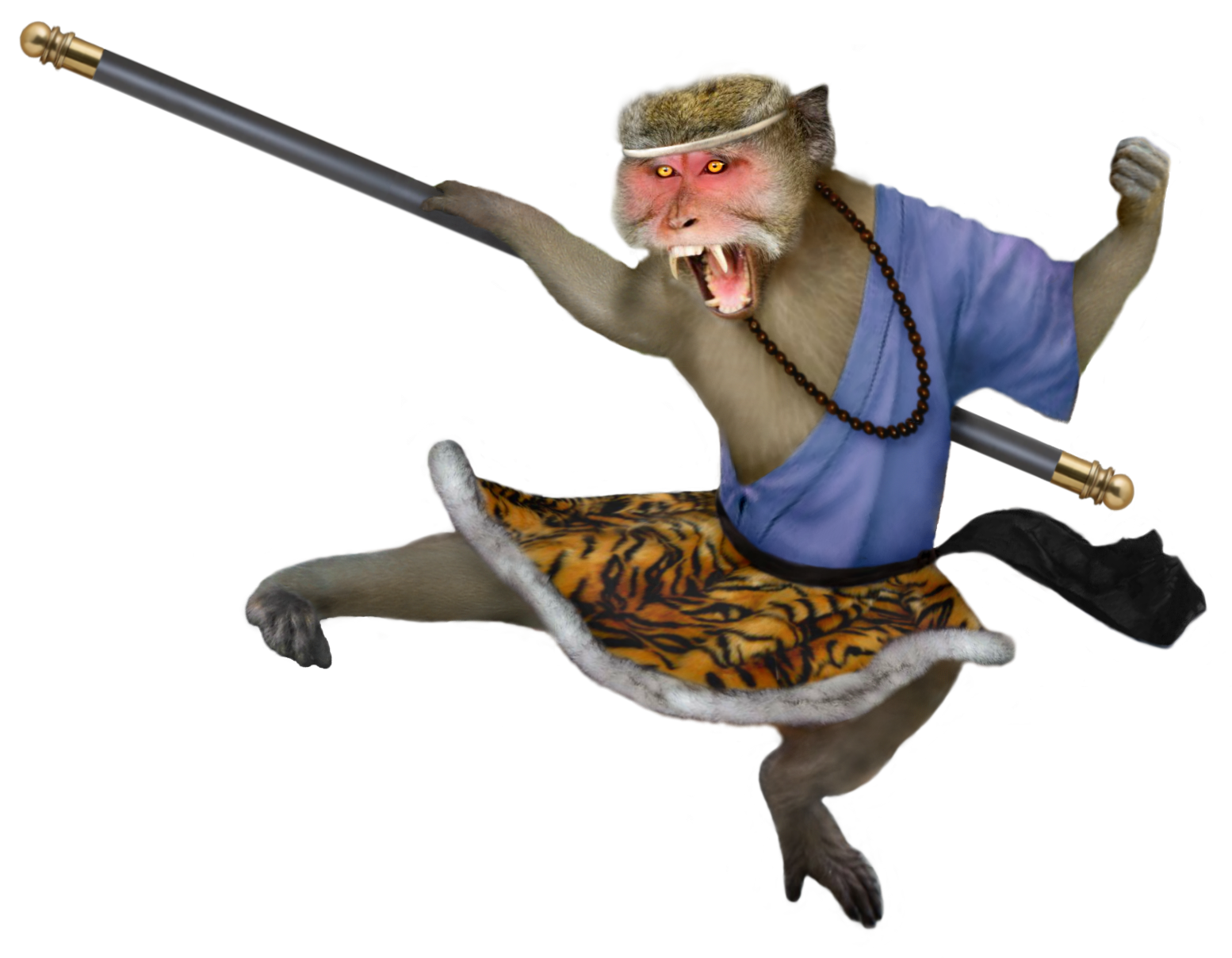
Fig. 1 – A modern depiction of Sun Wukong (by the author) (larger version).

Both the Eastern Dragon King and the Hell King Qinguang (秦廣王) submit memorials to heaven concerning Sun’s misconduct. But the court advisor, an embodiment of the planet Venus, convinces the Jade Emperor to give Sun the menial task of watching over the Heavenly Horses in order to avoid further conflict. Monkey accepts and steadfastly performs his duties, that is until he learns that he’s just a glorified stable boy. He immediately returns to his earthly home in rebellion to proclaim himself the “Great Sage Equaling Heaven” (Qitian dasheng, 齊天大聖). The celestial realm mobilizes an army of powerful demon hunters, including the Heavenly King Li Jing (Li Jing tianwang, 李靖天王) and his son, the child god Third Prince Nezha (Nezha santaizi, 哪吒三太子), but they all fall to Monkey’s magical and martial might. The embodiment of the planet Venus once again steps in to convince the Jade Emperor to acquiesce to Monkey’s demand for higher rank, thereby granting him the empty title of Great Sage Equaling Heaven and even promoting him to watch over the immortal peach groves.

Sun takes stock of the magical peaches that ripen every few thousand years, but he eventually succumbs to their heavenly aroma. He eats all but the youngest life-prolonging fruits, thus gaining another level of immortality. His theft is soon discovered, however, when fairy attendants of the Queen Mother of the West (Xiwangmu, 西王母) arrive to pick the choicest specimens for her long-awaited immortal peach banquet. Sun is alerted to there presence and, upon questioning them, learns that he has not been invited. Naturally, Sun becomes enraged, freezing the maidens in place with fixing magic and then crashes the party before the hallowed guests arrive. He eats all of the celestial food and drinks all of the immortal wine, and then drunkenly stumbles into the laboratory of Laozi (老子), a high god of Daoism. There, he gobbles up the deity’s alchemically-derived elixir pills, thereby adding several more levels of immortality.

Sun returns home once again to await the coming storm of heavenly forces. Tired of the demon’s antics, the Jade Emperor calls up 72 heavenly generals, comprising the most powerful Buddho-Daoist gods, and 100,000 celestial soldiers. In response, Monkey mobilizes his own army comprising the demon kings of the 72 caves and all manner of animal spirits, including his own monkey soldiers. But soon after the battle commences, the demon kings fall to heavenly troops, forcing Sun to take on three heads and six arms and multiply his iron staff to meet the onslaught. Once again, the heavenly army is no match for him. However, he soon loses his nerve when his monkey children are captured in great heavenly nets. He flees with Erlang (Erlang shen, 二郎神), a master of magic and the nephew of the Jade Emperor, taking chase. The two battle through countless animal transformations, each trying to one-up the other. Monkey is finally captured when Laozi drops a magical bracelet on his head, incapacitating him long enough for Erlang’s celestial hound to bite hold of his leg.

Sun is taken to heaven to be executed for his crimes, but fire, lightning, and edged weapons have no effect on his invincible body. Laozi then suggests that they put him inside of the deity’s alchemical furnace to reduce the demon to ashes. They check the furnace 49 days later expecting to see his rendered remains. However, Monkey jumps out unscathed, having found protection in the wind element (xun, 巽) of the eight trigrams. But intense heat and smoke inside the furnace had greatly irritated his eyes, refining his pupils the color of gold and giving them the power to recognize the dark auras of demons in disguise. He overturns the furnace and begins to cause havoc in heaven with his iron staff. The Jade Emperor finally beseeches the Buddha (Rulai, 如来) in the Western Paradise to intervene.

The Tathagata appears and declares that he will make Sun the new ruler of heaven if the macaque can simply jump out of his palm. Monkey agrees to the wager, and with one tremendous leap, speeds towards the reaches of heaven. He lands before five great pillars, thinking them to be the edge of the cosmos. He tags one with his name and urinates at the base of another in order to prove that he had been there. Upon returning, Sun demands the throne. However, the Buddha reveals that the five pillars were actually his fingers, meaning that the Great Sage had never left. But before Monkey can do anything, the Tathagata overturns his hand, pushing it out the gates of heaven, and transforming it into the Five Elements Mountain (Wuxing shan, 五行山). There, Sun is imprisoned for his crimes against heaven, as well as subjected to a hellish diet.

Chapters thirteen to 100 tell how six hundred years later Sun is released during the Tang Dynasty (618-907) to help escort the Buddhist monk Tripitaka (Sanzang, 三藏) (whose early story is told in chapters eight to twelve), a disciple of the Buddha in a previous life, on a quest to retrieve salvation-bestowing scriptures from India. The Bodhisattva Guanyin (觀音) gives the monk a golden headband (jingu, 金箍; a.k.a. jingu, 緊箍, lit: “tight fillet”) as a means to rein in Monkey’s unruly nature. It tightens around Sun’s head whenever a magic formula is recited, causing him great pain. In addition, Guanyin gives Monkey three magic hairs on the back of his neck that can transform into anything he desires to aid in his protection of the monk. Along the way, the two meet other monsters-turned-disciples—Zhu Bajie (猪八戒), the lecherous pig demon, Sha Wujing (沙悟净), the complacent water demon, and the White Dragon Horse (Bailongma, 白龍馬), a royal serpent transformed into an equine—who agree to aid in the monk’s defense. Monkey battles all sorts of ghosts, monsters, demons, and gods along the way. In the end, he is granted Buddhahood and given the title of the “Victorious Fighting Buddha” (Dou zhanzheng fo, 鬥戰勝佛) for protecting Tripitaka over the long journey.

A summary of all 100 chapters can be read on my friend’s blog (fig. 2).

https://journeytothewestlibrary.weebly.com/novel-summary

Fig. 2 – The summary header (larger version).

2. Sequels

There are a total of four unofficial sequels to the novel.

The first is called A Supplement to the Journey to the West (Xiyoubu, 西游补, 1640), which takes place between chapters 61 and 62 of the original. In the story, the Monkey King wanders from one adventure to the next, using a magic tower of mirrors and a Jade doorway to travel to different points in time. In the Qin Dynasty (221–206 BCE), he disguises himself as Consort Yu in order to locate a magic weapon needed for his quest to India. During the Song Dynasty (960–1279), he serves in place of King Yama as the judge of Hell. After returning to the Tang Dynasty, he finds that his master Tripitaka has taken a wife and become a general charged with wiping out the physical manifestation of desire (desire being a major theme running through the novelette). Monkey goes on to take part in a great war between all the kingdoms of the world, during which time he faces one of his own children in battle. In the end, he discovers an unforeseen danger that threatens Tripitaka’s life.

The second is the Later Journey to the West (Hou Xiyouji, 後西遊記, 17th century). This novel focuses on the adventures of Monkey’s spiritual descendent Sun Luzhen (孫履真, “Monkey who Walks Reality”). I have a three-part article about it (first, second, and third).

And the third and fourth are the Continuation of the Journey to the West (Xu Xiyouji, 續西遊記, 17th century) and the New Journey to the West (Xin Xiyouji, 新西遊記, 19th century), respectively. As of 2023, I have not written any articles on these sequels.

3. Cultural Impact

Stories about Sun Wukong have enthralled people the world over for centuries. His adventures first became popular via oral folktale performances during the Song Dynasty (960-1279). These eventually coalesced into the earliest known version of the novel, The Story of How Tripitaka of the Great Tang Procures the Scriptures (Da Tang Sanzang qujing shihua, 大唐三藏取經詩話; The Story hereafter), published during the late-13th century.

Since the anonymous publishing of the complete novel in the 16th century, Monkey has appeared in numerous paintings, poems, books, operatic stage plays, video games, and films (both live action and animated).

He was sometimes “channeled,” along with other martial spirits, by citizen soldiers of the anti-foreign Boxer Rebellion (1899-1901). There is also a monkey-based martial art named in his honor.

It is interesting to note that there are people in southern China, Taiwan, Malaysia, Singapore, Thailand, and Vietnam who worship him as a patron deity. Thus, Sun became so popular that he jumped from oral and published literature to take his place on the family altar.

Copies of The Story were discovered in Japan among a 17th-century catalog of books in the Kozanji Temple (高山寺, Ch: Gaoshan si). No copies are known to exist in China, which suggests this version came to the island many centuries ago. The complete Ming edition of the novel came to Japan in the late-18th century, where it was translated in bits and pieces over the course of some seventy years. However, Monkey did not become immensely popular until the first complete translation of the novel was published in 1835. The last part was illustrated with woodblocks by Taito II (fl. 1810-1853), a noted student of famous artist Hokusai (1760-1849).

Other Japanese artists, such as Kubo Shunman (1757-1820) and Yoshitoshi (1839-1892) (fig. 3), produced beautiful full color woodblock prints of Sun.

Fig. 3 – (Left) Tsukioka Yoshitoshi, “Jade Rabbit – Sun Wukong”, October 10, 1889 (larger version). Fig 4. – (Right) Son Goku (孫悟空) from the Dragonball Franchise (larger version).

Like in China, Monkey has been adapted in all kinds of Japanese media. By far, his most famous adaptation is the manga and anime character Son Goku (孫悟空) (fig. 4) from the Dragon Ball (Jp:ドラゴンボール; Ch: Qi longzhu, 七龍珠) franchise (1984-present). Like Sun, Goku has a monkey tail, knows martial arts, fights with a magic staff, and rides on a cloud. His early adventures in Dragon Ball (manga: 1984-1995; anime: 1986-1989) see him traveling the world in search of seven wish-granting “dragon balls,” while also perfecting his fighting abilities and participating in a world martial arts tournament. Several of the supporting characters, such as Oolong (ウーロン), a lecherous anthropomorphic pig who can change his shape, a nod to Zhu Bajie, were directly influenced by the novel. Dragon Ball Z (manga: 1988-1995; anime: 1989-1996), a continuation of the comic book and animated TV show, follows Goku as an adult and reveals that he is actually a humanoid alien sent as a child to destroy Earth. He arrived in a spherical spaceship that recalls the stone egg from which Sun Wukong was formed. But instead of destroying the planet, he becomes its stalwart protector and faces extraterrestrial menaces from beyond the stars. Goku’s adventures have continued in the sequels Dragon Ball GT (1996-1997), Dragon Ball Super (2015-2018), and Super Dragon Ball Heroes (2018-present).