Qitian Dasheng Monkey King Temples in Taiwan

Last updated: 03-14-2021

Temple Count: 14

Did you know that Sun Wukong (孫悟空), the immortal monkey hero from the great Chinese classic Journey to the West (Xiyouji, 西遊記, 1592), has his own religion? He is mainly worshiped as the “Great Sage Equaling Heaven” (Qitian dasheng, 齊天大聖) in southern China, Taiwan, and Southeast Asian countries like Malaysia, Singapore, and even Thailand and Vietnam.

I recently returned from a trip exploring Great Sage temples in northern and central Taiwan. I’ve decided to mirror a former article by creating a list of Monkey King temples that I’ve visited on the island. This should not be considered comprehensive. I intend to update the article as I visit new locations. I will divide the list according to the closest city/municipality and provide the address if possible. If I’ve already written an article about a particular location, I will add a link to the name.

(Note: Make sure to call each temple ahead of time to learn about the best travel route. Google is not always the most accurate in regards to traveling on foot in the countryside.)

Table of Contents

I. Jilong (Keelung)

1) Shengji Gong (聖濟宮) – 1949

Address: 202基隆市中正區中船路112巷30弄95號

I didn’t get any information about the temple during my visit as the caretaker appeared to be mute (or just didn’t want to talk to me). Online information states that the temple was built in 1949. Legend has it that the Great Sage saved villagers from rampant fires plaguing Keelung at the time. Like Yilan’s Wujian Ziyu Temple (see below), Shengji’s Great Sage and his army of monkey soldiers are portrayed as martial monks (wuseng, 武僧) with a golden headband and long hair. The alcove housing his statue is called the Shuilian Grotto-Heaven (Shuilian dongtian, 水濓洞天) after Monkey’s home the “Water Curtain Cave” (Shuilian dong, 水簾洞) on the Mountain of Flowers and Fruit. He is flanked on his left and right by Shennong (神農) and Kai Zhang Shengwang (開漳聖王), respectively

Pictures:

https://drive.google.com/drive/folders/0Bwi3jyIV3-OhflAzUy1vSHp2aC0wTExPbjRMV2FzX1pzZWlyd3RHM0hJYWpJc3B2RlM3Ykk?resourcekey=0-twvNaHcJLHXWU4JH05PtUg&usp=drive_link

2) Qitian Dasheng Miao (齊天大聖廟) – Unknown

Address: 203基隆市中山區中山二路89巷31號

No caretakers were present at the time of my visit, so I was unable to ask questions about history or names. All statues were locked inside of a glass display case, along with a blue booklet that caught my eye. It was titled The Great Sage Equaling Heaven’s True Scripture of Awakening People and Enlightening the World (Qitian Dasheng xingren jueshi zhenjing, 齊天大聖醒人覺世眞經). Like in Shengji and Wujian Ziyu Temples, the Great Sage and his monkey army are depicted as martial monks. Also like Shengji, he is flanked, this time on his left, by Kai Zhang Shengwang. He is flanked on his right by Fude Zhengshen (福德正神).

Pictures:

https://drive.google.com/drive/folders/0Bwi3jyIV3-OhflJtdTZya3lrY01HZVFfTmpIYlRpaF8yNHlTTFdCeUtnRlY3WE9kQzVjODA?resourcekey=0-D67c2xakNujE-s67mqVckA&usp=sharing

II. Taipei

1) Shilin Zheng’an Gong (士林正安宮) – circa 1990

Address: 111台北市士林區士東路2巷5號

The Zheng’an Temple of Shilin [1] is definitely the smallest Great Sage house of worship that I’ve yet visited. It appears to be a small, open-front store/apartment unit that has been converted into a temple. It recognizes at least seven Great Sages, each with his own name and purpose. I’m still gathering information on the temple, so I will post their names at a later date. While most such temples have one or two spirit-mediums, Zheng’an has an astounding seven, each of whom reports to a respective Great Sage. During special occasions, the spirit-mediums perform self-mortification with swords, axes, swordfish noses, spiked clubs, and spiked balls.

I had the pleasure of joining the temple on a pilgrimage to the south of Taiwan back in November of 2020. I was even blessed with the opportunity to help carry the Third Prince’s palanquin, which led the way for a much larger vehicle containing Zheng’an’s numerous Great Sage statues. I’ll write more about this in the future.

Pictures:

https://drive.google.com/drive/folders/0Bwi3jyIV3-OhfkY1VDdRUkNfMFdzTlgzdWZvUW5IZTNfN2NJMmdhRzFocmdaMWJmYWQ5Tjg?resourcekey=0-vTwI3jOGf6nQgFCwiL5Wlg&usp=sharing

2) Shuilian Gong (水濂宮) – Unknown

Address: 108台北市萬華區環河南路一段344號

The temple attendants were unable to give me any history on the temple. But I did learn that they worship a trinity: “Great Sage Sun” (Sun Dasheng, 孫大聖), the large central figure (image 1 (27)); the “Black Great Sage” (Hei Dasheng, 黑大聖), the small figure holding the gourd and whip (image 1 (34)); and the “White Great Sage” (Bai Dasheng, 白大聖), the small figure shielding his eyes and holding a staff (image 1 (42)). These color-coded names remind me of the red, white, and black-faced Great Sages from Fujian, the original home of Monkey’s religion. The temple houses many monkey god statues apart from the trinity, likely soldiers. I’ll return to get more info and better pictures. The soot black figures and bright clothing make it hard to get detailed photos.

Pictures:

https://drive.google.com/drive/folders/0Bwi3jyIV3-OhfkNJNlVLaXhUdW5idGMzaElNbjZDNU0xSFM3TVhUdkpZeFBvbGJMZEpsLUE?resourcekey=0-uTyI6aTdwRlh72AJb1z59A&usp=drive_link

III. Xinbei (New Taipei)

1) Qitian Dasheng Dian (齊天大聖殿) – circa 2000

Address: 249新北市八里區渡船頭路9號

I was told by the temple’s ritual master that she received a religious vision from the Great Sage to move from Gaoxiong in the south and look for land with good fengshui for a temple. After her third move, she founded her temple in the mountainous region of Bali. While the temple has several monkey statues, each is considered a different aspect of the singular “Lord Great Sage” (Dasheng ye, 大聖爺) or “Great Sage Patriarch” (Dasheng zushi, 大聖祖師).

The area behind the temple features a garden with a colorful, life-sized statue of the Great Sage seated on a throne. He holds a peach of immortality in one hand and his staff in the other. His throne rests on an elevated rock outcropping painted with the characters for the “Mountain of Flowers and Fruit” (Huaguo shan, 花菓山). A series of concrete steps laid within the folds of the rocks takes you to a private heaven further into the mountain with flowers and guava, papaya, banana, and tangerine crops. It’s a great experience.

Be forewarned: The route that Google told me to walk from the bus stop was NOT reliable. My GPS took me through a neglected cemetery up the side of a mountain. I had to cut a path through the forest, jump streams, and climb rocks before I finally arrived all sweaty and dirty. The temple personnel were amazed that I made such a trip because the route was completely unnecessary. They told me of a road leading directly to the temple! Apparently my GPS showed me the most direct route instead of the slightly longer, yet far more practical one. I highly suggest walking from the foot of Duchuantou Rd. (渡船頭路) and following the signs to the temple.

On the bright side, the caretakers were so thrilled to learn of my great interest in their god that they treated me to tea, fruit, and snacks. They are very welcoming people.

Pictures:

https://drive.google.com/drive/folders/0Bwi3jyIV3-OhfnN2amU5WmtzSEg1akt4UXRyaEYxSVB0ei00Nk84VHJDbk1TZ2o5WThleVU?resourcekey=0-E3rHR884MaSFmXdBuizoiQ&usp=sharing

2) Banqiao Yunsheng Gong (板橋雲聖宮) – Unknown

Address: 220新北市板橋區富山街84號

This temple was closed when I visited. I had to shoot pictures through two sliding glass doors. It is very small, possibly as small or even smaller than Zheng’an Temple in Taipei.

Pictures:

https://drive.google.com/drive/folders/0Bwi3jyIV3-Ohfk90MC1wUnRXQzhlWGVUNjdwTzB0T1NQc285MXF4cmFHVUc5VHlrWUFuOFE?resourcekey=0-7E48uhiHgEPXaihd35mbAg&usp=sharing

3) Qitian Dasheng Miao (齊天大聖廟) or Qitian Dasheng Ye Miao (齊天大聖爺廟) – Unknown, possibly new

Address: 238新北市樹林區佳園路一段41巷6號

The caretaker told me that the temple had not yet been consecrated and therefore wouldn’t let me take any pictures inside. However, a Chinese comment on Google says the temple “isn’t open to the outside world,” suggesting that it’s closed to the public. Based on what little I could see, the building unit appears to be someone’s home/business/personal altar. Rows and rows of god statues packaged for sale lined shelves against a back wall.

IV. Yilan

1) Wujian Ziyu Si (五間紫雲寺) – 1960

Address: 263宜蘭縣壯圍鄉大福路三段449號

Legend has it that around 1899 a man found a monkey-shaped stone and enshrined it in a thatched shed. This was eventually converted to a temple a few years later. It was destroyed by a typhoon in 1960 but subsequently rebuilt. The temple appears to recognize a trinity, with countless monkey soldiers beneath them, each portrayed as martial monks with a golden fillet and long hair. The Great Sage has two aspects: the “Martial Great Sage” (Wu Dasheng, 武大聖) (standing statues), who exorcises evil, and the “Civil Great Sage” (Wen Dasheng, 文大聖) (seated statues), who insures the safety of people and animals.

Pictures:

https://drive.google.com/drive/folders/0Bwi3jyIV3-OhfjlJSVc4QkVlSHRGYXR6OC13MDhuczdIVUsxTV9rcUxjMnZBQUFsMGFGbUk?resourcekey=0-X_tibNKz6SnI5YesVR_G1w&usp=sharing

V. Xinzhu (Hsinchu)

1) Shenglong Gong (聖龍宮) – 2016

Address: 310新竹縣竹東鎮中豐路三段187號

This temple is famous for its nine-meter-tall (29.52 ft.) statue of the Great Sage, which is apparently the tallest in Taiwan. I was told that it was shipped from Fuzhou, Fujian Province, China. The members appear to only revere a single monkey god, whom they call the “Buddha Great Sage Equaling Heaven” (Qitian Dasheng Foye, 齊天大聖佛爺). The smaller statue in front of the taller one was the original focus of worship at a devotee’s home prior to the building of the temple.

Pictures:

https://drive.google.com/drive/folders/0Bwi3jyIV3-OhfnNvdkJlTEdjZnFHVDRFZGxGNm1HRG1kNU10cWl6Vm1ubEdBTnVaSjJ1U1E?resourcekey=0-w6nIRnUrmb-cjOOSBuKiWQ&usp=drive_link

VI. Taizhong (Taichung)

1) Yusheng Si (玉聖寺) – 1959

Address: 436台中市清水區頂湳路73號

Records for the original temple apparently go back to the Xianfeng (1850–1861) period. According to legend, Yusheng was built at the behest of a beggar who revealed himself to be the Great Sage. The current house of worship was built in 1959. The members appear to recognize at least five Great Sages (maybe more). I was told that they don’t have individual names; though, the members may have been apprehensive to share secrets with a random foreigner. They just refer to them as “Lord Great Sage Equaling Heaven” (Qitian Dasheng Ye, 齊天大聖爺). One figure has a painted face similar to pestilence gods (wenshen, 瘟神). Perhaps this version of the Great Sage serves a similar purpose. It’s interesting to note that several statues are shown holding spiked balls like those used by spirit-mediums.

Pictures:

https://drive.google.com/drive/folders/0Bwi3jyIV3-OhfkpzTnI3YkU0LTh3N3ZYVDAzZWJwa1IwRF9LTUxtT3FhUGZaNjN6ejAxWGM?resourcekey=0-GUurvR7ZOmGtYI47Fm6fvA&usp=sharing

2) Wuji Tianyi Jiancha Gong Tiantan (無極天壹監察宮天壇) – Unknown

Address: 406台中市北屯區太原路三段1398號 (see below)

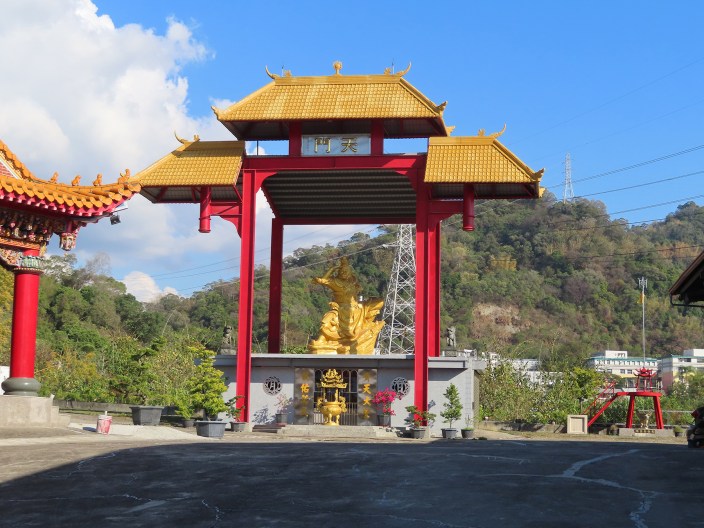
This temple was closed when I visited. I had to shoot pictures of their lovely statue over the gate. I’m guessing it’s four to five-meters-tall based on the ding censor in front. I plan to go back at a later time to get pictures of the temple interior.

I did see a black command flag (Hokkien: or leng ki; Ch: hei leng qi, 黑令旗) out front, which signifies that a spirit-medium is active in the temple.

Update: 04-24-21 – I was informed that this location is only used for particular festival days. The main temple is located at 404台中市北區富強街117巷17號.

Pictures:
https://drive.google.com/drive/folders/0Bwi3jyIV3-OhfjMtSE1oVU1Wd2pWZGpWWE94X09TZ3hjSXBPV0dlSGY5cEctYkI4TkJzbk0?resourcekey=0-uLDycsBAupb0qe1Lup7JgA&usp=sharing

VII. Beigang, Yunlin

1) Shengfo Tang (聖佛堂) – Unknown

Address: 651雲林縣北港鎮文化路198-1號

No attendants were present when I visited, so I couldn’t ask any questions about history or beliefs. The small temple appears to recognize three Great Sages, each represented with golden eyes. The larger central figure is depicted as a martial monk with long hair, while those to his left and right have animalistic, furry faces. Interestingly, the main statue is immediately flanked on both sides by a single wooden pole topped by a black or red Great Sage bag puppet, each depicted as a martial monk. A paper fan and two framed ink on paper paintings indicate the monkey god is referred to as the “Fighting Sage Buddha” (Douzhan sheng fo, 鬥戰聖佛). This is a variant of the deity’s lesser used title, the “Victorious Fighting Buddha” (Dou zhansheng fo, 鬥戰勝佛).

The main altar is flanked on the right by various Buddhist deities and on the left by Daoist gods.

The front of the building is adorned with two Great Sage spirit generals (shenjiang, 神將) [2], something I’ve never before seen but have heard of; as well as a large black command flag, indicating the presence of a tangki spirit-medium. A large, ornate spiked ball, like those used by mediums, was positioned on the offerings table between statues of San Taizi and bottles of rice wine.

The temple is located down the street from a small joss stick factory. It was interesting to see brightly-colored bundles and rolling trays of the sticks being aired out to dry.

Pictures:

https://drive.google.com/drive/folders/0Bwi3jyIV3-OhfjZfb2hpeDNMUnBqX3ZxemRtbDdSMl9tQnpfanlqY3Y1MGJrVi1OOVQ0bzg?resourcekey=0-AK1FYcermkK3wr44y8VntQ&usp=drive_linkhttps://drive.google.com/drive/folders/1qAIvC31izqKt49tTyQYSjxIOPx7T8P7D?usp=sharing

VIII. Chiayi (Jiayi)

1) Jisheng Gong (吉聖宮) – 1979

Address: 嘉義市林森東路691巷139弄65號

While an attendant with a thick Taiwanese accent told me the temple was “very, very old,” online information indicates that it was founded in 1979. Legend has it that Lord Guan sent the Great Sage to heal the head injury of a member of the Li (李) family, leading to their worship of the monkey god. (This suggests that Lord Guan is considered a superior of the Great Sage in Jisheng’s celestial hierarchy). The current Great Sage statue is apparently based on an original one that presided over the incense pot at a Lord Guan temple and was later kept in the Li family home. It sits in a man-made cave, along with other monkey figures and Buddho-Daoist gods, behind metal bars. It holds a banana leaf fan like that wielded by Lady Ironfan.

A large metal rod, a replica of the monkey god’s magic staff, is locked to a side wall when not in use by the temple’s spirit-medium. It is plastered with a paper talisman.

A hall to the right of the temple houses several spirit general costumes of various protector deities.

Pictures

https://drive.google.com/drive/folders/0Bwi3jyIV3-Ohfm5xaUF6WFU5TTZiTF90TkJVazBjbVNQaTJ6WXhhZHFkRkVNMElCWXZTblk?resourcekey=0-cUuC4t9sK9S4kBaUBYLDlA&usp=sharing

IX. Tainan

1) Wanfu An (萬福庵) – 1660s

Address: 700台南市中西區民族路二段317巷5號

Wanfu is touted as the oldest Qitian Dasheng temple on the island, originally serving as the home of an anti-Qing general’s wife during the Southern Ming (c. 1660s), which was later converted to a house of worship following her death. It was known for taking in orphans during the early-19th century. The temple recognizes a trinity of Great Sages, followed by a small handful in administrative positions, and finally a plethora of soldier monkeys. The highest-ranking member of the trinity is a 300-plus-year-old Fujianese stone statue called “Laying the Foundations Elder Great Sage” (Kaiji Da Dasheng, 開基大大聖). The temple has a single spirit-medium. But the last time I checked, he was training a disciple, his nephew.

Great Sage temples from all over Taiwan look upon Wanfu as a fount of pure energy, visiting every year to procure its incense ashes in order to replenish their spiritual armies. Spirit-mediums are thought to direct these soldiers in battle while possessed by the monkey god. I personally witnessed this ash ceremony during the Shilin Zheng’an Temple pilgrimage (as noted earlier). I saw at least three other temples waiting for their turn. I’m sure many more visited that day and the next.

Pictures:

https://drive.google.com/drive/folders/0Bwi3jyIV3-OhfldvbDFFdmlrWHNWNnFNeUhEY1hhTEhYaVdiUnRxS3VBZ2UtRDRwSkVTbms?resourcekey=0-NsUQkYFLqs_gC9-5onWgAw&usp=sharing

Notes:

1) Not to be confused with other Zheng’an Temples in Taiwan.

2) Large, bulky costumes that rest on a performer’s shoulders. They see out through holes in the chest. Such costumes are worn during religious processions, and the walking movement causes hinged arms to swing to and fro.

The Monkey King and The Buddha Victorious in Strife (a.k.a. Victorious Fighting Buddha)

NOTE: THIS IS MY 100TH BLOG POST.

Last updated: 06-13-2025

The Monkey King is elevated in spiritual rank at the end of Journey to the West (Xiyouji, 西遊記, 1592; “JTTW” hereafter) for his service in protecting the monk Tripitaka throughout the quest to India. Gautama Buddha enfeoffs him as the “Buddha Victorious in Strife” or “Victorious Fighting Buddha” (Dou zhansheng fo, 鬥戰勝佛). Many readers may be surprised to learn that this is actually an established Buddhist deity and not just the creation of the JTTW author-compiler. In this article, I would like to briefly explore the Buddha’s religious background, iconography, purpose, and relationship to the worship of Sun Wukong.

Table of Contents

1. Literary Enlightenment

The Gautama Buddha explains:

Sun Wukong, when you caused great disturbance at the Celestial Palace, I had to exercise enormous dharma power to have you pressed beneath the Mountain of Five Phases. Fortunately your Heaven-sent calamity came to an end, and you embraced the Buddhist religion. I am pleased even more by the fact that you were devoted to the scourging of evil and the exaltation of good. Throughout your journey you made great merit by smelting the demons and defeating the fiends. For being faithful in the end as you were in the beginning, I hereby give you the grand promotion and appoint you the Buddha Victorious in Strife (Wu & Yu, 2012, p. 381).

孫悟空,汝因大鬧天宮,吾以甚深法力,壓在五行山下,幸天災滿足,歸於釋教;。且喜汝隱惡揚善,在途中煉魔降怪有功,全終全始,加陞大職正果,汝為鬥戰勝佛。

2. Religious Background

JTTW closes by “submitting” or “prostrating” (namo, 南無) to a long list of Buddhas, Bodhisattvas, and Arhats. The Buddha Victorious in Strife is placed at the end of 47 Buddhas and ahead of the Bodhisattva Guanyin. A section of the list reads:

[…]
I submit to the Buddha of the Gift of Light.
I submit to the Buddha of Candana Merit.
I submit to the Buddha Victorious in Strife (emphasis added).
I submit to the Bodhisattva Guanshiyin.
I submit to the Bodhisattva, Great Power-Coming
[…] (Wu & Yu, 2012, p. 385).

南無才光佛。南無旃檀功德佛。南無鬥戰勝佛。南無觀世音菩薩。南無大勢至菩薩

Many of the Buddhas from the novel’s list appear in assorted real world canonical lists, including the 88 Buddhas (Bashiba fo, 八十八佛) from the Great Repentance Text of the Eighty-Eight Buddhas (Ch: Bashiba fo da chanhui wen, 八十八佛大懺悔文). [1] This group is comprised of the 53 Buddhas (Ch: Wushisan fo, 五十三佛) and the 35 Confession Buddhas (Ch: Sanshiwu fo chan, 三十五佛懺) (fig. 1).

The historical “Buddha Victorious in Strife,” Yuddhajaya (Sk: युद्धजय; see the 06-13-2025 update for more name info), is the 31st of the 35 Confession Buddhas, who are individually called upon during a confessional prayer to absolve oneself of sins. They appear in a number of sources, such as The Bodhisattva’s Confession of Ethical Downfalls (Ch: Pusa duochan / Pusa chanhui wen, 菩薩墮懺 / 菩薩懺悔文) from the Three Heaps Sutra (Sk: Trīskhandhadharmasūtra; Ch: Sanyun jing, 三蘊經) and the Names of the Thirty-Five Buddhas Spoken by the Buddha (Ch: Foshuo sanshiwu foming lichan wen, 佛說三十五佛名禮懺文, 8th century). 

Fig. 1 – A religious painting of the 35 Confession Buddhas (larger version). The Buddha Victorious in Strife is third from the right on the bottom row. Image found here.

2.1. Iconography

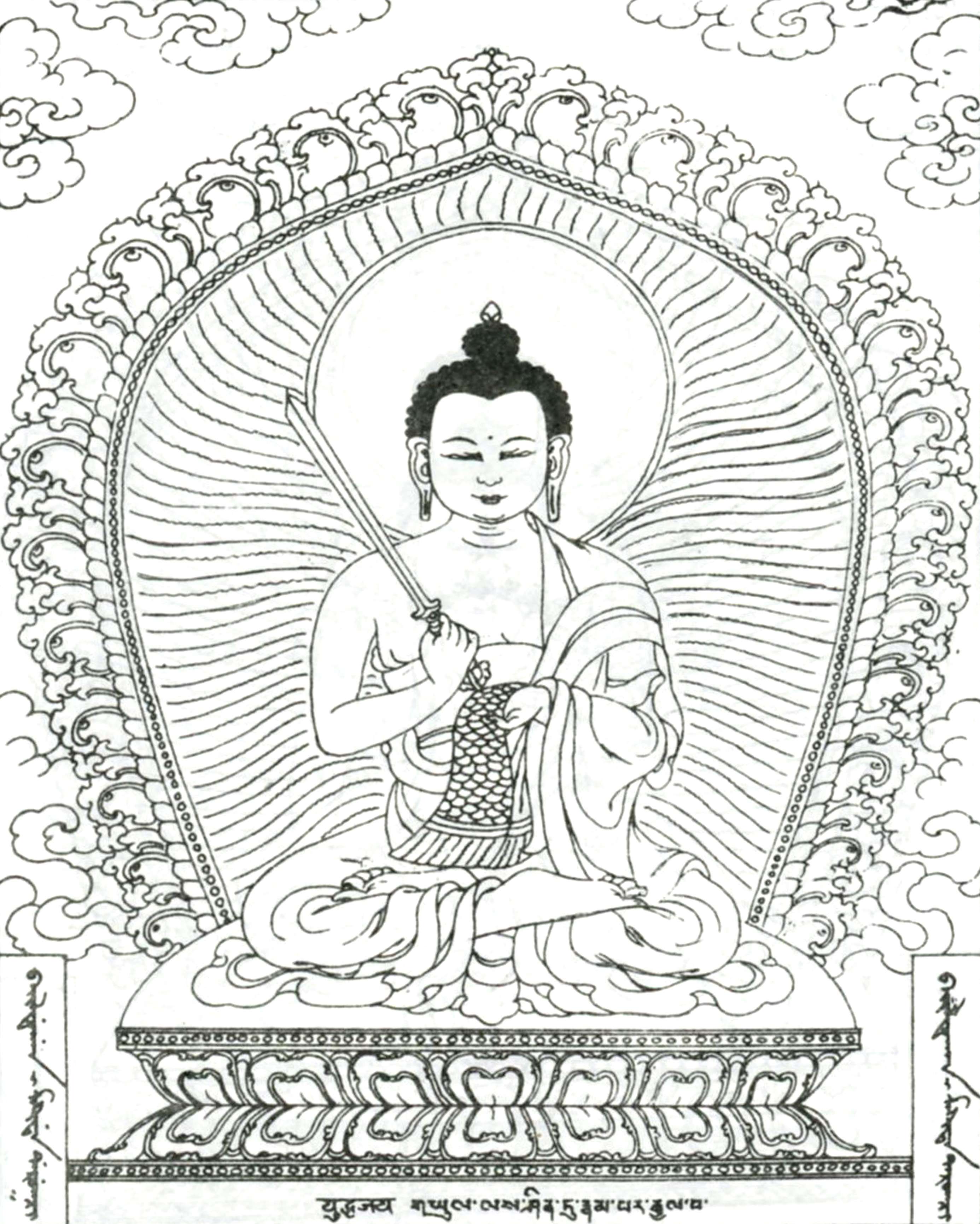
The Buddha Victorious in Strife is depicted in Buddhist art with the traditional features of a Buddha (i.e. ūrṇā, uṣṇīṣa, long ear lobes, robes, etc.), but he is also shown holding a suit of armor and a sword (fig. 2):

Yuddhajaya Buddha — (Skt.: aka Yuddhajaya) (Chin.: Tou-chan-sheng fo; Mon.: Bayildugan-i masids darugci; Tib.: gYul-las-sin-tu-rnam-par-rgyal-ba, rGyal-ba-gYul-lasr-Gyal-ba) A Sanskrit variant for the Jina Yuddhajaya. One of the Buddha images found in the Pao Hsiang Lou [寶相樓] temple of the Forbidden City, Beijing, and one of the thirty-five “Buddhas of Confession.” Face: one, calm, urna, usnisa, long ear-lobes; arms/hands: holding a cuirass up to his chest; body: monastic robes; legs: two; asana: vajrasana; vahana: lotus throne.

— (2) — (Mon.: Bayildugan-i masids darugci; Tib.: gYul-las-sin-tu-rnam-par-rgyal-ba) One of the Buddhas of Confession pictured in the Mongolian Kanjur (Mon.: Monggol ganjur-un) (1717-1720) Face: one, calm, urna, usnisa, long ear-lobes; arms/hands: two, right hand holds sword (khadga, ral-gri), left hand holds coat of mail (khrab); body: monastic robes, right shoulder uncovered; legs: two; asana: vajrasana; attributes: 32 major and 80 minor signs; vahana: lotus throne (Bunce, 1994, Vol. 1, p. 629). [2]

Fig. 2 – The Buddha Victorious in Strife (Yuddhajaya) holding a sword and suit of armor (larger version). Image found here.

2.2. Purpose

Neither the name Buddha Victorious in Strife nor the sword and armor are a reference to the deity’s fighting prowess. According to Lai (2016), the Buddha “defeat[s] the inner enemies of afflictive emotions and negative actions of sentient beings. He is victorious over cyclic existence and thus able to lead all sentient beings to liberation. He purifies the negative karma of actions committed out of pride.”

His name and accoutrements, therefore, symbolize the means by which he subjugates the negative emotions or actions that would otherwise keep man trapped in the illusory world of Saṃsāra.

3. Relationship to Sun Wukong’s Worship

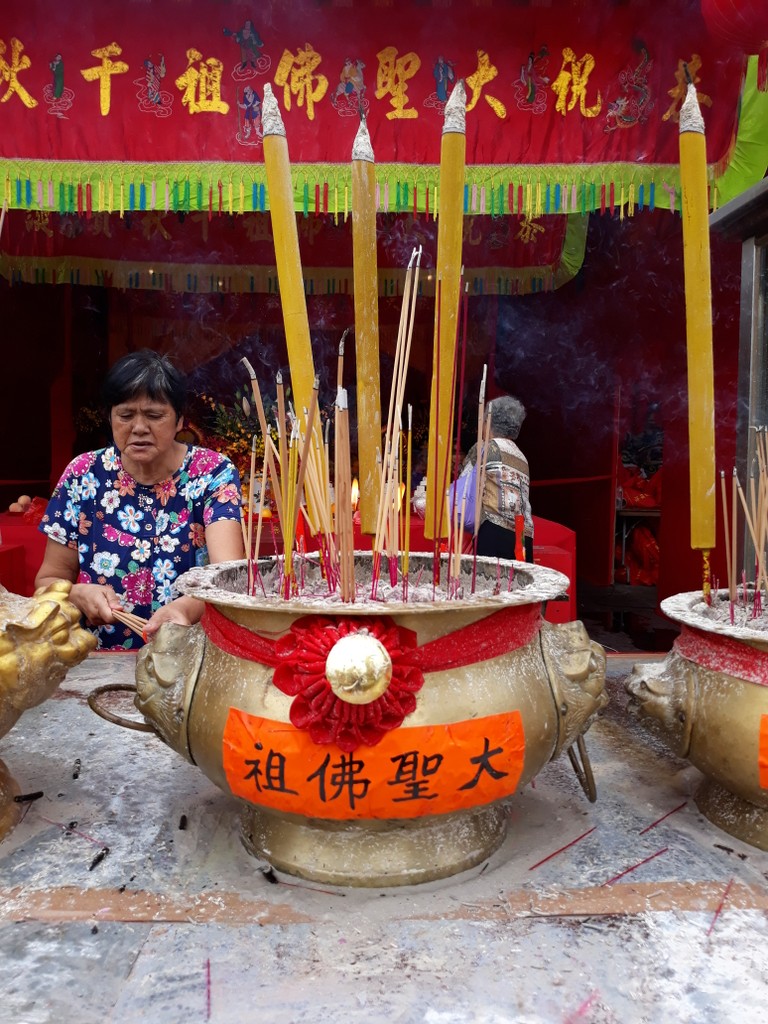
The Monkey King is worshiped in southern China, Taiwan, and Southeast Asian countries like Malaysia, Singapore, Thailand, and Vietnam as a great exorcist and protector of children. But it may come as a surprise to learn that he is rarely worshiped as the Buddha Victorious in Strife. Instead, Wukong is almost exclusively revered as the “Great Sage Equaling Heaven” (Qitian dasheng, 齊天大聖), and even when he is called a Buddha, the name usually includes some reference to the rebellious title. For example, when I attended the Monkey King’s birthday (sixteenth day of the eighth lunar month) in Hong Kong in 2018, I saw an incense pot labeled “Great Sage Buddha Patriarch” (Dasheng fozu, 大聖佛祖) (fig. 3).

So why isn’t Sun widely worshiped as the Buddha Victorious in Strife? I think the simplest answer is that the Buddha already had a long-established following and therefore couldn’t be subsumed under the late-blooming cult of a cultural hero, even one as popular as the Monkey King.

Fig. 3 – An incense pot reading “Great Sage Buddha Patriarch” (Dasheng fozu, 大聖佛祖) (larger version). Taken by the author in Kowloon, Hongkong (Sept. 24, 2018).

4. Precedent for Spiritual Promotion

The author-compiler likely connected Sun Wukong to the Buddha Victorious in Strife because of the Enlightened One’s war-like iconography (recall the sword and armor mentioned above). After all, Monkey is an armor-wearing martial deity wielding his magic staff to protect Tripitaka from untold numbers of demons and spirits.

But the choice to elevate Monkey in rank was likely influenced by previous media. For example, Wukong’s literary antecedent, the Monkey Pilgrim (Hou xingzhe, 猴行者), receives a promotion at the end of The Story of How Tripitaka of the Great Tang Procures the Scriptures (Da Tang Sanzang qujing shihua, 大唐三藏取經詩話), a late-13th century precursor of JTTW. The story ends thus: “Tang Taizong later enfeoffed Monkey Pilgrim as ‘Great Sage Steel Muscles and Iron Bones'” (Gangjin tiegu dasheng, 鋼筋鐵骨大聖) (Wivell, 1994, p. 1207). [3]

5. Conclusion

At the end of JTTW, the Buddha promotes Sun Wukong to the “Buddha Victorious in Strife” or “Victorious Fighting Buddha” (Dou zhansheng fo, 鬥戰勝佛). This is the Chinese name of Yuddhajaya (Sk: युद्धजय), the 31st of the 35 Confession Buddhas called upon during a confessional prayer to absolve oneself of sins. He is generally portrayed as a robe-wearing Buddha holding a sword and suit of armor. This is not a reference to the deity’s fighting prowess, however. Instead, his name and accoutrements symbolize the means by which he subjugates the negative emotions or actions that would otherwise keep man trapped in the illusory world of Saṃsāra.

Instead of being universally revered as the Buddha Victorious in Strife, the Monkey King is far more widely worshiped in East and Southeast Asia as the “Great Sage Equaling Heaven” (Qitian dasheng, 齊天大聖) or a variant like “Great Sage Buddha Patriarch” (Dasheng fozu, 大聖佛祖). This discrepancy is probably due to the original Yuddhajaya already having a long-established following. There’s no way that he could ever be subsumed under Sun Wukong’s late-blooming cult. 

Wu Cheng’en (or whoever the true author-compiler was) likely connected Monkey to the Buddha Victorious in Strife because both have martial iconography. Sun is commonly depicted wearing armor and wielding an iron staff, while Yuddhajaya is shown holding a sword and armor. But the concept of Sun receiving an elevation in spiritual rank goes back centuries. The Monkey Pilgrim, his literary antecedent from The Story of How Tripitaka of the Great Tang Procures the Scriptures (late-13th century), is deified by the Tang emperor as “Great Sage Steel Muscles and Iron Bones” (Gangjin tiegu dasheng, 鋼筋鐵骨大聖).


6. Updates

Update: 09-06-20

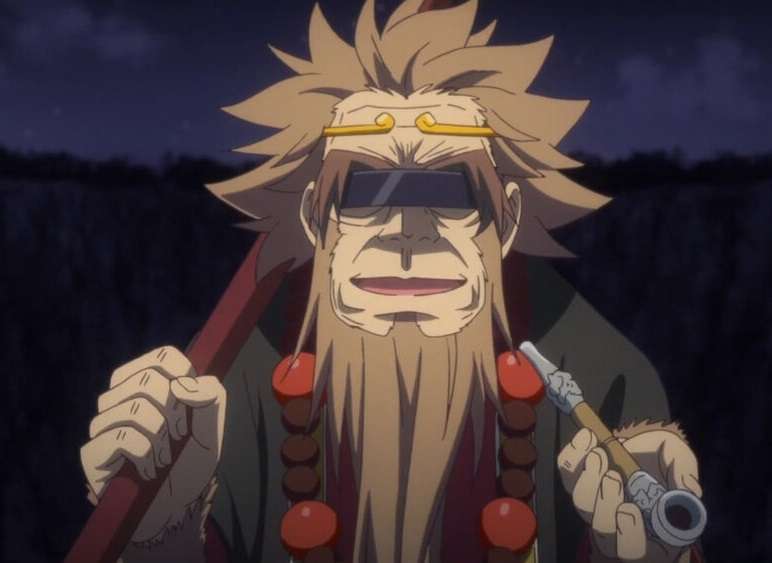
If you type “Buddha Victorious in Strife,” “Victorious Fighting Buddha,” “鬥戰勝佛” or “斗战胜佛” into google images, you’ll notice that these terms are almost exclusively associated with Sun Wukong. Most results are fan-made drawings of Monkey wearing his armor. Very few depict him as a Buddha. The only appearance of the latter in popular media that I’m aware is the Victorious Fighting Buddha from the manga / anime High School DxD.

The character is depicted as a jovial old dwarf with long, shaggy brown hair, bushy eyebrows that fall over a cyberpunk-style black visor, no mustache, a long beard, a floor-length, dark gray coat over a red robe, and monkey feet. He wears his famous golden fillet and a set of chunky brown and red prayer beads. In his left hand he holds a smoking pipe, while the right holds his magic staff, which is depicted as red and gold (fig. 4).

Fig. 4 – The Victorious Fighting Buddha from High School DxD (larger version).

The Victorious Fighting Buddha inhabits a universe where various factions of Western and Eastern gods, devils, and heroes battle one another. According to the story, upon ascending to Buddhahood, he steps down as the Monkey King, handing the title to a young descendant, and serves as the vanguard of the Hindu god Indra, during which time he protects the cosmos from a faction of devils and fallen angels. He later takes on the role of sub-leader and mentor to a new faction of young heroes whom he trains to battle god-tier opponents.

High School DxD portrays the Victorious Fighting Buddha as very powerful. For example, season four, episode six (minute 13:35) of the anime shows him effortlessly blocking the “True Longinus” spear with the tip of his index finger. This is quite a feat as this weapon is the same one used to pierce the side of Christ, thereby giving it the power to kill other gods.


Update: 03-22-21

I visited “Sage Buddha Hall” (Shengfo Tang, 聖佛堂), a Great Sage temple in Beigang, Yunlin, Taiwan and saw a few items labeled the “Fighting Sage Buddha” (Dou zhan sheng fo, 鬥戰聖佛) in place of the Buddha Victorious in Strife/Victorious Fighting Buddha. One such item was a paper fan (fig. 5). As noted above, Buddha Victorious in Strife/Victorious Fighting Buddha is not a reference to the deity’s fighting prowess, but his ability to “defeat the inner enemies of afflictive emotions and negative actions of sentient beings.” So it appears that this temple takes his martial skill at face value.


Update: 08-09-22

As an enlightened Buddha, Monkey is eligible for his own “Buddha-Field” (Sk: Buddhakṣetra; Ch: Focha, 佛刹), essentially his own universe in which he will lead the inhabitants to enlightenment. Buswell and Lopez (2014) explain:

[W]hen a buddha achieves enlightenment, a “container” or “inanimate” world is produced in the form of a field where the buddha leads beings to enlightenment. The inhabitant of that world is the buddha endowed with all the [qualities of an Enlightened One]. Buddha-fields occur in various levels of purification, broadly divided between pure and impure. Impure buddha-fields are synonymous with a world system (cakravāḍa), the infinite number of “world discs” in Buddhist cosmology that constitutes the universe; here, ordinary sentient beings (including animals, ghosts, and hell beings) dwell, subject to the afflictions of greed, hatred, and delusion. Each Cakravāḍa is the domain of a specific buddha, who achieves enlightenment in that world system and works there toward the liberation of all sentient beings… (p. 153).


Update: 01-22-23

Chandra (1999) includes a lovely black and white line drawing of Yuddhajaya (fig. 6) (p. 94).

Fig. 6 – A traditional Tibetan drawing of Yuddhajaya (larger version). Image from Chandra, 1999, p. 94.


Update: 05-09-23

I commissioned NinjaHaku21 (Twitter, Instagram, and Tumblr) to draw Sun Wukong using Yuddhajaya’s traditional iconography (fig. 7), and the results are stunning! It is based on the design from figure two above.

Fig. 7 – A religiously accurate drawing of Monkey as the Yuddhajaya Buddha by NinjaHaku21 (larger version).


Update: 06-12-23

I have written a companion piece to this article about Tripitaka’s Buddha title.

The Tang Monk Tripitaka and the Buddha Candana Merit


Update: 09-11-23

Tumblr user @darkfalcon-z has drawn a lovely picture of the Monkey King as a Buddha (fig. 8). They explain their headcanon for the image:

[B]aby monkeys think Grandpa’s lotus throne is for playing.

[…]

I think Wukong got back to his mountain to take care of his monkeys. He does visit sometimes. He takes his favourite monkeys along for the ride. I don’t think it is much of a problem in Western Heaven in Buddha’s domain, because if you are enlightened the antics of little animals won’t really bother you. He’s told not to bring monkeys along next time as per formality. He does anyway. It’s not like anyone minds. He takes the monkeys along when he visits Jade Emperors domain. There monkeys are treated as nuisance and chased around, but no one actually dares to harm them, as they fear to incur his anger. He probably takes more troublesome monkeys too. On purpose.
I love the baby monkeys, as well as Wukong’s flower-like halo.

Fig. 8 – @darkfalcon-z’s Monkey Buddha (larger version). Used with permission.


Update: 11-07-2024

Above, I wrote: 

Wu Cheng’en (or whoever the true author-compiler was) likely connected Monkey to the Buddha Victorious in Strife because both have martial iconography. Sun is commonly depicted wearing armor and wielding an iron staff, while Yuddhajaya is shown holding a sword and armor.

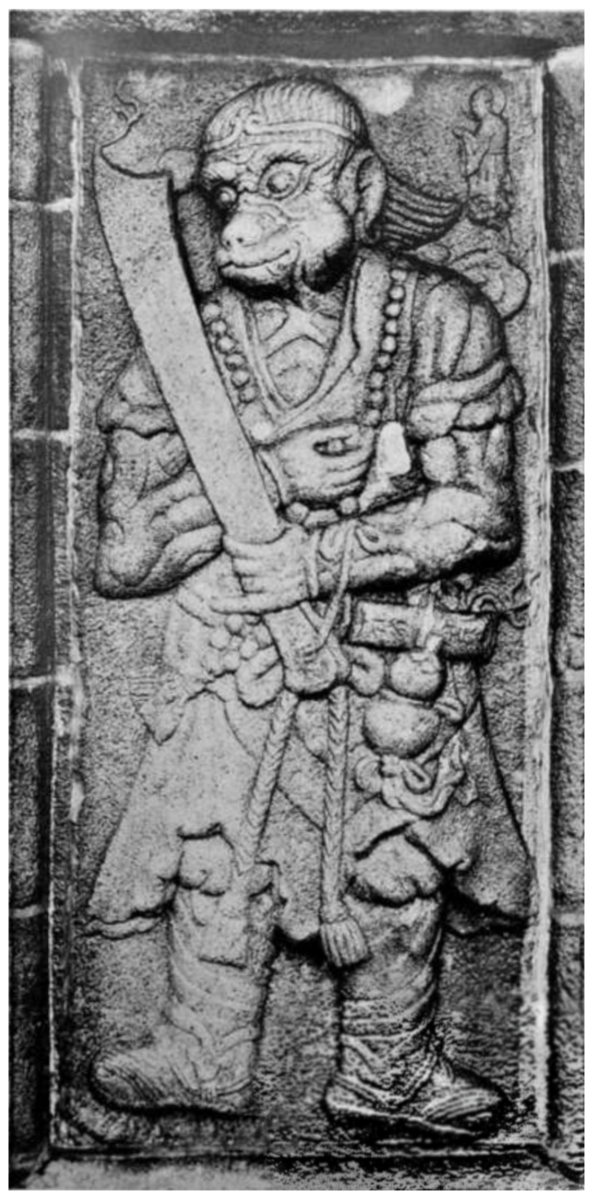
But it just dawned on me that Sun’s antecedent, the Monkey Pilgrim (Hou xingzhe, 猴行者), is also portrayed holding a divine sword in a 13th century stone relief carving (fig. 9). This weapon is referred to as his “Bodhisattva Sabre” (Pusa dao, 菩薩刀) in a 17th or 18th century tale appearing in a famous collection of Chinese folk stories. Therefore, it wouldn’t surprise me if this influenced the association with Yuddhajaya’s sword.

Fig. 9 – The Kaiyuan temple pagoda relief carving depicting Monkey holding a sword (larger version). Located on one of two 13th century stone pagodas of Kaiyuan Temple in Quanzhou City, Fujian Province, China.

I would also like to add some more drawings of Sun Wukong as a Buddha. The first two (fig. 10 & 11) are by a netizen who goes by @VirliebeAnatta (a.k.a. Bhante_Wukong) on Twitter and @his-shining-tears on Tumblr. Their work is very calming and welcoming.

Fig. 10 – The Monkey Buddha gazes upon the viewer with hands clasped (larger version). Image found here and here. Fig. 11 – A three-quarters view of the Monkey Buddha with head bowed and hands clasped (larger version). Image found here and here.

The third (fig. 12) is by Nhung Nguyen (twitter and instagram).

Fig. 12 – Nhung’s intense Monkey Buddha (larger version). The image was first seen on a JTTW discord, but it can also be found here and here.

The fourth (fig. 13) is by Saknarin Bowonkitmanee (a.k.a. Move Saknarin), a member of the the ศรัทธาอากงไต่เสี่ยฮุกโจ้ว (大聖佛祖) Thailand Facebook group.

Fig. 13 – Move’s serene Monkey Buddha (larger version). Image found here.


Update: 11-16-24

Figure 13 above was the bases for this lovely Thai statue of the Monkey Buddha (fig. 14).

Fig. 14 – The Thai Monkey Buddha idol (larger version). Image found here.


Update: 06-13-2025

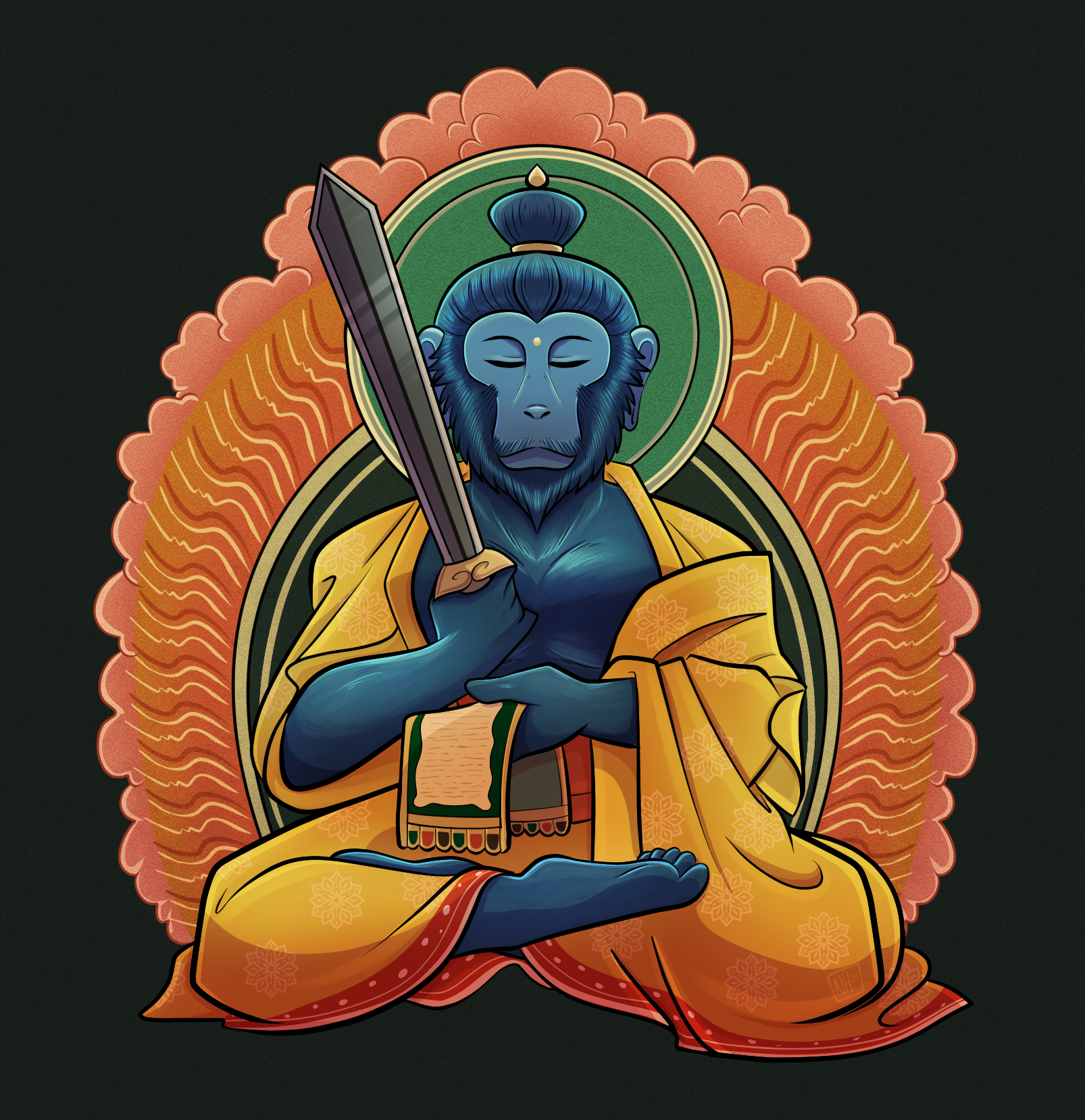
In late-2024, I commissioned friend of the blog NingadudeXx to draw Monkey as Yuddhajaya using their colorful style. The finished piece (fig. 15) was delivered in mid-January 2025.

Fig. 15 – NingadudeXx’s colorful Monkey Buddha (larger version).

On a related note, I learned that Yuddhajaya has a secondary name, Vijita-saṃgrāma (Ch: Yongjian jixiang fo, 勇健吉祥佛; Viet: Dũng Kiện Cát Tương Phật), or the “Brave and Auspicious Buddha” (source). The Chinese version of his title is listed in the 8th century Names of the Thirty-Five Buddhas Spoken by the Buddha (Ch: Foshuo sanshiwu foming lichan wen, 佛說三十五佛名禮懺文) (originally linked above).

Interestingly, the farthest back that I can trace the term Dou zhansheng fo (鬥戰勝佛, i.e. “Buddha Victorious in Strife”) on CBETA is the 12th or 13th century Ritual for the Tathāgata’s Extensive Filial Piety’s Ten Kinds of Recompensating (Parents’) Kindness (Rulai guangxiao shizhong bao’en daochang yi, 如來廣孝十種報恩道場儀) (see here). Therefore, Vijita-saṃgrāma appears to be a much older name.

Spread the gospel of the Brave and Auspicious Buddha!!!

Notes:

1) Compare the list from the Chinese version to those listed here. The characters may vary slightly.

2) I am grateful to Joris Baeyens of Ghent University Library for providing me with scans of Bunce (1994).

3) Source slightly altered.

Sources:

Bunce, F. W. (1994). An Encyclopaedia of Buddhist Deities, Demigods, Godlings, Saints and Demons: With Special Focus on Iconographic Attributes (Vols.1-2). New Delhi: D.K. Printworld.

Buswell, R. E., & Lopez, D. S. (2014). The Princeton Dictionary of Buddhism. N: Princeton University Press.

Chandra, L. (1999). Buddhist Iconography: Compact Edition. New Delhi: International Academy of Indian Culture & Aditya Prakashan.

Lai, D. (2016, September 3). 35 Confessional Buddhas. Retrieved from www.davidlai.me/2016/09/03/35-confessional-buddhas/.

Wu, C., & Yu, A. C. (2012). The Journey to the West (Vol. 4). Chicago, Illinois: University of Chicago Press.

The Great Sage Detecting “Ping-Pong” Bottle

Last updated: 06-26-2021

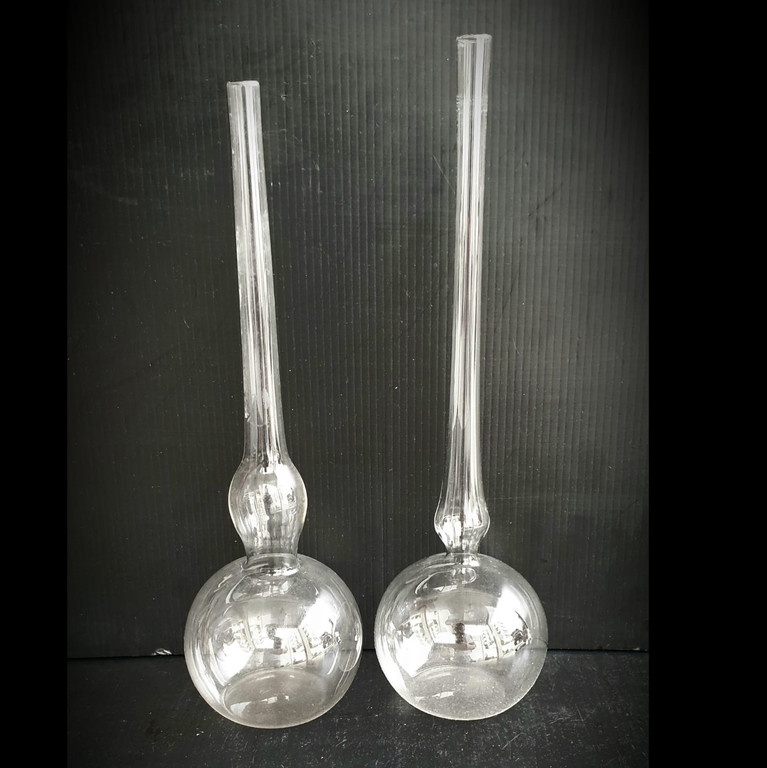
Elliott (1955/1990) describes a curious glass bottle used in the worship of Sun Wukong in Singapore. Filled with “twelve o’clock water” and topped with a consecrated bulbous glass stem, it is said to make a pinging noise to signal the arrival of the monkey god in a home or temple.

Table of Contents

1. Description

Elliott (1955/1990) explains:

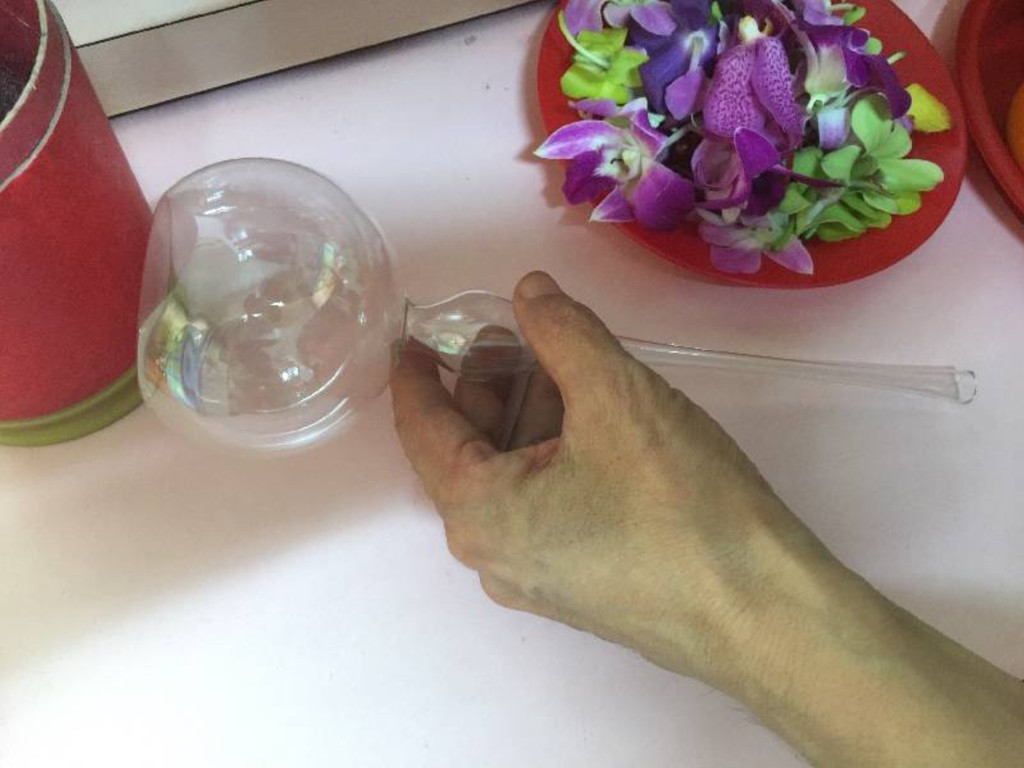
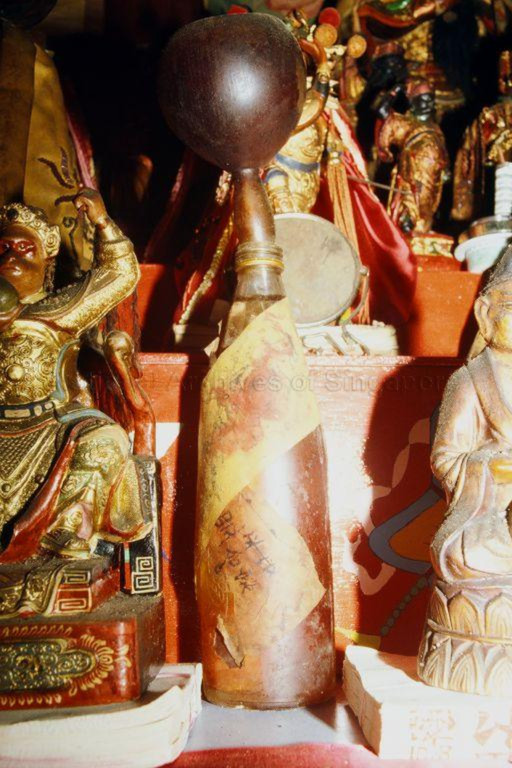
There are, also, sometimes other pieces of apparatus, apart from images, which devotees like to keep in their own homes. An outstanding example is an article of equipment almost exclusively associated with the ‘Great Saint’ [大聖] which goes by the onomatopoeic name of ‘ping-pong’ [乒乓]. It consists of an ordinary bottle filled with ‘twelve o’clock water’, water drawn from a tap or well at midday. Into the neck is fitted a funnel-like piece of glass-ware open at the lower end of the funnel, which dips into the water but completely closes the top [fig. 1 & 2]. Everyday at noon, and sometimes at other hours as well, this apparatus gives off a sudden ‘pinging’ sound, as if bubbles were rising and forcing up the funnel in the bottle’s neck. When this occurs, the shen [神, god] is supposed to be revealing his presence in the temple or the home, and an immediate act of worship must be carried out by the persons there. These ‘ping-pong’ are invariably found in temples associated with the ‘Great Saint’. Devotees will purchase their own funnels and bring them to the temple for the dang-ki [童乩, spirit-medium] to consecrate them with a lick of his blood (p. 58).

Fig. 1 – The ping-pong bottle, a.k.a. “Great Sage bottle” (Dasheng ping, 大聖瓶), fitted with the bulbous stem, which is closed at the top and open at the bottom (larger version). Fig. 2 – A detail of the stem (larger version). Images found on google.

2. Use Outside of Singapore

The device was also used in Hong Kong according to one personal account shared with me:

I believe the apparatus was used not just in Singapore. My mom told me that as a kid in HK in the 1940s/50s, her aunt also had something similar on the altar where she worshipped the [Great] Saint. And when the apparatus made a noise which signified his arrival, they would light up a joss stick.

I don’t know when the bottle was first associated with Sun Wukong, but the above information points to its active use in Asia as far back as the 1950s. It’s my understanding that the bottle is a rarity in modern practice, suggesting that it flourished prior to mid-century.

3. Speculation

Why the bottle was associated with the Great Sage is also a mystery to me, but the significance of twelve o’clock water may provide some clues. Astrological theory associates noon with wu (午), the seventh of twelve earthly branches, which is in turn identified with horses, the heart, fire yang, the summer solstice, and the direction south (Wu & Taylor, 2014, pp. 133-134). Readers may remember that Sun Wukong is appointed the keeper of the heavenly horses (bimawen, 弼馬溫) in chapter four of Journey to the West (Wu & Yu, 2012, pp. 148-149). Additionally, Chinese philosophy considers the heart to be the seat of the mind (xin, 心; a.k.a. “heart-mind”). This is important as Sun is called the “Mind Monkey” (xinyuan, 心猿; a.k.a. “Mind Ape”), which is a Buddho-Daoist concept denoting the disquieted, transient thoughts that keep man trapped in Samsara. Examples include the titles for chapters seven (“From the Eight Trigrams Brazier the Great Sage escapes; Beneath the Five Phases Mountain, Mind Monkey is still”) and fourteen (“Mind Monkey returns to the Right; The Six Robbers vanish from sight”). 

(Before I continue, I must warn that using the 16th-century novel as a source for modern folk religion surely overlooks beliefs that I am not aware of. The above info should, therefore, be considered purely speculative.)

A naturalistic explanation for the pinging noise is air escaping from the bottle due to changes in atmospheric pressure. However, I’d like to speculate on a possible esoteric reason. As mentioned above, noon is identified with fire yang, which is considered the height of yang power. In fact, the hours before wu and after zi (子, midnight) are considered the best time to practice Daoist exlixir cultivation. [1] And since heaven is the embodiment of yang, [2] it’s possible worshipers believe that water collected at noon is infused with strong yang energy, thereby giving it the ability to detect the presence of celestial deities like the Great Sage.


4. Updates

4.1. Significance of the Twelve O’clock Water

Update: 08-11-20

J.D. Martinsen contacted me and noted that “drawing noon water” (da wushi shui, 打午時水) is a common practice in coastal China during the Dragon Boat Festival. The water is apparently known for its demonifugic and medicinal properties. In fact, this custom is even practiced in Taiwan where there is a common saying: “A sip of noon water is better than three years of herbal medicine” (wushi shui yin yi zui, jiao hao buyao chi san nian, 午時水飲一嘴,較好補藥吃三年) (Chen, 2011, p. 210). Therefore, this association with warding malevolent influences/sickness may explain why Sun Wukong is connected with noon water. He is after all the exorcist par excellence, as well as a healer.


4.2. How the Twelve O’clock Water is Captured and Used

Update: 06-23-21

An informant from Singapore, who is the head of a monkey god temple, shared with me some wonderful folk knowledge about the ping-pong bottle. The words below were edited for readability:

He flies at a high speed which generates high heat and causes the ping pong to sound. The water inside the bottle where you place the ping pong is changed on 五月初五 (端午節) [i.e. the Dragon Boat Festival]. Every year, the replacement water is collected from your rain water. The former water will be used to bathe to purify our well-being. I have poured it into a large pail. And bottle it and give it to devotees to bathe. Talismans are issued when we change the water at noon (fig. 3), we will paste them on the bottle on 端午節. When urgent or dangerous matters happen, we will use the ping pong holy water to ward off bad omens.

My informant told me that some of this knowledge was revealed to him by the monkey god.

I was also told by a collector-seller that there are different-sized glass stems (fig. 4). Though, he believes that their hand-made nature means that no two are exactly the same. My informant also states that the stems with “larger diameters will sound louder” when the Great Sage arrives.

Fig. 3 – Talismans on a ping-pong bottle (larger version). Photo taken at the Wallich Street “Tai Seng Yah” (Dasheng ye) temple in Singapore during the 1970s. Courtesy of Ronni Pinsler of the BOXS project. Fig. 4 – The different sizes of ping-pong stems (larger version). Photo from a private collector.


4.3. How to Prepare the Ritual Bottle

Update: 06-26-21

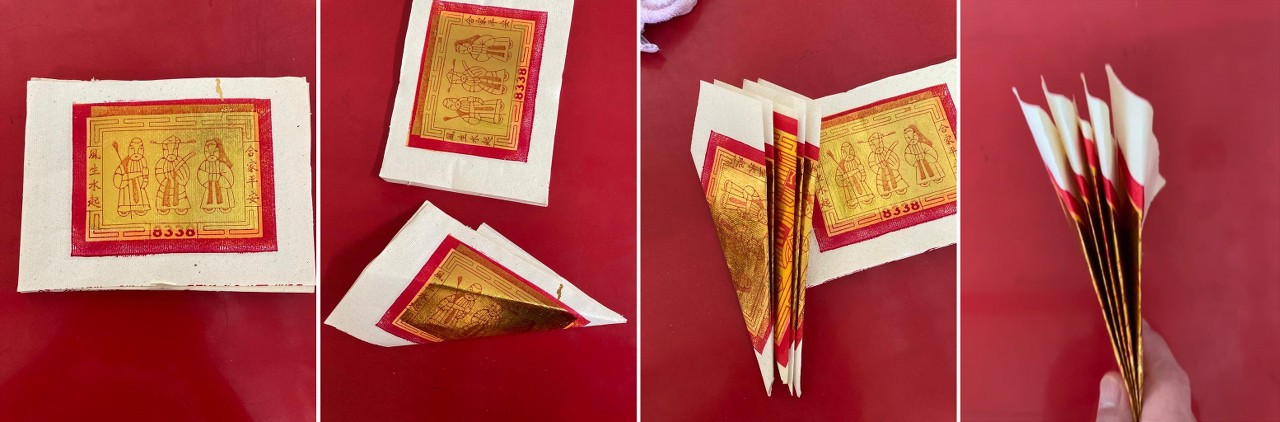
My informant tells me that a beer bottle can be used to hold the ping-pong stem. It must be washed and all labels removed. The preparation for the stem is a little more involved. The stem must be washed along with five kinds of flowers. The types of flowers do not matter, but no white flowers are permitted. Also, slices of green lemon can be included, but no yellow lemons are permitted. This washing must be done on the first or the 15th of the lunar month. The holy water is gathered in a pail between 11am and noon from rain the day before the Dragon Boat Festival, for it is believed that it always rains on this day. This water is poured one index finger length from the rim. This ensures that it will not overflow once the ping-pong stem is inserted. Then triangle-folded joss paper (jin zhi, 金紙) (fig. 5 to 8) is waved three times around the ping-pong (nuo pingpong, 挪乒乓) while prayers are said. Finally, the paper is left atop the ping-pong bulb for a given time. The ping-pong bottle must be placed next to a statue of the Great Sage.

Fig. 5 to 8 – The process of folding the joss paper into triangles (larger version). Photos by my informant.

Notes:

1) This is noted as early as the fourth century CE work Wondrous Record of the Golden Casket on the Spirit Immortals’ Practice of Eating Qi (Shenxian shiqi jin’gui miaolu, 神仙食氣金櫃妙錄) (Kohn, 2008, p. 84).

2) See, for example, Clearly (2003), p. 391.

Sources:

Chen, X. (2011). Taiwan li shi shang de yi min yu she hui yan jiu [The History of Taiwanese Immigration and Social Studies]. Beijing: Jiu zhou chu ban she.

Cleary, T. F. (2003). The Taoist Classics: The Collected Translations of Thomas Cleary, Volume Two. Boston, Mass: Shambhala.

Elliott, A. J. (1990). Chinese Spirit-Medium Cults in Singapore. London: The Athlone Press. (Original work published 1955)

Kohn, L. (2008). Chinese Healing Exercises: The Tradition of Daoyin. Honolulu: University of Hawaiʻi Press.

Wu, C., & Yu, A. C. (2012). The Journey to the West (Vol. 1) (Rev. ed.). Chicago, Illinois: University of Chicago Press.

Wu, Z., & Taylor, W. K. (2014). Heavenly Stems and Earthly Branches – TianGan DiZhi: The Heart of Chinese Wisdom Traditions. London: Jessica Kingsley Publishers.

Story Idea: Sun Wukong Animated Music Short

From time to time I like to post a fun blog not directly related to (though sometimes informed by) my research. Past examples can be seen here and here. Regular articles will resume after this entry.

Back in 2010 I dreamed up an animation based around a modern adaptation of “In the Hall of the Mountain King” by the Finnish operatic metal band Apocalyptica. The original version of the song was composed by Edvard Grieg for Henrik Ibsen‘s play Peer Gynt in 1876. The play is based on an old Norwegian tale about a man named Per Gynt who travels the land rescuing maidens from the clutches of trolls. The music is used during the play to enhance the drama and action of a particular scene where Peer attempts to hide and then escape from the hall of the mountain king. This plot obviously shares many similarities with Journey to the West. Sun Wukong spends the majority of the novel rescuing Tripitaka from the mountain strongholds of various demon kings.

The animation would be completely silent to accommodate the music, the various notes acting as dialogue or sound effects. Below, I present the story with time stamps to indicate when the events are to take place. I recommend reading the material once, then listening to the song, and finally reading and listening in unison to better understand. You can possibly use the stopwatch on your phone and start it the same time as the music.

Apocalyptica’s arrangement of “In the Hall of the Mountain King”.

0:00 – 0:29 – The scene opens in a cave where a mountain demon is celebrating news that the Tang monk is headed to his territory. An imp runs in to inform him that Tripitaka has been spotted in the mountain with only two of his three disciples.

0:30 – 1:03 – The demon king leaves the cave and silently spies on them from afar as Tripitaka on his dragon-horse, Zhu Bajie and Sha Wujing walk down a path through the mountains. When it’s obvious that Wukong is off running errands for his master, the demon magically disguises himself as an elderly man or woman and waits for them, drawing them near.

  • The notes in this section sound like someone is sneaking around.

1:04 – 1:42 – He reveals his true form, grabs the monk, and orders his imps to attack Zhu Bajie and Sha Wujing. The two fight but are over powered by sheer numbers.

  • The change up from the sneaky notes is when he reveals his true self.
  • Each of the high-pitched notes here represent imps attacking the disciples in wave after wave, coming faster and faster until they are overwhelmed.

1:43 – 1:52 – The monk calls out Sun Wukong’s name. I imagine the words would come out as Chinese characters that drift through the air to Monkey’s ear. He forcefully turns his head towards the sound, his eyes flash with a fiery light.

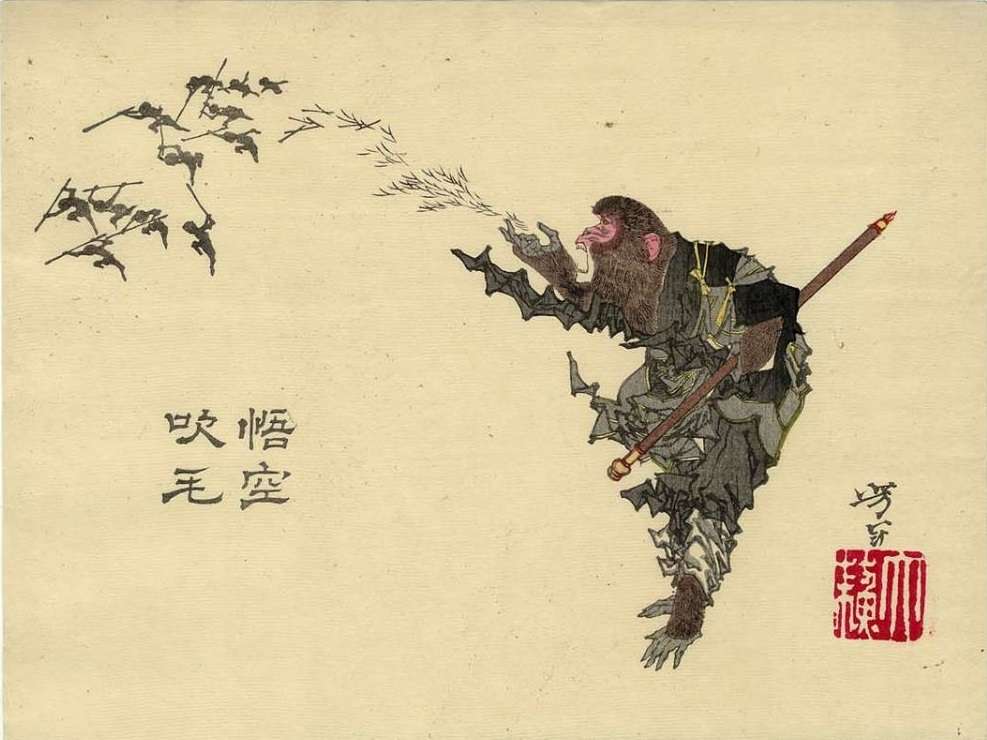
1:53 – 2:20 – Wukong lands in an explosion of multicolored clouds and light. He waves his staff in front of him, thus forcing the imps away from his brothers. He then pulls out magic hairs and blows on them, creating an army of monkeys to do battle with the imps. The monkeys do all manner of things to the imps while Wukong rolls around on the ground in laughter.

  • 1:58 – Wukong creates the army of monkeys. Also, notice how a few seconds in the notes sound almost like monkeys.

sc137582 - small

“Wukong Blows His Hair” (c. 1882) by Yoshitoshi (larger version).

2:21 – 2:26 – The imps run away in defeat. Monkey stands outside the cave screaming and hopping up and down while shaking his fist in order to entice the mountain demon outside.

  • 2:23 – Double hop while shaking fist and screaming obscenities. The words come out as Chinese characters. They could be “coward” or something demeaning like that. The particular sound of “bwah bwah” in the song at this point is when he screams and hops.
  • 2:26 – Second double hop, same.

2:27 – 2:31 – His trick works as the demon king pokes his head out of the doors and shakes his fist back at Wukong.

  • 2:28 – First fist shake and screams obscenity. Same “bwah bwah” sound but with lower register.
  • 2:31 – Second fist shake, same.

2:32 – 2:50 – The demon emerges with his armor and weapon ready to fight and the two begin their bout. The earth shakes, mountains crumble, forests tumble, and the gods shiver in the realm above.

2:51 – 3:08 – Both take to their clouds, the warriors circling each other, rising higher and higher into the heavens, leaving a double helix-like pattern in their wake.

3:09 – 3:12 – The demon makes one last attack with his weapon. Wukong disappears in a puff of smoke, only to reappear instantly in his 100,000-foot-tall cosmic form, breathing fire from a mouth full of tusk-like teeth, his eyes like the sun and moon. The demon realizes he is not Wukong’s match and flees in terror.

cosmic transformation

Monkey performs the cosmic transformation for his children (larger version). Original artist unknown. Found on this article.

3:13 – 3:16 – Wukong reverts to his original form and rockets towards earth with his staff held high.

3:17 – 3:21 – He lands a mortal blow to the demon and stands over his remains.

  • 3:17 – The exact moment the demon is turned into hamburger.

3:22 – 3:24 – Wukong kicks open the double door of the mountain stronghold. The view would be from the inside out (i.e. it’s dark and then the doors are kicked inward, revealing the dark silhouette of Monkey holding his staff against a bright background).

  • The “boom” at the end is when he kicks in the doors.

After the song stops, the animation silently ends with them all continuing their journey to India. The entire animation would probably be around three minutes and forty seconds long. I would really love to work with an animator to make this a reality.

Archive #15 – Narrative Structure and the Problem of Chapter Nine in the “Hsi-Yu Chi”

Last updated: 04-03-2022

Readers may be surprised to learn that chapter nine of the current one hundred chapter edition of Journey to the West did not appear in the original version anonymously published by the Shidetang (世德堂) publishing house in 1592. Chapter nine of course tells the story of how Tripitaka‘s parents, his scholar-official father Chen Guangrui (陳光蕊) and mother Yin Wenjiao (殷溫嬌), meet (fig. 1); Guangrui’s murder and the pregnant Lady Yin’s kidnapping by a bandit; Tripitaka’s birth and Moses-like trip down a river (hence his nickname “River Float,” Jiang liu, 江流); his rescue, rearing, and initiation into the Buddhist order by the abbot of Gold Mountain; Lady Yin’s rescue and the bandit-turned-official’s arrest; and Tripitaka’s later reunion with his mother and father, the latter’s body having been preserved and brought back to life by heaven.

Some scholars, such as Glen Dudbridge, suggest the current ninth chapter is a forgery, having been written by one Zhu Dingchen (朱鼎臣) of Canton because it appears in his slightly later edited version of the novel titled The Chronicle of Deliverances in Tripitaka Tang’s Journey to the West (Tang Sanzang Xiyou shi ni zhuan, 唐三藏西游释尼傳, circa 1595). (See the 01-02-21 update for new information about Zhu’s version of the novel.) Other scholars posit there is internal textual evidence for a possible lost chapter and that the current ninth chapter was salvaged from these internal clues. 

Tripitaka's Parents

Fig. 1 – Tripitaka’s parents from the 1986 television show. 

Anthony Yu‘s (1975) paper “Narrative Structure and the Problem of Chapter Nine in the ‘Hsi-Yu Chi'” supplements previous analyses of said internal textual evidence. He demonstrates that references to the Chen Guangrui episode litter the book. For example, a poem in chapter twelve (ch. 11 of the original Shidetang version) reads:

Gold Cicada was his former divine name.
As heedless he was of the Buddha’s talk,
He had to suffer in this world of dust,
To fall in the net by being born a man.
He met misfortune as he came to Earth,
And evildoers even before his birth.
His father: Chen, a zhuangyuan [1] from Haizhou.
His mother’s sire: chief of this dynasty’s court.
Fated by his natal star to fall in the stream,
He followed tide and current, chased by mighty waves.
At Gold Mountain, the island, he had great luck,
For the abbot, Qian’an, raised him up.
He met his true mother at age eighteen,
And called on her father at the capital.
A great army was sent by Chief Kaishan
To stamp out at Hongzhou the vicious crew.
The zhuangyuan Guangrui escaped his doom:
Son rejoined sire—how worthy of praise!
They saw the emperor to receive his grace;
Their names resounded in Lingyan Tower.
Declining office, he chose a monk’s life
At Hongfu Temple to seek the true Way,
This old Buddha-child, nicknamed River Float,
With a religious name of Chen Xuanzang. [2]

靈通本諱號金蟬,只為無心聽佛講。
轉托塵凡苦受磨,降生世俗遭羅網。
投胎落地就逢兇,未出之前臨惡黨。
父是海州陳狀元,外公總管當朝長。
出身命犯落江星,順水隨波逐浪泱。
海島金山有大緣,遷安和尚將他養。
年方十八認親娘,特赴京都求外長。
總管開山調大軍,洪州剿寇誅兇黨。
狀元光蕊脫天羅,子父相逢堪賀獎。
復謁當今受主恩,凌煙閣上賢名響。
恩官不受願為僧,洪福沙門將道訪。
小字江流古佛兒,法名喚做陳玄奘。

Yu (1975) notes “this passage…which introduces Tripitaka to the reader, has, with the exception of one major discrepancy (i.e. the name of the monk who took in the river-borne orphan), all the crucial elements constitutive of the Chen Guangrui story” (p. 296).

After providing several more examples, he concedes external textural evidence for a lost chapter has yet to be discovered, but suggests the author-compiler of the Journey to the West was surely familiar with established Yuan-Ming dramas involving Tripitaka’s birth and life:

I think that the foregoing analysis, admittedly brief, is sufficient to show the significance, if not the indispensability, of the Chen Guangrui episode in the narrative, though as I have remarked earlier, these later allusions certainly cannot be construed as incontrovertible proofs for a “lost chapter.” The existence of such a chapter has to be established by further discovery of textual materials hitherto unknown, if such discovery is indeed still possible. It may be safely asserted, however, that the author of the hundred-chapter novel, Wu Cheng’en or whoever he might be, is thoroughly familiar with the tradition of the birth and adventures of the infant Xuanzang popularized in the dramas of Yuan and Ming China, and that he has consciously and skillfully exploited this tradition in his narrative (Yu, 1975, p. 306).

Yu (1975) goes on to counter Dudbridge’s criticism that the Chen Guangrui episode doesn’t progress the overall plot by saying it should, instead, be accepted as an “organizing principle”, one that explains the reason for the monk’s ordeals:

[T]he theme of the river and its attendant perils utilized by the author of the hundred-chapter novel reinforces the theme of Tripitaka’s this-worldly identity as the incarnation of the banished Gold Cicada. Both themes in turn support the threefold aetiology developed in the narrative for explicating the meaning of Tripitaka’s ordeals: as a form of chastisement for his preexistent transgression, as a test of endurance for the earthly pilgrim, and as an exemplum of the high cost of obtaining sacred writings from the West (p. 307).

Furthermore, he counters Dudbridge’s claim that the concept of a lost chapter would be stronger if the novel provided more than just passing references to background info of the central characters. In fact, the novel does provide lengthy info on our heroes. For example, Yu (1975) presents a very long poem from chapter nineteen detailing Zhu Bajie’s life, from his early Daoist training, achievement of immortality, and rise to heavenly rank to his drunken flirting with the moon goddess (fig. 2), banishment from heaven, and mistaken reincarnation on earth as a pig-man.

Zhu Bajie-Chang'e stamp

Fig. 2 – a Taiwanese stamp featuring Zhu Bajie and the moon goddess Chang’e.

In the end, Yu (1975) states Qing-era editors of the novel were justified in their suspicion of a lost chapter given the lack of detailed info about Tripitaka’s life, unlike the other pilgrims:

In the absence of chapter 9, Tripitaka is the only member of the pilgrimage, in fact, whose origins are presented in the manner which Dudbridge ascribes to the disciples: in allusion or indirectly, in moments of retrospect. The early editors of the Xiyouji, therefore, were not wholly unjustified in their protest that a theme of such significance as the Chen Guangrui story had not been more fully accounted for by antecedent narrative (p. 310).

Paper link:


Disclaimer:

This has been posted for educational purposes. No malicious copyright infringement is intended. Please support the official release.


Update: 01-02-21

Zhu Dingchen’s edition of Journey to the West actually predates the 1592 edition. This shows that the aforementioned internal clues in the 1592 edition are based on previous material.


Update: 12-01-21

I’ve archived a book that shows how Tripitaka’s exile from heaven is similar to ancient Greek and Egyptian beliefs.


Update: 04-03-22

I’ve posted an entry discussing the characterization of Tripitaka as a Confucian in the novel.

Notes:

1) A scholar rank. All quotes from Yu (1975) originally use Wade-Giles. I have updated them with Pinyin.

2) Yu, 1975, p. 296. See Wu & Yu, 2012, p. 275 in Yu’s updated translation of the novel.

Sources:

Wu, C., & Yu, A. C. (2012). The journey to the West: Vol. 1. Chicago, Illinois: University of Chicago Press.

Yu, A. (1975). Narrative Structure and the Problem of Chapter Nine in The “Hsi-Yu Chi”. The Journal of Asian Studies, 34(2), 295-311. doi:10.2307/2052750