The Origin of Sun Wukong’s Cloud Somersault

Last updated: 05-03-2026

The Monkey King is famous for utilizing a vast arsenal of magic powers to protect the monk Tripitaka on the journey to India, chief among them being immortality, shape-shifting, hair clones, super strength, and flight via the cloud somersault (jindou yun, 觔/筋斗雲). The latter is a powerful skill because it enables him to travel 108,000 li (33,554 mi / 54,000 km), [1] or one and one-third the circumference of our Earth, in a single leap. [2] Perhaps the most famous episode involving the somersault appears in Journey to the West (Xiyouji西遊記, 1592; “JTTW” hereafter) chapter seven when the Buddha bets Wukong that he’ll give the rebellious monkey the throne of heaven if he can leap clear of the Enlightened One’s palm. Sun gleefully accepts, certain of his success:

What a fool this Tathagata is! A single somersault of mine can carry old Monkey one hundred and eight thousand li, yet his palm is not even one foot across. How could I possibly not jump clear of it? (Wu & Yu, 2012, vol. 1, p. 194).

這如來十分好獃。我老孫一觔斗去十萬八千里,他那手掌方圓不滿一尺,如何跳不出去?

But of course lovers of the novel know how this wager ends, with a desecrated finger and our hero trapped beneath Five Elements Mountain.

Table of Contents

1. Literary Description

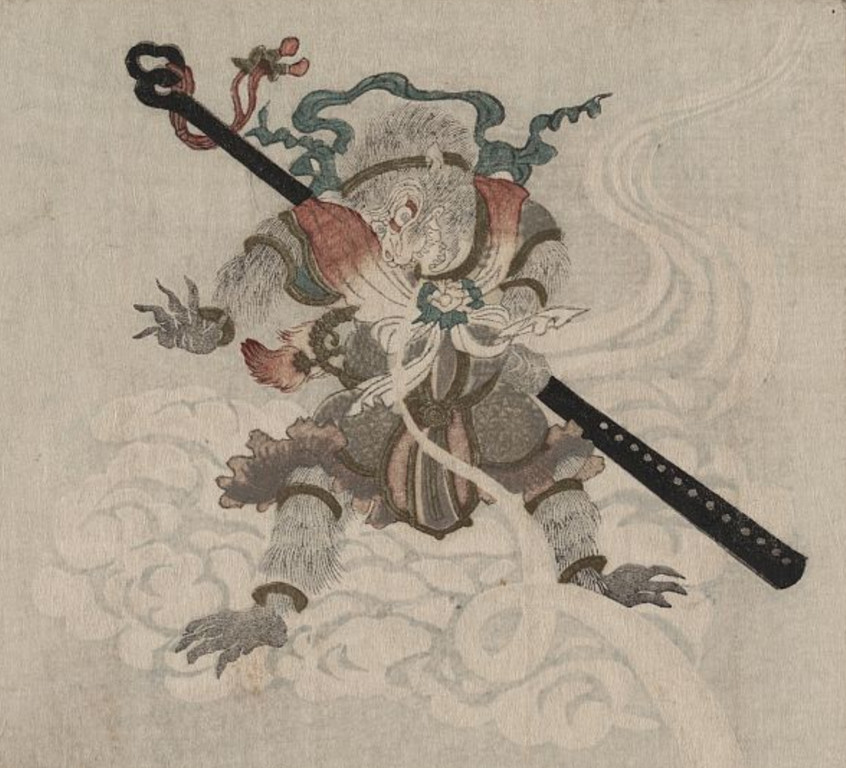
While Sun is traditionally portrayed in visual media riding a single cloud (fig. 1), the very name “somersault” points to Monkey leaping from cloud to cloud. And in fact this is demonstrated in chapter 97 when it requires “a series of cloud somersaults” for him to retrieve the soul of an elderly benefactor from the underworld (Wu & Yu, 2012, vol. 4, p. 338). However, the magic skill’s attributes are not always portrayed consistently throughout the novel. For example, it is sometimes shown capable of transporting passengers, such as the “thirty or fifty” of Monkey’s children rescued from captivity in JTTW chapter two, thereby implying a single cloud (Wu & Yu, 2012, vol. 1, p. 129). (See the 04-28-26 update below for more info.) But other times, like in chapter 22, it can’t lift even a single person because the impure nature of mortals renders them “as heavy as the Tai Mountain” (Wu & Yu, 2012, vol. 1, p. 427). Interestingly, the somersault is portrayed as much faster than the clouds of other immortals (see section three below).

Kubo Son Goku, 18th-c. - small

Fig. 1 – Detail of an 1812 calendar print by Japanese artist Kubo Shunman depicting Son Goku (Sun Wukong) flying on his cloud somersault (larger version). A full size scan of the calendar can be seen here.  

2. Ties to Daoist immortals

Sun Wukong first learns to perform his cloud somersault in chapter two while studying Daoist cultivation under his first master, the Sage Subodhi:

[T]he Patriarch gave him an oral formula, saying,

“Make the magic sign, recite the spell, clench your fist tightly, shake your body, and when you jump up, one somersault will carry you one hundred and eight thousand miles.” When the other people heard this, they all giggled and said, “Lucky Wukong! If he learns this little trick, he can become a dispatcher for someone to deliver documents or carry circulars. He’ll be able to make a living anywhere!”

The sky now began to darken, and the master went back to the cave dwelling with his pupils. Throughout the night, however, Wukong practiced ardently and mastered the technique of cloud-somersault. From then on, he had complete freedom (emphasis added), blissfully enjoying his state of long life (Wu & Yu, 2012, vol. 1, p. 123).

祖師卻又傳個口訣道:「這朵雲,捻著訣,念動真言,攢緊了拳,將身一抖,跳將起來,一觔斗就有十萬八千里路哩。」大眾聽說,一個個嘻嘻笑道:「悟空造化,若會這個法兒,與人家當鋪兵、送文書、遞報單,不管那裡都尋了飯吃。」師徒們天昏各歸洞府。

這一夜,悟空即運神煉法,會了觔斗雲。逐日家無拘無束,自在逍遙,此亦長生之美。

Elements of this passage reference the long tradition of cloud-borne transcendents in Daoist literature. For example, Kirkova (2016) highlights a poem by the first Cao Wei emperor Cao Pi describing the great speed of their travel: “Lightened you’ll soar, mount the floating clouds, / in a blink you’ll travel millions of li” (p. 105). She explains the ability to traverse vast distances in a flash “is a primary sign of the immortals’ mastery over space and time and is an important topos in their hagiographies” (Kirkova, 2016, p. 106). Furthermore, Kirkova (2016) points out the term used to denote their great freedom of movement, xiaoyao (逍遙/消搖), emphasized above, appears in works as old as the Huananzi and Zhuangzi (p. 104).

3. Ties to Chan Buddhist Philosophy

Despite the cloud’s apparent ties to Daoism, it has a strong symbolic connection to Buddhism. For example, the distance that a single somersault covers just so happens to correspond to the expanse separating Tripitaka from the Buddha’s paradise. This fact is revealed in chapter 14 by Guanyin while disguised as an old woman: “The Buddha of the West … lives in the Great Temple of Thunderclap in the territory of India, and the journey there is one hundred and eight thousand li long” (Wu & Yu, 2012, vol. 1, p. 316).

Shao (2006) explains that the distance is taken directly from the Platform Sutra (Liuzu tangjing, 六祖壇經, c. 8th to 13th century) of Huineng, the sixth patriarch of Chan Buddhism (p. 718). The particular passage reads:

The governor also asked,

I often see clergy and laity invoking Amitabha Buddha in hopes of rebirth in the [Pure Land of the] West. Please explain this to me. Can we attain rebirth there? Please resolve this doubt for me.

The Master said,

Listen clearly, Governor, and I will explain it to you. When the World Honored One was in the city of Sravasti, he spoke of the Western Pure Land as a teaching device. Scripture is clear that “it is not far from here,” but treatises say it is “108,000 li away.” This number refers to the ten evils and eight wrongs in the one’s person. This says it is far away. Saying it is far away is for people of lesser faculties. Saying it is near is for people of better faculties.

刺史又問曰:「弟子常見僧俗念阿彌陀佛,願生西方。請和尚說,得生彼否?願為破疑。」

師言:「使君善聽,惠能與說。世尊在舍衛城中,說西方引化。經文分明,去此不遠。若論相說,里數有十萬八千,即身中十惡八邪,便是說遠。說遠為其下根,說近為其上智。

[…]

Now I urge you, good friends, to first get rid of the ten evils; that is the equivalent of traveling one hundred thousand li. [3] Then get rid of the eight wrongs; that is the equivalent of crossing eight thousand li. See essential nature in every moment, always acting with impartial directness, and you will arrive in a finger-snap and see Amitabha Buddha (Huineng & Cleary, 1998, pp. 26-27).

今勸善知識,先除十惡即行十萬,後除八邪乃過八千。念念見性,常行平直,到如彈指,便覩彌陀 …」

As can be seen, the number 108,000 is symbolic of two sets of spiritual hindrances. The “ten evils” (shi’e, 十惡) are killing, stealing, sexual misconduct, greed, hatred, delusion, foul language, lying, harsh speech, and slander. The “eight wrongs” (baxie, 八邪) are opposites of the eight fold path (Huineng, Hsuan, & Buddhist Text Translation Society, 2002, p. 183). Ridding oneself of these piecemeal gets you many li closer to paradise. But only those who achieve enlightenment can arrive instantly. This means the cloud somersault can be read as a Chan metaphor for instant enlightenment. After all, Monkey can travel to the Buddha’s heaven in a flash, whereas Tripitaka is fated to journey thousands of miles over many years “before he finds deliverance from the sea of sorrows” (Wu & Yu, 2012, vol. 1, p. 436). This is because, as suggested by Shao (2006), the demons encountered on the journey embody the “ten evils and eight wrongs” that must be defeated before the monk can enter paradise (p. 719).

37e2fc9cebe000bb1c76c73e7ad2963a-d5oas0h

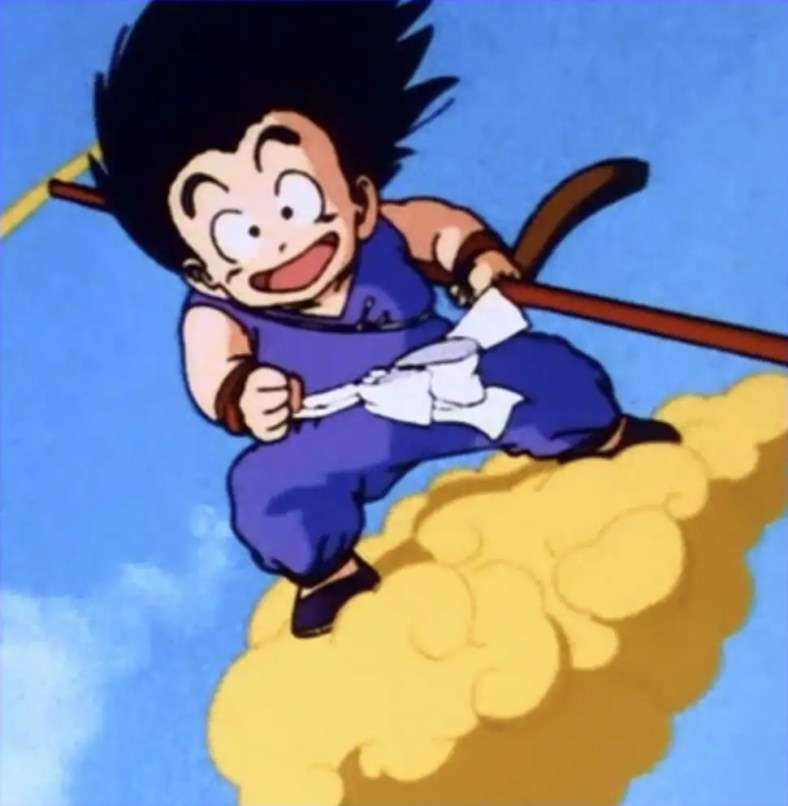
Fig. 2 – Monkey soaring on his cloud. Drawing by Funzee on deviantart (larger version).

This connection to Buddhism may then explain why the novel differentiates Monkey’s somersault (fig. 2) from the clouds of other immortals. As Sun explains in chapter 22: “My cloud somersault is essentially like cloud soaring [jiayun, 駕雲] … the only difference being that I can cover greater distances more rapidly” (Wu & Yu, 2012, vol. 1, p. 427). In light of the Chan evidence, the difference in speed could be read as a further metaphor for the potency of Buddhism over Daoism.

4. Other Influences?

Going back to the early days of Sun’s flight training, Subodhi observes our hero using an unorthodox method for propelling himself into the sky: jumping. This differs from other immortals, so the Sage teaches him a different method:

The Patriarch said, “When the various immortals want to soar on the clouds, they all rise by stamping their feet. But you’re not like them. When I saw you leave just now, you had to pull yourself up by jumping. What I’ll do now is to teach you the cloud-somersault in accordance with your form” (Wu & Yu, 2012, vol. 1, p. 123).

凡諸仙騰雲,皆跌足而起,你卻不是這般。我才見你去,連扯方才跳上。我今只就你這個勢,傳你個觔斗雲罷。

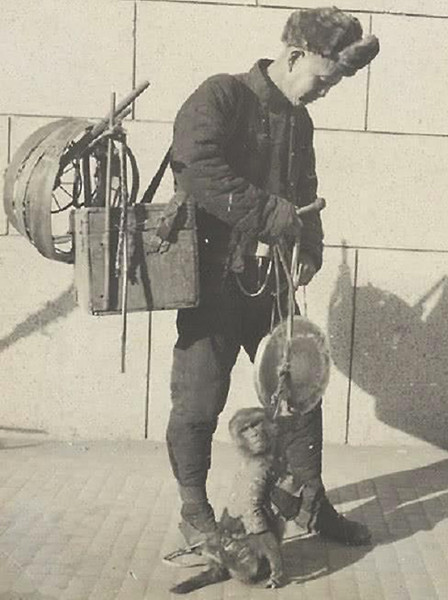
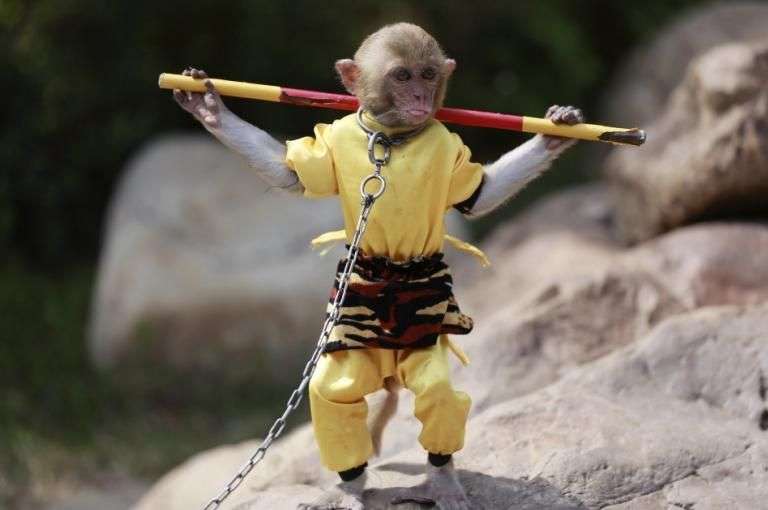
Zhou (1994) suggests this method is likely based on “the novelist’s personal observation” of trained monkey street performances “in the late Ming marketplace” (fig. 3 and 4) (p. 71). He points to an episode in chapter 28 when Wukong returns home to learn his children are regularly captured to perform tricks in the human world:

Those of us who were caught by the net or the trap would be led away live; they would be taught to skip ropes, to act, to somersault, and to do cartwheels. They would have to beat the drum and the gong on the streets and perform every kind of trick to entertain humans (Zhou, 1994, p. 71; cf. Wu & Yu, 2012, vol. 2, p. 31).

或有那遭網的,遇扣的,夾活兒拿去了,教他跳圈做戲,翻觔斗,豎蜻蜓,當街上篩鑼擂鼓,無所不為的頑耍。

Anyone who has viewed monkeys in a zoo or in the wild knows that they are naturally gifted acrobats. Therefore, Zhou’s proposal is certainly an alluring possibility, one that mixes the naturalistic and historical with Daoist tales of cloud-borne immortals.

Trained monkeys - pic for blog

Fig. 3 – A Qing-era trainer and his performing monkey (larger version). Original image found here. Fig. 4 – A monkey performer dressed as Sun Wukong (larger version). Original image found here

Scholars favoring a foreign origin for Sun sometimes point to the somersault as evidence for his connection to the Hindu monkey god Hanuman from the epic Ramayana (4th/5th century BCE). For example, Mi (as cited in Mair, 1989) notes similarities in which Sun and the god propel themselves by leaping:

In typical Chinese legends, the spirits and immortals mount on clouds and ride them; they stand on top of the clouds. Sun Wukong, however is different … Rather, he leaps through the air from a crouching position in the same fashion as Hanuman … This proves Sun Wukong’s supernatural abilities were adopted from Hanuman. (pp. 712-713).

Walker (1998) champions this view by citing a passage from the Ramayana in which Hanuman’s mighty leap across the sea from India to Lanka rips trees away from a mountain:

Hanuman, the foremost of monkeys, without pausing for breath … sprang into the air and, such was the force of his leap, that the trees growing on the mountain, tossing their branches, were sent spinning on every side.

In his rapid flight, Hanuman bore away those trees with their flowering boughs filled with lapwings intoxicated with love … Carried away by the impetus of his tremendous bound, those trees followed in his wake, like an army its leader (p. 10).

However, I’m inclined to believe any similarities in propulsion are simply the product of common behavioral traits among monkeys (refer back to my statement above about their gift for acrobatics). If Wukong’s jumping is indeed based on the somersaulting monkeys of vaudevillian street performances in China, then Hanuman’s jumping prowess no doubt has a real world counterpart in India. A prime example is the Gray Langur, which is capable of spectacular leaps (video 1).

Video 1 (LOUD NOISE WARNING) – A Langur takes a mighty jump. The video should start at minute 0:43.

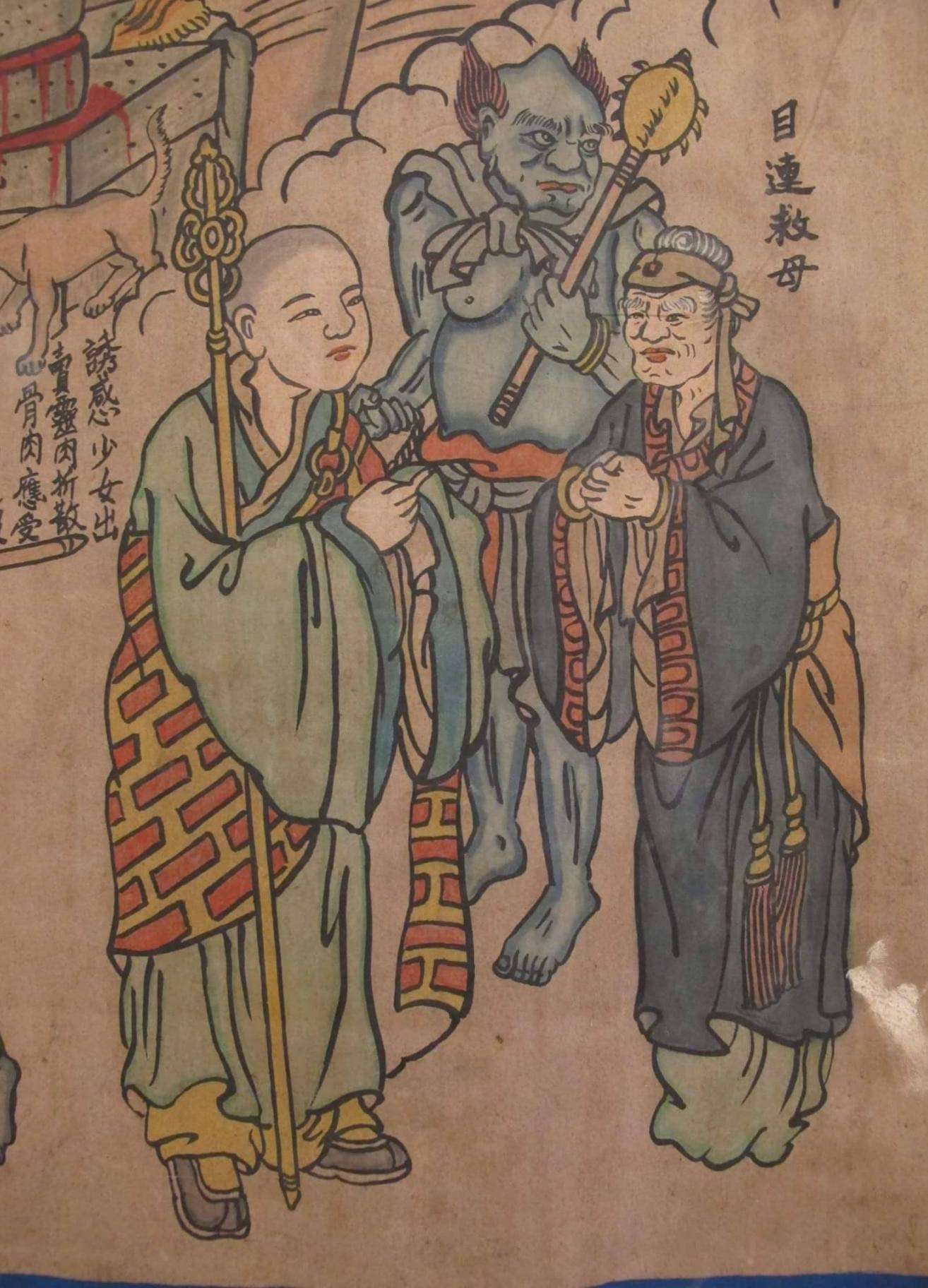
Given the somersault’s symbolic connection to Chan Buddhism, it’s possible Monkey’s jumping has ties to the religion as well. Like immortals, Buddhist saints are also portrayed in Chinese literature as having the power of flight. One example is Maudgalyayana (Ch: Mulian, 目連), a disciple of the Buddha, who is famous for appearing in a late-9th to early-10th century Bianwen (變文) text in which he travels to the underworld to release his mother from karmic torment (fig. 5). One passage from the tale reads:

Maudgalyayana awoke from abstract meditation,
Then swiftly exercised his supernatural power;
His coming was quick as a thunderclap,
His going seemed like a gust of wind.
[…]
With his supernatural power, he gained freedom,
So he hurled up his begging bowl and leaped into space (emphasis added);
Thereupon, instantaneously,
He ascended to the heavenly palace of Brahma (Mair, 1994, pp. 1097-1098).

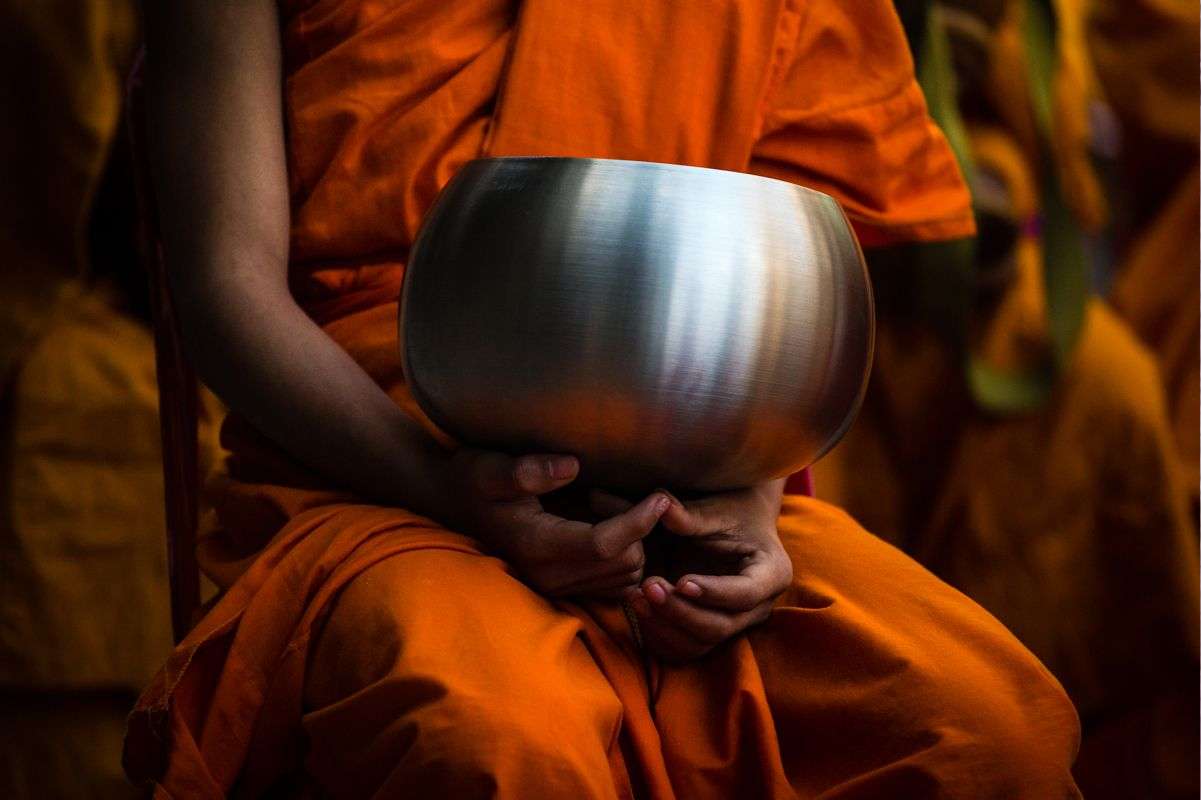
Like Monkey, Maudgalyayana is depicted leaping into the heavens to freely roam the cosmos at blinding speeds, the only difference being that he stands astride a magic alms bowl (fig. 6) and not a cloud. It’s important to note that the saint’s tale influenced the 13th century precursor of the Ming JTTW. As I show in this article, Sun’s antecedent, the Monkey Pilgrim (Hou xingzhe, 猴行者), serves as a proxy for the saint because he wields magic weapons based on those used by Maudgalyayana, namely a golden-ringed monk’s staff and an alms bowl. The ringed staff would come to influence Sun’s signature weapon in JTTW, including its ability to change size and pick locks. Therefore, it’s possible the saint may have also influenced Monkey’s jumping.

Buddhist alms bowl - small

Fig. 5 – A scroll or mural depicting Maudgalyayana rescuing his mother from the underworld (larger version). Originally found here. Fig. 6 – A metal alms bowl (larger version). 

5. Popular Culture

It’s interesting to note that the cloud somersault was adapted in the world famous Dragon Ball franchise. In episode three of the Dragonball anime, the lead character Son Goku, himself based on Sun Wukong, is gifted the yellow, fluffy Kinto’un (筋斗雲) by his would-be martial arts teacher, Master Roshi. [4] This is an obvious reference to Subodhi teaching the somersault skill to Monkey. But before Goku officially takes possession, Roshi gives him a warning: “People with impure thoughts can’t ride on it. In other words, you have to be a good person” (video 2). The master thereafter attempts to stand on it but quickly falls through due to his perverted nature. Goku then leaps up and successfully lands on the cloud, proving his worth. This exchange is no doubt a reference to Sun’s inability to carry passengers on his cloud because the impure nature of mortals renders them too heavy (see section one).

Video 2 – Roshi gives Goku his cloud. Watch from minute 1:50.

6. Conclusion

The Monkey King first learns the cloud somersault during the early days of his Daoist training under the Sage Subodhi. It enables him to travel 108,000 li in a single leap, making him much faster than the cloud soaring of other transcendents. While this skill shares affinities with the fleet clouds of immortals from Daoist hagiography, Sun’s somersault has a deep connection to Chan Buddhism. The vast distance that it travels is symbolic of the “ten evils and eight wrongs,” two sets of spiritual hindrances from the Platform Sutra said to keep the Buddha’s paradise out of reach. Only those who cleanse themselves of these obstacles can achieve enlightenment and arrive there in a flash, thus making Wukong’s cloud an apt metaphor for instant enlightenment. This suggests the greater speed of the somersault can be read as a further metaphor for the potency of Buddhism over Daoism.

Wukong’s habit of jumping into the heavens differs from the way other immortals rise by stamping their feet. This unorthodox method may have naturalistic or even religious influences. The suggestion that it is based on somersaulting monkeys from Chinese vaudevillian street performances is alluring given their natural gift for acrobatics. Some scholars champion a foreign origin by pointing to the leaping prowess of the Hindu monkey god Hanuman. But this could simply be a passing similarity based on common behavioral traits among monkeys. The jumping may also have ties to the Buddhist saint Maudgalyayana, who is portrayed in a famed 9th/10th century tale leaping into the air to ride his magic alms bowl between heaven and hell. Elements from his story would come to influence the 13th century precursor of JTTW, as well as the Ming edition of the novel, adding support for his possible influence.


7. Updates

Update: 01-04-24

The singular version of Monkey’s cloud is sometimes described as being “auspicious” (xiangyun, 祥雲) or having a “luminosity” (xiangguang, 祥光). Such clouds or lights are commonly associated with the five colors (wuse, 五色) (fig. 7). Chapter 88 makes this explicit:

Marvelous Great Sage! With a loud whistle he somersaulted right up into midair, his two feet treading the auspicious cloud of five colors (emphasis added). At about three hundred paces above ground, he let loose his rod to make [the martial arts moves] Sprinkling Flowers over the Top and the Yellow Dragon Entwining the Body. Up and down he moved, circling left and right. In the beginning his person and the rod so complemented each other that they seemed, as the adage had it, like flowers added to brocade. By and by even the person disappeared, and all one could see was a sky full of twirling rods! (Wu & Yu, 2012, vol. 4, pp. 196-197)

好大聖,唿哨一聲,將觔斗一抖,兩隻腳踏著五色祥雲,起在半空,離地約有三百步高下。把金箍棒丟開個「撒花蓋頂」,「黃龍轉身」,一上一下,左旋右轉,起初時人與棒似錦上添花;次後來不見人,只見一天棒滾。

Fig. 7 – An example of an auspicious cloud (larger version). The scientific term for this phenomenon is “cloud iridescence,” but such nimbuses are commonly called “rainbow clouds” in English. 


Update: 04-28-26

Above, I wrote: “[The cloud] is sometimes shown capable of transporting passengers, such as the ‘thirty or fifty’ of Monkey’s children rescued from captivity in JTTW chapter two, thereby implying a single cloud” (Wu & Yu, 2012, vol. 1, p. 129).

However, this was a mistake on my part. As I show in my more recent catalog of Sun Wukong’s powers and skills, these children are actually transported via the “magic of displacement” (shefa, 攝法), a swift, powerful wind appearing in JTTW chapters 2, 3, 62, 71, and 84.

On a different note, I feel like a major aspect of the somersault cloud needs extra context. If you recall in section 3, I discussed how the figure of 108,000 li is a religious allegory for the distance separating man from the Buddha’s paradise. Per the Sixth Chan Patriarch, the number comprises the “ten evils” (shi’e, 十惡) and “eight wrongs” (baxie, 八邪), two lists of negative thoughts and actions that hinder spiritual cultivation. Anyone who manages to rid themselves of these will attain enlightenment, allowing them to travel to the holy land instantly. But not everyone is capable of defeating these spiritual hindrances, so the distance separating them from the Buddha might as well be infinity. Therefore, it’s not wise to assign a real world distance and speed to the somersault cloud. This is regarding my recent response to “powerscaling.”


Update: 05-03-26

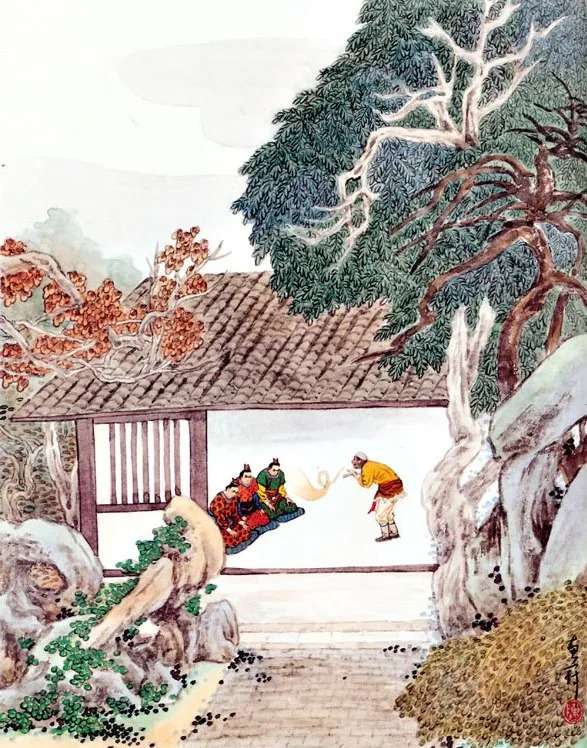
Here is an old woodblock print showing Monkey practicing his cloud somersault above Patriarch Subodhi and his early religious brothers (fig. 8). It is one of a few images from The Book to Enlightenment of the Journey to the West (Xiyou Zhengdao Shu西遊證道書, 1663), a Daoist commentary on the novel.

Fig. 8 – The 1663 woodblock print of Monkey’s cloud practice (larger version).

Notes:

1) The li (里) is a Chinese measure equaling roughly one-third of a mile. All cited English translations presented here use “mile” instead of the original li. I have, therefore, changed them accordingly.

2) Of course the magic world in which Monkey lives is not our own. It is much, much larger.

3) The English translation originally says “ten myriad” (Huineng & Cleary, 1998, pp. 26-27). The original Chinese reads shiwan (十萬; 10 x 10,000), or 100,000. I have changed the source to make this more explicit.

4) The cloud is called the “Flying Nimbus” in the English dub.

Sources:

Huineng, & Cleary, T. F. (1998). The Sutra of Hui-neng, Grand Master of Zen: With Hui-neng’s Commentary on the Diamond Sutra. Boston: Shambhala.

Huineng, Hsuan, H., & Buddhist Text Translation Society. (2002). The Sixth Patriarch’s Dharma Jewel Platform Sutra: With the Commentary of Venerable Master Hsuan Hua. Burlingame: Buddhist Text Translation Society.

Kirkova, Z. (2016). Roaming into the Beyond: Representations of Xian Immortality in Early Medieval Chinese Verse. Leiden: Brill.

Mair, V. (1989). Suen Wu-kung = Hanumat? The Progress of a Scholarly Debate. In Proceedings of the Second International Conference on Sinology (pp. 659-752). Taipei: Academia Sinica.

Mair, V. (1994). Transformation Text on Mahamaudgalyayana Rescuing His Mother From the Underworld with Pictures, One Scroll, with Preface. In V. Mair (Ed.), The Columbia Anthology of Traditional Chinese Literature (pp. 1094-1127). New York: Columbia University Press.

Shao, P. (2006). Huineng, Subhūti, and Monkey’s Religion in “Xiyou ji”The Journal of Asian Studies, 65(4), 713-740.

Walker, H.S. (1998). Indigenous or foreign? A look at the origins of monkey hero Sun Wukong. Sino-Platonic Papers, 81, 1-117. Retrieved from https://sino-platonic.org/complete/spp081_monkey_sun_wukong.pdf

Wu, C., & Yu, A. C. (2012). The Journey to the West (Vols. 1-4) (Rev. ed.). Chicago, Illinois: University of Chicago Press.

Zhou, Z. (1994). Carnivalization in The Journey to the West: Cultural Dialogism in Fictional Festivity. Chinese Literature: Essays, Articles, Reviews (CLEAR),16, 69-92. doi:10.2307/495307

Archive #11 – PDFs of the Journey to the West 2012 Revised Edition

Note: My blog is not monetized, so I am not making any money from this post. My hope is that these PDFs will make this legendary story more accessible to a wider audience. If you enjoyed the digital version, please, please, please support the official release.

Last updated: 04-06-2026

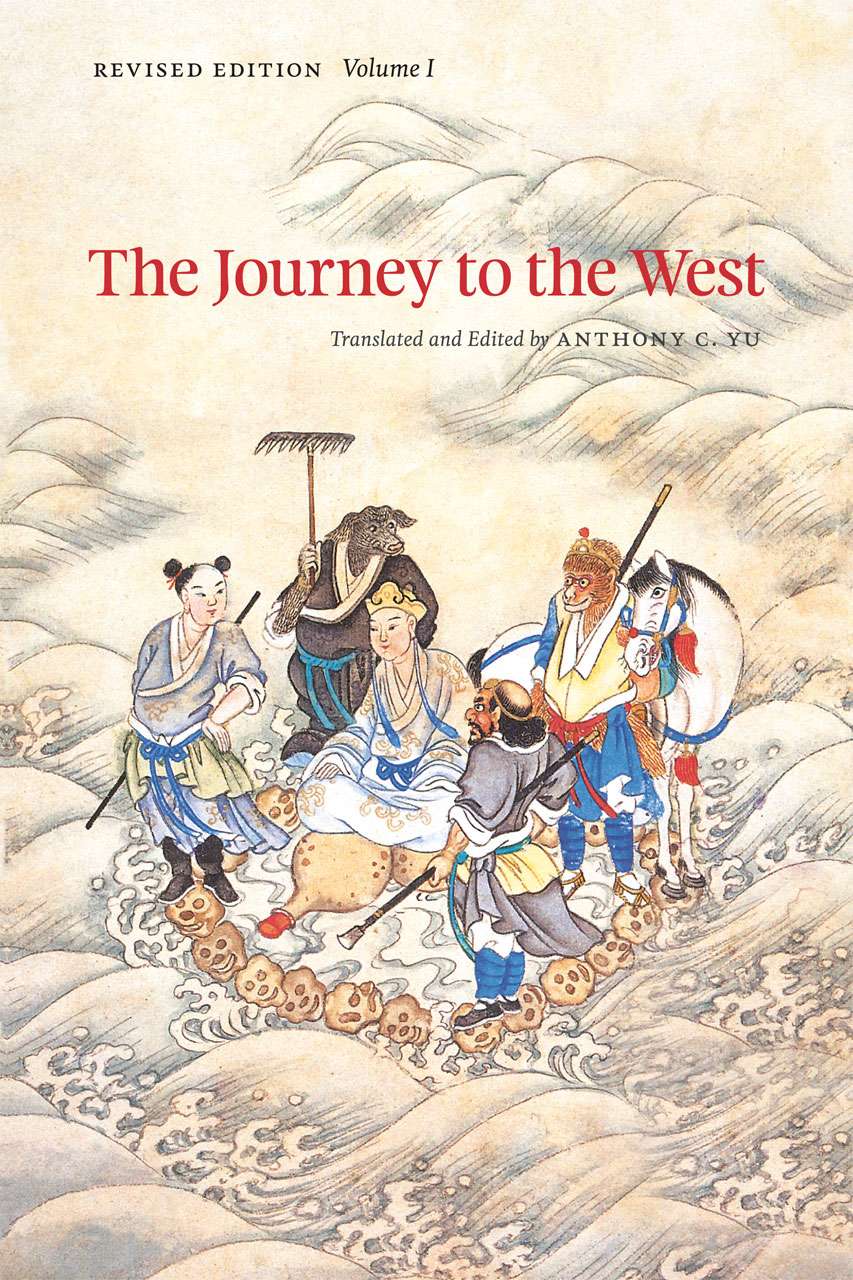
Here I present PDFs comprising the complete four volume 2012 revised edition of The Journey to the West (Xiyouji西遊記) translated by Anthony C. Yu (October 6, 1938 – May 12, 2015). This is considered THE most accurate translation of the tale available. I hope those who read and enjoy the digital version will support the official release.

Yu was Carl Darling Buck Distinguished Service Professor Emeritus in the Humanities and Professor Emeritus of Religion and Literature in the Chicago Divinity School. I shared a long email correspondence with Prof. Yu, during which we became friends. He was always quick to answer my many questions. His translation remains a treasure trove of explanatory notes and sources.

Table of Contents

1. Book Blurb

Anthony C. Yu’s translation of The Journey to the West, initially published in 1983, introduced English-speaking audiences to the classic Chinese novel in its entirety for the first time […] With over a hundred chapters written in both prose and poetry, The Journey to the West has always been a complicated and difficult text to render in English while preserving the lyricism of its language and the content of its plot. But Yu has successfully taken on the task, and in this new edition he has made his translations even more accurate and accessible. The explanatory notes are updated and augmented, and Yu has added new material to his introduction, based on his original research as well as on the newest literary criticism and scholarship on Chinese religious traditions. He has also modernized the transliterations included in each volume, using the now-standard Hanyu Pinyin romanization system. Perhaps most important, Yu has made changes to the translation itself in order to make it as precise as possible (source).

2. PDF Files

Vol. 1

Click to access the-journey-to-the-west-wu-chengen_-anthony-c.-yu-the-journey-to-the-west-volume-1-university-of-chicago-press-2013.pdf

Vol. 2

Click to access the-journey-to-the-west-2012-volume-2.pdf

Vol. 3

Click to access the-journey-to-the-west-2012-volume-3.pdf

Vol. 4

Click to access the-journey-to-the-west-2012-volume-4.pdf

The cover of volume one (larger version).


3. Updates

Update: 03-01-22

I’ve archived a scan of the original Chinese version of the 1592 edition of the novel.

Archive #31 – The Original 1592 Edition of Journey to the West, Complete with Pictures


Update: 07-26-23

I have archived the first complete 1835 Japanese translation of JTTW. It includes amazing woodblock prints.

Archive #41 – PDFs of The Illustrated Journey to the West (Ehon Saiyuki, 繪本西遊記, 1835) – The First Complete Japanese Translation


Update: 08-09-23

I have archived a list of other foreign language translations of Journey to the West, including complete and abridged editions.

  • English (W. J. F. Jenner and Arthur Waley)
  • French
  • German
  • Hungarian
  • Italian
  • Romanian
  • Russian
  • Spanish
  • Thai
  • Turkish
  • Vietnamese

Archive #42 – PDFs of Journey to the West Translations


Update: 04-06-26

See my archives of other translations.

Musings on Journey to the West and my new Great Sage Tattoo

I was a big fan of mythology as a child, particularly enjoying the adventures of the Greek and Norse pantheons. Then, one day, my mother bought me a book on world mythology, and I read about a certain Sun Wukong, a monkey deity that reminded me of my favorite anime hero Son Goku from the Dragon Ball franchise. In my youthful naivety, I thought this monkey was a knockoff of my beloved Saiyan. For instance, both have monkey features, fly on clouds, and wield extending staves. But I was humbled to learn years later that the flow of influence actually went in the opposite direction.

Young Goku flying on his cloud (larger version).

I don’t remember exactly howperhaps reading about it on the internetbut I confirmed the connection between both characters around 2001 while serving in the US Army 82nd Airborne Division. I shortly thereafter purchased the W. J. F. Jenner four-volume boxed edition of Journey to the West to learn more about Sun Wukong and his adventures. I immediately fell in love with the character, especially during the first seven chapters in which he comes to rebel against heaven. What’s not to love about a little stone monkey who, through his own hard work and determination, gains the power to bring the heavenly hierarchy to its knees? The fear that he continues to instill in gods even after his fall from grace and redemption, as well as the tit-for-tat relationship with his religious brother Zhu Bajie, still makes me laugh to this very day.

Journey to the West has been an integral part of my life for nearly 20 years. My foray into research did not happen until the latter part of college. This blog stands as a testament of my continued dedication to the novel. My love for the work grows deeper and deeper as I learn new things to share with my readers. This is especially true as the Anthony C. Yu 2012 revised edition has so much juicy background information. I often use it as a stepping stone to discover new concepts overlooked by previous scholarship.

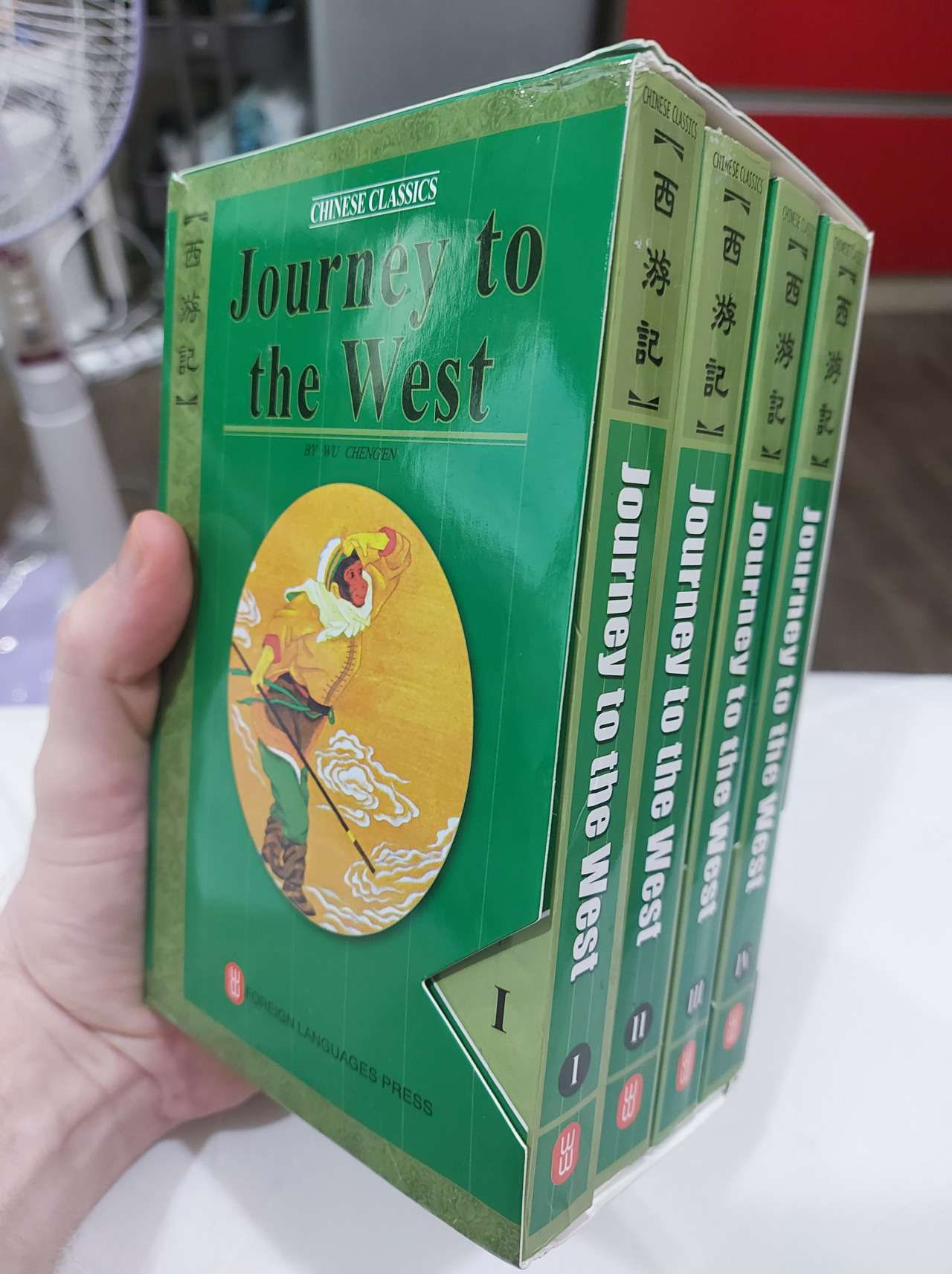
The four-volume box set in my collection (larger version).

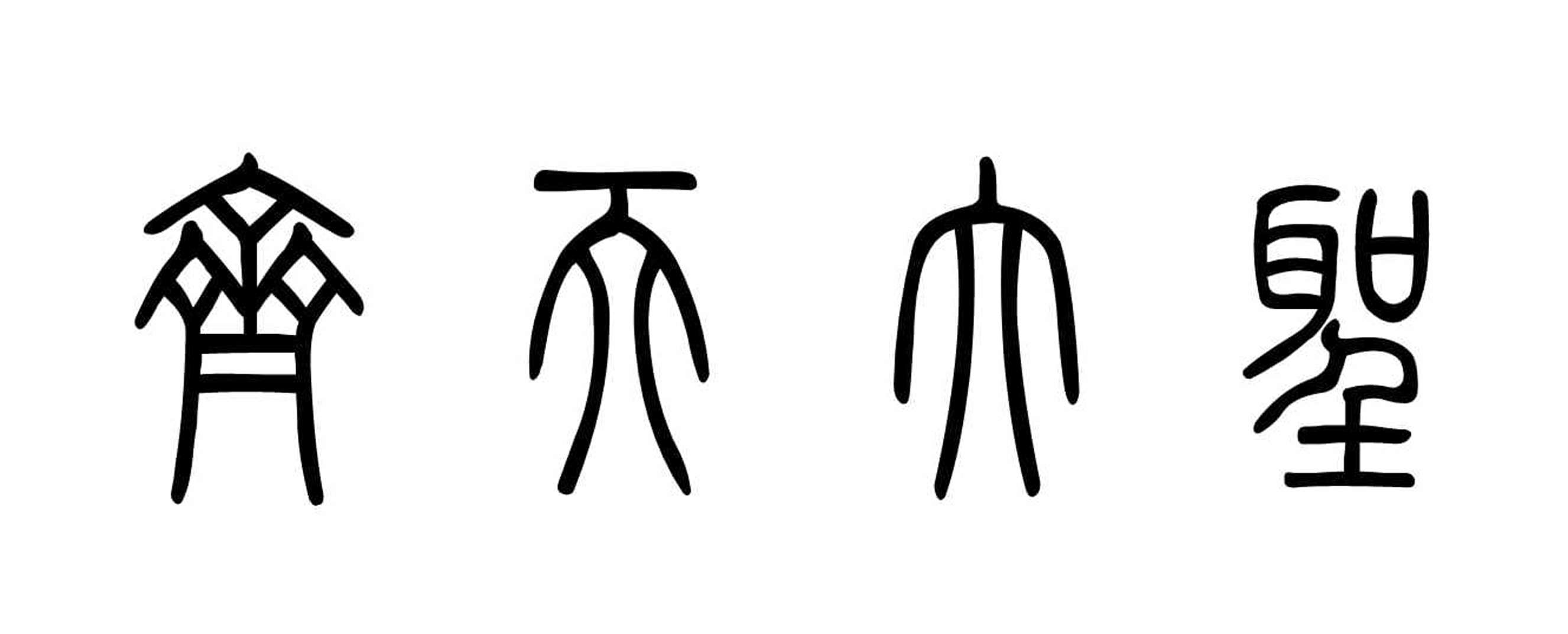
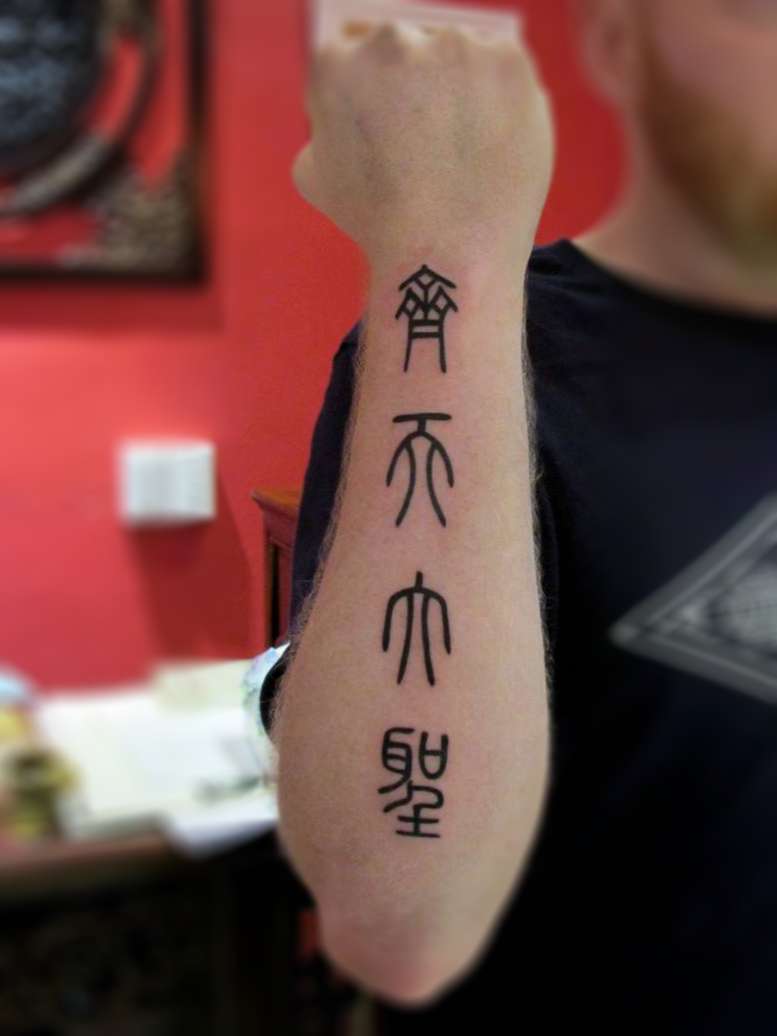
I’ve wanted to get a Monkey King tattoo for years but never liked anything I saw, not even my own novel accurate designs. I finally accepted that I would never find the bright, flashy piece that agreed with my strict standards of authenticity. I instead opted to start simple by getting the characters for “Great Sage Equaling Heaven” (Qitian Dasheng, 齊天大聖) because I felt it accurately reflected my interests. I chose Seal Script because I wanted the piece to have an ancient feel, something that is, if only briefly, arcane to even modern native readers like those in Taiwan where I live. I can’t wait to show it to some of my friends in Tainan who actively worship the Great Sage.

The seal script characters (larger version).

The piece was done by Judy Chang of the Red Room in Banqiao District, New Taipei City, Taiwan.

My tattoo (larger version).


Sun Wukong’s Strength-Bestowing Ritual

Last updated: 05-15-2025

In chapter 88 of Journey to the West (Xiyouji, 西遊記, 1592), the pilgrims arrive in the lower Indian prefecture of Jade Flower District (Yuhua xian, 玉華縣), which strikes Tripitaka as a spitting image of the Tang Chinese capital of Chang’an. There, the disciples’ monstrous appearance rouses the local ruler’s three sons to action against what they think are demons come to harm their father. However, they soon learn Monkey, Pigsy, and Sandy are celestial warriors possessing magical versions of their mere earthly arms—two staves and a battle rake. The three princes are later accepted as disciples, the oldest wanting to learn Monkey’s techniques and the second and third oldest wanting to learn from Pigsy and Sandy in turn. But when they fail to lift the monks’ celestial weapons, Monkey performs an arcane ritual in which he bestows each prince with superhuman strength:

In a secluded room behind the Gauze-Drying Pavilion, Pilgrim traced out on the ground a diagram of the Big Dipper. Then he asked the three princes to prostrate themselves inside the diagram and, with eyes closed, exercise the utmost concentration. Behind them he himself recited in silence the true sayings of realized immortality and intoned the words of Dharani as he blew divine breaths into their visceral cavities. Their primordial spirits were thus restored to their original abodes. Then he transmitted secret oral formulas to them so that each of the princes received the strength of tens of thousands of men. [1] He next helped them to circulate and build up the fire phases, as if they themselves were carrying out the technique for shedding the mortal embryo and changing the bones. Only when the circulation of the vital force had gone through all the circuits of their bodies (modeled on planetary movements) did the young princes regain consciousness. When they jumped to their feet and gave their own faces a wipe, they felt more energetic than ever. Each of them, in fact, had become so sturdy in his bones and so strong in his ligaments that the eldest prince could handle the golden-hooped rod, the second prince could wield the nine-pronged muckrake, and the third prince could lift the fiend-routing staff (Wu & Yu, 2012, vol. 4, pp. 202-203).

行者才教三個王子都在暴紗亭後,靜室之間,畫了罡斗。教三人都俯伏在內,一個個瞑目寧神。這裡卻暗暗念動真言,誦動咒語,將仙氣吹入他三人心腹之中,把元神收歸本舍。傳與口訣,各授得萬千之膂力,運添了火候,卻像個脫胎換骨之法。運遍了子午周天,那三個小王子方才甦醒,一齊爬將起來,抹抹臉,精神抖擻,一個個骨壯筋強:大王子就拿得金箍棒,二王子就掄得九齒鈀,三王子就舉得降妖杖。

Table of Contents

I. Explanation

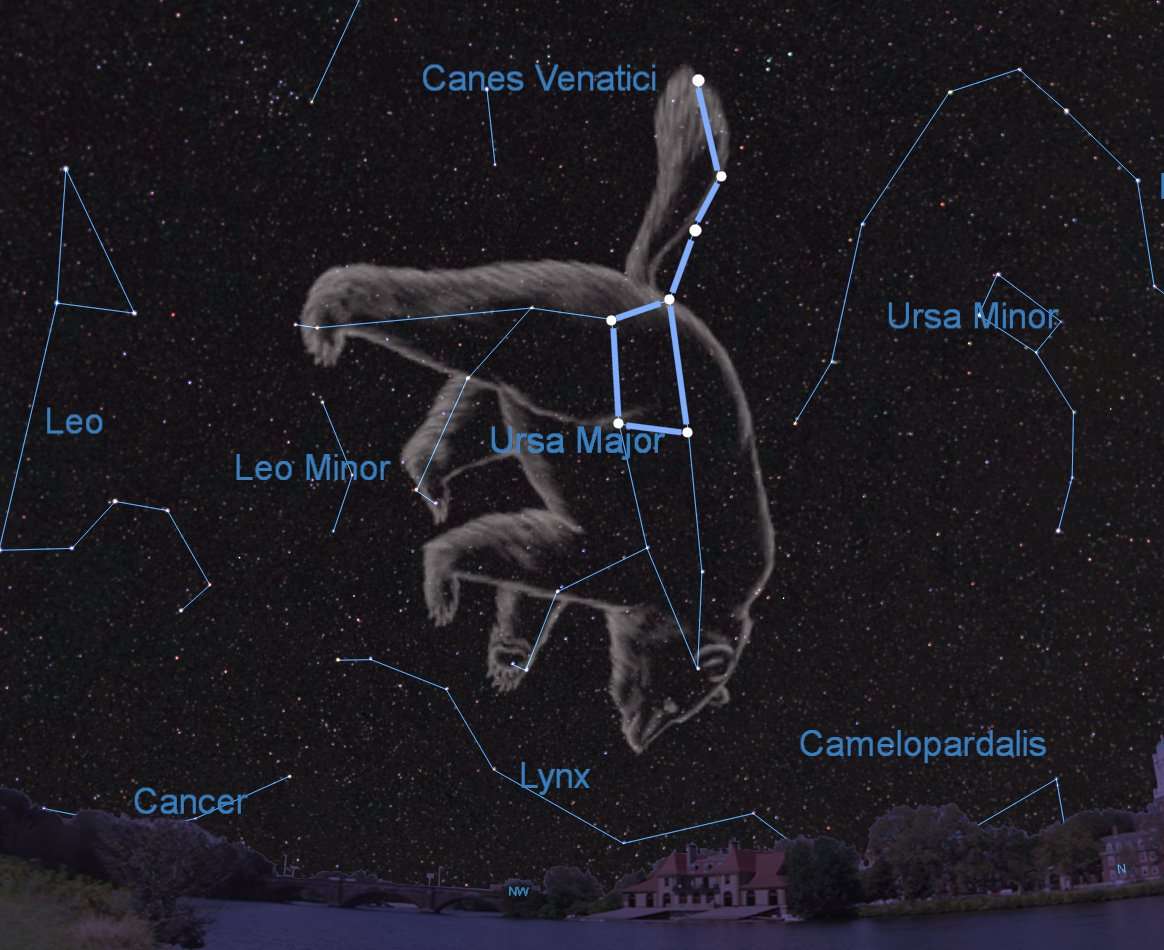
1. “Pilgrim traced out on the ground a diagram of the Big Dipper.”

The Big Dipper (gangdou, 罡斗), also known as the Northern Dipper (beidou, 北斗), is a pattern of seven stars associated with the constellation Ursa Major (fig. 1). Daoism considers the pole star of this pattern to be the center of the cosmos through which emanates “primordial breath” (generative qi), which has long been deified as the great god Taiyi. The constellation is associated with a Daoist ritual known as Bugang (步綱/罡, “Walking the Guideline”) in which a practitioner paces the Big Dipper pattern with their feet on the ground. This ritual dance is synonymous with the much older shamanistic Yubu (禹步, “Paces of Yu”) used by ancient Sage Kings to conquer primordial chaos by pacing the stars and planets into motion, thereby directing the seasons and passage of time. The ritual involved pacing an inwardly spiraling circular pattern while dragging one foot behind the other in imitation of the limp adopted by Yu the Great after over-exerting himself quelling the fabled World Flood (fig. 2). Later Daoists viewed Yubu as a means of gaining immortality because the limping, three pace-style walking pattern symbolized the practitioner spanning the three realms of Earth, Man, and finally Heaven (this has an interesting Vedic correlation). [2] But most importantly, by the Tang and Song dynasties, Bugang served the purpose of purifying the area before an altar, ensuring the liturgy to follow takes place in a consecrated space. In fact, some sources interchange the characters for Bugang with the homonyms 布剛, meaning “distributing strength,” which denotes the demonifugic properties of the dance (Andersen, 1989). Therefore, Monkey draws the Big Dipper talisman on the ground in order to create a sacred space free of any negative influences.

Fig. 1 (left) – The location of the Big Dipper in relation to the Ursa Major constellation (larger version). Originally from this Futurism article. Fig. 2 (right) – A diagram showing the inwardly spiraling pattern of Yubu (top) and the dipper pattern of Bugang (bottom) (larger version). Take note of the spiral’s limping, three pace-style walking pattern. Originally found on this WordPress article.  

2. “Then he himself recited in silence the true sayings of realized immortality and intoned the words of Dharani…”

The “true sayings” (zhenyan, 真言) is the Chinese term for mantra, meaning “spell” or “magical formula.” A mantra is “a syllable or series of syllables that may or may not have semantic meaning, most often in a form of Sanskrit, the contemplation or recitation of which is thought to be efficacious” (Buswell & Lopez, 2014, p. 529). The most famous mantra is of course Om Mani Padme Hum, the very same six-syllable prayer that was used to weigh down the mountain holding Monkey prisoner for rebelling against heaven.

The “true sayings” is often used as an abbreviation for Dharani (tuoluoni/zongchi, 陀羅尼/總持), a Sanskrit term meaning “mnemonic device” (fig. 3). Like mantras, dharani are comprised of syllables, but these instead serve to remind practitioners of broader concepts, for example a single syllable representing the first letter of a much longer phrase. There exists four types of dharani said to be used by Bodhisattvas to achieve enlightenment: 1) those used for teaching interpretations of Buddhist law; 2) those used for understanding the exact meaning of important words; 3) those used for casting spells; and 4) those used for spiritual endurance in the face of suffering (Buswell & Lopez, 2014, pp. 241-242). The third type, which concerns us, falls under a category of sutra recitation called Paritta (minghu/jing, 明護/經), which is Pali for “protection.” The historical Buddha is known to have delivered paritta verses, including those for “protection from evil spirits, the assurance of good fortune, exorcism, curing serious illness, and even safe childbirth” (Buswell & Lopez, 2014, p. 630).

In both cases zhenyan/mantra and dharani refer to magical formulas of sorts and were no doubt chosen because they gave the ritual an heir of arcane authenticity. Additionally, I suggest that the use of dharani may have also been chosen to denote a spell of protection, as in Sun wanted to protect the princes during the transformation of their bodies.

(Note 06-15-19: Feng Dajian of Nankai University notified me via Twitter that he disagrees with Anthony C. Yu’s 2012 revised translation (cited above) associating the “True Sayings” with the Buddhist Dharani. This is because he feels that the ritual is overtly Daoist, noting that the religion also has its own True Sayings.)

Fig. 3 – A Dharani print from the late Tang Dynasty. Original from Wikicommons.

3. “…as he blew divine breaths into their visceral cavities. Their primordial spirits were thus restored to their original abodes.”

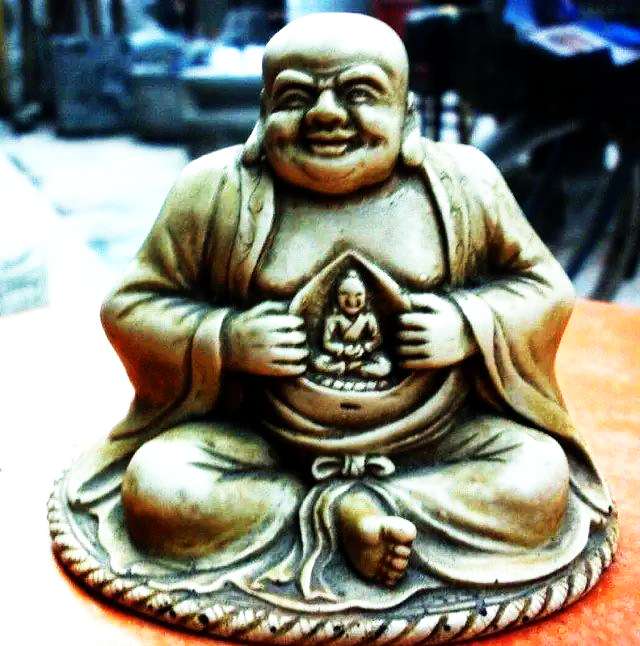
Journey to the West translator Anthony C. Yu (Wu & Yu, 2012) notes that this section “is an abbreviated or paraphrastic account, in fact, of the neidan (internal or physiological alchemy process)” (vol. 4, p. 396, n. 8). Monkey already went through this process in chapter two when he practiced a series of breathing and energy circulation exercises that resulted in his immortality. Therefore, he uses his own hard-won “divine breath” or “immortal energy” (xianqi, 仙氣) to fortify the princes’ bodies by drastically speeding up the years-long process of internal cultivation to only a matter of hours or minutes. Monkey’s breath bolsters their own energy, helping them to achieve “primordial spirits” (yuanshen, 元神), a term commonly associated with Buddhahood or enlightenment. In Daoism, the term is synonymous with the attainment of immortality via the formation of a “Sacred Embryo” (Shengtai, 聖胎) (fig. 4), which is forged from spiritual energies over long years of self-cultivation (Darga, 2008). This suggests that beyond super strength, the ritual also gives them some form of immortality.

Fig. 4 – The Sacred Embryo is sometimes depicted as a baby (or in this case a Buddha) on a practitioner’s stomach (larger version). Found on this blog.

4. “He next helped them to circulate and build up the fire phases…”

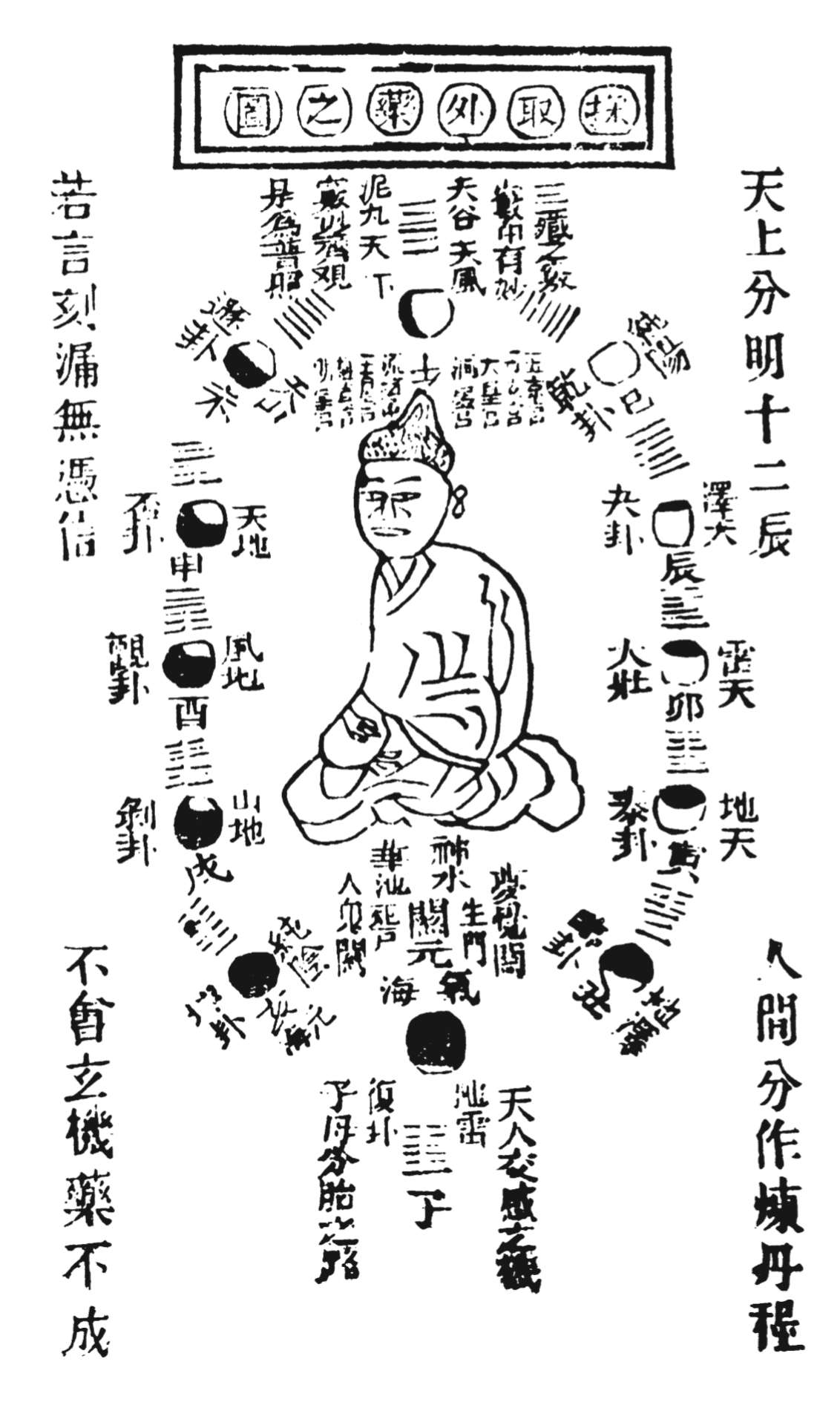
The fire phases (huohou, 火候) comprise the process of circulating spiritual energy throughout the body at prescribed times (fig. 5). Monica Esposito (2008) writes that there are three phases in total, making up two distinct periods of activity and rest:

The first is a phase of “yangization” in which Yang augments and Yin decreases. This is described as a warlike or martial period, corresponding to the advancement of a light called Martial Fire (wuhuo 武火) or Yang Fire (yanghuo 陽火) that purifies by burning and eliminates defiled elements to release the Original Yang and increase it. At the cosmic level, the beginning of this phase is symbolized by the winter solstice (zi 子) and by the hexagram fu 復 ䷗ (Return, no. 24), which indicates the return of Yang. This is followed by a phase of balance, a time of rest called muyu ([沐浴] ablutions). At the cosmic level, this phase is symbolized by the spring and autumn equinoxes and by the hexagrams dazhuang 大壯 ䷡ (Great Strength, no. 34) and guan 觀 ䷓ (Contemplation, no. 20). The third stage is a phase of “yinization” in which Yin augments and Yang decreases. This period, called Civil Fire (wenhuo 文火) or Yin Fire (yinfu 陰符), corresponds to a decrease of the light. The adept achieves the alchemical work spontaneously and without any effort or voluntary intervention; water descends to moisten, fertilize, and temper fire. At the cosmic level, this phase is symbolized by the summer solstice (wu 午) and by the hexagram gou 姤 ䷫ (Encounter, no. 44) (p. 531).

Mastering the complicated chronological rhythm of this process is considered the best kept secret of internal alchemy (Esposito, 2008). Therefore, Monkey navigates this temporal maze for the princes, ensuring the spiritual energy that he has helped them cultivate ebbs and flows when prescribed. Once again we see that Sun has sped up a lengthy process to only a few days, hours, or minutes.

Fig. 5 – A chart showing the fire phases, the 12 phases of the moon, and the corresponding hexagrams (larger version). From Kim, 2008, p. 528.

II. Similarities to Comic Book Heroes

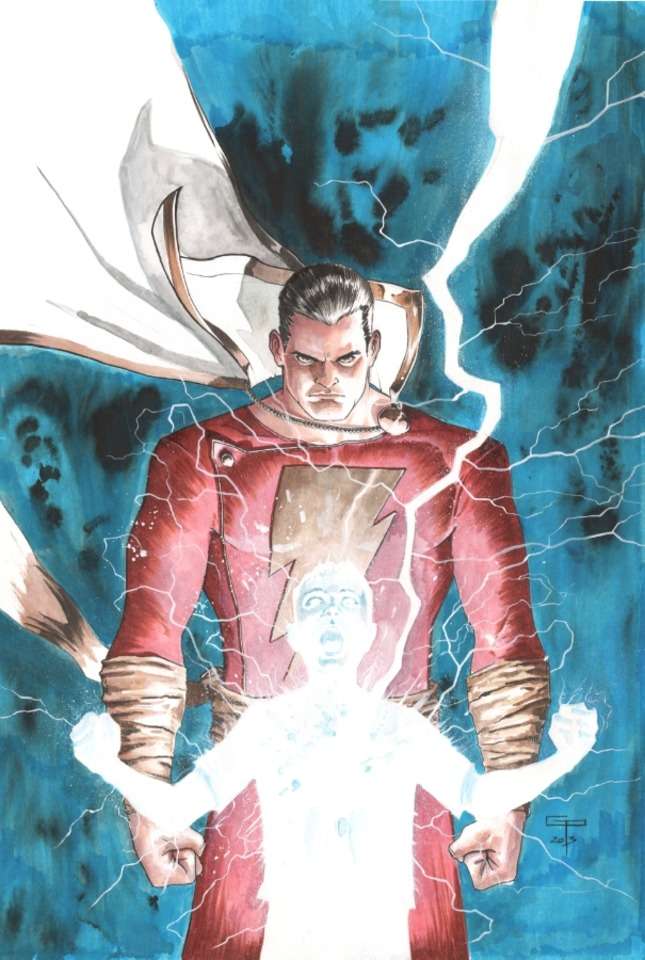
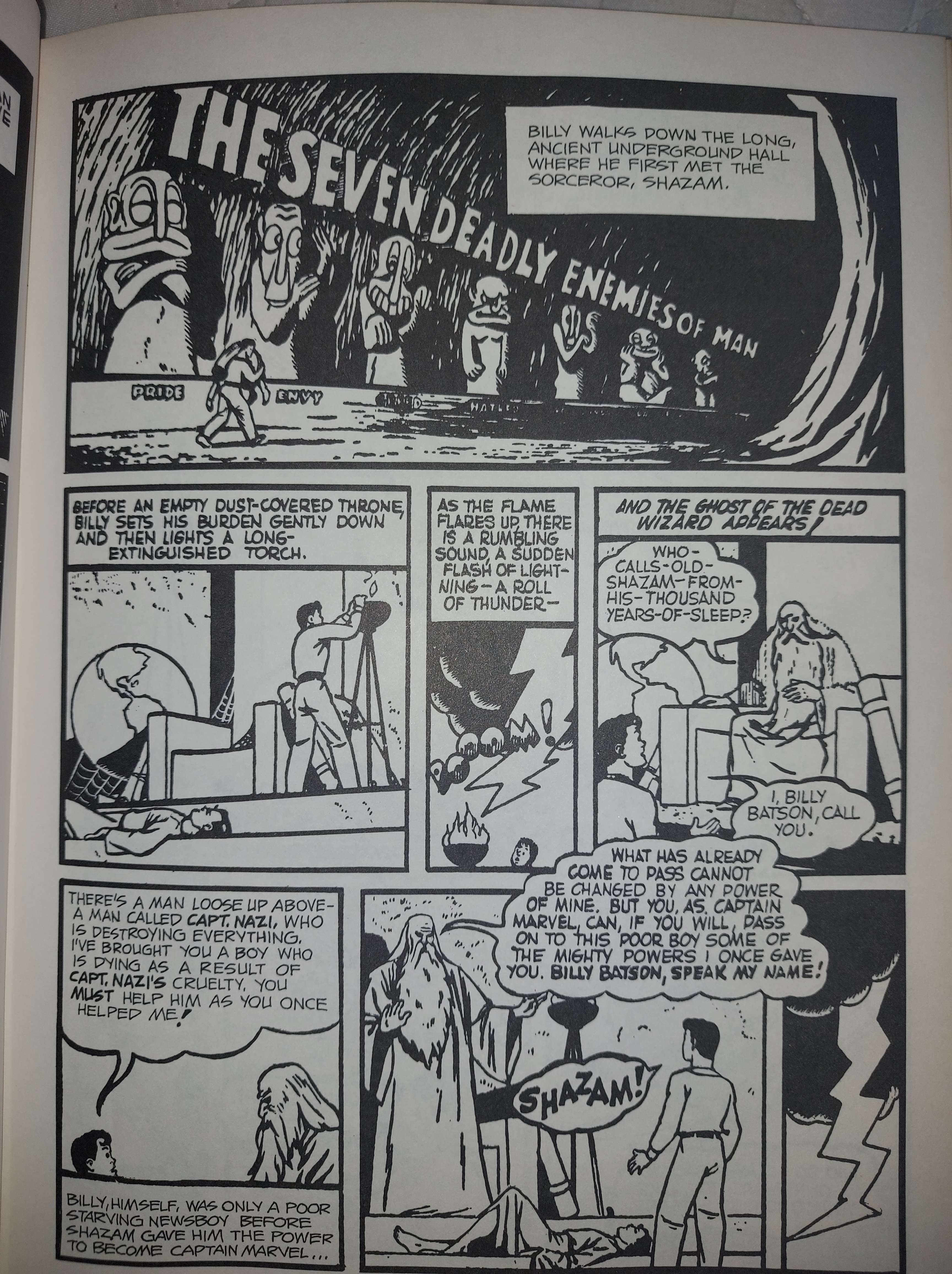
The princes in essence become the fantasy equivalent of today’s comic book superheroes. Gaining power from a divine being is similar to the concept of “Divine Empowerment” from DC Comics. A good example is Billy Batson, a.k.a. Captain Marvel (Ch: Jingqi duizhang, 驚奇隊長) (fig. 6), a child-turned-adult who receives super strength and other powers from a battery of Western gods and sages through the medium of a divine wizard.

4139607-160

Fig. 6 – The child Billy Batson transforming into the superhero Captain Marvel, also known as Shazam (larger version). Image found here.

III. Conclusion

This fascinating strength-bestowing ritual draws on multiple aspects of Buddho-Daoist ceremony and internal alchemy. First, Sun chooses a secluded room where he traces a diagram of the Big Dipper on the floor in order to consecrate the space. Second, he recites magical spells likely intended to protect the princes during their bodily transformation. Third, Monkey uses his own divine breath to ignite their spiritual energy, manually fanning the flames to higher levels of spiritual attainment. Finally, he controls the ebb and flow of the resulting energy throughout their bodies according to a prescribed chronological rhythm. In all, Sun shortens a years-long process to only a few days, hours, or minutes. The princes come away from the ritual with superhuman strength and likely some form of divine longevity.

This whole process reminds me of the DC Comics character Billy Batson receiving divine powers through the medium of the Wizard Shazam to become Captain Marvel.


IV. Updates

Update: 12-14-19

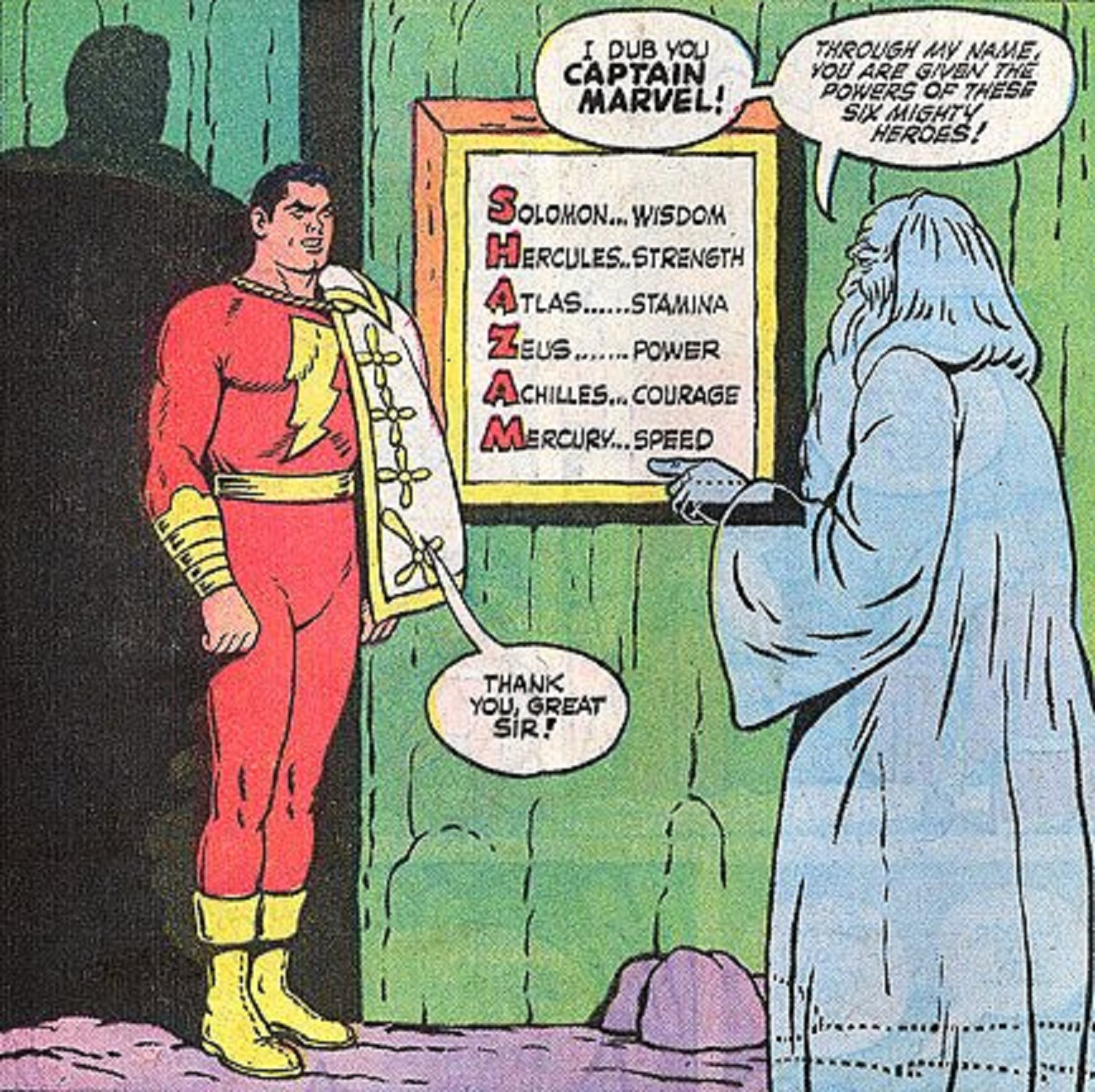
This is a past photomanipulation that depicts Monkey as the Wizard Shazam and the three Indian Princes as Captain Marvel. I used a golden age comic book image as the base (fig. 7).

Fig. 7 – The photomanipulation mixing Journey to the West and Captain Marvel (larger version). The original comic book image can be seen here.

Update: 07-17-22

I’ve posted an article that explores the abilities of Monkey’s immortal breath (used in the ritual above).

A Survey of Sun Wukong’s Magic “Immortal Breath” and Its Abilities


Update: 03-18-23

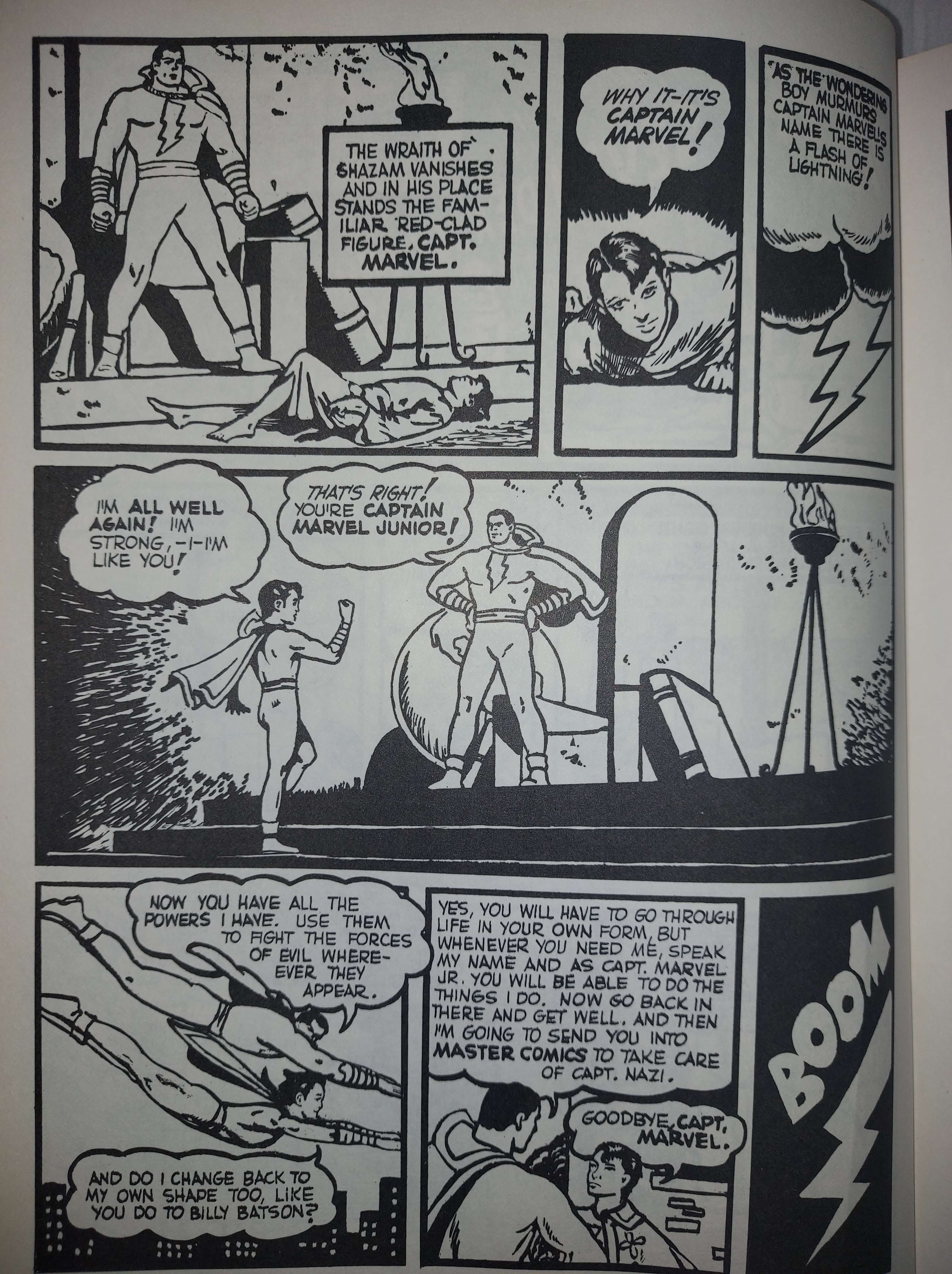
Above, I referenced Captain Marvel because he receives divine powers similar to the Indian Princes from Journey to the West. Well, the hero is also capable of sharing his abilities just like Sun Wukong! One issue sees him save the life of a fatally injured boy by giving him some of his magic energy, thereby transforming him into a superhero. The boy is henceforth known as “Captain Marvel Jr.” (Ch: Xiao shengqi duizhang, 小神奇隊長) in his hero form (fig. 8-10) (Binder et. al., 1977, pp. 57-59).

Fig. 8 (left) – Billy Batson (a.k.a. Captain Marvel) seeks help from Shazam to save the boy (larger version). Fig. 9 (center) – Captain Marvel shares some of his power, thus saving the boy (larger version). Fig. 10 (right) – The boy-turned-superhero vows to fight evil (larger version).


Update: 12-02-23

Someone recently asked me why the monstrous pilgrims would take human disciples in the first place. Well, this is the result of a sequence of events:

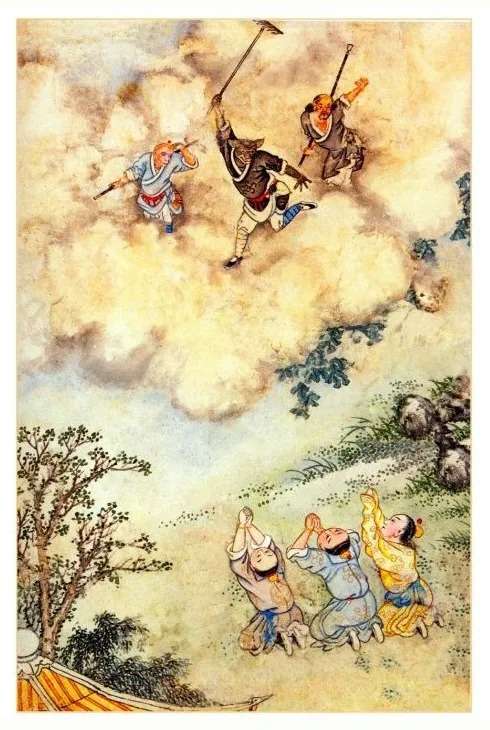
  • The young princes are amazed to see Sun, Zhu, and Sha display their martial arts skills while flying on divine clouds (fig. 11).
  • They tell their father, the sovereign prince, that they want to become their students, claiming it would allow them to protect their nation.
  • The monarch asks Tripitaka for permission, and he agrees.
  • The sovereign prince then personally requests that Sun, Zhu, and Sha tutor his sons in martial arts (Wu & Yu, 2012, pp. 197-199).

This seems straightforward enough, but there is an underlying answer that just dawned on me: everyone agrees, and Monkey goes a step further by empowering the princes (fig. 12), as a way of kissing the ruler’s butt since he stamped the group’s travel rescript, a kind of passport needed to legally travel through various countries (Wu & Yu, 2012, p. 193). Without the stamp, the pilgrims wouldn’t have been able to continue their journey to the Buddha’s mountain.

The humorous implication here is that even celestials have to bow to earthly bureaucracy. 

Fig. 11 (left) – The princes drop to their knees as they watch the three monstrous pilgrims display their supernatural martial skills (larger version). Image from the Qing-Period Color-Illustrated Complete Edition of Journey to the West (清彩繪全本西遊記, 2008). Fig. 12 (right) – Monkey empowers the princes with his divine breath (larger version). Image from Chen Huiguan’s Newly Illustrated and Complete Journey to the West (陈惠冠新绘全本西游记, 2001). Both images found here.

For future reference, this episode takes place towards the middle of ep. 23 of the 1986 JTTW TV show and the end of ep. 55 and the beginning of ep. 56 of the 2011 JTTW TV show. Both programs skip over the strength-bestowing ritual.


Update: 08-11-24

I have written a catalog of all of Sun Wukong’s abilities from all 100 chapters of JTTW. The strength-bestowing ritual appears on pages 194-195 (ch. 88, no. 3) of this PDF.

Archive #46 – A Catalog of the Monkey King’s Magic Powers and Skills


Update: 05-15-25

I forgot to mention above that although the princes can wield their teachers’ divine, multi-ton weapons after the ritual—an amazing feat for mortals to be sure—the weight is still too much for them to handle comfortably. This is why they request to make their own lighter replicas. Chapter 88 reads: 

When the old prince saw this [the princes wielding the divine weapons], he could not have been more pleased, and another vegetarian banquet was laid out to thank the master and his three disciples. Right before the banquet tables, however, they [the princes] began their instruction. The one studying the rod performed with the rod; the one studying the rake performed with the rake; and the one studying the staff performed with the staff. The princes thus succeeded in making a few turns and several movements, but they were, after all, mortals, and they found the goings rather strenuous. After exercising for a while, they began to pant heavily. Indeed, they could not last long, though their weapons might have the ability to undergo transformation. In their advances and retreats, their attacks and offenses, the princes simply could not attain the wonder of natural transformation. Later that day the banquet came to an end.

The next day the three princes came again to thank their masters and to say: “We thank the divine master for endowing us with strength in our arms. Though we are now able to hold the weapons of our masters, however, we find it difficult to wield and turn them. We propose, therefore, that artisans be asked to duplicate the three weapons. They will use your weapons as models but take some of the weight off. Would the masters grant us permission?” (Wu & Yu, 2012, vol. 4, p. 203)

老王見了,歡喜不勝。又排素宴,啟謝他師徒四眾。就在筵前各傳各授:學棍的演棍,學鈀的演鈀,學杖的演杖。雖然打幾個轉身,丟幾般解數,此等終是凡夫,有些著力:走一路,便喘氣噓噓,不能耐久。蓋他那兵器都有變化,其進退攻揚,隨消隨長,皆有自然之妙,此等終是凡夫,豈能以遽及也?當日收了筵宴。 

次日,三個王子又來稱謝道:「感蒙神師授賜了膂力,縱然掄得師的兵器,只是轉換艱難。意欲命匠依神師兵器式樣,減削斤兩,打造一般,未知師父肯容否?」

Pigsy takes the lead by granting their wish, but the three original weapons are unfortunately stolen by a fiend while in the custody of craftsmen (Wu & Yu, 2012, vol. 4, pp. 203-204). This eventually leads to a war with earthly and heavenly lion-spirits (see chapters 88 to 90).

After the day is saved, the replica weapons are completed. The end of chapter 90 reads:

In the meantime, the ironsmiths had finished forging the three weapons. As they kowtowed to Pilgrim [Monkey], they said, “Holy Father, our work is done.”

“What’s the weight of each of the weapons?” asked Pilgrim.

“The golden-hooped rod weighs a thousand catties,” replied one of the ironsmiths. “The nine-pronged rake and the fiend-routing staff both weigh eight hundred catties.” “All right,” said Pilgrim, and he asked the three princes to come out and pick up their weapons (based on Wu & Yu, 2012, vol. 4, pp. 229-230).

又見那鐵匠人等造成了三般兵器,對行者磕頭道:「爺爺,小的們工都完了。」問道:「各重多少斤兩?」鐵匠道:「金箍棒有千斤,九齒鈀與降妖杖各有八百斤。」行者道:「也罷。」叫請三位王子出來,各人執兵器。

One thousand catties (千斤) is 1,300.72 lbs or 590 kg, and 800 catties (八百斤) is 1,040.58 lbs or 472 kg.

This episode would be a great setup for a Game of Thrones-style Asian fantasy. The three princes could be plotting and scheming against each other in the hopes of one day gaining the throne from their aging father, the sovereign prince. Then a monkey wizard comes along and makes things worse by bestowing them with super strength and divine longevity. This would definitely lead to lots of drama between the brothers and their offspring. It would be a centuries-long battle royale between competing dynasties of superpowered beings!

Notes:

1) Although the original English translation reads “the strength of a thousand arms” (Wu & Yu, 2012, p. 202), the Chinese reads wanqian zhi luli (萬千之膂力), which means “the strength of tens of thousands (of men).” I have, therefore, adjusted the translation for more accuracy.

2) Andersen (2008) notes that the three paces are similar to those used by Vedic priests:

It would appear, in other words, that even in this early period the Paces of Yu constituted a close parallel to the three Strides Viṣṇu in early Vedic mythology, which are thought to have taken the god through the three levels of the cosmos (thereby establishing the universe), and which indeed, just like the Paces of Yu in Taoist ritual, are known to have been imitated by Vedic priests as they approached the altar—and in the same form as the Paces of Yu, that is, dragging one foot after the other (pp. 238-239).

Sources:

Andersen, P. (1989). The Practice of Bugang. Cahiers d’Extrême-Asie, 5. Numéro spécial Etudes taoïstes II / Special Issue on Taoist Studies II en l’honneur de Maxime Kaltenmark. pp. 15-53.

Andersen, P. (2008). Bugang. In F. Pregadio (Ed.), The Encyclopedia of Taoism (Vols. 1-2) (pp. 237-240). London [u.a.: Routledge].

Binder, O., Woolfolk, W., O’Neil, D., Parker, B., Maggin, E. S., & Bridwell, E. N. (1977). Shazam! From the Forties to the Seventies. New York: Harmony Books.

Buswell, R., & Lopez, D. (2014). The Princeton Dictionary of Buddhism. Princeton University Press.

Darga, M. (2008). Shengtai. In F. Pregadio (Ed.), The Encyclopedia of Taoism (Vols. 1-2) (pp. 883-884). London [u.a.: Routledge].

Esposito, M. (2008). Huohou: 2. Neidan. In F. Pregadio (Ed.), The Encyclopedia of Taoism (Vols. 1-2) (pp. 530-532). London [u.a.: Routledge].

Kim, D. (2008). Houhou: 1. Waidan. In F. Pregadio (Ed.), The Encyclopedia of Taoism (Vols. 1-2) (pp. 526-530). London [u.a.: Routledge].

Wu, C., & Yu, A. C. (2012). The Journey to the West (Vols. 1-4) (Rev. ed.). Chicago, Illinois: University of Chicago Press.

My Sun Wukong Art – “The Buddha has Awakened”

At the end of chapter 100, Tripitaka and his disciples are elevated in spiritual rank as a reward for their hardwon quest to retrieve scriptures from India. Pigsy becomes an altar cleaner, Sandy becomes a Luohan (Buddhist saint), and the priest and Sun both become Buddhas. This paragraph describes what the Buddha says to Monkey upon his ascension:

“Sun Wukong, when you caused great disturbance at the Celestial Palace, I had to exercise enormous dharma power to have you pressed beneath the Mountain of Five Phases. Fortunately your Heaven-sent calamity came to an end, and you embraced the Buddhist religion. I am pleased even more by the fact that you were devoted to the scourging of evil and the exaltation of good. Throughout your journey you made great merit by smelting the demons and defeating the fiends. For being faithful in the end as you were in the beginning, I hereby give you the grand promotion and appoint you the Buddha Victorious in Strife” [Dou zhangsheng fo, 鬥戰勝佛] (Wu & Yu, 2012, p. 381).

孫悟空,汝因大鬧天宮,吾以甚深法力,壓在五行山下,幸天災滿足,歸於釋教;。且喜汝隱惡揚善,在途中煉魔降怪有功,全終全始,加陞大職正果,汝為鬥戰勝佛。

Despite this promotion, Sun still dreads the magic golden headband might be used on him. But he soon learns the heaven-sent punishment has disappeared once he became an enlightened being, denoting the internalization of self-restraint:

As the various Buddhas gave praise to the great dharma of Tathagata, Pilgrim Sun said also to the Tang Monk, “Master, I’ve become a Buddha now, just like you. It can’t be that I still must wear a golden fillet! And you wouldn’t want to clamp my head still by reciting that so-called Tight-Fillet Spell, would you? Recite the Loose-Fillet Spell quickly and get it off my head. I’m going to smash it to pieces, so that that so-called Bodhisattva can’t use it anymore to play tricks on other people.”

“Because you were difficult to control previously,” said the Tang Monk, “this method had to be used to restrain you. Now that you have become a Buddha, naturally it will be gone. How could it be still on your head? Try touching your head and see.” Pilgrim raised his hand and felt along his head, and indeed the fillet had vanished (Wu & Yu, 2012, pp. 382-383).

諸佛讚揚如來的大法。

孫行者卻又對唐僧道:「師父,此時我已成佛,與你一般,莫成還戴金箍兒,你還念甚麼緊箍咒掯勒我?趁早兒念個鬆箍兒咒,脫下來,打得粉碎,切莫叫那甚麼菩薩再去捉弄他人。」唐僧道:「當時只為你難管,故以此法制之。今已成佛,自然去矣,豈有還在你頭上之理?你試摸摸看。」行者舉手去摸一摸,果然無之。

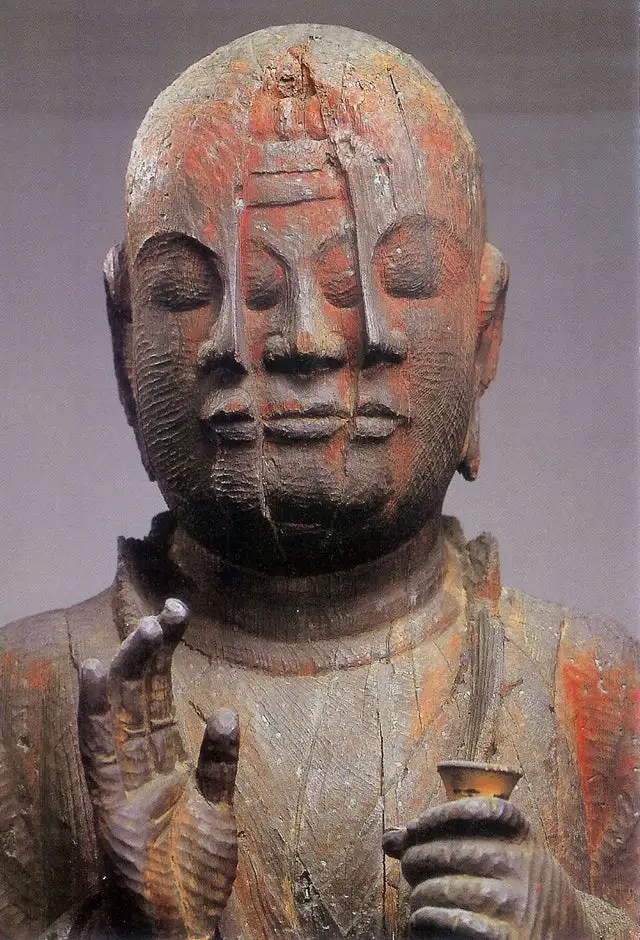
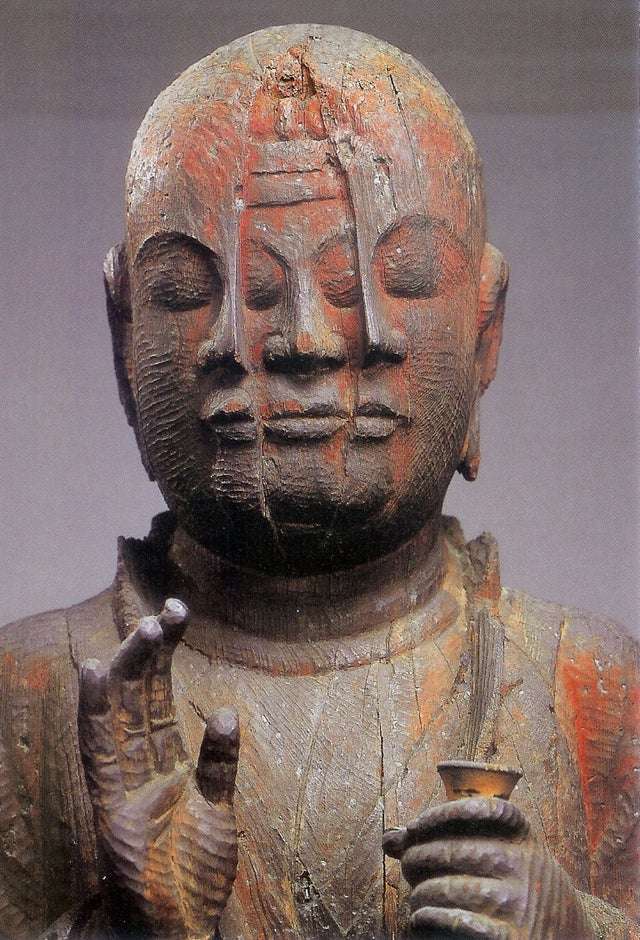
Fig. 1 – Wooden sculpture of the monk Baozhi, 12th-century, Saiho Temple, Kyoto, Japan (larger version). Image found here.

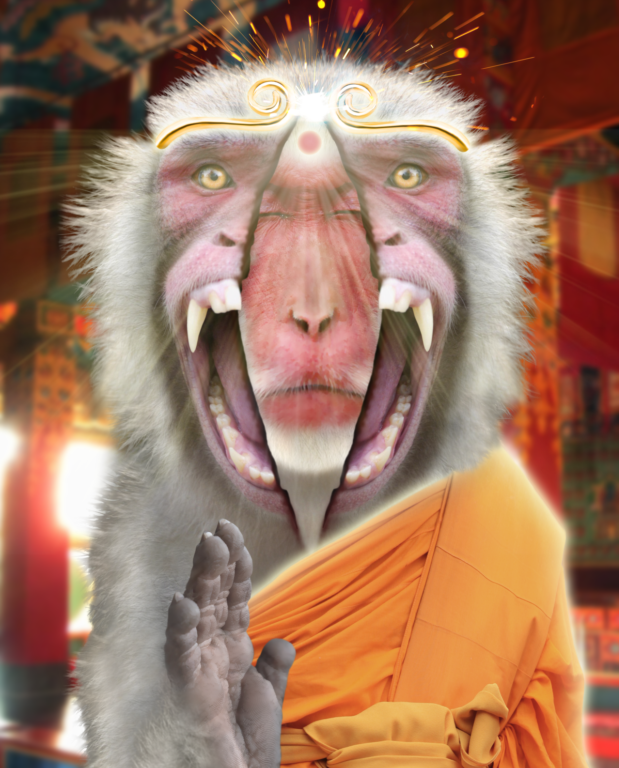
I’ve always wanted to create a piece of digital art portraying Monkey’s ascension and loss of his headband but never knew how to depict both events in the same picture. That is until a few days ago when I came across a beautiful 12th-century Japanese wooden sculpture of the Chan Buddhist monk Baozhi (Jp: Hoshi; K: Poji, 保志/寶志, 418–514) (fig. 1). The piece depicts “the monk’s face in supernatural corporeal transformation, splitting open to reveal the face of the numinous Eleven-Headed Kannon [Guanyin],” symbolizing his enlightenment (Levine, 2005, p. 72). I felt the statue was the best expression of enlightenment that I’ve ever seen. I later discovered the historical Baozhi was known for his ever youthful appearance, carrying a fanciful staff, and working magical miracles (Buswell & Lopez, 2014, p. 98; Ebrey, 1993, pp. 100-102), much like our hero. I therefore knew this piece would be the model from which I’d create my art.

This is the final product created in Photoshop CS6 (fig. 2). The piece is comprised of 15 layers using eight different pictures. It took roughly two days working on and off during free time. The screaming face of the angry immortal splits open, giving way to the serene Buddha beneath. The sparks at the top represent the headband violently snapping open since it is no longer needed. Rays of spiritual light shine from the urna on Monkey’s forehead.

Fig. 2 – The Monkey Buddha has Awakened (larger version). Photomanipulation by the author.

Sources

Buswell, R. E. , & Lopez, D. S. (2014). The Princeton Dictionary of Buddhism. Princeton University Press.

Ebrey, P. B. (1993). Chinese Civilization: A Sourcebook, 2nd Ed. New York: Free Press.

Levine, G. P. A. (2005). Daitokuji: The Visual Cultures of a Zen Monastery. Seattle: University of Washington Press.

Wu, C., & Yu, A. C. (2012). The Journey to the West (Vol. 4) (Rev. ed.) Chicago, Illinois : University of Chicago Press.