Yuebei xing, Daughter of the Monkey King

Last updated: 04-07-2026

Ever since I published my article “The Monkey King’s Children” (2021), I’ve noticed that people have fallen in love with Sun Wukong’s monstrous, magic skull-wielding daughter Yuebei xing (月孛星, “Moon Comet Star”) from Journey to the South (Nanyouji, 南遊記, c. 1570s-1580s, “JTTS” hereafter). For instance, search Tumblr and you will find plenty of art and short stories featuring her. The character does not appear in the original Journey to the West (Xiyouji, 西遊記, 1592) novel, so I’m honestly surprised that she has captured the imagination of so many.

Here, I would like to collect all that I’ve written about her, along with new information, into a single article. This piece discusses her brief character arc, her astrological origins, her appearance in other literature, and her religious iconography.

Table of Contents

1. Character Arc

In chapter 17 of JTTS, Sun Wukong is framed for once again stealing immortal peaches. The Jade Emperor threatens to remand him to the Buddha for punishment but is convinced to give him a month-long reprieve to find the true culprit. Monkey returns to the Mountain of Flowers and Fruit, and it is here, among his people, that the story briefly mentions three children, including sons Jidu (奇都, “Ketu”) and Luohou (羅猴, “Rahu”) and daughter Yuebei xing (月孛星, “Moon Comet Star”).

Sun eventually seeks out Guanyin, who reveals that the troublemaker is the rogue immortal Huaguang (華光). Returning home once more, Monkey’s news prompts his daughter to volunteer to battle the impostor. But her tribe simply pokes fun at her monstrous appearance. Yuebei Xing is said to have a crooked head with huge eyes and a broad mouth, coarse hands, a wide waist, and long legs with thunderous steps.

Sun travels with his daughter to Huaguang’s home of Mt. Lilou (Lilou shan, 離婁山) to provoke battle by chastising him for stealing the immortal peaches. Monkey strikes at him with his magic staff, causing Huaguang to deploy his heavenly treasure, a golden, triangular brick (sanjiao jinzhuan, 三角金磚). But Sun responds by creating untold monkey clones that not only confiscate the weapon but also overwhelm the immortal. Huaguang is seemingly defeated at this point; however, he manages to deploy one last treasure, the Fire Elixir (Huodan, 火丹). This weapon engulfs the Great Sage in heavenly flame (akin to the Red Boy episode), causing him to flee to the Eastern Sea. Yuebei xing then calls Huaguang’s name while holding her own magic treasure, a skull (kulou tou, 骷髏頭). The immortal is immediately stricken with a headache and stumbles back to his cave in a daze. Her weapon is said to be quite dangerous: anyone whose name is called will die within three days.

Huanguang’s religious teacher, the Flame King Buddha of Light (Huoyan wang guangfo, 火炎王光佛), then intervenes in order to sooth the situation between his disciple and the Great Sage. He promises to bring the rogue immortal to justice on the condition that Yuebei Xing withdraws her deadly magic. In the end, all parties are pardoned by the Jade Emperor, and Huaguang and Monkey become bond brothers (Yu, n.d.).

2. Astrological Origins

The Monkey King’s daughter is based on Yuebei xing, a shadowy planetary deity representing the lunar apogee, or the furthest point in the moon’s orbit. They are counted among the “Eleven Luminaries” (Shiyi yao, 十一曜) of East Asian astrology (fig. 1). These include the “Nine Planets” (Sk: Navagraha; Ch: Jiuyao, 九曜, “Nine Luminaries”) of Hindu astrology, namely the Sun, Moon, Mars, Mercury, Jupiter, Venus, Saturn, and Rahu and Ketu (Gansten, 2009), as well as Yuebei and another shadowy planet called Ziqi (紫氣/紫炁; “Purple Mist”) (Kotyk, 2017, p. 60). The latter two are mentioned in Daoist writings as early as the late-9th century (Kotyk, 2017, pp. 61-62).

Fig. 1 – A Chinese depiction of the Eleven Luminaries from the Ink Treasure of Wu Daozi (Daozi mobao, 道子墨寶, c. 13th century) (larger version). Yuebei xing is located first from the left on the top row. Image found here.

The late-Yuan to early-Ming scripture Secret Practice of the Primordial Lord Yuebei (Yuanhuang Yuebei mifa, 元皇月孛祕法; Secret Practice hereafter) describes them having two forms, one human and the other monstrous:

姓朱, 諱光, 天人相, 披髮裸體, 黑雲掩臍, 紅履鞋, 左手提旱魃頭, 右手杖劍, 騎玉龍, 變相青面獠牙, 緋衣, 杖劍, 駕熊。

Surnamed Zhu [Vermillion] with the honorific title of Guang [Luminous]. In the form of a celestial human, their hair is let down over their naked body. Their mass of black hair covers the navel. Red sandals. Their left hand holds the head of a drought demon. Their right hand holds a blade. They ride a jade dragon. In their modified form, [they display] a blue face with long fangs, a crimson garment and blade, while driving a bear (Kotyk, 2017, p. 62).

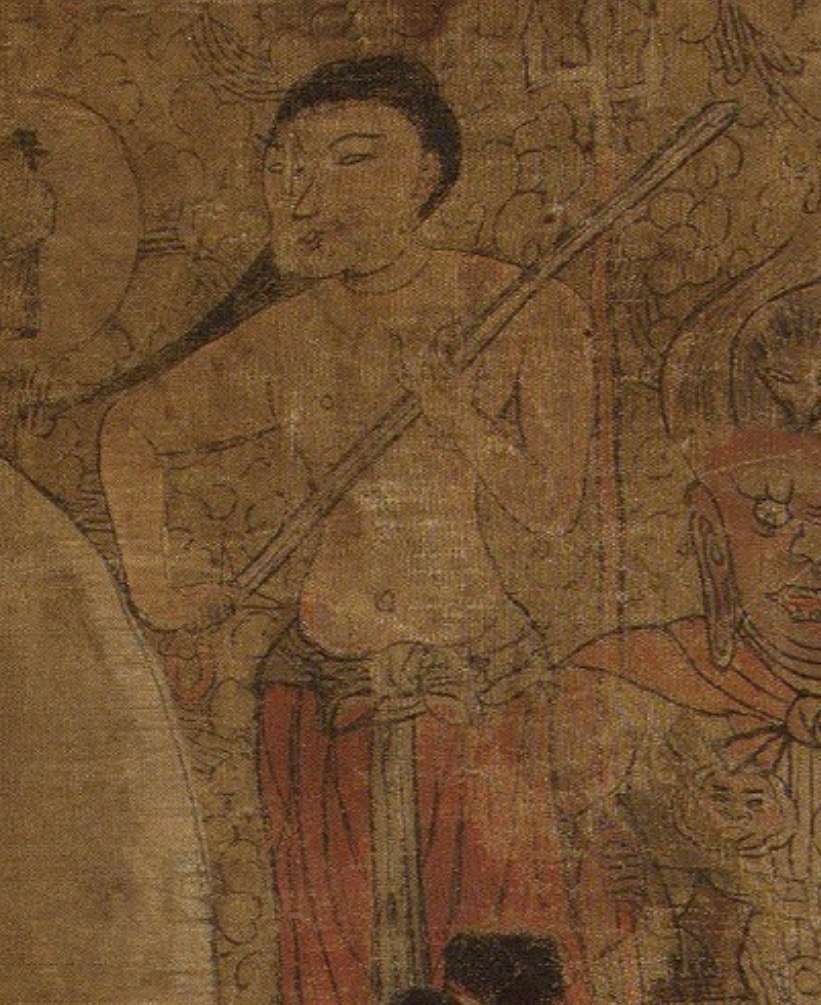
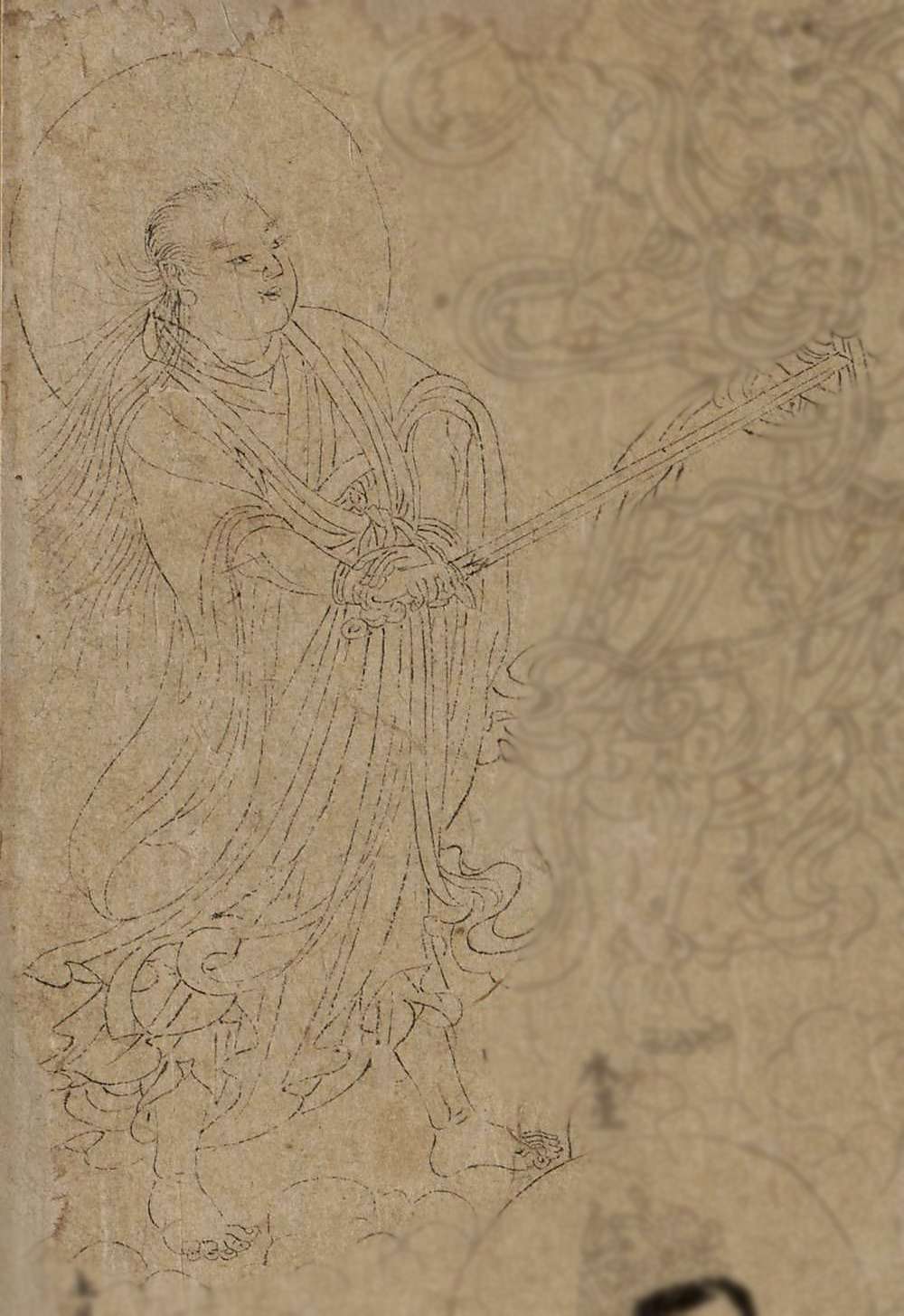
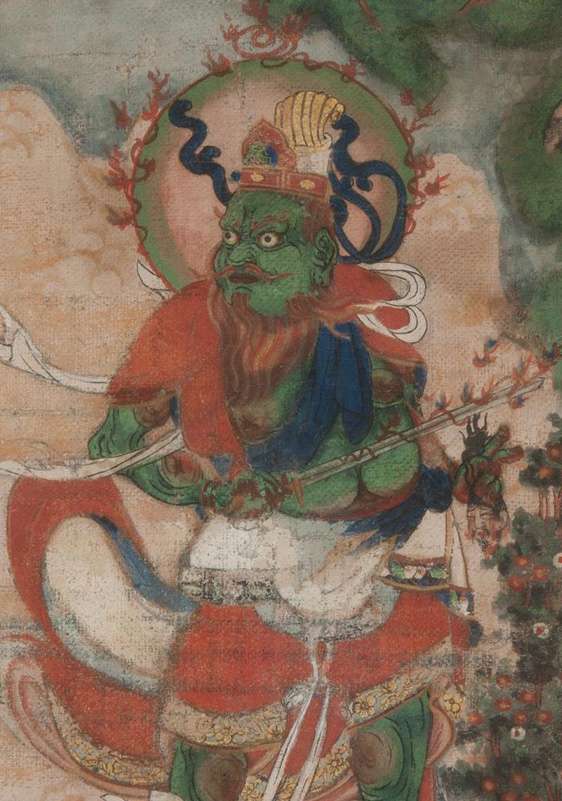
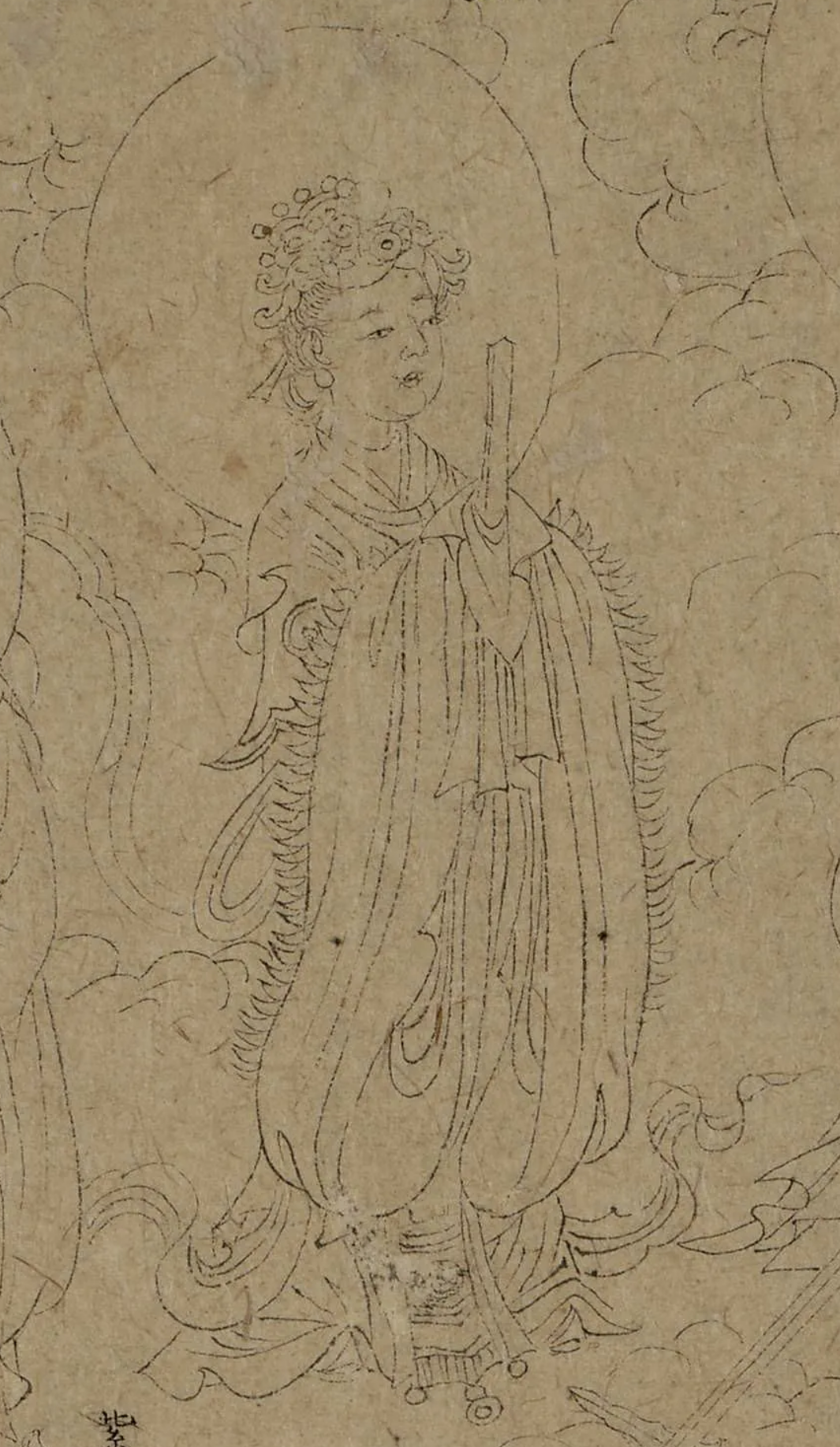
Both versions are known from late-Xixia dynasty (1038–1227) art. The first figure takes the form of a lightly clad or even topless woman with long, sometimes unkempt hair and red garments. One painting shows her with a bloody head in her right hand and a sword hanging from her hip (fig. 2). (Though, I should point out that she isn’t always depicted with the head in Xixia or Chinese art (fig. 3 & 4).) The second figure is much rarer and takes the form of a yaksha-like guardian with green skin, a fiery red beard and hair, and red garments. He wields a flaming sword in his right hand and a bloody head in the other (fig. 5). Thank you to Dr. Jeffrey Kotyk for bringing these to my attention.

Fig. 2 – Yuebei as a woman (larger version). Take note of the severed head in her right hand and the sword at her waist. Detail from a 13th to 14th-century Xixia painting in the Hermitage Museum. Fig. 3 – A topless Yuebei wielding only a sword (larger version). Detail from a 13th to 14th-century Xixia painting in the Hermitage Museum. Fig. 4 – Detail of Yuebei from the Chinese Ink Treasure of Wu Daozi (c. 13th century) (larger version). She too is holding only a sword. Take note of her lunar halo. Fig. 5 – Yuebei as a man (larger version). He clutches a small head in his left hand. Detail from a 13th-century Xixia painting in the Hermitage Museum.

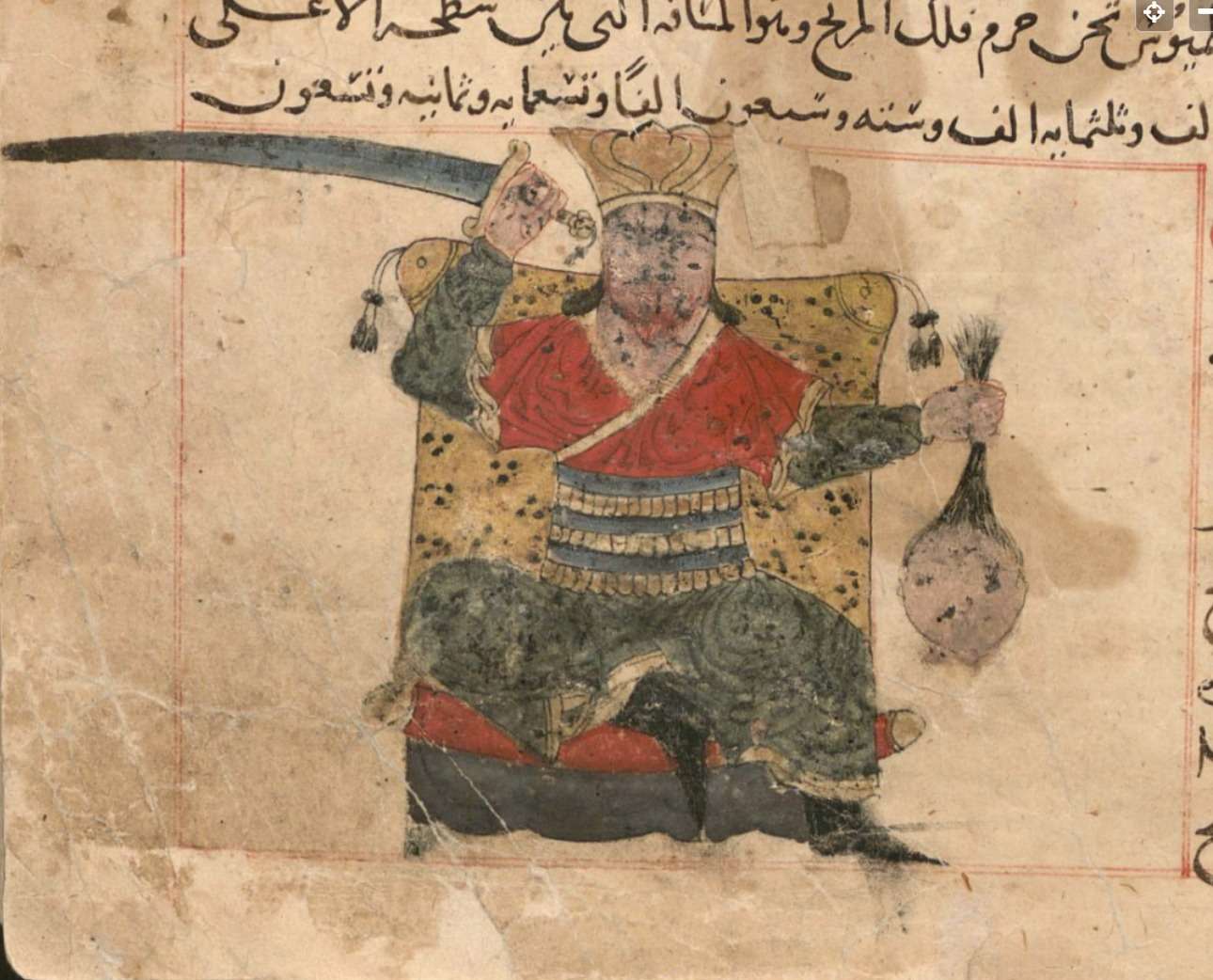
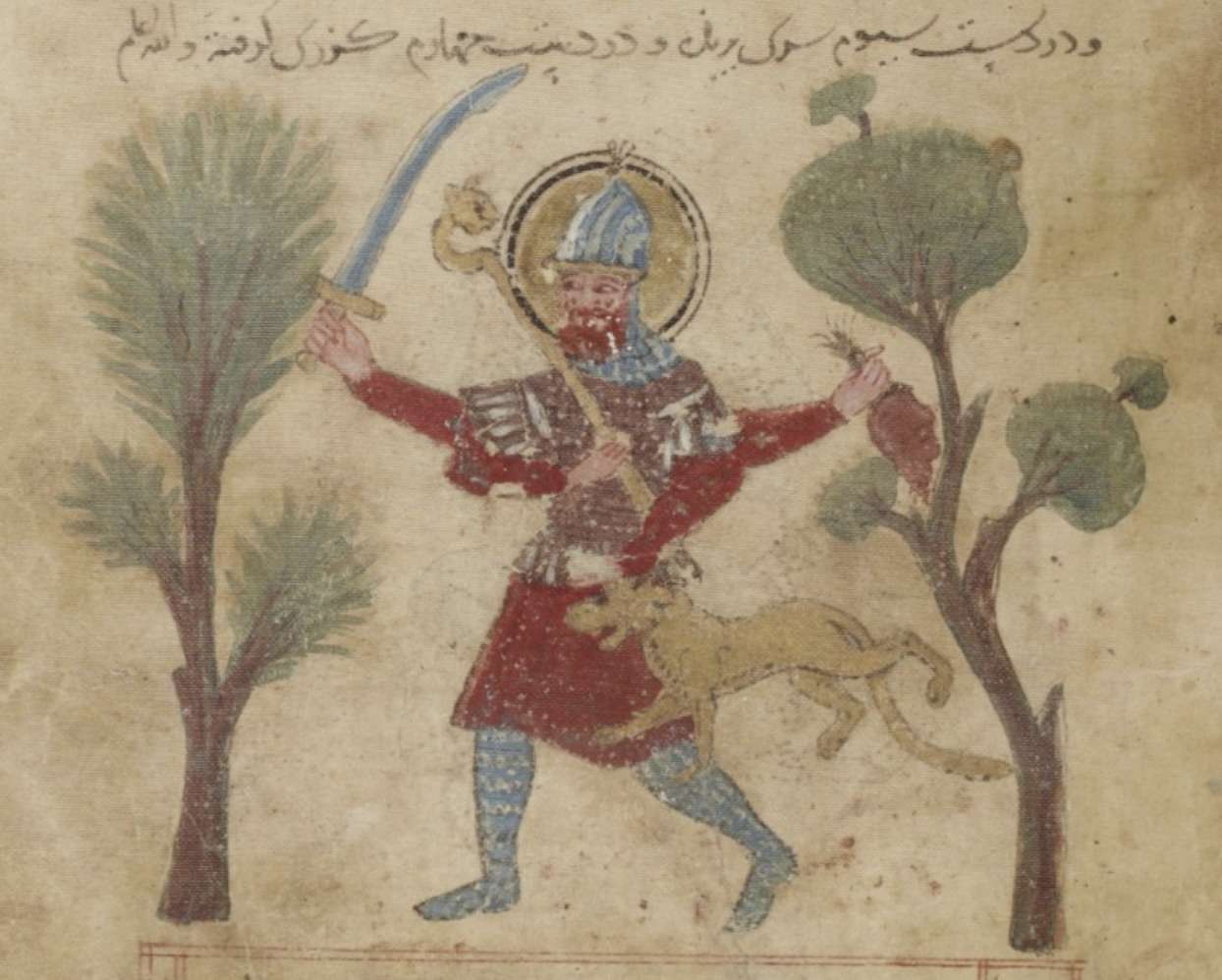
What’s interesting about the yaksha-male Yuebei is that his iconography is strikingly similar to Arabo-Persian depictions of al-Mirrīkh (Mars), who is also known for wielding a sword and head. Dr. Kotyk has directed me to several examples (fig. 6-8). Carboni (Carboni & MET, 1997) suggests that the war god’s imagery is connected to another deity:

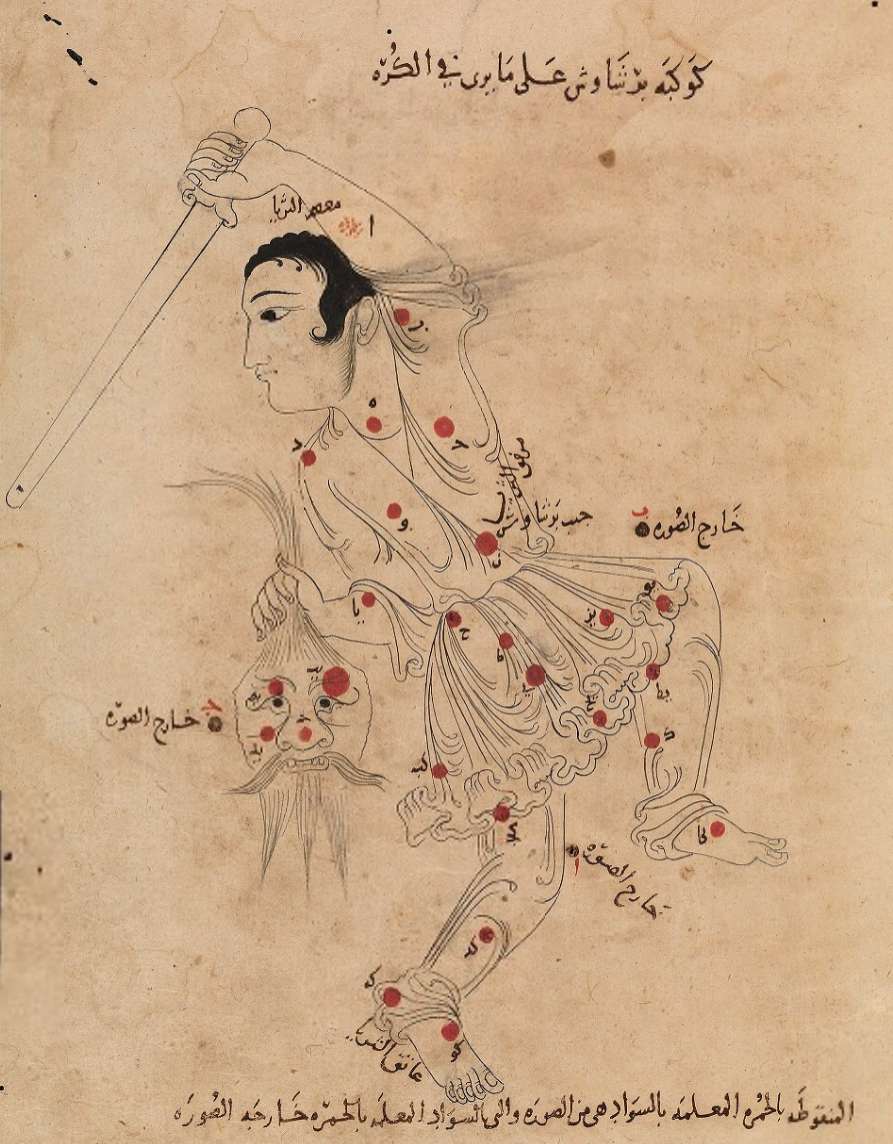
The bold iconography of the severed head underscores the warlike character of the planet but it probably is also related to the astronomical image of the constellation of Perseus, called in Arabic ḥāmil ra’s al-ghūl (“the Bearer of the Demon’s Head”), which represents a transformation of the Greek iconography of the severed head of Medusa [fig. 9] (p. 17).

The literary Yuebei’s use of a deadly skull is fitting considering its possible link to the beheaded Gorgon. [1] Remember that the Secret Practice describes Yuebei’s symbol as that of a “drought demon’s head” (batou, 魃頭), and Arabic sources call Perseus’ symbol the “demon’s head” (ra’s al-ghūl). This shows that both cultures considered the head some kind of supernatural monster.

(See the 01-16-23 update below for a headcanon mixing Yuebei’s skull with Medusa.)

Fig. 6 – Detail of al-Mirrīkh (Mars) on a late-12th to early-13th century bowl from Central or Northern Iran (larger version). From the Met Museum website. Fig. 7 – Detail from The Wonders of Creation (‘Aja’ib al-Makhluqat wa Ghara’ib al-Mawjudat, 13th century) (larger version). Found on the Library of Congress website. Fig. 8 – Detail from the Degrees of Truths (Daqa’iq al-haqa’iq, 1272) (larger version). Found on the Bibliothèque nationale de France website. Fig. 9 – The Perseus constellation from the early-11th-century Book of Pictures of the (fixed) Stars (Kitāb Ṣuwar al-kawākib (al-thābitah) (larger version). Found on the Bodleian Library website.

Dr. Kotyk tells me that East Asian depictions of Mars do not show him holding a head. But given the similar iconography of the Arabo-Persian deity and the yaksha-male Yuebei xing, there could be a South Asian intermediary. Bhattacharyya (1958) describes the Indian Buddhist iconography of Maṅgala (Mars) in similar terms: “[He] rides on a Goat. He is red in colour. In the right hand he holds the Kaṭṭāra (cutter) and in the left a severed human head in the act of devouring” (p. 368). But I don’t know how established this description is considering that a cursory search doesn’t turn up any ancient depictions of the Hindo-Buddhist deity holding a head (I’ll update the article if new evidence arises). Another possibility is that the similarities are evidence of cultural exchange between Muslim and Xixia (Tangut) astrologers. Either way, I should point out that the paintings of the yaksha-male Yuebei xing and al-Mirrīkh come from the same time period—the 13th century.

Recall that Xixia dynasty art (refer back to fig. 2) and the Secret Practice associate the human-female Yuebei xing with the head and sword, showing that it’s not the purview of the yaksha-male figure. It’s interesting to note that both the female figure and Mars are associated with the color red. Kotyk (2017) explains that there is a likely connection between Yuebei xing and the Irano-Semitic ĀlLīlīṯ (a.k.a. Lilith), who is also described as a demoness with a red, naked body and long, unkempt hair (pp. 63-64).

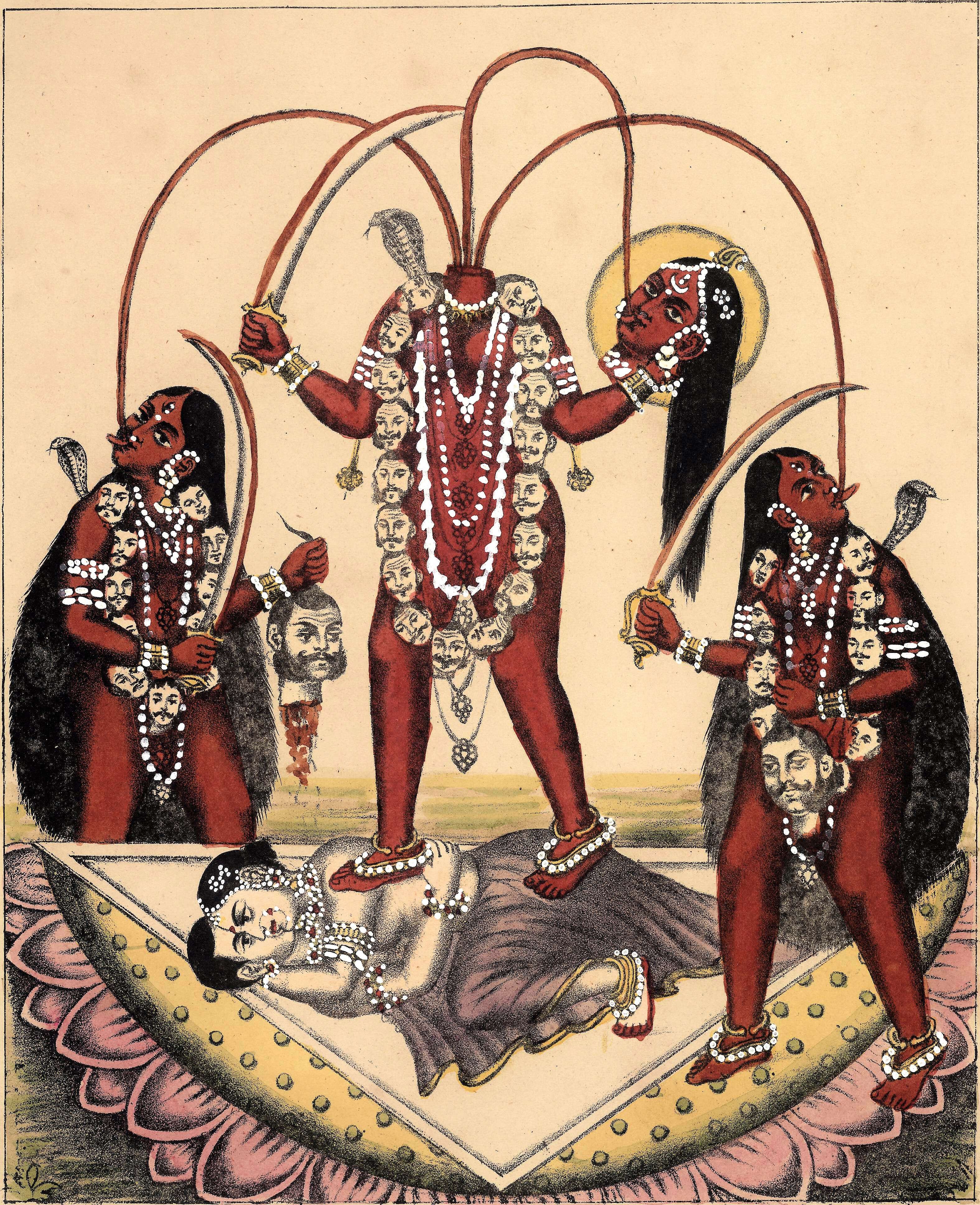
While I’m unsure if there is a connection, Yuebei’s imagery brings to mind the Hindo-Buddhist goddess ChinnamastāChinnamunda (Vajrayoginī). She is commonly shown as a naked, red-bodied figure holding a bloody head in one hand and a sword in the other (Kinsley, 1997, p. 144). In this case, the severed head is her own. Her sister attendants are also sometimes shown holding a head and sword (fig. 10).

Fig. 10 – A 19th-century lithograph of Chinnamastā (larger version). Image found on Wikipedia.

Beyond art, I learned that the respective astrological paths of Yuebei xing and Mars can cross in East Asian astrology. According to Wan Minying (萬民英), author of the Great Compendium of Astral Studies (Xingxue dacheng, 星學大成, 1563):

If Yuebei and Mars are conjunct in the same sign, [the native’s] heart will enjoy virtue, but they will be unable to actually act. They will also have many noxious sores, and pus and blood

孛火同宮心好善而實不能行亦多癰疽膿血. [2]

3. Appearance in Other Literature

Apart from JTTS, Yuebei briefly appears in an earlier Ming-era fiction titled Drama of Yang Jiajiang (Yang Jiajiang yanyi, 楊家將演義, 16th century). Kotyk (2017) explains that she is depicted as a red-skinned figure “holding in her hand a skeleton (手執骷髏骨)” (p. 63). I should note that the kulou (骷髏) in kulou gu (骷髏骨) can also mean “skull,” which aligns with her iconography.

Recall that the Irano-Semitic demoness Lilith and the Hindo-Buddhist goddess Chinnamastā-Chinnamunda are described or depicted as having red skin. This might explain Yuebei xing’s vermillion body in the novel.

4. Religious Iconography

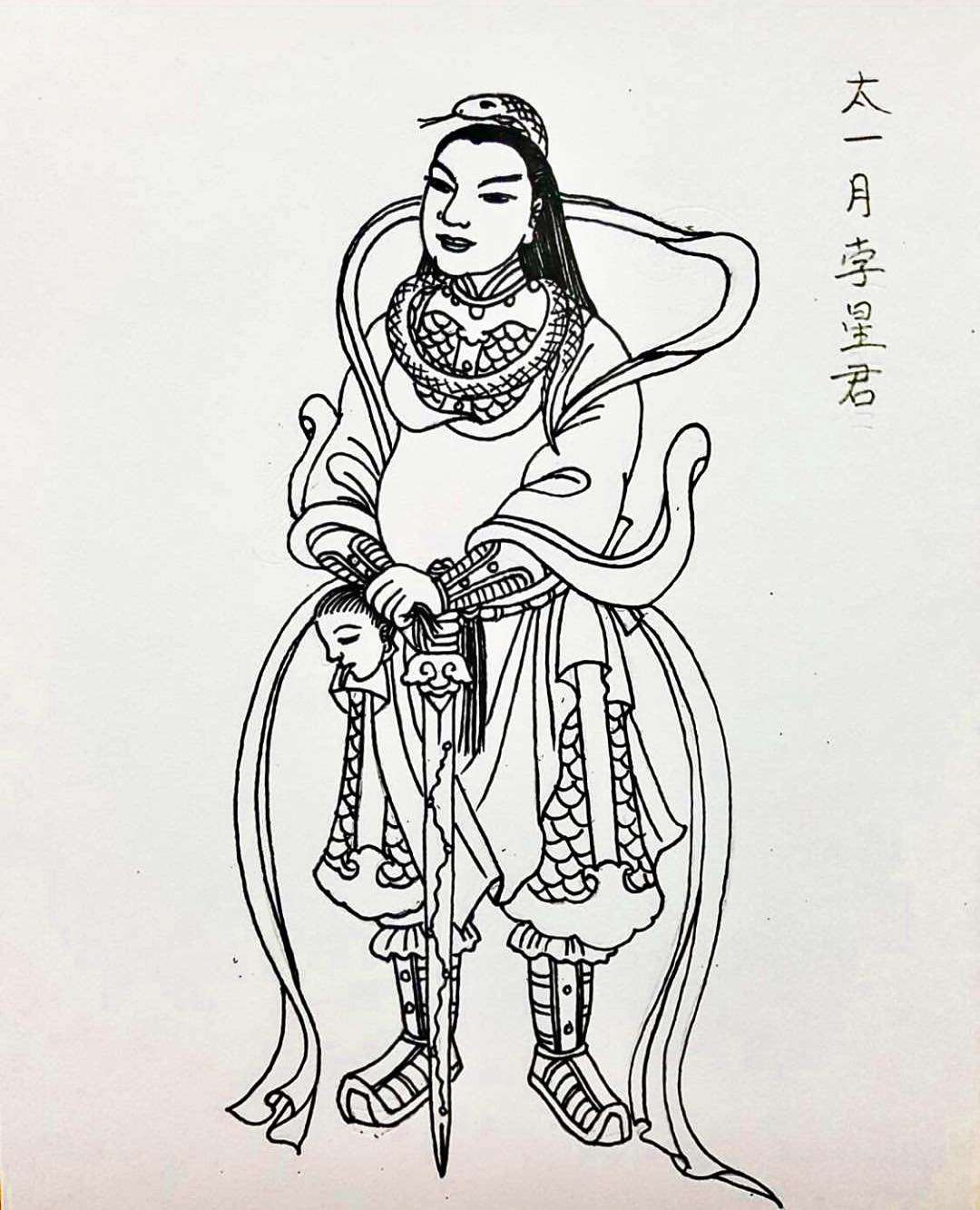
I know nothing of the actual worship of Yuebei xing, but Ronni Pinsler of the BOXS project was kind enough to show me a pattern sheet of her from an idol-maker’s shop in 1970s Singapore (fig. 11). She wears flowing robes just like her ancient Chinese depictions (refer back to fig. 4), but the signature sword and head are not included. They are instead replaced by a fly-whisk and a placard marked “moon” (yue, 月), which compliments the lunar halo behind her head. Additionally, she is labeled the “Vermillion (Comet) Inspiring Goddess, Heavenly Lord of the Moon Comet” (Zhuli[bei?] fu niang Yuebei tianjun, 朱李[孛?]孚娘 月孛天君). This is similar to the way it’s listed among the 36 celestial generals of the Journey to the North (Beiyou ji, 北遊記, 1602), the “Vermillion Comet Goddess, Heavenly Lord of the Moon Comet” (Zhubei wei Yuebei tianjun, 朱孛娘為月孛天君). I also found a more recent religious drawing that appears to mix the feminine and masculine iconography to depict her as an armored general named “Stellar Lord Moon Comet of the Great Monad” (Taiyi Yuebei xingjun (太一月孛星君) (fig. 12). Both the head and sword are present.

(See the 04-07-24 update below for a modern idol similar to figure 12.)

Fig. 11 – The vintage Yuebei pattern sheet from a Singaporean idol shop (larger version). Original photograph by Keith Stevens. Fig. 12 – The Yuebei general image (larger version). It was posted by an Indonesian Daoist priest of the Quanzhen school on Facebook.

5. Conclusion

Yuebei xing (月孛星, “Moon Comet Star”) briefly appears in chapter 17 of JTTS as the Monkey King’s monstrous daughter who uses a magic skull weapon to curse a rogue immortal. The demoness is based on a shadowy planetary deity from East Asian astrology that represents the lunar apogee. Xixia dynasty art and the Yuan-Ming Secret Practice scripture depict this deity having two forms, a lightly clad or even topless human-female with red clothing and long, disheveled hair, or a green-skinned, red-bearded yaksha-male. Both of these forms are sometimes depicted wielding a sword and a disembodied head.

The yaksha-male Yuebei xing surprisingly shares iconography with Arabo-Persian depictions of al-Mirrīkh (Mars), who is also represented as a bearded figure wielding a sword and head. Carboni (Carboni & MET, 1997) suggests that the Middle Eastern iconography is related to the constellation of Perseus (a.k.a. “Bearer of the Demon’s Head”) in which he holds the head of Medusa. This is interesting as the head held by the human-female figure is called a “drought demon” in the Secret Practice. This suggests a possible connection between the literary Yuebei xing’s skull and the deadly Gorgon.

Kotyk (2017) notes a possible connection between the human-female Yuebei xing and the Irano-Semitic Lilith. The latter too is described as having a red, naked body and unkempt hair. This same iconography is shared by the Hindo-Buddhist goddess Chinnamastā-Chinnamunda, who is also depicted bearing a sword and (her own) head. This may then explain why Yuebei xing is described as having red skin in the Drama of Yang Jiajiang (16th century), which predates JTTS.

Yuebei xing is worshiped in modern Chinese folk religion. Religious art depicts them as either a robed figure or an armored general. In both cases, the deity is a woman, but only the martial aspect is shown with the head and sword.


6. Updates

Update: 01-11-2023

Bunce (1994) describes Maṅgala (Mars) just like Bhattacharyya (1958) (refer back to the material below figure 9):

Face: one, angry; arms/hands: two, right hand holds ritual chopper (karttrika, grig-gug), left hand holds severed human head (emphasis added); legs: two; color: red; vahana: goat (p. 328).

But I still haven’t been able to find any ancient drawings of the planetary deity like this.

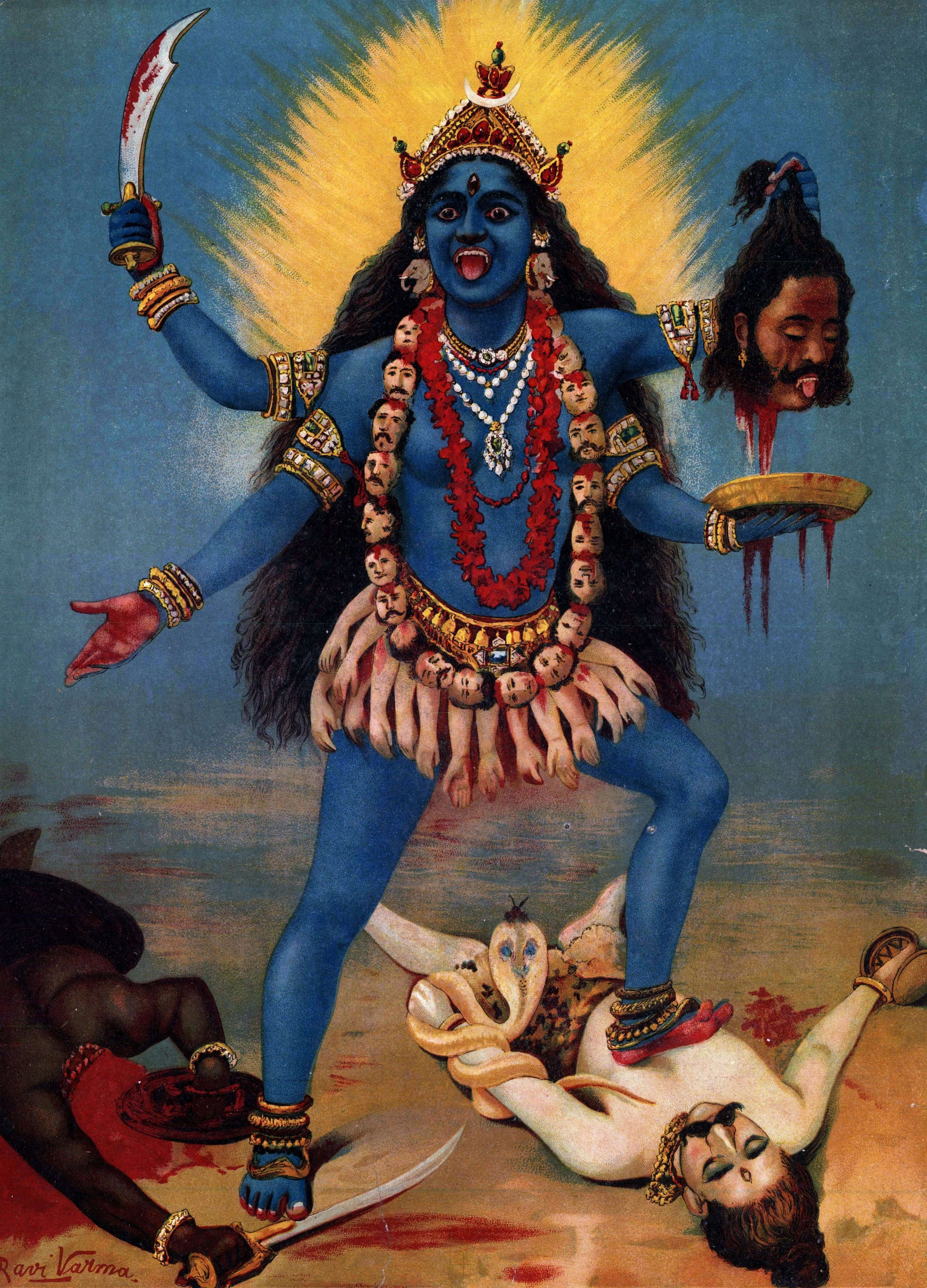
The iconography of the Hindu goddess Kālī also includes a sword and severed head (fig. 13). I didn’t mention her in the original article because she is traditionally depicted with dark skin, but she likely influenced the red-skinned Chinnamastā-Chinnamunda. It’s important to note that her mythos also associates the head with demons (asuras). For example, the Devī-Māhātmyam (c. 400-600 CE) reads:

Mounting her great lion, the Goddess ran at Caṇḍa, / And having seized him by the hair, she cut off his head with her sword. / On seeing Caṇḍa slain, Muṇḍa rushed at her. / She caused him to fall to the ground, wrathfully smitten with her sword. / On seeing Caṇḍa slain, and also the valorous Muṇḍa, / What was left of the assaulted army was overcome with fear and fled in all directions. / Picking up the heads of Caṇḍa and Muṇḍa, Kali / Approached C’aṇḍikā [Durgā] and spoke words mixed with loud and cruel laughter: / “Here, as a present from me to you, are Caṇḍa and Muṇḍa, two beasts / slain in the sacrifice of battle…” (Coburn, 1991, p. 62).

This adds to our list of sword-wielding, demon head-holding deities: 1) Perseus-Medusa; 2) Yuebei xing-Drought Demon; and 3) Kali-Asura.

Fig. 13 – An early-20th-century painting of Kali by Raja Ravi Varma (larger version). Image found here.


Update: 01-16-23

I thought of a way for artists and fan fiction writers to mix Yuebei xing’s skull with Medusa’s head. But first recall that section 1 reads:

Yuebei xing then calls Huaguang’s name while holding her own magic treasure, a skull. The immortal is immediately stricken with a headache and stumbles back to his cave in a daze. Her weapon is said to be quite dangerous; anyone whose name is called will die within three days.

Perhaps the skull’s gaze can turn any living thing into stone, but this lithic death happens over the aforementioned three days. After the target’s name is called, the skull’s glowing eyes open wider and wider upon the dawn of each successive day, causing compounding confusion and pain. The final dawn sees the eyes open wide (fig. 14), making the unfortunate soul (no matter their location) turn to stone.

Refer back to note #1 for a possible defense.

Fig. 14 – The skull would look like this on the third and final dawn (larger version). Adapted from an image found here.


Update: 01-17-23

“Who is the mother of Sun Wukong’s children in Journey to the South?” This is a question I’ve been asked a few times on Tumblr. The novel never answers this, but one can make an educated guess for the purposes of fan fiction.

Each child is based on one of three lunar deities appearing among the “Eleven Luminaries” (Shiyi yao, 十一曜) (mentioned above). The specific gods are:

  1. Jidu (奇都, “Ketu”) = Represents the southern (descending) lunar node, or the point where the moon crosses the earth’s orbit around the sun. Associated with eclipses.
  2. Luohou (羅睺, “Rahu”) = Represents the northern (ascending) lunar node. Also associated with eclipses.
  3. Yuebei Xing (月孛星, “Moon Comet Star”) = Represents the lunar apogee, or the furthest point in the moon’s orbit.

Given their close connection to the night time celestial body, it would make sense for the mother to be Taiyin xing (太陰星, “Star of Supreme Yin”), goddess of the moon from the Eleven Luminaries.

Taiyin xing is commonly equated with Chang’e, goddess of the moon in Chinese mythology. However, Journey to the West chapter 95 depicts her as a separate deity and the leader of an unknown number of Chang’e moon goddesses (cf. Wu & Yu, 2012, vol. 4, p. 302).

Fig. 15 – A detail of Taiyin xing from the Ink Treasure of Wu Daozi (Daozi mobao, 道子墨寶, c. 13th century) (larger version). See figure 1 for the complete image. She is the fourth person from the left on the top row.


Update: 01-18-23

I’ve decided to make this the only article on my blog where Yuebei xing information can be found. Therefore, I have removed all of it from “The Monkey King’s Children.” This means I have to also transfer some previous updates.

Posted: 02-13-22

I’ve recently started watching the Lego Monkie Kid series, which follows the adventures of Sun Wukong’s human disciple, MK, in a very toyetic, Lego-inspired world. This is why @TustiLoliPop‘s lovely drawing of Yuebei xing (fig. 16) really stood out to me. They were kind enough to give me permission to post it here. It’s based on the Xixia dynasty painting from figure 2.

Fig. 16 – The Lego Monkie Kid-style Yuebei xing by @TustiLoliPop (larger version). Used with permission.

Posted: 07-13-22

Tumblr user @sketching-shark has drawn some great pictures of Monkey and his children. Here is one of them (fig. 17). I love the alternating black and white color scheme of Rahu and Ketu, as well as Yuebei xing’s size.

Fig. 17 – Monkey’s family by @sketching-shark (larger version). Used with permission.


Update: 07-23-23

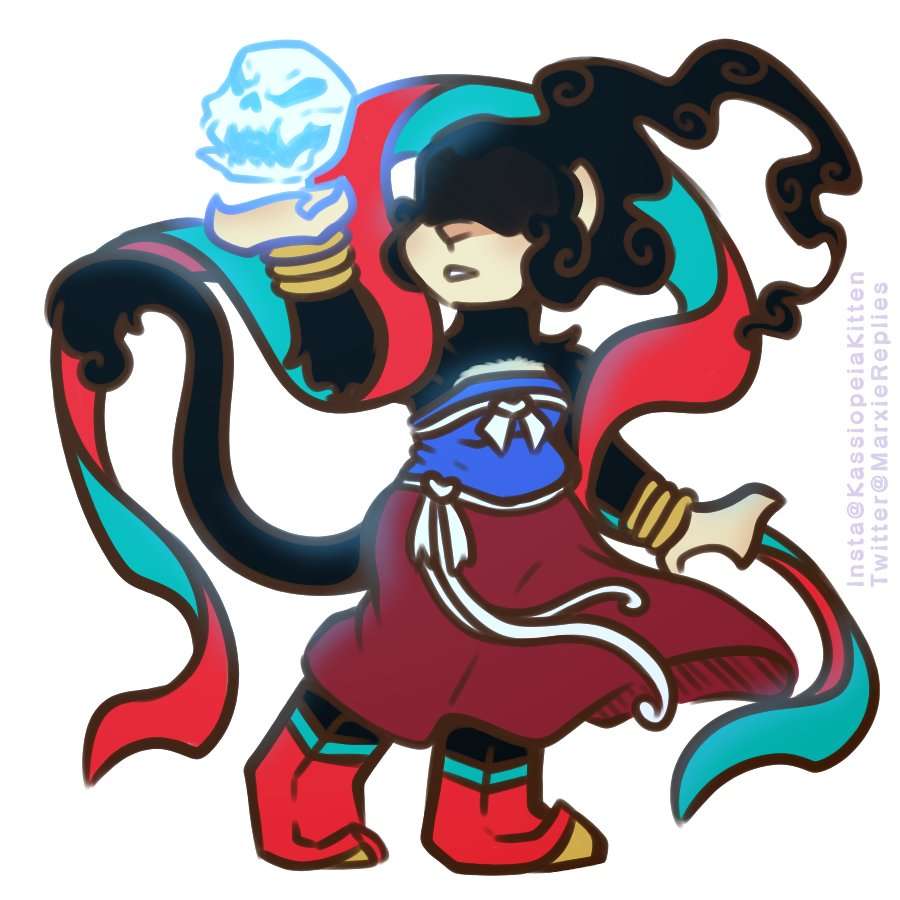
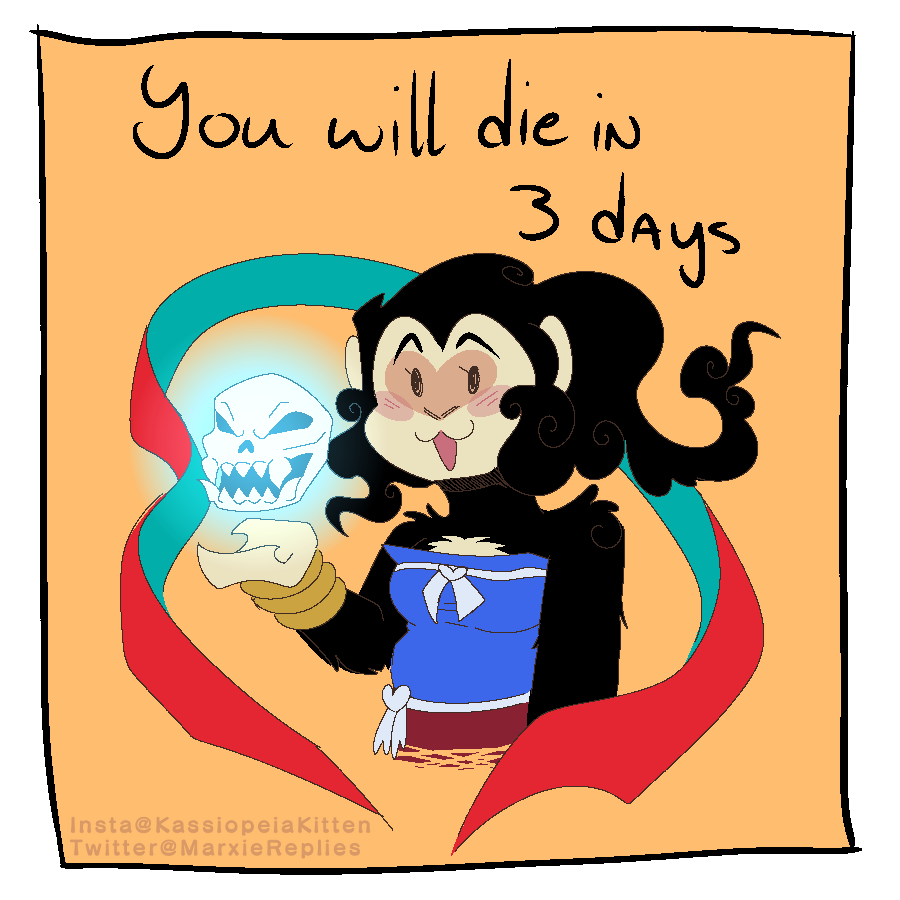
Tumblr user @MarxieReplies has drawn two Lego Monkie Kid-inspired pictures of Yuebei xing (fig. 18 & 19). Her clothing is based on the Xixia dynasty paintings of the lunar goddess (refer back to figure 2). I love the glowing skull and the flow of her ponytail and divine sashes.

Fig. 18 – A full body drawing of Yuebei (larger version). Fig. 19 – A head and torso drawing (larger version). Used with permission.


Update: 01-06-24

I just learned that a “Sun Yuebei” (孫月孛), daughter of the Monkey King, appears in the Japanese video game Touhou Monjusen ~ Bubbling Imaginary Treasures (東方門殊銭 ~ Bubbling Imaginary Treasures, 2021). She looks like a young, pink-haired human girl wearing red, feminine clothing with a bright green bow and light, red armor. And like her old man, she wears the golden headband and tiger skin and wields the iron staff along with her magic skull (video 1).

Video 1 – Sun Yuebei appears at min 3:34. I am 100% positive that the programmers hate people with epilepsy.

JTTS fans wanting to write fanfiction about our monkey demoness can call her Sun Yuebei, [3] but as mentioned above, the original astrological goddess is surnamed Zhu (朱, “vermillion,” i.e. a shade of red). If anyone wants to create a version of Monkey’s daughter that is more in line with her religious counterpart, then she should be called “Zhu Yuebei” (朱月孛). I’m sure someone can think of a reason for why she wouldn’t take her father’s surname.


Update: 04-27-24

Given the connection of Sun Wukong’s children to the moon, it’s interesting to note that he displays an intimate knowledge of the Earth’s satellite as both an astrological body and alchemical symbol. He explains in chapter 36:

When the moon reaches the thirtieth day, the metal [phase] in its yang spirit is completely dissolved, whereas the water [phase] of its yin soul is filled to the brim of the orb. This is the reason for the designation of that day with the term Obscure [Hui, 晦], for the moon is completely dark and without light. It is at this moment also that the moon copulates with the sun, and during the time of the thirtieth day and the first day of the month, it will become pregnant by the light of the sun. By the third day, one [stroke] of the yang will appear, and two [strokes] of the yang will be born by the eighth day. At this time, the moon will have half of its yang spirit in the middle of its yin soul, and its lower half is flat like a rope. That is the reason why the time of the month is called the Upper Bow [Shangxian, 上弦]. By the fifteenth day, all three [strokes] of the yang will be ready, and perfect union will be achieved. That is why this time of the month is called To Face [Wang, 望]. On the sixteenth day, one [stroke] of the yin will be born, and the second stroke will make its appearance on the twenty-second day. At that time half of the yin soul will be in the middle of the yang spirit, and its upper half is flat like a rope. That is the reason why this time of the month is called the Lower Bow [Xiaxian, 下弦]. By the thirtieth day; all three [strokes] of the yin will be ready, and the moon has then reached the state of obscurity once more. All this is the symbol of the process of cultivation practiced by nature (Wu & Yu, 2012, vol. 2, pp. 159-160).

月至三十日,陽魂之金散盡,陰魄之水盈輪,故純黑而無光,乃曰『晦』。此時與日相交,在晦朔兩日之間,感陽光而有孕。至初三日一陽現,初八日二陽生,魄中魂半,其平如繩,故曰『上弦』。至今十五日,三陽備足,是以團圓,故曰『望』。至十六日一陰生,二十二日二陰生,此時魂中魄半,其平如繩,故曰『下弦』。至三十日三陰備足,亦當『晦』。此乃先天採煉之意。


Update: 04-07-26

I was happy to learn that a temple in southern Taiwan features an idol of Yuebei. She is depicted as a dark-skinned, bare-breasted, double sword-wielding amazon wearing light, golden armor, golden jewelry, and a divine sash (fig. 20). This Facebook post (with additional images) refers to her as the “Thunder Lord Moon Comet from the Fire Department of the Great Monad” (Taiyi huofu Yuebei leijun, 太乙火府月孛雷君). Her title and appearance recall figure 12 (refer back to section 4). Though, the severed head hanging from her belt is missing.

Fig. 20 – The Taiwanese Yuebei idol (larger version). Image found here.

Note:

1) I’ve already suggested that an acquaintance draw Yuebei wielding Medusa’s head in place of her signature skull. The real question is: could Medusa’s glare actually kill an immortal? This insightful reddit post provides evidence from the Dionysiaca showing that even the god Dionysus considered it deadly enough to bring a magic diamond to protect himself from the Gorgon’s death stare:

The thyrsus was held up in his hand, and to defend his face he carried a diamond, the gem made stone in the showers of Zeus which protects against the stony glare of Medusa, that the baleful light of that destroying face may do him no harm (Rouse, 1940, vol. 3, p. 413).

2) Translation by Dr. Kotyk.

3) Xing (星) just indicates her position as a planetary body.

Sources:

Bhattacharyya, B. (1958). The Indian Buddhist Iconography: Mainly Based on the Sādhanamālā and Cognate Tāntric Texts of Rituals (2nd ed.). Calcutta: Firma K.L. Mukhopadhyay.

Bunce, F. W. (1994). An Encyclopaedia of Buddhist Deities, Demigods, Godlings, Saints and Demons: With Special Focus on Iconographic Attributes (Vols.1-2). New Delhi: D.K. Printworld.

Carboni S. & Metropolitan Museum of Art. (1997). Following the Stars: Images of the Zodiac in Islamic Art. New York: Metropolitan Museum of Art.

Coburn, T. B. (1991). Encountering the Goddess: A Translation of the Devī-Māhātmya and a Study of its Interpretation. Albany: State University of New York Press.

Gansten, M. (2009). Navagrahas. In K. A. Jacobsen (Ed.), Brill’s Encyclopedia of Hinduism (Vol. 1) (pp. 647-653). Leiden: Brill.

Kinsley, D. R. (1997). Tantric Visions of the Divine Feminine: The Ten Mahāvidyās. Berkeley, CA: University of California Press.

Kotyk, J. (2017). Astrological Iconography of Planetary Deities in Tang China. Journal of Chinese Buddhist Studies, 30, 33-88, Retrieved from http://enlight.lib.ntu.edu.tw/FULLTEXT/JR-BJ001/bj001575268.pdf

Rouse, W. H. D. (Ed.) (1940), Nonnos. Dionysiaca, with an English Translation by W. H. D. Rouse, Mythological Introduction and Notes by H. J. Rose and Notes on Text Criticism by L. R. Lind (Vols. 1-3). Cambridge, Ma: Harvard University Press. Retrieved from https://archive.org/details/dionysiaca03nonnuoft/page/412/mode/2up.

Wu, C., & Yu, A. C. (2012). The Journey to the West (Vols. 1-4) (Rev. ed.). Chicago, Illinois: University of Chicago Press.

Yu, X. (n.d.). Nanyouji: Huaguang sanxia Fengdu [Journey to the South: Huaguang goes to the Underworld Three Times]. Retrieved from https://ctext.org/wiki.pl?if=gb&chapter=506975&remap=gb#%E5%8D%8E%E5%85%89%E4%B8%89%E4%B8%8B%E9%85%86%E9%83%BD


A Survey of Sun Wukong’s Magic “Immortal Breath” and Its Abilities

Sun Wukong first exhibits the ability to transform his magic hair in chapter two of Journey to the West (Xiyouji, 西遊記, 1592):

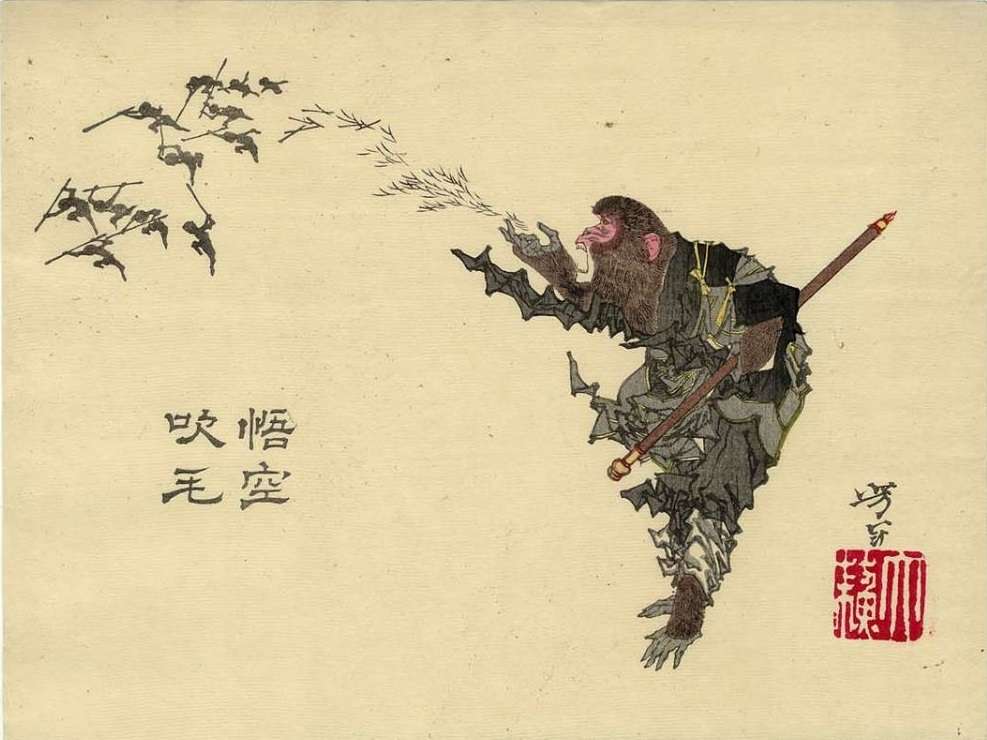
Plucking a handful of hairs from his own body and throwing them into his mouth, he chewed them to tiny pieces and then spat them into the air. “Change!” he cried, and they changed at once into two or three hundred little monkeys encircling the combatants on all sides. For you see, when someone acquires the body of an immortal, he can project his spirit, change his form, and perform all kinds of wonders. Since the Monkey King had become accomplished in the Way, every one of the eighty-four thousand hairs on his body could change into whatever shape or substance he desired (Wu & Yu, 2012, vol. 1, p. 129).

拔一把毫毛,丟在口中嚼碎,望空噴去,叫一聲:「變!」即變做三、二百個小猴,週圍攢簇。 原來人得仙體,出神變化無方。不知這猴王自從了道之後,身上有八萬四千毛羽,根根能變,應物隨心。

This tactic of transforming chewed up hairs into dozens, hundreds, or even thousands of monkey clones also appears in chapters 3, 5, 21, 35, 44, 86, and 90 (A & B) (Wu & Yu, 2012, vol. 1, pp. 132, 165, 172, & 409; vol. 2, pp. 138 & 277; vol. 3, p. 332; vol. 4, pp. 164-165, 168, 219, & 221). But these chewed up hairs can also be transformed into other objects, such as sleep-inducing bugs in chapters 5 and 86, as well as seven kinds of hawks in chapter 72 (Wu & Yu, 2012, vol. 1, p. 165; vol. 3, p. 332; vol. 4, p. 168).

But the novel states that Monkey sometimes changes his hair by first blowing on it with his magic “immortal breath” (xianqi, 仙氣). This article will provide a brief survey of this skill and its abilities.

Table of Contents

1. Hair

Explicit mentions of the immortal breath show that it can transform hair into:

  • Ink-soaked brush to write on the Buddha’s hand (ch. 7) (Wu & Yu, 2012, vol. 1, p. 195).
  • Dagger to skin a tiger (ch. 14) (Wu & Yu, 2012, vol. 1, p. 310).
  • Three-ply hemp rope to tie up Zhu Bajie (ch. 19) (Wu & Yu, 2012, vol. 1, p. 385).
  • Duplicates of the Monkey King (fig. 1) (ch. 25, 27, 45, 73, 77, 84, 85, & 94) (Wu & Yu, 2012, vol. 1, pp. 465; vol. 2, p. 27, 129, & 292; vol. 3, p. 340; vol. 4, pp. 20, 139, 151, & 293).
  • Copper coin to pay for paper (ch. 33) (Wu & Yu, 2012, vol. 2, pp. 117-118).
  • Fake lesser demons (ch. 34) (Wu & Yu, 2012, vol. 2, p. 122).
  • Yellow-gold rope to replace a magical weapon of the same name (ch. 34) (Wu & Yu, 2012, vol. 2, p. 130).
  • Gold-plated, red lacquered box to hold a white jade token (ch. 37) (Wu & Yu, 2012, vol. 2, p. 169).
  • Wrapper to infiltrate a demon’s lair (ch. 41) (Wu & Yu, 2012, vol. 2, pp. 235-236).
  • Yellow hound to carry away a bogus immortal’s decapitated head (ch. 46) (Wu & Yu, 2012, vol. 2, p. 308).
  • Hungry hawk to eat a bogus immortal’s entrails (ch. 46) (Wu & Yu, 2012, vol. 2, p. 310).
  • Group of 30 tigers to scare away monks (ch. 64) (Wu & Yu, 2012, vol. 3, p. 194).
  • Sleep-inducing insects and lice, fleas, and bedbugs (ch. 71 (A & B) & 84) (Wu & Yu, 2012, vol. 3, pp. 303 & 304; vol. 4, p. 139).
  • Gold-headed fly to scare a demon king (ch. 75) (Wu & Yu, 2012, vol. 3, p. 366).
  • Bow drill (comprised of a diamond bit, a bamboo strip, and a cotton string) to drill out of a dangerous magic treasure (ch. 75) (Wu & Yu, 2012, vol. 3, p. 369).
  • Very thin but long rope to climb out of a monster’s stomach (ch. 76) (Wu & Yu, 2012, vol. 4, p. 3).
  • Thirty ropes for tying up bandits (ch. 97) (Wu & Yu, 2012, vol. 4, p. 328).

It should be noted, however, that the novel is very inconsistent regarding this ability. The immortal breath is not always used; Sun often just commands the hair to transform or changes it without saying anything, such as in chapters 4, 33, 34 (A, B, & C), 42, 46, 49, 51, 59, 65, 68, 71, and 74 (Wu & Yu, 2012, vol. 1, p. 156; vol. 2, p. 115, 124-125, 237, 301, 305, & 345-346; vol. 3, p. 13, 120, 216, 269, 305, & 358). The “chewing” and “spitting out” of the hair is another example (see above). But one might argue that spitting requires a build of air in the lungs, so by extension, the immortal breath is being used.

This inconsistency is probably due to the standard 1592 edition of Journey to the West coalescing from independent oral stories developed and told over the centuries (see the late-13th century version of the story, for example). Therefore, some story tellers likely employed the immortal breath, while others did not.

sc137582 - small

Fig. 1 – “Wukong Blows His Hair” (c. 1882) by Yoshitoshi (larger version).

2. Staff

This immortal breath is also shown capable of transforming the magic iron staff (fig. 2).

  • Steel file to file through a magic golden ring pinning Monkey’s neck to a column (ch. 34) (Wu & Yu, 2012, vol. 2, p. 129).
  • Razor to mutilate two lesser demons (ch. 63) (Wu & Yu, 2012, vol. 3, p. 180).
  • Flag pole to make a pair of magic cymbals stand upright (ch. 65) (Wu & Yu, 2012, vol. 3, p. 216).
  • Seventy forked weapons to cut the threads of supernatural spider webs (ch. 73) (Wu & Yu, 2012, vol. 3, p. 340).
  • Nail to prop open a demon’s mouth while Monkey climbs out of their stomach (ch. 83) (Wu & Yu, 2012, vol. 4, p. 113).
  • Three-pointed drill to make a covert hole in a wardrobe (ch. 84) (Wu & Yu, 2012, vol. 4, p. 139).

As noted above, the novel is inconsistent in this regard. For instance, Monkey changes the staff into a steel drill without blowing on it in chapter 65 (Wu & Yu, 2012, vol. 3, p. 218). Likewise, no breath is used in chapters 46 and 84 when Sun transforms the weapon into razors for shaving heads (Wu & Yu, 2012, vol. 2, p. 305; vol. 4, p. 139).

Fig. 2 – Monkey pointing to the luminous iron pillar that will become his iron staff (larger version). From the Qing-Era Painted, Complete Edition Journey to the West (Qing caihui quanben Xiyouji, 清彩繪全本西遊記).

3. Miscellaneous 

Monkey can also transform items not in contact with his body.

3.1. Clothing Color

For instance, in chapter 46, he changes a Daoist lad’s clothing from a spring onion white robe into a brown monk’s robe (Wu & Yu, 2012, vol. 2, p. 305). 

3.2. Likeness

In chapter 78, Sun transforms Tripitaka into his likeness using a mask made from mud:

Pilgrim, too, had little alternative but to flatten the mud and press it on his own face and, after a little while, succeeded in making an apelike mask. Asking the Tang Monk to stand up but without uttering another word, Pilgrim pasted the mask on his master’s face and recited a magic spell. He then blew his immortal breath onto the mask, crying, “Change!” At once the elder took on the appearance of Pilgrim. He was told to take off his own garments and switch clothes with Pilgrim, who made the magic sign and then recited another spell to change into the form of the Tang Monk (Wu & Yu, 2012, vol. 4, p. 47).

行者沒奈何,將泥撲作一片,往自家臉上一安,做下個猴像的臉子。叫唐僧站起休動,再莫言語。貼在唐僧臉上,念動真言,吹口仙氣,叫:「變!」那長老即變做個行者模樣。脫了他的衣服,以行者的衣服穿上。行者卻將師父的衣服穿了,捻著訣,念個咒語,搖身變作唐僧的嘴臉。

Again, the novel is inconsistent regarding external objects. Sometimes Monkey bights his tongue and spits blood out to change said item, such as in chapter 25 (A & B) (Wu & Yu, 2012, vol. 1, pp. 474-475 & 477; vol. 2, p. 303). [1 & 2] But, again, one could argue that the immortal breath is used as spitting requires a build-up of air in the lungs.

4. Special Abilities 

The immortal breath (fig. 3) is also shown to have other special abilities.

4.1. Healing

For instance, in chapter 46, Monkey uses it to heal a gaping wound in his stomach:

With a swagger, Pilgrim walked down to the execution site. Leaning himself on a huge pillar, he untied his robe and revealed his stomach. The executioner used a rope and tied his neck to the pillar; down below, another rope strapped his two legs also to the pillar. Then he wielded a sharp dagger and ripped Pilgrim’s chest downward, all the way to his lower abdomen. Pilgrim used both his hands to push open his belly, and then he took out his intestines, which he examined one by one. After a long pause, he put them back inside, coil for coil exactly as before. Grasping the skins of his belly and bringing them together with his hands, he blew his magic breath on his abdomen, crying, “Grow!” At once his belly closed up completely (Wu & Yu, 2012, vol. 2, p. 309).

行者搖搖擺擺,徑至殺場。將身靠著大樁,解開衣帶,露出肚腹。那劊子手將一條繩套在他膊項上,一條繩紮住他腿足,把一口牛耳短刀幌一幌,著肚皮下一割,搠個窟窿。這行者雙手爬開肚腹,拿出腸臟來,一條條理夠多時,依然安在裡面,照舊盤曲。捻著肚皮,吹口仙氣,叫:「長!」依然長合。

4.2. Soul Manipulation

The novel implies that Sun’s immortal breath also has the ability to manipulate souls. For example, in chapter 88, Sun uses it in an arcane ritual designed to bestow three human disciples with super human strength. The pertinent section reads:

In a secluded room behind the Gauze-Drying Pavilion, Pilgrim traced out on the ground a diagram of the Big Dipper. Then he asked the three princes to prostrate themselves inside the diagram and, with eyes closed, exercise the utmost concentration. Behind them he himself recited in silence the true sayings of realized immortality and intoned the words of Dharani as he blew divine breaths into their visceral cavities. Their primordial spirits [yuanshen, 元神] were thus restored to their original abodes …

行者才教三個王子都在暴紗亭後,靜室之間,畫了罡斗。教三人都俯伏在內,一個個瞑目寧神。這裡卻暗暗念動真言,誦動咒語,將仙氣吹入他三人心腹之中,把元神收歸本舍 。。。

The term “primordial spirits” (yuanshen, 元神) is commonly associated with Buddhahood or enlightenment. In Daoism, it is synonymous with the attainment of immortality via the formation of a “Sacred Embryo” (shengtai, 聖胎), which is forged from spiritual energies over long years of self-cultivation (Darga, 2008). This suggests that Monkey’s immortal breath also grants the disciples some form of immortality. You can read about the entire ritual here.

Fig. 3 – A vapor blowing smoke (larger version). I imagine this is what the immortal breath would look like. Image found here. Photographer unknown. 

And in chapter 97, Sun uses the immortal breath to transform an old man’s soul into “ether” for easy transport back to the world of the living:

Pilgrim changed the soul of the squire into ether [qi, 氣] by blowing on him. The ether was stored in his sleeve so that they could leave [Hell] and go back to the world of light together. Astride the clouds, he soon arrived at the Kou house. Eight Rules [Zhu Bajie] was told to pry open the lid of the coffin, and the soul of the squire was pushed into his body. In a moment, he began to breathe once more and revived (Wu & Yu, 2012, vol. 4, p. 339).

將他吹化為氣,掉於衣袖之間,同去幽府,復返陽間。駕雲頭,到了寇家,即喚八戒捎開材蓋,把他魂靈兒推付本身。須臾間,透出氣來活了。

The phrase “immortal breath” (xianqi, 仙氣) is missing in the original Chinese, but the ability’s use is understood as the passage mentions Monkey “blowing” (chui, 吹) on the soul.

V. Conclusion

Various chapters of Journey to the West show that Sun Wukong can use his immortal breath to transform his hair, his magic staff, and items not directly in contact with his body into anything he desires. These range from utilitarian items like files, blades, drills, and ropes to living creatures like insects, birds of prey, dogs, tigers, lesser demons, and even independent copies of himself. It can also change the color and appearance of clothing, as well as magically disguise someone when used in tandem with a mud mask. The skill’s special abilities include healing and soul manipulation. Evidence suggests that it can restore the “primordial spirit,” granting superhuman strength and some form of immortality, as well as transform souls into “ether” for better ease of transport.

The immortal breath, however, is not used consistently throughout the novel. Monkey sometimes chews up and spits out the hair, commands it to change, or simply transforms it without saying anything at all. This inconsistency is likely due to the novel coalescing from independent oral stories developed and told over the centuries.

Notes:

1) Thank you to Irwen Wong for reminding me of this.

2) The second instance of tongue-biting doesn’t mention the word for blood (xie, 血), but it can be understood to be present.

Sources:

Darga, M. (2008). Shengtai. In F. Pregadio (Ed.), The Encyclopedia of Taoism (Vols. 1-2) (pp. 883-884). London: Routledge].

Wu, C., & Yu, A. C. (2012). The Journey to the West (Vols. 1-4). Chicago, Illinois: University of Chicago Press.

The Monkey King’s Magic Staff: A Complete Guide

Last updated: 04-23-2026

I’ve written many articles on the origins of the Monkey King’s staff over the years. Therefore, I’ve decided to combine all of the information in one location for the benefit of people wishing to learn more about the weapon and its history. This will no doubt be interesting to fans of Journey to the West (Xiyouji, 西遊記, 1592; JTTW hereafter), as well as those of modern franchises like Dragon Ball and Lego Monkie Kid (fig. 1). Citations can be found in the articles linked below.

Fig. 1 – A fan edit of the Lego Monkie Kid character “MK” wielding the Monkey King’s magic staff (larger version). Copyright Lego.

Table of Contents

1. The Literary Weapon

1.1. Staff Background

The staff first appears in chapter three of the original novel when the Monkey King goes to the underwater kingdom of Ao Guang (敖廣), the Dragon King of the Eastern Sea, looking for a magic weapon to match his supernatural strength and martial skill. When all of the traditional weapons offered to him fail to meet his standards, the dragon queen suggests to her husband that they give Sun Wukong “that piece of rare magic iron” taking up space in their treasury. She claims the ancient shaft had started producing heavenly light days prior and proposes that the monkey is fated to own it. The weapon is said to be a “divine treasure iron” originally used to set the depths of the Heavenly River (Tianhe ding di de shenzhen tie, 天河定底的神珍鐵) by Yu the Great (Dayu, 大禹), a mythic Chinese emperor and demigod.

The staff is initially described as a pillar of black iron or bin steel more than 20 feet in height and as wide as a barrel. It is only when Monkey lifts it and suggests a smaller size would be more manageable that the staff complies with his wishes and shrinks. This is when Sun notices that the weapon is decorated with a golden ring on each end, as well as an inscription along the body reading: “The ‘As-You-Will’ Gold-Banded Cudgel. Weight: Thirteen Thousand Five Hundred Catties” (Ruyi jingu bang zhong yiwan sanqian wubai jin, 如意金箍棒重一萬三千五百斤). The inscription indicates that the staff is immensely heavy, weighing 17,560 lbs. (7,965 kg).

Apart from the above information, a poem in chapter 75 (see section 2.3 here) highlights another name, “Rod of Numinous Yang” (Lingyang bang, 靈陽棒). In addition, the poem describes the staff being covered in “tracks of planets and stars” (i.e. astronomical charts) and esoteric “dragon and phoenix scripts” (longwen yu fengzhuan, 龍紋與鳳篆).

The novel provides two contradictory origins for the staff. The chapter 75 poem notes that it “[w]as forged in the stove by Laozi himself.” Laozi is of course the high god of Daoism. Chapter 88 instead states that it was “forged at Creation’s dawn / By Yu the Great himself, the god-man of old.”

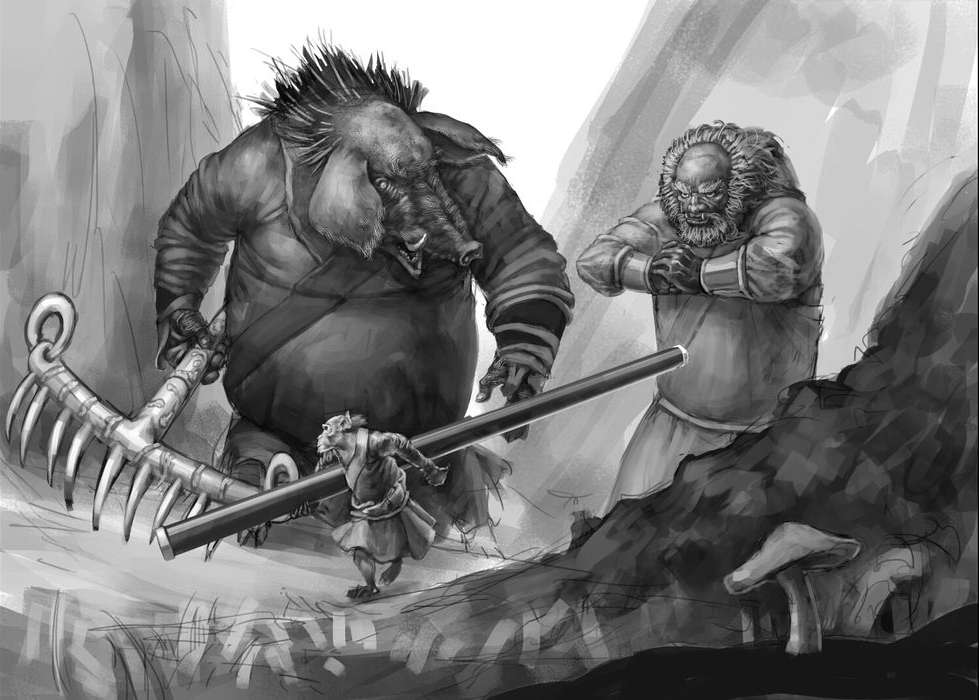
Contrary to popular images of the Monkey King holding a regular-sized staff, his literary counterpart wields a massive weapon in battle. It is said to be 20 feet long (likely an error for 12), [1] with the width of a bowl (erzhang changduan, wankou cuxi, 二丈長短,碗口粗細) (fig. 2). I did a cursory search of bowls during the Ming (when the standard edition of JTTW was published) and found that they have a radius of between 4 to 6 inches (10.16 to 15.25 cm).

Fig. 2 – An accurate depiction of the size of Monkey’s staff (larger version). Images found here. Artwork by @真·迪绝人.

1.2. Staff Powers

The staff is shown to have multiple powers.

  1. Size manipulation – This is the weapon’s most well-known ability, growing as big or as small as Monkey wishes.
  2. Controlling the oceans –  The aforementioned poem from chapter 88 writes: “The depths of all oceans, rivers, and lakes / Were fathomed and fixed by this very rod. / Having bored through mountains and conquered floods, / It stayed in East Ocean and ruled the seas…”
  3. Astral entanglement – Monkey’s soul is able to use the staff in Hell despite the physical weapon being with his sleeping body in the world of the living. (See the 04-23-26 update below for more info.)
  4. Multiplication – He can multiply his staff in the hundreds of thousands.
  5. Lock-Picking – He can open any door just by pointing it at the lock.
  6. Transformation – He can change it into tools like a straight razor or a drill.
  7. Sentience – The weapon glows in anticipation of Monkey’s arrival (fig. 3), responds to his touch, and follows his commands, denoting a certain level of sentience.

Fig. 3 – Monkey pointing to the luminous iron pillar (larger version). From the Qing-Era Painted, Complete Edition Journey to the West (Qing caihui quanben Xiyouji, 清彩繪全本西遊記).

2. Origins

2.1. Literary Precursors

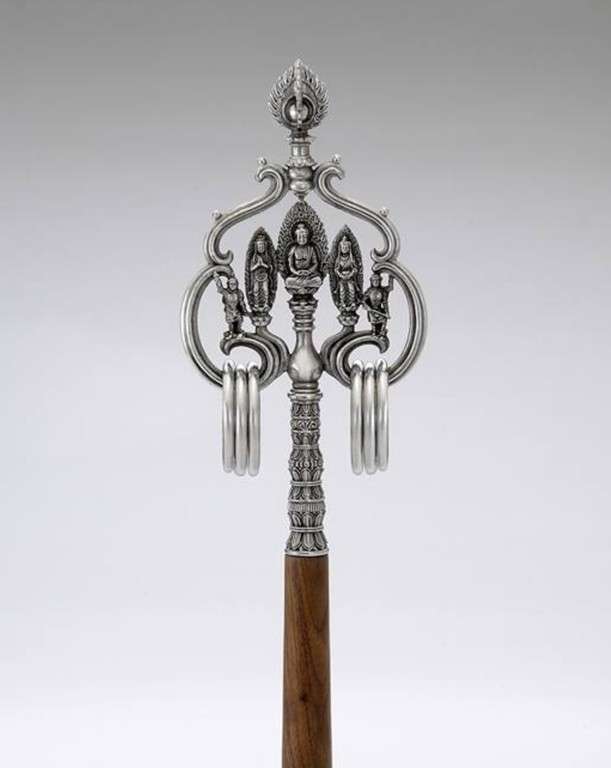
The staff found in the standard Ming edition of JTTW is actually based on two weapons from a 17-chapter storytelling prompt called The Story of How Tripitaka of the Great Tang Procured the Scriptures (Da Tang Sanzang qujing shihua, 大唐三藏取經詩話, c. late 13th-century). Sun Wukong’s precursor, an ageless immortal called the “Monkey Pilgrim” (Hou xingzhe, 猴行者), magically transports Tripitaka and his entourage to heaven. There, the supreme god, the Mahābrahmā Devarāja (Dafan tianwang, 大梵天王; i.e. Vaiśravana), gives the monk a cap of invisibility, a khakkhara (ringed monk’s staff) (fig. 4), and a begging bowl. Tripitaka and the Monkey Pilgrim take turns using these items throughout the journey. The staff is shown capable of shooting destructive beams of light, as well as transforming into magical creatures like an iron dragon or a giant, club-wielding Yaksha. Later, the Monkey Pilgrim also borrows an iron staff from heaven to fight a dragon.

The two staves from this tale were eventually combined by later storytellers. The rings from the first weapon were added to the ends of the second.

Fig. 4 – A beautiful, modern monk’s staff with six rings (larger version).

2.2. Influence from Religion

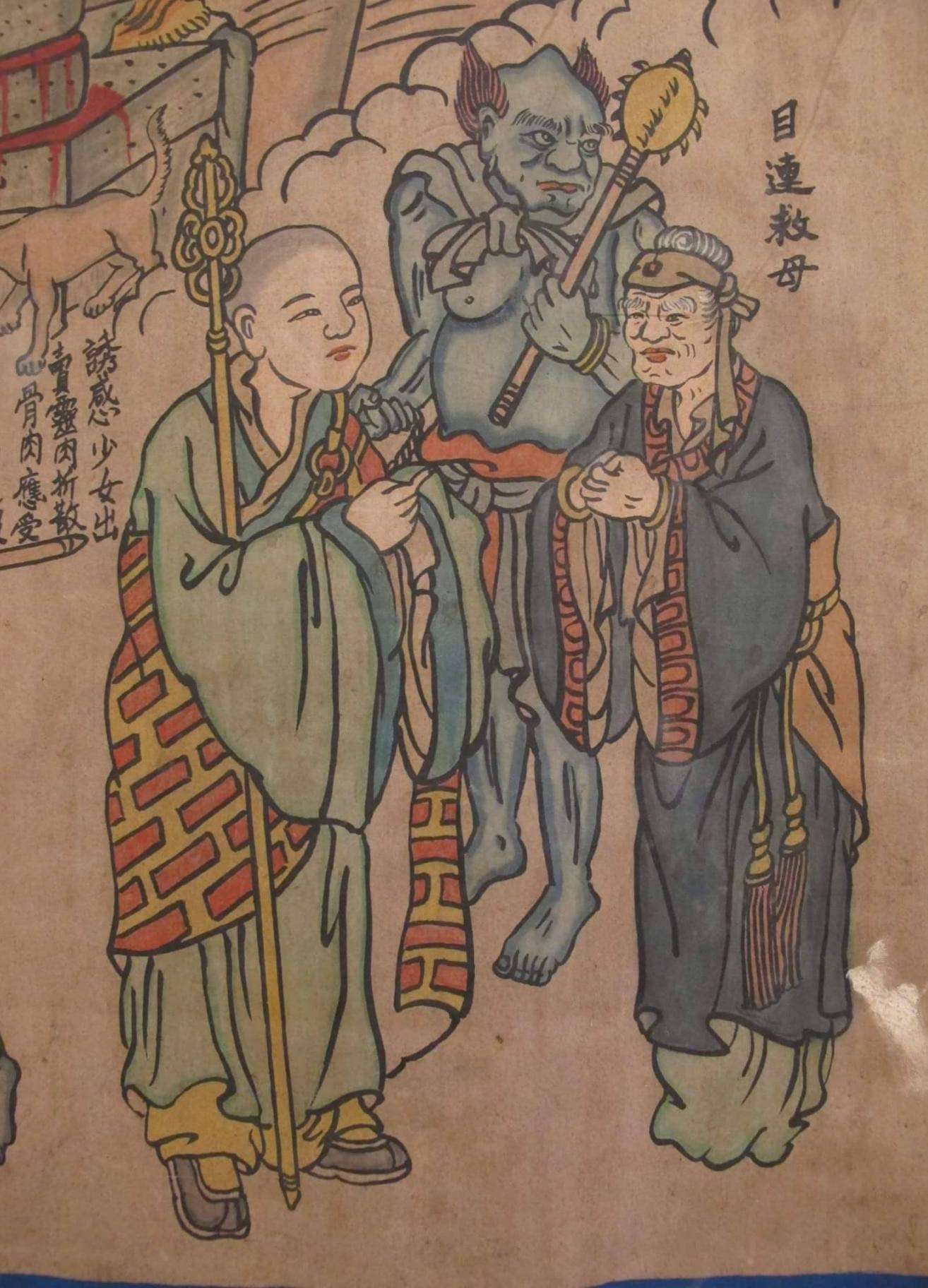
The Monkey Pilgrim’s magic ringed staff and begging bowl were directly influenced by the Buddhist Saint Mulian (目連; Sk: Maudgalyayana), a disciple of the historical Buddha. One particular 9th to 10th-century story notes that the Saint uses the staff to unlock the gates of hell in order to save his mother (fig. 5). This is where Sun Wukong’s weapon from JTTW gets the power to open locks.

Mulian saves his mother, scroll - small

Fig. 5 – A scroll or mural depicting Mulian rescuing his mother from the underworld (larger version). Originally found here.

The ringed and metal staves used by the Monkey Pilgrim are based on those historically carried by Buddhist monks in ancient China. The aforementioned ringed variety, called “tin staves” (xizhang, 錫杖) where used by religious monks and decorated with six to twelve metal rings (see fig. 4). These rings were designed to make a clanging noise to not only scare away animals on the road but also to alert possible donors to the monk’s presence.

Martial monks charged with protecting monasteries or deployed by the Chinese government against pirates wielded wooden or iron staves (fig. 6). The former were chosen for their diminished capacity for fatal injuries, while the latter were explicitly used for killing during times of war. Sun Wukong wielding the iron variety makes sense as he’s a martial monk charged with protecting Tripitaka from monsters and spirits.

Fig. 6 – A martial monk practicing a drunken staff-fighting form (larger version).

The term “As-you-will” (ruyi, 如意) from Monkey’s staff (mentioned above) is connected with a scepter used in ancient China as a symbol of religious debate and authority and, to a lesser extent, as a weapon. While it can be traced to a Hindo-Buddhist tradition in India, the scepter came to be associated with the highest gods of Daoism thanks to being decorated with a “numinous mushroom” (lingzhi, 靈芝), a real world fungi believed to bestow immortality. This mushroom scepter was at some point associated with the Buddhist Cintamani (Ruyi zhu, 如意珠), or “As-you-will jewel.” This was believed to grant any wish that one might desire. This explains why Monkey’s As-you-will staff grows or shrinks according to his commands. It’s interesting to note that some religious images of the scepter depict it with a syncretic mix of the Daoist mushroom and the Buddhist jewel (fig. 7).

Fig. 7 – An enhanced detail of the Celestial Worthy’s mushroom scepter with a flaming as-you-will jewel (larger version). See here for a fuller version of the deity.

2.3. Influence from Popular Literature

The weapon’s portrayal in JTTW as an iron pillar kept in the dragon kingdom comes from old stories about the immortal Xu Xun (許遜), a historical Daoist master and minor government official from Jiangsu province. Popular tales describe him as a Chinese St. Patrick who traveled southern China ridding the land of flood dragons. One 17th-century version titled “An Iron Tree at Jingyang Palace Drives Away Evil” (Jingyang gong tieshu zhenyao旌陽宮鐵樹鎮妖) describes how he chained the flood dragon patriarch to an iron tree (tieshu, 鐵樹) and submerged it in a well, thus preventing the serpent’s children from leaving their subterranean aquatic realm and causing trouble. Pre-JTTW versions of this tale depict the tree as an actual iron pillar (fig. 8). Chinese Five Elements Theory dictates that metal produces water, and as its creator, holds dominion over it. Therefore, an iron pillar would be the perfect item to ward off creatures entrenched in the aquatic environment.

Fig. 8 – A Ming Dynasty woodblock print depicting the immortal Xu overseeing the creation of the iron pillar in a furnace (right) and it’s placement the well (left). Dated 1444-1445 (larger version).

As previously noted, the staff weighs 17,560 lbs. (7,965 kg). This is likely based on an episode from chapter 27 of the Chinese novel Water Margin (Shuihu zhuan, 水滸傳, c. 1400). It involves the bandit Wu Song lifting a heavy stone block said to weigh 300 to 500 catties (san wu bai jin, 三五百斤; 390-650 lbs./177-295 kg) (fig. 9). This scene and the one from JTTW where Monkey lifts the iron pillar are quite similar. Both involve a hero (Wu Song vs. Sun Wukong) asking someone (Shi En vs. Ao Guang) to show them a heavy object that cannot be moved (stone block vs. iron pillar). Both heroes then adjust their clothing before easily lifting the object with both hands. Most importantly, the Chinese characters for the weight of each object (三五百斤 vs. 一萬三千五百斤) are similar. The only difference is the addition of “10,000” (yiwan, 一萬) and “1,000” (qian, 千), respectively. And given the close historical and cultural ties between the two heroes, I believe the author-compiler of JTTW embellished the Water Margin episode to portray Sun as a hero like no other, a divine immortal that can lift weights far beyond even Wu Song himself.

Fig. 9 – Wu Song lifts the stone block (larger version). Image found here.


3. Updates

Update: 04-23-26

Above, I wrote: “Astral entanglement – Monkey’s soul is able to use the staff in Hell despite the physical weapon being with his sleeping body in the world of the living.”

Sun’s use of said weapon also caught the attention of late-Ming commentators. The authors of The Book to Enlightenment of the Journey to the West (Xiyou Zhengdao Shu西遊證道書, 1663), a Daoist commentary on the novel, asked:

“Did he take this treasure with him in his dream?”

此寶貝夢中亦帶去耶? (Converted from simplified Chinesesource).

Note:

1) Irwen Wong of the Journey to the West Library blog has suggested that the length is likely an error for 12 feet (zhanger, 丈二) since the staff was already near 20 feet when Monkey first acquired it, and he later asked it to shrink to a more manageable size.

The Monkey King’s Children

Last updated: 04-04-2022

Modern media occasionally depicts Sun Wukong with children. Examples include the book series The Monkey King’s Daughter (2009-2011) and the DC Comics character the Monkey Prince (first appearing in 2021). The anime High School DxD (2012) even features a descendent some generations removed called Bikou. But the idea of the Great Sage having children goes back centuries. Two late-Ming novels influenced by the original Journey to the West (Xiyouji, 西遊記, 1592) reference multiple offspring. In this article, I will highlight these children and discuss their connection to Buddhism and Asian astrology.

Those interested in this subject may fancy learning about Sun’s brothers and sisters.

Table of Contents

1. King Pāramitā

The novel is set between the end of chapter 61 and the beginning of chapter 62 of the original. It follows the Monkey King as he travels through time seeking a magic weapon, while also striving to unmask the identity of a mysterious foreign king who has persuaded Tripitaka to give up the quest to India. The first reference to Sun’s children appears in chapter 13, when actors in a royal play describe an alternate timeline where our hero settled down: “His wife is so beautiful, his five sons so dashing. He started out as a monk, but came to such a good end! Such a very good end!” (Dong, Lin, & Schulz, 2000, p. 114). Later, in chapter 15, Monkey meets one of these sons on the battlefield. “King Pāramitā” (Boluomi wang, 波羅蜜王) (fig. 1) is portrayed as a sword-wielding general capable of fighting Sun for several rounds. Pāramitā goes on to recount his family history, revealing that although he’s never met his father, he’s the son of the Great Sage and Princess Iron Fan (Tieshan gongzhu, 鐵扇公主) (Dong, Lin, & Schulz, 2000, pp. 123-124). In addition, he suggests that he was conceived during an event from chapter 59 of the original:

[Sun Wukong] changed into a tiny insect and entered my mother’s belly. He stayed there a while and caused her no end of agony. When my mother could no longer bear the pain, she had no choice but to give the Banana-leaf Fan to my father, Monkey [1] … In the fifth month of the next year, my mother suddenly gave birth to me, King Pāramitā. Day by day I grew older and more intelligent. If you think about it, since my uncle [the Bull Demon King] and mother had never been together, [2] and I was born after my father, Monkey, had been inside my mother’s belly, the fact that I am his direct descendant is beyond dispute (Dong, Lin, & Schulz, 2000, p. 124).

Fig. 1 – King Pāramitā leaps into battle (larger version). Detail from a modern manhua. Image found here.

The translators of A Supplement to the Journey to the West explain that King Pāramitā’s name serves as a pun:

In the Chinese transliteration for Pāramitā, the character used to render the syllable “mi” [蜜] has the intrinsic meaning of “honey,” while the character t’ang [唐] in T’ang dynasty is homophonous with the character meaning “sugar” [糖]. King Pāramitā is punning on these associations (Dong, Lin, & Schulz, 2000, p. 123 n. 2). [3]

However, the name also has deep connections with Buddhism. The Princeton Dictionary of Buddhism defines the Sanskrit term Pāramitā (“perfection”) as “a virtue or quality developed and practiced by a Bodhisattva on the path to becoming a buddha” (Buswell & Lopez, 2014, p. 624). Various traditions recognize six to ten perfections, with the latter including the former six plus an additional four. The Mahayana perfections, for example, include giving, morality, patience, effort, concentration, wisdom, method, vow, power, and knowledge. Bodhisattvas are believed to master these virtues in the listed order, compounding spiritual wisdom and merit over the course of their journey towards Buddhahood (Buswell & Lopez, 2014, p. 624).

2. Jidu, Luohou, and Yuebei Xing

The novel follows the exile of Miao Jixiang (妙吉祥), a divine flame-turned Buddhist deity, from the Western Paradise through several mischievous reincarnations. As the rogue immortal Huaguang (華光), he works to end his mother’s demonic lust for flesh by procuring an immortal peach in chapter 17. He does this by transforming into Sun Wukong and stealing the magic fruit from heaven. The real Monkey King is subsequently accused of his double’s misdeeds, much like the Six-Eared Macaque episode of the original novel. The Jade Emperor threatens to remand him to the Buddha for punishment but is convinced to give Sun a month-long reprieve to find the true culprit.

Monkey returns to the Mountain of Flowers and Fruit, and it is here among his people, that the story mentions three children, including sons Jidu (奇都, “Ketu”) and Luohou (羅猴, “Rahu”) and daughter Yuebei Xing (月孛星, “Moon Comet Star”). [4] Sun eventually seeks out Guanyin, who reveals that the troublemaker is none other than Huaguang. Returning home once more, Monkey’s news prompts his daughter to volunteer to battle the impostor. But her tribe simply pokes fun at her monstrous appearance. Yuebei Xing is said to have a crooked head with huge eyes and a broad mouth, coarse hands, a wide waist, and long legs with thunderous steps.

Sun travels with his daughter to Huaguang’s home of Mt. Lilou (Lilou shan, 離婁山) to provoke battle by chastising him for stealing the immortal peaches. Monkey strikes at him with his magic staff, causing Huaguang to deploy his heavenly treasure, a golden, triangular brick (sanjiao jinzhuan, 三角金磚). But Sun responds by creating untold numbers of clone monkeys that not only confiscate the weapon but also overwhelm the immortal. Huaguang is seemingly defeated at this point; however, he manages to deploy one last treasure, the Fire Elixir (Huodan, 火丹). This weapon engulfs the Great Sage in heavenly flame (akin to the Red Boy episode), causing him to flee to the Eastern Sea. Yuebei Xing then calls Huaguang’s name while holding her own magic treasure, a skull (kulou tou, 骷髏頭). The immortal is immediately stricken with a headache and stumbles back to his cave in a daze. Her weapon is said to be quite dangerous; anyone whose name is called will die within three days.

Huanguang’s religious teacher, the Flame King Buddha of Light (Huoyan wang guangfo, 火炎王光佛), then intervenes in order to sooth the situation between his disciple and the Great Sage. He promises to bring the rogue immortal to justice on the condition that Yuebei Xing withdraws her deadly magic. In the end, all parties are pardoned by the Jade Emperor, and Huaguang and Monkey become bond brothers (Yu, n.d.).

All three of Sun’s children are named after planetary bodies associated with the moon in Asian astrology. [5] His sons Jidu and Luohou are respectively named after Ketu (Jidu, 奇都) and Rahu (Luohou, 羅睺), two of the “Nine Planets” (Sk: Navagraha; Ch: Jiuyao, 九曜, “Nine Luminaries”) from Hindu astrology. [6] These two shadowy planetary deities represent the respective southern (descending) and northern (ascending) lunar nodes, or points where the moon crosses the earth’s orbit around the sun. As such, the pair are associated with eclipses, and sources sometimes depict them as the head (Rahu) and tail (Ketu) of a great eclipse serpent. Other interpretations include Rahu as a disembodied head and Ketu as the torso, or Ketu as a comet or emerging from a cloud of smoke (Gansten, 2009, p. 652-653; Kotyk, 2017, pp. 59-60).

Before continuing, there are two interesting things to note: 1) Sun Wukong singlehandedly battles and defeats the Nine Planets in chapter five of the original novel (Wu & Yu, 2012, vol. 1, pp. 170-172). But the Ketu and Rahu in this group should be considered distinct from his sons; and 2) one of the original Chinese characters for Rahu (Luohou, 羅睺) was changed in Journey to the South to play on Luohou’s (羅猴) primate origins by using the homophonous word for “monkey” (hou, 猴).

All information about Yuebei xing has been moved to a new article.

Yuebei xing, Daughter of the Monkey King

3. Honorable Mention: Sun Luzhen

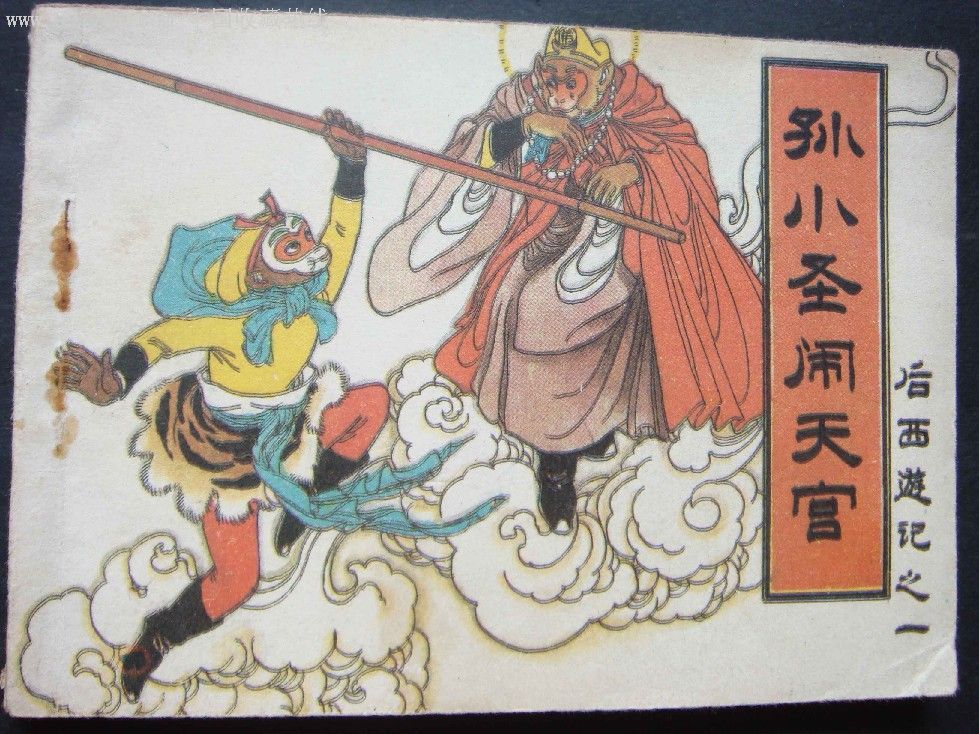
The novel is set two hundred years after the original and follows the adventures of Sun Wukong’s spiritual descendant Sun Luzhen (孫履真, “Monkey who Walks Reality”) (fig. 2). He too learns the secrets of immortality and causes havoc in heaven, before being tasked to protect the historical monk Dadian (大顛, 732–824) on a similar journey to India. The two are accompanied by the son of Zhu Bajie, Zhu Yijie (豬一戒), and the disciple of Sha Wujing, Sha Zhihe (沙致和). I did not include Luzhen in the main list as he is born from a stone in the same fashion as the original Monkey King (see Liu, 1994).

Fig. 2 – “Small Sage Sun’s Havoc in the Heavenly Palace” (larger version). The cover to a modern manhua. Image found here.

4. Conclusion

The Monkey King has a total of eight children shared between two late-Ming novels, but only four are mentioned by name, and only two of these actually have parts in the respective stories. King Pāramitā is one of the Great Sage’s five sons born to Princess Iron Fan in A Supplement to the Journey to the West (1640). He is portrayed as a handsome, sword-wielding general whom Sun faces on the battlefield. His name references the Pāramitās (“perfections”), or the wisdom and merit-building virtues that Bodhisattvas master in their quest for Buddhahood. Monkey has three children in Journey to the South (c. 1570s to 1580s), including sons Jidu and Luohou and daughter Yuebei Xing. The latter is depicted as a grotesque monster with a magic skull weapon cable of harming even celestials. She uses it to defeat the rogue immortal Huaguang. Jidu and Luohou are respectively named after the lunar nodes Ketu and Rahu, two of the Nine Planets from Hindu astrology. Yuebei is named after a shadowy planet representing the lunar apogee, which counts among the Eleven Luminaries of East Asian astrology. Ancient Xixia art sometimes depicts them as a woman or man bearing a sword and a severed head. The feminine iconography appears holding a skull in a novel from the 16th century.

An honorable mention is Sun Luzhen from Later Journey to the West (17th century). He is a stone-bone monkey who follows in his spiritual ancestors footsteps by attaining immortality, causing havoc in heaven, and later protecting a holy monk on the journey to India.


5. Updates

Update: 04-04-22

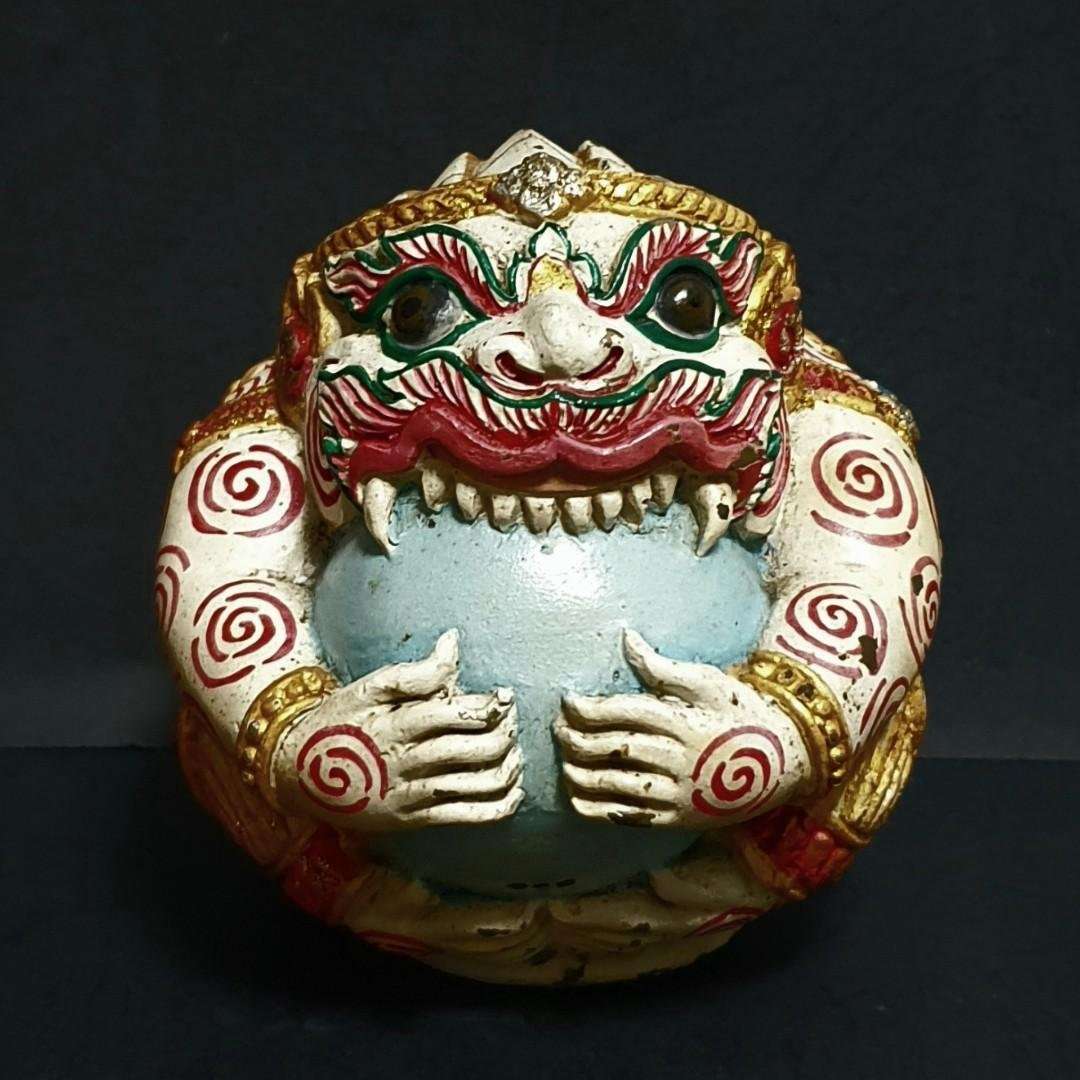
Back in November 2021, I made a post on twitter about a Rahu amulet that a collector friend of my was selling (and later sold). The deity is generally portrayed as a sharp-toothed, giant-mouthed monster devouring the moon. This piece is carved in a similar manner but Rahu is instead patterned after Thai depictions of Hanuman (fig. 3). I imagine his association with the monkey god is based on the latter’s attempt to eat the sun in his youth. 

Fig. 3 – The front of the Hanuman-like Rahu amulet (larger version).

Notes:

1) See Wu & Yu, 2012, vol. 3, p. 129.

2) This statement, of course, overlooks the conception and birth of the couple’s son Red Boy (Hong haier, 紅孩兒). But King Paramita might be referring to the Bull Demon King’s long absence while living with his mistress, Jade Countenance.

3) This pun plays out in chapter 14 of Journey to the West, when an old patron remarks on Monkey’s monstrous appearance:

“Though you [Tripitaka] may be a Tang man,” the old man said, “that nasty character is certainly no Tang man!” “Old fellow!” cried Wukong in a loud voice, “you really can’t see, can you? The Tang man is my master, and I am his disciple. Of course, I’m no sugar man or honey man! I am the Great Sage, Equal to Heaven!” (Wu & Yu, 2012, vol. 1, p. 312).

Thank you to Irwen Wong for reminding me of this passage.

4) I’m indebted to Jose Loayza for bringing these characters to my attention.

5) Thank you to Dr. Jeffrey Kotyk for confirming the astrological connection.

6) Sun, Moon, Mars, Mercury, Jupiter, Venus, Saturn, Rahu, and Ketu (Gansten, 2009).

Sources:

Dong, Y., Lin, S. F., & Schulz, L. J. (2000). The Tower of Myriad Mirrors: A Supplement to Journey to the West. Ann Arbor: Center for Chinese Studies, The University of Michigan.

Gansten, M. (2009). Navagrahas. In K. A. Jacobsen (Ed.), Brill’s Encyclopedia of Hinduism (Vol. 1) (pp. 647-653). Leiden: Brill.

Hart, R. (2010). The Chinese Roots of Linear Algebra. United States: Johns Hopkins University Press.

Kotyk, J. (2017). Astrological Iconography of Planetary Deities in Tang China. Journal of Chinese Buddhist Studies, 30, 33-88), Retrieved from https://chinesebuddhiststudies.org/previous_issues/jcbs3002_Kotyk(33-88)_e.pdf

Liu, X. (1994). The Odyssey of the Buddhist Mind: The Allegory of the Later Journey to the West. Lanham, Md: University Press of America.

Buswell, R., & Lopez, D. (2014). The Princeton Dictionary of Buddhism. Princeton University Press.

Wu, C., & Yu, A. C. (2012). The Journey to the West (Vol. 1-4). Chicago, Illinois: University of Chicago Press.

Yu, X. (n.d.). Nanyouji: Huaguang sanxia Fengdu [Journey to the South: Huaguang goes to the Underworld Three Times]. Retrieved from https://ctext.org/wiki.pl?if=gb&chapter=506975&remap=gb#%E5%8D%8E%E5%85%89%E4%B8%89%E4%B8%8B%E9%85%86%E9%83%BD

Watch Your Step: The Influence of Journey to the West on the “Ashiarai Yashiki” Yokai Story of Edo-Period Japan

Last updated: 07-26-2023

The Journey to the West (Xiyouji, 西遊記, 1592; “JTTW” hereafter) story cycle has been popular in East Asia for nearly a millennium. Written and pictorial evidence points to it emerging in China by at least the 11th century. Tales of the Tang Monk and his animal companions were well-regarded in Korea by at least the 14th century (see here and here). I’m not sure when the standard version of the story first arrived in Japan, but it received piecemeal translations starting in the 18th century, and the first complete version was finished by 1835. [1] According to Shi (as cited in Chien, 2017), these translations “had a tremendous impact of spreading the story of Xuanzang far and wide in Japan” (p. 22).

JTTW came to influence all sorts of Japanese media (one example). In this article, I would like to focus on a lesser known Edo-period folktale from the Seven Wonders of Honjo (Honjo Nanafushigi, 本所七不思議) [2] called the “Foot Washing Manor” (Ashiarai Yashiki, 足洗邸; あしあらいやしき).

Table of Contents

1. The “Foot Washing Manor”

The story tells of a filthy, titanic foot that plagues a samurai night after night. Matthew Meyer kindly gave me permission to reproduce his version of the story, as seen on his website yokai.com:

Long ago lived a hatamoto (a high-ranking samurai) named Aji no Kyūnosuke. One night at his manor in Honjo, a loud, booming voice was heard heard. It echoed like thunder:

“WAAASH MYYY FOOOOOOT!”

Just then there was a splintering crack, and the ceiling tore open. An enormous foot descended into the mansion. The foot was covered in thick, bristly hair, and it was filthy. The terrified servants scrambled to gather buckets, water, and rags. They washed the foot until it was thoroughly clean. Afterwards, the giant foot ascended up through the roof and disappeared.

The following night, and every night thereafter, the same thing occurred. A booming voice would demand its foot be washed. A giant foot would crash through the roof. And the dutiful servants would wash it clean.

A few nights of this was all that Aji no Kyūnosuke could take. He ordered his servants not to wash the foot anymore. That night, the foot crashed through the ceiling and demanded to be washed as usual. When it was ignored, it thrashed around violently, destroying vast swaths of the mansion’s roof in the process.

Kyūnosuke complained to his friends about the nightly visitor and the destruction it was causing. They were very interested. One of them wanted to witness the event so badly that he offered to swap mansions with Kyūnosuke, and Kyūnosuke quickly agreed. However, after his friend moved in, the giant foot never appeared again (Meyer, n.d.).

This story shares many parallels with an event from JTTW chapter 97.

Fig. 1 – “The Foot Washing Mansion” (足洗邸) by Utagawa Kuniteru (larger version).

2. The Monkey King’s Giant Foot

For context, the four monks are framed for the theft and murder of a rich layman who had originally hosted them for a month in the Bronze Estrade Prefecture (Tongtai fu, 銅臺府) of India. Sun Wukong captures the real perpetrators but is forced to release the bandits for fear that Tripitaka will chant the band-tightening spell for killing them. However, imperial troops later capture the monks with the stolen items, making them look guilty. And after allowing Tripitaka to be tortured—fulfilling one of the 81 predestined tribulations—Monkey escapes from the prison at night to affect his master’s release.

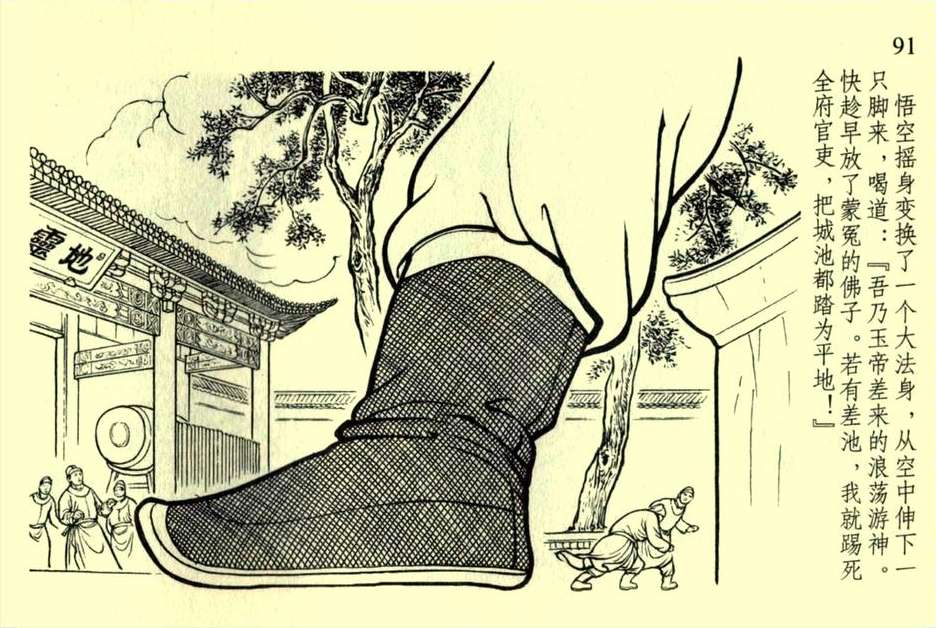
First, he imitates the voice of the slain layman at his wake and threatens heavenly retribution if his widow, the person who framed the monks, doesn’t recant her false claims. Second, he imitates the voice of the deceased uncle of the city magistrate who had imprisoned them and again threatens heavenly retribution if the official doesn’t reexamine the case. And third, at dawn he appears as a giant, disembodied foot (fig. 2) before the district-level magistrates and threatens to stomp the city and surrounding area into oblivion as heavenly retribution if they don’t put pressure on their superior to free his master:

Pilgrim flew out of the hall, and he found that it was beginning to grow light in the east. By the time he reached the Numinous Earth District [Di ling xian, 地靈縣], he saw that the district magistrate had already seated himself in the official hall. “If a midge speaks,” thought Pilgrim to himself, “and someone sees it, my identity may be revealed. That’s no good.” He changed, therefore, into the huge magic body [da fa shen, 大法身]: from midair he lowered a giant foot, [3] which completely filled the district hall. “Hear me, you officials,” he cried, “I’m the Wandering Spirit [Langdang youshen, 浪蕩遊神] sent by the Jade Emperor. I charge you that a son of Buddha has been wrongfully beaten in the jail of your prefecture, thus greatly disturbing the peace of the deities in the Three Regions. I am told to impart this message to you, that you should give him an early release. If there is any delay, my other foot will descend. It will first kick to death all the district officials of this prefecture. Then it will stamp to death the entire population of the region. Your cities finally will be trodden into dust and ashes!”

All the officials of the district were so terrified that they knelt down together to kowtow and worship, saying, “Let the noble sage withdraw his presence. We will go into the prefecture at once and report this to the magistrate. The prisoner will be released immediately. We beg you not to move your foot, for it will frighten these humble officials to death.” Only then did Pilgrim retrieve his magic body. Changing once more into a midge, he flew back inside the jail through the crack between the roof tiles and crawled back to sleep in the rack (Wu & Yu, 2012, p. 335-336).

行者又飛出來看時,東方早已發白。及飛到地靈縣,又見那合縣官卻都在堂上。他思道:「蜢蟲兒說話,被人看見,露出馬腳來不好。」他就半空中改了個大法身,從空裡伸下一隻腳來,把個縣堂屣滿。口中叫道:「眾官聽著:我乃玉帝差來的浪蕩遊神,說你這府監裡屈打了取經的佛子,驚動三界諸神不安,教我傳說,趁早放他;若有差池,教我再來一腳,先踢死合府縣官,後屣死四境居民,把城池都踏為灰燼。」概縣官吏人等慌得一齊跪倒,磕頭禮拜道:「上聖請回。我們如今進府,稟上府尊,即教放出。千萬莫動腳,驚諕死下官。」行者才收了法身,仍變做個蜢蟲兒,從監房瓦縫兒飛入,依舊鑽在轄床中間睡著。

Fig. 2 – A modern manhua depicting Monkey’s giant foot confronting the district-level magistrates (larger version). Comic found here. While the image shows Sun wearing shoes, the original Chinese doesn’t say whether are not his foot is covered.

3. Comparison

Both stories involve a single, giant foot threatening high-ranking members of society within the confines of their living or working quarters. The former is a samurai, while the latter are district-level magistrates. The threat involves death and the destruction of property. Danger looms over the Samurai’s household as the monstrous foot demands cleaning, and when its wants are ignored, it destroys part of the building in a fit of rage. Monkey, on the other hand, threatens to stomp everything (people and buildings) into oblivion if his demands for Tripitaka’s emancipation are not met. Also, the Japanese tale refers to the foot being “covered in thick, bristly hair” (Meyer, n.d.). This may be a reference to a furry monkey’s foot.

Now, someone might question what foot washing and release from prison have to do with each other. The two don’t appear to be related at all, but Meyer (n.d.) explains:

“[W]ashing your feet” is also a Japanese idiom for rehabilitating a criminal. A culprit whose ‘feet have been washed’ can be said to have paid his debt to society.

This is indeed an actual ceremony performed by criminals wishing to cleanse themselves of their negative past and reenter society (Clark, 1994, pp. 122-123). Therefore, both concepts are intimately related. Someone released from prison can be said to be rehabilitated, and this again is symbolized by said foot washing ceremony. Therefore, the monster in the Japanese tale is likely demanding that the Samurai do his part to help release or pardon a prisoner just like the JTTW episode.


4. Updates

Update: 04-09-23

The final act of Journey to the West: Conquering the Demons (Xiyou: Jiangmo pian, 西遊·降魔篇, 2013) includes a trio of demon hunters looking to defeat the Monkey King. One is a seemingly crippled old man who hobbles around on a crutch because of an underdeveloped right leg. But when the time comes, he uses qi energy to grow the appendage to giant proportions, calling it his “Heaven-Destroying Foot” (Tiancan jiao, 天殘脚).

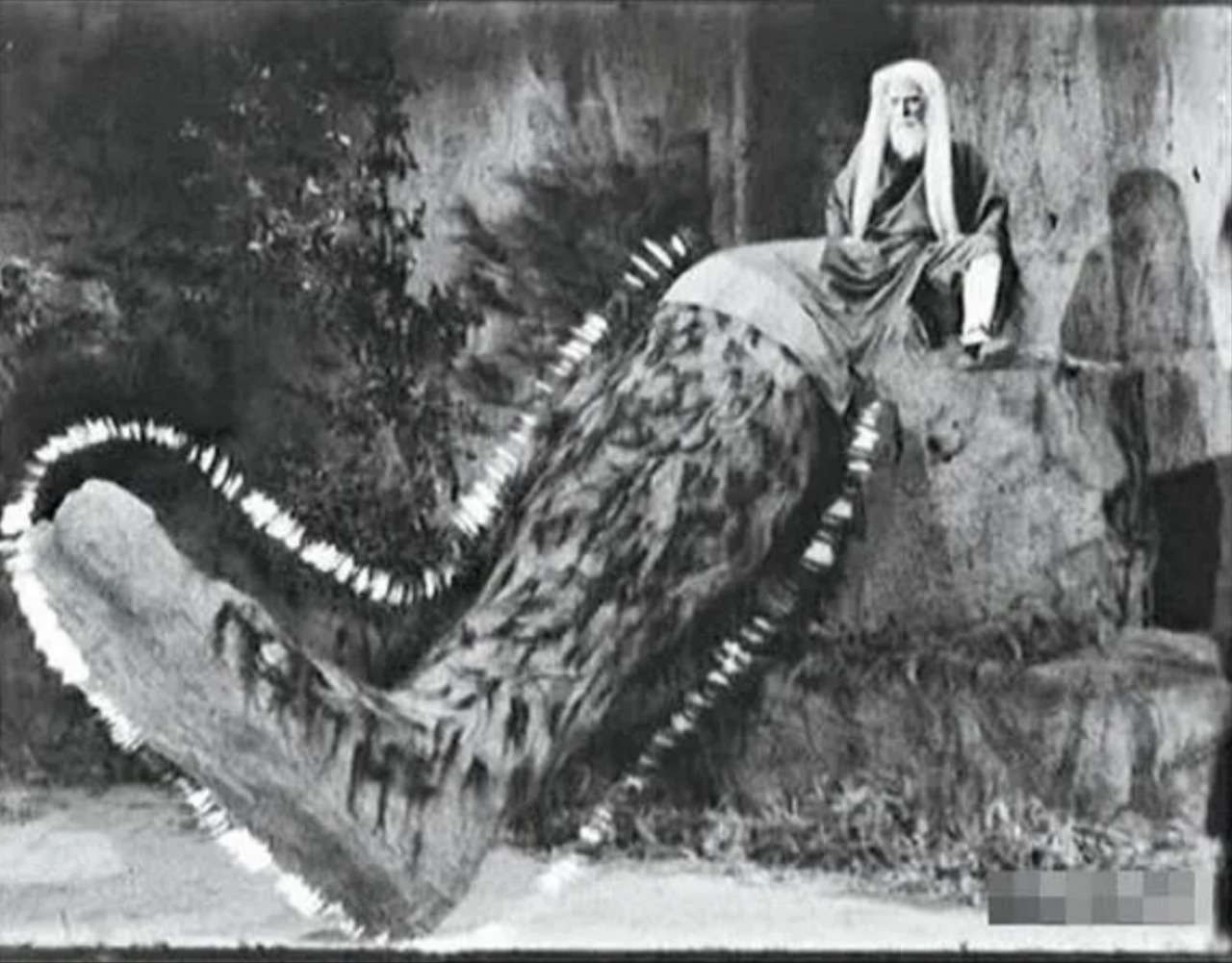
This character’s look and skill were copied directly from an HK martial arts film from 1965 commonly known in English as The Furious Buddha’s Palm (Rulai shenzhang nusui wanjian men, 如來神掌怒碎萬劍門; lit: “The Buddha Spirit Palm Shatters the 10,000 Sword Sect”). During the final battle, the main villain “Iron-Faced Asura” (Tiemian xiuluo, 鐵面修羅, played by Shih Kien) uses the same method to produce a giant foot. But what’s interesting for my purposes is that it appears to be covered in coarse hair like a primate (fig. 3).

A single, giant, destructive foot covered in hair sounds familiar doesn’t it? I wonder if this martial skill was influenced by the JTTW episode. This connection was first suggested to me by Jose Loayza (Twitter). A big thank you to him.

Note: A few hours after adding this update, it dawned on me that the “Buddha Spirit Palm” (Rulai shenzhang, 如來神掌) technique is used at the end of the film to combat the giant, monkey-like foot. This of course brings to mind the episode in JTTW when the Buddha defeats Sun Wukong with his palm by transforming it into Five Elements Mountain.)

Fig. 3 – A movie still of the Iron-Faced Asura summoning his hairy “Heaven-Destroying Foot” (larger version). Image found here.


Update: 07-26-23

A woodblock print showing Monkey’s titanic foot and leg from the first complete Japanese translation of JTTW.

Fig. 4 – Sun’s giant foot (larger version). 

Notes:

1) The 18th-century translator Nishida Korenori (西田維則, d. 1765; penname: Kuchiki sanjin, 口木山人) began publishing Japanese translations of stories from JTTW in 1758, ultimately publishing a total of 26 chapters before his death. Others picked up where he left off, including Ishimaro Sanjin (石麻呂山人) (ch. 27-39 and later 40-47), Ogata Teisai (尾方貞斎) (ch. 48-53), and Gakutei Kyuzan 岳亭丘山 (ch. 54-65). This incomplete version, known as The Popular Journey to the West (Tsuzoku saiyuki, 通俗西遊記, 1758-1831) was published in five instalments over 31 volumes. The first complete version of the novel, The Illustrated Journey to the West (Ehon Saiyuki, 繪本西遊記), was published a few years later in 1835 (Tanaka, 1988, as cited in Chien, 2017, p. 21).

However, I should point out that two ancient precursors of the story cycle (one of which is discussed here) were mentioned in a 1633 catalog from Kozan Temple. This points to different versions of the narrative coming to Japan’s shores at different times.

2) This page notes Honjo is “modern day Sumida ward in Tokyo.”

3) Yu (Wu & Yu, 2012) translates this as “leg” (p. 335), but the original Chinese says “foot” (jiao, 腳). I’ve corrected this throughout the quote.

Sources:

Chien, P. (2017). A Journey to the Translation of Verse in the Five English Versions of Xiyouji [Unpublished Master’s dissertation]. National Taiwan Normal University. Retrieved from http://rportal.lib.ntnu.edu.tw/bitstream/20.500.12235/95894/1/060025002l01.pdf

Clark, S. (1994). Japan, a View from the Bath. Germany: University of Hawaii Press.

Meyer, M. (n.d.). Ashiarai yashiki. Yokai.com. Retrieved October 16, 2021, from https://yokai.com/ashiaraiyashiki/.

Wu, C., & Yu, A. C. (2012). The Journey to the West (Vol. 4) (Rev. ed.). Chicago, Illinois: University of Chicago Press.