Readers may be surprised to learn that chapter nine of the current one hundred chapter edition of Journey to the West did not appear in the original version anonymously published by the Shidetang (世德堂) publishing house in 1592. Chapter nine of course tells the story of how Tripitaka‘s parents, his scholar-official father Chen Guangrui (陳光蕊) and mother Yin Wenjiao (殷溫嬌), meet (fig. 1); Guangrui’s murder and the pregnant Lady Yin’s kidnapping by a bandit; Tripitaka’s birth and Moses-like trip down a river (hence his nickname “River Float,” Jiang liu, 江流); his rescue, rearing, and initiation into the Buddhist order by the abbot of Gold Mountain; Lady Yin’s rescue and the bandit-turned-official’s arrest; and Tripitaka’s later reunion with his mother and father, the latter’s body having been preserved and brought back to life by heaven.
Some scholars, such as Glen Dudbridge, suggest the current ninth chapter is a forgery, having been written by one Zhu Dingchen (朱鼎臣) of Canton because it appears in his slightly later edited version of the novel titled The Chronicle of Deliverances in Tripitaka Tang’s Journey to the West (Tang Sanzang Xiyou shi ni zhuan, 唐三藏西游释尼傳, circa 1595). (See the 01-02-21update for new information about Zhu’s version of the novel.) Other scholars posit there is internal textual evidence for a possible lost chapter and that the current ninth chapter was salvaged from these internal clues.
Fig. 1 – Tripitaka’s parents from the 1986 television show.
Anthony Yu‘s (1975) paper “Narrative Structure and the Problem of Chapter Nine in the ‘Hsi-Yu Chi'” supplements previous analyses of said internal textual evidence. He demonstrates that references to the Chen Guangrui episode litter the book. For example, a poem in chapter twelve (ch. 11 of the original Shidetang version) reads:
Gold Cicada was his former divine name. As heedless he was of the Buddha’s talk, He had to suffer in this world of dust, To fall in the net by being born a man. He met misfortune as he came to Earth, And evildoers even before his birth. His father: Chen, a zhuangyuan [1] from Haizhou. His mother’s sire: chief of this dynasty’s court. Fated by his natal star to fall in the stream, He followed tide and current, chased by mighty waves. At Gold Mountain, the island, he had great luck, For the abbot, Qian’an, raised him up. He met his true mother at age eighteen, And called on her father at the capital. A great army was sent by Chief Kaishan To stamp out at Hongzhou the vicious crew. The zhuangyuan Guangrui escaped his doom: Son rejoined sire—how worthy of praise! They saw the emperor to receive his grace; Their names resounded in Lingyan Tower. Declining office, he chose a monk’s life At Hongfu Temple to seek the true Way, This old Buddha-child, nicknamed River Float, With a religious name of Chen Xuanzang. [2]
Yu (1975) notes “this passage…which introduces Tripitaka to the reader, has, with the exception of one major discrepancy (i.e. the name of the monk who took in the river-borne orphan), all the crucial elements constitutive of the Chen Guangrui story” (p. 296).
After providing several more examples, he concedes external textural evidence for a lost chapter has yet to be discovered, but suggests the author-compiler of the Journey to the West was surely familiar with established Yuan-Ming dramas involving Tripitaka’s birth and life:
I think that the foregoing analysis, admittedly brief, is sufficient to show the significance, if not the indispensability, of the Chen Guangrui episode in the narrative, though as I have remarked earlier, these later allusions certainly cannot be construed as incontrovertible proofs for a “lost chapter.” The existence of such a chapter has to be established by further discovery of textual materials hitherto unknown, if such discovery is indeed still possible. It may be safely asserted, however, that the author of the hundred-chapter novel, Wu Cheng’en or whoever he might be, is thoroughly familiar with the tradition of the birth and adventures of the infant Xuanzang popularized in the dramas of Yuan and Ming China, and that he has consciously and skillfully exploited this tradition in his narrative (Yu, 1975, p. 306).
Yu (1975) goes on to counter Dudbridge’s criticism that the Chen Guangrui episode doesn’t progress the overall plot by saying it should, instead, be accepted as an “organizing principle”, one that explains the reason for the monk’s ordeals:
[T]he theme of the river and its attendant perils utilized by the author of the hundred-chapter novel reinforces the theme of Tripitaka’s this-worldly identity as the incarnation of the banished Gold Cicada. Both themes in turn support the threefold aetiology developed in the narrative for explicating the meaning of Tripitaka’s ordeals: as a form of chastisement for his preexistent transgression, as a test of endurance for the earthly pilgrim, and as an exemplum of the high cost of obtaining sacred writings from the West (p. 307).
Furthermore, he counters Dudbridge’s claim that the concept of a lost chapter would be stronger if the novel provided more than just passing references to background info of the central characters. In fact, the novel does provide lengthy info on our heroes. For example, Yu (1975) presents a very long poem from chapter nineteen detailing Zhu Bajie’s life, from his early Daoist training, achievement of immortality, and rise to heavenly rank to his drunken flirting with the moon goddess (fig. 2), banishment from heaven, and mistaken reincarnation on earth as a pig-man.
Fig. 2 – a Taiwanese stamp featuring Zhu Bajie and the moon goddess Chang’e.
In the end, Yu (1975) states Qing-era editors of the novel were justified in their suspicion of a lost chapter given the lack of detailed info about Tripitaka’s life, unlike the other pilgrims:
In the absence of chapter 9, Tripitaka is the only member of the pilgrimage, in fact, whose origins are presented in the manner which Dudbridge ascribes to the disciples: in allusion or indirectly, in moments of retrospect. The early editors of the Xiyouji, therefore, were not wholly unjustified in their protest that a theme of such significance as the Chen Guangrui story had not been more fully accounted for by antecedent narrative (p. 310).
This has been posted for educational purposes. No malicious copyright infringement is intended. Please support the official release.
Update: 01-02-21
Zhu Dingchen’s edition of Journey to the West actually predates the 1592 edition. This shows that the aforementioned internal clues in the 1592 edition are based on previous material.
Update: 12-01-21
I’ve archived a book that shows how Tripitaka’s exile from heaven is similar to ancient Greek and Egyptian beliefs.
Update: 04-03-22
I’ve posted an entry discussing the characterization of Tripitaka as a Confucian in the novel.
Notes:
1) A scholar rank. All quotes from Yu (1975) originally use Wade-Giles. I have updated them with Pinyin.
2) Yu, 1975, p. 296. See Wu & Yu, 2012, p. 275 in Yu’s updated translation of the novel.
Sources:
Wu, C., & Yu, A. C. (2012). The journey to the West: Vol. 1. Chicago, Illinois: University of Chicago Press.
Yu, A. (1975). Narrative Structure and the Problem of Chapter Nine in The “Hsi-Yu Chi”. The Journal of Asian Studies,34(2), 295-311. doi:10.2307/2052750
The Monkey King is famous for utilizing a vast arsenal of magic powers to protect the monk Tripitaka on the journey to India, chief among them being immortality, shape-shifting, hair clones, super strength, and flight via the cloud somersault (jindou yun, 觔/筋斗雲). The latter is a powerful skill because it enables him to travel 108,000 li (33,554 mi / 54,000 km), [1] or one and one-third the circumference of our Earth, in a single leap. [2] Perhaps the most famous episode involving the somersault appears in Journey to the West (Xiyouji, 西遊記, 1592; “JTTW” hereafter) chapter seven when the Buddha bets Wukong that he’ll give the rebellious monkey the throne of heaven if he can leap clear of the Enlightened One’s palm. Sun gleefully accepts, certain of his success:
What a fool this Tathagata is! A single somersault of mine can carry old Monkey one hundred and eight thousand li, yet his palm is not even one foot across. How could I possibly not jump clear of it? (Wu & Yu, 2012, vol. 1, p. 194).
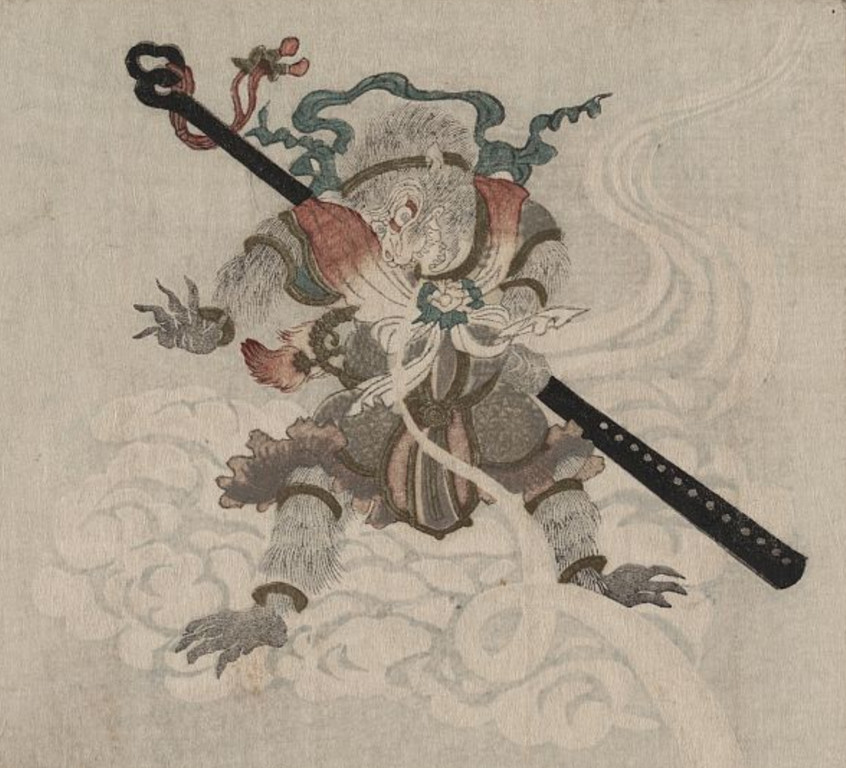
While Sun is traditionally portrayed in visual media riding a single cloud (fig. 1), the very name “somersault” points to Monkey leaping from cloud to cloud. And in fact this is demonstrated in chapter 97 when it requires “a series of cloud somersaults” for him to retrieve the soul of an elderly benefactor from the underworld (Wu & Yu, 2012, vol. 4, p. 338). However, the magic skill’s attributes are not always portrayed consistently throughout the novel. For example, it is sometimes shown capable of transporting passengers, such as the “thirty or fifty” of Monkey’s children rescued from captivity in JTTW chapter two, thereby implying a single cloud (Wu & Yu, 2012, vol. 1, p. 129). (See the 04-28-26 update below for more info.) But other times, like in chapter 22, it can’t lift even a single person because the impure nature of mortals renders them “as heavy as the Tai Mountain” (Wu & Yu, 2012, vol. 1, p. 427). Interestingly, the somersault is portrayed as much faster than the clouds of other immortals (see section three below).
Fig. 1 – Detail of an 1812 calendar print by Japanese artist Kubo Shunman depicting Son Goku (Sun Wukong) flying on his cloud somersault (larger version). A full size scan of the calendar can be seen here.
“Make the magic sign, recite the spell, clench your fist tightly, shake your body, and when you jump up, one somersault will carry you one hundred and eight thousand miles.” When the other people heard this, they all giggled and said, “Lucky Wukong! If he learns this little trick, he can become a dispatcher for someone to deliver documents or carry circulars. He’ll be able to make a living anywhere!”
The sky now began to darken, and the master went back to the cave dwelling with his pupils. Throughout the night, however, Wukong practiced ardently and mastered the technique of cloud-somersault. From then on, he had complete freedom (emphasis added), blissfully enjoying his state of long life (Wu & Yu, 2012, vol. 1, p. 123).
Elements of this passage reference the long tradition of cloud-borne transcendents in Daoist literature. For example, Kirkova (2016) highlights a poem by the first Cao Wei emperor Cao Pi describing the great speed of their travel: “Lightened you’ll soar, mount the floating clouds, / in a blink you’ll travel millions of li” (p. 105). She explains the ability to traverse vast distances in a flash “is a primary sign of the immortals’ mastery over space and time and is an important topos in their hagiographies” (Kirkova, 2016, p. 106). Furthermore, Kirkova (2016) points out the term used to denote their great freedom of movement, xiaoyao (逍遙/消搖), emphasized above, appears in works as old as the Huananzi and Zhuangzi (p. 104).
Shao (2006) explains that the distance is taken directly from the Platform Sutra (Liuzu tangjing, 六祖壇經, c. 8th to 13th century) of Huineng, the sixth patriarch of Chan Buddhism (p. 718). The particular passage reads:
The governor also asked,
I often see clergy and laity invoking Amitabha Buddha in hopes of rebirth in the [Pure Land of the] West. Please explain this to me. Can we attain rebirth there? Please resolve this doubt for me.
The Master said,
Listen clearly, Governor, and I will explain it to you. When the World Honored One was in the city of Sravasti, he spoke of the Western Pure Land as a teaching device. Scripture is clear that “it is not far from here,” but treatises say it is “108,000 li away.” This number refers to the ten evils and eight wrongs in the one’s person. This says it is far away. Saying it is far away is for people of lesser faculties. Saying it is near is for people of better faculties.
Now I urge you, good friends, to first get rid of the ten evils; that is the equivalent of traveling one hundred thousand li. [3] Then get rid of the eight wrongs; that is the equivalent of crossing eight thousand li. See essential nature in every moment, always acting with impartial directness, and you will arrive in a finger-snap and see Amitabha Buddha (Huineng & Cleary, 1998, pp. 26-27).
As can be seen, the number 108,000 is symbolic of two sets of spiritual hindrances. The “ten evils” (shi’e, 十惡) are killing, stealing, sexual misconduct, greed, hatred, delusion, foul language, lying, harsh speech, and slander. The “eight wrongs” (baxie, 八邪) are opposites of the eight fold path (Huineng, Hsuan, & Buddhist Text Translation Society, 2002, p. 183). Ridding oneself of these piecemeal gets you many li closer to paradise. But only those who achieve enlightenment can arrive instantly. This means the cloud somersault can be read as a Chan metaphor for instant enlightenment. After all, Monkey can travel to the Buddha’s heaven in a flash, whereas Tripitaka is fated to journey thousands of miles over many years “before he finds deliverance from the sea of sorrows” (Wu & Yu, 2012, vol. 1, p. 436). This is because, as suggested by Shao (2006), the demons encountered on the journey embody the “ten evils and eight wrongs” that must be defeated before the monk can enter paradise (p. 719).
Fig. 2 – Monkey soaring on his cloud. Drawing by Funzee on deviantart (larger version).
Going back to the early days of Sun’s flight training, Subodhi observes our hero using an unorthodox method for propelling himself into the sky: jumping. This differs from other immortals, so the Sage teaches him a different method:
The Patriarch said, “When the various immortals want to soar on the clouds, they all rise by stamping their feet. But you’re not like them. When I saw you leave just now, you had to pull yourself up by jumping. What I’ll do now is to teach you the cloud-somersault in accordance with your form” (Wu & Yu, 2012, vol. 1, p. 123).
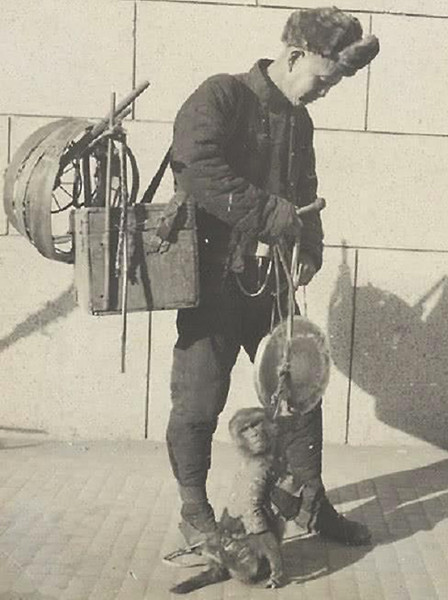
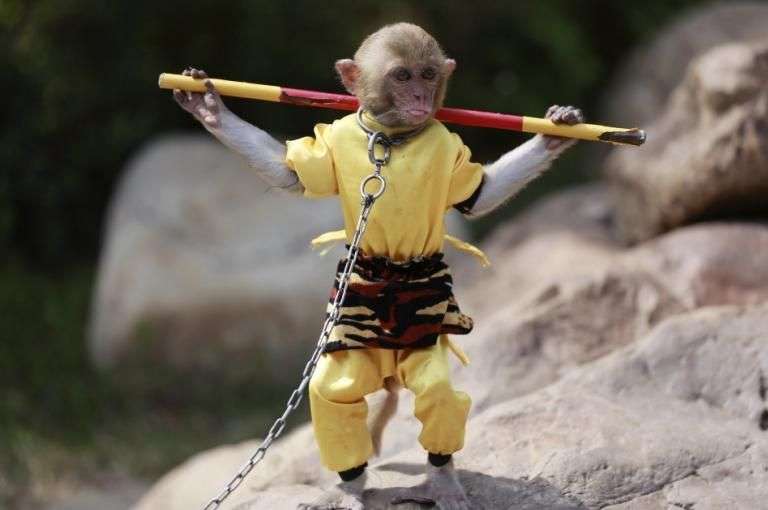
Zhou (1994) suggests this method is likely based on “the novelist’s personal observation” of trained monkey street performances “in the late Ming marketplace” (fig. 3 and 4) (p. 71). He points to an episode in chapter 28 when Wukong returns home to learn his children are regularly captured to perform tricks in the human world:
Those of us who were caught by the net or the trap would be led away live; they would be taught to skip ropes, to act, to somersault, and to do cartwheels. They would have to beat the drum and the gong on the streets and perform every kind of trick to entertain humans (Zhou, 1994, p. 71; cf. Wu & Yu, 2012, vol. 2, p. 31).
Anyone who has viewed monkeys in a zoo or in the wild knows that they are naturally gifted acrobats. Therefore, Zhou’s proposal is certainly an alluring possibility, one that mixes the naturalistic and historical with Daoist tales of cloud-borne immortals.
Fig. 3 – A Qing-era trainer and his performing monkey (larger version). Original image found here. Fig. 4 – A monkey performer dressed as Sun Wukong (larger version). Original image found here.
Scholars favoring a foreign origin for Sun sometimes point to the somersault as evidence for his connection to the Hindu monkey god Hanuman from the epic Ramayana (4th/5th century BCE). For example, Mi (as cited in Mair, 1989) notes similarities in which Sun and the god propel themselves by leaping:
In typical Chinese legends, the spirits and immortals mount on clouds and ride them; they stand on top of the clouds. Sun Wukong, however is different … Rather, he leaps through the air from a crouching position in the same fashion as Hanuman … This proves Sun Wukong’s supernatural abilities were adopted from Hanuman. (pp. 712-713).
Walker (1998) champions this view by citing a passage from the Ramayana in which Hanuman’s mighty leap across the sea from India to Lanka rips trees away from a mountain:
Hanuman, the foremost of monkeys, without pausing for breath … sprang into the air and, such was the force of his leap, that the trees growing on the mountain, tossing their branches, were sent spinning on every side.
In his rapid flight, Hanuman bore away those trees with their flowering boughs filled with lapwings intoxicated with love … Carried away by the impetus of his tremendous bound, those trees followed in his wake, like an army its leader (p. 10).
However, I’m inclined to believe any similarities in propulsion are simply the product of common behavioral traits among monkeys (refer back to my statement above about their gift for acrobatics). If Wukong’s jumping is indeed based on the somersaulting monkeys of vaudevillian street performances in China, then Hanuman’s jumping prowess no doubt has a real world counterpart in India. A prime example is the Gray Langur, which is capable of spectacular leaps (video 1).
Video 1 (LOUD NOISE WARNING) – A Langur takes a mighty jump. The video should start at minute 0:43.
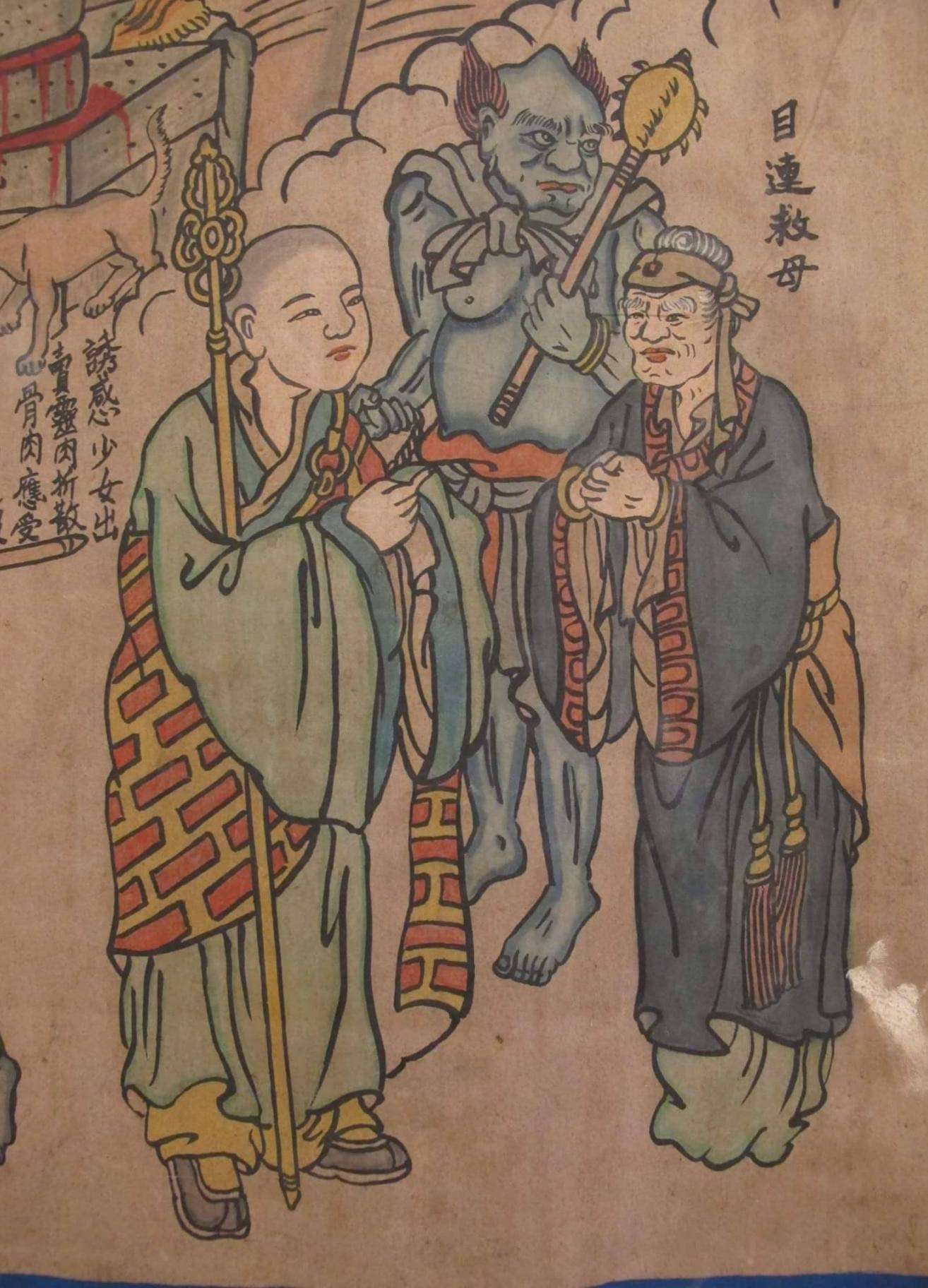
Given the somersault’s symbolic connection to Chan Buddhism, it’s possible Monkey’s jumping has ties to the religion as well. Like immortals, Buddhist saints are also portrayed in Chinese literature as having the power of flight. One example is Maudgalyayana (Ch: Mulian, 目連), a disciple of the Buddha, who is famous for appearing in a late-9th to early-10th century Bianwen (變文) text in which he travels to the underworld to release his mother from karmic torment (fig. 5). One passage from the tale reads:
Maudgalyayana awoke from abstract meditation,
Then swiftly exercised his supernatural power;
His coming was quick as a thunderclap,
His going seemed like a gust of wind.
[…]
With his supernatural power, he gained freedom,
So he hurled up his begging bowl and leaped into space (emphasis added);
Thereupon, instantaneously,
He ascended to the heavenly palace of Brahma (Mair, 1994, pp. 1097-1098).
Like Monkey, Maudgalyayana is depicted leaping into the heavens to freely roam the cosmos at blinding speeds, the only difference being that he stands astride a magic alms bowl (fig. 6) and not a cloud. It’s important to note that the saint’s tale influenced the 13th century precursor of the Ming JTTW. As I show in this article, Sun’s antecedent, the Monkey Pilgrim (Hou xingzhe, 猴行者), serves as a proxy for the saint because he wields magic weapons based on those used by Maudgalyayana, namely a golden-ringed monk’s staff and an alms bowl. The ringed staff would come to influence Sun’s signature weapon in JTTW, including its ability to change size and pick locks. Therefore, it’s possible the saint may have also influenced Monkey’s jumping.
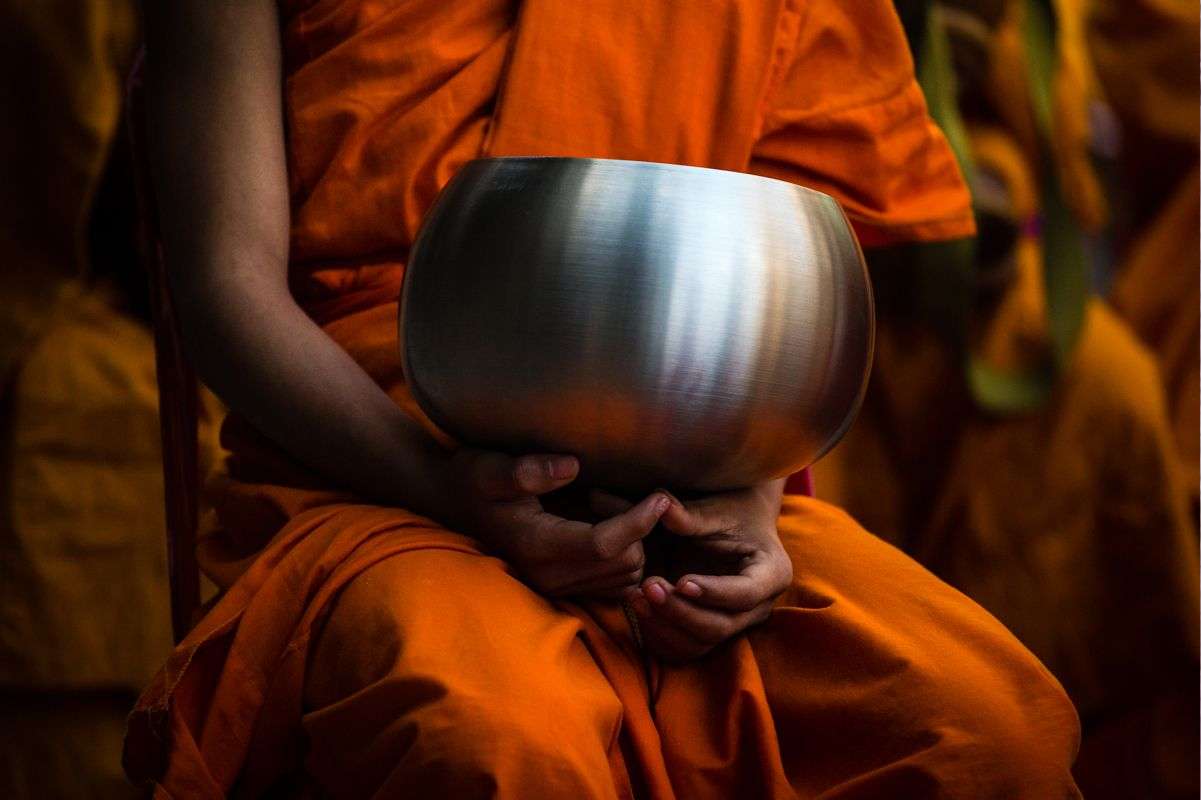
Fig. 5 – A scroll or mural depicting Maudgalyayana rescuing his mother from the underworld (larger version). Originally found here. Fig. 6 – A metal alms bowl (larger version).
5. Popular Culture
It’s interesting to note that the cloud somersault was adapted in the world famous Dragon Ball franchise. In episode three of the Dragonball anime, the lead character Son Goku, himself based on Sun Wukong, is gifted the yellow, fluffy Kinto’un (筋斗雲) by his would-be martial arts teacher, Master Roshi. [4] This is an obvious reference to Subodhi teaching the somersault skill to Monkey. But before Goku officially takes possession, Roshi gives him a warning: “People with impure thoughts can’t ride on it. In other words, you have to be a good person” (video 2). The master thereafter attempts to stand on it but quickly falls through due to his perverted nature. Goku then leaps up and successfully lands on the cloud, proving his worth. This exchange is no doubt a reference to Sun’s inability to carry passengers on his cloud because the impure nature of mortals renders them too heavy (see section one).
Video 2 – Roshi gives Goku his cloud. Watch from minute 1:50.
6. Conclusion
The Monkey King first learns the cloud somersault during the early days of his Daoist training under the Sage Subodhi. It enables him to travel 108,000 li in a single leap, making him much faster than the cloud soaring of other transcendents. While this skill shares affinities with the fleet clouds of immortals from Daoist hagiography, Sun’s somersault has a deep connection to Chan Buddhism. The vast distance that it travels is symbolic of the “ten evils and eight wrongs,” two sets of spiritual hindrances from the Platform Sutra said to keep the Buddha’s paradise out of reach. Only those who cleanse themselves of these obstacles can achieve enlightenment and arrive there in a flash, thus making Wukong’s cloud an apt metaphor for instant enlightenment. This suggests the greater speed of the somersault can be read as a further metaphor for the potency of Buddhism over Daoism.
Wukong’s habit of jumping into the heavens differs from the way other immortals rise by stamping their feet. This unorthodox method may have naturalistic or even religious influences. The suggestion that it is based on somersaulting monkeys from Chinese vaudevillian street performances is alluring given their natural gift for acrobatics. Some scholars champion a foreign origin by pointing to the leaping prowess of the Hindu monkey god Hanuman. But this could simply be a passing similarity based on common behavioral traits among monkeys. The jumping may also have ties to the Buddhist saint Maudgalyayana, who is portrayed in a famed 9th/10th century tale leaping into the air to ride his magic alms bowl between heaven and hell. Elements from his story would come to influence the 13th century precursor of JTTW, as well as the Ming edition of the novel, adding support for his possible influence.
7. Updates
Update: 01-04-24
The singular version of Monkey’s cloud is sometimes described as being “auspicious” (xiangyun, 祥雲) or having a “luminosity” (xiangguang, 祥光). Such clouds or lights are commonly associated with the five colors (wuse, 五色) (fig. 7). Chapter 88 makes this explicit:
Marvelous Great Sage! With a loud whistle he somersaulted right up into midair, his two feet treading the auspicious cloud of five colors (emphasis added). At about three hundred paces above ground, he let loose his rod to make [the martial arts moves] Sprinkling Flowers over the Top and the Yellow Dragon Entwining the Body. Up and down he moved, circling left and right. In the beginning his person and the rod so complemented each other that they seemed, as the adage had it, like flowers added to brocade. By and by even the person disappeared, and all one could see was a sky full of twirling rods! (Wu & Yu, 2012, vol. 4, pp. 196-197)
Fig. 7 – An example of an auspicious cloud (larger version). The scientific term for this phenomenon is “cloud iridescence,” but such nimbuses are commonly called “rainbow clouds” in English.
Update: 04-28-26
Above, I wrote: “[The cloud] is sometimes shown capable of transporting passengers, such as the ‘thirty or fifty’ of Monkey’s children rescued from captivity in JTTW chapter two, thereby implying a single cloud” (Wu & Yu, 2012, vol. 1, p. 129).
However, this was a mistake on my part. As I show in my more recent catalog of Sun Wukong’s powers and skills, these children are actually transported via the “magic of displacement” (shefa, 攝法), a swift, powerful wind appearing in JTTW chapters 2, 3, 62, 71, and 84.
On a different note, I feel like a major aspect of the somersault cloud needs extra context. If you recall in section 3, I discussed how the figure of 108,000 li is a religious allegory for the distance separating man from the Buddha’s paradise. Per the Sixth Chan Patriarch, the number comprises the “ten evils” (shi’e, 十惡) and “eight wrongs” (baxie, 八邪), two lists of negative thoughts and actions that hinder spiritual cultivation. Anyone who manages to rid themselves of these will attain enlightenment, allowing them to travel to the holy land instantly. But not everyone is capable of defeating these spiritual hindrances, so the distance separating them from the Buddha might as well be infinity. Therefore, it’s not wise to assign a real world distance and speed to the somersault cloud. This is regarding my recent response to “powerscaling.”
Update: 05-03-26
Here is an old woodblock print showing Monkey practicing his cloud somersault above Patriarch Subodhi and his early religious brothers (fig. 8). It is one of a few images from The Book to Enlightenment of the Journey to the West (Xiyou Zhengdao Shu, 西遊證道書, 1663), a Daoist commentary on the novel.
Fig. 8 – The 1663 woodblock print of Monkey’s cloud practice (larger version).
Notes:
1) The li (里) is a Chinese measure equaling roughly one-third of a mile. All cited English translations presented here use “mile” instead of the original li. I have, therefore, changed them accordingly.
3) The English translation originally says “ten myriad” (Huineng & Cleary, 1998, pp. 26-27). The original Chinese reads shiwan (十萬; 10 x 10,000), or 100,000. I have changed the source to make this more explicit.
4) The cloud is called the “Flying Nimbus” in the English dub.
Sources:
Huineng, & Cleary, T. F. (1998). The Sutra of Hui-neng, Grand Master of Zen: With Hui-neng’s Commentary on the Diamond Sutra. Boston: Shambhala.
Huineng, Hsuan, H., & Buddhist Text Translation Society. (2002). The Sixth Patriarch’s Dharma Jewel Platform Sutra: With the Commentary of Venerable Master Hsuan Hua. Burlingame: Buddhist Text Translation Society.
Kirkova, Z. (2016). Roaming into the Beyond: Representations of Xian Immortality in Early Medieval Chinese Verse. Leiden: Brill.
Mair, V. (1994). Transformation Text on Mahamaudgalyayana Rescuing His Mother From the Underworld with Pictures, One Scroll, with Preface. In V. Mair (Ed.), The Columbia Anthology of Traditional Chinese Literature (pp. 1094-1127). New York: Columbia University Press.
Wu, C., & Yu, A. C. (2012). The Journey to the West (Vols. 1-4) (Rev. ed.). Chicago, Illinois: University of Chicago Press.
Zhou, Z. (1994). Carnivalization in The Journey to the West: Cultural Dialogism in Fictional Festivity. Chinese Literature: Essays, Articles, Reviews (CLEAR),16, 69-92. doi:10.2307/495307
One reoccurring plot device in the world famous Dragon Ball (Jp: Doragon Bōru,ドラゴンボール; Ch: Qilongzhu, 七龍珠) franchise (1984-present) is the Lima bean-like Senzu (仙豆; Ch: xian dou; lit: “sage or immortal bean”) (fig. 1). As explained by Dragon Ball scholar Derek Padula, the Senzu is a green, crunchy bean used to magically and instantly heal life-threatening flesh wounds and broken bones, to rejuvenate warriors who have overexerted themselves during intense, prolonged training or battle (video 1), and to sate hunger for up to ten days. Its only limitations are the inability to heal viral sicknesses, missing body parts, and preexisting scars. Much like the immortal peaches of the Queen Mother of the West, which only mature every few thousand years, the beans only mature in small numbers, possibly taking hundreds of years for their caretaker, the long-lived sage cat Korin, to harvest a few hundred specimens. The beans become a rarity once a dimwitted character eats them by the handful (Padula, 2015).
Derek traces the bean to elixirs created by practitioners of Daoist external alchemy. For example, he writes:
The sennin [仙人; Ch: xianren] collect rare ingredients and prized metals such as gold, mercury, mushrooms, and precious stones such as jade. Then they place them into a crucible, stoke the fire, and melt them into a concoction. Each particular ingredient possesses various amounts of yīn and yáng energy, and by mixing the ingredients together in just the right fashion the hermit can concoct a potion or pill that will balance the yīn and yáng in their own bodies. Their hope is that the pill will increase their life span, eliminate illness and injuries, or confer immortality (Padula, 2015).
He also sees a connection between Senzu beans and the famed peaches of immortality. After all, both are heavenly agricultural goods with magico-medical properties.
Over time, legends formed around such practices and made their way into popular culture. For example, the Daoist Patriarch Laozi’s “pills of immortality” and “peaches of immortality” (Chinese: xiāntáo, 仙桃), from Journey to the West that Sun Wukong (the character Son Goku is inspired by) so voraciously devours. Sun Wukong becomes immortal not once, not twice, but thrice, by also practicing Internal Alchemy and transforming his body. Since Xiyouji is the inspiration for Dragon Ball, it’s no surprise that we find a simplified form of them here that Son Goku eats. Senzu do not confer instant immortality in Dragon Ball, but they do provide the other benefits. They’re a simplified representation of ancient and supernormal concepts (Padula, 2015).
1.2. Divine Fried Beans?
While Derek alludes to Laozi’s elixir pills above, I think he might have missed an important element from the novel, one that appears to be the ultimate source for Senzu. After raiding the heavenly peach banquet and getting drunk on immortal wine in chapter five, Sun Wukong stumbles into Laozi’s laboratory and eats all of the god’s elixir pills:
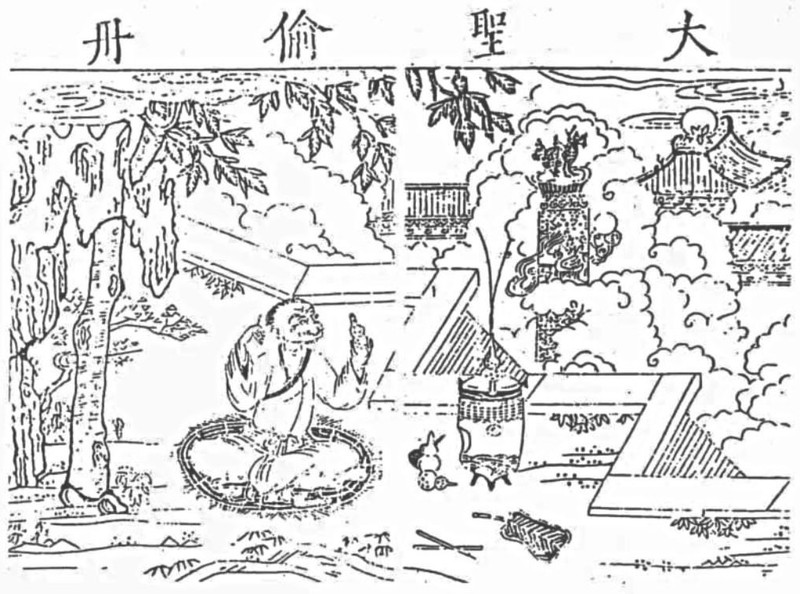
Searching around, our Great Sage went all the way to the alchemical room. He found no one but saw fire burning in an oven beside the hearth, and around the oven were five gourds in which finished elixir was stored. “This thing is the greatest treasure of immortals,” said the Great Sage happily. “Since old Monkey has understood the Way and comprehended the mystery of the Internal’s identity with the External, I have also wanted to produce some golden elixir [jin dan, 金丹] on my own to benefit people. While I have been too busy at other times even to think about going home to enjoy myself, good fortune has met me at the door today and presented me with this! As long as Laozi is not around, I’ll take a few tablets and try the taste of something new.” He poured out the contents of all the gourds and ate them like fried beans [chao dou, 炒豆] (emphasis added) [fig. 2].
In a moment, the effect of the elixir had dispelled that of the wine, and he again thought to himself, “Bad! Bad! I have brought on myself calamity greater than Heaven! If the Jade Emperor has knowledge of this, it’ll be difficult to preserve my life! Go! Go! Go! I’ll go back to the Region Below to be a king.” He ran out of the Tushita Palace and, avoiding the former way, left by the West Heaven Gate, making himself invisible by the magic of body concealment (Wu & Yu, 2012, p. 166).
So we have immortality-bestowing alchemical pills described as beans, which can instantly cure the effects of alcohol, a mild poison. As noted above, Son Goku is based on Sun Wukong. Additionally, many other characters and episodes of the manga/anime were pulled directly from Journey to the West. So it’s not a stretch to think that Akira Toriyama, the creator, embellished the ability of these bean-like pills to create the Senzu.
Fig. 2 – “The Great Sage Steals the Elixir”, from Newly Engraved, Illustrated, Large-Character Official Edition of the Journey to the West (Xinke chuxiang guanban dazi Xiyouji, 新刻出像官板大字西遊記, 1592) (larger version).
2. Updates
Update: 11-20-21
I’ve written an article briefly listing the influences of Journey to the West on Dragon Ball.
Note: My blog is not monetized, so I am not making any money from this post. My hope is that these PDFs will make this legendary story more accessible to a wider audience. If you enjoyed the digital version, please, please, please support the official release.
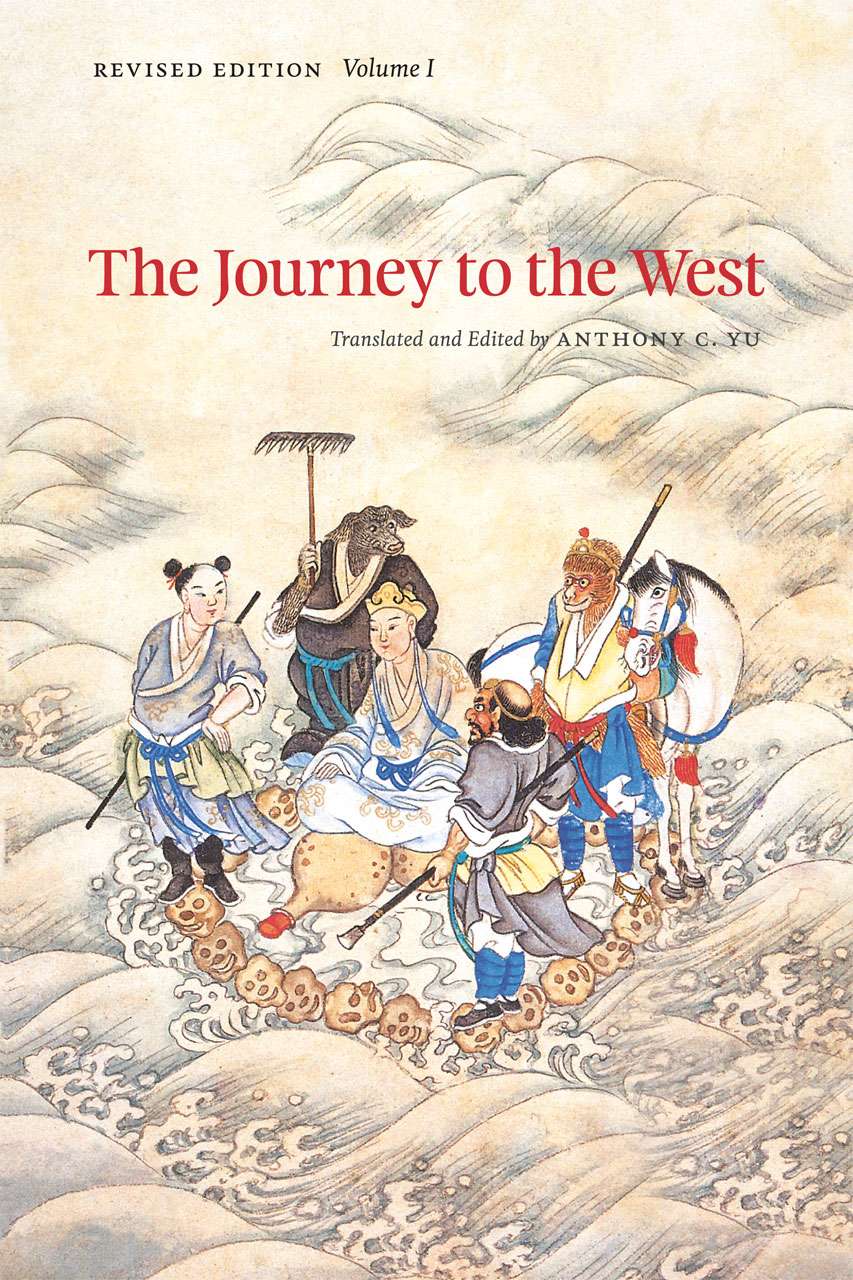
Here I present PDFs comprising the complete four volume 2012 revised edition of The Journey to the West(Xiyouji, 西遊記)translated by Anthony C. Yu (October 6, 1938 – May 12, 2015). This is considered THE most accurate translation of the tale available. I hope those who read and enjoy the digital version will support the official release.
Yu was Carl Darling Buck Distinguished Service Professor Emeritus in the Humanities and Professor Emeritus of Religion and Literature in the Chicago Divinity School. I shared a long email correspondence with Prof. Yu, during which we became friends. He was always quick to answer my many questions. His translation remains a treasure trove of explanatory notes and sources.
Anthony C. Yu’s translation of The Journey to the West, initially published in 1983, introduced English-speaking audiences to the classic Chinese novel in its entirety for the first time […] With over a hundred chapters written in both prose and poetry, The Journey to the West has always been a complicated and difficult text to render in English while preserving the lyricism of its language and the content of its plot. But Yu has successfully taken on the task, and in this new edition he has made his translations even more accurate and accessible. The explanatory notes are updated and augmented, and Yu has added new material to his introduction, based on his original research as well as on the newest literary criticism and scholarship on Chinese religious traditions. He has also modernized the transliterations included in each volume, using the now-standard Hanyu Pinyin romanization system. Perhaps most important, Yu has made changes to the translation itself in order to make it as precise as possible (source).
Different mythologies and fictional universes have their own magical metals. For example, Marvel’s Asgardians have Uru, and the elves of Middle-earth have Mithril. The great Chinese classic Journey to the West (Xiyouji, 西遊記, 1592 CE) hosts a long list of magical weapons, armor, and objects made from all kinds of metal (steel, iron, brass, gold, silver, etc.). A specific type is called Bin iron or Bin steel (bin tie, 鑌鐵), and it is mentioned several times in the narrative.
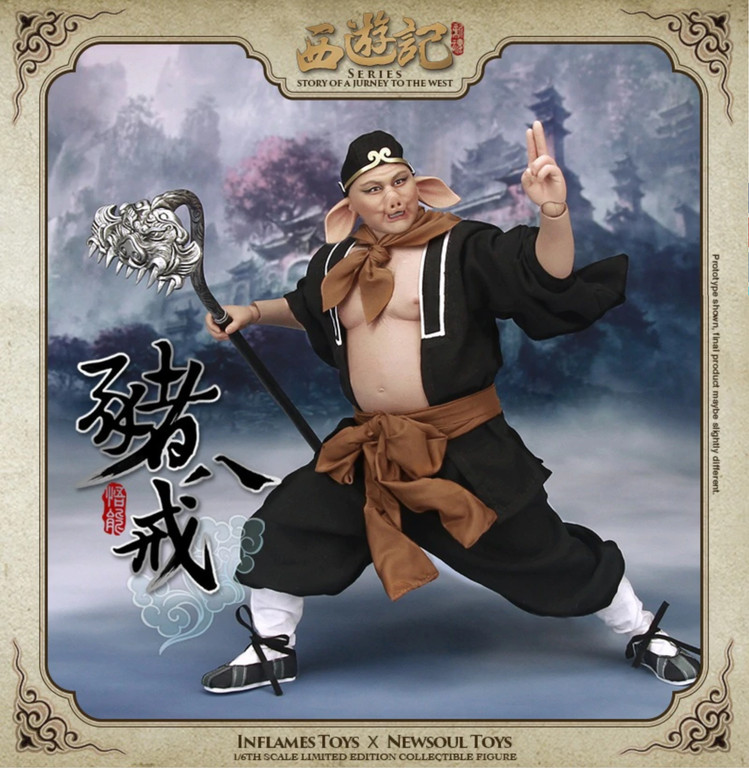
When Zhu Bajie first faces Sun Wukong in combat, he recites a poem praising the celestial origin of his weapon (fig. 1).
This is divine ice steel greatly refined,
Polished so highly that it glows and shines.
Laozi wielded the large hammer and tong;
Mars himself added charcoals piece by piece.
Five Kings of Five Quarters applied their schemes;
Twelve Gods of Time expended all their skills.
They made nine prongs like dangling teeth of jade,
And brass rings were cast with dropping gold leaves.
[…] (Wu & Yu, 2012, vol. 1, p. 382)
The “divine ice steel” (shen bing tie, 神冰鐵) is likely an error for “divine Bin steel” (shen bin tie, 神鑌鐵) as bing (冰) and bin (鑌) sound similar. This may also have something to do with the snowflake-like grain pattern of Bin steel (see sections two and three below). Take note that the metal is associated with Laozi and his furnace. We will see this association again.
Fig. 1 – A modern action figure of Zhu Bajie with his battle rake (larger version.
Chapter 34
On the cusp of his battle with the Monkey King, the demon King Silverhorn (Yinjiao wang, 銀角王) is described as wearing polished armor made from the material.
He wears a phoenix helmet white than snow
And armor made of bright Bin steel. [1]
The belt on his waist is dragon’s tendon.
Plum-flower shaped gaiters top his goat-skin boots.
He seems the living Lord of Libation Stream;
He looks no different from Mighty Spirit.
He holds in his hands the sword of seven stars,
Stern and imposing in a towering rage (Wu & Yu, 2012, vol. 1, p. 127).
The monster is later revealed to be one of two young attendants of Laozi’s furnace sent by heaven to test the resolve of the pilgrims (Wu & Yu, 2012, vol. 2, p. 145).
Chapter 75
The Monkey King recites a poem about his divine staff (fig. 2) prior to battling a lion demon.
The rod of [Bin] steel nine cyclic times refined
Was forged in the stove by Laozi himself.
King Yu took it, named it “Treasure Divine,”
To fix the Eight Rivers and Four Seas’ depth.
In it were spread out tracks of planets and stars,
Its two ends were clamped in pieces of gold.
Its dense patterns would frighten gods and ghosts;
On it dragon and phoenix scripts were drawn.
Its name was one Rod of Numinous Yang,
Stored deep in the sea, hardly seen by men.
Well-formed and transformed it wanted to fly,
Emitting bright strands of five-colored most.
[…] (Wu & Yu, 2012, vol. 3, p. 375)
Here again we see Laozi is associated with the material.
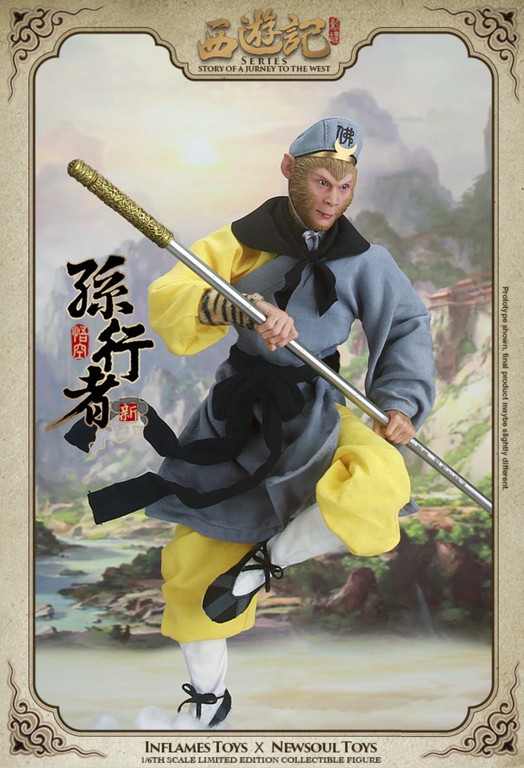
Fig. 2 – A modern action figure of Sun Wukong with his magic staff (larger version).
2. The Metal of Heroes
I want to reiterate the fact that Zhu Bajie and Sun Wukong, two of Tripitaka’s three main disciples and bodyguards, have weapons made from Bin steel (Sha Wujing’s staff is made from a heavenly tree). Each is the product of Laozi refining Bin steel in his magic furnace and smelting the polearms by hand. Just like dwarves imbued Thor’s uru-metal hammer with magical abilities, so too did the high god of Daoism for Zhu and Sun’s weapons. Each has supernatural durability and the power of transformation. In fact, the Monkey King’s staff is one of the strongest weapons in the entire novel, making its association with Bin steel very important. After all, a great hero requires a great weapon.
Another example of a hero wielding a Bin steel weapon is Wu Song (武松) from the classic Chinese novel the Water Margin (Shuihu zhuan, 水滸傳, c. 1400; a.k.a. “Outlaws of the Marsh” or “All Men Are Brothers”). The former constable-turned-outlaw comes into possession of a pair of Buddhist sabers (fig. 3) made from “snowflake [pattern] Bin steel” (xuehua bintie jiedao, 雪花鑌鐵戒刀) and housed in a sharkskin sheath. [2] They are described as being made from the “finest steel, and obviously hadn’t been made in a day” (Shi & Luo, 1993/2001, vol. 2, p. 580). In addition, the blades are said to “often groan in the night” (Shi & Luo, 1993/2001, vol. 2, p. 640), suggesting a magical, sentient longing for combat. Wu later sates this desire by using the sabers in a prolonged skirmish with an evil Daoist priest, eventually beheading the brigand with a single strike (Shi & Luo, 1993/2001, pp. 643-645).
Fig. 3 – A modern drawing of Wu Song with his Buddhist sabers (larger version).
3. Real World History
Wagner (2008) suggests that the name Bin (鑌) is a transliteration of a foreign term, possibly the Sanskrit word Piṇḍa, meaning “steel” or “lump” (p. 270). The material is mentioned in Chinese records of the 6th and 7th centuries as being imported from Persia (Bosi, 波斯) and Jaguda (Cao, 漕, modern day Ghazni) in Afghanistan. Mentions of the metal strangely disappear for centuries, only to reappear in early-10th century records. This is possibly due to the disruption of Persian trade wrought by the Islamic conquest of Persia and the subsequent rise of Muslim trade with the east. Bin steel is believed to have originally been transported in a raw “lump” state prior to smelting in China. But the secret of its manufacture eventually reached the Middle Kingdom, for a 12th-century report shows that the metal was produced in Inner Mongolia. The early Yuan government is known in 1275 to have established the “Office for Bin iron” (Bintie ju, 鑌鐵局), which possibly catered to elite blacksmiths (Wagner, 2008, pp. 268-272).
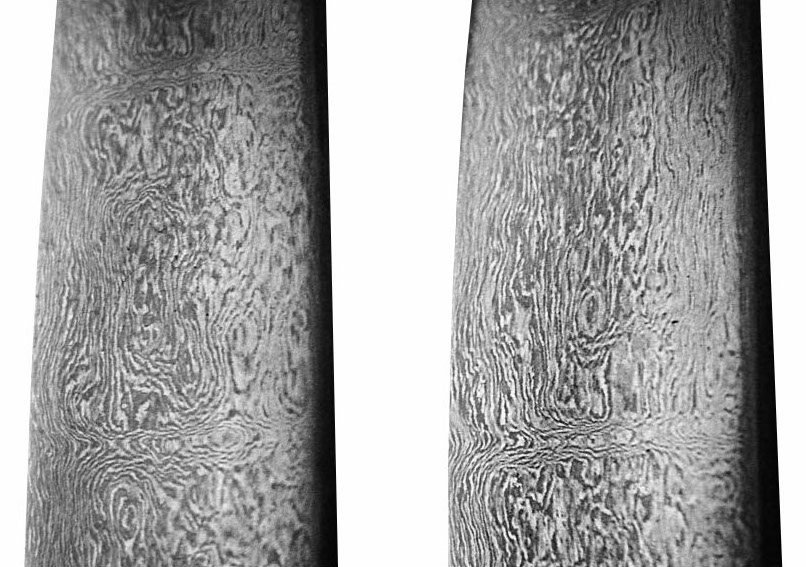
Fig. 4 – Persian-made Damascus steel blades of the 13th century (larger version). Take note of the intricate grain pattern. Bin steel was known to have various patterns (see below).
The best description of the material comes from Cao Zhao’s (曹昭) The Essential Criteria of Antiquities (Gegu yaolun, 格古要論, 1368), an early guide for connoisseurs.
Bin iron: It is produced by the Western Barbarians. Some [types] have a spiral self-patterning, while others have a sesame-seed or snowflake patterning. When a knife or sword is wiped clean and treated with ‘gold thread’ alum, [the pattern] appears. Its value is greater than silver.
An ancient saying holds that “knowing the strength of iron is like knowing gold” [i.e., the ability to judge the properties of steel is as valuable as the ability to assay the purity of gold]. Forgeries have a black patterning. One should examine [a steel object] very carefully.
There are three rules for knives. The first is that in the blade there should be perfect control of fire, metal, and water [i.e., the blade should be correctly quench-hardened and tempered]. The second is that the haft should be of xichi wood from the Western Barbarians, and the third is that the sheath should be of Tatar birchbark.
I once had a pair of scissors of bin iron, of exquisite workmanship. It had a raised gilt pattern on the inside, and on the outside a silver-inlaid inscription in Islamic characters (Wagner, 2008, p. 271).
So we see that Bin steel is comparable to Damascus steel (fig. 4), as both require quench-hardening and produce a number of intricate grain patterns visible after an acid treatment. One such pattern is the snowflake pattern associated with Wu Song’s sabers (and possibly Zhu Bajie’s rake). Most importantly, the metal was considered an exceptionally fine steel. One general is described as boasting that rebels would “have to nick (chi, 齒) his sword of bin iron” if they wished to rise up (Wagner, 2008, p. 269). [3] I take this statement to be symbolic of his unbreakable resolve. At the same time, it shows that Bin steel was considered exceptionally durable.
Highly durable Bin steel weapons could have seemed like magic in comparison to those made from lesser quality metal. Therefore, it’s interesting that Journey to the West presents the metal being smelted by a god in his magic furnace. It seems only natural that a magical forge would produce the finest steel. In fact, after the 10th century, the very name Bin steel came to be used as a term for any type of exquisite steel (Wagner, 2008, p. 271). Therefore, the author-compiler of Journey to the West may have been using it in that sense instead of referring to imported Persian steel.
4. Updates
Update: 02-06-21
I have written an article that discusses the magic powers of the staff. These include the ability to shrink and grow, control the ocean, astral project and entangle with Monkey’s spirit, multiply endlessly, pick locks, and transform into various objects. It also has sentience to a certain degree.
1) Yu’s (Wu & Yu) original translation says “bright Persian steel” (vol. 1, p. 127).
2) While the Water Margin presents them as sabers, Buddhist knives (jiedao, 戒刀, lit: “precept knife”) were historically small, unadorned, curved, finger-length blades used for cutting robes, trimming fingernails, opening wounds, or slicing food (Yifa, 2009, p. 250, n. 37).
3) Wagner (2008) states that the story is listed as coming from the 9th century but the housing source is from the 11th century (p. 269, n. 103). Therefore, it likely originates after the reappearance of Bin steel in Chinese records during the early-10th century.
Sources
Shi, N., & Luo, G. (2001). Outlaws of the Marsh (Vols. 1-4) (S. Shapiro, Trans.). Beijing: Foreign Languages Press. (Original work published 1993)
Wagner, D. (2008). Science and Civilisation in China: Volume 5, Chemistry and Chemical Technology, Part 11, Ferrous Metallurgy. Cambridge: Cambridge Univ. Press.
Wu, C., & Yu, A. C. (2012). The Journey to the West (Vols. 1-4) (Rev. ed.). Chicago, Ill: University of Chicago Press.
Yifa. (2009). The Origins of Buddhist Monastic Codes in China: An Annotated Translation and Study of the Chanyuan Qinggui. Honolulu: University of Hawai’i press.