The Monkey King’s Cosmic Body

Last updated: 04-04-2024

Sun Wukong is known for his limitless shape-changing powers, capable of taking the form of anything from gods, monsters, and humans to animals, insects, and even inanimate objects like buildings. But his most powerful transformation, that of a cosmic giant, is displayed only three times in the novel. It is used mostly in defense against other powerful characters, namely the god Erlang and the Bull Demon King. In this article, I will introduce the ancient astral-geographical term used to describe this phenomenon, associate the transformation with a divine giant from Chinese mythology, and explore possible ties to Hindu mythology.

Table of Contents

1. Episodes from the Novel

1.1. Chapter 3

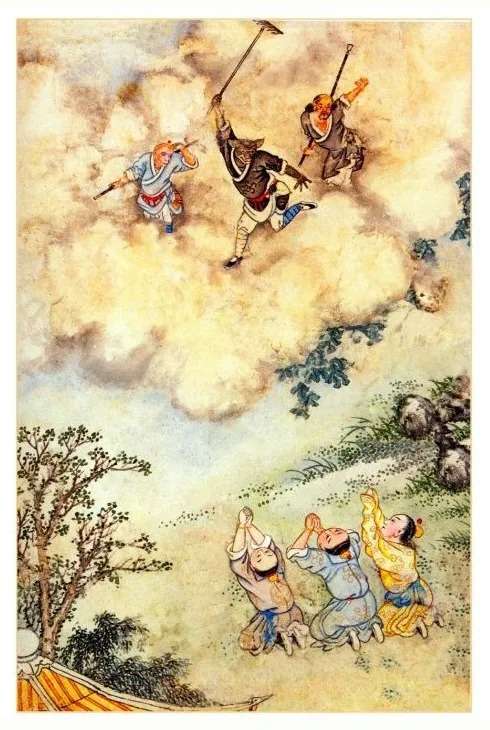
The first instance takes place in chapter three after Monkey returns from the Dragon King’s undersea palace with his new weapon. The form is used to show off his magical abilities for his children (fig. 1):

Grasping the treasure [iron staff] in his hands, he began to perform the magic of cosmic imitation (emphasis added). Bending over, he cried, “Grow!” and at once grew to be ten thousand-zhang [104,300 ft or 31,800 m]-tall, [1] with a head like the Tai Mountain and a chest like a rugged peak, eyes like lightning and a mouth like a blood bowl, and teeth like swords and halberds. The rod in his hands was of such a size that its top reached the thirty-third Heaven and its bottom the eighteenth layer of Hell (based on Wu & Yu, 2012, vol. 1, p. 138). 

將寶貝揝在手中,使一個法天像地的神通,把腰一躬,叫聲:「長!」他就長的高萬丈,頭如泰山,腰如峻嶺,眼如閃電,口似血盆,牙如劍戟;手中那棒,上抵三十三天,下至十八層地獄。

Fig. 1 – Monkey performs the cosmic transformation for his children (larger version). A page from Chen Huiguan’s Newly Illustrated and Complete Journey to the West (Chen Huiguan xinhui quanben xiyouji, 陈惠冠新绘全本西游记, 2001). Image found here.

1.2. Chapter 6

The second takes place in chapter six during his battle with Erlang Shen. The form is used this time in response to the god’s own cosmic transformation.

The Immortal Master [Erlang] fought the Great Sage for more than three hundred rounds, but the result could still not be determined. The Immortal Master, therefore, summoned all of his magic powers; with a shake he made his body a ten thousand zhang tall. Holding with both hands the divine lance of three points and two blades like the peaks that cap the Hua Mountain, this green-faced, sabre-toothed figure with scarlet hair aimed a violent blow at the head of the Great Sage. But the Great Sage also exerted his magical power and changed himself into a figure having the features and height of Erlang. He wielded a compliant golden-hooped rod that resembled the Heaven-supporting pillar on top of Mount Kunlun to oppose the god Erlang (based on Wu & Yu, 2012, vol. 1, p. 181).

真君與大聖鬥經三百餘合,不知勝負。那真君抖擻神威,搖身一變,變得身高萬丈,兩隻手舉著三尖兩刃神鋒,好便似華山頂上之峰,青臉獠牙,朱紅頭髮,惡狠狠,望大聖著頭就砍。這大聖也使神通,變得與二郎身軀一樣,嘴臉一般,舉一條如意金箍棒,卻就是崑崙頂上擎天之柱,抵住二郎神。

[…]

Now we were telling you about the Immortal Master and the Great Sage, who had changed themselves into forms which imitated Heaven and Earth (emphasis added) (based on Wu & Yu, 2012, vol. 1, p. 182).

卻說真君與大聖變做法天象地的規模

1.3. Chapter 61

The third takes place in chapter sixty-one during Sun’s battle with the Bull Demon King (fig. 2). Again, the form is used in response to another powerful character’s transformation.

With a loud guffaw, the Bull King then revealed his original form of a gigantic white bull, with a head like a rugged mountain and eyes like bolts of lightning. The two horns were like two iron pagodas, and his teeth were like rows of sharp daggers. From head to toe, he measured more than ten thousand-plus zhang [10,430 ft or 3,179.06 m], while his height from hoof to neck was about eight hundred zhang [8,344 ft or 2,543.25 m]. [2]

“Wretched ape!” he roared at Pilgrim [Monkey]. “What will you do with me now?” Pilgrim also changed back to his true form; yanking out his golden-hooped rod, he bent his back and then straightened out, crying, “Grow!” At once he grew to a height of ten thousand zhang, with a head like Mount Tai, eyes like the sun and moon, a mouth like a bloody pound, and teeth like doors (based on Wu & Yu, 2012, vol. 3, p. 157).

牛王嘻嘻的笑了一笑,現出原身:一隻大白牛,頭如峻嶺,眼若閃光,兩隻角似兩座鐵塔,牙排利刃,連頭至尾有千餘丈長短,自蹄至背有八百丈高下。對行者高叫道:「潑猢猻!你如今將奈我何?」行者也就現了原身,抽出金箍棒來,把腰一躬,喝聲叫:「長!」長得身高萬丈,頭如泰山,眼如日月,口似血池,牙似門扇

[…]

[After Zhu Bajie returns from exterminating all of the demons in the Bull King’s cave] “You have achieved great merit, Worthy Brother,” said Pilgrim. “Congratulations! Old Monkey has waged in vain a contest of transformation with him [the Bull King], for I have not yet achieved victory. He finally changed into the biggest possible white bull, and therefore assumed the appearance that imitated Heaven and Earth” (emphasis added) (based on Wu & Yu, 2012, vol. 3, p. 158). 

行者道:「賢弟有功,可喜,可喜。老孫空與那老牛賭變化,未曾得勝。他變做無大不大的白牛,我變了法天象地的身量。

Fig. 2 – Monkey vs the Bull King, both in their cosmic transformations (larger version). An 1833 woodblock print by Yashima Gakutei. Photo by Prof. Vincent Durand-Dastès of the ‏National Institute for Oriental Languages and Civilizations. With permission. 

2. Ties to Ancient Chinese Astral-Geography and Mythology

The exact word used each time to describe Sun’s modus for attaining his cosmic form is Fatian Xiangdi (法天像(象)地), or the “method of modeling Heaven on Earth.” This is actually related to ancient Pre-Qin and Han concepts of astral-geography later used in the construction of imperial Chinese cities. The ancient Chinese viewed the heavens as a complex system of seven star units set in four cardinal sections, making up the Twenty-Eight Lunar Mansions, all of which enclosed and revolved around a central star ruled by one of two supreme gods, Shangdi or Taiyi. Known as the “Purple Palace Enclosure” (Ziweiyuan, 紫微垣), this bound star system was the heavenly abode from which the supreme god oversaw reality, while the surrounding stars represented his civil and military officials and even outlying areas, such as dwellings and a marketplace. The Chinese emperor, commonly called the Son of Heaven, was considered the earthly counterpart of the great god, serving as the mediator between the will of heaven and the needs of man. Therefore, architects often modeled imperial cities on these celestial patterns, placing the emperor at the center surrounded by outer layers of courts, residential quarters, markets, and streets (Chan, 2008, pp. 8-19).

The arcane-sounding Fatian Xiangdi term was no doubt chosen simply because Monkey’s magic body mirrors the vastness of the cosmos (both heaven and earth), not that it borrowed particular celestial patterns like earthly architects. Interestingly, though, legend states the ancient Yuan capital of Dadu was modeled on the magic body of the child god Prince Nezha, who also appears in Journey to the West. [3]

The novel likens aspects of Sun’s cosmic form to earthly features and celestial bodies. This resembles stories of the ancient god Pangu (盤古) (fig. 3), the first being born into primordial chaos who slaved to separate heaven from earth, cleaving one from the other and forcing them apart. Stevens (1997) writes this monumental task took its toll on the titan:

He died as the task was reaching a climax and his body became features of the Earth. His head became the mountains, his breath the wind and clouds; his voice became thunder, his left eye the sun and his right eye the moon, and his four limbs became the four quarters of the Earth. His blood ran as rivers, his veins and muscles were the strata of the rocks, and his flesh the soil. His skin sprouted and became vegetable patches, forests and paddy fields, while his bones and teeth became the minerals. His sweat became the rain and to complete creation humanity sprang from the parasites on his body (p. 54).

Monkey in a way becomes a living embodiment of the divine giant because he too is described as having a head like a mountain, eyes like the sun and moon, and a mouth like a large body of liquid, which also happens to be blood.

Fig. 3 – A modern (metal?) relief simultaneously symbolizing Pangu’s separation of heaven and earth and the decay of his body into earthly features and celestial bodies (larger version). Take note of the eye-like sun. Found on this news article about the god.

Giant characters were obviously not a new concept to Chinese literature by the Ming. An earlier example comes to us from The Story of How Tripitaka of the Great Tang Procures the Scriptures, the thirteenth-century precursor of Journey to the West. Chapter six sees Monkey transform his golden-ringed monk’s staff “into a gigantic Yakşa whose head touched the sky and whose feet straddled the earth. In his hands he grasped a demon-subduing cudgel. His body was blue as indigo, his hair red as cinnabar” (Wivell, 1994, p. 1189) (fig. 4). This line simultaneously predicts Sun’s goliath form and blunt weapon (that touches heaven and earth like the head and feet of the yaksha) and Erlang’s monstrous appearance (i.e. his green skin and red hair).

Fig. 4 – A guardian yaksha statue, Bangkok, Thailand (larger version). Take note of the large stature, blue skin, and club. Found on this article.

3. Possible Ties to Hindu Mythology

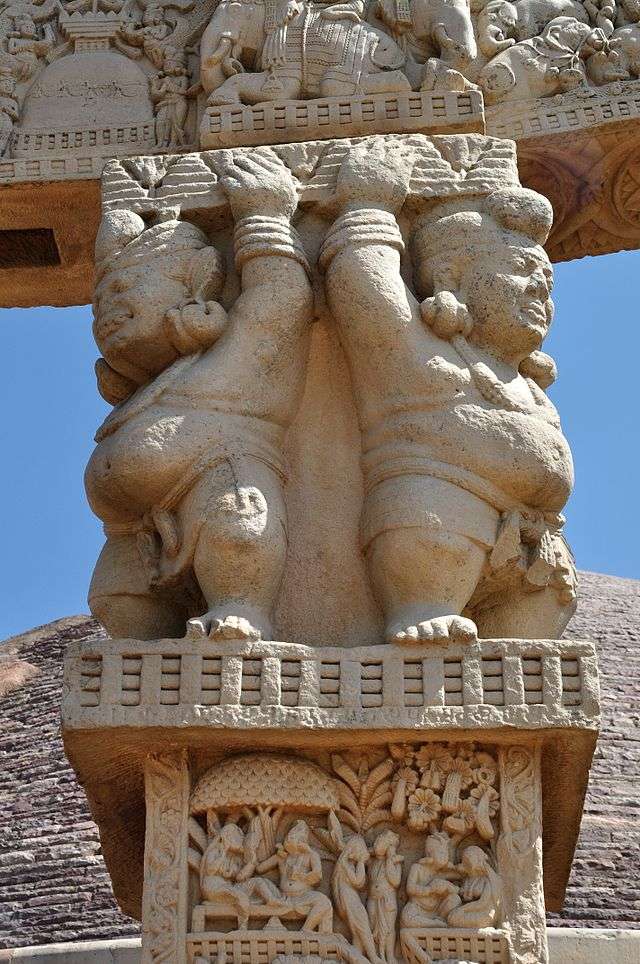
Yakşas or Yakshas (Ch: Yecha, 夜叉) appear in Hindu, Jain, and Buddhist scriptures as the assistants or protectors of divine beings. They are possessed of great magical powers and can do anything from flying to shape-changing (Dalal, 2014, p. 470; Buswell & Lopez, 2014, p. 1018). These nature spirits are often depicted in early religious art as portly dwarves (fig. 5), an element of iconography that they share with Vamana, the fifth avatar of the supreme deva Vishnu. This connection is important because the avatar is celebrated for his ability to eclipse the universe. According to Hindu mythology, Vishnu takes the form of the dwarf Brahmin when a benevolent asura named Mahabali wrestles control of the cosmos from the gods. Vamana visits the king during a great sacrifice, during which the asura grants gifts, and humbly requests only as much land as he can cover in three strides. But when his wish is granted, the deceptively small priest grows to cosmic proportions, “mightily waxing, swelling in every limb, with his first stride stepp[ing] beyond the sun and moon, with his second reach[ing] the limits of the universe, and with his third return[ing] to set his foot on the head of the conquered foe” (Zimmer & Campbell, 1992/1946, p. 132). With his feat (pun intended), Vishnu regains control of heaven (step one) and earth (step two), while simultaneously banishing the asura to the underworld (step three) (Dalal, 2014, p. 442).

Fig. 5 – A detail of chubby Yakshas from the western gateway of Stupa 1 at Sanchi (1st-cent.) (larger version). Image from here.

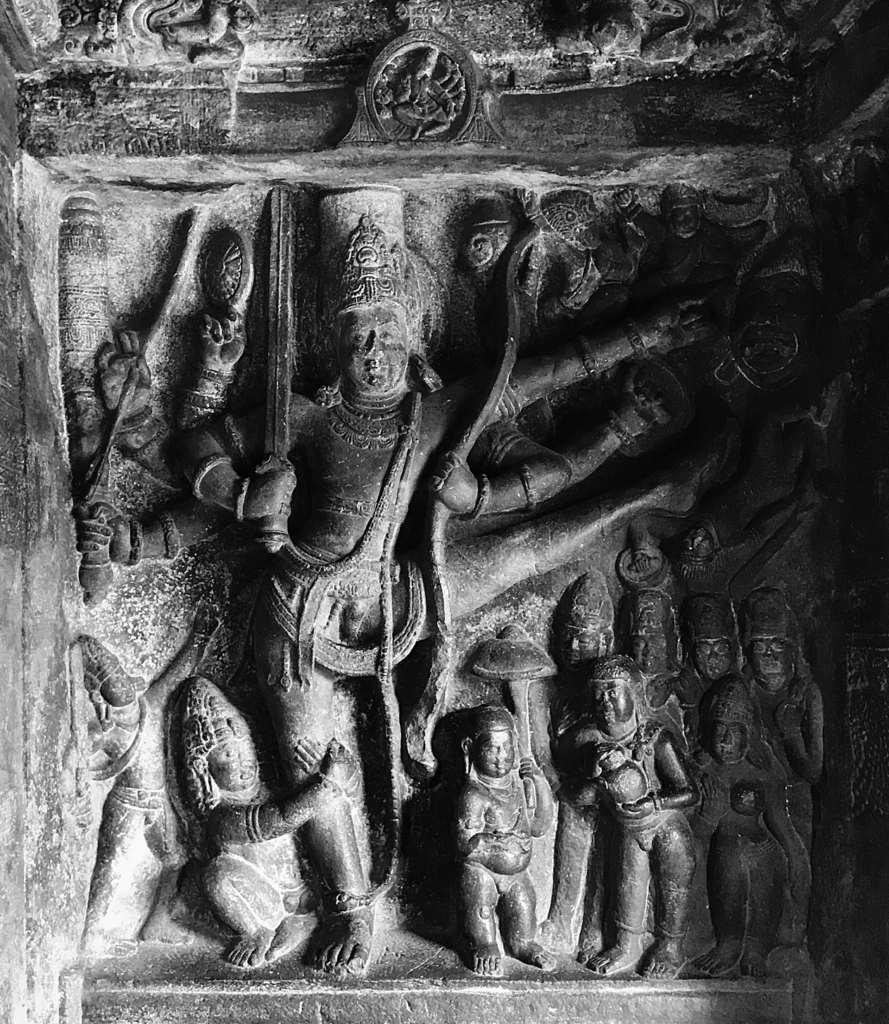
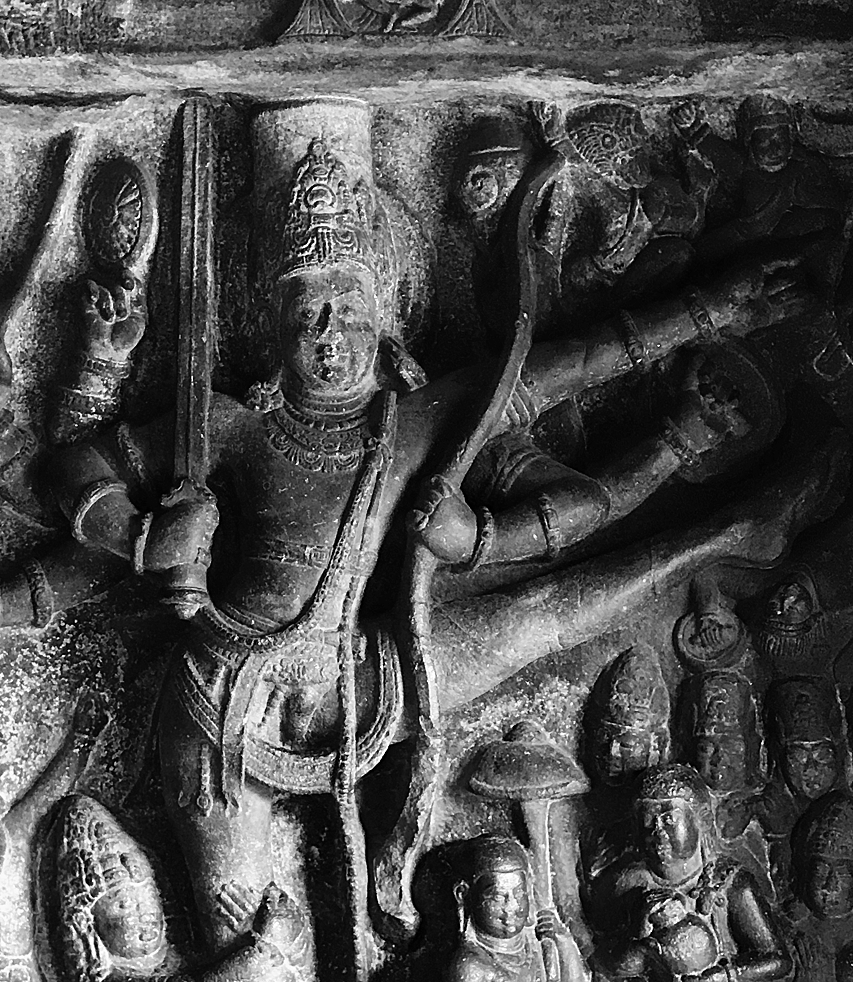
The noted art historian Heinrich Zimmer comments sculptures based on this story fall under a category of representationally kinetic art that he calls the “Phenomenon of Expanding Form” (Zimmer & Campbell, 1992/1946, p. 130). One cited example is the Trivikrama Vishnu (lit: “three steps” Vishnu), a sixth-century Badami cave number two relief (fig. 6) which presents a continuous narrative of the dwarf (fig. 7) growing to become the cosmic giant, the latter’s leg kicking high above his waist (fig. 8), symbolizing his mighty, universe-spanning strides. Though the piece is carved in stone, the dynamic nature of the composition gives it a feeling of swelling energy (Zimmer & Campbell, 1992/1946, p. 132).

The carving portrays the cosmic giant holding all manner of weapons, including a club, a sword, a bow, and a chakram, all of which are attributes of Vishnu (Dalal, 2014, p. 460).

badami vamana carving (total for blog)

Fig. 6 – The Trivikrama Vishnu relief carving of Vamana’s story, Badami cave number two (sixth-cent.) (larger version). Fig. 7 – A detail of the dwarf Brahmin holding a parasol (larger version). Fig. 8 – A detail of the cosmic giant holding celestial weapons and taking a supernaturally large stride (larger version). Adapted from this image.

The close association of the Yaksha and Vamana with a short, chubby body and shape-changing powers no doubt influenced the former to take on the latter’s ability to grow to huge proportions. In addition, after being absorbed into Buddhism, Yakshas are portrayed in scripture as divine warriors wielding clubs in defense of the dharma. Two prominent examples are Kubera (a.k.a. Vaisravana) and Vajrapani, both of whom are touted as the yaksha commander (Lutgendorf, 2007, p. 42; Buswell & Lopez, 2014, pp. 449 and 955). This surely influenced the later Chinese image of yakshas as club-wielding titans, such as the cited example from The Story. In turn, this and related material could have easily influenced the cosmic transformations of Monkey and other characters and their weapons from Journey to the West.

4. Conclusion

The novel describes Monkey taking on a giant cosmic form in chapters three, six, and sixty-one, the first time showing off his magic powers to his children and the second and third in response to the respective titanic transformations of Erlang and the Bull King. The magical spell used to achieve this form, titled Fatian Xiangdi (the “Method of modeling Heaven on Earth”), is based on ancient Pre-Qin and Han concepts of astral-geography later used in the construction of imperial Chinese cities. The idea of Sun’s body parts mirroring aspects of heaven and earth recalls the myth of the primordial god Pangu, whose body parts became the very building blocks of the cosmos after his death.

The cited episodes demonstrate that the characters involved transform both their bodies and weapons. Apart from being described as a 104,300-foot (31,800 m)-tall juggernaut with a head like Mt. Tai, Monkey’s staff is said to inhabit the upper and lowermost reaches of the universe (“its top reached the thirty-third Heaven and its bottom the eighteenth layer of Hell”) or that it resembles “the Heaven-supporting pillar on top of Mount Kunlun.” Likewise, Erlang’s three-pointed polearm is said to resemble “the peaks that cap the Hua Mountain.” Such transformations are predicted, for example, by an episode in the thirteenth-century precursor of Journey to the West in which Sun changes a monk’s staff into a gigantic Yaksha wielding a club.

While Yakshas are portrayed in early South Asian religious art as chubby dwarves, they most likely gained the ability to grow to enormous sizes thanks to iconographic similarities to Vamana, the fifth avatar of Vishnu famed for traversing the cosmos in three mighty steps. One sixth-century stone carving of the story portrays the dwarf-turned-cosmic giant wielding all sorts of celestial weapons. Additionally, Buddhist scriptures would come to portray yakshas as club-wielding warriors. Therefore, we can see how Monkey’s cosmic transformation could have ultimately been influenced by Hindu and Buddhist religious material.


5. Updates

Update: 10-17-21

Monkey also takes on his cosmic form in chapter 97. The episode calls it his “huge magic body” (da fa shen, 大法身). Read here for more information.

Watch Your Step: The Influence of Journey to the West on the “Ashiarai Yashiki” Yokai Story of Edo-Period Japan


Update: 08-06-22

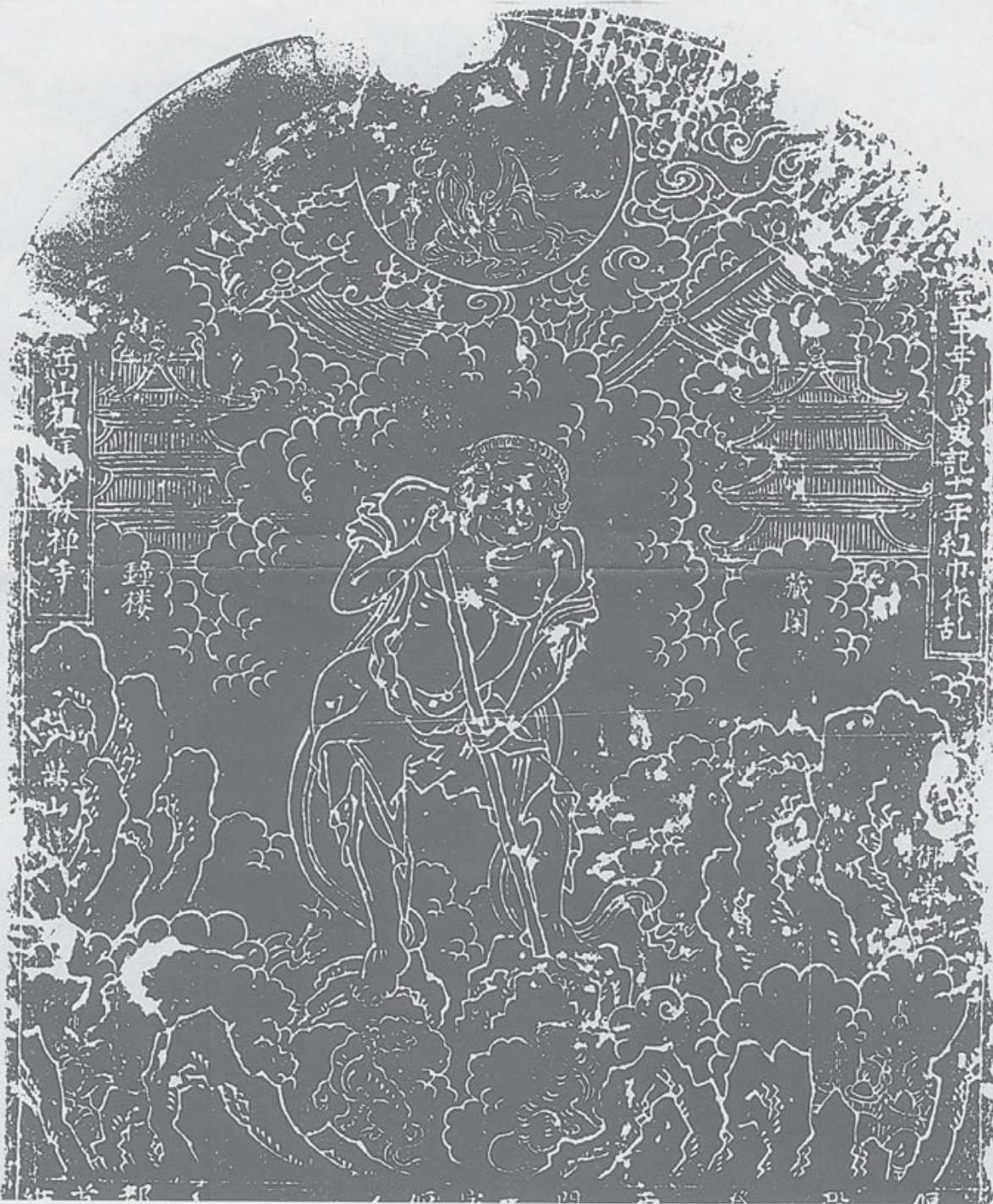
Sun Wukong’s cosmic body likely influenced Shaolin Monastery myth. The yaksha-bodhisattva Vajrapāni was historically worshiped as the progenitor of their famous staff method. A stele erected by Shaolin abbot Wenzai in 1517 shows that the deity’s vajra-club had been changed to a Chinese staff (fig. 9) (Shahar, 2008, p. 84). Vajrapāni’s Yaksha-like Nārāyana (Naluoyan(tian), 那羅延(天)) form was eventually equated with one of the four staff-wielding “Kimnara Kings” from the Lotus Sutra in 1575. His name was thus changed from Nārāyana to “Kimnara King” (Jinnaluo, 緊那羅) (Shahar, 2008, p. 87). One version of the story about his creation of the staff method takes place during the Yuan Dynasty‘s Red Turban Rebellion. Bandits lay siege to the monastery, but it is saved by a lowly kitchen worker wielding a long fire poker as a makeshift staff. He leaps into the oven and emerges as a monstrous giant tall enough to straddle both Mount Song and the imperial fort atop Mount Shaoshi, which are five miles (8.046 km) apart. The bandits flee when they behold this staff-wielding titan. The Shaolin monks later realize that the kitchen worker was none other than the Kimnara King in disguise (Shahar, 2008, pp. 87-88). Shahar (2008) suggests that mythical elements of the story were borrowed from the Monkey King’s adventures. He compares the worker’s transformation in the stove with Sun’s time in Laozi’s Eight Trigrams furnace (Bagua lu八卦爐), their use of the staff, and the fact that Monkey and his weapon can both grow to gigantic proportions (Shahar, 2008, p. 109). [4]

The aforementioned stele was erected in 1517, showing that Monkey’s cosmic body predates the standard 1592 edition of the novel.

Fig. 4 – The 1517 Shaolin stele showing a titanic Vajrapāni defending the monastery from rebels (larger version). From Shahar, 2008, p. 84.


Update: 04-04-24

In chapter 14, Sun Wukong lists a number of his powers, including the ability to grow as big as the cosmos:

“I, old Monkey, possess the ability to subdue dragons and tame tigers, and the power to overturn rivers and stir up oceans. I can look at a person’s countenance and discern his character; I can listen merely to sounds and discover the truth. If I want to be big, I can fill the universe; if I want to be small, I can be smaller than a piece of hair (emphasis added). In sum, I have boundless ways of transformation and incalculable means of becoming visible or invisible (Wu & Yu, 2012, vol. 1, p. 311).

我老孫頗有降龍伏虎的手段,翻江攪海的神通;見貌辨色,聆音察理;大之則量於宇宙,小之則攝於毫毛;變化無端,隱顯莫測

This might imply that the aforementioned “ten thousand zhang” (wanzhang, 萬丈; 104,300 ft or 31,800 m) number is instead meant to be a metaphor for a much larger height, one that would fill the universe.

Notes:

1) Here, Anthony C. Yu’s English translation says Monkey grows to be “ten thousand feet tall.” However, the original Chinese source reads “萬丈” (wanzhang), wan meaning 10,000 and zhang being a measure designating ten Chinese feet (10,000 x 10 = 100,000). Therefore, I have changed the source to read “ten thousand zhang.

2) Yu’s translation reads “eight hundred.” But, again, the original source is different. It reads “八百丈” (babai zhang), or 800 x 10 Chinese feet = 8,000. This makes more sense as he is said to be 10,000-plus feet long.

3) While the city is square, it has eleven gates, which legend states correspond to the three heads, six arms, and two legs of the god. For more information, see Chan (2008).

4) Yes, this information comes from Wikipedia, but I’m the one who originally added it under the screenname “Ghostexorcist.” See this edit history, for example.

Sources:

Chan, H. (2008). Legends of the Building of Old Peking. Seattle: University of Washington Press.

Dalal, R. (2014). Hinduism: An Alphabetical Guide. New Delhi, India: Penguin Books.

Lutgendorf, P. (2007). Hanuman’s Tale: The Messages of a Divine Monkey. Oxford: Oxford University Press.

Buswell, R., & Lopez, D. (2014). The Princeton Dictionary of Buddhism. Princeton University Press.

Shahar, M. (2008). The Shaolin Monastery: History, Religion, and the Chinese Martial Arts. Honolulu: University of Hawai’i Press.

Stevens, K. G. (1997). Chinese Gods: The Unseen World of Spirits and Demons. London: Collins & Brown.

Wivell, C.S. (1994). The Story of how the Monk Tripitaka of the Great Country of T’ang brought back the Sūtras. In Mair, Victor H. The Columbia Anthology of Traditional Chinese Literature (pp. 1181-1207). New York: Columbia University Press.

Wu, C., & Yu, A. C. (2012). The Journey to the West (Vols. 1-4) (Rev. ed.). Chicago, Illinois: University of Chicago Press.

Zimmer, H. R., & Campbell, J. (1992). Myths and Symbols in Indian Art and Civilization. Princeton, New Jersey: Princeton University Press. (Original work published 1946)

Sun Wukong’s Strength-Bestowing Ritual

Last updated: 05-15-2025

In chapter 88 of Journey to the West (Xiyouji, 西遊記, 1592), the pilgrims arrive in the lower Indian prefecture of Jade Flower District (Yuhua xian, 玉華縣), which strikes Tripitaka as a spitting image of the Tang Chinese capital of Chang’an. There, the disciples’ monstrous appearance rouses the local ruler’s three sons to action against what they think are demons come to harm their father. However, they soon learn Monkey, Pigsy, and Sandy are celestial warriors possessing magical versions of their mere earthly arms—two staves and a battle rake. The three princes are later accepted as disciples, the oldest wanting to learn Monkey’s techniques and the second and third oldest wanting to learn from Pigsy and Sandy in turn. But when they fail to lift the monks’ celestial weapons, Monkey performs an arcane ritual in which he bestows each prince with superhuman strength:

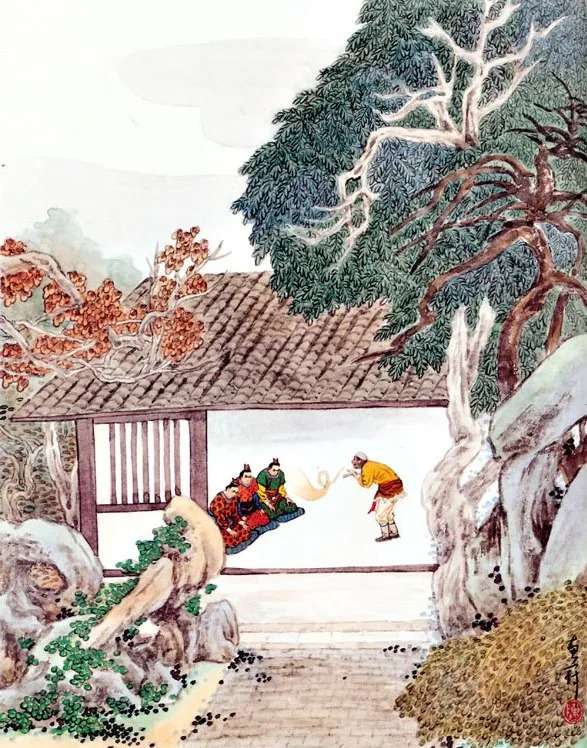
In a secluded room behind the Gauze-Drying Pavilion, Pilgrim traced out on the ground a diagram of the Big Dipper. Then he asked the three princes to prostrate themselves inside the diagram and, with eyes closed, exercise the utmost concentration. Behind them he himself recited in silence the true sayings of realized immortality and intoned the words of Dharani as he blew divine breaths into their visceral cavities. Their primordial spirits were thus restored to their original abodes. Then he transmitted secret oral formulas to them so that each of the princes received the strength of tens of thousands of men. [1] He next helped them to circulate and build up the fire phases, as if they themselves were carrying out the technique for shedding the mortal embryo and changing the bones. Only when the circulation of the vital force had gone through all the circuits of their bodies (modeled on planetary movements) did the young princes regain consciousness. When they jumped to their feet and gave their own faces a wipe, they felt more energetic than ever. Each of them, in fact, had become so sturdy in his bones and so strong in his ligaments that the eldest prince could handle the golden-hooped rod, the second prince could wield the nine-pronged muckrake, and the third prince could lift the fiend-routing staff (Wu & Yu, 2012, vol. 4, pp. 202-203).
行者才教三個王子都在暴紗亭後,靜室之間,畫了罡斗。教三人都俯伏在內,一個個瞑目寧神。這裡卻暗暗念動真言,誦動咒語,將仙氣吹入他三人心腹之中,把元神收歸本舍。傳與口訣,各授得萬千之膂力,運添了火候,卻像個脫胎換骨之法。運遍了子午周天,那三個小王子方才甦醒,一齊爬將起來,抹抹臉,精神抖擻,一個個骨壯筋強:大王子就拿得金箍棒,二王子就掄得九齒鈀,三王子就舉得降妖杖。

Table of Contents

I. Explanation

1. “Pilgrim traced out on the ground a diagram of the Big Dipper.”

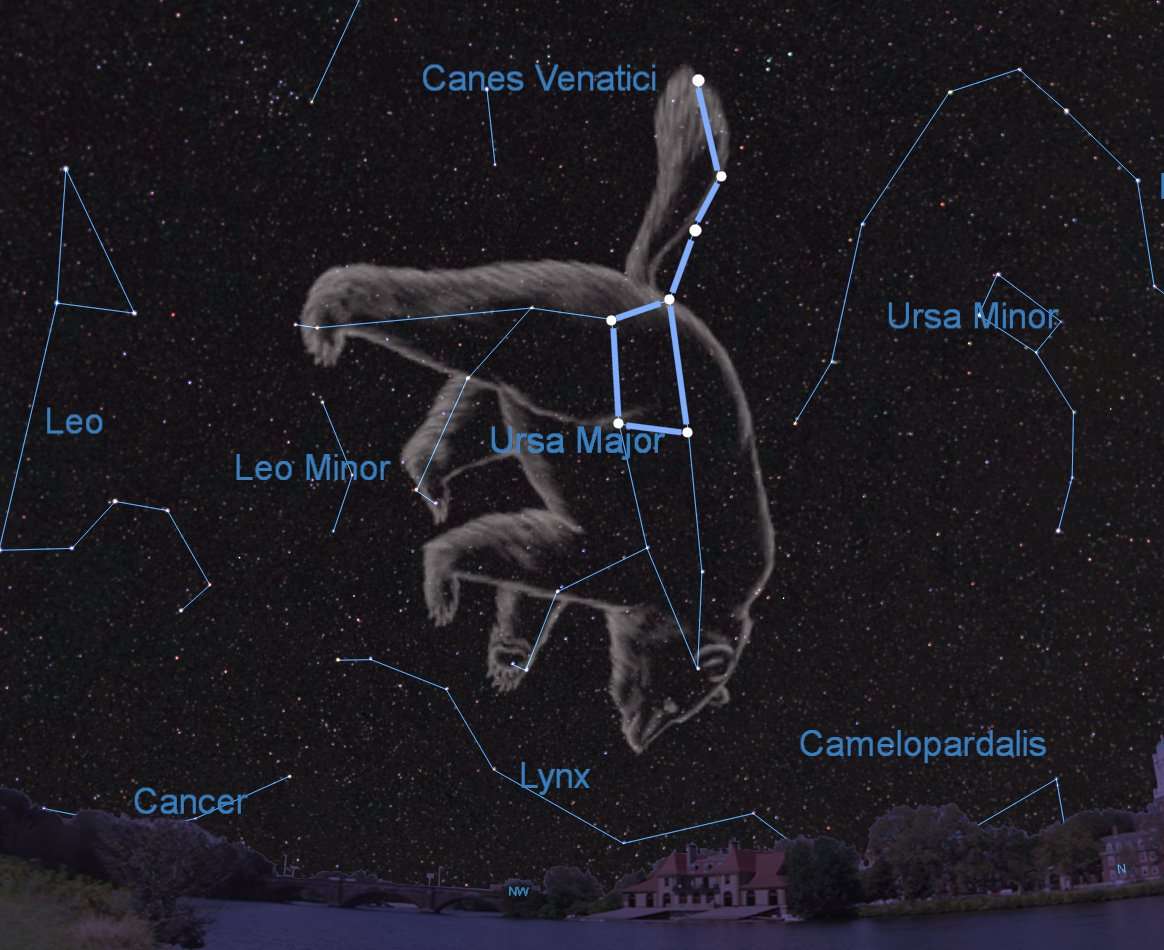
The Big Dipper (gangdou, 罡斗), also known as the Northern Dipper (beidou, 北斗), is a pattern of seven stars associated with the constellation Ursa Major (fig. 1). Daoism considers the pole star of this pattern to be the center of the cosmos through which emanates “primordial breath” (generative qi), which has long been deified as the great god Taiyi. The constellation is associated with a Daoist ritual known as Bugang (步綱/罡, “Walking the Guideline”) in which a practitioner paces the Big Dipper pattern with their feet on the ground. This ritual dance is synonymous with the much older shamanistic Yubu (禹步, “Paces of Yu”) used by ancient Sage Kings to conquer primordial chaos by pacing the stars and planets into motion, thereby directing the seasons and passage of time. The ritual involved pacing an inwardly spiraling circular pattern while dragging one foot behind the other in imitation of the limp adopted by Yu the Great after over-exerting himself quelling the fabled World Flood (fig. 2). Later Daoists viewed Yubu as a means of gaining immortality because the limping, three pace-style walking pattern symbolized the practitioner spanning the three realms of Earth, Man, and finally Heaven (this has an interesting Vedic correlation). [2] But most importantly, by the Tang and Song dynasties, Bugang served the purpose of purifying the area before an altar, ensuring the liturgy to follow takes place in a consecrated space. In fact, some sources interchange the characters for Bugang with the homonyms 布剛, meaning “distributing strength,” which denotes the demonifugic properties of the dance (Andersen, 1989). Therefore, Monkey draws the Big Dipper talisman on the ground in order to create a sacred space free of any negative influences.

Fig. 1 (left) – The location of the Big Dipper in relation to the Ursa Major constellation (larger version). Originally from this Futurism article. Fig. 2 (right) – A diagram showing the inwardly spiraling pattern of Yubu (top) and the dipper pattern of Bugang (bottom) (larger version). Take note of the spiral’s limping, three pace-style walking pattern. Originally found on this WordPress article.  

2. “Then he himself recited in silence the true sayings of realized immortality and intoned the words of Dharani…”

The “true sayings” (zhenyan, 真言) is the Chinese term for mantra, meaning “spell” or “magical formula.” A mantra is “a syllable or series of syllables that may or may not have semantic meaning, most often in a form of Sanskrit, the contemplation or recitation of which is thought to be efficacious” (Buswell & Lopez, 2014, p. 529). The most famous mantra is of course Om Mani Padme Hum, the very same six-syllable prayer that was used to weigh down the mountain holding Monkey prisoner for rebelling against heaven.

The “true sayings” is often used as an abbreviation for Dharani (tuoluoni/zongchi, 陀羅尼/總持), a Sanskrit term meaning “mnemonic device” (fig. 3). Like mantras, dharani are comprised of syllables, but these instead serve to remind practitioners of broader concepts, for example a single syllable representing the first letter of a much longer phrase. There exists four types of dharani said to be used by Bodhisattvas to achieve enlightenment: 1) those used for teaching interpretations of Buddhist law; 2) those used for understanding the exact meaning of important words; 3) those used for casting spells; and 4) those used for spiritual endurance in the face of suffering (Buswell & Lopez, 2014, pp. 241-242). The third type, which concerns us, falls under a category of sutra recitation called Paritta (minghu/jing, 明護/經), which is Pali for “protection.” The historical Buddha is known to have delivered paritta verses, including those for “protection from evil spirits, the assurance of good fortune, exorcism, curing serious illness, and even safe childbirth” (Buswell & Lopez, 2014, p. 630).

In both cases zhenyan/mantra and dharani refer to magical formulas of sorts and were no doubt chosen because they gave the ritual an heir of arcane authenticity. Additionally, I suggest that the use of dharani may have also been chosen to denote a spell of protection, as in Sun wanted to protect the princes during the transformation of their bodies.

(Note 06-15-19: Feng Dajian of Nankai University notified me via Twitter that he disagrees with Anthony C. Yu’s 2012 revised translation (cited above) associating the “True Sayings” with the Buddhist Dharani. This is because he feels that the ritual is overtly Daoist, noting that the religion also has its own True Sayings.)

Fig. 3 – A Dharani print from the late Tang Dynasty. Original from Wikicommons.

3. “…as he blew divine breaths into their visceral cavities. Their primordial spirits were thus restored to their original abodes.”

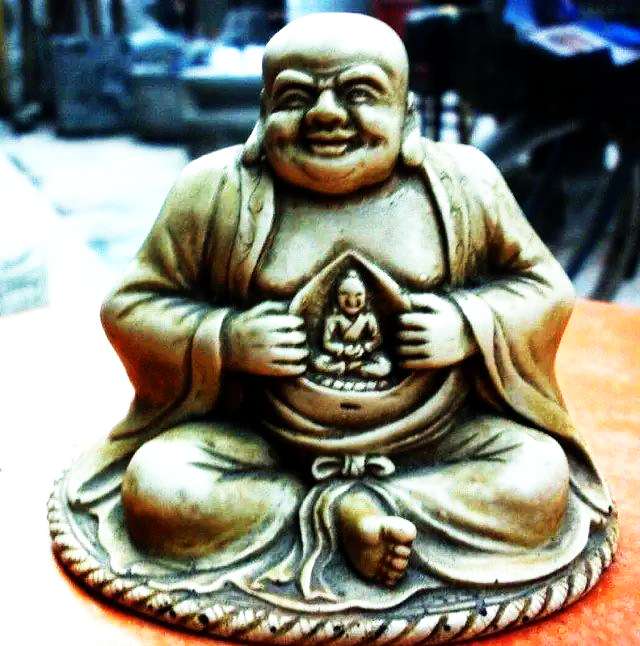
Journey to the West translator Anthony C. Yu (Wu & Yu, 2012) notes that this section “is an abbreviated or paraphrastic account, in fact, of the neidan (internal or physiological alchemy process)” (vol. 4, p. 396, n. 8). Monkey already went through this process in chapter two when he practiced a series of breathing and energy circulation exercises that resulted in his immortality. Therefore, he uses his own hard-won “divine breath” or “immortal energy” (xianqi, 仙氣) to fortify the princes’ bodies by drastically speeding up the years-long process of internal cultivation to only a matter of hours or minutes. Monkey’s breath bolsters their own energy, helping them to achieve “primordial spirits” (yuanshen, 元神), a term commonly associated with Buddhahood or enlightenment. In Daoism, the term is synonymous with the attainment of immortality via the formation of a “Sacred Embryo” (Shengtai, 聖胎) (fig. 4), which is forged from spiritual energies over long years of self-cultivation (Darga, 2008). This suggests that beyond super strength, the ritual also gives them some form of immortality.

Fig. 4 – The Sacred Embryo is sometimes depicted as a baby (or in this case a Buddha) on a practitioner’s stomach (larger version). Found on this blog.

4. “He next helped them to circulate and build up the fire phases…”

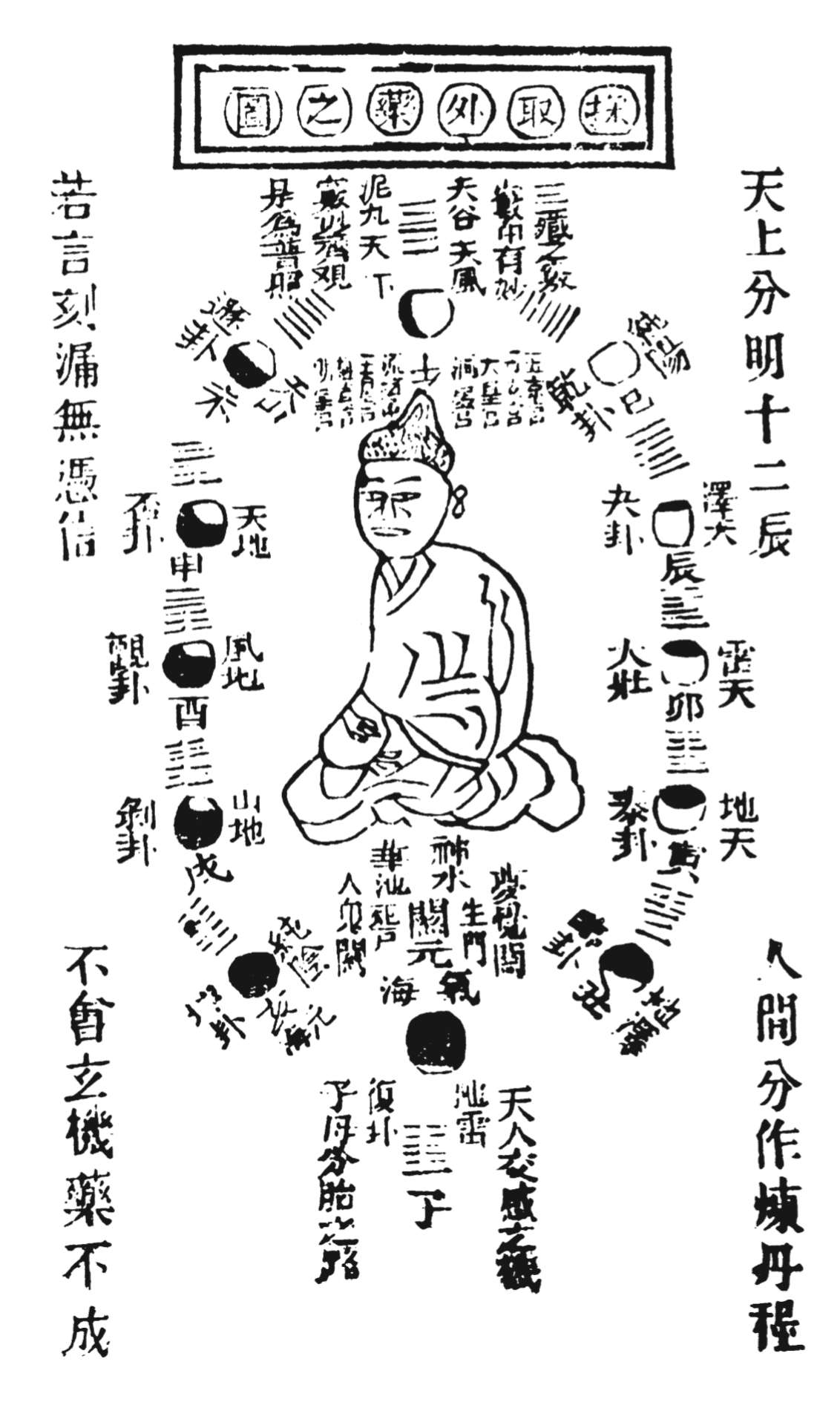
The fire phases (huohou, 火候) comprise the process of circulating spiritual energy throughout the body at prescribed times (fig. 5). Monica Esposito (2008) writes that there are three phases in total, making up two distinct periods of activity and rest:

The first is a phase of “yangization” in which Yang augments and Yin decreases. This is described as a warlike or martial period, corresponding to the advancement of a light called Martial Fire (wuhuo 武火) or Yang Fire (yanghuo 陽火) that purifies by burning and eliminates defiled elements to release the Original Yang and increase it. At the cosmic level, the beginning of this phase is symbolized by the winter solstice (zi 子) and by the hexagram fu 復 ䷗ (Return, no. 24), which indicates the return of Yang. This is followed by a phase of balance, a time of rest called muyu ([沐浴] ablutions). At the cosmic level, this phase is symbolized by the spring and autumn equinoxes and by the hexagrams dazhuang 大壯 ䷡ (Great Strength, no. 34) and guan 觀 ䷓ (Contemplation, no. 20). The third stage is a phase of “yinization” in which Yin augments and Yang decreases. This period, called Civil Fire (wenhuo 文火) or Yin Fire (yinfu 陰符), corresponds to a decrease of the light. The adept achieves the alchemical work spontaneously and without any effort or voluntary intervention; water descends to moisten, fertilize, and temper fire. At the cosmic level, this phase is symbolized by the summer solstice (wu 午) and by the hexagram gou 姤 ䷫ (Encounter, no. 44) (p. 531).

Mastering the complicated chronological rhythm of this process is considered the best kept secret of internal alchemy (Esposito, 2008). Therefore, Monkey navigates this temporal maze for the princes, ensuring the spiritual energy that he has helped them cultivate ebbs and flows when prescribed. Once again we see that Sun has sped up a lengthy process to only a few days, hours, or minutes.

Fig. 5 – A chart showing the fire phases, the 12 phases of the moon, and the corresponding hexagrams (larger version). From Kim, 2008, p. 528.

II. Similarities to Comic Book Heroes

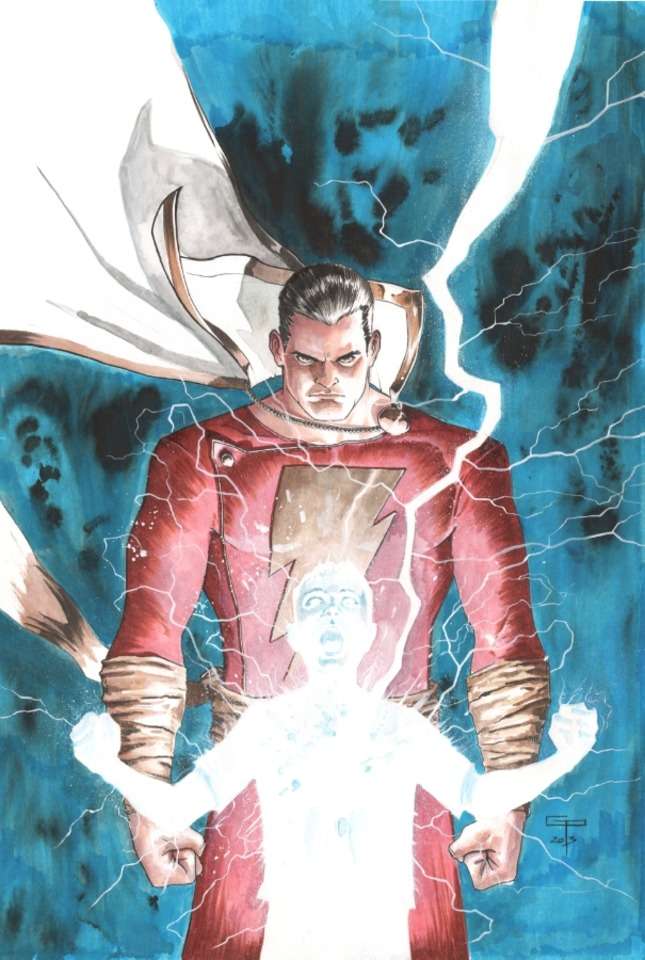
The princes in essence become the fantasy equivalent of today’s comic book superheroes. Gaining power from a divine being is similar to the concept of “Divine Empowerment” from DC Comics. A good example is Billy Batson, a.k.a. Captain Marvel (Ch: Jingqi duizhang, 驚奇隊長) (fig. 6), a child-turned-adult who receives super strength and other powers from a battery of Western gods and sages through the medium of a divine wizard.

4139607-160

Fig. 6 – The child Billy Batson transforming into the superhero Captain Marvel, also known as Shazam (larger version). Image found here.

III. Conclusion

This fascinating strength-bestowing ritual draws on multiple aspects of Buddho-Daoist ceremony and internal alchemy. First, Sun chooses a secluded room where he traces a diagram of the Big Dipper on the floor in order to consecrate the space. Second, he recites magical spells likely intended to protect the princes during their bodily transformation. Third, Monkey uses his own divine breath to ignite their spiritual energy, manually fanning the flames to higher levels of spiritual attainment. Finally, he controls the ebb and flow of the resulting energy throughout their bodies according to a prescribed chronological rhythm. In all, Sun shortens a years-long process to only a few days, hours, or minutes. The princes come away from the ritual with superhuman strength and likely some form of divine longevity.

This whole process reminds me of the DC Comics character Billy Batson receiving divine powers through the medium of the Wizard Shazam to become Captain Marvel.


IV. Updates

Update: 12-14-19

This is a past photomanipulation that depicts Monkey as the Wizard Shazam and the three Indian Princes as Captain Marvel. I used a golden age comic book image as the base (fig. 7).

Fig. 7 – The photomanipulation mixing Journey to the West and Captain Marvel (larger version). The original comic book image can be seen here.


Update: 07-17-22

I’ve posted an article that explores the abilities of Monkey’s immortal breath (used in the ritual above).

A Survey of Sun Wukong’s Magic “Immortal Breath” and Its Abilities


Update: 03-18-23

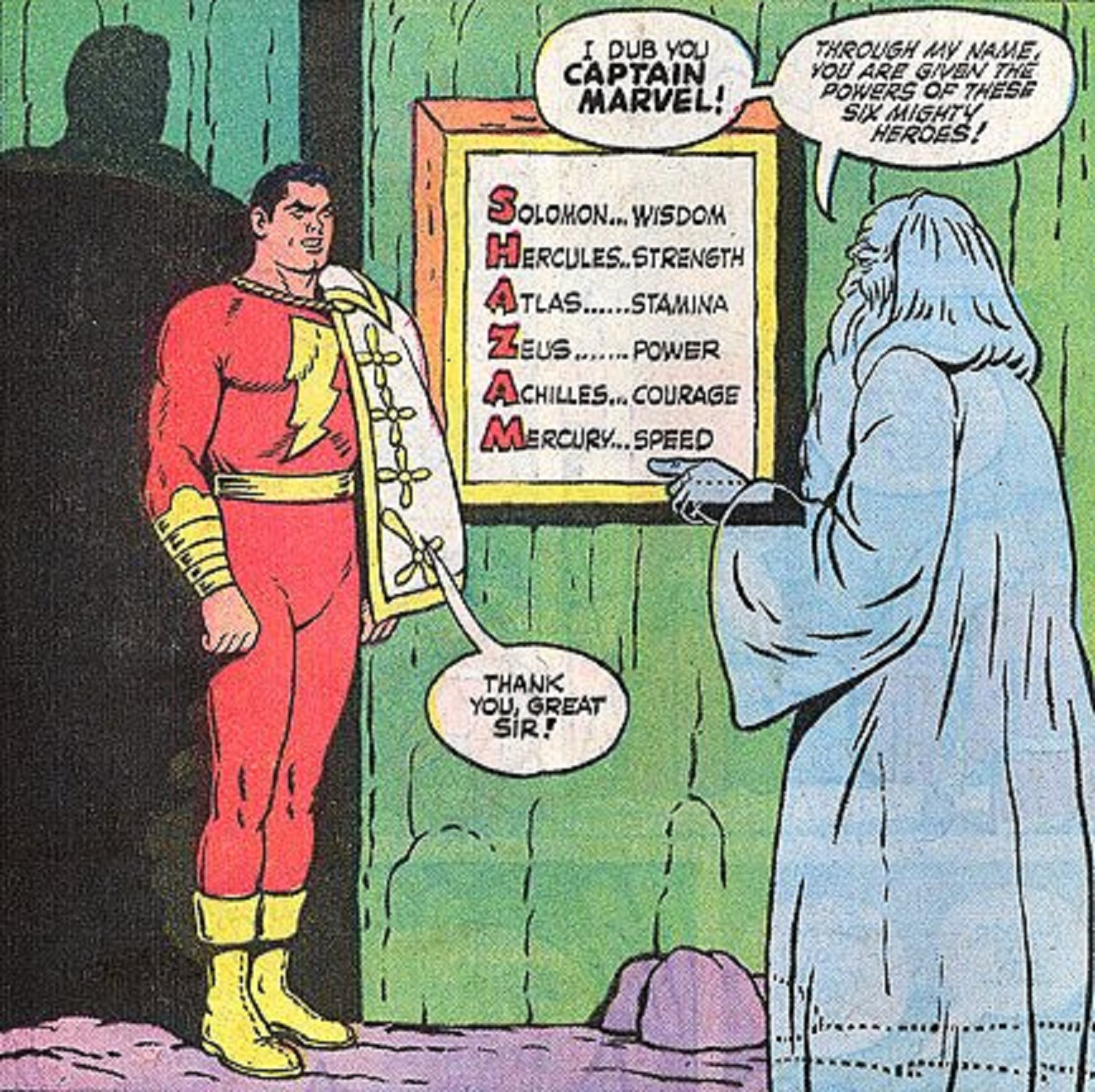
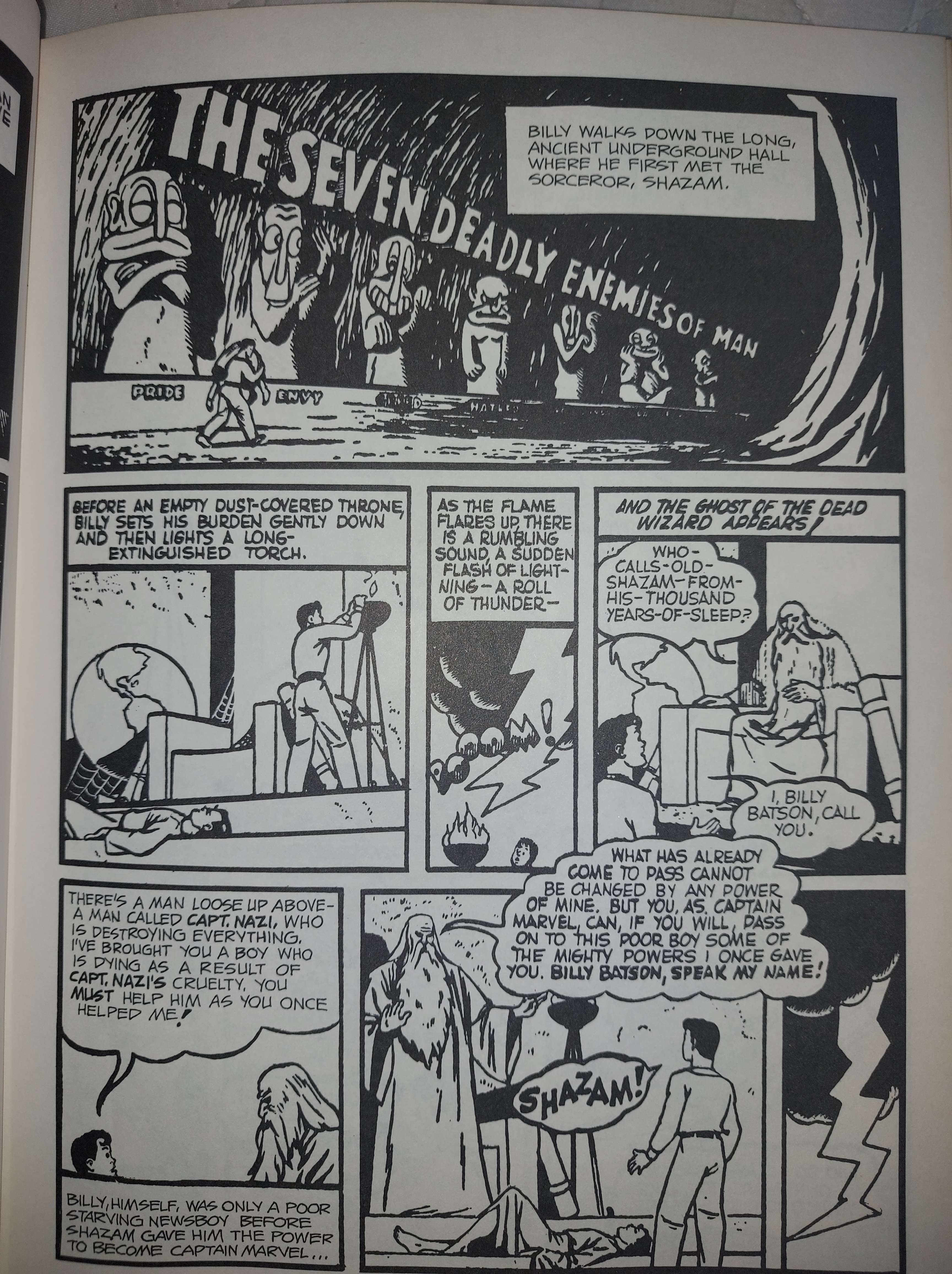
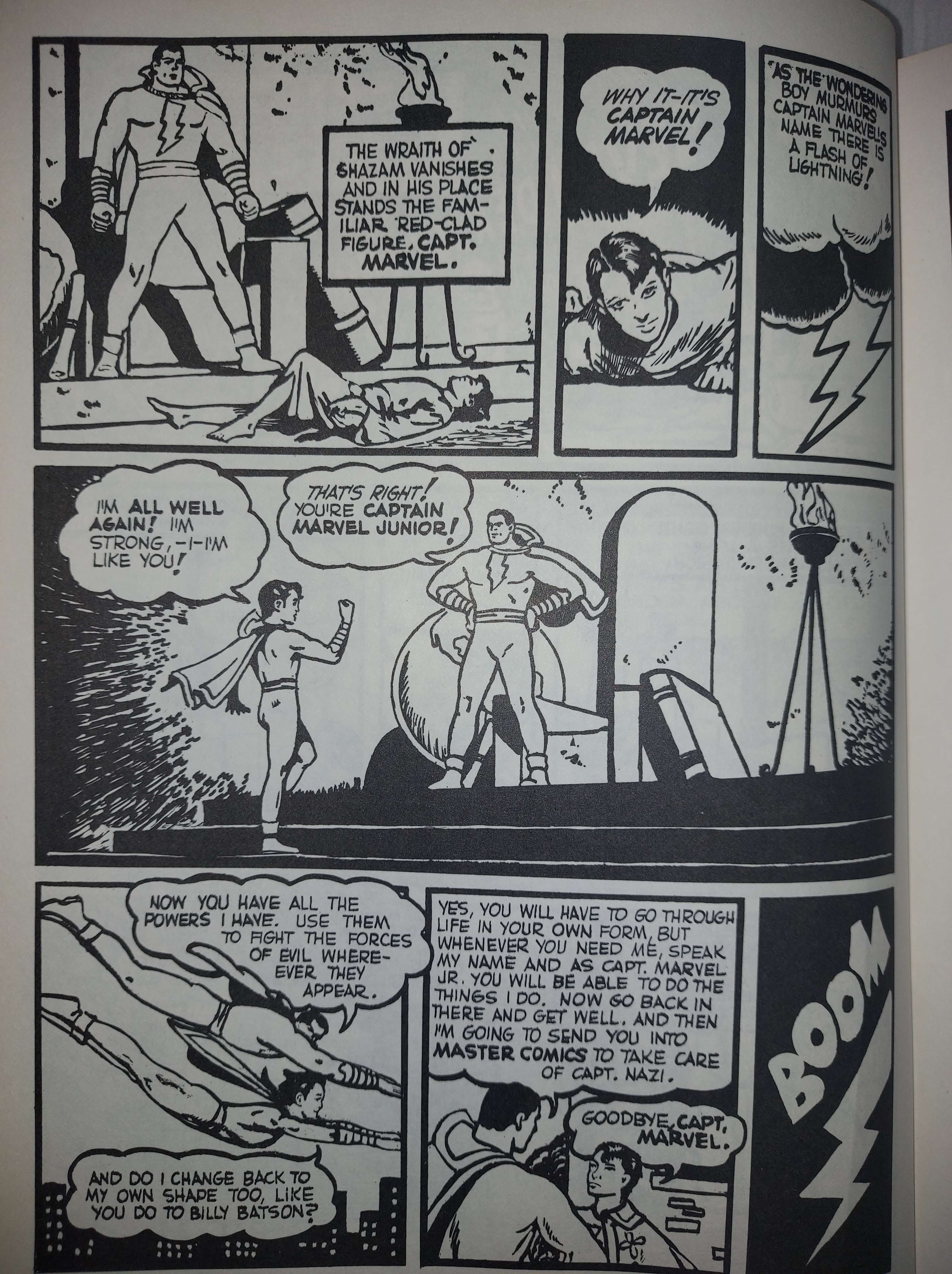
Above, I referenced Captain Marvel because he receives divine powers similar to the Indian Princes from Journey to the West. Well, the hero is also capable of sharing his abilities just like Sun Wukong! One issue sees him save the life of a fatally injured boy by giving him some of his magic energy, thereby transforming him into a superhero. The boy is henceforth known as “Captain Marvel Jr.” (Ch: Xiao shengqi duizhang, 小神奇隊長) in his hero form (fig. 8-10) (Binder et. al., 1977, pp. 57-59).

Fig. 8 (left) – Billy Batson (a.k.a. Captain Marvel) seeks help from Shazam to save the boy (larger version). Fig. 9 (center) – Captain Marvel shares some of his power, thus saving the boy (larger version). Fig. 10 (right) – The boy-turned-superhero vows to fight evil (larger version).


Update: 12-02-23

Someone recently asked me why the monstrous pilgrims would take human disciples in the first place. Well, this is the result of a sequence of events:

  • The young princes are amazed to see Sun, Zhu, and Sha display their martial arts skills while flying on divine clouds (fig. 11).
  • They tell their father, the sovereign prince, that they want to become their students, claiming it would allow them to protect their nation.
  • The monarch asks Tripitaka for permission, and he agrees.
  • The sovereign prince then personally requests that Sun, Zhu, and Sha tutor his sons in martial arts (Wu & Yu, 2012, pp. 197-199).

This seems straightforward enough, but there is an underlying answer that just dawned on me: everyone agrees, and Monkey goes a step further by empowering the princes (fig. 12), as a way of kissing the ruler’s butt since he stamped the group’s travel rescript, a kind of passport needed to legally travel through various countries (Wu & Yu, 2012, p. 193). Without the stamp, the pilgrims wouldn’t have been able to continue their journey to the Buddha’s mountain.

The humorous implication here is that even celestials have to bow to earthly bureaucracy. 

Fig. 11 (left) – The princes drop to their knees as they watch the three monstrous pilgrims display their supernatural martial skills (larger version). Image from the Qing-Period Color-Illustrated Complete Edition of Journey to the West (清彩繪全本西遊記, 2008). Fig. 12 (right) – Monkey empowers the princes with his divine breath (larger version). Image from Chen Huiguan’s Newly Illustrated and Complete Journey to the West (陈惠冠新绘全本西游记, 2001). Both images found here.

For future reference, this episode takes place towards the middle of ep. 23 of the 1986 JTTW TV show and the end of ep. 55 and the beginning of ep. 56 of the 2011 JTTW TV show. Both programs skip over the strength-bestowing ritual.


Update: 08-11-24

I have written a catalog of all of Sun Wukong’s abilities from all 100 chapters of JTTW. The strength-bestowing ritual appears on pages 194-195 (ch. 88, no. 3) of this PDF.

Archive #46 – A Catalog of the Monkey King’s Magic Powers and Skills


Update: 05-15-25

I forgot to mention above that although the princes can wield their teachers’ divine, multi-ton weapons after the ritual—an amazing feat for mortals to be sure—the weight is still too much for them to handle comfortably. This is why they request to make their own lighter replicas. Chapter 88 reads: 

When the old prince saw this [the princes wielding the divine weapons], he could not have been more pleased, and another vegetarian banquet was laid out to thank the master and his three disciples. Right before the banquet tables, however, they [the princes] began their instruction. The one studying the rod performed with the rod; the one studying the rake performed with the rake; and the one studying the staff performed with the staff. The princes thus succeeded in making a few turns and several movements, but they were, after all, mortals, and they found the goings rather strenuous. After exercising for a while, they began to pant heavily. Indeed, they could not last long, though their weapons might have the ability to undergo transformation. In their advances and retreats, their attacks and offenses, the princes simply could not attain the wonder of natural transformation. Later that day the banquet came to an end.

The next day the three princes came again to thank their masters and to say: “We thank the divine master for endowing us with strength in our arms. Though we are now able to hold the weapons of our masters, however, we find it difficult to wield and turn them. We propose, therefore, that artisans be asked to duplicate the three weapons. They will use your weapons as models but take some of the weight off. Would the masters grant us permission?” (Wu & Yu, 2012, vol. 4, p. 203)

老王見了,歡喜不勝。又排素宴,啟謝他師徒四眾。就在筵前各傳各授:學棍的演棍,學鈀的演鈀,學杖的演杖。雖然打幾個轉身,丟幾般解數,此等終是凡夫,有些著力:走一路,便喘氣噓噓,不能耐久。蓋他那兵器都有變化,其進退攻揚,隨消隨長,皆有自然之妙,此等終是凡夫,豈能以遽及也?當日收了筵宴。 

次日,三個王子又來稱謝道:「感蒙神師授賜了膂力,縱然掄得師的兵器,只是轉換艱難。意欲命匠依神師兵器式樣,減削斤兩,打造一般,未知師父肯容否?」

Pigsy takes the lead by granting their wish, but the three original weapons are unfortunately stolen by a fiend while in the custody of craftsmen (Wu & Yu, 2012, vol. 4, pp. 203-204). This eventually leads to a war with earthly and heavenly lion-spirits (see chapters 88 to 90).

After the day is saved, the replica weapons are completed. The end of chapter 90 reads:

In the meantime, the ironsmiths had finished forging the three weapons. As they kowtowed to Pilgrim [Monkey], they said, “Holy Father, our work is done.”

“What’s the weight of each of the weapons?” asked Pilgrim.

“The golden-hooped rod weighs a thousand catties,” replied one of the ironsmiths. “The nine-pronged rake and the fiend-routing staff both weigh eight hundred catties.” “All right,” said Pilgrim, and he asked the three princes to come out and pick up their weapons (based on Wu & Yu, 2012, vol. 4, pp. 229-230).

又見那鐵匠人等造成了三般兵器,對行者磕頭道:「爺爺,小的們工都完了。」問道:「各重多少斤兩?」鐵匠道:「金箍棒有千斤,九齒鈀與降妖杖各有八百斤。」行者道:「也罷。」叫請三位王子出來,各人執兵器。

One thousand catties (千斤) is 1,300.72 lbs or 590 kg, and 800 catties (八百斤) is 1,040.58 lbs or 472 kg.

This episode would be a great setup for a Game of Thrones-style Asian fantasy. The three princes could be plotting and scheming against each other in the hopes of one day gaining the throne from their aging father, the sovereign prince. Then a monkey wizard comes along and makes things worse by bestowing them with super strength and divine longevity. This would definitely lead to lots of drama between the brothers and their offspring. It would be a centuries-long battle royale between competing dynasties of superpowered beings!

Notes:

1) Although the original English translation reads “the strength of a thousand arms” (Wu & Yu, 2012, p. 202), the Chinese reads wanqian zhi luli (萬千之膂力), which means “the strength of tens of thousands (of men).” I have, therefore, adjusted the translation for more accuracy.

2) Andersen (2008) notes that the three paces are similar to those used by Vedic priests:

It would appear, in other words, that even in this early period the Paces of Yu constituted a close parallel to the three Strides Viṣṇu in early Vedic mythology, which are thought to have taken the god through the three levels of the cosmos (thereby establishing the universe), and which indeed, just like the Paces of Yu in Taoist ritual, are known to have been imitated by Vedic priests as they approached the altar—and in the same form as the Paces of Yu, that is, dragging one foot after the other (pp. 238-239).

Sources:

Andersen, P. (1989). The Practice of Bugang. Cahiers d’Extrême-Asie, 5. Numéro spécial Etudes taoïstes II / Special Issue on Taoist Studies II en l’honneur de Maxime Kaltenmark. pp. 15-53.

Andersen, P. (2008). Bugang. In F. Pregadio (Ed.), The Encyclopedia of Taoism (Vols. 1-2) (pp. 237-240). London [u.a.: Routledge].

Binder, O., Woolfolk, W., O’Neil, D., Parker, B., Maggin, E. S., & Bridwell, E. N. (1977). Shazam! From the Forties to the Seventies. New York: Harmony Books.

Buswell, R., & Lopez, D. (2014). The Princeton Dictionary of Buddhism. Princeton University Press.

Darga, M. (2008). Shengtai. In F. Pregadio (Ed.), The Encyclopedia of Taoism (Vols. 1-2) (pp. 883-884). London [u.a.: Routledge].

Esposito, M. (2008). Huohou: 2. Neidan. In F. Pregadio (Ed.), The Encyclopedia of Taoism (Vols. 1-2) (pp. 530-532). London [u.a.: Routledge].

Kim, D. (2008). Houhou: 1. Waidan. In F. Pregadio (Ed.), The Encyclopedia of Taoism (Vols. 1-2) (pp. 526-530). London [u.a.: Routledge].

Wu, C., & Yu, A. C. (2012). The Journey to the West (Vols. 1-4) (Rev. ed.). Chicago, Illinois: University of Chicago Press.

My Sun Wukong Art – “The Buddha has Awakened”

At the end of chapter 100, Tripitaka and his disciples are elevated in spiritual rank as a reward for their hardwon quest to retrieve scriptures from India. Pigsy becomes an altar cleaner, Sandy becomes a Luohan (Buddhist saint), and the priest and Sun both become Buddhas. This paragraph describes what the Buddha says to Monkey upon his ascension:

“Sun Wukong, when you caused great disturbance at the Celestial Palace, I had to exercise enormous dharma power to have you pressed beneath the Mountain of Five Phases. Fortunately your Heaven-sent calamity came to an end, and you embraced the Buddhist religion. I am pleased even more by the fact that you were devoted to the scourging of evil and the exaltation of good. Throughout your journey you made great merit by smelting the demons and defeating the fiends. For being faithful in the end as you were in the beginning, I hereby give you the grand promotion and appoint you the Buddha Victorious in Strife” [Dou zhangsheng fo, 鬥戰勝佛] (Wu & Yu, 2012, p. 381).

孫悟空,汝因大鬧天宮,吾以甚深法力,壓在五行山下,幸天災滿足,歸於釋教;。且喜汝隱惡揚善,在途中煉魔降怪有功,全終全始,加陞大職正果,汝為鬥戰勝佛。

Despite this promotion, Sun still dreads the magic golden headband might be used on him. But he soon learns the heaven-sent punishment has disappeared once he became an enlightened being, denoting the internalization of self-restraint:

As the various Buddhas gave praise to the great dharma of Tathagata, Pilgrim Sun said also to the Tang Monk, “Master, I’ve become a Buddha now, just like you. It can’t be that I still must wear a golden fillet! And you wouldn’t want to clamp my head still by reciting that so-called Tight-Fillet Spell, would you? Recite the Loose-Fillet Spell quickly and get it off my head. I’m going to smash it to pieces, so that that so-called Bodhisattva can’t use it anymore to play tricks on other people.”

“Because you were difficult to control previously,” said the Tang Monk, “this method had to be used to restrain you. Now that you have become a Buddha, naturally it will be gone. How could it be still on your head? Try touching your head and see.” Pilgrim raised his hand and felt along his head, and indeed the fillet had vanished (Wu & Yu, 2012, pp. 382-383).

諸佛讚揚如來的大法。

孫行者卻又對唐僧道:「師父,此時我已成佛,與你一般,莫成還戴金箍兒,你還念甚麼緊箍咒掯勒我?趁早兒念個鬆箍兒咒,脫下來,打得粉碎,切莫叫那甚麼菩薩再去捉弄他人。」唐僧道:「當時只為你難管,故以此法制之。今已成佛,自然去矣,豈有還在你頭上之理?你試摸摸看。」行者舉手去摸一摸,果然無之。

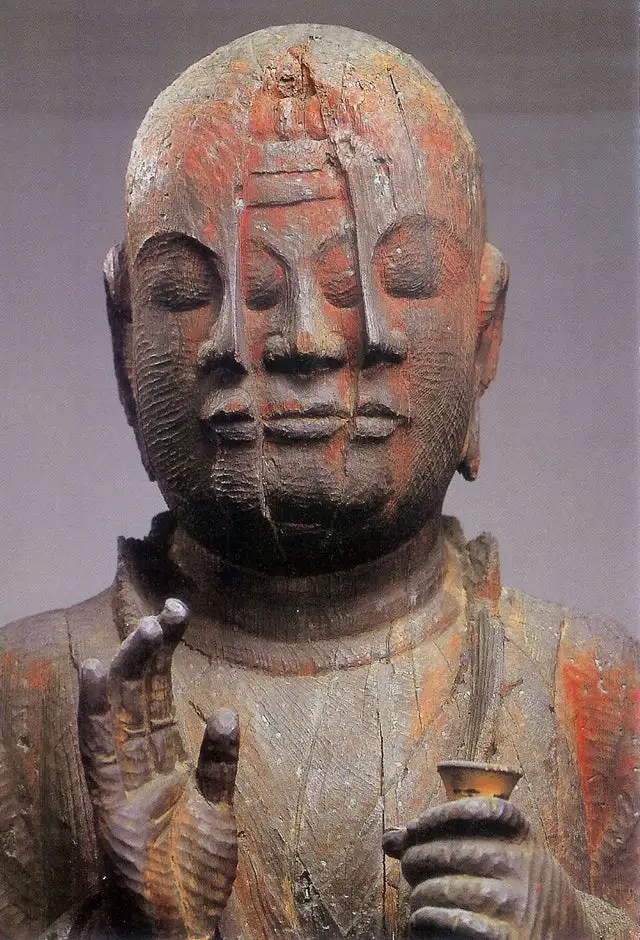
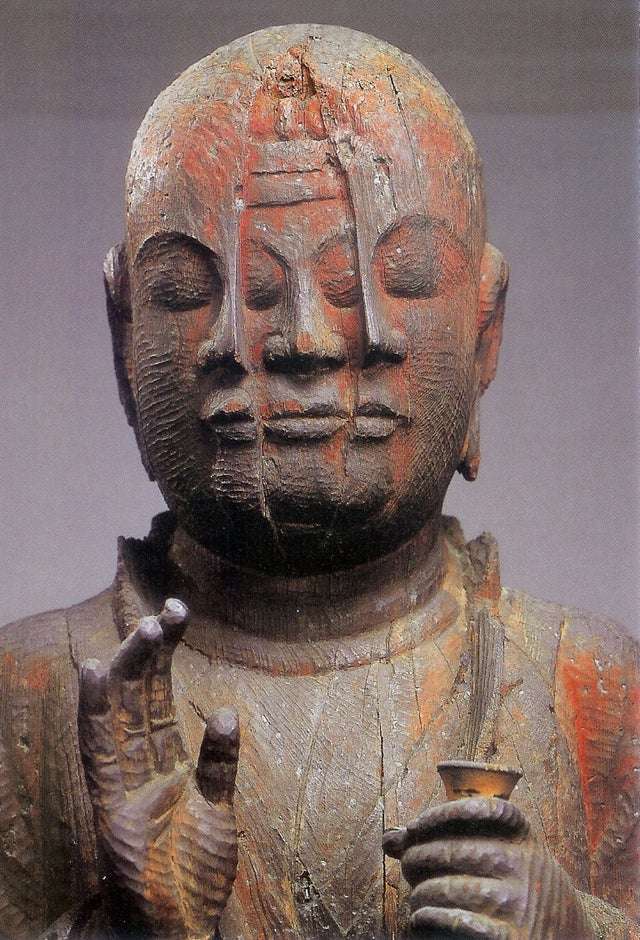
Fig. 1 – Wooden sculpture of the monk Baozhi, 12th-century, Saiho Temple, Kyoto, Japan (larger version). Image found here.

I’ve always wanted to create a piece of digital art portraying Monkey’s ascension and loss of his headband but never knew how to depict both events in the same picture. That is until a few days ago when I came across a beautiful 12th-century Japanese wooden sculpture of the Chan Buddhist monk Baozhi (Jp: Hoshi; K: Poji, 保志/寶志, 418–514) (fig. 1). The piece depicts “the monk’s face in supernatural corporeal transformation, splitting open to reveal the face of the numinous Eleven-Headed Kannon [Guanyin],” symbolizing his enlightenment (Levine, 2005, p. 72). I felt the statue was the best expression of enlightenment that I’ve ever seen. I later discovered the historical Baozhi was known for his ever youthful appearance, carrying a fanciful staff, and working magical miracles (Buswell & Lopez, 2014, p. 98; Ebrey, 1993, pp. 100-102), much like our hero. I therefore knew this piece would be the model from which I’d create my art.

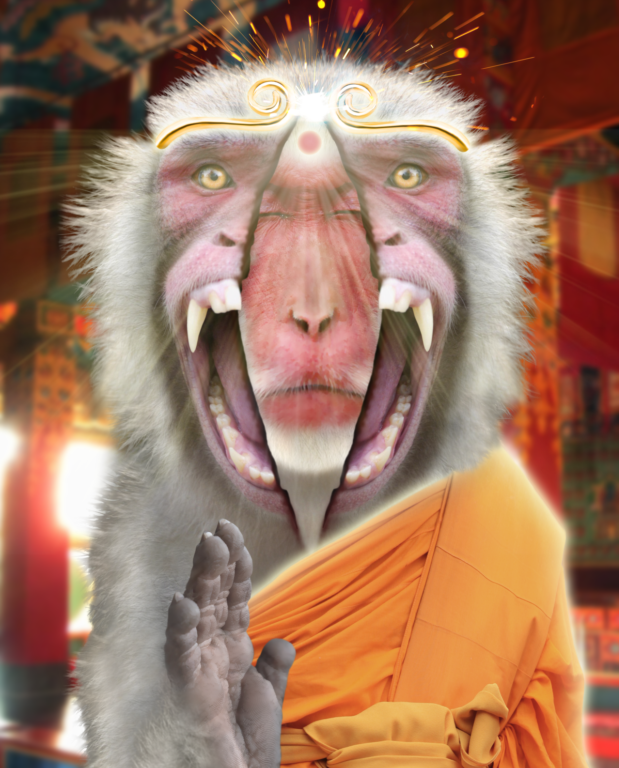
This is the final product created in Photoshop CS6 (fig. 2). The piece is comprised of 15 layers using eight different pictures. It took roughly two days working on and off during free time. The screaming face of the angry immortal splits open, giving way to the serene Buddha beneath. The sparks at the top represent the headband violently snapping open since it is no longer needed. Rays of spiritual light shine from the urna on Monkey’s forehead.

Fig. 2 – The Monkey Buddha has Awakened (larger version). Photomanipulation by the author.

Sources

Buswell, R. E. , & Lopez, D. S. (2014). The Princeton Dictionary of Buddhism. Princeton University Press.

Ebrey, P. B. (1993). Chinese Civilization: A Sourcebook, 2nd Ed. New York: Free Press.

Levine, G. P. A. (2005). Daitokuji: The Visual Cultures of a Zen Monastery. Seattle: University of Washington Press.

Wu, C., & Yu, A. C. (2012). The Journey to the West (Vol. 4) (Rev. ed.) Chicago, Illinois : University of Chicago Press.

Journey to the West and World History

Did you know that Journey to the West (Xiyouji, 西遊記, 1592) was published the same year that Shakespeare‘s Richard III was first performed? Here is a list of other 16th-century world events that took place before and slightly after the novel was published. The chosen source is Eurocentric, but I think this serves to contrast the hyper distillation of Chinese history and culture presented in the book. This list is by no means exhaustive.

1. Timeline of World Events

c. 1500 – The Incan citadel Machu Picchu is constructed.

– The first watches are made in Nuremberg.

1501Michelangelo begins to carve his David.

1503Leonardo da Vinci paints the Mona Lisa.

1507 – A circulating pamphlet suggests the New World should be named “America” after the explorer and mapmaker Amerigo Vespucci.

1508 – Michelangelo begins work on the Sistine Chapel ceiling.

1510Henry VIII becomes king of England.

1517Martin Luther nails his Protestant 95 Theses to the church doors.

1519 – Portuguese explorer Magellan sets out to circumnavigate the globe.

– The Spanish conquistador Cortes lands in Mexico.

1520 – Europe’s printing presses fuel a pamphlet war arguing for and against the Reformation.

1526 – The Mughal empire is founded in India.

1533 – Spanish Conquistadors sack the Incan city of Cuzco.

1536Wales becomes a principality of England.

1539 – The Great Bible, the first authorized English translation of the bible, commissioned by Henry VIII, is published.

1540 – Spanish explorer Vasquez de Coronado penetrates America looking for fabled cities of gold.

1543 – Polish scientist Copernicus suggests the Earth orbits around the sun.

– The first Europeans are blown ashore to Japan.

– Flemish anatomist Andreas Vesalius publishes his treatise on human anatomy.

1549Brazil becomes a Portuguese province.

c. 1550 – The Portuguese begin shipping West African slaves all across the Atlantic.

1553 – “Bloody Mary” the first ascends the English throne.

1564 – The birth of Shakespeare.

Gabriele Fallopia invents the condom.

1569 – The first map with the Mercator projection is published.

1574 – The Ottoman Empire takes control of Northern Africa.

1576 – Danish astronomer Tycho Brahe builds the Uraniborg, the world’s leading observatory.

1582 – The Gregorian calendar is introduced.

1583 – The Italian Jesuit Matteo Ricci arrives in China and begins his study of Chinese culture.

1585Roanoke Island, off the coast of North Carolina, becomes the first English colony of America.

1586Mary Queen of Scots is beheaded for plotting to usurp the English throne by assassinating Queen Elizabeth I.

1587Virginia Dare is the first child of English descent to be born in America.

1588 – The English fleet destroys the Spanish Armada.

1592 – Shakespeare’s Richard III is performed on stage.

JOURNEY TO THE WEST IS PUBLISHED.

1595 – Matteo Ricci introduces the writings of Confucius to the Western world.

1597Dafne, the first opera, is performed in Venice.

1599 – The Globe theater, home to many Shakespearean productions, is built.

1600William Gilbert concludes the earth is magnetic and coins the term “magnetic pole.”

– Gilbert coins the term “Electricity.”

2. Context

Journey to the West seemingly takes place in a timeless, magical land full of gods, immortals, demons, and ghosts, yet it was published during the late Ming Dynasty (1368-1644), a time coinciding with the late Renaissance period in Europe. One should remember that the novel was not a contemporary masterpiece born from the mind of a singular talented author but a product of oral storytelling stretching back to the Song Dynasty (960-1279) and possibly even before. These oral tales were built upon and adapted over the centuries, eventually starting to solidify into accepted episodes by at least the 15th-century. While Wu Cheng’en is widely considered the author, scholars remain divided on the issue. I instead prefer to use the phrase “author-compiler” since that is a more accurate description of the book’s construction from existing material.

Source:

http://www.oxfordreference.com/view/10.1093/acref/9780191735592.timeline.0001

Sun Wukong’s Hellish Punishment

Last updated: 01-09-2023

At the end of Journey to the West (Xiyouji西遊記, 1592) chapter seven, Sun Wukong is crushed under Five Elements Mountain for 600-plus-years as punishment for attempting to usurp the throne of heaven. I’ve previously described how this sentence is based on Tang and Song-era tales of the Sage-King Yu the Great imprisoning an aquatic simian demon beneath a mountain. Monkey’s time pinned by the landmass has been portrayed numerous times in movies and television, but modern media often forgets that this was only part of his punishment. The other half was a hellish diet:

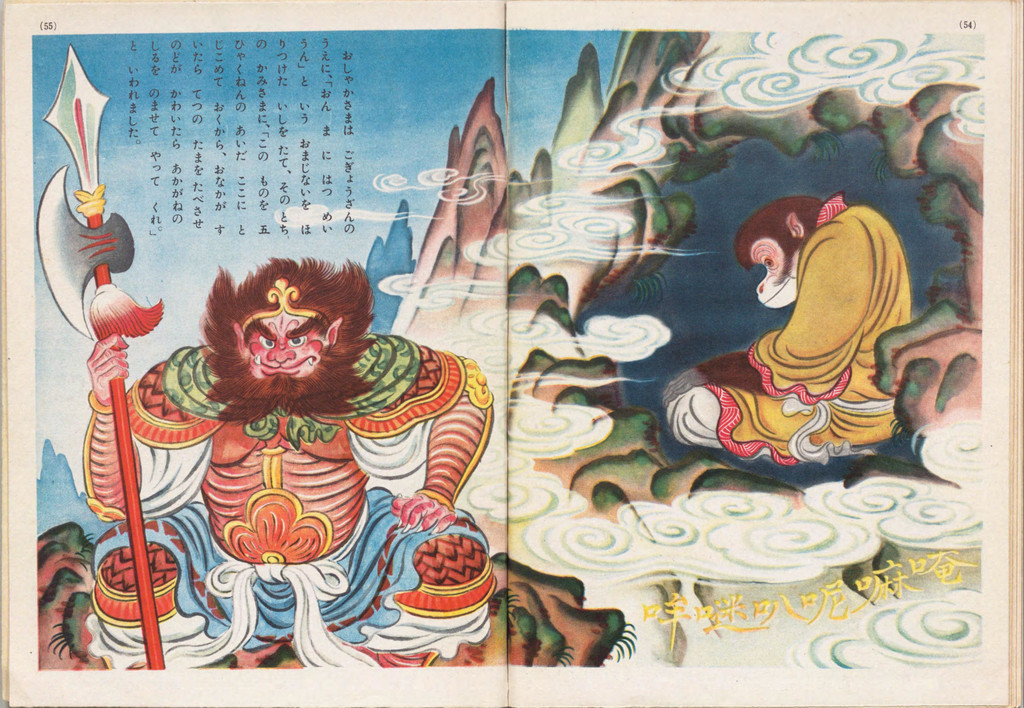
Moved by compassion, he [the Buddha] recited a divine spell and called together a local spirit and the Fearless Guards of Five Quarters to stand watch over the Five-Phases Mountain [fig. 1]. They were told to feed the prisoner with iron pellets [tie wanzi, 鐵丸子] when he was hungry and to give him melted copper [ronghua de tong zhi, 溶化的銅汁] to drink when he was thirsty. When the time of his chastisement was fulfilled, they were told, someone would be coming to deliver him (Wu & Yu, 2012, vol. 1, p. 199).

又發一個慈悲心,念動真言咒語,將五行山召一尊土地神祇,會同五方揭諦,居住此山監押。但他饑時,與他鐵丸子吃;渴時,與他溶化的銅汁飲。待他災愆滿日,自有人救他。

Fig. 1 – One of the guards charged with watching over Monkey (larger version). From the children’s book Son Goku (1939).

Table of Contents

1. The Origin

This punishment comes directly from Buddhist doctrine describing the torture of sinners in hell (Sk: Naraka; Ch: Diyu, 地獄). For example, the Dīrghāgama (Sk: दीर्घागम; Ch: Chang Ahun Jing, 長阿含經, or “The Collection of Long Scriptures”) [1] describes two realms in hell in which the damned are fed such a horrific diet:

[…] Terrified they [a damned soul] run out, seeking safety and refuge, but they arrive at the Hell of Hunger [Ji’e diyu, 飢餓地獄].

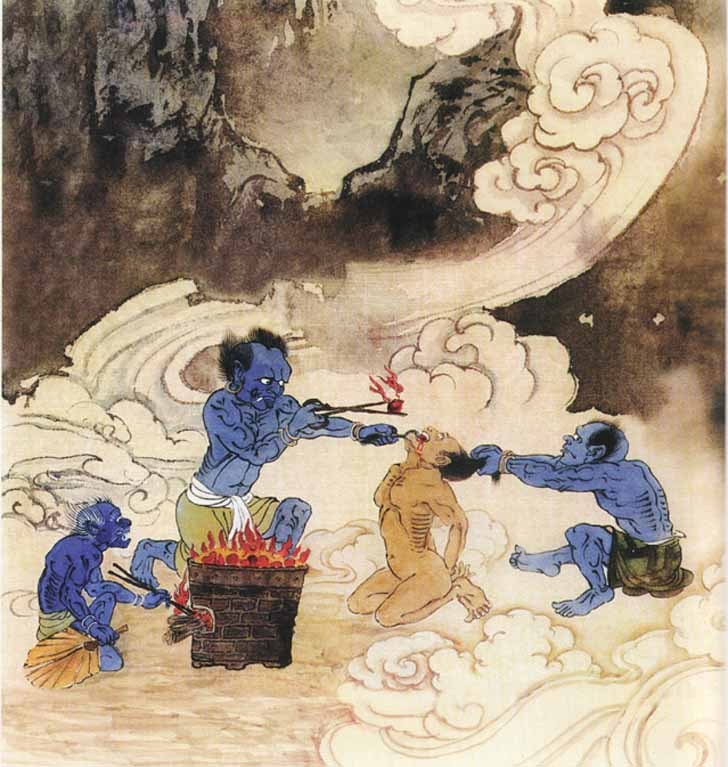
The wardens come to ask them: “Since you came here, what do you want?” They answer: “We are hungry”. The wardens then seize them and throw them on burning iron. They are caused to stretch and spread out their bodies; with iron hooks the wardens hook the sinners’ mouths and force them open; they put [hot] iron pellets into them [fig. 2]. The pellets burn their lips and tongues, from the throats down to their stomachs. The pellets penetrate through the sinners; there is nothing but burning. The horrible, fatal, and bitter suffering makes the sinners shriek and moan. Since their punishment is not yet completed, the sinners do not perish. After having suffered for a long time, they leave the Hell of Hunger. Frightened they run away, looking for relief and safety, until they arrive to the Hell of Thirst [Ke diyu, 渴地獄].

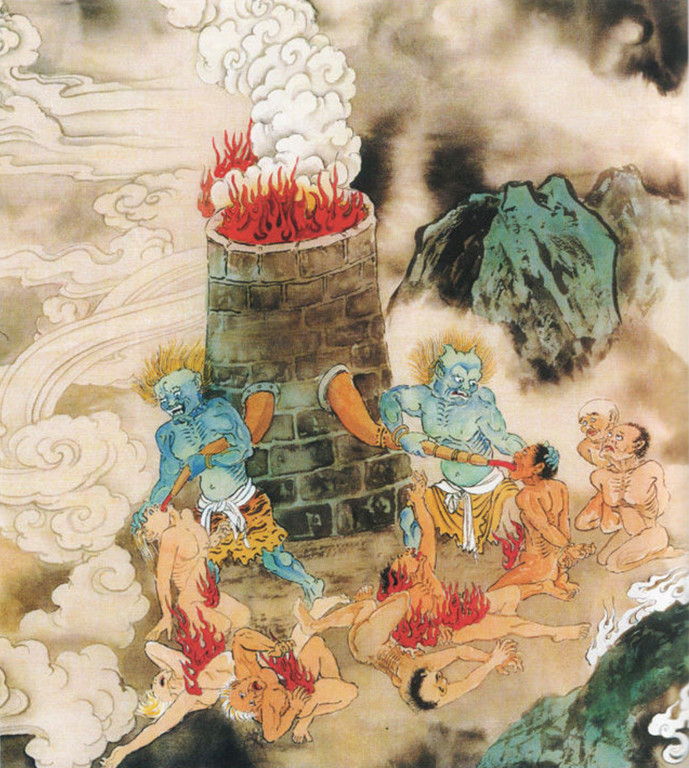
The wardens come to them and ask: “Since you came here, what do you want?” They answer: “We are thirsty.” The wardens thereupon seize the sinners and throw them on burning iron. They are caused to stretch and spread out their bodies; with hot iron hooks, the wardens hook the sinners’ mouths and force them open. They pour down molten copper [fig. 3]. It burns their mouth, lips and tongue; from their throats it reaches their stomachs. It penetrates down and goes through them; there is nothing but burning. The terrible, fatal, and bitter suffering makes the sinners shriek and moan. Since the remaining transgressions have not yet been atoned, they do not perish. After having been subjected to this punishment for a long time, they leave the Hell of Thirst (Howard, 1986, p. 131).

「… 慞惶馳走,求自救護,到飢餓地獄。獄卒來問:『汝等來此,欲何所求?』報言:『我餓。』獄卒即捉撲熱鐵上,舒展其身,以鐵鈎鈎口使開,以熱鐵丸著其口中,燋其脣舌,從咽至腹,通徹下過,無不燋爛,苦毒辛酸,悲號啼哭。餘罪未盡,猶復不死。

「久受苦已,出飢地獄,慞惶馳走,求自救護,到渴地獄。獄卒問言:『汝等來此,欲何所求?』報言:『我渴。』獄卒即捉撲熱鐵上,舒展其身,以熱鐵鈎鈎口使開,消銅灌口,燒其脣舌,從咽至腹,通徹下過,無不燋爛,苦毒辛酸,悲號啼哭。餘罪未盡,猶復不死。

「久受苦已,出渴地獄 …

Soul being forced to eat iron pellets

Fig. 2 – A damned soul being force-fed red hot iron pellets (larger version). Fig. 3 – Souls being forced to drink molten copper (larger version).

1.1. Additional Info

The same source explains that the hells of hunger and thirst are the respective fourth and fifth of sixteen minor hells (shiliu xiaoyu, 十六小獄) making up one of the eight greater purgatories (ba da diyu, 八大地獄) called the hell of consciousness (xiang, 想). Sinners reborn into this labyrinth of pain are full of anger and lash out at each other with scythe-like claws, as well as swords and daggers. They remain conscious through endless rounds of dismemberment and resurrection via a cold, magical wind (lengfeng, 冷風). They then wander into each successive minor hell, enduring everything from grinding by hot millstones to their flesh and bones being shattered by blistering cold. Again, each sinner remains conscious and resurrects between each purgatory (Howard, 1986, pp. 129-134).

Another name for the greater hell of consciousness is the Sanskrit term Samjiva (Ch: Denghuo, 等活), meaning “revival” or “repetition.” These might refer to the cyclical resurrection of the sinner, or to their karmic punishment mirroring what they did to others in life (Buswell & Lopez, 2014, p. 754).

It should be noted that unlike the Judeo-Christian tradition, rebirth in the Buddhist hell is not forever. For some it may last eons, but the torture serves to cleanse the spirit of past sins gained in life. Once the karmic debt has been repaid, the soul will be reborn into one of the other six realms of existence: hell, hungry ghost, animal, human, asura, or deva. Sometimes souls have to work their way back up to human status if they have particularly heavy karmic baggage.

Monkey’s punishment is essentially hell on earth. The Five Elements Mountain pins him down so that the chosen guards can torture him with hot iron pellets and molten copper just like those in the subterranean hells of hunger and thirst. He is not capable of dying, so his immortality serves a similar function to the magic wind that continually resurrects the damned. The finite length of his sentence (600-plus-years) is similar to the way a soul will only stay in the hell realm until they have repaid their karmic debt. And Tripitaka delivering him from his torments is like a soul being reborn into a new life. After all, Monkey’s life drastically changes after his release; he goes from being a rebellious, power-hungry demon, to a Buddhist monk devoted to the protection of his master.

2. Other Damned Celestials

Sun Wukong is not the only celestial to be damned to drink molten copper. Readers may be surprised to learn that King Yama (Yanluo Wang, 閻羅王), fifth of the Ten Judges of Hell, also suffers from this affliction. The aforementioned Dīrghāgama reads:

Buddha said to the bhiksus: “South of Jambudvipa, in the interior of the great Diamond Mountain, lies the palace of King Yama. The realm he governs extends for six thousand yojanas in both directions. His city has seven rows of ramparts, with seven nets and seven rows of trees … Day and night, three times a day, a huge copper cauldron automatically places itself in front of him. If the huge cauldron emerges in the interior of the palace, the king, upon seeing it, rushes out of the palace stricken by horror and fright. But then, if the cauldron emerges outside the palace, the king, upon seeing it, reenters the palace stricken by horror and fright. Giant hell wardens grab King Yama and have him lie down on hot irons. With iron hooks, they split his mouth open and force molten copper down. It burns his lips and tongue; from the throat, it reaches his stomach. It spreads down below and passes through [his body] so that no place is left unburnt. The punishment continues [in this fashion] until its completion. Afterwards, King Yama returns to seek amusement with all his ladies. Many great state[s]men, who possessed riches, are also punished in this way” (Howard, 1986, p. 141).

佛告比丘:「閻浮提南大金剛山內,有閻羅王宮,王所治處縱廣六千由旬,其城七重,七重欄楯、七重羅網、七重行樹 … 然彼閻羅王晝夜三時,有大銅鑊自然在前。若鑊出宮內,王見畏怖,捨出宮外。若鑊出宮外,王見畏怖,捨入宮內。有大獄卒,捉閻羅王臥熱鐵上,以鐵鈎擗口使開,洋銅灌之,燒其脣舌,從咽至腹,通徹下過,無不燋爛。受罪訖已,復與諸婇女共相娛樂。彼諸大臣同受福者,亦復如是。」

So Yama inhabits an odd position where he is both a member of the heavenly hierarchy working to judge the fate of the dead and a damned soul repaying a karmic debt through torture.


3. Updates

Update: 01-09-23

Chapter four of Shao (1997) explains that the term “Five Elements/Phases” (Wuxing, 五行) is used in JTTW and Buddho-Daoist doctrine to represent mortality. For example, Monkey complains to the judges of hell in chapter three that he’s no longer subject to death since he has achieved the Daoist elixir, thereby breaking free of the five elements. His imprisonment beneath Five Elements Mountain and hellish diet are, therefore, clues that the Buddha is punishing Sun to a symbolic death and afterlife. His subsequent release in chapter 14 can then be viewed as a symbolic reincarnation, which completes the cycle of death, karmic punishment, and rebirth.

Recall how the novel states time and time again that Monkey was under the mountain for 500 years. Although internal story details suggest it was actually over 600 years, it’s important to remember that 500 is used in Buddhist doctrine to denote a large number (Zhao, 2021, p. 126). So, maybe the novel was just implying that Monkey was punished for a really long time.

Note:

1) The Dīrghāgama has only survived thanks to a Chinese translation from the original Sanskrit in 413 CE (Buswell & Lopez, 2014, p. 246).

Sources:

Buswell, R. E., & Lopez, D. S. (2014). The Princeton Dictionary of Buddhism. Princeton University Press.

Howard, A. F. (1986). The Imagery of the Cosmological Buddha. Leiden: E.J. Brill.

Wu, C., & Yu, A. C. (2012). The Journey to the West (Vols. 1-4) (Rev. ed.). Chicago, Illinois: University of Chicago Press.

Zhao, P. (2021). The Essentials of Buddhism: Questions and Answers (H. Fang, trans.). Beijing: American Academic Press.