The Past Life Biography of Zhu Bajie

Last updated: 04-09-2025

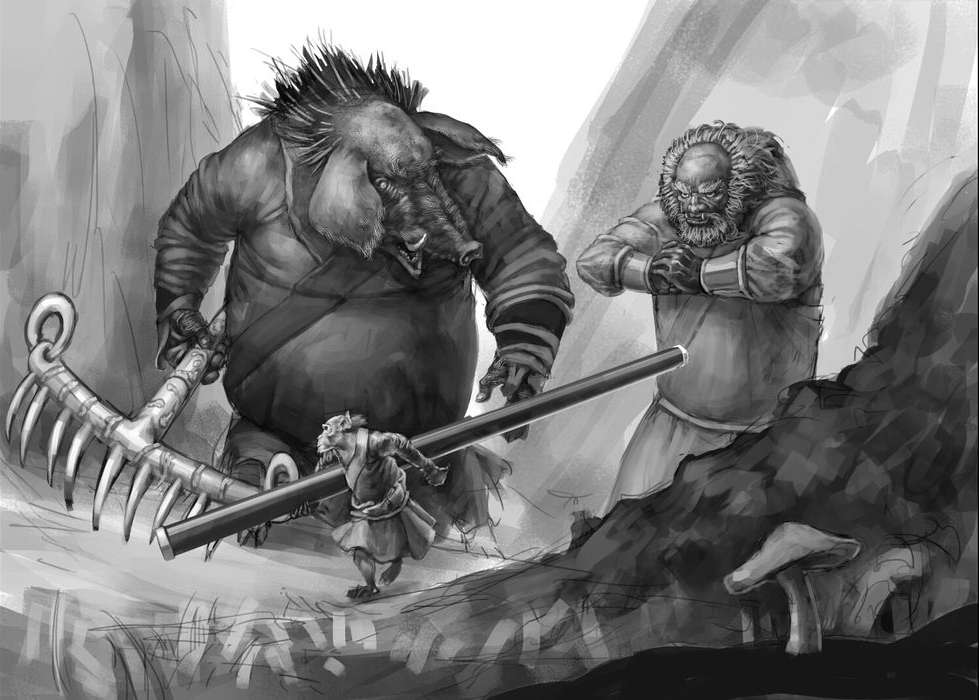
A twitter user asked me in late 2024 where Zhu Bajie (豬八戒; fig. 1) learned his “36 transformations” (sanshiliu ban bianhua, 三十六般變化). I told them that chapters 19 and 85 of Journey to the West (Xiyouji西遊記; “JTTW” hereafter) contain biographical poems, one of which explains his internal alchemy (neidan, 内丹) training under an immortal and ascension to godhood. I suggested that his past human life learned the magic changes during this time, but after answering the question, it dawned on me that many people may not be aware of these verses. I have, therefore, decided to post and analyze said poems for the benefit of my readers.

This is the second of three articles where I will present info about the disciples’ lives prior to the main events of JTTW. My next article will follow with Sha Wujing‘s (沙悟净) poem. Click here to read the first post about the White Dragon Horse (Bai longma, 白龍馬). These are meant to compliment my previous essay about Sun Wukong (孫悟空).

(On a related note, see here for the oldest known depictions of Zhu Bajie. They come from 14th-century Korea!)

Fig. 1 – A novel accurate depiction of the Tang Monk’s disciples, including our hog hero (top left) (larger version). Artwork by @真·迪绝人 (see here and here).

1. The poems

The novel actually presents two contradictory verses on the origins of our beloved pig-monster. One (ch. 19) portrays him as a human-turned-immortal commander of heavenly forces, while the other (ch. 85) alludes to him being a powerful hog-spirit given celestial rank.

1.1. Chapter 19

This poem is chock-full of internal alchemical jargon, so I’m placing explanatory notes just below the blockquote to save readers from having to scroll to the very bottom of the article every time a new concept is mentioned.

My mind was dim since the time of youth;
Always I loved my indolence and sloth.
Neither nursing nature nor seeking the Real,
I passed my days deluded and confused.
I met a true immortal suddenly
Who sat and spoke to me of cold and heat. [A]
‘Repent,’ he said, ‘and cease your worldly way:
From taking life accrues a boundless curse.
One day when the Great Limit ends your lot,
For eight woes and three ways you’ll grieve too late!’ 
I listened and turned my will to mend my ways:
I heard, repented, and sought the wondrous rune.
By fate my teacher he became at once,
Pointing to the Heavenly and Earthly Passes. [B]
Taught to forge the Great Pill Nine Times Reversed, [C]
I worked without pause through day and night
To reach Mud-Pill Palace topping my skull [D]
And Jetting-Spring Points on soles of my feet. [E]
With kidney brine flooding the Floral Pool, [F]
My Cinnabar Field was thus warmly nursed. [G]
Baby and Fair Girl mated as yin and yang[H]
Lead and mercury mixed as sun and moon. [I]
In concord Li-dragon and Kan-tiger used, [J]
The spirit turtle sucked dry the gold crow’s blood. [K]
‘Three flowers joined on top,’ the root reclaimed [L];
‘Five breaths faced their source’ and all freely flowed. [M]
My merit done, I ascended on high,
Met by pairs of immortals from the sky.
Radiant pink clouds arose beneath my feet;
With light, sound frame I faced the Golden Arch.
The Jade Emperor gave a banquet for gods
Who sat in rows according to their ranks.
Made a marshal of the Celestial Stream,
I took command of both sailors and ships.
Because Queen Mother gave the Peaches Feast
When she met her guests at the Jasper Pool
My mind turned hazy for I got dead drunk,
A shameless rowdy reeling left and right.
Boldly I barged into Vast Cold Palace
Where the charming fairy received me in.
When I saw her face that would snare one’s soul,
My carnal itch of old could not be stopped!
Without regard for manners or for rank,
I grabbed Miss Chang’e asking her to bed.
For three or four times she rejected me:
Hiding east and west, she was sore annoyed.
My passion sky-high I roared like thunder,
Almost toppling the arch of Heaven’s gate.
Inspector General told the Emperor Jade;
I was destined that day to meet my fate.
The Vast Cold completely enclosed airtight
Left me no way to run or to escape.
Then I was caught by the various gods,
Undaunted still, for wine was in my heart.
Bound and taken to see the Emperor Jade,
By law I should have been condemned to death.
It was Venus the Gold Star, Mr. Li,
Who left the ranks and knelt to beg for me.
My punishment changed to two thousand blows,
My flesh was torn; my bones did almost crack.
Alive! I was banished from Heaven’s gate
To make my home beneath the Fuling Mount.
An errant womb’s my sinful destination: Stiff-Bristle Hog’s my worldly appellation!” (Wu & Yu, 2012, vol. 1, pp. 378-379).

自小生來心性拙,貪閑愛懶無休歇。
不曾養性與修真,混沌迷心熬日月。
忽然閑裡遇真仙,就把寒溫坐下說。
勸我回心莫墮凡,傷生造下無邊孽。
有朝大限命終時,八難三途悔不喋。
聽言意轉要修行,聞語心回求妙訣。
有緣立地拜為師,指示天關並地[關]
得傳九轉大還丹,工夫晝夜無時輟。
上至頂門泥丸宮,下至腳板湧泉穴。
周流腎水入華池,丹田補得溫溫熱。
嬰兒姹女配陰陽,鉛汞相投分日月。
離龍坎虎用調和,靈龜吸盡金烏血。
三花聚頂得歸根,五氣朝元通透徹。
功圓行滿卻飛昇,天仙對對來迎接。
朗然足下彩雲生,身輕體健朝金闕。
玉皇設宴會群仙,各分品級排班列。
敕封元帥管天河,總督水兵稱憲節。
只因王母會蟠桃,開宴瑤池邀眾客。
那時酒醉意昏沉,東倒西歪亂撒潑。
逞雄撞入廣寒宮,風流仙子來相接。
見他容貌挾人魂,舊日凡心難得滅。
全無上下失尊卑,扯住嫦娥要陪歇。
再三再四不依從,東躲西藏心不悅。
色膽如天叫似雷,險些震倒天關闕。
糾察靈官奏玉皇,那日吾當命運拙。
廣寒圍困不通風,進退無門難得脫。
卻被諸神拿住我,酒在心頭還不怯。
押赴靈霄見玉皇,依律問成該處決。
多虧太白李金星,出班俯顖親言說。
改刑重責二千鎚,肉綻皮開骨將折。
放生遭貶出天關,福陵山下圖家業。
我因有罪錯投胎,俗名喚做豬剛鬣。(source)

Footnotes:

A) “[C]old and heat,” (riyue, 日月; lit: “sun and moon”) refers to respective yang and yin energies (Pregadio, 2025p; see also Wu & Yu, 2012, vol. 1, p. 527 n. 2).

B) The original Chinese, “天關並地” (tianguan bing dique, or “heavenly passes and earthly watchtowers(?)”), is a likely typo for “天關並地” (tianguan bing diguan, or “heavenly and earthly passes”). These respectively refer to the head and feet (Pregadio, 2025d, 2025s). I’ve therefore altered Yu’s (Wu & Yu, 2012) translation.

C) The “Great Pill [i.e. Elixir] Nine Times Reversed” (jiuzhuan da huandan, 九轉大還丹) was originally an external alchemical process where a concoction of toxic elements was purified over successive firings in a crucible to create a drug of immortality (see section 3.1. of this article). However, the term was coopted by later proponents of internal alchemy, who associated the ingestion and circulation of immortality-bestowing cosmic energies within pathways between bodily organs with a complex five phases-influenced numerology (Pregadio, 2025b, 2025n). Needham (1954, as cited in Wu & Yu, 2012) adds that it refers “to a chhi [qi, pneumatic vitality, breath] or substance generated by techniques purposefully within the human body which would bring about a reversion of the tissues from an ageing state to an infantile state” (vo. 1, p. 527 n. 4).

D) The “Mud-Pill Palace” (niwan gong, 泥丸宮) is a name for the upper cinnabar field in the head (Pregadio, 2025m; Wu & Yu, 2012, vol. 1, p. 528 n. 6).

E) The “Jetting-Spring Points” (yongquan xue, 湧泉穴) are pressure points on the bottom of the feet (Wu & Yu, 2012, vol. 1, p. 528 n. 7).

F) Yu (Wu & Yu, 2012) explains that spiritual energies contained in the kidneys (which are associated with the water element) can be directed to different parts of the practitioner’s body, including a spot under the tongue, the “Floral pool” (huachi, 華池) (vol. 1, p. 528 n. 8; see also Pregadio, 2025r). While this is no doubt the correct answer, it’s important to note that internal alchemy also uses the term Floral pool to refer to true yang energy inside yin (Pregadio, 2025h). The corresponding term is “spirit water” (shenshui, 神水), which denotes true yin energy inside yang—think of the white and black dots inside of the Taiji symbol (Pregadio, 2025h). Therefore, the poem’s original Chinese “腎水入華池” (shenshui ru huachi, or “kidney brine flooding the floral pool”) could also be a reference to the similarly-sounding phrase “神水入華池” (shenshui ru huachi, or “spirit water flooding the floral pool), or the mixture of yang and yin, respectively.

G) The “Cinnabar Field” (dantian, 丹田) is one of three spiritual centers in the body, which is located between 1.3 to 3.6 Chinese inches (cun, 寸; 1 = 1.25 in/3.18 cm) below (or behind) the belly button. The Cinnabar Field is believed to store cosmic/bodily energies, that when circulated and refined, produce an immortal alchemical embryo—i.e. a fledgling immortal spirit avatar (Pregadio, 2025c; see also Wu & Yu, 2012, vol. 1, p. 528 n. 9). And “warmly nursed” (bu de wenwen’re, 補得溫溫熱) may refer to “nourishing warmly” (wenyang, 溫養), or the process of “gestati[ng] the alchemical embryo” (Pregadio, 2025t).

H) The “Baby and Fair Girl” (ying’er chanu, 嬰兒姹女) are anthropomorphic personas of yang and yin energy, respectively (Pregadio, 2025a, 2025w; see also Wu & Yu, 2012, vol. 1, p. 528 n. 10).

I) The elemental and celestial imagery of “lead and mercury” (qian gong/hong, 鉛汞) and “sun and moon” (riyue, 日月) refer to yang and yin energies, respectively (Pregadio, 2025g, 2025o, 2025p).

J) The third eight trigram figure, Li (/☲), is associated with dragons (long, ), and both symbolize yang energy. The sixth figure, Kan (/☵), is associated with tigers (hu, ), and both symbolize yin energy (fig. 2) (Pregadio, 2025j, 2025k, 2025l; see also Wu & Yu, 2012, vol. 1, p. 529 n. 11).

K) Yu (Wu & Yu, 2012) suggests that “turtle” (gui, ) “may be another name for the dark liquid of the kidneys” (vol. 1, p. 529 n. 12). He continues, “[T]he gold crow indicates the sun or the heart. The line refers to the union of yin and yang through the absorption of yang energy by yin” (Wu & Yu, 2012, vol. 1, p. 529 n. 12). While I agree that this refers to the mixing of said energies, it’s important to note, however, that turtles are usually paired with “snakes” (she, 蛇), both being anthropomorphic symbols of jing-essence and qi-breath (精氣), respectively (Pregadio, 2025f). Additionally, the “gold crow” (jinwu, 金烏), an anthropomorphic symbol of true yin inside yang energy, is normally paired with the “jade rabbit” (yutu, 玉兔), an anthropomorphic symbol of true yang inside yin (Pregadio, 2025i, 2025y). Similarly, “blood” (xue, ) represents true yin inside of yang (Pregadio, 2025v).

L) The “Three flowers” (sanhua, 三花) is another name for jing-essence, qi-breath, and shen-spirit (精氣神), three important bio-spiritual substances/energies. These must be “joined on top” (juding, 聚頂), or concentrated in the head (the upper cinnabar field) during the internal alchemical process (Wu & Yu, 2012, vol. 1, p. 529 n. 13; see also Pregadio, 2025q). This leads to the “root [being] reclaimed” (guigen, 歸根), which refers to “[g]oing back to the root and returning to the mandate” (guigen fuming, 歸根復命), or achieving immortality (Pregadio, 2025e).

M) Yu (Wu & Yu, 2012) explains, “Five breaths … wuqi chaoyuan 五氣朝元, refers to the pneumatic vitality, qi, of the five viscera (heart, liver, spleen, lungs, and kidneys) in harmonious balance” (Wu & Yu, 2012, vol. 1, p. 529 n. 14). A related view is that said viscera are synced with bio-spiritual substances or mental concepts—ie. hun/liver, jing-essence/kidneys, spirit/heart, po/lungs, intention/spleen—when a practitioner has learned to quiet their senses and still their body (Pregadio, 2025u).

Fig. 2 – An internal alchemy diagram of a Daoist cultivator circulating yang and yin energies, which are respectively represented by the eight trigrams figures (Li, ) and (Kan, ) and the elements fire and water (larger version). Image found here. I believe it originally comes from the Anthology of Immortals of Complete Perfection (Quanzhen qunxian ji, 全真群仙集, 1483).

1.2. Explanation

Zhu was originally a lazy, aimless man, but he encountered a celestial who told him to mend his ways, or else he would be reborn in the lower three Buddhist realms of hell, hungry ghosts, or animals, making it impossible for him to hear the Buddha’s teachings (an example of the novel’s syncretic unity). Upon repenting, he studied under the immortal, learning the art of internal alchemy, which involved absorbing and circulating vital energies around his body. Once he had attained transcendence, he rose on clouds to be escorted by other celestials into the heavenly realm, where he was appointed marshal of the heavenly navy, which sailed the cosmic river of the Milky Way Galaxy.

But his great achievement was tainted when he got drunk at the Queen Mother’s peach banquet and, being aroused by Chang’e’s dazzling beauty (fig. 3), chased her to the moon palace. He propositioned the goddess for sex several times, but her refusals sent him into a powerful rage. The protector deity Wang Lingguan reported this to the Jade Emperor, who had the moon palace surrounded by heavenly soldiers. The Marshal was soon captured and sentenced to death, but the planet Venus asked for lenience, leading to Zhu’s past life being beaten 2,000 times and banished from the heavenly realm. His divine spirit sought reincarnation in the mortal realm below, but an accident of fate led to his rebirth as a pig-spirit. He later took the name “Stiff-Bristles Hog” (Zhu Ganglie, 豬剛鬣) based on his porcine appearance.

Zhu Bajie-Chang'e stamp

Fig. 3 – A Taiwanese stamp reading, “Drunkenly playing Chang’e” (Zuixi Change, 醉戲嫦娥) (larger version). It’s likely meant to serve as a visual reminder of Zhu’s early story arc involving the events leading to his banishment from heaven and rebirth as a hog-spirit.

1.3. Chapter 85

With huge mouth and fangs I’ve great magic might.
Emperor Jade made me Marshal Heavenly Reeds.
The boss of Heaven’s eighty-thousand marines,
Comforts and joys I had in the halls of light.
Because I mocked a palace maiden when I was drunk
And flaunted my strength at a wrongful hour
One shove of my snout toppled the DipperOx Palace;
Queen Mother’s divine herbs I then devoured
Emperor Jade pounded me two thousand times
And banished me from the Three Heavens realm.
Though told to nourish my primal spirit,
I became again a monster down below.
About to marry at the Village Gao, I met Brother Sun—’twas my wretched fate!
Quite defeated by his golden-hooped rod,
I had to bow and take the Buddhist vow:
A coolie who bears luggage and leads the horse,
Who owes, in former life, the Tang Monk a debt!
This iron-legged Heavenly Reed‘s name is Zhu;
And my religious name is Zhu Eight Rules(based on Wu & Yu, 2012, vol. 4, pp. 149-150).

巨口獠牙神力大,玉皇陞我天蓬帥。
掌管天河八萬兵,天宮快樂多自在。
只因酒醉戲宮娥,那時就把英雄賣。
一嘴拱倒斗牛宮,吃了王母靈芝菜。
玉皇親打二千鎚,把吾貶下三天界。
教吾立志養元神,下方卻又為妖怪。
正在高莊喜結親,命低撞著孫兄在。
金箍棒下受他降,低頭才把沙門拜。
背馬挑包做夯工,前生少了唐僧債。
鐵腳天蓬本姓豬,法名喚作豬八戒。(source)

1.4. Explanation

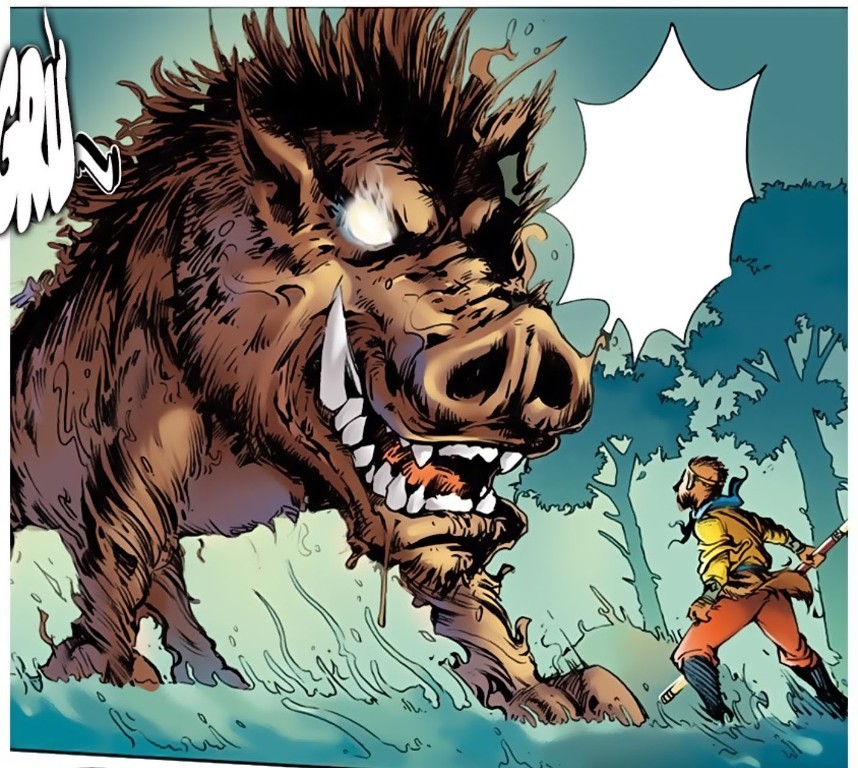
He was originally a pig-spirit with sharp tusks and powerful magic (fig. 4) who was appointed Marshal Tianpeng, commander of the 80,000-strong celestial navy. He enjoyed his new life among the godly ranks but later got drunk (at the Queen Mother’s banquet) and performed a number of forbidden deeds: mistreating a moon goddess, knocking over the Dipper-Ox Palace, and eating the Queen mother’s magic mushrooms. This resulted in a punishment of 2,000 strokes and banishment from heaven, with the added instruction to cultivate his spirit while on earth. But he once again became a monster, and at some point,  he took a wife in Gao Village. He was subsequently defeated by Monkey and forced to take the Buddhist vows, serving as Tripitaka’s disciple and luggage handler. His discipleship may have been the karmic result of a good deed that his master performed for him in a past life.

Fig. 4 – Zhu’s giant boar form from the manhua Journey to the West (Xiyouji, 西遊記) (larger version).

2. Which is true?

Both poems provide certain information that is consistent with internal narrative details, such as:

  • Zhu originally serving as Marshal Heavenly Reed (Tianpeng yuanshuai, 天蓬元帥; lit: “Marshal of Heavenly Mugwort“), commander of the 80,000 soldiers of the celestial navy (and a historical deity) (fig. 5)
  • Getting drunk at the peach festival and harassing a moon goddess
  • Being beaten 2,000 times as punishment and exiled to the mortal world
  • Mistakenly being reborn as Stiff-Bristles Hog, a bloodthirsty pig-monster in Fuling Mountain (Fuling shan, 福陵山)
  • Eventually taking a wife in Gao Village (Gao zhuang, 高莊)
  • Being defeated by Sun Wukong
  • Becoming Zhu Bajie, a Buddhist disciple of Tripitaka
  • Acting as a coolie carrying the luggage

But the real question is: was Zhu originally human or a pig-spirit? I think the first poem is likely true (within the narrative) given the amount of detail that he provides about the alchemical processes that eventually led to his immortality and ascension to godhood. The second poem is cursory in comparison and seems like something that was made up on the spot to embellish his might—perhaps influenced by stories of Sun Wukong’s past havoc in heaven—or monstrous pedigree in the face of a demonic opponent (refer to the events in chapter 85). One detail pointing to this is his claim of knocking over the “Dipper-Ox Palace” (Douniu gong, 斗牛宮), which references the stars of the Southern Dipper and Ox mansions (Stephenson, 2008, p. 517). He’s therefore asserting that he can collapse entire constellations. That’s definitely nonsense as Zhu is often overpowered and defeated in battle, even by groups of little fiends (Wu & Yu, 2012, vol. 2, pp. 102-103, for example).

Fig. 5 – A historical painting of “Great Marshal Tianpeng” (Tianpeng da yuanshui, 天蓬大元帥) from the Ink Treasures of Wu Daozi (Daozi mobao, 道子墨寶, 13th-century), (larger version). Image altered for clarity.

3. Additional info

The poems actually leave out several details about Zhu’s past and current lives.

  1. The Chang’e (嫦娥) mentioned above is not the singular goddess but one of many such named divine maidens in the entourage of the “Star Lord of Supreme Yin” (Taiyin xingjun, 太陰星君), the aged devi of the moon. [1]
  2. He mauled his sow mother and piglet siblings to death sometime after his mistaken rebirth in Fuling Mountain (Wu & Yu, 2012, vol. 1, p. 212).
  3. His first wife, “Second Elder Sister Mao” (Mao erjie, 夘二姐), [2] a likely rabbit spirit, [3] was the original owner of his Cloudy Paths Cave (Yunzhan dong, 雲棧洞) (Wu & Yu, 2012, vol. 1, p. 212). But sadly, she died less than a year after their marriage (Wu & Yu, 2012, vol. 1, p. 212). Their tragic love story would be good fodder for fanfiction.
  4. He was invited by the Crow’s Nest Chan Master (Wuchao chanshi烏巢禪師), a Buddhist sage, to practice austerities, but he passed on the opportunity.
  5. Years prior to being called Zhu Bajie, he submitted to Buddhism at the behest of the bodhisattva Guanyin and was given the religious name “Zhu Wuneng” (豬悟能, “Pig Who Awakens to Power”) (Wu & Yu, 2012, vol. 1, p. 213).
  6. Sometime after adopting a vegetarian diet, [4] he magically transformed into a “stout, swarthy [human] fellow” (hei pang han, 黑胖漢) in order to fraudulently arrange a marriage with his second wife, “Green Orchid” (Cui’lan, 翠蘭), a maiden from Gao Village in Tibet (Wusizang, 烏斯藏) (Wu & Yu, 2012, vol. 1, p. 372). [5]
  7. The Gao family grew rich from his supernatural labors in the field (Wu & Yu, 2012, vol. 1, pp. 375 and 381).
  8. But he was abusive to his wife, locking her inside a back building and not allowing her to see her family for half a year (Wu & Yu, 2012, vol. 1, p. 372).
  9. Monkey tricked Zhu by magically taking his wife’s form and hiding in a dark room (fig. 6), [6] but he later overpowered the hog-spirit in combat (Wu & Yu, 2012, vol. 1, p. 380). Zhu eventually submitted when he learned Sun was escorting the scripture pilgrim to India (Wu & Yu, 2012, vol. 1, p. 384).

Lastly, I would like to suggest that the immortal teacher of Zhu’s past life also taught him divine military arts—like Master Ghost Valley taught Sun Bin in vernacular fiction—because why else would a random person be given command of the entire heavenly navy? I headcanon that he was once a brilliant military strategist and commander, but his mistaken reincarnation as a hog made him very dim and lazy.

Fig. 6 – A woodblock print from the original 1592 edition of JTTW reading, “The fake Green Orchid outsmarts Stiff-Bristles Hog” (Jia Cui’lan zhinong Zhu Ganglie, 假翠蘭智㺯(弄)豬剛鬣) (larger version). See page 228 of the linked PDF. I’m intrigued by the pig-spirit’s failed human transformation.


Update: 03-04-25

Friend of the blog NingadudeXx has drawn a picture of Zhu Bajie as his past life, Marshal Tianpeng (fig. 7), based on the god’s historical iconography (refer back to fig. 5).

Fig. 7 – Zhu Bajie as Marshal Tianpeng (larger version).


Update: 04-09-25

I forgot to mention that Zhu has some medical knowledge. In chapter 41, for example, he performs life-saving massage to resuscitate a dead Sun Wukong:

With a chuckle, Eight Rules [Zhu Bajie] said, “Brother, stop crying. This ape is pretending to be dead, just to scare us. Feel him a little and see if there’s any warmth left in his breast.” “The whole body has turned cold,” said Sha Monk [Sha Wujing]. “Even if there were a little warmth left, how could you revive him?” Eight Rules said, “If he is capable of seventy-two transformations, he has seventy-two lives. Listen, you stretch out his legs while I take care of him.” Sha Monk indeed straightened Pilgrim’s legs while Eight Rules lifted his head and straightened his upper torso. They then pushed his legs up and folded them around the knees before raising him into a sitting position. Rubbing his hands together until they were warm, Eight Rules covered Pilgrim’s seven apertures and began to apply a Chan method [anmo chanfa, 按摩禪法] of massage on him (emphasis added). The cold water, you see, had had such a traumatic effect on Pilgrim that his breath was caught in his cinnabar field and he could not utter a sound. He was lucky, therefore, to have all that rubbing, squeezing, and kneading by Eight Rules, for in a moment his breath went through the three passes, invaded the bright hall, and burst through his apertures. and burst through his apertures. “O Master,” he [Monkey] began to say (Wu & Yu, 2012, vol. 2, p. 232).

八戒笑道:「兄弟莫哭。這猴子佯推死,嚇我們哩。你摸他摸,胸前還有一點熱氣沒有?」沙僧道:「渾身都冷了,就有一點兒熱氣,怎的就得回生?」八戒道:「他有七十二般變化,就有七十二條性命。你扯著腳,等我擺佈他。」真個那沙僧扯著腳,八戒扶著頭,把他拽個直,推上腳來,盤膝坐定。八戒將兩手搓熱,仵住他的七竅,使一個按摩禪法。原來那行者被冷水逼了,氣阻丹田,不能出聲。卻幸得八戒按摸揉擦,須臾間,氣透三關,轉明堂,沖開孔竅,叫了一聲:「師父啊!」

Also, in chapter 69, he argues with Wukong about the attributes and usages of a medicinal ingredient:

“The flavour of badou [巴豆],” said Eight Rules, “is slightly acrid; its nature is hot and poisonous. Able to pare down the hard and the accumulated, it will therefore sweep out the submerged chills of one’s internal cavities. Able to bore through clottings and impediments, it will therefore facilitate the paths of water and grain. This is a warrior who can break down doors and passes, and it should be used lightly” (Wu & Yu, 2012, vol. 3, p. 274).

八戒道:「巴豆味辛,性熱有毒。削堅積,蕩肺腑之沉寒;通閉塞,利水穀之道路。乃斬關奪門之將,不可輕用。」

This might suggest that Bajie also learned these skills from his immortal master.

Endnotes:

1) Chapter 95 explains that the seemingly singular goddess Chang’e is actually a collective, and also that one of them was the maiden that Zhu’s former life had harassed in the past:

As they stared into the sky, they heard the Great Sage Sun crying out in a loud voice: “Your Majesty of India, please ask your queen and concubines to come out and look. Beneath this treasure canopy is the Star Lord of Supreme Yin of the Moon Palace, and the immortal sisters on both sides of her* are the Chang’e goddesses inside the moon (emphasis added). This little jade hare is the false princess of your household; she has now revealed her true form.”

The king hurriedly assembled the queen, his concubines, the palace maidens, and gaily-attired girls to bow to the sky and worship. He himself and the Tang Monk also expressed their thanks toward the sky by bowing low. All the households in the city also set up incense tables and kowtowed, chanting the name of Buddha.

As they looked up into the air, Zhu Eight Rules was moved to lust. Unable to contain himself, he leaped into the air and embraced a rainbow-skirted immortal, crying, “Sister, you and I are old acquaintances! Let’s go play!” (emphasis added) (based on Wu & Yu, 2012, vol. 4, p. 303).

眾擡頭看處,又聞得孫大聖厲聲高叫道:「天竺陛下,請出你那皇后、嬪妃看者:這寶幢下乃月宮太陰星君,兩邊的仙妹是月裡嫦娥。這個玉兔兒卻是你家的假公主,今現真相也。」那國王急召皇后、嬪妃與宮娥、綵女等眾朝天禮拜,他和唐僧及多官亦俱望空拜謝。滿城中各家各戶,也無一人不設香案,叩頭念佛。正此觀看處,豬八戒動了慾心,忍不住,跳在空中,把霓裳仙子抱住道:「姐姐,我與你是舊相識,我和你耍子兒去也。」

* Yu (Wu & Yu, 2012) calls the Star Lord of Supreme Yin “him” in his original translation (vol. 4, p. 303), but the deity has been portrayed as a woman for centuries. See, for instance, her depiction (2nd from the top left) in the Ink Treasures of Wu Daozi (Daozi mobao, 道子墨寶, 13th-century).

2) Yu (Wu & Yu, 2012) translates her name as “Second Elder Sister Egg” (Luan erjie, 卵二姐)” (vol. 1, p. 212). But this is based on a transcription error—i.e. 夘 (Maooriginal edition) vs 卵 (Luan; modern edition).

3) The relationship of Zhu and Second Elder Sister Mao references the synergy between the elemental and animal aspects of the 12 earthly branches—i.e. Mao (夘; yin wood/rabbit) and Hai (亥; yang wood/pig) complete each other.

4) His vegetarian diet is mentioned in chapters 18 and 19 (Wu & Yu, 2012, vol. 1, pp. 372, 384, and 386).

5) Yu (Wu & Yu, 2012) translates “烏斯藏” (Wusizang), the location of Gao village, as the “Kingdom of Qoco” (Wu & Yu, 2012, vol. 1, p. 369). However, this phrase actually refers to Dbus-gtsang, or Tibet (Zhang, 2023, pp. 32-33; Wilkinson, 2000, p. 728).

6) I’ve previously suggested that this episode was influenced by a scene from chapter five of the Water Margin (Shuihu zhuan, 水滸傳, c. 1400). Both feature:

  • Young, beautiful daughters in unwanted relationships (Green Orchid vs the unnamed maiden).
  • Elderly fathers worried for their child (Mr. Gao vs Mr. Liu).
  • Evil spirit-turned-inhumanly strong, hot-tempered, heavy metal staff-wielding martial monks who come to their aid (Sun Wukong vs Lu Zhishen).
  • The monk takes the place of the woman in a darkened room.
  • The villain is beaten (Zhu Bajie vs Zhou Tong) (Wu & Yu, 2012, vol. 1, pp. 374-377; Shi & Luo, 1993/2021, pp. 109-113).

Sources:

Pregadio, F. (2025a). cha nü 姹女 (chanü). In Dictionary of Taoist Internal Alchemy (pp. 19-20). Leiden: Brill.

Pregadio, F. (2025b). da huan dan 大還丹 (da huandan). In Dictionary of Taoist Internal Alchemy (pp. 32-33). Leiden: Brill.

Pregadio, F. (2025c). dan tian 丹田 (dantian). In Dictionary of Taoist Internal Alchemy (pp. 38-39). Leiden: Brill.

Pregadio, F. (2025d). di guan 地關 (diguan). In Dictionary of Taoist Internal Alchemy (p. 45). Leiden: Brill.

Pregadio, F. (2025e). gui gen fu ming 歸根復命 (guigen fuming). In Dictionary of Taoist Internal Alchemy (p. 78). Leiden: Brill.

Pregadio, F. (2025f). gui she 龜蛇 (guishe). In Dictionary of Taoist Internal Alchemy (p. 78). Leiden: Brill.

Pregadio, F. (2025g). hong 汞. In Dictionary of Taoist Internal Alchemy (p. 86). Leiden: Brill.

Pregadio, F. (2025h). hua chi shen shui 華池神水 (huachi shenshui). In Dictionary of Taoist Internal Alchemy (p. 90). Leiden: Brill.

Pregadio, F. (2025i). jin wu 金烏 (jinwu). In Dictionary of Taoist Internal Alchemy (pp. 124-125). Leiden: Brill.

Pregadio, F. (2025j). kan 坎. In Dictionary of Taoist Internal Alchemy (p. 134). Leiden: Brill.

Pregadio, F. (2025k). li 離. In Dictionary of Taoist Internal Alchemy (pp. 142-143). Leiden: Brill.

Pregadio, F. (2025l). long hu 龍虎 (longhu). In Dictionary of Taoist Internal Alchemy (pp. 154-156). Leiden: Brill.

Pregadio, F. (2025m). ni wan gong 泥丸宮 (niwan gong). In Dictionary of Taoist Internal Alchemy (p. 174). Leiden: Brill.

Pregadio, F. (2025n). qi fan jiu huan 七返九還 (qifan jiuhuan). In Dictionary of Taoist Internal Alchemy (pp. 183-184). Leiden: Brill.

Pregadio, F. (2025o). qian 鉛. In Dictionary of Taoist Internal Alchemy (p. 188). Leiden: Brill.

Pregadio, F. (2025p). ri yue 日月 (riyue). In Dictionary of Taoist Internal Alchemy (pp. 202-203). Leiden: Brill.

Pregadio, F. (2025q). san hua ju ding 三花聚頂 (sanhua juding). In Dictionary of Taoist Internal Alchemy (p. 214). Leiden: Brill.

Pregadio, F. (2025r). shen 腎. In Dictionary of Taoist Internal Alchemy (pp. 230-231). Leiden: Brill.

Pregadio, F. (2025s). tian guan 天關 (tianguan). In Dictionary of Taoist Internal Alchemy (p. 262). Leiden: Brill.

Pregadio, F. (2025t). wen yang 溫養 (wenyang). In Dictionary of Taoist Internal Alchemy (p. 276). Leiden: Brill.

Pregadio, F. (2025u). wu qi chao yuan 五氣朝元 (wuqi chaoyuan). In Dictionary of Taoist Internal Alchemy (pp. 282-283). Leiden: Brill.

Pregadio, F. (2025v). xue 血. In Dictionary of Taoist Internal Alchemy (pp. 321-322). Leiden: Brill.

Pregadio, F. (2025w). ying er 嬰兒 (ying’er) (1). In Dictionary of Taoist Internal Alchemy (pp. 341-342). Leiden: Brill.

Pregadio, F. (2025x). ying er 嬰兒 (ying’er) (2). In Dictionary of Taoist Internal Alchemy (p. 342). Leiden: Brill.

Pregadio, F. (2025y). yu tu 玉兔 (yutu). In Dictionary of Taoist Internal Alchemy (p. 346). Leiden: Brill.

Shi, N., & Luo, G. (2021). Outlaws of the Marsh (Vols. 1-4) (S. Shapiro, Trans.). Beijing: Foreign Languages Press. (Original work published 1993)

Stephenson, F. R. (2008). Lunar Mansions in Chinese Astronomy. In H. Selin (Ed.), Encyclopaedia of the History of Science, Technology, and Medicine in Non-Western Cultures (pp. 516-518) (2nd ed.). Netherlands: Kluwer Academic Publishers.

Wilkinson, E. P. (2000). Chinese History: A Manual. United Kingdom: Harvard University Asia Center.

Wu, C., & Yu, A. C. (2012). The Journey to the West (Vols. 1-4) (Rev. ed.). Chicago, Illinois: University of Chicago Press.

Zhang, F. (2023). The Eastern Land and the Western Heaven: Qing Cosmopolitanism and Its Translation in Tibet in the Eighteenth Century. United Kingdom: Taylor & Francis.

What Does Red Boy Look Like? A Resource for Artists and Cosplayers

Last updated: 04-30-2024

The demon Red Boy (Honghai’er, 紅孩兒) appears in chapters 40 to 42 of Journey to the West (Xiyouji西遊記, 1592; “JTTW” hereafter). He is described as the son of the Bull Demon King (Niu mowang, 牛魔王) and Princess Iron Fan (Tieshan gongzhu, 鐵扇公主), a rakshasi spirit (luocha nu, 羅剎女). Due to his bovine father, Red Boy is sometimes portrayed in modern media and fan art with horns, and because of his youthful appearance, he is often shown wearing a red stomacher. So how do these representations compare to his depiction in the novel, and who has produced the most authentic look? In this article, I will present the demon’s literary description, along with ancient depictions from dynastic China and Korea. My hope is that the information will be both interesting and useful, especially for artists and cosplayers looking to make a more authentic design.

This is part of a series of articles describing JTTW characters. See my previous entries on Sun Wukong and Zhu Bajie.

1. Ancient Depiction

The oldest art featuring Red Boy that I know of appears on the 14th-century Gyeongcheonsa pagoda (Kyŏngch’ŏnsa sipch’ŭng sŏkt’ap, 경천사십층석탑) from Korea. The second level of the pagoda’s multifaceted three-tiered base contains a total of 20 carved scenes from the JTTW story cycle. The 19th carving depicts the character’s defeat in a scene that would come to appear in the 1592 JTTW. [1] Reading it from left to right, Sha Wujing and Zhu Bajie stand by the dragon horse as they watch the cloud-borne Guanyin enact her divine plan of capturing Red Boy, who is shown impaled on a lotus throne full of celestial swords. And to the child-sage’s left, the Bodhisattva’s disciple, Hui’an/Mucha, hammers at the swords with his staff while sitting on Sun Wukong’s shoulders in a symbolic display of teamwork (fig. 1 & 2).

Fig. 3 (top) – The complete 19th JTTW carving on the second tier of Gyeongcheonsa pagoda (larger version). Image from Wall (2019). Fig. 4 (bottom) – A detail of Red Boy trapped on the lotus throne of swords (L) and an accompanying line drawing for clarity (R) (larger version). 

2. What the novel says

2.1. Physical appearance

The fullest description of Red Boy appears in chapter 41:

A face as if it had been powdered white,
And lips so ruddy, they seemed brushed with paint.
No dye could create such dark, coiled hair;
His eyebrows curved like new moons carved with knives.
Phoenix and dragon coiled on his battle kilt;
More husky than Nezha‘s frame he had.
With air imposing he lifted up his lance
And walked out the door, swathed in hallowed light.
He roared like thunder in the time of spring;
His striking eyes flashed like lightning bright.
If one would know his true identity,
Remember Red Boy, a name of lasting fame
(based on Wu & Yu, 2012, vol. 2, pp. 222-223).

面如傅粉三分白,唇若塗朱一表才。
鬢挽青雲欺靛染,眉分新月似刀裁。
戰裙巧繡盤龍鳳,形比哪吒更富胎。
雙手綽槍威凜冽,祥光護體出門來。
哏聲響若春雷吼,暴眼明如掣電乖。
要識此魔真姓氏,名揚千古喚紅孩。

This description speaks of porcelain doll-like beauty and a chubby body. The original Chinese states that his hair is “rolled or coiled at the temples” (binwan, 鬢挽). This could mean his hair is in buns or coils. I’ll leave it up to the reader as to which one you like more.

It’s important to highlight that the poem does not mention horns. An in-canon explanation for this could be because Red Boy’s mother, Princess Iron Fan, had already “attained the way of humanity” (i.e. a human form) via spiritual cultivation (Wu & Yu, 2012, vol. 3, p. 162). Perhaps this resulted in the demon-sage having a more human-like appearance. Or, given his own 300-plus years of austerities (Wu & Yu, 2012, vol. 2, p. 219), he too has attained human form.

Interestingly, Ming-era woodblock prints don’t portray him with horns either. See figures four and five below.

2.2. Clothing

Red Boy is described as being lightly clothed and barefooted:

With no other armor except a battle kilt of embroidered silk and with naked feet, the monster king took up the lance and walked outside (Wu & Yu, 2012, vol. 2, p. 222).

妖王掄槍拽步,也無甚麼盔甲,只是腰間束一條錦繡戰裙,赤著腳,走出門前。

So his attire consists of a single silken battle kilt, [2] which is, as mentioned in the poem above, embroidered with dragons and phoenixes. This would mean that Red Boy is bare-chested on top of having no footwear.

But what exactly does a “battle kilt” (zhanqun, 戰裙) look like? One example comes from a set of brigandine armor of the Qing dynasty (1636–1912). It covers the entire lower half of the body down to the ground (fig. 4). I imagine that Red Boy’s kilt would be red given his name and association with fire.

One late-Ming woodblock print portrays this clothing, adding a divine sash and an embroidered stomacher (fig. 3).

Fig. 3 (left) – An example of Qing-era brigandine armor with a battle kilt (larger version). Image found here. Fig. 4 (right) – A detail of Red Boy’s attire from Mr. Li Zhuowu’s Literary Criticism of Journey to the West (Li Zhuowu Xiansheng piping Xiyouji, 李卓吾先生批評西遊記, late-16th or early-17th-century) (larger version).

2.3. Weapon

Prior to walking outside to face the Monkey King, the demon calls for his giant, fiery spear:

“Bring me my lance,” he ordered. Those fiends who looked after weapons had two of them carry out a ten zhang eight chi fire-tipped lance [huojian qiang, 火尖槍] to hand over to the monster king (based on Wu & Yu, 2012, vol. 2, p. 222).

教取過槍來。有那一夥管兵器的小妖,著兩個擡出一桿丈八長的火尖槍,遞與妖王。

One zhang (丈) comprises ten chi (尺, a.k.a. “Chinese feet”), and one chi is roughly 12.3 in (31.8 cm). This makes one zhang 10.43 ft (3.18 m) (Jiang, 2005, p. xxxi). Therefore, Red Boy’s weapon is roughly 18.77 ft (5.724 m) long. That’s one long spear!

A woodblock print from the original 1592 JTTW shows an armored Red Boy wielding his weapon (fig. 5).

Fig. 5 – Red Boy wields his spear and holy flame against Monkey and Zhu Bajie (larger version). Image from the Newly Printed, Illustrated, Deluxe and Large Character, Journey to the West (Xinke chuxiang guanban dazi Xiyou ji, 新刻出像官板大字西遊記, 1592).

3. Popular depictions

As far as I know, there have not been any novel accurate portrayals of Red Boy in popular media. But I figured that I would post images from the most famous TV shows.

3.1. 1986 JTTW

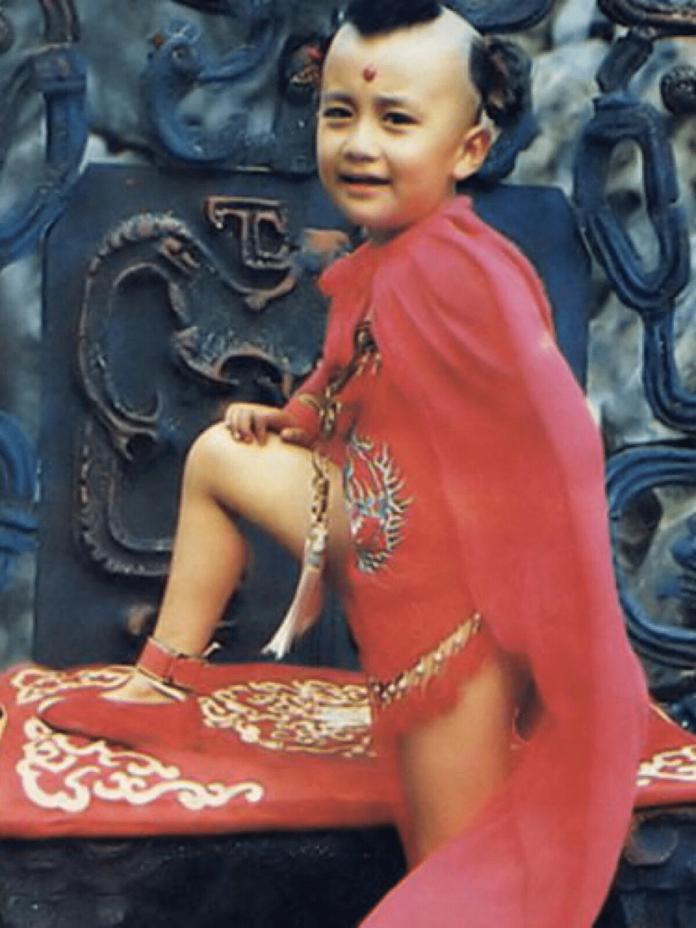
He is portrayed with a hair tuft and coils, a red urna, a red cape, a red stomacher, and red slippers (fig. 6).

Fig. 6 – “Adorable Red Boy” (larger version). Image found here.

3.2. 1996 JTTW

He is portrayed by a young woman with two red ribbon-wrapped, white cloth-covered hair buns and a white undershirt and a red vest, red forearm cuffs, red shorts, and red slippers (fig. 7).

Fig. 7 – “Girl Red Boy” (larger version). Image found here.

3.3. 2011 JTTW

He is portrayed with a hair tuft, red horns, a dark red to brown suit of armor with a flame pattern, and a red cape (fig. 8).

Fig. 8 – “Armored Red Boy” (larger version). The original online source is no longer available.

4. Conclusion

JTTW chapter 41 describes Red Boy as having doll-like beauty with a powder white face, crescent moon-shaped eyebrows, and deep red lips. His dark hair is either wrapped in buns or hung in coils. He is shoeless, and the only clothing covering his husky body is a silken battle kilt embroidered with phoenixes and dragons. And his weapon is an 18.77 ft (5.724 m) long, fired-tipped spear.


Update: 03-25-24

It occurred to me that the following description …

With no other armor except a battle kilt of embroidered silk and with naked feet … (Wu & Yu, 2012, vol. 2, p. 222).

妖王掄槍拽步,也無甚麼盔甲,只是腰間束一條錦繡戰裙,赤著腳

… does not necessarily exclude other clothing. Red Boy could wear some kind of silk robe beneath the battle kilt. However, I think him being shirtless better fits with his ferocious nature.


Update: 04-30-24

Chapter 42 indicates that Red Boy has a full head of hair that is later shaved by Guanyin:

She took out from her sleeve a golden razor and approached the fiend. With a few strokes, she shaved his hair off and turned it into the style of the Tai Mountain Crowning the Head: the top was completely bald, but three tufts of hair were left around the edge so that they could be knotted together into three tiny braids (Wu & Yu, 2012, vol. 2, p. 250).

就袖中取出一把金剃頭刀兒,近前去,把那怪分頂剃了幾刀,剃作一個太山壓頂,與他留下三個頂搭,挽起三個窩角揪兒。

This contrasts with modern representations of Red Boy that already have this shaven hair style prior to being subjugated. Refer back to section 3.

Notes:

1) Chapter 42 reads:

After she received [treasure swords borrowed from heaven], the Bodhisattva [Guanyin] threw them into the air as she recited a spell: the swords were transformed into a thousand-leaf lotus platform. Leaping up, the Bodhisattva sat solemnly in the middle.

菩薩接在手中,拋將去,念個咒語,只見那刀化作一座千葉蓮臺。菩薩縱身上去,端坐在中間。

[…]

[Sun Wukong feigns defeat and tricks Red Boy into chasing him to Guayin’s domain] When the monster spirit suddenly discovered that Pilgrim was gone, he walked up to the Bodhisattva with bulging eyes and said to her, “Are you the reinforcement Pilgrim Sun brought here?” The Bodhisattva did not reply. Rolling the lance in his hands, the monster king bellowed, “Hey! Are you the reinforcement Pilgrim Sun brought here?” Still the Bodhisattva did not reply. The monster-spirit lifted his lance and jabbed at the heart of the Bodhisattva, who at once changed herself into a beam of golden light and rose into the air. Pilgrim followed her on her way up and said to her, “Bodhisattva, you are trying to take advantage of me! The monster-spirit asked you several times. How could you pretend to be deaf and dumb and not make any noise at all? One blow of his lance, in fact, chased you away, and you have even left behind your lotus platform.”

“Don’t talk,” said the Bodhisattva, “let’s see what he will do.” At this time, Pilgrim and [Mucha] both stood in the air shoulder to shoulder and stared down; they found the monster-spirit laughing scornfully and saying to himself, “Brazen ape, you’re mistaken about me! What sort of person do you think that I, Holy Child, happen to be? For several times you could not prevail against me, and then you had to go and fetch some namby-pamby Bodhisattva. One blow of my lance now has made her vanish completely. Moreover, she has even left the treasure lotus platform behind. Well, let me get up there and take a seat.” Dear monster-spirit. He imitated the Bodhisattva by sitting in the middle of the platform with hands and legs folded. When he saw this, Pilgrim said, “Fine! Fine! Fine! This lotus platform has been given to someone else!”

“Wukong,” said the Bodhisattva, “what are you mumbling again?”

“Mumbling what? Mumbling what?” replied Pilgrim. “I’m saying that the lotus platform has been given to someone else. Look! It’s underneath his thighs. You think he’s going to return it to you?”

“I wanted him to sit there,” said the Bodhisattva.

“Well, he’s smaller than you,” said Pilgrim, “and it seems that the seat fits him even better than it fits you.”

“Stop talking,” said the Bodhisattva, “and watch the dharma power.”

She pointed the willow twig downward and cried, “Withdraw!” All at once, flowers and leaves vanished from the lotus platform and the auspicious luminosity dispersed entirely. The monster king, you see, was sitting actually on the points of those swords. The Bodhisattva then gave this command to [Mucha]:

“Use your demon-routing cudgel and strike back and forth at the sword handles.”

Dropping from the clouds, [Mucha] wielded his cudgel as if he were demolishing a wall: he struck at the handles hundreds of times. As for that monster-spirit,

Both his legs were pierced till the points stuck out;
Blood spouted in pools as flesh and skin were torn.

Marvelous monster! Look at him! Gritting his teeth to bear the pain, he abandoned the lance so that he could use both hands to try to pull the swords out from his body … (Wu & Yu, 2012, vol. 2, pp. 246 and 249-250).

這妖精見沒了行者。走近前,睜圓眼,對菩薩道:「你是孫行者請來的救兵麼?」菩薩不答應。妖王撚轉長槍,喝道:「咄!你是孫行者請來的救兵麼?」菩薩也不答應。妖精望菩薩劈心刺一槍來。那菩薩化道金光,徑走上九霄空內。行者跟定道:「菩薩,你好欺伏我罷了,那妖精再三問你,你怎麼推聾裝啞,不敢做聲,被他一槍搠走了,卻把那個蓮臺都丟下耶?」菩薩只教:「莫言語,看他再要怎的。」

此時行者與木叉俱在空中,並肩同看。只見那妖呵呵冷笑道:「潑猴頭,錯認了我也。他不知把我聖嬰當作個甚人,幾番家戰我不過,又去請個甚麼膿包菩薩來卻被我一槍,搠得無形無影去了,又把個寶蓮臺兒丟了。且等我上去坐坐。」好妖精,他也學菩薩,盤手盤腳的坐在當中。行者看見道:「好好好,蓮花臺兒好送人了。」菩薩道:「悟空,你又說甚麼?」行者道:「說甚?說甚?蓮臺送了人了。那妖精坐放臀下,終不得你還要哩?」菩薩道:「正要他坐哩。」行者道:「他的身軀小巧,比你還坐得穩當。」菩薩叫:「莫言語,且看法力。」

他將楊柳枝往下指定,叫一聲:「退!」只見那蓮臺花彩俱無,祥光盡散,原來那妖王坐在刀尖之上。即命木叉:「使降妖杵,把刀柄兒打打去來。」那木叉按下雲頭,將降魔杵如築牆一般,築了有千百餘下。那妖精穿通兩腿刀尖出,血注成汪皮肉開。好怪物,你看他咬著牙,忍著痛,且丟了長槍,用手將刀亂拔 …

2) Padded silk armor was apparently used in ancient China as early as 600 CE (Dean, 1920, pp. 284-285).

Sources:

Dean, B. (1920). Helmets and Body Armor in Modern Warfare. United Kingdom: Yale University Press.

Jiang, Y. (2005). The Great Ming Code / Da Ming Lu. Vancouver, Wa: University of Washington Press.

Wall, B. (2019). Dynamic Texts as Hotbeds for Transmedia Storytelling: A Case Study of the Story Universe of the Journey to the WestInternational Journal of Communication 13, 2116-2142. Retrieved from https://ijoc.org/index.php/ijoc/article/view/10006/2648.

Wu, C., & Yu, A. C. (2012). The Journey to the West (Vols. 1-4) (Rev. ed.). Chicago, Illinois: University of Chicago Press.

Interesting Facts about the Monkey King

Last updated: 08-28-2022

I recently posted a list of facts about Sun Wukong (孫悟空) to reddit. I am presenting an elongated version of it here, which serves as a summation of everything that I’ve learned over the years. It is by no means comprehensive. I’ll add more facts in the future as I learn of them. Enjoy.

Current count: 108

  1. He was likely influenced by the Hindu monkey god Hanuman (Ch: Ha nu man, 哈奴曼) in different waves, one possibly from the north (via Tibet) and another from the south (via Southeast Asia). But the parallels are most apparent from the standard 1592 edition of JTTW, suggesting that the author-compiler had access to some form of the Indian epic Rāmāyana (7th-c. BCE to 3rd-c. CE). The novel even includes material from the epic Mahābhārata (4th-c. BCE to 4th-c. CE).
  2. In my opinion, however, the greatest influence on his 1592 persona is a white ape antagonist from a Tang-era story. Similarities include: 1) both are supernatural primates possessed of human speech; 2) one thousand-year-old practitioners of longevity arts; 3) masters of Daoist magic with the ability to fly and change their appearance; 4) warriors capable of single-handedly defeating an army; 5) have a fondness for armed martial arts; 6) have an iron-hard, nigh-invulnerable body immune to most efforts to harm them; 7) have eyes that flash like lightning; 8) live in verdant mountain paradises (like Flower Fruit Mountain); and 9) reside in caves with stone furniture (like the Water Curtain Cave).
  3. He has the second longest association with the JTTW story cycle, appearing as the “Monkey Pilgrim” (Hou xingzhe, 猴行者) circa 1000 (or before). Sha Wujing’s earliest antecedent appeared during the 8th-century, while Zhu Bajie didn’t appear until the 14th-century.
  4. The oldest published mention of the Monkey Pilgrim is a eulogy appearing in a tale from Zhang Shinan’s (張世南) Memoirs of a Traveling Official (Youhuan jiwen, 遊宦紀聞, 13th-century). One scholar dates the story to around 1127.
  5. The oldest depictions of this character (late-11th to late-13th-century) appear in Buddhist cave art along the Silk Road in Northern China. He is almost always portrayed in a scene worshiping the Bodhisattva Guanyin.
  6. A 13th-century version of JTTW describes the Monkey Pilgrim as a white-clad scholar who is an ancient immortal from the very beginning of the tale. He was beaten with an iron rod as a young immortal after he stole magic peaches and was subsequently banished to the Mountain of Flowers and Fruit. He actively searches out the monk to protect him as the cleric’s two previous incarnations were eaten by a monster (Sha Wujing’s antecedent) in the past.

  7. This immortal fights with two staves (at different times), a golden-ringed monk’s staff and an iron staff (both borrowed from heaven). The monk’s staff can create destructive blasts of light, as well as transform into titanic creatures, including a club-wielding yaksha and an iron dragon. The iron staff isn’t shown to have any special powers. These weapons were later combined by storytellers, the rings from the former being added to the ends of the latter.

  8. He is called the “Monkey King” (Houwang, 猴王) as far back as the 13th-century version. This position is likely based on a jataka tale about the Buddha’s past life as a king of monkeys.
  9. The immortal is bestowed the title “Great Sage Steel Muscles and Iron Bones” (Gangjin tiegu dasheng, 鋼筋鐵骨大聖) at the end of the story by Tang Taizong.
  10. This immortal was heavily influenced by the Buddhist Saint Mulian (目連; Sk: Maudgalyayana).
  11. He was popular even in Korea and appeared in a set of carvings from a 14th-century stone pagoda.
  12. The earliest mention of the name “Sun Wukong” that I’m aware of appears in an early-15th-century zaju play. It depicts the character as a sex-crazed maniac who kidnaps a princess to be his wife, tries to seduce Princess Iron Fan, and later gets erectile disfunction when his golden headband tightens while trying to have sex with a young maiden in the Kingdom of Women.
  13. The dharma name “Wukong” (悟空) was likely influenced by a historical monk of that name who traveled to India during the 8th-century. The name means “Awakened to Emptiness”, thus referencing Buddhist enlightenment. I think the corresponding Sanskrit name would be something like “Bodhiśūnyatā” (but don’t quote me on this).

  14. The surname “Sun” (孫) means “grandson” but is an open reference to husun (猢猻, lit: “grandson of the barbarian”), the Chinese word for “macaque“. It was also a popular surname for supernatural primates in stories associated with the Lingyin Temple (靈隱寺), which also likely influenced the Monkey King.

  15. The 1592 edition of the novel associates the components of Sun (孫 = zi, 子 & xi, 系) (ch. 1 – see section 4.2 here) with the formation of a “holy embryo” (shengtai, 聖胎), an immortal spirit that lives on after the adherent dies.

  16. So taking all of the Buddhist and Daoist references into account, another translation for Sun Wukong would be “Immortal Awakened to Enlightenment”. This is a reference to the Buddho-Daoist philosophy of Zhang Boduan (張伯端, mid- to late-980s-1082), who believed that in order to become a true transcendent (xian, 仙), one had to achieve both the Daoist elixir of immortality and Buddha-nature (i.e. Buddhahood).

  17. The aforementioned zaju play calls him the “Great Sage Reaching Heaven” (Tongtian dasheng, 通天大聖).

  18. Said play also states that he has two sisters and two brothers. The sisters are respectively named the “Venerable Mother of Mount Li” (Lishan laomu, 驪山老母) and “Holy Mother Wuzhiqi” (Wuzhiqi shengmu, 巫支祇聖母). His older brother is called “Great Sage Equaling Heaven” (Qitian dasheng, 齊天大聖) and the younger the “Third Son Shuashua” (Shuashua sanlang, 耍耍三郎).

  19. His story in the 1592 version takes place not in our world but in one modeled after ancient Hindo-Buddhist cosmic geography, which features four island-like continents floating in a great ocean around the four respective faces of a cosmic mountain. And yet the novel was published during a time coinciding with the late Renaissance period in Europe, precisely 49 years after Copernicus suggested that the Earth orbits the sun.
  20. His home, the Mountain of Flowers and Fruit (Huaguo shan, 花果山), is located near the easternmost continent, while China is associated with the southernmost continent. This means that Monkey, within the novel, is not Chinese!
  21. He has had past lives (see the 11-24-20 update here).
  22. He’s not the only figure from world myth born from stone. In fact, “Birth from rock” (T544.1) is a mythic category appearing in Stith Thompson’s Motif-Index of Folk-Literature.

  23. While his stone birth (ch. 1) is likely based on that of Yu the Great (Dayu, 大禹), a legendary King of the Xia dynasty (more on this below), it may ultimately be linked to Tibetan stories of stone-born monkey deities.
  24. He was likely born during the late-Zhou Dynasty (circa 1046-256 BCE).
  25. He serves as a physical manifestation of the “Mind Monkey” (xinyuan, 心猿), a Buddho-Daoist philosophy denoting the disquieted thoughts that keep Man trapped in the illusory world of Saṃsāra (see the material below figure three here). This phrase is also surprisingly associated with sexual desire.
  26. Despite the association above, Monkey shows no interest in sex throughout the entire novel. This may be a response to the highly sexualized Sun Wukong from the zaju play.
  27. The novel also gives him the alchemical title “Squire of Metal/Gold” (Jingong, 金公), a possible “anagrammatic reading of the Chinese graph for lead or qian 鉛, which may be broken up into the two graphs of jin and gong” (Wu & Yu, 2012, vol. 1, p. 532 n. 3). Lead is an ingredient in external alchemy (see the material after figure two here). The title might also be referring to the earthly branch shen (申), which is associated with both metal and monkeys (Wu & Yu, 2012, vol. 1, p. 532 n. 3).
  28. The overall arc of his birth and early life were likely based on that of the historical Buddha to make his tale more familiar to readers. Similarities include: A) supernatural births that split open their respective mothers (Queen Maya vs stone egg); B) producing a radiant splendor in all directions upon their birth; C) being talented students that quickly master concepts taught to them; D) early lives as royals (Indian prince vs king of monkeys); E) shock at the impermanence of life; F) questing for a spiritual solution to said impermanence; and G) finding said solution via spiritual practices (Indic meditation vs Daoist elixir arts).

  29. His “Water Curtain Cave” (Shuilian dong, 水簾洞), the grotto-heaven where he and his people live in the Mountain of Flowers and Fruit, is associated with a different immortal in older religious literature. For instance, the Song-era text Master Ghost Valley’s Numinous Writ of the Essence of Heaven (Guigu zi tiansui lingwen鬼谷子天隨靈文) calls the titular character the “Master of the Waterfall Cave” (Shuilian dong zhu, 水濂洞主). In this case, the source uses a different lian (濂) in place of the lian (簾) associated with Monkey’s cave. But they both mean the same thing: a waterfall hiding a cave mouth (see the 12-11-21 update here). One 17th-century novel influenced by JTTW states that Master Ghost Valley lives in the Water Curtain Cave (Shuilian dong, 水簾洞; i.e. the same as Monkey’s home) with his student, the Warring States strategist Sun Bin (孫臏, d. 316 BCE). This means that two characters surnamed Sun (孫) live there in Chinese literature (see section II here).
  30. Despite modern media portraying him as an adult-sized humanoid character that is sometimes handsome and/or very muscular, the 1592 version describes him as an ugly, bald, and skinny Rhesus macaque that is less than four feet tall. This means that one of the most powerful warriors in the Buddho-Daoist cosmos is the size of a child.
  31. While commonly portrayed as a Daoist immortal, his first master, the Patriarch Subodhi (Xuputi zushi, 須菩提祖師) (ch. 1 & 2), is shown to live in India and have a strong connection to Buddhism, possibly even being a Bodhisattva.
  32. The breathing and energy circulation methods that Monkey uses to achieve immortality (ch. 2) are based on real Daoist elixir practices.
  33. The actual name for his famous 72 Transformations is “Multitude of Terrestrial Killers” (Disha shu, 地煞數), which is based on a popular set of malevolent stellar gods.
  34. This skill not only allows Monkey to transform into whatever he wants but also gives him a store of extra heads and possibly even extra lives like a video game (see section 4.4 # 3 here).
  35. He specifically learns the 72 Transformations (ch. 3) in order to hide from a trio of elemental calamities sent by heaven to punish cultivators for defying their fate and achieving immortality. This is the origin of the “Heavenly Tribulation” (tianjie, 天劫; zhongjie, 重劫) trope from modern Xianxia literature.
  36. But, surprisingly, he is not a true immortal, just long-lived and really hard to kill. The novel refers to him as a “bogus immortal” (yaoxian, 妖仙). This references Zhang Boduan’s aforementioned philosophy where one must obtain both the Daoist elixir (which Monkey did) and Buddha-Nature (which he hadn’t yet achieved) in order to be a true transcendent.
  37. While training under Subodhi (ch. 3), he expressly passes on learning the bureaucratic-style magic rites normally used by earthly priests to request something from heaven because the skills involved won’t result in eternal life. Instead, after achieving immortality, Monkey just commands the gods to do his bidding (see section II here).
  38. He can grow 100,000 feet (30,480 m) tall (ch. 1, 6, 61, and 97). This skill is called the “Method of Modeling Heaven on Earth” (Fatian xiangdi, 法天像地), and it is related to ancient Pre-Qin and Han concepts of astral-geography later used in the construction of imperial Chinese cities.
  39. His magic “immortal breath” (xianqi, 仙氣) can transform his hairs, his staff, and objects not in direct contact with his body into anything he desires. It can also change disembodied souls into “ether” for ease of transport, and evidence suggests that it can even grant some form of immortality.
  40. Monkey has 84,000 hairs on his body, and he can transform them into hundreds of thousands, millions, and even billions of hair clones (see the 03-19-22 update here).
  41. The novel only mentions him learning martial arts in passing (ch. 67 – see section 4.5 here), but one episode (ch. 51) features a battle between Monkey and a demon king in which they use a host of real world fighting techniques that are still known and practiced today.
  42. His favorite style of boxing is “Short Fist” (duanquan, 短拳) (see the 05-02-18 update here).
  43. His skill with the staff is so great that the novel compares it to techniques from two manuals listed among the Seven Military Classics of China (see the 08-07-18 update here).
  44. The bureaucratic mix-up that resulted in his soul being dragged to hell (ch. 3) is based on “mistaken summons” to the underworld and “return-from-death” narratives present in early Chinese “miraculous tales” (Zhiguai xiaoshuo, 志怪小説) (Campany, 1990).
  45. When he looks at his entry in the ledgers of hell, he learns that: 1) his soul number is “1,350”; 2) his real name is “Heaven-Born Stone Monkey” (Tianchan shihou, 天產石猴); and 3) he was fated to have a “good end” at the ripe old age of 342. This refers to a person’s pre-allotted lifespan (ming, 命) (Campany, 2005; Campany & Ge, 2002, pp. 47-52).
  46. The distance that his cloud-somersault can travel, 108,000 li (33,554 mi / 54,000 km), is based on a metaphor for instantaneous enlightenment. It comes from the Platform Sutra of the Sixth Chan Patriarch Huineng (惠能). The Chan Master explains that the common trope of the Buddha’s paradise being separated from the world of man by 108,000 li is based on a combination of the “Ten Evils” (Shi’e, 十惡) and “Eight Wrongs” (Baxie, 八邪) of Buddhism. Those who rid themselves of these spiritual flaws will achieve enlightenment and thus arrive instantly at the Buddha’s paradise.
  47. The initial depiction of his magic staff as a great iron pillar kept in the dragon kingdom treasury (ch. 3) is based on a metal column that the immortal Xu Xun (許遜) chained a demonic dragon to and then imprisoned in the aquatic realm in Chinese mythology.
  48. It’s a common misconception that his staff weighed down the Milky Way galaxy. This is based on a mistranslation. The W. J. F. Jenner edition claims that the weapon anchored said star cluster. However, the original Chinese states that it was used as a means to measure and set the depths of the Heavenly River (Tianhe, 天河; a.k.a. Milky Way).

  49. The weight of his staff is likely an embellishment on the weight of a heavy stone block lifted by the bandit-hero Wu Song (武松) in the Water Margin (Shuihu zhuan, 水滸傳, c. 1400). This episode and the JTTW episode where Monkey acquires his staff both involve a hero (Wu Song vs Sun Wukong) asking someone (a friend vs the Dragon King) to take them to a seemingly immovable object (stone block vs iron pillar). They then adjust their clothing before lifting the object with ease. Most importantly, the Chinese characters for the respective weights are visually similar. Sun’s staff is 13,500 catties (yiwan sanqian wubai jin, 一萬三千五百斤; 17,5560 lbs. / 7965.08 kg), while the stone block is 300 to 500 catties (sanwubai jin, 三五百斤; 390-650 lbs. / 177-295 kg). The characters in bold indicate the similarities between the two weights, where as those in red indicate the embellishments: 一萬五百斤.

  50. He singlehandedly defeats the “Nine Planets” (Sk: Navagraha; Ch: Jiuyao, 九曜, “Nine Luminaries”), personifications of the sun and planets from Hindu astrology (Gansten, 2009), during his rebellion (ch. 4) (Wu & Yu, 2012, vol. 1, pp. 170-172).
  51. His time as the Bimawen (弼馬溫, “To assist horse temperament”), a minor post overseeing the heavenly horse stables (ch. 4), is based on an ancient Chinese practice of placing monkeys in horse stables to ward off equine sicknesses. The belief was that the menstrual blood of female monkeys mixed with horse food somehow guarded against diseases. This is hilarious as the position links Sun Wukong to menstruation!

  52. His title “Great Sage Equaling Heaven” (Qitian dasheng, 齊天大聖) (ch. 4) was actually borrowed from the “Eastern Marchmount” (Dongyue, 東嶽; a.k.a. “Eastern Peak”), the god of Mt. Tai. This suggests that the older brother from the aforementioned zaju play is really the Eastern Marchmount.
  53. His time as the Guardian of the Immortal Peach Groves (ch. 5) is likely based on a Song-era Daoist scripture in which the aforementioned Sun Bin is tasked by his teacher, Master Ghost Valley, with protecting a tree laden with special fruit. He later captures a magic white ape stealing said produce (see section III here). The simian thief saves his life by offering Sun a set of secret religious texts. Both stories include: 1) a character surnamed Sun (孫) protecting special fruit (Sun Bin vs Sun Wukong); and 2) supernatural primates that steal and eat the fruit. Therefore, Monkey’s 1592 persona serves as both the guard and the thief!
  54. The elixir pills that he drunkenly eats in Laozi’s laboratory (ch. 5) likely influenced the senzu beans from the world famous Dragon Ball (Jp: Doragon Bōru,ドラゴンボール; Ch: Qilongzhu, 七龍珠) franchise.
  55. His conflict with Erlang (ch. 6) can be traced to ancient Han-era funerary rituals, and their battle of magic transformations shares parallels with ancient Greek tales and can ultimately be traced to even older stories from the Near East.
  56. His time in Laozi‘s furnace (ch. 7) is based on an episode from the aforementioned 13th-century version of JTTW. It may also be connected to a story of Laozi magically surviving a foreign king’s attempt to boil him in a cauldron.
  57. He is shown to be weak against spiritual fire and smoke (see the 06-28-22 update here).
  58. Smoke from the furnace irritates his eyes, giving him his famous “Fiery Eyes and Golden Pupils” (Huoyan jinjing, 火眼金睛). The former is likely based on the “actual red-rimmed eyes of [the Rhesus macaque]” (Burton, 2005, p. 148). The latter is likely based on the golden pupils of macaques (see section 2.1 here).
  59. The message that he leaves on the Buddha’s finger (ch. 7) is a popular form of graffiti in East Asia.
  60. His time under Five Elements Mountain (Wuxing shan, 五行山) (ch. 7) is based on stories of the aforementioned Wuzhiqi (無支奇/巫支祇) being imprisoned under a mountain by Yu the Great.
  61. He was pressed under the mountain during the late-Han Dynasty (202 BCE-220CE – see section II here).
  62. A religious precious scroll predating the 1592 edition states that Erlang instead traps Monkey beneath Mount Tai, and the aforementioned 15th-century zaju play states it was Guanyin and the Mountain of Flowers and Fruit.
  63. This punishment links him to a broader list of mythic baddies imprisoned in earth, including Lucifer, Loki, and the Titans of Tartarus. I plan to write a later article about “earth prisons” in world myth.
  64. One scholar suggests that being trapped under Five Elements Mountain is a symbolic death (remember that Monkey claims to be free of the Five Elements after attaining immortality), meaning that the hellish diet is his karmic punishment in the afterlife, and his later release is a symbolic reincarnation.
  65. Monkey’s mountain imprisonment was only part of his punishment. The other half was a hellish diet of hot iron pellets and molten copper, punishments straight from Buddhist canon.
  66. His golden headband (ch. 13) has three influences: 1) a historical ritual circlet worn as a physical reminder of right speech and action by Esoteric Buddhist yogins in ancient India; 2) adornments, likely based on stylized lingzhi mushrooms, worn by Daoist protector deities; and 3) an Iranic triple-crescent crown.
  67. The oldest depiction of Monkey with his headband that I know of appears in a late-Xixia (late-12th to early-13th-century) Buddhist cave grotto in Northwestern China.
  68. The earliest depiction of his double “curlicue-style” headband that I’m aware of is a 13th-century stone carving in Fujian.
  69. The secret spell that tightens his headband is likely the Akshobhya Buddha mantra.
  70. Along with the headband, his tiger skin kilt (ch. 13) can be traced to a list of ritual items prescribed for worshiping wrathful protector deities in Esoteric Indian Buddhism. These same ritual items came to be worn by the very protector deities that the yogins revered. This explains why some deities in Chinese folk religion (including Sun Wukong) are portrayed with the golden headband and tiger skin.

  71. Modern artists sometimes depict him with two long feathers protruding from the front of his golden headband, giving him the appearance of an insect. But the feathers (lingzi, 翎子) are actually associated with a different headdress called the “Purple Gold Cap” (zijin guan, 紫金冠), which is worn on top of the head. It was a military headdress later associated with heroes in Chinese opera (see section 2.2 here).
  72. Monkey is also shown to be weaker in water. For instance, he enlists Zhu Bajie to combat the water demon who turns out to be Sha Wujing (ch. 22) (Wu & Yu, 2012, vol. 1, p. pp. 422-423).
  73. The baby-shaped fruit that he eats (ch. 24) comes from a tree based on Indo-Persian lore.
  74. He claims to have eaten people when he was a monster in his youth (ch. 27) (Wu & Yu, 2012, vol. 2, p. 20).
  75. His greatest feat of strength is carrying two mountains while running at meteoric speeds (ch. 33). One is the axis mundi of the Hindo-Buddhist cosmos, while the other is the place from which (according to legend) Buddhism spread upon entering China. This episode is based on an older tale in which Erlang does the lifting.
  76. His doppelganger, the Six-Eared Macaque (ch. 56-58), is actually an aspect of his troubled mind. Once he kills him, Monkey takes one step closer to Buddhahood.
  77. He fights and is defeated by an ancient bird demon who is a spiritual uncle of the Buddha (ch. 77). This monster is based on the Hindu bird god Garuda.
  78. He and his religious brothers take human disciples in India (ch. 88), and Monkey later performs an arcane ritual in which he grants them superhuman strength (and possibly some form of immortality).
  79. His title, “Victorious Fighting Buddha” (Douzhan sheng fo, 鬥戰勝佛) (ch. 100), is based on a real world deity numbering among the “Thirty-Five Confession Buddhas“.
  80. The novel ranks him higher than Guanyin after his ascension (see the third quote here).
  81. As an enlightened Buddha, Monkey is eligible for his own “Buddha-Field” (Sk: Buddhakṣetra; Ch: Focha, 佛刹), essentially his own universe in which he will lead the inhabitants to enlightenment (Buswell & Lopez, 2014, p. 153).
  82. Despite his association with the Victorious Fighting Buddha, he is primarily worshiped as the Great Sage Equaling Heaven in East and Southeast Asian Chinese folk religion.
  83. Fighters of the Boxer Rebellion (Yihetuan yundong, 義和團運動, 1899-1901) believed that they could channel the Monkey King to gain his great combat skills.
  84. Modern ritual specialists known as “spirit-mediums” (Hokkien: Tangki, 童乩; Ch: Jitong, 乩童; lit: “Divining Child”) also channel the Great Sage, allowing his worshipers to have direct access to the divine. While they may use a staff to enhance the theater of their performance, the weapon surprisingly doesn’t serve a ritual function. They instead use a set of bladed or spiked weapons to draw blood intended to create evil-warding paper talismans (see the material below figure six here).
  85. Chinese folk religion recognizes more than one Great Sage, usually between three and five individuals.
  86. Monkey’s faith started in Fujian province, China and spread via boat to other countries within the Chinese diaspora. When he first started being worshiped is unknown. The first concrete references to his worship come from the 17th-century (see section III here). But the aforementioned 13th-century stone carving depicts him as a wrathful guardian, alongside other protector deities, Bodhisattvas, patriarchs, and eminent monks. This suggests that he might have been revered at an earlier time.
  87. He was even worshiped in 19th-century America!
  88. The iconic pose where he shades his eyes to search the horizon is likely based on a common motif associated with Chinese sea gods.
  89. He has a number of religious birthdays, one of which is the 16th day of the 8th lunar month (the day after the Mid Autumn Festival).
  90. There is a style of Chinese boxing named after him, “Great Sage Boxing” (Cantonese: Taishing kyun; Mandarin: Dasheng quan, 大聖拳). Another closely associated style is “Great Sage Axe Boxing” (Can: Taishing pek kwar kyun; Man: Dasheng pigua quan, 劈掛拳). These arts also have staff styles associated with the Monkey King.
  91. His time in Laozi’s furnace and ability to grow 100,000 feet tall influenced a Shaolin Monastery myth related to the founding of their famous staff fighting method. The story describes how a lowly kitchen worker jumped into an oven and remerged as a staff-wielding titan to battle mountain brigands attacking the monastery (see section 3 here).
  92. Mao Zedong, the leader of the Chinese Communist Party, was a fan of the Monkey King, even associating himself with the character in his poetry. Also, a CCP propaganda play of the 1960s associates the scripture pilgrims with members of the Communist Party, with Monkey referencing Mao.
  93. He shares several connections with Yu the Great (here and here). These include: A) both have stone births; B) Monkey’s staff was originally used by Yu as a drill and as a ruler to set the depths of the fabled world flood; C) Sun’s demonic sister Wuzhiqi was conquered by Yu in some stories; and D) both are legendary hero-kings.
  94. He shares a number of similarities with Wu Song. These include: A) both are reformed supernatural spirits originally trapped under the pressing weight of a mountain; B) slayers of tigers; C) Buddhist monks nicknamed “Pilgrim” (xingzhe, 行者), a title noting junior and traveling monks, as well as untrained riffraff that became clerics to avoid trouble with the law or taxes and military service (Wu Song is the latter and Monkey the former); D) martial arts monks who fight with staves; E) have moralistic golden headbands; and F) weapons made from bin steel (bin tie, 鑌鐵) (Wu Song’s Buddhist sabers vs Monkey’s magic staff).

  95. He shares a surprising number of similarities with the Greek hero Heracles (a.k.a. Hercules). These include: A) supernatural births via masculine heavenly forces (son of Zeus vs the stone seeded by heaven); B) quick to anger; C) big cat skins (Nemean lion vs mountain tiger); D) fight with blunt weapons (olive wood club vs magic iron staff); E) great strength; F) knocked out by a god during a fit of rage (Athena with a rock vs Laozi and his Diamond-Cutter bracelet); G) given punishment to atone for past transgressions (12 labors for killing family vs protecting the monk for rebelling against heaven); H) constantly helped by goddesses (Athena vs Guanyin); I) similar enemies (there’s a long list); tamer of supernatural horses (Mares of Diomedes vs Heavenly Horses); J) travel to lands peopled by women (Amazons vs Kingdom of Women); K) theft of fruit from the gardens of queenly goddesses (Hera’s golden apples of the Hesperides vs the Queen Mother’s immortal peaches); L) travel to the underworld; M) take part in a heavenly war (Gigantomachy vs rebellion in heaven); N) become gods at the end of their stories (god of heroes and strength vs Victorious Fighting Buddha); and O) worshiped in the real world (Greece and Rome vs East and Southeast Asia).

  96. He time travels to different points in Chinese history in an unofficial 17th-century sequel to JTTW.
  97. He has a total of eight children between two 17th-century novels. He has five sons in A Supplement to the Journey to the West (Xiyoubu, 西遊補, 1640), but only one of them is mentioned by name. “King Pāramitā” (Boluomi wang, 波羅蜜王) is portrayed as a sword-wielding general capable of fighting Sun for several rounds. His name is based on a set of virtues learned by Bodhisattvas on their path to Buddhahood. In Journey to the South (Nanyouji, 南遊記) he has two sons named “Jidu” (奇都) and “Luohou” (羅猴), who respectively represent the lunar eclipse demons Ketu and Rahu from Indian astrology. He also has a giant, monstrous daughter, “Yuebei Xing” (月孛星, “Moon Comet Star”), who is named after a shadowy planet representing the lunar apogee (or the furthest spot in the moon’s orbit) in East Asian astrology. Only the daughter plays a part in the story. She uses a magic skull, which can kill immortals three days after their name is called.

  98. He influenced the manga/anime hero Son Goku (a Japanese transliteration of 孫悟空) from the Dragon Ball Franchise.
  99. He almost appeared in an Indiana Jones movie!
  100. He has appeared in both Marvel and DC comic book series.
  101. The world’s tallest statue of Monkey is 40 ft (12.192 m) tall and resides at the Broga Sak Dato Temple (武來岸玉封石哪督廟) in Malaysia.
  102. He is the mascot of several entities in Taiwan, including the HCT delivery company, the Hang Yuan FC football team, and the Taipei Water Department.
  103. He has appeared in nearly 65 video games.
  104. He is the namesake for a Chinese satellite designed to search for dark matter.
  105. He is the namesake of a fossa on Pluto. This plays on his association with the underworld.
  106. He is the namesake of the Wukongopterus (Wukong yilong shu, 悟空翼龍屬), a genus of Chinese pterosaur.

  107. He is the namesake of Syntelia sunwukong, a Synteliid beetle from mid-Cretaceous Burma.
  108. A Covid-19 lab in Wuhan City, Hubei Province, China adopted the name “Fire Eyes” (Huoyan, 火眼) in honor of Monkey’s ability to discern evil spirits.

Sources:

Burton, F. D. (2005). Monkey King in China: Basis for a Conservation Policy? In A. Fuentes & L. D. Wolfe (Eds.), Primates Face to Face: Conservation Implications of Human-Nonhuman Primate Interconnections (pp. 137-162). Cambridge: Cambridge University Press.

Buswell, R. E., & Lopez, D. S. (2014). The Princeton Dictionary of Buddhism. N: Princeton University Press.

Campany, R. F. (1990). Return-from-Death Narratives in Early Medieval China. Journal of Chinese Religions, 18, pp. 91-125.

Campany, R. F., & Ge, H. (2002). To Live as Long as Heaven and Earth: A Translation and Study of Ge Hong’s Traditions of Divine Transcendents. Berkeley: University of California Press.

Campany, R. F. (2005). Living off the Books: Fifty Ways to Dodge Ming in Early Medieval China. In C. Lupke (Ed.), The Magnitude of Ming: Command, Allotment, and Fate in Chinese Culture (pp. 129-150), University of Hawaii Press.

Gansten, M. (2009). Navagrahas. In K. A. Jacobsen (Ed.), Brill’s Encyclopedia of Hinduism (Vol. 1) (pp. 647-653). Leiden: Brill.

Wu, C., & Yu, A. C. (2012). The Journey to the West (Vols. 1-4). Chicago, Illinois: University of Chicago Press.

Archive #29 – Ruthless Compassion: Wrathful Deities in Early Indo-Tibetan Esoteric Buddhist Art (1999)

I consider one of my greatest accomplishments on this blog to be discovering the origin of Sun Wukong’s golden headband. This would not have been possible without reading about the Hevajra Tantra (8th-century) in Robert Nelson Linrothe’s (1999) Ruthless Compassion: Wrathful Deities in Early Indo-Tibetan Esoteric Buddhist Art. This amazing study analyzes Esoteric Buddhist statues and texts to trace the evolution of these guardians from mere dwarf attendants to mighty warrior gods endowed with the power of the Five Wisdom Buddhas. This is a great resource for anyone researching religious art involving wrathful guardians in Buddhism, Daoism, and of course Chinese folk religion, for the iconography of these divine warriors spread far and wide.

I am sharing a PDF of the book found on libgen for the benefit of other scholars. The black and white portions of the book appear to be based on a xeroxed copy. However, there are full color plates in the back.

Book description:

Buddhists believe that the wrathful spirits represent inherent qualities of our own, and that meditating on them can transmute the otherwise malevolent sides of our own natures into positive qualities and actions. The wrathful deities also provide precious clues as to the early development of esoteric Buddhism in India, about which few early texts survive. Through careful examination of a large body of images as well as Sanskrit, Tibetan, and Indic texts, this lavishly illustrated volume traces the evolution of the forms and the unfolding significance of the wrathful deity in esoteric Buddhist sculpture.

Archive link:

Click to access Ruthless-Compassion-Wrathful-Deities-in-Early-Indo-Tibetan-Esoteric-Buddhist-Art-1999.pdf

Disclaimer:

This work has been posted for educational purposes. No malicious copyright infringement is intended. If you enjoyed the digital version, please support the official release.

Citation:

Linrothe, R. N. (1999). Ruthless Compassion: Wrathful Deities in Early Indo-Tibetan Esoteric Buddhist Art. London: Serindia Publ.

Archive #27 – The Journey to the West Japsang Effigies of Korean Royal Palaces

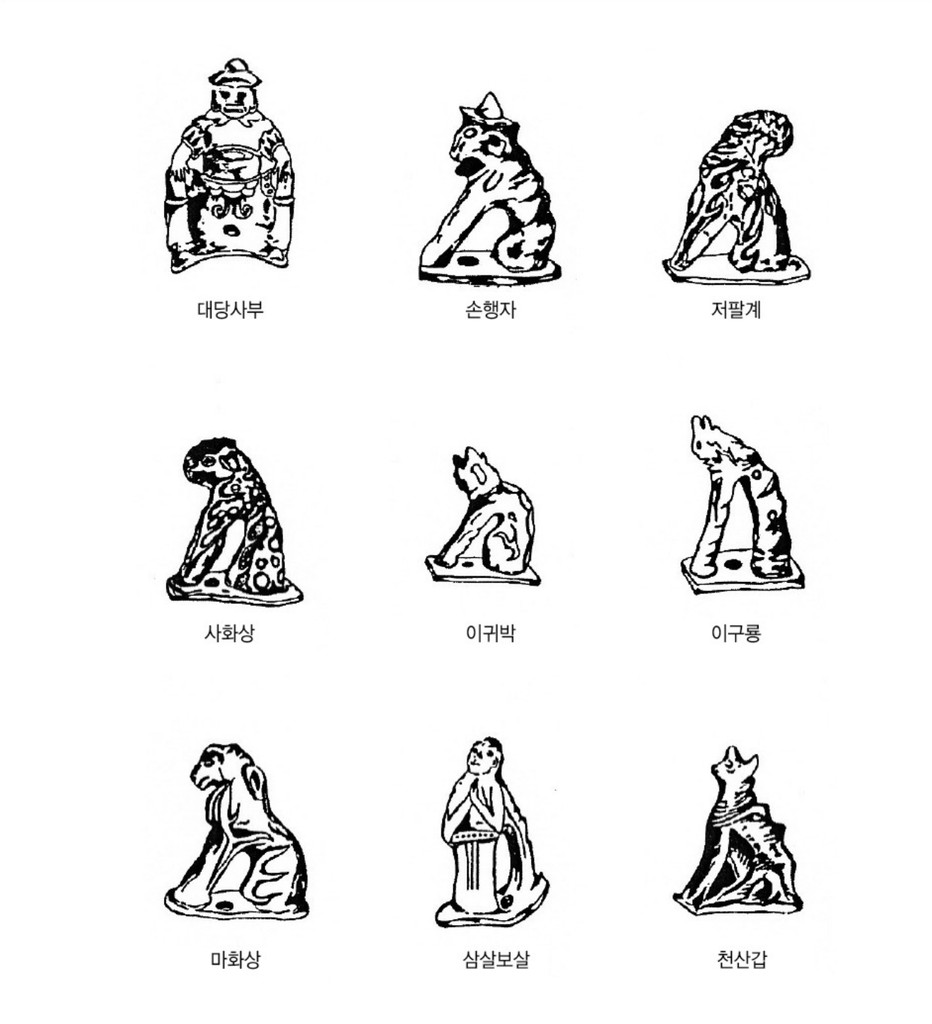
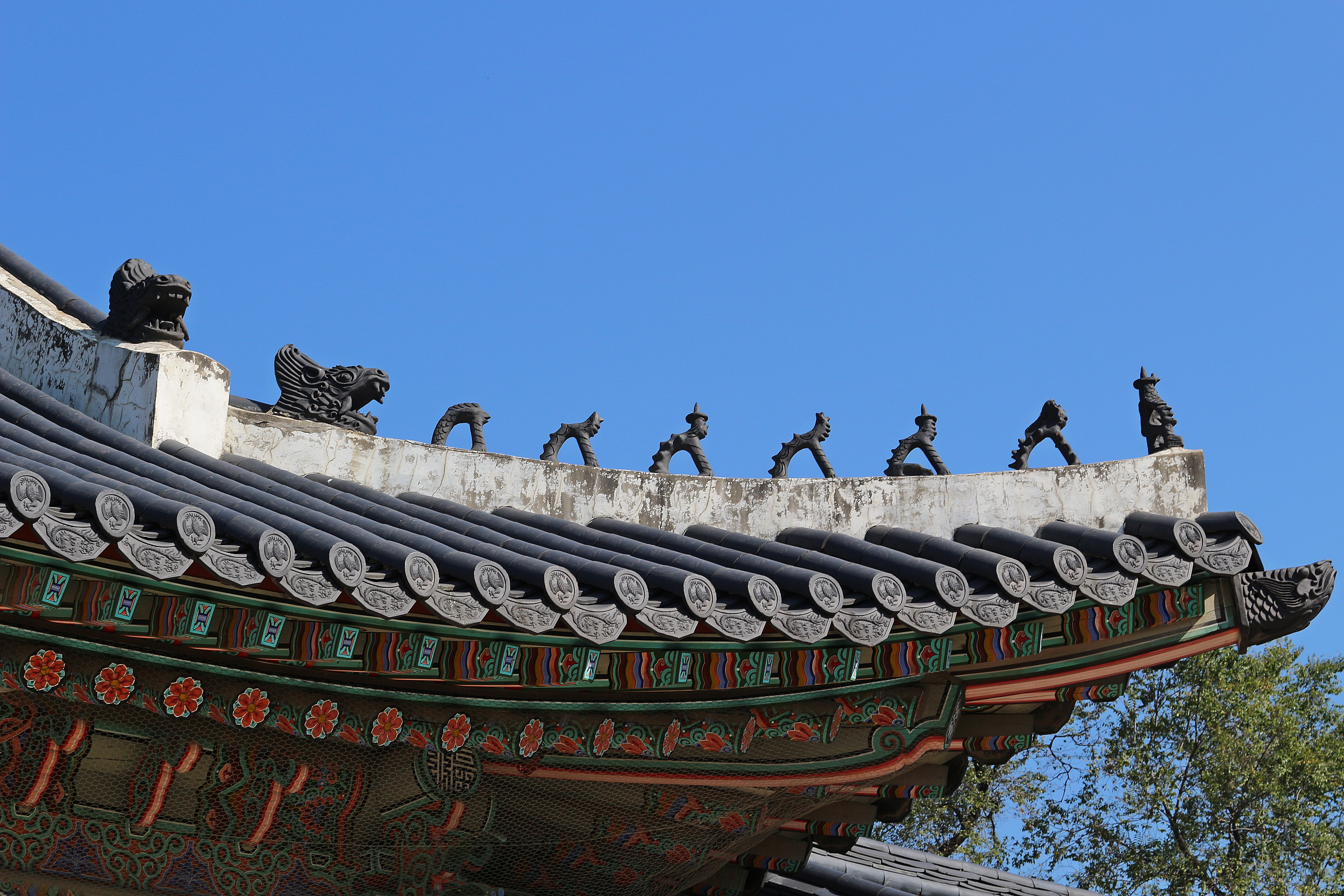
Japsang or Chapsang (Kor: 잡상; Ch: zaxiang, 雜像, “miscellaneous figurines”) are effigies of dark gray fired clay adorning the roof-hips of royal palaces in Korea. The first four (of up to eleven) figures are traditionally associated with the main characters of Journey to the West (Xiyouji, 西遊記, 1592) (fig. 1 & 2). Tripitaka is connected to the first figure, which wears a suit of armor and sits in a kingly fashion with hands on splayed knees (fig. 3). Sun Wukong is connected to the second, an ape-like figure with a pointed hat, long arms, and small legs. Zhu Bajie and Sha Wujing are respectively connected to the third and fourth figures, which are portrayed as scaled beasts with their heads turned in different directions.

Wall (2019) reveals the earliest reference to our our heroes’ association with the japsang appears in Eou yadam (어우야담, “Eou’s Unofficial Histories”), a collection of stories by the scholar-official Yu Mongin (유몽인, 1559-1623). Yu frames knowing the names of the figures as a test for a new official:

When newly appointed officials meet their predecessors for the first time, they have to be able to tell the names of the ten divine figures on top of the palace gates for ten times. . . . The names are Master of Great Tang (Taedang sabu, 大唐師傅 [Tripitaka]), Pilgrim Sun (Son haengja, 孫行者 [Sun Wukong]), Zhu Bajie (猪八戒), [and] Monk Sha (Sa Hwasang, 沙和尙 [Sha Wujing]) (Yu, 2004, as cited by Wall, 2019, p. 2137).

Interestingly, Sun Wukong was eventually associated with the very nails that fastened the figures to the royal rooftops (Chang, 2004, as cited by Wall, 2019, p. 2137). They were called “Pilgrim Sun-Nails” (Sonhaengja taech’ ol; Ch: (孫)行者帶鐵), [1] which implies our hero “was at some point considered representative of all roof ornaments” (Wall, 2019, p. 2137). This connection no doubt references Monkey’s adamantine body and position as the demon-conquering exorcist par excellence. After all, the japsang figurines were believed to “protect the palaces from calamities” (Ro & Park, 2015, p. 78), making them cognates for Chinese roof figurines, which serve as “guardians against fire and evil spirits” (Li, 1990, as cited by Wall, 2019, p. 2138). This is fascinating from a historical perspective as late dynastic Korea was staunchly Neo-Confucian, showing Journey to the West was so wildly popular in the “Land of the Morning Calm” that the pilgrims were able to transcend their original Buddhist associations (Wall, 2019, pp. 2137-2138).

(I also find this subject interesting because, while not officially worshiped by people of non-Chinese descent, it shows Sun served a religious function in Korea. Thus, we can add this thread to the complex tapestry of his worship in East and Southeast Asia.)

I originally intended to write my own in-depth article on japsang figures but later discovered Macouin (2003). This masterful paper explains the evolution of such roof adornments and their later association with the Chinese novel. Macouin (2003) is written in French, so I am presenting both the original and a rough English translation. I did not include the Korean and Chinese characters in the translation.

Fig. 1 (top L) – A chart of nine japsang (larger version). Notice that most feature the same basic arched back design similar to the Hebrew letter mēm (מ). Fig. 2 (top R) – Photo of a roof-hip featuring seven figures (larger version). From Wikipedia. Fig. 3 (bottom) – A picture of the lead figure believed to be Tripitaka (larger version). From Yogin, 2001 as cited in Macouin, 2003, p. 29. But as noted, Sun Wukong came to be associated with all japsang figures. 

I. Abstract (with translation)

French

Dans l’architecture ancienne de la Corée, à l’époque de la dynastie des Yi (1392-1910), les toits de certains bâtiments étaient ornés de statuettes protectrices, disposées en file sur leurs arêtes. À la fin du XIXe siècle, seuls les édifices peu ou prou en relation avec la fonction royale en étaient pourvus. La présence de ces figurines, à l’aspect d’animaux accroupis, est attestée au XVe siècle. Elles peuvent avoir succédé à d’autres ornements et, plus lointainement, à des tuiles spéciales à embout relevé.

Une tradition associe quatre de ces grotesques à des personnages bien connus par le roman chinois du XVIe siècle, le Xiyou ji. Plus précisément, la statuette placée en rive est identifiée au célèbre moine Xuanzang, héros de ce livre. Il est suggéré finalement que la personnification de ces statuettes pourrait être en relation avec des pratiques de bizutage.

English

In the ancient architecture of Korea, during the Yi Dynasty (1392-1910), the roofs of some buildings were adorned with protective statuettes, arranged in a line on their ridges. At the end of the 19th century, only buildings more or less related to the royal function were provided with it. The presence of these figurines, with the appearance of crouching animals, is attested in the 15th century. They may have succeeded other ornaments and, more distantly, special raised-toe tiles.

One tradition associates four of these grotesques with figures well known from the 16th century Chinese novel, Xiyou ji. More precisely, the statuette placed on the bank is identified with the famous monk Xuanzang, hero of this book. It is finally suggested that the personification of these statuettes could be related to hazing practices.

II. Original French Paper

Click to access Chapsang-paper.pdf

III. English Translation

Click to access Chapsang-paper-English-Translation-PDF.pdf

Disclaimer:

This has been uploaded for educational purposes. No malicious copyright infringement is intended. Please support the official release.

Notes:

1) For a discussion of Monkey’s “pilgrim” nickname, see section three of my previous article.

Source:

Macouin, F. (2003). Des Figurines De Toiture Coréennes, Les Chapsang. Journal Asiatique, 291(1-2), 17-34.

Ro, M. & Park, S. (Eds.). (2015). The King at the Palace: Joseon Royal Court Culture at the National Palace Museum of Korea (C. Kwon, Trans.). Seoul: National Palace Museum of Korea.

Wall, B. (2019). Dynamic Texts as Hotbeds for Transmedia Storytelling: A Case Study of the Story Universe of the Journey to the WestInternational Journal of Communication 13, 2116-2142. Retrieved from https://ijoc.org/index.php/ijoc/article/view/10006/2648