The Book of Xian and Shen (BOXS), a Catalog of Chinese Gods

I recently learned about an interesting website called the Book of Xian and Shen (BOXS), which catalogs information and pictures for Chinese gods from all over the world. There are currently 2,000 listings and counting.

https://www.bookofxianshen.com/

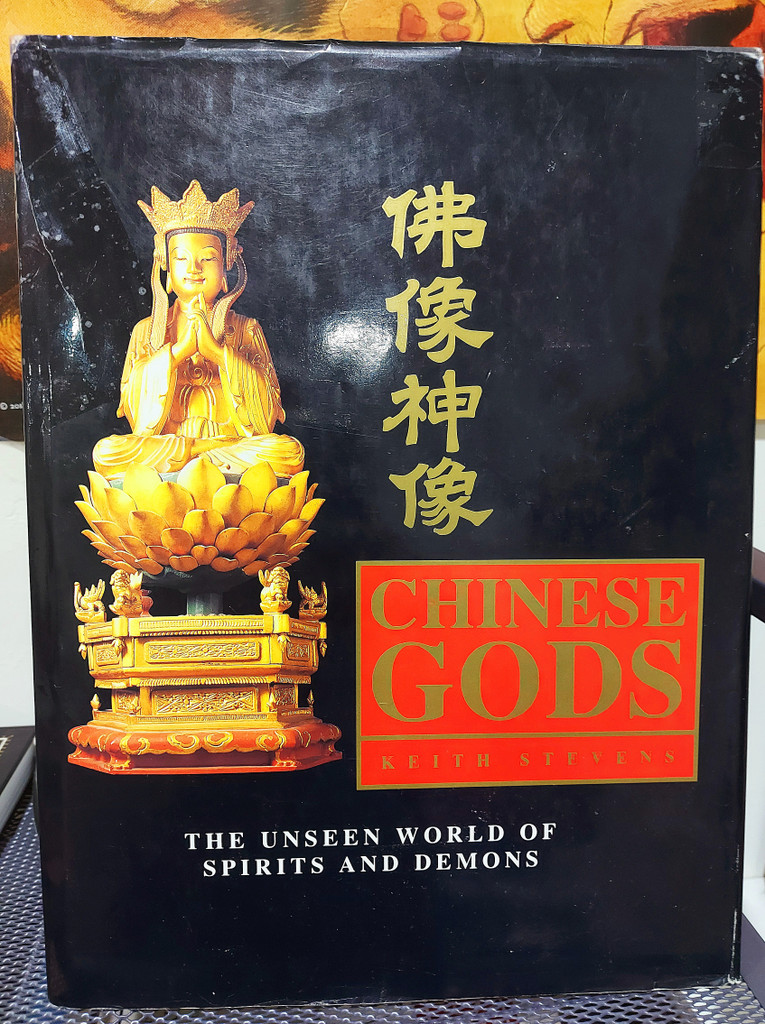
It is based on the work of religious scholar Keith Stevens (d. 2016), who wrote the amazing Chinese Gods: The Unseen Worlds of Spirits and Demons (Collins & Brown, 1997) (fig. 1). I recently volunteered to help the project. So far, I’ve written two articles (see reference no. W1001 and W1011) and updated two other existing listings with information and pictures (see the bottom of W8620 and W9305).

Fig. 1 – My well-worn personal copy of Chinese Gods (larger version).

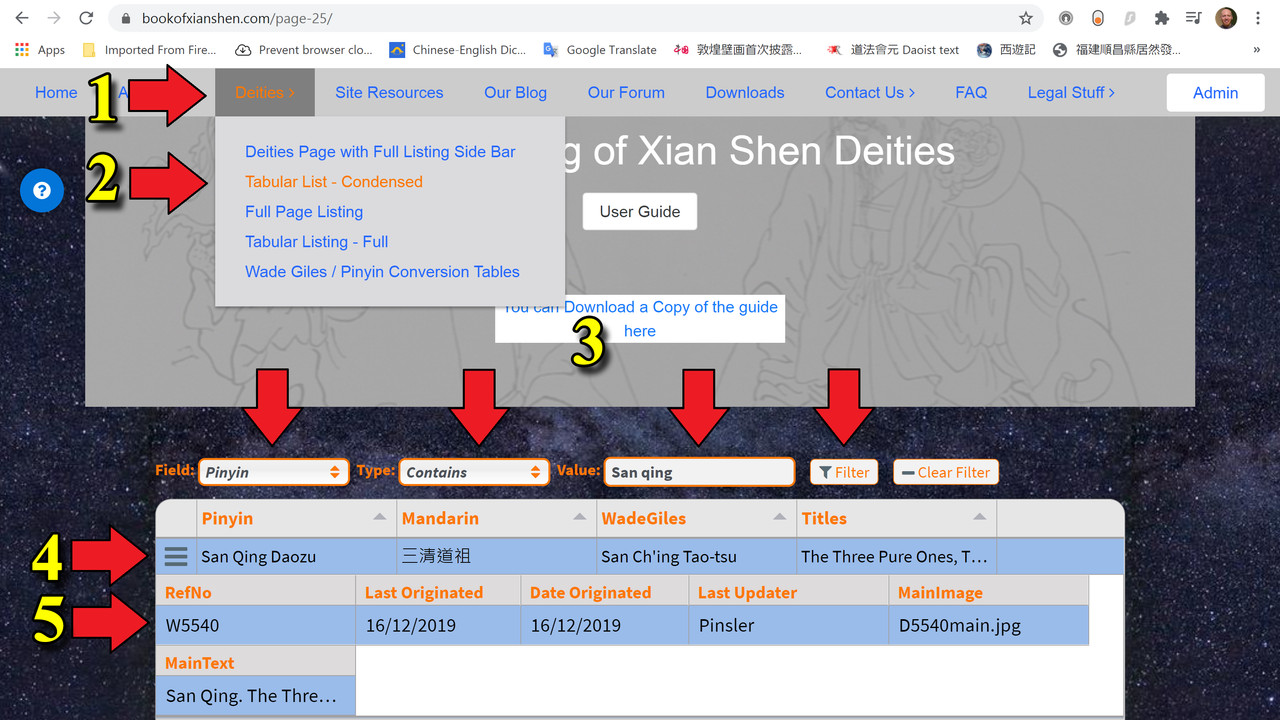
Due to the great number of listings, there are no direct links. Instead, the site has adopted a somewhat confusing (but necessary) cataloging system based around reference numbers, pinyin, Mandarin, and Wade-Giles. However, it’s easy to use once you get used to it. For example, if you were going to search for Sanqing, the “Three Pure Ones,” using, say, Pinyin, I recommend first getting the reference number (RefNo). 

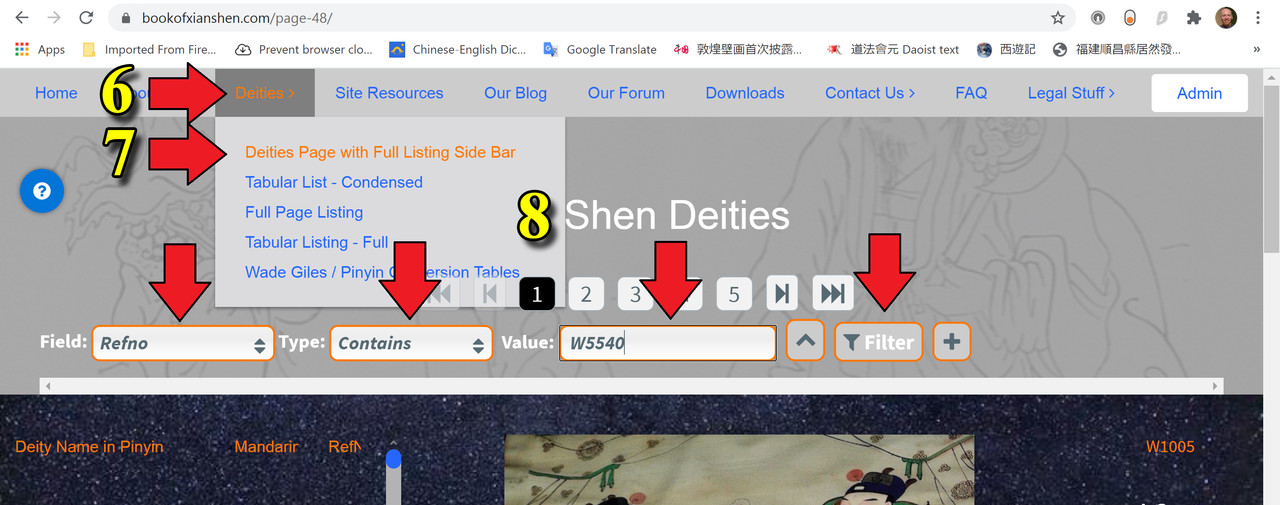
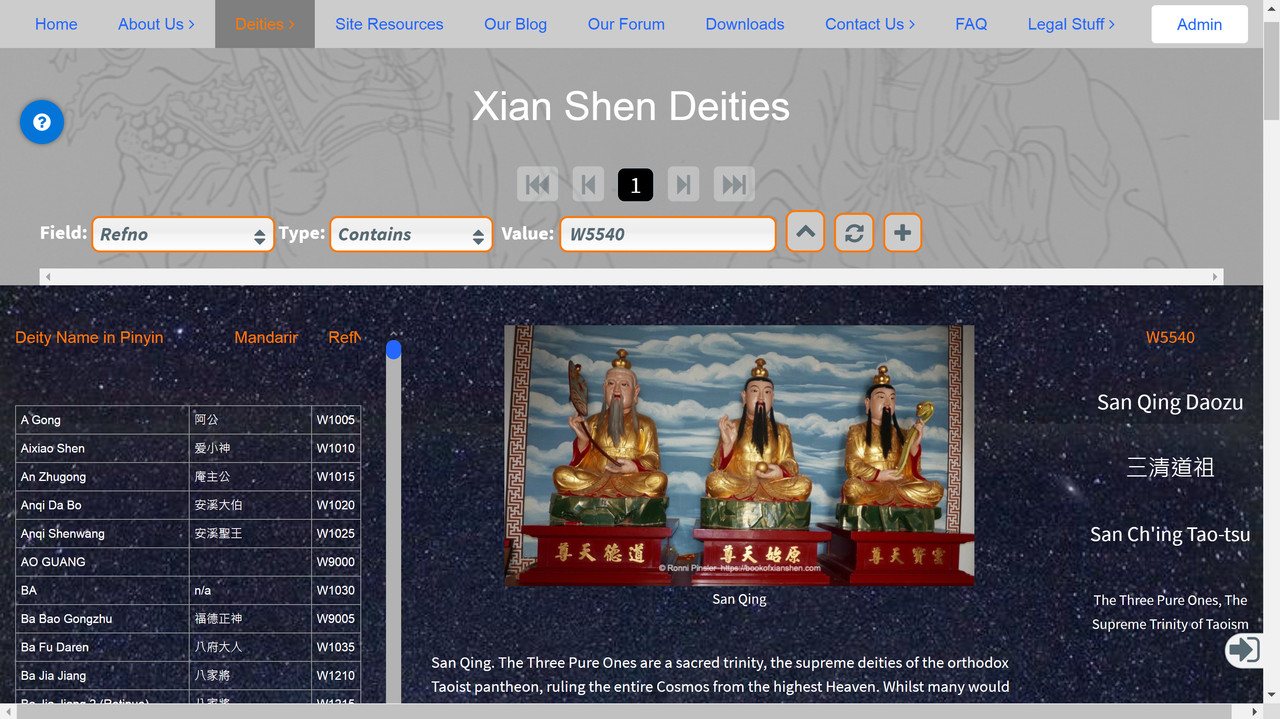
Deities —> Tabular Listing of Xian Shen Deities —> Field: Pinyin —> Type: Contains —> Value: San qing (you may have to play around with the spacing like I did here) —> Filter —> Then look for the correct listing (since other listings mentioning them might appear in the list) —> ☰ —> copy the “RefNo”, in this case W5540 (fig. 2) —> Deities —> Deities Page with Full Listing Side Bar —> Field: RefNo —> Type: Contains —> Value: W5540 —> Filter (fig. 3) —> The listing (fig. 4)

If you know the Mandarin or Wade-Giles for the deity you are looking for, the process would be similar. You would just need to change the field to “Mandarin” or “Wade-Giles”. You could just jump to “Deities Page with Full Listing Side Bar” to search using pinyin, mandarin, and Wade-Giles, but it’s been my experience that a different listing will pop up first based on a higher RefNo or Romanized spelling. First finding the reference number seems to be the easiest method for me.

I can’t recommend this website enough. New gods, as well as new stories or beliefs associated with more established deities, are appearing all the time, so it is very important to catalog everything as soon as new information becomes available. If you would like to volunteer in some way, please contact Ronni Pinsler using the “contact” form on the BOXS website.

Fig. 2 – How to acquire the reference number (RefNo) (larger version). Fig. 3 – How to navigate to the listing (larger version). Fig. 4 – The listing as seen from the top of the page (larger version).

The Monkey King and The Buddha Victorious in Strife (a.k.a. Victorious Fighting Buddha)

NOTE: THIS IS MY 100TH BLOG POST.

Last updated: 06-13-2025

The Monkey King is elevated in spiritual rank at the end of Journey to the West (Xiyouji, 西遊記, 1592; “JTTW” hereafter) for his service in protecting the monk Tripitaka throughout the quest to India. Gautama Buddha enfeoffs him as the “Buddha Victorious in Strife” or “Victorious Fighting Buddha” (Dou zhansheng fo, 鬥戰勝佛). Many readers may be surprised to learn that this is actually an established Buddhist deity and not just the creation of the JTTW author-compiler. In this article, I would like to briefly explore the Buddha’s religious background, iconography, purpose, and relationship to the worship of Sun Wukong.

Table of Contents

1. Literary Enlightenment

The Gautama Buddha explains:

“Sun Wukong, when you caused great disturbance at the Celestial Palace, I had to exercise enormous dharma power to have you pressed beneath the Mountain of Five Phases. Fortunately your Heaven-sent calamity came to an end, and you embraced the Buddhist religion. I am pleased even more by the fact that you were devoted to the scourging of evil and the exaltation of good. Throughout your journey you made great merit by smelting the demons and defeating the fiends. For being faithful in the end as you were in the beginning, I hereby give you the grand promotion and appoint you the Buddha Victorious in Strife (Wu & Yu, 2012, p. 381).

孫悟空,汝因大鬧天宮,吾以甚深法力,壓在五行山下,幸天災滿足,歸於釋教;。且喜汝隱惡揚善,在途中煉魔降怪有功,全終全始,加陞大職正果,汝為鬥戰勝佛。

2. Religious Background

JTTW closes by “submitting” or “prostrating” (namo, 南無) to a long list of Buddhas, Bodhisattvas, and Arhats. The Buddha Victorious in Strife is placed at the end of 47 Buddhas and ahead of the Bodhisattva Guanyin. A section of the list reads:

[…]
I submit to the Buddha of the Gift of Light.
I submit to the Buddha of Candana Merit.
I submit to the Buddha Victorious in Strife (emphasis added).
I submit to the Bodhisattva Guanshiyin.
I submit to the Bodhisattva, Great Power-Coming
[…] (Wu & Yu, 2012, p. 385).

…南無才光佛。南無旃檀功德佛。南無鬥戰勝佛。南無觀世音菩薩。南無大勢至菩薩…

Many of the Buddhas from the novel’s list appear in assorted real world canonical lists, including the 88 Buddhas (Bashiba fo, 八十八佛) from the Great Repentance Text of the Eighty-Eight Buddhas (Ch: Bashiba fo da chanhui wen, 八十八佛大懺悔文). [1] This group is comprised of the 53 Buddhas (Ch: Wushisan fo, 五十三佛) and the 35 Confession Buddhas (Ch: Sanshiwu fo chan, 三十五佛懺) (fig. 1).

The historical “Buddha Victorious in Strife,” Yuddhajaya (Sk: युद्धजय; see the 06-13-2025 update for more name info), is the 31st of the 35 Confession Buddhas, who are individually called upon during a confessional prayer to absolve oneself of sins. They appear in a number of sources, such as The Bodhisattva’s Confession of Ethical Downfalls (Ch: Pusa duochan / Pusa chanhui wen, 菩薩墮懺 / 菩薩懺悔文) from the Three Heaps Sutra (Sk: Trīskhandhadharmasūtra; Ch: Sanyun jing, 三蘊經) and the Names of the Thirty-Five Buddhas Spoken by the Buddha (Ch: Foshuo sanshiwu foming lichan wen, 佛說三十五佛名禮懺文, 8th century). 

Fig. 1 – A religious painting of the 35 Confession Buddhas (larger version). The Buddha Victorious in Strife is third from the right on the bottom row. Image found here.

2.1. Iconography

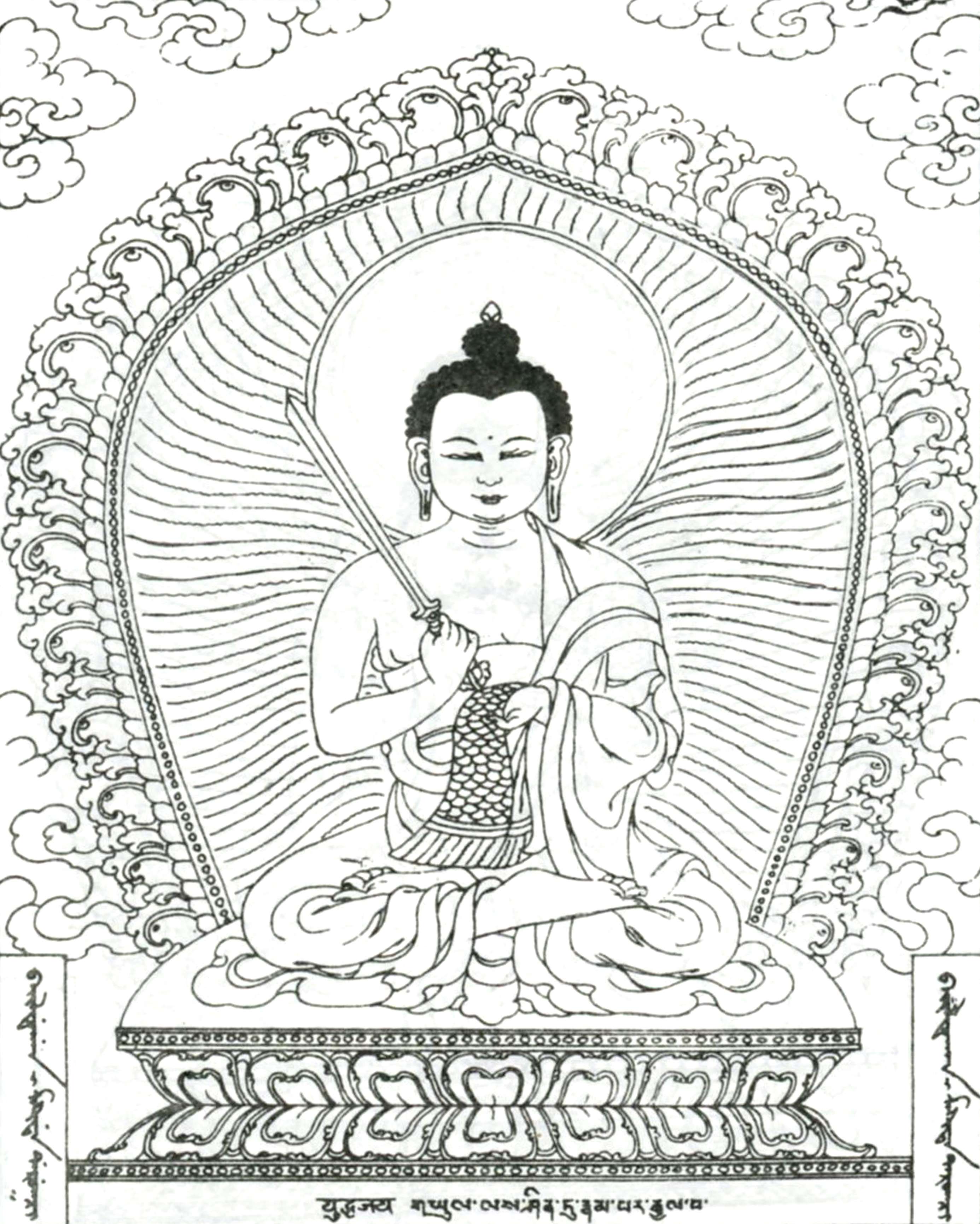
The Buddha Victorious in Strife is depicted in Buddhist art with the traditional features of a Buddha (i.e. ūrṇā, uṣṇīṣa, long ear lobes, robes, etc.), but he is also shown holding a suit of armor and a sword (fig. 2):

Yuddhajaya Buddha — (Skt.: aka Yuddhajaya) (Chin.: Tou-chan-sheng fo; Mon.: Bayildugan-i masids darugci; Tib.: gYul-las-sin-tu-rnam-par-rgyal-ba, rGyal-ba-gYul-lasr-Gyal-ba) A Sanskrit variant for the Jina Yuddhajaya. One of the Buddha images found in the Pao Hsiang Lou [寶相樓] temple of the Forbidden City, Beijing, and one of the thirty-five “Buddhas of Confession.” Face: one, calm, urna, usnisa, long ear-lobes; arms/hands: holding a cuirass up to his chest; body: monastic robes; legs: two; asana: vajrasana; vahana: lotus throne.

— (2) — (Mon.: Bayildugan-i masids darugci; Tib.: gYul-las-sin-tu-rnam-par-rgyal-ba) One of the Buddhas of Confession pictured in the Mongolian Kanjur (Mon.: Monggol ganjur-un) (1717-1720) Face: one, calm, urna, usnisa, long ear-lobes; arms/hands: two, right hand holds sword (khadga, ral-gri), left hand holds coat of mail (khrab); body: monastic robes, right shoulder uncovered; legs: two; asana: vajrasana; attributes: 32 major and 80 minor signs; vahana: lotus throne (Bunce, 1994, Vol. 1, p. 629). [2]

Fig. 2 – The Buddha Victorious in Strife (Yuddhajaya) holding a sword and suit of armor (larger version). Image found here.

2.2. Purpose

Neither the name Buddha Victorious in Strife nor the sword and armor are a reference to the deity’s fighting prowess. According to Lai (2016), the Buddha “defeat[s] the inner enemies of afflictive emotions and negative actions of sentient beings. He is victorious over cyclic existence and thus able to lead all sentient beings to liberation. He purifies the negative karma of actions committed out of pride.”

His name and accoutrements, therefore, symbolize the means by which he subjugates the negative emotions or actions that would otherwise keep man trapped in the illusory world of Saṃsāra.

3. Relationship to Sun Wukong’s Worship

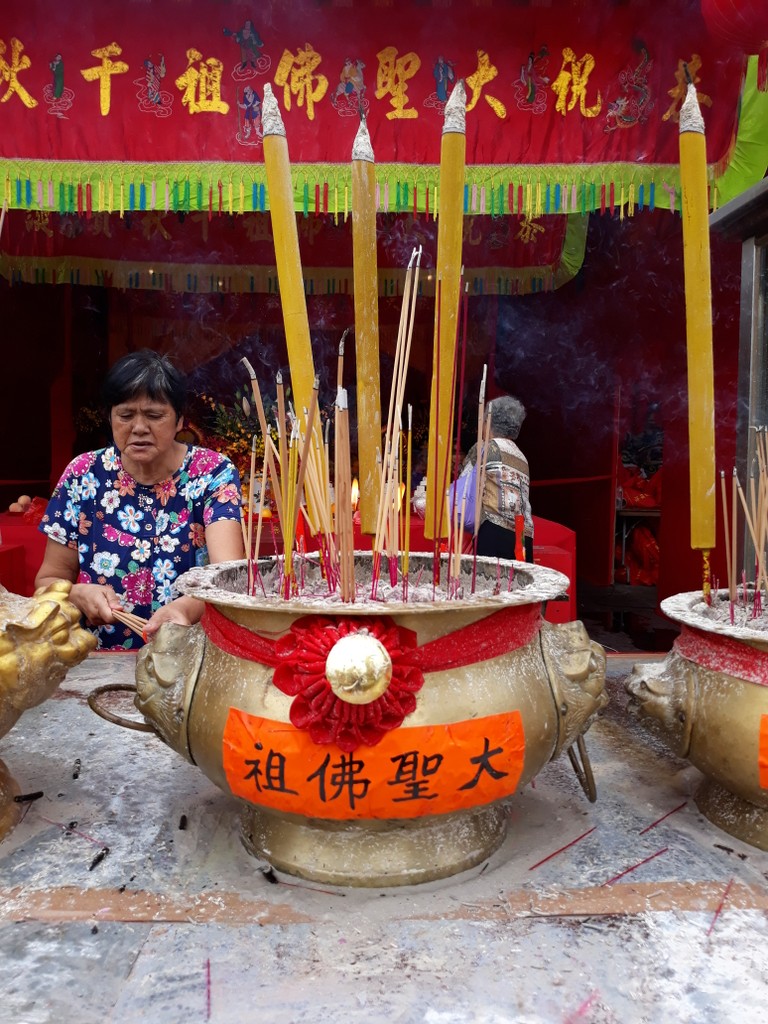
The Monkey King is worshiped in southern China, Taiwan, and Southeast Asian countries like Malaysia, Singapore, Thailand, and Vietnam as a great exorcist and protector of children. But it may come as a surprise to learn that he is rarely worshiped as the Buddha Victorious in Strife. Instead, Wukong is almost exclusively revered as the “Great Sage Equaling Heaven” (Qitian dasheng, 齊天大聖), and even when he is called a Buddha, the name usually includes some reference to the rebellious title. For example, when I attended the Monkey King’s birthday (sixteenth day of the eighth lunar month) in Hong Kong in 2018, I saw an incense pot labeled “Great Sage Buddha Patriarch” (Dasheng fozu, 大聖佛祖) (fig. 3).

So why isn’t Sun widely worshiped as the Buddha Victorious in Strife? I think the simplest answer is that the Buddha already had a long-established following and therefore couldn’t be subsumed under the late-blooming cult of a cultural hero, even one as popular as the Monkey King.

Fig. 3 – An incense pot reading “Great Sage Buddha Patriarch” (Dasheng fozu, 大聖佛祖) (larger version). Taken by the author in Kowloon, Hongkong (Sept. 24, 2018).

4. Precedent for Spiritual Promotion

The author-compiler likely connected Sun Wukong to the Buddha Victorious in Strife because of the Enlightened One’s war-like iconography (recall the sword and armor mentioned above). After all, Monkey is an armor-wearing martial deity wielding his magic staff to protect Tripitaka from untold numbers of demons and spirits.

But the choice to elevate Monkey in rank was likely influenced by previous media. For example, Wukong’s literary antecedent, the Monkey Pilgrim (Hou xingzhe, 猴行者), receives a promotion at the end of The Story of How Tripitaka of the Great Tang Procures the Scriptures (Da Tang Sanzang qujing shihua, 大唐三藏取經詩話), a late-13th century precursor of JTTW. The story ends thus: “Tang Taizong later enfeoffed Monkey Pilgrim as ‘Great Sage Steel Muscles and Iron Bones'” (Gangjin tiegu dasheng, 鋼筋鐵骨大聖) (Wivell, 1994, p. 1207). [3]

5. Conclusion

At the end of JTTW, the Buddha promotes Sun Wukong to the “Buddha Victorious in Strife” or “Victorious Fighting Buddha” (Dou zhansheng fo, 鬥戰勝佛). This is the Chinese name of Yuddhajaya (Sk: युद्धजय), the 31st of the 35 Confession Buddhas called upon during a confessional prayer to absolve oneself of sins. He is generally portrayed as a robe-wearing Buddha holding a sword and suit of armor. This is not a reference to the deity’s fighting prowess, however. Instead, his name and accoutrements symbolize the means by which he subjugates the negative emotions or actions that would otherwise keep man trapped in the illusory world of Saṃsāra.

Instead of being universally revered as the Buddha Victorious in Strife, the Monkey King is far more widely worshiped in East and Southeast Asia as the “Great Sage Equaling Heaven” (Qitian dasheng, 齊天大聖) or a variant like “Great Sage Buddha Patriarch” (Dasheng fozu, 大聖佛祖). This discrepancy is probably due to the original Yuddhajaya already having a long-established following. There’s no way that he could ever be subsumed under Sun Wukong’s late-blooming cult. 

Wu Cheng’en (or whoever the true author-compiler was) likely connected Monkey to the Buddha Victorious in Strife because both have martial iconography. Sun is commonly depicted wearing armor and wielding an iron staff, while Yuddhajaya is shown holding a sword and armor. But the concept of Sun receiving an elevation in spiritual rank goes back centuries. The Monkey Pilgrim, his literary antecedent from The Story of How Tripitaka of the Great Tang Procures the Scriptures (late-13th century), is deified by the Tang emperor as “Great Sage Steel Muscles and Iron Bones” (Gangjin tiegu dasheng, 鋼筋鐵骨大聖).


6. Updates

Update: 09-06-20

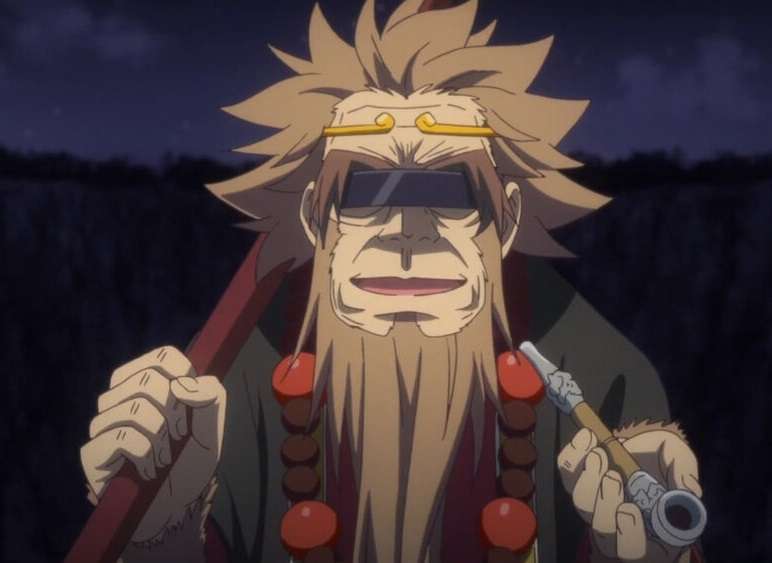
If you type “Buddha Victorious in Strife,” “Victorious Fighting Buddha,” “鬥戰勝佛” or “斗战胜佛” into google images, you’ll notice that these terms are almost exclusively associated with Sun Wukong. Most results are fan-made drawings of Monkey wearing his armor. Very few depict him as a Buddha. The only appearance of the latter in popular media that I’m aware is the Victorious Fighting Buddha from the manga / anime High School DxD.

The character is depicted as a jovial old dwarf with long, shaggy brown hair, bushy eyebrows that fall over a cyberpunk-style black visor, no mustache, a long beard, a floor-length, dark gray coat over a red robe, and monkey feet. He wears his famous golden fillet and a set of chunky brown and red prayer beads. In his left hand he holds a smoking pipe, while the right holds his magic staff, which is depicted as red and gold (fig. 4).

Fig. 4 – The Victorious Fighting Buddha from High School DxD (larger version).

The Victorious Fighting Buddha inhabits a universe where various factions of Western and Eastern gods, devils, and heroes battle one another. According to the story, upon ascending to Buddhahood, he steps down as the Monkey King, handing the title to a young descendant, and serves as the vanguard of the Hindu god Indra, during which time he protects the cosmos from a faction of devils and fallen angels. He later takes on the role of sub-leader and mentor to a new faction of young heroes whom he trains to battle god-tier opponents.

High School DxD portrays the Victorious Fighting Buddha as very powerful. For example, season four, episode six (minute 13:35) of the anime shows him effortlessly blocking the “True Longinus” spear with the tip of his index finger. This is quite a feat as this weapon is the same one used to pierce the side of Christ, thereby giving it the power to kill other gods.


Update: 03-22-21

I visited “Sage Buddha Hall” (Shengfo Tang, 聖佛堂), a Great Sage temple in Beigang, Yunlin, Taiwan and saw a few items labeled the “Fighting Sage Buddha” (Dou zhan sheng fo, 鬥戰聖佛) in place of the Buddha Victorious in Strife/Victorious Fighting Buddha. One such item was a paper fan (fig. 5). As noted above, Buddha Victorious in Strife/Victorious Fighting Buddha is not a reference to the deity’s fighting prowess, but his ability to “defeat the inner enemies of afflictive emotions and negative actions of sentient beings.” So it appears that this temple takes his martial skill at face value.


Update: 08-09-22

As an enlightened Buddha, Monkey is eligible for his own “Buddha-Field” (Sk: Buddhakṣetra; Ch: Focha, 佛刹), essentially his own universe in which he will lead the inhabitants to enlightenment. Buswell and Lopez (2014) explain:

[W]hen a buddha achieves enlightenment, a “container” or “inanimate” world is produced in the form of a field where the buddha leads beings to enlightenment. The inhabitant of that world is the buddha endowed with all the [qualities of an Enlightened One]. Buddha-fields occur in various levels of purification, broadly divided between pure and impure. Impure buddha-fields are synonymous with a world system (cakravāḍa), the infinite number of “world discs” in Buddhist cosmology that constitutes the universe; here, ordinary sentient beings (including animals, ghosts, and hell beings) dwell, subject to the afflictions of greed, hatred, and delusion. Each Cakravāḍa is the domain of a specific buddha, who achieves enlightenment in that world system and works there toward the liberation of all sentient beings… (p. 153).


Update: 01-22-23

Chandra (1999) includes a lovely black and white line drawing of Yuddhajaya (fig. 6) (p. 94).

Fig. 6 – A traditional Tibetan drawing of Yuddhajaya (larger version). Image from Chandra, 1999, p. 94.


Update: 05-09-23

I commissioned NinjaHaku21 (Twitter, Instagram, and Tumblr) to draw Sun Wukong using Yuddhajaya’s traditional iconography (fig. 7), and the results are stunning! It is based on the design from figure two above.

Fig. 7 – A religiously accurate drawing of Monkey as the Yuddhajaya Buddha by NinjaHaku21 (larger version).


Update: 06-12-23

I have written a companion piece to this article about Tripitaka’s Buddha title.

The Tang Monk Tripitaka and the Buddha Candana Merit


Update: 09-11-23

Tumblr user @darkfalcon-z has drawn a lovely picture of the Monkey King as a Buddha (fig. 8). They explain their headcanon for the image:

[B]aby monkeys think Grandpa’s lotus throne is for playing.

[…]

I think Wukong got back to his mountain to take care of his monkeys. He does visit sometimes. He takes his favourite monkeys along for the ride. I don’t think it is much of a problem in Western Heaven in Buddha’s domain, because if you are enlightened the antics of little animals won’t really bother you. He’s told not to bring monkeys along next time as per formality. He does anyway. It’s not like anyone minds. He takes the monkeys along when he visits Jade Emperors domain. There monkeys are treated as nuisance and chased around, but no one actually dares to harm them, as they fear to incur his anger. He probably takes more troublesome monkeys too. On purpose.

I love the baby monkeys, as well as Wukong’s flower-like halo.

Fig. 8 – @darkfalcon-z’s Monkey Buddha (larger version). Used with permission.


Update: 11-07-2024

Above, I wrote: 

Wu Cheng’en (or whoever the true author-compiler was) likely connected Monkey to the Buddha Victorious in Strife because both have martial iconography. Sun is commonly depicted wearing armor and wielding an iron staff, while Yuddhajaya is shown holding a sword and armor.

But it just dawned on me that Sun’s antecedent, the Monkey Pilgrim (Hou xingzhe, 猴行者), is also portrayed holding a divine sword in a 13th century stone relief carving (fig. 9). This weapon is referred to as his “Bodhisattva Sabre” (Pusa dao, 菩薩刀) in a 17th or 18th century tale appearing in a famous collection of Chinese folk stories. Therefore, it wouldn’t surprise me if this influenced the association with Yuddhajaya’s sword.

Fig. 9 – The Kaiyuan temple pagoda relief carving depicting Monkey holding a sword (larger version). Located on one of two 13th century stone pagodas of Kaiyuan Temple in Quanzhou City, Fujian Province, China.

I would also like to add some more drawings of Sun Wukong as a Buddha. The first two (fig. 10 & 11) are by a netizen who goes by @VirliebeAnatta (a.k.a. Bhante_Wukong) on Twitter and @his-shining-tears on Tumblr. Their work is very calming and welcoming.

Fig. 10 – The Monkey Buddha gazes upon the viewer with hands clasped (larger version). Image found here and here. Fig. 11 – A three-quarters view of the Monkey Buddha with head bowed and hands clasped (larger version). Image found here and here.

The third (fig. 12) is by Nhung Nguyen (twitter and instagram).

Fig. 12 – Nhung’s intense Monkey Buddha (larger version). The image was first seen on a JTTW discord, but it can also be found here and here.

The fourth (fig. 13) is by Saknarin Bowonkitmanee (a.k.a. Move Saknarin), a member of the the ศรัทธาอากงไต่เสี่ยฮุกโจ้ว (大聖佛祖) Thailand Facebook group.

Fig. 13 – Move’s serene Monkey Buddha (larger version). Image found here.


Update: 11-16-24

Figure 13 above was the bases for this lovely Thai statue of the Monkey Buddha (fig. 14).

Fig. 14 – The Thai Monkey Buddha idol (larger version). Image found here.


Update: 06-13-2025

In late-2024, I commissioned friend of the blog NingadudeXx to draw Monkey as Yuddhajaya using their colorful style. The finished piece (fig. 15) was delivered in mid-January 2025.

Fig. 15 – NingadudeXx’s colorful Monkey Buddha (larger version).

On a related note, I learned that Yuddhajaya has a secondary name, Vijita-saṃgrāma (Ch: Yongjian jixiang fo, 勇健吉祥佛; Viet: Dũng Kiện Cát Tương Phật), or the “Brave and Auspicious Buddha” (source). The Chinese version of his title is listed in the 8th century Names of the Thirty-Five Buddhas Spoken by the Buddha (Ch: Foshuo sanshiwu foming lichan wen, 佛說三十五佛名禮懺文) (originally linked above).

Interestingly, the farthest back that I can trace the term Dou zhansheng fo (鬥戰勝佛, i.e. “Buddha Victorious in Strife”) on CBETA is the 12th or 13th century Ritual for the Tathāgata’s Extensive Filial Piety’s Ten Kinds of Recompensating (Parents’) Kindness (Rulai guangxiao shizhong bao’en daochang yi, 如來廣孝十種報恩道場儀) (see here). Therefore, Vijita-saṃgrāma appears to be a much older name.

Spread the gospel of the Brave and Auspicious Buddha!!!

Notes:

1) Compare the list from the Chinese version to those listed here. The characters may vary slightly.

2) I am grateful to Joris Baeyens of Ghent University Library for providing me with scans of Bunce (1994).

3) Source slightly altered.

Sources:

Bunce, F. W. (1994). An Encyclopaedia of Buddhist Deities, Demigods, Godlings, Saints and Demons: With Special Focus on Iconographic Attributes (Vols.1-2). New Delhi: D.K. Printworld.

Buswell, R. E., & Lopez, D. S. (2014). The Princeton Dictionary of Buddhism. N: Princeton University Press.

Chandra, L. (1999). Buddhist Iconography: Compact Edition. New Delhi: International Academy of Indian Culture & Aditya Prakashan.

Lai, D. (2016, September 3). 35 Confessional Buddhas. Retrieved from www.davidlai.me/2016/09/03/35-confessional-buddhas/.

Wu, C., & Yu, A. C. (2012). The Journey to the West (Vol. 4). Chicago, Illinois: University of Chicago Press.

What Does Sun Wukong Look Like? A Resource for Artists and Cosplayers

Last updated: 05-03-2026

Type “Sun Wukong” into google images and you will be presented with an endless array of pictures that range from the familiar to the alien. A fanciful 1960s cartoon depiction of our hero sits to the left of a SMITE video game character with hulking muscles and a weapon more akin to a club than a staff. A toy version of Liu Xiao Ling Tong‘s much beloved 1986 TV portrayal sits above an anime character with blond hair and a shaved chest. It seems there are as many depictions of Wukong as he has transformations. But how do these myriad personas compare to his depiction in the novel, and who has produced the most authentic look? In this article I present the Monkey King’s literary description, along with ancient depictions that predate the novel. My hope is that the information will be both interesting and useful, especially for artists and cosplayers looking to make a more authentic design.

Table of Contents

1. Ancient Depictions

Some readers may be surprised to learn that stories about a “Monkey Pilgrim” (Hou xingzhe, 猴行者) go all the way back to the Song Dynasty (960–1279 CE). This predates the actual name Sun Wukong by centuries. The literary episodes we all know and love began life as oral tales that evolved over time and grew into an accepted storytelling cycle which started to solidify by the 15th century CE. [1] But the further we go back in time, the less familiar the recorded material becomes, and due to the memory-based nature of oral storytelling, [2] records for the earliest repertoires do not exist. Luckily, visual media from the Song survives, allowing us to see how artists of that time depicted the Monkey King.

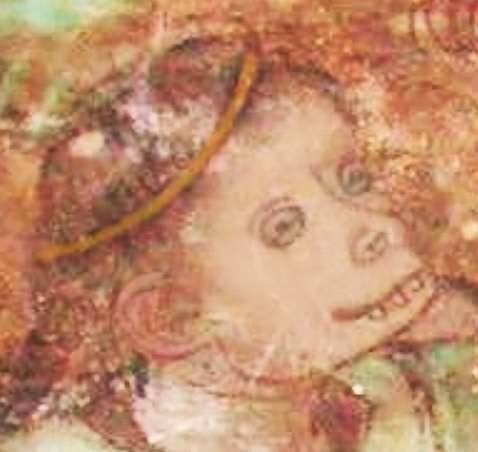
One example, Eastern Thousand Buddha Cave (Dong qianfo dong, 東千佛洞) number two in the Hexi Corridor of Gansu Province, contains a late-Xixia dynasty (late-12th or early-13th century CE) mural of Xuanzang worshiping Guanyin from a riverbank, while Monkey stands behind him tending to a brown horse. The latter is portrayed with a plain circlet on his head, a homely face with an overbite, waist length hair (or possibly wearing a fur on his back), and light blue-green robes with a red apron and brown pants and sandals (fig. 1 and 2). The depiction is less simian in appearance, yet not wholly human.

Fig. 1 – An almost complete version of the Eastern Thousand Buddha Cave no. 2 painting (larger version). Photo by National Geographic. Fig. 2 – A detail of Monkey and Xuanzang (larger version). See figure 14 for an enhanced detail of Monkey’s head.

A second example, Yulin Cave (Yulin ku, 榆林窟) number three in Gansu, contains a late-Xixia wall painting with similar imagery. Xuanzang is again worshiping from a riverbank, but this time the subject of adoration is Samantabhadra. We see Monkey lacks the fillet but wears a monk’s robe with wrapped socks and sandals. This time he is far more monkey-like in appearance, complete with furry arms (fig. 3 and 4).

Fig. 3 – An almost complete version of the late-Xixia Yulin Cave no. 3 painting (larger version). Monkey and Xuanzang can be seen standing on the river bank on the upper left side. Fig. 4 – A detail of the two figures (larger version).

A third example is the 1237 CE stone relief carving from the western pagoda of the Kaiyuan Temple (開元寺) in Quanzhou, Fujian province. This muscular warrior wears a headband, earrings, bracelets, a rosary necklace, and arm bangles (all prescribed Esoteric Buddhist ritual accouterments), as well as a monk’s robe and sandals. He wields a broadsword in one hand, while the other thumbs the rosary at his chest. At his waist hangs a calabash gourd and a scroll of the Mahamayurividyarajni Sutra (Fomu da kongque mingwang jing, 佛母大孔雀明王經) (fig. 5) (Ecke & Demiéville, 1935). He has the large ears and protruding mouth of a monkey.

Fig. 5 – The monkey-headed warrior from Kaiyuan temple in Quanzhou, Fujian (larger version).

Writing in the 1250s, the Song poet Liu Kezhuang (劉克莊, 1187–1269) references our hero twice in his work. The second of two such references uses Monkey as a metaphor to describe the ageing 70-year-old’s appearance. A portion of the poem reads:

A back bent like a water-buffalo in the Zi stream,
Hair as white as the silk thread issued by the “ice silkworms”,
A face even uglier than Hou xingzhe [“Monkey Pilgrim”],
Verse more scanty than even He Heshi (Dudbridge, 1970, p. 46).

背傴水牛泅磵髪白氷蠶吐絲貌醜似猴行者詩痩於鶴何師

Ugliness is a subject I will return to several more times.

I mentioned earlier that the farther we go back in time the less familiar the recorded material becomes. Case in point is the The Story of How Tripitaka of the Great Tang Procures the Scriptures (c. late-13th century CE), the earliest published edition of Journey to the West. Despite referring to himself as the Monkey King, the Monkey Pilgrim is depicted as a white-clad scholar. Another difference is the fact that he fights with two different staves, one a ringed monk’s staff and the other an iron rod (these two would later be combined to create his signature weapon).

The majority of Song sources depict the Monkey Pilgrim as the size of an adult man but with the head of an ugly monkey. I think that these were likely influenced by early stage plays, which would obviously entail a human actor taking on the role.

2. What the Novel Says

2.1. Physical Appearance

The earliest descriptions of what Monkey looks like appear in chapter one. When he is first taken in by his teacher Subodhi, the sage tells him, “Though your features are not the most attractive, you do resemble a pignolia-eating macaque (husun [猢猻])” (Wu & Yu, 2012, vol. 1, p. 115). After he returns to the Mountain of Flowers and Fruit in chapter two, a demon king refers to Monkey’s height: “You’re not four feet tall” (Wu & Yu, 2012, vol. 1, p. 128).

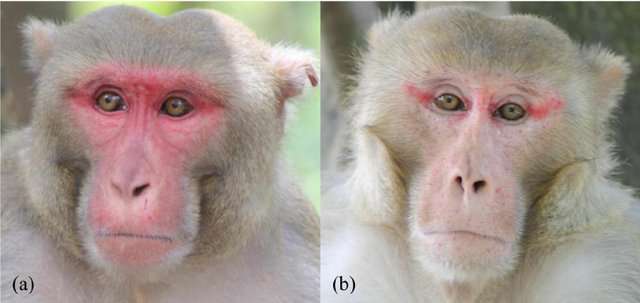
In chapter 7, Monkey is subjected to Laozi’s eight trigrams furnace as punishment for his crimes against heaven. He survives the celestial fire but the smoke inside “…reddened his eyes, giving them a permanently inflamed condition. Hence they were sometimes called Fiery Eyes and Golden Irises [Huoyan jinjing, 火眼金睛]” (based on Wu & Yu, 2012, vol. 1, p. 189). The anthropologist Frances D. Burton (2005) explains that his fiery eyes are “a characteristic he shares with the actual red-rimmed eyes of M. mulatta [the Rhesus macaque]” (p. 148). I further suggest that the hue of his eyes are based on the golden irises of macaques (fig. 6).

Fig. 6 – A comparison of Rhesus macaque males with red-rimmed eyes during mating season (left) and other times (right) (larger version). Original image from Dubue, Allen, Maestripieri, & Higham (2014, p. 5).

In chapter 20, the reader learns that Monkey’s head is bald (fig. 7). An old man asks him, “[W]hy did you shave your hair to become a monk?” (Wu & Yu, 2012, vol. 1, p. 395).

In chapter 21, a demon king steps out of his cave to fight Sun but is surprised by his small stature:

The old monster took a careful look and saw the diminutive figure of Pilgrim [Monkey]—less than four feet, in fact—and his sallow cheeks. He said with a laugh: “Too bad! Too bad! I thought you were some kind of invincible hero. But you are only a sickly ghost, with nothing more than your skeleton left!” (Wu & Yu, 2012, vol. 1, p. 408).

那怪仔細觀看,見行者身軀鄙猥,面容羸瘦,不滿四尺。笑道:「可憐,可憐。我只道是怎麼樣扳翻不倒的好漢,原來是這般一個骷髏的病鬼。」

(Thank you to Jose Loayza for bringing this passage to my attention.)

His bald head is referred to again in chapter 27:

“But ever since Nirvana delivered me from my sins, when with my hair shorn I took the vow of complete poverty and followed you as your disciple, I had this gold fillet clamped on my head…” (Wu & Yu, 2012, vol. 2, p. 24).

自從涅槃罪度,削髮秉正沙門,跟你做了徒弟,把這個金箍兒勒在我頭上…

(Thank you to Stanley Setiawan for bringing this passage to my attention.)

Fig. 7 – Reggie the baboon from Paignton Zoo (circa 2005). His slick head was the result of his mom’s “over-zealous” grooming. Look at those ears! He’s the wrong genus and species, but you get the general idea what Sun Wukong would look like wearing the golden fillet (larger version).

Wukong’s bald pate is once again referenced in chapter 34:

The fiend then gave the rope a tug and pulled Pilgrim down before he gave that bald head seven or eight blows with the sword. The skin on Pilgrim’s head did not even redden at all (Wu & Yu, 2012, vol. 2, p. 128).

那怪將繩一扯,扯將下來,照光頭上砍了七八寶劍。行者頭皮兒也不曾紅了一紅。

In chapter 44, the Monkey King’s appearance is revealed in a dream to a group of monks by the personification of the planet Venus:

A bumpy brow, and golden eyes flashing;
A round head and a hairy face with sunken cheeks;
Gaping teeth, pointed mouth, a character most sly;
He looks more strange than the thunder god
[…] (based on Wu & Yu, 2012, vol. 2, p. 276).

磕額金睛晃亮,圓頭毛臉無腮。咨牙尖嘴性情乖。貌比雷公古怪。…

In chapter 49, a monster who barely survived a battle with Sun Wukong describes his appearance to a friend: [H]e has a hairy face and a thunder god beak … forked ears and broken nose. A monk with fiery eyes and golden irises (based on Wu & Yu, 2012, vol. 2, p. 353).

In chapter 58, Sun Wukong’s doppelganger is described as having matching features:

A hairy face, a thunder god beak,
Empty cheeks unlike Saturn’s; [3]
Two forked ears on a big, broad head,
And fangs that have outward grown (based on Wu & Yu, 2012, vol. 3, p. 105).

…也是這等毛臉雷公嘴,朔腮別土星,查耳額顱闊,獠牙向外生。

In chapter 67, an old man chastises Monkey for offending him:

You! Look at your skeleton face, flattened brow, collapsed nose, sunken cheeks, and hairy eyes. A consumptive ghost, no doubt, and yet without any manners at all, you dare use your pointed mouth to offend an elderly person like me!” (based on Wu & Yu, 2012, vol. 3, p. 242).

你這廝骨撾臉,磕額頭,塌鼻子,凹頡腮,毛眼毛睛,癆病鬼,不知高低,尖著個嘴,敢來衝撞我老人家?

In chapter 75, he once again tests the hardness of his bald head:

“You come over here,” said the old demon, “and act as my chopping block first. If your bald head can withstand three blows of my scimitar, I’ll let you and your Tang Monk go past. But if you can’t, you’d better tum him over quickly to me as a meal.”

When he heard this, Pilgrim smiled and said, “Fiend! If you have brush and paper in your cave, take them out and I’ll sign a contract with you. You can start delivering your blows from today until next year, and I won’t regard you seriously!” Arousing his spirit, the old demon stood firmly with one foot placed in front of the other. He lifted up his scimitar with both hands and brought it down hard on the head of the Great Sage. Our Great Sage, however, jerked his head upward to meet the blow. All they heard was a loud crack, but the skin on the head did not even redden (Wu & Yu, 2012, vol. 3, p. 373).

老魔道:「你過來,先與我做個樁兒,讓我盡力氣著光頭砍上三刀,就讓你唐僧過去;假若禁不得,快送你唐僧來,與我做一頓下飯。」行者聞言笑道:「妖怪,你洞裡若有紙筆,取出來,與你立個合同。自今日起,就砍到明年,我也不與你當真。」

那老魔抖擻威風,丁字步站定,雙手舉刀,望大聖劈頂就砍。這大聖把頭往上一迎,只聞扢扠一聲響,頭皮兒紅也不紅。

We can see from these quotes several features that appear again and again. These include a furry face with sunken cheeks, fiery eyes, a broken or flat nose, a beak-like mouth with protruding fangs, and forked ears (with long earlobes, per the 06-02-25 update). The author-compiler of the novel uses these features over and over again to remind the reader just how ugly the Great Sage is. These same features are also shared by the Rhesus monkey and other macaque species (fig. 8). The multiple mentions of the Thunder God‘s beak refers to the monkey’s prognathic (protruding) mouth, which houses large canine teeth. The quotes also let us know that Sun Wukong is less than four feet tall and very skinny (e.g. having “sallow cheeks” and being like “a consumptive ghost”) just like a monkey (fig. 9). It’s important to note that Sun is described as being bald numerous times throughout the novel. This should come as no surprise since he was required to take the tonsure as a Buddhist monk. Modern depictions often deviate from the features mentioned here (more on this below).

Fig. 8 – A Bonnet macaque bearing its teeth. Photo by Hank Christensen. The furry face with sunken cheeks, a broken (flat) nose, beak-like mouth with protruding fangs, and forked ears are easily discernible. Fig. 9 – The short, skinny body of a Rhesus monkey. Photo by mario_ruckh via flickr.

2.2 Clothing and Accessories

The novel mentions Sun Wukong wearing different attire throughout his roughly 1,100 years of life. Here I will focus on that which is closely associated with his traditional iconography.

The clothing most often associated with Monkey is his suit of armor. He receives it from the dragon kings of the world’s oceans in chapter three:

“I have here a pair of cloud-treading shoes the color of lotus root[, said Aoshun, the Dragon King of the Northern Ocean]. Aorun, the Dragon King of the Western Ocean said, “I brought along a cuirass of chainmail made of yellow gold.” “And I have a cap with erect phoenix plumes, made of purple gold,” said Aoqin, the Dragon King of the Southern Ocean (based on Wu & Yu, 2012, vol. 1, p. 137).

北海龍王敖順道:「… 我這裡有一雙藕絲步雲履哩。」西海龍王敖閏道:「我帶了一副鎖子黃金甲哩。」南海龍王敖欽道:「我有一頂鳳翅紫金冠哩。」

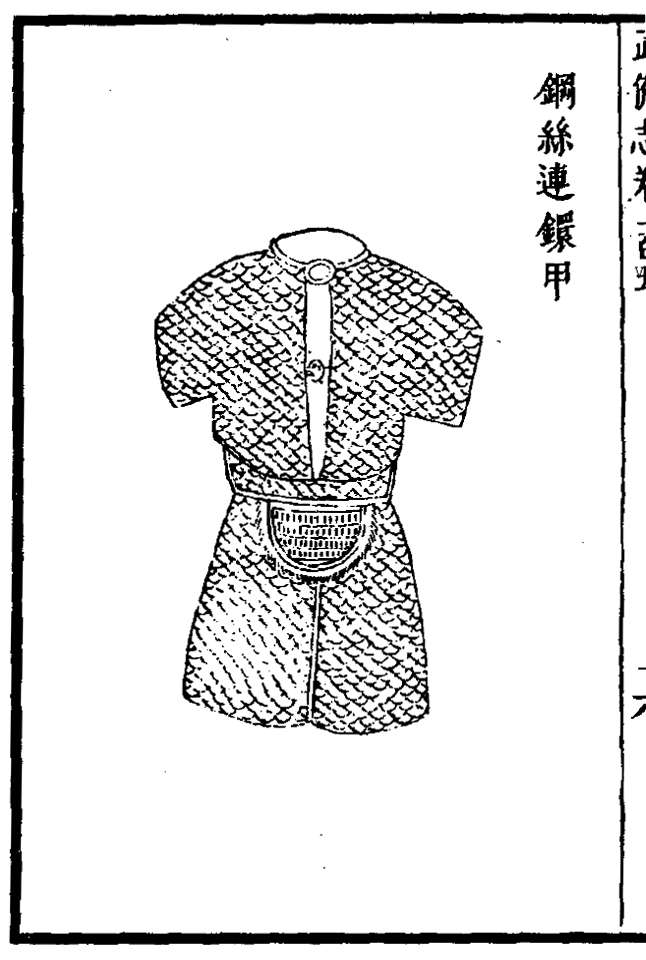
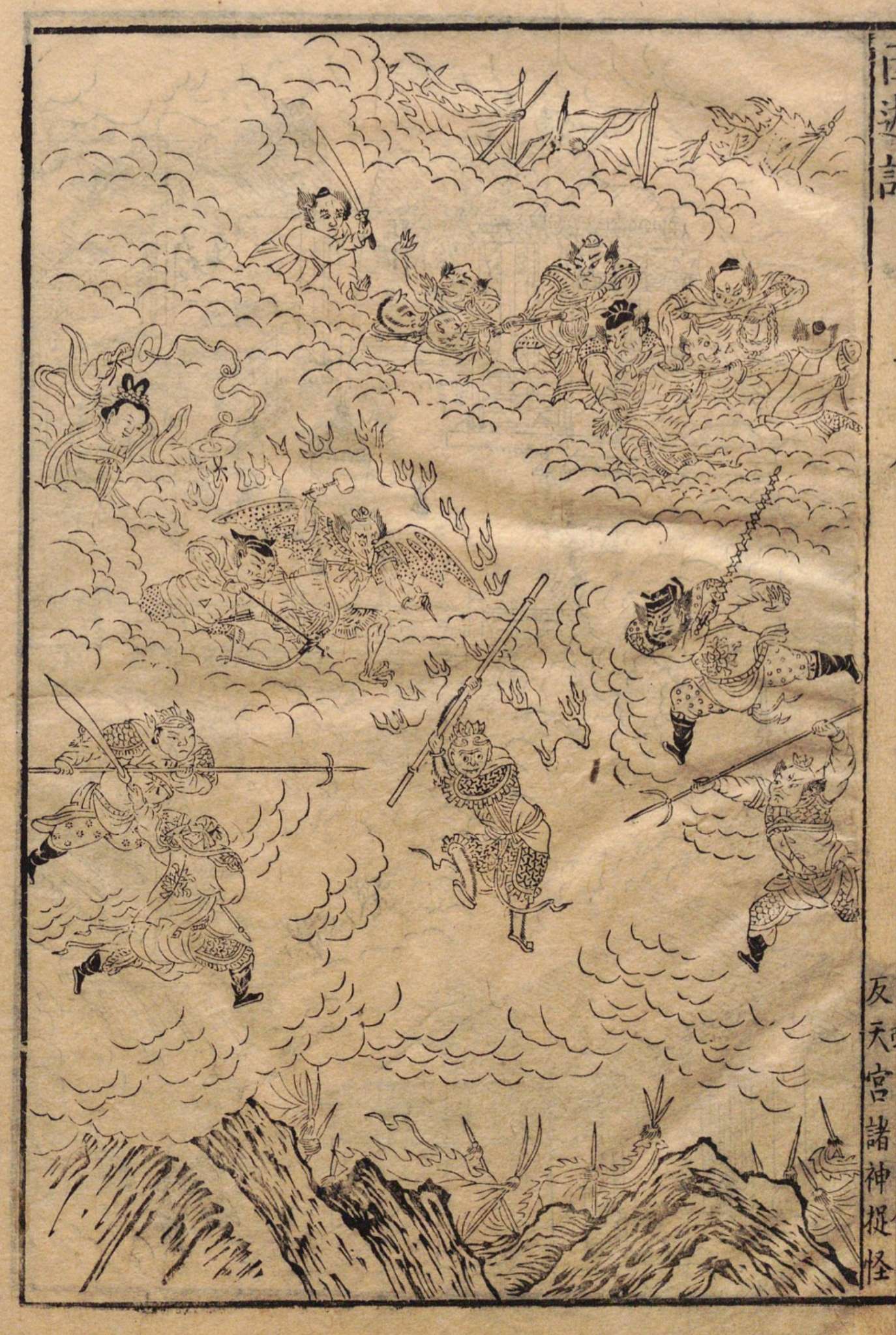
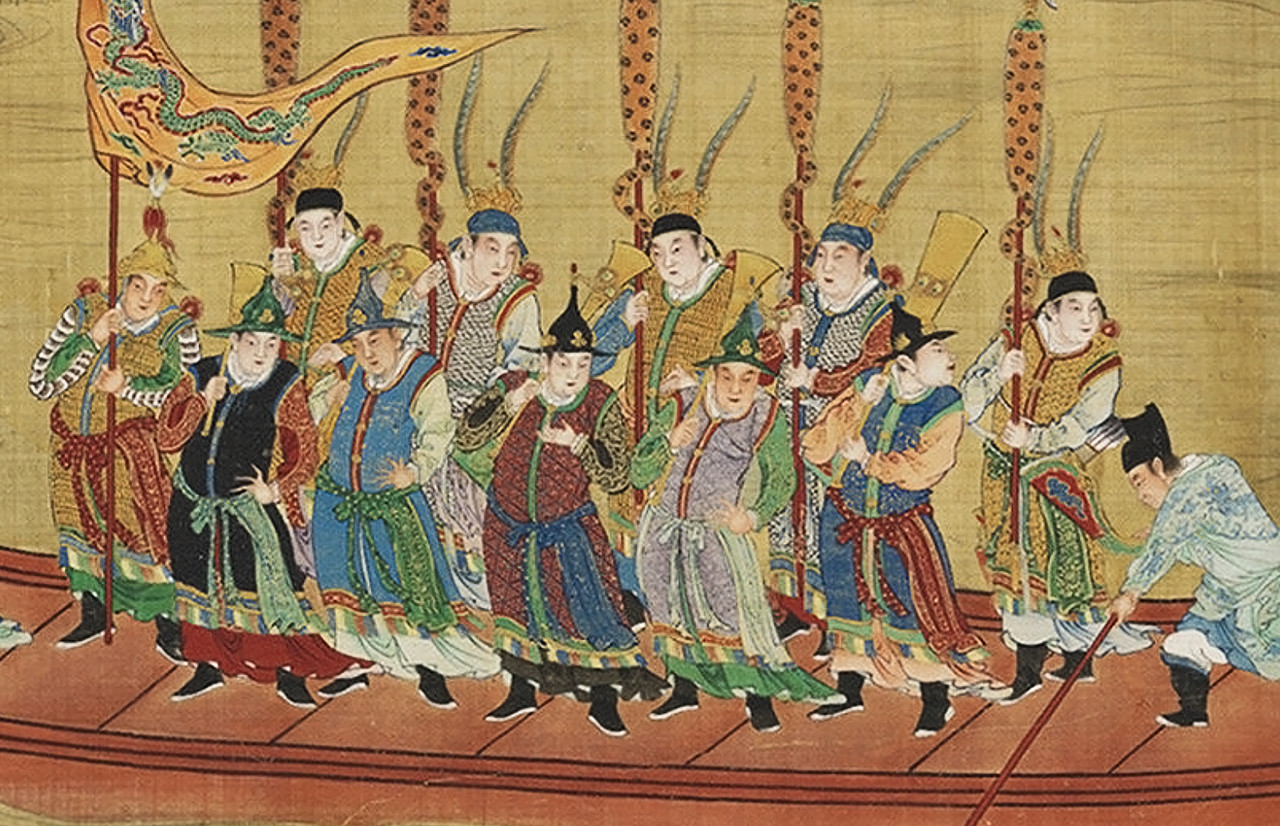
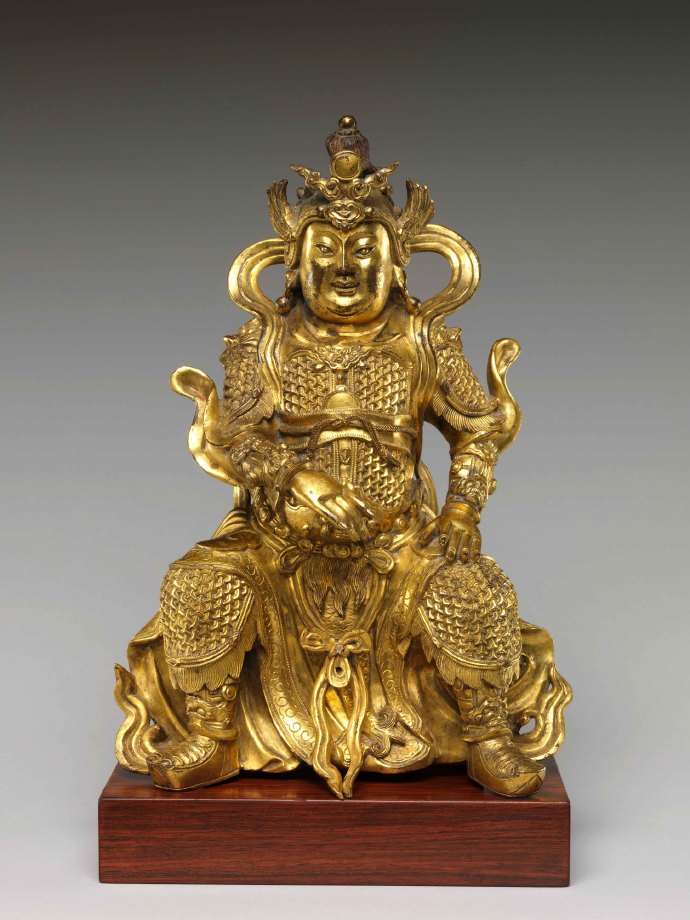
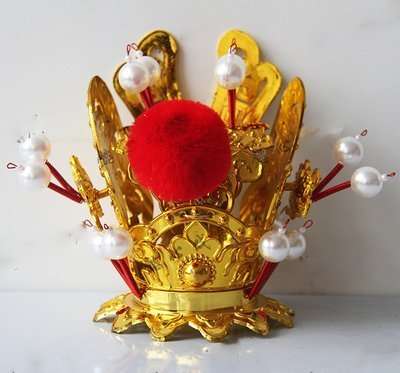
Those wanting to make a novel accurate suit should consult Ming-era chainmail (fig. 10). However, the oldest drawing of Wukong wearing armor that I’m aware of depicts him with “mountain pattern” armor (fig. 11). Combinations of mountain pattern armor and feather caps can be seen in the 16th century CE scroll The Emperor’s Return to the Capital (Rubitu, 入蹕圖) (fig. 12), showing it was part of historical military regalia and not just the purview of Chinese opera (fig. 13). Modern depictions of Monkey tend to portray him wearing mountain pattern armor with ornate beast elements on the shoulders and waist. Those wishing to replicate this kind of armor should consult Ming-era statues of Buddhist protector deities, such as Skanda or the Four Heavenly Kings (this blog is especially good) (fig. 14, for example). Modern “Purple Gold Caps” (zijin guan, 紫金冠) with lingzi (翎子) feathers should be used for Sun’s phoenix feather cap (fig. 15).

Fig. 10 – Ming chainmail from the Wubei zhi (1621 CE) (larger version). Fig. 11 – A woodblock print of Sun wearing mountain pattern armor while fighting the heavenly army (larger version). From Mr. Li Zhuowu’s Literary Criticism of Journey to the West (late-16th century CE, “Mr. Li’s Criticism” hereafter). Fig. 12 – A detail of halberd-bearing soldiers wearing mountain pattern armor and feather caps from The Emperor’s Return to the Capital (16th century CE) (larger version). Image enhanced slightly for clarity. Fig. 13 – Monkey as portrayed in Beijing Opera (larger version). Photo by TAO Images Limited via Alamy. Fig. 14 – A 16th century CE brass statue of Skanda (larger version). This blog has photos from all sides. Fig. 15 – A modern example of a Purple Gold Cap (larger version). 

Contrary to popular belief, Sun does not wear the armor throughout the entire story. Though not openly stated, the novel suggests it is stripped from the monkey when he is captured by heavenly soldiers in chapter six: “They bound him with ropes and punctured his breast bone with a knife, so that he could transform no further” (Wu & Yu, 2012, vol. 1, p. 186). Obviously the knife wouldn’t have punctured the magic armor. And after heaven fails to execute him in chapter seven, several celestial report:

“Your Majesty, we don’t know where this Great Sage has acquired such power to protect his body. Your subjects slashed him with a scimitar and hewed him with an ax; we also struck him with thunder and burned him with fire. Not a single one of his hairs was destroyed (emphasis added). What shall we do?” (Wu & Yu, 2012, vol. 1, p. 188).

萬歲,這大聖不知是何處學得這護身之法,臣等用刀砍斧剁,雷打火燒,一毫不能傷損,卻如之何?

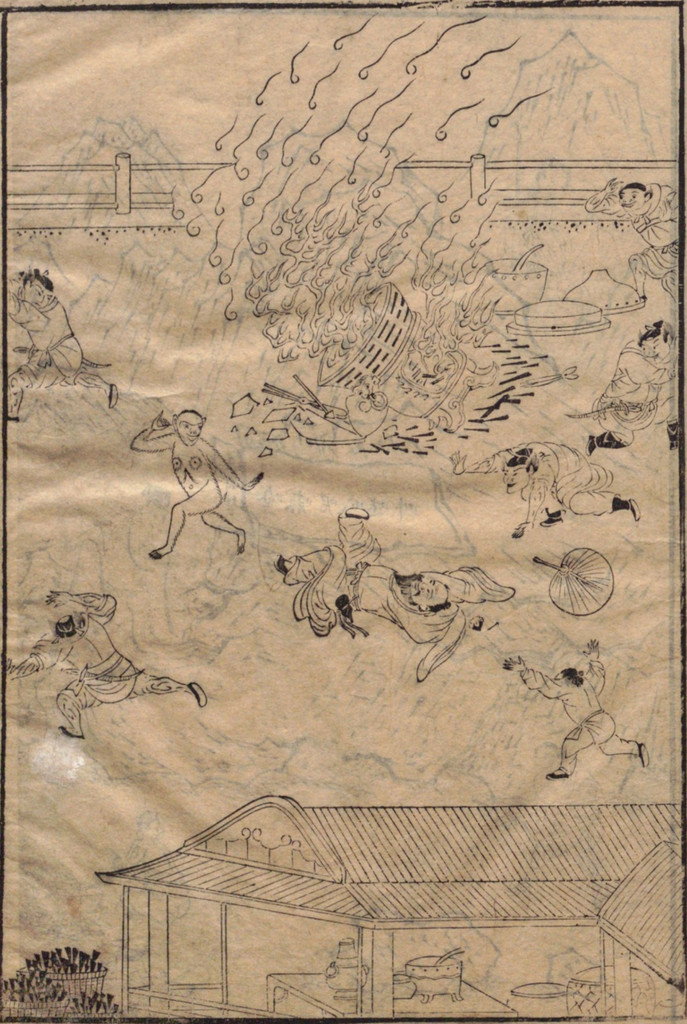
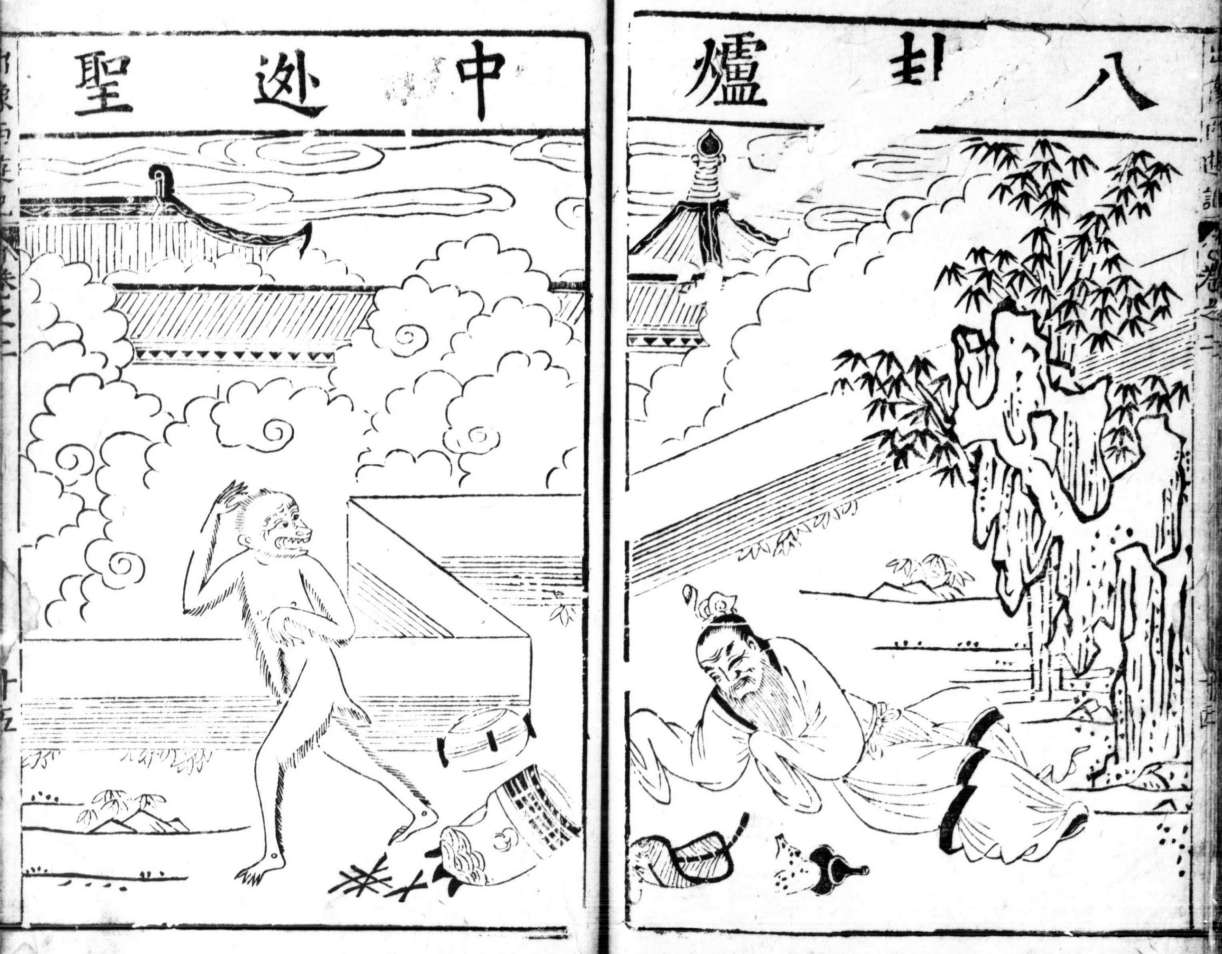
Prior to his turn in Laozi’s eight trigrams furnace in chapter seven, the story again references the knife in Monkey’s breastbone, suggesting he is still naked: “Arriving at the Tushita Palace, Laozi loosened the ropes on the Great Sage, pulled out the weapon from his breastbone, and pushed him into [furnace]” (Wu & Yu, 2012, vol. 1, p. 189). One late-Ming woodblock print actually portrays him naked upon his escape from the furnace (fig. 16). Most importantly, after being released from his 600 plus-year-long imprisonment under Five Elements Mountain, Monkey is twice described in chapter 14 as being “completely or stark naked” (chi lin lin, 赤淋淋; chi tiao tiao, 赤條條) (Wu & Yu, 2012, vol. 1, p. 309). (See the 06-22-23, 09-12-23, and 05-03-26 updates below for more evidence.)

Fig. 16 – Wukong in his birthday suit escaping from Laozi’s eight trigrams furnace (larger version). From Mr. Li’s Criticism (late-16th to early-17th century CE).

The lack of clothing leads to his second most identifiable and longest-worn piece of attire, a tiger skin kilt (hu pi qun, 虎皮裙). After killing the beast in chapter 14:

He pulled off one strand of hair and blew a mouthful of magic breath onto it, crying, “Change!” It changed into a sharp, curved knife, with which he ripped open the tiger’s chest. Slitting the skin straight down, he then ripped it off in one piece. He chopped away the paws and the head, cutting the skin into one square piece. He picked it up and tried it for size, and then said, “It’s a bit too large; one piece can be made into two.” He took the knife and cut it again into two pieces; he put one of these away and wrapped the other around his waist. Ripping off a strand of rattan from the side of the road, he firmly tied on this covering for the lower part of his body (Wu & Yu, 2012, vol. 1, p. 310).

好猴王,把毫毛拔下一根,吹口仙氣,叫:「變!」變作一把牛耳尖刀,從那虎腹上挑開皮,往下一剝,剝下個囫圇皮來。剁去了爪甲,割下頭來,割個四四方方一塊虎皮。提起來,量了一量道:「闊了些兒,一幅可作兩幅。」拿過刀來,又裁為兩幅。收起一幅,把一幅圍在腰間。路傍揪了一條葛籐,緊緊束定,遮了下體

Monkey’s most recognizable accessory is the self-control-inducing golden fillet (jingu, 金箍; a.k.a. jingu, 緊箍, lit: “tight fillet”), which he is tricked into wearing as a punishment shortly after murdering six bandits in chapter 14. As noted above, the band predates the novel, appearing in the 12th to 13th century CE Eastern Thousand Buddha Cave number two painting. This piece depicts the headgear as a simple circlet devoid of any decoration (fig. 17). This matches the novel’s description of “a thin metal band” (jinxian, 金線) (Wu & Yu, 2012, vol. 1, p. 310). But as can be seen from the Kaiyuan temple pagoda relief, there also exists a version with a double curlicue pattern in the center of the forehead (fig. 18). This has come to be the most popular version used in modern media.

Fig. 17 – Detail of the Monkey Pilgrim’s fillet from Eastern Thousand Buddha Cave no. 2 (c. 12th to 13th century CE) (larger version). Image enhanced slightly for clarity. Fig. 18 – Detail from the Kaiyuan Temple pagoda relief (1237 CE) (larger version).

As for other attire, there exists one passage in chapter 58 that describes how Monkey’s doppelganger copied even his clothing:

His looks were exactly the same as those of the Great Sage: he, too, had a gold fillet clamped to his blondish-brown hair, a pair of fiery eyes with golden irises, a monk’s robe on his body, a tiger kilt tied around his waist, a gold-banded iron staff in one of his hands, and a pair of deerskin boots on his feet (based on Wu & Yu, 2012, vol. 3, p. 105).

模樣與大聖無異:也是黃髮金箍,金睛火眼;身穿也是綿布直裰,腰繫虎皮裙;手中也拿一條兒金箍鐵棒;足下也踏一雙麂皮靴

Two things about this passage require explanation. First, Yu (Wu & Yu, 2012) originally translated huangfa (黃髮) as “brownish hair” (vol. 3, p. 105). But huang (黃) traditionally means “yellow.” If you refer back to figures six, eight, and nine, you will see that macaque monkeys have a light brown to blond coloring, so I changed the translation to reflect this.

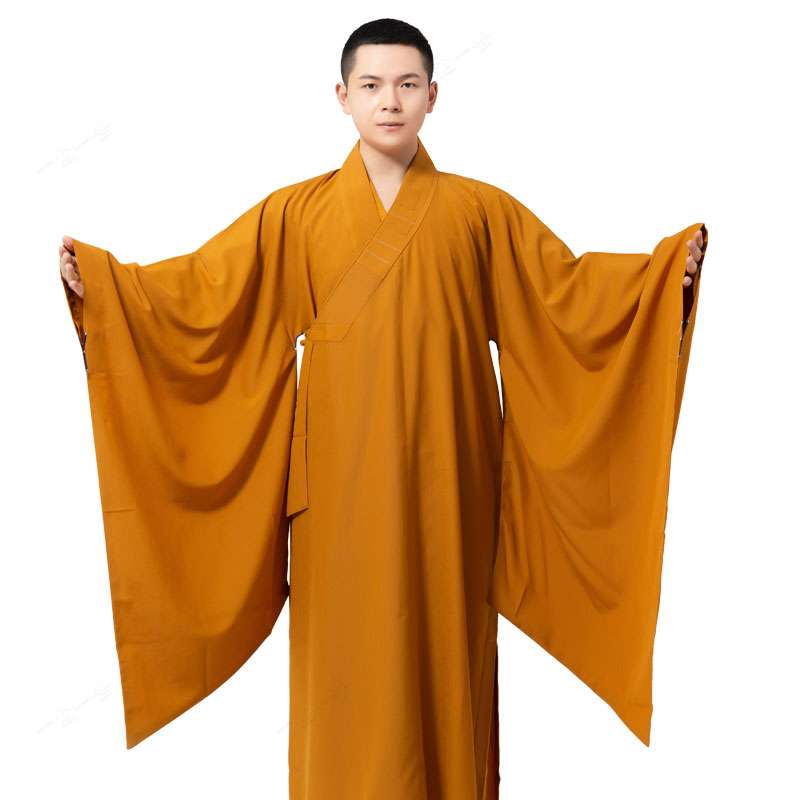
Second, he translates mianbu zhiduo (綿布直裰) as “silk shirt” (Wu & Yu, 2012, vol. 3, p. 105). However, a better translation is “silk cloth zhiduo robe.” The zhiduo robe is known colloquially in English as “Buddhist monk” or “Taoist monk” robes. Also called haiqing (海青), such garments reach almost to the ground and have long, broad sleeves. The robe is closed by a tie on the right side of the torso (fig. 19).

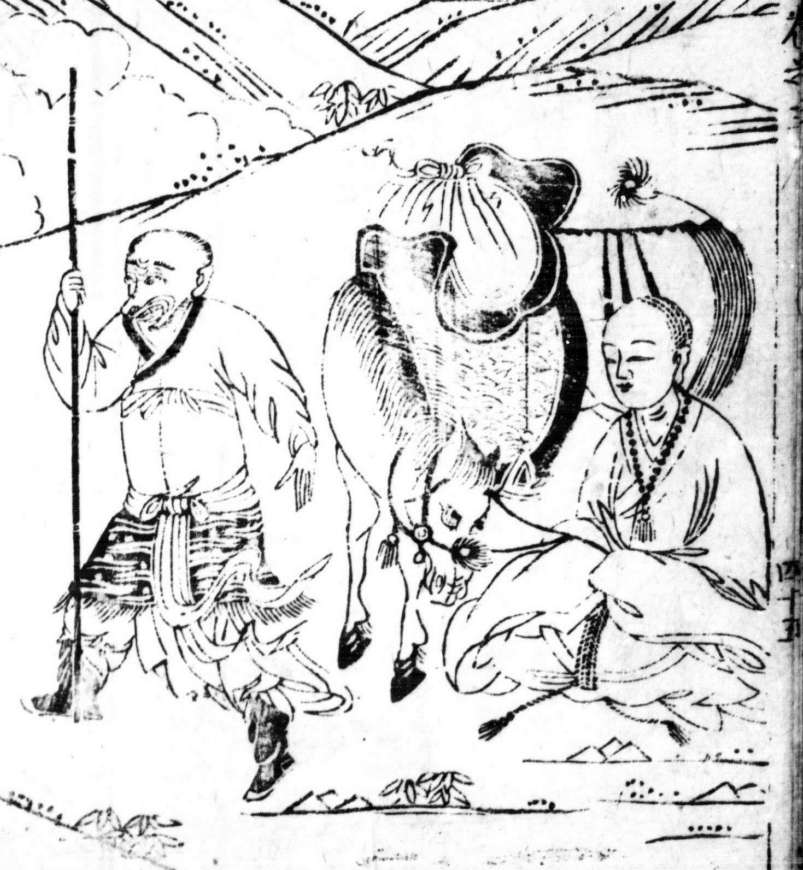
Woodblock prints of Monkey from the original 1592 CE Journey to the West vary from page to page, but one is pretty accurate. He wears the robe (with tied cuffs), the tiger skin kilt, and boots (fig. 20).

Fig. 19 – A zhiduo/haiqing robe (larger version). Image found here. These robes can be any number of colors. Fig. 20 – A woodblock print of Sun Wukong with his master, Tripitaka (larger version).

There is a distinct order in which Sun Wukong wears the aforementioned clothing and accessories: the armor, then the tiger skin, and then the golden fillet. However, many modern depictions portray Monkey wearing both the armor and headband. This is obviously anachronistic within the novel’s fictional story line. (Admittedly, though, this is not unique to the modern era. See figure 11 for a 16th century CE example.) Furthermore, many depictions dismiss the tiger skin kilt altogether.

2.3. The Staff

Monkey’s staff is first introduced in chapter three when he travels to the undersea palace of the dragon king to procure a divine weapon. There, he is directed towards a massive iron pillar:

Wukong girded up his clothes and went forward to touch it: it was an iron rod more than twenty feet long and as thick as a barrel. Using all his might, he lifted it with both hands, saying, “It’s a little too long and too thick. It would be more serviceable if it were somewhat shorter and thinner.” Hardly had he finished speaking when the treasure shrunk a few feet in length and became a layer thinner. “Smaller still would be even better,” said Wukong, giving it another bounce in his hands. Again the treasure became smaller. Highly pleased, Wukong took it out of the ocean treasury to examine it. He found a golden ring at each end, with solid black iron in between. Immediately adjacent to one of the rings was the inscription, “The As-You-Will Gold-Banded Staff. Weight: 17,560 pounds” (based on Wu & Yu, 2012, p. 135). [4]

悟空撩衣上前,摸了一把,乃是一根鐵柱子,約有斗來粗,二丈有餘長。他儘力兩手撾過道:「忒粗忒長些,再短細些方可用。」說畢,那寶貝就短了幾尺,細了一圍。悟空又顛一顛道:「再細些更好。」那寶貝真個又細了幾分。悟空十分歡喜,拿出海藏看時,原來兩頭是兩個金箍,中間乃一段烏鐵。緊挨箍有鐫成的一行字,喚做:「如意金箍棒,重一萬三千五百斤。」

A poem in chapter 75 describes how the staff is decorated with magic symbols. Part of it reads:

The rod of bin steel nine cyclic times refined
Was forged in the stove by Laozi himself.
King Yu took it, named it “Treasure Divine,”
To fix the Eight Rivers and Four Seas’ depth.
In it were spread out tracks of planets and stars,
Its two ends were clamped in pieces of gold.
Its dense patterns would frighten gods and ghosts;
On it dragon and phoenix scripts were drawn.
Its name was one Rod of Numinous Yang,
Stored deep in the sea, hardly seen by men
[…] (based on Wu & Yu, 2012, vol. 3, p. 375)

棒是九轉鑌鐵煉,老君親手爐中煅。
禹王求得號神珍,四海八河為定驗。
中間星斗暗鋪陳,兩頭箝裹黃金片。
花紋密佈鬼神驚,上造龍紋與鳳篆。
名號靈陽棒一條,深藏海藏人難見。

So we see the staff is depicted as a rod of black iron or steel adorned on both ends with a single golden ring and decorated along the body with astronomical charts and an inscription towards one tip listing the weapon’s name and weight. The literary description greatly differs from modern media which often portrays it as entirely gold or red in color.

Those wishing to replicate the inscription on the staff can use figure 21 as a template. The characters are presented in “Small Seal Script” (Xiao Zhuan, 小篆), which hails from the Qin Dynasty (221–206 BCE) when written Chinese was standardized by Emperor Qin Shihuang. Using this will give the staff a more ancient look. I used the template years ago to create a replica staff for an archaeology course in college.

Fig. 21 – The small script template for Monkey’s staff (larger version).

As for “the tracks of stars and planets,” I recommend using the Dunhuang or Suchow star charts.

3. Popular Depictions

The following two sections include a small sampling of what I consider to be the least and most accurate portrayals in past and modern media. These are presented in no particular order.

3.1. The Least Accurate

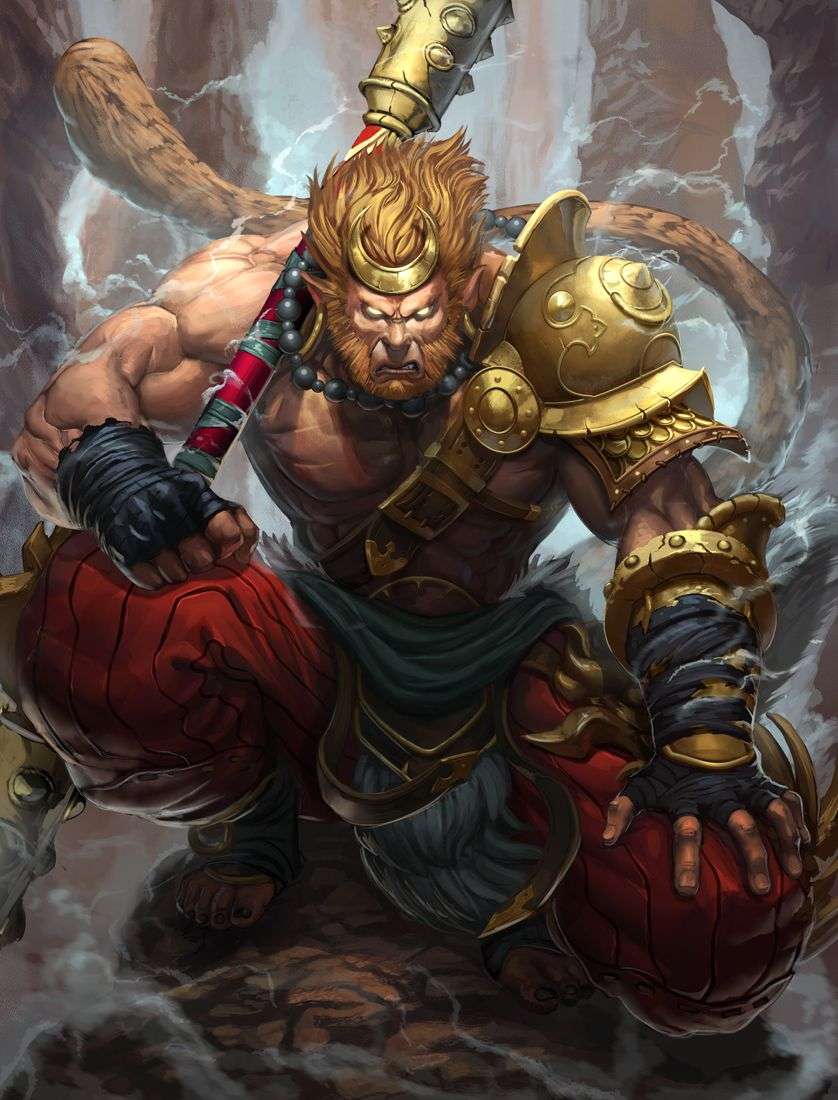
1) SMITE video game – He’s basically a bodybuilder with mutton chops (fig. 22). The design includes the aforementioned headband plus armor anachronism. Why is he wearing a gladiator-style pauldron? The original illustration is by Brolo on deviantart.

Fig. 22 – “Do you even lift?” Wukong (larger version).

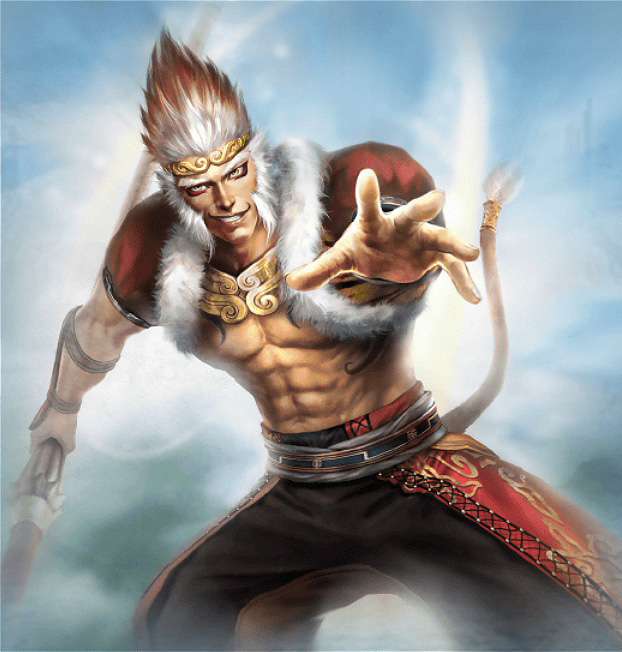
2) Warriors Orochi video game – Mutton chops, frosted tips, and an outfit borrowed from Prince’s wardrobe (fig. 23). Words fail me.

Fig. 23 – “Backup Dancer” Wukong (larger version).

3) The Forbidden Kingdom (2008) – Jet Li has a blond ponytail, mutton chops, and a soul patch (fig. 24). Need I say more?
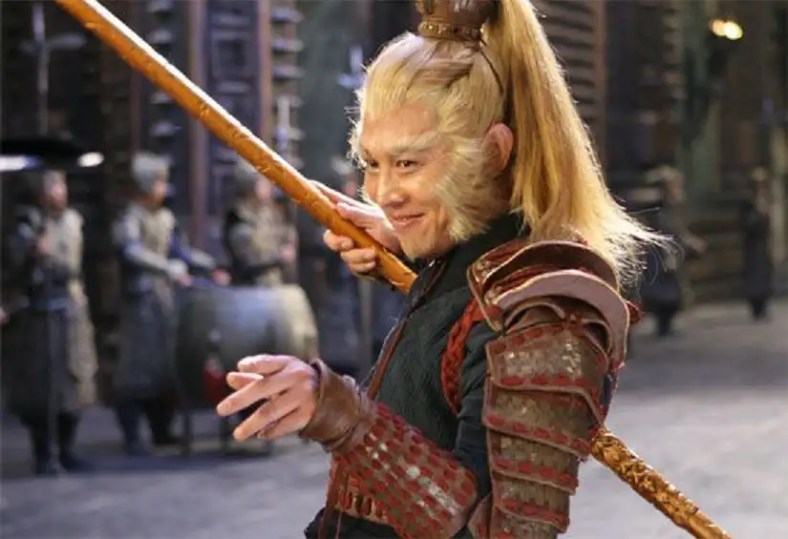
Fig. 24 – “L’Oréal Paris” Wukong (larger version).

3.2. The Most Accurate

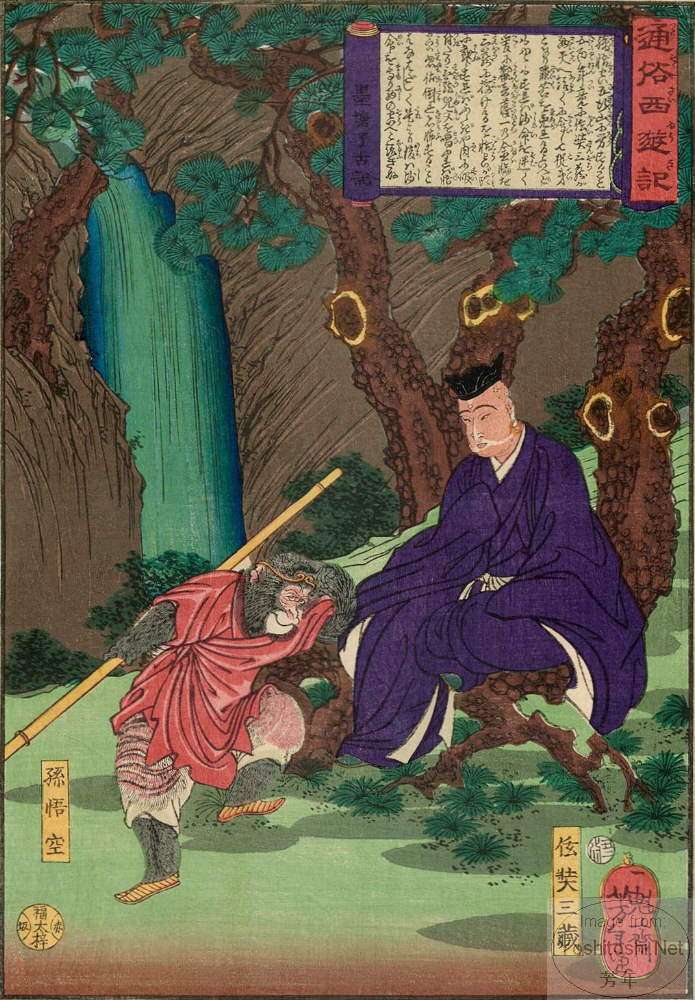
1) Yoshitoshi (1839-1892) – This Japanese artist produced many woodblock prints of our hero. Take for example his Modern Journey to the West series completed between 1864 and 1865. He portrays Sun Wukong as a red-faced snow macaque, which aligns more with the literary description (fig. 25).

Fig. 25 – Wukong salutes Xuanzang (larger version).

2) Journey to the West: Conquering the Demons (2013) – This dark comedy depicts the Great Sage as a short, ugly primate wearing golden armor (fig. 26).

Fig. 26 – Wukong prior to becoming Xuanzang’s disciple (larger version).

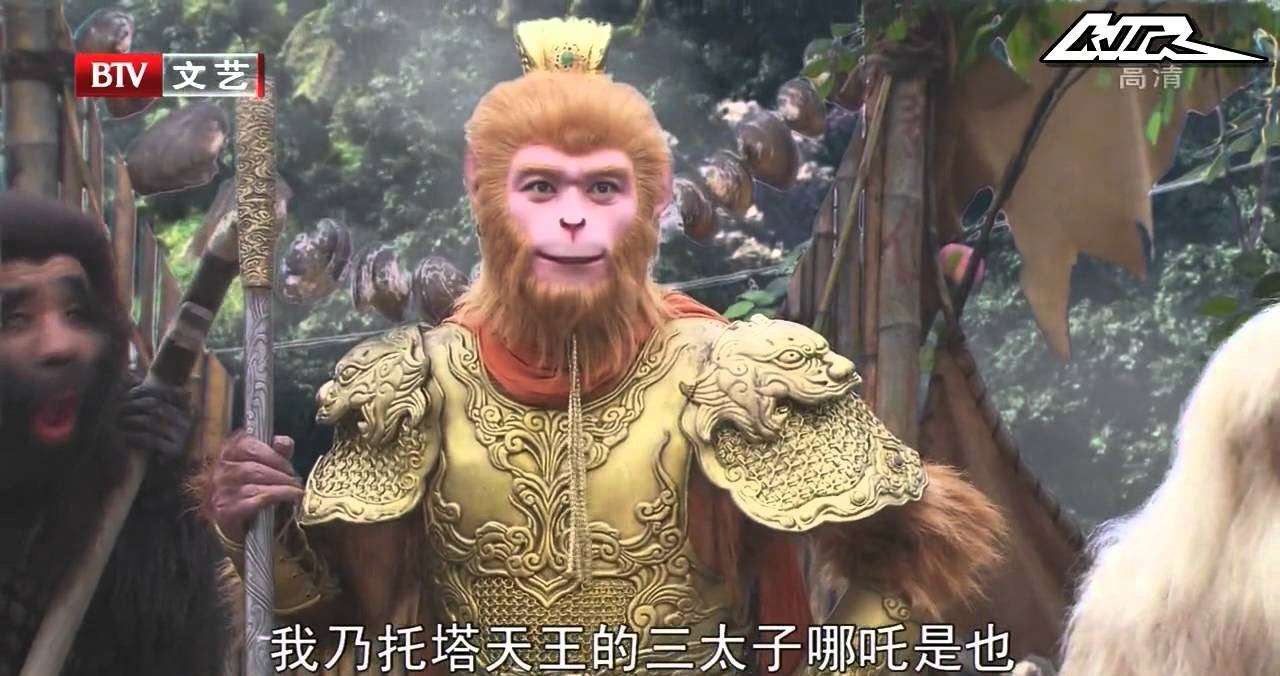
3) Journey to the West (2011) – This television series is a faithful adaptation of the novel. Although the actor who plays Sun Wukong is normal height, he wears a full silicone mask and clawed gloves to give the character a more primate look. His golden chainmail armor and staff are more accurate too. The latter even includes decorations on the shaft (fig. 27).

Fig. 27 – Wukong during his rebellion against heaven (larger version).

4. Conclusion

The novel portrays Sun Wukong as an ugly, bald Rhesus monkey less than four feet tall. (Per the 06-02-25 update, he also has long earlobes.) His traditional literary attire includes a phoenix feather cap, golden chainmail armor, and lotus root-colored boots. Later, he wears a golden fillet, a silk monk’s robe, a tiger skin kilt, and leather boots. He wields a rod of black iron/steel adorned on both ends with a single golden ring and decorated along the body with astronomical charts and an inscription towards one tip listing the weapon’s name and weight.


5. Updates

Update: 02-02-21

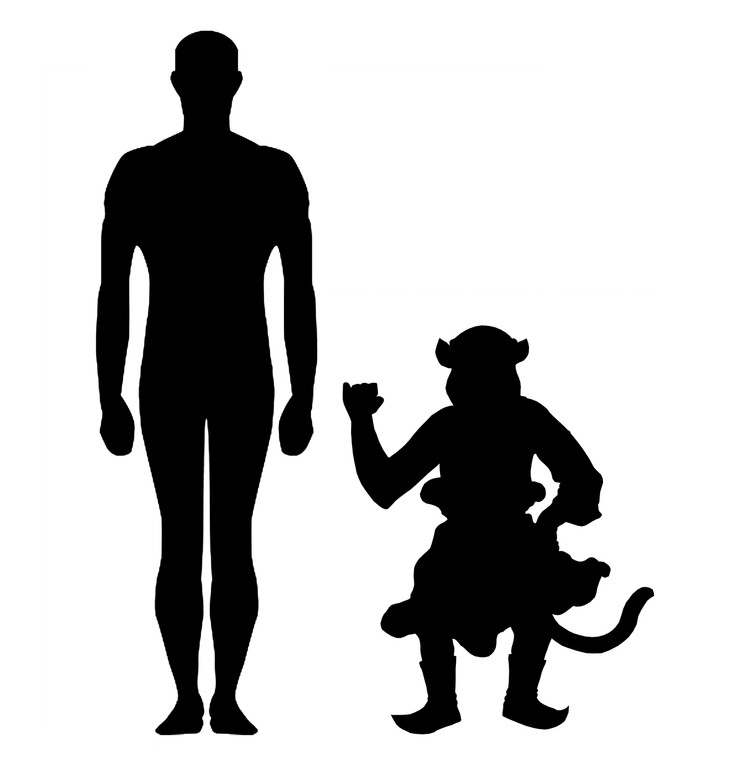
As mentioned above, the novel describes Wukong being “less than four feet, in fact” (Wu & Yu, 2012, vol. 1, p. 408). I have made a chart comparing his height with that of a 6 ft (1.82 m) human man (fig. 28). This should serve as a good illustration for just how short our hero is.

Fig. 28 – Size chart (larger version).


Update: 01-23-22

I’ve written an article suggesting a mantra for the secret spell that causes Sun Wukong’s golden headband to tighten. Similar to the above article, I had artists and fanfiction authors in mind when I wrote it.

The Tightening Spell of Sun Wukong’s Golden Headband


Update: 03-07-22

I’ve written a response to a comment on one of my Youtube videos. It discusses Sun Wukong’s height.

How Tall is the Monkey King? – A Debate


Update: 06-22-23

I previously noted a 16th century CE woodblock print that shows Sun Wukong naked upon escaping Laozi’s furnace (refer back to fig. 16). A woodblock print from the original 1592 CE Journey to the West also depicts him in his birthday suit (fig. 29). This adds to the evidence that Monkey doesn’t wear his armor during the entirety of the journey.

Fig. 29 – A naked Sun Wukong flees the furnace (larger version). 


Update: 09-12-23

In addition, in chapter 22, Sha Wujing mentions having his armor stripped from his body just before his planned execution:

Jade Emperor grew mightily enraged;
Hands clasped, he faced his counsel on the left.
Stripped of my hat, my armor, and my rank,
I had my whole body pushed to the block (Wu & Yu, 2012, vol. 1, p. 425).

玉皇即便怒生嗔,卻令掌朝左輔相:卸冠脫甲摘官銜,將身推在殺場上。

This supports the suggestion that Monkey’s armor was removed before heaven tried to execute him.


Update: 04-27-24

Here is another colorful description of Sun Wukong’s face:

A bumpy, scabrous face, a pair of yellow eyeballs, a sunken forehead, and long, protruding fangs—he seemed virtually an overcooked crab with meat inside and bones outside! (based on Wu & Yu, 2012, vol. 2, p. 155)

七高八低孤拐臉,兩隻黃眼睛,一個磕額頭,獠牙往外生。就像屬螃蟹的,肉在裡面,骨在外面。

In addition, chapter 37 gives a more precise measurement for Monkey’s height. He first transforms into a “tiny monk about two cun tall” (二寸長的小和尚兒) (based on Wu & Yu, 2012, vol. 2, p. 172). He shortly thereafter grows even bigger when a prince makes fun of him:

Tripitaka pulled open the box’s cover; Pilgrim [Sun Wukong] leaped out and began to hobble all over the place. The prince said, “This little midget! What can he know?” When Pilgrim heard this remark about his size, he at once resorted to magic. Straightening up his torso, he grew about three chi and four or five cun instantly (emphasis added). “If he can grow that rapidly,” said the soldiers, highly startled, “it will only be a few days before he pierces the sky.” When Pilgrim reached his normal height, however, he stopped growing (emphasis added) (based on Wu & Yu, 2012, vol. 2, pp. 174-175).

三藏扯開匣蓋兒,那行者跳將出來,呀的兩邊亂走。太子道:「這星星小人兒,能知甚事?」行者聞言嫌小,卻就使個神通,把腰伸一伸,就長了有三尺四五寸。眾軍士吃驚道:「若是這般快長,不消幾日,就撐破天也。」行者長到原身,就不長了。

One chi (尺) is roughly 12.3 in or 31.8 cm, and one chi equals 10 cun (寸; a.k.a. “Chinese inches”) (Jiang, 2005, p. xxxi). One cun would be about 1.25 in or 3.18 cm. Two cun would therefore be 2.5 in or 6.36 cm. Growing the stated additional height would then put our hero at 3 chi and 6 or 7 cun, which is roughly 3.86 ft or 1.176 m. This agrees with the aforementioned estimate of “not (or less than) four chi tall” (buman sichi, 不滿四尺) (Wu & Yu, 2012, vol. 1, pp. 128 and 408).


Update: 06-02-25

A reader reminded me that I forgot to list one of Monkey’s features: long earlobes. A poem in chapter four reads:

The gold cuirass worn on his body was brilliant and bright;
The gold cap on his head also glistened in the light.
In his hands was a staff, the golden-hooped rod,
That well became the cloud-treading shoes on his feet.
His eyes glowered strangely like burning stars.
Hanging past his shoulders were two ears, forked and hard (emphasis added).
His remarkable body knew many ways of change,
And his voice resounded like bells and chimes.
This BanHorsePlague with beaked mouth and gaping teeth
Aimed high to be the Equal to Heaven Sage.

身穿金甲亮堂堂,頭戴金冠光映映。
手舉金箍棒一根,足踏雲鞋皆相稱。
一雙怪眼似明星,兩耳過肩查又硬。
挺挺身才變化多,聲音響喨如鐘磬。
尖嘴咨牙弼馬溫,心高要做齊天聖。(Source)

Long earlobes are a symbol of wisdom and longevity (fig. 30), so the description here might be symbolic of his immortality.

Fig. 30 – An image of the Daoist high god Laozi and his long earlobes (larger version). Image found here.


Update: 05-03-26

Regarding the evidence for Monkey’s lack of armor throughout the story, here is another ancient woodblock print showing him without clothes upon escaping the furnace (fig. 31). It is included among a brief cache of illustrations from The Book to Enlightenment of the Journey to the West (Xiyou Zhengdao Shu, 西遊證道書, 1663), a Daoist commentary on the novel.

Fig. 31 – Monkey escapes from the furnace (larger version). 

I should also note that a reader disagrees with the idea that Sun Wukong is bald. See their comments below.

Notes:

1) The 15th century CE zaju play Journey to the West contains many familiar episodes that would come to appear in the final novel.

2) See the introduction of Dudbridge (1970), for example.

3) Saturn (Tuxing, 土星; lit: “Earth Star”) is mentioned here because the stellar deity is known for having a thickly-bearded face (see figure one on this article). The reference is saying that Monkey’s sunken cheeks are hairless.

4) Yu’s (Wu & Yu, 2012) original translation says “thirteen thousand five hundred pounds” (vol. 1, p. 135). However, the Chinese version uses jin (斤), known in English as “catty.” The catty and pound are two different measures of weight, the former being heavier than the latter. Therefore, the English text has been altered to show this. The catty during the Ming Dynasty when the novel was compiled equaled 590 grams (Jiang, 2005, p. xxxi), so 13,500 catties would equal 17,560 lbs.

Sources:

Burton, F. D. (2005). Monkey King in China: Basis for a Conservation Policy? In A. Fuentes & L. D. Wolfe (Eds.), Primates Face to Face: Conservation Implications of Human-Nonhuman Primate Interconnections (pp. 137-162). Cambridge: Cambridge University Press.

Dudbridge, G. (1970). The Hsi-Yu Chi: A Study of Antecedents to the Sixteenth-Century Chinese Novel. Cambridge: Cambridge Univ. Press.

Dubue, C., Allen, W. L., Maestripieri, D., & Higham, J. P. (2014). Is Male Rhesus Macaque Red Color Ornamentation Attractive to Females? Behavioral Ecology and Sociobiology 68(7), 1-10. Retrieved from https://www.researchgate.net/publication/262066733_Is_male_rhesus_macaque_red_color_ornamentation_attractive_to_females

Ecke, G., & Demiéville, P. (1935). The Twin Pagodas of Zayton: A Study of the Later Buddhist Sculpture in China. Cambridge, Mass: Harvard University Press.

Jiang, Y. (2005). The Great Ming Code / Da Ming Lu. University of Washington Press.

Wivell, C.S. (1994). The Story of how the Monk Tripitaka of the Great Country of T’ang Brought Back the Sūtras. In V. H. Mair (Ed.), The Columbia Anthology of Traditional Chinese Literature (pp. 1181-1207). New York: Columbia University Press.

Wu, C., & Yu, A. C. (2012). The Journey to the West (Vols. 1-4) (Rev. ed.). Chicago, Illinois: University of Chicago Press.

The Monkey King’s Spiritual Training and Historical Daoist Internal Alchemy

Last updated: 09-22-23

Did you know that the Monkey King’s early spiritual training is connected to historical Daoist internal alchemy? In Journey to the West (Xiyouji, 西遊記, 1592) chapter two, Sun Wukong receives a private lesson in which his master, Patriarch Subodhi, reveals the secret of immortality in a poem chocked full of esoteric Daoist imagery:

This bold, secret saying that’s wondrous and true:
Spare, nurse nature and life—there’s nothing else.
All power resides in the semen, breath, and spirit;
Store these securely lest there be a leak.
Lest there be a leak!
Keep within the body!
Heed my teaching and the Way itself will thrive.
Hold fast oral formulas so useful and keen
To purge concupiscence, to reach pure cool;
To pure cool
Where the light is bright.
You’ll face the elixir platform, enjoying the moon.
The moon holds the jade rabbit, the sun, the crow;
The tortoise and snake are now tightly entwined.
Tightly entwined,
Nature and life are strong.
You can plant gold lotus e’en in the midst of flames.
Squeeze the Five Phases jointly, use them back and forth—
When that’s done, be a Buddha or immortal at will! (Wu & Yu, 2012, p. 120).

顯密圓通真妙訣,惜修性命無他說。
都來總是精氣神,謹固牢藏休漏泄。
休漏泄,體中藏,汝受吾傳道自昌。
口訣記來多有益,屏除邪慾得清涼。
得清涼,光皎潔,好向丹臺賞明月。
月藏玉兔日藏烏,自有龜蛇相盤結。
相盤結,性命堅,卻能火裡種金蓮。
攢簇五行顛倒用,功完隨作佛和仙。

Table of Contents

1. Explanation

The cryptic methods advocated in the poem find their origins in dogmatic Daoist internal practices that emerged during the Song Dynasty (960–1279) (Kohn, 2008, p. 177). When Subodhi warns Monkey to “Store these [bodily substances] lest there be a leak,” he is referring to the first of three stages in the forging of an immortal spirit body. It involves transforming chaste semen (jing, 精) into pneumatic energy (qi, 氣) and guiding it to the brain, where it is purified and then circulated throughout the body, resulting in the formation of a spiritual pearl in the Cinnabar Field (dantian, 丹田), or the body’s spiritual furnace located in the lower abdomen (Kohn, 2008, p. 178).

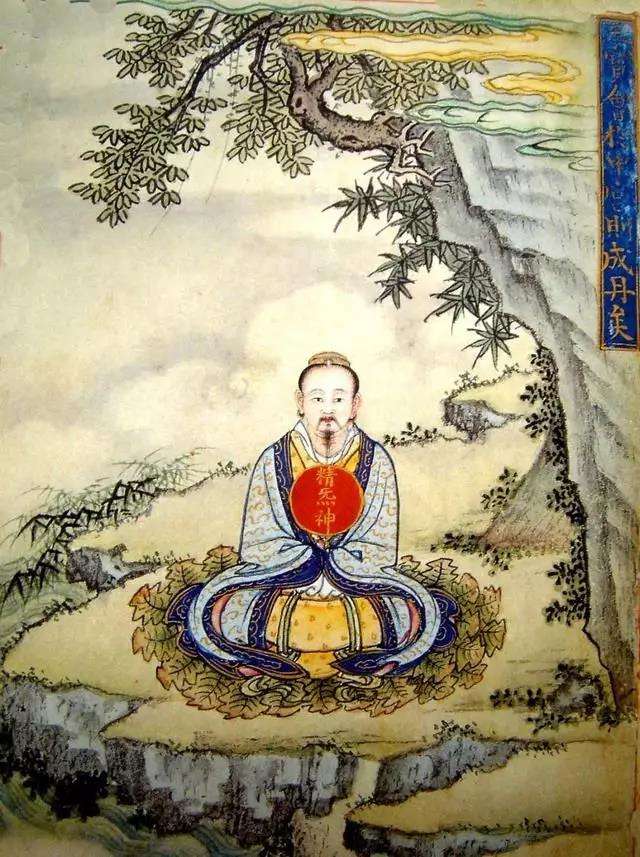
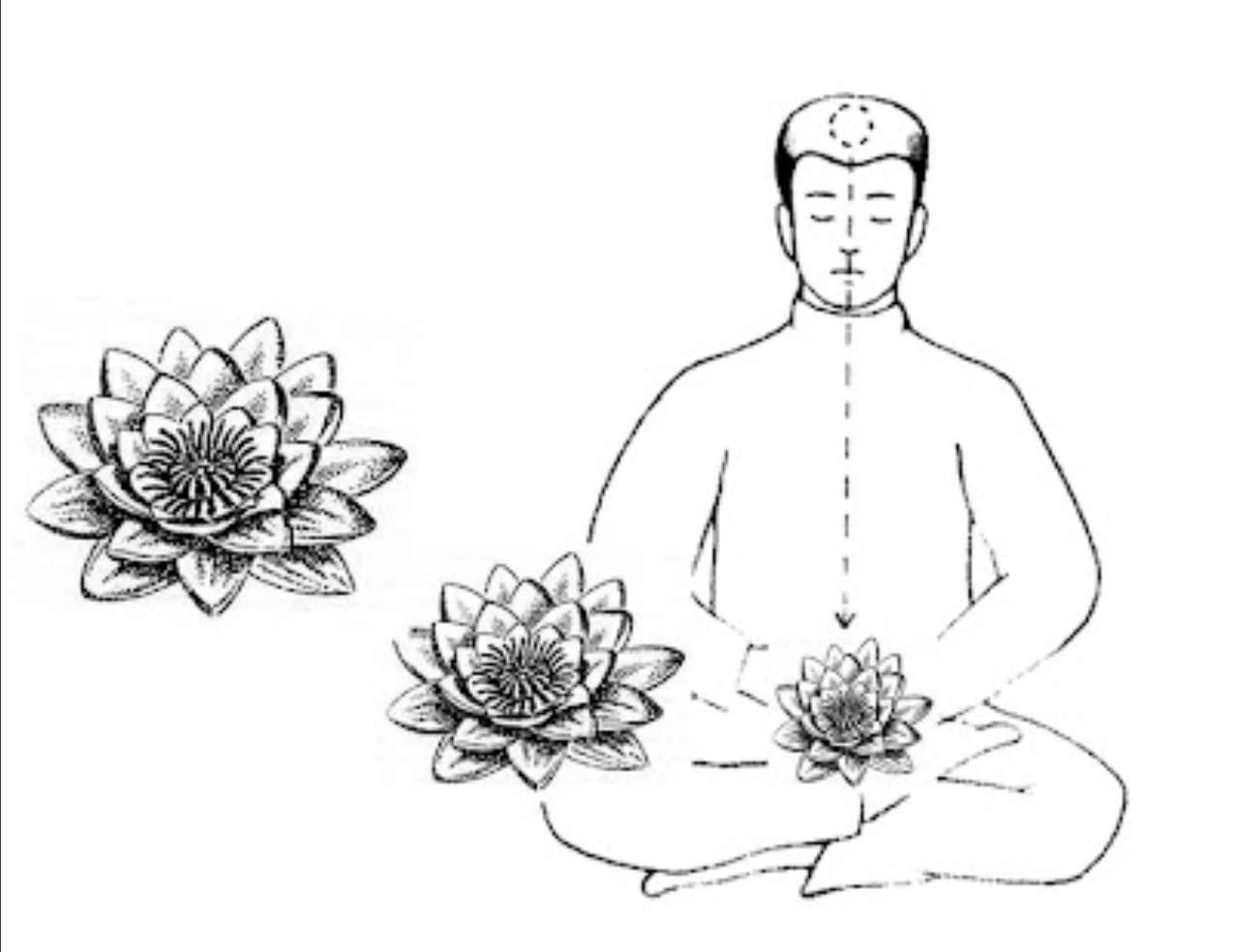
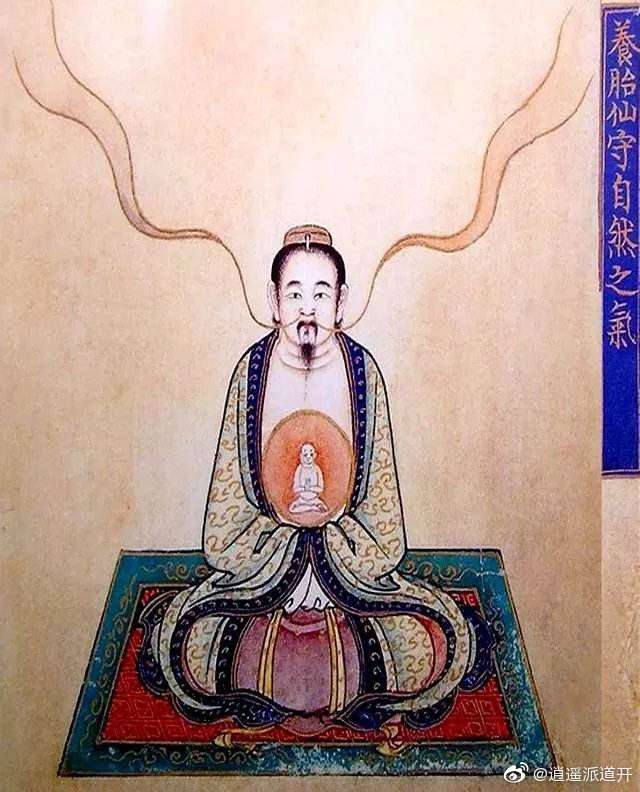
“You can plant gold lotus e’en in the midst of flames. / Squeeze the Five Phases jointly, use them back and forth” refers to the second stage, involving the inhalation and guidance of yang energy through various organs (the “five phases”) in the body to bolster the spirit (shen, 神) (fig. 1). This nurturing of the pearl causes it to sprout like a seed and blossom into a golden lotus (“amidst flames”) in the spiritual furnace (fig. 2). The lotus is considered the early stages of an immortal “spirit embryo” (shengtai, 聖胎) (fig. 3) (Kohn, 2008, pp. 178-179).

The third stage involves the nurturing of said embryo to maturation with spiritual energies and eventually guiding it upwards and out the “Heavenly Gate” (tianguan, 天關), or the top of the crown. This results in a fledgling immortal spirit body that must be trained over an additional three year period in which it learns to travel far and wide apart from the physical vessel (pp. 179-180). “When that’s done, be a Buddha or immortal at will!” refers to the eventual freedom of the immortal spirit.

Fig. 1 (top left) – A sage combining jing, qi, and shen (精炁/氣神, lit: “semen, pneumatic energy, and spirit”; a.k.a. the “Three Treasures,” Sanbao, 三寶) (larger version). Image from the Anthology of Immortals of Complete Perfection (Quanzhen qunxian ji, 全真群仙集). Fig. 2 (top right) – A visualized lotus in the cinnabar field (larger version). Fig. 3 (bottom) – A sage nurturing his spirit embryo with inhaled qi energy (larger version). Image from the Anthology of Immortals.

2. Powers

Kohn (2008) notes that adepts who succeed in their training gain supernatural powers, “including the ability to be in two places at once, to move quickly from one place to another, to know past and future, to divine people’s thoughts, and so on” (p. 180) (fig. 2). I feel this is important information considering all of the powers that Monkey exhibits throughout the story.

3. History

Various facets of the aforementioned Song-era practices, such as the breathing methods from stage two above, have a much older pedigree. While JTTW describes Sun secretly performing “breathing exercises before the hour of Zi and after the hour of Wu” (i.e. after noon and before midnight) (Wu & Yu, 2012, p. 121), the hours are switched in historical practice. The Wondrous Record of the Golden Casket on the Spirit Immortals’ Practice of Eating Qi (Shenxian shiqi jin’gui miaolu, 神仙食氣金櫃妙錄, 4th century; “Wonderous Record” hereafter) explains:

“[A]lways practice after midnight [and before noon] in the period of living qi [yang energy] … In this qi-practice, the time after noon and before midnight is called the period of dead qi [yin energy]. Do not practice then” (Kohn, 2008, p. 84).

So by practicing during the prescribed hours, Monkey absorbs the yang energy that he needs to fuel his immortality.


4. Updates

Update: 08-18-23

Above, I described how the cultivation of an immortal spirit involved refining cosmic energies in the dantian (丹田) into a seed-like pearl, then a lotus, and finally a “spirit embryo” (聖胎). Well, thanks to a tumblr post by user ruibaozha, I now have a better understanding of how Buddhist “lotus births” influenced this imagery. Shahar (2015) explains:

As early as the first centuries CE, redemption in Amitabha‘s Pure Land has been imagined in floral terms. Those who trust in the Buddha’s grace are resurrected from divine lotus blooms. Flower-like beings, they emerge from the sacred lotus blossoms into a realm of purity and happiness:

When beings of this [superior] type are about to die, the Buddha of Measureless Light [Amitabha] appears before them, accompanied by a great crowd of attendants. Then, these beings follow this Buddha and go to be reborn in his land. They are reborn naturally and miraculously in the center of a lotus made of the seven precious substances, and they dwell in the state from which there is no falling back. They come to possess wisdom and courage, supernormal powers and spiritual mastery.

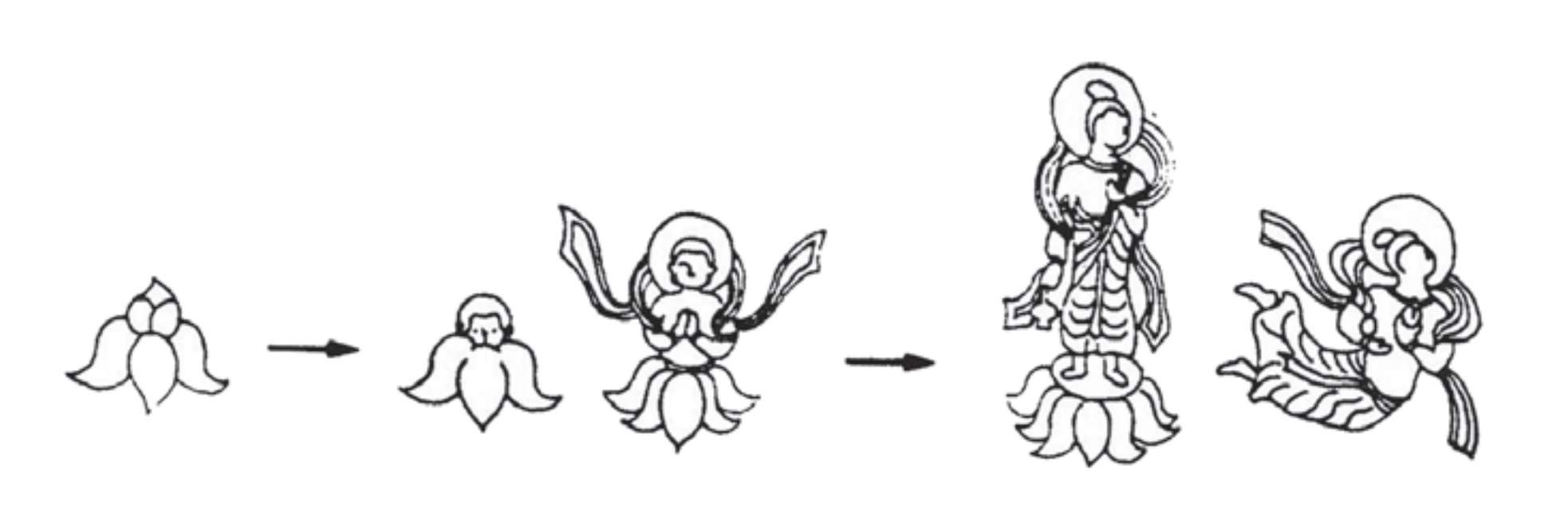
Floral regeneration became a favorite topic of Buddhist art across Asia. Redeemed souls were visually rendered as newborns wrapped in lotus blooms. Some artists faithfully followed a given Pure Land text. The ca. fifth-century Amitabha Visualization Sutra enumerated nine ranks of rebirth in the paradise of the west, from “the upper birth of the upper rank,” through “the middle birth of the upper rank,” downward to the “lower birth of the lower rank.” A seventh-century Dunhuang mural depicted them all in the form of babies emanating from nine lotus blossoms. Other artists focused on the process by which the flower is transformed into a divine being. They created a series of images recording the mysterious metamorphosis of the lotus. Dating from as early as the fifth century CE, the Yun’gang and Longmen caves include numerous examples of these pictorial narratives, showing first a newborn’s head peeping from inside the corolla, then the gradual transformation of the petals into the limbs, and finally the release of a full-blown ethereal being, the divinity of which is indicated by a [halo] [fig. 4] (pp. 143-144). 

Fig. 4 – “Lotus rebirth as rendered at the fifth-century Yun’gang Caves. From Yoshmura Rei, Tianren dansheng tu (Shanghai: Shanghai guji, 2009), p. 23” (larger version) (Shahar, 2015, p. 144).

If viewed through a Daoist lens, this image could represent the fledgling spirit embryo emerging from the lotus, being nurtured to fruition, and then freed to live out an eternity in blissful freedom.


Update: 09-22-23

Above, I quoted Kohn’s (2008) heavily edited translation of the Wonderous Record, which noted the prescribed times for the ingestion of qi energy. This source was apparently cited in the “Inner Chapters” (Neipian, 內篇) of Ge Hong’s Master Who Embraces Simplicity (Baopuzi, 抱朴子, 4th century). A longer quote appearing in Campany (2002) mentions the aforementioned time-based practices, lists the types of resulting spiritual powers, and warns of this path’s difficulty:

Now the circulation of pneumas should be done during the hours of live pneumas (shengqi 生氣[/炁]), not during the hours of dead pneumas (siqi 死氣[/炁]). This is why it is said that “transcendents ingest the six pneumas.” In one day and night there are twelve double-hours. The six double-hours from midnight to noon are those of live pneumas; the six from noon to midnight are those of dead pneumas. During the period of dead pneumas, circulating pneumas is of no benefit.

One who is adept at using pneumas can blow on water and it will flow against its own current for several paces; blow on fire, and it will be extinguished; blow at tigers or wolves, and they will crouch down and not be able to move; blow at serpents, and they will coil up and be unable to flee. If someone is wounded by a weapon, blow on the wound, and the bleeding will stop. If you hear of someone who has suffered a poisonous insect bite, even if you are not in his presence, you can, from a distance, blow and say an incantation over your own hand (males on the left hand, females on the right), and the person will at once be healed even if more than a hundred li away. And if you yourself are struck by a sudden illness, you have merely to swallow pneumas in three series of nine, and you will immediately recover.

However, people by nature are restless, and few are able to maintain the quietude to cultivate this way. Furthermore, to practice the most essential methods of circulating pneumas one must avoid eating very much, or eating flesh vegetables and meats, for these cause the breath to become strong and thus hard to shut off. Also one must avoid rage, for if one has much rage, then the breath becomes disordered, and if it is unable to spill over, then it will cause a fit of coughing.

Few are those, therefore, who can practice breath circulation! (p. 21)

夫行炁當以生炁之時,勿以死炁之時也。故曰仙人服六炁,此之謂也。一日一夜有十二時,其從半夜以至日中六時為生炁,從日中至夜半六時為死炁,死炁之時,行炁無益也。善用炁者,噓水,水為之逆流數步;噓火,火為之滅;噓虎狼,虎狼伏而不得動起;噓蛇虺,蛇虺蟠而不能去。若他人為兵刃所傷,噓之血即止;聞有為毒蟲所中,雖不見其人,遙為噓祝我之手,男噓我左,女噓我右,而彼人雖在百里之外,即時皆愈矣。又中惡急疾,但吞三九之炁,亦登時差也。但人性多躁,少能安靜以修其道耳。又行炁大要,不欲多食,及食生菜肥鮮之物,令人炁強難閉。又禁恚怒,多恚怒則炁亂,既不得溢,或令人發欬,故鮮有能為者也。

Sources:

Campany, R. F. (2002). To Live as Long as Heaven and Earth: A Translation and Study of Ge Hong’s Traditions of Divine Transcendents. United Kingdom: University of California Press.

Kohn, L. (2008). Chinese Healing Exercises: The Tradition of Daoyin. Honolulu: University of Hawaiʻi Press.

Shahar, M. (2015). Oedipal God: The Chinese Nezha and His Indian Origins. Germany: University of Hawaii Press.

Wu, C., & Yu, A. C. (2012). The Journey to the West (Vol. 1) (Rev. ed.). Chicago, Illinois: University of Chicago Press.

The Mountain of Flowers and Fruit and the Cosmic Geography of Journey to the West

Note: This page used to have historical information about the origin of Monkey’s first master, but I have moved it to a new article.

Last updated: 03-07-2023

The Monkey King’s home, the “Mountain of Flowers and Fruit” or “Flower-Fruit Mountain” (Huaguo shan, 花果山), is commonly assumed to be located in China. In fact, a similarly-named mountain in Jiangsu province is even touted as the home of Sun Wukong. However, this is not the case within the novel’s narrative. It’s important to remember that Journey to the West (Xiyouji, 西遊記, 1592) is set in a world that is nothing like our Earth.

In this article, I will explain the location of the Mountain of Flowers and Fruit, showing that Sun Wukong’s home is in fact an island east of what would be considered China. This opens the door to interesting interpretations by those wanting to place the story within a real world context. Second, I will explain the ancient Buddhist disc-world system as presented in the book. My hope is that this will give readers a better understanding of the cosmic geography in which the story happens. 

Table of Contents

1. Religious Background

Note: I will alternate between Wu & Jenner (2020) and Wu & Yu (2012), using one or the other depending on who I think has done a better job of translating certain passages.

Chapter one opens by describing the world in which the story is set:

The world was then divided into four great continents: The Eastern Continent of Superior Body, the Western Continent of Cattle-Gift, the Southern Continent of Jambu and the Northern Continent of Kuru (Wu & Jenner, 1993/2020, vol. 1, p. 3).

… 世界之間,遂分為四大部洲:曰東勝神洲,曰西牛賀洲,曰南贍部洲,曰北俱蘆洲。

Yu’s (Wu & Yu, 2012) translation provides romanization of the Sanskrit names (vol. 1, p. 100). I’ve listed them below, along with the original Sanskrit, an alternative English translation, and the Chinese for the reader’s reference:

  • East Pūrvavideha (Sk: पूर्वविदेह, “Surpassing the Body”; Ch: Dong shengshen zhou, 東勝神洲)
  • West Aparagodānīya (Sk: अपरगोदानीय, “Enjoyer of Cattle”; Ch: Xi niuhe zhou, 西牛賀洲)
  • North Uttarakuru (Sk: उत्तरकुरु, “Unpleasant Sound”; Ch: Bei julu zhou, 北俱盧洲)
  • South Jambudvīpa (Sk: जम्बुद्वीप, “Rose-Apple”; Ch: Nan shanbu zhou, 南贍部洲)

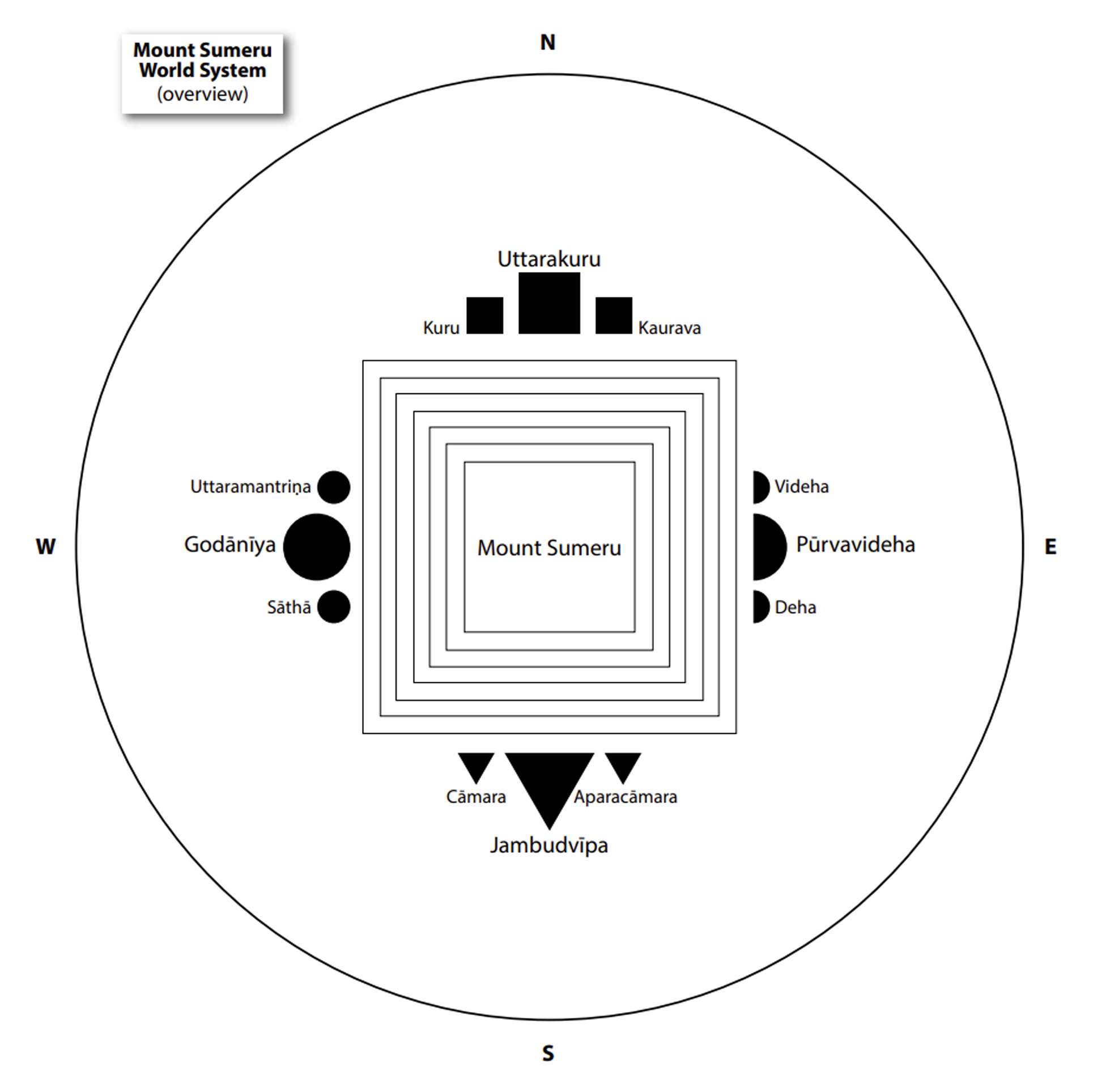
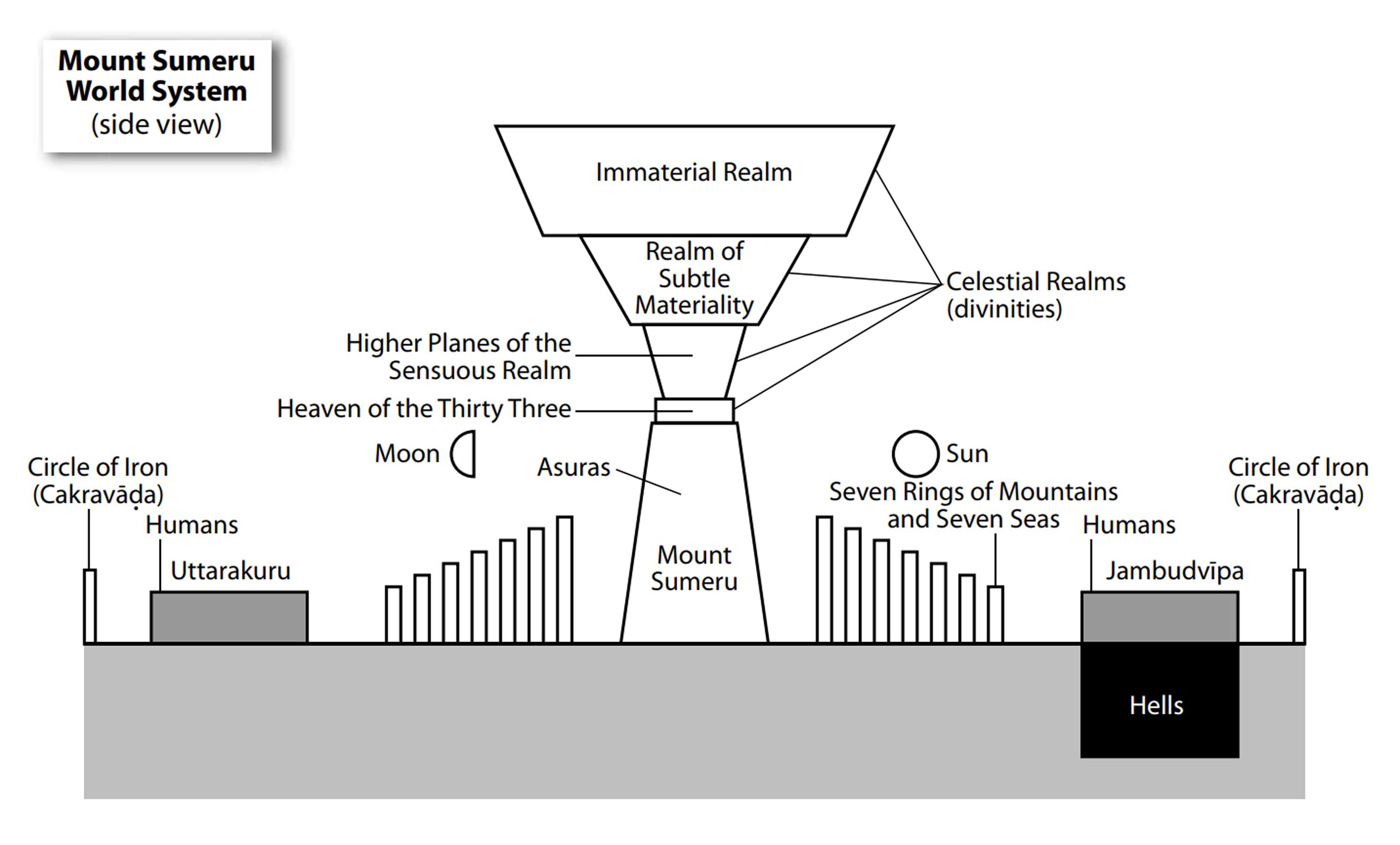
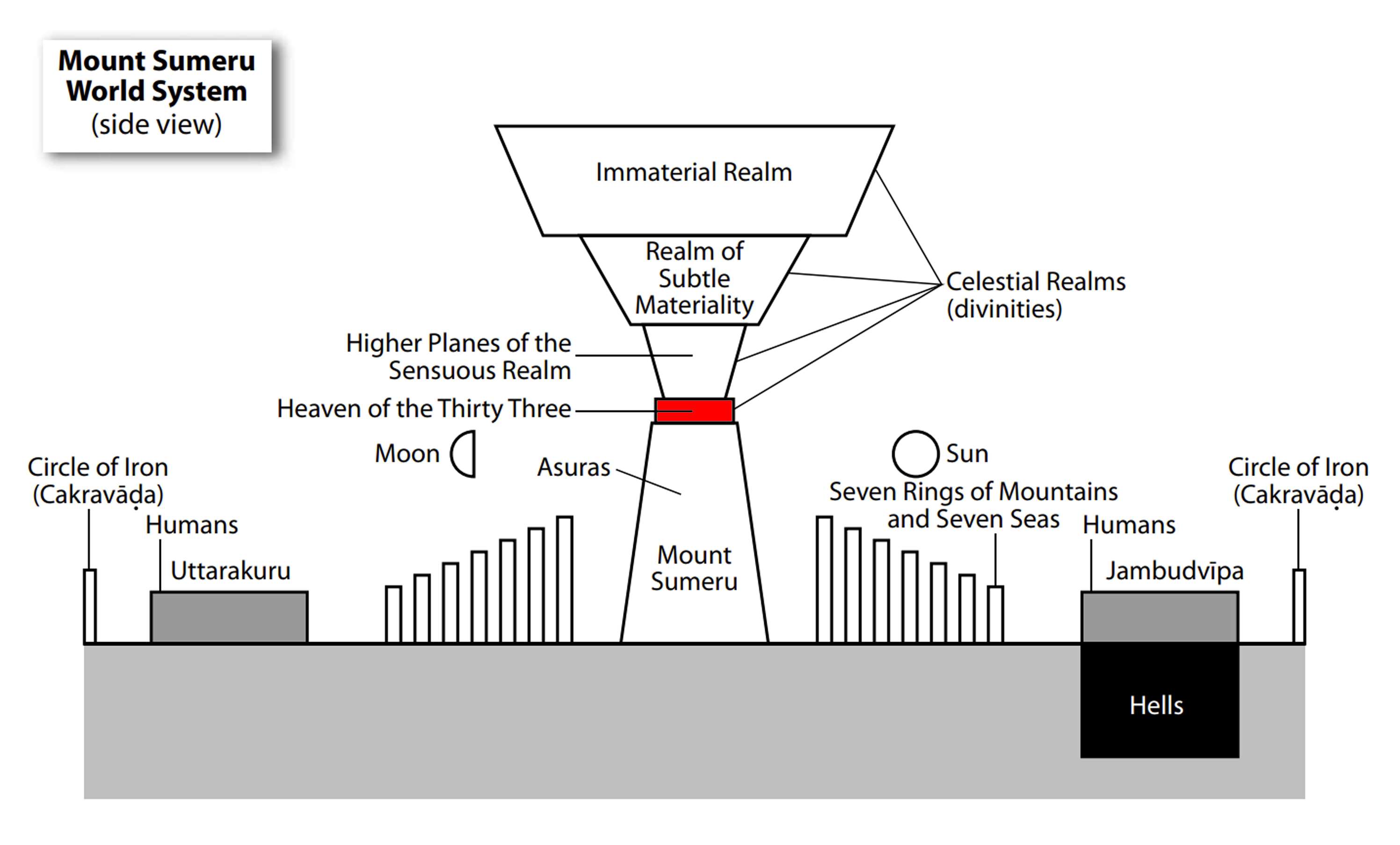
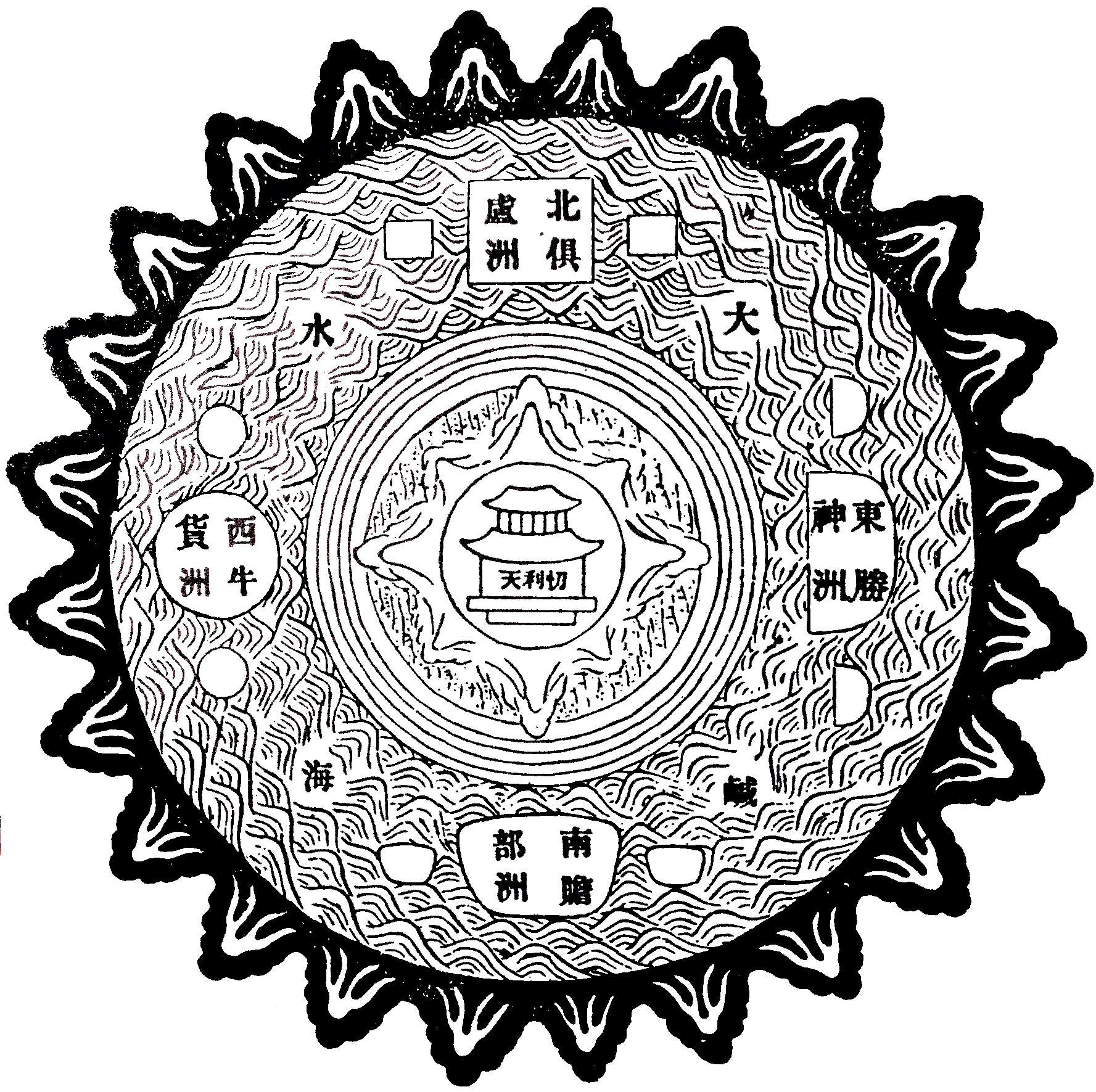
The Abhidharmakośa (Sk: अभिधर्मकोशभास्य; Ch: Api damo jushe lun, 阿毗達磨俱舍論, 4th to 5th century), a text describing the Buddhist universe, states that the four continents each have two intermediate continents, and that all twelve are set afloat in a great ocean surrounding the four respective sides of Mt. Sumeru (Ximi shan, 須彌山; Miaogao shan, 妙高山). This is a giant mountain that serves as the axis mundi of the cosmos, as well as the abode of assorted gods and sages. It is surrounded by seven golden mountains of lesser height, as well as a final iron mountain around the outside rim of the ocean, which keeps the water from draining over the edge (fig. 1 & 2) (Vasubandhu, La Vallée-Poussin, & Pruden, 1991, pp. 452-456).

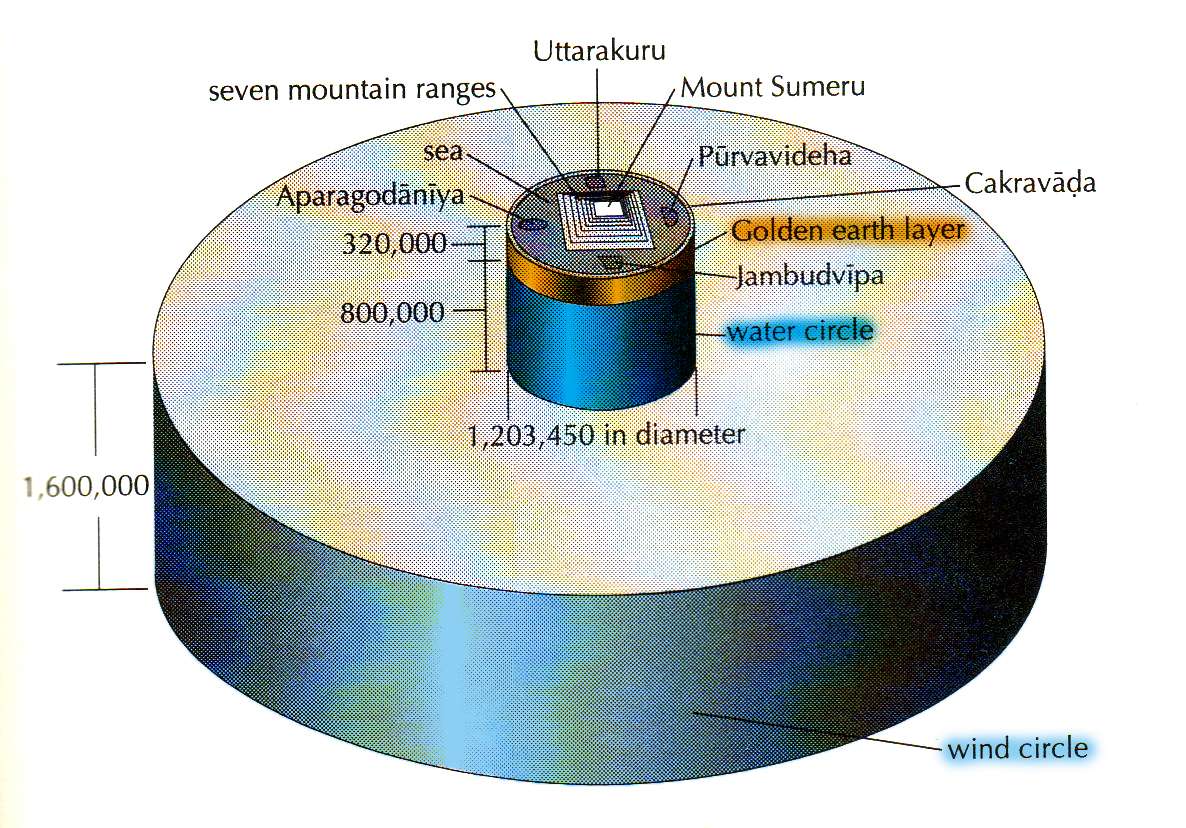
This system is supported by a series of elemental discs, each one becoming larger as one descends. The highest is kāñcanamaṇḍala, a disc of gold. The middle is jalamaṇḍala, a disc of water. And the lowest is vāyumaṇḍala, a disc of wind (fig. 3). This grand creation is thought to float in “space” (Vasubandhu, La Vallée-Poussin, & Pruden, 1991, pp. 451-452). 

Fig. 1 (top) – A top view of the Buddhist disc-world system (larger version). Fig. 2 (center) – A side view of the system (larger version). Images from Buswell & Lopez, 2014, pp. xxxii-xxxi. Fig. 3 (bottom) – A diagram showing the elemental discs supporting the world (larger version). Take note of the “wind circle” (light blue), the “water circle” (dark blue), and the “Golden earth layer” (gold). Adapted from Sadakata, 1997, p. 27.

2. Location of the Mountain

Chapter one continues:

Beyond the seas there is a country called Aolai [Aolai guo, 傲來國]. This country is next to an ocean, and in the middle of the ocean is a famous island called the Mountain of Flowers and Fruit. This mountain is the ancestral artery of the Ten Continents, the origin of the Three Islands; [1] it was formed when the clear and impure were separated and the Enormous Vagueness was divided (Wu & Jenner, 1993/2020, vol. 1, p. 3; cf. Wu & Yu, 2012, vol. 1, p. 100). 

海外有一國土,名曰傲來國。國近大海,海中有一座名山,喚為花果山。此山乃十洲之祖脈,三島之來龍,自開清濁而立,鴻濛判後而成。

Two deities shortly thereafter give a more precise location for the Mountain of Flowers and Fruit:

“We found that at the edge of the country of Aolai, which is east of the ocean belonging to the Eastern Continent of Superior Body, there is an island called the Mountain of Flowers and Fruit …” (Wu & Jenner, 1993/2020, vol. 1, p. 3; cf. Wu & Yu, 2012, vol. 1, p. 102). 

… 乃東勝神洲海東傲來小國之界,有一座花果山 …

Later, in chapter three, Sun Wukong’s advisors note the distance between Aolai and their island home:

The four monkeys replied, “East of our mountain, across two hundred [li] of water, is the boundary of the Aolai Country (Wu & Yu, 2012, vol. 1, p. 131; c.f. Wu & Jenner, 1993/2020, vol. 1, p. 50).

四猴道:「我們這山向東去,有二百里水面,那廂乃傲來國界。

All of this information tells us that the mountain is an island located 200 li (62 miles / 100 km) east of Eastern Superior Body (East Pūrvavideha).

3. The Novel’s Version of the Buddhist Disc-World System

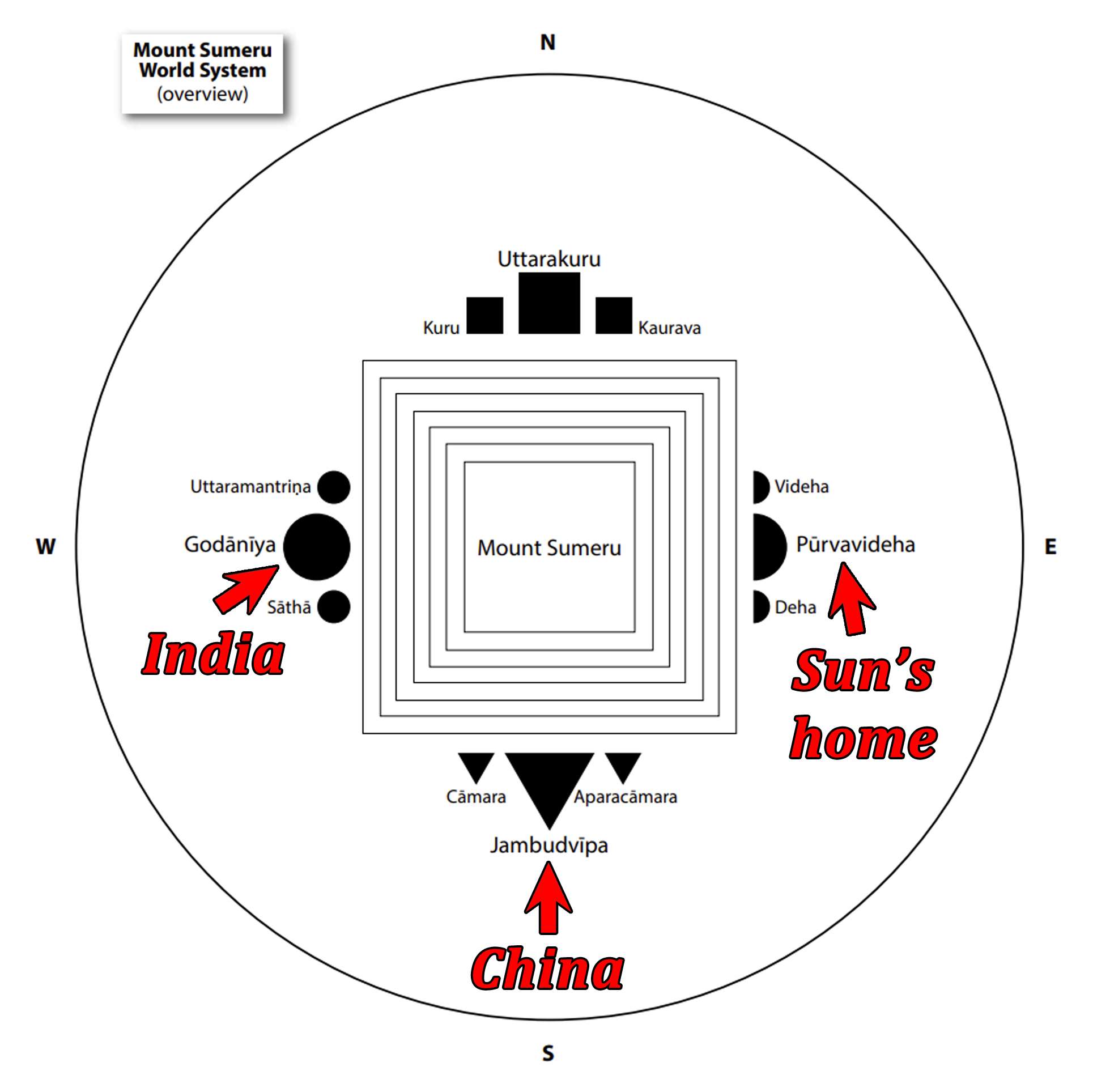
Buddhism traditionally associates Southern Jambu (South Jambudvīpa) with India (Buswell & Lopez, 2014, p. 377), but the novel shifts this structure a quarter turn clockwise (fig. 4). For example, in chapter eight, the Buddha associates his home (India) with the western continent and the southern continent with the “eastern lands” (dongtu, 東土), the Chinese Buddhist term for China (Tan, 1998, p. 137):

“… Our Western Continent of Cattle-Gift has people who neither covet nor kill. They nourish the vital essence and submerge the spirit; and although they produce no saints of the highest order, they all live to a ripe old age. But in the Southern Jambu Continent they are greedy and lecherous and delight in the sufferings of others; they go in for a great deal of killing and quarrelling. That continent can with truth be called a vicious field of tongues and mouths, an evil sea of disputation. [But I have] Three Stores of True Scriptures with which they can be persuaded to be good” (Wu & Jenner, 1993/2020, vol.1, p. 165; cf. Wu & Yu, 2012, vol. 1, pp. 205).

我西牛賀洲者,不貪不殺,養氣潛靈,雖無上真,人人固壽;但那南贍部洲者,貪淫樂禍,多殺多爭,正所謂口舌兇場,是非惡海。我今有三藏真經,可以勸人為善。

[…]

“I want to send them to the eastern lands because it is intolerable that the beings of that quarter should all be such stupid wretches who slander and defame the true word, do not understand the gist of my Law, and have lapsed from the orthodox Yogacara Sect…” (Wu & Jenner, 1993/2020, vol.1, p. 165; cf. Wu & Yu, 2012, vol. 1, pp. 205).

我待要送上東土,叵耐那方眾生愚蠢,毀謗真言,不識我法門之旨要,怠慢了瑜迦之正宗。

Additional evidence comes from chapter 29 when the chosen scripture pilgrim‘s travel rescript is reproduced. The opening line expressly connects China with the southern continent by way of the Chinese Tang dynasty: 

The travel rescript of the Tang Son of Heaven, who succeeds under the guidance of Heaven to the throne of the Great Tang Empire in the South Jambudvīpa Continent. … (Wu & Yu, 2012, vol. 2, p. 48; cf. Wu & Jenner, 1993/2020, vol. 2, p. 661).

南贍部洲大唐國奉天承運唐天子牒行 …

This means that when Sun first sails to Southern Jambu (South Jambudvīpa) to find a means of escaping death (Wu & Jenner, 1993/2020, vol.1, p. 16; cf. Wu & Yu, 2012, vol. 1, p. 108), he travels to the novel’s version of China. This further solidifies the fact that the Mountain of Flowers and Fruit is not located in China.

Fig. 4 – A top view of the Buddhist disc-world system according to Journey to the West (larger version). The Mountain of Flowers and Fruit would be to the east of Eastern Superior Body (East Pūrvavideha). Adapted from Buswell & Lopez, 2014, p. xxxii.

4. Reason for the Change

I suggest that the author-compiler of Journey to the West replaced the traditional cosmic geography for two reasons. First, both China and (part of) ancient India were referred to as the “Middle Kingdom” (Ch: Zhongguo, 中國; Sk: Madhyadeśa, मध्यदेश) (Wilkinson, 2000, p. 132; Lamotte, 1988, pp. 8-9). For example, the travelogue of the noted 4th to 5th-century Chinese Buddhist monk Faxian (法顯) reads:

Central India is known as the “Middle Kingdom” [Zhongguo, 中國]. The food and clothing of the common people are the same as the “Middle Kingdom” [i.e. China].

中天竺所謂中國。俗人衣服飲食亦與中國同。

This would naturally make it easier to associate China with Southern Jambu (South Jambudvīpa).

Second, since India is west of China, it would make sense for the country to be associated with Western Cattle-Gift (West Aparagodānīya).


5. Updates

Update: 10-01-17

A poem in chapter one states that the Mountain of Flowers and Fruit is the center of the universe. This obviously conflicts with Mt. Sumeru being the axis mundi.

Flower Fruit Mountain as the Center of the Universe


Update: 02-06-23

I have drastically rewritten the article to include more detailed information about the Buddhist disc-world system. I would also like to add material here from a previous article since it is related to the novel’s changes to the pre-existing structure.

Originally, the top of Mt. Sumeru supported the Buddhist heaven of the “Thirty-Three (Gods)” (Sk: Trāyastriṃśa, त्रायस्त्रिंश; Ch: Sanshisan tian, 三十三天; Daoli tian, 忉利天) (fig. 5), which is ruled by Śakra (Sk: शक्र; Ch: Dishi, 帝釋), king of the gods (Buswell & Lopez, 2014, pp. 921-922). However, the novel replaces this realm with the Daoist heaven, which is ruled by the Jade Emperor (Yuhuang shang/dadi, 玉皇上/大帝) (Clart, 2008, pp. 1197-1198). This is hinted at in chapter four when Monkey is invited to serve as the keeper of the heavenly horses. Part of a poem describing what he sees reads:

[…]
In this heaven are thirty-three heavenly palaces (emphasis added):
The Palace of Clouds Dispersed, the Vaisravana Palace, the [P]alace of Five Lores, the Sun Palace, the Palace of Flowery Bliss
[…] (Wu & Jenner, 1993/2020, p. 73; cf. Wu & Yu, 2012, vol. 1, p. 146).

這天上有三十三座天宮,乃遣雲宮、毘沙宮、五明宮、太陽宮、花樂宮 …

The “thirty-three” palaces are references to the homes of the thirty three gods. This change is, therefore, a prime example of the kind of Buddho-Daoist religious syncretism featured in Journey to the West.

Fig. 5 – The Heaven of the Thirty-Three atop Mt. Sumeru is indicated in red (larger version). Adapted from Buswell & Lopez, 2014, p. xxxii.


Update: 02-08-23

Despite the four Buddhist disc-world continents appearing in the story, Journey to the West hints that its world is a globe. For instance, when the Monkey King first sets out from his home in chapter one, he sails SE to reach the NW side of Southern Jambu (South Jambudvīpa):

He had chosen just the right time for his journey. After he boarded his raft the southeasterly wind blew hard for days on end and bore him to the northwestern shore of the southern continent (Wu & Jenner, 2020, vol.1, p. 16; cf. Wu & Yu, 2012, vol. 1, p. 108).

也是他運至時來,自登木栰之後,連日東南風緊,將他送到西北岸前,乃是南贍部洲地界。

I thought that maybe SE and NW were typos since heading SW would have taken him to the NE shore of the southern continent (refer back to fig. 4). However, in chapter two, Sun tells his children:

“The year I left you all,” Wukong said, “I drifted with the waves across the Great Eastern Ocean and reached the West Aparagodānīya Continent. I then arrived at the South Jambudvīpa Continent, where I learned human ways, wearing this garment and these shoes. I swaggered along with the clouds for eight or nine years, but I had yet to learn the Great Art. I then crossed the Great Western Ocean and reached the West Aparagodānīya Continent (Wu & Yu, 2012, vol. 1, p. 129; cf. Wu & Jenner, 1993/2020, p. 47).

我當年別汝等,隨波逐流,飄過東洋大海,到西牛賀洲地界,徑至南贍部洲,學成人像,著此衣,穿此履,擺擺搖搖,雲遊了八九年餘,更不曾有道。又渡西洋大海,到西牛賀洲地界 …

So it appears that he sailed from the Mountain of Flowers and Fruit to Western Cattle-Gift (West Aparagodānīya), similar to traveling from Japan in the East to the United States in the West. Then, he sailed from there to Southern Jambu (South Jambudvīpa), similar to traveling from the US to Africa. Lastly, he sailed back to Western Cattle-Gift (West Aparagodānīya). This might mean that the world of Journey to the West is a combination of a spherical planet and the Buddhist disc-world system.

If true, I suggest that the nonsensical, roundabout way that Monkey comes to study with Subodhi in the western continent could be a physical representation of his unsettled “monkey mind” (xinyuan, 心猿).

However, it’s important to point out that even Yu (Wu & Yu, 2012) considers the aforementioned route to be “[a]n inconsistency in the text” (vol. 1, p. 509, n. 17). So, I’ll leave it up to the reader as to which version of the world they ultimately want to accept.


Update: 02-09-23

I found a lovely overhead Chinese map of the Buddhist disc-world system (fig. 6). The teeth-like structures around the perimeter are actually the iron mountain that contains the ocean. Also Mt. Sumeru in the center is topped by a building representing the Buddhist heaven of the “Thirty-Three (Gods)” (Ch: Daoli tian, 忉利天) (refer back to fig. 5).

Fig. 6 – An early-20th-century Chinese map of the Buddhist disc-world system (larger version). Image found on Wikimedia Commons.


Update: 02-11-23

I have posted an article that discusses the Buddha’s realm in Western Cattle-Gift (West Aparagodānīya).

The Buddha’s Vulture Peak and Journey to the West


Update: 03-07-23

In my 02-06-23 update, I noted how the “thirty-three mansions” alluded to the Buddhist heaven of the thirty-three gods (sanshisan tian, 三十三天), thereby showing that the Daoist heaven was inserted into the Buddhist cosmological structure. Well, I had completely forgotten that the novel overtly mentions this heaven numerous times. This is important in regards to the location of Laozi‘s (老子) residence. 

Journey to the West states that the deva and his alchemical furnace are located in the “Tushita Palace” (Doushuai gong, 兜率宮), which is said to be either in the “Separation’s Regret Heaven” (Lihen tian, 離恨天) or the “Great Canopy Heaven” (Daluo tian, 大羅天). Both are treated as the highest of the thirty-three heavens. For more information, see my article: 

Laozi’s Realm in Journey to the West

Note:

1) Yu (Wu & Yu, 2012) explains, “These islets and islands were famous abodes of gods or immortals” (vol. 1, p. 506, n. 6).

Sources:

Buswell, R. E. , & Lopez, D. S. (2014). The Princeton Dictionary of Buddhism. Princeton University Press.
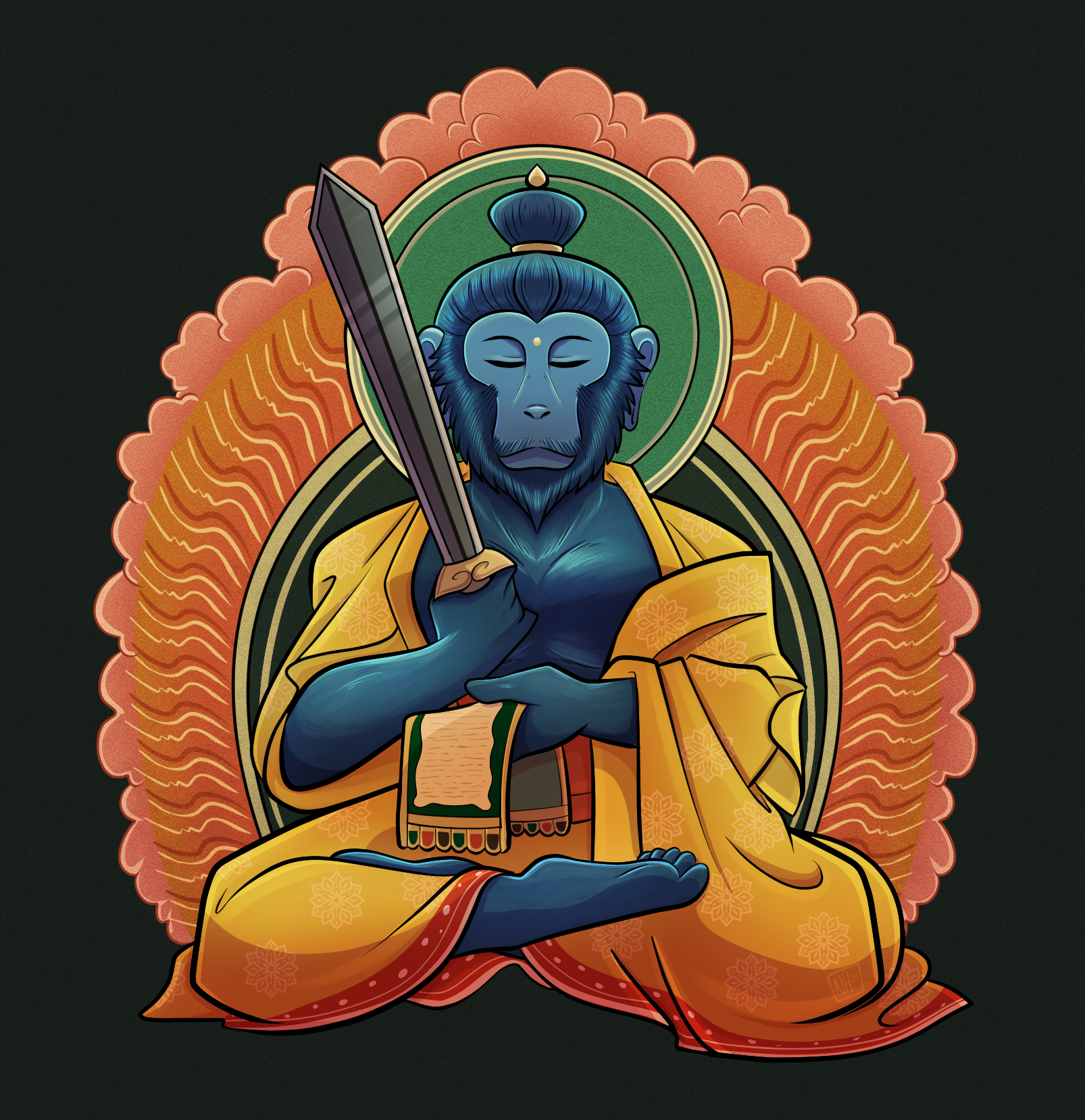
Clart, P. (2008). Yuhuang. In F. Pregadio (Ed.), The Encyclopedia of Taoism (Vols. 1 & 2) (pp. 1197-1198). Longdon: Routledge.

Lamotte, E. (1988). History of Indian Buddhism: From the Origins to the Saka Era (S. Webb-Boin, Trans.). Louvain-la-Neuve: Université Catholique de Louvain Institut Orientaliste.

Tan, C. (1998). A Sino-Indian Perspective for India-China Understanding. In C. Tan (Ed.), Across the Himalayan Gap: An Indian Quest for Understanding China (pp. 133-147). New Delhi: Indira Gandhi National Centre for the Arts.

Vasubandhu, La Vallée-Poussin, L., & Pruden, L. M. (1991). Abhidharmakośabhāṣyam of Vasubandhu (Vol. 2). Berkeley, Calif.: Asian Humanities Press.

Wilkinson, E. P. (2000). Chinese History: A Manual (Rev. and Enl). Published by the Harvard University Asia Center for the Harvard-Yenching Institute : Distributed by Harvard University Press.
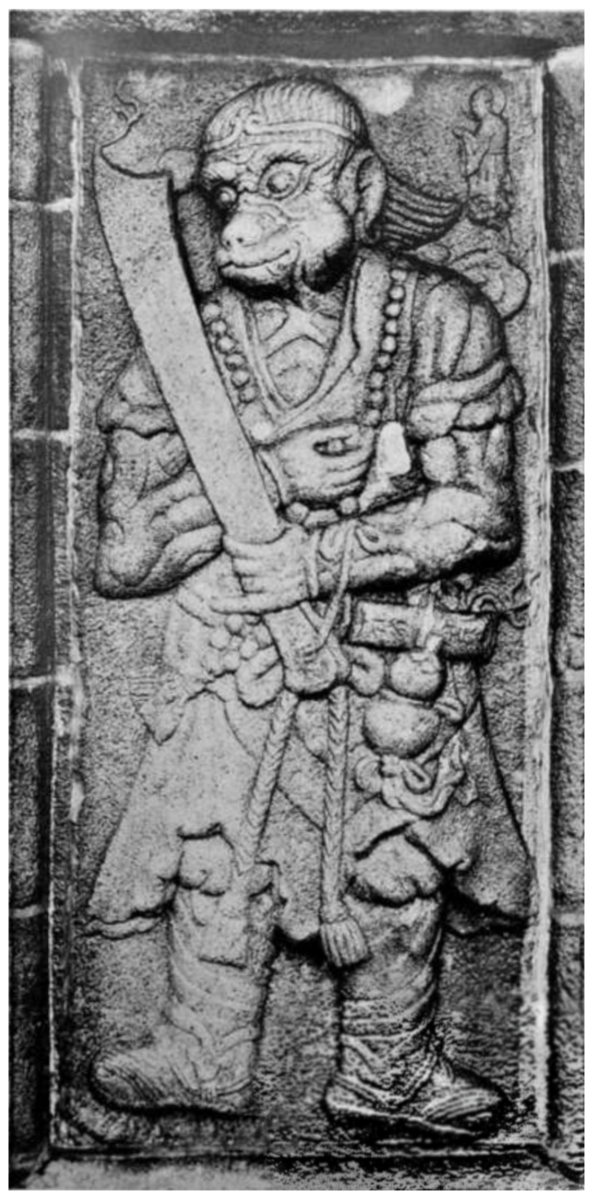
Wu, C. & Jenner, W. J. F. (2020). Journey to the West (Vols. 1-4). Beijing: Foreign Languages Press. (Original work published 1993)

Wu, C., & Yu, A. C. (2012). The Journey to the West (Vols. 1-4) (Rev. ed.). Chicago, Illinois: University of Chicago Press.