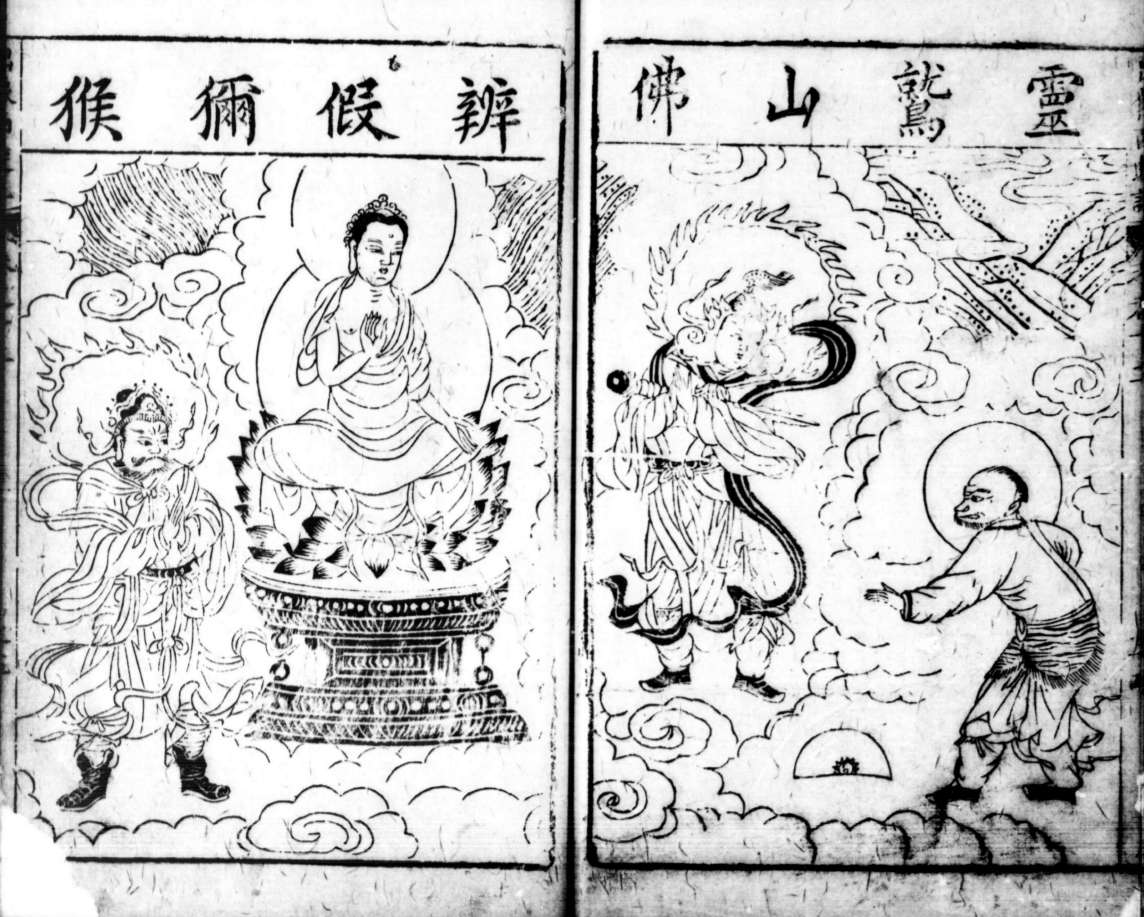
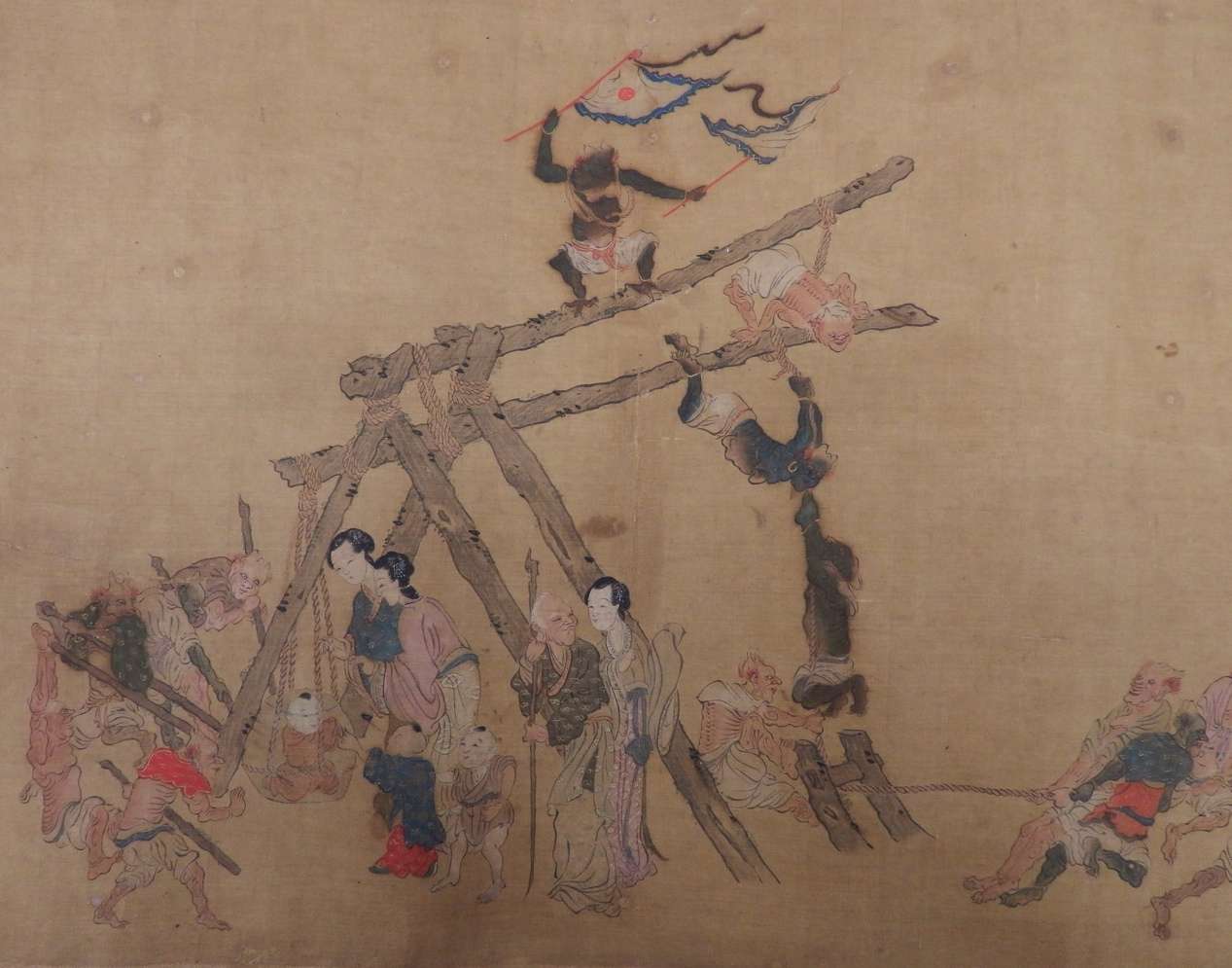
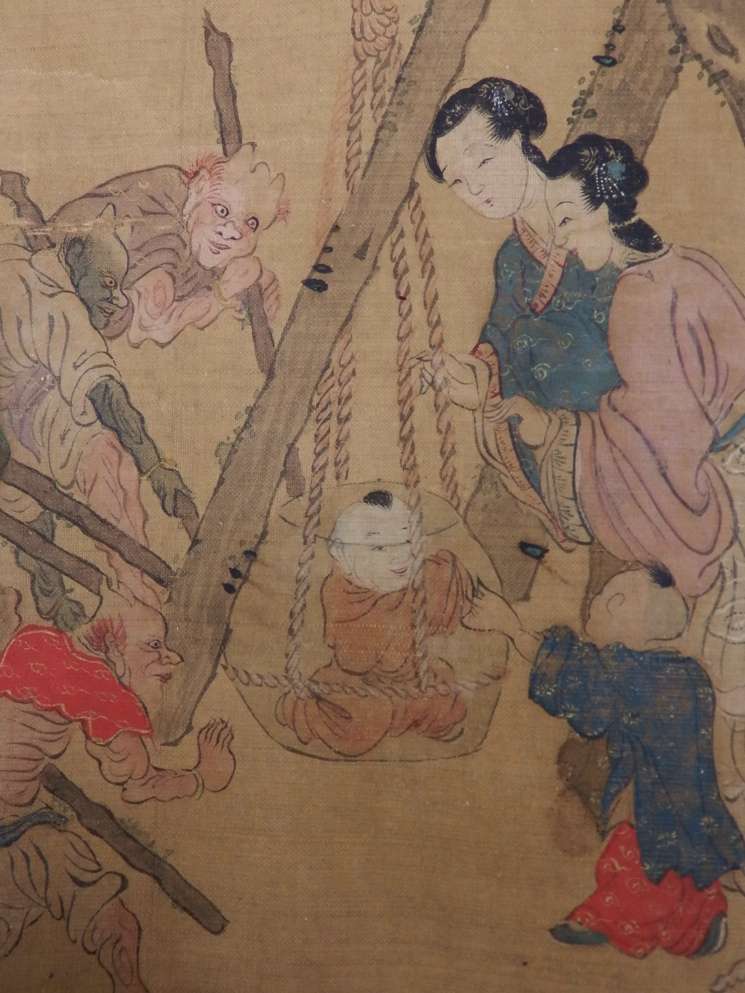
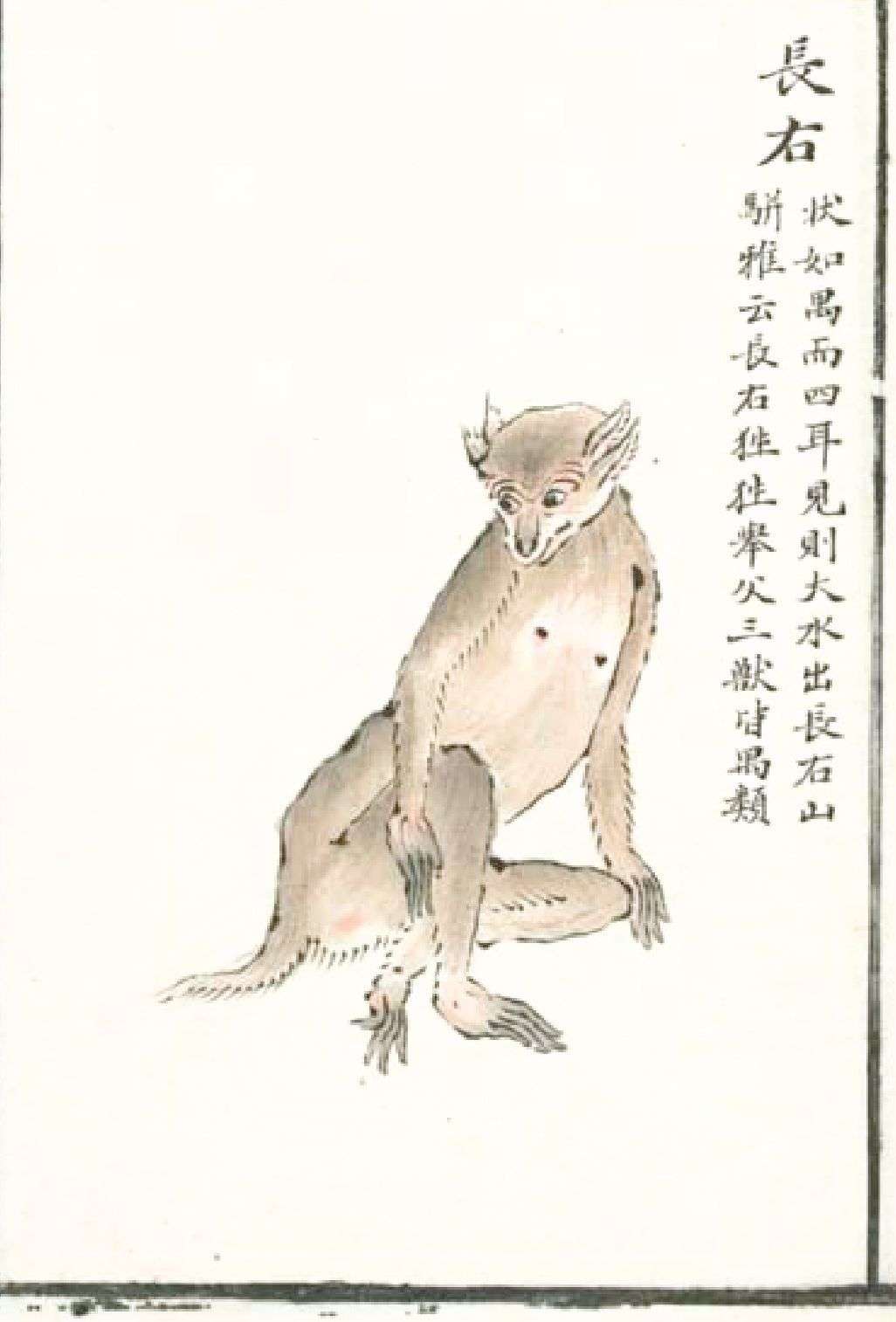
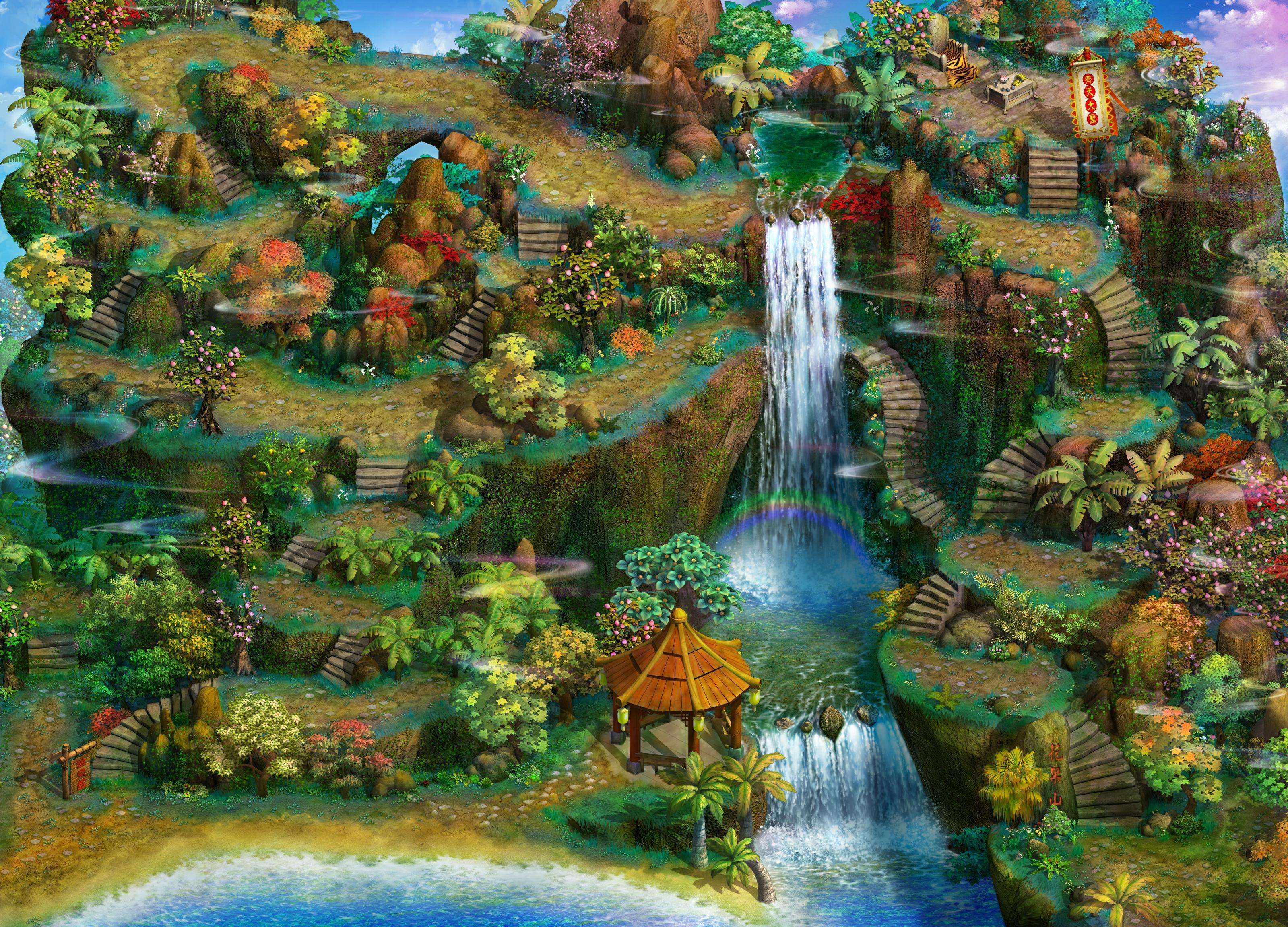
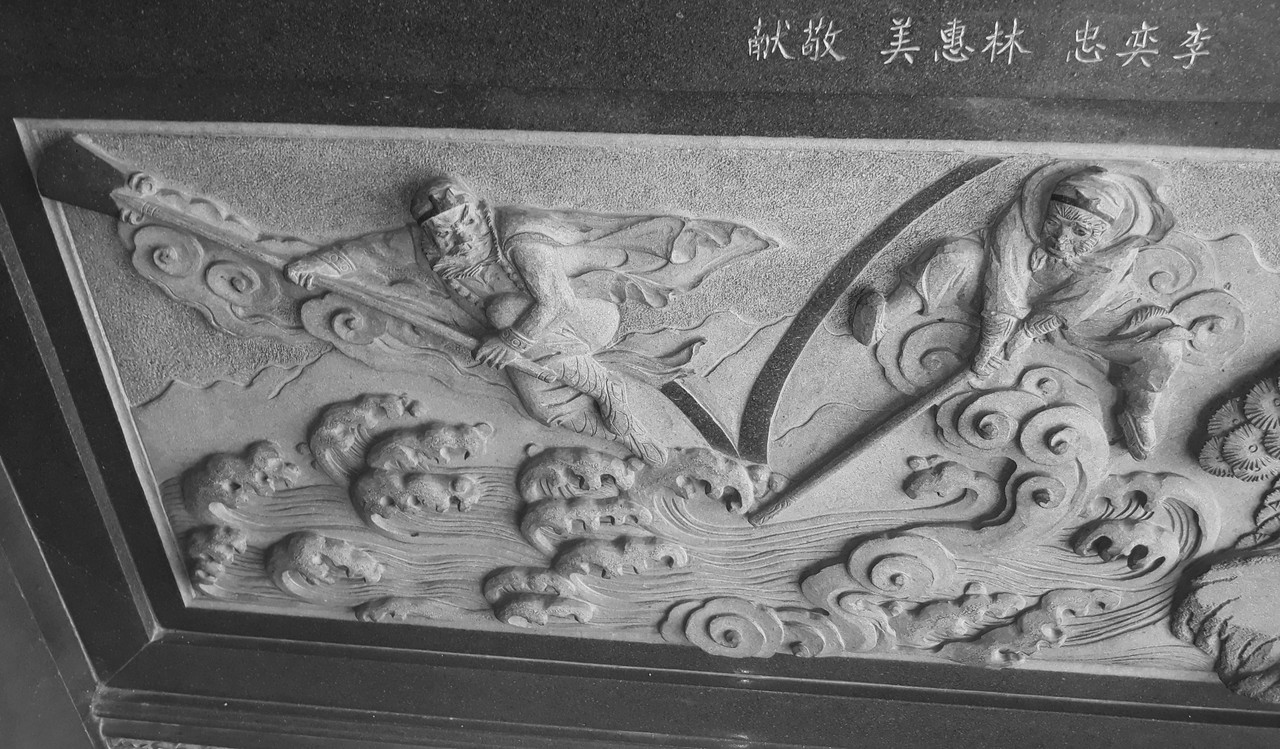
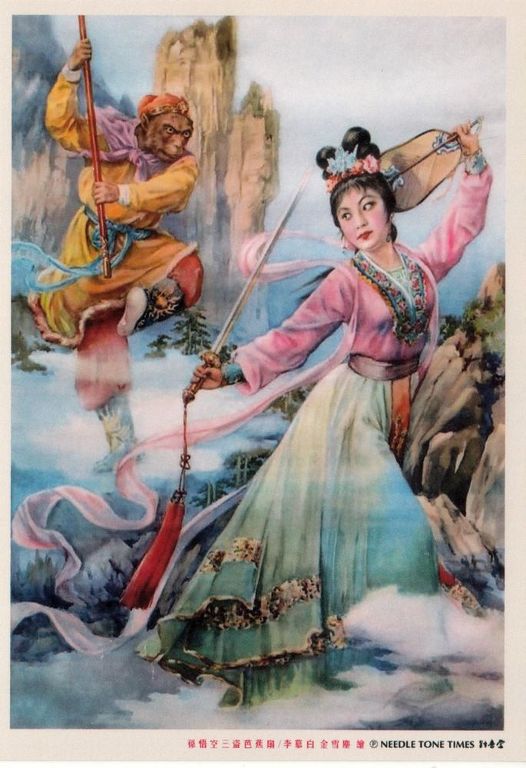
The God Erlang Captures the Great Sage Equaling Heaven (Erlang shen suo Qitian dasheng / Erh-lang shen so Ch’i-t’ien Ta-sheng, 二郎神鎖齊天大聖) is a zaju play from the Yuan-Ming period. To my knowledge it is roughly contemporaneous with the early-Ming Journey to the West zaju play (Xiyou ji zaju, 西遊記雜劇). Here, I would like to archive the Chinese script, as well as provide a brief description for those unable to read the original.
1. Synopsis
Dudbridge (1970) gives a brief overview of the play:
The action, in brief, is as follows: An ape-demon, Qitian dasheng [齊天大聖], steals Taoist elixir and fairy wine from the Immortal Yuanshi tianzun [元始天尊] and returns with it to his home Shuilian dong [水簾洞] on Huaguo shan. The theft reported, Erlang is summoned to capture him. The ape meanwhile feasts with members of his family on Huaguo shan. Erlang, mustering his traditional followers, advances in company with Juling shen [巨靈神] and effects the capture. In the final act he surrenders the prisoner to the Taoist deity Quxie yuanzhu [驅邪院主]. The ape begs for clemency and is finally dismissed with only a firm injunction to reform (p. 129). [1]
Apart from Erlang and his followers, some of these figures carried over into the 1592 Journey to the West novel. Yuanshi tianzun (“Celestial Worthy of Original Commencement”) is mentioned by name in the novel six times. Juling shen (“Might-Spirit God”) is easily bested by Sun Wukong in chapter four (Wu & Yu, 2012, vol. 1, pp. 153-154). His name is mentioned a total of 15 times.
Quxie yuanzhu (驅邪院主, “Lord of the Court for Exorcising Evils”) does not appear in the novel.
2. Similarities with the JTTW Zaju
As noted in the introduction, this zaju shares parallels with the early-Ming JTTW zaju. Dudbridge (1970) explains:
A number of details demand attention:
the name of the ape: Qitian Dasheng;
the name of his home: Huaguo shan, Shuilian dong [花果山水簾洞];
the members of his family: “My elder brother Tongtian Dasheng [通天大聖], myself Qitian Dasheng, my elder sister Guishan shuimu [龜山水母], my younger sister Tiese mihou [鐵色獼猴], my younger brother Shuashua Sanlang [耍耍三郎]” (speech in the first act);
the stealing of elixir and wine;
the role of Erlang and Juling shen;
the ‘iron cudgel’ [鐵棒], with which the ape defends himself in the third act;
the name Sun xingzhe [孫行者] claimed by the youngest brother in the same act;
minor details of the battle—the attendants of Erlang, the Taoist gods—also peripherally related to the Xiyouji story (pp. 129-130).
For a list comparing the names of Monkey’s siblings from both plays, see the 12-20-23 update here.
Thank you to the Text Court of the University of Oxford for making this zaju play freely available. The original can be found here.
Update: 03-07-25
Above, Quxie yuanzhu (驅邪院主, “Lord of the Court for Exorcising Evils”) was mentioned as a character that didn’t carry over to the 1592 JTTW. I originally couldn’t find any info about said deity, but I have found a possible lead. According to Kohn (2020), “In Daoism under the Song, [the immortal Zhongli Quan] was particularly honored as the head of the Department of Exorcism (Quxie yuan 驅邪元[院]), a central part of the celestial administration” (p. 13). Perhaps there is a connection between the two.
Update: 03-08-25
I apparently didn’t look hard enough because Text Court (thanked and linked above) provides a list of the character’s other titles:
北極鎮天真武玉虚師相玄天元聖仁威
北極驅邪院主
北極驅邪院都教主
The first title, “北極鎮天真武玉虚師相玄天元聖仁威” (Beiji Zhentian Zhenwu Yuxushi Shixiang Xuantian Yuansheng Renwei), or the “Northern Ultimate and Suppressing Heaven True Warrior, Jade Emptiness Prime Minister, Dark (or Mysterious) Heaven Primal Sage of Humane Power,” contains several illusions to a deity associated with exorcism. The most obvious of these is Zhenwu (真武) and Xuantian (玄天), both of which refer to a singular martial god. I guess this is mystery solved.
Zhenwu appears as the “Demon-Conquering Celestial Worthy” (Dangmo tianzun, 蕩魔天尊) in JTTW chapter 66 (Wu & Yu, 2012, vol. 3, p. 226), but his role is small like in the play.
Warning: This article contains adult language and content.
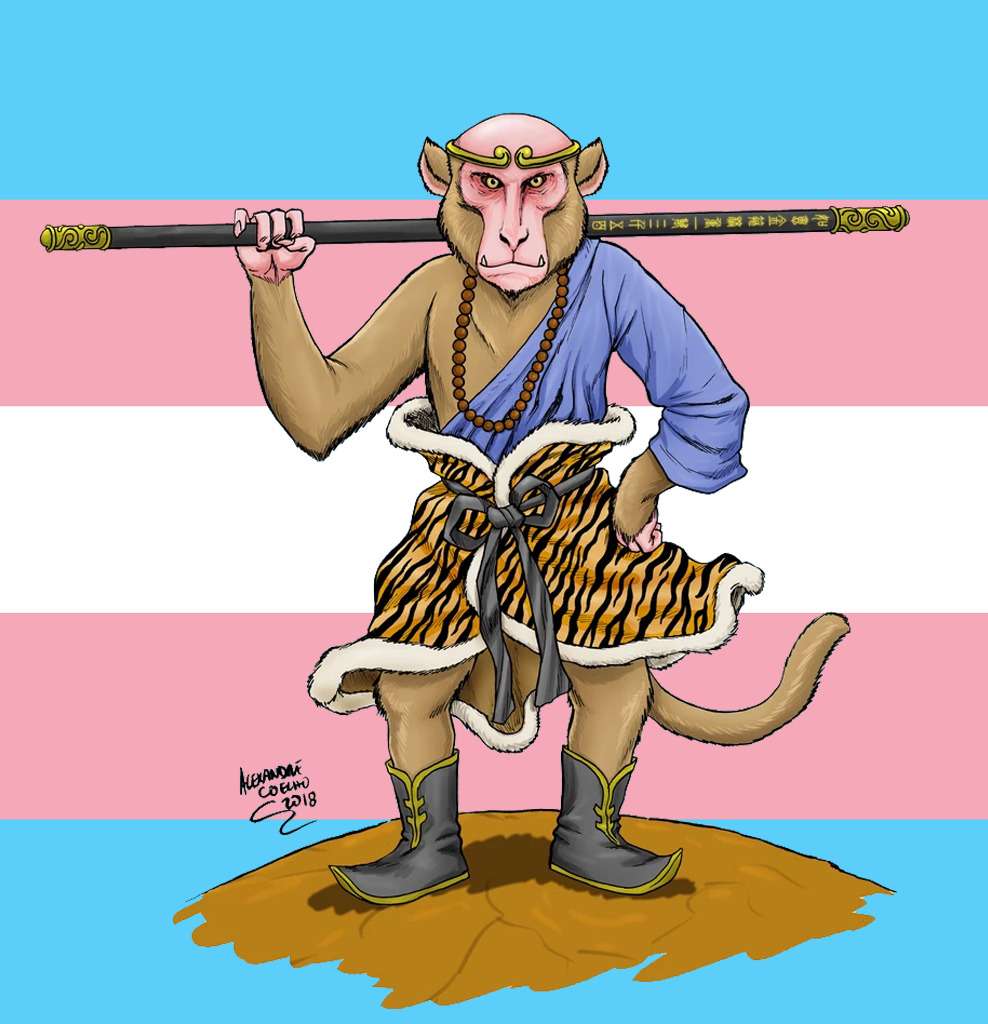
The notion that Sun Wukong (孫悟空) is transgender (fig. 1) became popular on English-speaking social media sometime around 2022. The central idea appears to be that the Monkey King, or I should say “Monkey Queen,” was originally born a woman but magically changes to a trans-man sometime after learning the art of transformation. Whether this is true or not has two possible answers:
1) If you or a loved one are trans, identify with Monkey’s ability to transform his body, and choose to personally interpret the character or portions of his story as an allegory for transness, then yes Sun Wukong is trans.
2) Historically and canonically speaking? No.
In this article, I will present common arguments (A) in favor of a trans Monkey King that I’ve seen on social media. I will also introduce counterarguments (CA) supported by historical oral, published, and pictorial evidence that calls any claims of canonical proof into question. If I don’t have a particular counterargument in mind, I will simply post a comment (C).
Before continuing, I want to expressly state that this piece was written for two kinds of people: 1) Those who might openly claim that Sun Wukong is canonically trans; and 2) Those who don’t know enough about the character’s history or Journey to the West (Xiyouji, 西遊記; “JTTW” hereafter) in general and might be swayed by seemingly knowledgeable online comments. It does not pertain to those who already personally interpret Monkey as trans and/or don’t care about canon because they were first exposed to him via movies, TV shows, video games, comic books, etc.
General readers will certainly find this article interesting as it features a lot of lesser-known historical information about the simian immortal.
If someone claims that the Monkey King appearing in the 1592 edition of JTTW is canonically female-to-male (FTM) trans, or they state the novel hints that he is without openly admitting that this is their own personal interpretation, that person, whether they realize it or not, is not telling you the whole truth. I don’t think they are doing this maliciously, though. It’s perfectly natural for people to want to see some of themselves in their favorite heroes. After all, who wouldn’t want to be an immortal rage wizard who can fly around the cosmos, transform into anything, lift mountains, and beat up gods and devils? I can see how it might be attractive to a trans youth to have the power to push back against authorities that wrongly vilify and strip them of their human rights. Therefore, in that sense, I think I understand why the idea of a trans Sun Wukong is so popular. But having said that, I should highlight that anyone who goes beyond an allegorical reading of the novel by touting the reality of Monkey’s transness is either unaware of the character’s historical development or is willfully ignoring it.
2. Arguments and Counterarguments
2.1. Gender Neutral Terms
A:Ta (他; commonly “him”) and wang (王, commonly “king”) [1] are historically “gender neutral terms” and, therefore, can be used to refer to Sun Wukong as a woman.
C: These are indeed gender neutral terms in dynastic material. Here are two examples from the 1592 JTTW: 1) Wang (王) appears in the royal title of the “Queen Mother” (Wangmu niangniang, 王母娘娘), the high-ranking Daoist goddess who owns the immortal peach groves; and 2) Ta (他) is used to refer to the female Bodhisattva Guanyin (觀音). Part of a descriptive poem in chapter eight reads: “She is the merciful lord of the Potalaka Mountain” (Ta shi Luojiashan shang Cibei zhu, 他是落伽山上慈悲主) (Wu & Yu, 2012, vol. 1, p. 206).
However, the gender neutral status of these terms do not by themselves constitute evidence that the Monkey King is a woman.
2.2. Matriarchal Primate Society
A: Real world monkey troupes are matriarchal, so it would make more sense for Sun Wukong to be a woman.
CA: Real world biological concepts don’t mesh well with religious mythology. For example, Monkey is born from stone, and he later attains his authority through a test of bravery by jumping through a waterfall. So where does the primate matriarchy fit into this? Also, in chapter 11 of the 13th-century oral version of JTTW (see here and here), Sun’s antecedent, the “Monkey Pilgrim” (Hou xingzhe, 猴行者), explains that prior to becoming the primate monarch, he had been exiled to the Mountain of Flowers and Fruit in the distant past for stealing immortal peaches from the Queen Mother’s heavenly garden (Wivell, 1994, p. 1195). It’s important to note that the tale presents him as a supremely ancient immortal, one who has seen the Yellow River dry up nine times (Wivell, 1994, pp. 1182-1183). Therefore, it’s not a stretch to suggest that his position as the Monkey King is related to his divinity. So I ask again: Where does the primate matriarchy fit into this?
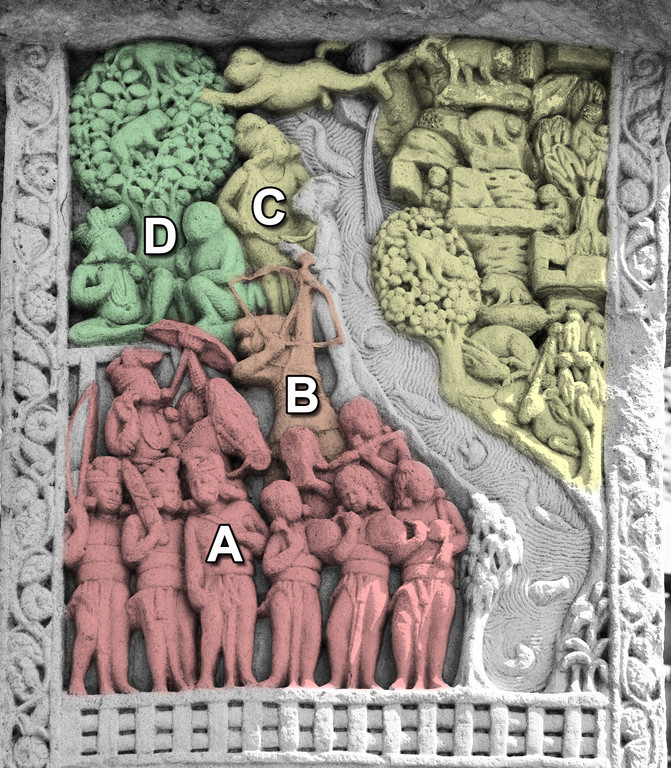
Most importantly, mythic stories about male monkey monarchs do exist. Two such characters are Vali/Bali (Sk: वाली) and Sugrīva (Sk: सुग्रीव) from the Hindu epic Rāmāyaṇa (Sk: रामायणम्, c. 5th century BCE). Another is the Mahākapi (Sk: महाकपि; lit: “Great Monkey,” c. 2nd century BCE), an Indian Buddhist jataka tale about the Buddha’s past life as a king of monkeys. One 2,000-year-old carving even depicts him with testicles (fig. 2). These few examples alone challenge the idea that monkey troupes have to be matriarchal in a mythic setting.
In fact, I suggest in this article that the Mahākapi tale influenced the 13th-century oral JTTW in several ways: 1) The Great Monkey is described as the chief of his tribe, and one 3rd-century Chinese version of the story even refers to him as the “Monkey King” (Mihou wang, 獼猴王). This is a likely source for the Monkey Pilgrim’s position as the primate monarch; 2) The Great Monkey leads 80,000 monkeys. The 3rd-century Chinese version changes this number to 500 (wubai, 五百), while the later Monkey Pilgrim leads 84,000 (bawan siqian, 八萬四千). But all three numbers are used in Buddhism to refer to large numbers of things. In the case of the respective Indian and Chinese versions, the 80,000/500 monkeys are said to be the past lives of Buddhist monks. But most importantly, the Chinese term for 80,000 (bawan, 八萬) is considered shorthand for 84,000 (bawan siqian, 八萬四千), showing a possible connection between the numbers of monkeys in the Indian original and the 13th-century oral JTTW; 3) The Great Monkey and his tribe live in or around a mountainous, fruit-bearing tree. This could be one of several sources for the Mountain of Flowers and Fruit (see note #4 below for another); and 4) The 3rd-century Chinese version sees the Great Monkey steal from the imperial fruit garden of a human monarch. This could be one of several sources for the Monkey Pilgrim stealing immortal peaches from the Queen Mother’s heavenly garden.
(On a related note, see this article for the many parallels shared between the 1592 Sun Wukong and the historical Buddha.)
Fig. 2 – The “Great Monkey” carving from the western torana at Sanchi (c. 1st century BCE/CE) (larger version). He is the uppermost yellow figure reaching for the green tree. Take note of his testicles. The colored and labeled elements are used in my article to describe this “continuous narrative” scene.
2.3. Feminine Title
A: Sun Wukong calls himself the “Handsome Monkey King” (Meihou wang, 美猴王), but the character for handsome, “mei (美),” traditionally means “beautiful.” Therefore, it would make more sense for Monkey to call themself beautiful if they were a woman.
CA: I think that there is a much better explanation. Recall that the 1592 JTTW depicts our hero as an ugly creature. For instance, part of a descriptive poem in chapter 44 reads:
A bumpy brow, and golden eyes flashing;
A round head and a hairy face jowl-less;
Gaping teeth, pointed mouth, a character most sly;
He looks more strange than thunder god
[…] (Wu & Yu, 2012, vol. 2, p. 276).
In fact, Sun’s association with being ugly goes back centuries. For example, writing in the 1250s, the Song-era poet Liu Kezhuang (劉克莊, 1187–1269) used Monkey as a metaphor to describe his own failing appearance:
A back bent like a water-buffalo in the Zi stream,
Hair as white as the silk thread issued by the “ice silkworms”, A face even uglier than Hou xingzhe [“Monkey Pilgrim”] (emphasis added),
Verse more scanty than even He Heshi (Dudbridge, 1970, p. 46).
Therefore, the primate monarch definitely is not “handsome” or “beautiful.”
I suggest instead that Sun refers to himself as mei (美) because of his egotistical personality. He is after all an allegory for the Monkey Mind. This same overinflated sense of self eventually leads him to challenge the primacy of the Jade Emperor (Yuhuang dadi, 玉皇大帝). Monkey’s self-conceit is best illustrated by the rebellious poem that he recites to the Buddha in chapter seven. The latter part reads:
[…]
In Divine Mists Hall none should long reside,
For king may follow king in the reign of man.
If might is honor, let them yield to me.
He only is hero who dares to fight and win!”(Wu & Yu, 2012, vol. 1, p. 193).
(See the 08-09-2023 and 09-27-23 updates below for another reason why he might have been called Meihou wang (美猴王).)
2.4. Etymology of Surname
A: In chapter one, the Patriarch Subodhi (Puti zushi, 菩提祖師) relies on Monkey’s appearance to derive a surname for them. Some of the etymology mentions feminine concepts, adding support to the idea that Sun Wukong was originally a woman:
The Patriarch laughed and said, “Though your features are not the most attractive, you do resemble a pignolia-eating monkey (husun [猢猻]). This gives me the idea of taking a surname for you from your appearance. I intended to call you by the name Hu [猢]. If I drop the animal radical [犭] from this word, what’s left is a compound made up of the two characters, gu [古] and yue [月]. Gu means aged and yue [“moon”] denotes feminine yin energy [陰], but aged yin cannot reproduce (emphasis added). Therefore, it is better to give you the surname of Sun [猻]. If I drop the animal radical from this word, what we have left is the compound of zi [子] and xi [系]. Zi means a boy and xi means a baby, and that name exactly accords with the fundamental Doctrine of the Baby Boy. So your surname will be ‘Sun’” (Wu & Yu, 2012, vol. 1, p. 115).
Also, Sun (孫) has been used as a surname for monkeys associated with Buddhist monks since at least the Tang Dynasty (618–907). According to the Tang poet Li Shen (李紳, d. 846):
There are many monkeys in the [Lingyin and Tianzhu] monasteries. They are called the Sun group (or the group of Sun, “Sun tuan”). They have been reared there for a long time (Shahar, 1992, pp. 202-203).
2.5. Stable Monkeys
A: It was a common historical practice to place female monkeys in horse stables because their menstruation was believed to ward off equine sickness (see my past article for a source). Hence, Sun’s time as the heavenly stable master supports the idea that they were originally a woman.
CA: Just because something influenced a character in a story doesn’t mean that thing and all of its traits become the character. That’s like saying Son Goku is Superman just because Dragon Ball Z-era Akira Toriyama borrowed the “alien baby sent to earth” element from the Man of Steel’s mythos. But that isn’t the case since each character and their respective stories have definable differences. And it’s the same for the female stable monkeys and Sun Wukong.
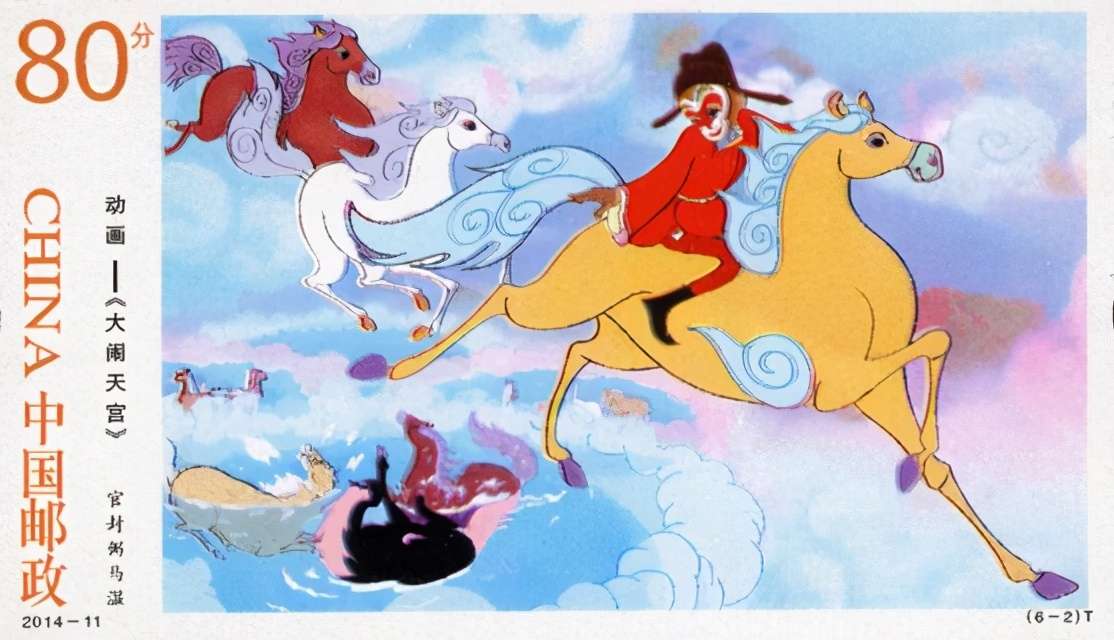
After becoming the Bimawen (弼馬溫) (fig. 3), Sun dotingly cares for nearly 1,000 horses day and night, making sure that they are all well-fed, exercised, and rested. At no point does the 1592 JTTW even hint that their health is in any way tied to menstruation. But having said that, I suggest the reason that Monkey gets so upset when people call him Bimawen, what Yu (Wu & Yu, 2012) translates as “BanHorsePlague” (vol. 1, p. 354), is because it references the homophonous term for the historical practice, Bimawen (避馬瘟, lit: “avoid the horse plague”). Surprisingly, the latter phrase does not appear in the novel.
Fig. 3 – A 2014 stamp featuring a scene from the classic 1960s animation Havoc in Heaven in which Sun Wukong serves as the Bimawen (larger version). Image found here.
3. Final Counterarguments
3.1. Historical Male Depictions
I don’t know of any historical oral, published, or pictorial sources that portray or describe Sun as a woman in their regular form. To my knowledge, he has always been depicted as a man.
I won’t pretend to know the full extent of our hero’s history, but I always strive to learn more about the subject. Just look at the following as a brief survey.
3.1.A. Art
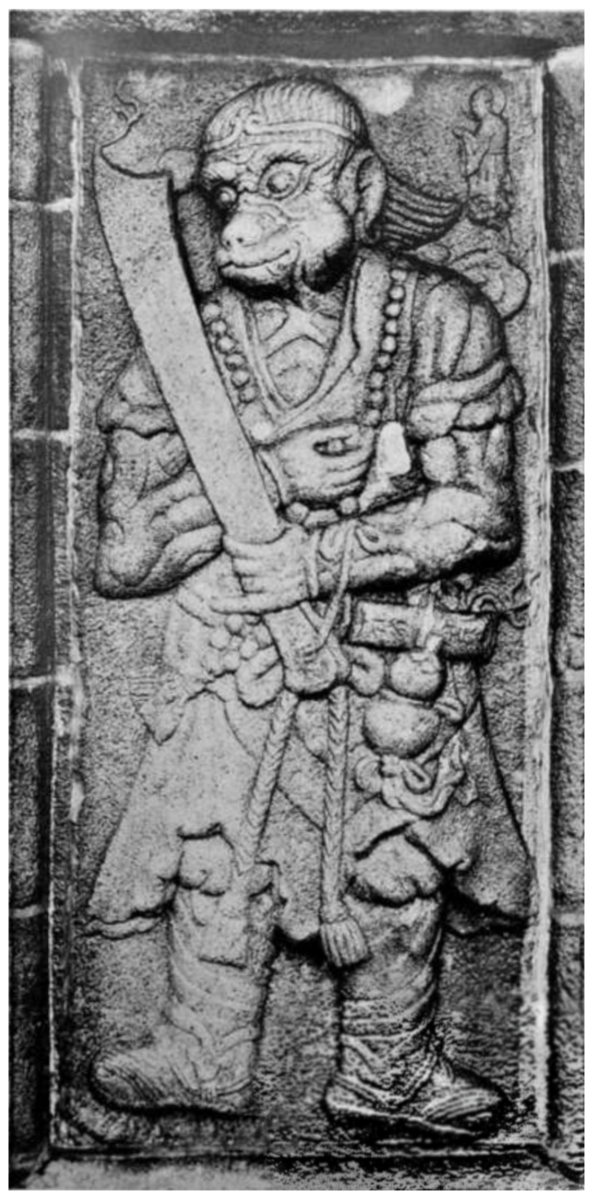
The earliest art depicting the aforementioned Monkey Pilgrim shows him as either a simian cleric or soldier accompanying the monk Tripitaka. But I think the best example to present for this discussion is the 13th-century Kaiyuan Temple stone pagoda carving (fig. 4), which portrays him as a muscular, sword-wielding protector deity.
Fig. 4 – The Kaiyuan Temple stone pagoda carving of the Monkey Pilgrim (1237) (larger version).
3.1.B. Oral Literature
The Story of How Tripitaka of the Great Tang Procures the Scriptures (Da Tang Sanzang qujing shihua, 大唐三藏取經詩話), the aforementioned 13th-century oral version of JTTW, first introduces the Monkey Pilgrim as a “scholar dressed in a white robe” (Baiyi xiucai, 白衣秀才) (Wivell, 1994, p. 1182). The word translated here as scholar, “xiucai” (秀才; lit: “cultivated talent”), was “[f]rom antiquity a categorical rubric under which talented men were nominated to be considered for official appointments” (Hucker, 1985, p. 284). During the Song dynasty (960–1279), when this tale was first recorded, the xiucai was an informal term for candidates of the metropolitan-level exams (Hucker, 1985, p. 284). That is to say they were educated commoners who had yet to receive an official office. Dudbridge (1970) suggests that disguising oneself as a traveling, white-robed scholar would have then “conferr[ed] anonymity on the wearer” (p. 32). [2] This means that Monkey is likely using the disguise to walk among mortals without them realizing his divine nature.
Dudbridge (1970) also notes that this disguise was used by male characters in later published media (p. 32 n. 1). These examples instead use “xiushi” (秀士; lit: “cultivated scholar”). For instance, in chapter 81 of the Water Margin (Shuihu zhuan, 水滸傳, c. 1400), a literary version of Song Emperor Huizong (宋徽宗) dresses this way in order to meet in secret with his favorite sex worker:
Accompanied by a young eunuch, the sovereign arrived through the secret tunnel at the rear door of the courtesan’s house. He was dressed in the white garb of a scholar (emphasis added) (Shi & Luo, 1993/2021b, p.1715).
只見道君皇帝引着一個小黃門,扮做白衣秀士,從地道中逕到李師師家後門來。(Shi & Luo, 1975/2021b, p. 1104)
This male disguise even carried over into the 1592 JTTW. For example, in chapter ten, the Dragon King of the Jing River (Jinghe Longwang, 涇河龍王) takes on such a form to investigate a fortune teller with dangerously accurate predictions that threaten the fish of his kingdom:
[H]e abandoned his sword and dismissed the clouds and the rains. Reaching the river bank, he shook his body and changed into a white-robed scholar (emphasis added) (Wu & Yu, 2012, vol. 1, p. 239).
The early-Ming Journey to the Westzaju play (Xiyou ji zaju, 西遊記雜劇) contains many familiar episodes that would come to appear in the 1592 JTTW. [3] But despite these parallels, there are many interesting differences. For example, in act nine (of 24), Sun Wukong is said to be the brother of several divine siblings:
We are five brothers and sisters: my older sister is the Venerable Mother of Mount Li, my younger sister is the Holy Mother Wuzhiqi, my older brother is the Great Sage Equaling Heaven, I myself am the Great Sage Reaching Heaven (emphasis added), and my younger brother is the Third Son Shuashua (based on Dudbridge, 1970, p. 110).
(That’s right! The play refers to Monkey as the “Great Sage Reaching Heaven” instead of “… Equaling Heaven.”)
He also has a wife, a princess whom he had kidnapped from the “Country of the Golden Cauldron” (Jinding guo, 金鼎國) (Ning, 1986, pp. 63-66). This portion of the play draws directly from a genre of Han to Song-era tales in which magic apes kidnap young maidens in order to rape and impregnate them. [4]
The most apparent differences are the addition of bawdy elements like sex, cursing, and dirty jokes by the author, the 15th-century Mongol playwright Yang Jingxian (杨景賢). For instance, act 18 sees the pilgrims travel through the famous Woman Kingdom, where Sun, Zhu, and Sha all fall prey to temptations of the flesh. But whereas the latter two are successful in their sexual ventures, poor Monkey is struck by a bout of erectile dysfunction caused by the painful constricting of his headband:
Master, listen and I’ll tell you. There I was pinned down by a woman. My lustful nature was about to come forth, when suddenly the iron hoop on my head tightened, and the joints and bones up and down my whole body began to ache. The throbbing conjured up a bunch of vegetable names in my brain.
My head hurt so my hair stood up like radish-tops, my face turned as green as smartweed sprouts, my sweat beaded up like the moisture on an eggplant soaked in sauce, and my cock fell as limp as a salted cucumber (emphasis added). When she saw me looking for all the world like chives sizzling in hot oil, she came around, suppressed her itch and set me free (Ning, 1986, pp. 138-139).
(Notice that ta (他) is used in the quote above to refer to the girl. Refer back to section 2.1 for a reminder of the significance.)
Later in act 19, Monkey attempts to seduce Princess Iron Fan (Tieshan gongzhu, 鐵扇公主) in order to gain access to her magic Banana leaf fan. Sun does this by reciting a poem in which he makes a veiled allusion to his penis being the right size for her vagina:
The disciple’s not too shallow, the woman’s not too deep (emphasis added).
You and I, let’s each put forth an item,
and make a little demon
(Ning, 1986, p. 141).
When this plan fails and the Princess threatens him with her sword, Sun angrily explains that the supernatural durability of his body and penis renders him impervious to physical harm:
Why this lowdown wench has no manners at all! I am the Lord of the Crimson Cloud Cavern, the Great Sage [Reaching Heaven]! I plundered Laozi’s gold Pill of Immortality, and have endured so many alchemical transformations that my muscles are brass, my bones iron, my eyes fire, my pupils gold, my asshole lead and my prick is pewter. Why should I fear a steel [sword] slicing off my pizzle? (emphasis added) (Ning, 1986, p. 142).
I want to highlight that this play did not influence the story cycle; it only reflects characters and episodes that were common to the cycle at that time. The bawdy elements were solely added to spice up the tale, making it more entertaining for zaju audiences. Therefore, this sex-crazed, dirty-mouthed version of the Monkey King should be considered a separate entity from his literary counterpart in the 1592 JTTW. However, I have included him here because the play clearly establishes that the character is a man.
3.1.D. Other Published Literature
A Supplement to the Journey to the West (Xiyoubu, 西遊補, 1640) is an unofficial sequel to the 1592 JTTW with a trippy, time-jumping story that mentions Sun Wukong fathering children with a woman. The first reference to his offspring appears in chapter 13 when actors in a royal play describe an alternate timeline where our hero had settled down:
His wife is so beautiful, his five sons so dashing. He started out as a monk, but came to such a good end! Such a very good end! (Dong, Lin, & Schulz, 2000, p. 114).
Later, in chapter 15, Monkey meets one of these sons, King Pāramitā (Boluomi wang, 波羅蜜王), on the battlefield. This general recounts his family history to the stranger, revealing that, although he’s never met his father (jiafu, 家父), he’s the son of the Great Sage and the Rakshasi (Luocha nu, 羅剎女), Princess Iron Fan (Dong, Lin, & Schulz, 2000, pp. 123-124). In addition, he suggests that he was conceived during an event from chapter 59 of the original novel:
[Sun Wukong] changed into a tiny insect and entered my mother’s belly. He stayed there a while and caused her no end of agony. When my mother could no longer bear the pain, she had no choice but to give the Banana-leaf Fan to my father, Monkey. [5] When my father, Monkey, got the Banana-leaf Fan, he cooled the inferno at Flaming Mountain and left. In the fifth month of the next year, my mother suddenly gave birth to me, King Pāramitā. Day by day I grew older and more intelligent. If you think about it, since my uncle [the Bull Demon King] and mother had never been together, and I was born after my father, Monkey, had been inside my mother’s belly, the fact that I am his direct descendant is beyond dispute (Dong, Lin, & Schulz, 2000, p. 124).
The novel doesn’t elaborate on how the other four sons are conceived. But in the case of Pāramitā, Sun’s presence in Iron Fan’s stomach acts as sperm fertilizing an egg.
Anyways, it should be evident from the examples presented above that the Monkey King was portrayed or described in his regular form as a man throughout the long course of his character development.
This by itself should put the idea of a canonically trans Sun Wukong to rest, but there is one more counterargument that I think is even stronger.
3.2. Spiritual Gender Transitions in Buddhism
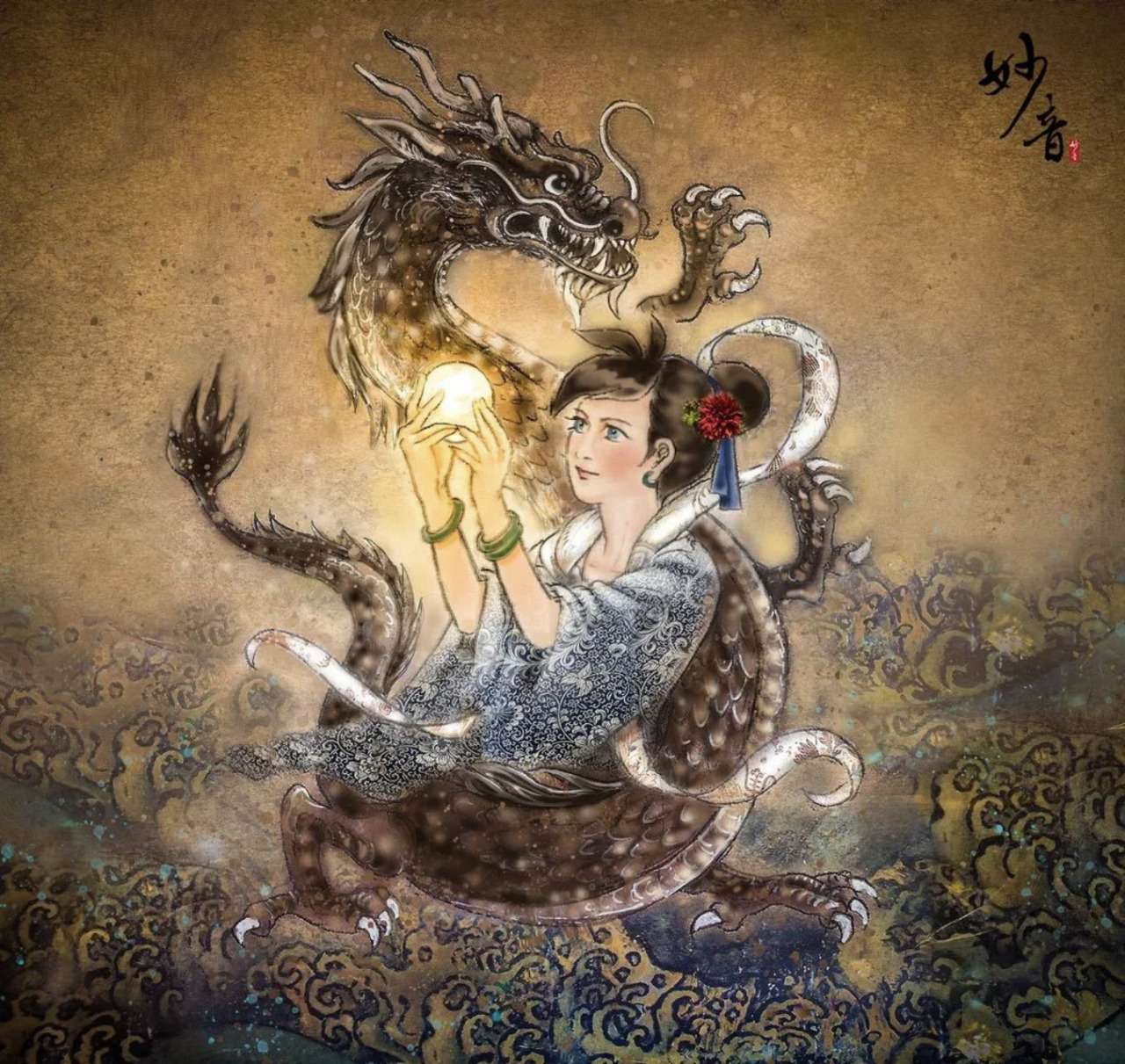
Buddhist literature actually includes instances of girls or women transforming into men upon enlightenment or rebirth. [6] The former is best exemplified by the “Dragon Girl” (Longnu, 龍女) from chapter 12 of the Lotus Sutra (Miaofa lianhua jing, 妙法蓮華經; a.k.a. Fahua jing, 法華經, c. 3rd century) (fig. 5), a work mentioned in the 1592 JTTW six times. She is first introduced to an assembly of Buddhist deities as the eight-year-old daughter of the Dragon King Sāgara (Suojieluo longwang, 娑竭羅龍王) and one of an unfathomable number of dragonfolk enlightened by the Bodhisattva Mañjuśrī’s (Wenshu shili, 文殊師利) lessons on the Lotus Sutra. Her teacher describes her as a great student prodigy with a deep knowledge of Buddhist Law, as well as having many advanced spiritual achievements. But this upsets some among the assembly because the notion of a young girl approaching Buddhahood so quickly flies in the face of convention, which normally calls for untold aeons of severe austerities before one can achieve awakening. Her accomplishments are called into question at first, but everyone is appeased when she offers a priceless jewel to the Buddha, and he quickly accepts it as a symbolic gesture. Then:
The girl said [to the assembly], “Employ your supernatural powers and watch me attain Buddhahood. It will be even quicker than that!”
At that time the members of the assembly all saw the dragon girl in the space of an instant change into a man (emphasis added) and carry out all the practices of a bodhisattva, immediately proceeding to the spotless World of the south, taking a seat on a jeweled lotus, and attaining impartial and correct enlightenment. With the thirty-two features and the eighty characteristics [of a Buddha], he expounded the wonderful Law for all living beings everywhere in the ten directions (Watson, 1993, p. 188). [7]
This kind of spiritual gender transition was certainly known to the host of historical oral storytellers and author-compilers who contributed to the formation of the novel due to their vast shared knowledge of Buddhist and Daoist religion and lore. This is especially true given that the Lotus Sutra is even touted in the 13th-century oral version of JTTW. [8]
Therefore, if the Sun Wukong from the 1592 JTTW was originally intended to be trans, they would have been OPENLY portrayed as such, without the need for subtle hints, due to scriptural precedent. And the fact that he wasn’t makes this what I consider to be the most damning argument against a canonically trans Sun Wukong.
Fig. 5 – A frontispiece to a Song-era edition of the Lotus Sutra (larger version). Image found here.
4. Final Thoughts
I hope that anyone unfamiliar with the Monkey King’s history can now make an informed judgement about online comments making claims about his gender.
And for those who still might want to go beyond an allegorical reading of the novel, you need to answer two questions:
Why did the 1592 JTTW hint that Sun Wukong is FTM trans despite him being depicted as a man for centuries?
Why were said hints used in place of scriptural examples of spiritual gender transition?
Answering these questions will require evidence, not an interpretation. I’m honestly not sure what that evidence would be since the evidence against it is so overwhelming.
I would be willing to accept the “possibility” of a trans Sun Wukong, though, if anyone can find an analysis of the character by a pre-20th-century Chinese literary critic expounding the same view. Please do not misinterpret this as me saying that there were no trans people prior to the 20th century. I’m sure there have been many throughout history, and I’m sure the terms applied to or used by them in the past were wildly different from the ones used today. But without some kind of historical support, the reality of a canonically trans Monkey King, beyond a personal interpretation, is nothing more than a wish.
5. Updates
Update: 05-19-2023
It’s recently come to my attention that this article has upset some people, namely those who are aware of the Monkey King’s worship and those who disagree with the concept of transgender people. The first group needs to understand that, while a religious figure, Sun Wukong is far more widely known around the world as a literary figure. And since people primarily view him as a fictional character—one who is in the public domain, in fact—they are free to interpret the simian immortal however they see fit. This means that both the Monkey God and the literary Monkey King should be viewed as two separate entities.
For the second group, the trans identity is outside my area of research and personal experience. Therefore, I can’t really say anything about the subject that would affect your point of view. My advice would be to ignore political pundits and instead start a dialogue with someone in the trans community to understand their thoughts, feelings, and motivations.
I’ve also learned that my article has apparently been weaponized by some on discord in an attempt to invalidate the views of trans individuals who identify with Sun Wukong. I don’t like that my work is being used to harass people. I want to make it clear that this article was not written to attack the trans community. It was solely made to place Monkey in his correct historical context. My first concern as a student of JTTW is that the history of the novel and its characters are presented accurately. But I am fully aware that perceptions of popular characters can and do evolve over time. That’s why I mentioned in the opening that viewing Sun as trans is perfectly fine as long as it’s clear that this is a personal interpretation. Therefore, if you are a trans person and some troll presents my article as proof that your personal allegory is wrong, please have the confidence to tell them, “off you fuck.”
Update: 05-27-23
I found this lovely drawing of the Dragon Girl online (fig. 6). The image depicts her at the moment when she hands the Buddha the priceless jewel, just prior to transforming into a man.
Fig. 6 – A drawing of the Dragon Girl and the priceless jewel (larger version). Image found here.
Update: 08-09-23
It just occurred to me that another reason why Sun Wukong might be called Meihou wang (美猴王), or “Handsome or Beautiful Monkey King,” is because it’s a pun on mihou (獼猴), another word for macaque. The 1592 JTTW already includes a separate character named Mihou wang (獼猴王) in chapters three, four, and 41. And most importantly, even the Buddha’s past life as a king of monkeys is called Mihou wang (獼猴王). See the article below for more info.
It just dawned on me that Sun Wukong’s precursor, the Monkey Pilgrim” from the 13th-century JTTW, is also called Mihou wang (獼猴王). Chapter two refers to him as Huaguo shan ziyun dong bawan siqian tongtou tie’e Mihou wang (花果山紫雲洞八萬四千銅頭鐵額獼猴王, the “Bronze-Headed, Iron-Browed King of the Eighty-Four Thousand Monkeys of the Purple Cloud Grotto on the Mountain of Flowers and Fruits”) (Wivell, 1994, p. 1182).
This might lend support to the suggestion in my 08-09-23 update above.
Update: 01-03-2024
Apart from the Lotus Sutra, there is another way to make Sun Wukong a woman. The idea is a byproduct of my recent “How to Kill Sun Wukong” article. It details a ritual (from another famous vernacular novel) that secretly steals an immortal’s spirit, tethers it to a straw effigy, and then kills the target by shooting it with arrows. In that article, I introduced a story idea where Zhu Bajie and/or Sha Wujing could race to stop the ritual. But what if they failed and the Monkey King was killed?
The rite only terminates the immortal’s physical body. It doesn’t destroy the spirit. And since Wukong hasn’t yet achieved Buddha-Nature, meaning he is still subject to the wheel of rebirth, his spirit would report to the underworld for processing. He could definitely be transferred to a new reincarnation; however, considering the journey would still be ongoing, and the Tang Monk is always in trouble, heaven might rush to find our hero a new body. This actually happens to a minor character in the 1592 JTTW.
The ledgers of hell show that the deceased wife of a Tang official was fated to live a long life (i.e. she wasn’t supposed to be dead). Therefore, the underworld bureaucracy takes the timely passing of the Tang Emperor’s sister as an opportunity to force the soul of the official’s wife into the princess’ body. The best part is that she still retains her memories from her past life (Wu & Yu, 2012, vol. 1, pp. 268-269)!
Heaven might find the only suitable body that can contain Monkey’s soul is a recently deceased demoness (fox, yaksha, tree, etc.). [9] I imagine this would result in Sun Wukong being weaker, not because she’s now a woman, but because few beings can match Monkey’s original physical and magical might. This would naturally lead to her coming to terms with a loss of power. She could still be a very strong fighter, just not as strong as her past life. This might cause her to use more cunning when dealing with especially powerful evils encountered along the journey.
The choice is yours if you want to keep her a woman or have her become a male Buddha, like the Dragon Girl.
Update: 03-27-25
Another thing to point out is that Monkey’s physical body only changes when he turns into animals. When he mimics a humanoid figure, only his face changes, not his body. This is revealed when Sun is captured in chapter 75:
“Elder Brother,” said the third fiend,” didn’t you see him? He [Wukong disguised as a small demon] was giggling just now with his face half turned, and I saw for a moment a thunder god beak on him. When I grabbed him, he changed back immediately into his present looks.” He then called out: “Little ones, bring me some ropes.” The captains took out ropes immediately. Wrestling Pilgrim to the ground, the third fiend had him hog-tied before they hitched up his clothes to examine him. It became apparent at once that he was the BanHorsePlague all right! Pilgrim, you see, was capable of seventy-two kinds of transformation. If it was a matter of changing into a fowl, a beast, a plant, a utensil, or an insect, his entire body could be transformed. But when he had to change into another person, only his face but not his body could be transformed (emphasis added). When they lifted up his clothes, therefore, they saw a body full of brown fur, two red buttocks, and a tail (Wu & Yu, 2012, vol. 3, p. 367).
Since his body does not change, this would imply that his sex does not change either.
Again, I’m not trying to anger anyone; I’m just presenting information from the novel to make sure that it is depicted accurately.
On that note, I was told by a friend that some young trans folk were/had been upset with this article. Please write me (see “contact” above) if something about this piece bothers you. I’d like to get your perspective.
Notes:
1) One of the suggested earliest meanings for wang (王) is “big man,” and it was used as a title by the tribal chieftains that would evolve into Chinese emperors (Qi, 1991).
2) Yes, I am aware that Dudbridge (1970) also associates white robes with female demons (p. 32 n. 3). However, the Monkey Pilgrim is expressly associated with the white clothing of the historically male xiucai scholar candidates.
4) One example is “A Supplement to Jiang Zong’s Biography of a White Ape” (Bu Jiang Zong Baiyuan Zhuan, 補江總白猿傳, c. late-7th century). In the story, a general’s young wife is kidnapped by a mysterious force, but he and his soldiers later find her living among a large harem of women in a mountain paradise. They tell the commander that their captor is a magic white ape who uses them night after night to fuel his Daoist sexual alchemy. The women also warn him and his men that they are no match for the beast’s great power, so the captives devise a plan that eventually leads to the primate’s death. In the end, the general learns that his wife is pregnant with the spirit’s child.
What’s interesting for the purposes of this blog is that the titular white ape shares many surprising parallels with the Sun Wukong from the 1592 JTTW. Both:
Are supernatural primates possessed of human speech.
Are one thousand-year-old practitioners of longevity arts.
Are masters of Daoist magic with the ability to fly and change their appearance.
Are warriors capable of single-handedly defeating an army.
Have a fondness for armed martial arts.
Have an iron-hard, nigh-invulnerable body immune to most efforts to harm them.
Have eyes that flash like lightning.
Live in verdant mountain paradises (like the Mountain of Flowers and Fruit).
Reside in caves with stone furniture (like the Water Curtain Cave).
5) See Wu & Yu, 2012, vol. 3, p. 129.
6) An example of the latter appears in Chapter 23 of the Lotus Sutra. Women are promised a male rebirth in paradise for having heard and practiced the scripture (Watson, 1993, pp. 287-288).
7) For the Dragon Girl’s story, see Watson, 1993, pp. 187-189.
8) The Lotus Sutra, which contains the story of the Dragon Girl, is given prominence in the 13th-century oral JTTW. It is painted as an important scripture, one even hailed in heaven. Chapter three sees the monk Tripitaka (referred to here by his historical name Xuanzang) give a detailed lecture on the sacred text:
The arhats said: “We thank the Master for coming to the [heavenly] palace today. Does the master excel in explaining sutras?” Xuanzang replied: “If it is a sutra, I can explain it. If it is not, I do not.” “Can you explain the Lotus Sutra?” the arhat asked. Xuanzang replied: “That’s easy.” (emphasis added)
Thereupon the five hundred arhats, the [king of heaven] Mahabrahma Devaraja, and in all a company of over a thousand gathered to listen to the sutra. Xuanzang recited flawlessly without pausing for breath. Like pouring water from a vase, he clarified the obscurities of the text (emphasis added). Everyone praised his marvelous delivery (Wivell, 1994, p. 1184).
9) I even considered Princess Iron Fan as the receptacle. However, she is said to having a positive fate in the novel: “In the end she, too, attained the right fruit [i.e. enlightenment] and a lasting reputation in the sutras” (Wu & Yu, 2012, vol. 3, p. 163). I think choosing her would muddy our Lady’s accomplishments.
Hucker, C. O. (1985). A Dictionary of Official Titles in Imperial China. Taipei: SMC Publishing Inc.
Ning, C. Y. (1986). Comic Elements in the Xiyouji Zaju (UMI No. 8612591) [Doctoral Dissertation, University of Michigan]. ProQuest Dissertations and Theses Global.
Qi, W. (1991). An Inquiry into the Original Meaning of the Chinese Character for King (wang). Chinese Studies in History, 25(2), 3-16, DOI: 10.2753/CSH0009-463325023
Shahar, M. (1992). The Lingyin Si Monkey Disciples and The Origins of Sun Wukong. Harvard Journal of Asiatic Studies, 52(1), 193-224. https://doi.org/10.2307/2719331
Shi, N., & Luo, G. (2021a). Shuihu zhuan (shang, zhong, xia) [Tale of the Water Margin (Vols. 1-3)]. Beijing: Renmin wenxue chubanshe. (Original work published 1975)
Shi, N., & Luo, G. (2021b). Outlaws of the Marsh (Vols. 1-4) (S. Shapiro, Trans.). Beijing: Foreign Languages Press. (Original work published 1993)
Watson, B. (Trans.) (1993). The Lotus Sutra. New York: Columbia University Press.
I recently posted a list of facts about Sun Wukong (孫悟空) to reddit. I am presenting an elongated version of it here, which serves as a summation of everything that I’ve learned over the years. It is by no means comprehensive. I’ll add more facts in the future as I learn of them. Enjoy.
In my opinion, however, the greatest influence on his 1592 persona is a white ape antagonist from a Tang-era story. Similarities include: 1) both are supernatural primates possessed of human speech; 2) one thousand-year-old practitioners of longevity arts; 3) masters of Daoist magic with the ability to fly and change their appearance; 4) warriors capable of single-handedly defeating an army; 5) have a fondness for armed martial arts; 6) have an iron-hard, nigh-invulnerable body immune to most efforts to harm them; 7) have eyes that flash like lightning; 8) live in verdant mountain paradises (like Flower Fruit Mountain); and 9) reside in caves with stone furniture (like the Water Curtain Cave).
The oldest published mention of the Monkey Pilgrim is a eulogy appearing in a tale from Zhang Shinan’s (張世南) Memoirs of a Traveling Official (Youhuan jiwen, 遊宦紀聞, 13th-century). One scholar dates the story to around 1127.
The oldest depictions of this character (late-11th to late-13th-century) appear in Buddhist cave art along the Silk Road in Northern China. He is almost always portrayed in a scene worshiping the Bodhisattva Guanyin.
A 13th-century version of JTTW describes the Monkey Pilgrim as a white-clad scholar who is an ancient immortal from the very beginning of the tale. He was beaten with an iron rod as a young immortal after he stole magic peaches and was subsequently banished to the Mountain of Flowers and Fruit. He actively searches out the monk to protect him as the cleric’s two previous incarnations were eaten by a monster (Sha Wujing’s antecedent) in the past.
This immortal fights with two staves (at different times), a golden-ringed monk’s staff and an iron staff (both borrowed from heaven). The monk’s staff can create destructive blasts of light, as well as transform into titanic creatures, including a club-wielding yaksha and an iron dragon. The iron staff isn’t shown to have any special powers. These weapons were later combined by storytellers, the rings from the former being added to the ends of the latter.
The earliest mention of the name “Sun Wukong” that I’m aware of appears in an early-15th-century zaju play. It depicts the character as a sex-crazed maniac who kidnaps a princess to be his wife, tries to seduce Princess Iron Fan, and later gets erectile disfunction when his golden headband tightens while trying to have sex with a young maiden in the Kingdom of Women.
The dharma name “Wukong” (悟空) was likely influenced by a historical monk of that name who traveled to India during the 8th-century. The name means “Awakened to Emptiness”, thus referencing Buddhist enlightenment. I think the corresponding Sanskrit name would be something like “Bodhiśūnyatā” (but don’t quote me on this).
The surname “Sun” (孫) means “grandson” but is an open reference to husun (猢猻, lit: “grandson of the barbarian”), the Chinese word for “macaque“. It was also a popular surname for supernatural primates in stories associated with the Lingyin Temple (靈隱寺), which also likely influenced the Monkey King.
The 1592 edition of the novel associates the components of Sun (孫 = zi, 子 & xi, 系) (ch. 1 – see section 4.2 here) with the formation of a “holy embryo” (shengtai, 聖胎), an immortal spirit that lives on after the adherent dies.
So taking all of the Buddhist and Daoist references into account, another translation for Sun Wukong would be “Immortal Awakened to Enlightenment”. This is a reference to the Buddho-Daoist philosophy of Zhang Boduan (張伯端, mid- to late-980s-1082), who believed that in order to become a true transcendent (xian, 仙), one had to achieve both the Daoist elixir of immortality and Buddha-nature (i.e. Buddhahood).
The aforementioned zaju play calls him the “Great Sage Reaching Heaven” (Tongtian dasheng, 通天大聖).
Said play also states that he has two sisters and two brothers. The sisters are respectively named the “Venerable Mother of Mount Li” (Lishan laomu, 驪山老母) and “Holy Mother Wuzhiqi” (Wuzhiqi shengmu, 巫支祇聖母). His older brother is called “Great Sage Equaling Heaven” (Qitian dasheng, 齊天大聖) and the younger the “Third Son Shuashua” (Shuashua sanlang, 耍耍三郎).
His story in the 1592 version takes place not in our world but in one modeled after ancient Hindo-Buddhist cosmic geography, which features four island-like continents floating in a great ocean around the four respective faces of a cosmic mountain. And yet the novel was published during a time coinciding with the late Renaissance period in Europe, precisely 49 years after Copernicus suggested that the Earth orbits the sun.
His home, the Mountain of Flowers and Fruit (Huaguo shan, 花果山), is located near the easternmost continent, while China is associated with the southernmost continent. This means that Monkey, within the novel, is not Chinese!
While his stone birth (ch. 1) is likely based on that ofYu the Great (Dayu, 大禹), a legendary King of theXia dynasty(more on this below), it may ultimately be linked to Tibetan stories ofstone-born monkey deities.
Despite the association above, Monkey shows no interest in sex throughout the entire novel. This may be a response to the highly sexualized Sun Wukong from the zaju play.
The novel also gives him the alchemical title “Squire of Metal/Gold” (Jingong, 金公), a possible “anagrammatic reading of the Chinese graph for lead or qian 鉛, which may be broken up into the two graphs of jin and gong” (Wu & Yu, 2012, vol. 1, p. 532 n. 3). Lead is an ingredient in external alchemy (see the material after figure two here). The title might also be referring to the earthly branchshen (申), which is associated with both metal and monkeys (Wu & Yu, 2012, vol. 1, p. 532 n. 3).
The overall arc of his birth and early life were likely based on that of the historical Buddha to make his tale more familiar to readers. Similarities include: A) supernatural births that split open their respective mothers (Queen Maya vs stone egg); B) producing a radiant splendor in all directions upon their birth; C) being talented students that quickly master concepts taught to them; D) early lives as royals (Indian prince vs king of monkeys); E) shock at the impermanence of life; F) questing for a spiritual solution to said impermanence; and G) finding said solution via spiritual practices (Indic meditation vs Daoist elixir arts).
His “Water Curtain Cave” (Shuilian dong, 水簾洞), the grotto-heaven where he and his people live in the Mountain of Flowers and Fruit, is associated with a different immortal in older religious literature. For instance, the Song-era text Master Ghost Valley’sNuminous Writ of the Essence of Heaven (Guigu zi tiansui lingwen, 鬼谷子天隨靈文) calls the titular character the “Master of the Waterfall Cave” (Shuilian dong zhu, 水濂洞主). In this case, the source uses a different lian (濂) in place of the lian (簾) associated with Monkey’s cave. But they both mean the same thing: a waterfall hiding a cave mouth (see the 12-11-21 update here). One 17th-century novel influenced by JTTW states that Master Ghost Valley lives in the Water Curtain Cave (Shuilian dong, 水簾洞; i.e. the same as Monkey’s home) with his student, the Warring States strategist Sun Bin (孫臏, d. 316 BCE). This means that two characters surnamed Sun (孫) live there in Chinese literature (see section II here).
While commonly portrayed as a Daoist immortal, his first master, the Patriarch Subodhi (Xuputi zushi, 須菩提祖師) (ch. 1 & 2), is shown to live in India and have a strong connection to Buddhism, possibly even being a Bodhisattva.
The actual name for his famous 72 Transformations is “Multitude of Terrestrial Killers” (Disha shu, 地煞數), which is based on a popular set of malevolent stellar gods.
This skill not only allows Monkey to transform into whatever he wants but also gives him a store of extra heads and possibly even extra lives like a video game (see section 4.4 # 3 here).
He specifically learns the 72 Transformations (ch. 3) in order to hide from a trio of elemental calamities sent by heaven to punish cultivators for defying their fate and achieving immortality. This is the origin of the “Heavenly Tribulation” (tianjie, 天劫; zhongjie, 重劫) trope from modern Xianxia literature.
But, surprisingly, he is not a true immortal, just long-lived and really hard to kill. The novel refers to him as a “bogus immortal” (yaoxian, 妖仙). This references Zhang Boduan’s aforementioned philosophy where one must obtain both the Daoist elixir (which Monkey did) and Buddha-Nature (which he hadn’t yet achieved) in order to be a true transcendent.
While training under Subodhi (ch. 3), he expressly passes on learning the bureaucratic-style magic rites normally used by earthly priests to request something from heaven because the skills involved won’t result in eternal life. Instead, after achieving immortality, Monkey just commands the gods to do his bidding (see section II here).
He can grow 100,000 feet (30,480 m) tall (ch. 1, 6, 61, and 97). This skill is called the “Method of Modeling Heaven on Earth” (Fatian xiangdi, 法天像地), and it is related to ancient Pre-Qin and Han concepts of astral-geography later used in the construction of imperial Chinese cities.
His magic “immortal breath” (xianqi, 仙氣) can transform his hairs, his staff, and objects not in direct contact with his body into anything he desires. It can also change disembodied souls into “ether” for ease of transport, and evidence suggests that it can even grant some form of immortality.
Monkey has 84,000 hairs on his body, and he can transform them into hundreds of thousands, millions, and even billions of hair clones (see the 03-19-22 update here).
The novel only mentions him learning martial arts in passing (ch. 67 – see section 4.5 here), but one episode (ch. 51) features a battle between Monkey and a demon king in which they use a host of real world fighting techniques that are still known and practiced today.
His skill with the staff is so great that the novel compares it to techniques from two manuals listed among the Seven Military Classics of China (see the 08-07-18 update here).
The bureaucratic mix-up that resulted in his soul being dragged to hell (ch. 3) is based on “mistaken summons” to the underworld and “return-from-death” narratives present in early Chinese “miraculous tales” (Zhiguai xiaoshuo, 志怪小説) (Campany, 1990).
When he looks at his entry in the ledgers of hell, he learns that: 1) his soul number is “1,350”; 2) his real name is “Heaven-Born Stone Monkey” (Tianchan shihou, 天產石猴); and 3) he was fated to have a “good end” at the ripe old age of 342. This refers to a person’s pre-allotted lifespan (ming, 命) (Campany, 2005; Campany & Ge, 2002, pp. 47-52).
The distance that his cloud-somersault can travel, 108,000 li (33,554 mi / 54,000 km), is based on a metaphor for instantaneous enlightenment. It comes from the Platform Sutra of the Sixth Chan Patriarch Huineng (惠能). The Chan Master explains that the common trope of the Buddha’s paradise being separated from the world of man by 108,000 li is based on a combination of the “Ten Evils” (Shi’e, 十惡) and “Eight Wrongs” (Baxie, 八邪) of Buddhism. Those who rid themselves of these spiritual flaws will achieve enlightenment and thus arrive instantly at the Buddha’s paradise.
The initial depiction of his magic staff as a great iron pillar kept in the dragon kingdom treasury (ch. 3) is based on a metal column that the immortal Xu Xun (許遜) chained a demonic dragon to and then imprisoned in the aquatic realm in Chinese mythology.
It’s a common misconception that his staff weighed down the Milky Way galaxy. This is based on a mistranslation. The W. J. F. Jenner edition claims that the weapon anchored said star cluster. However, the original Chinese states that it was used as a means to measure and set the depths of the Heavenly River (Tianhe, 天河; a.k.a. Milky Way).
The weight of his staff is likely an embellishment on the weight of a heavy stone block lifted by the bandit-hero Wu Song (武松) in the Water Margin (Shuihu zhuan, 水滸傳, c. 1400). This episode and the JTTW episode where Monkey acquires his staff both involve a hero (Wu Song vs Sun Wukong) asking someone (a friend vs the Dragon King) to take them to a seemingly immovable object (stone block vs iron pillar). They then adjust their clothing before lifting the object with ease. Most importantly, the Chinese characters for the respective weights are visually similar. Sun’s staff is 13,500 catties (yiwan sanqian wubai jin, 一萬三千五百斤; 17,5560 lbs. / 7965.08 kg), while the stone block is 300 to 500 catties (sanwubai jin, 三五百斤; 390-650 lbs. / 177-295 kg). The characters in bold indicate the similarities between the two weights, where as those in red indicate the embellishments: 一萬三千五百斤.
He singlehandedly defeats the “Nine Planets” (Sk: Navagraha; Ch: Jiuyao, 九曜, “Nine Luminaries”), personifications of the sun and planets from Hindu astrology (Gansten, 2009), during his rebellion (ch. 4) (Wu & Yu, 2012, vol. 1, pp. 170-172).
His time as the Bimawen (弼馬溫, “To assist horse temperament”), a minor post overseeing the heavenly horse stables (ch. 4), is based on an ancient Chinese practice of placing monkeys in horse stables to ward off equine sicknesses. The belief was that the menstrual blood of female monkeys mixed with horse food somehow guarded against diseases. This is hilarious as the position links Sun Wukong to menstruation!
His title “Great Sage Equaling Heaven” (Qitian dasheng, 齊天大聖) (ch. 4) was actually borrowed from the “Eastern Marchmount” (Dongyue, 東嶽; a.k.a. “Eastern Peak”), the god of Mt. Tai. This suggests that the older brother from the aforementioned zaju play is really the Eastern Marchmount.
His time as the Guardian of the Immortal Peach Groves (ch. 5) is likely based on a Song-era Daoist scripture in which the aforementioned Sun Bin is tasked by his teacher, Master Ghost Valley, with protecting a tree laden with special fruit. He later captures a magic white ape stealing said produce (see section III here). The simian thief saves his life by offering Sun a set of secret religious texts. Both stories include: 1) a character surnamed Sun (孫) protecting special fruit (Sun Bin vs Sun Wukong); and 2) supernatural primates that steal and eat the fruit. Therefore, Monkey’s 1592 persona serves as both the guard and the thief!
The elixir pills that he drunkenly eats in Laozi’s laboratory (ch. 5) likely influenced the senzu beans from the world famous Dragon Ball (Jp: Doragon Bōru,ドラゴンボール; Ch: Qilongzhu, 七龍珠) franchise.
His time in Laozi‘s furnace (ch. 7) is based on an episode from the aforementioned 13th-century version of JTTW. It may also be connected to a story of Laozi magically surviving a foreign king’s attempt to boil him in a cauldron.
He is shown to be weak against spiritual fire and smoke (see the 06-28-22 update here).
Smoke from the furnace irritates his eyes, giving him his famous “Fiery Eyes and Golden Pupils” (Huoyan jinjing, 火眼金睛). The former is likely based on the “actual red-rimmed eyes of [the Rhesus macaque]” (Burton, 2005, p. 148). The latter is likely based on the golden pupils of macaques (see section 2.1 here).
His time under Five Elements Mountain (Wuxing shan, 五行山) (ch. 7) is based on stories of the aforementioned Wuzhiqi (無支奇/巫支祇) being imprisoned under a mountain by Yu the Great.
A religious precious scroll predating the 1592 edition states that Erlang instead traps Monkey beneath Mount Tai, and the aforementioned 15th-century zaju play states it was Guanyin and the Mountain of Flowers and Fruit.
This punishment links him to a broader list of mythic baddies imprisoned in earth, including Lucifer, Loki, and the Titans of Tartarus. I plan to write a later article about “earth prisons” in world myth.
One scholar suggests that being trapped under Five Elements Mountain is a symbolic death (remember that Monkey claims to be free of the Five Elements after attaining immortality), meaning that the hellish diet is his karmic punishment in the afterlife, and his later release is a symbolic reincarnation.
The oldest depiction of Monkey with his headband that I know of appears in a late-Xixia (late-12th to early-13th-century) Buddhist cave grotto in Northwestern China.
Along with the headband, his tiger skin kilt (ch. 13) can be traced to a list of ritual items prescribed for worshiping wrathful protector deities in Esoteric Indian Buddhism. These same ritual items came to be worn by the very protector deities that the yogins revered. This explains why some deities in Chinese folk religion (including Sun Wukong) are portrayed with the golden headband and tiger skin.
Modern artists sometimes depict him with two long feathers protruding from the front of his golden headband, giving him the appearance of an insect. But the feathers (lingzi, 翎子) are actually associated with a different headdress called the “Purple Gold Cap” (zijin guan, 紫金冠), which is worn on top of the head. It was a military headdress later associated with heroes in Chinese opera (see section 2.2 here).
Monkey is also shown to be weaker in water. For instance, he enlists Zhu Bajie to combat the water demon who turns out to be Sha Wujing (ch. 22) (Wu & Yu, 2012, vol. 1, p. pp. 422-423).
He claims to have eaten people when he was a monster in his youth (ch. 27) (Wu & Yu, 2012, vol. 2, p. 20).
His greatest feat of strength is carrying two mountains while running at meteoric speeds (ch. 33). One is the axis mundi of the Hindo-Buddhist cosmos, while the other is the place from which (according to legend) Buddhism spread upon entering China. This episode is based on an older tale in which Erlang does the lifting.
His doppelganger, the Six-Eared Macaque (ch. 56-58), is actually an aspect of his troubled mind. Once he kills him, Monkey takes one step closer to Buddhahood.
He fights and is defeated by an ancient bird demon who is a spiritual uncle of the Buddha (ch. 77). This monster is based on the Hindu bird god Garuda.
He and his religious brothers take human disciples in India (ch. 88), and Monkey later performs an arcane ritual in which he grants them superhuman strength (and possibly some form of immortality).
The novel ranks him higher than Guanyin after his ascension (see the third quote here).
As an enlightened Buddha, Monkey is eligible for his own “Buddha-Field” (Sk: Buddhakṣetra; Ch: Focha, 佛刹), essentially his own universe in which he will lead the inhabitants to enlightenment (Buswell & Lopez, 2014, p. 153).
Modern ritual specialists known as “spirit-mediums” (Hokkien: Tangki, 童乩; Ch: Jitong, 乩童; lit: “Divining Child”) also channel the Great Sage, allowing his worshipers to have direct access to the divine. While they may use a staff to enhance the theater of their performance, the weapon surprisingly doesn’t serve a ritual function. They instead use a set of bladed or spiked weapons to draw blood intended to create evil-warding paper talismans (see the material below figure six here).
Chinese folk religion recognizes more than one Great Sage, usually between three and five individuals.
Monkey’s faith started in Fujian province, China and spread via boat to other countries within the Chinese diaspora. When he first started being worshiped is unknown. The first concrete references to his worship come from the 17th-century (see section III here). But the aforementioned 13th-century stone carving depicts him as a wrathful guardian, alongside other protector deities, Bodhisattvas, patriarchs, and eminent monks. This suggests that he might have been revered at an earlier time.
There is a style of Chinese boxing named after him, “Great Sage Boxing” (Cantonese: Taishingkyun; Mandarin: Dasheng quan, 大聖拳). Another closely associated style is “Great Sage Axe Boxing” (Can: Taishing pek kwarkyun; Man: Dasheng pigua quan, 劈掛拳). These arts also have staff styles associated with the Monkey King.
His time in Laozi’s furnace and ability to grow 100,000 feet tall influenced a Shaolin Monastery myth related to the founding of their famous staff fighting method. The story describes how a lowly kitchen worker jumped into an oven and remerged as a staff-wielding titan to battle mountain brigands attacking the monastery (see section 3 here).
He shares several connections with Yu the Great (here and here). These include: A) both have stone births; B) Monkey’s staff was originally used by Yu as a drill and as a ruler to set the depths of the fabled world flood; C) Sun’s demonic sister Wuzhiqi was conquered by Yu in some stories; and D) both are legendary hero-kings.
He shares a number of similarities with Wu Song. These include: A) both are reformed supernatural spirits originally trapped under the pressing weight of a mountain; B) slayers of tigers; C) Buddhist monks nicknamed “Pilgrim” (xingzhe, 行者), a title noting junior and traveling monks, as well as untrained riffraff that became clerics to avoid trouble with the law or taxes and military service (Wu Song is the latter and Monkey the former); D) martial arts monks who fight with staves; E) have moralistic golden headbands; and F) weapons made from bin steel (bin tie, 鑌鐵) (Wu Song’s Buddhist sabers vs Monkey’s magic staff).
He shares a surprising number of similarities with the Greek hero Heracles (a.k.a. Hercules). These include: A) supernatural births via masculine heavenly forces (son of Zeus vs the stone seeded by heaven); B) quick to anger; C) big cat skins (Nemean lion vs mountain tiger); D) fight with blunt weapons (olive wood club vs magic iron staff); E) great strength; F) knocked out by a god during a fit of rage (Athena with a rock vs Laozi and his Diamond-Cutter bracelet); G) given punishment to atone for past transgressions (12 labors for killing family vs protecting the monk for rebelling against heaven); H) constantly helped by goddesses (Athena vs Guanyin); I) similar enemies (there’s a long list); tamer of supernatural horses (Mares of Diomedes vs Heavenly Horses); J) travel to lands peopled by women (Amazons vs Kingdom of Women); K) theft of fruit from the gardens of queenly goddesses (Hera’s golden apples of the Hesperides vs the Queen Mother’s immortal peaches); L) travel to the underworld; M) take part in a heavenly war (Gigantomachy vs rebellion in heaven); N) become gods at the end of their stories (god of heroes and strength vs Victorious Fighting Buddha); and O) worshiped in the real world (Greece and Rome vs East and Southeast Asia).
He has a total of eight children between two 17th-century novels. He has five sons in A Supplement to the Journey to the West (Xiyoubu, 西遊補, 1640), but only one of them is mentioned by name. “King Pāramitā” (Boluomi wang, 波羅蜜王) is portrayed as a sword-wielding general capable of fighting Sun for several rounds. His name is based on a set of virtues learned by Bodhisattvas on their path to Buddhahood. In Journey to the South (Nanyouji, 南遊記) he has two sons named “Jidu” (奇都) and “Luohou” (羅猴), who respectively represent the lunar eclipse demons Ketu and Rahu from Indian astrology. He also has a giant, monstrous daughter, “Yuebei Xing” (月孛星, “Moon Comet Star”), who is named after a shadowy planet representing the lunar apogee (or the furthest spot in the moon’s orbit) in East Asian astrology. Only the daughter plays a part in the story. She uses a magic skull, which can kill immortals three days after their name is called.
Burton, F. D. (2005). Monkey King in China: Basis for a Conservation Policy? In A. Fuentes & L. D. Wolfe (Eds.), Primates Face to Face: Conservation Implications of Human-Nonhuman Primate Interconnections (pp. 137-162). Cambridge: Cambridge University Press.
Buswell, R. E., & Lopez, D. S. (2014). The Princeton Dictionary of Buddhism. N: Princeton University Press.
Campany, R. F. (1990). Return-from-Death Narratives in Early Medieval China. Journal of Chinese Religions, 18, pp. 91-125.
Campany, R. F., & Ge, H. (2002). To Live as Long as Heaven and Earth: A Translation and Study of Ge Hong’s Traditions of Divine Transcendents. Berkeley: University of California Press.
Campany, R. F. (2005). Living off the Books: Fifty Ways to Dodge Ming in Early Medieval China. In C. Lupke (Ed.), The Magnitude of Ming: Command, Allotment, and Fate in Chinese Culture (pp. 129-150), University of Hawaii Press.
Gansten, M. (2009). Navagrahas. In K. A. Jacobsen (Ed.), Brill’s Encyclopedia of Hinduism (Vol. 1) (pp. 647-653). Leiden: Brill.
Wu, C., & Yu, A. C. (2012). The Journey to the West (Vols. 1-4). Chicago, Illinois: University of Chicago Press.
The Six-Eared Macaque (Liu’er mihou, 六耳獼猴) (fig. 1) is one of the most interesting villains that Sun Wukong faces in Journey to the West (Xiyouji, 西遊記, 1592; “JTTW” hereafter). He is an example of the evil twin archetype from world mythology. But unlike modern media which sometimes differentiates evil twins with goatees—think of Evil Spock from the Star Trek episode “Mirror, Mirror“—this malicious spirit is an exact duplicate of Monkey, with the same features, voice, clothing, and fighting abilities. He’s so similar, in fact, that no one in the cosmos, save the Buddha, can differentiate him from Wukong. But who is he really, and where did he come from?
In this article, I suggest that the Six-Eared Macaque is a negative manifestation of Sun Wukong’s mind, a concept which is based on Buddhist theories of mind and nonduality (Sk: advaya; Ch: bu’er, 不二). In addition, I describe his character arc and appearance, discuss his possible origin within the book as a former sworn brother of the Monkey King, explain the significance of the six ears to Buddhism, and detail references to him in an unofficial 17th century sequel to JTTW. Finally, I describe the character’s influence on the upcoming Chinese video game Black Myth: Wukong (August 20th, 2024).
In chapter 56, Monkey magically disguises himself as a 16-year-old monk and comes to the rescue of Tripitaka, who had been captured by mountain bandits demanding money for safe passage. The bandits let the priest go under the pretense that his young disciple has money. However, Wukong murders the two bandit chiefs with his magic staff, causing the remaining thirty or so men to flee in terror. That night, the pilgrims find lodging with an old couple, but they soon discover that the couple’s son is one of the bandits routed by Monkey earlier in the evening. The son returns home with his gang late at night and upon learning of the monks, hatches a plan to attack them in their sleep. But the old man alerts the pilgrims to the danger and allows them to escape out a back gate. The bandits take chase, catching up to them at sunrise, only to meet their death at Wukong’s hands. Monkey finds the old couple’s son and beheads him as punishment for disrespecting his parents. All of this killing horrifies Tripitaka, who recites the tight-fillet spell (jin gu zhou, 緊箍咒) and banishes Wukong from the group.
In chapter 57, Wukong travels to Guanyin’s island paradise to complain about Tripitaka casting him out from the pilgrimage. He asks the goddess if he can be released from monkhood and return to his old life, but she instead uses her eyes of wisdom to foresee a future event in which Monkey will need to rescue his master. Meanwhile, Tripitaka asks his remaining disciples to find him food and drink. However, in their absence, Wukong attacks the priest, knocking him unconscious with the staff and stealing the group’s belongings containing the travel rescript (tongguan wendie, 通關文牒). [1]Sha Wujing is sent to the Mountain of Flowers and Fruit to retrieve their things, but Monkey refuses to return the rescript as he wishes to win all of the merit and fame by finishing the quest on his own. Wujing points out that the Buddha will only give the holy texts to the chosen scripture seeker. Wukong, however, shows that he’s prepared for this outcome by parading doppelgangers of Tripitaka, Zhu Bajie, Sha, and the white dragon horse. Wujing kills his double—which is revealed to be a transformed monkey spirit—and attempts to attack Monkey but is forced to retreat. He flees to Guanyin only to attack Wukong once more when he finds him sitting next to the goddess. Guanyin stays his hand and explains that Monkey has been with her the entire time. She then sends them both back to the Mountain of Flowers and Fruit to investigate the double.
In chapter 58, upon seeing the impostor, Wukong rushes forward to attack the double, who defends himself with his his own magic staff. The two battle their way through the sky to Guanyin’s island paradise in order to determine who is the real Monkey. But when she attempts to weed out the impostor by reciting the tight-fillet spell, both Wukongs drop to the floor in pain. In the face of failure, Guanyin sends them up to the celestial realm in the hopes that the deities who fought Monkey centuries ago will be able to tell one from the other. Both of them fight their way into heaven and gain an audience with the Jade Emperor, but not even the imp-reflecting mirror (zhao yao jing, 照妖鏡) [2] can tell them apart. The two then battle their way back to earth, and when Tripitaka’s use of the tight-fillet spell fails, they fight down to the underworld. There, the judges are unable to find the impostor in their ledgers, but “Investigative Hearing” (Diting, 諦聽), the omniscient celestial mount of the bodhisattva Ksitigarbha, finally solves the riddle. However, the creature is reluctant to reveal the false Wukong for fear that the fiend will use his powers to disrupt the underworld. The bodhisattva, therefore, sends them to the Western Paradise in India to stand before the Buddha, who instantly recognizes the impostor. The Enlightened One gives Guanyin a short lecture on four spiritual primates that fall outside of the ten categories of mortal and immortal life in the cosmos: 1) The Stone Monkey of Numinous Wisdom (Lingming shihou, 靈明石猴, i.e. Sun Wukong); 2) The Red-Buttocked Horse-Monkey (Chikao mahou, 赤尻馬猴); 3) The Connected-Arms Gibbon (Tongbi yuanhou, 通臂猿猴); and 4) The Six-Eared Macaque (Liu’er mihou, 六耳獼猴). When the Buddha identifies the doppelganger as the fourth kind, the fake Monkey attempts to flee in the form of a bee but is trapped under the Enlightened One’s alms bowl. In the end, Wukong kills the macaque with his staff.
2. Physical Appearance
Chapter 58 describes Six Ears as Sun’s exact twin:
His looks were exactly the same as those of the Great Sage: he, too, had a golden headband clamped to his blondish-brown hair, a pair of fiery eyes with golden irises, a monk’s robe on his body, a tiger kilt tied around his waist, a gold-banded iron staff in one of his hands, and a pair of deerskin boots on his feet. He, too, had
A hairy face with the Thunder Lord’s beak, [3] Empty cheeks unlike those of Saturn; [4] Two forked ears on a big, broad head, And fangs that have grown outward (based on Wu & Yu, 2012, vol. 3, p. 104).
His magic staff, the “Acquiescent Iron Pole Arm” (Suixin tie ganbing, 隨心鐵桿兵), [5] also mirrors Monkey’s weapon. “Acquiescent” or “to fulfill one’s desires” (suixin, 隨心) is a play on the “as-you-will” (ruyi, 如意) of Sun’s “As-You-Will Gold-Banded Staff” (Ruyi jingu bang, 如意金箍棒).
3. Origin
3.1. Possible Identity
Lam (2005) suggests that the Six-Eared Macaque is actually Monkey’s sworn brother, the Macaque King (Mihou wang, 獼猴王) (fig. 2), from his younger days as a demon (p. 168). [6] He explains:
The latter’s other agnomen, “the Great Sage Informing Wind” (Tongfeng dasheng, 通風大聖 …) [7] suggests further that its ears are as good as the six-eared macaque’s in information gathering. Despite all these archaic or anachronistic traces, however, Monkey never comes to recognize the six-eared macaque as his old sworn brother as is the case with the Bull Demon King” (Lam, 2005, p. 168).
[Note (08-05-23): For the sake of discourse, I have altered the wording in the above section from “Lam (2005) reveals” to “… suggests” to show that I’m open to opposing views.
It has recently come to my attention that some people disagree with Lam’s (2005) statement from above. One anonymous person on Tumblr even questioned my credibility because they believed that I—not realizing that this is not my idea—was confusing two different characters. But I replied by saying:
It’s okay to disagree with someone. I don’t always agree with scholars who write about Journey to the West and its characters. But that doesn’t make them untrustworthy. The most important thing to do in such situations is to present your own views and support them with evidence.
Admittedly, this person subsequently contacted me in private to ask questions about the subject. So my respect goes out to them.
Another person (who shall remain nameless) has repeatedly said on social media that Lam’s (2005) statement is “just a theory” and that the Macaque King is never explicitly stated in the book to be Six Ears. In addition, they claim the idea that Macaque and Sun Wukong were sworn brothers is not widely accepted in China. Instead, the Chinese supposedly view them as biological brothers. But I have three problems with this critique. One, saying that something is just a theory does not address the point raised by Lam (2005). As noted above, anyone who disagrees needs to provide a counterargument with cited evidence. Two, just because something isn’t openly stated doesn’t mean there isn’t a connection between two or more concepts. See, for instance, the unspoken relationship between the supply cart in chapter 46 and Daoist internal alchemy. And three, the views of modern readers carry no weight when we are talking about an allegory-laden novel that was published over 430 years ago. This is especially true since framing Six Ears and the Monkey King as brothers is incorrect (see section 3.4. below for how these two are connected). Therefore, the only thing that matters in this case is evidence gleaned from the book.
But to the person’s credit, they (along with others on social media) provide a reason for why they don’t accept Lam (2005): Six Ears can’t be the Macaque King because the latter is a woman. This idea is always mentioned in passing but never actually supported with evidence. However, I show in this article that the concept is based on a discrepancy in the Anthony C. Yu (Wu & Yu, 2012) translation. My conclusion reads:
Journey to the West uses the term Mihou wang (獼猴王) three times to refer to the same character. Yu (Wu & Yu, 2012) translates this twice as “Macaque King” (ch. 3 & 4) but later changes it to “Female Monkey King” (ch. 41). Despite the original Chinese referring to the character as the “fifth brother” (wuge, 五哥), Yu (Wu & Yu, 2012) appears to represent them as a woman based solely on the association of mihou (獼猴) with female monkeys. However, not even Journey to the West follows this association, for out of 13 mentions of the term, over 61% refer directly to Liu’er mihou (六耳獼猴), Sun Wukong’s six-eared doppelganger. In addition, mihou (獼猴) and mi (獼) are even used in the novel to refer to monkeys as a whole.
The term mihou (獼猴) is just one of several transcriptions for a non-Chinese word used in China for millennia to mean “macaque” or “monkey.” Dynastic sources show that the association with female monkeys is a misunderstanding based on changes in dialect, along with differences in transcription. Said changes include muhou (沐猴, “bathing monkey”), muhou (母猴, “mother monkey”), and of course mihou (獼猴). Therefore, the word can be applied to either male or female monkeys.
The last point is exemplified in Buddhist literature. A 3rd century CE Chinese version of the Dasaratha Jataka, which very briefly describes the Hindu epic Ramayana (5th-century BCE), references the great battle between the monkey king brothers Sugriva and Vali and calls the former Mihou (獼猴). A 3rd century Chinese version of the Mahakapi Jataka, which tells of the Buddha’s past life as a monkey king, also refers to him as Mihou wang (獼猴王). And a 5th century variant of the same story refers to the Enlightened One as the Shan mihou (善獼猴), or “Good Macaque.”
[Note (09-27-23): Even Sun Wukong’s precursor, Hou xingzhe (猴行者, the “Monkey Pilgrim”) from the 13th century JTTW, is called Mihou wang (獼猴王). Chapter two refers to him as Huaguo shan ziyun dong bawan siqian tongtou tie’e Mihou wang (花果山紫雲洞八萬四千銅頭鐵額獼猴王, the “Bronze-Headed, Iron-Browed King of the Eighty-Four Thousand Monkeys of the Purple Cloud Grotto on the Mountain of Flowers and Fruits”) (Wivell, 1994, p. 1182).]
Therefore, this is not a valid counterargument.
I know of one other objection appearing on social media: Sun Wukong wouldn’t have killed Six Ears if he had recognized him as his sworn brother. But people who claim this forget that Macaque is capable of transformations due to his connection to the Monkey King (again see section 3.4. below). This fact is revealed at the end of his character arc in chapter 58: “The macaque’s hair stood on end, for he supposed that he would not be able to escape. Shaking his body quickly, he changed at once into a bee, flying straight up” (Wu & Yu, vol. 3, p. 116). Thus, he could have taken on a different form in the past. Someone might counter that Sun would have seen through this magic disguise with his “Fiery Eyes and Golden Irises” (Huoyan jinjing, 火眼金睛). [8] But the fraternal brotherhood with the Macaque King and the other Demon Kings is formed in JTTW chapter three, while Monkey isn’t punished to the eight trigrams furnace, which gives him this power, until chapter seven (Wu & Yu, 2012, vol. 1, pp. 138-139 and 189). Remember also that even with his holy vision, Sun can’t see through Six Ears’ disguise during their struggle across the cosmos. Therefore, I don’t consider this to be a valid counterargument either.
It appears that most of this hubbub can be traced to “Shadowpeach,” a nickname for a popular slash romance between the Lego Monkie Kid versions of Six Ears (Shadow) and Sun Wukong (Peach). Somehow this is validated if the Macaque King and Six Ears are two different people. I’m not exactly sure why. But trying to discredit me or a source just to support a popular headcanon seems extremely immature to me.
[Note 10-01-23: I wanted to highlight that I’ve seen a more compelling argument than those listed above. Simply put, it doesn’t make any narrative sense for Six Ears to be the Macaque King. The latter is introduced in chapter three, while the former is introduced in chapter 56. And beyond Lam’s (2005) suggestion, there is nothing else concretely connecting the two. On the other hand, the Bull Demon King (Niumo wang, 牛魔王) is the only sworn brother who openly reappears under the same name to play a part later in the novel (ch. 60-61).
Therefore, I will leave it up to the reader to accept whether or not Six Ears and the Macaque King are the same character.]]
3.3. Significance of the Six Ears
Yu (Wu & Yu, 2012) suggests that the macaque’s six ears come from the Buddhist saying “The dharma is not to be transmitted to the sixth ear [i.e., the third pair or person]” (fa bu zhuan liu er, 法不傳六耳) (p. 387 n. 7). He continues: “This idiom is already used in chapter 2 when Monkey assured Patriarch Subodhi that he could receive the oral transmission of the secret formula for realized immortality because ‘there is no third party [sixth ear] present'” (Wu & Yu, 2012, vol. 3, p. 387 n. 7). This phrase refers to a closely guarded secret that must be kept at all cost, something that can only be passed from a qualified teacher to an initiated disciple.
In this case, the Six-Eared Macaque is the third set of ears, for the Buddha states:
[E]ven if this monkey stands in one place, he can possess the knowledge of events a thousand li [(310.7 mi/500 km] away and whatever a man may say in that distance (based on Wu & Yu, 2012, vol. 3, p. 115).
Who knows how long this creature listens in on Monkey’s life before he makes an appearance. Perhaps he hears Subodhi’s secret teachings. This might explain why the impostor has similar abilities to our hero.
(See the 08-18-23 and 12-20-23 updates below for more information.)
As the embodiment of the “sixth ear,” the Six-Eared Macaque also represents heterodoxy (waidao, 外道; pangmen, 旁們, lit: “side door”), for someone eavesdropping on esoteric secrets without full initiation into a tradition would have an incomplete understanding. And any supernatural gifts derived from subsequent practice, though powerful as they may be, would just be pale imitations of that achieved by true disciples. This concept is featured in JTTW chapter 46 when three animal spirits-turned-Daoist priests challenge Wukong to contests of torture, but each of them dies because their magic is not as strong as Monkey’s. The novel stresses this is because their training was only partially completed under a teacher. [9] Wukong is more powerful because he completed his training under Subodhi.
3.4. The Ramayana vs. Buddhist Philosophy
Hoong (2004) claims that the concept of two identical apes fighting each other “evolved from the well-known episode of the Ramayana where Rama was unable to distinguish between [Vali] and the monkey king Sugriva … when the twin brothers were fighting hand to hand” (p. 36 n. 32). This is an enticing suggestion, and indeed the episode is very briefly described in a collection of Buddhist jataka tales translated into Chinese in the third century, [10] showing that the story existed in China for centuries prior to the publication of the standard 1592 edition of JTTW. However, I should point out that the tale doesn’t mention the pugilistic primates being identical. In fact, they’re not even brothers. It simply reads,
The following day the monkey fought with his uncle. The [human] king bent the bow and took out arrows … Though far off, the uncle shuddered with horror. He was mighty afraid. He wandered about [a while] and ran away (Mair, 1989, p. 677).
That’s not to say the JTTW author-compiler wasn’t influenced by the tale. It’s just that I think there are other avenues open to research.
Fig. 3 – The Great Sage and his impostor battle in the Western Paradise (larger version). Artist unknown.
In Chapter 58, the Buddha gives his congregation a sermon on nonduality (Sk: advaya; Ch: bu’er, 不二), discussing existence and nonexistence, form and formlessness, and emptiness and nonemptiness. Just as the battle between Monkey and his double erupts on Spirit Vulture Mountain (fig. 3), the Enlightened One tells his congregation: “You are all of one mind, but take a look at two Minds in competition and strife arriving here” (Wu & Yu, 2012, vol. 3, p. 113). “One mind” (Sk: ekacitta; Ch: yixin, 一心) is a high-level philosophy and core tenet of many Buddhist schools that refers to a tranquil, immovable mind that encompasses nonduality (Buswell & Lopez, 2014, pp. 1031-1032; Huang, 2005, p. 68). “Two minds” (erxin, 二心) refers to the dichotomy of the “true mind” (zhenxin, 眞/真心), “the original, simple, pure, natural mind of all creatures, [or] the Buddha-mind” and the “illusionary mind” (wangxin, 妄心), “which results in complexity and confusion” (Soothill and Hodous, 1937/2006, pp. 24-25). A poem in chapter 58 specifically associates two minds with confusion. The first two lines read: “If one has two minds, disasters he’ll breed; / He’ll guess and conjecture both far and near” (Wu & Yu, 2012, vol. 3, p. 113).
It’s important to remember that Wukong is an embodiment of the “Mind Monkey” (xinyuan, 心猿), a Buddho-Daoist concept denoting the disquieted thoughts that keep man trapped in Samsara. [11] As his double, the Six-Eared Macaque is also a Mind Monkey. Therefore, I suggest that the battle between these twin primates is an allegory for the struggle between the true and illusionary minds within our hero. After all, Wukong is the true Monkey, while his double, the fake Monkey, lives under the fantasy that he can take the Great Sage’s place and finish the quest on his own. Furthermore, given chapter 58’s emphasis on nonduality, I argue Monkey killing the Six-Eared Macaque in the end represents the blossoming of one mind/true mind by extinguishing the illusionary mind. This fits with Sun’s (2018) suggestion that the killing “is an action of eliminating the monster in him [Wukong], indicating that he is getting closer to achieving Buddhahood at this point in the journey” (p. 25). [12]
4. Other Literature
The Six-Eared Macaque is mentioned by name twice and referenced once in A Supplement to the Journey to the West(Xiyoubu, 西遊補, c. 1640), an unofficial 16-chapter novellette and addendum to the original novel taking place between the end of chapter 61 and the beginning of chapter 62. In the story, Monkey is trapped in a dream world where he wanders from one disjointed adventure to the next searching for a magic weapon needed to clear the pilgrims’ path to India. In chapter ten, he attempts to leave a magic tower of mirrors and becomes hopelessly entangled in a net of sentient red threads that adapt to any transformation he uses to escape. An elderly man claiming to be Sun Wukong, the Great Sage Equaling Heaven, comes to his rescue by snapping the threads for him. But upon hearing the man’s name, Monkey lashes out at him with his weapon, exclaiming: “You rascally six-eared ape! Have you come to trick me again? Take a look at my cudgel!” (Dong, Lin, & Schulz, 2000, p. 87). But after the old man vanishes in a flash, Wukong realizes that he was saved by his very own spirit.
In chapter 12, a blind court singer plays a tune recounting events from the original novel for the enjoyment of Tripitaka and a foreign king. A section of the song goes: “A pair of Sage Monkeys deceived Guanyin” (Dong, Lin, & Schulz, 2000, p. 104). [13]
In chapter 15, after giving up the quest and becoming a commander for the foreign king, Tripitaka starts amassing an army. Sun Wukong is listed among the generals, but because Monkey is investigating his master’s change of heart, he instead presents himself as his brother, the Six-Eared Macaque:
The name “Great General Sun Wukong” was called. The Tang Priest blanched and gazed below his platform. It happened that Monkey had mixed amongst the army for the past three days in the form of a six-eared monkey soldier. When he heard the three words “Sun Wukong” he leaped out of formation and knelt on the ground, saying, “Little General Sun Wukong is transporting supplies and couldn’t be present. I’m his brother Sun Wuhuan [孫悟幻, “Monkey Awakened to Fantasy”], and I wish to take his place in battle. In this I dare disobey the Commander’s order.”
The Tang Priest said, “Sun Wuhuan, what is your origin? Tell me quickly, and I’ll spare your life.”
Hopping and dancing, Monkey said:
In the old days I was a monster, Who took the name of Monkey. After the Great Sage left the Tang Priest, I became his close relation by way of marriage. There’s no need to ask my name, I’m the Six-eared Monkey, Great General Sun Wuhuan.
The Tang Priest said, “The six-eared ape used to be Monkey’s enemy. Now he’s forgotten the old grudge and become generous. He must be a good man.” He ordered [the minor general] White Banner to give Sun Wuhuan a suit of the iron armor of the vanguard and appointed him “Vanguard General to Destroy Entrenchment” (Dong, Lin, & Schulz, 2000, p. 122).
Black Myth: Wukong (Hei shenhua: Wukong, 黑神話:悟空, August 20th, 2024) is an upcoming action RPG by the independent Chinese developer Game Science (Youxi Kexue, 遊戲科學). A trailer with 13 minutes of gameplay was released August 20th of 2020 and (as of 11-4-20) has garnered over 6.7 million views on YouTube alone (video 1). It opens on an aged, furry and squint-faced, long-nailed monk (likely Wukong) sitting in a rundown temple and recalling assorted legends about Monkey. One says the hero became a Buddha and stayed on Spirit Mountain; another that he died on the journey and a different figure was given buddhahood in his place; and another still that Wukong is just a fictional character from a story. The monk then tells the viewer, “But you must not have heard the story I’m going to tell,” thus alluding to the unofficial or “black myth” (hei shenhua, 黑神話).
The trailer features a gorgeous, immersive world in which Wukong travels by foot, wing, and cloud battling underlings and demonic bosses. Monkey is shown capable of freezing enemies in place, making soldiers with his hair, and hardening his body to avoid damage, as well as transforming into a cicada (for covert travel and reconnaissance) and a large golden ape (for boss battles). See here for a great explanation of the cultural and literary references in the game.
Video 1 – The 13 minute game play trailer for Black Myth: Wukong.
Interestingly, some characters in the game hint at a second Wukong. For example, a low-level demon boss says, “Hmm … another monkey?” upon meeting Wukong. Later, an earth god sees him and proclaims, “Similar!”, thus alluding to the other Monkey. This mystery comes to a head at the end of the trailer when Wukong goes to strike another character, and his weapon is blocked by a staff with little effort. The camera pans upwards along the shaft, passed glowing Chinese characters for the “‘As-you-will’ Gold-Banded Staff” (Ruyi jingu bang, 如意金箍棒), revealing the Great Sage Equaling Heaven in his golden armor. This implies the “real” Sun Wukong has arrived and the gamer has been playing as a “fake” Monkey the entire time. But who is this figure?
I suggest that this fake Monkey is the Six-Eared Macaque. As noted above, this impostor wishes to win all the glory by completing the quest on his own. His exact words read:
I struck the Tang Monk [with my staff] and I took the luggage not because I didn’t want to go to the West, nor because I loved to live in this place [Flower-Fruit Mountain]. I’m studying the rescript at the moment precisely because I want to go to the West all by myself to ask Buddha for the scriptures. When I deliver them to the Land of the East, it will be my success and no one else’s. Those people of the South Jambudvipa Continent will honor me then as their patriarch and my fame will last for all posterity (Wu & Yu, 2012, vol. 3, p. 100).
This would explain why the fake Monkey is traveling alone and why the real Wukong stops him at the end of the trailer.
6. Conclusion
The Six-Eared Macaque is a supernatural primate who wishes to take Wukong’s place in order to win all the glory by finishing the quest on his own. He is possibly Monkey’s former sworn brother, the Macaque King, who took the title “Great Sage Informing Wind.” His six ears are likely based on the Buddhist phrase “The dharma is not to be transmitted to the sixth ear,” denoting a great secret that must only be passed to an initiated disciple. His ability to eavesdrop on such secrets from a thousand miles away identifies him as a practitioner of heterodoxy. Being a copy of Monkey, the macaque also symbolizes the “Mind Monkey,” thereby marking their battle as an allegory for the internal struggle between the true and illusionary minds. The spirit’s death at the end represents the blossoming of One Mind.
The Six-Eared Macaque is referenced several times in an unofficial JTTW sequel, A Supplement to the Journey to the West (1640). In chapter ten, Monkey is freed from a magical trap by his very own spirit, who presents himself as Sun Wukong, causing our hero to mistakenly assume his doppelganger has returned. In chapter 12, a court singer alludes to Guanyin’s failure to distinguish the true Great Sage from the fake one. Finally, in chapter 15, Wukong presents himself as the macaque in order to infiltrate Tripitaka’s army.
The spirit is likely the main character of the upcoming action RPG Black Myth: Wukong (2024). The trailer shows this Monkey fighting all manner of underlings and bosses along his solo quest. But the “real” Wukong appears at the end to cross staves, thus showing the gamer is playing as the impostor.
7. Updates
Update: 12-22-22
A friend recently asked me an interesting question: Do you think that the Six-Eared Macaque has Sun Wukong’s fire eyes and golden pupils [huoyan jinjing, 火眼金睛]? My initial thought was “no” since he was never subjected to Laozi’s furnace, but then I remembered that chapter 58 reads:
His looks were exactly the same as those of the Great Sage: he, too, had a golden headband clamped to his blondish-brown hair, a pair of fiery eyes with golden irises (emphasis added), a monk’s robe on his body, a tiger kilt tied around his waist, a gold-banded iron staff in one of his hands, and a pair of deerskin boots on his feet (based on Wu & Yu, 2012, vol. 3, p. 104).
The original article above already establishes that Six Ears is a manifestation of Monkey’s mind. It’s only natural then that he too would have the same appearance and carry the same scars. But this raises the question: When did the two split? As pointed out above, one scholar suggests that Six Ears was once Sun’s sworn brother, the Macaque King (Mihou wang, 獼猴王). If true, this would suggest that they split prior to Monkey’s turn in the furnace. This makes sense as an early split would allow Six Ears to gain the same magic powers at a similar pace.
But an early split carries with it a certain implication: Six Ears would have experienced the tortuous heat and smoke of Laozi’s furnace while physically separated from Sun Wukong. It would be like the two were connected by an invisible thread, similar to entangled particles in Quantum physics (fig. 4).
Can you imagine it? The sheer terror of your super ears hearing that your counterpart is about to be shoved into a celestial furnace, and then the feeling of torturous heat and smoke assaulting your body and eyes (fig. 5). Perhaps Six Ears would try rushing to heaven to stop this but is overcome by the pain affecting him … for 49 days (or 49 years depending on his location). [14]
Fig. 11 (top) – An artist’s interpretation of Quantum entanglement (larger version). Image found here. Fig. 12 (bottom) – A stunt performer running around on fire. I imagine something similar would happen to Six Ears once Monkey is pushed into Laozi’s furnace (larger version). Image found here.
And it just occurred to me while writing that Six Ears would have also been subject to imprisonment under Five Elements Mountain (Wuxing shan, 五行山). I’ll let you decide if he is weighed down by an invisible, metaphysical mountain or a physical object (see the paragraph above figure 2 here for one possibility).
The Quantum physics-like entanglement shared by the twin monkeys also explains why Six Ears has a golden headband (refer back to the quote above). They are after all two sides to the same person. Most importantly, the novel establishes that the tight-fillet spell also causes the doppelganger pain (Wu & Yu, 2012, vol. 3, p. 106, for example).
Update: 01-06-23
Both Six Ears and (at least some of) the monkeys on the Mountain of Flowers and Fruit are depicted as cannibals. This happens in JTTW chapter 57:
When that Pilgrim [a magically disguised Six Ears] saw that the Sha Monk had been forced to flee, he did not give chase. He went back to his cave instead and told his little ones to have the dead monkey skinned. Then his meat was taken to be fried and served as food along with coconut and grape wines (Wu & Yu, 2012, vol. 3, p. 101).
It just occurred to me that since Six Ears is an aspect of Sun Wukong’s mind, the other two celestial primates could be as well. All three being aspects of Sun’s mind would thus explain why they “are not classified in the ten categories [of life], nor are they contained in the names between Heaven and Earth” (Wu & Yu, 2012, vol. 3, p. 115). They aren’t classified because they were never born. They are simply personifications of Sun’s base and noble qualities. How and when they would have splintered from his psyche is the big question.
I doubt I’m the first person to think of this. I’m interested to hear what my readers think.
Update: 06-29-23
Above, I showed how the mentions of “one mind” and “two minds” (and the corresponding “true and illusionary minds”) prove that Six Ears is an aspect of Sun Wukong’s mind, a personification of our hero’s baser qualities if you will. But I want to remind the reader that other features of chapter 58 support this fact:
The Bodhisattva Guanyin and her “eyes of wisdom” (huiyan, 慧眼) can’t tell them apart:
The various deities and the Bodhisattva stared at the two for a long time, but none could tell them apart (Wu & Yu, 2012, vol. 3, p. 106).
Pressing his palms together, our Buddha said, “Guanyin, the Honored One, can you tell which is the true Pilgrim and which is the false one?” “They came to your disciple’s humble region the other day,” replied the Bodhisattva, “but I truly could not distinguish between them …” (Wu & Yu, 2012, vol. 3, p. 114).
Asking Moksa and Goodly Wealth [a.k.a. Red Boy] to approach her, the Bodhisattva whispered to them this instruction: “Each of you take hold of one of them firmly, and let me start reciting in secret the Tight-Fillet Spell. The one whose head hurts is the real monkey; the one who has no pain is specious.” Indeed, the two disciples took hold of the two Pilgrims as the Bodhisattva recited in silence the magic words. At once the two of them gripped their heads and rolled on the ground, both screaming, “Don’t recite! Don’t recite!” The Bodhisattva stopped her recital … (Wu & Yu, 2012, vol. 3, p. 106).
Both the Jade Emperor and the imp-reflecting mirror can’t tell them apart:
Issuing a decree at once to summon Devariija Li, the Pagoda-Bearer, the Jade Emperor commanded: “Let us look at those two fellows through the imp-reflecting mirror, so that the false may perish and the true endure.” The devariija took out the mirror immediately and asked the Jade Emperor to watch with the various celestial deities. What appeared in the mirror were two reflections of Sun Wukong: there was not the slightest difference between their golden fillets, their clothing, and even their hair. Since the Jade Emperor found it impossible to distinguish them, he ordered them chased out of the hall (Wu & Yu, 2012, vol. 3, pp. 107-108).
Only omniscient beings like Investigative Hearing and the Buddha can tell the two apart:
[T]he Bodhisattva Ksitigarbha said, “Wait a moment! Wait a moment! Let me ask Investigative Hearing to listen for you.” That Investigative Hearing, you see, happens to be a beast that usually lies beneath the desk of Ksitigarbha. When he crouches on the ground, he can in an instant perceive the true and the false, the virtuous and the wicked among all short-haired creatures, scaly creatures, hairy creatures, winged creatures, and crawling creatures, and among all the celestial immortals, the earthly immortals, the divine immortals, the human immortals, and the spirit immortals resident in all the cave Heavens and blessed lands in the various shrines, rivers, and mountains of the Four Great Continents. In obedience, therefore, to the command of Ksitigarbha, the beast prostrated himself in the courtyard of the Hall of Darkness, and in a little while, he raised his head to say to his master, “I have the name of the fiend …” (Wu & Yu, 2012, vol. 3, p. 112).
Smiling, Tathagata said, “Though all of you [Guanyin] possess vast dharma power and are able to observe the events of the whole universe, you cannot know all the things therein, nor do you have the knowledge of all the species” (Wu & Yu, 2012, vol. 3, p. 114).
In short, the twin monkeys are so hard to tell apart simply because they are representations of the true and illusionary minds within the same person.
Update: 08-18-23
Six Ears displays one of several powers possessed by Buddhist sages. Volume five, part 51 of the Saṃyutta Nikāya (Sk: संयुक्त निकाया; Ch: Xiang ying bu, 相應部, c. 250 BCE) explains:
When the four bases for spiritual power have been developed and cultivated in this way, a bhikkhu, with the divine ear element, which is purified and surpasses the human, hears both kinds of sounds, the divine and human, those that are far as well as near (Bodhi, 2000, p. 1727).
The end of JTTW chapter 58 sees the Buddha trap Six Ears under his alms bowl:
The [Six-Eared] macaque’s hair stood on end, for he supposed that he would not be able to escape. Shaking his body quickly, he changed at once into a bee, flying straight up. Tathagata threw up into the air a golden almsbowl [jin boyu, 金缽盂], which caught the bee and brought it down [figs. 13 & 14]. Not perceiving that, the congregation thought the macaque had escaped. With a smile, Tathagata said, “Be silent, all of you. The monster-spirit hasn’t escaped. He’s underneath this alms bowl of mine” (Wu & Yu, 2012, vol. 3, p. 116).
This is similar to how the Buddha captures Red Boy (Honghai’er, 紅孩兒; a.k.a. Ainu’er, 愛奴兒) in the early-Ming Journey to the West zaju play (Xiyou ji zaju, 西遊記雜劇), which predates the standard 1592 edition of the novel. It’s important to note that the play casts him as the son of the yakshini Hariti instead of Princess Iron Fan. [15]
This is based on a common story cycle from Buddhist canon in which the Enlightened one hides the demoness’ youngest son in his alms bowl in an attempt to stop her from eating human children. For instance, the Samyuktavastu (Ch: Genbenshuo yiqie youbu binaye zashi, 根本說一切有部毘奈耶雜事; T24, no. 1451) states that he hides the boy under the bowl like Six Ears:
The next day at first light, the Buddha having taken his robe and his bowl, entered into the city in order to seek his food. Having begged following the order of the houses, he came back to the place where he lived and took his meal; after which he went to the residence of the yaksini Hariti [Helidi, 訶利底]. At that moment, the yaksini had gone out and was not at her home but the smallest of her sons, Priyankara [Ai’er, 愛兒] remained at the house. The Bhagavat concealed him under his almsbowl [bo, 鉢] and because of his power (as a) Tathagatha the older brothers could not see their youngest brother and the youngest brother could not see the older ones (Rowan, 2002, p. 142). [16]
(Yes, the name Ai’er likely influenced Red Boy’s name Ainu’er from the early-Ming zaju play)
The Scripture on the Storehouse of Sundry Treasures (Za baozang jing, 雜寶藏經; T4, no. 203, mid-5th-century CE) says that he hides the boy at the bottom. This version is not long, so I will transcribe it in full:
Hariti [Ch: Guizimu, 鬼子母; lit: “Mother of Ghosts”] was the wife of the demon king Pancika. She had ten thousand sons who all had the strength of fine athletes. The youngest one was called Pingala [Binjialuo, 嬪伽羅]. This demon mother was inhuman and cruel. She killed people’s sons to eat them. People suffered because of her. They appealed to the World-honored One. The World-honored One then took her son Pingala and put him at the bottom of his bowl [bo, 鉢]. Hariti looked everywhere in the world for him for seven days, but she did not find him. She was sorrowful and sad. When she heard others say, “It is said that the Buddha, the World-honored One, is omniscient,” she went to the Buddha and asked him where her son was.
The Buddha then answered, “You have ten thousand sons. You have lost only one son. Why do you search for him, suffering and sad? People in the world may have one son, or they may have several sons, but you kill them.’’ Hariti said to the Buddha, “If I can find Pingala now, I shall never kill anyone’s son any more.” So the Buddha let Hariti see Pingala in his bowl. She exerted her supernatural strength, but she could not pull him out. She implored the Buddha, and the Buddha said, “If you can accept the three refuges and the five precepts now, and never in your life kill any more, I shall return your son.” Hariti did as the Buddha told her to, and she accepted the three refuges and the five precepts. After she had accepted them, he returned her son.
The Buddha said, “Keep the precepts well! In the time of Buddha Kasyapa you were the seventh, the youngest daughter of King Jieni. You performed acts of great merit, but because you did not keep the precepts you have received the body of a demon” (based on Tanyao, Kikkaya, & Liu, 1994, pp. 220-221).
Hariti’s inability to free the child was later exaggerated in a detail from a mid-Qing dynasty hell scroll. It depicts a host of demons using a makeshift wooden lever/pulley to no avail (figs. 15 & 16).
The immovable quality of the Buddha’s alms bowl (or anything inside like Six Ears and Red Boy) is likely related to a story told by the pilgrim Faxian (法顯, 337–c. 422 CE):
Buddha’s alms-bowl [bo, 缽] is in this country [of Peshawar]. Formerly, a king of Yuezhi raised a large force and invaded this country, wishing to carry the [Buddha’s] bowl away. Having subdued the kingdom, as he and his captains were sincere believers in the Law of Buddha, and wished to carry off the bowl, they proceeded to present their offerings on a great scale. When they had done so to the Three Treasures, he made a large elephant be grandly caparisoned, and placed the bowl upon it. But the elephant knelt down on the ground, and was unable to go forward. Again he caused a four-wheeled wagon to be prepared in which the bowl was put to be conveyed away. Eight elephants were then yoked to it, and dragged it with their united strength; but neither were they able to go forward. The king knew that the time for an association between himself and the bowl had not yet arrived, and was sad and deeply ashamed of himself. Forthwith he built a tope at the place and a monastery, and left a guard to watch (the bowl), making all sorts of contributions (based on Faxian & Legge, 1886/1965, pp. 34-35).
The Buddha using his alms bowl to trap spirits like Six Ears finds a parallel in Babylonian Demon Bowls (fig. 17). Bohak (1996) explains:
Those bowls which are found in situ often are positioned face-down, and in some cases two bowls are found glued together with pitch, the space enclosed between them containing such items as inscribed egg-shells or human skull fragments. From their positioning, and from the images of bound demons which adorn numerous bowls, it would seem that these were demon traps, meant to lure, trap, and disable any malevolent demons, preventing them from hurting humans or causing damage to property. It seems that such traps often were placed in room corners, since the meeting of walls and floor created cracks through which the demons could sneak in — a fact which is also verified in contemporary literary sources.
Fig. 17 – A circa 400 to 800 CE demon bowl written with Babylonian Aramaic (larger version). Image found here. See this page for several examples.
Update: 12-20-23
This awesome tweet by Xing Wu Chinese Folklore (@x1ngwu) reminded me that the Classic of Mountains and Seas (Shanhai jing, 山海經, c. 4th century to 1st century BCE) has a monkey figure with four ears:
19. CHANGYOU 長右 [fig. 18] Four hundred fifty li to the southeast stands Mount Changyou, which lacks plants and trees, though it contains many rivers. There is a beast here whose form resembles a Yu-Ape with four ears. It is called the Changyou. It makes a sound like a person singing. If seen by people, it is an omen of a great flood in the districts of the commandery (Strassberg, 2002, p. 91).
Beyond the “sixth ear” (liu’er, 六耳) concept from section 3.3, the Changyou (or something similar) could have definitely influenced Six Ear’s image as a supernatural primate with many ears.
Fig. 18 – The Changyou print posted by Xing Wu Chinese Folklore (larger version). From an unknown version of the Classic of Mountains and Seas.
Update: 08-22-2024
Now that Black Myth: Wukong has been released, I see that my prediction about the player being Six Ears was wrong. According to the Wikipedia article, the player is the most recent of several random monkey-warriors from the Mountain of Flower and Fruit that have been sent out to retrieve the six essences (or something like that) of the original Sun Wukong, who forewent Buddhahood at the end of the journey and was later killed in battle against Erlang.
I can’t say that I’m a fan of this storyline.
Notes:
1) The travel rescript is like an imperial passport that needs to be stamped by each kingdom to guarantee legal passage along the quest to India. It contains an introductory letter from the Tang emperor and the stamps of all the kingdoms already visited.
2) The imp-reflecting mirror is used in chapter six to see through Monkey’s various magical disguises during his battle with Erlang (Wu, & Yu, 2012, vol. 1, pp. 179 and 184).
3) This is comparing a monkey’s prognathic face with the beak of the Chinese thunder god, who is commonly portrayed as a bird man.
4) Saturn (Tuxing, 土星; lit: “Earth Star”) is mentioned here because the stellar deity is known for having a thickly-bearded face (see figure one here). The reference is saying that Sun Wukong’s sunken cheeks are hairless.
5) Yu (Wu, & Yu, 2012) translates the name as “acquiescent staff of iron” (vol. 3, p. 105). My thanks to Irwen Wong for suggesting the alternative translation.
6) Wukong takes his six sworn brothers in chapter three shortly after establishing his monkey tribe as a military power. The other brothers include the Bull Monster King, the Dragon Monster King, the Garuda Monster King, the Giant Lynx King, and the Orangutan King (Wu, & Yu, 2012, vol. 1, pp. 138-139).
7) Yu (Wu, & Yu, 2012) translates the name as “Telltale Great Sage” (vol. 1, p. 157).
8) For example, Monkey sees through the White Bone Spirit‘s disguises in chapter 27 (Wu & Yu, 2012, vol. 2, pp. 19-20).
9) For example, after he successfully meets a goat spirit’s challenge to boil in oil, Wukong discovers that the opponent’s liquid is somehow cool to the touch. Monkey then summons a dragon king who tells him:
[T]his cursed beast did go through quite an austere process of self-cultivation, to the point where he was able to cast off his original shell. He has acquired the true magic of the Five Thunders, while the rest of the magic powers he has are all those developed by heterodoxy, none fit to lead him to the true way of the immortals (Wu, & Yu, 2012, vol. 2, p. 313).
10) The Dasaratha Jataka is story no. 46 in The Collection of Sutras on the Six Paramitas (Liudu jijing, 六度集經, third century) (CBETA, 2016), a compilation of karmic merit tales (Sk: avadana) translated into Chinese by the Sogdian Buddhist monk Kang Senghui (康僧會, d. 280). See Mair, 1989, pp. 676-678 for a full English translation.
12) Alternatively, Sun (2018) suggests: “[H]e kills the six-eared macaque because the latter has copied him too closely, the best demon among the ones that Monkey has conquered” (p. 25).
13) I changed the Wade-Giles to Pinyin. All other quotes from this source will be thus changed.
14) The novel establishes that “one day in heaven is equal to one year on Earth” (Wu & Yu, 2012, vol. 1, pp. 150 and 167).
15) I plan to write an article on this at a later date. I don’t want to take up too much space here.
16) The full English version is based on the Chinese to French translation in Peri, 1917, pp. 3-14.
Sources:
Bodhi, B. (2000). The Connected Discourses of the Buddha: A Translation of the Saṃyutta Nikāya; Translated from the Pāli by Bhikkhu Bodhi (Vols. 1-2). Boston: Wisdom Publications.
Chinese Buddhist Electronic Text Association (Ed.). (2016). T03n0152_005 六度集經 第5卷 [The Collection of Sutras on the Six Paramitas, scroll no. 5]. Retrieved from http://tripitaka.cbeta.org/T03n0152_005.
Dong, Y., Lin, S. F., & Schulz, L. J. (2000). The Tower of Myriad Mirrors: A Supplement to Journey to the West. Ann Arbor: Center for Chinese Studies, The University of Michigan.
Faxian, & Legge, J. (1965). A Record of Buddhistic Kingdoms: Being an Account by the Chinese Monk Fâ-Hien of his Travels in India and Ceylon (A.D. 399-414) in Search of the Buddhist Books of Discipline. New York: Dover Publications. (Original work published 1886)
Huang, Y. (2005). Integrating Chinese Buddhism: A Study of Yongming Yanshou’s Guanxin Xuanshu. Taipei: Dharma Drum Publishing.
Lam, H. L. (2005). Cannibalizing the Heart: The Politics of Allegory and The Journey to the West. In E. Ziolkowski (Ed.). Literature, Religion, and East/West Comparison (pp. 162-178). Newark: University of Delaware Press.
Rowan, J. G. (2002). Danger and Devotion: Hariti, Mother of Demons in the Stories and Stones of Gandhara: A History and Catalogue of Images [Master’s thesis, University of Oregon] CORE. https://core.ac.uk/download/pdf/36687517.pdf
Soothill, W. E., & Hodous, L. (2006). A Dictionary of Chinese Buddhist Terms: With Sanskrit and English Equivalents and a Sanskrit-Pali Index. London: Routledge. (Original work published 1937)
Strassberg, R. (2002). A Chinese Bestiary: Strange Creatures from the Guideways Through Mountains and Seas. University of California Press.
Note: My blog is not monetized, so I am not making any money from this post. My hope is that the attached PDFs will help make academic info about the history of this legendary story more accessible to a wider audience. If you enjoyed the digital versions, please, please, please support the official releases.
Last updated: 09-06-2023
I have previously discussed the 13th-century precursor to Journey to the West called The Story of How Tripitaka of the Great Tang Procures the Scriptures. This 17-chapter storytelling prompt differs greatly from the final version. However, a little known precursor, the early-Ming Journey to the West zaju play (Xiyou ji zaju, 西遊記雜劇), contains many familiar episodes, including the reincarnation of a heavenly being as Tripitaka, the murder of his father, Monkey stealing immortal peaches from heaven and eventually being imprisoned under a mountain, his punishment with the restricting headband, the subjugation of Zhu Bajie (here and here) and Sha Wujing, the addition of a royal dragon-turned-horse, the ordeal at Fire Mountain, the Country of Women, etc. It is also one of the earliest sources to call the monkey character “Sun Wukong” (孫悟空). [1] This shows that the centuries-old story cycle was starting to become standardized by the 14th or 15th century.
But despite the many similarities to the 1592 novel, there are several subtle and very interesting differences. For instance, Sun is trapped under his home of Flower Fruit Mountain by Guanyin, instead of being banished to Five Elements Mountain by the Buddha 600 years prior. In addition, although Red Boy and Princess Iron Fan appear in the play, they are not depicted as mother and son. The demon child is instead the offspring of the monstress Hariti. These are just a few of many deviations.
Early-20th century scholarship ascribes the play to Yang Jingxian (杨景賢), a 15th-century mongol playwright who served as a minor official to his sister’s husband, the Military Judge Yang (from whom he took his pen surname). Records indicate that Yang was fond of music, practical jokes, visiting pleasure quarters, and, of course, writing zaju plays (Ning, 1986, pp. 6-7). This explains the rowdy and often saucy nature of the story, which is replete with cursing, sexual innuendo, [2] and many beautiful, seductive women. Ning (1986) suggests that Yang uses sexualized women as a detriment to the celibate Tripitaka to not only elicit laughter from the male audience, but also to make fun of Buddhism while elevating his own Confucian worldview (p. 81).
2. Women
Women play a large role in the production, appearing in 13 of the 24 acts. Female characters are abducted in four different parts (Xuanzang’s mother in acts one to four; Monkey’s wife in act 10; the daughter of the Liu family in act 11; and Pigsy’s wife in acts 13 to 16), while women make up the three main obstacles (Hariti in act 12; the Queen of the Land of Women in act 17; and Princess Iron Fan in acts 18 to 20) (fig. 1).
Fig. 1 – A synopsis diagram of the Journey to the West zaju play (from Ning, 1986, p. 9) (larger version).
3. Summary
Below I present the play’s summary as laid out by Dudbridge (1970).
Scene 1: Disaster encountered on a journey to office
The Bodhisattva Guanyin introduces the action: a mortal is required to collect scriptures for the benefit of China; for this purpose the Arhat Vairocana is to become incarnate as the son of Chen Guangrui [陳光蕊] in Hongnong xian [弘農縣] of Haizhou [海州]. Chen Guangrui is to suffer an eighteen-year-long ‘disaster in water’. The Dragon King has been instructed to protect him.
Chen Guangrui, on his journey to office, has reached the Inn of a Hundred Flowers: he has restored life to a fish which, when he bought it, blinked at him. Preparing to continue the journey to Hongzhou [洪州], the servant Wang An [王安] looks for a boatman. The singer in this act is Chen’s wife who, being eight months pregnant, is full of anxieties about the journey. In the event Liu Hong [劉洪], recruited as their boatman, murders first Wang An, then Chen himself; he agrees to spare the wife and her unborn child on condition that she accepts him in Chen Guangrui’s place—as her husband and the prefect of Hongzhou. She has him agree in turn to a three-year delay—a gesture of filial piety on the part of her as yet unborn son.
Scene 2: The mother forced, the child cast out
The Dragon of the Southern Seas explains that in compliance with Guanyin’s direction and in gratitude for Chen Guangrui’s action in saving his life (in the form of a fish at the Inn of a Hundred Flowers), he is holding the murdered Chen secure in his Crystal Palace until the eighteen years are up.
Liu Hong enters and declares his intention of ridding himself of the newly born child who constitutes a threat to his security in office.
The Dragon reappears briefly to ensure protection for the incarnate Vairocana who is to suffer hardship on the river.
The wife—again the singer—completes the scene alone. She has been compelled by Liu Hong to cast her month-old son into the river, and now performs the deed carefully, putting the child into a watertight box, together with two gold clasps and an explanatory note written in her own blood.
Scene 3: Jiangliu [江流] recognizes his mother
The Dragon orders the Arhat to be transported to the island monastery Jinshansi [金山寺, Gold Mountain Monastery].
A fisherman finds the box and takes it off to the Abbot.
The Chan Master Danxia [丹霞] receives it, inspects the contents and resolves to raise the child [whom he names Jiangliu, Flowing River] and preserve the letter with all the details of its history.
Liu Hong here makes a brief appearance, alluding to his present quite life and sense of security.
The passage of eighteen years is assumed: the Chan career of the abandoned child, whom he has brought up as a novice monk and named Xuanzang [玄奘]. He now sends him on a mission of revenge, first explaining the details of his background.
The mother is discovered in a state of anxiety: again she is the singer. Xuanzang enters, there is an extended recognition scene. They arrange for him to return provisionally to Jinshansi.
Scene 4: The bandit is taken, revenge is wrought
Yu Shinan [虞世南] has now, in the year Zhenguan [貞觀] 21 [647/648 CE], been appointed Prefect of Hongzhou. His first official case is an appeal delivered by the Abbot Danxia and Xuanzang, calling for action against Liu Hong. Men are sent secretly to arrest him.
The dissipated Liu Hong is giving orders to his wife, who is again the singer. Official guards enter and arrest Liu; he makes a full confession. Yu Shinan sentences him to immolation on the shore of the river in expiation of Chen’s death. As the sacrificial verses are pronounced Chen’s body is borne out of the water by the Dragon King’s attendants. There is a final explanation.
Guanyin appears on high: she summons Xuanzang to the capital, first to pray for rain to break a great drought there, and further to fetch 5,048 rolls of Mahāyāna scriptures from the West.
The wife sums up the whole action in her closing songs.
Scene 5: An Imperial send-off for the westward journey
Yu Shinan narrates how he presented Xuanzang at court: the prayers for rain were successful, Xuanzang was honoured with the title Tripitaka [三藏] and invested with a golden kaṣāya and a nine-ringed Chan staff. His parents also received honours.
Now, in official mark of his departure for the West, Qin Shubao [秦叔寶] and Fang Xuanling [房玄齡] representing officials civil and military, enter to greet him. Xuanzang is ushered on. The official party is headed by the aged Yuchi Gong [尉遲恭], the singer in this act. He sustains a dialogue, partly in song, with Xuanzang, leading finally to a request for a Buddhist name. Xuanzang names him Baolin [寶林, Treasure Forest].
The pine-twig is planted which will point east when Xuanzang returns. Finally, he gives spiritual counsel to members of the crowd.
Scene 6: A village woman tells the tale
In a village outside Chang’an some local characters return from watching the spectacle of Tripitaka’s departure. The singer is a woman nicknamed Panguer [胖姑兒]. Her songs describe the scene from the crowd’s point of view. There is a good deal of observation of various side-shows and theatrical performances.
Scene 7: Moksha sells a horse
The Fiery Dragon of the Southern Sea is being led to execution for the offence of ‘causing insufficient and delayed rainfall’. His appeals succeed in enlisting the help of Guanyin, who persuades the Jade Emperor to have him changed into a white horse for the transport of Tripitaka and the scriptures.
Tripitaka is discovered at a wayside halt, troubled by the lack of a horse.
Moksha [木叉], disciple of Guanyin and the singer in this act, comes to offer him the white dragon-horse. His songs extol the horse’s qualities. Finally he uncovers the design, reveals the dragon in its original form, and ends the scene with allusions to the coming recruitment of Sun Wukong on Huaguo shan [花果山, Flower Fruit Mountain] (fig. 2) (Dudbridge, 1970, pp. 193-195).
Fig. 2 – A depiction of Huaguo shan from a modern videogame (larger version).
Scene 8: Huaguang serves as protector
Guanyin first announces a list of ten celestial protectors for Tripitaka on his journey. The Heavenly King Huaguang [華光天王], sixth on the list, is the last to sign on: he enters and for the rest of the scene sings on this theme of protection, pausing only to receive Guanyin’s greeting. In the last song there is a further allusion to Huaguo shan.
Scene 9: The Holy Buddha defeats Sun
Sun Xingzhe [孫行者, Pilgrim Sun] now appears: after an initial poem vaunting his celestial birth, his ubiquity and power, he lists out the members of his ape family, alludes to his career of misdeeds and his wife, the abducted Princess of Jinding guo [金鼎國, the Golden Cauldron Country].
Devaraja Li appears, with orders to recover the possessions stolen by Sun from the Queen Mother of the West. He issues orders to his son Nezha, who enters with troops upon orders from the Jade Emperor to capture Sun Xingzhe in his home Ziyun luo dong [紫雲羅洞, Purple Cloud Cave] on Huaguo shan.
The princess-wife now enters (the singer in this act) and tells in song the story of her abduction and the life on this mountain. She is joined by Sun and they prepare to feast.
The celestial troops surround them, Sun’s animal guards flee and Sun himself escapes. Devaraja Li ‘combs the hills’ and meanwhile finds the princess, who now sings through the remainder of her suite of songs until it is decided to give her escort back to her home.
Sun Xingzhe eludes the forces of Nezha and is captured only by intervention by Guanyin, who has him imprisoned beneath Huaguo shan to await the arrival of Tripitaka, his future master.
Scene 10: Sun is caught, the charm rehearsed
The singer is a Mountain Spirit guarding Sun beneath Huaguoshan: He opens the act with songs about his own permanence and his present duties.
Tripitaka comes seeking hospitality. The Spirit responds with a sung discourse which is interrupted by the shout of Sun Xingzhe eager to be delivered. Tripitaka releases him, and Sun’s immediate reaction is to seek to eat him and escape. Guanyin intervenes to curb his nature will disciplines in the shape of an iron hoop [Tiejie, 鐵戒, Iron prohibition ring], a cassock and a sword. She gives him the name Sun Xingzhe.
To Tripitaka she teaches the spell that works the binding hoop on Sun’s head, and they successfully prove it.
The Spirit adds (in speech) a warning about the demon of Liusha [he 流沙河, Flowing Sands River] and they again set out.
Scene 11: Xingzhe expels a demon
The Spirit of Liusha he, characterized as a monk adorned with human skulls, announces that he has devoured nine incarnations of Tripitaka (nine skulls represent them), towards the total of a hundred holy men he must eat in order to gain supremacy.
Sun Xingzhe enters and is attacked by this Sha Heshang [沙和尚, Sha Monk]. Sun vanquishes him (fig. 3) , and he is recruited for Tripitaka’s band of pilgrims.
A new demon named Yin’e jiangjun [銀額將軍, Silver-browed General] enters, inhabitant of the impregnable Huangfeng shan [黃風山, Yellow Wind Mountain]. He has abducted the daughter from a nearby Liu family.
The father Liu is the singer in this act: he explains his plight to Tripitaka and the party of pilgrims. They fight and kill the demon, and restore the girl to her home. As they set out again, Liu gratefully awaits their return from the West (Dudbridge, 1970, pp. 195-196).
Fig. 3 – A stone relief carving of Monkey fighting Sandy (from Wanfu Temple, Tainan, Taiwan) (larger version).
Scene 12: Gui mu is converted [Guiyi, 皈依, Take refuge (in the Buddha)]
The pilgrims are now approached by the Red Boy [Hong hai’er, 紅孩兒] feigning tears. Sun Xingzhe, against his own better judgement, is made to carry the child, cannot sustain the intolerable weight and tosses him into a mountain torrent.
Sha Heshang at once reports that the child has borne away their Master. They go off to appeal to Guanyin; she in turn takes the case to the Buddha, who now appears in company with the Bodhisattvas Mañjuśrī [Wenshu, 文殊] and Samantabhadra [Puxian, 普賢]. He explains that this is the son, named Ainu’er [愛奴兒], of Guizi mu (鬼子母, Hariti) (fig. 4). Four guardians have been sent to capture him with the help of the Buddha’s own alms bowl. The bowl is now brought in, with the Red Boy confined beneath it. The pilgrims return to rejoin their Master.
The mother Guizi mu enters to sing vindictive songs about this action. The Buddha defends himself from her attacks; she attempts to have the bowl lifted clear; finally she is overcome by Nezha. Tripitaka is freed and himself offers her alternative sentences: she chooses to embrace Buddhism (Dudbridge, 1970, pp. 196-197).
Fig. 4 – A 1st-cent. BCE Gandharan statue of Hariti (Guizi mu) with children (larger version).
Scene 13: A pig-demon deludes with magic
Zhu Bajie [豬八戒] enters, announces his background, past history and present home (Heifeng dong [黑風洞, Blackwind cave]) and describes a plan by which he means to substitute himself for the young man Chu Lang [朱郎], the bridegroom to whom a young local girl is promised and for whom she waits nightly. (Her father Peigong [裴公], we learn, is disposed to retract the agreed match for financial reasons.)
The girl, with her attendant, expects a visit from young Chu the same night. She (the singer in this act) goes through the actions of burning incense as she waits for him. Zhu Bajie enters, carries on a burlesque lovers’ dialogue with her and prevails on her to elope with him.
The pilgrims appear briefly on the stage, preparing to seek lodging near the frontier of Huolun [火輪] Jinding guo.
Scene 14: Haitang [海棠] sends on news
The girl, again the singer, is now in Zhu Bajie’s mountain home, has discovered the deception and despairs of seeing her home again; she is obliged to entertain the debauched Zhu Bajie, who agrees however to let her visit home.
Sun Xingzhe enters, overhears their conversation and at once attacks Zhu. He offers to carry a verbal message for the girl. She trusts him with this and warns him that her family and the Zhu’s are already disputing the case.
Scene 15: They take the daughter back to Pei
The heads of the Zhu and Pei families argue out their marriage contract and its alleged violation and are stopped from going to court only by the arrival of Tripitaka and his party. Sun Xingzhe produces the message in the form of a little song.
To determine what demon this abductor is they summon up the local guardian spirit (tudi [土地]), who reports that he takes the form of a pig. Sun Xingzhe at once sets out to attack.
The Pei girl sings a series of heartbroken songs. Sun Xingzhe comes and offers to take her home: she now sings gratitude, against some jeering comment from Sun. They leave.
Tripitaka, with the two family heads, await them and welcome back the daughter. She reveals that Zhu fears only the hunting dogs of Erlang [二郎]. The family affairs are now resolved.
Zhu Bajie decides to follow her home. Sun Xingzhe arranges to take her place in the bridal chamber where Zhu expects to find her. They fight: Zhu escapes, taking with him the Master Tripitaka. Erlang must now be called in.
Scene 16: The hunting hounds catch the pig
Erlang, the singer in this act, begins with a series of truculent and threatening songs, then demands Zhu’s surrender to Buddhism. Zhu fights first with Sun Xingzhe, who has entered with Erlang; then the dogs are put on him and finally seize him. Tripitaka is released and instantly urges mercy. Zhu accepts the Buddhist faith.
Erlang’s closing song alludes to the coming perils of the Land of Women and Huoyan shan [火焰山, Flaming Mountain].
Scene 17: The Queen forces a marriage
The pilgrims arrive in the Land of Women.
The Queen enters alone (she is the singer), describes her situation and her longing for a husband, and declares an intention to detain Tripitaka for this purpose.
The pilgrims again enter, warned of their danger in a recent dream granted by one of their guardians—Weituo zuntian [韋馱尊天, Skanda]. The Queen seeks to tempt Tripitaka with wine, then embraces him and finally bears him off to the rear of the Palace. Other women do the same with the three disciples.
The Queen and Tripitaka re-enter, and she continues to sing her entreaties until Wei-t’o tsun-t’ien appears and drives her back. Sun Hsing-che is summoned and Weituo, giving him a brief allocution, retires.
Sun confesses that his own near lapse was forestalled only by the tightening of the hoop upon his brow. He now ends the scene by singing a suggestive ditty to the tune Jishengcao [寄賸草].
Scene 18: They lose the way and ask it of an Immortal
The pilgrims require guidance.
A Taoist in the mountains sings a set of literary verses on the Four Vices. When the pilgrims come and ask the way of him he at once gives details of the nearby Huoyan shan and the female demon Tieshan gongzhu [鐵扇公主, Princess Iron Fan] whose Iron Fan alone is able to put out the flames on the fiery mountain. With more songs, of a warning nature, the Taoist leaves them.
The pilgrims reach the mountain, Sun Xingzhe undertakes to borrow the fan. From the mountain spirit he ascertains that Tieshan gongzhu is unmarried and accessible to offers of marriage. He resolves to approach her.
Scene 19: The Iron Fan and its evil power
Tieshan gongzhu (the singer) enters and introduces herself, giving her background, members of her family.
Sun Xingzhe arrives with his request to borrow the fan; she dislikes his insolence and refuses. They threaten one another, then fight (fig. 5) until she waves him off with the fan and Sun Xingzhe somersaults off the stage.
Sun Xingzhe, in the closing remarks of the scene, prepares to retaliate by seeking the assistance of Guanyin (Dudbridge, 1970, pp. 197-199).
Fig. 5 – A postcard depicting Monkey’s battle with Princess Iron Fan (larger version).
Scene 20: The Water Department quenches the fire
Guanyin enters and decides to employ the masters of Thunder, Lightning, Wind and Rain, with all the attendant spirits of the celestial Water Department, to ensure Tripitaka’s safe passage across Huoyan shan.
These characters now enter and introduce themselves. The singer is Mother-Lightning [Dianmu, 電母], and her first series of songs is purely descriptive.
Tripitaka enters to offer brief thanks, and the scene ends with more songs as the spirits escort the party of pilgrims over the burning mountain. The last song predicts the imminent end of their pilgrimage.
Scene 21: The Poor Woman conveys intuitive certainty [Xinyin, 心印]
The party has arrived in India and prepares to advance to the Vulture Peak—Lingjiu shan [靈鷲山]. Sun Xingzhe is sent on ahead to look for food.
The Poor Woman enters and introduces herself as one whose trade is selling cakes and who, without presuming to enter the Buddha’s own province, has attained to great spiritual accomplishments. (She is the singer here.)
Sun Xingzhe appears to announce his mission, and they quickly engage in a sophistical dialogue on the term xin [心, heart/mind] in the ‘Diamond Sūtra‘. It becomes a burlesque in which Sun is ridiculed. Tripitaka enters and sustains a more competent discussion. He asks some plain questions about the Buddhist paradise, and the Poor Woman then urges them on.
Scene 22: They present themselves before the Buddha and collect the scriptures
The Mountain Spirit of the Vulture Peak introduces the situation: the pilgrims are about to be received into the Western Paradise; the householder Jigudu [給孤獨] (Sanskrit: Anāthapindada) is to escort them. He enters, the singer in this act. He introduces Tripitaka to heaven, answers his questions and announces the entry of the Buddha.
The Buddha appears in the form of an image (Buddha leaving the mountains) ‘represented’ [ban, 扮] by the monks Hanshan [寒山] and Shide [拾得] (fig. 6). He decrees that the three animal disciples may not return to the East; four of his own disciples will escort Tripitaka on the return journey. Tripitaka is led off to receive the scriptures.
The character Daquan [大權] is responsible for their issue. All assist in loading them on to the horse, who alone is to return East with Tripitaka and the disciples of the Buddha.
The three disciples in turn offer their final remarks and yield up their mortal lives. Tripitaka remembers each of them in a spoken soliloquy before he sets out on his return journey (Dudbridge, 1970, pp. 199-200).
Fig. 6 – An ink rubbing of a 19th-century stone stele depicting Hanshan and Shide, from Hanshan Temple in Suzhou (larger version).
Scene 23: Escorted back to the Eastern Land
The first of the four Buddhist disciples, Chengji [成基], is the singer. The opening of the scene consists solely of his songs on the implications of the journey; he pauses only to reveal that the trials on the westward journey were contrived by the Buddha.
In Chang’an the pine-twig has been seen to turn eastward, and a crowd has come out to welcome Tripitaka’s return. Yuchi [Gong] again appears to receive him.
Chengji’s final song gives warning that the scriptures must be presented the following morning before the Emperor.
Scene 24: Tripitaka appears before the Buddha [Chaoyuan, 朝元]
The Sākyamuni Buddha enters and gives orders for Tripitaka to be led back to the Vulture Peak to meet his final spiritual goal.
The Winged Immortal who receives these orders is the singer. He escorts Tripitaka before the Buddha, whose closing remarks, as well as the Spirit’s last songs, invoke conventional benedictions upon the Imperial house (Dudbridge, 1970, p. 200). [3]
4. Updates
4.1. Scholarly Source – 1
Update: 11-18-21
I’ve decided to upload a PDF of Ning’s (1986) Comic Elements in the Xiyouji Zaju, which is cited above.
Here is an earlier analysis of the play by Howard Goldblatt (1973). He notes evidence that points to the play largely being a product of the Ming (e.g. a higher number of acts, singers, and musical scales) and not the Yuan as was assumed at the time. However, he states that the play was likely a patchwork of Yuan material, a scene by the playwright Yang in the early Ming, and copious later material borrowed from the standard 1592 edition of the novel. Despite all of this, Goldblatt (1973) suggests that the play’s “stylistic unity” points to a single author compiling everything into its present form.
4.3. The Influence of Buddhist Literature on Redboy
Update: 09-06-23
As noted in the summary above, the Buddha captures Hariti’s son, Red Boy (Honghai’er, 紅孩兒; a.k.a. Ainu’er, 愛奴兒), in his alms bowl in act 12. This is based on a common story cycle from Buddhist canon in which the Enlightened one hides the demoness’ youngest son in his alms bowl in an attempt to stop her from eating human children. For instance, the Samyuktavastu (Ch: Genbenshuo yiqie youbu binaye zashi, 根本說一切有部毘奈耶雜事; T24, no. 1451) states that he hides the boy under the bowl like the Six Ears episode from JTTW:
The next day at first light, the Buddha having taken his robe and his bowl, entered into the city in order to seek his food. Having begged following the order of the houses, he came back to the place where he lived and took his meal; after which he went to the residence of the yaksini Hariti [Helidi, 訶利底]. At that moment, the yaksini had gone out and was not at her home but the smallest of her sons, Priyankara [Ai’er, 愛兒] remained at the house. The Bhagavat concealed him under his almsbowl [bo, 鉢] and because of his power (as a) Tathagatha the older brothers could not see their youngest brother and the youngest brother could not see the older ones (Rowan, 2002, p. 142). [16]
(Yes, the name Ai’er likely influenced Red Boy’s name Ainu’er.)
The Scripture on the Storehouse of Sundry Treasures (Za baozang jing, 雜寶藏經; T4, no. 203, mid-5th century CE) says that he hides the boy at the bottom. This version is not long, so I will transcribe it in full:
Hariti [Ch: Guizimu, 鬼子母; lit: “Mother of Ghosts”] was the wife of the demon king Pancika. She had ten thousand sons who all had the strength of fine athletes. The youngest one was called Pingala [Binjialuo, 嬪伽羅]. This demon mother was inhuman and cruel. She killed people’s sons to eat them. People suffered because of her. They appealed to the World-honored One. The World-honored One then took her son Pingala and put him at the bottom of his bowl [bo, 鉢]. Hariti looked everywhere in the world for him for seven days, but she did not find him. She was sorrowful and sad. When she heard others say, “It is said that the Buddha, the World-honored One, is omniscient,” she went to the Buddha and asked him where her son was.
The Buddha then answered, “You have ten thousand sons. You have lost only one son. Why do you search for him, suffering and sad? People in the world may have one son, or they may have several sons, but you kill them.’’ Hariti said to the Buddha, “If I can find Pingala now, I shall never kill anyone’s son any more.” So the Buddha let Hariti see Pingala in his bowl. She exerted her supernatural strength, but she could not pull him out. She implored the Buddha, and the Buddha said, “If you can accept the three refuges and the five precepts now, and never in your life kill any more, I shall return your son.” Hariti did as the Buddha told her to, and she accepted the three refuges and the five precepts. After she had accepted them, he returned her son.
The Buddha said, “Keep the precepts well! In the time of Buddha Kasyapa you were the seventh, the youngest daughter of King Jieni. You performed acts of great merit, but because you did not keep the precepts you have received the body of a demon” (based on Tanyao, Kikkaya, & Liu, 1994, pp. 220-221).
Hariti’s inability to free the child was later exaggerated in a detail from a mid-Qing dynasty hell scroll. It depicts a host of demons using a makeshift wooden lever/pulley to no avail (fig. 7 & 8).
The immovable quality of the Buddha’s alms bowl (or anything inside like Six Ears and Red Boy) is likely related to a story told by the pilgrim Faxian (法顯, 337–c. 422 CE):
Buddha’s alms-bowl [bo, 缽] is in this country [of Peshawar]. Formerly, a king of Yuezhi raised a large force and invaded this country, wishing to carry the [Buddha’s] bowl away. Having subdued the kingdom, as he and his captains were sincere believers in the Law of Buddha, and wished to carry off the bowl, they proceeded to present their offerings on a great scale. When they had done so to the Three Treasures, he made a large elephant be grandly caparisoned, and placed the bowl upon it. But the elephant knelt down on the ground, and was unable to go forward. Again he caused a four-wheeled wagon to be prepared in which the bowl was put to be conveyed away. Eight elephants were then yoked to it, and dragged it with their united strength; but neither were they able to go forward. The king knew that the time for an association between himself and the bowl had not yet arrived, and was sad and deeply ashamed of himself. Forthwith he built a tope at the place and a monastery, and left a guard to watch (the bowl), making all sorts of contributions (based on Faxian & Legge, 1886/1965, pp. 34-35).
2) A good example of this appears in act 19 when Monkey tries to seduce Princess Iron Fan with a saucy poem: “The disciple’s not too shallow / the woman’s not too deep. / You and I, let’s each put forth an item, / and make a little demon” (Ning, 1986, p. 141).
3) Source altered slightly. The Wade-Giles was changed to pinyin. The Chinese characters presented in the footnotes were placed into the summary.
Faxian, & Legge, J. (1965). A Record of Buddhistic Kingdoms: Being an Account by the Chinese Monk Fâ-Hien of his Travels in India and Ceylon (A.D. 399-414) in Search of the Buddhist Books of Discipline. New York: Dover Publications. (Original work published 1886)
Goldblatt, H. (1973). The Hsi-yu chi Play: A Critical Look at its Discovery, Authorship, and Content. Asian Pacific Quarterly of Cultural and Social Affairs, 5(1), pp. 31-46.
Ning, C. Y. (1986). Comic Elements in the Xiyouji Zaju (UMI No. 8612591) [Doctoral Dissertation, University of Michigan]. ProQuest Dissertations and Theses Global.
Rowan, J. G. (2002). Danger and Devotion: Hariti, Mother of Demons in the Stories and Stones of Gandhara: A History and Catalogue of Images [Master’s thesis, University of Oregon] CORE. https://core.ac.uk/download/pdf/36687517.pdf