Zhu Bajie’s Earliest Known Depictions and the Gyeongcheonsa Pagoda

Last updated: 10-26-19

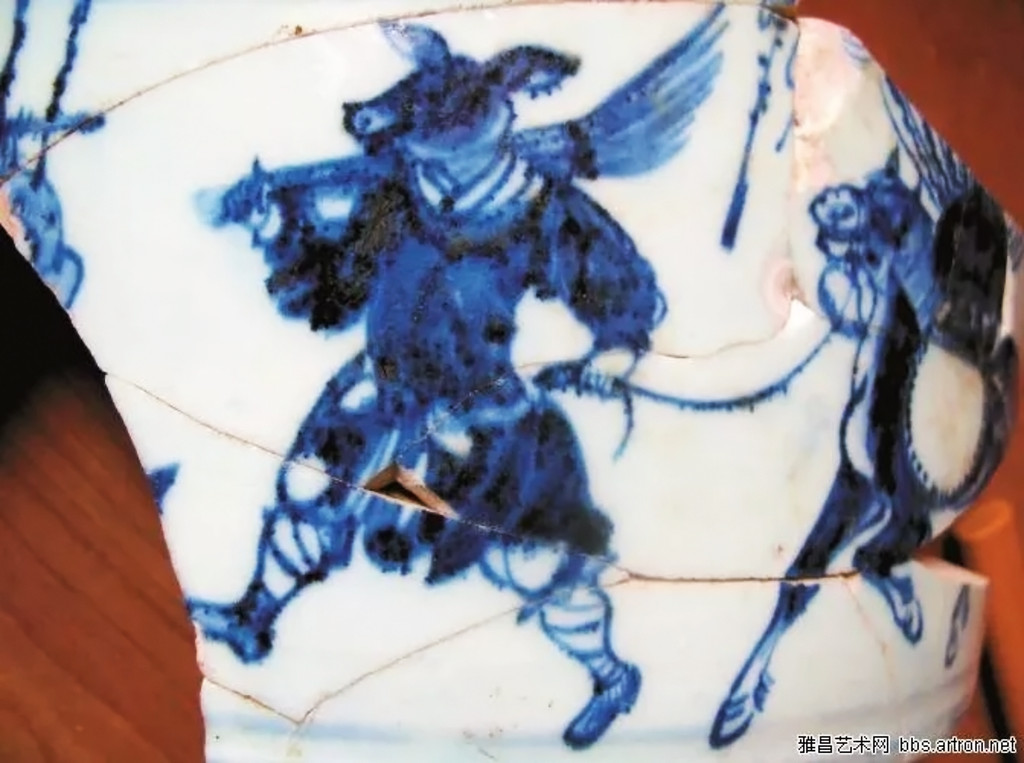
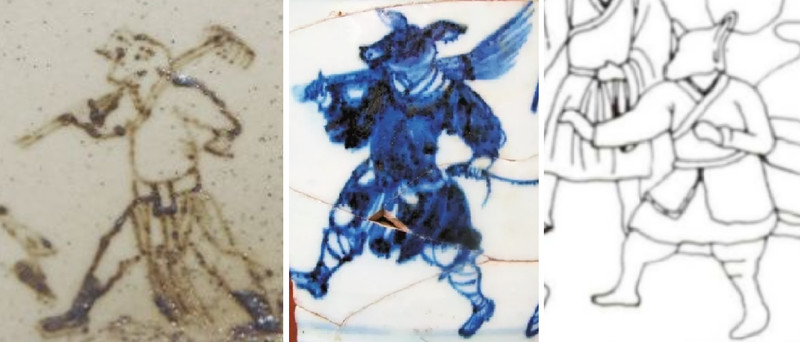
I suggested in a previous article that Zhu Bajie was first added to the Journey to the West story cycle during the 14th-century. This is because the character does not appear in the 13th-century version of the story, but he does appear in a stage play from the 15th-century. Thanks to the writing of Prof. Ben Brose, I learned of Pigsy’s three earliest known depictions from this time period. The first is a Yuan Dynasty Cizhou ware ceramic pillow showing all of the characters (fig. 1). The second is a fragmented Yuan-era blue and white incense burner (fig. 2). Older still are Zhu’s depictions appearing on the 14th-century Gyeongcheonsa pagoda (Kyŏngch’ŏnsa sipch’ŭng sŏkt’ap, 경천사십층석탑) from Korea (fig. 3). You read that right, Korea!

cizhou ware pillow and korean pagoda

Fig. 1 – The Cizhou ware pillow featuring Pigsy and the other pilgrims (larger version); Fig. 2 – A fragment of the blue and white incense burner showing Pigsy leading the White Dragon Horse (larger version). Fragments with the other characters can be found here; Fig. 3 – The Gyeongcheonsa pagoda is now housed inside of the National Museum of Korea (larger version). 

I. Why Korea?

The Pak t’ongsa ŏnhae (Ch: 朴通事諺解, Pu tongshi yanjie), a 17th-century Korean primer on colloquial Chinese comprised mostly of material traceable to the mid-15th-century, presents the Journey to the West story cycle as a highly popular tale among Koreans. This fact is revealed during a conversation between two Buddhist monks, one of which states: “The Xiyouji is lively. It is good reading when you are feeling gloomy” (Dudbridge, 1970, p. 180). The same monk then recounts an episode where Monkey competes with three animal spirits-cum-Daoist priests in a test of magic skill. This episode comprises chapters 44 to 46 in the final Ming version of the novel. [1] The popularity of the Chinese story cycle in Korea then explains why scenes from it appear on the pagoda.

II. Pagoda Background

The National Museum of Korea explains the 13.5 meter (44.3 ft) tower has a long and tumultuous history:

Made of marble, this ten-story stone pagoda was erected at Gyeongcheonsa Temple in Gaeseong in 1348, the fourth year of the reign of Goryeo’s King Chungmok. The first tier of the pagoda bears an inscription that records various details about the pagoda’s production, including the production date and the patrons. According to the inscription, the pagoda was sponsored by Goryeo people who were associated with China’s Yuan Dynasty. Notably, this stone pagoda was closely modeled after wooden architecture, and each story is expertly carved with Buddhist images. The platform is sculpted with scenes of Xiyouji (Journey to the West), as well as lions, dragons, and lotus flowers. The lower four stories are sculpted with scenes of Buddha’s Assembly, while the upper six stories are sculpted with images of Buddha with both hands clasped. The four sides of the platform and those of the lower three tiers are protruding, recalling the shape of Tibetan-Mongolian pagodas that were prevalent in the Yuan period. However, the upper seven tiers have a more standard rectangular shape that corresponds with the conventional form of stone pagodas. Notably, about 120 years after this pagoda was built, the Joseon royal court erected a stone pagoda with a similar material and shape at Wongaksa Temple in Gwangju. In 1907, this pagoda was illegally dismantled and smuggled to Japan by Tanaka Mitsuyaki, the Japanese Minister of the Imperial Household. However, thanks in part to the efforts of a British journalist named Ernest Thomas Bethel and an American journalist named Homer Hulbert, it was returned to Korea in 1918. The pagoda was partially restored in 1960, while it was being kept at Gyeongbokgung Palace, but after having been kept outside for so long, suffering the effects of weather and acid rain, it could not be properly preserved. Thus, in 1995, it was dismantled for a more extensive restoration project. Ten years later, it was reassembled inside the new building of the National Museum of Korea in Yongsan, being unveiled as part of the museum’s grand opening in 2005 (“Ten-story Stone Pagoda”, n.d.).

The pagoda’s political and architectural connections to Yuan China further explain why scenes from the story cycle grace the platform.

III. The Images

(Note: I have recently learned that the line drawings from Yegŭrin Kŏnchʻuksa Samuso (1993) are all but useless. See the 10-26-19 update below for more info.)

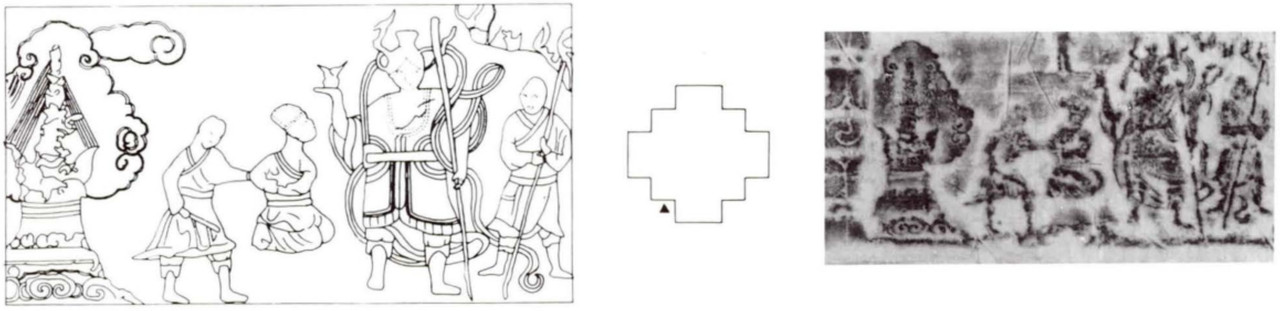
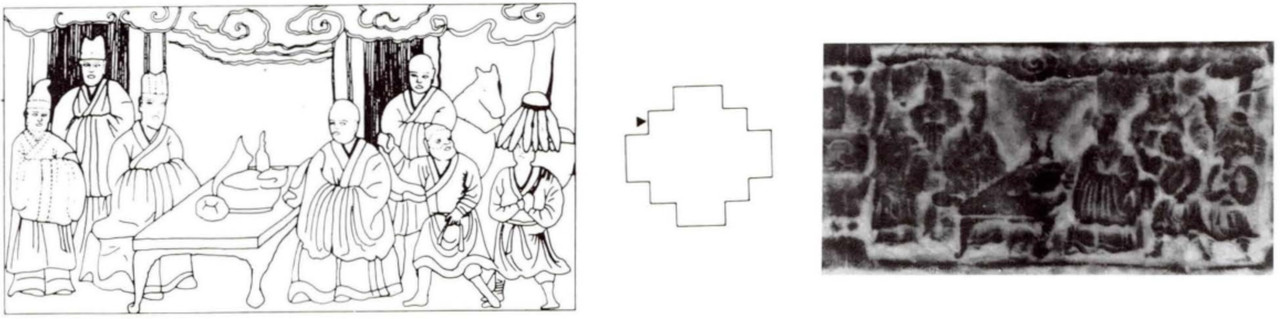
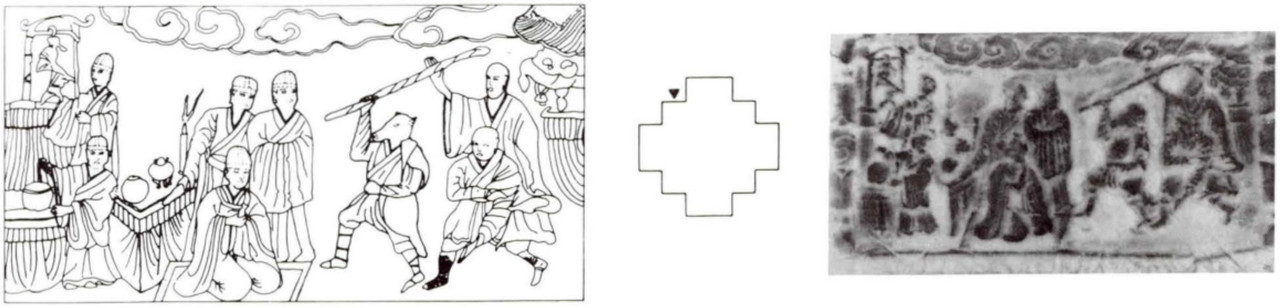
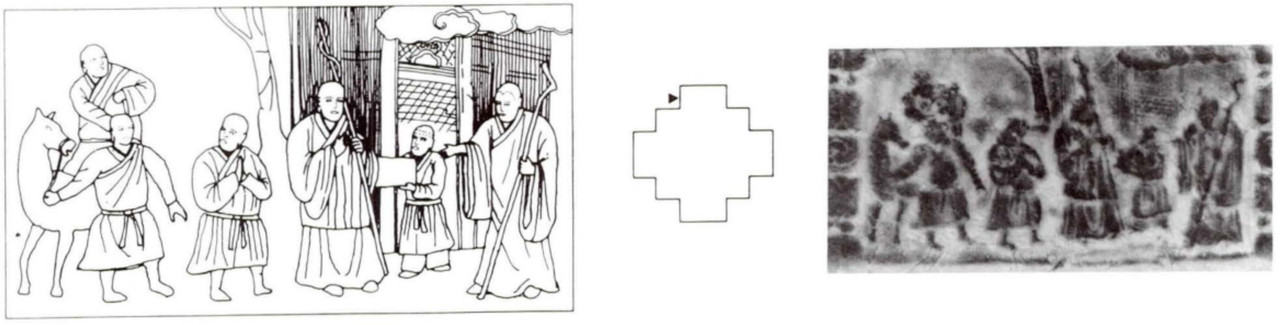
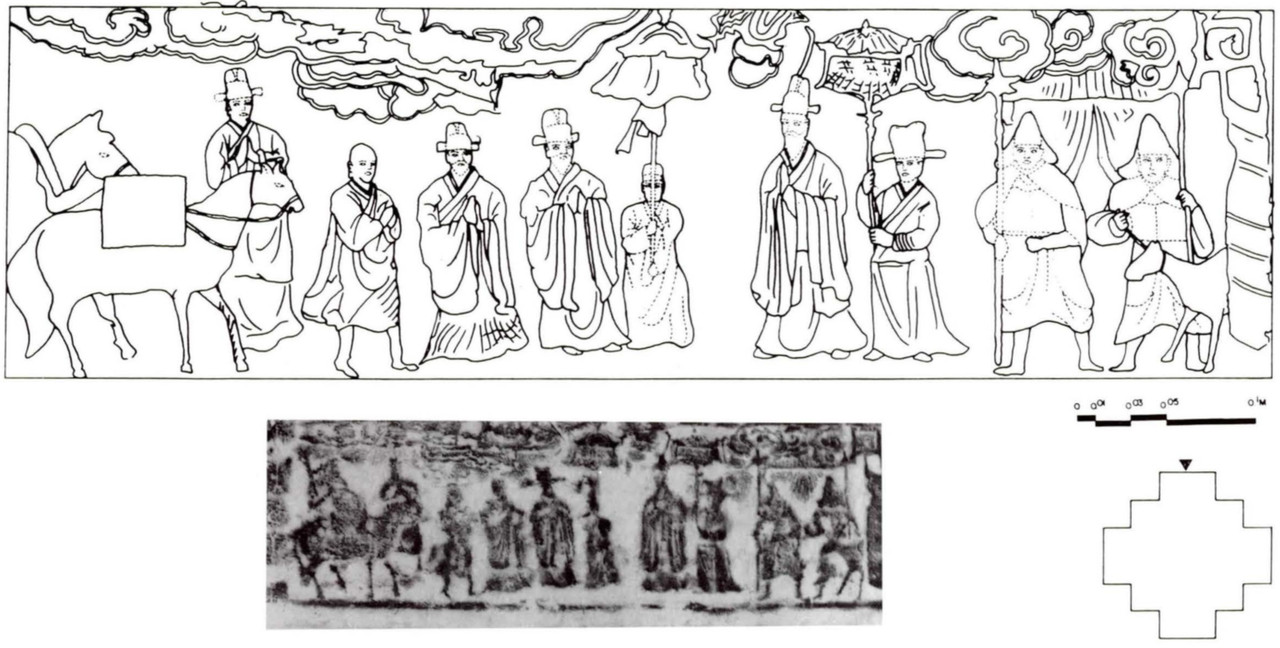
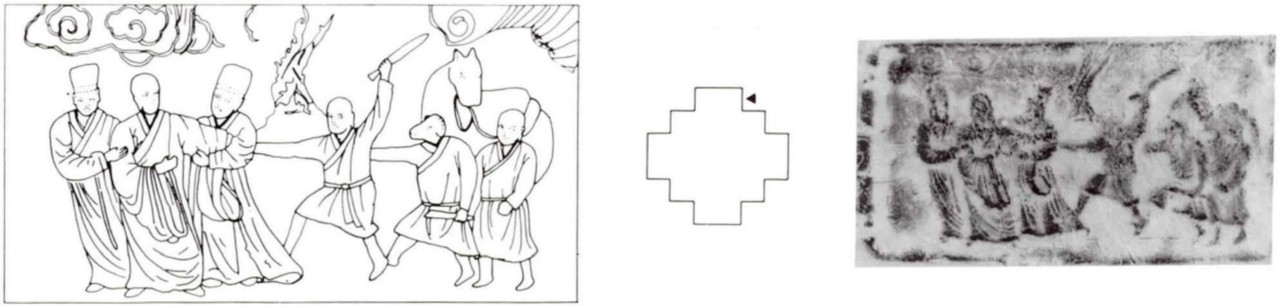
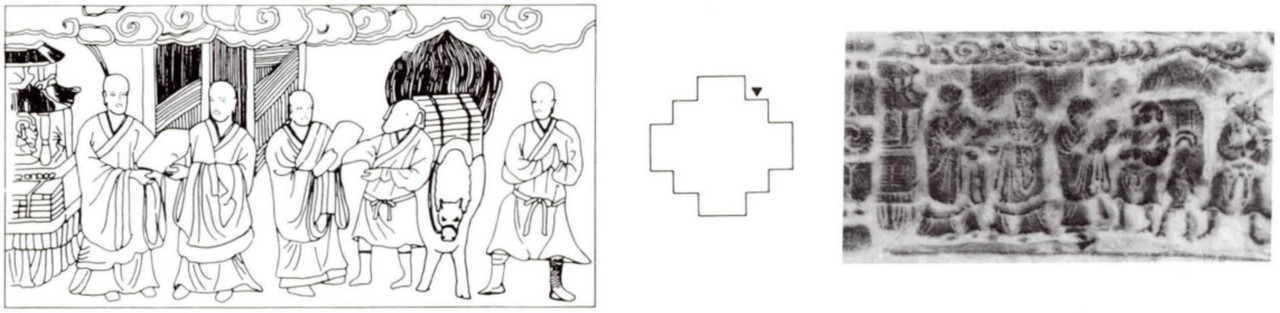
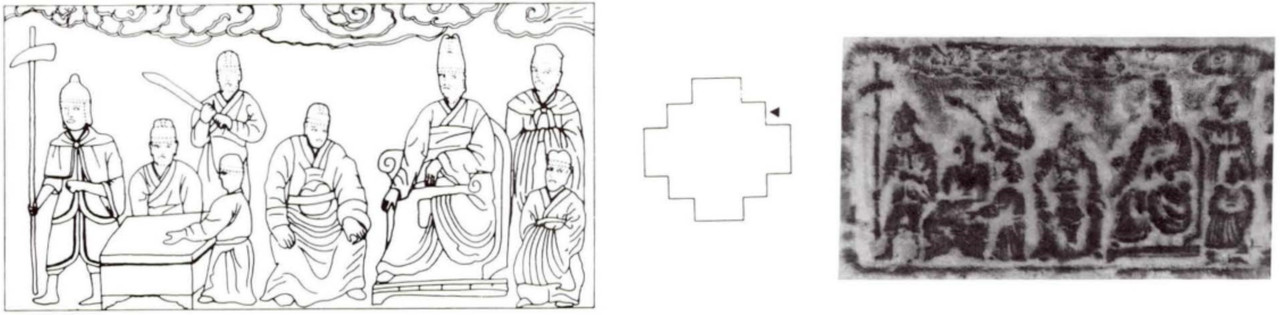
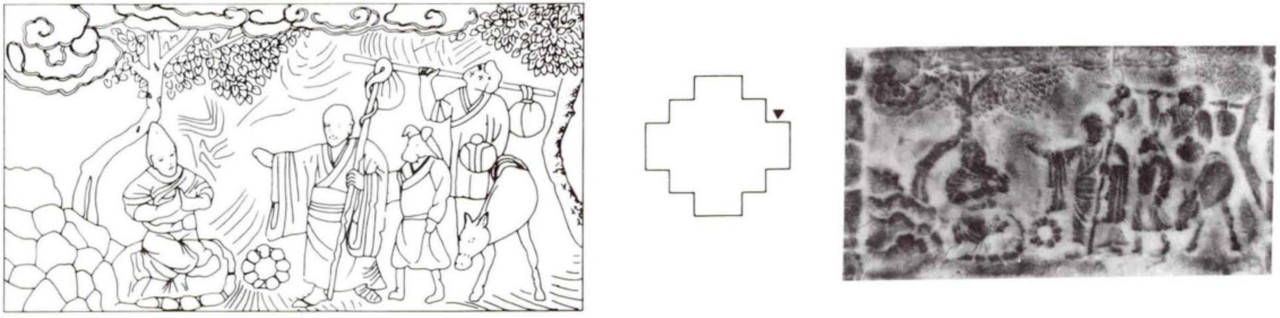
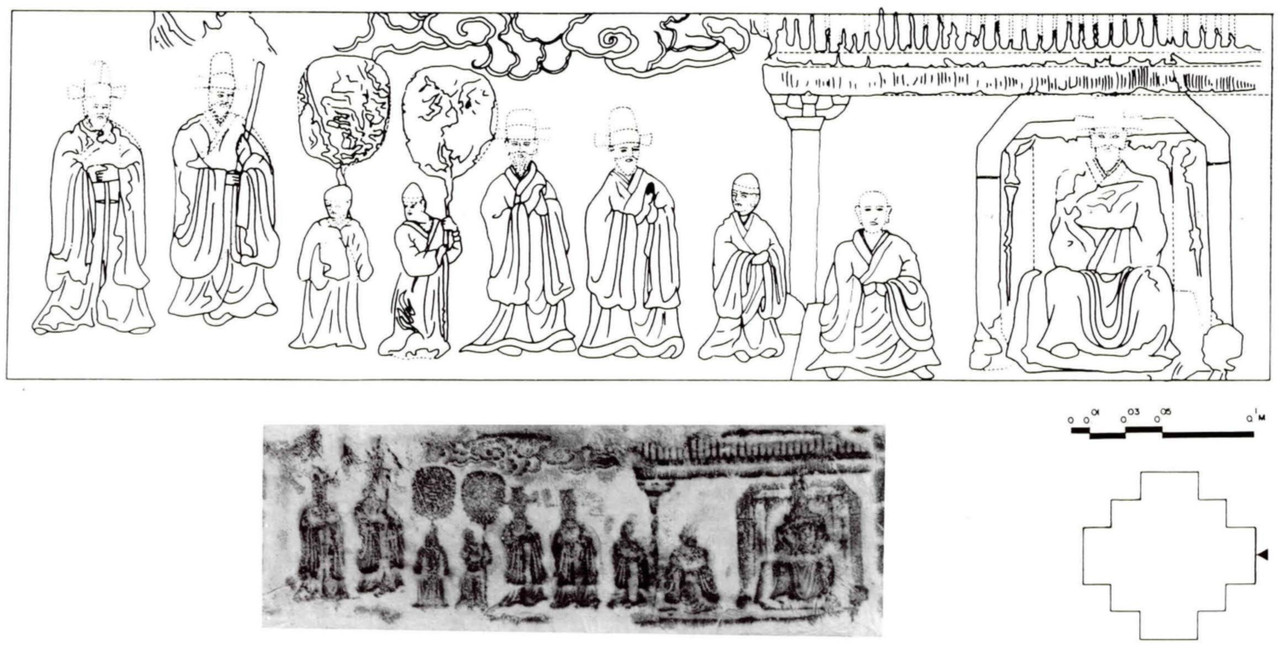
Twenty Journey to the West-related scenes appear on the second level of the pagoda’s multifaceted three-tiered base. The following line drawings, which are based on ink rubbings of the original carvings, come from an in-depth field report by the Yegŭrin Architectural Firm (Yegŭrin Kŏnchʻuksa Samuso, 1993). The images are presented below starting from the southernmost face (the six o’clock position) of the pagoda’s diamond-shaped cross section, proceeding in a clockwise fashion. Each is accompanied with commentary from the original report.[2] You will notice the report is generally vague as the exact meaning of the scenes are often unclear. I will therefore present my own commentary or questions below in the hopes of furthering the discussion.

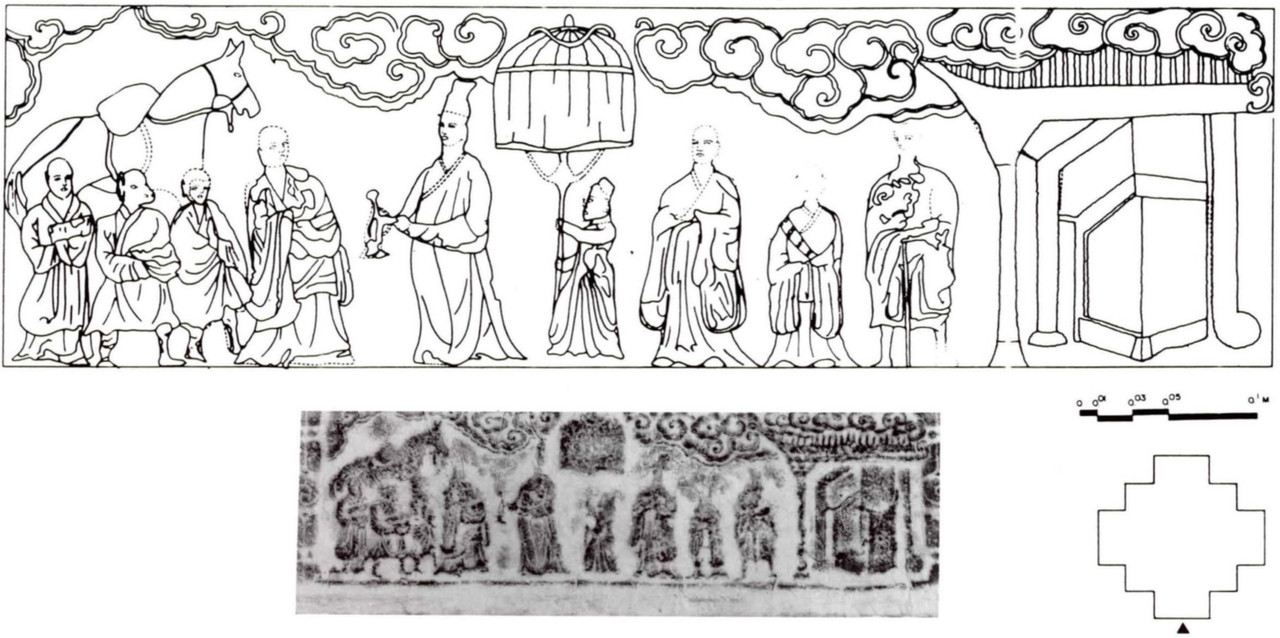
Number One: A royal send off

image 1 (small)

Fig. 5 – (larger version)

On the left, a figure of a Buddhist monk stands at the front, and behind him a horse and figures in the shape of a pig’s head, a monkey, and more are depicted. The figure of the Buddhist monk appears to be Monk Xuanzang, the figure of the monkey, Sun Wukong, the figure with the pig’s head, Zhu Bajie, and the last figure appears to be Sha Wujing. In other words, it is Monk Xuanzang’s travel companions. On the right, pictured symmetrically with Xuanzang’s travel party is the figure of a nobleman wearing a crown, and behind him stands a figure of a young boy holding an umbrella over his head and the figures of three noblemen.

And to the right of this a building structure is depicted. The nobleman who is at the very front wearing a crown seems to be a king and the building structure appears to represent a palace. Therefore, the content of the carving above seems to be the scene of a king sending off Monk Xuanzang’s travel party [fig. 5] (Yegŭrin Kŏnchʻuksa Samuso, 1993, p.123).

Could this scene be a telescopic version of the narrative, one in which the already assembled group is being sent off by Tang Taizong? After all, the authors suggest in panel number ten that the first ten images likely show the journey to India, while the latter half shows the return (Yegŭrin Kŏnchʻuksa Samuso, 1993, p. 124). Hierarchy in scale is employed to portray the king as the largest and therefore the most important, with Tripitaka being the second tallest/important, and the three disciples even shorter. Pigsy’s porcine head really stands out as Sandy is depicted as a human monk.

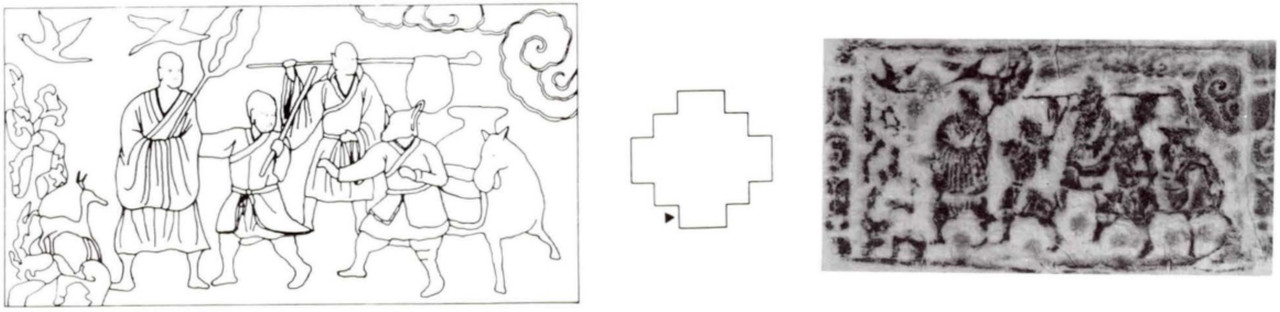
Number Two: On the Road

image 2 (small)

Fig. 6 – (larger version)

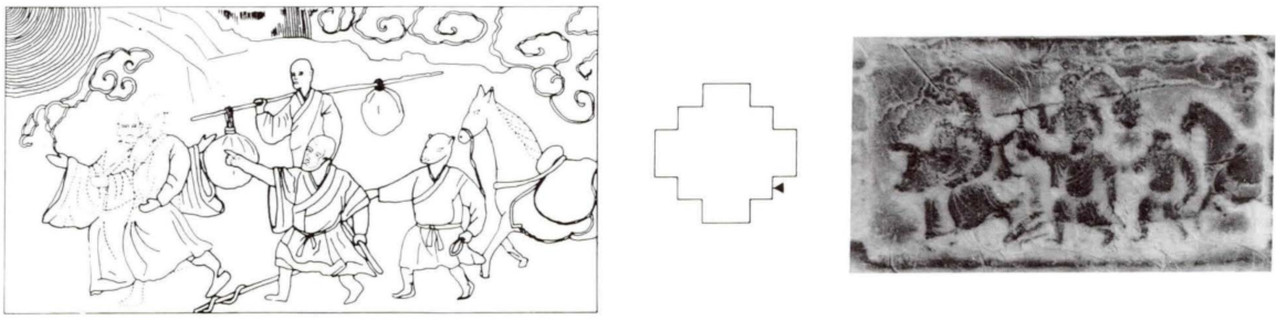
As above, the horse and the travel party of Monk Xuanzang, Monkey, Zhu Bajie and Sha Wujing have been portrayed. Here Sha Wujing is carrying a knapsack. On the left a road populated with animals and birds are depicted. Therefore, here it appears to show that Monk Xuanzang and his companions are traveling on a mountain road [fig. 6] (Yegŭrin Kŏnchʻuksa Samuso, 1993, p.123).

Take note of Pigsy’s upraised hands and wide stride. This motif appears several more times on other panels (fig. 12, 13, 17, and 24). The posture is quite similar to that from the aforementioned ceramic pillow and incense burner, which depict Pigsy carrying his rake and leading the horse. He lacks his signature weapon in these scenes, however (fig. 7). This might explain the strange posture of his right hand.

Korean Pagoda paper - Pigsy iconography comparison

Fig. 7 – Similar Pigsy iconography from the Cizhou ware pillow (left), the incense burner (center), and panel two (right), all corresponding with the Yuan Dynasty (larger version). See also figure 24 for a better match. 

Number Three: A prisoner?

image 3 (small)

Fig. 8 – (larger version)

On the left, the figure of a nobleman wearing a crown is kneeling. Behind him, a figure of a person holding a club appears to threaten the nobleman in front. Behind them something like an altar is depicted. Symmetrical with the figure of the kneeling nobleman, a figure looking like a government official from a prison in a provincial district stands holding a tool of torture.

Even if we don’t know what this is, it seems to show the oppression by those of other religions during the years of Xuanzang’s journey [fig. 8] (Yegŭrin Kŏnchʻuksa Samuso, 1993, p. 123).

My view on the scene differs from the authors. The “government official” appears to be a deity (noted by the flowing ribbons around the shoulders), possibly Guanyin since the upheld item reminds me of her holy vase. The figure to the right could be her disciple Moksha. Would this make the club-wielding figure Monkey and his prisoner a captured demon?

Number Four: A confrontation

image 4 (small)

Fig. 9 – (larger version)

On the left, a figure holding a club and Monk Xuanzang are depicted. On the right, Monkey, Zhu Bajie and Sha Wujing are portrayed. Here Monkey is posed as if he is defeating something with the stick, and behind the horse Sha Wujing is carrying the knapsack. Monk Xuanzang is shown lifting his left hand as if he is arguing something. This appears to show the scene of Xuanzang’s companions defeating some hindrance [fig. 9] (Yegŭrin Kŏnchʻuksa Samuso, 1993, p. 123).

I believe Tripitaka is begging Monkey not to slay or beat the person, as the monk steps in many times throughout the narrative to do this. Could this be the White Bone Demon under one of its many disguises from chapter 27?

Number 5: A king or deity

image 5 (small)

Fig. 10 – (larger version)

On the right side, a figure riding a lion is depicted. On the left side, three figures that seem like they are servants are depicted, and in the back a building structure is carved. It seems to depict some group of royals or noblemen on Xuanzang’s way to India [fig. 10] (Yegŭrin Kŏnchʻuksa Samuso, 1993, p. 123).

The group of servants appear to me to be our pilgrims, the long-faced figure possibly being Pigsy. The figure riding the lion could be Manjusri and his feline mount. Could this be a reference to him subduing the beast in chapter 77? The figure’s hands appear to be producing bolts of lightning. I’m not sure of the significance, if any.

Number Six: A foreign court

image 6 (small)

Fig. 11 – (larger version)

On the right, there is a figure of a Buddhist monk holding a monk’s staff who seems to be Monk Xuanzang, and a figure to his left seems to be a disguised Monkey. On the left, figures of noblemen from a palace are portrayed. This appears to depict a scene where Monk Xuanzang’s travel party is welcomed in some palace along the road [fig. 11] (Yegŭrin Kŏnchʻuksa Samuso, 1993, p. 124).

The strange figure in the middle is a complete mystery to me. While the figure is identified as Monkey, it’s impossible to tell for sure.

Number Seven: Fire Mountain

image 7 (small)

Fig. 12 – (larger version)

On the left side, a pattern of fire sparks is carved. And in front of that is Monkey, holding a fan trying to put out the fire. Behind him Monk Xuanzang is carrying out some action with lifted hands, and behind him Zhu Bajie is holding the horse reins while Sha Wujing as always is carrying the knapsack. This depicts the scene of Xuanzang’s travel party meeting and trying to eliminate difficulties along the road [fig. 12] (Yegŭrin Kŏnchʻuksa Samuso, 1993, p. 124).

This is the least ambiguous of the twenty scenes and my personal favorite. It depicts Monkey using the magic palm leaf fan to conquer the flames of Fire Mountain.

Pigsy’s upraised hand-wide stride motif appears once more.

Number Eight: Offerings

image 8 (small)

Fig. 13 – (larger version)

A table is placed in the middle, and on top of it lays objects that seem to be offerings. On the right Xuanzang’s travel party and on the left figures of noblemen or royals are depicted. Two of the figures from Xuanzang’s travel party are covering their heads with something, but this seems to be to conceal the sight of Monkey and Zhu Bajie’s animal heads. This appears to be the scene of Xuanzang’s travel party receiving offerings from a royal or gentry family along the way [fig. 13] (Yegŭrin Kŏnchʻuksa Samuso, 1993, p. 124).

The bearded figure between Tripitaka and the supposedly veiled figure is no doubt Pigsy, based on his upraised hands and wide stride. The elongated snout has been confused for a beard.

Also, could the veil actually be supplies on the horse’s back? Maybe the original rubbing is degraded in this area, making the head look as if it is under (instead of in front of) the object.

Number Nine: Another confrontation

image 9 (small)

Fig. 14 – (larger version)

On the left, a figure of a nobleman who is kneeling or bending his head is depicted. On the right, the figure of Zhu Bajie, who is trying to attack the nobleman, and the figure of Monk Xuanzang, who is trying to prevent this, are shown. It appears to be depicting some sort of misunderstanding that happened between the nobleman and Xuanzang’s attendant [fig. 14] (Yegŭrin Kŏnchʻuksa Samuso, 1993, p. 124).

Pigsy has not been portrayed with a weapon up to this point. It would make more sense if Monkey was wielding the staff. After all, figure 17 depicts Sun standing in a similar posture while wielding a club/staff. Perhaps the elongated face on this panel is just an artifact from the original rubbing?

Number Ten: A temple

image 10 (small)

Fig. 15 – (larger version)

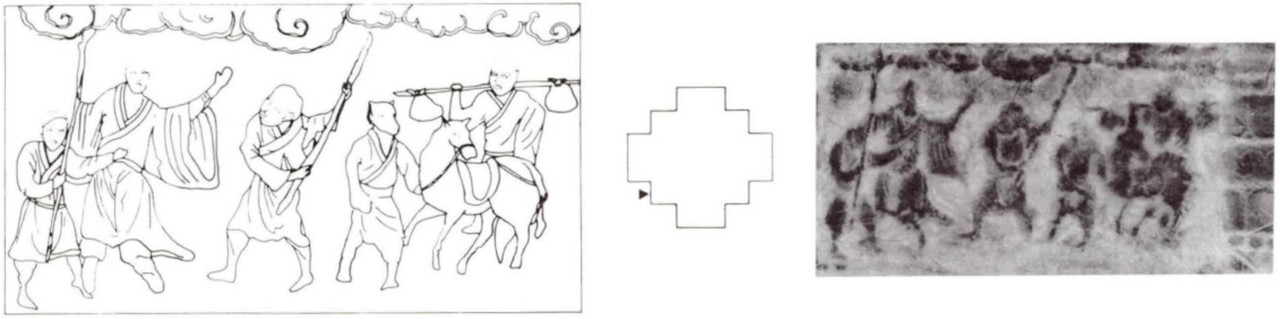
On the left side, Xuanzang bears a monk’s staff and his attendants are depicted together with the horse. And on the right side, symmetrical to this, are the figures of a Buddhist monk (holding a monk’s staff) and his attendant, who are about to receive Xuanzang’s travel party. This appears to depict the scene of Xuanzang’s travel party being welcomed by the monks of some temple along the way. Here Monkey and Zhu Bajie seem to have transformed into monks and are posing as Buddhist monks.

The above ten sides, beginning at due south and reaching due north, appear to be depicting the process of Xuanzang’s travel party going to India, while the ten sides starting at due north appears to depict their return journey [fig. 15] (Yegŭrin Kŏnchʻuksa Samuso, 1993, p. 124).

The scene shows the small monk on the right passing something to Tripitaka. Based on iconography from the following images (see, for example, fig. 18), this could be portraying the monks receiving the scriptures in India.

Number Eleven: Returning home

image 11 (small)

Fig. 16 – (larger version)

On the left side, two horses carrying something on their backs and Xuanzang’s travel party are shown. On the left are two figures of kings with umbrellas held over their heads by attendants. And to the left of them, a figure of an official who seems to be guarding the palace is visible. This appears to be depicting the scene where the kings are sending off Xuanzang’s travel party, who are setting off on their journey home after obtaining the scriptures [fig. 16] (Yegŭrin Kŏnchʻuksa Samuso, 1993, p. 124).

The “something” on the horses’ backs could be the scriptures.

Number Twelve: Saving their Master

image 12 (small)

Fig. 17 – (larger version)

On the left, the figure of a monk is caught by the figures of noblemen wearing crowns. On the left Monkey, Zhu Bajie, Sha Wujing and the horse are depicted. But Monkey and Zhu Bajie are assuming postures threatening to save the captured Monk Xuanzang. This seems to show the image of Monkey and company as guards, trying to save Xuanzang when he was being captured on their way back [fig. 17] (Yegŭrin Kŏnchʻuksa Samuso, 1993, p. 125).

Here the figure wielding the staff is designated Monkey, with Pigsy standing behind him. Again, this makes more sense than Zhu Bajie attacking (as portrayed in figure 14).

Number Thirteen: Passing on the dharma

image 13 (small)

Fig. 18 – (larger version)

On the right side, Xuanzang’s travel party and the horse carrying the scriptures are depicted. Here Xuanzang is shown handing over some of the Buddhist scriptures to the figure of a monk on the left. This appears to show Xuanzang’s travel party passing on Buddhism along the way on their return journey [fig. 18] (Yegŭrin Kŏnchʻuksa Samuso, 1993, p. 125).

Compare the shape of the Buddhist scriptures held by the monks with that in figure 15.

The panel draws on preexisting iconography regarding the sutras. The collection of holy writings are sometimes portrayed as a bundle of scrolls emitting an aura of holy light. See, for example, the 12th-century mural from Yulin Cave (Yulin ku, 榆林窟) number three in Gansu province, China (fig. 19).

Yulin Cave and Korean pagoda examples of sutras - small

 Fig. 19 – Detail of sutras from a 12th-century Yunlin cave mural (left) and the sutras from panel thirteen (right) (larger version). Both are shown stacked atop a horse. 

Number Fourteen: The emperor waits

image 14 (small)

Fig. 20 – (larger version)

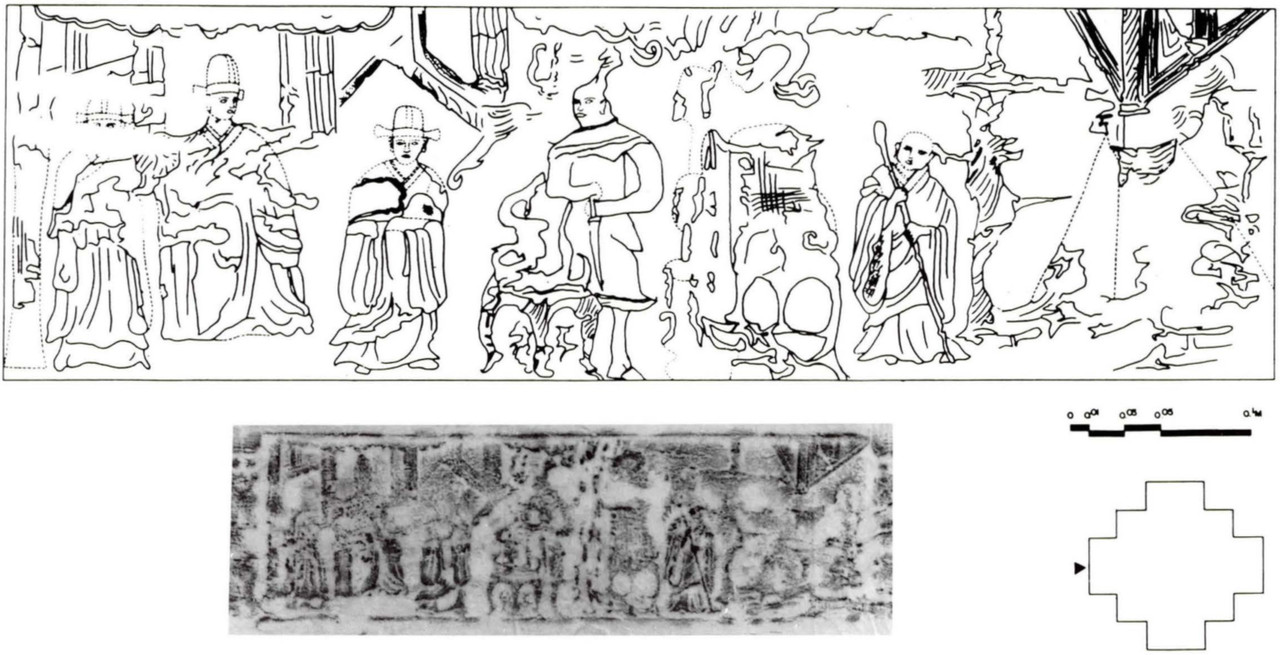
In the middle of the right side, the figure of a king seated on a throne is depicted. On both sides of him figures of scholar-officials attend to him or sit. On the left, figures of officials are shown attending to duties or sitting. It seems this is depicting the scene of China’s emperor waiting for Xuanzang’s travel party [fig. 20] (Yegŭrin Kŏnchʻuksa Samuso, 1993, p. 125).

Could the figures at the table actually be our heroes, with Xuanzang kneeling before a foreign king?

Number Fifteen: An ascetic or Monkey

image 15 (small)

Fig. 21 – (larger version)

On the left side, a figure of an ascetic is depicted sitting under a tree (Bodhi tree) meditating, and Xuanzang’s travel party and the horse are depicted. Here Xuanzang is assuming a posture, holding the monk’s staff and lifting his right hand trying to assert something. This seems to show the scene of Xuanzang’s travel party meeting an ascetic and passing on Buddhism on their journey home [fig. 21] (Yegŭrin Kŏnchʻuksa Samuso, 1993, p. 125).

Look closely and you will notice that Sun Wukong does not appear in the scene. Could the “ascetic” be Monkey kneeling before Xuanzang. If so, could this be a reference to the immortal and his master mending their relationship in chapter 58 after the trickery of the Six-Eared Macaque forced them apart?

Number Sixteen: Imperial court

image 1 (small)

Fig. 22 – (larger version)

On the right, a building is depicted and inside it a figure of a king sitting on a throne, and in front of him, a figure of a kneeling monk (Xuanzang) are portrayed. Outside the building, the figure of a young monk that seems to be Xuanzang’s attendant is depicted. Behind him, figures that seem to be civil and military officials are depicted. This seems to show the scene of Xuanzang meeting some king along his way [fig. 22](Yegŭrin Kŏnchʻuksa Samuso, 1993, p. 125).

Could the “attendant” be Monkey?

Number Seventeen: Attacking a pagoda

image 2 (small)

Fig. 23 – (larger version)

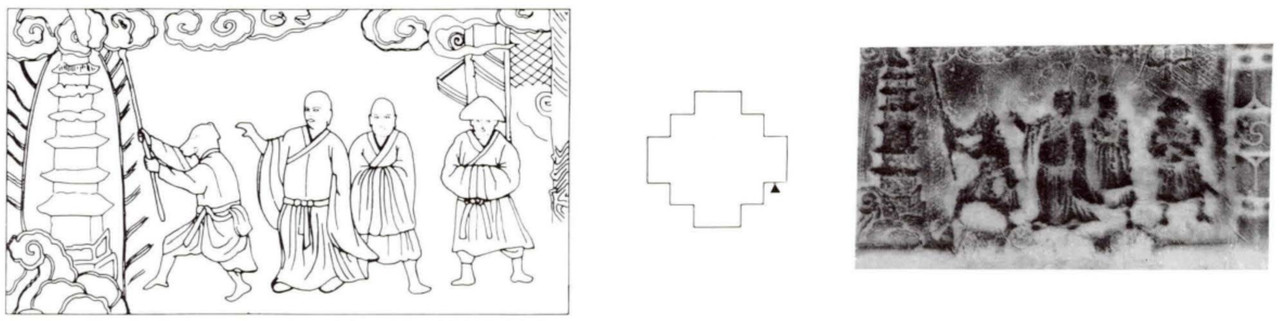
On the left, a pagoda is depicted and in front of it, Zhu Bajie is carrying a club, assuming a posture trying to bring the pagoda down. Behind him Monk Xuanzang is lifting his right hand and insisting something, as if trying to stop him. This seems to show the soothing of Zhu Bajie’s aggressive, insulting actions towards Buddhism [fig. 23] (Yegŭrin Kŏnchʻuksa Samuso, 1993, p. 125).

Like figure 14, it would make more sense if Monkey is the one wielding the staff. Could this be a reference to chapter 62 when Sun captures two fish spirits found on a pagoda’s topmost floor?

Number Eighteen: Nearing home

image 3 (small)

Fig. 24 – (larger version)

In the upper left part, the sun symbolizing light is depicted. Headed in that direction Monk Xuanzang is taking the lead and behind him Monkey, Zhu Bajie and Sha Wujing are shown hurrying their steps while leading the horse. Here Monk Xuanzang seems to be urging Monkey, Zhu Bajie and Sha Wujing, rushing their journey home [fig. 24] (Yegŭrin Kŏnchʻuksa Samuso, 1993, p. 125).

This includes Pigsy’s aforementioned motif. It is a better match for the ceramic pillow and incense burner examples from figure 19.

Number Nineteen: A deity appears

image 4 (small)

Fig. 25 – (larger version)

On the right, a figure of a celestial being is depicted and Xuanzang’s travel party is facing it symmetrically. This seems to show the fact that Xuanzang’s travel party received the blessing of celestial guardian deities [fig. 25] (Yegŭrin Kŏnchʻuksa Samuso, 1993, p. 126).

I’m confused as to why the two characters on the far right are stacked one on the other. Per the original ink rubbing, could “they” actually be a singular figure, possibly someone of great importance given their size? Could the “deity” actually be Xuanzang being elevated in spiritual rank like in chapter 100?

Number Twenty: Teaching the dharma

image 5 (small)

Fig. 26 – (larger version)

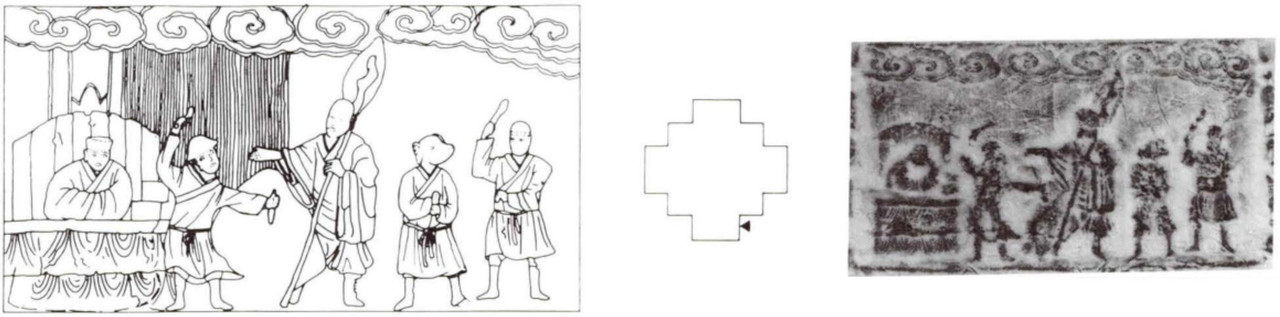
On the left, something that seems to be a Buddhist altar is depicted. In front of it, Xuanzang is placed in the middle shown holding the monk’s staff, and Monkey, Zhu Bajie and Sha Wujing are each shown performing different actions. Xuanzang is lifting his right hand, posed arguing something and you could say he is trying to educate his attendants, Monkey etc., in Buddhism [fig. 26] (Yegŭrin Kŏnchʻuksa Samuso, 1993, p. 126).

While the line drawing looks more like a figure at a desk, it very well could be an altar with a Buddha statue. Could this depict the lives of our heroes after entering paradise?

IV. Other Pagodas

This is not the first time characters from the story cycle have appeared on a pagoda. Even older examples appear on the 13th-century tower of the Kaiyuan Temple from Quanzhou, Fujian province, China. In this previous article I described how the pagoda is covered with eighty life-sized carvings of Buddhas, bodhisattvas, guardian deities, Buddhist saints, and eminent monks. Of note is a muscular, sword-wielding, monkey-headed warrior that many consider to be an early example of Sun Wukong. Another is an armored, spear-wielding warrior believed to be the dragon prince who becomes the white dragon horse. Both occupy the same face of the eight-sided structure (Dudbridge, 1970, pp. 47-48 and 49-51).

V. Conclusion

Zhu Bajie’s oldest known depictions come from a time coinciding with the late Yuan Dynasty, examples including a ceramic pillow and a fragmented incense burner from China and carvings on a pagoda from Korea. Built in 1348 by Goryeo representatives with ties to the Yuan court, the ten-story Gyeongcheonsa pagoda includes twenty Journey to the West-related scenes around the second level of the structure’s multifaceted three-tiered base. Many of the scenes are vague or focus more on kings and nobles in place of Tripitaka’s tribulations or instances of supernatural battles. One has to consider the story cycle was still solidifying at this point, so it’s possible some of the scenes depict episodes that did not make it into the final Ming version of the novel. But given the amount of royalty, is it possible the donors/planners were trying to ingratiate themselves with people of higher social rank? Or were they just trying to illustrate the great many countries visited by the pilgrims (each one ruled by a king) within the limited space provided?

The panels involving Pigsy for the most part use a consistent iconography borrowed from China. The aforementioned Yuan examples portray Pigsy leading the horse with one hand and with the other holding his signature rake, which rests on his shoulder, all while taking a large step forward. The pagoda panels, however, do not portray the rake, leaving our portly hero with his arm strangely floating in the air. Instead of a rake, some panels appear to show him wielding a staff. But the figure might actually be Sun Wukong, the elongated face just being an artifact from the original ink rubbings.

The fact that characters from the Journey to the West story cycle appear on Chinese and Korean pagodas alongside Buddhist deities proves just how intertwined the story is with the religion. The tale essentially symbolizes the quest for enlightenment, the ultimate goal of Buddhism. Therefore, such pictorial representations, especially the narrative-type scenes from Gyeongcheonsa, were probably meant to both entertain and spread the faith.


Update: 10-26-19

I have recently learned that the line drawings from Yegŭrin Kŏnchʻuksa Samuso (1993) are all but useless. A prime example is number nineteen. As a reminder, here is the drawing:

Korean Pagoda scene with Red Boy - Line drawing

(larger version)

I originally suggested that the being on the cloud was Xuanzang being elevated in spiritual rank. I didn’t comment on the strange, flower-like cloud to the right of that figure because of its abstract shape.

Now here is a photo of the actual carving. It has been enhanced slightly for clarity.

Korean Pagoda scene with Red Boy - small

(larger version)

You’ll noticed that the cloud really is a flower with a defined bulb, stem, and leaves. There also appears to be a figure sitting on the flower, one who is surrounded by what looks to be spikes or swords. Here’s a closer look with a crude line drawing by the author.

Korean Pagoda scene with Red Boy - Close up of flower with new line drawing - small

(larger version)

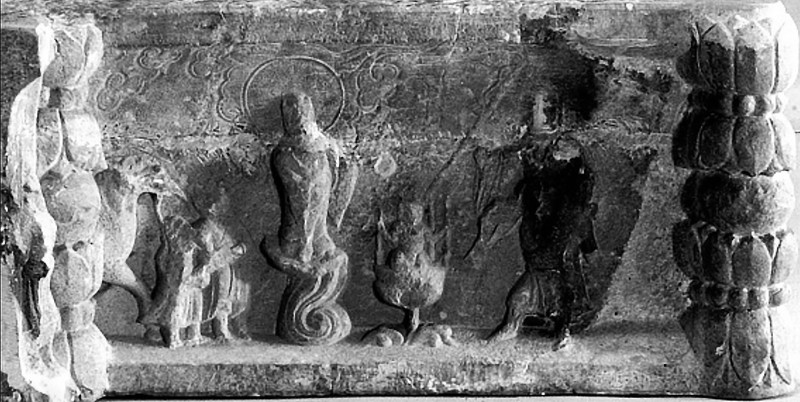
Wall (2019) notes the figure on the flower is Red Boy and the figure on the cloud is Guanyin (pp. 2129-2130), making this a depiction of the former’s defeat at the end of what would be chapter 42 of the Ming Journey to the West:

After she received [treasure swords borrowed from heaven], the Bodhisattva [Guanyin] threw them into the air as she recited a spell: the swords were transformed into a thousand-leaf lotus platform. Leaping up, the Bodhisattva sat solemnly in the middle.

[…]

[Sun Wukong feigns defeat and tricks Red Boy into chasing him to Guayin’s domain] When the monster spirit suddenly discovered that Pilgrim was gone, he walked up to the Bodhisattva with bulging eyes and said to her, “Are you the reinforcement Pilgrim Sun brought here?” The Bodhisattva did not reply. Rolling the lance in his hands, the monster king bellowed, “Hey! Are you the reinforcement Pilgrim Sun brought here?” Still the Bodhisattva did not reply. The monster-spirit lifted his lance and jabbed at the heart of the Bodhisattva, who at once changed herself into a beam of golden light and rose into the air. Pilgrim followed her on her way up and said to her, “Bodhisattva, you are trying to take advantage of me! The monster-spirit asked you several times. How could you pretend to be deaf and dumb and not make any noise at all? One blow of his lance, in fact, chased you away, and you have even left behind your lotus platform.”

“Don’t talk,” said the Bodhisattva, “let’s see what he will do.” At this time, Pilgrim and Mokṣa both stood in the air shoulder to shoulder and stared down; they found the monster-spirit laughing scornfully and saying to himself, “Brazen ape, you’re mistaken about me! What sort of person do you think that I, Holy Child, happen to be? For several times you could not prevail against me, and then you had to go and fetch some namby-pamby Bodhisattva. One blow of my lance now has made her vanish completely. Moreover, she has even left the treasure lotus platform behind. Well, let me get up there and take a seat.” Dear monster-spirit. He imitated the Bodhisattva by sitting in the middle of the platform with hands and legs folded. When he saw this, Pilgrim said, “Fine! Fine! Fine! This lotus platform has been given to someone else!”

“Wukong,” said the Bodhisattva, “what are you mumbling again?”

“Mumbling what? Mumbling what?” replied Pilgrim. “I’m saying that the lotus platform has been given to someone else. Look! It’s underneath his thighs. You think he’s going to return it to you?”

“I wanted him to sit there,” said the Bodhisattva.

“Well, he’s smaller than you,” said Pilgrim, “and it seems that the seat fits him even better than it fits you.”

“Stop talking,” said the Bodhisattva, “and watch the dharma power.”

She pointed the willow twig downward and cried, “Withdraw!” All at once, flowers and leaves vanished from the lotus platform and the auspicious luminosity dispersed entirely. The monster king, you see, was sitting actually on the points of those swords. The Bodhisattva then gave this command to Mokṣa:

“Use your demon-routing cudgel and strike back and forth at the sword handles.”

Dropping from the clouds, Mokṣa wielded his cudgel as if he were demolishing a wall: he struck at the handles hundreds of times. As for that monster-spirit,

Both his legs were pierced till the points stuck out;
Blood spouted in pools as flesh and skin were torn.

Marvelous monster! Look at him! Gritting his teeth to bear the pain, he abandoned the lance so that he could use both hands to try to pull the swords out from his body (Wu & Yu, 2012, vol. 2, pp. 246 and 249-250).

Could the figures, one on top of the other’s shoulders, be an inventive way of showing Monkey and Guanyin’s disciple Moksha working together to subdue Red Boy?

This carving shows the Red Boy episode was known in Korea during the 14th-century, demonstrating that it predates the final Ming novel by centuries. The tale obviously would have taken time to form, become established in the accepted story cycle, and travel north, suggesting it may date to the early part of the corresponding Yuan-period when the Pagoda was raised in Korea, or possibly even before.

I hope to locate pictures of the other carvings to make this article more accurate.

Notes:

1) See Dudbridge, 1970, pp. 60-74 for more information. The tale itself is translated in appendix B of the same work. See pages 179-188.

2) I am indebted to Sini Henningsen, BA (sinihenningsen@gmail.com) for translating the cited Korean material.

Sources:

Brose, B. (2018). The pig and the prostitute: The cult of Zhu Bajie in modern Taiwan. Journal of Chinese Religions, 46 (2), pp. 167-196, DOI:
10.1080/0737769X.2018.1507091

Dudbridge, G. (1970). The Hsi-yu chi: A study of antecedents to the sixteenth-century Chinese novel. Cambridge: Cambridge Univ. Press.

Ten-story Stone Pagoda from Gyeongcheonsa Temple. (n.d.). Retrieved January 23, 2019, from https://www.museum.go.kr/site/eng/relic/masterpiece/view?relicMpId=11

Wall, B. (2019). Dynamic texts as hotbeds for transmedia storytelling: A case study of the story universe of the Journey to the West. International Journal of Communication 13, 2116-2142. Retrieved from https://ijoc.org/index.php/ijoc/article/view/10006/2648

Yegŭrin Kŏnchʻuksa Samuso 예그린 건축사사무소. (1993). Wŏn′gaksaji sipch′ŭng sŏkt′ap: silch′ŭk chosa pogosŏ 圓覺寺址十層石塔: 實測調查報告書. Seoul: Munhwajae Kwalliguk.

The Great Sage Purple Cloud Temple of Yilan, Taiwan: A Photo Essay

I recently visited another Great Sage temple, this time the Wujian Purple Cloud Temple (Wujian Ziyu si, 五間紫雲寺) of Yilan (宜蘭), Taiwan. The temple was bustling with people during the Chinese New Year celebrations, so I didn’t have time to ask many questions. This entry will serve more as a picture essay until I return to conduct proper research.

1. History

Legend has it that around 1899 a man found a monkey-shaped stone and enshrined it in a thatched shed. This was eventually converted to a temple a few years later. It was destroyed by a typhoon in 1960 but subsequently rebuilt. The temple appears to recognize a trinity, with countless monkey soldiers beneath them. The Great Sage has two aspects: the “Martial Great Sage” (Wu Dasheng, 武大聖) (standing statues), who exorcises evil, and the “Civil Great Sage” (Wen Dasheng, 文大聖) (seated statues), who insures the safety of people and animals.

2. How to get there

(Note: Always consult google if you are directionally challenged like myself)

Address: No. 449, Section 3, Dafu Road, Zhuangwei Township, Yilan County, Taiwan, 263

I took bus #1571 (google calls it #1571A) from gate 15 of the Taiwan City Hall Bus Station. This heads towards the Yilan Bus Station. (If you plan to take this route, please note that buses headed to different areas of Yilan will board from this gate. So pay very close attention to the calls of the bus station attendant. For example, they called “Jiaoxi” (礁溪) (bus #1572), a small township in Yilan, and those waiting for another destination had to stand off to the side while those from different sections of the line made their way to the front. If you aren’t careful, you might end up on the wrong bus.) My destination was the first stop, the Zhuangwei (壯圍) bus stop, a small shelter by an overpass. My short walk to the temple took me passed rows of flooded rice fields and small patches of buildings.

(Click images for larger versions)

1

Gate 15 at the Taiwan City Hall Bus Station.

2

The Zhuangwei bus stop shelter (as seen from the opposite outgoing bus stop).

1a - Map to Purple Cloud Temple

The route map from the Zhuangwei bus stop to the temple.

4
5

Random rice fields along Gonglao Road (see map).

6

A panorama of a rice field next to Lane 423, Sect. 3, Dafu Road (see map). 

3. The Outside

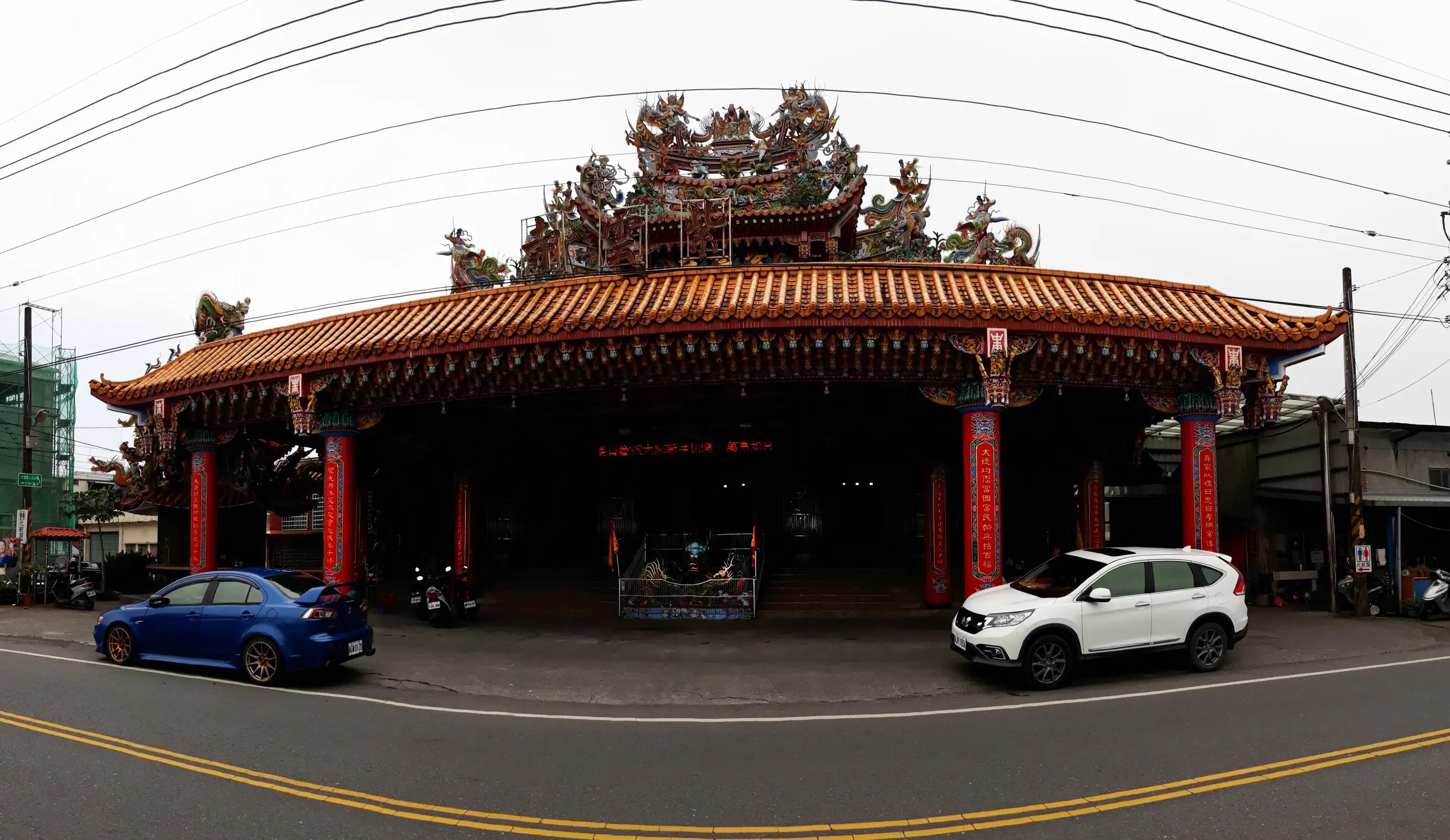
The temple is located on the side of a busy road. It appears almost out of nowhere since the face of the holy structure is in line with the buildings on either side. The first thing that caught my eye was the highly ornate roof of the furnace covered in mythical creatures, divine heroes, and gods, features typical of South Chinese and Taiwanese temple architecture. Each face of the hexagonal body was covered with beautiful carvings on black marble, two of which included the pilgrims from Journey to the West.

7

The furnace visible on the left side of the temple (as seen from the road).

8
9
10
11

A marble carving of Guanyin, the White Dragon Horse, Monkey, and Tripitaka.

12

A detail of Monkey.

13

Monkey, Sha Wujing, Tripitaka on the White Dragon Horse, and Zhu Bajie.

14

A detail of the group.

The front of the temple houses an ornate statue of three brightly colored dragons enclosed in a fence. Looking up, I noticed beautiful hand-painted dragons and Qilin on the ceiling, along with paintings of events from Chinese mythology and Journey to the West on the cross beams. Walking towards one of the five entrances, I noticed the facade was covered in highly detailed stone carvings, some depicting events from the novel.

15

The front of the Purple Cloud Temple.

17
18

The front of the temple. Three of the five entrances are visible behind the dragons.

19

A detail of the three dragon statues.

20

Five hand-painted dragons on the ceiling. The Eight Immortals grace the crossbeam below. 

21

A pair of Qilin on the ceiling. The cross beam below portrays an event from Prince Nezha‘s life.

22

Zhu Bajie protecting his master from the ogre that will become Sha Wujing.

23

Monkey escaping from Laozi’s furnace.

24 - BW

A stone carving on the facade showing Monkey (top right), Zhu bajie (top center right), and Sha Wujing (center left) battling a monster (top left). The image has been enhanced for clarity.

25 - BW

Monkey (center) battling the heavenly army. Enhanced for clarity. 

26 - BW

Monkey (center) leaping from Laozi’s furnace. Enhanced for clarity. Apologies for the blur. 

28 - BW

A detail of Monkey leaping.

29 - BW

The Great Sage (top center) and his monkey army battling heaven. Enhanced for clarity. These are just a few of the many carvings covering the temple facade. 

4. The Inside

The interior hall is wide yet shallow in depth and split between three altars, Folk religion to the right, the Great Sage in the Center, and Daoist to the left. I must admit in my zeal to photograph anything Monkey-related, I completely forgot to take pictures of the other two sections. This online image shows the folk section includes Mazu, Budai, and other deities. This image shows the Daoist section includes the Jade emperor, the Earth god, and others. Surprisingly, the incense burner in front of the main entrance was not marked with the name of the Great Sage (unlike what I’ve seen at other such temples) but that of the Jade Emperor, 玉皇上帝 (Yuhuang shangdi).

30

The main hall.

20190206_123034

The incense burner bearing the name of the Jade Emperor (visible from the hall looking out the main door).

Upon entering the right side of the main hall, the first thing that caught my eye was a large wooden sculpture of a tree-bound monkey holding onto a branch with one hand and a pair of peaches in the other. Immediately behind him was a stone carving of a vague monkey with two children. (I’m not sure of the ritual importance of either statue. I’ll report on this later. However, I will say the stone statue recalls Sun Wukong’s origins as a stone monkey.) Next to both statues is one of two cylindrical towers, one positioned on each end of the hall. Each is topped by a Great Sage statue and the towers themselves are comprised of hundreds of small compartments, each filled with a small Great Sage figure. These represent a donor who has given money to the temple.

31

The wooden monkey statue.

32

A detail of the monkey holding peaches.

33

The stone monkey with children.

34

The tower of donor Great Sages.

35

The Great Sage topping each tower. He holds a fly whisk in one hand and a peach of immortality in the other.

36

The many compartments.

37

A mini Great Sage donor figure. He sits on a throne with his staff held over head in one hand and a calabash gourd held to his front in the other. 

4.1. The Great Sage Altar

The central offering table to the Great Sage was covered in all sorts of fruits, candies, and flowers. Also included were an incense burner, offerings of wine, and a pair of crescent moon-shaped wooden blocks. These blocks are used in tandem with fortune sticks and oracles revealed on slips of paper, all of which are housed in a metal cylinder to the left of the table (see section three of this article on how these items are used).

39
38

The table laden with offerings. Take note of the young woman praying to the Great Sage. She told me that she was from Vietnam and that Monkey was not a common deity there.

40

The incense burner (back center), tea offerings (three cups visible in the center) and wooden blocks (front right).

41

The metal cylinder housing the fortune sticks (top), with the corresponding oracles located in each of the surrounding drawers.

Like in other parts of Taiwan and Singapore, this temple appears to recognize a plethora of Great Sages, from a holy trinity to an army of soldier monkeys. (I don’t yet know their individual names. I will report on this later.) All of the Great Sage figures are portrayed with golden armor, red-painted humanoid faces, golden fillets, and long, dark hair. The headband and long hair are no doubt influenced by depictions of Military Monks (Wuseng, 武僧) from Chinese opera (Bonds, 2008, pp. 177-178 and 328). Red face paint is also associated with such characters (Bonds, 2008, p. 211). While the red paint of the statues references the red faces of macaque monkeys, it definitely plays into the military monk personna. Portraying Monkey as such defines him as a divine warrior and a guardian deity.

Military Monk - Beijing Opera (Bonds, 2008)

A military monk from a modern Beijing Opera production (Bonds, 2008, p. 178).

I was pleasantly surprised to see statues of Zhu Bajie appear among the Great Sage’s army. It’s quite appropriate given this is the year of the pig according to the Chinese zodiac. Also included were statues of Ksitigarbha and Nezha.

42

The three main Great Sages visible in front of the ornate dragon statue. Note the long hair.

43

Statues of Zhu Bajie among Monkey’s soldiers.

44

More soldier monkeys. Take note of the Ksitigarbha (front right).

45

Nezha figures mixed in with the monkey soldiers (left).

46

This soldier monkey holds a calabash gourd at the ready.

47

More Nezha figures among the soldiers (right).

I have more pictures of the interior but I’ll leave those for a later article. Lastly, I want to share one of the temple flags stationed opposite the main building.

z

(Left) “Great Sage Equaling Heaven”. (Right) “(Yi)lan Wujian Purple Cloud Temple”.

Sources:

Bonds, A. B. (2008). Beijing Opera Costumes: The Visual Communication of Character and Culture. Honolulu: University of Hawai’i Press.

Sun Wukong’s Strength-Bestowing Ritual

Last updated: 05-15-2025

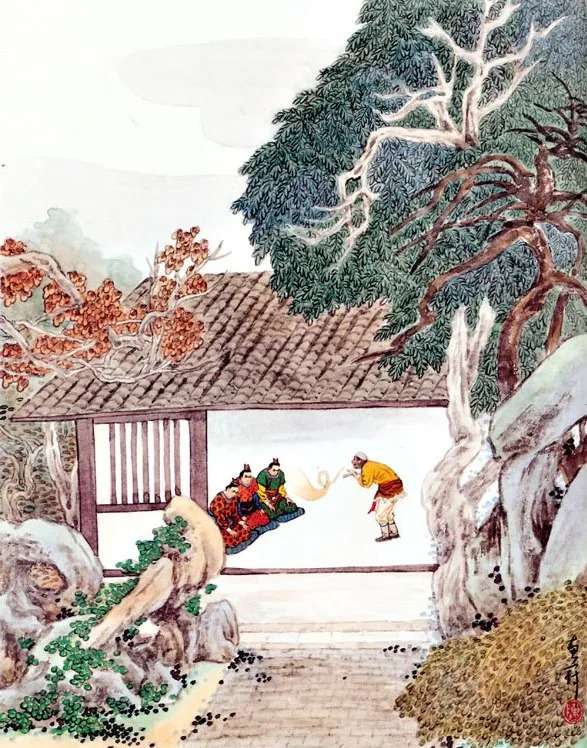
In chapter 88 of Journey to the West (Xiyouji, 西遊記, 1592), the pilgrims arrive in the lower Indian prefecture of Jade Flower District (Yuhua xian, 玉華縣), which strikes Tripitaka as a spitting image of the Tang Chinese capital of Chang’an. There, the disciples’ monstrous appearance rouses the local ruler’s three sons to action against what they think are demons come to harm their father. However, they soon learn Monkey, Pigsy, and Sandy are celestial warriors possessing magical versions of their mere earthly arms (two staves and a battle rake). The three princes are later accepted as disciples, the oldest wanting to learn Monkey’s techniques and the second and third oldest wanting to learn from Pigsy and Sandy in turn. But when they fail to lift the monks’ celestial weapons, Monkey performs an arcane ritual in which he bestows each prince with superhuman strength:

In a secluded room behind the Gauze-Drying Pavilion, Pilgrim traced out on the ground a diagram of the Big Dipper. Then he asked the three princes to prostrate themselves inside the diagram and, with eyes closed, exercise the utmost concentration. Behind them he himself recited in silence the true sayings of realized immortality and intoned the words of Dharani as he blew divine breaths into their visceral cavities. Their primordial spirits were thus restored to their original abodes. Then he transmitted secret oral formulas to them so that each of the princes received the strength of tens of thousands of men. [1] He next helped them to circulate and build up the fire phases, as if they themselves were carrying out the technique for shedding the mortal embryo and changing the bones. Only when the circulation of the vital force had gone through all the circuits of their bodies (modeled on planetary movements) did the young princes regain consciousness. When they jumped to their feet and gave their own faces a wipe, they felt more energetic than ever. Each of them, in fact, had become so sturdy in his bones and so strong in his ligaments that the eldest prince could handle the golden-hooped rod, the second prince could wield the nine-pronged muckrake, and the third prince could lift the fiend-routing staff (Wu & Yu, 2012, vol. 4, pp. 202-203).

行者才教三個王子都在暴紗亭後,靜室之間,畫了罡斗。教三人都俯伏在內,一個個瞑目寧神。這裡卻暗暗念動真言,誦動咒語,將仙氣吹入他三人心腹之中,把元神收歸本舍。傳與口訣,各授得萬千之膂力,運添了火候,卻像個脫胎換骨之法。運遍了子午周天,那三個小王子方才甦醒,一齊爬將起來,抹抹臉,精神抖擻,一個個骨壯筋強:大王子就拿得金箍棒,二王子就掄得九齒鈀,三王子就舉得降妖杖。

I. Explanation

1. “Pilgrim traced out on the ground a diagram of the Big Dipper.”

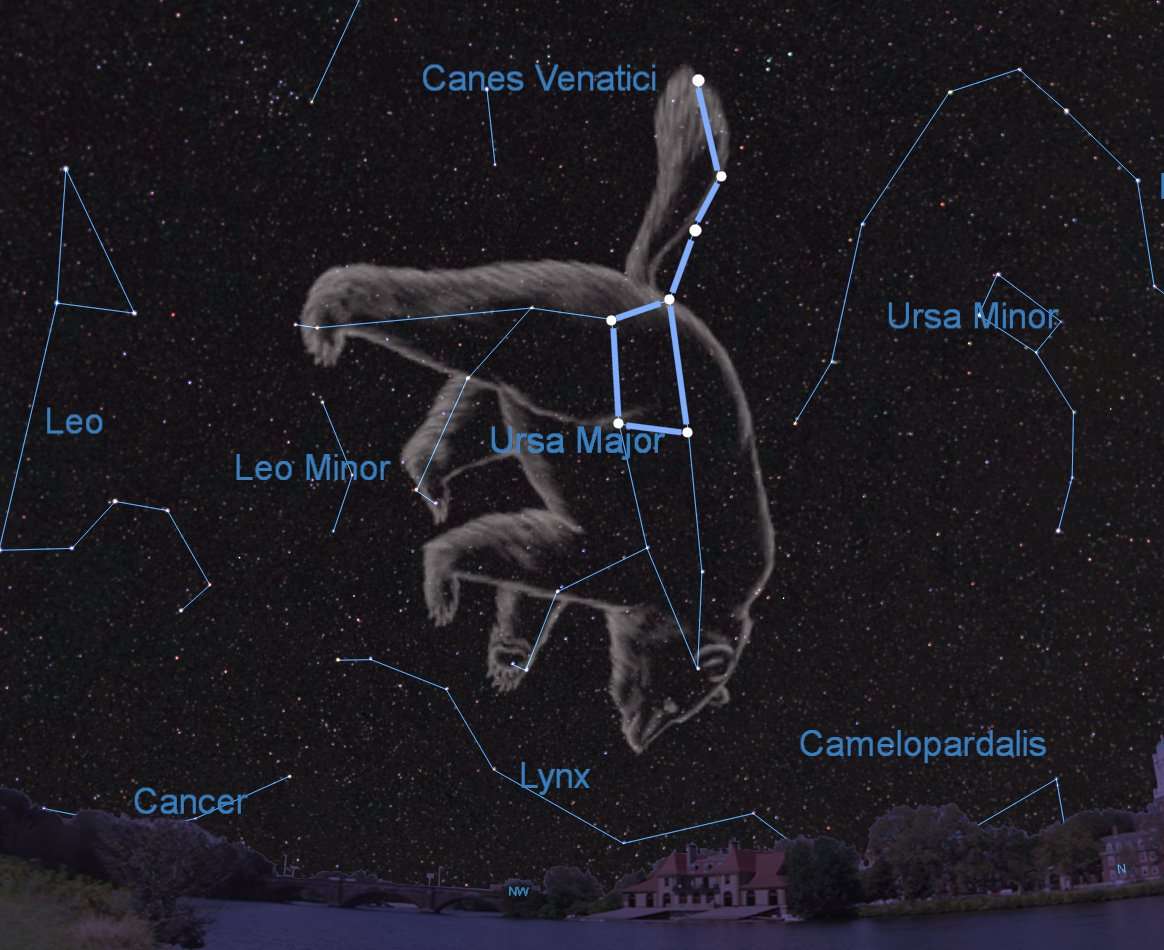
The Big Dipper (gang dou, 罡斗), also known as the Northern Dipper (beidou, 北斗), is a pattern of seven stars associated with the constellation Ursa Major (fig. 1). Daoism considers the pole star of this pattern to be the center of the cosmos through which emanates “primordial breath” (generative qi), which has long been deified as the great god Taiyi. The constellation is associated with a Daoist ritual known as Bugang (步綱/罡, “Walking the Guideline”) in which a practitioner paces the Big Dipper pattern with their feet on the ground. This ritual dance is synonymous with the much older shamanistic Yubu (禹步, “Paces of Yu”) used by ancient Sage Kings to conquer primordial chaos by pacing the stars and planets into motion, thereby directing the seasons and passage of time. The ritual involved pacing an inwardly spiraling circular pattern while dragging one foot behind the other in imitation of the limp adopted by Yu the Great after over-exerting himself quelling the fabled World Flood (fig. 2). Later Daoists viewed Yubu as a means of gaining immortality because the limping, three pace-style walking pattern symbolized the practitioner spanning the three realms of Earth, Man, and finally Heaven (this has an interesting Vedic correlation). [2] But, most importantly, by the Tang and Song dynasties, Bugang served the purpose of purifying the area before an altar, ensuring the liturgy to follow takes place in a consecrated space. In fact, some sources interchange the characters for Bugang with the homonyms 布剛, meaning “distributing strength,” which denotes the demonifugic properties of the dance (Andersen, 1989). Therefore, Monkey draws the Big Dipper talisman on the ground in order to create a sacred space free of any negative influences.

Fig. 1 – The location of the Big Dipper in relation to the Ursa Major constellation (larger version). Originally from this Futurism article. Fig. 2 – A diagram showing the inwardly spiraling pattern of Yubu (top) and the dipper pattern of Bugang (bottom) (larger version). Take note of the spiral’s limping, three pace-style walking pattern. Originally found on this wordpress article.  

2. “Then he himself recited in silence the true sayings of realized immortality and intoned the words of Dharani…”

The “true sayings” (zhenyan, 真言) is the Chinese term for Mantra, meaning “spell” or “magical formula.” A mantra is “a syllable or series of syllables that may or may not have semantic meaning, most often in a form of Sanskrit, the contemplation or recitation of which is thought to be efficacious” (Buswell & Lopez, 2014, p. 529). The most famous mantra is of course Om Mani Padme Hum, the very same six-syllable prayer that was used to weigh down the mountain holding Monkey prisoner for rebelling against heaven.

The “true sayings” is often used as an abbreviation for Dharani (tuoluoni/zongchi, 陀羅尼/總持), a Sanskrit term meaning “mnemonic device” (fig. 3). Like mantras, dharani are comprised of syllables, but these instead serve to remind practitioners of broader concepts, for example a single syllable representing the first letter of a much longer phrase. There exists four types of dharani said to be used by Bodhisattvas to achieve enlightenment: 1) those used for teaching interpretations of Buddhist law; 2) those used for understanding the exact meaning of important words; 3) those used for casting spells; and 4) those used for spiritual endurance in the face of suffering (Buswell & Lopez, 2014, pp. 241-242). The third type, which concerns us, falls under a category of sutra recitation called Paritta (minghu/minghu jing, 明護/明護經), which is Pali for “protection.” The historical Buddha is known to have delivered paritta verses, including those for “protection from evil spirits, the assurance of good fortune, exorcism, curing serious illness, and even safe childbirth” (Buswell & Lopez, 2014, p. 630).

In both cases zhenyan/mantra and dharani refer to magical formulas of sorts and were no doubt chosen because they gave the ritual an heir of arcane authenticity. Additionally, I suggest the use of dharani may have also been chosen to denote a spell of protection, as in Sun wanted to protect the princes during the transformation of their bodies.

(Note 06-15-19: Feng Dajian of Nankai University notified me via Twitter that he disagrees with Anthony C. Yu’s 2012 revised translation (cited above) associating the “True Sayings” with the Buddhist Dharani. This is because he feels the ritual is overtly Daoist, noting that the religion also has its own True Sayings.)

Fig. 3 – A Dharani print from the late Tang Dynasty. Original from Wikicommons.

3. “…as he blew divine breaths into their visceral cavities. Their primordial spirits were thus restored to their original abodes.”

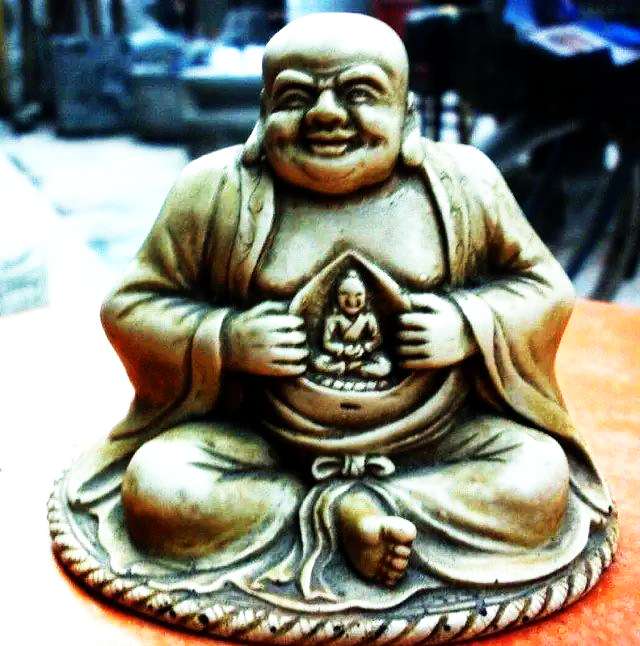
Journey to the West translator Anthony C. Yu (Wu & Yu, 2012) notes this section “is an abbreviated or paraphrastic account, in fact, of the neidan (internal or physiological alchemy process)” (vol. 4, p. 396, n. 8). Monkey already went through this process in chapter two when he practiced a series of breathing and energy circulation exercises that resulted in his immortality. Therefore, he uses his own hard-won “divine breath” or “immortal energy” (xianqi, 仙氣) to fortify the princes’ bodies by drastically speeding up the years-long process of internal cultivation to only a matter of hours or minutes. Monkey’s breath bolsters their own energy, helping them to achieve “primordial spirits” (yuanshen, 元神), a term commonly associated with Buddhahood or enlightenment. In Daoism, the term is synonymous with the attainment of immortality via the formation of a “Sacred Embryo” (shengtai, 聖胎) (fig. 4), which is forged from spiritual energies over long years of self-cultivation (Darga, 2008). This suggests that, beyond super strength, the ritual also gives them some form of immortality.

Fig. 4 – The Sacred Embryo is sometimes depicted as a baby (or in this case a Buddha) on a practitioner’s stomach (larger version). Found on this blog.

4. “He next helped them to circulate and build up the fire phases…”

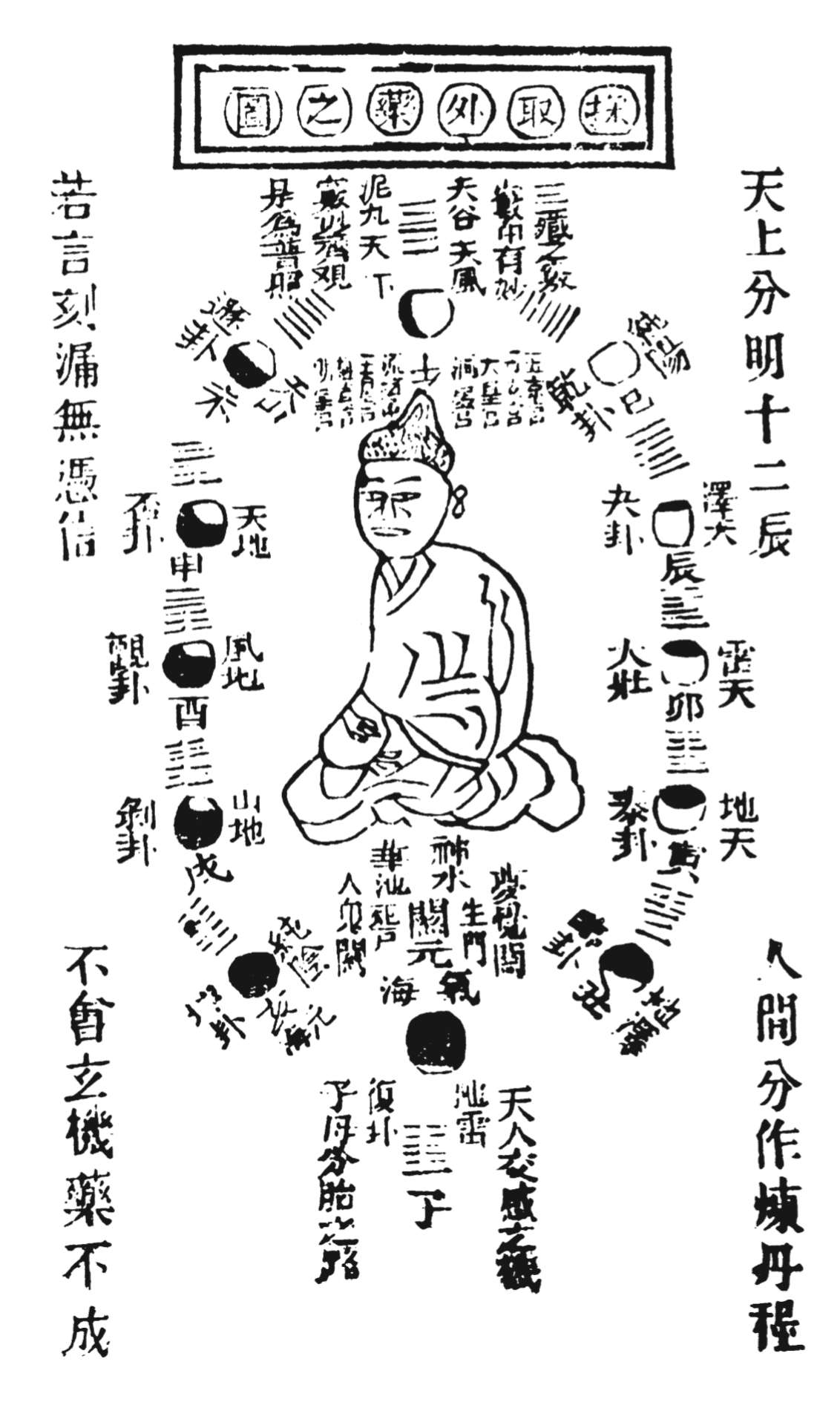
The fire phases (huohou, 火候) comprise the process of circulating spiritual energy throughout the body at prescribed times (fig. 5). Monica Esposito (2008) writes there are three phases in total, making up two distinct periods of activity and rest:

The first is a phase of “yangization” in which Yang augments and Yin decreases. This is described as a warlike or martial period, corresponding to the advancement of a light called Martial Fire (wuhuo 武火) or Yang Fire (yanghuo 陽火) that purifies by burning and eliminates defiled elements to release the Original Yang and increase it. At the cosmic level, the beginning of this phase is symbolized by the winter solstice (zi 子) and by the hexagram fu 復 ䷗ (Return, no. 24), which indicates the return of Yang. This is followed by a phase of balance, a time of rest called muyu ([沐浴] ablutions). At the cosmic level, this phase is symbolized by the spring and autumn equinoxes and by the hexagrams dazhuang 大壯 ䷡ (Great Strength, no. 34) and guan 觀 ䷓ (Contemplation, no. 20). The third stage is a phase of “yinization” in which Yin augments and Yang decreases. This period, called Civil Fire (wenhuo 文火) or Yin Fire (yinfu 陰符), corresponds to a decrease of the light. The adept achieves the alchemical work spontaneously and without any effort or voluntary intervention; water descends to moisten, fertilize, and temper fire. At the cosmic level, this phase is symbolized by the summer solstice (wu 午) and by the hexagram gou 姤 ䷫ (Encounter, no. 44) (p. 531).

Mastering the complicated chronological rhythm of this process is considered the best kept secret of internal alchemy (Esposito, 2008). Therefore, Monkey navigates this temporal maze for the princes, ensuring the spiritual energy that he has helped them cultivate ebbs and flows when prescribed. Once again we see Sun has sped up a lengthy process to only a few days, hours, or minutes.

Fig. 5 – A chart showing the fire phases, the 12 phases of the moon, and the corresponding hexagrams (larger version). From Kim, 2008, p. 528.

II. Similarities to Comic Book Heroes

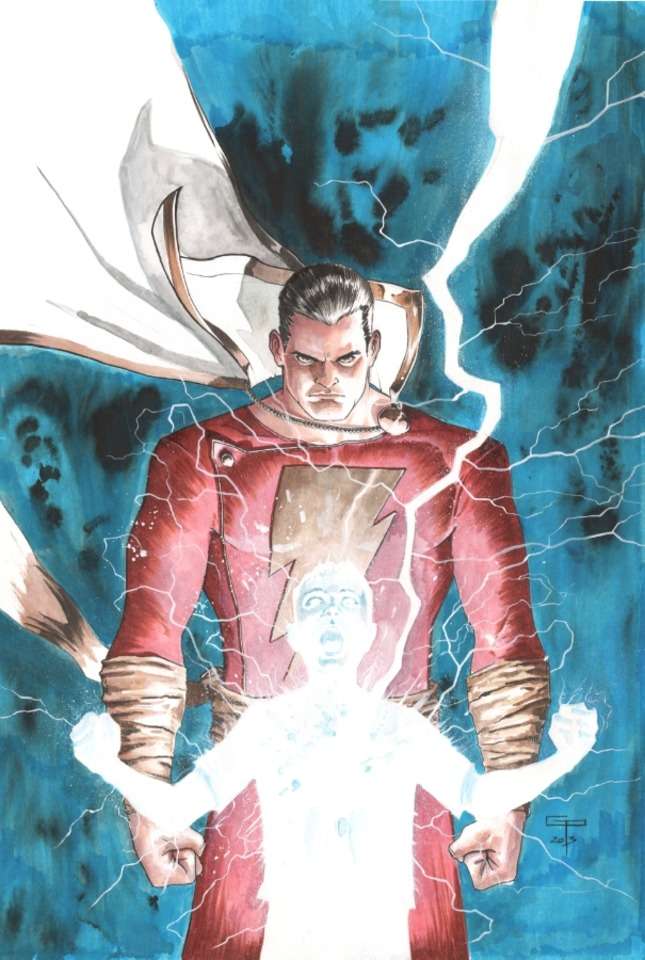
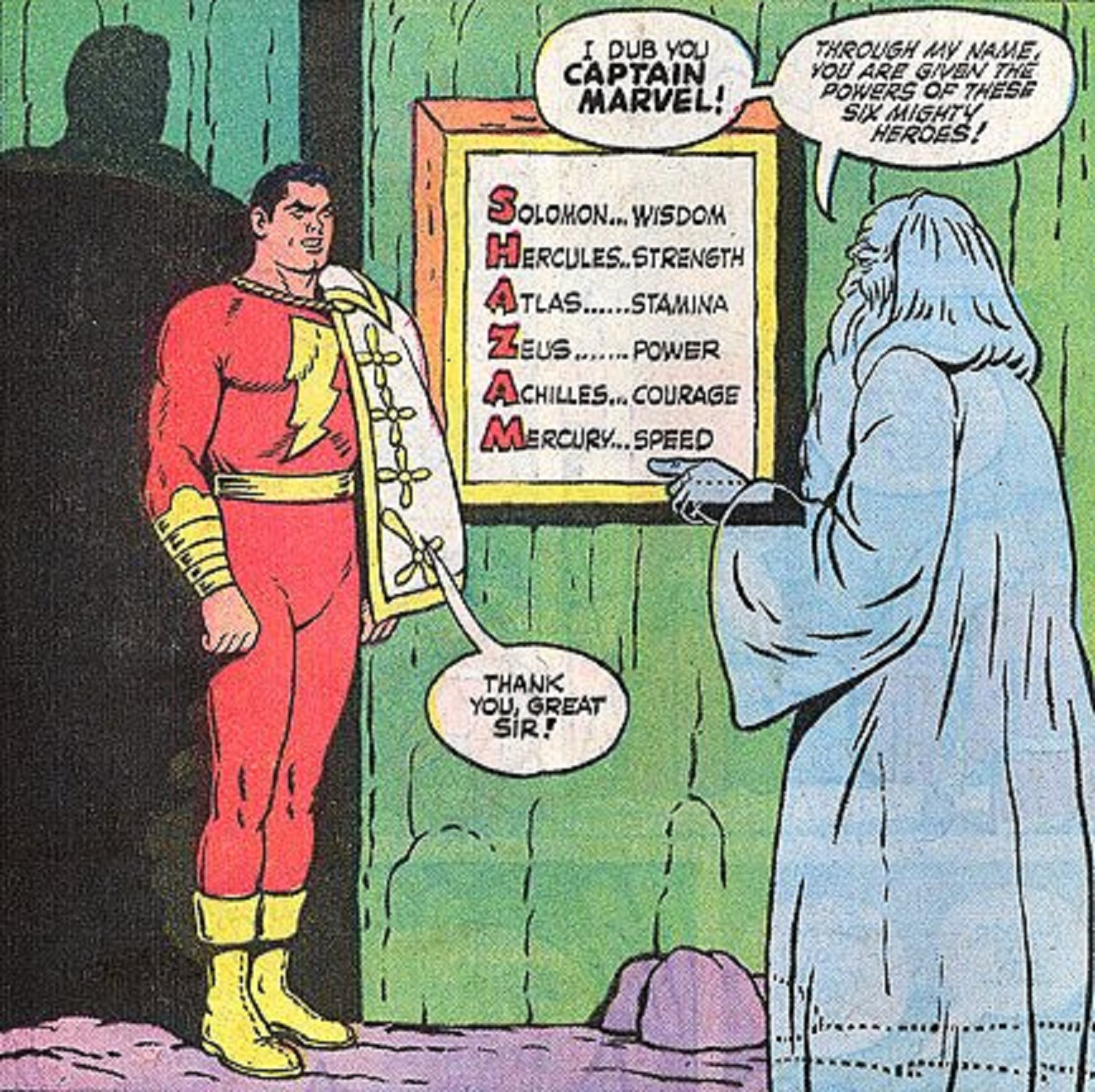
The princes in essence become the fantasy equivalent of today’s comic book superheroes. Gaining power from a divine being is similar to the concept of “Divine Empowerment” from DC Comics. A good example is Billy Batson, a.k.a. Captain Marvel (Ch: Jingqi duizhang, 驚奇隊長) (fig. 6), a child-turned-adult who receives super strength and other powers from a battery of Western gods and sages through the medium of a divine wizard.

4139607-160

Fig. 6 – The child Billy Batson transforming into the superhero Captain Marvel, also known as Shazam (larger version). Originally found on this Comic Vine article.

III. Conclusion

This fascinating strength-bestowing ritual draws on multiple aspects of Buddho-Daoist ceremony and internal alchemy. First, Sun chooses a secluded room where he traces a diagram of the Big Dipper on the floor in order to consecrate the space. Second, he recites magical spells likely intended to protect the princes during their bodily transformation. Third, Monkey uses his own divine breath to ignite their spiritual energy, manually fanning the flames to higher levels of spiritual attainment. Finally, he controls the ebb and flow of the resulting energy throughout their bodies according to a prescribed chronological rhythm. In all, Sun shortens a years-long process to only a few days, hours, or minutes. The princes come away from the ritual with superhuman strength and likely some form of divine longevity.

This whole process reminds me of the DC Comics character Billy Batson receiving divine powers through the medium of the Wizard Shazam to become Captain Marvel.


Update: 12-14-19

This is a past photomanipulation that depicts Monkey as the Wizard Shazam and the three Indian Princes as Captain Marvel. I used a golden age comic book image as the base (fig. 7).

Fig. 7 – The photomanipulation mixing Journey to the West and Captain Marvel (larger version). The original comic book image can be seen here.


Update: 07-17-22

I’ve posted an article that explores the abilities of Monkey’s immortal breath (used in the ritual above).

A Survey of Sun Wukong’s Magic “Immortal Breath” and Its Abilities


Update: 03-18-23

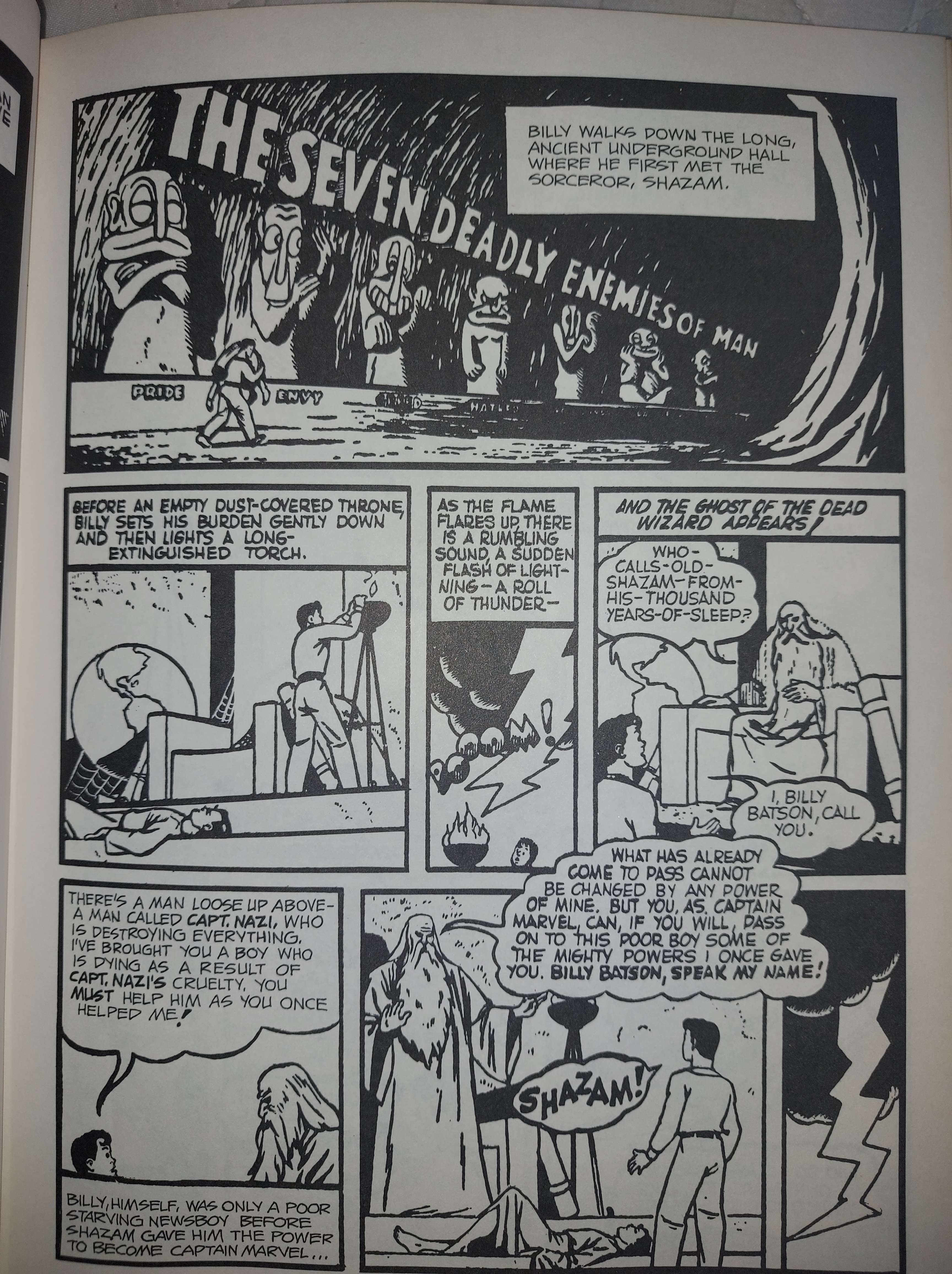
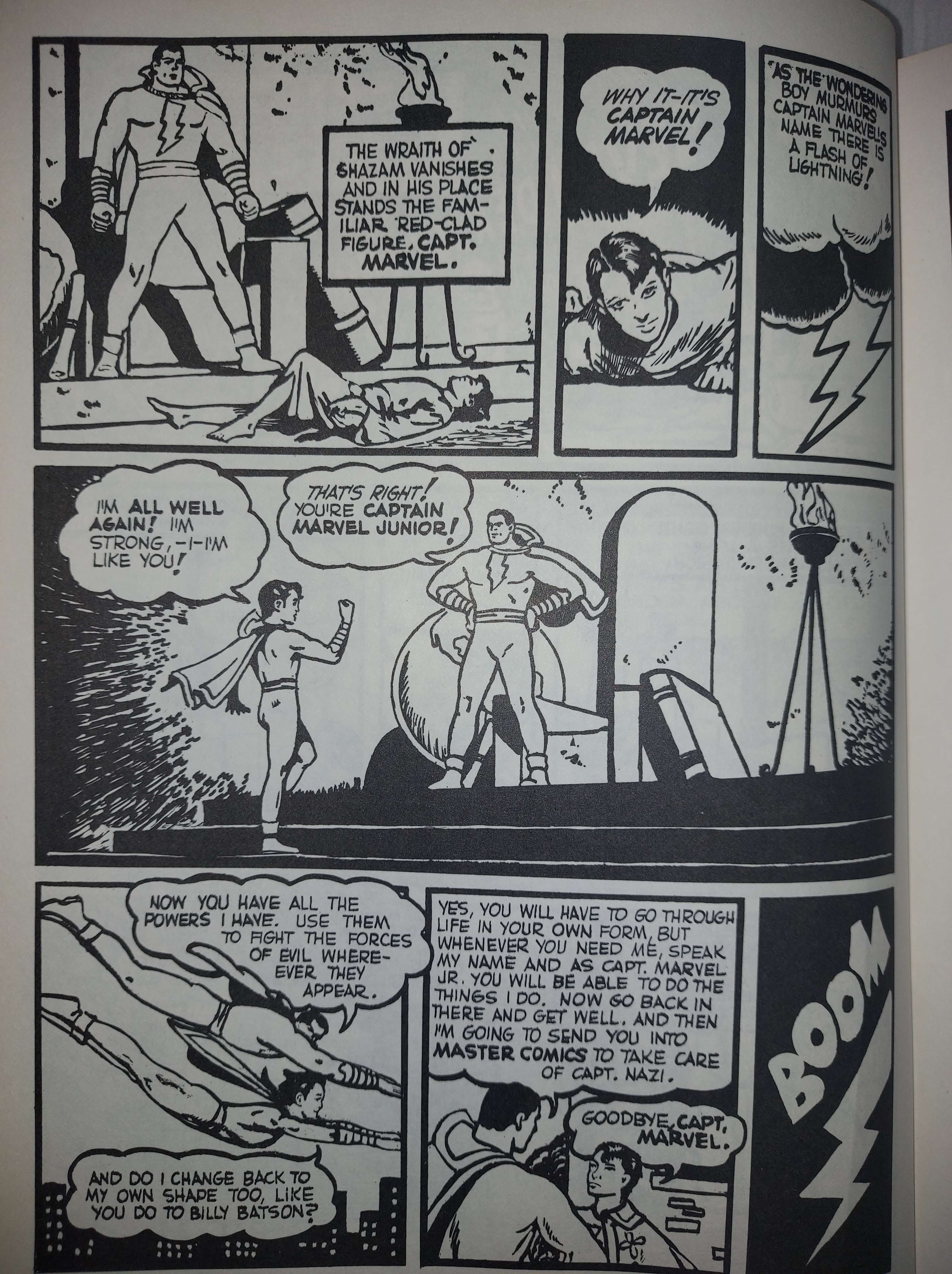
Above, I referenced Captain Marvel because he receives divine powers similar to the Indian Princes from Journey to the West. Well, the hero is also capable of sharing his abilities just like Sun Wukong! One issue has him save the life of a fatally injured boy by giving him some of his magic energy, thereby transforming him into a superhero. The boy is henceforth known as “Captain Marvel Jr.” (Ch: Xiao shengqi duizhang, 小神奇隊長) in his hero form (fig. 8-10) (Binder et. al., 1977, pp. 57-59).

Fig. 8 – Billy Batson (a.k.a. Captain Marvel) seeks help from Shazam to save the boy (larger version). Fig. 9 – Captain Marvel shares some of his power, thus saving the boy (larger version). Fig. 10 – The boy-turned-superhero vows to fight evil (larger version).


Update: 12-02-23

Someone recently asked me why the monstrous pilgrims would take human disciples in the first place. Well, this is the result of a sequence of events:

  • The young princes are amazed to see Sun, Zhu, and Sha display their martial arts skills while flying on divine clouds (fig. 11).
  • They tell their father, the sovereign prince, that they want to become their students, claiming it would allow them to protect their nation.
  • The monarch asks Tripitaka for permission, and he agrees.
  • The sovereign prince then personally requests that Sun, Zhu, and Sha tutor his sons in martial arts (Wu & Yu, 2012, pp. 197-199).

This seems straightforward enough, but there is an underlying answer that just dawned on me. Everyone agrees, and Monkey goes a step further by empowering the princes (fig. 12), as a way of kissing the ruler’s butt since he stamped the group’s travel rescript, a kind of passport needed to legally travel through various countries (Wu & Yu, 2012, p. 193). Without the stamp, the pilgrims wouldn’t have been able to continue their journey to the Buddha’s mountain.

The humorous implication here is that even celestials have to bow to earthly bureaucracy. 

Fig. 11 – The princes drop to their knees as they watch the three monstrous pilgrims display their supernatural martial skills (larger version). Image from the Qing-Period Color-Illustrated Complete Edition of Journey to the West (清彩繪全本西遊記, 2008). Fig. 12 – Monkey empowers the princes with his divine breath (larger version). Image from Chen Huiguan’s Newly Illustrated and Complete Journey to the West (陈惠冠新绘全本西游记, 2001). Both images found here.

For future reference, this episode takes place towards the middle of ep. 23 of the 1986 JTTW TV show and the end of ep. 55 and the beginning of ep. 56 of the 2011 JTTW TV show. Both programs skip over the strength-bestowing ritual.


Update: 08-11-24

I have written a catalog of all of Sun Wukong’s abilities from all 100 chapters of JTTW. The strength-bestowing ritual appears on pages 193-194 (ch. 88, no. 3) of this PDF.

Archive #46 – A Catalog of the Monkey King’s Magic Powers and Skills


Update: 05-15-25

I forgot to mention above that although the princes can wield their teachers’ divine, multi-ton weapons after the ritual—an amazing feat for mortals to be sure—the weight is still too much for them to handle comfortably. This is why they request to make their own lighter replicas. Chapter 88 reads: 

When the old prince saw this [the princes wielding the divine weapons], he could not have been more pleased, and another vegetarian banquet was laid out to thank the master and his three disciples. Right before the banquet tables, however, they [the princes] began their instruction. The one studying the rod performed with the rod; the one studying the rake performed with the rake; and the one studying the staff performed with the staff. The princes thus succeeded in making a few turns and several movements, but they were, after all, mortals, and they found the goings rather strenuous. After exercising for a while, they began to pant heavily. Indeed, they could not last long, though their weapons might have the ability to undergo transformation. In their advances and retreats, their attacks and offenses, the princes simply could not attain the wonder of natural transformation. Later that day the banquet came to an end.

The next day the three princes came again to thank their masters and to say: “We thank the divine master for endowing us with strength in our arms. Though we are now able to hold the weapons of our masters, however, we find it difficult to wield and turn them. We propose, therefore, that artisans be asked to duplicate the three weapons. They will use your weapons as models but take some of the weight off. Would the masters grant us permission?” (Wu & Yu, 2012, vol. 4, p. 203)

老王見了,歡喜不勝。又排素宴,啟謝他師徒四眾。就在筵前各傳各授:學棍的演棍,學鈀的演鈀,學杖的演杖。雖然打幾個轉身,丟幾般解數,此等終是凡夫,有些著力:走一路,便喘氣噓噓,不能耐久。蓋他那兵器都有變化,其進退攻揚,隨消隨長,皆有自然之妙,此等終是凡夫,豈能以遽及也?當日收了筵宴。 

次日,三個王子又來稱謝道:「感蒙神師授賜了膂力,縱然掄得師的兵器,只是轉換艱難。意欲命匠依神師兵器式樣,減削斤兩,打造一般,未知師父肯容否?」

Pigsy takes the lead by granting their wish, but the three original weapons are unfortunately stolen by a fiend while in the custody of craftsmen (Wu & Yu, 2012, vol. 4, pp. 203-204). This eventually leads to a war with earthly and heavenly lion-spirits (see chapters 88 to 90).

After the day is saved, the replica weapons are completed. The end of chapter 90 reads:

In the meantime, the ironsmiths had finished forging the three weapons. As they kowtowed to Pilgrim [Monkey], they said, “Holy Father, our work is done.”

“What’s the weight of each of the weapons?” asked Pilgrim.

“The golden-hooped rod weighs a thousand catties,” replied one of the ironsmiths. “The nine-pronged rake and the fiend-routing staff both weigh eight hundred catties.” “All right,” said Pilgrim, and he asked the three princes to come out and pick up their weapons (based on Wu & Yu, 2012, vol. 4, pp. 229-230).

又見那鐵匠人等造成了三般兵器,對行者磕頭道:「爺爺,小的們工都完了。」問道:「各重多少斤兩?」鐵匠道:「金箍棒有千斤,九齒鈀與降妖杖各有八百斤。」行者道:「也罷。」叫請三位王子出來,各人執兵器。

One thousand catties (千斤) is 1,300.72 lbs or 590 kg, and 800 catties (八百斤) is 1,040.58 lbs or 472 kg.

This episode would be a great setup for a Game of Thrones-style Asian fantasy. The three princes could be plotting and scheming against each other in the hopes of one day gaining the throne from their aging father, the sovereign prince. Then a monkey wizard comes along and makes things worse by bestowing them with super strength and divine longevity. This would definitely lead to lots of drama between the brothers and their offspring. It would be a centuries-long battle royale between competing dynasties of superpowered beings!

Notes:

1) Although the original English translation reads “the strength of a thousand arms” (Wu & Yu, 2012, p. 202), the Chinese reads wanqian zhi luli (萬千之膂力), which means “the strength of tens of thousands (of men).” I have therefore adjusted the translation for more accuracy.

2) Andersen (2008) notes that the three paces are similar to those used by Vedic priests:

It would appear, in other words, that even in this early period the Paces of Yu constituted a close parallel to the three Strides Viṣṇu in early Vedic mythology, which are thought to have taken the god through the three levels of the cosmos (thereby establishing the universe), and which indeed, just like the Paces of Yu in Taoist ritual, are known to have been imitated by Vedic priests as they approached the altar—and in the same form as the Paces of Yu, that is, dragging one foot after the other (pp. 238-239).

Sources:

Andersen, P. (1989). The Practice of Bugang. Cahiers d’Extrême-Asie, 5. Numéro spécial Etudes taoïstes II / Special Issue on Taoist Studies II en l’honneur de Maxime Kaltenmark. pp. 15-53.

Andersen, P. (2008). Bugang. In F. Pregadio (Ed.), The Encyclopedia of Taoism (Vols. 1-2) (pp. 237-240). London [u.a.: Routledge].

Binder, O., Woolfolk, W., O’Neil, D., Parker, B., Maggin, E. S., & Bridwell, E. N. (1977). Shazam! From the Forties to the Seventies. New York: Harmony Books.

Buswell, R., & Lopez, D. (2014). The Princeton Dictionary of Buddhism. Princeton University Press.

Darga, M. (2008). Shengtai. In F. Pregadio (Ed.), The Encyclopedia of Taoism (Vols. 1-2) (pp. 883-884). London [u.a.: Routledge].

Esposito, M. (2008). Huohou: 2. Neidan. In F. Pregadio (Ed.), The Encyclopedia of Taoism (Vols. 1-2) (pp. 530-532). London [u.a.: Routledge].

Kim, D. (2008). Houhou: 1. Waidan. In F. Pregadio (Ed.), The Encyclopedia of Taoism (Vols. 1-2) (pp. 526-530). London [u.a.: Routledge].

Wu, C., & Yu, A. C. (2012). The Journey to the West (Vols. 1-4) (Rev. ed.). Chicago, Illinois: University of Chicago Press.

The Story of the Original Golden Headband in the Great Sage Treasure Temple, Kowloon, Hong Kong

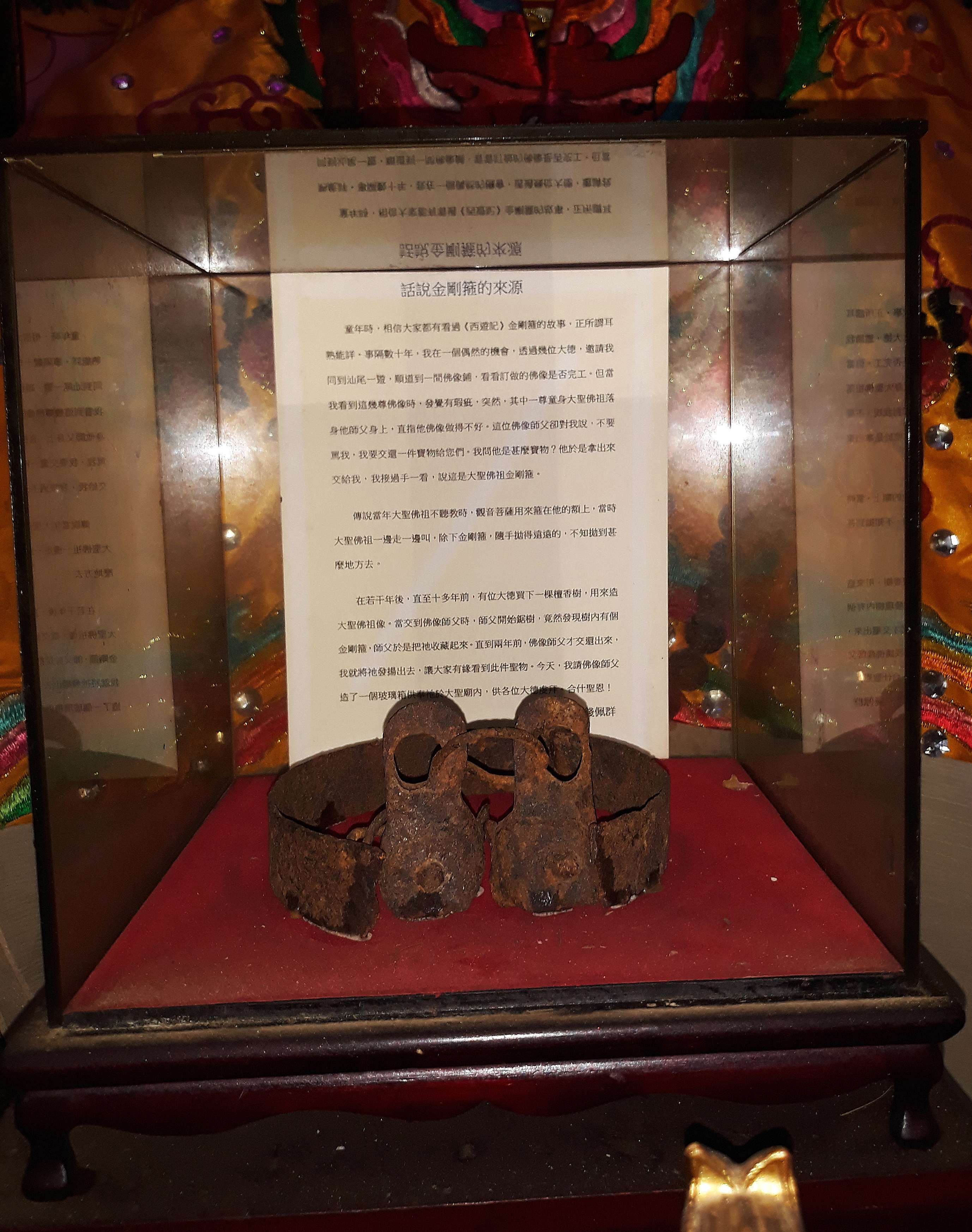
I recently attended the birthday of Sun Wukong on September 25th (the 16th day of the 8th lunar month) in Kowloon, Hong Kong (I’ll write more about this later). While the festivities took place at an alternate location with a secondary altar, I later visited the main altar in the Great Sage Treasure Temple (Dasheng bao miao, 大聖寶廟) on the Po Tat Estate. The altar stage includes a large gilded statue of Wukong, flanked on either side by those of his religious brothers Sha Wujing and Zhu Bajie. Strangely enough, a glass box is conspicuously placed in front of the Monkey King’s visage (fig. 1). Inside is a rusted metal band held together with a single chain link (fig. 2). An accompanying text panel labels it the “Vajra/Diamond Headband” (Jingang gu, 金剛箍) and claims the piece to be the original band worn by the Great Sage during his adventures. This same text is echoed in the Kowloon Great Sage Buddha Hall: Special Inaugural Ceremony Issue of the Sixteenth Year Council Association (Jiulong Dasheng Fo tang: Di shiliu jie lishi hui jiu shi dianli tekan, 九龍大聖佛堂: 第十六屆理事會就識典禮特刊) (2014), a booklet handed out during this year’s festivities. [1]

20180925_150017

Fig. 1 – The glass box is visible between the food offerings and the Great Sage’s statue (larger version). Photo by the author.

I. Translation

From Childhood, I believe that everyone has read the story of the golden headband from Journey to the West. Everyone is familiar with the tale. A few decades later [after the events took place], some Buddhists were invited to a Buddhist statue workshop in Shanwei [City, Guangdong Province, China] to see if the Buddha statue they ordered was finished. But when they saw the statue they found it full of flaws. Suddenly, one among them spoke up and said it wasn’t made well enough. The Buddhist statue workshop master asked not to be chastised and said he instead wanted to give them a treasure. They asked him what it was. When he handed it to them they saw it was the Great Sage Buddha’s [original] golden headband.

People say that when Sun Wukong would not accept the Buddhist teachings, Guanyin put the band on his head. Sun Wukong ran side to side while yelling, trying to take it off and throw it far away to some unknown place [but couldn’t].

Many years later, maybe until ten years ago, a virtuous man purchased a sandalwood tree in order to build a Great Sage Buddha statue. He gave it to a Buddhist statue workshop master, who started to saw the tree but soon discovered the golden headband inside and decided to keep it for himself. Two years later, he decided to return it so everyone could behold this sacred treasure. Today, we asked the Buddhist workshop master to make a glass box to display the band in the Great Sage Temple for everyone to worship (p. 45). [2]

20180925_150202

Fig. 2 – The glass box with the headband. The accompanying text panel can be seen in the back (larger version). Photo by the author.

Chapter 100 of the original novel describes the headband disappearing once Monkey internalizes self-restraint and becomes a Buddha (Wu & Yu, 2012, p. 383). The ultimate fate of the band is never commented on thereafter. The above story presents a continuation of the tale, thereby linking the Great Sage Treasure Temple with the original events of the novel. The band is lost and discovered twice over the centuries, eventually coming to rest in Hong Kong.

II. Similarities with Shaolin art

The displayed headband appears to be quite old given the level of rust damage. In addition, the style is different than any band I’ve written about before. That being said, the style is somewhat similar to a 17th-century mural from the famed Shaolin Monastery. The mural depicts a muscular luohan wielding a staff and standing next to a ferocious tiger (possibly the Tiger-Taming Luohan). His crown is adorned with a headband held together by a single chain link (fig. 3) similar to our aforementioned band. I am by no means claiming a connection to Shaolin, but it shows there may have been some style of linked headband associated with protector deities in late dynastic China.

17th-Century Shaolin Fresco

Fig. 3 – The 17th-century Shaolin mural (larger version). Take note of the linked headband. From Shahar, 2008, p. 90.

Notes

1) The presented folk story is as told by the Kowloon Great Sage Buddha Hall First Vice-Chairperson Qian Peiqun (錢佩群).

2) Thank you to Kelly Black Lin for helping me with the translation.

Sources

Kowloon Great Sage Buddha hall: Special inaugural ceremony issue of the sixteenth year Council association (2014, Sept. 9). Published by the Hong Kong Shanwei General Commerce Association Limited.

Shahar, M. (2008). The Shaolin monastery: History, religion, and the Chinese martial arts. Honolulu: University of Hawai’i Press.

Wu, C., & Yu, A. C. (2012). The journey to the West: Volume 4. Chicago, Ill: University of Chicago Press.

Archive #7 – The PRC Mythology Chapter from The Contemporary Chinese Historical Drama (1990)

Here I present the “Monkey King Subdues the White-Bone Demon: A Study in PRC Mythology” chapter from The Contemporary Chinese Historical Drama (1990). This fascinating chapter discusses how a play/film based on the named Journey to the West episode was co-opted during the mid-20th-century as Communist propaganda. Of note is the way each figure is associated with a particular aspect of the communist party. For example, the group of pilgrims represents the party itself, Sun Wukong represents Mao Zedong, and the White Bone Demon, while first representing Imperialism, came to be associated with Soviet Revisionists bowing to imperialism. While the monk Tripitaka was originally associated with the Revisionists Eduard Bernstein and Nikita Khrushchev, he later came to represent the “Middle-of-the-roaders” within the Chinese communist party. It should be remembered that, in the particular episode from the novel, Monkey keeps killing the White Bone Demon because he sees through her demonic disguises, yet the monk continues to punish his protector via the Tight-fillet spell because he is continually deluded by said disguises. Therefore, the play/film was symbolic of Mao’s struggle to placate the communist party while trying to battle the evil of revisionists.

Most surprising to me is that the play/film was made into a children’s book. I believe I’ve seen the illustrations (fig. 1) on the internet but never realized the book had a political origin and purpose.
PRC Monkey King beats the White Bone Demon Three Times (1962) Detail - small

Fig. 1 – Page one from Sun Wukong sanda baigujing (1962) (larger version).

Archive Link:

Click to access contemporary-chinese-drama-sun-wukong-chapter.pdf

Thanks:

A PDF of the full book can be found on archive.org and downloaded for free.