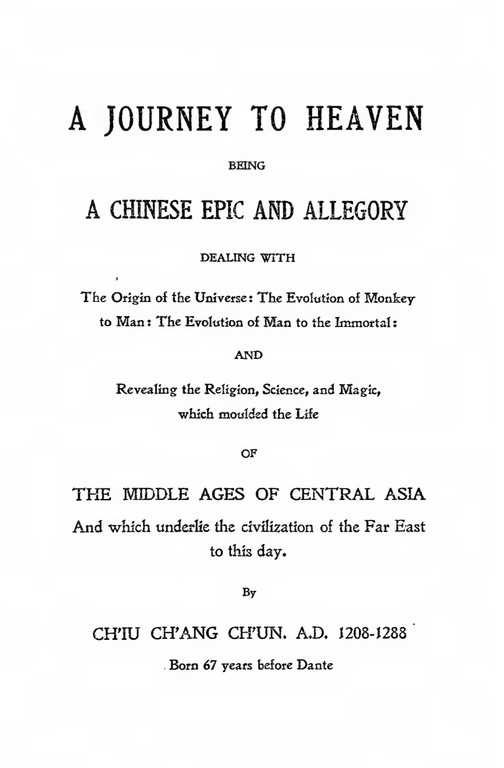
Here I present A Mission to Heaven (1913), the first English version of Journey to the West translated by the Welsh Baptist missionary Timothy Richard (1845-1919). Modern translator Anthony C. Yu describes it and a slightly later translation as “no more than brief paraphrases and adaptations” (Wu & Yu, 2012, vol. 1, p. xiii). This is because Yu’s translation stretches over 2,000 pages, while Richard’s barely breaks 370 pages. Also, there are many mistranslations that will become apparent to those who have already read Yu’s version. For example, in chapter one when light from Sun Wukong’s eyes reach the celestial realm, A Mission to Heaven reads:
They saw the light burning brightly and ordered a telescope to be brought. (The telescope was invented by Galileo only in 1609 A.D., therefore the Chinese must have had some kind of telescope before we in Europe had it. — Tr.) It was taken to the South gate of heaven to be looked through from thence (Chiu & Richard, 1913, p. 3).
However, Yu’s more accurate version reads:
Upon seeing the glimmer of the golden beams, he [the Jade Emperor] ordered Thousand-Mile Eye and Fair-Wind Ear to open the South Heaven Gate and to look out (Wu & Yu, 2012, vol. 1, p. 102).
As can be seen, Richard completely glossed over the two named deities, choosing instead to refer to both as a telescope.
It’s interesting to note the author of A Mission to Heaven/Journey to the West is listed as one Qiu Changchun, otherwise known as Qiu Chuji (1148-1227), founder of the Dragon Gate sect of Daoism. This may be confusing to some since the novel has long been touted as the work of Wu Cheng’en (1500-1582). However, the novel was anonymously published in 1592. Qiu’s disciple is known to have written a travel journal titled Journey to the West (西遊記), which detailed his master’s journey to meet Genghis Khan. Therefore, early commentators confused this historical travel journal with the fictional narrative, thereby claiming Qiu as the author as early as the 17th-century. Wu Cheng’en wasn’t associated with the novel until the 1920s, and the association is again based on a similarly named work published by Wu. Historians remain divided on the true author.
Here I present all of the woodblock prints from Mr. Li Zhuowu’s Literary Criticism of Journey to the West (Li Zhuowu Xiansheng piping Xiyouji, 李卓吾先生批評西遊記, late-16th-c. or early-17th-c.) by the Ming scholar Li Zhi (李贄, 1527-1602). It’s important to remember that the original novel was published in 1592, which means the images therein are some of the earliest depictions of the characters and episodes based on that freshly published version. The PDF linked below has nearly 200 prints, illustrating everything from Sun Wukong’s discovery of the Water Curtain Cave to the pilgrims’ final attainment of Buddhahood or Sainthood. Here is a sample.
Sun Wukong fighting the heavenly army (larger version). Enhanced slightly for clarity.
For my 50th post, I am excited to host PDF copies of two gorgeously illustrated Journey to the West children’s books produced in Japan during the middle part of the 20th-century.
1. Son Goku (孫悟空, 1939)
This work was illustrated by Shotaro Honda (本田庄太郎, 1893-1939), a Western-trained artist closely associated with children’s literature for nearly 30 years. As the title suggests, the book focuses on the first 7 chapters of the novel, from the time of Monkey’s birth to his final imprisonment under Five Elements mountain. Literally every single panel is worthy of framing. The illustrations are bright and vibrant, seemingly jumping from the page. See below for an example.
Monkey in the underworld striking his name from the Book of Life and Death (larger version).
2. The Illustrated Journey to the West (繪本西遊記, 1950)
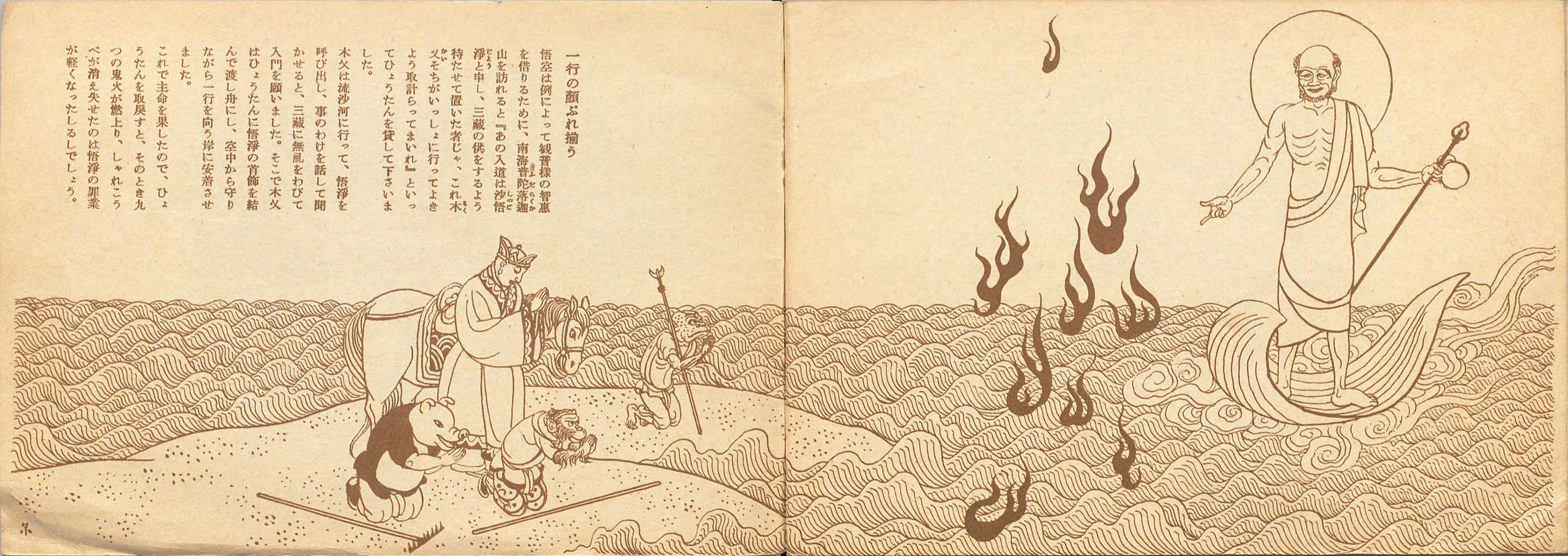
This three volume work was illustrated by Mizushima Nio (水島爾保布, 1884-1958). The first volume covers Monkey’s birth to the submission of Sandy; the second covers the Ginseng fruit tree to the battle with Guanyin’s goldfish; and the third covers the Rhino demon to the end of the novel. The dark on light line work reminds one of delicate paper cut artwork brought to life. Here’s a sample.
The group bowing before a Buddhist figure (larger version).
The historical Buddhist monk Xuanzang (玄奘, 602-664) is famous for having traveled to India between 629 and 645 in order to supplement the Chinese Buddhist canon with fresh scriptures (see here). As his legend grew, an embellished story cycle began referring to him as Tang Sanzang (唐三藏; lit: “Tripitaka (“Three Baskets,” i.e. the Buddhist canon) of the Tang Dynasty“), and as early as the 11th-century, he acquired a divine monkey disciple who would later become Sun Wukong (孫悟空). The cleric eventually gained his own supernatural background, for evidence shows that he was worshiped as an Arhat (Luohan, 羅漢; Zunzhe, 尊者), a Buddhist saint, by the Song Dynasty (960-1127 CE) (Liu, 2019). A Yuan-Ming zaju stage production plays on this concept by depicting Tripitaka as the reincarnation of the Arhat Vairocana (Pulujia zunzhe, 毗廬伽尊者) (Dudbridge, 1970, p. 193). [1] This saintly status was further embellished in Journey to the West (Xiyouji, 西遊記, 1592), the culmination of his story cycle, where the character is cast as the earthly reincarnation of Master Golden Cicada (Jinchan zi, 金蟬子), the Buddha’s fictional second disciple.
In this article, I would like to discuss the Golden Cicada, including the story details explaining his background and the origin of his title. I ultimately suggest that the term was chosen because the celestial’s banishment to Earth and eventual return to paradise recalls the metamorphic lifecycle of the real life insect.
I. Internal story details
The Tang Monk’s background is first hinted at in chapter eight when Guanyin sets out to find the scripture pilgrim. The narrative proclaims:
[A] Buddha son return[s] to keep his primal vow. The Gold Cicada Elder will clasp the candana (Wu & Yu, 2012, vol. I, p. 207).
Chapter twelve contains a poem introducing Tripitaka as the chosen pilgrim and reveals his heavenly origin. The first part reads:
Gold Cicada was his former divine name. As heedless he was of the Buddha’s talk, He had to suffer in this world of dust, To fall in the net by being born a man […] (Wu & Yu, 2012, vol. 1, p. 275).
Details about the extent of the former celestial’s punishment is revealed throughout the book. For instance, in chapter 33, a demon explains the source of the heavenly aura [2] around Tripitaka:
That Tang Monk is actually the incarnation of the Elder Gold Cicada, a virtuous man who has practiced austerities for ten existences (Wu & Yu, 2012, vol. 2, p. 105).
Furthermore, in chapter 100 the Buddha tells his former disciple:
Because you failed to listen to my exposition of the law and slighted my great teaching, your true spirit was banished to find another incarnation in the Land of the East. Happily you submitted and, by remaining faithful to our teaching [Buddhism], succeeded in acquiring the true scriptures (Wu & Yu, 2012, vol. 4, p. 381).
So, we learn that the Golden Cicada was banished to live out ten pious lives in China until the time came for him to build merit as the scripture pilgrim, thereby gaining reentry into paradise.
II. Origin of the title
Yu (2008) alludes to chapter 99 explaining the source of the name Golden Cicada (p. 110). I can’t find such an overt explanation, but the chapter does mention the monk miraculously surviving drowning after being dumped by a disgruntled river turtle [3] into a heavenly river, along with his disciples and the hard-won scriptures. The novel exclaims:
Ah! It was fortunate that the Tang Monk had cast off his mortal frame and attained the way. If he were like the person he had been before, he would have sunk straight to the bottom (Wu & Yu, 2012, vol. 4, p. 363).
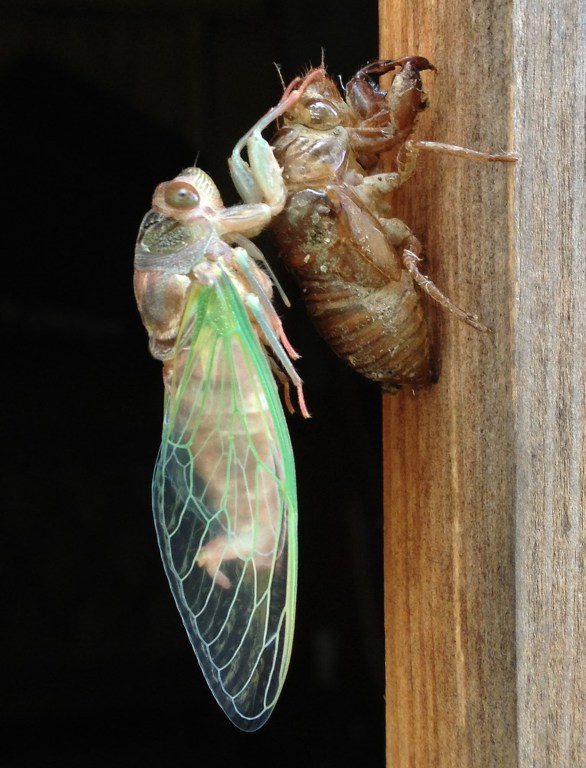
The “cast[ing] off of his body” (tuotai, 脫胎) is reminiscent of the way in which the real life insect sloughs off its shell (fig. 1). If this is what Yu was referring to, I think this is but one part of the puzzle.
Fig. 1 – A newly formed cicada clinging to its shell (larger version).
I suggest that the author-compiler of Journey to the West chose the cicada imagery for the symbolic nature of its life cycle. Munsterberg (1972) describes the insect’s role in ancient Chinese religion:
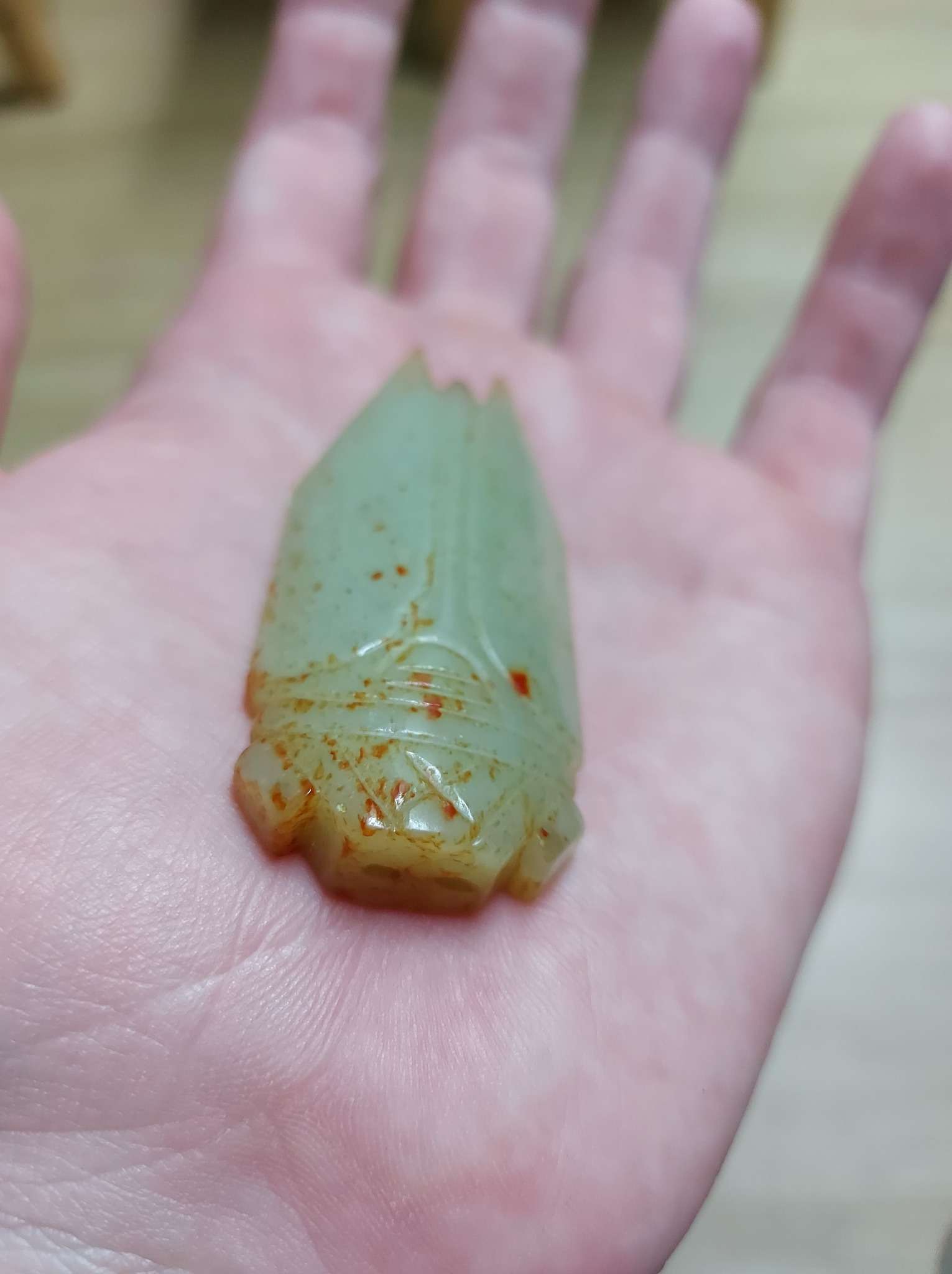
Cicadas carved in jade are frequently found in graves of the Han period [fig. 2]. Since the cicada hatches above ground, spends a long period underground, and finally emerges as if in rebirth, these burial tokens were probably intended to induce resurrection by sympathetic magic (p. 32).
The Golden Cicada’s life follows this cycle very closely: the celestial being resides above in the Western Paradise, is banished below for an extended period of time, and is only allowed back into the celestial realm after a metamorphosis.
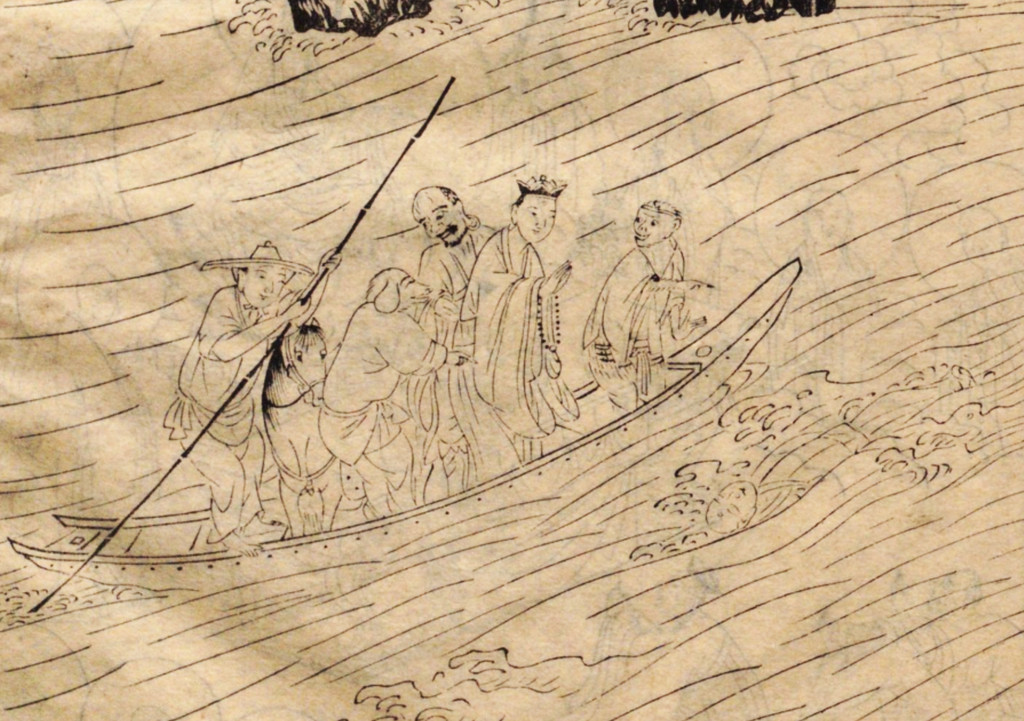
The lifesaving transformation previously referred to by Guanyin takes place in chapter 98 when Tripitaka and his disciples are ferried across a heavenly river in a bottomless boat on their way to the Western Paradise:
All at once they saw a corpse floating [fig. 3] down upstream, the sight of which filled the elder [Tripitaka] with terror.
“Don’t be afraid, Master,” said Pilgrim [Sun Wukong], laughing. “It’s actually you!”
“It’s you! It’s you!” said Eight Rules [Zhu Bajie] also.
Clapping his hands, Sha Monk also said, “It’s you! It’s you!”
Adding his voice to the chorus, the boatman also said, “That’s you! Congratulations! Congratulations!” Then the three disciples repeated this chanting in unison as the boat was punted across the water. In no time at all, they crossed the Divine Cloud-Transcending Ferry all safe and sound. Only then did Tripitaka turn and skip lightly onto the shore. We have here a testimonial poem, which says:
Delivered from their mortal flesh and bone, A primal spirit of mutual love has grown. Their work done, they become Buddhas this day, Free of their former six-six senses sway (Wu & Yu, 2012, vol. 4, pp. 345-346). [4]
Here, we see Tripitaka has shed his mortal form to become a Buddha just like the cicada sheds its shell to grow wings and fly. The monk has freed himself from the endless cycle of birth and death to achieve nirvana.
The Thirty-Six Stratagems (Sanshiliu ji, 三十六計, c. 5th-6th-cent.), a collection of military, political, and civil tactics, contains a plan known as “The Golden Cicada Sheds its Shell” (Jinchan tuoke, 金蟬脫殼), which entails leaving a decoy that distracts the enemy while the losing force is retreating. I’m not sure if this directly influenced the celestial’s title, but it at least shows that the name was known long before Journey to the West was published.
The strategy is actually used by a tiger demon in chapter 20:
Whipping out the iron rod, Pilgrim [Sun Wukong] shouted, “Catch him!” Eight Rules [Zhu Bajie] at once attacked with even greater ferocity, and the monster fled in defeat. “Don’t spare him,” yelled Pilgrim. “We must catch him!” Wielding rod and rake, the two of them gave chase down the mountain. In panic, the monster resorted to the trick of the gold cicada casting its shell (emphasis added): he rolled on the ground and changed back into the form of a tiger. Pilgrim and Eight Rules would not let up. Closing in on the tiger, they intended to dispose of him once and for all. When the monster saw them approaching, he again stripped himself of his own hide and threw the skin over a large piece of rock, while his true form changed into a violent gust of wind heading back the way he had come. (Wu & Yu, 2012, vol. 1, p. 401).
I would like to further suggest that the name Master Golden Cicada (Jinchan zi, 金蟬子) might have been chosen to serve as a pun for “child or student of Chan” (Chanzi, 禪子) (fig. 4). While the historical Xuanzang was the patriarch of the Yogacara school of Chinese Buddhism (Robert & David, 2013, pp. 1015-1016), the novel closely associates him with Chan:
The depiction of the novelistic Xuanzang surely and constantly associates him and his entourage with Chan. Revealing examples can readily be found in both narrative content and such titular couplets as “Tripitaka does not forget his origin; / The Four Sages test the Chan Mind” (chapter 2[3]); “The Child’s tricky transformations confuse the Chan Mind; / Ape, Horse, Spatula, and Wood Mother-all are lost” (chapter 40); “The Chan Lord, taking food, has demonic conception; / Yellow Dame brings water to dissolve perverse pregnancy” (chapter 53); “Rescuing Tuoluo, Chan Nature is secure; / Escaping defilement, the Mind of Dao is pure” (chapter 67); “Mind Monkey envies Wood Mother; / The demon lord plots to devour Chan” (chapter 85); and “Chan, reaching Jade-Flower, convenes an assembly; / Mind Monkey, Wood, and Earth take in disciples” (chapter 88) (Wu & Yu, 2012, vol. 1, pp. 64-65).
If true, this would mean that the cicada-like spiritual transformation is based around a pun.
Fig. 4 – The similarities in form and pronunciation of chanzi (larger version).
This seems like such an obvious connection that I wouldn’t be surprised if someone else beat me to the conclusion by decades or even centuries.
Update: 08-29-20
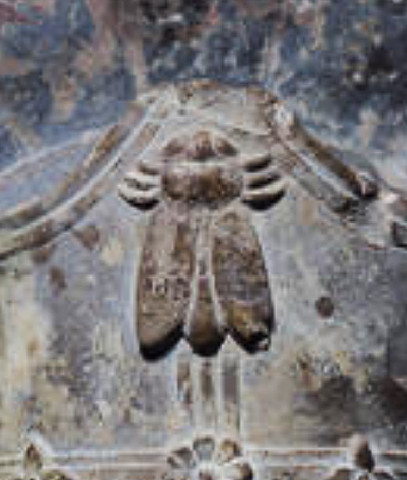
Art historian Jin Xu posted a picture of a 6th-century stone bodhisattva statue on twitter, and I was interested to see a cicada adorning the headdress (fig. 5 & 6). One essay about the statue suggests it was commissioned by an aristocratic layman since cicadas are known to have decorated the caps of high-ranking officials:
Another noteworthy characteristic of this superb sculpture is the cicada-shaped decoration on the front of the crown. To date, there are no other known Chinese Buddhist sculptural examples of this kind. However, cicada images can be found on gold mountain-shaped crown plaques that also are embellished with thin gold wire and granulation; these have been excavated from the tomb of Ping Sufu of the Northern Yan period (A.D. 409-436), and seated Buddha images were molded onto the back face of these crown ornaments. These excavated materials would have been made some one hundred years before the present image and suggest that there were members of the aristocracy who revered Buddhism and hid Buddha images on the backs of their crowns. This suggests the possibility that the Shumei bodhisattva, with a cicada in place of a Buddha image, was created at the request of a member of the aristocracy who revered Buddhism and believed in the philosophy that the Emperor is the living Buddha, which may have dated back to the Northern court (Standing Bodhisattva, n.d.).
The sculpture didn’t influence Tripitaka’s title as the Golden Cicada Elder. But it’s still fascinating to see a real world connection between the insect and a bodhisattva.
Fig. 5 – The Sixth-century Bodhisattva statue with a cicada decorating the crown (larger version). From Qingzhou Museum in Shandong province, China. Fig. 6 – A detail of the insect (larger version).
Update: 09-13-20
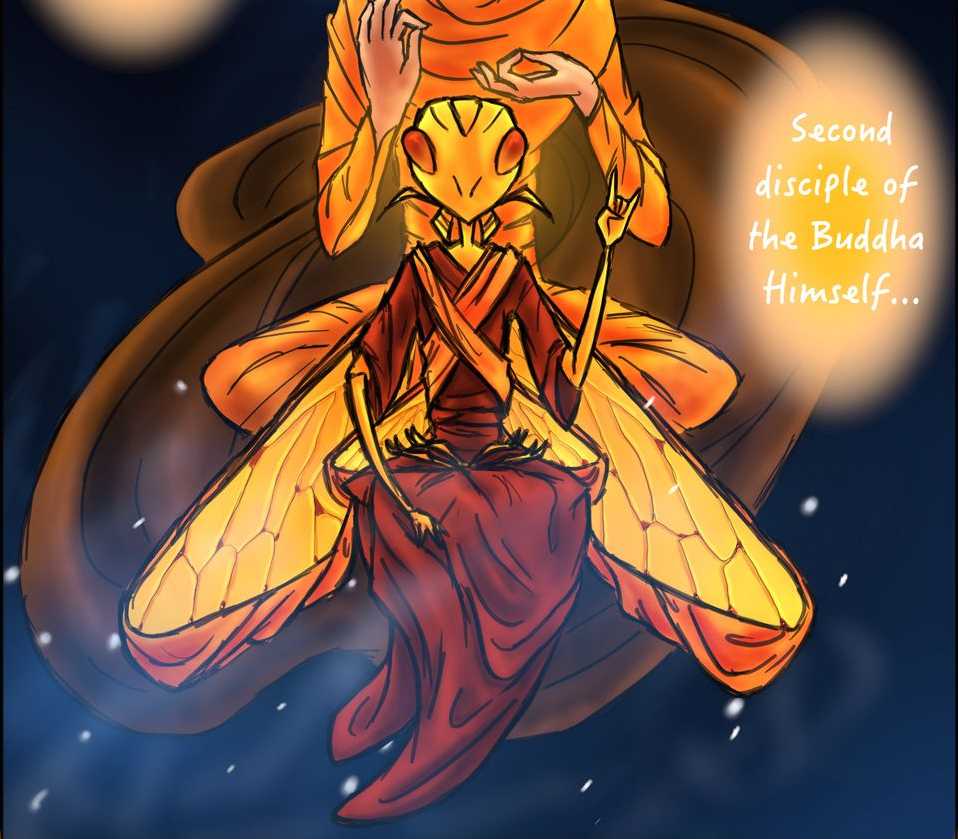
Deviantart user Taylor-Denna has drawn a beautiful depiction of Tripitaka’s former incarnation as a literal cicada (fig. 6). It is quite unique as I’ve never seen any other artist portray the former celestial in such a way. The image makes one think of an insect who acquired magic powers through spiritual cultivation and rose through the Buddho-Daoist hierarchy to become the Buddha’s disciple. The idea would make a good prequel story.
Fig. 6 – Detail of Master Golden Cicada by Taylor-Denna (larger version). Click here for the full version and the artist’s statement. Used with permission.
Update: 12-01-21
I’ve archived a book that shows how Tripitaka’s exile from heaven is similar to ancient Greek and Egyptian beliefs.
In chapter 81, Monkey alludes to his master’s past life, adding to the reason why the celestial had been exiled to Earth:
“You don’t realize that Master was the second disciple of our Buddha Tathagata, and originally he was called Elder Gold Cicada. Because he slighted the Law, he was fated to experience this great ordeal.”
“Elder Brother,” said Eight Rules, […] “Why must he endure sickness [for two days] as well?”
“You wouldn’t know about this,” replied Pilgrim. “Our old master fell asleep while listening to Buddha expounding the Law. As he slumped to one side, his left foot kicked down one grain of rice. That is why he is fated to suffer three days’ illness after he has arrived at the Region Below.”
Horrified, Eight Rules said, “The way old Hog sprays and splatters things all over when he eats, I wonder how many years of illness I’d have to go through!”
“Brother,” said Pilgrim, “you have no idea either that the Buddha is not that concerned with you and other creatures. But as people say:
Rice stalks planted in noonday sun Take root as perspiration runs. Who knows of this food from the soil Each grain requires most bitter toil?
Master still has one more day to go, but he’ll be better by tomorrow” (Wu & Yu, 2012, vol. 4, p. 82).
This points to the supreme importance of rice in an agrarian society like ancient China.
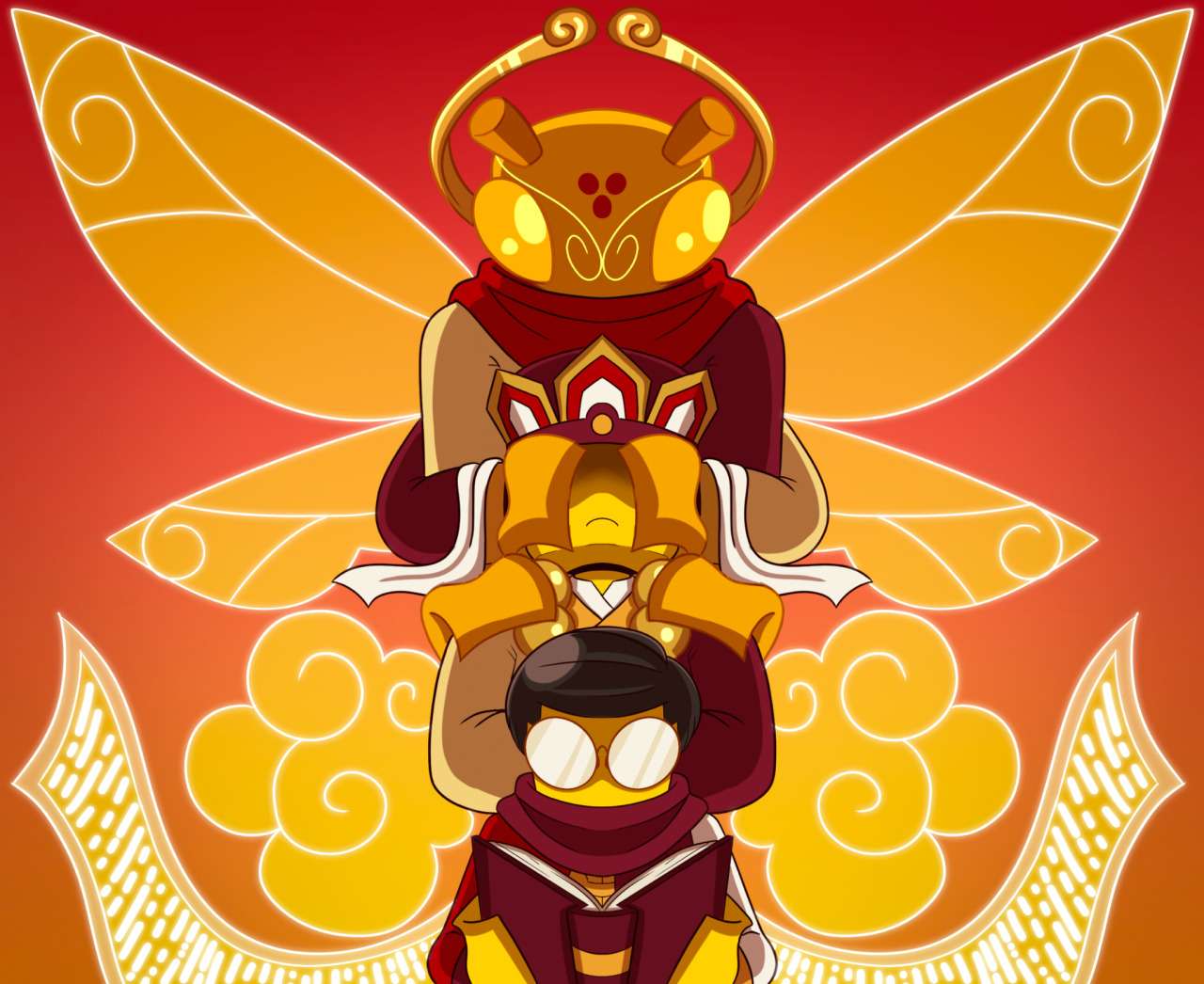
Fig. 10 – “Break the Cycle” by Countingclowns (larger version). The original can be seen here.
Update: 06-03-23
Tripitaka’s past celestial life and punishment appear to be based on information from Xuanzang’s historical life story, A Biography of the Tripitaka Master of the Great Ci’en Monastery of the Great Tang Dynasty (Datang Da Ci’ensi Sanzang Fashi zhuan, 大唐大慈恩寺三藏法師傳, 7th-century). After his death, a spirit extolls the monk’s virtues, as well as reveals the karmic result of his afterlife:
The Venerable Xuanzang alone cultivated the deeds of both blessedness and wisdom in nine lives. In every incarnation he was always learned and erudite, intelligent and eloquent, always the first and foremost in the land of Cīna in Jambudvīpa. Such were his blessed virtues also. […] Owing to the power of his good deeds, he has now been reborn in the inner court of Maitreya in the Tuṣita Heaven, where he will hear the Dharma with comprehension and understanding, and he will never again be born in the human world (Huili & Shi, 1995, p. 336).
Like Tripitaka, Xuanzang has nine prior pious past lives, and like Master Golden Cicada, he comes to live in a paradise where he can listen to a Buddha lecture on the Dharma. The novel simply changes some of the details, like Xuanzang’s final rebirth in paradise being a previous life, and instead of Maitreya, he studies under the historical Buddha.
Update: 06-04-23
Brose (2021) mentions a small temple in Taipei, Taiwan where one of Xuanzang’s avatars, the bodhisattva Nine Lotuses (Jiulian pusa, 九蓮菩薩) is worshiped. [5] What’s important for this article is that the deity’s mythos, as recounted by a temple master, alludes to the Golden Cicada’s story:
[Xuanzang], she explained, originally lived in a heavenly Buddha realm, but because his cultivation was incomplete, he was sent down to earth to perform the meritorious task of bringing Buddhist sūtras from India to China. Once his work was complete, Xuanzang was able to return to the Buddha realm, but out of compassion for the world, he left a portion of his spirit behind in the form of Nine Lotuses (Brose, 2021, pp. ix-x).
Update: 04-09-24
In chapter 27, the white bone spirit also comments on the monk’s past life and the effects of eating his flesh:
“What luck! What luck!” she said, unable to contain her delight. “For several years my relatives have been talking about a Tang Monk from the Land of the East going to fetch the Great Vehicle. He is actually the incarnation of the Gold Cicada, and he has the original body that has gone through the process of self-cultivation during ten previous existences. If a man eats a piece of his flesh, his age will be immeasurably lengthened. So, this monk has at last arrived today!” (Wu & Yu, 2012, vol. 2, 17).
Recall that the 01-14-23 update quotes the fullest description of events leading to Master Golden Cicada’s banishment from paradise: he falls asleep during a sermon and accidentally kicks something, causing a single grain of rice to fall to the ground. Well, I’m reading a biography of the Buddha and learned that his family has a connection to rice:
Sakyamuni’s father was called Suddhodana. The name means “pure rice” or “white rice.” In Chinese it is translated as Ching-fan-wang [[Jingfan wang, 淨飯王;] king of pure rice]. Legend says that the names of his four younger brothers all contained the element meaning “rice” (odana). These names suggest that the Sakyas were already cultivating rice and that they particularly valued white rice (Nakamura, 2000, vol. 1, p. 46).
This might explain the Buddha’s reaction.
Update: 01-25-25
To recap, Journey to the West casts the Tang Monk Tripitaka as the last incarnation of Master Golden Cicada (Jinchan zi, 金蟬子), the second disciple of the Buddha who is exiled from paradise for falling asleep during his master’s sermon. Chapter 81 adds a second crime: kicking something in his slumber and making a single grain of rice fall to the ground.
This leads me to the point of this post. A reader contacted me the other day asking if Sariputra (Sk: शारिपुत्र; Pali: Sariputta; Ch. Shelifu, 舍利弗), one of the Buddha’s ten primary disciples, was the basis for Master Golden Cicada since he was known for having a golden glow about him. A cursory search didn’t turn up anything connecting them, but thanks to the reader’s prompt, I kept digging and was interested to learn that another disciple of Tathagata, Aniruddha (Sk: अनुरुद्ध; Pali: Anuruddha; Ch: Analu, 阿那律) (fig. 11), was known to have fallen asleep during the Enlightened One’s lessons.
According to monk Jiaoguang’s (交光, fl. 1600) Dafo Dingshou Lengyan Jing Zhengmai Shuxu (大佛頂首楞嚴經正脉疏序, T. 275):
Analu [Aniruddha] then stood up, bowed at the Buddha’s feet, and said to him respectfully …
[Commentary:] Changshui [6] says: Nalu, namely Anouloutuo, which means “free of poverty,” was a Rice Prince. He gave a meal to a Solitary Buddha in a past life and enjoyed happiness for 91 kalpas.
… “When I first entered the monastic life, I was too fond of sleep. The Thus-Come One admonished me, saying that I was no better than an animal. After the Buddha scolded me, I rebuked myself and wept. For seven days I did not sleep, and as a result I went blind in both eyes.”
[Commentary:] Gushan [7] says: According to the Ekottara Agama, the Buddha was preaching the Law in Jetavana when Nalu fell asleep. The Buddha spoke in verse: “Tut-tut … Why are you sleeping? River snails, mussels, clams and the like sleep for a thousand years, never hearing the names of Buddhas.” Thereupon, Nalu made it known that he would never sleep again, and he soon lost his sight. [8]
The term “Rice Prince” (Bifan wangzi, 白飯王子) refers to the fact that Aniruddha was the cousin of the Buddha and a fellow grandson of King Sihahanu, whose sons, including the Buddha’s father (as mentioned above), all had the suffix odana (“rice”) as part of their names. Aniruddha’s father was Amitodana (“Unmeasured Rice”) (Nakamura, 2000, vol. 1, p. 46; Harvey, 2013, p. 117; Thomas, 1931/2013, p. 24).
Therefore, we have a Buddhist disciple who dozes off during the Buddha’s sermon and has an association with rice. This makes Aniruddha the best possible influence for Master Golden Cicada that I’ve seen. The story goes back to at least the 4th-century Zengyi ahan jingxu (增壹阿含經序, T. 125), so it would have been around long enough to eventually influence Journey to the West.
I need to point out, however, that I’m not the first person to write about this. While I was finishing typing this update, I came across this article, which mentions Aniruddha in passing. But to my credit, I actually cited the historical Buddhist literature involved.
Fig. 11 – A colored relief of the Buddha helping his blind disciple sew a new robe (larger version). Image found here.
Update: 02-13-25
I just thought of a way to work Aniruddha into JTTW lore: In chapter eight of the Lotus Sutra (Miaofa lianhua jing, 妙法蓮華經; a.k.a. Fahua jing, 法華經, c. 3rd-century), the Buddha mentions our tired friend among a list of 500 Arhats who will attain perfect enlightenment and share the same holy title:
In our headcanon, Master Golden Cicada could be the celestial title of the Arhat Aniruddha, but his sleeping episode instead takes place in heaven. In addition, “Universal Brightness” (Puming, 普明) could just be a classification of Buddha, thus allowing for his Tripitaka avatar to receive the individualized title “Buddha of Candana Merit” (Zhantan gongde fo, 旃檀功德佛) at the end of his quest.
Update: 02-19-25
Something just dawned on: although I’ve always considered Master Golden Cicada to be a bodhisattva, the novel never specifically calls him that. So what is his actual spiritual rank then? Several pieces of Information point to him being an Arhat.
First, recall that the introduction to this article reads:
The cleric [Xuanzang] eventually gained his own supernatural background, for evidence shows that he was worshiped as an Arhat (Luohan, 羅漢; Zunzhe, 尊者), a Buddhist saint, by the Song Dynasty (960-1127 CE) (Liu, 2019). A Yuan-Ming zaju stage production plays on this concept by depicting Tripitaka as the reincarnation of the Arhat Vairocana (Pulujia zunzhe, 毗廬伽尊者) (Dudbridge, 1970, p. 193).
This shows that the Tang Monk was already closely associated with Arhats in the past. Second, something I learned but forgot to mention here is that Tripitaka Seeks the Scriptures (Sanzang qujing, 三藏取經), a rare Yuan-Ming puppet play that predates the 1592 JTTW, even refers to the cleric’s past life as the “Golden Chan Arhat” (Jinchan luohan, 金禪羅漢). (This implies that chan (蟬, “cicada”) was based on the Chan (禪) of Chan Buddhism, thereby supporting my suggestion from the 12-08-18 update.) Third, as mentioned above, Golden Cicada was likely based on the Arhat Aniruddha, one of the Buddha’s ten principal disciples, who was reprimanded by his master for dozing off during a lesson. And fourth, the Arhats Ananda (A’nuo, 阿儺) and Kasyapa (Jiaye, 伽葉), two other principle Buddha disciples, also appear among the Enlightened One’s heavenly retinue in JTTW (chapters 7, 8, 77, 98, 99, & 100). Therefore, taken together, this info is a strong indication that the novel’s author-compiler intended Golden Cicada to be an Arhat.
Because of this, I’ve updated the article by removing any previous references to him as a bodhisattva.
Update: 02-21-25
I posted a summary of my last update to Twitter, and a follower commented that Golden Cicada wouldn’t have been able to reincarnate like bodhisattvas if he was really an Arhat. This is based on Buddhist belief. For instance, Buswell and Lopez (2014) briefly explain: [T]he arhat is one who has attained nirvāṇa in this life, and at death attains final liberation ([parinirvāṇa]) and will never again be subject to rebirth” (p. 62). But I reminded them that JTTW is not an accurate snapshot of mainstream beliefs by pointing to two instances from past media (mentioned above) where Tripitaka is the reincarnation of an Arhat. Here, I translate the pertinent sections.
I. The Yuan-Ming JTTW zaju play
Guanyin reveals the monk’s divine origins in act one:
At present, the Western Land of India has the “Golden Scriptures of the Great Repository” in 5,480 volumes. We desire to transmit them to the Eastern Lands (i.e. China), but how can we help propagate them if we don’t have the illusory, corporal body of a genuine person? Currently, the various Buddhas are discussing what to do, and they have decided that the Arhat Vairocana of the Western Heaven will be reborn (tuohua, 托化) as a son to Chen Guangrui’s family in Hongnong County, Haizhou, China. When he grows up, he will leave the family to become a monk and travel to the Western Heaven to retrieve scriptures. He will (later) spread the teachings.
You can see here that there are no negative reasons for his reincarnation. This differs from the next source.
II. The Yuan-Ming JTTW puppet play
Tripitaka describes being born (chushi, 出世) to father Chen Guangrui and a beautiful, nameless mother in scene one (see page 1 of this PDF). His celestial origin is later revealed by “Equaling Heaven” (Qitian, 齊天; i.e. Monkey) in scene six:
The Golden Chan Arhat descended to earth (jiangshi, 降世) because he privately went to the lantern fruit festival without reporting this to the temple sangha, causing the Buddha to punish him to 36 tribulations, including journeying to the Western Heaven to acquire scriptures. After suffering over countless days, he finally returned to the right fruit (i.e. achieved enlightenment).
… 金禪羅漢降世,因私赴燈果會,不報寺中眾僧,佛罰伊過三十六劫,往西天取經。苦難滿日,修歸正果。(see page 9 of this PDF)
Having read the above, I think Master Golden Cicada’s Arhatship is now fully established as fact within the JTTW story cycle.
Update: 08-03-25
The notion that Arhats fall asleep is exemplified by the “Dreaming/Sleeping Arhat Fist” (Shuimeng luohan quan, 睡梦罗汉拳) from the 1992 HK film King of Beggars (Wu zhuangyuan Su qi’er, 武状元苏乞儿; lit: “Top Martial Scholar: Beggar Su”; video 1).
Video #1 – The scene where Beggar Su displays his new-found boxing abilities.
2) This heavenly aura is also mentioned by Sun Wukong later in chapter 80 (Wu & Yu, 2012, vol. 4, p. 66).
3) The turtle had previously helped the pilgrims cross the same river in chapter 34, and in return they agreed to ask the Buddha when the terrapin would be allowed to achieve human form (for all creatures strive for such an attainment). But Tripitaka forgot to ask the Enlightenment One while visiting the Western paradise, so the turtle dumped them into the river upon their return.
4) The six-six senses (liuliu chen, 六六塵) are “the intensified form of the six gunas, the six impure qualities engendered by the objects and organs of sense: sight, sound, smell, taste, touch and idea” (Wu & Yu, 2012, vol. 4, p. 405 n. 7).
5) Brose (2021), however, explains that this goddess “is usually identified as the divinized form of a Ming Dynasty empress dowager” (p. ix).
6) The monk Changshui (長水), a.k.a. Zixuan (子璿; 965-1038), was the compiler of the Shou lengyan yanyi shu zhu jing (首楞嚴義疏注經, T. 1799) (Sorenson, 2011, p. 39).
7) Gushan (孤山), a.k.a. Zhiyuan (智圓; 976-1022), wrote a commentary for the Shou lengyan jing shu (首楞嚴經疏) (McBride, 2016, pp. 144-145 n. 238).
8) The translation of the commentary is mine, while the rest comes from Buddhist Text Translation Society & Hsuan (2012, p. 210).
Sources:
Brose, B. (2021). Xuanzang: China’s Legendary Pilgrim and Translator. Boulder, Colorado: Shambhala Publications, Inc.
Buddhist Text Translation Society & Hsuan, H. (2012). The Surangama Sutra: A New Translation with Excerpts from the Commentary by the Venerable Master Hsuan Hua. (n.p.): Buddhist Text Translation Society.
Buswell, R. E. , & Lopez, D. S. (2014). The Princeton Dictionary of Buddhism. Princeton University Press.
Harvey, P. (2013). Buddha, Family Of. In C. S. Prebish & D. Keown (Eds.), Encyclopedia of Buddhism (pp. 117-121). United Kingdom: Taylor & Francis.
Huili, & Shi, Y. (1995). A Biography of the Tripitaka Master of the Great Ci’en Monastery of the Great Tang Dynasty (L. Rongxi Trans.). Berkeley, CA: Numata Center for Buddhist Translation and Research.
Liu, S. (2019). Songdai Xuanzang de shenghua: Tuxiang, wenwu he yiji [The Sanctification of Xuanzang in the Song Dynasty: Images, Artifacts and Remains]. Zhonghua wenshi luncong, 133, 161-219.
McBride, R. D. (2016). Doctrine and Practice in Medieval Korean Buddhism: The Collected Works of Ŭich’ŏn. Germany: University of Hawaii Press.
Munsterberg, H. (1972). The Arts of China. Rutland, Vt: C.E. Tuttle Co.
Sorenson, H. H. (2011). Textual Material Relating to Esoteric Buddhism in China Outside the Taisho, vol. 18-21. In C. D. Orzech, H. H. Sorensen, & R. K. Payne (Eds.), Esoteric Buddhism and the Tantras in East Asia (pp. 37-70). Netherlands: Brill.
Note: Go to the 11-18-21 and 11-21-21 updates for PDFs of two scholarly studies of the zaju play.
Last updated: 09-06-2023
I have previously discussed the 13th-century precursor to Journey to the West called The Story of How Tripitaka of the Great Tang Procures the Scriptures. This 17-chapter storytelling prompt differs greatly from the final version. However, a little known precursor, the early-Ming Journey to the West zaju play (Xiyou ji zaju, 西遊記雜劇), contains many familiar episodes, including the reincarnation of a heavenly being as Tripitaka, the murder of his father, Monkey stealing immortal peaches from heaven and eventually being imprisoned under a mountain, his punishment with the restricting headband, the subjugation of Zhu Bajie (here and here) and Sha Wujing, the addition of a royal dragon-turned-white horse, the ordeal at Fire Mountain, the Country of Women, etc. It is also one of the earliest sources to call the monkey character “Sun Wukong” (孫悟空). [1] This shows that the centuries-old story cycle was starting to become standardized by the 14th or 15th-century.
But despite the many similarities to the 1592 novel, there are several subtle and very interesting differences. For instance, Sun is trapped under his home of Flower Fruit Mountain by Guanyin, instead of being banished to Five Elements Mountain by the Buddha 600 years prior. In addition, although Red Boy and Princess Iron Fan appear in the play, they are not depicted as mother and son. The demon child is instead the offspring of the monstress Hariti. These are just a few of many deviations.
Early 20th-century scholarship ascribes the play to Yang Jingxian (杨景賢), a 15th-century mongol playwright who served as a minor official to his sister’s husband, the Military Judge Yang (from whom he took his pen surname). Records indicate Yang was fond of music, practical jokes, visiting pleasure quarters, and, of course, writing zaju plays (Ning, 1986, pp. 6-7). This explains the rowdy and often saucy nature of the story, which is replete with cursing, sexual innuendo, [2] and many beautiful, seductive women. Ning (1986) suggests Yang uses sexualized women as a detriment to the celibate Tripitaka to not only elicit laughter from the male audience, but also to make fun of Buddhism while elevating his own Confucian worldview (p. 81).
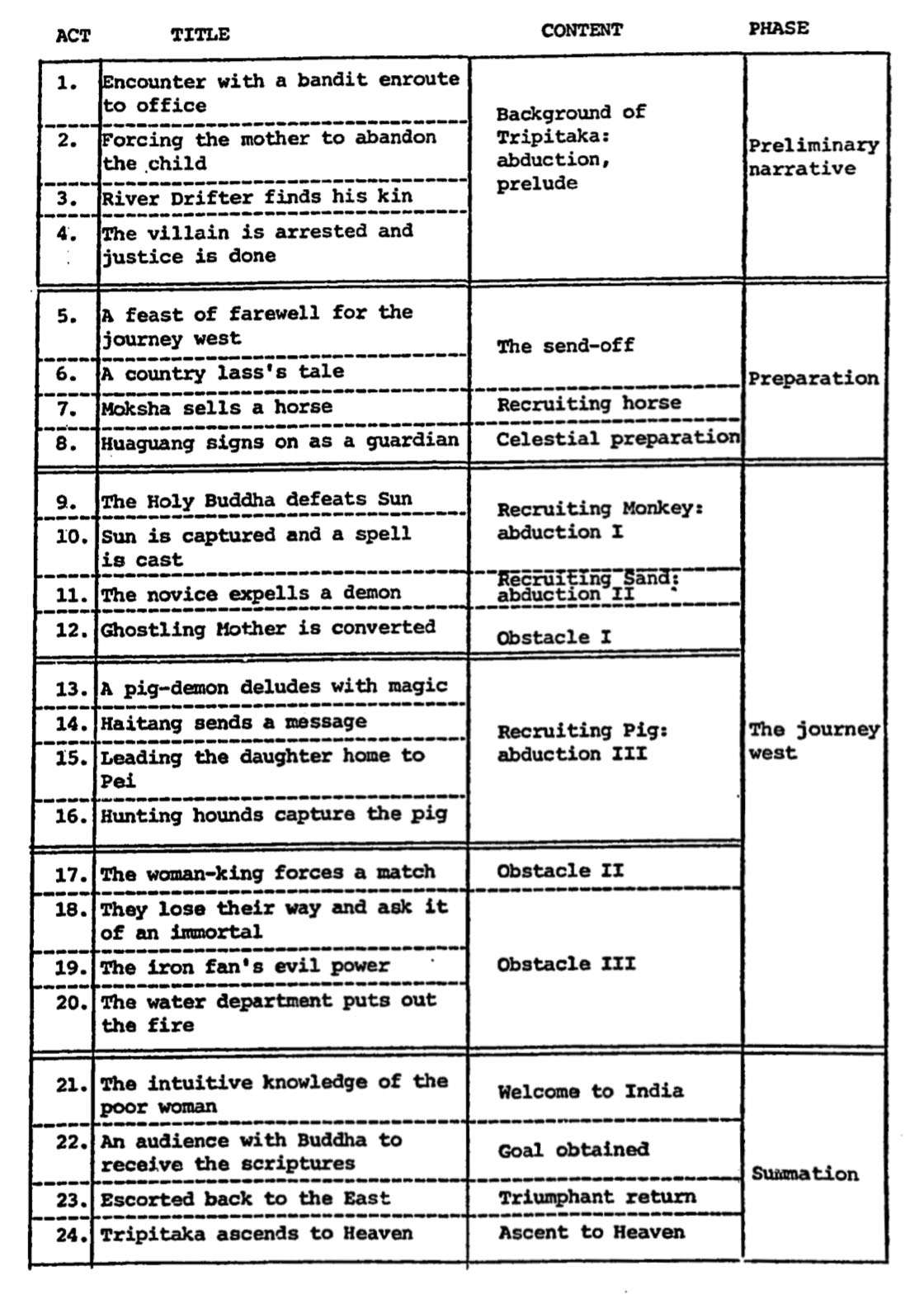
Women play a large role in the production, appearing in 13 of the 24 acts. Female characters are abducted in four different parts (Xuanzang’s mother in acts one to four; Monkey’s wife in act 10; the daughter of the Liu family in act 11; and Pigsy’s wife in acts 13 to 16), while women make up the three main obstacles (Hariti in act 12; the Queen of the Land of Women in act 17; and Princess Iron Fan in acts 18 to 20) (fig. 1).
Fig. 1 – A synopsis diagram of the Journey to the West zaju play (from Ning, 1986, p. 9) (larger version).
Below I present the play’s summary as laid out by Dudbridge (1970).
Scene 1: Disaster encountered on a journey to office
The Bodhisattva Guanyin introduces the action: a mortal is required to collect scriptures for the benefit of China; for this purpose the Arhat Vairocana is to become incarnate as the son of Chen Guangrui [陳光蕊] in Hongnong xian [弘農縣] of Haizhou [海州]. Chen Guangrui is to suffer an eighteen-year-long ‘disaster in water’. The Dragon King has been instructed to protect him.
Chen Guangrui, on his journey to office, has reached the Inn of a Hundred Flowers: he has restored life to a fish which, when he bought it, blinked at him. Preparing to continue the journey to Hongzhou [洪州], the servant Wang An [王安] looks for a boatman. The singer in this act is Chen’s wife who, being eight months pregnant, is full of anxieties about the journey. In the event Liu Hong [劉洪], recruited as their boatman, murders first Wang An, then Chen himself; he agrees to spare the wife and her unborn child on condition that she accepts him in Chen Guangrui’s place—as her husband and the prefect of Hongzhou. She has him agree in turn to a three-year delay—a gesture of filial piety on the part of her as yet unborn son.
Scene 2: The mother forced, the child cast out
The Dragon of the Southern Seas explains that in compliance with Guanyin’s direction and in gratitude for Chen Guangrui’s action in saving his life (in the form of a fish at the Inn of a Hundred Flowers), he is holding the murdered Chen secure in his Crystal Palace until the eighteen years are up.
Liu Hong enters and declares his intention of ridding himself of the newly born child who constitutes a threat to his security in office.
The Dragon reappears briefly to ensure protection for the incarnate Vairocana who is to suffer hardship on the river.
The wife—again the singer—completes the scene alone. She has been compelled by Liu Hong to cast her month-old son into the river, and now performs the deed carefully, putting the child into a watertight box, together with two gold clasps and an explanatory note written in her own blood.
Scene 3: Jiangliu [江流] recognizes his mother
The Dragon orders the Arhat to be transported to the island monastery Jinshansi [金山寺, Gold Mountain Monastery].
A fisherman finds the box and takes it off to the Abbot.
The Chan Master Danxia [丹霞] receives it, inspects the contents and resolves to raise the child [whom he names Jiangliu, Flowing River] and preserve the letter with all the details of its history.
Liu Hong here makes a brief appearance, alluding to his present quite life and sense of security.
The passage of eighteen years is assumed: the Chan career of the abandoned child, whom he has brought up as a novice monk and named Xuanzang [玄奘]. He now sends him on a mission of revenge, first explaining the details of his background.
The mother is discovered in a state of anxiety: again she is the singer. Xuanzang enters, there is an extended recognition scene. They arrange for him to return provisionally to Jinshansi.
Scene 4: The bandit is taken, revenge is wrought
Yu Shinan [虞世南] has now, in the year Zhenguan [貞觀] 21 [647/648 CE], been appointed Prefect of Hongzhou. His first official case is an appeal delivered by the Abbot Danxia and Xuanzang, calling for action against Liu Hong. Men are sent secretly to arrest him.
The dissipated Liu Hong is giving orders to his wife, who is again the singer. Official guards enter and arrest Liu; he makes a full confession. Yu Shinan sentences him to immolation on the shore of the river in expiation of Chen’s death. As the sacrificial verses are pronounced Chen’s body is borne out of the water by the Dragon King’s attendants. There is a final explanation.
Guanyin appears on high: she summons Xuanzang to the capital, first to pray for rain to break a great drought there, and further to fetch 5,048 rolls of Mahāyāna scriptures from the West.
The wife sums up the whole action in her closing songs.
Scene 5: An Imperial send-off for the westward journey
Yu Shinan narrates how he presented Xuanzang at court: the prayers for rain were successful, Xuanzang was honoured with the title Tripitaka [三藏] and invested with a golden kaṣāya and a nine-ringed Chan staff. His parents also received honours.
Now, in official mark of his departure for the West, Qin Shubao [秦叔寶] and Fang Xuanling [房玄齡] representing officials civil and military, enter to greet him. Xuanzang is ushered on. The official party is headed by the aged Yuchi Gong [尉遲恭], the singer in this act. He sustains a dialogue, partly in song, with Xuanzang, leading finally to a request for a Buddhist name. Xuanzang names him Baolin [寶林, Treasure Forest].
The pine-twig is planted which will point east when Xuanzang returns. Finally, he gives spiritual counsel to members of the crowd.
Scene 6: A village woman tells the tale
In a village outside Chang’an some local characters return from watching the spectacle of Tripitaka’s departure. The singer is a woman nicknamed Panguer [胖姑兒]. Her songs describe the scene from the crowd’s point of view. There is a good deal of observation of various side-shows and theatrical performances.
Scene 7: Moksha sells a horse
The Fiery Dragon of the Southern Sea is being led to execution for the offence of ‘causing insufficient and delayed rainfall’. His appeals succeed in enlisting the help of Guanyin, who persuades the Jade Emperor to have him changed into a white horse for the transport of Tripitaka and the scriptures.
Tripitaka is discovered at a wayside halt, troubled by the lack of a horse.
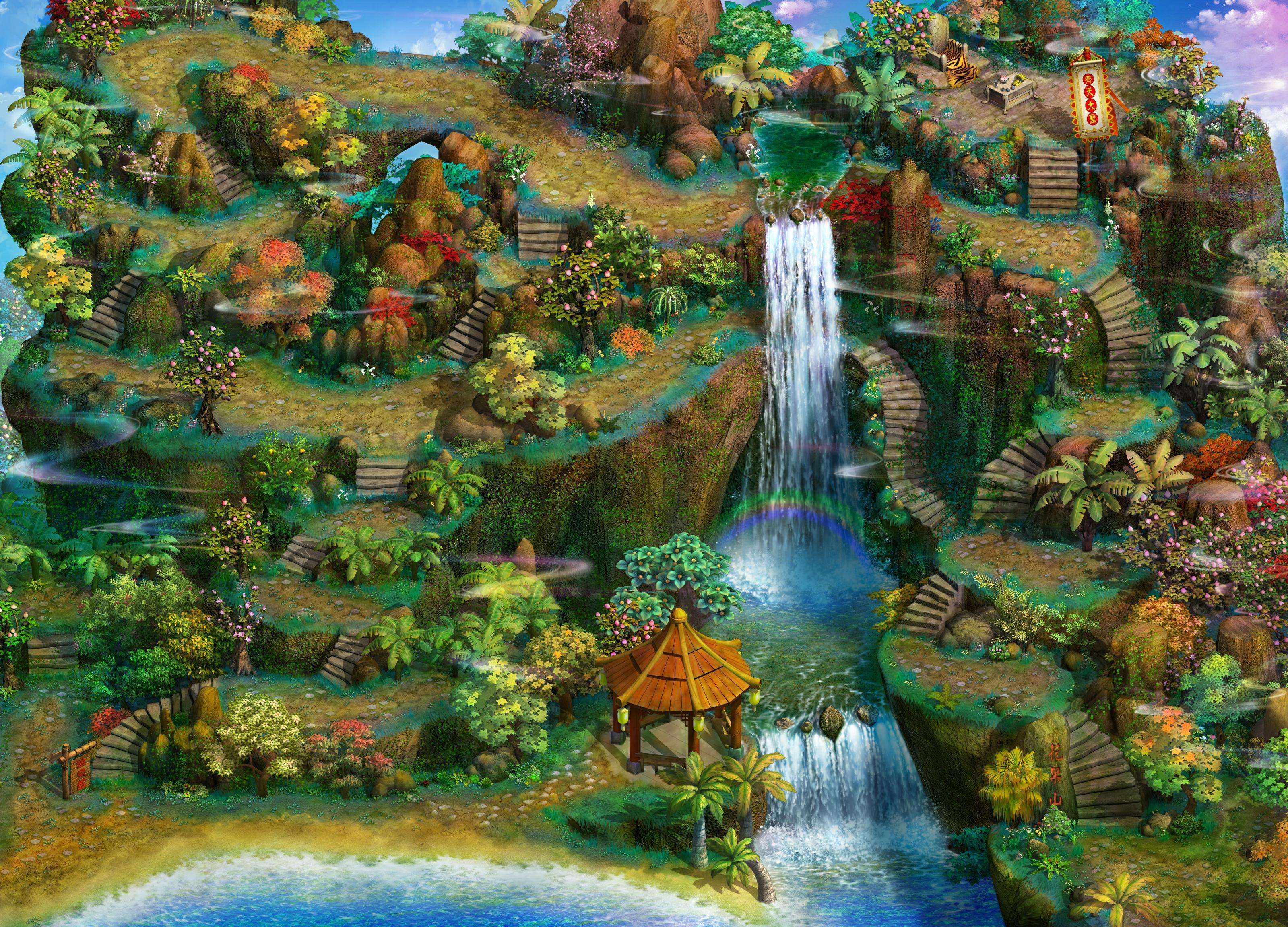
Moksha [木叉], disciple of Guanyin and the singer in this act, comes to offer him the white dragon-horse. His songs extol the horse’s qualities. Finally he uncovers the design, reveals the dragon in its original form, and ends the scene with allusions to the coming recruitment of Sun Wukong on Huaguo shan [花果山, Flower Fruit Mountain] (fig. 2) (Dudbridge, 1970, pp. 193-195).
Fig. 2 – A depiction of Huaguo shan from a modern videogame (larger version).
Scene 8: Huaguang serves as protector
Guanyin first announces a list of ten celestial protectors for Tripitaka on his journey. The Heavenly King Huaguang [華光天王], sixth on the list, is the last to sign on: he enters and for the rest of the scene sings on this theme of protection, pausing only to receive Guanyin’s greeting. In the last song there is a further allusion to Huaguo shan.
Scene 9: The Holy Buddha defeats Sun
Sun Xingzhe [孫行者, Pilgrim Sun] now appears: after an initial poem vaunting his celestial birth, his ubiquity and power, he lists out the members of his ape family, alludes to his career of misdeeds and his wife, the abducted Princess of Jinding guo [金鼎國, the Golden Cauldron Country].
Devaraja Li appears, with orders to recover the possessions stolen by Sun from the Queen Mother of the West. He issues orders to his son Nezha, who enters with troops upon orders from the Jade Emperor to capture Sun Xingzhe in his home Ziyun luo dong [紫雲羅洞, Purple Cloud Cave] on Huaguo shan.
The princess-wife now enters (the singer in this act) and tells in song the story of her abduction and the life on this mountain. She is joined by Sun and they prepare to feast.
The celestial troops surround them, Sun’s animal guards flee and Sun himself escapes. Devaraja Li ‘combs the hills’ and meanwhile finds the princess, who now sings through the remainder of her suite of songs until it is decided to give her escort back to her home.
Sun Xingzhe eludes the forces of Nezha and is captured only by intervention by Guanyin, who has him imprisoned beneath Huaguo shan to await the arrival of Tripitaka, his future master.
Scene 10: Sun is caught, the charm rehearsed
The singer is a Mountain Spirit guarding Sun beneath Huaguoshan: He opens the act with songs about his own permanence and his present duties.
Tripitaka comes seeking hospitality. The Spirit responds with a sung discourse which is interrupted by the shout of Sun Xingzhe eager to be delivered. Tripitaka releases him, and Sun’s immediate reaction is to seek to eat him and escape. Guanyin intervenes to curb his nature will disciplines in the shape of an iron hoop [Tiejie, 鐵戒, Iron prohibition ring], a cassock and a sword. She gives him the name Sun Xingzhe.
To Tripitaka she teaches the spell that works the binding hoop on Sun’s head, and they successfully prove it.
The Spirit adds (in speech) a warning about the demon of Liusha [he 流沙河, Flowing Sands River] and they again set out.
Scene 11: Xingzhe expels a demon
The Spirit of Liusha he, characterized as a monk adorned with human skulls, announces that he has devoured nine incarnations of Tripitaka (nine skulls represent them), towards the total of a hundred holy men he must eat in order to gain supremacy.
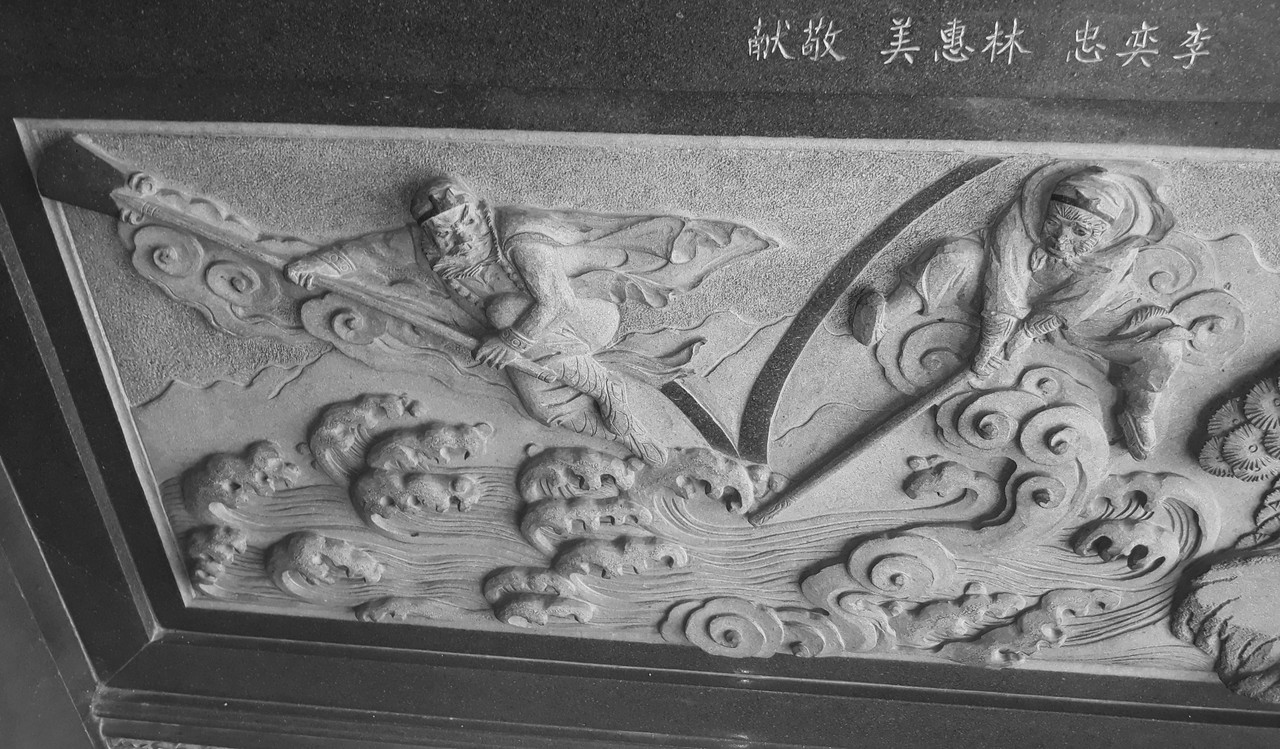
Sun Xingzhe enters and is attacked by this Sha Heshang [沙和尚, Sha Monk]. Sun vanquishes him (fig. 3) , and he is recruited for Tripitaka’s band of pilgrims.
A new demon named Yin’e jiangjun [銀額將軍, Silver-browed General] enters, inhabitant of the impregnable Huangfeng shan [黃風山, Yellow Wind Mountain]. He has abducted the daughter from a nearby Liu family.
The father Liu is the singer in this act: he explains his plight to Tripitaka and the party of pilgrims. They fight and kill the demon, and restore the girl to her home. As they set out again, Liu gratefully awaits their return from the West (Dudbridge, 1970, pp. 195-196).
Fig. 3 – A stone relief carving of Monkey fighting Sandy (from Wanfu Temple, Tainan, Taiwan) (larger version).
Scene 12: Gui mu is converted [Guiyi, 皈依, Take refuge (in the Buddha)]
The pilgrims are now approached by the Red Boy [Hong hai’er, 紅孩兒] feigning tears. Sun Xingzhe, against his own better judgement, is made to carry the child, cannot sustain the intolerable weight and tosses him into a mountain torrent.
Sha Heshang at once reports that the child has borne away their Master. They go off to appeal to Guanyin; she in turn takes the case to the Buddha, who now appears in company with the Bodhisattvas Mañjuśrī [Wenshu, 文殊] and Samantabhadra [Puxian, 普賢]. He explains that this is the son, named Ainu’er [愛奴兒], of Guizi mu (鬼子母, Hariti) (fig. 4). Four guardians have been sent to capture him with the help of the Buddha’s own alms bowl. The bowl is now brought in, with the Red Boy confined beneath it. The pilgrims return to rejoin their Master.
The mother Guizi mu enters to sing vindictive songs about this action. The Buddha defends himself from her attacks; she attempts to have the bowl lifted clear; finally she is overcome by Nezha. Tripitaka is freed and himself offers her alternative sentences: she chooses to embrace Buddhism (Dudbridge, 1970, pp. 196-197).
Fig. 4 – A 1st-cent. BCE Gandharan statue of Hariti (Guizi mu) with children (larger version).
Scene 13: A pig-demon deludes with magic
Zhu Bajie [豬八戒] enters, announces his background, past history and present home (Heifeng dong [黑風洞, Blackwind cave]) and describes a plan by which he means to substitute himself for the young man Chu Lang [朱郎], the bridegroom to whom a young local girl is promised and for whom she waits nightly. (Her father Peigong [裴公], we learn, is disposed to retract the agreed match for financial reasons.)
The girl, with her attendant, expects a visit from young Chu the same night. She (the singer in this act) goes through the actions of burning incense as she waits for him. Zhu Bajie enters, carries on a burlesque lovers’ dialogue with her and prevails on her to elope with him.
The pilgrims appear briefly on the stage, preparing to seek lodging near the frontier of Huolun [火輪] Jinding guo.
Scene 14: Haitang [海棠] sends on news
The girl, again the singer, is now in Zhu Bajie’s mountain home, has discovered the deception and despairs of seeing her home again; she is obliged to entertain the debauched Zhu Bajie, who agrees however to let her visit home.
Sun Xingzhe enters, overhears their conversation and at once attacks Zhu. He offers to carry a verbal message for the girl. She trusts him with this and warns him that her family and the Zhu’s are already disputing the case.
Scene 15: They take the daughter back to Pei
The heads of the Zhu and Pei families argue out their marriage contract and its alleged violation and are stopped from going to court only by the arrival of Tripitaka and his party. Sun Xingzhe produces the message in the form of a little song.
To determine what demon this abductor is they summon up the local guardian spirit (tudi [土地]), who reports that he takes the form of a pig. Sun Xingzhe at once sets out to attack.
The Pei girl sings a series of heartbroken songs. Sun Xingzhe comes and offers to take her home: she now sings gratitude, against some jeering comment from Sun. They leave.
Tripitaka, with the two family heads, await them and welcome back the daughter. She reveals that Zhu fears only the hunting dogs of Erlang [二郎]. The family affairs are now resolved.
Zhu Bajie decides to follow her home. Sun Xingzhe arranges to take her place in the bridal chamber where Zhu expects to find her. They fight: Zhu escapes, taking with him the Master Tripitaka. Erlang must now be called in.
Scene 16: The hunting hounds catch the pig
Erlang, the singer in this act, begins with a series of truculent and threatening songs, then demands Zhu’s surrender to Buddhism. Zhu fights first with Sun Xingzhe, who has entered with Erlang; then the dogs are put on him and finally seize him. Tripitaka is released and instantly urges mercy. Zhu accepts the Buddhist faith.
Erlang’s closing song alludes to the coming perils of the Land of Women and Huoyan shan [火焰山, Flaming Mountain].
Scene 17: The Queen forces a marriage
The pilgrims arrive in the Land of Women.
The Queen enters alone (she is the singer), describes her situation and her longing for a husband, and declares an intention to detain Tripitaka for this purpose.
The pilgrims again enter, warned of their danger in a recent dream granted by one of their guardians—Weituo zuntian [韋馱尊天, Skanda]. The Queen seeks to tempt Tripitaka with wine, then embraces him and finally bears him off to the rear of the Palace. Other women do the same with the three disciples.
The Queen and Tripitaka re-enter, and she continues to sing her entreaties until Wei-t’o tsun-t’ien appears and drives her back. Sun Hsing-che is summoned and Weituo, giving him a brief allocution, retires.
Sun confesses that his own near lapse was forestalled only by the tightening of the hoop upon his brow. He now ends the scene by singing a suggestive ditty to the tune Jishengcao [寄賸草].
Scene 18: They lose the way and ask it of an Immortal
The pilgrims require guidance.
A Taoist in the mountains sings a set of literary verses on the Four Vices. When the pilgrims come and ask the way of him he at once gives details of the nearby Huoyan shan and the female demon Tieshan gongzhu [鐵扇公主, Princess Iron Fan] whose Iron Fan alone is able to put out the flames on the fiery mountain. With more songs, of a warning nature, the Taoist leaves them.
The pilgrims reach the mountain, Sun Xingzhe undertakes to borrow the fan. From the mountain spirit he ascertains that Tieshan gongzhu is unmarried and accessible to offers of marriage. He resolves to approach her.
Scene 19: The Iron Fan and its evil power
Tieshan gongzhu (the singer) enters and introduces herself, giving her background, members of her family.
Sun Xingzhe arrives with his request to borrow the fan; she dislikes his insolence and refuses. They threaten one another, then fight (fig. 5) until she waves him off with the fan and Sun Xingzhe somersaults off the stage.
Sun Xingzhe, in the closing remarks of the scene, prepares to retaliate by seeking the assistance of Guanyin (Dudbridge, 1970, pp. 197-199).
Fig. 5 – A postcard depicting Monkey’s battle with Princess Iron Fan (larger version).
Scene 20: The Water Department quenches the fire
Guanyin enters and decides to employ the masters of Thunder, Lightning, Wind and Rain, with all the attendant spirits of the celestial Water Department, to ensure Tripitaka’s safe passage across Huoyan shan.
These characters now enter and introduce themselves. The singer is Mother-Lightning [Dianmu, 電母], and her first series of songs is purely descriptive.
Tripitaka enters to offer brief thanks, and the scene ends with more songs as the spirits escort the party of pilgrims over the burning mountain. The last song predicts the imminent end of their pilgrimage.
Scene 21: The Poor Woman conveys intuitive certainty [Xinyin, 心印]
The party has arrived in India and prepares to advance to the Vulture Peak—Lingjiu shan [靈鷲山]. Sun Xingzhe is sent on ahead to look for food.
The Poor Woman enters and introduces herself as one whose trade is selling cakes and who, without presuming to enter the Buddha’s own province, has attained to great spiritual accomplishments. (She is the singer here.)
Sun Xingzhe appears to announce his mission, and they quickly engage in a sophistical dialogue on the term xin [心, heart/mind] in the ‘Diamond Sūtra‘. It becomes a burlesque in which Sun is ridiculed. Tripitaka enters and sustains a more competent discussion. He asks some plain questions about the Buddhist paradise, and the Poor Woman then urges them on.
Scene 22: They present themselves before the Buddha and collect the scriptures
The Mountain Spirit of the Vulture Peak introduces the situation: the pilgrims are about to be received into the Western Paradise; the householder Jigudu [給孤獨] (Sanskrit: Anāthapindada) is to escort them. He enters, the singer in this act. He introduces Tripitaka to heaven, answers his questions and announces the entry of the Buddha.
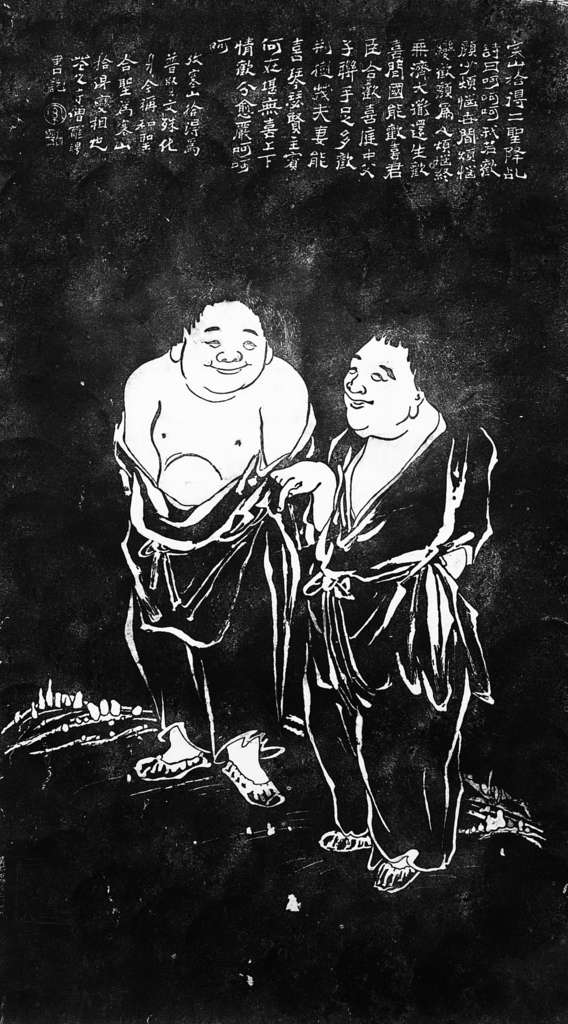
The Buddha appears in the form of an image (Buddha leaving the mountains) ‘represented’ [ban, 扮] by the monks Hanshan [寒山] and Shide [拾得] (fig. 6). He decrees that the three animal disciples may not return to the East; four of his own disciples will escort Tripitaka on the return journey. Tripitaka is led off to receive the scriptures.
The character Daquan [大權] is responsible for their issue. All assist in loading them on to the horse, who alone is to return East with Tripitaka and the disciples of the Buddha.
The three disciples in turn offer their final remarks and yield up their mortal lives. Tripitaka remembers each of them in a spoken soliloquy before he sets out on his return journey (Dudbridge, 1970, pp. 199-200).
Fig. 6 – An ink rubbing of a 19th-century stone stele depicting Hanshan and Shide, from Hanshan Temple in Suzhou (larger version).
Scene 23: Escorted back to the Eastern Land
The first of the four Buddhist disciples, Chengji [成基], is the singer. The opening of the scene consists solely of his songs on the implications of the journey; he pauses only to reveal that the trials on the westward journey were contrived by the Buddha.
In Chang’an the pine-twig has been seen to turn eastward, and a crowd has come out to welcome Tripitaka’s return. Yuchi [Gong] again appears to receive him.
Chengji’s final song gives warning that the scriptures must be presented the following morning before the Emperor.
Scene 24: Tripitaka appears before the Buddha [Chaoyuan, 朝元]
The Sākyamuni Buddha enters and gives orders for Tripitaka to be led back to the Vulture Peak to meet his final spiritual goal.
The Winged Immortal who receives these orders is the singer. He escorts Tripitaka before the Buddha, whose closing remarks, as well as the Spirit’s last songs, invoke conventional benedictions upon the Imperial house (Dudbridge, 1970, p. 200). [3]
Update: 11-18-21
I’ve decided to upload a PDF of Ning’s (1986) Comic Elements in the Xiyouji Zaju, which is cited above.
Here is an earlier analysis of the play by Howard Goldblatt (1973). He notes evidence points to the play largely being a product of the Ming (e.g. a higher number of acts, singers, and musical scales) and not the Yuan as was assumed at the time. However, he states the play was likely a patchwork of Yuan material, a scene by the playwright Yang in the early Ming, and copious later material borrowed from the standard 1592 edition of the novel. Despite all of this, Goldblatt (1973) suggests the play’s “stylistic unity” points to a single author compiling everything into its present form.
As noted in the summary above, the Buddha captures Hariti’s son, Red Boy (Honghai’er, 紅孩兒; a.k.a. Ainu’er, 愛奴兒), in his alms bowl in act 12. This is based on a common story cycle from Buddhist canon in which the Enlightened one hides the demoness’ youngest son in his alms bowl in an attempt to stop her from eating human children. For instance, the Samyuktavastu (Ch: Genbenshuo yiqie youbu binaye zashi, 根本說一切有部毘奈耶雜事; T24, no. 1451) states that he hides the boy under the bowl like Six Ears:
The next day at first light, the Buddha having taken his robe and his bowl, entered into the city in order to seek his food. Having begged following the order of the houses, he came back to the place where he lived and took his meal; after which he went to the residence of the yaksini Hariti [Helidi, 訶利底]. At that moment, the yaksini had gone out and was not at her home but the smallest of her sons, Priyankara [Ai’er, 愛兒] remained at the house. The Bhagavat concealed him under his almsbowl [bo, 鉢] and because of his power (as a) Tathagatha the older brothers could not see their youngest brother and the youngest brother could not see the older ones (Rowan, 2002, p. 142). [16]
(Yes, the name Ai’er likely influenced Red Boy’s name Ainu’er.)
The Scripture on the Storehouse of Sundry Treasures (Za baozang jing, 雜寶藏經; T4, no. 203, mid-5th-century CE) says that he hides the boy at the bottom. This version is not long, so I will transcribe it in full:
Hariti [Ch: Guizimu, 鬼子母; lit: “Mother of Ghosts”] was the wife of the demon king Pancika. She had ten thousand sons who all had the strength of fine athletes. The youngest one was called Pingala [Binjialuo, 嬪伽羅]. This demon mother was inhuman and cruel. She killed people’s sons to eat them. People suffered because of her. They appealed to the World-honored One. The World-honored One then took her son Pingala and put him at the bottom of his bowl [bo, 鉢]. Hariti looked everywhere in the world for him for seven days, but she did not find him. She was sorrowful and sad. When she heard others say, “It is said that the Buddha, the World-honored One, is omniscient,” she went to the Buddha and asked him where her son was.
The Buddha then answered, “You have ten thousand sons. You have lost only one son. Why do you search for him, suffering and sad? People in the world may have one son, or they may have several sons, but you kill them.’’ Hariti said to the Buddha, “If I can find Pingala now, I shall never kill anyone’s son any more.” So the Buddha let Hariti see Pingala in his bowl. She exerted her supernatural strength, but she could not pull him out. She implored the Buddha, and the Buddha said, “If you can accept the three refuges and the five precepts now, and never in your life kill any more, I shall return your son.” Hariti did as the Buddha told her to, and she accepted the three refuges and the five precepts. After she had accepted them, he returned her son.
The Buddha said, “Keep the precepts well! In the time of Buddha Kasyapa you were the seventh, the youngest daughter of King Jieni. You performed acts of great merit, but because you did not keep the precepts you have received the body of a demon” (based on Tanyao, Kikkaya, & Liu, 1994, pp. 220-221).
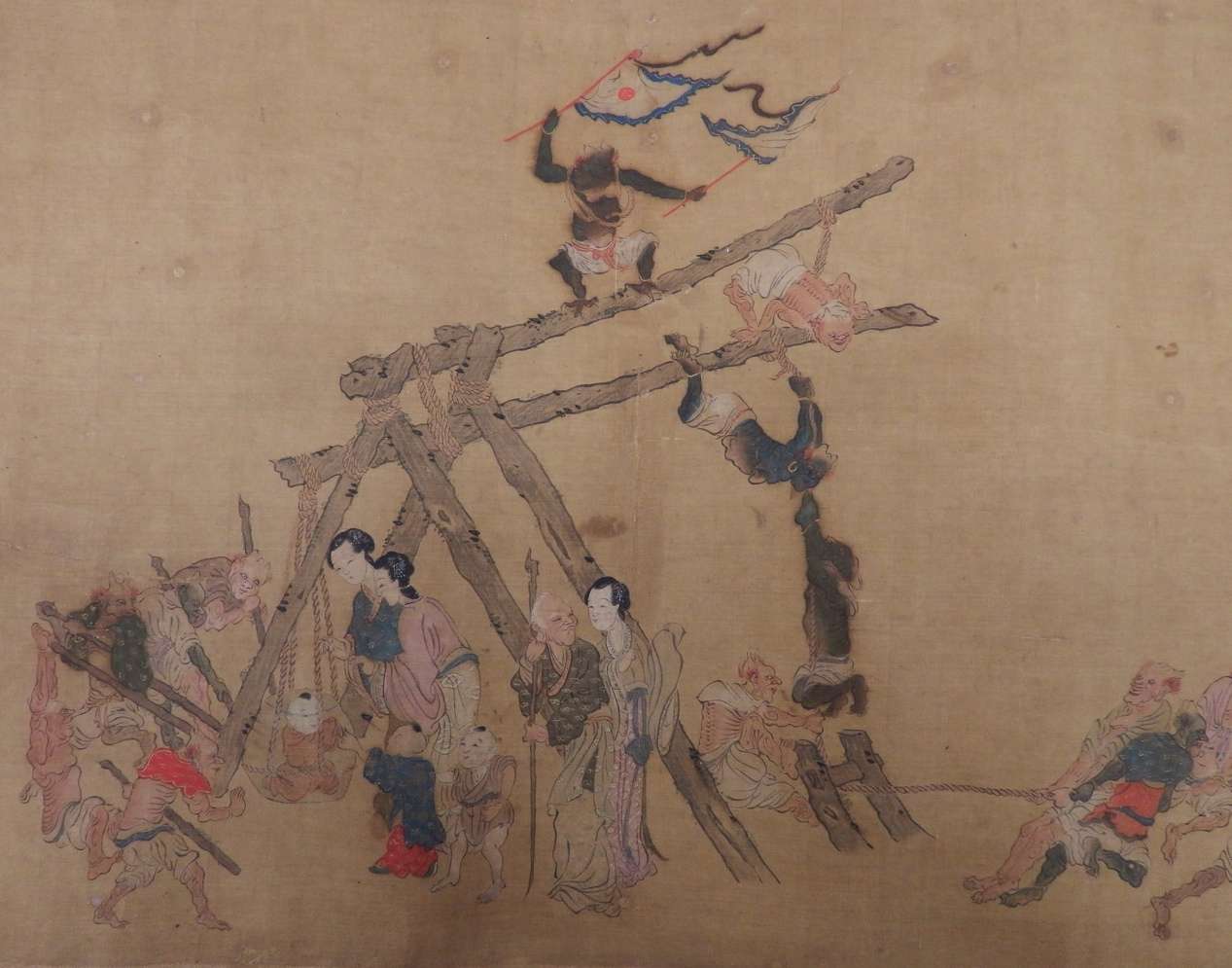
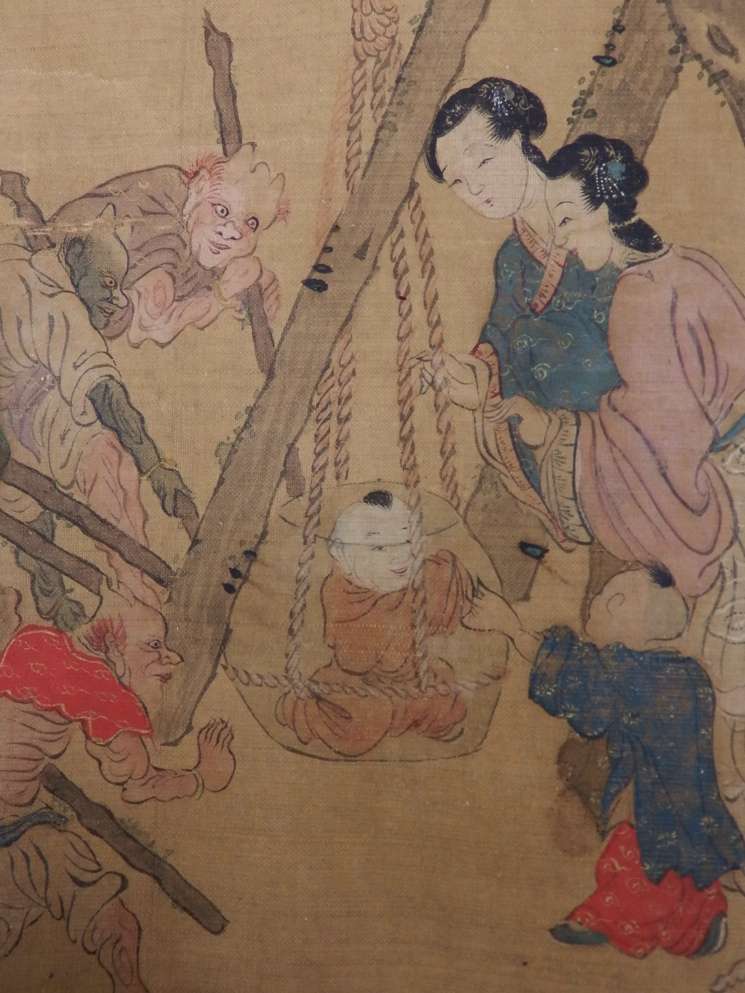
Hariti’s inability to free the child was later exaggerated in a detail from a mid-Qing dynasty hell scroll. It depicts a host of demons using a makeshift wooden pulley to no avail (fig. 7 & 8).
The immovable quality of the Buddha’s alms bowl (or anything inside like Six Ears and Red Boy) is likely related to a story told by the pilgrim Faxian (法顯, 337 – c. 422 CE):
Buddha’s alms-bowl [bo, 缽] is in this country [of Peshawar]. Formerly, a king of Yuezhi raised a large force and invaded this country, wishing to carry the [Buddha’s] bowl away. Having subdued the kingdom, as he and his captains were sincere believers in the Law of Buddha, and wished to carry off the bowl, they proceeded to present their offerings on a great scale. When they had done so to the Three Treasures, he made a large elephant be grandly caparisoned, and placed the bowl upon it. But the elephant knelt down on the ground, and was unable to go forward. Again he caused a four-wheeled wagon to be prepared in which the bowl was put to be conveyed away. Eight elephants were then yoked to it, and dragged it with their united strength; but neither were they able to go forward. The king knew that the time for an association between himself and the bowl had not yet arrived, and was sad and deeply ashamed of himself. Forthwith he built a tope at the place and a monastery, and left a guard to watch (the bowl), making all sorts of contributions (based on Faxian & Legge, 1886/1965, pp. 34-35).
2) A good example of this appears in act 19 when Monkey tries to seduce Princess Iron Fan with a saucy poem: “The disciple’s not too shallow / the woman’s not too deep. / You and I, let’s each put forth an item, / and make a little demon” (Ning, 1986, p. 141).
3) Source altered slightly. The Wade-Giles was changed to pinyin. The Chinese characters presented in the footnotes were placed into the summary.
Faxian, & Legge, J. (1965). A Record of Buddhistic Kingdoms: Being an Account by the Chinese Monk Fâ-Hien of his Travels in India and Ceylon (A.D. 399-414) in Search of the Buddhist Books of Discipline. New York: Dover Publications. (Original work published 1886)
Goldblatt, H. (1973). The Hsi-yu chi Play: A Critical Look at its Discovery, Authorship, and Content. Asian Pacific Quarterly of Cultural and Social Affairs, 5(1), pp. 31-46.
Ning, C. Y. (1986). Comic Elements in the Xiyouji Zaju (UMI No. 8612591) [Doctoral Dissertation, University of Michigan]. ProQuest Dissertations and Theses Global.
Rowan, J. G. (2002). Danger and Devotion: Hariti, Mother of Demons in the Stories and Stones of Gandhara: A History and Catalogue of Images [Master’s thesis, University of Oregon] CORE. https://core.ac.uk/download/pdf/36687517.pdf