Last updated: 08-02-2019
The Qiang (Ch: 羌; Qiangic: Rrmea) ethnic group have been mentioned in Chinese records as far back as the oracle bones of the Shang Dynasty (17th to 11th-century BCE). Originally inhabiting the northern reaches of China, these sheepherders and warriors were driven southwest over many centuries of conflict with neighboring ethnic groups, as well as the Chinese. Many Chinese dynasties attempted to assimilate them, but the Qiang have resisted up to the present. Today, they live in western Sichuan near the Tibetan border and are listed among the 56 recognized ethnic groups of China (Yu, 2004, pp. 155-156; Wang, 2002, pp. 133-136).
What’s interesting about the Qiang for the purposes of this blog is that both magic monkeys and heavenly stones, and even Sun Wukong himself, play a part in the people’s religious mythology.

Fig. 1 – A map of China showing the location of Sichuan province in red. Larger version available on wikicommons.
I. Monkeys and Qiang shamanism
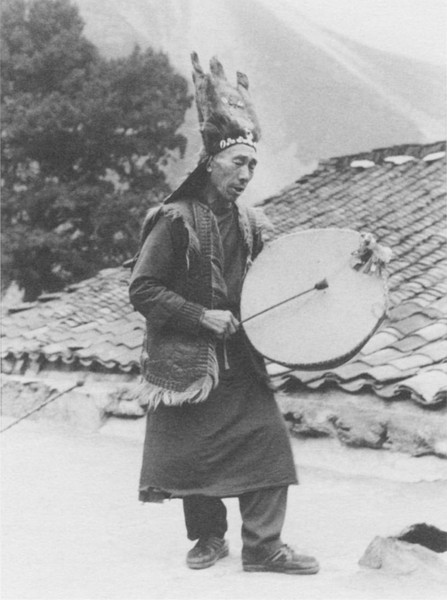
Shamans (Ch: Duan gong, 端公 or Wu, 巫j; Qiangic: Shüpi) are the heart of Qiang religious life. During special ceremonies, they wear three-peaked hats (fig. 2 and 3) made from the fur of golden monkeys (fig. 4), each peak respectively representing the deities of heaven, earth, and shamanism (more on the latter below). [1] These hats are especially worn during exorcisms because the monkeys are considered “the purest of animals, [which stand] in extreme contrast to the vilest of beings—the demons” (Oppitz, 2004, p. 13). There are several legends, with many variants, explaining the origins of the headdress. One version states:
[T]he Qiangs used to have a written language, and their patriarch recorded the scriptures he obtained from the gods and other important writings on human affairs on the bark of birch trees. One day when he took out the pieces of bark to be aired, a mountain sheep came and ate them all. With the help of a golden monkey the patriarch captured the guilty sheep and made its skin into a drum. When he beat on the drum he was able to recall the words written on the birch bark. To prevent future mishaps to these precious documents, he memorized them by heart (Yu, 2004, p. 160).
So in essence the hats are worn to commemorate the assistance of the golden monkey. Interestingly, another version replaces the patriarch and golden monkey with Tripitaka and Sun Wukong:
A long time ago, in the Tang period, there was a monk by the name of Tang Seng [唐僧, “Tang Monk”], who undertook a journey to the western skies in the company of a monkey named Sun Wukong, in order to collect sacred scriptures. On their way back, they encountered a sheep ghost who ate all the newly acquired scriptures. The monkey got very angry, killed the sheep ghost, and used its skin to fabricate a drum. Thereupon Tang Seng and the monkey met with the Eighteen Arhats … Listening to their teachings, Tang Seng picked up the sheep-skin drum and repeated all that he heard through their mouths. Since then all shamans use a drum when reciting their knowledge from memory (Oppitz, 2004, p. 23).

Fig. 2 – The three-peaked golden monkey skin shaman hat. From the Sichuan University Museum. Larger version on wikipedia. Fig. 3 – A shaman wearing the headdress and playing the ritual sheep skin drum (larger version). Original photograph by Michael Oppitz. From Oppitz, 2004, p. 14. Fig. 4 – A golden monkey with child. Larger version on wikipedia.
The golden monkey is closely associated with the Qiang’s pantheistic worship of sacred white stones, each one representing the gods of heaven, sun, fire, mountains, rivers, and trees. [2] Yu (2004) provides another legend for the origins of the Shaman’s hat, describing how the monkey is the offspring of the sacred stone and noting parallels with the birth of Sun Wukong:
Another legend depicts the golden monkey as a Prometheus-like figure who stole fire from heaven. The first two attempts failed because the god of wind and the god of rain extinguished the fire, but the monkey succeeded the third time by concealing the fire in a white stone. It is worth noting that in this legend the golden monkey is closely related to the white stone. In the Qiang language, the first syllables in the names of the monkey’s mother and father mean respectively “stone” and “fire.” “This implies that fire is produced by stone and hidden inside the stone, and that the half-human, half-simian golden monkey was an offspring of the union between stone and fire”. The white stone and the golden monkey, as the source of fire and the messenger who brought it to the human world, became the totems of the Qiang people. To commemorate the recovery of the lost scriptures, wearing the monkey hat and playing the sheepskin drum also became an indispensable part of Sacrifice to the Mountain[, a Qiang ceremony]. However, the monkey legend is not particular to the Qiang people. The Yi minority people of northwestern Guizhou province have a nuo drama known as bianren xi (changing-into-people drama) based on a legend that people derived from monkeys. Actors wear monkey masks for this performance. There is also the famous monkey, Sun Wukong, who was born from a stone in the Han Chinese novel Xiyou ji (Journey to the West, 1592) by Wu Chengen (ca. 1506-1582). [3] The novel was first published in 1592, but the monkey lore included in it was of much earlier time (p. 160).
A celestial, stone-born monkey who steals from heaven certainly sounds like the Monkey King. As noted here, stories about Sun Wukong have been circulating in Asia for a millennia. So it seems only natural that the Qiang’s reverence for heavenly stones and monkeys would lead to some of them worshiping the beloved cultural figure.
Graham (1958) notes that Sun Wukong and Sha Wujing figure among the Chinese patron deities of the “red” shamans (p. 53). [4] What’s interesting is that the red shamans are said to speak a special demon language and use their skills to exorcise demons (p. 54). Therefore, their worship of the Monkey King should come as no surprise considering Sun Wukong is the exorcist par excellence.
As noted above, one of the peaks of the ritual headdress represents the patron deity of shamanism. Known among other names as the Abba mula (“father god”; Ch: Aba muna, 阿爸木纳), this is the title given to the shaman’s main focus of worship. For instance, Sun Wukong is the Abba mula of those who revere him. Most importantly, the chosen deity is further represented by a small bundle that the shaman carries with him and guards jealousy, as it is the source of his knowledge and power. Graham (1958) describes the sacred bundle’s importance, construction, and use:
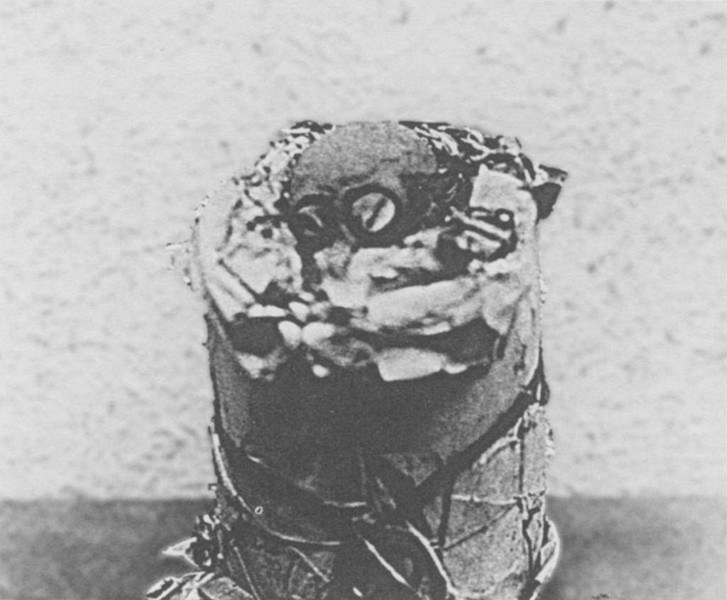
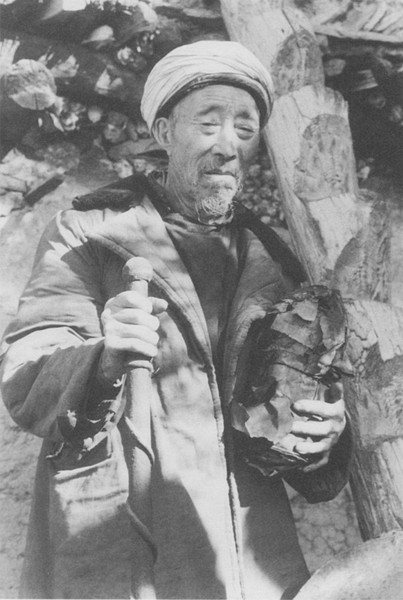
He is the patron or guardian deity and instructor of the Ch’iang priest, and without him the priest could do nothing. It consists of a skull of a golden-haired monkey wrapped in a round bundle of white paper. Its eyes are old cowry shells or large seeds. Inside are also dried pieces of a golden-haired monkey’s lungs, intestines, lips, and fingernails. It is so wrapped that the face of the skull is visible at one end, and the other end is closed [fig. 5 and 6]. After each ceremony in the sacred grove, [5] the priest wraps another sheet of white paper around it, so that it gradually increases in diameter. Some priests will not allow another person to touch his Abba Mula and only the priest worships this god (pp. 51-52).
I mention this because there are no doubt sacred bundles representing Sun Wukong, which are used under his supernatural guidance.

Fig. 5 – The Abba mula bundle. Note the visible monkey skull with cowry shell eyes (larger version). Original photograph by Wolfgang Wenning. Fig. 6 – A Qiang shaman carry a bundle and sacred cane (larger version). Original photograph by Michael Oppitz. Both images are from Oppitz, 2004, p. 41.
Oppitz (2004) explains that stories alluding to Sun Wukong appear in Qiang pictorial divination books. Furthermore, he suggests that the ritual of wrapping the Abba mula bundle with additional paper represents the lost written knowledge saved by the Monkey King / golden monkey, which is now passed on orally.
In Qiang divination books the monkey features in various passages. In one book the picture of a monkey alludes to a story in which he destroys a heavenly palace; another book addresses a monkey’s trip to a western land, where he acquires written texts. In both cases the monkey Sun Wukong of popular literature and protagonist of the novel Xi yu ji, who escorts the Tang pilgrim Xuanzang, stands as the model. This character’s association with the acquisition of books and the role a golden-haired monkey plays in a Qiang myth as the inventor of the drum replacing the lost scriptures, suggests that the paper which is wrapped around the venerated monkey skull may also be interpreted as a hint to the conflict between scriptural versus oral tradition at the intersection of which the monkey stands as a mediator (p. 42).
II. Monkeys and the Qiang origin myth
Called “Mutsitsu and Tugantsu” (Ch: Mujiezhu yu Douanzhu, 木姐珠與斗安珠), the Qiang origin myth centers around the romance of Mutsitsu, the daughter of the supreme god Abamubi (or Mubita), and the earthbound monkey Tugantsu. The latter saves the goddess from a ferocious tiger when she visits the mortal world and both instantly fall in love. She brings him to the celestial realm, where Abamubi only agrees to their marriage if Tugantsu can successfully complete a series of impossible herculean tasks. These include falling the trees of ninety-nine mountains, burning the trees, and using the arable land to plant a crop of corn (other sources say grain); but each time Mutsitsu secretly enlists the aid of fellow gods to insure the tasks are completed on time. During the burning of the forest, Tugantsu’s fur is singed, revealing him to be a handsome man. In the end, the supreme god agrees to their marriage and Mutsitsu and Tugantsu become the progenitors of mankind. [6]
Academia Sinica (n.d.) comments that some Qiang communities who revere Chinese gods often equate Abamubi with the Jade Emperor of Daoism and Tugantsu with Sun Wukong. I find this especially fascinating as the Monkey King then becomes a sacred protoplast.

Fig. 7 – A modern painting showing the monkey and rock ogress of Tibetan myth (larger version). Original from Wikipedia.
In addition, Academia Sinica (n.d.) explains this “monkey transforming into human” motif (i.e. Tugantsu becoming a man) has similarities with Tibetan mythology, for the Qiang live in close proximity to the people of Tibet. This refers to the Tibetan origin myth in which the Bodhisattvas Avalokitesvara (the Indo-Tibetan variant of Guanyin) and Tara are respectively reborn on earth as a monkey and his wife, a rock ogress (fig. 7). (Again, the association between the monkey and rock reminds one of Sun Wukong.) The union produces six half-human half-monkey children, from which originate the six original tribes of Tibet. These children and their offspring eventually evolve human features (Stein, 1972, pp. 37 and 46).
III. Conclusion
The religious mythology of the Qiang ethnic group of China pays reverence to both heavenly monkeys and sacred stones. Examples include stories about a golden monkey born from a stone who both bestows fire on man and creates the sheepskin drum needed to recover lost scriptural knowledge. Qiang communities that revere Chinese deities often replace the golden monkey with Sun Wukong, no doubt due to his birth mirroring the former’s origins. The same holds true for the Qiang origin myth in which a goddess and monkey-turned-man become the progenitors of mankind. The Monkey King is sometimes equated with the father, transforming him from a literary character and cultural figure into a sacred protoplast. Interestingly, the monkey-rock and monkey-to-man motifs have connections to a wider myth cycle present in Tibet.
Some shamans (Qiangic: Shüpi) specializing in exorcism worship our hero as their patron deity, or Abba mula (“father god”). Such deities are given form as a bundled monkey skull successively wrapped in white paper. This sacred object is considered the source of the shaman’s power. It’s possible the wrapping paper references the lost scriptural knowledge that Sun Wukong/the golden monkey helped recover.
To my knowledge, most of what has been written about the Qiang, and by extension their connection with Sun Wukong, was collected by ethnographers during the 20th and 21st centuries. Considering the Qiang have no written language (hence the importance of oral knowledge), it’s impossible to say how far back this connection goes. But as noted in this article, the Monkey King has been worshiped by the Chinese since at least the 17th-century. So the Qiang reverence for Sun Wukong could also be centuries old.
Update: 04-19-2019
Sun Wukong also appears in the folklore of the neighboring (and related) Miao ethnic group. The Miao also believe man derives from monkeys.
Sun Wukong and Miao Folklore
Update: 08-02-2019
Rockhill (1891) provides a complete translation of the Tibetan monkey-ogress origin myth taken from the Mani Kambum (12th to 13th-century), a collection of Tibetan Buddhist texts centered around Avalokitesvara. [7] The translation is too long to transcribe here, so I have made a PDF of the relevant pages. It’s interesting to note that the Bodhisattva Hilumandju, the protagonist, is a monkey king with magic powers.
Archive link
Click to access the-land-of-the-lamas-notes-of-a-journey-through-china-mongolia-and-tibet-1891-by-william-woodville-rockhill-rock-ogress-and-a-monkey-info-pages-extracted.pdf
Hilumandju and Hanumanji are quite similar, as noted by other writers (Chattopadhyaya & Chimpa, 2011, p. 152). The Tibetologist Per K. Sørensen notes “the idea of an ape-gestalt in this myth is directly associated with or inspired by the ape-king … and champion … Ha-lu ma-da = Hanümän, the resourceful figure and protagonist known from Välmlki’s Rämäyana, a tale of considerable popularity already in the dynastic period in Tibet” (Bsod-nams-rgyal-mtshan & Sørensen, 1994, p. 127, n. 329).
Additionally, the Chinese of Sichuan also have stories regarding primates fathering human children. A body of Han and Tang dynasty tales that heavily influenced the creation of Sun Wukong describes magic white apes (baiyuan, 白猿) kidnapping and impregnating young woman. One example appears in both Zhang Hua’s Encyclopedic Records of Things (Bowuzhi, 博物志, c. 290) and the Records of Spirits (Soushenji, 搜神記, c. 340):
In the high mountains of southwestern Shu [Sichuan and Tibet] there is an animal resembling the monkey. It is seven feet in height, it can imitate the ways of human beings and is able to run fast in pursuit of them. It is named Jia-guo 猳國 or Ma-hua 馬化; some call it Jue 貜. It watches out for young women travelling on the road and seizes and bears them away without anyone being aware of it. If travelers are due to pass in its vicinity they lead one another by a long robe, but even this fails to avert disaster. The beast is able to distinguish between the smell of men and women and can thus pick out the women and leave the men. Having abducted a man’s wife or daughter it makes her its own wife. Women that fail to bear its children can never return for the rest of their lives, and after ten years they come to resemble the beast in appearance, their minds become confused, and they no longer think of return. Those that bear sons return to their homes with the infants in their arms. The sons are all like men in appearance. If any refuse to rear them, the mothers die. So the women go in fear of the beast, and none dares refuse to bring up her son. Grown up, the sons are no different from men, and they all take the surname Yang 楊, which is why there are so many people by that name now in the south west of Shu: they are mostly descended from the Jia-guo or Ma-hua (Wu, 1987, pp. 91-92).
I find the last part fascinating because it states the inhabitants of the Sichuan-Tibet region were fathered by the ape. This recalls the Tibetan, Qiang, and Miao tales of humans descending from monkeys. It also suggests the aforementioned ethnic stories about a primate progenitor stretch back to the early part of the first millennium.
Notes:
1) Graham (1958) notes the headdress is one of eleven sacred implements of the Qiang shaman. He provides a detailed description of the hat’s significance.
This is made of a golden-haired monkey skin and is believed to be very efficacious, greatly adding to the dignity and potency of the priest and his ceremonies. The eyes and ears of the monkey are left on, and the tail is sewed on at the back. The eyes enable the hat to see and the ears to hear, and add to the efficiency of the hat. The tail also adds to its efficiency. The front of the hat is ornamented with old cowry shells arranged in ornamental designs, one or two polished white bones that are said to be the kneecaps of tigers, and sometimes with carved sea shells. These ornaments improve the looks of the hat and also add to its efficiency. Other ornaments believed to add efficiency when used are two cloth pennants, one or two small circular brass mirrors, and one or two small brass horse bells much like sleigh bells, on which the Chinese character wang 王 meaning king is carved. Near Wen-ch’uan the priests sometimes assist the magistrate in praying for rain and in turn are presented with a small, thin silver plaque to be worn on the hat, on which is stamped the Chinese word shang 賞, or “reward.” This plaque also adds dignity and efficiency (pp. 55-56).
2) The Qiang reverence for these stones is tied to the aforementioned conflict with neighboring tribes. For example, legend states the great heavenly ancestor of the Qiang sent them three white stones to aid in their battle with a neighboring tribe, transforming them into mountains from which weapons were made. Another legend claims these stones help the Qiang make fire (Yu, 2004, pp. 156-157). These white stones often appear on buildings (both temples and houses), walls, altars, and graves in Qiang society (Graham, 1958, p. 103).
3) The original paper reads, “…in the Han Chinese novel Xiyu ji (Journey to the West, 1982)…” I have corrected the typos.
4) The colors red, white, and black signify the class of magic (good vs. dark), though shamans often inhabit all three roles (Graham, 1958, p. 54).
5) Sacred groves are home to a village’s temple and white stone altar, where many rituals are performed at night and in the early morning (Graham, 1958, p. 64).
6) A Chinese version of the tale can be read here. This forum has scans of an illustrated bilingual book presenting a different version of the tale.
7) Another version of the tale appears in The Mirror Illuminating the Royal Genealogies (Rgyal rabs gsal ba’i me long, 14th-century). An annotated translation can be read in Bsod-nams-rgyal-mtshan & Sørensen, 1994, pp. 125-133.
Sources:
Academia Sinica. (n.d.). A Brief Introduction to the Qiang People – Religion. Retrieved from http://ethno.ihp.sinica.edu.tw/en/southwest/main_QI-04.html
Bsod-nams-rgyal-mtshan, & Sørensen, P. K. (1994). The mirror illuminating the royal genealogies: Tibetan buddhist historiography : an annotated translation of the XIVth century Tibetan chronicle: rGyal-rabs gsal-ba’i me-long. Wiesbaden: Harrassowitz.
Chattopadhyaya, A., & Chimpa. (2011). Atīśa and Tibet: Life and works of Dīpaṃkara Śrījñāna (alias Atīśa) in relation to the history and religion of Tibet, with Tibetan sources. Delhi: Motilal Banarsidass Publishers.
Graham, D. C. (1958). The customs and religion of the Ch’iang. Washington: Smithsonian Institution. Retrieved from https://repository.si.edu/bitstream/handle/10088/22946/SMC_135_Graham_1958_1_1-110.pdf?sequence=1&isAllowed=y
Oppitz, M. (2004). Ritual objects of the Qiang shamans. Res: Anthropology and aesthetics, 45, 10-46. Retrieved from https://www.journals.uchicago.edu/doi/pdfplus/10.1086/RESv45n1ms20167620
Rockhill, W. W. (1891). The land of the lamas: Notes of a journey through China, Mongolia and Tibet with maps and illustrations. New York: Century Co.
Stein, R. A. (1972). Tibetan civilization. Stanford, Calif: Stanford University Press.
Wang, M. (2002). Searching for Qiang culture in the first half of the twentieth century. Inner Asia, 4(1), 131-148. Retrieved from http://www.jstor.org/stable/23615428
Wu, H. (1987). The earliest pictorial representations of ape tales: An interdisciplinary study of early Chinese narrative art and literature. T’oung Pao LXXIII, pp. 86-112.
Yu, S. (2004). Sacrifice to the Mountain: A Ritual Performance of the Qiang Minority People in China. TDR 48(4), 155-166. Retrieved from http://www.jstor.org/stable/4488600