Note: The additional archived translations have been moved to a new location. See the 08-09-23 update below.
Last updated: 08-09-2023
Here I present PDFs comprising the complete four volume 2012 revised edition of The Journey to the West(Xiyouji, 西遊記)translated by Anthony C. Yu (October 6, 1938 – May 12, 2015). This is considered THE most accurate translation of the tale available. I hope those who read and enjoy the digital version will support the official release.
Yu was Carl Darling Buck Distinguished Service Professor Emeritus in the Humanities and Professor Emeritus of Religion and Literature in the Chicago Divinity School. I shared a long email correspondence with Prof. Yu, during which we became friends. He was always quick to answer my many questions. His translation remains a treasure trove of explanatory notes and sources.
1. Book blurb
Anthony C. Yu’s translation of The Journey to the West, initially published in 1983, introduced English-speaking audiences to the classic Chinese novel in its entirety for the first time […] With over a hundred chapters written in both prose and poetry, The Journey to the West has always been a complicated and difficult text to render in English while preserving the lyricism of its language and the content of its plot. But Yu has successfully taken on the task, and in this new edition he has made his translations even more accurate and accessible. The explanatory notes are updated and augmented, and Yu has added new material to his introduction, based on his original research as well as on the newest literary criticism and scholarship on Chinese religious traditions. He has also modernized the transliterations included in each volume, using the now-standard Hanyu Pinyin romanization system. Perhaps most important, Yu has made changes to the translation itself in order to make it as precise as possible (source).
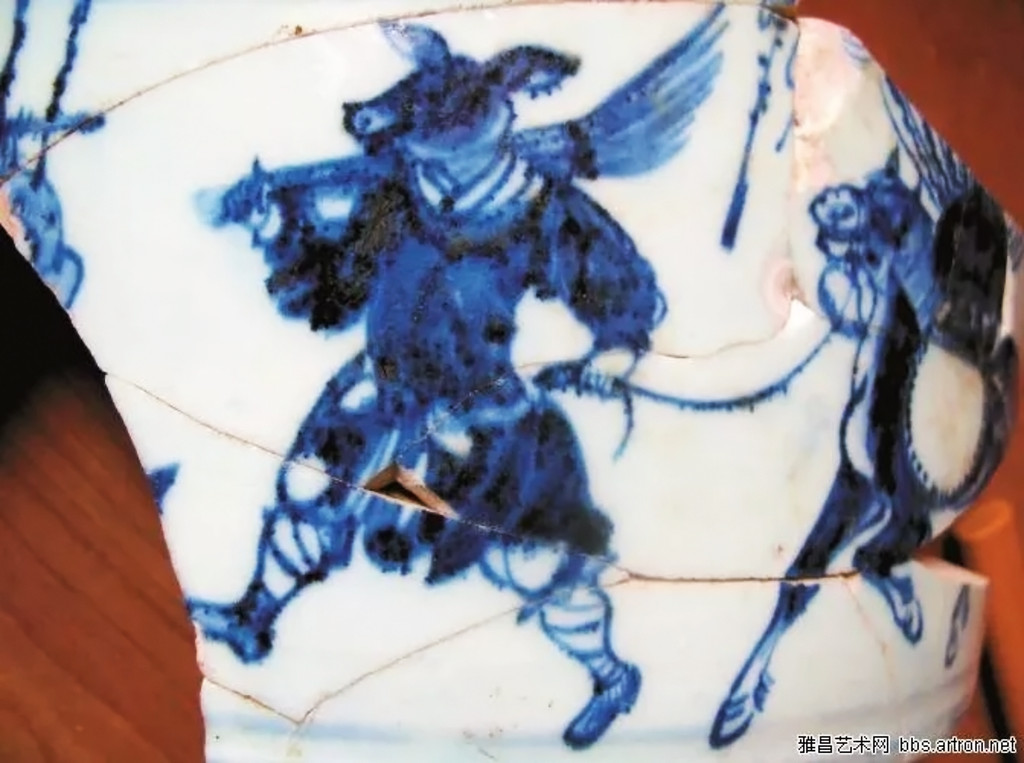
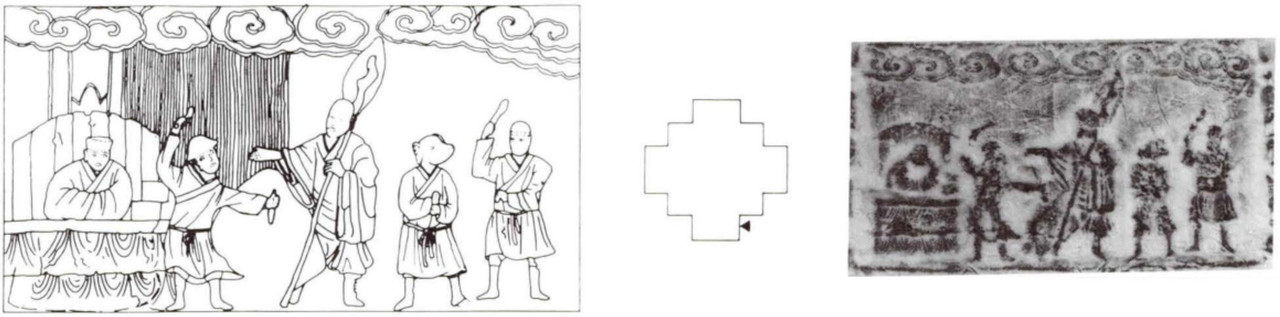
I suggested in a previous article that Zhu Bajie was first added to the Journey to the West story cycle during the 14th-century. This is because the character does not appear in the 13th-century version of the story, but he does appear in a stage play from the 15th-century. Thanks to the writing of Prof. Ben Brose, I learned of Pigsy’s three earliest known depictions from this time period. The first is a Yuan DynastyCizhou ware ceramic pillow showing all of the characters (fig. 1). The second is a fragmented Yuan-era blue and white incense burner (fig. 2). Older still are Zhu’s depictions appearing on the 14th-century Gyeongcheonsa pagoda (Kyŏngch’ŏnsa sipch’ŭng sŏkt’ap, 경천사십층석탑) from Korea (fig. 3). You read that right, Korea!
Fig. 1 – The Cizhou ware pillow featuring Pigsy and the other pilgrims (larger version); Fig. 2 – A fragment of the blue and white incense burner showing Pigsy leading the White Dragon Horse (larger version). Fragments with the other characters can be found here; Fig. 3 – The Gyeongcheonsa pagoda is now housed inside of the National Museum of Korea (larger version).
I. Why Korea?
The Pak t’ongsaŏnhae (Ch: 朴通事諺解, Pu tongshi yanjie), a 17th-century Korean primer on colloquial Chinese comprised mostly of material traceable to the mid-15th-century, presents the Journey to the West story cycle as a highly popular tale among Koreans. This fact is revealed during a conversation between two Buddhist monks, one of which states: “The Xiyouji is lively. It is good reading when you are feeling gloomy” (Dudbridge, 1970, p. 180). The same monk then recounts an episode where Monkey competes with three animal spirits-cum-Daoist priests in a test of magic skill. This episode comprises chapters 44 to 46 in the final Ming version of the novel. [1] The popularity of the Chinese story cycle in Korea then explains why scenes from it appear on the pagoda.
II. Pagoda Background
The National Museum of Korea explains the 13.5 meter (44.3 ft) tower has a long and tumultuous history:
Made of marble, this ten-story stone pagoda was erected at Gyeongcheonsa Temple in Gaeseong in 1348, the fourth year of the reign of Goryeo’s King Chungmok. The first tier of the pagoda bears an inscription that records various details about the pagoda’s production, including the production date and the patrons. According to the inscription, the pagoda was sponsored by Goryeo people who were associated with China’s Yuan Dynasty. Notably, this stone pagoda was closely modeled after wooden architecture, and each story is expertly carved with Buddhist images. The platform is sculpted with scenes of Xiyouji (Journey to the West), as well as lions, dragons, and lotus flowers. The lower four stories are sculpted with scenes of Buddha’s Assembly, while the upper six stories are sculpted with images of Buddha with both hands clasped. The four sides of the platform and those of the lower three tiers are protruding, recalling the shape of Tibetan-Mongolian pagodas that were prevalent in the Yuan period. However, the upper seven tiers have a more standard rectangular shape that corresponds with the conventional form of stone pagodas. Notably, about 120 years after this pagoda was built, the Joseon royal court erected a stone pagoda with a similar material and shape at Wongaksa Temple in Gwangju. In 1907, this pagoda was illegally dismantled and smuggled to Japan by Tanaka Mitsuyaki, the Japanese Minister of the Imperial Household. However, thanks in part to the efforts of a British journalist named Ernest Thomas Bethel and an American journalist named Homer Hulbert, it was returned to Korea in 1918. The pagoda was partially restored in 1960, while it was being kept at Gyeongbokgung Palace, but after having been kept outside for so long, suffering the effects of weather and acid rain, it could not be properly preserved. Thus, in 1995, it was dismantled for a more extensive restoration project. Ten years later, it was reassembled inside the new building of the National Museum of Korea in Yongsan, being unveiled as part of the museum’s grand opening in 2005 (“Ten-story Stone Pagoda”, n.d.).
The pagoda’s political and architectural connections to Yuan China further explain why scenes from the story cycle grace the platform.
III. The Images
(Note: I have recently learned that the line drawings from Yegŭrin Kŏnchʻuksa Samuso (1993) are all but useless. See the 10-26-19 update below for more info.)
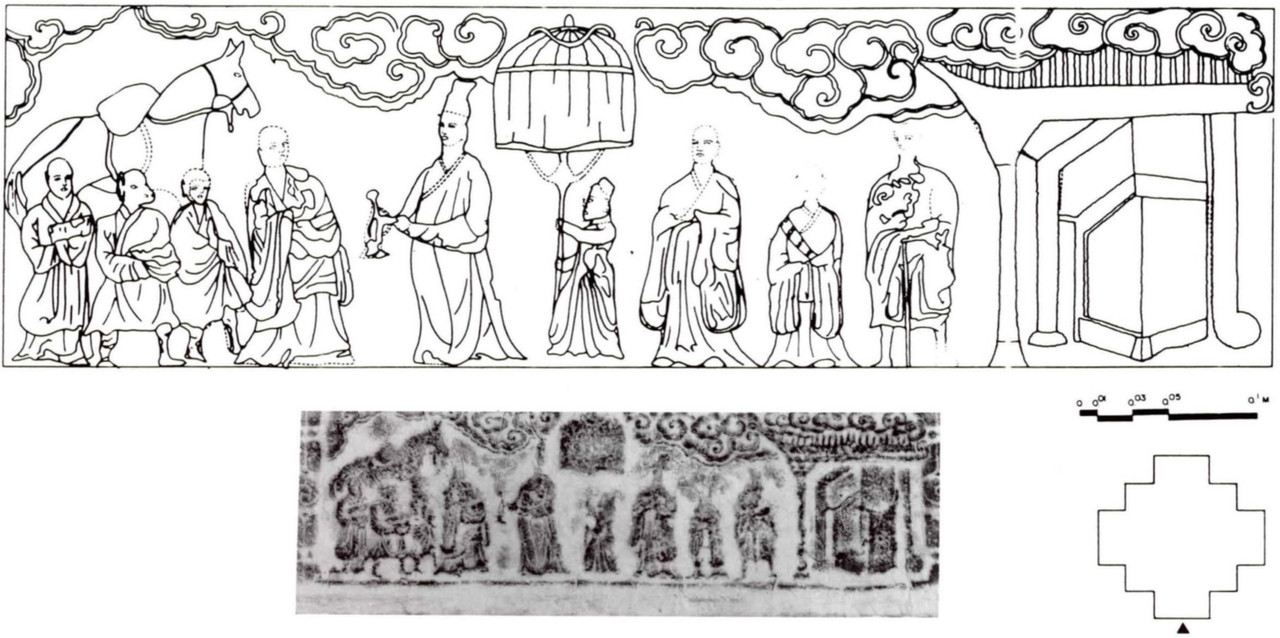
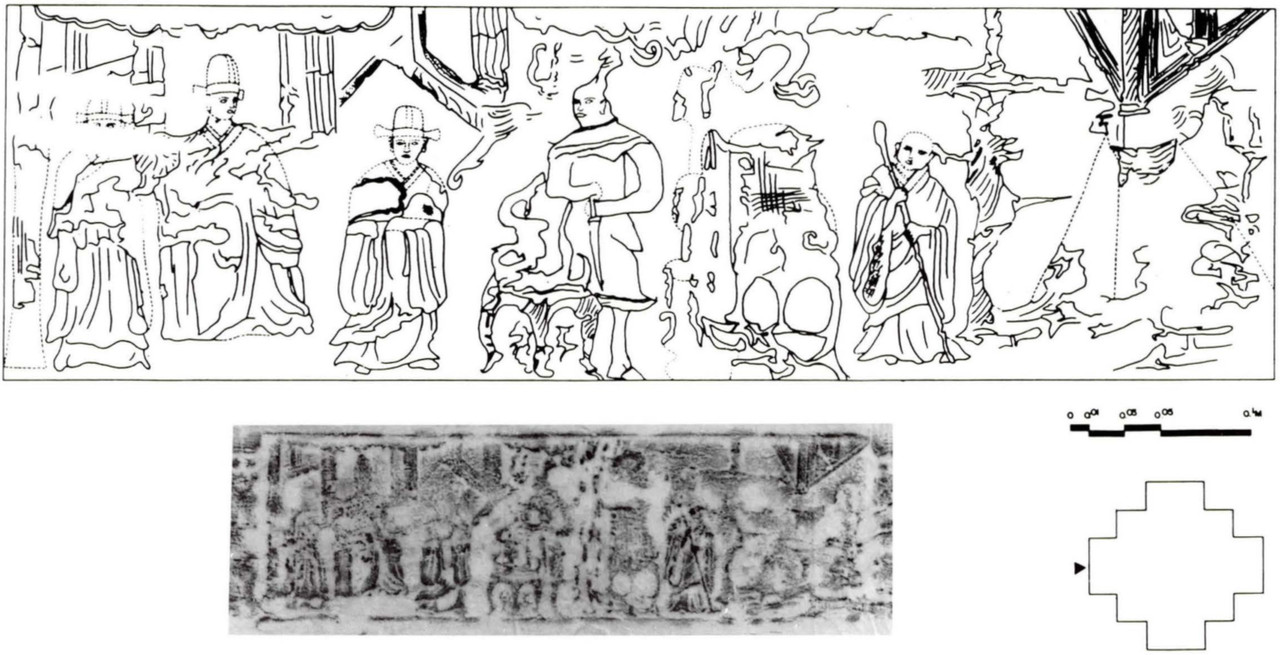
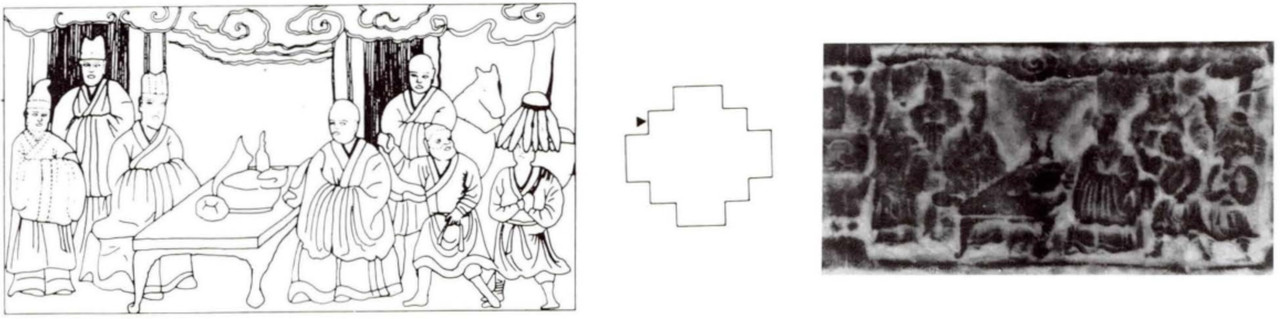
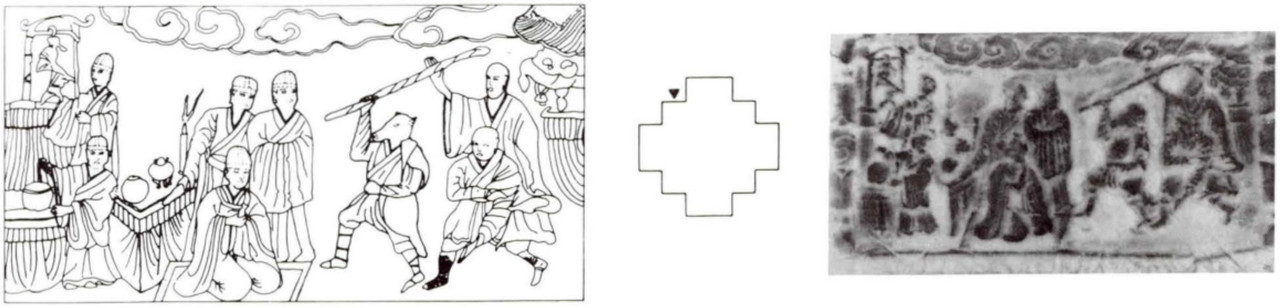
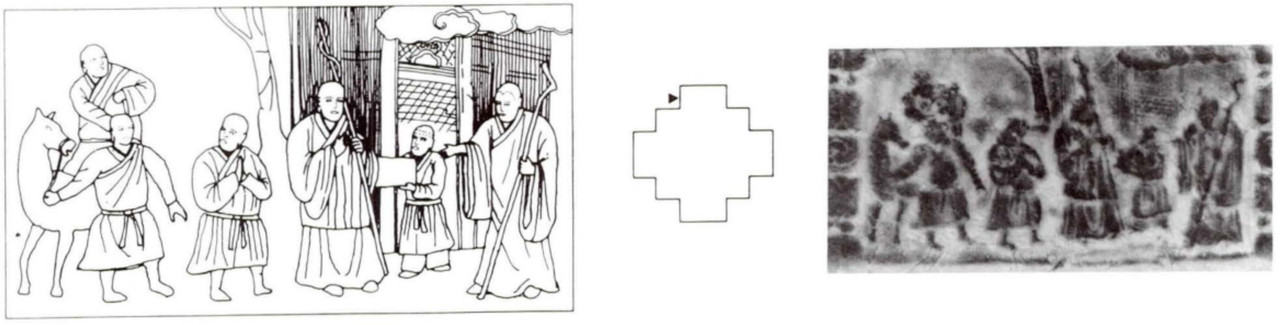
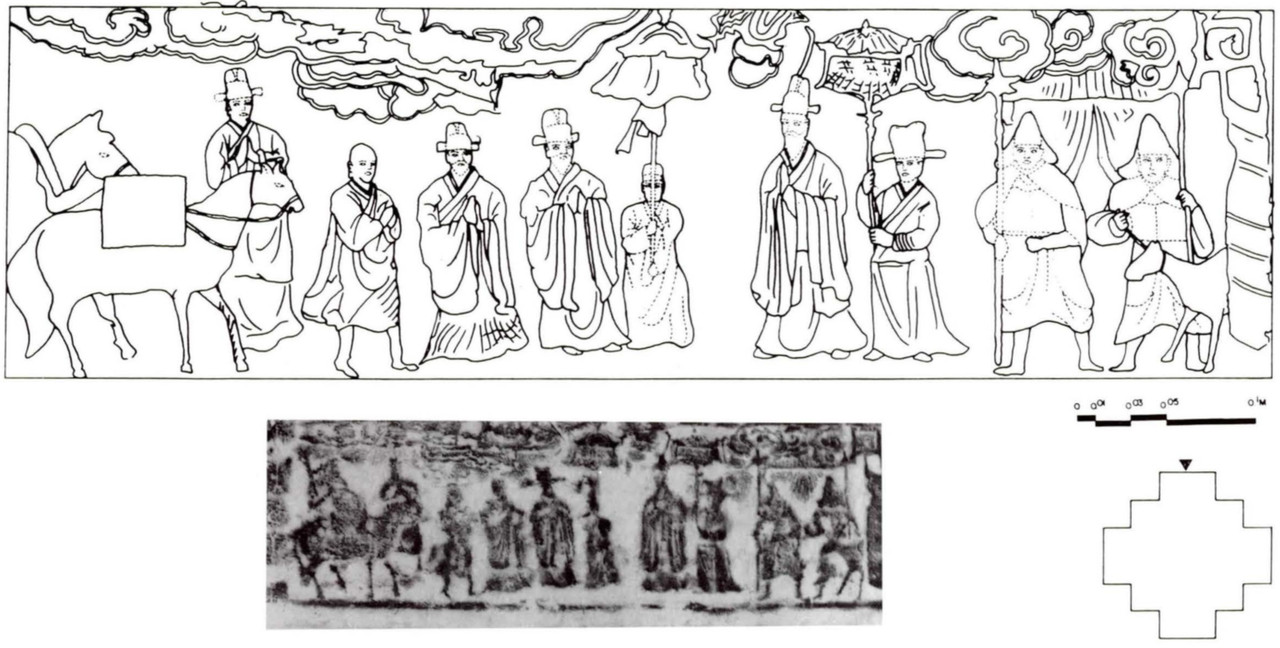
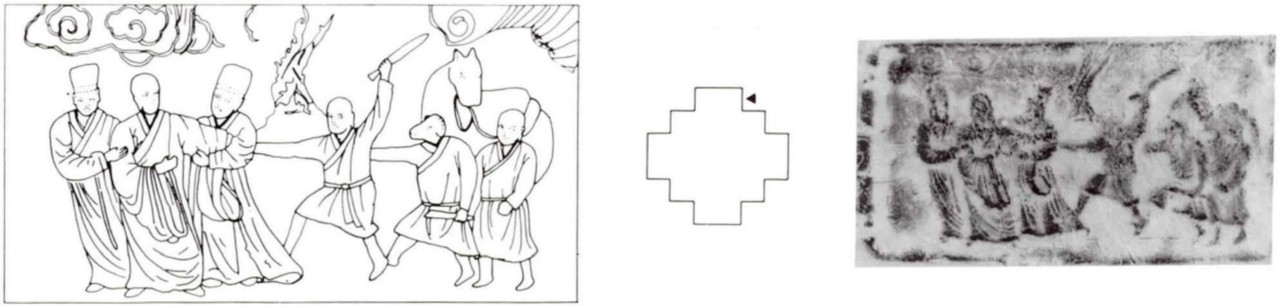
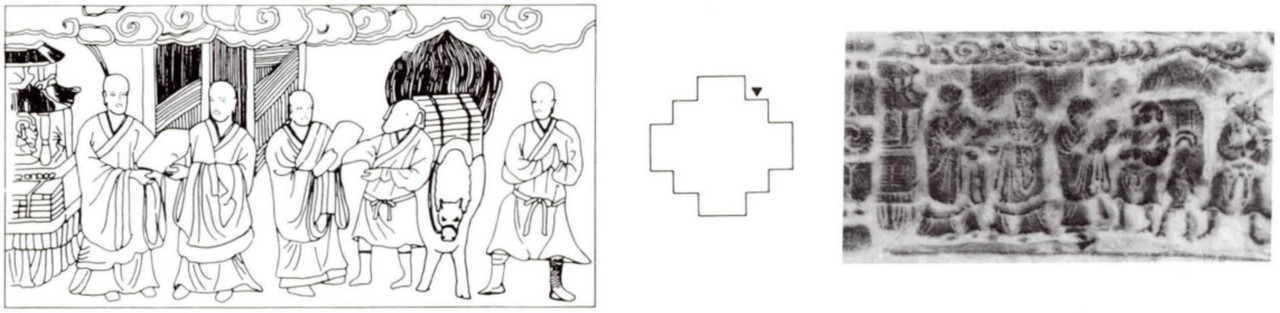
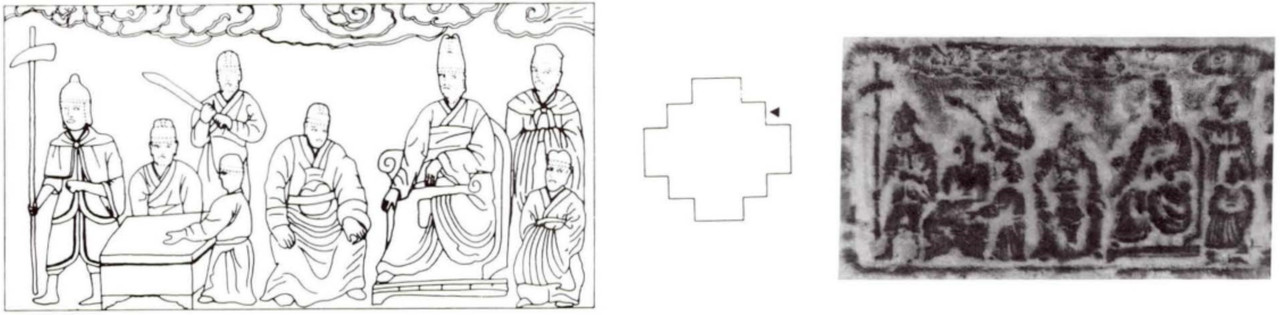
Twenty Journey to the West-related scenes appear on the second level of the pagoda’s multifaceted three-tiered base. The following line drawings, which are based on ink rubbings of the original carvings, come from an in-depth field report by the Yegŭrin Architectural Firm (Yegŭrin Kŏnchʻuksa Samuso, 1993). The images are presented below starting from the southernmost face (the six o’clock position) of the pagoda’s diamond-shaped cross section, proceeding in a clockwise fashion. Each is accompanied with commentary from the original report.[2] You will notice the report is generally vague as the exact meaning of the scenes are often unclear. I will therefore present my own commentary or questions below in the hopes of furthering the discussion.
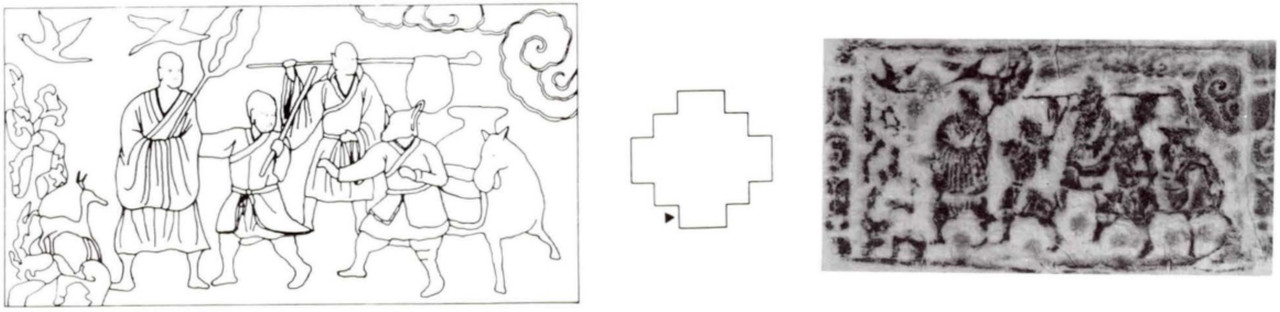
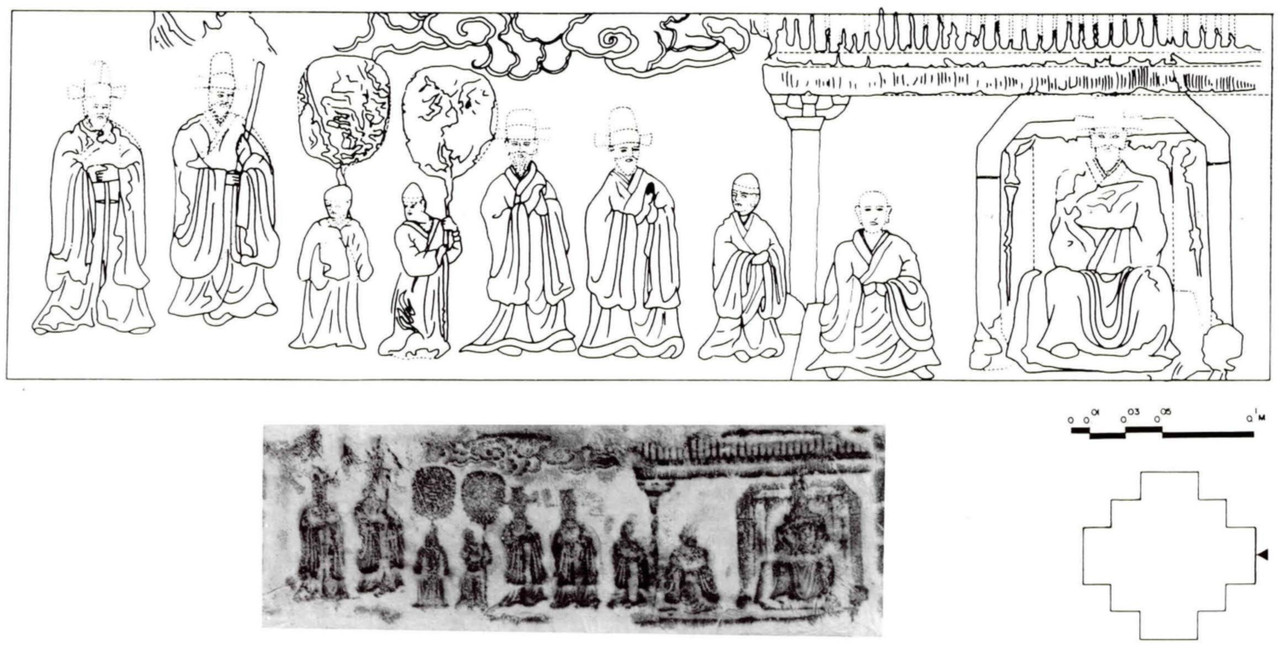
On the left, a figure of a Buddhist monk stands at the front, and behind him a horse and figures in the shape of a pig’s head, a monkey, and more are depicted. The figure of the Buddhist monk appears to be Monk Xuanzang, the figure of the monkey, Sun Wukong, the figure with the pig’s head, Zhu Bajie, and the last figure appears to be Sha Wujing. In other words, it is Monk Xuanzang’s travel companions. On the right, pictured symmetrically with Xuanzang’s travel party is the figure of a nobleman wearing a crown, and behind him stands a figure of a young boy holding an umbrella over his head and the figures of three noblemen.
And to the right of this a building structure is depicted. The nobleman who is at the very front wearing a crown seems to be a king and the building structure appears to represent a palace. Therefore, the content of the carving above seems to be the scene of a king sending off Monk Xuanzang’s travel party [fig. 5] (Yegŭrin Kŏnchʻuksa Samuso, 1993, p.123).
Could this scene be a telescopic version of the narrative, one in which the already assembled group is being sent off by Tang Taizong? After all, the authors suggest in panel number ten that the first ten images likely show the journey to India, while the latter half shows the return (Yegŭrin Kŏnchʻuksa Samuso, 1993, p. 124). Hierarchy in scale is employed to portray the king as the largest and therefore the most important, with Tripitaka being the second tallest/important, and the three disciples even shorter. Pigsy’s porcine head really stands out as Sandy is depicted as a human monk.
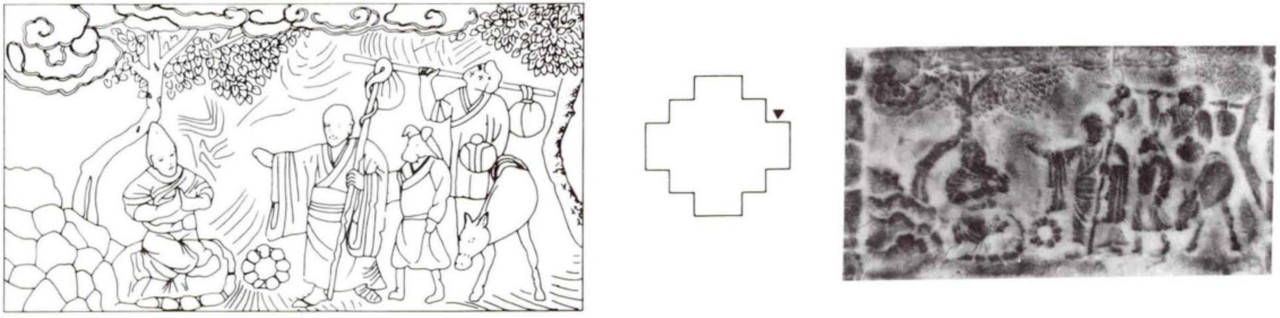
As above, the horse and the travel party of Monk Xuanzang, Monkey, Zhu Bajie and Sha Wujing have been portrayed. Here Sha Wujing is carrying a knapsack. On the left a road populated with animals and birds are depicted. Therefore, here it appears to show that Monk Xuanzang and his companions are traveling on a mountain road [fig. 6] (Yegŭrin Kŏnchʻuksa Samuso, 1993, p.123).
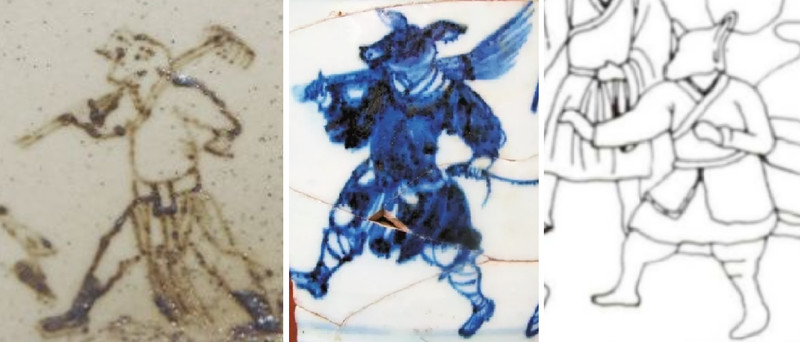
Take note of Pigsy’s upraised hands and wide stride. This motif appears several more times on other panels (fig. 12, 13, 17, and 24). The posture is quite similar to that from the aforementioned ceramic pillow and incense burner, which depict Pigsy carrying his rake and leading the horse. He lacks his signature weapon in these scenes, however (fig. 7). This might explain the strange posture of his right hand.
Fig. 7 – Similar Pigsy iconography from the Cizhou ware pillow (left), the incense burner (center), and panel two (right), all corresponding with the Yuan Dynasty (larger version). See also figure 24 for a better match.
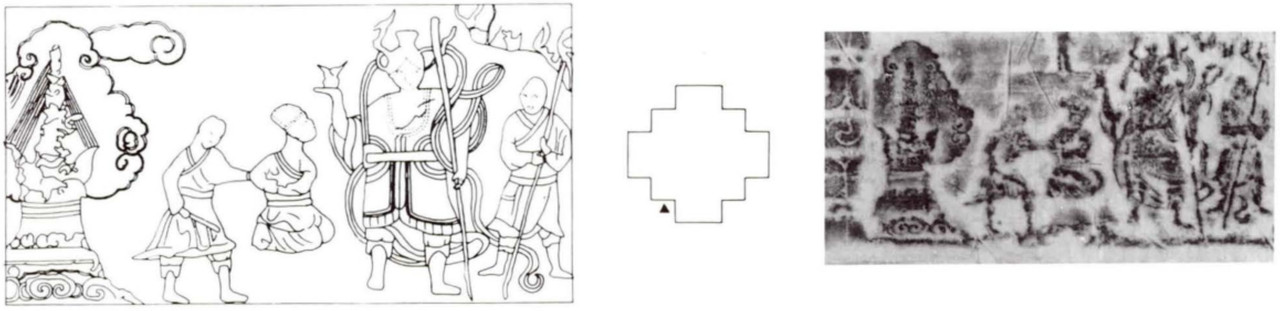
On the left, the figure of a nobleman wearing a crown is kneeling. Behind him, a figure of a person holding a club appears to threaten the nobleman in front. Behind them something like an altar is depicted. Symmetrical with the figure of the kneeling nobleman, a figure looking like a government official from a prison in a provincial district stands holding a tool of torture.
Even if we don’t know what this is, it seems to show the oppression by those of other religions during the years of Xuanzang’s journey [fig. 8] (Yegŭrin Kŏnchʻuksa Samuso, 1993, p. 123).
My view on the scene differs from the authors. The “government official” appears to be a deity (noted by the flowing ribbons around the shoulders), possibly Guanyin since the upheld item reminds me of her holy vase. The figure to the right could be her disciple Moksha. Would this make the club-wielding figure Monkey and his prisoner a captured demon?
On the left, a figure holding a club and Monk Xuanzang are depicted. On the right, Monkey, Zhu Bajie and Sha Wujing are portrayed. Here Monkey is posed as if he is defeating something with the stick, and behind the horse Sha Wujing is carrying the knapsack. Monk Xuanzang is shown lifting his left hand as if he is arguing something. This appears to show the scene of Xuanzang’s companions defeating some hindrance [fig. 9] (Yegŭrin Kŏnchʻuksa Samuso, 1993, p. 123).
I believe Tripitaka is begging Monkey not to slay or beat the person, as the monk steps in many times throughout the narrative to do this. Could this be the White Bone Demon under one of its many disguises from chapter 27?
On the right side, a figure riding a lion is depicted. On the left side, three figures that seem like they are servants are depicted, and in the back a building structure is carved. It seems to depict some group of royals or noblemen on Xuanzang’s way to India [fig. 10] (Yegŭrin Kŏnchʻuksa Samuso, 1993, p. 123).
The group of servants appear to me to be our pilgrims, the long-faced figure possibly being Pigsy. The figure riding the lion could be Manjusri and his feline mount. Could this be a reference to him subduing the beast in chapter 77? The figure’s hands appear to be producing bolts of lightning. I’m not sure of the significance, if any.
On the right, there is a figure of a Buddhist monk holding a monk’s staff who seems to be Monk Xuanzang, and a figure to his left seems to be a disguised Monkey. On the left, figures of noblemen from a palace are portrayed. This appears to depict a scene where Monk Xuanzang’s travel party is welcomed in some palace along the road [fig. 11] (Yegŭrin Kŏnchʻuksa Samuso, 1993, p. 124).
The strange figure in the middle is a complete mystery to me. While the figure is identified as Monkey, it’s impossible to tell for sure.
On the left side, a pattern of fire sparks is carved. And in front of that is Monkey, holding a fan trying to put out the fire. Behind him Monk Xuanzang is carrying out some action with lifted hands, and behind him Zhu Bajie is holding the horse reins while Sha Wujing as always is carrying the knapsack. This depicts the scene of Xuanzang’s travel party meeting and trying to eliminate difficulties along the road [fig. 12] (Yegŭrin Kŏnchʻuksa Samuso, 1993, p. 124).
This is the least ambiguous of the twenty scenes and my personal favorite. It depicts Monkey using the magic palm leaf fan to conquer the flames of Fire Mountain.
Pigsy’s upraised hand-wide stride motif appears once more.
A table is placed in the middle, and on top of it lays objects that seem to be offerings. On the right Xuanzang’s travel party and on the left figures of noblemen or royals are depicted. Two of the figures from Xuanzang’s travel party are covering their heads with something, but this seems to be to conceal the sight of Monkey and Zhu Bajie’s animal heads. This appears to be the scene of Xuanzang’s travel party receiving offerings from a royal or gentry family along the way [fig. 13] (Yegŭrin Kŏnchʻuksa Samuso, 1993, p. 124).
The bearded figure between Tripitaka and the supposedly veiled figure is no doubt Pigsy, based on his upraised hands and wide stride. The elongated snout has been confused for a beard.
Also, could the veil actually be supplies on the horse’s back? Maybe the original rubbing is degraded in this area, making the head look as if it is under (instead of in front of) the object.
On the left, a figure of a nobleman who is kneeling or bending his head is depicted. On the right, the figure of Zhu Bajie, who is trying to attack the nobleman, and the figure of Monk Xuanzang, who is trying to prevent this, are shown. It appears to be depicting some sort of misunderstanding that happened between the nobleman and Xuanzang’s attendant [fig. 14] (Yegŭrin Kŏnchʻuksa Samuso, 1993, p. 124).
Pigsy has not been portrayed with a weapon up to this point. It would make more sense if Monkey was wielding the staff. After all, figure 17 depicts Sun standing in a similar posture while wielding a club/staff. Perhaps the elongated face on this panel is just an artifact from the original rubbing?
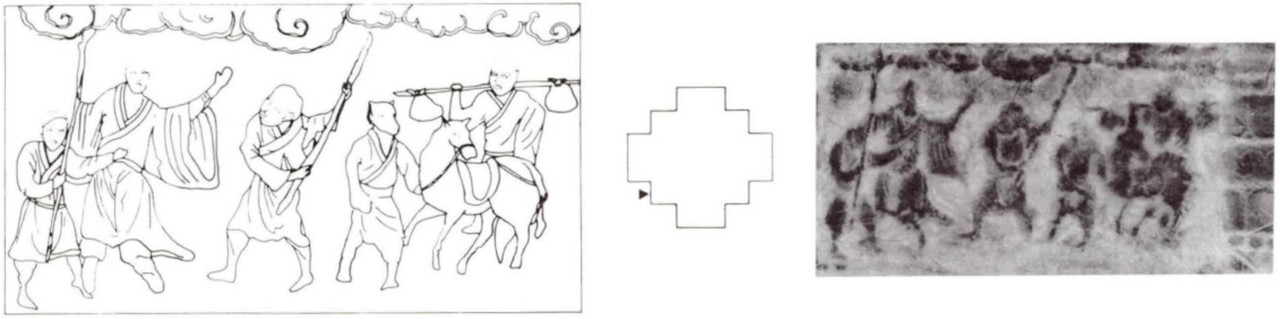
On the left side, Xuanzang bears a monk’s staff and his attendants are depicted together with the horse. And on the right side, symmetrical to this, are the figures of a Buddhist monk (holding a monk’s staff) and his attendant, who are about to receive Xuanzang’s travel party. This appears to depict the scene of Xuanzang’s travel party being welcomed by the monks of some temple along the way. Here Monkey and Zhu Bajie seem to have transformed into monks and are posing as Buddhist monks.
The above ten sides, beginning at due south and reaching due north, appear to be depicting the process of Xuanzang’s travel party going to India, while the ten sides starting at due north appears to depict their return journey [fig. 15] (Yegŭrin Kŏnchʻuksa Samuso, 1993, p. 124).
The scene shows the small monk on the right passing something to Tripitaka. Based on iconography from the following images (see, for example, fig. 18), this could be portraying the monks receiving the scriptures in India.
On the left side, two horses carrying something on their backs and Xuanzang’s travel party are shown. On the left are two figures of kings with umbrellas held over their heads by attendants. And to the left of them, a figure of an official who seems to be guarding the palace is visible. This appears to be depicting the scene where the kings are sending off Xuanzang’s travel party, who are setting off on their journey home after obtaining the scriptures [fig. 16] (Yegŭrin Kŏnchʻuksa Samuso, 1993, p. 124).
The “something” on the horses’ backs could be the scriptures.
On the left, the figure of a monk is caught by the figures of noblemen wearing crowns. On the left Monkey, Zhu Bajie, Sha Wujing and the horse are depicted. But Monkey and Zhu Bajie are assuming postures threatening to save the captured Monk Xuanzang. This seems to show the image of Monkey and company as guards, trying to save Xuanzang when he was being captured on their way back [fig. 17] (Yegŭrin Kŏnchʻuksa Samuso, 1993, p. 125).
Here the figure wielding the staff is designated Monkey, with Pigsy standing behind him. Again, this makes more sense than Zhu Bajie attacking (as portrayed in figure 14).
On the right side, Xuanzang’s travel party and the horse carrying the scriptures are depicted. Here Xuanzang is shown handing over some of the Buddhist scriptures to the figure of a monk on the left. This appears to show Xuanzang’s travel party passing on Buddhism along the way on their return journey [fig. 18] (Yegŭrin Kŏnchʻuksa Samuso, 1993, p. 125).
Compare the shape of the Buddhist scriptures held by the monks with that in figure 15.
The panel draws on preexisting iconography regarding the sutras. The collection of holy writings are sometimes portrayed as a bundle of scrolls emitting an aura of holy light. See, for example, the 12th-century mural from Yulin Cave (Yulin ku, 榆林窟) number three in Gansu province, China (fig. 19).
Fig. 19 – Detail of sutras from a 12th-century Yunlin cave mural (left) and the sutras from panel thirteen (right) (larger version). Both are shown stacked atop a horse.
In the middle of the right side, the figure of a king seated on a throne is depicted. On both sides of him figures of scholar-officials attend to him or sit. On the left, figures of officials are shown attending to duties or sitting. It seems this is depicting the scene of China’s emperor waiting for Xuanzang’s travel party [fig. 20] (Yegŭrin Kŏnchʻuksa Samuso, 1993, p. 125).
Could the figures at the table actually be our heroes, with Xuanzang kneeling before a foreign king?
On the left side, a figure of an ascetic is depicted sitting under a tree (Bodhi tree) meditating, and Xuanzang’s travel party and the horse are depicted. Here Xuanzang is assuming a posture, holding the monk’s staff and lifting his right hand trying to assert something. This seems to show the scene of Xuanzang’s travel party meeting an ascetic and passing on Buddhism on their journey home [fig. 21] (Yegŭrin Kŏnchʻuksa Samuso, 1993, p. 125).
Look closely and you will notice that Sun Wukong does not appear in the scene. Could the “ascetic” be Monkey kneeling before Xuanzang. If so, could this be a reference to the immortal and his master mending their relationship in chapter 58 after the trickery of the Six-Eared Macaque forced them apart?
On the right, a building is depicted and inside it a figure of a king sitting on a throne, and in front of him, a figure of a kneeling monk (Xuanzang) are portrayed. Outside the building, the figure of a young monk that seems to be Xuanzang’s attendant is depicted. Behind him, figures that seem to be civil and military officials are depicted. This seems to show the scene of Xuanzang meeting some king along his way [fig. 22](Yegŭrin Kŏnchʻuksa Samuso, 1993, p. 125).
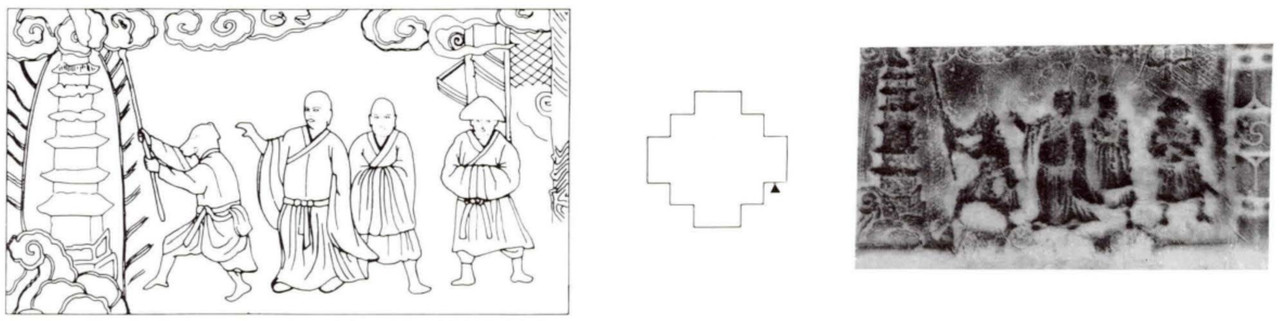
On the left, a pagoda is depicted and in front of it, Zhu Bajie is carrying a club, assuming a posture trying to bring the pagoda down. Behind him Monk Xuanzang is lifting his right hand and insisting something, as if trying to stop him. This seems to show the soothing of Zhu Bajie’s aggressive, insulting actions towards Buddhism [fig. 23] (Yegŭrin Kŏnchʻuksa Samuso, 1993, p. 125).
Like figure 14, it would make more sense if Monkey is the one wielding the staff. Could this be a reference to chapter 62 when Sun captures two fish spirits found on a pagoda’s topmost floor?
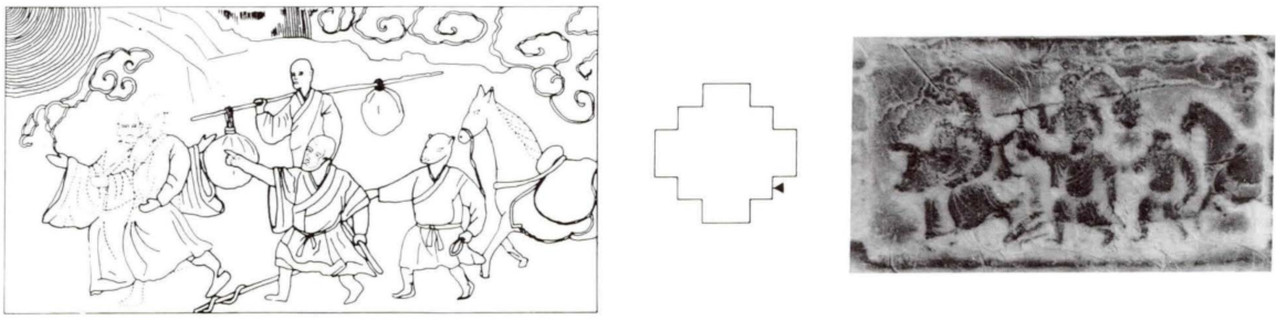
In the upper left part, the sun symbolizing light is depicted. Headed in that direction Monk Xuanzang is taking the lead and behind him Monkey, Zhu Bajie and Sha Wujing are shown hurrying their steps while leading the horse. Here Monk Xuanzang seems to be urging Monkey, Zhu Bajie and Sha Wujing, rushing their journey home [fig. 24] (Yegŭrin Kŏnchʻuksa Samuso, 1993, p. 125).
This includes Pigsy’s aforementioned motif. It is a better match for the ceramic pillow and incense burner examples from figure 19.
On the right, a figure of a celestial being is depicted and Xuanzang’s travel party is facing it symmetrically. This seems to show the fact that Xuanzang’s travel party received the blessing of celestial guardian deities [fig. 25] (Yegŭrin Kŏnchʻuksa Samuso, 1993, p. 126).
I’m confused as to why the two characters on the far right are stacked one on the other. Per the original ink rubbing, could “they” actually be a singular figure, possibly someone of great importance given their size? Could the “deity” actually be Xuanzang being elevated in spiritual rank like in chapter 100?
On the left, something that seems to be a Buddhist altar is depicted. In front of it, Xuanzang is placed in the middle shown holding the monk’s staff, and Monkey, Zhu Bajie and Sha Wujing are each shown performing different actions. Xuanzang is lifting his right hand, posed arguing something and you could say he is trying to educate his attendants, Monkey etc., in Buddhism [fig. 26] (Yegŭrin Kŏnchʻuksa Samuso, 1993, p. 126).
While the line drawing looks more like a figure at a desk, it very well could be an altar with a Buddha statue. Could this depict the lives of our heroes after entering paradise?
IV. Other Pagodas
This is not the first time characters from the story cycle have appeared on a pagoda. Even older examples appear on the 13th-century tower of the Kaiyuan Temple from Quanzhou, Fujian province, China. In this previous article I described how the pagoda is covered with eighty life-sized carvings of Buddhas, bodhisattvas, guardian deities, Buddhist saints, and eminent monks. Of note is a muscular, sword-wielding, monkey-headed warrior that many consider to be an early example of Sun Wukong. Another is an armored, spear-wielding warrior believed to be the dragon prince who becomes the white dragon horse. Both occupy the same face of the eight-sided structure (Dudbridge, 1970, pp. 47-48 and 49-51).
V. Conclusion
Zhu Bajie’s oldest known depictions come from a time coinciding with the late Yuan Dynasty, examples including a ceramic pillow and a fragmented incense burner from China and carvings on a pagoda from Korea. Built in 1348 by Goryeo representatives with ties to the Yuan court, the ten-story Gyeongcheonsa pagoda includes twenty Journey to the West-related scenes around the second level of the structure’s multifaceted three-tiered base. Many of the scenes are vague or focus more on kings and nobles in place of Tripitaka’s tribulations or instances of supernatural battles. One has to consider the story cycle was still solidifying at this point, so it’s possible some of the scenes depict episodes that did not make it into the final Ming version of the novel. But given the amount of royalty, is it possible the donors/planners were trying to ingratiate themselves with people of higher social rank? Or were they just trying to illustrate the great many countries visited by the pilgrims (each one ruled by a king) within the limited space provided?
The panels involving Pigsy for the most part use a consistent iconography borrowed from China. The aforementioned Yuan examples portray Pigsy leading the horse with one hand and with the other holding his signature rake, which rests on his shoulder, all while taking a large step forward. The pagoda panels, however, do not portray the rake, leaving our portly hero with his arm strangely floating in the air. Instead of a rake, some panels appear to show him wielding a staff. But the figure might actually be Sun Wukong, the elongated face just being an artifact from the original ink rubbings.
The fact that characters from the Journey to the West story cycle appear on Chinese and Korean pagodas alongside Buddhist deities proves just how intertwined the story is with the religion. The tale essentially symbolizes the quest for enlightenment, the ultimate goal of Buddhism. Therefore, such pictorial representations, especially the narrative-type scenes from Gyeongcheonsa, were probably meant to both entertain and spread the faith.
Update: 10-26-19
I have recently learned that the line drawings from Yegŭrin Kŏnchʻuksa Samuso (1993) are all but useless. A prime example is number nineteen. As a reminder, here is the drawing:
I originally suggested that the being on the cloud was Xuanzang being elevated in spiritual rank. I didn’t comment on the strange, flower-like cloud to the right of that figure because of its abstract shape.
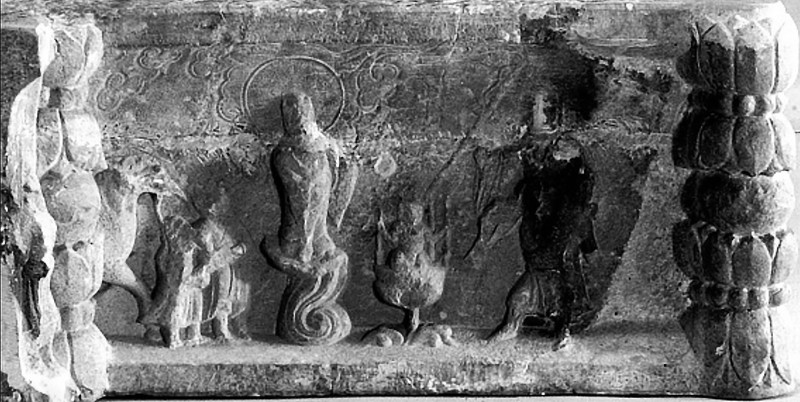
Now here is a photo of the actual carving. It has been enhanced slightly for clarity.
You’ll noticed that the cloud really is a flower with a defined bulb, stem, and leaves. There also appears to be a figure sitting on the flower, one who is surrounded by what looks to be spikes or swords. Here’s a closer look with a crude line drawing by the author.
Wall (2019) notes the figure on the flower is Red Boy and the figure on the cloud is Guanyin (pp. 2129-2130), making this a depiction of the former’s defeat at the end of what would be chapter 42 of the Ming Journey to the West:
After she received [treasure swords borrowed from heaven], the Bodhisattva [Guanyin] threw them into the air as she recited a spell: the swords were transformed into a thousand-leaf lotus platform. Leaping up, the Bodhisattva sat solemnly in the middle.
[…]
[Sun Wukong feigns defeat and tricks Red Boy into chasing him to Guayin’s domain] When the monster spirit suddenly discovered that Pilgrim was gone, he walked up to the Bodhisattva with bulging eyes and said to her, “Are you the reinforcement Pilgrim Sun brought here?” The Bodhisattva did not reply. Rolling the lance in his hands, the monster king bellowed, “Hey! Are you the reinforcement Pilgrim Sun brought here?” Still the Bodhisattva did not reply. The monster-spirit lifted his lance and jabbed at the heart of the Bodhisattva, who at once changed herself into a beam of golden light and rose into the air. Pilgrim followed her on her way up and said to her, “Bodhisattva, you are trying to take advantage of me! The monster-spirit asked you several times. How could you pretend to be deaf and dumb and not make any noise at all? One blow of his lance, in fact, chased you away, and you have even left behind your lotus platform.”
“Don’t talk,” said the Bodhisattva, “let’s see what he will do.” At this time, Pilgrim and Mokṣa both stood in the air shoulder to shoulder and stared down; they found the monster-spirit laughing scornfully and saying to himself, “Brazen ape, you’re mistaken about me! What sort of person do you think that I, Holy Child, happen to be? For several times you could not prevail against me, and then you had to go and fetch some namby-pamby Bodhisattva. One blow of my lance now has made her vanish completely. Moreover, she has even left the treasure lotus platform behind. Well, let me get up there and take a seat.” Dear monster-spirit. He imitated the Bodhisattva by sitting in the middle of the platform with hands and legs folded. When he saw this, Pilgrim said, “Fine! Fine! Fine! This lotus platform has been given to someone else!”
“Wukong,” said the Bodhisattva, “what are you mumbling again?”
“Mumbling what? Mumbling what?” replied Pilgrim. “I’m saying that the lotus platform has been given to someone else. Look! It’s underneath his thighs. You think he’s going to return it to you?”
“I wanted him to sit there,” said the Bodhisattva.
“Well, he’s smaller than you,” said Pilgrim, “and it seems that the seat fits him even better than it fits you.”
“Stop talking,” said the Bodhisattva, “and watch the dharma power.”
She pointed the willow twig downward and cried, “Withdraw!” All at once, flowers and leaves vanished from the lotus platform and the auspicious luminosity dispersed entirely. The monster king, you see, was sitting actually on the points of those swords. The Bodhisattva then gave this command to Mokṣa:
“Use your demon-routing cudgel and strike back and forth at the sword handles.”
Dropping from the clouds, Mokṣa wielded his cudgel as if he were demolishing a wall: he struck at the handles hundreds of times. As for that monster-spirit,
Both his legs were pierced till the points stuck out; Blood spouted in pools as flesh and skin were torn.
Marvelous monster! Look at him! Gritting his teeth to bear the pain, he abandoned the lance so that he could use both hands to try to pull the swords out from his body (Wu & Yu, 2012, vol. 2, pp. 246 and 249-250).
Could the figures, one on top of the other’s shoulders, be an inventive way of showing Monkey and Guanyin’s disciple Moksha working together to subdue Red Boy?
This carving shows the Red Boy episode was known in Korea during the 14th-century, demonstrating that it predates the final Ming novel by centuries. The tale obviously would have taken time to form, become established in the accepted story cycle, and travel north, suggesting it may date to the early part of the corresponding Yuan-period when the Pagoda was raised in Korea, or possibly even before.
I hope to locate pictures of the other carvings to make this article more accurate.
Notes:
1) See Dudbridge, 1970, pp. 60-74 for more information. The tale itself is translated in appendix B of the same work. See pages 179-188.
2) I am indebted to Sini Henningsen, BA (sinihenningsen@gmail.com) for translating the cited Korean material.
Sources:
Brose, B. (2018). The pig and the prostitute: The cult of Zhu Bajie in modern Taiwan. Journal of Chinese Religions, 46 (2), pp. 167-196, DOI: 10.1080/0737769X.2018.1507091
Dudbridge, G. (1970). The Hsi-yu chi: A study of antecedents to the sixteenth-century Chinese novel. Cambridge: Cambridge Univ. Press.
Wall, B. (2019). Dynamic texts as hotbeds for transmedia storytelling: A case study of the story universe of the Journey to the West. International Journal of Communication 13, 2116-2142. Retrieved from https://ijoc.org/index.php/ijoc/article/view/10006/2648
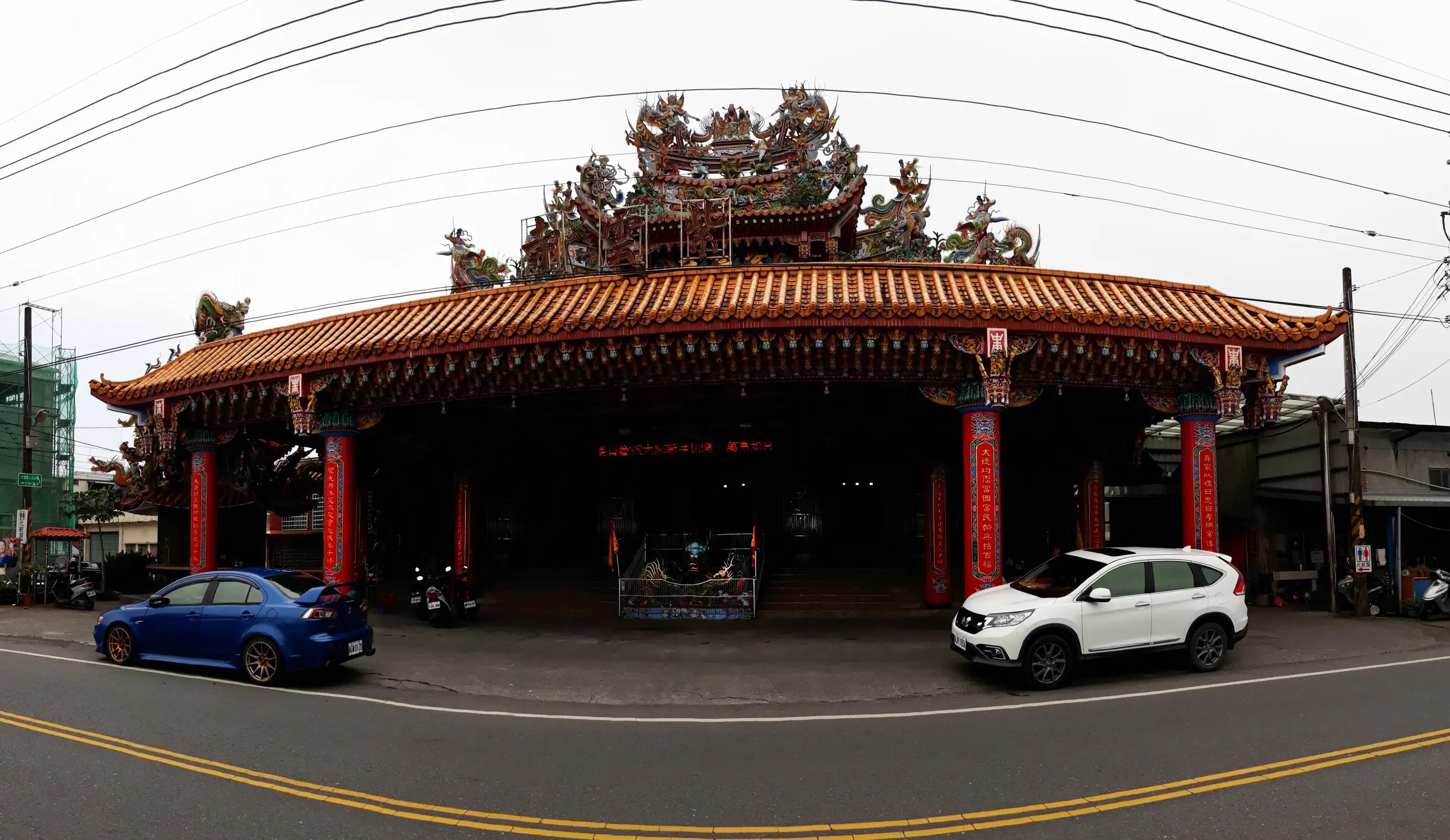
I recently visited another Great Sage temple, this time the Wujian Purple Cloud Temple (Wujian Ziyu si, 五間紫雲寺) of Yilan (宜蘭), Taiwan. The temple was bustling with people during the Chinese New Year celebrations, so I didn’t have time to ask many questions. This entry will serve more as a picture essay until I return to conduct proper research.
1. History
Legend has it that around 1899 a man found a monkey-shaped stone and enshrined it in a thatched shed. This was eventually converted to a temple a few years later. It was destroyed by a typhoon in 1960 but subsequently rebuilt. The temple appears to recognize a trinity, with countless monkey soldiers beneath them. The Great Sage has two aspects: the “Martial Great Sage” (Wu Dasheng, 武大聖) (standing statues), who exorcises evil, and the “Civil Great Sage” (Wen Dasheng, 文大聖) (seated statues), who insures the safety of people and animals.
2. How to get there
(Note: Always consult google if you are directionally challenged like myself)
Address: No. 449, Section 3, Dafu Road, Zhuangwei Township, Yilan County, Taiwan, 263
I took bus #1571 (google calls it #1571A) from gate 15 of the Taiwan City Hall Bus Station. This heads towards the Yilan Bus Station. (If you plan to take this route, please note that buses headed to different areas of Yilan will board from this gate. So pay very close attention to the calls of the bus station attendant. For example, they called “Jiaoxi” (礁溪) (bus #1572), a small township in Yilan, and those waiting for another destination had to stand off to the side while those from different sections of the line made their way to the front. If you aren’t careful, you might end up on the wrong bus.) My destination was the first stop, the Zhuangwei (壯圍) bus stop, a small shelter by an overpass. My short walk to the temple took me passed rows of flooded rice fields and small patches of buildings.
(Click images for larger versions)
Gate 15 at the Taiwan City Hall Bus Station.
The Zhuangwei bus stop shelter (as seen from the opposite outgoing bus stop).
The route map from the Zhuangwei bus stop to the temple.
Random rice fields along Gonglao Road (see map).
A panorama of a rice field next to Lane 423, Sect. 3, Dafu Road (see map).
3. The Outside
The temple is located on the side of a busy road. It appears almost out of nowhere since the face of the holy structure is in line with the buildings on either side. The first thing that caught my eye was the highly ornate roof of the furnace covered in mythical creatures, divine heroes, and gods, features typical of South Chinese and Taiwanese temple architecture. Each face of the hexagonal body was covered with beautiful carvings on black marble, two of which included the pilgrims from Journey to the West.
The furnace visible on the left side of the temple (as seen from the road).
A marble carving of Guanyin, the White Dragon Horse, Monkey, and Tripitaka.
A detail of Monkey.
Monkey, Sha Wujing, Tripitaka on the White Dragon Horse, and Zhu Bajie.
A detail of the group.
The front of the temple houses an ornate statue of three brightly colored dragons enclosed in a fence. Looking up, I noticed beautiful hand-painted dragons and Qilin on the ceiling, along with paintings of events from Chinese mythology and Journey to the West on the cross beams. Walking towards one of the five entrances, I noticed the facade was covered in highly detailed stone carvings, some depicting events from the novel.
The front of the Purple Cloud Temple.
The front of the temple. Three of the five entrances are visible behind the dragons.
A detail of the three dragon statues.
Five hand-painted dragons on the ceiling. The Eight Immortals grace the crossbeam below.
A pair of Qilin on the ceiling. The cross beam below portrays an event from Prince Nezha‘s life.
Zhu Bajie protecting his master from the ogre that will become Sha Wujing.
A stone carving on the facade showing Monkey (top right), Zhu bajie (top center right), and Sha Wujing (center left) battling a monster (top left). The image has been enhanced for clarity.
Monkey (center) battling the heavenly army. Enhanced for clarity.
Monkey (center) leaping from Laozi’s furnace. Enhanced for clarity. Apologies for the blur.
A detail of Monkey leaping.
The Great Sage (top center) and his monkey army battling heaven. Enhanced for clarity. These are just a few of the many carvings covering the temple facade.
4. The Inside
The interior hall is wide yet shallow in depth and split between three altars, Folk religion to the right, the Great Sage in the Center, and Daoist to the left. I must admit in my zeal to photograph anything Monkey-related, I completely forgot to take pictures of the other two sections. This online image shows the folk section includes Mazu, Budai, and other deities. This image shows the Daoist section includes the Jade emperor, the Earth god, and others. Surprisingly, the incense burner in front of the main entrance was not marked with the name of the Great Sage (unlike what I’ve seen at other such temples) but that of the Jade Emperor, 玉皇上帝 (Yuhuang shangdi).
The main hall.
The incense burner bearing the name of the Jade Emperor (visible from the hall looking out the main door).
Upon entering the right side of the main hall, the first thing that caught my eye was a large wooden sculpture of a tree-bound monkey holding onto a branch with one hand and a pair of peaches in the other. Immediately behind him was a stone carving of a vague monkey with two children. (I’m not sure of the ritual importance of either statue. I’ll report on this later. However, I will say the stone statue recalls Sun Wukong’s origins as a stone monkey.) Next to both statues is one of two cylindrical towers, one positioned on each end of the hall. Each is topped by a Great Sage statue and the towers themselves are comprised of hundreds of small compartments, each filled with a small Great Sage figure. These represent a donor who has given money to the temple.
The wooden monkey statue.
A detail of the monkey holding peaches.
The stone monkey with children.
The tower of donor Great Sages.
The Great Sage topping each tower. He holds a fly whisk in one hand and a peach of immortality in the other.
The many compartments.
A mini Great Sage donor figure. He sits on a throne with his staff held over head in one hand and a calabash gourd held to his front in the other.
4.1. The Great Sage Altar
The central offering table to the Great Sage was covered in all sorts of fruits, candies, and flowers. Also included were an incense burner, offerings of wine, and a pair of crescent moon-shaped wooden blocks. These blocks are used in tandem with fortune sticks and oracles revealed on slips of paper, all of which are housed in a metal cylinder to the left of the table (see section three of this article on how these items are used).
The table laden with offerings. Take note of the young woman praying to the Great Sage. She told me that she was from Vietnam and that Monkey was not a common deity there.
The incense burner (back center), tea offerings (three cups visible in the center) and wooden blocks (front right).
The metal cylinder housing the fortune sticks (top), with the corresponding oracles located in each of the surrounding drawers.
Like in other parts of Taiwan and Singapore, this temple appears to recognize a plethora of Great Sages, from a holy trinity to an army of soldier monkeys. (I don’t yet know their individual names. I will report on this later.) All of the Great Sage figures are portrayed with golden armor, red-painted humanoid faces, golden fillets, and long, dark hair. The headband and long hair are no doubt influenced by depictions of Military Monks (Wuseng, 武僧) from Chinese opera (Bonds, 2008, pp. 177-178 and 328). Red face paint is also associated with such characters (Bonds, 2008, p. 211). While the red paint of the statues references the red faces of macaque monkeys, it definitely plays into the military monk personna. Portraying Monkey as such defines him as a divine warrior and a guardian deity.
A military monk from a modern Beijing Opera production (Bonds, 2008, p. 178).
I was pleasantly surprised to see statues of Zhu Bajie appear among the Great Sage’s army. It’s quite appropriate given this is the year of the pig according to the Chinese zodiac. Also included were statues of Ksitigarbha and Nezha.
The three main Great Sages visible in front of the ornate dragon statue. Note the long hair.
Statues of Zhu Bajie among Monkey’s soldiers.
More soldier monkeys. Take note of the Ksitigarbha (front right).
Nezha figures mixed in with the monkey soldiers (left).
This soldier monkey holds a calabash gourd at the ready.
More Nezha figures among the soldiers (right).
I have more pictures of the interior but I’ll leave those for a later article. Lastly, I want to share one of the temple flags stationed opposite the main building.
I’ve previously written about Zhu Bajie‘s worship in Taiwan as the god of prostitutes and the hospitality industry. Now, a new paper has been published by Prof. Ben Brose (University of Michigan) that takes a more in-depth look at the phenomenon.
Abstract
Before the publication of the famous Chinese novel The Journey to the West, the central characters of the narrative—the Tang Monk, the monkey Sun Wukong, the pig Zhu Bajie, and the monk Sha—were venerated as deities. These same figures continue to be invoked today in a range of rituals throughout the Chinese world. This article focuses on the cult of Zhu Bajie in modern Taiwan. As a “licentious” spirit known for his voracious appetite and irrepressible libido, Zhu Bajie has attracted devotees from among Taiwan’s “special professions,” namely masseuses, hostesses, and sex workers [fig. 1]. Unable to turn to conventional, ethically demanding deities for assistance, purveyors of illicit goods and services make offerings to spirits like Zhu Bajie who they hope will be more sympathetic to their needs. In this way, Zhu Bajie, a figure familiar from children’s books, cartoons, and blockbuster movies, has also become a patron saint of prostitutes.
Fig. – An altar statue (shenxiang, 神像) of Zhu Bajie holding a nude woman (larger version).
Disclaimer
Prof. Brose was kind enough to give me permission to post the article. However, in the event that the hosting journal requests I pull the article, I will do so when asked. This has been posted for educational purposes. No copyright infringement is intended.
Citation
Brose, B. (2018). The pig and the prostitute: The cult of Zhu Bajie in modern Taiwan. Journal of Chinese Religions, 46 (2), pp. 167-196, DOI:
10.1080/0737769X.2018.1507091
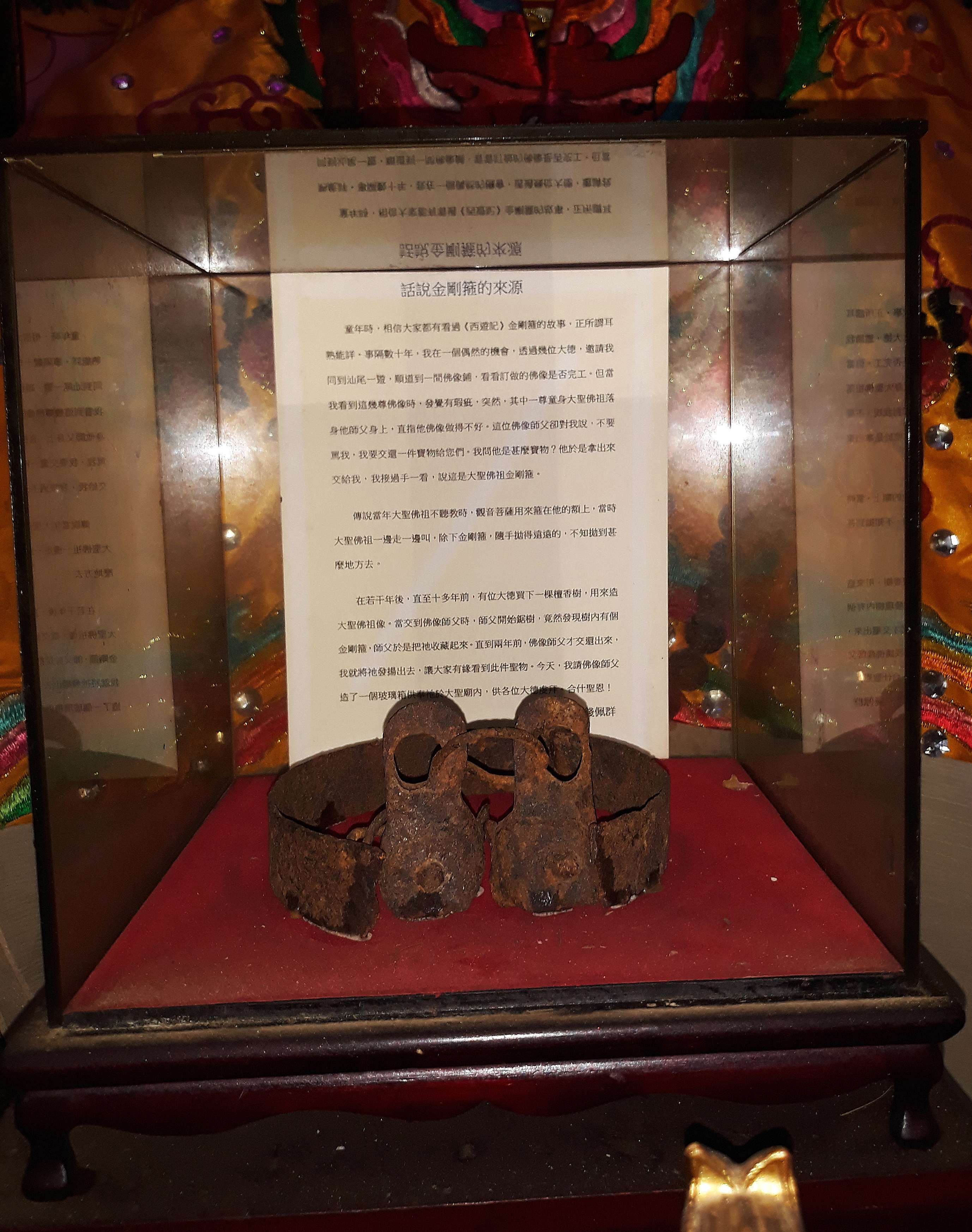
I recently attended the birthday of Sun Wukong on September 25th (the 16th day of the 8th lunar month) in Kowloon, Hong Kong (I’ll write more about this later). While the festivities took place at an alternate location with a secondary altar, I later visited the main altar in the Great Sage Treasure Temple (Dasheng bao miao, 大聖寶廟) on the Po Tat Estate. The altar stage includes a large gilded statue of Wukong, flanked on either side by those of his religious brothers Sha Wujing and Zhu Bajie. Strangely enough, a glass box is conspicuously placed in front of the Monkey King’s visage (fig. 1). Inside is a rusted metal band held together with a single chain link (fig. 2). An accompanying text panel labels it the “Vajra/Diamond Headband” (Jingang gu, 金剛箍) and claims the piece to be the original band worn by the Great Sage during his adventures. This same text is echoed in the Kowloon Great Sage Buddha Hall: Special Inaugural Ceremony Issue of the Sixteenth Year Council Association (Jiulong Dasheng Fo tang: Di shiliu jie lishi hui jiu shi dianli tekan, 九龍大聖佛堂: 第十六屆理事會就識典禮特刊) (2014), a booklet handed out during this year’s festivities. [1]
Fig. 1 – The glass box is visible between the food offerings and the Great Sage’s statue (larger version). Photo by the author.
I. Translation
From Childhood, I believe that everyone has read the story of the golden headband from Journey to the West. Everyone is familiar with the tale. A few decades later [after the events took place], some Buddhists were invited to a Buddhist statue workshop in Shanwei [City, Guangdong Province, China] to see if the Buddha statue they ordered was finished. But when they saw the statue they found it full of flaws. Suddenly, one among them spoke up and said it wasn’t made well enough. The Buddhist statue workshop master asked not to be chastised and said he instead wanted to give them a treasure. They asked him what it was. When he handed it to them they saw it was the Great Sage Buddha’s [original] golden headband.
People say that when Sun Wukong would not accept the Buddhist teachings, Guanyin put the band on his head. Sun Wukong ran side to side while yelling, trying to take it off and throw it far away to some unknown place [but couldn’t].
Many years later, maybe until ten years ago, a virtuous man purchased a sandalwood tree in order to build a Great Sage Buddha statue. He gave it to a Buddhist statue workshop master, who started to saw the tree but soon discovered the golden headband inside and decided to keep it for himself. Two years later, he decided to return it so everyone could behold this sacred treasure. Today, we asked the Buddhist workshop master to make a glass box to display the band in the Great Sage Temple for everyone to worship (p. 45). [2]
Fig. 2 – The glass box with the headband. The accompanying text panel can be seen in the back (larger version). Photo by the author.
Chapter 100 of the original novel describes the headband disappearing once Monkey internalizes self-restraint and becomes a Buddha (Wu & Yu, 2012, p. 383). The ultimate fate of the band is never commented on thereafter. The above story presents a continuation of the tale, thereby linking the Great Sage Treasure Temple with the original events of the novel. The band is lost and discovered twice over the centuries, eventually coming to rest in Hong Kong.
II. Similarities with Shaolin art
The displayed headband appears to be quite old given the level of rust damage. In addition, the style is different than any band I’ve written about before. That being said, the style is somewhat similar to a 17th-century mural from the famed Shaolin Monastery. The mural depicts a muscular luohan wielding a staff and standing next to a ferocious tiger (possibly the Tiger-Taming Luohan). His crown is adorned with a headband held together by a single chain link (fig. 3) similar to our aforementioned band. I am by no means claiming a connection to Shaolin, but it shows there may have been some style of linked headband associated with protector deities in late dynastic China.
Fig. 3 – The 17th-century Shaolin mural (larger version). Take note of the linked headband. From Shahar, 2008, p. 90.
Notes
1) The presented folk story is as told by the Kowloon Great Sage Buddha Hall First Vice-Chairperson Qian Peiqun (錢佩群).
2) Thank you to Kelly Black Lin for helping me with the translation.
Sources
Kowloon Great Sage Buddha hall: Special inaugural ceremony issue of the sixteenth year Council association (2014, Sept. 9). Published by the Hong Kong Shanwei General Commerce Association Limited.
Shahar, M. (2008). The Shaolin monastery: History, religion, and the Chinese martial arts. Honolulu: University of Hawai’i Press.
Wu, C., & Yu, A. C. (2012). The journey to the West: Volume 4. Chicago, Ill: University of Chicago Press.