Why was Sun Wukong Able to Live 342 Years Prior to his Immortality?

Last updated: 04-23-2026

Someone on reddit recently asked why Sun Wukong was able to live just shy of 400 years before even attaining immortality. I thought this was a good question, so I decided to split off related material from an old piece that I never finished and make a quick article. The short answer is tied to Daoist concepts of fate, and the long answer ultimately explains why Monkey strikes his name from the ledger of life and death in hell.

Table of Contents

1.  Novel Info

Here, I would like to quote two early sections from Journey to the West (Xiyouji西遊記, 1592) that refer to Sun Wukong’s age. The first appears in chapter one after he becomes monarch of the primates:

The Handsome Monkey King thus led a flock of gibbons, macaques, and horse-monkeys, some of whom were appointed by him as his ministers, aides, and envoys. They toured the Flower-Fruit Mountain in the morning, and they lived in the Water-Curtain Cave by night. Living in concord and sympathy, they did not mingle with bird or beast but enjoyed their independence in perfect happiness. For such were their activities:

In the spring they gathered flowers for food and drink.
In the summer they went in quest of fruits for sustenance.
In the autumn they amassed taros and chestnuts to ward off time.
In the winter they searched for yellow-sperms to live out the year.

The Handsome Monkey King had enjoyed this insouciant existence for three to five hundred years (emphasis added) when one day, while feasting with the rest of the monkeys, he suddenly grew sad and shed a few tears (based on Wu & Yu, 2012, p. 106).

美猴王領一群猿猴、獼猴、馬猴等,分派了君臣佐使。朝遊花果山,暮宿水簾洞,合契同情,不入飛鳥之叢,不從走獸之類,獨自為王,不勝歡樂。是以:

春採百花為飲食,夏尋諸果作生涯。
秋收芋栗延時節,冬覓黃精度歲華。

美猴王享樂天真,何期有三五百載。一日,與群猴喜宴之間,忽然憂惱,墮下淚來。

And the second appears in chapter three after Monkey is dragged to hell. He bullies underworld officials into giving him his ledger of life and death, in which he learns his exact age and fate:

You see, though this monkey resembled a human being [i.e. his body], he was not listed under the names of men; though he resembled the short-haired creatures [i.e. his fur], he did not dwell in their kingdoms; though he resembled other animals, he was not subject to the unicorn; and though he resembled flying creatures [i.e. his beak-like, protruding face], he was not governed by the phoenix. He had, therefore, a separate ledger, which Wukong examined himself. Under the heading “Soul1350” he found the name Sun Wukong recorded, with the description: “Heaven-born Stone Monkey. Age: three hundred and forty-two years. A good end” (emphasis added) (Wu & Yu, 2012, p. 140).

又看到猴屬之類,原來這猴似人相,不入人名;似臝蟲,不居國界;似走獸,不伏麒麟管;似飛禽,不受鳳凰轄。另有個簿子,悟空親自檢閱,直到那「魂」字一千三百五十號上,方注著孫悟空名字,乃「天產石猴,該壽三百四十二歲,善終」

So why then was he able to live so long?

2. Religious Background

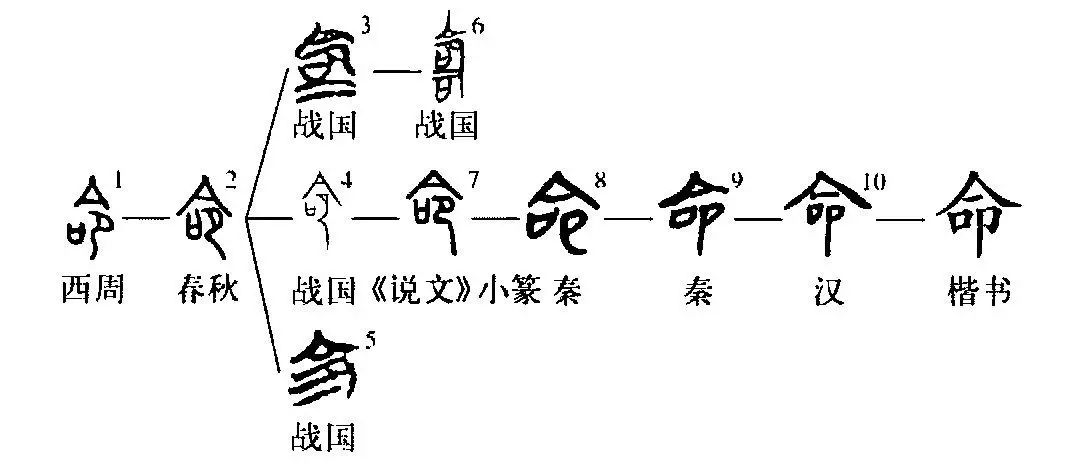
The answer lies in the concept of “pre-allotted lifespans” (ming, 命; a.k.a. “fate”) (fig. 1), which can be traced to weft texts [1] and Grand Purity (Taiqing, 太清) scriptures of the Han dynasty (3rd-c. BCE to 3rd-c. CE). According to 1st to 3rd-century CE commentators, a person’s lifespan and good or bad fortune in life were determined according to whatever combination of “heavenly pneumas” (tianqi, 天氣) and “astral essences” (xingjing, 星精) that they were born under, meaning one’s fate was not handpicked by heaven (Campany, 2005, pp. 131-134). This allotted lifespan was not set in stone, however, for it was subject to subtractions and additions based on one’s bad or good deeds. The deity in charge of this tally system was called the “Director of Allotted Life Spans” (Siming, 司命), and, unlike the underworld officials who provided Monkey with his ledger, he was said to reside in heaven where he regularly received reports on individual human sins by the tutelary Stove god (Zaoshen, 竈神) on the first, fifteenth, and last day of every month. Additionally, he received reports from the three corpses/worms (sanshi, 三尸) inhabiting a person’s body. [2] The more a person sinned, the more points (time) was subtracted, anywhere from almost a year for major offences to just three days for minor offences. Doing good deeds or cheating the system were the only ways to live out the entirety of the allotted lifespan (Campany & Ge, 2002, pp. 47-52).

Evolution of the character ming () (larger version). Image found here.

Ways of “living off the books” included magically disguising clothing or a sword as a body (fig. 2), ritually bribing the gods of life and death with a golden statue to be used as a substitute body, or inserting a fake death certificate into the coffin of a recently deceased grandfather. These methods essentially tricked heaven into thinking that the person had died (Campany, 2005, pp. 134-138; Campany & Ge, 2002, pp. 60). The use of longevity-bestowing elixirs was considered the only true way of breaking free of the allotted lifespan and achieving immortality. Interestingly, the Han-era Scripture on the Elixirs of the Nine Tripods (Jiuding danjing, 九鼎丹經) describes how taking a fired concoction of cinnabar, vinegar, and lacquer for a thousand days straight would result in the “Director of Allotted Life Spans expung[ing] your name from the registers of death, so that you will end only when Heaven and Earth do” (Campany & Ge, 2002, pp. 52).

Fig. 2 – A type of Chinese jian (劍) sword that might be magically disguised to look like a decoy body (larger version). Image found here.

2.1. Relation to Monkey

Therefore, we can see that Wukong’s allotted lifespan was 342 years and his birth fell under fortunate cosmic circumstances, for he was born onto an island paradise, served as the king of monkeys, and was destined to have a “good end” (shan zhong, 善終). Monkey had already achieved immortality via Daoist practices prior to being dragged to hell, so he had no need for cheating the system in order to live out the rest of his allotted lifespan. Nor did he need to take an elixir. He was simply so powerful that he could strike his name from the ledgers by force, thereby freeing himself from heaven’s control.

As for the significance of 342, Irwen Wong over at the Journey to the West Library blog has pointed out to me that the numbers add up to nine (3+4+2 = 9), which is an important digit in religious numerology. However, he also suggests that 342 could just be a random number chosen by the author-compiler. (See the 04-23-26 update below for more info.)


3. Updates

Update: 10-15-24

I was reminded that the max level in the hit video game Black Myth: Wukong (2024) is 342, an obvious reference to Monkey’s lifespan.


Update: 10-26-24

Someone on reddit disagreed with me regarding allotted lifespans. Instead, they suggested that Sun Wukong somehow naturally performs the Daoist breathing exercises that would eventually lead to his immortality, as in he lengthened his life via cultivation practices just like Monkey deduces the 270-year-old Buddhist abbot, “Elder of the Golden Pool” (Jinchi changlao金池長老), did in chapter 17 (Wu & Yu, 2012, vol. 1, p. 356). But this explanation ignores two elements from the novel. One, as mentioned above, the Great Sage’s allotted lifespan of 342 years is clearly recorded in the ledgers of life and death. This is beyond dispute. And two, the book presents cultivated longevity as a crime against heaven. For example, when Sun achieves immortality, the Patriarch Subodhi gives him a warning:

“What you have learned,” said the Patriarch, “is no ordinary magic: you have stolen the creative powers of Heaven and Earth and invaded the dark mysteries of the sun and moon. Your success in perfecting the elixir is something that the gods and the demons cannot countenance. Though your appearance will be preserved and your age lengthened, [heaven will send the three calamities to destroy you]” (Wu & Yu, 2012, vol. 1, p. 121).

祖師道:「此乃非常之道:奪天地之造化,侵日月之玄機;丹成之後,鬼神難容。雖駐顏益壽,但到了五百年後,天降雷災打你,須要見性明心,預先躲避。躲得過,壽與天齊;躲不過,就此絕命。再五百年後,天降火災燒你。這火不是天火,亦不是凡火,喚做『陰火』。自本身湧泉穴下燒起,直透泥垣宮,五臟成灰,四肢皆朽,把千年苦行,俱為虛幻。再五百年,又降風災吹你。這風不是東南西北風,不是和薰金朔風,亦不是花柳松竹風,喚做『贔風』。自顖門中吹入六腑,過丹田,穿九竅,骨肉消疏,其身自解。所以都要躲過。」

The aforementioned calamities are elemental attacks of divine lightening, fire, and wind that are respectively sent every 500 years to kill cultivators for defying their fated age and attaining immortality (Wu & Yu, 2012, vol. 1, pp. 121-122).

This negative view of immortality also extends to the cultivation practices that produce it. Campany (1985) explains that demons are evil in the novel because they try to bypass the natural cosmic hierarchy by using spiritual practices to encapsulate the universe within themselves, while the pilgrims follow the “correct” path by submitting to Buddhism and building Buddhist merit in place of the selfish quest for immortality (pp. 112-113). This is perfectly summed up by the Great Sage’s story trajectory. He was considered a monster until he reformed and became Tripitaka’s disciple.

Having said that, I would like to return to the Golden Pool Elder. It’s important to remember that he learned his life-prolonging techniques from a nearby spirit, and that he was, as Monkey puts it, also a member of the fiend’s “monster’s gang” (yaojing jiedang, 妖精結黨) (Wu & Yu, 2012, vol. 1, p. 356). And when you take into account his willingness to set his own monastery on fire just to murder Tripitaka and attain the monk’s heaven-sent robe (Wu & Yu, 2012, vol. 1, p. 340), the abbot is just as much of a devil as those he congregated with. Therefore, his cultivation falls into the same category as demons, making him an ill-suited example to use.


Update: 04-23-26

The Book to Enlightenment of the Journey to the West (Xiyou Zhengdao Shu, 西遊證道書, 1663), a Daoist commentary on the novel, points out the numerological significance of 342:

This is extremely absurd but nonetheless true. Three hundred is ten thirties; plus three tens and three fours, it equals three hundred and forty-two, also a sum of three times three (nine).

荒唐極矣,說來卻是逼真。奇絕奇絕。 〇三百者,十個三十也;又加三個十,三個四,恰是三百四十二,亦是三三之數。(Converted from simplified Chinesesource)

Notes:

1) The term “Weft texts” draws on a weaving analogy to refer to side texts that compliment or complete existing material.

2) The ancient Chinese believed that the body was inhabited by upwards of ten souls, namely three hun (魂) and seven po (魄) souls. In addition, the body was inhabited by three demonic parasites, the three corpses/worms (sanshi, 三尸), who wanted nothing more than to be rid of their mortal confinement so they’d be free to wander and eat sacrificial offerings left for ghosts. Therefore, they would report the sins of their human vessel to heaven in order to hasten their demise (Campany & Ge, 2002, p. 49, for example).

Monkey’s own three corpses/worms are referenced in chapter 32 when a demon magically calls forth a mountain that crushes our hero:

Exerting his spirit even more, he [the monster] recited another spell and sent up the Tai Mountain to press down on Pilgrim’s head. With this magic of the Tai Mountain Pressing the Head, the Great Sage was overpowered as his strength ebbed and his tendons turned numb; the weight was so great that the spirits of the Three Worms inside his body exploded (emphasis added) and blood spouted from his seven apertures [i.e. his eyes, ears, nostrils, and mouth] (Wu & Yu, 2012, vol. 2, pp. 108-109).

又整性情,把真言念動,將一座泰山遣在空中,劈頭壓住行者。那大聖力軟觔麻,遭逢他這泰山下頂之法,只壓得三尸神咋,七竅噴紅。

Sources:

Campany, R. F. (1985). Demons, Gods, and Pilgrims: The Demonology of the Hsi-yu ChiChinese Literature: Essays, Articles, Reviews (CLEAR), 7(1/2), 95-115. doi:10.2307/495195

Campany, R. F., & Ge, H. (2002). To Live as Long as Heaven and Earth: A Translation and Study of Ge Hong’s Traditions of Divine Transcendents. Berkeley: University of California Press.

Campany, R. F. (2005). Living off the Books: Fifty Ways to Dodge Ming in Early Medieval China. In C. Lupke (Ed.), The Magnitude of Ming: Command, Allotment, and Fate in Chinese Culture (pp. 129-150), University of Hawaii Press.

Wu, C., & Yu, A. C. (2012). The Journey to the West (Vols. 1-4) (Rev. ed.). Chicago, Illinois: University of Chicago Press.

The Monkey King’s Magic Staff: A Complete Guide

Last updated: 04-23-2026

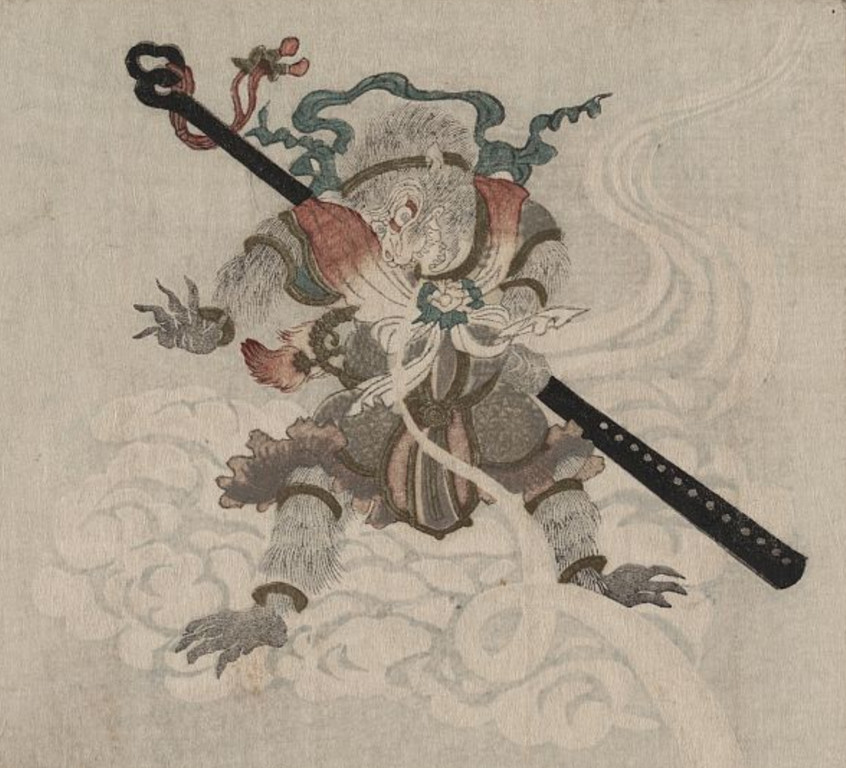
I’ve written many articles on the origins of the Monkey King’s staff over the years. Therefore, I’ve decided to combine all of the information in one location for the benefit of people wishing to learn more about the weapon and its history. This will no doubt be interesting to fans of Journey to the West (Xiyouji, 西遊記, 1592; JTTW hereafter), as well as those of modern franchises like Dragon Ball and Lego Monkie Kid (fig. 1). Citations can be found in the articles linked below.

Fig. 1 – A fan edit of the Lego Monkie Kid character “MK” wielding the Monkey King’s magic staff (larger version). Copyright Lego.

Table of Contents

1. The Literary Weapon

1.1. Staff Background

The staff first appears in chapter three of the original novel when the Monkey King goes to the underwater kingdom of Ao Guang (敖廣), the Dragon King of the Eastern Sea, looking for a magic weapon to match his supernatural strength and martial skill. When all of the traditional weapons offered to him fail to meet his standards, the dragon queen suggests to her husband that they give Sun Wukong “that piece of rare magic iron” taking up space in their treasury. She claims the ancient shaft had started producing heavenly light days prior and proposes that the monkey is fated to own it. The weapon is said to be a “divine treasure iron” originally used to set the depths of the Heavenly River (Tianhe ding di de shenzhen tie, 天河定底的神珍鐵) by Yu the Great (Dayu, 大禹), a mythic Chinese emperor and demigod.

The staff is initially described as a pillar of black iron or bin steel more than 20 feet in height and as wide as a barrel. It is only when Monkey lifts it and suggests a smaller size would be more manageable that the staff complies with his wishes and shrinks. This is when Sun notices that the weapon is decorated with a golden ring on each end, as well as an inscription along the body reading: “The ‘As-You-Will’ Gold-Banded Cudgel. Weight: Thirteen Thousand Five Hundred Catties” (Ruyi jingu bang zhong yiwan sanqian wubai jin, 如意金箍棒重一萬三千五百斤). The inscription indicates that the staff is immensely heavy, weighing 17,560 lbs. (7,965 kg).

Apart from the above information, a poem in chapter 75 (see section 2.3 here) highlights another name, “Rod of Numinous Yang” (Lingyang bang, 靈陽棒). In addition, the poem describes the staff being covered in “tracks of planets and stars” (i.e. astronomical charts) and esoteric “dragon and phoenix scripts” (longwen yu fengzhuan, 龍紋與鳳篆).

The novel provides two contradictory origins for the staff. The chapter 75 poem notes that it “[w]as forged in the stove by Laozi himself.” Laozi is of course the high god of Daoism. Chapter 88 instead states that it was “forged at Creation’s dawn / By Yu the Great himself, the god-man of old.”

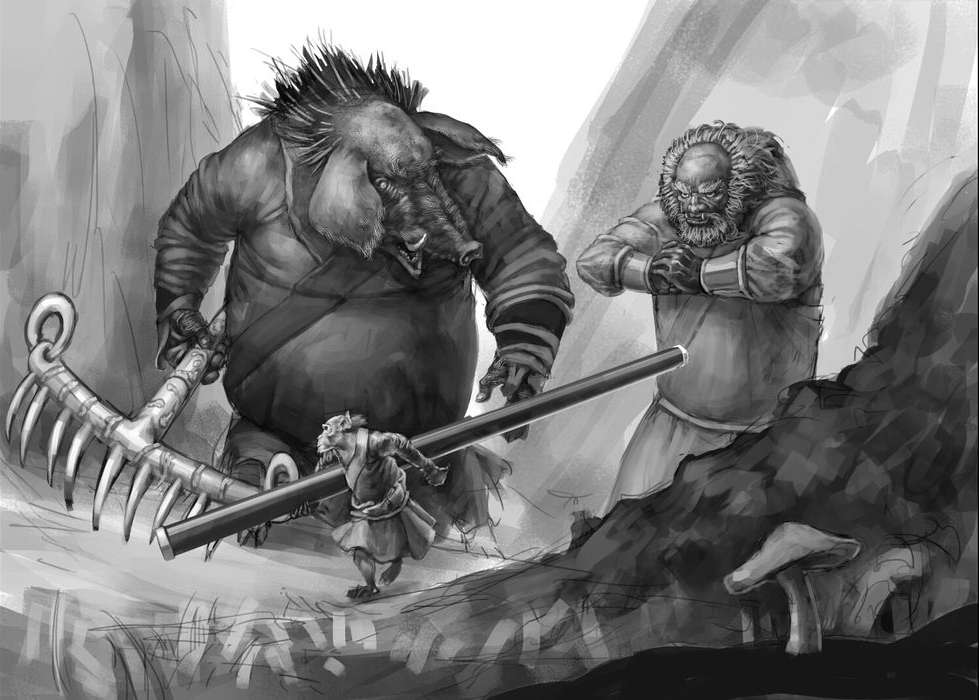
Contrary to popular images of the Monkey King holding a regular-sized staff, his literary counterpart wields a massive weapon in battle. It is said to be 20 feet long (likely an error for 12), [1] with the width of a bowl (erzhang changduan, wankou cuxi, 二丈長短,碗口粗細) (fig. 2). I did a cursory search of bowls during the Ming (when the standard edition of JTTW was published) and found that they have a radius of between 4 to 6 inches (10.16 to 15.25 cm).

Fig. 2 – An accurate depiction of the size of Monkey’s staff (larger version). Images found here. Artwork by @真·迪绝人.

1.2. Staff Powers

The staff is shown to have multiple powers.

  1. Size manipulation – This is the weapon’s most well-known ability, growing as big or as small as Monkey wishes.
  2. Controlling the oceans –  The aforementioned poem from chapter 88 writes: “The depths of all oceans, rivers, and lakes / Were fathomed and fixed by this very rod. / Having bored through mountains and conquered floods, / It stayed in East Ocean and ruled the seas…”
  3. Astral entanglement – Monkey’s soul is able to use the staff in Hell despite the physical weapon being with his sleeping body in the world of the living. (See the 04-23-26 update below for more info.)
  4. Multiplication – He can multiply his staff in the hundreds of thousands.
  5. Lock-Picking – He can open any door just by pointing it at the lock.
  6. Transformation – He can change it into tools like a straight razor or a drill.
  7. Sentience – The weapon glows in anticipation of Monkey’s arrival (fig. 3), responds to his touch, and follows his commands, denoting a certain level of sentience.

Fig. 3 – Monkey pointing to the luminous iron pillar (larger version). From the Qing-Era Painted, Complete Edition Journey to the West (Qing caihui quanben Xiyouji, 清彩繪全本西遊記).

2. Origins

2.1. Literary Precursors

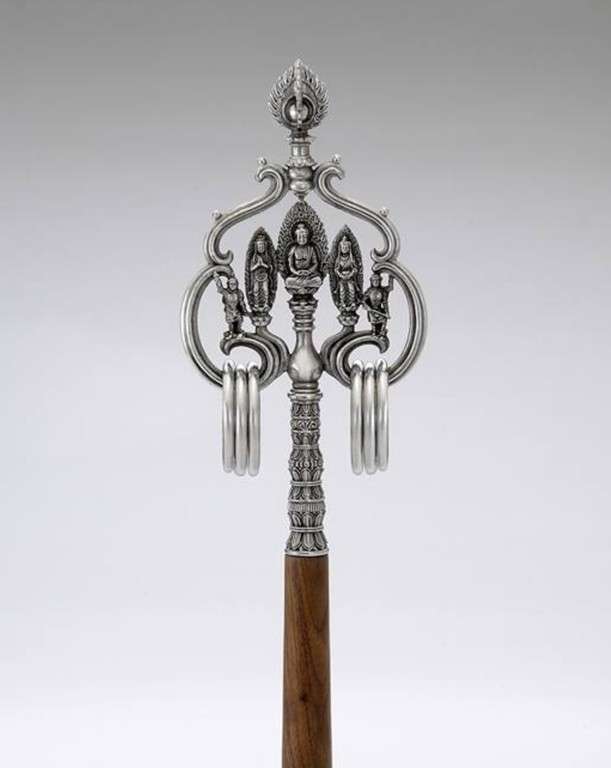
The staff found in the standard Ming edition of JTTW is actually based on two weapons from a 17-chapter storytelling prompt called The Story of How Tripitaka of the Great Tang Procured the Scriptures (Da Tang Sanzang qujing shihua, 大唐三藏取經詩話, c. late 13th-century). Sun Wukong’s precursor, an ageless immortal called the “Monkey Pilgrim” (Hou xingzhe, 猴行者), magically transports Tripitaka and his entourage to heaven. There, the supreme god, the Mahābrahmā Devarāja (Dafan tianwang, 大梵天王; i.e. Vaiśravana), gives the monk a cap of invisibility, a khakkhara (ringed monk’s staff) (fig. 4), and a begging bowl. Tripitaka and the Monkey Pilgrim take turns using these items throughout the journey. The staff is shown capable of shooting destructive beams of light, as well as transforming into magical creatures like an iron dragon or a giant, club-wielding Yaksha. Later, the Monkey Pilgrim also borrows an iron staff from heaven to fight a dragon.

The two staves from this tale were eventually combined by later storytellers. The rings from the first weapon were added to the ends of the second.

Fig. 4 – A beautiful, modern monk’s staff with six rings (larger version).

2.2. Influence from Religion

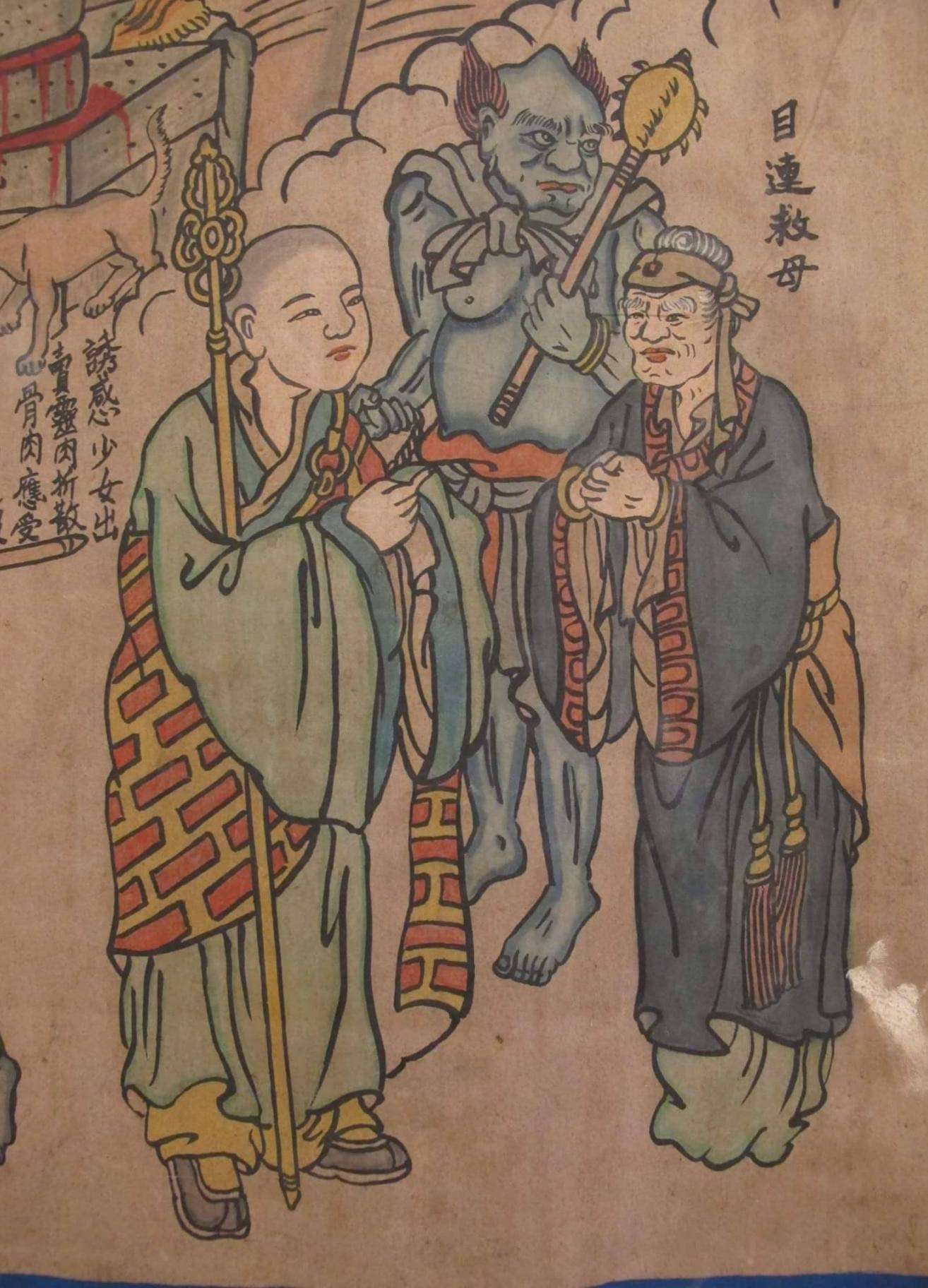
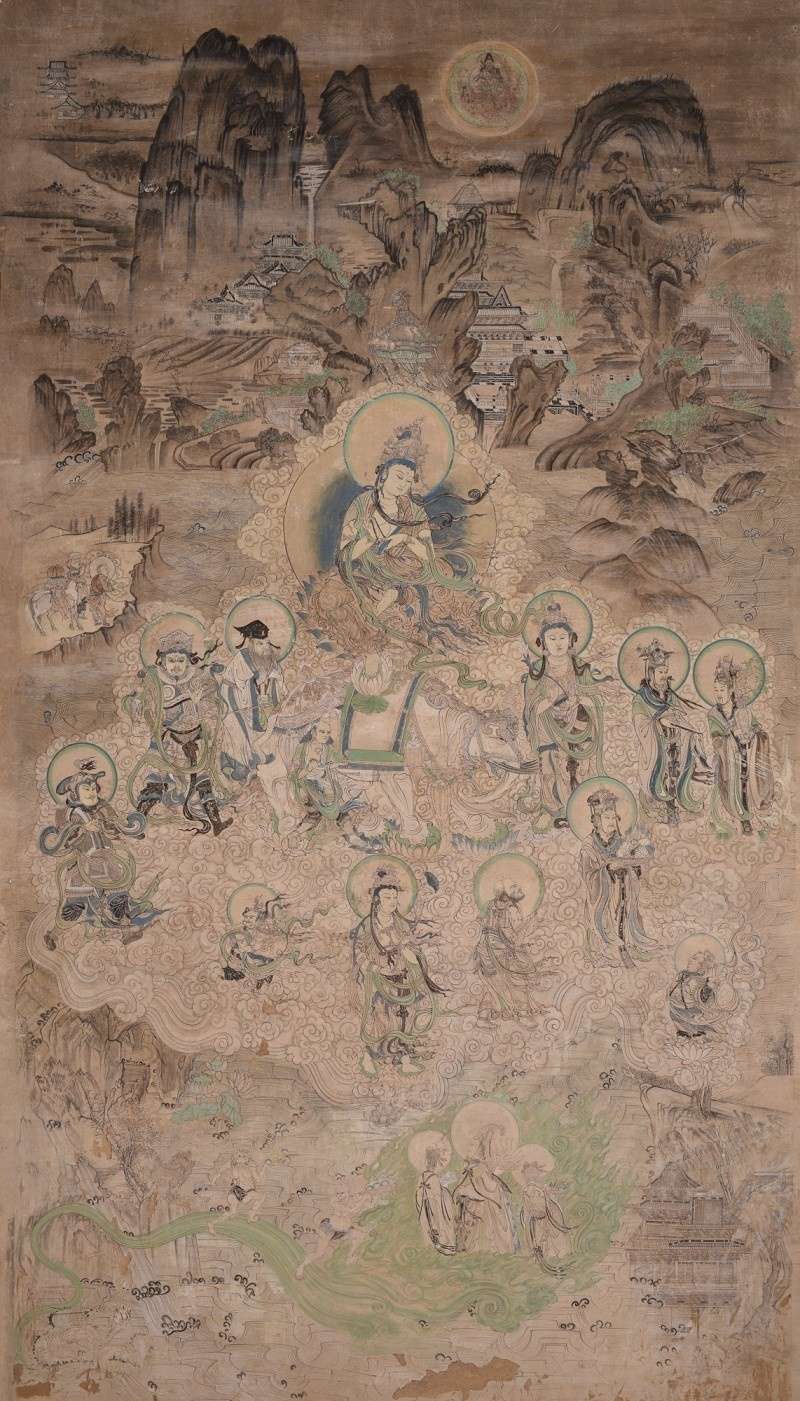
The Monkey Pilgrim’s magic ringed staff and begging bowl were directly influenced by the Buddhist Saint Mulian (目連; Sk: Maudgalyayana), a disciple of the historical Buddha. One particular 9th to 10th-century story notes that the Saint uses the staff to unlock the gates of hell in order to save his mother (fig. 5). This is where Sun Wukong’s weapon from JTTW gets the power to open locks.

Mulian saves his mother, scroll - small

Fig. 5 – A scroll or mural depicting Mulian rescuing his mother from the underworld (larger version). Originally found here.

The ringed and metal staves used by the Monkey Pilgrim are based on those historically carried by Buddhist monks in ancient China. The aforementioned ringed variety, called “tin staves” (xizhang, 錫杖) where used by religious monks and decorated with six to twelve metal rings (see fig. 4). These rings were designed to make a clanging noise to not only scare away animals on the road but also to alert possible donors to the monk’s presence.

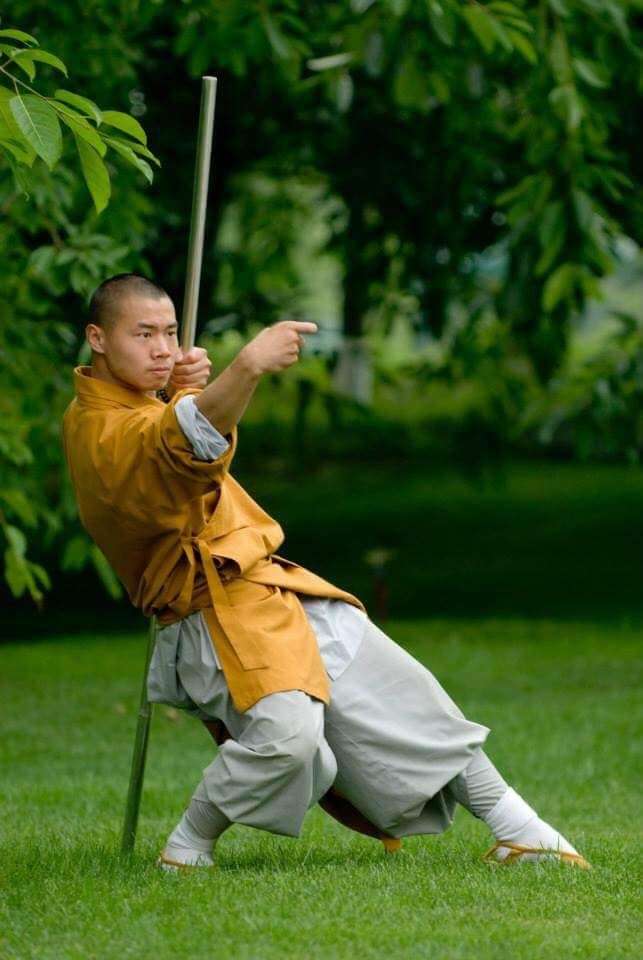
Martial monks charged with protecting monasteries or deployed by the Chinese government against pirates wielded wooden or iron staves (fig. 6). The former were chosen for their diminished capacity for fatal injuries, while the latter were explicitly used for killing during times of war. Sun Wukong wielding the iron variety makes sense as he’s a martial monk charged with protecting Tripitaka from monsters and spirits.

Fig. 6 – A martial monk practicing a drunken staff-fighting form (larger version).

The term “As-you-will” (ruyi, 如意) from Monkey’s staff (mentioned above) is connected with a scepter used in ancient China as a symbol of religious debate and authority and, to a lesser extent, as a weapon. While it can be traced to a Hindo-Buddhist tradition in India, the scepter came to be associated with the highest gods of Daoism thanks to being decorated with a “numinous mushroom” (lingzhi, 靈芝), a real world fungi believed to bestow immortality. This mushroom scepter was at some point associated with the Buddhist Cintamani (Ruyi zhu, 如意珠), or “As-you-will jewel.” This was believed to grant any wish that one might desire. This explains why Monkey’s As-you-will staff grows or shrinks according to his commands. It’s interesting to note that some religious images of the scepter depict it with a syncretic mix of the Daoist mushroom and the Buddhist jewel (fig. 7).

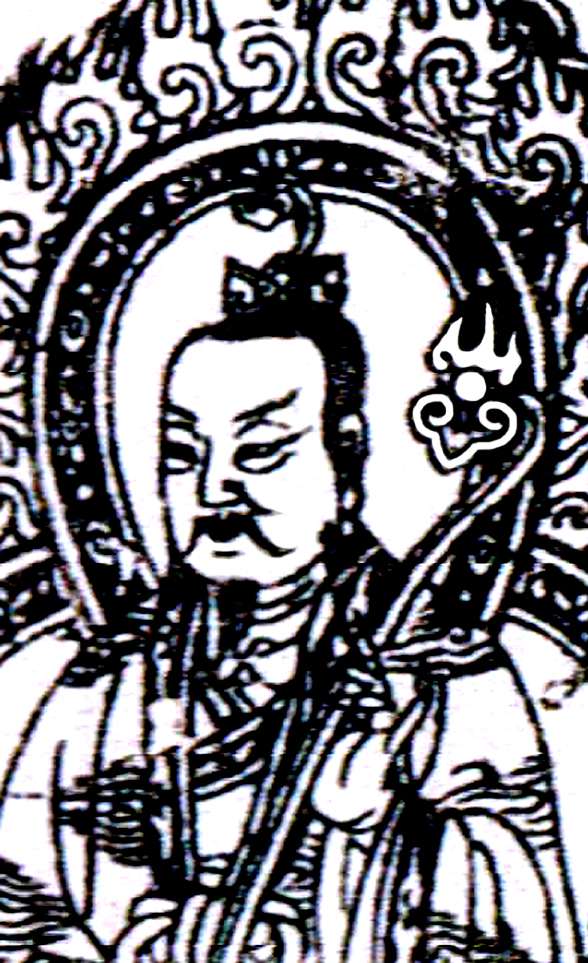
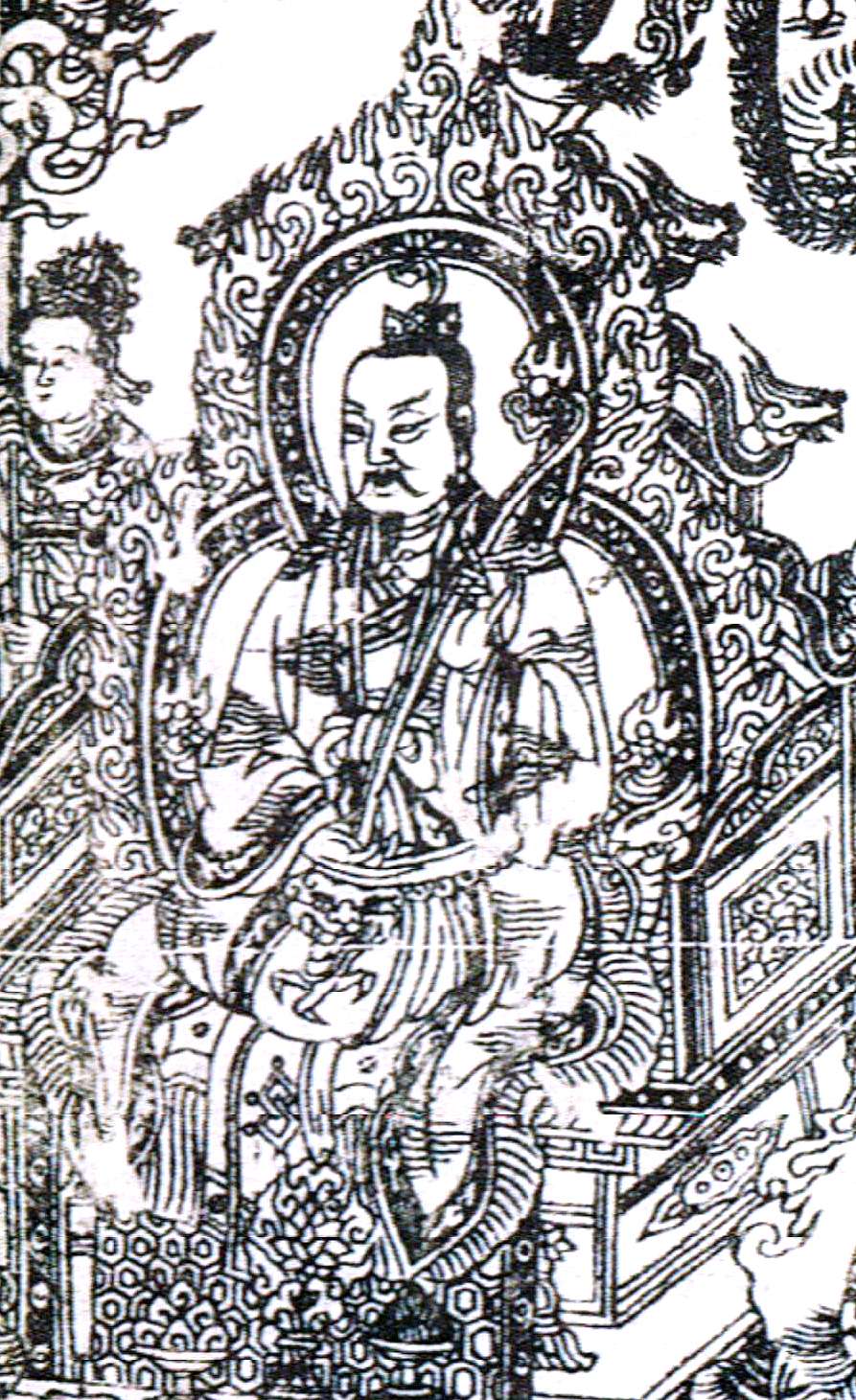
Fig. 7 – An enhanced detail of the Celestial Worthy’s mushroom scepter with a flaming as-you-will jewel (larger version). See here for a fuller version of the deity.

2.3. Influence from Popular Literature

The weapon’s portrayal in JTTW as an iron pillar kept in the dragon kingdom comes from old stories about the immortal Xu Xun (許遜), a historical Daoist master and minor government official from Jiangsu province. Popular tales describe him as a Chinese St. Patrick who traveled southern China ridding the land of flood dragons. One 17th-century version titled “An Iron Tree at Jingyang Palace Drives Away Evil” (Jingyang gong tieshu zhenyao旌陽宮鐵樹鎮妖) describes how he chained the flood dragon patriarch to an iron tree (tieshu, 鐵樹) and submerged it in a well, thus preventing the serpent’s children from leaving their subterranean aquatic realm and causing trouble. Pre-JTTW versions of this tale depict the tree as an actual iron pillar (fig. 8). Chinese Five Elements Theory dictates that metal produces water, and as its creator, holds dominion over it. Therefore, an iron pillar would be the perfect item to ward off creatures entrenched in the aquatic environment.

Fig. 8 – A Ming Dynasty woodblock print depicting the immortal Xu overseeing the creation of the iron pillar in a furnace (right) and it’s placement the well (left). Dated 1444-1445 (larger version).

As previously noted, the staff weighs 17,560 lbs. (7,965 kg). This is likely based on an episode from chapter 27 of the Chinese novel Water Margin (Shuihu zhuan, 水滸傳, c. 1400). It involves the bandit Wu Song lifting a heavy stone block said to weigh 300 to 500 catties (san wu bai jin, 三五百斤; 390-650 lbs./177-295 kg) (fig. 9). This scene and the one from JTTW where Monkey lifts the iron pillar are quite similar. Both involve a hero (Wu Song vs. Sun Wukong) asking someone (Shi En vs. Ao Guang) to show them a heavy object that cannot be moved (stone block vs. iron pillar). Both heroes then adjust their clothing before easily lifting the object with both hands. Most importantly, the Chinese characters for the weight of each object (三五百斤 vs. 一萬三千五百斤) are similar. The only difference is the addition of “10,000” (yiwan, 一萬) and “1,000” (qian, 千), respectively. And given the close historical and cultural ties between the two heroes, I believe the author-compiler of JTTW embellished the Water Margin episode to portray Sun as a hero like no other, a divine immortal that can lift weights far beyond even Wu Song himself.

Fig. 9 – Wu Song lifts the stone block (larger version). Image found here.


3. Updates

Update: 04-23-26

Above, I wrote: “Astral entanglement – Monkey’s soul is able to use the staff in Hell despite the physical weapon being with his sleeping body in the world of the living.”

Sun’s use of said weapon also caught the attention of late-Ming commentators. The authors of The Book to Enlightenment of the Journey to the West (Xiyou Zhengdao Shu西遊證道書, 1663), a Daoist commentary on the novel, asked:

“Did he take this treasure with him in his dream?”

此寶貝夢中亦帶去耶? (Converted from simplified Chinesesource).

Note:

1) Irwen Wong of the Journey to the West Library blog has suggested that the length is likely an error for 12 feet (zhanger, 丈二) since the staff was already near 20 feet when Monkey first acquired it, and he later asked it to shrink to a more manageable size.

The Origin of Sun Wukong’s Cloud Somersault

Last updated: 05-03-2026

The Monkey King is famous for utilizing a vast arsenal of magic powers to protect the monk Tripitaka on the journey to India, chief among them being immortality, shape-shifting, hair clones, super strength, and flight via the cloud somersault (jindou yun, 觔/筋斗雲). The latter is a powerful skill because it enables him to travel 108,000 li (33,554 mi / 54,000 km), [1] or one and one-third the circumference of our Earth, in a single leap. [2] Perhaps the most famous episode involving the somersault appears in Journey to the West (Xiyouji西遊記, 1592; “JTTW” hereafter) chapter seven when the Buddha bets Wukong that he’ll give the rebellious monkey the throne of heaven if he can leap clear of the Enlightened One’s palm. Sun gleefully accepts, certain of his success:

What a fool this Tathagata is! A single somersault of mine can carry old Monkey one hundred and eight thousand li, yet his palm is not even one foot across. How could I possibly not jump clear of it? (Wu & Yu, 2012, vol. 1, p. 194).

這如來十分好獃。我老孫一觔斗去十萬八千里,他那手掌方圓不滿一尺,如何跳不出去?

But of course lovers of the novel know how this wager ends, with a desecrated finger and our hero trapped beneath Five Elements Mountain.

Table of Contents

1. Literary Description

While Sun is traditionally portrayed in visual media riding a single cloud (fig. 1), the very name “somersault” points to Monkey leaping from cloud to cloud. And in fact this is demonstrated in chapter 97 when it requires “a series of cloud somersaults” for him to retrieve the soul of an elderly benefactor from the underworld (Wu & Yu, 2012, vol. 4, p. 338). However, the magic skill’s attributes are not always portrayed consistently throughout the novel. For example, it is sometimes shown capable of transporting passengers, such as the “thirty or fifty” of Monkey’s children rescued from captivity in JTTW chapter two, thereby implying a single cloud (Wu & Yu, 2012, vol. 1, p. 129). (See the 04-28-26 update below for more info.) But other times, like in chapter 22, it can’t lift even a single person because the impure nature of mortals renders them “as heavy as the Tai Mountain” (Wu & Yu, 2012, vol. 1, p. 427). Interestingly, the somersault is portrayed as much faster than the clouds of other immortals (see section three below).

Kubo Son Goku, 18th-c. - small

Fig. 1 – Detail of an 1812 calendar print by Japanese artist Kubo Shunman depicting Son Goku (Sun Wukong) flying on his cloud somersault (larger version). A full size scan of the calendar can be seen here.  

2. Ties to Daoist immortals

Sun Wukong first learns to perform his cloud somersault in chapter two while studying Daoist cultivation under his first master, the Sage Subodhi:

[T]he Patriarch gave him an oral formula, saying,

“Make the magic sign, recite the spell, clench your fist tightly, shake your body, and when you jump up, one somersault will carry you one hundred and eight thousand miles.” When the other people heard this, they all giggled and said, “Lucky Wukong! If he learns this little trick, he can become a dispatcher for someone to deliver documents or carry circulars. He’ll be able to make a living anywhere!”

The sky now began to darken, and the master went back to the cave dwelling with his pupils. Throughout the night, however, Wukong practiced ardently and mastered the technique of cloud-somersault. From then on, he had complete freedom (emphasis added), blissfully enjoying his state of long life (Wu & Yu, 2012, vol. 1, p. 123).

祖師卻又傳個口訣道:「這朵雲,捻著訣,念動真言,攢緊了拳,將身一抖,跳將起來,一觔斗就有十萬八千里路哩。」大眾聽說,一個個嘻嘻笑道:「悟空造化,若會這個法兒,與人家當鋪兵、送文書、遞報單,不管那裡都尋了飯吃。」師徒們天昏各歸洞府。

這一夜,悟空即運神煉法,會了觔斗雲。逐日家無拘無束,自在逍遙,此亦長生之美。

Elements of this passage reference the long tradition of cloud-borne transcendents in Daoist literature. For example, Kirkova (2016) highlights a poem by the first Cao Wei emperor Cao Pi describing the great speed of their travel: “Lightened you’ll soar, mount the floating clouds, / in a blink you’ll travel millions of li” (p. 105). She explains the ability to traverse vast distances in a flash “is a primary sign of the immortals’ mastery over space and time and is an important topos in their hagiographies” (Kirkova, 2016, p. 106). Furthermore, Kirkova (2016) points out the term used to denote their great freedom of movement, xiaoyao (逍遙/消搖), emphasized above, appears in works as old as the Huananzi and Zhuangzi (p. 104).

3. Ties to Chan Buddhist Philosophy

Despite the cloud’s apparent ties to Daoism, it has a strong symbolic connection to Buddhism. For example, the distance that a single somersault covers just so happens to correspond to the expanse separating Tripitaka from the Buddha’s paradise. This fact is revealed in chapter 14 by Guanyin while disguised as an old woman: “The Buddha of the West … lives in the Great Temple of Thunderclap in the territory of India, and the journey there is one hundred and eight thousand li long” (Wu & Yu, 2012, vol. 1, p. 316).

Shao (2006) explains that the distance is taken directly from the Platform Sutra (Liuzu tangjing, 六祖壇經, c. 8th to 13th century) of Huineng, the sixth patriarch of Chan Buddhism (p. 718). The particular passage reads:

The governor also asked,

I often see clergy and laity invoking Amitabha Buddha in hopes of rebirth in the [Pure Land of the] West. Please explain this to me. Can we attain rebirth there? Please resolve this doubt for me.

The Master said,

Listen clearly, Governor, and I will explain it to you. When the World Honored One was in the city of Sravasti, he spoke of the Western Pure Land as a teaching device. Scripture is clear that “it is not far from here,” but treatises say it is “108,000 li away.” This number refers to the ten evils and eight wrongs in the one’s person. This says it is far away. Saying it is far away is for people of lesser faculties. Saying it is near is for people of better faculties.

刺史又問曰:「弟子常見僧俗念阿彌陀佛,願生西方。請和尚說,得生彼否?願為破疑。」

師言:「使君善聽,惠能與說。世尊在舍衛城中,說西方引化。經文分明,去此不遠。若論相說,里數有十萬八千,即身中十惡八邪,便是說遠。說遠為其下根,說近為其上智。

[…]

Now I urge you, good friends, to first get rid of the ten evils; that is the equivalent of traveling one hundred thousand li. [3] Then get rid of the eight wrongs; that is the equivalent of crossing eight thousand li. See essential nature in every moment, always acting with impartial directness, and you will arrive in a finger-snap and see Amitabha Buddha (Huineng & Cleary, 1998, pp. 26-27).

今勸善知識,先除十惡即行十萬,後除八邪乃過八千。念念見性,常行平直,到如彈指,便覩彌陀 …」

As can be seen, the number 108,000 is symbolic of two sets of spiritual hindrances. The “ten evils” (shi’e, 十惡) are killing, stealing, sexual misconduct, greed, hatred, delusion, foul language, lying, harsh speech, and slander. The “eight wrongs” (baxie, 八邪) are opposites of the eight fold path (Huineng, Hsuan, & Buddhist Text Translation Society, 2002, p. 183). Ridding oneself of these piecemeal gets you many li closer to paradise. But only those who achieve enlightenment can arrive instantly. This means the cloud somersault can be read as a Chan metaphor for instant enlightenment. After all, Monkey can travel to the Buddha’s heaven in a flash, whereas Tripitaka is fated to journey thousands of miles over many years “before he finds deliverance from the sea of sorrows” (Wu & Yu, 2012, vol. 1, p. 436). This is because, as suggested by Shao (2006), the demons encountered on the journey embody the “ten evils and eight wrongs” that must be defeated before the monk can enter paradise (p. 719).

37e2fc9cebe000bb1c76c73e7ad2963a-d5oas0h

Fig. 2 – Monkey soaring on his cloud. Drawing by Funzee on deviantart (larger version).

This connection to Buddhism may then explain why the novel differentiates Monkey’s somersault (fig. 2) from the clouds of other immortals. As Sun explains in chapter 22: “My cloud somersault is essentially like cloud soaring [jiayun, 駕雲] … the only difference being that I can cover greater distances more rapidly” (Wu & Yu, 2012, vol. 1, p. 427). In light of the Chan evidence, the difference in speed could be read as a further metaphor for the potency of Buddhism over Daoism.

4. Other Influences?

Going back to the early days of Sun’s flight training, Subodhi observes our hero using an unorthodox method for propelling himself into the sky: jumping. This differs from other immortals, so the Sage teaches him a different method:

The Patriarch said, “When the various immortals want to soar on the clouds, they all rise by stamping their feet. But you’re not like them. When I saw you leave just now, you had to pull yourself up by jumping. What I’ll do now is to teach you the cloud-somersault in accordance with your form” (Wu & Yu, 2012, vol. 1, p. 123).

凡諸仙騰雲,皆跌足而起,你卻不是這般。我才見你去,連扯方才跳上。我今只就你這個勢,傳你個觔斗雲罷。

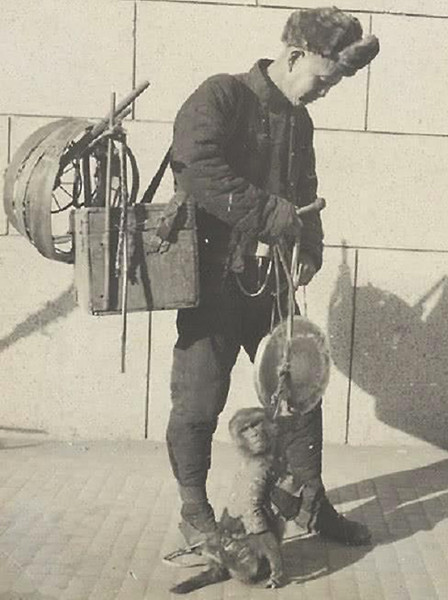
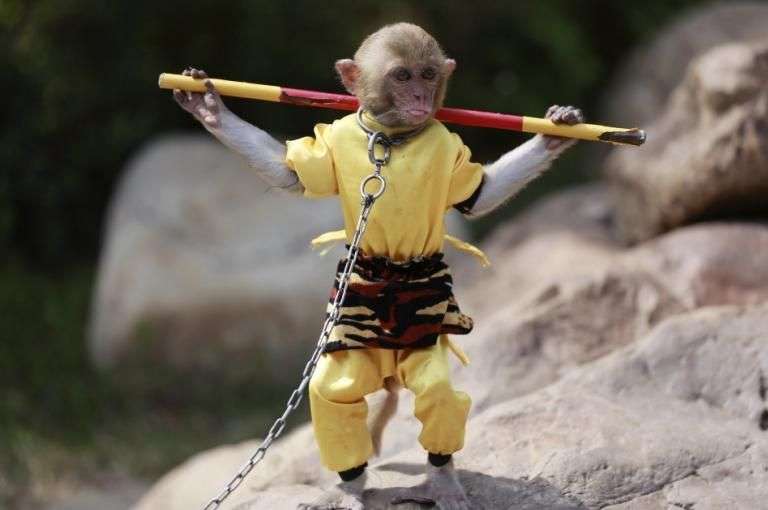
Zhou (1994) suggests this method is likely based on “the novelist’s personal observation” of trained monkey street performances “in the late Ming marketplace” (fig. 3 and 4) (p. 71). He points to an episode in chapter 28 when Wukong returns home to learn his children are regularly captured to perform tricks in the human world:

Those of us who were caught by the net or the trap would be led away live; they would be taught to skip ropes, to act, to somersault, and to do cartwheels. They would have to beat the drum and the gong on the streets and perform every kind of trick to entertain humans (Zhou, 1994, p. 71; cf. Wu & Yu, 2012, vol. 2, p. 31).

或有那遭網的,遇扣的,夾活兒拿去了,教他跳圈做戲,翻觔斗,豎蜻蜓,當街上篩鑼擂鼓,無所不為的頑耍。

Anyone who has viewed monkeys in a zoo or in the wild knows that they are naturally gifted acrobats. Therefore, Zhou’s proposal is certainly an alluring possibility, one that mixes the naturalistic and historical with Daoist tales of cloud-borne immortals.

Trained monkeys - pic for blog

Fig. 3 – A Qing-era trainer and his performing monkey (larger version). Original image found here. Fig. 4 – A monkey performer dressed as Sun Wukong (larger version). Original image found here

Scholars favoring a foreign origin for Sun sometimes point to the somersault as evidence for his connection to the Hindu monkey god Hanuman from the epic Ramayana (4th/5th century BCE). For example, Mi (as cited in Mair, 1989) notes similarities in which Sun and the god propel themselves by leaping:

In typical Chinese legends, the spirits and immortals mount on clouds and ride them; they stand on top of the clouds. Sun Wukong, however is different … Rather, he leaps through the air from a crouching position in the same fashion as Hanuman … This proves Sun Wukong’s supernatural abilities were adopted from Hanuman. (pp. 712-713).

Walker (1998) champions this view by citing a passage from the Ramayana in which Hanuman’s mighty leap across the sea from India to Lanka rips trees away from a mountain:

Hanuman, the foremost of monkeys, without pausing for breath … sprang into the air and, such was the force of his leap, that the trees growing on the mountain, tossing their branches, were sent spinning on every side.

In his rapid flight, Hanuman bore away those trees with their flowering boughs filled with lapwings intoxicated with love … Carried away by the impetus of his tremendous bound, those trees followed in his wake, like an army its leader (p. 10).

However, I’m inclined to believe any similarities in propulsion are simply the product of common behavioral traits among monkeys (refer back to my statement above about their gift for acrobatics). If Wukong’s jumping is indeed based on the somersaulting monkeys of vaudevillian street performances in China, then Hanuman’s jumping prowess no doubt has a real world counterpart in India. A prime example is the Gray Langur, which is capable of spectacular leaps (video 1).

Video 1 (LOUD NOISE WARNING) – A Langur takes a mighty jump. The video should start at minute 0:43.

Given the somersault’s symbolic connection to Chan Buddhism, it’s possible Monkey’s jumping has ties to the religion as well. Like immortals, Buddhist saints are also portrayed in Chinese literature as having the power of flight. One example is Maudgalyayana (Ch: Mulian, 目連), a disciple of the Buddha, who is famous for appearing in a late-9th to early-10th century Bianwen (變文) text in which he travels to the underworld to release his mother from karmic torment (fig. 5). One passage from the tale reads:

Maudgalyayana awoke from abstract meditation,
Then swiftly exercised his supernatural power;
His coming was quick as a thunderclap,
His going seemed like a gust of wind.
[…]
With his supernatural power, he gained freedom,
So he hurled up his begging bowl and leaped into space (emphasis added);
Thereupon, instantaneously,
He ascended to the heavenly palace of Brahma (Mair, 1994, pp. 1097-1098).

Like Monkey, Maudgalyayana is depicted leaping into the heavens to freely roam the cosmos at blinding speeds, the only difference being that he stands astride a magic alms bowl (fig. 6) and not a cloud. It’s important to note that the saint’s tale influenced the 13th century precursor of the Ming JTTW. As I show in this article, Sun’s antecedent, the Monkey Pilgrim (Hou xingzhe, 猴行者), serves as a proxy for the saint because he wields magic weapons based on those used by Maudgalyayana, namely a golden-ringed monk’s staff and an alms bowl. The ringed staff would come to influence Sun’s signature weapon in JTTW, including its ability to change size and pick locks. Therefore, it’s possible the saint may have also influenced Monkey’s jumping.

Buddhist alms bowl - small

Fig. 5 – A scroll or mural depicting Maudgalyayana rescuing his mother from the underworld (larger version). Originally found here. Fig. 6 – A metal alms bowl (larger version). 

5. Popular Culture

It’s interesting to note that the cloud somersault was adapted in the world famous Dragon Ball franchise. In episode three of the Dragonball anime, the lead character Son Goku, himself based on Sun Wukong, is gifted the yellow, fluffy Kinto’un (筋斗雲) by his would-be martial arts teacher, Master Roshi. [4] This is an obvious reference to Subodhi teaching the somersault skill to Monkey. But before Goku officially takes possession, Roshi gives him a warning: “People with impure thoughts can’t ride on it. In other words, you have to be a good person” (video 2). The master thereafter attempts to stand on it but quickly falls through due to his perverted nature. Goku then leaps up and successfully lands on the cloud, proving his worth. This exchange is no doubt a reference to Sun’s inability to carry passengers on his cloud because the impure nature of mortals renders them too heavy (see section one).

Video 2 – Roshi gives Goku his cloud. Watch from minute 1:50.

6. Conclusion

The Monkey King first learns the cloud somersault during the early days of his Daoist training under the Sage Subodhi. It enables him to travel 108,000 li in a single leap, making him much faster than the cloud soaring of other transcendents. While this skill shares affinities with the fleet clouds of immortals from Daoist hagiography, Sun’s somersault has a deep connection to Chan Buddhism. The vast distance that it travels is symbolic of the “ten evils and eight wrongs,” two sets of spiritual hindrances from the Platform Sutra said to keep the Buddha’s paradise out of reach. Only those who cleanse themselves of these obstacles can achieve enlightenment and arrive there in a flash, thus making Wukong’s cloud an apt metaphor for instant enlightenment. This suggests the greater speed of the somersault can be read as a further metaphor for the potency of Buddhism over Daoism.

Wukong’s habit of jumping into the heavens differs from the way other immortals rise by stamping their feet. This unorthodox method may have naturalistic or even religious influences. The suggestion that it is based on somersaulting monkeys from Chinese vaudevillian street performances is alluring given their natural gift for acrobatics. Some scholars champion a foreign origin by pointing to the leaping prowess of the Hindu monkey god Hanuman. But this could simply be a passing similarity based on common behavioral traits among monkeys. The jumping may also have ties to the Buddhist saint Maudgalyayana, who is portrayed in a famed 9th/10th century tale leaping into the air to ride his magic alms bowl between heaven and hell. Elements from his story would come to influence the 13th century precursor of JTTW, as well as the Ming edition of the novel, adding support for his possible influence.


7. Updates

Update: 01-04-24

The singular version of Monkey’s cloud is sometimes described as being “auspicious” (xiangyun, 祥雲) or having a “luminosity” (xiangguang, 祥光). Such clouds or lights are commonly associated with the five colors (wuse, 五色) (fig. 7). Chapter 88 makes this explicit:

Marvelous Great Sage! With a loud whistle he somersaulted right up into midair, his two feet treading the auspicious cloud of five colors (emphasis added). At about three hundred paces above ground, he let loose his rod to make [the martial arts moves] Sprinkling Flowers over the Top and the Yellow Dragon Entwining the Body. Up and down he moved, circling left and right. In the beginning his person and the rod so complemented each other that they seemed, as the adage had it, like flowers added to brocade. By and by even the person disappeared, and all one could see was a sky full of twirling rods! (Wu & Yu, 2012, vol. 4, pp. 196-197)

好大聖,唿哨一聲,將觔斗一抖,兩隻腳踏著五色祥雲,起在半空,離地約有三百步高下。把金箍棒丟開個「撒花蓋頂」,「黃龍轉身」,一上一下,左旋右轉,起初時人與棒似錦上添花;次後來不見人,只見一天棒滾。

Fig. 7 – An example of an auspicious cloud (larger version). The scientific term for this phenomenon is “cloud iridescence,” but such nimbuses are commonly called “rainbow clouds” in English. 


Update: 04-28-26

Above, I wrote: “[The cloud] is sometimes shown capable of transporting passengers, such as the ‘thirty or fifty’ of Monkey’s children rescued from captivity in JTTW chapter two, thereby implying a single cloud” (Wu & Yu, 2012, vol. 1, p. 129).

However, this was a mistake on my part. As I show in my more recent catalog of Sun Wukong’s powers and skills, these children are actually transported via the “magic of displacement” (shefa, 攝法), a swift, powerful wind appearing in JTTW chapters 2, 3, 62, 71, and 84.

On a different note, I feel like a major aspect of the somersault cloud needs extra context. If you recall in section 3, I discussed how the figure of 108,000 li is a religious allegory for the distance separating man from the Buddha’s paradise. Per the Sixth Chan Patriarch, the number comprises the “ten evils” (shi’e, 十惡) and “eight wrongs” (baxie, 八邪), two lists of negative thoughts and actions that hinder spiritual cultivation. Anyone who manages to rid themselves of these will attain enlightenment, allowing them to travel to the holy land instantly. But not everyone is capable of defeating these spiritual hindrances, so the distance separating them from the Buddha might as well be infinity. Therefore, it’s not wise to assign a real world distance and speed to the somersault cloud. This is regarding my recent response to “powerscaling.”


Update: 05-03-26

Here is an old woodblock print showing Monkey practicing his cloud somersault above Patriarch Subodhi and his early religious brothers (fig. 8). It is one of a few images from The Book to Enlightenment of the Journey to the West (Xiyou Zhengdao Shu西遊證道書, 1663), a Daoist commentary on the novel.

Fig. 8 – The 1663 woodblock print of Monkey’s cloud practice (larger version).

Notes:

1) The li (里) is a Chinese measure equaling roughly one-third of a mile. All cited English translations presented here use “mile” instead of the original li. I have, therefore, changed them accordingly.

2) Of course the magic world in which Monkey lives is not our own. It is much, much larger.

3) The English translation originally says “ten myriad” (Huineng & Cleary, 1998, pp. 26-27). The original Chinese reads shiwan (十萬; 10 x 10,000), or 100,000. I have changed the source to make this more explicit.

4) The cloud is called the “Flying Nimbus” in the English dub.

Sources:

Huineng, & Cleary, T. F. (1998). The Sutra of Hui-neng, Grand Master of Zen: With Hui-neng’s Commentary on the Diamond Sutra. Boston: Shambhala.

Huineng, Hsuan, H., & Buddhist Text Translation Society. (2002). The Sixth Patriarch’s Dharma Jewel Platform Sutra: With the Commentary of Venerable Master Hsuan Hua. Burlingame: Buddhist Text Translation Society.

Kirkova, Z. (2016). Roaming into the Beyond: Representations of Xian Immortality in Early Medieval Chinese Verse. Leiden: Brill.

Mair, V. (1989). Suen Wu-kung = Hanumat? The Progress of a Scholarly Debate. In Proceedings of the Second International Conference on Sinology (pp. 659-752). Taipei: Academia Sinica.

Mair, V. (1994). Transformation Text on Mahamaudgalyayana Rescuing His Mother From the Underworld with Pictures, One Scroll, with Preface. In V. Mair (Ed.), The Columbia Anthology of Traditional Chinese Literature (pp. 1094-1127). New York: Columbia University Press.

Shao, P. (2006). Huineng, Subhūti, and Monkey’s Religion in “Xiyou ji”The Journal of Asian Studies, 65(4), 713-740.

Walker, H.S. (1998). Indigenous or foreign? A look at the origins of monkey hero Sun Wukong. Sino-Platonic Papers, 81, 1-117. Retrieved from https://sino-platonic.org/complete/spp081_monkey_sun_wukong.pdf

Wu, C., & Yu, A. C. (2012). The Journey to the West (Vols. 1-4) (Rev. ed.). Chicago, Illinois: University of Chicago Press.

Zhou, Z. (1994). Carnivalization in The Journey to the West: Cultural Dialogism in Fictional Festivity. Chinese Literature: Essays, Articles, Reviews (CLEAR),16, 69-92. doi:10.2307/495307

What Does Sun Wukong Look Like? A Resource for Artists and Cosplayers

Last updated: 05-03-2026

Type “Sun Wukong” into google images and you will be presented with an endless array of pictures that range from the familiar to the alien. A fanciful 1960s cartoon depiction of our hero sits to the left of a SMITE video game character with hulking muscles and a weapon more akin to a club than a staff. A toy version of Liu Xiao Ling Tong‘s much beloved 1986 TV portrayal sits above an anime character with blond hair and a shaved chest. It seems there are as many depictions of Wukong as he has transformations. But how do these myriad personas compare to his depiction in the novel, and who has produced the most authentic look? In this article I present the Monkey King’s literary description, along with ancient depictions that predate the novel. My hope is that the information will be both interesting and useful, especially for artists and cosplayers looking to make a more authentic design.

Table of Contents

1. Ancient Depictions

Some readers may be surprised to learn that stories about a “Monkey Pilgrim” (Hou xingzhe, 猴行者) go all the way back to the Song Dynasty (960–1279 CE). This predates the actual name Sun Wukong by centuries. The literary episodes we all know and love began life as oral tales that evolved over time and grew into an accepted storytelling cycle which started to solidify by the 15th century CE. [1] But the further we go back in time, the less familiar the recorded material becomes, and due to the memory-based nature of oral storytelling, [2] records for the earliest repertoires do not exist. Luckily, visual media from the Song survives, allowing us to see how artists of that time depicted the Monkey King.

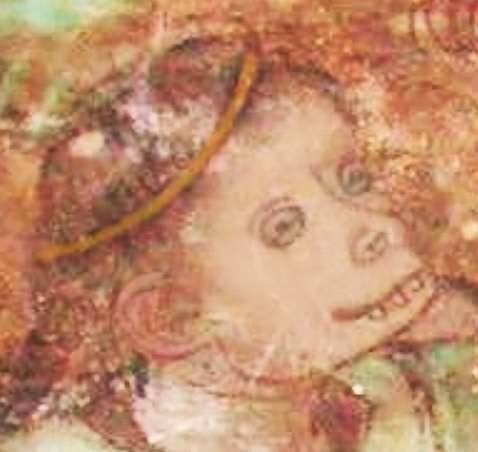
One example, Eastern Thousand Buddha Cave (Dong qianfo dong, 東千佛洞) number two in the Hexi Corridor of Gansu Province, contains a late-Xixia dynasty (late-12th or early-13th century CE) mural of Xuanzang worshiping Guanyin from a riverbank, while Monkey stands behind him tending to a brown horse. The latter is portrayed with a plain circlet on his head, a homely face with an overbite, waist length hair (or possibly wearing a fur on his back), and light blue-green robes with a red apron and brown pants and sandals (fig. 1 and 2). The depiction is less simian in appearance, yet not wholly human.

Fig. 1 – An almost complete version of the Eastern Thousand Buddha Cave no. 2 painting (larger version). Photo by National Geographic. Fig. 2 – A detail of Monkey and Xuanzang (larger version). See figure 14 for an enhanced detail of Monkey’s head.

A second example, Yulin Cave (Yulin ku, 榆林窟) number three in Gansu, contains a late-Xixia wall painting with similar imagery. Xuanzang is again worshiping from a riverbank, but this time the subject of adoration is Samantabhadra. We see Monkey lacks the fillet but wears a monk’s robe with wrapped socks and sandals. This time he is far more monkey-like in appearance, complete with furry arms (fig. 3 and 4).

Fig. 3 – An almost complete version of the late-Xixia Yulin Cave no. 3 painting (larger version). Monkey and Xuanzang can be seen standing on the river bank on the upper left side. Fig. 4 – A detail of the two figures (larger version).

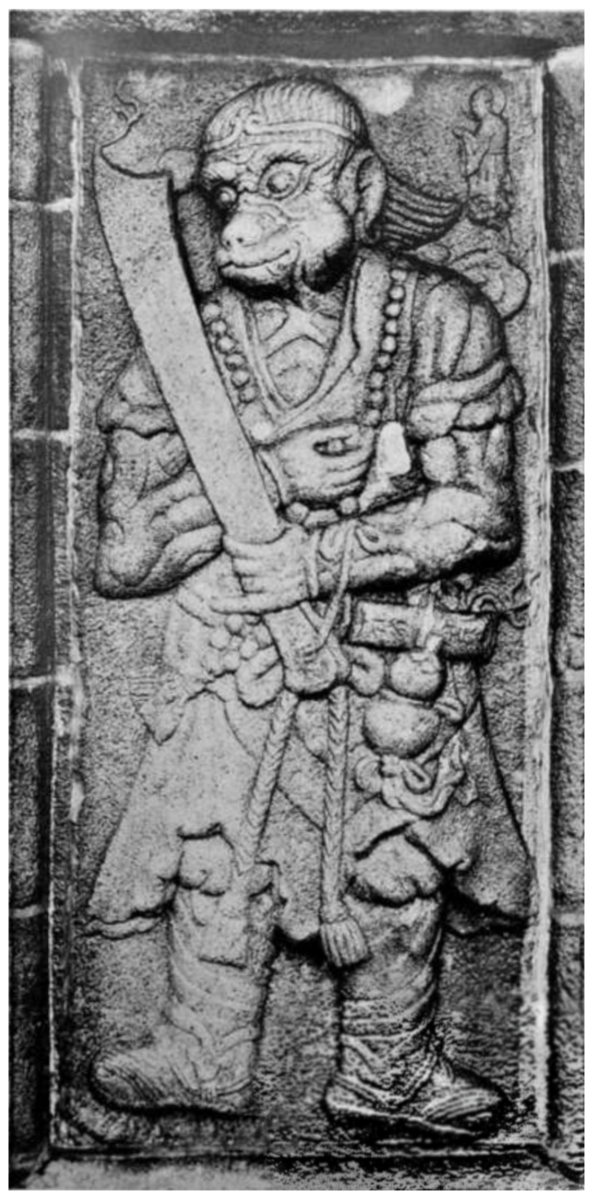
A third example is the 1237 CE stone relief carving from the western pagoda of the Kaiyuan Temple (開元寺) in Quanzhou, Fujian province. This muscular warrior wears a headband, earrings, bracelets, a rosary necklace, and arm bangles (all prescribed Esoteric Buddhist ritual accouterments), as well as a monk’s robe and sandals. He wields a broadsword in one hand, while the other thumbs the rosary at his chest. At his waist hangs a calabash gourd and a scroll of the Mahamayurividyarajni Sutra (Fomu da kongque mingwang jing, 佛母大孔雀明王經) (fig. 5) (Ecke & Demiéville, 1935). He has the large ears and protruding mouth of a monkey.

Fig. 5 – The monkey-headed warrior from Kaiyuan temple in Quanzhou, Fujian (larger version).

Writing in the 1250s, the Song poet Liu Kezhuang (劉克莊, 1187–1269) references our hero twice in his work. The second of two such references uses Monkey as a metaphor to describe the ageing 70-year-old’s appearance. A portion of the poem reads:

A back bent like a water-buffalo in the Zi stream,
Hair as white as the silk thread issued by the “ice silkworms”,
A face even uglier than Hou xingzhe [“Monkey Pilgrim”],
Verse more scanty than even He Heshi (Dudbridge, 1970, p. 46).

背傴水牛泅磵髪白氷蠶吐絲貌醜似猴行者詩痩於鶴何師

Ugliness is a subject I will return to several more times.

I mentioned earlier that the farther we go back in time the less familiar the recorded material becomes. Case in point is the The Story of How Tripitaka of the Great Tang Procures the Scriptures (c. late-13th century CE), the earliest published edition of Journey to the West. Despite referring to himself as the Monkey King, the Monkey Pilgrim is depicted as a white-clad scholar. Another difference is the fact that he fights with two different staves, one a ringed monk’s staff and the other an iron rod (these two would later be combined to create his signature weapon).

The majority of Song sources depict the Monkey Pilgrim as the size of an adult man but with the head of an ugly monkey. I think that these were likely influenced by early stage plays, which would obviously entail a human actor taking on the role.

2. What the Novel Says

2.1. Physical Appearance

The earliest descriptions of what Monkey looks like appear in chapter one. When he is first taken in by his teacher Subodhi, the sage tells him, “Though your features are not the most attractive, you do resemble a pignolia-eating macaque (husun [猢猻])” (Wu & Yu, 2012, vol. 1, p. 115). After he returns to the Mountain of Flowers and Fruit in chapter two, a demon king refers to Monkey’s height: “You’re not four feet tall” (Wu & Yu, 2012, vol. 1, p. 128).

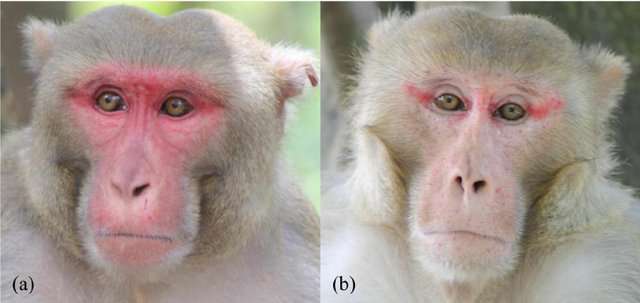
In chapter 7, Monkey is subjected to Laozi’s eight trigrams furnace as punishment for his crimes against heaven. He survives the celestial fire but the smoke inside “…reddened his eyes, giving them a permanently inflamed condition. Hence they were sometimes called Fiery Eyes and Golden Irises [Huoyan jinjing, 火眼金睛]” (based on Wu & Yu, 2012, vol. 1, p. 189). The anthropologist Frances D. Burton (2005) explains that his fiery eyes are “a characteristic he shares with the actual red-rimmed eyes of M. mulatta [the Rhesus macaque]” (p. 148). I further suggest that the hue of his eyes are based on the golden irises of macaques (fig. 6).

Fig. 6 – A comparison of Rhesus macaque males with red-rimmed eyes during mating season (left) and other times (right) (larger version). Original image from Dubue, Allen, Maestripieri, & Higham (2014, p. 5).

In chapter 20, the reader learns that Monkey’s head is bald (fig. 7). An old man asks him, “[W]hy did you shave your hair to become a monk?” (Wu & Yu, 2012, vol. 1, p. 395).

In chapter 21, a demon king steps out of his cave to fight Sun but is surprised by his small stature:

The old monster took a careful look and saw the diminutive figure of Pilgrim [Monkey]—less than four feet, in fact—and his sallow cheeks. He said with a laugh: “Too bad! Too bad! I thought you were some kind of invincible hero. But you are only a sickly ghost, with nothing more than your skeleton left!” (Wu & Yu, 2012, vol. 1, p. 408).

那怪仔細觀看,見行者身軀鄙猥,面容羸瘦,不滿四尺。笑道:「可憐,可憐。我只道是怎麼樣扳翻不倒的好漢,原來是這般一個骷髏的病鬼。」

(Thank you to Jose Loayza for bringing this passage to my attention.)

His bald head is referred to again in chapter 27:

“But ever since Nirvana delivered me from my sins, when with my hair shorn I took the vow of complete poverty and followed you as your disciple, I had this gold fillet clamped on my head…” (Wu & Yu, 2012, vol. 2, p. 24).

自從涅槃罪度,削髮秉正沙門,跟你做了徒弟,把這個金箍兒勒在我頭上…

(Thank you to Stanley Setiawan for bringing this passage to my attention.)

Fig. 7 – Reggie the baboon from Paignton Zoo (circa 2005). His slick head was the result of his mom’s “over-zealous” grooming. Look at those ears! He’s the wrong genus and species, but you get the general idea what Sun Wukong would look like wearing the golden fillet (larger version).

Wukong’s bald pate is once again referenced in chapter 34:

The fiend then gave the rope a tug and pulled Pilgrim down before he gave that bald head seven or eight blows with the sword. The skin on Pilgrim’s head did not even redden at all (Wu & Yu, 2012, vol. 2, p. 128).

那怪將繩一扯,扯將下來,照光頭上砍了七八寶劍。行者頭皮兒也不曾紅了一紅。

In chapter 44, the Monkey King’s appearance is revealed in a dream to a group of monks by the personification of the planet Venus:

A bumpy brow, and golden eyes flashing;
A round head and a hairy face with sunken cheeks;
Gaping teeth, pointed mouth, a character most sly;
He looks more strange than the thunder god
[…] (based on Wu & Yu, 2012, vol. 2, p. 276).

磕額金睛晃亮,圓頭毛臉無腮。咨牙尖嘴性情乖。貌比雷公古怪。

In chapter 49, a monster who barely survived a battle with Sun Wukong describes his appearance to a friend: [H]e has a hairy face and a thunder god beak … forked ears and broken nose. A monk with fiery eyes and golden irises (based on Wu & Yu, 2012, vol. 2, p. 353).

In chapter 58, Sun Wukong’s doppelganger is described as having matching features:

A hairy face, a thunder god beak,
Empty cheeks unlike Saturn’s; [3]
Two forked ears on a big, broad head,
And fangs that have outward grown (based on Wu & Yu, 2012, vol. 3, p. 105).

…也是這等毛臉雷公嘴,朔腮別土星,查耳額顱闊,獠牙向外生。

In chapter 67, an old man chastises Monkey for offending him:

You! Look at your skeleton face, flattened brow, collapsed nose, sunken cheeks, and hairy eyes. A consumptive ghost, no doubt, and yet without any manners at all, you dare use your pointed mouth to offend an elderly person like me!” (based on Wu & Yu, 2012, vol. 3, p. 242).

你這廝骨撾臉,磕額頭,塌鼻子,凹頡腮,毛眼毛睛,癆病鬼,不知高低,尖著個嘴,敢來衝撞我老人家?

In chapter 75, he once again tests the hardness of his bald head:

“You come over here,” said the old demon, “and act as my chopping block first. If your bald head can withstand three blows of my scimitar, I’ll let you and your Tang Monk go past. But if you can’t, you’d better tum him over quickly to me as a meal.”

When he heard this, Pilgrim smiled and said, “Fiend! If you have brush and paper in your cave, take them out and I’ll sign a contract with you. You can start delivering your blows from today until next year, and I won’t regard you seriously!” Arousing his spirit, the old demon stood firmly with one foot placed in front of the other. He lifted up his scimitar with both hands and brought it down hard on the head of the Great Sage. Our Great Sage, however, jerked his head upward to meet the blow. All they heard was a loud crack, but the skin on the head did not even redden (Wu & Yu, 2012, vol. 3, p. 373).

老魔道:「你過來,先與我做個樁兒,讓我盡力氣著光頭砍上三刀,就讓你唐僧過去;假若禁不得,快送你唐僧來,與我做一頓下飯。」行者聞言笑道:「妖怪,你洞裡若有紙筆,取出來,與你立個合同。自今日起,就砍到明年,我也不與你當真。」

那老魔抖擻威風,丁字步站定,雙手舉刀,望大聖劈頂就砍。這大聖把頭往上一迎,只聞扢扠一聲響,頭皮兒紅也不紅。

We can see from these quotes several features that appear again and again. These include a furry face with sunken cheeks, fiery eyes, a broken or flat nose, a beak-like mouth with protruding fangs, and forked ears (with long earlobes, per the 06-02-25 update). The author-compiler of the novel uses these features over and over again to remind the reader just how ugly the Great Sage is. These same features are also shared by the Rhesus monkey and other macaque species (fig. 8). The multiple mentions of the Thunder God‘s beak refers to the monkey’s prognathic (protruding) mouth, which houses large canine teeth. The quotes also let us know that Sun Wukong is less than four feet tall and very skinny (e.g. having “sallow cheeks” and being like “a consumptive ghost”) just like a monkey (fig. 9). It’s important to note that Sun is described as being bald numerous times throughout the novel. This should come as no surprise since he was required to take the tonsure as a Buddhist monk. Modern depictions often deviate from the features mentioned here (more on this below).

Fig. 8 – A Bonnet macaque bearing its teeth. Photo by Hank Christensen. The furry face with sunken cheeks, a broken (flat) nose, beak-like mouth with protruding fangs, and forked ears are easily discernible. Fig. 9 – The short, skinny body of a Rhesus monkey. Photo by mario_ruckh via flickr.

2.2 Clothing and Accessories

The novel mentions Sun Wukong wearing different attire throughout his roughly 1,100 years of life. Here I will focus on that which is closely associated with his traditional iconography.

The clothing most often associated with Monkey is his suit of armor. He receives it from the dragon kings of the world’s oceans in chapter three:

“I have here a pair of cloud-treading shoes the color of lotus root[, said Aoshun, the Dragon King of the Northern Ocean]. Aorun, the Dragon King of the Western Ocean said, “I brought along a cuirass of chainmail made of yellow gold.” “And I have a cap with erect phoenix plumes, made of purple gold,” said Aoqin, the Dragon King of the Southern Ocean (based on Wu & Yu, 2012, vol. 1, p. 137).

北海龍王敖順道:「… 我這裡有一雙藕絲步雲履哩。」西海龍王敖閏道:「我帶了一副鎖子黃金甲哩。」南海龍王敖欽道:「我有一頂鳳翅紫金冠哩。」

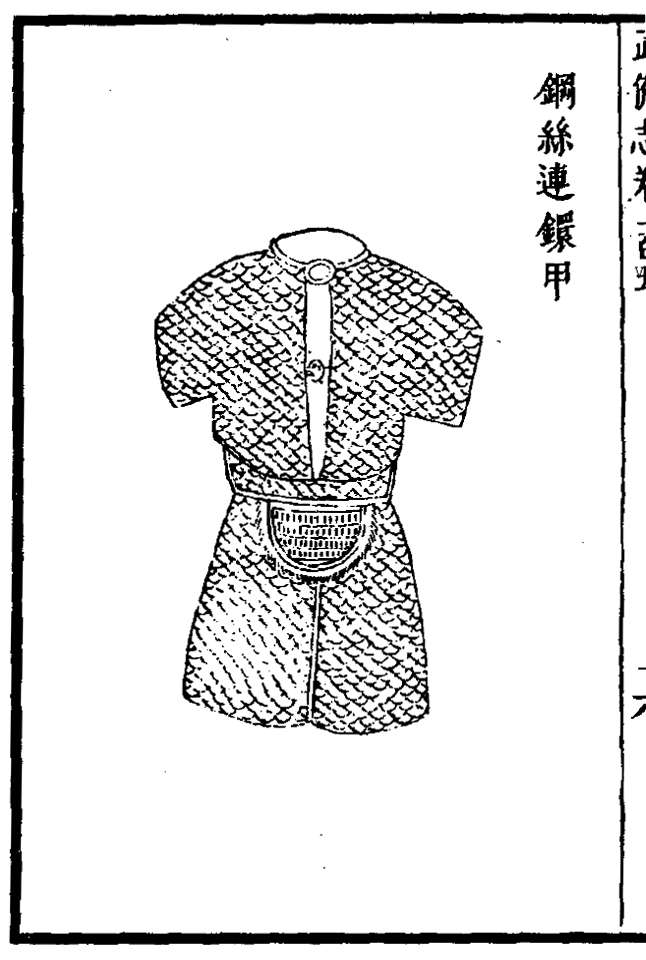
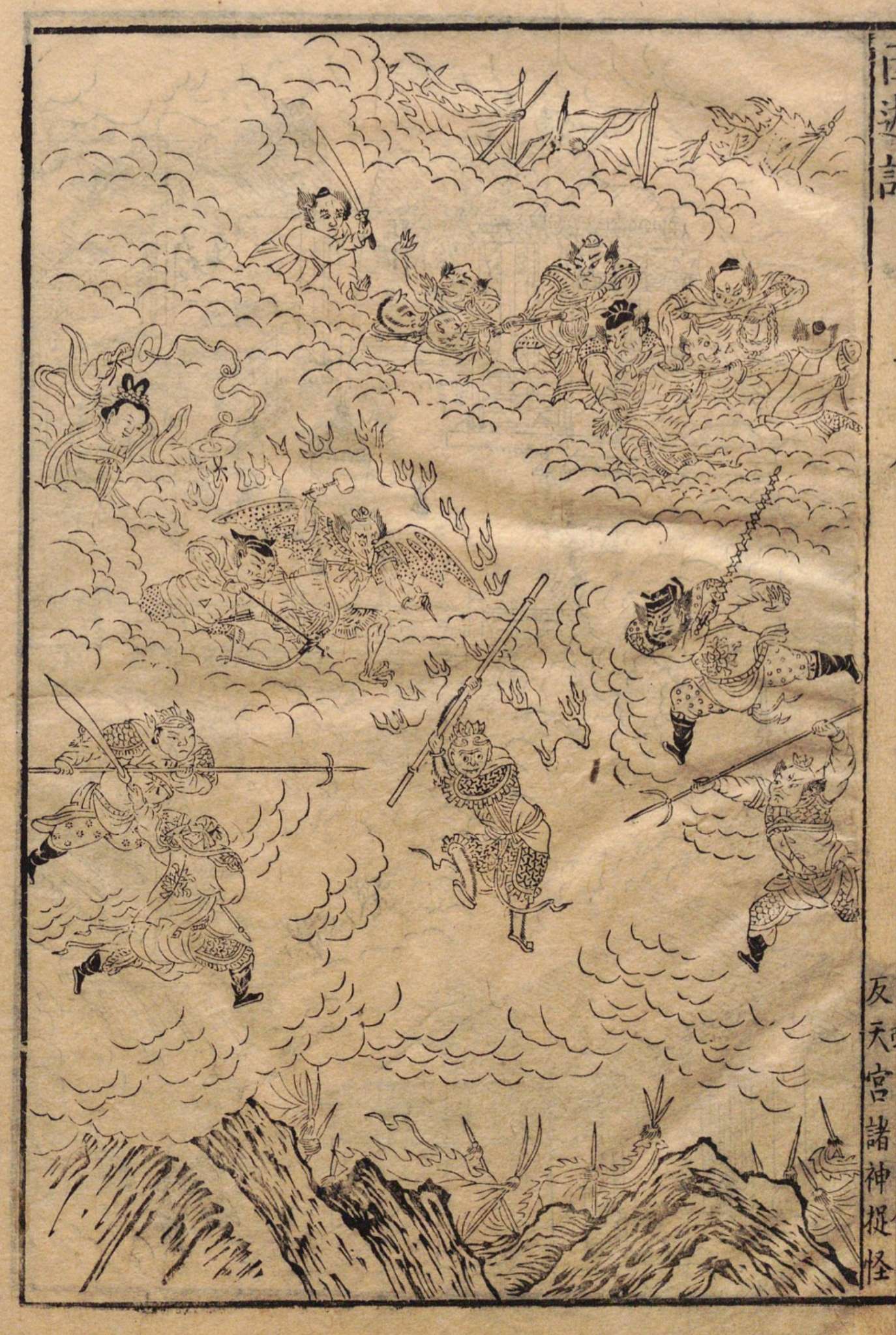
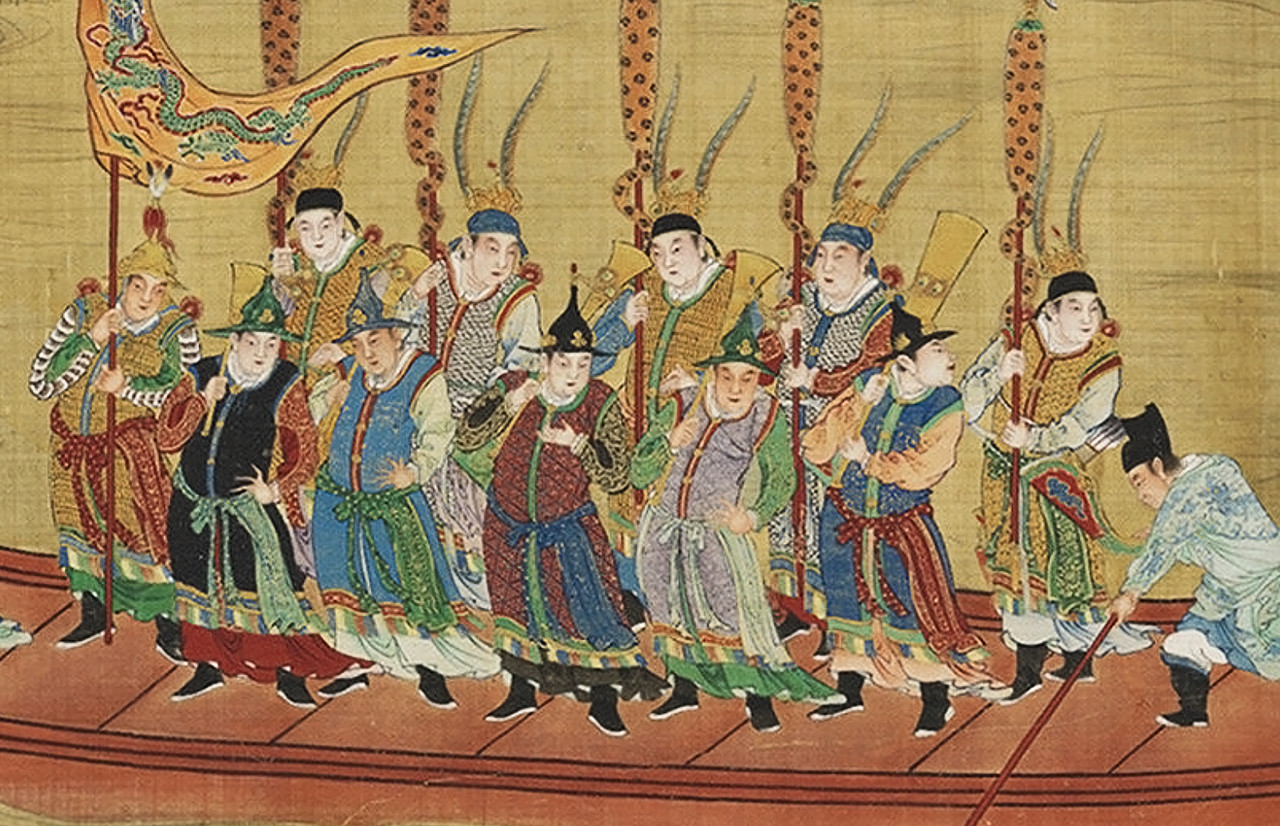
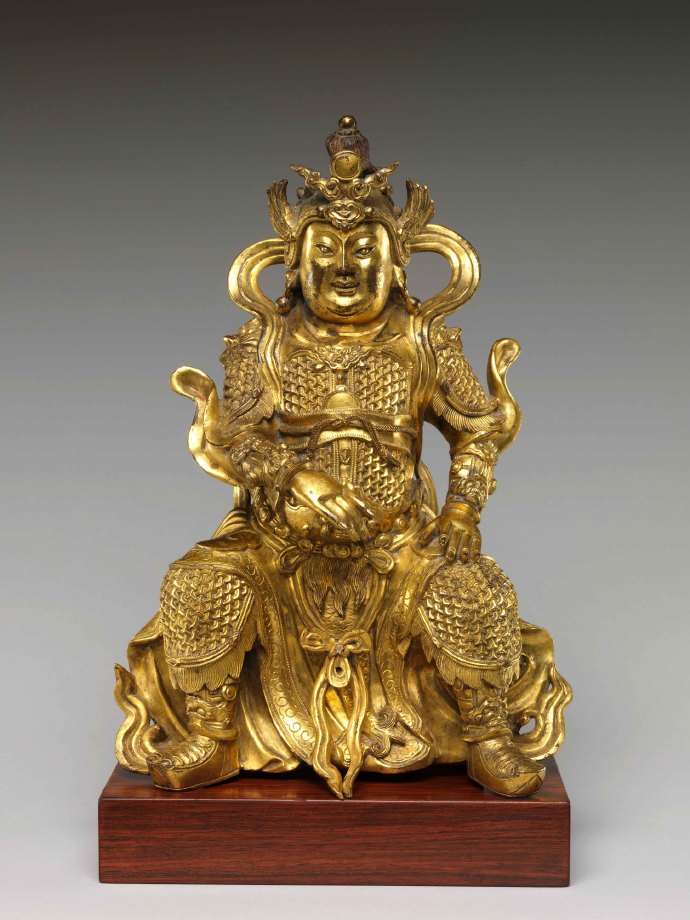
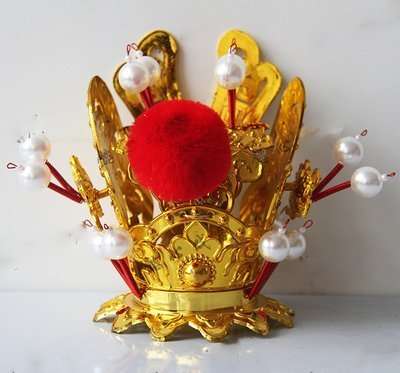
Those wanting to make a novel accurate suit should consult Ming-era chainmail (fig. 10). However, the oldest drawing of Wukong wearing armor that I’m aware of depicts him with “mountain pattern” armor (fig. 11). Combinations of mountain pattern armor and feather caps can be seen in the 16th century CE scroll The Emperor’s Return to the Capital (Rubitu, 入蹕圖) (fig. 12), showing it was part of historical military regalia and not just the purview of Chinese opera (fig. 13). Modern depictions of Monkey tend to portray him wearing mountain pattern armor with ornate beast elements on the shoulders and waist. Those wishing to replicate this kind of armor should consult Ming-era statues of Buddhist protector deities, such as Skanda or the Four Heavenly Kings (this blog is especially good) (fig. 14, for example). Modern “Purple Gold Caps” (zijin guan, 紫金冠) with lingzi (翎子) feathers should be used for Sun’s phoenix feather cap (fig. 15).

Fig. 10 – Ming chainmail from the Wubei zhi (1621 CE) (larger version). Fig. 11 – A woodblock print of Sun wearing mountain pattern armor while fighting the heavenly army (larger version). From Mr. Li Zhuowu’s Literary Criticism of Journey to the West (late-16th century CE, “Mr. Li’s Criticism” hereafter). Fig. 12 – A detail of halberd-bearing soldiers wearing mountain pattern armor and feather caps from The Emperor’s Return to the Capital (16th century CE) (larger version). Image enhanced slightly for clarity. Fig. 13 – Monkey as portrayed in Beijing Opera (larger version). Photo by TAO Images Limited via Alamy. Fig. 14 – A 16th century CE brass statue of Skanda (larger version). This blog has photos from all sides. Fig. 15 – A modern example of a Purple Gold Cap (larger version). 

Contrary to popular belief, Sun does not wear the armor throughout the entire story. Though not openly stated, the novel suggests it is stripped from the monkey when he is captured by heavenly soldiers in chapter six: “They bound him with ropes and punctured his breast bone with a knife, so that he could transform no further” (Wu & Yu, 2012, vol. 1, p. 186). Obviously the knife wouldn’t have punctured the magic armor. And after heaven fails to execute him in chapter seven, several celestial report:

“Your Majesty, we don’t know where this Great Sage has acquired such power to protect his body. Your subjects slashed him with a scimitar and hewed him with an ax; we also struck him with thunder and burned him with fire. Not a single one of his hairs was destroyed (emphasis added). What shall we do?” (Wu & Yu, 2012, vol. 1, p. 188).

萬歲,這大聖不知是何處學得這護身之法,臣等用刀砍斧剁,雷打火燒,一毫不能傷損,卻如之何?

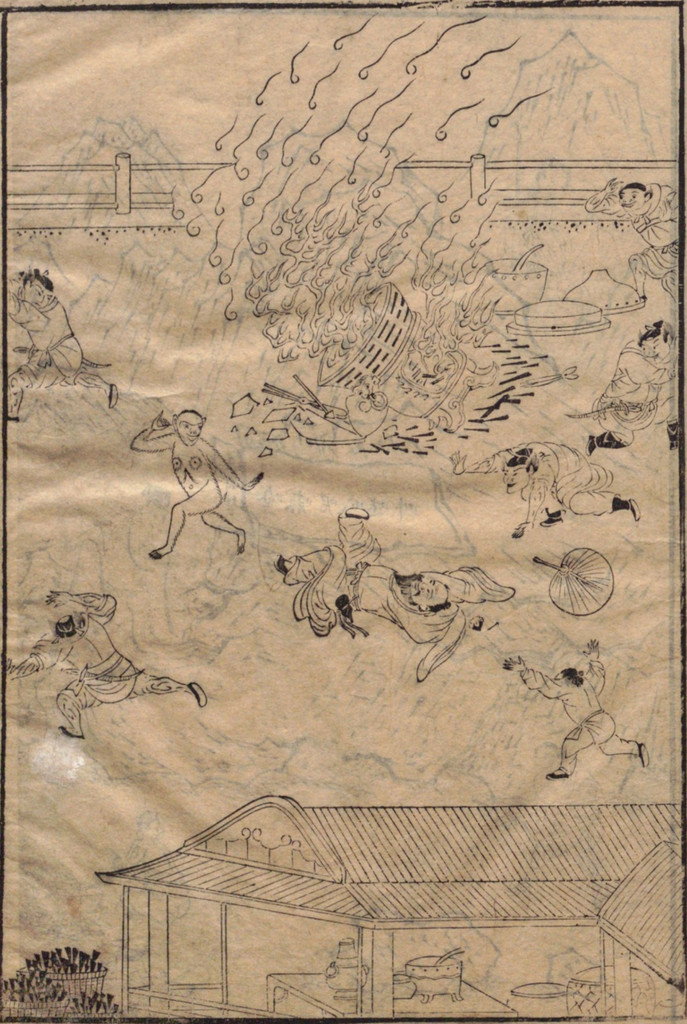
Prior to his turn in Laozi’s eight trigrams furnace in chapter seven, the story again references the knife in Monkey’s breastbone, suggesting he is still naked: “Arriving at the Tushita Palace, Laozi loosened the ropes on the Great Sage, pulled out the weapon from his breastbone, and pushed him into [furnace]” (Wu & Yu, 2012, vol. 1, p. 189). One late-Ming woodblock print actually portrays him naked upon his escape from the furnace (fig. 16). Most importantly, after being released from his 600 plus-year-long imprisonment under Five Elements Mountain, Monkey is twice described in chapter 14 as being “completely or stark naked” (chi lin lin, 赤淋淋; chi tiao tiao, 赤條條) (Wu & Yu, 2012, vol. 1, p. 309). (See the 06-22-23, 09-12-23, and 05-03-26 updates below for more evidence.)

Fig. 16 – Wukong in his birthday suit escaping from Laozi’s eight trigrams furnace (larger version). From Mr. Li’s Criticism (late-16th to early-17th century CE).

The lack of clothing leads to his second most identifiable and longest-worn piece of attire, a tiger skin kilt (hu pi qun, 虎皮裙). After killing the beast in chapter 14:

He pulled off one strand of hair and blew a mouthful of magic breath onto it, crying, “Change!” It changed into a sharp, curved knife, with which he ripped open the tiger’s chest. Slitting the skin straight down, he then ripped it off in one piece. He chopped away the paws and the head, cutting the skin into one square piece. He picked it up and tried it for size, and then said, “It’s a bit too large; one piece can be made into two.” He took the knife and cut it again into two pieces; he put one of these away and wrapped the other around his waist. Ripping off a strand of rattan from the side of the road, he firmly tied on this covering for the lower part of his body (Wu & Yu, 2012, vol. 1, p. 310).

好猴王,把毫毛拔下一根,吹口仙氣,叫:「變!」變作一把牛耳尖刀,從那虎腹上挑開皮,往下一剝,剝下個囫圇皮來。剁去了爪甲,割下頭來,割個四四方方一塊虎皮。提起來,量了一量道:「闊了些兒,一幅可作兩幅。」拿過刀來,又裁為兩幅。收起一幅,把一幅圍在腰間。路傍揪了一條葛籐,緊緊束定,遮了下體

Monkey’s most recognizable accessory is the self-control-inducing golden fillet (jingu, 金箍; a.k.a. jingu, 緊箍, lit: “tight fillet”), which he is tricked into wearing as a punishment shortly after murdering six bandits in chapter 14. As noted above, the band predates the novel, appearing in the 12th to 13th century CE Eastern Thousand Buddha Cave number two painting. This piece depicts the headgear as a simple circlet devoid of any decoration (fig. 17). This matches the novel’s description of “a thin metal band” (jinxian, 金線) (Wu & Yu, 2012, vol. 1, p. 310). But as can be seen from the Kaiyuan temple pagoda relief, there also exists a version with a double curlicue pattern in the center of the forehead (fig. 18). This has come to be the most popular version used in modern media.

Fig. 17 – Detail of the Monkey Pilgrim’s fillet from Eastern Thousand Buddha Cave no. 2 (c. 12th to 13th century CE) (larger version). Image enhanced slightly for clarity. Fig. 18 – Detail from the Kaiyuan Temple pagoda relief (1237 CE) (larger version).

As for other attire, there exists one passage in chapter 58 that describes how Monkey’s doppelganger copied even his clothing:

His looks were exactly the same as those of the Great Sage: he, too, had a gold fillet clamped to his blondish-brown hair, a pair of fiery eyes with golden irises, a monk’s robe on his body, a tiger kilt tied around his waist, a gold-banded iron staff in one of his hands, and a pair of deerskin boots on his feet (based on Wu & Yu, 2012, vol. 3, p. 105).

模樣與大聖無異:也是黃髮金箍,金睛火眼;身穿也是綿布直裰,腰繫虎皮裙;手中也拿一條兒金箍鐵棒;足下也踏一雙麂皮靴

Two things about this passage require explanation. First, Yu (Wu & Yu, 2012) originally translated huangfa (黃髮) as “brownish hair” (vol. 3, p. 105). But huang (黃) traditionally means “yellow.” If you refer back to figures six, eight, and nine, you will see that macaque monkeys have a light brown to blond coloring, so I changed the translation to reflect this.

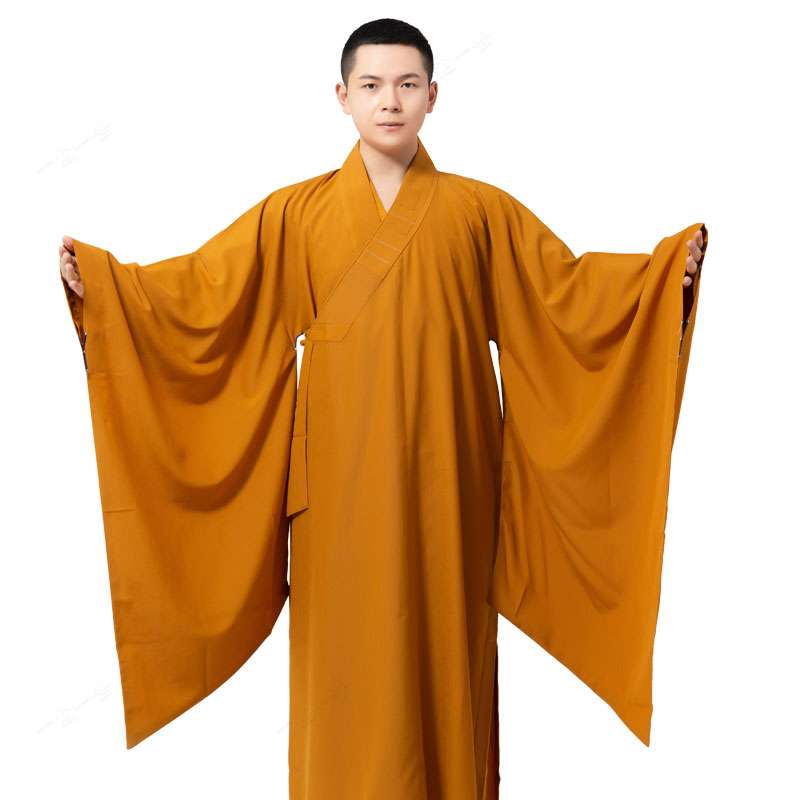
Second, he translates mianbu zhiduo (綿布直裰) as “silk shirt” (Wu & Yu, 2012, vol. 3, p. 105). However, a better translation is “silk cloth zhiduo robe.” The zhiduo robe is known colloquially in English as “Buddhist monk” or “Taoist monk” robes. Also called haiqing (海青), such garments reach almost to the ground and have long, broad sleeves. The robe is closed by a tie on the right side of the torso (fig. 19).

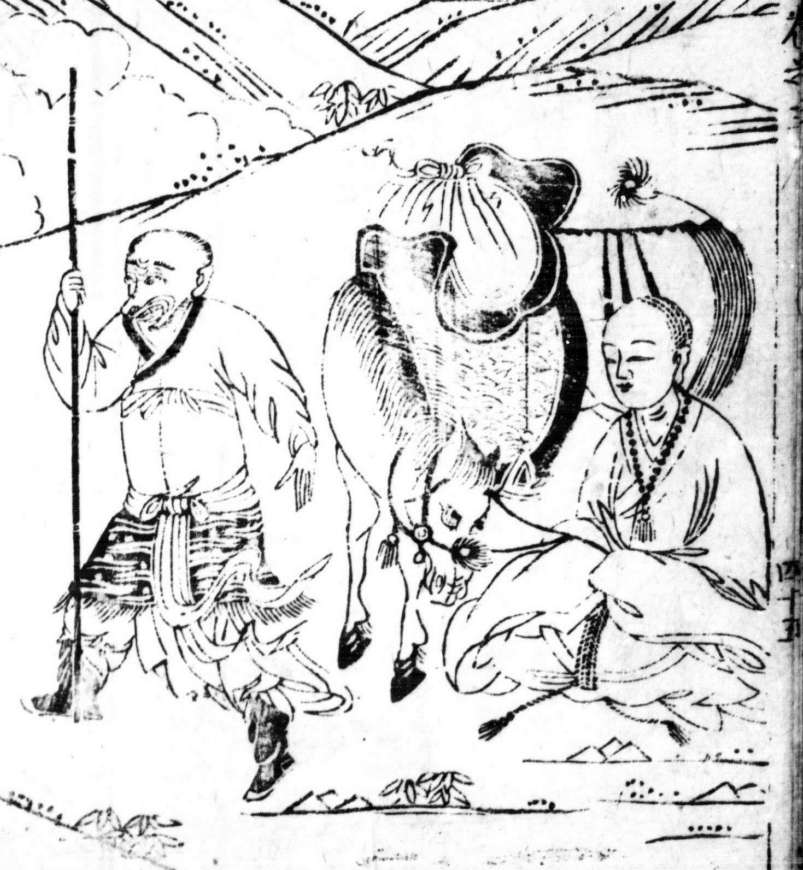
Woodblock prints of Monkey from the original 1592 CE Journey to the West vary from page to page, but one is pretty accurate. He wears the robe (with tied cuffs), the tiger skin kilt, and boots (fig. 20).

Fig. 19 – A zhiduo/haiqing robe (larger version). Image found here. These robes can be any number of colors. Fig. 20 – A woodblock print of Sun Wukong with his master, Tripitaka (larger version).

There is a distinct order in which Sun Wukong wears the aforementioned clothing and accessories: the armor, then the tiger skin, and then the golden fillet. However, many modern depictions portray Monkey wearing both the armor and headband. This is obviously anachronistic within the novel’s fictional story line. (Admittedly, though, this is not unique to the modern era. See figure 11 for a 16th century CE example.) Furthermore, many depictions dismiss the tiger skin kilt altogether.

2.3. The Staff

Monkey’s staff is first introduced in chapter three when he travels to the undersea palace of the dragon king to procure a divine weapon. There, he is directed towards a massive iron pillar:

Wukong girded up his clothes and went forward to touch it: it was an iron rod more than twenty feet long and as thick as a barrel. Using all his might, he lifted it with both hands, saying, “It’s a little too long and too thick. It would be more serviceable if it were somewhat shorter and thinner.” Hardly had he finished speaking when the treasure shrunk a few feet in length and became a layer thinner. “Smaller still would be even better,” said Wukong, giving it another bounce in his hands. Again the treasure became smaller. Highly pleased, Wukong took it out of the ocean treasury to examine it. He found a golden ring at each end, with solid black iron in between. Immediately adjacent to one of the rings was the inscription, “The As-You-Will Gold-Banded Staff. Weight: 17,560 pounds” (based on Wu & Yu, 2012, p. 135). [4]

悟空撩衣上前,摸了一把,乃是一根鐵柱子,約有斗來粗,二丈有餘長。他儘力兩手撾過道:「忒粗忒長些,再短細些方可用。」說畢,那寶貝就短了幾尺,細了一圍。悟空又顛一顛道:「再細些更好。」那寶貝真個又細了幾分。悟空十分歡喜,拿出海藏看時,原來兩頭是兩個金箍,中間乃一段烏鐵。緊挨箍有鐫成的一行字,喚做:「如意金箍棒,重一萬三千五百斤。」

A poem in chapter 75 describes how the staff is decorated with magic symbols. Part of it reads:

The rod of bin steel nine cyclic times refined
Was forged in the stove by Laozi himself.
King Yu took it, named it “Treasure Divine,”
To fix the Eight Rivers and Four Seas’ depth.
In it were spread out tracks of planets and stars,
Its two ends were clamped in pieces of gold.
Its dense patterns would frighten gods and ghosts;
On it dragon and phoenix scripts were drawn.
Its name was one Rod of Numinous Yang,
Stored deep in the sea, hardly seen by men
[…] (based on Wu & Yu, 2012, vol. 3, p. 375)

棒是九轉鑌鐵煉,老君親手爐中煅。
禹王求得號神珍,四海八河為定驗。
中間星斗暗鋪陳,兩頭箝裹黃金片。
花紋密佈鬼神驚,上造龍紋與鳳篆。
名號靈陽棒一條,深藏海藏人難見。

So we see the staff is depicted as a rod of black iron or steel adorned on both ends with a single golden ring and decorated along the body with astronomical charts and an inscription towards one tip listing the weapon’s name and weight. The literary description greatly differs from modern media which often portrays it as entirely gold or red in color.

Those wishing to replicate the inscription on the staff can use figure 21 as a template. The characters are presented in “Small Seal Script” (Xiao Zhuan, 小篆), which hails from the Qin Dynasty (221–206 BCE) when written Chinese was standardized by Emperor Qin Shihuang. Using this will give the staff a more ancient look. I used the template years ago to create a replica staff for an archaeology course in college.

Fig. 21 – The small script template for Monkey’s staff (larger version).

As for “the tracks of stars and planets,” I recommend using the Dunhuang or Suchow star charts.

3. Popular Depictions

The following two sections include a small sampling of what I consider to be the least and most accurate portrayals in past and modern media. These are presented in no particular order.

3.1. The Least Accurate

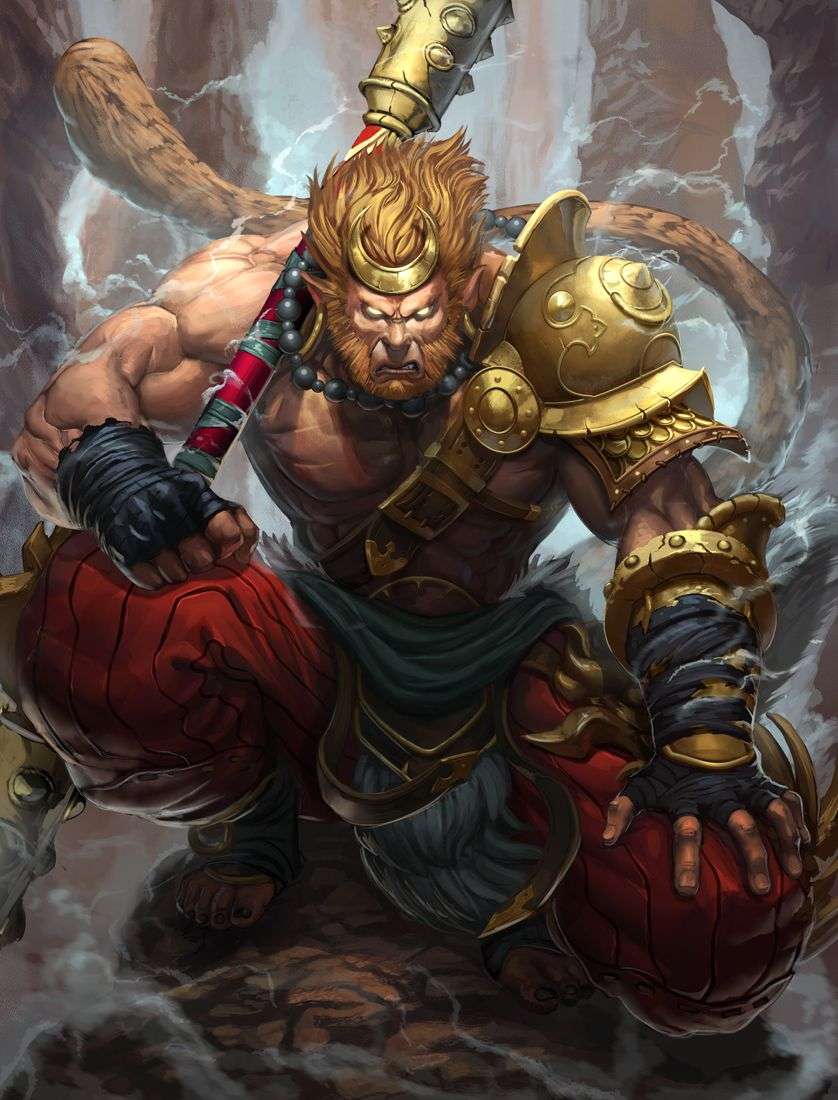
1) SMITE video game – He’s basically a bodybuilder with mutton chops (fig. 22). The design includes the aforementioned headband plus armor anachronism. Why is he wearing a gladiator-style pauldron? The original illustration is by Brolo on deviantart.

Fig. 22 – “Do you even lift?” Wukong (larger version).

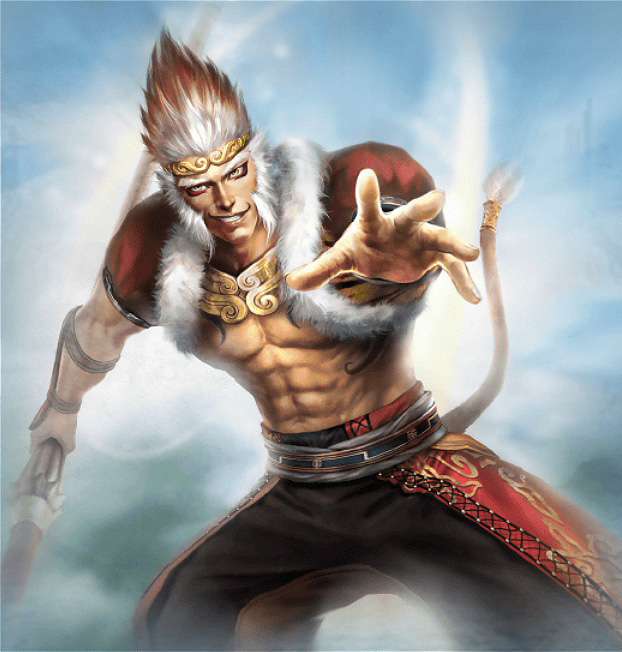
2) Warriors Orochi video game – Mutton chops, frosted tips, and an outfit borrowed from Prince’s wardrobe (fig. 23). Words fail me.

Fig. 23 – “Backup Dancer” Wukong (larger version).

3) The Forbidden Kingdom (2008) – Jet Li has a blond ponytail, mutton chops, and a soul patch (fig. 24). Need I say more?
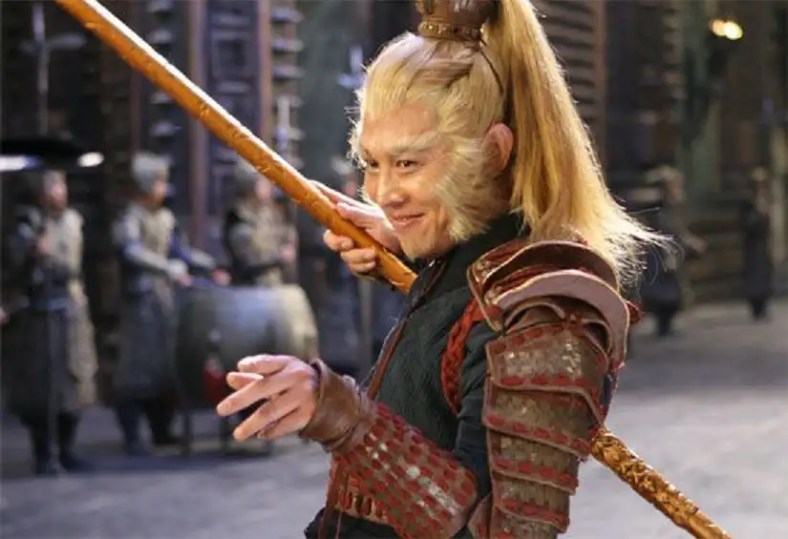
Fig. 24 – “L’Oréal Paris” Wukong (larger version).

3.2. The Most Accurate

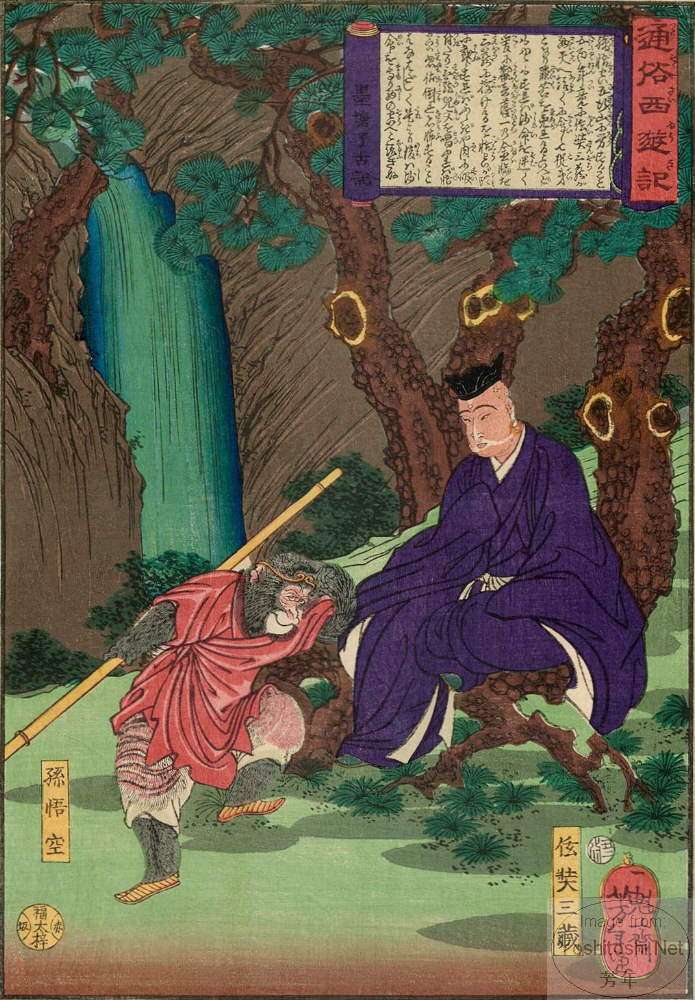
1) Yoshitoshi (1839-1892) – This Japanese artist produced many woodblock prints of our hero. Take for example his Modern Journey to the West series completed between 1864 and 1865. He portrays Sun Wukong as a red-faced snow macaque, which aligns more with the literary description (fig. 25).

Fig. 25 – Wukong salutes Xuanzang (larger version).

2) Journey to the West: Conquering the Demons (2013) – This dark comedy depicts the Great Sage as a short, ugly primate wearing golden armor (fig. 26).

Fig. 26 – Wukong prior to becoming Xuanzang’s disciple (larger version).

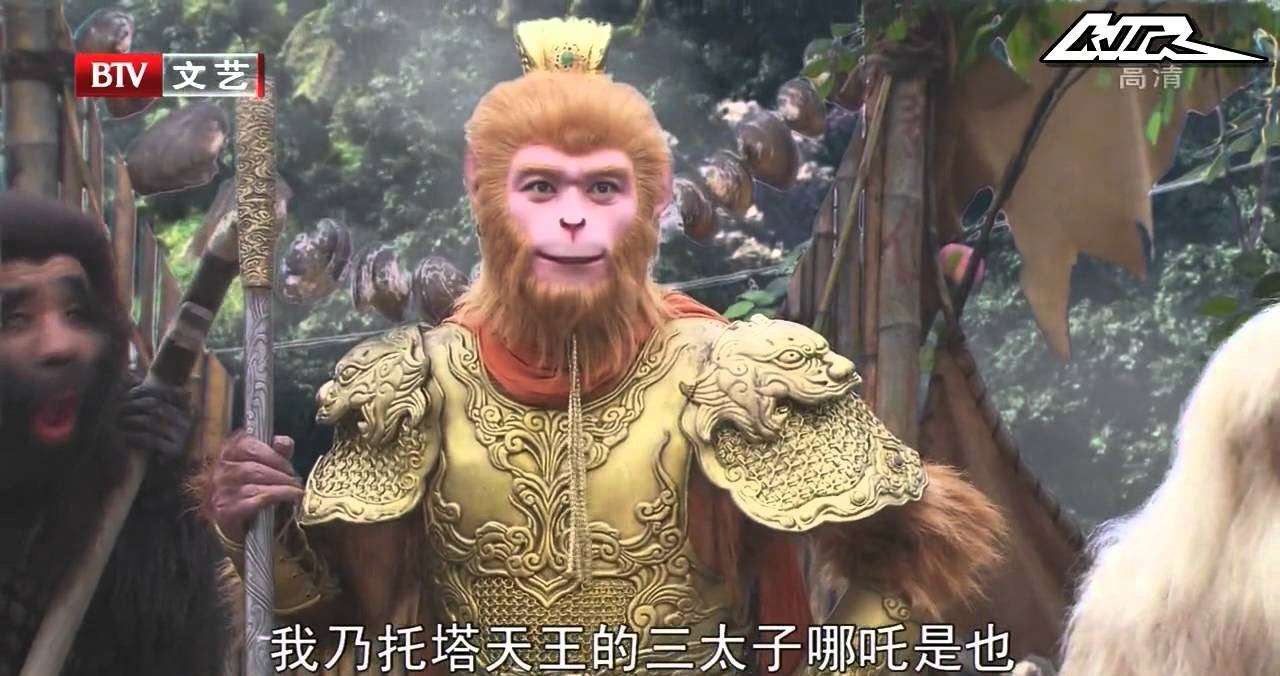
3) Journey to the West (2011) – This television series is a faithful adaptation of the novel. Although the actor who plays Sun Wukong is normal height, he wears a full silicone mask and clawed gloves to give the character a more primate look. His golden chainmail armor and staff are more accurate too. The latter even includes decorations on the shaft (fig. 27).

Fig. 27 – Wukong during his rebellion against heaven (larger version).

4. Conclusion

The novel portrays Sun Wukong as an ugly, bald Rhesus monkey less than four feet tall. (Per the 06-02-25 update, he also has long earlobes.) His traditional literary attire includes a phoenix feather cap, golden chainmail armor, and lotus root-colored boots. Later, he wears a golden fillet, a silk monk’s robe, a tiger skin kilt, and leather boots. He wields a rod of black iron/steel adorned on both ends with a single golden ring and decorated along the body with astronomical charts and an inscription towards one tip listing the weapon’s name and weight.


5. Updates

Update: 02-02-21

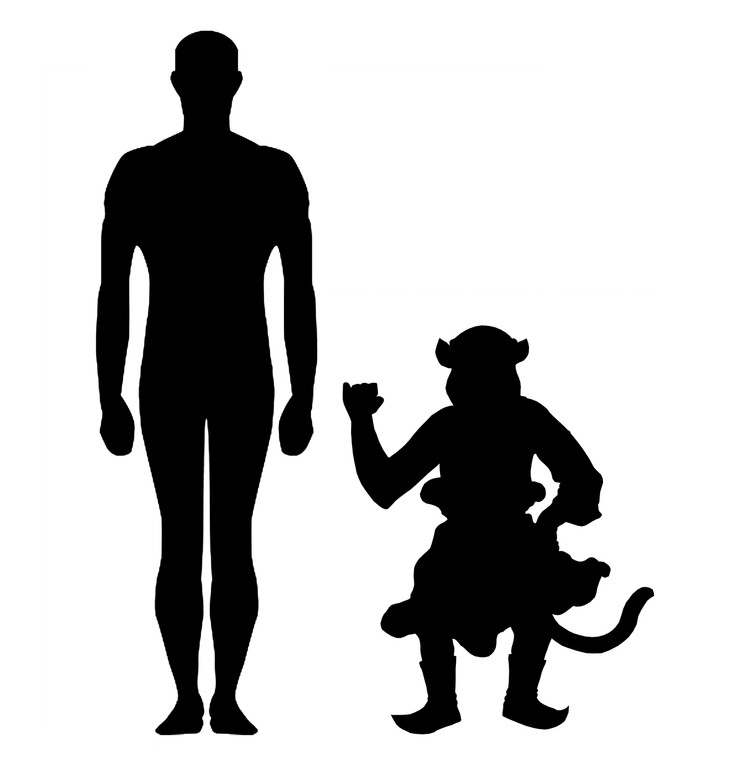
As mentioned above, the novel describes Wukong being “less than four feet, in fact” (Wu & Yu, 2012, vol. 1, p. 408). I have made a chart comparing his height with that of a 6 ft (1.82 m) human man (fig. 28). This should serve as a good illustration for just how short our hero is.

Fig. 28 – Size chart (larger version).


Update: 01-23-22

I’ve written an article suggesting a mantra for the secret spell that causes Sun Wukong’s golden headband to tighten. Similar to the above article, I had artists and fanfiction authors in mind when I wrote it.

The Tightening Spell of Sun Wukong’s Golden Headband


Update: 03-07-22

I’ve written a response to a comment on one of my Youtube videos. It discusses Sun Wukong’s height.

How Tall is the Monkey King? – A Debate


Update: 06-22-23

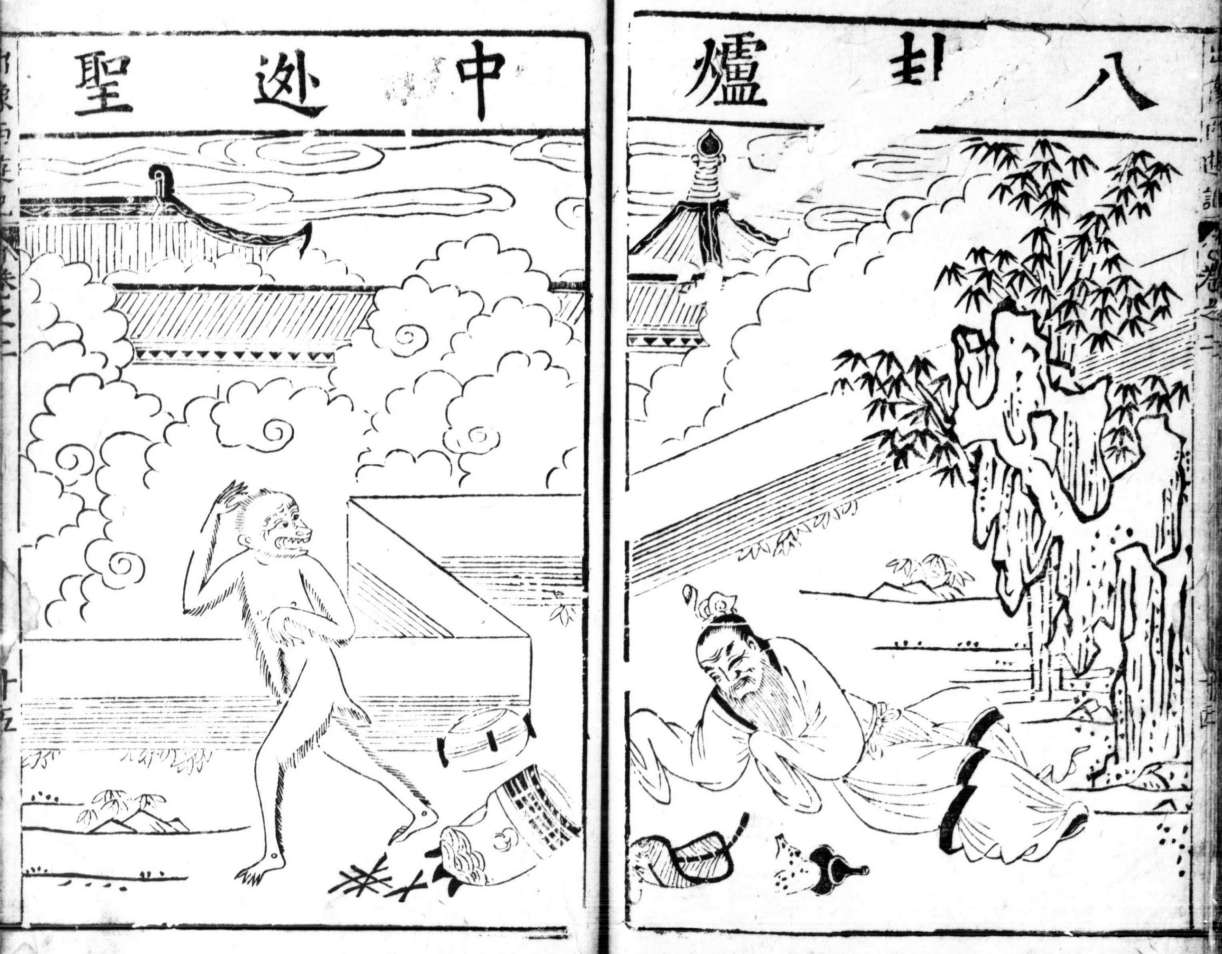
I previously noted a 16th century CE woodblock print that shows Sun Wukong naked upon escaping Laozi’s furnace (refer back to fig. 16). A woodblock print from the original 1592 CE Journey to the West also depicts him in his birthday suit (fig. 29). This adds to the evidence that Monkey doesn’t wear his armor during the entirety of the journey.

Fig. 29 – A naked Sun Wukong flees the furnace (larger version). 


Update: 09-12-23

In addition, in chapter 22, Sha Wujing mentions having his armor stripped from his body just before his planned execution:

Jade Emperor grew mightily enraged;
Hands clasped, he faced his counsel on the left.
Stripped of my hat, my armor, and my rank,
I had my whole body pushed to the block (Wu & Yu, 2012, vol. 1, p. 425).

玉皇即便怒生嗔,卻令掌朝左輔相:卸冠脫甲摘官銜,將身推在殺場上。

This supports the suggestion that Monkey’s armor was removed before heaven tried to execute him.


Update: 04-27-24

Here is another colorful description of Sun Wukong’s face:

A bumpy, scabrous face, a pair of yellow eyeballs, a sunken forehead, and long, protruding fangs—he seemed virtually an overcooked crab with meat inside and bones outside! (based on Wu & Yu, 2012, vol. 2, p. 155)

七高八低孤拐臉,兩隻黃眼睛,一個磕額頭,獠牙往外生。就像屬螃蟹的,肉在裡面,骨在外面。

In addition, chapter 37 gives a more precise measurement for Monkey’s height. He first transforms into a “tiny monk about two cun tall” (二寸長的小和尚兒) (based on Wu & Yu, 2012, vol. 2, p. 172). He shortly thereafter grows even bigger when a prince makes fun of him:

Tripitaka pulled open the box’s cover; Pilgrim [Sun Wukong] leaped out and began to hobble all over the place. The prince said, “This little midget! What can he know?” When Pilgrim heard this remark about his size, he at once resorted to magic. Straightening up his torso, he grew about three chi and four or five cun instantly (emphasis added). “If he can grow that rapidly,” said the soldiers, highly startled, “it will only be a few days before he pierces the sky.” When Pilgrim reached his normal height, however, he stopped growing (emphasis added) (based on Wu & Yu, 2012, vol. 2, pp. 174-175).

三藏扯開匣蓋兒,那行者跳將出來,呀的兩邊亂走。太子道:「這星星小人兒,能知甚事?」行者聞言嫌小,卻就使個神通,把腰伸一伸,就長了有三尺四五寸。眾軍士吃驚道:「若是這般快長,不消幾日,就撐破天也。」行者長到原身,就不長了。

One chi (尺) is roughly 12.3 in or 31.8 cm, and one chi equals 10 cun (寸; a.k.a. “Chinese inches”) (Jiang, 2005, p. xxxi). One cun would be about 1.25 in or 3.18 cm. Two cun would therefore be 2.5 in or 6.36 cm. Growing the stated additional height would then put our hero at chi and 6 or 7 cun, which is roughly 3.86 ft or 1.176 m. This agrees with the aforementioned estimate of “not (or less than) four chi tall” (buman sichi不滿四尺) (Wu & Yu, 2012, vol. 1, pp. 128 and 408).


Update: 06-02-25

A reader reminded me that I forgot to list one of Monkey’s features: long earlobes. A poem in chapter four reads:

The gold cuirass worn on his body was brilliant and bright;
The gold cap on his head also glistened in the light.
In his hands was a staff, the golden-hooped rod,
That well became the cloud-treading shoes on his feet.
His eyes glowered strangely like burning stars.
Hanging past his shoulders were two ears, forked and hard (emphasis added).
His remarkable body knew many ways of change,
And his voice resounded like bells and chimes.
This BanHorsePlague with beaked mouth and gaping teeth
Aimed high to be the Equal to Heaven Sage.

身穿金甲亮堂堂,頭戴金冠光映映。
手舉金箍棒一根,足踏雲鞋皆相稱。
一雙怪眼似明星,兩耳過肩查又硬
挺挺身才變化多,聲音響喨如鐘磬。
尖嘴咨牙弼馬溫,心高要做齊天聖。(Source)

Long earlobes are a symbol of wisdom and longevity (fig. 30), so the description here might be symbolic of his immortality.

Fig. 30 – An image of the Daoist high god Laozi and his long earlobes (larger version). Image found here.


Update: 05-03-26

Regarding the evidence for Monkey’s lack of armor throughout the story, here is another ancient woodblock print showing him without clothes upon escaping the furnace (fig. 31). It is included among a brief cache of illustrations from The Book to Enlightenment of the Journey to the West (Xiyou Zhengdao Shu, 西遊證道書, 1663), a Daoist commentary on the novel.

Fig. 31 – Monkey escapes from the furnace (larger version). 

I should also note that a reader disagrees with the idea that Sun Wukong is bald. See their comments below.

Notes:

1) The 15th century CE zaju play Journey to the West contains many familiar episodes that would come to appear in the final novel.

2) See the introduction of Dudbridge (1970), for example.

3) Saturn (Tuxing, 土星; lit: “Earth Star”) is mentioned here because the stellar deity is known for having a thickly-bearded face (see figure one on this article). The reference is saying that Monkey’s sunken cheeks are hairless.

4) Yu’s (Wu & Yu, 2012) original translation says “thirteen thousand five hundred pounds” (vol. 1, p. 135). However, the Chinese version uses jin (斤), known in English as “catty.” The catty and pound are two different measures of weight, the former being heavier than the latter. Therefore, the English text has been altered to show this. The catty during the Ming Dynasty when the novel was compiled equaled 590 grams (Jiang, 2005, p. xxxi), so 13,500 catties would equal 17,560 lbs.

Sources:

Burton, F. D. (2005). Monkey King in China: Basis for a Conservation Policy? In A. Fuentes & L. D. Wolfe (Eds.), Primates Face to Face: Conservation Implications of Human-Nonhuman Primate Interconnections (pp. 137-162). Cambridge: Cambridge University Press.
Dudbridge, G. (1970). The Hsi-Yu Chi: A Study of Antecedents to the Sixteenth-Century Chinese Novel. Cambridge: Cambridge Univ. Press.

Dubue, C., Allen, W. L., Maestripieri, D., & Higham, J. P. (2014). Is Male Rhesus Macaque Red Color Ornamentation Attractive to Females? Behavioral Ecology and Sociobiology 68(7), 1-10. Retrieved from https://www.researchgate.net/publication/262066733_Is_male_rhesus_macaque_red_color_ornamentation_attractive_to_females

Ecke, G., & Demiéville, P. (1935). The Twin Pagodas of Zayton: A Study of the Later Buddhist Sculpture in China. Cambridge, Mass: Harvard University Press.

Jiang, Y. (2005). The Great Ming Code / Da Ming Lu. University of Washington Press.

Wivell, C.S. (1994). The Story of how the Monk Tripitaka of the Great Country of T’ang Brought Back the Sūtras. In V. H. Mair (Ed.), The Columbia Anthology of Traditional Chinese Literature (pp. 1181-1207). New York: Columbia University Press.

Wu, C., & Yu, A. C. (2012). The Journey to the West (Vols. 1-4) (Rev. ed.). Chicago, Illinois: University of Chicago Press.