One reoccurring plot device in the world famous Dragon Ball (Jp: Doragon Bōru,ドラゴンボール; Ch: Qilongzhu, 七龍珠) franchise (1984-present) is the Lima bean-like Senzu (仙豆; Ch: xian dou; lit: “sage or immortal bean”) (fig. 1). As explained by Dragon Ball scholar Derek Padula, the Senzu is a green, crunchy bean used to magically and instantly heal life-threatening flesh wounds and broken bones, to rejuvenate warriors who have overexerted themselves during intense, prolonged training or battle (video 1), and to sate hunger for up to ten days. Its only limitations are the inability to heal viral sicknesses, missing body parts, and preexisting scars. Much like the immortal peaches of the Queen Mother of the West, which only mature every few thousand years, the beans only mature in small numbers, possibly taking hundreds of years for their caretaker, the long-lived sage cat Korin, to harvest a few hundred specimens. The beans become a rarity once a dimwitted character eats them by the handful (Padula, 2015).
Video 1 – The hero Son Goku is healed by a Senzu.
Derek traces the bean to elixirs created by practitioners of Daoist external alchemy. For example, he writes:
The sennin [仙人; Ch: xianren] collect rare ingredients and prized metals such as gold, mercury, mushrooms, and precious stones such as jade. Then they place them into a crucible, stoke the fire, and melt them into a concoction. Each particular ingredient possesses various amounts of yīn and yáng energy, and by mixing the ingredients together in just the right fashion the hermit can concoct a potion or pill that will balance the yīn and yáng in their own bodies. Their hope is that the pill will increase their life span, eliminate illness and injuries, or confer immortality (Padula, 2015).
He makes a keen connection between the Senzu and immortal peaches. After all, both are heavenly agricultural goods with magico-medical properties.
Over time, legends formed around such practices and made their way into popular culture. For example, the Daoist Patriarch Laozi’s “pills of immortality” and “peaches of immortality” (Chinese: xiāntáo, 仙桃), from Journey to the West that Sun Wukong (the character Son Goku is inspired by) so voraciously devours. Sun Wukong becomes immortal not once, not twice, but thrice, by also practicing Internal Alchemy and transforming his body. Since Xiyouji is the inspiration for Dragon Ball, it’s no surprise that we find a simplified form of them here that Son Goku eats. Senzu do not confer instant immortality in Dragon Ball, but they do provide the other benefits. They’re a simplified representation of ancient and supernormal concepts (Padula, 2015).
While Derek alludes to Laozi’s elixir pills above, I think he might have missed an important element from the novel, one that appears to be the ultimate source for Senzu. After raiding the heavenly peach banquet and getting drunk on immortal wine in chapter five, Sun Wukong stumbles into Laozi’s laboratory and eats all of the god’s elixir pills:
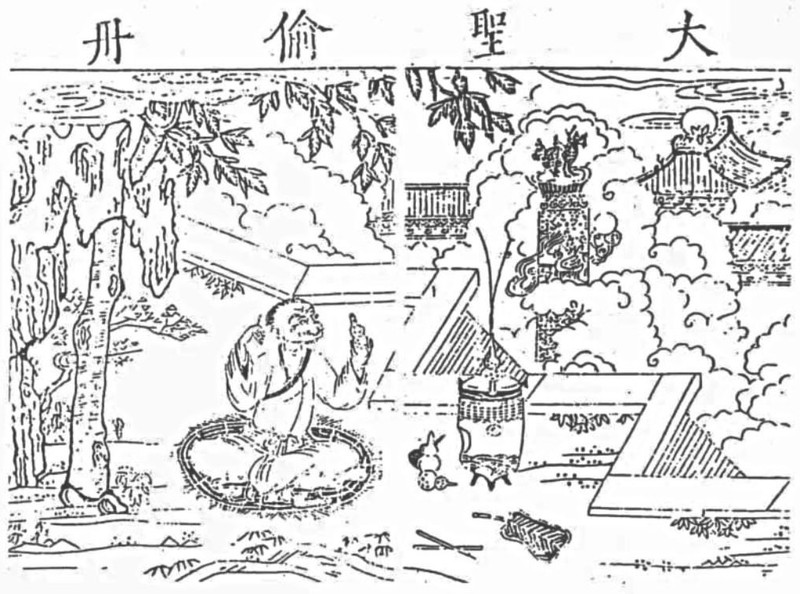
Searching around, our Great Sage went all the way to the alchemical room. He found no one but saw fire burning in an oven beside the hearth, and around the oven were five gourds in which finished elixir was stored. “This thing is the greatest treasure of immortals,” said the Great Sage happily. “Since old Monkey has understood the Way and comprehended the mystery of the Internal’s identity with the External, I have also wanted to produce some golden elixir [jin dan, 金丹] on my own to benefit people. While I have been too busy at other times even to think about going home to enjoy myself, good fortune has met me at the door today and presented me with this! As long as Laozi is not around, I’ll take a few tablets and try the taste of something new.” He poured out the contents of all the gourds and ate them like fried beans [chao dou, 炒豆] (emphasis added) [fig. 2].
In a moment, the effect of the elixir had dispelled that of the wine, and he again thought to himself, “Bad! Bad! I have brought on myself calamity greater than Heaven! If the Jade Emperor has knowledge of this, it’ll be difficult to preserve my life! Go! Go! Go! I’ll go back to the Region Below to be a king.” He ran out of the Tushita Palace and, avoiding the former way, left by the West Heaven Gate, making himself invisible by the magic of body concealment (Wu & Yu, 2012, p. 166).
So we have immortality-bestowing alchemical pills described as beans, which can instantly cure the effects of alcohol, a mild poison. As noted above, Son Goku is based on Sun Wukong. Additionally, many other characters and episodes of the manga/anime were pulled directly from Journey to the West. So it’s not a stretch to think that Akira Toriyama, the creator, embellished the ability of these bean-like pills to create the Senzu.
Fig. 2 – “The Great Sage Steals the Elixir”, from Newly Engraved, Illustrated, Large-Character Official Edition of the Journey to the West (Xinke chuxiang guanban dazi Xiyouji, 新刻出像官板大字西遊記, 1592) (larger version).
Update: 11-20-21
I’ve written an article briefly listing the influences of Journey to the West on Dragon Ball.
Sun Wukong first appears as the “Monkey Pilgrim” (Hou xingzhe, 猴行者) in The Story of How Tripitaka of the Great Tang Procures the Scriptures (Datang Sanzang qujing shihua, 大唐三藏取經詩話, late-13th-century; “The Story,” hereafter), the earliest known published version of the Journey to the West (Xiyouji, 西遊記, 1592; “JTTW” hereafter) story cycle. He is described as an immortal banished from heaven for stealing divine peaches from the Queen Mother of the West, and he later became the ruler of the 84,000 monkeys of Flower-Fruit Mountain. But he first enters the story as a white-clad scholar and willing participant in the journey who actively seeks out the monk Tripitaka and his retinue of fellow clerics on the quest to India. The Monkey Pilgrim then uses his magical abilities and heavenly treasures to protect the monks from all manner of spirits, warlocks, and dragons. In the end, he is bestowed the title “Great Sage Steel Muscles and Iron Bones” (Gangjin tiegu dasheng, 鋼筋鐵骨大聖) (Wivell, 1994). [1]
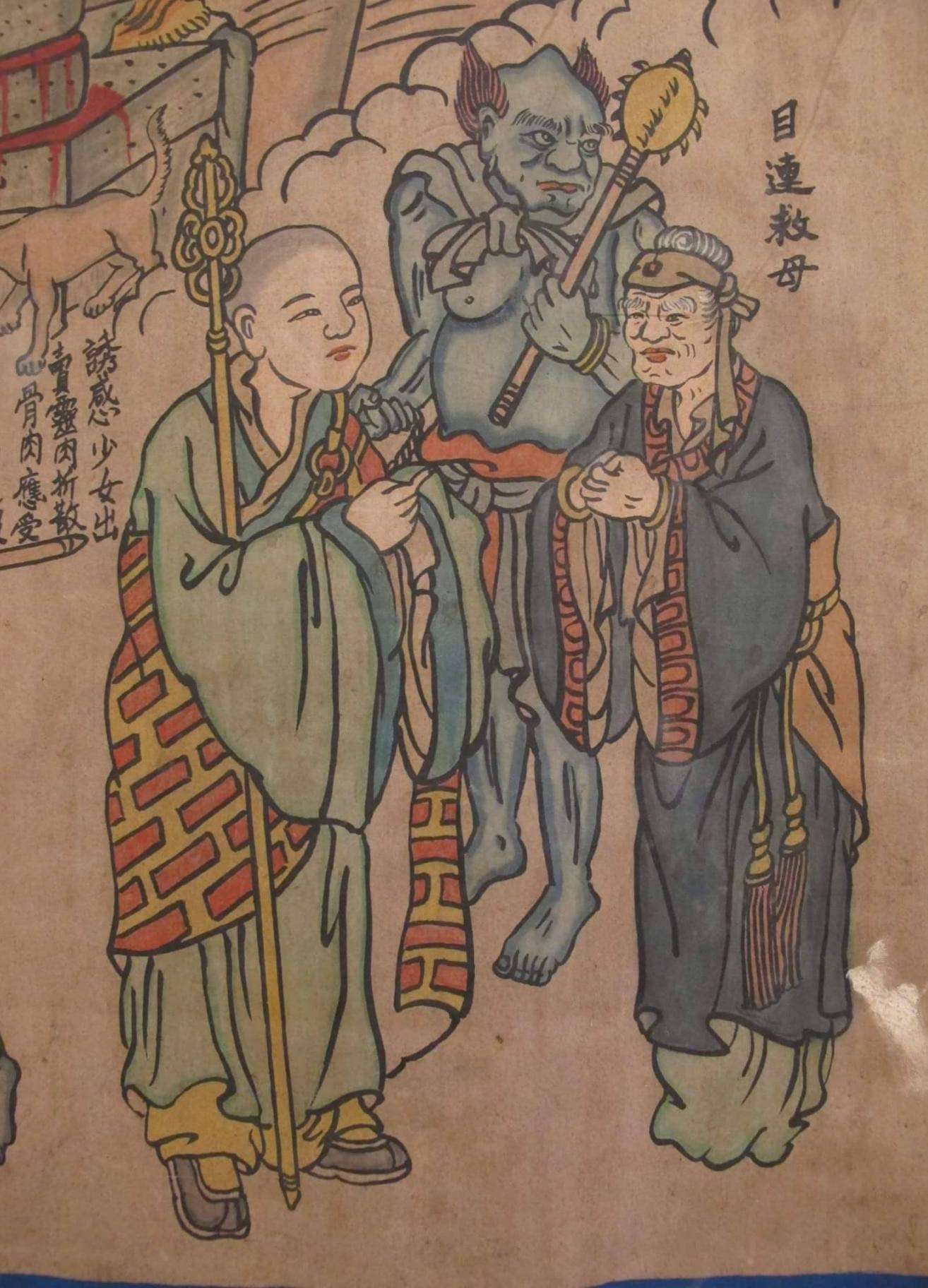
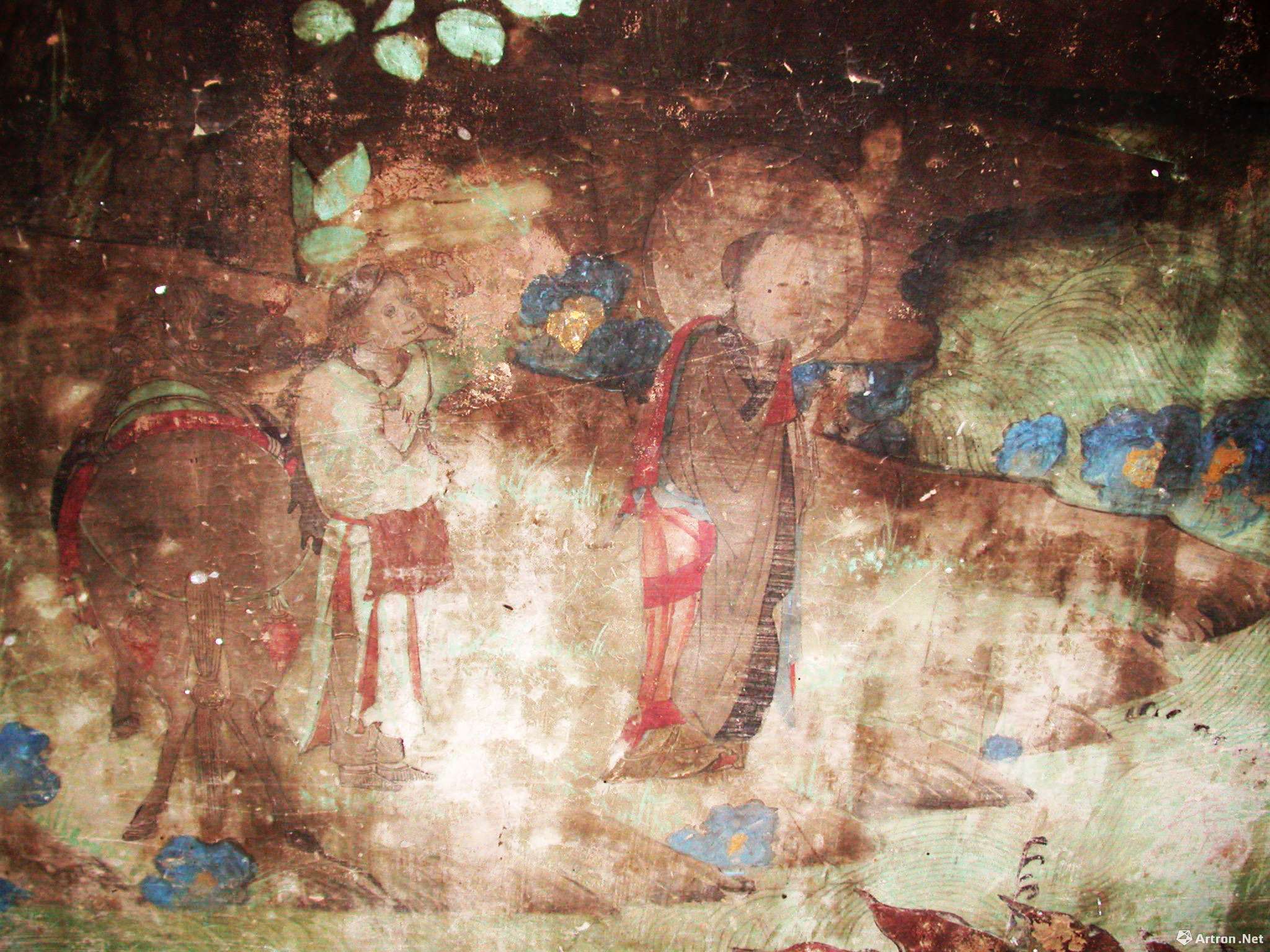
The heavenly treasures wielded by the Monkey Pilgrim are based on those used by the famed Buddhist saint and cultural hero Mulian (目連; Sk: Maudgalyayana), a disciple of the Buddha. He appears in the Transformation Text on Mahamaudgalyayana Rescuing his Mother From the Underworld with Pictures, One Scroll, with Preface (Damuganlian mingjian jiumu bianwen bingtu yijuan bingxu, 大目乾連冥間救母變文并圖一卷並序), a late-9th to early-10th-century Bianwen (變文) text in which he travels to the underworld to release his mater from karmic torment (fig. 1). Originally discovered in the oasis of Dunhuang, the text serves as the foundational myth for the Ghost Festival (Gui jie, 鬼節; a.k.a. “Zhongyuan Festival,” Zhongyuan jie, 中元節; a.k.a. “Yulanpen Festival,” Yulanpen jie, 盂蘭盆節), which is held on the 15th day of the seventh month.
In this article, I will discuss three similarities that the Monkey Pilgrim shares with Mulian, including using similar holy treasures, visiting the same heavenly realm, and having a connection to the Ghost Festival. While Tripitaka, as a monk working towards the salvation of others, is a more obvious cognate for Mulian, it’s correct to say that Monkey is an amalgam of the Buddhist saint and Chinese stories of animals that guide the recently deceased through the underworld.
Fig. 1 – A scroll or mural depicting Mulian rescuing his mother from the underworld (larger version). Originally found here.
1. The Monkey Pilgrim
1.1. The Staff
The Monkey Pilgrim and Tripitaka first receive the golden-ringed monk’s staff, along with two other treasures, from the supreme deity, the Mahabrahma devaraja (Dafan tianwang, 大梵天王; lit: “Great Brahma Heavenly King,” a.k.a. Vaisravana), in chapter two.
The Dharma Master [Tripitaka] and Monkey Pilgrim approached the Devaraja and begged for his help. The Devaraja granted them a cap of invisibility, a golden-ringed staff, and a begging bowl. After accepting these three boons, the Dharma Master said farewell, then turned to the Monkey Pilgrim and asked: “How can we get back to the mortal world?” Pilgrim replied: “Before the Dharma Master speaks of returning to the world below, he had better ask the Devaraja how we can save ourselves from the monsters and disasters which lie ahead of us.” The Dharma Master returned to Mahabrahma and asked as Monkey had suggested. The Devaraja responded: “When you meet calamity, point toward the Heavenly Palace from afar and shout ‘Devaraja’ once, and you will be saved.” The Dharma Master accepted his instructions and bowed farewell (Wivell, 1994, p. 1184).
Now compare that with Mulian’s tale in which he receives the staff from the Buddha:
“How will I [Mulian] be able to see my dear mother again?” The World-Honored called out to him, saying, “Mahamaudgalyayana! Do not be so mournful that you cry yourself heartbroken; The sins of the world are tied to those who commit them like a string, They are not stuck on clay-fashion by anyone else. Quickly I take my metal-ringed staff and give it to you. It can repel the eight difficulties and the three disasters. If only you remember diligently to recite my name, The hells will certainly open up their doors for you” (Mair, 1994, p. 1111).
Both receive a magic monk’s staff with abilities tied to the recitation of a Buddhist deity’s name.
Here is one example of the power of The Story‘s staff:
The pilgrims arrived at the valley of the fire-spitting White Tiger Spirit. Coming closer they encountered a great ditch. The four steep entrances were pitch-black and they heard a roar of thunder. They could not advance. The Dharma Master held up his golden-ringed staff and, flourishing it toward the distant heavenly palace, yelled: “Devaraja! Help us in our afflictions!” Suddenly a shaft of light shot out from the staff five tricents long. It slashed through the long ditch and soon they were able to get across (Wivell, 1994, 1187-1188).
He [Mulian] wiped his tears in mid-air, and shook the metal-ringed staff, Ghosts and spirits were mowed down on the spot like stalks of hemp. Streams of cold sweat crisscrossed their bodies, dampening them like rain, Dazed and unconscious, they groaned in self-pity; They let go of the three-cornered clubs which were in their hands, They threw far away the six-tined pitchforks which were on their shoulders (Mair, 1994, p. 1112).
But The Story‘s treasure builds upon the Mulian tale by adding an exciting new ability: creating giant, monstrous life. For instance, while confronting the white tiger spirit in chapter six,
Monkey Pilgrim transformed his golden-ringed staff into a gigantic yaksa whose head touched the sky and whose feet straddled the earth. In his hands he grasped a demon-subduing cudgel. His body was blue as indigo, his hair red as cinnabar; from his mouth a fiery gleam shot forth a hundred yards long (Wivell, 1994, p. 1189).
How cool is that? And in chapter seven, “he transformed the magic staff into an iron dragon” to battle a group of nine-headed serpents (被猴行者 … 金鐶錫杖化作一條鐵龍) (Wivell, 1994, p. 1190).
Fig. 2 – The head of a 12-ringed monk’s staff (larger version). From the author’s personal collection.
1.2. The Alms Bowl
The treasure bowl is first used in chapter six:
Next they suddenly came to a wild fire [2] which reached to the heavens. It sent off such a huge amount of smoke and sparks that the pilgrims could not proceed. The Dharma Master shone the light of his begging-bowl toward the fire and yelled: “Devaraja!” The fire died out immediately and the seven pilgrims crossed this pit (Wivell, 1994, p. 1189).
It is next used by the Monkey Pilgrim in chapter seven while fighting the nine-headed serpents. He “sucked all the thousand tricents of water into the begging-bowl” (被猴行者 … 缽盂盛卻萬里之水) (Wivell, 1994, p. 1190).
There are no similar feats in Mulian’s story, but his alms bowl is also imbued with magic, allowing him to fly freely between the realms of heaven, earth, and the underworld. For instance,
Maudgalyayana awoke from abstract meditation, Then swiftly exercised his supernatural power; His coming was quick as a thunderclap, His going seemed like a gust of wind. […] With his supernatural power, he gained freedom, So he hurled up his begging bowl and leaped into space; Thereupon, instantaneously, He ascended to the heavenly palace of Brahma (Mair, 1994, pp. 1097-1098).
Both he and the primate hero travel to the Brahma realm. Readers will recall that Monkey magically transports Tripitaka and his group to the crystal palace of the Mahabrahma Devaraja in chapter two (Wivell, 1994, p. 1184).
1.3. Connection to the Ghost Festival
Not only does the Monkey Pilgrim use Mulian-esque treasures, he also ascends to heaven on the Ghost Festival. After the group receives the last of the scriptures in chapter 16, the Dipamkara Buddha tells them:
“On the fifteenth day of the seventh month [i.e. the date of the Ghost Festival], it will be time for you, Dharma Master, and your band of seven to return to the celestial halls. Remember what I have said, and on the fifteenth rise early and bathe yourself. Say farewell to the T’ang emperor, for at noon the ‘Lotus-Plucking Barge’ will arrive. There will also be golden lotus-flower seats and auspicious rainbow-colored clouds. Twelve mellifluously voiced youths will escort you with incense, flowers, and decorated banners. They will adorn you with the seven precious gems, welcoming you seven to return to Heaven. But the invitation from Heaven has a time limit and you must not dally! Listen well to what I have told you and keep it firmly implanted in your mind!” (Wivell, 1994, 1202).
The seven boarded the barge and, looking due west, they ascended into the heavens and became immortals. Nine dragons rose up into the mist and ten phoenixes came out to welcome them. A thousand cranes offered them felicitations and there were flashing lights of transcendence (Wivell, 1994, p. 1206).
Recall that Mulian’s quest to free his mother’s soul from underworld torments is the foundational myth of the Ghost Festival. It actually opens with an explanation of the chthonic celebration:
Now, on the fifteenth day of the seventh month, the heavens open their doors and the gates of hells are flung wide. The three mires dissipate, the ten virtues increase. Because this is the day when the company of monks end their summer retreat, the deity who confers blessings and and the eight classes of supernatural beings all come to convey blessings. Those who undertake to make offerings to them in the present world will have a supply of blessings and those who are dead will be reborn in a superlative place. Therefore, a purgatorian feast is spread before the Three Honored Ones who, through the grace of their welcoming the great assembly, put a priority upon saving those who are distressed by hanging in limbo (Wivell, 1994, pp. 1093-1094).
The Monkey Pilgrim’s use of Mulian-style holy accoutrements, travel to the Brahma realm, and ascension on the Ghost Festival raises the question: is our hero suppose to be a stand-in for the Buddhist saint? The simple answer is “not exactly.” It’s important to remember that he and Tripitaka share the duty of wielding the holy treasures. And while the immortal uses them more, the fact that Tripitaka is a Buddhist monk working towards the salvation of others makes him a more fitting cognate for Mulian.
However, The Story‘s connection to chthonic literature still provides Monkey a link to the Buddhist saint:
The Japanese scholar Chūbachi Masakazu (b. 1938) was the first to point out that the Kōzanji narratives mirror two closely related mythic archetypes. The first, derived from ancient Han Chinese traditions, is the journey of the dead to the netherworld. In many accounts of postmortem travels, spirit animals (including but not limited to monkeys) serve as the guides for the dead on their passage through the spirit realm, whether the final destination is the Yellow Springs beneath the earth or Mount Kunlun in the distant west. The other motif, emerging from early Indian Buddhist literature, is the transmigration of the spirit to the Pure Land, which, like Mount Kunlun, was conventionally located somewhere in the west. In Buddhist accounts, animals (again, often but not always monkeys) also serve as escorts for the dead. Chūbachi proposed that these narrative traditions—culturally distinct but thematically and functionally similar—were fused together with the historical account of Xuanzang’s journey to India. The Kōzanji texts, according to this reading, represent a complex but organic blending of initially independent narratives. The broad contours of Xuanzang’s biography and travelogue were superimposed onto older mythic accounts to provide a new, quasi-historical frame for age-old stories about the transmigrations of the dead.
Viewed from this perspective, Xuanzang was not passing through Central Asia en route to India but, instead, was traversing a hellish purgatory to reach a heavenly pure land. Like a shaman, he departs the human world and enters a dangerous liminal zone. Beset by ghosts and demons, he is guided and protected by powerful spirit animals and Buddhist deities. After enduring extreme hardship, he eventually arrives in an immortal realm populated by spirit monks, immortals, bodhisattvas, and buddhas. From Śākyamuni Buddha, he receives a collection of apotropaic texts with the power to safeguard the living and liberate the dead. Xuanzang then transmits these sacred scriptures back to the human realm before he and his assistants ascend to heaven during the annual ritual for liberating the damned from purgatory. This narrative not only maps the landscape of a postmortem shadow world, it also identifies the scriptures that guard against demonic molestation and ensure a propitious rebirth: the Buddhist canon in general and the Heart Sūtra in particular. Those who read, recited, or heard the Kōzanji texts were thus informed of the perils of purgatory and offered the promise of protection and salvation. Xuanzang, they also learned, was the saintly monk responsible for delivering these divine texts and technologies into the hands of humans (Brose, 2023, pp. 62-63).
Given the above information, it’s more correct to view the Monkey Pilgrim as a sort of amalgam of Mulian and the animal helpers who guide the recently deceased through the under world. This is important to remember, especially when discussing the origins of the Great Sage, for his history is far more nuanced than the “foreign only” (i.e. Hanuman=Sun Wukong) theory would suggest.
2. Sun Wukong
Another power of Mulian’s staff likely influenced the Monkey King’s “As You Wish Gold-Banded Cudgel.” During his quest to free his mother from the underworld, the Buddhist saint uses the treasure to unlock the gates of hell:
With one shake of his staff, the bars and locks fell from the black walls, On the second shake, the double leaves of the main gate [of hell] flew open (Mair, 1994, p. 1113). [2]
Now compare that to an episode from JTTW chapter 25:
“Elder Brother,” said Eight Rules [Zhu Bajie], “stop this hocus-pocus. The doors are all locked. Where are we going to go?” “Watch my power!” said Pilgrim. He seized his golden-hooped rod and exercised the lock-opening magic; he pointed the rod at the door and all the locks fell down with a loud pop as the several doors immediately sprung open. “What talent!” said Eight Rules, laughing. “Even if a little smith were to use a lock pick, he wouldn’t be able to do this so nimbly.” Pilgrim said, “This door is nothing! Even the South Heaven Gate would immediately fly open if I pointed this at it!” (Wu & Yu, 2012, vol. 1, pp. 468-469)
While I believe Mulian’s bowl influenced the somersault cloud, Shao (2006) notes the 108,000 li (33,554 mi/54,000 km) covered by Monkey in a single leap is based on the symbolic distance said by Huineng to separate the Buddha’s paradise from the world of man. As the Chan patriarch explains in the Platform Sutra, “This number refers to the ten evils and eight wrongs in one’s person” (Huineng & Cleary, 1998, p. 26, for example). Only those who achieve enlightenment can overcome these hindrances and arrive instantly in paradise. This is symbolized in the novel by Monkey zipping their instantly on his cloud, whereas Tripitaka must travel thousands of miles over many years.
Update: 02-06-21
I have written an article that discusses the magic powers of the staff. These include the ability to shrink and grow, control the ocean, astral project and entangle with Monkey’s spirit, multiply endlessly, pick locks, and transform into various objects. It also has sentience to a certain degree.
I’ve rewritten and added new some new information to the article.
Note:
1) Wivell (1994) translates the name as “Great Sage of Bronze Muscles and Iron Bones” (p. 1207). But the gang (鋼) of Gangjin tiegu dasheng (鋼筋鐵骨大聖) means “steel.” Therefore, I’ve changed the original source accordingly.
2) Wivell (1994) translates yehuo (野火) as “prairie fire” (p. 1189), but “wildfire” is a more literal rendering. Therefore, I’ve changed the original source accordingly.
Sources:
Brose, B. (2023). Embodying Xuanzang: The Postmortem Travels of a Buddhist Pilgrim. United States: University of Hawaii Press.
Buswell, R. E., & Lopez, D. S. (2014). The Princeton Dictionary of Buddhism. Princeton University Press.
Mair, V. H. (1994). Transformation Text on Mahamaudgalyayana Rescuing his Mother From the Underworld with Pictures, One Scroll, with Preface. In V. Mair (Ed.), The Columbia Anthology of Traditional Chinese Literature (pp. 1094-1127). New York: Columbia University Press.
Shao, P. (2006). Huineng, Subhūti, and Monkey’s Religion in “Xiyou ji”. The Journal of Asian Studies,65(4), 713-740. Retrieved from www.jstor.org/stable/25076127
Note: My blog is not monetized, so I am not making any money from this post. My hope is that the PDF will make this legendary story more accessible to a wider audience. If you enjoyed the digital version, please, please, please support the official release.
Last updated: 04-06-2026
Here I present PDFs comprising the complete four volume 2012 revised edition of The Journey to the West(Xiyouji, 西遊記)translated by Anthony C. Yu (October 6, 1938 – May 12, 2015). This is considered THE most accurate translation of the tale available. I hope those who read and enjoy the digital version will support the official release.
Yu was Carl Darling Buck Distinguished Service Professor Emeritus in the Humanities and Professor Emeritus of Religion and Literature in the Chicago Divinity School. I shared a long email correspondence with Prof. Yu, during which we became friends. He was always quick to answer my many questions. His translation remains a treasure trove of explanatory notes and sources.
1. Book blurb
Anthony C. Yu’s translation of The Journey to the West, initially published in 1983, introduced English-speaking audiences to the classic Chinese novel in its entirety for the first time […] With over a hundred chapters written in both prose and poetry, The Journey to the West has always been a complicated and difficult text to render in English while preserving the lyricism of its language and the content of its plot. But Yu has successfully taken on the task, and in this new edition he has made his translations even more accurate and accessible. The explanatory notes are updated and augmented, and Yu has added new material to his introduction, based on his original research as well as on the newest literary criticism and scholarship on Chinese religious traditions. He has also modernized the transliterations included in each volume, using the now-standard Hanyu Pinyin romanization system. Perhaps most important, Yu has made changes to the translation itself in order to make it as precise as possible (source).
It recently occurred to me that Sun Wukong from Journey to the West (Xiyouji, 西遊記, 1592) (hereafter, JTTW) and Wu Song (武松) from the Water Margin (Shuihu zhuan, 水滸傳, c. 1400) (hereafter, WM) share a number of similarities. Each is a reformed supernatural spirit, a tiger-slayer, a Buddhist monk nicknamed “Pilgrim”, and a monastic martial artist, and each wears a moralistic headband and wields a weapon made from the same fanciful metal. Since the WM predates the publication of JTTW by nearly two hundred years, one might be tempted to speculate that the latter influenced the former. However, both story cycles first appeared during the Song dynasty, with various iterations from the Yuan to the Ming (see Ge, 2001). In this article I show the parallels are due to the respective narratives drawing on similar religious, folkloric, and historical source material. I feel such a comparison is important as it presents a fuller picture of the cultural landscape in which the Monkey King developed.
I. Reformed supernatural spirits
Chapters one through seven of JTTW present Sun Wukong as a celestial stone-born monkey who studies under a Buddho-Daoist master and achieves great magic powers, which he uses to rebel against heaven. After being defeated by the Buddha, Monkey is imprisoned under Five Elements Mountain for five hundred years. In chapter fourteen, the repentant immortal is later released to protect the monk Tripitaka on his journey to retrieve scriptures from India.
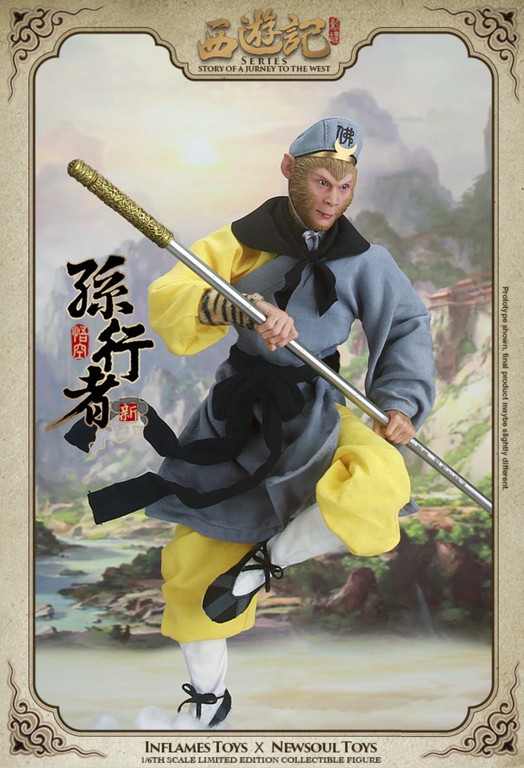
Fig. 1 – A modern action figure of Sun Wukong’s imprisonment under a section of Five Elements Mountain (larger version).
Chapter one of the WM tells how one hundred and eight spirits were quelled by a Daoist sage during the Tang dynasty and imprisoned in a bottomless pit under a great stone slab. Four or five hundred years later during the Song dynasty, a haughty government official orders the slab dug up and removed to sate his curiosity, allowing the spirits to escape in a plume of miasmic black fumes and later be reborn on earth. Wu Song, whose main story appears in chapters 23 to 32, is one of these extraordinary men and women who come to use their martial, intellectual, or magical skills to rebel against the corrupt Song government. A heaven-sent stone slab in chapter 71 is later discovered to list the names of each bandit with the corresponding name of their previous incarnation, which make up the “Thirty-Six Heavenly Stars” (Tiangang sanshiliu xing, 天罡三十六星) and the “Seventy-Two Earthly Fiend Stars” (Disha qishier xing, 地煞七十二星). Wu Song is listed as the “Heavenly Harm Star” (Tianshang xing, 天傷星), the fourteenth of the Thirty-Six Heavenly Stars.
So we see both are formerly evil spirits who were conquered by a religious figure and imprisoned under stone for centuries. After being released, each rebellious figure becomes a force for good.
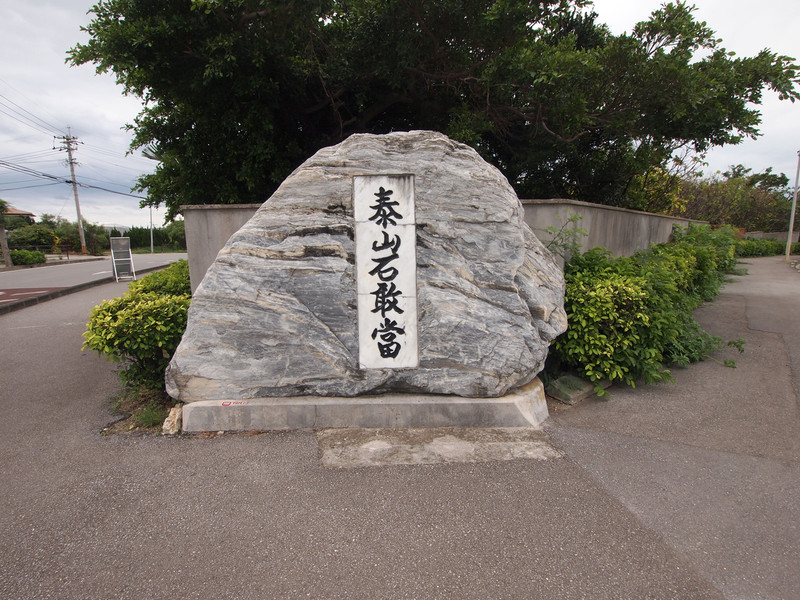
Monkey’s punishment can be traced to Tang and Song dynasty tales about the sage king Yu the Great imprisoning a simian water demon under a mountain. To my knowledge, the first recorded mention of this punishment appears in an early Ming zaju play in which Guanyin traps Sun Wukong under Flower Fruit Mountain. Wang (1992) suggests the stone slab from the WM was likely influenced by the Taishan stone (taishan shi, 泰山石) (fig. 2), a class of “evil-warding stones” (shigandang, 石敢當) often placed outside of homes and temples or at the intersection of roads as protection from malevolent forces (pp. 71-72 and 254). The Taishan stone represents Mount Tai and its deity. The landmass is considered the heaviest thing imaginable in Chinese culture. This means the evil would be completely immobilized by the great weight.
Fig. 2 – A modern Japanese example of a Taishan stone (larger version). They often read “Taishan stone takes upon itself” (Taishan shi gandang, 泰山石敢當), denoting its duty of protection (Wang, 1992, p. 71). Original image from Wikipedia.
Additionally, the pit containing the spirits can be traced to a Song-era Daoist ritual in which an exorcist draws the character for “well” (jing, 井/丼) on the ground, thereby dividing the ritual space into nine sections, representing the Nine Palaces (jiugong, 九宮), [1] and creating an earth prison. The Compilation of Rituals of the Way (Daofa huiyuan, 道法會元) reads:
[U]se the Sword mudrā to draw the character for “well” on the ground. Transform it into a black prison, ten-thousand zhang deep, and ten thousand li wide. [2] Black vapors burst out of it. Inside the prison, visualize how cangues and locks, as well as tools and machinery are laid out. Then recite the Spell for Fast Arrest [cu zhuo zhou, 促捉咒] (Meulenbeld, 2007, p. 142).
The black vapors should remind readers of that released upon the spirits’ escape from their centuries-long imprisonment.
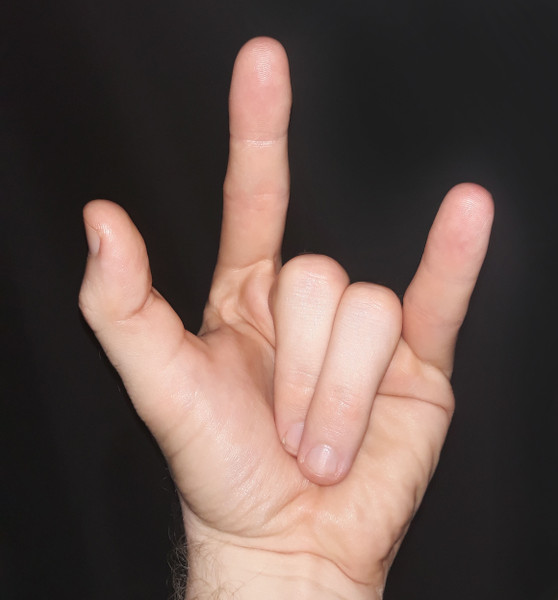
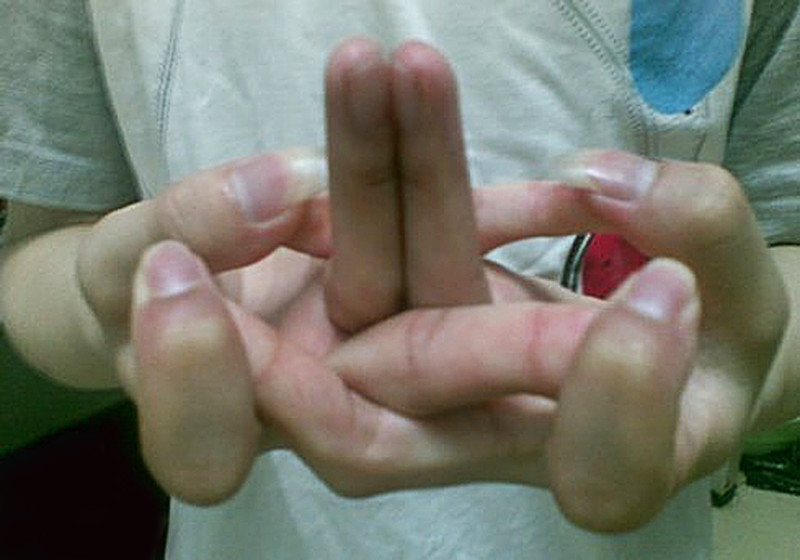
Fig. 3 – The Chinese character for mountain (shan, 山) (larger version). Fig. 4 – The Mountain mudra (shanzi jue, 山字訣) (larger version). Photo by the author. Fig. 5 – The double-handed Mount Tai mudra (Taishan jue, 泰山訣) (larger version). Original picture from here.
Another version of the ritual sees the spirits being coaxed or forced inside of a liquid-filled jar placed in the center of the well diagram. Afterwards, the opening is sealed with paper and the exorcist performs a mudra representing the immense pressing weight of a mountain (just like the aforementioned Taishan stone). [3] Meulenbeld (2007) writes:
The spirits captured within the grid of the Nine Palaces were kept inside their prison by symbolically pressing them down underneath a mountain. The symbolism here lies in the fact that the mountain was represented by a posture of the hand forming the character for mountain (“Mountain Mudrā” 山字訣 with the thumb, index-finger, and little finger all pointing upward [fig. 3 and 4]. Oftentimes the specific “mudrā of Mt. Tai” 泰山訣 [fig. 5], was used, representing the heaviest of all mountains. Moreover, many present-day exorcist talismans contain a character composed of a “demon” 鬼 underneath a “mountain” 山, namely the character wei 嵬 (p. 145, n. 92).
This means the respective punishments of Sun Wukong and Wu Song (and his brethren) are for all intents and purposes the same: they are imprisoned under mountains. The Taishan stone and the Mountain mudra are no doubt based on the same belief that mountains can immobilize evil spirits. Most importantly, the mudra likely influenced the concept of the Buddha transforming his hand into Five Elements Mountain in chapter 7 of JTTW. The fictional mountain is then a cognate of Mount Tai.
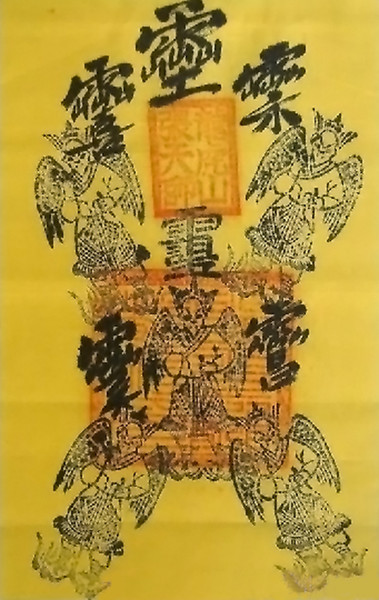
Fig. 6 – A paper fu talisman marked with an image of the Five Thunders(Wu Lei, 五雷) (larger version).
Lastly, the idea that evil spirits can be reformed and their powers put to good use—i.e. Sun Wukong protecting Tripitaka and Wu Song standing against a corrupt government—is tied to the Song-era “Thunder Ritual” (Leifa, 雷法). Meulenbeld (2007) explains stories from the Tang to the Song present the characteristics of the thunder god, Sire Thunder (Lei Gong, 雷公), becoming increasingly demonic, changing from a muscular deity to a number of animals and finally a Garuda-like bird monster. Likewise, while he was a respected force of nature in the past, Sire Thunder becomes an impulsive agent of heaven, one capable of being challenged and even captured by a brave individual or ritual master. The subjugation of this demonic god allows his captors to appropriate his heavenly power for their own purposes. The deity and his four brothers, comprising the “Five Thunders” (Wu Lei, 五雷) (fig. 6), can be summoned on command via talismans and charms and made to bring rain, heal sicknesses, or conquer demons. [4] Such ritual accouterments are just a small part of a much larger subsequent Thunder Ritual liturgy that is, according to one Song dynasty source, capable of “control[ing] the demons and spirits of the Sixfold Heavens, [expelling] evil and avert[ing] disaster” (Meulenbeld, 2007, p. 67).
II. Tiger-Slayers
JTTW, ch. 14 – Sun Wukong’s first act of protecting Tripitaka upon his release is effortlessly killing a tiger with a single stroke of his staff. This happens the day after a huntsman had come to the monk’s defense by fighting a tiger for hours before dispatching it with a trident. The difference in power between the immortal and human heroes leads the monk to exclaim, “For the strong, there’s always someone stronger!” (Wu & Yu, 2012, vol. 1, p. 310).
WM, ch. 23 – Wu Song gets drunk on a trip home to see his elder brother, and after ignoring warnings not to take a mountain shortcut, the hero is set upon by a ferocious man-eating tiger. In the process of initially defending himself, Wu snaps his walking staff on a nearby tree, forcing him to resort to brute strength. He manages to wrestle the big cat’s face into the dirt and rains down sixty or seventy fist blows before it stops moving (fig. 7). He then finishes off the beast with the remains of his staff.
Fig. 7 – “Wu Song Beats the Tiger” (Wu Song da hu, 武松打虎) by Wang Kewei (王可偉) (larger version).
I can’t help but imagine the episode from JTTW is a sly nod to that from the WM. Tripitaka’s statement could be a way of propping up the Monkey King as the most powerful hero, one who can dispatch tigers with no effort at all.
The ability to kill a tiger was considered the sign of a powerful warrior in Chinese folklore. For example, A New Account of the Tales of the World (Shishuo xinyu, 世說新語, 5th-century), a collection of historical and fictional anecdotes, tells the story of how the Western Jin general Zhou Chu (周處, 236–297) was originally a wayward youth considered the worst of Yixing‘s “Three Scourges”—a tiger, a dragon, and himself. Wanting to prove his strength, Zhou is said to have easily killed the tiger but disappeared for three days and nights fighting the dragon. The youth later returned to find the people celebrating his apparent death. This caused Zhou to mend his ways and eventually become a great general (Knechtges & Chang, 2010, pp. 2274-2275).
III. Buddhist monks with matching religious nicknames
JTTW, ch. 14 – Sun Wukong takes the tonsure as a Buddhist monk upon his release. [5] His master Tripitaka then gives him the religious nickname “Pilgrim Sun” (Sun xingzhe, 孫行者), and the character is often simply referred to as “Pilgrim” (xingzhe, 行者; literally: “traveler”) throughout the narrative.
WM, ch. 31 – Wu Song kills a thug and his Song government official friend for framing the hero for theft and attempting to have him murdered en route to a prison camp. As a result, he is forced to dress as a Buddhist monk, taking a slain priest’s religious garb and ordination certificate (jiedie, 戒牒) and calling himself “Pilgrim Wu” (Wu xingzhe, 武行者).
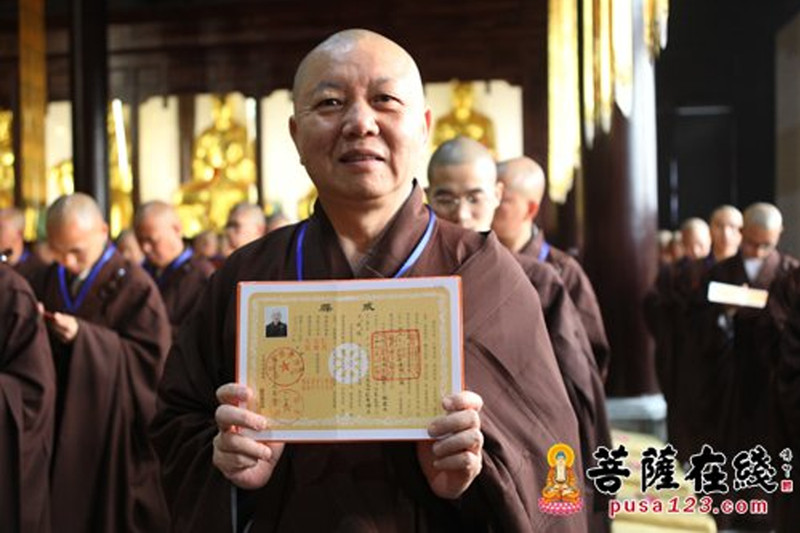
The term Pilgrim refers to a “postulant”, a lay Buddhist acolyte who has yet to be ordained but lives as an untonsured monk, one expected to follow the Five Precepts (Pali: Pañcasīla; Ch: Wujie, 五戒) against killing, lying, stealing, sexual misconduct, and drinking alcohol (Robert & David, 2013, pp. 1011-1012). Ch’en (1956) writes that such trainees were historically required to complete a long period of intense religious study and pass a rigorous examination before being awarded the aforementioned ordination certificate (fig. 8), thereby becoming a full-fledged monk. This certification system was originally initiated during the Tang to weed out those wanting to evade the draft and taxes, as well as bandits like Wu Song who sought refuge from the law. However, during the Song, the government sold these documents like war bonds in order to help pay for their ongoing struggle against the barbarians of northern China. Therefore, ordination certificates were often exuberantly expensive, [6] meaning those who had the training but could not afford the document were doomed to live as a postulant. This contrasts with the thousands upon thousands of people who bought their way into the Buddha’s fold simply for the draft and tax exemption. They forwent the training altogether and were monks only on paper. This continued practice naturally resulted in a major decline in the quality of monks during the Song.
Fig. 8 – A present day monk showing his ordination certificate (jiedie, 戒牒) (larger version). Original image found here.
Having read the above, we can say Sun Wukong is called Pilgrim because he assists a Buddhist priest but lacks the religious education and ordination certificate. While Wu Song has the document (taken from a dead priest), he lacks the required education. It should be remembered that Wu is a bandit-turned-monk. At the same time, both characters typify the “itinerant monk”, the second meaning of Pilgrim (xingzhe, 行者), as both are on a journey: Sun is traveling to India and Wu is traveling the road—albeit secretly to meet with fellow outlaws. But I would like to suggest that the titles may have also been meant as a jab at the violent, untrained riffraff passing for monks during the Song (more on this below). After all, the earliest references to our characters with these titles come from this period.
“Pilgrim Wu” appears in scholar-painterGong Shengyu‘s (龔聖予, 1222–1307) In Praise of the Thirty-Six [men] of Song Jiang (Song Jiang sanshiliu zan, 宋江三十六贊), a collection of poems eulogizing each of the thirty-six bandits then associated with the early WM story cycle.
Pilgrim Wu Song: You resisted women, obeyed the Five Precepts, among Wine, Women, Wealth and Force, you were inclined to kill people (Børdahl, 2013, p. 29).
Gong claims the poems were based on “stories of the streets and tales of the lanes” (jie tan xiang yu, 街談巷語), popular narratives performed by storytellers at local venues. Given that such early tales no longer exist, its impossible to say whether or not Wu Song was always a monk or a bandit-turned-impostor monk like his counterpart from the published edition of the WM (Børdahl, 2013, pp. 28-29). Either way, this suggests Wu’s predilection for killing was a prominent aspect of his story cycle by at least the 13-century.
Sun Wukong first appears as the “Monkey Pilgrim” (Hou xingzhe, 猴行者) in The Story of How Tripitaka of the Great Tang Procures the Scriptures (Da Tang Sanzang qujing shihua, 大唐三藏取經詩話), a seventeen chapter storytelling prompt dated to the late 13th-century. Like Wu Song, Monkey is also depicted as comfortable with killing.For example, in chapter five, he turns an evil sorcerer’s wife into grass so that she will be eaten by a young monk who had been transformed by her husband into a donkey. After both parties are changed back to normal, Monkey threatens to “mow down all the grass of [his] house” (i.e. kill his wife and anyone else he loves) if the man ever misuses his magic again. [7] Later in chapter six, Monkey brutally tortures and then kills a white tiger demon who tries to eat his master (Wivell, 1994, pp. 1181-1207)
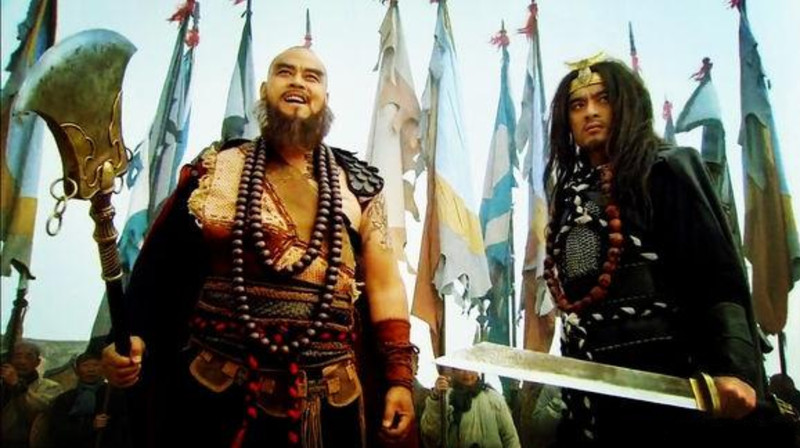
Fig. 9 – The “Pilgrim” Wu Song (right) and the “Flower Monk” Lu Zhishen (left) from a recent WM television series (larger version).
Additionally, two early WM-related tales titled “Pilgrim Wu” (Wu xingzhe, 武行者) and the “Flower [Tattooed] Monk” (Hua heshang, 花和尚) are listed under the “staff” (ganbang, 桿棒) category of popular stories in The Drunken Man’s Talk (Zuiweng tanlu, 醉翁談錄), a circa 13th-century collection of short stories, anecdotes, and poetry. [8] So-called staff tales were character-driven narratives about heroes, in this case Wu Song and his fellow outlaw-turned-monkLu Zhishen (fig. 9), righting injustices using staves. [9] I should note that The Story describes the Monkey Pilgrim wielding two such weapons in his adventures.
Sun and Wu’s association with killing and staff fighting were likely influenced by historical warrior monks and bandit monks. Shahar (2008) explains warrior monks were seasoned fighters who lived in subsidiary shrines away from the devout community and protected monasteries in times of trouble. These “monks” regularly drank wine and ate meat, associating the latter with physical strength and fighting ability, and even worshiped wrathful deities like Vajrapani, who is described in scripture as killing in the name of Buddha. Their weapon of choice was a wooden staff, which was originally chosen for being non-lethal. However, a metal staff like the one wielded by Sun Wukong in JTTW was sometimes used by warrior monks for its killing capacity in times of war. The most famous monastic staff method belongs to the Shaolin Monastery (Shaolin si, 少林寺) (video 1). After the Shaolin warrior monks helped the Ming dynasty government repelJapanese pirate incursions from the Chinese coast during the 1550s, their staff method was touted in military encyclopedias and civilian weapons manuals. [10]
Video 1 – A demonstration of Shaolin Wind Devil Staff (Fengmo gun, 風魔棍).
Bandit monks are outlaws like Wu Song who dressed as monks to avoid problems with the law. [11] Lorge (2012) comments that the characteristics of bandit monks were nearly indistinguishable from that of warrior monks.
[I]t is easy to see how bandit-monks are virtually the same as warrior-monks. These men drank wine, at meat, and had sex with women—practices alien to true Buddhist monks. A number of Buddhist authorities were deeply troubled by the presence of monks who directly violated Buddhist precepts. We do not know whether there was a sharp break between ordained and trained monks who carefully followed monastic rules in their search for enlightenment and men who simply claimed to be monks, wore monastic robes, shaved their heads, but otherwise did not follow monastic rules (p. 174).
He goes on to explain that the Shaolin monastery, for example, became heavily militarized after a nasty defeat in 1356 during the Red Turban Rebellion and so may have replenished its ranks using formerly deactivated soldiers at the turn of the Ming dynasty. Such violence-prone men would naturally turn towards a life of crime. Therefore, these bandits “would have been easy enough to recruit and send out as warrior-monks to fight against [other] bandits” (Lorge, 2012, p. 175).
So we see there existed a class of staff-bearing pseudo-monks who regularly took life and drank alcohol. Serving as mainly monastic bodyguards, these fighters lacked the devotion to the precepts and, especially, the religious education to be considered real monks. Therefore, Sun and Wu’s characterization as such warriors may further explain why they are called Pilgrim.
IV. Monastic martial artists
I want to preface this section by stating upfront that it overlaps to some degree with the previous one. But while the former explored Sun and Wu’s connection to staff-wielding warrior monks by way of their characterization in late Song oral literature, this one will discuss the connection between their images as monastic martial artists and the historical practice of boxing by warrior monks.
While the Great Sage is primarily known for his skill with the staff, he displays a mastery of unarmed combat twice in JTTW. Chapter 51, for example, describes Sun and a demonic opponent fighting with a long list of punches, kicks, grapples, and throws.
Hitching up his clothes and walking forward, the fiend assumed a boxing posture; his two fists upraised looked truly like two iron sledge hammers. Our Great Sage also loosened his legs at once and moved his body to attack; right before the cave entrance, he began to box with the demon king. This was quite a fight! Aha!
Opening wide the “Four Levels Posture”; The double-kicking feet fly up. They pound the ribs and chests; They stab at galls and hearts. “The Immortal pointing the Way”; “Lao Zi Riding the Crane”; “A Hungry Tiger Pouncing on the Prey” is most hurtful; “A Dragon Playing with Water” is quite vicious. The demon king uses a “Serpent Turning Around”; The Great Sage employs a “Deer Letting Loose its Horns.” The dragon plunges to Earth with heels upturned; The wrist twists around to seize Heaven’s bag. A green lion’s open-mouthed lunge; A carp’s snapped-back flip. Sprinkling flowers over the head; Tying a rope around the waist; A fan moving with the wind; The rain driving down the flowers. The monster-spirit then uses the “Guanyin Palm,” And pilgrim counters with the “Arhat Feet.” The “Long-Range Fist,” stretching, is more slack, of course. How could it compare with the “Close-Range Fist’s” sharp jabs? The two of them fought for many rounds— None was the stronger, for they are evenly matched (Wu & Yu, 2012, vol. 3, pp. 12-13)
I show in this article that many of the named techniques are real and are still practiced to this day. Furthermore, the poem’s bias for close-range fighting over long-range “is typical of late Ming and early Qing military literature”, as noted by Shahar (2008, p. 117). He continues, “Sixteenth- and seventeenth-century military experts allude to various short-range styles including ‘Cotton Zhang’s Close-Range Fist’ (Mian Zhang duanda [綿張短打]), ‘Ren Family Close-Range Fist’ (Renjia duanda [任家短打]), and ‘Liu [Family] Close-Range Fist’ (Liu duanda [劉短打])” (Shahar, 2008, p. 117). This shows the author-compiler of JTTW consulted real martial arts material to make this fight more authentic.
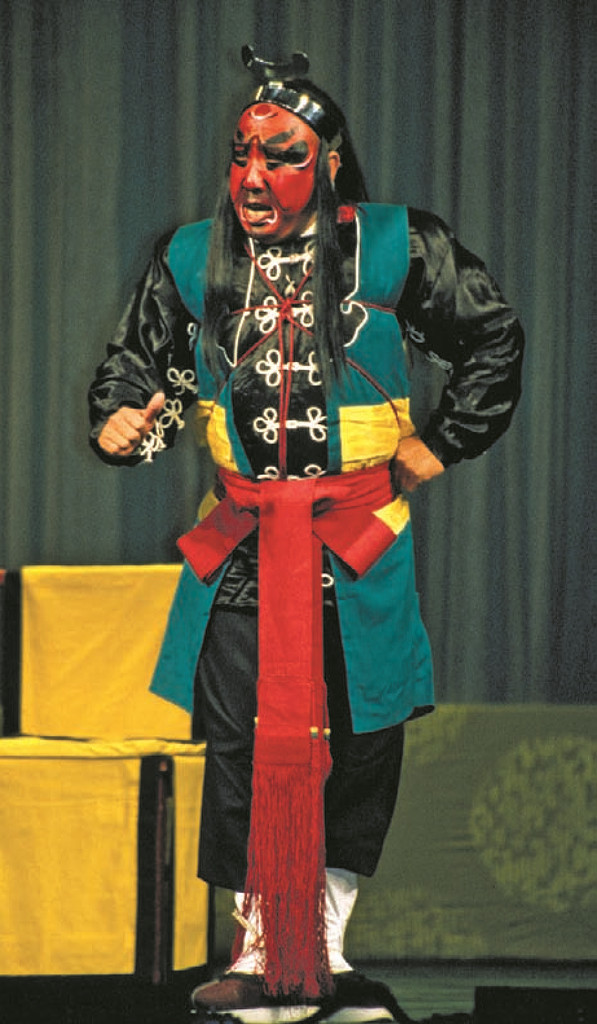
Having donned the monk persona, Pilgrim Wu stops by an inn while on a journey to meet with fellow outlaws in chapter 32. The monk’s great tolerance for wine (fig. 13) and request for meat surprises the inn keeper, whom Wu slaps to the ground upon seeing the man serve better wine and even chicken to a different patron. The patron and his friends attack the monk but are soundly beaten by his superior strength and fighting ability. [12]
Wu’s characterization as a meat-eating, alcohol-drinking monk with a thirst for combat is obviously tied to the warrior and bandit monks discussed earlier.
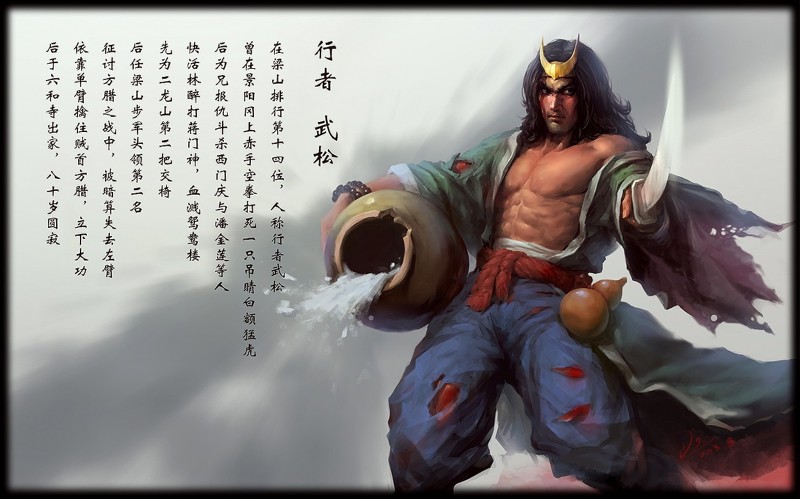
Fig. 15 – A modern depiction of Pilgrim Wu holding a jar of wine and brandishing a saber (larger version). By Leewiart user Du_YH. Original image found here.
While it precedes Wu becoming a monk, the best example of his martial prowess appears in chapter 29:
But Jiang was scornful of his foe [Wu Song], thinking that he was drunk, and he closed in rapidly. Quicker than it takes to tell, Wu Song flourished his two fists at Jiang’s face, then turned and started away. Enraged, Jiang raced after him. Wu Song lashed out backwards with his left foot and kicked him in the groin. As Jiang clasped his injured section and doubled over in pain, Wu Song whirled around and swung his right foot in a flying kick to the forehead that slammed the big man over on his back. Wu Song planted one foot on his chest and, with keg-like fists, began pommeling Jiang’s head.
This maneuver we just described—the flourish of fists and turning away, the backward left kick, the whirling around and the forward right kick—is called “the Jade-Circle Steps with Duck and Drake Feet” [Yuhuan bu, yuanyang jiao, 玉環步, 鴛鴦腳]. It was one of Wu Song’s most skillful moves. A remarkable trick! (Shi, Luo, & Shapiro, 2015, p. 332).
Wu’s style is possibly another name for “Piercing Foot” (Chuojiao, 戳腳), a northern Chinese martial art known for its dynamic kicking skills. Modern folklore traces the style to the Song dynasty due to its association with WM heroes. [13]
While JTTW never openly describes Sun Wukong training in martial arts, it does imply that he learns armed and unarmed combat as a young monk studying under the Buddho-Daoist Sage Subodhi. Monkey learning boxing in a religious institution is actually a faithful depiction of one aspect of monastic life during the Ming. Shahar (2008) shows Shaolin warrior monks took up unarmed combat during the late Ming-period, when boxing saw an explosion in popularity in Chinese culture (as demonstrated by the named techniques recorded in JTTW and the WM). Textual evidence suggests the first styles practiced by Shaolin were Drunken Eight Immortals Boxing (Zui baxian quan, 醉八仙拳), popularized by Jackie Chan in The Drunken Master (1978), and Lost Track Boxing (Mizong quan, 迷蹤拳), the fighting style of the national hero Huo Yuanjia popularized by Bruce Lee in Fist of Fury (1972). The monks may have adopted boxing as a form of calisthenic exercise. To this they later added Daoyin (導引), a regimen of yoga-like Daoist breathing and stretching exercises designed to absorb qi (氣) energy and circulate it throughout the body. Therefore, the monks elevated their boxing practice from mere fighting to a form of spiritual cultivation. This synthesis of martial and spiritual practices simultaneously took place in wider Ming culture, leading to the creation of so-called “internal” (Neijia, 内家) martial arts like Taiji and Xingyi boxing. [14]
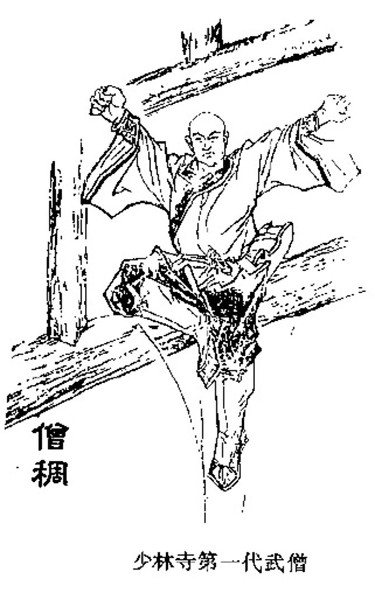
Fig. 10 – A modern drawing of the monk Sengchou showing off his newfound powers by jumping above the rafters of the Shaolin monastery (larger version). Original image found here.
That’s not to say Shaolin monks did not practice unarmed martial arts prior to the 17th-century. It’s just boxing was only a form of entertainment practiced by a few and not part of the official training regimen. For example, the Tang-era anthology Complete Records from Court and Commonality (Chaoye qian zai, 朝野僉載, c. 8th-century), contains the story of the famed dhyana master and Shaolin monk Sengchou (僧稠, 480–560) beseeching a religious statue of Vajrapani to bless him with martial strength so that the other monks, who enjoy sparring in their free time, will stop bullying him. After six straight days of prayer, the deity appears before him and offers the young novice a bowl of sinews to eat. Sengchou initially refuses due to the prohibition against eating meat, but he ultimately finishes the meal for fear Vajrapani will smite him with his vajra club. Like the radioactive spider bite that changes Peter Parker into Spider-Man, the sinews transform the monk, blessing him with a god-like physique and miraculous powers, such as the ability to walk on walls, leap great heights (fig. 10), and lift thousands of pounds. Most importantly, it drastically improves his fighting skills, so much so, in fact, that his former tormentors come to grovel in his presence (Shahar, 2008, pp. 35-37).
From whom might have Sengchou’s religious brothers learned their unarmed martial arts centuries prior to it becoming an official part of Shaolin’s training regimen? The simplest answer is someone like Wu Song who learned boxing as a bandit or soldier and later joined the sangha. Readers may recall such violence-prone men may have been tapped as warrior monks to protect the monastery in times of trouble. They could have easily passed their fighting skills to the next generation of warrior monks.
A good example of a soldier-turned-monk is the brutish former general Huiming (惠明) from the Platform Sutra (Liuzu tanjing, 六祖壇經, written from the 8th to 13th-c.). The text tells how the disciples of Hongren (弘忍, 601–674), the fifth Chan patriarch, were enraged when their master passed the mantle onto the illiterate postulant laborer Huineng (惠能, 638–713). Hundreds of monks are said to have pursued the fleeing Pilgrim south intent on forcefully taking the patriarchal symbols of the begging bowl and robe for themselves. Huiming persevered and managed to corner Huineng on a mountain. He attempted to wrestle the treasures away, but, by a miracle, he could not lift them. Realizing Huineng was the rightful heir, the monk became his disciple (Huineng & Cleary, 1998, pp. 11-12). Jealousy and anger are obviously qualities unbecoming of a real monk. In fact, the only thing that separates Huiming’s actions of hounding and attempted strong arm robbery from a bandit is his monkhood.
So we see Sun Wukong typifies a next generation warrior monk who learns boxing inside a religious institution. Wu Song typifies the soldier or bandit who learns boxing outside the monastery and later becomes a monastic fighter, one who passes on their skills to younger monks.
V. Moralistic headbands
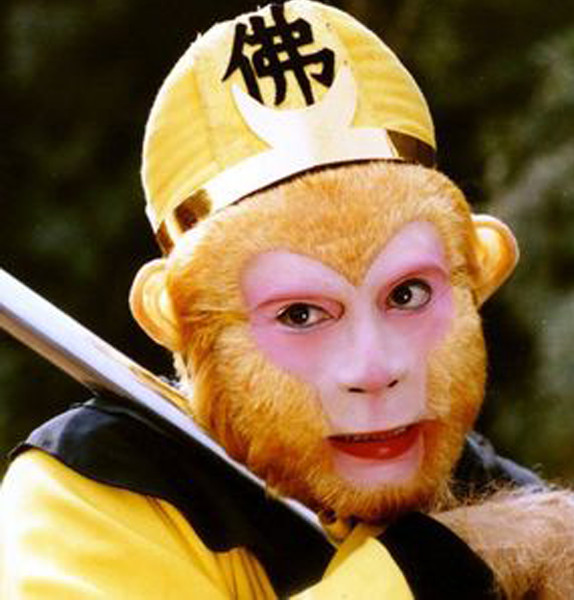
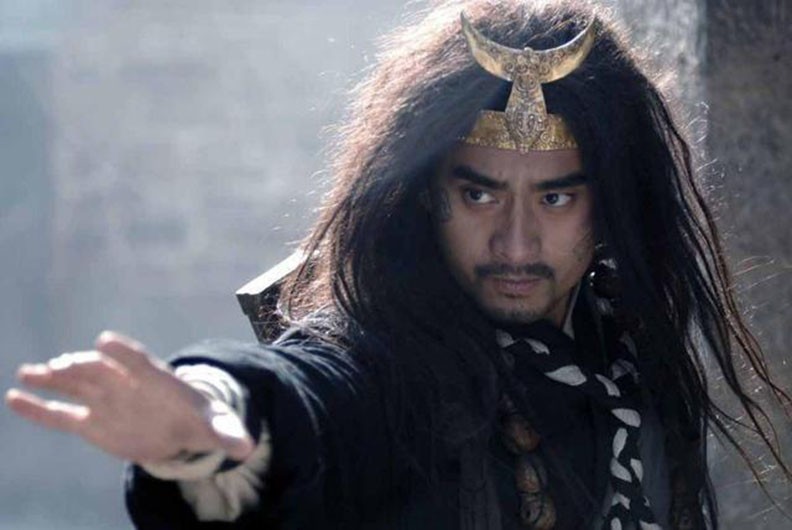
JTTW, ch. 14 – The Monkey King is tricked into wearing a brocade hat under the pretense of gaining the ability to recite scripture without rote memorization. However, the hat houses a golden fillet (jinguquan, 金箍圈) that soon takes root and painfully tightens around the immortal’s head when the correct spell is chanted (fig. 11). This allows the feeble monk Tripitaka to control the celestial monkey’s unruly nature.
WM, ch. 31 – When Wu Song disguises himself as a monk, he wears the garments of a priest who had previously been killed by bandits. The habit includes a metal “Precepts fillet” (jiegu, 戒箍) that he wears over his long hair (fig. 12).
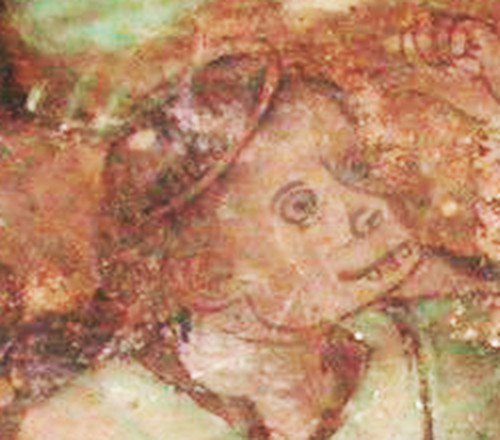
Fig. 11 – (Top left) Sun Wukong’s golden fillet from the 1986 JTTW television series (larger version). Fig. 12 – (Top right) Wu Song’s Precepts fillet from a recent WM television series (larger version). Fig. 13 – (Bottom left) A late 11th to early 12th-century copper alloy statue of the wrathful deity Hevajra (larger version). He is portrayed with the same Esoteric Buddhist ritual attire as his followers, including the headband, arm cuffs, a bone (skull) rosary, bracelets, a girdle, anklets, and a tiger skin sarong. Courtesy of the Los Angeles County Museum of Art. Fig. 14 – (Bottom center) A detail of the Monkey Pilgrim’s fillet featured in an 11th-century mural from Eastern Thousand Buddha Cave number two in Gansu Province, China (larger version). It has been slightly enhanced for clarity. A fuller version of the image can be seen here. Fig. 15 – (Bottom right) A military monk from a modern Beijing Opera production (larger version). From Bonds, 2008, p. 178.
I explain in this article that the heroes’ fillets share a common origin in an ancient Indo-Tibetan Esoteric Buddhist ritual headband, one representing the Buddha Akshobhya and thereby moral self-restraint. It was one of several ritual items worn while worshiping wrathful protector deities like Heruka. Such deities were often depicted wearing the same attire as their followers, leading to the band becoming a symbol of powerful Buddhist spirits (fig. 13). The Hevajra Tantra (Ch: Dabei kongzhi jingang dajiao wang yigui jing, 大悲空智金剛大教王儀軌經), the original 8th-century Indian Buddhist text mentioning the ritual items, was translated into Tibetan and Chinese during the 11th-century. Interestingly, the earliest example of Monkey wearing the circlet (likely symbolizing the taming of the monkey of the mind) hails from this time (fig. 14). But Wu’s association with the headband was likely influenced by the Precepts fillet worn by the warrior monks of Chinese Opera(fig. 15). These heroes wear the band to show that they have taken a vow of abstinence (Bonds, 2008, pp. 177-178 and 328).
VI. Bin steel weapons
JTTW, ch. 3 – Sun Wukong comes into possession of a magic staff (fig. 16) taken from the Dragon King’s underwater treasury. A poem in chapter 75 describes the weapon being hand-forged from Bin steel (bintie, 鑌鐵) by the high Daoist god Laozi.
WM, ch. 31 – Apart from wearing the fallen monk’s religious clothing, Wu Song also takes possession of his Buddhist sabers made from “snowflake pattern” Bin steel (huaxue bintie jiedao, 雪花鑌鐵戒刀) (fig. 17). [15]
Fig. 16 – A modern action figure of Sun Wukong holding his magic Bin steel staff (larger version). Fig. 17 – A modern painting of Wu Song wielding his Bin steel sabers (larger version). Artist unknown.
Sun’s staff and Wu’s sabers are not the first bin steel weapons to appear in Chinese literature. A bladed pole arm example is the Bin steel great sword(bintie da podao, 鑌鐵大潑刀) wielded by a bandit from the Old incidents in Xuanhe period of the Great Song Dynasty (Da Song Xuanhe Yishi, 大宋宣和遺事, mid-13th-century), a storytelling prompt containing WM material predating the published novel. [16] Another pole arm is the Bin steel spear (bintie qiang, 鑌鐵槍) wielded by a general from The Three Sui Quash the Demons’ Revolt (San sui pingyao zhuan, 三遂平妖傳, c. late 16th-century), which also takes place in the Song-era (Luo, n.d.).
I explain in this article that Bin steel is a real world metal akin to Damascus that was imported to China from Persia starting from the 6th-century, and the secret of its manufacture eventually reached the Middle Kingdom by the 12th-century. The metal was considered an exceptionally fine steel and was often used to make strong, durable, and sharp knives and swords, some worth more than silver. One general is described as boasting that rebels would “have to nick (chi, 齒) his sword of bin iron” if they wished to rise up (Wagner, 2008, p. 269). This is a simultaneous declaration of his unbreakable resolve and a statement praising the seemingly indestructible metal. Therefore, JTTW and the WM portray the finest of heroes wielding the finest of steel weapons.
VII. Conclusion
As shown, the parallels between Sun Wukong and Wu Song are the result of JTTW and the WM borrowing from the same cultural source material. Monkey’s imprisonment under Five Elements mountain and Wu’s time as an evil spirit trapped in a well beneath stone was influenced by the Daoist belief that mountains—be they sympathetically represented by stone or hand mudras—could immobilize malevolent forces. Likewise, our heroes’ portrayal as reformed demons can be tied to the Daoist “Thunder Ritual”, which aims to conquer evil and repurpose its power for good. Sun and Wu’s image as tiger-slayers was influenced by stories of tiger-killing strongmen from Chinese folklore. Their religious nickname “Pilgrim” and characterization as monastic martial artists can be tied to uneducated pseudo-monks and holy warriors skilled in both staff fighting and boxing from Chinese history. Their religious fillets were inspired by an Esoteric Buddhist ritual headband worn as a reminder of moral self-restraint. And the metal comprising Sun and Wu’s weapons can be traced to a real world steel prized in ancient China for its durability.
This was a fun piece to write because it shows the Great Sage obviously didn’t develop in a vacuum. It’s interesting to me that much of Sun and Wu’s influences hail from the Song dynasty. These include the Daoist rituals for trapping and reforming spirits, the Pilgrim nickname and characterization as staff-wielding warrior monks, and the translation of the tantric text mentioning the moralistic headband and Monkey’s earliest known depiction wearing it.
Update: 10-04-20
I have written a follow up article explaining the parallels between Monkey and the historical Buddha.
I’ve written an article that shows the weight of Sun Wukong’s magic staff (一萬三千五百斤) is an embellishment on the weight of a stone block (三五百斤) lifted by Wu Song in ch. 27 of the WM.
I’m thinking about writing a piece on characters from world myth trapped under mountains. Here’s the list I have so far:
Sun Wukong (various Journey to the West iterations) – Mt. Huaguo by Guanyin or Five Elements Mountain by the Buddha
108 stars (Water Margin) – Imprisoned in an earth prison under a stone slab by a Daoist master. As mentioned above, Jing Wang (1992) suggests the stone slab was likely influenced by the Taishan stone (泰山石).
The parameters may later be expanded to include “earth prisons” in general, which would open the door to Lucifer.
Update: 03-11-22
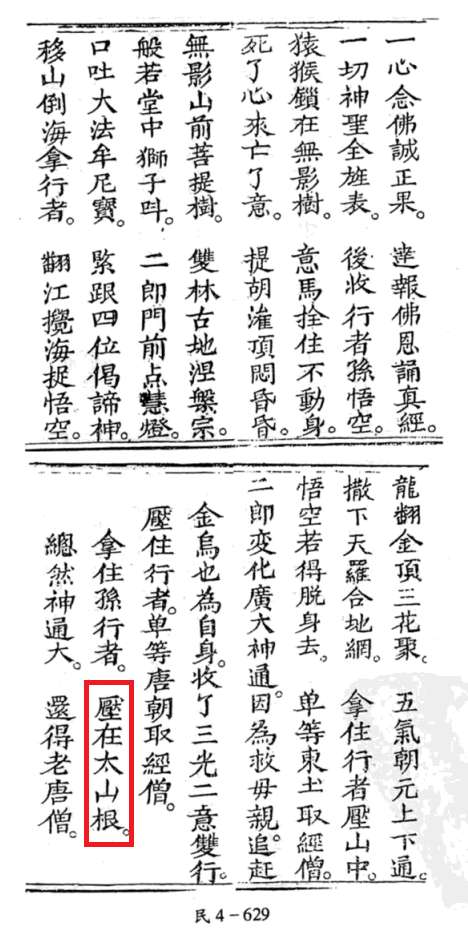
I recently archived the Precious Scroll of Erlang (Erlang baojuan, 二郎寳卷, 1562), a baojuan that venerates and records the various deeds of the immortal demi-god. This work states that the Monkey King was “pressed under the base of Mt. Tai” (yazai, taishan gen, 壓在太山根) (PDF page 46) (fig. 18). This supports my suggestion above that Five Elements Mountain is a cognate for Mt. Tai.
Fig. 18 – The Mt. Tai sentence is indicated in red (larger version).
Update: 06-18-22
I’ve written an article that lists a number of surprising parallels shared by Monkey and the Greco-Roman hero Heracles (see section 2).
1) The nine palaces are a cosmic geographical concept in which stars are mapped according to the five Chinese cardinal directions(N, S, E, W, and center) and the four intermediate directions. Thus, they represent the universe as a whole.
2) A zhang (丈) is ten Chinese feet, so 10,000 zhang would be 100,000 feet. A li (里) is one-third of a Western mile. More importantly, in Chinese culture, the number 10,000 represents an infinitely large concept. Therefore, by squaring the number, the well prison is described as an unfathomably large and inescapable place. I would like to thank the Dragon Ball scholar Derek Padula (his website) for suggesting this note as it helps better visualize the prison. He was kind enough to read an earlier draft of this article.
3) See Meulenbeld, 2007, pp. 143-145 for more information about the jar ritual. It likely influenced media that influenced Akira Toriyama of Dragon Ball fame to create the Mafuba (魔封波; Ch: mofengbo), or “Demon Containment Wave” ritual. Padula (2016) describes the etymology and background of the Mafuba (pp. 122 to 126). He graciously provided me with a digital copy of his book.
4) See chapter two.
5) This is not openly stated in chapter 14 but is implied in chapter 27. See this article for more information.
6) Ch’en (1956) gives examples. During the Song, the official selling prices for the certificates ranged from one hundred thirty to eight hundred strings of cash. To put these prices in perspective, he notes the lowest cost would pay for the equivalent of seventy-five bolts of silk or one hundred twenty-five bushels of rice (pp. 316-317).
7) Wivell, 1994, p. 1187. The full episode appears on pages 1186-1187.
8) Ge, 2001, p. 38. The eight types of stories appearing in The Drunken Man’s Talk are: “lingguai [靈怪] (spirits and demons), yanfen [煙粉] (rouge and powder), chuanqi [傳奇] (marvels), gong’an [公案] (court cases), podao [朴刀] (broadsword), ganbang [桿棒] (staff), shenxian [神仙] (immortals), and yaoshu [妖術] (sorcery)” (Ge, 2001, p. 209, n. 6).
9) Huang, 2018, p. 61 and n. 8. It’s interesting to note that the monk Lu Zhishen is said to wield an impossibly heavy metal staff like Sun Wukong. See this article for more details.
10) See chapters three and four.
11) Lorge (2012) cites a Tang-era story about an 8th-century prince who discovers an abandoned wardrobe while hunting in the forest. It is found to contain a young woman who had been kidnapped the previous night by bandits but was subsequently whisked away by two monks among the group. The prince replaces her with a wild bear that later mauls the bandit monks to death when the wardrobe is reopened (pp. 106-107). The monks were likely impostors like Wu Song.
12) Wu Song is famed in Chinese folklore for his martial arts ability. This led to the creation of a wushu form known as “Wu Song Breaks Manacles” (Wu Song tuo kao, 武松脫拷), which mimics a person fighting with their hands clasped as if shackled, forcing them to rely on doubled fist and elbow strikes and lots of kicking. The form is based on an episode from chapter 30 of the WM when the hero is attacked by assassins while being led in shackles to a prison camp. Wu Song is forced to defend himself in such a manner before breaking his restraints.
13) See, for example, Chlumsky, 2005, p. 72. The author also repeats folklore further tying the style to the Song dynasty heroes Yue Fei and his teacher Zhou Tong.
14) See chapters five and six.
15) I think it’s interesting that each weapon is presented as having somelevel of sentience. Called the “As-you-wish” Gold-Banded Cudgel (Ruyi jingu bang, 如意金箍棒), Sun’s staff grows or shrinks according to his whim. Wu’s peerless blades are said to “often groan in the night” (Shi, Luo, & Shapiro, 2015, p. 350),suggesting a magic longing for combat. The sentience of each weapon is based on different sources, however. I note in this article that the compliance of Monkey’s weapon is based on the Ruyi (如意) scepter, a symbol of religious and secular authority that was at some point associated with the similarly named wish-fulfilling cintamanijewel (ruyi zhu, 如意珠) from Buddhist mythology. The vocal ability of Wu Song’s blades may be based on the Chinese belief that swords have a soul. Two prime examples are the famed treasure swords Longyuan (龍淵, a.k.a. Longquan, 龍泉) and Tai’e (泰阿/太阿) made by the legendary swordsmith Ou Yezi (歐冶子) during the Spring and Autumn period. Yuan poet Jia Penglai (賈蓬萊, c. mid-14th-ccentury) described them as mated lovers who pine for each other when separated and even leap from the scabbard to seek out their beloved (Lee & Wiles, 2015, pp. 161-163).
16) See Luo (n.d.). The original source says “po bintie dadao” (潑鑌鐵大刀). This is likely a transcription error. I have corrected it above.
Sources
Bonds, A. B. (2008). Beijing opera costumes: The visual communication of character and culture. Honolulu: University of Hawai’i Press.
Børdahl, V. (2013). Wu Song fights the tiger: The interaction of oral and written traditions in the Chinese novel, drama and storytelling. Copenhagen, Denmark: NIAS Press.
Ch’en, K. (1956). The sale of monk certificates during the Sung dynasty: A factor in the decline of Buddhism in China. The Harvard Theological Review 49(4), pp. 307-327.
Chen, P., & Petersen, V. (2016). The development of Chinese martial arts fiction. Cambridge, U.K.: Cambridge University Press.
Chlumsky, N. (2015). Inside kungfu: Chinese martial arts encyclopedia. [n.p.]: Lulu.com.
Meulenbeld, M. R. E. (2007). Civilized demons: Ming thunder gods from ritual to literature (Doctoral dissertation). Available from ProQuest Dissertations and Theses database (UMI No: 3247802).
Robert, E. B. J., & David, S. L. J. (2013). The Princeton Dictionary of Buddhism. Princeton University Press.
Shahar, M. (2008). The Shaolin monastery: History, religion, and the Chinese martial arts. Honolulu: University of Hawai’i Press.
Shi, N., Luo, G., & Shapiro, S. (2015). Outlaws of the marsh. California: CreateSpace Independent Publishing Platform.
Wagner, D. (2008). Science and civilisation in China: volume 5, chemistry and chemical technology, part 11, ferrous metallurgy. Cambridge: Cambridge Univ. Press.
Wang, J. (1992). The story of stone: Intertextuality, ancient Chinese stone lore, and the stone symbolism in Dream of the red chamber, Water margin, and the journey to the west. Durham, N.C: Duke University Press.
Wivell, C.S. (1994). The story of how the monk Tripitaka of the great country of T’ang brought back the sūtras. In V. Mair (Ed.). The Columbia anthology of traditional Chinese literature (pp 1181-1207). New York: Columbia University Press.
Wu, C., & Yu, A. C. (2012). The journey to the West: Vol. 1-4. Chicago, Illinois: University of Chicago Press.
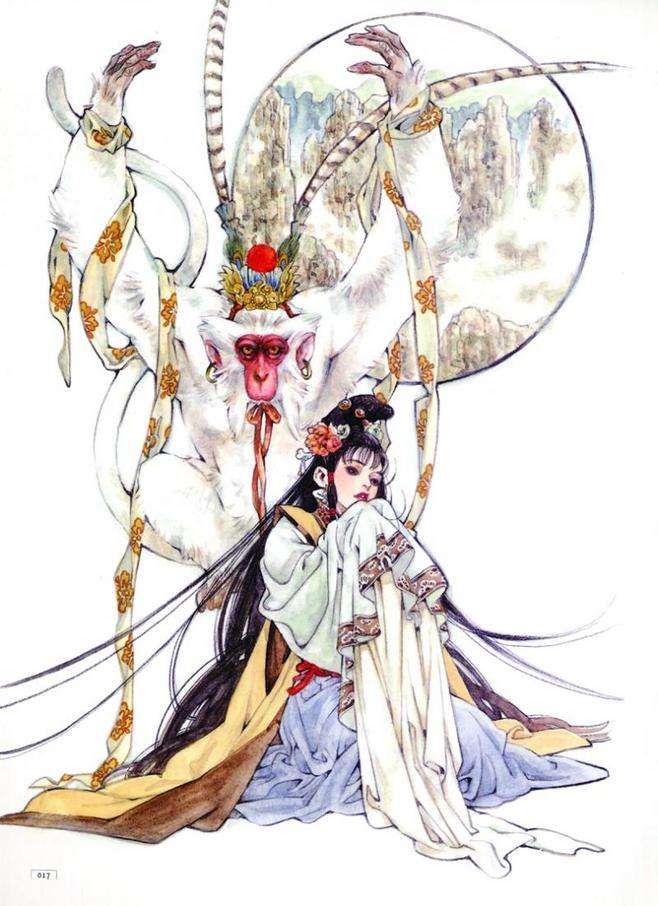
The brief Tang-era tale “A Supplement to Jiang Zong’s Biography of a White Ape” (Bu Jiang Zong Baiyuan Zhuan, 補江總白猿傳, c. late 7th-century) tells how the beautiful young wife of General Ouyang He (歐陽紇, 538–570) is kidnapped by a seemingly invisible force while he is engaged in conquering minority groups of the south lands. The general and his men scour the surrounding area for hundreds of miles before discovering a mountain where she and other women are being kept by a magic white ape (baiyuan, 白猿) (fig. 1). The captives caution that his soldiers are no match for the powerful primate, and so the ladies devise a plan to get him drunk and incapacitate him long enough for a killing blow to be dealt. With their help, the general manages to fall the beast with a well-placed sword strike below the navel, his only weak spot. Before dying, the ape reveals the general’s wife is pregnant and begs him not to kill the child. Ouyang subsequently returns to the north with his wife, the other women, and the monster’s priceless treasures. The tale ends with the birth of an unnamed son a year later.
Fig. 1 – A modern drawing of the white ape and General Ouyang He’s wife by Japanese artist Natsuki Sumeragi(皇名月) (larger version). Original image found here. The silken ropes around his wrists refer to those intertwined with hemp and triple-tied to ensure that he can’t break free in the story.
I. Historical background
Chen (1998) explains the original Biography of a White Ape story, purportedly supplemented by the above tale, [1] never existed. The Supplement is actually a standalone piece anonymously published to slander the historical scholar Ouyang Xun (歐陽詢, 557–641), who was known for his legendary monkey-like ugliness and almost supernatural intellect. The tale implies that he was the unnatural offspring of the general’s wife and the magic white ape (p. 76-79).
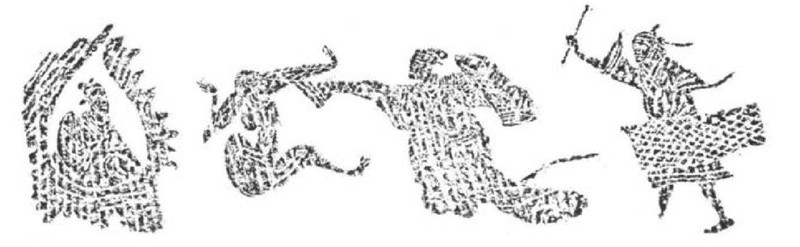
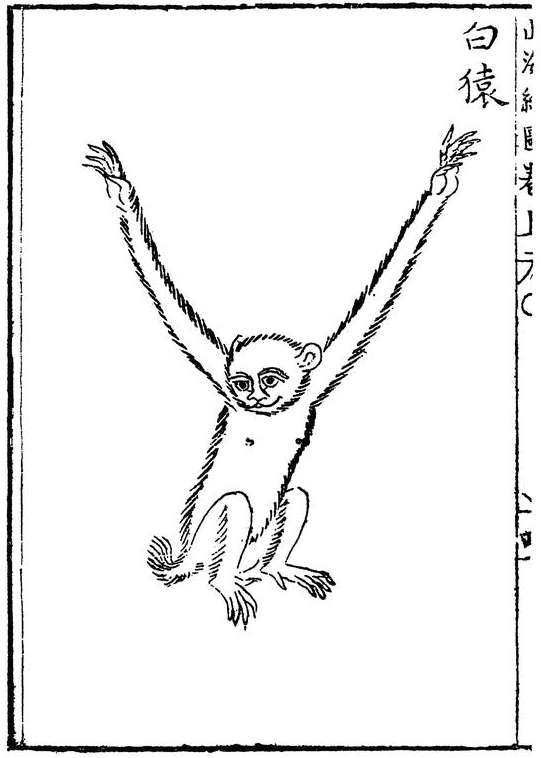
These mischievous simian spirits are known for kidnapping young maidens in tales from the Han to the Song (fig. 2). The mythical creature is based on the Gibbon (fig. 3), a small, long-armed, arboreal ape present in East and Southeast Asia(see Gulik, 1967).
Fig. 2 – A Han-era stone tomb rubbing showing a sword-wielding hero striking at a fleeing white ape (center). A woman can be seen held captive in a teardrop-shaped cave (left). The hero is followed by an assistant beating a gong (right) (larger version). From Wu, 1987, p. 88. Fig. 3 – A woodblock print of a “white ape” or Gibbon from a Ming version of the Shanhai Jing (larger version).
II. Parallels with Sun Wukong
The story’s unnamed primate antagonist shares many surprising similarities with Sun Wukong. Both:
Are supernatural primates possessed of human speech.
Are one thousand-year-old practitioners of longevity arts.
Are masters of Daoist magic with the ability to fly and change their appearance.
Are warriors capable of single-handedly defeating an army.
Have a fondness for armed martial arts.
Have an iron-hard, nigh-invulnerable body immune to most efforts to harm them.
Have eyes that flash like lightning.
Live in verdant mountain paradises (like Flower Fruit Mountain).
Reside in caves with stone furniture (like the Water Curtain Cave).
The character and his home appear to be an early model for the Monkey King, his abilities, and Flower Fruit Mountain.
III. Translation
Chen (1998) provides a complete translation of the brief tale, along with an informative translator’s introduction. The following PDF was put together from smartphone photos as I don’t currently have access to a scanner.
1) A supplement (bu, 補) is an addendum to an existing body of work, sort of like modern fan fiction. See, for example, A Supplement to the Journey to the West (1640).
Sources
Chen, J. (1998). A supplement to Jiang Zong’s biography of a white ape. Renditions, 49, pp. 76-85.
Chen, J. (2003/2004). Revisiting the yingshe mode of representation in “Supplement to Jiang Zong’s biography of a white ape”. Oriens Extremus, 44, pp. 155-178.
Wu, H. (1987). The earliest pictorial representations of ape tales: An interdisciplinary study of early Chinese narrative art and literature.T’oung Pao LXXIII, pp. 86-112.