The Worship of Sun Wukong in 19th-century America

Last updated: 01-15-2022

I by chance happened upon an old magazine article that mentions the worship of Sun Wukong in San Francisco’s Chinatown in 1892. The piece is written by one Frederic J. Masters, D.D., a Methodist pastor who wrote extensively about the area’s Chinese community. Not surprisingly, the article is dripping with condescension towards Chinese religion, condemning the Great Sage’s worship as “the acme of absurdity and sinfulness” (Masters, 1892, p. 737). Below is the section discussing the Monkey King.

In the Spofford-alley temple are found the shrines of some twenty other gods and goddesses, the principal being the Grand Duke of Peace, the God of Medicine, and Pan Kung, a celebrated Prime Minister of the Sung Dynasty. The funniest discovery in this temple was that of Tsai Tin Tai Shing [Qitian dasheng, 齊天大聖]. He is a beatified monkey in the image of a man. Hatched from a bowlder [sic], this animal is said to have proclaimed himself king of the monkeys. At last he learned the language of men, and finding himself possessed of supernatural powers, he obtained a place among the gods. Such is the legend. Chinese idolatry thus reaches the acme of absurdity and sinfulness in the canonization of a monkey. Thoughts of Darwin’s descent of man at once flashed across our mind as we looked at this image. It was disappointing at one’s curiosity to find that the old temple keeper who cared more for a pipe of opium than for speculations in theology and anthropology could not tell us what part natural selection played in the evolution of Chinese deities, or whether monkey worship was the newest phase of Chinese ancestral worship. Finding him lamentably ignorant upon the great question of the descent of man, we astonished with him with a complete history of his monkey god.

There was an ape in the days that were earlier;
Centuries passed and his hair became curlier;
Centuries more and his tail disappeared,
Then he was man and a god to be feared (Masters, 1892, pp. 736-737).

So what can we learn from this brief entry? Given the time, place, and use of Cantonese, the worshipers were most likely immigrants from Guangdong province. Refo Mason (1994) explains, “When news of the discovery of gold in California reached South China in 1849, thousands of labourers in Guangdong and Fujian provinces left their villages to seek work in the gum shan ([金山] ‘Gold Mountain’) … Emigration from South China to California…peaked in 1852, when 20,000 Chinese arrived in San Francisco” (p. 200). Monkey‘s adherents may have counted among these men or their descendants (or possibly among those from later periods of immigration). Either way, belief in the Great Sage came with those who traveled from southern China to America.

Monkey King Bust - American Gods - Instagram 1 - small

Fig. 1 – A photomanipulation of Sun Wukong above the title logo from the ongoing American Gods television show (larger version). By the author. The program is based on the 2001 novel of the same name.

Somebody please get Neil Gaimon on the phone and tell him that he can now include Monkey in American Gods (fig. 1). What do you think the character would look like? Maybe a short old man with a cane?

Spofford Alley, home to 19th-century temple with Monkey King shrine - small

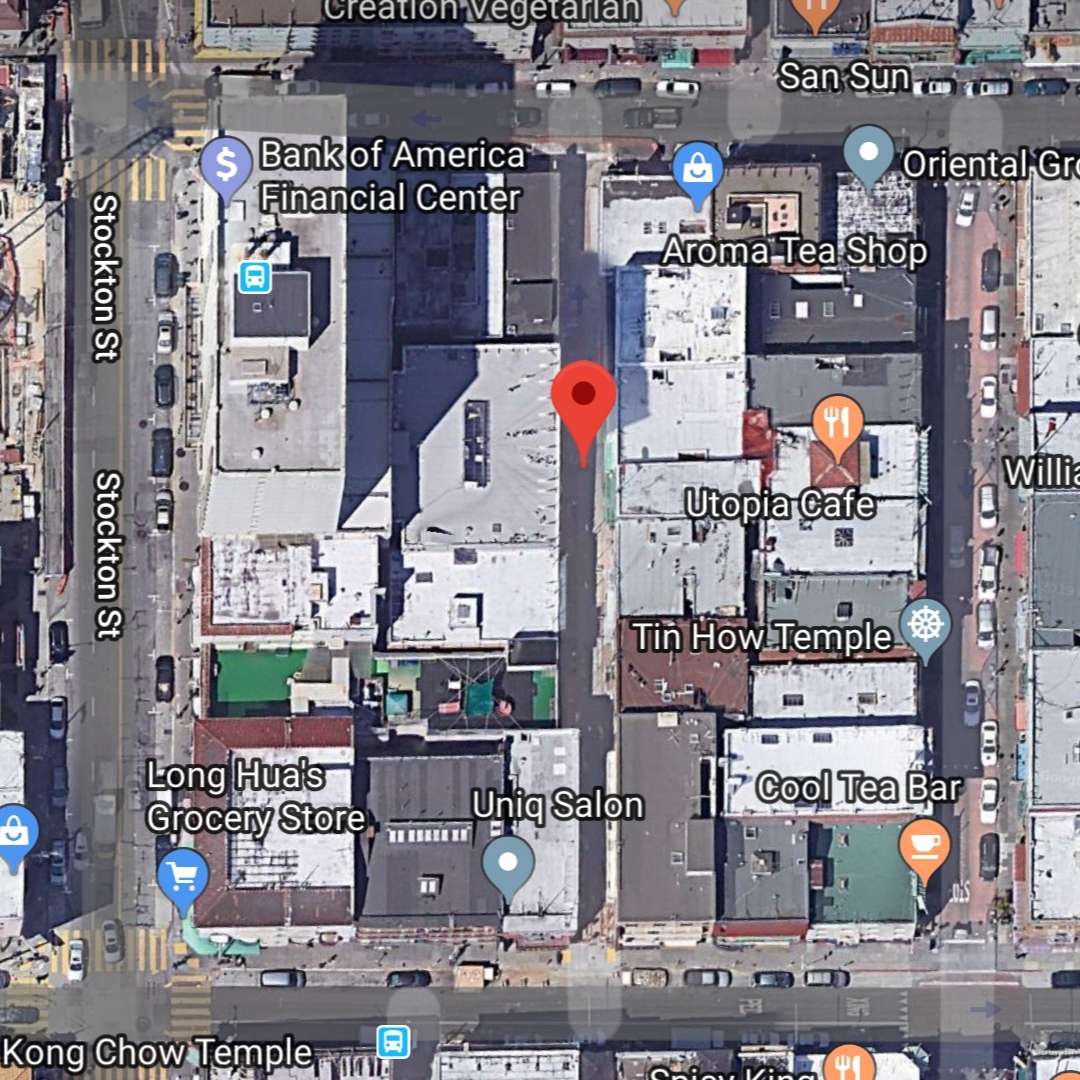
Fig 2 – A modern Google satellite image of Spofford Alley (larger version). It is only a few hundred feet long.

During the 19th-century, Spofford Alley (fig. 2), where the temple housing the Great Sage shrine was located, was home to the Chee Kong Tong (Zhigong tang, 致公堂, “Chamber of High Justice Society,” a.k.a. the “Chinese Freemasons”), the secret Chinese society-turned-criminal organization running Chinatown’s illicit opium, gambling, and prostitution trade (Risse, 2012, p. 37). The Chee Kong Tong were originally an offshoot of anti-Manchu rebels who wanted to overthrow the foreign-ruled Qing dynasty (Cassel, 2002, pp. 218-219). [1] Therefore, Sun Wukong’s worshipers may have included gangsters and rebels. As mentioned in this article, the Great Sage was venerated by fighters of the Boxer Rebellion (1899-1901). This makes sense as the divine primate is famous for his rebellion against heaven in Journey to the West.


Update: 01-15-2022

I was very happy to recently find an article called “Map of Temples in San Francisco’s Chinatown 1850s-1906” (Romaskiewicz, 2021). The author, a PhD student named Peter Romaskiewicz, has done a great service by scouring 19th and 20-century material and cross-referencing this with antique maps of Chinatown. The article has a list of over 20 temples/immigrant associations and their corresponding locations plotted on a map. This is great because it has allowed me to pinpoint the exact place where the Monkey King was worshiped in 1892 Chinatown!

Masters (1892) refers twice to temples on Spofford: 1) “[Guanyin’s] shrine is found up a dingy staircase on the southwest corner of Spofford alley and Washington streets” (p. 734); and 2) “In the Spofford-alley temple are found the shrines of some twenty other gods and goddesses…” (p. 736). Romaskiewicz (2021) shows the Guanyin temple (#10) was located at the end of Spofford, while a different joss house belonging to the Chee Kong Tong (#9) was located in the middle of the street. I therefore assumed Monkey was worshiped at the Chee Kong Tong joss house because Masters’ (1892) second temple reference didn’t mention Guanyin. However, after writing Romaskiewicz, I learned that there were actually three joss houses on Spofford during the 19th-century (one from an 1887 map is not listed). But most importantly, Masters (1982) was likely referring to the Guanyin Temple in both instances. That’s why he highlights “the shrines of some twenty other gods and goddesses…” (emphasis added) (Masters, 1892, p. 736), meaning these icons were also found in the same location.

The Guanyin Temple (Guanyin miao, 觀音廟) was located at No. 60 on the corner of Spofford and Washington (fig. 3) (Romaskiewicz, 2021). I’m unsure if it still exists in some form in that location. But I do know from Google Maps that the old No. 60 is not the same as the current No. 60.

Romaskiewicz was kind enough to direct me to an 1883 brochure asking for funds to restore the temple. This shows it was in use for some time.

Fig. 3 – The yellow star marks the location of the Guanyin Temple (larger version). Based on Romaskiewicz (2021). See this 1885 map

Notes:

1) Sun Yatsen, the “Father of modern China,” made contact with the Chee Kong Tong several times and even used their no. 36 Spofford Alley office as his own while raising money for his revolution in China (United States, 1993, pp. 45-46; Lum & Lum, 1999, p. 57).

Source:

Cassel, S. L. (2002). The Chinese in America: A history from Gold Mountain to the new millennium. Walnut Creek, CA: AltaMira Press.

Lum, Y. M., & Lum, R. M. K. (1999). Sun Yat-sen in Hawaii: Activities and supporters. Honolulu: Hawaii Chinese History Center.

Masters. F. J. (1892). Pagan Temples in San Francisco. In C.F. Holder (Ed.). The Californian illustrated magazine: June to November, 1892, vol. 2 (pp. 727-741). San Francisco, Calif.: Californian Pub. Co.

Refo Mason, S. (1994). Social Christianity, American feminism, and Chinese prostitutes: The history of the Presbyterian mission home, San Francisco, 1874-1935 In M. Jaschok and S. Miers (Ed.) Women and Chinese Patriarchy: Submission, Servitude, and Escape (pp. 198-220). Hong Kong: Hong Kong University Press.

Romaskiewicz, P. (2021, April 15). Map of Temples in San Francisco’s Chinatown 1850s-1906. Personal Site of Peter Romaskiewicz. Retrieved from https://peterromaskiewicz.com/2020/06/02/map-of-temples-in-san-franciscos-chinatown-1850s-1906/

Risse, G. B. (2012). Plague, fear, and politics in San Francisco’s Chinatown. Baltimore: The Johns Hopkins University Press.

United States. (1993). An introduction to organized crime in the United States. Washington, D.C.: Organized Crime/Drug Branch, Criminal Investigative Division.

Bin Steel: The Magic Metal of Journey to the West

Last updated: 02-06-21

Different mythologies and fictional universes have their own magical metals. For example, Marvel’s Asgardians have Uru, and the elves of Middle-earth have Mithril. The great Chinese classic Journey to the West (Xiyouji, 西遊記, 1592 CE) hosts a long list of magical weapons, armor, and objects made from all kinds of metal (steel, iron, brass, gold, silver, etc.). A specific type is called Bin iron or Bin steel (bin tie, 鑌鐵), and it is mentioned several times in the narrative.

I. Mentions in the novel

Chapter 19

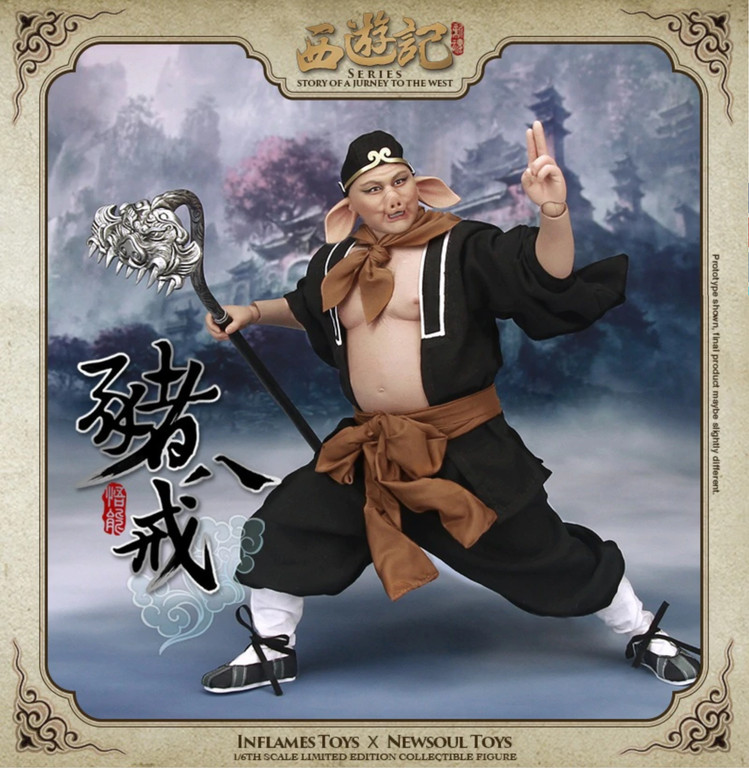
When Zhu Bajie first faces Sun Wukong in combat, he recites a poem praising the celestial origin of his weapon (fig. 1).

This is divine ice steel greatly refined,
Polished so highly that it glows and shines.
Laozi wielded the large hammer and tong;
Mars himself added charcoals piece by piece.
Five Kings of Five Quarters applied their schemes;
Twelve Gods of Time expended all their skills.
They made nine prongs like dangling teeth of jade,
And brass rings were cast with dropping gold leaves.
[…] (Wu & Yu, 2012, vol. 1, p. 382)

The “divine ice steel” (shen bing tie, 神冰鐵) is likely an error for “divine Bin steel” (shen bin tie, 神鑌鐵) as bing (冰) and bin (鑌) sound similar. This may also have something to do with the snowflake-like grain pattern of Bin steel (see sections one and two below). Take note that the metal is associated with Laozi and his furnace. We will see this association again.

Zhu Bajie In-Flames Action Figure- small

Fig. 1 – A modern action figure of Zhu Bajie with his battle rake (larger version).

Chapter 34

On the cusp of his battle with the Monkey King, the demon King Silverhorn (Yinjiao wang, 銀角王) is described as wearing polished armor made from the material.

He wears a phoenix helmet white than snow
And armor made of bright Bin steel. [1]
The belt on his waist is dragon’s tendon.
Plum-flower shaped gaiters top his goat-skin boots.
He seems the living Lord of Libation Stream;
He looks no different from Mighty Spirit.
He holds in his hands the sword of seven stars,
Stern and imposing in a towering rage (Wu & Yu, 2012, vol. 1, p. 127).

The monster is later revealed to be one of two young attendants of Laozi’s furnace sent by heaven to test the resolve of the pilgrims (Wu & Yu, 2012, vol. 2, p. 145).

Chapter 75

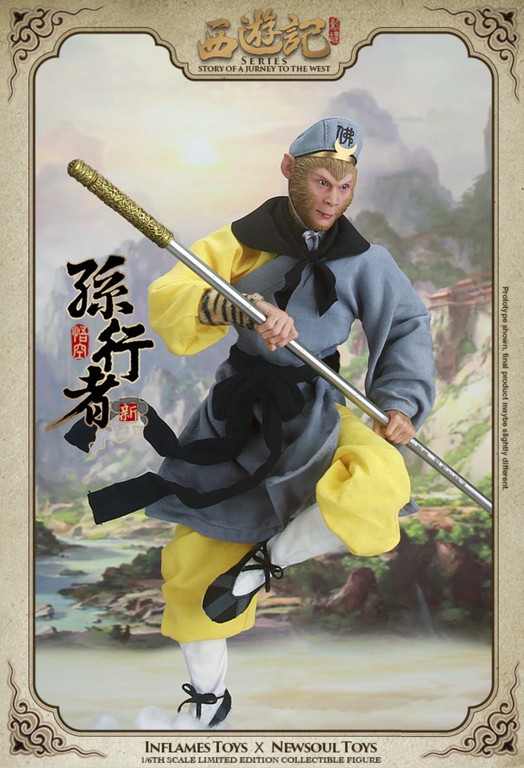
The Monkey King recites a poem about his divine staff (fig. 2) prior to battling a lion demon.

The rod of [Bin] steel nine cyclic times refined
Was forged in the stove by Laozi himself.
King Yu took it, named it “Treasure Divine,”
To fix the Eight Rivers and Four Seas’ depth.
In it were spread out tracks of planets and stars,
Its two ends were clamped in pieces of gold.
Its dense patterns would frighten gods and ghosts;
On it dragon and phoenix scripts were drawn.
Its name was one Rod of Numinous Yang,
Stored deep in the sea, hardly seen by men.
Well-formed and transformed it wanted to fly,
Emitting bright strands of five-colored most.
[…] (Wu & Yu, 2012, vol. 3, p. 375)

Here again we see Laozi is associated with the material.

Sun Wukong In-Flames action figure - small

Fig. 2 – A modern action figure of Sun Wukong with his magic staff (larger version).

II. The metal of heroes

I want to reiterate the fact that Zhu Bajie and Sun Wukong, two of Tripitaka’s three main disciples and bodyguards, have weapons made from Bin steel (Sha Wujing’s staff is made from a heavenly tree). Each is the product of Laozi refining Bin steel in his magic furnace and smelting the polearms by hand. Just like dwarves imbued Thor’s uru-metal hammer with magical abilities, so too did the high god of Daoism for Zhu and Sun’s weapons. Each has supernatural durability and the power of transformation. In fact, the Monkey King’s staff is one of the strongest weapons in the entire novel, making its association with Bin steel very important. After all, a great hero requires a great weapon.

Another example of a hero wielding a Bin steel weapon is Wu Song (武松) from the classic Chinese novel the Water Margin (Shuihu zhuan, 水滸傳, c. 1400). The former constable-turned-outlaw comes into possession of a pair of Buddhist sabers (fig. 3) made from “snowflake [pattern] Bin steel” (xuehua bintie jiedao, 雪花鑌鐵戒刀) and housed in a sharkskin sheath. [2] They are described as being made from the “finest steel, and obviously hadn’t been made in a day” (Shi, Luo, & Shapiro, 2015, p. 317). In addition, the blades are said to “often groan in the night” (Shi, Luo, & Shapiro, 2015, p. 350), suggesting a magical, sentient longing for combat. Wu later sates this desire by using the sabers in a prolonged skirmish with an evil Daoist priest, eventually beheading the brigand with a single strike (Shi, Luo, & Shapiro, 2015, pp. 352-353).

Wu Song with knives

Fig. 3 – A modern drawing of Wu Song with his Buddhist sabers (larger version).

III. Real world history

Wagner (2008) suggests the name Bin (鑌) is a transliteration of a foreign term, possibly the Sanskrit word Piṇḍa, meaning “steel” or “lump” (p. 270). The material is mentioned in Chinese records of the 6th and 7th-centuries as being imported from Persia (Bosi, 波斯) and Jaguda (Cao, 漕, modern day Ghazni) in Afghanistan. Mentions of the metal strangely disappear for centuries, only to reappear in early 10th-century records. This is possibly due to the disruption of Persian trade wrought by the Islamic conquest of Persia and the subsequent rise of Muslim trade with the east. Bin steel is believed to have originally been transported in a raw “lump” state prior to smelting in China. But the secret of its manufacture eventually reached the Middle Kingdom, for a 12th-century report shows the metal was produced in Inner Mongolia. The early Yuan government is known in 1275 to have established the “Office for Bin iron” (Bintie ju, 鑌鐵局), which possibly catered to elite blacksmiths (Wagner, 2008, pp. 268-272).

13th-century Persian Damascus blades (detail) - small

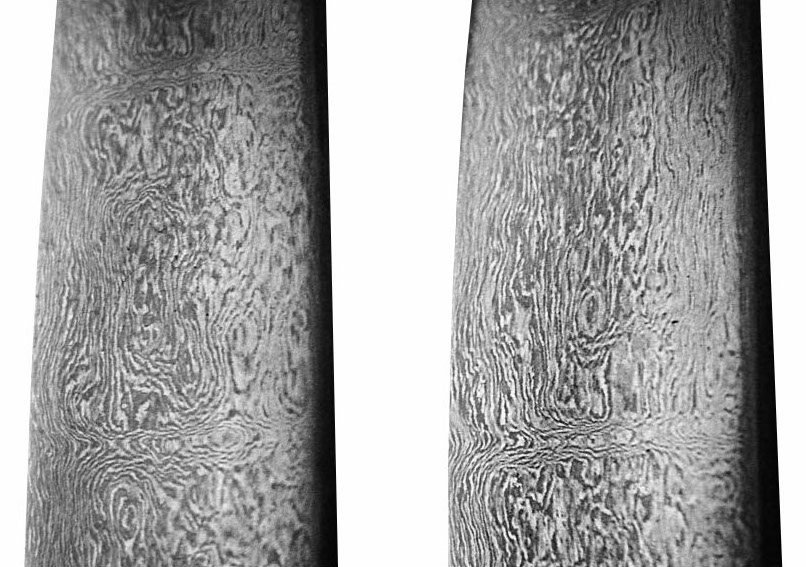
Fig. 4 – Persian-made Damascus steel blades of the 13th-century (larger version). Take note of the intricate grain pattern. Bin steel was known to have various patterns (see below).

The best description of the material comes from Cao Zhao’s (曹昭) The Essential Criteria of Antiquities (Gegu yaolun, 格古要論, 1368), an early guide for connoisseurs.

Bin iron: It is produced by the Western Barbarians. Some [types] have a spiral self-patterning, while others have a sesame-seed or snowflake patterning. When a knife or sword is wiped clean and treated with ‘gold thread’ alum, [the pattern] appears. Its value is greater than silver.

An ancient saying holds that “knowing the strength of iron is like knowing gold” [i.e., the ability to judge the properties of steel is as valuable as the ability to assay the purity of gold]. Forgeries have a black patterning. One should examine [a steel object] very carefully.

There are three rules for knives. The first is that in the blade there should be perfect control of fire, metal, and water [i.e., the blade should be correctly quench-hardened and tempered]. The second is that the haft should be of xichi wood from the Western Barbarians, and the third is that the sheath should be of Tatar birchbark.

I once had a pair of scissors of bin iron, of exquisite workmanship. It had a raised gilt pattern on the inside, and on the outside a silver-inlaid inscription in Islamic characters (Wagner, 2008, p. 271).

So we see Bin steel is comparable to Damascus steel (fig. 4), as both require quench-hardening and produce a number of intricate grain patterns visible after an acid treatment. One such pattern is the snowflake pattern associated with Wu Song’s sabers (and possibly Zhu Bajie’s rake). Most importantly, the metal was considered an exceptionally fine steel. One general is described as boasting that rebels would “have to nick (chi, 齒) his sword of bin iron” if they wished to rise up (Wagner, 2008, p. 269). [3] I take this statement to be symbolic of his unbreakable resolve. At the same time, it shows Bin steel was considered exceptionally durable.

Highly durable Bin steel weapons could have seemed like magic in comparison to those made from lesser quality metal. Therefore, it’s interesting that Journey to the West presents the metal being smelted by a god in his magic furnace. It seems only natural that a magical forge would produce the finest steel. In fact, after the 10th-century, the very name Bin steel came to be used as a term for any type of exquisite steel (Wagner, 2008, p. 271). So the author-compiler of Journey to the West may have been using it in that sense instead of referring to imported Persian steel.


Update: 02-06-21

I have written an article that discusses the magic powers of the staff. These include the ability to shrink and grow, control the ocean, astral project and entangle with Monkey’s spirit, multiply endlessly, pick locks, and transform into various objects. It also has sentience to a certain degree.

The Magic Powers of the Monkey King’s Iron Staff

Notes:

1) Yu’s (Wu & Yu) original translation says “bright Persian steel” (vol. 1, p. 127).

2) While the Water Margin presents them as sabers, Buddhist knives (jiedao, 戒刀, lit: “precept knife”) were historically small, unadorned, curved, finger-length blades used for cutting robes, trimming fingernails, opening wounds, or slicing food (Yifa, 2009, p. 250, n. 37).

3) Wagner (2008) states the story is listed as coming from the 9th-century but the housing source is from the 11th-century (p. 269, n. 103). Therefore, it likely originates after the reappearance of Bin steel in Chinese records during the early 10th-century.

Sources

Shi, N., Luo, G., & Shapiro, S. (2015). Outlaws of the Marsh. California: CreateSpace Independent Publishing Platform.

Wagner, D. (2008). Science and Civilisation in China: Volume 5, Chemistry and Chemical Technology, Part 11, Ferrous Metallurgy. Cambridge: Cambridge Univ. Press.

Wu, C., & Yu, A. C. (2012). The Journey to the West (Vols. 1-4) (Rev. ed.). Chicago, Ill: University of Chicago Press.

Yifa. (2009). The Origins of Buddhist Monastic Codes in China: An Annotated Translation and Study of the Chanyuan Qinggui. Honolulu: University of Hawai’i press.

Sun Wukong and Miao Folklore

Last updated: 04-26-21

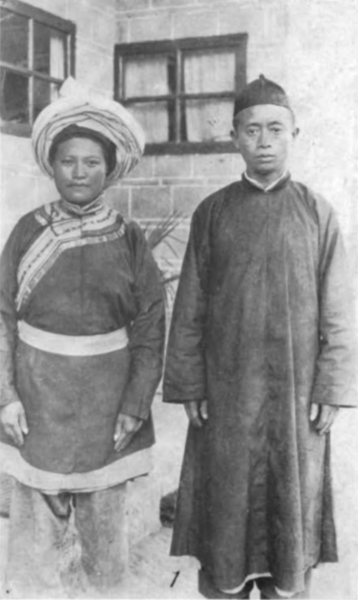
Sun Wukong appears in a body of Buddhist folklore passed on by the Miao ethnic group of Sichuan, also known as the “River Miao” (Chuan Miao, 川苗) or “Old Miao” (Miao: Hmong Bo) (fig. 1). The particular tale is quite different from the popular narrative appearing in Journey to the West (1592). For example, the unnamed monkey tends to a dragon king’s injury and later escorts a Tang dynasty emperor to India.

A Monkey Went Fishing, or Securing Buddhist Sacred Books (97)

The monkey changed into a fisherman and daily went fishing (with a line and hook). He hooked the dragon’s upper lip. When he pulled, the fishhook broke off in the dragon’s upper lip. The dragon’s lip therefore pained him every day. Then every day the dragon king called on his soldiers to go and get a doctor and heal it, but they could not find a doctor.

The monkey daily went to the sand bank to look for his fishhook. One day when he was looking for it two of the dragon king’s soldiers came and asked him, “What are you looking for?” He answered, “I am looking for medicine.” The two soldiers then said, “Old scholar, our old man’s upper lip pains him and he sent us to help him find a doctor. Can you heal him?” The monkey thought, “Probably he has been caught by my fishhook.” He then said, “I can heal it, but I must first look at the injury, then I will give the medicine.” Then the two soldiers invited him to come.

He said, “How can I go since there is so much water?” He had to go down into the water of the stream. The two men then said, “You may get under our fins and close your eyes, and do not open your eyes until we call you.” The monkey wanted to see the dragon, so he closed his two eyes. The two soldiers held him under their fins, and in a short time one of them called him, and he opened his eyes and looked.

When he opened his eyes he had already entered a fine palace. In a little while he heard the soldiers of the dragon king from both sides calling to the dragon king to come and have his wound looked at.

The monkey heard the inside gate resound, “Gu, ga.” He then saw the hands of a big man carrying the dragon king so that he could sit in the chair. Then they requested him to look at the wound. The monkey kowtowed just once to the dragon king and then looked. Then he took a pair of chop sticks and pushed aside the dragon king’s lips, and saw that the fishhook was hooked in the dragon king’s upper lip. Then he took the chopsticks and loosened the fishhook a little. He then asked the dragon king, “Is it any better?” The dragon king answered, “It is a little better.” Then the monkey sat down and rested a little. The dragon king said, “I am afraid that I will die from this illness.”

The monkey said, “You will not die from this sickness. You will certainly recover.” The dragon said, “If you are willing to heal me, I will give you whatever you want.” The monkey then used the chopsticks to push open the lips. Then he seized the fishhook with his chopsticks and with one jerk pulled out the fish book. The lip of the dragon king hurt no longer.

Then the dragon king called to his daughters to entertain the monkey fisherman. The monkey remained there several days. The dragon king was afraid that he [the monkey] was in a hurry and told his soldiers to give him some gold and silver. The monkey said, “I do not want gold and silver. I only want you to permit me to stay here a few days longer.” When the soldiers had reported this to the dragon king, he was glad to have him remain longer. He stayed several months.

One day he was visiting with the women in the palace. The monkey saw a yellow golden club. He then picked it up to play with. He struck with the golden club outside, and the club flew with him to the sea. Then he knew that this club was an ancient golden club. The dragon king did not pursue him.

The monkey lived until the Tang Dynasty, and the Tang Dynasty king wanted to go and get sacred books. But the king could not go himself because the demons and spooks were very numerous along the road. The Tang emperor then sent a messenger to call the monkey to him. The monkey said, “I cannot go. If anybody wants me to go, he must change likenesses with me, and then I will go.”

The Tang emperor himself returned, and for three years sought for a method. One day he came and said to the monkey, “Now I am able to change.” The monkey then requested the Tang emperor to change. The Tang emperor then changed into a big mountain, and the monkey went into the mountain. Then he was unable to come out again. The Tang emperor then said, “Now will you go with me?” The monkey then promised to go with him. Then the Tang emperor lifted aside the written character that had imprisoned him, and then the monkey came out. The monkey then went with the Tang emperor to the western horizon and brought back the sacred books. [79]

[Notes]

79) The Ch’uan Miao said that this is a story about a monkey of some repute, but they did not know his name. It is evidently the monkey god Sen Hou Tzu [Sun houzi, “the monkey Sun”] 孫猴子 or Sen Wu K’ung [Sun Wukong孫悟空 (Graham, 1954, p. 211).

I. Story influences

I suggest the first three-quarters of the Miao tale draws on the Asian variant of a widely known story cycle in which a fisherman is rewarded for releasing a magic fish (B375.1. Fish returned to the water: grateful, n.d.). This version sees the fisherman release a carp to later discover it was actually the transformed son of a dragon king. He is then rewarded with a magic treasure for his kindness. [1] This cycle is partially played out in another Miao legend in which a fisherman catches a fish, who turns out to be the daughter of the dragon king Ryuang Lan, and later marries her in human form (Graham, 1954, pp. 226-227). In our story, the monkey-turned-fisherman catches the dragon king and then frees him of the hook. He is subsequently rewarded with a prolonged stay in the dragon kingdom and thereafter retrieves the golden club, which is itself a magic treasure.

Miao couple (for Sun Wukong article) - small

Fig. 1 – A Miao couple (larger version). She is wearing traditional dress, while he wears that of the Chinese. From Graham, 1954, p. 125. Fig. 2 – Sun Wukong meets the dragon king Ao Guang (larger version). A screenshot from the classic Chinese animation Uproar in Heaven (1965).

Elements of the first three-quarters and all of the last quarter clearly borrow from Journey to the West. The monkey is presented as a shape-shifting immortal, for he changes into a fisherman and lives until the Tang dynasty. His aversion to water in the tale is a common trope throughout the novel, such as when Sun Wukong uses water-propelling magic or relies on others to fight water-based monsters. [2] The golden club is the Monkey King’s “As-you-will” gold-banded cudgel retrieved from the undersea dragon kingdom. This in turn identifies the dragon king as Ao Guang, the ruler of the Eastern Sea (fig. 2). The unnamed “Tang dynasty emperor”, Tang Taizong in Journey to the West, replaces the monk Tripitaka originally sent to retrieve holy scriptures. The monkey’s imprisonment inside the emperor-turned-mountain is based on Sun’s imprisonment under Five Elements Mountain in the novel, complete with a written amulet weighing the landmass down.

The monarch’s transformation into a mountain is particularly interesting to me, for I don’t recall ever reading any Asian folklore featuring such an event. I know of at least one instance of a hero in ancient European folklore being changed into a mountain as punishment (see fig. 5 in my article here). However, our tale presents the ruler’s transformation as a willing metamorphosis. The Miao consider mountains to be living beings, [3] having “heads, feet, hands, eyes, ears, hearts, breasts, veins, and arteries” (Graham, 1954, p. 9). Therefore, the mountain is a macrocosm of the human body, making the transformation one of degree and not kind. But this portion of the narrative remains a mystery to me as the original intended outcome was “switch[ing] likenesses.” I take this to mean that the monkey would look like the emperor and visa versa. Does this imply the primate was keen on usurping the throne and the monarch then used his transformation as a deterrent?

II. Monkey progenitors

The Monkey King’s inclusion in Miao folklore should come as no surprise since monkeys play an important role in their mythology. They believe humans are descended from a pair of monkeys who broke off their tails by accident and eventually evolved human features (Graham, 1954, p. 204). As explained in this article, having a monkey ancestor is a common belief among the various ethnic groups of Tibet and southwestern China. Sun Wukong also appears in the legends of the neighboring (and related) Qiang people of Sichuan.


Updated: 04-26-21

Author David Leffman was kind enough to ask his Miao friend of southeast Guizhou about this story. This is their response:

I feel personally that this story is maybe created recently by someone who want to find a reason to give better explanation of her embroidery. In our folk story we have monkey which is smart, used to play prank joke with human being Jiangyang. And Miao don’t have chronology, not even annals, never knew anything about Tang Dynasty which should be aliens for them. And in the history Miao lived away from Han Chinese, almost no contact except those who were called Shu Miao, the cooked ones in west Hunnan and some in east Guizhou, like Sheng Chongwen, the famous writer who grew up in Fenghuang ancient town. Then those Shu Miao may get some influence and confuse those Han Chinese culture as their own.

So it’s possible that the above story is a modern legend influenced by Chinese culture.

Notes

1) One version appears in the Complete Tale of Guanyin of the Southern Seas (Nanhai Guanyin quanzhuan, 南海觀音全傳), a 16th-century pious novelette detailing Guanyin’s former life as the Princess Miaoshan. After achieving enlightenment, Miaoshan/Guanyin looks to take on disciples. One is a dragon princess (longnu, 龍女) who bestows the Bodhisattva with a magic jewel for saving her brother, a dragon prince who had been caught by a fisherman while transformed into a carp (Idema, 2008, p. 31).

2) The water-propelling magic is first displayed in chapter three when Sun seeks a magic weapon from the underwater dragon kingdom (Wu & Yu, 2012, p. 133). An example of Monkey relying on others to fight a water-based monster happens in chapter 22 when he asks Zhu Bajie to battle Sha Wujing (Wu & Yu, 2012, p. 423).

3) According to Graham (1954), “The Ch’uan Miao regard all things as alive and sentient. The sun, moon, stars, mountains, rivers, rocks, trees, thunder, the echo, the rainbow, homes, fields, plains, recompense or karma, beds, marriage, swords, the harvest, the year…the ceremonial drum, and even the sound of the ceremonial drum are considered to be living things” (p. 9).

Sources

B375.1. Fish returned to the water: grateful (n.d.). S. Thompson. Motif-index of folk-literature. Retrieved from http://www.ruthenia.ru/folklore/thompson/index.htm.

Graham, D. C. (1954). Songs and stories of the Chʻuan Miao. Washington: Smithsonian Institution. Retrieved from https://babel.hathitrust.org/cgi/pt?id=inu.39000005872432;view=1up;seq=7

Idema, W. L. (2008). Personal salvation and filial piety: Two precious scroll narratives of Guanyin and her acolytes. Honolulu: University of Hawaii Press.

Wu, C., & Yu, A. C. (2012). The journey to the west: Vol. 1. Chicago, Ill: University of Chicago Press.

Sun Wukong and the Qiang Ethnic Group of China

Last updated: 08-02-2019

The Qiang (Ch: 羌; Qiangic: Rrmea) ethnic group have been mentioned in Chinese records as far back as the oracle bones of the Shang Dynasty (17th to 11th-century BCE). Originally inhabiting the northern reaches of China, these sheepherders and warriors were driven southwest over many centuries of conflict with neighboring ethnic groups, as well as the Chinese. Many Chinese dynasties attempted to assimilate them, but the Qiang have resisted up to the present. Today, they live in western Sichuan near the Tibetan border and are listed among the 56 recognized ethnic groups of China (Yu, 2004, pp. 155-156; Wang, 2002, pp. 133-136).

What’s interesting about the Qiang for the purposes of this blog is that both magic monkeys and heavenly stones, and even Sun Wukong himself, play a part in the people’s religious mythology.

Map of China showing location of Sichuan Province, home to Qiang ethnic group, some of whom worship Sun Wukong

Fig. 1 – A map of China showing the location of Sichuan province in red. Larger version available on wikicommons.

I. Monkeys and Qiang shamanism

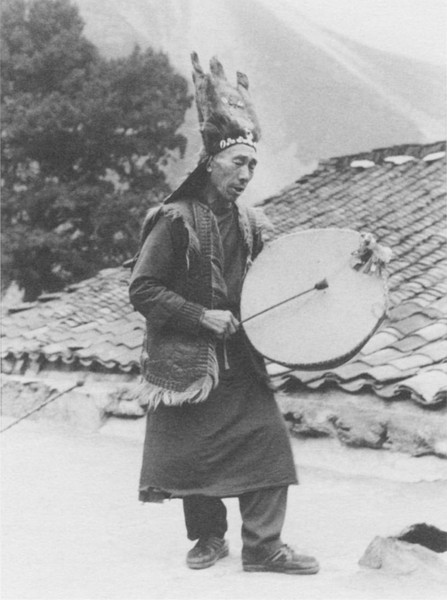
Shamans (Ch: Duan gong, 端公 or Wu, 巫j; Qiangic: Shüpi) are the heart of Qiang religious life. During special ceremonies, they wear three-peaked hats (fig. 2 and 3) made from the fur of golden monkeys (fig. 4), each peak respectively representing the deities of heaven, earth, and shamanism (more on the latter below). [1] These hats are especially worn during exorcisms because the monkeys are considered “the purest of animals, [which stand] in extreme contrast to the vilest of beings—the demons” (Oppitz, 2004, p. 13). There are several legends, with many variants, explaining the origins of the headdress. One version states:

[T]he Qiangs used to have a written language, and their patriarch recorded the scriptures he obtained from the gods and other important writings on human affairs on the bark of birch trees. One day when he took out the pieces of bark to be aired, a mountain sheep came and ate them all. With the help of a golden monkey the patriarch captured the guilty sheep and made its skin into a drum. When he beat on the drum he was able to recall the words written on the birch bark. To prevent future mishaps to these precious documents, he memorized them by heart (Yu, 2004, p. 160).

So in essence the hats are worn to commemorate the assistance of the golden monkey. Interestingly, another version replaces the patriarch and golden monkey with Tripitaka and Sun Wukong:

A long time ago, in the Tang period, there was a monk by the name of Tang Seng [唐僧, “Tang Monk”], who undertook a journey to the western skies in the company of a monkey named Sun Wukong, in order to collect sacred scriptures. On their way back, they encountered a sheep ghost who ate all the newly acquired scriptures. The monkey got very angry, killed the sheep ghost, and used its skin to fabricate a drum. Thereupon Tang Seng and the monkey met with the Eighteen Arhats … Listening to their teachings, Tang Seng picked up the sheep-skin drum and repeated all that he heard through their mouths. Since then all shamans use a drum when reciting their knowledge from memory (Oppitz, 2004, p. 23).

Qiang shaman hat and goldn monkey

Fig. 2 – The three-peaked golden monkey skin shaman hat. From the Sichuan University Museum. Larger version on wikipedia. Fig. 3 – A shaman wearing the headdress and playing the ritual sheep skin drum (larger version). Original photograph by Michael Oppitz. From Oppitz, 2004, p. 14. Fig. 4 – A golden monkey with child. Larger version on wikipedia.

The golden monkey is closely associated with the Qiang’s pantheistic worship of sacred white stones, each one representing the gods of heaven, sun, fire, mountains, rivers, and trees. [2] Yu (2004) provides another legend for the origins of the Shaman’s hat, describing how the monkey is the offspring of the sacred stone and noting parallels with the birth of Sun Wukong:

Another legend depicts the golden monkey as a Prometheus-like figure who stole fire from heaven. The first two attempts failed because the god of wind and the god of rain extinguished the fire, but the monkey succeeded the third time by concealing the fire in a white stone. It is worth noting that in this legend the golden monkey is closely related to the white stone. In the Qiang language, the first syllables in the names of the monkey’s mother and father mean respectively “stone” and “fire.” “This implies that fire is produced by stone and hidden inside the stone, and that the half-human, half-simian golden monkey was an offspring of the union between stone and fire”. The white stone and the golden monkey, as the source of fire and the messenger who brought it to the human world, became the totems of the Qiang people. To commemorate the recovery of the lost scriptures, wearing the monkey hat and playing the sheepskin drum also became an indispensable part of Sacrifice to the Mountain[, a Qiang ceremony]. However, the monkey legend is not particular to the Qiang people. The Yi minority people of northwestern Guizhou province have a nuo drama known as bianren xi (changing-into-people drama) based on a legend that people derived from monkeys. Actors wear monkey masks for this performance. There is also the famous monkey, Sun Wukong, who was born from a stone in the Han Chinese novel Xiyou ji (Journey to the West, 1592) by Wu Chengen (ca. 1506-1582). [3] The novel was first published in 1592, but the monkey lore included in it was of much earlier time (p. 160).

A celestial, stone-born monkey who steals from heaven certainly sounds like the Monkey King. As noted here, stories about Sun Wukong have been circulating in Asia for a millennia. So it seems only natural that the Qiang’s reverence for heavenly stones and monkeys would lead to some of them worshiping the beloved cultural figure.

Graham (1958) notes that Sun Wukong and Sha Wujing figure among the Chinese patron deities of the “red” shamans (p. 53). [4] What’s interesting is that the red shamans are said to speak a special demon language and use their skills to exorcise demons (p. 54). Therefore, their worship of the Monkey King should come as no surprise considering Sun Wukong is the exorcist par excellence.

As noted above, one of the peaks of the ritual headdress represents the patron deity of shamanism. Known among other names as the Abba mula (“father god”; Ch: Aba muna, 阿爸木纳), this is the title given to the shaman’s main focus of worship. For instance, Sun Wukong is the Abba mula of those who revere him. Most importantly, the chosen deity is further represented by a small bundle that the shaman carries with him and guards jealousy, as it is the source of his knowledge and power. Graham (1958) describes the sacred bundle’s importance, construction, and use:

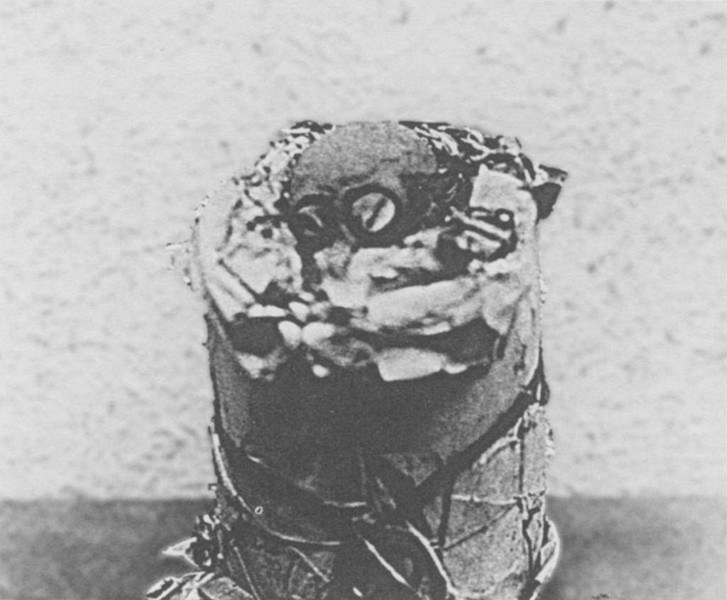
He is the patron or guardian deity and instructor of the Ch’iang priest, and without him the priest could do nothing. It consists of a skull of a golden-haired monkey wrapped in a round bundle of white paper. Its eyes are old cowry shells or large seeds. Inside are also dried pieces of a golden-haired monkey’s lungs, intestines, lips, and fingernails. It is so wrapped that the face of the skull is visible at one end, and the other end is closed [fig. 5 and 6]. After each ceremony in the sacred grove, [5] the priest wraps another sheet of white paper around it, so that it gradually increases in diameter. Some priests will not allow another person to touch his Abba Mula and only the priest worships this god (pp. 51-52).

I mention this because there are no doubt sacred bundles representing Sun Wukong, which are used under his supernatural guidance.

Qiang abba mula bundle and shaman holding one

Fig. 5 – The Abba mula bundle. Note the visible monkey skull with cowry shell eyes (larger version). Original photograph by Wolfgang Wenning. Fig. 6 – A Qiang shaman carry a bundle and sacred cane (larger version). Original photograph by Michael Oppitz. Both images are from Oppitz, 2004, p. 41.

Oppitz (2004) explains that stories alluding to Sun Wukong appear in Qiang pictorial divination books. Furthermore, he suggests that the ritual of wrapping the Abba mula bundle with additional paper represents the lost written knowledge saved by the Monkey King / golden monkey, which is now passed on orally.

In Qiang divination books the monkey features in various passages. In one book the picture of a monkey alludes to a story in which he destroys a heavenly palace; another book addresses a monkey’s trip to a western land, where he acquires written texts. In both cases the monkey Sun Wukong of popular literature and protagonist of the novel Xi yu ji, who escorts the Tang pilgrim Xuanzang, stands as the model. This character’s association with the acquisition of books and the role a golden-haired monkey plays in a Qiang myth as the inventor of the drum replacing the lost scriptures, suggests that the paper which is wrapped around the venerated monkey skull may also be interpreted as a hint to the conflict between scriptural versus oral tradition at the intersection of which the monkey stands as a mediator (p. 42).

II. Monkeys and the Qiang origin myth

Called “Mutsitsu and Tugantsu” (Ch: Mujiezhu yu Douanzhu, 木姐珠與斗安珠), the Qiang origin myth centers around the romance of Mutsitsu, the daughter of the supreme god Abamubi (or Mubita), and the earthbound monkey Tugantsu. The latter saves the goddess from a ferocious tiger when she visits the mortal world and both instantly fall in love. She brings him to the celestial realm, where Abamubi only agrees to their marriage if Tugantsu can successfully complete a series of impossible herculean tasks. These include falling the trees of ninety-nine mountains, burning the trees, and using the arable land to plant a crop of corn (other sources say grain); but each time Mutsitsu secretly enlists the aid of fellow gods to insure the tasks are completed on time. During the burning of the forest, Tugantsu’s fur is singed, revealing him to be a handsome man. In the end, the supreme god agrees to their marriage and Mutsitsu and Tugantsu become the progenitors of mankind. [6]

Academia Sinica (n.d.) comments that some Qiang communities who revere Chinese gods often equate Abamubi with the Jade Emperor of Daoism and Tugantsu with Sun Wukong. I find this especially fascinating as the Monkey King then becomes a sacred protoplast.

Tibetan origin myth painting - Monkey and Ogress - small

Fig. 7 – A modern painting showing the monkey and rock ogress of Tibetan myth (larger version). Original from Wikipedia.

In addition, Academia Sinica (n.d.) explains this “monkey transforming into human” motif (i.e. Tugantsu becoming a man) has similarities with Tibetan mythology, for the Qiang live in close proximity to the people of Tibet. This refers to the Tibetan origin myth in which the Bodhisattvas Avalokitesvara (the Indo-Tibetan variant of Guanyin) and Tara are respectively reborn on earth as a monkey and his wife, a rock ogress (fig. 7). (Again, the association between the monkey and rock reminds one of Sun Wukong.) The union produces six half-human half-monkey children, from which originate the six original tribes of Tibet. These children and their offspring eventually evolve human features (Stein, 1972, pp. 37 and 46).

III. Conclusion

The religious mythology of the Qiang ethnic group of China pays reverence to both heavenly monkeys and sacred stones. Examples include stories about a golden monkey born from a stone who both bestows fire on man and creates the sheepskin drum needed to recover lost scriptural knowledge. Qiang communities that revere Chinese deities often replace the golden monkey with Sun Wukong, no doubt due to his birth mirroring the former’s origins. The same holds true for the Qiang origin myth in which a goddess and monkey-turned-man become the progenitors of mankind. The Monkey King is sometimes equated with the father, transforming him from a literary character and cultural figure into a sacred protoplast. Interestingly, the monkey-rock and monkey-to-man motifs have connections to a wider myth cycle present in Tibet.

Some shamans (Qiangic: Shüpi) specializing in exorcism worship our hero as their patron deity, or Abba mula (“father god”). Such deities are given form as a bundled monkey skull successively wrapped in white paper. This sacred object is considered the source of the shaman’s power. It’s possible the wrapping paper references the lost scriptural knowledge that Sun Wukong/the golden monkey helped recover.

To my knowledge, most of what has been written about the Qiang, and by extension their connection with Sun Wukong, was collected by ethnographers during the 20th and 21st centuries. Considering the Qiang have no written language (hence the importance of oral knowledge), it’s impossible to say how far back this connection goes. But as noted in this article, the Monkey King has been worshiped by the Chinese since at least the 17th-century. So the Qiang reverence for Sun Wukong could also be centuries old.


Update: 04-19-2019

Sun Wukong also appears in the folklore of the neighboring (and related) Miao ethnic group. The Miao also believe man derives from monkeys.

Sun Wukong and Miao Folklore


Update: 08-02-2019

Rockhill (1891) provides a complete translation of the Tibetan monkey-ogress origin myth taken from the Mani Kambum (12th to 13th-century), a collection of Tibetan Buddhist texts centered around Avalokitesvara. [7] The translation is too long to transcribe here, so I have made a PDF of the relevant pages. It’s interesting to note that the Bodhisattva Hilumandju, the protagonist, is a monkey king with magic powers. 

Archive link

Click to access the-land-of-the-lamas-notes-of-a-journey-through-china-mongolia-and-tibet-1891-by-william-woodville-rockhill-rock-ogress-and-a-monkey-info-pages-extracted.pdf

Hilumandju and Hanumanji are quite similar, as noted by other writers (Chattopadhyaya & Chimpa, 2011, p. 152). The Tibetologist Per K. Sørensen notes “the idea of an ape-gestalt in this myth is directly associated with or inspired by the ape-king … and champion … Ha-lu ma-da = Hanümän, the resourceful figure and protagonist known from Välmlki’s Rämäyana, a tale of considerable popularity already in the dynastic period in Tibet” (Bsod-nams-rgyal-mtshan & Sørensen, 1994, p. 127, n. 329).

Additionally, the Chinese of Sichuan also have stories regarding primates fathering human children. A body of Han and Tang dynasty tales that heavily influenced the creation of Sun Wukong describes magic white apes (baiyuan, 白猿) kidnapping and impregnating young woman. One example appears in both Zhang Hua’s Encyclopedic Records of Things (Bowuzhi, 博物志, c. 290) and the Records of Spirits (Soushenji, 搜神記, c. 340):

In the high mountains of southwestern Shu [Sichuan and Tibet] there is an animal resembling the monkey. It is seven feet in height, it can imitate the ways of human beings and is able to run fast in pursuit of them. It is named Jia-guo 猳國 or Ma-hua 馬化; some call it Jue 貜. It watches out for young women travelling on the road and seizes and bears them away without anyone being aware of it. If travelers are due to pass in its vicinity they lead one another by a long robe, but even this fails to avert disaster. The beast is able to distinguish between the smell of men and women and can thus pick out the women and leave the men. Having abducted a man’s wife or daughter it makes her its own wife. Women that fail to bear its children can never return for the rest of their lives, and after ten years they come to resemble the beast in appearance, their minds become confused, and they no longer think of return. Those that bear sons return to their homes with the infants in their arms. The sons are all like men in appearance. If any refuse to rear them, the mothers die. So the women go in fear of the beast, and none dares refuse to bring up her son. Grown up, the sons are no different from men, and they all take the surname Yang 楊, which is why there are so many people by that name now in the south west of Shu: they are mostly descended from the Jia-guo or Ma-hua (Wu, 1987, pp. 91-92).

I find the last part fascinating because it states the inhabitants of the Sichuan-Tibet region were fathered by the ape. This recalls the Tibetan, Qiang, and Miao tales of humans descending from monkeys. It also suggests the aforementioned ethnic stories about a primate progenitor stretch back to the early part of the first millennium.

Notes:

1) Graham (1958) notes the headdress is one of eleven sacred implements of the Qiang shaman. He provides a detailed description of the hat’s significance.

This is made of a golden-haired monkey skin and is believed to be very efficacious, greatly adding to the dignity and potency of the priest and his ceremonies. The eyes and ears of the monkey are left on, and the tail is sewed on at the back. The eyes enable the hat to see and the ears to hear, and add to the efficiency of the hat. The tail also adds to its efficiency. The front of the hat is ornamented with old cowry shells arranged in ornamental designs, one or two polished white bones that are said to be the kneecaps of tigers, and sometimes with carved sea shells. These ornaments improve the looks of the hat and also add to its efficiency. Other ornaments believed to add efficiency when used are two cloth pennants, one or two small circular brass mirrors, and one or two small brass horse bells much like sleigh bells, on which the Chinese character wang 王 meaning king is carved. Near Wen-ch’uan the priests sometimes assist the magistrate in praying for rain and in turn are presented with a small, thin silver plaque to be worn on the hat, on which is stamped the Chinese word shang 賞, or “reward.” This plaque also adds dignity and efficiency (pp. 55-56).

2) The Qiang reverence for these stones is tied to the aforementioned conflict with neighboring tribes. For example, legend states the great heavenly ancestor of the Qiang sent them three white stones to aid in their battle with a neighboring tribe, transforming them into mountains from which weapons were made. Another legend claims these stones help the Qiang make fire (Yu, 2004, pp. 156-157). These white stones often appear on buildings (both temples and houses), walls, altars, and graves in Qiang society (Graham, 1958, p. 103).

3) The original paper reads, “…in the Han Chinese novel Xiyu ji (Journey to the West, 1982)…” I have corrected the typos.

4) The colors red, white, and black signify the class of magic (good vs. dark), though shamans often inhabit all three roles (Graham, 1958, p. 54).

5) Sacred groves are home to a village’s temple and white stone altar, where many rituals are performed at night and in the early morning (Graham, 1958, p. 64).

6) A Chinese version of the tale can be read here. This forum has scans of an illustrated bilingual book presenting a different version of the tale.

7) Another version of the tale appears in The Mirror Illuminating the Royal Genealogies (Rgyal rabs gsal ba’i me long, 14th-century). An annotated translation can be read in Bsod-nams-rgyal-mtshan & Sørensen, 1994, pp. 125-133.

Sources:

Academia Sinica. (n.d.). A Brief Introduction to the Qiang People – Religion. Retrieved from http://ethno.ihp.sinica.edu.tw/en/southwest/main_QI-04.html

Bsod-nams-rgyal-mtshan, & Sørensen, P. K. (1994). The mirror illuminating the royal genealogies: Tibetan buddhist historiography : an annotated translation of the XIVth century Tibetan chronicle: rGyal-rabs gsal-ba’i me-long. Wiesbaden: Harrassowitz.

Chattopadhyaya, A., & Chimpa. (2011). Atīśa and Tibet: Life and works of Dīpaṃkara Śrījñāna (alias Atīśa) in relation to the history and religion of Tibet, with Tibetan sources. Delhi: Motilal Banarsidass Publishers.

Graham, D. C. (1958). The customs and religion of the Ch’iang. Washington: Smithsonian Institution. Retrieved from https://repository.si.edu/bitstream/handle/10088/22946/SMC_135_Graham_1958_1_1-110.pdf?sequence=1&isAllowed=y

Oppitz, M. (2004). Ritual objects of the Qiang shamans. Res: Anthropology and aesthetics, 45, 10-46. Retrieved from https://www.journals.uchicago.edu/doi/pdfplus/10.1086/RESv45n1ms20167620

Rockhill, W. W. (1891). The land of the lamas: Notes of a journey through China, Mongolia and Tibet with maps and illustrations. New York: Century Co.

Stein, R. A. (1972). Tibetan civilization. Stanford, Calif: Stanford University Press.

Wang, M. (2002). Searching for Qiang culture in the first half of the twentieth century. Inner Asia, 4(1), 131-148. Retrieved from http://www.jstor.org/stable/23615428

Wu, H. (1987). The earliest pictorial representations of ape tales: An interdisciplinary study of early Chinese narrative art and literature. T’oung Pao LXXIII, pp. 86-112.

Yu, S. (2004). Sacrifice to the Mountain: A Ritual Performance of the Qiang Minority People in China. TDR 48(4), 155-166. Retrieved from http://www.jstor.org/stable/4488600

The Great Sage Purple Cloud Temple of Yilan, Taiwan: A Photo Essay

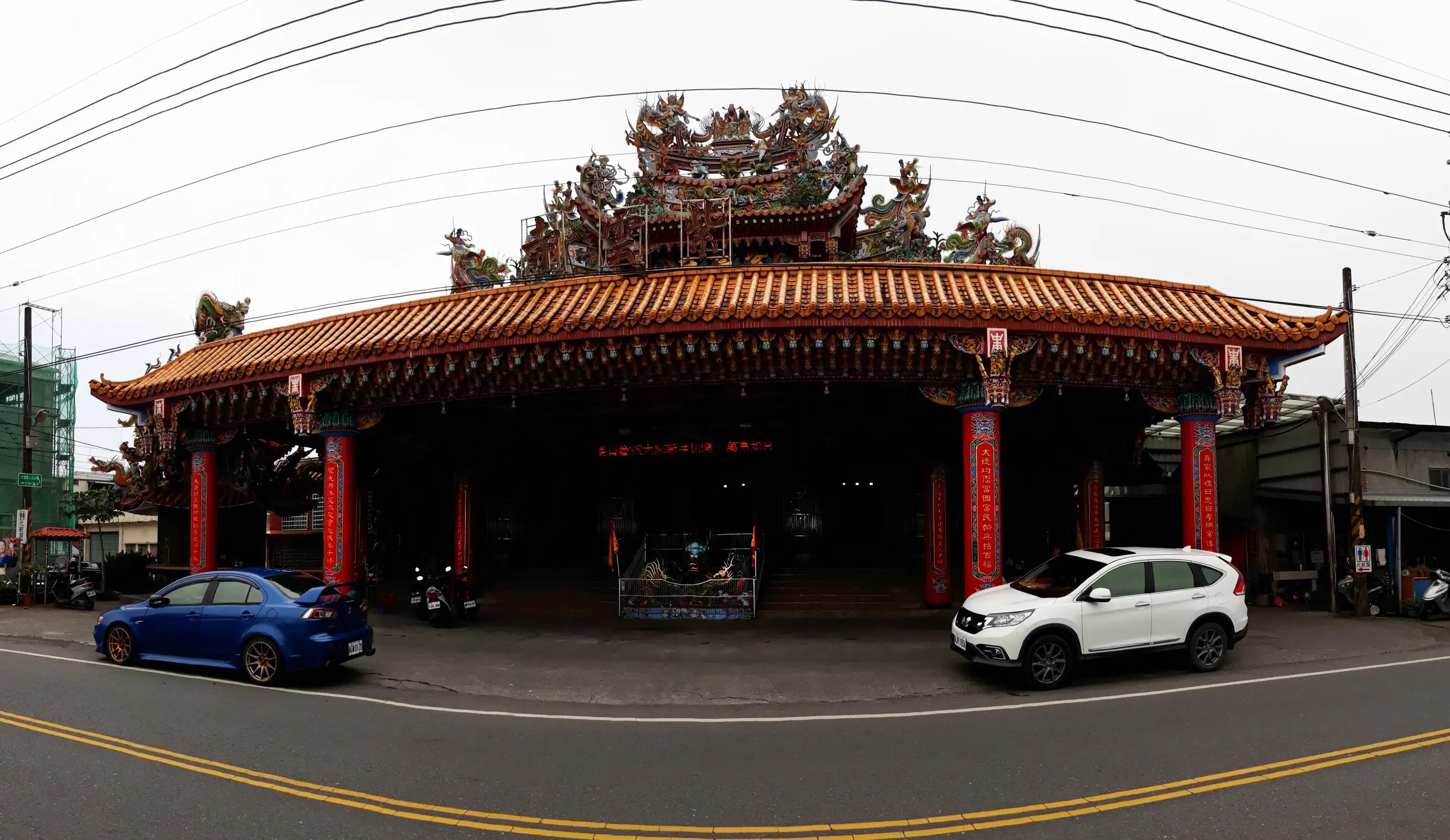
I recently visited another Great Sage temple, this time the Wujian Purple Cloud Temple (Wujian Ziyu si, 五間紫雲寺) of Yilan (宜蘭), Taiwan. The temple was bustling with people during the Chinese New Year celebrations, so I didn’t have time to ask many questions. This entry will serve more as a picture essay until I return to conduct proper research.

1. History

Legend has it that around 1899 a man found a monkey-shaped stone and enshrined it in a thatched shed. This was eventually converted to a temple a few years later. It was destroyed by a typhoon in 1960 but subsequently rebuilt. The temple appears to recognize a trinity, with countless monkey soldiers beneath them. The Great Sage has two aspects: the “Martial Great Sage” (Wu Dasheng, 武大聖) (standing statues), who exorcises evil, and the “Civil Great Sage” (Wen Dasheng, 文大聖) (seated statues), who insures the safety of people and animals.

2. How to get there

(Note: Always consult google if you are directionally challenged like myself)

Address: No. 449, Section 3, Dafu Road, Zhuangwei Township, Yilan County, Taiwan, 263

I took bus #1571 (google calls it #1571A) from gate 15 of the Taiwan City Hall Bus Station. This heads towards the Yilan Bus Station. (If you plan to take this route, please note that buses headed to different areas of Yilan will board from this gate. So pay very close attention to the calls of the bus station attendant. For example, they called “Jiaoxi” (礁溪) (bus #1572), a small township in Yilan, and those waiting for another destination had to stand off to the side while those from different sections of the line made their way to the front. If you aren’t careful, you might end up on the wrong bus.) My destination was the first stop, the Zhuangwei (壯圍) bus stop, a small shelter by an overpass. My short walk to the temple took me passed rows of flooded rice fields and small patches of buildings.

(Click images for larger versions)

1

Gate 15 at the Taiwan City Hall Bus Station.

2

The Zhuangwei bus stop shelter (as seen from the opposite outgoing bus stop).

1a - Map to Purple Cloud Temple

The route map from the Zhuangwei bus stop to the temple.

4
5

Random rice fields along Gonglao Road (see map).

6

A panorama of a rice field next to Lane 423, Sect. 3, Dafu Road (see map). 

3. The Outside

The temple is located on the side of a busy road. It appears almost out of nowhere since the face of the holy structure is in line with the buildings on either side. The first thing that caught my eye was the highly ornate roof of the furnace covered in mythical creatures, divine heroes, and gods, features typical of South Chinese and Taiwanese temple architecture. Each face of the hexagonal body was covered with beautiful carvings on black marble, two of which included the pilgrims from Journey to the West.

7

The furnace visible on the left side of the temple (as seen from the road).

8
9
10
11

A marble carving of Guanyin, the White Dragon Horse, Monkey, and Tripitaka.

12

A detail of Monkey.

13

Monkey, Sha Wujing, Tripitaka on the White Dragon Horse, and Zhu Bajie.

14

A detail of the group.

The front of the temple houses an ornate statue of three brightly colored dragons enclosed in a fence. Looking up, I noticed beautiful hand-painted dragons and Qilin on the ceiling, along with paintings of events from Chinese mythology and Journey to the West on the cross beams. Walking towards one of the five entrances, I noticed the facade was covered in highly detailed stone carvings, some depicting events from the novel.

15

The front of the Purple Cloud Temple.

17
18

The front of the temple. Three of the five entrances are visible behind the dragons.

19

A detail of the three dragon statues.

20

Five hand-painted dragons on the ceiling. The Eight Immortals grace the crossbeam below. 

21

A pair of Qilin on the ceiling. The cross beam below portrays an event from Prince Nezha‘s life.

22

Zhu Bajie protecting his master from the ogre that will become Sha Wujing.

23

Monkey escaping from Laozi’s furnace.

24 - BW

A stone carving on the facade showing Monkey (top right), Zhu bajie (top center right), and Sha Wujing (center left) battling a monster (top left). The image has been enhanced for clarity.

25 - BW

Monkey (center) battling the heavenly army. Enhanced for clarity. 

26 - BW

Monkey (center) leaping from Laozi’s furnace. Enhanced for clarity. Apologies for the blur. 

28 - BW

A detail of Monkey leaping.

29 - BW

The Great Sage (top center) and his monkey army battling heaven. Enhanced for clarity. These are just a few of the many carvings covering the temple facade. 

4. The Inside

The interior hall is wide yet shallow in depth and split between three altars, Folk religion to the right, the Great Sage in the Center, and Daoist to the left. I must admit in my zeal to photograph anything Monkey-related, I completely forgot to take pictures of the other two sections. This online image shows the folk section includes Mazu, Budai, and other deities. This image shows the Daoist section includes the Jade emperor, the Earth god, and others. Surprisingly, the incense burner in front of the main entrance was not marked with the name of the Great Sage (unlike what I’ve seen at other such temples) but that of the Jade Emperor, 玉皇上帝 (Yuhuang shangdi).

30

The main hall.

20190206_123034

The incense burner bearing the name of the Jade Emperor (visible from the hall looking out the main door).

Upon entering the right side of the main hall, the first thing that caught my eye was a large wooden sculpture of a tree-bound monkey holding onto a branch with one hand and a pair of peaches in the other. Immediately behind him was a stone carving of a vague monkey with two children. (I’m not sure of the ritual importance of either statue. I’ll report on this later. However, I will say the stone statue recalls Sun Wukong’s origins as a stone monkey.) Next to both statues is one of two cylindrical towers, one positioned on each end of the hall. Each is topped by a Great Sage statue and the towers themselves are comprised of hundreds of small compartments, each filled with a small Great Sage figure. These represent a donor who has given money to the temple.

31

The wooden monkey statue.

32

A detail of the monkey holding peaches.

33

The stone monkey with children.

34

The tower of donor Great Sages.

35

The Great Sage topping each tower. He holds a fly whisk in one hand and a peach of immortality in the other.

36

The many compartments.

37

A mini Great Sage donor figure. He sits on a throne with his staff held over head in one hand and a calabash gourd held to his front in the other. 

4.1. The Great Sage Altar

The central offering table to the Great Sage was covered in all sorts of fruits, candies, and flowers. Also included were an incense burner, offerings of wine, and a pair of crescent moon-shaped wooden blocks. These blocks are used in tandem with fortune sticks and oracles revealed on slips of paper, all of which are housed in a metal cylinder to the left of the table (see section three of this article on how these items are used).

39
38

The table laden with offerings. Take note of the young woman praying to the Great Sage. She told me that she was from Vietnam and that Monkey was not a common deity there.

40

The incense burner (back center), tea offerings (three cups visible in the center) and wooden blocks (front right).

41

The metal cylinder housing the fortune sticks (top), with the corresponding oracles located in each of the surrounding drawers.

Like in other parts of Taiwan and Singapore, this temple appears to recognize a plethora of Great Sages, from a holy trinity to an army of soldier monkeys. (I don’t yet know their individual names. I will report on this later.) All of the Great Sage figures are portrayed with golden armor, red-painted humanoid faces, golden fillets, and long, dark hair. The headband and long hair are no doubt influenced by depictions of Military Monks (Wuseng, 武僧) from Chinese opera (Bonds, 2008, pp. 177-178 and 328). Red face paint is also associated with such characters (Bonds, 2008, p. 211). While the red paint of the statues references the red faces of macaque monkeys, it definitely plays into the military monk personna. Portraying Monkey as such defines him as a divine warrior and a guardian deity.

Military Monk - Beijing Opera (Bonds, 2008)

A military monk from a modern Beijing Opera production (Bonds, 2008, p. 178).

I was pleasantly surprised to see statues of Zhu Bajie appear among the Great Sage’s army. It’s quite appropriate given this is the year of the pig according to the Chinese zodiac. Also included were statues of Ksitigarbha and Nezha.

42

The three main Great Sages visible in front of the ornate dragon statue. Note the long hair.

43

Statues of Zhu Bajie among Monkey’s soldiers.

44

More soldier monkeys. Take note of the Ksitigarbha (front right).

45

Nezha figures mixed in with the monkey soldiers (left).

46

This soldier monkey holds a calabash gourd at the ready.

47

More Nezha figures among the soldiers (right).

I have more pictures of the interior but I’ll leave those for a later article. Lastly, I want to share one of the temple flags stationed opposite the main building.

z

(Left) “Great Sage Equaling Heaven”. (Right) “(Yi)lan Wujian Purple Cloud Temple”.

Sources:

Bonds, A. B. (2008). Beijing Opera Costumes: The Visual Communication of Character and Culture. Honolulu: University of Hawai’i Press.