The Sun Wukong Cult in Fujian

Last update: 08-17-19

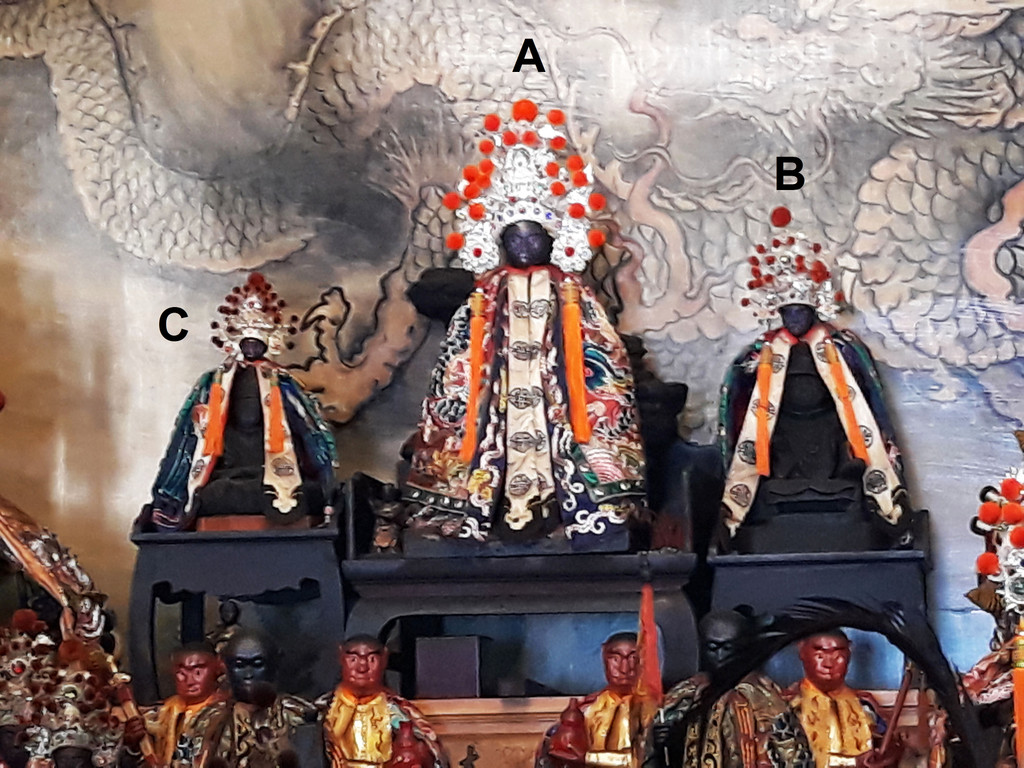
Worshipers of the Wanfu Temple of Tainan, Taiwan believe their high god and oldest altar statue, the “Laying the Foundation Elder Great Sage” (Kaiji Da Dasheng, 開基大大聖) (fig. 1), was transported to the island from the southern Chinese province of Fujian by a certain Lady Ruan (Ruan Furen, 阮夫人) during the Southern Ming/early Qing Dynasty (c. 1660). Fujian is home to a large number of temples dedicated to Sun Wukong. Monkey’s cult on the mainland may have some bearing on the history of his worship on the island. This is especially true since Taiwan was made a prefecture of Fujian in 1684 by the Qing. It was later granted provincehood in 1887 (Gordon, 2007). The cult was no doubt part of the cultural exchange that took place between these two areas during this time. In this paper I use modern demographics and historical records and stories to explore the history of Sun Wukong’s worship in Fujian. I suggest the existence of a historical 12th-century monkey cult explains why the Great Sage’s cult was so readily adopted in the province.

Fig. 1 – The Wanfu Temple’s Laying the Foundation Great Great Sage altar statue, indicated by the letter A (larger version). B and C are lesser Great Sages within the temple’s pantheon.

I. Modern demographics and possible tie to historical trends

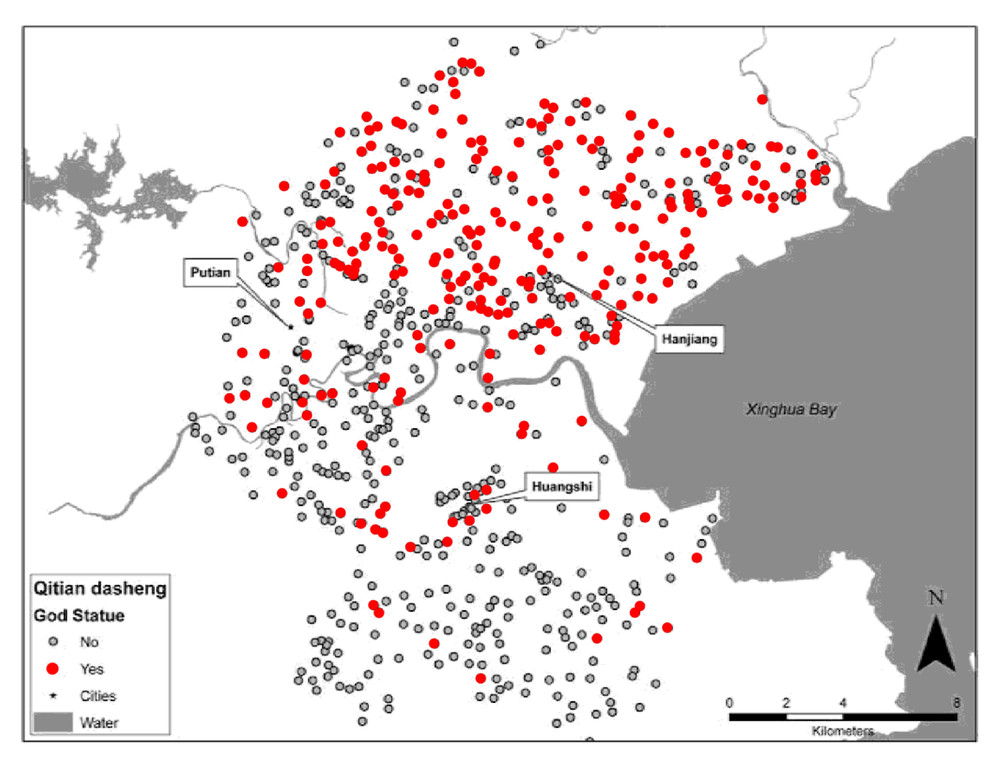
The plains of Putian (莆田) on the central Fujian coast hosts a cluster of Great Sage temples. Dean and Zheng (2009) show the Great Sage is the sixth of the forty most popular deities, his statue appearing in 332 temples, even beating out Guanyin (322 statues) in seventh place (p. 177). Additionally, they describe an interesting geographical correlation in their distribution:

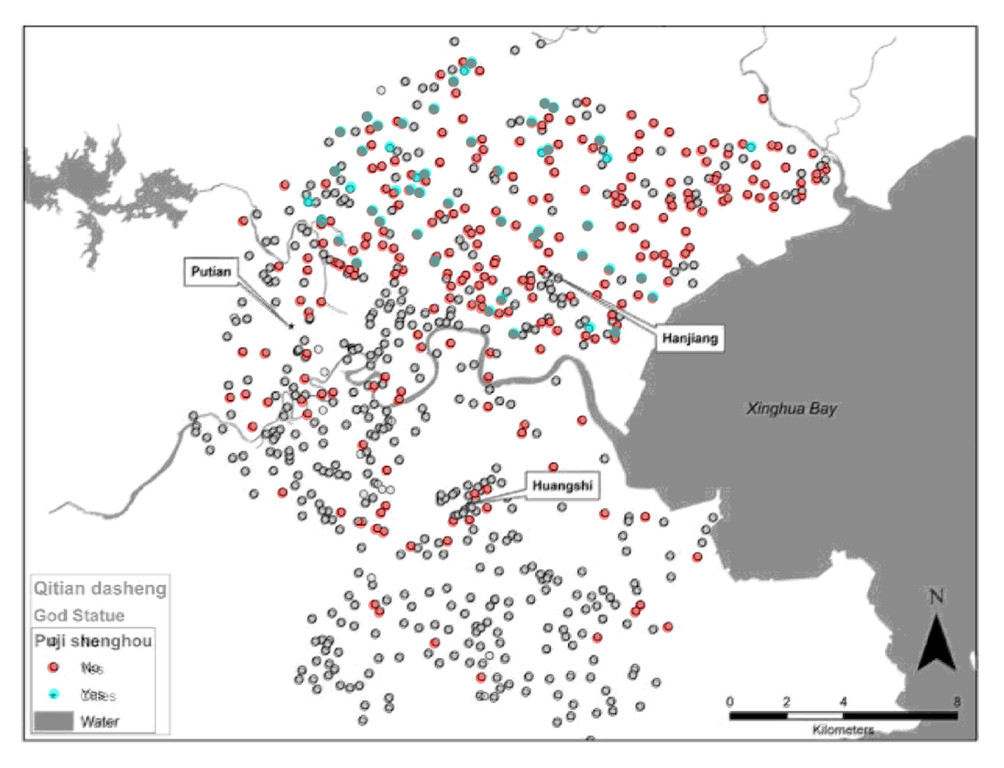
Using GIS mapping, one can unearth many suggestive correlations in distributions of different cultural features across the plain. For example, certain gods such as Qitian dasheng 齊天大聖 (Sun Wukong 孫悟空) and Puji shenghou 普濟聖侯 (Zhu Bajie 豬八戒), the Monkey and the Pig of the classic Xiyouji 西游記 (Journey to the West), appear more often in poorer villages in the northern plain [fig. 2], often in higher elevations than in the low-lying, densely irrigated, wealthier villages of the southern plains. This suggests that the unruly natures of these gods appealed to poorer communities rather than to villages with established scholar-literati lineages (Dean & Zheng, 2009, pp. 38-39)

Fujian Sun Wukong and Zhu Bajie Temple overlay Map - small

Fig. 2 – Left: Distribution of Sun Wukong temples (red) in the Putian plains of Fujian Province, China (larger version); Right: An overlay of Zhu Bajie Temples (light blue) with those of Monkey (red) (larger version). There is quite a bit of overlap. Adapted from Dean & Zheng, 2009, pp. 192-193.

Sun Wukong is one of several gods who never enjoyed state patronage in dynastic China due to their eccentric or rebellious nature (Shahar, 1996, p. 185). Regarding the latter, emperors had to deal with real world challenges to their own primacy, so paying homage to, say, a dissident monkey spirit probably didn’t seem too appealing. It’s interesting to note that Monkey is worshiped in Fujian and Taiwan under his defiant title of the Great Sage Equaling Heaven, a name he chose during his rebellion with the celestial realm, instead of his Buddhist name Wukong (悟空, “Awakened to Emptiness”) (Shahar, 1996, p. 201). Therefore, Monkey may have historically appealed to poorer folks because he had the power to push back against an unfair government, perhaps one that favored rich literati over impoverished farmers. This could explain the demographics mentioned above. If true, such people could be responsible for bringing Sun’s cult to Taiwan.

II. The connection between religion, myth, and popular literature

Emperors who officially recognized gods helped make them more popular or at least better known. [1] But, as Shahar (1996) explains, the state’s involvement rarely went beyond building temples and making offerings. Oral tales and popular novels were largely responsible for spreading the myth of a particular deity (p. 185). He continues:

In some cases the novel’s transformation of its divine protagonist was so profound, and its impact on the shape of its cult so great, that the novelist could be considered the deity’s creator. A notable example is Sun Wukong. The cult of this divine monkey in late imperial times cannot be separated from his image as shaped by the successive Journey to the West novels. In this respect he is indeed their author’s creation, and Pu Songling‘s complaint, voiced through his protagonist Xu Sheng [許盛], is justified: “Sun Wukong is nothing but a parable invented by [the novelist] Old Qiu [老丘]. [2] How can people sincerely believe in him?” (Shahar, 1996, pp. 193-194).

The tale referred to by Shahar, titled the Great Sage Equaling Heaven (Qitian Dasheng, 齊天大聖) appears in Strange Tales from a Chinese Studio (Liaozhai zhiyi, 聊齋誌異), a collection of popular tales recorded as early as 1679 by Pu Songling and later posthumously published in 1740 (Barr, 1984). The story follows the aforementioned Xu Sheng and his older brother, both merchants from Shandong, who travel to Fujian to sell their wares but are told to pray to the Great Sage when they fail to make any money.  They visit the monkey god temple and witness people burning incense and kowtowing to an image of Sun Wukong. The older brother takes part in the rituals, but Sheng simply laughs and leaves, resulting in a subsequent argument between the two during which Sheng ridicules adherents for worshiping a fictional character from a novel. Sheng later falls bedridden with agonizing leg sores that prevent him from walking, yet he refuses to accept the Great sage is punishing him. His brother begs him to repent, but he still refuses. The brother shortly thereafter falls ill and dies, prompting Sheng to go to the temple to beg for his brother’s life. That night, he dreams he is brought before Sun Wukong, who rebukes Sheng for his rude behavior and reveals the leg sores (the result of being stabbed by Monkey’s heavenly sword) [3] and his brother’s subsequent death to be heaven-sent punishments. The deity finally agrees to revive the brother and sends an order to King Yama in hell to release his soul. Sheng shows his thanks by kneeling. He then awakes to find his brother has revived but remains too weak to work. Days later, Sheng meets an old man who claims he can use “a little magic” to transport them to a beautiful place that will sap away the merchant’s depression wrought by the past events. The two travel by cloud to a celestial paradise where Sheng and the old man drink tea with an aged deity. The god rewards Sheng with twelve magic stones for taking the time to visit him. Upon returning to earth, the merchant realizes the old man is the Great Sage, for both use the “Somersault Cloud” (Jindou yun, 筋斗雲) as a means of conveyance. In the end, the magic stones are found to have melted, but this corresponds to a drastic increase in the brothers’ selling profits. The two return home but are sure to pay their respects to the Great Sage anytime they visit Fujian for business (Pu & Sondergard, 2014, pp. 2078-2085).

I’d like to point out the story includes an afterward that critiques the idea of Sun Wukong being a real god:

The collector of these strange tales remarks, “Once upon a time, a scholar who was passing a temple went in and painted a pipa on one wall, then left; when he checked on it later, its spiritual power was considered so outstanding that people had joined together there to burn incense to it. A god certainly doesn’t have to exist in order to be considered powerful in this world; if people believe it to be divine, it will be so for them. What’s the reason for this? When people who share the same beliefs gather together, they’ll choose some creature figure to represent those beliefs. It’s right that an outspoken man like Sheng should be blessed by the god; who else could believe for real that he’s protected by someone who keeps an embroidery needle inside his ear, who he can transform one of his hairs into a writing brush, or who ascends via cloud-somersault into the cerulean sky! In the end, Sheng’s mind must have deluded him, for what he saw simply couldn’t be true” (Pu & Sondergard, 2014, p. 2085)

This shows that, while the common folk believed in Monkey, the literati class scoffed at such an idea. This again may explain why, as mentioned above, more well-educated communities in modern Fujian do not widely worship Monkey.

III. Historical monkey cults in Fujian

Apart from Pu Songling’s story, there are two other 17th-century references to the worship of a monkey god in Fujian. Dudbridge (1970) explains:

According to You Dong [尤侗] (1618-1704) the citizens of Fuzhou worshiped Sun Xingzhe [孫行者, Pilgrim Sun] as a household god and built temples to the monkey-god Qitian Dasheng. Tong Shisi [佟世思] (1651-92) describes the monkey-headed god of Fujian as bearing a metal circlet about his forehead, brandishing an iron cudgel, wearing a tiger-skin and known as Sun Dasheng [孫大聖, Great Sage Sun]. Traditionally he had appeared in the clouds to beat back an attack from Japanese pirates (p. 158). [4]

I find the last reference particularly interesting because it refers to the preceding 16th-century when China’s coast was plagued by Japanese pirates. It depicts the Great Sage as a benevolent god who intervenes to protect his chosen people, the Chinese.

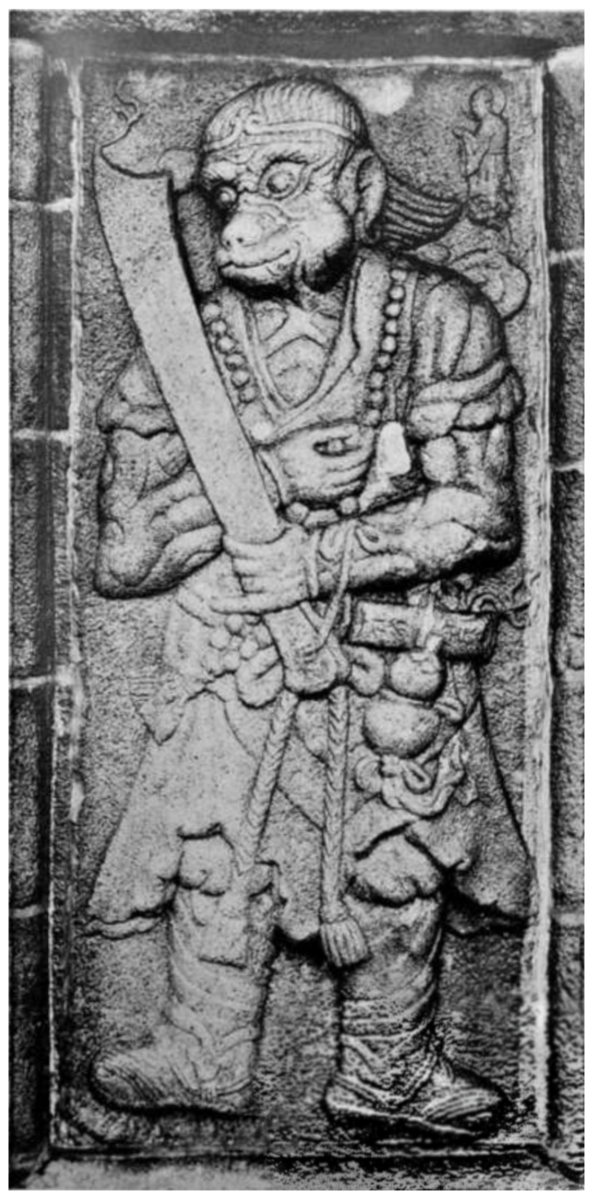
In her excellent paper on the origins of Sun Wukong, Hera S. Walker (1998) discusses a 1237 stone relief from the western pagoda of the Kaiyuan Temple (開元寺) in Quanzhou, a port city in Fujian, that portrays a sword-wielding, monkey-headed warrior (pp. 69-70). [5] Considered by many to be an early depiction of Monkey, the figure wears a fillet, a tunic, a Buddhist rosary, and a pair of bangles (Fig. 3). Walker quotes Victor Mair, who believes the fillet and the figure wearing it recall South and Southeast asian depictions of the Buddhist guardian Andira and the Hindu monkey god Hanuman (Walker, 1998, p. 70). I have suggested in a previous article that the accouterments worn by the warrior are instead based on Esoteric Buddhist ritual attire known in China. So instead of being based on a foreign source, it can be considered a depiction of a local spirit or deity. The relief therefore suggests the proposed Fujian monkey god cult predates the 17th-century.

Better Kaiyung Temple Monkey (Zayton-Quanzhou) - small

Fig. 3 – The 1237 stone relief of Sun Wukong from the Kaiyuan Temple in Quanzhou, Fujian (larger version).

The oldest known evidence for a cult based around a monkey is described in Hong Mai’s (洪邁, 1123-1202) the Record of the Listener (Yijian zhi, 夷堅志, c. 1160), a collection of supernatural tales from the Song Dynasty. The following story is said to take place in the Yongfu County of Fujian. Again, we turn to Dudbridge (2005):

The image [effigy], dubbed Monkey King 猴王, was shaped around a captured living monkey and worshipped as a ‘spirit protecting hills and woods’ (保山林神). [6] It afflicted the surrounding population with fevers and frenzy. Blood sacrifice won no relief. Shamans and monks assaulted the spirit by night with noisy ritual music, but to no effect. Only the Buddhist elder Zongyan 宗演 successfully admonished the resentful monkey spirit and wrought its deliverance by reciting in Sanskrit the dhāraṇī of the All-Compassionate (大悲咒). The grateful monkey appeared to him the same night, explaining that she was now able to rise to heaven. Later the image and its thirty-two attendants (all made from birds) were smashed, and the hauntings came to an end (p. 264; see also Dudbridge, 1970, p. 159).

Dudbridge (1970) is reluctant, however, to accept this as a precursor to Sun Wukong’s cult, especially since both this 12th-century monkey spirit and the “Monkey Pilgrim” (Hou Xingzhe, 猴行者) from the The Story of How Tripitaka of the Great Tang Procures the Scriptures, a 13th-century precursor to Journey to the West, bear little resemblance to the simian god mentioned in 17th-century records. He instead suggests the Great Sage’s cult could have grown up around stories connected to the publishing of the novel (Dudbridge, 1970, p. 159). While Journey to the West certainly played a sizable role in the spread of Monkey’s cult, I think the above tale shows that the Fujian area was already primed for monkey worship by at least the 12th-century. Most importantly, the noted Song dynasty poet Liu Kezhuang (劉克莊, 1187-1269), whose family hailed from the Fujian city of Putian (mentioned in section one) (Ebrey, 2005, p. 95), referenced the Monkey pilgrim twice in his 13th-century work. The second of two such references uses Monkey as a metaphor to describe the ageing 70-year-old poet’s appearance. A portion of the poem reads:

A back bent like a water-buffalo in the Zi stream [泗河],
Hair as white as the silk thread issued by the “ice silkworms”,
A face even uglier than Hou Xingzhe,
Verse more scanty than even He Heshi [鶴何師] (Dudbridge, 1970, p. 46)

This shows the character’s story cycle was so well-known in Fujian at this time that no other specifics from the oral tradition had to be mentioned. Therefore, stories of the early monkey cult and those of Sun Wukong could have existed in Fujian around the same time. It’s not entirely impossible then that the historical monkey worship in the province gave the cult of the Great Sage, whenever it first appeared, a boost. This might explain why a so-called literary character would come to be so readily worshiped in the province.

IV. Conclusion

Taiwan has close ties to the southern Chinese province of Fujian because the former was made a prefecture of the latter during the 17th-century. The province is home to a large number of temples dedicated to the Monkey King, so this is no doubt connected to the spread of his cult to the island nation. Modern GIS mapping in Fujian suggests Sun Wukong’s temples mainly inhabit the northern highlands of the Putian plains where poorer villages reside. Monkey’s cult never received royal patronage in dynastic China due to his rebellious nature. The fact that he is worshiped in Fujian and Taiwan by his rebellious title of the Great Sage Equaling Heaven suggests Monkey may have historically appealed to the poorer class because he had the power to push back against an unfair government, perhaps one that favored the rich over the destitute. If true, these could be the people responsible for bringing Sun’s cult to Taiwan.

The mythos of Monkey’s cult was spread thanks to oral tales and popular literature. His mythos became so inseparable from the novel that the scholar class looked upon him as a literary character that jumped from the pages of fiction to be worshiped as a god. An example of this viewpoint appears in Strange Tales from a Chinese Studio (written c. 17th-cent.) in which a skeptical merchant only becomes an adherent of the Great Sage after he and his brother are punished with painful sores and death, respectively. The author of the tale comments the merchant was probably delusional to fall for such a belief. This scholarly disdain for such literary gods may then explain why the more well-educated villages in Putian don’t widely worship Sun Wukong today.

Other 17th-century sources referring to Monkey’s Fujian cult portray him as a headband-wearing, cudgel-wielding benevolent god who comes to the aid of the Chinese people. A 13th-century stone relief located on the western pagoda of the Kaiyuan Temple in Quanzhou depicts a sword-wielding, monkey-headed warrior wearing a fillet. While past scholarship has posited a South and Southeast Asian origin for the figure’s iconography, my research suggests it to be based on esoteric ritual accouterments known in China. So instead of being based on a foreign source, it can be considered a depiction of a local spirit or deity. The relief therefore suggests the proposed Fujian monkey god cult predates the 17th-century. The oldest evidence for such a cult appears in Hong Mai’s Record of the Listener, a 12th-century collection of supernatural tales. It refers to a malevolent simian god worshiped as the “Spirit protecting hills and woods” that spread fever and was eventually pacified by a Buddhist monk. This shows Fujian was primed for monkey worship by the 12th-century, and the fact that the “Monkey Pilgrim” (Sun Wukong’s original name) is mentioned in the secular works of the Putian poet Liu Kezhuang in the 13th-century shows stories of this god and Monkey existed in Fujian around the same time. The historical existence of a Fujian monkey cult may have given Sun Wukong’s cult a boost, explaining how a literary character came to be so readily worshiped.


Updated: 07-26-19

The American missionary Justus Doolittle (1865) recorded information about the worship of the Great Sage in Fuzhou city, Fujian province, China during the 19th-century:

The Monkey. — It is represented as a man sitting, the face only being like a monkey. The image is usually made of wood or clay. Sometimes a picture of it is made on paper, or simply the title under which the monkey is worshiped is written on a slip of paper, and used instead of an image. There are several large temples at this place, erected for the worship of “His Excellency the Holy King,” one of the titles much used in speaking of the monkey as an object of worship. Oftentimes the niche holding the image or the written name is placed in a hollow tree, or in the wall at the corners of streets, or at the heads of alleys or lanes. Such places, in this city and vicinity, where the monkey is worshiped, reckoned together with the small temples or buildings dedicated to it, amount to several scores. The worship consists principally in the burning of incense and candles, sometimes attended with the presentation of meats, vegetables, and fruits. The monkey was first worshiped in return for some supposed services rendered the individual who went to India, by special command of an emperor of the Tang dynasty, to obtain the Sacred Books of the Buddhist religion — so some affirm. This emperor deified the monkey, or, at least, he conferred the august title of “the great Sage equal to Heaven” upon that quadruped. The birthday of “His Excellency the Holy King” is believed to occur on the twenty-third of the second Chinese month, when his monkey majesty is specially worshiped by men from all classes of society. The monkey is believed to have the general control of hobgoblins, witches, elves, etc. It is also supposed to be able to bestow health, protection, and success on mankind, if not directly, indirectly, by keeping away malicious spirits or goblins. People often imagine that sickness, or want of success in study and trade, is caused by witches and hobgoblins. Hence the sick or the unsuccessful worship the monkey, in order to obtain its kind offices in driving away or preventing the evil influences of various imaginary spirits or powers (vol. 1, pp. 287-288).

He continues, “Sometimes the image carried in procession while praying for rain represents a deified monkey, an object which is much worshiped by some classes of the people at this place” (Doolittle, 1865, vol. 2, p. 119).

It appears that Doolittle wasn’t aware of Journey to the West since he combines folklore with history, claiming a Tang emperor deified and/or bestowed Wukong with his Great Sage title. Sun’s image as an exorcist and healer, as well as his remuneration with incense and delicious foodstuffs, matches what I’ve previously written about in Taiwan. But his association with rainmaking is new, although not entirely a surprise. Also, his birthday is celebrated on a different day, the twenty-third day of the second lunar month, instead of the twelfth day of the tenth lunar month in Taiwan and the sixteenth day of the eighth lunar month in Hong Kong and Singapore. Interestingly, unlike Fuzhou, his birthday is celebrated on the twenty-fifth day of the second lunar month in Putian (Dean & Zheng, 2010, p. 162, for example). Such differences highlight that Monkey’s cult never received state patronage and therefore lacks standardization in beliefs and practices even in Fujian.

This information may have implications for the worship of the Great Sage by southern Chinese immigrants in 19th-century San Francisco.


Updated: 08-17-2019

The Japanese researcher Isobe Akira shows that, despite appearing in Song-era sources, the aforementioned story about the female monkey king can be traced to the late Tang period (Mair, 1989, pp. 694-695). This shows Fujian was primed for monkey worship centuries prior to the development of Sun Wukong’s story cycle.

Additionally, Isobe points to one of the earliest known references to Sun Wukong. A tale appearing in Zhang Shinan’s (張世南, 12th-13th century) Memoirs of a Traveling Official  (Youhuan jiwen遊宦紀聞) tells of Zhang the Sage (Zhang sheng, 張聖), a farmer-turned-Buddhist monk who gains literacy and clairvoyance after eating a magic peach. In the story, Zhang is asked to write a eulogy in honor of a newly built revolving sutra case. The resulting poem references the Monkey Pilgrim:

Fresh are the pattra (palm) leaves on which are written
the unexcelled (anuttara), vigorous texts,
In several lives, Tripitaka went west to India to retrieve them;
Their every line, their every letter is a precious treasure,
Each sentence and each word is a field of blessing (punyaksetra).
In the waves of the sea of misery (duhkha-sagara),
the Monkey-disciple presses on 猴行復,
Through the waters of the river that soak its hair,
the horse rushes forward;
No sooner have they passed the long sand than they must face
the trial of the golden sands,
Only while gazing toward the other shore do they know
the reasons (pratyaya) for being on this shore.
The demons (yaksas) are delighted that they might
get their heart’s desire,
But the Bodhisattva, with hand clasped in respectful greeting,
sends them on;
Now here are the five hundred and sixty-odd cases of scriptures,
Their merit is difficult to measure, their perfection
hard to encompass (Mair, 1989, pp. 693-694).

This eulogy is fascinating because it references additional elements that would appear in The Story of How Tripitaka of the Great Tang Procures the Scriptures, including the Buddhist master’s quest to India over many lifetimes, the tribulations at the river of sand (a nod to Sha Wujing’s precursor), the demons encountered, and heavenly assistance. Isobe dates Zhang the Sage’s tale to the late Northern Song to the early Southern Song (circa 1127) (Mair, 1989, p. 694). But what’s interesting for our purposes is that the original recorder, Zhang Shinan was known to have historically held a government post in Fujian (Zheng, Kirk, Buell, & Unschuld, 2018, pp. 644-645), meaning he could have picked up the tale in the southern province. This adds an additional connection between Fujian and Sun Wukong.

Notes:

1) One example of this connected to Journey to the West is Erlang. He was originally worshiped as a hunting god and queller of mountain ghosts by the Qiang (羌) ethnic group of the western Sichuan region. But his cult became even more popular upon gaining state recognition. Wu (1987) writes: “The Er-lang cult became even more popular in Sichuan under the patronage of the Later Shu emperor, Meng Chang 孟昶 (r. 934-65), and in 965, when the Song dynasty conquered the kingdom, it adopted the cult, erecting temples for the god in the capital and throughout the country” (pp. 107-108).

2) This refers to Qiu Chuji (丘處機, 1148-1227), the founder of the Dragon Gate sect of Daoism during the Song Dynasty. Qiu is known to have written a travel journal named Journey to the West, which Pu Songling confused with the novel of the same name (Pu & Sondergard, 2014, p. 2080 n. 1).

3) Literally “Bodhisattva Saber” (Pusa dao, 菩薩刀).

4) Source altered slightly. The Wade Giles was converted to pinyin and the Chinese characters from the footnotes were moved into the paragraph.

5) In act 10 of the early 15th-century zaju play Journey to the West, Guanyin gives Sun Wukong an iron headband, a cassock, and, most importantly, a sword. His depiction in the play and this relief then may have some connection.

6) The fact that the effigy was formed around a living monkey suggests it was killed in the process. This would explain its rage.

Sources:

Barr, A. (1984). The Textural Transmission of Liaozhai zhiyi. Harvard Journal of Asiatic Studies, 44 (2), pp. 515-562.

Dean, K., & Zheng, Z. (2009). Ritual alliances of the Putian plain. Volume One: Historical introduction to the return of the gods. Leiden: Brill.

Dean, K., & Zheng, Z. (2010). Ritual alliances of the Putian plain. Volume Two: A survey of village temples and ritual activities. Leiden: Brill.

Doolittle, J. (1865). Social life of the Chinese: With some account of their religious, governmental, educational, and business customs and opinions. With special but not exclusive reference to Fuhchau. Volume 1 and 2. New York: Harper & Brothers.

Dudbridge, G. (2005). Books, tales and vernacular culture: Selected papers on China. Leiden: Brill.

Dudbridge, G. (1970). The Hsi-yu chi: A study of antecedents to the sixteenth-century Chinese novel. Cambridge: Cambridge Univ. Press.

Ebrey, P. B. (2005). Women and the family in Chinese history. London: Routledge.

Gordon, L. H. D. (2007). Confrontation over Taiwan: Nineteenth-century China and the powers. Lanham, MD: Lexington Books.

Mair, V. (1989). Suen Wu-kung = Hanumat? The Progress of a Scholarly Debate, in Proceedings of the Second International Conference on Sinology (pp. 659-752). Taipei: Academia Sinica.

Pu, S., & Sondergard, S. L. (2014). Strange tales from Liaozhai. Volume 6. Fremont, Calif: Jain Pub.

Shahar, M. (1996). Vernacular Fiction and the Transmission of Gods’ Cults in Later Imperial China. In M. Shahar & R. P. Weller (Eds.), Unruly gods: Divinity and Society in China (pp. 184-211). Honolulu: University of Hawaiʻi Press.

Walker, H.S. (1998). Indigenous or foreign? A look at the origins of monkey hero Sun Wukong. Sino-Platonic Papers, 81, pp. 1-117.

Zheng, J., Kirk, N., Buell, P. D., & Unschuld, P. U. (2018). Dictionary of the Ben cao gang mu, Vol. 3: Authors and book titles. Berkeley: University of California Press.

Archive #1 – The Early-Ming Journey to the West Zaju Play

Note: Go to the 11-18-21 and 11-21-21 updates for PDFs of two scholarly studies of the zaju play.

Last updated: 09-06-2023

I have previously discussed the 13th-century precursor to Journey to the West called The Story of How Tripitaka of the Great Tang Procures the Scriptures. This 17-chapter storytelling prompt differs greatly from the final version. However, a little known precursor, the early-Ming Journey to the West zaju play (Xiyou ji zaju, 西遊記雜劇), contains many familiar episodes, including the reincarnation of a heavenly being as Tripitaka, the murder of his father, Monkey stealing immortal peaches from heaven and eventually being imprisoned under a mountain, his punishment with the restricting headband, the subjugation of Zhu Bajie (here and here) and Sha Wujing, the addition of a royal dragon-turned-white horse, the ordeal at Fire Mountain, the Country of Women, etc. It is also one of the earliest sources to call the monkey character “Sun Wukong” (孫悟空). [1] This shows that the centuries-old story cycle was starting to become standardized by the 14th or 15th-century.

But despite the many similarities to the 1592 novel, there are several subtle and very interesting differences. For instance, Sun is trapped under his home of Flower Fruit Mountain by Guanyin, instead of being banished to Five Elements Mountain by the Buddha 600 years prior. In addition, although Red Boy and Princess Iron Fan appear in the play, they are not depicted as mother and son. The demon child is instead the offspring of the monstress Hariti. These are just a few of many deviations.

Early 20th-century scholarship ascribes the play to Yang Jingxian (杨景賢), a 15th-century mongol playwright who served as a minor official to his sister’s husband, the Military Judge Yang (from whom he took his pen surname). Records indicate Yang was fond of music, practical jokes, visiting pleasure quarters, and, of course, writing zaju plays (Ning, 1986, pp. 6-7). This explains the rowdy and often saucy nature of the story, which is replete with cursing, sexual innuendo, [2] and many beautiful, seductive women. Ning (1986) suggests Yang uses sexualized women as a detriment to the celibate Tripitaka to not only elicit laughter from the male audience, but also to make fun of Buddhism while elevating his own Confucian worldview (p. 81).

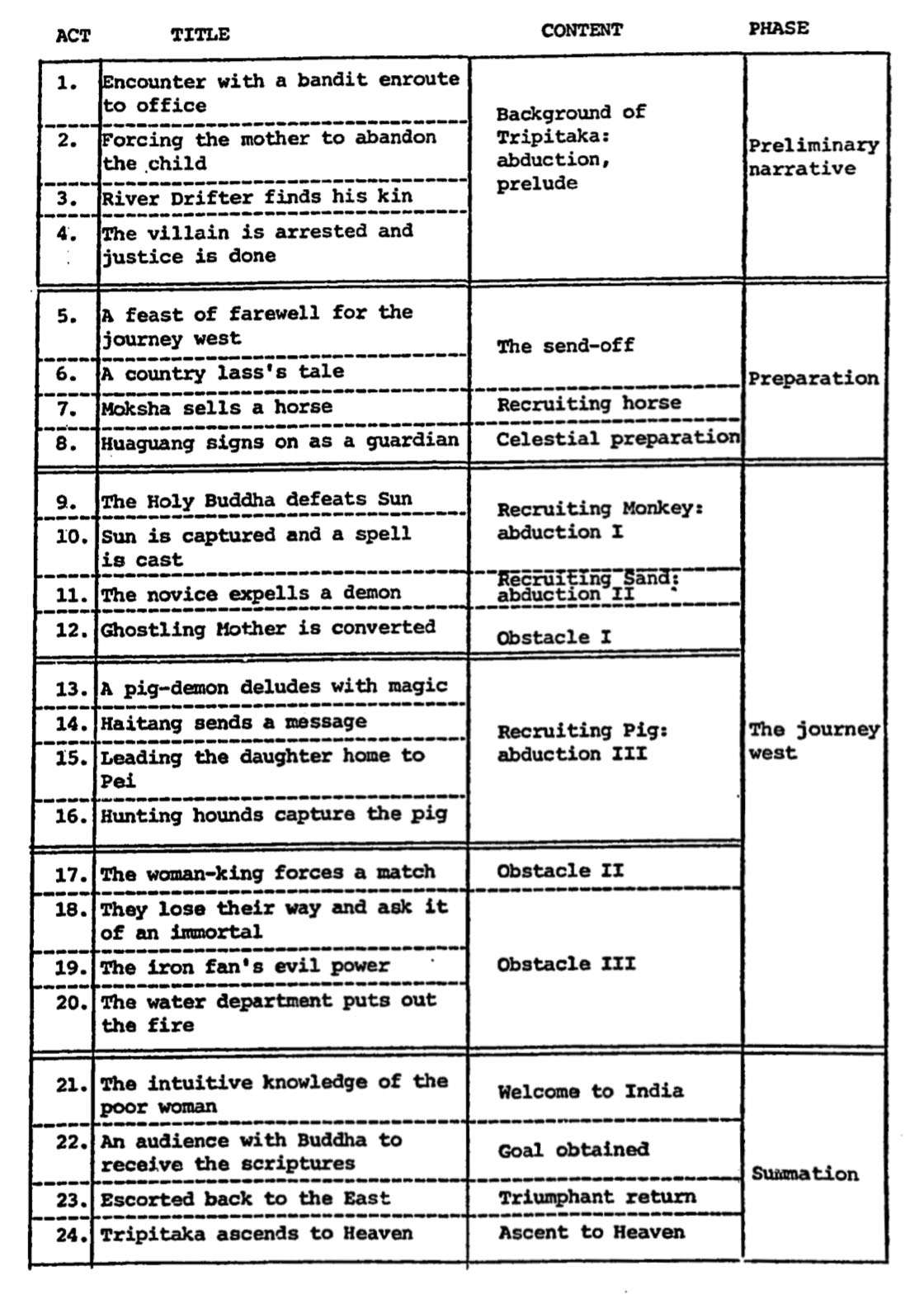
Women play a large role in the production, appearing in 13 of the 24 acts. Female characters are abducted in four different parts (Xuanzang’s mother in acts one to four; Monkey’s wife in act 10; the daughter of the Liu family in act 11; and Pigsy’s wife in acts 13 to 16), while women make up the three main obstacles (Hariti in act 12; the Queen of the Land of Women in act 17; and Princess Iron Fan in acts 18 to 20) (fig. 1).

zaju-acts-list.jpg

Fig. 1 – A synopsis diagram of the Journey to the West zaju play (from Ning, 1986, p. 9) (larger version).

Below I present the play’s summary as laid out by Dudbridge (1970).

Scene 1: Disaster encountered on a journey to office

The Bodhisattva Guanyin introduces the action: a mortal is required to collect scriptures for the benefit of China; for this purpose the Arhat Vairocana is to become incarnate as the son of Chen Guangrui [陳光蕊] in Hongnong xian [弘農縣] of Haizhou [海州]. Chen Guangrui is to suffer an eighteen-year-long ‘disaster in water’. The Dragon King has been instructed to protect him.

Chen Guangrui, on his journey to office, has reached the Inn of a Hundred Flowers: he has restored life to a fish which, when he bought it, blinked at him. Preparing to continue the journey to Hongzhou [洪州], the servant Wang An [王安] looks for a boatman. The singer in this act is Chen’s wife who, being eight months pregnant, is full of anxieties about the journey. In the event Liu Hong [劉洪], recruited as their boatman, murders first Wang An, then Chen himself; he agrees to spare the wife and her unborn child on condition that she accepts him in Chen Guangrui’s place—as her husband and the prefect of Hongzhou. She has him agree in turn to a three-year delay—a gesture of filial piety on the part of her as yet unborn son.

Scene 2: The mother forced, the child cast out

The Dragon of the Southern Seas explains that in compliance with Guanyin’s direction and in gratitude for Chen Guangrui’s action in saving his life (in the form of a fish at the Inn of a Hundred Flowers), he is holding the murdered Chen secure in his Crystal Palace until the eighteen years are up.

Liu Hong enters and declares his intention of ridding himself of the newly born child who constitutes a threat to his security in office.

The Dragon reappears briefly to ensure protection for the incarnate Vairocana who is to suffer hardship on the river.

The wife—again the singer—completes the scene alone. She has been compelled by Liu Hong to cast her month-old son into the river, and now performs the deed carefully, putting the child into a watertight box, together with two gold clasps and an explanatory note written in her own blood.

Scene 3: Jiangliu [江流] recognizes his mother

The Dragon orders the Arhat to be transported to the island monastery Jinshansi [金山寺, Gold Mountain Monastery].

A fisherman finds the box and takes it off to the Abbot.

The Chan Master Danxia [丹霞] receives it, inspects the contents and resolves to raise the child [whom he names Jiangliu, Flowing River] and preserve the letter with all the details of its history.

Liu Hong here makes a brief appearance, alluding to his present quite life and sense of security.

The passage of eighteen years is assumed: the Chan career of the abandoned child, whom he has brought up as a novice monk and named Xuanzang [玄奘]. He now sends him on a mission of revenge, first explaining the details of his background.

The mother is discovered in a state of anxiety: again she is the singer. Xuanzang enters, there is an extended recognition scene. They arrange for him to return provisionally to Jinshansi. 

Scene 4: The bandit is taken, revenge is wrought

Yu Shinan [虞世南] has now, in the year Zhenguan [貞觀] 21 [647/648 CE], been appointed Prefect of Hongzhou. His first official case is an appeal delivered by the Abbot Danxia and Xuanzang, calling for action against Liu Hong. Men are sent secretly to arrest him.

The dissipated Liu Hong is giving orders to his wife, who is again the singer. Official guards enter and arrest Liu; he makes a full confession. Yu Shinan sentences him to immolation on the shore of the river in expiation of Chen’s death. As the sacrificial verses are pronounced Chen’s body is borne out of the water by the Dragon King’s attendants. There is a final explanation.

Guanyin appears on high: she summons Xuanzang to the capital, first to pray for rain to break a great drought there, and further to fetch 5,048 rolls of Mahāyāna scriptures from the West.

The wife sums up the whole action in her closing songs.

Scene 5: An Imperial send-off for the westward journey

Yu Shinan narrates how he presented Xuanzang at court: the prayers for rain were successful, Xuanzang was honoured with the title Tripitaka [三藏] and invested with a golden kaṣāya and a nine-ringed Chan staff. His parents also received honours.

Now, in official mark of his departure for the West, Qin Shubao [秦叔寶] and Fang Xuanling [房玄齡] representing officials civil and military, enter to greet him. Xuanzang is ushered on. The official party is headed by the aged Yuchi Gong [尉遲恭], the singer in this act. He sustains a dialogue, partly in song, with Xuanzang, leading finally to a request for a Buddhist name. Xuanzang names him Baolin [寶林, Treasure Forest].

The pine-twig is planted which will point east when Xuanzang returns. Finally, he gives spiritual counsel to members of the crowd.

Scene 6: A village woman tells the tale

In a village outside Chang’an some local characters return from watching the spectacle of Tripitaka’s departure. The singer is a woman nicknamed Panguer [胖姑兒]. Her songs describe the scene from the crowd’s point of view. There is a good deal of observation of various side-shows and theatrical performances.

Scene 7: Moksha sells a horse

The Fiery Dragon of the Southern Sea is being led to execution for the offence of ‘causing insufficient and delayed rainfall’. His appeals succeed in enlisting the help of Guanyin, who persuades the Jade Emperor to have him changed into a white horse for the transport of Tripitaka and the scriptures.

Tripitaka is discovered at a wayside halt, troubled by the lack of a horse.

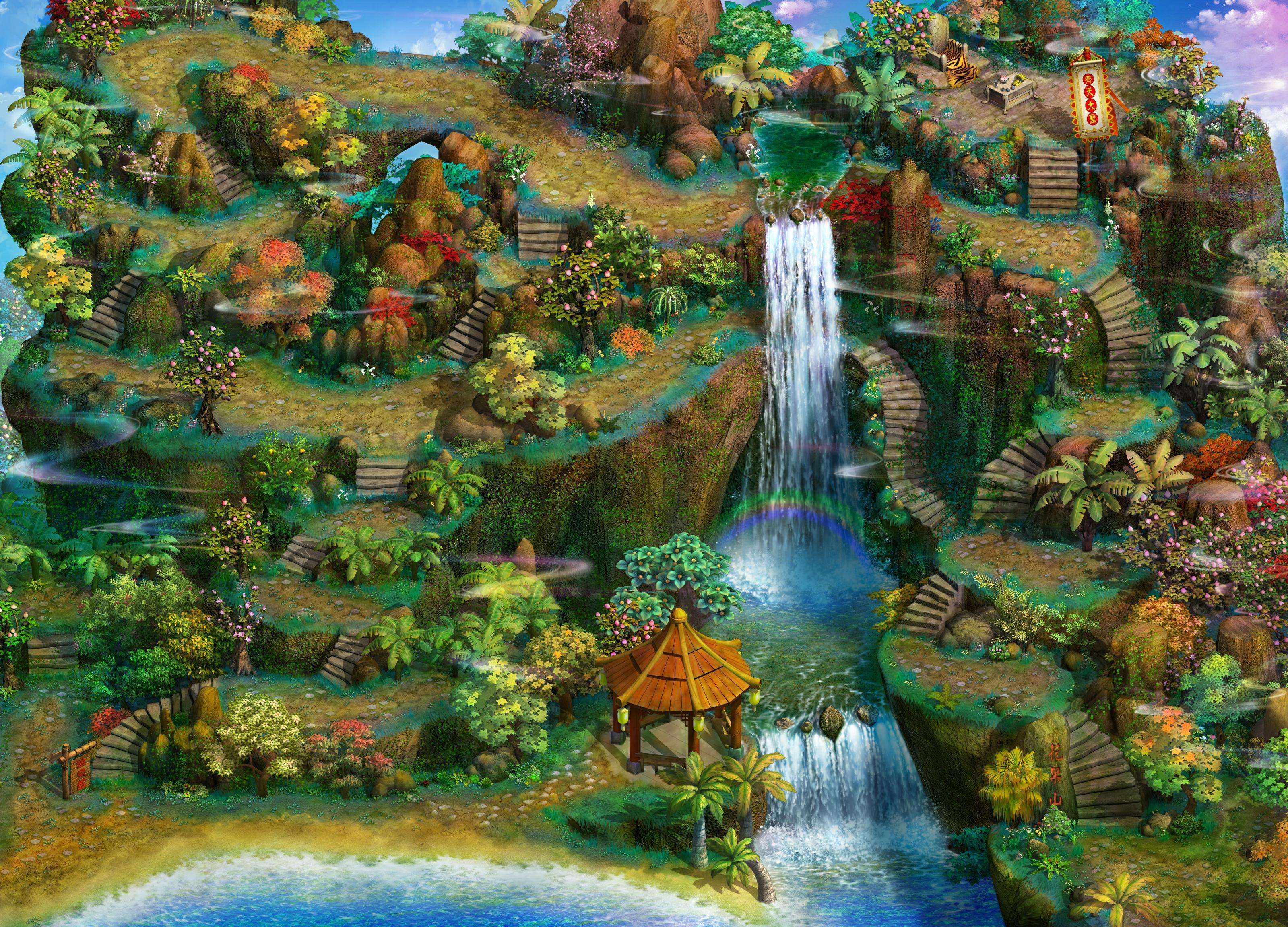
Moksha [木叉], disciple of Guanyin and the singer in this act, comes to offer him the white dragon-horse. His songs extol the horse’s qualities. Finally he uncovers the design, reveals the dragon in its original form, and ends the scene with allusions to the coming recruitment of Sun Wukong on Huaguo shan [花果山, Flower Fruit Mountain] (fig. 2) (Dudbridge, 1970, pp. 193-195).

106_125336_1 - small

Fig. 2 – A depiction of Huaguo shan from a modern videogame (larger version).

Scene 8: Huaguang serves as protector

Guanyin first announces a list of ten celestial protectors for Tripitaka on his journey. The Heavenly King Huaguang [華光天王], sixth on the list, is the last to sign on: he enters and for the rest of the scene sings on this theme of protection, pausing only to receive Guanyin’s greeting. In the last song there is a further allusion to Huaguo shan.

Scene 9: The Holy Buddha defeats Sun

Sun Xingzhe [孫行者, Pilgrim Sun] now appears: after an initial poem vaunting his celestial birth, his ubiquity and power, he lists out the members of his ape family, alludes to his career of misdeeds and his wife, the abducted Princess of Jinding guo [金鼎國, the Golden Cauldron Country].

Devaraja Li appears, with orders to recover the possessions stolen by Sun from the Queen Mother of the West. He issues orders to his son Nezha, who enters with troops upon orders from the Jade Emperor to capture Sun Xingzhe in his home Ziyun luo dong [紫雲羅洞, Purple Cloud Cave] on Huaguo shan.

The princess-wife now enters (the singer in this act) and tells in song the story of her abduction and the life on this mountain. She is joined by Sun and they prepare to feast.

The celestial troops surround them, Sun’s animal guards flee and Sun himself escapes. Devaraja Li ‘combs the hills’ and meanwhile finds the princess, who now sings through the remainder of her suite of songs until it is decided to give her escort back to her home.

Sun Xingzhe eludes the forces of Nezha and is captured only by intervention by Guanyin, who has him imprisoned beneath Huaguo shan to await the arrival of Tripitaka, his future master.

Scene 10: Sun is caught, the charm rehearsed

The singer is a Mountain Spirit guarding Sun beneath Huaguoshan: He opens the act with songs about his own permanence and his present duties.

Tripitaka comes seeking hospitality. The Spirit responds with a sung discourse which is interrupted by the shout of Sun Xingzhe eager to be delivered. Tripitaka releases him, and Sun’s immediate reaction is to seek to eat him and escape. Guanyin intervenes to curb his nature will disciplines in the shape of an iron hoop [Tiejie, 鐵戒, Iron prohibition ring], a cassock and a sword. She gives him the name Sun Xingzhe.

To Tripitaka she teaches the spell that works the binding hoop on Sun’s head, and they successfully prove it.

The Spirit adds (in speech) a warning about the demon of Liusha [he 流沙河, Flowing Sands River] and they again set out.

Scene 11: Xingzhe expels a demon

The Spirit of Liusha he, characterized as a monk adorned with human skulls, announces that he has devoured nine incarnations of Tripitaka (nine skulls represent them), towards the total of a hundred holy men he must eat in order to gain supremacy.

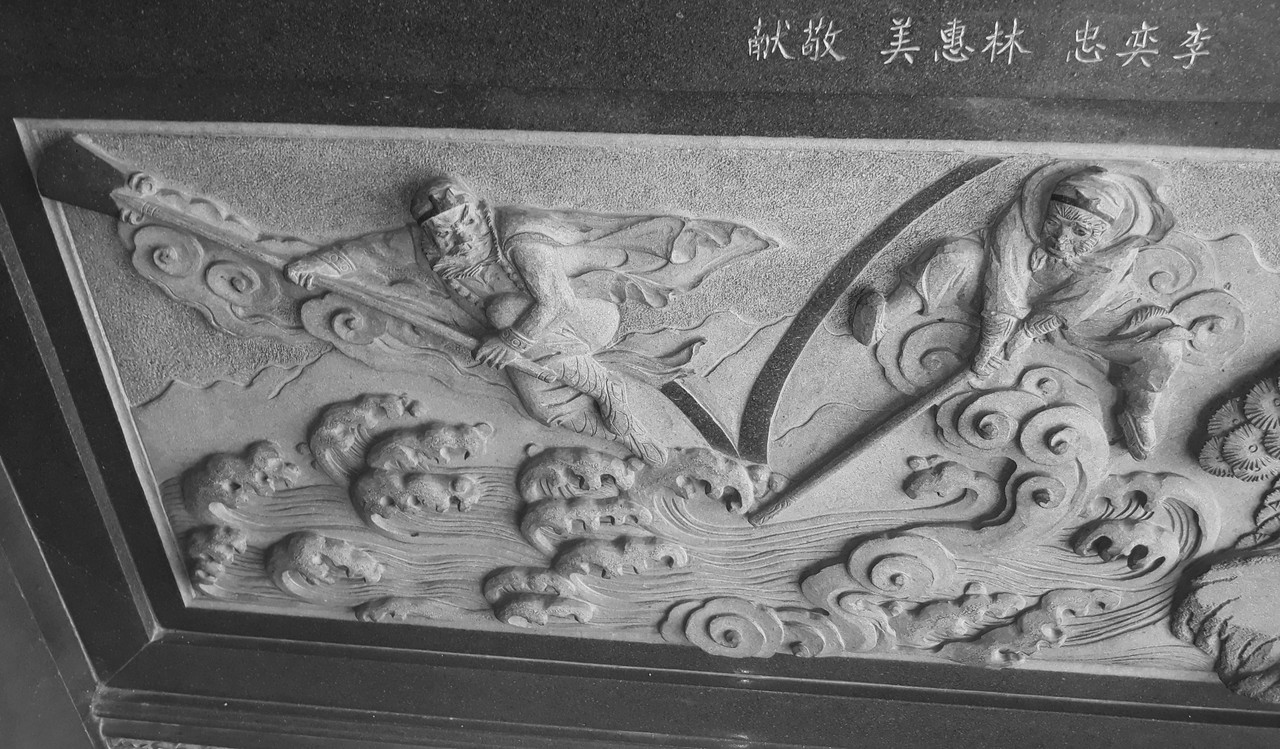
Sun Xingzhe enters and is attacked by this Sha Heshang [沙和尚, Sha Monk]. Sun vanquishes him (fig. 3) , and he is recruited for Tripitaka’s band of pilgrims.

A new demon named Yin’e jiangjun [銀額將軍, Silver-browed General] enters, inhabitant of the impregnable Huangfeng shan [黃風山, Yellow Wind Mountain]. He has abducted the daughter from a nearby Liu family.

The father Liu is the singer in this act: he explains his plight to Tripitaka and the party of pilgrims. They fight and kill the demon, and restore the girl to her home. As they set out again, Liu gratefully awaits their return from the West (Dudbridge, 1970, pp. 195-196).

Wanfu (44) - small

Fig. 3 – A stone relief carving of Monkey fighting Sandy (from Wanfu Temple, Tainan, Taiwan) (larger version).

Scene 12: Gui mu  is converted [Guiyi, 皈依, Take refuge (in the Buddha)]

The pilgrims are now approached by the Red Boy [Hong hai’er, 紅孩兒] feigning tears. Sun Xingzhe, against his own better judgement, is made to carry the child, cannot sustain the intolerable weight and tosses him into a mountain torrent.

Sha Heshang at once reports that the child has borne away their Master. They go off to appeal to Guanyin; she in turn takes the case to the Buddha, who now appears in company with the Bodhisattvas Mañjuśrī [Wenshu, 文殊] and Samantabhadra [Puxian, 普賢]. He explains that this is the son, named Ainu’er [愛奴兒], of Guizi mu (鬼子母, Hariti) (fig. 4). Four guardians have been sent to capture him with the help of the Buddha’s own alms bowl. The bowl is now brought in, with the Red Boy confined beneath it. The pilgrims return to rejoin their Master.

The mother Guizi mu enters to sing vindictive songs about this action. The Buddha defends himself from her attacks; she attempts to have the bowl lifted clear; finally she is overcome by Nezha. Tripitaka is freed and himself offers her alternative sentences: she chooses to embrace Buddhism (Dudbridge, 1970, pp. 196-197).

The_Buddhist_Goddess_Hariti_with_Children - Small

Fig. 4 – A 1st-cent. BCE Gandharan statue of Hariti (Guizi mu) with children (larger version).

Scene 13: A pig-demon deludes with magic

Zhu Bajie [豬八戒] enters, announces his background, past history and present home (Heifeng dong [黑風洞, Blackwind cave]) and describes a plan by which he means to substitute himself for the young man Chu Lang [朱郎], the bridegroom to whom a young local girl is promised and for whom she waits nightly. (Her father Peigong [裴公], we learn, is disposed to retract the agreed match for financial reasons.)

The girl, with her attendant, expects a visit from young Chu the same night. She (the singer in this act) goes through the actions of burning incense as she waits for him. Zhu Bajie enters, carries on a burlesque lovers’ dialogue with her and prevails on her to elope with him.

The pilgrims appear briefly on the stage, preparing to seek lodging near the frontier of Huolun [火輪] Jinding guo.

Scene 14: Haitang [海棠] sends on news

The girl, again the singer, is now in Zhu Bajie’s mountain home, has discovered the deception and despairs of seeing her home again; she is obliged to entertain the debauched Zhu Bajie, who agrees however to let her visit home.

Sun Xingzhe enters, overhears their conversation and at once attacks Zhu. He offers to carry a verbal message for the girl. She trusts him with this and warns him that her family and the Zhu’s are already disputing the case.

Scene 15: They take the daughter back to Pei

The heads of the Zhu and Pei families argue out their marriage contract and its alleged violation and are stopped from going to court only by the arrival of Tripitaka and his party. Sun Xingzhe produces the message in the form of a little song.

To determine what demon this abductor is they summon up the local guardian spirit (tudi [土地]), who reports that he takes the form of a pig. Sun Xingzhe at once sets out to attack.

The Pei girl sings a series of heartbroken songs. Sun Xingzhe comes and offers to take her home: she now sings gratitude, against some jeering comment from Sun. They leave.

Tripitaka, with the two family heads, await them and welcome back the daughter. She reveals that Zhu fears only the hunting dogs of Erlang [二郎]. The family affairs are now resolved.

Zhu Bajie decides to follow her home. Sun Xingzhe arranges to take her place in the bridal chamber where Zhu expects to find her. They fight: Zhu escapes, taking with him the Master Tripitaka. Erlang must now be called in.

Scene 16: The hunting hounds catch the pig

Erlang, the singer in this act, begins with a series of truculent and threatening songs, then demands Zhu’s surrender to Buddhism. Zhu fights first with Sun Xingzhe, who has entered with Erlang; then the dogs are put on him and finally seize him. Tripitaka is released and instantly urges mercy. Zhu accepts the Buddhist faith.

Erlang’s closing song alludes to the coming perils of the Land of Women and Huoyan shan [火焰山, Flaming Mountain].

Scene 17: The Queen forces a marriage

The pilgrims arrive in the Land of Women.

The Queen enters alone (she is the singer), describes her situation and her longing for a husband, and declares an intention to detain Tripitaka for this purpose.

The pilgrims again enter, warned of their danger in a recent dream granted by one of their guardians—Weituo zuntian [韋馱尊天, Skanda]. The Queen seeks to tempt Tripitaka with wine, then embraces him and finally bears him off to the rear of the Palace. Other women do the same with the three disciples.

The Queen and Tripitaka re-enter, and she continues to sing her entreaties until Wei-t’o tsun-t’ien appears and drives her back. Sun Hsing-che is summoned and Weituo, giving him a brief allocution, retires.

Sun confesses that his own near lapse was forestalled only by the tightening of the hoop upon his brow. He now ends the scene by singing a suggestive ditty to the tune Jishengcao [寄賸草].

Scene 18: They lose the way and ask it of an Immortal

The pilgrims require guidance.

A Taoist in the mountains sings a set of literary verses on the Four Vices. When the pilgrims come and ask the way of him he at once gives details of the nearby Huoyan shan and the female demon Tieshan gongzhu [鐵扇公主, Princess Iron Fan] whose Iron Fan alone is able to put out the flames on the fiery mountain. With more songs, of a warning nature, the Taoist leaves them.

The pilgrims reach the mountain, Sun Xingzhe undertakes to borrow the fan. From the mountain spirit he ascertains that Tieshan gongzhu is unmarried and accessible to offers of marriage. He resolves to approach her.

Scene 19: The Iron Fan and its evil power

Tieshan gongzhu (the singer) enters and introduces herself, giving her background, members of her family.

Sun Xingzhe arrives with his request to borrow the fan; she dislikes his insolence and refuses. They threaten one another, then fight (fig. 5) until she waves him off with the fan and Sun Xingzhe somersaults off the stage.

Sun Xingzhe, in the closing remarks of the scene, prepares to retaliate by seeking the assistance of Guanyin (Dudbridge, 1970, pp. 197-199).

3c9178d29e3a119cd3b65cca56d9a6ca--chinese-mythology-monkey-king

Fig. 5 – A postcard depicting Monkey’s battle with Princess Iron Fan (larger version).

Scene 20: The Water Department quenches the fire

Guanyin enters and decides to employ the masters of Thunder, Lightning, Wind and Rain, with all the attendant spirits of the celestial Water Department, to ensure Tripitaka’s safe passage across Huoyan shan.

These characters now enter and introduce themselves. The singer is Mother-Lightning [Dianmu, 電母], and her first series of songs is purely descriptive.

Tripitaka enters to offer brief thanks, and the scene ends with more songs as the spirits escort the party of pilgrims over the burning mountain. The last song predicts the imminent end of their pilgrimage.

Scene 21: The Poor Woman conveys intuitive certainty [Xinyin, 心印]

The party has arrived in India and prepares to advance to the Vulture Peak—Lingjiu shan [靈鷲山]. Sun Xingzhe is sent on ahead to look for food.

The Poor Woman enters and introduces herself as one whose trade is selling cakes and who, without presuming to enter the Buddha’s own province, has attained to great spiritual accomplishments. (She is the singer here.)

Sun Xingzhe appears to announce his mission, and they quickly engage in a sophistical dialogue on the term xin [心, heart/mind] in the ‘Diamond Sūtra‘. It becomes a burlesque in which Sun is ridiculed. Tripitaka enters and sustains a more competent discussion. He asks some plain questions about the Buddhist paradise, and the Poor Woman then urges them on.

Scene 22: They present themselves before the Buddha and collect the scriptures

The Mountain Spirit of the Vulture Peak introduces the situation: the pilgrims are about to be received into the Western Paradise; the householder Jigudu [給孤獨] (Sanskrit: Anāthapindada) is to escort them. He enters, the singer in this act. He introduces Tripitaka to heaven, answers his questions and announces the entry of the Buddha.

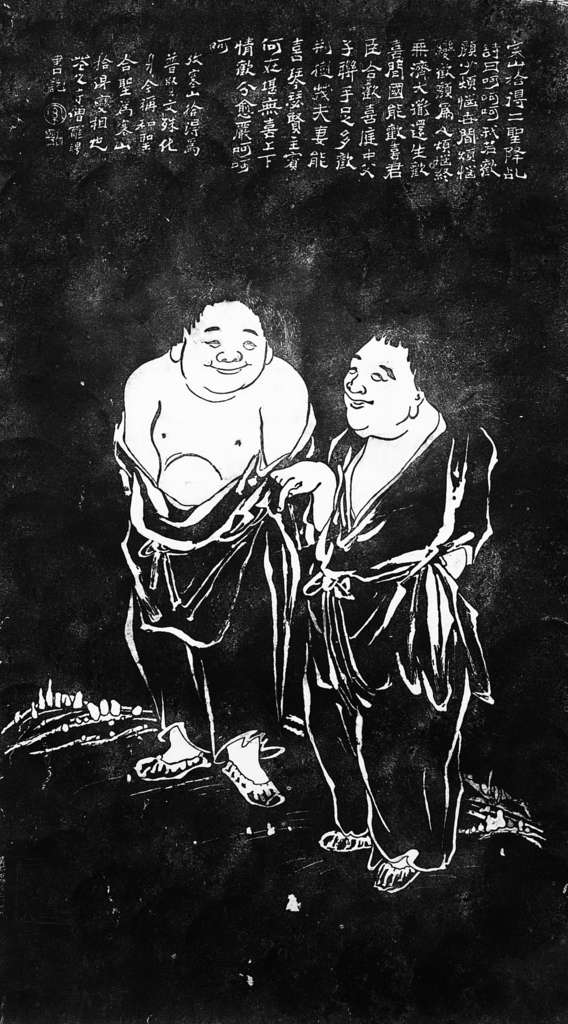
The Buddha appears in the form of an image (Buddha leaving the mountains) ‘represented’ [ban, 扮] by the monks Hanshan [寒山] and Shide [拾得] (fig. 6). He decrees that the three animal disciples may not return to the East; four of his own disciples will escort Tripitaka on the return journey. Tripitaka is led off to receive the scriptures.

The character Daquan [大權] is responsible for their issue. All assist in loading them on to the horse, who alone is to return East with Tripitaka and the disciples of the Buddha.

The three disciples in turn offer their final remarks and yield up their mortal lives. Tripitaka remembers each of them in a spoken soliloquy before he sets out on his return journey (Dudbridge, 1970, pp. 199-200).

pacskolat3 - Small

Fig. 6 – An ink rubbing of a 19th-century stone stele depicting Hanshan and Shide, from Hanshan Temple in Suzhou (larger version).

Scene 23: Escorted back to the Eastern Land

The first of the four Buddhist disciples, Chengji [成基], is the singer. The opening of the scene consists solely of his songs on the implications of the journey; he pauses only to reveal that the trials on the westward journey were contrived by the Buddha.

In Chang’an the pine-twig has been seen to turn eastward, and a crowd has come out to welcome Tripitaka’s return. Yuchi [Gong] again appears to receive him.

Chengji’s final song gives warning that the scriptures must be presented the following morning before the Emperor.

Scene 24: Tripitaka appears before the Buddha [Chaoyuan, 朝元]

The Sākyamuni Buddha enters and gives orders for Tripitaka to be led back to the Vulture Peak to meet his final spiritual goal.

The Winged Immortal who receives these orders is the singer. He escorts Tripitaka before the Buddha, whose closing remarks, as well as the Spirit’s last songs, invoke conventional benedictions upon the Imperial house (Dudbridge, 1970, p. 200). [3]


Update: 11-18-21

I’ve decided to upload a PDF of Ning’s (1986) Comic Elements in the Xiyouji Zaju, which is cited above.

PDF File


Update: 11-21-21

Here is an earlier analysis of the play by Howard Goldblatt (1973). He notes evidence points to the play largely being a product of the Ming (e.g. a higher number of acts, singers, and musical scales) and not the Yuan as was assumed at the time. However, he states the play was likely a patchwork of Yuan material, a scene by the playwright Yang in the early Ming, and copious later material borrowed from the standard 1592 edition of the novel. Despite all of this, Goldblatt (1973) suggests the play’s “stylistic unity” points to a single author compiling everything into its present form.

PDF File

https://journeytothewestresearch.com/wp-content/uploads/2021/11/the-hsi-yu-chi-play.pdf


Update: 09-06-23

As noted in the summary above, the Buddha captures Hariti’s son, Red Boy (Honghai’er紅孩兒; a.k.a. Ainu’er愛奴兒), in his alms bowl in act 12. This is based on a common story cycle from Buddhist canon in which the Enlightened one hides the demoness’ youngest son in his alms bowl in an attempt to stop her from eating human children. For instance, the Samyuktavastu (Ch: Genbenshuo yiqie youbu binaye zashi根本說一切有部毘奈耶雜事; T24, no. 1451) states that he hides the boy under the bowl like Six Ears:

The next day at first light, the Buddha having taken his robe and his bowl, entered into the city in order to seek his food. Having begged following the order of the houses, he came back to the place where he lived and took his meal; after which he went to the residence of the yaksini Hariti [Helidi, 訶利底]. At that moment, the yaksini had gone out and was not at her home but the smallest of her sons, Priyankara [Ai’er, 愛兒] remained at the house. The Bhagavat concealed him under his almsbowl [bo, 鉢] and because of his power (as a) Tathagatha the older brothers could not see their youngest brother and the youngest brother could not see the older ones (Rowan, 2002, p. 142). [16] 

至明清旦,佛即著衣持鉢入城乞食,次第乞已還至本處,飯食訖即往訶利底藥叉住處。時藥叉女出行不在,小子愛兒留在家內,世尊即以鉢覆其上。如來威力令兄不見弟、弟見諸兄。

(Yes, the name Ai’er likely influenced Red Boy’s name Ainu’er.)

The Scripture on the Storehouse of Sundry Treasures (Za baozang jing雜寶藏經; T4, no. 203, mid-5th-century CE) says that he hides the boy at the bottom. This version is not long, so I will transcribe it in full: 

Hariti [Ch: Guizimu, 鬼子母; lit: “Mother of Ghosts”] was the wife of the demon king Pancika. She had ten thousand sons who all had the strength of fine athletes. The youngest one was called Pingala [Binjialuo, 嬪伽羅]. This demon mother was inhuman and cruel. She killed people’s sons to eat them. People suffered because of her. They appealed to the World-honored One. The World-honored One then took her son Pingala and put him at the bottom of his bowl [bo, 鉢]. Hariti looked everywhere in the world for him for seven days, but she did not find him. She was sorrowful and sad. When she heard others say, “It is said that the Buddha, the World-honored One, is omniscient,” she went to the Buddha and asked him where her son was.

The Buddha then answered, “You have ten thousand sons. You have lost only one son. Why do you search for him, suffering and sad? People in the world may have one son, or they may have several sons, but you kill them.’’ Hariti said to the Buddha, “If I can find Pingala now, I shall never kill anyone’s son any more.” So the Buddha let Hariti see Pingala in his bowl. She exerted her supernatural strength, but she could not pull him out. She implored the Buddha, and the Buddha said, “If you can accept the three refuges and the five precepts now, and never in your life kill any more, I shall return your son.” Hariti did as the Buddha told her to, and she accepted the three refuges and the five precepts. After she had accepted them, he returned her son.

The Buddha said, “Keep the precepts well! In the time of Buddha Kasyapa you were the seventh, the youngest daughter of King Jieni. You performed acts of great merit, but because you did not keep the precepts you have received the body of a demon” (based on Tanyao, Kikkaya, & Liu, 1994, pp. 220-221).

鬼子母者,是老鬼神王般闍迦妻,有子一萬,皆有大力士之力。其最小子,字嬪伽羅,此鬼子母兇妖暴虐,殺人兒子,以自噉食。人民患之,仰告世尊。世尊爾時,即取其子嬪伽羅,盛著鉢底。時鬼子母,周遍天下,七日之中,推求不得,愁憂懊惱,傳聞他言,云佛世尊,有一切智。即至佛所,問兒所在。時佛答言:「汝有萬子,唯失一子,何故苦惱愁憂而推覓耶?世間人民,或有一子,或五三子,而汝殺害。」鬼子母白佛言:「我今若得嬪伽羅者,終更不殺世人之子。」佛即使鬼子母見嬪伽羅在於鉢下,盡其神力,不能得取,還求於佛。佛言:「汝今若能受三歸五戒,盡壽不殺,當還汝子。」鬼子母即如佛勅,受於三歸及以五戒。受持已訖,即還其子。佛言:「汝好持戒,汝是迦葉佛時,羯膩王第[11]七小女,大作功德,以不持戒故,受是鬼形。」

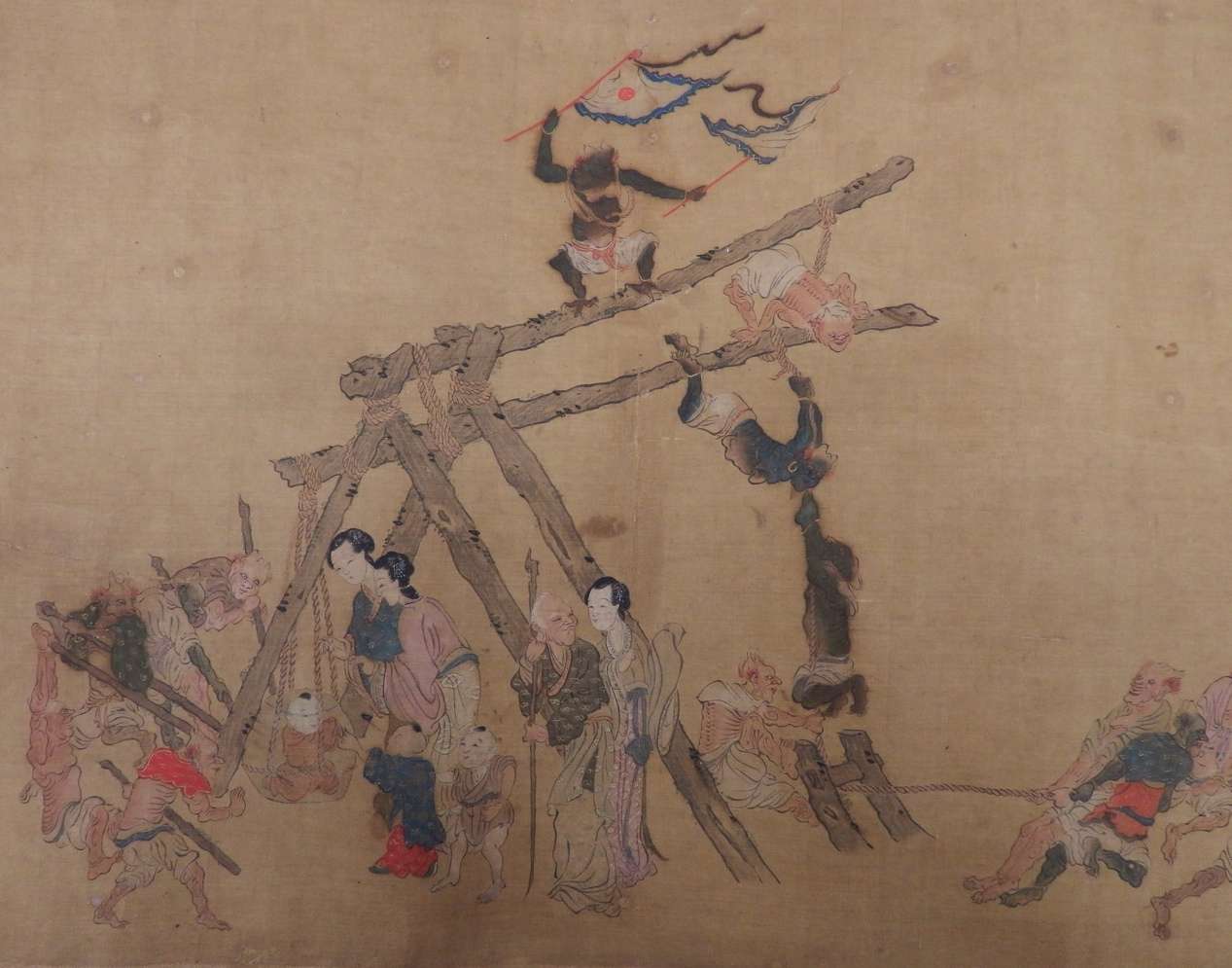
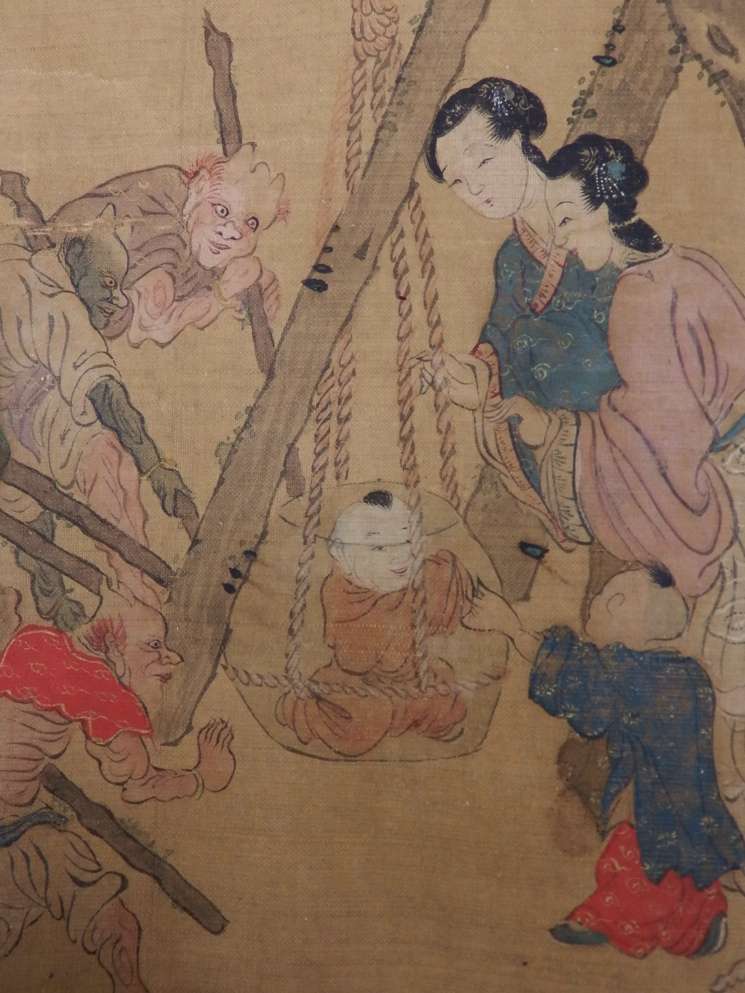
Hariti’s inability to free the child was later exaggerated in a detail from a mid-Qing dynasty hell scroll. It depicts a host of demons using a makeshift wooden pulley to no avail (fig. 7 & 8).

Fig. 7 – A detail of the demon horde trying to free Pingala (larger version). Fig. 8 – A detail of the detail (larger version). I love the transparent bowl. Images from the Maidstone Museum.

The immovable quality of the Buddha’s alms bowl (or anything inside like Six Ears and Red Boy) is likely related to a story told by the pilgrim Faxian (法顯, 337 – c. 422 CE):

Buddha’s alms-bowl [bo, 缽] is in this country [of Peshawar]. Formerly, a king of Yuezhi raised a large force and invaded this country, wishing to carry the [Buddha’s] bowl away. Having subdued the kingdom, as he and his captains were sincere believers in the Law of Buddha, and wished to carry off the bowl, they proceeded to present their offerings on a great scale. When they had done so to the Three Treasures, he made a large elephant be grandly caparisoned, and placed the bowl upon it. But the elephant knelt down on the ground, and was unable to go forward. Again he caused a four-wheeled wagon to be prepared in which the bowl was put to be conveyed away. Eight elephants were then yoked to it, and dragged it with their united strength; but neither were they able to go forward. The king knew that the time for an association between himself and the bowl had not yet arrived, and was sad and deeply ashamed of himself. Forthwith he built a tope at the place and a monastery, and left a guard to watch (the bowl), making all sorts of contributions (based on Faxian & Legge, 1886/1965, pp. 34-35). 

佛缽即在此國。昔月氏王大興兵眾。來伐此國欲取佛缽。既伏此國已。月氏王篤信佛法。欲持缽去。故興供養。供養三寶畢。乃挍飾大象置缽其上。象便伏地不能得前。更作四輪車載缽。八象共牽復不能進。

王知與缽緣未至。深自愧歎即於此處起塔及僧伽藍。并留鎮守種種供養。

Disclaimer:

These have been uploaded for educational purposes. No malicious copyright infringement is intended. Please support the official release.

Notes:

1) He is called the “Monkey Pilgrim” (Hou xingzhe, 孫行者) in the aforementioned 13th-century storytelling prompt.

2) A good example of this appears in act 19 when Monkey tries to seduce Princess Iron Fan with a saucy poem: “The disciple’s not too shallow / the woman’s not too deep. / You and I, let’s each put forth an item, / and make a little demon” (Ning, 1986, p. 141).

3) Source altered slightly. The Wade-Giles was changed to pinyin. The Chinese characters presented in the footnotes were placed into the summary.

Source:

Dudbridge, G. (1970). The Hsi-yu chi: A Study of Antecedents to the Sixteenth-Century Chinese Novel. Cambridge: Cambridge Univ. Press.

Faxian, & Legge, J. (1965). A Record of Buddhistic Kingdoms: Being an Account by the Chinese Monk Fâ-Hien of his Travels in India and Ceylon (A.D. 399-414) in Search of the Buddhist Books of Discipline. New York: Dover Publications. (Original work published 1886)

Goldblatt, H. (1973). The Hsi-yu chi Play: A Critical Look at its Discovery, Authorship, and Content. Asian Pacific Quarterly of Cultural and Social Affairs, 5(1), pp. 31-46.

Ning, C. Y. (1986). Comic Elements in the Xiyouji Zaju (UMI No. 8612591) [Doctoral Dissertation, University of Michigan]. ProQuest Dissertations and Theses Global.

Peri, N. (1917). Hârîtî, la Mère-de-démons [Hariti, The Mother of Demons]. Bulletin de l’École française d’Extrême-Orient, 17, 1-102. Retrieved from https://www.persee.fr/doc/befeo_0336-1519_1917_num_17_1_5319.

Rowan, J. G. (2002). Danger and Devotion: Hariti, Mother of Demons in the Stories and Stones of Gandhara: A History and Catalogue of Images [Master’s thesis, University of Oregon] CORE. https://core.ac.uk/download/pdf/36687517.pdf

The Origin of the Monkey King’s Punishment Under Five Elements Mountain

Last updated: 03-08-2025

After escaping from Laozi’s furnace, Sun Wukong battles his way through heaven until the Buddha is called in to halt his rebellion. The Enlightened One makes him a wager that, if he can jump out of his hand, the macaque will become the new ruler of heaven. Monkey agrees to the wager and jumps into his palm. With one tremendous leap, Sun speeds towards the reaches of heaven, clouds whizzing by him in a blur of colors as he travels across the sky. He lands before five great pillars, thinking them to be the edge of the cosmos. He tags one of the pillars with his name and urinates at the base of another in order to prove that he had been there. Upon returning, he demands that the Buddha live up to his end of the bargain. Yet the Buddha explains that he had tricked him into thinking he had left, when he actually stayed in the Tathagata’s hand the entire time. But before Monkey can do anything, the Buddha overturns his hand, pushing it out the gates of heaven, and slamming it onto earth, transforming it into the Five Elements Mountain (Wuxing shan, 五行山). There, Sun is imprisoned for his crimes against heaven (fig. 1) (Wu & Yu, 2012, vol. 1, pp. 193-195).

The idea of a primate spirit being imprisoned under a mountain can be traced to a story appearing in Tang (618-907) and Song Dynasty (960-1279) sources. It involves Wuzhiqi (無支奇 / 巫支祇), a monkey flood demon, being trapped in an earthly prison by the demi-god and emperor Yu the Great (Dayu, 大禹).

Sun Wukong trapped under mountain - In Flames toy - small

Fig. 1 – A modern action figure of Sun Wukong’s imprisonment under a section of Five Elements Mountain (larger version).

I. The Sources

The first and shortest version appears in the Supplement to the History of the Empire (Guoshi bu, 國史補, early-9th-cent.):

There was a fisherman at Chuzhao 楚州 who unexpectedly hooked an ancient iron chain in the Huai [river 淮河], but could not pull it clear. He reported this to the Prefect, Li Yang 李陽, who summoned a large number of men to draw it out. At the end of the chain was a black monkey; it jumped out of the water, then plunged back and vanished. Later this was verified in the Shanhai jing 山海經, from the words—’A river-beast persistently wrought destruction. [1] Yu [the great 大禹] chained it below Junshan 軍山. It’s name was Wuzhiqi 無支奇 [fig. 2] (Andersen, 2001, pp. 15-16).

3o0s0004on1o16457o87

Fig. 2 – A modern depiction of Wuzhiqi (larger version).

A longer and more well-known account appears in Extensive Records of the Taiping Reign (Taiping guangji, 太平廣記, 978). The entry explains how the water spirit Wuzhiqi came to wear the iron chain. The passage is quite long, so I’ll paraphrase the beginning and middle sections:

[While taking a boat (c. 797), Li Gongzuo 李公佐 of Longxi 隴西 by chance meets Yang Heng 楊衡 of Hongnong 弘農. Yang tells Li the following story.] [2]

In the reign period of Yongtai (765) Li Tang was governor of Chuzhou. One night, at that time, a fisherman was out fishing below Turtle Mountain [龜山], when his hook caught on something and would not come up again. The fisherman was an expert swimmer and quickly went down to a depth of fifty zhang (c. 150 meters), where he saw a great iron chain encircling the base of the mountain. He searched but could not find the end of it, and he subsequently informed Li Tang about it.

Li Tang ordered several tens of fishermen and people who could swim to get hold of the chain, but they were unable to pull it free. He increased their forces with that of fifty heads of oxen, and now the chain gave way and began little by little to move onto the shore. There was no wind at the time, but all of a sudden the waves started to roll and gush forth, and those who watched were greatly frightened. At the end of the chain a beast appeared, shaped like a monkey, with [a] white head and long mane, teeth like snow and golden claws, and it rushed onto the shore. It was more than five zhang high (c. 15 meters), and it squatted in the manner of a monkey; only it could not open its eyes, but sat motionless as if in a daze. Water ran down from its eyes and nose in a stream, and its spittle was so repellent and foul-smelling that people could not be near it. After a long while it stretched out its neck and lowered it, and suddenly opened its eyes [fig. 3]. They were as bright as lightning, and it looked at people around it, raging with madness. Those who watched took to their heels, and the beast very slowly pulled at the chain and dragged the oxen with it into the water, never to emerge again. Many knowledgeable and prominent men from Chu were present, and they looked at Li Tang and at each other, startled and fearful, not knowing the source of this. Since then the fishermen were aware of the location of the chain, but in fact the beast never appeared again.

[Li travels to Mt. Bao (Baoshan, 包山) and, with the help of the Daoist Zhou Jiaojun 周焦君, deciphers the following account found in the eighth scroll of the Classic of Peaks and Rivers (Yuedu jing, 岳瀆經).] [3]

When Yu regulated the waters, he went thrice to the Tongbai 桐栢 mountains, and each time a storm broke, with crashes of thunder, shattering the stones and making the trees groan. The Five Earls, Wubo 伍伯, restrained the waters, the Celestial Elder, Tianlao 天老, harnessed his troops, but they could not begin their work. In anger Yu summoned the hundred sacred powers. He searched for and called upon the Dragon Kui, Kuilong 夔龍, and the thousand spiritual lords and seniors of Mt. Tongbai bowed their heads and asked for his command. Yu then assigned Hongmeng 鴻蒙氏, Zhangshang 章商氏, Doulu 兜盧氏, and Lilou 犁婁氏, to the task, and they captured the god of the rivers Huai and Guo, whose name was Wuzhiqi 無支祁. It answered readily when spoken to and knew about the shallow and the deep parts of the Yangzi and the Huai, and about how far the marshlands extended. It was shaped like a monkey, with [a] flattened nose and high brows, black body and white head, metallic eyes and teeth like snow. Its neck stretched out to a length of a hundred feet (c. 30 meters), and its strength exceeded that of nine elephants. It attacked in high leaps and running swiftly, its movements were agile and sudden, and one could not keep it in sight or hearing for very long.

Yu turned it over to Zhanglu 章律, but he could not control it. He turned it over to Niaomuyou 鳥木由, but he could not control it. He turned it over to Gengchen 庚辰, and he could control it. For thousands of years the Chipi 鴟脾 and the Huanhu 桓胡, the tree goblins and the water spirits, the mountain sprites and the stone prodigies had roamed and roared and gathered around it, but Gengchen used his military prowess to chase them away. He tied a great chain around its neck, pierced its nose and attached a golden bell to it. He placed it under the base of Turtle Mountain at the southern bank of the Huai, so that forever after the Huai flowed peacefully into the sea. Since the time of Gengchen people would all make images of this shape in order not to suffer from the waves and rainstorms of the Huai (Andersen, 2001, pp. 17-21). [4]

download

Fig. 3 – A Japanese depiction of a Tarsier-like Wuzhiqi based on its description from the Song dynasty source (larger version). 

This entry presents Wuzhiqi as a supernaturally strong monkey demon with flashing eyes and the ability to perform transformations (by stretching its neck). The gods then imprison him below a mountain to punish his affront to the natural order (calm the waves created by him). It’s no wonder then how it influenced the final novel.


Update: 05-16-18

Another source comes from the early Ming (14th-15th-cent.) zaju play Journey to the West (Xiyouji, 西遊記) by Yang Jingxian (杨景賢). But instead of it being the Buddha, the monkey is trapped by the Bodhisattva Guanyin, and instead of Five Elements Mountain, it is his home of Flower Fruit Mountain. Dudbridge (1970) paraphrases scene nine, titled “The Holy Buddha Defeats Sun”:

Sun Xingzhe [孫行者, Pilgrim Sun] now appears: after an initial poem vaunting his celestial birth, his ubiquity and power, he lists out the members of his ape family, alludes to his career of misdeeds and his wife, the abducted Princess of Jindingguo [金鼎國, the Golden Cauldron Country].

Devaraja Li appears, with orders to recover the possessions stolen by Sun from the Queen Mother of the West. He issues orders to his son Nezha, who enters with troops upon orders from the Jade Emperor to capture Sun Xingzhe in his home Ziyun luo dong [紫雲羅洞, Purple Cloud Cave] on Huaguoshan.

The princess-wife now enters (the singer in this act) and tells in song the story of her abduction and the life on this mountain. She is joined by Sun and they prepare to feast.

The celestial troops surround them, Sun’s animal guards flee and Sun himself escapes. Devaraja Li ‘combs the hills’ and meanwhile finds the princess, who now sings through the remainder of her suite of songs until it is decided to give her escort back to her home.

Sun Xingzhe eludes the forces of Nezha and is captured only by intervention by Guanyin, who has him imprisoned beneath Huaguoshan to await the arrival of Tripitaka, his future master (p. 195). [5]


Update: 06-29-19

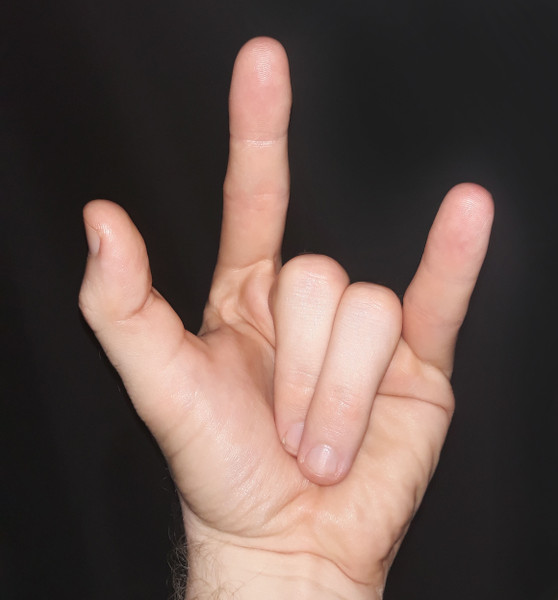
The idea of the Buddha magically transforming his hand into Five Elements Mountain can be traced to a Song-era Daoist ritual in which an exorcist draws the character for “well” (jing, 井 / 丼) on the ground, thereby dividing the ritual space into nine sections, representing the Nine Palaces (jiugong, 九宮), [6] and in the center is placed a liquid-filled jar. After the target demons are coaxed or forced inside, the opening is sealed with paper and the exorcist performs a hand mudra representing the immense pressing weight of a mountain. [7] Meulenbeld (2007) writes:

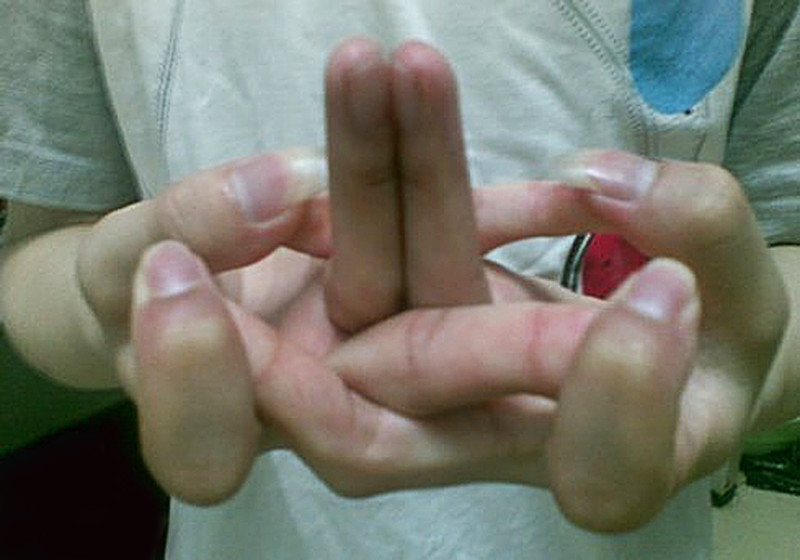
The spirits captured within the grid of the Nine Palaces were kept inside their prison by symbolically pressing them down underneath a mountain. The symbolism here lies in the fact that the mountain was represented by a posture of the hand forming the character for mountain (“Mountain Mudrā” 山字訣 with the thumb, index-finger, and little finger all pointing upward [fig. 4 and 5]. Oftentimes the specific “mudrā of Mt. Tai” 泰山訣 [fig. 6], was used, representing the heaviest of all mountains. Moreover, many present-day exorcist talismans contain a character composed of a “demon” 鬼 underneath a “mountain” 山, namely the character wei 嵬 (p. 145, n. 92).

Mountain mudra with Chinese character

Fig. 4 – The Chinese character for mountain (shan, 山) (larger version). Fig. 5 – The Mountain mudra (shanzi jue, 山字訣) (larger version). Photo by the author. Fig. 6 – The double-handed Mount Tai mudra (Taishan jue, 泰山訣) (larger version). Original picture from here.

The “Mountain” and “Mount Tai” mudras are connected to a similar concept called the Taishan stone (taishan shi, 泰山石) (fig. 7), a class of “evil-warding stones” (shigandang, 石敢當) often placed outside of homes and temples or at the intersection of roads as protection from malevolent forces (pp. 71-72). The Taishan stone represents Mount Tai, a holy mountain in Shandong province, China, and its deity. The landmass is considered the heaviest thing imaginable in Chinese culture. This means any evil would be completely immobilized under its great weight. Therefore, this shows Five Elements Mountain serves as a cognate for Mount Tai because it is actualized in a similar manner⁠—i.e. the landmass is represented by a hand—and its great weight is used to weigh down an evil spirit, in this case Sun Wukong.

Taishan stone example - small

Fig. 7 – A modern Japanese example of a Taishan stone (larger version). They often read “Taishan stone takes upon itself” (Taishan shi gandang, 泰山石敢當), denoting its duty of protection (Wang, 1992, p. 71). Original image from Wikipedia


Update: 03-11-22

I recently archived the Precious Scroll of Erlang (Erlang baojuan, 二郎寳卷, 1562), a baojuan that venerates and records the various deeds of the immortal demi-god. This work states that the Monkey King was “pressed under the base of Mt. Tai” (yazai, taishan gen, 壓在太山根) (PDF page 46) (fig. 8). This supports my suggestion above that Five Elements Mountain is a cognate for Mt. Tai.

Fig. 8 – The Mt. Tai sentence is indicated in red (larger version).


Update: 12-20-23

I should have mentioned a long time ago that Wuzhiqi appears as Sun Wukong’s sister in late-Yuan to early-Ming media. The first is in The God Erlang Captures the Great Sage Equaling Heaven (Erlang shen suo Qitian dasheng, 二郎神鎖齊天大聖):

My hallowed family has three brothers and two sisters: My elder brother is the “Great Sage Reaching Heaven” (Tongtian Dasheng, 通天大聖), myself the “Great Sage Equaling Heaven” (Qitian Dasheng, 齊天大聖), my elder sister is the “Aquatic Mother of Turtle Mountain” (Guishan shuimu, 龜山水母), my younger sister the “Iron-Colored Macaque” (Tiese Mihou, 鐵色獼猴), my younger brother is the “Third Son Shuashua” (Shuashua Sanlang, 耍耍三郎) (based on Dudbridge, 1970, p. 129).

吾神三人姊妹五箇大哥哥通天大聖吾神乃齊天 大聖姐姐是龜山水母妹子鐵色獮猴兄弟是耍耍

The “Aquatic Mother of Turtle Mountain” is likely Wuzhiqi since s/he is trapped under Turtle Mountain (refer back to the quoted sources above).

The second is the Journey to the West zaju play (Xiyou ji zaju, 西遊記雜劇):

This small sage has five brothers and sisters: My elder sister is the “Venerable Mother of Mount Li” (Lishan Laomu, 驪山老母), my second sister is the “Holy Mother Wuzhiqi” (Wuzhiqi Shengmu, 巫支祇聖母), my older brother is the “Great Sage Equaling Heaven” (Qitian Dasheng, 齊天大聖), I myself am the “Great Sage Reaching Heaven” (Tongtian Dasheng, 通天大聖), and my younger brother is the “Third Son Shuashua” (Shuashua Sanlang, 耍耍三郎) (based on Dudbridge, 1970, p. 110).

小聖弟兄、姊妹五人,大姊驪山老母,二妹巫枝祗聖母,大兄齊天大聖,小聖通天大聖,三弟耍耍三郎。

You will notice that the play’s version of Wuzhiqi’s name, 巫支祇, is different from that cited above, 無支奇.


Update: 03-08-25

The preface to the Daoist treatise Devil’s Code of the Spinal Numinous Script of the Highest Clarity (Shangqing gusui lingwen guilu, 上清骨髓靈文鬼律, pre-1116) has an interesting passage related to our subject. It claims that the “Devil’s Code” can be traced to the Immortal Ancestor Rao Dongtian (Zuxian Rao Dongtian, 祖仙饒洞天), a great official who applied worldly judgement to punish supernatural beings. However,

devils and gods have influence but can’t be grasped [i.e. they are incorporeal], so there is no place to give them a beating. If there is a criminal among them, they must be subjected to forced labor. Therefore, the Law of the Fengdu Hell [Fengdu lu, 豐都律] states: “Devil’s must toil to carry mountains, and dragons must struggle to dig moats.”

然則鬼神有影響力而不可執著,無所施其鞭撲,有罪犯則苦役之。故《豐都律》言鬼以負山之勞,龍以穿池之戰

(I don’t consider myself a translator, so please forgive any errors.)

This adds to the evidence that mountains were used to punish evil beings.

Notes:

1) Anderson (2001) explains that no such entry for Wuzhiqi exists in this historical bestiary (p. 16).

2) Li Gongzuo (c. 770-c. 848) was a historical story teller and the presumed author of this particular tale (Andersen, 2001, p. 16).

3) This is most likely a fictional version of the aforementioned Shanhai jing (Andersen, 2001, p. 16).

4) One such statue dating to the Song Dynasty is held in the Museum fur Ostasiatische kunst in Berlin. It is discussed at length in Anderson (2001).

5) Source slightly altered. The Wade-Giles was changed to Pinyin.

6) The nine palaces are a cosmic geographical concept in which stars are mapped according to the five Chinese cardinal directions (N, S, E, W, and center) and the four intermediate directions. Thus, they represent the universe as a whole.

7) See Meulenbeld, 2007, pp. 143-145 for more information about the jar ritual. It likely influenced media that influenced Akira Toriyama of Dragon Ball fame to create the Mafuba (魔封波; Ch: mofengbo), or “Demon Containment Wave” ritual. Padula (2016) describes the etymology and background of the Mafuba (pp. 122 to 126). He graciously provided me with a digital copy of his book.

Sources:

Andersen, P. (2001). The Demon Chained Under Turtle Mountain: The History and Mythology of Chinese River Spirit Wuzhiqi. Berlin: G-und-H-Verl.

Dudbridge, G. (1970). The Hsi-yu chi: A Study of Antecedents to the Sixteenth-Century Chinese Novel. Cambridge: Cambridge Univ. Press.

Meulenbeld, M. R. E. (2007). Civilized demons: Ming Thunder Gods from Ritual to Literature (Doctoral dissertation). Available from ProQuest Dissertations and Theses database (UMI No: 3247802).

Wang, J. (1992). The Story of Stone: Intertextuality, Ancient Chinese Stone Lore, and the Stone Symbolism in Dream of the Red chamber, Water Margin, and the Journey to the West. Durham, N.C: Duke University Press.
Wu, C., & Yu, A. C. (2012). The Journey to the West (Vols. 1-4) (Rev. ed.). Chicago, Illinois: University of Chicago Press.
The Later Journey to the West: Part 3 – The Journey Comes to an End

The main body of Later Journey to the West (Hou Xiyouji, 後西遊記, 17th-century) follows a similar trajectory as the parent novel, Journey to the West (Xiyouji, 西遊記, 1592). The historical monk Dadian (大顛, 732-824) is tasked with traveling from China to India to retrieve spiritual knowledge from the Buddha, and just like Tripitaka, he is protected by three demonic disciples, namely Sun Luzhen (孫履真), the descendant of Sun Wukong, Zhu Yijie (豬一戒), the son of Zhu Bajie, and Sha Zhihe (沙致和), the disciple of Sha Wujing. Along the way the group travels through many lands, battles numerous evils, and they eventually become enlightened Buddhas like their predecessors two hundred years prior. As noted in part oneLater Journey to the West may appear like a carbon copy of the original, but the similarities are only skin deep since the novel is comprised of extremely dense layers of allegorical meaning. Below, I present the last of a three-part summary of the novel (part 2), which focuses on the end of the journey. I rely very heavily on Xiaolian Liu (1994) as the novel has yet to be published in English.

Readers will notice letters of the alphabet at the end of particular sentences in the first two sections of the article. These correspond with said letters in the third section containing information explaining the allegorical meaning of that part of the story.

I. The latter half of the journey

(The novel has a total of 40 chapters. Liu (1994) only covers certain chapters since they contain the most allegorical meaning.)

The pilgrims travel towards String and Song village (Xiange cun, 弦歌村) when they learn the Confucian society there hates Buddhism and spreads lies about its demonic nature. [A] Enraged, Monkey creates an army of warrior Skanda Bodhisattvas (Ch: Weituo, 韋馱) from his magic hair, each of which visits every family in the village and threatens them with punishment if they don’t receive the “living Buddhas” (the pilgrims) with much respect and fanfare. Luzhen also creates likenesses of the Four Heavenly Kings, who lead the monks into the village. The celestial spectacle causes the entire population to convert to Buddhism on the spot. This angers the demon ruler of the region, the Heavenly King of Civilization (Wenming tianwang, 文明天王), the reincarnation of a Qilin unicorn (fig. 1) who favors Confucianism over Buddhism. In their first battle, Monkey proves impervious to the demon’s weaponized coin scales, but is crushed under the weight of his writing brush-turned-spear. [B] The monster explains:

I don’t need knives or swords to kill you. With the writing brush, I can easily describe you as a heretic monk and write the words “Foreign religion,” which will crush you down, so you will never be able to stand up (Liu, 1994, p. 89).

The demon then kidnaps Dadian and subdues him under the weight of the brush and a golden ingot. Monkey consults the god of literature in heaven and learns the monster’s brush is so powerful because it was originally used by Confucius to write the Analects. The group is finally able to defeat the demon and release Dadian with the god’s help.

TB2Rs09sXXXXXXLXpXXXXXXXXXX_!!706768533

Fig. 1 – A Qilin unicorn. This beast is often depicted with coin scales (larger version).

After many more adventures, the group comes to the Temple of Sudden Realization (Mengxing an, 猛省庵) on Division Ridge (Zhongfen ling, 中分嶺). There, the head monk tells them the ridge is an extension of the Western paradise installed by the Buddha to weed out corrupt Chinese monks heading to India. Only those who pass the test of the Bodhisattva of Great Eloquence (Da biancai pusa, 大辯才菩薩) in the Temple of Division (Zhongfen si, 中分寺) on top of the ridge will be allowed to continue their pilgrimage. [C] The pilgrims pass their respective tests and are allowed to enter the Pass of Obstruction (Gua’ai guan, 挂礙關), where they face a blizzard and a road covered in brambles. [D] Dadian, Luzhen, and Shihe pay the obstacles no attention, but Yijie continues to fall further and further behind. The monks are surprised when they circle back around to find the same temple. A young monk gives them a note from the bodhisattva:

The temple which you have seen twice is the same temple;
The pass which appears and disappears is not a pass;
The true cultivation is without obstacles,
And the enlightened nature will eliminate delusions;
Only for those who are greedy and deceitful;
The road will be rugged and full of brambles;
One must cleanse himself of desires,
Before he can pay homage to the Buddha at the Spirit Mountain (Liu, 1994, p. 93)

Yijie arrives late covered with scratches and bruises from his rough journey. He questions how his companions traveled so easily, but realizes the error of his ways when shown the note.

The pilgrims arrive at the Mountain of Cloud-Crossing (Yundu shan, 雲度山) located on the outskirts of India. They meet a young cowherd riding an ox (fig. 2) who tells them the mountain is a gateway to the Buddha’s paradise and that two paths to heaven exist. The easiest is located on the three small peaks of the mountain and measures a mere square inch. [E] This path is often taken by Buddhas, immortals, and other celestials. The other is a long, winding road located on the ground. He describes the latter as being a quick and pleasant route, but one fraught with danger if traveled with the wrong mindset:

If the Monkey of the Mind is still and the Horse of the Will is tame, and your speed is neither fast nor slow, the road will be smooth and steady, and you will be able to reach your destination in an instant. But if the Fire of the Liver flares up, the plank road will be burned down; if the Wind of the Spleen blows, the platform bridge will be destroyed; if the Water of the Kidneys is dried up, the boat will be stranded; and if the Air of the Lungs is weak, the chariot cannot be driven. In that case you will be traveling all your life, groping in the Skin Bag, and never be able to get out (Liu, 1994, pp. 94-95) [F].

Oxherding_pictures,_No._6 - small

Fig. 2 – The cowherd and his ox, a traditional symbol of enlightenment (larger version). Painting by Tenshō Shūbun (天章周文) (1414-1463).

Dadian chooses the long path, but his disciples goad him into taking a boat, a forbidden shortcut, which initiates the chain of events foretold by the cowherd (actually a sage in disguise). The vessel eventually runs aground on the riverbed because the water dries up. The priest then mounts his horse once more, but Yijie slaps its behind to speed up, leading to a wild, uncontrolled ride that knocks the wind out of Dadian and dampens his will to continue. Angry, the master admonishes the pig, causing the group’s path to be blocked by a monstrous fire. Seeing the road to paradise blocked, Dadian is beset with anxiety, causing a terrible wind that forces the group to take shelter in the forest. [G] The pilgrims soon realize the obstacles arise from the monk’s mental state. When Dadian centers himself, the wind subsides. The path before them then becomes an easy one.

The group arrives at Spirit Mountain and meets the Laughing Monk (Xiao heshang, 笑和尚) who informs Dadian that he will meet the Buddha the following day and asks if he wants to see his material appearance (Semian, 色面) or immaterial appearance (Kongmian, 空面). The master, however, fails to answer out of confusion. The next day the pilgrims climb to Thunderclap Monastery, home of the Buddha, and find it devoid of any people. Monkey explains this represents “emptiness” and coincides with the Buddha’s aforementioned immaterial appearance. He goes on to not only claim himself the Buddha, but also superior to him:

Listen to what I have to say: The Buddha is merciful. Am I not merciful? The Buddha is wise. Am I not wise? The Buddha is vast. Am I not vast? The Buddha is divine. Am I not divine? The Buddha is void of the five qualities and I don’t have an inch of thread hanging on my body. [1]  The cultivation of the Buddha took ten thousand kalpas of time. But it only takes me an instant. In the most profound sense, I can exist without the Buddha, but the Buddha can’t exist without me. You should think carefully. In what respect am I inferior to the Buddha (Liu, 1994, pp. 104-105).

When Yijie scoffs at his words, Luzhen enters a neighboring chamber and transforms into the Enlightened One, using his magic hairs to create a large retinue of lesser buddhas, saints, and guardian spirits (fig. 3). The pig is called before the false Buddha and sentenced to torture in hell, but Monkey is forced to revert to his true form when Dadian begs for lenience. The Laughing Monk later explains Luzhen’s stunt is not disrespectful but a demonstration of “The Mind is the Buddha” (Liu, 1994, p. 106). [H]

Pure Land of Bliss (Large)

Fig. 3 – The Buddha surrounded by a celestial retinue (larger version).

II. Returning with the interpretations and becoming Buddhas

The Laughing Monk escorts the pilgrims to see the Buddha, who is reluctant to release the true interpretation:

The divine scripture can only relieve people for a moment. Even with the transmission of the true interpretation, it is difficult to deliver many people. It would be better to get rid of all the words and interpretations and thus make people forget knowledge and perception. This is the wonderful principle of returning to the origin (Liu, 1994, p. 106). [I]

But he releases the interpretations anyway. The group, having become enlightened beings, fly on clouds back to the Chinese capital of Chang’an, returning five years after the journey started. Emperor Muzong (唐穆宗, r. 820-824) welcomes the pilgrims and builds for Dadian a prayer platform from which he can read the scriptures. [2] On the 18th day of the second (lunar) month of 824, the priest orders Luzhen to open the sutras that had been magically sealed by Tripitaka years prior. The Small Sage sends out a legion of monkeys all across the Middle Kingdom to complete this task. The resulting sermon enlightens the whole of China. The monk intends to finish reading the entire interpretation, but his lecture is stopped by the Laughing Monk who reveals himself to be the Buddha. Dadian and his disciples return to the Western Paradise with the Enlightened One and are bestowed with Buddhahood for their efforts. In the end, the Buddha shines light from his third eye onto China, transforming it into a paradise on earth.

III. Allegory explained

A) The name of the village refers to the classic method of teaching Confucian values through song (Xiange, 弦歌) in ancient China.

B) The money and brush refer to the power and wealth belonging to the Confucian social elite. Monkey is impervious to the weaponized coins because, as a monk, he has no desire for money, but falls to the brush-spear because Confucians can sway public opinion about Buddhism simply with a few strokes of the brush.

C) Division Ridge and the Temple of Division both serve as filters that separate (or divide) true believers from those still plagued with desires or negative emotions.

D) The pass and Yijie’s troubles therein are metaphors for the negative mental states (or obstacles) that block someone’s path to enlightenment.

E) The three peaks and the square inch are references to the Chinese character for heart or mind (xin, 心) (take note of the three dots on top of the character). This means the mountain is a metaphor for the mind. Those who master the mind and achieve enlightenment can take this quick path to paradise since they have already done the heard work of cleansing themselves of desires. This path is essentially located in the clouds, hence the name of the mountain.

F) The skin bag is the human body. Each of the body parts and elements refers to a particular human emotion. Therefore, if a person doesn’t tame the emotions, they will forever be a slave to their bodily desires.

G) Pilgrims on the journey to enlightenment create their own obstacles.

H) This refers back to the riddle that opens the novel (see part one):

I have a statue of Buddha, which nobody knows;
He needs no molding or carving;
Nor does he have any clay or color;
No human can draw him; no thief can steal him;
His appearance is originally natural,
And his clarity and purity are not the result of cleaning;
Though only one body,
He is capable of transforming himself into myriad forms (Liu, 1994, p. 22)

The answer to this riddle is “the Buddha is in the mind”. Liu (1994) considers Monkey’s above statement about being equal and even superior to the Buddha to be the most important passage in the entire book because it demonstrates “Buddhahood is inherent in everybody’s nature and everyone is capable of becoming the Buddha through self-cultivation” (Liu, 1994, p. 105).

[I] This refers to over reliance on the written word and spoken interpretations, a concept revisited many times throughout the novel.

Notes:

1) These five qualities, or “Wuyun 五蘊 are the five mental and physical qualities or constituents (Sanskrit: skandhas), i.e. the components of an intelligent being, especially a human being” (Liu, 1994, p. 116, n. 47). This means the Buddha and Monkey are not human.

2) Emperor Muzong’s father, Xianzong, dies during the course of the journey.

Source:

Liu, X. (1994). The odyssey of the Buddhist mind: The allegory of the Later journey to the West. Lanham, Md: University Press of America.

The Later Journey to the West: Part 2 – The Journey to India Begins

Note: An AI translation of this novel is now available. Click the linked Chinese characters below that read “後西遊記.”

The main body of Later Journey to the West (Hou Xiyouji, 後西遊記, 17th century) follows a similar trajectory as the parent novel, Journey to the West (Xiyouji西遊記, 1592). The historical monk Dadian (大顛, 732–824) (fig. 1) is tasked with traveling from China to India to retrieve spiritual knowledge from the Buddha, and just like Tripitaka, he is protected by three demonic disciples, namely Sun Luzhen (孫履真), the descendant of Sun Wukong, Zhu Yijie (豬一戒), the son of Zhu Bajie, and Sha Zhihe (沙致和), the disciple of Sha Wujing. Along the way the group travels through many lands, battles numerous evils, and they eventually become enlightened Buddhas like their predecessors two hundred years prior. As noted in part one, Later Journey to the West may appear like a carbon copy of the original, but the similarities are only skin deep since the novel is comprised of extremely dense layers of allegorical meaning.

Below, I present the second of a three-part summary of the novel (part 3), which focuses on the journey proper. I rely very heavily on Xiaolian Liu (1994) as the novel has yet to be published in English.

Notes have been added to the sections below to explain the allegorical meaning of various story elements.

I. The Interpretation Pilgrim is Chosen

After quelling his descendant’s rebellion, Buddha Sun Wukong travels eastward by cloud with Buddha Tripitaka to see how China has benefited from the scriptures delivered by them some two centuries in the past. However, they find that the monks of the Famen temple (Famen si, 法門寺) are not only falsely claiming to have holy relics from Tripitaka’s deceased human body, [1] but also that their leader is his sixth generation disciple and a master of the sutras. This influences Tang Emperor Xianzong (唐憲宗, r. 806-820) to donate heavily to the temple because he believes that the dynasty will prosper once the pagoda containing the supposed relics is opened. The two Buddhas return to the Western Paradise and report their findings to Tathagata, who tells them that the Chinese will continue to misunderstand and misuse the teachings until they receive the “true interpretation” (zhenjie, 真解). The Enlightened One then charges Tripitaka with locating a pilgrim who will make the journey to India to retrieve this interpretation. [2]

In the meantime, the scholar-official Han Yu (韓愈, 768–824) openly criticizes the emperor for his worship of the relics and his spendthrift support of the temple. For this he is exiled from Shaanxi province in the north to Guangdong province in the south, where he meets the Chan Buddhist Master Dadian. [3] Upon hearing of the decadent, misguided state of Buddhism near the capital, Dadian goes north and memorializes the emperor to give up his extravagant patronage of the religion. This show of integrity cements Tripitaka’s decision to choose the monk as his pilgrim. The Buddha then magically seals away the scriptures, forcing the Emperor to send Dadian to India to retrieve the true interpretation.

124782997

Fig. 1 – A woodblock print of the monk Dadian.

II. The Journey to India Begins

The novel has a total of 40 chapters. Liu (1994) only covers certain chapters from this point on since they contain the most allegorical meaning.

Dadian acquires his demonic disciples during the early stage of his journey. First, he recites a magic spell taught to him by Tripitaka which calls Sun Luzhen to his side. Second, he recruits Zhu Yijie on the road after the pig is subdued by Monkey and made to follow the priest west. Third, Dadian accepts Sha Shihe as his last disciple after the water spirit saves him from a monster that had dragged him to the bottom of the Flowing Sands River.

Prior to Sha Shihe joining the group, Monkey, Dadian, and Yijie travel through the sister villages of Ge (葛, “Creepers”) and Teng (籐, “Clinging Vines”), which are both plagued by bottomless pits that appear and swallow untold numbers of people. [A] The elders of these respective villages tell the pilgrims that the source of this calamity is a demon known as King Defect (Quexian wang, 缺陷王), who lives on the Mountain of Imperfection (Buman, 不滿, lit: “Not full”). The monster feeds on the negativity of people whom he curses with poverty, divorce, disease, etc., and those who don’t worship him are swallowed by the ground to be imprisoned forever. Luzhen retrieves a magic golden treasure from heaven that stops the demon from burrowing underground; however, when he flees into a cave, the pilgrims’ path is blocked by seemingly indestructible vines that regrow as soon as they are cut. But Monkey discovers the vines fail to grow if he cuts them while not talking. [B] The group follows suit and they are able to capture and kill the demon, who is revealed to be a badger spirit.

A) These names refer to Geteng (葛籐, Creepers and Clinging Vines), a term used in Buddhist literature to refer to the net of desire that ensnares humans. Liu (1994) notes the Avadanas Scripture (Chuyao jing, 出曜經, late-5th to early-6th cent.) contains two mentions of the term, one of which reads: “Entrapped in the net of desires, common people are bound to undermine the right (orthodoxy) way … like the creepers and vines which twine round a tree and eventually cause its death” (p. 70).

B) The aforementioned creepers and clinging vines also refer to Geteng Chan (葛籐禪, Wordy Chan/Zen), a term often applied “to people who resort to long-winded words or writings, rather than to their intuitive perceptions to grasp the essence of Buddhist principles” (Liu, 1994, p. 71). This love for speaking/writing is believed to hinder the path to enlightenment. This explains why the vines stop growing when Monkey stops talking. The group, in essence, frees themselves from Wordy Chan and relies more on intuition. This puts them one step closer to enlightenment.

After passing the Flowing Sands River and bringing Sha Shihe into their fold, the group travels to the Mountain of Deliverance lorded over by King Deliverance (Jietuo dawang, 解脫大王). He and his demon generals maintain 72 chasms where humans fall prey to their desires (sex, money, alcohol, anger, etc.) and 36 pits where sinners are tortured. [C] During a battle with the demon army, Zhu Yijie resists promises of sex, food, and treasures offered by the generals, but lets his guard down due to flattery and is captured. [D] Dadian is captured by seven demons displaying a range of emotions from joy to hatred. [E] The monk clears his mind and falls into a deep meditative state undisturbed by the outside world. It is only when Monkey comes to his rescue that Tripitaka regains consciousness. [F] In the end, Luzhen manages to kill King Deliverance by crushing him under the weight of a huge boulder that he had transformed into an exact likeness of himself. This causes all of the generals and the chasms and pits to disappear. The author provides an explanatory couplet.
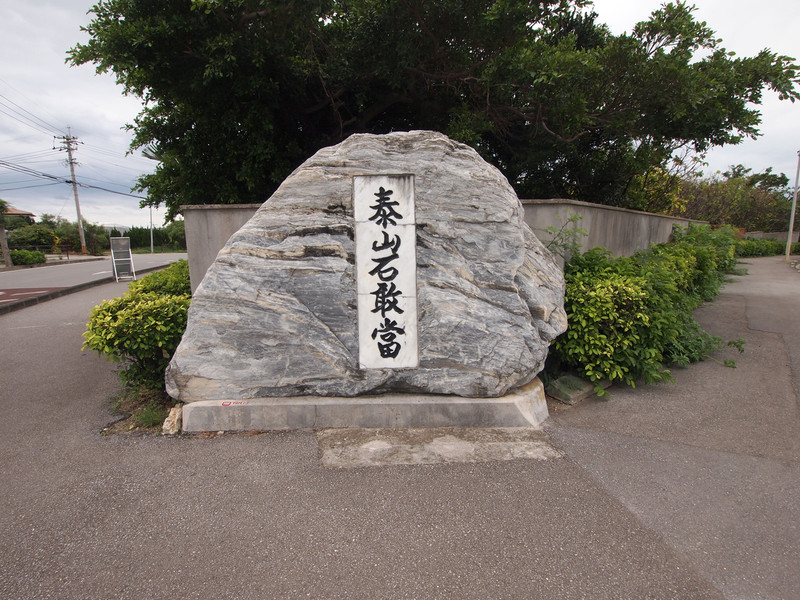
When the heart (mind) is active,
All kinds of demons come into existence;
When the heart (mind) is extinguished,
All kinds of demons disappear (Liu, 1994, p. 77).

心生種種魔生,心滅種種魔滅。

C) The demon king and generals are physical embodiments of desires that keep people from attaining enlightenment.

D) This represents the consequence of temptation, no matter how small.

E) These demons represent the seven emotions of joy, anger, sorrow, fear, love, hate, and desire.

F) Dadian’s capture represents those who erroneously think meditation is simply sitting quietly instead of inner reflection and the examination of truths. His inability to focus his mind is the real reason for his capture. Monkey represents the mind, so his arrival allows the monk to regain consciousness. Therefore, this episode teaches one to focus the mind and thereby not fall prey to desires. This is yet another step closer to enlightenment.
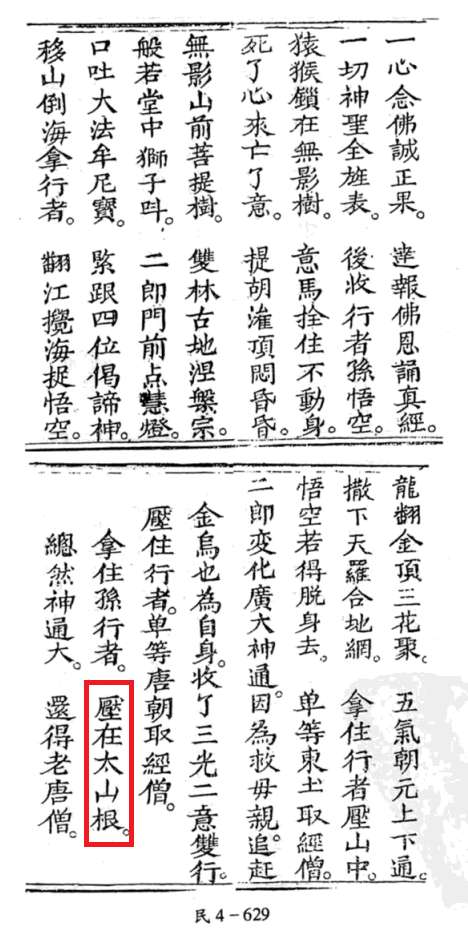
QQ截图20160221185741

Fig. 2 – The immortal Zhenyuanzi as depicted in the famous 1986 television series.

The pilgrims travel to the Temple of Five Villages (Wuzhuang guan, 五莊觀) in the Mountain of Longevity (Wanshou shan, 萬壽山), where they are met by the supreme immortal Zhenyuanzi (鎮元子) (fig. 2), the patriarch of all earthly immortals and a temporary adversary in chapters 24 to 26 of the original. Sensing that Monkey relies too heavily on his physical strength and not his spiritual strength, the immortal only allows Dadian to enter, leaving the others to sit outside for hours. To add further insult to injury, a young immortal page tells Luzhen that his master has decided to forsake the journey in order to study Daoism. This so enrages him that he bursts inside to confront Zhenyuanzi and is challenged to retrieve Dadian from the Mansion of Fiery Clouds (Huoyun lou, 火雲樓) in which the monk is drinking tea. But Monkey’s way is suddenly blocked by a supernatural flame, known as the “fire of the mind” (Xinhuo, 心火), which can’t even be extinguished by Dragon King rain. [G] He finally manages to douse the fire with the sweet dew from Guanyin‘s holy willow sprig and retrieve his master. [H]

G) This fire represents Sun Luzhen and Zhenyuanzi’s anger, which ignites when both enter into an argument. Anger is one of the emotions thought to inhibit enlightenment.

H) This liquid is referred to in Buddhist literature as being able to extinguish everything from desires to negative emotions. For example, Liu (1994) comments: “In a parable in Za baozang jing 雜寶藏經 (Sutra of Miscellaneous Treasures [5th cent.]), the Buddha was said to use the Water of Wisdom to extinguish the Three Fires of Desire, Anger and Delusion” (Liu, 1994, p. 81). Therefore, the dew/water represents wisdom, or the ability to use reason and not become angry. The use of the dew causes Monkey to switch from knee jerk reaction to reason, as exemplified by this statement:

It was my mistake in the first place. I should not have quarreled with him to stir up his fire. Once his fire is stirred up, my fire is stirred up too. I don’t know how long the fire will burn. This surely would cause delay in our master’s proper business (Liu, 1994, p. 80).

初時,原是我差了,不該與他角口,惹他動起火來。他既動了火,我又動起火來,不知燒到幾時?豈不誤了師父正事!

The group comes to an endless, ocean-like river and question how they will ever reach the “other side” (bi’an, 彼岸). [I] They eventually take a derelict boat, but infighting between Dadian and the disciples coincides with a monstrous black storm that erupts overhead, producing powerful winds that blow them thousands of miles off course to the Rakshasa Kingdom (Luocha guo, 羅剎國). This land of monsters is ruled over by the Bull Demon King and Lady Iron Fan (fig. 3), adversaries from chapters 59 to 61 of the original. After learning of the pilgrims’ arrival, Lady Iron Fan sends an army of demon soldiers to capture them so she can exact revenge for perceived misdeeds by their predecessors. [4] Dadian once again enters meditation to avoid evil influences and is quickly rescued by Monkey. Luzhen attempts to save Yijie, who once again falls prey to temptation and is captured, but is stopped by a black whirlwind created by Black Boy (Heihai’er, 黑孩兒), the second son of the demonic couple. [J] Monkey is forced to retrieve a sutra from the Bodhisattva Ksitigarbha in the underworld. Upon reading the sutra, a magic red cloud appears and shines light on the kingdom, destroying all of the demons and leading the monks to freedom. [K]

I) This ocean/river is a common metaphor in Buddhist literature referring to desire, and the “other side” refers to a life free from desire (Paramita), or achieving enlightenment. For example, Huineng (惠能, 638–713), the sixth Chan patriarch, says: “The perverted mind is the great sea and the passions are the waves … if the perverted mind is cast aside the ocean will dry up, and when the passions are gone the waves will subside” (Liu, 1994, p. 81).

J) The black whirlwind represents ignorance, or the Buddhist concept of Wuming (無明, darkness without illumination), and the demon kingdom represents the unenlightened mind that falls prey to its own demons (desire, ignorance, anger, etc.). The metaphors of the black whirlwind and demon kingdom are mentioned in the Collected Essentials of the Five Lamplight Histories (Wudeng huiyuan, 五燈會元, c. 1252), one of several accepted histories of Chan Buddhist orthodoxy in China (Liu, 1994, pp. 84-85).

K) The illuminated red cloud represents sudden enlightenment that sweeps away all ignorance and desire.

01300001248577133770100944901

Fig. 3 – An artist’s depiction of Lady Iron Fan and the Bull Demon King.

Notes:

1) This is false within the novel’s fictional universe because Tripitaka attained living Buddhahood in chapter 100 of the original.

2) Tripitaka serves as Guanyin’s successor in this respect, for it was the Bodhisattva who recruited the “scripture pilgrim” in chapter 12.

3) Liu (1994) notes that this is based on actual history. Han Yu, who was a Confucian scholar and the Vice Minister of the Justice Department, “presented a memorial to the throne, denouncing Buddhism as an alien doctrine and criticizing the emperor for receiving and showing reverence for the ‘decayed and rotten bone’ of the Buddha” (pp. 63-64). So in this case it was a relic belonging to the Buddha and not Tripitaka. Han was actually sentenced to death, but this was later commuted to exile thanks to parties arguing on his behalf.

4) She wishes to exact her revenge because their predecessors, Tripitaka, Sun Wukong, Zhu Bajie, and Sha Wujing, were instrumental in the subjugation and reformation of her first son Red Boy by Guanyin.

Source:

Liu, X. (1994). The Odyssey of the Buddhist Mind: The Allegory of the Later Journey to the West. Lanham, Md: University Press of America.