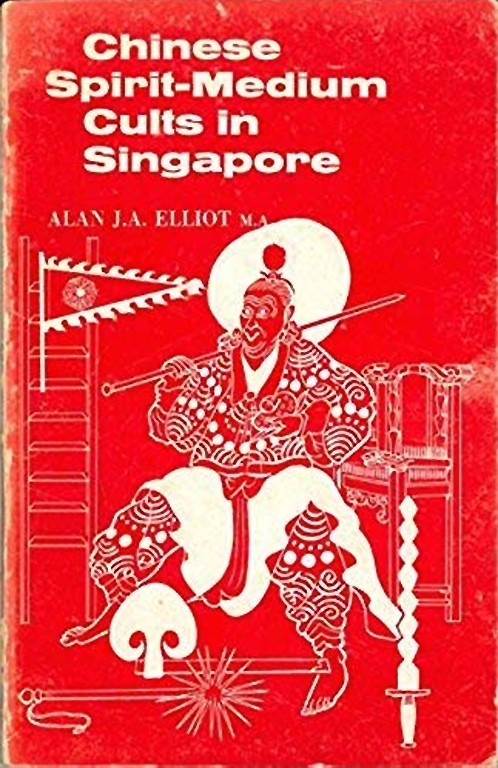
Here I present a PDF of Chinese Spirit-Medium Cults in Singapore (1955/1990) by Alan J. A. Elliott. The book contains a large chapter on the importance of spirit-mediums (Hokkien: Tangki, 童乩; Chinese: Jitong, 乩童; literally: “Divining Child”) in the worship of Sun Wukong. For those unfamiliar with spirit-mediums, I have quoted material from my article linked above:
They are believed to channel [the Great Sage’s] spirit to interact with believers, generally answering their questions, blessing them or their belongings with paper talismans, or prescribing medicine. On special occasions, they also perform a complex self-mortification ceremony […] The ritual serves several purposes. First, hacking, skewering, and poking the body with various weapons is considered a form of self-sacrifice. Second, the weapons that pierce the flesh are believed to imbue the mediums with spiritual power needed in their battle with demonic forces that pervade every corner of daily life. Third, the resulting blood is believed to have demonifugic properties, hence the reason it is smeared on paper talismans and clothing. Overall, the ritual is performed to exorcize evil spirits that cause bad luck and mental and physical illnesses.
Cover from the 1964 (2nd edition) (larger version). Note the prominence of the Monkey King.
I. Forward from the 1990 Edition
This account of Chinese spirit-medium cults describes in great detail an important aspect of the religion of overseas Chinese in Singapore. It is an historical study, since the field research was carried out over nearly two years in 1950 and 1951. It is historical for two reasons. One is that the highly personalized nature of many of these cults has meant that they are short-lived, emphemeral. The other is that in the forty years since the study was made the life of the Singapore Chinese has changed radically, and many of their ritual practices must have altered accordingly. But at the time this research was carried out, anthropological field studies of Chinese social institutions were rare, and this particular investigation was unique. Most studies of Chinese religion anywhere had been of a literary nature, concerning the ideas and practices of Confucianism, Buddhism, Taoism; very little information was available about how ordinary Chinese conducted their daily ritual affairs.
The significance of this study is not just focused on the past. It has contemporary relevance, and for a field far wider than Singapore alone. For anthropologists, enquiry into spirit-mediumship, shamanism, ecstatic religion, possession, has become a recognised part of the discipline, over a broad ethnographic range. But the general problems involved, of alternative personality, of apparent lack of sensitivity to external physical stimuli, of claims in the name of spirit to knowledge and authority not possessed by the human medium, can attract the attention of psychologists, psychiatrists, and all interested in the obscure and complex workings of the human mind. The issues raised involve ordinary people too, since they show how anxiety, uncertainty, fear, disappointment and greed seek assurance and resolution from some source deemed superhuman, even spiritual. The basic beliefs revealed by this study of Chinese spirit-mediumship are not confined to Chinese.
The following video presents 10 facts about Sun Wukong that even superfans of the novel may not know. It is a summation of my and other scholars’ research. I hope you like it and will share with your friends and family.
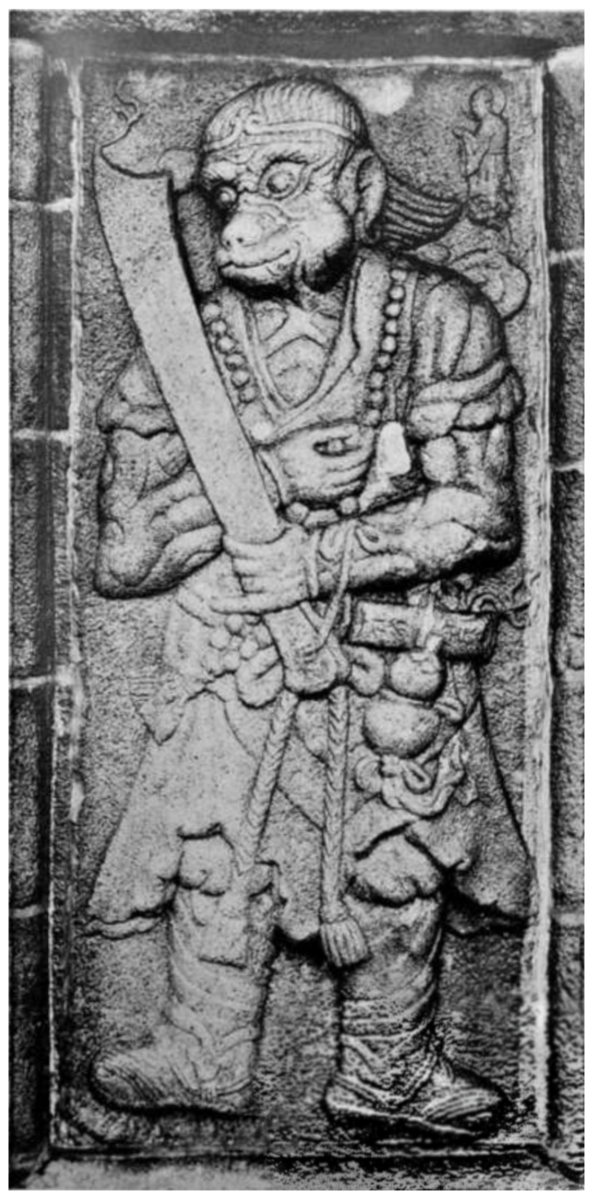
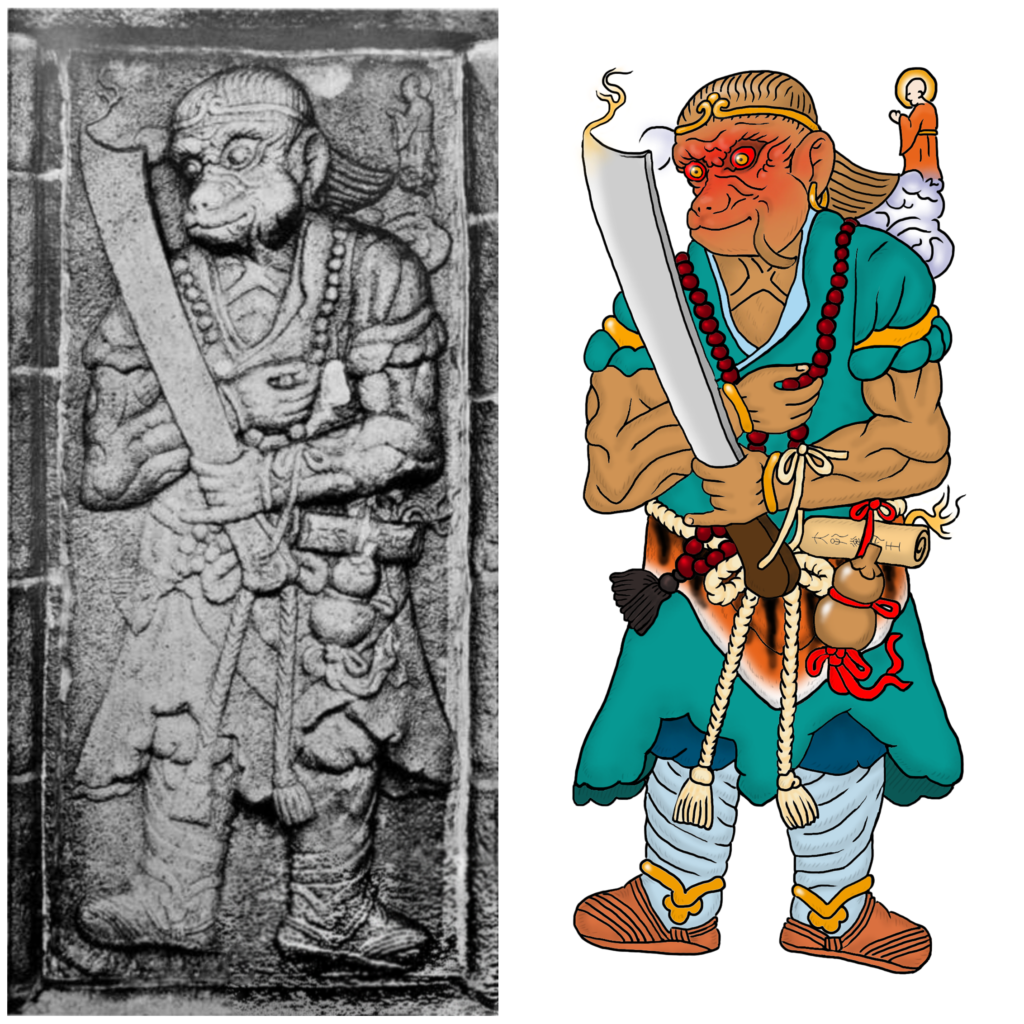
The southern Chinese seaport of Quanzhou in Fujian province is home to Kaiyuan Temple (Kaiyuan si, 開元寺), also known as the Purple Cloud Temple (Ziyun si, 紫雲寺), an ancient Buddhist complex originally built in 686. The temple is famous for its two stone pagodas, each of which is covered in 80 life-size relief carvings of bodhisattvas, arhats, patriarchs, protector deities, and various mythological creatures rendered in a rustic style influenced by the Northern Song Dynasty school of art (Ecke & Demiéville, 1935, pp. 11-18). One figure of interest is a muscular, sword-wielding, monkey-headed warrior (fig. 1) located on the northeastern side of the western pagoda’s fourth story. Many scholars consider this to be an early depiction of Sun Wukong from Journey to the West (Xiyouji, 西遊記, 1592). The pagoda was erected in 1237 (Ecke & Demiéville, 1935, p. 91), so this depiction predates the Ming novel by 355 years, making it an important source for analyzing the early influences on the much beloved literary character. In this paper, I present past research on the relief, as well my own in which I suggest the iconography is based on ritual adornments mentioned in the Hevajra Tantra, an Esoteric Buddhist text of the 8th-century.
The first detailed description of the relief appears in Ecke and Demiéville (1935):
A guardian with a monkey-head, holding with one hand a rosary which is hanging around his neck, and with the other a sword emitting a cloud from its tip. He wears a short tunic, travel-sandals, and a rope-belt from which are hanging a calabash and a scroll with the Chinese title of the Mahamayarividyārajñi [Fomu da kongque mingwang jing, 佛母大孔雀明王經] (T982-985, a text which was used as a charm against all calamities, dangers, wounds, and diseases). [According to local tradition, it is] Sun Wu-k’ung the name of the monkey assistant (alias the Monkey attendant 猴行者, or the fair Monkey-king 美猴王, or the Great Saint Equal to Heaven 齊天大聖) of Hsüan-tsang [Xuanzang] in the JW-novel. In the upper right corner of the carving there is a small monk-figure with a halo, evidently Hsüan-tsang himself, appearing on a cloud, seemingly the same cloud as that which emanates from the monkey’s sword. In the version of the JW now extant, the monkey assistant’s weapon is not a sword, but an iron rod with two golden rings, which he can reduce, whenever he finds it convenient, into a needle and so keep inside his ear. Also, he wears a tiger-skin over the lower part of his body, a detail which does not agree with our carving (p. 35)
Glen Dudbridge (1970) compares Ecke and Demiéville’s analysis with the description of the Monkey Pilgrim (Hou xinzhe, 猴行者) from the The Story of How Tripitaka of the Great Tang Procures the Scriptures, the late 13th-century precursor of Journey to the West. Based on the differences, he suggests Northern and Southern China may have had separate Monkey story cycles:
[T]here is no sign there of the traveller’s garb in which the Zayton [2] figure is so meticulously clothed; the sword is also not mentioned, although the ‘iron rod with gold rings’ … has not yet assumed its full distinctive role; similarly, the tiger-skin robe, while not described in so many words, seems faintly anticipated in the episode [chapter six] in which Hou Hsing-che slays a tiger-demon, and certainly this standard attribute of demonic figures in Tantric iconography accords well with the description of the yakṣa in that same episode. [3] All this tends to suggest that the Zayton monkey-figure remains strangely distinct from that known to us in the literary sources … Certainly at this stage of their development, there seems to have been no obligation to uniformity in the enactment or representation of popular story cycles: the monkey seen, heard or read about by the northern public could well have differed from his southern counterpart (Dudbridge, 1970, p. 49).
Journey to the West translator and scholar Anthony C. Yu (1977) highlighted a difference in opinion regarding the pious figure on the upper right of the piece:
Ōta Tatsuo 太田辰夫 and Torii Hisayasu 鳥居久靖, in “Kaisetsu 解説,” in Saiyuki, Chūgoku koten bungaku taikei, 31-32 (Tokyo 1971), 432, have challenged Ecke and Demiéville’s interpretation of the carving by pointing out that the figure at the upper righthand corner should be thought of simply as a figure of Buddha (not Hsüan-tsang), which Monkey will become by virtue of bringing back the scriptures. It may be added that Sun Wu-k’ung of the hundred chapter narrative did use a sword or scimitar 刀 (JW, chaps. 2 and 3) before he acquired his famous rod. [1] None of the scholars consulted here sees fit to discuss the significance of what seems to be a headband worn by the carved figure (p. 497 n. 23).
Victor Mair (1989) focuses on the relief’s iconography and suggests that the various elements might have ties to depictions of both the Buddhist protector deity Aṇḍīra and the Hindu monkey god Hanuman from the Ramayana (c. 4th-cent BCE):
The band on the Zayton monkey’s head is indeed very important. Surely it must represent what becomes the Tight-Fillet 緊箍 of the Ming JW, ch. 14. Regardless of the author’s (or his predecessors’) elaborate creative inventions surrounding this fillet in the tradition of the novel, we may ask whether it has any identifiable iconographical origins in art.
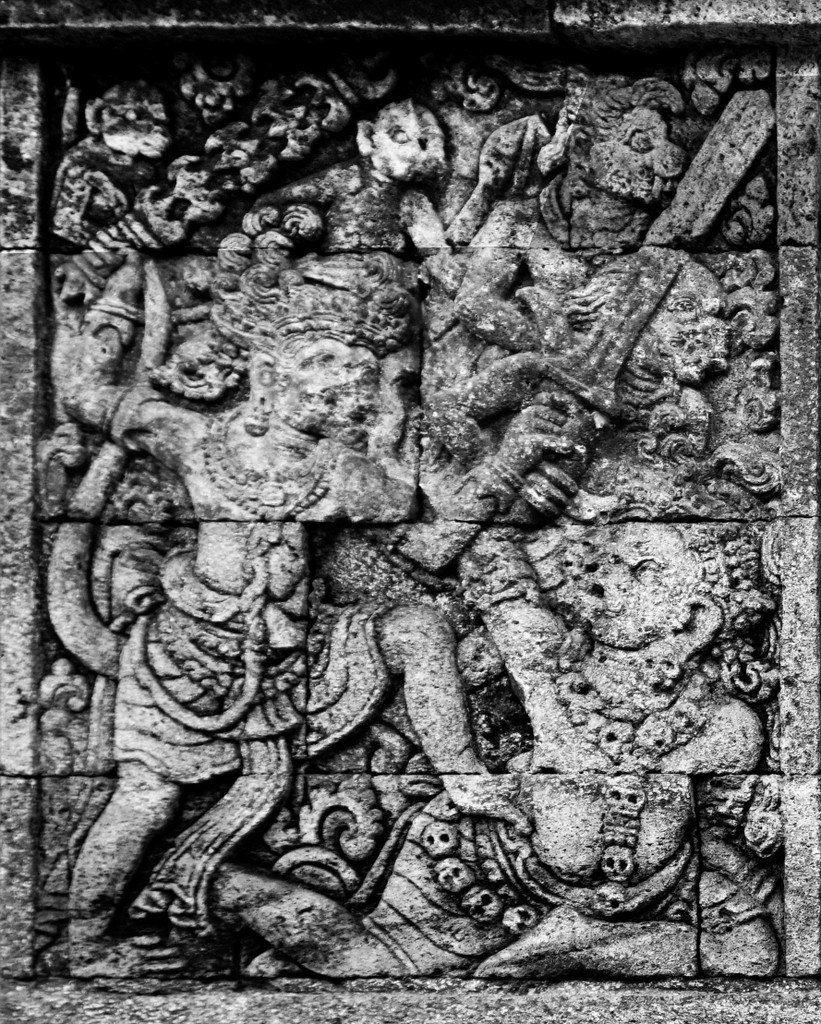
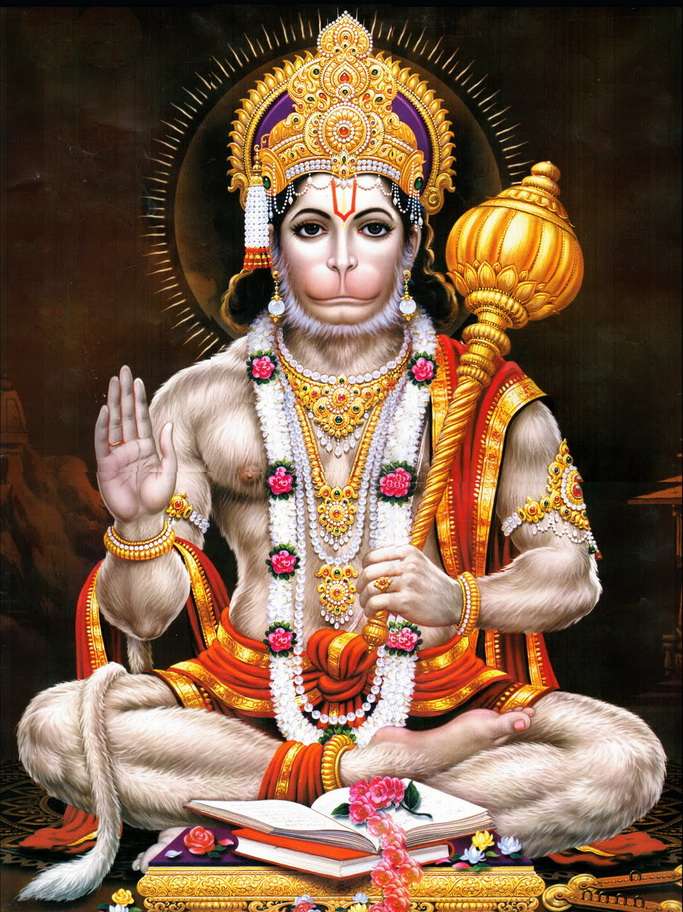
The Tight-Fillet recalls the band around the head of representations of Aṇḍīra, the simian guardian of Avalokiteśvara and Bhaișajyaguruvaidūryaprabhāṣa … As a typical specimen, we may take a statue [fig. 2] from the Kōfukuji in Nara. The Kōfukuji Aṇḍīra has curious wing-like projections extending from the sides of the band around his head that remind us of Mercury in Western classical art. On the Zayton SWK [Sun Wukong], these symbols of swiftness have been displaced to the sides of the eyes. In either case, the wings remind us of H’s [Hanuman’s] descent from the god of the wind. Other similarities between the Kōfukuji Aṇḍīra and the Zayton SWK include: identical earrings (these are key iconographical features of H in many Southeast Asian Rs [Ramayanas]), comparable tilt of the head (exaggerated with the Kōfukuji Aṇḍīra) which seems to indicate enforced submission, long locks of hair flaring out behind the head, elongated monkey’s mouth, similar decorations on forearms and upper arm, etc. It is crucial to note that all of these features can be found in South Asian and Southeast Asian representations of H. For its photographic clarity, we may choose a scene from the Rāma reliefs in Panataran, Indonesia [fig. 3]. H’s forearms are bare in this particular representation, but in some Thai reliefs (at Wat Phra Jetubon in Bangkok), they resemble those of the Zayton SWK and the Kōfukuji Aṇḍīra. The discrepancies in the dress and ornamentation of the lower parts of the body may be attributed to culture and climate (pp. 699-700).
Fig. 2 – The Kōfukuji Aṇḍīra wooden relief carving (c. 11th to 12th-cent.) (larger version), Nara, Japan. Fig. 3 – Hanuman (left) besting a demonic foe (right), from the Ramayana reliefs of the Panataran temple complex (c. 12th-cent.) (larger version), East Java, Indonesia.
II. My findings
My opinion on the origins of the Kaiyuan relief’s iconography parts ways with Mair in some respects. For instance, upon close inspection of the Japanese Aṇḍīracarving, the band that he refers to appears to be the brim of a helmet. I do agree the Kaiyuan relief shares affinities with the cited image of Hanuman (e.g., the earrings and armbands). But again, here I part ways with Mair because I suggest the relief’s accoutrements were instead influenced by Esoteric Buddhism and not Hinduism. The similar imagery is no doubt due to a common cultural source.
Nearly every aspect of Sun Wukong’s attire can be found in a passage from the 8th-century esoteric text the Hevajra Tantra (Dabei kongzhi jingang dajiao wang yigui jing, 大悲空智金剛大教王儀軌經). It instructs yogins on how to adorn and dress themselves for worshipping Heruka (Xilujia, 呬嚕迦), a wrathful protector deity of Buddhism.
Translation: The practitioner should wear divine ear-rings, a circlet around the head, upon each wrist a bracelet, a girdle around his waist, anklets around the ankles, arm ornaments around the upper arms and a garland of bones around the neck. His dress must be of tiger skin … (Farrow & Menon, 2001, pp. 61-62).
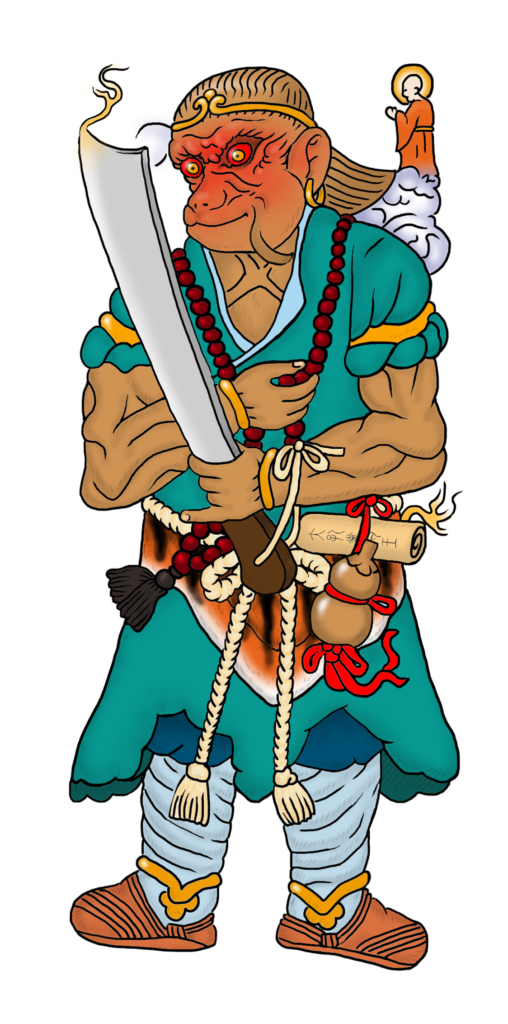
Earrings? Check! Circlet? Check! Bracelets, girdle, anklets, and arm ornaments? Check, check, check, and check! The only two aspects that are questionable are the bone necklace and the tigerskin. Rosaries are sometimes made from bone, which satisfies that requirement. As for the skin, while Ecke and Demiéville were quick to note its omission in their study, I think the appearance of so many elements from the passage suggests the tigerskin is present but the features may have just been eroded by time. The chevron shape visible below the girdle could be a skin apron. I’ve created a color version of the relief based on this information (fig. 4).
Fig. 4 – My interpretation of the relief (larger version). A comparison of the original and new versions can be seen here.
(Note 05-22-23: Upon reviewing figure four, I don’t like the way the proposed tiger skin cuts off at the belt. It would make more sense for the skin to act as a girdle, making it visible above the belt. I’ll probably update this in the future.)
As I explained in a previous article, the Hevajra Tantra was officially translated into Chinese in 1055 (no doubt arriving earlier than this), so the text was present in the middle kingdom for nearly 200 years prior to the creation of the relief.
What can these ritual elements tell us about Monkey’s depiction? Firstly, it should be noted that the esoteric deity Heruka and other such wrathful guardians, known by the neologism “Wrathful Destroyers of Obstacles” (Sk: krodha-vighnantaka), are commonly portrayed wearing such items, leading to the scholar Van Kooij (as cited in Linrothe, 1999) to comment, “Heruka is more or less a deified hypostasis of the … yogin himself” (p. 251). Second, these deities are often portrayed wielding weapons. For example, one source describes Vajrapani‘s wrathful form Trailokyavijaya “hold[ing] the vajra, ankusa-hook, sharp sword, pâsa-noose and other âyudha [weapons]” (Linrothe, 1999, p. 188). Sun Wukong too is depicted with a weapon, a sword with a lick of heavenly flame. Third, the flamingsutra tied to Monkey’s girdle was, as explained above, historically “used as a charm against all calamities, dangers, wounds, and diseases” (Ecke & Demiéville, 1935, p. 35). Wrathful Destroyers of Obstacles are charged “with the destruction of barriers which prevent the experience of enlightenment” (Linrothe, 1999, p. 25). These include external threats like manifested demons and internal threats like demon-caused mental and bodily illness, the “three poisons,” and karmic debt (Linrothe, 1999, pp. 24-25). Therefore, the iconography presents Sun Wukong as a wrathful protector deity.
This then may lend support to Ecke and Demiéville’s original assertion that the pious figure floating in the clouds to the right of Monkey’s head is in fact Xuanzang. The Great Sage clears the path of manifested demons that obstruct the monk’s path to enlightenment, leading to his ascension into paradise (this happens in both the 13th-century version of the story and the final Ming novel).
III. Ritual Adorments and Other Literary Figures
While Monkey’s association with the fillet and the tiger skin carried over into the novel, other characters came to be associated with ritual adornments from the Hevajra Tantra. A prime example is Red Boy (Hong hai’er, 紅孩兒), son of the Bull Demon King and Princess Iron Fan. The Bodhisattva Guanyin forces the demon child to submit in chapter 42, after which she uses a magic treasure given to her by the Buddha to ensnare his extremities.
Dear Bodhisattva! She took the fillet and waved it at the wind once, crying, “Change!” It changed into five fillets, which she threw at the body of the boy, crying, “Hit!” One fillet enveloped the boy’s head, while the rest caught his two hands and two feet (Wu & Yu, 1977, vol. 2, p. 280).
Red Boy is the literary counterpart of the religious figure Sudhana (Sancai, 善財), whose spiritual journey is told in the Gandavyuha Sutra(Dafang guang fohuayan jing, 大方廣佛華嚴經, c. 3rd-cent.). The youth sets out on a quest towards enlightenment and trains under 52 different teachers, including Maitreya, Avalokiteśvara (the South Asian variant of Guanyin), Mañjuśrī, and Samantabhadra (Buswell & Lopez, 2014, p. 864). It’s no wonder then that the ascetic came to be associated with such ritual adornments. South and East Asian depictions of Sudhana/Sancai often portray him wearing bangles and anklets (fig. 5).
Fig. 5 – A modern day altar statue of Sudhana/Sancai (larger version). Notice the bracelets and anklets.
IV. Conclusion
The 13th-century Sun Wukong pagoda relief of the Kaiyuan Temple shares many similarities to ritual adornments mentioned in the esoteric Hevajra Tantra (8th-cent.), including earrings, the circlet, arm cuffs, a necklace, a girdle, wrist bangles, anklets, and possibly even a tiger skin. Esoteric protector deities are often portrayed with similar attire since they represent the very yogin ascetics who worship them. Monkey’s depiction with said attire suggests the artist who created the piece intended to present him as a powerful Buddhist guardian on par with Wrathful Destroyers of Obstacles like Heruka. The depicted sword and sutra, each shown with a lick of heavenly flame, no doubt represent the means by which the Great Sage protects his master Xuanzang (possibly the pious figure on the upper right corner of the relief).
The onetime enemy Redboy comes to wear the ritual circlet, bracelets, and anklets in Journey to the West after being subjugated by Guanyin. While he is depicted as a defeated foe who submits to Buddhism, these adornments recall his historical and religious origins as Sudhana, a great ascetic from Buddhist literature.
Update: 05-22-23
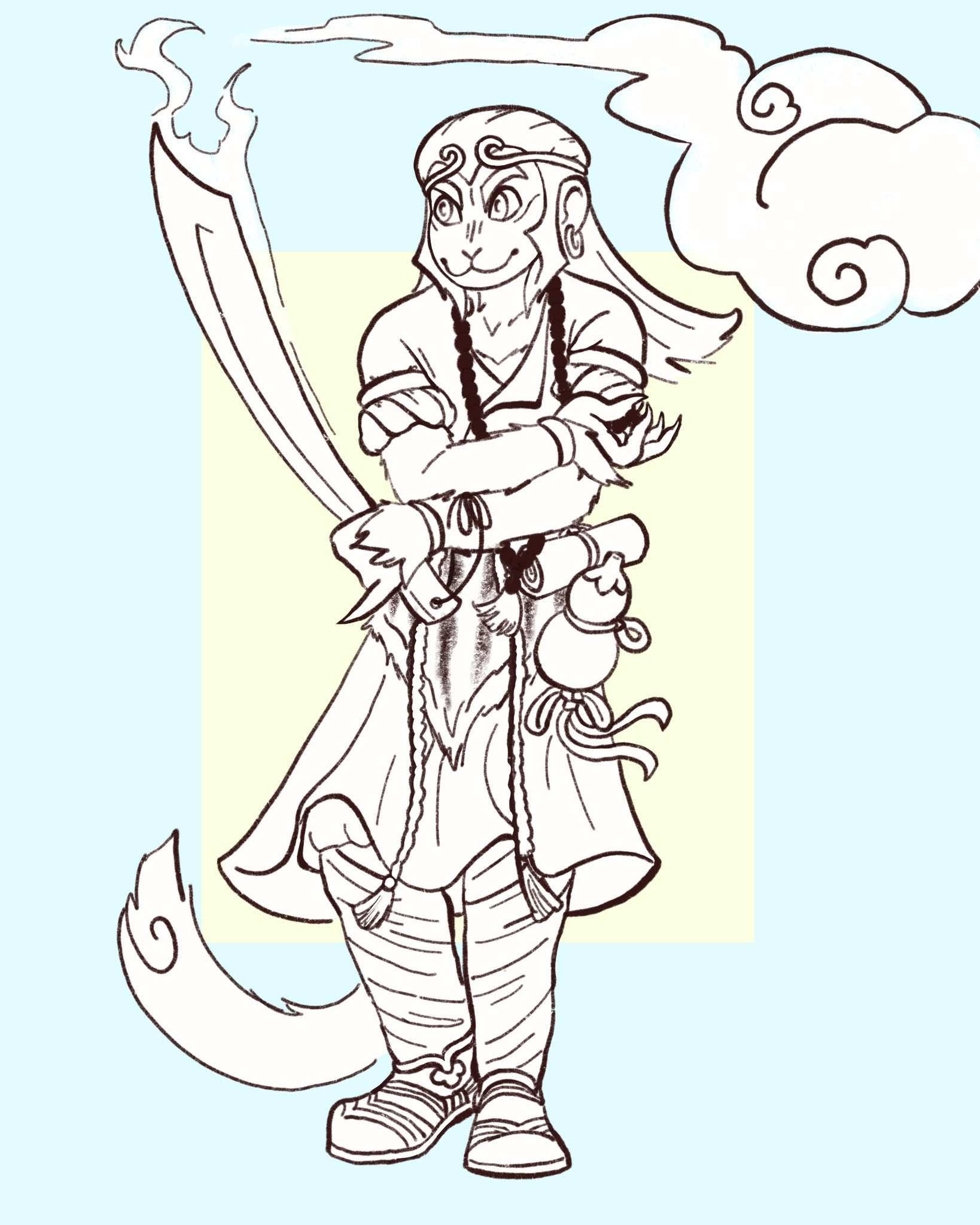
Twitter user Lava (@Lavaflowe) has allowed me to post their lovely drawing of the stone pagoda carving.
There is also a possibility that the tiger skin isn’t present at all (as suggested by others). Despite the Hevajra Tantra prescribing this dress, the skin isn’t listed among the most basic accoutrements of a yogi elsewhere in the work. These are known as the “Five Symbolic Ornaments” or “Five Seals” (Sk: Pancamudrā, पञ्चमुद्रा; Ch: Wuyin, 五印; a.k.a. “Five Buddha Seals,” Wufo yin, 五佛印). Each is associated with a particular Buddha:
Aksobhya is symbolised by the circlet, Amitabha by the ear-rings, Ratnesa by the necklace, Vairocana by the hand ornaments, [and] Amogha by the girdle (Farrow, 1992, p. 65).
The aforementioned five ornaments are sometimes combined with another item to form the “Six Ornaments” or “Six Seals” (Sk: Shanmudrā, षण्मुद्रा), each of which is associated with a Buddhist wisdom:
The yogic ornaments … are commonly classified as being six in number: (1) the skull-tiara, (2) the armlets, (3) the bracelets, (4) the anklets … (5) the bone-bead apron and waist-band combined … and (6) the double line of bone-beads extending over the shoulders to the breast, where they hold in place the breast-plate Mirror of Karma, wherein … are reflected every good and bad action. These six ornaments (usually of human bone) denote the Six Pāramitā (‘Boundless Virtues’), which are: (1) Dāna-Pāramitā (‘Boundless Charity’), (2) Shīla-Pāramitā (‘Boundless Morality’), (3) Kshānti-Pāramitā (‘Boundless Patience’), (4) Vīrya-Pāramitā (‘Boundless Industry’), (5) Dhyāna-Pāramitā (‘Boundless Meditation’), and (6) Prajñā-Pāramitā (‘Boundless Wisdom’). To attain to Buddhahood, and as a Bodhisattva to assist in the salvation of all living creatures, the Six Pramita must be assiduously practised (Evans-Wentz, 2000, p. xxv).
The most detailed source I’ve found reads:
a. The Bone Wheel
Vajradharma wears a bone wheel on his head. It is formed from a small bone circle that sits around the crown of the head, surrounded by a second, larger circle. The two circles are attached to one another by eight bone spokes. On each of the five spokes at the front, above the forehead, stands a dried skull that supports the jewel, which is the crest ornament. From the lower part of their jaws, looped chains and hanging decorative chains extend downward to the space between Vajradharma’s eyebrows and to the tips of his ears. One the back of each skull is a multicolored vajra with a crescent moon placed to the left. The deity’s long hair passes up through the hole in the middle of the inner bone circle and is tired in a topknot.
b. The Earrings
There are five parts to the earrings. There is a main circle of bone, which is like a bangle. From the bottom of the circle hang two smaller rings, each one attached to the larger ring above them by a semi-circle of bone.
c. The Necklace
The necklace is made of two strings of bones bound together with hair taken from both a corpse and a living person. At the front is a square central hub. The hub forms the base for a T-shaped triple vajra. There are to more triple vajras placed at the two points where the strings of the necklace reach the shoulders.
d. The Bracelets
The deity wears a bracelet on each ankle, wrist, and upper arm, making six in total. Each bracelet is made from two strings of bones that have been bound together. There are three vajras on each pair of bracelets, one at the knot in the upper string, one at the knot in the lower string, and one opposite the knot in the upper string.
e. The Brahmin’s Bone Thread
Next is the Brahmin’s bone thread, or investiture thread (yajnopavita). On the front of the body, above the novel, is a bone wheel with either right or four spokes. There are holes in four of the spokes and two parallels strings of bone pass through each of them. Two of these strings go over the shoulders, and two pass under the armpit. On each of these strings are two vajras on the shoulder and another two under the armpit, making eight in total. Sometimes there is a second bone wheel on the back, to which all the strings are tied; if not, all the ends of the strings are knotted together.
Together, or with the thread of hair from a slain thief, these bone ornaments are called the ornaments of the five mudras.
f. The Bone Belt
The bone belt, or apron, hangs from the waist. It is made, as before, of two parallel strings of bone. The strings have five vajras attached to them–one at the front in the center, one on each hip, and one on each side of the center, halfway to the whips. Hanging chains and looped chains decorated with small silver bells and small bone spearheads hang from the tips of the vajras. The chains end at the point where the calf muscle begins to taper.
According to oral tradition, the necklace we just mentioned is ornamented with five vajras at the heart. Although I have consulted many descriptions of the bone ornaments, I have never seen this stated anywhere else. There are many traditions concerning the bone ornaments, but here I have presented that of the oral tradition taught by my master (Lingpa, Rinpoche, & Chemchok, 2017, pp. 52-54).
As can be seen, the tiger skin is not mentioned among these ornaments either.
Also, as is mentioned, the items making up the six ornaments vary from tradition to tradition. For instance, Huntington and Bangdel (2003) list bone ash in place of the bone thread (p. 161). But it’s important to note for our purposes that the circlet, bangles, bracelets, anklets, and belt make up the five basic accoutrements.
Notes:
1) Yu (Wu & Yu, 1977) is referring to the fight between Sun Wukong and a demon, during which time the monkey disarms him and uses the latter’s own sword against him.
2) The city of Quanzhou was known to both Marco Polo and Ibn Battuta by the Arabic name Zayton or Zaiton (زيتون , the “City of Olives”).
3) Monkey transforms a ringed monk’s staff into a titanic yakṣa that crushes the aforementioned tiger demon with a club.
Sources:
Buswell, R. E., & Lopez, D. S. (2014). The Princeton Dictionary of Buddhism. Princeton, NJ: Princeton University Press.
Ecke, G., & Demiéville, P. (1935). The Twin Pagodas of Zayton: A Study of the Later Buddhist Sculpture in China. Cambridge, Mass: Harvard University Press.
Evans-Wentz, W. Y. (Ed.). (2000). Tibet’s Great Yogi Milarepa: A Biography from the Tibetan Being the Jetsun-Kabbum Or Biographical History of Jetsun-Milarepa, According to the Late Lama Kazi Dawa-Samdup’s English Rendering. United Kingdom: Oxford University Press, USA.
Farrow, G. W., & Menon, I. (2001). The Concealed Essence of the Hevajra Tantra: With the Commentary Yogaratnamālā. Delhi: Motilal Banarsidass Publ.
Huntington, J. C., & Bangdel, D. (2003). The Circle of Bliss: Buddhist Meditational Art. United Kingdom: Serindia Publications.
Lingpa, J., Rinpoche, P., Chemchok, K. (2017). The Gathering of Vidyadharas: Text and Commentaries on the Rigdzin Düpa. United States: Shambhala.
I have finally tracked down a digital version of Victor Mair’s often quoted summary of the scholarly debate on the possible connection between Sun Wukong (fig. 1) and the Hindu monkey god Hanuman (fig. 2). This paper is extremely hard to find, so I am archiving it here to aid both amateur and professional scholars who may not yet have access to it.
The chief aim of this article is to restore the debate to its original scholarly intent, namely to determine whether H [Hanuman], the redoubtable simian devotee of Prince Rama in his quest to recover Sita from Lanka, had anything to do with the formation of the character of SWK [Sun Wukong], Tripitaka’s formidable Monkey-disciple during his pilgrimage to India to retrieve scriptures. This can only be achieved by remaining as impartial and objective as possible while presenting the pertinent evidence. A clinically dispassionate examination of the widely varying opinions of authorities concerning the apparent affinity between SWK and H is also required if the present impasse is to be broken. Hence, this article is necessarily as much an investigation of scholarly methods and attitudes as it is about the origins of SWK. Accordingly, it is divided into two main divisions, “Evidence” and “Authorities and Interpretations.” These are further subdivided into a number of sections, “Evidence” by geographical area and “Authorities and Interpretations” by a chronological listing of major participants in the debate.
Mair, V. (1989). Suen Wu-kung = Hanumat? The Progress of a Scholarly Debate, in Proceedings of the Second International Conference on Sinology (pp. 659-752). Taipei: Academia Sinica.
The historical Buddhist monk Xuanzang (玄奘, 602-664) is famous for having traveled to India between 629 and 645 in order to supplement the Chinese Buddhist canon with fresh scriptures (see here). As his legend grew, an embellished story cycle began referring to him as Tang Sanzang (唐三藏; lit: “Tripitaka (“Three Baskets,” i.e. the Buddhist canon) of the Tang Dynasty“), and as early as the 11th-century, he acquired a divine monkey disciple who would later become Sun Wukong (孫悟空). The cleric eventually gained his own supernatural background, for evidence shows that he was worshiped as an Arhat (Luohan, 羅漢; Zunzhe, 尊者), a Buddhist saint, by the Song Dynasty (960-1127 CE) (Liu, 2019). A Yuan-Ming zaju stage production plays on this concept by depicting Tripitaka as the reincarnation of the Arhat Vairocana (Pulujia zunzhe, 毗廬伽尊者) (Dudbridge, 1970, p. 193). [1] This saintly status was further embellished in Journey to the West (Xiyouji, 西遊記, 1592), the culmination of his story cycle, where the character is cast as the earthly reincarnation of Master Golden Cicada (Jinchan zi, 金蟬子), the Buddha’s fictional second disciple.
In this article, I would like to discuss the Golden Cicada, including the story details explaining his background and the origin of his title. I ultimately suggest that the term was chosen because the celestial’s banishment to Earth and eventual return to paradise recalls the metamorphic lifecycle of the real life insect.
I. Internal story details
The Tang Monk’s background is first hinted at in chapter eight when Guanyin sets out to find the scripture pilgrim. The narrative proclaims:
[A] Buddha son return[s] to keep his primal vow. The Gold Cicada Elder will clasp the candana (Wu & Yu, 2012, vol. I, p. 207).
Chapter twelve contains a poem introducing Tripitaka as the chosen pilgrim and reveals his heavenly origin. The first part reads:
Gold Cicada was his former divine name. As heedless he was of the Buddha’s talk, He had to suffer in this world of dust, To fall in the net by being born a man […] (Wu & Yu, 2012, vol. 1, p. 275).
Details about the extent of the former celestial’s punishment is revealed throughout the book. For instance, in chapter 33, a demon explains the source of the heavenly aura [2] around Tripitaka:
That Tang Monk is actually the incarnation of the Elder Gold Cicada, a virtuous man who has practiced austerities for ten existences (Wu & Yu, 2012, vol. 2, p. 105).
Furthermore, in chapter 100 the Buddha tells his former disciple:
Because you failed to listen to my exposition of the law and slighted my great teaching, your true spirit was banished to find another incarnation in the Land of the East. Happily you submitted and, by remaining faithful to our teaching [Buddhism], succeeded in acquiring the true scriptures (Wu & Yu, 2012, vol. 4, p. 381).
So, we learn that the Golden Cicada was banished to live out ten pious lives in China until the time came for him to build merit as the scripture pilgrim, thereby gaining reentry into paradise.
II. Origin of the title
Yu (2008) alludes to chapter 99 explaining the source of the name Golden Cicada (p. 110). I can’t find such an overt explanation, but the chapter does mention the monk miraculously surviving drowning after being dumped by a disgruntled river turtle [3] into a heavenly river, along with his disciples and the hard-won scriptures. The novel exclaims:
Ah! It was fortunate that the Tang Monk had cast off his mortal frame and attained the way. If he were like the person he had been before, he would have sunk straight to the bottom (Wu & Yu, 2012, vol. 4, p. 363).
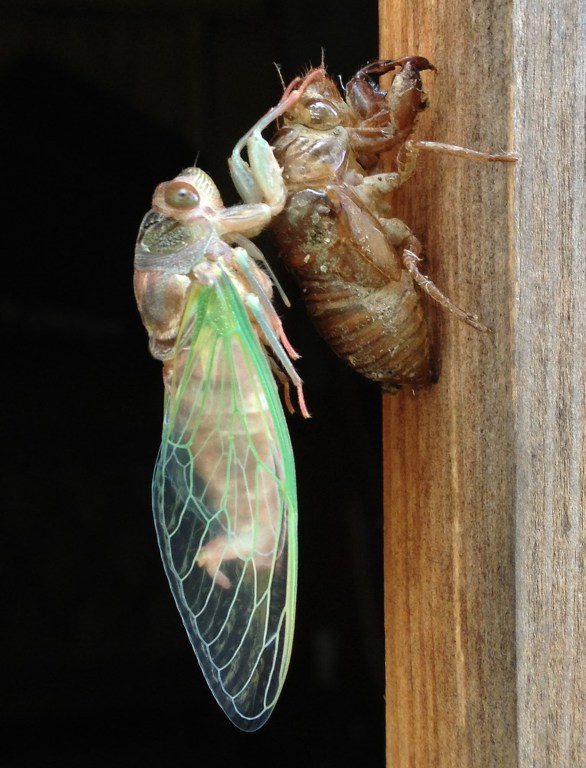
The “cast[ing] off of his body” (tuotai, 脫胎) is reminiscent of the way in which the real life insect sloughs off its shell (fig. 1). If this is what Yu was referring to, I think this is but one part of the puzzle.
Fig. 1 – A newly formed cicada clinging to its shell (larger version).
I suggest that the author-compiler of Journey to the West chose the cicada imagery for the symbolic nature of its life cycle. Munsterberg (1972) describes the insect’s role in ancient Chinese religion:
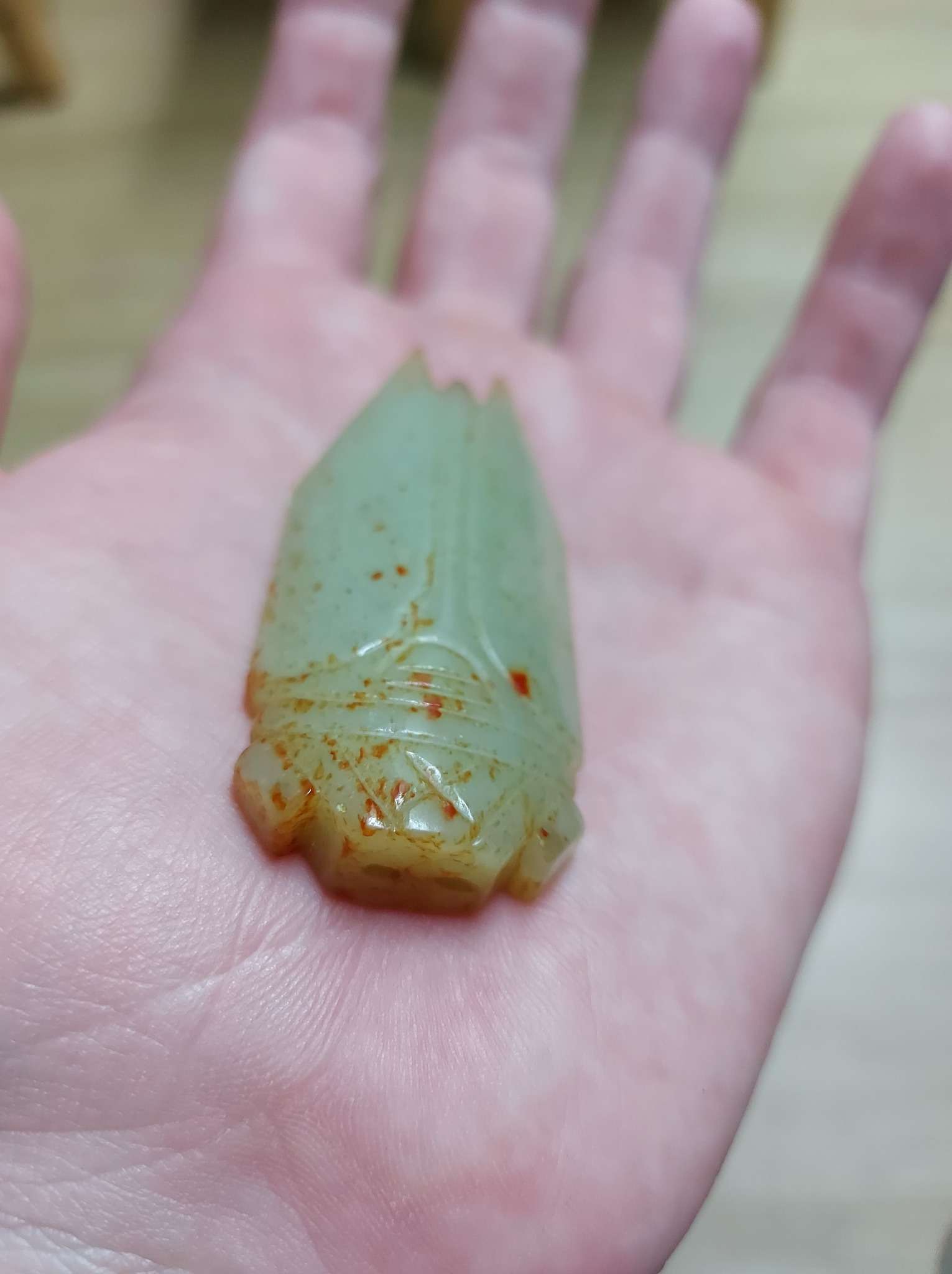
Cicadas carved in jade are frequently found in graves of the Han period [fig. 2]. Since the cicada hatches above ground, spends a long period underground, and finally emerges as if in rebirth, these burial tokens were probably intended to induce resurrection by sympathetic magic (p. 32).
The Golden Cicada’s life follows this cycle very closely: the celestial being resides above in the Western Paradise, is banished below for an extended period of time, and is only allowed back into the celestial realm after a metamorphosis.
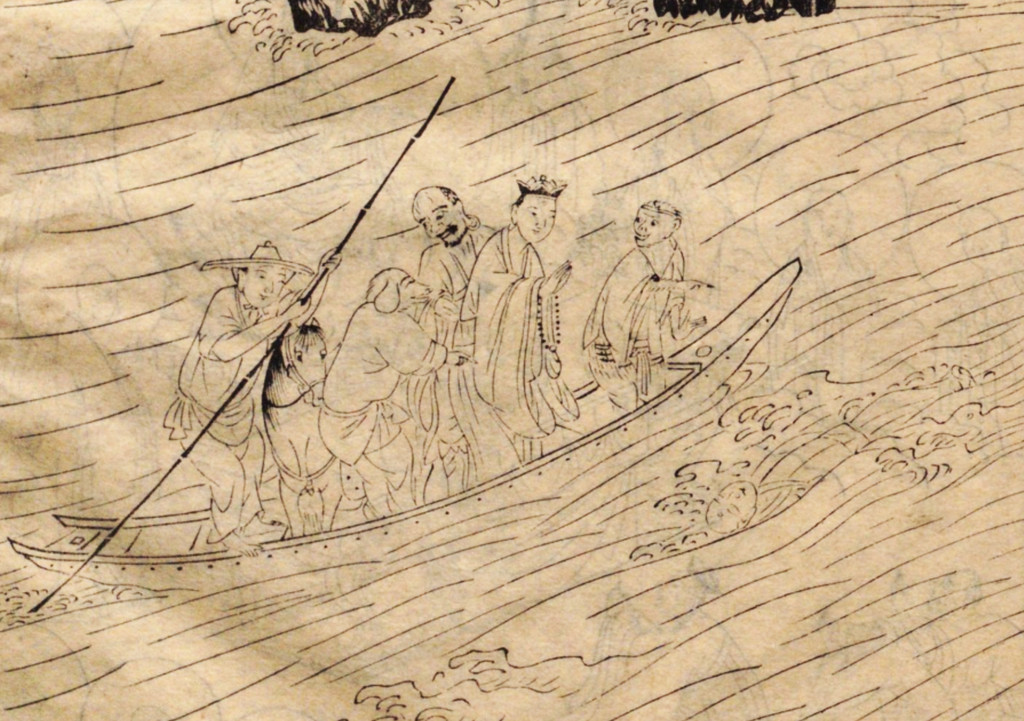
The lifesaving transformation previously referred to by Guanyin takes place in chapter 98 when Tripitaka and his disciples are ferried across a heavenly river in a bottomless boat on their way to the Western Paradise:
All at once they saw a corpse floating [fig. 3] down upstream, the sight of which filled the elder [Tripitaka] with terror.
“Don’t be afraid, Master,” said Pilgrim [Sun Wukong], laughing. “It’s actually you!”
“It’s you! It’s you!” said Eight Rules [Zhu Bajie] also.
Clapping his hands, Sha Monk also said, “It’s you! It’s you!”
Adding his voice to the chorus, the boatman also said, “That’s you! Congratulations! Congratulations!” Then the three disciples repeated this chanting in unison as the boat was punted across the water. In no time at all, they crossed the Divine Cloud-Transcending Ferry all safe and sound. Only then did Tripitaka turn and skip lightly onto the shore. We have here a testimonial poem, which says:
Delivered from their mortal flesh and bone, A primal spirit of mutual love has grown. Their work done, they become Buddhas this day, Free of their former six-six senses sway (Wu & Yu, 2012, vol. 4, pp. 345-346). [4]
Here, we see Tripitaka has shed his mortal form to become a Buddha just like the cicada sheds its shell to grow wings and fly. The monk has freed himself from the endless cycle of birth and death to achieve nirvana.
The Thirty-Six Stratagems (Sanshiliu ji, 三十六計, c. 5th-6th-cent.), a collection of military, political, and civil tactics, contains a plan known as “The Golden Cicada Sheds its Shell” (Jinchan tuoke, 金蟬脫殼), which entails leaving a decoy that distracts the enemy while the losing force is retreating. I’m not sure if this directly influenced the celestial’s title, but it at least shows that the name was known long before Journey to the West was published.
The strategy is actually used by a tiger demon in chapter 20:
Whipping out the iron rod, Pilgrim [Sun Wukong] shouted, “Catch him!” Eight Rules [Zhu Bajie] at once attacked with even greater ferocity, and the monster fled in defeat. “Don’t spare him,” yelled Pilgrim. “We must catch him!” Wielding rod and rake, the two of them gave chase down the mountain. In panic, the monster resorted to the trick of the gold cicada casting its shell (emphasis added): he rolled on the ground and changed back into the form of a tiger. Pilgrim and Eight Rules would not let up. Closing in on the tiger, they intended to dispose of him once and for all. When the monster saw them approaching, he again stripped himself of his own hide and threw the skin over a large piece of rock, while his true form changed into a violent gust of wind heading back the way he had come. (Wu & Yu, 2012, vol. 1, p. 401).
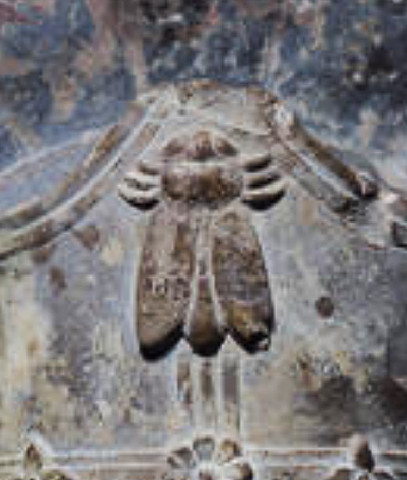
I would like to further suggest that the name Master Golden Cicada (Jinchan zi, 金蟬子) might have been chosen to serve as a pun for “child or student of Chan” (Chanzi, 禪子) (fig. 4). While the historical Xuanzang was the patriarch of the Yogacara school of Chinese Buddhism (Robert & David, 2013, pp. 1015-1016), the novel closely associates him with Chan:
The depiction of the novelistic Xuanzang surely and constantly associates him and his entourage with Chan. Revealing examples can readily be found in both narrative content and such titular couplets as “Tripitaka does not forget his origin; / The Four Sages test the Chan Mind” (chapter 2[3]); “The Child’s tricky transformations confuse the Chan Mind; / Ape, Horse, Spatula, and Wood Mother-all are lost” (chapter 40); “The Chan Lord, taking food, has demonic conception; / Yellow Dame brings water to dissolve perverse pregnancy” (chapter 53); “Rescuing Tuoluo, Chan Nature is secure; / Escaping defilement, the Mind of Dao is pure” (chapter 67); “Mind Monkey envies Wood Mother; / The demon lord plots to devour Chan” (chapter 85); and “Chan, reaching Jade-Flower, convenes an assembly; / Mind Monkey, Wood, and Earth take in disciples” (chapter 88) (Wu & Yu, 2012, vol. 1, pp. 64-65).
If true, this would mean that the cicada-like spiritual transformation is based around a pun.
Fig. 4 – The similarities in form and pronunciation of chanzi (larger version).
This seems like such an obvious connection that I wouldn’t be surprised if someone else beat me to the conclusion by decades or even centuries.
Update: 08-29-20
Art historian Jin Xu posted a picture of a 6th-century stone bodhisattva statue on twitter, and I was interested to see a cicada adorning the headdress (fig. 5 & 6). One essay about the statue suggests it was commissioned by an aristocratic layman since cicadas are known to have decorated the caps of high-ranking officials:
Another noteworthy characteristic of this superb sculpture is the cicada-shaped decoration on the front of the crown. To date, there are no other known Chinese Buddhist sculptural examples of this kind. However, cicada images can be found on gold mountain-shaped crown plaques that also are embellished with thin gold wire and granulation; these have been excavated from the tomb of Ping Sufu of the Northern Yan period (A.D. 409-436), and seated Buddha images were molded onto the back face of these crown ornaments. These excavated materials would have been made some one hundred years before the present image and suggest that there were members of the aristocracy who revered Buddhism and hid Buddha images on the backs of their crowns. This suggests the possibility that the Shumei bodhisattva, with a cicada in place of a Buddha image, was created at the request of a member of the aristocracy who revered Buddhism and believed in the philosophy that the Emperor is the living Buddha, which may have dated back to the Northern court (Standing Bodhisattva, n.d.).
The sculpture didn’t influence Tripitaka’s title as the Golden Cicada Elder. But it’s still fascinating to see a real world connection between the insect and a bodhisattva.
Fig. 5 – The Sixth-century Bodhisattva statue with a cicada decorating the crown (larger version). From Qingzhou Museum in Shandong province, China. Fig. 6 – A detail of the insect (larger version).
Update: 09-13-20
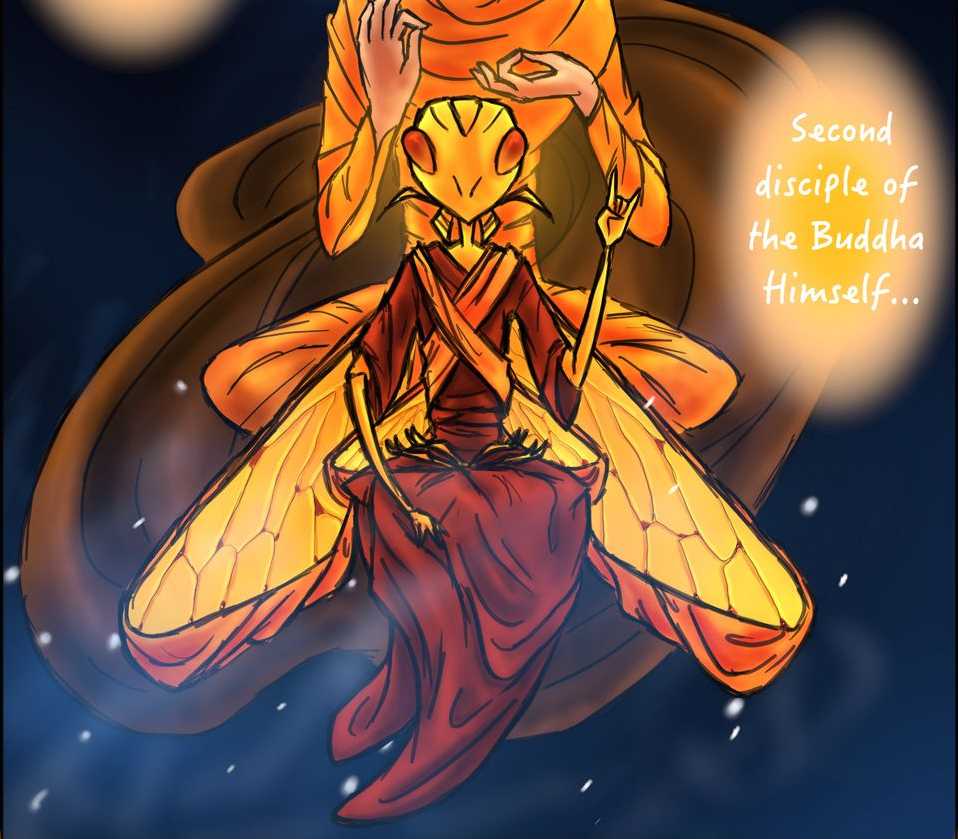
Deviantart user Taylor-Denna has drawn a beautiful depiction of Tripitaka’s former incarnation as a literal cicada (fig. 6). It is quite unique as I’ve never seen any other artist portray the former celestial in such a way. The image makes one think of an insect who acquired magic powers through spiritual cultivation and rose through the Buddho-Daoist hierarchy to become the Buddha’s disciple. The idea would make a good prequel story.
Fig. 6 – Detail of Master Golden Cicada by Taylor-Denna (larger version). Click here for the full version and the artist’s statement. Used with permission.
Update: 12-01-21
I’ve archived a book that shows how Tripitaka’s exile from heaven is similar to ancient Greek and Egyptian beliefs.
In chapter 81, Monkey alludes to his master’s past life, adding to the reason why the celestial had been exiled to Earth:
“You don’t realize that Master was the second disciple of our Buddha Tathagata, and originally he was called Elder Gold Cicada. Because he slighted the Law, he was fated to experience this great ordeal.”
“Elder Brother,” said Eight Rules, […] “Why must he endure sickness [for two days] as well?”
“You wouldn’t know about this,” replied Pilgrim. “Our old master fell asleep while listening to Buddha expounding the Law. As he slumped to one side, his left foot kicked down one grain of rice. That is why he is fated to suffer three days’ illness after he has arrived at the Region Below.”
Horrified, Eight Rules said, “The way old Hog sprays and splatters things all over when he eats, I wonder how many years of illness I’d have to go through!”
“Brother,” said Pilgrim, “you have no idea either that the Buddha is not that concerned with you and other creatures. But as people say:
Rice stalks planted in noonday sun Take root as perspiration runs. Who knows of this food from the soil Each grain requires most bitter toil?
Master still has one more day to go, but he’ll be better by tomorrow” (Wu & Yu, 2012, vol. 4, p. 82).
This points to the supreme importance of rice in an agrarian society like ancient China.
Fig. 10 – “Break the Cycle” by Countingclowns (larger version). The original can be seen here.
Update: 06-03-23
Tripitaka’s past celestial life and punishment appear to be based on information from Xuanzang’s historical life story, A Biography of the Tripitaka Master of the Great Ci’en Monastery of the Great Tang Dynasty (Datang Da Ci’ensi Sanzang Fashi zhuan, 大唐大慈恩寺三藏法師傳, 7th-century). After his death, a spirit extolls the monk’s virtues, as well as reveals the karmic result of his afterlife:
The Venerable Xuanzang alone cultivated the deeds of both blessedness and wisdom in nine lives. In every incarnation he was always learned and erudite, intelligent and eloquent, always the first and foremost in the land of Cīna in Jambudvīpa. Such were his blessed virtues also. […] Owing to the power of his good deeds, he has now been reborn in the inner court of Maitreya in the Tuṣita Heaven, where he will hear the Dharma with comprehension and understanding, and he will never again be born in the human world (Huili & Shi, 1995, p. 336).
Like Tripitaka, Xuanzang has nine prior pious past lives, and like Master Golden Cicada, he comes to live in a paradise where he can listen to a Buddha lecture on the Dharma. The novel simply changes some of the details, like Xuanzang’s final rebirth in paradise being a previous life, and instead of Maitreya, he studies under the historical Buddha.
Update: 06-04-23
Brose (2021) mentions a small temple in Taipei, Taiwan where one of Xuanzang’s avatars, the bodhisattva Nine Lotuses (Jiulian pusa, 九蓮菩薩) is worshiped. [5] What’s important for this article is that the deity’s mythos, as recounted by a temple master, alludes to the Golden Cicada’s story:
[Xuanzang], she explained, originally lived in a heavenly Buddha realm, but because his cultivation was incomplete, he was sent down to earth to perform the meritorious task of bringing Buddhist sūtras from India to China. Once his work was complete, Xuanzang was able to return to the Buddha realm, but out of compassion for the world, he left a portion of his spirit behind in the form of Nine Lotuses (Brose, 2021, pp. ix-x).
Update: 04-09-24
In chapter 27, the white bone spirit also comments on the monk’s past life and the effects of eating his flesh:
“What luck! What luck!” she said, unable to contain her delight. “For several years my relatives have been talking about a Tang Monk from the Land of the East going to fetch the Great Vehicle. He is actually the incarnation of the Gold Cicada, and he has the original body that has gone through the process of self-cultivation during ten previous existences. If a man eats a piece of his flesh, his age will be immeasurably lengthened. So, this monk has at last arrived today!” (Wu & Yu, 2012, vol. 2, 17).
Recall that the 01-14-23 update quotes the fullest description of events leading to Master Golden Cicada’s banishment from paradise: he falls asleep during a sermon and accidentally kicks something, causing a single grain of rice to fall to the ground. Well, I’m reading a biography of the Buddha and learned that his family has a connection to rice:
Sakyamuni’s father was called Suddhodana. The name means “pure rice” or “white rice.” In Chinese it is translated as Ching-fan-wang [[Jingfan wang, 淨飯王;] king of pure rice]. Legend says that the names of his four younger brothers all contained the element meaning “rice” (odana). These names suggest that the Sakyas were already cultivating rice and that they particularly valued white rice (Nakamura, 2000, vol. 1, p. 46).
This might explain the Buddha’s reaction.
Update: 01-25-25
To recap, Journey to the West casts the Tang Monk Tripitaka as the last incarnation of Master Golden Cicada (Jinchan zi, 金蟬子), the second disciple of the Buddha who is exiled from paradise for falling asleep during his master’s sermon. Chapter 81 adds a second crime: kicking something in his slumber and making a single grain of rice fall to the ground.
This leads me to the point of this post. A reader contacted me the other day asking if Sariputra (Sk: शारिपुत्र; Pali: Sariputta; Ch. Shelifu, 舍利弗), one of the Buddha’s ten primary disciples, was the basis for Master Golden Cicada since he was known for having a golden glow about him. A cursory search didn’t turn up anything connecting them, but thanks to the reader’s prompt, I kept digging and was interested to learn that another disciple of Tathagata, Aniruddha (Sk: अनुरुद्ध; Pali: Anuruddha; Ch: Analu, 阿那律) (fig. 11), was known to have fallen asleep during the Enlightened One’s lessons.
According to monk Jiaoguang’s (交光, fl. 1600) Dafo Dingshou Lengyan Jing Zhengmai Shuxu (大佛頂首楞嚴經正脉疏序, T. 275):
Analu [Aniruddha] then stood up, bowed at the Buddha’s feet, and said to him respectfully …
[Commentary:] Changshui [6] says: Nalu, namely Anouloutuo, which means “free of poverty,” was a Rice Prince. He gave a meal to a Solitary Buddha in a past life and enjoyed happiness for 91 kalpas.
… “When I first entered the monastic life, I was too fond of sleep. The Thus-Come One admonished me, saying that I was no better than an animal. After the Buddha scolded me, I rebuked myself and wept. For seven days I did not sleep, and as a result I went blind in both eyes.”
[Commentary:] Gushan [7] says: According to the Ekottara Agama, the Buddha was preaching the Law in Jetavana when Nalu fell asleep. The Buddha spoke in verse: “Tut-tut … Why are you sleeping? River snails, mussels, clams and the like sleep for a thousand years, never hearing the names of Buddhas.” Thereupon, Nalu made it known that he would never sleep again, and he soon lost his sight. [8]
The term “Rice Prince” (Bifan wangzi, 白飯王子) refers to the fact that Aniruddha was the cousin of the Buddha and a fellow grandson of King Sihahanu, whose sons, including the Buddha’s father (as mentioned above), all had the suffix odana (“rice”) as part of their names. Aniruddha’s father was Amitodana (“Unmeasured Rice”) (Nakamura, 2000, vol. 1, p. 46; Harvey, 2013, p. 117; Thomas, 1931/2013, p. 24).
Therefore, we have a Buddhist disciple who dozes off during the Buddha’s sermon and has an association with rice. This makes Aniruddha the best possible influence for Master Golden Cicada that I’ve seen. The story goes back to at least the 4th-century Zengyi ahan jingxu (增壹阿含經序, T. 125), so it would have been around long enough to eventually influence Journey to the West.
I need to point out, however, that I’m not the first person to write about this. While I was finishing typing this update, I came across this article, which mentions Aniruddha in passing. But to my credit, I actually cited the historical Buddhist literature involved.
Fig. 11 – A colored relief of the Buddha helping his blind disciple sew a new robe (larger version). Image found here.
Update: 02-13-25
I just thought of a way to work Aniruddha into JTTW lore: In chapter eight of the Lotus Sutra (Miaofa lianhua jing, 妙法蓮華經; a.k.a. Fahua jing, 法華經, c. 3rd-century), the Buddha mentions our tired friend among a list of 500 Arhats who will attain perfect enlightenment and share the same holy title:
In our headcanon, Master Golden Cicada could be the celestial title of the Arhat Aniruddha, but his sleeping episode instead takes place in heaven. In addition, “Universal Brightness” (Puming, 普明) could just be a classification of Buddha, thus allowing for his Tripitaka avatar to receive the individualized title “Buddha of Candana Merit” (Zhantan gongde fo, 旃檀功德佛) at the end of his quest.
Update: 02-19-25
Something just dawned on: although I’ve always considered Master Golden Cicada to be a bodhisattva, the novel never specifically calls him that. So what is his actual spiritual rank then? Several pieces of Information point to him being an Arhat.
First, recall that the introduction to this article reads:
The cleric [Xuanzang] eventually gained his own supernatural background, for evidence shows that he was worshiped as an Arhat (Luohan, 羅漢; Zunzhe, 尊者), a Buddhist saint, by the Song Dynasty (960-1127 CE) (Liu, 2019). A Yuan-Ming zaju stage production plays on this concept by depicting Tripitaka as the reincarnation of the Arhat Vairocana (Pulujia zunzhe, 毗廬伽尊者) (Dudbridge, 1970, p. 193).
This shows that the Tang Monk was already closely associated with Arhats in the past. Second, something I learned but forgot to mention here is that Tripitaka Seeks the Scriptures (Sanzang qujing, 三藏取經), a rare Yuan-Ming puppet play that predates the 1592 JTTW, even refers to the cleric’s past life as the “Golden Chan Arhat” (Jinchan luohan, 金禪羅漢). (This implies that chan (蟬, “cicada”) was based on the Chan (禪) of Chan Buddhism, thereby supporting my suggestion from the 12-08-18 update.) Third, as mentioned above, Golden Cicada was likely based on the Arhat Aniruddha, one of the Buddha’s ten principal disciples, who was reprimanded by his master for dozing off during a lesson. And fourth, the Arhats Ananda (A’nuo, 阿儺) and Kasyapa (Jiaye, 伽葉), two other principle Buddha disciples, also appear among the Enlightened One’s heavenly retinue in JTTW (chapters 7, 8, 77, 98, 99, & 100). Therefore, taken together, this info is a strong indication that the novel’s author-compiler intended Golden Cicada to be an Arhat.
Because of this, I’ve updated the article by removing any previous references to him as a bodhisattva.
Update: 02-21-25
I posted a summary of my last update to Twitter, and a follower commented that Golden Cicada wouldn’t have been able to reincarnate like bodhisattvas if he was really an Arhat. This is based on Buddhist belief. For instance, Buswell and Lopez (2014) briefly explain: [T]he arhat is one who has attained nirvāṇa in this life, and at death attains final liberation ([parinirvāṇa]) and will never again be subject to rebirth” (p. 62). But I reminded them that JTTW is not an accurate snapshot of mainstream beliefs by pointing to two instances from past media (mentioned above) where Tripitaka is the reincarnation of an Arhat. Here, I translate the pertinent sections.
I. The Yuan-Ming JTTW zaju play
Guanyin reveals the monk’s divine origins in act one:
At present, the Western Land of India has the “Golden Scriptures of the Great Repository” in 5,480 volumes. We desire to transmit them to the Eastern Lands (i.e. China), but how can we help propagate them if we don’t have the illusory, corporal body of a genuine person? Currently, the various Buddhas are discussing what to do, and they have decided that the Arhat Vairocana of the Western Heaven will be reborn (tuohua, 托化) as a son to Chen Guangrui’s family in Hongnong County, Haizhou, China. When he grows up, he will leave the family to become a monk and travel to the Western Heaven to retrieve scriptures. He will (later) spread the teachings.
You can see here that there are no negative reasons for his reincarnation. This differs from the next source.
II. The Yuan-Ming JTTW puppet play
Tripitaka describes being born (chushi, 出世) to father Chen Guangrui and a beautiful, nameless mother in scene one (see page 1 of this PDF). His celestial origin is later revealed by “Equaling Heaven” (Qitian, 齊天; i.e. Monkey) in scene six:
The Golden Chan Arhat descended to earth (jiangshi, 降世) because he privately went to the lantern fruit festival without reporting this to the temple sangha, causing the Buddha to punish him to 36 tribulations, including journeying to the Western Heaven to acquire scriptures. After suffering over countless days, he finally returned to the right fruit (i.e. achieved enlightenment).
… 金禪羅漢降世,因私赴燈果會,不報寺中眾僧,佛罰伊過三十六劫,往西天取經。苦難滿日,修歸正果。(see page 9 of this PDF)
Having read the above, I think Master Golden Cicada’s Arhatship is now fully established as fact within the JTTW story cycle.
Update: 08-03-25
The notion that Arhats fall asleep is exemplified by the “Dreaming/Sleeping Arhat Fist” (Shuimeng luohan quan, 睡梦罗汉拳) from the 1992 HK film King of Beggars (Wu zhuangyuan Su qi’er, 武状元苏乞儿; lit: “Top Martial Scholar: Beggar Su”; video 1).
Video #1 – The scene where Beggar Su displays his new-found boxing abilities.
2) This heavenly aura is also mentioned by Sun Wukong later in chapter 80 (Wu & Yu, 2012, vol. 4, p. 66).
3) The turtle had previously helped the pilgrims cross the same river in chapter 34, and in return they agreed to ask the Buddha when the terrapin would be allowed to achieve human form (for all creatures strive for such an attainment). But Tripitaka forgot to ask the Enlightenment One while visiting the Western paradise, so the turtle dumped them into the river upon their return.
4) The six-six senses (liuliu chen, 六六塵) are “the intensified form of the six gunas, the six impure qualities engendered by the objects and organs of sense: sight, sound, smell, taste, touch and idea” (Wu & Yu, 2012, vol. 4, p. 405 n. 7).
5) Brose (2021), however, explains that this goddess “is usually identified as the divinized form of a Ming Dynasty empress dowager” (p. ix).
6) The monk Changshui (長水), a.k.a. Zixuan (子璿; 965-1038), was the compiler of the Shou lengyan yanyi shu zhu jing (首楞嚴義疏注經, T. 1799) (Sorenson, 2011, p. 39).
7) Gushan (孤山), a.k.a. Zhiyuan (智圓; 976-1022), wrote a commentary for the Shou lengyan jing shu (首楞嚴經疏) (McBride, 2016, pp. 144-145 n. 238).
8) The translation of the commentary is mine, while the rest comes from Buddhist Text Translation Society & Hsuan (2012, p. 210).
Sources:
Brose, B. (2021). Xuanzang: China’s Legendary Pilgrim and Translator. Boulder, Colorado: Shambhala Publications, Inc.
Buddhist Text Translation Society & Hsuan, H. (2012). The Surangama Sutra: A New Translation with Excerpts from the Commentary by the Venerable Master Hsuan Hua. (n.p.): Buddhist Text Translation Society.
Buswell, R. E. , & Lopez, D. S. (2014). The Princeton Dictionary of Buddhism. Princeton University Press.
Harvey, P. (2013). Buddha, Family Of. In C. S. Prebish & D. Keown (Eds.), Encyclopedia of Buddhism (pp. 117-121). United Kingdom: Taylor & Francis.
Huili, & Shi, Y. (1995). A Biography of the Tripitaka Master of the Great Ci’en Monastery of the Great Tang Dynasty (L. Rongxi Trans.). Berkeley, CA: Numata Center for Buddhist Translation and Research.
Liu, S. (2019). Songdai Xuanzang de shenghua: Tuxiang, wenwu he yiji [The Sanctification of Xuanzang in the Song Dynasty: Images, Artifacts and Remains]. Zhonghua wenshi luncong, 133, 161-219.
McBride, R. D. (2016). Doctrine and Practice in Medieval Korean Buddhism: The Collected Works of Ŭich’ŏn. Germany: University of Hawaii Press.
Munsterberg, H. (1972). The Arts of China. Rutland, Vt: C.E. Tuttle Co.
Sorenson, H. H. (2011). Textual Material Relating to Esoteric Buddhism in China Outside the Taisho, vol. 18-21. In C. D. Orzech, H. H. Sorensen, & R. K. Payne (Eds.), Esoteric Buddhism and the Tantras in East Asia (pp. 37-70). Netherlands: Brill.